Are you free?
Freedom & Determinism
Sobia Anwer
Lecture 9
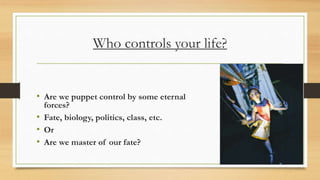
Who controls your life?
• Are we puppet control by some eternal
forces?
• Fate, biology, politics, class, etc.
• Or
• Are we master of our fate?
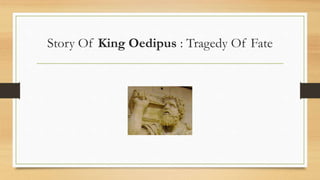
Story Of King Oedipus : Tragedy Of Fate
Freedom Of Will
• Whether human beings are fundamentally free to choose
their actions and mold their lives or they are hard
determined (controlled/ caused) by forces beyond their
control, be they fate, biology, social structure, unconscious
mind etc.
Difference Between Freedom Of Action
And Freedom Of Will
• Freedom of action equates with external freedom
• Freedom of will/choice equates with internal freedom
Libertarianism
• Is also called Indeterminism
• Principle of alternate possibility: An agent is responsible for an
action only if he/she could have done otherwise
Libertarianism/ Indeterminism
• A theory which claims, in opposition to determinism, that some events just
happen without determining causes and that no prior conditions account for
them. Such events can be characterized in terms of chance, randomness, or
uncertainty.
• According to quantum mechanics, quantum events at the most fundamental
level of reality are of this kind.
• The contrast between indeterminism and determinism reflects a difference in
the world views held by quantum mechanics and Newtonian physics.
7
Determinism
• Human actions are determined/ decided/ controlled by external factor
not by him/her.
i. Theological Determinism(Fatalism) : Destiny determines our life
ii. Causal Determinism/ : All events in the world are result of previous
events. Every event in the universe, including every human action,
has its natural explanatory causes; given certain earlier conditions,
then an event will take place necessarily according to the laws of
nature
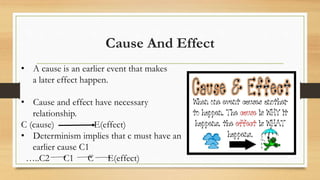
Cause And Effect
• A cause is an earlier event that makes
a later effect happen.
• Cause and effect have necessary
relationship.
C (cause) E(effect)
• Determinism implies that c must have an
earlier cause C1
…..C2 C1 C E(effect)
Determinism’s Argument
• Every event has its explanatory cause.
• Every human choice or action is an event.
• Therefore, every human choice or action has its explanatory cause.
Then, by a second syllogism:
• Every human choice or action has its explanatory cause.
• To have explanatory causes is not to be free.
• Therefore, no human choice or action is free.
Incompatibilism (Hard Determinism)
• Incompatibilism, also called hard determinism, holds that determinism and
free will are not compatible and that the truth of determinism will destroy
the grounds of moral responsibility.
• Hard determinism (associated with eighteenth century thinkers like
d’Holbach and, recently, certain behaviorists), according to which freedom is
an illusion since behavior is brought about by environmental and genetic
factors.
11
Brainstorming
• Were you really free to choose to attend the university today or
not?
• Did you decide to wear the dress you are wearing? Was it you free
choice?
• Could you choose something else to where if you wanted so?
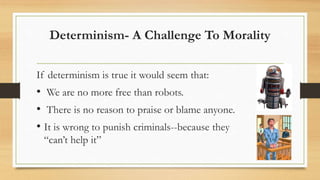
Determinism- A Challenge To Morality
If determinism is true it would seem that:
• We are no more free than robots.
• There is no reason to praise or blame anyone.
• It is wrong to punish criminals--because they
“can’t help it”
Compatibilism (Soft Determinism)
• Also called soft determinism, a position that holds that determinism and free will
are compatible.
• Soft determinism, Its supporters include some who identify freedom with autonomy
(the Stoics, Spinoza) and others who champion freedom of spontaneity (Hobbes,
Locke, Hume & Mill). The latter speak of liberty as the power of doing or
refraining from an action according to what one wills, so that by choosing otherwise
one would have done otherwise.
• Hence human actions can be caused, but still be free. Free actions are not uncaused
actions, but are actions that are closely linked with an agent’s inner causation
through one’s own beliefs and desires.
14
Compatibilism (Soft Determinism)
• On this view, I did X freely means that if I had wanted to I could have done
otherwise and that I did X as a result of my own desire and deliberation rather than
as a result of being compelled and coerced.
• Accordingly, the study of human beings can yield some predictability within the
terms of an inexact science, although complete accuracy is not possible.
• Freedom is in contrast with coercion or constraint, rather than with having a cause.
• My action is causally determined does not entail that I am constrained to do it and
does not entail that I am not free.
15
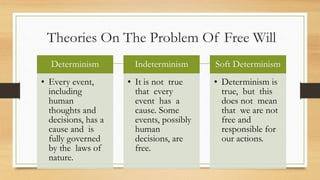
Theories On The Problem Of Free Will
Determinism
• Every event,
including
human
thoughts and
decisions, has a
cause and is
fully governed
by the laws of
nature.
Indeterminism
• It is not true
that every
event has a
cause. Some
events, possibly
human
decisions, are
free.
Soft Determinism
• Determinism is
true, but this
does not mean
that we are not
free and
responsible for
our actions.

freedom and determinism

  • 1.
    Are you free? Freedom& Determinism Sobia Anwer Lecture 9
  • 2.
    Who controls yourlife? • Are we puppet control by some eternal forces? • Fate, biology, politics, class, etc. • Or • Are we master of our fate?
  • 3.
    Story Of KingOedipus : Tragedy Of Fate
  • 4.
    Freedom Of Will •Whether human beings are fundamentally free to choose their actions and mold their lives or they are hard determined (controlled/ caused) by forces beyond their control, be they fate, biology, social structure, unconscious mind etc.
  • 5.
    Difference Between FreedomOf Action And Freedom Of Will • Freedom of action equates with external freedom • Freedom of will/choice equates with internal freedom
  • 6.
    Libertarianism • Is alsocalled Indeterminism • Principle of alternate possibility: An agent is responsible for an action only if he/she could have done otherwise
  • 7.
    Libertarianism/ Indeterminism • Atheory which claims, in opposition to determinism, that some events just happen without determining causes and that no prior conditions account for them. Such events can be characterized in terms of chance, randomness, or uncertainty. • According to quantum mechanics, quantum events at the most fundamental level of reality are of this kind. • The contrast between indeterminism and determinism reflects a difference in the world views held by quantum mechanics and Newtonian physics. 7
  • 8.
    Determinism • Human actionsare determined/ decided/ controlled by external factor not by him/her. i. Theological Determinism(Fatalism) : Destiny determines our life ii. Causal Determinism/ : All events in the world are result of previous events. Every event in the universe, including every human action, has its natural explanatory causes; given certain earlier conditions, then an event will take place necessarily according to the laws of nature
  • 9.
    Cause And Effect •A cause is an earlier event that makes a later effect happen. • Cause and effect have necessary relationship. C (cause) E(effect) • Determinism implies that c must have an earlier cause C1 …..C2 C1 C E(effect)
  • 10.
    Determinism’s Argument • Everyevent has its explanatory cause. • Every human choice or action is an event. • Therefore, every human choice or action has its explanatory cause. Then, by a second syllogism: • Every human choice or action has its explanatory cause. • To have explanatory causes is not to be free. • Therefore, no human choice or action is free.
  • 11.
    Incompatibilism (Hard Determinism) •Incompatibilism, also called hard determinism, holds that determinism and free will are not compatible and that the truth of determinism will destroy the grounds of moral responsibility. • Hard determinism (associated with eighteenth century thinkers like d’Holbach and, recently, certain behaviorists), according to which freedom is an illusion since behavior is brought about by environmental and genetic factors. 11
  • 12.
    Brainstorming • Were youreally free to choose to attend the university today or not? • Did you decide to wear the dress you are wearing? Was it you free choice? • Could you choose something else to where if you wanted so?
  • 13.
    Determinism- A ChallengeTo Morality If determinism is true it would seem that: • We are no more free than robots. • There is no reason to praise or blame anyone. • It is wrong to punish criminals--because they “can’t help it”
  • 14.
    Compatibilism (Soft Determinism) •Also called soft determinism, a position that holds that determinism and free will are compatible. • Soft determinism, Its supporters include some who identify freedom with autonomy (the Stoics, Spinoza) and others who champion freedom of spontaneity (Hobbes, Locke, Hume & Mill). The latter speak of liberty as the power of doing or refraining from an action according to what one wills, so that by choosing otherwise one would have done otherwise. • Hence human actions can be caused, but still be free. Free actions are not uncaused actions, but are actions that are closely linked with an agent’s inner causation through one’s own beliefs and desires. 14
  • 15.
    Compatibilism (Soft Determinism) •On this view, I did X freely means that if I had wanted to I could have done otherwise and that I did X as a result of my own desire and deliberation rather than as a result of being compelled and coerced. • Accordingly, the study of human beings can yield some predictability within the terms of an inexact science, although complete accuracy is not possible. • Freedom is in contrast with coercion or constraint, rather than with having a cause. • My action is causally determined does not entail that I am constrained to do it and does not entail that I am not free. 15
  • 16.
    Theories On TheProblem Of Free Will Determinism • Every event, including human thoughts and decisions, has a cause and is fully governed by the laws of nature. Indeterminism • It is not true that every event has a cause. Some events, possibly human decisions, are free. Soft Determinism • Determinism is true, but this does not mean that we are not free and responsible for our actions.