Discourse
Communities
Discourse
Communities

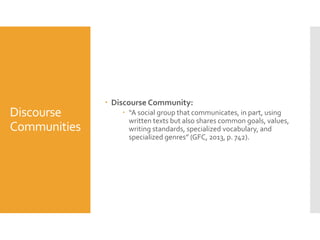
 Discourse Community:
 “A social group that communicates, in part, using
written texts but also shares common goals, values,
writing standards, specialized vocabulary, and
specialized genres” (GFC, 2013, p. 742).
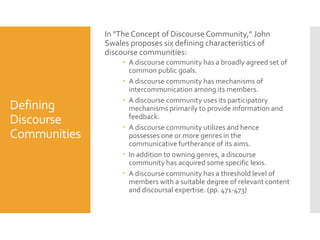
In "The Concept of Discourse Community," John
Swales proposes six defining characteristics of
discourse communities:

Defining
Discourse
Communities

 A discourse community has a broadly agreed set of
common public goals.
 A discourse community has mechanisms of
intercommunication among its members.
 A discourse community uses its participatory
mechanisms primarily to provide information and
feedback.
 A discourse community utilizes and hence
possesses one or more genres in the
communicative furtherance of its aims.
 In addition to owning genres, a discourse
community has acquired some specific lexis.
 A discourse community has a threshold level of
members with a suitable degree of relevant content
and discoursal expertise. (pp. 471-473)
 Conventions:

Conventions

 “The traditional, commonly
understood, unspoken, or official guidelines or rules
of communication or behavior in discourse
communities” (GFC, 2013, p. 742).

 Conventions can include rules governing language.
 Genres:

Genres

 “Different kinds or categories of writing,
composition, or production” (GFC, 2013, p. 742)

 In this class, genre does not mean fantasy, sci-fi,
horror, etc.
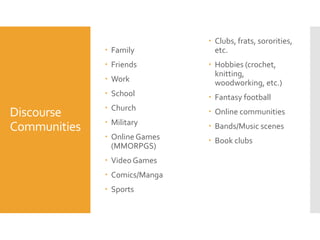
 Family
 Friends

 Clubs, frats, sororities,
etc.

 Work
 School

Discourse
Communities

 Hobbies (crochet,
knitting,
woodworking, etc.)
 Fantasy football

 Church

 Online communities

 Military

 Bands/Music scenes

 Online Games
(MMORPGS)

 Book clubs

 Video Games
 Comics/Manga
 Sports
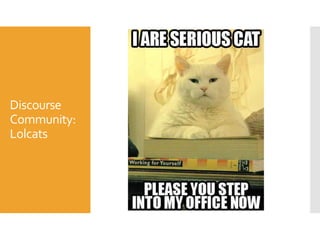
Discourse
Community:
Lolcats
The
Discourse
Community
Map &
Response

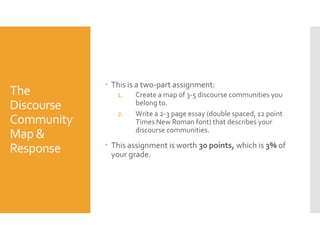
 This is a two-part assignment:
1.
2.

Create a map of 3-5 discourse communities you
belong to.
Write a 2-3 page essay (double spaced, 12 point
Times New Roman font) that describes your
discourse communities.

 This assignment is worth 30 points, which is 3% of
your grade.
 Prezi.com

Resources for
Creating Your
Map

 easel.ly
 bubbl.us
 Microsoft Word (or openoffice)
 Microsoft Powerpoint
 Turn in your map and response on Blackboard
through the Week 3 learning module by midnight
on Monday, February 3rd.

To Turn in
Your DC Map
and
Response

 After clicking “Assignment: Turn in DC Map and
Response Here,” click “Browse My Computer” and
select the file for your response. Make sure to save
your response as a .doc or .docx (please no .pages!)
and to include your last name and first initial in the
document name.
 Click “Type Submission” and paste the url for your
map. Make sure your map is publically viewable.
You can also post your map as a separate document
if it is not online.

Discourse Communities

  • 1.
  • 2.
    Discourse Communities  Discourse Community: “A social group that communicates, in part, using written texts but also shares common goals, values, writing standards, specialized vocabulary, and specialized genres” (GFC, 2013, p. 742).
  • 3.
    In "The Conceptof Discourse Community," John Swales proposes six defining characteristics of discourse communities: Defining Discourse Communities  A discourse community has a broadly agreed set of common public goals.  A discourse community has mechanisms of intercommunication among its members.  A discourse community uses its participatory mechanisms primarily to provide information and feedback.  A discourse community utilizes and hence possesses one or more genres in the communicative furtherance of its aims.  In addition to owning genres, a discourse community has acquired some specific lexis.  A discourse community has a threshold level of members with a suitable degree of relevant content and discoursal expertise. (pp. 471-473)
  • 4.
     Conventions: Conventions  “Thetraditional, commonly understood, unspoken, or official guidelines or rules of communication or behavior in discourse communities” (GFC, 2013, p. 742).  Conventions can include rules governing language.
  • 5.
     Genres: Genres  “Differentkinds or categories of writing, composition, or production” (GFC, 2013, p. 742)  In this class, genre does not mean fantasy, sci-fi, horror, etc.
  • 6.
     Family  Friends Clubs, frats, sororities, etc.  Work  School Discourse Communities  Hobbies (crochet, knitting, woodworking, etc.)  Fantasy football  Church  Online communities  Military  Bands/Music scenes  Online Games (MMORPGS)  Book clubs  Video Games  Comics/Manga  Sports
  • 7.
  • 8.
    The Discourse Community Map & Response  Thisis a two-part assignment: 1. 2. Create a map of 3-5 discourse communities you belong to. Write a 2-3 page essay (double spaced, 12 point Times New Roman font) that describes your discourse communities.  This assignment is worth 30 points, which is 3% of your grade.
  • 9.
     Prezi.com Resources for CreatingYour Map  easel.ly  bubbl.us  Microsoft Word (or openoffice)  Microsoft Powerpoint
  • 10.
     Turn inyour map and response on Blackboard through the Week 3 learning module by midnight on Monday, February 3rd. To Turn in Your DC Map and Response  After clicking “Assignment: Turn in DC Map and Response Here,” click “Browse My Computer” and select the file for your response. Make sure to save your response as a .doc or .docx (please no .pages!) and to include your last name and first initial in the document name.  Click “Type Submission” and paste the url for your map. Make sure your map is publically viewable. You can also post your map as a separate document if it is not online.