Hans Bellmer
Hans Bellmer
• Hans Bellmer was born in Kattowitz in 1902. At
his father's insistence, he worked in a steel
factory and a coal mine after finishing the
examinations qualifying for university
admittance. Nevertheless, Bellmer managed to
do some art work and exhibit it in Poland in
1922/23. The work led to his arrest.
While studying engineering at Berlin Polytechnic,
Hans Bellmer met John Heartfield, Rudolf
Schlichter and George Grosz. In 1924 Bellmer
dropped out of engineering, worked as a book
printer and then as an illustrator for Malik Verlag.
Hans Bellmer
• That winter Bellmer took his first trip to Paris. After his
marriage in 1927, Hans Bellmer worked as a
commercial artist, attended lectures at the Bauhaus in
the early 1930s and travelled to Italy and Tunisia. He
refused to continue working as a sign of resistance to
Fascism in 1933. To show his repudiation of Fascism
and the aesthetic it propagated, Hans Bellmer began to
construct girlish three-dimensional dolls, which he
photographed in erotic poses. Some of these works
were published by Bellmer at his own expense in 1934,
others appeared in the Surrealist journal "Le
Minotaure", ensuring Bellmer important ranking
among Paris Surrealists.
Hans Bellmer
• In 1938 Hans Bellmer emigrated to Paris and was interned
with Max Ernst on the outbreak of the second world war in
the "Les Mille" camp near Aix-en-Provence. On being
discharged from the camp, Bellmer renounced German
nationality in 1941 and fled to Castres, where he married
his second wife that same year.
During the war years Hans Bellmer did drawings,
developing an increasingly distinctive figurative style after
initial essays in abstraction. In 1943 Bellmer had his first
one-man show at the "Librairie Trentin", a bookshop in
Toulouse. It was followed by numerous international
Surrealist group shows.
Hans Bellmer
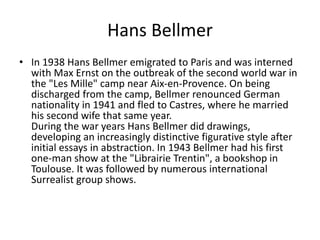
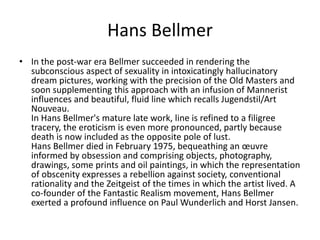
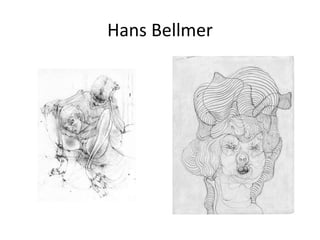
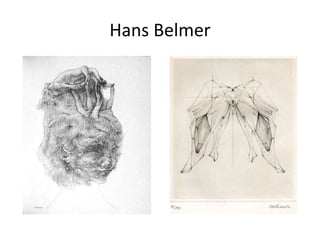
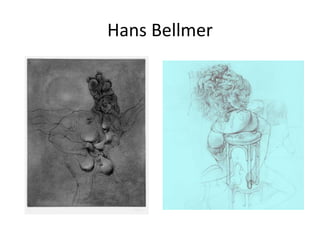
• In the post-war era Bellmer succeeded in rendering the
subconscious aspect of sexuality in intoxicatingly hallucinatory
dream pictures, working with the precision of the Old Masters and
soon supplementing this approach with an infusion of Mannerist
influences and beautiful, fluid line which recalls Jugendstil/Art
Nouveau.
In Hans Bellmer's mature late work, line is refined to a filigree
tracery, the eroticism is even more pronounced, partly because
death is now included as the opposite pole of lust.
Hans Bellmer died in February 1975, bequeathing an œuvre
informed by obsession and comprising objects, photography,
drawings, some prints and oil paintings, in which the representation
of obscenity expresses a rebellion against society, conventional
rationality and the Zeitgeist of the times in which the artist lived. A
co-founder of the Fantastic Realism movement, Hans Bellmer
exerted a profound influence on Paul Wunderlich and Horst Jansen.
Hans Bellmer
Hans Bellmer
Hans Bellmer
Hans Belmer
Hans Bellmer

Hans belmer powerpoint

  • 1.
  • 3.
    Hans Bellmer • HansBellmer was born in Kattowitz in 1902. At his father's insistence, he worked in a steel factory and a coal mine after finishing the examinations qualifying for university admittance. Nevertheless, Bellmer managed to do some art work and exhibit it in Poland in 1922/23. The work led to his arrest. While studying engineering at Berlin Polytechnic, Hans Bellmer met John Heartfield, Rudolf Schlichter and George Grosz. In 1924 Bellmer dropped out of engineering, worked as a book printer and then as an illustrator for Malik Verlag.
  • 4.
    Hans Bellmer • Thatwinter Bellmer took his first trip to Paris. After his marriage in 1927, Hans Bellmer worked as a commercial artist, attended lectures at the Bauhaus in the early 1930s and travelled to Italy and Tunisia. He refused to continue working as a sign of resistance to Fascism in 1933. To show his repudiation of Fascism and the aesthetic it propagated, Hans Bellmer began to construct girlish three-dimensional dolls, which he photographed in erotic poses. Some of these works were published by Bellmer at his own expense in 1934, others appeared in the Surrealist journal "Le Minotaure", ensuring Bellmer important ranking among Paris Surrealists.
  • 5.
    Hans Bellmer • In1938 Hans Bellmer emigrated to Paris and was interned with Max Ernst on the outbreak of the second world war in the "Les Mille" camp near Aix-en-Provence. On being discharged from the camp, Bellmer renounced German nationality in 1941 and fled to Castres, where he married his second wife that same year. During the war years Hans Bellmer did drawings, developing an increasingly distinctive figurative style after initial essays in abstraction. In 1943 Bellmer had his first one-man show at the "Librairie Trentin", a bookshop in Toulouse. It was followed by numerous international Surrealist group shows.
  • 6.
    Hans Bellmer • Inthe post-war era Bellmer succeeded in rendering the subconscious aspect of sexuality in intoxicatingly hallucinatory dream pictures, working with the precision of the Old Masters and soon supplementing this approach with an infusion of Mannerist influences and beautiful, fluid line which recalls Jugendstil/Art Nouveau. In Hans Bellmer's mature late work, line is refined to a filigree tracery, the eroticism is even more pronounced, partly because death is now included as the opposite pole of lust. Hans Bellmer died in February 1975, bequeathing an œuvre informed by obsession and comprising objects, photography, drawings, some prints and oil paintings, in which the representation of obscenity expresses a rebellion against society, conventional rationality and the Zeitgeist of the times in which the artist lived. A co-founder of the Fantastic Realism movement, Hans Bellmer exerted a profound influence on Paul Wunderlich and Horst Jansen.
  • 7.
  • 8.
  • 9.
  • 10.
  • 11.