Presented By:
Chad Schildt
CONNECTION 1: THE CORPORATE TAKEOVER
•   In order to market education and compete in a global market, education
    has undergone a major shift.
•   “The expansion of higher education in Britain and Northern Ireland
    during this period, for instance, involved a the restructuring of courses
    and programmes so that they could be marketed. This included
    marketing new courses such as MBAs, modulization (to achieve
    economies of scale), and the increased use of part-time and distance
    learning programmes (to target those already in work). The introduction
    of student loans and course fees has raised, significantly, the direct cost
    placed upon students - and helped to change people's orientation to
    higher education away from that of participants towards being
    consumers. “ (Smith, 2002, para. 6)
•   The increase in costs to target the changing, global populations has
    made education more business like, thus inducing a “corporate
    takeover”


                                Connection: Challenge
CONNECTION 1: THE CORPORATE TAKEOVER
•   This is the most important connection overall because ultimately, not all
    students (consumers) are the same.
•   Students individual needs must be taken into consideration and a
    business-like approach may not be the best fit for education.


                                Connection: Challenge
CONNECTION 2: THE GOVERNING OF EDUCATION
•   There has been a drastic shift in standardizing national educational
    policies, rather than leaving education to states
•   In order to promote social and economic standing, educational policy
    has incorporated more politics than ever
•   “In other words, the impact of globalization is less about the direct way
    in which specific policy choices are made, as the shaping and reshaping
    of social relations within all countries” (Smith, 2002, para. 11)
•   This is the second most important because national standards could
    complete change the way education is carried out.


                               Connection: Issue
CONNECTION 3: CHANGING TECHNOLOGIES
•   As a result of the need to compete on a global level, the use of
    technology has increased in schools.
•   More and more schools and incorporating new technologies, hoping to
    expose children to a wealth of resources, preparing them for a more
    global, technologically advanced world.
•   This is the third most important connection because the increase in
    technology will continue to shape how we teach and provide instruction.


                                Connection: Trend
CONNECTION 4: BRANDING SCHOOLS
•   With the increase in the use of technology, and the wide reach of the
    internet, schools have become more focused on branding.
•   Many schools and school districts have embraced social media to get
    their school (and brand) more attention, thus increasing visibility.
•   Branding can be important, particularly for schools who must recruit
    students from other schools in the area.
•   This is the fourth most important connection because while it is
    necessary for some schools, it is not necessary for all.


                               Connection: Trend
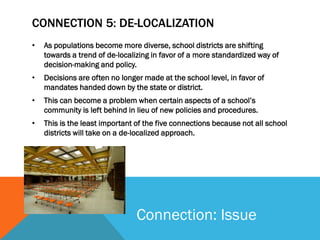
CONNECTION 5: DE-LOCALIZATION
•   As populations become more diverse, school districts are shifting
    towards a trend of de-localizing in favor of a more standardized way of
    decision-making and policy.
•   Decisions are often no longer made at the school level, in favor of
    mandates handed down by the state or district.
•   This can become a problem when certain aspects of a school’s
    community is left behind in lieu of new policies and procedures.
•   This is the least important of the five connections because not all school
    districts will take on a de-localized approach.


                                Connection: Issue
REFERENCE
Smith, M. K. (2002) 'Globalization and the incorporation of education' the
  encyclopedia of informal education,
  www.infed.org/biblio/globalization.htm.

Globalization and education

  • 1.
  • 2.
    CONNECTION 1: THECORPORATE TAKEOVER • In order to market education and compete in a global market, education has undergone a major shift. • “The expansion of higher education in Britain and Northern Ireland during this period, for instance, involved a the restructuring of courses and programmes so that they could be marketed. This included marketing new courses such as MBAs, modulization (to achieve economies of scale), and the increased use of part-time and distance learning programmes (to target those already in work). The introduction of student loans and course fees has raised, significantly, the direct cost placed upon students - and helped to change people's orientation to higher education away from that of participants towards being consumers. “ (Smith, 2002, para. 6) • The increase in costs to target the changing, global populations has made education more business like, thus inducing a “corporate takeover” Connection: Challenge
  • 3.
    CONNECTION 1: THECORPORATE TAKEOVER • This is the most important connection overall because ultimately, not all students (consumers) are the same. • Students individual needs must be taken into consideration and a business-like approach may not be the best fit for education. Connection: Challenge
  • 4.
    CONNECTION 2: THEGOVERNING OF EDUCATION • There has been a drastic shift in standardizing national educational policies, rather than leaving education to states • In order to promote social and economic standing, educational policy has incorporated more politics than ever • “In other words, the impact of globalization is less about the direct way in which specific policy choices are made, as the shaping and reshaping of social relations within all countries” (Smith, 2002, para. 11) • This is the second most important because national standards could complete change the way education is carried out. Connection: Issue
  • 5.
    CONNECTION 3: CHANGINGTECHNOLOGIES • As a result of the need to compete on a global level, the use of technology has increased in schools. • More and more schools and incorporating new technologies, hoping to expose children to a wealth of resources, preparing them for a more global, technologically advanced world. • This is the third most important connection because the increase in technology will continue to shape how we teach and provide instruction. Connection: Trend
  • 6.
    CONNECTION 4: BRANDINGSCHOOLS • With the increase in the use of technology, and the wide reach of the internet, schools have become more focused on branding. • Many schools and school districts have embraced social media to get their school (and brand) more attention, thus increasing visibility. • Branding can be important, particularly for schools who must recruit students from other schools in the area. • This is the fourth most important connection because while it is necessary for some schools, it is not necessary for all. Connection: Trend
  • 7.
    CONNECTION 5: DE-LOCALIZATION • As populations become more diverse, school districts are shifting towards a trend of de-localizing in favor of a more standardized way of decision-making and policy. • Decisions are often no longer made at the school level, in favor of mandates handed down by the state or district. • This can become a problem when certain aspects of a school’s community is left behind in lieu of new policies and procedures. • This is the least important of the five connections because not all school districts will take on a de-localized approach. Connection: Issue
  • 8.
    REFERENCE Smith, M. K.(2002) 'Globalization and the incorporation of education' the encyclopedia of informal education, www.infed.org/biblio/globalization.htm.