Constructivist Lesson Plan

Teacher: Yang Yang Li                                           Date: 25 February 2013

Subject: Math                                                    Grade: 4

Content to teach:

Identifying Prime Numbers

Web 2.0 technology use for this lesson:

Slide share, is a free media website that you can upload your video and presentation
there.

How to use it?

Sign up for an account first, and then you upload your presentation for free.

How the Web 2.0 tool is supporting constructivist learning?

Web 2.0 tool help supporting constructivist learning by

    1) Providing highly active participation
    2) Help expand the classroom more virtual than tradition classroom
    3) Allow students to work together to share their ideas.

Introduction:

In today’s lesson I will cover how to identifying prime numbers. First I will ask few
questions that is relates to our topic- prime numbers, then let student divided into
a small interact groups to work each other with those questions. After the
discussion we will work on some problems to help students identify prime
numbers more easily and remember better. Throughout the lesson, I will help the
student to identify prime numbers. The goal of this lesson will be help each
students to understanding of concept and how to identifying prime numbers.

Lesson Plan:

What is prime numbers by the definition? How can you identify prime numbers?
Take a few minutes to discuss within your group and come with the answers and
examples. I will then ask each group’s reporter to share their answers to these
questions with whole class.
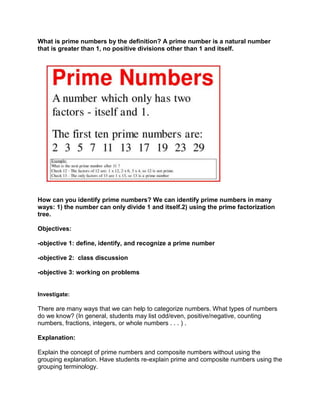
What is prime numbers by the definition? A prime number is a natural number
that is greater than 1, no positive divisions other than 1 and itself.


How can you identify prime numbers? We can identify prime numbers in many
ways: 1) the number can only divide 1 and itself.2) using the prime factorization
tree.

Objectives:

-objective 1: define, identify, and recognize a prime number

-objective 2: class discussion

-objective 3: working on problems


Investigate:

There are many ways that we can help to categorize numbers. What types of numbers
do we know? (In general, students may list odd/even, positive/negative, counting
numbers, fractions, integers, or whole numbers . . . ) .

Explanation:

Explain the concept of prime numbers and composite numbers without using the
grouping explanation. Have students re-explain prime and composite numbers using the
grouping terminology.
Conclusion:

We have seen that numbers have patterns. You may notice the prime numbers is exist
as big numbers and small numbers. The smallest prime number is two. The largest
prime number is at infinity. Grouping is the key to help determine if a number is prime or
not. These groupings are also known as factors.

Constructivist lesson plan

  • 1.
    Constructivist Lesson Plan Teacher:Yang Yang Li Date: 25 February 2013 Subject: Math Grade: 4 Content to teach: Identifying Prime Numbers Web 2.0 technology use for this lesson: Slide share, is a free media website that you can upload your video and presentation there. How to use it? Sign up for an account first, and then you upload your presentation for free. How the Web 2.0 tool is supporting constructivist learning? Web 2.0 tool help supporting constructivist learning by 1) Providing highly active participation 2) Help expand the classroom more virtual than tradition classroom 3) Allow students to work together to share their ideas. Introduction: In today’s lesson I will cover how to identifying prime numbers. First I will ask few questions that is relates to our topic- prime numbers, then let student divided into a small interact groups to work each other with those questions. After the discussion we will work on some problems to help students identify prime numbers more easily and remember better. Throughout the lesson, I will help the student to identify prime numbers. The goal of this lesson will be help each students to understanding of concept and how to identifying prime numbers. Lesson Plan: What is prime numbers by the definition? How can you identify prime numbers? Take a few minutes to discuss within your group and come with the answers and examples. I will then ask each group’s reporter to share their answers to these questions with whole class.
  • 2.
    What is primenumbers by the definition? A prime number is a natural number that is greater than 1, no positive divisions other than 1 and itself. How can you identify prime numbers? We can identify prime numbers in many ways: 1) the number can only divide 1 and itself.2) using the prime factorization tree. Objectives: -objective 1: define, identify, and recognize a prime number -objective 2: class discussion -objective 3: working on problems Investigate: There are many ways that we can help to categorize numbers. What types of numbers do we know? (In general, students may list odd/even, positive/negative, counting numbers, fractions, integers, or whole numbers . . . ) . Explanation: Explain the concept of prime numbers and composite numbers without using the grouping explanation. Have students re-explain prime and composite numbers using the grouping terminology.
  • 3.
    Conclusion: We have seenthat numbers have patterns. You may notice the prime numbers is exist as big numbers and small numbers. The smallest prime number is two. The largest prime number is at infinity. Grouping is the key to help determine if a number is prime or not. These groupings are also known as factors.