SCREENING PROCEDURES
FOR AMNESIA
PRESENTED BY JATHIN S
M.Pharm , First Semester.
GUIDED BY Mrs. D.D.BANDAWANE
M.PHARM, PhD, H.O.D, PHARMACOLOGY
PES MODERN COLLEGE OF PHARMACY
Nigdi, pune.
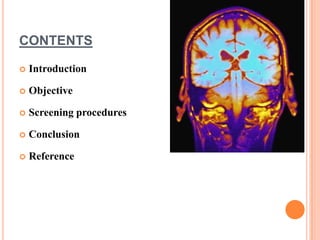
CONTENTS
 Introduction
 Objective
 Screening procedures
 Conclusion
 Reference
INTRODUCTION
 Memory
 Memory means the conservation of certain conditions,
their reproduction and their localisation in the past. The
three elements are of unequal values; The first two are
necessary , indispensible ; The third , what in the
language of the school is called “Recollection” ,
completes the act of memory but does not constitute it.
 Amnesia
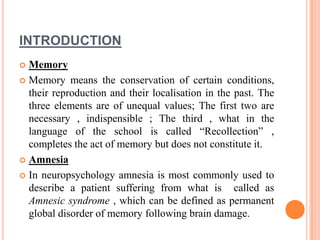
 In neuropsychology amnesia is most commonly used to
describe a patient suffering from what is called as
Amnesic syndrome , which can be defined as permanent
global disorder of memory following brain damage.
OBJECTIVE
 Amnesia is a topic that is of high importance in
Indian scenario as the number of cases on it are
increasing and the awareness of this disease is
very low.
 My aim is to study the screening procedures for
amnesia and giving a brief account of drug therapy
on it.
CLASSIFICATION
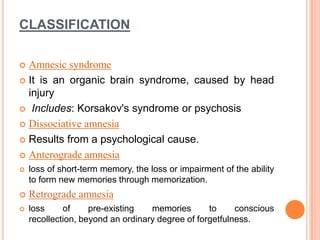
 Amnesic syndrome
 It is an organic brain syndrome, caused by head
injury
 Includes: Korsakov's syndrome or psychosis
 Dissociative amnesia
 Results from a psychological cause.
 Anterograde amnesia
 loss of short-term memory, the loss or impairment of the ability
to form new memories through memorization.
 Retrograde amnesia
 loss of pre-existing memories to conscious
recollection, beyond an ordinary degree of forgetfulness.
PATHOPHYSIOLOGY
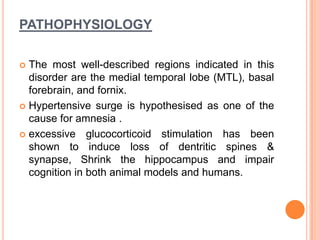
 The most well-described regions indicated in this
disorder are the medial temporal lobe (MTL), basal
forebrain, and fornix.
 Hypertensive surge is hypothesised as one of the
cause for amnesia .
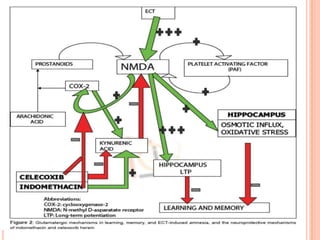
 excessive glucocorticoid stimulation has been
shown to induce loss of dentritic spines &
synapse, Shrink the hippocampus and impair
cognition in both animal models and humans.
MANAGMENT OF AMNESIA
 The primary goal in the management of amnesia is
to treat the underlying cause.
 A regimen of anticancer drugs (chemotherapy)
along with radiation treatments (radiation therapy)
may be indicated for individuals with cancerous
brain tumors.
SCREENING PROCEDURES
 Behavioral models for studying drugs or conditions
that affect cognitive processes rely on a stimuli to
induce an aversive state within the organism.
 Once an animal has learned to escape from
aversive events, the next favourable strategy is to
try to avoid those aversive events totally.
METHODS OF SCREENING
 Discrimination learning
1. Morris water maze
2. Radial arm maze
3. Y-Maze
4. Figure 8 maze
5. Modular mazes
6. Stone T-maze
 Avoidance behaviour
7. Three-panel runway apparatus
8. Elevated Plus-maze
9. Two-way shuttle box
DISCRIMINATION LEARNING
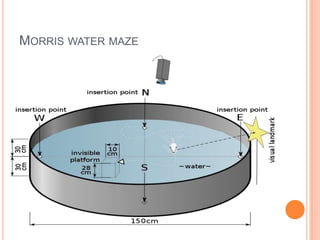
1.MORRIS WATER MAZE
 A task was developed where rats learn to swim in a
water tank to find an escape platform hidden under
the water (Morris 1984).
 As there are no proximal cues to mark the position
of the platform, the ability to locate it efficiently will
depend on the use of a configuration of the cues
outside the tank.
 Learning is reflected on the shorter latencies to
escape and the decrease on the length of the path
to find the platform.
MORRIS WATER MAZE
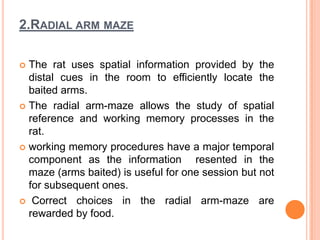
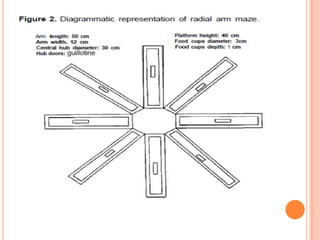
2.RADIAL ARM MAZE
 The rat uses spatial information provided by the
distal cues in the room to efficiently locate the
baited arms.
 The radial arm-maze allows the study of spatial
reference and working memory processes in the
rat.
 working memory procedures have a major temporal
component as the information resented in the
maze (arms baited) is useful for one session but not
for subsequent ones.
 Correct choices in the radial arm-maze are
rewarded by food.
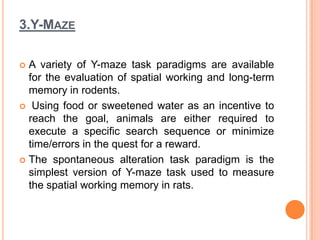
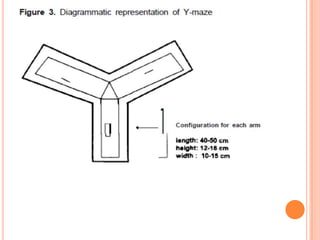
3.Y-MAZE
 A variety of Y-maze task paradigms are available
for the evaluation of spatial working and long-term
memory in rodents.
 Using food or sweetened water as an incentive to
reach the goal, animals are either required to
execute a specific search sequence or minimize
time/errors in the quest for a reward.
 The spontaneous alteration task paradigm is the
simplest version of Y-maze task used to measure
the spatial working memory in rats.
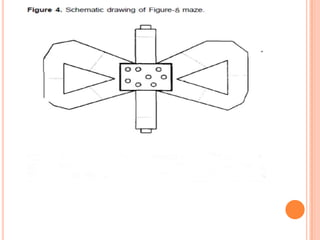
4.FIGURE 8 MAZE
 Figure 8 maze, used to measure spatial ability of
animals, is a unique task paradigm designed
basically to provide a classic common ‘choice point’
(Figure 4) with gated entry and exit points.
 It may also be equipped with photo-cell detection
system for automatic recording of the animal
behaviour.
 However, this task is not being used
currently, except for supportive information.
5.MODULAR MAZES
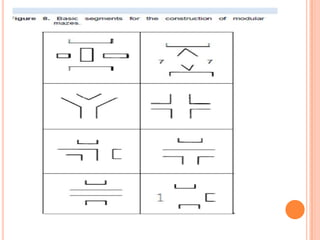
 These mazes are built on the concept of construction
complex mazes with simple maze segments. Using the
six basic segments (Figure 8) a number of complex
mazes can be constructed by adjoining and increasing
numbers and variations in the basic segments.
 Each basic segment comprises a specific maze
pathway constructed on a one square foot platform or in
any other required dimension. Platforms may be
mechanically joined to complete the maze.
 Further, the junction of platforms may be demarcated
with photocell sensors that defined specific maze
sections for automated monitoring studies using
commercially available photo-cell monitors or video
tracking systems.
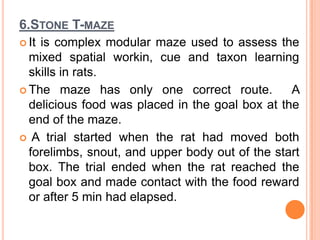
6.STONE T-MAZE
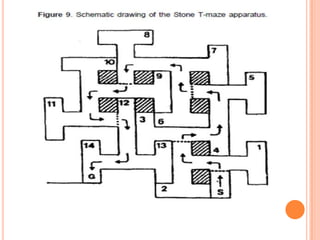
 It is complex modular maze used to assess the
mixed spatial workin, cue and taxon learning
skills in rats.
 The maze has only one correct route. A
delicious food was placed in the goal box at the
end of the maze.
 A trial started when the rat had moved both
forelimbs, snout, and upper body out of the start
box. The trial ended when the rat reached the
goal box and made contact with the food reward
or after 5 min had elapsed.
AVOIDANCE BEHAVIOUR
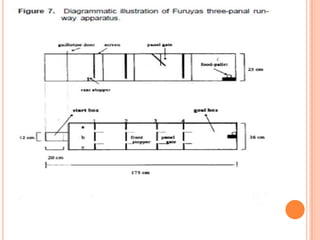
7.THREE-PANEL RUNWAY APPARATUS
 A straightforward avoidance situation features a
fixed aversive gradient which can be traversed by
the animal.
 The shock can be avoided when the safe area is
reached within the time allocated.
 The time the animal needs to reach the safe area
on both days is measured. In addition, the number
of errors (not reaching the safe area) is recorded.
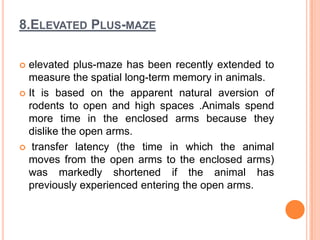
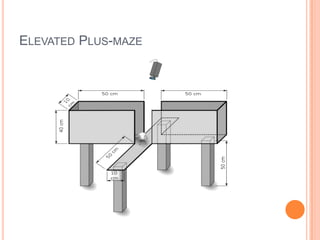
8.ELEVATED PLUS-MAZE
 elevated plus-maze has been recently extended to
measure the spatial long-term memory in animals.
 It is based on the apparent natural aversion of
rodents to open and high spaces .Animals spend
more time in the enclosed arms because they
dislike the open arms.
 transfer latency (the time in which the animal
moves from the open arms to the enclosed arms)
was markedly shortened if the animal has
previously experienced entering the open arms.
ELEVATED PLUS-MAZE
9.TWO-WAY SHUTTLE BOX
 Compared to runway avoidance, shuttle box
avoidance (two-way-shuttle-box) is a more difficult
task.
 Since the animal is not handled between trials, the
shuttleboxcan be easily automated.
 The time the animal needs to reach the safe area
on both days is measured.
 In addition, the number of errors (not reaching the
safe area) are recorded.
INDUCTION OF AMNESIA IN LABORATORY
ANIMALS
 Drug-induced state dependent learning
 Animals trained on a task under some drugs often
show a failure of learning performance when they
are tested in the absence of the drugs. The failure,
however, is ameliorated when the drugs are
reintroduced.
 Electroshock-induced amnesia
 Amnesia can also be induced in experimental
animals by electroshock (ES) stimulation.
Presentation of electroshock by silvercorneal
electrodes induces clonic-tonic seizures and impair
memory.
BRAIN LESION-INDUCED COGNITIVE DYSFUNCTION
 Lesions have been produced with several different
neurotoxic and electrolytic techniques and several
cholinergic agents have been utilized to reverse the
resulting deficits.
 A selective cholinergic neurotoxin, ethylcholine
mustard aziridinium ion (AF64A) has been widely
used for the experimental induction of cognitive
deficits.
Novel drug Approach
Drug in
question
Aim Materials &
methods
Biostatical
method
Result Conclusion
stevioside The present
study was
undertaken to
explore the
potential of
stevioside in
memory
dysfunction
of rats.
Morris water
maze (MWM)
test was
employed to
assess learning
and
memory.
Memory
impairment was
produced by
scopolamine
(0.5 mg/kg,
i.p.) in animals.
The results are
expressed as
mean standard
error of
means (S.E.M.).
The data of
behavioral results
were statistically
analyzed by one-
way analysis of
variance
(ANOVA)
followed by
post hoc Tukey‟s
multiple range
test using Sigma
Stat Statistical
software version
3.5.
Pretreatment of
stevioside (250
mg/kg
dose orally)
significantly
reversed
scopolamine-
induced
learning and
memory
deficits along
with
attenuation of
scopolamine-
induced rise in
brain AChE
activity and
brain oxidative
stress levels.
It may be
concluded that
stevioside exerts a
memory-
preservative effect
in
cognitive deficits
of rats possibly
through its
multiple actions.
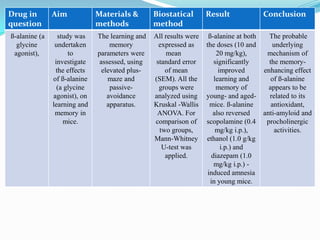
Drug in
question
Aim Materials &
methods
Biostatical
method
Result Conclusion
ß-alanine (a
glycine
agonist),
study was
undertaken
to
investigate
the effects
of ß-alanine
(a glycine
agonist), on
learning and
memory in
mice.
The learning and
memory
parameters were
assessed, using
elevated plus-
maze and
passive-
avoidance
apparatus.
All results were
expressed as
mean
standard error
of mean
(SEM). All the
groups were
analyzed using
Kruskal -Wallis
ANOVA. For
comparison of
two groups,
Mann-Whitney
U-test was
applied.
ß-alanine at both
the doses (10 and
20 mg/kg),
significantly
improved
learning and
memory of
young- and aged-
mice. ß-alanine
also reversed
scopolamine (0.4
mg/kg i.p.),
ethanol (1.0 g/kg
i.p.) and
diazepam (1.0
mg/kg i.p.) -
induced amnesia
in young mice.
The probable
underlying
mechanism of
the memory-
enhancing effect
of ß-alanine
appears to be
related to its
antioxidant,
anti-amyloid and
procholinergic
activities.
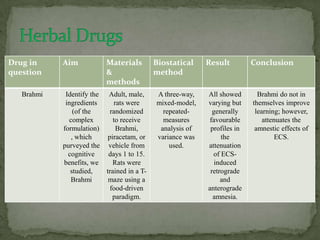
Drug in
question
Aim Materials
&
methods
Biostatical
method
Result Conclusion
Brahmi Identify the
ingredients
(of the
complex
formulation)
, which
purveyed the
cognitive
benefits, we
studied,
Brahmi
Adult, male,
rats were
randomized
to receive
Brahmi,
piracetam, or
vehicle from
days 1 to 15.
Rats were
trained in a T-
maze using a
food-driven
paradigm.
A three-way,
mixed-model,
repeated-
measures
analysis of
variance was
used.
All showed
varying but
generally
favourable
profiles in
the
attenuation
of ECS-
induced
retrograde
and
anterograde
amnesia.
Brahmi do not in
themselves improve
learning; however,
attenuates the
amnestic effects of
ECS.
Drug in
question
Aim Materials &
methods
Biostatical
method
Result Conclusion
Ocimum
tenuiflorum
To assess
the potential
of Ocimum
tenuiflorum
Linn. as a
nootropic
Passive avoidance
paradigm served as
the exteroceptive
behavioural model.
one-way
ANOVA,
followed by
unpaired „t‟
test.
O. tenuiflorum
extract increased
step-down latency
and acetyl
cholinesterase
inhibition
significantly.
O. tenuiflorum
can be employed
in the treatment of
cognitive
disorders such as
dementia and
amnesia.
Argyreia
speciosa
The present
work was
undertaken to
justify the
traditional
claim of the
plant as
nootropic and
antiamnesic
agent
in mice.
Exteroceptive
behavioural models
such
as elevated plus
maze and Water
maze were used to
assess the short-term
memory, whereas,
scopolamine and
natural ageing-
induced
amnesia served as
interoceptive models
The data were
expressed as
mean6SEM.
The data
were analysed
using one-way
ANOVA
followed by
Tukey—
kramer tests.
Pre-treatment with
EAAS (100 and 200
mg/
kg, p.o.) significantly
attenuated
scopolamine and
ageing-induced
amnesia.[ The ethyl
acetate and ethanolic
fractions (EAAS) of
roots were selected
for the study]
The results indicate
that A. speciosa has
significant
nootropic and
antiamnesic
activity,
Justifying its
traditional use in
Ayurveda.
CONCLUSION
Although a wide variety of behavioural models for the
evaluation of learning and memory processes are currently
being used, the interpretation of behavioural parameters in
many of these tasks is still ambiguous.
Drug effects should be tested in different types of tasks that tap
different aspects of behaviour to exclude alternative
explanations for the performance in a cognitive task.
Rapid developments in the field of neurobiology of learning
and memory processes may hopefully lead to an improved
understanding of the pathophysiology of several disorders that
are associated with cognitive dysfunction.
REFERENCE
1. Theodule armand ribot, Diseases of memory , an essay in the
positive psychology. page no. 10-25
2. H. Gerhard vogel , drug discovery and evaluation pharmacological
assays second edition page no. 624-634
3. WHO bluebook -The icd-10 classification of mental and
behavioural disorders.
4. Assessment of nootropic and amnestic activity of centrally acting
agents by d.S. Reddy[department of pharmacology, university
institute of pharmaceutical sciences, punjab university.Chandigarh.]
5. Antiamnesic effect of stevioside in scopolamine-treated rats deepika
sharma1, munish puri, ashok k. Tiwary, nirmal singh, amteshwar
singh jaggi ijp
6. anti-amnestic properties of brahmi and mandookaparni in a rat
model chittaranjan andrade, j. Suresh chandra indian journal of
psychiatry
THANK YOU

Screening procedure for amnesia

  • 1.
    SCREENING PROCEDURES FOR AMNESIA PRESENTEDBY JATHIN S M.Pharm , First Semester. GUIDED BY Mrs. D.D.BANDAWANE M.PHARM, PhD, H.O.D, PHARMACOLOGY PES MODERN COLLEGE OF PHARMACY Nigdi, pune.
  • 2.
    CONTENTS  Introduction  Objective Screening procedures  Conclusion  Reference
  • 3.
    INTRODUCTION  Memory  Memorymeans the conservation of certain conditions, their reproduction and their localisation in the past. The three elements are of unequal values; The first two are necessary , indispensible ; The third , what in the language of the school is called “Recollection” , completes the act of memory but does not constitute it.  Amnesia  In neuropsychology amnesia is most commonly used to describe a patient suffering from what is called as Amnesic syndrome , which can be defined as permanent global disorder of memory following brain damage.
  • 4.
    OBJECTIVE  Amnesia isa topic that is of high importance in Indian scenario as the number of cases on it are increasing and the awareness of this disease is very low.  My aim is to study the screening procedures for amnesia and giving a brief account of drug therapy on it.
  • 5.
    CLASSIFICATION  Amnesic syndrome It is an organic brain syndrome, caused by head injury  Includes: Korsakov's syndrome or psychosis  Dissociative amnesia  Results from a psychological cause.  Anterograde amnesia  loss of short-term memory, the loss or impairment of the ability to form new memories through memorization.  Retrograde amnesia  loss of pre-existing memories to conscious recollection, beyond an ordinary degree of forgetfulness.
  • 6.
    PATHOPHYSIOLOGY  The mostwell-described regions indicated in this disorder are the medial temporal lobe (MTL), basal forebrain, and fornix.  Hypertensive surge is hypothesised as one of the cause for amnesia .  excessive glucocorticoid stimulation has been shown to induce loss of dentritic spines & synapse, Shrink the hippocampus and impair cognition in both animal models and humans.
  • 8.
    MANAGMENT OF AMNESIA The primary goal in the management of amnesia is to treat the underlying cause.  A regimen of anticancer drugs (chemotherapy) along with radiation treatments (radiation therapy) may be indicated for individuals with cancerous brain tumors.
  • 9.
    SCREENING PROCEDURES  Behavioralmodels for studying drugs or conditions that affect cognitive processes rely on a stimuli to induce an aversive state within the organism.  Once an animal has learned to escape from aversive events, the next favourable strategy is to try to avoid those aversive events totally.
  • 10.
    METHODS OF SCREENING Discrimination learning 1. Morris water maze 2. Radial arm maze 3. Y-Maze 4. Figure 8 maze 5. Modular mazes 6. Stone T-maze  Avoidance behaviour 7. Three-panel runway apparatus 8. Elevated Plus-maze 9. Two-way shuttle box
  • 11.
    DISCRIMINATION LEARNING 1.MORRIS WATERMAZE  A task was developed where rats learn to swim in a water tank to find an escape platform hidden under the water (Morris 1984).  As there are no proximal cues to mark the position of the platform, the ability to locate it efficiently will depend on the use of a configuration of the cues outside the tank.  Learning is reflected on the shorter latencies to escape and the decrease on the length of the path to find the platform.
  • 12.
  • 13.
    2.RADIAL ARM MAZE The rat uses spatial information provided by the distal cues in the room to efficiently locate the baited arms.  The radial arm-maze allows the study of spatial reference and working memory processes in the rat.  working memory procedures have a major temporal component as the information resented in the maze (arms baited) is useful for one session but not for subsequent ones.  Correct choices in the radial arm-maze are rewarded by food.
  • 15.
    3.Y-MAZE  A varietyof Y-maze task paradigms are available for the evaluation of spatial working and long-term memory in rodents.  Using food or sweetened water as an incentive to reach the goal, animals are either required to execute a specific search sequence or minimize time/errors in the quest for a reward.  The spontaneous alteration task paradigm is the simplest version of Y-maze task used to measure the spatial working memory in rats.
  • 17.
    4.FIGURE 8 MAZE Figure 8 maze, used to measure spatial ability of animals, is a unique task paradigm designed basically to provide a classic common ‘choice point’ (Figure 4) with gated entry and exit points.  It may also be equipped with photo-cell detection system for automatic recording of the animal behaviour.  However, this task is not being used currently, except for supportive information.
  • 19.
    5.MODULAR MAZES  Thesemazes are built on the concept of construction complex mazes with simple maze segments. Using the six basic segments (Figure 8) a number of complex mazes can be constructed by adjoining and increasing numbers and variations in the basic segments.  Each basic segment comprises a specific maze pathway constructed on a one square foot platform or in any other required dimension. Platforms may be mechanically joined to complete the maze.  Further, the junction of platforms may be demarcated with photocell sensors that defined specific maze sections for automated monitoring studies using commercially available photo-cell monitors or video tracking systems.
  • 21.
    6.STONE T-MAZE  Itis complex modular maze used to assess the mixed spatial workin, cue and taxon learning skills in rats.  The maze has only one correct route. A delicious food was placed in the goal box at the end of the maze.  A trial started when the rat had moved both forelimbs, snout, and upper body out of the start box. The trial ended when the rat reached the goal box and made contact with the food reward or after 5 min had elapsed.
  • 23.
    AVOIDANCE BEHAVIOUR 7.THREE-PANEL RUNWAYAPPARATUS  A straightforward avoidance situation features a fixed aversive gradient which can be traversed by the animal.  The shock can be avoided when the safe area is reached within the time allocated.  The time the animal needs to reach the safe area on both days is measured. In addition, the number of errors (not reaching the safe area) is recorded.
  • 25.
    8.ELEVATED PLUS-MAZE  elevatedplus-maze has been recently extended to measure the spatial long-term memory in animals.  It is based on the apparent natural aversion of rodents to open and high spaces .Animals spend more time in the enclosed arms because they dislike the open arms.  transfer latency (the time in which the animal moves from the open arms to the enclosed arms) was markedly shortened if the animal has previously experienced entering the open arms.
  • 26.
  • 27.
    9.TWO-WAY SHUTTLE BOX Compared to runway avoidance, shuttle box avoidance (two-way-shuttle-box) is a more difficult task.  Since the animal is not handled between trials, the shuttleboxcan be easily automated.  The time the animal needs to reach the safe area on both days is measured.  In addition, the number of errors (not reaching the safe area) are recorded.
  • 28.
    INDUCTION OF AMNESIAIN LABORATORY ANIMALS  Drug-induced state dependent learning  Animals trained on a task under some drugs often show a failure of learning performance when they are tested in the absence of the drugs. The failure, however, is ameliorated when the drugs are reintroduced.  Electroshock-induced amnesia  Amnesia can also be induced in experimental animals by electroshock (ES) stimulation. Presentation of electroshock by silvercorneal electrodes induces clonic-tonic seizures and impair memory.
  • 29.
    BRAIN LESION-INDUCED COGNITIVEDYSFUNCTION  Lesions have been produced with several different neurotoxic and electrolytic techniques and several cholinergic agents have been utilized to reverse the resulting deficits.  A selective cholinergic neurotoxin, ethylcholine mustard aziridinium ion (AF64A) has been widely used for the experimental induction of cognitive deficits.
  • 30.
    Novel drug Approach Drugin question Aim Materials & methods Biostatical method Result Conclusion stevioside The present study was undertaken to explore the potential of stevioside in memory dysfunction of rats. Morris water maze (MWM) test was employed to assess learning and memory. Memory impairment was produced by scopolamine (0.5 mg/kg, i.p.) in animals. The results are expressed as mean standard error of means (S.E.M.). The data of behavioral results were statistically analyzed by one- way analysis of variance (ANOVA) followed by post hoc Tukey‟s multiple range test using Sigma Stat Statistical software version 3.5. Pretreatment of stevioside (250 mg/kg dose orally) significantly reversed scopolamine- induced learning and memory deficits along with attenuation of scopolamine- induced rise in brain AChE activity and brain oxidative stress levels. It may be concluded that stevioside exerts a memory- preservative effect in cognitive deficits of rats possibly through its multiple actions.
  • 31.
    Drug in question Aim Materials& methods Biostatical method Result Conclusion ß-alanine (a glycine agonist), study was undertaken to investigate the effects of ß-alanine (a glycine agonist), on learning and memory in mice. The learning and memory parameters were assessed, using elevated plus- maze and passive- avoidance apparatus. All results were expressed as mean standard error of mean (SEM). All the groups were analyzed using Kruskal -Wallis ANOVA. For comparison of two groups, Mann-Whitney U-test was applied. ß-alanine at both the doses (10 and 20 mg/kg), significantly improved learning and memory of young- and aged- mice. ß-alanine also reversed scopolamine (0.4 mg/kg i.p.), ethanol (1.0 g/kg i.p.) and diazepam (1.0 mg/kg i.p.) - induced amnesia in young mice. The probable underlying mechanism of the memory- enhancing effect of ß-alanine appears to be related to its antioxidant, anti-amyloid and procholinergic activities.
  • 32.
    Drug in question Aim Materials & methods Biostatical method ResultConclusion Brahmi Identify the ingredients (of the complex formulation) , which purveyed the cognitive benefits, we studied, Brahmi Adult, male, rats were randomized to receive Brahmi, piracetam, or vehicle from days 1 to 15. Rats were trained in a T- maze using a food-driven paradigm. A three-way, mixed-model, repeated- measures analysis of variance was used. All showed varying but generally favourable profiles in the attenuation of ECS- induced retrograde and anterograde amnesia. Brahmi do not in themselves improve learning; however, attenuates the amnestic effects of ECS.
  • 33.
    Drug in question Aim Materials& methods Biostatical method Result Conclusion Ocimum tenuiflorum To assess the potential of Ocimum tenuiflorum Linn. as a nootropic Passive avoidance paradigm served as the exteroceptive behavioural model. one-way ANOVA, followed by unpaired „t‟ test. O. tenuiflorum extract increased step-down latency and acetyl cholinesterase inhibition significantly. O. tenuiflorum can be employed in the treatment of cognitive disorders such as dementia and amnesia. Argyreia speciosa The present work was undertaken to justify the traditional claim of the plant as nootropic and antiamnesic agent in mice. Exteroceptive behavioural models such as elevated plus maze and Water maze were used to assess the short-term memory, whereas, scopolamine and natural ageing- induced amnesia served as interoceptive models The data were expressed as mean6SEM. The data were analysed using one-way ANOVA followed by Tukey— kramer tests. Pre-treatment with EAAS (100 and 200 mg/ kg, p.o.) significantly attenuated scopolamine and ageing-induced amnesia.[ The ethyl acetate and ethanolic fractions (EAAS) of roots were selected for the study] The results indicate that A. speciosa has significant nootropic and antiamnesic activity, Justifying its traditional use in Ayurveda.
  • 34.
    CONCLUSION Although a widevariety of behavioural models for the evaluation of learning and memory processes are currently being used, the interpretation of behavioural parameters in many of these tasks is still ambiguous. Drug effects should be tested in different types of tasks that tap different aspects of behaviour to exclude alternative explanations for the performance in a cognitive task. Rapid developments in the field of neurobiology of learning and memory processes may hopefully lead to an improved understanding of the pathophysiology of several disorders that are associated with cognitive dysfunction.
  • 35.
    REFERENCE 1. Theodule armandribot, Diseases of memory , an essay in the positive psychology. page no. 10-25 2. H. Gerhard vogel , drug discovery and evaluation pharmacological assays second edition page no. 624-634 3. WHO bluebook -The icd-10 classification of mental and behavioural disorders. 4. Assessment of nootropic and amnestic activity of centrally acting agents by d.S. Reddy[department of pharmacology, university institute of pharmaceutical sciences, punjab university.Chandigarh.] 5. Antiamnesic effect of stevioside in scopolamine-treated rats deepika sharma1, munish puri, ashok k. Tiwary, nirmal singh, amteshwar singh jaggi ijp 6. anti-amnestic properties of brahmi and mandookaparni in a rat model chittaranjan andrade, j. Suresh chandra indian journal of psychiatry
  • 36.