Identificationsof fiber
1 | P a g e
Assignment# 01
Report of
Identification of
textile fibres
Name: Rafiq Lakhyar
Discipline: TMM-01A
Submitted to: Sir Imran Raza Malik
Submission Date: 27-Mar-2015
Identificationsof fiber
2 | P a g e
There Are Some Fibers and Its Identifications by
Burning test
Chemical test
Microscopic views
1. Cotton
2. Silk
3. Wool
4. Flax/linen
5. Polyester
6. Nylon
7. Acrylic
8. Rayon
Identificationsof fiber
3 | P a g e
COTTON
Burning Test
Flame: Orange
Odor:Paper burning like odor
After burning it’sconverting into ashes gray or black powder
Chemical Test
At 45 °C, 75% zinc chloride solution dissolves cotton that has not been mercerized.
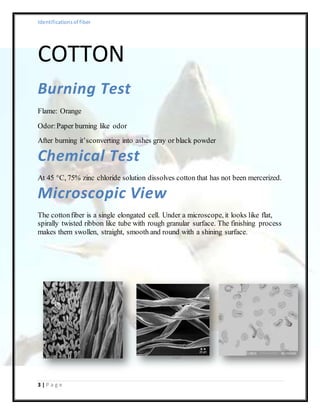
Microscopic View
The cottonfiber is a single elongated cell. Under a microscope, it looks like flat,
spirally twisted ribbon like tube with rough granular surface. The finishing process
makes them swollen, straight, smooth and round with a shining surface.
Identificationsof fiber
4 | P a g e
WOOL
Burning Test
Flame: Orange/sputters
Odor: Hair burning like odor
After burning it’s converting into black ashes/crumbles
Chemical Test
At 100 °C, a 5% solution of sodium hydroxide dissolves wool protein
fibers dissolve only partially and very slowly
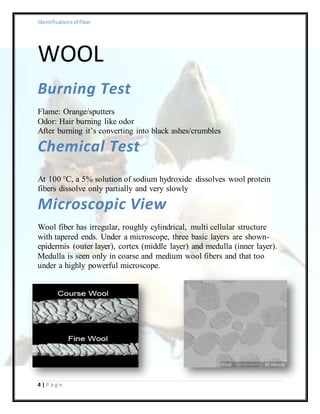
Microscopic View
Wool fiber has irregular, roughly cylindrical, multi cellular structure
with tapered ends. Under a microscope, three basic layers are shown-
epidermis (outer layer), cortex (middle layer) and medulla (inner layer).
Medulla is seen only in coarse and medium wool fibers and that too
under a highly powerful microscope.
Identificationsof fiber
5 | P a g e
SILK
Burning Test
When we burn silk it’s create orange flame.
Hair burning like odor
After burning it convert black ashes
Chemical Test
At 20 °C, 60% sulfuric acid dissolves silk
At 100 °C, a 5% solution of sodium hydroxide dissolves silk and reconstituted
protein fibers dissolve only partially and very slowly.
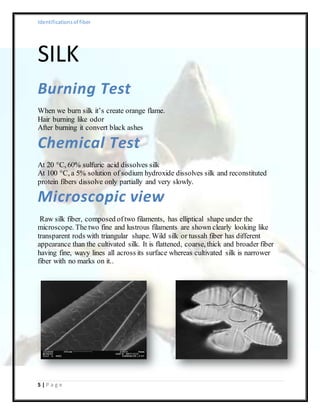
Microscopic view
Raw silk fiber, composed oftwo filaments, has elliptical shape under the
microscope. The two fine and lustrous filaments are shown clearly looking like
transparent rods with triangular shape. Wild silk or tussah fiber has different
appearance than the cultivated silk. It is flattened, coarse, thick and broader fiber
having fine, wavy lines all across its surface whereas cultivated silk is narrower
fiber with no marks on it..
Identificationsof fiber
6 | P a g e
LINEN/FLAX
Burning Test
Yellow-orange flame and Linen is easily extinguished like candle
The ashes Very brittle
Grass burning like odor
Chemical Test
Linen Dissolved in 70% solution of sulphuric acid at the temperature of 38 degree
in 20min.
Microscopic view
Linen fiber, under a microscope, looks like having multiple sided cylindrical
filaments with fine pointed edges. The filaments show nodes at intervals. It, in fact,
looks like a bamboo stick having joints that result into a little unevenness.
Identificationsof fiber
7 | P a g e
POLYESTER
Burning Test
When polyester burn it’s creating orange, sputters and drips,
Sweet and fruity odor
The extinguished ash is hard
Chemical Test
Polyester Dissolved in 100% solution of meta-cresol at the temperature of 139
degree in 5m.
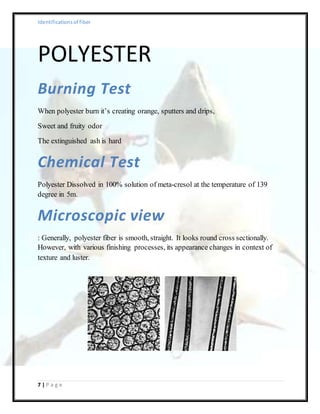
Microscopic view
: Generally, polyester fiber is smooth, straight. It looks round cross sectionally.
However, with various finishing processes, its appearance changes in context of
texture and luster.
Identificationsof fiber
8 | P a g e
NYLON
Burning Test
When we burn nylon it’s create blue flame.
Plastic Burning like odor
After burning it convert round, black bead ashes.
Chemical Test
At 20 °C, concentrated (12 M) hydrochloric acid dissolves nylon Less concentrated
(6 M) hydrochloric acid dissolves nylon.
At 20 °C, 60% sulfuric acid dissolves nylon.
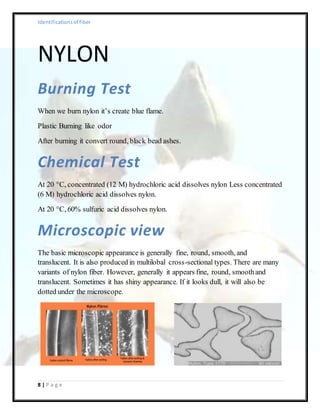
Microscopic view
The basic microscopic appearance is generally fine, round, smooth, and
translucent. It is also produced in multilobal cross-sectional types. There are many
variants of nylon fiber. However, generally it appears fine, round, smoothand
translucent. Sometimes it has shiny appearance. If it looks dull, it will also be
dotted under the microscope.
Identificationsof fiber
9 | P a g e
ACRYLIC
Burning Text
When acrylic burn it’s create white- orange flame and black smoke
Burnt meat like odoror acrid like smell
After burning convert into hard ashes
Chemical test
Acrylic fibers will dissolve in 70% solution of ammonium thio cyanate at 130
degree temperature.
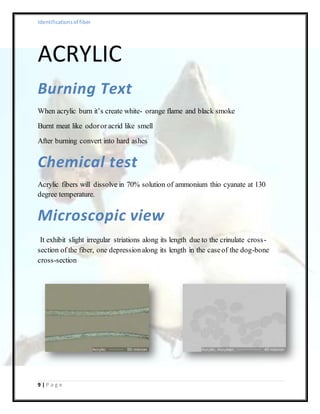
Microscopic view
It exhibit slight irregular striations along its length due to the crinulate cross-
section of the fiber, one depressionalong its length in the caseof the dog-bone
cross-section
Identificationsof fiber
10 | P a g e
RAYON
Burning Text
Yellow-orange flame, burns evenly, does not smolder, no smoke
The burning smell like a burning leaves or paper
Leaves only a slight ash
Chemical test
Rayon Dissolved in 38% solution of hydrochloric acid at the temperature of 24
degree in 5min.
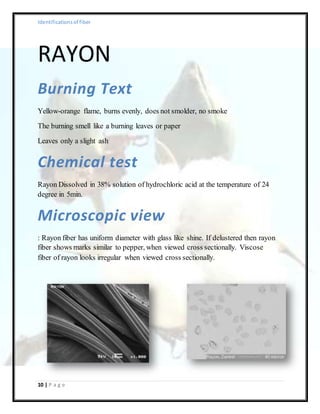
Microscopic view
: Rayon fiber has uniform diameter with glass like shine. If delustered then rayon
fiber shows marks similar to pepper, when viewed cross sectionally. Viscose
fiber of rayon looks irregular when viewed cross sectionally.
Identificationsof fiber
11 | P a g e
Bibliography of Report
http://www.customs.go.jp/ccl/e_etc/3.htm
http://www.slideshare.net/tahmidurrahman52/identification-
of-textile-fibers?qid=adaa42d6-7217-4997-b71d-
b8723f6f520e&v=qf1&b=&from_search=1
http://www.slideshare.net/suniltalekar1/25-textile-testing-
methods?qid=c953c944-5727-4460-b9ca-
3fb3de03bf55&v=default&b=&from_search=6
http://www.microlabgallery.com/gallery/Rayon13b2XSecfixed
.aspx
http://makezine.com/laboratory-67-test-fiber-specimens/
http://www.google .com
Class Lecture…

Identification of Fibers

  • 1.
    Identificationsof fiber 1 |P a g e Assignment# 01 Report of Identification of textile fibres Name: Rafiq Lakhyar Discipline: TMM-01A Submitted to: Sir Imran Raza Malik Submission Date: 27-Mar-2015
  • 2.
    Identificationsof fiber 2 |P a g e There Are Some Fibers and Its Identifications by Burning test Chemical test Microscopic views 1. Cotton 2. Silk 3. Wool 4. Flax/linen 5. Polyester 6. Nylon 7. Acrylic 8. Rayon
  • 3.
    Identificationsof fiber 3 |P a g e COTTON Burning Test Flame: Orange Odor:Paper burning like odor After burning it’sconverting into ashes gray or black powder Chemical Test At 45 °C, 75% zinc chloride solution dissolves cotton that has not been mercerized. Microscopic View The cottonfiber is a single elongated cell. Under a microscope, it looks like flat, spirally twisted ribbon like tube with rough granular surface. The finishing process makes them swollen, straight, smooth and round with a shining surface.
  • 4.
    Identificationsof fiber 4 |P a g e WOOL Burning Test Flame: Orange/sputters Odor: Hair burning like odor After burning it’s converting into black ashes/crumbles Chemical Test At 100 °C, a 5% solution of sodium hydroxide dissolves wool protein fibers dissolve only partially and very slowly Microscopic View Wool fiber has irregular, roughly cylindrical, multi cellular structure with tapered ends. Under a microscope, three basic layers are shown- epidermis (outer layer), cortex (middle layer) and medulla (inner layer). Medulla is seen only in coarse and medium wool fibers and that too under a highly powerful microscope.
  • 5.
    Identificationsof fiber 5 |P a g e SILK Burning Test When we burn silk it’s create orange flame. Hair burning like odor After burning it convert black ashes Chemical Test At 20 °C, 60% sulfuric acid dissolves silk At 100 °C, a 5% solution of sodium hydroxide dissolves silk and reconstituted protein fibers dissolve only partially and very slowly. Microscopic view Raw silk fiber, composed oftwo filaments, has elliptical shape under the microscope. The two fine and lustrous filaments are shown clearly looking like transparent rods with triangular shape. Wild silk or tussah fiber has different appearance than the cultivated silk. It is flattened, coarse, thick and broader fiber having fine, wavy lines all across its surface whereas cultivated silk is narrower fiber with no marks on it..
  • 6.
    Identificationsof fiber 6 |P a g e LINEN/FLAX Burning Test Yellow-orange flame and Linen is easily extinguished like candle The ashes Very brittle Grass burning like odor Chemical Test Linen Dissolved in 70% solution of sulphuric acid at the temperature of 38 degree in 20min. Microscopic view Linen fiber, under a microscope, looks like having multiple sided cylindrical filaments with fine pointed edges. The filaments show nodes at intervals. It, in fact, looks like a bamboo stick having joints that result into a little unevenness.
  • 7.
    Identificationsof fiber 7 |P a g e POLYESTER Burning Test When polyester burn it’s creating orange, sputters and drips, Sweet and fruity odor The extinguished ash is hard Chemical Test Polyester Dissolved in 100% solution of meta-cresol at the temperature of 139 degree in 5m. Microscopic view : Generally, polyester fiber is smooth, straight. It looks round cross sectionally. However, with various finishing processes, its appearance changes in context of texture and luster.
  • 8.
    Identificationsof fiber 8 |P a g e NYLON Burning Test When we burn nylon it’s create blue flame. Plastic Burning like odor After burning it convert round, black bead ashes. Chemical Test At 20 °C, concentrated (12 M) hydrochloric acid dissolves nylon Less concentrated (6 M) hydrochloric acid dissolves nylon. At 20 °C, 60% sulfuric acid dissolves nylon. Microscopic view The basic microscopic appearance is generally fine, round, smooth, and translucent. It is also produced in multilobal cross-sectional types. There are many variants of nylon fiber. However, generally it appears fine, round, smoothand translucent. Sometimes it has shiny appearance. If it looks dull, it will also be dotted under the microscope.
  • 9.
    Identificationsof fiber 9 |P a g e ACRYLIC Burning Text When acrylic burn it’s create white- orange flame and black smoke Burnt meat like odoror acrid like smell After burning convert into hard ashes Chemical test Acrylic fibers will dissolve in 70% solution of ammonium thio cyanate at 130 degree temperature. Microscopic view It exhibit slight irregular striations along its length due to the crinulate cross- section of the fiber, one depressionalong its length in the caseof the dog-bone cross-section
  • 10.
    Identificationsof fiber 10 |P a g e RAYON Burning Text Yellow-orange flame, burns evenly, does not smolder, no smoke The burning smell like a burning leaves or paper Leaves only a slight ash Chemical test Rayon Dissolved in 38% solution of hydrochloric acid at the temperature of 24 degree in 5min. Microscopic view : Rayon fiber has uniform diameter with glass like shine. If delustered then rayon fiber shows marks similar to pepper, when viewed cross sectionally. Viscose fiber of rayon looks irregular when viewed cross sectionally.
  • 11.
    Identificationsof fiber 11 |P a g e Bibliography of Report http://www.customs.go.jp/ccl/e_etc/3.htm http://www.slideshare.net/tahmidurrahman52/identification- of-textile-fibers?qid=adaa42d6-7217-4997-b71d- b8723f6f520e&v=qf1&b=&from_search=1 http://www.slideshare.net/suniltalekar1/25-textile-testing- methods?qid=c953c944-5727-4460-b9ca- 3fb3de03bf55&v=default&b=&from_search=6 http://www.microlabgallery.com/gallery/Rayon13b2XSecfixed .aspx http://makezine.com/laboratory-67-test-fiber-specimens/ http://www.google .com Class Lecture…