On Branded
company Specific
presentation
ID.2010000400087
ID.2010000400088
ID.2010000400090

ID.2010000400093
ID.2010000400094
The innovative water free dyeing technology
consumes absolutely no water, uses less energy and
fewer chemicals, reduces emissions into the air.
Another added bonus to this process is the nonexistent drying times, which makes the process
twice as fast as water-based dyes.
This technique Improves the sustainability efforts
and in turn reducing the harmful effects to
people, animals and the environment that waterbased dye processes have had in the past.
DYEING WITH SUPERCRITICAL CO2
PLASMA DYEING

SUBLIMATION AND TRANSFER PRINTING
FOAM DYEING
DYEING WITH SUPERCRITICAL CO2
DYEING WITH
SUPERCRITICAL CO2
DYEING WITH SUPERCRITICAL CO2

Figure: Schematic diagram of super Supercritical CO2
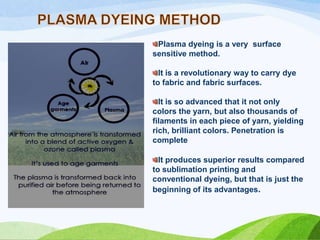
Plasma dyeing is a very surface
sensitive method.
It is a revolutionary way to carry dye
to fabric and fabric surfaces.
It is so advanced that it not only
colors the yarn, but also thousands of
filaments in each piece of yarn, yielding
rich, brilliant colors. Penetration is
complete
It produces superior results compared
to sublimation printing and
conventional dyeing, but that is just the
beginning of its advantages.
Glow Discharge
Corona Discharge
Dielectric-Barrier
Discharge
Atmospheric pressure
plasma technique .
•Figure: Thermal Transfer Printing
KEY ADVANTAGES
Primarily suited to t-shirt printing or for small areas of
decoration;
Sublimation prints offer a soft hand and greater
potential for printing larger fields of color;
Printing faster than dye sublimation,

consumables (ribbon and paper) are less expensive.
•
 The advantages of the process include:
Improved dye pre fixation.
Improved migration of the dye into the fiber.
Higher color yields in the fabric even after relatively
short dyeing times.

Improved dimensional stability of the dyed fabrics.
• The way of Textile coloration by Nano-tech. is very
fascinating as no dyeing and finishing will take
place, which means no toxic chemicals, waste water and
would consume less energy and resources to produce.
• For the Pigments found in butterflies (melanin's etc.)

can be produced by Nano-technology in only
yellow, orange-yellow, red, black, and brown colors and
Green, blue and violet color comes from layers of
nanoparticles separated by layers of air.

• This nanolayer is in a pattern of mosaic tiles, where
each tile of pattern has different structural features as
well as tiny gap among them for light refraction.
• The thickness of the layers changes the color we see.
• Teijin Fibers Limited of Japan; produces Morphotex®, a
first optical coloring fiber that mimics morpho butterfly
wings, by using interference to produce color without
pigments or dyes.

• The fabric is produced from 61 layers of polyester or
nylon in alternative way, with 70nm thickness, and
laminated.
The dielectric property refers
to the intrinsic electrical
properties that affect the
dyeing by dipolar rotation of
the dye and influences the
microwave field upon the
dipoles.
This is a terrific method of
dyeing small amounts of fabric
in the microwave using
‘Procion dyes‘.
Water free dyeing technology

Water free dyeing technology

  • 2.
  • 3.
  • 6.
    The innovative waterfree dyeing technology consumes absolutely no water, uses less energy and fewer chemicals, reduces emissions into the air. Another added bonus to this process is the nonexistent drying times, which makes the process twice as fast as water-based dyes. This technique Improves the sustainability efforts and in turn reducing the harmful effects to people, animals and the environment that waterbased dye processes have had in the past.
  • 7.
    DYEING WITH SUPERCRITICALCO2 PLASMA DYEING SUBLIMATION AND TRANSFER PRINTING FOAM DYEING
  • 9.
  • 10.
  • 11.
    DYEING WITH SUPERCRITICALCO2 Figure: Schematic diagram of super Supercritical CO2
  • 15.
    Plasma dyeing isa very surface sensitive method. It is a revolutionary way to carry dye to fabric and fabric surfaces. It is so advanced that it not only colors the yarn, but also thousands of filaments in each piece of yarn, yielding rich, brilliant colors. Penetration is complete It produces superior results compared to sublimation printing and conventional dyeing, but that is just the beginning of its advantages.
  • 16.
  • 21.
  • 23.
    KEY ADVANTAGES Primarily suitedto t-shirt printing or for small areas of decoration; Sublimation prints offer a soft hand and greater potential for printing larger fields of color; Printing faster than dye sublimation, consumables (ribbon and paper) are less expensive.
  • 26.
  • 27.
     The advantagesof the process include: Improved dye pre fixation. Improved migration of the dye into the fiber. Higher color yields in the fabric even after relatively short dyeing times. Improved dimensional stability of the dyed fabrics.
  • 28.
    • The wayof Textile coloration by Nano-tech. is very fascinating as no dyeing and finishing will take place, which means no toxic chemicals, waste water and would consume less energy and resources to produce. • For the Pigments found in butterflies (melanin's etc.) can be produced by Nano-technology in only yellow, orange-yellow, red, black, and brown colors and Green, blue and violet color comes from layers of nanoparticles separated by layers of air. • This nanolayer is in a pattern of mosaic tiles, where each tile of pattern has different structural features as well as tiny gap among them for light refraction. • The thickness of the layers changes the color we see.
  • 29.
    • Teijin FibersLimited of Japan; produces Morphotex®, a first optical coloring fiber that mimics morpho butterfly wings, by using interference to produce color without pigments or dyes. • The fabric is produced from 61 layers of polyester or nylon in alternative way, with 70nm thickness, and laminated.
  • 30.
    The dielectric propertyrefers to the intrinsic electrical properties that affect the dyeing by dipolar rotation of the dye and influences the microwave field upon the dipoles. This is a terrific method of dyeing small amounts of fabric in the microwave using ‘Procion dyes‘.