PREPARED BY:-
-UTSAV SHAH(434043)
-JAYANT PATIL(434038)
DEPARTMENT:-
-TEXTILE PROCESSING
Faculty of Technology & engineering
The Maharaja Sayajirao University of baroda
INTRODUCTION(9)
✓ Denim is a rugged cotton twill textile in which the weft yarns
passes under two or more warp yarns.
✓ In dyeing of denim only warp yarn is traditionally dyed with
the blue colour obtained from indigo dyes.
✓ It is the future of fabric because denim is used by all human
beings around the world.
Objectives Of Denim Washing(6)
Washing of denim is a most important finishing treatment in textile
industries. It has the largest effect on the physico-mechanical properties on
denim garment. Objectives:-
1. Faded or worn out effects could be introduced to the garment which creates
new fashion.
2. Softness could be increased by the addition of softener just at the last sage of
washing.
3. Removal of starch or size materials makes the garments soft hand feel.
4. Improving the quality of final product and also increase the aesthetic value
in the market.
“provides the garment an identity and exclusive appearance and helps in
creating a brand image”
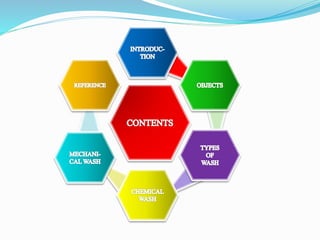
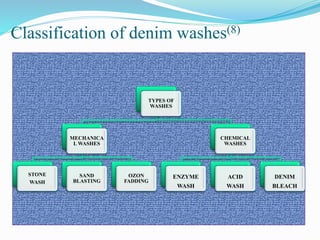
TYPES OF
WASHES
MECHANICA
L WASHES
STONE
WASH
SAND
BLASTING
OZON
FADDING
CHEMICAL
WASHES
ENZYME
WASH
ACID
WASH
DENIM
BLEACH
Classification of denim washes(8)
1. STONE WASH
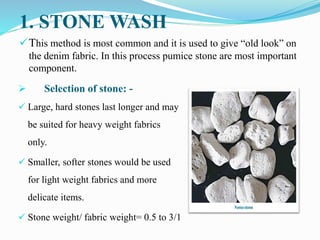
✓This method is most common and it is used to give “old look” on
the denim fabric. In this process pumice stone are most important
component.
➢ Selection of stone: -
✓ Large, hard stones last longer and may
be suited for heavy weight fabrics
only.
✓ Smaller, softer stones would be used
for light weight fabrics and more
delicate items.
✓ Stone weight/ fabric weight= 0.5 to 3/1
➢ Limitations:
✓ Outcome of a load of jeans is never uniform.
✓ Damage to wash machineries and garment due to stone to
machine abrasion.
✓ Increase in labour to remove stone particles from finished
garments.
✓ Water pollution during disposal of used liquor.
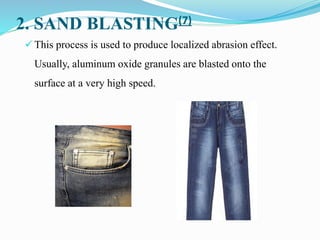
2. SAND BLASTING(7)
✓ This process is used to produce localized abrasion effect.
Usually, aluminum oxide granules are blasted onto the
surface at a very high speed.
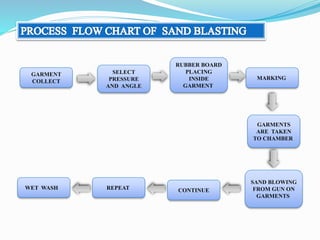
GARMENT
COLLECT
SELECT
PRESSURE
AND ANGLE
MARKING
RUBBER BOARD
PLACING
INSIDE
GARMENT
REPEAT CONTINUE
SAND BLOWING
FROM GUN ON
GARMENTS
GARMENTS
ARE TAKEN
TO CHAMBER
WET WASH
➢ Advantages:
✓ It is purely mechanical process, not using any chemicals.
✓ It is a water free process therefore no drying required.
✓ Variety of distressed or abraded looks possible.
✓ Any number of designs could be created by special
techniques.
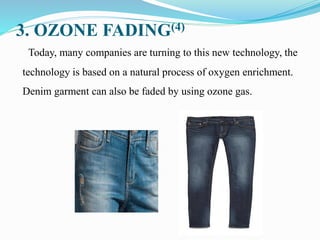
3. OZONE FADING(4)
Today, many companies are turning to this new technology, the
technology is based on a natural process of oxygen enrichment.
Denim garment can also be faded by using ozone gas.
➢ Advantages:
✓ Colour removal is possible without lossing strength.
✓ This method is very simple.
✓ No harmful effect on environment.
✓ Gives very good results on denim compare to other processes
of washing.
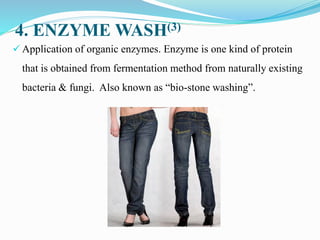
4. ENZYME WASH(3)
✓ Application of organic enzymes. Enzyme is one kind of protein
that is obtained from fermentation method from naturally existing
bacteria & fungi. Also known as “bio-stone washing”.
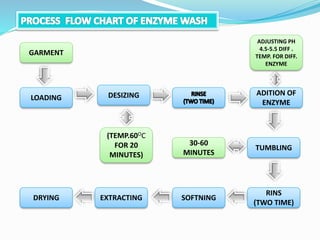
LOADING DESIZING ADITION OF
ENZYME
GARMENT
ADJUSTING PH
4.5-5.5 DIFF .
TEMP. FOR DIFF.
ENZYME
TUMBLING
30-60
MINUTES
RINS
(TWO TIME)
SOFTNINGEXTRACTINGDRYING
(TEMP.60OC
FOR 20
MINUTES)
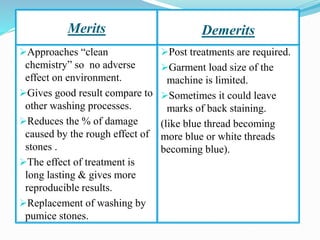
Merits Demerits
➢Approaches “clean
chemistry” so no adverse
effect on environment.
➢Gives good result compare to
other washing processes.
➢Reduces the % of damage
caused by the rough effect of
stones .
➢The effect of treatment is
long lasting & gives more
reproducible results.
➢Replacement of washing by
pumice stones.
➢Post treatments are required.
➢Garment load size of the
machine is limited.
➢Sometimes it could leave
marks of back staining.
(like blue thread becoming
more blue or white threads
becoming blue).
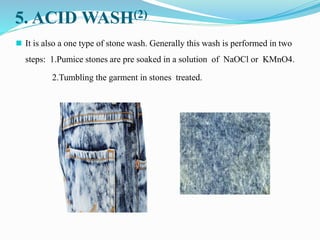
5. ACID WASH(2)
◼ It is also a one type of stone wash. Generally this wash is performed in two
steps: 1.Pumice stones are pre soaked in a solution of NaOCl or KMnO4.
2.Tumbling the garment in stones treated.
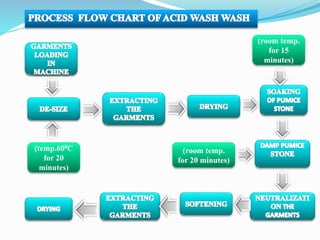
(temp.600C
for 20
minutes)
(room temp.
for 15
minutes)
(room temp.
for 20 minutes)
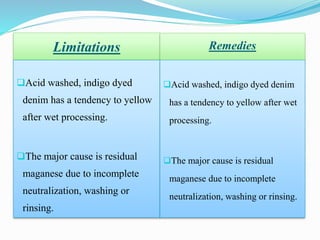
Limitations Remedies
❑Acid washed, indigo dyed
denim has a tendency to yellow
after wet processing.
❑The major cause is residual
maganese due to incomplete
neutralization, washing or
rinsing.
❑Acid washed, indigo dyed denim
has a tendency to yellow after wet
processing.
❑The major cause is residual
maganese due to incomplete
neutralization, washing or rinsing.
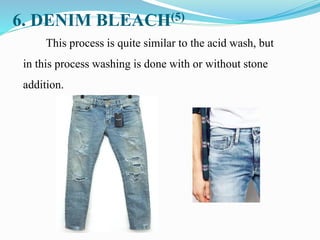
6. DENIM BLEACH(5)
This process is quite similar to the acid wash, but
in this process washing is done with or without stone
addition.
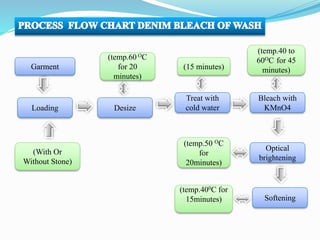
Garment
Loading
(With Or
Without Stone)
Softening
Optical
brightening
Bleach with
KMnO4
Treat with
cold waterDesize
(temp.60 OC
for 20
minutes)
(temp.40 to
60OC for 45
minutes)(15 minutes)
(temp.50 OC
for
20minutes)
(temp.400C for
15minutes)
Limitations:
◆Process is difficult to control,
◆Sometimes problem of yellowing occurs,
◆Causes corrosion of machine parts,
◆Source of environmental pollution,
◆Required anti-chloro treatment.
3E BLEACHING CONCEPT(8)
◆Intensive research is underway for the development of Sodium
hypochlorite bleaching alternative eg. Glucose bleaching, bleaching
with sulphinic acid derivatives, and recently with laccase (one type
of enzyme).
◆Laccase enzyme belongs to the oxidoreductase group. Laccase,s
oxidative effect is complex and it does not work independently. A
mediator is necessary and a chemical mediator is employed between
enzyme and indigo.
◆This technology is based on a (a redox enzyme using mol. Oxygen as
electron acceptor) and mediator. eg. Denilite (enzyme+PPT).
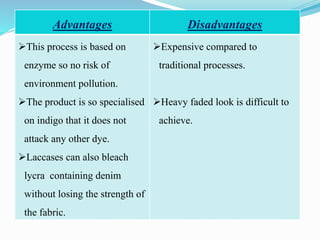
Advantages Disadvantages
➢This process is based on
enzyme so no risk of
environment pollution.
➢The product is so specialised
on indigo that it does not
attack any other dye.
➢Laccases can also bleach
lycra containing denim
without losing the strength of
the fabric.
➢Expensive compared to
traditional processes.
➢Heavy faded look is difficult to
achieve.
• BIBLIOGRAPHY:
1. D. P. Chattopadhyay and R.D. Pachauri, "Preparation of synthetic stones
for denim washing & analysis of wash effects", Textiles and light industrial
science & Tech., volume 1(2), pages.1 to 4, 2012.
2. U. N. Haq and M.R. Khan, "Technology of acid wash on woven denim
apparel with damp pumice stone", International journal of science,
environment & Tech., vol. 3, pages. 2090 to 2095, 2014.
3. I. H. Mondal, M. R. Khan and F. A. Ahmed, "Physical-Mechanical
properties of finished denim garment by stone enzymatic treatment",
Journal of textile and apparel, Tech. & management, vol.10(1), pages.1 to
4, 2016.
4. Anurag Singh, "Denim washing", Technology & Business, volume.1(3),
pages.1 to 8, 2014.
5. "Manufacture of denim", Small industries service institute, Gov. of India
(ministry of SSI), company. volume.1(1), pages.67 to69, 2003.
6. "Garment washing techniques for cotton apparel" Cotton incorporated
research center, A technical bulletin, volume. 1(1), pages. 2 to 6, 1992.
7. C. H. Chaterjee, "Different methods for denim washing " Denim 2006 &
Indo-us summit, Ahmadabad, volume. 1(1), pages.1 to 12.
8. Archroma global denim center, "Denim book/from cotton to fashion",
Advanced denim, volume.1(1), pages. 38 to 55, 2004.
Denim washing; Mechanical & Chemical methods

Denim washing; Mechanical & Chemical methods

  • 1.
    PREPARED BY:- -UTSAV SHAH(434043) -JAYANTPATIL(434038) DEPARTMENT:- -TEXTILE PROCESSING Faculty of Technology & engineering The Maharaja Sayajirao University of baroda
  • 3.
    INTRODUCTION(9) ✓ Denim isa rugged cotton twill textile in which the weft yarns passes under two or more warp yarns. ✓ In dyeing of denim only warp yarn is traditionally dyed with the blue colour obtained from indigo dyes. ✓ It is the future of fabric because denim is used by all human beings around the world.
  • 4.
    Objectives Of DenimWashing(6) Washing of denim is a most important finishing treatment in textile industries. It has the largest effect on the physico-mechanical properties on denim garment. Objectives:- 1. Faded or worn out effects could be introduced to the garment which creates new fashion. 2. Softness could be increased by the addition of softener just at the last sage of washing. 3. Removal of starch or size materials makes the garments soft hand feel. 4. Improving the quality of final product and also increase the aesthetic value in the market. “provides the garment an identity and exclusive appearance and helps in creating a brand image”
  • 5.
  • 6.
    1. STONE WASH ✓Thismethod is most common and it is used to give “old look” on the denim fabric. In this process pumice stone are most important component. ➢ Selection of stone: - ✓ Large, hard stones last longer and may be suited for heavy weight fabrics only. ✓ Smaller, softer stones would be used for light weight fabrics and more delicate items. ✓ Stone weight/ fabric weight= 0.5 to 3/1
  • 8.
    ➢ Limitations: ✓ Outcomeof a load of jeans is never uniform. ✓ Damage to wash machineries and garment due to stone to machine abrasion. ✓ Increase in labour to remove stone particles from finished garments. ✓ Water pollution during disposal of used liquor.
  • 9.
    2. SAND BLASTING(7) ✓This process is used to produce localized abrasion effect. Usually, aluminum oxide granules are blasted onto the surface at a very high speed.
  • 10.
    GARMENT COLLECT SELECT PRESSURE AND ANGLE MARKING RUBBER BOARD PLACING INSIDE GARMENT REPEATCONTINUE SAND BLOWING FROM GUN ON GARMENTS GARMENTS ARE TAKEN TO CHAMBER WET WASH
  • 11.
    ➢ Advantages: ✓ Itis purely mechanical process, not using any chemicals. ✓ It is a water free process therefore no drying required. ✓ Variety of distressed or abraded looks possible. ✓ Any number of designs could be created by special techniques.
  • 12.
    3. OZONE FADING(4) Today,many companies are turning to this new technology, the technology is based on a natural process of oxygen enrichment. Denim garment can also be faded by using ozone gas.
  • 13.
    ➢ Advantages: ✓ Colourremoval is possible without lossing strength. ✓ This method is very simple. ✓ No harmful effect on environment. ✓ Gives very good results on denim compare to other processes of washing.
  • 14.
    4. ENZYME WASH(3) ✓Application of organic enzymes. Enzyme is one kind of protein that is obtained from fermentation method from naturally existing bacteria & fungi. Also known as “bio-stone washing”.
  • 15.
    LOADING DESIZING ADITIONOF ENZYME GARMENT ADJUSTING PH 4.5-5.5 DIFF . TEMP. FOR DIFF. ENZYME TUMBLING 30-60 MINUTES RINS (TWO TIME) SOFTNINGEXTRACTINGDRYING (TEMP.60OC FOR 20 MINUTES)
  • 16.
    Merits Demerits ➢Approaches “clean chemistry”so no adverse effect on environment. ➢Gives good result compare to other washing processes. ➢Reduces the % of damage caused by the rough effect of stones . ➢The effect of treatment is long lasting & gives more reproducible results. ➢Replacement of washing by pumice stones. ➢Post treatments are required. ➢Garment load size of the machine is limited. ➢Sometimes it could leave marks of back staining. (like blue thread becoming more blue or white threads becoming blue).
  • 17.
    5. ACID WASH(2) ◼It is also a one type of stone wash. Generally this wash is performed in two steps: 1.Pumice stones are pre soaked in a solution of NaOCl or KMnO4. 2.Tumbling the garment in stones treated.
  • 18.
    (temp.600C for 20 minutes) (room temp. for15 minutes) (room temp. for 20 minutes)
  • 19.
    Limitations Remedies ❑Acid washed,indigo dyed denim has a tendency to yellow after wet processing. ❑The major cause is residual maganese due to incomplete neutralization, washing or rinsing. ❑Acid washed, indigo dyed denim has a tendency to yellow after wet processing. ❑The major cause is residual maganese due to incomplete neutralization, washing or rinsing.
  • 20.
    6. DENIM BLEACH(5) Thisprocess is quite similar to the acid wash, but in this process washing is done with or without stone addition.
  • 21.
    Garment Loading (With Or Without Stone) Softening Optical brightening Bleachwith KMnO4 Treat with cold waterDesize (temp.60 OC for 20 minutes) (temp.40 to 60OC for 45 minutes)(15 minutes) (temp.50 OC for 20minutes) (temp.400C for 15minutes)
  • 22.
    Limitations: ◆Process is difficultto control, ◆Sometimes problem of yellowing occurs, ◆Causes corrosion of machine parts, ◆Source of environmental pollution, ◆Required anti-chloro treatment.
  • 23.
    3E BLEACHING CONCEPT(8) ◆Intensiveresearch is underway for the development of Sodium hypochlorite bleaching alternative eg. Glucose bleaching, bleaching with sulphinic acid derivatives, and recently with laccase (one type of enzyme). ◆Laccase enzyme belongs to the oxidoreductase group. Laccase,s oxidative effect is complex and it does not work independently. A mediator is necessary and a chemical mediator is employed between enzyme and indigo. ◆This technology is based on a (a redox enzyme using mol. Oxygen as electron acceptor) and mediator. eg. Denilite (enzyme+PPT).
  • 24.
    Advantages Disadvantages ➢This processis based on enzyme so no risk of environment pollution. ➢The product is so specialised on indigo that it does not attack any other dye. ➢Laccases can also bleach lycra containing denim without losing the strength of the fabric. ➢Expensive compared to traditional processes. ➢Heavy faded look is difficult to achieve.
  • 25.
    • BIBLIOGRAPHY: 1. D.P. Chattopadhyay and R.D. Pachauri, "Preparation of synthetic stones for denim washing & analysis of wash effects", Textiles and light industrial science & Tech., volume 1(2), pages.1 to 4, 2012. 2. U. N. Haq and M.R. Khan, "Technology of acid wash on woven denim apparel with damp pumice stone", International journal of science, environment & Tech., vol. 3, pages. 2090 to 2095, 2014. 3. I. H. Mondal, M. R. Khan and F. A. Ahmed, "Physical-Mechanical properties of finished denim garment by stone enzymatic treatment", Journal of textile and apparel, Tech. & management, vol.10(1), pages.1 to 4, 2016.
  • 26.
    4. Anurag Singh,"Denim washing", Technology & Business, volume.1(3), pages.1 to 8, 2014. 5. "Manufacture of denim", Small industries service institute, Gov. of India (ministry of SSI), company. volume.1(1), pages.67 to69, 2003. 6. "Garment washing techniques for cotton apparel" Cotton incorporated research center, A technical bulletin, volume. 1(1), pages. 2 to 6, 1992. 7. C. H. Chaterjee, "Different methods for denim washing " Denim 2006 & Indo-us summit, Ahmadabad, volume. 1(1), pages.1 to 12. 8. Archroma global denim center, "Denim book/from cotton to fashion", Advanced denim, volume.1(1), pages. 38 to 55, 2004.