Privacy & Social Media
Chuck Ben-Tzur   CISSP, CISM, CRISC, PMP
March 29, 2012
Personal Information
    • Uniquely identifiable data relating to a person that is collected and stored,
      in digital form or otherwise.
        – Can lead to fraud
           • Social Insurance Number (SIN)
           • Other identification numbers (e.g. Driver license)
        – Can cause damage
           • Financial Information (Credit and Tax Information)
           • Health Information
           • Personal information (e.g. email address, habits)
    • Information privacy is the relationship between collection and
      dissemination of data, technology, the public expectation of privacy, and
      the legal issues surrounding them.
    • In Information Security, it is mostly the “C” in the “C-I-A” (Confidentiality –
      Integrity – Availability)

2
Social Media
    • A group of Internet-based applications that allow the creation
      and exchange of user-generated content
       – Facebook (General)
           • 800 Million active users (end of 2011)
           • 250 Million users accessing Facebook via mobile devices
             (workplace)
           • 30 Billion pieces of content are shared each month
           • 50% of users log onto Facebook everyday
           • The average user has 130 “friends”
       – Twitter (Micro blogging – 190 Million tweets a day)
       – LinkedIn (Business Networking – 135 Million Users)
       – You Tube (Videos)
       – Flickr (photos)

3
Distribution of Information
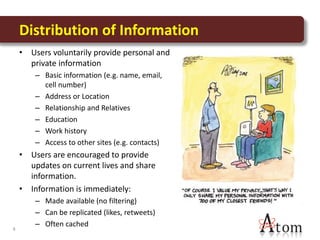
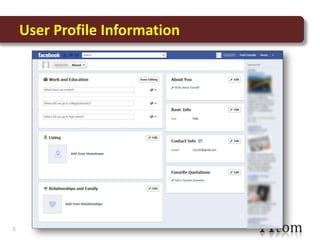
    • Users voluntarily provide personal and
      private information
        – Basic information (e.g. name, email,
          cell number)
        – Address or Location
        – Relationship and Relatives
        – Education
        – Work history
        – Access to other sites (e.g. contacts)
    • Users are encouraged to provide
      updates on current lives and share
      information.
    • Information is immediately:
        – Made available (no filtering)
        – Can be replicated (likes, retweets)
        – Often cached
4
User Profile Information


5
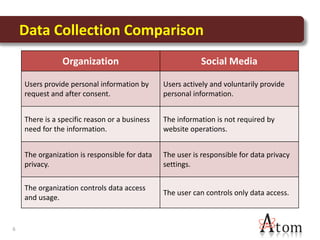
Data Collection Comparison
                Organization                              Social Media

    Users provide personal information by      Users actively and voluntarily provide
    request and after consent.                 personal information.


    There is a specific reason or a business   The information is not required by
    need for the information.                  website operations.


    The organization is responsible for data   The user is responsible for data privacy
    privacy.                                   settings.

    The organization controls data access
                                               The user can controls only data access.
    and usage.


6
Risks
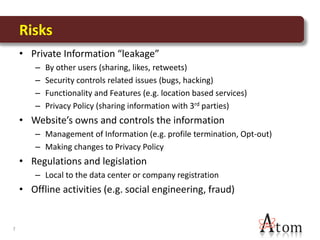
    • Private Information “leakage”
       –   By other users (sharing, likes, retweets)
       –   Security controls related issues (bugs, hacking)
       –   Functionality and Features (e.g. location based services)
       –   Privacy Policy (sharing information with 3rd parties)
    • Website’s owns and controls the information
       – Management of Information (e.g. profile termination, Opt-out)
       – Making changes to Privacy Policy
    • Regulations and legislation
       – Local to the data center or company registration
    • Offline activities (e.g. social engineering, fraud)


7
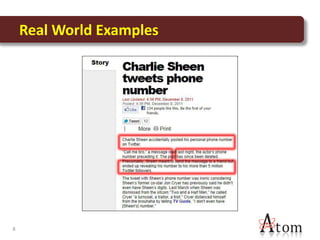
Real World Examples


8
Real World Examples


9
Real World Examples


10
Real World Examples


11
Privacy Related Legislation (Canada)
     • Privacy Act (federal)
     • PIPEDA - Personal Information Protection and Electronic
       Documents Act (private sector)
        – Last Updated on April 2011
     • Provincial laws (e.g. Ontario)
        – Freedom of Information and Protection of Privacy Act
        – Municipal Freedom of Information and Protection of Privacy Act
        – Personal Health Information Protection Act (PHIPA)


12
“PIPEDA”/Facebook (May 2008)
     • A complaint against Facebook by the Canadian Internet Policy
       and Public Interest Clinic (CIPPIC). Issues centered around
       users knowledge and consent, retention (account
       deactivation) and third-party applications security.
     • Some of the allegations (e.g. third-party applications, account
       deactivation) were found to be well-founded.
     • Facebook agreed to make several changes which address the
       issues uncovered during the investigation (mostly by providing
       additional information on screen).


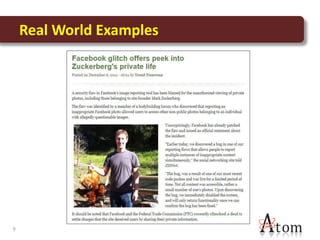
     Remember the Example in slide 9?


13
“PIPEDA”/Facebook (Excerpt from Report )
     • “… the foundation on which the Personal Information
       Protection and Electronic Documents Act (the Act) is built –
       are being significantly challenged.”
     • “…Individuals do post personal information for purely
       personal reasons. Nonetheless, personal information posted
       by individuals for purely personal purposes that would
       otherwise be exempted under the Act does fall under the Act
       and imposes obligations on Facebook to the extent that
       Facebook uses such personal information in the course of
       commercial activities.”
     • Full report can be found at:
       http://www.priv.gc.ca/information/social/index_e.cfm

14
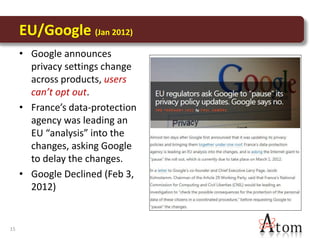
EU/Google (Jan 2012)
     • Google announces
       privacy settings change
       across products, users
       can’t opt out.
     • France’s data-protection
       agency was leading an
       EU “analysis” into the
       changes, asking Google
       to delay the changes.
     • Google Declined (Feb 3,
       2012)


15
What Should We Do?
     • Education and Training
        – WHAT is personal information
        – HOW to maintain privacy
        – Do and Don’t in Social Media
     • Independent Security Controls
        – Website Filtering
        – Data Leakage Prevention (DLP)
        – Logging and Monitoring
     • Be Involved and Updated
        – Changes in legislation
        – Changes in Privacy Policies
     • Embed in the organization
        – Corporate Policies
16      – Privacy Impact and Risk Assessment
Thank You
                  cbentzur@atominfosec.com


Images from: http://www.priv.gc.ca/information/illustrations/index_e.cfm#contenttop

Privacy & Social Media

  • 1.
    Privacy & SocialMedia Chuck Ben-Tzur CISSP, CISM, CRISC, PMP March 29, 2012
  • 2.
    Personal Information • Uniquely identifiable data relating to a person that is collected and stored, in digital form or otherwise. – Can lead to fraud • Social Insurance Number (SIN) • Other identification numbers (e.g. Driver license) – Can cause damage • Financial Information (Credit and Tax Information) • Health Information • Personal information (e.g. email address, habits) • Information privacy is the relationship between collection and dissemination of data, technology, the public expectation of privacy, and the legal issues surrounding them. • In Information Security, it is mostly the “C” in the “C-I-A” (Confidentiality – Integrity – Availability) 2
  • 3.
    Social Media • A group of Internet-based applications that allow the creation and exchange of user-generated content – Facebook (General) • 800 Million active users (end of 2011) • 250 Million users accessing Facebook via mobile devices (workplace) • 30 Billion pieces of content are shared each month • 50% of users log onto Facebook everyday • The average user has 130 “friends” – Twitter (Micro blogging – 190 Million tweets a day) – LinkedIn (Business Networking – 135 Million Users) – You Tube (Videos) – Flickr (photos) 3
  • 4.
    Distribution of Information • Users voluntarily provide personal and private information – Basic information (e.g. name, email, cell number) – Address or Location – Relationship and Relatives – Education – Work history – Access to other sites (e.g. contacts) • Users are encouraged to provide updates on current lives and share information. • Information is immediately: – Made available (no filtering) – Can be replicated (likes, retweets) – Often cached 4
  • 5.
  • 6.
    Data Collection Comparison Organization Social Media Users provide personal information by Users actively and voluntarily provide request and after consent. personal information. There is a specific reason or a business The information is not required by need for the information. website operations. The organization is responsible for data The user is responsible for data privacy privacy. settings. The organization controls data access The user can controls only data access. and usage. 6
  • 7.
    Risks • Private Information “leakage” – By other users (sharing, likes, retweets) – Security controls related issues (bugs, hacking) – Functionality and Features (e.g. location based services) – Privacy Policy (sharing information with 3rd parties) • Website’s owns and controls the information – Management of Information (e.g. profile termination, Opt-out) – Making changes to Privacy Policy • Regulations and legislation – Local to the data center or company registration • Offline activities (e.g. social engineering, fraud) 7
  • 8.
  • 9.
  • 10.
  • 11.
  • 12.
    Privacy Related Legislation(Canada) • Privacy Act (federal) • PIPEDA - Personal Information Protection and Electronic Documents Act (private sector) – Last Updated on April 2011 • Provincial laws (e.g. Ontario) – Freedom of Information and Protection of Privacy Act – Municipal Freedom of Information and Protection of Privacy Act – Personal Health Information Protection Act (PHIPA) 12
  • 13.
    “PIPEDA”/Facebook (May 2008) • A complaint against Facebook by the Canadian Internet Policy and Public Interest Clinic (CIPPIC). Issues centered around users knowledge and consent, retention (account deactivation) and third-party applications security. • Some of the allegations (e.g. third-party applications, account deactivation) were found to be well-founded. • Facebook agreed to make several changes which address the issues uncovered during the investigation (mostly by providing additional information on screen). Remember the Example in slide 9? 13
  • 14.
    “PIPEDA”/Facebook (Excerpt fromReport ) • “… the foundation on which the Personal Information Protection and Electronic Documents Act (the Act) is built – are being significantly challenged.” • “…Individuals do post personal information for purely personal reasons. Nonetheless, personal information posted by individuals for purely personal purposes that would otherwise be exempted under the Act does fall under the Act and imposes obligations on Facebook to the extent that Facebook uses such personal information in the course of commercial activities.” • Full report can be found at: http://www.priv.gc.ca/information/social/index_e.cfm 14
  • 15.
    EU/Google (Jan 2012) • Google announces privacy settings change across products, users can’t opt out. • France’s data-protection agency was leading an EU “analysis” into the changes, asking Google to delay the changes. • Google Declined (Feb 3, 2012) 15
  • 16.
    What Should WeDo? • Education and Training – WHAT is personal information – HOW to maintain privacy – Do and Don’t in Social Media • Independent Security Controls – Website Filtering – Data Leakage Prevention (DLP) – Logging and Monitoring • Be Involved and Updated – Changes in legislation – Changes in Privacy Policies • Embed in the organization – Corporate Policies 16 – Privacy Impact and Risk Assessment
  • 17.
    Thank You cbentzur@atominfosec.com Images from: http://www.priv.gc.ca/information/illustrations/index_e.cfm#contenttop