Web 3.0?  A Look at the Future of The World Wide Web Roman Koshykar Library Liaison, Golisano College of Computing and Information Sciences , RIT Libraries
It’s quite simple, really… The past of the World Wide Web The present of the World Wide Web The future of the World Wide Web What is the Semantic Web? Imagining the shape of the online world to come
How did we get here? Disambiguation of terms Web 1.0: hyperlinked information, static content Web 2.0: dynamic information, social content Web 3.0(?): organized information, content plus  meaning
The Adolescent WWW If the Web was a human, it would be about 17 years old How many 17 year olds are fully mature? Take a look back at the early days
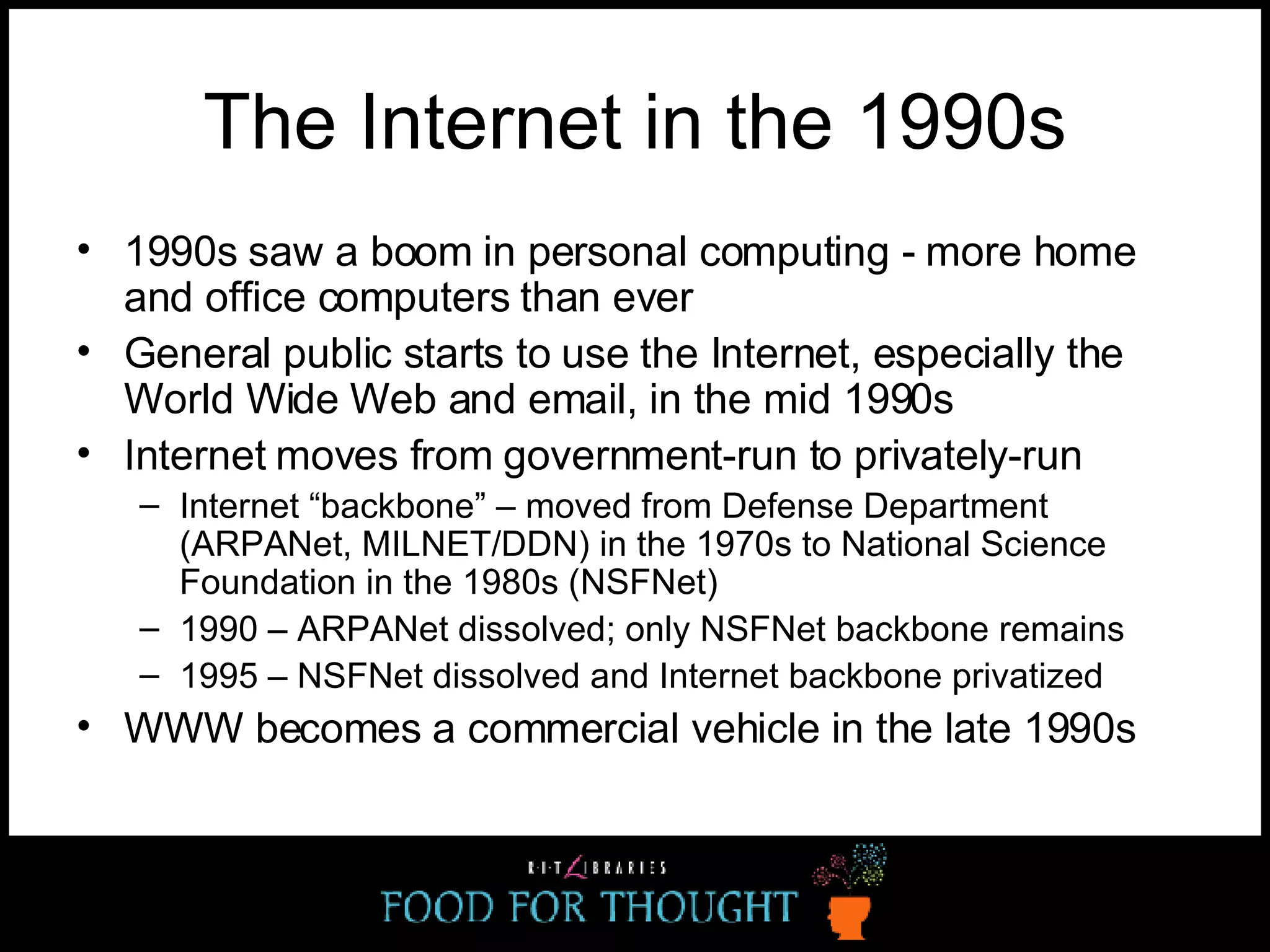
The Internet in the 1990s 1990s saw a boom in personal computing - more home and office computers than ever General public starts to use the Internet, especially the World Wide Web and email, in the mid 1990s Internet moves from government-run to privately-run Internet “backbone” – moved from Defense Department (ARPANet, MILNET/DDN) in the 1970s to National Science Foundation in the 1980s (NSFNet) 1990 – ARPANet dissolved; only NSFNet backbone remains 1995 – NSFNet dissolved and Internet backbone privatized WWW becomes a commercial vehicle in the late 1990s
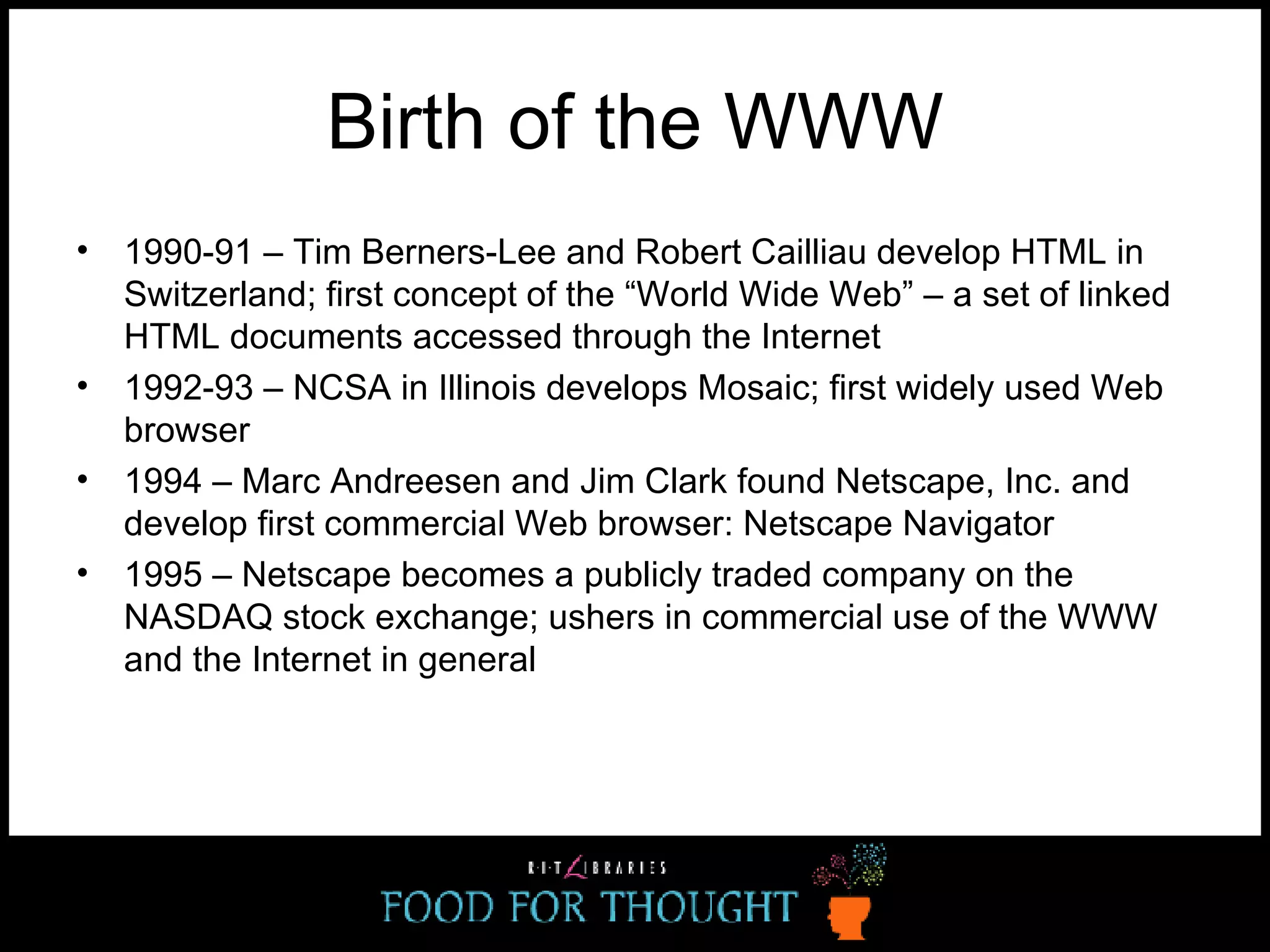
Birth of the WWW 1990-91 – Tim Berners-Lee and Robert Cailliau develop HTML in Switzerland; first concept of the “World Wide Web” – a set of linked HTML documents accessed through the Internet 1992-93 – NCSA in Illinois develops Mosaic; first widely used Web browser 1994 – Marc Andreesen and Jim Clark found Netscape, Inc. and develop first commercial Web browser: Netscape Navigator 1995 – Netscape becomes a publicly traded company on the NASDAQ stock exchange; ushers in commercial use of the WWW and the Internet in general
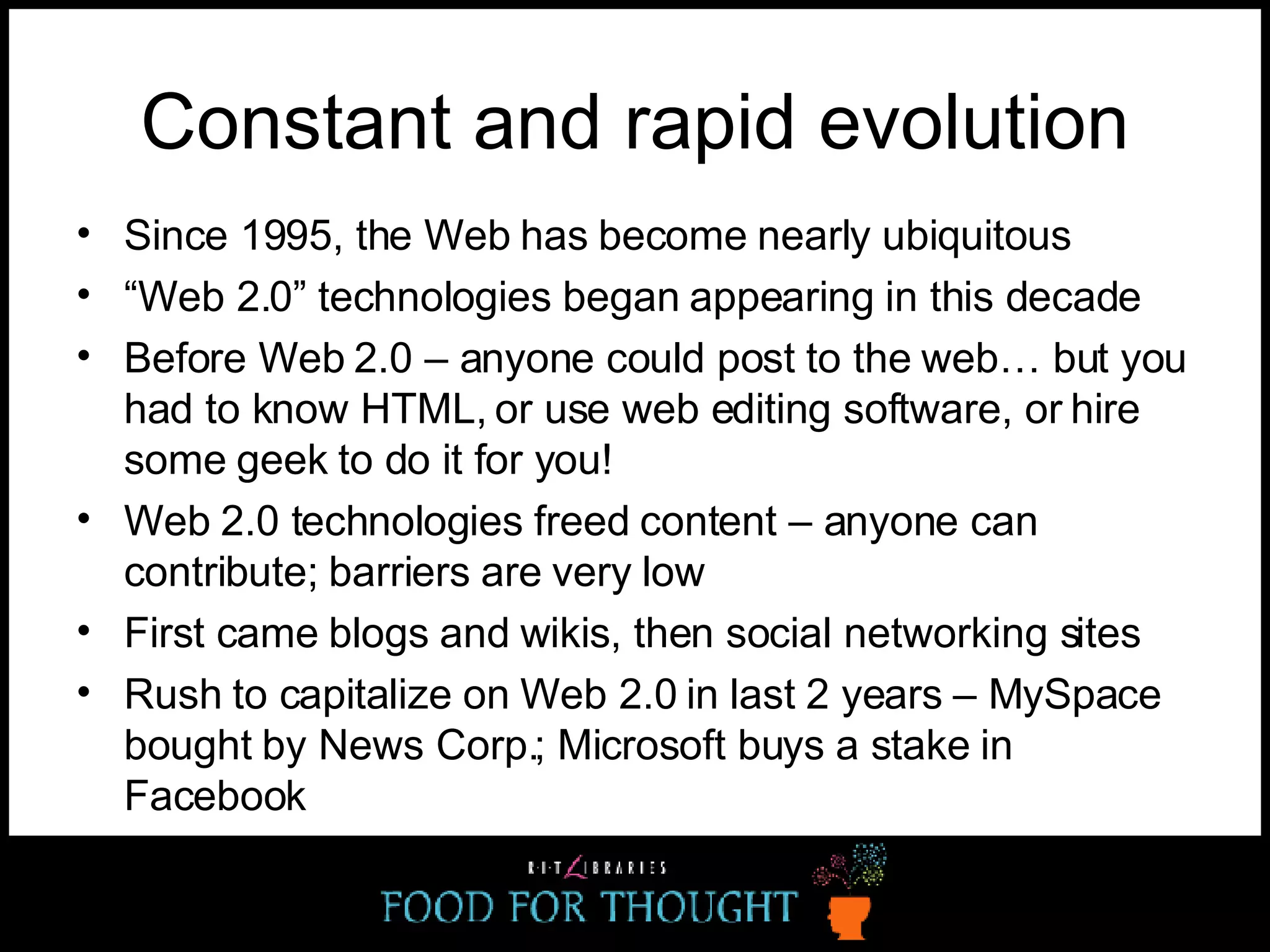
Constant and rapid evolution Since 1995, the Web has become nearly ubiquitous “ Web 2.0” technologies began appearing in this decade Before Web 2.0 – anyone could post to the web… but you had to know HTML, or use web editing software, or hire some geek to do it for you! Web 2.0 technologies freed content – anyone can contribute; barriers are very low First came blogs and wikis, then social networking sites Rush to capitalize on Web 2.0 in last 2 years – MySpace bought by News Corp.; Microsoft buys a stake in Facebook
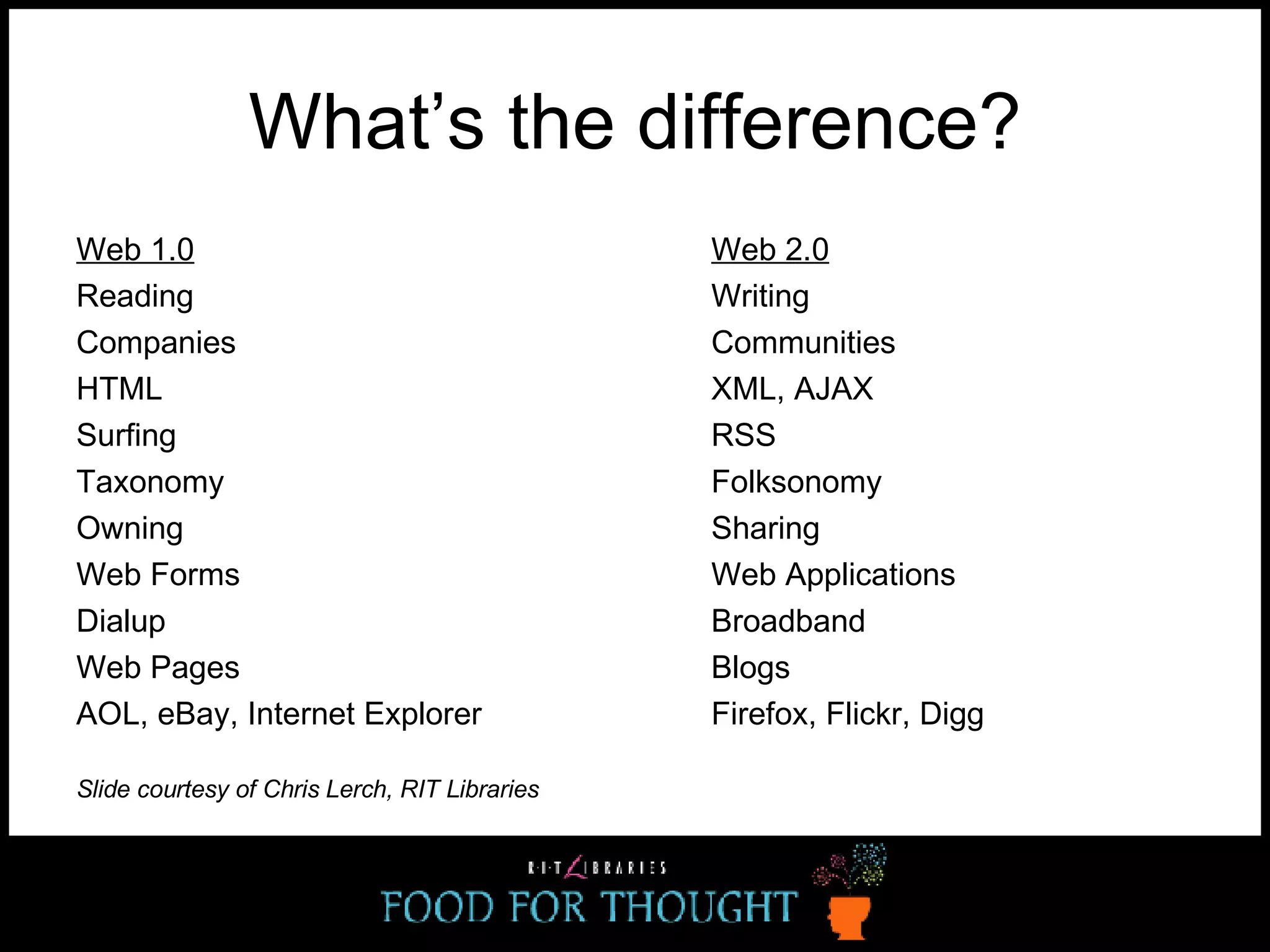
What’s the difference? Web 1.0 Web 2.0 Reading Writing Companies Communities HTML XML, AJAX Surfing RSS Taxonomy Folksonomy Owning Sharing Web Forms Web Applications Dialup Broadband Web Pages Blogs AOL, eBay, Internet Explorer Firefox, Flickr, Digg Slide courtesy of Chris Lerch, RIT Libraries
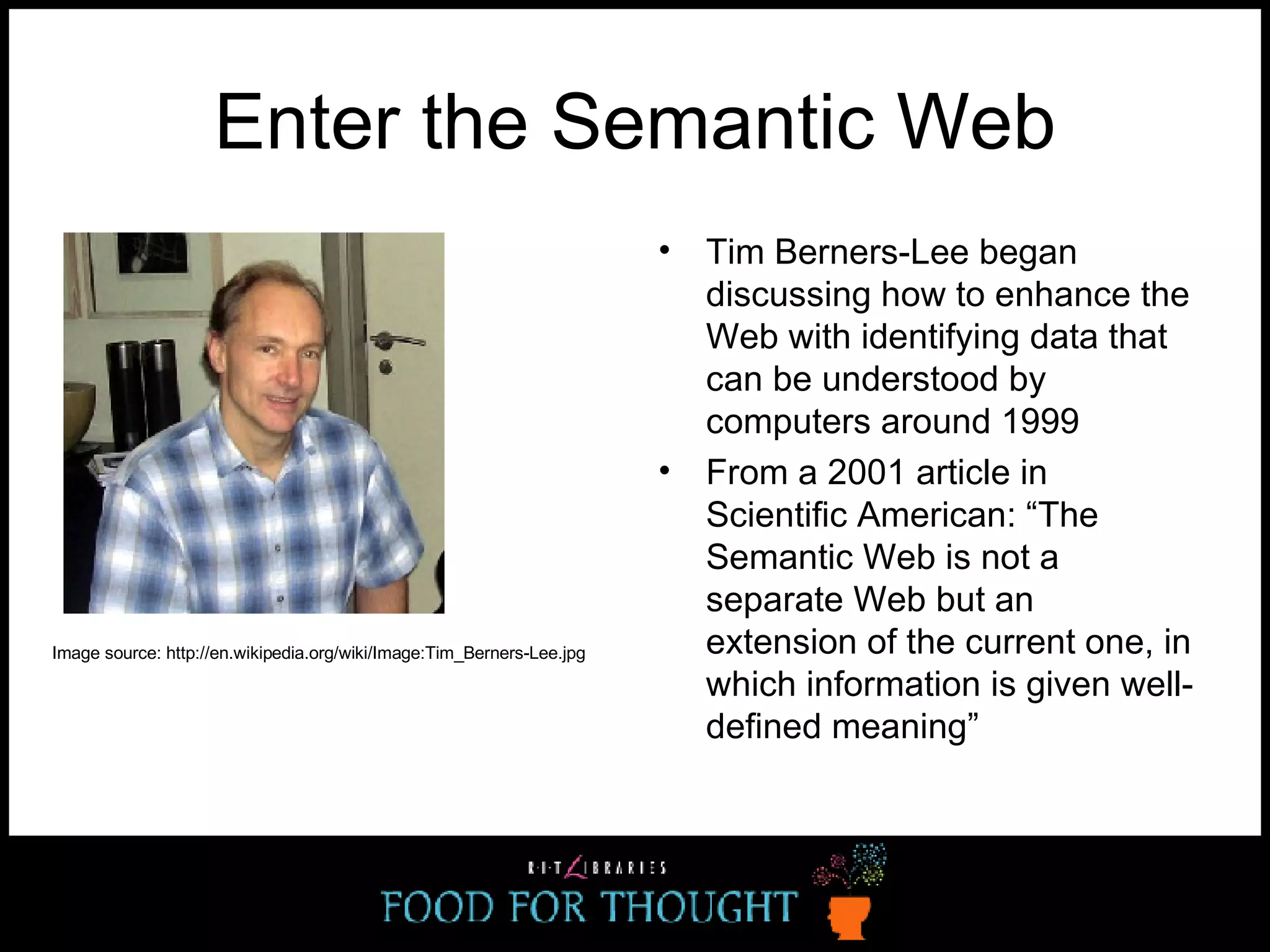
Enter the Semantic Web Tim Berners-Lee began discussing how to enhance the Web with identifying data that can be understood by computers around 1999 From a 2001 article in Scientific American: “The Semantic Web is not a separate Web but an extension of the current one, in which information is given well-defined meaning” Image source: http://en.wikipedia.org/wiki/Image:Tim_Berners-Lee.jpg
How is this accomplished? It’s all about  metadata : information that indicates attributes of a content item Metadata should be standardized to have meaning – Semantic Web uses standards of XML (Extensible Markup Language) to assign metadata and RDF (Resource Description Format) to define meaning and describe relationships  Using XML, metadata associated with Web-based information can be communicated in a machine-readable way Metadata can be assigned to XML documents according to sets of rules called  hierarchical taxonomies  The overall goal of the Semantic Web is to organize metadata in such a way that computers can automatically interpret and “understand” it because it is logically represented (ontology) This is almost like artificial intelligence -  smart data read by dumb machines
What is it good for? Since its inception, the Web has been an unorganized mess – organizing it in a meaningful way is a worthy goal Semantic metadata would greatly improve searching – but search is already better than it was in the ‘90s Semantic Web could allow programmers to create software that acts autonomously – software that “understands” Web content and does exactly what you want/need  When pressed, Semantic Web pioneers often say that we haven’t even conceived of all the possible uses – Semantic Web may offer wide open potential, but also may be so vague that it isn’t practical or even attainable Tim Berners-Lee wanted the Web to be Semantic from the beginning – but he wasn’t able to make it so – does that mean it is impossible, or that the Web needs to mature further?
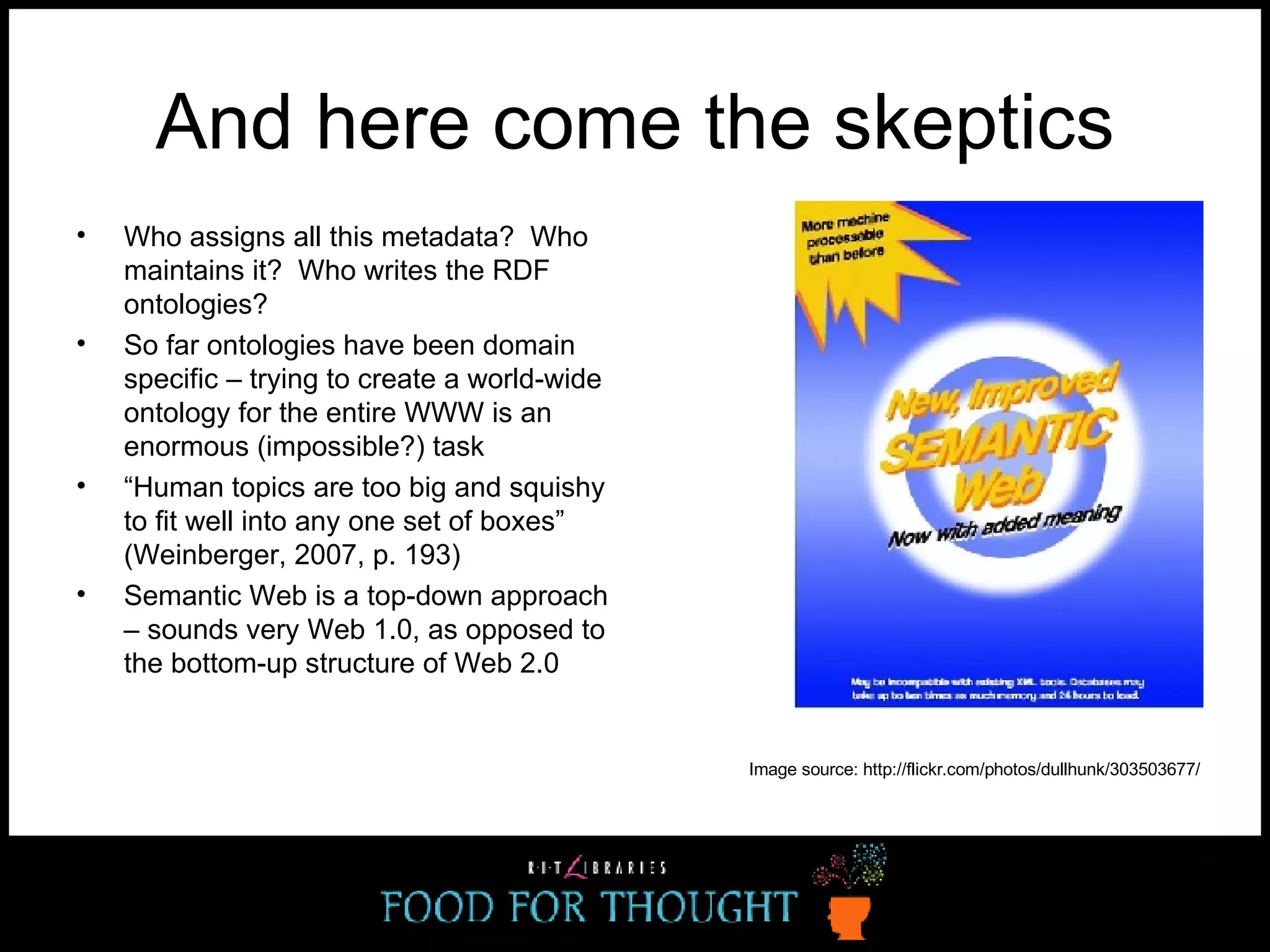
And here come the skeptics Who assigns all this metadata?  Who maintains it?  Who writes the RDF ontologies? So far ontologies have been domain specific – trying to create a world-wide ontology for the entire WWW is an enormous (impossible?) task  “ Human topics are too big and squishy to fit well into any one set of boxes” (Weinberger, 2007, p. 193) Semantic Web is a top-down approach – sounds very Web 1.0, as opposed to the bottom-up structure of Web 2.0 Image source: http://flickr.com/photos/dullhunk/303503677/
So where does the Semantic Web stand? So far, only a handful of start-ups are working on Semantic Web systems – there has been no “killer app” that has led to widespread adoption Investors are always looking for the next hot tech, but so far the Semantic Web hasn’t generated more than curiosity Web 2.0 technologies have caught on, though – one of the hallmarks of Web 2.0 is tagging, or the ability for anyone to assign descriptive keywords to things on the Web Are Web 2.0 tags metadata?  More importantly, are tags  semantic  metadata?
Example – organizing your digital photos If you store your photos on your hard drive in a traditional file structure, they are organized in an ontology (of sorts), but they are not categorized in a meaningful way (i.e. they lack metadata) If you post your photos to Flickr and tag them, the tags act like metadata, but there is no structure or standardization (i.e. there is no ontology) – there’s no structure because you tag them however you wish Tagging is extremely flexible and dynamic, but meanings are ambiguous and there is no centralized controlled vocabulary for consistently assigning tags – these organization schemes are called “folksonomies,” to distinguish them from formalized taxonomies For the Semantic Web, you need both the metadata and the overlying structure – is it hopeless?
A Social Semantic Web? Can Web 2.0 tags represent some ordered collective intelligence? It’s the Wikipedia model instead of the Britannica model “ When a substantial number of users tag content for a long period of time, stable tags start appearing in the resulting folksonomy.” (Mikroyannidis, 2007, p. 114) Folksonomies of this sort are much more dynamic – evolve with user understanding Folksonomies provide meaning, but this meaning would need to be codified into metadata, so computers can understand the human-generated tags
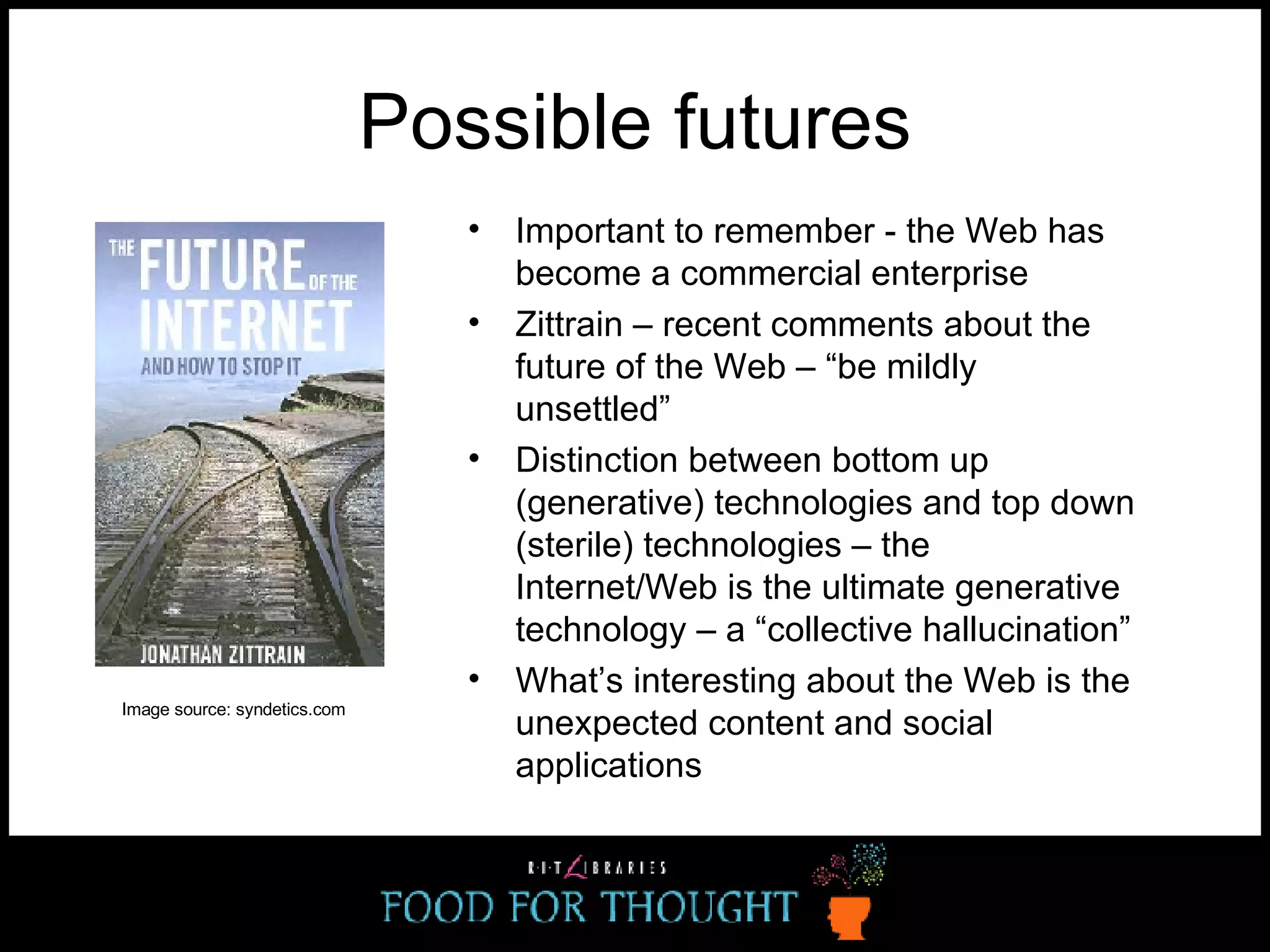
Possible futures Important to remember - the Web has become a commercial enterprise Zittrain – recent comments about the future of the Web – “be mildly unsettled” Distinction between bottom up (generative) technologies and top down (sterile) technologies – the Internet/Web is the ultimate generative technology – a “collective hallucination” What’s interesting about the Web is the unexpected content and social applications Image source: syndetics.com
“ Contingently generative” As fear and mistrust take root, tech companies are beginning to move back to sterile technologies, in Zittrain’s opinion – even as user-generated content (and user-generated metadata, in the form of tags) revolutionize the Web These include nonprogrammable devices such as TiVo, BlackBerry, iPod, mobile phones, and game consoles – vendors can change them, but users can’t Also seem to be moving in the direction of vendors approving new software applications written for their products – Zittrain calls these “contingently generative technologies” Where is the balance between openness and security if the generative technology of the Web is just as useful to the bad guys as it is to businesses and everyday users?
Why bring this up? The debate over the openness of the Web has become a political issue Remember, the Internet backbone was privatized in the mid-1990s “ Net neutrality” is an extremely hot topic – legislators, regulators, telecommunication corporations, advocacy groups, academics, and citizen activists are all playing a part in the debate right now See  http://www.savetheinternet.com  for a great overview of the issue – but know that this site is sponsored by an advocacy group
To summarize, to speculate How will a (potentially) less open Internet affect the development of Web 3.0 – whether it’s the Semantic Web or something else? How much ontological standardization is needed, vs. how much to we let the hive mind organize the Web for us? Who owns semantic metadata?  Who maintains it?  Where is the ultimate balance between 2.0-style social metadata and 1.0-style hierarchical metadata schemes? Is there any money to be made on the Semantic Web?  Will Semantic Web technology advance without a profit motive?
Bibliography Berners-Lee, T., & Fischetti, M. (1999).  Weaving the Web: the original design and ultimate destiny of the World Wide Web by its inventor .  San Francisco: HarperSanFrancisco. Berners-Lee, T., Hendler, J., & Lassila, O.  (2001, May).  The Semantic Web.  Scientific American, 284 (5), 34-43.  Daconta, M.C., Obrst, L.J., & Smith, K.T.  (2003).  The Semantic Web: a guide to the future of XML, Web services, and knowledge management .  Indianapolis: Wiley. Free Press Action Fund.  (2008).  Save the Internet: fighting for Internet freedom.  Retrieved June 3, 2008, from  http://www.savetheinternet.com   Gillies, J., & Cailliau, R.  (2000).  How the Web was born: the story of the World Wide Web .  Oxford: Oxford University Press. Markoff, J.  (2006, Nov. 12).  Entrepreneurs see a Web guided by common sense.  New York Times , p. 1.1  Mikroyannidis, A.  (2007, Nov.).  Toward a social Semantic Web.  IEEE Computer, 40 (11), 113-115. Stewart, W.  (1996-2008).  The living internet .  Retrieved May 21, 2008 from  http://www.livinginternet.com .  Weinberger, D.  (2007).  Everything is miscellaneous: the power of the new digital disorder .  New York: Times Books. Zittrain, J.  (2008).  The future of the Internet and how to stop it .  New Haven: Yale University Press. Zittrain, J.  (2008, Apr. 22).  The future of the Internet and how to stop it .  [Online video].  Retrieved May 21, 2008, from the MediaBerkman blog:  http://blogs.law.harvard.edu/mediaberkman/2008/04/22/jonathan-zittrain-the-future-of-the-internet-and-how-to-stop-it/

Web 3.0? A look at the future of the World Wide Web

  • 1.
    Web 3.0? A Look at the Future of The World Wide Web Roman Koshykar Library Liaison, Golisano College of Computing and Information Sciences , RIT Libraries
  • 2.
    It’s quite simple,really… The past of the World Wide Web The present of the World Wide Web The future of the World Wide Web What is the Semantic Web? Imagining the shape of the online world to come
  • 3.
    How did weget here? Disambiguation of terms Web 1.0: hyperlinked information, static content Web 2.0: dynamic information, social content Web 3.0(?): organized information, content plus meaning
  • 4.
    The Adolescent WWWIf the Web was a human, it would be about 17 years old How many 17 year olds are fully mature? Take a look back at the early days
  • 5.
    The Internet inthe 1990s 1990s saw a boom in personal computing - more home and office computers than ever General public starts to use the Internet, especially the World Wide Web and email, in the mid 1990s Internet moves from government-run to privately-run Internet “backbone” – moved from Defense Department (ARPANet, MILNET/DDN) in the 1970s to National Science Foundation in the 1980s (NSFNet) 1990 – ARPANet dissolved; only NSFNet backbone remains 1995 – NSFNet dissolved and Internet backbone privatized WWW becomes a commercial vehicle in the late 1990s
  • 6.
    Birth of theWWW 1990-91 – Tim Berners-Lee and Robert Cailliau develop HTML in Switzerland; first concept of the “World Wide Web” – a set of linked HTML documents accessed through the Internet 1992-93 – NCSA in Illinois develops Mosaic; first widely used Web browser 1994 – Marc Andreesen and Jim Clark found Netscape, Inc. and develop first commercial Web browser: Netscape Navigator 1995 – Netscape becomes a publicly traded company on the NASDAQ stock exchange; ushers in commercial use of the WWW and the Internet in general
  • 7.
    Constant and rapidevolution Since 1995, the Web has become nearly ubiquitous “ Web 2.0” technologies began appearing in this decade Before Web 2.0 – anyone could post to the web… but you had to know HTML, or use web editing software, or hire some geek to do it for you! Web 2.0 technologies freed content – anyone can contribute; barriers are very low First came blogs and wikis, then social networking sites Rush to capitalize on Web 2.0 in last 2 years – MySpace bought by News Corp.; Microsoft buys a stake in Facebook
  • 8.
    What’s the difference?Web 1.0 Web 2.0 Reading Writing Companies Communities HTML XML, AJAX Surfing RSS Taxonomy Folksonomy Owning Sharing Web Forms Web Applications Dialup Broadband Web Pages Blogs AOL, eBay, Internet Explorer Firefox, Flickr, Digg Slide courtesy of Chris Lerch, RIT Libraries
  • 9.
    Enter the SemanticWeb Tim Berners-Lee began discussing how to enhance the Web with identifying data that can be understood by computers around 1999 From a 2001 article in Scientific American: “The Semantic Web is not a separate Web but an extension of the current one, in which information is given well-defined meaning” Image source: http://en.wikipedia.org/wiki/Image:Tim_Berners-Lee.jpg
  • 10.
    How is thisaccomplished? It’s all about metadata : information that indicates attributes of a content item Metadata should be standardized to have meaning – Semantic Web uses standards of XML (Extensible Markup Language) to assign metadata and RDF (Resource Description Format) to define meaning and describe relationships Using XML, metadata associated with Web-based information can be communicated in a machine-readable way Metadata can be assigned to XML documents according to sets of rules called hierarchical taxonomies The overall goal of the Semantic Web is to organize metadata in such a way that computers can automatically interpret and “understand” it because it is logically represented (ontology) This is almost like artificial intelligence - smart data read by dumb machines
  • 11.
    What is itgood for? Since its inception, the Web has been an unorganized mess – organizing it in a meaningful way is a worthy goal Semantic metadata would greatly improve searching – but search is already better than it was in the ‘90s Semantic Web could allow programmers to create software that acts autonomously – software that “understands” Web content and does exactly what you want/need When pressed, Semantic Web pioneers often say that we haven’t even conceived of all the possible uses – Semantic Web may offer wide open potential, but also may be so vague that it isn’t practical or even attainable Tim Berners-Lee wanted the Web to be Semantic from the beginning – but he wasn’t able to make it so – does that mean it is impossible, or that the Web needs to mature further?
  • 12.
    And here comethe skeptics Who assigns all this metadata? Who maintains it? Who writes the RDF ontologies? So far ontologies have been domain specific – trying to create a world-wide ontology for the entire WWW is an enormous (impossible?) task “ Human topics are too big and squishy to fit well into any one set of boxes” (Weinberger, 2007, p. 193) Semantic Web is a top-down approach – sounds very Web 1.0, as opposed to the bottom-up structure of Web 2.0 Image source: http://flickr.com/photos/dullhunk/303503677/
  • 13.
    So where doesthe Semantic Web stand? So far, only a handful of start-ups are working on Semantic Web systems – there has been no “killer app” that has led to widespread adoption Investors are always looking for the next hot tech, but so far the Semantic Web hasn’t generated more than curiosity Web 2.0 technologies have caught on, though – one of the hallmarks of Web 2.0 is tagging, or the ability for anyone to assign descriptive keywords to things on the Web Are Web 2.0 tags metadata? More importantly, are tags semantic metadata?
  • 14.
    Example – organizingyour digital photos If you store your photos on your hard drive in a traditional file structure, they are organized in an ontology (of sorts), but they are not categorized in a meaningful way (i.e. they lack metadata) If you post your photos to Flickr and tag them, the tags act like metadata, but there is no structure or standardization (i.e. there is no ontology) – there’s no structure because you tag them however you wish Tagging is extremely flexible and dynamic, but meanings are ambiguous and there is no centralized controlled vocabulary for consistently assigning tags – these organization schemes are called “folksonomies,” to distinguish them from formalized taxonomies For the Semantic Web, you need both the metadata and the overlying structure – is it hopeless?
  • 15.
    A Social SemanticWeb? Can Web 2.0 tags represent some ordered collective intelligence? It’s the Wikipedia model instead of the Britannica model “ When a substantial number of users tag content for a long period of time, stable tags start appearing in the resulting folksonomy.” (Mikroyannidis, 2007, p. 114) Folksonomies of this sort are much more dynamic – evolve with user understanding Folksonomies provide meaning, but this meaning would need to be codified into metadata, so computers can understand the human-generated tags
  • 16.
    Possible futures Importantto remember - the Web has become a commercial enterprise Zittrain – recent comments about the future of the Web – “be mildly unsettled” Distinction between bottom up (generative) technologies and top down (sterile) technologies – the Internet/Web is the ultimate generative technology – a “collective hallucination” What’s interesting about the Web is the unexpected content and social applications Image source: syndetics.com
  • 17.
    “ Contingently generative”As fear and mistrust take root, tech companies are beginning to move back to sterile technologies, in Zittrain’s opinion – even as user-generated content (and user-generated metadata, in the form of tags) revolutionize the Web These include nonprogrammable devices such as TiVo, BlackBerry, iPod, mobile phones, and game consoles – vendors can change them, but users can’t Also seem to be moving in the direction of vendors approving new software applications written for their products – Zittrain calls these “contingently generative technologies” Where is the balance between openness and security if the generative technology of the Web is just as useful to the bad guys as it is to businesses and everyday users?
  • 18.
    Why bring thisup? The debate over the openness of the Web has become a political issue Remember, the Internet backbone was privatized in the mid-1990s “ Net neutrality” is an extremely hot topic – legislators, regulators, telecommunication corporations, advocacy groups, academics, and citizen activists are all playing a part in the debate right now See http://www.savetheinternet.com for a great overview of the issue – but know that this site is sponsored by an advocacy group
  • 19.
    To summarize, tospeculate How will a (potentially) less open Internet affect the development of Web 3.0 – whether it’s the Semantic Web or something else? How much ontological standardization is needed, vs. how much to we let the hive mind organize the Web for us? Who owns semantic metadata? Who maintains it? Where is the ultimate balance between 2.0-style social metadata and 1.0-style hierarchical metadata schemes? Is there any money to be made on the Semantic Web? Will Semantic Web technology advance without a profit motive?
  • 20.
    Bibliography Berners-Lee, T.,& Fischetti, M. (1999). Weaving the Web: the original design and ultimate destiny of the World Wide Web by its inventor . San Francisco: HarperSanFrancisco. Berners-Lee, T., Hendler, J., & Lassila, O. (2001, May). The Semantic Web. Scientific American, 284 (5), 34-43. Daconta, M.C., Obrst, L.J., & Smith, K.T. (2003). The Semantic Web: a guide to the future of XML, Web services, and knowledge management . Indianapolis: Wiley. Free Press Action Fund. (2008). Save the Internet: fighting for Internet freedom. Retrieved June 3, 2008, from http://www.savetheinternet.com Gillies, J., & Cailliau, R. (2000). How the Web was born: the story of the World Wide Web . Oxford: Oxford University Press. Markoff, J. (2006, Nov. 12). Entrepreneurs see a Web guided by common sense. New York Times , p. 1.1  Mikroyannidis, A. (2007, Nov.). Toward a social Semantic Web. IEEE Computer, 40 (11), 113-115. Stewart, W. (1996-2008). The living internet . Retrieved May 21, 2008 from http://www.livinginternet.com . Weinberger, D. (2007). Everything is miscellaneous: the power of the new digital disorder . New York: Times Books. Zittrain, J. (2008). The future of the Internet and how to stop it . New Haven: Yale University Press. Zittrain, J. (2008, Apr. 22). The future of the Internet and how to stop it . [Online video]. Retrieved May 21, 2008, from the MediaBerkman blog: http://blogs.law.harvard.edu/mediaberkman/2008/04/22/jonathan-zittrain-the-future-of-the-internet-and-how-to-stop-it/