ICT in Schools - Where to now? Doug Brown Divisional Manager, NGfL
This presentation was first given by Doug Brown ( Divisional Manager, NGfL DfEE ) to the NAACE \conference in Blackpool February 2001 It was later shown at five schools’ NGfL and Standards fund briefings in Dorset 6 th .-8 th  March 2001
  
? The pace of change is accelerating... the result will be far greater transformations in the first two decades of the twenty-first century than we saw in the entire twentieth century. Ray Kurzwell - The Age of Spiritual Machines ?
The Need for Lifelong Learning? Lack of education will not be the biggest problem in the future.  The problem will be an excess of stupidity as more people fall below the incompetence line. Scott Adams - The Dilbert Future
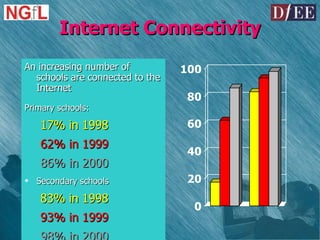
Internet Connectivity An increasing number of schools are connected to the Internet Primary schools:  17% in 1998   62% in 1999 86% in 2000 Secondary schools 83% in 1998 93% in 1999 98% in 2000
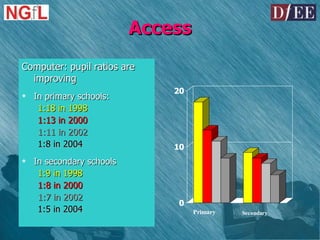
Access Computer: pupil ratios are improving In primary schools:  1:18 in 1998 1:13 in 2000 1:11 in 2002 1:8 in 2004 In secondary schools 1:9 in 1998 1:8 in 2000 1:7 in 2002 1:5 in 2004
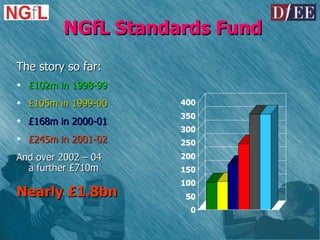
NGfL Standards Fund The story so far: £102m in 1998-99 £105m in 1999-00 £168m in 2000-01 £245m in 2001-02 And over 2002 – 04  a further £710m Nearly £1.8bn
Impact on Standards Schools (KS2: age 7-11yrs) with good ICT resources have better achievement than schools with poor ICT resources. Even when compared with schools of a similar type…  Irrespective of socio-economic circumstances… Irrespective of quality of management…
Impact on Standards KS3/4 results published yesterday. 77% of pupils with ‘very good ICT resources’ achieved level 5 or above in English compared to 68% of schools with ‘poor ICT resources’ Fischer Trust research
Access – key issue? Key Issue for future? Anytime Anywhere Access will become a reality? 85% of learning time outside of school hours
Access Baseline What is a computer? Procurement Advisory Unit Technical support options Local banks of shared technicians Training for learning assistants New Deal employment option Post-16 training option
Broadband Issues Who isn’t connected and why? Regional broadband consortia Video conferencing for learning Common timetabled events Expertise into the classroom - paraprofessionals Role of teacher/pedagogue ‘ A’ level minority subjects Primary extension activity Video streaming on demand - ADSL trials in homes
Content – Key Issue? Increasingly materials for use in the classroom will be available on-line… … and much of it will be distributed only on-line
Content 15% focused funding NGfL – 300,000 pages of content over 2.5m hits per week Teachernet – access to resources for teachers as transparent as possible
Content KS3 on-line courses - Japanese/Latin/Maths Grid Club 1000 lesson plans and useful resources Digital Learning Prospectus NESTA Learning Lab Updated VTC and NGfL Digital TV – trials Digital curriculum proposals
Training – Key issue? Schools of the future are likely to be constrained by walls of the mind Fear of future (66%+ confident 1999) Unconsciously Incompetent Consciously Incompetent Consciously Competent Unconsciously Competent
NOF - £230m – 430,000 teachers to train – 220,000+ already started – LEA figures re-published Computers for Senior Managers – Virtual College for School Leadership  Post-NOF On-line training Computers for Teachers – phase 2 Best practice debate Training
Best practice Control:  Teaching empowers pupils to take control of their own learning, engaging interactively with the technology thus enabling them to work independently at the most effective pace and the most appropriate level Quality: Teaching encourages pupils to use ICT to develop and improve their work and enhance its presentation
Best practice Capability:  Teaching supports pupils in developing the capability to use the new technologies both effectively and to their full potential Creativity: Teaching involves ICT use to inspire pupils’ creativity, allowing them to explore the possibilities of any or all of the multi-media tools available Scope: Teaching provides opportunities for pupils to employ ICT to provide access to experience, information or resources in ways that are not possible with other media, and to carry out work that would otherwise be too difficult or impossible.
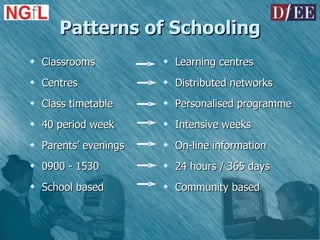
Classrooms  Centres Class timetable 40 period week Parents’ evenings 0900 - 1530 School based Learning centres Distributed networks Personalised programme Intensive weeks On-line information 24 hours / 365 days Community based Patterns of Schooling
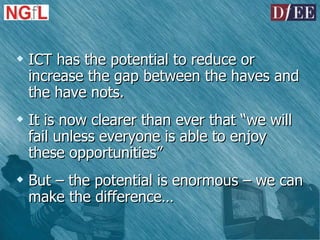
ICT has the potential to reduce or increase the gap between the haves and the have nots. It is now clearer than ever that “we will fail unless everyone is able to enjoy these opportunities” But – the potential is enormous – we can make the difference…
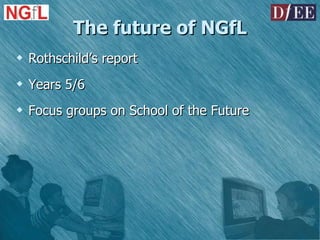
The future of NGfL Rothschild’s report Years 5/6 Focus groups on School of the Future
We welcome comments/ideas etc: [email_address] [email_address] www.ngfl.gov.uk THANK YOU

DfEEmad2001.ppt

  • 1.
    ICT in Schools- Where to now? Doug Brown Divisional Manager, NGfL
  • 2.
    This presentation wasfirst given by Doug Brown ( Divisional Manager, NGfL DfEE ) to the NAACE \conference in Blackpool February 2001 It was later shown at five schools’ NGfL and Standards fund briefings in Dorset 6 th .-8 th March 2001
  • 3.
  • 4.
    ? The paceof change is accelerating... the result will be far greater transformations in the first two decades of the twenty-first century than we saw in the entire twentieth century. Ray Kurzwell - The Age of Spiritual Machines ?
  • 5.
    The Need forLifelong Learning? Lack of education will not be the biggest problem in the future. The problem will be an excess of stupidity as more people fall below the incompetence line. Scott Adams - The Dilbert Future
  • 6.
    Internet Connectivity Anincreasing number of schools are connected to the Internet Primary schools: 17% in 1998 62% in 1999 86% in 2000 Secondary schools 83% in 1998 93% in 1999 98% in 2000
  • 7.
    Access Computer: pupilratios are improving In primary schools: 1:18 in 1998 1:13 in 2000 1:11 in 2002 1:8 in 2004 In secondary schools 1:9 in 1998 1:8 in 2000 1:7 in 2002 1:5 in 2004
  • 8.
    NGfL Standards FundThe story so far: £102m in 1998-99 £105m in 1999-00 £168m in 2000-01 £245m in 2001-02 And over 2002 – 04 a further £710m Nearly £1.8bn
  • 9.
    Impact on StandardsSchools (KS2: age 7-11yrs) with good ICT resources have better achievement than schools with poor ICT resources. Even when compared with schools of a similar type… Irrespective of socio-economic circumstances… Irrespective of quality of management…
  • 10.
    Impact on StandardsKS3/4 results published yesterday. 77% of pupils with ‘very good ICT resources’ achieved level 5 or above in English compared to 68% of schools with ‘poor ICT resources’ Fischer Trust research
  • 11.
    Access – keyissue? Key Issue for future? Anytime Anywhere Access will become a reality? 85% of learning time outside of school hours
  • 12.
    Access Baseline Whatis a computer? Procurement Advisory Unit Technical support options Local banks of shared technicians Training for learning assistants New Deal employment option Post-16 training option
  • 13.
    Broadband Issues Whoisn’t connected and why? Regional broadband consortia Video conferencing for learning Common timetabled events Expertise into the classroom - paraprofessionals Role of teacher/pedagogue ‘ A’ level minority subjects Primary extension activity Video streaming on demand - ADSL trials in homes
  • 14.
    Content – KeyIssue? Increasingly materials for use in the classroom will be available on-line… … and much of it will be distributed only on-line
  • 15.
    Content 15% focusedfunding NGfL – 300,000 pages of content over 2.5m hits per week Teachernet – access to resources for teachers as transparent as possible
  • 16.
    Content KS3 on-linecourses - Japanese/Latin/Maths Grid Club 1000 lesson plans and useful resources Digital Learning Prospectus NESTA Learning Lab Updated VTC and NGfL Digital TV – trials Digital curriculum proposals
  • 17.
    Training – Keyissue? Schools of the future are likely to be constrained by walls of the mind Fear of future (66%+ confident 1999) Unconsciously Incompetent Consciously Incompetent Consciously Competent Unconsciously Competent
  • 18.
    NOF - £230m– 430,000 teachers to train – 220,000+ already started – LEA figures re-published Computers for Senior Managers – Virtual College for School Leadership Post-NOF On-line training Computers for Teachers – phase 2 Best practice debate Training
  • 19.
    Best practice Control: Teaching empowers pupils to take control of their own learning, engaging interactively with the technology thus enabling them to work independently at the most effective pace and the most appropriate level Quality: Teaching encourages pupils to use ICT to develop and improve their work and enhance its presentation
  • 20.
    Best practice Capability: Teaching supports pupils in developing the capability to use the new technologies both effectively and to their full potential Creativity: Teaching involves ICT use to inspire pupils’ creativity, allowing them to explore the possibilities of any or all of the multi-media tools available Scope: Teaching provides opportunities for pupils to employ ICT to provide access to experience, information or resources in ways that are not possible with other media, and to carry out work that would otherwise be too difficult or impossible.
  • 21.
    Classrooms CentresClass timetable 40 period week Parents’ evenings 0900 - 1530 School based Learning centres Distributed networks Personalised programme Intensive weeks On-line information 24 hours / 365 days Community based Patterns of Schooling
  • 22.
    ICT has thepotential to reduce or increase the gap between the haves and the have nots. It is now clearer than ever that “we will fail unless everyone is able to enjoy these opportunities” But – the potential is enormous – we can make the difference…
  • 23.
    The future ofNGfL Rothschild’s report Years 5/6 Focus groups on School of the Future
  • 24.
    We welcome comments/ideasetc: [email_address] [email_address] www.ngfl.gov.uk THANK YOU

Editor's Notes