INFORMATION
COMMUNICATION
TECHNOLOGY
PREPARED BY ANJU A
ICT
Information and Communication Technology (ICT) is a generic term referring to
technologies which are used for collecting, storing, editing and passing
information in various forms.
It has been used in language classrooms for more than two decades. Over this
time, classroom use has moved from drill, text manipulation, and word processing
to more interactive and communicative applications such as email, chat, and web-
based programs, requiring learners to acquire computer literacies.
As a learning tool, ICT is being integrated in different fields and instructions.
ICT is being used extensively not only as part of curriculum requirements but
also as a management, assessment diagnostic and statistical tool.
Interactive computer applications and simulation exercise can be used to
supplement the traditional study preparation.
Various researches have been done to investigate the effectiveness of
information technologies as an educational tool.
ICT
Massive Open Online Courses(MOOCs)
A massive open online course (MOOC) is an online course aimed at unlimited
participation and open access via the web.
In addition to traditional course materials such as videos, readings, problem
sets, etc.
MOOC provides interactive user forums that help build a community for
students, professors, and teaching assistants.
MOOCs are a recent developments in distance education which emerged since
2012.
MOOCs
MOOCs are offered by some leading universities
and institutions including Harvard, Massachusetts
Institute of Technology (MIT), and Stanford.
The websites like www.edx.org, www.courcera.org
facilitate MOOC to millions of learners for free.
Informatics or Human Computer Interaction (HCI)
• Informatics is the study and application
of information technology to the arts,
science and professions, and to use it in
organizations and society at large.
• It strongly focuses on the human use of
computing.
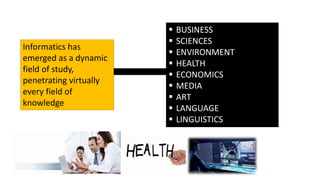
 BUSINESS
 SCIENCES
 ENVIRONMENT
 HEALTH
 ECONOMICS
 MEDIA
 ART
 LANGUAGE
 LINGUISTICS
Informatics has
emerged as a dynamic
field of study,
penetrating virtually
every field of
knowledge
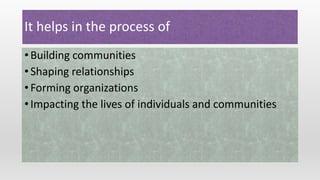
It helps in the process of
• Building communities
• Shaping relationships
• Forming organizations
• Impacting the lives of individuals and communities
PEOPLE
INFORMATIONTECHNOLOGY
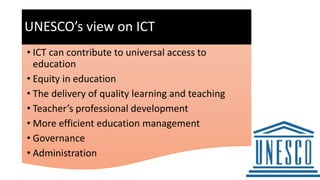
UNESCO’s view on ICT
• ICT can contribute to universal access to
education
• Equity in education
• The delivery of quality learning and teaching
• Teacher’s professional development
• More efficient education management
• Governance
• Administration
• Allows flexible, self-paced learning where students are, to an
appreciable extent, able to choose what they'd like to focus on and
spend variable amounts of time on it based on the perception of
their learning needs and positions.
• This leads to added abilities for self-regulated learning
• Reduces stigma of failure. Failure is a natural part of learning, but
it is harder to deal with it in actual classroom settings because of
societal pressures. An online environment provides enough
privacy and space for learners to not feel miserable about minor
failures that come along the way and thus helps keep up the
motivation.
Advantages of ICT
Advantages of ICT
• ICT enables information and knowledge to travel faster and further
• ICT supports information and knowledge sharing on a large scale
• ICT makes available just-in-time information and knowledge for
learning
• ICT has brought about revolutionary advances in distance learning
• ICT can significantly reduce learning costs
Motivating Factor.
• The Internet can act as a motivating tool for many students. Young
people are very captivated with technology.
• Educators must capitalize on this interest, excitement, and
enthusiasm about the Internet for the purpose of enhancing learning.
• For already enthusiastic learners, the Internet allows you to provide
them with additional learning activities not readily available in the
classroom.
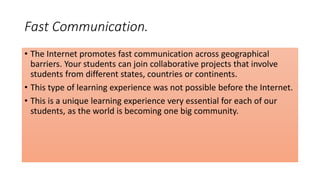
Fast Communication.
• The Internet promotes fast communication across geographical
barriers. Your students can join collaborative projects that involve
students from different states, countries or continents.
• This type of learning experience was not possible before the Internet.
• This is a unique learning experience very essential for each of our
students, as the world is becoming one big community.
Cooperative Learning.
• The Internet facilitates cooperative learning, encourages dialogue,
and creates a more engaging classroom.
• For example, a LISTSER V for our class will allow your students to get
involved in class discussions through e-mails in a way not possible
within the four walls of the classroom.
Locating Research Materials.
• Apart from communication, research is what takes many people to
the Internet.
• There are many more resources on the Internet than the school
library can provide.
• We can encourage students to take advantage of this wealth of
resources on the Internet for their research.
Acquiring Varied Writing Skills
• If students are required to publish their work on the Internet, they
have to develop hypertext skills.
• These skills help students gain experience in non-sequential writings.
Moreover, and since the Internet is open to all with access, students
publishing their work on the Internet are forced to be mindful of their
language and to write to non-expert audience.
Disadvantages of ICT
• May not help more disorganized learners who needs more
structure and routine available in a physical classroom setting.
Better for those who are able to or at least keen to self-regulate
their learning.
• Difficult to replicate settings such as lab activities that require
hands-on, experiential learning
Immense expenditures –
• Gone are the days where students have to depend on paper and
pen. This is an advanced era of technology where machines like
computers substituted the use of paper with its hi-tech features and
to maintain them a huge sum of money is required by schools and
colleges which can otherwise be spent to buy necessary resources.
• In addition to it you have to spend thousands of dollars to update
the out-dated softwares which are incompatible with present
technology.
Creating enough room for cheating-
• The mechanized world is making you more and more lazy giving
all the powers to control everything by a click of mouse.
• Cheating is an illegal activity but technology made it more
powerful and easy to use with its powerful wings.
• It has really become very tough to control this activity, especially
in the examination environment.
• Smartphones are available with all its advanced features and
instant internet accessibility which compel them to use it
without any hassles.
Major sources of distractions-
 As you know that in present generation social networking sites
are literally ruling the world with its attractive innovations
therefore students and learners are busy in checking their posts
and updates, counting the number of likes, checking the status
that they themselves or any of their near and dear ones updated,
engage in commenting on social sites etc. all these activities create
a huge distance between them and their education.
Makes learners disconnected from the real
world-
• In recent days to keep equal pace with technology educators are
busy in educating the learners with its online education
tools instead of communicating orally that makes them unable
to interact with their teachers and share their problems openly
to overcome it.
• Teachers fail to draw student’s attention. To avoid these problem
educators should always use verbal communications along with
online education tools so that their students can dynamically
learn the topics along with proper interactions.
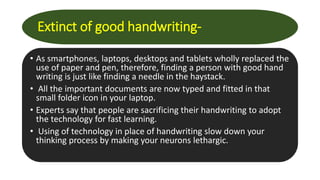
Extinct of good handwriting-
• As smartphones, laptops, desktops and tablets wholly replaced the
use of paper and pen, therefore, finding a person with good hand
writing is just like finding a needle in the haystack.
• All the important documents are now typed and fitted in that
small folder icon in your laptop.
• Experts say that people are sacrificing their handwriting to adopt
the technology for fast learning.
• Using of technology in place of handwriting slow down your
thinking process by making your neurons lethargic.
Replacing books with e-books-
• The world is shrinking day by day and so all your important stuffs are now
compressed in your favourite gadgets even the books which have now
become e-books which are called electronic books.
• Books are your real assets and can never be replaced by e-books which
may not be cost-effective at times and can cause eyestrain.
• E-books are not compatible in all the devices so your laptop or tablets
should have e-book reader to access electronic books and the worst part is
your e-book can be hacked easily by the hackers.
• Wherever there is light, there is a shadow. Technology can make you fly
higher and higher in the sky but at the same time it can even ruin your life
with its negative features.
• Technology can enhance your knowledge at the same time it can even
lower your grade in education.
A major drawback of losing assignment for
students-
• Computer is a machine which often faces malfunction at times due to
its wear and tear. Just imagine you have to submit your
assignment tomorrow which is your last deadline and you have put all
your hard labours to complete the assignment and saved it in your
laptop to get the highest grade in class but all of sudden just the night
before submission your laptop isn’t working.
• What will be your reaction? Will you be able to put the same efforts
within that limited time? All your efforts went in vain with the
malfunctioning of your laptop. You cannot rely completely on these
gadgets for your important projects and assignments.
Increase rate of cyber bullying-
• Cyber bullying is an illegal activity where especially youngsters fall
under the trap of illegal crimes without their knowledge.
• The young learners have an easy access to umpteen accounts that
tends them to enter into the dark tunnel of harassment which has
an entry but no exit at times.
• They lost in its darkness along with their shining future which
could have given miraculous results if cultivated properly but with
cyber bullying everything gets washed off all of a sudden.
Major challenges for teachers-
• Every day, scientists come with new discoveries and challenges
that keep technology rolling every second.
• Software's keep on upgrading and if a teacher does not possess
technical skills, it becomes difficult for him to execute it in the
right direction.
• Hence, educators have to be expert in technical skills toor the
school has to hire technical experts adding extra expenses to
their expenditures to overcome these technical challenges.
Difficult to deal with online courses-
• You keep on exploring the world each day but still there are lots of facts
that are left unexplored.
• Knowledge has no limit and no age. Many students or learners have urge
to keep their learning go on and on but at times it becomes difficult for
them to attend regular classes due to their job or other difficulties but with
advance science it has become easy nowadays as it has given us the
marvellous option of perusing online courses along with our regular
activities, but problems like slow internet speed and network issues keeps
troubling you.
• The other disadvantage is that these online courses often fail to create
motivation for learning or self-discipline and usually ends with
monotonous experiences and frustration.
Waste of valuable time-
• It is the human being who built technology not the technology that
created a human.
• As humans are not error-free, similarly technology too does not come
error-free.
• There are lots of problems like server error and connectivity problems
which take oodles of time to troubleshoot it, therefore, hindering the
learning process which can sometimes be a matter of frustration both
for the learners and the educators.
• Wastage of time because of unnecessary issues is not at all advisable in
schools or any learning institutes where every second is valuable for the
learners.
Partial to the low-income group-
• Some low-income institutes does not have access to a huge
number of computers to make it available for all the students so in
this case those students may be unaware of the basic computer
skills that have been learned by other students at a very early
stage.
• Technology needs a huge sum of money to shower its blessings to
the educational institutes especially the colleges that requires
large number of computers to educate its students with advanced
science.

ICT

  • 1.
  • 2.
    ICT Information and CommunicationTechnology (ICT) is a generic term referring to technologies which are used for collecting, storing, editing and passing information in various forms. It has been used in language classrooms for more than two decades. Over this time, classroom use has moved from drill, text manipulation, and word processing to more interactive and communicative applications such as email, chat, and web- based programs, requiring learners to acquire computer literacies.
  • 3.
    As a learningtool, ICT is being integrated in different fields and instructions. ICT is being used extensively not only as part of curriculum requirements but also as a management, assessment diagnostic and statistical tool. Interactive computer applications and simulation exercise can be used to supplement the traditional study preparation. Various researches have been done to investigate the effectiveness of information technologies as an educational tool. ICT
  • 4.
    Massive Open OnlineCourses(MOOCs) A massive open online course (MOOC) is an online course aimed at unlimited participation and open access via the web. In addition to traditional course materials such as videos, readings, problem sets, etc. MOOC provides interactive user forums that help build a community for students, professors, and teaching assistants. MOOCs are a recent developments in distance education which emerged since 2012.
  • 5.
    MOOCs MOOCs are offeredby some leading universities and institutions including Harvard, Massachusetts Institute of Technology (MIT), and Stanford. The websites like www.edx.org, www.courcera.org facilitate MOOC to millions of learners for free.
  • 6.
    Informatics or HumanComputer Interaction (HCI) • Informatics is the study and application of information technology to the arts, science and professions, and to use it in organizations and society at large. • It strongly focuses on the human use of computing.
  • 7.
     BUSINESS  SCIENCES ENVIRONMENT  HEALTH  ECONOMICS  MEDIA  ART  LANGUAGE  LINGUISTICS Informatics has emerged as a dynamic field of study, penetrating virtually every field of knowledge
  • 8.
    It helps inthe process of • Building communities • Shaping relationships • Forming organizations • Impacting the lives of individuals and communities
  • 9.
  • 10.
    UNESCO’s view onICT • ICT can contribute to universal access to education • Equity in education • The delivery of quality learning and teaching • Teacher’s professional development • More efficient education management • Governance • Administration
  • 11.
    • Allows flexible,self-paced learning where students are, to an appreciable extent, able to choose what they'd like to focus on and spend variable amounts of time on it based on the perception of their learning needs and positions. • This leads to added abilities for self-regulated learning • Reduces stigma of failure. Failure is a natural part of learning, but it is harder to deal with it in actual classroom settings because of societal pressures. An online environment provides enough privacy and space for learners to not feel miserable about minor failures that come along the way and thus helps keep up the motivation. Advantages of ICT
  • 12.
    Advantages of ICT •ICT enables information and knowledge to travel faster and further • ICT supports information and knowledge sharing on a large scale • ICT makes available just-in-time information and knowledge for learning • ICT has brought about revolutionary advances in distance learning • ICT can significantly reduce learning costs
  • 13.
    Motivating Factor. • TheInternet can act as a motivating tool for many students. Young people are very captivated with technology. • Educators must capitalize on this interest, excitement, and enthusiasm about the Internet for the purpose of enhancing learning. • For already enthusiastic learners, the Internet allows you to provide them with additional learning activities not readily available in the classroom.
  • 14.
    Fast Communication. • TheInternet promotes fast communication across geographical barriers. Your students can join collaborative projects that involve students from different states, countries or continents. • This type of learning experience was not possible before the Internet. • This is a unique learning experience very essential for each of our students, as the world is becoming one big community.
  • 15.
    Cooperative Learning. • TheInternet facilitates cooperative learning, encourages dialogue, and creates a more engaging classroom. • For example, a LISTSER V for our class will allow your students to get involved in class discussions through e-mails in a way not possible within the four walls of the classroom.
  • 16.
    Locating Research Materials. •Apart from communication, research is what takes many people to the Internet. • There are many more resources on the Internet than the school library can provide. • We can encourage students to take advantage of this wealth of resources on the Internet for their research.
  • 17.
    Acquiring Varied WritingSkills • If students are required to publish their work on the Internet, they have to develop hypertext skills. • These skills help students gain experience in non-sequential writings. Moreover, and since the Internet is open to all with access, students publishing their work on the Internet are forced to be mindful of their language and to write to non-expert audience.
  • 18.
    Disadvantages of ICT •May not help more disorganized learners who needs more structure and routine available in a physical classroom setting. Better for those who are able to or at least keen to self-regulate their learning. • Difficult to replicate settings such as lab activities that require hands-on, experiential learning
  • 19.
    Immense expenditures – •Gone are the days where students have to depend on paper and pen. This is an advanced era of technology where machines like computers substituted the use of paper with its hi-tech features and to maintain them a huge sum of money is required by schools and colleges which can otherwise be spent to buy necessary resources. • In addition to it you have to spend thousands of dollars to update the out-dated softwares which are incompatible with present technology.
  • 20.
    Creating enough roomfor cheating- • The mechanized world is making you more and more lazy giving all the powers to control everything by a click of mouse. • Cheating is an illegal activity but technology made it more powerful and easy to use with its powerful wings. • It has really become very tough to control this activity, especially in the examination environment. • Smartphones are available with all its advanced features and instant internet accessibility which compel them to use it without any hassles.
  • 21.
    Major sources ofdistractions-  As you know that in present generation social networking sites are literally ruling the world with its attractive innovations therefore students and learners are busy in checking their posts and updates, counting the number of likes, checking the status that they themselves or any of their near and dear ones updated, engage in commenting on social sites etc. all these activities create a huge distance between them and their education.
  • 22.
    Makes learners disconnectedfrom the real world- • In recent days to keep equal pace with technology educators are busy in educating the learners with its online education tools instead of communicating orally that makes them unable to interact with their teachers and share their problems openly to overcome it. • Teachers fail to draw student’s attention. To avoid these problem educators should always use verbal communications along with online education tools so that their students can dynamically learn the topics along with proper interactions.
  • 23.
    Extinct of goodhandwriting- • As smartphones, laptops, desktops and tablets wholly replaced the use of paper and pen, therefore, finding a person with good hand writing is just like finding a needle in the haystack. • All the important documents are now typed and fitted in that small folder icon in your laptop. • Experts say that people are sacrificing their handwriting to adopt the technology for fast learning. • Using of technology in place of handwriting slow down your thinking process by making your neurons lethargic.
  • 24.
    Replacing books withe-books- • The world is shrinking day by day and so all your important stuffs are now compressed in your favourite gadgets even the books which have now become e-books which are called electronic books. • Books are your real assets and can never be replaced by e-books which may not be cost-effective at times and can cause eyestrain. • E-books are not compatible in all the devices so your laptop or tablets should have e-book reader to access electronic books and the worst part is your e-book can be hacked easily by the hackers. • Wherever there is light, there is a shadow. Technology can make you fly higher and higher in the sky but at the same time it can even ruin your life with its negative features. • Technology can enhance your knowledge at the same time it can even lower your grade in education.
  • 25.
    A major drawbackof losing assignment for students- • Computer is a machine which often faces malfunction at times due to its wear and tear. Just imagine you have to submit your assignment tomorrow which is your last deadline and you have put all your hard labours to complete the assignment and saved it in your laptop to get the highest grade in class but all of sudden just the night before submission your laptop isn’t working. • What will be your reaction? Will you be able to put the same efforts within that limited time? All your efforts went in vain with the malfunctioning of your laptop. You cannot rely completely on these gadgets for your important projects and assignments.
  • 26.
    Increase rate ofcyber bullying- • Cyber bullying is an illegal activity where especially youngsters fall under the trap of illegal crimes without their knowledge. • The young learners have an easy access to umpteen accounts that tends them to enter into the dark tunnel of harassment which has an entry but no exit at times. • They lost in its darkness along with their shining future which could have given miraculous results if cultivated properly but with cyber bullying everything gets washed off all of a sudden.
  • 27.
    Major challenges forteachers- • Every day, scientists come with new discoveries and challenges that keep technology rolling every second. • Software's keep on upgrading and if a teacher does not possess technical skills, it becomes difficult for him to execute it in the right direction. • Hence, educators have to be expert in technical skills toor the school has to hire technical experts adding extra expenses to their expenditures to overcome these technical challenges.
  • 28.
    Difficult to dealwith online courses- • You keep on exploring the world each day but still there are lots of facts that are left unexplored. • Knowledge has no limit and no age. Many students or learners have urge to keep their learning go on and on but at times it becomes difficult for them to attend regular classes due to their job or other difficulties but with advance science it has become easy nowadays as it has given us the marvellous option of perusing online courses along with our regular activities, but problems like slow internet speed and network issues keeps troubling you. • The other disadvantage is that these online courses often fail to create motivation for learning or self-discipline and usually ends with monotonous experiences and frustration.
  • 29.
    Waste of valuabletime- • It is the human being who built technology not the technology that created a human. • As humans are not error-free, similarly technology too does not come error-free. • There are lots of problems like server error and connectivity problems which take oodles of time to troubleshoot it, therefore, hindering the learning process which can sometimes be a matter of frustration both for the learners and the educators. • Wastage of time because of unnecessary issues is not at all advisable in schools or any learning institutes where every second is valuable for the learners.
  • 30.
    Partial to thelow-income group- • Some low-income institutes does not have access to a huge number of computers to make it available for all the students so in this case those students may be unaware of the basic computer skills that have been learned by other students at a very early stage. • Technology needs a huge sum of money to shower its blessings to the educational institutes especially the colleges that requires large number of computers to educate its students with advanced science.