Australasian Soil & Plant
Analysis Council/Pacific
Soil Partnership
Spectroscopy Workshop
10 December 2020
https://web.microsoftstream.com/video/b0d1b604-c828-4f07-aac1-62fb8fa8851f
https://web.microsoftstream.com/video/bc55f185-4e29-418b-b3bd-47c4a3baa469
Video of the workshop can be found at
Australasian Soil & Plant Analysis Council/Pacific Soil Partnership
Spectroscopy Workshop
10 December 2020
Workshop purposes –
1. to better understand the breadth of laboratories
(research, government and commercial) operating the
technology
2. to look for opportunities for collaboration across
spectral data management, R&D, spectral data
exchange mechanisms, operationalisation of libraries
and systems, business and commercial opportunities
3. to consider development of a regional strategy to
move implementation of the technology forward
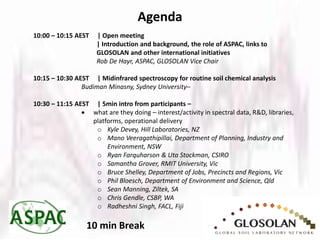
Agenda
10:00 – 10:15 AEST | Open meeting
| Introduction and background, the role of ASPAC, links to
GLOSOLAN and other international initiatives
Rob De Hayr, ASPAC, GLOSOLAN Vice Chair
10:15 – 10:30 AEST | Midinfrared spectroscopy for routine soil chemical analysis
Budiman Minasny, Sydney University–
10:30 – 11:15 AEST | 5min intro from participants –
 what are they doing – interest/activity in spectral data, R&D, libraries,
platforms, operational delivery
o Kyle Devey, Hill Laboratories, NZ
o Mano Veeragathipillai, Department of Planning, Industry and
Environment, NSW
o Ryan Farquharson & Uta Stockman, CSIRO
o Samantha Grover, RMIT University, Vic
o Bruce Shelley, Department of Jobs, Precincts and Regions, Vic
o Phil Bloesch, Department of Environment and Science, Qld
o Sean Manning, Ziltek, SA
o Chris Gendle, CSBP, WA
o Radheshni Singh, FACL, Fiji
10 min Break
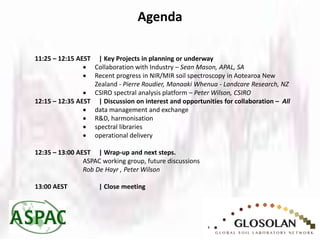
Agenda
11:25 – 12:15 AEST | Key Projects in planning or underway
 Collaboration with Industry – Sean Mason, APAL, SA
 Recent progress in NIR/MIR soil spectroscopy in Aotearoa New
Zealand - Pierre Roudier, Manaaki Whenua - Landcare Research, NZ
 CSIRO spectral analysis platform – Peter Wilson, CSIRO
12:15 – 12:35 AEST | Discussion on interest and opportunities for collaboration – All
 data management and exchange
 R&D, harmonisation
 spectral libraries
 operational delivery
12:35 – 13:00 AEST | Wrap-up and next steps.
ASPAC working group, future discussions
Rob De Hayr , Peter Wilson
13:00 AEST | Close meeting
ASPAC’s objectives are to:
• Provide a national and international focus for
promoting excellence in all aspects of soil and plant
tissue analysis.
• Encourage and promote the adoption of preferred
methods and protocols used in soil and plant tissue
analysis within Australasia.
• Facilitate national and international communication
• Stimulate training, research and development in soil
and plant tissue analysis.
ASPAC activities include:
• Conducting regular Regional Quality Assurance Programs to enhance
standards of analysis and assist standardisation of soil and plant
analytical methods across laboratories.
• Promoting the need for soil and plant analysis to end-users such as
farmers, graziers, foresters and horticulturists.
• Promoting the adoption of uniform technology and terminology in soil
and plant analysis.
• Conducting conferences, workshops, training courses and seminars on
soil and plant testing and encourages wider participation of the public in
understanding the need for soil and plant analysis.
• Supporting relevant research, and encouraging collaborative research
amongst its members.
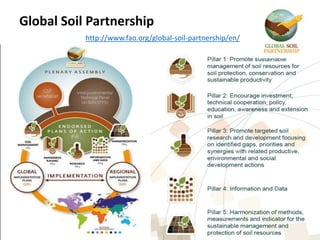
Global Soil Partnership
http://www.fao.org/global-soil-partnership/en/
Global Soil Laboratory Network
• Established in November 2017 to:
• Strengthen the performance of
laboratories using standardized methods
and protocols
• Harmonize soil analysis methods so that
soil information would be comparable and
interpretable across laboratories, countries
and regions
• [Aspiration] provide a certification for
technical competencies in laboratory
analysis
http://www.fao.org/global-soil-partnership/glosolan/en/
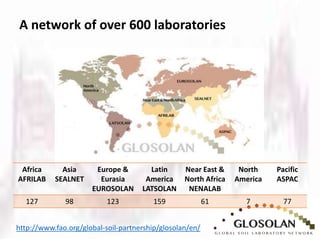
A network of over 600 laboratories
http://www.fao.org/global-soil-partnership/glosolan/en/
Africa
AFRILAB
Asia
SEALNET
Europe &
Eurasia
EUROSOLAN
Latin
America
LATSOLAN
Near East &
North Africa
NENALAB
North
America
Pacific
ASPAC
127 98 123 159 61 7 77
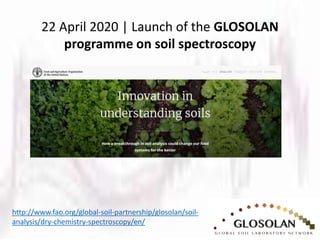
22 April 2020 | Launch of the GLOSOLAN
programme on soil spectroscopy
http://www.fao.org/global-soil-partnership/glosolan/soil-
analysis/dry-chemistry-spectroscopy/en/
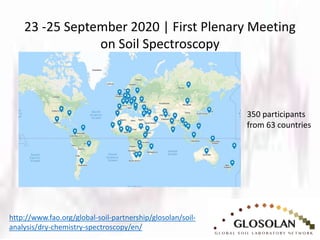
23 -25 September 2020 | First Plenary Meeting
on Soil Spectroscopy
http://www.fao.org/global-soil-partnership/glosolan/soil-
analysis/dry-chemistry-spectroscopy/en/
350 participants
from 63 countries
GLOSOLAN is aiming to:
http://www.fao.org/global-soil-partnership/glosolan/soil-
analysis/dry-chemistry-spectroscopy/en/
• Build a globally representative calibrated soil spectral library (database)
based on MIR spectra with accompanying soil property reference data
recorded in one gold-standard reference laboratory;
• Provide a freely available and easy-to-use soil property estimation service
based on the evolving GLOSOLAN global MIR spectral library;
• Support countries to contribute to the GLOSOLAN global spectral
calibration library and use the soil property estimation service;
• Harmonize soil spectroscopy methods (including soil sample preparation,
spectral measurement and quality assurance of data analysis) by
developing standard and protocols;
• Develop the capacity of countries and labs in the performance of lab-based
soil spectroscopy measurements.
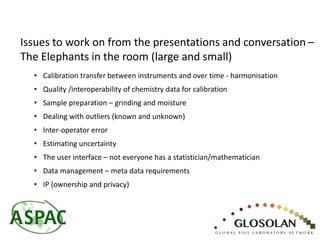
• Calibration transfer between instruments and over time - harmonisation
• Quality /interoperability of chemistry data for calibration
• Sample preparation – grinding and moisture
• Dealing with outliers (known and unknown)
• Inter-operator error
• Estimating uncertainty
• The user interface – not everyone has a statistician/mathematician
• Data management – meta data requirements
• IP (ownership and privacy)
Issues to work on from the presentations and conversation –
The Elephants in the room (large and small)
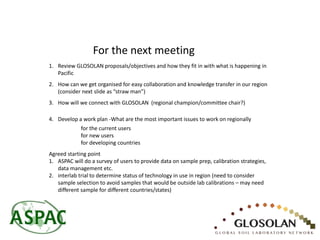
1. Review GLOSOLAN proposals/objectives and how they fit in with what is happening in
Pacific
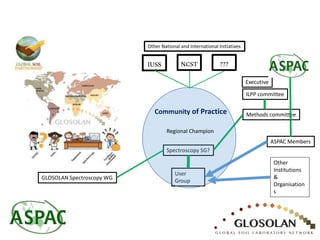
2. How can we get organised for easy collaboration and knowledge transfer in our region
(consider next slide as “straw man”)
3. How will we connect with GLOSOLAN (regional champion/committee chair?)
4. Develop a work plan -What are the most important issues to work on regionally
for the current users
for new users
for developing countries
Agreed starting point
1. ASPAC will do a survey of users to provide data on sample prep, calibration strategies,
data management etc.
2. interlab trial to determine status of technology in use in region (need to consider
sample selection to avoid samples that would be outside lab calibrations – may need
different sample for different countries/states)
For the next meeting
NCST
Executive
ILPP committee
Methods committee
Spectroscopy SG?
User
Group
ASPAC Members
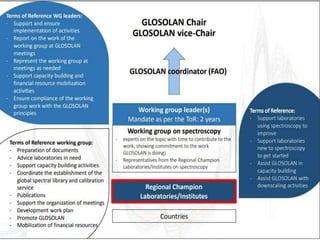
GLOSOLAN Spectroscopy WG
IUSS
Other National and International Initiatives
Other
Institutions
&
Organisation
s
Community of Practice
Regional Champion
???

Spectroscopy workshop - ASPAC

  • 1.
    Australasian Soil &Plant Analysis Council/Pacific Soil Partnership Spectroscopy Workshop 10 December 2020 https://web.microsoftstream.com/video/b0d1b604-c828-4f07-aac1-62fb8fa8851f https://web.microsoftstream.com/video/bc55f185-4e29-418b-b3bd-47c4a3baa469 Video of the workshop can be found at
  • 2.
    Australasian Soil &Plant Analysis Council/Pacific Soil Partnership Spectroscopy Workshop 10 December 2020 Workshop purposes – 1. to better understand the breadth of laboratories (research, government and commercial) operating the technology 2. to look for opportunities for collaboration across spectral data management, R&D, spectral data exchange mechanisms, operationalisation of libraries and systems, business and commercial opportunities 3. to consider development of a regional strategy to move implementation of the technology forward
  • 3.
    Agenda 10:00 – 10:15AEST | Open meeting | Introduction and background, the role of ASPAC, links to GLOSOLAN and other international initiatives Rob De Hayr, ASPAC, GLOSOLAN Vice Chair 10:15 – 10:30 AEST | Midinfrared spectroscopy for routine soil chemical analysis Budiman Minasny, Sydney University– 10:30 – 11:15 AEST | 5min intro from participants –  what are they doing – interest/activity in spectral data, R&D, libraries, platforms, operational delivery o Kyle Devey, Hill Laboratories, NZ o Mano Veeragathipillai, Department of Planning, Industry and Environment, NSW o Ryan Farquharson & Uta Stockman, CSIRO o Samantha Grover, RMIT University, Vic o Bruce Shelley, Department of Jobs, Precincts and Regions, Vic o Phil Bloesch, Department of Environment and Science, Qld o Sean Manning, Ziltek, SA o Chris Gendle, CSBP, WA o Radheshni Singh, FACL, Fiji 10 min Break
  • 4.
    Agenda 11:25 – 12:15AEST | Key Projects in planning or underway  Collaboration with Industry – Sean Mason, APAL, SA  Recent progress in NIR/MIR soil spectroscopy in Aotearoa New Zealand - Pierre Roudier, Manaaki Whenua - Landcare Research, NZ  CSIRO spectral analysis platform – Peter Wilson, CSIRO 12:15 – 12:35 AEST | Discussion on interest and opportunities for collaboration – All  data management and exchange  R&D, harmonisation  spectral libraries  operational delivery 12:35 – 13:00 AEST | Wrap-up and next steps. ASPAC working group, future discussions Rob De Hayr , Peter Wilson 13:00 AEST | Close meeting
  • 5.
    ASPAC’s objectives areto: • Provide a national and international focus for promoting excellence in all aspects of soil and plant tissue analysis. • Encourage and promote the adoption of preferred methods and protocols used in soil and plant tissue analysis within Australasia. • Facilitate national and international communication • Stimulate training, research and development in soil and plant tissue analysis.
  • 6.
    ASPAC activities include: •Conducting regular Regional Quality Assurance Programs to enhance standards of analysis and assist standardisation of soil and plant analytical methods across laboratories. • Promoting the need for soil and plant analysis to end-users such as farmers, graziers, foresters and horticulturists. • Promoting the adoption of uniform technology and terminology in soil and plant analysis. • Conducting conferences, workshops, training courses and seminars on soil and plant testing and encourages wider participation of the public in understanding the need for soil and plant analysis. • Supporting relevant research, and encouraging collaborative research amongst its members.
  • 7.
  • 8.
    Global Soil LaboratoryNetwork • Established in November 2017 to: • Strengthen the performance of laboratories using standardized methods and protocols • Harmonize soil analysis methods so that soil information would be comparable and interpretable across laboratories, countries and regions • [Aspiration] provide a certification for technical competencies in laboratory analysis http://www.fao.org/global-soil-partnership/glosolan/en/
  • 9.
    A network ofover 600 laboratories http://www.fao.org/global-soil-partnership/glosolan/en/ Africa AFRILAB Asia SEALNET Europe & Eurasia EUROSOLAN Latin America LATSOLAN Near East & North Africa NENALAB North America Pacific ASPAC 127 98 123 159 61 7 77
  • 10.
    22 April 2020| Launch of the GLOSOLAN programme on soil spectroscopy http://www.fao.org/global-soil-partnership/glosolan/soil- analysis/dry-chemistry-spectroscopy/en/
  • 11.
    23 -25 September2020 | First Plenary Meeting on Soil Spectroscopy http://www.fao.org/global-soil-partnership/glosolan/soil- analysis/dry-chemistry-spectroscopy/en/ 350 participants from 63 countries
  • 13.
    GLOSOLAN is aimingto: http://www.fao.org/global-soil-partnership/glosolan/soil- analysis/dry-chemistry-spectroscopy/en/ • Build a globally representative calibrated soil spectral library (database) based on MIR spectra with accompanying soil property reference data recorded in one gold-standard reference laboratory; • Provide a freely available and easy-to-use soil property estimation service based on the evolving GLOSOLAN global MIR spectral library; • Support countries to contribute to the GLOSOLAN global spectral calibration library and use the soil property estimation service; • Harmonize soil spectroscopy methods (including soil sample preparation, spectral measurement and quality assurance of data analysis) by developing standard and protocols; • Develop the capacity of countries and labs in the performance of lab-based soil spectroscopy measurements.
  • 15.
    • Calibration transferbetween instruments and over time - harmonisation • Quality /interoperability of chemistry data for calibration • Sample preparation – grinding and moisture • Dealing with outliers (known and unknown) • Inter-operator error • Estimating uncertainty • The user interface – not everyone has a statistician/mathematician • Data management – meta data requirements • IP (ownership and privacy) Issues to work on from the presentations and conversation – The Elephants in the room (large and small)
  • 16.
    1. Review GLOSOLANproposals/objectives and how they fit in with what is happening in Pacific 2. How can we get organised for easy collaboration and knowledge transfer in our region (consider next slide as “straw man”) 3. How will we connect with GLOSOLAN (regional champion/committee chair?) 4. Develop a work plan -What are the most important issues to work on regionally for the current users for new users for developing countries Agreed starting point 1. ASPAC will do a survey of users to provide data on sample prep, calibration strategies, data management etc. 2. interlab trial to determine status of technology in use in region (need to consider sample selection to avoid samples that would be outside lab calibrations – may need different sample for different countries/states) For the next meeting
  • 17.
    NCST Executive ILPP committee Methods committee SpectroscopySG? User Group ASPAC Members GLOSOLAN Spectroscopy WG IUSS Other National and International Initiatives Other Institutions & Organisation s Community of Practice Regional Champion ???