1
FOUNDATION IN NATURAL AND BUILT ENVIRONMENT (FNBE)
FEBRUARY 2014 INTAKE
INTRODUCTION TO CONSTURCTION INDUSTRY
(QSB 30105)
FINAL PROJECT
NAME: DARREN LOONG CHI YOONG & TAN ZHAO MING
STUDENT ID: 0318029 & 0318724
LECTURER: PN. HASMANIRA MOKHTAR, MS. ANN SEE PENG
SUBMISSION DATE: 15 JUNE 2014
2
CONTENTS:
1. Introduction
2. Types of building development
3. Site analysis
4. Purpose of construction
5. Concept
6. Plan and zoning of construction
7. Layout and perspectives of construction
8. Conclusion
3
Introduction
In this project, we are ought to initiate a small construction in
Taylor’s University Lakeside Campus and to use a land area of
about 10mx10m anywhere on campus ground.
As we are given the task to construct a study enhancement area,
the small project that we are initiating is the construction of a 24/7
study and discussion room. The construction of this project will
take place at the open car park beside the commercial block. A
10mx10m area will be taken from the current open car park to
construct this 24/7 study and discussion room.
4
Types of Building Development
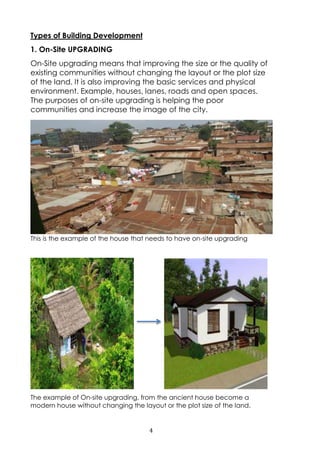
1. On-Site UPGRADING
On-Site upgrading means that improving the size or the quality of
existing communities without changing the layout or the plot size
of the land. It is also improving the basic services and physical
environment. Example, houses, lanes, roads and open spaces.
The purposes of on-site upgrading is helping the poor
communities and increase the image of the city.
This is the example of the house that needs to have on-site upgrading
The example of On-site upgrading, from the ancient house become a
modern house without changing the layout or the plot size of the land.
5
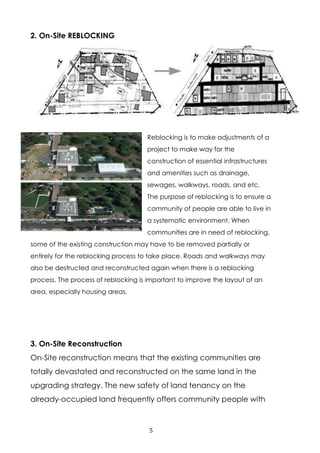
2. On-Site REBLOCKING
Reblocking is to make adjustments of a
project to make way for the
construction of essential infrastructures
and amenities such as drainage,
sewages, walkways, roads, and etc.
The purpose of reblocking is to ensure a
community of people are able to live in
a systematic environment. When
communities are in need of reblocking,
some of the existing construction may have to be removed partially or
entirely for the reblocking process to take place. Roads and walkways may
also be destructed and reconstructed again when there is a reblocking
process. The process of reblocking is important to improve the layout of an
area, especially housing areas.
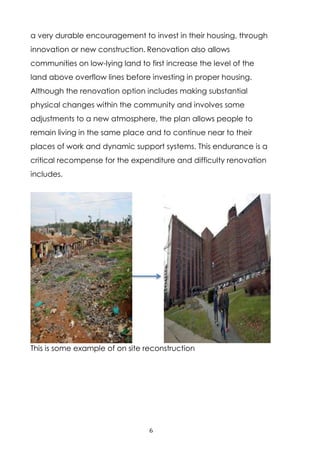
3. On-Site Reconstruction
On-Site reconstruction means that the existing communities are
totally devastated and reconstructed on the same land in the
upgrading strategy. The new safety of land tenancy on the
already-occupied land frequently offers community people with
6
a very durable encouragement to invest in their housing, through
innovation or new construction. Renovation also allows
communities on low-lying land to first increase the level of the
land above overflow lines before investing in proper housing.
Although the renovation option includes making substantial
physical changes within the community and involves some
adjustments to a new atmosphere, the plan allows people to
remain living in the same place and to continue near to their
places of work and dynamic support systems. This endurance is a
critical recompense for the expenditure and difficulty renovation
includes.
This is some example of on site reconstruction
7
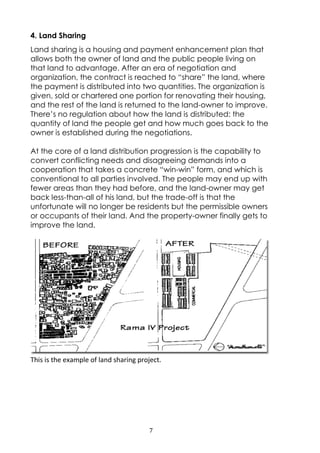
4. Land Sharing
Land sharing is a housing and payment enhancement plan that
allows both the owner of land and the public people living on
that land to advantage. After an era of negotiation and
organization, the contract is reached to “share” the land, where
the payment is distributed into two quantities. The organization is
given, sold or chartered one portion for renovating their housing,
and the rest of the land is returned to the land-owner to improve.
There’s no regulation about how the land is distributed: the
quantity of land the people get and how much goes back to the
owner is established during the negotiations.
At the core of a land distribution progression is the capability to
convert conflicting needs and disagreeing demands into a
cooperation that takes a concrete “win-win” form, and which is
conventional to all parties involved. The people may end up with
fewer areas than they had before, and the land-owner may get
back less-than-all of his land, but the trade-off is that the
unfortunate will no longer be residents but the permissible owners
or occupants of their land. And the property-owner finally gets to
improve the land.
This is the example of land sharing project.
8
5. Nearby or not-so-nearby RELOCATION
The extreme benefit of the rearrangement strategy is that it
generally comes with housing safety, through land use rights,
outright proprietorship or some kind of long-term land tenancy.
Relocation sites can sometimes be distant from current
communities, job occasions, backing organizations and schools.
In these cases, community members who want to keep their old
jobs or attend the same schools must swallow the encumbrance
of extra travelling time and expenditure and they must get used
to a new environment. But in many towns and cities around the
country, ingenious communities are finding bits of land to buy or
rent inexpensively for their housing that are not far away at all.
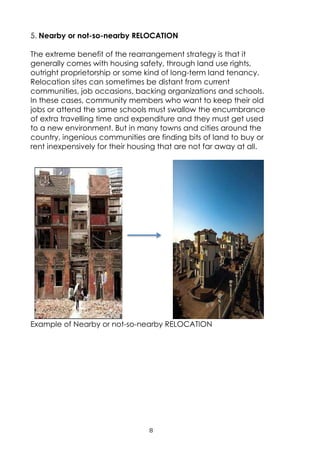
Example of Nearby or not-so-nearby RELOCATION
9
SITE ANALYSIS
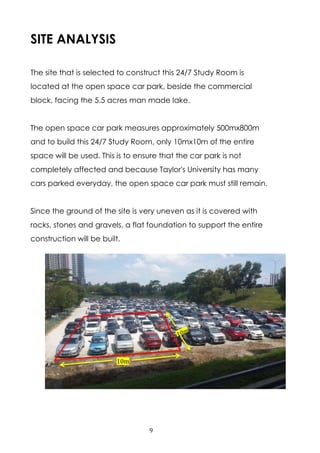
The site that is selected to construct this 24/7 Study Room is
located at the open space car park, beside the commercial
block, facing the 5.5 acres man made lake.
The open space car park measures approximately 500mx800m
and to build this 24/7 Study Room, only 10mx10m of the entire
space will be used. This is to ensure that the car park is not
completely affected and because Taylor's University has many
cars parked everyday, the open space car park must still remain.
Since the ground of the site is very uneven as it is covered with
rocks, stones and gravels, a flat foundation to support the entire
construction will be built.
10m
10
PURPOSE
The aim of building this 24/7 study room is to of course to allow
students to study 24/7. This is the second 24/7-study room that is to
be built in Taylor's University. There is already one 24/7 study room
in the campus, which is located beside the library.
As mentioned above, this project will be constructed beside the
commercial block. Since the commercial block has a hostel
there, the construction of this project is also for the convenience
of the students, as they do not need to walk all the way to the
library's 24/7 study room.
11
CONCEPT
The current 24/7 study room that is located beside the library is for
silent study only. By constructing this 24/7 study room, students do
not need to be silent because there will be two discussions room
built inside the study room. Each discussion room features a 10-
seater rectangular table, an LCD screen with projector, and a 30-
inch smart white board. This is for the convenience of the students
to conduct their discussion effectively and also to support the use
of technologies.
Outside the study room, there will be a 60-seater study table for
self-study. Anywhere outside the discussion room within the study
area is a silent study area. There are also 10 public computers for
students to use for their research and to use for printing purposes.
Of course, there will be a Print-On-Demand (POD) machine in the
24/7 study room. There is also a toilet included in the 24/7 study
room so that the students do not need to walk all the way to the
commercial block to utilise the toilet.
12
PLAN AND ZONING OF CONSTRUCTION
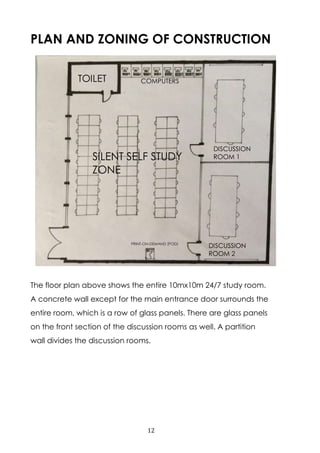
The floor plan above shows the entire 10mx10m 24/7 study room.
A concrete wall except for the main entrance door surrounds the
entire room, which is a row of glass panels. There are glass panels
on the front section of the discussion rooms as well. A partition
wall divides the discussion rooms.
TOILET COMPUTERS
DISCUSSION
ROOM 1SILENT SELF STUDY
ZONE
PRINT-ON-DEMAND (POD)
DISCUSSION
ROOM 2
13
Layout and perspectives of construction
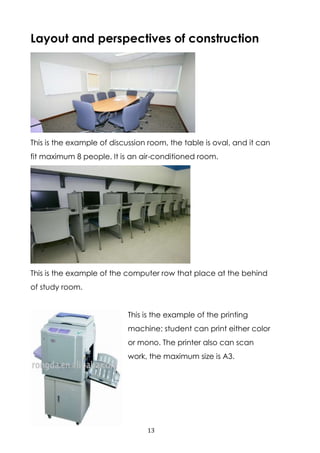
This is the example of discussion room, the table is oval, and it can
fit maximum 8 people. It is an air-conditioned room.
This is the example of the computer row that place at the behind
of study room.
This is the example of the printing
machine; student can print either color
or mono. The printer also can scan
work, the maximum size is A3.
14
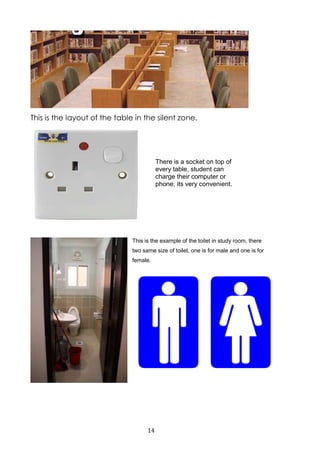
This is the layout of the table in the silent zone.
This is the example of the toilet in study room, there
two same size of toilet, one is for male and one is for
female.
There is a socket on top of
every table, student can
charge their computer or
phone, its very convenient.
15
CONCLUSION
In conclusion, the study room is very convenient for Taylor’s
student especially when public holiday and Sunday. The students
who want to study overnight also can study at there. Although it is
just 10m x 10m but it already help the students a lot. The student
can just park their car and then straight walk to the study room for
study because the library is quite far. Lastly, I hope that this study
room is helpful for some inconvenient students.

Ici report revised (2)

  • 1.
    1 FOUNDATION IN NATURALAND BUILT ENVIRONMENT (FNBE) FEBRUARY 2014 INTAKE INTRODUCTION TO CONSTURCTION INDUSTRY (QSB 30105) FINAL PROJECT NAME: DARREN LOONG CHI YOONG & TAN ZHAO MING STUDENT ID: 0318029 & 0318724 LECTURER: PN. HASMANIRA MOKHTAR, MS. ANN SEE PENG SUBMISSION DATE: 15 JUNE 2014
  • 2.
    2 CONTENTS: 1. Introduction 2. Typesof building development 3. Site analysis 4. Purpose of construction 5. Concept 6. Plan and zoning of construction 7. Layout and perspectives of construction 8. Conclusion
  • 3.
    3 Introduction In this project,we are ought to initiate a small construction in Taylor’s University Lakeside Campus and to use a land area of about 10mx10m anywhere on campus ground. As we are given the task to construct a study enhancement area, the small project that we are initiating is the construction of a 24/7 study and discussion room. The construction of this project will take place at the open car park beside the commercial block. A 10mx10m area will be taken from the current open car park to construct this 24/7 study and discussion room.
  • 4.
    4 Types of BuildingDevelopment 1. On-Site UPGRADING On-Site upgrading means that improving the size or the quality of existing communities without changing the layout or the plot size of the land. It is also improving the basic services and physical environment. Example, houses, lanes, roads and open spaces. The purposes of on-site upgrading is helping the poor communities and increase the image of the city. This is the example of the house that needs to have on-site upgrading The example of On-site upgrading, from the ancient house become a modern house without changing the layout or the plot size of the land.
  • 5.
    5 2. On-Site REBLOCKING Reblockingis to make adjustments of a project to make way for the construction of essential infrastructures and amenities such as drainage, sewages, walkways, roads, and etc. The purpose of reblocking is to ensure a community of people are able to live in a systematic environment. When communities are in need of reblocking, some of the existing construction may have to be removed partially or entirely for the reblocking process to take place. Roads and walkways may also be destructed and reconstructed again when there is a reblocking process. The process of reblocking is important to improve the layout of an area, especially housing areas. 3. On-Site Reconstruction On-Site reconstruction means that the existing communities are totally devastated and reconstructed on the same land in the upgrading strategy. The new safety of land tenancy on the already-occupied land frequently offers community people with
  • 6.
    6 a very durableencouragement to invest in their housing, through innovation or new construction. Renovation also allows communities on low-lying land to first increase the level of the land above overflow lines before investing in proper housing. Although the renovation option includes making substantial physical changes within the community and involves some adjustments to a new atmosphere, the plan allows people to remain living in the same place and to continue near to their places of work and dynamic support systems. This endurance is a critical recompense for the expenditure and difficulty renovation includes. This is some example of on site reconstruction
  • 7.
    7 4. Land Sharing Landsharing is a housing and payment enhancement plan that allows both the owner of land and the public people living on that land to advantage. After an era of negotiation and organization, the contract is reached to “share” the land, where the payment is distributed into two quantities. The organization is given, sold or chartered one portion for renovating their housing, and the rest of the land is returned to the land-owner to improve. There’s no regulation about how the land is distributed: the quantity of land the people get and how much goes back to the owner is established during the negotiations. At the core of a land distribution progression is the capability to convert conflicting needs and disagreeing demands into a cooperation that takes a concrete “win-win” form, and which is conventional to all parties involved. The people may end up with fewer areas than they had before, and the land-owner may get back less-than-all of his land, but the trade-off is that the unfortunate will no longer be residents but the permissible owners or occupants of their land. And the property-owner finally gets to improve the land. This is the example of land sharing project.
  • 8.
    8 5. Nearby ornot-so-nearby RELOCATION The extreme benefit of the rearrangement strategy is that it generally comes with housing safety, through land use rights, outright proprietorship or some kind of long-term land tenancy. Relocation sites can sometimes be distant from current communities, job occasions, backing organizations and schools. In these cases, community members who want to keep their old jobs or attend the same schools must swallow the encumbrance of extra travelling time and expenditure and they must get used to a new environment. But in many towns and cities around the country, ingenious communities are finding bits of land to buy or rent inexpensively for their housing that are not far away at all. Example of Nearby or not-so-nearby RELOCATION
  • 9.
    9 SITE ANALYSIS The sitethat is selected to construct this 24/7 Study Room is located at the open space car park, beside the commercial block, facing the 5.5 acres man made lake. The open space car park measures approximately 500mx800m and to build this 24/7 Study Room, only 10mx10m of the entire space will be used. This is to ensure that the car park is not completely affected and because Taylor's University has many cars parked everyday, the open space car park must still remain. Since the ground of the site is very uneven as it is covered with rocks, stones and gravels, a flat foundation to support the entire construction will be built. 10m
  • 10.
    10 PURPOSE The aim ofbuilding this 24/7 study room is to of course to allow students to study 24/7. This is the second 24/7-study room that is to be built in Taylor's University. There is already one 24/7 study room in the campus, which is located beside the library. As mentioned above, this project will be constructed beside the commercial block. Since the commercial block has a hostel there, the construction of this project is also for the convenience of the students, as they do not need to walk all the way to the library's 24/7 study room.
  • 11.
    11 CONCEPT The current 24/7study room that is located beside the library is for silent study only. By constructing this 24/7 study room, students do not need to be silent because there will be two discussions room built inside the study room. Each discussion room features a 10- seater rectangular table, an LCD screen with projector, and a 30- inch smart white board. This is for the convenience of the students to conduct their discussion effectively and also to support the use of technologies. Outside the study room, there will be a 60-seater study table for self-study. Anywhere outside the discussion room within the study area is a silent study area. There are also 10 public computers for students to use for their research and to use for printing purposes. Of course, there will be a Print-On-Demand (POD) machine in the 24/7 study room. There is also a toilet included in the 24/7 study room so that the students do not need to walk all the way to the commercial block to utilise the toilet.
  • 12.
    12 PLAN AND ZONINGOF CONSTRUCTION The floor plan above shows the entire 10mx10m 24/7 study room. A concrete wall except for the main entrance door surrounds the entire room, which is a row of glass panels. There are glass panels on the front section of the discussion rooms as well. A partition wall divides the discussion rooms. TOILET COMPUTERS DISCUSSION ROOM 1SILENT SELF STUDY ZONE PRINT-ON-DEMAND (POD) DISCUSSION ROOM 2
  • 13.
    13 Layout and perspectivesof construction This is the example of discussion room, the table is oval, and it can fit maximum 8 people. It is an air-conditioned room. This is the example of the computer row that place at the behind of study room. This is the example of the printing machine; student can print either color or mono. The printer also can scan work, the maximum size is A3.
  • 14.
    14 This is thelayout of the table in the silent zone. This is the example of the toilet in study room, there two same size of toilet, one is for male and one is for female. There is a socket on top of every table, student can charge their computer or phone, its very convenient.
  • 15.
    15 CONCLUSION In conclusion, thestudy room is very convenient for Taylor’s student especially when public holiday and Sunday. The students who want to study overnight also can study at there. Although it is just 10m x 10m but it already help the students a lot. The student can just park their car and then straight walk to the study room for study because the library is quite far. Lastly, I hope that this study room is helpful for some inconvenient students.