work
samples
tina botsi
contents
CV
DISsERTATION PROJECT
DIPLOMA THESIS PROJECT
CONSEPTUAL PROJECT
HOUSING PROJECTS
SUSTAINABLE DESIGN PROJECT
INTERIOR DESIGN PROJECT
SET DESIGN PROJECT
PRODUCT DESIGN PROJECT
cv
dissertation
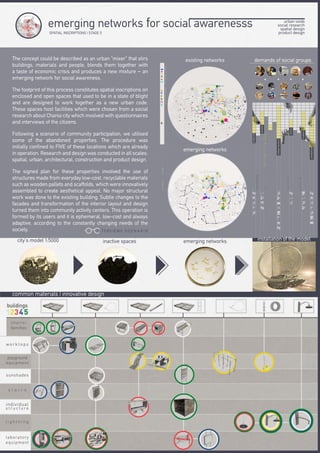
Τhe concept could be described as an urban “mixer” that stirs
buildings, materials and people, blends them together with
a taste of economic crisis and produces a new mixture – an
emerging network for social awareness.
The footprint of this process constitutes spatial inscriptions on
enclosed and open spaces that used to be in a state of blight
and are designed to work together as a new urban code.
These spaces host facilities which were chosen from a social
research about Chania city which involved with questionnaires
and interviews of the citizens.
Following a scenario of community participation, we utilised
some of the abandoned properties. The procedure was
initially confined to FIVE of these locations which are already
in operation. Research and design was conducted in all scales:
spatial, urban, architectural, construction and product design.
The signed plan for these properties involved the use of
structures made from everyday low-cost, recyclable materials
such as wooden pallets and scaffolds, which were innovatively
assembled to create aesthetical appeal. No major structural
work was done to the existing building. Subtle changes to the
facades and transformation of the interior layout and design
turned them into community activity centers. This operation is
formed by its users and it is ephemeral, low-cost and always
adaptive, according to the constantly changing needs of the
society.
emerging networks
existing networks demands of social groups
city’s model 1:5000 inactive spaces emerging networks installation of the model
common materials | innovative designcommon materials | innovative design
individual
w o r k t o p s
sunshades
equipment
urban voids
social research
spatial design
product designSPATIAL INSCRIPTIONS | STAGE 5
emerging networks for social awarenesss
I N T E R V I E W S S C E N A R I O
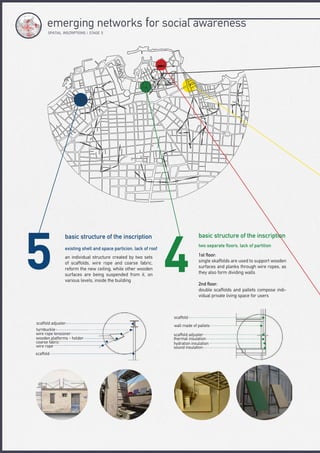
basic structure of the inscriptionbasic structure of the inscription
two separate floors, lack of partition
existing shell and space particion, lack of roof
1st floor:
single skaffolds are used to support wooden
surfaces and planks through wire ropes, as
they also form dividing walls
2nd floor:
double scaffolds and pallets compose indi-
vidual private living space for users
an individual structure created by two sets
of scaffolds, wire rope and coarse fabric,
reform the new ceiling, while other wooden
surfaces are being suspended from it, on
various levels, inside the building
scaffold adjuster
turnbuckle
wire rope tensioner
wooden platforms - holder
coarse fabric
wire rope
scaffold
scaffold
wall made of pallets
scaffold adjuster
thermal insulation
hydration insulation
sound insulation
SPΑTIAL INSCRIPTIONS | STAGE 5
emerging networks for social awareness
1
2
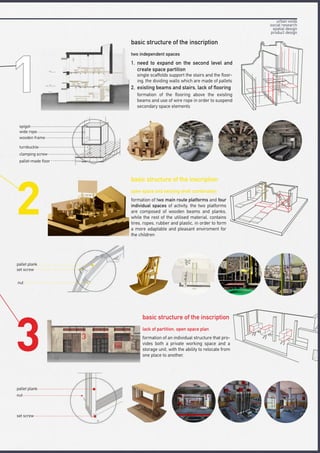
basic structure of the inscription
two independent spaces
open space and existing shell combination
lack of partition, open space plan
1.
2.
need to expand on the second level and
create space partition
formation of two main route platforms and four
individual spaces of activity. the two platforms
are composed of wooden beams and planks,
while the rest of the utilised material, contains
tires, ropes, rubber and plastic, in order to form
a more adaptable and pleasant enviroment for
the children
formation of an individual structure that pro-
vides both a private working space and a
storage unit, with the ability to relocate from
one place to another.
existing beams and stairs, lack of flooring
single scaffolds support the stairs and the floor-
ing, the dividing walls which are made of pallets
formation of the flooring above the existing
beams and use of wire rope in order to suspend
secondary space elements
spigot
wide rope
wooden frame
turnbuckle
clamping screw
pallet-made floor
pallet plank
set screw
nut
pallet plank
nut
set screw
urban voids
social research
spatial design
product design
diploma
thesis
THE CASE OF SOCIAL HOUSING
click to read online
“Τop Down & Bottom up” strategies research
compose
infograph
graphic design
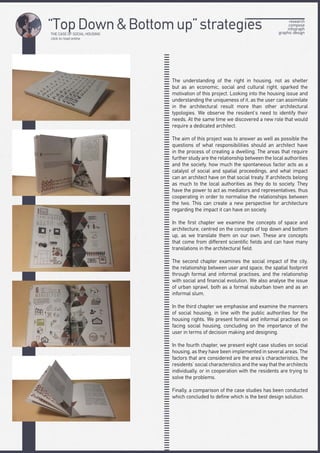
The understanding of the right in housing, not as shelter
but as an economic, social and cultural right, sparked the
motivation of this project. Looking into the housing issue and
understanding the uniqueness of it, as the user can assimilate
in the architectural result more than other architectural
typologies. We observe the resident’s need to identify their
needs. At the same time we discovered a new role that would
require a dedicated architect.
The aim of this project was to answer as well as possible the
questions of what responsibilities should an architect have
in the process of creating a dwelling. The areas that require
further study are the relationship between the local authorities
and the society, how much the spontaneous factor acts as a
catalyst of social and spatial proceedings, and what impact
can an architect have on that social treaty. If architects belong
as much to the local authorities as they do to society. They
have the power to act as mediators and representatives, thus
cooperating in order to normalise the relationships between
the two. This can create a new perspective for architecture
regarding the impact it can have on society.
In the first chapter we examine the concepts of space and
architecture, centred on the concepts of top down and bottom
up, as we translate them on our own. These are concepts
that come from different scientific fields and can have many
translations in the architectural field.
The second chapter examines the social impact of the city,
the relationship between user and space, the spatial footprint
through formal and informal practises, and the relationship
with social and financial evolution. We also analyse the issue
of urban sprawl, both as a formal suburban town and as an
informal slum.
In the third chapter we emphasise and examine the manners
of social housing, in line with the public authorities for the
housing rights. We present formal and informal practises on
facing social housing, concluding on the importance of the
user in terms of decision making and designing.
In the fourth chapter, we present eight case studies on social
housing, as they have been implemented in several areas. The
factors that are considered are the area’s characteristics, the
residents’ social characteristics and the way that the architects
individually, or in cooperation with the residents are trying to
solve the problems.
Finally, a comparison of the case studies has been conducted
which concluded to define which is the best design solution.
conseptual
west view
passenger terminal in Souda non-places
infrastructure
dynamic model
conceptual design
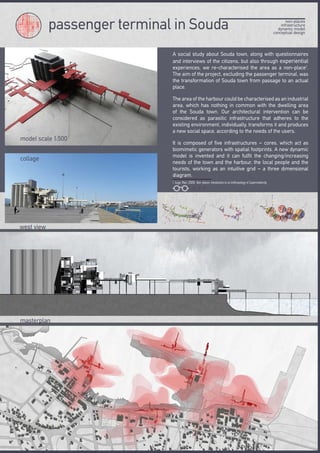
Α social study about Souda town, along with questionnaires
and interviews of the citizens, but also through experiential
experiences, we re-characterised the area as a non-place1
.
The aim of the project, excluding the passenger terminal, was
the transformation of Souda town from passage to an actual
place.
The area of the harbour could be characterised as an industrial
area, which has nothing in common with the dwelling area
of the Souda town. Our architectural intervention can be
considered as parasitic infrastructure that adheres to the
existing environment, individually, transforms it and produces
a new social space, according to the needs of the users.
It is composed of five infrastructures – cores, which act as
biomimetic generators with spatial footprints. A new dynamic
model is invented and it can fulfil the changing/increasing
needs of the town and the harbour, the local people and the
tourists, working as an intuitive grid – a three dimensional
diagram.
1. Auge, Marc (2009). Non-places: Introduction to an Anthropology of Supermodernity,
masterplan
collage
model scale 1:500
V I D E O
housing
adaptive design
vertical core
trasformable furniture
tranformable facade
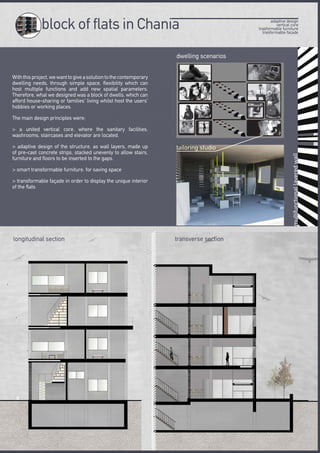
block of flats in Chania
With this project, we want to give a solution to the contemporary
dwelling needs, through simple space, flexibility which can
host multiple functions and add new spatial parameters.
Therefore, what we designed was a block of dwells, which can
afford house-sharing or families’ living whilst host the users’
hobbies or working places.
The main design principles were:
> a united vertical core, where the sanitary facilities,
washrooms, staircases and elevator are located.
> adaptive design of the structure, as wall layers, made up
of pre-cast concrete strips, stacked unevenly to allow stairs,
furniture and floors to be inserted to the gaps.
> smart transformable furniture, for saving space
> transformable façade in order to display the unique interior
of the flats
longitudinal section transverse section
dwelling scenarios
multifunctionallayeredwall
tailoring studio
housing
HOUSE | WORKING PLACE | GUEST HOUSE
housing in Tampakaria, Chania
In this project, we used a folding surface in order to separate
and at the same time unite the spaces of the house, guest
house and the working area.
The main lines have organised the positioning of the individual
uses. The design aim was for the house and the guest house to
have privacy and sea view and on the other hand the working
place to have a public yard.
longitudinal section
model scale 1:100
floor plan
main lines
folding surface
housing
folding surface
privacy filters
sea view
sustainable
design
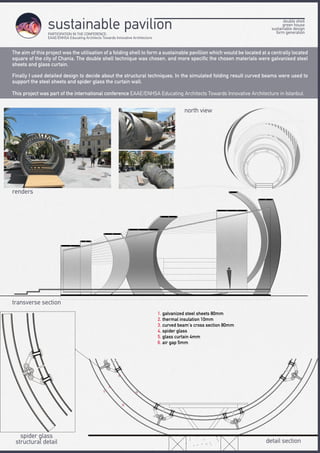
double shell
green house
sustainable design
form generation
sustainable pavilion
The aim of this project was the utilisation of a folding shell to form a sustainable pavillion which would be located at a centrally located
square of the city of Chania. The double shell technique was chosen, and more specific the chosen materials were galvanised steel
sheets and glass curtain.
Finally I used detailed design to decide about the structural techniques. In the simulated folding result curved beams were used to
support the steel sheets and spider glass the curtain wall.
This project was part of the international conference EAAE/ENHSA Educating Architects Towards Innovative Architecture in Istanbul.
1. galvanized steel sheets 80mm
2. thermal insulation 10mm
3. curved beam’s cross section 80mm
4. spider glass
5. glass curtain 4mm
6. air gap 5mm
spider glass
structural detail detail section
transverse section
north view
renders
PARTICIPATION IN THE CONFERENCE:
EAAE/ENHSA Educating Architects Towards Innovative Architecture
intrerior
design
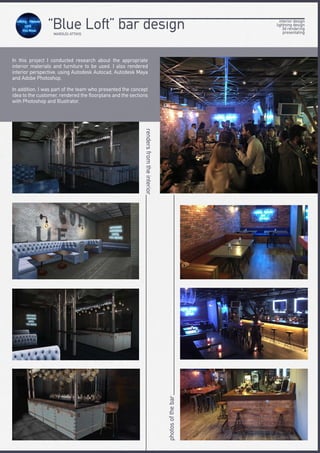
In this project I conducted research about the appropriate
interior materials and furniture to be used. I also rendered
interior perspective, using Autodesk Autocad, Autodesk Maya
and Adobe Photoshop.
In addition, I was part of the team who presented the concept
idea to the customer, rendered the floorplans and the sections
with Photoshop and Illustrator.
rendersfromtheinterior
photosofthebar
interior design
lightning design
3d rendering
presentating
“Blue Loft” bar designMAROUSI ATTIKIS
set
design
ATHENS BIENALLE
Dome Experience: “TRACES”
photosfromthepresentation
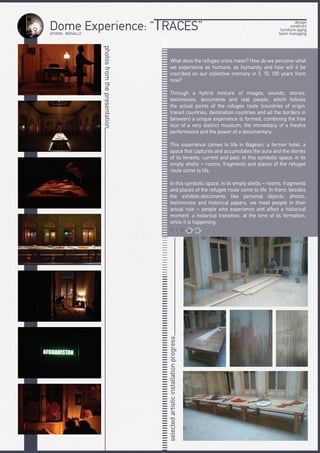
What does the refugee crisis mean? How do we perceive what
we experience as humans, as humanity, and how will it be
inscribed on our collective memory in 5, 10, 100 years from
now?
Through a hybrid mixture of images, sounds, stories,
testimonies, documents and real people, which follows
the actual points of the refugee route (countries of origin,
transit countries, destination countries and all the borders in
between) a unique experience is formed, combining the free
tour of a very distinct museum, the immediacy of a theatre
performance and the power of a documentary.
This experience comes to life in Bageion, a former hotel, a
space that captures and accumulates the aura and the stories
of its tenants, current and past. In this symbolic space, in its
empty shells – rooms, fragments and places of the refugee
route come to life.
In this symbolic space, in its empty shells – rooms, fragments
and places of the refugee route come to life.
In there, besides
the exhibits-documents like personal objects, photos,
testimonies and historical papers, we meet people in their
actual role – people who experience and affect a historical
moment, a historical transition, at the time of its formation,
while it is happening.
selectedartisticinstallationprogress
design
construct
furniture aging
team managing
V I D E O
PRODUCT
DESIGN
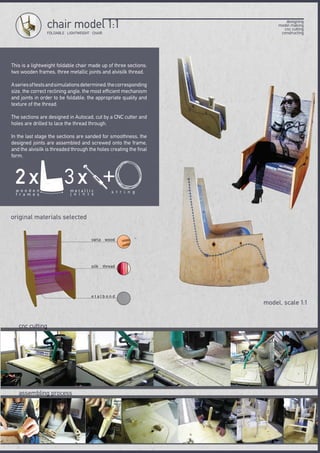
This is a lightweight foldable chair made up of three sections:
two wooden frames, three metallic joints and alvisilk thread.
Aseriesoftestsandsimulationsdetermined:thecorresponding
size, the correct reclining angle, the most efficient mechanism
and joints in order to be foldable, the appropriate quality and
texture of the thread.
The sections are designed in Autocad, cut by a CNC cutter and
holes are drilled to lace the thread through.
In the last stage the sections are sanded for smoothness, the
designed joints are assembled and screwed onto the frame,
and the alvisilk is threaded through the holes creating the final
form.
cnc cutting
assembling process
original materials selected
FOLDABLE LIGHTWEIGHT CHAIR
chair model 1:1
model, scale 1:1
designing
model making
cnc cutting
constructing
2 χw o o d e n
f r a m e s
+
s t r i n g
3χm e t a l l i c
j o i n t s
varia wood
silk thread
e t a l b o n d
thank
you

Worksamples tina botsi_

  • 1.
  • 2.
  • 3.
    CV DISsERTATION PROJECT DIPLOMA THESISPROJECT CONSEPTUAL PROJECT HOUSING PROJECTS SUSTAINABLE DESIGN PROJECT INTERIOR DESIGN PROJECT SET DESIGN PROJECT PRODUCT DESIGN PROJECT
  • 4.
  • 6.
  • 7.
    Τhe concept couldbe described as an urban “mixer” that stirs buildings, materials and people, blends them together with a taste of economic crisis and produces a new mixture – an emerging network for social awareness. The footprint of this process constitutes spatial inscriptions on enclosed and open spaces that used to be in a state of blight and are designed to work together as a new urban code. These spaces host facilities which were chosen from a social research about Chania city which involved with questionnaires and interviews of the citizens. Following a scenario of community participation, we utilised some of the abandoned properties. The procedure was initially confined to FIVE of these locations which are already in operation. Research and design was conducted in all scales: spatial, urban, architectural, construction and product design. The signed plan for these properties involved the use of structures made from everyday low-cost, recyclable materials such as wooden pallets and scaffolds, which were innovatively assembled to create aesthetical appeal. No major structural work was done to the existing building. Subtle changes to the facades and transformation of the interior layout and design turned them into community activity centers. This operation is formed by its users and it is ephemeral, low-cost and always adaptive, according to the constantly changing needs of the society. emerging networks existing networks demands of social groups city’s model 1:5000 inactive spaces emerging networks installation of the model common materials | innovative designcommon materials | innovative design individual w o r k t o p s sunshades equipment urban voids social research spatial design product designSPATIAL INSCRIPTIONS | STAGE 5 emerging networks for social awarenesss I N T E R V I E W S S C E N A R I O
  • 8.
    basic structure ofthe inscriptionbasic structure of the inscription two separate floors, lack of partition existing shell and space particion, lack of roof 1st floor: single skaffolds are used to support wooden surfaces and planks through wire ropes, as they also form dividing walls 2nd floor: double scaffolds and pallets compose indi- vidual private living space for users an individual structure created by two sets of scaffolds, wire rope and coarse fabric, reform the new ceiling, while other wooden surfaces are being suspended from it, on various levels, inside the building scaffold adjuster turnbuckle wire rope tensioner wooden platforms - holder coarse fabric wire rope scaffold scaffold wall made of pallets scaffold adjuster thermal insulation hydration insulation sound insulation SPΑTIAL INSCRIPTIONS | STAGE 5 emerging networks for social awareness
  • 9.
    1 2 basic structure ofthe inscription basic structure of the inscription basic structure of the inscription two independent spaces open space and existing shell combination lack of partition, open space plan 1. 2. need to expand on the second level and create space partition formation of two main route platforms and four individual spaces of activity. the two platforms are composed of wooden beams and planks, while the rest of the utilised material, contains tires, ropes, rubber and plastic, in order to form a more adaptable and pleasant enviroment for the children formation of an individual structure that pro- vides both a private working space and a storage unit, with the ability to relocate from one place to another. existing beams and stairs, lack of flooring single scaffolds support the stairs and the floor- ing, the dividing walls which are made of pallets formation of the flooring above the existing beams and use of wire rope in order to suspend secondary space elements spigot wide rope wooden frame turnbuckle clamping screw pallet-made floor pallet plank set screw nut pallet plank nut set screw urban voids social research spatial design product design
  • 10.
  • 11.
    THE CASE OFSOCIAL HOUSING click to read online “Τop Down & Bottom up” strategies research compose infograph graphic design The understanding of the right in housing, not as shelter but as an economic, social and cultural right, sparked the motivation of this project. Looking into the housing issue and understanding the uniqueness of it, as the user can assimilate in the architectural result more than other architectural typologies. We observe the resident’s need to identify their needs. At the same time we discovered a new role that would require a dedicated architect. The aim of this project was to answer as well as possible the questions of what responsibilities should an architect have in the process of creating a dwelling. The areas that require further study are the relationship between the local authorities and the society, how much the spontaneous factor acts as a catalyst of social and spatial proceedings, and what impact can an architect have on that social treaty. If architects belong as much to the local authorities as they do to society. They have the power to act as mediators and representatives, thus cooperating in order to normalise the relationships between the two. This can create a new perspective for architecture regarding the impact it can have on society. In the first chapter we examine the concepts of space and architecture, centred on the concepts of top down and bottom up, as we translate them on our own. These are concepts that come from different scientific fields and can have many translations in the architectural field. The second chapter examines the social impact of the city, the relationship between user and space, the spatial footprint through formal and informal practises, and the relationship with social and financial evolution. We also analyse the issue of urban sprawl, both as a formal suburban town and as an informal slum. In the third chapter we emphasise and examine the manners of social housing, in line with the public authorities for the housing rights. We present formal and informal practises on facing social housing, concluding on the importance of the user in terms of decision making and designing. In the fourth chapter, we present eight case studies on social housing, as they have been implemented in several areas. The factors that are considered are the area’s characteristics, the residents’ social characteristics and the way that the architects individually, or in cooperation with the residents are trying to solve the problems. Finally, a comparison of the case studies has been conducted which concluded to define which is the best design solution.
  • 12.
  • 13.
    west view passenger terminalin Souda non-places infrastructure dynamic model conceptual design Α social study about Souda town, along with questionnaires and interviews of the citizens, but also through experiential experiences, we re-characterised the area as a non-place1 . The aim of the project, excluding the passenger terminal, was the transformation of Souda town from passage to an actual place. The area of the harbour could be characterised as an industrial area, which has nothing in common with the dwelling area of the Souda town. Our architectural intervention can be considered as parasitic infrastructure that adheres to the existing environment, individually, transforms it and produces a new social space, according to the needs of the users. It is composed of five infrastructures – cores, which act as biomimetic generators with spatial footprints. A new dynamic model is invented and it can fulfil the changing/increasing needs of the town and the harbour, the local people and the tourists, working as an intuitive grid – a three dimensional diagram. 1. Auge, Marc (2009). Non-places: Introduction to an Anthropology of Supermodernity, masterplan collage model scale 1:500 V I D E O
  • 14.
  • 15.
    adaptive design vertical core trasformablefurniture tranformable facade block of flats in Chania With this project, we want to give a solution to the contemporary dwelling needs, through simple space, flexibility which can host multiple functions and add new spatial parameters. Therefore, what we designed was a block of dwells, which can afford house-sharing or families’ living whilst host the users’ hobbies or working places. The main design principles were: > a united vertical core, where the sanitary facilities, washrooms, staircases and elevator are located. > adaptive design of the structure, as wall layers, made up of pre-cast concrete strips, stacked unevenly to allow stairs, furniture and floors to be inserted to the gaps. > smart transformable furniture, for saving space > transformable façade in order to display the unique interior of the flats longitudinal section transverse section dwelling scenarios multifunctionallayeredwall tailoring studio
  • 16.
  • 17.
    HOUSE | WORKINGPLACE | GUEST HOUSE housing in Tampakaria, Chania In this project, we used a folding surface in order to separate and at the same time unite the spaces of the house, guest house and the working area. The main lines have organised the positioning of the individual uses. The design aim was for the house and the guest house to have privacy and sea view and on the other hand the working place to have a public yard. longitudinal section model scale 1:100 floor plan main lines folding surface housing folding surface privacy filters sea view
  • 18.
  • 19.
    double shell green house sustainabledesign form generation sustainable pavilion The aim of this project was the utilisation of a folding shell to form a sustainable pavillion which would be located at a centrally located square of the city of Chania. The double shell technique was chosen, and more specific the chosen materials were galvanised steel sheets and glass curtain. Finally I used detailed design to decide about the structural techniques. In the simulated folding result curved beams were used to support the steel sheets and spider glass the curtain wall. This project was part of the international conference EAAE/ENHSA Educating Architects Towards Innovative Architecture in Istanbul. 1. galvanized steel sheets 80mm 2. thermal insulation 10mm 3. curved beam’s cross section 80mm 4. spider glass 5. glass curtain 4mm 6. air gap 5mm spider glass structural detail detail section transverse section north view renders PARTICIPATION IN THE CONFERENCE: EAAE/ENHSA Educating Architects Towards Innovative Architecture
  • 20.
  • 21.
    In this projectI conducted research about the appropriate interior materials and furniture to be used. I also rendered interior perspective, using Autodesk Autocad, Autodesk Maya and Adobe Photoshop. In addition, I was part of the team who presented the concept idea to the customer, rendered the floorplans and the sections with Photoshop and Illustrator. rendersfromtheinterior photosofthebar interior design lightning design 3d rendering presentating “Blue Loft” bar designMAROUSI ATTIKIS
  • 22.
  • 23.
    ATHENS BIENALLE Dome Experience:“TRACES” photosfromthepresentation What does the refugee crisis mean? How do we perceive what we experience as humans, as humanity, and how will it be inscribed on our collective memory in 5, 10, 100 years from now? Through a hybrid mixture of images, sounds, stories, testimonies, documents and real people, which follows the actual points of the refugee route (countries of origin, transit countries, destination countries and all the borders in between) a unique experience is formed, combining the free tour of a very distinct museum, the immediacy of a theatre performance and the power of a documentary. This experience comes to life in Bageion, a former hotel, a space that captures and accumulates the aura and the stories of its tenants, current and past. In this symbolic space, in its empty shells – rooms, fragments and places of the refugee route come to life. In this symbolic space, in its empty shells – rooms, fragments and places of the refugee route come to life.
In there, besides the exhibits-documents like personal objects, photos, testimonies and historical papers, we meet people in their actual role – people who experience and affect a historical moment, a historical transition, at the time of its formation, while it is happening. selectedartisticinstallationprogress design construct furniture aging team managing V I D E O
  • 24.
  • 25.
    This is alightweight foldable chair made up of three sections: two wooden frames, three metallic joints and alvisilk thread. Aseriesoftestsandsimulationsdetermined:thecorresponding size, the correct reclining angle, the most efficient mechanism and joints in order to be foldable, the appropriate quality and texture of the thread. The sections are designed in Autocad, cut by a CNC cutter and holes are drilled to lace the thread through. In the last stage the sections are sanded for smoothness, the designed joints are assembled and screwed onto the frame, and the alvisilk is threaded through the holes creating the final form. cnc cutting assembling process original materials selected FOLDABLE LIGHTWEIGHT CHAIR chair model 1:1 model, scale 1:1 designing model making cnc cutting constructing 2 χw o o d e n f r a m e s + s t r i n g 3χm e t a l l i c j o i n t s varia wood silk thread e t a l b o n d
  • 26.