CODING 101-CHAPTER 4
USINGTHE
ICD-10-CM
DERIVED FROM BUCK'S 2019 STEP-BY-STEP
MEDICAL CODING
AVLS
CHAPTER
HIGHLIGHTS
TOPICS
Organization of the Guidelines
Accurate Coding
Alphabetic Index and Tabular List
Level of Specifity
Integral Conditions
Multiple Coding
Acute and Chronic
Combination Codes
Late Effects (Sequela)
Reporting Same Diagnosis Code More
Than Once
Laterality
CODING 101 | USING THE ICD-10-CM
ORGANIZATION OF
THE GUIDELINES
Official Guidelines for Coding and Reporting
developed and approved by the American Hospital
Association (AHA), American Health Information
Management Association (AHIMA), Center for Medicare
and Medical Services (CMS), and National Center for
Health Statistics
Sections
Section 1- structure and conventions of the
classification and general guidelines that apply to the
entire classification and chapter specific guidelines
Section 2- guidelines for selection of principal
diagnosis for non-outpatient (hospital) settings
Section 3- guidelines for reporting additional
diagnoses in non-out patient setting
Section 4- outpatient coding and reporting
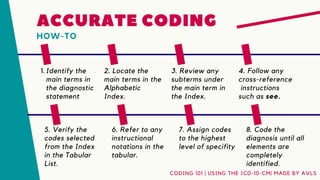
ACCURATE CODINGHOW-TO
Identify the
main terms in
the diagnostic
statement
1. 2. Locate the
main terms in the
Alphabetic
Index.
4. Follow any
cross-reference
instructions
such as see.
3. Review any
subterms under
the main term in
the Index.
CODING 101 | USING THE ICD-10-CM| MADE BY AVLS
5. Verify the
codes selected
from the Index
in the Tabular
List.
6. Refer to any
instructional
notations in the
tabular.
8. Code the
diagnosis until all
elements are
completely
identified.
7. Assign codes
to the highest
level of specifity
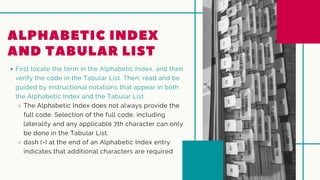
ALPHABETIC INDEX
AND TABULAR LIST
First locate the term in the Alphabetic Index, and then
verify the code in the Tabular List. Then, read and be
guided by instructional notations that appear in both
the Alphabetic Index and the Tabular List.
The Alphabetic Index does not always provide the
full code. Selection of the full code, including
laterality and any applicable 7th character can only
be done in the Tabular List.
dash (-) at the end of an Alphabetic Index entry
indicates that additional characters are required
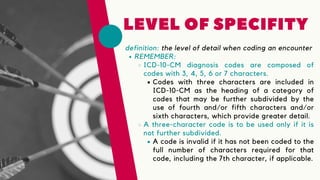
definition: the level of detail when coding an encounter
LEVEL OF SPECIFITY
REMEMBER:
ICD-10-CM diagnosis codes are composed of
codes with 3, 4, 5, 6 or 7 characters.
Codes with three characters are included in
ICD-10-CM as the heading of a category of
codes that may be further subdivided by the
use of fourth and/or fifth characters and/or
sixth characters, which provide greater detail.
A three-character code is to be used only if it is
not further subdivided.
A code is invalid if it has not been coded to the
full number of characters required for that
code, including the 7th character, if applicable.
CODING 101 | USING THE ICD-10-CM
INTEGRAL
CONDITIONS
When the sign or symptom is due to a
diagnosed condition, the sign or symptom
are not reported separately.
ex.
Fever and shortness of breath due to
pneumonia
Abdominal pain due to gastric ulcer
When the signs or symptoms are not due to
a diagnosed condition, the signs and
symptoms should be reported.
ex.
Dehydration and pneumonia
Ascites and cirrhosis of the liver
MULTIPLE CODING
“Code first” notes are also under certain codes
that are not specifically manifestation codes but
may be due to an underlying cause.
underlying condition should be sequenced first,
if known
“Code, if applicable, any causal condition first”-
indicate that this code may be assigned as a
principal diagnosis when the causal condition is
unknown or not applicable.
Multiple codes may be needed for sequela,
complication codes and obstetric codes to more
fully describe a condition.
ACUTE AND CHRONICIf the same condition is described as both acute (subacute) and chronic, and separate
subentries exist in the Alphabetic Index at the same indentation level, code both and sequence
the acute (subacute) code first.
EXAMPLES
ACUTE AND
CHRONIC
THYROIDITIS
1.
E06 Thyroiditis
E06.0 Acute
Thyroditis
E06.5 Other chronic
thyroiditis
CODE: E06.0, E06.5
2. ACUTE AND
CHRONIC
PERICARDITIS
I30 Pericarditis
I30.9 Acute
Pericarditis
I31.9 Other
diseases of
pericardium
CODE: I30.9, I31.9
3. ACUTE AND
CHRONIC
RHEUMATIC
FEVER
I00 Rheumatic fever
without heart
involvement
(INCLUDES)
I09.9 Rheumatic Heart
Disease, unspecified
CODE: I00, I09.9
4. ACUTE AND
CHRONIC
BRONCHITIS
J40- Bronchitis
J20.9 Acute
Bronchitis,
unspecified
J42 Unspecified
chronic bronchitis
CODE: J20.9, J42
usually occurs in
respiratory
system
CODING 101 | USING THE ICD-10-CM
COMBINATION
CODESused to classify:
Two diagnoses
A diagnosis with an associated secondary
process (manifestation)
A diagnosis with an associated complication
identified by referring to subterm entries in the
Alphabetic Index and by reading the inclusion
and exclusion notes in the Tabular List
Assign only the combination code when it fully
identifies the diagnostic conditions involved or
when the Alphabetic Index so directs.
Streptococcal Pharyngitis
TABULAR: J02 Acute Pharyngitis
J02.0 - Streptococcal Pharyngitis
Diabetes Mellitus
Example:
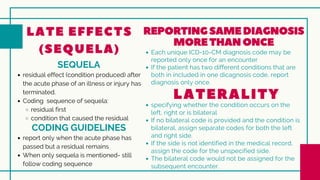
LATE EFFECTS
(SEQUELA)
REPORTINGSAMEDIAGNOSIS
MORETHANONCE
Each unique ICD-10-CM diagnosis code may be
reported only once for an encounter
If the patient has two different conditions that are
both in included in one dicagnosis code, report
diagnosis only once.
LATERALITYspecifying whether the condition occurs on the
left, right or is bilateral
If no bilateral code is provided and the condition is
bilateral, assign separate codes for both the left
and right side.
If the side is not identified in the medical record,
assign the code for the unspecified side.
The bilateral code would not be assigned for the
subsequent encounter.
SEQUELA
residual effect (condition produced) after
the acute phase of an illness or injury has
terminated.
Coding sequence of sequela:
residual first
condition that caused the residual
CODING GUIDELINES
report only when the acute phase has
passed but a residual remains
When only sequela is mentioned- still
follow coding sequence
THANK YOU!
Source:
Buck,C.J., Koesterman, J.G.(2019). Buck's Step-
by-Step Medical Coding, 2019 Edition. Elsevier
Health Sciences.

Using the ICD-10-CM

  • 1.
    CODING 101-CHAPTER 4 USINGTHE ICD-10-CM DERIVEDFROM BUCK'S 2019 STEP-BY-STEP MEDICAL CODING AVLS
  • 2.
    CHAPTER HIGHLIGHTS TOPICS Organization of theGuidelines Accurate Coding Alphabetic Index and Tabular List Level of Specifity Integral Conditions Multiple Coding Acute and Chronic Combination Codes Late Effects (Sequela) Reporting Same Diagnosis Code More Than Once Laterality
  • 3.
    CODING 101 |USING THE ICD-10-CM ORGANIZATION OF THE GUIDELINES Official Guidelines for Coding and Reporting developed and approved by the American Hospital Association (AHA), American Health Information Management Association (AHIMA), Center for Medicare and Medical Services (CMS), and National Center for Health Statistics Sections Section 1- structure and conventions of the classification and general guidelines that apply to the entire classification and chapter specific guidelines Section 2- guidelines for selection of principal diagnosis for non-outpatient (hospital) settings Section 3- guidelines for reporting additional diagnoses in non-out patient setting Section 4- outpatient coding and reporting
  • 4.
    ACCURATE CODINGHOW-TO Identify the mainterms in the diagnostic statement 1. 2. Locate the main terms in the Alphabetic Index. 4. Follow any cross-reference instructions such as see. 3. Review any subterms under the main term in the Index. CODING 101 | USING THE ICD-10-CM| MADE BY AVLS 5. Verify the codes selected from the Index in the Tabular List. 6. Refer to any instructional notations in the tabular. 8. Code the diagnosis until all elements are completely identified. 7. Assign codes to the highest level of specifity
  • 5.
    ALPHABETIC INDEX AND TABULARLIST First locate the term in the Alphabetic Index, and then verify the code in the Tabular List. Then, read and be guided by instructional notations that appear in both the Alphabetic Index and the Tabular List. The Alphabetic Index does not always provide the full code. Selection of the full code, including laterality and any applicable 7th character can only be done in the Tabular List. dash (-) at the end of an Alphabetic Index entry indicates that additional characters are required
  • 6.
    definition: the levelof detail when coding an encounter LEVEL OF SPECIFITY REMEMBER: ICD-10-CM diagnosis codes are composed of codes with 3, 4, 5, 6 or 7 characters. Codes with three characters are included in ICD-10-CM as the heading of a category of codes that may be further subdivided by the use of fourth and/or fifth characters and/or sixth characters, which provide greater detail. A three-character code is to be used only if it is not further subdivided. A code is invalid if it has not been coded to the full number of characters required for that code, including the 7th character, if applicable.
  • 7.
    CODING 101 |USING THE ICD-10-CM INTEGRAL CONDITIONS When the sign or symptom is due to a diagnosed condition, the sign or symptom are not reported separately. ex. Fever and shortness of breath due to pneumonia Abdominal pain due to gastric ulcer When the signs or symptoms are not due to a diagnosed condition, the signs and symptoms should be reported. ex. Dehydration and pneumonia Ascites and cirrhosis of the liver
  • 8.
    MULTIPLE CODING “Code first”notes are also under certain codes that are not specifically manifestation codes but may be due to an underlying cause. underlying condition should be sequenced first, if known “Code, if applicable, any causal condition first”- indicate that this code may be assigned as a principal diagnosis when the causal condition is unknown or not applicable. Multiple codes may be needed for sequela, complication codes and obstetric codes to more fully describe a condition.
  • 9.
    ACUTE AND CHRONICIfthe same condition is described as both acute (subacute) and chronic, and separate subentries exist in the Alphabetic Index at the same indentation level, code both and sequence the acute (subacute) code first. EXAMPLES ACUTE AND CHRONIC THYROIDITIS 1. E06 Thyroiditis E06.0 Acute Thyroditis E06.5 Other chronic thyroiditis CODE: E06.0, E06.5 2. ACUTE AND CHRONIC PERICARDITIS I30 Pericarditis I30.9 Acute Pericarditis I31.9 Other diseases of pericardium CODE: I30.9, I31.9 3. ACUTE AND CHRONIC RHEUMATIC FEVER I00 Rheumatic fever without heart involvement (INCLUDES) I09.9 Rheumatic Heart Disease, unspecified CODE: I00, I09.9 4. ACUTE AND CHRONIC BRONCHITIS J40- Bronchitis J20.9 Acute Bronchitis, unspecified J42 Unspecified chronic bronchitis CODE: J20.9, J42 usually occurs in respiratory system
  • 10.
    CODING 101 |USING THE ICD-10-CM COMBINATION CODESused to classify: Two diagnoses A diagnosis with an associated secondary process (manifestation) A diagnosis with an associated complication identified by referring to subterm entries in the Alphabetic Index and by reading the inclusion and exclusion notes in the Tabular List Assign only the combination code when it fully identifies the diagnostic conditions involved or when the Alphabetic Index so directs. Streptococcal Pharyngitis TABULAR: J02 Acute Pharyngitis J02.0 - Streptococcal Pharyngitis Diabetes Mellitus Example:
  • 11.
    LATE EFFECTS (SEQUELA) REPORTINGSAMEDIAGNOSIS MORETHANONCE Each uniqueICD-10-CM diagnosis code may be reported only once for an encounter If the patient has two different conditions that are both in included in one dicagnosis code, report diagnosis only once. LATERALITYspecifying whether the condition occurs on the left, right or is bilateral If no bilateral code is provided and the condition is bilateral, assign separate codes for both the left and right side. If the side is not identified in the medical record, assign the code for the unspecified side. The bilateral code would not be assigned for the subsequent encounter. SEQUELA residual effect (condition produced) after the acute phase of an illness or injury has terminated. Coding sequence of sequela: residual first condition that caused the residual CODING GUIDELINES report only when the acute phase has passed but a residual remains When only sequela is mentioned- still follow coding sequence
  • 12.
    THANK YOU! Source: Buck,C.J., Koesterman,J.G.(2019). Buck's Step- by-Step Medical Coding, 2019 Edition. Elsevier Health Sciences.