



Medical Coding: an Application of
Health Informatics
By:
Denise Miller
Content
• History
• Purpose
• Format of ICD-9-CM
• Methods to find the ICD-9-CM codes
• ICD-10-CM Preview
• Difference between ICD-9-CM and ICD-10-CM.
• Summary
History
• In the early 17th
century, John Graunt began the statistical
study of health and diseases.
• Later, in 1837, William Farr thought of getting a unique
classification for causes of diseases.
• The Bertillon Classification of Causes of Death was
developed by Jacques Bertillon in 1893 which then was
implemented in 1898.
• In 1938, the name was then changed to International
Classification of Diseases (ICD).
• The 9th
edition of this was brought into implementation in
1978
Purpose
• Providing Morbidity Statistics to the World Health
Organization (WHO).
• Verify the need of patient care/treatment.
• Provide statistics helpful to analyze healthcare costs.
Format of ICD-9-CM
• The codes are broken into 3 digit categories. The first
three digits determine the category.
• The fourth digit specifies the sub category.
• The Fifth digit is used for sub classification and
specifies the type of treatment or diagnosis required.
Methods to Find ICD-9-CM
Codes
• Good research habits are necessary.
• 5 basic steps to identify the correct code.
- Correct identification of main term or condition.
- Use the index to locate the problem.
- Review information with all instructions.
- Select the correct code from tabular list.
- Use correct sequence while mentioning multiple
codes.
ICD-10-CM Preview
• A new version of codes was implemented by WHO
in 1992. The National Center for Health Statistics
(NCHS) stated that this version was not detailed
enough to be used at a national level.
• Soon the advanced version ICD-10-CM will be
brought into practice from October 1, 2014. This is a
more detailed coding system that contains a codes
that are more specific.
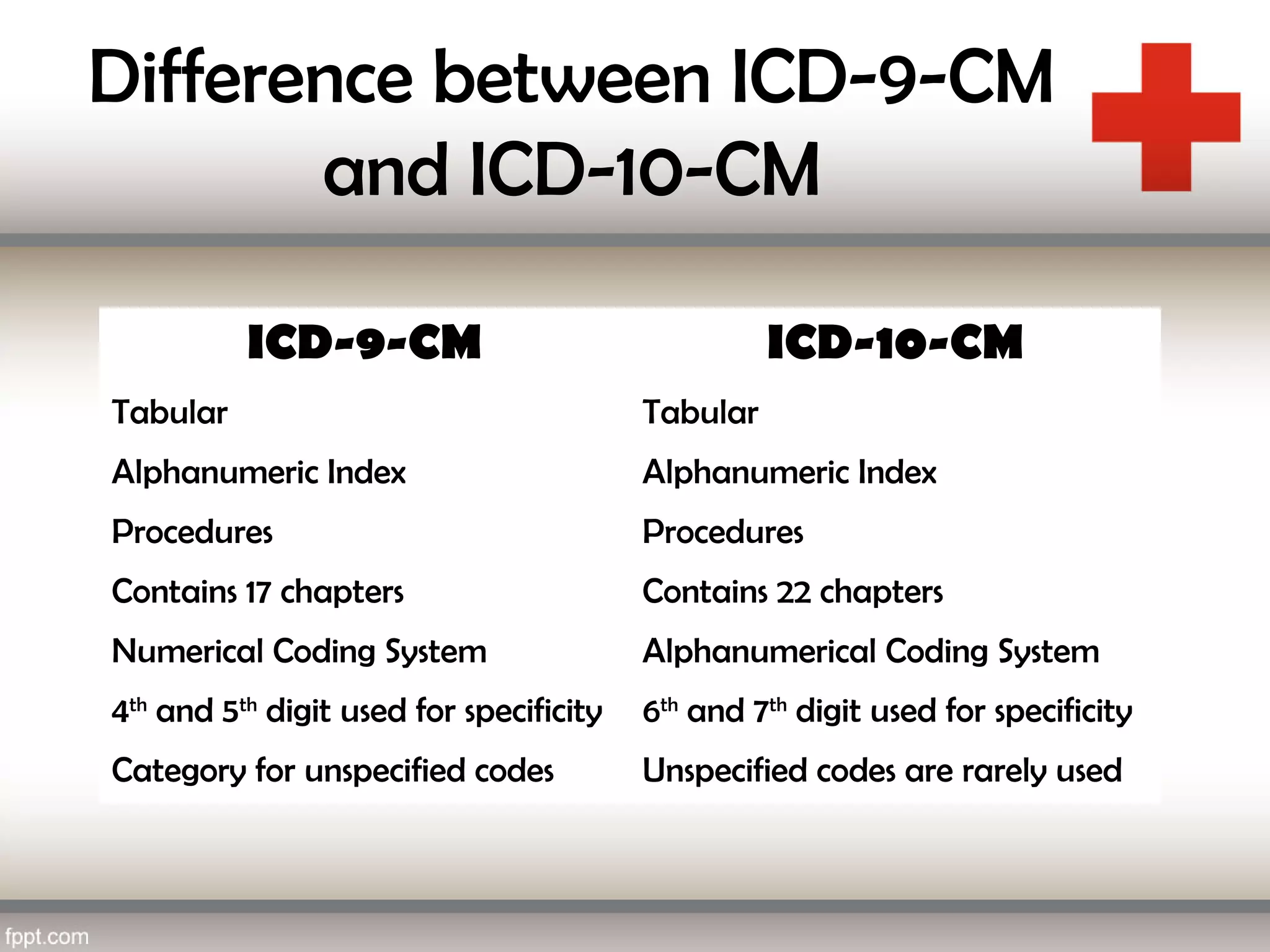
Difference between ICD-9-CM
and ICD-10-CM
ICD-9-CM ICD-10-CM
Tabular Tabular
Alphanumeric Index Alphanumeric Index
Procedures Procedures
Contains 17 chapters Contains 22 chapters
Numerical Coding System Alphanumerical Coding System
4th
and 5th
digit used for specificity 6th
and 7th
digit used for specificity
Category for unspecified codes Unspecified codes are rarely used
Summary
• We have thus seen why Medical Coding is
brought into practice.
• The Presentation also speaks about the
different stages it has gone through.
• The upcoming transition in the coding system
also proves that the health care industry is
growing and there are many more
improvements we can expect.
Summary
• We have thus seen why Medical Coding is
brought into practice.
• The Presentation also speaks about the
different stages it has gone through.
• The upcoming transition in the coding system
also proves that the health care industry is
growing and there are many more
improvements we can expect.

Medical coding

  • 1.
    Medical Coding: anApplication of Health Informatics By: Denise Miller
  • 2.
    Content • History • Purpose •Format of ICD-9-CM • Methods to find the ICD-9-CM codes • ICD-10-CM Preview • Difference between ICD-9-CM and ICD-10-CM. • Summary
  • 3.
    History • In theearly 17th century, John Graunt began the statistical study of health and diseases. • Later, in 1837, William Farr thought of getting a unique classification for causes of diseases. • The Bertillon Classification of Causes of Death was developed by Jacques Bertillon in 1893 which then was implemented in 1898. • In 1938, the name was then changed to International Classification of Diseases (ICD). • The 9th edition of this was brought into implementation in 1978
  • 4.
    Purpose • Providing MorbidityStatistics to the World Health Organization (WHO). • Verify the need of patient care/treatment. • Provide statistics helpful to analyze healthcare costs.
  • 5.
    Format of ICD-9-CM •The codes are broken into 3 digit categories. The first three digits determine the category. • The fourth digit specifies the sub category. • The Fifth digit is used for sub classification and specifies the type of treatment or diagnosis required.
  • 6.
    Methods to FindICD-9-CM Codes • Good research habits are necessary. • 5 basic steps to identify the correct code. - Correct identification of main term or condition. - Use the index to locate the problem. - Review information with all instructions. - Select the correct code from tabular list. - Use correct sequence while mentioning multiple codes.
  • 7.
    ICD-10-CM Preview • Anew version of codes was implemented by WHO in 1992. The National Center for Health Statistics (NCHS) stated that this version was not detailed enough to be used at a national level. • Soon the advanced version ICD-10-CM will be brought into practice from October 1, 2014. This is a more detailed coding system that contains a codes that are more specific.
  • 8.
    Difference between ICD-9-CM andICD-10-CM ICD-9-CM ICD-10-CM Tabular Tabular Alphanumeric Index Alphanumeric Index Procedures Procedures Contains 17 chapters Contains 22 chapters Numerical Coding System Alphanumerical Coding System 4th and 5th digit used for specificity 6th and 7th digit used for specificity Category for unspecified codes Unspecified codes are rarely used
  • 9.
    Summary • We havethus seen why Medical Coding is brought into practice. • The Presentation also speaks about the different stages it has gone through. • The upcoming transition in the coding system also proves that the health care industry is growing and there are many more improvements we can expect.
  • 10.
    Summary • We havethus seen why Medical Coding is brought into practice. • The Presentation also speaks about the different stages it has gone through. • The upcoming transition in the coding system also proves that the health care industry is growing and there are many more improvements we can expect.