Marketing your practice on a shoestring
Robert E. Goff
Formerly Executive Director & CEO University Physicians Network (UPN)
Robert has over 40 year of experience in the healthcare industry, a significant portion of that with physicians, independent
physicians, on strategies to improve their practices, and to allow them to survive in the changing environment.
03
The information presented is for general information only and are not meant to substitute for legal advice.
Always seek the advice of an attorney on legal matters.
The presenter makes no recommendations as to an individual physician’s participation or non-participation
with any specific health plans, insurance company or payer. Each physician is urged to give due and proper
consideration to their own individual practice needs and act independently regardless of the actions or non-
action of other physicians.
Legal Guidance
Copy righted © material is subject to fine of $5000 per occurrence
Official Disclaimer
04
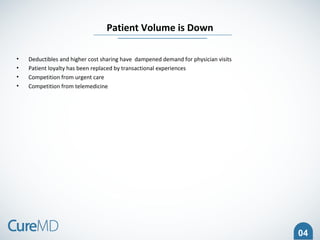
• Deductibles and higher cost sharing have dampened demand for physician visits
• Patient loyalty has been replaced by transactional experiences
• Competition from urgent care
• Competition from telemedicine
Patient Volume is Down
05
• Create greater awareness of your practice and what it offers
• The more people that know of your existence, your availability, and have a positive impression, the
greater likelihood yours will be the practice they seek out.
Market Your Practice
06
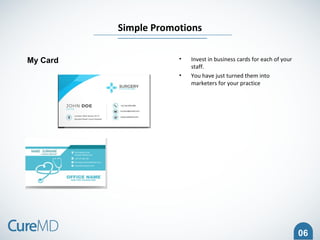
• Invest in business cards for each of your
staff.
• You have just turned them into
marketers for your practice
Simple Promotions
My Card
07
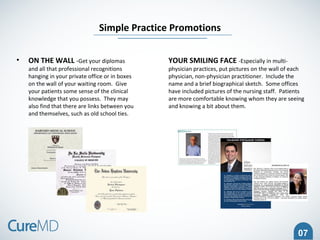
• ON THE WALL -Get your diplomas
and all that professional recognitions
hanging in your private office or in boxes
on the wall of your waiting room. Give
your patients some sense of the clinical
knowledge that you possess. They may
also find that there are links between you
and themselves, such as old school ties.
Simple Practice Promotions
YOUR SMILING FACE -Especially in multi-
physician practices, put pictures on the wall of each
physician, non-physician practitioner. Include the
name and a brief biographical sketch. Some offices
have included pictures of the nursing staff. Patients
are more comfortable knowing whom they are seeing
and knowing a bit about them.
08
• GET OUT – Get known
• Community exposure/Community events
• Free screenings a health fairs
– Offer low/free camp physicals
• Educational programs at civic and
religious organizations
• Offer “medical advice” in local
newspapers and/or local radio stations
• Join civic organizations and encourage
staff to do the same
– Local business organizations
(Rotary)
• Perhaps offer to be company
physician
• Think ethnically, religiously,
demographically, geographically
Simple Practice Promotions
• TAP INTO YOUR DATA
• Capture email addresses
• Send reminders for appropriate services
• Remind patients of usually “no deductible”
services”
• Introduce new services
• Offer education that is current – flu season,
back to school/camp, etc
09
• Be findable – it’s expected
• Make sure you have a presence, and that
it represents you well.
– Your practice vision
– Tout all the great things about your
practice
– Your physician credentials
– Special services and anything that
makes you special.
– About your specialty, and general
appropriate educational materials
• How to reach you
– Schedule appointments by phone,
and online
The Internet
• Google yourself
• See where you are being listed.
• If you find yourself improperly listed, try to
correct the information.
• If you find yourself on a rating site with
negative comments, generally you can
comment back, even if you are angry, a
reasonable and concerned counter-posting
presents you in a positive.
10
• HOW AM I DOING?
• A call to a patient by a member of your
staff after the first visit is an unexpected
and long remembered mark of a caring
practice.
• It will also be the source of great
information on how your practice is doing
in the eyes of your patients.
• Give an employee this responsibility in
the evening, after hours, with a script and
some questions. Make sure they know if
the patient has another appointment
scheduled, the call can serve as a
reminder.
Make The Visit About Them
• HOW ARE YOU DOING?
• Call after a patient's return home from the hospital
or the evening after an outpatient procedure. Your
call says you care. – Especially important if their
care was by a hospitalist of other specialist.
11
• Protect your existing referral sources
• Professional Referrals are all about personal relationships
• Quality is assumed
• Build a data base
• Who refers, what
• Physicians
• Non-physicians
• Give them what they want (within the law)
• Who do you know? – ask what is important
• Updates, calls, letters, what will make for a better/easier referral?
• Communicate what is great about your practice
• Don't assume that they know
• Consistently communicate with them – touch them often
• Respect their staff
• Entertain appropriately
• Make them feel appreciated – its relationships
• Physician Liaison
• Who works the relationship?
• Plan for referrals and referral relationships
Referral's are the life blood of a Specialists' practice
12
• A positive patient experience with your practice leads to positive stories by the patient to friends,
family, and co-workers
• A negative experience leads to the same
• The patient experience is every element of their transaction with your practice, you, as well as your
staff
Remember marketing is everyone’s Responsibility
13
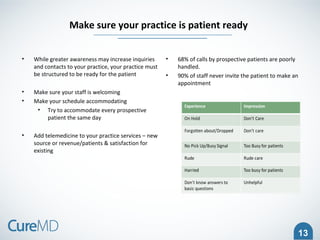
• While greater awareness may increase inquiries
and contacts to your practice, your practice must
be structured to be ready for the patient
• Make sure your staff is welcoming
• Make your schedule accommodating
• Try to accommodate every prospective
patient the same day
• Add telemedicine to your practice services – new
source or revenue/patients & satisfaction for
existing
Make sure your practice is patient ready
• 68% of calls by prospective patients are poorly
handled.
• 90% of staff never invite the patient to make an
appointment
Marketing your practice on a shoestring

Marketing your practice on a shoestring

  • 1.
    Marketing your practiceon a shoestring
  • 2.
    Robert E. Goff FormerlyExecutive Director & CEO University Physicians Network (UPN) Robert has over 40 year of experience in the healthcare industry, a significant portion of that with physicians, independent physicians, on strategies to improve their practices, and to allow them to survive in the changing environment.
  • 3.
    03 The information presentedis for general information only and are not meant to substitute for legal advice. Always seek the advice of an attorney on legal matters. The presenter makes no recommendations as to an individual physician’s participation or non-participation with any specific health plans, insurance company or payer. Each physician is urged to give due and proper consideration to their own individual practice needs and act independently regardless of the actions or non- action of other physicians. Legal Guidance Copy righted © material is subject to fine of $5000 per occurrence Official Disclaimer
  • 4.
    04 • Deductibles andhigher cost sharing have dampened demand for physician visits • Patient loyalty has been replaced by transactional experiences • Competition from urgent care • Competition from telemedicine Patient Volume is Down
  • 5.
    05 • Create greaterawareness of your practice and what it offers • The more people that know of your existence, your availability, and have a positive impression, the greater likelihood yours will be the practice they seek out. Market Your Practice
  • 6.
    06 • Invest inbusiness cards for each of your staff. • You have just turned them into marketers for your practice Simple Promotions My Card
  • 7.
    07 • ON THEWALL -Get your diplomas and all that professional recognitions hanging in your private office or in boxes on the wall of your waiting room. Give your patients some sense of the clinical knowledge that you possess. They may also find that there are links between you and themselves, such as old school ties. Simple Practice Promotions YOUR SMILING FACE -Especially in multi- physician practices, put pictures on the wall of each physician, non-physician practitioner. Include the name and a brief biographical sketch. Some offices have included pictures of the nursing staff. Patients are more comfortable knowing whom they are seeing and knowing a bit about them.
  • 8.
    08 • GET OUT– Get known • Community exposure/Community events • Free screenings a health fairs – Offer low/free camp physicals • Educational programs at civic and religious organizations • Offer “medical advice” in local newspapers and/or local radio stations • Join civic organizations and encourage staff to do the same – Local business organizations (Rotary) • Perhaps offer to be company physician • Think ethnically, religiously, demographically, geographically Simple Practice Promotions • TAP INTO YOUR DATA • Capture email addresses • Send reminders for appropriate services • Remind patients of usually “no deductible” services” • Introduce new services • Offer education that is current – flu season, back to school/camp, etc
  • 9.
    09 • Be findable– it’s expected • Make sure you have a presence, and that it represents you well. – Your practice vision – Tout all the great things about your practice – Your physician credentials – Special services and anything that makes you special. – About your specialty, and general appropriate educational materials • How to reach you – Schedule appointments by phone, and online The Internet • Google yourself • See where you are being listed. • If you find yourself improperly listed, try to correct the information. • If you find yourself on a rating site with negative comments, generally you can comment back, even if you are angry, a reasonable and concerned counter-posting presents you in a positive.
  • 10.
    10 • HOW AMI DOING? • A call to a patient by a member of your staff after the first visit is an unexpected and long remembered mark of a caring practice. • It will also be the source of great information on how your practice is doing in the eyes of your patients. • Give an employee this responsibility in the evening, after hours, with a script and some questions. Make sure they know if the patient has another appointment scheduled, the call can serve as a reminder. Make The Visit About Them • HOW ARE YOU DOING? • Call after a patient's return home from the hospital or the evening after an outpatient procedure. Your call says you care. – Especially important if their care was by a hospitalist of other specialist.
  • 11.
    11 • Protect yourexisting referral sources • Professional Referrals are all about personal relationships • Quality is assumed • Build a data base • Who refers, what • Physicians • Non-physicians • Give them what they want (within the law) • Who do you know? – ask what is important • Updates, calls, letters, what will make for a better/easier referral? • Communicate what is great about your practice • Don't assume that they know • Consistently communicate with them – touch them often • Respect their staff • Entertain appropriately • Make them feel appreciated – its relationships • Physician Liaison • Who works the relationship? • Plan for referrals and referral relationships Referral's are the life blood of a Specialists' practice
  • 12.
    12 • A positivepatient experience with your practice leads to positive stories by the patient to friends, family, and co-workers • A negative experience leads to the same • The patient experience is every element of their transaction with your practice, you, as well as your staff Remember marketing is everyone’s Responsibility
  • 13.
    13 • While greaterawareness may increase inquiries and contacts to your practice, your practice must be structured to be ready for the patient • Make sure your staff is welcoming • Make your schedule accommodating • Try to accommodate every prospective patient the same day • Add telemedicine to your practice services – new source or revenue/patients & satisfaction for existing Make sure your practice is patient ready • 68% of calls by prospective patients are poorly handled. • 90% of staff never invite the patient to make an appointment