
Medical
Coding
C
O
N
T
E
N
T
S
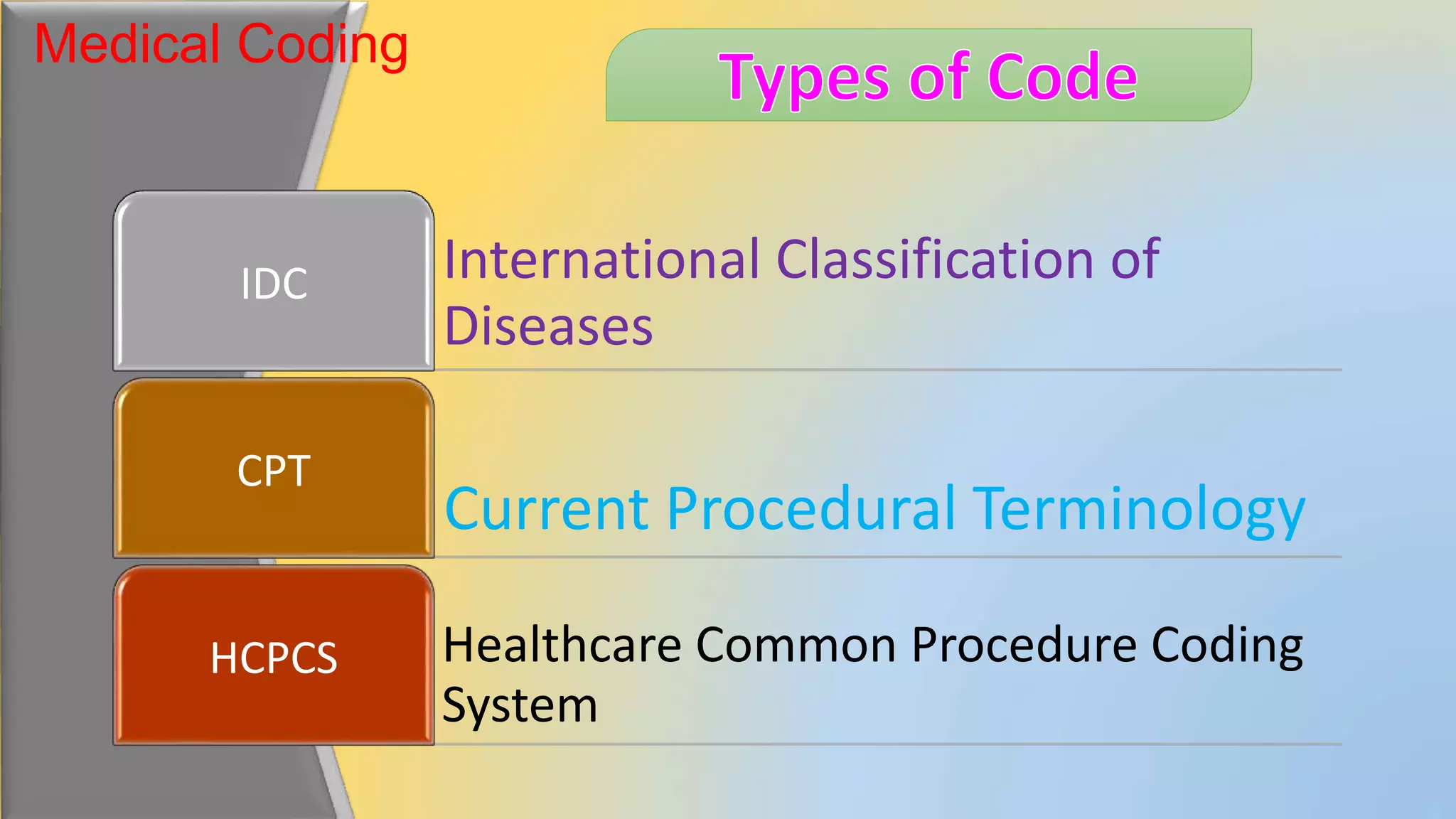
Medical Coding
International Classification of
Diseases
IDC
Current Procedural Terminology
CPT
Healthcare Common Procedure Coding
System
HCPCS
Medical
Coding
ɤ Diagnostic codes that create a uniform vocabulary for describing
the causes of injury, illness and death.
ɤ Established by the World Health Organization (WHO) in the late
1940s.
ɤ Updated several times in the 60 – plus years since its inception
ɤ The number following “ICD” represents which revision of the
code is in use.
Medical
Coding
ɤ Are used to document the majority of the medical procedures
performed in a physician's office.
ɤ The code set is published and maintained by the American
Medical Association (AMA).
ɤ These codes are copyrighted by the AMA and are updated
annually.
Medical
Coding
ɤ The Clinical Modification significantly increases the number of
codes for diagnosis.
ɤ The increased scope gives coders much more flexibility and
specificity, which is essential for the profession.
ɤ The ICD-10 code, has 14,000 codes.
ɤ Its clinical modification, ICD-10-CM, contains over 68,000.
Medical
Coding
ɤ CPT codes are five-digit numeric codes.
ɤ The first category is divided into six ranges which
correspond to six major medical fields:
 Evaluation and Management
 Anesthesia
 Radiology
 Surgery
 Medicine
 Pathology and Laboratory
Medical
Coding
ɤ The second category of CPT codes corresponds to
performance measurement and in some cases, laboratory or
radiology test results.
ɤ The five-digit, alphanumeric codes are typically added to the
end of a Category I CPT code with a hyphen.
ɤ The third category of CPT codes corresponds to emerging
medical technology.
Medical
Coding
ɤ CPT codes also have addendums that increase the
specificity and accuracy of the code used.
ɤ CPT Modifiers are two-digit numeric or alphanumeric codes
that are added to the end of the category I CPT code.
ɤ They provide important additional information to the
procedure code.
ɤ E.g. a CPT modifier that describes which side of the body a
procedure is performed on, and there’s also a code for a
discontinued procedure.
Medical
Coding
ɤ This includes durable medical equipment, prosthetics,
ambulance rides, and certain drugs and modifiers.
ɤ HCPCS is also the official code set for outpatient hospital
care, chemotherapy drugs, Medicaid, and Medicare, among
other services.
ɤ Since HCPCS codes are involved in Medicaid and Medicare,
its one of the most important code a medical coder can use.
Medical
Coding
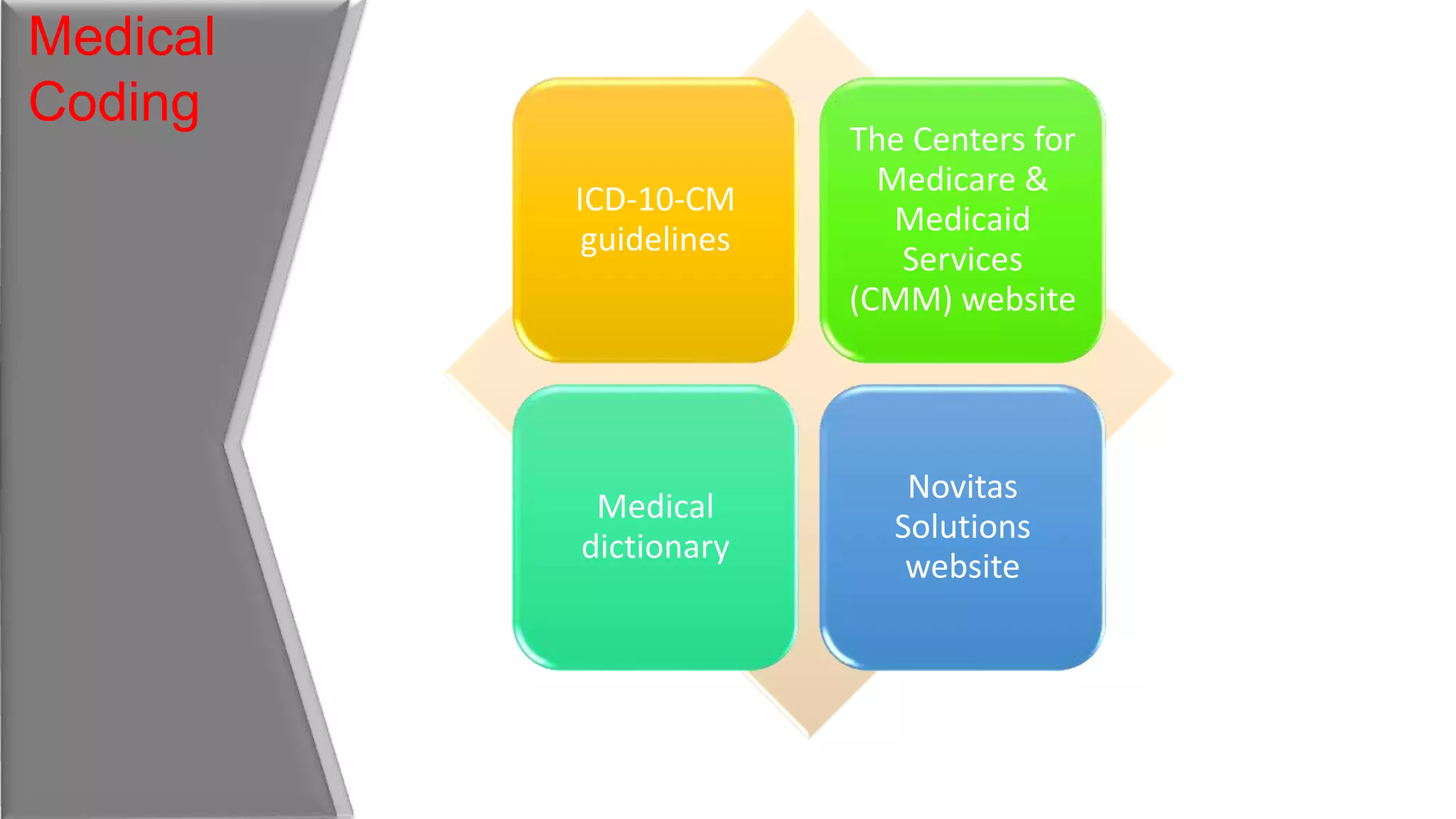
ICD-10-CM
guidelines
The Centers for
Medicare &
Medicaid
Services
(CMM) website
Medical
dictionary
Novitas
Solutions
website
Medical
Coding
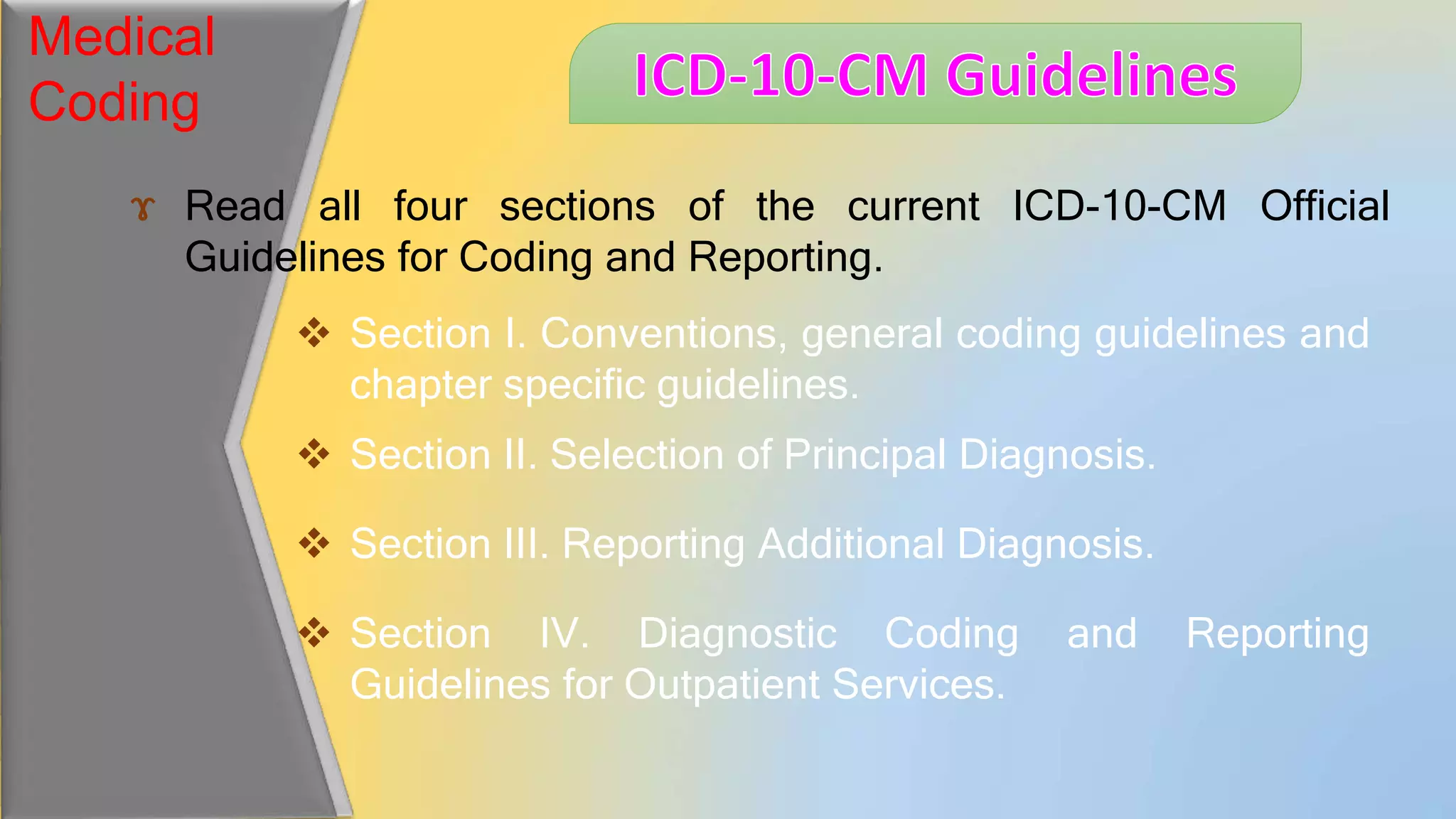
ɤ Read all four sections of the current ICD-10-CM Official
Guidelines for Coding and Reporting.
 Section I. Conventions, general coding guidelines and
chapter specific guidelines.
 Section II. Selection of Principal Diagnosis.
 Section III. Reporting Additional Diagnosis.
 Section IV. Diagnostic Coding and Reporting
Guidelines for Outpatient Services.
Medical
Coding
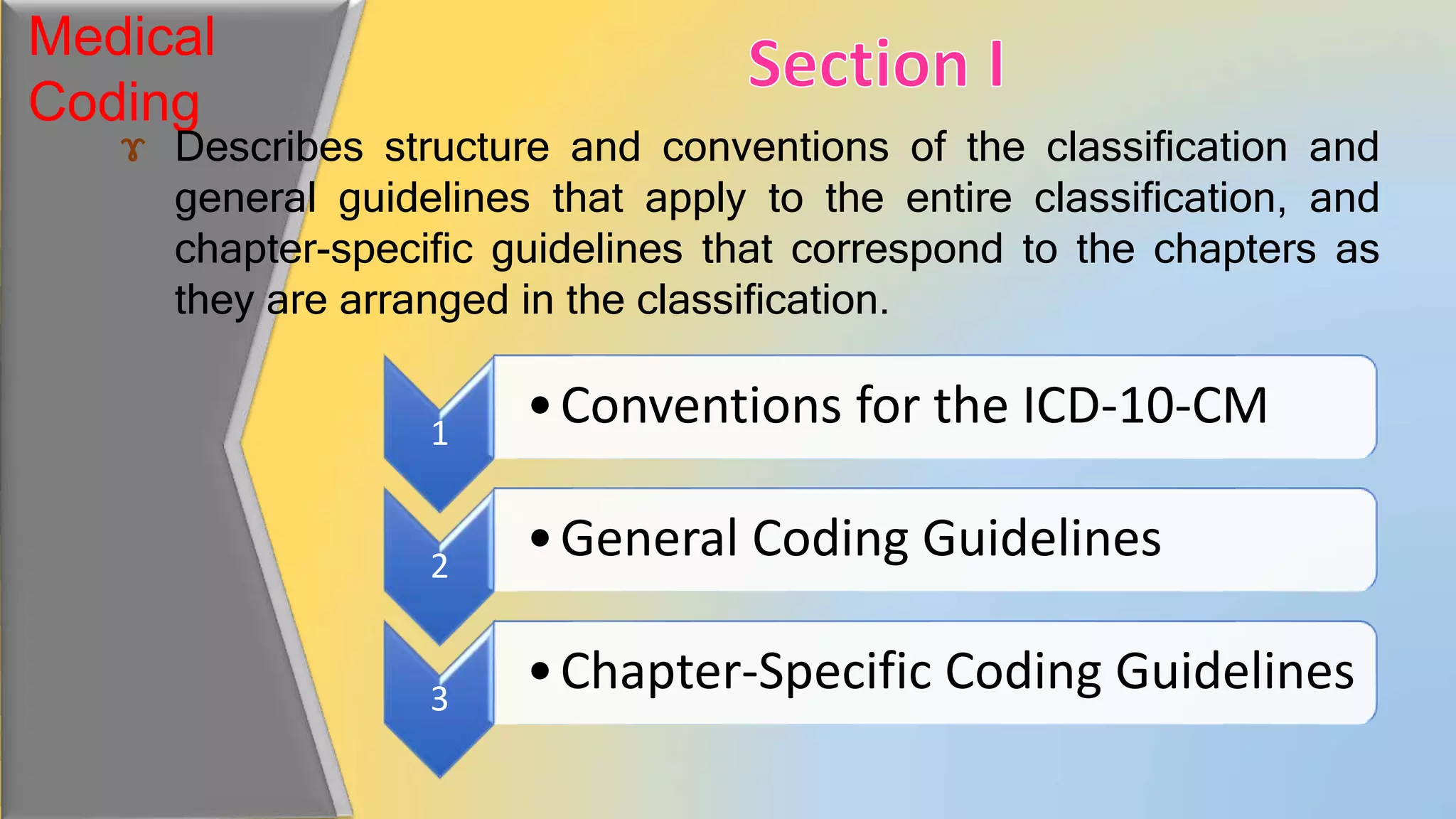
ɤ Describes structure and conventions of the classification and
general guidelines that apply to the entire classification, and
chapter-specific guidelines that correspond to the chapters as
they are arranged in the classification.
1
•Conventions for the ICD-10-CM
2
•General Coding Guidelines
3
•Chapter-Specific Coding Guidelines
Medical
Coding
ɤ Section II includes guidelines for the selection of principal
diagnosis for non-outpatient settings.
ɤ Section III includes guidelines for reporting additional
diagnosis in non-outpatient settings.
ɤ Section IV is for outpatient coding and reporting

Types of medical coding

  • 2.
  • 3.
    Medical Coding International Classificationof Diseases IDC Current Procedural Terminology CPT Healthcare Common Procedure Coding System HCPCS
  • 4.
    Medical Coding ɤ Diagnostic codesthat create a uniform vocabulary for describing the causes of injury, illness and death. ɤ Established by the World Health Organization (WHO) in the late 1940s. ɤ Updated several times in the 60 – plus years since its inception ɤ The number following “ICD” represents which revision of the code is in use.
  • 5.
    Medical Coding ɤ Are usedto document the majority of the medical procedures performed in a physician's office. ɤ The code set is published and maintained by the American Medical Association (AMA). ɤ These codes are copyrighted by the AMA and are updated annually.
  • 6.
    Medical Coding ɤ The ClinicalModification significantly increases the number of codes for diagnosis. ɤ The increased scope gives coders much more flexibility and specificity, which is essential for the profession. ɤ The ICD-10 code, has 14,000 codes. ɤ Its clinical modification, ICD-10-CM, contains over 68,000.
  • 7.
    Medical Coding ɤ CPT codesare five-digit numeric codes. ɤ The first category is divided into six ranges which correspond to six major medical fields:  Evaluation and Management  Anesthesia  Radiology  Surgery  Medicine  Pathology and Laboratory
  • 8.
    Medical Coding ɤ The secondcategory of CPT codes corresponds to performance measurement and in some cases, laboratory or radiology test results. ɤ The five-digit, alphanumeric codes are typically added to the end of a Category I CPT code with a hyphen. ɤ The third category of CPT codes corresponds to emerging medical technology.
  • 9.
    Medical Coding ɤ CPT codesalso have addendums that increase the specificity and accuracy of the code used. ɤ CPT Modifiers are two-digit numeric or alphanumeric codes that are added to the end of the category I CPT code. ɤ They provide important additional information to the procedure code. ɤ E.g. a CPT modifier that describes which side of the body a procedure is performed on, and there’s also a code for a discontinued procedure.
  • 10.
    Medical Coding ɤ This includesdurable medical equipment, prosthetics, ambulance rides, and certain drugs and modifiers. ɤ HCPCS is also the official code set for outpatient hospital care, chemotherapy drugs, Medicaid, and Medicare, among other services. ɤ Since HCPCS codes are involved in Medicaid and Medicare, its one of the most important code a medical coder can use.
  • 11.
    Medical Coding ICD-10-CM guidelines The Centers for Medicare& Medicaid Services (CMM) website Medical dictionary Novitas Solutions website
  • 12.
    Medical Coding ɤ Read allfour sections of the current ICD-10-CM Official Guidelines for Coding and Reporting.  Section I. Conventions, general coding guidelines and chapter specific guidelines.  Section II. Selection of Principal Diagnosis.  Section III. Reporting Additional Diagnosis.  Section IV. Diagnostic Coding and Reporting Guidelines for Outpatient Services.
  • 13.
    Medical Coding ɤ Describes structureand conventions of the classification and general guidelines that apply to the entire classification, and chapter-specific guidelines that correspond to the chapters as they are arranged in the classification. 1 •Conventions for the ICD-10-CM 2 •General Coding Guidelines 3 •Chapter-Specific Coding Guidelines
  • 14.
    Medical Coding ɤ Section IIincludes guidelines for the selection of principal diagnosis for non-outpatient settings. ɤ Section III includes guidelines for reporting additional diagnosis in non-outpatient settings. ɤ Section IV is for outpatient coding and reporting