g

to
o

ith

w
se
ru

in

tra

,+-./"&0&

in

!"#$%&'"()*)+#

& 1223&45)$)+#

Fo

lo
nl
y

ICD-10

!"#$%"&#'("&)
*#&#'+#',&)
-)&++'.',&#'("
(./0'+$&+$+/&"1
2$)&#$1/3$&)#4
5%(6)$7+
WHO Library Cataloguing-in-Publication Data
International statistical classification of diseases and related health problems. - 10th revision,
2008 edition.
3 v.
Contents: v. 1. Tabular list -- v. 2. Instruction manual -- v. 3. Alphabetical index.

ISBN 978 92 4 154766 6

lo
nl
y

1.Diseases - classification. 2.Classification. 3.Manuals. I.World Health Organization.
II.ICD-10.
(NLM classification: WB 15)
!"#$%&'"()*&+,"-%.*/01*+0$/"2334"

to
o

"

g

!""#$%&'()#$*)*$+*,-#./0"%12(%34)#35#('*#63$",#7*2"('#8$&24%92(%34#124#0*#30(2%4*,#5$3:#678#
.$*));#63$",#7*2"('#8$&24%92(%34;#<=#!+*4/*#!>>%2;#?<??#@*4*+2#<A;#BC%(9*$"24,#D(*"-E#FG?#<<#
AH?# I<JGK# 52LE# FG?# <<# AH?# GMNAK# *O:2%"E# 033P3$,*$)QC'3-%4(R-# S*T/*)()# 53$# >*$:%))%34# (3#
$*>$3,/1*#3$#($24)"2(*#678#>/0"%12(%34)#U#C'*('*$#53$#)2"*#3$#53$#43413::*$1%2"#,%)($%0/(%34# #
U
)'3/",#0*#2,,$*))*,#(3#678#.$*));#2(#('*#203+*#2,,$*))#D52LE#FG?#<<#AH?#GM=JK##
#
*O:2%"E#>*$:%))%34)QC'3-%4(R-##

w

ith

tra

in

in

V'*# ,*)%&42(%34)# *:>"3W*,# 24,# ('*# >$*)*4(2(%34# 35# ('*# :2(*$%2"# %4# ('%)# >/0"%12(%34# ,3# 43(# %:>"W# ('*#
*L>$*))%34#35#24W#3>%4%34#C'2()3*+*$#34#('*#>2$(#35#('*#63$",#7*2"('#8$&24%92(%34#1341*$4%4&#('*#"*&2"#
)(2(/)#35#24W#13/4($W;#(*$$%(3$W;#1%(W#3$#2$*2#3$#35#%()#2/('3$%(%*);#
3$#1341*$4%4&#('*#,*"%:%(2(%34#35#%()#5$34(%*$)#
3$#03/4,2$%*)-#X3((*,#"%4*)#34#:2>)#$*>$*)*4(#2>>$3L%:2(*#03$,*$#"%4*)#53$#C'%1'#('*$*#:2W#43(#W*(#0*#5/""#
2&$**:*4(-#
#
V'*# :*4(%34# 35# )>*1%5%1# 13:>24%*)# 3$# 35# 1*$(2%4# :24/521(/$*$)Y# >$3,/1()# ,3*)# 43(# %:>"W# ('2(# ('*W# 2$*#
*4,3$)*,#3$#$*13::*4,*,#0W#('*#63$",#7*2"('#8$&24%92(%34#%4#>$*5*$*41*#(3#3('*$)#35#2#)%:%"2$#42(/$*#('2(#
2$*#43(#:*4(%34*,-#Z$$3$)#24,#3:%))%34)#*L1*>(*,;#('*#42:*)#35#>$3>$%*(2$W#>$3,/1()#2$*#,%)(%4&/%)'*,#0W#
%4%(%2"#12>%(2"#"*((*$)# -#
!""#$*2)3420"*#>$*12/(%34)#'2+*#0**4#(2P*4#0W#('*#63$",#7*2"('#8$&24%92(%34#(3#+*$%5W#('*#%453$:2(%34#
134(2%4*,#%4#('%)#>/0"%12(%34-##73C*+*$;#('*#>/0"%)'*,#:2(*$%2"#%)#0*%4&#,%)($%0/(*,#C%('3/(#C2$$24(W#35#24W#
P%4,;#*%('*$#*L>$*))*,#3$#%:>"%*,-##V'*#$*)>34)%0%"%(W#53$#('*#%4(*$>$*(2(%34#24,#/)*#35#('*#:2(*$%2"#"%*)#C%('#
('*#$*2,*$-##[4#43#*+*4(#)'2""#('*#63$",#7*2"('#8$&24%92(%34#0*#"%20"*#53$#,2:2&*)#2$%)%4&#5$3:#%()#/)*-##

Fo

ru

se

V'*#GI$,#63$",#7*2"('#!))*:0"W#%4#?HH=#2>>$3+*,#('*#V*4('#S*+%)%34#35#('*#[4(*$42(%342"#]"2))%5%12(%34#
35#X%)*2)*)#D67!#GI;<GR#24,#*4,3$)*,#('*#$*13::*4,2(%34#35#('*#[4(*$42(%342"#]345*$*41*#53$#('*#
V*4('# S*+%)%34# 35# ('*# []X# '*",# %4# @*4*+2# 5$3:# <J# B*>(*:0*$# (3# <# 81(30*$# ?HMH# 1341*$4%4&# ('*#
*)(20"%)':*4(#35#24#/>,2(%4&#>$31*))#C%('%4#('*#?=OW*2$#$*+%)%34#1W1"*-##V'%)#$*13::*4,2(%34#C2)#>/(#
%4(3# :3(%34# 2(# ('*# 244/2"# :**(%4&# 35# 678# ]3""203$2(%4&# ]*4($*)# 53$# ('*# _2:%"W# 35# [4(*$42(%342"#
]"2))%5%12(%34)#%4#V3PW3;#`2>24#%4#?HHJ#24,#"2(*$#2#53$:2"#:*1'24%):#(3#&/%,*#('*#/>,2(%4&#>$31*))#C2)#
*)(20"%)'*,-#!113$,%4&#(3#('%)#/>,2(%4&#:*1'24%):#:%43$#/>,2(*)#2$*#:2,*#*21'#W*2$#C'%"*#:2a3$#
/>,2(*)#2$*#:2,*;#%5#$*T/%$*,;#*+*$W#('$**#W*2$)-#
_3$#:3$*#%453$:2(%34#$*&2$,%4&#('*#/>,2(%4&#>$31*))#24,#2#1/:/"2(%+*#"%)(#35#('*#/>,2(*)#>"*2)*#)**#
'((>ECCC-C'3-%4(1"2))%5%12(%34)-#_/(/$*#/>,2(*)#C%""#2")3#0*#>3)(*,#34#('%)#)%(*-#
#
#
5,06"2337"8'0+0$/"$9":;<=>3"0/?&@')6"@A'*+)6"+,*+"?*B)"0/+$")99)?+"C)+D))/">447"*/'"2337E"*6"D)&&"*6"
+,)"?$%%0.)/'*"+$"F$&@B)">E"D,0?,"*AA)*%)'"*6"*/"*'')/'@B"+$"F$&@B)"G"$9"+,)"90%6+")'0+0$/H"

VW>*)*(#0W#678[ZS7B[]VB##O##X[^X[#
.$%4(*,#%4#BC%(9*$"24,#
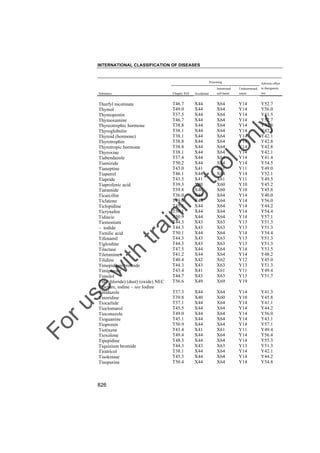
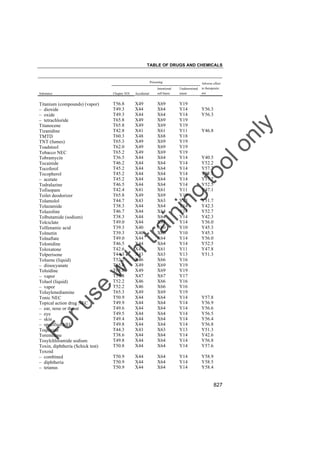
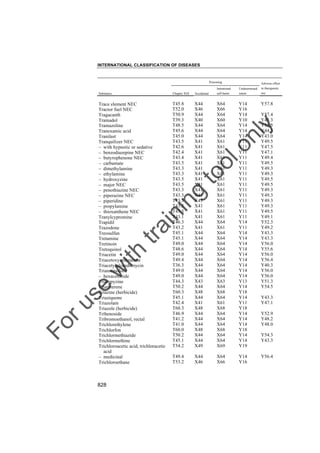
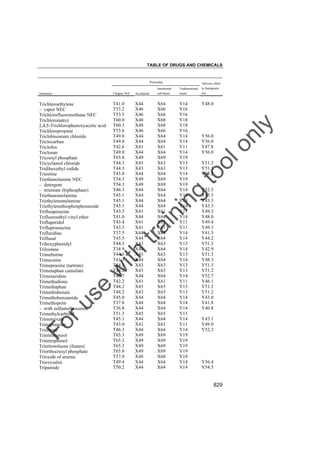
Contents
Introduction
General arrangement of the Index
Conventions used in the Index

1
5

Alphabetical index to diseases and nature of injury
External causes of injury

9

to
o

659

lo
nl
y

1

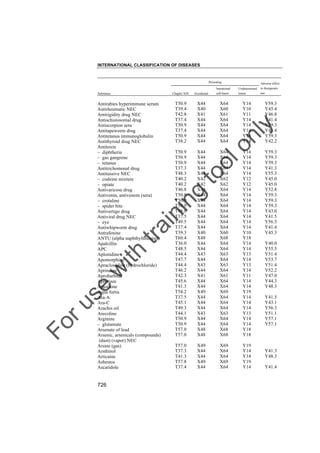
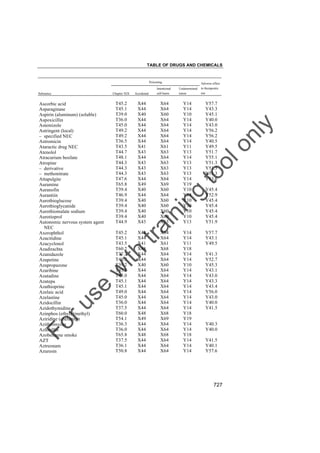
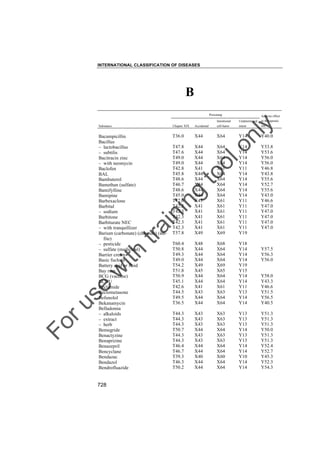
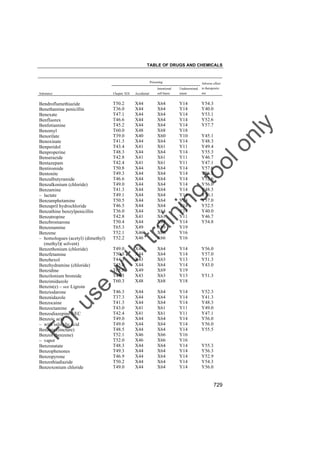
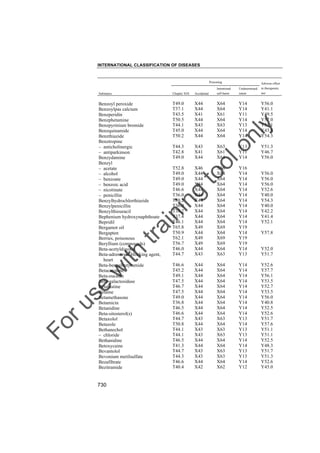
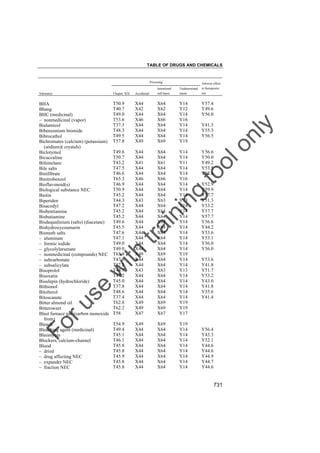
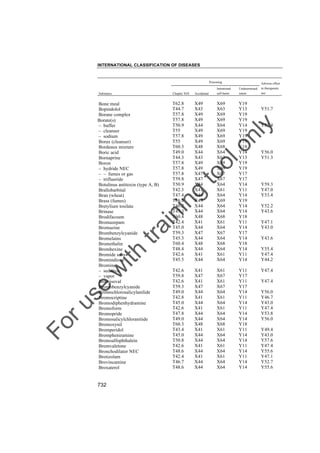
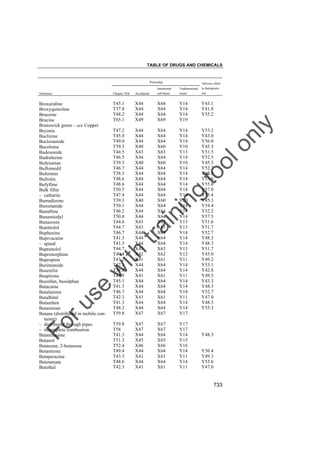
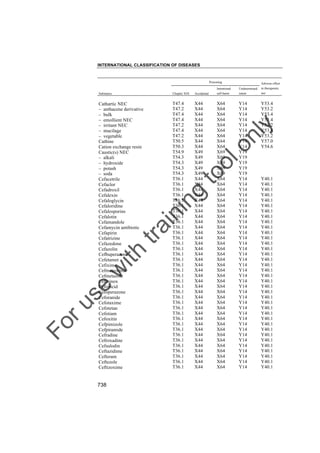
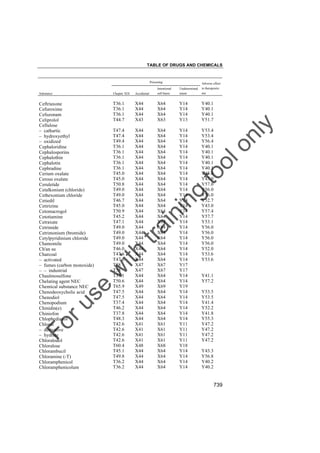
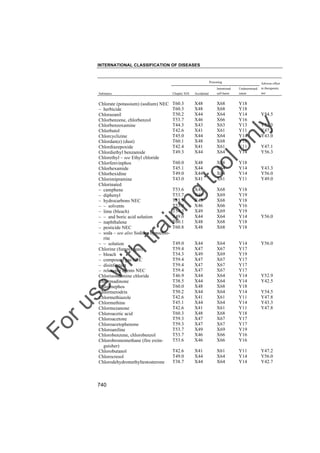
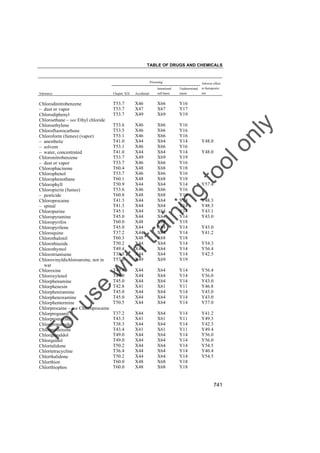
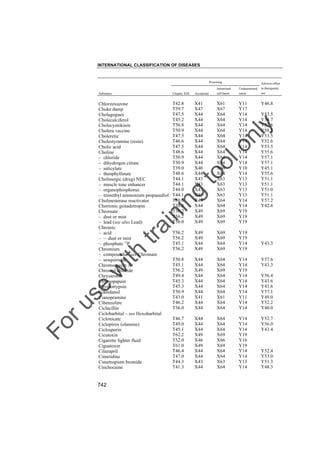
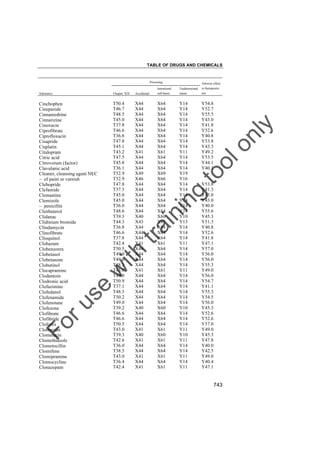
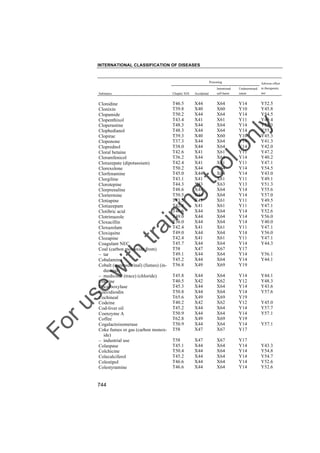
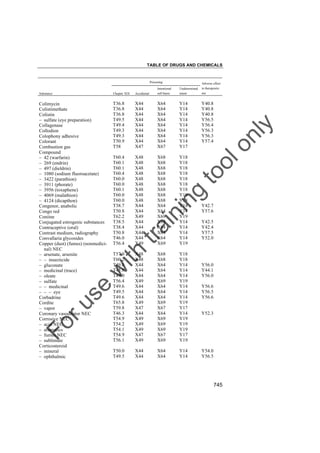
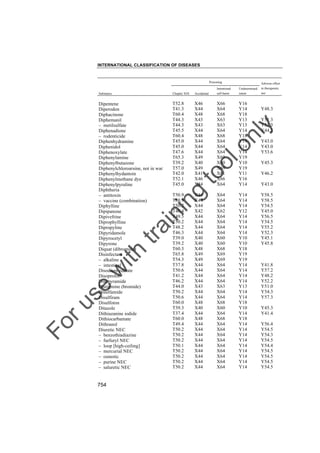
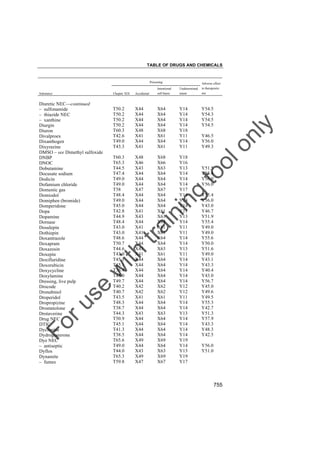
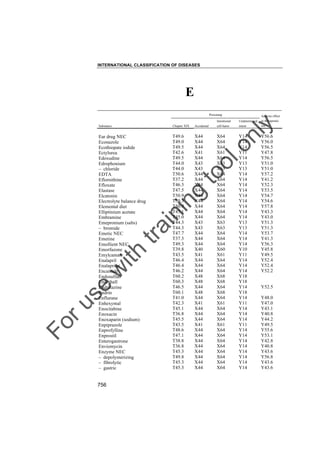
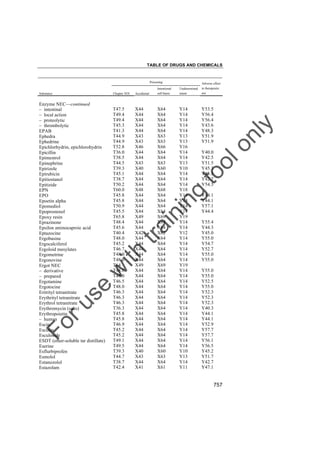
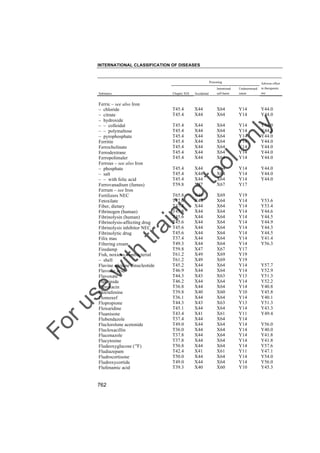
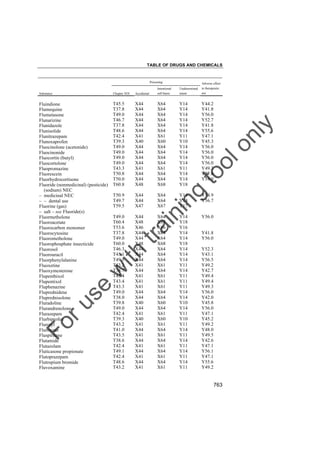
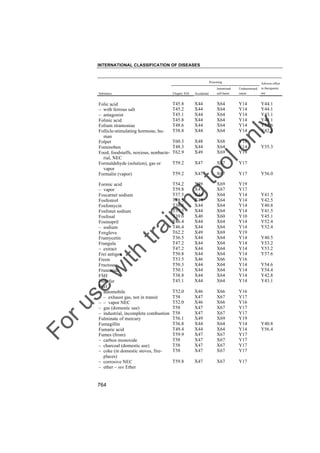
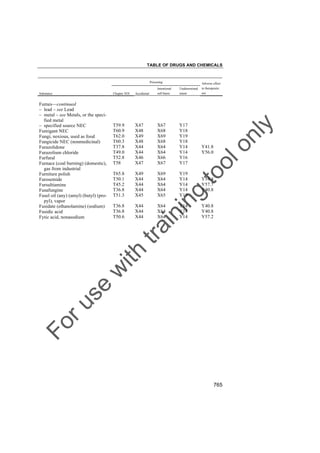
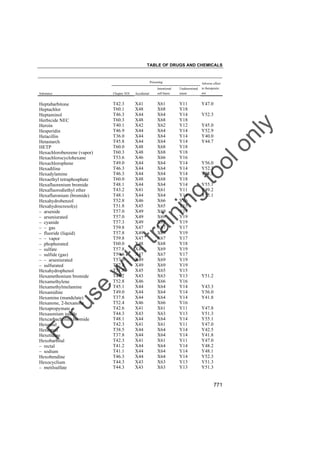
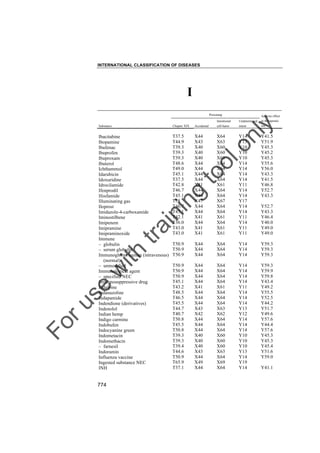
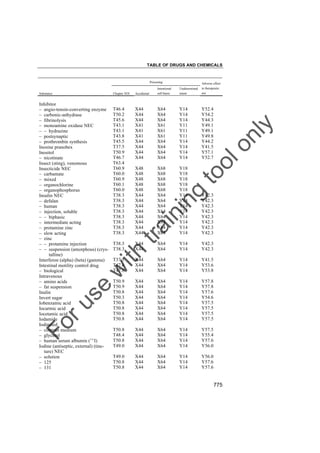
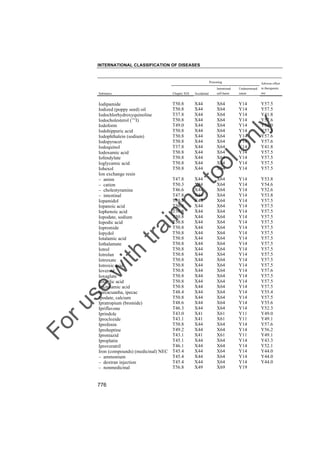
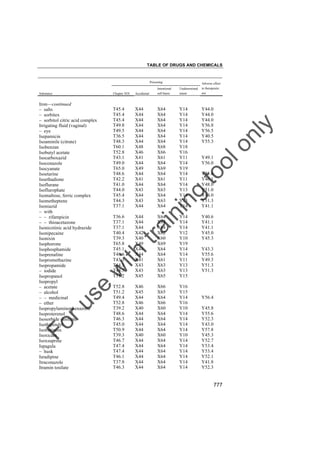
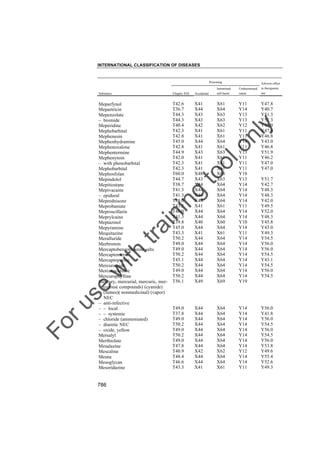
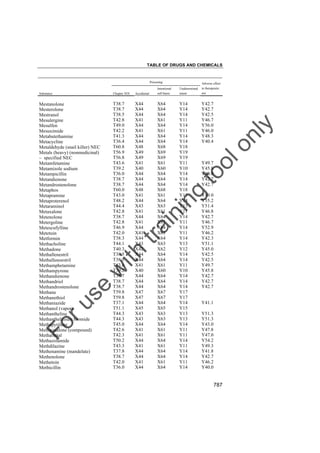
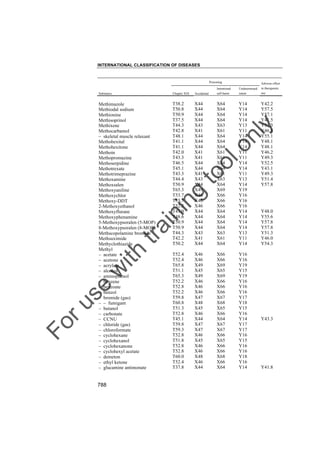
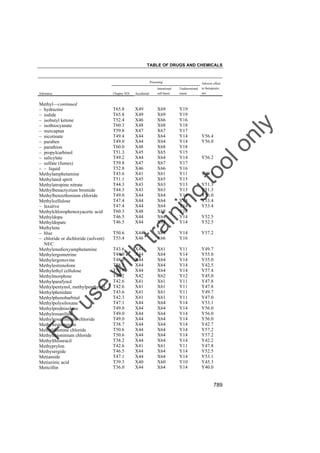
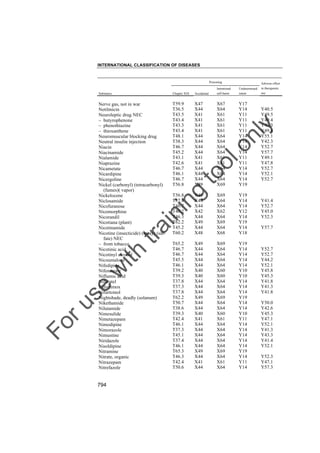
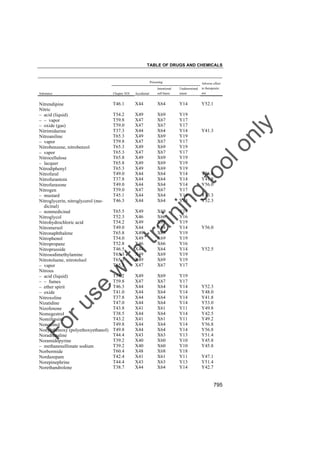
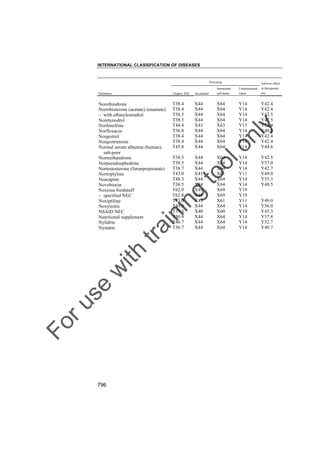
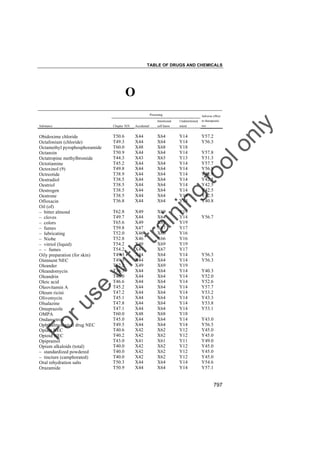
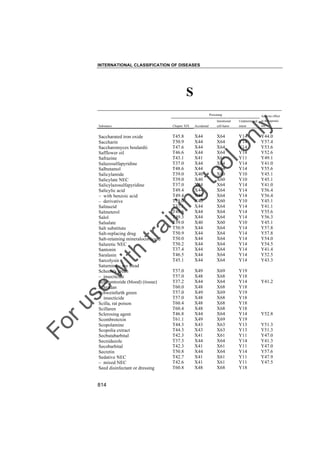
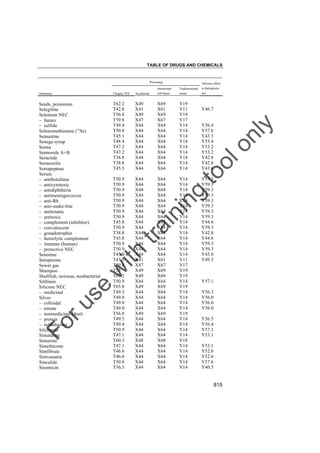
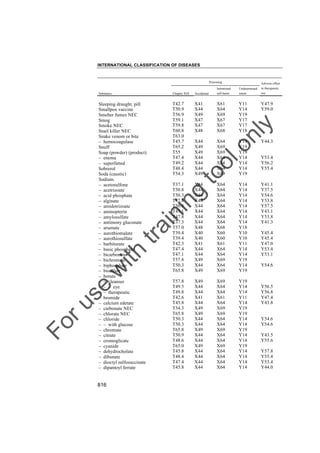
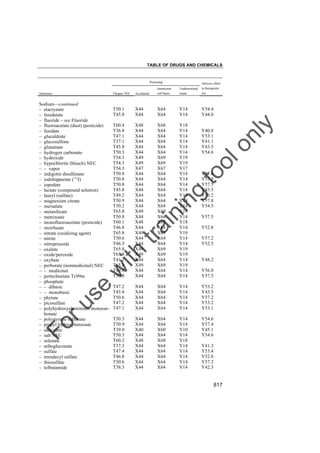
Table of drugs and chemicals

Fo

ru

se

w

ith

tra

in

in

g

713

iii
se

ru

Fo
ith

w
g

in

in

tra

lo
nl
y

to
o
Introduction

to
o

lo
nl
y

Volume 3 of the International Statistical Classification of Diseases and
Related Health Problems is an alphabetical index to the Tabular List of
Volume 1. Although the Index reflects the provisions of the Tabular List in
regard to the notes varying the assignment of a diagnostic term when it is
reported with other conditions, or under particular circumstances (e.g. certain
conditions complicating pregnancy), it is not possible to express all such
variations in the index terms. Volume 1 should therefore be regarded as the
primary coding tool. The Alphabetical Index is, however, an essential adjunct
to the Tabular List, since it contains a great number of diagnostic terms that
do not appear in Volume 1. The two volumes must therefore be used
together.

tra

in

in

g

The terms included in a category of the Tabular List are not exhaustive; they
serve as examples of the content of the category or as indicators of its extent
and limits. The Index, on the other hand, is intended to include most of the
diagnostic terms currently in use. Nevertheless, reference should always be
made back to the Tabular List and its notes, as well as to the guidelines
provided in Volume 2, to ensure that the code given by the Index fits with the
information provided by a particular record.

w

ith

Because of its exhaustive nature, the Index inevitably includes many
imprecise and undesirable terms. Since these terms are still occasionally
encountered on medical records, coders need an indication of their
assignment in the classification, even if this is to a rubric for residual or illdefined conditions. The presence of a term in this volume, therefore, should
not be taken as implying approval of its usage.

se

General arrangement of the Index

ru

Main sections

The Alphabetical Index consists of the three sections, as follows:

Fo

Section I is the index of diseases, syndromes, pathological conditions,
injuries, signs, symptoms, problems and other reasons for contact with health
services, i.e. the type of information that would be recorded by a physician. It
includes all terms classifiable to categories A00!T98 and Z00!Z99 except
drugs and other chemical substances giving rise to poisoning or other adverse
effects (these are included in Section III).
Section II is the index of external causes of injury. The terms included here
are not medical diagnoses but descriptions of the circumstances in which the
1
INTERNATIONAL CLASSIFICATION OF DISEASES

violence occurred (e.g. fire, explosion, fall, assault, collision, submersion). It
includes all terms classifiable to V01!Y98, except drugs and chemicals.

lo
nl
y

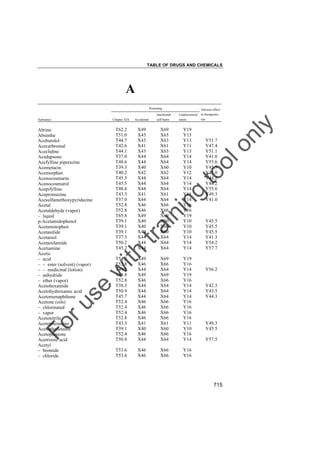
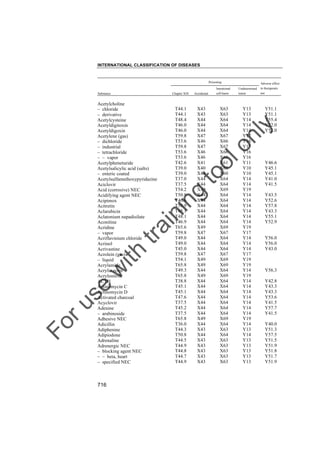
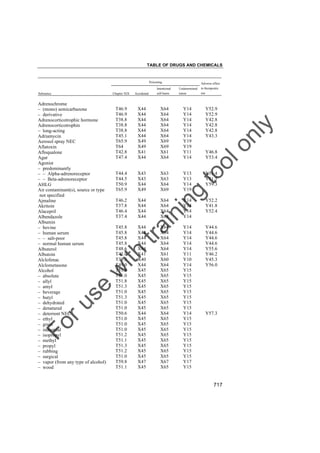
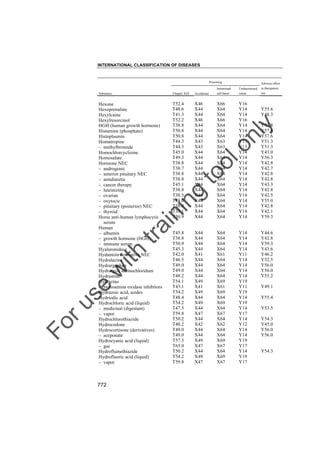
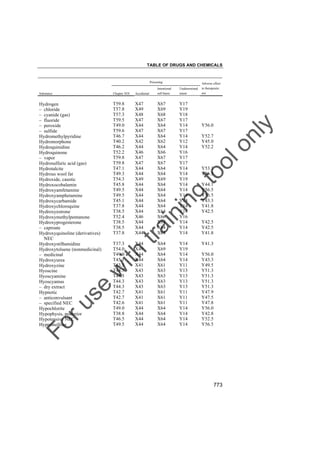
Section III is the index of drugs and other chemical substances giving rise to
poisoning or other adverse effects (referred to in Sections I and II as the
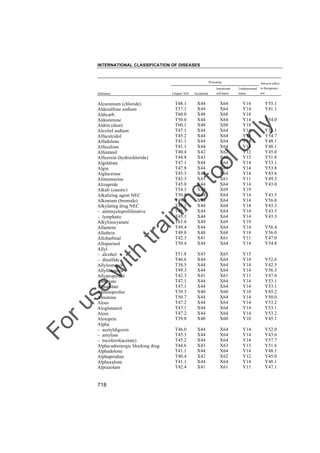
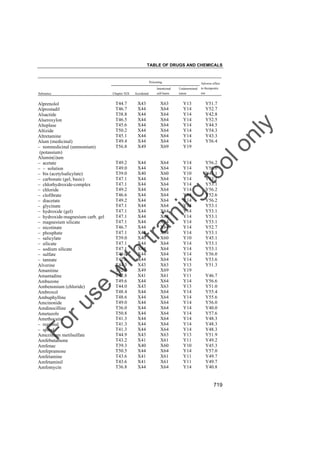
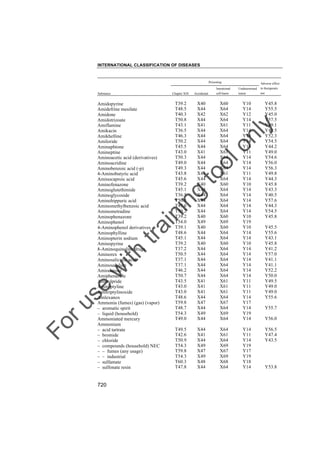
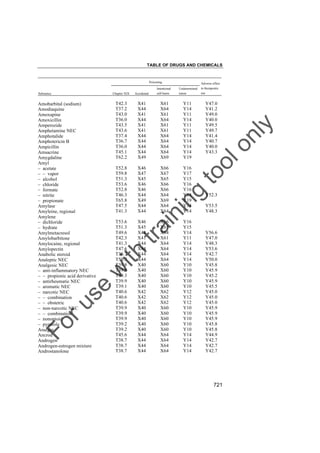
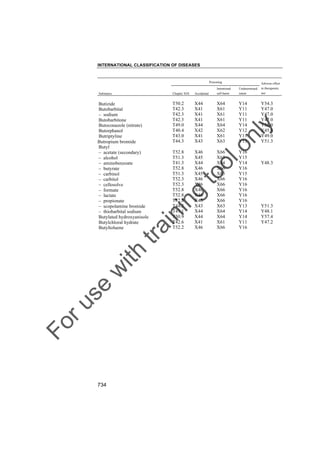
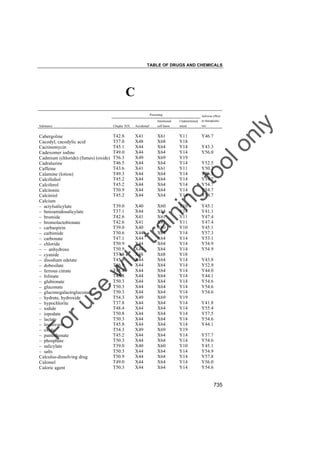
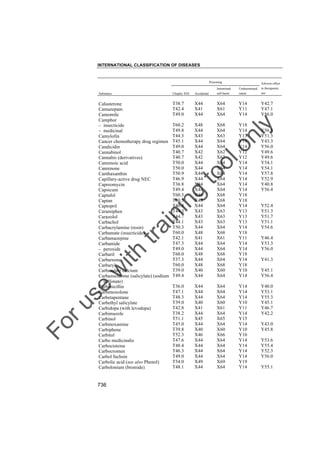
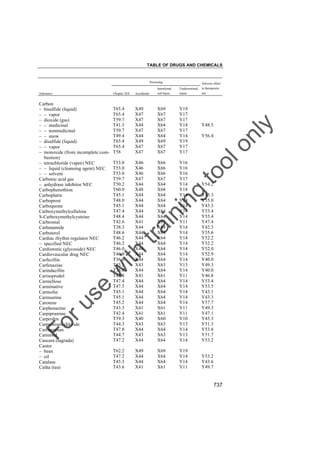
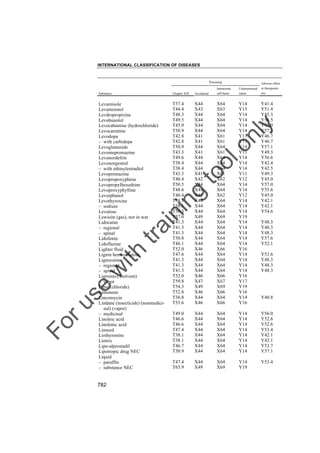
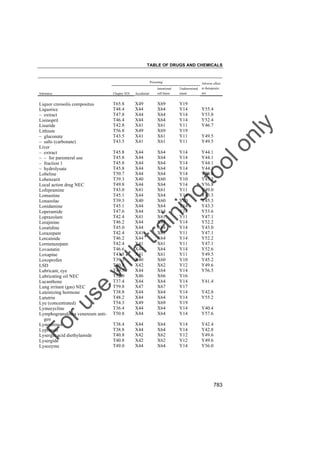
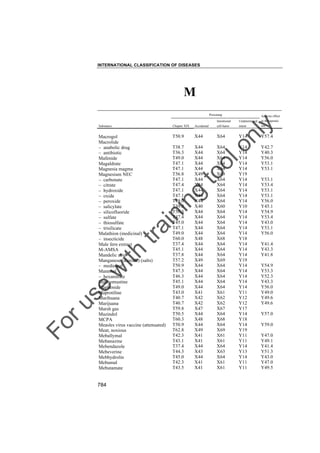
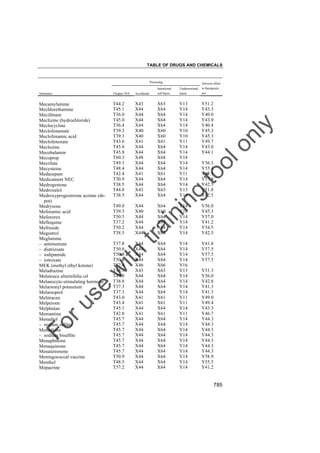
Table of drugs and chemicals). For each substance the Table gives the
Chapter XIX code for poisoning (T36!T65) and the external cause (Chapter
XX) codes for accidental poisoning by and exposure to noxious substances
(X40!X49), intentional self-harm (X60!X69), and poisoning, undetermined
whether accidental or intentional (Y10!Y19). For drugs, medicaments and
biological substances, it also gives the code for these substances causing
adverse effects in therapeutic use (Y40!Y59).

to
o

Structure

in

g

To avoid unnecessary repetition, the Index is organized in the form of lead
terms, which start at the extreme left of a column, and various levels of
indentation, which start progressively further right. A complete index term,
therefore, may be composed of several lines, sometimes quite widely
separated. For example, in the entry:

tra

in

Erythroblastosis (fetalis) (newborn) P55.9
– due to
– – ABO (antibodies) (incompatibility) (isoimmunization) P55.1
– – Rh (antibodies) (incompatibility) (isoimmunization) P55.0

ith

the last line stands for "Erythroblastosis due to Rh antibodies, incompatibility
or isoimmunization".

Fo

ru

se

w

Usually, the lead term is the name of a disease or pathological condition,
while the terms indented beneath it (the "modifiers") refer either to varieties
of the condition, to the anatomical sites affected by it, or to circumstances
that affect its coding. The coder should therefore look up the disease or
condition as a lead term and then find the variety, anatomical site, etc.,
indented beneath it. Thus "tuberculosis of hip" is under the letter T and not
under H, and stomach ulcer is under U, not under S. Only occasionally are
anatomical sites indexed as the lead term. Usually, after the name of the
anatomical site there will be a cross-reference to the disease, e.g. Ankle ! see
condition. 1

In some diagnostic statements, the disease condition is expressed in
adjectival form. Sometimes, the index lists both forms but often only the

1

The name of an anatomical site appears as a lead term when it is part of the name of
the disease, e.g. "abdomen, acute R10.0". This does not occur frequently in English,
and in the English-language version applies mainly to Latin expressions for some
conditions, e.g. "Cor biloculare".

2
ALPHABETICAL INDEX TO DISEASES AND NATURE OF INJURY

noun form will be found and the coder must make the necessary
transformation.

in

in

g

to
o

lo
nl
y

Among the indented modifiers, it is always feasible to include a complete
listing of the various combinations of modifiers that could apply to a given
term. In such circumstances, some types of modifier tend to have priority in
assignment over others. For instance, under the lead term "Abscess" are
indented a large number of anatomical sites and their appropriate codes.
However, tuberculous abscesses are not classified to these codes but to the
codes for tuberculosis of these sites. Instead of inserting an indent
"tuberculous" under each anatomical site, the index uses one single indent
"tuberculous ! see Tuberculosis, abscess" under the lead term "Abscess". In
general, the types of modifiers that tend to have priority in Section I are those
indicating that a disease or condition is infectious or parasitic, malignant,
neoplastic, psychogenic, hysterical, congenital, traumatic, complicating or
affecting the management of pregnancy, childbirth or the puerperium, or
affecting the fetus or newborn, or that the disease was reported in
circumstances where the patient was looking for health advice but was not
necessarily sick (cases in Chapter XXI). In Section II, the priority modifiers
are those indicating transport accidents, complications of medical and
surgical procedures, intentional self-harm, assault, legal intervention, or war
operations.

ith

tra

Section I incorporates an index of the categories to be used with Chapter
XXI2 for terms relating to problems or circumstances rather than diseases or
injuries. Some special lead terms, or "key" words, are used for these,
indicating the type of problem or circumstances. The main key words are
"Counseling", "Examination", "History", "Observation", "Pregnancy",
"Problem", "Screening", "Status", and "Vaccination".

Fo

ru

se

w

In both Sections I and II, this key word form of lead term is also used instead
of, or in addition to, the standard method for certain conditions or
circumstances where terminology is diverse and reported descriptions might
not easily be found in the Index, or where the normal method of indexing
might be misleading. Some obstetric complications, especially the more
common ones, can be found under the specific condition, e.g. Hemorrhage,
complicating delivery. More often, however, the complication will be listed
under "Labor", "Pregnancy", "Puerperal", or "Maternal condition affecting
fetus or newborn". In Section II, key words are "Complication" (for medical
or surgical procedures), "Sequelae", "Suicide", "Assault", "Legal
intervention" and "War operations". Coders should remember the presence of
the special lists whenever they have difficulty locating index entries for the
relevant conditions, problems or circumstances;

2

Formerly the supplementary "V" code.
3
INTERNATIONAL CLASSIFICATION OF DISEASES

by scrutinizing the indented terms, guidance can be found as to the code
numbers of all the relevant categories even if not reported in precisely the
same words.
Code numbers

to
o

lo
nl
y

The code numbers that follow the terms in the Index are those of the three- or
four-character categories to which the terms are classified. In some cases, the
fourth character is replaced by a dash, e.g. Burn, ankle (and foot) T25.!. This
indicates that a fourth character exists and should be used, and that it will be
found either in a note in the Index (e.g. the fourth-character subdivisions
common to many sites of burns are given in a note under the lead term
"Burn") or by reference to Volume 1.

in

in

g

When a set of fourth characters is applicable to a group of categories, the
common fourth characters may be presented in a note or, in the case of
pregnancies with abortive outcome, in a table in order to facilitate their
application to different types of complete or incomplete abortion and to
molar pregnancies. In other cases, the complication or main manifestation is
listed in the Index with a cross-reference to the entire group of categories,
with specification of the fourth character, e.g. Coma, diabetic ! code to
E10!E14 with fourth character .0.

ith

tra

Where an index term is one of the diagnostic statements for which there is a
dual classification according to etiology and manifestation (see Volume 2),
both codes are given, the first followed by a dagger (†) and the second by an
asterisk (*), e.g. Pott's disease A18.0† M49.0*.
Multiple diagnoses

Fo

ru

se

w

The Tabular List includes a number of categories for the classification of two
or more conditions jointly reported, e.g. "Influenza with pneumonia" (J11.0),
"Acute appendicitis with generalized peritonitis" (K35.0). Such combinations
of conditions, which are specifically classified in the Tabular List, also
appear in the Index. Classification rules for certain other combinations appear
in Volume 2 in the section "Mortality: guidelines for certification and rules
for coding" under the heading "Notes for use in underlying cause mortality
coding", e.g. "Atherosclerosis" should not be coded when it is reported with
conditions in I60!I69 (cerebrovascular diseases). These provisions, since
they are not inherent in the classification itself, are not indexed.
Spelling
In order to avoid repetitions caused by the differences between American and
British spelling, the American form has been used in the Index.

4
ALPHABETICAL INDEX TO DISEASES AND NATURE OF INJURY

lo
nl
y

Users familiar with the British form should remember that the first letter of
the vowel combinations ae and oe and the u in words ending in -our have
been dropped, and the "re" reversed to "er" in words ending thus. It is only
when the initial letters are affected that any great displacement in alphabetical
order is caused, and in this case, the word is usually also listed with the
British spelling and a reference given to the American spelling, thus:
"Oedema, oedematous ! see Edema".
Conventions used in the Index

to
o

Parentheses

g

In the Index, as in the Tabular List, parentheses have a special meaning
which the coder must bear in mind. A term that is followed by other terms in
parentheses is classified to the given code number whether any of the terms
in parentheses are reported or not. For example:

in

in

Abscess (embolic) (infective) (metastatic) (multiple) (pyogenic)
(septic)
– brain (any part) G06.0

ith

Cross-references

tra

Brain abscess is classified to G06.0 regardless of the part of the organ
affected and whether or not the abscess is described as embolic, infective,
metastatic, multiple, pyogenic, or septic.

se

w

Some categories, particularly those subject to notes linking them with other
categories, require rather complex indexing arrangements. To avoid repeating
this arrangement for each of the inclusion terms involved, a cross-reference is
used. This may take a number of forms, as in the following examples:

ru

Inflammation
– bone ! see Osteomyelitis

Fo

This indicates that the term "Inflammation, bone" is to be coded in the same
way as the term "Osteomyelitis". On looking up the latter term, the coder will
find listed various forms of osteomyelitis: acute, acute hematogenous,
chronic, etc.
When a term has a number of modifiers which might be listed beneath more
than one term, the cross-reference (see also...) is used.
Paralysis
– shaking (see also Parkinsonism) G20

5
INTERNATIONAL CLASSIFICATION OF DISEASES

The coder is told that if the term "shaking paralysis" is the only term on the
medical record, the code number is G20, but that if any other information is
present which is not found indented below, he or she should look up
"Parkinsonism". There alternative codes will be found for the condition if
further or otherwise qualified as, for example, due to drugs or syphilitic.

lo
nl
y

Enlargement, enlarged ! see also Hypertrophy
If the coder does not find the site of the enlargement among the indentations
beneath "Enlargement", he or she should look among the indentations
beneath "Hypertrophy" where a more complete list of sites is given.
Bladder ! see condition

to
o

Hereditary ! see condition

g

As stated previously, anatomical sites and very general adjectival modifiers
are not usually used as lead terms in the Index and the coder is instructed to
look up the disease or injury reported on the medical record and under that
term to find the site or adjectival modifier.

in

in

Abdomen, abdominal ! see also condition
– acute R10.0
– convulsive equivalent G40.8
– muscle deficiency syndrome Q79.4

ith

tra

The term "acute abdomen" is coded to R10.0; "abdominal convulsive
equivalent" is coded to G40.8; and "abdominal muscle deficiency syndrome"
is coded to Q79.4. For other abdominal conditions, the coder should look up
the disease or injury reported.
Abbreviation NEC

Fo

ru

se

w

The letters NEC stand for "not elsewhere classified". They are added after
terms classified to residual or unspecific categories and to terms in
themselves ill defined as a warning that specified forms of the conditions are
classified differently. If the medical record includes more precise information
the coding should be modified accordingly, e.g.
Anomaly, anomalous (congenital) (unspecified type) Q89.9
– aorta (arch) NEC Q25.9

The term "anomaly of aorta" is classified to Q25.4 only if no more precise
description appears on the medical record. If a more precise term, e.g. atresia
of aorta, is recorded, this term should be looked up for the appropriate code.

6
ALPHABETICAL INDEX TO DISEASES AND NATURE OF INJURY

Special signs
The following special signs will be found attached to certain code numbers or
index terms:

lo
nl
y

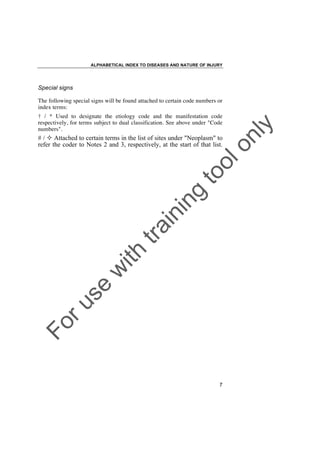
† / * Used to designate the etiology code and the manifestation code
respectively, for terms subject to dual classification. See above under "Code
numbers".

Fo

ru

se

w

ith

tra

in

in

g

to
o

# / ! Attached to certain terms in the list of sites under "Neoplasm" to
refer the coder to Notes 2 and 3, respectively, at the start of that list.

7
se

ru

Fo
ith

w
g

in

in

tra

lo
nl
y

to
o
Section I

Fo

ru

se

w

ith

tra

in

in

g

to
o

lo
nl
y

Alphabetical index to diseases and
nature of injury

9
se

ru

Fo
ith

w
g

in

in

tra

lo
nl
y

to
o
ALPHABETICAL INDEX TO DISEASES AND NATURE OF INJURY

A

tra

in

in

g

to
o

lo
nl
y

Abnormal, abnormality––continued
– autosomes NEC––continued
– – fragile site Q95.5
– basal metabolic rate R94.8
– biosynthesis, testicular androgen E29.1
– blood level (of)
– – cobalt R79.0
– – copper R79.0
– – iron R79.0
– – lithium R78.8
– – magnesium R79.0
– – mineral NEC R79.0
– – zinc R79.0
– blood-gas level R79.8
– bowel sounds R19.1
– breathing NEC R06.8
– caloric test R94.1
– cervix NEC (acquired) (congenital), in
pregnancy or childbirth O34.4
– – causing obstructed labor O65.5
– – – affecting fetus or newborn P03.1
– chemistry, blood R79.9
– – specified NEC R79.8
– chest sounds (friction) (rales) R09.8
– chorion O41.9
– – affecting fetus or newborn P02.9
– chromosome, chromosomal Q99.9
– – analysis result R89.8
– – dicentric replacement Q93.2
– – female with more than three X
chromosomes Q97.1
– – fetal (suspected), affecting management
of pregnancy O35.1
– – ring replacement Q93.2
– – sex Q99.8
– – – female phenotype Q97.9
– – – – specified NEC Q97.8
– – – male phenotype Q98.9
– – – – specified NEC Q98.8
– – – structural, male Q98.6
– – specified NEC Q99.8
– clinical findings NEC R68.8
– coagulation D68.9
– – newborn, transient P61.6
– communication – see Fistula
– course, eustachian tube Q17.8
– diagnostic imaging
– – abdomen, abdominal region NEC
R93.5

Fo

ru

se

w

ith

Aarskog's syndrome Q87.1
Abandonment T74.0
Abasia(-astasia) (hysterical) F44.4
Abdomen, abdominal – see also condition
– acute R10.0
– convulsive equivalent G40.8
– muscle deficiency syndrome Q79.4
Abdominalgia R10.4
Abduction contracture, hip or other
joint – see Contraction, joint
Aberrant (congenital) – see also
Malposition, congenital
– adrenal gland Q89.1
– artery (peripheral) NEC Q27.8
– breast Q83.8
– endocrine gland NEC Q89.2
– hepatic duct Q44.5
– pancreas Q45.3
– parathyroid gland Q89.2
– pituitary gland Q89.2
– sebaceous glands, mucous membrane,
mouth, congenital Q38.6
– spleen Q89.0
– subclavian artery Q27.8
– thymus (gland) Q89.2
– thyroid gland Q89.2
– vein (peripheral) NEC Q27.8
Aberration, mental F99
Abetalipoproteinemia E78.6
Abiotrophy R68.8
Ablatio, ablation
– placentae (see also Abruptio placentae)
O45.9
– – affecting fetus or newborn P02.1
– retinae (see also Detachment, retina)
H33.2
– uterus Z90.7
Ablepharia, ablepharon Q10.3
Abnormal, abnormality, abnormalities –
see also Anomaly
– acid-base balance (mixed) E87.4
– – fetus – see Distress, fetal
– albumin R77.0
– alphafetoprotein R77.2
– amnion, amniotic fluid O41.9
– – affecting fetus or newborn P02.9
– apertures, congenital, diaphragm Q79.1
– auditory perception NEC H93.2
– autosomes NEC Q99.9

11
INTERNATIONAL CLASSIFICATION OF DISEASES

to
o

lo
nl
y

Abnormal, abnormality––continued
– finding––continued
– – antenatal screening, mother––continued
– – – ultrasonic O28.3
– – specimen – see Abnormal, specimen
– fluid
– – amniotic R89.– – cerebrospinal R83.– – peritoneal R85.– – pleural R84.– – respiratory organs (bronchial washings)
(nasal secretions) (pleural fluid)
(sputum) (throat scrapings) R84.– – synovial R89.– – thorax (bronchial washings) (pleural
fluid) R84.– – vaginal R87.– forces of labor O62.9
– – affecting fetus or newborn P03.6
– – specified type NEC O62.8
– form
– – teeth K00.2
– – uterus – see Anomaly, uterus
– function studies
– – bladder R94.8
– – brain R94.0
– – cardiovascular R94.3
– – endocrine NEC R94.7
– – kidney R94.4
– – liver R94.5
– – nervous system
– – – central R94.0
– – – peripheral R94.1
– – pulmonary R94.2
– – special senses R94.1
– – spleen R94.8
– – thyroid R94.6
– gait (see also Gait) R26.8
– – hysterical F44.4
– globulin R77.1
– – cortisol-binding E27.8
– – thyroid-binding E07.8
– glomerular, minor – code to N00-N07
with fourth character .0N05.0
– glucose tolerance (test) R73.0
– – in pregnancy, childbirth or puerperium
O99.8
– gravitational (G) forces or states (effect
of) T75.8
– hair (color) (shaft) L67.9
– – specified NEC L67.8
– hard tissue formation in pulp (dental)
K04.3
– head movement R25.0

Fo

ru

se

w

ith

tra

in

in

g

Abnormal, abnormality––continued
– diagnostic imaging––continued
– – biliary tract R93.2
– – breast R92
– – central nervous system NEC R90.8
– – coronary circulation R93.1
– – digestive tract NEC R93.3
– – gastrointestinal (tract) R93.3
– – genitourinary organs R93.8
– – head R93.0
– – heart R93.1
– – intrathoracic organs NEC R93.8
– – limbs R93.6
– – liver R93.2
– – lung (field) R91
– – musculoskeletal system NEC R93.7
– – retroperitoneum R93.5
– – sites specified NEC R93.8
– – skin and subcutaneous tissue R93.8
– – skull R93.0
– – urinary organs R93.4
– ear ossicles, acquired NEC H74.3
– echocardiogram R93.1
– echoencephalogram R90.8
– echogram – see Abnormal, diagnostic
imaging
– electrocardiogram (ECG) (EKG) R94.3
– electroencephalogram (EEG) R94.0
– electrolyte (see also Imbalance,
electrolyte) E87.8
– electromyogram (EMG) R94.1
– electro-oculogram (EOG) R94.1
– electrophysiological intracardiac studies
R94.3
– electroretinogram (ERG) R94.1
– feces (color) (contents) (mucus) R19.5
– fetus, fetal
– – acid-base balance, complicating labor
and delivery O68.3
– – affecting management of pregnancy
O35.9
– – causing disproportion O33.7
– – – with obstructed labor O66.3
– – – affecting fetus or newborn P03.1
– – heart rate – see Distress, fetal
– finding
– – antenatal screening, mother O28.9
– – – biochemical NEC O28.1
– – – chromosomal NEC O28.5
– – – cytological NEC O28.2
– – – genetic NEC O28.5
– – – hematological NEC O28.0
– – – radiological NEC O28.4
– – – specified NEC O28.8

12
ALPHABETICAL INDEX TO DISEASES AND NATURE OF INJURY

tra

in

in

g

to
o

lo
nl
y

Abnormal, abnormality––continued
– plasma
– – protein R77.9
– – – specified NEC R77.8
– – viscosity R70.1
– pleural (folds) Q34.0
– position – see Malposition
– posture R29.3
– presentation (fetus) (see also Presentation,
fetal, abnormal) O32.9
– – before labor, affecting fetus or newborn
P01.7
– product of conception O02.9
– – specified type NEC O02.8
– pulmonary
– – artery, congenital Q25.7
– – function, newborn P28.8
– – test results R94.2
– – ventilation, newborn P28.8
– pupillary function (reaction) (reflex)
H57.0
– radiological examination – see Abnormal,
diagnostic imaging
– red blood cell(s) (morphology) (volume)
R71
– reflex NEC (see also Reflex) R29.2
– renal function test R94.4
– response to nerve stimulation R94.1
– retinal correspondence H53.3
– rhythm, heart (see also Arrhythmia) I49.9
– – fetus – see Distress, fetal
– saliva R85.– secretion
– – gastrin E16.4
– – glucagon E16.3
– semen, seminal fluid R86.– serum level (of)
– – acid phosphatase R74.8
– – alkaline phosphatase R74.8
– – amylase R74.8
– – enzymes R74.9
– – – specified NEC R74.8
– – lipase R74.8
– – triacylglycerol lipase R74.8
– shape, gravid uterus – see Anomaly,
uterus
– sinus venosus Q21.1
– size, tooth, teeth K00.2
– spacing, tooth, teeth K07.3
– specimen
– – cervix uteri R87.– – digestive organs (peritoneal fluid)
(saliva) R85.-

Fo

ru

se

w

ith

Abnormal, abnormality––continued
– heart
– – rate NEC R00.8
– – – fetus – see Distress, fetal
– – shadow R93.1
– – sounds NEC R01.2
– hematological NEC, resulting from HIV
disease B23.2
– hemoglobin (disease) (see also Disease,
hemoglobin) D58.2
– – trait – see Trait, hemoglobin, abnormal
– histology NEC R89.7
– immunological findings R89.4
– – in serum R76.9
– – – specified NEC R76.8
– – resulting from HIV disease B23.2
– involuntary movement R25.8
– jaw closure K07.5
– karyotype R89.8
– labor NEC O75.8
– – affecting fetus or newborn P03.6
– leukocyte (cell) (differential) NEC R72
– loss of weight R63.4
– Mantoux test R76.1
– membranes (fetal)
– – affecting fetus or newborn P02.9
– – complicating pregnancy O41.9
– – specified type NEC, affecting fetus or
newborn P02.8
– movement (disorder) (see also Disorder,
movement) G25.9
– – head R25.0
– – involuntary R25.8
– myoglobin (Aberdeen) (Annapolis) R89.– organs or tissues of pelvis NEC
– – in pregnancy or childbirth O34.9
– – – affecting fetus or newborn P03.8
– – – causing obstructed labor O65.5
– – – – affecting fetus or newborn P03.1
– – – specified NEC O34.8
– palmar creases Q82.8
– Papanicolaou (smear)
– – cervix R87.6
– – sites NEC R89.6
– parturition
– – affecting fetus or newborn P03.9
– – mother – see Delivery, complicated
– pelvis (bony) – see Deformity, pelvis
– percussion, chest (tympany) R09.8
– periods (grossly) (see also Menstruation)
N92.6
– phonocardiogram R94.3
– placenta NEC (see also Placenta,
abnormal) O43.1

13
INTERNATIONAL CLASSIFICATION OF DISEASES

to
o

lo
nl
y

Abnormal, abnormality––continued
– white blood cells NEC R72
– X-ray examination – see Abnormal,
diagnostic imaging
Abnormity (any organ or part) – see
Anomaly
ABO hemolytic disease (fetus or newborn)
P55.1
Abolition, language R48.8
Aborter, habitual or recurrent NEC
– care in current pregnancy O26.2
– current abortion – see categories O03-O06
– – affecting fetus or newborn P01.8
– without current pregnancy N96
Abortion (complete) (incomplete) O06.– accidental O03.– attempted (failed) (induced) (nonmedical)
O07.9
– – complicated by
– – – afibrinogenemia O07.6
– – – cardiac arrest O07.8
– – – chemical damage of pelvic organ(s)
O07.8
– – – circulatory collapse O07.8
– – – defibrination syndrome O07.6
– – – electrolyte imbalance O07.8
– – – embolism (amniotic fluid) (blood
clot) (pulmonary) (septic) (soap)
O07.7
– – – endometritis O07.5
– – – hemorrhage (delayed) (excessive)
O07.6
– – – infection, genital tract or pelvic
O07.5
– – – intravascular coagulation O07.6
– – – laceration of pelvic organ(s) O07.8
– – – oliguria O07.8
– – – oophoritis O07.5
– – – parametritis O07.5
– – – pelvic peritonitis O07.5
– – – perforation of pelvic organ(s) O07.8
– – – renal failure or shutdown O07.8
– – – salpingitis or salpingo-oophoritis
O07.5
– – – sepsis O07.5
– – – septic shock O07.5
– – – septicemia O07.5
– – – shock O07.8
– – – – septic O07.5
– – – specified condition NEC O07.8
– – – tubular necrosis (renal) O07.8
– – – urinary infection O07.8
– – illegal O07.– – medical O07.4

Fo

ru

se

w

ith

tra

in

in

g

Abnormal, abnormality––continued
– specimen––continued
– – female genital organs (secretions)
(smears) R87.– – male genital organs (prostatic
secretions) (semen) R86.– – nipple discharge R89.– – respiratory organs (bronchial washings)
(nasal secretions) (pleural fluid)
(sputum) (throat scrapings) R84.– – specified organ, system or tissue NEC
R89.– – synovial fluid R89.– – thorax (bronchial washings) (pleural
fluids) R84.– – vagina (secretion) (smear) R87.– – vulva (secretion) (smear) R87.– – wound secretion R89.– spermatozoa R86.– sputum (amount) (color) (odor) R09.3
– stool (color) (contents) (mucus) R19.5
– synchondrosis Q78.8
– thermography – see Abnormal, diagnostic
imaging
– thyroid-binding globulin E07.8
– tooth, teeth (form) (size) K00.2
– toxicology (findings) R78.9
– transport protein E88.0
– ultrasound results – see Abnormal,
diagnostic imaging
– umbilical cord
– – affecting fetus or newborn P02.6
– – complicating delivery O69.9
– urination NEC R39.1
– urine (constituents) NEC R82.9
– – cytological examination R82.8
– – heavy metals R82.6
– – histological examination R82.8
– – microbiological examination (culture)
R82.7
– – positive culture R82.7
– – specified NEC R82.9
– – substances nonmedical R82.6
– vagina (acquired) (congenital), in
pregnancy or childbirth O34.6
– – causing obstructed labor O65.5
– – – affecting fetus or newborn P03.1
– vectorcardiogram R94.3
– visually evoked potential (VEP) R94.1
– vulva and perineum (acquired)
(congenital), in pregnancy or childbirth
O34.7
– – causing obstructed labor O65.5
– – – affecting fetus or newborn P03.1

14
ALPHABETICAL INDEX TO DISEASES AND NATURE OF INJURY

tra

in

in

g

to
o

lo
nl
y

Abortion––continued
– attempted––continued
– – medical––continued
– – – complicated by––continued
– – – – shock––continued
– – – – urinary infection O07.3
– failed – see Abortion, attempted
– fetus or newborn P96.4
– following threatened abortion O03.– habitual or recurrent N96
– – with current abortion – see categories
O03-O06
– – – fetus P01.8
– – care in current pregnancy O26.2
– – without current pregnancy N96
– illegal O05.– induced O06.– – for
– – – legal indications O04.– – – medical indications O04.– – – psychiatric indications O04.– – nonmedical O05.– legal (induced) O04.– – fetus P96.4
– medical O04.– – fetus P96.4
– missed O02.1
– operative – see Abortion, medical
– spontaneous O03.– – fetus P01.8
– – threatened O20.0
– – – affecting fetus or newborn P01.8
– therapeutic O04.– – fetus P96.4
– threatened (spontaneous) O20.0
– – affecting fetus or newborn P01.8
– tubal O00.1

Fo

ru

se

w

ith

Abortion––continued
– attempted––continued
– – medical––continued
– – – complicated by
– – – – afibrinogenemia O07.1
– – – – cardiac arrest O07.3
– – – – chemical damage of pelvic
organ(s) O07.3
– – – – circulatory collapse O07.3
– – – – defibrination syndrome O07.1
– – – – electrolyte imbalance O07.3
– – – – embolism (amniotic fluid) (blood
clot) (pulmonary) (septic) (soap)
O07.2
– – – – endometritis O07.0
– – – – hemorrhage (delayed) (excessive)
O07.1
– – – – infection, genital tract or pelvic
O07.0
– – – – intravascular coagulation O07.1
– – – – laceration of pelvic organ(s)
O07.3
– – – – oliguria O07.3
– – – – oophoritis O07.0
– – – – parametritis O07.0
– – – – pelvic peritonitis O07.0
– – – – perforation of pelvic organ(s)
O07.3
– – – – renal failure or shutdown O07.3
– – – – salpingitis or salpingo-oophoritis
O07.0
– – – – sepsis O07.0
– – – – septic shock O07.0
– – – – septicemia O07.0
– – – – shock O07.3
– – – – – septic O07.0
– – – – specified condition NEC O07.3
– – – – tubular necrosis (renal) O07.3

15
INTERNATIONAL CLASSIFICATION OF DISEASES

Abortion––continued
Note: The following fourth-character list is provided to be used with categories O03-O06
and O08. A distinction is made between an episode of care at which a disease or injury and
resulting complications or manifestations are treated together - "current episode" - and an
episode of care for complications or manifestations of diseases or injuries treated previousy
- "subsequent episode".
Complication of abortion, current

Complication of preg-

episode (O03-O06)

nancy with abortive
outcome, subsequent

unspecified

.8
.6
.8

.9
.1
.8

.3
.3
.3
.3
.3
.3
.3
.3
.3
.1
.3
.2
.2
.2
.2
.2
.2
.2
.2
.2
.0
.1

.6
.6
.6
.6
.6
.6
.3
.8
.6
.1
.5
.2
.2
.2
.2
.2
.2
.2
.2
.2
.0
.1

.5
.5
.8
.6

.0
.0
.3
.1

.0
.0
.8
.1

.8
.8
.8
.8
.8
.8
.8
.8
.5
.5
.5

.3
.3
.3
.3
.3
.3
.3
.3
.0
.0
.0

.6
.6
.6
.6
.6
.6
.5
.4
.0
.0
.0

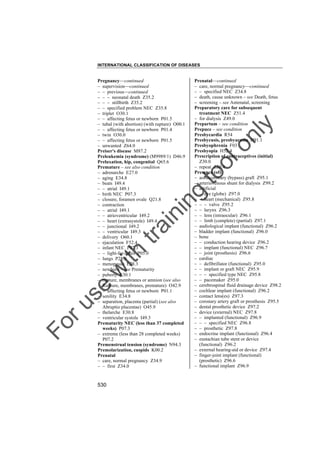
to
o

.8
.8
.8
.8
.8
.8
.8
.8
.8
.6
.8
.7
.7
.7
.7
.7
.7
.7
.7
.7
.5
.6

in

in

tra

ith

w
Fo

ru

se
16

episode (O08)

.3
.1
.3

g

Abortion––continued
– complicated (by)
– – afibrinogenemia
– – cardiac arrest
– – chemical damage
– – – bladder
– – – bowel
– – – broad ligament
– – – cervix
– – – periurethral tissue
– – – uterus
– – circulatory collapse
– – condition specified NEC
– – damage to pelvic organs or tissues NEC
– – defibrination syndrome
– – electrolyte imbalance
– – embolism
– – – air
– – – amniotic fluid
– – – blood clot
– – – pulmonary
– – – pyemic
– – – septic
– – – septicopyemic
– – – soap
– – endometritis
– – hemorrhage (delayed) (excessive)
– – infection
– – – genital
– – – pelvic
– – – urinary tract
– – intravascular coagulation
– – laceration
– – – bladder
– – – bowel
– – – broad ligament
– – – cervix
– – – periurethral tissue
– – – uterus
– – metabolic disorder
– – oliguria
– – oophoritis
– – parametritis
– – pelvic peritonitis

incomplete

lo
nl
y

complete or
ALPHABETICAL INDEX TO DISEASES AND NATURE OF INJURY

Complication of abortion, current

Complication of preg-

episode (O03-O06)

nancy with abortive
outcome, subsequent

complete or

incomplete

episode (O08)

unspecified

.9

.8
.8
.8
.8
.8
.8
.5
.5
.5
.5
.5
.8

.3
.3
.3
.3
.3
.3
.0
.0
.0
.0
.0
.3

.6
.6
.6
.6
.4
.4
.0
.0
.0
.0
.0
.3

.8
.8
.8
.8
.8
.8
.8
.8
.8

.3
.3
.3
.3
.3
.3
.3
.3
.3

.6
.6
.6
.6
.6
.6
.4
.4
.8

g

in

in

tra

Abscess––continued
– accessory sinus (chronic) (see also
Sinusitis) J32.9
– – acute (see also Sinusitis, acute) J01.9
– alveolar K04.7
– amebic A06.4
– – brain (and liver or lung abscess)
A06.6† G07"
– – liver (without mention of brain or lung
abscess) A06.4
– – lung (and liver) (without mention of
brain abscess) A06.5† J99.8"
– – specified site NEC A06.8
– – spleen A06.8
– ankle L02.4
– anorectal K61.2
– antecubital space L02.4
– antrum (chronic) (Highmore) (see also
Sinusitis, maxillary) J32.0
– anus K61.0
– apical (tooth) K04.7
– – with sinus (alveolar) K04.6
– appendix K35.1

Fo

ru

se

w

ith

Abrami's disease D59.8
Abrasion (see also Injury, superficial)
T14.0
– tooth, teeth (dentifrice) (habitual) (hard
tissues) (occupational) (ritual) (traditional)
(wedge defect) K03.1
Abruptio placentae O45.9
– with coagulation defect O45.0
– affecting fetus or newborn P02.1
Abruption, placenta – see Abruptio
placentae
Abscess (embolic) (infective) (metastatic)
(multiple) (pyogenic) (septic) L02.9
– with
– – diverticular disease (intestine) K57.8
– – – large K57.2
– – – – and small K57.4
– – – small K57.0
– – lymphangitis – code site under Abscess
– abdomen, abdominal
– – cavity K65.0
– – wall L02.2
– abdominopelvic K65.0

.3

to
o

.8

lo
nl
y

Abortion––continued
– complicated (by) ––continued
– – perforation
– – – bladder
– – – bowel
– – – cervix
– – – uterus
– – renal failure (acut)
– – renal shutdown
– – salpingitis
– – salpingo-oophoritis
– – sepsis
– – septic shock
– – septicemia
– – shock (postoperative)
– – tear
– – – bladder
– – – bowel
– – – broad ligament
– – – cervix
– – – periurethral tissue
– – – uterus
– – tubular necrosis (renal)
– – uremia
– – urinary infection

17
INTERNATIONAL CLASSIFICATION OF DISEASES

to
o

lo
nl
y

Abscess––continued
– cheek (external) L02.0
– chest J86.9
– – with fistula J86.0
– – wall L02.2
– chin L02.0
– choroid H30.0
– ciliary body H20.8
– cold (lung) (tuberculous) (see also
Tuberculosis, abscess, lung) A16.2
– – articular – see Tuberculosis, joint
– colon (wall) K63.0
– colostomy or enterostomy K91.4
– conjunctiva H10.0
– connective tissue NEC L02.9
– cornea H16.3
– corpus
– – cavernosum N48.2
– – luteum (see also Salpingo-oophoritis)
N70.9
– Cowper's gland N34.0
– cranium G06.0
– Crohn's disease K50.9
– – large intestine K50.1
– – – and small intestine K50.8
– – small intestine (duodenum, ileum or
jejunum) K50.0
– cul-de-sac (Douglas') (posterior) (see also
Peritonitis, pelvic, female) N73.5
– cutaneous (see also Abscess, by site)
L02.9
– dental K04.7
– – with sinus (alveolar) K04.6
– dentoalveolar K04.7
– – with sinus K04.6
– diaphragm, diaphragmatic K65.0
– Douglas' cul-de-sac or pouch (see also
Peritonitis, pelvic, female) N73.5
– ear (middle) H66.4
– – acute H66.0
– – external H60.0
– entamebic – see Abscess, amebic
– epididymis N45.0
– epidural G06.2
– – brain G06.0
– – spinal cord G06.1
– epiglottis J38.7
– epiploon, epiploic K65.0
– erysipelatous (see also Erysipelas) A46
– esophagus K20
– ethmoid (bone) (chronic) (sinus) J32.2
– external auditory canal H60.0
– extradural G06.2
– – brain G06.0

Fo

ru

se

w

ith

tra

in

in

g

Abscess––continued
– areola (acute) (chronic) (nonpuerperal)
N61
– – puerperal, postpartum or gestational
O91.0
– arm (any part) L02.4
– artery (wall) I77.8
– auricle, ear H60.0
– axilla (region) L02.4
– – lymph gland or node L04.2
– back (any part, except buttock) L02.2
– Bartholin's gland N75.1
– Bezold's H70.0
– bladder (wall) N30.8
– bone (subperiosteal) M86.8
– – accessory sinus (chronic) (see also
Sinusitis) J32.9
– – chronic M86.6
– – jaw (lower) (upper) K10.2
– – mastoid H70.0
– – petrous H70.2
– – spinal (tuberculous) A18.0† M49.0"
– – – nontuberculous M46.2
– bowel K63.0
– brain (any part) G06.0
– – amebic (with abscess of any other site)
A06.6† G07"
– – cystic G06.0
– – gonococcal A54.8† G07"
– – otogenic G06.0
– – pheomycotic (chromomycotic) B43.1†
G07"
– – tuberculous A17.8† G07"
– breast (acute) (chronic) (nonpuerperal)
N61
– – gestational O91.1
– – newborn P39.0
– – puerperal, postpartum O91.1
– broad ligament (see also Disease, pelvis,
inflammatory) N73.2
– Brodie's (chronic) (localized) M86.8
– bronchi J98.0
– buccal cavity K12.2
– bulbourethral gland N34.0
– bursa M71.0
– – pharyngeal J39.1
– buttock L02.3
– canthus H10.5
– cartilage M94.8
– cerebellum, cerebellar G06.0
– cerebral (embolic) G06.0
– cervical (meaning neck) L02.1
– – lymph gland or node L04.0
– cervix (uteri) (see also Cervicitis) N72

18
ALPHABETICAL INDEX TO DISEASES AND NATURE OF INJURY

tra

in

in

g

to
o

lo
nl
y

Abscess––continued
– intra-abdominal (see also Abscess,
peritoneum) K65.0
– intracranial G06.0
– intramammary – see Abscess, breast
– intraorbital H05.0
– intraperitoneal K65.0
– intrasphincteric (anus) K61.4
– intraspinal G06.1
– intratonsillar J36
– iris H20.8
– ischiorectal (fossa) K61.3
– jaw (bone) (lower) (upper) K10.2
– joint M00.9
– – spine (tuberculous) A18.0† M49.0"
– – – nontuberculous M46.5
– kidney N15.1
– – with calculus N20.0
– – – with hydronephrosis N13.6
– – complicating pregnancy O23.0
– – – affecting fetus or newborn P00.1
– – puerperal, postpartum O86.2
– knee L02.4
– – joint M00.9
– labium (majus) (minus) N76.4
– – complicating pregnancy O23.5
– – puerperal, postpartum O86.1
– lacrimal
– – caruncle H04.3
– – gland H04.0
– – passages (duct) (sac) H04.3
– larynx J38.7
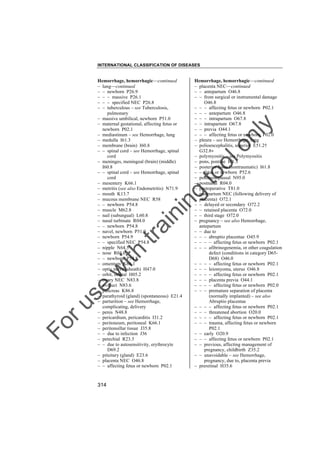
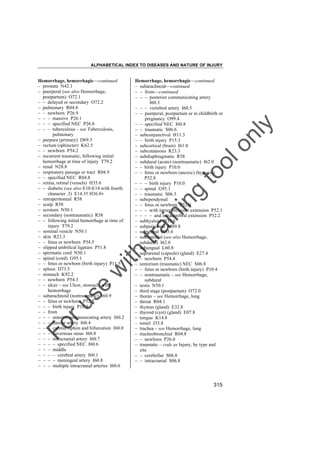
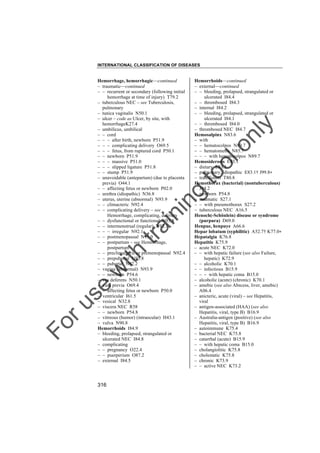
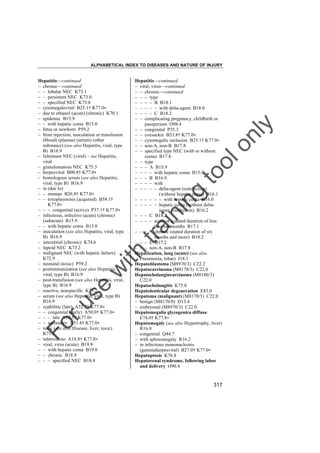
– leg (any part) L02.4
– lens H27.8
– limb (lower) (upper) L02.4
– lingual K14.0
– lip K13.0
– Littré's gland N34.0
– liver (cholangitic) (hematogenic)
(lymphogenic) (pylephlebitic) K75.0
– – amebic A06.4
– – – with
– – – – brain abscess (and lung abscess)
A06.6† G07"
– – – – lung abscess A06.5† J99.8"
– – due to Entamoeba histolytica (see also
Abscess, liver, amebic) A06.4
– loin (region) L02.2
– lumbar (tuberculous) A18.0† M49.0"
– – nontuberculous L02.2
– lung (miliary) (putrid) J85.2
– – with pneumonia J85.1
– – – due to specified organism – see
Pneumonia, in (due to)

Fo

ru

se

w

ith

Abscess––continued
– extradural––continued
– – spinal cord G06.1
– extraperitoneal K65.0
– eye H44.0
– eyelid H00.0
– face (any part, except ear, eye and nose)
L02.0
– fallopian tube (see also Salpingooophoritis) N70.9
– fascia M72.8
– fauces J39.1
– femoral (region) L02.4
– filaria, filarial (see also Infestation,
filarial) B74.9
– finger (any) L02.4
– – nail L03.0
– fistulous NEC L02.9
– foot (any part) L02.4
– forehead L02.0
– frontal sinus (chronic) J32.1
– gallbladder K81.0
– genital organ or tract NEC
– – female (external) N76.4
– – – following
– – – – abortion (subsequent episode)
O08.0
– – – – ectopic or molar pregnancy O08.0
– – male N49.9
– – – multiple sites N49.8
– – – specified NEC N49.8
– gingival K05.2
– gland, glandular (lymph) (acute) (see also
Lymphadenitis, acute) L04.9
– gluteal (region) L02.3
– gonorrheal NEC (see also Gonococcus)
A54.1
– groin L02.2
– gum K05.2
– hand L02.4
– head NEC L02.8
– heart (see also Carditis) I51.8
– heel L02.4
– hepatic (cholangitic) (hematogenic)
(lymphogenic) (pylephlebitic) K75.0
– hip (region) L02.4
– ileocecal K35.1
– ileostomy (bud) K91.4
– iliac (region) L02.2
– infraclavicular (fossa) L02.4
– inguinal (region) L02.2
– – lymph gland or node L04.1
– intestine, intestinal NEC K63.0
– – rectal K61.1

19
INTERNATIONAL CLASSIFICATION OF DISEASES

to
o

lo
nl
y

Abscess––continued
– parametric, parametrium (see also
Disease, pelvis, inflammatory) N73.2
– parapharyngeal J39.0
– pararectal K61.1
– parasinus (see also Sinusitis) J32.9
– parauterine (see also Disease, pelvis,
inflammatory) N73.2
– paravaginal N76.0
– parietal region (scalp) L02.8
– parotid (duct) (gland) K11.3
– pectoral (region) L02.2
– pelvis, pelvic
– – female (see also Disease, pelvis,
inflammatory) N73.9
– – male, peritoneal K65.0
– penis N48.2
– – gonococcal (accessory gland)
(periurethral) A54.1
– perianal K61.0
– periapical K04.7
– – with sinus (alveolar) K04.6
– periappendicular K35.1
– pericardial I30.1
– pericemental K05.2
– pericoronal K05.2
– peridental K05.2
– perimetric (see also Disease, pelvis,
inflammatory) N73.2
– perinephric, perinephritic (see also
Abscess, kidney) N15.1
– perineum, perineal (superficial) L02.2
– – urethra N34.0
– periodontal (parietal) K05.2
– periosteum, periosteal M86.8
– – with osteomyelitis M86.8
– – – acute M86.1
– – – chronic M86.6
– peripharyngeal J39.0
– periprostatic N41.2
– perirectal K61.1
– perirenal (tissue) (see also Abscess,
kidney) N15.1
– peritoneum, peritoneal (perforated)
(ruptured) K65.0
– – with appendicitis K35.1
– – following
– – – abortion (subsequent episode) O08.0
– – – ectopic or molar pregnancy O08.0
– – pelvic
– – – female (see also Peritonitis, pelvic,
female) N73.5
– – – male K65.0
– – postoperative T81.4

Fo

ru

se

w

ith

tra

in

in

g

Abscess––continued
– lung––continued
– – amebic (with liver abscess) A06.5†
J99.8"
– – – with
– – – – brain abscess A06.6† G07"
– – – – pneumonia A06.5† J17.0"
– lymph, lymphatic, gland or node
(acute) (see also Lymphadenitis, acute)
L04.9
– – mesentery I88.0
– mammary gland – see Abscess, breast
– marginal, anus K61.0
– mastoid H70.0
– maxilla, maxillary K10.2
– – sinus (chronic) J32.0
– mediastinum J85.3
– meibomian gland H00.0
– meninges G06.2
– mesentery, mesenteric K65.0
– mesosalpinx (see also Salpingooophoritis) N70.9
– mons pubis L02.2
– mouth (floor) K12.2
– muscle M60.0
– myocardium I40.0
– nabothian (follicle) (see also Cervicitis)
N72
– nail (chronic) (with lymphangitis) L03.0
– nasopharyngeal J39.1
– navel L02.2
– – newborn P38
– neck (region) L02.1
– – lymph gland or node L04.0
– nephritic (see also Abscess, kidney)
N15.1
– nipple N61
– – puerperal, postpartum or gestational
O91.0
– nose (external) (fossa) (septum) J34.0
– – sinus (chronic) (see also Sinusitis)
J32.9
– omentum K65.0
– operative wound T81.4
– orbit, orbital H05.0
– ovary, ovarian (corpus luteum) (see also
Salpingo-oophoritis) N70.9
– oviduct (see also Salpingo-oophoritis)
N70.9
– palate (soft) K12.2
– – hard K10.2
– palmar (space) L02.4
– pancreas (duct) K85.– paradontal K05.2

20
ALPHABETICAL INDEX TO DISEASES AND NATURE OF INJURY

tra

in

in

g

to
o

lo
nl
y

Abscess––continued
– round ligament (see also Disease, pelvis,
inflammatory) N73.2
– rupture (spontaneous) NEC L02.9
– sacrum (tuberculous) A18.0† M49.0"
– – nontuberculous M46.2
– salivary (duct) (gland) K11.3
– scalp (any part) L02.8
– scapular M86.8
– sclera H15.0
– scrofulous (tuberculous) A18.2
– scrotum N49.2
– seminal vesicle N49.0
– shoulder (region) L02.4
– sigmoid K63.0
– sinus (accessory) (chronic)
(nasal) (see also Sinusitis) J32.9
– – intracranial venous (any) G06.0
– Skene's duct or gland N34.0
– skin (see also Abscess, by site) L02.9
– sloughing NEC L02.9
– specified site NEC L02.8
– spermatic cord N49.1
– sphenoidal (sinus) (chronic) J32.3
– spinal cord (any part) (staphylococcal)
G06.1
– – tuberculous A17.8† G07"
– spine (column) (tuberculous) A18.0†
M49.0"
– – nontuberculous M46.2
– spleen D73.3
– – amebic A06.8
– stitch T81.4
– subarachnoid G06.2
– – brain G06.0
– – spinal cord G06.1
– subareolar (see also Abscess, breast) N61
– – puerperal, postpartum O91.1
– subcutaneous (see also Abscess, by site)
L02.9
– – pheomycotic (chromomycotic) B43.2†
L99.8"
– subdiaphragmatic K65.0
– subdural G06.2
– – brain G06.0
– – spinal cord G06.1
– subgaleal L02.8
– subhepatic K65.0
– sublingual K12.2
– – gland K11.3
– submammary – see Abscess, breast
– submandibular (region) (space) (triangle)
K12.2
– – gland K11.3

Fo

ru

se

w

ith

Abscess––continued
– peritoneum, peritoneal––continued
– – puerperal, postpartum, childbirth O85
– – tuberculous A18.3† K67.3"
– peritonsillar J36
– periureteral N28.8
– periurethral N34.0
– – gonococcal (accessory gland)
(periurethral) A54.1
– periuterine (see also Disease, pelvis,
inflammatory) N73.2
– perivesical N30.8
– pernicious NEC L02.9
– petrous bone H70.2
– phagedenic NEC L02.9
– – chancroid A57
– pharynx, pharyngeal (lateral) J39.1
– pilonidal L05.0
– pituitary (gland) E23.6
– pleura J86.9
– – with fistula J86.0
– popliteal L02.4
– postlaryngeal J38.7
– postnasal J34.0
– postoperative (any site) T81.4
– postpharyngeal J39.0
– post-typhoid A01.0
– pouch of Douglas (see also Peritonitis,
pelvic, female) N73.5
– premammary – see Abscess, breast
– prepatellar L02.4
– prostate N41.2
– – gonococcal (acute) (chronic) A54.2†
N51.0"
– psoas, nontuberculous M60.0
– puerperal – code site under Puerperal,
abscess
– pulmonary – see Abscess, lung
– pulp, pulpal (dental) K04.0
– rectovesical N30.8
– rectum K61.1
– regional NEC L02.8
– renal (see also Abscess, kidney) N15.1
– respiratory, upper J39.8
– retina H30.0
– retrobulbar H05.0
– retrocecal K65.0
– retrolaryngeal J38.7
– retromammary – see Abscess, breast
– retroperitoneal K65.0
– retropharyngeal J39.0
– retrouterine (see also Peritonitis, pelvic,
female) N73.5
– retrovesical N30.8

21
INTERNATIONAL CLASSIFICATION OF DISEASES

to
o

lo
nl
y

Abscess––continued
– vertebra (column) (tuberculous) A18.0†
M49.0"
– – nontuberculous M46.2
– vesical N30.8
– vesico-uterine pouch (see also Peritonitis,
pelvic, female) N73.5
– vitreous (humor) H44.0
– vocal cord J38.3
– von Bezold's H70.0
– vulva N76.4
– – complicating pregnancy O23.5
– – puerperal, postpartum O86.1
– vulvovaginal gland N75.1
– web space L02.4
– wound T81.4
– wrist L02.4
Absence (organ or part) (complete or
partial)
– adrenal (gland) (congenital) Q89.1
– – acquired E89.6
– albumin in blood E88.0
– alimentary tract (congenital) Q45.8
– – upper Q40.8
– ankle (acquired) – see Absence, foot and
ankle
– anus (congenital) Q42.3
– – with fistula Q42.2
– aorta (congenital) Q25.4
– appendix, congenital Q42.8
– arm (acquired) (unilateral) Z89.2
– – with leg (any level) Z89.8
– – bilateral (any level) Z89.3
– – – with leg(s) (any level) Z89.8
– – congenital Q71.9
– artery (congenital) (peripheral) Q27.8
– – brain Q28.3
– – coronary Q24.5
– – pulmonary Q25.7
– atrial septum (congenital) Q21.1
– auditory canal (congenital) (external)
Q16.1
– auricle (ear), congenital Q16.0
– bile, biliary duct, congenital Q44.5
– bladder (acquired) Z90.6
– – congenital Q64.5
– bowel sounds R19.1
– brain Q00.0
– – part of Q04.3
– breast(s) (acquired) Z90.1
– – congenital Q83.8
– broad ligament Q50.6
– bronchus (congenital) Q32.4
– canaliculus lacrimalis, congenital Q10.4

Fo

ru

se

w

ith

tra

in

in

g

Abscess––continued
– submaxillary (region) L02.0
– submental L02.0
– subperiosteal – see Abscess, bone
– subphrenic K65.0
– – postoperative T81.4
– suburethral N34.0
– sudoriparous L75.8
– suppurative NEC L02.9
– supraclavicular (fossa) L02.4
– sweat gland L74.8
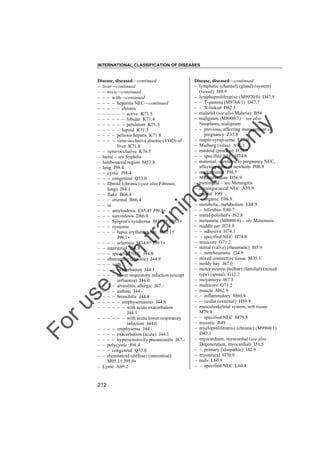
– tear duct H04.3
– temple L02.0
– temporal region L02.0
– temporosphenoidal G06.0
– tendon (sheath) M65.0
– testis N45.0
– thigh L02.4
– thorax J86.9
– – with fistula J86.0
– throat J39.1
– thumb L02.4
– – nail L03.0
– thymus (gland) E32.1
– thyroid (gland) E06.0
– toe (any) L02.4
– – nail L03.0
– tongue (staphylococcal) K14.0
– tonsil(s) J36
– tonsillopharyngeal J36
– tooth, teeth (root) K04.7
– – with sinus (alveolar) K04.6
– – supporting structures NEC K05.2
– trachea J39.8
– trunk L02.2
– tubal (see also Salpingo-oophoritis)
N70.9
– tuberculous – see Tuberculosis, abscess
– tubo-ovarian (see also Salpingooophoritis) N70.9
– tunica vaginalis N49.1
– umbilicus L02.2
– – newborn P38
– urethral (gland) N34.0
– uterus, uterine (wall) (see also
Endometritis) N71.9
– – ligament (see also Disease, pelvis,
inflammatory) N73.2
– – neck (see also Cervicitis) N72
– vagina (wall) (see also Vaginitis) N76.0
– vaginorectal (see also Vaginitis) N76.0
– vas deferens N49.1
– vermiform appendix K35.1

22
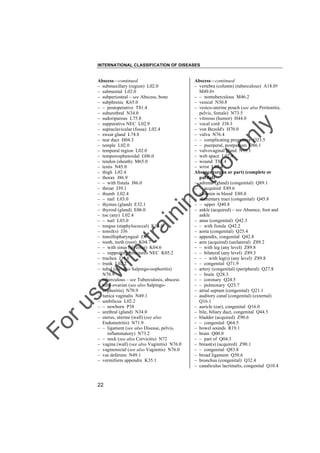
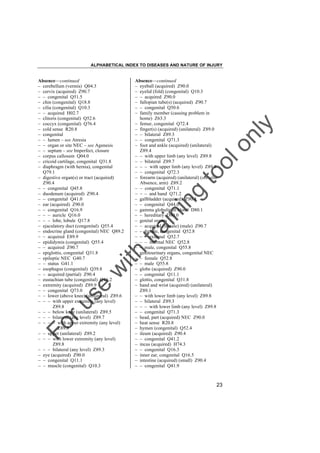
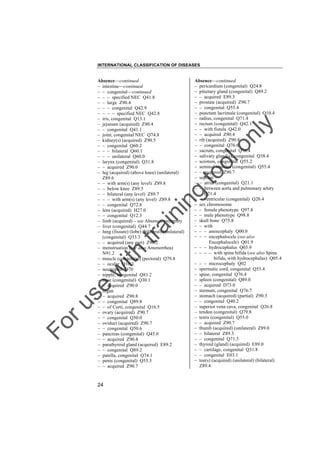
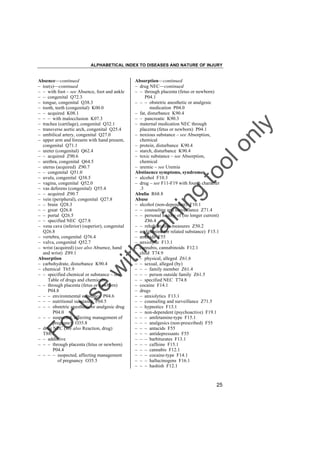
ALPHABETICAL INDEX TO DISEASES AND NATURE OF INJURY

tra

in

in

g

to
o

lo
nl
y

Absence––continued
– eyeball (acquired) Z90.0
– eyelid (fold) (congenital) Q10.3
– – acquired Z90.0
– fallopian tube(s) (acquired) Z90.7
– – congenital Q50.6
– family member (causing problem in
home) Z63.3
– femur, congenital Q72.4
– finger(s) (acquired) (unilateral) Z89.0
– – bilateral Z89.3
– – congenital Q71.3
– foot and ankle (acquired) (unilateral)
Z89.4
– – with upper limb (any level) Z89.8
– – bilateral Z89.7
– – – with upper limb (any level) Z89.8
– – congenital Q72.3
– forearm (acquired) (unilateral) (see also
Absence, arm) Z89.2
– – congenital Q71.1
– – – and hand Q71.2
– gallbladder (acquired) Z90.4
– – congenital Q44.0
– gamma globulin in blood D80.1
– – hereditary D80.0
– genital organs
– – acquired (female) (male) Z90.7
– – female, congenital Q52.8
– – – external Q52.7
– – – internal NEC Q52.8
– – male, congenital Q55.8
– genitourinary organs, congenital NEC
– – female Q52.8
– – male Q55.8
– globe (acquired) Z90.0
– – congenital Q11.1
– glottis, congenital Q31.8
– hand and wrist (acquired) (unilateral)
Z89.1
– – with lower limb (any level) Z89.8
– – bilateral Z89.3
– – – with lower limb (any level) Z89.8
– – congenital Q71.3
– head, part (acquired) NEC Z90.0
– heat sense R20.8
– hymen (congenital) Q52.4
– ileum (acquired) Z90.4
– – congenital Q41.2
– incus (acquired) H74.3
– – congenital Q16.3
– inner ear, congenital Q16.5
– intestine (acquired) (small) Z90.4
– – congenital Q41.9

Fo

ru

se

w

ith

Absence––continued
– cerebellum (vermis) Q04.3
– cervix (acquired) Z90.7
– – congenital Q51.5
– chin (congenital) Q18.8
– cilia (congenital) Q10.3
– – acquired H02.7
– clitoris (congenital) Q52.6
– coccyx (congenital) Q76.4
– cold sense R20.8
– congenital
– – lumen – see Atresia
– – organ or site NEC – see Agenesis
– – septum – see Imperfect, closure
– corpus callosum Q04.0
– cricoid cartilage, congenital Q31.8
– diaphragm (with hernia), congenital
Q79.1
– digestive organ(s) or tract (acquired)
Z90.4
– – congenital Q45.8
– duodenum (acquired) Z90.4
– – congenital Q41.0
– ear (acquired) Z90.0
– – congenital Q16.9
– – – auricle Q16.0
– – – lobe, lobule Q17.8
– ejaculatory duct (congenital) Q55.4
– endocrine gland (congenital) NEC Q89.2
– – acquired E89.9
– epididymis (congenital) Q55.4
– – acquired Z90.7
– epiglottis, congenital Q31.8
– epileptic NEC G40.7
– – status G41.1
– esophagus (congenital) Q39.8
– – acquired (partial) Z90.4
– eustachian tube (congenital) Q16.2
– extremity (acquired) Z89.9
– – congenital Q73.0
– – lower (above knee) (unilateral) Z89.6
– – – with upper extremity (any level)
Z89.8
– – – below knee (unilateral) Z89.5
– – – bilateral (any level) Z89.7
– – – – with upper extremity (any level)
Z89.8
– – upper (unilateral) Z89.2
– – – with lower extremity (any level)
Z89.8
– – – bilateral (any level) Z89.3
– eye (acquired) Z90.0
– – congenital Q11.1
– – muscle (congenital) Q10.3

23
INTERNATIONAL CLASSIFICATION OF DISEASES

to
o

lo
nl
y

Absence––continued
– pericardium (congenital) Q24.8
– pituitary gland (congenital) Q89.2
– – acquired E89.3
– prostate (acquired) Z90.7
– – congenital Q55.4
– punctum lacrimale (congenital) Q10.4
– radius, congenital Q71.4
– rectum (congenital) Q42.1
– – with fistula Q42.0
– – acquired Z90.4
– rib (acquired) Z90.8
– – congenital Q76.6
– sacrum, congenital Q76.4
– salivary gland(s), congenital Q38.4
– scrotum, congenital Q55.2
– seminal vesicles (congenital) Q55.4
– – acquired Z90.7
– septum
– – atrial (congenital) Q21.1
– – between aorta and pulmonary artery
Q21.4
– – ventricular (congenital) Q20.4
– sex chromosome
– – female phenotype Q97.8
– – male phenotype Q98.8
– skull bone Q75.8
– – with
– – – anencephaly Q00.0
– – – encephalocele (see also
Encephalocele) Q01.9
– – – hydrocephalus Q03.9
– – – – with spina bifida (see also Spina
bifida, with hydrocephalus) Q05.4
– – – microcephaly Q02
– spermatic cord, congenital Q55.4
– spine, congenital Q76.4
– spleen (congenital) Q89.0
– – acquired D73.0
– sternum, congenital Q76.7
– stomach (acquired) (partial) Z90.3
– – congenital Q40.2
– superior vena cava, congenital Q26.8
– tendon (congenital) Q79.8
– testis (congenital) Q55.0
– – acquired Z90.7
– thumb (acquired) (unilateral) Z89.0
– – bilateral Z89.3
– – congenital Q71.3
– thyroid (gland) (acquired) E89.0
– – cartilage, congenital Q31.8
– – congenital E03.1
– toe(s) (acquired) (unilateral) (bilateral)
Z89.4

Fo

ru

se

w

ith

tra

in

in

g

Absence––continued
– intestine––continued
– – congenital––continued
– – – specified NEC Q41.8
– – large Z90.4
– – – congenital Q42.9
– – – – specified NEC Q42.8
– iris, congenital Q13.1
– jejunum (acquired) Z90.4
– – congenital Q41.1
– joint, congenital NEC Q74.8
– kidney(s) (acquired) Z90.5
– – congenital Q60.2
– – – bilateral Q60.1
– – – unilateral Q60.0
– larynx (congenital) Q31.8
– – acquired Z90.0
– leg (acquired) (above knee) (unilateral)
Z89.6
– – with arm(s) (any level) Z89.8
– – below knee Z89.5
– – bilateral (any level) Z89.7
– – – with arm(s) (any level) Z89.8
– – congenital Q72.8
– lens (acquired) H27.0
– – congenital Q12.3
– limb (acquired) – see Absence, extremity
– liver (congenital) Q44.7
– lung (fissure) (lobe) (bilateral) (unilateral)
(congenital) Q33.3
– – acquired (any part) Z90.2
– menstruation (see also Amenorrhea)
N91.2
– muscle (congenital) (pectoral) Q79.8
– – ocular Q10.3
– neutrophil D70
– nipple, congenital Q83.2
– nose (congenital) Q30.1
– – acquired Z90.0
– organ
– – acquired Z90.8
– – congenital Q89.8
– – of Corti, congenital Q16.5
– ovary (acquired) Z90.7
– – congenital Q50.0
– oviduct (acquired) Z90.7
– – congenital Q50.6
– pancreas (congenital) Q45.0
– – acquired Z90.4
– parathyroid gland (acquired) E89.2
– – congenital Q89.2
– patella, congenital Q74.1
– penis (congenital) Q55.5
– – acquired Z90.7

24
ALPHABETICAL INDEX TO DISEASES AND NATURE OF INJURY

tra

in

in

g

to
o

lo
nl
y

Absorption––continued
– drug NEC––continued
– – through placenta (fetus or newborn)
P04.1
– – – obstetric anesthetic or analgesic
medication P04.0
– fat, disturbance K90.4
– – pancreatic K90.3
– maternal medication NEC through
placenta (fetus or newborn) P04.1
– noxious substance – see Absorption,
chemical
– protein, disturbance K90.4
– starch, disturbance K90.4
– toxic substance – see Absorption,
chemical
– uremic – see Uremia
Abstinence symptoms, syndrome
– alcohol F10.3
– drug – see F11-F19 with fourth character
.3
Abulia R68.8
Abuse
– alcohol (non-dependent) F10.1
– – counseling and surveillance Z71.4
– – personal history of (no longer current)
Z86.4
– – rehabilitation measures Z50.2
– amfetamine (or related substance) F15.1
– antacids F55
– anxiolytic F13.1
– cannabis, cannabinoids F12.1
– child T74.9
– – physical, alleged Z61.6
– – sexual, alleged (by)
– – – family member Z61.4
– – – person outside family Z61.5
– – specified NEC T74.8
– cocaine F14.1
– drugs
– – anxiolytics F13.1
– – counseling and surveillance Z71.5
– – hypnotics F13.1
– – non-dependent (psychoactive) F19.1
– – – amfetamine-type F15.1
– – – analgesics (non-prescribed) F55
– – – antacids F55
– – – antidepressants F55
– – – barbiturates F13.1
– – – caffeine F15.1
– – – cannabis F12.1
– – – cocaine-type F14.1
– – – hallucinogens F16.1
– – – hashish F12.1

Fo

ru

se

w

ith

Absence––continued
– toe(s)––continued
– – with foot – see Absence, foot and ankle
– – congenital Q72.3
– tongue, congenital Q38.3
– tooth, teeth (congenital) K00.0
– – acquired K08.1
– – – with malocclusion K07.3
– trachea (cartilage), congenital Q32.1
– transverse aortic arch, congenital Q25.4
– umbilical artery, congenital Q27.0
– upper arm and forearm with hand present,
congenital Q71.1
– ureter (congenital) Q62.4
– – acquired Z90.6
– urethra, congenital Q64.5
– uterus (acquired) Z90.7
– – congenital Q51.0
– uvula, congenital Q38.5
– vagina, congenital Q52.0
– vas deferens (congenital) Q55.4
– – acquired Z90.7
– vein (peripheral), congenital Q27.8
– – brain Q28.3
– – great Q26.8
– – portal Q26.5
– – specified NEC Q27.8
– vena cava (inferior) (superior), congenital
Q26.8
– vertebra, congenital Q76.4
– vulva, congenital Q52.7
– wrist (acquired) (see also Absence, hand
and wrist) Z89.1
Absorption
– carbohydrate, disturbance K90.4
– chemical T65.9
– – specified chemical or substance – see
Table of drugs and chemicals
– – through placenta (fetus or newborn)
P04.8
– – – environmental substance P04.6
– – – nutritional substance P04.5
– – – obstetric anesthetic or analgesic drug
P04.0
– – – suspected, affecting management of
pregnancy O35.8
– drug NEC (see also Reaction, drug)
T88.7
– – addictive
– – – through placenta (fetus or newborn)
P04.4
– – – – suspected, affecting management
of pregnancy O35.5

25
INTERNATIONAL CLASSIFICATION OF DISEASES

to
o

lo
nl
y

Acantholysis L11.9
Acanthosis (acquired) (nigricans) L83
– benign Q82.8
– congenital Q82.8
– seborrheic L82
– tongue K14.3
Acardia, acardius Q89.8
Acardiacus amorphus Q89.8
Acariasis B88.0
– scabies B86
Acarodermatitis (urticarioides) B88.0†
L99.8"
Acarophobia F40.2
Acatalasemia, acatalasia E80.3
Accelerated atrioventricular conduction
I45.6
Accentuation of personality traits (type A)
Z73.1
Accessory (congenital)
– adrenal gland Q89.1
– anus Q43.4
– appendix Q43.4
– atrioventricular conduction I45.6
– auditory ossicles Q16.3
– auricle (ear) Q17.0
– biliary duct or passage Q44.5
– bladder Q64.7
– blood vessels NEC Q27.9
– bone NEC Q79.8
– breast tissue, axilla Q83.1
– carpal bones Q74.0
– cecum Q43.4
– chromosome(s) NEC (non-sex) Q92.9
– – with complex rearrangements NEC
Q92.5
– – – seen only at prometaphase Q92.4
– – partial Q92.9
– – sex
– – – female phenotype Q97.8
– – – male phenotype Q98.8
– – 13 – see Trisomy, 13
– – 18 – see Trisomy, 18
– – 21 – see Trisomy, 21
– coronary artery Q24.5
– cusp(s), heart valve NEC Q24.8
– – pulmonary Q22.3
– cystic duct Q44.5
– digit(s) Q69.9
– ear (auricle) (lobe) Q17.0
– endocrine gland NEC Q89.2
– eye muscle Q10.3
– eyelid Q10.3
– face bone(s) Q75.8
– fallopian tube (fimbria) (ostium) Q50.6

Fo

ru

se

w

ith

tra

in

in

g

Abuse––continued
– drugs––continued
– – non-dependent––continued
– – – herbal or folk remedies F55
– – – hormones F55
– – – laxatives F55
– – – LSD F16.1
– – – marihuana F12.1
– – – mixed F19.1
– – – morphine-type (opioids) F11.1
– – – sedatives F13.1
– – – specified NEC F19.1
– – – steroids F55
– – – stimulants NEC F15.1
– – – tranquilizers F13.1
– – – vitamins F55
– – personal history of (no longer current)
Z86.4
– – rehabilitation measures Z50.3
– – sedatives F13.1
– – stimulants NEC F15.1
– hallucinogens F16.1
– herbal or folk remedies F55
– hormones F55
– hypnotics F13.1
– inhalants F18.1
– laxatives F55
– opioids F11.1
– PCP (phencyclidine) (or related
substance) F19.1
– physical (adult) (child) T74.1
– psychoactive substance (specified NEC)
F19.1
– psychological (adult) (child) T74.3
– sedative F13.1
– sexual T74.2
– – child, alleged (by)
– – – family member Z61.4
– – – person outside family Z61.5
– solvent F18.1
– steroids F55
– tobacco F17.1
– – counseling and surveillance Z71.6
– – personal history of (no longer current)
Z86.4
– vitamins F55
Acalculia R48.8
– developmental F81.2
Acanthamebiasis (with) B60.1
– conjunctiva B60.1† H13.1"
– keratoconjunctivitis B60.1† H19.2"
Acanthocephaliasis B83.8
Acanthocheilonemiasis B74.4
Acanthocytosis E78.6

26
ALPHABETICAL INDEX TO DISEASES AND NATURE OF INJURY

tra

in

in

g

to
o

lo
nl
y

Accessory––continued
– thymus gland Q89.2
– thyroid gland Q89.2
– toes Q69.2
– tongue Q38.3
– tooth, teeth K00.1
– – causing crowding K07.3
– tragus Q17.0
– ureter Q62.5
– urethra Q64.7
– urinary organ or tract NEC Q64.8
– uterus Q51.2
– vagina Q52.1
– valve, heart NEC Q24.8
– vertebra Q76.4
– vocal cords Q31.8
– vulva Q52.7
Accident
– birth – see Birth, injury
– cardiac (see also Infarct, myocardium)
I21.9
– cardiovascular (see also Disease,
cardiovascular) I51.6
– cerebral I64
– cerebrovascular I64
– – hemorrhagic I61.9
– – old I69.4
– coronary (see also Infarct, myocardium)
I21.9
– craniovascular I64
– during pregnancy, to mother
– – affecting fetus or newborn P00.5
– vascular, brain I64
Accidental – see condition
Accommodation (disorder) (paresis)
(spasm) (see also condition) H52.5
– hysterical paralysis of F44.8
Accouchement – see Delivery
Accreta placenta (with hemorrhage)
O72.0
– without hemorrhage O73.0
Accretio cordis I31.0
Accretions, tooth, teeth K03.6
Acculturation difficulty Z60.3
Accumulation secretion, prostate N42.8
Acephalia, acephalism, acephalus,
acephaly Q00.0
Acephalobrachia monster Q89.8
Acephalochirus monster Q89.8
Acephalogaster Q89.8
Acephalostomus monster Q89.8
Acephalothorax Q89.8

Fo

ru

se

w

ith

Accessory––continued
– finger(s) Q69.0
– foreskin N47
– frontonasal process Q75.8
– gallbladder Q44.1
– genital organ(s)
– – female Q52.8
– – – external Q52.7
– – – internal NEC Q52.8
– – male Q55.8
– hallux Q69.2
– heart Q24.8
– – valve NEC Q24.8
– – – pulmonary Q22.3
– hepatic ducts Q44.5
– hymen Q52.4
– intestine (large) (small) Q43.4
– kidney Q63.0
– lacrimal canal Q10.6
– leaflet, heart valve NEC Q24.8
– liver Q44.7
– – duct Q44.5
– lobule (ear) Q17.0
– lung (lobe) Q33.1
– muscle Q79.8
– navicular of carpus Q74.0
– nervous system, part NEC Q07.8
– nipple Q83.3
– nose Q30.8
– organ or site not listed – see Anomaly, by
site
– ovary Q50.3
– oviduct Q50.6
– pancreas Q45.3
– parathyroid gland Q89.2
– parotid gland (and duct) Q38.4
– pituitary gland Q89.2
– preauricular appendage Q17.0
– prepuce N47
– renal arteries (multiple) Q27.2
– rib Q76.6
– – cervical Q76.5
– roots (teeth) K00.2
– salivary gland Q38.4
– sesamoid bones Q74.8
– – foot Q74.2
– – hand Q74.0
– skin tags Q82.8
– spleen Q89.0
– sternum Q76.7
– submaxillary gland Q38.4
– tarsal bones Q74.2
– tendon Q79.8
– thumb Q69.1

27
INTERNATIONAL CLASSIFICATION OF DISEASES

to
o

lo
nl
y

Acidosis––continued
– metabolic NEC E87.2
– – late, of newborn P74.0
– renal (hyperchloremic) (tubular) N25.8
Aciduria
– argininosuccinic E72.2
– glutaric E72.3
– orotic (congenital) (hereditary)
(pyrimidine deficiency) E79.8
– – anemia D53.0
Aclasis, diaphyseal Q78.6
Acne L70.9
– artificialis L70.8
– atrophica L70.2
– cachecticorum (Hebra) L70.8
– conglobata L70.1
– cystic L70.0
– decalvans L66.2
– excoriée des jeunes filles L70.5
– frontalis L70.2
– indurata L70.0
– infantile L70.4
– keloid L73.0
– necrotic, necrotica (miliaris) L70.2
– nodular L70.0
– occupational L70.8
– pustular L70.0
– rosacea L71.9
– specified NEC L70.8
– tropica L70.3
– varioliformis L70.2
– vulgaris L70.0
Acnitis (primary) A18.4
Acosta's disease T70.2
Acoustic – see condition
Acquired – see also condition
– immunodeficiency syndrome
(AIDS) (see also Human,
immunodeficiency virus (HIV) disease)
B24
Acrania Q00.0
Acroasphyxia, chronic I73.8
Acrocephalopolysyndactyly Q87.0
Acrocephalosyndactyly Q87.0
Acrocephaly Q75.0
Acrocyanosis I73.8
– newborn P28.2
Acrodermatitis L30.8
– atrophicans (chronica) L90.4
– continua (Hallopeau) L40.2
– enteropathica (hereditary) E83.2
– Hallopeau's L40.2
– infantile papular L44.4
– perstans L40.2

Fo

ru

se

w

ith

tra

in

in

g

Acetonemia R79.8
– diabetic – see E10-E14 with fourth
character .1
Acetonuria R82.4
Achalasia (cardia) (esophagus) K22.0
– congenital Q39.5
– pylorus Q40.0
Ache(s) – see Pain
Achillobursitis M76.6
Achillodynia M76.6
Achlorhydria, achlorhydric (neurogenic)
K31.8
– anemia D50.8
– diarrhea K31.8
– psychogenic F45.3
– secondary to vagotomy K91.1
Acholuric jaundice (familial)
(splenomegalic) (see also Spherocytosis)
D58.0
– acquired D59.8
Achondrogenesis Q77.0
Achondroplasia (osteosclerosis congenita)
Q77.4
Achromatism, achromatopsia (acquired)
(congenital) H53.5
Achylia gastrica K31.8
– psychogenic F45.3
Acid
– burn – see Corrosion
– deficiency
– – amide nicotinic E52
– – ascorbic E54
– – folic E53.8
– – nicotinic E52
– – pantothenic E53.8
– intoxication E87.2
– phosphatase deficiency E83.3
– stomach K31.8
– – psychogenic F45.3
Acidemia E87.2
– argininosuccinic E72.2
– fetal – see Distress, fetal
– isovaleric E71.1
– methylmalonic E71.1
– pipecolic E72.3
– propionic E71.1
Acidity, gastric (high) (low) K31.8
– psychogenic F45.3
Acidosis (lactic) (respiratory) E87.2
– diabetic – see E10-E14 with fourth
character .1
– fetal – see Distress, fetal
– intrauterine – see Distress, fetal
– kidney, tubular N25.8

28
ALPHABETICAL INDEX TO DISEASES AND NATURE OF INJURY

tra

in

in

g

to
o

lo
nl
y

Adams-Stokes(-Morgagni) disease or
syndrome I45.9
Adaptation reaction F43.2
Addiction (see also Dependence) – code to
F10-F19 with fourth character .2
– alcohol, alcoholic (ethyl) (methyl) (wood)
F10.2
– – complicating pregnancy, childbirth or
puerperium O99.3
– – – affecting fetus or newborn P04.3
– – suspected damage to fetus affecting
management of pregnancy O35.4
– drug F19.2
– ethyl alcohol F10.2
– heroin F11.2
– methyl alcohol F10.2
– methylated spirit F10.2
– morphine(-like substances) F11.2
– nicotine F17.2
– opium and opioids F11.2
– tobacco F17.2
Addisonian crisis E27.2
Addison's
– anemia D51.0
– disease (bronze) or syndrome E27.1
– – tuberculous A18.7† E35.1"
– keloid L94.0
Addison-Schilder complex E71.3
Additional – see Accessory
Adduction contracture, hip or other
joint – see Contraction, joint
Adenitis (see also Lymphadenitis) I88.9
– acute, unspecified site L04.9
– axillary I88.9
– – acute L04.2
– – chronic or subacute I88.1
– Bartholin's gland N75.8
– bulbourethral gland (see also Urethritis)
N34.2
– cervical I88.9
– – acute L04.0
– – chronic or subacute I88.1
– chancroid (Haemophilus ducreyi) A57
– chronic, unspecified site I88.1
– Cowper's gland (see also Urethritis)
N34.2
– epidemic, acute B27.0
– gangrenous L04.9
– gonorrheal NEC A54.8
– groin I88.9
– – acute L04.1
– – chronic or subacute I88.1
– infectious (acute) (epidemic) B27.0
– inguinal I88.9

Fo

ru

se

w

ith

Acrodermatitis––continued
– pustulosa continua L40.2
– recalcitrant pustular L40.2
Acrodynia T56.1
Acromegaly, acromegalia E22.0
Acromicria, acromikria Q79.8
Acroparesthesia (simple) (vasomotor)
I73.8
Acrophobia F40.2
Acroscleriasis, acroscleroderma,
acrosclerosis (see also Scleroderma)
M34.8
Acrospiroma, eccrine (M8402/0) – see
Neoplasm, skin, benign
ACTH ectopic syndrome E24.3
Actinic – see condition
Actinobacillosis, actinobacillus A28.8
Actinomyces israelii (infection) – see
Actinomycosis
Actinomycetoma (foot) B47.1
Actinomycosis, actinomycotic A42.9
– with pneumonia A42.0† J17.0"
– abdominal A42.1
– cervicofacial A42.2
– cutaneous A42.8
– gastrointestinal A42.1
– pulmonary A42.0
– septicemia A42.7
– specified site NEC A42.8
Actinoneuritis G62.8
Action, heart
– disorder I49.9
– irregular I49.9
– – psychogenic F45.3
Active – see condition
Acute – see also condition
– abdomen NEC R10.0
Acyanotic heart disease (congenital)
Q24.9
Acystia Q64.5
Adamantinoblastoma (M9310/0) – see
Adamantinoma
Adamantinoma (M9310/0) D16.5
– jaw (bone) (lower) D16.5
– – upper D16.4
– long bones (M9261/3) C40.9
– malignant (M9310/3) C41.1
– – jaw (bone) (lower) C41.1
– – – upper C41.0
– mandible D16.5
– tibial (M9261/3) C40.2
Adamantoblastoma (M9310/0) – see
Adamantinoma

29
INTERNATIONAL CLASSIFICATION OF DISEASES

to
o

lo
nl
y

Adenocarcinoma––continued
– acidophil––continued
– – unspecified site C75.1
– acinar (M8550/3)
– acinic cell (M8550/3)
– adrenal cortical (M8370/3) C74.0
– alveolar (M8251/3) – see Neoplasm, lung,
malignant
– and
– – carcinoid, combined (M8244/3)
– – epidermoid carcinoma, mixed
(M8560/3)
– – squamous cell carcinoma, mixed
(M8560/3)
– apocrine (M8401/3)
– – breast – see Neoplasm, breast,
malignant
– – in situ (M8401/2)
– – – breast D05.7
– – – specified site NEC – see Neoplasm,
skin, in situ
– – – unspecified site D04.9
– – specified site NEC – see Neoplasm,
skin, malignant
– – unspecified site C44.9
– basal cell (M8147/3)
– – specified site – see Neoplasm,
malignant
– – unspecified site C08.9
– basophil (M8300/3)
– – specified site – see Neoplasm,
malignant
– – unspecified site C75.1
– bile duct type (M8160/3) C22.1
– – liver C22.1
– – specified site NEC – see Neoplasm,
malignant
– – unspecified site C22.1
– bronchiolar (M8250/3) – see Neoplasm,
lung, malignant
– bronchioloalveolar (M8250/3) – see
Neoplasm, lung, malignant
– ceruminous (M8420/3) C44.2
– chromophobe (M8270/3)
– – specified site – see Neoplasm,
malignant
– – unspecified site C75.1
– clear cell (mesonephroid) (M8310/3)
– colloid (M8480/3)
– cylindroid (M8200/3)
– diffuse type (M8145/3)
– – specified site – see Neoplasm,
malignant
– – unspecified site C16.9

ith

tra

in

in

g

Adenitis––continued
– inguinal––continued
– – acute L04.1
– – chronic or subacute I88.1
– lymph gland or node, except mesenteric
I88.9
– – acute (see also Lymphadenitis, acute)
L04.9
– – chronic or subacute I88.1
– mesenteric (acute) (chronic) (nonspecific)
(subacute) I88.0
– parotid gland (suppurative) K11.2
– salivary gland (any) (recurring)
(suppurative) K11.2
– scrofulous (tuberculous) A18.2
– Skene's duct or gland (see also Urethritis)
N34.2
– strumous, tuberculous A18.2
– subacute, unspecified site I88.1
– sublingual gland (suppurative) K11.2
– submandibular gland (suppurative) K11.2
– tuberculous (see also Tuberculosis, lymph
gland) A18.2
– urethral gland (see also Urethritis) N34.2
Adenoacanthoma (M8570/3) – see
Neoplasm, malignant
Adenoameloblastoma (lower jaw)
(M9300/0) D16.5
– upper jaw (bone) D16.4
Adenocarcinoid (tumor) (M8245/3) – see
Neoplasm, malignant
Adenocarcinoma (M8140/3) – see also
Neoplasm, malignant

Fo

ru

se

w

Note: The list of adjectival modifiers below
is not exhaustive. A description of
adenocarcinoma that does not appear in this
list should be coded in the same manner as
carcinoma with that description. Thus,
"mixed acidophil-basophil adenocarcinoma"
should be coded in the same manner as
"mixed acidophil-basophil carcinoma",
which apperas in the list under "Carcinoma".
– with
– – apocrine metaplasia (M8573/3)
– – cartilaginous (and osseous) metaplasia
(M8571/3)
– – osseous (and cartilaginous) metaplasia
(M8571/3)
– – spindle cell metaplasia (M8572/3)
– – squamous metaplasia (M8570/3)
– acidophil (M8280/3)
– – specified site – see Neoplasm,
malignant

30
ALPHABETICAL INDEX TO DISEASES AND NATURE OF INJURY

tra

in

in

g

to
o

lo
nl
y

Adenocarcinoma––continued
– intestinal type––continued
– – specified site – see Neoplasm,
malignant
– – unspecified site C16.9
– intracystic papillary (M8504/3)
– intraductal (M8500/2)
– – breast D05.1
– – noninfiltrating (M8500/2)
– – – breast D05.1
– – – papillary (M8503/2)
– – – – with invasion (M8503/3)
– – – – – specified site – see Neoplasm,
malignant
– – – – – unspecified site C50.9
– – – – breast D05.1
– – – – specified site NEC – see
Neoplasm, in situ
– – – – unspecified site D05.1
– – – specified site NEC – see Neoplasm,
in situ
– – – unspecified site D05.1
– – papillary (M8503/2)
– – – with invasion (M8503/3)
– – – – specified site – see Neoplasm,
malignant
– – – – unspecified site C50.9
– – – breast D05.1
– – – specified site – see Neoplasm, in situ
– – – unspecified site D05.1
– – specified site NEC – see Neoplasm, in
situ
– – unspecified site D05.1
– islet cell (M8150/3)
– – with exocrine, mixed (M8154/3)
– – – specified site – see Neoplasm,
malignant
– – – unspecified site C25.9
– – pancreas C25.4
– – specified site NEC – see Neoplasm,
malignant
– – unspecified site C25.4
– lobular (M8520/3)
– – in situ (M8520/2)
– – – breast D05.0
– – – specified site NEC – see Neoplasm,
in situ
– – – unspecified site D05.0
– – specified site – see Neoplasm,
malignant
– – unspecified site C50.9
– medullary (M8510/3)
– mesonephric (M9110/3)
– mixed cell (M8323/3)

Fo

ru

se

w

ith

Adenocarcinoma––continued
– duct (M8500/3)
– – infiltrating (M8500/3)
– – – with Paget's disease (M8541/3) – see
Neoplasm, breast, malignant
– – – specified site – see Neoplasm,
malignant
– – – unspecified site (female) C50.9
– embryonal (M9070/3)
– endometrioid (M8380/3)
– – specified site – see Neoplasm,
malignant
– – unspecified site
– – – female C56
– – – male C61
– eosinophil (M8280/3)
– – specified site – see Neoplasm,
malignant
– – unspecified site C75.1
– follicular (M8330/3)
– – with papillary (M8340/3) C73
– – moderately differentiated (M8332/3)
C73
– – specified site – see Neoplasm,
malignant
– – trabecular (M8332/3) C73
– – unspecified site C73
– – well differentiated (M8331/3) C73
– gelatinous (M8480/3)
– granular cell (M8320/3)
– Hurthle cell (M8290/3) C73
– in
– – adenomatous
– – – polyp (M8210/3)
– – – – multiple (M8221/3)
– – – polyposis coli (M8220/3) C18.9
– – polyp (adenomatous) (M8210/3)
– – – multiple (M8221/3)
– – polypoid adenoma (M8210/3)
– – tubular adenoma (M8210/3)
– – tubulovillous adenoma (M8263/3)
– – villous adenoma (M8261/3)
– infiltrating duct (M8500/3)
– – with Paget's disease (M8541/3) – see
Neoplasm, breast, malignant
– – specified site – see Neoplasm,
malignant
– – unspecified site C50.9
– inflammatory (M8530/3)
– – specified site – see Neoplasm,
malignant
– – unspecified site C50.9
– intestinal type (M8144/3)

31
INTERNATIONAL CLASSIFICATION OF DISEASES

to
o

lo
nl
y

Adenocarcinoma––continued
– tubular (M8211/3)
– villous (M8262/3)
– water-clear cell (M8322/3) C75.0
Adenocarcinoma in situ (M8140/2) –
see also Neoplasm, in situ
– breast D05.9
– in
– – adenoma (polypoid) (tubular)
(M8210/2)
– – – tubulovillous (M8263/2)
– – – villous (M8261/2)
– – polyp, adenomatous (M8210/2)
Adenofibroma (M9013/0)
– clear cell (M8313/0) – see Neoplasm,
benign
– endometrioid (M8381/0) D27
– – borderline malignancy (M8381/1)
D39.1
– – malignant (M8381/3) C56
– mucinous (M9015/0)
– – specified site – see Neoplasm, benign
– – unspecified site D27
– papillary (M9013/0)
– – specified site – see Neoplasm, benign
– – unspecified site D27
– prostate N40
– serous (M9014/0)
– – specified site – see Neoplasm, benign
– – unspecified site D27
– specified site – see Neoplasm, benign
– unspecified site D27
Adenofibrosis, breast N60.2
Adenoiditis (chronic) J35.0
– acute J03.9
Adenoids – see condition
Adenolipoma (M8324/0) – see Neoplasm,
benign
Adenolipomatosis, Launois-Bensaude
E88.8
Adenolymphoma (M8561/0)
– specified site – see Neoplasm, benign
– unspecified site D11.9
Adenoma (M8140/0) – see also Neoplasm,
benign

Fo

ru

se

w

ith

tra

in

in

g

Adenocarcinoma––continued
– mucinous (M8480/3)
– mucin-producing (M8481/3)
– mucin-secreting (M8481/3)
– mucoid (M8480/3) – see also Neoplasm,
malignant
– – cell (M8300/3)
– – – specified site – see Neoplasm,
malignant
– – – unspecified site C75.1
– mucous (M8480/3)
– nonencapsulated sclerosing (M8350/3)
C73
– oncocytic (M8290/3)
– oxyphilic (M8290/3)
– papillary (M8260/3)
– – with follicular (M8340/3) C73
– – follicular variant (M8340/3) C73
– – intraductal (noninfiltrating) (M8503/2)
– – – with invasion (M8503/3)
– – – – specified site – see Neoplasm,
malignant
– – – – unspecified site C50.9
– – – breast D05.1
– – – specified site NEC – see Neoplasm,
in situ
– – – unspecified site D05.1
– – serous (M8460/3)
– – – specified site – see Neoplasm,
malignant
– – – unspecified site C56
– papillocystic (M8450/3)
– – specified site – see Neoplasm,
malignant
– – unspecified site C56
– pseudomucinous (M8470/3)
– – specified site – see Neoplasm,
malignant
– – unspecified site C56
– renal cell (M8312/3) C64
– scirrhous (M8141/3)
– sebaceous (M8410/3) – see Neoplasm,
skin, malignant
– serous (M8441/3) – see also Neoplasm,
malignant
– – papillary (M8460/3)
– – – specified site – see Neoplasm,
malignant
– – – unspecified site C56
– signet ring cell (M8490/3)
– superficial spreading (M8143/3)
– sweat gland (M8400/3) – see Neoplasm,
skin, malignant
– trabecular (M8190/3)

32

Note: Except where otherwise indicated, the
morphological varieties of adenoma in the
list below should be coded by site as for
"Neoplasm, benign".
–
–
–
–

acidophil (M8280/0)
– specified site – see Neoplasm, benign
– unspecified site D35.2
acidophil-basophil, mixed (M8281/0)
ALPHABETICAL INDEX TO DISEASES AND NATURE OF INJURY

tra

in

in

g

to
o

lo
nl
y

Adenoma––continued
– clear cell (M8310/0)
– colloid (M8334/0)
– – specified site – see Neoplasm, benign
– – unspecified site D34
– duct (M8503/0)
– eccrine, papillary (M8408/0) – see
Neoplasm, skin, benign
– embryonal (M8191/0)
– endocrine, multiple (M8360/1)
– – single specified site – see Neoplasm,
uncertain behavior
– – two or more specified sites D44.8
– – unspecified site D44.8
– endometrioid (M8380/0) – see also
Neoplasm, benign
– – borderline malignancy (M8380/1) – see
Neoplasm, uncertain behavior
– eosinophil (M8280/0)
– – specified site – see Neoplasm, benign
– – unspecified site D35.2
– fetal (M8333/0)
– – specified site – see Neoplasm, benign
– – unspecified site D34
– follicular (M8330/0)
– – specified site – see Neoplasm, benign
– – unspecified site D34
– hepatocellular (M8170/0) D13.4
– Hurthle cell (M8290/0) D34
– intracystic papillary (M8504/0)
– islet cell (M8150/0)
– – pancreas D13.7
– – specified site NEC – see Neoplasm,
benign
– – unspecified site D13.7
– liver cell (M8170/0) D13.4
– macrofollicular (M8334/0)
– – specified site – see Neoplasm, benign
– – unspecified site D34
– malignant (M8140/3) – see Neoplasm,
malignant
– mesonephric (M9110/0)
– microcystic (M8202/0)
– – pancreas D13.7
– – specified site NEC – see Neoplasm,
benign
– – unspecified site D13.7
– microfollicular (M8333/0)
– – specified site – see Neoplasm, benign
– – unspecified site D34
– mixed cell (M8323/0)
– monomorphic (M8146/0)
– mucinous (M8480/0)
– mucoid cell (M8300/0)

Fo

ru

se

w

ith

Adenoma––continued
– acidophil-basophil, mixed––continued
– – specified site – see Neoplasm, benign
– – unspecified site D35.2
– acinar (cell) (M8550/0)
– acinic cell (M8550/0)
– adrenal (cortical) (M8370/0) D35.0
– – clear cell (M8373/0) D35.0
– – compact cell (M8371/0) D35.0
– – glomerulosa cell (M8374/0) D35.0
– – heavily pigmented variant (M8372/0)
D35.0
– – mixed cell (M8375/0) D35.0
– alpha-cell (M8152/0)
– – pancreas D13.7
– – specified site NEC – see Neoplasm,
benign
– – unspecified site D13.7
– alveolar (M8251/0) D14.3
– apocrine (M8401/0)
– – breast D24
– – specified site NEC – see Neoplasm,
skin, benign
– – unspecified site D23.9
– basal cell (M8147/0) D11.9
– basophil (M8300/0)
– – specified site – see Neoplasm, benign
– – unspecified site D35.2
– basophil-acidophil, mixed (M8281/0)
– – specified site – see Neoplasm, benign
– – unspecified site D35.2
– beta-cell (M8151/0)
– – pancreas D13.7
– – specified site NEC – see Neoplasm,
benign
– – unspecified site D13.7
– bile duct (M8160/0) D13.4
– – common D13.5
– – extrahepatic D13.5
– – intrahepatic D13.4
– – specified site NEC – see Neoplasm,
benign
– – unspecified site D13.4
– black (M8372/0) D35.0
– bronchial (M8140/1) D38.1
– – carcinoid type (M8240/3) – see
Neoplasm, lung, malignant
– – cylindroid type (M8200/3) – see
Neoplasm, lung, malignant
– ceruminous (M8420/0) D23.2
– chief cell (M8321/0) D35.1
– chromophobe (M8270/0)
– – specified site – see Neoplasm, benign
– – unspecified site D35.2

33
INTERNATIONAL CLASSIFICATION OF DISEASES

to
o

lo
nl
y

Adenoma––continued
– trabecular (M8190/0)
– tubular (M8211/0) – see also Neoplasm,
benign
– – adenocarcinoma in (M8210/3) – see
Neoplasm, malignant
– – adenocarcinoma in situ (M8210/2) –
see Neoplasm, in situ
– – Pick's (M8640/0)
– – – specified site – see Neoplasm, benign
– – – unspecified site
– – – – female D27
– – – – male D29.2
– tubulovillous (M8263/0) – see also
Neoplasm, benign
– – adenocarcinoma in (M8263/3) – see
Neoplasm, malignant
– – adenocarcinoma in situ (M8263/2) –
see Neoplasm, in situ
– villoglandular (M8263/0)
– villous (M8261/1) – see Neoplasm,
uncertain behavior
– – adenocarcinoma in (M8261/3) – see
Neoplasm, malignant
– – adenocarcinoma in situ (M8261/2) –
see Neoplasm, in situ
– water-clear cell (M8322/0) D35.1
– wolffian duct (M9110/0)
Adenomatosis (M8220/0)
– endocrine (multiple) (M8360/1)
– – single specified site – see Neoplasm,
uncertain behavior
– – two or more specified sites D44.8
– – unspecified site D44.8
– erosive of nipple (M8506/0) D24
– pluriendocrine (M8360/1) – see
Adenomatosis, endocrine (multiple)
– pulmonary (M8250/1) D38.1
– – malignant (M8250/3) – see Neoplasm,
lung, malignant
– specified site – see Neoplasm, benign
– unspecified site D12.6
Adenomatous
– goiter (nontoxic) E04.9
– – with hyperthyroidism E05.2
– – toxic E05.2
Adenomyoma (M8932/0) – see also
Neoplasm, benign
– prostate N40
Adenomyosis N80.0
Adenopathy (lymph gland) R59.9
– generalized R59.1
– inguinal R59.0
– localized R59.0

Fo

ru

se

w

ith

tra

in

in

g

Adenoma––continued
– mucoid cell––continued
– – specified site – see Neoplasm, benign
– – unspecified site D35.2
– multiple endocrine (M8360/1)
– – single specified site – see Neoplasm,
uncertain behavior
– – two or more specified sites D44.8
– – unspecified site D44.8
– nipple (M8506/0) D24
– oncocytic (M8290/0)
– oxyphilic (M8290/0)
– papillary (M8260/0) – see also Neoplasm,
benign
– – eccrine (M8408/0) – see Neoplasm,
skin, benign
– – intracystic (M8504/0)
– papillotubular (M8263/0)
– Pick's tubular (M8640/0)
– – specified site – see Neoplasm, benign
– – unspecified site
– – – female D27
– – – male D29.2
– pleomorphic (M8940/0)
– – carcinoma in (M8941/3) – see
Neoplasm, salivary gland, malignant
– – – specified site – see Neoplasm,
malignant
– – – unspecified site C08.9
– polypoid (M8210/0) – see also Neoplasm,
benign
– – adenocarcinoma in (M8210/3) – see
Neoplasm, malignant
– – adenocarcinoma in situ (M8210/2) –
see Neoplasm, in situ
– prostate N40
– sebaceous (M8410/0) – see Neoplasm,
skin, benign
– Sertoli cell (M8640/0)
– – specified site – see Neoplasm, benign
– – unspecified site
– – – female D27
– – – male D29.2
– skin appendage (M8390/0) – see
Neoplasm, skin, benign
– sudoriferous gland (M8400/0) – see
Neoplasm, skin, benign
– sweat gland (M8400/0) – see Neoplasm,
skin, benign
– testicular (M8640/0)
– – specified site – see Neoplasm, benign
– – unspecified site
– – – female D27
– – – male D29.2

34
ALPHABETICAL INDEX TO DISEASES AND NATURE OF INJURY

tra

in

in

g

to
o

lo
nl
y

Adhesions, adhesive––continued
– congenital (see also Anomaly, by site)
– – fingers Q70.0
– – omental, anomalous Q43.3
– – peritoneal Q43.3
– – toes Q70.2
– – tongue (to gum or roof of mouth)
Q38.3
– conjunctiva (acquired) H11.2
– – congenital Q15.8
– cystic duct K82.8
– diaphragm (see also Adhesions,
peritoneum) K66.0
– due to foreign body – see Foreign body
– duodenum (see also Adhesions,
peritoneum) K66.0
– epididymis N50.8
– epidural – see Adhesions, meninges
– epiglottis J38.7
– eyelid H02.5
– female pelvis N73.6
– gallbladder K82.8
– globe H44.8
– heart I31.0
– – rheumatic I09.2
– ileocecal (coil) (see also Adhesions,
peritoneum) K66.0
– ileum (see also Adhesions, peritoneum)
K66.0
– intestine (see also Adhesions, peritoneum)
K66.0
– – with obstruction K56.5
– intra-abdominal (see also Adhesions,
peritoneum) K66.0
– iris NEC H21.5
– – to corneal graft T85.8
– joint M24.8
– – knee M23.8
– labium (majus) (minus), congenital Q52.5
– liver (see also Adhesions, peritoneum)
K66.0
– lung J98.4
– mediastinum J98.5
– meninges (cerebral) (spinal) G96.1
– – congenital Q07.8
– – tuberculous (cerebral) (spinal) A17.0†
G01"
– mesenteric (see also Adhesions,
peritoneum) K66.0
– nasal (septum) (to turbinates) J34.8
– ocular muscle H50.6
– omentum (see also Adhesions,
peritoneum) K66.0
– ovary N73.6

Fo

ru

se

w

ith

Adenopathy––continued
– mediastinal R59.0
– mesentery R59.0
– syphilitic (secondary) A51.4
– tracheobronchial R59.0
– – tuberculous A16.3
– – – primary (progressive) A16.7
– – – – with bacteriological and
histological confirmation A15.7
– tuberculous (see also Tuberculosis, lymph
gland) A18.2
– – tracheobronchial A16.3
– – – primary (progressive) A16.7
– – – – with bacteriological and
histological confirmation A15.7
Adenosarcoma (M8933/3) – see Neoplasm,
malignant
Adenosclerosis I88.8
Adenosis (sclerosing) breast N60.2
Adenovirus, as cause of disease classified
elsewhere B97.0
Adherent – see also Adhesions
– labia (minora) N90.8
– pericardium I31.0
– – rheumatic I09.2
– placenta (with hemorrhage) O72.0
– – without hemorrhage O73.0
– prepuce N47
– scar (skin) L90.5
Adhesions, adhesive (postinfective) K66.0
– with intestinal obstruction K56.5
– abdominal (wall) (see also Adhesions,
peritoneum) K66.0
– amnion to fetus O41.8
– – affecting fetus or newborn P02.8
– appendix K38.8
– bile duct (common) (hepatic) K83.8
– bladder (sphincter) N32.8
– bowel (see also Adhesions, peritoneum)
K66.0
– cardiac I31.0
– – rheumatic I09.2
– cecum (see also Adhesions, peritoneum)
K66.0
– cervicovaginal N88.1
– – congenital Q52.8
– – postpartal O90.8
– – – old N88.1
– cervix N88.1
– ciliary body NEC H21.5
– clitoris N90.8
– colon (see also Adhesions, peritoneum)
K66.0
– common duct K83.8

35
INTERNATIONAL CLASSIFICATION OF DISEASES

to
o

lo
nl
y

Adhesions, adhesive––continued
– sigmoid flexure (see also Adhesions,
peritoneum) K66.0
– spermatic cord (acquired) N50.8
– – congenital Q55.4
– spinal canal G96.1
– stomach (see also Adhesions, peritoneum)
K66.0
– subscapular M75.0
– tendinitis M65.8
– – shoulder M75.0
– testis N50.8
– tongue, congenital (to gum or roof of
mouth) Q38.3
– trachea J39.8
– tubo-ovarian N73.6
– tunica vaginalis N50.8
– uterus N73.6
– – internal N85.6
– – to abdominal wall N73.6
– vagina (chronic) N89.5
– – postoperative N99.2
– vitreous H43.8
– vulva N90.8
Adiaspiromycosis B48.8
Adie(-Holmes) pupil or syndrome H57.0
Adiponecrosis neonatorum P83.8
Adiposis E66.9
– cerebralis E23.6
– dolorosa E88.2
Adiposity E66.9
– heart (see also Degeneration, myocardial)
I51.5
– localized E65
Adiposogenital dystrophy E23.6
Adjustment
– disorder F43.2
– implanted device – see Management
– prosthesis, external – see Fitting
– reaction F43.2
Administration, prophylactic
– antibiotics Z29.2
– chemotherapeutic agents NEC Z29.2
– gamma globulin Z29.1
– immunoglobulin Z29.1
Admission (for)
– in vitro fertilization Z31.2
– observation – see Observation
– ovum harvesting or implantation Z31.2
– prophylactic organ removal Z40.0
Adnexitis (suppurative) (see also Salpingooophoritis) N70.9
Adrenal (gland) – see condition
Adrenalism, tuberculous A18.7† E35.1"

Fo

ru

se

w

ith

tra

in

in

g

Adhesions, adhesive––continued
– ovary––continued
– – congenital (to cecum, kidney or
omentum) Q50.3
– paraovarian N73.6
– pelvic (peritoneal)
– – female N73.6
– – – postprocedural N99.4
– – male (see also Adhesions, peritoneum)
K66.0
– – postpartal (old) N73.6
– – tuberculous A18.1† N74.1"
– penis to scrotum (congenital) Q55.8
– periappendiceal (see also Adhesions,
peritoneum) K66.0
– pericardium I31.0
– – focal I31.8
– – rheumatic I09.2
– – tuberculous A18.8† I32.0"
– perigastric (see also Adhesions,
peritoneum) K66.0
– periovarian N73.6
– periprostatic N42.8
– perirenal N28.8
– peritoneum, peritoneal K66.0
– – with obstruction (intestinal) K56.5
– – congenital Q43.3
– – pelvic, female N73.6
– – – postprocedural N99.4
– – postpartal, pelvic N73.6
– – to uterus N73.6
– peritubal N73.6
– periureteral N28.8
– periuterine N73.6
– perivesical N32.8
– perivesicular (seminal vesicle) N50.8
– pleura, pleuritic J94.8
– – tuberculous NEC A16.5
– pleuropericardial J94.8
– postoperative
– – with obstruction K91.3
– – due to foreign body accidentally left in
wound T81.5
– – pelvic peritoneal N99.4
– – vagina N99.2
– postpartal, old (vulva or perineum) N90.8
– preputial, prepuce N47
– pulmonary J98.4
– pylorus (see also Adhesions, peritoneum)
K66.0
– sciatic nerve G57.0
– seminal vesicle N50.8
– shoulder (joint) M75.0

36
ALPHABETICAL INDEX TO DISEASES AND NATURE OF INJURY

tra

in

in

g

to
o

lo
nl
y

Agammaglobulinemia––continued
– hereditary D80.0
– lymphopenic D81.9
– nonfamilial D80.1
– Swiss type (autosomal recessive) D80.0
– X-linked (with growth hormone
deficiency)(Bruton) D80.0
Aganglionosis (bowel) (colon) Q43.1
Age (old) (see also Senile, senility) R54
Agenesis
– adrenal (gland) Q89.1
– alimentary tract (complete) (partial) NEC
Q45.8
– – upper Q40.8
– anus, anal (canal) Q42.3
– – with fistula Q42.2
– aorta Q25.4
– appendix Q42.8
– arm (complete) Q71.0
– artery (peripheral) Q27.9
– – brain Q28.3
– – coronary Q24.5
– – pulmonary Q25.7
– – specified NEC Q27.8
– – umbilical Q27.0
– auditory (canal) (external) Q16.1
– auricle (ear) Q16.0
– bile duct or passage Q44.5
– bladder Q64.5
– bone NEC Q79.9
– brain Q00.0
– – part of Q04.3
– breast (with nipple present) Q83.8
– – with absent nipple Q83.0
– bronchus Q32.4
– canaliculus lacrimalis Q10.4
– carpus Q71.3
– cartilage Q79.9
– cecum Q42.8
– cerebellum Q04.3
– cervix Q51.5
– chin Q18.8
– cilia Q10.3
– circulatory system, part NEC Q28.9
– clavicle Q74.0
– clitoris Q52.6
– coccyx Q76.4
– colon Q42.9
– – specified NEC Q42.8
– corpus callosum Q04.0
– cricoid cartilage Q31.8
– diaphragm (with hernia) Q79.1
– digestive organ(s) or tract (complete)
(partial) NEC Q45.8

Fo

ru

se

w

ith

Adrenalitis, adrenitis E27.8
– autoimmune E27.1
– meningococcal, hemorrhagic A39.1†
E35.1"
Adrenocortical syndrome – see Cushing's
syndrome
Adrenogenital syndrome E25.9
– acquired E25.8
– congenital E25.0
– salt loss E25.0
Adrenogenitalism, congenital E25.0
Adrenoleukodystrophy E71.3
Adventitious bursa M71.8
Advice – see Counseling
Adynamia episodica hereditaria G72.3
Aeration lung imperfect, newborn P28.1
Aerobullosis T70.3
Aerocele – see Embolism, air
Aerodontalgia T70.2
Aeroembolism T70.3
Aero-otitis media T70.0
Aerophagy, aerophagia (psychogenic)
F45.3
Aerosinusitis T70.1
Aerotitis T70.0
Affection – see Disease
Afibrinogenemia (see also Defect,
coagulation) D68.8
– acquired D65
– congenital D68.2
Aftercare (see also Care) Z51.9
– following surgery Z48.9
– – specified NEC Z48.8
– involving dialysis
– – extracorporeal Z49.1
– – peritoneal Z49.2
– – renal Z49.1
– orthodontics Z51.8
– orthopedic (see also Removal) Z47.9
– – specified NEC Z47.8
– specified type NEC Z51.8
After-cataract H26.4
Agalactia (primary) O92.3
– elective, secondary or therapeutic O92.5
Agammaglobulinemia D80.1
– with
– – immunoglobulin-bearing Blymphocytes D80.1
– – lymphopenia D81.9
– acquired (secondary) D80.1
– autosomal recessive (Swiss type) D80.0
– Bruton's X-linked D80.0
– common variable (CVAgamma) D80.1
– congenital sex-linked D80.0

37
INTERNATIONAL CLASSIFICATION OF DISEASES

to
o

lo
nl
y

Agenesis––continued
– leg
– – lower Q72.8
– – – and foot Q72.2
– – meaning lower limb Q72.0
– lens Q12.3
– limb (complete) Q73.0
– – lower Q72.0
– – upper Q71.0
– lip Q38.0
– liver Q44.7
– lung (fissure) (lobe) (bilateral) (unilateral)
Q33.3
– mandible, maxilla K07.0
– metacarpus Q71.3
– metatarsus Q72.3
– muscle Q79.8
– – eyelid Q10.3
– – ocular Q15.8
– musculoskeletal system NEC Q79.8
– nail(s) Q84.3
– neck, part Q18.8
– nerve Q07.8
– nervous system, part NEC Q07.8
– nipple Q83.2
– nose Q30.1
– nuclear Q07.8
– oesophagus Q39.8
– organ
– – of Corti Q16.5
– – or site not listed – see Anomaly, by site
– osseous meatus (ear) Q16.1
– ovary Q50.0
– oviduct Q50.6
– pancreas Q45.0
– parathyroid (gland) Q89.2
– parotid gland(s) Q38.4
– patella Q74.1
– pelvic girdle (complete) (partial) Q74.2
– penis Q55.5
– pericardium Q24.8
– pituitary (gland) Q89.2
– prostate Q55.4
– punctum lacrimale Q10.4
– radioulnar Q71.8
– radius Q71.4
– rectum Q42.1
– – with fistula Q42.0
– renal Q60.2
– – bilateral Q60.1
– – unilateral Q60.0
– respiratory organ NEC Q34.8
– rib Q76.6
– roof of orbit Q75.8

Fo

ru

se

w

ith

tra

in

in

g

Agenesis––continued
– digestive organ(s) or tract––continued
– – upper Q40.8
– duodenum Q41.0
– ear Q16.9
– – auricle Q16.0
– – lobe Q17.8
– ejaculatory duct Q55.4
– endocrine (gland) NEC Q89.2
– epiglottis Q31.8
– esophagus Q39.8
– eustachian tube Q16.2
– eye Q11.1
– – adnexa Q15.8
– eyelid (fold) Q10.3
– face
– – bones NEC Q75.8
– – specified part NEC Q18.8
– fallopian tube Q50.6
– femur Q72.4
– fibula Q72.6
– finger (complete) (partial) Q71.3
– foot (and toes) (complete) (partial) Q72.3
– gallbladder Q44.0
– gastric Q40.2
– genitalia, genital (organ(s))
– – female Q52.8
– – – external Q52.7
– – – internal NEC Q52.8
– – male Q55.8
– glottis Q31.8
– hair Q84.0
– hand (and fingers) (complete) (partial)
Q71.3
– heart Q24.8
– – valve NEC Q24.8
– hepatic Q44.7
– humerus Q71.8
– hymen Q52.4
– ileum Q41.2
– incus Q16.3
– intestine (small) Q41.9
– – large Q42.9
– – – specified NEC Q42.8
– iris (dilator fibers) Q13.1
– jaw K07.0
– jejunum Q41.1
– kidney(s) (partial) Q60.2
– – bilateral Q60.1
– – unilateral Q60.0
– labium (majus) (minus) Q52.7
– labyrinth, membranous Q16.5
– lacrimal apparatus Q10.4
– larynx Q31.8

38
ALPHABETICAL INDEX TO DISEASES AND NATURE OF INJURY

tra

in

in

g

to
o

lo
nl
y

Agenesis––continued
– vena cava (inferior) (superior) Q26.8
– vermis of cerebellum Q04.3
– vertebra Q76.4
– vulva Q52.7
Ageusia R43.2
Agitated – see condition
Agitation R45.1
Aglossia (congenital) Q38.3
Aglossia-adactylia syndrome Q87.0
Agnosia (body image) (tactile) (other
senses) R48.1
– developmental F88
– verbal R48.1
– – auditory R48.1
– – – developmental F80.2
– – developmental F80.2
– – visual R48.1
Agoraphobia (with history of panic
disorder) F40.0
Agrammatism R48.8
Agranulocytosis (angina) (chronic)
(cyclical) (genetic) (infantile) (periodic)
(pernicious) D70
Agraphia (absolute) R48.8
– developmental F81.8
Ague – see Malaria
Agyria Q04.3
Ahumada-del Castillo syndrome E23.0
AIDS (related complex) (see also Human,
immunodeficiency virus (HIV) disease)
B24
Ailment, heart – see Disease, heart
Ainhum (disease) L94.6
Air
– anterior mediastinum J98.2
– conditioner lung or pneumonitis J67.7
– embolism (artery) (cerebral) (any site)
T79.0
– – due to implanted device NEC – see
Complications, by site and type,
specified NEC
– – following infusion, therapeutic injection
or transfusion T80.0
– – in pregnancy, childbirth or puerperium
O88.0
– – traumatic T79.0
– hunger, psychogenic F45.3
– pollution Z58.1
– – occupational NEC Z57.3
– rarefied, effects of – see Effect, adverse,
high altitude
– sickness T75.3
Akathisia, treatment-induced G21.1

Fo

ru

se

w

ith

Agenesis––continued
– round ligament Q52.8
– sacrum Q76.4
– salivary gland Q38.4
– scapula Q74.0
– scrotum Q55.2
– seminal vesicles Q55.4
– septum
– – atrial Q21.1
– – between aorta and pulmonary artery
Q21.4
– – ventricular Q20.4
– shoulder girdle (complete) (partial) Q74.0
– skull (bone) Q75.8
– – with
– – – anencephaly Q00.0
– – – encephalocele (see also
Encephalocele) Q01.9
– – – hydrocephalus Q03.9
– – – – with spina bifida (see also Spina
bifida, with hydrocephalus) Q05.4
– – – microcephaly Q02
– spermatic cord Q55.4
– spinal cord Q06.0
– spine Q76.4
– spleen Q89.0
– sternum Q76.7
– stomach Q40.2
– submaxillary gland(s) (congenital) Q38.4
– tarsus Q72.3
– tendon Q79.8
– testicle Q55.0
– thymus (gland) Q89.2
– thyroid (gland) E03.1
– – cartilage Q31.8
– tibia Q72.5
– tibiofibular Q72.8
– toe (and foot) (complete) (partial) Q72.3
– tongue Q38.3
– trachea (cartilage) Q32.1
– ulna Q71.5
– upper limb Q71.0
– – with hand present Q71.1
– ureter Q62.4
– urethra Q64.5
– urinary tract NEC Q64.8
– uterus Q51.0
– uvula Q38.5
– vagina Q52.0
– vas deferens Q55.4
– vein(s) (peripheral) Q27.9
– – brain Q28.3
– – great NEC Q26.8
– – portal Q26.5

39
INTERNATIONAL CLASSIFICATION OF DISEASES

to
o

lo
nl
y

Alcohol, alcoholic––continued
– intoxication––continued
– – with––continued
– – – dependence F10.2
– jealousy F10.5
– liver K70.9
– paranoia, paranoid (type) psychosis F10.5
– pellagra E52
– poisoning, accidental (acute) NEC T51.9
– – specified type of alcohol – see Table of
drugs and chemicals
– psychosis – see Psychosis, alcoholic
– rehabilitation measures Z50.2
– use NEC Z72.1
– withdrawal F10.3
– – with delirium F10.4
Alcoholism (chronic) F10.2
– with psychosis (see also Psychosis,
alcoholic) F10.5
– complicating pregnancy, childbirth or
puerperium O99.3
– – affecting fetus or newborn P04.3
– Korsakov's F10.6
– suspected damage to fetus affecting
management of pregnancy O35.4
Alder's anomaly or syndrome D72.0
Aldosteronism (see also
Hyperaldosteronism) E26.9
Aldrich(-Wiskott) syndrome D82.0
Aleppo boil B55.1
Aleukemic – see condition
Aleukia hemorrhagica D61.9
Alexia R48.0
– developmental F81.0
Algoneurodystrophy M89.0
Alienation, mental (see also Psychosis)
F29
Alkalemia E87.3
Alkalosis (metabolic) (respiratory) E87.3
Alkaptonuria E70.2
Allen-Masters syndrome N83.8
Allergy, allergic (reaction) T78.4
– airborne substance NEC (rhinitis) J30.3
– animal (dander) (epidermal) (hair)
(rhinitis) J30.3
– biological – see Allergy, drug,
medicament and biological
– colitis K52.2
– dander (animal) (rhinitis) J30.3
– dandruff (rhinitis) J30.3
– dermatitis (see also Dermatitis, due to)
L23.9

Fo

ru

se

w

ith

tra

in

in

g

Akinesia R29.8
Akinetic mutism R41.8
Akureyri's disease G93.3
Alactasia, congenital E73.0
Alagille's syndrome Q44.7
Alalia R47.0
– developmental F80.0
Alastrim B03
Albers-Schönberg syndrome Q78.2
Albert's syndrome M76.6
Albinism, albino (cutaneous) (generalized)
(isolated) (partial) E70.3
– ocular, oculocutaneous E70.3
Albinismus E70.3
Albright(-McCune)(-Sternberg) syndrome
Q78.1
Albuminous – see condition
Albuminuria, albuminuric (acute)
(chronic) (subacute) (see also
Proteinuria) R80
– complicating pregnancy, childbirth or
puerperium O12.1
– – with
– – – gestational hypertension (see also
Pre-eclampsia) O14.9
– – – pre-existing hypertensive disorder
O11
– gestational O12.1
– – with
– – – gestational hypertension (see also
Pre-eclampsia) O14.9
– – – pre-existing hypertensive disorder
O11
– orthostatic N39.2
– postural N39.2
– pre-eclamptic (see also Pre-eclampsia)
O14.9
– – affecting fetus or newborn P00.0
– – severe O14.1
– – – affecting fetus or newborn P00.0
Alcaptonuria E70.2
Alcohol, alcoholic, alcohol-induced
– addiction F10.2
– brain syndrome, chronic F10.7
– counseling and surveillance Z71.4
– delirium (acute) (tremens) (withdrawal)
F10.4
– – chronic F10.6
– dementia F10.7
– detoxification therapy Z50.2
– hallucinosis (acute) F10.5
– intoxication (acute) F10.0
– – with
– – – delirium F10.0

40
ALPHABETICAL INDEX TO DISEASES AND NATURE OF INJURY

tra

in

in

g

to
o

lo
nl
y

Alopecia (hereditaria) (seborrheica)
L65.9
– androgenic L64.9
– – drug-induced L64.0
– – specified NEC L64.8
– areata L63.9
– – specified NEC L63.8
– cicatricial L66.9
– – specified NEC L66.8
– circumscripta L63.9
– congenital, congenitalis Q84.0
– due to cytotoxic drugs NEC L65.8
– mucinosa L65.2
– postinfective NEC L65.8
– postpartum L65.0
– premature L64.8
– specific (syphilitic) A51.3† L99.8"
– specified NEC L65.8
– syphilitic (secondary) A51.3† L99.8"
– totalis (capitis) L63.0
– universalis (entire body) L63.1
– X-ray L58.1
Alpers' disease G31.8
Alpine sickness T70.2
Alport's syndrome Q87.8
Altered pattern of family relationships
affecting child Z61.2
Alternating – see condition
Altitude, high (effects) – see Effect,
adverse, high altitude
Aluminosis (of lung) J63.0
Alveolitis
– allergic (extrinsic) J67.9
– – due to
– – – inhaled organic dusts NEC J67.8
– – – organisms (fungal, thermophilic
actinomycetes, other) growing in
ventilation (air conditioning) systems
J67.7
– due to
– – Aspergillus clavatus J67.4
– – Cryptostroma corticale J67.6
– fibrosing (cryptogenic) (idiopathic) J84.1
– jaw K10.3
Alveolus, alveolar – see condition
Alymphocytosis D72.8
– thymic (with immunodeficiency) D82.1
Alymphoplasia, thymic D82.1
Alzheimer's disease or sclerosis G30.9
– dementia in G30.9† F00.9"
– – atypical or mixed G30.8† F00.2"
– – early onset (presenile) G30.0† F00.0"
– – late onset (senile) G30.1† F00.1"
– early onset (presenile) G30.0

Fo

ru

se

w

ith

Allergy, allergic––continued
– drug, medicament and biological (any)
(correct medicinal substance properly
administered) (external) (internal) T88.7
– – wrong substance given or taken NEC
T50.9
– – – specified drug or substance – see
Table of drugs and chemicals
– dust (house) (stock) (rhinitis) J30.3
– – with asthma J45.0
– eczema (see also Dermatitis, due to)
L23.9
– epidermal (animal) (rhinitis) J30.3
– feathers (rhinitis) J30.3
– food (any) (ingested) NEC T78.1
– – anaphylactic shock T78.0
– – dietary counseling and surveillance
Z71.3
– – in contact with skin L23.6
– gastrointestinal K52.2
– grass (hay fever) (pollen) J30.1
– – asthma J45.0
– hair (animal) (rhinitis) J30.3
– horse serum – see Allergy, serum
– inhalant (rhinitis) J30.3
– kapok (rhinitis) J30.3
– medicine – see Allergy, drug, medicament
and biological
– nasal, seasonal due to pollen J30.1
– pollen (any) (hay fever) J30.1
– – asthma J45.0
– ragweed (hay fever) (pollen) J30.1
– – asthma J45.0
– rose (pollen) J30.1
– Senecio jacobae (pollen) J30.1
– serum (prophylactic) (therapeutic) T80.6
– – anaphylactic shock T80.5
– shock (anaphylactic) T78.2
– – due to
– – – adverse effect of correct medicinal
substance properly administered
T88.6
– – – serum or immunization T80.5
– tree (any) (hay fever) (pollen) J30.1
– – asthma J45.0
– upper respiratory J30.4
– vaccine – see Allergy, serum
Allescheriasis B48.2
Alligator skin disease Q80.9
Allocheiria, allochiria R20.8
Almeida's disease (see also
Paracoccidioidomycosis) B41.9

41
INTERNATIONAL CLASSIFICATION OF DISEASES

to
o

lo
nl
y

Amenorrhea N91.2
– hyperhormonal E28.8
– primary N91.0
– secondary N91.1
Amentia (see also Retardation, mental)
F79.Ametropia H52.7
Amimia R48.8
Amino-acid disorder E72.9
– anemia D53.0
Aminoacidopathy E72.9
Aminoaciduria E72.9
Amnes(t)ic syndrome
– alcohol-induced F10.6
– drug-induced – see F11-F19 with fourth
character .6
Amnesia R41.3
– anterograde R41.1
– auditory R48.8
– dissociative F44.0
– hysterical F44.0
– postictal in epilepsy G40.9
– psychogenic F44.0
– retrograde R41.2
– transient global G45.4
Amniocentesis screening (for) Z36.2
– alphafetoprotein level, raised Z36.1
– chromosomal anomalies Z36.0
Amnion, amniotic – see condition
Amnionitis
– affecting fetus or newborn P02.7
– complicating pregnancy O41.1
Amok F68.8
Amoral traits F61
Ampulla
– lower esophagus K22.8
– phrenic K22.8
Amputation – see also Absence, by limb or
organ, acquired
– any part of fetus, to facilitate delivery
P03.8
– cervix (uteri) Z90.7
– – in pregnancy or childbirth O34.4
– neuroma T87.3
– stump (surgical)
– – abnormal, painful, or with complication
(late) T87.6
– – healed or old NEC Z89.9
– traumatic (complete) (partial) T14.7
– – abdomen, lower back and pelvis NEC
S38.3
– – arm
– – – meaning upper limb – see
Amputation, traumatic, limb, upper

Fo

ru

se

w

ith

tra

in

in

g

Alzheimer's disease or sclerosis––
continued
– late onset (senile) G30.1
– specified NEC G30.8
Amastia (with nipple present) Q83.8
– with absent nipple Q83.0
Amaurosis (acquired)
(congenital) (see also Blindness) H54.0
– fugax G45.3
– hysterical F44.6
– Leber's congenital H35.5
– uremic – see Uremia
Amaurotic idiocy (infantile) (juvenile)
(late) E75.4
Ambiguous genitalia Q56.4
Amblyopia (congenital) (deprivation)
(partial) (strabismic) (suppression)
H53.0
– anisometropic H53.0
– ex anopsia H53.0
– hysterical F44.6
– nocturnal H53.6
– – vitamin A deficiency E50.5† H58.1"
– tobacco H53.8
– toxic NEC H53.8
– uremic – see Uremia
Ameba, amebic – see Amebiasis
Amebiasis A06.9
– with abscess – see Abscess, amebic
– acute A06.0
– chronic (intestine) A06.1
– – with abscess – see Abscess, amebic
– cutaneous A06.7
– hepatic (see also Abscess, liver, amebic)
A06.4
– intestine A06.0
– nondysenteric colitis A06.2
– skin A06.7
– specified site NEC A06.8
Ameboma (of intestine) A06.3
Amelia Q73.0
– lower limb Q72.0
– upper limb Q71.0
Ameloblastoma (M9310/0) D16.5
– jaw (bone) (lower) D16.5
– – upper D16.4
– long bones (M9261/3) C40.9
– malignant (M9310/3) C41.1
– – jaw (bone) (lower) C41.1
– – – upper C41.0
– mandible D16.5
– tibial (M9261/3) C40.2
Amelogenesis imperfecta K00.5
– nonhereditaria (segmentalis) K00.4

42
ALPHABETICAL INDEX TO DISEASES AND NATURE OF INJURY

tra

in

in

g

to
o

lo
nl
y

Amputation––continued
– traumatic––continued
– – limb T14.7
– – – lower T13.6
– – – – and other foot T05.4
– – – – both T05.5
– – – upper T11.6
– – – – and other hand T05.1
– – – – both T05.2
– – lower limb(s) except toe(s) T13.6
– – multiple T05.9
– – – specified site NEC T05.8
– – nose S08.8
– – pelvis S38.3
– – penis S38.2
– – scrotum S38.2
– – shoulder S48.9
– – – at shoulder joint S48.0
– – testis S38.2
– – thigh S78.9
– – – at hip joint S78.0
– – – between hip and knee S78.1
– – thorax, part of S28.1
– – thumb S68.0
– – toe
– – – one S98.1
– – – – with other parts of foot S98.3
– – – two or more S98.2
– – – – with other parts of foot S98.3
– – trunk NEC T09.6
– – upper limb(s) T11.6
– – – with lower limb(s), any level(s)
T05.6
– – – both T05.2
– – vulva S38.2
– – wrist S68.9
– – – parts NEC S68.8
Amputee (bilateral) (old) Z89.9
Amsterdam dwarfism Q87.1
Amusia R48.8
– developmental F80.8
Amyelencephalus, amyelencephaly Q00.0
Amyelia Q06.0
Amygdalitis – see Tonsillitis
Amygdalolith J35.8
Amyloid heart (disease) E85.4† I43.1"
Amyloidosis (generalized) (primary)
E85.9
– with lung involvement E85.4† J99.8"
– familial E85.2
– genetic E85.2
– heart E85.4† I43.1"
– hemodialysis-associated E85.3
– heredofamilial E85.2

Fo

ru

se

w

ith

Amputation––continued
– traumatic––continued
– – arm––continued
– – – upper S48.9
– – – – at shoulder joint S48.0
– – – – between shoulder and elbow
S48.1
– – ear S08.1
– – finger
– – – one (except thumb) S68.1
– – – – with other parts of wrist and hand
S68.3
– – – two or more (except thumb) S68.2
– – – – with other parts of wrist and hand
S68.3
– – foot S98.4
– – – and other lower limb(s) (leg) (any
level, except foot) T05.4
– – – at ankle level S98.0
– – – both T05.3
– – – one toe S98.1
– – – other parts S98.3
– – – parts of foot and toe(s) S98.3
– – – two or more toes S98.2
– – forearm S58.9
– – – at elbow level S58.0
– – – between elbow and wrist S58.1
– – genital organ(s) (external) S38.2
– – hand S68.9
– – – and other upper limb(s) (arm) (any
level, except hand) T05.1
– – – and wrist S68.9
– – – – parts NEC S68.8
– – – at wrist level S68.4
– – – both T05.0
– – – parts NEC S68.8
– – head
– – – decapitation (at neck level) S18
– – – ear S08.1
– – – nose S08.8
– – – part S08.9
– – – – scalp S08.0
– – – – specified NEC S08.8
– – hip (and thigh) S78.9
– – – at hip joint S78.0
– – labium (majus) (minus) S38.2
– – leg
– – – lower S88.9
– – – – and other foot T05.4
– – – – at knee level S88.0
– – – – between knee and ankle S88.1
– – – – both (any level) T05.5
– – – meaning lower limb – see
Amputation, traumatic, limb, lower

43
INTERNATIONAL CLASSIFICATION OF DISEASES

to
o

lo
nl
y

Anatomical narrow angle H40.0
Ancylostoma, ancylostomiasis
(braziliense) (caninum) (ceylanicum)
(duodenale) (infection) (infestation)
B76.0
Andersen's disease (glycogen storage)
E74.0
Anderson-Fabry disease E75.2
Andes disease T70.2
Androblastoma (M8630/1)
– benign (M8630/0)
– – specified site – see Neoplasm, benign
– – unspecified site
– – – female D27
– – – male D29.2
– malignant (M8630/3)
– – specified site – see Neoplasm,
malignant
– – unspecified site
– – – female C56
– – – male C62.9
– specified site – see Neoplasm, uncertain
behavior
– tubular (M8640/0)
– – with lipid storage (M8641/0)
– – – specified site – see Neoplasm, benign
– – – unspecified site
– – – – female D27
– – – – male D29.2
– – specified site – see Neoplasm, benign
– – unspecified site
– – – female D27
– – – male D29.2
– unspecified site
– – female D39.1
– – male D40.1
Androgen resistance syndrome E34.5
Android pelvis Q74.2
– with disproportion (fetopelvic) O33.3
– – affecting fetus or newborn P03.1
– – causing obstructed labor O65.3
Anemia D64.9
– with disorder of
– – anaerobic glycolysis D55.2
– – pentose phosphate pathway D55.1
– achlorhydric D50.8
– achrestic D53.1
– Addison(-Biermer) D51.0
– amino-acid-deficiency D53.0
– aplastic D61.9
– – congenital D61.0
– – constitutional D61.0
– – drug-induced D61.1

Fo

ru

se

w

ith

tra

in

in

g

Amyloidosis––continued
– heredofamilial––continued
– – neuropathic E85.1
– – non-neuropathic E85.0
– liver E85.4† K77.8"
– localized E85.4
– neuropathic heredofamilial E85.1
– non-neuropathic heredofamilial E85.0
– organ-limited E85.4
– Portuguese E85.1
– pulmonary E85.4† J99.8"
– skin (lichen) (macular) E85.4† L99.0"
– specified NEC E85.8
– subglottic E85.4† J99.8"
– systemic, secondary E85.3
Amylopectinosis (brancher enzyme
deficiency) E74.0
Amyoplasia congenita Q79.8
Amyotonia M62.8
– congenita G70.2
Amyotrophia, amyotrophy, amyotrophic
G71.8
– congenita Q79.8
– diabetic (see also E10-E14 with fourth
character .4) E14.4† G73.0"
– lateral sclerosis G12.2
– neuralgic G54.5
– spinal progressive G12.2
Anacidity, gastric K31.8
– psychogenic F45.3
Anaerosis of newborn P28.8
Analbuminemia E88.0
Analgesia (see also Anesthesia) R20.0
Analphalipoproteinemia E78.6
Anaphylactic shock or reaction – see
Shock, anaphylactic
Anaphylactoid shock or reaction – see
Shock, anaphylactic
Anaphylaxis T78.2
Anaplasia cervix (see also Dysplasia,
cervix) N87.9
Anarthria R47.1
Anasarca R60.1
– cardiac (see also Failure, heart,
congestive) I50.0
– fetus or newborn P83.2
Anastomosis
– aneurysmal – see Aneurysm
– arteriovenous, ruptured, brain I60.8
– intestinal K63.8
– – complicated NEC K91.8
– – – involving urinary tract N99.8
– retinal and choroidal vessels (congenital)
Q14.8

44
ALPHABETICAL INDEX TO DISEASES AND NATURE OF INJURY

tra

in

in

g

to
o

lo
nl
y

Anemia––continued
– deficiency––continued
– – folate––continued
– – – dietary D52.0
– – – drug-induced D52.1
– – folic acid D52.9
– – – dietary D52.0
– – – drug-induced D52.1
– – GSH D55.1
– – GGS-R D55.1
– – glucose-6-phosphate dehydrogenase
(G6PD) D55.0
– – glutathione reductase (GGS-R) D55.1
– – glyceraldehyde phosphate
dehydrogenase D55.2
– – G6PD D55.0
– – hexokinase D55.2
– – iron D50.9
– – – secondary to blood loss (chronic)
D50.0
– – nutritional D53.9
– – – with
– – – – poor iron absorption D50.8
– – – – specified deficiency NEC D53.8
– – 2,3-PG D55.2
– – 6-PGD D55.1
– – phosphofructo-aldolase D55.2
– – 6-phosphogluconate dehydrogenase (6PGD) D55.1
– – phosphoglycerate kinase (PK) D55.2
– – PK D55.2
– – protein D53.0
– – pyruvate kinase D55.2
– – transcobalamin II D51.2
– – triose-phosphate isomerase D55.2
– – vitamin B12 D51.9
– – – dietary D51.3
– – – due to
– – – – intrinsic factor deficiency D51.0
– – – – selective vitamin B12
malabsorption with proteinuria
D51.1
– – – specified type NEC D51.8
– Diamond-Blackfan D61.0
– dimorphic D53.1
– diphasic D53.1
– Diphyllobothrium (Dibothriocephalus)
B70.0† D63.8"
– drepanocytic (see also Disease, sicklecell) D57.1
– due to
– – deficiency
– – – amino-acid D53.0
– – – copper D53.8

Fo

ru

se

w

ith

Anemia––continued
– aplastic––continued
– – due to
– – – drugs D61.1
– – – external agents NEC D61.2
– – – infection D61.2
– – – radiation D61.2
– – idiopathic D61.3
– – red cell (pure) D60.9
– – – chronic D60.0
– – – congenital D61.0
– – – specified type NEC D60.8
– – – transient D60.1
– – specified type NEC D61.8
– – toxic D61.2
– asiderotic D50.9
– atypical (primary) D64.9
– Baghdad spring D55.0
– Balantidium coli A07.0
– Biermer's D51.0
– brickmaker's B76.9† D63.8"
– cerebral I67.8
– childhood D64.9
– chlorotic D50.8
– chronic simple D53.9
– combined system disease NEC D51.0†
G32.0"
– – due to dietary vitamin B12 deficiency
D51.3† G32.0"
– complicating pregnancy, childbirth or
puerperium O99.0
– congenital P61.4
– – due to isoimmunization NEC P55.9
– – dyserythropoietic, dyshematopoietic
D64.4
– – following fetal blood loss P61.3
– – Heinz body D58.2
– – hereditary hemolytic NEC D58.9
– Cooley's (erythroblastic) D56.1
– deficiency D53.9
– – amino-acid D53.0
– – 2,3-diphosphoglycerate mutase (2,3PG) D55.2
– – enzyme D55.9
– – – drug-induced (hemolytic) D59.2
– – – glucose-6-phosphate dehydrogenase
(G6PD) D55.0
– – – glycolytic D55.2
– – – nucleotide metabolism D55.3
– – – related to hexose monophosphate
(HMP) shunt pathway NEC D55.1
– – – specified type NEC D55.8
– – erythrocytic glutathione D55.1
– – folate D52.9

45
INTERNATIONAL CLASSIFICATION OF DISEASES

to
o

lo
nl
y

Anemia––continued
– glucose-6-phosphate dehydrogenase
(G6PD) deficiency D55.0
– glutathione-reductase deficiency D55.1
– goat's milk D52.0
– Heinz body, congenital D58.2
– hemoglobin deficiency D64.9
– hemolytic D58.9
– – acquired D59.9
– – – with hemoglobinuria NEC D59.6
– – – autoimmune NEC D59.1
– – – infectious D59.4
– – – non-autoimmune NEC D59.4
– – – – drug-induced D59.2
– – – specified type NEC D59.8
– – – toxic D59.4
– – acute D59.9
– – – due to enzyme deficiency specified
type NEC D55.8
– – – fetus or newborn (see also Disease,
hemolytic) P55.9
– – – Lederer's D59.1
– – autoimmune D59.1
– – – drug-induced D59.0
– – chronic D58.9
– – – idiopathic D59.9
– – cold type (secondary) (symptomatic)
D59.1
– – congenital (spherocytic) (see also
Spherocytosis) D58.0
– – due to
– – – cardiac conditions D59.4
– – – drugs (nonautoimmune) D59.2
– – – – autoimmune D59.0
– – – enzyme disorder D55.9
– – – – drug-induced D59.2
– – – presence of shunt or other internal
prosthetic device D59.4
– – familial D58.9
– – hereditary D58.9
– – – due to enzyme disorder D55.9
– – – – specified type NEC D55.8
– – – specified type NEC D58.8
– – idiopathic (chronic) D59.9
– – mechanical D59.4
– – microangiopathic D59.4
– – nonautoimmune D59.4
– – – drug-induced D59.2
– – nonspherocytic
– – – congenital or hereditary NEC D55.8
– – – – glucose-6-phosphate
dehydrogenase deficiency D55.0
– – – – pyruvate kinase deficiency D55.2
– – – – type I D55.1

Fo

ru

se

w

ith

tra

in

in

g

Anemia––continued
– due to––continued
– – deficiency––continued
– – – folate (folic acid) D52.9
– – – – dietary D52.0
– – – – drug-induced D52.1
– – – molybdenum D53.8
– – – protein D53.0
– – – zinc D53.8
– – dietary vitamin B12 deficiency D51.3
– – disorder of
– – – glutathione metabolism D55.1
– – – nucleotide metabolism D55.3
– – enzyme disorder D55.9
– – fetal blood loss P61.3
– – hemorrhage (chronic) D50.0
– – – acute D62
– – loss of blood (chronic) D50.0
– – – acute D62
– – myxedema E03.9† D63.8"
– – prematurity P61.2
– – selective vitamin B12 malabsorption
with proteinuria D51.1
– – transcobalamin II deficiency D51.2
– Dyke-Young type (secondary)
(symptomatic) D59.1
– dyserythropoietic (congenital) D64.4
– dyshematopoietic (congenital) D64.4
– Egyptian B76.9† D63.8"
– elliptocytosis (see also Elliptocytosis)
D58.1
– enzyme-deficiency, drug-induced D59.2
– erythroblastic
– – familial D56.1
– – fetus or newborn (see also Disease,
hemolytic) P55.9
– – of childhood D56.1
– erythrocytic glutathione deficiency D55.1
– essential D64.9
– familial erythroblastic D56.1
– Fanconi's D61.0
– favism D55.0
– fetus or newborn P61.4
– – due to
– – – ABO (antibodies) (isoimmunization)
(maternal/fetal incompatibility)
P55.1
– – – Rh (antibodies) (isoimmunization)
(maternal/fetal incompatibility)
P55.0
– – following fetal blood loss P61.3
– folate (folic acid) deficiency D52.9
– general D64.9

46
ALPHABETICAL INDEX TO DISEASES AND NATURE OF INJURY

tra

in

in

g

to
o

lo
nl
y

Anemia––continued
– malignant D51.0
– malnutrition D53.9
– marsh (see also Malaria) B54† D63.8"
– Mediterranean D56.9
– megaloblastic D53.1
– – hereditary D51.1
– – nutritional D52.0
– – of or complicating pregnancy O99.0
– – orotic aciduria D53.0
– – refractory D53.1
– – specified type NEC D53.1
– megalocytic D53.1
– microcytic D50.8
– – due to blood loss (chronic) D50.0
– – – acute D62
– – familial D56.8
– – hypochromic D50.8
– microelliptopoikilocytic (Rietti-GreppiMicheli) D56.9
– miner's B76.9† D63.8"
– myelodysplastic (M9989/1) D46.9
– myelofibrosis (M9960/1) D47.1† D63.0"
– myelogenous D64.8
– myelopathic D64.8
– myelophthisic D61.9
– myeloproliferative (M9960/1) D47.1
– newborn P61.4
– – posthemorrhagic (fetal) P61.3
– nonspherocytic hemolytic – see Anemia,
hemolytic, nonspherocytic
– normocytic (infection) D64.9
– – due to blood loss (chronic) D50.0
– – – acute D62
– – myelophthisic D61.9
– nutritional (deficiency) D53.9
– – with poor iron absorption D50.8
– – megaloblastic D52.0
– – specified NEC D53.8
– of or complicating pregnancy O99.0
– – affecting fetus or newborn P00.8
– of prematurity P61.2
– orotaciduric D53.0
– osteosclerotic D64.8
– paludal (see also Malaria) B54† D63.8"
– pernicious (congenital) (malignant)
(progressive) D51.0
– – of or complicating pregnancy O99.0
– pleochromic D64.8
– – of sprue D52.8
– posthemorrhagic (chronic) D50.0
– – acute D62
– – newborn P61.3
– pressure D64.8

Fo

ru

se

w

ith

Anemia––continued
– hemolytic––continued
– – nonspherocytic––continued
– – – congenital or hereditary NEC––
continued
– – – – type II D55.2
– – – type I D55.1
– – – type II D55.2
– – secondary D59.4
– – – autoimmune D59.1
– – – – drug-induced D59.0
– – specified (hereditary) type NEC D58.8
– – Stransky-Regala type (see also
Hemoglobinopathy) D58.2
– – symptomatic D59.4
– – – autoimmune D59.1
– – toxic NEC D59.4
– – warm type (secondary) (symptomatic)
D59.1
– hemorrhagic (chronic) D50.0
– – acute D62
– Herrick's (see also Disease, sickle-cell)
D57.1
– hexokinase deficiency D55.2
– hookworm B76.9† D63.8"
– hypochromic D50.9
– – familial sex-linked D64.0
– – microcytic D50.8
– – normoblastic D50.8
– – pyridoxine-responsive D64.3
– – sideroblastic, sex-linked D64.0
– hypoplasia, red blood cells D61.9
– – congenital or familial D61.0
– hypoplastic D61.9
– – congenital or familial D61.0
– hypoproliferative (refractive) D61.9
– idiopathic D64.9
– – aplastic D61.3
– – hemolytic, chronic D59.9
– in neoplastic disease NEC
(M8000/1) (see also Neoplasm) D48.9†
D63.0"
– infantile D64.9
– iron deficiency D50.9
– – secondary to blood loss (chronic)
D50.0
– – specified type NEC D50.8
– Lederer's (hemolytic) D59.1
– leukoerythroblastic D64.8
– macrocytic D52.9
– – nutritional D52.0
– – of or complicating pregnancy O99.0
– – tropical D52.8
– malarial (see also Malaria) B54† D63.8"

47
INTERNATIONAL CLASSIFICATION OF DISEASES

to
o

lo
nl
y

Anemia––continued
– tropical B76.9† D63.8"
– – macrocytic D52.8
– tuberculous A18.8† D63.8"
– vegan D51.3
– vitamin B6-responsive D64.3
– von Jaksch's D64.8
– Witts' D50.8
Anencephalus, anencephaly Q00.0
– fetus (suspected), affecting management
of pregnancy O35.0
Anesthesia, anesthetic (see also Effect,
adverse, anesthesia) R20.0
– complication or reaction NEC (see also
Complications, anesthesia) T88.5
– – due to
– – – correct substance properly
administered T88.5
– – – overdose or wrong substance given
T41.– – – – specified anesthetic – see Table of
drugs and chemicals
– cornea H18.8
– death from
– – correct substance properly administered
T88.2
– – during delivery O74.8
– – in pregnancy O29.9
– – overdose or wrong substance given
T41.– – – specified anesthetic – see Table of
drugs and chemicals
– – postpartum, puerperal O89.8
– dissociative F44.6
– functional (hysterical) F44.6
– hysterical F44.6
– local skin lesion R20.0
– sexual (psychogenic) F52.1
– shock T88.2
– – correct substance properly administered
T88.2
– – overdose or wrong substance given
T41.– – – specified anesthetic – see Table of
drugs and chemicals
– skin R20.0
Anetoderma (maculosum) (of) L90.8
– Jadassohn-Pellizzari L90.2
– Schweniger-Buzzi L90.1
Aneurin deficiency E51.9
Aneurysm (anastomotic) (artery) (cirsoid)
(diffuse) (false) (fusiform) (multiple)
(saccular) I72.9
– abdominal (aorta) I71.4

Fo

ru

se

w

ith

tra

in

in

g

Anemia––continued
– primary D64.9
– profound D64.9
– progressive D64.9
– protein-deficiency D53.0
– pseudoleukemica infantum D64.8
– puerperal O99.0
– pure red cell D60.9
– – congenital D61.0
– pyridoxine-responsive D64.3
– pyruvate kinase deficiency D55.2
– refractory (M9980/1) D46.4
– – with
– – – excess of blasts (M9983/1) D46.2
– – – – with transformation (M9984/1)
D46.3
– – – hemochromatosis (M9982/1) D46.1
– – – sideroblasts (M9982/1) D46.1
– – sideroblastic (M9982/1) D46.1
– – sideropenic D50.8
– – without sideroblasts (M9981/1) D46.0
– Rietti-Greppi-Micheli D56.9
– scorbutic D53.2
– secondary to
– – blood loss (chronic) D50.0
– – – acute D62
– – hemorrhage (chronic) D50.0
– – – acute D62
– semiplastic D61.8
– septic D64.8
– sickle-cell D57.1
– – with crisis D57.0
– sideroblastic D64.3
– – hereditary D64.0
– – hypochromic, sex-linked D64.0
– – pyridoxine-responsive NEC D64.3
– – secondary (due to)
– – – disease D64.1
– – – drugs and toxins D64.2
– – specified type NEC D64.3
– sideropenic (refractory) D50.9
– simple chronic D53.9
– specified type NEC D64.8
– spherocytic (hereditary) (see also
Spherocytosis) D58.0
– splenic D64.8
– splenomegalic D64.8
– syphilitic (acquired) (late) A52.7†
D63.8"
– target cell D64.8
– thalassemia D56.9
– thrombocytopenic (see also
Thrombocytopenia) D69.6
– toxic D61.2

48
ALPHABETICAL INDEX TO DISEASES AND NATURE OF INJURY

tra

in

in

g

to
o

lo
nl
y

Aneurysm––continued
– brain––continued
– – arteriovenous (congenital)
(nonruptured) Q28.2
– – – acquired I67.1
– – – – ruptured I60.8
– – – ruptured I60.8
– – berry (nonruptured) I67.1
– – – ruptured (see also Hemorrhage,
subarachnoid) I60.7
– – congenital Q28.3
– – – ruptured I60.7
– – meninges I67.1
– – – ruptured I60.8
– – ruptured NEC (see also Hemorrhage,
subarachnoid) I60.9
– – syphilitic (hemorrhage) A52.0† I68.8"
– cardiac (false) (see also Aneurysm, heart)
I25.3
– carotid (internal) I72.0
– – ruptured into brain I60.0
– – syphilitic A52.0† I79.8"
– – – intracranial A52.0† I68.8"
– cavernous sinus I67.1
– – arteriovenous (congenital)
(nonruptured) Q28.3
– – – ruptured I60.8
– central nervous system, syphilitic A52.0†
I68.8"
– cerebral – see Aneurysm, brain
– chest – see Aneurysm, thorax
– circle of Willis I67.1
– – congenital Q28.3
– – – ruptured I60.6
– – ruptured I60.6
– congenital (peripheral) Q27.8
– – brain Q28.3
– – – ruptured (see also Hemorrhage,
subarachnoid) I60.9
– – coronary Q24.5
– – pulmonary Q25.7
– – retina Q14.1
– conjunctiva H11.4
– conus arteriosus (see also Aneurysm,
heart) I25.3
– coronary (arteriosclerotic) (artery) I25.4
– – arteriovenous, congenital Q24.5
– – congenital Q24.5
– – ruptured (see also Infarct, myocardium)
I21.9
– – syphilitic A52.0† I52.0"
– – vein I25.8
– cylindroid (aorta) I71.9
– – ruptured I71.8

Fo

ru

se

w

ith

Aneurysm––continued
– abdominal––continued
– – dissecting (ruptured) I71.0
– – ruptured I71.3
– – syphilitic A52.0† I79.0"
– aorta, aortic (nonsyphilitic) I71.9
– – abdominal I71.4
– – – ruptured I71.3
– – arch I71.2
– – – ruptured I71.1
– – arteriosclerotic NEC I71.9
– – – ruptured I71.8
– – ascending I71.2
– – – ruptured I71.1
– – congenital Q25.4
– – descending I71.9
– – – abdominal I71.4
– – – – ruptured I71.3
– – – ruptured I71.8
– – – thoracic I71.2
– – – – ruptured I71.1
– – dissecting (any part) (ruptured) I71.0
– – ruptured I71.8
– – sinus, congenital Q25.4
– – syphilitic A52.0† I79.0"
– – thoracoabdominal I71.6
– – – ruptured I71.5
– – thorax, thoracic (arch) I71.2
– – – ruptured I71.1
– – transverse I71.2
– – – ruptured I71.1
– – valve (heart) (see also Endocarditis,
aortic) I35.8
– arteriosclerotic I72.9
– – cerebral I67.1
– – – ruptured (see also Hemorrhage,
subarachnoid) I60.9
– arteriovenous (congenital) (peripheral)
Q27.3
– – acquired I77.0
– – – brain I67.1
– – – pulmonary I28.0
– – brain Q28.2
– – – ruptured I60.8
– – precerebral vessels Q28.0
– – specified site NEC Q27.3
– – – acquired I77.0
– – traumatic (complication) (early) T14.5
– basal – see Aneurysm, brain
– brain I67.1
– – arteriosclerotic I67.1
– – – ruptured (see also Hemorrhage,
subarachnoid) I60.9

49
INTERNATIONAL CLASSIFICATION OF DISEASES

to
o

lo
nl
y

Aneurysm––continued
– retina––continued
– – diabetic (see also E10-E14 with fourth
character .3) E14.3† H36.0"
– spinal (cord) I72.8
– – syphilitic (hemorrhage) A52.0† I79.8"
– splenic I72.8
– subclavian (artery) (ruptured) I72.8
– – syphilitic A52.0† I79.8"
– syphilitic (aorta) A52.0† I79.0"
– – central nervous system A52.0† I68.8"
– – congenital (late) A50.5† I79.0"
– – spine, spinal A52.0† I79.8"
– thoracoabdominal (aorta) I71.6
– – ruptured I71.5
– thorax, thoracic (aorta) (arch)
(nonsyphilitic) I71.2
– – dissecting (ruptured) I71.0
– – ruptured I71.1
– – syphilitic A52.0† I79.0"
– traumatic (complication) (early), specified
site – see Injury, blood vessel
– tricuspid (heart) (valve) I07.8
– upper limb (ruptured) I72.1
– valve, valvular – see Endocarditis
– venous (see also Varix) I86.8
– – congenital Q27.8
– ventricle (see also Aneurysm, heart) I25.3
Angelman syndrome Q93.5
Anger R45.4
Angiectasis, angiectopia I99
Angiitis I77.6
– allergic granulomatous M30.1
– hypersensitivity M31.0
– necrotizing M31.9
– – specified NEC M31.8
Angina (attack) (cardiac) (chest) (heart)
(pectoris) (syndrome) (vasomotor)
I20.9
– with documented spasm I20.1
– agranulocytic D70
– angiospastic I20.1
– aphthous B08.5
– crescendo I20.0
– cruris I73.9
– de novo effort I20.0
– decubitus I20.0
– diphtheritic, membranous A36.0
– Ludwig's K12.2
– membranous J31.2
– – diphtheritic A36.0
– – Vincent's A69.1
– monocytic (see also Mononucleosis,
infectious) B27.9

Fo

ru

se

w

ith

tra

in

in

g

Aneurysm––continued
– cylindroid––continued
– – syphilitic A52.0† I79.0"
– dissecting I72.9
– – aorta (any part) (ruptured) I71.0
– – syphilitic A52.0† I79.0"
– femoral (artery) (ruptured) I72.4
– heart (wall) (chronic or with a stated
duration of over 4 weeks) I25.3
– – acute or with a stated duration of 4
weeks or less I21.9
– – valve – see Endocarditis
– iliac (common) (artery) (ruptured) I72.3
– infective I72.9
– innominate (nonsyphilitic) I72.8
– – syphilitic A52.0† I79.8"
– interauricular septum (see also Aneurysm,
heart) I25.3
– interventricular septum (see also
Aneurysm, heart) I25.3
– intrathoracic (nonsyphilitic) I71.2
– – ruptured I71.1
– – syphilitic A52.0† I79.0"
– jugular vein I86.8
– lower limb I72.4
– mediastinal (nonsyphilitic) I72.8
– – syphilitic A52.0† I79.8"
– miliary I67.1
– – ruptured (see also Hemorrhage,
subarachnoid) I60.7
– mitral (heart) (valve) I34.8
– mural (see also Aneurysm, heart) I25.3
– mycotic I72.9
– – ruptured, brain (see also Hemorrhage,
subarachnoid) I60.9
– myocardium (see also Aneurysm, heart)
I25.3
– peripheral NEC I72.8
– – congenital Q27.8
– popliteal (artery) (ruptured) I72.4
– precerebral, congenital (nonruptured)
Q28.1
– pulmonary I28.1
– – arteriovenous Q25.7
– – – acquired I28.0
– – syphilitic A52.0† I79.8"
– – valve (heart) (see also Endocarditis,
pulmonary) I37.8
– racemose (peripheral) I72.9
– – congenital Q27.8
– Rasmussen's NEC A16.2
– renal (artery) I72.2
– retina H35.0
– – congenital Q14.1

50
ALPHABETICAL INDEX TO DISEASES AND NATURE OF INJURY

tra

in

in

g

to
o

lo
nl
y

Angiomatosis Q82.8
– encephalotrigeminal Q85.8
– liver K76.4
Angiomyolipoma (M8860/0) – see Lipoma
Angiomyoliposarcoma (M8860/3) – see
Neoplasm, connective tissue, malignant
Angiomyoma (M8894/0) – see Neoplasm,
connective tissue, benign
Angiomyosarcoma (M8894/3) – see
Neoplasm, connective tissue, malignant
Angiomyxoma (M8841/1) – see Neoplasm,
connective tissue, uncertain behavior
Angioneurosis F45.3
Angioneurotic edema (allergic) (any site)
(with urticaria) T78.3
– hereditary D84.1
Angiopathia, angiopathy I99
– cerebral I67.9
– – amyloid E85.4† I68.0"
– diabetic (peripheral) (see also E10-E14
with fourth character .5) E14.5† I79.2"
– peripheral I73.9
– – diabetic (see also E10-E14 with fourth
character .5) E14.5† I79.2"
– retinae syphilitica A52.0† H36.8"
Angiosarcoma (M9120/3) – see also
Neoplasm, connective tissue, malignant
– liver C22.3
Angiosclerosis – see Arteriosclerosis
Angiospasm I73.9
– cerebral G45.9
– peripheral NEC I73.9
– traumatic (foot) (leg) I73.9
– vessel (peripheral) I73.9
Angiostrongyliasis
– due to
– – Angiostrongylus
– – – cantonensis B83.2
– – – costaricensis B81.3
– – Parastrongylus
– – – cantonensis B83.2
– – – costaricensis B81.3
– intestinal B81.3
Anguillulosis (see also Strongyloidiasis)
B78.9
Angulation
– cecum (see also Obstruction, intestine)
K56.6
– coccyx (acquired) M43.8
– – congenital NEC Q76.4
– femur (acquired) M21.8
– – congenital Q74.2
– intestine (large) (small) (see also
Obstruction, intestine) K56.6

Fo

ru

se

w

ith

Angina––continued
– of effort I20.8
– pre-infarctional I20.0
– Prinzmetal I20.1
– pseudomembranous A69.1
– septic J02.0
– spasm-induced I20.1
– specified NEC I20.8
– unstable I20.0
– variant I20.1
– Vincent's A69.1
– worsening effort I20.0
Angioblastoma (M9161/1) – see Neoplasm,
connective tissue, uncertain behavior
Angiocholecystitis (see also Cholecystitis,
acute) K81.0
Angiodysplasia (cecum) (colon) K55.2
Angioedema (allergic) (any site) (with
urticaria) T78.3
– hereditary D84.1
Angioendothelioma (M9130/1) – see also
Neoplasm, uncertain behavior
– benign (M9130/0) D18.0
– bone (M9130/3) – see Neoplasm, bone,
malignant
– Ewing's (M9260/3) – see Neoplasm, bone,
malignant
– nervous system (M9130/0) D18.0
Angioendotheliomatosis (M9712/3) C85.7
Angiofibroma (M9160/0) – see also
Neoplasm, benign
– juvenile (M9160/0)
– – specified site – see Neoplasm, benign
– – unspecified site D10.6
Angiohemophilia (A) (B) D68.0
Angioid streaks (choroid) (macula)
(retina) H35.3
Angiokeratoma (M9141/0) – see Neoplasm,
skin, benign
– corporis diffusum E75.2
Angioleiomyoma (M8894/0) – see
Neoplasm, connective tissue, benign
Angiolipoma (M8861/0) (see also Lipoma)
D17.9
– infiltrating (M8856/0) – see Lipoma
Angioma (M9120/0) D18.0
– malignant (M9120/3) – see Neoplasm,
connective tissue, malignant
– placenta O43.1
– plexiform (M9131/0) D18.0
– senile I78.1
– serpiginosum L81.7
– spider I78.1
– stellate I78.1

51
INTERNATIONAL CLASSIFICATION OF DISEASES

to
o

lo
nl
y

Ankylostoma – see Ancylostoma
Ankylostomiasis – see Ancylostoma
Ankylurethria (see also Stricture, urethra)
N35.9
Annular – see also condition
– organ or site, congenital NEC – see
Distortion
– pancreas (congenital) Q45.1
Anodontia (complete) (partial) (vera)
K00.0
– acquired K08.1
Anomaly, anomalous (congenital)
(unspecified type) Q89.9
– abdominal wall NEC Q79.5
– acoustic nerve Q07.8
– adrenal (gland) Q89.1
– Alder's D72.0
– alimentary tract Q45.9
– – upper Q40.9
– ankle (joint) Q74.2
– anus Q43.9
– aorta (arch) NEC Q25.4
– – coarctation (preductal) (postductal)
Q25.1
– aortic cusp or valve NEC Q23.9
– appendix Q43.8
– apple peel syndrome Q41.1
– aqueduct of Sylvius Q03.0
– – with spina bifida (see also Spina bifida,
with hydrocephalus) Q05.4
– arm Q74.0
– artery (peripheral) Q27.9
– – basilar NEC Q28.1
– – cerebral Q28.3
– – coronary Q24.5
– – eye Q15.8
– – great Q25.9
– – – specified NEC Q25.8
– – peripheral Q27.9
– – – specified NEC Q27.8
– – pulmonary NEC Q25.7
– – retina Q14.1
– – vertebral NEC Q28.1
– aryteno-epiglottic folds Q31.8
– atrial
– – bands or folds Q20.8
– – septa Q21.1
– atrioventricular excitation I45.6
– auditory canal Q17.8
– auricle
– – ear Q17.8
– – – causing impairment of hearing
Q16.9
– – heart Q20.8

Fo

ru

se

w

ith

tra

in

in

g

Angulation––continued
– sacrum (acquired) M43.8
– – congenital NEC Q76.4
– sigmoid (flexure) (see also Obstruction,
intestine) K56.6
– spine (see also Curvature, spine) M43.8
– tibia (acquired) M21.8
– – congenital Q74.2
– ureter N13.5
– – with infection N13.6
– wrist (acquired) M21.8
– – congenital Q74.0
Angulus infectiosus (lips) K13.0
Anhedonia (sexual) F52.1
Anhidrosis L74.4
Anhydration, anhydremia E86
Anidrosis L74.4
Aniridia (congenital) Q13.1
Anisakiasis (infection) (infestation) B81.0
Anisakis larvae infestation B81.0
Aniseikonia H52.3
Anisocoria (pupil) H57.0
– congenital Q13.2
Anisocytosis R71
Anisometropia (congenital) H52.3
Ankle – see condition
Ankyloblepharon (eyelid) (acquired)
H02.5
– filiforme (adnatum) (congenital) Q10.3
– total Q10.3
Ankyloglossia Q38.1
Ankylosis (fibrous) (osseous) (joint)
M24.6
– ankle M24.6
– arthrodesis status Z98.1
– cricoarytenoid (cartilage) (larynx) J38.7
– dental K03.5
– ear ossicles H74.3
– elbow M24.6
– finger M24.6
– hip M24.6
– incudostapedial (infectional) H74.3
– knee M24.6
– lumbosacral M43.2
– multiple sites, except spine M24.6
– postoperative (status) Z98.1
– produced by surgical fusion, status Z98.1
– sacro-iliac M43.2
– shoulder M24.6
– specified site NEC M24.6
– spine M43.2
– surgical M24.6
– tooth, teeth (hard tissues) K03.5
– wrist M24.6

52
ALPHABETICAL INDEX TO DISEASES AND NATURE OF INJURY

tra

in

in

g

to
o

lo
nl
y

Anomaly, anomalous––continued
– cheek Q18.9
– chest wall Q67.8
– – bones Q76.9
– chin Q18.9
– chordae tendineae Q24.8
– choroid Q14.3
– – plexus Q07.8
– chromosomes, chromosomal Q99.9
– – D(1) – see condition, chromosome l3
– – E(3) – see condition, chromosome l8
– – G – see condition, chromosome 21
– – sex
– – – female phenotype Q97.9
– – – – specified NEC Q97.8
– – – gonadal dysgenesis (pure) Q99.1
– – – Klinefelter's Q98.4
– – – male phenotype Q98.9
– – – – specified NEC Q98.8
– – – Turner's Q96.9
– – – – specified NEC Q96.8
– – specified NEC Q99.8
– cilia Q10.3
– circulatory system NEC Q28.9
– clavicle Q74.0
– clitoris Q52.6
– coccyx Q76.4
– colon Q43.9
– common duct Q44.5
– concha (ear) Q17.3
– connection
– – portal vein Q26.5
– – pulmonary venous Q26.4
– – – partial Q26.3
– – – total Q26.2
– – renal artery with kidney Q27.2
– cornea (shape) Q13.4
– coronary artery or vein Q24.5
– cranium – see Anomaly, skull
– cricoid cartilage Q31.8
– cystic duct Q44.5
– dental arch relationship K07.2
– dentofacial K07.9
– – functional K07.5
– – specified NEC K07.8
– dermatoglyphic Q82.8
– diaphragm (apertures) NEC Q79.1
– digestive organ(s) or tract NEC Q45.9
– – lower Q43.9
– – upper Q40.9
– ductus
– – arteriosus Q25.0
– – botalli Q25.0
– duodenum Q43.9

Fo

ru

se

w

ith

Anomaly, anomalous––continued
– Axenfeld's Q15.0
– band
– – atrial Q20.8
– – heart Q24.8
– – ventricular Q24.8
– Bartholin's duct Q38.4
– biliary duct or passage Q44.5
– bladder (neck) Q64.7
– bone NEC Q79.9
– – arm Q74.0
– – face Q75.9
– – leg Q74.2
– – pelvic girdle Q74.2
– – shoulder girdle Q74.0
– – skull Q75.9
– – – with
– – – – anencephaly Q00.0
– – – – encephalocele (see also
Encephalocele) Q01.9
– – – – hydrocephalus Q03.9
– – – – – with spina bifida (see also Spina
bifida, with hydrocephalus)
Q05.4
– – – – microcephaly Q02
– brain (multiple) Q04.9
– – vessel Q28.3
– breast Q83.9
– broad ligament Q50.6
– bronchus Q32.4
– bursa Q79.9
– canal of Nuck Q52.4
– canthus Q10.3
– capillary Q27.9
– cardiac Q24.9
– – chambers Q20.9
– – – specified NEC Q20.8
– – septal closure Q21.9
– – – specified NEC Q21.8
– – valve NEC Q24.8
– – – pulmonary Q22.3
– cardiovascular system Q28.8
– carpus Q74.0
– caruncle, lacrimal Q10.6
– cauda equina Q06.3
– cecum Q43.9
– cerebral Q04.9
– – vessels Q28.3
– cervix Q51.9
– – in pregnancy or childbirth O34.4
– – – affecting fetus or newborn P03.8
– – – causing obstructed labor O65.5
– – – – affecting fetus or newborn P03.1
– Chediak-Higashi(-Steinbrinck) E70.3

53
INTERNATIONAL CLASSIFICATION OF DISEASES

to
o

lo
nl
y

Anomaly, anomalous––continued
– granulation or granulocyte, genetic D72.0
– gum Q38.6
– hair Q84.2
– hand Q74.0
– head (see also Anomaly, skull) Q75.9
– heart Q24.9
– – auricle Q20.8
– – bands or folds Q24.8
– – septum Q21.9
– – – auricular Q21.1
– – – specified NEC Q21.8
– – – ventricular Q21.0
– – valve NEC Q24.8
– – – pulmonary Q22.3
– – ventricle Q20.8
– heel NEC Q74.2
– Hegglin's D72.0
– hepatic duct Q44.5
– hip NEC Q74.2
– humerus Q74.0
– hydatid of Morgagni
– – female Q50.5
– – male (epididymal) Q55.4
– – – testicular Q55.2
– hymen Q52.4
– hypophyseal Q89.2
– ileocecal (coil) (valve) Q43.9
– ileum Q43.9
– ilium NEC Q74.2
– integument Q84.9
– – specified NEC Q84.8
– intervertebral cartilage or disk Q76.4
– intestine (large) (small) Q43.9
– – with anomalous adhesions, fixation or
malrotation Q43.3
– iris Q13.2
– ischium NEC Q74.2
– jaw K07.9
– – size (major) K07.0
– – specified NEC K07.8
– jaw-cranial base relationship K07.1
– jejunum Q43.8
– joint NEC Q74.9
– – specified NEC Q74.8
– kidney(s) (calyx) (pelvis) Q63.9
– – artery Q27.2
– – specified NEC Q63.8
– knee Q74.1
– labium (majus) (minus) Q52.7
– labyrinth, membranous Q16.5
– lacrimal apparatus or duct Q10.6
– larynx, laryngeal (muscle) Q31.9
– – web(bed) Q31.0

Fo

ru

se

w

ith

tra

in

in

g

Anomaly, anomalous––continued
– dura (brain) Q04.9
– – spinal cord Q06.9
– ear Q17.9
– – causing impairment of hearing Q16.9
– – inner Q16.5
– – middle (causing impairment of hearing)
Q16.4
– – ossicles Q16.3
– Ebstein's Q22.5
– ectodermal Q82.9
– ejaculatory duct Q55.4
– elbow Q74.0
– endocrine gland NEC Q89.2
– epididymis Q55.4
– epiglottis Q31.8
– esophagus Q39.9
– eustachian tube Q17.8
– eye Q15.9
– – anterior segment Q13.9
– – posterior segment Q14.9
– – specified NEC Q15.8
– eyelid Q10.3
– face Q18.9
– – bone(s) Q75.9
– fallopian tube Q50.6
– fascia Q79.9
– femur NEC Q74.2
– fibula NEC Q74.2
– finger Q74.0
– fixation, intestine Q43.3
– flexion (joint) NEC Q74.9
– – hip or thigh Q65.8
– foot NEC Q74.2
– – varus (congenital) Q66.3
– forearm Q74.0
– forehead (see also Anomaly, skull) Q75.8
– fovea centralis Q14.1
– frontal bone (see also Anomaly, skull)
Q75.9
– gallbladder (position) (shape) (size)
Q44.1
– Gartner's duct Q50.6
– gastrointestinal tract NEC Q45.9
– genitalia, genital organ(s) or system
– – female Q52.9
– – – external Q52.7
– – – internal NEC Q52.9
– – male Q55.9
– – – specified NEC Q55.8
– genitourinary NEC
– – female Q52.9
– – male Q55.9
– glottis Q31.8

54
tra

in

in

g

to
o

Anomaly, anomalous––continued
– optic
– – disk Q14.2
– – nerve Q07.8
– opticociliary vessels Q13.2
– orbit (eye) Q10.7
– organ NEC Q89.9
– – of Corti Q16.5
– origin
– – artery
– – – innominate Q25.8
– – – pulmonary Q25.7
– – – renal Q27.2
– – – subclavian Q25.8
– osseous meatus (ear) Q16.1
– ovary NEC Q50.3
– oviduct Q50.6
– palate (hard) (soft) NEC Q38.5
– pancreas or pancreatic duct Q45.3
– papillary muscles Q24.8
– parathyroid gland Q89.2
– paraurethral ducts Q64.7
– parotid (gland) Q38.4
– patella Q74.1
– Pelger-Huet D72.0
– pelvic girdle NEC Q74.2
– pelvis (bony) NEC Q74.2
– penis (glans) Q55.6
– pericardium Q24.8
– peripheral vascular system Q27.9
– Peter's Q13.4
– pharynx Q38.8
– pigmentation L81.9
– pituitary (gland) Q89.2
– pleural (folds) Q34.0
– portal vein Q26.5
– – connection Q26.5
– position, tooth, teeth K07.3
– precerebral vessel Q28.1
– prepuce Q55.6
– prostate Q55.4
– pulmonary Q33.9
– – artery NEC Q25.7
– – valve Q22.3
– – venous connection Q26.4
– – – partial Q26.3
– – – total Q26.2
– pupil Q13.2
– – function H57.0
– pylorus Q40.3
– radius Q74.0
– rectum Q43.9
– reduction (extremity) (limb)
– – femur (longitudinal) Q72.4

Fo

ru

se

w

ith

Anomaly, anomalous––continued
– lens Q12.9
– leukocytes, genetic D72.0
– lid (fold) Q10.3
– ligament Q79.9
– – broad Q50.6
– – round Q52.8
– limb Q74.9
– – lower NEC Q74.2
– – – reduction deformity Q72.8
– – upper Q74.0
– lip Q38.0
– liver Q44.7
– – duct Q44.5
– lower limb NEC Q74.2
– lumbosacral (joint) (region) Q76.4
– lung (fissure) (lobe) Q33.9
– May-Hegglin D72.0
– meatus urinarius NEC Q64.7
– meningeal bands or folds Q07.9
– – constriction of Q07.8
– – spinal Q06.9
– meninges Q07.9
– – cerebral Q04.8
– – spinal Q06.9
– mesentery Q45.9
– metacarpus Q74.0
– metatarsus NEC Q74.2
– middle ear Q16.4
– mitral (leaflets) (valve) Q23.9
– – specified NEC Q23.8
– mouth Q38.6
– multiple NEC Q89.7
– muscle Q79.9
– – eyelid Q10.3
– musculoskeletal system, except limbs
Q79.9
– myocardium Q24.8
– nail Q84.6
– narrowness, eyelid Q10.3
– nasal sinus (wall) Q30.9
– neck (any part) Q18.9
– nerve Q07.9
– – acoustic Q07.8
– – optic Q07.8
– nervous system (central) NEC Q07.9
– nipple Q83.9
– nose, nasal (bones) (cartilage) (septum)
(sinus) Q30.9
– – specified NEC Q30.8
– ocular muscle Q15.8
– oesophagus Q39.9
– opening, pulmonary veins Q26.4

lo
nl
y

ALPHABETICAL INDEX TO DISEASES AND NATURE OF INJURY

55
INTERNATIONAL CLASSIFICATION OF DISEASES

to
o

lo
nl
y

Anomaly, anomalous––continued
– spine, spinal NEC––continued
– – nerve root Q07.8
– spleen Q89.0
– stenonian duct Q38.4
– sternum NEC Q76.7
– stomach Q40.3
– submaxillary gland Q38.4
– tarsus NEC Q74.2
– tendon Q79.9
– testis Q55.2
– thigh NEC Q74.2
– thorax (wall) Q67.8
– – bony Q76.9
– throat Q38.8
– thumb Q74.0
– thymus gland Q89.2
– thyroid (gland) Q89.2
– – cartilage Q31.8
– tibia NEC Q74.2
– toe Q74.2
– tongue Q38.3
– tooth, teeth NEC K00.9
– – eruption K00.6
– – position K07.3
– – spacing K07.3
– trachea (cartilage) Q32.1
– trichromata, trichromatopsia H53.5
– tricuspid (leaflet) (valve) Q22.9
– – atresia or stenosis Q22.4
– – Ebstein's Q22.5
– Uhl's (hypoplasia of myocardium, right
ventricle) Q24.8
– ulna Q74.0
– union
– – cricoid cartilage and thyroid cartilage
Q31.8
– – thyroid cartilage and hyoid bone Q31.8
– – trachea with larynx Q31.8
– upper limb Q74.0
– urachus Q64.4
– ureter Q62.8
– – obstructive NEC Q62.3
– urethra NEC Q64.7
– – obstructive Q64.3
– urinary tract Q64.9
– uterus Q51.9
– – with only one functioning horn Q51.8
– – in pregnancy or childbirth NEC O34.0
– – – affecting fetus or newborn P03.8
– – – causing obstructed labor O65.5
– – – – affecting fetus or newborn P03.1
– uvula Q38.5
– vagina Q52.4

Fo

ru

se

w

ith

tra

in

in

g

Anomaly, anomalous––continued
– reduction––continued
– – fibula (longitudinal) Q72.6
– – lower limb Q72.9
– – – specified NEC Q72.8
– – radius (longitudinal) Q71.4
– – tibia (longitudinal) Q72.5
– – ulna (longitudinal) Q71.5
– – upper limb Q71.9
– – – specified NEC Q71.8
– refraction H52.7
– renal Q63.9
– – artery Q27.2
– – pelvis Q63.9
– – – specified NEC Q63.8
– respiratory system Q34.9
– – specified NEC Q34.8
– retina Q14.1
– rib Q76.6
– – cervical Q76.5
– Rieger's Q13.8
– rotation – see also Malrotation Q43.3
– – hip or thigh Q65.8
– round ligament Q52.8
– sacroiliac (joint) NEC Q74.2
– sacrum NEC Q76.4
– salivary duct or gland Q38.4
– scapula Q74.0
– scrotum Q55.2
– sebaceous gland Q82.9
– seminal vesicles Q55.4
– sense organs NEC Q07.8
– sex chromosomes NEC – see Anomaly,
chromosomes, sex
– shoulder (girdle) (joint) Q74.0
– sigmoid (flexure) Q43.9
– simian crease Q82.8
– sinus of Valsalva Q25.4
– skeleton generalized NEC Q78.9
– skin (appendage) Q82.9
– skull Q75.9
– – with
– – – anencephaly Q00.0
– – – encephalocele (see also
Encephalocele) Q01.9
– – – hydrocephalus Q03.9
– – – – with spina bifida (see also Spina
bifida, with hydrocephalus) Q05.4
– – – microcephaly Q02
– specified organ or site NEC Q89.8
– spermatic cord Q55.4
– spine, spinal NEC Q76.4
– – column NEC Q76.4
– – cord Q06.9

56
ALPHABETICAL INDEX TO DISEASES AND NATURE OF INJURY

tra

in

in

g

to
o

lo
nl
y

Anoxia R09.0
– altitude T70.2
– cerebral G93.1
– – complicating
– – – anesthesia (general) (local) or other
sedation
– – – – in labor and delivery O74.3
– – – – in pregnancy O29.2
– – – – postpartum, puerperal O89.2
– – – delivery (cesarean) (instrumental)
O75.4
– – during or resulting from a procedure
G97.8
– – newborn (see also Asphyxia, newborn)
P21.9
– due to drowning T75.1
– heart – see Insufficiency, coronary
– high altitude T70.2
– intrauterine – see Hypoxia, intrauterine
– myocardial – see Insufficiency, coronary
– newborn (see also Asphyxia, newborn)
P21.9
– pathological R09.0
Anteflexion – see Anteversion
Antenatal
– care, normal pregnancy Z34.9
– – first Z34.0
– – specified NEC Z34.8
– screening (for) Z36.9
– – abnormal findings – see Abnormal,
finding, antenatal screening, mother
– – based on amniocentesis Z36.2
– – chromosomal anomalies Z36.0
– – fetal growth retardation using
ultrasound and other physical methods
Z36.4
– – hemoglobinopathy Z36.8
– – isoimmunization Z36.5
– – malformations using ultrasound and
other physical methods Z36.3
– – raised alphafetoprotein levels in
amniotic fluid Z36.1
– – specified NEC Z36.8
Antepartum – see condition
Anterior – see condition
Anteversion
– cervix (see also Anteversion, uterus)
N85.4
– femur (neck), congenital Q65.8
– uterus, uterine (cervix) (postinfectional)
(postpartal, old) N85.4
– – congenital Q51.8
– – in pregnancy or childbirth O34.5
– – – affecting fetus or newborn P03.8

Fo

ru

se

w

ith

Anomaly, anomalous––continued
– valleculae Q31.8
– valve (heart) NEC Q24.8
– – coronary sinus Q24.5
– – inferior vena cava Q24.8
– – pulmonary Q22.3
– – sinus coronario Q24.5
– – venae cavae inferioris Q24.8
– vas deferens Q55.4
– vascular NEC Q27.9
– – brain Q28.3
– – ring Q25.4
– vein(s) (peripheral) Q27.9
– – brain Q28.3
– – cerebral Q28.3
– – coronary Q24.5
– – great Q26.9
– – – specified NEC Q26.8
– vena cava (inferior) (superior) Q26.9
– venous return Q26.8
– ventricular
– – bands or folds Q24.8
– – septa Q21.0
– vertebra Q76.4
– vesicourethral orifice NEC Q64.7
– vessel(s) Q27.9
– – optic papilla Q14.2
– – precerebral Q28.1
– vitreous body or humor Q14.0
– vulva Q52.7
– wrist (joint) Q74.0
Anomia R48.8
Anonychia (congenital) Q84.3
– acquired L60.8
Anophthalmos, anophthalmus
(congenital) (globe) Q11.1
– acquired Z90.0
Anopsia, quadrant H53.4
Anorchia, anorchism, anorchidism Q55.0
Anorexia R63.0
– hysterical F44.8
– nervosa F50.0
– – atypical F50.1
– – binge-eating type F50.2
Anorgasmy (psychogenic) F52.3
Anosmia (see also Disturbance, sensation)
R43.0
– hysterical F44.6
Anosognosia R41.8
Anovulatory cycle N97.0
Anoxemia R09.0
– newborn (see also Asphyxia, newborn)
P21.9

57
INTERNATIONAL CLASSIFICATION OF DISEASES

to
o

lo
nl
y

Anuria––continued
– traumatic (following crushing) T79.5
Anus, anal – see condition
Anusitis K62.8
Anxiety F41.9
– depression F41.2
– episodic paroxysmal F41.0
– generalized F41.1
– hysteria F41.8
– neurosis F41.1
– reaction F41.1
– separation, abnormal (of childhood)
F93.0
– specified NEC F41.8
– state F41.1
Aorta, aortic – see condition
Aortitis (nonsyphilitic) (calcific) I77.6
– arteriosclerotic I70.0
– Doehle-Heller A52.0† I79.1"
– luetic A52.0† I79.1"
– rheumatic (see also Endocarditis, acute,
rheumatic) I01.1
– specific (syphilitic) A52.0† I79.1"
– syphilitic A52.0† I79.1"
– – congenital A50.5† I79.1"
Apathy R45.3
Apepsia K31.8
– psychogenic F45.3
Apert's syndrome Q87.0
Apgar (score)
– low NEC, with asphyxia P21.9
– 0-3 at 1 minute, with asphyxia P21.0
– 4-7 at 1 minute, with asphyxia P21.1
Aphagia R63.0
– psychogenic F50.1
Aphakia (acquired) H27.0
– congenital Q12.3
Aphasia (amnestic) (global) (nominal)
(semantic) (syntactic) R47.0
– acquired, with epilepsy (Landau-Kleffner
syndrome) F80.3
– auditory (developmental) F80.2
– developmental (receptive type) F80.2
– – expressive type F80.1
– – Wernicke's F80.2
– progressive isolated G31.0
– sensory F80.2
– syphilis, tertiary A52.1† G94.8"
– uremic N19
– Wernicke's (developmental) F80.2
Aphemia R47.0
Aphonia R49.1
– hysterical F44.4
– organic R49.1

Fo

ru

se

w

ith

tra

in

in

g

Anteversion––continued
– uterus, uterine––continued
– – in pregnancy or childbirth––continued
– – – causing obstructed labor O65.5
– – – – affecting fetus or newborn P03.1
Anthracosilicosis J60
Anthracosis (lung) J60
Anthrax A22.9
– with pneumonia A22.1† J17.0"
– cerebral A22.8
– cutaneous A22.0
– gastrointestinal A22.2
– inhalation A22.1
– meningitis A22.8† G01"
– pulmonary A22.1
– respiratory A22.1
– septicemia A22.7
– specified manifestation NEC A22.8
Anthropoid pelvis Q74.2
– with disproportion (fetopelvic) O33.0
– – affecting fetus or newborn P03.1
Anthropophobia F40.1
Antibodies, maternal (blood
group) (see also Incompatibility) O36.1
– anti-D O36.0
– – fetus or newborn P55.0
Antidiuretic hormone syndrome E22.2
Antimonial cholera T56.8
Antisocial personality F60.2
Antithrombinemia (see also Circulating
anticoagulants) D68.3
Antithromboplastinemia (see also
Circulating anticoagulants) D68.3
Antithromboplastinogenemia (see also
Circulating anticoagulants) D68.3
Antitoxin complication or reaction – see
Complications, vaccination
Antritis (chronic) J32.0
– acute J01.0
Antrum, antral – see condition
Anuria R34
– calculous (impacted) (recurrent) (see also
Calculus, urinary) N20.9
– following
– – abortion (subsequent episode) O08.4
– – – current episode – see Abortion
– – ectopic or molar pregnancy O08.4
– newborn P96.0
– postprocedural N99.0
– sulfonamide
– – correct substance properly administered
R34
– – overdose or wrong substance given or
taken T37.0

58
ALPHABETICAL INDEX TO DISEASES AND NATURE OF INJURY

tra

in

in

g

to
o

lo
nl
y

Aplasia––continued
– spermatic cord Q55.4
– testicle Q55.0
– thymic, with immunodeficiency D82.1
– thyroid (congenital) (with myxedema)
E03.1
– uterus Q51.0
– ventral horn cell Q06.1
Apnea, apneic (spells) R06.8
– newborn NEC P28.4
– – sleep (primary) P28.3
– sleep (central) (obstructive) G47.3
Apocrine metaplasia (breast) N60.8
Apophysitis (bone) (see also
Osteochondrosis) M93.9
– calcaneus M92.8
– juvenile M92.9
Apoplectiform convulsions (cerebral
ischemia) I67.8
Apoplexia, apoplexy, apoplectic I64
– attack I64
– basilar I64
– brain I64
– bulbar I64
– capillary I64
– cerebral I64
– chorea I64
– congestive I64
– embolic I63.4
– fit I64
– heart (auricle) (ventricle) (see also Infarct,
myocardium) I21.9
– heat T67.0
– hemorrhagic (stroke) (see also
Hemorrhage, intracerebral) I61.9
– meninges, hemorrhagic (see also
Hemorrhage, subarachnoid) I60.9
– progressive I64
– seizure I64
– stroke I64
– thrombotic I63.3
– uremic N18.8† I68.8"
Appearance
– bizarre R46.1
– specified NEC R46.8
– very low level of personal hygiene R46.0
Appendage
– epididymal (organ of Morgagni) Q55.4
– intestine (epiploic) Q43.8
– preauricular Q17.0
– testicular (organ of Morgagni) Q55.2
Appendicitis K37
– with
– – perforation or rupture K35.0

Fo

ru

se

w

ith

Aphonia––continued
– psychogenic F44.4
Aphthae, aphthous – see also condition
– Bednar's K12.0
– epizootic B08.8
– fever B08.8
– oral (recurrent) K12.0
– stomatitis (major) (minor) K12.0
– thrush B37.0
– ulcer (oral) (recurrent) K12.0
– – genital organ(s) NEC
– – – female N76.6
– – – male N50.8
– – larynx J38.7
Apical – see condition
Aplasia – see also Agenesis
– abdominal muscle syndrome Q79.4
– alveolar process (acquired) K08.8
– – congenital Q38.6
– aorta (congenital) Q25.4
– axialis extracorticalis (congenita) E75.2
– bone marrow (myeloid) D61.9
– brain Q00.0
– – part of Q04.3
– bronchus Q32.4
– cementum K00.4
– cerebellum Q04.3
– cervix (congenital) Q51.5
– corpus callosum Q04.0
– cutis congenita Q84.8
– extracortical axial E75.2
– eye Q11.1
– fovea centralis (congenital) Q14.1
– gallbladder, congenital Q44.0
– labyrinth, membranous Q16.5
– limb (congenital) Q73.0
– – lower Q72.0
– – upper Q71.0
– lung, congenital (bilateral) (unilateral)
Q33.3
– pancreas Q45.0
– parathyroid-thymic D82.1
– Pelizaeus-Merzbacher E75.2
– penis Q55.5
– prostate Q55.4
– red cell (pure) (with thymoma) D60.9
– – chronic D60.0
– – congenital D61.0
– – of infants D61.0
– – primary D61.0
– – specified type NEC D60.8
– – transient D60.1
– round ligament Q52.8
– skin Q84.8

59
INTERNATIONAL CLASSIFICATION OF DISEASES

to
o

lo
nl
y

Apudoma (M8248/1) – see Neoplasm,
uncertain behavior
Arachnidism T63.3
Arachnitis – see Meningitis
Arachnodactyly Q87.4
Arachnoiditis (acute) (adhesive) (basal)
(cerebrospinal) (see also Meningitis)
G03.9
– meningococcal (chronic) A39.0† G01"
– syphilitic (late) (tertiary) A52.1† G01"
– tuberculous A17.0† G01"
Arachnophobia F40.2
Araneism T63.3
Arboencephalitis, Australian A83.4
Arborization block (heart) I45.5
ARC (AIDS-related complex) (see also
Human, immunodeficiency virus (HIV)
disease) B24
Arches – see condition
Arcuatus uterus Q51.8
Arcus senilis (cornea) H18.4
Arc-welder's lung J63.4
Areola – see condition
Argentaffinoma (M8241/1) – see also
Neoplasm, uncertain behavior
– malignant (M8241/3) – see Neoplasm,
malignant
Argininemia E72.2
Argyll Robertson phenomenon, pupil or
syndrome (syphilitic) A52.1† H58.0"
– atypical H57.0
– nonsyphilitic H57.0
Argyria, argyriasis, argyrosis NEC T56.8
– conjunctival H11.1
– from drug or medicament
– – correct substance properly administered
L81.8
– – overdose or wrong substance given or
taken T37.8
Arhinencephaly Q04.1
Ariboflavinosis E53.0
Arm – see condition
Arnold-Chiari obstruction or syndrome
Q07.0
Aromatic amino-acid metabolism
disorder E70.9
– specified NEC E70.8
Arrest, arrested
– active phase of labor O62.1
– – affecting fetus or newborn P03.6
– any plane in pelvis
– – complicating delivery O66.9
– cardiac I46.9
– – with successful resuscitation I46.0

Fo

ru

se

w

ith

tra

in

in

g

Appendicitis––continued
– with––continued
– – peritoneal abscess K35.1
– – peritonitis, localized K35.9
– – – with mention of perforation or
rupture K35.0
– – – generalized K35.0
– acute (catarrhal) (fulminating)
(gangrenous) (obstructive) (retrocecal)
(suppurative) K35.9
– – with
– – – perforation or rupture K35.0
– – – peritoneal abscess K35.1
– – – peritonitis, localized K35.9
– – – – with mention of perforation or
rupture K35.0
– – – – generalized K35.0
– amebic A06.8
– chronic (recurrent) K36
– exacerbation – see Appendicitis, acute
– gangrenous – see Appendicitis, acute
– healed (obliterative) K36
– interval K36
– obstructive K36
– pneumococcal K37
– recurrent K36
– retrocecal K37
– subacute (adhesive) K36
– suppurative – see Appendicitis, acute
– tuberculous A18.3† K93.0"
Appendix, appendicular – see also
condition
– epididymis Q55.4
– Morgagni
– – female Q50.5
– – male (epididymal) Q55.4
– – – testicular Q55.2
– testis Q55.2
Appetite
– depraved F50.8
– – in childhood F98.3
– excessive R63.2
– lack or loss (see also Anorexia) R63.0
– – nonorganic origin F50.8
– – psychogenic F50.8
– perverted (hysterical) F50.8
Apple peel syndrome Q41.1
Apprehension state F41.1
Apprehensiveness, abnormal F41.9
Apraxia (classic) (ideational) (ideokinetic)
(ideomotor) (motor) (verbal) R48.2
– oculomotor, congenital H51.8
Aptyalism K11.7

60
ALPHABETICAL INDEX TO DISEASES AND NATURE OF INJURY

tra

in

in

g

to
o

lo
nl
y

Arrhenoblastoma––continued
– malignant––continued
– – unspecified site––continued
– – – male C62.9
– specified site – see Neoplasm, uncertain
behavior
– unspecified site
– – female D39.1
– – male D40.1
Arrhythmia (cardiac) I49.9
– extrasystolic I49.4
– newborn P29.1
– psychogenic F45.3
– specified NEC I49.8
– ventricular re-entry I47.0
Arsenical pigmentation L81.8
– from drug or medicament – see Table of
drugs and chemicals
Arterial – see condition
Arteriofibrosis – see Arteriosclerosis
Arteriolar sclerosis – see Arteriosclerosis
Arteriolith – see Arteriosclerosis
Arteriolitis I77.6
– renal – see Hypertension, kidney
Arteriolosclerosis – see Arteriosclerosis
Arterionephrosclerosis (see also
Hypertension, kidney) I12.9
Arteriopathy I77.9
Arteriosclerosis, arteriosclerotic (diffuse)
(disease) (general) (obliterans) (senile)
(with calcification) I70.9
– aorta I70.0
– arteries of extremities I70.2
– brain I67.2
– cardiac I25.1
– cardiopathy I25.1
– cardiorenal (see also Hypertension,
cardiorenal) I13.9
– cardiovascular I25.0
– central nervous system I67.2
– cerebral I67.2
– cerebrovascular I67.2
– coronary (artery) I25.1
– extremities I70.2
– heart (disease) I25.1
– kidney (see also Hypertension, kidney)
I12.9
– medial I70.2
– mesenteric K55.1
– Mönckeberg's I70.2
– peripheral (of extremities) I70.2
– pulmonary I27.0
– renal (arterioles) (see also Hypertension,
kidney) I12.9

Fo

ru

se

w

ith

Arrest, arrested––continued
– cardiac––continued
– – complicating
– – – anesthesia (general) (local) or other
sedation
– – – – correct substance properly
administered I46.9
– – – – in labor and delivery O74.2
– – – – in pregnancy O29.1
– – – – overdose or wrong substance given
T41.– – – – – specified anesthetic – see Table
of drugs and chemicals
– – – – postpartum, puerperal O89.1
– – – delivery (cesarean) (instrumental)
O75.4
– – – surgery T81.8
– – newborn P29.1
– – postoperative I97.8
– – – long-term effect of cardiac surgery
I97.1
– cardiorespiratory (see also Arrest, cardiac)
I46.9
– circulatory (see also Arrest, cardiac)
I46.9
– deep transverse O64.0
– – affecting fetus or newborn P03.1
– development or growth
– – bone M89.2
– – child R62.8
– – fetus P05.9
– – – affecting management of pregnancy
O36.5
– – tracheal rings Q32.1
– epiphyseal M89.1
– heart – see Arrest, cardiac
– legal, anxiety concerning Z65.3
– respiratory R09.2
– – newborn P28.5
– sinus I45.5
– spermatogenesis (complete) (incomplete)
N46
– transverse (deep) O64.0
Arrhenoblastoma (M8630/1)
– benign (M8630/0)
– – specified site – see Neoplasm, benign
– – unspecified site
– – – female D27
– – – male D29.2
– malignant (M8630/3)
– – specified site – see Neoplasm,
malignant
– – unspecified site
– – – female C56

61
INTERNATIONAL CLASSIFICATION OF DISEASES

to
o

lo
nl
y

Arthritis, arthritic––continued
– ankylosing––continued
– – sites other than spine M13.8
– atrophic M19.9
– – spine M45
– back (see also Arthritis, spine) M46.9
– blennorrhagic (gonococcal) A54.4†
M01.3"
– Charcot's (tabetic) A52.1† M14.6"
– – diabetic (see also E10-E14 with fourth
character .6) E14.6† M14.6"
– – nonsyphilitic NEC G98† M14.6"
– – syringomyelic G95.0† M49.4"
– chylous (filarial) B74.9† M01.8"
– climacteric (any site) NEC M13.8
– crystal(-induced) M11.9
– deformans M19.9
– epidemic erythema A25.1
– febrile – see Fever, rheumatic
– gonococcal A54.4† M01.3"
– gouty (acute) M10.0
– in (due to)
– – acromegaly E22.0† M14.5"
– – amyloidosis E85.4† M14.4"
– – bacterial disease A49.9† M01.3"
– – – specified NEC A48.8† M01.3"
– – Behçet's disease M35.2
– – caisson disease T70.3† M14.8"
– – coliform bacilli (Escherichia coli)
M00.8
– – colitis, ulcerative K51.-† M07.5"
– – Crohn's disease K50.-† M07.4"
– – crystals M11.9
– – – dicalcium phosphate M11.8
– – – hydroxyapatite M11.0
– – – pyrophosphate M11.8
– – – specified NEC M11.8
– – dermatoarthritis, lipoid E78.8† M14.3"
– – dracontiasis (dracunculiasis) B72†
M01.8"
– – endocrine disorder NEC E34.9†
M14.5"
– – enteritis NEC A09† M01.8"
– – – regional K50.-† M07.4"
– – – specified organism NEC A08.5†
M01.8"
– – erythema
– – – multiforme L51.-† M14.8"
– – – nodosum L52† M14.8"
– – gastrointestinal condition NEC K63.9†
M03.6"
– – gout M10.0
– – Haemophilus influenzae M00.8
– – helminthiasis NEC B83.9† M01.8"

Fo

ru

se

w

ith

tra

in

in

g

Arteriosclerosis, arteriosclerotic––
continued
– renal––continued
– – artery I70.1
– retina (vascular) I70.8
– specified artery NEC I70.8
– spinal (cord) G95.1
– vertebral (artery) I67.2
Arteriospasm I73.9
Arteriovenous – see condition
Arteritis I77.6
– allergic M31.0
– aorta (nonsyphilitic) I77.6
– – syphilitic A52.0† I79.1"
– aortic arch M31.4
– brachiocephalic M31.4
– brain I67.7
– – syphilitic A52.0† I68.1"
– cerebral I67.7
– – in systemic lupus erythematosus
M32.1† I68.2"
– – listerial A32.8† I68.1"
– – syphilitic A52.0† I68.1"
– – tuberculous A18.8† I68.1"
– coronary (artery) I25.8
– – rheumatic I01.8
– – – chronic I09.8
– – syphilitic A52.0† I52.0"
– cranial (left) (right), giant cell M31.6
– deformans – see Arteriosclerosis
– giant cell NEC M31.6
– – with polymyalgia rheumatica M31.5
– necrosing or necrotizing M31.9
– – specified NEC M31.8
– nodosa M30.0
– obliterans – see Arteriosclerosis
– rheumatic – see Fever, rheumatic
– senile – see Arteriosclerosis
– suppurative I77.2
– syphilitic (general) A52.0† I79.8"
– – brain A52.0† I68.1"
– – coronary A52.0† I52.0"
– – spinal A52.0† I79.8"
– temporal, giant cell M31.6
– young female aortic arch syndrome
M31.4
Artery, arterial – see also condition
– single umbilical Q27.0
Arthralgia (allergic) M25.5
– psychogenic F45.4
Arthritis, arthritic (acute) (chronic)
(subacute) M13.9
– allergic M13.8
– ankylosing (crippling) (spine) M45

62
ALPHABETICAL INDEX TO DISEASES AND NATURE OF INJURY

tra

in

in

g

to
o

lo
nl
y

Arthritis, arthritic––continued
– in––continued
– – sarcoidosis D86.8† M14.8"
– – sporotrichosis B42.8† M01.6"
– – syringomyelia G95.0† M49.4"
– – thalassemia NEC D56.9† M36.3"
– – tuberculosis – see Tuberculosis,
arthritis
– – typhoid fever A01.0† M01.3"
– – ulcerative colitis K51.-† M07.5"
– – urethritis, Reiter's M02.3
– – viral disease NEC B34.9† M01.5"
– infectious or infective (see also Arthritis,
in) M00.9
– – spine M46.5
– juvenile M08.9
– – with systemic onset M08.2
– – in (due to)
– – – Crohn's disease K50.-† M09.1"
– – – psoriasis L40.5† M09.0"
– – – regional enteritis K50.-† M09.1"
– – – ulcerative colitis K51.-† M09.2"
– – pauciarticular M08.4
– – rheumatoid M08.0
– – specified NEC M08.8
– meningococcal A39.8† M01.0"
– menopausal (any site) NEC M13.8
– mutilans (psoriatic) L40.5† M07.1"
– mycotic NEC B49† M01.6"
– neuropathic (Charcot) (tabetic) A52.1†
M14.6"
– – diabetic (see also E10-E14 with fourth
character .6) E14.6† M14.6"
– – nonsyphilitic NEC G98† M14.6"
– – syringomyelic G95.0† M49.4"
– nonpyogenic NEC M13.9
– ochronotic E70.2† M14.5"
– palindromic (any site) M12.3
– pneumococcal (any site) M00.1
– postdysenteric M02.1
– postmeningococcal A39.8† M03.0"
– postrheumatic, chronic M12.0
– primary progressive M13.8
– – spine M45
– psoriatic L40.5† M07.3"
– purulent (any site) M00.9
– pyogenic or pyemic (any site) M00.9
– rheumatic, acute or subacute – see Fever,
rheumatic
– rheumatoid M06.9
– – with
– – – carditis M05.3† I52.8"
– – – endocarditis M05.3† I39.8"

Fo

ru

se

w

ith

Arthritis, arthritic––continued
– in––continued
– – hematological disorder NEC D75.9†
M36.3"
– – hemochromatosis E83.1† M14.5"
– – hemoglobinopathy NEC D58.2†
M36.3"
– – hemophilia NEC D66† M36.2"
– – Henoch(-Schönlein) purpura D69.0†
M36.4"
– – hyperparathyroidism NEC E21.3†
M14.1"
– – hypersensitivity reaction NEC T78.4†
M36.4"
– – hypogammaglobulinemia D80.1†
M14.8"
– – hypothyroidism NEC E03.9† M14.5"
– – infection M00.9
– – infectious disease NEC B99† M01.8"
– – leprosy A30.-† M01.3"
– – leukemia NEC (M9800/3) C95.9†
M36.1"
– – lipoid dermatoarthritis E78.8† M14.3"
– – Lyme disease A69.2† M01.2"
– – Mediterranean fever, familial E85.0†
M14.4"
– – meningococcus A39.8† M01.0"
– – metabolic disorder NEC E88.9†
M14.5"
– – multiple myeloma (M9732/3) C90.0†
M36.1"
– – mumps B26.8† M01.5"
– – mycosis NEC B49† M01.6"
– – myelomatosis (multiple) (M9732/3)
C90.0† M36.1"
– – neurological disorder NEC G98†
M14.6"
– – ochronosis E70.2† M14.5"
– – O'nyong-nyong A92.1† M01.5"
– – parasitic disease NEC B89† M01.8"
– – paratyphoid fever A01.-† M01.3"
– – Pseudomonas M00.8
– – psoriasis L40.5† M07.3"
– – pyogenic organism NEC M00.8
– – regional enteritis K50.-† M07.4"
– – Reiter's disease M02.3
– – respiratory disorder NEC J98.9†
M14.8"
– – reticulosis, malignant (M9713/3)
C85.7† M14.8"
– – rubella B06.8† M01.4"
– – Salmonella (arizonae) (cholerae-suis)
(enteritidis) (typhimurium) A02.2†
M01.3"

63
INTERNATIONAL CLASSIFICATION OF DISEASES

to
o

lo
nl
y

Arthritis, arthritic––continued
– villous (any site) M12.8
Arthrocele M25.4
Arthrodesis status Z98.1
Arthrodynia M25.5
– psychogenic F45.4
Arthrofibrosis, joint M24.6
Arthrogryposis (congenital) Q68.8
– multiplex congenita Q74.3
Arthrokatadysis M24.7
Arthropathy (see also Arthritis) M13.9
– Charcot's (tabetic) A52.1† M14.6"
– – diabetic (see also E10-E14 with fourth
character .6) E14.6† M14.6"
– – nonsyphilitic NEC G98† M14.6"
– – syringomyelic G95.0† M49.4"
– crycoarytenoid J38.7
– crystal(-induced) M11.9
– diabetic NEC (see also E10-E14 with
fourth character .6) E14.6† M14.2"
– – neuropathic E14.6† M14.6"
– distal interphalangeal, psoriatic L40.5†
M07.0"
– following intestinal bypass M02.0
– gouty M10.0
– – in (due to)
– – – Lesch-Nyhan syndrome E79.1†
M14.0"
– – – sickle-cell disorders D57.-† M14.0"
– hemophilic NEC D66† M36.2"
– – in (due to)
– – – hyperparathyroidism NEC E21.3†
M14.1"
– – – metabolic disease NEC E88.9†
M14.1"
– in (due to)
– – acromegaly E22.0† M14.5"
– – amyloidosis E85.-† M14.4"
– – blood disorder NEC D75.9† M36.3"
– – Crohn's disease K50.-† M07.4"
– – diabetes (see also E10-E14 with fourth
character .6) E14.6† M14.2"
– – endocrine disorder NEC E34.9†
M14.5"
– – enteropathic NEC K52.9† M07.6"
– – erythema
– – – multiforme L51.-† M14.8"
– – – nodosum L52† M14.8"
– – hemochromatosis E83.1† M14.5"
– – hemoglobinopathy NEC D58.2†
M36.3"
– – hemophilia NEC D66† M36.2"
– – Henoch-Schönlein purpura D69.0†
M36.4"

Fo

ru

se

w

ith

tra

in

in

g

Arthritis, arthritic––continued
– rheumatoid––continued
– – with––continued
– – – heart involvement NEC M05.3†
I52.8"
– – – lung involvement M05.1† J99.0"
– – – myocarditis M05.3† I41.8"
– – – myopathy M05.3† G73.7"
– – – pericarditis M05.3† I32.8"
– – – polyneuropathy M05.3† G63.6"
– – – splenoadenomegaly and leukopenia
M05.0
– – – systemic involvement NEC M05.3
– – – torticollis M06.8
– – – vasculitis M05.2
– – – visceral involvement NEC M05.3
– – juvenile (with or without rheumatoid
factor) M08.0
– – seronegative M06.0
– – seropositive M05.9
– – – specified NEC M05.8
– – specified NEC M06.8
– – spine M45
– rubella B06.8† M01.4"
– scorbutic E54† M14.5"
– senile or senescent (see also Arthrosis)
M19.9
– septic (any site) M00.9
– serum (nontherapeutic) (therapeutic)
M02.2
– specified form NEC M13.8
– spine M46.9
– – infectious or infective NEC M46.5
– – Marie-Strümpell M45
– – pyogenic M46.5
– – rheumatoid M45
– – traumatic (old) M48.3
– – tuberculous A18.0† M49.0"
– staphylococcal (any site) M00.0
– streptococcal NEC (any site) M00.2
– suppurative (any site) M00.9
– syphilitic (late) A52.1† M01.3"
– – congenital A50.5† M03.1"
– syphilitica deformans (Charcot) A52.1†
M14.6"
– temporomandibular K07.6
– toxic of menopause (any site) M13.8
– transient M12.8
– traumatic (chronic) M12.5
– tuberculous A18.0† M01.1"
– – spine A18.0† M49.0"
– uratic M10.0
– urethritica, Reiter's M02.3
– vertebral (see also Arthritis, spine) M46.9

64
ALPHABETICAL INDEX TO DISEASES AND NATURE OF INJURY

tra

in

in

g

to
o

lo
nl
y

Arthropathy––continued
– tabetic A52.1† M14.6"
– traumatic M12.5
Arthropyosis M00.9
Arthrosis (deformans) (degenerative)
M19.9
– erosive M15.4
– first carpometacarpal joint M18.9
– – post-traumatic (unilateral) M18.3
– – – bilateral M18.2
– – primary (unilateral) M18.1
– – – bilateral M18.0
– – secondary NEC (unilateral) M18.5
– – – bilateral M18.4
– generalized, primary M15.0
– hip – see Coxarthrosis
– joint NEC
– – post-traumatic M19.1
– – primary M19.0
– – secondary NEC M19.2
– knee – see Gonarthrosis
– localized M19.9
– polyarticular M15.9
– post-traumatic NEC M19.1
– primary NEC M19.0
– secondary NEC M19.2
– – multiple M15.3
– specified NEC M19.8
– spine M47.9
Arthus' phenomenon or reaction T78.4
– due to
– – correct substance properly administered
T88.7
– – overdose or wrong substance given or
taken T50.9
– – – specified drug – see Table of drugs
and chemicals
– – serum T80.6
Articular – see condition
Artificial
– insemination Z31.1
– – complication (see also Complications,
artificial, fertilization or insemination)
N98.9
– vagina status Z93.8
Arytenoid – see condition
Asbestosis J61
Ascariasis, ascaridosis, ascaridiasis B77.9
– with
– – complications NEC B77.8
– – intestinal complications B77.0†
K93.8"
– – pneumonia, pneumonitis B77.8†
J17.3"

Fo

ru

se

w

ith

Arthropathy––continued
– in––continued
– – hyperthyroidism E05.-† M14.5"
– – hypothyroidism E03.9† M14.5"
– – infective endocarditis I33.0† M03.6"
– – leukemia NEC (M9800/3) C95.9†
M36.1"
– – malignant histiocytosis (M9720/3)
C96.1† M36.1"
– – metabolic disorder NEC E88.9†
M14.5"
– – multiple myeloma (M9732/3) C90.0†
M36.1"
– – neoplastic disease NEC
(M8000/1) (see also Neoplasm)
D48.9† M36.1"
– – nutritional deficiency E63.9† M14.5"
– – psoriasis NEC L40.5† M07.3"
– – regional enteritis K50.-† M07.4"
– – sarcoidosis D86.8† M14.8"
– – syphilis (late) A52.7† M01.3"
– – – congenital A50.5† M03.1"
– – thyrotoxicosis E05.-† M14.5"
– – ulcerative colitis K51.-† M07.5"
– – viral hepatitis (postinfectious) NEC
B19.9† M03.2"
– – Whipple's disease K90.8† M14.8"
– Jaccoud M12.0
– juvenile – see Arthritis, juvenile
– neurogenic, neuropathic (Charcot)
(tabetic) A52.1† M14.6"
– – diabetic (see also E10-E14 with fourth
character .6) E14.6† M14.6"
– – nonsyphilitic NEC G98† M14.6"
– – syringomyelic G95.0† M49.4"
– osteopulmonary M89.4
– postdysenteric M02.1
– postimmunization M02.2
– postinfectious NEC B99† M03.2"
– – in (due to)
– – – enteritis due to Yersinia
enterocolitica A04.6† M03.2"
– – – syphilis A52.7† M03.1"
– – – viral hepatitis NEC B19.9† M03.2"
– postrheumatic, chronic (Jaccoud) M12.0
– psoriatic NEC L40.5† M07.3"
– – interphalangeal, distal L40.5† M07.0"
– reactive M02.9
– – in infective endocarditis I33.0†
M03.6"
– – specified NEC M02.8
– specified NEC M12.8
– syringomyelic G95.0† M49.4"
– tabes dorsalis A52.1† M14.6"

65
INTERNATIONAL CLASSIFICATION OF DISEASES

to
o

lo
nl
y

Asphyxia, asphyxiation––continued
– food or foreign body––continued
– – pharynx T17.2
– – respiratory tract T17.9
– – – specified part NEC T17.8
– – throat T17.2
– – trachea T17.4
– gas, fumes, or vapor T59.9
– – specified – see Table of drugs and
chemicals
– gravitational changes T71
– hanging T71
– inhalation – see Inhalation
– intrauterine (see also Distress, fetal)
P20.9
– local I73.0
– mechanical T71
– mucus (in) T17.9
– – bronchioles T17.8
– – bronchus (main) T17.5
– – larynx T17.3
– – lung T17.8
– – nasal sinus T17.0
– – nasopharynx T17.2
– – newborn P24.1
– – nose, nostril T17.1
– – pharynx T17.2
– – respiratory tract T17.9
– – – specified part NEC T17.8
– – throat T17.2
– – trachea T17.4
– newborn P21.9
– – with 1-minute Apgar score
– – – low NEC P21.9
– – – 0-3 P21.0
– – – 4-7 P21.1
– – blue P21.1
– – livida P21.1
– – mild or moderate P21.1
– – pallida P21.0
– – severe P21.0
– – white P21.0
– pathological R09.0
– postnatal (see also Asphyxia, newborn)
P21.9
– – mechanical T71
– prenatal (see also Distress, fetal) P20.9
– pressure T71
– reticularis R23.1
– strangulation T71
– submersion T75.1
– traumatic NEC T71
– – due to crushed chest S28.0

Fo

ru

se

w

ith

tra

in

in

g

Ascaris (infection) (infestation)
(lumbricoides) (see also Ascariasis)
B77.9
Ascending – see condition
Aschoff's bodies (see also Myocarditis,
rheumatic) I09.0
Ascites (abdominal) R18
– chylous (nonfilarial) I89.8
– – filarial (see also Filaria) B74.9
– fetal, causing obstructed labor (mother)
O66.3
– malignant C78.6
– syphilitic A52.7
– tuberculous A18.3
Aseptic – see condition
Asialia K11.7
Askin's tumor (M8803/3) – see Neoplasm,
connective tissue, malignant
Asocial personality F60.2
Aspartylglucosaminuria E77.1
Asperger's disease or syndrome F84.5
Aspergillosis, aspergilloma B44.9
– with pneumonia B44.-† J17.2"
– disseminated B44.7
– generalized B44.7
– pulmonary NEC B44.1† J99.8"
– – invasive B44.0† J99.8"
– specified NEC B44.8
– tonsillar B44.2† J99.8"
Aspergillus (flavus) (fumigatus)
(infection) (terreus) (see also
Aspergillosis) B44.9
Aspermatogenesis N46
Aspermia (testis) N46
Asphyxia, asphyxiation (by) R09.0
– antenatal (see also Distress, fetal) P20.9
– bedclothes T71
– birth (see also Asphyxia, newborn) P21.9
– carbon monoxide T58
– cave-in T71
– – crushing S28.0
– constriction T71
– crushing S28.0
– drowning T75.1
– fetal (see also Distress, fetal) P20.9
– food or foreign body (in) T17.9
– – bronchioles T17.8
– – bronchus (main) T17.5
– – larynx T17.3
– – lung T17.8
– – nasal sinus T17.0
– – nasopharynx T17.2
– – newborn P24.3
– – nose, nostril T17.1

66
ALPHABETICAL INDEX TO DISEASES AND NATURE OF INJURY

tra

in

in

g

to
o

lo
nl
y

Asthenia, asthenic––continued
– senile R54
Asthenopia H53.1
– accommodative H52.5
– hysterical F44.6
– psychogenic F44.6
Asthenospermia R86.9
Asthma, asthmatic (bronchial) (catarrh)
(spasmodic) J45.9
– with
– – hay fever J45.0
– – rhinitis, allergic J45.0
– acute, severe J46
– allergic extrinsic J45.0
– atopic J45.0
– cardiac (see also Failure, ventricular, left)
I50.1
– childhood J45.0
– collier's J60
– croup J45.9
– due to detergent J69.8
– eosinophilic J82
– extrinsic, allergic J45.0
– grinder's J62.8
– heart I50.1
– idiosyncratic J45.1
– intrinsic, nonallergic J45.1
– late-onset J45.9
– Millar's J38.5
– miner's J60
– mixed J45.8
– nervous J45.1
– nonallergic J45.1
– platinum J45.0
– pneumoconiotic NEC J64
– potter's J62.8
– predominantly allergic J45.0
– pulmonary eosinophilic J82
– Rostan's I50.1
– sandblaster's J62.8
– severe, acute J46
– status J46
– stonemason's J62.8
– tuberculous (see also Tuberculosis,
pulmonary) A16.2
Astigmatism (compound) (congenital)
(any type) H52.2
Astroblastoma (M9430/3)
– specified site – see Neoplasm, malignant
– unspecified site C71.9
Astrocytoma (cystic) (M9400/3)
– anaplastic (M9401/3)
– – specified site – see Neoplasm,
malignant

Fo

ru

se

w

ith

Asphyxia, asphyxiation––continued
– vomiting, vomitus – see Asphyxia, food or
foreign body
Aspiration
– amniotic fluid (newborn) P24.1
– blood, newborn P24.2
– food or foreign body (with asphyxiation) –
see Asphyxia, food or foreign body
– liquor (amnii) (newborn) P24.1
– meconium (newborn) P24.0
– milk (newborn) P24.3
– mucus T17.9
– – into
– – – bronchioles T17.8
– – – bronchus (main) T17.5
– – – larynx T17.3
– – – lung T17.8
– – – nasal sinus T17.0
– – – nose, nostril T17.1
– – – pharynx T17.2
– – – respiratory tract T17.9
– – – – specified part NEC T17.8
– – – throat T17.2
– – – trachea T17.4
– – newborn P24.1
– syndrome of newborn (massive) P24.9
– – meconium P24.0
– vernix caseosa (newborn) P24.8
Asplenia (congenital) Q89.0
– postsurgical D73.0
Assam fever B55.0
Assmann's focus NEC A16.2
Astasia(-abasia) (hysterical) F44.4
Asteatosis cutis L85.3
Astereognosis R41.3
Asterixis R27.8
Asthenia, asthenic R53
– cardiac (see also Failure, heart) I50.9
– – psychogenic F45.3
– cardiovascular (see also Failure, heart)
I50.9
– – psychogenic F45.3
– heart (see also Failure, heart) I50.9
– – psychogenic F45.3
– hysterical F44.4
– myocardial (see also Failure, heart) I50.9
– – psychogenic F45.3
– nervous F48.0
– neurocirculatory F45.3
– neurotic F48.0
– psychogenic F48.0
– psychoneurotic F48.0
– psychophysiologic F48.0
– reaction (psychophysiologic) F48.0

67
INTERNATIONAL CLASSIFICATION OF DISEASES

to
o

lo
nl
y

Asystole (heart) (see also Arrest, cardiac)
I46.9
Ataxia, ataxy, ataxic R27.0
– brain (hereditary) G11.9
– cerebellar (hereditary) G11.9
– – with defective DNA repair G11.3
– – alcoholic G31.2
– – early-onset G11.1
– – in
– – – alcoholism G31.2
– – – myxedema E03.9† G13.2"
– – – neoplastic disease NEC
(M8000/1) (see also Neoplasm)
D48.9† G13.1"
– – late-onset (Marie's) G11.2
– cerebral (hereditary) G11.9
– congenital nonprogressive G11.0
– family, familial – see Ataxia, hereditary
– Friedreich's (cerebellar) (heredofamilial)
(spinal) G11.1
– gait R26.0
– – hysterical F44.4
– general R27.8
– hereditary G11.9
– – with neuropathy G60.2
– – cerebellar – see Ataxia, cerebellar
– – spastic G11.4
– – specified NEC G11.8
– – spinal (Friedreich's) G11.1
– heredofamilial – see Ataxia, hereditary
– Hunt's G11.1
– hysterical F44.4
– locomotor (partial) (progressive) (spastic)
(syphilitic) A52.1
– Marie's (cerebellar) (heredofamilial) (lateonset) G11.2
– nonorganic origin F44.4
– nonprogressive, congenital G11.0
– psychogenic F44.4
– Roussy-Lévy G60.0
– Sanger-Brown's (hereditary) G11.2
– spinal
– – hereditary (Friedreich's) G11.1
– – progressive (syphilitic) A52.1
– spinocerebellar, X-linked recessive G11.1
– telangiectasia (Louis-Bar) G11.3
Ataxia-telangiectasia (Louis-Bar) G11.3
Atelectasis (massive) (partial) (pressure)
(pulmonary) J98.1
– fetus or newborn (secondary) P28.1
– – due to resorption P28.1
– – partial P28.1
– – primary P28.0
– primary (newborn) P28.0

Fo

ru

se

w

ith

tra

in

in

g

Astrocytoma––continued
– anaplastic––continued
– – unspecified site C71.9
– fibrillary (M9420/3)
– – specified site – see Neoplasm,
malignant
– – unspecified site C71.9
– fibrous (M9420/3)
– – specified site – see Neoplasm,
malignant
– – unspecified site C71.9
– gemistocytic (M9411/3)
– – specified site – see Neoplasm,
malignant
– – unspecified site C71.9
– juvenile (M9421/3)
– – specified site – see Neoplasm,
malignant
– – unspecified site C71.9
– pilocytic (M9421/3)
– – specified site – see Neoplasm,
malignant
– – unspecified site C71.9
– piloid (M9421/3)
– – specified site – see Neoplasm,
malignant
– – unspecified site C71.9
– protoplasmic (M9410/3)
– – specified site – see Neoplasm,
malignant
– – unspecified site C71.9
– specified site NEC – see Neoplasm,
malignant
– subependymal (M9383/1) D43.2
– – giant cell (M9384/1)
– – – specified site – see Neoplasm,
uncertain behavior
– – – unspecified site D43.2
– – specified site – see Neoplasm, uncertain
behavior
– – unspecified site D43.2
– unspecified site C71.9
Astroglioma (M9400/3)
– specified site – see Neoplasm, malignant
– unspecified site C71.9
Asymbolia R48.8
Asymmetry – see also Distortion
– face Q67.0
– jaw K07.1
– pelvis with disproportion (fetopelvic)
O33.0
– – affecting fetus or newborn P03.1
– – causing obstructed labor O65.0
Asynergia, asynergy R27.8

68
ALPHABETICAL INDEX TO DISEASES AND NATURE OF INJURY

tra

in

in

g

to
o

lo
nl
y

Atresia, atretic––continued
– alimentary organ or tract NEC––continued
– – upper Q40.8
– ani, anus, anal (canal) Q42.3
– – with fistula Q42.2
– aorta (arch) (ring) Q25.2
– aortic (orifice) (valve) Q23.0
– – arch Q25.2
– – congenital with hypoplasia of ascending
aorta and defective development of left
ventricle (with mitral stenosis) Q23.4
– – in hypoplastic left heart syndrome
Q23.4
– aqueduct of Sylvius Q03.0
– – with spina bifida (see also Spina bifida,
with hydrocephalus) Q05.4
– artery NEC Q27.8
– – cerebral Q28.3
– – coronary Q24.5
– – eye Q15.8
– – pulmonary Q25.5
– – umbilical Q27.0
– auditory canal (external) Q16.1
– bile duct (common) (congenital) (hepatic)
Q44.2
– – acquired (see also Obstruction, bile
duct) K83.1
– bladder (neck) Q64.3
– bronchus Q32.4
– cecum Q42.8
– cervix (acquired) N88.2
– – congenital Q51.8
– – in pregnancy or childbirth O34.4
– – – causing obstructed labor O65.5
– – – – affecting fetus or newborn P03.1
– choana Q30.0
– colon Q42.9
– – specified NEC Q42.8
– common duct Q44.2
– cystic duct Q44.2
– – acquired (see also Obstruction,
gallbladder) K82.0
– digestive organs NEC Q45.8
– duodenum Q41.0
– ear canal Q16.1
– ejaculatory duct Q55.4
– esophagus Q39.0
– – with tracheoesophageal fistula Q39.1
– eustachian tube Q17.8
– fallopian tube (congenital) Q50.6
– – acquired N97.1
– foramen of
– – Luschka Q03.1

Fo

ru

se

w

ith

Atelectasis––continued
– tuberculous (see also Tuberculosis,
pulmonary) A16.2
Atelocardia Q24.9
Atelomyelia Q06.1
Atheroma, atheromatous (see also
Arteriosclerosis) I70.9
– aorta, aortic I70.0
– – valve (see also Endocarditis, aortic)
I35.8
– aorto-iliac I70.0
– artery – see Arteriosclerosis
– basilar (artery) I67.2
– carotid (artery) (common) (internal) I67.2
– cerebral (arteries) I67.2
– coronary (artery) I25.1
– degeneration – see Arteriosclerosis
– heart, cardiac I25.1
– mitral (valve) I34.8
– myocardium, myocardial I25.1
– pulmonary valve (heart) (see also
Endocarditis, pulmonary) I37.8
– tricuspid (heart) (valve) I36.8
– valve, valvular – see Endocarditis
– vertebral (artery) I67.2
Atheromatosis – see Arteriosclerosis
Atherosclerosis – see Arteriosclerosis
Athetosis (acquired) R25.8
– bilateral (congenital) G80.3
– congenital (bilateral) (double) G80.3
– double (congenital) G80.3
– unilateral R25.8
Athlete's
– foot B35.3
– heart I51.7
Athyrea (acquired) – see Hypothyroidism
Atonia, atony, atonic
– bladder (sphincter) (neurogenic) N31.2
– capillary I78.8
– cecum K59.8
– – psychogenic F45.3
– colon – see Atonia, intestine
– congenital P94.2
– esophagus K22.8
– intestine K59.8
– – psychogenic F45.3
– stomach K31.8
– – neurotic or psychogenic F45.3
– uterus, during labor O62.2
– – affecting fetus or newborn P03.6
Atopy – see Hypersensitive, hypersensitivity
Atransferrinemia, congenital E88.0
Atresia, atretic
– alimentary organ or tract NEC Q45.8

69
INTERNATIONAL CLASSIFICATION OF DISEASES

to
o

lo
nl
y

Atresia, atretic––continued
– sublingual duct Q38.4
– – acquired K11.8
– submandibular duct Q38.4
– – acquired K11.8
– trachea Q32.1
– tricuspid valve Q22.4
– ureter Q62.1
– ureteropelvic junction Q62.1
– ureterovesical orifice Q62.1
– urethra (valvular) Q64.3
– urinary tract NEC Q64.8
– uterus Q51.8
– – acquired N85.8
– vagina (congenital) Q52.4
– – acquired (postinfectional) (senile)
N89.5
– vas deferens Q55.3
– vascular NEC Q27.8
– – cerebral Q28.3
– vein NEC Q27.8
– – great Q26.8
– – portal Q26.5
– – pulmonary Q26.3
– vena cava (inferior) (superior) Q26.8
– vesicourethral orifice Q64.3
– vulva Q52.7
– – acquired N90.5
Atrichia, atrichosis (see also Alopecia)
L65.9
– congenital (universal) Q84.0
Atrophia – see also Atrophy
– cutis senilis L90.8
– – due to radiation L57.8
– gyrata of choroid and retina H31.2
– senilis R54
– – dermatological L90.8
– – – due to radiation (nonionizing) (solar)
L57.8
– unguium L60.3
– – congenita Q84.6
Atrophie blanche (en plaque) (de Milian)
L95.0
Atrophoderma, atrophodermia (of) L90.9
– diffusum (idiopathic) L90.4
– maculatum L90.8
– – et striatum L90.8
– – – due to syphilis A52.7† L99.8"
– – syphilitic A51.3† L99.8"
– neuriticum L90.8
– Pasini and Pierini L90.3
– pigmentosum Q82.1
– reticulatum symmetricum faciei L66.4
– senile L90.8

Fo

ru

se

w

ith

tra

in

in

g

Atresia, atretic––continued
– foramen of––continued
– – Luschka––continued
– – – with spina bifida (see also Spina
bifida, with hydrocephalus) Q05.4
– – Magendie Q03.1
– – – with spina bifida (see also Spina
bifida, with hydrocephalus) Q05.4
– gallbladder Q44.1
– genital organ
– – external
– – – female Q52.7
– – – male Q55.8
– – internal
– – – female Q52.8
– – – male Q55.8
– gullet Q39.0
– – with tracheoesophageal fistula Q39.1
– heart valve NEC Q24.8
– – pulmonary Q22.0
– – tricuspid Q22.4
– hymen Q52.3
– – acquired (postinfective) N89.6
– ileum Q41.2
– intestine (small) Q41.9
– – large Q42.9
– – – specified NEC Q42.8
– iris, filtration angle Q15.0
– jejunum Q41.1
– lacrimal apparatus Q10.4
– larynx Q31.8
– meatus urinarius Q64.3
– mitral valve Q23.2
– – in hypoplastic left heart syndrome
Q23.4
– nares (anterior) (posterior) Q30.0
– nasopharynx Q34.8
– nose, nostril Q30.0
– – acquired J34.8
– oesophagus Q39.0
– – with tracheoesophageal fistula Q39.1
– organ or site NEC Q89.8
– osseous meatus (ear) Q16.1
– oviduct (congenital) Q50.6
– – acquired N97.1
– parotid duct Q38.4
– – acquired K11.8
– pulmonary (artery) Q25.5
– – valve Q22.0
– pupil Q13.2
– rectum Q42.1
– – with fistula Q42.0
– salivary duct Q38.4
– – acquired K11.8

70
ALPHABETICAL INDEX TO DISEASES AND NATURE OF INJURY

tra

in

in

g

to
o

lo
nl
y

Atrophy, atrophic––continued
– enteric K63.8
– epididymis N50.8
– eyeball H44.5
– eyelid (senile) H02.7
– facial (skin) L90.9
– facioscapulohumeral G71.0
– fallopian tube (senile) N83.3
– fatty, thymus (gland) E32.8
– gallbladder K82.8
– gastric K29.4
– gastrointestinal K63.8
– glandular I89.8
– globe H44.5
– gum K06.0
– hair L67.8
– hemifacial Q67.4
– – Romberg G51.8
– infantile paralysis, acute (see also
Poliomyelitis, paralytic) A80.3
– intestine K63.8
– iris (essential) (progressive) H21.2
– kidney (senile) (terminal) (see also
Sclerosis, renal) N26
– – with hypertension (see also
Hypertension, kidney) I12.9
– – congenital or infantile Q60.5
– – – bilateral Q60.4
– – – unilateral Q60.3
– – hydronephrotic N13.3
– – – with infection N13.6
– lacrimal gland H04.1
– Landouzy-Déjerine G71.0
– laryngitis, infective J37.0
– larynx J38.7
– Leber's optic (hereditary) H47.2
– lip K13.0
– liver (yellow) K72.9
– – acute, subacute K72.0
– – chronic K72.1
– lung (senile) J98.4
– macular (dermatological) L90.8
– – syphilitic, skin A51.3† L99.8"
– – – striated A52.7† L99.8"
– muscle, muscular M62.5
– – diffuse M62.5
– – Duchenne-Aran G12.2
– – general M62.5
– – limb (lower) (upper) M62.5
– – myelopathic – see Atrophy, muscle,
spinal
– – neuritic G58.9
– – neuropathic (peroneal) (progressive)
G60.0

Fo

ru

se

w

ith

Atrophoderma, atrophodermia––
continued
– senile––continued
– – due to radiation (nonionizing) (solar)
L57.8
– vermiculata (cheeks) L66.4
Atrophy, atrophic
– adrenal (capsule) (gland) E27.4
– – primary E27.1
– alveolar process or ridge (edentulous)
K08.2
– appendix K38.8
– arteriosclerotic – see Arteriosclerosis
– bile duct (common) (hepatic) K83.8
– bladder N32.8
– – neurogenic N31.8
– blanche (en plaque) (of Milian) L95.0
– bone (senile) NEC M89.8
– – due to
– – – tabes dorsalis (neurogenic) A52.1†
M90.2"
– brain (cortex) (progressive) (see also
Degeneration, brain) G31.9
– – circumscribed G31.0
– – – dementia in G31.0† F02.0"
– – presenile NEC G31.8
– – – dementia in G31.8† F02.8"
– – senile NEC G31.1
– breast N64.2
– – puerperal, postpartum O92.2
– buccal cavity K13.7
– cardiac (see also Degeneration,
myocardial) I51.5
– cartilage (infectional) (joint) M94.8
– cerebellar – see Atrophy, brain
– cerebral – see Atrophy, brain
– cervix (mucosa) (senile) (uteri) N88.8
– – menopausal N95.8
– Charcot-Marie-Tooth G60.0
– choroid (central) (macular) (myopic)
(retina) (senile) H31.1
– – gyrate H31.2
– ciliary body H21.2
– conjunctiva (senile) H11.8
– corpus cavernosum N48.8
– cortical (see also Atrophy, brain) G31.9
– cystic duct K82.8
– Déjerine-Thomas G23.8
– disuse NEC M62.5
– Duchenne-Aran G12.2
– ear H93.8
– edentulous alveolar ridge K08.2
– endometrium (senile) N85.8
– – cervix N88.8

71
INTERNATIONAL CLASSIFICATION OF DISEASES

to
o

lo
nl
y

Atrophy, atrophic––continued
– renal (see also Sclerosis, renal) N26
– retina, retinal (postinfectional) H35.8
– salivary gland K11.0
– scar L90.5
– sclerosis, lobar (of brain) G31.0
– – dementia in G31.0† F02.0"
– scrotum N50.8
– seminal vesicle N50.8
– senile R54
– – due to radiation (nonionizing) (solar)
L57.8
– skin (patches) (spots) L90.9
– – degenerative (senile) L90.8
– – due to radiation (nonionizing) (solar)
L57.8
– – senile L90.8
– spermatic cord N50.8
– spinal (cord) G95.8
– – muscular (see also Atrophy, muscle,
spinal) G12.9
– – paralysis G12.2
– – – infantile (see also Poliomyelitis,
paralytic) A80.3
– – – meaning progressive muscular
atrophy G12.2
– spine (column) M48.8
– spleen (senile) D73.0
– stomach K29.4
– striate (skin) L90.6
– – syphilitic A52.7† L99.8"
– subcutaneous L90.9
– sublingual gland K11.0
– submandibular gland K11.0
– Sudeck's M89.0
– suprarenal (capsule) (gland) E27.4
– – primary E27.1
– systemic, affecting central nervous system
– – in
– – – myxedema E03.9† G13.2"
– – – neoplastic disease NEC
(M8000/1) (see also Neoplasm)
D48.9† G13.1"
– tarso-orbital fascia, congenital Q10.3
– testis N50.0
– thymus (fatty) E32.8
– thyroid (gland) (acquired) E03.4
– – with cretinism E03.1
– – congenital (with myxedema) E03.1
– tongue (senile) K14.8
– – papillae K14.4
– trachea J39.8
– tunica vaginalis N50.8
– turbinate J34.8

Fo

ru

se

w

ith

tra

in

in

g

Atrophy, atrophic––continued
– muscle, muscular––continued
– – peroneal G60.0
– – primary (idiopathic) M62.5
– – progressive (bulbar) (spinal) G12.2
– – pseudohypertrophic G71.0
– – spinal G12.9
– – – adult form G12.1
– – – childhood form, type II G12.1
– – – distal G12.1
– – – hereditary NEC G12.1
– – – infantile, type I (Werdnig-Hoffmann)
G12.0
– – – juvenile form, type III (KugelbergWelander) G12.1
– – – progressive G12.2
– – – scapuloperoneal form G12.1
– – – specified NEC G12.8
– – syphilitic A52.7† M63.8"
– myocardium (see also Degeneration,
myocardial) I51.5
– myometrium (senile) N85.8
– – cervix N88.8
– myopathic NEC M62.5
– nail L60.3
– nasopharynx J31.1
– nerve – see also Disorder, nerve
– – abducens H49.2
– – cranial
– – – fourth (trochlear) H49.1
– – – second (optic) H47.2
– – – sixth (abducens) H49.2
– – – third (oculomotor) H49.0
– – oculomotor H49.0
– – optic (papillomacular bundle) H47.2
– – – syphilitic (late) A52.1† H48.0"
– – – – congenital A50.4† H48.0"
– – trochlear H49.1
– neurogenic, bone, tabetic A52.1† M90.2"
– old age R54
– olivopontocerebellar G23.8
– orbit H05.3
– ovary (senile) N83.3
– oviduct (senile) N83.3
– palsy, diffuse (progressive) G12.2
– pancreas (duct) (senile) K86.8
– parotid gland K11.0
– penis N48.8
– pharynx J39.2
– pluriglandular E31.8
– – autoimmune E31.0
– polyarthritis M15.9
– prostate N42.2
– pseudohypertrophic (muscle) G71.0

72
ALPHABETICAL INDEX TO DISEASES AND NATURE OF INJURY

tra

in

in

g

to
o

lo
nl
y

Attention––continued
– gastrostomy Z43.1
– ileostomy Z43.2
– nephrostomy Z43.6
– surgical dressings Z48.0
– sutures Z48.0
– tracheostomy Z43.0
– ureterostomy Z43.6
– urethrostomy Z43.6
Attrition, tooth, teeth (excessive) (hard
tissues) K03.0
Atypical, atypism – see also condition
– endometrium N85.9
– – hyperplasia (adenomatous) N85.1
– parenting situation Z60.1
Auditory – see condition
Aujeszky's disease B33.8
Aura, jacksonian G40.1
Aurantiasis, cutis E67.1
Auricle, auricular – see also condition
– cervical Q18.2
Austin Flint murmur (aortic insufficiency)
I35.1
Australian
– Q fever A78
– X disease A83.4
Autism, autistic (childhood) (infantile)
F84.0
– atypical F84.1
Autodigestion R68.8
Autoerythrocyte sensitization (syndrome)
D69.2
Autographism L50.3
Autoimmune disease (systemic) NEC
M35.9
Autointoxication R68.8
Automatism
– epileptic G40.2
– paroxysmal, idiopathic G40.2
Autonomic, autonomous
– bladder (neurogenic) N31.2
– hysteria seizure F44.5
Autosensitivity, erythrocyte D69.2
Autosensitization, cutaneous L30.2
Autosome – see condition by chromosome
involved
Autotopagnosia R48.1
Autotoxemia R68.8
Autumn – see condition
Avellis' syndrome I65.0† G46.8"
Aversion, sexual F52.1
Aviator's
– disease or sickness (see also Effects,
adverse, high altitude) T70.2

Fo

ru

se

w

ith

Atrophy, atrophic––continued
– upper respiratory tract J39.8
– uterus, uterine (senile) N85.8
– – cervix N88.8
– – due to radiation (intended effect)
N85.8
– – – adverse effect or misadventure
N99.8
– vagina (senile) N95.2
– vas deferens N50.8
– vascular I99
– vertebra (senile) M48.8
– vulva (senile) N90.5
– yellow (see also Failure, hepatic) K72.9
Attack
– Adams-Stokes I45.9
– akinetic – see Epilepsy
– angina – see Angina
– atonic G40.3
– cardiovascular I51.6
– cataleptic – see Catalepsy
– cerebral I64
– coronary – see Infarct, myocardium
– cyanotic, newborn P28.2
– epileptic – see Epilepsy
– epileptiform R56.8
– hysterical F44.9
– jacksonian G40.1
– myoclonic G40.3
– panic F41.0
– paroxysmal – see Convulsions
– psychomotor (see also Epilepsy) G40.2
– salaam G40.4
– schizophreniform, brief F23.2
– sensory and motor – see Convulsions
– Stokes-Adams I45.9
– syncope R55
– transient ischemic (TIA) G45.9
– – specified NEC G45.8
– unconsciousness R55
– – hysterical F44.8
– vasomotor R57.9
– vasovagal (paroxysmal) (idiopathic) R55
Attention (to)
– artificial
– – opening (of) Z43.9
– – – digestive tract NEC Z43.4
– – – specified NEC Z43.8
– – – urinary tract NEC Z43.6
– – vagina Z43.7
– colostomy Z43.3
– cystostomy Z43.5
– deficit disorder or syndrome F98.8
– – with hyperactivity F90.0

73
INTERNATIONAL CLASSIFICATION OF DISEASES

to
o

lo
nl
y

Avulsion––continued
– muscle – see Injury, muscle
– nerve (root) – see Injury, nerve
– scalp S08.0
– skin and subcutaneous tissue – see
Wound, open, by site
– symphyseal cartilage (inner), complicating
delivery O71.6
– tendon – see Injury, muscle
– tooth S03.2
Awareness of heart beat R00.2
Axenfeld's
– anomaly or syndrome Q15.0
– degeneration (calcareous) Q13.4
Axilla, axillary – see also condition
– breast Q83.1
Axonotmesis – see Injury, nerve
Ayerza's disease or syndrome I27.0
Azoospermia N46
Azotemia R79.8
Aztec ear Q17.3
Azygos
– continuation inferior vena cava Q26.8
– lobe (lung) Q33.1

Fo

ru

se

w

ith

tra

in

in

g

Aviator's––continued
– ear T70.0
Avitaminosis (multiple NEC) (see also
Deficiency, vitamin) E56.9
Avulsion (traumatic) T14.7
– blood vessel – see Injury, blood vessel
– bone – see Fracture, by site
– cartilage (see also Dislocation, by site)
T14.3
– – symphyseal (inner), complicating
delivery O71.6
– external site other than limb – see Wound,
open, by site
– eye S05.7
– head NEC (intracranial) S08.9
– – complete S18
– – external site NEC S08.8
– – scalp S08.0
– internal organ or site – see Injury, by site
– joint (see also Dislocation, by site) T14.3
– – capsule – see Sprain, by site
– ligament – see Sprain, by site
– limb – see also Amputation, traumatic, by
site
– – skin and subcutaneous tissue – see
Wound, open, by site

74
ALPHABETICAL INDEX TO DISEASES AND EATURE OF INJURY

B

tra

in

in

g

to
o

lo
nl
y

Balanitis––continued
– due to Haemophilus ducreyi A57
– gonococcal (acute) (chronic) A54.0
– venereal NEC A64† N51.2"
– xerotica obliterans N48.0
Balanoposthitis N48.1
– gonococcal (acute) (chronic) A54.0
– ulcerative (specific) A63.8† N51.2"
Balanorrhagia – see Balanitis
Balantidiasis, balantidiosis A07.0
Baldness (see also Alopecia) L65.9
– male-pattern (see also Alopecia,
androgenic) L64.9
Balkan grippe A78
Balloon disease (see also Effect, adverse,
high altitude) T70.2
Balo's disease (concentric sclerosis) G37.5
Bamberger-Marie disease M89.4
Bancroft's filariasis B74.0
Band(s)
– adhesive (see also Adhesions,
peritoneum) K66.0
– anomalous or congenital – see also
Anomaly, by site
– – heart (atrial) (ventricular) Q24.8
– – omentum Q43.3
– cervix N88.1
– constricting, congenital Q79.8
– gallbladder (congenital) Q44.1
– intestinal (adhesive) (see also Adhesions,
peritoneum) K66.0
– obstructive
– – intestine K56.5
– – peritoneum K56.5
– periappendiceal, congenital Q43.3
– peritoneal (adhesive) (see also Adhesions,
peritoneum) K66.0
– uterus N73.6
– – internal N85.6
– vagina N89.5
Bandl's ring (contraction), complicating
delivery O62.4
– affecting fetus or newborn P03.6
Bankruptcy, anxiety concerning Z59.8
Bannister's disease T78.3
– hereditary D84.1
Banti's disease or syndrome (with
cirrhosis) (with portal hypertension)
K76.6

Fo

ru

se

w

ith

Baastrup's disease M48.2
Babesiosis B60.0
Babinski's syndrome A52.7
Baby
– crying constantly R68.1
– floppy (syndrome) P94.2
Bacillary – see condition
Bacilluria N39.0
Bacillus – see also Infection, bacillus
– fragilis, as cause of disease classified
elsewhere B96.6
Back – see condition
Backache (postural) M54.9
– psychogenic F45.4
– sacroiliac M53.3
– specified NEC M54.8
Backflow – see Reflux
Backward reading (dyslexia) F81.0
Bacteremia A49.9
– with sepsis – see Septicemia
– meningococcal (see also
Meningococcemia) A39.4
Bacterid, bacteride (pustular) L40.3
Bacterium, bacteria, bacterial – see also
condition
– agent NEC, as cause of disease classified
elsewhere B96.8
– in blood – see Bacteremia
– infection NEC, resulting from HIV
disease B20.1
– in urine – see Bacteriuria
Bacteriuria, bacteruria N39.0
– asymptomatic N39.0
– – in pregnancy O23.4
– – puerperal, postpartum O86.2
Bad
– heart – see Disease, heart
– trip – see F11-F19 with fourth character .0
Baelz's disease K13.0
Bagasse disease or pneumonitis J67.1
Bagassosis J67.1
Baker's cyst M71.2
– tuberculous A18.0† M01.1"
Balanitis (circinata) (erosiva)
(gangrenosa) (infectional)
(nongonococcal) (phagedenic) (vulgaris)
N48.1
– amebic A06.8† N51.2"
– candidal B37.4† N51.2"

75
INTERNATIONAL CLASSIFICATION OF DISEASES

to
o

lo
nl
y

Baumgarten-Cruveilhier cirrhosis, disease
or syndrome K74.6
Bauxite fibrosis (of lung) J63.1
Bayle's disease (general paresis) A52.1
Bazin's disease (primary) (tuberculous)
A18.4
Beach ear H60.3
Beaded hair (congenital) Q84.1
Béal conjunctivitis or syndrome B30.2†
H13.1"
Beard's disease F48.0
Beat(s)
– atrial, premature I49.1
– ectopic I49.4
– elbow M70.3
– escaped, heart I49.4
– hand M70.1
– knee M70.5
– premature I49.4
– – atrial I49.1
Beau's lines L60.4
Bechterev's syndrome M45
Becker's
– cardiomyopathy I42.8
– dystrophy G71.0
– pigmented hairy nevus (M8720/0) D22.5
Beckwith-Wiedemann syndrome Q87.3
Bedclothes, asphyxiation or suffocation by
T71
Bedfast, requiring health care provider
Z74.0
Bednar's
– aphthae K12.0
– tumor (M8833/3) – see Neoplasm,
malignant
Bedsore L89
Bedwetting (see also Enuresis) R32
Bee sting (with allergic or anaphylactic
shock) T63.4
Beer drinker's heart (disease) I42.6
Behavior
– antisocial, child or adolescent Z72.8
– disorder, disturbance – see Disorder,
conduct
– disruptive (see also Disorder, conduct)
F91.8
– inexplicable R46.2
– marked evasiveness R46.5
– overactivity R46.3
– poor responsiveness R46.4
– self-damaging (lifestyle) Z72.8
– slowness R46.4
– specified NEC R46.8
– strange (and inexplicable) R46.2

Fo

ru

se

w

ith

tra

in

in

g

Bar, median, prostate N40
Barcoo disease or rot (see also Ulcer, skin)
L98.4
Barlow's disease E54
Barodontalgia T70.2
Baron Münchhausen syndrome F68.1
Barosinusitis T70.1
Barotitis T70.0
Barotrauma T70.2
– odontalgia T70.2
– otitic T70.0
– sinus T70.1
Barraquer(-Simons) disease or syndrome
E88.1
Barré-Guillain disease or syndrome
G61.0
Barrel chest M95.4
Barrett's
– esophagus K22.7
– syndrome K22.7
– ulcer K22.1
Bartholinitis (suppurating) N75.8
– gonococcal (acute) (chronic) (with
abscess) A54.1
Bartonellosis A44.9
– cutaneous A44.1
– mucocutaneous A44.1
– specified NEC A44.8
– systemic A44.0
Bartter's syndrome E26.8
Basal – see condition
Baseball finger S63.1
Basedow's disease E05.0
Basic – see condition
Basilar – see condition
Basophilia D75.8
Basophilism (cortico-adrenal) (Cushing's)
(pituitary) E24.0
Bassen-Kornzweig disease or syndrome
E78.6
Bat ear Q17.5
Bateman's disease B08.1
Bathing cramp T75.1
Bathophobia F40.2
Batten(-Mayou) disease E75.4
– retina E75.4† H36.8"
Battered
– baby or child (syndrome) NEC T74.1
– spouse syndrome T74.1
Battey mycobacterium infection A31.0
Battle exhaustion F43.0
Battledore placenta – see Placenta,
abnormal

76
ALPHABETICAL INDEX TO DISEASES AND EATURE OF INJURY

tra

in

in

g

to
o

lo
nl
y

Bestiality F65.8
Best's disease H35.5
Betalipoproteinemia, broad or floating
E78.2
Betting and gambling Z72.6
– pathological (compulsive) F63.0
Bezoar T18.9
– intestine T18.3
– stomach T18.2
Bezold's abscess H70.0
Bianchi's syndrome R48.8
Bicornate or bicornis uterus Q51.3
– in pregnancy or childbirth O34.0
– – affecting fetus or newborn P03.8
– – causing obstructed labor O65.5
Bicuspid aortic valve Q23.1
Biedl-Bardet syndrome Q87.8
Bielschowsky(-Jansky) disease E75.4
Biermer's anemia or disease D51.0
Biett's disease L93.0
Bifid (congenital)
– apex, heart Q24.8
– clitoris Q52.6
– kidney Q63.8
– nose Q30.2
– patella Q74.1
– scrotum Q55.2
– toe NEC Q74.2
– tongue Q38.3
– ureter Q62.8
– uterus Q51.3
– uvula Q35.7
Biforis uterus (suprasimplex) Q51.3
Bifurcation (congenital)
– gallbladder Q44.1
– kidney pelvis Q63.8
– renal pelvis Q63.8
– rib Q76.6
– tongue Q38.3
– trachea Q32.1
– ureter Q62.8
– urethra Q64.7
– vertebra Q76.4
Bigeminal pulse R00.8
Bilateral – see condition
Bile
– duct – see condition
– pigments in urine R82.2
Bilharziasis (see also Schistosomiasis)
B65.9
– chyluria B65.0
– galacturia B65.0
– hematochyluria B65.0
– intestinal B65.1

Fo

ru

se

w

ith

Behavior––continued
– suspiciousness R46.5
– type A pattern Z73.1
– undue concern or preoccupation with
stressful events R46.6
– verbosity and circumstantial detail
obscuring reason for contact R46.7
Behçet's disease or syndrome M35.2
Behr's disease H35.5
Beigel's disease B36.8
Bejel A65
Bekhterev's syndrome M45
Belching (see also Eructation) R14
Bell's
– mania F30.8
– palsy, paralysis G51.0
– spasm G51.3
Bence Jones albuminuria or proteinuria
NEC R80
Bends T70.3
Benedikt's paralysis or syndrome I67.9†
G46.3"
Bennett's fracture S62.2
Benson's disease H43.2
Bent
– back (hysterical) F44.4
– nose M95.0
– – congenital Q67.4
Bereavement (uncomplicated) Z63.4
Bergeron's disease (hysterical chorea)
F44.4
Berger's disease – see Nephropathy, IgA
Beriberi (dry) E51.1
– wet E51.1
– – involving circulatory system E51.1†
I98.8"
– – polyneuropathy E51.1† G63.4"
Berlin's disease or edema (traumatic)
S05.8
Berlock (berloque) dermatitis L56.2
Bernard-Horner syndrome G90.2
Bernard-Soulier disease or
thrombopathia D69.1
Bernhardt(-Roth) disease or paresthesia
G57.1
Bernheim's syndrome (see also Failure,
heart, congestive) I50.0
Bertielliasis B71.8
Berylliosis (lung) J63.2
Besnier-Boeck(-Schaumann)
disease (see also Sarcoidosis) D86.9
Besnier's
– lupus pernio D86.3
– prurigo L20.0

77
INTERNATIONAL CLASSIFICATION OF DISEASES

to
o

lo
nl
y

Birth––continued
– injury––continued
– – fracture––continued
– – – clavicle P13.4
– – – femur P13.2
– – – humerus P13.3
– – – long bone, except femur P13.3
– – – radius and ulna P13.3
– – – skull P13.0
– – – spine P11.5
– – – tibia and fibula P13.3
– – intracranial P11.2
– – – laceration or hemorrhage P10.9
– – – – specified NEC P10.8
– – intraventricular hemorrhage P10.2
– – laceration
– – – brain P10.1
– – – by scalpel P15.8
– – – peripheral nerve P14.9
– – liver P15.0
– – meninges
– – – brain P11.1
– – – spinal cord P11.5
– – nerve
– – – brachial plexus P14.3
– – – cranial NEC (except facial) P11.4
– – – facial P11.3
– – – peripheral P14.9
– – – phrenic (paralysis) P14.2
– – penis P15.5
– – scalp P12.9
– – scalpel wound P15.8
– – scrotum P15.5
– – skull NEC P13.1
– – – fracture P13.0
– – specified type NEC P15.8
– – spinal cord P11.5
– – spine P11.5
– – spleen P15.1
– – sternomastoid (hematoma) P15.2
– – subarachnoid hemorrhage P10.3
– – subcutaneous fat necrosis P15.6
– – subdural hemorrhage P10.0
– – tentorial tear P10.4
– – testes P15.5
– – vulva P15.5
– instrumental NEC, affecting fetus or
newborn P03.8
– lack of care, at or after T74.0
– multiple, affecting fetus or newborn
P01.5
– neglect, at or after T74.0
– palsy or paralysis, newborn, NEC (birth
injury) P14.9

Fo

ru

se

w

ith

tra

in

in

g

Bilharziasis––continued
– lipuria B65.0
– oriental B65.2
– pulmonary NEC B65.-† J99.8"
– – pneumonia B65.-† J17.3"
– tropical hematuria B65.0
– vesical B65.0
Biliary – see condition
Bilious (attack) (see also Vomiting) R11
Bilirubin metabolism disorder E80.7
– specified NEC E80.6
Bilirubinemia, familial nonhemolytic
E80.4
Biliuria R82.2
Bilocular stomach K31.2
Binswanger's disease I67.3
Biparta, bipartite
– carpal scaphoid Q74.0
– patella Q74.1
– vagina Q52.1
Bird
– face Q75.8
– fancier's disease or lung J67.2
Birth
– abnormal NEC, affecting fetus or newborn
P03.9
– complications in mother – see Delivery,
complicated
– defect – see Anomaly
– delayed, fetus P03.8
– difficult NEC, affecting fetus or newborn
P03.9
– forced NEC, affecting fetus or newborn
P03.8
– forceps, affecting fetus or newborn P03.2
– immature (between 28 and 37 completed
weeks) P07.3
– – extremely (less than 28 completed
weeks) P07.2
– inattention, at or after T74.0
– induced, affecting fetus or newborn P03.8
– injury P15.9
– – basal ganglia P11.1
– – brachial plexus NEC P14.3
– – brain (compression) (pressure) P11.2
– – central nervous system NEC P11.9
– – cerebellum P11.1
– – cerebral hemorrhage P10.1
– – external genitalia P15.5
– – eye P15.3
– – face P15.4
– – fracture
– – – bone P13.9
– – – – specified NEC P13.8

78
ALPHABETICAL INDEX TO DISEASES AND EATURE OF INJURY

tra

in

in

g

to
o

lo
nl
y

Biting, cheek or lip K13.1
Biventricular failure (heart) I50.0
Black
– eye S00.1
– hairy tongue K14.3
– lung J60
Blackfan-Diamond anemia or syndrome
D61.0
Blackhead L70.0
Blackout R55
Bladder – see condition
Blast (air) (hydraulic) (immersion)
(underwater)
– blindness S05.8
– injury T14.8
– – abdomen or thorax – see Injury, by site
– – syndrome NEC T70.8
Blastoma (M8000/3) – see Neoplasm,
malignant
– pulmonary (M8972/3) – see Neoplasm,
lung, malignant
Blastomycosis, blastomycotic B40.9
– Brazilian (see also
Paracoccidioidomycosis) B41.9
– cutaneous B40.3† L99.8"
– disseminated B40.7
– European (see also Cryptococcosis)
B45.9
– generalized B40.7
– keloidal B48.0
– North American B40.9
– primary pulmonary B40.0† J99.8"
– pulmonary B40.2† J99.8"
– – acute B40.0† J99.8"
– – chronic B40.1† J99.8"
– skin B40.3† L99.8"
– South American (see also
Paracoccidioidomycosis) B41.9
– specified NEC B40.8
Bleb(s) R23.8
– emphysematous (lung) J43.9
– lung (ruptured) J43.9
– – fetus or newborn P25.8
Bleeder (familial) (hereditary) (see also
Defect, coagulation) D68.9
Bleeding (see also Hemorrhage) R58
– atonic, following delivery O72.1
– capillary I78.8
– – puerperal O72.2
– contact (postcoital) N93.0
– familial (see also Defect, coagulation)
D68.9
– following intercourse N93.0
– hemorrhoids NEC I84.8

Fo

ru

se

w

ith

Birth––continued
– post-term (42 weeks or more) P08.2
– precipitate, affecting fetus or newborn
P03.5
– premature (infant) P07.3
– prolonged, affecting fetus or newborn
P03.8
– retarded, affecting fetus or newborn
P03.8
– shock, newborn P96.8
– trauma – see Birth, injury
– twin, affecting fetus or newborn P01.5
– vacuum extractor, affecting fetus or
newborn P03.3
– ventouse, affecting fetus or newborn
P03.3
– weight
– – low (between 1000 and 2499 grams)
P07.1
– – – extremely (999 grams or less) P07.0
– – 4500 grams or more P08.0
Birthmark Q82.5
Bisalbuminemia E88.0
Biskra's button B55.1
Bite(s)
– amphibian (venomous) T63.8
– animal (see also Wound, open) T14.1
– – multiple T01.9
– – venomous T63.9
– – – specified NEC T63.8
– arthropod NEC T63.4
– centipede T63.4
– chigger B88.0
– flea – see Injury, superficial
– human (open wound) (see also Wound,
open) T14.1
– insect (nonvenomous) (see also Injury,
superficial) T14.0
– – venomous T63.4
– lizard (venomous) T63.1
– marine animal (venomous) NEC T63.6
– poisonous (see also Bite(s), venomous)
T63.9
– reptile NEC T63.1
– – nonvenomous – see Wound, open
– scorpion T63.2
– sea-snake (venomous) T63.0
– snake T63.0
– – nonvenomous – see Wound, open
– spider (venomous) T63.3
– – nonvenomous (see also Injury,
superficial) T14.0
– venomous T63.9
– – specified NEC T63.8

79
INTERNATIONAL CLASSIFICATION OF DISEASES

to
o

lo
nl
y

Blind––continued
– loop syndrome K90.2
– – congenital Q43.8
– sac, fallopian tube (congenital) Q50.6
– spot, enlarged H53.4
– tract or tube, congenital NEC – see
Atresia, by site
Blindness (acquired) (congenital) (both
eyes) H54.0
– blast S05.8
– color H53.5
– concussion S05.8
– day H53.1
– due to injury (current episode) S05.9
– – sequelae T90.4
– eclipse (total) H31.0
– emotional (hysterical) F44.6
– hysterical F44.6
– mind R48.8
– night H53.6
– – vitamin A deficiency E50.5
– one eye (other eye normal) H54.4
– – low vision, other eye H54.1
– psychic F44.6
– river B73† H45.1"
– snow H16.1
– sun, solar H31.0
– transient H53.1
– traumatic (current episode) S05.9
– uremic N19
– word (developmental) F81.0
Blister – see also Injury, superficial
– beetle dermatitis L24.8
– due to burn – see Burn, by site, second
degree
– fever B00.1
– multiple, skin, nontraumatic R23.8
Bloating R14
Bloch-Sulzberger disease or syndrome
Q82.3
Block
– alveolocapillary J84.1
– arborization (heart) I45.5
– arrhythmic I45.9
– atrioventricular (incomplete) (partial)
I44.3
– – complete I44.2
– – first degree I44.0
– – second degree (types I and II) I44.1
– – specified NEC I44.3
– – types I and II I44.1
– auriculoventricular – see Block,
atrioventricular
– bifascicular I45.2

Fo

ru

se

w

ith

tra

in

in

g

Bleeding––continued
– intermenstrual (regular) N92.3
– – irregular N92.1
– irregular N92.6
– ovulation N92.3
– postclimacteric N95.0
– postcoital N93.0
– postmenopausal N95.0
– postoperative T81.0
– puberty (excessive, with onset of
menstrual periods) N92.2
– rectum, rectal K62.5
– – newborn P54.2
– tendencies (see also Defect, coagulation)
D68.9
– tooth socket (post-extraction) T81.0
– umbilical stump P51.9
– uterus, uterine NEC N93.9
– – climacteric N92.4
– – dysfunctional or functional N93.8
– – menopausal N92.4
– – preclimacteric or premenopausal N92.4
– – unrelated to menstrual cycle N93.9
– vagina, vaginal (abnormal) N93.9
– – dysfunctional or functional N93.8
– – newborn P54.6
– vicarious N94.8
Blennorrhagia, blennorrhagic – see
Gonorrhea
Blennorrhea (acute) (chronic) (see also
Gonorrhea) A54.9
– lower genitourinary tract (gonococcal)
A54.0
– neonatorum (gonococcal ophthalmia)
A54.3† H13.1"
Blepharelosis H02.0
Blepharitis (angularis) (ciliaris) (eyelid)
(marginal) (nonulcerative) (squamous)
(ulcerative) H01.0
– zoster (herpes) B02.3† H03.1"
Blepharochalasis H02.3
– congenital Q10.0
Blepharoclonus H02.5
Blepharoconjunctivitis H10.5
Blepharophimosis (eyelid) H02.5
– congenital Q10.3
Blepharoptosis H02.4
– congenital Q10.0
Blepharopyorrhea, gonococcal A54.3†
H03.1"
Blepharospasm G24.5
Blighted ovum O02.0
Blind – see also Blindness
– bronchus (congenital) Q32.4

80
ALPHABETICAL INDEX TO DISEASES AND EATURE OF INJURY

tra

in

in

g

to
o

lo
nl
y

Blood––continued
– in
– – feces (see also Melena) K92.1
– – – occult R19.5
– – urine (see also Hematuria) R31
– mole O02.0
– pressure
– – decreased, due to shock following
injury T79.4
– – examination only Z01.3
– – fluctuating I99
– – high (see also Hypertension) I10
– – – incidental reading, without diagnosis
of hypertension R03.0
– – low (see also Hypotension) I95.9
– – – incidental reading, without diagnosis
of hypotension R03.1
– spitting (see also Hemoptysis) R04.2
– staining cornea H18.0
– tranfusion
– – reaction or complication – see
Complications, transfusion
– – without reported diagnosis Z51.3
– vessel rupture – see Hemorrhage
– vomiting (see also Hematemesis) K92.0
Blood-forming organs, disease D75.9
Bloodgood's disease N60.1
Bloom(-Machacek)(-Torre) syndrome
Q82.8
Blount's disease or osteochondrosis
M92.5
Blue
– baby Q24.9
– dome cyst (breast) N60.0
– dot cataract Q12.0
– nevus (M8780/0) D22.9
– sclera Q13.5
– – with fragility of bone and deafness
Q78.0
Blueness – see Cyanosis
Blushing (abnormal) (excessive) R23.2
Boarder, hospital NEC Z76.4
– accompanying sick person Z76.3
Bockhart's impetigo L01.0
Bodechtel-Guttman disease (subacute
sclerosing panencephalitis) A81.1
Body, bodies
– Aschoff's (see also Myocarditis,
rheumatic) I09.0
– cytoid (retina) H34.2
– drusen (degenerative) (macula) (retinal)
H35.3
– – optic disk H47.3
– foreign – see Foreign body

Fo

ru

se

w

ith

Block––continued
– bundle-branch (complete) (false)
(incomplete) I45.4
– – left I44.7
– – – hemiblock I44.6
– – – – anterior I44.4
– – – – posterior I44.5
– – right I45.1
– – Wilson's type I45.1
– cardiac I45.9
– conduction I45.9
– fascicular (left) I44.6
– – anterior I44.4
– – posterior I44.5
– – right I45.0
– foramen Magendie (acquired) G91.1
– – congenital Q03.1
– – – with spina bifida (see also Spina
bifida, with hydrocephalus) Q05.4
– heart I45.9
– – complete (atrioventricular) I44.2
– – congenital Q24.6
– – first degree (atrioventricular) I44.0
– – second degree (atrioventricular) I44.1
– – specified type NEC I45.5
– – third degree (atrioventricular) I44.2
– hepatic vein I82.0
– intraventricular (nonspecific) I45.4
– kidney (see also Failure, renal) N19
– – postcystoscopic or postprocedural
N99.0
– Möbitz (types I and II) I44.1
– myocardial (see also Block, heart) I45.9
– nodal I45.5
– organ or site, congenital NEC – see
Atresia, by site
– portal (vein) I81
– sinoatrial I45.5
– sinoauricular I45.5
– trifascicular I45.3
– tubal N97.1
– vein NEC I82.9
– Wenckebach (types I and II) I44.1
Blockage – see Obstruction
Blocq's disease F44.4
Blood
– constituents, abnormal R78.9
– disease D75.9
– dyscrasia D75.9
– – fetus or newborn P61.9
– – puerperal, postpartum O72.3
– flukes NEC (see also Schistosomiasis)
B65.9

81
INTERNATIONAL CLASSIFICATION OF DISEASES

to
o

lo
nl
y

Bowen's
– dermatosis (precancerous) (M8081/2) –
see Neoplasm, skin, in situ
– disease (M8081/2) – see Neoplasm, skin,
in situ
– epithelioma (M8081/2) – see Neoplasm,
skin, in situ
– type
– – epidermoid carcinoma in situ
(M8081/2) – see Neoplasm, skin, in situ
– – intraepidermal squamous cell
carcinoma (M8081/2) – see Neoplasm,
skin, in situ
Bowing
– femur M21.8
– – congenital Q68.3
– fibula M21.8
– – congenital Q68.4
– forearm M21.8
– leg(s), long bones, congenital Q68.5
– radius M21.8
– tibia M21.8
– – congenital Q68.4
Bowleg(s) (acquired) M21.1
– congenital Q68.5
– rachitic E64.3
Boyd's dysentery A03.2
Brachial – see condition
Brachycardia R00.1
Brachycephaly Q75.0
Bradley's disease A08.1
Bradyarrhythmia, cardiac I49.8
Bradycardia (sinoatrial) (sinus) (vagal)
R00.1
– fetal – see Distress, fetal
Bradypnea R06.8
Bradytachycardia I49.5
Brailsford's disease or osteochondrosis
M92.1
Brain – see also condition
– syndrome – see Syndrome, brain
Branched-chain amino-acid disorder
E71.2
Branchial – see condition
– cartilage, congenital Q18.2
Branchiogenic remnant (in neck) Q18.0
Brash (water) R12
Brass-founders' ague T56.8
Bravais-jacksonian epilepsy G40.1
Braziers' disease T56.8
Break, retina (without detachment) H33.3
– with retinal detachment H33.0

Fo

ru

se

w

ith

tra

in

in

g

Body, bodies––continued
– loose
– – joint, except knee M24.0
– – – knee M23.4
– – sheath, tendon M67.8
– Mallory's R89.7
– Mooser's A75.2
– rice M24.0
– – knee M23.4
Boeck's
– disease or sarcoid (see also Sarcoidosis)
D86.9
– lupoid (miliary) D86.3
Boggy
– cervix N88.8
– uterus N85.8
Boil (see also Abscess, by site) L02.9
– Aleppo B55.1
– Baghdad B55.1
– corpus cavernosum N48.2
– Delhi B55.1
– eyelid H00.0
– lacrimal
– – gland H04.0
– – passages (duct) (sac) H04.3
– Natal B55.1
– orbit, orbital H05.0
– penis N48.2
– tropical B55.1
Bombé, iris H21.4
Bone – see condition
Bonnevie-Ullrich syndrome Q87.1
Bonnier's syndrome H81.8
Bonvale dam fever T73.3
Bony block of joint M24.6
Bornholm disease B33.0
Boston exanthem A88.0
Botulism (foodborne intoxication) A05.1
– infant A05.1
– wound A05.1
Bouba (see also Yaws) A66.9
Bouchard's nodes (with arthropathy)
M15.2
Bouffée délirante (without symptoms of
schizophrenia) F23.0
– with symptoms of schizophrenia F23.1
Bouillaud's disease or syndrome I01.8
Bourneville's disease Q85.1
Boutonnière deformity (finger) M20.0
Bouveret(-Hoffmann) syndrome I47.9
Bovine heart – see Hypertrophy, cardiac
Bowel – see condition

82
ALPHABETICAL INDEX TO DISEASES AND EATURE OF INJURY

tra

in

in

g

to
o

lo
nl
y

Breathing––continued
– mouth R06.5
– periodic R06.3
Breathlessness R06.8
Breda's disease (see also Yaws) A66.9
Breech
– delivery NEC O83.1
– – affecting fetus or newborn P03.0
– – assisted NEC O83.1
– extraction O83.0
– – affecting fetus or newborn P03.0
– presentation (mother) O32.1
– – before labor, affecting fetus or newborn
P01.7
– – causing obstructed labor O64.1
– – during labor, affecting fetus or newborn
P03.0
Breisky's disease N90.4
Brennemann's syndrome I88.0
Brenner
– tumor (benign) (M9000/0) D27
– – borderline malignancy (M9000/1)
D39.1
– – malignant (M9000/3) C56
– – proliferating (M9000/1) D39.1
Bretonneau's disease or angina A36.0
Breus' mole O02.0
Brevicollis Q76.4
Bright's
– disease (see also Nephritis) N05.– – arteriosclerotic (see also Hypertension,
kidney) I12.9
Brill(-Zinsser) disease A75.1
Brill-Symmers' disease (M9690/3) C82.9
Briquet's disorder or syndrome F45.0
Brissaud's infantilism or dwarfism E23.0
Brittle
– bones disease Q78.0
– nails L60.3
– – congenital Q84.6
Broad ligament – see also condition
– laceration syndrome N83.8
Broad- or floating-betalipoproteinemia
E78.2
Brock's syndrome J98.1
Brodie's abscess or disease M86.8
Broken
– arches M21.4
– – congenital Q66.5
– arm T10
– – meaning upper limb – see Fracture,
limb, upper
– – upper – see Fracture, arm, upper
– back – see Fracture, vertebra

Fo

ru

se

w

ith

Breakdown
– device, graft or implant (see also
Complications, by site and type,
mechanical) T85.8
– – arterial graft NEC T82.3
– – – coronary (bypass) T82.2
– – breast T85.4
– – catheter NEC T85.6
– – – dialysis (renal) T82.4
– – – – intraperitoneal T85.6
– – – infusion NEC T82.5
– – – – spinal (epidural) (subdural) T85.6
– – – urinary (indwelling) T83.0
– – corneal T85.3
– – electronic (electrode) (pulse generator)
(stimulator)
– – – bone T84.3
– – – cardiac T82.1
– – – nervous system (brain) (peripheral
nerve) (spinal) T85.1
– – – urinary T83.1
– – fixation, internal (orthopedic) NEC
T84.2
– – – bones of limb T84.1
– – gastrointestinal (bile duct) (esophagus)
T85.5
– – genital NEC T83.4
– – – intrauterine contraceptive device
T83.3
– – heart NEC T82.5
– – – valve (prosthesis) T82.0
– – – – graft T82.2
– – joint prosthesis T84.0
– – ocular (corneal graft) (orbital implant)
NEC T85.3
– – – intraocular lens T85.2
– – orthopedic NEC T84.4
– – – bone graft T84.3
– – specified NEC T85.6
– – urinary NEC T83.1
– – – graft T83.2
– – vascular NEC T82.5
– – ventricular intracranial shunt T85.0
– nervous F48.8
– perineum (obstetric) O90.1
Breast – see condition
Breath
– foul R19.6
– holder, child R06.8
– holding spells R06.8
– shortness R06.0
Breathing
– exercises Z50.1
– labored (see also Hyperventilation) R06.4

83
INTERNATIONAL CLASSIFICATION OF DISEASES

to
o

lo
nl
y

Bronchitis––continued
– with––continued
– – obstruction (airway) (lung) J44.8
– acute or subacute (with bronchospasm or
obstruction) J20.9
– – chemical (due to gases, fumes or
vapors) J68.0
– – due to
– – – coxsackievirus J20.3
– – – echovirus J20.7
– – – Haemophilus influenzae J20.1
– – – Mycoplasma pneumoniae J20.0
– – – parainfluenza virus J20.4
– – – radiation J70.0
– – – respiratory syncytial virus J20.5
– – – rhinovirus J20.6
– – – specified organism NEC J20.8
– – – streptococcus J20.2
– – viral NEC J20.8
– allergic (acute) – see Asthma
– arachidic T17.5
– asthmatic – see Asthma
– capillary (see also Pneumonia, broncho)
J18.0
– caseous (tuberculous) A16.4
– catarrhal (l5 years of age and above) J40
– – acute – see Bronchitis, acute or
subacute
– – chronic J41.0
– – under l5 years of age J20.9
– chemical (acute) (subacute) J68.0
– – chronic J68.4
– chronic J42
– – with
– – – airways obstruction J44.8
– – – tracheitis (chronic) J42
– – asthmatic (obstructive) J44.8
– – chemical (due to fumes or vapors)
J68.4
– – due to
– – – chemicals, gases, fumes or vapors
(inhalation) J68.4
– – – radiation J70.1
– – emphysematous J44.8
– – mucopurulent J41.1
– – obliterans J44.8
– – obstructive J44.8
– – purulent J41.1
– – simple J41.0
– croupous (see also Bronchitis, acute or
subacute) J20.9
– due to gases, fumes or vapors (chemical)
J68.0
– emphysematous (obstructive) J44.8

Fo

ru

se

w

ith

tra

in

in

g

Broken––continued
– bone – see Fracture
– implant or internal device – see
Complications, by site and type,
mechanical
– leg T12
– – lower – see Fracture, leg, lower
– – meaning lower limb – see Fracture,
limb, lower
– nose S02.2
– tooth, teeth S02.5
Bromhidrosis, bromidrosis L75.0
Bromidism, bromism
– acute, overdose or wrong substance given
or taken T42.6
– chronic (dependence) F13.2
– correct substance properly administered
G92
Bromidrosiphobia F40.2
Bronchi, bronchial – see condition
Bronchiectasis (cylindrical) (diffuse)
(fusiform) (localized) (saccular) J47
– congenital Q33.4
– tuberculous NEC (see also Tuberculosis,
pulmonary) A16.2
Bronchiolectasis – see Bronchiectasis
Bronchiolitis (acute) (infective) (subacute)
J21.9
– with
– – bronchospasm or obstruction J21.9
– – influenza, flu or grippe (see also
Influenza, with, respiratory
manifestations) J11.1
– chemical (chronic) J68.4
– chronic (fibrosing) (obliterative) J44.8
– due to
– – external agent – see Bronchitis, acute or
subacute, due to
– – respiratory syncytial virus J21.0
– – specified organism NEC J21.8
– fibrosa obliterans J44.8
– influenzal (see also Influenza, with,
respiratory manifestations) J11.1
– obliterative (chronic) (subacute) J44.8
– – due to chemicals, gases, fumes or
vapors (inhalation) J68.4
Bronchitis (diffuse) (fibrinous)
(hypostatic) (infective) (membranous)
(with tracheitis) (15 years of age and
above) J40
– with
– – influenza, flu or grippe (see also
Influenza, with, respiratory
manifestations) J11.1

84
ALPHABETICAL INDEX TO DISEASES AND EATURE OF INJURY

tra

in

in

g

to
o

lo
nl
y

Bronchopneumonia (see also Pneumonia,
broncho) J18.0
Bronchopneumonitis – see Pneumonia,
broncho
Bronchopulmonary – see condition
Bronchopulmonitis – see Pneumonia,
broncho
Bronchorrhagia – see Hemoptysis
Bronchorrhea J98.0
– chronic (infective) (purulent) J42
Bronchospasm J98.0
– with
– – bronchiolitis, acute J21.9
– – bronchitis, acute (conditions in J20.) (see also Bronchitis, acute or
subacute) J20.9
Bronchospirochetosis A69.8
– Castellani A69.8
Bronchostenosis J98.0
Bronchus – see condition
Bronze baby syndrome P83.8
Brooke's tumor (M8100/0) – see Neoplasm,
skin, benign
Brown's sheath syndrome H50.6
Brown-Séquard disease, paralysis or
syndrome G83.8
Bruce septicemia A23.0
Brucella, brucellosis (infection) A23.9
– abortus A23.1
– canis A23.3
– melitensis A23.0
– mixed A23.8
– septicemia A23.9
– – melitensis A23.0
– – specified NEC A23.8
– suis A23.2
Bruck-de Lange disease Q87.1
Bruck's disease M21.8
Brugsch's syndrome Q82.8
Bruise (skin surface intact) (see also
Contusion) T14.0
– with open wound – see Wound, open
– fetus or newborn P54.5
– internal organ – see Injury, by site
– scalp, due to birth injury, newborn P12.3
– umbilical cord O69.5
– – affecting fetus or newborn P02.6
Bruit (arterial) R09.8
– cardiac R01.1
Brushburn – see Burn, by site
Bruton's X-linked agammaglobulinemia
D80.0
Bruxism F45.8
Bubbly lung syndrome P27.0

Fo

ru

se

w

ith

Bronchitis––continued
– exudative (see also Bronchitis, acute or
subacute) J20.9
– fetid J41.1
– grippal (see also Influenza, with,
respiratory manifestations) J11.1
– in those under l5 years of age – see also
Bronchitis, acute or subacute
– – chronic – see Bronchitis, chronic
– influenzal (see also Influenza, with,
respiratory manifestations) J11.1
– membranous, acute or subacute (see also
Bronchitis, acute or subacute) J20.– mixed simple and mucopurulent J41.8
– mucopurulent (chronic) (recurrent) J41.1
– – acute or subacute J20.9
– – and simple (mixed) J41.8
– obliterans (chronic) J44.8
– obstructive (chronic) (diffuse) J44.8
– pneumococcal, acute or subacute J20.2
– purulent (chronic) (recurrent) J41.1
– – acute or subacute (see also Bronchitis,
acute or subacute) J20.9
– senile (chronic) J42
– septic, acute or subacute (see also
Bronchitis, acute or subacute) J20.9
– simple and mucopurulent (mixed) J41.8
– smokers' J41.0
– spirochetal NEC A69.8† J99.8"
– subacute – see Bronchitis, acute or
subacute
– suppurative (chronic) J41.1
– – acute or subacute (see also Bronchitis,
acute or subacute) J20.– tuberculous A16.4
– – with bacteriological and histological
confirmation A15.5
– under l5 years of age – see also
Bronchitis, acute or subacute
– – chronic – see Bronchitis, chronic
– viral NEC, acute or subacute (see also
Bronchitis, acute or subacute) J20.8
Bronchoaspergillosis B44.1† J99.8"
Broncholithiasis J98.0
– tuberculous NEC A16.4
– – with bacteriological and histological
confirmation A15.5
Bronchomalacia J98.0
– congenital Q32.2
Bronchomycosis NEC B49† J99.8"
– candidal B37.8† J99.8"
Bronchopleuropneumonia – see
Pneumonia, broncho

85
INTERNATIONAL CLASSIFICATION OF DISEASES

to
o

lo
nl
y

Buphthalmia, buphthalmos (congenital)
Q15.0
Burdwan fever B55.0
Bürger-Grütz disease or syndrome E78.3
Buried roots K08.3
Burkitt's
– cell leukemia (M9826/3) C91.0
– lymphoma (malignant) (M9687/3) C83.7
– – resulting from HIV disease B21.1
– – small noncleaved, diffuse (M9687/3)
C83.7
– – undifferentiated (M9687/3) C83.7
– tumor (M9687/3) C83.7
– type
– – acute lymphoblastic leukemia
(M9826/3) C91.0
– – undifferentiated (M9687/3) C83.7
Burn (electricity) (flame) (hot gas, liquid
or object) (radiation) (steam) (thermal)
T30.0
Note: The following fourth-character
subdivisions are for use with categories T20T25, T29 and T30:

Fo

ru

se

w

ith

tra

in

in

g

Bubo I88.8
– blennorrhagic (gonococcal) A54.8
– chancroidal A57
– climatic A55
– due to
– – Haemophilus ducreyi A57
– – Yersinia pestis A20.0
– gonococcal A54.8
– inguinal (nonspecific) I88.8
– – chancroidal A57
– – climatic A55
– – due to Haemophilus ducreyi A57
– – infective I88.8
– – venereal A64
– scrofulous (tuberculous) A18.2
– soft chancre A57
– suppurating (see also Lymphadenitis,
acute) L04.9
– syphilitic (primary) A51.0
– – congenital A50.0
– tropical A55
– venereal A64
– virulent (chancroidal) A57
Bubonocele – see Hernia, inguinal
Buccal – see condition
Buchanan's disease or osteochondrosis
M91.0
Bucket-handle fracture or tear (semilunar
cartilage) (see also Tear, meniscus)
S83.2
Budd-Chiari syndrome I82.0
Budgerigar fancier's disease or lung J67.2
Buerger's disease I73.1
Bulbar – see condition
Bulbus cordis (left ventricle) (persistent)
Q21.8
Bulimia (nervosa) F50.2
– atypical F50.3
– normal weight F50.3
Bulky
– stools R19.5
– uterus N85.2
Bulla(e) R23.8
– lung J43.9
– – fetus or newborn P25.8
Bullet wound – see also Wound, open
– fracture – code as Fracture, by site
– internal organ – see Injury, by site
Bundle
– branch block (complete) (false)
(incomplete) – see Block, bundle-branch
– of His – see condition
Bunion M20.1

86

–
–
–
–
–
–
–
–
–
–
–
–
–
–
–

.0 Unspecified degree
.1 First degree [Erythema]
.2 Second degree [Blisters, epidermal
loss]
.3 Third degree [Deep necrosis of
underlying tissue][Full-thickness
skin loss]
abdomen, abdominal (muscle) (wall)
T21.acid (caustic) (external) (internal) – see
Corrosion, by site
alimentary tract NEC T28.2
alkaline (caustic) (external) (internal) –
see Corrosion, by site
ankle (and foot) T25.– with leg T29.anus T21.arm (lower) (upper) – see Burn, limb,
upper
axilla T22.back (lower) T21.blisters – code as Burn, by site, with
fourth character .2
breast(s) T21.buttock(s) T21.caustic acid or alkaline – see Corrosion,
by site
cervix T28.3
ALPHABETICAL INDEX TO DISEASES AND EATURE OF INJURY

tra

in

in

g

to
o

lo
nl
y

Burn––continued
– genitourinary organs––continued
– – internal––continued
– – – from caustic or corrosive substance
T28.8
– groin T21.– hand(s) (phalanges) (and wrist) T23.– – with arm T29.– head (and face) (and neck) T20.– – eye(s) only – see Burn, eye(s) and
adnexa
– – – specified part – see Burn, by site
– hip(s) T24.– inhalation NEC (see also Burn, by site)
T27.3
– – caustic or corrosive substance (fumes) –
see Corrosion, by site
– internal organs NEC (see also Burn, by
site) T28.4
– – from caustic or corrosive substance
(swallowing) NEC (see also Corrosion,
by site) T28.9
– interscapular region T21.– intestine (large) (small) T28.2
– knee T24.– labium (majus) (minus) T21.– lacrimal apparatus, duct, gland or sac
T26.3
– – chemical T26.8
– larynx T27.0
– – with lung T27.1
– leg(s) (lower) (upper) – see Burn, limb(s),
lower
– lightning – see Burn, by site
– limb(s)
– – lower (except ankle or foot alone)
T24.– – – with ankle and foot T29.– – upper (except wrist and hand alone)
T22.– – – with wrist and hand T29.– lip(s) T20.– lower back T21.– lung (with larynx and trachea) T27.1
– mouth T28.0
– multiple body regions (sites classifiable to
more than one category in T20-T28)
T29.0
– – first degree (only, without second or
third degree) T29.1
– – second degree (with first degree) T29.2
– – third degree (with first and second
degree) T29.3
– neck T20.-

Fo

ru

se

w

ith

Burn––continued
– chemical (acids) (alkalines) (caustics)
(external) (internal) – see Corrosion, by
site
– chest wall T21.– colon T28.2
– conjunctiva (and cornea) T26.1
– – chemical T26.6
– cornea (and conjunctiva) T26.1
– – chemical T26.6
– corrosion (external) (internal) – see
Corrosion, by site
– deep necrosis of underlying tissue – code
as Burn, by site, with fourth character .3
– due to ingested chemical agent – see
Corrosion, by site
– ear (auricle) (canal) (drum) (external)
T20.– entire body T29.– epidermal loss – code as Burn, by site,
with fourth character .2
– erythema, erythematous – code as Burn,
by site, with fourth character .1
– esophagus T28.1
– extremity – see Burn, limb
– eye(s) and adnexa T26.4
– – with resulting rupture and destruction
of eyeball T26.2
– – specified part (see also Burn, by site)
T26.3
– eyeball – see Burn, eye(s) and adnexa
– eyelid(s) T26.0
– – chemical T26.5
– face T20.– finger(s) (nail) (subungual) T23.– first degree – code as Burn, by site, with
fourth character .1T30.1
– flank T21.– foot (and ankle) (phalanges) T25.– – with leg T29.– fourth degree – code as Burn, by site, with
fourth character .3
– friction – see Burn, by site
– from swallowing caustic or corrosive
substance NEC – see Corrosion, by site
– full-thickness skin loss – code as Burn, by
site, with fourth character .3
– gastrointestinal tract NEC T28.2
– – from swallowing caustic or corrosive
substance T28.7
– genitourinary organs
– – external T21.– – internal T28.3

87
INTERNATIONAL CLASSIFICATION OF DISEASES

to
o

lo
nl
y

Burn––continued
– wrist (and hand) T23.– – with arm T29.Burnett's syndrome E83.5
Burning
– feet syndrome E53.9
– sensation R20.8
– tongue K14.6
Burn-out (state) Z73.0
Burns' disease or osteochondrosis M92.1
Bursa – see condition
Bursitis M71.9
– Achilles M76.6
– adhesive M71.5
– ankle M76.8
– calcaneal M77.5
– due to use, overuse or pressure M70.9
– – specified NEC M70.8
– Duplay's M75.0
– elbow NEC M70.3
– finger M70.8
– foot M77.5
– gonococcal A54.4† M73.0"
– gouty M10.0
– hand M70.1
– hip NEC M70.7
– infective NEC M71.1
– ischial M70.7
– knee NEC M70.5
– occupational NEC M70.9
– olecranon M70.2
– pharyngeal J39.1
– popliteal M70.5
– prepatellar M70.4
– radiohumeral M77.8
– rheumatoid M06.2
– scapulohumeral M75.5
– semimembranous muscle (knee) M70.5
– shoulder M75.5
– specified NEC M71.5
– subacromial M75.5
– subcoracoid M75.5
– subdeltoid M75.5
– syphilitic A52.7† M73.1"
– Thornwaldt, Tornwaldt J39.2
– tibial collateral M76.4
– toe M77.5
– trochanteric (area) M70.6
– wrist M70.1
Bursopathy (see also Bursitis) M71.9
– specified NEC M71.8
Burst stitches or sutures (complication of
surgery) T81.3
Buruli ulcer A31.1

Fo

ru

se

w

ith

tra

in

in

g

Burn––continued
– nose (septum) T20.– ocular adnexa T26.4
– palm(s) T23.– partial thickness skin damage – code as
Burn, by site, with fourth character .2
– pelvis T21.– penis T21.– perineum T21.– periocular area T26.0
– – chemical T26.5
– pharynx T28.0
– rectum T28.2
– respiratory tract T27.3
– – specified part NEC T27.2
– scalp T20.– scapular region T22.– sclera T26.3
– scrotum T21.– second degree – code as Burn, by site,
with fourth character .2T30.2
– shoulder(s) T22.– skin NEC T30.0
– stomach T28.2
– temple T20.– testis T21.– thigh(s) T24.– third degree – code as Burn, by site, with
fourth character .3T30.3
– thorax (external) T21.– throat (meaning pharynx) T28.0
– thumb(s) T23.– toe(nail) (subungual) T25.– tongue T28.0
– tonsil(s) T28.0
– total body T29.– trachea T27.0
– – with lung T27.1
– trunk T21.– unspecified site with extent of body
surface involved specified
– – less than 10 per cent T31.0
– – 10-19 per cent T31.1
– – 20-29 per cent T31.2
– – 30-39 per cent T31.3
– – 40-49 per cent T31.4
– – 50-59 per cent T31.5
– – 60-69 per cent T31.6
– – 70-79 per cent T31.7
– – 80-89 per cent T31.8
– – 90 per cent or more T31.9
– uterus T28.3
– vagina T28.3
– vulva T21.-

88
ALPHABETICAL INDEX TO DISEASES AND EATURE OF INJURY

Button––continued
– Delhi B55.1
– oriental B55.1
Buttonhole deformity (finger) M20.0
Bwamba fever A92.8
Byssinosis J66.0
Bywaters' syndrome T79.5

Fo

ru

se

w

ith

tra

in

in

g

to
o

lo
nl
y

Bury's disease L95.1
Buschke's
– disease B45.3† M90.2"
– scleredema M34.8
Busse-Buschke disease B45.3† M90.2"
Buttock – see condition
Button
– Biskra B55.1

89
INTERNATIONAL CLASSIFICATION OF DISEASES

C

to
o

lo
nl
y

Calcification––continued
– cortex (brain) – see Calcification, cerebral
– dental pulp (nodular) K04.2
– dentinal papilla K00.4
– falx cerebri G96.1
– gallbladder K82.8
– general E83.5
– heart (see also Degeneration, myocardial)
I51.5
– – valve – see Endocarditis
– intervertebral cartilage or disk
(postinfective) M51.8
– intracranial – see Calcification, cerebral
– joint M25.8
– kidney N28.8
– – tuberculous B90.1† N29.1"
– larynx (senile) J38.7
– lens H26.8
– lung (active) (postinfectional) J98.4
– – tuberculous B90.9
– lymph gland or node (postinfectional)
I89.8
– – tuberculous B90.8
– massive (paraplegic) M61.2
– meninges (cerebral) (spinal) G96.1
– metastatic E83.5
– Mönckeberg's I70.2
– muscle M61.9
– – due to burns M61.3
– – paralytic M61.2
– – specified NEC M61.4
– myocardium, myocardial (see also
Degeneration, myocardial) I51.5
– ovary N83.8
– pancreas K86.8
– penis N48.8
– periarticular M25.8
– pericardium (see also Pericarditis) I31.1
– pineal gland E34.8
– pleura J94.8
– – postinfectional J94.8
– – tuberculous NEC B90.9
– – – with bacteriological and histological
confirmation A15.6
– pulpal (dental) (nodular) K04.2
– sclera H15.8
– spleen D73.8
– subcutaneous L94.2
– suprarenal (capsule) (gland) E27.4

Fo

ru

se

w

ith

tra

in

in

g

Cachexia R64
– cancerous (M8000/3) C80
– cardiac – see Disease, heart
– due to malnutrition E41
– heart – see Disease, heart
– hypophyseal E23.0
– hypopituitary E23.0
– lead T56.0
– malignant (M8000/3) C80
– marsh (see also Malaria) B54
– nervous F48.0
– old age R54
– paludal (see also Malaria) B54
– pituitary E23.0
– saturnine T56.0
– senile R54
– Simmonds' E23.0
– splenica D73.0
– strumipriva E03.4
– tuberculous NEC (see also Tuberculosis)
A16.9
Café au lait spots L81.3
Caffey's syndrome M89.8
Caisson disease T70.3
Cake kidney Q63.1
Caked breast (postpartum) (puerperal)
O92.2
Calabar swelling B74.3
Calcaneo-apophysitis M92.8
Calcareous – see condition
Calcicosis J62.8
Calcification
– adrenal (capsule) (gland) E27.4
– – tuberculous B90.8† E35.1"
– aorta I70.0
– artery (annular) – see Arteriosclerosis
– auricle (ear) H61.1
– basal ganglia G23.8
– bladder N32.8
– brain (cortex) – see Calcification, cerebral
– bronchus J98.0
– bursa NEC M71.4
– – shoulder M75.3
– cerebral (cortex) G93.8
– – artery I67.2
– cervix (uteri) N88.8
– choroid plexus G93.8
– conjunctiva H11.1
– corpus cavernosum (penis) N48.8

90
ALPHABETICAL INDEX TO DISEASES AND NATURE OF INJURY

tra

in

in

g

to
o

lo
nl
y

Calculus, calculi––continued
– gallbladder––continued
– – with cholecystitis––continued
– – – acute K80.0
– hepatic (duct) K80.5
– intestinal (impaction) (obstruction) K56.4
– kidney (impacted) (multiple) (pelvis)
(recurrent) (staghorn) N20.0
– – with calculus, ureter – see Calculus,
ureter, with calculus, kidney
– – congenital Q63.8
– lacrimal passages H04.5
– liver (impacted) K80.5
– lung J98.4
– nephritic (impacted) (recurrent) (see also
Calculus, kidney) N20.0
– nose J34.8
– pancreas (duct) K86.8
– parotid duct or gland K11.5
– pelvis, encysted (see also Calculus,
kidney) N20.0
– prostate N42.0
– pulmonary J98.4
– pyelitis (impacted) (recurrent) N20.9
– – with hydronephrosis N13.2
– pyelonephritis (impacted) (recurrent)
N20.9
– – with hydronephrosis N13.2
– renal (impacted) (recurrent) (see also
Calculus, kidney) N20.0
– – congenital Q63.8
– salivary (duct) (gland) K11.5
– seminal vesicle N50.8
– staghorn (see also Calculus, kidney)
N20.0
– Stensen's duct K11.5
– stomach K31.8
– sublingual duct or gland K11.5
– – congenital Q38.4
– submandibular duct, gland or region
K11.5
– suburethral N21.8
– tonsil J35.8
– tooth, teeth (subgingival) (supragingival)
K03.6
– tunica vaginalis N50.8
– ureter (impacted) (recurrent) N20.1
– – with
– – – calculus, kidney N20.2
– – – – with hydronephrosis N13.2
– – – – – with infection N13.6
– – – hydronephrosis N13.2
– – – – with infection N13.6
– urethra (impacted) N21.1

Fo

ru

se

w

ith

Calcification––continued
– tendon (sheath) M65.8
– – with bursitis, synovitis or tenosynovitis
M65.2
– trachea J39.8
– ureter N28.8
– uterus N85.8
– vitreous H43.2
Calcified – see Calcification
Calcinosis (interstitial) (tumoral)
(universalis) E83.5
– with Raynaud's phenomenon, esophageal
dysfunction, sclerodactyly, telangiectasia
(CREST syndrome) M34.1
– circumscripta (skin) L94.2
– cutis L94.2
Calcium
– deposits – see Calcification, by site
– metabolism disorder E83.5
– salts or soaps in vitreous (body) H43.2
Calciuria R82.9
Calculi – see Calculus
Calculosis, intrahepatic (see also
Choledocholithiasis) K80.5
Calculus, calculi, calculous
– ampulla of Vater (see also
Choledocholithiasis) K80.5
– appendix K38.1
– bile duct (common) (hepatic) K80.5
– – with cholangitis K80.3
– biliary K80.2
– – specified NEC K80.8
– bilirubin, multiple (see also
Cholelithiasis) K80.2
– bladder (diverticulum) (encysted)
(impacted) (urinary) N21.0
– bronchus J98.0
– calyx (kidney) (renal) (see also Calculus,
kidney) N20.0
– – congenital Q63.8
– cholesterol (pure) (solitary) (see also
Cholelithiasis) K80.2
– common duct (bile) K80.5
– conjunctiva H11.1
– cystic N21.0
– – duct (see also Cholelithiasis) K80.2
– dental (subgingival) (supragingival)
K03.6
– diverticulum
– – bladder N21.0
– – kidney N20.0
– epididymis N50.8
– gallbladder K80.2
– – with cholecystitis (chronic) K80.1

91
INTERNATIONAL CLASSIFICATION OF DISEASES

cancer" should be coded in the same manner
as "squamous cell carcinoma", which
appears in the list under "Carcinoma".

to
o

lo
nl
y

Cancer(o)phobia F45.2
Cancerous (M8000/3) – see Neoplasm,
malignant
Cancrum oris A69.0
Candidiasis, candidal B37.9
– balanitis B37.4† N51.2"
– congenital P37.5
– disseminated B37.8
– endocarditis B37.6† I39.8"
– intertrigo B37.2
– lung B37.1† J99.8"
– meningitis B37.5† G02.1"
– mouth B37.0
– nails B37.2
– neonatal P37.5
– onychia B37.2
– paronychia B37.2
– pneumonia B37.1† J17.2"
– resulting from HIV disease B20.4
– septicemia B37.7
– skin B37.2
– specified site NEC B37.8
– systemic B37.8
– urethritis B37.4† N37.0"
– urogenital site NEC B37.4
– vagina B37.3† N77.1"
– vulva B37.3† N77.1"
– vulvovaginitis B37.3† N77.1"
Candidid L30.2
Candidosis – see Candidiasis
Candiru infection or infestation B88.8
Canities (premature) L67.1
– congenital Q84.2
Canker (sore) (mouth) K12.0
Cannabinosis J66.2
Cantrell's syndrome Q87.8
Capillariasis (intestinal) B81.1
– hepatic B83.8
Capillary – see condition
Caplan's syndrome M05.1† J99.0"
Capsule – see condition
Capsulitis (joint) M77.9
– adhesive M77.9
– – shoulder M75.0
– hepatic K65.8
Caput
– crepitus Q75.8
– medusae I86.8
– succedaneum P12.8
Car sickness T75.3
Carapata (disease) A68.0

Fo

ru

se

w

ith

tra

in

in

g

Calculus, calculi––continued
– urinary (duct) (impacted) (passage) (tract)
N20.9
– – with hydronephrosis N13.2
– – – with infection N13.6
– – lower NEC N21.9
– – – specified NEC N21.8
– vagina N89.8
– vesical (impacted) N21.0
– Wharton's duct K11.5
– xanthine E79.8† N22.8"
Calicectasis N28.8
California disease B38.9
Callositas, callosity (infected) L84
Callus (infected) L84
– excessive, following fracture – see
Sequelae, fracture
Calorie deficiency (see also Malnutrition)
E46
Calvé-Perthes disease M91.1
Calvé's disease M42.0
Calvities (see also Alopecia, androgenic)
L64.9
Cameroon fever (see also Malaria) B54
Camptocormia (hysterical) F44.4
Camurati-Engelmann syndrome Q78.3
Canal – see also condition
– atrioventricular common Q21.2
Canaliculitis (acute) (lacrimal) (subacute)
H04.3
– Actinomyces A42.8
– chronic H04.4
Canavan's disease E75.2
Cancelled procedure (surgical) Z53.9
– because of
– – contraindication Z53.0
– – patient's decision NEC Z53.2
– – – for reasons of belief or group
pressure Z53.1
– – specified reason NEC Z53.8
– vaccination Z28.9
– – because of
– – – contraindication Z28.0
– – – patient's decision NEC Z28.2
– – – – for reasons of belief or group
pressure Z28.1
– – – specified reason NEC Z28.8
Cancer (M8000/3) – see also Neoplasm,
malignant

Note: The term "cancer", when modified by
an adjective or adjectival phrase indicating a
morphological type, should be coded in the
same manner as "carcinoma" with that
adjective or phrase. Thus, "squamous cell

92
ALPHABETICAL INDEX TO DISEASES AND NATURE OF INJURY

tra

in

in

g

to
o

lo
nl
y

Carcinoma––continued
– with––continued
– – cartilaginous (and osseous) metaplasia
(M8571/3)
– – osseous (and cartilaginous) metaplasia
(M8571/3)
– – productive fibrosis (M8141/3)
– – spindle cell metaplasia (M8572/3)
– – squamous metaplasia (M8570/3)
– acidophil (M8280/3)
– – specified site – see Neoplasm,
malignant
– – unspecified site C75.1
– acidophil-basophil, mixed (M8281/3)
– – specified site – see Neoplasm,
malignant
– – unspecified site C75.1
– acinar (cell) (M8550/3)
– acinic cell (M8550/3)
– adenocystic (M8200/3)
– adenoid
– – cystic (M8200/3)
– – squamous cell (M8075/3)
– adenosquamous (M8560/3)
– adnexal (skin) (M8390/3) – see Neoplasm,
skin, malignant
– adrenal cortical (M8370/3) C74.0
– alveolar (M8251/3) – see Neoplasm, lung,
malignant
– – cell (M8250/3) – see Neoplasm, lung,
malignant
– ameloblastic (M9270/3) C41.1
– – upper jaw (bone) C41.0
– anaplastic type (M8021/3)
– apocrine (M8401/3)
– – breast – see Neoplasm, breast,
malignant
– – specified site NEC – see Neoplasm,
skin, malignant
– – unspecified site C44.9
– basal cell (pigmented) (M8090/3) –
see also Neoplasm, skin, malignant
– – fibro-epithelial (M8093/3) – see
Neoplasm, skin, malignant
– – morphea (M8092/3) – see Neoplasm,
skin, malignant
– – multicentric (M8091/3) – see
Neoplasm, skin, malignant
– basaloid (M8123/3)
– basal-squamous cell, mixed (M8094/3) –
see Neoplasm, skin, malignant
– basophil (M8300/3)
– – specified site – see Neoplasm,
malignant

Fo

ru

se

w

ith

Carate – see Pinta
Carbon lung J60
Carboxyhemoglobinemia T58
Carbuncle (see also Abscess, by site)
L02.9
– auricle, ear H60.0
– corpus cavernosum N48.2
– ear (external) (middle) H60.0
– external auditory canal H60.0
– eyelid H00.0
– kidney (see also Abscess, kidney) N15.1
– labium (majus) (minus) N76.4
– lacrimal
– – gland H04.0
– – passages (duct) (sac) H04.3
– malignant A22.0
– nose J34.0
– orbit, orbital H05.0
– penis N48.2
– urethra N34.0
– vulva N76.4
Carcinoid (tumor) (M8240/3) – see also
Neoplasm, malignant
– with struma ovarii (M9091/1) D39.1
– appendix (M8240/1) D37.3
– argentaffin (M8241/1) – see Neoplasm,
uncertain behavior
– – malignant (M8241/3) – see Neoplasm,
malignant
– composite (M8244/3) – see Neoplasm,
malignant
– goblet cell (M8243/3) C80
– – specified site – see Neoplasm,
malignant
– – unspecified site C18.1
– malignant (M8240/3) – see Neoplasm,
malignant
– mucinous (M8243/3)
– – specified site – see Neoplasm,
malignant
– – unspecified site C18.1
– strumal (M9091/1) D39.1
– syndrome E34.0
– type bronchial adenoma (M8240/3) – see
Neoplasm, lung, malignant
Carcinoma (M8010/3) – see also Neoplasm,
malignant

Note: Except where otherwise indicated, the
morphological varieties of carcinoma in the
list below should be coded by site as for
Neoplasm, malignant.
– with
– – apocrine metaplasia (M8573/3)

93
INTERNATIONAL CLASSIFICATION OF DISEASES

to
o

lo
nl
y

Carcinoma––continued
– duct––continued
– – infiltrating––continued
– – – with lobular carcinoma (in situ)
(M8522/3)
– – – – specified site – see Neoplasm,
malignant
– – – – unspecified site C50.9
– – – specified site – see Neoplasm,
malignant
– – – unspecified site (female) C50.9
– ductal (M8500/3)
– – with lobular (M8522/3)
– – – specified site – see Neoplasm,
malignant
– – – unspecified site C50.9
– ductular, infiltrating (M8521/3)
– – specified site – see Neoplasm,
malignant
– – unspecified site C50.9
– embryonal (M9070/3)
– – with teratoma, mixed (M9081/3)
– – combined with choriocarcinoma
(M9101/3)
– – infantile type (M9071/3)
– – liver C22.7
– – polyembryonal type (M9072/3)
– endometrioid (M8380/3)
– – specified site – see Neoplasm,
malignant
– – unspecified site
– – – female C56
– – – male C61
– eosinophil (M8280/3)
– – specified site – see Neoplasm,
malignant
– – unspecified site C75.1
– epidermoid (M8070/3) – see also
Carcinoma, squamous cell
– – with adenocarcinoma, mixed
(M8560/3)
– – in situ, Bowen's type (M8081/2) – see
Neoplasm, skin, in situ
– – keratinizing (M8071/3)
– – large cell, nonkeratinizing (M8072/3)
– – small cell, nonkeratinizing (M8073/3)
– – spindle cell (M8074/3)
– – verrucous (M8051/3)
– epithelial-myoepithelial (M8562/3)
– fibroepithelial, basal cell (M8093/3) – see
Neoplasm, skin, malignant
– follicular (M8330/3)
– – with papillary (mixed) (M8340/3) C73

Fo

ru

se

w

ith

tra

in

in

g

Carcinoma––continued
– basophil––continued
– – unspecified site C75.1
– basophil-acidophil, mixed (M8281/3)
– – specified site – see Neoplasm,
malignant
– – unspecified site C75.1
– basosquamous (M8094/3) – see
Neoplasm, skin, malignant
– bile duct (M8160/3)
– – with hepatocellular, mixed (M8180/3)
C22.0
– – liver C22.1
– – specified site NEC – see Neoplasm,
malignant
– – unspecified site C22.1
– branchial or branchiogenic C10.4
– bronchial or bronchogenic – see
Neoplasm, lung, malignant
– bronchiolar (M8250/3) – see Neoplasm,
lung, malignant
– bronchioloalveolar (M8250/3) – see
Neoplasm, lung, malignant
– C cell (M8510/3)
– – specified site – see Neoplasm,
malignant
– – unspecified site C73
– ceruminous (M8420/3) C44.2
– chorionic (M9100/3)
– – specified site – see Neoplasm,
malignant
– – unspecified site
– – – female C58
– – – male C62.9
– chromophobe (M8270/3)
– – specified site – see Neoplasm,
malignant
– – unspecified site C75.1
– clear cell (mesonephroid) (M8310/3)
– cloacogenic (M8124/3)
– – specified site – see Neoplasm,
malignant
– – unspecified site C21.2
– colloid (M8480/3)
– cribriform (M8201/3)
– cylindroid (M8200/3)
– diffuse type (M8145/3)
– – specified site – see Neoplasm,
malignant
– – unspecified site C16.9
– duct (cell) (M8500/3)
– – with Paget's disease (M8541/3) – see
Neoplasm, breast, malignant
– – infiltrating (M8500/3)

94
ALPHABETICAL INDEX TO DISEASES AND NATURE OF INJURY

tra

in

in

g

to
o

lo
nl
y

Carcinoma––continued
– inflammatory––continued
– – specified site – see Neoplasm,
malignant
– – unspecified site (female) C50.9
– intestinal type (M8144/3)
– – specified site – see Neoplasm,
malignant
– – unspecified site C16.9
– intracystic (M8504/3)
– – noninfiltrating (M8504/2) – see
Neoplasm, in situ
– intraductal (noninfiltrating) (M8500/2)
– – with Paget's disease (M8543/3) – see
Neoplasm, breast, malignant
– – breast D05.1
– – papillary (M8503/2)
– – – with invasion (M8503/3)
– – – – specified site – see Neoplasm,
malignant
– – – – unspecified site C50.9
– – – breast D05.1
– – – specified site NEC – see Neoplasm,
in situ
– – – unspecified site D05.1
– – specified site NEC – see Neoplasm, in
situ
– – unspecified site D05.1
– intraepidermal (M8070/2) – see
Neoplasm, in situ
– – squamous cell, Bowen's type
(M8081/2) – see Neoplasm, skin, in situ
– intraepithelial (M8010/2) – see Neoplasm,
in situ
– – squamous cell (M8070/2) – see
Neoplasm, in situ
– intraosseous (M9270/3) C41.1
– – upper jaw (bone) C41.0
– islet cell (M8150/3)
– – with exocrine, mixed (M8154/3)
– – – specified site – see Neoplasm,
malignant
– – – unspecified site C25.9
– – pancreas C25.4
– – specified site NEC – see Neoplasm,
malignant
– – unspecified site C25.4
– juvenile, breast (M8502/3) – see
Neoplasm, breast, malignant
– large cell (M8012/3)
– – small cell (M8045/3)
– – – specified site – see Neoplasm,
malignant
– – – unspecified site C34.9

Fo

ru

se

w

ith

Carcinoma––continued
– follicular––continued
– – moderately differentiated (M8332/3)
C73
– – pure follicle (M8331/3) C73
– – specified site – see Neoplasm,
malignant
– – trabecular (M8332/3) C73
– – unspecified site C73
– – well differentiated (M8331/3) C73
– gelatinous (M8480/3)
– giant cell (M8031/3)
– – with spindle cell (M8030/3)
– glycogen-rich (M8315/3) – see Neoplasm,
breast, malignant
– granular cell (M8320/3)
– granulosa cell (M8620/3) C56
– hepatic cell (M8170/3) C22.0
– hepatocellular (M8170/3) C22.0
– – with bile duct, mixed (M8180/3) C22.0
– – fibrolamellar (M8171/3) C22.0
– hepatocholangiolitic (M8180/3) C22.0
– Hurthle cell (M8290/3) C73
– in
– – adenomatous
– – – polyp (M8210/3)
– – – polyposis coli (M8220/3) C18.9
– – pleomorphic adenoma (M8941/3) – see
Neoplasm, salivary gland, malignant
– – polyp (M8210/3)
– – polypoid adenoma (M8210/3)
– – situ (M8010/2) – see Carcinoma in situ
– – tubular adenoma (M8210/3)
– – villous adenoma (M8261/3)
– infiltrating
– – duct (M8500/3)
– – – with lobular (M8522/3)
– – – – specified site – see Neoplasm,
malignant
– – – – unspecified site C50.9
– – – with Paget's disease (M8541/3) – see
Neoplasm, breast, malignant
– – – specified site – see Neoplasm,
malignant
– – – unspecified site (female) C50.9
– – ductular (M8521/3)
– – – specified site – see Neoplasm,
malignant
– – – unspecified site C50.9
– – lobular (M8520/3)
– – – specified site – see Neoplasm,
malignant
– – – unspecified site C50.9
– inflammatory (M8530/3)

95
INTERNATIONAL CLASSIFICATION OF DISEASES

to
o

lo
nl
y

Carcinoma––continued
– mucoid––continued
– – cell––continued
– – – specified site – see Neoplasm,
malignant
– – – unspecified site C75.1
– mucous (M8480/3)
– myoepithelial-epithelial (M8562/3)
– neuroendocrine (M8246/3)
– nonencapsulated sclerosing (M8350/3)
C73
– noninfiltrating (M8010/2)
– – intracystic (M8504/2) – see Neoplasm,
in situ
– – intraductal (M8500/2)
– – – breast D05.1
– – – papillary (M8503/2)
– – – – breast D05.1
– – – – specified site NEC – see
Neoplasm, in situ
– – – – unspecified site D05.1
– – – specified site – see Neoplasm, in situ
– – – unspecified site D05.1
– – lobular (M8520/2)
– – – breast D05.0
– – – specified site NEC – see Neoplasm,
in situ
– – – unspecified site D05.0
– oat cell (M8042/3)
– – specified site – see Neoplasm,
malignant
– – unspecified site C34.9
– odontogenic (M9270/3) C41.1
– – upper jaw (bone) C41.0
– oncocytic (M8290/3)
– oxyphilic (M8290/3)
– papillary (M8050/3)
– – with follicular (mixed) (M8340/3) C73
– – epidermoid (M8052/3)
– – follicular variant (M8340/3) C73
– – intraductal (noninfiltrating) (M8503/2)
– – – with invasion (M8503/3)
– – – – specified site – see Neoplasm,
malignant
– – – – unspecified site C50.9
– – – breast D05.1
– – – specified site NEC – see Neoplasm,
in situ
– – – unspecified site D05.1
– – serous (M8460/3)
– – – specified site – see Neoplasm,
malignant
– – – surface (M8461/3)

Fo

ru

se

w

ith

tra

in

in

g

Carcinoma––continued
– large cell––continued
– – squamous cell (M8070/3)
– – – keratinizing (M8071/3)
– – – nonkeratinizing (M8072/3)
– Leydig cell (testis) (M8650/3)
– – specified site – see Neoplasm,
malignant
– – unspecified site
– – – female C56
– – – male C62.9
– lipid-rich (M8314/3) C50.9
– liver cell (M8170/3) C22.0
– lobular (infiltrating) (M8520/3)
– – with intraductal (M8522/3)
– – – specified site – see Neoplasm,
malignant
– – – unspecified site C50.9
– – noninfiltrating (M8520/2)
– – – breast D05.0
– – – specified site NEC – see Neoplasm,
in situ
– – – unspecified site D05.0
– – specified site – see Neoplasm,
malignant
– – unspecified site (female) C50.9
– lymphoepithelial (M8082/3)
– medullary (M8510/3)
– – with
– – – amyloid stroma (M8511/3)
– – – – specified site – see Neoplasm,
malignant
– – – – unspecified site C73
– – – lymphoid stroma (M8512/3)
– – – – specified site – see Neoplasm,
malignant
– – – – unspecified site (female) C50.9
– Merkel cell (M8247/3) – see Neoplasm,
skin, malignant
– mesometanephric (M9110/3)
– mesonephric (M9110/3)
– metastatic (M8010/6) – see Neoplasm,
secondary
– metatypical (M8095/3) – see Neoplasm,
skin, malignant
– morphea, basal cell (M8092/3) – see
Neoplasm, skin, malignant
– mucinous (M8480/3)
– mucin-producing (M8481/3)
– mucin-secreting (M8481/3)
– mucoepidermoid (M8430/3)
– mucoid (M8480/3)
– – cell (M8300/3)

96
ALPHABETICAL INDEX TO DISEASES AND NATURE OF INJURY

tra

in

in

g

to
o

lo
nl
y

Carcinoma––continued
– Sertoli cell (M8640/3)
– – specified site – see Neoplasm,
malignant
– – unspecified site C62.9
– – – female C56
– – – male C62.9
– signet ring cell (M8490/3)
– – metastatic (M8490/6) – see Neoplasm,
secondary
– simplex (M8231/3)
– skin appendage (M8390/3) – see
Neoplasm, skin, malignant
– small cell (M8041/3)
– – fusiform cell (M8043/3)
– – – specified site – see Neoplasm,
malignant
– – – unspecified site C34.9
– – intermediate cell (M8044/3)
– – – specified site – see Neoplasm,
malignant
– – – unspecified site C34.9
– – large cell (M8045/3)
– – – specified site – see Neoplasm,
malignant
– – – unspecified site C34.9
– – squamous cell, nonkeratinizing
(M8073/3)
– solid (M8230/3)
– spheroidal cell (M8010/3)
– spindle cell (M8032/3)
– – with giant cell (M8030/3)
– spinous cell (M8070/3)
– squamous (cell) (M8070/3)
– – with adenocarcinoma, mixed
(M8560/3)
– – adenoid (M8075/3)
– – keratinizing, large cell (M8071/3)
– – large cell, nonkeratinizing (M8072/3)
– – metastatic (M8070/6) – see Neoplasm,
secondary
– – microinvasive (M8076/3)
– – – specified site – see Neoplasm,
malignant
– – – unspecified site C53.9
– – nonkeratinizing (large cell) (M8072/3)
– – papillary (M8052/3)
– – pseudoglandular (M8075/3)
– – small cell, nonkeratinizing (M8073/3)
– – spindle cell (M8074/3)
– – verrucous (M8051/3)
– superficial spreading (M8143/3)
– sweat gland (M8400/3) – see Neoplasm,
skin, malignant

Fo

ru

se

w

ith

Carcinoma––continued
– papillary––continued
– – serous––continued
– – – surface––continued
– – – – specified site – see Neoplasm,
malignant
– – – – unspecified site C56
– – – unspecified site C56
– – squamous cell (M8052/3)
– – transitional cell (M8130/3)
– papillocystic (M8450/3)
– – specified site – see Neoplasm,
malignant
– – unspecified site C56
– parafollicular cell (M8510/3)
– – specified site – see Neoplasm,
malignant
– – unspecified site C73
– pilomatrix (M8110/3) – see Neoplasm,
skin, malignant
– pleomorphic (M8022/3)
– polygonal cell (M8034/3)
– pseudoglandular, squamous cell
(M8075/3)
– pseudomucinous (M8470/3)
– – specified site – see Neoplasm,
malignant
– – unspecified site C56
– pseudosarcomatous (M8033/3)
– renal cell (M8312/3) C64
– reserve cell (M8041/3)
– round cell (M8041/3)
– Schmincke (M8082/3) – see Neoplasm,
nasopharynx, malignant
– Schneiderian (M8121/3)
– – specified site – see Neoplasm,
malignant
– – unspecified site C30.0
– scirrhous (M8141/3)
– sebaceous (M8410/3) – see Neoplasm,
skin, malignant
– secondary (M8010/6) – see Neoplasm,
secondary
– secretory, breast (M8502/3) – see
Neoplasm, breast, malignant
– serous (M8441/3)
– – papillary (M8460/3)
– – – specified site – see Neoplasm,
malignant
– – – unspecified site C56
– – surface, papillary (M8461/3)
– – – specified site – see Neoplasm,
malignant
– – – unspecified site C56

97
INTERNATIONAL CLASSIFICATION OF DISEASES

to
o

lo
nl
y

Carcinoma in situ––continued
– squamous cell (M8070/2) – see also
Neoplasm, in situ
– – with questionable stromal invasion
(M8076/2)
– – – cervix D06.9
– – – specified site NEC – see Neoplasm,
in situ
– – – unspecified site D06.9
– transitional cell (M8120/2) – see
Neoplasm, in situ
Carcinomaphobia F45.2
Carcinomatosis
– peritonei (M8010/6) C78.6
– specified site NEC (M8010/3) – see
Neoplasm, malignant
– unspecified site (M8010/6) C80
Carcinosarcoma (M8980/3) – see
Neoplasm, malignant
– embryonal (M8981/3) – see Neoplasm,
malignant
Cardia, cardial – see condition
Cardiac – see also condition
– death, sudden I46.1
– pacemaker
– – in situ Z95.0
– – management or adjustment Z45.0
– tamponade I31.9
Cardialgia (see also Pain, precordial)
R07.2
Cardiectasis – see Hypertrophy, cardiac
Cardiochalasia K21.9
Cardiomegalia glycogenica diffusa E74.0†
I43.1"
Cardiomegaly (see also Hypertrophy,
cardiac) I51.7
– congenital Q24.8
– glycogen E74.0† I43.1"
– idiopathic I51.7
Cardiomyopathy (familial) (idiopathic)
I42.9
– alcoholic I42.6
– amyloid E85.4† I43.1"
– arteriosclerotic I25.1
– beriberi E51.1† I43.2"
– complicating pregnancy O99.4
– congenital I42.4
– congestive I42.0
– constrictive NEC I42.5
– dilated I42.0
– due to
– – alcohol I42.6
– – drugs I42.7
– – external agents NEC I42.7

Fo

ru

se

w

ith

tra

in

in

g

Carcinoma––continued
– theca cell (M8600/3) C56
– thymic (M8580/3) C37
– trabecular (M8190/3)
– transitional (cell) (M8120/3)
– – papillary (M8130/3)
– – spindle cell (M8122/3)
– tubular (M8211/3)
– undifferentiated (M8020/3)
– urothelial (M8120/3)
– verrucous (epidermoid)(squamous cell)
(M8051/3)
– villous (M8262/3)
– water-clear cell (M8322/3) C75.0
– wolffian duct (M9110/3)
Carcinoma in situ (M8010/2) – see also
Neoplasm, in situ
– breast NEC D05.9
– epidermoid (M8070/2) – see also
Neoplasm, in situ
– – with questionable stromal invasion
(M8076/2)
– – – cervix D06.9
– – – specified site NEC – see Neoplasm,
in situ
– – – unspecified site D06.9
– – Bowen's type (M8081/2) – see
Neoplasm, skin, in situ
– in
– – adenomatous polyp (M8210/2)
– – polyp NEC (M8210/2)
– intraductal (M8500/2)
– – breast D05.1
– – specified site NEC – see Neoplasm, in
situ
– – unspecified site D05.1
– lobular (M8520/2)
– – with
– – – infiltrating duct (M8522/3)
– – – – breast C50.9
– – – – specified site NEC – see
Neoplasm, malignant
– – – – unspecified site C50.9
– – – intraductal (M8522/2)
– – – – breast D05.7
– – – – specified site NEC – see
Neoplasm, in situ
– – – – unspecified site D05.7
– – breast D05.0
– – specified site NEC – see Neoplasm, in
situ
– – unspecified site D05.0
– papillary (M8050/2) – see Neoplasm, in
situ

98
ALPHABETICAL INDEX TO DISEASES AND NATURE OF INJURY

tra

in

in

g

to
o

lo
nl
y

Care––continued
– family member (handicapped) (sick)
Z63.6
– foundling Z76.1
– holiday relief Z75.5
– improper T74.0
– lack of (at or after birth) (infant) T74.0
– lactating mother Z39.1
– orthodontic Z51.8
– palliative Z51.5
– postpartum
– – immediately after delivery Z39.0
– – routine follow-up Z39.2
– pregnancy – see Maternal care
– preparatory, for subsequent treatment
Z51.4
– – for dialysis Z49.0
– respite Z75.5
– unavailable, due to
– – absence of person rendering care Z74.2
– – inability (any reason) of person
rendering care Z74.2
– well-baby Z76.2
Caries
– bone NEC A18.0† M90.0"
– cementum K02.2
– – arrested K02.3
– – specified NEC K02.8
– dental K02.9
– dentin (acute) (chronic) K02.1
– enamel (acute) (chronic, incipient) K02.0
– external meatus H61.8
– hip (tuberculous) A18.0† M01.1"
– initial K02.0
– knee (tuberculous) A18.0† M01.1"
– labyrinth H83.8
– limb NEC (tuberculous) A18.0† M90.0"
– mastoid process (chronic) H70.1
– – tuberculous A18.0† H75.0"
– middle ear H74.8
– nose (tuberculous) A18.0† M90.0"
– orbit (tuberculous) A18.0† M90.0"
– ossicles, ear H74.3
– petrous bone H70.2
– sacrum (tuberculous) A18.0† M49.0"
– spine, spinal (column) (tuberculous)
A18.0† M49.0"
– syphilitic A52.7† M90.2"
– – congenital (early) A50.0† M90.2"
– tooth, teeth K02.9
– tuberculous A18.0† M90.0"
– vertebra (column) (tuberculous) A18.0†
M49.0"
Carious teeth K02.9

Fo

ru

se

w

ith

Cardiomyopathy––continued
– hypertensive (see also Hypertension,
heart) I11.9
– hypertrophic (nonobstructive) I42.2
– – obstructive I42.1
– – – congenital Q24.8
– in
– – Chagas' disease (chronic) B57.2†
I41.2"
– – – acute B57.0† I41.2"
– – sarcoidosis D86.8† I43.8"
– ischemic I25.5
– metabolic E88.9† I43.1"
– nutritional E63.9† I43.2"
– obscure of Africa I42.8
– postpartum O90.3
– restrictive NEC I42.5
– rheumatic I09.0
– secondary I42.9
– thyrotoxic E05.9† I43.8"
– tuberculous A18.8† I43.0"
– viral B33.2† I43.0"
Cardionephritis (see also Hypertension,
cardiorenal) I13.9
Cardionephropathy (see also
Hypertension, cardiorenal) I13.9
Cardionephrosis (see also Hypertension,
cardiorenal) I13.9
Cardiopathy (see also Disease, heart) I51.9
– idiopathic I42.9
– mucopolysaccharidosis E76.3† I52.8"
Cardiopericarditis (see also Pericarditis)
I31.9
Cardiophobia F45.2
Cardiorenal – see condition
Cardiorrhexis (see also Infarct,
myocardium) I21.9
Cardiosclerosis I25.1
Cardiosis – see Disease, heart
Cardiospasm (esophagus) (reflex)
(stomach) K22.0
– congenital (without mention of
megaesophagus) Q40.2
– – with megaesophagus Q39.5
Cardiostenosis – see Disease, heart
Cardiovascular – see condition
Carditis (acute) (chronic) (subacute) I51.8
– meningococcal A39.5† I52.0"
– rheumatic – see Disease, heart, rheumatic
– rheumatoid M05.3† I52.8"
– viral B33.2† I52.1"
Care (of) (for) (following)
– child (routine) Z76.2

99
INTERNATIONAL CLASSIFICATION OF DISEASES

to
o

lo
nl
y

Cataract (cortical) (immature)
(incipient) (see also Cataracta) H26.9
– anterior
– – and posterior axial embryonal Q12.0
– – pyramidal Q12.0
– blue Q12.0
– central Q12.0
– cerulean Q12.0
– complicated H26.2
– congenital Q12.0
– coralliform Q12.0
– coronary Q12.0
– crystalline Q12.0
– diabetic (see also E10-E14 with fourth
character .3) E14.3† H28.0"
– drug-induced H26.3
– due to radiation H26.8
– electric H26.8
– glass-blower's H26.8
– heat ray H26.8
– heterochromic H26.2
– in (due to)
– – chronic iridocyclitis H26.2
– – diabetes (see also E10-E14 with fourth
character .3) E14.3† H28.0"
– – endocrine disease NEC E34.9† H28.1"
– – eye disease H26.2
– – hypoparathyroidism E20.-† H28.1"
– – malnutrition-dehydration E46† H28.1"
– – metabolic disease NEC E88.9† H28.1"
– – myotonic disorders G71.1† H28.2"
– – nutritional disease NEC E63.9†
H28.1"
– infantile H26.0
– irradiational H26.8
– juvenile H26.0
– malnutrition-dehydration E46† H28.1"
– morgagnian H25.2
– myotonic G71.1† H28.2"
– myxedema E03.9† H28.1"
– nuclear
– – embryonal Q12.0
– – sclerosis H25.1
– presenile H26.0
– secondary H26.4
– – to eye disease H26.2
– senile H25.9
– – brunescens H25.1
– – combined forms H25.8
– – coronary H25.0
– – cortical H25.0
– – hypermature H25.2
– – incipient H25.0
– – morgagnian type H25.2

Fo

ru

se

w

ith

tra

in

in

g

Carneous mole O02.0
Carotid body or sinus syndrome G90.0
Carotinosis (cutis) (skin) E67.1
Carpal tunnel syndrome G56.0
Carpenter's syndrome Q87.0
Carpopedal spasm (see also Tetany) R29.0
Carr-Barr-Plunkett syndrome Q97.1
Carrier (suspected) of
– amebiasis Z22.1
– bacterial disease NEC Z22.3
– cholera Z22.1
– diphtheria Z22.2
– gastrointestinal pathogens NEC Z22.1
– gonorrhea Z22.4
– HB(c)(s)Ag Z22.5
– hepatitis
– – Australia antigen (HAA) Z22.5
– – B surface antigen (HBAg) Z22.5
– – – with acute delta-(super)infection
B17.0
– – viral Z22.5
– human T-cell lymphotropic virus type 1
(HTLV-1) infection Z22.6
– infectious organism Z22.9
– – specified NEC Z22.8
– meningococci Z22.3
– staphylococci Z22.3
– streptococci Z22.3
– syphilis Z22.4
– typhoid Z22.0
– venereal disease NEC Z22.4
Carrion's disease A44.0
Carter's relapsing fever (Asiatic) A68.1
Cartilage – see condition
Caruncle (inflamed)
– labium (majus) (minus) N90.8
– lacrimal H04.3
– myrtiform N89.8
– urethral (benign) N36.2
Caseation lymphatic gland (tuberculous)
A18.2
Castellani's disease A69.8
Castration, traumatic, male S38.2
Casts in urine R82.9
Cat
– cry syndrome Q93.4
– ear Q17.3
Catabolism, senile R54
Catalepsy (hysterical) F44.2
– schizophrenic F20.2
Cataplexy (idiopathic) G47.4

100
ALPHABETICAL INDEX TO DISEASES AND NATURE OF INJURY

tra

in

in

g

to
o

lo
nl
y

Cauda equina – see condition
Caul over face (causing asphyxia) P21.9
Cauliflower ear M95.1
Causalgia G56.4
Cause
– external, general effects T75.8
– not stated (morbidity) R69
– – mortality R99
– unknown (morbidity) R69
– – mortality R99
Caustic burn – see Corrosion, by site
Cavare's disease G72.3
Cave-in, injury
– crushing (severe) T14.7
– suffocation T71
Cavernitis (penis) N48.2
Cavernositis N48.2
Cavernous – see condition
Cavitation of lung (see also Tuberculosis,
pulmonary) A16.2
– nontuberculous J98.4
Cavity
– lung – see Cavitation of lung
– optic papilla Q14.2
– pulmonary – see Cavitation of lung
Cavus foot (congenital) Q66.7
– acquired M21.6
Cazenave's disease L10.2
Cecitis K52.9
– with perforation, peritonitis, or rupture
K65.8
Cecum – see condition
Cell(s), cellular – see also condition
– anterior chamber (eye) H20.0
– in urine R82.9
Cellulitis (diffuse) (with lymphangitis)
L03.9
– abdominal wall L03.3
– anaerobic A48.0
– ankle L03.1
– anus K61.0
– arm (any part, except finger or thumb)
L03.1
– auricle (ear) H60.1
– axilla L03.1
– back (any part) L03.3
– buttock L03.3
– cervical (meaning neck) L03.8
– cervix (uteri) (see also Cervicitis) N72
– chest wall L03.3
– chronic NEC L03.9
– clostridial A48.0
– corpus cavernosum N48.2
– drainage site (following operation) T81.4

Fo

ru

se

w

ith

Cataract––continued
– senile––continued
– – nuclear (sclerosis) H25.1
– – polar subcapsular (anterior) (posterior)
H25.0
– – punctate H25.0
– – specified NEC H25.8
– – subcapsular polar (anterior) (posterior)
H25.0
– toxic H26.3
– traumatic H26.1
– zonular (perinuclear) Q12.0
Cataracta (see also Cataract) H26.9
– brunescens H25.1
– centralis pulverulenta Q12.0
– cerulea Q12.0
– complicata H26.2
– congenita Q12.0
– coralliformis Q12.0
– coronaria Q12.0
– membranacea
– – accreta H26.4
– – congenita Q12.0
– sunflower H26.2
Catarrh, catarrhal
(inflammation) (see also condition) J00
– acute J00
– bronchial – see Bronchitis
– chronic J31.0
– enteric – see Enteritis
– eustachian H68.0
– eye (acute) H10.2
– fauces (see also Pharyngitis) J02.9
– febrile J00
– gastrointestinal – see Enteritis
– hay fever J30.1
– – with asthma J45.0
– infectious J00
– intestinal – see Enteritis
– larynx, chronic J37.0
– middle ear, chronic H65.2
– nasal (chronic) (see also Rhinitis) J31.0
– – acute J00
– nasopharyngeal (chronic) J31.1
– – acute J00
– spring (eye) (vernal) H10.1
– summer (hay) (see also Fever, hay) J30.1
– throat J31.2
– tubotympanal H65.9
– – chronic H65.2
Catatonia (schizophrenic) F20.2
Catscratch (see also Injury, superficial)
T14.0
– disease or fever A28.1

101
INTERNATIONAL CLASSIFICATION OF DISEASES

to
o

lo
nl
y

Cellulitis––continued
– periuterine (see also Disease, pelvis,
inflammatory) N73.2
– pharynx J39.1
– rectum K61.1
– retroperitoneal K65.0
– scalp (any part) L03.8
– scrotum N49.2
– septic NEC L03.9
– shoulder L03.1
– specified site NEC L03.8
– suppurative NEC L03.9
– thigh L03.1
– thumb (intrathecal) (periosteal)
(subcutaneous) (subcuticular) L03.0
– toe (intrathecal) (periosteal)
(subcutaneous) (subcuticular) L03.0
– tonsil J36
– trunk L03.3
– tuberculous (primary) A18.4
– umbilicus L03.3
– – newborn P38
– vaccinal T88.0
– vocal cord J38.3
– vulva (see also Vulvitis) N76.2
– wrist L03.1
Cementoblastoma, benign (M9273/0)
D16.5
– upper jaw (bone) D16.4
Cementoma (M9272/0) D16.5
– gigantiform (M9275/0) D16.5
– – upper jaw (bone) D16.4
– upper jaw (bone) D16.4
Cementosis K03.4
Cephalematocele, cephal(o)hematocele
– fetus or newborn P52.8
– – birth injury P10.8
– traumatic S09.8
Cephalematoma, cephalhematoma
(calcified)
– fetus or newborn (birth injury) P12.0
– traumatic S09.8
Cephalgia, cephalalgia (see also Headache)
R51
– nonorganic origin F45.4
Cephalic – see condition
Cephalitis – see Encephalitis
Cephalocele (see also Encephalocele)
Q01.9
Cephalomenia N94.8
Cephalopelvic – see condition
Cerclage (with cervical incompetence) in
pregnancy O34.3
Cerebellitis – see Encephalitis

Fo

ru

se

w

ith

tra

in

in

g

Cellulitis––continued
– ear (external) H60.1
– eosinophilic (granulomatous) L98.3
– erysipelatous (see also Erysipelas) A46
– external auditory canal H60.1
– eyelid H00.0
– face (any part, except ear, eye and nose)
L03.2
– finger (intrathecal) (periosteal)
(subcutaneous) (subcuticular) L03.0
– foot, except toe(s) L03.1
– gangrenous (see also Gangrene) R02
– genital organ NEC
– – female (external) N76.4
– – male N49.9
– – – multiple sites N49.8
– – – specified NEC N49.8
– gluteal (region) L03.3
– gonococcal NEC A54.8
– groin L03.3
– hand, except finger or thumb L03.1
– head NEC L03.8
– heel L03.1
– hip L03.1
– jaw (region) L03.2
– knee L03.1
– labium (majus) (minus) (see also Vulvitis)
N76.4
– lacrimal apparatus H04.3
– larynx J38.7
– leg, except toe(s) L03.1
– mouth (floor) K12.2
– multiple sites, so stated L03.8
– nasopharynx J39.1
– navel L03.3
– – newborn P38
– neck (region) L03.8
– nose (external) (septum) J34.0
– orbit, orbital H05.0
– pectoral (region) L03.3
– pelvis, pelvic (chronic)
– – female (see also Disease, pelvis,
inflammatory) N73.2
– – following
– – – abortion (subsequent episode) O08.0
– – – – current episode – see Abortion
– – – ectopic or molar pregnancy O08.0
– – male K65.0
– penis N48.2
– perineal, perineum L03.3
– perirectal K61.1
– peritonsillar J36
– periurethral N34.0

102
ALPHABETICAL INDEX TO DISEASES AND NATURE OF INJURY

tra

in

in

g

to
o

lo
nl
y

Chagas'(-Mazza) disease (chronic) B57.2
– with
– – cardiovascular involvement NEC
B57.2† I98.1"
– – digestive system involvement NEC
B57.3† K93.8"
– – megacolon B57.3† K93.1"
– – megaesophagus B57.3† K23.1"
– – myocarditis B57.2† I41.2"
– – nervous system involvement B57.4
– – other organ involvement B57.5
– acute (with) B57.1
– – cardiovascular NEC B57.0† I98.1"
– – myocarditis B57.0† I41.2"
Chagres fever B50.9
Chairfast, requiring health care provider
Z74.0
Chalasia (cardiac sphincter) K21.9
Chalazion H00.1
Chalcosis H44.3
– cornea H18.0
– crystalline lens H26.2
– retina H35.8
Chalicosis J62.8
Chancre (genital) (hard) (primary)
(seronegative) (seropositive) (syphilitic)
A51.0
– conjunctiva A51.2
– Ducrey's A57
– extragenital A51.2
– eyelid A51.2
– hunterian A51.0
– lip A51.2
– mixed A51.0
– nipple A51.2
– of
– – carate A67.0
– – pinta A67.0
– – yaws A66.0
– simple A57
– soft A57
– – bubo A57
– – palate A51.2
– urethra A51.0
Chancroid (anus) (genital) (rectum) A57
Change(s) (of) – see also Removal
– arteriosclerotic – see Arteriosclerosis
– bone M89.9
– – diabetic E14.6† M90.8"
– bowel habit R19.4
– cardiorenal (vascular) (see also
Hypertension, cardiorenal) I13.9
– cardiovascular – see Disease,
cardiovascular

Fo

ru

se

w

ith

Cerebellum, cerebellar – see condition
Cerebral – see condition
Cerebritis – see Encephalitis
Cerebrohepatorenal syndrome Q87.8
Cerebromalacia (see also Softening, brain)
G93.8
Cerebroside lipidosis E75.2
Cerebrospasticity (congenital) G80.1
Cerebrospinal – see condition
Cerebrum – see condition
Ceroid-lipofuscinosis, neuronal E75.4
Cerumen (accumulation) (impacted)
H61.2
Cervical – see also condition
– auricle Q18.2
– dysplasia in pregnancy O34.4
– erosion in pregnancy O34.4
– fibrosis in pregnancy O34.4
– fusion syndrome Q76.1
– rib Q76.5
Cervicalgia M54.2
Cervicitis (acute) (chronic) (nonvenereal)
(subacute) (with ulceration) N72
– chlamydial A56.0
– complicating pregnancy O23.5
– – affecting fetus or newborn P00.8
– gonococcal A54.0
– herpesviral A60.0† N74.8"
– puerperal, postpartum O86.1
– senile (atrophic) N72
– syphilitic A52.7† N74.2"
– trichomonal A59.0† N74.8"
– tuberculous A18.1† N74.0"
Cervicocolpitis (emphysematosa) (see also
Cervicitis) N72
Cervix – see condition
Cesarean
– emergency O82.1
– operation or section NEC (see also
Delivery, cesarean) O82.9
– – with hysterectomy O82.2
– – affecting fetus or newborn P03.4
– – post mortem, affecting fetus or newborn
P01.6
– – previous, affecting management of
pregnancy O34.2
Cestan(-Chenais) paralysis or syndrome
I63.0† G46.3"
Cestode infection or infestation B71.9
– specified type NEC B71.8
Cestodiasis B71.9
Chafing L30.4

103
INTERNATIONAL CLASSIFICATION OF DISEASES

to
o

lo
nl
y

Change(s)––continued
– skin––continued
– – acute, due to ultraviolet radiation L56.9
– – – specified NEC L56.8
– – chronic, due to nonionizing radiation
L57.9
– – – specified NEC L57.8
– – texture R23.4
– splint, external Z47.8
– suture Z48.0
– traction device Z47.8
– vascular I99
– vasomotor I73.9
– voice R49.8
– – psychogenic F44.4
Chapping skin T69.8
Charcot-Marie-Tooth disease, paralysis or
syndrome G60.0
Charcot's
– arthropathy (tabetic) A52.1† M14.6"
– – diabetic (see also E10-E14 with fourth
character.6) E14.6† M14.6"
– – nonsyphilitic NEC G98† M14.6"
– – syringomyelic G95.0† M49.4"
– cirrhosis K74.3
– disease (tabetic arthropathy) – see
Charcot's arthropathy
– joint (disease) (tabetic) – see Charcot's
arthropathy
– syndrome I73.9
Charley-horse (quadriceps) S76.1
– muscle, except quadriceps – see Sprain
Cheadle's disease E54
Checking (of)
– cardiac pacemaker (battery) (electrode(s))
(pulse generator) Z45.0
– device
– – contraceptive Z30.5
– – fixation (internal) Z47.0
– – – external Z47.8
– – traction Z47.8
– Kirschner wire Z47.0
– plaster cast Z47.8
– splint, external Z47.8
Check-up, health (routine) Z00.0
– infant (not sick) Z00.1
– occupational Z10.0
Chediak-Higashi(-Steinbrinck) anomaly,
disease or syndrome E70.3
Cheek – see condition
Cheese itch B88.0
Cheese-washer's lung J67.8
Cheese-worker's lung J67.8

tra

in

in

g

Change(s)––continued
– circulatory I99
– cognitive (mild) (organic) due to or
secondary to general medical condition
F06.7
– color, tooth, teeth
– – during formation K00.8
– – posteruptive K03.7
– contraceptive device Z30.5
– corneal membrane H18.3
– degenerative, spine or vertebra M47.9
– dressing Z48.0
– fixation device (internal) Z47.0
– – external Z47.8
– heart – see Disease, heart
– hyperplastic larynx J38.7
– hypertrophic
– – nasal sinus J34.8
– – upper respiratory tract J39.8
– indwelling catheter Z46.6
– inflammatory – see also Inflammation
– – sacroiliac M46.1
– job, anxiety concerning Z56.1
– Kirschner wire Z47.0
– malignant (M8000/3) – code as primary
malignant neoplasm of the site of the
lesion

ith

Note: For malignant change occurring in a
neoplasm, use the appropriate M code with
behavior code /3, e.g. malignant change in
uterine fibroid, M8890/3. For malignant
change occuring in a non-neoplastic
condition (e.g. gastric ulcer) use the M code
M8000/3.

Fo

ru

se

w

– mental NEC F99
– minimal (glomerular) – code to N00-N07,
with fourth character .0N05.0
– myocardium, myocardial – see
Degeneration, myocardial
– of life (see also Menopause) N95.1
– pacemaker Z45.0
– personality (enduring) (see also
Personality, change) F62.9
– – due to (secondary to) general medical
condition F07.0
– – secondary (nonspecific) F61
– plaster cast Z47.8
– renal (see also Disease, renal) N28.9
– retina, myopic H44.2
– sacroiliac joint M53.3
– senile (see also condition) R54
– sensory R20.8
– skin R23.8

104
ALPHABETICAL INDEX TO DISEASES AND NATURE OF INJURY

tra

in

in

g

to
o

lo
nl
y

Chlamydia, chlamydial A74.9
– cervicitis A56.0
– conjunctivitis A74.0† H13.1"
– cystitis A56.0
– endometritis A56.1† N74.4"
– epididymitis A56.1† N51.1"
– female
– – pelvic inflammatory disease A56.1†
N74.4"
– – pelviperitonitis A56.1† N74.4"
– orchitis A56.1† N51.1"
– peritonitis A74.8† K67.0"
– pharyngitis A56.4
– proctitis A56.3
– psittaci (infection) A70
– salpingitis A56.1† N74.4"
– sexually transmitted infection NEC A56.8
– specified NEC A74.8
– urethritis A56.0
– vulvovaginitis A56.0
Chlamydiosis (see also Chlamydia) A74.9
Chloasma (idiopathic) (symptomatic)
L81.1
– eyelid H02.7
– – hyperthyroid E05.9† H03.8"
Chloroma (M9930/3) C92.3
Chlorosis D50.8
– Egyptian B76.9† D63.8"
– miner's B76.9† D63.8"
Chocolate cyst (ovary) N80.1
Choked
– disk H47.1
– on food, phlegm, or vomitus
NEC (see also Asphyxia, food or foreign
body) T17.9
– while vomiting NEC (see also Asphyxia,
food or foreign body) T17.9
Chokes (resulting from bends) T70.3
Choking sensation R06.8
Cholangiectasis K83.8
Cholangiocarcinoma (M8160/3)
– with hepatocellular carcinoma, combined
(M8180/3) C22.0
– liver C22.1
– specified site NEC – see Neoplasm,
malignant
– unspecified site C22.1
Cholangiohepatoma (M8180/3) C22.0
Cholangiolitis (acute) (chronic)
(extrahepatic) (gangrenous)
(intrahepatic) K83.0
Cholangioma (M8160/0) D13.4
– malignant (M8160/3) – see
Cholangiocarcinoma

Fo

ru

se

w

ith

Cheilitis (angular) (exfoliative)
(glandular) K13.0
– actinic (due to sun) L56.8
– – other than from sun L59.8
– candidal B37.8
Cheilodynia K13.0
Cheiloschisis (see also Cleft, lip) Q36.9
Cheilosis (angular) K13.0
– with pellagra E52† K93.8"
– due to vitamin B2 (riboflavin) deficiency
E53.0† K93.8"
Cheiromegaly M79.8
Cheiropompholyx L30.1
Cheloid (see also Keloid) L91.0
Chemical burn – see also Corrosion, by site
– following induced abortion O08.6
Chemodectoma (M8693/1) – see
Paraganglioma, nonchromaffin
Chemoprophylaxis Z29.2
Chemosis, conjunctiva H11.4
Chemotherapy (session) (for) Z51.2
– cancer Z51.1
– – maternal, affecting fetus or newborn
P04.1
– maintenance NEC Z51.2
– – neoplasm Z51.1
– neoplasm Z51.1
– prophylactic NEC Z29.2
Cherubism K10.8
Chest – see condition
Cheyne-Stokes breathing (respiration)
R06.3
Chiari's
– disease (Budd) I82.0
– net Q24.8
Chicago disease B40.9
Chickenpox (see also Varicella) B01.9
– congenital P35.8
Chiclero ulcer or sore B55.1
Chigger (infestation) B88.0
Chignon (disease) B36.8
– fetus or newborn (birth injury) (from
vacuum extraction) P12.1
Chilblain(s) T69.1
Child behavior causing concern Z63.8
Childbirth (mother) (see also Delivery)
O80.9
Chill(s) R68.8
– with fever R50.8
– septic – see Septicemia
Chilomastigiasis A07.8
Chimera 46,XX/46,XY Q99.0
Chin – see condition

105
INTERNATIONAL CLASSIFICATION OF DISEASES

to
o

lo
nl
y

Cholestasis NEC K83.1
– with hepatocyte injury K71.0
– pure K71.0
Cholesteatoma (ear) (middle) (mastoid)
(with reaction) H71
– external ear (canal) H60.4
– postmastoidectomy cavity (recurrent)
H95.0
– tympani H71
Cholesterin in vitreous (body) H43.2
Cholesterol deposit
– retina H35.8
– vitreous (body) H43.2
Cholesterolemia (essential) (familial)
(hereditary) (pure) E78.0
Cholesterolosis, cholesterosis
(gallbladder) K82.4
– cerebrotendinous E75.5
Choluria R82.2
Chondritis M94.8
– costal M94.0
– – Tietze's M94.0
– purulent M94.8
– tuberculous NEC A18.0† M01.1"
– – intervertebral A18.0† M49.0"
Chondroblastoma (M9230/0) – see also
Neoplasm, bone, benign
– malignant (M9230/3) – see Neoplasm,
bone, malignant
Chondrocalcinosis M11.2
– familial M11.1
– specified NEC M11.2
Chondrodermatitis nodularis chronica
helicis or anthelicis H61.0
Chondrodysplasia Q78.9
– with hemangioma Q78.4
– calcificans congenita Q77.3
– fetalis Q77.4
– punctata Q77.3
Chondrodystrophy, chondrodystrophia
(familial) (fetalis) (hypoplastic) Q78.9
– calcificans congenita Q77.3
– punctata Q77.3
Chondroectodermal dysplasia Q77.6
Chondrogenesis imperfecta Q77.4
Chondrolysis M94.3
Chondroma (M9220/0) – see also
Neoplasm, cartilage, benign
– juxtacortical (M9221/0) – see Neoplasm,
bone, benign
– periosteal (M9221/0) – see Neoplasm,
bone, benign
Chondromalacia M94.2
– patella, patellae M22.4

Fo

ru

se

w

ith

tra

in

in

g

Cholangitis (primary) (recurrent)
(sclerosing) (secondary) (stenosing)
(suppurative) K83.0
– with calculus, bile duct K80.3
– – and cholecystitis K80.4
– chronic nonsuppurative destructive K74.3
Cholecystectasia K82.8
Cholecystitis K81.9
– with
– – calculus, stones in
– – – bile duct (common) (hepatic) K80.4
– – – cystic duct K80.1
– – – gallbladder K80.1
– – choledocholithiasis K80.4
– – cholelithiasis K80.1
– acute K81.0
– – with
– – – calculus, stones in
– – – – cystic duct K80.0
– – – – gallbladder K80.0
– – – choledocholithiasis K80.4
– – – cholelithiasis K80.0
– chronic K81.1
– emphysematous (acute) K81.0
– gangrenous K81.0
– specified NEC K81.8
– suppurative K81.0
Cholecystolithiasis K80.2
Choledochitis (suppurative) K83.0
Choledocholith K80.5
Choledocholithiasis (common duct) K80.5
– with
– – cholangitis K80.3
– – cholecystitis (and cholangitis) K80.4
– cystic K80.2
Cholelithiasis (cystic duct) (gallbladder)
(impacted) (multiple) K80.2
– with cholecystitis (chronic) K80.1
– – acute K80.0
– bile duct (common) (hepatic) K80.5
– common duct K80.5
– hepatic duct K80.5
– specified NEC K80.8
Cholemia (see also Jaundice) R17
– familial (simple) (congenital) E80.4
– Gilbert's E80.4
Choleperitoneum, choleperitonitis K65.8
Cholera (Asiatic) (epidemic) (malignant)
A00.9
– antimonial T56.8
– classical A00.0
– due to Vibrio cholerae 01 A00.9
– – biovar cholerae A00.0
– – biovar eltor A00.1

106
ALPHABETICAL INDEX TO DISEASES AND NATURE OF INJURY

tra

in

in

g

to
o

lo
nl
y

Chorioadenoma (destruens) (M9100/1)
D39.2
Chorioamnionitis O41.1
– fetus or newborn P02.7
Chorioangioma O02.8
Choriocarcinoma (female) (M9100/3) C58
– combined with
– – embryonal carcinoma (M9101/3) – see
Neoplasm, malignant
– – other germ cell elements (M9101/3) –
see Neoplasm, malignant
– – teratoma (M9101/3) – see Neoplasm,
malignant
– male C62.9
– specified site – see Neoplasm, malignant
– unspecified site
– – female C58
– – male C62.9
Chorioencephalitis (acute) (lymphocytic)
(serous) A87.2† G05.1"
Chorioepithelioma (M9100/3) – see
Choriocarcinoma
Choriomeningitis (acute) (lymphocytic)
(serous) A87.2† G02.0"
Chorionepithelioma (M9100/3) – see
Choriocarcinoma
Chorioretinitis H30.9
– disseminated H30.1
– – in neurosyphilis A52.1† H32.0"
– focal (acute) (chronic) (central)
(exudative) (Jensen's) H30.0
– histoplasmic B39.9† H32.0"
– in (due to)
– – histoplasmosis B39.9† H32.0"
– – syphilis (secondary) – see
Chorioretinitis, syphilitic
– – toxoplasmosis (acquired) B58.0†
H32.0"
– – – congenital (active) P37.1† H32.0"
– – tuberculosis A18.5† H32.0"
– juxtapapillary, juxtapapillaris H30.0
– progressive myopia (degeneration) H44.2
– specified NEC H30.8
– syphilitic (secondary) A51.4† H32.0"
– – congenital (early) A50.0† H32.0"
– – – late A50.3† H32.0"
– – late A52.7† H32.0"
– tuberculous A18.5† H32.0"
Chorioretinopathy, central serous H35.7
Choroid – see condition
Choroideremia H31.2
Choroiditis (see also Chorioretinitis) H30.9
– leprous A30.-† H32.0"
– syphilitic (secondary) A51.4† H32.0"

Fo

ru

se

w

ith

Chondromalacia––continued
– systemic M94.2
Chondromatosis (M9220/1) – see also
Neoplasm, cartilage, uncertain behavior
– internal Q78.4
Chondromyxosarcoma (M9220/3) – see
Neoplasm, cartilage, malignant
Chondro-osteodysplasia (MorquioBrailsford type) E76.2
Chondro-osteodystrophy E76.2
Chondro-osteoma (M9210/0) – see
Neoplasm, bone, benign
Chondropathia tuberosa M94.0
Chondrosarcoma (M9220/3) – see also
Neoplasm, cartilage, malignant
– juxtacortical (M9221/3) – see Neoplasm,
bone, malignant
– mesenchymal (M9240/3) – see Neoplasm,
connective tissue, malignant
– myxoid (M9231/3) – see Neoplasm,
cartilage, malignant
Chordee (nonvenereal) N48.8
– congenital Q54.4
– gonococcal A54.0
Chorditis (fibrinous) (nodosa) (tuberosa)
J38.2
Chordoma (M9370/3) – see Neoplasm,
malignant
Chorea (gravis) (spasmodic) G25.5
– with
– – heart involvement I02.0
– – – active or acute (conditions in I01.-)
I02.0
– – rheumatic heart disease (chronic)
(inactive) (quiescent) – code to
rheumatic heart condition involved
– apoplectic I64
– chronic G25.5
– drug-induced G25.4
– habit F95.8
– hereditary G10
– Huntington's G10
– hysterical F44.4
– minor I02.9
– – with heart involvement I02.0
– posthemiplegic G25.5
– progressive G25.5
– – hereditary G10
– rheumatic (chronic) I02.9
– – with heart involvement I02.0
– senile G25.5
– Sydenham's I02.9
– – with heart involvement I02.0
Choreoathetosis (paroxysmal) G25.5

107
INTERNATIONAL CLASSIFICATION OF DISEASES

to
o

lo
nl
y

Chyluria––continued
– filarial (see also Filaria) B74.9
– nonfilarial R82.0
Cicatricial (deformity) – see Cicatrix
Cicatrix (adherent) (contracted) (painful)
(vicious) (see also Scar) L90.5
– adenoid (and tonsil) J35.8
– anus K62.8
– auricle H61.1
– bile duct (common) (hepatic) K83.8
– bladder N32.8
– bone M89.8
– brain G93.8
– cervix (postoperative) (postpartal) N88.1
– common duct K83.8
– cornea H17.9
– – tuberculous A18.5† H19.8"
– duodenum (bulb), obstructive K31.5
– eyelid H02.5
– hypopharynx J39.2
– lacrimal passages H04.5
– larynx J38.7
– lung J98.4
– middle ear H74.8
– mouth K13.7
– muscle M62.8
– – with contracture M62.4
– nasopharynx J39.2
– palate (soft) K13.7
– penis N48.8
– pharynx J39.2
– prostate N42.8
– rectum K62.8
– retina H31.0
– semilunar cartilage – see Derangement,
meniscus
– seminal vesicle N50.8
– skin L90.5
– – infected L08.8
– – postinfective L90.5
– – tuberculous B90.8
– throat J39.2
– tongue K14.8
– tonsil (and adenoid) J35.8
– trachea J39.8
– tuberculous NEC B90.9
– urethra N36.8
– uterus N85.8
– vagina N89.8
– – postoperative N99.2
– vocal cord J38.3
CIN – see Neoplasia, intraepithelial, cervix

Fo

ru

se

w

ith

tra

in

in

g

Choroiditis––continued
– syphilitic––continued
– – congenital (early) A50.0† H32.0"
– – – late A50.3† H32.0"
– – late A52.7† H32.0"
– tuberculous A18.5† H32.0"
Choroidopathy H31.9
– degenerative H31.1
– hereditary H31.2
Choroidoretinitis – see Chorioretinitis
Choroidoretinopathy, central serous
H35.7
Christian-Weber disease M35.6
Christmas disease D67
Chromaffinoma (M8700/0) – see also
Neoplasm, benign
– malignant (M8700/3) – see Neoplasm,
malignant
Chromatopsia H53.1
Chromhidrosis, chromidrosis L75.1
Chromoblastomycosis (see also
Chromomycosis) B43.9
Chromomycosis B43.9
– brain abscess B43.1† G07"
– cerebral B43.1† G07"
– cutaneous B43.0† L99.8"
– skin B43.0† L99.8"
– specified NEC B43.8
– subcutaneous abscess or cyst B43.2†
L99.8"
Chromophytosis B36.0
Chromosome – see condition by
chromosome involved
– D(1) – see condition, chromosome 13
– E(3) – see condition, chromosome 18
– G – see condition, chromosome 21
– long arm l8 or 21 syndrome Q93.5
Chronic – see condition
Churg-Strauss syndrome M30.1
Chyle cyst, mesentery I89.8
Chylocele (nonfilarial) I89.8
– filarial (see also Filaria) B74.-† N51.8"
– tunica vaginalis N50.8
– – filarial (see also Filaria) B74.-† N51.8"
Chylopericardium I31.3
Chylothorax (nonfilarial) I89.8
– filarial (see also Filaria) B74.9† J91"
Chylous – see condition
Chyluria R82.0
– due to
– – Brugia (malayi) B74.1
– – – timori B74.2
– – schistosomiasis (bilharziasis) B65.0
– – Wuchereria (bancrofti) B74.0

108
ALPHABETICAL INDEX TO DISEASES AND NATURE OF INJURY

tra

in

in

g

to
o

lo
nl
y

Cirrhosis, cirrhotic––continued
– macronodular K74.6
– – alcoholic K70.3
– micronodular K74.6
– – alcoholic K70.3
– mixed type K74.6
– monolobular K74.3
– nodular K74.6
– nutritional K74.6
– – alcoholic K70.3
– obstructive (intrahepatic) (secondary) –
see Cirrhosis, biliary
– pancreas (duct) K86.8
– periportal K74.6
– portal K74.6
– – alcoholic K70.3
– posthepatitic K74.6
– postnecrotic K74.6
– – alcoholic K70.3
– pulmonary – see Fibrosis, lung
– septal K74.6
– stasis K76.1
– Todd's K74.3
– trabecular K74.6
– unilobar K74.3
Citrullinemia E72.2
Citrullinuria E72.2
Civatte's disease or poikiloderma L57.3
Clammy skin R23.1
Clap – see Gonorrhea
Clastothrix L67.8
Claude Bernard-Horner syndrome G90.2
– traumatic S14.5
Claude's disease or syndrome I66.8†
G46.3"
Claudication, intermittent I73.9
– cerebral (artery) G45.9
– spinal cord (arteriosclerotic) G95.1
– syphilitic A52.0† I79.8"
– venous I87.8
Claustrophobia F40.2
Clavus (infected) L84
Clawfoot (congenital) Q66.8
– acquired M21.5
Clawhand (acquired) M21.5
– congenital Q68.1
Clawtoe (congenital) Q66.8
– acquired M20.5
Cleansing of artificial opening – see
Attention, artificial, opening
Cleft (congenital) – see also Imperfect,
closure
– alveolar process K08.8
– branchial (cyst) (persistent) Q18.2

Fo

ru

se

w

ith

Cinchonism
– correct substance properly administered
H91.0
– overdose or wrong substance given or
taken T37.2
Circle of Willis – see condition
Circular – see condition
Circulating anticoagulants D68.3
– following childbirth O72.3
Circulation
– collateral, any site I99
– defective I99
– – congenital Q28.9
– failure (peripheral) R57.9
– – fetus or newborn P29.8
– fetal, persistent P29.3
– heart, incomplete Q28.9
Circulatory system – see condition
Circulus senilis (cornea) H18.4
Circumcision (in absence of medical
indication) (ritual) (routine) Z41.2
Circumscribed – see condition
Circumvallate placenta (see also Placenta,
abnormal) O43.1
Cirrhosis, cirrhotic (hepatic) K74.6
– alcoholic K70.3
– atrophic – see Cirrhosis, liver
– Baumgarten-Cruveilhier K74.6
– biliary (cholangiolitic) (cholangitic)
(hypertrophic) (obstructive)
(pericholangiolitic) K74.5
– – primary K74.3
– – secondary K74.4
– cardiac (of liver) K76.1
– Charcot's K74.3
– cholangiolitic, cholangitic, cholostatic
(primary) K74.3
– congestive K76.1
– Cruveilhier-Baumgarten K74.6
– cryptogenic – see Cirrhosis, liver
– dietary K74.6
– Hanot's (hypertrophic) K74.3
– hypertrophic K74.3
– Indian childhood K74.6
– kidney – see Sclerosis, renal
– Laennec's K70.3
– – non-alcoholic K74.6
– liver (chronic) (hepatolienal)
(hypertrophic) (nodular) (splenomegalic)
K74.6
– – alcoholic K70.3
– – congenital P78.8
– – syphilitic A52.7† K77.0"
– lung (chronic) – see Fibrosis, lung

109
INTERNATIONAL CLASSIFICATION OF DISEASES

to
o

lo
nl
y

Clonus R25.8
Clostridium perfringens, as cause of
disease classified elsewhere B96.7
Closure
– cranial sutures, premature Q75.0
– defective or imperfect NEC – see
Imperfect, closure
– fistula, delayed – see Fistula
– foramen ovale, imperfect Q21.1
– hymen N89.6
– interauricular septum, defective Q21.1
– interventricular septum, defective Q21.0
– lacrimal duct H04.5
– – congenital Q10.5
– nose, congenital Q30.0
– of artificial opening – see Attention,
artificial, opening
– vagina N89.5
– valve – see Endocarditis
– vulva N90.5
Clot (blood) – see also Embolism
– artery (obstruction) (occlusion) (see also
Embolism) I74.9
– bladder N32.8
– brain (intradural or extradural) (see also
Occlusion, artery, cerebral) I66.9
– circulation I74.9
– coronary (see also Infarct, myocardium)
I21.9
– – not resulting in infarction I24.0
– vein (see also Thrombosis) I82.9
Clouded state R40.1
– epileptic G40.8
– paroxysmal G40.8
Cloudy antrum, antra J32.0
Clouston's (hidrotic) ectodermal dysplasia
Q82.8
Clubbed nail pachydermoperiostosis
M89.4† L62.0"
Clubbing of finger(s) (nails) R68.3
Clubfinger R68.3
– congenital Q68.1
Clubfoot (congenital) Q66.8
– acquired M21.5
– paralytic M21.5
Clubhand (congenital) (radial) Q71.4
– acquired M21.5
Clubnail R68.3
– congenital Q84.6
Clump, kidney Q63.1
Clumsiness, clumsy child syndrome F82
Cluttering F98.6
Clutton's joints A50.5† M03.1"

Fo

ru

se

w

ith

tra

in

in

g

Cleft––continued
– cricoid cartilage, posterior Q31.8
– lip (unilateral) Q36.9
– – median Q36.1
– – with cleft palate Q37.9
– – – hard Q37.1
– – – – and soft Q37.5
– – – soft Q37.3
– – bilateral Q36.0
– – – with cleft palate Q37.8
– – – – hard Q37.0
– – – – – and soft Q37.4
– – – – soft Q37.2
– nose Q30.2
– palate Q35.9
– – with cleft lip (unilateral) Q37.9
– – – bilateral Q37.8
– – hard Q35.1
– – – with cleft
– – – – lip (unilateral) Q37.1
– – – – – bilateral Q37.0
– – – – soft palate Q35.5
– – – – – with cleft lip (unilateral) Q37.5
– – – – – – bilateral Q37.4
– – medial Q35.5
– – soft Q35.3
– – – with cleft
– – – – hard palate Q35.5
– – – – – with cleft lip (unilateral) Q37.5
– – – – – – bilateral Q37.4
– – – – lip (unilateral) Q37.3
– – – – – bilateral Q37.2
– penis Q55.6
– scrotum Q55.2
– thyroid cartilage Q31.8
– uvula Q35.7
Cleidocranial dysostosis Q74.0
Cleidotomy, fetus or newborn P03.8
– to facilitate delivery O83.4
Clicking hip (newborn) R29.4
Climacteric (see also Menopause) N95.1
– arthritis (any site) NEC M13.8
– depression (single episode) F32.8
– disease (female) N95.1
– male (symptoms) (syndrome) NEC N50.8
– paranoid state F22.8
– polyarthritis NEC M13.8
– symptoms (female) N95.1
Clinical research investigation (control
subject) Z00.6
Clitoris – see condition
Cloaca (persistent) Q43.7
Clonorchiasis, clonorchis infection B66.1
– liver B66.1† K77.0"

110
ALPHABETICAL INDEX TO DISEASES AND NATURE OF INJURY

tra

in

in

g

to
o

lo
nl
y

Cold––continued
– common (head) J00
– effects of T69.9
– – specified NEC T69.8
– excessive, effects of T69.9
– – specified NEC T69.8
– exhaustion from T69.8
– exposure to T69.9
– – specified effect NEC T69.8
– injury syndrome (newborn) P80.0
– sensitivity, auto-immune D59.1
– virus J00
Coldsore B00.1
Colibacillosis NEC A49.8
– generalized A41.5
Colic (recurrent) R10.4
– abdomen R10.4
– – psychogenic F45.3
– appendix, appendicular K38.8
– bile duct (see also Choledocholithiasis)
K80.5
– biliary K80.5
– bilious R10.4
– common duct K80.5
– cystic duct (see also Cholelithiasis)
K80.2
– Devonshire NEC T56.0
– flatulent R14
– gallbladder K80.2
– gallstone K80.2
– – gallbladder or cystic duct (see also
Cholelithiasis) K80.2
– hepatic (duct) (see also
Choledocholithiasis) K80.5
– hysterical F45.3
– infantile R10.4
– intestinal R10.4
– kidney N23
– lead NEC T56.0
– nephritic N23
– painter's NEC T56.0
– psychogenic F45.3
– renal N23
– saturnine NEC T56.0
– spasmodic R10.4
– ureter N23
– urethral N36.8
– – due to calculus N21.1
– uterus NEC N94.8
– – menstrual (see also Dysmenorrhea)
N94.6
Colicystitis (see also Cystitis) N30.8

Fo

ru

se

w

ith

Coagulation, intravascular (diffuse)
(disseminated) (see also Defibrination)
D65
– fetus or newborn P60
Coagulopathy (see also Defect,
coagulation) D68.9
– consumption D65
– – newborn P60
Coalminer's
– elbow M70.2
– lung or pneumoconiosis J60
Coalition
– calcaneo-scaphoid Q66.8
– tarsal Q66.8
Coalworker's lung or pneumoconiosis J60
Coarctation of aorta (preductal)
(postductal) Q25.1
Coated tongue K14.3
Coats' disease (exudative retinopathy)
H35.0
Cocainism F14.2
Coccidioidomycosis, coccidioidosis B38.9
– cutaneous B38.3† L99.8"
– disseminated B38.7
– generalized B38.7
– meninges B38.4† G02.1"
– prostate B38.8† N51.0"
– pulmonary B38.2† J99.8"
– – acute B38.0† J99.8"
– – chronic B38.1† J99.8"
– skin B38.3† L99.8"
– specified NEC B38.8
Coccidiosis (intestinal) A07.3
Coccydynia, coccygodynia M53.3
Coccyx – see condition
Cockayne's syndrome Q87.1
Cocked up toe M20.5
Cock's peculiar tumor L72.1
Codman's tumor (M9230/0) – see
Neoplasm, bone, benign
Coenurosis B71.8
Coffee-worker's lung J67.8
Cogan's syndrome H16.3
– oculomotor apraxia H51.8
Coitus, painful (female) N94.1
– male N48.8
– psychogenic F52.6
Cold J00
– with influenza, flu, or grippe (see also
Influenza, with, respiratory
manifestations) J11.1
– agglutinin disease or hemoglobinuria
D59.1
– bronchial or chest – see Bronchitis

111
INTERNATIONAL CLASSIFICATION OF DISEASES

to
o

lo
nl
y

Collapse––continued
– circulatory––continued
– – during or after labor and delivery
O75.1
– – fetus or newborn P29.8
– – following
– – – abortion (subsequent episode) O08.3
– – – – current episode – see Abortion
– – – ectopic or molar pregnancy O08.3
– during or after labor and delivery O75.1
– external ear canal H61.3
– general R55
– heart I50.9
– heat T67.1
– hysterical F44.8
– labyrinth, membranous (congenital)
Q16.5
– lung (massive) (see also Atelectasis)
J98.1
– – pressure due to anesthesia (general)
(local) or other sedation T88.2
– – – during labor and delivery O74.1
– – – in pregnancy O29.0
– – – postpartum, puerperal O89.0
– myocardial – see Disease, heart
– nervous F48.8
– neurocirculatory F45.3
– nose M95.0
– postoperative (cardiovascular) T81.1
– pulmonary (see also Atelectasis) J98.1
– trachea J39.8
– tracheobronchial J98.0
– valvular – see Endocarditis
– vascular (peripheral) R57.9
– – cerebral I64
– – during or after labor and delivery
O75.1
– – – affecting fetus or newborn P03.8
– – fetus or newborn P29.8
– vertebra NEC M48.5
– – in (due to)
– – – metastasis (M8000/6) C79.5†
M49.5"
– – – osteoporosis (see also Osteoporosis)
M80.9
Colles' fracture S52.5
Collet(-Sicard) syndrome G52.7
Collier's asthma or lung J60
Collodion baby Q80.2
Colloid nodule (cystic) (of thyroid) E04.1
Coloboma Q13.0
– eyelid Q10.3
– fundus Q14.8
– iris Q13.0

Fo

ru

se

w

ith

tra

in

in

g

Colitis (acute) (catarrhal) (hemorrhagic)
(presumed infectious) (see also Enteritis,
and note at category A09) A09
– allergic K52.2
– amebic (acute) (see also Amebiasis)
A06.0
– – nondysenteric A06.2
– anthrax A22.2
– bacillary (see also Infection, Shigella)
A03.9
– balantidial A07.0
– chronic (noninfective) K52.9
– coccidial A07.3
– cystica superficialis K52.8
– dietary counseling and surveillance (for))
Z71.3
– dietetic K52.2
– due to radiation K52.0
– food hypersensitivity K52.2
– giardial A07.1
– granulomatous K50.1
– infectious (see also Enteritis, infectious)
A09
– ischemic K55.9
– – acute (fulminant) (subacute) K55.0
– – chronic K55.1
– – fulminant (acute) K55.0
– noninfective K52.9
– – specified NEC K52.8
– polyposa K51.4
– presumed noninfective K52.9
– protozoal A07.9
– pseudomembranous A04.7
– regional K50.1
– septic (see also Enteritis, infectious) A09
– spastic K58.9
– – with diarrhea K58.0
– toxic K52.1
– trichomonal A07.8
– tuberculous (ulcerative) A18.3† K93.0"
– ulcerative (chronic) K51.9
– – specified NEC K51.8
Collagenosis, collagen disease
(nonvascular) (vascular) M35.9
– cardiovascular I42.8
– reactive perforating L87.1
– specified NEC M35.8
Collapse R55
– adrenal E27.2
– cardiorenal I13.2
– cardiorespiratory R57.0
– cardiovascular R57.9
– – newborn P29.8
– circulatory (peripheral) R57.9

112
ALPHABETICAL INDEX TO DISEASES AND NATURE OF INJURY

tra

in

in

g

to
o

lo
nl
y

Comminuted fracture – code as Fracture,
closed
Common
– arterial trunk Q20.0
– atrioventricular canal Q21.2
– atrium Q21.1
– truncus (arteriosus) Q20.0
– variable immunodeficiency – see
Immunodeficiency, common variable
– ventricle Q20.4
Commotio, commotion (current)
– brain S06.0
– cerebri S06.0
– retinae S05.8
– spinal cord – see Injury, spinal cord, by
region
– spinalis – see Injury, spinal cord, by
region
Communication
– between
– – base of aorta and pulmonary artery
Q21.4
– – left ventricle and right atrium Q20.5
– – pericardial sac and pleural sac Q34.8
– – pulmonary artery and pulmonary vein,
congenital Q25.7
– – uterus and digestive or urinary tract,
congenital Q51.7
Compensation
– failure – see Disease, heart
– neurosis, psychoneurosis F68.0
Complaint – see also Disease
– bowel, functional K59.9
– – psychogenic F45.3
– intestine, functional K59.9
– – psychogenic F45.3
– kidney (see also Disease, renal) N28.9
Complete – see condition
Complex
– Addison-Schilder E71.3
– cardiorenal (see also Hypertension,
cardiorenal) I13.9
– Costen's K07.6
– Eisenmenger I27.8
– hypersexual F52.7
– jumped process, spine – see Dislocation,
vertebra
– primary, tuberculous A16.7
– – with bacteriological and histological
confirmation A15.7
– Schilder-Addison E71.3
– subluxation (vertebral) M99.1
– Taussig-Bing Q20.1

Fo

ru

se

w

ith

Coloboma––continued
– lens Q12.2
– optic disk Q14.2
Coloenteritis – see Enteritis
Colon – see condition
Coloptosis K63.4
Color blindness H53.5
Colostomy
– attention to Z43.3
– fitting or adjustment Z46.5
– malfunctioning K91.4
– status Z93.3
Colpitis (acute) (see also Vaginitis) N76.0
Colpocele N81.1
Colpocystitis (see also Vaginitis) N76.0
Column, spinal, vertebral – see condition
Coma R40.2
– apoplectic I64
– diabetic (with ketoacidosis)
(hyperosmolar) – code to E10-E14 with
fourth character .0E14.0
– eclamptic (see also Eclampsia) R56.8
– epileptic G40.8
– hepatic (see also Failure, hepatic) K72.9
– hyperglycemic (diabetic) E14.0
– hyperosmolar (diabetic) E14.0
– hypoglycemic (nondiabetic) E15
– – diabetic – code to E10-E14 with fourth
character .0E14.0
– insulin – code to E10-E14 with fourth
character .0E14.0
– – drug-induced – code to E10-E14 with
fourth character .0E14.0
– – – in nondiabetic E15
– – in nondiabetic (drug-induced) E15
– Kussmaul's – code to E10-E14 with fourth
character .0E14.0
– myxedematous E03.5
– newborn P91.5
– prolonged, due to intracranial injury
S06.7
– uremic N19
Comatose R40.2
Combat fatigue F43.0
Combined – see condition
Comedo, comedones (giant) L70.0
Comedocarcinoma (M8501/3) – see also
Neoplasm, breast, malignant
– noninfiltrating (M8501/2)
– – breast D05.7
– – specified site – see Neoplasm, in situ
– – unspecified site D05.7
Comedomastitis N60.4

113
INTERNATIONAL CLASSIFICATION OF DISEASES

to
o

lo
nl
y

Complications––continued
– aortic (bifurcation) graft – see
Complications, graft, arterial
– aortocoronary (bypass) graft – see
Complications, coronary artery (bypass)
graft
– aortofemoral (bypass) graft – see
Complications, graft, arterial
– arteriovenous fistula or shunt, surgically
created T82.9
– – infection or inflammation T82.7
– – mechanical T82.5
– – specified NEC T82.8
– arthroplasty T84.9
– – specified NEC T84.8
– artificial
– – fertilization or insemination N98.9
– – – attempted introduction (of)
– – – – embryo in embryo transfer N98.3
– – – – ovum following in vitro
fertilization N98.2
– – – hyperstimulation of ovaries N98.1
– – – infection N98.0
– – – specified NEC N98.8
– – heart T82.9
– – – infection or inflammation T82.7
– – – mechanical T82.5
– – – specified NEC T82.8
– balloon implant or device
– – gastrointestinal T85.9
– – – infection or inflammation T85.7
– – – mechanical T85.5
– – – specified NEC T85.8
– – vascular (counterpulsation) T82.9
– – – infection or inflammation T82.7
– – – mechanical T82.5
– – – specified NEC T82.8
– bile duct implant (prosthetic) T85.9
– – infection or inflammation T85.7
– – mechanical T85.5
– – specified NEC T85.8
– bladder device (auxiliary) T83.9
– – infection or inflammation T83.5
– – mechanical T83.1
– – specified NEC T83.8
– bone
– – graft T84.9
– – – infection or inflammation T84.7
– – – mechanical T84.3
– – – specified NEC T84.8
– – growth stimulator (electrode) T84.9
– – – infection or inflammation T84.7
– – – mechanical T84.3
– – – specified NEC T84.8

Fo

ru

se

w

ith

tra

in

in

g

Complications (from) (of)
– accidental puncture or laceration during
procedure T81.2
– amputation stump (late) (surgical) T87.6
– – infection or inflammation T87.4
– – necrosis T87.5
– – neuroma T87.3
– – specified NEC T87.6
– anastomosis (and bypass) NEC T85.9
– – intestinal (internal) NEC K91.8
– – – involving urinary tract N99.8
– – urinary tract (involving intestinal tract)
N99.8
– – vascular T82.9
– – – infection or inflammation T82.7
– – – mechanical T82.3
– – – specified NEC T82.8
– anesthesia, anesthetic NEC (see also
Anesthesia, complication or reaction
NEC) T88.5
– – brain, postpartum, puerperal O89.2
– – cardiac
– – – in labor and delivery O74.2
– – – in pregnancy O29.1
– – – postpartum, puerperal O89.1
– – central nervous system
– – – in labor and delivery O74.3
– – – in pregnancy O29.2
– – – postpartum, puerperal O89.2
– – difficult or failed intubation T88.4
– – hyperthermia, malignant T88.3
– – hypothermia NEC T88.5
– – in
– – – abortion – see Abortion
– – – labor and delivery O74.9
– – – – specified NEC O74.8
– – – postpartum, puerperal O89.9
– – – – specified NEC O89.8
– – – pregnancy O29.9
– – – – specified NEC O29.8
– – malignant hyperthermia T88.3
– – pulmonary NEC
– – – in labor and delivery O74.1
– – – in pregnancy O29.0
– – – postpartum, puerperal O89.0
– – shock T88.2
– – spinal and epidural
– – – in labor and delivery NEC O74.6
– – – – headache O74.5
– – – in pregnancy NEC O29.5
– – – – headache O29.4
– – – postpartum, puerperal NEC O89.5
– – – – headache O89.4

114
ALPHABETICAL INDEX TO DISEASES AND NATURE OF INJURY

tra

in

in

g

to
o

lo
nl
y

Complications––continued
– catheter––continued
– – cystostomy – see Complications,
catheter, urinary
– – infection or inflammation T85.7
– – mechanical T85.6
– – specified NEC T85.8
– – urethral, indwelling – see
Complications, catheter, urinary
– – urinary (indwelling) T83.9
– – – infection or inflammation T83.5
– – – mechanical T83.0
– – – specified NEC T83.8
– – – urethral stricture N99.1
– cecostomy (stoma) K91.4
– cesarean section wound NEC O90.8
– – disruption O90.0
– – hematoma O90.2
– – infection (following delivery) O86.0
– chin implant (prosthetic) T85.9
– – infection or inflammation T85.7
– – mechanical T85.6
– – specified NEC T85.8
– circulatory I99
– – postoperative I97.9
– – – specified NEC I97.8
– colostomy (stoma) K91.4
– contraceptive device, intrauterine T83.9
– – infection or inflammation T83.6
– – mechanical T83.3
– – specified NEC T83.8
– cord (umbilical) – see Complications,
umbilical cord NEC
– corneal graft T85.9
– – infection or inflammation T85.7
– – mechanical T85.3
– – specified NEC T85.8
– coronary artery (bypass) graft T82.9
– – infection or inflammation T82.7
– – mechanical T82.2
– – specified NEC T82.8
– counterpulsation device (balloon), intraaortic T82.9
– – infection or inflammation T82.7
– – mechanical T82.5
– – specified NEC T82.8
– cystostomy (stoma) N99.5
– – catheter – see Complications, catheter,
urinary
– delivery (see also Complications,
obstetric) O75.9
– – procedure (instrumental) (manual)
(surgical) O75.4
– – specified NEC O75.8

Fo

ru

se

w

ith

Complications––continued
– brain neurostimulator (electrode) T85.9
– – infection or inflammation T85.7
– – mechanical T85.1
– – specified NEC T85.8
– breast implant (prosthetic) T85.9
– – infection or inflammation T85.7
– – mechanical T85.4
– – specified NEC T85.8
– bypass (see also Complications,
anastomosis) T85.9
– – aortocoronary – see Complications,
coronary artery (bypass) graft
– – arterial NEC – see Complications, graft,
arterial
– cardiac (see also Disease, heart) I51.9
– – device, implant or graft T82.9
– – – infection or inflammation T82.7
– – – mechanical T82.5
– – – pacemaker (electrode) (pulse
generator) T82.9
– – – – infection or inflammation T82.7
– – – – mechanical T82.1
– – – – specified NEC T82.8
– – – specified NEC T82.8
– – – valve graft T82.9
– – – – infection or inflammation T82.7
– – – – mechanical T82.2
– – – – specified NEC T82.8
– – – valve prosthesis T82.9
– – – – infection or inflammation T82.6
– – – – mechanical T82.0
– – – – specified NEC T82.8
– – pacemaker (electrode) (pulse generator)
T82.9
– – – infection or inflammation T82.7
– – – mechanical T82.1
– – – specified NEC T82.8
– – postoperative I97.9
– – – specified NEC I97.8
– – valve
– – – graft T82.9
– – – – infection or inflammation T82.7
– – – – mechanical T82.2
– – – – specified NEC T82.8
– – – prosthesis T82.9
– – – – infection or inflammation T82.6
– – – – mechanical T82.0
– – – – specified NEC T82.8
– cardiorenal I13.2
– carotid artery (bypass) graft – see
Complications, graft, arterial
– catheter (device) NEC T85.9

115
INTERNATIONAL CLASSIFICATION OF DISEASES

to
o

lo
nl
y

Complications––continued
– eye––continued
– – postoperative H59.9
– – – specified NEC H59.8
– female genital N94.9
– – device, implant or graft T83.9
– – – infection or inflammation T83.6
– – – mechanical T83.4
– – – – intrauterine contraceptive device
T83.3
– – – specified NEC T83.8
– femoral artery (bypass) graft – see
Complications, graft, arterial NEC
– fixation device, internal (orthopedic)
T84.9
– – infection or inflammation T84.6
– – mechanical T84.2
– – – bones of limb T84.1
– – specified NEC T84.8
– following
– – abortion O08.9
– – – specified NEC O08.8
– – acute myocardial infarction NEC I23.8
– – – aneurysm (false) (of cardiac wall) (of
heart wall) (non-ruptured) I23.3
– – – defect
– – – – septal
– – – – – atrial (heart) I23.1
– – – – – ventricular (heart) I23.2
– – – haemopericardium I23.0
– – – rupture
– – – – cardiac wall I23.3
– – – – – with haemopericardium I23.0
– – – – chordae tendineae I23.4
– – – – papillary muscle I23.5
– – – thrombosis
– – – – atrium I23.6
– – – – auricular appendage I23.6
– – – – ventricle (heart) I23.6
– – ectopic or molar pregnancy O08.9
– – – specified NEC O08.8
– gastrointestinal K92.9
– – postoperative (see also Complications,
by type and site) K91.9
– – – specified NEC K91.8
– gastrostomy (stoma) K91.8
– genitourinary, postprocedural N99.9
– – specified NEC N99.8
– graft (bypass) (patch) T85.9
– – arterial T82.9
– – – infection or inflammation T82.7
– – – mechanical T82.3
– – – specified NEC T82.8
– – bone T84.9

Fo

ru

se

w

ith

tra

in

in

g

Complications––continued
– device NEC T85.8
– dialysis (renal) T80.9
– – catheter (vascular) T82.9
– – – infection or inflammation T82.7
– – – mechanical T82.4
– – – peritoneal, intraperitoneal – see
Complications, catheter
– – – specified NEC T82.8
– ear H93.9
– – postoperative H95.9
– – – specified NEC H95.8
– electronic stimulator device (electrode(s))
(pulse generator)
– – bladder (urinary) T83.9
– – – infection or inflammation T83.5
– – – mechanical T83.1
– – – specified NEC T83.8
– – bone T84.9
– – – infection or inflammation T84.7
– – – mechanical T84.3
– – – specified NEC T84.8
– – cardiac (defibrillator) (pacemaker)
T82.9
– – – infection or inflammation T82.7
– – – mechanical T82.1
– – – specified NEC T82.8
– – muscle T84.9
– – – infection or inflammation T84.7
– – – mechanical T84.4
– – – specified NEC T84.8
– – nervous system (brain) (peripheral
nerve) (spinal cord) T85.9
– – – infection or inflammation T85.7
– – – mechanical T85.1
– – – specified NEC T85.8
– electroshock therapy T88.9
– – specified NEC T88.8
– endocrine E34.9
– – postoperative E89.9
– – – specified NEC E89.8
– enterostomy (stoma) K91.4
– episiotomy, disruption O90.1
– esophageal anti-reflux device T85.9
– – infection or inflammation T85.7
– – mechanical T85.5
– – specified NEC T85.8
– extracorporeal circulation T80.9
– eye H57.9
– – implant (prosthetic) T85.9
– – – infection or inflammation T85.7
– – – mechanical T85.3
– – – – intraocular lens T85.2
– – – specified NEC T85.8

116
ALPHABETICAL INDEX TO DISEASES AND NATURE OF INJURY

tra

in

in

g

to
o

lo
nl
y

Complications––continued
– heart––continued
– – valve
– – – graft T82.9
– – – – infection or inflammation T82.7
– – – – mechanical T82.2
– – – – specified NEC T82.8
– – – prosthesis T82.9
– – – – infection or inflammation T82.6
– – – – mechanical T82.0
– – – – specified NEC T82.8
– hemodialysis – see Complications,
dialysis
– ileostomy (stoma) K91.4
– immunization (procedure) – see
Complications, vaccination
– implant NEC – see Complications, by site
and type
– infusion (procedure) NEC T80.9
– – blood – see Complications, transfusion
– – catheter T82.9
– – – infection or inflammation T82.7
– – – mechanical T82.5
– – – specified NEC T82.8
– – infection NEC T80.2
– – pump – see Complications, infusion,
catheter
– – sepsis NEC T80.2
– inhalation therapy NEC T81.8
– injection (procedure) T80.9
– – drug reaction (see also Reaction, drug)
T88.7
– – infection NEC T80.2
– – sepsis NEC T80.2
– – serum (prophylactic) (therapeutic) – see
Complications, vaccination
– – vaccine (any) – see Complications,
vaccination
– inoculation (any) (see also Complications,
vaccination) T80.9
– internal device (catheter) (electronic)
(fixation) (prosthetic) NEC – see
Complications, by site and type
– intraocular lens (prosthetic) T85.9
– – infection or inflammation T85.7
– – mechanical T85.2
– – specified NEC T85.8
– intraperitoneal catheter (dialysis)
(infusion) T85.9
– – infection or inflammation T85.7
– – mechanical T85.6
– – specified NEC T85.8
– intrauterine
– – contraceptive device T83.9

Fo

ru

se

w

ith

Complications––continued
– graft––continued
– – bone––continued
– – – infection or inflammation T84.7
– – – marrow NEC T86.0
– – – mechanical T84.3
– – – specified NEC T84.8
– – carotid artery – see Complications,
graft, arterial
– – cornea T85.9
– – – infection or inflammation T85.7
– – – mechanical T85.3
– – – specified NEC T85.8
– – coronary (artery) T82.9
– – – infection or inflammation T82.7
– – – mechanical T82.2
– – – specified NEC T82.8
– – femoral artery (bypass) – see
Complications, graft, arterial
– – genital organ or tract T83.9
– – – infection or inflammation T83.6
– – – mechanical T83.4
– – – specified NEC T83.8
– – muscle T84.9
– – – infection or inflammation T84.7
– – – mechanical T84.4
– – – specified NEC T84.8
– – nerve T85.9
– – – infection or inflammation T85.7
– – – mechanical T85.6
– – – specified NEC T85.8
– – organ (immune or nonimmune cause)
(partial) (total) – see Complications,
organ or tissue transplant
– – skin (failure) (infection) (rejection)
T86.8
– – specified NEC T85.8
– – tendon T84.9
– – – infection or inflammation T84.7
– – – mechanical T84.4
– – – specified NEC T84.8
– – urinary organ T83.9
– – – infection or inflammation T83.5
– – – mechanical T83.2
– – – specified NEC T83.8
– – vascular – see Complications, graft,
arterial NEC
– heart I51.9
– – postoperative I97.9
– – – specified NEC I97.8
– – transplant, failure or rejection (immune
or nonimmune cause) T86.2
– – – and lung(s) T86.3

117
INTERNATIONAL CLASSIFICATION OF DISEASES

to
o

lo
nl
y

Complications––continued
– medical procedure––continued
– – musculoskeletal––continued
– – – specified NEC M96.8
– – nervous system (central) (peripheral)
G97.9
– – – specified NEC G97.8
– – peripheral vascular T81.7
– – respiratory J95.9
– – – specified NEC J95.8
– – urethral stricture N99.1
– – vascular T81.7
– – – postprocedural (functional) (late)
I97.8
– metabolic E88.9
– – postoperative E89.9
– – – specified NEC E89.8
– musculoskeletal M79.9
– – postprocedural M96.9
– – – specified NEC M96.8
– nephrostomy (stoma) N99.5
– nervous system G98
– – central G96.9
– – device, implant or graft T85.9
– – – infection or inflammation T85.7
– – – mechanical T85.6
– – – specified NEC T85.8
– – electronic stimulator (electrode(s))
T85.9
– – – infection or inflammation T85.7
– – – mechanical T85.1
– – – specified NEC T85.8
– – postprocedural G97.9
– – – specified NEC G97.8
– neurostimulator T85.9
– – infection or inflammation T85.7
– – mechanical T85.1
– – specified NEC T85.8
– nonabsorbable (permanent) sutures NEC
T85.9
– – in bone repair NEC – see
Complications, fixation device, internal
– obstetric O75.9
– – procedure (instrumental) (manual)
(surgical) specified NEC O75.4
– – specified NEC O75.8
– – surgical wound NEC O90.8
– – – hematoma O90.2
– – – infection O86.0
– organ or tissue transplant, failure or
rejection (immune or nonimmune cause)
(partial) (total) T86.9
– – bone T86.8
– – bone marrow T86.0

Fo

ru

se

w

ith

tra

in

in

g

Complications––continued
– intrauterine––continued
– – contraceptive device––continued
– – – infection or inflammation T83.6
– – – mechanical T83.3
– – – specified NEC T83.8
– – procedure NEC, affecting fetus or
newborn P96.5
– jejunostomy (stoma) K91.4
– joint prosthesis, internal (any site) T84.9
– – infection or inflammation T84.5
– – mechanical T84.0
– – specified NEC T84.8
– kidney transplant, failure or rejection
(immune or nonimmune cause) T86.1
– labor O75.9
– – specified NEC O75.8
– liver transplant, failure or rejection
(immune or nonimmune cause) T86.4
– lumbar puncture G97.1
– – cerebrospinal fluid leak G97.0
– – headache or reaction G97.1
– lung transplant, failure or rejection
(immune or nonimmune cause) T86.8
– – and heart T86.3
– male genital N50.9
– – device, implant or graft T83.9
– – – infection or inflammation T83.6
– – – mechanical T83.4
– – – specified NEC T83.8
– – postprocedural or postoperative N99.9
– – – specified NEC N99.8
– mastoid (process) (postprocedural) H95.9
– – specified NEC H95.8
– mastoidectomy cavity NEC H95.1
– medical procedure T88.9
– – cardiac T81.8
– – – postprocedural (functional) (late)
I97.9
– – – – specified NEC I97.8
– – circulatory T81.7
– – – postprocedural (functional) (late)
I97.9
– – – – specified NEC I97.8
– – digestive system K91.9
– – – specified NEC K91.8
– – ear H95.9
– – – specified NEC H95.8
– – eye H59.9
– – – specified NEC H59.8
– – gastrointestinal K91.9
– – – specified NEC K91.8
– – mastoidectomy cavity NEC H95.1
– – musculoskeletal M96.9

118
ALPHABETICAL INDEX TO DISEASES AND NATURE OF INJURY

in

g

to
o

lo
nl
y

Complications––continued
– peripheral nerve device, implant or graft–
–continued
– – mechanical NEC T85.6
– – specified NEC T85.8
– phototherapy T88.9
– – specified NEC T88.8
– postmastoidectomy NEC H95.1
– – recurrent cholesteatoma H95.0
– postoperative (see also Complications,
surgical procedure) T81.9
– – specified NEC T81.8
– postprocedural
– – ear H95.9
– – – specified NEC H95.8
– – endocrine E89.9
– – – specified NEC E89.8
– – metabolic E89.9
– – – specified NEC E89.8
– pregnancy NEC (see also Pregnancy,
complicated by) O26.9
– procedure (surgical or medical care)
T88.9

tra

in

Note: Whenever a complication of a
procedure is not indexed or is not a synonym
of an inclusion or indexed term, proceed as
follows:
Code to T80-T88:

early complications of medical
procedure;
mechanical complications;
Code to appropriate system chapter:

Fo

ru

se

w

ith

Complications––continued
– organ or tissue transplant, failure or rejection––continued
– – heart T86.2
– – – and lung(s) T86.3
– – intestine T86.8
– – kidney T86.1
– – liver T86.4
– – lung(s) T86.8
– – – and heart T86.3
– – pancreas T86.8
– – skin (allograft) (autograft) T86.8
– – specified NEC T86.8
– orthopedic M79.9
– – device, implant or graft T84.9
– – – infection or inflammation T84.7
– – – mechanical T84.3
– – – specified NEC T84.8
– – fracture (following insertion of implant,
joint prosthesis, bone plate) M96.6
– – internal fixation (nail) (plate) (rod)
T84.9
– – – infection or inflammation NEC
T84.6
– – – mechanical NEC T84.2
– – – – bones of limb T84.1
– – – specified NEC T84.8
– – joint prosthesis T84.9
– – – infection or inflammation T84.5
– – – mechanical T84.0
– – – specified NEC T84.8
– pacemaker (cardiac) (electrode(s)) (pulse
generator) T82.9
– – infection or inflammation T82.7
– – mechanical T82.1
– – specified NEC T82.8
– pancreas transplant, failure or rejection
(immune or nonimmune cause) T86.8
– penile prosthesis (implant) T83.9
– – infection or inflammation T83.6
– – mechanical T83.4
– – specified NEC T83.8
– perfusion NEC T80.9
– perineal repair (obstetrical) NEC O90.8
– – disruption O90.1
– – hematoma O90.2
– – infection (following delivery) O86.0
– peripheral nerve device, implant or graft
T85.9
– – electronic stimulator T85.9
– – – infection or inflammation T85.7
– – – mechanical T85.1
– – – specified NEC T85.8
– – infection or inflammation NEC T85.7

–
–
–
–
–
–
–
–
–
–
–
–
–
–
–
–
–
–

late complications;
functional complications;
prosthetic device, graft or implant T85.9
– breast T85.9
– – infection or inflammation T85.7
– – mechanical T85.4
– – specified NEC T85.8
– cardiac and vascular T82.9
– eye T85.9
– – infection or inflammation T85.7
– – mechanical NEC T85.3
– – – intraocular lens T85.2
– – specified NEC T85.8
– gastrointestinal tract T85.9
– – infection or inflammation T85.7
– – mechanical T85.5
– – specified NEC T85.8
– genital organ or tract T83.9
– – infection or inflammation T83.6
– – mechanical T83.4

119
INTERNATIONAL CLASSIFICATION OF DISEASES

to
o

lo
nl
y

Complications––continued
– respiratory––continued
– – device, implant or graft––continued
– – – infection or inflammation T85.7
– – – mechanical T85.6
– – – specified NEC T85.8
– – postoperative J95.9
– – – specified NEC J95.8
– – therapy NEC T81.8
– sedation during labor and delivery O74.9
– – affecting fetus or newborn P04.0
– – cardiac O74.2
– – central nervous system O74.3
– – pulmonary NEC O74.1
– shunt T85.9
– – vascular T82.9
– – – infection or inflammation T82.7
– – – mechanical T82.5
– – – specified NEC T82.8
– – ventricular (communicating) T85.9
– – – infection or inflammation T85.7
– – – mechanical T85.0
– – – specified NEC T85.8
– skin graft (failure) (infection) (rejection)
T86.8
– spinal
– – anesthesia – see Complications,
anesthesia, spinal and epidural
– – catheter (epidural) (subdural) T85.9
– – – infection or inflammation T85.7
– – – mechanical T85.6
– – – specified NEC T85.8
– – puncture or tap G97.1
– – – cerebrospinal fluid leak G97.0
– – – headache or reaction G97.1
– surgical procedure T81.9
– – accidental puncture or laceration T81.2
– – amputation stump (late) NEC T87.6
– – – infection or inflammation T87.4
– – – necrosis T87.5
– – – neuroma T87.3
– – anoxic brain damage T88.5
– – burst stitches or sutures T81.3
– – cardiac T81.8
– – – long-term effect following cardiac
surgery I97.1
– – – postprocedural (functional) (late)
I97.8
– – cholesteatoma, recurrent
(postmastoidectomy) H95.0
– – circulatory (early) T81.7
– – – functional disturbance NEC I97.8
– – – postprocedural I97.9
– – dehiscence (of wound) T81.3

Fo

ru

se

w

ith

tra

in

in

g

Complications––continued
– prosthetic device, graft or implant––
continued
– – genital organ or tract––continued
– – – specified NEC T83.8
– – heart valve T82.9
– – – infection or inflammation T82.6
– – – mechanical T82.0
– – – specified NEC T82.8
– – infection or inflammation NEC T85.7
– – joint T84.9
– – – fracture, bone M96.6
– – – infection or inflammation T84.5
– – – mechanical T84.0
– – – specified NEC T84.8
– – mechanical NEC T85.6
– – specified NEC T85.8
– – urinary organ or tract T83.9
– – – infection or inflammation T83.5
– – – mechanical T83.1
– – – specified NEC T83.8
– – vascular T82.9
– – – specified NEC T82.8
– puerperium – see Puerperal
– puncture, spinal G97.1
– – cerebrospinal fluid leak G97.0
– – headache or reaction G97.1
– pyelogram N99.8
– radiation T66
– radiotherapy NEC T66
– – kyphosis M96.2
– – scoliosis M96.5
– reattached
– – extremity (infection) (rejection) T87.2
– – – lower T87.1
– – – upper T87.0
– – specified body part NEC T87.2
– reimplant NEC T85.9
– – limb (infection) (rejection) T87.2
– – – lower T87.1
– – – upper T87.0
– – organ, failure or rejection (immune or
nonimmune cause) (partial)(total) – see
Complications, organ or tissue
transplant
– – – failure or rejection
– – prosthetic device NEC – see
Complications, prosthetic device, graft
or implant
– renal N28.9
– – allograft T86.1
– – dialysis – see Complications, dialysis
– respiratory J98.9
– – device, implant or graft T85.9

120
ALPHABETICAL INDEX TO DISEASES AND NATURE OF INJURY

tra

in

in

g

to
o

lo
nl
y

Complications––continued
– surgical procedure––continued
– – musculoskeletal––continued
– – – specified NEC M96.8
– – nervous system (central) (peripheral)
G97.9
– – – specified NEC G97.8
– – ovarian failure E89.4
– – peripheral vascular T81.7
– – postcardiotomy syndrome I97.0
– – postcholecystectomy syndrome K91.5
– – postcommissurotomy syndrome I97.0
– – postgastrectomy dumping syndrome
K91.1
– – postlaminectomy syndrome NEC
M96.1
– – – kyphosis M96.3
– – postmastectomy lymphedema syndrome
I97.2
– – postvagotomy syndrome K91.1
– – postvalvulotomy syndrome I97.0
– – pulmonary insufficiency (acute) J95.2
– – – chronic J95.3
– – reattached body part (infection)
(rejection) NEC T87.2
– – – lower limb T87.1
– – – upper limb T87.0
– – respiratory J95.9
– – – specified NEC J95.8
– – shock (endotoxic) (hypovolemic)
(septic) T81.1
– – specified NEC T81.8
– – stitch abscess T81.4
– – subglottic stenosis (postsurgical) J95.5
– – testicular hypofunction E89.5
– – transplant – see Complications, organ
or tissue transplant
– – urinary N99.9
– – – specified NEC N99.8
– – vaginal vault prolapse
(posthysterectomy) N99.3
– – vascular (peripheral) T81.7
– – vitreous (touch) syndrome H59.0
– – wound infection T81.4
– suture, permanent (wire) T85.9
– – infection or inflammation NEC T85.7
– – in repair of bone – see Complications,
fixation device, internal
– – mechanical T85.6
– – specified NEC T85.8
– tracheostomy J95.0
– transfusion (blood) (lymphocytes)
(plasma) T80.9
– – embolism T80.1

Fo

ru

se

w

ith

Complications––continued
– surgical procedure––continued
– – dehiscence––continued
– – – cesarean section O90.0
– – – episiotomy O90.1
– – digestive system K91.9
– – – functional disorder NEC K91.8
– – – specified NEC K91.8
– – disruption of wound T81.3
– – – cesarean section O90.0
– – – episiotomy O90.1
– – dumping syndrome (postgastrectomy)
K91.1
– – ear H95.9
– – – specified NEC H95.8
– – elephantiasis or lymphedema I97.8
– – – postmastectomy I97.2
– – emphysema (surgical) T81.8
– – endocrine E89.9
– – – specified NEC E89.8
– – evisceration T81.3
– – eye H59.9
– – – specified NEC H59.8
– – fistula (persistent postoperative) T81.8
– – foreign body inadvertently left in
wound (sponge) (suture) (swab) T81.5
– – gastrointestinal K91.9
– – – specified NEC K91.8
– – genitourinary N99.9
– – – specified NEC N99.8
– – hemorrhage or hematoma T81.0
– – hepatic failure K91.8
– – hyperglycemia (postpancreatectomy)
E89.1
– – hypoinsulinemia (postpancreatectomy)
E89.1
– – hypoparathyroidism
(postparathyroidectomy) E89.2
– – hypopituitarism (posthypophysectomy)
E89.3
– – hypothyroidism (post-thyroidectomy)
E89.0
– – intestinal obstruction K91.3
– – intracranial hypotension following
ventricular shunting (ventriculostomy)
G97.2
– – malabsorption (postsurgical) NEC
K91.2
– – – osteoporosis M81.3
– – mastoidectomy cavity NEC H95.1
– – – recurrent cholesteatoma H95.0
– – metabolic E89.9
– – – specified NEC E89.8
– – musculoskeletal M96.9

121
INTERNATIONAL CLASSIFICATION OF DISEASES

to
o

lo
nl
y

Complications––continued
– vascular––continued
– – following
– – – infusion, therapeutic injection or
transfusion T80.1
– – – procedure, specified NEC T81.7
– – postoperative I97.8
– vena cava device (filter) (sieve)
(umbrella) T82.9
– – infection or inflammation T82.7
– – mechanical T82.5
– – specified NEC T82.8
– venous NEC
– – complicating pregnancy O22.8
– – following
– – – abortion (subsequent episode) O08.7
– – – – current episode – see Abortion
– – – ectopic or molar pregnancy O08.7
– ventilation therapy NEC T81.8
– ventricular (communicating) shunt device
(catheter) T85.9
– – infection or inflammation T85.7
– – mechanical T85.0
– – specified NEC T85.8
– wire suture, permanent (implanted) – see
Complications, suture, permanent
Compressed air disease T70.3
Compression
– with injury – code to Injury, by type and
site
– artery I77.1
– – celiac, syndrome I77.4
– brachial plexus G54.0
– brain (stem) G93.5
– – due to
– – – contusion (diffuse) S06.2
– – – – focal S06.3
– – – injury NEC S06.2
– – traumatic S06.2
– bronchus J98.0
– cauda equina G83.4
– cerebral – see Compression, brain
– cord (umbilical) – see Compression,
umbilical cord
– diver's squeeze T70.3
– during birth (fetus or newborn) P15.9
– esophagus K22.2
– eustachian tube H68.1
– facies Q67.1
– fracture – see Fracture
– heart – see Disease, heart
– intestine (see also Obstruction, intestine)
K56.6
– laryngeal nerve, recurrent J38.7

Fo

ru

se

w

ith

tra

in

in

g

Complications––continued
– transfusion––continued
– – embolism––continued
– – – air T80.0
– – hemolysis T80.8
– – incompatibility reaction (ABO) (blood
group) T80.3
– – – Rh (factor) T80.4
– – infection T80.2
– – reaction NEC T80.8
– – sepsis T80.2
– – serum (reaction) T80.6
– – – shock, anaphylactic T80.5
– – shock T80.8
– – thromboembolism, thrombus T80.1
– transplant NEC (see also Complications,
organ or tissue transplant) T86.9
– trauma (early) T79.9
– – specified NEC T79.8
– ultrasound therapy T88.9
– umbilical cord
– – affecting fetus or newborn P02.6
– – complicating delivery O69.9
– – – specified NEC O69.8
– urethral catheter NEC (see also
Complications, catheter, urinary) T83.9
– vaccination T88.1
– – anaphylaxis NEC T80.5
– – arthropathy M02.2
– – cellulitis T88.0
– – encephalitis or encephalomyelitis
G04.0
– – infection (general) (local) NEC T88.0
– – meningitis G03.8
– – myelitis G04.0
– – protein sickness T80.6
– – rash T88.1
– – reaction (allergic) T88.1
– – – Herxheimer's T78.2
– – – serum T80.6
– – sepsis, septicemia T88.0
– – serum intoxication, sickness, rash, or
reaction NEC T80.6
– – vaccinia (generalized) (localized)
B08.0
– vas deferens device or implant T83.9
– – infection or inflammation T83.6
– – mechanical T83.4
– – specified NEC T83.8
– vascular I99
– – device, implant or graft T82.9
– – – infection or inflammation T82.7
– – – mechanical NEC T82.5
– – – specified NEC T82.8

122
ALPHABETICAL INDEX TO DISEASES AND NATURE OF INJURY

tra

in

in

g

to
o

lo
nl
y

Compulsion, compulsive
– gambling F63.0
– neurosis F42.1
– personality F60.5
– states F42.1
– – mixed with obsessional thoughts F42.2
– swearing F42.8
– – in Gilles de la Tourette's syndrome
F95.2
– tics and spasms F95.9
Concato's disease A19.9
– pleural – see Pleurisy, with effusion
Concavity chest wall M95.4
Concealed penis Q55.6
Concrescence (teeth) K00.2
Concretio cordis I31.1
Concretion – see also Calculus
– appendicular K38.1
– canaliculus H04.5
– clitoris N90.8
– conjunctiva H11.1
– eyelid H02.8
– lacrimal passages H04.5
– prepuce (male) N47
– seminal vesicle N50.8
– tonsil J35.8
Concussion (current) S06.0
– blast (air) (hydraulic) (immersion)
(underwater)
– – abdomen or thorax – see Injury, by site
– – brain S06.0
– – ear S09.8
– brain S06.0
– cauda equina S34.3
– cerebral S06.0
– conus medullaris S34.3
– ocular S05.8
– spinal (cord) T09.3
– – cervical S14.0
– – lumbar S34.0
– – thoracic S24.0
– syndrome F07.2
Condition – see Disease

Fo

ru

se

w

ith

Compression––continued
– lumbosacral plexus G54.1
– lung J98.4
– lymphatic vessel I89.0
– medulla – see Compression, brain
– nerve (see also Disorder, nerve) G58.9
– – median (in carpal tunnel) G56.0
– – optic H47.0
– – posterior tibial (in tarsal tunnel) G57.5
– – root or plexus NEC (in) G54.9
– – – intervertebral disk disorder NEC
M51.1† G55.1"
– – – – with myelopathy M51.0† G99.2"
– – – – cervical M50.1† G55.1"
– – – – – with myelopathy M50.0†
G99.2"
– – – neoplastic disease NEC
(M8000/1) (see also Neoplasm)
D48.9† G55.0"
– – – spondylosis M47.2† G55.2"
– – sciatic (acute) G57.0
– – sympathetic G90.8
– – traumatic – see Injury, nerve
– – ulnar G56.2
– spinal (cord) G95.2
– – by displacement of intervertebral disk
NEC M51.0† G99.2"
– – – cervical M50.0† G99.2"
– – nerve root NEC G54.9
– – – due to displacement of intervertebral
disk NEC M51.1† G55.1"
– – – – with myelopathy M51.0† G99.2"
– – – – cervical M50.1† G55.1"
– – – – – with myelopathy M50.0†
G99.2"
– – – traumatic – see Injury, nerve, spinal
– – spondylogenic (cervical) (lumbar,
lumbosacral) (thoracic) M47.1†
G99.2"
– – – anterior M47.0† G99.2"
– – traumatic (see also Injury, spinal cord,
by region) T09.3
– sympathetic nerve NEC G90.8
– syndrome T79.5
– trachea J39.8
– umbilical cord
– – affecting fetus or newborn P02.5
– – – with cord prolapse P02.4
– – complicating delivery O69.2
– – – cord around neck O69.1
– – – prolapse O69.0
– – – specified NEC O69.2
– vein I87.1
– vena cava (inferior) (superior) I87.1

123
INTERNATIONAL CLASSIFICATION OF DISEASES

These exclude:

g

Congenital malformations, deformations
and chromosomal abnormalities (Q00Q99)
Endocrine, nutritional and metabolic
diseases (E00-E99)
Injury, poisoning and certain other
consequences of external causes (S00T99)
Neoplasms (C00-D48)
Tetanus neonatorum (A33)

lo
nl
y

Note: Conditions originating (arising) in the
perinatal period, even though death or
morbidity occurs later, should, as far as
possible, be coded to chapter XVI, which
takes precedence over chapters containing
codes for diseases by their anatomical site.

Conditions originating in the perinatal
period––continued
– abnormal, abnormality––continued
– – parturition, affecting fetus or newborn
P03.9
– – presentation (fetus)
– – – before labor, affecting fetus or
newborn P01.7
– – – causing obstructed labour, affecting
fetus or newborn (any, except
breech) P03.1
– – – – breech P03.0
– – pulmonary
– – – function, newborn P28.8
– – – ventilation, newborn P28.8
– – umbilical cord, affecting fetus or
newborn P02.6
– – uterus, maternal, in pregnancy or
childbirth
– – – affecting fetus or newborn P03.8
– – – – causing obstructed labor
– – – – – affecting fetus or newborn
P03.1
– – vagina, maternal (acquired)
(congenital), in pregnancy or childbirth
– – – causing obstructed labor
– – – – affecting fetus or newborn P03.1
– – vulva and perineum, maternal
(acquired) (congenital), in pregnancy or
childbirth
– – – causing obstructed labor
– – – – affecting fetus or newborn P03.1
– ABO hemolytic disease (fetus or
newborn) P55.1
– aborter, habitual or recurrent NEC
– – current abortion, affecting fetus or
newborn P01.8
– abortion (complete) (incomplete)
– – fetus or newborn P96.4
– – habitual or recurrent, with current
abortion, fetus P01.8
– – legal (induced), fetus P96.4
– – medical, fetus P96.4
– – spontaneous, fetus P01.8
– – – threatened, affecting fetus or
newborn P01.8
– – therapeutic, fetus P96.4
– – threatened (spontaneous), affecting
fetus or newborn P01.8
– abruptio placentae, affecting fetus or
newborn P02.1

to
o

Conditions originating in the perinatal
period

Fo

ru

se

w

ith

tra

in

in

– ablatio, ablation
– – placentae, affecting fetus or newborn
P02.1
– abnormal, abnormality, abnormalities
– – amnion, amniotic fluid, affecting fetus
or newborn P02.9
– – anticoagulation, newborn (transient)
P61.6
– – cervix, maternal (acquired)
(congenital), in pregnancy or childbirth
– – – affecting fetus or newborn P03.8
– – – causing obstructed labor
– – – – affecting fetus or newborn P03.1
– – chorion, affecting fetus or newborn
P02.9
– – coagulation, newborn, transient P61.6
– – fetus, fetal
– – – causing disproportion, affecting fetus
or newborn P03.1
– – forces of labor affecting fetus or
newborn P03.6
– – labor NEC, affecting fetus or newborn
P03.6
– – membranes (fetal)
– – – affecting fetus or newborn P02.9
– – – specified type NEC, affecting fetus
or newborn P02.8
– – organs or tissues of maternal pelvis, in
pregnancy or childbirth
– – – affecting fetus or newborn P03.8
– – – – causing obstructed labor
– – – – – affecting fetus or newborn
P03.1

124
ALPHABETICAL INDEX TO DISEASES AND NATURE OF INJURY

tra

in

in

g

to
o

lo
nl
y

Conditions originating in the perinatal
period––continued
– adhesions, adhesive (postinfective)
– – amnion to fetus, affecting fetus or
newborn P02.8
– adiponecrosis neonatorum P83.8
– aeration lung imperfect, newborn P28.1
– albuminuria, albuminuric (acute) (chronic)
(subacute)
– – pre-eclamptic, affecting fetus or
newborn P00.0
– alcoholism (acute) (chronic), complicating
pregnancy or childbirth
– – affecting fetus or newborn P04.3
– amnionitis, affecting fetus or newborn
P02.7
– amputation, any part of fetus, to facilitate
delivery P03.8
– anaerosis of newborn P28.8
– anasarca, fetus or newborn P83.2
– android pelvis, maternal
– – with disproportion (fetopelvic),
affecting fetus or newborn P03.1
– anemia
– – congenital P61.4
– – – due to isoimmunization NEC P55.9
– – – following fetal blood loss P61.3
– – due to
– – – fetal blood loss P61.3
– – – prematurity P61.2
– – erythroblastic, fetus or newborn (see
also Conditions originating in the
perinatal period, disease, hemolytic)
P55.9
– – fetus or newborn P61.4
– – – due to
– – – – ABO (antibodies)
(isoimmunization) (maternal/fetal
incompatibility) P55.1
– – – – Rh (antibodies) (isoimmunization)
(maternal/fetal incompatibility)
P55.0
– – – following fetal blood loss P61.3
– – – posthemorrhagic P61.3
– – hemolytic, acute, fetus or newborn (see
also Conditions originating in the
perinatal period, disease, hemolytic)
P55.9
– – maternal, of or complicating pregnancy
– – – affecting fetus or newborn P00.8
– – of prematurity P61.2
– – posthemorrhagic (chronic), newborn
P61.3

Fo

ru

se

w

ith

Conditions originating in the perinatal
period––continued
– abscess (embolic) (infective) (metastatic)
(multiple) (perforated) (pyogenic) (septic)
– – breast (acute) (chronic) (nonpuerperal),
newborn P39.0
– – kidney, maternal, complicating
pregnancy
– – – affecting fetus or newborn P00.1
– – navel, newborn P38
– – umbilicus, newborn P38
– absorption
– – chemical
– – – through placenta (fetus or newborn)
P04.8
– – – – environmental substance P04.6
– – – – nutritional substance P04.5
– – – – obstetric anesthetic or analgesic
drug P04.0
– – drug NEC (fetus or newborn) – see also
Conditions originating in the perinatal
period, reaction, drug
– – – through placenta P04.1
– – – – addictive P04.4
– – – – obstetric anesthetic or analgesic
medication P04.0
– – maternal medication NEC through
placenta (fetus or newborn) P04.1
– accident
– – birth – see Conditions originating in the
perinatal period, birth, injury
– – during pregnancy, to mother, affecting
fetus or newborn P00.5
– acidosis (lactic) (respiratory)
– – fetal – see Conditions originating in the
perinatal period, distress, fetal
– – intrauterine – see Conditions
originating in the perinatal period,
distress, fetal
– – metabolic NEC
– – – late, of newborn P74.0
– – – newborn – see Conditions originating
in the perinatal period, distress, fetal
– acrocyanosis, newborn P28.2
– addiction, maternal
– – alcohol, alcoholic (ethyl) (methyl)
(wood), complicating pregnancy or
childbirth
– – – affecting fetus or newborn P04.3
– – drug NEC, maternal, complicating
pregnancy or childbirth
– – – affecting fetus or newborn P04.4
– – – withdrawal symptoms in newborn
P96.1

125
INTERNATIONAL CLASSIFICATION OF DISEASES

to
o

lo
nl
y

Conditions originating in the perinatal
period––continued
– arrest, arrested––continued
– – respiratory, newborn P28.5
– arrhythmia (cardiac) (ventricular),
newborn P29.1
– asphyxia, asphyxiation (by)
– – antenatal (see also Conditions
originating in the perinatal period,
distress, fetal) P20.9
– – birth (see also Conditions originating in
the perinatal period, asphyxia,
newborn) P21.9
– – fetal (see also Conditions originating in
the perinatal period, distress, fetal)
P20.9
– – food or foreign body (in), newborn
P24.3
– – intrauterine (see also Conditions
originating in the perinatal period,
distress, fetal) P20.9
– – mucus (in), newborn P24.1
– – newborn P21.9
– – – with 1-minute Apgar score
– – – – low NEC P21.9
– – – – 0-3 P21.0
– – – – 4-7 P21.1
– – – blue P21.1
– – – livida P21.1
– – – mild or moderate P21.1
– – – pallida P21.0
– – – severe P21.0
– – – white P21.0
– – perinatal – see Conditions originating in
the perinatal period, asphyxia, newborn
– – postnatal – see Conditions originating
in the perinatal period, asphyxia,
newborn
– – prenatal (see also Conditions
originating in the perinatal period,
distress, fetal) P20.9
– aspiration
– – amniotic fluid (newborn) P24.1
– – blood, newborn P24.2
– – liquor (amnii) (newborn) P24.1
– – meconium (newborn) P24.0
– – milk (newborn) P24.3
– – mucus, newborn P24.1
– – newborn (massive) (syndrome) P24.9
– – – meconium P24.0
– – vernix caseosa (newborn) P24.8
– asymmetry
– – lumbar spine with disproportion,
affecting fetus or newborn P03.1

Fo

ru

se

w

ith

tra

in

in

g

Conditions originating in the perinatal
period––continued
– anomaly, anomalous (congenital)
(unspecified type)
– – cervix, maternal, in pregnancy or
childbirth NEC
– – – affecting fetus or newborn P03.8
– – – causing obstructed labor
– – – – affecting fetus or newborn P03.1
– – uterus, maternal, in pregnancy or
childbirth
– – – affecting fetus or newborn P03.8
– – – causing obstructed labor
– – – – affecting fetus or newborn P03.1
– anoxemia – see Conditions originating in
the perinatal period, anoxia
– anoxia (see also Conditions, originating in
the perinatal period, hypoxia)
– – cerebral, newborn (see also Conditions
originating in the perinatal period,
asphyxia, newborn) P21.9
– – newborn (see also Conditions,
originating in the perinatal period,
asphyxia, newborn) P21.9
– anteversion
– – uterus, uterine, maternal (cervix)
(postinfectional) (postpartal, old), in
pregnancy or childbirth
– – – affecting fetus or newborn P03.8
– – – causing obstructed labor
– – – – affecting fetus or newborn P03.1
– anthropoid pelvis, maternal
– – with disproportion (fetopelvic),
affecting fetus or newborn P03.1
– antibodies (blood group) (see also
Conditions originating in the perinatal
period, incompatibility)
– – anti-D, fetus or newborn P55.0
– anuria, newborn P96.0
– apgar (score)
– – low NEC, with asphyxia P21.9
– – 0-3 at 1 minute, with asphyxia P21.0
– – 4-7 at 1 minute, with asphyxia P21.1
– apnea, apneic (spells), newborn NEC
P28.4
– – sleep (primary) P28.3
– arrest, arrested
– – active phase of labor, affecting fetus or
newborn P03.6
– – cardiac, newborn P29.1
– – coronary, infant P29.1
– – deep transverse, affecting fetus or
newborn P03.1
– – development or growth, fetus P05.9

126
ALPHABETICAL INDEX TO DISEASES AND NATURE OF INJURY

tra

in

in

g

to
o

lo
nl
y

Conditions originating in the perinatal
period––continued
– birth––continued
– – immature (between 28 and 37
completed weeks) P07.3
– – – extremely (less than 28 completed
weeks) P07.2
– – induced, affecting fetus or newborn
P03.8
– – injury P15.9
– – – basal ganglia P11.1
– – – brachial plexus NEC P14.3
– – – brain (compression) (pressure) P11.2
– – – central nervous system NEC P11.9
– – – cerebellum P11.1
– – – cerebral hemorrhage P10.1
– – – external genitalia P15.5
– – – eye P15.3
– – – face P15.4
– – – fracture
– – – – bone P13.9
– – – – – specified NEC P13.8
– – – – clavicle P13.4
– – – – femur P13.2
– – – – humerus P13.3
– – – – long bone, except femur P13.3
– – – – radius and ulna P13.3
– – – – skull P13.0
– – – – spine P11.5
– – – – tibia and fibula P13.3
– – – intracranial P11.2
– – – – laceration or hemorrhage P10.9
– – – – – specified NEC P10.8
– – – intraventricular hemorrhage P10.2
– – – laceration
– – – – brain P10.1
– – – – by scalpel P15.8
– – – – peripheral nerve P14.9
– – – liver P15.0
– – – meninges
– – – – brain P11.1
– – – – spinal cord P11.5
– – – nerve
– – – – brachial plexus P14.3
– – – – cranial NEC (except facial) P11.4
– – – – facial P11.3
– – – – peripheral P14.9
– – – – phrenic (paralysis) P14.2
– – – penis P15.5
– – – scalp P12.9
– – – scalpel wound P15.8
– – – scrotum P15.5
– – – skull NEC P13.1
– – – – fracture P13.0

Fo

ru

se

w

ith

Conditions originating in the perinatal
period––continued
– asymmetry––continued
– – pelvis with disproportion (fetopelvic),
affecting fetus or newborn P03.1
– atelectasis (massive) (partial) (pressure)
(pulmonary)
– – fetus or newborn (secondary) P28.1
– – – due to resorption P28.1
– – – partial P28.1
– – – primary P28.0
– – – subtotal P28.0
– atonia, atony, atonic
– – congenital P94.2
– – uterus, maternal, during labor
– – – affecting fetus or newborn P03.6
– atresia, atretic
– – cervix, maternal (acquired), in
pregnancy or childbirth
– – – causing obstructed labor
– – – – affecting fetus or newborn P03.1
– attack
– – cyanotic, newborn P28.2
– – respiration, respiratory, newborn P28.8
– awareness of heart beat
– – fetal P20.9
– – newborn P29.1
– baby, floppy (syndrome) P94.2
– bacteremia
– – due to bacterial organisms NEC –
see also Conditions originating in the
perinatal period, infection, by specified
organism
– – – newborn P36.9
– Bandl's ring (contraction), complicating
delivery
– – affecting fetus or newborn P03.6
– bicornate or bicornis maternal uterus, in
pregnancy or childbirth
– – affecting fetus or newborn P03.8
– bigeminal pulse
– – fetal P20.9
– – newborn P29.1
– birth
– – abnormal NEC, affecting fetus or
newborn P03.9
– – delayed, fetus P03.8
– – difficult NEC, affecting fetus or
newborn P03.9
– – forced NEC, affecting fetus or newborn
P03.8
– – forceps, affecting fetus or newborn
P03.2

127
INTERNATIONAL CLASSIFICATION OF DISEASES

to
o

lo
nl
y

Conditions originating in the perinatal
period––continued
– brachycardia
– – fetal P20.9
– – newborn P29.1
– bradycardia (any type) (sinoatrial) (sinus)
(vagal)
– – fetal – see Conditions originating in the
perinatal period, distress, fetal
– – newborn P29.1
– breech
– – delivery NEC, affecting fetus or
newborn P03.0
– – extraction, affecting fetus or newborn
P03.0
– – presentation
– – – before labor, affecting fetus or
newborn P01.7
– – – during labor, affecting fetus or
newborn P03.0
– bronze baby syndrome P83.8
– bruise (skin surface intact)
– – fetus or newborn P54.5
– – scalp, due to birth injury, newborn
P12.3
– – umbilical cord, affecting fetus or
newborn P02.6
– bubbly lung syndrome P27.0
– bulla(e), lung, fetus or newborn P25.8
– candidiasis, candidal
– – congenital P37.5
– – neonatal P37.5
– caput succedaneum P12.8
– catastrophe, catastrophy,
cardiorespiratory, newborn P28.8
– caul over face (causing asphyxia) P21.9
– cellulitis (diffuse) (with lymphangitis)
– – navel, newborn P38
– – umbilicus, newborn P38
– cephalematocele, cephal(o)hematocele
– – fetus or newborn P52.8
– – – birth injury P10.8
– cephalematoma, cephalhematoma
(calcified)
– – fetus or newborn (birth injury) P12.0
– cervicitis, maternal (acute) (chronic)
(nonvenereal) (subacute) (with ulceration)
– – complicating pregnancy, affecting fetus
or newborn P00.8
– cesarean operation or section
– – affecting fetus or newborn P03.4
– – post mortem, affecting fetus or newborn
P01.6

Fo

ru

se

w

ith

tra

in

in

g

Conditions originating in the perinatal
period––continued
– birth––continued
– – injury––continued
– – – specified site or type NEC P15.8
– – – spinal cord P11.5
– – – spine P11.5
– – – spleen P15.1
– – – sternomastoid (hematoma) P15.2
– – – subarachnoid hemorrhage P10.3
– – – subcutaneous fat necrosis P15.6
– – – subdural hemorrhage P10.0
– – – tentorial tear P10.4
– – – testes P15.5
– – – vulva P15.5
– – instrumental NEC, affecting fetus or
newborn P03.8
– – multiple, affecting fetus or newborn
P01.5
– – palsy or paralysis, newborn, NEC (birth
injury) P14.9
– – post-term (42 weeks or more) P08.2
– – precipitate, affecting fetus or newborn
P03.5
– – premature (infant) P07.3
– – prolonged, affecting fetus or newborn
P03.8
– – retarded, affecting fetus or newborn
P03.8
– – shock, newborn P96.8
– – trauma – see Conditions originating in
the perinatal period, birth, injury
– – twin, affecting fetus or newborn P01.5
– – vacuum extractor, affecting fetus or
newborn P03.3
– – ventouse, affecting fetus or newborn
P03.3
– – weight
– – – low (between 1000 and 2499 grams
at birth) P07.1
– – – – extremely (999 grams or less at
birth) P07.0
– – – 4500 grams or more P08.0
– bleb(s) lung (ruptured), fetus or newborn
P25.8
– bleeding (see also Conditions originating
in perinatal period, hemorrhage)
– – rectum, rectal, newborn P54.2
– – umbilical stump P51.9
– – vagina, vaginal (abnormal), newborn
P54.6
– blood dyscrasia, fetus or newborn P61.9
– born in toilet (see also Birth, precipitate
fetus or newborn) P03.5

128
ALPHABETICAL INDEX TO DISEASES AND NATURE OF INJURY

tra

in

in

g

to
o

lo
nl
y

Conditions originating in the perinatal
period––continued
– complications––continued
– – maternal sedation during labor and
delivery, affecting fetus or newborn
P04.0
– – umbilical cord, affecting fetus or
newborn P02.6
– compression
– – during birth (fetus or newborn) P15.9
– – umbilical cord, affecting fetus or
newborn P02.5
– – – with cord prolapse P02.4
– compromise, respiratory, newborn P28.5
– congestion, congestive (chronic) (passive)
– – facial, due to birth injury P15.4
– conjunctivitis (in) (due to)
– – chlamydial, neonatal P39.1
– – neonatal P39.1
– constriction
– – cervix, cervical (canal), in pregnancy or
childbirth
– – – causing obstructed labour, affecting
fetus or newborn P03.1
– – ring dystocia (uterus), affecting fetus or
newborn P03.6
– contraction, contracture, contracted
– – hourglass uterus (complicating
delivery), affecting fetus or newborn
P03.6
– – pelvis, maternal (acquired) (general)
– – – with disproportion (fetopelvic),
affecting fetus or newborn P03.1
– – ring (Bandl's) (complicating delivery),
affecting fetus or newborn P03.6
– – uterus, maternal, abnormal NEC,
affecting fetus or newborn P03.6
– contusion (skin surface intact)
– – fetus or newborn P54.5
– – scalp, due to birth injury P12.3
– convulsions (idiopathic), newborn P90
– cord – see also condition
– – around neck (tightly) (with
compression), affecting fetus or
newborn P02.5
– coupled rhythm
– – fetal P20.9
– – newborn P29.1
– cranioclasis, fetus P03.8
– craniotabes (cause unknown), neonatal
P96.3
– craniotomy, fetus P03.8

Fo

ru

se

w

ith

Conditions originating in the perinatal
period––continued
– cessation
– – cardiac, newborn P29.0
– – cardiorespiratory, newborn P29.0
– – respiratory, newborn P28.5
– chemotherapy (session) (for)
– – cancer, maternal, affecting fetus or
newborn P04.1
– chickenpox, congenital P35.8
– chignon, fetus or newborn (birth injury)
(from vacuum extraction) P12.1
– chorioamnionitis, fetus or newborn P02.7
– chorioretinitis, in toxoplasmosis,
congenital (active) P37.1† H32.0"
– circulation
– – failure (peripheral)
– – – fetus or newborn P29.8
– – fetal, persistent P29.3
– cirrhosis, cirrhotic (hepatic)
– – liver (chronic) (hepatolienal)
(hypertrophic) (nodular)
(splenomegalic)
– – – congenital P78.8
– cleidotomy, fetus or newborn P03.8
– clotting, disseminated, intravascular,
newborn P60
– coagulation, intravascular (diffuse)
(disseminated)
– – antepartum, affecting fetus or newborn
P02.1
– – fetus or newborn P60
– coagulopathy (see also Conditions
originating in the perinatal period, defect,
coagulation)
– – consumption, newborn P60
– cold injury syndrome (newborn) P80.0
– collapse
– – cardiocirculatory, newborn P29.8
– – cardiopulmonary, newborn P29.8
– – cardiovascular, newborn P29.8
– – circulatory (peripheral), fetus or
newborn P29.8
– – respiratory, newborn P28.8
– – vascular (peripheral)
– – – during labor and delivery, affecting
fetus or newborn P03.8
– – – fetus or newborn P29.8
– coma, newborn P91.5
– complications (from) (of)
– – intrauterine procedure NEC, affecting
fetus or newborn P96.5

129
INTERNATIONAL CLASSIFICATION OF DISEASES

to
o

lo
nl
y

Conditions originating in the perinatal
period––continued
– defibrination (syndrome)
– – antepartum, maternal, affecting fetus or
newborn P02.1
– – fetus or newborn P60
– deficiency, deficient
– – coagulation
– – – antepartum, maternal, affecting fetus
or newborn P02.1
– – – newborn, transient P61.6
– – surfactant P28.0
– – vitamin K, of newborn P53
– deformity
– – fetal, causing obstructed labor, affecting
fetus or newborn P03.1
– – pelvis, pelvic, maternal (acquired)
(bony)
– – – with disproportion (fetopelvic),
affecting fetus or newborn P03.1
– – soft parts, maternal organs or tissues (of
pelvis), in pregnancy or childbirth NEC
– – – affecting fetus or newborn P03.8
– – – causing obstructed labor
– – – – affecting fetus or newborn P03.1
– dehydration, newborn P74.1
– delay, delayed,
– – birth or delivery NEC, affecting fetus or
newborn P03.8
– – closure, ductus arteriosus (Botalli)
P29.3
– – delivery, second twin, triplet, etc.
– – – affecting fetus or newborn P03.8
– – primary respiration (see also Conditions
originating in the perinatal period,
asphyxia, newborn) P21.9
– delivery (single)
– – breech NEC, affecting fetus or newborn
P03.0
– – cesarean (for), affecting fetus or
newborn P03.4
– – extremely rapid, newborn P03.5
– – forceps, affecting fetus or newborn
P03.2
– – precipitate, affecting fetus or newborn
P03.5
– – premature or preterm NEC, affecting
fetus or newborn P07.3
– – vacuum extractor NEC, affecting fetus
or newborn P03.3
– – ventouse NEC, affecting fetus or
newborn P03.3
– demise, fetal P95

Fo

ru

se

w

ith

tra

in

in

g

Conditions originating in the perinatal
period––continued
– cretin, cretinism (congenital) (endemic)
(nongoitrous) (sporadic)
– – pelvis, maternal, with disproportion
(fetopelvic), affecting fetus or newborn
P03.1
– cyst (colloid) (mucous) (retention)
(simple)
– – periventricular, acquired, newborn
P91.1
– cystitis, maternal (exudative)
(hemorrhagic) (septic) (suppurative)
– – complicating pregnancy, affecting fetus
or newborn P00.1
– cystocele(-rectocele), maternal, in
pregnancy or childbirth
– – affecting fetus or newborn P03.8
– – causing obstructed labor
– – – affecting fetus or newborn P03.1
– dacryocystitis (acute) (phlegmonous),
neonatal P39.1
– damage
– – brain (nontraumatic)
– – – anoxic, hypoxic
– – – – at birth P21.9
– – – – fetal P20.9
– – – – intrauterine P20.9
– – – – newborn P21.9
– – – due to birth injury P11.2
– – – ischemic, newborn P91.0
– – – newborn P11.2
– – eye, birth injury P15.3
– deadborn fetus P95
– death
– – fetus, fetal (cause not stated)
(intrauterine) P95
– – infant, from intrauterine coil P00.7
– – neonatal NEC P96.8
– – obstetric, maternal (cause unknown),
affecting fetus or newborn P01.6
– debility (chronic) (general), congenital or
neonatal NEC P96.9
– decapitation, fetal (to facilitate delivery)
P03.8
– deciduitis (acute), affecting fetus or
newborn P00.8
– decompensation, lung (pulmonary),
newborn P28.8
– defect, defective coagulation (factor)
– – antepartum with hemorrhage, maternal,
affecting fetus or newborn P02.1
– – newborn, transient P61.6

130
ALPHABETICAL INDEX TO DISEASES AND NATURE OF INJURY

tra

in

in

g

to
o

lo
nl
y

Conditions originating in the perinatal
period––continued
– disease, diseased––continued
– – breast, inflammatory, fetus or newborn
P83.4
– – cardiorespiratory, newborn P96.8
– – cardiovascular, fetus or newborn P29.9
– – – specified NEC P29.8
– – circulatory (system) NEC, fetus or
newborn P29.9
– – – maternal, affecting fetus or newborn
P00.3
– – facial nerve (seventh), newborn (birth
injury) P11.3
– – heart (organic)
– – – congenital
– – – – maternal, affecting fetus or
newborn P00.3
– – – rheumatic (chronic) (inactive) (old)
(quiescent) (with chorea)
– – – – maternal, affecting fetus or
newborn P00.3
– – hemolytic (fetus) (newborn) P55.9
– – – due to
– – – – incompatibility
– – – – – ABO (blood group) P55.1
– – – – – blood (group) (Duffy) (K(ell))
(Kidd) (Lewis) (M) (S) NEC
P55.8
– – – – – Rh (blood group) (factor) P55.0
– – – – Rh-negative mother P55.0
– – – specified type NEC P55.8
– – hemorrhagic, fetus or newborn P53
– – hyaline (diffuse) (generalized),
membrane (lung) (newborn) P22.0
– – infectious, infective
– – – congenital P37.9
– – – – specified NEC P37.8
– – – maternal, complicating pregnancy or
childbirth
– – – – affecting fetus or newborn P00.2
– – maternal, unrelated to pregnancy NEC,
affecting fetus or newborn P00.9
– – pelvis, pelvic, maternal
– – – inflammatory (female), complicating
pregnancy
– – – – affecting fetus or newborn P00.8
– – placenta, affecting fetus or newborn
P02.2
– – renal, maternal (functional) (pelvis)
– – – complicating pregnancy, affecting
fetus or newborn P00.1

Fo

ru

se

w

ith

Conditions originating in the perinatal
period––continued
– dependence
– – due to drug NEC
– – – maternal, complicating pregnancy or
childbirth
– – – – affecting fetus or newborn P04.4
– – – – withdrawal symptoms in newborn
P96.1
– depression
– – central nervous system (CNS) NEC,
newborn P91.4
– – cerebral, newborn P91.4
– – respiration, respiratory, newborn P28.8
– – vital centers, newborn P91.4
– destruction, live fetus to facilitate delivery
(fetus) P03.8
– development
– – arrested, fetus P05.9
– – incomplete P05.9
– device, contraceptive, intrauterine,
affecting fetus or newborn P00.8
– diabetes, diabetic (controlled) (familial)
(mellitus) (on insulin) (severe)
(uncontrolled)
– – arising in pregnancy, maternal,
affecting fetus or newborn P70.0
– – complicating pregnancy or childbirth,
maternal, affecting fetus or newborn
P70.1
– – – arising in pregnancy, affecting fetus
or newborn P70.0
– – – gestational, affecting fetus or
newborn P70.0
– – neonatal (transient) P70.2
– diarrhea, diarrheal (disease) (endemic)
(infantile) (summer) (see also Conditions
originating in the perinatal period,
enteritis)
– – neonatal (noninfective) P78.3
– difficult, difficulty (in)
– – birth, affecting fetus or newborn P03.9
– – feeding, newborn P92.9
– – – breast P92.5
– – – specified NEC P92.8
– – respiratory, newborn P28.8
– dilatation cervix (uteri), maternal –
see also Conditions originating in the
perinatal period, incompetency, cervix
– – incomplete, poor, slow, affecting fetus
or newborn P03.6
– disease, diseased – see also Conditions
originating in the perinatal period,
syndrome

131
INTERNATIONAL CLASSIFICATION OF DISEASES

to
o

lo
nl
y

Conditions originating in the perinatal
period––continued
– distress––continued
– – cardiorespiratory, newborn P96.8
– – circulatory, newborn P96.8
– – fetal (syndrome) P20.– – – first noted
– – – – before onset of labor P20.0
– – – – during labor and delivery P20.1
– – intrauterine – see Conditions
originating in the perinatal period,
distress, fetal
– – respiratory, newborn P22.9
– – – specified NEC P22.8
– disturbance – see also Conditions
originating in the perinatal period, disease
– – cerebral status, newborn P91.9
– – – specified NEC P91.8
– – electrolyte
– – – newborn, transitory P74.4
– – – – potassium balance P74.3
– – – – sodium balance P74.2
– – – – specified type NEC P74.4
– – endocrine (gland), neonatal, transitory
P72.9
– – – specified NEC P72.8
– – feeding, newborn P92.9
– – metabolism, neonatal, transitory P74.9
– – – calcium and magnesium P71.9
– – – – specified type NEC P71.8
– – – carbohydrate metabolism P70.9
– – – – specified type NEC P70.8
– – – specified NEC P74.8
– – potassium balance, newborn P74.3
– – sodium balance, newborn P74.2
– – temperature regulation, newborn P81.9
– – – specified NEC P81.8
– double uterus, maternal, in pregnancy or
childbirth
– – affecting fetus or newborn P03.8
– Duchenne'sparalysis, birth injury P14.0
– dyscrasia, blood, fetus or newborn P61.9
– – specified type NEC P61.8
– dysfunction uterus, complicating delivery
– – affecting fetus or newborn P03.6
– dysmaturity (see also Conditions
originating in the perinatal period,
immaturity) P05.0
– – pulmonary (newborn) (Wilson-Mikity)
P27.0
– dysplasia – see also Conditions
originating in the perinatal period,
anomaly
– – bronchopulmonary (perinatal) P27.1

Fo

ru

se

w

ith

tra

in

in

g

Conditions originating in the perinatal
period––continued
– disease, diseased––continued
– – respiratory (tract)
– – – chronic NEC, fetus or newborn
P27.9
– – – – specified NEC P27.8
– – – newborn P28.9
– – – – specified type NEC P28.8
– – viral, virus NEC
– – – congenital P35.9
– – – – specified NEC P35.8
– disorder (of) – see also Conditions
originating in the perinatal period, disease
– – amino-acid, neonatal, transitory P74.8
– – coagulation (factor)
– – – antepartum with hemorrhage,
maternal, affecting fetus or newborn
P02.1
– – – newborn, transient P61.6
– – digestive (system), fetus or newborn
P78.9
– – – specified NEC P78.8
– – feeding, newborn P92.9
– – fetus or newborn P96.9
– – – specified NEC P96.8
– – hematological, fetus or newborn P61.9
– – – specified NEC P61.8
– – hemorrhagic NEC, newborn P53
– – integument, fetus or newborn P83.9
– – – specified NEC P83.8
– – membranes or fluid, amniotic, affecting
fetus or newborn P02.9
– – muscle tone, newborn P94.9
– – – specified NEC P94.8
– – seizure, newborn P90
– – skin, fetus or newborn P83.9
– – – specified NEC P83.8
– – temperature regulation, fetus or
newborn P81.9
– – – specified NEC P81.8
– – thyroid (gland) function NEC, neonatal,
transitory P72.2
– disproportion (fetopelvic), affecting fetus
or newborn P03.1
– distortion (congenital) lumbar spine,
maternal
– – with disproportion, affecting fetus or
newborn P03.1
– distress
– – cardiac
– – – congenital P20.9
– – – newborn P29.8
– – cardiopulmonary, newborn P96.8

132
ALPHABETICAL INDEX TO DISEASES AND NATURE OF INJURY

tra

in

in

g

to
o

lo
nl
y

Conditions originating in the perinatal
period––continued
– embryotomy (to facilitate delivery), fetus
P03.8
– emphysema (atrophic) (chronic)
(interlobular) (lung) (obstructive)
(pulmonary) (senile)
– – congenital (interstitial) P25.0
– – fetus or newborn (interstitial) P25.0
– – interstitial, congenital P25.0
– – – perinatal period P25.0
– – mediastinal, fetus or newborn P25.2
– encephalitis in toxoplasmosis, congenital
P37.1† G05.2"
– encephalopathia hyperbilirubinemica,
newborn P57.9
– – due to isoimmunization (conditions in
P55.-) P57.0
– encephalopathy (acute) (cerebral)
– – hyperbilirubinemic, newborn P57.9
– – – due to isoimmunization (conditions
in P55.-) P57.0
– – in birth injury P11.1
– – ischemic
– – – anoxic (hypoxic), newborn P21.9
– – – newborn P91.0
– endometritis (nonspecific) (purulent)
(septic) (suppurative)
– – maternal, complicating pregnancy,
affecting fetus or newborn P00.8
– engorgement, breast, newborn P83.4
– entanglement umbilical cord(s), affecting
fetus or newborn P02.5
– enteritis (acute) (diarrheal) (hemorrhagic)
(see also Conditions originating in the
perinatal period, diarrhea)
– – necrotizing of fetus or newborn P77
– enterocolitis (see also Conditions
originating in the perinatal period,
diarrhea)
– – necrotizing (chronic), fetus or newborn
P77
– Erb(-Duchenne) paralysis (birth injury)
(newborn) P14.0
– Erb's palsy, paralysis (brachial) (birth)
(newborn) P14.0
– erythema, erythematous
– – neonatorum P83.8
– – – toxic P83.1
– – rash, newborn P83.8
– – toxic, toxicum NEC, newborn P83.1
– erythroblastosis (fetalis) (newborn) P55.9

Fo

ru

se

w

ith

Conditions originating in the perinatal
period––continued
– dysplasia––continued
– – lung (congenital), associated with short
gestation P28.0
– dyspnea (nocturnal) (paroxysmal),
newborn P22.8
– dysrhythmia (cardiac), newborn P29.1
– dystocia
– – affecting fetus or newborn P03.1
– – cervical, maternal (hypotonic),
affecting fetus or newborn P03.6
– – contraction ring, maternal, affecting
fetus or newborn P03.6
– – fetal, fetus, affecting fetus or newborn
P03.1
– – maternal, affecting fetus or newborn
P03.1
– – positional, affecting fetus or newborn
P03.1
– – shoulder (girdle), affecting fetus or
newborn P03.1
– – uterine NEC, maternal, affecting fetus
or newborn P03.6
– ecchymosis (see also Conditions
originating in the perinatal period,
hemorrhage)
– – fetus or newborn P54.5
– eclampsia, eclamptic (coma)
(convulsions) (delirium) (with preexisting or pregnancy-related
hypertension) NEC
– – pregnancy, affecting fetus or newborn
P00.0
– edema, edematous brain
– – due to birth injury P11.0
– – fetus or newborn (anoxia or hypoxia)
P52.4
– – – birth injury P11.0
– – fetus or newborn NEC, classifiable to
R60.- P83.3
– – newborn, classifiable to R60.- P83.3
– effect, adverse NEC
– – anesthesia in labor and delivery,
affecting fetus or newborn P04.0
– effusion, pleura, pleurisy, pleuritic,
pleuropericardial
– – fetus or newborn P28.8
– embarrassment, respiratory, newborn –
see Conditions originating in the perinatal
period, distress, respiratory
– embolism (septic), air (any site)
(traumatic), newborn NEC P25.8

133
INTERNATIONAL CLASSIFICATION OF DISEASES

to
o

lo
nl
y

Conditions originating in the perinatal
period––continued
– failure, failed––continued
– – vacuum extraction NEC (with
subsequent cesarean section), affecting
fetus or newborn P03.1
– – ventilatory, newborn P28.5
– – ventouse NEC (with subsequent
cesarean section), affecting fetus or
newborn P03.1
– – ventricular, left, newborn P29.0
– – vital centers, fetus or newborn P91.8
– fecalith (impaction), congenital P76.8
– feeding problem, newborn P92.9
– – specified NEC P92.8
– fever, newborn P81.9
– – environmental P81.0
– fibroid (tumor), maternal
– – in pregnancy or childbirth, affecting
fetus or newborn P03.8
– fibromyoma, maternal
– – uterus (corpus), in pregnancy or
childbirth, affecting fetus or newborn
P03.8
– fibrosis, fibrotic
– – lung (atrophic) (capillary) (chronic)
(confluent) (massive) (perialveolar)
(peribronchial), congenital P27.8
– – perineum, maternal, in pregnancy or
childbirth
– – – causing obstructed labor, affecting
fetus or newborn P03.1
– – pulmonary, congenital P27.8
– fit, newborn P90
– flail chest, newborn (birth injury) P13.8
– flat – see also Conditions originating in
the perinatal period, anomaly, by site
– – pelvis, maternal
– – – with disproportion (fetopelvic),
affecting fetus or newborn P03.1
– floppy baby syndrome (nonspecific)
P94.2
– forced birth or delivery NEC, affecting
fetus or newborn P03.8
– forceps delivery NEC, affecting fetus or
newborn P03.2
– fracture (abduction) (adduction)
(avulsion) (comminuted) (compression)
(dislocation) (oblique) (separation)
– – bone NEC, birth injury P13.9
– – clavicle (acromial end)
(interligamentous) (shaft), birth injury
P13.4
– – femur, femoral, birth injury P13.2

Fo

ru

se

w

ith

tra

in

in

g

Conditions originating in the perinatal
period––continued
– erythroblastosis––continued
– – due to
– – – ABO (antibodies) (incompatibility)
(isoimmunization) P55.1
– – – Rh (antibodies) (incompatibility)
(isoimmunization) P55.0
– erythroderma neonatorum P83.8
– – toxic P83.1
– evisceration, birth injury P15.8
– excess, excessive, excessively
– – large, fetus or infant P08.0
– – long umbilical cord (entangled),
affecting fetus or newborn P02.5
– – short umbilical cord, affecting fetus or
newborn P02.6
– exhaustion (physical NEC)
– – fetus or newborn P96.8
– – maternal, complicating delivery,
affecting fetus or newborn P03.8
– exsanguination – see Conditions
originating in the perinatal period,
hemorrhage
– extraction
– – with hook (fetus) P03.8
– – breech NEC, affecting fetus or newborn
P03.0
– face, facial presentation, affecting fetus or
newborn P01.7
– failure, failed
– – cardiac, newborn P29.0
– – cardiopulmonary (acute) (chronic),
newborn P29.0
– – cervical dilatation in labor, affecting
fetus or newborn P03.6
– – descent of head (at term), affecting
fetus or newborn P03.1
– – expansion, terminal respiratory units
(newborn) (primary) P28.0
– – fetal head to enter pelvic brim, affecting
fetus or newborn P03.1
– – forceps NEC (with subsequent delivery
by cesarean section)
– – – affecting fetus or newborn P03.1
– – heart (acute) (sudden), newborn P29.0
– – – congestive P29.0
– – – left (ventricular) P29.0
– – pulmonary, newborn P28.5
– – renal, congenital P96.0
– – respiration, respiratory, newborn P28.5
– – trial of labor (with subsequent cesarean
section), affecting fetus or newborn
P03.1

134
ALPHABETICAL INDEX TO DISEASES AND NATURE OF INJURY

tra

in

in

g

to
o

lo
nl
y

Conditions originating in the perinatal
period––continued
– hematoma––continued
– – brain (traumatic), fetus or newborn
NEC P52.4
– – – birth injury P10.1
– – face, birth injury P15.4
– – liver (subcapsular), birth injury P15.0
– – penis, birth injury P15.5
– – scrotum, superficial, birth injury P15.5
– – spinal (cord) (meninges)
– – – fetus or newborn (birth injury) P11.5
– – sternocleidomastoid, birth injury P15.2
– – sternomastoid, birth injury P15.2
– – subarachnoid, fetus or newborn
(nontraumatic) P52.5
– – – birth injury P10.3
– – subdural, fetus or newborn (localized)
P52.8
– – – birth injury P10.0
– – superficial, fetus or newborn P54.5
– – testis, birth injury P15.5
– – umbilical cord, complicating delivery,
affecting fetus or newborn P02.6
– – vulva, fetus or newborn (birth injury)
P15.5
– hematomyelia (central), fetus or newborn
(birth injury) P11.5
– hematorachis, hematorrhachis, fetus or
newborn (birth injury) P11.5
– hemiplegia, newborn NEC P91.8
– – birth injury P11.9
– hemolysis
– – autoimmune, newborn P55.9
– – intravascular NEC, newborn P60
– – neonatal (excessive) P58.8
– hemopericardium, newborn P54.8
– hemoptysis, newborn P26.9
– hemorrhage, hemorrhagic
– – accidental antepartum, affecting fetus
or newborn P02.1
– – adrenal (capsule) (gland), newborn
P54.4
– – alveolar, lung, newborn P26.8
– – antepartum (see also Conditions
originating in the perinatal period,
hemorrhage, pregnancy)
– – – affecting fetus or newborn P02.1
– – bowel, newborn P54.3
– – brain (miliary) (nontraumatic)
(petechial)
– – – due to birth injury P10.1
– – – fetus or newborn P52.4
– – – – birth injury P10.1

Fo

ru

se

w

ith

Conditions originating in the perinatal
period––continued
– fracture––continued
– – skull, birth injury P13.0
– – vertebra, vertebral (back) (body)
(column) (neural arch) (pedicle)
(spinous process) (transverse process),
birth injury P11.5
– funnel pelvis, maternal (acquired)
– – with disproportion (fetopelvic),
affecting fetus or newborn P03.1
– gallop rhythm
– – fetal P20.9
– – newborn P29.1
– ganglionitis geniculate, newborn (birth
injury) P11.3
– gestation (period) – see also Conditions
originating in the perinatal period,
pregnancy
– – less than 28 weeks P07.2
– – 28 weeks but less than 37 weeks P07.3
– – 42 or more completed weeks P08.2
– glaucoma, traumatic, newborn (birth
injury) P15.3
– goiter (plunging) (substernal)
– – congenital (nontoxic), transitory, with
normal functioning P72.0
– – neonatal NEC P72.0
– gonococcus, gonococcal (disease)
(infection) (see also condition)
– – maternal, complicating pregnancy or
childbirth
– – – affecting fetus or newborn P00.2
– gonorrhea (acute) (chronic)
– – maternal, complicating pregnancy or
childbirth
– – – affecting fetus or newborn P00.2
– granuloma, umbilicus, newborn P38
– Gray syndrome (newborn) P93
– Grey syndrome (newborn) P93
– heart beat
– – abnormality
– – – fetal P20.9
– – – newborn P29.1
– – awareness
– – – fetal P20.9
– – – newborn P29.1
– heavy-for-dates NEC (fetus or infant)
P08.1
– – exceptionally (4500 g or more) P08.0
– hematemesis, newborn, neonatal P54.0
– – due to swallowed maternal blood P78.2
– hematoma (traumatic) (skin surface intact)
– – birth injury NEC P15.8

135
INTERNATIONAL CLASSIFICATION OF DISEASES

to
o

lo
nl
y

Conditions originating in the perinatal
period––continued
– hemorrhage, hemorrhagic––continued
– – intracerebral (nontraumatic), fetus or
newborn P52.4
– – – birth injury P10.1
– – intracranial, fetus or newborn
(nontraumatic) P52.9
– – – birth injury P10.9
– – – specified NEC P52.8
– – intraventricular, fetus or newborn
(nontraumatic) P52.3
– – – birth injury P10.2
– – – grade
– – – – 1 P52.0
– – – – 2 P52.1
– – – – 3 P52.2
– – lung, newborn P26.9
– – – massive P26.1
– – – specified NEC P26.8
– – massive umbilical, newborn P51.0
– – maternal, gestational, affecting fetus or
newborn P02.1
– – mucous membrane NEC, newborn
P54.8
– – nasal turbinate, newborn P54.8
– – navel, newborn P51.9
– – newborn P54.9
– – – specified NEC P54.8
– – nose, newborn P54.8
– – placenta NEC, affecting fetus or
newborn P02.1
– – – from surgical or instrumental
damage, affecting fetus or newborn
P02.1
– – – previa, affecting fetus or newborn
P02.0
– – posterior fossa (nontraumatic), fetus or
newborn P52.6
– – pregnancy – see also Conditions
originating in the perinatal period,
hemorrhage,antepartum
– – – due to
– – – – abruptio placentae, affecting fetus
or newborn P02.1
– – – – afibrinogenemia, or other
coagulation defect (conditions in
category D65-D68), affecting fetus
or newborn P02.1
– – – – leiomyoma, uterus, affecting fetus
or newborn P02.1
– – – – placenta previa , affecting fetus or
newborn P02.0

Fo

ru

se

w

ith

tra

in

in

g

Conditions originating in the perinatal
period––continued
– hemorrhage, hemorrhagic––continued
– – brain––continued
– – – stem, newborn P52.4
– – cerebellar, cerebellum (nontraumatic),
fetus or newborn P52.6
– – cerebral, cerebrum, fetus or newborn
(anoxic) P52.4
– – – birth injury P10.1
– – complicating delivery
– – – affecting fetus or newborn P02.1
– – – associated with coagulation defect,
maternal, affecting fetus or newborn
P03.8
– – – – afibrinogenemia P03.8
– – – due to
– – – – low-lying placenta, affecting fetus
or newborn P02.0
– – – – placenta previa, affecting fetus or
newborn P02.0
– – – – premature separation of placenta,
affecting fetus or newborn P02.1
– – – – trauma, affecting fetus or newborn
P03.8
– – – – uterine leiomyoma, affecting fetus
or newborn P03.8
– – conjunctiva, newborn P54.8
– – cord, newborn (stump) P51.9
– – cutaneous, fetus or newborn P54.5
– – disease, fetus or newborn P53
– – epicranial subaponeurotic (massive),
birth injury P12.2
– – extradural, fetus or newborn (anoxic)
(nontraumatic) P52.8
– – – birth injury P10.8
– – fetal, fetus (see also Conditions arising
in the perinatal period, hemorrhage, by
specified sites) P50.9
– – – from
– – – – cut end of co-twin's cord P50.5
– – – – placenta P50.2
– – – – ruptured cord P50.1
– – – – vasa previa P50.0
– – – into
– – – – co-twin P50.3
– – – – maternal circulation P50.4
– – – specified NEC P50.8
– – fetal-maternal P50.4
– – gastroenteric, newborn P54.3
– – gastrointestinal (tract), newborn P54.3
– – internal (organs) NEC, newborn P54.8
– – intestine, newborn P54.3
– – intra-alveolar (lung), newborn P26.8

136
ALPHABETICAL INDEX TO DISEASES AND NATURE OF INJURY

tra

in

in

g

to
o

lo
nl
y

Conditions originating in the perinatal
period––continued
– hemothorax (bacterial) (nontuberculous),
newborn P54.8
– hepatitis
– – fetus or newborn P59.2
– – in toxoplasmosis, congenital (active)
P37.1† K77.0"
– – neonatal (toxic) P59.2
– – viral, virus (acute), congenital P35.3
– herpes simplex, congenital P35.2
– hyaline membrane (disease) (lung)
(pulmonary) (newborn) P22.0
– hydramnios, affecting fetus or newborn
P01.3
– hydrocele (spermatic cord) (testis) (tunica
vaginalis), congenital P83.5
– – fetus or newborn P83.5
– hydrocephalus (acquired) (external)
(internal) (malignant) (recurrent)
– – causing disproportion, affecting fetus or
newborn P03.1
– – due to toxoplasmosis (congenital)
P37.1
– hydrops fetal(is) or newborn (idiopathic)
P83.2
– – due to
– – – ABO isoimmunization P56.0
– – – hemolytic disease NEC P56.9
– – – isoimmunization (ABO) (Rh) P56.0
– – – Rh incompatibility P56.0
– hyperbilirubinemia NEC
– – neonatal (transient) (see also Conditions
originating in the perinatal period,
jaundice, fetus or newborn) P59.9
– – – of prematurity P59.0
– hyperemesis (see also Conditions
originating in the perinatal period,
vomiting)
– – gravidarum, maternal (mild), affecting
fetus or newborn P01.8
– hypermagnesemia, neonatal P71.8
– hypermaturity (fetus or newborn) P08.2
– hypertension, hypertensive (accelerated)
(benign) (essential) (idiopathic)
(malignant) (primary) (systemic)
– – maternal, complicating pregnancy or
childbirth
– – – affecting fetus or newborn P00.0
– – newborn P29.2
– – – pulmonary (persistent) P29.3
– – pulmonary (artery), of newborn
(persistent) P29.3

Fo

ru

se

w

ith

Conditions originating in the perinatal
period––continued
– hemorrhage, hemorrhagic––continued
– – pregnancy––continued
– – – due to––continued
– – – – premature separation of placenta
(normally implanted), affecting
fetus or newborn P02.1
– – – – threatened abortion, affecting fetus
or newborn P02.1
– – – – trauma, affecting fetus or newborn
P02.1
– – – early, affecting fetus or newborn
P02.1
– – pulmonary, newborn P26.9
– – – massive P26.1
– – – specified NEC P26.8
– – rectum (sphincter), newborn P54.2
– – skin, fetus or newborn P54.5
– – slipped umbilical ligature P51.8
– – spinal (cord), fetus or newborn (birth
injury) P11.5
– – stomach, newborn P54.3
– – subarachnoid, fetus or newborn
(nontraumatic) P52.5
– – – birth injury P10.3
– – subconjunctival, birth injury P15.3
– – subdural (acute)
– – – fetus or newborn (nontraumatic)
(anoxic) (hypoxic) P52.8
– – – – birth injury P10.0
– – subependymal, fetus or newborn P52.0
– – – with intraventricular extension P52.1
– – – – and intracerebral extension P52.2
– – suprarenal (capsule) (gland), newborn
P54.4
– – tentorium (traumatic) NEC, fetus or
newborn (birth injury) P10.4
– – tracheobronchial, newborn P26.0
– – umbilicus, umbilical
– – – cord,
– – – – after birth, newborn P51.9
– – – – fetus, from ruptured cord P50.1
– – – newborn P51.9
– – – – massive P51.0
– – – – slipped ligature P51.8
– – – stump P51.9
– – unavoidable (antepartum) (due to
placenta previa), affecting fetus or
newborn P02.0
– – vagina (abnormal), newborn P54.6
– – vasa previa, affecting fetus or newborn
P50.0
– – viscera NEC, newborn P54.8

137
INTERNATIONAL CLASSIFICATION OF DISEASES

to
o

lo
nl
y

Conditions originating in the perinatal
period––continued
– hypoxia––continued
– – intrauterine––continued
– – – first noted––continued
– – – – during labor and delivery P20.1
– – newborn (see also Conditions
originating in the perinatal period,
asphyxia, newborn) P21.9
– hysterotomy, affecting fetus or newborn
P03.8
– icterus neonatorum (see also Conditions
originating in the perinatal period,
jaundice, fetus or newborn) P59.9
– ileus (bowel) (colon) (inhibitory)
(intestine) (neurogenic), newborn,
transitory P76.1
– imbalance, electrolyte
– – neonatal, transitory NEC P74.4
– – – potassium P74.3
– – – sodium P74.2
– immature, birth (28 completed weeks or
more but less than 37 completed weeks)
P07.3
– – extremely (less than 28 completed
weeks) P07.2
– immaturity (28 completed weeks or more
but less than 37 completed weeks) P07.3
– – extreme (less than 28 completed weeks)
P07.2
– – fetal, fetus P07.3
– – fetus or infant light-for-dates – see
Conditions originating in the perinatal
period, light-for-dates
– – gross P07.2
– – infant P07.3
– – newborn P07.3
– – pulmonary, fetus or newborn P28.0
– – respiratory P28.0
– immunization
– – ABO (see also Conditions originating
in the perinatal period,
isoimmunization, ABO)
– – – affecting management of pregnancy,
in fetus or newborn P55.1
– impaction, impacted shoulder, affecting
fetus or newborn P03.1
– imperfect aeration, lung (newborn) NEC
P28.1
– improperly tied umbilical cord (causing
hemorrhage) P51.8
– inability to breathe properly, newborn
P28.8

Fo

ru

se

w

ith

tra

in

in

g

Conditions originating in the perinatal
period––continued
– hyperthermia (of unknown origin),
newborn, environmental P81.0
– hyperthyroidism (apathetic) (latent) (preadult) (recurrent), neonatal, transitory
P72.1
– hypertony, hypertonia, hypertonicity
– – congenital P94.1
– – uterus, uterine (contractions)
(complicating delivery), affecting fetus
or newborn P03.6
– hypertrophy, hypertrophic breast, fetus or
newborn P83.4
– hypocalcemia, neonatal P71.1
– – due to cow's milk P71.0
– – phosphate-loading (newborn) P71.1
– hypoglycemia (spontaneous)
– – in infant of diabetic mother P70.1
– – – gestational diabetes P70.0
– – neonatal (transitory) P70.4
– – – iatrogenic P70.3
– – – maternal diabetes P70.1
– – – – gestational P70.0
– – transitory neonatal P70.4
– hypomagnesemia, neonatal P71.2
– hypoparathyroidism, neonatal, transitory
P71.4
– hypoplasia, hypoplastic
– – lung (congenital) (lobe), associated
with short gestation P28.0
– – pulmonary, associated with short
gestation P28.0
– hypoprothrombinemia (congenital)
(hereditary) (idiopathic), newborn,
transient P61.6
– hypothermia (accidental) (due to)
– – neonatal P80.9
– – – environmental (mild) NEC P80.8
– – – mild P80.8
– – – severe (chronic) (cold injury
syndrome) P80.0
– – – specified NEC P80.8
– hypothyroidism (acquired), neonatal,
transitory P72.2
– hypotonia, hypotonicity, hypotony NEC,
congenital (benign) P94.2
– hypoxia – see also Conditions originating
in the perinatal period, anoxia
– – fetal – see Conditions originating in the
perinatal period, distress, fetal
– – intrauterine P20.9
– – – first noted
– – – – before onset of labor P20.0

138
ALPHABETICAL INDEX TO DISEASES AND NATURE OF INJURY

tra

in

in

g

to
o

lo
nl
y

Conditions originating in the perinatal
period––continued
– infection, infected (opportunistic) (see
also Conditions originating in the
perinatal period, inflammation)
– – amniotic fluid, sac or cavity, affecting
fetus or newborn P02.7
– – Candida (albicans) (tropicalis),
– – – neonatal P37.5
– – – congenital P37.5
– – Citrobacter, newborn P37.8
– – Clostridium, clostridium, congenital
P39.8
– – congenital NEC P39.9
– – – Candida (albicans) P37.5
– – – clostridium, other than Clostridium
tetani P39.8
– – – cytomegalovirus P35.1
– – – Escherichia coli P39.8
– – – – sepsis P36.4
– – – hepatitis, viral P35.3
– – – herpes simplex P35.2
– – – infectious or parasitic disease P37.9
– – – – specified NEC P37.8
– – – listeriosis (disseminated) P37.2
– – – malaria NEC P37.4
– – – – falciparum P37.3
– – – Plasmodium falciparum P37.3
– – – poliomyelitis P35.8
– – – rubella P35.0
– – – salmonella P39.8
– – – skin P39.4
– – – streptococcal NEC P39.8
– – – – sepsis P36.1
– – – – – group B P36.0
– – – toxoplasmosis (acute) (chronic)
(subacute) P37.1
– – – tuberculosis P37.0
– – – urinary (tract) P39.3
– – – vaccinia P35.8
– – – virus P35.9
– – – – specified type NEC P35.8
– – cytomegalovirus, cytomegaloviral,
congenital P35.1
– – Enterobacter (cloacae), newborn P37.8
– – Escherichia (E.) coli NEC, congenital
P39.8
– – – sepsis P36.4
– – fetus (see also Conditions originating in
the perinatal period, infection,
congenital) P39.9
– – – intra-amniotic NEC P39.2

Fo

ru

se

w

ith

Conditions originating in the perinatal
period––continued
– inadequate, inadequacy
– – development
– – – fetus P05.9
– – – lungs, associated with short gestation
P28.0
– – pulmonary function, newborn P28.5
– – – ventilation, newborn P28.5
– – ventilation, newborn P28.5
– incompatibility
– – ABO, fetus or newborn P55.1
– – blood (group) (Duffy) (K(ell)) (Kidd)
(Lewis) (M) (S) NEC
– – – fetus or newborn P55.8
– – Rh (blood group) (factor), fetus or
newborn P55.0
– incompatible with life (newborn)
(nonviable) P07.2
– incompetency, incompetent cervix,
cervical (os), maternal
– – in pregnancy, affecting fetus or
newborn P01.0
– incomplete – see also condition
– – expansion, lungs (newborn) NEC
P28.1
– incoordinate, incoordination
– – uterus (action) (contractions)
(complicating delivery)
– – – affecting fetus or newborn P03.6
– induction of labor, affecting fetus or
newborn P03.8
– inertia uterus, uterine during labor
– – affecting fetus or newborn P03.6
– infancy, infantile, infantilism – see also
condition
– – genitalia, genitals, maternal (after
puberty)
– – – in pregnancy or childbirth NEC,
affecting fetus or newborn P03.8
– – pelvis, maternal
– – – with disproportion (fetopelvic),
affecting fetus or newborn P03.1
– infant(s) – see also Conditions originating
in the perinatal period, infancy
– – of diabetic mother (syndrome of) P70.1
– – – gestational diabetes P70.0
– infarct, infarction (of), placenta
(complicating pregnancy), affecting fetus
or newborn P02.2

139
INTERNATIONAL CLASSIFICATION OF DISEASES

to
o

lo
nl
y

Conditions originating in the perinatal
period––continued
– inflammation, inflamed, inflammatory
(with exudation) (see also Conditions
originating in the perinatal period,
infection)
– – navel, newborn P38
– – umbilicus, newborn P38
– influenza (specific virus not identified)
– – maternal, affecting fetus or newborn
P00.2
– inhalation, meconium (newborn) P24.0
– injury, injuries (see also specified injury
type)
– – birth (see also Conditions originating in
the perinatal period, birth, injury)
P15.9
– – brachial plexus, newborn P14.3
– – brain, anoxic
– – – at birth P21.9
– – – newborn P21.9
– – childbirth (fetus or newborn) (see also
Conditions originating in the perinatal
period, birth, injury) P15.9
– – delivery (fetus or newborn) P15.9
– – maternal, during pregnancy, affecting
fetus or newborn P00.5
– – nerve, facial, newborn P11.3
– – scalp, fetus or newborn (birth injury)
P12.9
– – – due to monitoring (electrode)
(sampling incision) P12.4
– – – specified NEC P12.8
– – skeleton, skeletal, birth injury P13.9
– – – specified part NEC P13.8
– inspissated bile syndrome (newborn)
P59.1
– insufficiency, insufficient
– – circulatory NEC, fetus or newborn
P29.8
– – heart, newborn P29.0
– – lung, newborn P28.5
– – myocardial, myocardium (acute)
(chronic), newborn P29.0
– – placental, affecting fetus or newborn
P02.2
– – pulmonary, newborn P28.5
– – respiratory (acute), newborn P28.5
– – ventilation, ventilatory, newborn P28.8
– insufficiently tied umbilical cord P51.8
– interruption (of)
– – oxygen cycle, newborn P28.8
– – respiration, newborn P28.8
– intoxication NEC, drug, newborn P93

Fo

ru

se

w

ith

tra

in

in

g

Conditions originating in the perinatal
period––continued
– infection, infected––continued
– – genital organ or tract, maternal
– – – complicating pregnancy, affecting
fetus or newborn P00.8
– – herpes (simplex), congenital P35.2
– – intra-amniotic, fetus P39.2
– – intrauterine (complicating pregnancy)
– – – fetus or newborn P00.8
– – – specified infection NEC, fetus P39.2
– – kidney, maternal (cortex)
(hematogenous)
– – – complicating pregnancy, affecting
fetus or newborn P00.1
– – Listeria monocytogenes, congenital
P37.2
– – Monilia, neonatal P37.5
– – navel, newborn P38
– – newborn P39.9
– – – skin P39.4
– – – specified type NEC (see also
Conditions originating in the
perinatal period, infection,
congenital) P39.8
– – perinatal period NEC P39.9
– – – specified type NEC P39.8
– – polymicrobial, newborn P37.9
– – respiratory (tract) NEC
– – – fetus P28.8
– – – newborn, neonatal P28.8
– – rubella, congenital P35.0
– – Salmonella (arizonae) (cholerae-suis)
(enteritidis) (typhimurium)
– – – congenital P39.8
– – skin (local) (staphylococcal)
(streptococcal)
– – – newborn P39.4
– – staphylococcal NEC
– – – hemolytic, newborn P36.3
– – – newborn P37.8
– – streptococcal NEC
– – – congenital P39.8
– – – – sepsis P36.1
– – – – – group B P36.0
– – umbilicus, newborn P38
– – urinary (tract) NEC
– – – maternal, complicating pregnancy,
affecting fetus or newborn P00.1
– – – newborn P39.3

140
ALPHABETICAL INDEX TO DISEASES AND NATURE OF INJURY

tra

in

in

g

to
o

lo
nl
y

Conditions originating in the perinatal
period––continued
– jaundice––continued
– – fetus or newborn––continued
– – – due to or associated with––continued
– – – – incompatibility, maternal/fetal
NEC P55.9
– – – – infection P58.2
– – – – inspissated bile syndrome P59.1
– – – – isoimmunization NEC P55.9
– – – – polycythemia P58.3
– – – – preterm delivery P59.0
– – – – Rh
– – – – – antibodies P55.0
– – – – – incompatibility, maternal/fetal
P55.0
– – – – – isoimmunization P55.0
– – – – swallowed maternal blood P58.5
– – – specified cause NEC P59.8
– – nuclear, newborn – see Conditions
originating in the perinatal period,
kernicterus of newborn
– kernicterus of newborn P57.9
– – due to isoimmunization (conditions in
P55.-) P57.0
– – specified type NEC P57.8
– Klumpke(-Déjerine) palsy, paralysis
(birth) (newborn) P14.1
– knot (true), umbilical cord, affecting fetus
or newborn P02.5
– labor (see also Conditions originating in
the perinatal period, delivery)
– – abnormal NEC, affecting fetus or
newborn P03.6
– – arrested active phase, affecting fetus or
newborn P03.6
– – desultory, affecting fetus or newborn
P03.6
– – dyscoordinate, affecting fetus or
newborn P03.6
– – forced or induced, affecting fetus or
newborn P03.8
– – hypertonic, affecting fetus or newborn
P03.6
– – hypotonic, affecting fetus or newborn
P03.6
– – incoordinate, affecting fetus or newborn
P03.6
– – irregular, affecting fetus or newborn
P03.6
– – obstructed
– – – affecting fetus or newborn P03.1

Fo

ru

se

w

ith

Conditions originating in the perinatal
period––continued
– intrauterine contraceptive device (IUD),
affecting fetus or newborn P01.8
– irritable, irritability, cerebral, in newborn
P91.3
– ischemia, ischemic
– – cerebral (chronic) (generalized)
– – – newborn P91.0
– – – prenatal P91.0
– – myocardium, myocardial, transient, of
newborn P29.4
– isoimmunization NEC (see also
Conditions originating in the perinatal
period, incompatibility)
– – fetus or newborn P55.9
– – – with
– – – – hydrops fetalis P56.0
– – – – kernicterus P57.0
– – – ABO P55.1
– – – Rh P55.0
– – – specified type NEC P55.8
– jaundice (yellow)
– – breast-milk (inhibitor) P59.3
– – due to or associated with
– – – delivery due to delayed conjugation
P59.0
– – – preterm delivery P59.0
– – fetus or newborn (physiological) P59.9
– – – due to or associated with
– – – – ABO
– – – – – antibodies P55.1
– – – – – incompatibility, maternal/fetal
P55.1
– – – – – isoimmunization P55.1
– – – – absence or deficiency of enzyme
system for bilirubin conjugation
(congenital) P59.8
– – – – bleeding P58.1
– – – – breast milk inhibitors to
conjugation P59.3
– – – – bruising P58.0
– – – – delayed conjugation P59.8
– – – – – associated with preterm delivery
P59.0
– – – – drugs or toxins
– – – – – given to newborn P58.4
– – – – – transmitted from mother P58.4
– – – – excessive hemolysis NEC P58.9
– – – – – specified type NEC P58.8
– – – – hepatocellular damage P59.2
– – – – hereditary hemolytic anemia
P58.8

141
INTERNATIONAL CLASSIFICATION OF DISEASES

to
o

lo
nl
y

Conditions originating in the perinatal
period––continued
– lie, abnormal (maternal care) (see also
Conditions originating in the perinatal
period, presentation, fetal, abnormal)
– – before labor, affecting fetus or newborn
P01.7
– light, fetus or newborn, for gestational age
P05.0
– light-for-dates (infant) P05.0
– – and small-for-dates P05.1
– listeriosis, listerellosis, congenital
(disseminated) P37.2
– – fetal P37.2
– – neonatal (disseminated) P37.2
– lithopedion P95
– locked twins causing obstructed labor,
affecting fetus or newborn P03.1
– long labor, affecting fetus or newborn
P03.8
– loss of fluid (acute), fetus or newborn
P74.1
– low
– – birthweight (2499 grams or less) (see
also Conditions originating in the
perinatal period, weight) P07.1
– – – extreme (999 grams or less) P07.0
– – – for gestational age P05.0
– – cardiac, output, newborn P29.8
– lupus erythematosus, systemic (discoid)
(local)
– – maternal, affecting fetus or newborn
P00.8
– luxation , eyeball, birth injury P15.3
– lymphadenopathy (generalized), due to
toxoplasmosis
– – congenital (acute) (chronic) (subacute)
P37.1
– maceration of fetus or newborn (cause not
stated) P95
– malaria, malarial fever, congenital NEC
P37.4
– – falciparum P37.3
– male type pelvis, maternal
– – with disproportion (fetopelvic),
affecting fetus or newborn P03.1
– malformation (congenital) – see also
Conditions originating in the perinatal
period, anomaly
– – pelvic organs or tissues NEC, maternal
– – – in pregnancy or childbirth, affecting
fetus or newborn P03.8
– – – – causing obstructed labor, affecting
fetus or newborn P03.1

Fo

ru

se

w

ith

tra

in

in

g

Conditions originating in the perinatal
period––continued
– labor––continued
– – obstructed––continued
– – – by or due to
– – – – abnormal
– – – – – pelvis (bony), affecting fetus or
newborn P03.1
– – – – – presentation or position,
affecting fetus or newborn
P03.1
– – – – – size, fetus, affecting fetus or
newborn P03.1
– – – – cephalopelvic disproportion
(normally formed fetus), affecting
fetus or newborn P03.1
– – – – disproportion, fetopelvic NEC,
affecting fetus or newborn P03.1
– – – – malpresentation, affecting fetus or
newborn P03.1
– – precipitate, affecting fetus or newborn
P03.5
– – prolonged or protracted, affecting fetus
or newborn P03.8
– laceration (see also Conditions originating
in the perinatal period, wound)
– – brain (any part) (cortex) (diffuse)
(membrane), during birth P10.8
– – – with hemorrhage P10.1
– – cerebral (diffuse), during birth P10.8
– – – with hemorrhage P10.1
– – intracranial NEC, birth injury P10.9
– – spinal cord (meninges), fetus or
newborn (birth injury) P11.5
– lack of exchange of gases, newborn P28.5
– large-for-dates NEC (fetus or infant)
P08.1
– – exceptionally (4500 g or more) P08.0
– laryngismus (stridulus), congenital P28.8
– lateroversion, uterus, uterine, maternal
(cervix) (postinfectional) (postpartal, old)
– – in pregnancy or childbirth, affecting
fetus or newborn P03.8
– leak, leakage of air (bronchus)
(intrathoracic) (lung) (pleural)
(pulmonary) (thorax), newborn P25.1
– lesion, vascular (nontraumatic)
– – umbilical cord, complicating delivery
– – – affecting fetus or newborn P02.6
– leukomalacia, cerebral, newborn P91.2

142
ALPHABETICAL INDEX TO DISEASES AND NATURE OF INJURY

tra

in

in

g

to
o

lo
nl
y

Conditions originating in the perinatal
period––continued
– maternal condition, affecting fetus or
newborn––continued
– – injury (conditions in S00-T79) P00.5
– – intrauterine coil P01.8
– – malaria P00.2
– – – manifest malaria NEC in infant or
fetus P37.4
– – – – falciparum P37.3
– – malnutrition P00.4
– – necrosis of liver P00.8
– – nephritis, nephrotic syndrome and
nephrosis (conditions in N00-N08)
P00.1
– – noxious influence transmitted via breast
milk or placenta P04.9
– – – specified NEC P04.8
– – nutritional disorder (conditions in E40E64) P00.4
– – operation unrelated to current
pregnancy P00.6
– – pre-eclampsia P00.0
– – previous surgery, uterus or pelvic
organs P03.8
– – proteinuria P00.1
– – pyelitis or pyelonephritis P00.1
– – renal disease or failure P00.1
– – respiratory disease (conditions in J00J99, Q30-Q34) P00.3
– – rheumatic heart disease (chronic)
(conditions in I05-I09) P00.3
– – rubella (conditions in B06) P00.2
– – – manifest rubella in the infant or fetus
P35.0
– – septate vagina P03.8
– – stenosis or stricture of vagina P03.8
– – surgery unrelated to current pregnancy
P00.6
– – – to uterus or pelvic organs P03.8
– – syphilis (conditions in A50-A53) P00.2
– – thrombophlebitis P00.3
– – tobacco use P04.2
– – toxemia (of pregnancy) P00.0
– – toxoplasmosis (conditions in B58.-)
P00.2
– – – manifest toxoplasmosis (acute)
(chronic) (subacute) in the infant or
fetus P37.1
– – transmission of chemical substance
through the placenta (see also
Conditions originating in the perinatal
period, absorption, chemical, through
placenta) P04.8

Fo

ru

se

w

ith

Conditions originating in the perinatal
period––continued
– malformation––continued
– – umbilical cord NEC (complicating
delivery)
– – – affecting fetus or newborn P02.6
– malnutrition
– – intrauterine or fetal P05.2
– – – light-for-dates P05.0
– – – small-for-dates P05.1
– – maternal, affecting fetus or newborn
P00.4
– mastitis (acute) (nonpuerperal) (subacute)
– – infective, newborn or neonatal P39.0
– – noninfective, newborn or neonatal
P83.4
– maternal condition, affecting fetus or
newborn P00.9
– – acute yellow atrophy of liver P00.8
– – alcohol use P04.3
– – anesthesia or analgesia P04.0
– – blood loss (gestational) P02.1
– – cancer chemotherapy P04.1
– – chorioamnionitis P02.7
– – circulatory disease (conditions in I00I99, Q20-Q28) P00.3
– – complication of pregnancy NEC P01.9
– – congenital heart disease (conditions in
Q20-Q24) P00.3
– – cortical necrosis of kidney P00.1
– – cytotoxic drug P04.1
– – death P01.6
– – diabetes mellitus (conditions in E10E14) P70.1
– – disease NEC P00.9
– – drug abuse P04.4
– – eclampsia P00.0
– – exposure to environmental chemical
substances P04.6
– – genital tract infections NEC P00.8
– – glomerular diseases (conditions in N00N08) P00.1
– – hemorrhage, gestational P02.1
– – hepatitis, acute, malignant or subacute
P00.8
– – hyperemesis (gravidarum) P01.8
– – hypertension (conditions in O10-O11,
O13-O16) P00.0
– – infectious and parasitic diseases
(conditions in A00-B99, J09-J11)
P00.2
– – influenza P00.2
– – – manifest influenza in the infant
P35.8

143
INTERNATIONAL CLASSIFICATION OF DISEASES

to
o

lo
nl
y

Conditions originating in the perinatal
period––continued
– necrosis, necrotic––continued
– – subcutaneous fat, fetus or newborn
P83.8
– – umbilical cord, affecting fetus or
newborn P02.6
– nephritis, nephritic, maternal,
complicating pregnancy or childbirth
– – with secondary hypertension, preexisting, affecting fetus or newborn
P00.0
– – affecting fetus or newborn P00.1
– neuritis, cranial nerve
– – seventh or facial, newborn (birth injury)
P11.3
– neutropenia, neutropenic (congenital)
(cyclic) (drug-induced) (periodic)
(primary) (splenic) (toxic)
– – neonatal, transitory (isoimmune)
(maternal transfer) P61.5
– nonexpansion, lung (newborn) P28.0
– nonviable P07.2
– nuchal cord, newborn P02.5
– obstetric trauma NEC (complicating
delivery), affecting fetus or newborn
P03.8
– obstruction, obstructed, obstructive
– – intestine (mechanical) (neurogenic)
(paroxysmal) (postinfective) (reflex)
– – – newborn P76.9
– – – – due to
– – – – – fecaliths P76.8
– – – – – inspissated milk P76.2
– – – – – meconium (plug) P76.0
– – – – specified NEC P76.8
– – labor (see also Conditions originating in
the perinatal period, labor, obstructed)
– – – affecting fetus or newborn P03.1
– – meconium plug, newborn P76.0
– oligohydramnios, affecting fetus or
newborn P01.2
– omphalitis (congenital) (newborn) (with
mild hemorrhage) P38
– omphalorrhagia, newborn P51.9
– operation
– – for delivery, affecting fetus or newborn
(see also Conditions originating in the
perinatal period, delivery, by type,
affecting fetus) P03.8
– – maternal, unrelated to current delivery,
affecting fetus or newborn P00.6
– ophthalmia neonatorum, newborn P39.1
– overfeeding, newborn P92.4

Fo

ru

se

w

ith

tra

in

in

g

Conditions originating in the perinatal
period––continued
– maternal condition, affecting fetus or
newborn––continued
– – uremia P00.1
– – urinary tract conditions (conditions in
N00- N39) P00.1
– – vomiting (pernicious) (persistent)
(vicious) P01.8
– meconium
– – obstruction, fetus or newborn P76.0
– – peritonitis P78.0
– – plug syndrome (newborn) NEC P76.0
– – stain, fetus or newborn P20.9
– melena, newborn, neonatal P54.1
– – due to swallowed maternal blood P78.2
– membranitis, affecting fetus or newborn
P02.7
– meningoencephalitis, in toxoplasmosis,
congenital P37.1† G05.2"
– meningoencephalomyelitis, due to
toxoplasma or toxoplasmosis, congenital
P37.1† G05.2"
– microcephalus, microcephalic,
microcephaly, due to toxoplasmosis
(congenital) P37.1
– Mikity-Wilson disease or syndrome
P27.0
– molding, head (during birth) P13.1
– mole (pigmented), hydatid, hydatidiform
(benign) (complicating pregnancy)
(delivered) (undelivered)
– – newborn P02.2
– moniliasis, neonatal P37.5
– mucus
– – asphyxia or suffocation, newborn
P24.1
– – plug
– – – aspiration, newborn P24.1
– – – tracheobronchial, newborn P24.1
– multiple, multiplex – see also condition
– – birth, affecting fetus or newborn P01.5
– myasthenia, myasthenic gravis, neonatal,
transient P94.0
– necrosis, necrotic (ischemic) (necrotizing)
– – fat (generalized)
– – – subcutaneous, due to birth injury
P15.6
– – kidney (bilateral)
– – – tubular, complicating pregnancy ,
affecting fetus or newborn P00.1
– – liver (cell), maternal
– – – complicating pregnancy or childbirth,
affecting fetus or newborn P00.8

144
ALPHABETICAL INDEX TO DISEASES AND NATURE OF INJURY

tra

in

in

g

to
o

lo
nl
y

Conditions originating in the perinatal
period––continued
– perforation, perforated (nontraumatic) (see
also Conditions originating in the
perinatal period, rupture)
– – intestine (bowel) (colon) (ileum)
(jejunum) (rectum) (sigmoid), fetus or
newborn P78.0
– peritonitis (adhesive) (fibrinous) (with
effusion)
– – congenital NEC P78.1
– – meconium (newborn) P78.0
– – neonatal P78.1
– – – meconium P78.0
– persistence, persistent (congenital) fetal
circulation P29.3
– – occipitoposterior or transverse
(position), affecting fetus or newborn
P03.1
– petechia, petechiae, fetus or newborn
P54.5
– pithecoid maternal pelvis, with
disproportion (fetopelvic)
– – affecting fetus or newborn P03.1
– placenta, placental (see also condition)
– – ablatio, affecting fetus or newborn
P02.1
– – abnormal, abnormality NEC
– – – with hemorrhage, affecting fetus or
newborn P02.1
– – – affecting fetus or newborn P02.2
– – abruptio, affecting fetus or newborn
P02.1
– – disease NEC, affecting fetus or
newborn P02.2
– – infarction, affecting fetus or newborn
P02.2
– – insufficiency , affecting fetus or
newborn P02.2
– – marginal (hemorrhage) (rupture),
affecting fetus or newborn P02.0
– – previa (central) (complete) (marginal)
(partial) (total) (with hemorrhage,
affecting fetus or newborn P02.0
– placentitis, affecting fetus or newborn
P02.7
– platypelloid maternal pelvis, with
disproportion (fetopelvic)
– – affecting fetus or newborn P03.1
– plug, meconium (newborn), syndrome
P76.0
– pneumomediastinum, congenital or
perinatal (newborn) P25.2

Fo

ru

se

w

ith

Conditions originating in the perinatal
period––continued
– oversize fetus P08.1
– – causing disproportion, affecting fetus or
newborn P03.1
– – exceptionally large (more than 4500 g)
P08.0
– palpitations (heart)
– – fetal P20.9
– – newborn P29.1
– palsy (see also Conditions originating in
the perinatal period, paralysis)
– – brachial plexus NEC
– – – fetus or newborn (birth injury) P14.3
– – Erb's P14.0
– – facial, newborn (birth injury) P11.3
– – Klumpke(-Déjerine) P14.1
– papyraceous fetus P95
– paralysis, paralytic (complete)
(incomplete)
– – birth injury P14.9
– – brachial plexus NEC, birth injury
P14.3
– – – newborn P14.3
– – Duchenne's, birth injury P14.0
– – Erb(-Duchenne) (birth) (newborn)
P14.0
– – facial (nerve), birth injury P11.3
– – – newborn P11.3
– – Klumpke(-Déjerine) (birth injury)
(newborn) P14.1
– – nerve
– – – birth injury P14.9
– – – facial, birth injury (newborn) P11.3
– – – newborn (birth injury) P14.9
– – – phrenic (birth injury) (newborn)
P14.2
– – – radial, birth injury (newborn) P14.3
– – – seventh or facial (birth injury)
(newborn) P11.3
– – newborn P91.8
– – – birth injury P11.9
– – radial nerve, birth injury (newborn)
P14.3
– paraplegia (lower), newborn P91.8
– – birth injury P11.9
– patent cervix, maternal, complicating
pregnancy
– – affecting fetus or newborn P01.0
– pendulous abdomen, maternal, in
pregnancy or childbirth
– – affecting fetus or newborn P03.8

145
INTERNATIONAL CLASSIFICATION OF DISEASES

to
o

lo
nl
y

Conditions originating in the perinatal
period––continued
– polycythemia (primary) (rubra) (vera),
neonatorum P61.1
– polyhydramnios, affecting fetus or
newborn P01.3
– polyp, polypus
– – cervix (uteri), maternal, in pregnancy or
childbirth, affecting fetus or newborn
P03.8
– – umbilical, newborn P83.6
– – uterus (body) (corpus) (mucous),
maternal, in pregnancy or childbirth,
affecting fetus or newborn P03.8
– poor
– – contractions, labor, affecting fetus or
newborn P03.6
– – fetal growth NEC P05.9
– postmaturity, postmature (fetus or
newborn) P08.2
– postterm (pregnancy), infant P08.2
– precipitate labor or delivery, affecting
fetus or newborn P03.5
– pre-eclampsia, affecting fetus or newborn
P00.0
– pregnancy (single) (uterine)
– – abdominal (ectopic), affecting fetus or
newborn P01.4
– – cornual, fetus or newborn P01.4
– – ectopic (ruptured), affecting fetus or
newborn P01.4
– – multiple NEC, affecting fetus or
newborn P01.5
– – mural, fetus or newborn P01.4
– – ovarian, fetus or newborn P01.4
– – quadruplet, affecting fetus or newborn
P01.5
– – quintuplet, affecting fetus or newborn
P01.5
– – sextuplet, affecting fetus or newborn
P01.5
– – triplet, affecting fetus or newborn
P01.5
– – tubal (with abortion) (with rupture),
affecting fetus or newborn P01.4
– – twin, affecting fetus or newborn P01.5
– premature – see also condition
– – birth NEC P07.3
– – delivery, newborn NEC P07.3
– – infant NEC P07.3
– – – light-for-dates P05.0
– – labor, newborn NEC P07.3
– – lungs P28.0

Fo

ru

se

w

ith

tra

in

in

g

Conditions originating in the perinatal
period––continued
– pneumonia (acute) (community acquired)
(double) (hemorrhagic) (lobe) (migratory)
(nosocomial) (primary) (purulent) (septic)
(unresolved) (see also Conditions
originating in the perinatal period,
pneumonitis)
– – aspiration
– – – newborn P24.9
– – – – meconium P24.0
– – chlamydial, congenital P23.1
– – congenital (infective) P23.9
– – – due to
– – – – bacterium NEC P23.6
– – – – Chlamydia P23.1
– – – – Escherichia coli P23.4
– – – – Haemophilus influenzae P23.6
– – – – infective organism NEC P23.8
– – – – Klebsiella pneumoniae P23.6
– – – – Mycoplasma P23.6
– – – – Pseudomonas P23.5
– – – – staphylococcus P23.2
– – – – streptococcus (except group B)
P23.6
– – – – – group B P23.3
– – – – viral agent P23.0
– – – specified NEC P23.8
– – in (due to), Chlamydia, neonatal P23.1
– – meconium P24.0
– – neonatal P23.9
– – – aspiration P24.9
– – viral, virus (broncho) (interstitial)
(lobar) , congenital P23.0
– pneumonitis (acute) (primary) (see also
Conditions originating in the perinatal
period, pneumonia)
– – due to toxoplasmosis, congenital
P37.1† J17.3"
– – meconium P24.0
– – neonatal aspiration P24.9
– – rubella, congenital P35.0
– pneumopericardium
– – congenital P25.3
– – fetus or newborn P25.3
– pneumothorax
– – congenital P25.1
– – newborn P25.1
– – perinatal period P25.1
– – spontaneous NEC
– – – fetus or newborn P25.1
– poliomyelitis (acute) (anterior)
(epidemic), congenital P35.8

146
ALPHABETICAL INDEX TO DISEASES AND NATURE OF INJURY

tra

in

in

g

to
o

lo
nl
y

Conditions originating in the perinatal
period––continued
– prolapse, prolapsed––continued
– – fetal limb NEC, in fetus or newborn
P03.1
– – leg, in fetus or newborn P03.1
– – umbilical cord, affecting fetus or
newborn P02.4
– – uterus (with prolapse of vagina),
pregnant, affecting fetus or newborn
P03.8
– prolonged
– – labor, affecting fetus or newborn P03.8
– – uterine contractions in labor, affecting
fetus or newborn P03.6
– prominent ischial spine or sacral
promontory, with disproportion
(fetopelvic)
– – affecting fetus or newborn P03.1
– proteinuria, pre-eclamptic, affecting fetus
or newborn P00.0
– pseudomenses (newborn) P54.6
– pseudomenstruation (newborn) P54.6
– pseudoparalysis, atonic, congenital P94.2
– pseudosclerema, newborn P83.8
– pulse
– – alternating
– – – fetal P20.9
– – – newborn P29.1
– – bigeminal
– – – fetal P20.9
– – – newborn P29.1
– pulsus alternans or trigeminus
– – fetal P20.9
– – newborn P29.1
– purpura, thrombocytopenic (congenital)
(hereditary), neonatal, transitory P61.0
– pyelitis, maternal (congenital) (uremic),
complicating pregnancy, affecting fetus or
newborn P00.1
– pyelonephritis, maternal, complicating
pregnancy, affecting fetus or newborn
P00.1
– pyoderma, pyodermia NEC, newborn
P39.4
– pyrexia (of unknown origin), newborn,
environmentally-induced P81.0
– quadriplegia, newborn NEC P11.9
– quadruplet, affecting fetus or newborn
P01.5
– quintuplet, affecting fetus or newborn
P01.5
– rachitic – see also condition

Fo

ru

se

w

ith

Conditions originating in the perinatal
period––continued
– premature––continued
– – rupture, membranes or amnion,
affecting fetus or newborn P01.1
– prematurity NEC (less than 37 completed
weeks) (see also Conditions originating in
the perinatal period, immaturity) P07.3
– – extreme (less than 28 completed weeks)
P07.2
– – gross P07.2
– – marked P07.2
– – severe P07.2
– presentation, fetal
– – abnormal
– – – before labor, affecting fetus or
newborn P01.7
– – – causing obstructed labor, affecting
fetus or newborn (any, except
breech) P03.1
– – – – breech P03.0
– – breech
– – – with external version before labor,
affecting fetus or newborn P01.7
– – – before labor, affecting fetus or
newborn P01.7
– – – causing obstructed labor, fetus or
newborn P03.0
– pressure
– – birth, fetus or newborn, NEC P15.9
– – brain injury at birth NEC P11.1
– – increased, intracranial (benign), injury
at birth P11.0
– preterm infant, newborn NEC P07.3
– previa
– – placenta (with hemorrhage), affecting
fetus or newborn P02.0
– – vasa, affecting fetus or newborn P02.6
– previable P07.2
– problem (related to) (with) (see also
Conditions originating in the perinatal
period, disease)
– – feeding newborn P92.9
– – – breast P92.5
– – – overfeeding P92.4
– – – slow P92.2
– – – specified NEC P92.8
– – – underfeeding P92.3
– procedure (surgical), maternal (unrelated
to current delivery), affecting fetus or
newborn P00.6
– – nonsurgical (medical) P00.7
– prolapse, prolapsed
– – arm or hand, in fetus or newborn P03.1

147
INTERNATIONAL CLASSIFICATION OF DISEASES

to
o

lo
nl
y

Conditions originating in the perinatal
period––continued
– rigid, rigidity––continued
– – pelvic floor, maternal, in pregnancy or
childbirth
– – – affecting fetus or newborn P03.8
– – – causing obstructed labor, affecting
fetus or newborn P03.1
– – perineum or vulva, maternal, in
pregnancy or childbirth
– – – causing obstructed labor, affecting
fetus or newborn P03.1
– – vagina, maternal, in pregnancy or
childbirth
– – – causing obstructed labor, affecting
fetus or newborn P03.8
– ring(s)
– – Bandl's, fetus or newborn P03.6
– – contraction, complicating delivery,
affecting fetus or newborn P03.6
– – retraction, uterus, pathological,
affecting fetus or newborn P03.6
– rotation, manual, affecting fetus or
newborn P03.8
– rubella
– – congenital P35.0
– – maternal, affecting fetus or newborn
P00.2
– – – manifest rubella in infant P35.0
– rumination, newborn P92.1
– rupture, ruptured – see also Conditions
originating in the perinatal period,
perforation
– – fontanelle P13.1
– – intestine (bowel) (colon) (ileum)
(jejunum) (rectum) (sigmoid), fetus or
newborn P78.0
– – kidney, birth injury P15.8
– – liver, birth injury P15.0
– – marginal sinus (placental) (with
hemorrhage), affecting fetus or
newborn P02.1
– – – with placenta previa, affecting fetus
or newborn P02.0
– – membranes
– – – artificial, delayed delivery following
– – – – affecting fetus or newborn P01.1
– – – premature, affecting fetus or
newborn P01.1
– – – spontaneous, delayed delivery
following
– – – – affecting fetus or newborn P01.1
– – spinal cord, fetus or newborn (birth
injury) P11.5

Fo

ru

se

w

ith

tra

in

in

g

Conditions originating in the perinatal
period––continued
– rachitic––continued
– – pelvis, maternal (late effect), with
disproportion (fetopelvic), affecting
fetus or newborn P03.1
– radiology, maternal, affecting fetus or
newborn P00.7
– rapid
– – heart (beat)
– – – fetal P20.9
– – – newborn P29.1
– – second stage (delivery), affecting fetus
or newborn P03.5
– R.D.S. (newborn) P22.0
– reaction – see also Conditions originating
in the perinatal period, disorder
– – drug NEC
– – – newborn P93
– – – withdrawal
– – – – infant of dependent mother P96.1
– – – – newborn P96.1
– rectocele, maternal, in pregnancy or
childbirth
– – causing obstructed labor, affecting fetus
or newborn P03.1
– regurgitation, food, newborn P92.1
– respiration, insufficient, or poor, newborn
NEC P28.5
– retardation
– – growth, fetus P05.9
– – – intrauterine P05.9
– – physical, fetus P05.9
– retraction, ring, uterus (Bandl's)
(pathological), affecting fetus or newborn
P03.6
– retroversion, retroverted uterus, uterine,
maternal, in pregnancy or childbirth
– – causing obstructed labor, affecting fetus
or newborn P03.1
– Rh (factor)
– – hemolytic disease (fetus or newborn)
P55.0
– – incompatibility, immunization or
sensitization, fetus or newborn P55.0
– – negative mother affecting fetus or
newborn P55.0
– rigid, rigidity – see also condition
– – cervix, maternal (uteri), in pregnancy or
childbirth
– – – affecting fetus or newborn P03.8
– – – causing obstructed labor, affecting
fetus or newborn P03.1

148
ALPHABETICAL INDEX TO DISEASES AND NATURE OF INJURY

tra

in

in

g

to
o

lo
nl
y

Conditions originating in the perinatal
period––continued
– sepsis––continued
– – newborn NEC––continued
– – – due to
– – – – anaerobes NEC P36.5
– – – – Escherichia coli P36.4
– – – – Staphylococcus NEC P36.3
– – – – – aureus P36.2
– – – – streptococcus NEC P36.1
– – – – – group B P36.0
– – – specified NEC P36.8
– – umbilical (newborn) (organism
unspecified) P38
– septic – see also condition
– – umbilical cord P38
– septicemia, septicemic (generalized)
(suppurative) (see also Conditions
originating in the perinatal period, sepsis)
– – Actinobacter, newborn P36.8
– – Bacillus coli, newborn P36.8
– – Citobacter, newborn P36.8
– – Enterobacter (aerogenes) (clocae),
newborn P36.8
– – Friedlanders', newborn P36.8
– – newborn NEC (see also Conditions
originating in the perinatal period,
sepsis, newborn) P36.9
– – Streptococcus, streptococcal, neonatal
P36.1
– sextuplet, affecting fetus or newborn
P01.5
– shock (acute),
– – birth, fetus or newborn NEC P96.8
– – lung, newborn P22.0
– – septic (see also Conditions originating
in the perinatal period, septicemia)
– – – newborn P36.9
– – septicemic, newborn P36.9
– short, shortening, shortness
– – cord (umbilical), complicating delivery,
affecting fetus or newborn P02.6
– sinus, marginal, ruptured or bleeding,
maternal, affecting fetus or newborn
P02.1
– – with placenta previa, affecting fetus or
newborn P02.0
– sleep apnea, newborn P28.3
– slipped, slipping ligature, umbilical P51.8
– slow
– – feeding, newborn P92.2
– – fetal growth NEC P05.9
– – heart(beat)
– – – fetal P20.9

Fo

ru

se

w

ith

Conditions originating in the perinatal
period––continued
– rupture, ruptured––continued
– – spleen (traumatic)
– – – birth injury P15.1
– – – congenital P15.1
– – umbilical cord, complicating delivery,
affecting fetus or newborn P50.1
– – uterus, maternal
– – – during or after labor, affecting fetus
or newborn P03.8
– salpingo-oophoritis, maternal (purulent)
(ruptured) (septic) (suppurative)
– – complicating pregnancy, affecting fetus
or newborn P00.8
– scar, scarring,
– – cervix, maternal
– – – in pregnancy or childbirth, affecting
fetus or newborn P03.8
– – due to previous cesarean section,
complicating pregnancy or childbirth
– – – affecting fetus or newborn P03.8
– – uterus, maternal
– – – in pregnancy or childbirth, affecting
fetus or newborn P03.8
– scleredema, newborn P83.0
– sclerema (newborn) P83.0
– – adiposum P83.0
– – edematosum P83.0
– scleroderma, sclerodermia (diffuse)
(generalized), newborn P83.8
– scoliotic maternal pelvis with
disproportion (fetopelvic)
– – affecting fetus or newborn P03.1
– section, cesarean
– – affecting fetus or newborn P03.4
– – – postmortem P01.6
– – – previous, in pregnancy or childbirth
P03.8
– seizure(s), newborn P90
– sepsis (generalized) (see also Conditions
originating in the perinatal period,
septicemia)
– – bacterial, newborn P36.9
– – – due to
– – – – anaerobes NEC P36.5
– – – – Escherichia coli P36.4
– – – – Staphylococcus NEC P36.3
– – – – – aureus P36.2
– – – – streptococcus NEC P36.1
– – – – – group B P36.0
– – – specified type NEC P36.8
– – newborn NEC P36.9

149
INTERNATIONAL CLASSIFICATION OF DISEASES

to
o

lo
nl
y

Conditions originating in the perinatal
period––continued
– stridor, congenital (larynx) NEC P28.8
– stroke (apoplectic) (brain) (paralytic),
hemorrhagic, newborn P52.4
– surgery, previous, in pregnancy or
childbirth
– – cervix, maternal
– – – causing obstructed labor, affecting
fetus or newborn P03.1
– – pelvic soft tissues NEC, maternal
– – – affecting fetus or newborn P03.8
– – – causing obstructed labor, affecting
fetus or newborn P03.1
– – uterus, maternal
– – – causing obstructed labor, affecting
fetus or newborn P03.1
– suspended maternal uterus, in pregnancy
or childbirth
– – causing obstructed labor, affecting fetus
or newborn P03.1
– syncope, bradycardia
– – fetal P20.9
– – newborn P29.1
– syndrome – see also Conditions
originating in the perinatal period, disease
– – aspiration, of newborn (massive) P24.9
– – – meconium P24.0
– – bronze baby P83.8
– – bubbly lung P27.0
– – cardiorespiratory distress (idiopathic),
newborn P22.0
– – cold injury (newborn) P80.0
– – congenital rubella (manifest) P35.0
– – defibrination, fetus or newborn P60
– – drug withdrawal, infant of dependent
mother P96.1
– – fetal transfusion P02.3
– – fetomaternal dysfunctional P02.2
– – floppy, baby P94.2
– – gray (newborn) P93
– – idiopathic cardiorespiratory distress,
newborn P22.0
– – infant of diabetic mother P70.1
– – – gestational diabetes P70.0
– – inspissated bile (newborn) P59.1
– – low cardiac output, newborn P29.8
– – lower radicular, newborn (birth injury),
P14.8
– – meconium plug (newborn) P76.0
– – perfusion, newborn P28.8
– – placental
– – – dysfunction, affecting fetus or
newborn P02.2

Fo

ru

se

w

ith

tra

in

in

g

Conditions originating in the perinatal
period––continued
– slow––continued
– – heart(beat)––continued
– – – newborn P29.1
– small(ness)
– – fetus or newborn for gestational age
P05.1
– – pelvis, maternal, with disproportion
(fetopelvic), affecting fetus or newborn
P03.1
– small-and-light-for-dates (infant) P05.1
– small-for-dates (infant) P05.1
– snuffles (non-syphilitic), newborn P28.8
– spasm(s), spastic, spasticity (see also
condition)
– – cervix, maternal, complicating delivery,
affecting fetus or newborn P03.6
– – uterus, maternal, complicating labor,
affecting fetus or newborn P03.6
– spondylolisthesis, maternal (acquired)
– – with disproportion (fetopelvic),
affecting fetus or newborn P03.1
– spondylolysis, maternal, lumbosacral
region
– – with disproportion (fetopelvic),
affecting fetus or newborn P03.1
– spondylosis, maternal
– – with disproportion (fetopelvic),
affecting fetus or newborn P03.1
– standstill respiration, respiratory, newborn
P28.5
– stenosis (cicatricial)
– – cervix, cervical (canal), maternal, in
pregnancy or childbirth
– – – affecting fetus or newborn P03.8
– – – causing obstructed labor, affecting
fetus or newborn P03.1
– – vagina, maternal, in pregnancy or
childbirth
– – – affecting fetus or newborn P03.8
– – – causing obstructed labor, affecting
fetus or newborn P03.1
– stillbirth NEC P95
– strangulation, strangulated, umbilical
cord, fetus or newborn P02.5
– – with cord prolapse P02.4
– stricture (see also Conditions originating
in the perinatal period, stenosis)
– – cervix, cervical (canal), maternal, in
pregnancy or childbirth
– – – affecting fetus or newborn P03.8
– – – causing obstructed labor, affecting
fetus or newborn P03.1

150
ALPHABETICAL INDEX TO DISEASES AND NATURE OF INJURY

tra

in

in

g

to
o

lo
nl
y

Conditions originating in the perinatal
period––continued
– thrombocytopenia, thrombocytopenic––
continued
– – due to––continued
– – – isoimmunization P61.0
– – neonatal, transitory P61.0
– thrombophlebitis, maternal
– – antepartum (superficial), affecting fetus
or newborn P00.3
– – pregnancy (superficial), affecting fetus
or newborn P00.3
– thrombosis, thrombotic (multiple)
(progressive) (septic) (vein) (vessel)
– – umbilical cord (vessels), complicating
delivery, affecting fetus or newborn
P02.6
– thyrotoxicosis, neonatal P72.1
– tobacco (nicotine), maternal use, affecting
fetus or newborn P04.2
– torsion umbilical cord in fetus or newborn
P02.5
– torticollis (intermittent) (spastic), due to
birth injury P15.2
– toxemia, maternal (of pregnancy),
affecting fetus or newborn P00.0
– toxoplasma, toxoplasmosis
– – congenital (acute) (chronic) (subacute)
P37.1
– – maternal, affecting fetus or newborn
P00.2
– – – manifest toxoplasmosis in infant or
fetus (acute) (chronic) (subacute)
P37.1
– transfusion
– – placental (syndrome) (mother), in fetus
or newborn P02.3
– – twin-to-twin, fetus or newborn P02.3
– transverse – see also condition
– – arrest (deep), in labor, affecting fetus or
newborn P03.1
– – lie
– – – before labor, affecting fetus or
newborn P01.7
– – – causing obstructed labor, affecting
fetus or newborn P03.1
– trauma, traumatism (see also Conditions
originating in the perinatal period, injury)
– – birth – see Conditions originating in the
perinatal period, birth, injury
– – maternal, during pregnancy, affecting
fetus or newborn P00.5
– trigeminy
– – fetal P20.9

Fo

ru

se

w

ith

Conditions originating in the perinatal
period––continued
– syndrome––continued
– – placental––continued
– – – insufficiency, affecting fetus or
newborn P02.2
– – – transfusion, in fetus or newborn
P02.3
– – pulmonary dysmaturity (WilsonMikity) P27.0
– – radicular NEC, upper limbs, newborn
(birth injury) P14.3
– – respiratory distress (idiopathic)
(newborn) P22.0
– – transfusion, fetomaternal P50.4
– – twin (to twin) transfusion, in fetus or
newborn P02.3
– – wet lung, newborn P22.1
– – withdrawal, drug
– – – infant of dependent mother P96.1
– – – therapeutic use, newborn P96.2
– syphilis, syphilitic, maternal (acquired),
affecting fetus or newborn P00.2
– – complicating pregnancy or childbirth
P00.2
– tachycardia
– – fetal – see Conditions originating in the
perinatal period, distress, fetal
– – newborn P29.1
– tachypnea, transitory, of newborn P22.1
– tear, torn (traumatic) – see also
Conditions originating in the perinatal
period, wound
– – tentorial, at birth P10.4
– – umbilical cord, affecting fetus or
newborn P50.1
– temperature, cold, trauma from, newborn
P80.0
– tetany (due to), neonatal (without calcium
or magnesium deficiency) P71.3
– threatened
– – abortion, affecting fetus P01.8
– – labor (see also Complications
originating in the perinatal period,
labor, false)
– – – affecting fetus P01.8
– – miscarriage, affecting fetus P01.8
– – premature delivery, affecting fetus
P01.8
– thrombocytopenia, thrombocytopenic
– – due to
– – – exchange transfusion P61.0
– – – idiopathic maternal
thrombocytopenia P61.0

151
INTERNATIONAL CLASSIFICATION OF DISEASES

to
o

lo
nl
y

Conditions originating in the perinatal
period––continued
– Underwood's disease P83.0
– unstable lie, fetus or newborn, before
labor P01.7
– uremia, uremic (coma)
– – congenital P96.0
– – maternal NEC, affecting fetus or
newborn P00.1
– – newborn P96.0
– urticaria neonatorum P83.8
– use (of) harmful patent medicines,
maternal, affecting fetus or newborn
P04.1
– uveitis (anterior), due to toxoplasmosis,
congenital P37.1† H22.0"
– vaccinia (generalized) (localized)
– – congenital P35.8
– vaginitis, maternal (acute), complicating
pregnancy, affecting fetus or newborn
P00.8
– varicella, congenital P35.8
– varicose vein (ruptured), umbilical cord,
affecting fetus or newborn P02.6
– varix (ruptured), umbilical cord, affecting
fetus or newborn P02.6
– vasa previa
– – affecting fetus or newborn P02.6
– – hemorrhage from, affecting fetus or
newborn P50.0
– ventilator lung, newborn P27.8
– ventouse delivery NEC, affecting fetus or
newborn P03.3
– version, with extraction, affecting fetus or
newborn P01.7
– viremia, newborn P35.9
– vitality, lack of, newborn P96.8
– volvulus (bowel) (colon) (intestine),
newborn P76.8
– vomiting (see also Conditions originating
in the perinatal period, hyperemesis)
– – newborn P92.0
– weak, weakness, newborn P96.8
– weight
– – 999 grams or less at birth (extremely
low) P07.0
– – 1000-2499 grams at birth (low) P07.1
– wet lung, newborn P22.1
– wide cranial sutures, newborn P96.3
– Wilson-Mikity syndrome P27.0
– withdrawal state, symptoms, syndrome,
newborn
– – correct therapeutic substance properly
administered P96.2

Fo

ru

se

w

ith

tra

in

in

g

Conditions originating in the perinatal
period––continued
– trigeminy––continued
– – newborn P29.1
– triplet, affecting fetus or newborn P01.5
– tuberculosis, tubercular, tuberculous
(caseous) (degeneration) (gangrene)
(necrosis)
– – congenital P37.0
– – maternal, complicating pregnancy or
childbirth, affecting fetus or newborn
P00.2
– tumor
– – cervix, maternal, in pregnancy or
childbirth
– – – affecting fetus or newborn P03.8
– – – causing obstructed labor, affecting
fetus or newborn P03.1
– – ovary, maternal, in pregnancy or
childbirth
– – – affecting fetus or newborn P03.8
– – pelvic, maternal, in pregnancy or
childbirth
– – – affecting fetus or newborn P03.8
– – – causing obstructed labor, affecting
fetus or newborn P03.1
– – uterus (body), maternal, in pregnancy
or childbirth
– – – affecting fetus or newborn P03.8
– – – causing obstructed labor, affecting
fetus or newborn P03.1
– – vagina, maternal, in pregnancy or
childbirth
– – – affecting fetus or newborn P03.8
– – – causing obstructed labor, affecting
fetus or newborn P03.1
– – vulva or perineum, maternal, in
pregnancy or childbirth
– – – affecting fetus or newborn P03.8
– – – causing obstructed labor, affecting
fetus or newborn P03.1
– twin (pregnancy) (fetus or newborn)
P01.5
– twist, twisted umbilical cord in fetus or
newborn P02.5
– tyrosinemia, newborn, transitory P74.5
– ulcer, ulcerated, ulcerating, ulceration,
ulcerative
– – intestine, intestinal, perforating, fetus or
newborn P78.0
– – peptic (site unspecified), newborn
P78.8
– underfeeding, newborn P92.3
– underweight for gestational age P05.0

152
ALPHABETICAL INDEX TO DISEASES AND NATURE OF INJURY

tra

in

in

g

to
o

lo
nl
y

Congestion, congestive––continued
– hypostatic, lung (see also Edema, lung)
J81
– intestine K63.8
– kidney N28.8
– labyrinth H83.8
– larynx J37.0
– liver K76.1
– lung (hypostatic) (see also Edema, lung)
J81
– – active or acute (see also Pneumonia)
J18.2
– orbit, orbital H05.2
– – inflammatory (chronic) H05.1
– – – acute H05.0
– ovary N83.8
– pancreas K86.8
– pelvic, female N94.8
– pleural J94.8
– prostate (active) N42.1
– pulmonary – see Congestion, lung
– renal N28.8
– retina H35.8
– seminal vesicle N50.1
– spinal cord G95.1
– spleen D73.2
– stomach K31.8
– trachea – see Tracheitis
– urethra N36.8
– uterus N85.8
– venous (passive) I87.8
– viscera R68.8
Conical
– cervix (hypertrophic elongation) N88.4
– cornea H18.6
– teeth K00.2
Conjoined twins Q89.4
Conjugal maladjustment Z63.0
Conjunctiva – see condition
Conjunctivitis (in) (due to) H10.9
– Acanthamoeba B60.1† H13.1"
– acute H10.3
– – specified NEC H10.2
– adenoviral (acute) (follicular) B30.1†
H13.1"
– allergic (acute) H10.1
– Apollo B30.3† H13.1"
– atopic (acute) H10.1
– Béal's B30.2† H13.1"
– blennorrhagic (gonococcal) (neonatorum)
A54.3† H13.1"
– chlamydial A74.0† H13.1"
– – neonatal P39.1

Fo

ru

se

w

ith

Conditions originating in the perinatal
period––continued
– withdrawal state, symptoms––continued
– – infant of dependent mother P96.1
– – therapeutic substance, neonatal P96.2
– wound (cut) (laceration) (open)
(penetrating (puncture wound) (with
penetrating foreign body)
– – scalpel, fetus or newborn (birth injury)
P15.8
Conduct disorder – see Disorder, conduct
Condyloma A63.0
– acuminatum A63.0
– gonorrheal A54.0
– latum A51.3
– syphilitic A51.3
– – congenital A50.0
– venereal, syphilitic A51.3
Conflagration – see also Burn
– asphyxia (by inhalation of smoke, gases,
fumes or vapors) T59.9
– – specified agent – see Table of drugs and
chemicals
Conflict (with) – see also Discord
– social role NEC Z73.5
Confluent – see condition
Confusion, confused R41.0
– epileptic F05.8
– mental state (psychogenic) F44.8
– psychogenic F44.8
– reactive (from emotional stress,
psychological trauma) F44.8
Congelation T69.9
Congenital – see also condition
– aortic septum Q25.4
– intrinsic factor deficiency D51.0
– malformation – see Anomaly
Congestion, congestive (chronic) (passive)
– bladder N32.8
– bowel K63.8
– brain G93.8
– breast N64.5
– bronchial J98.0
– chest (see also Edema, lung) J81
– circulatory NEC I99
– duodenum K31.8
– eye H11.4
– facial, due to birth injury P15.4
– general R68.8
– glottis J37.0
– heart (see also Failure, heart, congestive)
I50.0
– hepatic K76.1

153
INTERNATIONAL CLASSIFICATION OF DISEASES

to
o

lo
nl
y

Constipation––continued
– psychogenic F45.3
Constitutional – see condition
Constriction – see also Stricture
– asphyxiation or suffocation by T71
– bronchial J98.0
– duodenum K31.5
– esophagus K22.2
– external canal, ear H61.3
– gallbladder (see also Obstruction,
gallbladder) K82.0
– intestine (see also Obstruction, intestine)
K56.6
– larynx J38.6
– – congenital Q31.9
– – – specified NEC Q31.8
– – – subglottic Q31.1
– organ or site, congenital NEC – see
Atresia, by site
– prepuce (acquired) N47
– ring dystocia (uterus) O62.4
– – affecting fetus or newborn P03.6
– spastic – see Spasm
– ureter N13.5
– – with infection N13.6
– urethra (see also Stricture, urethra) N35.9
– visual field (functional) (peripheral)
H53.4
Constrictive – see condition
Consultation, medical – see Counseling
medical
– without complaint or sickness Z71.9
Consumption – see Tuberculosis
Contact (with)
– acariasis Z20.7
– AIDS virus Z20.6
– cholera Z20.0
– communicable disease Z20.9
– – sexually transmitted Z20.2
– – specified NEC Z20.8
– – viral NEC Z20.8
– German measles Z20.4
– gonorrhea Z20.2
– human immunodeficiency virus (HIV)
Z20.6
– infection
– – human immunodeficiency virus (HIV)
Z20.6
– – intestinal Z20.0
– – sexually transmitted Z20.2
– – specified NEC Z20.8
– infestation (parasitic) NEC Z20.7
– intestinal infectious disease Z20.0
– parasitic disease Z20.7

Fo

ru

se

w

ith

tra

in

in

g

Conjunctivitis––continued
– chronic (nodosa) (petrificans)
(phlyctenular) H10.4
– coxsackievirus 24 B30.3† H13.1"
– diphtheritic A36.8† H13.1"
– enterovirus type 70 (hemorrhagic) B30.3†
H13.1"
– epidemic (viral) B30.9† H13.1"
– – hemorrhagic B30.3† H13.1"
– gonococcal (neonatorum) A54.3† H13.1"
– granular (trachomatous) A71.1† H13.1"
– hemorrhagic (acute) (epidemic) B30.3†
H13.1"
– herpes (simplex) (virus) B00.5† H13.1"
– – zoster B02.3† H13.1"
– inclusion A74.0† H13.1"
– infectious disease NEC B99† H13.1"
– Koch-Weeks' H10.0
– meningococcal A39.8† H13.1"
– Morax-Axenfeld H10.2
– mucopurulent H10.0
– neonatal P39.1
– Newcastle B30.8† H13.1"
– parasitic disease NEC B89† H13.1"
– Parinaud's H10.8
– rosacea L71.-† H13.2"
– specified NEC H10.8
– swimming-pool B30.1† H13.1"
– syphilis (late) A52.7† H13.1"
– trachomatous A71.1
– tuberculous A18.5† H13.1"
– tularemic A21.1† H13.1"
– viral B30.9† H13.1"
– – specified NEC B30.8† H13.1"
– zoster (herpes) B02.3† H13.1"
Connective tissue – see condition
Conn's syndrome E26.0
Conradi(-Hunermann) disease Q77.3
Consanguinity Z84.3
– counseling Z71.8
Conscious simulation (of illness) Z76.5
Consecutive – see condition
Consolidation lung (base) – see
Pneumonia, lobar
Constipation (atonic) (simple) (spastic)
K59.0
– drug-induced
– – correct substance properly administered
K59.0
– – overdose or wrong substance given or
taken T50.9
– – – specified drug – see Table of drugs
and chemicals
– neurogenic K59.0

154
ALPHABETICAL INDEX TO DISEASES AND NATURE OF INJURY

tra

in

in

g

to
o

lo
nl
y

Contraction, contracture––continued
– finger NEC––continued
– – joint (see also Contraction, joint)
M24.5
– flaccid – see Contraction, paralytic
– gallbladder or cystic duct K82.8
– heart valve – see Endocarditis
– hip (see also Contraction, joint) M24.5
– hourglass
– – bladder N32.8
– – – congenital Q64.7
– – gallbladder K82.8
– – – congenital Q44.1
– – stomach K31.8
– – – congenital Q40.2
– – – psychogenic F45.3
– – uterus (complicating delivery) O62.4
– – – affecting fetus or newborn P03.6
– hysterical F44.4
– internal os (see also Stricture, cervix)
N88.2
– joint (abduction) (acquired) (adduction)
(flexion) (rotation) M24.5
– – congenital NEC Q68.8
– – – hip Q65.8
– – hysterical F44.4
– kidney (granular) (secondary) (see also
Sclerosis, renal) N26
– – congenital Q63.8
– – hydronephritic N13.3
– – – with infection N13.6
– – pyelonephritic (see also Pyelitis,
chronic) N11.9
– – tuberculous A18.1† N29.1"
– ligament M24.2
– – congenital Q79.8
– muscle (postinfective) (postural) NEC
M62.4
– – with contracture of joint M24.5
– – congenital Q79.8
– – extraocular H50.8
– – eye (extrinsic) (see also Strabismus)
H50.8
– – – paralytic H49.9
– – hysterical F44.4
– – ischemic (Volkmann's) T79.6
– – psychogenic F45.8
– – – conversion reaction F44.4
– ocular muscle (see also Strabismus)
H50.8
– organ or site, congenital NEC – see
Atresia, by site
– outlet (pelvis) – see Contraction, pelvis
– palmar fascia M72.0

Fo

ru

se

w

ith

Contact––continued
– pediculosis Z20.7
– poliomyelitis Z20.8
– rabies Z20.3
– rubella Z20.4
– sexually transmitted disease Z20.2
– smallpox (laboratory) Z20.8
– syphilis Z20.2
– tuberculosis Z20.1
– venereal disease Z20.2
– viral disease NEC Z20.8
– viral hepatitis Z20.5
Contamination, food (see also Intoxication,
foodborne) A05.9
Contraception, contraceptive
– advice Z30.0
– counseling Z30.0
– device (intrauterine) (in situ) Z97.5
– – causing menorrhagia T83.8
– – checking Z30.5
– – complications, mechanical T83.3
– – in place Z97.5
– – insertion Z30.1
– – reinsertion Z30.5
– – removal Z30.5
– maintenance (drug) Z30.4
– – device (intrauterine) Z30.5
– – examination Z30.4
– management Z30.9
– – specified NEC Z30.8
– prescription Z30.0
– – repeat Z30.4
– surveillance (drug) Z30.4
– – device (intrauterine) Z30.5
Contraction, contracture, contracted
– Achilles tendon M67.0
– – congenital Q66.8
– amputation stump (flexion) (late)
(surgical) T87.6
– bile duct (common) (hepatic) K83.8
– bladder N32.8
– – neck or sphincter N32.0
– bowel, cecum, colon or intestine, any
part (see also Obstruction, intestine)
K56.6
– bronchial J98.0
– burn (old) – see Cicatrix
– cervix (see also Stricture, cervix) N88.2
– cicatricial – see Cicatrix
– conjunctiva, trachomatous, active A71.1
– Dupuytren's M72.0
– eyelid H02.5
– finger NEC M20.0
– – congenital Q68.8

155
INTERNATIONAL CLASSIFICATION OF DISEASES

to
o

lo
nl
y

Contraction, contracture––continued
– uterus––continued
– – hypotonic NEC O62.2
– – inadequate
– – – primary O62.0
– – – secondary O62.1
– – incoordinate (complicating delivery)
O62.4
– – poor O62.2
– – tetanic (complicating delivery) O62.4
– vagina (outlet) N89.5
– vesical N32.8
– – neck or urethral orifice N32.0
– visual field H53.4
– Volkmann's (ischemic) T79.6
Contusion (skin surface intact) (see also
Injury, superficial) T14.0
– with
– – crush injury – see Crush
– – nerve injury – see Injury, nerve
– – open wound – see Wound, open
– abdomen, abdominal (muscle) (wall)
S30.1
– adnexa, eye NEC S05.8
– ankle S90.0
– – and foot, multiple S90.7
– arm
– – meaning upper limb T11.0
– – upper (and shoulder) S40.0
– axilla S40.0
– bone NEC T14.0
– brain (diffuse) S06.2
– – focal S06.3
– breast S20.0
– brow S00.1
– buttock S30.0
– canthus, eye S00.1
– cerebellum S06.2
– cerebral (diffuse) S06.2
– – focal S06.3
– chest (wall) S20.2
– clitoris S30.2
– conjunctiva S05.0
– – with foreign body (in conjunctival sac)
T15.1
– cornea S05.1
– – with foreign body T15.0
– corpus cavernosum S30.2
– cortex (brain) (cerebral) (focal) S06.3
– – diffuse S06.2
– costal region S20.2
– elbow S50.0
– epididymis S30.2
– epigastric region S30.1

Fo

ru

se

w

ith

tra

in

in

g

Contraction, contracture––continued
– paralytic
– – joint (see also Contraction, joint)
M24.5
– – muscle M62.4
– – – ocular (see also Strabismus,
paralytic) H49.9
– pelvis (acquired) (general) M95.5
– – with disproportion (fetopelvic) O33.1
– – – affecting fetus or newborn P03.1
– – – causing obstructed labor O65.1
– – – inlet O33.2
– – – mid-cavity O33.3
– – – outlet O33.3
– plantar fascia M72.2
– premature
– – atrium I49.1
– – auriculoventricular I49.4
– – heart I49.4
– – junctional I49.2
– – ventricular I49.3
– prostate N42.8
– pylorus NEC (see also Pylorospasm)
K31.3
– – psychogenic F45.3
– ring (Bandl's) (complicating delivery)
O62.4
– – affecting fetus or newborn P03.6
– scar – see Cicatrix
– spine M43.9
– sternocleidomastoid (muscle), congenital
Q68.0
– stomach K31.8
– – hourglass K31.8
– – – congenital Q40.2
– – – psychogenic F45.3
– – psychogenic F45.3
– tendon (sheath) (see also Short, tendon)
M67.1
– – with contracture of joint M24.5
– toe M20.5
– ureterovesical orifice (postinfectional)
N13.5
– – with infection N13.6
– urethra (see also Stricture, urethra) N35.9
– uterus N85.8
– – abnormal NEC O62.9
– – – affecting fetus or newborn P03.6
– – clonic (complicating delivery) O62.4
– – dyscoordinate (complicating delivery)
O62.4
– – hourglass (complicating delivery)
O62.4
– – hypertonic O62.4

156
ALPHABETICAL INDEX TO DISEASES AND NATURE OF INJURY

tra

in

in

g

to
o

lo
nl
y

Contusion––continued
– occipital––continued
– – region (scalp) S00.0
– orbit (region) (tissues) S05.1
– parietal
– – lobe (brain) S06.3
– – region (scalp) S00.0
– pelvis S30.0
– penis S30.2
– perineum S30.2
– periocular area S00.1
– pharynx S10.0
– popliteal space S80.1
– prepuce S30.2
– pubic region S30.1
– pudendum S30.2
– quadriceps femoris S70.1
– sacral region S30.0
– scalp S00.0
– – due to birth injury P12.3
– scapular region S40.0
– – multiple S40.7
– sclera S05.1
– scrotum S30.2
– shoulder (and arm) S40.0
– – multiple S40.7
– skin NEC T14.0
– spinal cord – see also Injury, spinal cord,
by region
– – cauda equina S34.3
– – conus medullaris S34.3
– sternal region S20.2
– subconjunctival S05.0
– subcutaneous NEC T14.0
– subperiosteal NEC T14.0
– supraclavicular fossa S10.8
– supraorbital S00.8
– temple (region) S00.8
– temporal
– – lobe (brain) S06.3
– – region S00.8
– testis S30.2
– thigh S70.1
– thorax S20.2
– throat S10.0
– thumb S60.0
– – with damage to nail (matrix) S60.1
– toe(s) S90.1
– – with damage to nail(s) (matrix) S90.2
– trachea (cervical) S10.0
– – thoracic S27.5
– tunica vaginalis S30.2
– vagina S30.2
– vocal cord(s) S10.0

Fo

ru

se

w

ith

Contusion––continued
– esophagus (thoracic) S27.8
– – cervical S10.0
– eye NEC S05.8
– eyeball S05.1
– eyebrow S00.1
– eyelid (and periocular area) S00.1
– fetus or newborn P54.5
– finger(s) S60.0
– – with damage to nail (matrix) S60.1
– flank S30.1
– foot (except toe(s) alone) S90.3
– – specified part NEC S90.3
– – toe(s) S90.1
– – – with damage to nail (matrix) S90.2
– forearm S50.1
– – elbow S50.0
– genital organs, external S30.2
– globe (eye) S05.1
– groin S30.1
– hand S60.2
– – finger(s) (alone) S60.0
– – – with damage to nail (matrix) S60.1
– – wrist S60.2
– heel S90.3
– hip S70.0
– iliac region S30.1
– inguinal region S30.1
– interscapular region S20.2
– iris (eye) S05.1
– knee S80.0
– labium (majus) (minus) S30.2
– lacrimal apparatus, gland or sac S05.8
– larynx S10.0
– leg
– – lower S80.1
– – – knee S80.0
– – – multiple S80.7
– – meaning lower limb T13.0
– lens S05.1
– limb
– – lower T13.0
– – upper T11.0
– lower back S30.0
– lumbar region S30.0
– membrane, brain S06.8
– muscle T14.6
– nail
– – finger S60.1
– – toe S90.2
– neck S10.9
– nerve – see Injury, nerve
– occipital
– – lobe (brain) S06.3

157
INTERNATIONAL CLASSIFICATION OF DISEASES

to
o

lo
nl
y

Cooper's
– disease N60.1
– hernia (see also Hernia, abdomen,
specified site NEC) K45.8
Copra itch B88.0
Coprolith or coprostasis K56.4
Coprophagy F50.8
Coproporphyria, hereditary E80.2
Cor
– biloculare Q20.8
– bovis, bovinum – see Hypertrophy,
cardiac
– pulmonale (chronic) I27.9
– – acute I26.0
– triatriatum, triatrium Q24.2
– triloculare Q20.8
– – biatrium Q20.4
– – biventriculare Q21.1
Corbus' disease N48.1
Cord – see also condition
– around neck (tightly) (with compression)
– – affecting fetus or newborn P02.5
– – complicating delivery O69.1
– bladder G95.8
– – tabetic A52.1
Cordis ectopia Q24.8
Corditis (spermatic) N49.1
Corectopia Q13.2
Cori's disease (glycogen storage) E74.0
Corkhandler's disease or lung J67.3
Corkscrew esophagus K22.4
Corkworker's disease or lung J67.3
Corlett's pyosis L00
Corn (infected) L84
Cornea – see also condition
– guttata H18.4
– plana Q13.4
Cornelia de Lange syndrome Q87.1
Cornu cutaneum L85.8
Cornual gestation or pregnancy O00.8
Coronary (artery) – see condition
Coronavirus, as cause of disease classified
elsewhere B97.2
Corpora – see also condition
– amylacea, prostate N42.8
– cavernosa – see condition
Corpulence (see also Obesity) E66.9
Corpus – see condition
Corrected transposition Q20.5

Fo

ru

se

w

ith

tra

in

in

g

Contusion––continued
– vulva S30.2
– wrist S60.2
Conus (congenital) (any type) Q14.8
– acquired H35.3
– – cornea H18.6
– medullaris syndrome G95.8
Convalescence (following) Z54.9
– chemotherapy Z54.2
– psychotherapy Z54.3
– radiotherapy Z54.1
– surgery NEC Z54.0
– treatment (for) Z54.9
– – combined Z54.7
– – fracture Z54.4
– – – surgery Z54.0
– – mental disorder NEC Z54.3
– – specified NEC Z54.8
Conversion hysteria, neurosis or reaction
F44.9
Conviction (legal), anxiety concerning
Z65.0
– with imprisonment Z65.1
Convulsions (idiopathic) (see also
Seizure(s)) R56.8
– apoplectiform (cerebral ischemia) I67.8
– dissociative F44.5
– epileptic (see also Epilepsy) G40.9
– epileptiform, epileptoid (see also Seizure,
epileptiform) R56.8
– ether (anesthetic)
– – correct substance properly administered
R56.8
– – overdose or wrong substance given
T41.0
– febrile R56.0
– generalized R56.8
– hysterical F44.5
– infantile R56.8
– – epilepsy – see Epilepsy
– jacksonian G40.1
– myoclonic G40.3
– neonatal, benign (familial) G40.3
– newborn P90
– obstetrical (nephritic) (uremic) – see
Eclampsia
– paretic A52.1
– psychomotor G40.2
– reflex R25.8
– tetanus, tetanic (see also Tetanus) A35
– uremic N19
Convulsive – see also Convulsions
– equivalent, abdominal G40.8
Cooley's anemia D56.1

158
ALPHABETICAL INDEX TO DISEASES AND NATURE OF INJURY

–
–
–

Fo

–
–
–
–
–
–

–
–

lo
nl
y

to
o

g

in

ith

–
–
–
–
–
–
–
–

w

–
–
–
–

se

–
–
–
–
–

ru

–

.4 Unspecified degree
.5 First degree [Erythema]
.6 Second degree [Blisters, epidermal
loss]
.7 Third degree [Deep necrosis of
underlying tissue][Full-thickness
skin loss]
abdomen, abdominal (muscle) (wall)
T21.alimentary tract NEC T28.7
ankle (and foot) T25.– with leg T29.anus T21.arm(s) (upper) (meaning upper limb)
T22.– with wrist and hand T29.axilla T22.back T21.blisters – code as Corrosion, by site, with
fourth character .6
breast(s) T21.buttock(s) T21.cervix T28.8
chest wall T21.colon T28.7
conjunctiva (and cornea) T26.6
cornea (and conjunctiva) T26.6
deep necrosis of underlying tissue – code
as Corrosion, by site, with fourth
character .7
ear (auricle) (canal) (drum) (external)
T20.entire body – see Corrosion, multiple
body regions
epidermal loss – code as Corrosion, by
site, with fourth character .6
epiglottis T27.4
erythema, erythematous – code as
Corrosion, by site, with fourth character .5
esophagus T28.6
extremity – see Corrosion, limb
eye(s) T26.9
– with resulting rupture and destruction
of eyeball T26.7
– specified part NEC (see also Corrosion,
by site) T26.8
eyeball – see Corrosion, eye

in

Note: The following fourth-character
subdivisions are for use with categories T20T25, T29 and T30:

Corrosion––continued
– eyelid(s) T26.5
– face T20.– finger(s) (nail) (subungual) T23.– first degree – code as Corrosion, by site,
with fourth character .5T30.5
– flank T21.– foot (and ankle) (phalanges) T25.– – with leg T29.– fourth degree – code as Corrosion, by site,
with fourth character .7
– full-thickness skin loss – code as
Corrosion, by site, with fourth character .7
– gastrointestinal tract NEC T28.7
– genitourinary organs
– – external T21.– – internal T28.8
– groin T21.– hand(s) (phalanges) (and wrist) T23.– – with arm T29.– head (and face) (and neck) T20.– – eye(s) only – see Corrosion, eye
– hip T24.– inhalation (see also Corrosion, by site)
T27.7
– internal organs NEC (see also Corrosion,
by site) T28.9
– interscapular region T21.– intestine (large) (small) T28.7
– knee T24.– labium (majus) (minus) T21.– lacrimal apparatus, duct, gland or sac
T26.8
– larynx T27.4
– – with lung T27.5
– leg(s) (lower) (meaning lower limb)
T24.– – with ankle and foot T29.– limb(s)
– – lower (except ankle or foot alone)
T24.– – – with ankle and foot T29.– – upper (except wrist and hand alone)
T22.– – – with wrist and hand T29.– lip(s) T20.– lower back T21.– lung (with larynx and trachea) T27.5
– mouth T28.5
– multiple body regions (sites classifiable to
more than one category in T20-T28)
T29.4
– – first degree (only, without second or
third degree) T29.5

tra

Corrosion (injury) (acid) (caustic)
(chemical) (external) (internal) (lime)
T30.4

159
INTERNATIONAL CLASSIFICATION OF DISEASES

to
o

lo
nl
y

Corrosion––continued
– unspecified site with extent of body surface involved specified––continued
– – 80-89 per cent T32.8
– – 90 per cent or more T32.9
– uterus T28.8
– vagina T28.8
– vulva T21.– wrist(s) (and hand) T23.– – with arm T29.Corrosive burn – see Corrosion
Corsican fever (see also Malaria) B54
Cortical – see condition
Cortico-adrenal – see condition
Coryza (acute) J00
– with grippe or influenza (see also
Influenza, with, respiratory
manifestations) J11.1
Costen's syndrome or complex K07.6
Costiveness (see also Constipation) K59.0
Costochondritis M94.0
Cotard's syndrome F22.0
Cot death R95
Cough R05
– with hemorrhage (see also Hemoptysis)
R04.2
– bronchial R05
– – with grippe or influenza (see also
Influenza, with, respiratory
manifestations) J11.1
– chronic R05
– epidemic R05
– functional F45.3
– hysterical F45.3
– laryngeal, spasmodic R05
– nervous R05
– psychogenic F45.3
– smokers' J41.0
– tea taster's B49
Counseling Z71.9
– alcohol abuse Z71.4
– consanguinity Z71.8
– contraceptive Z30.0
– dietary Z71.3
– drug abuse Z71.5
– for non-attending third party Z71.0
– – related to sexual bahavior or orientation
Z70.2
– genetic Z31.5
– health (advice) (education)
(instruction) (see also Counseling,
medical) Z71.9
– human immunodeficiency virus (HIV)
Z71.7

Fo

ru

se

w

ith

tra

in

in

g

Corrosion––continued
– multiple body regions––continued
– – second degree (with first degree) T29.6
– – third degree (with first and second
degree) T29.7
– neck T20.– nose (septum) T20.– ocular adnexa T26.9
– palm(s) T23.– partial thickness skin damage – code as
Corrosion, by site, with fourth character .6
– pelvis T21.– penis T21.– perineum T21.– periocular area T26.5
– pharynx T28.5
– rectum T28.7
– respiratory tract T27.7
– – specified part NEC T27.6
– scalp T20.– scapular region T22.– sclera T26.8
– scrotum T21.– second degree – code as Corrosion, by
site, with fourth character .6T30.6
– shoulder(s) T22.– skin NEC T30.4
– stomach T28.7
– temple T20.– testis T21.– thigh(s) T24.– third degree – code as Corrosion, by site,
with fourth character .7T30.7
– thorax (external) T21.– throat (meaning pharynx) T28.5
– thumb(s) T23.– toe(nail) (subungual) T25.– tongue T28.5
– tonsil(s) T28.5
– total body – see Corrosion, multiple body
regions
– trachea T27.4
– – with lung T27.5
– trunk T21.– unspecified site with extent of body
surface involved specified
– – less than 10 per cent T32.0
– – 10-19 per cent T32.1
– – 20-29 per cent T32.2
– – 30-39 per cent T32.3
– – 40-49 per cent T32.4
– – 50-59 per cent T32.5
– – 60-69 per cent T32.6
– – 70-79 per cent T32.7

160
ALPHABETICAL INDEX TO DISEASES AND NATURE OF INJURY

tra

in

in

g

to
o

lo
nl
y

Coxarthrosis––continued
– post-traumatic––continued
– – bilateral M16.4
– primary (unilateral) M16.1
– – bilateral M16.0
– secondary NEC (unilateral) M16.7
– – bilateral M16.6
Coxitis M13.1
Coxsackievirus (infection) B34.1
– as cause of disease classified elsewhere
B97.1
– carditis B33.2† I43.0"
– central nervous system NEC A88.8
– endocarditis B33.2† I39.8"
– enteritis A08.3
– meningitis (aseptic) A87.0† G02.0"
– myocarditis B33.2† I41.1"
– pericarditis B33.2† I32.1"
– pharyngitis B08.5
– pleurodynia B33.0
– specific disease NEC B33.8
– unspecified nature or site B34.1
Crabs, meaning pubic lice B85.3
Cracked nipple N64.0
– puerperal, postpartum, gestational O92.1
Cradle cap L21.0
Craft neurosis F48.8
Cramp(s) R25.2
– abdominal R10.4
– bathing T75.1
– colic R10.4
– – psychogenic F45.3
– fireman T67.2
– heat T67.2
– immersion T75.1
– intestinal R10.4
– – psychogenic F45.3
– limb (lower) (upper) NEC R25.2
– linotypist's F48.8
– – organic G25.8
– muscle (general) (limb) R25.2
– – due to immersion T75.1
– – psychogenic F45.8
– occupational (hand) F48.8
– – organic G25.8
– salt-depletion E87.1
– stoker's T67.2
– swimmer's T75.1
– telegrapher's F48.8
– – organic G25.8
– typist's F48.8
– – organic G25.8
– uterus N94.8

Fo

ru

se

w

ith

Counseling––continued
– impotence Z70.1
– medical (for) Z71.9
– – boarding school resident Z59.3
– – condition not demonstrated Z71.1
– – consanguinity Z71.8
– – feared complaint and no disease found
Z71.1
– – human immunodeficiency virus (HIV)
Z71.7
– – institutional resident Z59.3
– – on behalf of another Z71.0
– – – related to sexual behavior or
orientation Z70.2
– – person living alone Z60.2
– – specified reason NEC Z71.8
– procreative Z31.6
– promiscuity Z70.1
– sex, sexual (related to) Z70.9
– – attitude(s) Z70.0
– – behavior or orientation Z70.1
– – combined concerns Z70.3
– – non-responsiveness Z70.1
– – on behalf of third party Z70.2
– – specified reason NEC Z70.8
– specified reason NEC Z71.8
– substance abuse Z71.8
– – alcohol Z71.4
– – drug Z71.5
– – tobacco Z71.6
– tobacco use Z71.6
Coupled rhythm R00.8
Couvelaire syndrome or uterus
(complicating delivery) (see also
Abruptio placentae) O45.8
Cowperitis (see also Urethritis) N34.2
Cowper's gland – see condition
Cowpox B08.0
– eyelid B08.0† H03.1"
Coxa
– plana M91.2
– valga (acquired) M21.0
– – congenital Q65.8
– – late effect of rickets E64.3
– vara (acquired) M21.1
– – congenital Q65.8
– – late effect of rickets E64.3
Coxalgia, coxalgic (nontuberculous)
M25.5
– tuberculous A18.0† M01.1"
Coxarthrosis M16.9
– dysplastic (unilateral) M16.3
– – bilateral M16.2
– post-traumatic (unilateral) M16.5

161
INTERNATIONAL CLASSIFICATION OF DISEASES

to
o

lo
nl
y

Crigler-Najjar disease or syndrome E80.5
Crime, victim of Z65.4
Criminalism F60.2
Crisis
– abdomen R10.4
– acute reaction F43.0
– addisonian E27.2
– adrenal (cortical) E27.2
– emotional F43.2
– – acute reaction to stress F43.0
– – adjustment reaction F43.2
– – specific to childhood and adolescence
F93.8
– glaucomatocyclitic H40.4
– nitritoid
– – correct substance properly administered
I95.2
– – overdose or wrong substance given or
taken T37.8
– oculogyric H51.8
– – psychogenic F45.8
– Pel's (tabetic) A52.1
– renal N28.8
– sickle-cell D57.0
– state (acute reaction) F43.0
– tabetic A52.1
– thyroid E05.5
– thyrotoxic E05.5
Crohn's disease K50.9
– large intestine (colon or rectum) K50.1
– – with small intestine K50.8
– small intestine (duodenum, ileum or
jejunum) K50.0
– – with large intestine K50.8
Crooked septum, nasal J34.2
Cross syndrome E70.3
Crossbite (anterior) (posterior) K07.2
Cross-eye H50.0
Croup, croupous (catarrhal) (infectious)
(inflammatory) (nondiphtheritic) J05.0
– bronchial J20.9
– diphtheritic A36.2
– false J38.5
– spasmodic J38.5
– – diphtheritic A36.2
– stridulous J38.5
– – diphtheritic A36.2
Crouzon's disease Q75.1
Crowding, tooth, teeth K07.3
CRST syndrome M34.1
Cruchet's disease A85.8
Cruelty in children (see also Disorder,
conduct) F91.8

Fo

ru

se

w

ith

tra

in

in

g

Cramp(s)––continued
– uterus––continued
– – menstrual (see also Dysmenorrhea)
N94.6
– writer's F48.8
– – organic G25.8
Cranial – see condition
Cranioclasis, fetus P03.8
Craniocleidodysostosis Q74.0
Craniofenestria (skull) Q75.8
Craniolacunia (skull) Q75.8
Craniopagus Q89.4
Craniopharyngeal – see condition
Craniopharyngioma (M9350/1) D44.4
Craniorachischisis (totalis) Q00.1
Cranioschisis Q75.8
Craniostenosis Q75.0
Craniosynostosis Q75.0
Craniotabes (cause unknown) M83.8
– neonatal P96.3
– rachitic E64.3
– syphilitic A50.5
Craniotomy, fetus P03.8
– to facilitate delivery O83.4
Cranium – see condition
Craw-craw B73
Creaking joint M24.8
– knee M23.8
Creeping palsy or paralysis G12.2
Crenated tongue K14.8
Crepitus
– caput Q75.8
– joint M24.8
– – knee M23.8
Crescent or conus choroid, congenital
Q14.3
CREST syndrome M34.1
Cretin, cretinism (congenital) (endemic)
(nongoitrous) (sporadic) E00.9
– pelvis, with disproportion (fetopelvic)
O33.0
– – affecting fetus or newborn P03.1
– – causing obstructed labor O65.0
– type
– – hypothyroid E00.1
– – mixed E00.2
– – myxedematous E00.1
– – neurological E00.0
Creutzfeldt-Jakob disease or syndrome
A81.0
– with dementia A81.0† F02.1"
Crib death R95
Cribriform hymen Q52.3
Cri-du-chat syndrome Q93.4

162
ALPHABETICAL INDEX TO DISEASES AND NATURE OF INJURY

tra

in

in

g

to
o

lo
nl
y

Crush, crushed––continued
– multiple––continued
– – limb––continued
– – – lower––continued
– – – – with
– – – – – thorax, abdomen, lower back
and pelvis T04.7
– – – – – upper limb(s) T04.4
– – – upper T04.2
– – – – with
– – – – – lower limb(s) T04.4
– – – – – thorax, abdomen, lower back
and pelvis T04.7
– – neck S17.– – – with
– – – – head T04.0
– – – – other body regions T04.8
– – specified sites NEC T04.8
– – thorax S28.0
– – – with
– – – – abdomen, lower back and pelvis
T04.1
– – – – – and limb(s) T04.7
– – – – other body regions T04.8
– – trunk T04.1
– – – with
– – – – limb(s) T04.7
– – – – other body regions T04.8
– – upper limb T04.2
– neck S17.9
– – with
– – – head T04.0
– – – other body regions T04.8
– nerve – see Injury, nerve
– nose S07.0
– pelvis S38.1
– penis S38.0
– scalp S07.8
– scapular region S47
– scrotum S38.0
– severe, unspecified site T14.7
– shoulder (and upper arm) S47
– skull S07.1
– syndrome (complication of trauma) T79.5
– testis S38.0
– thigh S77.1
– – with hip S77.2
– throat S17.8
– thumb (and finger(s)) S67.0
– – with hand (and wrist) S67.8
– toe(s) S97.1
– – with foot (and ankle) S97.8
– trachea S17.0
– trunk (multiple sites) T04.1

Fo

ru

se

w

ith

Crush, crushed, crushing T14.7
– abdomen S38.1
– ankle S97.0
– – with foot, toe(s) S97.8
– arm
– – meaning upper limb T04.2
– – upper (and shoulder) S47
– axilla S47
– back, lower S38.1
– buttock S38.1
– cheek S07.0
– chest S28.0
– cranium S07.1
– ear S07.0
– elbow S57.0
– face S07.0
– finger(s) (and thumb) S67.0
– – with hand (and wrist) S67.8
– foot S97.8
– – with ankle, toe(s) S97.8
– forearm S57.9
– – specified NEC S57.8
– genitalia, external (female) (male) S38.0
– hand (except fingers alone) S67.8
– head S07.9
– – specified NEC S07.8
– heel S97.8
– hip S77.0
– – with thigh S77.2
– internal organ (abdomen, chest, or pelvis)
T14.7
– knee S87.0
– labium (majus) (minus) S38.0
– larynx S17.0
– leg
– – lower S87.8
– – meaning lower limb T04.3
– limb
– – lower T04.3
– – upper T04.2
– lip S07.0
– lower
– – back S38.1
– – limb T04.3
– multiple T04.9
– – body regions NEC T04.8
– – head S07.– – – with
– – – – neck T04.0
– – – – other body regions NEC T04.8
– – limb
– – – lower T04.3

163
INTERNATIONAL CLASSIFICATION OF DISEASES

to
o

lo
nl
y

Curvature
– organ or site, congenital NEC – see
Distortion
– penis (lateral) Q55.6
– Pott's (spinal) A18.0† M49.0"
– radius, idiopathic, progressive
(congenital) Q74.0
– spine (acquired) (angular) (idiopathic)
(incorrect) (postural) M43.9
– – congenital Q67.5
– – due to or associated with
– – – Charcot-Marie-Tooth disease
G60.0† M49.4"
– – – osteitis
– – – – deformans M88.8
– – – – fibrosa cystica E21.0† M49.8"
– – – tuberculosis (Pott's curvature)
A18.0† M49.0"
– – late effect of rickets E64.3
– – tuberculous A18.0† M49.0"
Cushingoid due to steroid therapy
– correct substance properly administered
E24.2
– overdose or wrong substance given or
taken T38.0
Cushing's
– syndrome or disease E24.9
– – drug-induced E24.2
– – iatrogenic E24.2
– – pituitary-dependent E24.0
– – specified NEC E24.8
– ulcer (see also Ulcer, peptic, acute) K27.3
Cusp, Carabelli – see condition
Cut (external) – see also Wound, open
– muscle – see Injury, muscle
Cutis – see also condition
– hyperelastica Q82.8
– – acquired L57.4
– laxa (hyperelastica) (see also
Dermatolysis) Q82.8
– – senilis L57.4
– marmorata R23.8
– osteosis L94.2
– pendula – see Dermatolysis
– rhomboidalis nuchae L57.2
– verticis gyrata Q82.8
– – acquired L91.8
Cyanosis R23.0
– conjunctiva H11.4
– enterogenous D74.8
– paroxysmal digital I73.0
– retina, retinal H35.8
Cyanotic heart disease I24.9
– congenital Q24.9

Fo

ru

se

w

ith

tra

in

in

g

Crush, crushed––continued
– trunk––continued
– – with
– – – limb(s) T04.7
– – – other body regions T04.8
– vulva S38.0
– wrist (and hand) S67.8
Crusta lactea L21.0
Cruveilhier-Baumgarten cirrhosis, disease
or syndrome K74.6
Cruveilhier's atrophy or disease G12.8
Cryoglobulinemia, cryoglobulinemic
(essential) (idiopathic) (mixed)
(primary) (purpura) (secondary)
(vasculitis) D89.1
– with lung involvement D89.1† J99.8"
Cryptitis (anal) (rectal) K62.8
Cryptococcosis, Cryptococcus (infection)
(neoformans) B45.9
– bone B45.3† M90.2"
– cerebral B45.1† G05.2"
– cutaneous B45.2† L99.8"
– disseminated B45.7
– generalized B45.7
– meningitis B45.1† G02.1"
– meningocerebralis B45.1† G02.1"
– osseous B45.3† M90.2"
– pulmonary B45.0† J99.8"
– skin B45.2† L99.8"
– specified NEC B45.8
Cryptopapillitis (anus) K62.8
Cryptophthalmos Q11.2
– syndrome Q87.0
Cryptorchid, cryptorchism,
cryptorchidism Q53.9
– bilateral Q53.2
– unilateral Q53.1
Cryptosporidiosis A07.2
– resulting from HIV disease B20.8
Cryptostromosis J67.6
Crystalluria R82.9
Cubitus
– valgus (acquired) M21.0
– – congenital Q68.8
– – late effect of rickets E64.3
– varus (acquired) M21.1
– – congenital Q68.8
– – late effect of rickets E64.3
Cultural deprivation or shock Z60.3
Curling's ulcer (see also Ulcer, peptic,
acute) K27.3
Curse, Ondine's G47.3

164
ALPHABETICAL INDEX TO DISEASES AND NATURE OF INJURY

w

lo
nl
y

to
o

g

in

in

ith

Note: In general, cysts are not neoplastic and
are classified either as specific entities or to
the appropriate category for disease of the
specified anatomical site. This generalization
does not apply to certain types of cysts
which are neoplastic in nature, for example
dermoid, or to cysts of certain structures, for
example branchial cleft, which are classified
as developmental anomalies.

Cyst––continued
– anterior chamber (eye) (exudative)
(implantation) (parasitic) H21.3
– antrum J34.1
– anus K62.8
– apical (tooth) (periodontal) K04.8
– appendix K38.8
– arachnoid, brain (acquired) G93.0
– – congenital Q04.6
– arytenoid J38.7
– Baker's M71.2
– – ruptured M66.0
– – tuberculous A18.0† M01.1"
– Bartholin's gland N75.0
– bile duct (common) (hepatic) K83.5
– bladder (multiple) (trigone) N32.8
– blue dome (breast) N60.0
– bone (local) NEC M85.6
– – aneurysmal M85.5
– – jaw K09.2
– – – developmental (nonodontogenic)
K09.1
– – – – odontogenic K09.0
– – – latent K10.0
– – solitary M85.4
– brain (acquired) G93.0
– – congenital Q04.6
– – hydatid (see also Echinococcus)
B67.9† G94.8"
– – third ventricle (colloid), congenital
Q04.6
– branchial (cleft) Q18.0
– branchiogenic Q18.0
– breast (benign) (blue dome)
(pedunculated) N60.0
– – involution N60.8
– – sebaceous N60.8
– broad ligament (benign) N83.8
– bronchogenic (mediastinal)
(sequestration) J98.4
– – congenital Q33.0
– buccal K09.8
– bulbourethral gland N36.8
– bursa, bursal NEC M71.3
– – pharyngeal J39.2
– calcifying odontogenic (M9301/0) D16.5
– – upper jaw (bone) D16.4
– canal of Nuck (female) N94.8
– – congenital Q52.4
– canthus H11.4
– carcinomatous (M8010/3) – see
Neoplasm, malignant
– cauda equina G95.8
– cavum septi pellucidi – see Cyst, brain

tra

Cycle––continued
– anovulatory N97.0
– menstrual, irregular N92.6
Cyclencephaly Q04.9
Cyclical vomiting R11
– psychogenic F50.5
Cyclitis (see also Iridocyclitis) H20.9
– Fuchs' heterochromic H20.8
– posterior H30.2
Cycloid personality F34.0
Cyclophoria H50.5
Cyclopia, cyclops Q87.0
Cyclopism Q87.0
Cycloplegia H52.5
Cyclospasm H52.5
Cyclothymia F34.0
Cyclothymic personality F34.0
Cyclotropia H50.4
Cylindroma (M8200/3) – see also
Neoplasm, malignant
– eccrine dermal (M8200/0) – see
Neoplasm, skin, benign
– skin (M8200/0) – see Neoplasm, skin,
benign
Cylindruria R82.9
Cyphosis – see Kyphosis
Cyst (colloid) (mucous) (retention)
(simple)

Fo

ru

se

The following listing includes some of the
most frequently reported sites of cysts as
well as qualifiers that indicate the type of
cyst. The qualifiers are not usually repeated
under the anatomical sites. Since the code
assignment for a given site may vary
depending on the type of cyst, the coder
should refer to the listings under the
specified type of cyst before considering the
site.
–
–
–
–
–

adenoid (infected) J35.8
adrenal gland E27.8
– congenital Q89.1
air, lung J98.4
amnion, amniotic O41.8

165
INTERNATIONAL CLASSIFICATION OF DISEASES

to
o

lo
nl
y

Cyst––continued
– dermoid––continued
– – with malignant transformation
(M9084/3) C56
– – implantation
– – – external area or site (skin) NEC
L72.0
– – – iris H21.3
– – – vagina N89.8
– – – vulva N90.7
– – mouth K09.8
– – oral soft tissue K09.8
– developmental K09.1
– – odontogenic K09.0
– – oral region (nonodontogenic) K09.1
– – ovary, ovarian Q50.1
– dura (cerebral) G93.0
– – spinal G96.1
– ear (external) Q18.1
– echinococcal (see also Echinococcus)
B67.9
– embryonic, fallopian tube Q50.4
– endometrium, endometrial (uterus) N85.8
– – ectopic (see also Endometriosis) N80.9
– enterogenous Q43.8
– epidermal, epidermoid
(inclusion) (see also Cyst, skin) L72.0
– – mouth K09.8
– – oral soft tissue K09.8
– epididymis N50.8
– epiglottis J38.7
– epiphysis cerebri E34.8
– epithelial (inclusion) L72.0
– epoophoron Q50.5
– eruption K09.0
– esophagus K22.8
– ethmoid sinus J34.1
– external female genital organs NEC
N90.7
– eye NEC H57.8
– – congenital Q15.8
– eyelid (sebaceous) H02.8
– – infected H00.0
– fallopian tube N83.8
– fimbrial (twisted) Q50.4
– follicle (graafian) (hemorrhagic) N83.0
– – nabothian N88.8
– follicular (atretic) (hemorrhagic) (ovarian)
N83.0
– – odontogenic K09.0
– – skin L72.9
– – – specified NEC L72.8
– frontal sinus J34.1
– gallbladder K82.8

Fo

ru

se

w

ith

tra

in

in

g

Cyst––continued
– celomic (pericardium) Q24.8
– cerebellopontine (angle) – see Cyst, brain
– cerebellum – see Cyst, brain
– cerebral – see Cyst, brain
– cervical lateral Q18.1
– cervix NEC N88.8
– – embryonic Q51.6
– – nabothian N88.8
– chiasmal optic NEC H47.4
– chocolate (ovary) N80.1
– choledochus, congenital Q44.4
– chorion O41.8
– choroid plexus G93.0
– ciliary body (exudative) (implantation)
(parasitic) H21.3
– clitoris N90.7
– colon K63.8
– common (bile) duct K83.5
– congenital NEC Q89.8
– – epiglottis Q31.8
– – esophagus Q39.8
– – fallopian tube Q50.4
– – larynx Q31.8
– – liver Q44.7
– – mediastinum Q34.1
– – ovary Q50.1
– – oviduct Q50.4
– – periurethral (tissue) Q64.7
– – prepuce Q55.6
– – salivary gland (any) Q38.4
– – thymus (gland) Q89.2
– – tongue Q38.3
– – ureterovesical orifice Q62.8
– – vulva Q52.7
– conjunctiva H11.4
– cornea H18.8
– corpora quadrigemina G93.0
– corpus
– – albicans N83.2
– – luteum (hemorrhagic) (ruptured) N83.1
– Cowper's gland (benign) (infected) N36.8
– cranial meninges G93.0
– craniobuccal pouch E23.6
– craniopharyngeal pouch E23.6
– cystic duct K82.8
– cysticercus (see also Cysticercosis) B69.9
– Dandy-Walker Q03.1
– dental (root) K04.8
– – eruption K09.0
– – primordial K09.0
– dentigerous (mandible) (maxilla) K09.0
– dermoid (M9084/0) – see also Neoplasm,
benign

166
ALPHABETICAL INDEX TO DISEASES AND NATURE OF INJURY

tra

in

in

g

to
o

lo
nl
y

Cyst––continued
– kidney––continued
– – pyelogenic (see also Hydronephrosis)
N13.3
– labium (majus) (minus) N90.7
– – sebaceous N90.7
– lacrimal H04.8
– – gland H04.1
– – passages or sac H04.6
– larynx J38.7
– lateral periodontal K09.0
– lens H27.8
– – congenital Q12.8
– lip (gland) K13.0
– liver K76.8
– – congenital Q44.7
– – hydatid B67.8† K77.0"
– – – granulosus B67.0† K77.0"
– – – multilocularis B67.5† K77.0"
– lung J98.4
– – congenital Q33.0
– – giant bullous J43.9
– lutein N83.1
– lymphangiomatous (M9173/0) D18.1
– lymphoepithelial, oral soft tissue K09.8
– macula H35.3
– malignant (M8000/3) – see Neoplasm,
malignant
– mammary gland – see Cyst, breast
– mandible K09.2
– – dentigerous K09.0
– maxilla K09.2
– – dentigerous K09.0
– – radicular K04.8
– medial, face and neck Q18.8
– median
– – anterior maxillary K09.1
– – palatal K09.1
– mediastinum, congenital Q34.1
– meibomian (gland) H00.1
– – infected H00.0
– membrane, brain G93.0
– meninges (cerebral) G93.0
– – spinal G96.1
– meniscus, knee M23.0
– mesentery, mesenteric K66.8
– – chyle I89.8
– mesonephric duct
– – female Q50.5
– – male Q55.4
– milk N64.8
– Morgagni (hydatid)
– – female Q50.5
– – male (epididymal) Q55.4

Fo

ru

se

w

ith

Cyst––continued
– ganglion M67.4
– Gartner's duct Q50.5
– gingiva K09.0
– gland of Moll H02.8
– globulomaxillary K09.1
– graafian follicle (hemorrhagic) N83.0
– granulosal lutein (hemorrhagic) N83.1
– hemangiomatous (M9120/0) D18.0
– hydatid (see also Echinococcus) B67.9
– – liver (see also Cyst, liver, hydatid)
B67.8† K77.0"
– – lung NEC B67.9† J99.8"
– – Morgagni
– – – female Q50.5
– – – male (epididymal) Q55.4
– – – – testicular Q55.2
– – specified site NEC B67.9
– hymen N89.8
– – embryonic Q52.4
– hypopharynx J39.2
– hypophysis, hypophyseal (duct)
(recurrent) E23.6
– – cerebri E23.6
– implantation (dermoid)
– – external area or site (skin) NEC L72.0
– – iris H21.3
– – vagina N89.8
– – vulva N90.7
– incisive canal K09.1
– inclusion (epidermal) (epidermoid)
(epithelial) (squamous) L72.0
– – not of skin – see Cyst, by site
– intestine (large) (small) K63.8
– intracranial – see Cyst, brain
– intraligamentous M24.2
– – knee M23.8
– intrasellar E23.6
– iris (exudative) (implantation) (parasitic)
H21.3
– jaw (bone) (aneurysmal) (hemorrhagic)
(traumatic) K09.2
– – developmental (odontogenic) K09.0
– joint NEC M25.8
– kidney (congenital) Q61.0
– – acquired N28.1
– – calyceal (see also Hydronephrosis)
N13.3
– – multiple Q61.3
– – – autosomal dominant (adult type)
Q61.2
– – – autosomal recessive (infantile type)
Q61.1

167
INTERNATIONAL CLASSIFICATION OF DISEASES

to
o

lo
nl
y

Cyst––continued
– ovary, ovarian––continued
– – theca lutein (hemorrhagic) N83.1
– – tuberculous A18.1† N74.1"
– oviduct N83.8
– palate (fissural) (median) K09.1
– palatine papilla (jaw) K09.1
– pancreas, pancreatic (hemorrhagic) (true)
K86.2
– – congenital Q45.2
– – false K86.3
– paramesonephric duct
– – female Q50.4
– – male Q55.2
– paraphysis, cerebri, congenital Q04.6
– parasitic B89
– parathyroid (gland) E21.4
– paratubal N83.8
– paraurethral duct N36.8
– paroophoron Q50.5
– parotid gland K11.6
– parovarian Q50.5
– pelvis, female N94.8
– – in pregnancy or childbirth O34.8
– – – causing obstructed labor O65.5
– penis (sebaceous) N48.8
– periapical K04.8
– pericardial, congenital Q24.8
– periodontal K04.8
– – lateral K09.0
– peritoneum K66.8
– – chylous I89.8
– periventricular, acquired, newborn P91.1
– pharynx (wall) J39.2
– pilar L72.1
– pilonidal (infected) (rectum) L05.9
– – with abscess L05.0
– – malignant (M9084/3) C44.5
– pituitary (duct) (gland) E23.6
– placenta (amniotic) O43.1
– pleura J94.8
– popliteal M71.2
– – ruptured M66.0
– porencephalic Q04.6
– – acquired G93.0
– postmastoidectomy cavity (mucosal)
H95.1
– preauricular Q18.1
– prepuce N48.8
– – congenital Q55.6
– pretragal Q18.1
– primordial (jaw) K09.0
– prostate N42.8
– pseudomucinous (ovary) (M8470/0) D27

Fo

ru

se

w

ith

tra

in

in

g

Cyst––continued
– Morgagni––continued
– – male––continued
– – – testicular Q55.2
– mouth K09.8
– muellerian duct Q50.4
– multilocular (ovary) (M8000/1) D39.1
– – benign (M8000/0) – see Neoplasm,
benign
– myometrium N85.8
– nabothian (follicle) (ruptured) N88.8
– nasoalveolar K09.8
– nasolabial K09.8
– nasopalatine (duct) K09.1
– nasopharynx J39.2
– neoplastic (M8000/1) – see also
Neoplasm, uncertain behavior
– – benign (M8000/0) – see Neoplasm,
benign
– nervous system NEC G96.8
– neuroenteric (congenital) Q06.8
– nipple N60.0
– nose (turbinates) J34.1
– – sinus J34.1
– odontogenic, developmental K09.0
– omentum (lesser) K66.8
– – congenital Q45.8
– ora serrata H33.1
– oral
– – region K09.9
– – – developmental (nonodontogenic)
K09.1
– – – specified NEC K09.8
– – soft tissue K09.9
– – – specified NEC K09.8
– orbit H05.8
– ovary, ovarian (twisted) NEC N83.2
– – adherent N83.2
– – chocolate N80.1
– – corpus
– – – albicans N83.2
– – – luteum (hemorrhagic) N83.1
– – dermoid (M9084/0) D27
– – developmental Q50.1
– – due to failure or involution NEC N83.2
– – follicular (graafian) (hemorrhagic)
N83.0
– – hemorrhagic N83.2
– – in pregnancy or childbirth O34.8
– – – with obstructed labor O65.5
– – multilocular (M8000/1) D39.1
– – pseudomucinous (M8470/0) D27
– – retention N83.2
– – serous N83.2

168
ALPHABETICAL INDEX TO DISEASES AND NATURE OF INJURY

tra

in

in

g

to
o

lo
nl
y

Cyst––continued
– sublingual gland K11.6
– submandibular gland K11.6
– suburethral N36.8
– suprarenal gland E27.8
– suprasellar – see Cyst, brain
– sweat gland or duct L74.8
– synovial M71.3
– – ruptured M66.1
– tarsal H00.1
– tendon (sheath) M67.8
– testis N50.8
– Thornwaldt's J39.2
– thymus (gland) E32.8
– thyroglossal duct (infected) (persistent)
Q89.2
– thyroid (gland) E04.1
– tongue K14.8
– tonsil J35.8
– tooth – see Cyst, dental
– Tornwaldt's J39.2
– trichilemmal L72.1
– trichodermal L72.1
– tubal (fallopian) N83.8
– – inflammatory N70.1
– tunica vaginalis N50.8
– turbinate (nose) J34.1
– Tyson's gland N48.8
– urachus, congenital Q64.4
– ureter N28.8
– ureterovesical orifice N28.8
– urethra, urethral (gland) N36.8
– uterine ligament N83.8
– uterus (body) (corpus) (recurrent) N85.8
– – embryonic Q51.8
– – – cervix Q51.6
– vagina, vaginal (implantation) (inclusion)
(squamous cell) (wall) N89.8
– – embryonic Q52.4
– vallecula, vallecular (epiglottis) J38.7
– vesical (orifice) N32.8
– vitreous body H43.8
– vulva (implantation) (inclusion) N90.7
– – congenital Q52.7
– – sebaceous gland N90.7
– vulvovaginal gland N90.7
– wolffian
– – female Q50.5
– – male Q55.4
Cystadenocarcinoma (M8440/3) – see also
Neoplasm, malignant
– bile duct (M8161/3) C22.1
– endometrioid (M8380/3) – see Neoplasm,
malignant

Fo

ru

se

w

ith

Cyst––continued
– pupillary, miotic H21.2
– radicular (residual) K04.8
– Rathke's pouch E23.6
– rectum (epithelium) (mucous) K62.8
– renal (congenital) Q61.0
– – acquired N28.1
– residual (radicular) K04.8
– retina (parasitic) H33.1
– retroperitoneal K66.8
– salivary gland or duct (mucous
extravasation or retention) K11.6
– Sampson's N80.1
– sclera H15.8
– scrotum L72.9
– – sebaceous L72.1
– sebaceous (duct) (gland) L72.1
– – breast N60.8
– – eyelid H02.8
– – genital organ NEC
– – – female N94.8
– – – male N50.8
– – scrotum L72.1
– semilunar cartilage (knee) (multiple)
M23.0
– seminal vesicle N50.8
– sinus (accessory) (nasal) J34.1
– Skene's gland N36.8
– skin L72.9
– – breast N60.8
– – epidermal, epidermoid L72.0
– – epithelial L72.0
– – eyelid H02.8
– – inclusion L72.0
– – genital organ NEC
– – – female N90.7
– – – male N50.8
– – scrotum L72.9
– – sebaceous L72.1
– – sweat gland or duct L74.8
– solitary
– – bone M85.4
– – jaw K09.2
– spermatic cord N50.8
– sphenoid sinus J34.1
– spinal meninges G96.1
– spleen NEC D73.4
– – hydatid (see also Echinococcus)
B67.9† D77"
– Stafne's K10.0
– subcutaneous, pheomycotic
(chromomycotic) B43.2† L99.8"
– subdural (cerebral) G93.0
– – spinal cord G96.1

169
INTERNATIONAL CLASSIFICATION OF DISEASES

to
o

lo
nl
y

Cystadenofibroma––continued
– mucinous (M9015/0)
– – specified site – see Neoplasm, benign
– – unspecified site D27
– serous (M9014/0)
– – specified site – see Neoplasm, benign
– – unspecified site D27
– specified site – see Neoplasm, benign
– unspecified site D27
Cystadenoma (M8440/0) – see also
Neoplasm, benign
– bile duct (M8161/0) D13.4
– endometrioid (M8380/0) – see also
Neoplasm, benign
– – borderline malignancy (M8380/1) – see
Neoplasm, uncertain behavior
– malignant (M8440/3) – see Neoplasm,
malignant
– mucinous (M8470/0)
– – borderline malignancy (M8472/1)
– – – ovary (M8472/3) C56
– – – specified site NEC – see Neoplasm,
uncertain behavior
– – – unspecified site C56
– – papillary (M8471/0)
– – – borderline malignancy (M8473/1)
– – – – ovary (M8473/3) C56
– – – – specified site NEC – see
Neoplasm, uncertain behavior
– – – – unspecified site C56
– – – specified site – see Neoplasm, benign
– – – unspecified site D27
– – specified site – see Neoplasm, benign
– – unspecified site D27
– papillary (M8450/0)
– – borderline malignancy (M8451/1)
– – – ovary (M8451/3) C56
– – – specified site NEC – see Neoplasm,
uncertain behavior
– – – unspecified site C56
– – lymphomatosum (M8561/0)
– – – specified site – see Neoplasm, benign
– – – unspecified site D11.9
– – mucinous (M8471/0)
– – – borderline malignancy (M8473/1)
– – – – ovary (M8473/3) C56
– – – – specified site NEC – see
Neoplasm, uncertain behavior
– – – – unspecified site C56
– – – specified site – see Neoplasm, benign
– – – unspecified site D27
– – pseudomucinous (M8471/0)
– – – borderline malignancy (M8473/1)
– – – – ovary (M8473/3) C56

Fo

ru

se

w

ith

tra

in

in

g

Cystadenocarcinoma––continued
– endometrioid––continued
– – specified site – see Neoplasm,
malignant
– – unspecified site
– – – female C56
– – – male C61
– mucinous (M8470/3)
– – papillary (M8471/3)
– – – specified site – see Neoplasm,
malignant
– – – unspecified site C56
– – specified site – see Neoplasm,
malignant
– – unspecified site C56
– papillary (M8450/3)
– – mucinous (M8471/3)
– – – specified site – see Neoplasm,
malignant
– – – unspecified site C56
– – pseudomucinous (M8471/3)
– – – specified site – see Neoplasm,
malignant
– – – unspecified site C56
– – serous (M8460/3)
– – – specified site – see Neoplasm,
malignant
– – – unspecified site C56
– – specified site – see Neoplasm,
malignant
– – unspecified site C56
– pseudomucinous (M8470/3)
– – papillary (M8471/3)
– – – specified site – see Neoplasm,
malignant
– – – unspecified site C56
– – specified site – see Neoplasm,
malignant
– – unspecified site C56
– serous (M8441/3)
– – papillary (M8460/3)
– – – specified site – see Neoplasm,
malignant
– – – unspecified site C56
– – specified site – see Neoplasm,
malignant
– – unspecified site C56
Cystadenofibroma (M9013/0)
– clear cell (M8313/0) – see Neoplasm,
benign
– endometrioid (M8381/0) D27
– – borderline malignancy (M8381/1)
D39.1
– – malignant (M8381/3) C56

170
ALPHABETICAL INDEX TO DISEASES AND NATURE OF INJURY

tra

in

in

g

to
o

lo
nl
y

Cystic – see also condition
– breast (chronic) N60.1
– – with epithelial proliferation N60.3
– corpus luteum (hemorrhagic) N83.1
– duct – see condition
– eyeball (congenital) Q11.0
– fibrosis (see also Fibrosis, cystic) E84.9
– kidney Q61.9
– – medullary Q61.5
– liver, congenital Q44.6
– lung disease J98.4
– – congenital Q33.0
– medullary, kidney Q61.5
– meniscus M23.0
– ovary N83.2
Cysticercosis, cysticerciasis B69.9
– with epileptiform fits B69.0† G94.8"
– brain B69.0† G94.8"
– central nervous system B69.0† G99.8"
– cerebral B69.0† G94.8"
– ocular B69.1† H45.1"
– specified NEC B69.8
Cysticercus cellulose infestation – see
Cysticercosis
Cystinosis (malignant) E72.0
Cystinuria E72.0
Cystitis (exudative) (hemorrhagic) (septic)
(suppurative) N30.9
– with prostatitis N41.3
– acute N30.0
– allergic N30.8
– amebic A06.8
– blennorrhagic (gonococcal) A54.0
– bullous N30.8
– calculous N21.0
– chlamydial A56.0
– chronic N30.2
– – interstitial N30.1
– – specified NEC N30.2
– complicating pregnancy O23.1
– – affecting fetus or newborn P00.1
– cystic(a) N30.8
– diphtheritic A36.8† N33.8"
– encysted N30.8
– eosinophilic N30.8
– gangrenous N30.8
– gonococcal A54.0

Fo

ru

se

w

ith

Cystadenoma––continued
– papillary––continued
– – pseudomucinous––continued
– – – borderline malignancy––continued
– – – – specified site NEC – see
Neoplasm, uncertain behavior
– – – – unspecified site C56
– – – specified site – see Neoplasm, benign
– – – unspecified site D27
– – serous (M8460/0)
– – – borderline malignancy (M8462/1)
– – – – ovary (M8462/3) C56
– – – – specified site NEC – see
Neoplasm, uncertain behavior
– – – – unspecified site C56
– – – specified site – see Neoplasm, benign
– – – unspecified site D27
– – specified site – see Neoplasm, benign
– – unspecified site D27
– pseudomucinous (M8470/0)
– – borderline malignancy (M8472/1)
– – – ovary (M8472/3) C56
– – – specified site NEC – see Neoplasm,
uncertain behavior
– – – unspecified site C56
– – papillary (M8471/0)
– – – borderline malignancy (M8473/1)
– – – – ovary (M8473/3) C56
– – – – specified site NEC – see
Neoplasm, uncertain behavior
– – – – unspecified site C56
– – – specified site – see Neoplasm, benign
– – – unspecified site D27
– – specified site – see Neoplasm, benign
– – unspecified site D27
– serous (M8441/0)
– – borderline malignancy (M8442/1)
– – – ovary (M8442/3) C56
– – – specified site NEC – see Neoplasm,
uncertain behavior
– – – unspecified site C56
– – papillary (M8460/0)
– – – borderline malignancy (M8462/1)
– – – – ovary (M8462/3) C56
– – – – specified site NEC – see
Neoplasm, uncertain behavior
– – – – unspecified site C56
– – – specified site – see Neoplasm, benign
– – – unspecified site D27
– – specified site – see Neoplasm, benign
– – unspecified site D27
Cystathioninemia E72.1
Cystathioninuria E72.1

171
INTERNATIONAL CLASSIFICATION OF DISEASES

to
o

lo
nl
y

– – unspecified site D27
– serous (M8441/0)
– – specified site – see Neoplasm, benign
– – unspecified site D27
Cystoplegia N31.2
Cystoptosis N32.8
Cystopyelitis (see also Pyelonephritis) N12
Cystorrhagia N32.8
Cystosarcoma phyllodes (M9020/1) D48.6
– benign (M9020/0) D24
– malignant (M9020/3) – see Neoplasm,
breast, malignant
Cystostomy
– attention to Z43.5
– status Z93.5
Cystourethritis (see also Urethritis) N34.2
Cystourethrocele (see also Cystocele)
– female N81.1
– male N32.8
Cytomegalovirus infection B25.9
– maternal, (suspected) damage to fetus
affecting management of pregnancy
O35.3
Cytomycosis (reticuloendothelial) B39.4

Fo

ru

se

w

ith

tra

in

in

g

Cystitis––continued
– interstitial (chronic) N30.1
– irradiation N30.4
– puerperal, postpartum O86.2
– specified NEC N30.8
– subacute N30.2
– submucous N30.1
– syphilitic (late) A52.7† N33.8"
– trichomonal A59.0† N33.8"
– tuberculous A18.1† N33.0"
Cystocele(-urethrocele)
– female N81.1
– – with prolapse of uterus – see Prolapse,
uterus
– in pregnancy or childbirth O34.8
– – affecting fetus or newborn P03.8
– – causing obstructed labor O65.5
– – – affecting fetus or newborn P03.1
– male N32.8
Cystolithiasis N21.0
Cystoma (M8440/0) – see also Neoplasm,
benign
– mucinous (M8470/0)
– – specified site – see Neoplasm, benign

172
ALPHABETICAL INDEX TO DISEASES AND NATURE OF INJURY

D

tra

in

in

g

to
o

lo
nl
y

Damage––continued
– pelvic
– – joint or ligament, during delivery
O71.6
– – organ NEC
– – – during delivery O71.5
– – – following
– – – – abortion (subsequent episode)
O08.6
– – – – – current episode – see Abortion
– – – – ectopic or molar pregnancy O08.6
– renal (see also Disease, renal) N28.9
– subendocardium, subendocardial (see also
Degeneration, myocardial) I51.5
– vascular I99
Dana-Putnam syndrome – see
Degeneration, combined
Dandruff L21.0
Dandy-Walker syndrome Q03.1
Danlos' syndrome Q79.6
Darier(-White) disease (congenital) Q82.8
– meaning erythema annulare centrifugum
L53.1
Darier-Roussy sarcoid D86.3
Darling's disease or histoplasmosis B39.4
Darwin's tubercle Q17.8
Dawson's (inclusion body) encephalitis
A81.1
De Beurmann(-Gougerot) disease B42.1
De la Tourette's syndrome F95.2
De Lange's syndrome Q87.1
De Morgan's spots I78.1
De Quervain's
– disease M65.4
– thyroiditis E06.1
De Toni-Fanconi(-Debré) syndrome
E72.0
Dead
– fetus, retained (mother) O36.4
– – early pregnancy O02.1
– labyrinth H83.2
– ovum, retained O02.0
Deadborn fetus NEC P95
Deaf and dumb NEC H91.3
Deaf mutism (acquired) (congenital) NEC
H91.3
– hysterical F44.6
– syphilitic, congenital A50.0† H94.8"

Fo

ru

se

w

ith

Da Costa's syndrome F45.3
Dabney's grip B33.0
Dacryoadenitis, dacryadenitis (acute)
(chronic) H04.0
Dacryocystitis (acute) (phlegmonous)
H04.3
– chronic H04.4
– neonatal P39.1
– syphilitic A52.7† H06.0"
– – congenital (early) A50.0† H06.0"
– trachomatous, active A71.1
Dacryocystoblenorrhea H04.4
Dacryocystocele H04.6
Dacryolith, dacryolithiasis H04.5
Dacryoma H04.6
Dacryopericystitis (acute) (subacute)
H04.3
– chronic H04.4
Dacryops H04.1
Dacryostenosis H04.5
– congenital Q10.5
Dactylitis L08.9
– bone (see also Osteomyelitis) M86.9
– syphilitic A52.7† M90.1"
– tuberculous A18.0† M90.0"
Dactylolysis spontanea (ainhum) L94.6
Dactylosymphysis Q70.9
– fingers Q70.0
– toes Q70.2
Damage
– arteriosclerotic – see Arteriosclerosis
– brain (nontraumatic) G93.9
– – anoxic, hypoxic G93.1
– – – resulting from a procedure G97.8
– – child NEC G80.9
– – due to birth injury P11.2
– cardiorenal (vascular) (see also
Hypertension, cardiorenal) I13.9
– cerebral NEC – see Damage, brain
– chemical, following abortion (subsequent
episode) O08.6
– coccyx, complicating delivery O71.6
– coronary (see also Ischemia, heart) I25.9
– eye, birth injury P15.3
– liver (nontraumatic) K76.9
– – alcoholic K70.9
– – due to drugs – see Disease, liver, toxic
– – toxic – see Disease, liver, toxic

173
INTERNATIONAL CLASSIFICATION OF DISEASES

to
o

lo
nl
y

Death––continued
– anesthetic
– – due to
– – – correct substance properly
administered T88.2
– – – overdose or wrong substance given
T41.– – – – specified anesthetic – see Table of
drugs and chemicals
– – during delivery O74.8
– – in pregnancy O29.8
– – postpartum, puerperal O89.8
– cardiac, sudden I46.1
– cause unknown R99
– cot R95
– crib R95
– family member Z63.4
– fetus, fetal (cause not stated) (intrauterine)
P95
– – early, with retention O02.1
– – late, affecting management of
pregnancy O36.4
– instantaneous R96.0
– intrauterine (late), complicating pregnancy
O36.4
– known not to be violent or instantaneous,
cause unknown R96.1
– maternal – see Death, obstetric
– neonatal NEC P96.8
– obstetric (cause unknown) O95
– – affecting fetus or newborn P01.6
– – between 42 days and one year after
delivery O96
– – one year or more after delivery O97
– sudden (cause unknown) R96.0
– – during delivery O95
– – infant R95
– – puerperal, during puerperium O95
– unattended (cause unknown) R98
– under anesthesia NEC
– – due to
– – – correct substance properly
administered T88.2
– – – overdose or wrong substance given
T41.– – – – specified anesthetic – see Table of
drugs and chemicals
– – during delivery O74.8
– without sign of disease R96.1
Debility (chronic) (general) R53
– congenital or neonatal NEC P96.9
– nervous F48.0
– old age R54
– senile R54

Fo

ru

se

w

ith

tra

in

in

g

Deafness (acquired) (complete)
(hereditary) (partial) H91.9
– with blue sclera and fragility of bone
Q78.0
– auditory fatigue H91.8
– aviation T70.0
– boilermaker's H83.3
– central – see Deafness, sensorineural
– conductive H90.2
– – and sensorineural, mixed H90.8
– – – bilateral H90.6
– – – unilateral (unrestricted hearing other
side) H90.7
– – bilateral H90.0
– – unilateral (unrestricted hearing other
side) H90.1
– congenital NEC H90.5
– due to toxic agents H91.0
– emotional (hysterical) F44.6
– functional (hysterical) F44.6
– high frequency H91.9
– hysterical F44.6
– low frequency H91.9
– mental R48.8
– mixed conductive and sensorineural
H90.8
– – bilateral H90.6
– – unilateral (unrestricted hearing other
side) H90.7
– nerve – see Deafness, sensorineural
– neural – see Deafness, sensorineural
– noise-induced H83.3
– nonspeaking H91.3
– ototoxic H91.0
– perceptive – see Deafness, sensorineural
– psychogenic (hysterical) F44.6
– sensorineural H90.5
– – and conductive, mixed H90.8
– – – bilateral H90.6
– – – unilateral (unrestricted hearing other
side) H90.7
– – bilateral H90.3
– – unilateral (unrestricted hearing other
side) H90.4
– sensory – see Deafness, sensorineural
– specified type NEC H91.8
– sudden (idiopathic) H91.2
– syphilitic A52.1† H94.8"
– transient ischemic H93.0
– word (developmental) F80.2
Death
– after delivery (cause not stated) (sudden)
O95

174
ALPHABETICAL INDEX TO DISEASES AND NATURE OF INJURY

tra

in

in

g

to
o

lo
nl
y

Defect, defective––continued
– atrial septal (ostium secundum) (type II)
Q21.1
– – following acute myocardial infarction
(current complication) I23.1
– – ostium primum (type I) Q21.2
– atrioventricular
– – canal Q21.2
– – septum Q21.2
– auricular septal Q21.1
– bilirubin excretion NEC E80.6
– biosynthesis, androgen (testicular) E29.1
– bulbar septum Q21.0
– catalase E80.3
– cell membrane receptor complex (CR3)
D71
– circulation I99
– – congenital Q28.9
– – newborn Q28.9
– coagulation (factor) (see also Deficiency,
factor) D68.9
– – antepartum with hemorrhage O46.0
– – – affecting fetus or newborn P02.1
– – – premature separation of placenta
O45.0
– – intrapartum O67.0
– – newborn, transient P61.6
– – postpartum O72.3
– complement system D84.1
– conduction I45.9
– – bone – see Deafness, conductive
– congenital, organ or site not listed – see
Anomaly, by site
– coronary sinus Q21.1
– cushion, endocardial Q21.2
– degradation, glycoprotein E77.1
– Descemet's membrane, congenital Q13.8
– developmental – see also Anomaly
– – cauda equina Q06.3
– diaphragm
– – with elevation, eventration or hernia –
see Hernia, diaphragm
– – congenital Q79.1
– – – with hernia Q79.0
– – – gross (with hernia) Q79.0
– ectodermal, congenital Q82.9
– Eisenmenger's Q21.8
– enzyme
– – catalase E80.3
– – peroxidase E80.3
– esophagus, congenital Q39.9
– extensor retinaculum M62.8
– filling
– – bladder R93.4

Fo

ru

se

w

ith

Decalcification
– bone M81.9
– teeth K03.8
Decapitation S18
– fetal (to facilitate delivery) P03.8
Decapsulation, kidney N28.8
Decay
– dental K02.9
– senile R54
– tooth, teeth K02.9
Deciduitis (acute), affecting fetus or
newborn P00.8
Decline (general) (see also Debility) R53
– cognitive, age-associated R41.8
Decompensation
– cardiac (acute) (chronic) (see also
Disease, heart) I51.9
– cardiorenal I13.2
– cardiovascular (see also Disease,
cardiovascular) I51.6
– heart (see also Disease, heart) I51.9
– hepatic (see also Failure, hepatic) K72.9
– myocardial (acute) (chronic) (see also
Disease, heart) I51.9
– respiratory J98.8
Decompression sickness T70.3
Decrease(d)
– blood
– – platelets (see also Thrombocytopenia)
D69.6
– – pressure, due to shock following injury
T79.4
– estrogen E28.3
– fragility of erythrocytes D58.8
– function
– – lipase (pancreatic) K90.3
– – ovary in hypopituitarism E23.0
– – parenchyma of pancreas K86.8
– – pituitary (gland) (anterior) (lobe) E23.0
– – – posterior E23.0
– functional activity R68.8
– respiration, due to shock following injury
T79.4
– tear secretion NEC H04.1
– tolerance
– – fat K90.4
– – glucose R73.0
– – pancreatic K90.3
Decubitus (ulcer) L89
– cervix N86
Defect, defective
– abdominal wall, congenital Q79.5
– antibody immunodeficiency D80.9
– aortopulmonary septum Q21.4

175
INTERNATIONAL CLASSIFICATION OF DISEASES

to
o

lo
nl
y

Defect, defective––continued
– ventricular septal––continued
– – concurrent with acute myocardial
infarction – see Infarct, myocardium
– – following acute myocardial infarction
(current complication) I23.2
– – in tetralogy of Fallot Q21.3
– vision NEC H54.7
– visual field H53.4
– voice R49.8
– wedge, tooth, teeth (abrasion) K03.1
Deferentitis N49.1
– gonorrheal (acute) (chronic) A54.2†
N51.8"
Defibrination (syndrome) D65
– antepartum O46.0
– – affecting fetus or newborn P02.1
– fetus or newborn P60
– following
– – abortion (subsequent episode) O08.1
– – – current episode – see Abortion
– – ectopic or molar pregnancy O08.1
– intrapartum O67.0
– postpartum O72.3
Deficiency, deficient
– abdominal muscle syndrome Q79.4
– AC globulin (congenital) (hereditary)
D68.2
– – acquired D68.4
– acid phosphatase E83.3
– adenosine deaminase (ADA) D81.3
– aldolase (hereditary) E74.1
– alpha-1-antitrypsin E88.0
– amino-acids E72.9
– anemia – see Anemia
– aneurin E51.9
– antibody with
– – hyperimmunoglobulinemia D80.6
– – near-normal immunoglobins D80.6
– anti-hemophilic globulin NEC D66
– ascorbic acid E54
– attention (disorder) (syndrome) F98.8
– – with hyperactivity F90.0
– biotin E53.8
– biotin-dependent carboxylase D81.8
– brancher enzyme (amylopectinosis)
E74.0
– calciferol E55.9
– – with
– – – adult osteomalacia M83.8
– – – rickets (see also Rickets) E55.0
– calcium (dietary) E58
– calorie, severe E43
– – with marasmus E41

Fo

ru

se

w

ith

tra

in

in

g

Defect, defective––continued
– filling––continued
– – kidney R93.4
– – ureter R93.4
– glycoprotein degradation E77.1
– Hageman (factor) D68.2
– hearing (see also Deafness) H91.9
– 11-hydroxylase E25.0
– 21-hydroxylase E25.0
– 3beta hydroxysteroid dehydrogenase
E25.0
– interatrial septal Q21.1
– interauricular septal Q21.1
– interventricular septal Q21.0
– – with dextroposition of aorta, pulmonary
stenosis and hypertrophy of right
ventricle Q21.3
– – in tetralogy of Fallot Q21.3
– learning (specific) F81.9
– lymphocyte function antigen-1 (LFA-1)
D84.0
– lysosomal enzyme, post-translational
modification E77.0
– mental – see Retardation, mental
– modification, lysosomal enzymes, posttranslational E77.0
– ostium
– – primum Q21.2
– – secundum Q21.1
– peroxidase E80.3
– placental blood supply – see Insufficiency,
placental
– platelets, qualitative D69.1
– postural NEC, spine M43.9
– renal pelvis Q63.8
– – obstructive Q62.3
– respiratory system, congenital Q34.9
– septal (heart) NEC Q21.9
– – acquired (atrial) (auricular)
(ventricular) (old) I51.0
– – atrial
– – – concurrent with acute myocardial
infarction – see Infarct, myocardium
– – – following acute myocardial
infarction (current complication)
I23.1
– – ventricular (see also Defect, ventricular
septal) Q21.0
– sinus venosus Q21.1
– speech NEC R47.8
– – developmental F80.9
– vascular (local) I99
– – congenital Q27.9
– ventricular septal Q21.0

176
ALPHABETICAL INDEX TO DISEASES AND NATURE OF INJURY

tra

in

in

g

to
o

lo
nl
y

Deficiency, deficient––continued
– factor––continued
– – multiple (congenital) D68.8
– – – acquired D68.4
– – I (congenital) (hereditary) D68.2
– – II (congenital) (hereditary) D68.2
– – V (congenital) (hereditary) D68.2
– – VII (congenital) (hereditary) D68.2
– – VIII (congenital) (functional)
(hereditary) (with functional defect)
D66
– – – with vascular defect D68.0
– – IX (congenital) (functional) (hereditary)
(with functional defect) D67
– – X (congenital) (hereditary) D68.2
– – XI (congenital) (hereditary) D68.1
– – XII (congenital) (hereditary) D68.2
– – XIII (congenital) (hereditary) D68.2
– femoral, proximal focal (congenital)
Q72.4
– fibrin-stabilizing factor (congenital)
(hereditary) D68.2
– – acquired D68.4
– fibrinogen (congenital) (hereditary)
D68.2
– – acquired D65
– folate E53.8
– folic acid E53.8
– fructokinase E74.1
– fructose 1,6-diphosphatase E74.1
– galactokinase E74.2
– galactose-1-phosphate uridyl transferase
E74.2
– gammaglobulin in blood D80.1
– – hereditary D80.0
– glucose-6-phosphatase E74.0
– glucose-6-phosphate dehydrogenase
anemia D55.0
– beta-glucoronidase E76.2
– glucuronyl transferase E80.5
– glycogen synthetase E74.0
– gonadotropin (isolated) E23.0
– growth hormone (idiopathic) (isolated)
E23.0
– Hageman factor D68.2
– hemoglobin D64.9
– hepatophosphorylase E74.0
– homogentisate 1,2-dioxygenase E70.2
– hormone
– – anterior pituitary (partial) NEC E23.0
– – – growth E23.0
– – growth (isolated) E23.0
– – pituitary E23.0
– – testicular E29.1

Fo

ru

se

w

ith

Deficiency, deficient––continued
– calorie, severe––continued
– – with marasmus––continued
– – – and kwashiorkor E42
– cardiac (see also Insufficiency,
myocardial) I50.0
– carnitine (palmityltransferase), muscle
E71.3
– carotene E50.9
– central nervous system G96.8
– ceruloplasmin (Wilson) E83.0
– chromium E61.4
– clotting (blood) (see also Deficiency,
coagulation factor) D68.9
– clotting factor NEC (hereditary) (see also
Deficiency, factor) D68.2
– coagulation D68.9
– – acquired (any) D68.4
– – antepartum O46.0
– – – affecting fetus or newborn P02.1
– – clotting factor NEC (see also
Deficiency, factor) D68.2
– – due to
– – – hyperprothrombinemia D68.4
– – – liver disease D68.4
– – – vitamin K deficiency D68.4
– – newborn, transient P61.6
– – postpartum O72.3
– – specified NEC D68.8
– copper (nutritional) E61.0
– corticoadrenal E27.4
– – primary E27.1
– craniofacial axis Q75.0
– cyanocobalamin E53.8
– C1 esterase inhibitor (C1-INH) D84.1
– debrancher enzyme (limit dextrinosis)
E74.0
– diet E63.9
– disaccharidase E73.9
– edema (see also Malnutrition, severe)
E43
– endocrine E34.9
– energy supply (see also Malnutrition)
E46
– – severe (see also Malnutrition, severe)
E43
– enzymes, circulating NEC E88.0
– ergosterol E55.9
– – with
– – – adult osteomalacia M83.8
– – – rickets (see also Rickets) E55.0
– essential fatty acid (EFA) E63.0
– factor – see also Deficiency, coagulation
– – Hageman D68.2

177
INTERNATIONAL CLASSIFICATION OF DISEASES

to
o

lo
nl
y

Deficiency, deficient––continued
– NADH diaphorase or reductase
(congenital) D74.0
– NADH-methemoglobin reductase
(congenital) D74.0
– natrium E87.1
– niacin (amide)(-tryptophan) E52
– nicotinamide E52
– nicotinic acid E52
– number of teeth (see also Anodontia)
K00.0
– nutrient element E61.9
– – multiple E61.7
– – specified NEC E61.8
– nutrition, nutritional E63.9
– – sequelae – see Sequelae, nutritional
deficiency
– – specified NEC E63.8
– ornithine transcarbamylase E72.4
– oxygen (see also Anoxia) R09.0
– – systemic (by suffocation) (low content
in atmosphere) T71
– pantothenic acid E53.8
– parathyroid (gland) E20.9
– phenylalanine hydroxylase E70.1
– phosphoenolpyruvate carboxykinase
E74.4
– pituitary hormone (isolated) E23.0
– placenta – see Insufficiency, placental
– plasma thromboplastin
– – antecedent (PTA) D68.1
– – component (PTC) D67
– polyglandular E31.8
– – autoimmune E31.0
– potassium (K) E87.6
– proaccelerin (congenital) (hereditary)
D68.2
– – acquired D68.4
– proconvertin factor (congenital)
(hereditary) D68.2
– – acquired D68.4
– protein (see also Malnutrition) E46
– prothrombin (congenital) (hereditary)
D68.2
– – acquired D68.4
– pseudocholinesterase E88.0
– PTA (plasma thromboplastin antecedent)
D68.1
– PTC (plasma thromboplastin component)
D67
– purine nucleoside phosphorylase (PNP)
D81.5
– pyridoxamine, pyridoxal E53.1
– pyridoxine (derivatives) E53.1

Fo

ru

se

w

ith

tra

in

in

g

Deficiency, deficient––continued
– 11-hydroxylase E25.0
– 21-hydroxylase E25.0
– 3beta hydroxysteroid dehydrogenase
E25.0
– hypoxanthine(-guanine)phosphoribosyltransferase (HG-PRT)
(total H-PRT) E79.1
– immunity D84.9
– – cell-mediated D84.8
– – combined D81.9
– – humoral D80.9
– immuno – see Immunodeficiency
– immunoglobulin, selective
– – A (IgA) D80.2
– – G (IgG) (subclasses) D80.3
– – M (IgM) D80.4
– intrinsic factor (congenital) D51.0
– iodine E61.8
– – congenital syndrome (see also
Syndrome, iodine-deficiency,
congenital) E00.9
– iron E61.1
– kalium E87.6
– kappa light chain D80.8
– labile factor (congenital) (hereditary)
D68.2
– – acquired D68.4
– lacrimal fluid (acquired) H04.1
– – congenital Q10.6
– lactase
– – congenital E73.0
– – secondary E73.1
– lecithin cholesterol acyltransferase E78.6
– lipocaic K86.8
– lipoprotein (familial) (high density) E78.6
– liver phosphorylase E74.0
– magnesium E61.2
– major histocompatibility complex
– – class I D81.6
– – class II D81.7
– manganese E61.3
– mental (familial) (hereditary) – see
Retardation, mental
– mineral NEC E61.8
– molybdenum (nutritional) E61.5
– moral F60.2
– multiple nutrient elements E61.7
– muscle carnitine (palmityltransferase)
E71.3
– myocardial (see also Insufficiency,
myocardial) I50.0
– myophosphorylase E74.0

178
ALPHABETICAL INDEX TO DISEASES AND NATURE OF INJURY

tra

in

in

g

to
o

lo
nl
y

Deficiency, deficient––continued
– vitamin––continued
– – B (complex) NEC E53.9
– – – with
– – – – beriberi E51.1
– – – – pellagra E52
– – B1 E51.9
– – – beriberi E51.1
– – – – with circulatory system
manifestations E51.1† I98.8"
– – B12 E53.8
– – B2 (riboflavin) E53.0
– – B6 E53.1
– – C E54
– – – sequelae E64.2
– – D E55.9
– – – with
– – – – adult osteomalacia M83.8
– – – – rickets (see also Rickets) E55.0
– – E E56.0
– – group B E53.9
– – – specified NEC E53.8
– – H (biotin) E53.8
– – K E56.1
– – – of newborn P53
– – P E56.8
– – PP (pellagra-preventing) E52
– – specified NEC E56.8
– – thiamine E51.9
– – – beriberi (see also Beriberi) E51.1
– zinc, dietary E60
Deficient perineum (female) N81.8
Deficit – see also Deficiency
– attention – see Attention, deficit disorder
or syndrome
Deflection
– radius M21.8
– septum (acquired) (nasal) (nose) J34.2
– spine – see Curvature, spine
– turbinate (nose) J34.2
Defluvium
– capillorum (see also Alopecia) L65.9
– ciliorum H02.7
– unguium L60.8
Deformity Q89.9
– abdomen, congenital Q89.9
– abdominal wall
– – acquired M95.8
– – congenital Q79.5
– alimentary tract, congenital Q45.9
– – upper Q40.9
– ankle (joint) (acquired) NEC M21.6
– – congenital Q68.8
– anus (acquired) K62.8

Fo

ru

se

w

ith

Deficiency, deficient––continued
– pyruvate
– – carboxylase E74.4
– – dehydrogenase E74.4
– 5-alpha-reductase (with male
pseudohermaphroditism) E29.1
– riboflavin E53.0
– salt E87.1
– secretion
– – ovary E28.3
– – salivary gland (any) K11.7
– – urine R34
– selenium (dietary) E59
– serum antitrypsin, familial E88.0
– sodium (Na) E87.1
– SPCA (factor VII) D68.2
– stable factor (congenital) (hereditary)
D68.2
– – acquired D68.4
– Stuart-Prower (factor X) D68.2
– sucrase E74.3
– sulfatase E75.2
– sulfite oxidase E72.1
– thiamine, thiaminic (chloride) E51.9
– – beriberi E51.1
– – specified NEC E51.8
– thyroid (gland) (see also Hypothyroidism)
E03.9
– tocopherol E56.0
– transcobalamin II (anemia) D51.2
– vanadium E61.6
– vascular I99
– viosterol (see also Deficiency, calciferol)
E55.9
– vitamin (multiple) E56.9
– – A E50.9
– – – with
– – – – Bitot's spot (corneal) E50.1
– – – – follicular keratosis E50.8† L86"
– – – – keratomalacia E50.4† H19.8"
– – – – manifestations NEC E50.8
– – – – night blindness E50.5† H58.1"
– – – – scar of cornea, xerophthalmic
E50.6† H19.8"
– – – – xeroderma E50.8† L86"
– – – – xerophthalmia E50.7† H19.8"
– – – – xerosis
– – – – – conjunctival E50.0† H13.8"
– – – – – – and Bitot's spot E50.1†
H13.8"
– – – – – cornea E50.2† H19.8"
– – – – – – and ulceration E50.3†
H19.8"
– – – sequelae E64.1

179
INTERNATIONAL CLASSIFICATION OF DISEASES

to
o

lo
nl
y

Deformity––continued
– chest (acquired) (wall) M95.4
– – congenital Q67.8
– – late effect of rickets E64.3
– chin (acquired) M95.2
– – congenital Q18.9
– choroid (congenital) Q14.3
– – acquired H31.8
– – plexus Q07.8
– cicatricial – see Cicatrix
– cilia, acquired H02.8
– clavicle (acquired) M21.8
– – congenital Q68.8
– clitoris (congenital) Q52.6
– – acquired N90.8
– clubfoot – see Clubfoot
– coccyx (acquired) M43.8
– colon (congenital) Q43.9
– – acquired K63.8
– concha (ear), congenital (see also
Deformity, ear) Q17.3
– – acquired H61.1
– cornea (acquired) H18.7
– – congenital Q13.4
– coronary artery (acquired) I25.8
– – congenital Q24.5
– cranium (acquired) M95.2
– – congenital (see also Deformity, skull,
congenital) Q75.8
– cricoid cartilage (congenital) Q31.8
– – acquired J38.7
– cystic duct (congenital) Q44.5
– – acquired K82.8
– diaphragm (congenital) Q79.1
– – acquired J98.6
– duodenal bulb K31.8
– duodenum (congenital) Q43.9
– – acquired K31.8
– dura – see Deformity, meninges or
membrane
– ear (acquired) H61.1
– – congenital Q17.9
– – internal Q16.5
– – middle Q16.4
– ectodermal (congenital) Q82.9
– ejaculatory duct (congenital) Q55.4
– – acquired N50.8
– elbow (joint) (acquired) M21.9
– – congenital Q68.8
– endocrine gland NEC Q89.2
– epididymis (congenital) Q55.4
– – acquired N50.8
– epiglottis (congenital) Q31.8
– – acquired J38.7

Fo

ru

se

w

ith

tra

in

in

g

Deformity––continued
– anus––continued
– – congenital Q43.9
– aorta (arch) (congenital) Q25.4
– – acquired I77.8
– aortic cusp or valve (congenital) Q23.8
– – acquired (see also Endocarditis, aortic)
I35.8
– arm (acquired) M21.9
– – congenital Q68.8
– artery (congenital) (peripheral) NEC
Q27.9
– – acquired I77.8
– – coronary (acquired) I25.8
– – – congenital Q24.5
– auditory canal (external)
(congenital) (see also Deformity, ear)
Q17.8
– – acquired H61.8
– auricle
– – ear (congenital) (see also Deformity,
ear) Q17.3
– – – acquired H61.1
– back (acquired) – see Deformity, spine
– bile duct (common) (congenital) (hepatic)
Q44.5
– – acquired K83.8
– biliary duct or passage (congenital) Q44.5
– – acquired K83.8
– bladder (neck) (sphincter) (trigone)
(acquired) N32.8
– – congenital Q64.7
– bone (acquired) M95.9
– brain (congenital) Q04.9
– – acquired G93.8
– – reduction Q04.3
– breast (acquired) N64.8
– – congenital Q83.9
– bronchus (congenital) Q32.4
– – acquired NEC J98.0
– canaliculi (lacrimalis) (acquired) H04.6
– – congenital Q10.6
– canthus, acquired H02.8
– capillary (acquired) I78.8
– cardiovascular system, congenital Q28.9
– caruncle, lacrimal (acquired) H04.6
– – congenital Q10.6
– cecum (congenital) Q43.9
– – acquired K63.8
– cerebral, acquired G93.8
– cervix (uterus) (acquired) NEC N88.8
– – congenital Q51.9
– cheek (acquired) M95.2
– – congenital Q18.9

180
ALPHABETICAL INDEX TO DISEASES AND NATURE OF INJURY

tra

in

in

g

to
o

lo
nl
y

Deformity––continued
– heel––continued
– – congenital Q66.9
– hepatic duct (congenital) Q44.5
– – acquired K83.8
– hip (joint) (acquired) M21.9
– – congenital Q65.9
– – due to (previous) juvenile
osteochondrosis M91.2
– hourglass – see Contraction, hourglass
– humerus (acquired) M21.8
– – congenital Q74.0
– hypophyseal (congenital) Q89.2
– ileocecal (coil) (valve) (acquired) K63.8
– – congenital Q43.9
– ileum (congenital) Q43.9
– – acquired K63.8
– ilium (acquired) M95.5
– – congenital Q74.2
– integument (congenital) Q84.9
– intervertebral cartilage or disk (acquired)
M51.8
– intestine (large) (small) (congenital) NEC
Q43.9
– – acquired K63.8
– intrinsic minus or plus (hand) M21.8
– iris (acquired) H21.5
– – congenital Q13.2
– ischium (acquired) M95.5
– – congenital Q74.2
– jaw (acquired) (congenital) K07.9
– joint (acquired) NEC M21.9
– – congenital Q68.8
– kidney(s) (calyx) (pelvis) (congenital)
Q63.9
– – acquired N28.8
– – artery Q27.2
– – – acquired I77.8
– Klippel-Feil Q76.1
– knee (acquired) NEC M21.9
– – congenital Q68.2
– labium (majus) (minus) (congenital)
Q52.7
– – acquired N90.8
– lacrimal passages or duct (congenital)
NEC Q10.6
– – acquired H04.6
– larynx (muscle) (congenital) Q31.8
– – acquired J38.7
– leg (lower) (upper) (acquired) M21.9
– – congenital Q68.8
– lens (acquired) H27.8
– – congenital Q12.9
– lid (fold) (acquired) H02.8

Fo

ru

se

w

ith

Deformity––continued
– esophagus (congenital) Q39.9
– – acquired K22.8
– eustachian tube (congenital) NEC Q17.8
– eyelid (acquired) H02.8
– – congenital Q10.3
– face (acquired) M95.2
– – congenital Q18.9
– fallopian tube, acquired N83.8
– femur (acquired) M21.8
– fetal
– – with fetopelvic disproportion O33.7
– – causing obstructed labor O66.3
– – – affecting fetus or newborn P03.1
– finger (acquired) M20.0
– – congenital NEC Q68.1
– flexion (joint) (acquired) M21.2
– – congenital NEC Q68.8
– – hip or thigh (acquired) M21.2
– – – congenital Q65.9
– foot (acquired) NEC M21.6
– – congenital Q66.9
– – valgus M21.0
– – – congenital NEC Q66.6
– – varus M21.1
– – – congenital NEC Q66.3
– forearm (acquired) M21.9
– – congenital Q68.8
– forehead (acquired) M95.2
– – congenital Q75.8
– frontal bone (acquired) M95.2
– – congenital Q75.8
– gallbladder (congenital) Q44.1
– – acquired K82.8
– gastrointestinal tract (congenital) Q45.9
– – acquired K63.8
– genitalia, genital organ(s) or system NEC
– – female (congenital) Q52.9
– – – acquired N94.8
– – – external Q52.7
– – male (congenital) Q55.9
– – – acquired N50.8
– globe (eye) (congenital) Q15.8
– – acquired H44.8
– gum, acquired NEC K06.8
– hand (acquired) M21.9
– – congenital Q68.1
– head (acquired) M95.2
– – congenital Q75.8
– heart (congenital) Q24.9
– – septum Q21.9
– – valve NEC Q24.8
– – – acquired – see Endocarditis
– heel (acquired) M21.6

181
INTERNATIONAL CLASSIFICATION OF DISEASES

to
o

lo
nl
y

Deformity––continued
– nose––continued
– – syphilitic
– – – congenital A50.5
– – – late A52.7† J99.8"
– ocular muscle (congenital) Q10.3
– – acquired H50.6
– oesophagus (congenital) Q39.9
– – acquired K22.8
– opticociliary vessels (congenital) Q13.2
– orbit (eye) (acquired) H05.3
– – congenital Q10.7
– organ of Corti (congenital) Q16.5
– ovary (congenital) Q50.3
– – acquired N83.8
– oviduct, acquired N83.8
– palate (congenital) Q38.5
– – acquired K10.8
– – cleft (see also Cleft, palate) Q35.9
– pancreas (congenital) Q45.3
– – acquired K86.8
– parathyroid (gland) Q89.2
– parotid (gland) (congenital) Q38.4
– – acquired K11.8
– patella (acquired) M22.8
– – congenital Q68.2
– pelvis, pelvic (acquired) (bony) M95.5
– – with disproportion (fetopelvic) O33.0
– – – affecting fetus or newborn P03.1
– – – causing obstructed labor O65.0
– – congenital Q74.2
– – rachitic (late effect) E64.3
– penis (glans) (congenital) Q55.6
– – acquired N48.8
– pericardium (congenital) Q24.8
– – acquired – see Pericarditis
– pharynx (congenital) Q38.8
– – acquired J39.2
– pinna, acquired H61.1
– pituitary (congenital) Q89.2
– posture – see Curvature, spine
– prepuce (congenital) Q55.6
– – acquired N48.8
– prostate (congenital) Q55.4
– – acquired N42.8
– pupil (congenital) Q13.2
– – acquired H21.5
– pylorus (congenital) Q40.3
– – acquired K31.8
– rachitic (acquired), old or healed E64.3
– radius (acquired) M21.9
– – congenital Q68.8
– rectum (congenital) Q43.9
– – acquired K62.8

Fo

ru

se

w

ith

tra

in

in

g

Deformity––continued
– lid––continued
– – congenital Q10.3
– ligament (acquired) M24.2
– limb (acquired) M21.9
– – congenital, except reduction deformity
Q68.8
– – specified NEC M21.8
– lip (acquired) NEC K13.0
– – congenital Q38.0
– liver (congenital) Q44.7
– – acquired K76.8
– lumbosacral (congenital) (joint) (region)
Q76.4
– – acquired M43.8
– lung (congenital) Q33.9
– – acquired J98.4
– lymphatic system, congenital Q89.9
– Madelung's (radius) Q74.0
– mandible (acquired) (congenital) K07.9
– maxilla (acquired) (congenital) K07.9
– meninges or membrane (congenital)
Q07.9
– – cerebral Q04.8
– – – acquired G96.1
– – spinal cord Q06.9
– – – acquired G96.1
– metacarpus (acquired) M21.9
– – congenital Q74.0
– metatarsus (acquired) M21.6
– – congenital Q66.8
– middle ear (congenital) Q16.4
– mitral (leaflets) (valve) I05.8
– – stenosis, congenital Q23.2
– mouth (acquired) K13.7
– multiple, congenital NEC Q89.7
– muscle (acquired) M62.8
– musculoskeletal system (acquired) M95.9
– – specified NEC M95.8
– nail (acquired) L60.8
– – congenital Q84.6
– nasal – see Deformity, nose
– neck (acquired) M95.3
– – congenital Q18.9
– – – sternocleidomastoid Q68.0
– nipple (congenital) Q83.9
– – acquired N64.8
– nose (acquired) (cartilage) M95.0
– – bone (turbinate) M95.0
– – congenital Q30.9
– – – bent or squashed Q67.4
– – septum J34.2
– – – congenital Q30.8
– – sinus (wall), congenital Q30.8

182
ALPHABETICAL INDEX TO DISEASES AND NATURE OF INJURY

tra

in

in

g

to
o

lo
nl
y

Deformity––continued
– spermatic cord (congenital) Q55.4
– – acquired N50.8
– spinal M43.9
– – column (acquired) – see Deformity,
spine
– – congenital Q67.5
– – cord (congenital) Q06.9
– – – acquired G95.8
– – nerve root (congenital) Q07.8
– spine (acquired) M43.9
– – congenital Q67.5
– – rachitic E64.3
– – specified NEC M43.8
– spleen
– – acquired D73.8
– – congenital Q89.0
– Sprengel's (congenital) Q74.0
– sternocleidomastoid (muscle), congenital
Q68.0
– sternum (acquired) M95.4
– – congenital NEC Q76.7
– stomach (congenital) Q40.3
– – acquired K31.8
– submandibular gland (congenital) Q38.4
– talipes – see Talipes
– testis (congenital) Q55.2
– – acquired N50.8
– thigh (acquired) M21.9
– – congenital NEC Q68.8
– thorax (acquired) (wall) M95.4
– – congenital Q67.8
– – sequelae of rickets E64.3
– thumb (acquired) M20.0
– – congenital NEC Q68.8
– thymus (tissue) (congenital) Q89.2
– thyroid (gland) (congenital) Q89.2
– – cartilage Q31.8
– – – acquired J38.7
– tibia (acquired) M21.8
– – congenital NEC Q68.8
– – saber (syphilitic) A50.5† M90.2"
– toe (acquired) M20.6
– – congenital Q66.9
– – specified NEC M20.5
– tongue (congenital) Q38.3
– – acquired K14.8
– tooth, teeth K00.2
– trachea (rings) (congenital) Q32.1
– – acquired J39.8
– transverse aortic arch (congenital) Q25.4
– tricuspid (leaflets) (valve) I07.8
– – Ebstein's Q22.5
– trunk (acquired) M95.8

Fo

ru

se

w

ith

Deformity––continued
– reduction (extremity) (limb),
congenital (see also condition and site)
Q73.8
– – brain Q04.3
– – lower Q72.9
– – – specified NEC Q72.8
– – upper Q71.9
– – – specified NEC Q71.8
– renal – see Deformity, kidney
– respiratory system (congenital) Q34.9
– rib (acquired) M95.4
– – congenital Q76.6
– – – cervical Q76.5
– rotation (joint) (acquired) M21.8
– – congenital Q74.9
– – hip M21.8
– – – congenital Q65.8
– sacroiliac joint (congenital) Q74.2
– – acquired M43.8
– sacrum (acquired) M43.8
– saddle
– – back M40.5
– – nose M95.0
– – – syphilitic A50.5
– salivary gland or duct (congenital) Q38.4
– – acquired K11.8
– scapula (acquired) M21.8
– – congenital Q68.8
– scrotum (congenital) Q55.2
– – acquired N50.8
– seminal vesicles (congenital) Q55.4
– – acquired N50.8
– shoulder (joint) (acquired) M21.9
– – congenital Q74.0
– sigmoid (flexure) (congenital) Q43.9
– – acquired K63.8
– skin (congenital) Q82.9
– skull (acquired) M95.2
– – congenital Q75.8
– – – with
– – – – anencephaly Q00.0
– – – – encephalocele (see also
Encephalocele) Q01.9
– – – – hydrocephalus Q03.9
– – – – – with spina bifida (see also Spina
bifida, with hydrocephalus)
Q05.4
– – – – microcephaly Q02
– soft parts, organs or tissues (of pelvis)
– – in pregnancy or childbirth NEC O34.8
– – – affecting fetus or newborn P03.8
– – – causing obstructed labor O65.5
– – – – affecting fetus or newborn P03.1

183
INTERNATIONAL CLASSIFICATION OF DISEASES

to
o

lo
nl
y

Degeneration, degenerative––continued
– basal nuclei or ganglia––continued
– – specified NEC G23.8
– bone NEC M89.8
– brain (cortical) (progressive) G31.9
– – alcoholic G31.2
– – arteriosclerotic I67.2
– – childhood G31.9
– – – specified NEC G31.8
– – cystic G31.8
– – – congenital Q04.6
– – in
– – – alcoholism G31.2
– – – beriberi E51.1† G32.8"
– – – cerebrovascular disease I67.9
– – – congenital hydrocephalus Q03.9
– – – Fabry-Anderson disease E75.2†
G32.8"
– – – Gaucher's disease E75.2† G32.8"
– – – Hunter's syndrome E76.1† G32.8"
– – – lipidosis
– – – – cerebral E75.4† G32.8"
– – – – generalized E75.6† G32.8"
– – – mucopolysaccharidosis E76.3†
G32.8"
– – – myxedema E03.9† G32.8"
– – – neoplastic disease NEC
(M8000/1) (see also Neoplasm)
D48.9† G32.8"
– – – Niemann-Pick disease E75.2†
G32.8"
– – – sphingolipidosis E75.3† G32.8"
– – – vitamin B12 deficiency E53.8†
G32.8"
– – senile NEC G31.1
– breast N64.8
– Bruch's membrane H31.1
– calcareous NEC R89.7
– capillaries (fatty) I78.8
– – amyloid E85.8† I79.8"
– cardiac (see also Degeneration,
myocardial) I51.5
– – valve, valvular – see Endocarditis
– cardiorenal (see also Hypertension,
cardiorenal) I13.9
– cardiovascular (see also Disease,
cardiovascular) I51.6
– – renal (see also Hypertension,
cardiorenal) I13.9
– cerebellar G31.9
– – alcoholic G31.2
– – primary (hereditary) (sporadic) G11.9
– cerebral – see Degeneration, brain
– cerebrovascular I67.9

Fo

ru

se

w

ith

tra

in

in

g

Deformity––continued
– trunk––continued
– – congenital Q89.9
– ulna (acquired) M21.9
– – congenital NEC Q68.8
– urachus, congenital Q64.4
– ureter (opening) (congenital) Q62.8
– – acquired N28.8
– urethra (congenital) Q64.7
– – acquired N36.8
– urinary tract (congenital) Q64.9
– uterus (congenital) Q51.9
– – acquired N85.8
– uvula (congenital) Q38.5
– vagina (acquired) N89.8
– – congenital Q52.4
– valgus NEC M21.0
– valve, valvular (congenital) (heart) Q24.8
– – acquired – see Endocarditis
– varus NEC M21.1
– vas deferens (congenital) Q55.4
– – acquired N50.8
– vein (congenital) Q27.9
– – great Q26.9
– vertebra – see Deformity, spine
– vesicourethral orifice (acquired) N32.8
– – congenital NEC Q64.7
– vessels of optic papilla (congenital)
Q14.2
– visual field (contraction) H53.4
– vitreous body, acquired H43.8
– vulva (congenital) Q52.7
– – acquired N90.8
– wrist (joint) (acquired) M21.9
– – congenital Q68.1
Degeneration, degenerative
– adrenal (capsule) (fatty) (gland) (hyaline)
(infectional) E27.8
– amyloid (see also Amyloidosis) E85.9
– anterior cornua, spinal cord G12.2
– aorta, aortic I70.0
– – fatty I77.8
– aortic valve (heart) (see also Endocarditis,
aortic) I35.8
– arteriovascular – see Arteriosclerosis
– artery, arterial (atheromatous)
(calcareous) (see also Arteriosclerosis)
I70.9
– – cerebral, amyloid E85.4† I68.0"
– – medial I70.2
– articular cartilage NEC M24.1
– – knee M23.3
– atheromatous – see Arteriosclerosis
– basal nuclei or ganglia G23.9

184
ALPHABETICAL INDEX TO DISEASES AND NATURE OF INJURY

tra

in

in

g

to
o

lo
nl
y

Degeneration, degenerative––continued
– hepatorenal K76.7
– hyaline (diffuse) (generalized)
(localized) – see Degeneration, by site
– intervertebral disk NEC M51.3
– – with
– – – myelopathy M51.0† G99.2"
– – – radiculitis or radiculopathy M51.1†
G55.1"
– – cervical, cervicothoracic M50.3
– – – with
– – – – myelopathy M50.0† G99.2"
– – – – neuritis, radiculitis or
radiculopathy M50.1† G55.1"
– – lumbar, lumbosacral M51.3
– – – with
– – – – myelopathy M51.0† G99.2"
– – – – neuritis, radiculitis, radiculopathy
or sciatica M51.1† G55.1"
– – thoracic, thoracolumbar M51.3
– – – with
– – – – myelopathy M51.0† G99.2"
– – – – neuritis, radiculitis, radiculopathy
or sciatica M51.1† G55.1"
– intestine, amyloid E85.4† K93.8"
– iris (pigmentary) H21.2
– ischemic – see Ischemia
– kidney N28.8
– – amyloid E85.4† N29.8"
– – cystic, congenital Q61.9
– – fatty N28.8
– Kuhnt-Junius H35.3
– lens H27.8
– lenticular (familial) (progressive)
(Wilson's) (with cirrhosis of liver) E83.0
– liver (diffuse) NEC K76.8
– – amyloid E85.4† K77.8"
– – cystic K76.8
– – – congenital Q44.6
– – fatty NEC K76.0
– – – alcoholic K70.0
– – hypertrophic K76.8
– – parenchymatous, acute or subacute
K72.0
– – pigmentary K76.8
– – toxic (acute) K71.9
– lung J98.4
– lymph gland I89.8
– – hyaline I89.8
– macula, macular (acquired) (atrophic)
(exudative) (senile) H35.3
– – congenital or hereditary H35.5
– membranous labyrinth, congenital
(causing impairment of hearing) Q16.5

Fo

ru

se

w

ith

Degeneration, degenerative––continued
– cervix N88.8
– – due to radiation (intended effect)
N88.8
– – – adverse effect or misadventure
N99.8
– changes, spine or vertebra M47.9
– chorioretinal H31.1
– – hereditary H31.2
– choroid (colloid) (drusen) H31.1
– – hereditary H31.2
– ciliary body H21.2
– cochlear H83.8
– combined (spinal cord) (subacute) E53.8†
G32.0"
– – with anemia (pernicious) D51.0†
G32.0"
– – – due to dietary vitamin B12 deficiency
D51.3† G32.0"
– – in (due to)
– – – vitamin B12 deficiency E53.8†
G32.0"
– – – – anemia D51.9† G32.0"
– conjunctiva H11.1
– cornea H18.4
– – familial, hereditary H18.5
– – hyaline (of old scars) H18.4
– – senile H18.4
– cortical (cerebellar) (parenchymatous)
G31.8
– – alcoholic G31.2
– – diffuse, due to arteriopathy I67.2
– cutis L98.8
– – amyloid E85.4† L99.0"
– dental pulp K04.2
– disk disease – see Degeneration,
intervertebral disk NEC
– dorsolateral (spinal cord) – see
Degeneration, combined
– extrapyramidal G25.9
– eye, macular H35.3
– – congenital or hereditary H35.5
– – posterior pole (eye) H35.3
– facet joints (see also Spondylosis) M47.9
– fatty
– – liver NEC K76.0
– – – alcoholic K70.0
– – placenta – see Placenta, abnormal
– grey matter (brain) (Alpers') G31.8
– heart (see also Degeneration, myocardial)
I51.5
– – amyloid E85.4† I43.1"
– – atheromatous I25.1
– hepatolenticular (Wilson's) E83.0

185
INTERNATIONAL CLASSIFICATION OF DISEASES

to
o

lo
nl
y

Degeneration, degenerative––continued
– renal N28.8
– retina (lattice) (microcystoid) (palisade)
(paving stone) (peripheral) (reticular)
(senile) H35.4
– – hereditary (cerebroretinal) (congenital)
(juvenile) (macula) (peripheral)
(pigmentary) H35.5
– – Kuhnt-Junius H35.3
– – macula (cystic) (exudative) (hole)
(nonexudative) (pseudohole) (senile)
(toxic) H35.3
– – pigmentary (primary) H35.5
– – posterior pole H35.3
– saccule, congenital (causing impairment
of hearing) Q16.5
– senile R54
– – brain G31.1
– – cardiac, heart or myocardium (see also
Degeneration, myocardial) I51.5
– – vascular – see Arteriosclerosis
– sinus (cystic) (see also Sinusitis) J32.9
– – polypoid J33.1
– skin L98.8
– – amyloid E85.4† L99.0"
– – colloid L98.8
– spinal (cord) G31.8
– – amyloid E85.4† G32.8"
– – combined (subacute) – see
Degeneration, combined
– – dorsolateral – see Degeneration,
combined
– – familial NEC G31.8
– – fatty G31.8
– – funicular – see Degeneration, combined
– – posterolateral – see Degeneration,
combined
– – subacute combined – see Degeneration,
combined
– – tuberculous A17.8† G07"
– spleen D73.0
– – amyloid E85.4† D77"
– stomach K31.8
– striatonigral G23.2
– suprarenal (capsule) (gland) E27.8
– synovial membrane (pulpy) M67.8
– tapetoretinal H35.5
– thymus (gland) E32.8
– – fatty E32.8
– thyroid (gland) E07.8
– tricuspid (heart) (valve) I07.9
– tuberculous NEC (see also Tuberculosis)
A16.9
– turbinate J34.8

Fo

ru

se

w

ith

tra

in

in

g

Degeneration, degenerative––continued
– meniscus (see also Derangement,
meniscus) M23.3
– mitral – see Insufficiency, mitral
– Mönckeberg's I70.2
– multi-system G90.3
– mural (see also Degeneration, myocardial)
I51.5
– muscle (fatty) (fibrous) (hyaline)
(progressive) M62.8
– – heart (see also Degeneration,
myocardial) I51.5
– myelin, central nervous system G37.9
– myocardial, myocardium (fatty) (hyaline)
(senile) I51.5
– – with rheumatic fever (conditions in I00)
I09.0
– – – active, acute or subacute I01.2
– – – – with chorea I02.0
– – – inactive or quiescent (with chorea)
I09.0
– – hypertensive (see also Hypertension,
heart) I11.9
– – rheumatic – see Degeneration,
myocardial, with rheumatic fever
– – syphilitic A52.0† I52.0"
– nerve – see Disorder, nerve
– nervous system G31.9
– – alcoholic G31.2
– – amyloid E85.4† G99.8"
– – autonomic G90.9
– – fatty G31.8
– – specified NEC G31.8
– nipple N64.8
– olivopontocerebellar (familial)
(hereditary) G23.8
– osseous labyrinth H83.8
– ovary N83.8
– – cystic N83.2
– – microcystic N83.2
– pallidal pigmentary (progressive) G23.0
– pancreas K86.8
– – tuberculous A18.8† K87.1"
– penis N48.8
– pigmentary (diffuse) (general)
(localized) – see Degeneration, by site
– – pallidal (progressive) G23.0
– pineal gland E34.8
– pituitary (gland) E23.6
– placenta O43.8
– posterolateral (spinal cord) – see
Degeneration, combined
– pulmonary valve (heart) I37.8
– pupillary margin H21.2

186
ALPHABETICAL INDEX TO DISEASES AND NATURE OF INJURY

tra

in

in

g

to
o

lo
nl
y

Deletion––continued
– chromosome––continued
– – part Q93.5
– – seen only at prometaphase Q93.6
– – short arm
– – – specified part NEC Q93.5
– – – 4 Q93.3
– – – 5 Q93.4
– – specified part NEC Q93.5
– long arm chromosome l8 or 21 syndrome
Q93.5
– – with complex rearrangements NEC
Q93.7
– – specified NEC Q93.8
Delhi boil or button B55.1
Delinquency (juvenile) F91.8
– group F91.2
– neurotic F92.8
Delirium, delirious (acute or subacute)
(not alcohol- or drug-induced) F05.9
– alcoholic (acute) (tremens) (withdrawal)
F10.4
– – chronic F10.6
– due to (secondary to)
– – alcohol
– – – intoxication F10.0
– – – withdrawal F10.4
– – amfetamine (or related substance)
intoxication (acute) F15.0
– – cannabis intoxication (acute) F12.0
– – cocaine intoxication (acute) F14.0
– – general medical condition F05.0
– – hallucinogen intoxication (acute) F16.0
– – inhalant intoxication (acute) F18.0
– – multiple etiologies F05.8
– – opioid intoxication (acute) F11.0
– – phencyclidine (or related substance)
intoxication (acute) F19.0
– – psychoactive substance NEC
– – – intoxication F19.0
– – – withdrawal F19.4
– – sedative, hypnotic or anxiolytic
– – – intoxication F13.0
– – – withdrawal F13.4
– – unknown etiology F05.9
– – withdrawal state – code to F10-F19
with fourth character .4
– exhaustion F43.0
– hysterical F44.8
– mixed origin (dementia and other) F05.8
– not superimposed on dementia F05.0
– puerperal F05.8
– superimposed on dementia F05.1
– thyroid E05.5

Fo

ru

se

w

ith

Degeneration, degenerative––continued
– uterus (cystic) N85.8
– vascular (senile) – see Arteriosclerosis
– – hypertensive – see Hypertension
– vitreous (body) H43.8
– Wallerian – see Disorder, nerve
– Wilson's hepatolenticular E83.0
Deglutition paralysis R13
– hysterical F44.4
Degos' disease I77.8
Dehiscence
– cesarean wound O90.0
– episiotomy O90.1
– operation wound NEC T81.3
– perineal wound (postpartum) O90.1
– postoperative NEC T81.3
Dehydration E86
– newborn P74.1
Déjerine-Roussy syndrome G93.8
Déjerine-Sottas disease or neuropathy
(hypertrophic) G60.0
Déjerine-Thomas atrophy G23.8
Delay, delayed
– birth or delivery NEC O63.9
– – affecting fetus or newborn P03.8
– closure, ductus arteriosus (Botalli) P29.3
– coagulation (see also Defect, coagulation)
D68.9
– conduction (cardiac) (ventricular) I45.8
– delivery, second twin, triplet, etc. O63.2
– – affecting fetus or newborn P03.8
– development R62.9
– – intellectual (specific) F81.9
– – learning F81.9
– – physiological R62.9
– – – specified stage NEC R62.0
– – reading F81.0
– – sexual E30.0
– – speech F80.9
– – spelling F81.1
– menstruation (cause unknown) N91.0
– milestone R62.0
– plane in pelvis, complicating delivery
O66.9
– primary respiration (see also Asphyxia,
newborn) P21.9
– puberty (constitutional) E30.0
– union, fracture M84.2
Deletion
– autosome Q93.9
– – specified NEC Q93.8
– chromosome
– – with complex rearrangements NEC
Q93.7

187
INTERNATIONAL CLASSIFICATION OF DISEASES

to
o

lo
nl
y

Delivery––continued
– cesarean––continued
– – face presentation O32.3
– – failed
– – – forceps O66.5
– – – trial of labour NEC O66.4
– – – vacuum extraction O66.5
– – – ventouse O66.5
– – fetal-maternal hemorrhage O43.0
– – fetus, fetal
– – – disproportion due to fetal deformity
NEC O33.7
– – – distress O36.3
– – – prematurity O60.1
– – hemorrhage (antepartum) O46.9
– – – intrapartum O67.9
– – high head at term O32.4
– – hydrocephalic fetus O33.6
– – incarceration of uterus O34.5
– – incoordinate uterine action O62.4
– – increased size, fetus O33.5
– – inertia, uterus O62.2
– – – primary O62.0
– – – secondary O62.1
– – lateroversion, uterus O34.5
– – mal lie O32.9
– – malposition
– – – fetus O32.9
– – – – in multiple gestation O32.5
– – – pelvic organs or tissues NEC O34.8
– – – uterus NEC O34.5
– – malpresentation NEC O32.9
– – – in multiple gestation O32.5
– – maternal
– – – diabetes mellitus (see also Diabetes,
complicating pregnancy) O24.9
– – – heart disease NEC O99.4
– – meconium in liquor O36.3
– – oblique presentation O32.2
– – oversized fetus O33.5
– – pelvic tumor NEC O34.8
– – placenta previa (with hemorrhage)
O44.1
– – – without hemorrhage O44.0
– – placental insufficiency O36.5
– – polyp, cervix O34.4
– – poor dilatation, cervix O62.0
– – pre-eclampsia (see also Pre-eclampsia)
O14.9
– – previous
– – – cesarean section O34.2
– – – surgery (to)
– – – – cervix O34.4
– – – – gynecological NEC O34.8

Fo

ru

se

w

ith

tra

in

in

g

Delirium, delirious––continued
– traumatic – see Injury, intracranial
– tremens (alcohol-induced) F10.4
– – drug withdrawal – code to F11-F19
with fourth character .4
– uremic N19
Delivery (single) O80.9
– assisted O83.9
– – specified NEC O83.8
– breech NEC O83.1
– – affecting fetus or newborn P03.0
– – assisted NEC O83.1
– – extraction NEC O83.0
– cesarean (for) O82.9
– – with hysterectomy O82.2
– – abnormal
– – – cervix O34.4
– – – pelvis (bony) (deformity) (major)
NEC with disproportion (fetopelvic)
O33.0
– – – – with obstructed labor O65.0
– – – presentation or position O32.9
– – – – in multiple gestation O32.5
– – – uterus, congenital O34.0
– – – vagina O34.6
– – – vulva O34.7
– – abruptio placentae (see also Abruptio
placentae) O45.9
– – acromion presentation O32.2
– – affecting fetus or newborn P03.4
– – anteversion, uterus O34.5
– – atony, uterus O62.2
– – breech presentation O32.1
– – brow presentation O32.3
– – cephalopelvic disproportion O33.9
– – cerclage O34.3
– – chin presentation O32.3
– – cicatrix of cervix O34.4
– – contracted pelvis (general)
– – – inlet O33.2
– – – outlet O33.3
– – cord presentation or prolapse O69.0
– – cystocele O34.8
– – deformity (acquired) (congenital)
– – – pelvic organs or tissues NEC O34.8
– – – pelvis (bony) NEC O33.0
– – displacement, uterus NEC O34.5
– – disproportion NEC O33.9
– – distress
– – – fetal O36.3
– – – maternal O75.0
– – eclampsia O15.0
– – elective O82.0
– – emergency O82.1

188
ALPHABETICAL INDEX TO DISEASES AND NATURE OF INJURY

tra

in

in

g

to
o

lo
nl
y

Delivery––continued
– complicated––continued
– – cervical dystocia (hypotonic) O62.0
– – compression of cord (umbilical) NEC
O69.2
– – contraction, contracted ring O62.4
– – cord (umbilical)
– – – around neck, tightly or with
compression O69.1
– – – bruising O69.5
– – – complication O69.9
– – – – specified NEC O69.8
– – – compression NEC O69.8
– – – entanglement O69.2
– – – hematoma O69.5
– – – presentation O69.0
– – – prolapse O69.0
– – – short O69.3
– – – thrombosis (vessels) O69.5
– – – vascular lesion O69.5
– – Couvelaire uterus (see also Abruptio
placentae) O45.8
– – death (sudden), unknown cause O95
– – delay following rupture of membranes
(spontaneous) O75.6
– – diastasis recti (abdominis) O71.8
– – dilatation
– – – bladder O66.8
– – – cervix incomplete, poor or slow
O62.0
– – diseased placenta O43.9
– – disruptio uteri – see Delivery,
complicated by, rupture, uterus
– – distress
– – – fetal O68.9
– – – – biochemical evidence O68.3
– – – – electrocardiographic evidence
O68.8
– – – – specified evidence NEC O68.8
– – – – ultrasonic evidence O68.8
– – – maternal O75.0
– – dysfunction, uterus NEC O62.9
– – – hypertonic O62.4
– – – hypotonic O62.2
– – – – primary O62.0
– – – – secondary O62.1
– – – incoordinate O62.4
– – eclampsia O15.1
– – embolism (pulmonary) O88.2
– – – air O88.0
– – – amniotic fluid O88.1
– – – blood-clot O88.2
– – – fat O88.8
– – – pyemic O88.3

Fo

ru

se

w

ith

Delivery––continued
– cesarean––continued
– – previous––continued
– – – surgery––continued
– – – – uterus O34.2
– – – – vagina O34.6
– – prolapse
– – – arm or hand O32.2
– – – uterus O34.5
– – prolonged labor NEC O63.9
– – rectocele O34.8
– – repeat NEC O82.0
– – retroversion O34.5
– – – uterus O34.5
– – rigid
– – – cervix O34.4
– – – pelvic floor O34.8
– – – perineum O34.7
– – – vagina O34.6
– – – vulva O34.7
– – sacculation, pregnant uterus O34.5
– – scar(s)
– – – cervix O34.4
– – – cesarean section O34.2
– – – uterus O34.2
– – Shirodkar suture in situ O34.3
– – shoulder presentation O32.2
– – specified NEC O82.8
– – stenosis or stricture, cervix O34.4
– – transverse presentation or lie O32.2
– – tumor, pelvic organs or tissues NEC
O34.8
– – – cervix O34.4
– – umbilical cord presentation or prolapse
O69.0
– cleidotomy, to facilitate delivery O83.4
– completely normal case (see also Note at
category O80.-) O80.9
– complicated (by) O75.9
– – abnormal, abnormality of
– – – forces of labor O62.9
– – – – specified type NEC O62.8
– – – uterine contractions NEC O62.9
– – abruptio placentae NEC O45.8
– – adherent placenta O72.0
– – – without hemorrhage O73.0
– – anesthetic death O74.8
– – annular detachment of cervix O71.3
– – apoplexy (cerebral) O99.4
– – atony, uterus O62.2
– – Bandl's ring O62.4
– – bleeding (see also Delivery,
complicated by, hemorrhage) O67.9
– – cerebral hemorrhage O99.4

189
INTERNATIONAL CLASSIFICATION OF DISEASES

to
o

lo
nl
y

Delivery––continued
– complicated––continued
– – infantile
– – – genitalia NEC O34.8
– – – uterus O34.5
– – injury (to mother) O71.9
– – inversion, uterus O71.2
– – laceration O70.9
– – – anus (sphincter) O70.2
– – – – with mucosa O70.3
– – – bladder (urinary) O71.5
– – – bowel O71.5
– – – cervix (uteri) O71.3
– – – fourchette O70.0
– – – hymen O70.0
– – – labia O70.0
– – – pelvic
– – – – floor O70.1
– – – – organ NEC O71.5
– – – perineum, perineal O70.9
– – – – first degree O70.0
– – – – fourth degree O70.3
– – – – muscles O70.1
– – – – second degree O70.1
– – – – skin O70.0
– – – – slight O70.0
– – – – third degree O70.2
– – – peritoneum O71.5
– – – rectovaginal (septum) (without
perineal laceration) O71.4
– – – – with perineum O70.2
– – – – – with anal or rectal mucosa
O70.3
– – – specified NEC O71.8
– – – sphincter ani O70.2
– – – – with mucosa O70.3
– – – urethra O71.5
– – – uterus O71.1
– – – – before labour O71.0
– – – vagina, vaginal (deep) (high)
(without perineal laceration) O71.4
– – – – with perineum O70.0
– – – – – and muscles (perineal) (vaginal)
O70.1
– – – vulva O70.0
– – malposition
– – – placenta (with hemorrhage) O44.1
– – – – without hemorrhage O44.0
– – – uterus or cervix O65.5
– – meconium in liquor O68.1
– – – with fetal heart rate anomaly O68.2
– – metrorrhexis – see Delivery,
complicated by, rupture, uterus
– – obstetric trauma O71.9

Fo

ru

se

w

ith

tra

in

in

g

Delivery––continued
– complicated––continued
– – embolism––continued
– – – septic O88.3
– – fetal
– – – deformity O66.3
– – – distress (see also Delivery,
complicated by, distress, fetal)
O68.9
– – – heart rate anomaly O68.0
– – – – with meconium in liquor O68.2
– – fever during labor O75.2
– – hematoma O71.7
– – – ischial spine O71.7
– – – pelvic O71.7
– – – subdural O99.4
– – – vagina O71.7
– – – vulva or perineum O71.7
– – hemorrhage (uterine) O67.9
– – – accidental (see also Abruptio
placentae) O45.9
– – – associated with
– – – – afibrinogenemia O67.0
– – – – coagulation defect O67.0
– – – – hyperfibrinolysis O67.0
– – – – hypofibrinogenemia O67.0
– – – cerebral O99.4
– – – due to
– – – – low-lying placenta O44.1
– – – – placenta previa O44.1
– – – – premature separation of placenta
(normally implanted) (see also
Abruptio placentae) O45.9
– – – – retained placenta O72.0
– – – – trauma (obstetric) O67.8
– – – – uterine leiomyoma O67.8
– – – placenta NEC O67.8
– – – postpartum NEC (atonic)
(immediate) O72.1
– – – – with retained or trapped placenta
O72.0
– – – – delayed O72.2
– – – – secondary O72.2
– – – – third stage O72.0
– – hourglass contraction, uterus O62.4
– – hypertension (see also Hypertension,
complicating pregnancy) O16
– – incomplete dilatation (cervix) O62.0
– – incoordinate uterine contractions
O62.4
– – inertia, uterus O62.2
– – – primary O62.0
– – – secondary O62.1

190
ALPHABETICAL INDEX TO DISEASES AND NATURE OF INJURY

tra

in

in

g

to
o

lo
nl
y

Delivery––continued
– complicated––continued
– – previous––continued
– – – surgery––continued
– – – – gynecological NEC O34.8
– – – – perineum O34.7
– – – – uterus NEC O34.2
– – – – vagina O34.6
– – – – vulva O34.7
– – primipara, elderly or old – code as
Delivery, complicated by, specific
condition
– – prolapse
– – – arm or hand O32.2
– – – cord (umbilical) O69.0
– – – foot or leg O32.1
– – – uterus O34.5
– – prolonged labor O63.9
– – – first stage O63.0
– – – second stage O63.1
– – retained membranes or portions of
placenta O72.2
– – – without hemorrhage O73.1
– – retarded birth O63.9
– – retention of secundines (with
hemorrhage) O72.0
– – – partial O72.2
– – – – without hemorrhage O73.1
– – – without hemorrhage O73.0
– – rupture
– – – bladder (urinary) O71.5
– – – cervix O71.3
– – – pelvic organ NEC O71.5
– – – perineum (without mention of other
laceration) – see Delivery,
complicated by, laceration, perineum
– – – urethra O71.5
– – – uterus (during or after labor) O71.1
– – – – before labor O71.0
– – sacculation, pregnant uterus O34.5
– – scar(s)
– – – cervix O34.4
– – – cesarean section O75.7
– – – uterus NEC O34.2
– – separation, pubic bone (symphysis
pubis) O71.6
– – shock O75.1
– – shoulder presentation O64.4
– – spasm, cervix O62.4
– – stenosis or stricture, cervix O65.5
– – stress, fetal – see Delivery, complicated
by, distress, fetal
– – tear – see Delivery, complicated by,
laceration

Fo

ru

se

w

ith

Delivery––continued
– complicated––continued
– – obstetric trauma––continued
– – – specified NEC O71.8
– – obstruction – see Labor, obstructed
– – pathological retraction ring, uterus
O62.4
– – penetration, pregnant uterus, by
instrument O71.1
– – perforation – see Delivery, complicated
by, laceration
– – placenta, placental
– – – ablatio (see also Abruptio placentae)
O45.9
– – – abnormality NEC O43.1
– – – abruptio (see also Abruptio
placentae) O45.9
– – – accreta O72.0
– – – – without hemorrhage O73.0
– – – adherent (with hemorrhage) O72.0
– – – – without hermorrhage O73.0
– – – detachment (premature) (see also
Abruptio placentae) O45.9
– – – disorder O43.9
– – – hemorrhage NEC O67.8
– – – increta (with hemorrhage) O72.0
– – – – without hemorrhage O73.0
– – – low (implantation) (with
hemorrhage) O44.1
– – – – without hemorrhage O44.0
– – – malformation NEC O43.1
– – – malposition (with hemorrhage)
O44.1
– – – – without hemorrhage O44.0
– – – percreta O72.0
– – – – without hemorrhage O73.0
– – – previa (central) (lateral) (marginal)
(partial) (with hemorrhage) O44.1
– – – – without hemorrhage O44.0
– – – retained (with hemorrhage) O72.0
– – – – without hemorrhage O73.0
– – – separation (premature) (see also
Abruptio placentae) O45.9
– – – vicious insertion (with hemorrhage)
O44.1
– – – – without hemorrhage O44.0
– – precipitate labor O62.3
– – premature rupture, membranes (see also
Rupture, membranes, premature)
O42.9
– – previous
– – – cesarean section O75.7
– – – surgery
– – – – cervix O34.4

191
INTERNATIONAL CLASSIFICATION OF DISEASES

to
o

lo
nl
y

Delivery––continued
– threatened premature (before 37 weeks of
gestation) O47.0
– uncomplicated (see also Note at category
O80.9) O80.9
– vacuum extractor NEC O81.4
– – with forceps O81.5
– – affecting fetus or newborn P03.3
– vaginal, following previous cesarean
section O75.7
– ventouse NEC O81.4
– – affecting fetus or newborn P03.3
– version with extraction O83.2
– viable fetus in abdominal pregnancy
O83.3
Delusions (paranoid) – see Disorder,
delusional
Dementia (persisting) F03
– alcoholic F10.7
– Alzheimer's type G30.9† F00.9"
– arteriosclerotic (see also Dementia,
vascular) F01.9
– atypical, Alzheimer's type G30.8† F00.2"
– degenerative (primary) F03
– in (due to)
– – alcohol F10.7
– – Alzheimer's disease G30.9† F00.9"
– – – with onset
– – – – early G30.0† F00.0"
– – – – late G30.1† F00.1"
– – – atypical G30.8† F00.2"
– – – mixed type G30.8† F00.2"
– – arteriosclerotic brain disease F01.9
– – cerebral lipidoses E75.-† F02.8"
– – Creutzfeldt-Jakob disease A81.0†
F02.1"
– – drugs (residual) – code to F10-F19 with
fourth character .7
– – epilepsy G40.-† F02.8"
– – general paralysis of the insane A52.1†
F02.8"
– – hepatolenticular degeneration E83.0†
F02.8"
– – human immunodeficiency virus (HIV)
disease B22.0† F02.4"
– – Huntington's disease or chorea G10†
F02.2"
– – hypercalcemia E83.5† F02.8"
– – hypothyroidism, acquired E03.-†
F02.8"
– – – due to iodine-deficiency E01.-†
F02.8"
– – inhalants F18.7

Fo

ru

se

w

ith

tra

in

in

g

Delivery––continued
– complicated––continued
– – tetanic uterus O62.4
– – trauma (obstetrical) O71.9
– – tumor, pelvic organs or tissues NEC
O65.5
– – uterine inertia O62.2
– – – primary O62.0
– – – secondary O62.1
– – vasa previa O69.4
– – velamentous insertion of cord O69.8
– craniotomy, to facilitate delivery O83.4
– delayed NEC O63.9
– – following rupture of membranes
(spontaneous) O75.6
– – – artificial O75.5
– – second twin, triplet, etc. O63.2
– destructive operation O83.4
– difficult NEC
– – previous, affecting management of
pregnancy Z35.2
– early onset (spontaneous) O60.1
– embryotomy, to facilitate delivery O83.4
– forceps NEC O81.3
– – with ventouse (vacuum extractor)
O81.5
– – affecting fetus or newborn P03.2
– – low O81.0
– – – following failed vacuum extraction
O66.5
– – mid-cavity O81.1
– – – with rotation O81.2
– manipulation-assisted NEC O83.2
– missed (at or near term) O36.4
– multiple O84.9
– – all (by)
– – – cesarean section O84.2
– – – forceps O84.1
– – – spontaneous O84.0
– – – vacuum extractor O84.1
– – combination of methods O84.8
– – specified NEC O84.8
– normal (see also Note at category O80.9)
O80.9
– precipitate O62.3
– – affecting fetus or newborn P03.5
– premature or preterm NEC O60.1
– – previous, affecting management of
pregnancy Z35.2
– spontaneous O80.9
– – breech O80.1
– – specified NEC O80.8
– – vertex O80.0

192
ALPHABETICAL INDEX TO DISEASES AND NATURE OF INJURY

tra

in

in

g

to
o

lo
nl
y

Demoralization R45.3
Demyelination, demyelinization
– central nervous system G37.9
– – specified NEC G37.8
– corpus callosum (central) G37.1
– disseminated, acute G36.9
– – specified NEC G36.8
– in optic neuritis G36.0
Dengue (classical) (fever) A90
– hemorrhagic A91
Dennie-Marfan syphilitic syndrome
A50.4
Dens evaginatus, in dente or invaginatus
K00.2
Density
– increased, bone (disseminated)
(generalized) (spotted) M85.8
– lung (nodular) J98.4
Dental – see also condition
– examination Z01.2
Dentia praecox K00.6
Denticles (pulp) K04.2
Dentigerous cyst K09.0
Dentin
– irregular (in pulp) K04.3
– secondary (in pulp) K04.3
– sensitive K03.8
Dentinogenesis imperfecta K00.5
Dentinoma (M9271/0) D16.5
– upper jaw (bone) D16.4
Dentition (syndrome) K00.7
– delayed K00.6
– difficult K00.7
– precocious K00.6
– premature K00.6
– retarded K00.6
Dependence
– due to
– – alcohol (ethyl) (methyl) F10.2
– – – counseling and surveillance Z71.4
– – – detoxification therapy Z50.2
– – – rehabilitation measures Z50.2
– – amfetamine(s) (type) F15.2
– – amobarbital F13.2
– – amytal (sodium) F13.2
– – anxiolytic NEC F13.2
– – barbital(s) F13.2
– – barbiturate(s) (compounds) (drugs
classifiable to T42.3) F13.2
– – bhang F12.2
– – bromide(s) NEC F13.2
– – caffeine F15.2
– – Cannabis (indica) (sativa) (derivatives)
(resin) (type) F12.2

Fo

ru

se

w

ith

Dementia––continued
– in––continued
– – intoxication (see also Table of drugs
and chemicals) T65.9† F02.8"
– – multiple
– – – etiologies F03
– – – sclerosis G35† F02.8"
– – neurosyphilis A52.1† F02.8"
– – niacin deficiency E52† F02.8"
– – paralysis agitans G20† F02.3"
– – Parkinson's disease (parkinsonism)
G20† F02.3"
– – pellagra E52† F02.8"
– – Pick's disease G31.0† F02.0"
– – polyarteritis nodosa M30.0† F02.8"
– – sedatives, hypnotics or anxiolytics
F13.7
– – systemic lupus erythematosus M32.-†
F02.8"
– – trypanosomiasis, African B56.-†
F02.8"
– – unknown etiology F03
– – vitamin B12 deficiency E53.8† F02.8"
– – volatile solvents F18.7
– infantile, infantilis F84.3
– Lewy body G31.8
– multi-infarct F01.1
– old age F03
– paralytica, paralytic (syphilitic) A52.1†
F02.8"
– – juvenilis A50.4
– paretic A52.1† F02.8"
– praecox (see also Schizophrenia) F20.9
– presenile F03
– – Alzheimer's type G30.0† F00.0"
– primary degenerative F03
– progressive, syphilitic A52.1† F02.8"
– resulting from HIV disease B22.0†
F02.4"
– senile F03
– – with acute confusional state F05.1
– – Alzheimer's type G30.1† F00.1"
– – depressed or paranoid type F03
– uremic N18.8† F02.8"
– vascular (of) F01.9
– – acute onset F01.0
– – mixed cortical and subcortical F01.3
– – multi-infarct F01.1
– – predominantly cortical F01.1
– – specified NEC F01.8
– – subcortical F01.2
Demineralization, bone (see also
Osteoporosis) M81.9
Demodex folliculorum (infestation) B88.0

193
INTERNATIONAL CLASSIFICATION OF DISEASES

to
o

lo
nl
y

Dependence––continued
– due to––continued
– – methadone F11.2
– – methaqualone F13.2
– – methyl
– – – alcohol F10.2
– – – bromide F13.2
– – – morphine F11.2
– – – phenidate F15.2
– – morphine (sulfate) (sulfite) (type)
F11.2
– – narcotic (drug) NEC F19.2
– – nicotine F17.2
– – nitrous oxide F19.2
– – nonbarbiturate sedatives and
tranquilizers with similar effect F13.2
– – opiate F11.2
– – opioids F11.2
– – opium (alkaloids) (derivatives)
(tincture) F11.2
– – paraldehyde F13.2
– – paregoric F11.2
– – PCP (phencyclidine) F19.2
– – pentobarbital, pentobarbitone (sodium)
F13.2
– – peyote F16.2
– – phencyclidine (PCP) (and related
substances) F19.2
– – phenmetrazine F15.2
– – phenobarbital F13.2
– – polysubstance F19.2
– – psilocin, psilocybine F16.2
– – psychostimulant NEC F15.2
– – secobarbital (sodium) F13.2
– – sedative NEC F13.2
– – specified drug NEC F19.2
– – stimulant NEC F15.2
– – substance NEC F19.2
– – tobacco F17.2
– – – counseling and surveillance Z71.6
– – tranquilizer NEC F13.2
– – volatile solvents F18.2
– on
– – aspirator Z99.0
– – care provider (because of) Z74.9
– – – impaired mobility Z74.0
– – – need for
– – – – assistance with personal care
Z74.1
– – – – continuous supervision Z74.3
– – – no other household member able to
render care Z74.2
– – – specified reason NEC Z74.8
– – machine Z99.9

Fo

ru

se

w

ith

tra

in

in

g

Dependence––continued
– due to––continued
– – chlordiazepoxide F13.2
– – cloral (betaine) (hydrate) F13.2
– – coca (leaf) (derivatives) F14.2
– – cocaine F14.2
– – codeine F11.2
– – combinations of drugs F19.2
– – dagga F12.2
– – dexamfetamine(s) (type) F15.2
– – dextromethorphan F11.2
– – dextromoramide F11.2
– – dextrorphan F11.2
– – diazepam F13.2
– – drug NEC F19.2
– – – combinations NEC F19.2
– – – complicating pregnancy, childbirth or
puerperium O99.3
– – – – affecting fetus or newborn P04.4
– – – – withdrawal symptoms in newborn
P96.1
– – – counseling and surveillance Z71.5
– – – soporific NEC F13.2
– – – suspected damage to fetus, affecting
management of pregnancy O35.5
– – – synthetic, with morphine-like effect
F11.2
– – ethyl
– – – alcohol F10.2
– – – bromide F13.2
– – – carbamate F19.2
– – – chloride F19.2
– – – morphine F11.2
– – ganja F12.2
– – glue (airplane) (sniffing) F18.2
– – glutethimide F13.2
– – hallucinogenics F16.2
– – hashish F12.2
– – hemp F12.2
– – heroin (salt) (any) F11.2
– – hypnotic NEC F13.2
– – Indian hemp F12.2
– – inhalants F18.2
– – khat F15.2
– – laudanum F11.2
– – LSD(-25) (derivatives) F16.2
– – luminal F13.2
– – lysergide, lysergic acid, D-lysergic acid
diethylamide F16.2
– – maconha F12.2
– – marihuana, marijuana F12.2
– – meprobamate F13.2
– – mescaline F16.2
– – metamfetamine(s) F15.2

194
ALPHABETICAL INDEX TO DISEASES AND NATURE OF INJURY

tra

in

in

g

to
o

lo
nl
y

Depression––continued
– atypical (single episode) F32.8
– basal metabolic rate R94.8
– bone marrow D75.8
– cerebral R29.8
– – newborn P91.4
– cerebrovascular I67.9
– chest wall M95.4
– climacteric (single episode) F32.8
– endogenous (without psychotic
symptoms) F33.2
– – with psychotic symptoms F33.3
– functional activity R68.8
– hysterical F44.8
– involutional (single episode) F32.8
– major (without psychotic symptoms)
F32.2
– – with psychotic symptoms F32.3
– – recurrent – see Disorder, depressive,
recurrent
– manic-depressive – see Disorder,
depressive, recurrent
– masked (single episode) F32.8
– medullary G93.8
– menopausal (single episode) F32.8
– mental F32.9
– metatarsus – see Depression, arches
– monopolar F33.9
– nervous F34.1
– neurotic F34.1
– nose M95.0
– postnatal F53.0
– postpartum F53.0
– post-psychotic of schizophrenia F20.4
– post-schizophrenic F20.4
– psychogenic (reactive) (single episode)
F32.9
– psychoneurotic F34.1
– psychotic (single episode) F32.3
– – recurrent F33.3
– reactive (psychogenic) (single episode)
F32.9
– – psychotic F32.3
– recurrent (see also Disorder, depressive,
recurrent) F33.9
– respiratory center G93.8
– seasonal (see also Disorder, depressive,
recurrent) F33.9
– senile F03
– severe, single episode F32.2
– skull Q67.4
– specified NEC (single episode) F32.8
– sternum M95.4
– visual field H53.4

Fo

ru

se

w

ith

Dependence––continued
– on––continued
– – machine––continued
– – – enabling NEC Z99.8
– – – specified type NEC Z99.8
– – renal dialysis Z99.2
– – respirator Z99.1
– – wheelchair Z99.3
– syndrome – code to F10-F19 with fourth
character .2
Dependency
– care-provider Z74.9
– passive F60.7
– reactions (persistent) F60.7
Depersonalization (in neurotic state)
(neurotic) (syndrome) F48.1
Depletion
– potassium E87.6
– salt or sodium E87.1
– – causing heat exhaustion or prostration
T67.4
– volume
– – extracellular fluid E86
– – plasma E86
Depolarization, premature I49.4
– atrial I49.1
– junctional I49.2
– specified NEC I49.4
– ventricular I49.3
Deposit
– bone in Boeck's sarcoid D86.8
– calcareous, calcium – see Calcification
– cholesterol
– – retina H35.8
– – vitreous (body) (humor) H43.2
– conjunctiva H11.1
– cornea H18.0
– crystallin, vitreous (body) (humor) H43.2
– hemosiderin in old scars of cornea H18.0
– metallic in lens H26.8
– skin R23.8
– tooth, teeth (betel) (black) (green)
(materia alba) (orange) (tobacco) K03.6
– urate, kidney (see also Calculus, kidney)
N20.0
Depraved appetite F50.8
– in childhood F98.3
Depression F32.9
– acute F32.9
– agitated (single episode) F32.2
– anxiety F41.2
– – persistent F34.1
– arches M21.4
– – congenital Q66.5

195
INTERNATIONAL CLASSIFICATION OF DISEASES

to
o

lo
nl
y

Derangement––continued
– shoulder (internal) M24.9
– – current injury (see also Dislocation,
shoulder) S43.0
Dercum's disease E88.2
Derealization (neurotic) F48.1
Dermal – see condition
Dermaphytid – see Dermatophytosis
Dermatitis L30.9
– ab igne L59.0
– acarine B88.0
– actinic (due to sun) L57.8
– – other than from sun L59.8
– allergic (contact) (see also Dermatitis, due
to) L23.9
– ambustionis, due to burn or scald – see
Burn
– amebic A06.7
– arsenical (ingested) L27.8
– artefacta L98.1
– atopic L20.9
– – specified NEC L20.8
– berlock, berloque L56.2
– blastomycetic B40.3† L99.8"
– blister beetle L24.8
– bullous, bullosa L13.9
– – mucosynechial, atrophic L12.1
– – seasonal L30.8
– – specified NEC L13.8
– calorica L59.0
– – due to burn or scald – see Burn
– caterpillar L24.8
– cercarial B65.3
– combustionis L59.0
– – due to burn or scald – see Burn
– congelationis T69.1
– contact (occupational) (see also
Dermatitis, due to) L25.9
– – allergic L23.9
– – irritant L24.9
– diabetic (see also E10-E14 with fourth
character .6) E14.6† L99.8"
– diaper L22
– diphtheritica A36.3
– dry skin L85.3
– due to
– – acetone (contact) (irritant) L24.2
– – acids (contact) (irritant) L24.5
– – adhesives (allergic) (contact) (plaster)
L23.1
– – – irritant L24.5
– – alcohols (irritant) (skin contact)
(substances in T51.-) L24.2
– – – taken internally L27.8

Fo

ru

se

w

ith

tra

in

in

g

Depression––continued
– vital (recurrent) (without psychotic
symptoms) F33.2
– – with psychotic symptoms F33.3
– – single episode F32.2
Deprivation (effects) T73.9
– cultural Z60.3
– emotional NEC Z65.8
– – affecting infant or child T74.3
– food T73.0
– protein (see also Malnutrition) E46
– – severe (see also Malnutrition, severe)
E43
– social Z60.4
– – affecting infant or child T74.3
– specified NEC T73.8
– symptoms, syndrome, drug (narcotic) –
code to F10-F19 with fourth character .3
– vitamins (see also Deficiency, vitamin)
E56.9
– water T73.1
Derangement
– cartilage (articular) NEC M24.1
– – knee, meniscus (see also Derangement,
meniscus) M23.3
– – – recurrent M24.4
– – recurrent M24.4
– elbow (internal) M24.9
– – recurrent M24.4
– joint (internal) M24.9
– – current injury (see also Dislocation)
T14.3
– – – knee, cartilage or meniscus S83.2
– – elbow M24.9
– – knee M23.9
– – – current injury S83.2
– – – specified NEC M23.8
– – recurrent M24.4
– – shoulder M24.9
– – specified NEC M24.8
– – temporomandibular K07.6
– knee M23.9
– – current injury S83.2
– – recurrent M24.4
– – specified NEC M23.8
– low back NEC M53.8
– meniscus (anterior horn) (posterior horn)
(lateral) (medial) M23.3
– – due to old tear or injury M23.2
– – recurrent M24.4
– mental (see also Psychosis) F29
– patella, specified NEC M22.3
– semilunar cartilage (knee) M23.3
– – recurrent M24.4

196
ALPHABETICAL INDEX TO DISEASES AND NATURE OF INJURY

tra

in

in

g

to
o

lo
nl
y

Dermatitis––continued
– due to––continued
– – furs––continued
– – – irritant L24.8
– – glues – see Dermatitis, due to,
adhesives
– – greases NEC (contact) (irritant) L24.1
– – hot
– – – objects and materials – see Burn
– – – weather or places L59.0
– – infrared rays L59.8
– – ingestion, ingested substance L27.9
– – – chemicals NEC L27.8
– – – drugs and medicaments (correct
substance properly administered)
(generalized) (see also Dermatitis,
due to, drugs) L27.0
– – – – localized skin eruption L27.1
– – – – wrong substance given or taken
T50.9
– – – – – specified substance – see Table
of drugs and chemicals
– – – food L27.2
– – – specified NEC L27.8
– – insecticide, in contact with skin L25.3
– – – allergic L23.5
– – – irritant L24.5
– – internal agent L27.9
– – – drugs and medicaments
(generalized) (see also Dermatitis,
due to, drugs) L27.0
– – – food L27.2
– – irradiation – see Dermatitis, due to,
radioactive substances
– – lacquer tree (allergic) (contact) L23.7
– – light (sun) NEC L57.8
– – – acute L56.8
– – – other L59.8
– – Liponyssoides sanguineus B88.0
– – low temperature L30.8
– – metals, metal salts (allergic) (contact)
L23.0
– – – irritant L24.8
– – nickel (allergic) (contact) L23.0
– – – irritant L24.8
– – nylon (allergic) (contact) L23.5
– – – irritant L24.5
– – oils NEC (contact) (irritant) L24.1
– – paint solvents (contact) (irritant) L24.2
– – petroleum products (contact) (irritant)
(substances in T52.-) L24.2
– – plants NEC (contact) L25.5
– – – allergic L23.7
– – – irritant L24.7

Fo

ru

se

w

ith

Dermatitis––continued
– due to––continued
– – alkalis (contact) (irritant) L24.5
– – arsenic (ingested) L27.8
– – carbon disulfide (contact) (irritant)
L24.2
– – caustics (contact) (irritant) L24.5
– – cement (contact) L25.3
– – – allergic L23.5
– – – irritant L24.5
– – chemicals NEC L25.3
– – – in contact with skin L25.3
– – – – allergic L23.5
– – – – irritant NEC L24.5
– – – taken internally L27.8
– – chromium (allergic) (contact) L23.0
– – – irritant L24.8
– – cold weather L30.8
– – cosmetics (contact) L25.0
– – – allergic L23.2
– – – irritant L24.3
– – Demodex species B88.0
– – Dermanyssus gallinae B88.0
– – detergents (contact) (irritant) L24.0
– – dichromate (allergic) L23.0
– – – irritant L24.5
– – drugs and medicaments (correct
substance properly administered)
(generalized) (internal use) L27.0
– – – external (see also Dermatitis, due to,
drugs, in contact with skin) L25.1
– – – – wrong substance given or taken
T49.9
– – – – – specified substance – see Table
of drugs and chemicals
– – – in contact with skin L25.1
– – – – allergic L23.3
– – – – irritant L24.4
– – – localized skin eruption L27.1
– – – wrong substance given or taken
T50.9
– – – – specified substance – see Table of
drugs and chemicals
– – dyes (contact) L25.2
– – – allergic L23.4
– – – irritant L24.8
– – epidermophytosis – see
Dermatophytosis
– – external irritant NEC L24.9
– – food (ingested) L27.2
– – – in contact with skin L25.4
– – – – allergic L23.6
– – – – irritant L24.6
– – furs (allergic) (contact) L23.8

197
INTERNATIONAL CLASSIFICATION OF DISEASES

to
o

lo
nl
y

Dermatitis––continued
– dysmenorrheica N94.6
– eczematous NEC L30.9
– escharotica – see Burn
– exfoliative, exfoliativa (generalized) L26
– eyelid (allergic) (contact) (eczematous)
H01.1
– – due to
– – – Demodex species B88.0† H03.0"
– – – herpes (zoster) B02.3† H03.1"
– – – – simplex B00.5† H03.1"
– facta, factitia, factitial L98.1
– flexural NEC L20.8
– friction L30.4
– fungus B36.9
– – specified type NEC B36.8
– gangrenosa, gangrenous L88
– – infantum R02
– harvest mite B88.0† L99.8"
– heat L59.0
– herpesviral, vesicular (ear) (lip) B00.1
– herpetiformis (bullous) (erythematous)
(pustular) (vesicular) L13.0
– – juvenile L12.2
– – senile L12.0
– hiemalis L30.8
– hypostatic, hypostatica I83.1
– – with ulcer I83.2
– infectious eczematoid L30.3
– infective L30.3
– irritant (contact) (see also Dermatitis, due
to) L24.9
– Jacquet's L22
– Leptus B88.0† L99.8"
– lichenified NEC L28.0
– medicamentosa (correct substance
properly administered) (generalized)
(internal use) (see also Dermatitis, due to,
drugs) L27.0
– – due to contact with skin L25.1
– – – allergic L23.3
– – – irritant L24.4
– – localized skin eruption L27.1
– mite B88.0† L99.8"
– napkin L22
– nummular L30.0
– papillaris capillitii L73.0
– pellagrous E52
– perioral L71.0
– photocontact L56.2
– pruritic NEC L30.8
– purulent L08.0
– pustular
– – contagious B08.0

Fo

ru

se

w

ith

tra

in

in

g

Dermatitis––continued
– due to––continued
– – plasters (adhesive) (any) (allergic)
(contact) L23.1
– – – irritant L24.5
– – plastic (allergic) (contact) L23.5
– – – irritant L24.5
– – preservatives (contact) – see Dermatitis,
due to, chemicals, in contact with skin
– – primrose (allergic) (contact) L23.7
– – primula (allergic) (contact) L23.7
– – radiation L59.8
– – – nonionizing (chronic exposure)
L57.8
– – – sun NEC L57.8
– – – – acute L56.8
– – radioactive substances L58.9
– – – acute L58.0
– – – chronic L58.1
– – radium L58.9
– – – acute L58.0
– – – chronic L58.1
– – ragweed (allergic) (contact) L23.7
– – Rhus (diversiloba) (radicans)
(toxicodendron) (venenata)
(verniciflua) (allergic) (contact) L23.7
– – rubber (allergic) (contact) L23.5
– – Senecio jacobaea (allergic) (contact)
L23.7
– – solvents (contact) (irritant) (substances
in T52-T53) L24.2
– – specified agent NEC (contact) L25.8
– – – allergic L23.8
– – – irritant L24.8
– – sunshine NEC L57.8
– – – acute L56.8
– – tetrachlorethylene (contact) (irritant)
L24.2
– – toluene (contact) (irritant) L24.2
– – turpentine (contact) L25.3
– – – allergic L23.5
– – – irritant L24.2
– – ultraviolet rays (sun NEC) (chronic
exposure) L57.8
– – – acute L56.8
– – vaccine or vaccination (correct
substance properly administered)
L27.0
– – – wrong substance given or taken
T50.9
– – varicose veins I83.1
– – X-rays L58.9
– – – acute L58.0
– – – chronic L58.1

198
ALPHABETICAL INDEX TO DISEASES AND NATURE OF INJURY

tra

in

in

g

to
o

lo
nl
y

Dermatophytid L30.2
Dermatophytide – see Dermatophytosis
Dermatophytosis (epidermophyton)
(infection) (Microsporum) (tinea)
(Trichophyton) B35.9
– beard B35.0
– body B35.4
– capitis B35.0
– corporis B35.4
– deep-seated B35.8
– disseminated B35.8
– foot B35.3
– granulomatous B35.8
– groin B35.6
– hand B35.2
– nail B35.1
– perianal (area) B35.6
– scalp B35.0
– specified NEC B35.8
Dermatopolymyositis M33.9
– in neoplastic disease NEC
(M8000/1) (see also Neoplasm) D48.9†
M36.0"
Dermatopolyneuritis T56.1
Dermatorrhexis Q82.8
– acquired L57.4
Dermatosclerosis (see also Scleroderma)
M34.9
– localized L94.0
Dermatosis L98.9
– Bowen's (M8081/2) – see Neoplasm, skin,
in situ
– bullous L13.9
– – specified NEC L13.8
– exfoliativa L26
– eyelid (noninfectious) H01.1
– factitial L98.1
– febrile neutrophilic L98.2
– gonococcal A54.8† L99.8"
– herpetiformis L13.0
– menstrual NEC L98.8
– neutrophilic, febrile L98.2
– occupational (see also Dermatitis, due to)
L25.9
– papulosa nigra L82
– pigmentary L81.9
– – progressive L81.7
– – Schamberg's L81.7
– psychogenic F54
– purpuric, pigmented L81.7
– pustular, subcorneal L13.1
– transient acantholytic L11.1
Dermographia, dermographism L50.3

Fo

ru

se

w

ith

Dermatitis––continued
– pustular––continued
– – subcorneal L13.1
– pyococcal L08.0
– pyogenica L08.0
– repens L40.2
– Schamberg's L81.7
– schistosome B65.3
– seasonal bullous L30.8
– seborrheic L21.9
– – infantile L21.1
– – specified NEC L21.8
– sensitization NEC L23.9
– septic L08.0
– solare L57.8
– specified NEC L30.8
– stasis I83.1
– – with ulcer I83.2
– suppurative L08.0
– traumatic NEC L30.4
– ultraviolet (sun) (chronic exposure) L57.8
– – acute L56.8
– varicose I83.1
– – with ulcer I83.2
– vegetans L10.1
– verrucosa B43.0† L99.8"
– vesicular, herpesviral B00.1
Dermatoarthritis, lipoid E78.8† M14.3"
Dermatofibroma (lenticulare) (M8832/0) –
see Neoplasm, skin, benign
Dermatofibrosarcoma (M8832/3) –
see also Neoplasm, skin, malignant
– protuberans (M8832/3) C44.9
– – pigmented (M8833/3) C80
Dermatographia L50.3
Dermatolysis (exfoliativa) (congenital)
Q82.8
– acquired L57.4
– eyelids H02.3
– palpebrarum H02.3
– senile L57.4
Dermatomegaly NEC Q82.8
Dermatomucosomyositis M33.1
Dermatomycosis B36.9
– furfuracea B36.0
– specified type NEC B36.8
Dermatomyositis (acute) (chronic) M33.1
– with lung involvement M33.-† J99.1"
– in (due to) neoplastic disease NEC
(M8000/1) (see also Neoplasm) D48.9†
M36.0"
– juvenile M33.0
Dermatoneuritis of children T56.1
Dermatophilosis A48.8

199
INTERNATIONAL CLASSIFICATION OF DISEASES

to
o

lo
nl
y

Detachment––continued
– retina––continued
– – with retinal break H33.0
– – pigment epithelium H35.7
– – rhegmatogenous H33.0
– – serous H33.2
– – specified NEC H33.5
– – traction H33.4
– vitreous (body) H43.8
Deterioration
– epileptic F06.8
– general physical R53
– heart, cardiac (see also Degeneration,
myocardial) I51.5
– mental (see also Psychosis) F29
– myocardial, myocardium (see also
Degeneration, myocardial) I51.5
– senile (simple) R54
De Toni-Fanconi syndrome E72.0
Detoxification therapy (for)
– alcohol Z50.2
– drug Z50.3
Deuteranomaly (anomalous trichromat)
H53.5
Deuteranopia (complete) (incomplete)
H53.5
Development
– arrested R62.8
– – bone M89.2
– – child R62.8
– – due to malnutrition E45
– – fetus P05.9
– – – affecting management of pregnancy
O36.5
– defective, congenital – see also Anomaly,
by site
– – cauda equina Q06.3
– – left ventricle Q24.8
– – – in hypoplastic left heart syndrome
Q23.4
– – valve Q24.8
– – – pulmonary Q22.2
– delayed (see also Delay, development)
R62.8
– – arithmetical skills F81.2
– – language (skills) (expressive) F80.1
– – learning skills F81.9
– – mixed skills F83
– – motor coordination F82
– – reading F81.0
– – specified learning skill NEC F81.8
– – speech F80.9
– – spelling F81.1

Fo

ru

se

w

ith

tra

in

in

g

Dermoid (cyst) (M9084/0) – see also
Neoplasm, benign
– with malignant transformation (M9084/3)
C56
– due to radiation (nonionizing) L57.8
Dermophytosis – see Dermatophytosis
Descemetocele H18.7
Descemet's membrane – see condition
Descending – see condition
Descensus uteri – see Prolapse, uterus
Desensitization to allergens Z51.6
Desert
– rheumatism B38.0† J99.8"
– sore (see also Ulcer, skin) L98.4
Desertion (newborn) T74.0
Desmoid (extra-abdominal) (tumor)
(M8821/1) – see also Neoplasm,
connective tissue, uncertain behavior
– abdominal (M8822/1) D48.1
Desquamation, skin R23.4
Destruction, destructive – see also Damage
– articular facet M24.8
– – knee M23.8
– – vertebra (see also Spondylosis) M47.9
– bone M89.8
– – syphilitic A52.7† M90.2"
– joint M24.8
– – sacroiliac M53.3
– live fetus to facilitate delivery (mother)
O83.4
– – fetus P03.8
– operation to facilitate delivery O83.4
– rectal sphincter K62.8
– septum (nasal) J34.8
– tympanum, tympanic membrane
(nontraumatic) H73.8
– vertebral disk – see Degeneration,
intervertebral disk
Destructiveness (see also Disorder,
conduct) F91.8
– adjustment reaction F43.2
Detachment
– cartilage (see also Sprain) T14.3
– cervix, annular O71.3
– – complicating delivery O71.3
– choroid (old) (postinfectional) (simple)
(spontaneous) H31.4
– ligament – see Sprain
– meniscus (knee) (due to) M23.3
– – current injury S83.2
– – old tear or injury M23.2
– placenta (premature) (see also Abruptio
placentae) O45.9
– retina (without retinal break) H33.2

200
ALPHABETICAL INDEX TO DISEASES AND NATURE OF INJURY

tra

in

in

g

to
o

lo
nl
y

Devil's grip B33.0
Devitalized tooth K04.9
Devonshire colic T56.0
Dextraposition, aorta Q20.3
– in tetralogy of Fallot Q21.3
Dextrinosis, limit (debrancher enzyme
deficiency) E74.0
Dextrocardia (true) Q24.0
– with
– – complete transposition of viscera
Q89.3
– – situs inversus Q89.3
Dextrotransposition, aorta Q20.3
Dhat syndrome F48.8
Dhobi itch B35.6
Di George's syndrome D82.1
Di Guglielmo's disease (M9841/3) C94.0
Diabetes, diabetic (mellitus) (controlled)
(familial) (severe) E14.– acetonemia – code to E10-E14 with fourth
character .1E14.1
– acidosis – code to E10-E14 with fourth
character .1E14.1
– adult-onset (nonobese) (obese) E11.– arising in pregnancy O24.4
– – affecting fetus or newborn P70.0
– bone change – code to E10-E14 with
fourth character .6E14.6M90.8
– brittle E10.– bronze, bronzed E83.1
– cataract – code to E10-E14 with fourth
character .3E14.3H28.0
– chemical R73.0
– coma (hyperglycemic) (hyperosmolar) –
code to E10-E14 with fourth character
.0E14.0
– complicating pregnancy, childbirth or
puerperium (maternal) O24.– – affecting fetus or newborn P70.1
– – arising in pregnancy O24.4
– – – affecting fetus or newborn P70.0
– – gestational O24.4
– – – affecting fetus or newborn P70.0
– – pre-existing O24.3
– – – insulin-dependent O24.0
– – – malnutrition-related O24.2
– – – non-insulin-dependent O24.1
– congenital E10.– dietary counseling and surveillance Z71.3
– gangrene – code to E10-E14 with fourth
character .5E14.5
– gestational O24.4
– hemochromatosis E83.1
– insipidus E23.2

Fo

ru

se

w

ith

Development––continued
– imperfect, congenital – see also Anomaly,
by site
– – heart Q24.9
– – lungs Q33.6
– incomplete P05.9
– – bronchial tree Q32.4
– – organ or site not listed – see
Hypoplasia, by site
– – respiratory system Q34.8
– tardy, mental (see also Retardation,
mental) F79.Developmental – see condition
Devergie's disease L44.0
Deviation
– conjugate (eye) (spastic) H51.8
– esophagus (acquired) K22.8
– eye, skew H51.8
– midline (dental arch) (jaw) (teeth) K07.2
– – specified site NEC – see Malposition
– nasal septum J34.2
– – congenital Q67.4
– organ or site, congenital NEC – see
Malposition, congenital
– septum (nasal) (acquired) J34.2
– – congenital Q67.4
– sexual F65.9
– – bestiality F65.8
– – erotomania F52.7
– – exhibitionism F65.2
– – fetishism, fetishistic F65.0
– – – transvestism F65.1
– – frotteurism F65.8
– – masochism F65.5
– – multiple F65.6
– – necrophilia F65.8
– – nymphomania F52.7
– – pederosis F65.4
– – pedophilia F65.4
– – sadism, sadomasochism F65.5
– – satyriasis F52.7
– – specified type NEC F65.8
– – transvestism F64.1
– – voyeurism F65.3
– teeth, midline K07.2
– trachea J39.8
– ureter, congenital Q62.6
Device
– cerebral ventricle (communicating), in situ
Z98.2
– contraceptive – see Contraception, device
– drainage, cerebrospinal fluid, in situ
Z98.2
Devic's disease G36.0

201
INTERNATIONAL CLASSIFICATION OF DISEASES

to
o

lo
nl
y

Diagnosis deferred R69
Dialysis (intermittent) (treatment)
– extracorporeal Z49.1
– – preparatory care only (without
treatment) Z49.0
– peritoneal Z49.2
– – preparatory care only (without
treatment) Z49.0
– renal Z49.1
– – preparatory care only (without
treatment) Z49.0
– retina, retinal H33.0
– specified type NEC Z49.2
– – preparatory care only (without
treatment) Z49.0
Diaphragm – see condition
Diaphragmatitis, diaphragmitis J98.6
Diaphysial aclasis Q78.6
Diaphysitis M86.8
Diarrhea, diarrheal (disease) (endemic)
(infantile) (presumed infectious)
(summer) (see also Note at category A09)
A09
– achlorhydric K31.8
– allergic K52.2
– amebic (see also Amebiasis) A06.0
– – with abscess – see Abscess, amebic
– – acute A06.0
– – chronic A06.1
– – nondysenteric A06.2
– and vomiting, epidemic A08.1
– bacillary – see Dysentery, bacillary
– balantidial A07.0
– cachectic NEC K52.8
– Chilomastix A07.8
– chronic (noninfective) K52.9
– coccidial A07.3
– Cochin-China B78.0
– Dientamoeba A07.8
– dietetic K52.2
– due to
– – bacteria A04.9
– – – specified NEC A04.8
– – Campylobacter A04.5
– – Clostridium perfringens (C) (F) A04.8
– – Cryptosporidium A07.2
– – Escherichia coli A04.4
– – – enteroaggregative A04.4
– – – enterohemorrhagic A04.3
– – – enteroinvasive A04.2
– – – enteropathogenic A04.0
– – – enterotoxigenic A04.1
– – – specified NEC A04.4
– – food hypersensitivity K52.2

Fo

ru

se

w

ith

tra

in

in

g

Diabetes, diabetic––continued
– insipidus––continued
– – nephrogenic N25.1
– – pituitary E23.2
– – vasopressin resistant N25.1
– insulin-dependent E10.– intracapillary glomerulosclerosis – code to
E10-E14 with fourth character
.2E14.2N08.3
– iritis – code to E10-E14 with fourth
character .3E14.3H22.1
– juvenile-onset E10.– ketosis, ketoacidosis – code to E10-E14
with fourth character .1E14.1
– ketosis-prone E10.– Lancereaux's E14.6
– latent R73.0
– malnutrition-related (insulin-or noninsulin-dependent) E12.– maturity-onset (nonobese) (obese) E11.– neonatal (transient) P70.2
– nephropathy – code to E10-E14 with
fourth character .2E14.2N08.3
– nephrosis – code to E10-E14 with fourth
character .2E14.2N08.3
– neuralgia – code to E10-E14 with fourth
character .4E14.4G63.2
– neuritis – code to E10-E14 with fourth
character .4E14.4G63.2
– neuropathy E14.4† G63.2"
– – peripheral autonomic – code to E10E14 with fourth character .4E14.4G99.0
– – polyneuropathy E14.4† G63.2"
– non-insulin-dependent (of the young)
E11.– nonketotic E11.– phosphate E83.3
– renal E74.8
– retinal hemorrhage – code to E10-E14
with fourth character .3E14.3H36.0
– retinitis – code to E10-E14 with fourth
character .3E14.3H36.0
– retinopathy – code to E10-E14 with fourth
character .3E14.3H36.0
– specified NEC E13.– stable E11.– steroid-induced
– – correct substance properly administered
E13.– – overdose or wrong substance given or
taken T38.0
– type I E10.– type II (nonobese) (obese) E11.– unstable E10.-

202
ALPHABETICAL INDEX TO DISEASES AND NATURE OF INJURY

tra

in

in

g

to
o

lo
nl
y

Dibothriocephalus, dibothriocephaliasis
(latus) (infection) (infestation) B70.0
– larval B70.1
Dicephalus, dicephaly Q89.4
Dichotomy, teeth K00.2
Dichromat, dichromatopsia (congenital)
H53.5
Dichuchwa A65
Dicroceliasis B66.2
Didelphia, didelphys (see also Double
uterus) Q51.2
Didymytis (see also Orchitis) N45.9
Died – see also Death
– without
– – medical attention (cause unknown)
R98
– – sign of disease R96.1
Dietary
– counseling and surveillance Z71.3
– inadequacy or deficiency E63.9
Dieulafoy's disease or ulcer K25.0
Difficult, difficulty (in)
– acculturation Z60.3
– birth, affecting fetus or newborn P03.9
– feeding R63.3
– – newborn P92.9
– – – breast P92.5
– – – specified NEC P92.8
– – nonorganic, infant or child F98.2
– intubation, in anesthesia T88.4
– mechanical, gastroduodenal stoma K91.8
– reading (developmental) F81.0
– – secondary to emotional disorders F93.– spelling (specific) F81.1
– – with reading disorder F81.3
– – due to inadequate teaching Z55.8
– swallowing (see also Dysphagia) R13
– walking R26.2
– work
– – conditions NEC Z56.5
– – schedule Z56.3
Diffuse – see condition
Digestive – see condition
Diktyoma (M9501/3) – see Neoplasm,
malignant
Dilaceration, tooth K00.4
Dilatation
– anus K59.8
– – venule – see Hemorrhoids
– aorta (focal) (general) (see also
Aneurysm, aorta) I71.9
– – congenital Q25.4
– – ruptured I71.8
– – syphilitic A52.0† I79.0"

Fo

ru

se

w

ith

Diarrhea, diarrheal––continued
– due to––continued
– – specified organism NEC A08.5
– – – bacterial A04.8
– – – viral A08.3
– – Staphylococcus A04.8
– – virus (see also Enteritis, viral) A08.4
– – Yersinia enterocolitica A04.6
– dysenteric A09
– epidemic A09
– flagellate A07.9
– functional K59.1
– – following gastrointestinal surgery
K91.8
– – psychogenic F45.3
– Giardia lamblia A07.1
– giardial A07.1
– infectious A09
– inflammatory A09
– mycotic NEC B49† K93.8"
– neonatal (noninfective) P78.3
– nervous F45.3
– noninfective K52.9
– presumed noninfectious K52.9
– protozoal A07.9
– – specified NEC A07.8
– psychogenic F45.3
– specified
– – bacterium NEC A04.8
– – virus NEC A08.3
– strongyloidiasis B78.0
– toxic K52.1
– trichomonal A07.8
– tropical K90.1
– tuberculous A18.3† K93.0"
– viral (see also Enteritis, viral) A08.4
Diastasis
– cranial bones M84.8
– – congenital NEC Q75.8
– joint (traumatic) – see Dislocation
– muscle M62.0
– – congenital Q79.8
– recti (abdomen)
– – complicating delivery O71.8
– – congenital Q79.5
Diastema, tooth, teeth K07.3
Diastematomyelia Q06.2
Diataxia, cerebral, infantile G80.4
Diathesis
– gouty M10.9
– hemorrhagic (familial) D69.9
Diaz's disease or osteochondrosis
(juvenile) (talus) M92.6

203
INTERNATIONAL CLASSIFICATION OF DISEASES

to
o

lo
nl
y

Dilatation––continued
– rectum K59.3
– saccule, congenital Q16.5
– sphincter ani K62.8
– stomach K31.8
– – acute K31.0
– – psychogenic F45.3
– trachea, congenital Q32.1
– ureter (idiopathic) N28.8
– – congenital Q62.2
– urethra (acquired) N36.8
– vasomotor I73.9
– vein I86.8
– ventricular, ventricle (acute)
(chronic) (see also Hypertrophy, cardiac)
I51.7
– – cerebral, congenital Q04.8
– venule NEC I86.8
– vesical orifice N32.8
Dilated, dilation – see Dilatation
Diminished, diminution
– hearing (acuity) (see also Deafness)
H91.9
– sense or sensation (cold) (heat) (tactile)
(vibratory) R20.8
Dimitri-Sturge-Weber disease Q85.8
Dimple
– parasacral, pilonidal or postanal L05.9
– – with abscess L05.0
Dioctophyme renalis (infection)
(infestation) B83.8
Dipetalonemiasis B74.4
Diphallus Q55.6
Diphtheria, diphtheritic (gangrenous)
(hemorrhagic) A36.9
– cutaneous A36.3
– faucial A36.0
– infection of wound A36.3
– laryngeal A36.2
– myocarditis A36.8† I41.0"
– nasal, anterior A36.8
– nasopharyngeal A36.1
– neurological complication A36.8
– pharyngeal A36.0
– specified site NEC A36.8
– tonsillar A36.0
Diphyllobothriasis (intestine) B70.0
– larval B70.1
Diplacusis H93.2
Diplegia (upper limbs) G83.0
– congenital (cerebral) G80.8
– – spastic G80.1
– lower limbs G82.2
Diplococcus, diplococcal – see condition

Fo

ru

se

w

ith

tra

in

in

g

Dilatation––continued
– artery (see also Aneurysm) I72.9
– bladder (sphincter) N32.8
– – congenital Q64.7
– blood vessel I99
– bronchial J47
– calyx (due to obstruction) N13.3
– capillaries I78.8
– cardiac (acute) (chronic) (see also
Hypertrophy, cardiac) I51.7
– – congenital (valve) Q24.8
– – valve – see Endocarditis
– cavum septi pellucidi Q06.8
– cecum K59.3
– cervix (uteri) – see also Incompetency,
cervix
– – incomplete, poor, slow
– – – affecting fetus or newborn P03.6
– – – complicating delivery O62.0
– colon K59.3
– – congenital Q43.2
– common duct (acquired) K83.8
– – congenital Q44.5
– cystic duct (acquired) K82.8
– – congenital Q44.5
– duodenum K59.8
– esophagus K22.8
– – congenital Q39.5
– eustachian tube, congenital Q17.8
– gallbladder K82.8
– gastric – see Dilatation, stomach
– heart (acute) (chronic) (see also
Hypertrophy, cardiac) I51.7
– – congenital Q24.8
– – valve – see Endocarditis
– ileum K59.8
– jejunum K59.8
– kidney (calyx) (collecting structures)
(cystic) (parenchyma) (pelvis) (idiopathic)
N28.8
– lacrimal passages or duct H04.6
– lymphatic vessel I89.0
– mammary duct N60.4
– Meckel's diverticulum (congenital) Q43.0
– myocardium (acute) (chronic) (see also
Hypertrophy, cardiac) I51.7
– organ or site, congenital NEC – see
Distortion
– pancreatic duct K86.8
– pericardium – see Pericarditis
– pharynx J39.2
– prostate N42.8
– pulmonary artery (idiopathic) I28.8
– pupil H57.0

204
ALPHABETICAL INDEX TO DISEASES AND NATURE OF INJURY

tra

in

in

g

to
o

lo
nl
y

Discordant connection
– atrioventricular (congenital) Q20.5
– ventriculoarterial Q20.3
Discrepancy, leg length (acquired) M21.7
– congenital Q72.9
Discrimination
– ethnic Z60.5
– political Z60.5
– racial Z60.5
– religious Z60.5
– sex Z60.5
Disease, diseased – see also Syndrome
– adenoids (and tonsils) J35.9
– adrenal (capsule) (cortex) (gland)
(medullary) E27.9
– – specified NEC E27.8
– ainhum L94.6
– airway, obstructive, chronic J44.9
– – with
– – – exacerbation (acute) NEC J44.1
– – – lower respiratory infection (except
influenza) J44.0
– – due to
– – – cotton dust J66.0
– – – specific organic dusts NEC J66.8
– alimentary canal K63.9
– alligator-skin Q80.9
– – acquired L85.0
– alpha heavy chain (M9762/3) C88.1
– alveolar ridge
– – edentulous K06.9
– – – specified NEC K06.8
– alveoli, teeth K08.9
– amyloid (see also Amyloidosis) E85.9
– Andes T70.2
– angiospastic I73.9
– – cerebral G45.9
– – vein I87.8
– anterior
– – chamber H21.9
– – horn cell G12.2
– antiglomerular basement membrane (antiGBM) antibody M31.0† N08.5"
– – tubulo-interstitial nephritis N12
– anus K62.9
– – specified NEC K62.8
– aorta (nonsyphilitic) I77.9
– – syphilitic NEC A52.0† I79.1"
– aortic (heart) (valve) I35.9
– Apollo B30.3† H13.1"
– aponeuroses M77.9
– appendix K38.9
– – specified NEC K38.8
– aqueous (chamber) H21.9

Fo

ru

se

w

ith

Diplopia H53.2
Dipsomania F10.2
– with psychosis (see also Psychosis,
alcoholic) F10.5
Dipylidiasis B71.1
Dirofilariasis B74.8
Dirt-eating child F98.3
Disability
– heart – see Disease, heart
– knowledge acquisition F81.9
– learning F81.9
– limiting activities Z73.6
– spelling, specific F81.1
Disappearance of family member Z63.4
Disarticulation – see Amputation
– meaning traumatic amputation – see
Amputation, traumatic
Discharge (from)
– abnormal finding in – see Abnormal,
specimen
– breast (female) (male) N64.5
– diencephalic autonomic idiopathic G40.5
– ear H92.1
– excessive urine R35
– nipple N64.5
– penile R36
– postnasal – see Sinusitis
– prison, anxiety concerning Z65.2
– urethral R36
– vaginal N89.8
Discitis, diskitis M46.4
– pyogenic M46.3
Discoid
– meniscus (congenital) M23.1
– semilunar cartilage (congenital) M23.1
Discoloration, nails L60.8
Discontinuity, ossicles, ear H74.2
Discord (with)
– boss Z56.4
– classmates Z55.4
– counselor Z64.4
– employer Z56.4
– family Z63.8
– fellow employees Z56.4
– landlord Z59.2
– lodgers Z59.2
– neighbors Z59.2
– parents and in-laws Z63.1
– probation officer Z64.4
– social worker Z64.4
– spouse or partner Z63.0
– teachers Z55.4
– workmates Z56.4

205
INTERNATIONAL CLASSIFICATION OF DISEASES

to
o

lo
nl
y

Disease, diseased––continued
– bone––continued
– – aluminium M83.4
– bone-marrow D75.9
– Bornholm B33.0
– bowel K63.9
– – functional (see also Disorder, colon,
functional) K59.9
– brain G93.9
– – arterial, artery I67.9
– – arteriosclerotic I67.2
– – congenital Q04.9
– – degenerative – see Degeneration, brain
– – inflammatory – see Encephalitis
– – organic G93.9
– – – arteriosclerotic I67.2
– – parasitic NEC B71.9† G94.8"
– – Pick's G31.0
– – – dementia in G31.0† F02.0"
– – senile NEC G31.1
– – specified NEC G93.8
– brazier's T56.8
– breast N64.9
– – cystic (chronic) N60.1
– – – with epithelial proliferation N60.3
– – fibrocystic N60.1
– – – with epithelial proliferation N60.3
– – Paget's (M8540/3) C50.0
– – puerperal, postpartum NEC O92.2
– – specified NEC N64.8
– broad ligament (noninflammatory) N83.9
– – inflammatory – see Disease, pelvis,
inflammatory
– – specified NEC N83.8
– bronchopulmonary J98.4
– bronchus NEC J98.0
– bronze Addison's E27.1
– – tuberculous A18.7† E35.1"
– budgerigar fancier's J67.2
– bullous L13.9
– – chronic, of childhood L12.2
– – specified NEC L13.8
– bursa M71.9
– – specified NEC M71.8
– caisson T70.3
– California (see also Coccidioidomycosis)
B38.9
– capillaries I78.9
– – specified NEC I78.8
– Carapata A68.0
– cardiac – see Disease, heart
– cardiopulmonary, chronic I27.9

Fo

ru

se

w

ith

tra

in

in

g

Disease, diseased––continued
– arterial – see Disease, artery
– arteriocardiorenal (see also Hypertension,
cardiorenal) I13.9
– arteriolar (generalized) (obliterative)
I77.9
– arteriorenal – see Hypertension, kidney
– arteriosclerotic (see also Arteriosclerosis)
I70.9
– – cardiovascular I25.0
– – coronary (artery) I25.1
– – heart I25.1
– artery I77.9
– – cerebral I67.9
– – coronary I25.1
– arthropod-borne NEC (viral) A94
– – specified type NEC A93.8
– atticoantral, chronic H66.2
– auditory canal H61.9
– auricle, ear NEC H61.1
– Australian X A83.4
– autoimmune (systemic) NEC M35.9
– – hemolytic (cold type) (warm type)
D59.1
– – – drug-induced D59.0
– aviator's (see also Effect, adverse, high
altitude) T70.2
– bacterial A49.9
– – specified NEC A48.8
– – zoonotic A28.9
– – – specified type NEC A28.8
– balloon (see also Effect, adverse, high
altitude) T70.2
– Bartholin's gland N75.9
– basal ganglia G25.9
– – degenerative G23.9
– – – specified NEC G23.8
– – specified NEC G25.8
– behavioral, organic F07.9
– bile duct (common) (hepatic) K83.9
– – with calculus, stones K80.5
– – specified NEC K83.8
– biliary (tract) K83.9
– – specified NEC K83.8
– bird fancier's J67.2
– bladder N32.9
– – in (due to)
– – – schistosomiasis (bilharziasis) B65.0†
N33.8"
– – specified NEC N32.8
– blood D75.9
– – forming organs D75.9
– – vessel I99
– bone M89.9

206
ALPHABETICAL INDEX TO DISEASES AND NATURE OF INJURY

tra

in

in

g

to
o

lo
nl
y

Disease, diseased––continued
– circulatory––continued
– – maternal, affecting fetus or newborn
P00.3
– – syphilitic A52.0† I98.0"
– – – congenital A50.5† I98.0"
– climacteric (female) N95.1
– – male N50.8
– coagulation factor deficiency
(congenital) (see also Defect, coagulation)
D68.9
– coccidioidal – see Coccidioidomycosis
– cold
– – agglutinin or hemoglobinuria D59.1
– – – paroxysmal D59.6
– – hemagglutinin (chronic) D59.1
– collagen (nonvascular) (vascular) M35.9
– – specified NEC M35.8
– colon K63.9
– – functional (see also Disorder, colon,
functional) K59.9
– combined system – see Degeneration,
combined
– compressed air T70.3
– conjunctiva H11.9
– – chlamydial A74.0† H13.1"
– – specified NEC H11.8
– – viral B30.9† H13.1"
– – – specified NEC B30.8† H13.1"
– connective tissue, systemic M35.9
– – in (due to)
– – – hypogammaglobulinemia D80.1†
M36.8"
– – – ochronosis E70.2† M36.8"
– – specified NEC M35.8
– corkhandler's or corkworker's J67.3
– cornea H18.9
– – specified NEC H18.8
– coronary (artery) I25.1
– – congenital Q24.5
– – ostial, syphilitic A52.0† I52.0"
– – – aortic A52.0† I39.1"
– – – mitral A52.0† I39.0"
– – – pulmonary A52.0† I39.3"
– corpus cavernosum N48.9
– – specified NEC N48.8
– coxsackie (virus) NEC B34.1
– – as cause of disease classified elsewhere
B97.1
– – unspecified nature or site B34.1
– cystic
– – breast (chronic) N60.1
– – – with epithelial proliferation N60.3
– – kidney, congenital Q61.9

Fo

ru

se

w

ith

Disease, diseased––continued
– cardiorenal (hepatic) (hypertensive)
(vascular) (see also Hypertension,
cardiorenal) I13.9
– cardiovascular I51.6
– – congenital Q28.9
– – fetus or newborn P29.9
– – – specified NEC P29.8
– – hypertensive – see Hypertension, heart
– – renal (hypertensive) (see also
Hypertension, cardiorenal) I13.9
– – syphilitic (asymptomatic) A52.0†
I98.0"
– cartilage M94.9
– – specified NEC M94.8
– cat-scratch A28.1
– cecum K63.9
– celiac (adult) (infantile) K90.0
– cellular tissue L98.9
– central core G71.2
– cerebellar, cerebellum – see Disease, brain
– cerebral (see also Disease, brain) G93.9
– – degenerative – see Degeneration, brain
– cerebrospinal G96.9
– cerebrovascular I67.9
– – acute I67.8
– – – embolic I63.4
– – – thrombotic I63.3
– – arteriosclerotic I67.2
– – complicating pregnancy, childbirth or
puerperium O99.4
– – embolic I66.9
– – occlusive I66.9
– – specified NEC I67.8
– – thrombotic I66.9
– cervix (uteri) (noninflammatory) N88.9
– – inflammatory (see also Cervicitis) N72
– – specified NEC N88.8
– chest J98.9
– Chicago B40.9
– Chignon B36.8
– chigo, chigoe B88.1
– chlamydial A74.9
– – specified NEC A74.8
– cholecystic (see also Disease, gallbladder)
K82.9
– choroid H31.9
– – specified NEC H31.8
– Christmas D67
– chronic bullous of childhood L12.2
– ciliary body H21.9
– – specified NEC H21.8
– circulatory (system) NEC I99
– – fetus or newborn P29.9

207
INTERNATIONAL CLASSIFICATION OF DISEASES

to
o

lo
nl
y

Disease, diseased––continued
– enteroviral, enterovirus NEC––continued
– – central nervous system NEC A88.8
– – unspecified nature or site B34.1
– epidemic NEC B99
– epididymis N50.9
– esophagus K22.9
– – psychogenic F45.3
– – specified NEC K22.8
– eustachian tube H69.9
– external
– – auditory canal H61.9
– – ear H61.9
– extrapyramidal G25.9
– – specified NEC G25.8
– eye H57.9
– – anterior chamber H21.9
– – inflammatory NEC H57.8
– – muscle (external) H50.9
– – specified NEC H57.8
– – syphilitic – see Oculopathy, syphilitic
– eyeball H44.9
– – specified NEC H44.8
– eyelid H02.9
– – specified NEC H02.8
– eyeworm of Africa B74.3
– facial nerve (seventh) G51.9
– – newborn (birth injury) P11.3
– fallopian tube (noninflammatory) N83.9
– – inflammatory – see Salpingo-oophoritis
– – specified NEC N83.8
– fascia M62.9
– – inflammatory M60.9
– – specified NEC M62.8
– female pelvic inflammatory (see also
Disease, pelvis, inflammatory) N73.9
– – tuberculous A18.1† N74.1"
– fetal NEC, known or suspected, affecting
management of pregnancy O35.8
– fibrocaseous of lung (see also
Tuberculosis, pulmonary) A16.2
– fibrocystic – see Fibrocystic disease
– fifth B08.3
– file-cutter's T56.0
– fish-skin Q80.9
– – acquired L85.0
– flax-dresser's J66.1
– fluke – see Infestation, fluke
– foot and mouth B08.8
– fourth B08.8
– fungus NEC B49
– gallbladder K82.9
– – specified NEC K82.8
– gamma heavy chain (M9763/3) C88.2

Fo

ru

se

w

ith

tra

in

in

g

Disease, diseased––continued
– cystic––continued
– – liver, congenital Q44.6
– – lung J98.4
– – – congenital Q33.0
– cystine storage (with renal sclerosis)
E72.0
– cytomegalic inclusion (generalized)
B25.9
– – with pneumonia B25.0† J17.1"
– cytomegaloviral B25.9
– – resulting from HIV disease B20.2
– – specified NEC B25.8
– demyelinating, demyelinizating (nervous
system) G37.9
– – specified NEC G37.8
– dense deposit – code to N00-N07 with
fourth character .6N05.6
– deposition, hydroxyapatite M11.0
– diaphorase deficiency D74.0
– diaphragm J98.6
– diarrheal, infectious NEC A09
– digestive system K92.9
– – specified NEC K92.8
– discogenic M51.2
– – with myelopathy M51.0† G99.2"
– disk, degenerative – see Degeneration,
intervertebral disk
– diverticular – see Diverticula
– ductless glands E34.9
– duodenum K31.9
– – specified NEC K31.8
– ear H93.9
– – degenerative H93.0
– – external H61.9
– – inner H83.9
– – – specified NEC H83.8
– – specified NEC H93.8
– – vascular H93.0
– Ebola (virus) A98.4
– Echinococcus (see also Echinococcus)
B67.9
– echovirus NEC B34.1
– – as cause of disease classified elsewhere
B97.1
– – unspecified nature or site B34.1
– edentulous (alveolar) ridge K06.9
– – specified NEC K06.8
– end-stage renal N18.0
– endocrine glands or system NEC E34.9
– endomyocardial (eosinophilic) I42.3
– enteroviral, enterovirus NEC B34.1
– – as cause of disease classified elsewhere
B97.1

208
ALPHABETICAL INDEX TO DISEASES AND NATURE OF INJURY

tra

in

in

g

to
o

lo
nl
y

Disease, diseased––continued
– heart––continued
– – with––continued
– – – rheumatic fever––continued
– – – – inactive or quiescent (with chorea)
I09.9
– – – – – specified NEC I09.8
– – amyloid E85.4† I43.1"
– – aortic (valve) I35.9
– – arteriosclerotic or sclerotic (senile)
I25.1
– – artery, arterial I25.1
– – beriberi (wet) E51.1† I43.2"
– – black I27.0
– – congenital Q24.9
– – – cyanotic Q24.9
– – – maternal, affecting fetus or newborn
P00.3
– – – specified NEC Q24.8
– – congestive (see also Failure, heart,
congestive) I50.0
– – coronary (see also Ischemia, heart)
I25.9
– – fibroid (see also Myocarditis) I51.4
– – glycogen storage E74.0† I43.1"
– – gonococcal A54.8† I52.0"
– – hypertensive (see also Hypertension,
heart) I11.9
– – hyperthyroid (see also
Hyperthyroidism) E05.9† I43.8"
– – ischemic (chronic or with a stated
duration of over 4 weeks) I25.9
– – – acute or with a stated duration of 4
weeks or less I24.9
– – – – specified NEC I24.8
– – – asymptomatic I25.6
– – – diagnosed on ECG or other special
investigation, but currently
presenting no symptoms I25.6
– – – – specified form NEC I25.8
– – kyphoscoliotic I27.1
– – meningococcal A39.5† I52.0"
– – mitral I05.9
– – – specified NEC I05.8
– – muscular (see also Degeneration,
myocardial) I51.5
– – psychogenic (functional) F45.3
– – pulmonary (chronic) I27.9
– – – acute I26.0
– – – in (due to) schistosomiasis B65.-†
I52.1"
– – – specified NEC I27.8
– – rheumatic (chronic) (inactive) (old)
(quiescent) (with chorea) I09.9

Fo

ru

se

w

ith

Disease, diseased––continued
– ganister J62.8
– gastric (see also Disease, stomach) K31.9
– gastrointestinal (tract) K92.9
– – amyloid E85.4† K93.8"
– – functional (see also Disorder,
gastrointestinal) K59.9
– – specified NEC K92.8
– genital organs
– – female N94.9
– – male N50.9
– gingiva K06.9
– – specified NEC K06.8
– gland (lymph) I89.9
– glass-blower's (cataract) H26.8
– globe H44.9
– – specified NEC H44.8
– glomerular (see also Glomerulonephritis)
N05.– – with edema – see Nephrosis
– – microscopic polyangiitis M31.7†
N08.5"
– – rapidly progressive N01.– glycogen storage (Andersen's) (Cori's)
(Forbes') (Hers') (McArdle-SchmidPearson) (Pompe's) (Tauri's) (von
Gierke's) E74.0
– – generalized E74.0
– – glucose-6-phosphatase deficiency
E74.0
– – heart E74.0† I43.1"
– – hepatorenal E74.0
– – liver and kidney E74.0
– – myocardium E74.0† I43.1"
– gonococcal NEC A54.9
– graft-versus-host (GVH) (bone marrow)
T86.0
– grainhandler's J67.8
– granulomatous (childhood) (chronic) D71
– gum K06.9
– gynecological N94.9
– H (Hartnup's) E72.0
– hair (color) (shaft) L67.9
– – follicles L73.9
– – – specified NEC L73.8
– hand, foot and mouth B08.4
– Hb (see also Disease, hemoglobin) D58.2
– heart (organic) I51.9
– – with
– – – pulmonary edema (acute) (see also
Failure, ventricular, left) I50.1
– – – rheumatic fever (conditions in I00)
– – – – active I01.9
– – – – – specified NEC I01.8

209
INTERNATIONAL CLASSIFICATION OF DISEASES

to
o

lo
nl
y

Disease, diseased––continued
– hemoglobin or Hb––continued
– – S or SS – see Disease, sickle-cell
– – SC D57.2
– – SD D57.2
– – SE D57.2
– – spherocytosis D58.0
– – unstable, hemolytic D58.2
– hemolytic (fetus) (newborn) P55.9
– – autoimmune (cold type) (warm type)
D59.1
– – drug-induced D59.0
– – due to
– – – incompatibility
– – – – ABO (blood group) P55.1
– – – – blood (group) (Duffy) (K(ell))
(Kidd) (Lewis) (M) (S) NEC
P55.8
– – – – Rh (blood group) (factor) P55.0
– – – Rh-negative mother P55.0
– – specified type NEC P55.8
– hemorrhagic D69.9
– – fetus or newborn P53
– hepatic – see Disease, liver
– herpesviral, disseminated B00.7
– high fetal gene or hemoglobin thalassemia
D56.9
– hip (joint) M25.9
– – congenital Q65.8
– – suppurative M00.9
– – tuberculous A18.0† M01.1"
– hookworm B76.9
– – specified NEC B76.8
– human immunodeficiency virus (HIV) –
see Human, immunodeficiency virus
(HIV) disease
– hyaline (diffuse) (generalized)
– – membrane (lung) (newborn) P22.0
– – – adult J80
– hydatid (see also Echinococcus) B67.9
– hydroxyapatite deposition M11.0
– hyperkinetic (see also Hyperkinesia)
F90.9
– hypertensive (see also Hypertension) I10
– hypophysis E23.7
– Iceland G93.3
– I-cell E77.0
– ill-defined R68.8
– immune D89.9
– immunoproliferative (M9760/3) C88.9
– – small intestinal (M9764/3) C88.3
– – specified NEC C88.7
– inclusion B25.9
– – salivary gland B25.9

Fo

ru

se

w

ith

tra

in

in

g

Disease, diseased––continued
– heart––continued
– – rheumatic––continued
– – – active or acute I01.9
– – – – with chorea (acute) (rheumatic)
(Sydenham's) I02.0
– – – maternal, affecting fetus or newborn
P00.3
– – – specified NEC I09.8
– – senile (see also Myocarditis) I51.4
– – syphilitic A52.0† I52.0"
– – – aortic A52.0† I39.1"
– – – – aneurysm A52.0† I79.0"
– – – congenital A50.5† I52.0"
– – thyrotoxic (see also Thyrotoxicosis)
E05.9† I43.8"
– – valve, valvular (obstructive)
(regurgitant) (see also Endocarditis)
I38
– – – congenital NEC Q24.8
– – – – pulmonary Q22.3
– – vascular – see Disease, cardiovascular
– heavy chain
– – alpha (M9762/3) C88.1
– – gamma (M9763/3) C88.2
– hematopoietic organs D75.9
– hemoglobin or Hb
– – abnormal (mixed) NEC D58.2
– – – with thalassemia D56.9
– – C (Hb-C) D58.2
– – – with other abnormal hemoglobin
NEC D58.2
– – – elliptocytosis D58.1
– – – Hb-S D57.2
– – – sickle-cell D57.2
– – – thalassemia D56.9
– – D (Hb-D) D58.2
– – – with other abnormal hemoglobin
NEC D58.2
– – – Hb-S D57.2
– – – sickle-cell D57.2
– – – thalassemia D56.9
– – E (Hb-E) D58.2
– – – with other abnormal hemoglobin
NEC D58.2
– – – Hb-S D57.2
– – – sickle-cell D57.2
– – – thalassemia D56.9
– – elliptocytosis D58.1
– – H (Hb-H) (thalassemia) D56.0
– – – with other abnormal hemoglobin
NEC D56.9
– – I thalassemia D56.9
– – M D74.0

210
ALPHABETICAL INDEX TO DISEASES AND NATURE OF INJURY

tra

in

in

g

to
o

lo
nl
y

Disease, diseased––continued
– Katayama B65.2
– Keshan E59
– kidney (functional) (pelvis) (see also
Disease, renal) N28.9
– – cystic (congenital) Q61.9
– – fibrocystic (congenital) Q61.8
– – in (due to) schistosomiasis (bilharziasis)
B65.-† N29.1"
– kissing B27.9
– kuru A81.8
– Kyasanur Forest A98.2
– labyrinth, ear H83.9
– – specified NEC H83.8
– lacrimal system H04.9
– – specified NEC H04.8
– larynx J38.7
– legionnaire's A48.1
– – nonpneumonic A48.2
– lens H27.9
– – specified NEC H27.8
– Lewy body (dementia) G31.8
– lip K13.0
– lipid-storage E75.6
– – specified NEC E75.5
– liver (chronic) (organic) K76.9
– – alcoholic (chronic) K70.9
– – cystic, congenital Q44.6
– – drug-induced (idiosyncratic) (toxic)
(predictable) (unpredictable) – see
Disease, liver, toxic
– – fibrocystic (congenital) Q44.6
– – fluke
– – – Chinese B66.1
– – – oriental B66.1
– – – sheep B66.3
– – glycogen storage E74.0† K77.8"
– – in (due to) schistosomiasis (bilharziasis)
B65.-† K77.0"
– – inflammatory K75.9
– – – alcoholic K70.1
– – – specified NEC K75.8
– – polycystic (congenital) Q44.6
– – toxic K71.9
– – – with
– – – – cholestasis K71.0
– – – – cirrhosis (liver) K71.7
– – – – fibrosis (liver) K71.7
– – – – focal nodular hyperplasia K71.8
– – – – hepatic granuloma K71.8
– – – – hepatic necrosis K71.1
– – – – hepatitis NEC K71.6
– – – – – acute K71.2

Fo

ru

se

w

ith

Disease, diseased––continued
– infectious, infective B99
– – complicating pregnancy, childbirth or
puerperium O98.9
– – – affecting fetus or newborn P00.2
– – congenital P37.9
– – – specified NEC P37.8
– – resulting from HIV disease B20.9
– – – specified NEC B20.8
– intervertebral disk M51.9
– – with myelopathy M51.0† G99.2"
– – cervical, cervicothoracic (with) M50.9
– – – myelopathy M50.0† G99.2"
– – – neuritis, radiculitis or radiculopathy
M50.1† G55.1"
– – – specified NEC M50.8
– – lumbar, lumbosacral (with) M51.9
– – – myelopathy M51.0† G99.2"
– – – neuritis, radiculitis, radiculopathy or
sciatica M51.1† G55.1"
– – – specified NEC M51.8
– – specified NEC M51.8
– – thoracic, thoracolumbar (with) M51.9
– – – myelopathy M51.0† G99.2"
– – – neuritis, radiculitis or radiculopathy
M51.1† G55.1"
– – – specified NEC M51.8
– intestine K63.9
– – functional (see also Disorder, intestine,
functional) K59.9
– – – specified NEC K59.8
– – organic K63.9
– – protozoal A07.9
– – specified NEC K63.8
– iris H21.9
– – specified NEC H21.8
– iron metabolism or storage E83.1
– itai-itai T56.3
– jaw K10.9
– – specified NEC K10.8
– jigger B88.1
– joint M25.9
– – Charcot's (tabetic) A52.1† M14.6"
– – – diabetic (see also E10-E14 with
fourth character .6) E14.6† M14.6"
– – – nonsyphilitic NEC G98† M14.6"
– – – syringomyelic G95.0† M49.4"
– – degenerative M19.9
– – – multiple M15.9
– – – spine M47.9
– – sacroiliac M53.3
– – specified NEC M25.8
– – spine NEC M53.9
– – suppurative M00.9

211
INTERNATIONAL CLASSIFICATION OF DISEASES

to
o

lo
nl
y

Disease, diseased––continued
– lymphatic (channel) (gland) (system)
(vessel) I89.9
– lymphoproliferative (M9970/0) D47.9
– – T-gamma (M9768/1) D47.7
– – X-linked D82.3
– malarial (see also Malaria) B54
– malignant (M8000/3) – see also
Neoplasm, malignant
– – previous, affecting management of
pregnancy Z35.8
– maple-syrup-urine E71.0
– Marburg (virus) A98.3
– mastoid (process) H74.9
– – specified NEC H74.8
– maternal, unrelated to pregnancy NEC,
affecting fetus or newborn P00.9
– mediastinum J98.5
– Mediterranean D56.9
– meningeal – see Meningitis
– meningococcal NEC A39.9
– mental F99
– – organic F06.9
– metabolic, metabolism E88.9
– – bilirubin E80.7
– metal-polisher's J62.8
– metastatic (M8000/6) – see Metastasis
– middle ear H74.9
– – adhesive H74.1
– – specified NEC H74.8
– minicore G71.2
– mitral (valve) (rheumatic) I05.9
– – nonrheumatic I34.9
– mixed connective tissue M35.1
– moldy hay J67.0
– motor neuron (bulbar) (familial) (mixed
type) (spinal) G12.2
– moyamoya I67.5
– multicore G71.2
– muscle M62.9
– – inflammatory M60.9
– – ocular (external) H50.9
– musculoskeletal system, soft tissue
M79.9
– – specified NEC M79.8
– mycotic B49
– myeloproliferative (chronic) (M9960/1)
D47.1
– myocardium, myocardial (see also
Degeneration, myocardial) I51.5
– – primary (idiopathic) I42.9
– myoneural G70.9
– nails L60.9
– – specified NEC L60.8

Fo

ru

se

w

ith

tra

in

in

g

Disease, diseased––continued
– liver––continued
– – toxic––continued
– – – with––continued
– – – – hepatitis NEC––continued
– – – – – chronic
– – – – – – active K71.5
– – – – – – lobular K71.4
– – – – – – persistent K71.3
– – – – – lupoid K71.5
– – – – peliosis hepatis K71.8
– – – – veno-occlusive disease (VOD) of
liver K71.8
– – veno-occlusive K76.5
– luetic – see Syphilis
– lumbosacral region M53.8
– lung J98.4
– – cystic J98.4
– – – congenital Q33.0
– – fibroid (chronic) (see also Fibrosis,
lung) J84.1
– – fluke B66.4
– – – oriental B66.4
– – in
– – – amyloidosis E85.4† J99.8"
– – – sarcoidosis D86.0
– – – Sjögren's syndrome M35.0† J99.1"
– – – systemic
– – – – lupus erythematosus M32.1†
J99.1"
– – – – sclerosis M34.8† J99.1"
– – interstitial J84.9
– – – specified NEC J84.8
– – obstructive (chronic) J44.9
– – – with
– – – – exacerbation J44.1
– – – – lower respiratory infection (except
influenza) J44.0
– – – – alveolitis, allergic J67.– – – – asthma J44.– – – – bronchitis J44.8
– – – – – emphysematous J44.8
– – – – – – with acute exacerbation
J44.1
– – – – – – with acute lower respiratory
infection J44.0
– – – – emphysema J44.– – – – exacerbation (acute) J44.1
– – – – hypersensitivity pneumonitis J67.– – polycystic J98.4
– – – congenital Q33.0
– – rheumatoid (diffuse) (interstitial)
M05.1† J99.0"
– Lyme A69.2

212
ALPHABETICAL INDEX TO DISEASES AND NATURE OF INJURY

tra

in

in

g

to
o

lo
nl
y

Disease, diseased––continued
– panvalvular––continued
– – specified NEC (unspecified origin)
I08.8
– parametrium (noninflammatory) N83.9
– parasitic B89
– – cerebral NEC B71.9† G94.8"
– – complicating pregnancy, childbirth or
puerperium O98.9
– – intestinal NEC B82.9
– – mouth B37.0
– – skin NEC B88.9
– – specified type – see Infestation
– – tongue B37.0
– parathyroid (gland) E21.5
– – specified NEC E21.4
– parodontal K05.6
– pearl-worker's M86.8
– pelvis, pelvic
– – female NEC N94.9
– – – specified NEC N94.8
– – gonococcal (acute) (chronic) A54.2
– – inflammatory (female) N73.9
– – – acute N73.0
– – – chronic N73.1
– – – complicating pregnancy O23.5
– – – – affecting fetus or newborn P00.8
– – – following
– – – – abortion (subsequent episode)
O08.0
– – – – – current episode – see Abortion
– – – – ectopic or molar pregnancy O08.0
– – – specified NEC N73.8
– – – tuberculous A18.1† N74.1"
– – organ, female N94.9
– – peritoneum, female NEC N94.8
– penis N48.9
– – inflammatory N48.2
– – specified NEC N48.8
– periapical tissues NEC K04.9
– periodontal K05.6
– – specified NEC K05.5
– periosteum M89.8
– peripheral
– – arterial I73.9
– – autonomic nervous system G90.9
– – nerves – see Polyneuropathy
– – vascular NEC I73.9
– peritoneum K66.9
– – pelvic, female NEC N94.8
– – specified NEC K66.8
– pharynx J39.2
– – specified NEC J39.2
– pigeon fancier's J67.2

Fo

ru

se

w

ith

Disease, diseased––continued
– Nairobi (sheep virus) A93.8
– nasal J34.8
– nemaline body G71.2
– neoplastic (malignant), generalized
(M8000/6) C80
– nerve – see Disorder, nerve
– nervous system G98
– – affecting management of pregnancy,
childbirth or puerperium O99.3
– – autonomic G90.9
– – central G96.9
– – – specified NEC G96.8
– – parasympathetic G90.9
– – specified NEC G98
– – sympathetic G90.9
– – vegetative G90.9
– neuromuscular system G70.9
– Newcastle B30.8† H13.1"
– nipple N64.9
– – Paget's (M8540/3) C50.0
– nonarthropod-borne NEC (viral) B34.9
– – as cause of disease classified elsewhere
B97.1
– – enterovirus NEC B34.1
– – unspecified nature or site B34.1
– nonautoimmune hemolytic D59.4
– – drug-induced D59.2
– nose J34.8
– nucleus pulposus – see Disease,
intervertebral disk
– nutritional E63.9
– oast-house-urine E72.1
– ocular
– – herpesviral B00.5
– – zoster B02.3
– optic nerve NEC H47.0
– orbit H05.9
– – specified NEC H05.8
– Oropouche virus A93.0
– osteofibrocystic E21.0
– outer ear H61.9
– ovary (noninflammatory) N83.9
– – cystic N83.2
– – inflammatory – see Salpingo-oophoritis
– – polycystic E28.2
– – specified NEC N83.8
– ovum (complicating pregnancy) O02.0
– pancreas K86.9
– – cystic K86.2
– – fibrocystic E84.9
– – specified NEC K86.8
– panvalvular (unspecified origin) I08.9

213
INTERNATIONAL CLASSIFICATION OF DISEASES

to
o

lo
nl
y

Disease, diseased––continued
– renal––continued
– – with––continued
– – – glomerular lesion – see
Glomerulonephritis
– – – – with edema – see Nephrosis
– – – interstitial nephritis N12
– – acute – see Nephritis, acute
– – chronic – see Nephritis, chronic
– – complicating pregnancy O26.8
– – – with hypertension (pre-existing)
O10.2
– – – – secondary O10.4
– – – affecting fetus or newborn P00.1
– – cystic, congenital Q61.9
– – end-stage (failure) N18.0
– – fibrocystic (congenital) Q61.8
– – hypertensive (see also Hypertension,
kidney) I12.9
– – rapidly progressive N01.– – tubular (see also Nephritis, tubulointerstitial) N12
– renovascular (arteriosclerotic) (see also
Hypertension, kidney) I12.9
– respiratory (tract) J98.9
– – acute or subacute NEC
– – – due to
– – – – chemicals, gases, fumes or vapors
(inhalation) J68.3
– – – – external agent J70.9
– – – – – specified NEC J70.8
– – – – radiation J70.0
– – chronic NEC J98.9
– – – due to
– – – – chemicals, gases, fumes or vapors
J68.4
– – – – external agent J70.9
– – – – – specified NEC J70.8
– – – – radiation J70.1
– – – fetus or newborn P27.9
– – – – specified NEC P27.8
– – due to
– – – chemicals, gases, fumes or vapors
J68.9
– – – – acute or subacute NEC J68.3
– – – – chronic J68.4
– – – external agent J70.9
– – – – specified NEC J70.8
– – newborn P28.9
– – – specified type NEC P28.8
– – upper J39.9
– – – acute or subacute J06.9
– – – – multiple sites NEC J06.8
– – – noninfectious NEC J39.8

Fo

ru

se

w

ith

tra

in

in

g

Disease, diseased––continued
– pineal gland E34.8
– pink T56.1
– pinna (noninfective) H61.1
– pinworm B80
– Piry virus A93.8
– pituitary (gland) E23.7
– pituitary-snuff-taker's J67.8
– placenta
– – affecting fetus or newborn P02.2
– – complicating pregnancy or childbirth
O43.9
– pleura (cavity) J94.9
– – specified NEC J94.8
– pneumatic drill (hammer) T75.2
– polycystic
– – liver or hepatic Q44.6
– – lung or pulmonary J98.4
– – – congenital Q33.0
– – ovary, ovaries E28.2
– pregnancy NEC (see also Pregnancy)
O26.9
– prion, central nervous system A81.9
– – specified NEC A81.8
– prostate N42.9
– – specified NEC N42.8
– protozoal B64
– – complicating pregnancy, childbirth or
puerperium O98.6
– – intestine, intestinal A07.9
– – specified NEC B60.8
– pseudo-Hurler's E77.0
– psychiatric F99
– psychotic (see also Psychosis) F29
– puerperal NEC (see also Puerperal)
O90.9
– pulmonary – see also Disease, lung
– – artery I28.9
– – heart I27.9
– – – specified NEC I27.8
– – valve I37.9
– pulp (dental) NEC K04.9
– pulseless M31.4
– ragpicker's or ragsorter's A22.1
– rectum K62.9
– – specified NEC K62.8
– renal (functional) (pelvis) N28.9

Note: Where a term is indexed only at the
three-character level, e.g. N01.-, reference
should be made to the list of fourth-character
subdivisions in Volume 1 at N00-N08.
– – with
– – – edema – see Nephrosis

214
ALPHABETICAL INDEX TO DISEASES AND NATURE OF INJURY

tra

in

in

g

to
o

lo
nl
y

Disease, diseased––continued
– spleen––continued
– – amyloid E85.4† D77"
– – organic D73.9
– – postinfectional D73.8
– sponge-diver's T63.6
– stomach K31.9
– – functional, psychogenic F45.3
– – specified NEC K31.8
– stonemason's J62.8
– storage
– – glycogen (see also Disease, glycogen
storage) E74.0
– – mucopolysaccharide E76.3
– striatopallidal system NEC G25.8
– subcutaneous tissue (see also Disease,
skin) L98.9
– supporting structures of teeth K08.9
– – specified NEC K08.8
– suprarenal (capsule) (gland) E27.9
– – specified NEC E27.8
– sweat glands L74.9
– – specified NEC L74.8
– swimming-pool granuloma A31.1
– sympathetic nervous system G90.9
– synovium M67.9
– – specified NEC M67.8
– syphilitic – see Syphilis
– systemic tissue mast cell (M9741/3)
C96.2
– Tangier E78.6
– tear duct H04.9
– tendon, tendinous M67.9
– – inflammatory NEC M65.9
– – nodular M65.3
– – specified NEC M67.8
– testis N50.9
– throat J39.2
– – septic J02.0
– thromboembolic (see also Embolism)
I74.9
– thymus (gland) E32.9
– – specified NEC E32.8
– thyroid (gland) E07.9
– – heart (see also Hyperthyroidism)
E05.9† I43.8"
– – specified NEC E07.8
– tongue K14.9
– – specified NEC K14.8
– tonsils, tonsillar (and adenoids) J35.9
– tooth, teeth K08.9
– – hard tissues K03.9
– – – specified NEC K03.8
– – pulp NEC K04.9

Fo

ru

se

w

ith

Disease, diseased––continued
– respiratory––continued
– – upper––continued
– – – specified NEC J39.8
– – – streptococcal J06.9
– retina, retinal H35.9
– – Batten's or Batten-Mayou E75.4†
H36.8"
– – specified NEC H35.8
– – vascular lesion H35.0
– rheumatoid – see Arthritis, rheumatoid
– rickettsial NEC A79.9
– – specified type NEC A79.8
– Ross River B33.1
– salivary gland or duct K11.9
– – inclusion B25.9
– – specified NEC K11.8
– – virus B25.9
– sandworm B76.9
– sclera H15.9
– – specified NEC H15.8
– scrofulous (tuberculous) A18.2
– scrotum N50.9
– sebaceous glands L73.9
– semilunar cartilage, cystic M23.0
– seminal vesicle N50.9
– serum NEC T80.6
– shipyard B30.0† H19.2"
– sickle-cell D57.1
– – with
– – – crisis D57.0
– – – other abnormal hemoglobin NEC
D57.2
– – elliptocytosis D57.8
– – spherocytosis D57.8
– – thalassemia D56.8
– silo-filler's J68.8
– simian B B00.4† G05.1"
– sinus (see also Sinusitis) J32.9
– sixth B08.2
– skin L98.9
– – due to metabolic disorder NEC E88.9†
L99.8"
– – specified NEC L98.8
– slim (HIV) B22.2
– spinal (cord) G95.9
– – congenital Q06.9
– – specified NEC G95.8
– spine M48.9
– – joint M53.9
– – tuberculous A18.0† M49.0"
– spinocerebellar (hereditary) G11.9
– – specified NEC G11.8
– spleen D73.9

215
INTERNATIONAL CLASSIFICATION OF DISEASES

to
o

lo
nl
y

Disease, diseased––continued
– vascular––continued
– – obliterative I77.1
– – – peripheral I73.9
– – occlusive I99
– – peripheral (occlusive) I73.9
– vasomotor I73.9
– vasospastic I73.9
– vein I87.9
– venereal A64
– – specified nature or type NEC A63.8
– vertebra, vertebral M48.9
– – disk – see Disease, intervertebral disk
– vibration NEC T75.2
– viral, virus (see also Disease, by type of
virus) B34.9
– – arbovirus NEC A94
– – arthropod-borne NEC A94
– – congenital P35.9
– – – specified NEC P35.8
– – Hanta (with renal manifestations)
(Dobrava) (Puumala) (Seoul) A98.5†
N08.0"
– – – with pulmonary manifestations
(Andes) (Bayou) (Bermejo) (Black
Creek Canal) (Choclo) (Juquitiba)
(Laguna negra) (Lechiguanas) (New
York) (Oran) (Sin Nombre) B33.4†
J17.1"
– – Hantaan (Korean hemorrhagic fever)
A98.5† N08.0"
– – human immunodeficiency (HIV) – see
Human, immunodeficiency virus (HIV)
disease
– – Kunjin A83.4
– – nonarthropod-borne NEC B34.9
– – Powassan A84.8
– – Rocio (encephalitis) A83.6
– – Sin Nombre (Hantavirus (cardio)pulmonary syndrome) B33.4† J17.1"
– – suspected damage to fetus affecting
management of pregnancy O35.3
– – Tahyna B33.8
– – vesicular stomatitis A93.8
– vitreous H43.9
– – specified NEC H43.8
– vocal cord J38.3
– vulva (noninflammatory) N90.9
– – inflammatory NEC N76.8
– – specified NEC N90.8
– wasting NEC R64
– whipworm B79
– white blood cells D72.9
– – specified NEC D72.8

Fo

ru

se

w

ith

tra

in

in

g

Disease, diseased––continued
– tooth, teeth––continued
– – specified NEC K08.8
– trachea NEC J39.8
– tricuspid (valve) (rheumatic) I07.9
– – nonrheumatic I36.9
– triglyceride-storage E75.5
– trophoblastic (M9100/0) (see also Mole,
hydatidiform) O01.9
– tsutsugamushi A75.3
– tube (fallopian) (noninflammatory) N83.9
– – inflammatory (see also Salpingooophoritis) N70.9
– – specified NEC N83.8
– tuberculous NEC (see also Tuberculosis)
A16.9
– tubo-ovarian (noninflammatory) N83.9
– – inflammatory (see also Salpingooophoritis) N70.9
– – specified NEC N83.8
– tubotympanic, chronic H66.1
– tubulo-interstitial N15.9
– – specified NEC N15.8
– tympanum H73.9
– – specified NEC H73.8
– ureter N28.9
– – due to (in) schistosomiasis (bilharziasis)
B65.0† N29.1"
– urethra N36.9
– – specified NEC N36.8
– urinary (tract) N39.9
– – bladder N32.9
– – – specified NEC N32.8
– – specified NEC N39.8
– uterus (noninflammatory) N85.9
– – infective (see also Endometritis) N71.9
– – inflammatory (see also Endometritis)
N71.9
– – specified NEC N85.8
– uveal tract (anterior) H21.9
– – posterior H31.9
– vagina, vaginal (noninflammatory) N89.9
– – inflammatory NEC N76.8
– – specified NEC N89.8
– valve, valvular I38
– – multiple (unspecified origin) I08.9
– – – specified NEC (unspecified origin)
I08.8
– vas deferens N50.9
– vascular I99
– – arteriosclerotic – see Arteriosclerosis
– – ciliary body NEC H21.1
– – hypertensive – see Hypertension
– – iris NEC H21.1

216
ALPHABETICAL INDEX TO DISEASES AND NATURE OF INJURY

tra

in

in

g

to
o

lo
nl
y

Dislocation––continued
– femur
– – distal end S83.1
– – proximal end S73.0
– fibula
– – distal end S93.0
– – proximal end S83.1
– finger S63.1
– – multiple S63.2
– foot S93.3
– forearm T11.2
– fracture – see Fracture
– glenohumeral (joint) S43.0
– glenoid S43.0
– habitual – see Dislocation, recurrent
– head, part NEC S03.3
– hip S73.0
– – congenital Q65.2
– – – bilateral Q65.1
– – – unilateral Q65.0
– – recurrent M24.4
– humerus, proximal end S43.0
– infracoracoid S43.0
– innominate (pubic junction) (sacral
junction) S33.3
– – acetabulum S73.0
– interphalangeal (joint(s))
– – finger or hand S63.1
– – foot or toe S93.1
– jaw (cartilage) (meniscus) S03.0
– knee S83.1
– – cap S83.0
– – congenital Q68.2
– – old M23.8
– – pathological M24.3
– – recurrent M24.4
– lacrimal gland H04.1
– leg, meaning lower limb – see
Dislocation, limb, lower
– lens (complete) (crystalline) (partial)
H27.1
– – congenital Q12.1
– – traumatic S05.8
– ligament – code as Dislocation, by site
– limb
– – lower T13.2
– – – with upper limb(s) T03.4
– – – multiple sites T03.3
– – upper T11.2
– – – with lower limb(s) T03.4
– – – multiple sites T03.2
– lumbar (vertebra) S33.1
– lumbosacral (vertebra) S33.1
– – congenital Q76.4

Fo

ru

se

w

ith

Disease, diseased––continued
– white-spot, meaning lichen sclerosus et
atrophicus L90.0
– – penis N48.0
– – vulva N90.4
– white matter NEC R90.8
– winter vomiting (epidemic) A08.1
– woolsorter's A22.1
– zoonotic, bacterial A28.9
– – specified type NEC A28.8
Disfigurement (due to scar) L90.5
Disgerminoma – see Dysgerminoma
DISH (diffuse idiopathic skeletal
hyperostosis) M48.1
Disinsertion, retina H33.0
Disintegration, complete, of the body
R68.8
Dislocatable hip, congenital Q65.6
Dislocation (articular) T14.3
– with fracture – see Fracture
– acromioclavicular (joint) S43.1
– ankle S93.0
– – navicular bone S93.3
– arm, meaning upper limb – see
Dislocation, limb, upper
– astragalus S93.0
– atlantoaxial S13.1
– atlas S13.1
– axis S13.1
– back T09.2
– breast bone S23.2
– capsule, joint – code as Dislocation, by
site
– carpal (bone) S63.0
– carpometacarpal (joint) S63.0
– cartilage (joint) – code as Dislocation, by
site
– cervical spine (vertebra) S13.1
– cervicothoracic (spine) (vertebra) T03.8
– chronic – see Dislocation, recurrent
– clavicle S43.1
– coccyx S33.2
– congenital NEC Q68.8
– coracoid S43.0
– costal cartilage S23.2
– costochondral S23.2
– cricoarytenoid articulation S13.2
– cricothyroid articulation S13.2
– dorsal vertebra S23.1
– elbow S53.1
– – congenital Q68.8
– – recurrent M24.4
– eye, eyeball, nontraumatic H44.8

217
INTERNATIONAL CLASSIFICATION OF DISEASES

to
o

lo
nl
y

Dislocation––continued
– phalanx
– – finger or hand S63.1
– – foot or toe S93.1
– prosthesis, internal – see Complications,
prosthetic device, by site, mechanical
– radiocarpal (joint) S63.0
– radiohumeral (joint) S53.0
– radioulnar (joint)
– – distal S63.0
– – proximal S53.1
– radius
– – distal end S63.0
– – proximal end S53.0
– recurrent M24.4
– – elbow M24.4
– – hip M24.4
– – joint NEC M24.4
– – knee M24.4
– – patella M22.0
– – sacroiliac M53.2
– – shoulder M24.4
– rib (cartilage) S23.2
– sacrococcygeal S33.2
– sacroiliac (joint) (ligament) S33.2
– – congenital Q74.2
– – recurrent M53.2
– sacrum S33.2
– scaphoid (bone) (hand) (wrist) S63.0
– – foot S93.3
– scapula S43.3
– semilunar cartilage, knee – see Tear,
meniscus
– septal cartilage (nose) S03.1
– septum (nasal) (old) J34.2
– sesamoid bone – code as Dislocation, by
site
– shoulder (blade) (joint) (ligament) S43.0
– – chronic M24.4
– – congenital Q68.8
– – girdle S43.3
– – recurrent M24.4
– spine T09.2
– – cervical S13.1
– – congenital Q76.4
– – lumbar S33.1
– – thoracic S23.1
– spontaneous M24.3
– sternoclavicular (joint) S43.2
– sternum S23.2
– subglenoid S43.0
– symphysis pubis S33.3
– – obstetric (traumatic) O71.6
– talus S93.0

Fo

ru

se

w

ith

tra

in

in

g

Dislocation––continued
– mandible S03.0
– meniscus (knee) – see Tear, meniscus
– – sites specified, other than knee – code
as Dislocation, by site
– metacarpal (bone) S63.7
– – distal end S63.1
– – proximal end S63.0
– metacarpophalangeal (joint) S63.1
– metatarsal (bone) S93.3
– metatarsophalangeal (joint(s)) S93.1
– midcarpal (joint) S63.0
– midtarsal (joint) S93.3
– multiple T03.9
– – body regions NEC T03.8
– – fingers S63.2
– – head S03.5
– – – with
– – – – neck T03.0
– – – – other body regions T03.8
– – limb
– – – lower T03.3
– – – – with
– – – – – thorax, lower back and pelvis
T03.8
– – – – – upper limb(s) T03.4
– – – upper T03.2
– – – – with
– – – – – lower limb(s) T03.4
– – – – – thorax, lower back and pelvis
T03.8
– – neck S13.3
– – – with
– – – – head T03.0
– – – – other body regions T03.8
– – specified NEC T03.8
– – thorax S23.2
– – – with lower back and pelvis T03.1
– – – – with limbs T03.8
– – trunk T03.1
– neck S13.1
– – multiple S13.3
– nose (septal cartilage) S03.1
– occiput from atlas S13.1
– old M24.8
– – knee M23.8
– ossicles, ear H74.2
– patella S83.0
– – congenital Q74.1
– – recurrent M22.0
– pathological NEC M24.3
– – lumbosacral joint M53.2
– – sacroiliac M53.2
– – spine M53.2

218
ALPHABETICAL INDEX TO DISEASES AND NATURE OF INJURY

tra

in

in

g

to
o

lo
nl
y

Disorder––continued
– affective––continued
– – bipolar (see also Disorder, bipolar,
affective) F31.9
– – organic (mixed) F06.3
– – persistent F34.9
– – – specified NEC F34.8
– – recurrent NEC F38.1
– – right hemisphere, organic F07.8
– – specified NEC F38.8
– aggressive, unsocialized F91.1
– alcohol use F10.9
– allergic – see Allergy
– alveolar NEC J84.0
– amino-acid
– – metabolism NEC (see also Disturbance,
metabolism, amino-acid) E72.9
– – – specified NEC E72.8
– – neonatal, transitory P74.8
– – renal transport NEC E72.0
– – transport NEC E72.0
– amnesic, amnestic
– – alcohol-induced F10.6
– – drug-induced – code to F11-F19 with
fourth character .6F1X.6
– – due to (secondary to) general medical
condition F04
– – sedative, hypnotic or anxiolytic-induced
F13.6
– amfetamine (or related substance) use
F15.9
– anaerobic glycolysis with anemia D55.2
– anxiety F41.9
– – due to (secondary to)
– – – alcohol F10.8
– – – amfetamine (or related substance)
F15.8
– – – caffeine F15.8
– – – cannabis F12.8
– – – cocaine F14.8
– – – general medical condition F06.4
– – – hallucinogen F16.8
– – – inhalant F18.8
– – – phencyclidine (or related substance)
F19.8
– – – psychoactive substance NEC F19.8
– – – sedative, hypnotic or anxiolytic
F13.8
– – – volatile solvents F18.8
– – generalized F41.1
– – mixed
– – – with depression (mild) F41.2
– – – specified NEC F41.3
– – organic F06.4

Fo

ru

se

w

ith

Dislocation––continued
– tarsal (bone(s)) (joint(s)) S93.3
– tarsometatarsal (joint(s)) S93.3
– temporomandibular (joint) S03.0
– thigh, proximal end S73.0
– thoracic (vertebra) S23.1
– thumb S63.1
– thyroid cartilage S13.2
– tibia
– – distal end S93.0
– – proximal end S83.1
– tibiofibular (joint)
– – distal S93.0
– – proximal S83.1
– toe(s) S93.1
– tooth S03.2
– trachea S23.2
– ulna
– – distal end S63.0
– – proximal end S53.1
– ulnohumeral (joint) S53.1
– vertebra (articular process) (body) T09.2
– – cervical S13.1
– – cervicothoracic T03.8
– – congenital Q76.4
– – lumbar S33.1
– – thoracic S23.1
– wrist (carpal bone) (scaphoid) (semilunar)
S63.0
– xiphoid cartilage S23.2
Disorder (of) – see also Disease
– acantholytic L11.9
– – specified NEC L11.8
– accommodation H52.5
– acute
– – psychotic (see also Psychosis, acute)
F23.9
– – – with schizophrenia-like features
F23.2
– – – specified NEC F23.8
– – stress F43.0
– adjustment F43.2
– adrenal (capsule) (gland) (medullary)
E27.9
– – specified NEC E27.8
– adrenogenital E25.9
– – drug-induced E25.8
– – iatrogenic E25.8
– – idiopathic E25.8
– adult personality (and behavior) F69
– – specified NEC F68.8
– affective (mood) (see also Disorder,
mood) F39

219
INTERNATIONAL CLASSIFICATION OF DISEASES

to
o

lo
nl
y

Disorder––continued
– bipolar––continued
– – I––continued
– – – most recent episode––continued
– – – – mixed F31.6
– – II F31.8
– – organic F06.3
– – single manic episode F30.9
– – – mild F30.0
– – – moderate F30.1
– – – severe (without psychotic symptoms)
F30.1
– – – – with psychotic symptoms F30.2
– bladder N32.9
– – functional NEC N31.9
– – in schistosomiasis B65.0† N33.8"
– – specified NEC N32.8
– body dysmorphic F45.2
– bone M89.9
– – continuity M84.9
– – – specified NEC M84.8
– – density and structure M85.9
– – – specified NEC M85.8
– – development and growth NEC M89.2
– – specified NEC M89.8
– brachial plexus G54.0
– branched-chain amino-acid metabolism
E71.2
– – specified NEC E71.1
– breast N64.9
– – puerperal, postpartum O92.2
– – specified NEC N64.8
– Briquet's F45.0
– caffeine use F15.9
– cannabis use F12.9
– carbohydrate
– – absorption, intestinal NEC E74.3
– – metabolism (congenital) E74.9
– – – specified NEC E74.8
– cardiac, functional I51.8
– cardiovascular system I51.6
– – psychogenic F45.3
– cartilage M94.9
– – articular NEC M24.1
– catatonic
– – due to (secondary to) general medical
condition F06.1
– – organic F06.1
– – schizophrenia F20.2
– cervical
– – region NEC M53.8
– – root (nerve) NEC G54.2
– character NEC F68.8
– childhood disintegrative NEC F84.3

Fo

ru

se

w

ith

tra

in

in

g

Disorder––continued
– anxiety––continued
– – phobic F40.9
– – – of childhood F93.1
– – specified NEC F41.8
– anxiolytic use F13.9
– aromatic amino-acid metabolism E70.9
– – specified NEC E70.8
– articulation – see Disorder, joint
– attachment (childhood)
– – disinhibited F94.2
– – reactive F94.1
– attention deficit, with hyperactivity F90.0
– autistic F84.0
– autonomic nervous system G90.9
– – specified NEC G90.8
– avoidant, child or adolescent F93.2
– balance
– – acid-base (mixed) E87.4
– – electrolyte E87.8
– – fluid NEC E87.8
– beta-amino-acid metabolism E72.8
– bilirubin excretion E80.6
– binocular
– – movement H51.9
– – – specified NEC H51.8
– – vision NEC H53.3
– bipolar F31.9
– – affective F31.9
– – – current episode
– – – – hypomanic F31.0
– – – – manic (without psychotic
symptoms) F31.1
– – – – – with psychotic symptoms F31.2
– – – – mild or moderate depression
F31.3
– – – – mixed F31.6
– – – – severe depression (without
psychotic symptoms) F31.4
– – – – – with psychotic symptoms F31.5
– – – in remission (currently) F31.7
– – – specified NEC F31.8
– – I F31.9
– – – most recent episode
– – – – depressed
– – – – – mild or moderate severity F31.3
– – – – – severe (without psychotic
symptoms) F31.4
– – – – – – with psychotic symptoms
F31.5
– – – – hypomanic F31.0
– – – – manic (without psychotic
symptoms) F31.1
– – – – – with psychotic symptoms F31.2

220
ALPHABETICAL INDEX TO DISEASES AND NATURE OF INJURY

tra

in

in

g

to
o

lo
nl
y

Disorder––continued
– depressive––continued
– – major––continued
– – – single episode––continued
– – – – severe––continued
– – – – – with psychotic symptoms F32.3
– – organic F06.3
– – recurrent F33.9
– – – current episode
– – – – mild F33.0
– – – – moderate F33.1
– – – – severe (without psychotic
symptoms) F33.2
– – – – – with psychotic symptoms F33.3
– – – in remission F33.4
– – – specified NEC F33.8
– – single episode – see Episode,
depressive
– developmental F89
– – arithmetical skills F81.2
– – coordination (motor) F82
– – expressive writing F81.8
– – language (receptive type) F80.2
– – – expressive F80.1
– – learning F81.9
– – – arithmetical F81.2
– – – reading F81.0
– – mixed F83
– – motor coordination or function F82
– – pervasive F84.9
– – – specified NEC F84.8
– – phonological F80.0
– – reading F81.0
– – scholastic skills F81.9
– – – mixed F81.3
– – – specified NEC F81.8
– – specified NEC F88
– – speech F80.9
– – – and language disorder F80.9
– – – articulation F80.0
– – written expression F81.8
– digestive (system) K92.9
– – fetus or newborn P78.9
– – – specified NEC P78.8
– – postprocedural K91.9
– – – specified NEC K91.8
– – psychogenic F45.3
– disinhibited attachment (childhood) F94.2
– disintegrative, childhood NEC F84.3
– disk (intervertebral) M51.9
– disruptive behavior F98.9
– dissocial personality F60.2
– dissociative F44.9

Fo

ru

se

w

ith

Disorder––continued
– coagulation (factor) (see also Defect,
coagulation) D68.9
– – newborn, transient P61.6
– cocaine use F14.9
– coccyx NEC M53.3
– cognitive
– – due to (secondary to) general medical
condition F06.9
– – – mixed F06.8
– – mild F06.7
– colon K63.9
– – functional K59.9
– – – congenital Q43.2
– – – psychogenic F45.3
– conduct (childhood) F91.9
– – with emotional disorder F92.9
– – – specified NEC F92.8
– – adjustment reaction F43.2
– – compulsive F63.9
– – confined to the family context F91.0
– – depressive F92.0
– – group type F91.2
– – hyperkinetic F90.1
– – oppositional defiance F91.3
– – socialized F91.2
– – solitary aggressive type F91.1
– – specified NEC F91.8
– – unsocialized F91.1
– connective tissue, localized L94.9
– – specified NEC L94.8
– conversion (see also Disorder,
dissociative) F44.9
– convulsive (secondary) (see also
Convulsions) R56.8
– corpus cavernosum N48.9
– cranial nerve (see also Disorder, nerve,
cranial) G52.9
– cyclothymic F34.0
– defiant oppositional F91.3
– delusional F22.0
– – induced F24
– – persistent F22.9
– – – specified NEC F22.8
– – systematized F22.0
– depersonalization F48.1
– depressive (see also Depression) F32.9
– – major
– – – recurrent F33.9
– – – single episode
– – – – mild F32.0
– – – – moderate F32.1
– – – – severe (without psychotic
symptoms) F32.2

221
INTERNATIONAL CLASSIFICATION OF DISEASES

to
o

lo
nl
y

Disorder––continued
– fluid balance E87.8
– follicular (skin) L73.9
– – specified NEC L73.8
– fructose metabolism E74.1
– functional, polymorphonuclear
neutrophils D71
– gamma-glutamyl cycle E72.8
– gastric (functional) K31.9
– – psychogenic F45.3
– gastrointestinal (functional) NEC K92.9
– – psychogenic F45.3
– gender-identity or -role F64.9
– – childhood F64.2
– – effect on relationship F66.2
– – egodystonic F66.1
– – of adolescence or adulthood
(nontranssexual) F64.1
– – specified NEC F64.8
– – uncertainty F66.0
– genitourinary system
– – female N94.9
– – male N50.9
– – psychogenic F45.3
– glomerular (in) N05.9
– – amyloidosis E85.4† N08.4"
– – cryoglobulinemia D89.1† N08.2"
– – disseminated intravascular coagulation
D65† N08.2"
– – Fabry's disease E75.2† N08.4"
– – familial lecithin cholesterol
acyltransferase deficiency E78.6†
N08.4"
– – Goodpasture's syndrome M31.0†
N08.5"
– – hemolytic-uremic syndrome D59.3†
N08.2"
– – Henoch(-Schönlein) purpura D69.0†
N08.2"
– – malariae malaria B52.0† N08.0"
– – microscopic polyangiits M31.7†
N08.5"
– – multiple myeloma (M9732/3) C90.0†
N08.1"
– – mumps B26.8† N08.0"
– – schistosomiasis B65.-† N08.0"
– – septicemia NEC A41.-† N08.0"
– – – streptococcal A40.-† N08.0"
– – sickle-cell disorders D57.-† N08.2"
– – strongyloidiasis B78.9† N08.0"
– – subacute bacterial endocarditis I33.0†
N08.8"
– – syphilis A52.7† N08.0"

Fo

ru

se

w

ith

tra

in

in

g

Disorder––continued
– dissociative––continued
– – affecting
– – – motor function F44.4
– – – – and sensation F44.7
– – – sensation F44.6
– – brief reactive F43.0
– – due to (secondary to) general medical
condition F06.5
– – mixed F44.7
– – organic F06.5
– double heterozygous sickling D57.2
– dream anxiety F51.5
– drug-related, residual F19.7
– dysphoric, premenstrual F38.8
– dysthymic F34.1
– ear, postprocedural H95.9
– – specified NEC H95.8
– eating (psychogenic) F50.9
– – specified NEC F50.8
– electrolyte (balance) NEC E87.8
– elimination, transepidermal L87.9
– – specified NEC L87.8
– emotional (persistent) F34.9
– – with conduct disorder F92.9
– – of childhood F93.9
– – – specified NEC F93.8
– endocrine E34.9
– – postprocedural E89.9
– – – specified NEC E89.8
– erythematous – see Erythema
– esophagus K22.9
– – psychogenic F45.3
– eustachian tube H69.9
– – specified NEC H69.8
– extrapyramidal G25.9
– – specified type NEC G25.8
– eye, postprocedural H59.9
– – specified NEC H59.8
– factitious F68.1
– factor, coagulation (see also Defect,
coagulation) D68.9
– fatty acid metabolism E71.3
– feeding (infant or child) F98.2
– feigned (with obvious motivation) Z76.5
– – without obvious motivation F68.1
– female
– – hypoactive sexual desire F52.0
– – orgasmic F52.3
– – sexual arousal F52.2
– fetus or newborn P96.9
– – specified NEC P96.8
– fibroblastic M72.9
– – specified NEC M72.8

222
ALPHABETICAL INDEX TO DISEASES AND NATURE OF INJURY

tra

in

in

g

to
o

lo
nl
y

Disorder––continued
– intestine, intestinal
– – carbohydrate absorption NEC E74.3
– – – postoperative K91.2
– – functional K59.9
– – – psychogenic F45.3
– – vascular K55.9
– – – chronic K55.1
– – – specified NEC K55.8
– isovaleric acidemia E71.1
– jaw, developmental K10.0
– – temporomandibular K07.6
– joint M25.9
– – psychogenic F45.8
– kidney N28.9
– – functional (tubular) N25.9
– – in schistosomiasis B65.-† N29.1"
– – tubular function N25.9
– – – specified NEC N25.8
– lactation O92.7
– language (developmental) F80.9
– – expressive F80.1
– – mixed receptive and expressive F80.2
– – receptive F80.2
– late luteal phase dysphoric N94.8
– learning F81.9
– ligament M24.2
– ligamentous attachments (see also
Enthesopathy) M77.9
– – spine M46.0
– lipid
– – metabolism, congenital E78.9
– – storage E75.6
– – – specified NEC E75.5
– lipoprotein
– – deficiency (familial) E78.6
– – metabolism E78.9
– – – specified NEC E78.8
– liver K76.9
– – malarial B54† K77.0"
– low back M53.8
– – psychogenic F45.4
– lumbosacral
– – plexus G54.1
– – root (nerve) NEC G54.4
– lung, interstitial, drug-induced J70.4
– – acute J70.2
– – chronic J70.3
– lysine and hydroxylysine metabolism
E72.3
– male
– – erectile F52.2
– – hypoactive sexual desire F52.0
– – orgasmic F52.3

Fo

ru

se

w

ith

Disorder––continued
– glomerular––continued
– – systemic lupus erythematosus M32.1†
N08.5"
– – thrombotic thrombocytopenic purpura
M31.1† N08.5"
– – Waldenström's macroglobulinemia
(M9761/3) C88.0† N08.1"
– – Wegener's granulomatosis M31.3†
N08.5"
– gluconeogenesis E74.4
– glucosaminoglycan E76.9
– – specified NEC E76.8
– glycine metabolism E72.5
– glycoprotein metabolism E77.9
– – specified NEC E77.8
– habit (and impulse) F63.9
– – involving sexual behavior NEC F65.9
– – specified NEC F63.8
– hallucinogen use F16.9
– heart action I49.9
– hematological D75.9
– – fetus or newborn P61.9
– – – specified NEC P61.8
– hematopoietic organs D75.9
– hemorrhagic NEC D69.9
– – due to circulating
anticoagulants (see also Circulating
anticoagulants) D68.3
– hemostasis (see also Defect, coagulation)
D68.9
– histidine metabolism E70.8
– hyperkinetic F90.9
– – specified NEC F90.8
– hyperleucine-isoleucinemia E71.1
– hypervalinemia E71.1
– hypnotic use F13.9
– hypoactive sexual desire F52.0
– hypochondriacal F45.2
– identity
– – dissociative F44.8
– – of childhood F93.8
– immune mechanism (immunity) D89.9
– – specified type NEC D89.8
– impaired renal tubular function N25.9
– – specified NEC N25.8
– impulse (control) F63.9
– inhalant use F18.9
– integument, fetus or newborn P83.9
– – specified NEC P83.8
– intermittent explosive F63.8
– internal secretion, pancreas – see Increase,
secretion, pancreas, endocrine

223
INTERNATIONAL CLASSIFICATION OF DISEASES

to
o

lo
nl
y

Disorder––continued
– metabolism NEC––continued
– – carbohydrate––continued
– – – specified NEC E74.8
– – cholesterol E78.9
– – congenital E88.9
– – copper E83.0
– – following abortion O08.5
– – fructose E74.1
– – galactose E74.2
– – glutamine E72.8
– – glycine E72.5
– – glycoprotein E77.9
– – – specified NEC E77.8
– – glycosaminoglycan E76.9
– – – specified NEC E76.8
– – in labor and delivery O75.8
– – iron E83.1
– – isoleucine E71.1
– – leucine E71.1
– – lipoid E78.9
– – lipoprotein E78.9
– – – specified NEC E78.8
– – magnesium E83.4
– – mineral E83.9
– – – specified NEC E83.8
– – ornithine E72.4
– – phosphorus E83.3
– – plasma protein NEC E88.0
– – porphyrin E80.2
– – postprocedural E89.9
– – – specified NEC E89.8
– – purine E79.9
– – – specified NEC E79.8
– – pyrimidine E79.9
– – – specified NEC E79.8
– – pyruvate E74.4
– – serine E72.8
– – specified NEC E88.8
– – threonine E72.8
– – valine E71.1
– – zinc E83.2
– methylmalonic acidemia E71.1
– micturition NEC R39.1
– – psychogenic F45.3
– mild cognitive F06.7
– mixed
– – anxiety and depressive F41.2
– – of scholastic skills (developmental)
F81.3
– – receptive expressive language F80.2
– mood (see also Disorder, affective) F39
– – due to (secondary to)
– – – alcohol F10.8

Fo

ru

se

w

ith

tra

in

in

g

Disorder––continued
– manic F30.9
– – organic F06.3
– mastoid process, postprocedural H95.9
– – specified NEC H95.8
– membranes or fluid, amniotic O41.9
– – affecting fetus or newborn P02.9
– meniscus NEC M23.9
– menopausal N95.9
– – specified NEC N95.8
– menstrual N92.6
– – psychogenic F45.8
– – specified NEC N92.5
– mental (or behavioral) (nonpsychotic)
F99
– – affecting management of pregnancy,
childbirth or puerperium O99.3
– – due to (secondary to)
– – – amfetamine (or related substance)
withdrawal F15.9
– – – brain disease, damage or dysfunction
F06.9
– – – caffeine use F15.9
– – – cannabis use F12.9
– – – general medical condition F06.9
– – – sedative or hypnotic use F13.9
– – – tobacco (nicotine) use F17.9
– – following organic brain damage F07.9
– – – frontal lobe syndrome F07.0
– – – personality change F07.0
– – – postconcussional syndrome F07.2
– – – specified NEC F07.8
– – infancy, childhood or adolescence
F98.9
– – neurotic (see also Neurosis) F48.9
– – organic or symptomatic F06.9
– – presenile, psychotic F03
– – previous, affecting management of
pregnancy Z35.8
– – psychoneurotic (see also Neurosis)
F48.9
– – psychotic – see Psychosis
– – puerperal F53.9
– – – mild F53.0
– – – psychotic F53.1
– – – severe F53.1
– – – specified NEC F53.8
– – senile, psychotic NEC F03
– metabolism NEC E88.9
– – amino-acid straight-chain E72.8
– – bilirubin E80.7
– – – specified NEC E80.6
– – calcium E83.5
– – carbohydrate E74.9

224
tra

in

in

g

to
o

Disorder––continued
– nerve––continued
– – cranial––continued
– – – multiple G52.7
– – – ninth G52.1
– – – second NEC H47.0
– – – seventh NEC G51.9
– – – sixth NEC H49.2
– – – specified NEC G52.8
– – – tenth G52.2
– – – third NEC H49.0
– – – twelfth G52.3
– – facial G51.9
– – – specified NEC G51.8
– – femoral G57.2
– – glossopharyngeal NEC G52.1
– – hypoglossal G52.3
– – intercostal G58.0
– – lateral
– – – cutaneous of thigh G57.1
– – – popliteal G57.3
– – lower limb G57.9
– – – specified NEC G57.8
– – medial popliteal G57.4
– – median NEC G56.1
– – multiple G58.7
– – oculomotor NEC H49.0
– – olfactory G52.0
– – optic NEC H47.0
– – peroneal G57.3
– – phrenic G58.8
– – plantar G57.6
– – pneumogastric G52.2
– – radial G56.3
– – recurrent laryngeal G52.2
– – root G54.9
– – – specified NEC G54.8
– – sciatic NEC G57.0
– – specified NEC G58.8
– – – lower limb G57.8
– – – upper limb G56.8
– – sympathetic G90.9
– – tibial G57.4
– – trigeminal G50.9
– – – specified NEC G50.8
– – trochlear NEC H49.1
– – ulnar G56.2
– – upper limb G56.9
– – vagus G52.2
– nervous system G98
– – autonomic (peripheral) G90.9
– – – specified NEC G90.8
– – central G96.9
– – – specified NEC G96.8

Fo

ru

se

w

ith

Disorder––continued
– mood––continued
– – due to––continued
– – – amfetamine (or related substance)
F15.8
– – – cannabis F12.8
– – – cocaine F14.8
– – – general medical condition F06.3
– – – hallucinogen F16.8
– – – inhalant F18.8
– – – opioid F11.8
– – – phencyclidine (or related substance)
F19.8
– – – psychoactive substance NEC F19.8
– – – sedative, hypnotic or anxiolytic
F13.8
– – – volatile solvents F18.8
– – organic F06.3
– movement G25.9
– – hysterical F44.4
– – specified NEC G25.8
– – stereotyped F98.4
– – treatment-induced G25.9
– multiple personality F44.8
– muscle M62.9
– – psychogenic F45.8
– – specified NEC M62.8
– – tone, newborn P94.9
– – – specified NEC P94.8
– muscular attachments (see also
Enthesopathy) M77.9
– – spine M46.0
– musculoskeletal system, soft tissue
M79.9
– – postprocedural M96.9
– – psychogenic F45.8
– myoneural G70.9
– – due to lead G70.1
– – specified NEC G70.8
– – toxic G70.1
– myotonic G71.1
– neck region NEC M53.8
– nerve G58.9
– – abducent NEC H49.2
– – accessory G52.8
– – acoustic H93.3
– – auditory H93.3
– – cerebral – see Disorder, nerve, cranial
– – cranial G52.9
– – – eighth H93.3
– – – eleventh G52.8
– – – fifth G50.9
– – – first G52.0
– – – fourth NEC H49.1

lo
nl
y

ALPHABETICAL INDEX TO DISEASES AND NATURE OF INJURY

225
INTERNATIONAL CLASSIFICATION OF DISEASES

to
o

lo
nl
y

Disorder––continued
– panic F41.0
– – with agoraphobia F40.0
– papulosquamous L44.9
– – specified NEC L44.8
– paranoid F22.0
– – induced F24
– parathyroid (gland) E21.5
– – specified NEC E21.4
– parietoalveolar NEC J84.0
– paroxysmal, mixed R56.8
– patella M22.9
– – specified NEC M22.8
– patellofemoral M22.2
– pentose phosphate pathway with anemia
D55.1
– perception, due to hallucinogens F16.7
– peripheral nervous system NEC G64
– persistent
– – affective (mood) F34.9
– – pain (somatoform) F45.4
– persisting
– – amnestic
– – – alcoholic F10.6
– – – sedative-induced F13.6
– – cognitive impairment R41.8
– – – due to
– – – – alcohol F10.7
– – – – cannabis F12.7
– – – – hallucinogens F16.7
– – – – sedatives, hypnotics or anxiolytics
F13.7
– – – – specified substance NEC F19.7
– personality (see also Personality) F60.9
– – affective F34.0
– – aggressive F60.3
– – amoral F60.2
– – anankastic F60.5
– – antisocial F60.2
– – anxious F60.6
– – asocial F60.2
– – asthenic F60.7
– – avoidant F60.6
– – borderline F60.3
– – change (secondary) due to general
medical condition F07.0
– – compulsive F60.5
– – cyclothymic F34.0
– – dependent F60.7
– – depressive F34.1
– – dissocial F60.2
– – emotional instability F60.3
– – expansive paranoid F60.0
– – explosive F60.3

Fo

ru

se

w

ith

tra

in

in

g

Disorder––continued
– nervous system––continued
– – parasympathetic G90.9
– – specified NEC G98
– – sympathetic G90.9
– – vegetative G90.9
– neurohypophysis NEC E23.3
– neurological NEC R29.8
– neuromuscular G70.9
– – hereditary NEC G71.9
– – specified NEC G70.8
– – toxic G70.1
– neurotic F48.9
– – specified NEC F48.8
– nicotine use F17.9
– nightmare F51.5
– nose NEC J34.8
– obsessive-compulsive F42.9
– – mixed obsessions and compulsions
F42.2
– – predominantly with
– – – compulsions F42.1
– – – obsessions F42.0
– – specified NEC F42.8
– odontogenesis NEC K00.9
– oesophagus – see Disorder, esophagus
– opioid use F11.9
– oppositional defiant F91.3
– optic
– – chiasm H47.4
– – disk H47.3
– – radiations H47.5
– – tracts H47.5
– organic
– – anxiety F06.4
– – catatonic F06.1
– – delusional F06.2
– – dissociative F06.5
– – emotionally labile (asthenic) F06.6
– – mood (affective) F06.3
– – schizophrenia-like F06.2
– orgasmic (female) (male) F52.3
– ornithine metabolism E72.4
– overactive, associated with mental
retardation and stereotyped movements
F84.4
– overanxious, of childhood F93.8
– pain
– – associated with psychological factors
F45.4
– – due to general medical condition
(secondary) R52.9
– pancreatic internal secretion E16.9
– – specified NEC E16.8

226
ALPHABETICAL INDEX TO DISEASES AND NATURE OF INJURY

tra

in

in

g

to
o

lo
nl
y

Disorder––continued
– psychogenic NEC––continued
– – anxiety F41.8
– – appetite F50.8
– – asthenic F48.0
– – cardiovascular (system) F45.3
– – compulsive F42.1
– – cutaneous F54
– – depressive F32.9
– – digestive (system) F45.3
– – dysmenorrheic F45.8
– – dyspneic F45.3
– – endocrine (system) F54
– – eye NEC F45.8
– – feeding F50.8
– – functional NEC F45.8
– – gastric F45.3
– – gastrointestinal (system) F45.3
– – genitourinary (system) F45.3
– – heart (function) (rhythm) F45.3
– – hyperventilatory F45.3
– – hypochondriacal F45.2
– – intestinal F45.3
– – joint F45.8
– – learning F81.9
– – limb F45.8
– – lymphatic (system) F45.8
– – menstrual F45.8
– – micturition F45.3
– – monoplegic NEC F44.4
– – motor F44.4
– – muscle F45.8
– – musculoskeletal F45.8
– – neurocirculatory F45.3
– – obsessive F42.0
– – occupational F48.8
– – organ or part of body NEC F45.8
– – paralytic NEC F44.4
– – phobic F40.9
– – physical NEC F45.8
– – rectal F45.3
– – respiratory (system) F45.3
– – rheumatic F45.8
– – sexual (function) F52.9
– – skin (allergic) (eczematous) F54
– – sleep F51.9
– – specified part of body NEC F45.8
– – stomach F45.3
– psychological F99
– – associated with
– – – disease classified elsewhere F54
– – – egodystonic orientation F66.1
– – – sexual
– – – – development F66.9

Fo

ru

se

w

ith

Disorder––continued
– personality––continued
– – following organic brain damage F07.0
– – histrionic F60.4
– – hyperthymic F34.0
– – hypothymic F34.1
– – hysterical F60.4
– – immature F60.8
– – inadequate F60.7
– – labile F60.3
– – mixed (nonspecific) F61
– – moral deficiency F60.2
– – narcissistic F60.8
– – negativistic F60.8
– – obsessional F60.5
– – obsessive(-compulsive) F60.5
– – organic F07.9
– – paranoid F60.0
– – passive(-dependent) F60.7
– – passive-aggressive F60.8
– – pathological NEC F60.9
– – psychopathic F60.2
– – schizoid F60.1
– – schizotypal F21
– – self-defeating F60.7
– – sociopathic F60.2
– – specified NEC F60.8
– – unstable (emotional) F60.3
– pervasive, developmental F84.9
– phencyclidine use F19.9
– phobic anxiety, childhood F93.1
– phosphate-losing tubular N25.0
– pigmentation L81.9
– – choroid, congenital Q14.3
– – diminished melanin formation L81.6
– – iron L81.8
– – specified NEC L81.8
– pituitary gland E23.7
– – iatrogenic (postprocedural) E89.3
– – specified NEC E23.6
– plexus G54.9
– – specified NEC G54.8
– porphyrin metabolism E80.2
– postconcussional F07.2
– posthallucinogen perception F16.7
– postmenopausal N95.9
– – specified NEC N95.8
– post-traumatic stress F43.1
– propionic acidemia E71.1
– prostate N42.9
– – specified NEC N42.8
– psychoactive substance use F19.9
– psychogenic NEC (see also condition)
F45.9

227
INTERNATIONAL CLASSIFICATION OF DISEASES

to
o

lo
nl
y

Disorder––continued
– psychotic––continued
– – polymorphic, acute––continued
– – – with symptoms of schizophrenia
F23.1
– – psychoactive substance NEC
– – – intoxication F19.5
– – – withdrawal F19.3
– – residual and late-onset
– – – alcohol-induced F10.7
– – – drug-induced – code to F11-F19 with
fourth character .7F1X.7
– – sedative, hypnotic or anxiolytic
(intoxication) F13.5
– – transient (acute) F23.9
– – – specified NEC F23.8
– puberty E30.9
– – specified NEC E30.8
– purine metabolism E79.9
– pyrimidine metabolism E79.9
– pyruvate metabolism E74.4
– reactive attachment (childhood) F94.1
– reading R48.0
– – developmental (specific) F81.0
– receptive language F80.2
– receptor, hormonal, peripheral E34.5
– recurrent brief depressive F38.1
– reflex R29.2
– refraction H52.7
– – specified NEC H52.6
– relationship F68.8
– – due to sexual orientation F66.2
– renal function, impaired (tubular) N25.9
– respiratory function, impaired J96.9
– – postprocedural J95.8
– – psychogenic F45.3
– right hemisphere organic affective F07.8
– rumination (infant or child) F98.2
– sacroiliac NEC M53.3
– sacrum, sacrococcygeal NEC M53.3
– schizoaffective F25.9
– – bipolar type F25.2
– – depressive type F25.1
– – manic type F25.0
– – mixed type F25.2
– – specified NEC F25.8
– schizoid, of childhood F84.5
– schizophreniform F20.8
– – brief F23.2
– schizotypal (personality) F21
– sedative use F13.9
– seizure R56.8
– sense of smell R43.1
– – psychogenic F45.8

Fo

ru

se

w

ith

tra

in

in

g

Disorder––continued
– psychological––continued
– – associated with––continued
– – – sexual––continued
– – – – relationship F66.2
– – – uncertainty about gender identity
F66.0
– psychomotor NEC F44.4
– – hysterical F44.4
– psychoneurotic (see also Neurosis) F48.9
– – mixed NEC F48.8
– psychophysiologic (see also Disorder,
somatoform) F45.9
– psychosexual F65.9
– – development F66.9
– – – specified NEC F66.8
– – identity, of childhood F64.2
– psychosomatic NEC (see also Disorder,
somatoform) F45.9
– – multiple F45.0
– – undifferentiated F45.1
– psychotic (due to) (see also Psychosis)
F29
– – acute F23.9
– – – specified NEC F23.8
– – alcohol(-induced), alcoholic F10.5
– – – intoxication (acute) F10.5
– – amfetamine (or related substance)
(intoxication) F15.5
– – brief
– – – with schizophrenia-like features
F23.2
– – – without schizophrenia-like features
F23.3
– – cannabis F12.5
– – cocaine (intoxication) F14.5
– – delusional F22.0
– – – acute F23.3
– – general medical condition (secondary)
with
– – – delusions F06.2
– – – hallucinations F06.0
– – hallucinogens F16.5
– – – intoxication (acute) F16.0
– – – withdrawal F16.4
– – induced F24
– – inhalant (intoxication) F18.5
– – opioid intoxication (acute) F11.5
– – phencyclidine (PCP) (or related
substance) F19.5
– – – acute intoxication F19.0
– – polymorphic, acute (without symptoms
of schizophrenia) F23.0

228
ALPHABETICAL INDEX TO DISEASES AND NATURE OF INJURY

tra

in

in

g

to
o

lo
nl
y

Disorder––continued
– sleep––continued
– – hypersomnia type G47.1
– – initiating or maintaining G47.0
– – insomnia type G47.0
– – mixed type G47.8
– – nonorganic F51.9
– – – specified NEC F51.8
– – parasomnia type G47.8
– – specified NEC G47.8
– – terrors F51.4
– – walking F51.3
– sleep-wake pattern or schedule G47.2
– – psychogenic F51.2
– social
– – anxiety, of childhood F93.2
– – functioning, in childhood F94.9
– – – specified NEC F94.8
– soft tissue M79.9
– – specified NEC M79.8
– somatization F45.0
– somatoform F45.9
– – pain (persistent) F45.4
– – somatization (long-lasting) (multiple)
F45.0
– – specified NEC F45.8
– – undifferentiated F45.1
– somnolence, excessive G47.1
– specific
– – arithmetical F81.2
– – developmental, of motor F82
– – reading F81.0
– – speech and language F80.9
– – spelling F81.1
– – written expression F81.8
– speech NEC R47.8
– – articulation (functional) (specific)
F80.0
– – developmental F80.9
– spelling (specific) F81.1
– spine M53.9
– – ligamentous or muscular attachments,
peripheral M46.0
– – specified NEC M53.8
– stereotyped, habit or movement F98.4
– stomach (functional) (see also Disorder,
gastric) K31.9
– stress F43.9
– – post-traumatic F43.1
– sulfur-bearing amino-acid metabilism
E72.1
– sweat gland (eccrine) L74.9
– – apocrine L75.9
– – – specified NEC L75.8

Fo

ru

se

w

ith

Disorder––continued
– separation anxiety, of childhood F93.0
– sexual
– – arousal, female F52.2
– – aversion F52.1
– – function, psychogenic F52.9
– – maturation F66.0
– – nonorganic F52.9
– – orientation (preference)
– – – effect on relationship F66.2
– – – egodystonic F66.1
– – – uncertainty F66.0
– – preference (see also Deviation, sexual)
F65.9
– – – fetishistic transvestism F65.1
– – relationship F66.2
– sibling rivalry F93.3
– sickle-cell (sickling) (homozygous)
D57.1
– – with crisis D57.0
– – double heterozygous D57.2
– – heterozygous D57.3
– – specified type NEC D57.8
– – trait D57.3
– sinus (nasal) NEC J34.8
– skin L98.9
– – atrophic L90.9
– – – specified NEC L90.8
– – fetus or newborn P83.9
– – – specified NEC P83.8
– – granulomatous L92.9
– – – specified NEC L92.8
– – hypertrophic L91.9
– – – specified NEC L91.8
– – infiltrative NEC L98.6
– – psychogenic (allergic) (eczematous)
F54
– sleep G47.9
– – breathing-related G47.3
– – circadian rhythm G47.2
– – – psychogenic F51.2
– – due to
– – – alcohol F10.8
– – – amfetamine (or related substance)
F15.8
– – – caffeine F15.8
– – – cannabis F12.8
– – – cocaine F14.8
– – – opioid F11.8
– – – psychoactive substance NEC F19.8
– – – sedative, hypnotic or anxiolytic
F13.8
– – emotional F51.9
– – excessive somnolence G47.1

229
INTERNATIONAL CLASSIFICATION OF DISEASES

to
o

lo
nl
y

Disorder––continued
– urea cycle metabolism E72.2
– ureter (in) N28.9
– – schistosomiasis B65.0† N29.1"
– – tuberculosis A18.1† N29.1"
– urethra N36.9
– – specified NEC N36.8
– urinary system N39.9
– – specified NEC N39.8
– vestibular function H81.9
– – specified NEC H81.8
– visual
– – cortex H47.6
– – pathways H47.7
– – – specified NEC H47.5
– voice R49.8
– volatile solvent use F18.9
– withdrawing, child or adolescent F93.2
Disorientation R41.0
– psychogenic F44.8
Displacement, displaced
– acquired traumatic of bone, cartilage,
joint, tendon NEC (without fracture) – see
Dislocation
– adrenal gland (congenital) Q89.1
– appendix, retrocecal (congenital) Q43.8
– auricle (congenital) Q17.4
– bladder (acquired) N32.8
– – congenital Q64.1
– brachial plexus (congenital) Q07.8
– brain stem, caudal (congenital) Q04.8
– canuliculus (lacrimalis), congenital Q10.6
– cardia through esophageal hiatus
(congenital) Q40.1
– cerebellum, caudal (congenital) Q04.8
– cervix (see also Malposition, uterus)
N85.4
– colon (congenital) Q43.3
– device, implant or graft (see also
Complications, by site and type,
mechanical) T85.6
– – arterial graft NEC T82.3
– – – coronary (bypass) T82.2
– – breast (implant) T85.4
– – catheter NEC T85.6
– – – dialysis (renal) T82.4
– – – – intraperitoneal T85.6
– – – infusion NEC T82.5
– – – – spinal (epidural) (subdural) T85.6
– – – urinary (indwelling) T83.0
– – electronic (electrode) (pulse generator)
(stimulator)
– – – bone T84.3
– – – cardiac T82.1

Fo

ru

se

w

ith

tra

in

in

g

Disorder––continued
– sweat gland––continued
– – specified NEC L74.8
– temperature regulation, fetus or newborn
P81.9
– – specified NEC P81.8
– temporomandibular joint K07.6
– tendon M67.9
– – shoulder region M75.8
– thoracic root (nerve) NEC G54.3
– thyrocalcitonin hypersecretion E07.0
– thyroid (gland) E07.9
– – function NEC, neonatal, transitory
P72.2
– – iodine-deficiency-related E01.8
– – specified NEC E07.8
– tic – see Tic
– tobacco use F17.9
– tooth
– – development K00.9
– – – specified NEC K00.8
– – eruption K00.6
– – – with abnormal position K07.3
– Tourette's F95.2
– trance and possession F44.3
– tryptophan metabolism E70.8
– tubular, phosphate-losing N25.0
– tubulo-interstitial (in)
– – brucellosis A23.-† N16.0"
– – cystinosis E72.0† N16.3"
– – diphtheria A36.8† N16.0"
– – glycogen storage disease E74.0†
N16.3"
– – leukemia NEC (M9800/3) C95.9†
N16.1"
– – lymphoma NEC (M9590/3) C85.9†
N16.1"
– – mixed cryoglobulinemia D89.1†
N16.2"
– – multiple myeloma (M9732/3) C90.0†
N16.1"
– – Salmonella infection A02.2† N16.0"
– – sarcoidosis D86.8† N16.2"
– – septicemia A41.-† N16.0"
– – – streptococcal A40.-† N16.0"
– – systemic lupus erythematosus M32.1†
N16.4"
– – toxoplasmosis B58.8† N16.0"
– – transplant rejection T86.-† N16.5"
– – Wilson's disease E83.0† N16.3"
– tubulo-renal function, impaired N25.9
– – specified NEC N25.8
– tympanic membrane H73.9
– unsocialized aggressive F91.1

230
ALPHABETICAL INDEX TO DISEASES AND NATURE OF INJURY

tra

in

in

g

to
o

lo
nl
y

Displacement, displaced––continued
– intervertebral disk NEC––continued
– – due to major trauma – see Dislocation,
vertebra
– – lumbar, lumbosacral (with) M51.2
– – – myelopathy M51.0† G99.2"
– – – neuritis, radiculitis, radiculopathy or
sciatica M51.1† G55.1"
– – – specified NEC M51.2
– – thoracic, thoracolumbar (with) M51.2
– – – due to major trauma S23.1
– – – myelopathy M51.0† G99.2"
– – – neuritis, radiculitis, radiculopathy
M51.1† G55.1"
– – – specified NEC M51.2
– kidney (acquired) N28.8
– – congenital Q63.2
– lacrymal, lacrimal apparatus or duct
(congenital) Q10.6
– lens, congenital Q12.1
– macula (congenital) Q14.1
– nail (congenital) Q84.6
– – acquired L60.8
– oesophagus (acquired) – see
Displacement, esophagus
– opening of Wharton's duct in mouth
Q38.4
– organ or site, congenital NEC – see
Malposition, congenital
– ovary (acquired) N83.4
– – congenital Q50.3
– – free in peritoneal cavity (congenital)
Q50.3
– – into hernial sac N83.4
– oviduct (acquired) N83.4
– – congenital Q50.6
– punctum lacrimale (congenital) Q10.6
– sacroiliac (joint) (congenital) Q74.2
– – current injury S33.2
– – old M53.2
– salivary gland (any) (congenital) Q38.4
– spleen (congenital) Q89.0
– stomach, congenital Q40.2
– tongue (downward) (congenital) Q38.3
– tooth, teeth K07.3
– trachea (congenital) Q32.1
– ureter or ureteric opening or orifice
(congenital) Q62.6
– uterine opening of oviducts or fallopian
tubes Q50.6
– uterus, uterine (see also Malposition,
uterus) N85.4
– ventricular septum Q21.0
– – with rudimentary ventricle Q20.4

Fo

ru

se

w

ith

Displacement, displaced––continued
– device, implant or graft––continued
– – electronic––continued
– – – nervous system (brain) (peripheral
nerve) (spinal) T85.1
– – – urinary T83.1
– – fixation, internal (orthopedic) NEC
T84.2
– – – bones of limb T84.1
– – gastrointestinal (bile duct) (esophagus)
T85.5
– – genital NEC T83.4
– – – intrauterine contraceptive device
T83.3
– – heart NEC T82.5
– – – valve (prosthesis) T82.0
– – – – graft T82.2
– – joint prosthesis T84.0
– – ocular (corneal graft) (orbital implant)
NEC T85.3
– – – intraocular lens T85.2
– – orthopedic NEC T84.4
– – – bone graft T84.3
– – specified NEC T85.6
– – urinary NEC T83.1
– – – graft T83.2
– – vascular NEC T82.5
– – ventricular intracranial shunt T85.0
– epithelium
– – columnar, of cervix N87.9
– – cuboidal, beyond limits of external os
Q51.8
– esophageal mucosa into cardia of
stomach, congenital Q39.8
– esophagus (acquired) K22.8
– – congenital Q39.8
– eyeball (acquired) (lateral) (old) H05.2
– – congenital Q15.8
– fallopian tube (acquired) N83.4
– – congenital Q50.6
– – opening (congenital) Q50.6
– gallbladder (congenital) Q44.1
– gastric mucosa (congenital) Q40.2
– globe (acquired) (lateral) (old) H05.2
– heart (congenital) Q24.8
– – acquired I51.8
– hymen (upward) (congenital) Q52.4
– intervertebral disk NEC M51.2
– – with myelopathy M51.0† G99.2"
– – cervical, cervicothoracic (with) M50.2
– – – with myelopathy M50.0† G99.2"
– – – neuritis, radiculitis or radiculopathy
M50.1† G55.1"

231
INTERNATIONAL CLASSIFICATION OF DISEASES

to
o

lo
nl
y

Dissection––continued
– artery––continued
– – cerebral––continued
– – – ruptured (see also Hemorrhage,
subarachnoid) I60.7
– vascular I99
– wound – see Wound, open
Disseminated – see condition
Dissocial behavior, without manifest
psychiatric disorder Z03.2
Dissociation
– auriculoventricular or atrioventricular
(AV) (any degree) I45.8
– interference I45.8
Dissociative reaction, state F44.9
Dissolution, vertebra M81.9
Distension
– abdomen R14
– bladder N32.8
– cecum K63.8
– colon K63.8
– gallbladder K82.8
– intestine K63.8
– kidney N28.8
– liver K76.8
– seminal vesicle N50.8
– stomach K31.8
– – acute K31.0
– – psychogenic F45.3
– ureter N28.8
– uterus N85.8
Distoma hepaticum infestation B66.3
Distomiasis B66.9
– hemic B65.9
– hepatic B66.3† K77.0"
– – due to Clonorchis sinensis B66.1†
K77.0"
– intestinal B66.5
– liver B66.3† K77.0"
– – due to Clonorchis sinensis B66.1†
K77.0"
– lung B66.4† J99.8"
– pulmonary B66.4† J99.8"
Distomolar (fourth molar) K00.1
– causing crowding K07.3
Disto-occlusion K07.2
Distortion (congenital)
– arm NEC Q68.8
– bile duct or passage Q44.5
– bladder Q64.7
– brain Q04.9
– cervix (uteri) Q51.9
– chest (wall) Q67.8
– – bones Q76.8

Fo

ru

se

w

ith

tra

in

in

g

Disproportion (fetopelvic) O33.9
– affecting fetus or newborn P03.1
– caused by
– – conjoined twins O33.7
– – contraction pelvis (general) O33.1
– – – causing obstruction O65.1
– – – inlet O33.2
– – – outlet O33.3
– – fetal
– – – ascites O33.7
– – – deformity NEC O33.7
– – – hydrocephalus O33.6
– – – hydrops O33.7
– – – meningomyelocele O33.7
– – – sacral teratoma O33.7
– – – tumor O33.7
– – hydrocephalic fetus O33.6
– – pelvis, pelvic, abnormality (bony) NEC
O33.0
– – – causing obstructed labor O65.0
– – unusually large fetus O33.5
– causing obstructed labor O65.4
– cephalopelvic O33.9
– – causing obstructed labor O65.4
– fetal (with normally formed fetus) O33.5
– fiber-type G71.2
– mixed maternal and fetal origin O33.4
– specified NEC O33.8
Disruptio uteri – see Rupture, uterus
Disruption
– ciliary body NEC H21.5
– family Z63.8
– – involving divorce or separation Z63.5
– iris NEC H21.5
– ligament(s) – see also Sprain
– – knee
– – – current injury – see Dislocation, knee
– – – old (chronic) M23.5
– – – spontaneous NEC M23.6
– marital Z63.0
– – involving divorce Z63.5
– wound
– – episiotomy O90.1
– – operation T81.3
– – – cesarean O90.0
– – perineal (obstetric) O90.1
Dissatisfaction with
– employment Z56.7
– school environment Z55.4
Dissecting – see condition
Dissection
– aorta (any part) (ruptured) I71.0
– artery
– – cerebral (nonruptured) I67.0

232
ALPHABETICAL INDEX TO DISEASES AND NATURE OF INJURY

tra

in

in

g

to
o

lo
nl
y

Distortion––continued
– skull bone(s) NEC––continued
– – with––continued
– – – hydrocephalus––continued
– – – – with spina bifida (see also Spina
bifida, with hydrocephalus) Q05.4
– – – microcephaly Q02
– spinal cord Q06.8
– spine Q76.4
– spleen Q89.0
– sternum NEC Q76.7
– thorax (wall) Q67.8
– – bony Q76.8
– tibia NEC Q68.8
– toe(s) Q66.9
– tongue Q38.3
– trachea (cartilage) Q32.1
– ulna NEC Q68.8
– ureter Q62.8
– urethra Q64.7
– – causing obstruction Q64.3
– uterus Q51.9
– vagina Q52.4
– vertebra Q76.4
– vulva Q52.7
– wrist (bones) (joint) Q68.8
Distress
– abdominal R10.4
– epigastric R10.1
– fetal (syndrome) P20.– – affecting
– – – labor and delivery O68.– – – management of pregnancy (unrelated
to labor or delivery) O36.3
– – complicating labor and delivery O68.– – first noted
– – – before onset of labor P20.0
– – – during labor and delivery P20.1
– gastrointestinal (functional) K30
– – psychogenic F45.3
– intestinal (functional) NEC K59.9
– – psychogenic F45.3
– intrauterine – see Distress, fetal
– maternal, during labor and delivery O75.0
– respiratory R06.0
– – adult J80
– – newborn P22.9
– – – specified NEC P22.8
– – psychogenic F45.3
– – syndrome (idiopathic) (newborn) P22.0
– – – adult J80
Distribution vessel, atypical Q27.9
– precerebral Q28.1
Districhiasis L68.8

Fo

ru

se

w

ith

Distortion––continued
– clavicle Q74.0
– clitoris Q52.6
– coccyx Q76.4
– common duct Q44.5
– cystic duct Q44.5
– ear (auricle) (external) Q17.3
– – inner Q16.5
– – ossicles Q16.3
– eustachian tube Q17.8
– eye (adnexa) Q15.8
– face bone(s) NEC Q75.8
– fallopian tube Q50.6
– femur NEC Q68.8
– fibula NEC Q68.8
– finger(s) Q68.1
– foot Q66.9
– gyri Q04.8
– hand bone(s) Q68.1
– heart (auricle) (ventricle) Q24.8
– – valve (cusp) Q24.8
– hepatic duct Q44.5
– humerus NEC Q68.8
– hymen Q52.4
– intrafamilial communications Z63.8
– knee (joint) Q68.2
– labium (majus) (minus) Q52.7
– leg NEC Q68.8
– lens Q12.8
– liver Q44.7
– lumbar spine Q76.4
– – with disproportion O33.8
– – – affecting fetus or newborn P03.1
– – – causing obstructed labor O65.0
– lumbosacral (joint) (region) Q76.4
– nerve Q07.8
– nose Q30.8
– organ
– – of Corti Q16.5
– – or site not listed – see Anomaly, by site
– oviduct Q50.6
– pancreas Q45.3
– patella Q68.2
– radius NEC Q68.8
– sacroiliac joint Q74.2
– sacrum Q76.4
– scapula Q74.0
– shoulder girdle Q74.0
– skull bone(s) NEC Q75.8
– – with
– – – encephalocele (see also
Encephalocele) Q01.9
– – – hydrocephalus Q03.9

233
INTERNATIONAL CLASSIFICATION OF DISEASES

to
o

lo
nl
y

Disturbance––continued
– emotions specific to childhood and adolescence––continued
– – mixed F93.8
– – specified NEC F93.8
– endocrine (gland) E34.9
– – neonatal, transitory P72.9
– – – specified NEC P72.8
– equilibrium R42
– feeding R63.3
– – newborn P92.9
– – nonorganic origin (infant or child)
F98.2
– – psychogenic NEC F50.8
– fructose metabolism E74.1
– gait R26.8
– – hysterical F44.4
– – psychogenic F44.4
– gastrointestinal (functional) K30
– – psychogenic F45.3
– habit, child F98.9
– hearing, except deafness and tinnitus
H93.2
– heart, functional (conditions in I44-I50)
– – due to presence of (cardiac) prosthesis
I97.1
– – postoperative I97.8
– – – cardiac surgery I97.1
– hormones E34.9
– innervation uterus (parasympathetic)
(sympathetic) N85.8
– keratinization NEC
– – lip K13.0
– – oral (mucosa) (soft tissue) K13.2
– – tongue K13.2
– learning (specific) F81.9
– memory (see also Amnesia) R41.3
– – mild, following organic brain damage
F06.7
– mental F99
– – associated with diseases classified
elsewhere F54
– metabolism E88.9
– – amino-acid E72.9
– – – aromatic E70.9
– – – branched-chain E71.2
– – – straight-chain E72.8
– – – sulfur-bearing E72.1
– – ammonia E72.2
– – arginine E72.2
– – arginosuccinic acid E72.2
– – carbohydrate E74.9
– – cholesterol E78.9
– – citrulline E72.2

Fo

ru

se

w

ith

tra

in

in

g

Disturbance – see also Disease
– absorption K90.9
– – calcium E58
– – carbohydrate K90.4
– – fat K90.4
– – – pancreatic K90.3
– – protein K90.4
– – starch K90.4
– – vitamin (see also Deficiency, vitamin)
E56.9
– acid-base equilibrium (mixed) E87.4
– activity and attention (with hyperkinesis)
F90.0
– assimilation, food K90.9
– auditory nerve, except deafness H93.3
– behavior – see Disorder, conduct
– blood clotting (mechanism) (see also
Defect, coagulation) D68.9
– cerebral
– – nerve – see Disorder, nerve, cranial
– – status, newborn P91.9
– – – specified NEC P91.8
– circulatory I99
– conduct (see also Disorder, conduct)
F91.9
– – with emotional disorder F92.9
– – adjustment reaction F43.2
– – compulsive F63.9
– – disruptive F91.9
– – hyperkinetic F90.1
– – socialized F91.2
– – specified NEC F91.8
– – unsocialized F91.1
– coordination R27.8
– cranial nerve – see Disorder, nerve,
cranial
– deep sensibility – see Disturbance,
sensation
– digestive K30
– – psychogenic F45.3
– electrolyte (see also Imbalance,
electrolyte) E87.8
– – newborn, transitory P74.4
– – – potassium balance P74.3
– – – sodium balance P74.2
– – – specified type NEC P74.4
– emotions specific to childhood and
adolescence F93.9
– – with
– – – anxiety and fearfulness NEC F93.8
– – – sensitivity (withdrawal) F93.2
– – – shyness F93.2
– – – social withdrawal F93.2
– – involving relationship problems F93.8

234
ALPHABETICAL INDEX TO DISEASES AND NATURE OF INJURY

tra

in

in

g

to
o

lo
nl
y

Disturbance––continued
– personality (pattern) (trait) (see also
Disorder, personality) F60.9
– – following organic brain damage F07.0
– polyglandular E31.9
– – specified NEC E31.8
– potassium balance, newborn P74.3
– psychogenic F45.9
– psychomotor F44.4
– pupillary H57.0
– reflex R29.2
– rhythm, heart I49.9
– salivary secretion K11.7
– sensation (cold) (heat) (localization)
(tactile discrimination) (texture)
(vibratory) NEC R20.8
– – hysterical F44.6
– – skin R20.8
– – smell R43.1
– – – and taste (mixed) R43.8
– – taste R43.2
– sensory – see Disturbance, sensation
– situational (transient) (see also Reaction,
adjustment) F43.2
– – acute F43.0
– sleep G47.9
– – nonorganic origin F51.9
– smell R43.1
– – and taste (mixed) R43.8
– sociopathic F60.2
– sodium balance, newborn P74.2
– speech NEC R47.8
– – developmental F80.9
– stomach (functional) K31.9
– sympathetic (nerve) G90.9
– taste R43.8
– temperature
– – regulation, newborn P81.9
– – – specified NEC P81.8
– – sense R20.8
– – – hysterical F44.6
– tooth
– – eruption K00.6
– – formation K00.4
– – structure, hereditary NEC K00.5
– touch – see Disturbance, sensation
– vascular I99
– – arteriosclerotic – see Arteriosclerosis
– vasomotor I73.9
– vasospastic I73.9
– vision, visual H53.9
– – specified NEC H53.8
– voice R49.8
– – psychogenic F44.4

Fo

ru

se

w

ith

Disturbance––continued
– metabolism––continued
– – cystathionine E72.1
– – general E88.9
– – glutamine E72.8
– – histidine E70.8
– – homocystine E72.1
– – hydroxylysine E72.3
– – in labor or delivery O75.8
– – iron E83.1
– – lipoid E78.9
– – lysine E72.3
– – methionine E72.1
– – neonatal, transitory P74.9
– – – calcium and magnesium P71.9
– – – – specified type NEC P71.8
– – – carbohydrate metabolism P70.9
– – – – specified type NEC P70.8
– – – specified NEC P74.8
– – ornithine E72.4
– – phosphate E83.3
– – sodium NEC E87.8
– – threonine E72.8
– – tryptophan E70.8
– – tyrosine E70.2
– – urea cycle E72.2
– motor R29.2
– nervous, functional R45.0
– neuromuscular mechanism, eye, due to
syphilis A52.1† H58.8"
– nutritional E63.9
– – nail L60.3
– ocular motion H51.9
– – psychogenic F45.8
– oculogyric H51.8
– – psychogenic F45.8
– oculomotor H51.9
– – psychogenic F45.8
– olfactory nerve R43.1
– optic nerve NEC H47.0
– oral epithelium, including tongue K13.2
– perceptual due to
– – alcohol withdrawal F10.3
– – amfetamine (or related substance)
intoxication (acute) F15.0
– – cannabis intoxication (acute) F12.0
– – cocaine intoxication (acute) F14.0
– – hallucinogen intoxication (acute) F16.0
– – opioid intoxication (acute) F11.0
– – phencyclidine (or related substance)
intoxication (acute) F19.0
– – sedative, hypnotic or anxiolytic
intoxication F13.0

235
INTERNATIONAL CLASSIFICATION OF DISEASES

to
o

lo
nl
y

Diverticula, diverticulitis––continued
– rectum (see also Diverticula, intestine,
large) K57.3
– seminal vesicle N50.8
– sigmoid (see also Diverticula, intestine,
large) K57.3
– – congenital Q43.8
– stomach (acquired) K31.4
– – congenital Q40.2
– trachea (acquired) J39.8
– ureter (acquired) N28.8
– – congenital Q62.8
– ureterovesical orifice N28.8
– urethra (acquired) N36.1
– – congenital Q64.7
– ventricle, left (congenital) Q24.8
– vesical N32.3
– – congenital Q64.6
– Zenker's (esophagus) K22.5
Division
– cervix uteri (acquired) N88.8
– external os into two openings by frenum
Q51.8
– glans penis Q55.6
– labia minora (congenital) Q52.7
– ligament (current) (partial or
complete) (see also Sprain) T14.3
– – with open wound – see Wound, open
– muscle (current) (partial or
complete) (see also Injury, muscle) T14.6
– – with open wound – see Wound, open
– nerve (traumatic) – see Injury, nerve
– spinal cord – see Injury, spinal cord, by
region
– vein I87.8
Divorce, causing family disruption Z63.5
Dizziness R42
– hysterical F44.8
– psychogenic F45.8
Doehle-Heller aortitis A52.0† I79.1"
Dog bite – see Wound, open
Dolichocephaly Q67.2
Dolichocolon Q43.8
Dolichostenomelia Q74.0
Donohue's syndrome E34.8
Donor (organ or tissue) Z52.9
– blood (components) Z52.0
– bone Z52.2
– – marrow Z52.3
– cornea Z52.5
– heart Z52.7
– kidney Z52.4
– liver Z52.6
– lymphocytes Z52.0

Fo

ru

se

w

ith

tra

in

in

g

Diuresis R35
Diver's palsy, paralysis or squeeze T70.3
Diverticula, diverticulitis, diverticulosis,
diverticulum (acute) (multiple) K57.9
– appendix (noninflammatory) K38.2
– bladder (sphincter) N32.3
– – congenital Q64.6
– bronchus (congenital) Q32.4
– – acquired J98.0
– calyx, calyceal (kidney) N28.8
– cardia (stomach) K22.5
– cecum (see also Diverticula, intestine,
large) K57.3
– – congenital Q43.8
– colon (see also Diverticula, intestine,
large) K57.3
– – congenital Q43.8
– duodenum (see also Diverticula, intestine,
small) K57.1
– – congenital Q43.8
– esophagus (congenital) Q39.6
– – acquired (epiphrenic) (pulsion)
(traction) K22.5
– eustachian tube H69.8
– fallopian tube N83.8
– gastric K31.4
– heart (congenital) Q24.8
– ileum (see also Diverticula, intestine,
small) K57.1
– intestine K57.9
– – with abscess, perforation or peritonitis
K57.8
– – both large and small K57.5
– – – with abscess, perforation or
peritonitis K57.4
– – congenital Q43.8
– – large K57.3
– – – with abscess, perforation or
peritonitis K57.2
– – small K57.1
– – – with abscess, perforation or
peritonitis K57.0
– jejunum (see also Diverticula, intestine,
small) K57.1
– Meckel's (displaced) (hypertrophic)
Q43.0
– pericardium (congenital) (cyst) Q24.8
– pharyngoesophageal (congenital) Q39.6
– – acquired K22.5
– pharynx (congenital) Q38.7
– rectosigmoid (see also Diverticula,
intestine, large) K57.3
– – congenital Q43.8

236
ALPHABETICAL INDEX TO DISEASES AND NATURE OF INJURY

tra

in

in

g

to
o

lo
nl
y

Dream state, hysterical F44.8
Drechslera (hawaiiensis) (infection) B43.8
Drepanocytic anemia (see also Disease,
sickle-cell) D57.1
Dressler's syndrome I24.1
Drift, ulnar M21.8
Drinking (alcohol)
– excessive, to excess NEC F10.0
– – habitual (continual) F10.2
Drop
– finger M20.0
– foot M21.3
– toe M20.5
– wrist M21.3
Dropped
– dead R96.0
– heart beats I45.9
Dropsy, dropsical (see also Hydrops)
R60.9
– abdomen R18
– brain – see Hydrocephalus
– cardiac, heart (see also Failure, heart,
congestive) I50.0
– cardiorenal I13.2
– gangrenous (see also Gangrene) R02
– lung (see also Edema, lung) J81
– pericardium (see also Pericarditis) I31.9
Drowned, drowning T75.1
Drowsiness R40.0
Drug
– abuse counseling and surveillance Z71.5
– addiction (see also Dependence) – code to
F10-F19 with fourth character .2
– adverse effect NEC, correct substance
properly administered T88.7
– dependence – code to F10-F19 with fourth
character .2
– detoxification therapy Z50.3
– fever R50.2
– habit – code to F10-F19 with fourth
character .2
– harmful use – code to F10-F19 with fourth
character .1F1X.1
– overdose – see Table of drugs and
chemicals
– poisoning – see Table of drugs and
chemicals
– rehabilitation measures Z50.3
– resistant bacterial agent in bacterial
infection – see Resistance, antibiotic, by
bacterial agent
– use NEC Z72.2
– wrong substance given or taken in error –
see Table of drugs and chemicals

Fo

ru

se

w

ith

Donor––continued
– platelets Z52.0
– potential, examination of Z00.5
– skin Z52.1
– specified organ or tissue NEC Z52.8
– stem cells Z52.0
Donovanosis A58
Dorsalgia M54.9
– psychogenic F45.4
– specified NEC M54.8
Dorsopathy M53.9
– deforming M43.9
– – specified NEC M43.8
– specified NEC M53.8
Double
– albumin E88.0
– aortic arch Q25.4
– auditory canal Q17.8
– auricle (heart) Q20.8
– bladder Q64.7
– cervix Q51.8
– – with doubling of uterus (and vagina)
Q51.1
– external os Q51.8
– inlet ventricle Q20.4
– kidney with double pelvis (renal) Q63.0
– meatus urinarius Q64.7
– monster Q89.4
– outlet
– – left ventricle Q20.2
– – right ventricle Q20.1
– pelvis (renal) with double ureter Q62.5
– tongue Q38.3
– ureter (one or both sides) Q62.5
– – with double pelvis (renal) Q62.5
– urethra Q64.7
– urinary meatus Q64.7
– uterus Q51.2
– – with
– – – double cervix (and vagina) Q51.1
– – – double vagina (and cervix) Q51.1
– – in pregnancy or childbirth O34.0
– – – affecting fetus or newborn P03.8
– – – causing obstructed labor O65.5
– vagina Q52.1
– – with double uterus (and cervix) Q51.1
– vision H53.2
– vulva Q52.7
Douglas' pouch or cul-de-sac – see
condition
Down's disease or syndrome (see also
Trisomy, 21) Q90.9
Dracontiasis B72
Dracunculiasis, dracunculosis B72

237
INTERNATIONAL CLASSIFICATION OF DISEASES

to
o

lo
nl
y

Duplex, duplication––continued
– cystic duct Q44.5
– digestive organs NEC Q45.8
– esophagus Q39.8
– frontonasal process Q75.8
– intestine (large) (small) Q43.4
– kidney Q63.0
– liver Q44.7
– oesophagus Q39.8
– pancreas Q45.3
– penis Q55.6
– placenta O43.1
– respiratory organs NEC Q34.8
– salivary duct Q38.4
– spinal cord (incomplete) Q06.8
– stomach Q40.2
Dupuytren's contraction or disease M72.0
Durand-Nicolas-Favre disease A55
Duroziez' disease Q23.2
Dust exposure (inorganic) Z58.1
– occupational Z57.2
– reticulation (see also Pneumoconiosis)
J64
– – organic dusts J66.8
Dutton's relapsing fever (West African)
A68.1
Dwarfism E34.3
– achondroplastic Q77.4
– congenital E34.3
– constitutional E34.3
– hypochondroplastic Q77.4
– hypophyseal E23.0
– infantile E34.3
– Laron-type E34.3
– Lorain(-Levi) type E23.0
– metatropic Q77.8
– nephrotic-glycosuric (with
hypophosphatemic rickets) E72.0†
N16.3"
– nutritional E45
– pancreatic K86.8
– pituitary E23.0
– psychosocial E34.3
– renal N25.0
– thanatophoric Q77.1
Dyke-Young anemia (secondary)
(symptomatic) D59.1
Dysacusis H93.2
Dysadrenocortism E27.9
Dysarthria R47.1
Dysautonomia (familial) G90.1
Dysbarism T70.3
Dysbasia R26.2
– angiosclerotica intermittens I73.9

Fo

ru

se

w

ith

tra

in

in

g

Drunkenness F10.0
– acute in alcoholism F10.0
– chronic F10.2
– pathological F10.0
Drusen
– macula (degenerative) (retina) H35.3
– optic disk H47.3
Dry, dryness – see also condition
– socket (teeth) K10.3
Duane's syndrome H50.8
Dubin-Johnson disease or syndrome
E80.6
Dubois' disease (thymus gland) A50.5†
E35.8"
Dubowitz' syndrome Q87.1
Duchenne-Aran muscular atrophy G12.2
Duchenne-Griesinger disease G71.0
Duchenne's
– disease or syndrome
– – motor neuron disease G12.2
– – due to or associated with
– – – motor neuron disease G12.2
– – – muscular dystrophy G71.0
– locomotor ataxia (syphilitic) A52.1
– paralysis
– – birth injury P14.0
– – due to or associated with
– – – motor neuron disease G12.2
– – – muscular dystrophy G71.0
Ducrey's chancre A57
Duct, ductus – see condition
Duhring's disease L13.0
Dullness, cardiac (decreased) (increased)
R01.2
Dumbness (see also Aphasia) R47.0
Dumdum fever B55.0
Dumping syndrome (postgastrectomy)
K91.1
Duodenitis (nonspecific) (peptic) K29.8
Duodenocholangitis (see also Cholangitis)
K83.0
Duodenum, duodenal – see condition
Duplay's bursitis or periarthritis M75.0
Duplex, duplication – see also Accessory
– alimentary tract NEC Q45.8
– anus Q43.4
– appendix (and cecum) Q43.4
– biliary duct (any) Q44.5
– bladder Q64.7
– cecum (and appendix) Q43.4
– chromosome NEC
– – with complex rearrangements NEC
Q92.5
– – seen only at prometaphase Q92.4

238
ALPHABETICAL INDEX TO DISEASES AND NATURE OF INJURY

tra

in

in

g

to
o

lo
nl
y

Dysentery, dysenteric––continued
– Dientamoeba (fragilis) A07.8
– Embadomonas A07.8
– Entamoeba, entamebic – see Dysentery,
amebic
– Flexner's A03.1
– Giardia lamblia A07.1
– Hiss-Russell A03.1
– Lamblia A07.1
– leishmanial B55.0
– metazoal B82.0
– monilial B37.8
– protozoal A07.9
– Salmonella A02.0
– schistosomal B65.1
– Schmitz(-Stutzer) A03.0
– Shiga(-Kruse) A03.0
– Shigella NEC (see also Dysentery,
bacillary) A03.9
– Sonne A03.3
– strongyloidiasis B78.0
– trichomonal A07.8
– viral (see also Enteritis, viral) A08.4
Dysesthesia R20.8
– hysterical F44.6
Dysfibrinogenemia (congenital) D68.2
Dysfunction
– adrenal E27.9
– ambulatory (transient) following surgery
Z48.8
– autonomic
– – due to alcohol G31.2
– – somatoform F45.3
– bladder N31.9
– – neurogenic NEC (see also Dysfunction,
bladder, neuromuscular) N31.9
– – neuromuscular NEC N31.9
– – – atonic (motor) (sensory) N31.2
– – – autonomous N31.2
– – – flaccid N31.2
– – – nonreflex N31.2
– – – reflex N31.1
– – – specified NEC N31.8
– – – uninhibited N31.0
– bleeding, uterus N93.8
– cerebral G93.8
– colon K59.9
– – psychogenic F45.3
– colostomy or enterostomy K91.4
– cystic duct K82.8
– cystostomy (stoma) N99.5
– endocrine NEC E34.9
– endometrium N85.8
– enteric stoma K91.4

Fo

ru

se

w

ith

Dysbasia––continued
– hysterical F44.4
– lordotica (progressiva) G24.1
– nonorganic origin F44.4
– psychogenic F44.4
Dyscalculia R48.8
– developmental F81.2
Dyschezia R19.8
Dyschondroplasia (with hemangiomata)
Q78.4
Dyschromia (skin) L81.9
Dyscranio-pygo-phalangy Q87.0
Dyscrasia
– blood (with) D75.9
– – antepartum hemorrhage O46.0
– – fetus or newborn P61.9
– – – specified type NEC P61.8
– – intrapartum hemorrhage O67.0
– – puerperal, postpartum O72.3
– polyglandular, pluriglandular E31.9
Dysendocrinism E34.9
Dysentery, dysenteric (catarrhal)
(diarrhea) (epidemic) (hemorrhagic)
(infectious) (sporadic) (tropical) A09
– amebic (see also Amebiasis) A06.0
– – with abscess – see Abscess, amebic
– – acute A06.0
– – chronic A06.1
– arthritis A09† M01.8"
– – bacillary A03.9† M01.3"
– bacillary A03.9
– – arthritis A03.9† M01.3"
– – Boyd A03.2
– – Flexner A03.1
– – Schmitz(-Stutzer) A03.0
– – Shiga(-Kruse) A03.0
– – Shigella A03.9
– – – boydii A03.2
– – – dysenteriae A03.0
– – – flexneri A03.1
– – – group A A03.0
– – – group B A03.1
– – – group C A03.2
– – – group D A03.3
– – – sonnei A03.3
– – – specified type NEC A03.8
– – Sonne A03.3
– – specified type NEC A03.8
– balantidial A07.0
– Balantidium coli A07.0
– Boyd's A03.2
– candidal B37.8
– Chilomastix A07.8
– coccidial A07.3

239
INTERNATIONAL CLASSIFICATION OF DISEASES

to
o

lo
nl
y

Dysfunction––continued
– somatic M99.0
– somatoform autonomic F45.3
– stomach K31.8
– – psychogenic F45.3
– suprarenal E27.9
– symbolic NEC R48.8
– temporomandibular (joint) (joint-pain
syndrome) K07.6
– testicular (endocrine) E29.9
– – specified NEC E29.8
– thyroid E07.9
– ureterostomy (stoma) N99.5
– urethrostomy (stoma) N99.5
– uterus, complicating delivery O62.9
– – affecting fetus or newborn P03.6
– – hypertonic O62.4
– – hypotonic O62.2
– – – primary O62.0
– – – secondary O62.1
Dysgenesis
– gonadal (due to chromosomal anomaly)
Q96.9
– – pure Q99.1
– renal Q60.5
– – bilateral Q60.4
– – unilateral Q60.3
– reticular D72.0
Dysgerminoma (M9060/3)
– specified site – see Neoplasm, malignant
– unspecified site
– – female C56
– – male C62.9
Dysgeusia R43.2
Dysgraphia R27.8
Dyshidrosis, dysidrosis L30.1
Dyskaryotic cervical smear R87.6
Dyskeratosis L85.8
– cervix (see also Dysplasia, cervix) N87.9
– congenital Q82.8
– uterus NEC N85.8
Dyskinesia G24.9
– biliary (cystic duct or gallbladder) K82.8
– esophagus K22.4
– hysterical F44.4
– intestinal K59.8
– neuroleptic-induced (tardive) G24.0
– nonorganic origin F44.4
– orofacial (idiopathic) G24.4
– psychogenic F44.4
– trachea J39.8
– tracheobronchial J98.0
Dyslalia (developmental) F80.0

Fo

ru

se

w

ith

tra

in

in

g

Dysfunction––continued
– gallbladder K82.8
– gastrostomy (stoma) K91.8
– gland, glandular NEC E34.9
– heart I51.8
– hemoglobin D75.8
– hepatic K76.8
– hypophysis E23.3
– hypothalamic NEC E23.3
– ileostomy (stoma) K91.4
– jejunostomy (stoma) K91.4
– kidney (see also Disease, renal) N28.9
– labyrinthine H83.2
– liver K76.8
– orgasmic F52.3
– ovary E28.9
– – specified NEC E28.8
– papillary muscle I51.8
– physiological NEC R68.8
– – psychogenic F59
– pineal gland E34.8
– pituitary (gland) E23.3
– placental O43.8
– polyglandular E31.9
– – specified NEC E31.8
– psychophysiological F59
– rectum K59.9
– – psychogenic F45.3
– segmental M99.0
– senile R54
– sexual (due to)
– – alcohol F10.8
– – amfetamine (or related substance)
F15.8
– – anxiolytic, hypnotic or sedative F13.8
– – cannabis F12.8
– – cocaine F14.8
– – excessive sexual drive F52.7
– – failure of genital response F52.2
– – inhibited orgasm (female) (male) F52.3
– – lack
– – – of sexual enjoyment F52.1
– – – or loss of sexual desire F52.0
– – nonorganic F52.9
– – – specified NEC F52.8
– – opioid F11.0
– – orgasmic dysfunction (female) (male)
F52.3
– – premature ejaculation F52.4
– – psychoactive substances NEC F19.8
– – psychogenic F52.9
– – sexual aversion F52.1
– – vaginismus (nonorganic) (psychogenic)
F52.5

240
ALPHABETICAL INDEX TO DISEASES AND NATURE OF INJURY

tra

in

in

g

to
o

lo
nl
y

Dysphonia––continued
– psychogenic F44.4
– spastica J38.3
Dyspituitarism E23.3
Dysplasia – see also Anomaly
– acetabular, congenital Q65.8
– arterial, fibromuscular I77.3
– arrhythmogenic right ventricular I42.8
– asphyxiating thoracic (congenital) Q77.2
– bronchopulmonary, perinatal P27.1
– cervix (uteri) N87.9
– – mild N87.0
– – moderate N87.1
– – severe NEC N87.2
– chondroectodermal Q77.6
– dentinal K00.5
– diaphyseal, progressive Q78.3
– dystrophic Q77.5
– ectodermal (anhidrotic) (congenital)
(hereditary) Q82.4
– – hydrotic Q82.8
– epiphysis, epiphysealis
– – multiple, multiplex Q77.3
– – punctata Q77.3
– epithelial, uterine cervix (see also
Dysplasia, cervix) N87.9
– eye (congenital) Q11.2
– fibrous
– – bone NEC M85.0
– – diaphyseal, progressive Q78.3
– – jaw K10.8
– – monostotic M85.0
– – polyostotic Q78.1
– florid osseous (M9275/0) D16.5
– – upper jaw (bone) D16.4
– hip, congenital Q65.8
– joint, congenital Q74.8
– kidney Q61.4
– leg Q74.2
– lung, congenital (not associated with short
gestation) Q33.6
– mammary (gland) (benign) N60.9
– – cystic N60.1
– – specified NEC N60.8
– metaphyseal Q78.5
– muscle Q79.8
– oculodentodigital Q87.0
– periapical (cemental) (cemento-osseous)
(M9272/0) D16.5
– – upper jaw (bone) D16.4
– periosteum M89.8
– polyostotic fibrous Q78.1
– renal Q61.4
– retinal, congenital Q14.1

Fo

ru

se

w

ith

Dyslexia R48.0
– developmental F81.0
Dysmaturity (see also Immaturity) P05.0
– pulmonary (newborn) (Wilson-Mikity)
P27.0
Dysmenorrhea (essential) (exfoliative)
N94.6
– congestive (syndrome) N94.6
– primary N94.4
– psychogenic F45.8
– secondary N94.5
Dysmetria R27.8
Dysmorphism (due to)
– alcohol Q86.0
– exogenous cause NEC Q86.8
– hydantoin Q86.1
– warfarin Q86.2
Dysmorphophobia (nondelusional) F45.2
– delusional F22.8
Dysnomia R47.0
Dysorexia R63.0
– psychogenic F50.8
Dysostosis
– cleidocranial, cleidocranialis Q74.0
– craniofacial Q75.1
– mandibulofacial (incomplete) Q75.4
– multiplex E76.0
– oculomandibular Q75.5
Dyspareunia (female) N94.1
– male N48.8
– nonorganic F52.6
– psychogenic F52.6
– secondary N94.1
Dyspepsia (allergic) (congenital)
(functional) (gastrointestinal)
(occupational) (reflex) K30
– atonic K30
– nervous F45.3
– neurotic F45.3
– psychogenic F45.3
Dysphagia R13
– functional (hysterical) F45.8
– hysterical F45.8
– nervous (hysterical) F45.8
– psychogenic F45.8
– sideropenic D50.1
Dysphagocytosis, congenital D71
Dysphasia R47.0
– developmental
– – expressive type F80.1
– – receptive type F80.2
Dysphonia R49.0
– functional F44.4
– hysterical F44.4

241
INTERNATIONAL CLASSIFICATION OF DISEASES

to
o

lo
nl
y

Dystocia––continued
– contraction ring O62.4
– – affecting fetus or newborn P03.6
– fetal, fetus O66.9
– – abnormality NEC O66.3
– – affecting fetus or newborn P03.1
– – oversized O66.2
– maternal O66.9
– – affecting fetus or newborn P03.1
– positional O64.9
– – affecting fetus or newborn P03.1
– shoulder (girdle) O66.0
– – affecting fetus or newborn P03.1
– – causing obstructed labor O66.0
– uterine NEC O62.4
– – affecting fetus or newborn P03.6
Dystonia G24.9
– deformans progressive G24.1
– drug-induced G24.0
– idiopathic G24.1
– – familial G24.1
– – nonfamilial G24.2
– – orofacial G24.4
– lenticularis G24.8
– musculorum deformans G24.1
– orofacial (idiopathic) G24.4
– specified NEC G24.8
– torsion (idiopathic) G24.1
– – symptomatic (nonfamilial) G24.2
Dystonic movements R25.8
Dystrophy, dystrophia
– adiposogenital E23.6
– Becker's type G71.0
– choroid (central areolar) (generalized)
(gyrate) (hereditary) (peripapillary)
H31.2
– cornea (endothelial) (epithelial) (granular)
(hereditary) (lattice) (macular) H18.5
– Duchenne's type G71.0
– due to malnutrition E45
– Erb's G71.0
– Fuchs' H18.5
– Gower's muscular G71.0
– hair L67.8
– Landouzy-Déjerine G71.0
– Leyden-Moebius G71.0
– muscular G71.0
– – benign (Becker type) G71.0
– – congenital (hereditary) (progressive)
G71.2
– – – myotonic G71.1
– – distal G71.0
– – Duchenne type G71.0
– – Emery-Dreifuss G71.0

Fo

ru

se

w

ith

tra

in

in

g

Dysplasia––continued
– right ventricular, arrhythmogenic I42.8
– septo-optic Q04.4
– spinal cord Q06.1
– spondyloepiphyseal Q77.7
– thymic, with immunodeficiency D82.1
– vagina N89.3
– – mild N89.0
– – moderate N89.1
– – severe NEC N89.2
– vulva N90.3
– – mild N90.0
– – moderate N90.1
– – severe NEC N90.2
Dyspnea (nocturnal) (paroxysmal) R06.0
– asthmatic (bronchial) J45.9
– – with bronchitis J45.9
– – – chronic J44.8
– – cardiac (see also Failure, ventricular,
left) I50.1
– cardiac (see also Failure, ventricular, left)
I50.1
– functional F45.3
– hyperventilation R06.0
– hysterical F45.3
– newborn P22.8
– psychogenic F45.3
– uremic N19
Dyspraxia R27.8
– developmental (syndrome) F82
Dysproteinemia E88.0
Dysreflexia
– autonomic G90.4
Dysrhythmia
– cardiac I49.9
– – newborn P29.1
– – postoperative I97.8
– – – long-term effect of cardiac surgery
I97.1
– cerebral or cortical (see also Epilepsy)
G40.9
Dyssomnia (see also Disorder, sleep) G47.9
Dyssynergia
– biliary K83.8
– cerebellaris myoclonica (Hunt's ataxia)
G11.1
Dysthymia F34.1
Dysthyroidism E07.9
Dystocia O66.9
– affecting fetus or newborn P03.1
– cervical (hypotonic) O62.2
– – affecting fetus or newborn P03.6
– – primary O62.0
– – secondary O62.1

242
ALPHABETICAL INDEX TO DISEASES AND NATURE OF INJURY

g

to
o

lo
nl
y

Dystrophy, dystrophia––continued
– ovarian N83.8
– polyglandular E31.8
– reflex (sympathetic) M89.0
– retinal (albipunctate) (pigmentary)
(vitelliform) (hereditary) H35.5
– – in
– – – lipid storage disorders E75.-†
H36.8"
– – – systemic lipidoses E75.6† H36.8"
– Salzmann's nodular H18.4
– scapuloperoneal G71.0
– skin NEC L98.8
– sympathetic (reflex) M89.0
– tapetoretinal H35.5
– thoracic, asphyxiating Q77.2
– unguium L60.3
– – congenital Q84.6
– vitreoretinal H35.5
– vulva N90.4
– yellow (liver) – see Failure, hepatic
Dysuria R30.0
– psychogenic F45.3

Fo

ru

se

w

ith

tra

in

in

Dystrophy, dystrophia––continued
– muscular––continued
– – Erb type G71.0
– – facioscapulohumeral G71.0
– – Gower's G71.0
– – hereditary (progressive) G71.0
– – Landouzy-Déjerine type G71.0
– – limb-girdle G71.0
– – myotonic G71.1
– – progressive (hereditary) G71.0
– – – Charcot-Marie(-Tooth) type G60.0
– – pseudohypertrophic (infantile) G71.0
– – severe (Duchenne type) G71.0
– myocardium, myocardial (see also
Degeneration, myocardial) I51.5
– myotonic, myotonica G71.1
– nail L60.3
– – congenital Q84.6
– nutritional E45
– ocular G71.0
– oculocerebrorenal E72.0
– oculopharyngeal G71.0

243
INTERNATIONAL CLASSIFICATION OF DISEASES

E

to
o

lo
nl
y

Echovirus, as cause of disease classified
elsewhere B97.1
Eclampsia, eclamptic (coma) (convulsions)
(delirium) (with pre-existing or
pregnancy-related hypertension) NEC
O15.9
– during labor and delivery O15.1
– male R56.8
– not associated with pregnancy or
childbirth R56.8
– postpartum O15.2
– pregnancy O15.0
– – affecting fetus or newborn P00.0
– puerperal O15.2
Economic circumstances affecting care
Z59.9
Economo's disease A85.8
Ectasia, ectasis
– aorta (see also Aneurysm, aorta) I71.9
– – ruptured I71.8
– breast N60.4
– capillary I78.8
– cornea H18.7
– mammary duct N60.4
– sclera H15.8
Ecthyma L08.0
– contagiosum B08.0
– gangrenosum L88
– infectiosum B08.0
Ectocardia Q24.8
Ectodermal dysplasia (anhidrotic) Q82.4
Ectodermosis erosiva pluriorificialis
L51.1
Ectopic, ectopia (congenital)
– abdominal viscera Q45.8
– – due to defect in anterior abdominal wall
Q79.5
– ACTH syndrome E24.3
– anus Q43.5
– atrial beats I49.1
– beats I49.4
– – atrial I49.1
– – ventricular I49.3
– bladder Q64.1
– bone and cartilage in lung Q33.5
– brain Q04.8
– breast tissue Q83.8
– cardiac Q24.8
– cerebral Q04.8

Fo

ru

se

w

ith

tra

in

in

g

Eales' disease H35.0
Ear – see also condition
– piercing Z41.3
– wax (impacted) H61.2
Earache H92.0
Eaton-Lambert syndrome C80† G73.1"
– unassociated with neoplasm G70.8
Eberth's disease (typhoid fever) A01.0
Ebola virus disease A98.4
Ebstein's
– anomaly or syndrome (heart) Q22.5
– disease (renal tubular degeneration in
diabetes) E14.2† N16.3"
Eccentro-osteochondrodysplasia E76.2
Ecchondroma (M9210/0) – see Neoplasm,
bone, benign
Ecchondrosis (M9210/1) D48.0
Ecchymosis R58
– conjunctiva H11.3
– eye (traumatic) S05.1
– eyelid (traumatic) S00.1
– fetus or newborn P54.5
– spontaneous R23.3
– traumatic – see Contusion
Echinococciasis – see Echinococcus
Echinococcosis – see Echinococcus
Echinococcus (infection) B67.9
– granulosus B67.4
– – bone B67.2† M90.2"
– – liver B67.0† K77.0"
– – lung B67.1† J99.8"
– – multiple sites B67.3
– – specified site NEC B67.3
– – thyroid B67.3† E35.0"
– liver NEC B67.8† K77.0"
– – granulosus B67.0† K77.0"
– – multilocularis B67.5† K77.0"
– multilocularis B67.7
– – liver B67.5† K77.0"
– – multiple sites B67.6
– – specified site NEC B67.6
– orbit B67.-† H06.1"
– specified site NEC B67.9
– – granulosus B67.3
– – multilocularis B67.6
Echinorhynchiasis B83.8
Echinostomiasis B66.8
Echolalia R48.8

244
ALPHABETICAL INDEX TO DISEASES AND NATURE OF INJURY

tra

in

in

g

to
o

lo
nl
y

Eczema––continued
– lichenified NEC L28.0
– marginatum (hebrae) B35.6
– pustular L30.3
– stasis I83.1
– vaccination, vaccinatum T88.1
– varicose I83.1
Eczematid L30.2
Eddowes(-Spurway) syndrome Q78.0
Edema, edematous R60.9
– with nephritis (see also Nephrosis) N04.– amputation stump (surgical) T87.6
– angioneurotic (allergic) (any site) (with
urticaria) T78.3
– – hereditary D84.1
– angiospastic I73.9
– Berlin's (traumatic) S05.8
– brain G93.6
– – due to birth injury P11.0
– – fetus or newborn (anoxia or hypoxia)
P52.4
– – – birth injury P11.0
– – traumatic S06.1
– cardiac (see also Failure, heart,
congestive) I50.0
– cardiovascular (see also Failure, heart,
congestive) I50.0
– cerebral – see Edema, brain
– cerebrospinal – see Edema, brain
– cervix (uteri) (acute) N88.8
– – puerperal, postpartum O90.8
– circumscribed, acute T78.3
– – hereditary D84.1
– complicating pregnancy O12.0
– conjunctiva H11.4
– cornea NEC H18.2
– due to lymphatic obstruction I89.0
– epiglottis – see Edema, glottis
– essential, acute T78.3
– – hereditary D84.1
– extremities, lower – see Edema, legs
– eyelid NEC H02.8
– famine (see also Malnutrition, severe)
E43
– fetus or newborn NEC P83.3
– generalized R60.1
– gestational O12.0
– – with proteinuria O12.2
– glottis, glottic, glottidis (obstructive)
(passive) J38.4
– – allergic T78.3
– – – hereditary D84.1
– heart (see also Failure, heart, congestive)
I50.0

Fo

ru

se

w

ith

Ectopic, ectopia––continued
– cordis Q24.8
– endometrium (see also Endometriosis)
N80.9
– gastric mucosa Q40.2
– gestation (see also Pregnancy, by site)
O00.9
– heart Q24.8
– hormone secretion NEC E34.2
– kidney (crossed) (pelvis) Q63.2
– lens, lentis Q12.1
– mole (see also Pregnancy, by site) O00.9
– organ or site NEC – see Malposition,
congenital
– pancreas Q45.3
– pregnancy (see also Pregnancy, by site)
O00.9
– pupil H21.5
– renal Q63.2
– testis (bilateral) (unilateral) Q53.0
– tissue in lung Q33.5
– ureter Q62.6
– ventricular beats I49.3
– vesicae Q64.1
Ectromelia Q73.8
– lower limb Q72.9
– upper limb Q71.9
Ectropion H02.1
– cervix N86
– – with cervicitis N72
– congenital Q10.1
– eyelid (cicatricial) (paralytic) (senile)
(spastic) H02.1
– – congenital Q10.1
– iris H21.8
– lip (acquired) K13.0
– – congenital Q38.0
– urethra N36.3
– uvea H21.8
Eczema (acute) (chronic) (erythematous)
(fissum) (rubrum) (squamous) (see also
Dermatitis) L30.9
– dyshydrotic L30.1
– external ear H60.5
– herpeticum B00.0
– hypertrophicum L28.0
– hypostatic I83.1
– impetiginous L01.1
– infantile (due to any substance) L20.8
– – intertriginous L21.1
– – seborrheic L21.1
– intertriginous NEC L30.4
– – infantile L21.1
– intrinsic (allergic) L20.8

245
INTERNATIONAL CLASSIFICATION OF DISEASES

to
o

lo
nl
y

Edema, edematous––continued
– pitting R60.9
– pulmonary – see Edema, lung
– Quincke's T78.3
– – hereditary D84.1
– retina H35.8
– salt E87.0
– scrotum N50.8
– seminal vesicle N50.8
– spermatic cord N50.8
– spinal (cord) (nontraumatic) (vascular)
G95.1
– – traumatic T09.3
– starvation (see also Malnutrition, severe)
E43
– subglottic (see also Edema, glottis) J38.4
– supraglottic (see also Edema, glottis)
J38.4
– testis N50.8
– toxic NEC R60.9
– tunica vaginalis N50.8
– vas deferens N50.8
– vulva (acute) N90.8
Educational handicap Z55.9
– specified NEC Z55.8
Edward's syndrome (see also Trisomy, 18)
Q91.3
Effect, adverse NEC T78.9
– abnormal gravitational (G) forces or states
T75.8
– abuse of
– – adult T74.9
– – child T74.9
– air pressure T70.9
– – specified NEC T70.8
– altitude (high) – see Effect, adverse, high
altitude
– anesthesia (see also Anesthesia) T88.5
– – in
– – – labor and delivery O74.9
– – – – affecting fetus or newborn P04.0
– – – pregnancy O29.9
– – local, toxic
– – – in
– – – – labor and delivery O74.4
– – – – pregnancy O29.3
– – – postpartum, puerperal O89.3
– – postpartum, puerperal O89.9
– – specified NEC T88.5
– – – in
– – – – labor and delivery O74.8
– – – – pregnancy O29.8
– – – postpartum, puerperal O89.8
– – spinal and epidural T88.5

Fo

ru

se

w

ith

tra

in

in

g

Edema, edematous––continued
– heat T67.7
– inanition (see also Malnutrition, severe)
E43
– infectious R60.9
– iris H21.8
– joint M25.4
– larynx (see also Edema, glottis) J38.4
– legs R60.0
– – due to venous obstruction I87.1
– localized R60.0
– – due to venous obstruction I87.1
– lower limbs – see Edema, legs
– lung (acute) J81
– – with heart condition or failure (see also
Failure, ventricular, left) I50.1
– – due to
– – – chemicals, fumes or vapors
(inhalation) J68.1
– – – external agent J70.9
– – – – specified NEC J70.8
– – – radiation J70.0
– – meaning failure, left ventricle I50.1
– – chemical (acute) J68.1
– – – chronic J68.4
– – chronic J81
– – – due to
– – – – chemicals, gases, fumes or vapors
(inhalation) J68.4
– – – – external agent J70.9
– – – – – specified NEC J70.8
– – due to
– – – external agent J70.9
– – – – specified NEC J70.8
– – – high altitude T70.2
– – – near drowning T75.1
– – terminal J81
– lymphatic I89.0
– – due to mastectomy I97.2
– macula H35.8
– Milroy's Q82.0
– nasopharynx J39.2
– newborn P83.3
– nutritional (see also Malnutrition, severe)
E43
– – with dyspigmentation, skin and hair
E40
– optic disk or nerve H47.1
– orbit H05.2
– papilla, optic H47.1
– penis N48.8
– periodic T78.3
– – hereditary D84.1
– pharynx J39.2

246
ALPHABETICAL INDEX TO DISEASES AND NATURE OF INJURY

tra

in

in

g

to
o

lo
nl
y

Effect, adverse NEC––continued
– gases, fumes or vapors––continued
– – specified NEC – see Table of drugs and
chemicals
– glue (airplane) sniffing F18.1
– heat (see also Heat) T67.9
– high altitude NEC T70.2
– – anoxia T70.2
– – on
– – – ears T70.0
– – – sinuses T70.1
– – polycythemia D75.1
– high-pressure fluids T70.4
– hot weather (see also Heat) T67.9
– hunger T73.0
– immunization – see Complications,
vaccination
– immunological agents – see
Complications, vaccination
– implantation (removable) of isotope or
radium NEC T66
– infrared (radiation) (rays) NEC T66
– – dermatitis or eczema L59.8
– infusion – see Complications, infusion
– ingestion or injection of isotope
(therapeutic) NEC T66
– irradiation NEC T66
– isotope (radioactive) NEC T66
– lack of care of infants T74.0
– lightning T75.0
– – burn – see Burn
– medical care T88.9
– – specified NEC T88.8
– medicinal substance, correct, properly
administered (see also Effect, adverse,
drug) T88.7
– mesothorium NEC T66
– motion T75.3
– noise, on inner ear H83.3
– overheated places (see also Heat) T67.9
– polonium NEC T66
– psychosocial, of work environment Z56.5
– radiation (diagnostic) (fallout) (infrared)
(natural source) (therapeutic) (tracer)
(ultraviolet) (X-ray) NEC T66
– – dermatitis or eczema – see Dermatitis,
due to, radiation
– – fibrosis of lung J70.1
– – pneumonitis J70.0
– – pulmonary manifestations
– – – acute J70.0
– – – chronic J70.1
– – skin L59.9

Fo

ru

se

w

ith

Effect, adverse NEC––continued
– anesthesia––continued
– – spinal and epidural––continued
– – – headache T88.5
– – – – in
– – – – – labor and delivery O74.5
– – – – – pregnancy O29.4
– – – – postpartum, puerperal O89.4
– – – in
– – – – labor and delivery O74.6
– – – – pregnancy O29.5
– – – postpartum, puerperal O89.5
– antitoxin – see Complications, vaccination
– atmospheric pressure T70.9
– – due to explosion T70.8
– – high T70.3
– – low – see Effect, adverse, high altitude
– – specified effect NEC T70.8
– biological, correct substance properly
administered (see also Effect, adverse,
drug) T88.7
– blood (derivatives) (serum) (transfusion) –
see Complications, transfusion
– chemical substance NEC T65.9
– – specified – see Table of drugs and
chemicals
– cobalt, radioactive T66
– cold (temperature) (weather) T69.9
– – chilblains T69.1
– – frostbite – see Frostbite
– – specified effect NEC T69.8
– drugs and medicaments NEC T88.7
– – correct substance properly administered
T88.7
– – overdose or wrong substance given or
taken T50.9
– – – specified drug – see Table of drugs
and chemicals
– electric current, electricity (shock) T75.4
– – burn – see Burn
– exertion (excessive) T73.3
– exposure – see Exposure
– external cause NEC T75.8
– fallout (radioactive) NEC T66
– fluoroscopy NEC T66
– foodstuffs
– – allergic reaction (see also Allergy,
food) T78.1
– – noxious T62.9
– – – specified type NEC (see also
Poisoning, by name of noxious
foodstuff) T62.8
– gases, fumes or vapors T59.9

247
INTERNATIONAL CLASSIFICATION OF DISEASES

to
o

lo
nl
y

Effusion––continued
– cerebrospinal (see also Meningitis) G03.9
– chest – see Effusion, pleura
– chylous, chyliform (pleura) J94.0
– intracranial G93.6
– joint M25.4
– meninges (see also Meningitis) G03.9
– pericardium, pericardial
(noninflammatory) I31.3
– – acute (see also Pericarditis, acute)
I30.9
– peritoneal (chronic) R18
– pleura, pleurisy, pleuritic,
pleuropericardial J90
– – chylous, chyliform J94.0
– – fetus or newborn P28.8
– – influenzal (see also Influenza, with,
respiratory manifestations) J11.1
– – malignant NEC C78.2
– – tuberculous NEC A16.5
– – – primary (progressive) A16.7
– – – – with bacteriological and
histological confirmation A15.7
– spinal (see also Meningitis) G03.9
– thorax, thoracic – see Effusion, pleura
Egg shell nails L60.3
– congenital Q84.6
Egyptian splenomegaly B65.1
Ehlers-Danlos syndrome Q79.6
Eichstedt's disease B36.0
Eisenmenger's
– complex or syndrome I27.8
– defect Q21.8
Ejaculation
– premature F52.4
– semen, painful N48.8
– – psychogenic F52.6
Ekbom's syndrome (restless legs) G25.8
Elastic skin Q82.8
– acquired L57.4
Elastofibroma (M8820/0) – see Neoplasm,
connective tissue, benign
Elastoma (juvenile) Q82.8
– Miescher's L87.2
Elastomyofibrosis I42.4
Elastosis
– actinic, solar L57.8
– atrophicans (senile) L57.4
– perforans serpiginosa L87.2
– senilis L57.4
Elbow – see condition

Fo

ru

se

w

ith

tra

in

in

g

Effect, adverse NEC––continued
– radiation––continued
– – suspected damage to fetus, affecting
management of pregnancy O35.6
– radioactive substance NEC T66
– – dermatitis or eczema (see also
Radiodermatitis) L58.9
– radioactivity NEC T66
– radiotherapy NEC T66
– – dermatitis or eczema (see also
Radiodermatitis) L58.9
– radium NEC T66
– reduced temperature T69.9
– – specified effect NEC T69.8
– roentgen rays, roentgenography,
roentgenoscopy NEC T66
– serum (prophylactic) (therapeutic) NEC
T80.6
– specified NEC T78.8
– – external cause NEC T75.8
– teletherapy NEC T66
– thirst T73.1
– toxic – see Poisoning
– transfusion – see Complications,
transfusion
– ultraviolet (radiation) (rays) NEC T66
– – burn – see Burn
– – dermatitis or eczema – see Dermatitis,
due to, ultraviolet rays
– – – acute L56.8
– uranium NEC T66
– vaccine (any) – see Complications,
vaccination
– vibration T75.2
– water pressure NEC T70.9
– – specified NEC T70.8
– weightlessness T75.8
– whole blood – see Complications,
transfusion
– work environment Z56.5
– X-rays NEC T66
– – dermatitis or eczema (see also
Radiodermatitis) L58.9
Effect(s) (of) (from) – see Effect, adverse
Effects, late – see Sequelae
Effluvium
– anagen L65.1
– telogen L65.0
Effort syndrome (psychogenic) F45.3
Effusion
– amniotic fluid – see Rupture, membranes,
premature
– brain (serous) G93.6
– cerebral G93.6

248
ALPHABETICAL INDEX TO DISEASES AND NATURE OF INJURY

tra

in

in

g

to
o

lo
nl
y

Elliptocytosis (congenital) (hereditary)
D58.1
– Hb C (disease) D58.1
– hemoglobin disease D58.1
– sickle-cell (disease) D57.8
Ellison-Zollinger syndrome E16.4
Ellis-van Creveld syndrome Q77.6
Elongated, elongation (congenital) –
see also Distortion
– cervix (uteri) Q51.8
– – hypertrophic N88.4
– colon Q43.8
– common bile duct Q44.5
– cystic duct Q44.5
– frenulum, penis Q55.6
– labia minora (acquired) N90.6
– ligamentum patellae Q74.1
– petiolus (epiglottidis) Q31.8
– tooth, teeth K00.2
Eltor cholera A00.1
Emaciation (due to malnutrition) E41
Embadomoniasis A07.8
Embedded tooth, teeth K01.0
– with abnormal position (same or adjacent
tooth) K07.3
Embolic – see condition
Embolism (septic) I74.9
– air (any site) (traumatic) T79.0
– – following
– – – abortion – see Embolism, following,
abortion
– – – infusion, therapeutic injection or
transfusion T80.0
– – – procedure NEC T81.7
– – in pregnancy, childbirth or puerperium
O88.0
– amniotic fluid (pulmonary) O88.1
– – following abortion – see Embolism,
following, abortion
– aorta, aortic I74.1
– – abdominal I74.0
– – bifurcation I74.0
– – saddle I74.0
– – thoracic I74.1
– artery I74.9
– – auditory, internal I65.8
– – basilar (see also Occlusion, artery,
basilar) I65.1
– – carotid (common) (internal) (see also
Occlusion, artery, carotid) I65.2
– – cerebellar (anterior inferior) (posterior
inferior) (superior) (see also Occlusion,
artery, cerebellar) I66.3

Fo

ru

se

w

ith

Electric current, electricity, effects
(concussion) (fatal) (nonfatal) (shock)
T75.4
– burn – see Burn
Electrocution T75.4
Electrolyte imbalance E87.8
Elephantiasis (nonfilarial) I89.0
– bancroftian B74.0
– congenital (any site) (hereditary) Q82.0
– due to
– – Brugia (malayi) B74.1
– – – timori B74.2
– – mastectomy I97.2
– – Wuchereria (bancrofti) B74.0
– eyelid H02.8
– filarial, filariensis (see also Filaria,
filarial, filariasis) B74.9
– glandular I89.0
– graecorum A30.5
– lymphangiectatic I89.0
– lymphatic vessel I89.0
– – due to mastectomy I97.2
– scrotum (nonfilarial) I89.0
– surgical I97.8
– – postmastectomy I97.2
– telangiectodes I89.0
– vulva (nonfilarial) N90.8
Elevated, elevation
– antibody titer R76.0
– basal metabolic rate R94.8
– blood pressure (see also Hypertension)
I10
– – reading (incidental) (isolated)
(nonspecific), no diagnosis of
hypertension R03.0
– body temperature (of unknown origin)
R50.9
– diaphragm, congenital Q79.1
– erythrocyte sedimentation rate R70.0
– immunoglobulin level R76.8
– lactic acid dehydrogenase (LDH) level
R74.0
– leukocyte count R72
– scapula, congenital Q74.0
– sedimentation rate R70.0
– transaminase level R74.0
– urine level of
– – catecholamines R82.5
– – indoleacetic acid R82.5
– – 17-ketosteroids R82.5
– – steroids R82.5
– venous pressure I87.8

249
INTERNATIONAL CLASSIFICATION OF DISEASES

to
o

lo
nl
y

Embolism––continued
– due to device, implant or graft––continued
– – arterial graft NEC T82.8
– – breast (implant) T85.8
– – catheter NEC T85.8
– – – dialysis (renal) T82.8
– – – – intraperitoneal T85.8
– – – infusion NEC T82.8
– – – – spinal (epidural) (subdural) T85.8
– – – urinary (indwelling) T83.8
– – electronic (electrode) (pulse generator)
(stimulator)
– – – bone T84.8
– – – cardiac T82.8
– – – nervous system (brain) (peripheral
nerve) (spinal) T85.8
– – – urinary T83.8
– – fixation, internal (orthopedic) NEC
T84.8
– – gastrointestinal (bile duct) (esophagus)
T85.8
– – genital NEC T83.8
– – heart (graft) (valve) T82.8
– – joint prosthesis T84.8
– – ocular (corneal graft) (orbital implant)
T85.8
– – orthopedic (bone graft) NEC T84.8
– – specified NEC T85.8
– – urinary (graft) NEC T83.8
– – vascular NEC T82.8
– – ventricular intracranial shunt T85.8
– eye H34.2
– fat (cerebral) (pulmonary) (systemic)
T79.1
– – complicating delivery O88.8
– femoral I74.3
– – vein (superficial) I80.1
– following
– – abortion (subsequent episode) O08.2
– – – current episode – see Abortion
– – ectopic or molar pregnancy O08.2
– – infusion, therapeutic injection or
transfusion
– – – air T80.0
– – – thrombus T80.1
– heart (fatty) (see also Infarct,
myocardium) I21.9
– – not resulting in infarction I24.0
– hepatic (vein) I82.0
– in pregnancy, childbirth or
puerperium (see also Embolism, obstetric)
O88.2
– intestine (artery) (vein) (with gangrene)
K55.0

Fo

ru

se

w

ith

tra

in

in

g

Embolism––continued
– artery––continued
– – cerebral (see also Occlusion, artery,
cerebral) I66.9
– – choroidal (anterior) I66.8
– – communicating posterior I66.8
– – coronary (see also Infarct,
myocardium) I21.9
– – – not resulting in infarction I24.0
– – hypophyseal I66.8
– – iliac I74.5
– – limb I74.4
– – – lower I74.3
– – – upper I74.2
– – mesenteric (with gangrene) K55.0
– – ophthalmic H34.2
– – peripheral I74.4
– – pontine I66.8
– – precerebral (see also Occlusion, artery,
precerebral) I65.9
– – pulmonary – see Embolism, pulmonary
– – renal N28.0
– – retinal H34.2
– – specified NEC I74.8
– – vertebral (see also Occlusion, artery,
vertebral) I65.0
– birth, mother – see Embolism, obstetric
– blood clot
– – following
– – – abortion O08.2
– – in pregnancy, childbirth or puerperium
O88.2
– brain (see also Occlusion, artery, cerebral)
I66.9
– – in pregnancy, childbirth or puerperium
O88.2
– capillary I78.8
– cardiac (see also Infarct, myocardium)
I21.9
– – not resulting in infarction I24.0
– carotid (artery) (common)
(internal) (see also Occlusion, artery,
carotid) I65.2
– cavernous sinus (venous) – see Embolism,
intracranial venous sinus
– cerebral (see also Occlusion, artery,
cerebral) I66.9
– coronary (artery or vein)
(systemic) (see also Infarct, myocardium)
I21.9
– – not resulting in infarction I24.0
– due to device, implant or graft (see also
Complications, by site and type, specified
NEC) T85.8

250
ALPHABETICAL INDEX TO DISEASES AND NATURE OF INJURY

tra

in

in

g

to
o

lo
nl
y

Embolism––continued
– pyemic––continued
– – staphylococcal A41.2
– – streptococcal A40.9
– renal (artery) N28.0
– – vein I82.3
– retina, retinal H34.2
– septicemic – see Septicemia
– sinus – see Embolism, intracranial, venous
sinus
– soap, following abortion O08.2
– spinal cord G95.1
– – pyogenic origin G06.1
– spleen, splenic (artery) I74.8
– thrombus (thromboembolism), following
infusion, therapeutic injection or
transfusion T80.1
– vein I82.9
– – cerebral I67.6
– – coronary (see also Infarct,
myocardium) I21.9
– – – not resulting in infarction I24.0
– – hepatic I82.0
– – mesenteric (with gangrene) K55.0
– – portal I81
– – pulmonary – see Embolism, pulmonary
– – renal I82.3
– – specified NEC I82.8
– vena cava I82.2
– vessels of brain (see also Occlusion,
artery, cerebral) I66.9
Embolus – see Embolism
Embryoma (M9080/1) – see also
Neoplasm, uncertain behavior
– benign (M9080/0) – see Neoplasm, benign
– kidney (M8960/3) C64
– liver (M8970/3) C22.0
– malignant (M9080/3) – see also
Neoplasm, malignant
– – kidney (M8960/3) C64
– – liver (M8970/3) C22.0
– – testis (M9070/3) C62.9
– – – descended (scrotal) C62.1
– – – undescended C62.0
– testis (M9070/3) C62.9
– – descended (scrotal) C62.1
– – undescended C62.0
Embryonic
– circulation Q28.9
– heart Q28.9
– vas deferens Q55.4
Embryotomy (mother) (to facilitate
delivery) O83.4
– fetus P03.8

Fo

ru

se

w

ith

Embolism––continued
– intracranial (see also Occlusion, artery,
cerebral) I66.9
– – venous sinus (any) G08
– – – nonpyogenic I67.6
– intraspinal venous sinuses or veins G08
– – nonpyogenic G95.1
– kidney (artery) N28.0
– lateral sinus (venous) – see Embolism,
intracranial, venous sinus
– leg I80.3
– longitudinal sinus (venous) – see
Embolism, intracranial, venous sinus
– lower extremity I80.3
– – arterial I74.3
– lung (massive) – see Embolism,
pulmonary
– meninges I66.8
– mesenteric (artery) (vein) (with gangrene)
K55.0
– multiple NEC I74.9
– obstetric (pulmonary) O88.2
– – air O88.0
– – amniotic fluid O88.1
– – blood clot O88.2
– – fat O88.8
– – pyemic O88.3
– – septic O88.3
– – specified NEC O88.8
– ophthalmic H34.2
– paradoxical NEC I74.9
– penis N48.8
– peripheral artery NEC I74.4
– pituitary E23.6
– portal (vein) I81
– postoperative T81.7
– precerebral artery (see also Occlusion,
artery, precerebral) I65.9
– puerperal – see Embolism, obstetric
– pulmonary (artery) (vein) I26.9
– – with acute cor pulmonale I26.0
– – in pregnancy, childbirth or
puerperium – see Embolism, obstetric
– pyemic (multiple) (see also Septicemia)
A41.9
– – following
– – – abortion (subsequent episode) O08.2
– – – – current episode – see Abortion
– – – ectopic or molar pregnancy O08.2
– – pneumococcal A40.3
– – – with pneumonia J13
– – puerperal, postpartal or in childbirth
(any organism) O88.3
– – specified organism NEC A41.8

251
INTERNATIONAL CLASSIFICATION OF DISEASES

to
o

lo
nl
y

Empyema––continued
– extradural (see also Abscess, extradural)
G06.2
– frontal (sinus) (chronic) (see also
Sinusitis, frontal) J32.1
– gallbladder K81.0
– mastoid (process) (acute) H70.0
– maxillary sinus (chronic) (see also
Sinusitis, maxillary) J32.0
– nasal sinus (chronic) (see also Sinusitis)
J32.9
– sinus (accessory) (nasal)
(chronic) (see also Sinusitis) J32.9
– sphenoidal (sinus) (chronic) (see also
Sinusitis, sphenoidal) J32.3
– subarachnoid (see also Abscess,
extradural) G06.2
– subdural (see also Abscess, subdural)
G06.2
– tuberculous A16.5
– – with bacteriological and histological
confirmation A15.6
– ureter (see also Ureteritis) N28.8
– ventricular (see also Abscess, brain)
G06.0
En coup de sabre lesion L94.1
Enamel pearls K00.2
Enameloma K00.2
Enanthema, viral B09
Encephalitis (chronic) (hemorrhagic)
(idiopathic) (nonepidemic) (spurious)
(subacute) G04.9
– acute (see also Encephalitis, viral) A86
– – disseminated (postimmunization)
(postinfectious) (postvaccination)
G04.0
– arboviral, arbovirus NEC A85.2
– arthropod-borne NEC (viral) A85.2
– Australian A83.4
– California (virus) A83.5
– Central European (tick-borne) A84.1
– Czechoslovakian A84.1
– Dawson's (inclusion body) A81.1
– disseminated, acute G04.0
– endemic (viral) A86
– epidemic NEC (viral) A86
– equine (acute) (infectious) (viral) A83.9
– – Eastern A83.2
– – Venezuelan A92.2† G05.1"
– – Western A83.1
– Far Eastern (tick-borne) A84.0
– following vaccination or other
immunization procedure G04.0
– herpes zoster B02.0† G05.1"

Fo

ru

se

w

ith

tra

in

in

g

Embryotoxon Q13.4
Emesis (see also Vomiting) R11
– gravidarum – see Hyperemesis,
gravidarum
Emotionality, pathological F60.3
Emphysema (atrophic) (chronic)
(interlobular) (lung) (obstructive)
(pulmonary) (senile) J43.9
– bullous J43.9
– cellular tissue (traumatic) T79.7
– – surgical T81.8
– centrilobular J43.2
– compensatory J98.3
– congenital (interstitial) P25.0
– conjunctiva H11.8
– connective tissue (traumatic) T79.7
– – surgical T81.8
– due to chemicals, gases, fumes or vapors
J68.4
– eyelid(s) H02.8
– – surgical T81.8
– – traumatic T79.7
– fetus or newborn (interstitial) P25.0
– interstitial J98.2
– – congenital P25.0
– – perinatal period P25.0
– laminated tissue T79.7
– – surgical T81.8
– mediastinal J98.2
– – fetus or newborn P25.2
– orbit, orbital H05.8
– panacinar J43.1
– panlobular J43.1
– specified NEC J43.8
– subcutaneous (traumatic) T79.7
– – postprocedural T81.8
– – surgical T81.8
– surgical T81.8
– traumatic (subcutaneous) T79.7
– unilateral J43.0
– vesicular J43.9
Empty nest syndrome Z60.0
Empyema (chest) (double) (pleura)
(supradiaphragmatic) (thorax) J86.9
– with fistula J86.0
– accessory sinus (chronic) (see also
Sinusitis) J32.9
– antrum (chronic) (see also Sinusitis,
maxillary) J32.0
– brain (any part) (see also Abscess, brain)
G06.0
– ethmoidal (sinus) (chronic) (see also
Sinusitis, ethmoidal) J32.2

252
ALPHABETICAL INDEX TO DISEASES AND NATURE OF INJURY

tra

in

in

g

to
o

lo
nl
y

Encephalitis––continued
– postmeasles B05.0† G05.1"
– postvaccinal G04.0
– postvaricella B01.1† G05.1"
– postviral NEC A86
– Powassan A84.8
– Rio Bravo A85.8
– Russian
– – autumnal A83.0
– – spring-summer (taiga) A84.0
– saturnine T56.0
– specified NEC G04.8
– St Louis A83.3
– suppurative G04.8
– Torula, torular (cryptococcal) B45.1†
G05.2"
– toxic NEC G92
– trichinosis B75† G05.2"
– type
– – B A83.0
– – C A83.3
– Venezuelan equine A92.2† G05.1"
– Vienna A85.8
– viral, virus A86
– – arthropod-borne NEC A85.2
– – mosquito-borne A83.9
– – – specified NEC A83.8
– – specified type NEC A85.8
– – tick-borne A84.9
– – – specified NEC A84.8
Encephalocele Q01.9
– frontal Q01.0
– nasofrontal Q01.1
– occipital Q01.2
– specified NEC Q01.8
Encephalomalacia (brain) (cerebellar)
(cerebral) (see also Softening, brain)
G93.8
Encephalomeningitis – see
Meningoencephalitis
Encephalomeningocele (see also
Encephalocele) Q01.9
Encephalomeningomyelitis – see
Meningoencephalitis
Encephalomyelitis (see also Encephalitis)
G04.9
– acute disseminated (postimmunization)
G04.0
– – postinfectious G04.0
– benign myalgic G93.3
– due to or resulting from vaccination (any)
G04.0
– equine Venezuelan A92.2† G05.1"
– myalgic, benign G93.3

Fo

ru

se

w

ith

Encephalitis––continued
– herpesviral B00.4† G05.1"
– Ilheus (virus) A83.8
– in (due to)
– – actinomycosis A42.8† G05.0"
– – adenovirus A85.1† G05.1"
– – African trypanosomiasis B56.-†
G05.2"
– – Chagas' disease (chronic) B57.4†
G05.2"
– – cytomegalovirus B25.8† G05.1"
– – enterovirus A85.0† G05.1"
– – herpes (simplex) virus B00.4† G05.1"
– – infectious disease NEC B99† G05.2"
– – influenza (specific virus not identified)
J11.8† G05.1"
– – – avian influenza virus identified J09†
G05.1"
– – – other influenza virus identified
J10.8† G05.1"
– – listeriosis A32.1† G05.0"
– – measles B05.0† G05.1"
– – mumps B26.2† G05.1"
– – naegleriasis B60.2† G05.2"
– – parasitic disease NEC B89† G05.2"
– – poliovirus A80.9† G05.1"
– – rubella B06.0† G05.1"
– – syphilis
– – – congenital A50.4† G05.0"
– – – late A52.1† G05.0"
– – systemic lupus erythematosus M32.1†
G05.8"
– – toxoplasmosis (acquired) B58.2†
G05.2"
– – – congenital P37.1† G05.2"
– – tuberculosis A17.8† G05.0"
– – zoster B02.0† G05.1"
– infectious (acute), viral NEC A86
– Japanese (B type) A83.0
– La Crosse A83.5
– lead T56.0
– lethargica (acute) (infectious) A85.8
– louping ill A84.8
– lupus erythematosus, systemic M32.1†
G05.8"
– lymphatica A87.2† G05.1"
– Mengo A85.8
– meningococcal A39.8† G05.0"
– Murray Valley A83.4
– otitic NEC H66.4† G05.8"
– periaxialis (concentrica) (diffuse) G37.5
– postchickenpox B01.1† G05.1"
– postimmunization G04.0
– postinfectious NEC G04.8

253
INTERNATIONAL CLASSIFICATION OF DISEASES

to
o

lo
nl
y

Encephalopathy––continued
– lead T56.0
– myoclonic, early, symptomatic G40.4
– necrotizing, subacute (Leigh) G31.8
– pellagrous E52† G32.8"
– portosystemic (see also Failure, hepatic)
K72.9
– postcontusional F07.2
– – current injury S06.2
– posthypoglycemic (coma) E16.1† G94.8"
– postradiation G93.8
– resulting from HIV disease B22.0
– saturnine T56.0
– spongiform, subacute (viral) A81.0
– toxic G92
– traumatic (postconcussional) F07.2
– – current injury S06.0
– vitamin B deficiency NEC E53.9†
G32.8"
– Wernicke's E51.2† G32.8"
Encephalorrhagia (see also Hemorrhage,
intracerebral) I61.9
Enchondroma (M9220/0) – see Neoplasm,
bone, benign
Enchondromatosis (cartilaginous)
(multiple) Q78.4
Encopresis R15
– functional F98.1
– nonorganic origin F98.1
– psychogenic F98.1
Encounter with health service (for) Z76.9
– administrative purpose only Z02.9
– – specified reason NEC Z02.8
– specified NEC Z76.8
Encystment – see Cyst
Endarteritis (bacterial) (infective) (septic)
(subacute) I77.6
– brain I67.7
– cerebral or cerebrospinal I67.7
– deformans – see Arteriosclerosis
– embolic (see also Embolism) I74.9
– obliterans (see also Arteriosclerosis)
I70.9
– – pulmonary I28.8
– retina H35.0
– senile – see Arteriosclerosis
– syphilitic A52.0† I79.8"
– – brain or cerebral A52.0† I68.1"
– – congenital A50.5† I79.8"
– tuberculous A18.8† I79.8"
Endemic – see condition

Fo

ru

se

w

ith

tra

in

in

g

Encephalomyelitis––continued
– postchickenpox B01.1† G05.1"
– postinfectious NEC G04.8
– postmeasles B05.0† G05.1"
– postvaccinal G04.0
– postvaricella B01.1† G05.1"
– rubella B06.0† G05.1"
– specified NEC G04.8
– Venezuelan equine A92.2† G05.1"
Encephalomyelocele (see also
Encephalocele) Q01.9
Encephalomyelomeningitis – see
Meningoencephalitis
Encephalomyelopathy G96.9
Encephalomyeloradiculoneuritis (acute)
(Guillain-Barré) G61.0
Encephalomyeloradiculopathy G96.9
Encephalopathia hyperbilirubinemica,
newborn P57.9
– due to isoimmunization (conditions in
P55.-) P57.0
Encephalopathy (acute) G93.4
– alcoholic G31.2
– anoxic – see Damage, brain, anoxic
– arteriosclerotic I67.2
– centrolobar progressive (Schilder) G37.0
– demyelinating callosal G37.1
– hepatic (see also Failure, hepatic) K72.9
– hyperbilirubinemic, newborn P57.9
– – due to isoimmunization (conditions in
P55.-) P57.0
– hypertensive I67.4
– hypoxic – see Damage, brain, anoxic
– – ischemic of newborn P91.6
– in (due to)
– – birth injury P11.1
– – hyperinsulinism E16.1† G94.8"
– – influenza (specific virus not identified)
J11.8† G94.8"
– – – avian influenza virus identified J09†
G94.8"
– – – other influenza virus identified
J10.8† G94.8"
– – lack of vitamin (see also Deficiency,
vitamin) E56.9† G32.8"
– – neoplastic disease NEC
(M8000/1) (see also Neoplasm)
D48.9† G13.1"
– – serum (nontherapeutic) (therapeutic)
T80.6
– – syphilis A52.1† G94.8"
– – trauma (postconcussional) F07.2
– – – current injury S06.0
– – vaccination T80.6

254
ALPHABETICAL INDEX TO DISEASES AND NATURE OF INJURY

tra

in

in

g

to
o

lo
nl
y

Endocarditis––continued
– Coxiella burnetii A78† I39.8"
– coxsackie virus B33.2† I39.8"
– due to prosthetic cardiac valve T82.6
– fetal I42.4
– gonococcal A54.8† I39.8"
– infectious or infective (acute) (any valve)
(subacute) I33.0
– lenta (acute) (any valve) (subacute) I33.0
– Libman-Sacks M32.1† I39.8"
– listerial A32.8† I39.8"
– Löffler's I42.3
– malignant (acute) (any valve) (subacute)
I33.0
– meningococcal A39.5† I39.8"
– mitral (chronic) (double) (fibroid) (heart)
(inactive) (valve) (with chorea) I05.9
– – with
– – – aortic (valve) disease (unspecified
origin) I08.0
– – – – with tricuspid (valve) disease
(unspecified origin) I08.3
– – – – active or acute I01.1
– – – – – with chorea (acute) (rheumatic)
(Sydenham's) I02.0
– – – rheumatic fever (conditions in I00)
– – – – active – see Endocarditis, acute,
rheumatic
– – – – inactive or quiescent (with chorea)
I05.9
– – – tricuspid (valve) disease (unspecified
origin) I08.1
– – – – with aortic (valve) disease
(unspecified origin) I08.3
– – active or acute I01.1
– – – with chorea (acute) (rheumatic)
(Sydenham's) I02.0
– – arteriosclerotic I34.8
– – nonrheumatic I34.8
– – – acute or subacute I33.9
– – specified NEC I05.8
– monilial B37.6† I39.8"
– multiple valves (unspecified origin) I08.9
– – specified disorders (unspecified origin)
I08.8
– mycotic (acute) (any valve) (subacute)
I33.0
– pneumococcal (acute) (any valve)
(subacute) I33.0
– pulmonary (chronic) (heart) (valve) I37.8
– – with rheumatic fever (conditions in I00)
– – – active – see Endocarditis, acute,
rheumatic

Fo

ru

se

w

ith

Endocarditis (chronic) (nonbacterial)
(thrombotic) (valvular) I38
– with rheumatic fever (conditions in I00)
– – active – see Endocarditis, acute,
rheumatic
– – inactive or quiescent – see condition, by
valve, rheumatic
– acute or subacute I33.9
– – infective I33.0
– – rheumatic (aortic) (mitral) (pulmonary)
(tricuspid) I01.1
– – – with chorea (acute) (rheumatic)
(Sydenham's) I02.0
– aortic (heart) (nonrheumatic) (valve)
I35.8
– – with
– – – mitral disease (unspecified origin)
I08.0
– – – – with tricuspid (valve) disease
(unspecified origin) I08.3
– – – – active or acute I01.1
– – – – – with chorea (acute) (rheumatic)
(Sydenham's) I02.0
– – – rheumatic fever (conditions in I00)
– – – – active – see Endocarditis, acute,
rheumatic
– – – – inactive or quiescent (with chorea)
I06.9
– – – tricuspid (valve) disease (unspecified
origin) I08.2
– – – – with mitral (valve) disease
(unspecified origin) I08.3
– – acute or subacute I33.9
– – arteriosclerotic I35.8
– – rheumatic I06.9
– – – with mitral disease I08.0
– – – – with tricuspid (valve) disease
I08.3
– – – – active or acute I01.1
– – – – – with chorea (acute) (rheumatic)
(Sydenham's) I02.0
– – – active or acute I01.1
– – – – with chorea (acute) (rheumatic)
(Sydenham's) I02.0
– – – specified NEC I06.8
– – specified cause NEC I35.8
– – syphilitic A52.0† I39.1"
– arteriosclerotic I38
– atypical verrucous (Libman-Sacks)
M32.1† I39.8"
– bacterial (acute) (any valve) (subacute)
I33.0
– candidal B37.6† I39.8"
– congenital I42.4

255
INTERNATIONAL CLASSIFICATION OF DISEASES

to
o

lo
nl
y

Endocarditis––continued
– tricuspid––continued
– – active or acute––continued
– – – with chorea (acute) (rheumatic)
(Sydenham's) I02.0
– – arteriosclerotic I36.8
– – nonrheumatic I36.8
– – – acute or subacute I33.9
– – specified cause, except rheumatic I36.8
– tuberculous (see also Tuberculosis,
endocarditis) A18.8† I39.8"
– typhoid A01.0† I39.8"
– ulcerative (acute) (any valve) (subacute)
I33.0
– vegetative (acute) (any valve) (subacute)
I33.0
– verrucous (atypical) (nonbacterial)
(nonrheumatic) M32.1† I39.8"
Endocardium, endocardial – see also
condition
– cushion defect Q21.2
Endocervicitis (see also Cervicitis) N72
– due to intrauterine (contraceptive) device
T83.6
– hyperplastic N72
Endocrine – see condition
Endomastoiditis – see Mastoiditis
Endometriosis N80.9
– fallopian tube N80.2
– intestine N80.5
– ovary N80.1
– pelvic peritoneum N80.3
– rectovaginal septum N80.4
– skin (scar) N80.6
– specified site NEC N80.8
– stromal (M8931/1) D39.0
– uterus N80.0
– vagina N80.4
Endometritis (nonspecific) (purulent)
(septic) (suppurative) N71.9
– acute N71.0
– blenorrhagic (acute) (chronic) A54.2†
N74.3"
– cervix, cervical (with erosion or
ectropion) (see also Cervicitis) N72
– – hyperplastic N72
– chlamydial A56.1† N74.4"
– chronic N71.1
– complicating pregnancy O23.5
– – affecting fetus or newborn P00.8
– following
– – abortion (subsequent episode) O08.0
– – – current episode – see Abortion
– – ectopic or molar pregnancy O08.0

Fo

ru

se

w

ith

tra

in

in

g

Endocarditis––continued
– pulmonary––continued
– – with rheumatic fever––continued
– – – inactive or quiescent (with chorea)
I09.8
– – – – with aortic, mitral or tricuspid
disease (unspecified origin) I08.8
– – acute or subacute I33.9
– – – rheumatic I01.1
– – – – with chorea (acute) (rheumatic)
(Sydenham's) I02.0
– – arteriosclerotic I37.8
– – rheumatic (chronic) (inactive) (with
chorea) I09.8
– – – active or acute I01.1
– – – – with chorea (acute) (rheumatic)
(Sydenham's) I02.0
– – syphilitic A52.0† I39.3"
– purulent (acute) (any valve) (subacute)
I33.0
– Q fever A78† I39.8"
– rheumatic (chronic) (inactive) – see also
condition, by valve, rheumatic
– – active or acute (aortic) (mitral)
(pulmonary) (tricuspid) I01.1
– – – with chorea (acute) (rheumatic)
(Sydenham's) I02.0
– septic (acute) (any valve) (subacute)
I33.0
– streptococcal (acute) (any valve)
(subacute) I33.0
– subacute – see Endocarditis, acute
– suppurative (acute) (any valve) (subacute)
I33.0
– syphilitic NEC A52.0† I39.8"
– toxic I33.9
– tricuspid (chronic) (heart) (inactive)
(rheumatic) (valve) (with chorea) I07.8
– – with
– – – aortic (valve) disease (unspecified
origin) I08.2
– – – – mitral (valve) disease (unspecified
origin) I08.3
– – – mitral (valve) disease (unspecified
origin) I08.1
– – – – aortic (valve) disease (unspecified
origin) I08.3
– – – rheumatic fever (conditions in I00)
– – – – active – see Endocarditis, acute,
rheumatic
– – – – inactive or quiescent (with chorea)
I07.8
– – active or acute I01.1

256
ALPHABETICAL INDEX TO DISEASES AND NATURE OF INJURY

tra

in

in

g

to
o

lo
nl
y

Enlargement, enlarged––continued
– gingival K06.1
– heart, cardiac (see also Hypertrophy,
cardiac) I51.7
– lacrimal gland, chronic H04.0
– liver (see also Hypertrophy, liver) R16.0
– lymph gland or node R59.9
– – generalized R59.1
– – localized R59.0
– organ or site, congenital NEC – see
Anomaly, by site
– parathyroid (gland) E21.0
– prostate N40
– spleen – see Splenomegaly
– thymus (gland) (congenital) E32.0
– thyroid (gland) (see also Goiter) E04.9
– tongue K14.8
– tonsils J35.1
– – with adenoids J35.3
– uterus N85.2
Enophthalmos H05.4
Entamebic, entamebiasis – see Amebiasis
Entanglement
– umbilical cord(s) O69.2
– – with compression O69.2
– – affecting fetus or newborn P02.5
– – around neck (with compression) O69.1
– – of twins in monoamniotic sac O69.2
Enteralgia R10.4
Enteric – see condition
Enteritis (acute) (diarrheal) (epidemic)
(hemorrhagic) (presumed infectious)
(septic) (see also Note at category A09)
A09
– allergic K52.2
– amebic (see also Amebiasis) A06.0
– – acute A06.0
– – – with abscess – see Abscess, amebic
– – – nondysenteric A06.2
– – chronic A06.1
– – – with abscess – see Abscess, amebic
– – – nondysenteric A06.2
– – nondysenteric A06.2
– bacillary NEC A03.9
– bacterial A04.9
– – specified NEC A04.8
– candidal B37.8
– Chilomastix A07.8
– chronic (noninfective) K52.9
– – ulcerative K51.9
– coccidial A07.3
– dietetic K52.2
– due to
– – food hypersensitivity K52.2

Fo

ru

se

w

ith

Endometritis––continued
– gonococcal, gonorrheal (acute) (chronic)
A54.2† N74.3"
– hyperplastic N85.0
– – cervix N72
– puerperal, postpartum O85
– senile (atrophic) N71.9
– subacute N71.0
– tuberculous A18.1† N74.1"
Endometrium – see condition
Endomyocarditis – see Endocarditis
Endomyofibrosis I42.3
Endomyometritis (see also Endometritis)
N71.9
Endoperineuritis – see Disorder, nerve
Endophlebitis (see also Phlebitis) I80.9
Endophthalmia H44.0
Endophthalmitis (acute) (infective)
(metastatic) (subacute) H44.0
– gonorrheal A54.3† H45.1"
– in (due to)
– – cysticercosis B69.1† H45.1"
– – onchocerciasis B73† H45.1"
– – toxocariasis B83.0† H45.1"
– parasitic NEC H44.1
– purulent H44.0
– specified NEC H44.1
– sympathetic H44.1
Endosalpingioma (M8932/0) D28.2
Endosteitis – see Osteomyelitis
Endothelioma, bone (M9260/3) – see
Neoplasm, bone, malignant
Endotheliosis (hemorrhagic infectious)
D69.8
Endotrachelitis (see also Cervicitis) N72
Engelmann(-Camurati) syndrome Q78.3
Engman's disease L30.3
Engorgement
– breast N64.5
– – newborn P83.4
– – puerperal, postpartum O92.2
– lung (passive) (see also Edema, lung) J81
– pulmonary (passive) (see also Edema,
lung) J81
– stomach K31.8
– venous, retina H34.8
Enlargement, enlarged – see also
Hypertrophy
– adenoids J35.2
– – with tonsils J35.3
– alveolar ridge K08.8
– apertures of diaphragm (congenital)
Q79.1
– blind spot, visual field H53.4

257
INTERNATIONAL CLASSIFICATION OF DISEASES

to
o

lo
nl
y

Enteritis––continued
– presumed noninfectious K52.9
– protozoal A07.9
– – specified NEC A07.8
– regional (of) K50.9
– – intestine K50.9
– – – large (colon or rectum) K50.1
– – – – with small intestine K50.8
– – – small (duodenum, ileum or jejunum)
K50.0
– – – – with large intestine K50.8
– rotaviral A08.0
– Salmonella, salmonellosis (arizonae)
(cholerae-suis) (enteritidis) (typhimurium)
A02.0
– segmental K50.9
– Shigella (see also Infection, Shigella)
A03.9
– spasmodic, spastic – see Syndrome,
irritable bowel
– staphylococcal A04.8
– toxic K52.1
– trichomonal A07.8
– tuberculous (see also Tuberculosis)
A18.3† K93.0"
– typhosa A01.0
– ulcerative (chronic) K51.9
– – specified NEC K51.8
– viral A08.4
– – adenovirus A08.2
– – enterovirus A08.3
– – Rotavirus A08.0
– – small round structured A08.1
– – virus specified NEC A08.3
Enterobiasis B80
Enterobius vermicularis (infection)
(infestation) B80
Enterocele (see also Hernia, abdomen)
K46.9
– vagina, vaginal (acquired) (congenital)
NEC N81.5
Enterocolitis (see also Enteritis) A09
– due to Clostridium difficile A04.7
– fulminant ischemic K55.0
– hemorrhagic (acute) K55.0
– ischemic K55.9
– necrotizing
– – due to Clostridium difficile A04.7
– – fetus or newborn P77
– ulcerative (chronic) K51.0
Enterogastritis – see Enteritis
Enterolith, enterolithiasis (impaction)
K56.4

Fo

ru

se

w

ith

tra

in

in

g

Enteritis––continued
– due to––continued
– – infectious organism (bacterial) (viral) –
see Enteritis, infectious
– – Yersinia enterocolitica A04.6
– eltor A00.1
– gangrenous (see also Enteritis, infectious)
A09
– giardial A07.1
– infectious NEC A09
– – due to
– – – adenovirus A08.2
– – – Aerobacter aerogenes A04.8
– – – Arizona (bacillus) A02.0
– – – bacteria NEC A04.9
– – – – specified NEC A04.8
– – – Campylobacter A04.5
– – – Clostridium perfringens A04.8
– – – Enterobacter aerogenes A04.8
– – – enterovirus A08.3
– – – Escherichia coli A04.4
– – – – enteroaggregative A04.4
– – – – enterohemorrhagic A04.3
– – – – enteroinvasive A04.2
– – – – enteropathogenic A04.0
– – – – enterotoxigenic A04.1
– – – – specified NEC A04.4
– – – specified
– – – – bacteria NEC A04.8
– – – – virus NEC A08.3
– – – Staphylococcus A04.8
– – – virus NEC A08.4
– – – – specified type NEC A08.3
– – – Yersinia enterocolitica A04.6
– – specified organism NEC A08.5
– influenzal (specific virus not identified)
J11.8
– – avian influenza virus identified J09
– – other influenza virus identified J10.8
– ischemic K55.9
– – acute K55.0
– – chronic K55.1
– microsporidial A07.8
– mucomembranous, myxomembranous –
see Syndrome, irritable bowel
– mucous – see Syndrome, irritable bowel
– necroticans A05.2
– necrotizing of fetus or newborn P77
– neurogenic – see Syndrome, irritable
bowel
– noninfective K52.9
– parasitic NEC B82.9
– paratyphoid (fever) (see also Fever,
paratyphoid) A01.4

258
ALPHABETICAL INDEX TO DISEASES AND NATURE OF INJURY

tra

in

in

g

to
o

lo
nl
y

Ependymoma––continued
– anaplastic––continued
– – specified site – see Neoplasm,
malignant
– – unspecified site C71.9
– myxopapillary (M9394/1) D43.2
– – specified site – see Neoplasm, uncertain
behavior
– – unspecified site D43.2
– papillary (M9393/1) D43.2
– – specified site – see Neoplasm, uncertain
behavior
– – unspecified site D43.2
– specified site – see Neoplasm, malignant
– unspecified site C71.9
Ependymopathy G93.8
Ephelis, ephelides L81.2
Epiblepharon (congenital) Q10.3
Epicanthus, epicanthic fold (eyelid)
(congenital) Q10.3
Epicondylitis (elbow)
– lateral M77.1
– medial M77.0
Epicystitis (see also Cystitis) N30.9
Epidemic – see condition
Epidermidalization, cervix (see also
Dysplasia, cervix) N87.9
Epidermis, epidermal – see condition
Epidermodysplasia verruciformis B07
Epidermolysis
– bullosa (congenital) Q81.9
– – acquired L12.3
– – dystrophica Q81.2
– – letalis Q81.1
– – simplex Q81.0
– – specified NEC Q81.8
– necroticans combustiformis L51.2
– – due to drug
– – – correct substance properly
administered L51.2
– – – overdose or wrong substance given
or taken T50.9
– – – – specified drug – see Table of drugs
and chemicals
Epidermophytid – see Dermatophytosis
Epidermophytosis (infected) – see
Dermatophytosis
Epididymis – see condition
Epididymitis (acute) (nonvenereal)
(recurrent) (residual) N45.9
– with abscess N45.0
– blennorrhagic (gonococcal) A54.2†
N51.1"
– caseous (tuberculous) A18.1† N51.1"

Fo

ru

se

w

ith

Enteropathy K63.9
– gluten-sensitive K90.0
– protein-losing K90.4
Enteroptosis K63.4
Enterorrhagia K92.2
Enterostenosis (see also Obstruction,
intestine) K56.6
Enterostomy, malfunctioning K91.4
Enterovirus, as cause of disease classified
elsewhere B97.1
Enthesopathy M77.9
– ankle and tarsus M77.5
– elbow region M77.8
– foot NEC M77.5
– hip M76.8
– knee M76.8
– lower limb M76.9
– – specified NEC M76.8
– peripheral NEC M77.9
– shoulder region M75.9
– – adhesive M75.0
– – specified NEC M75.8
– specified NEC M77.8
– spinal M46.0
– wrist and carpus NEC M77.8
Entomophthoromycosis B46.8
Entrance, air into vein – see Embolism, air
Entrapment, nerve – see Neuropathy,
entrapment
Entropion (cicatricial) (eyelid) (paralytic)
(senile) (spastic) H02.0
– congenital Q10.2
– – eyelid Q10.2
Enucleated eye (traumatic, current) S05.7
Enuresis R32
– functional F98.0
– nocturnal R32
– – psychogenic F98.0
– nonorganic origin F98.0
– psychogenic F98.0
Eosinopenia D72.8
Eosinophilia (allergic) (hereditary) D72.1
– pulmonary NEC J82
– tropical (pulmonary) J82
Eosinophilia-myalgia syndrome M35.8
Ependymitis (acute) (cerebral) (chronic)
(granular) (see also Encephalomyelitis)
G04.9
Ependymoblastoma (M9392/3)
– specified site – see Neoplasm, malignant
– unspecified site C71.9
Ependymoma (epithelial) (malignant)
(M9391/3)
– anaplastic (M9392/3)

259
INTERNATIONAL CLASSIFICATION OF DISEASES

to
o

lo
nl
y

Epilepsy, epileptic––continued
– grand mal (seizures) G40.6
– – on awakening G40.3
– idiopathic G40.9
– – generalized G40.3
– – localization-related G40.0
– jacksonian (motor) (sensory) G40.1
– Kozhevnikof's G40.5
– limbic system G40.2
– localization-related (focal) (partial) G40.8
– – idiopathic G40.0
– – symptomatic G40.1
– – – with
– – – – alteration of consciousness G40.2
– – – – complex partial seizures G40.2
– – – – simple partial seizures G40.1
– – – without alteration of consciousness
G40.1
– major G40.3
– minor G40.3
– mixed (type) G40.3
– motor partial G40.1
– musicogenic G40.8
– myoclonus, myoclonic G40.3
– – benign, of infancy G40.3
– – juvenile G40.3
– – progressive (familial) G40.3
– parasitic NEC B71.9† G94.8"
– partial (localized) G40.1
– – with
– – – alteration of consciousness G40.2
– – – memory and ideational disturbances
G40.2
– – secondarily generalized G40.1
– partialis continua G40.5
– peripheral G40.8
– petit mal (juvenile) (childhood) G40.3
– procursiva G40.2
– progressive (familial) myoclonic G40.3
– psychomotor G40.2
– psychosensory G40.2
– reflex G40.8
– related to
– – alcohol G40.5
– – drugs G40.5
– – external cause NEC G40.5
– – hormonal changes G40.5
– – sleep deprivation G40.5
– – stress G40.5
– seizure (see also Seizure, epileptic) G40.9
– senile G40.8
– somatomotor G40.1
– somatosensory G40.1
– specified type NEC G40.8

Fo

ru

se

w

ith

tra

in

in

g

Epididymitis––continued
– chlamydial A56.1† N51.1"
– gonococcal A54.2† N51.1"
– syphilitic A52.7† N51.1"
– tuberculous A18.1† N51.1"
Epididymo-orchitis (see also Epididymitis)
N45.9
– with abscess N45.0
Epidural – see condition
Epigastrium, epigastric – see condition
Epigastrocele – see Hernia, ventral
Epiglottis – see condition
Epiglottitis, epiglottiditis (acute) J05.1
– chronic J37.0
Epignathus Q89.4
Epilepsy, epileptic, epilepsia G40.9
– with
– – complex partial seizures G40.2
– – grand mal seizures on awakening
G40.3
– – myoclonic absences G40.4
– – myoclonic-astatic seizures G40.4
– – simple partial seizures G40.1
– abdominal G40.8
– absence (juvenile) (childhood) G40.3
– akinetic G40.3
– attack G40.9
– – with alteration of consciousness G40.2
– – without alteration of consciousness
G40.1
– automatism G40.2
– Bravais-jacksonian G40.1
– cerebral G40.9
– childhood (benign) (with)
– – centrotemporal EEG spikes G40.0
– – occipital EEG paroxysms G40.0
– climacteric G40.8
– clonic G40.3
– clouded state G40.8
– coma G40.8
– convulsions G40.9
– cortical (focal) (motor) G40.1
– cysticercosis B69.0† G94.8"
– deterioration (mental) F06.8
– due to syphilis A52.1† G94.8"
– equivalent G40.8
– fits G40.9
– focal (motor) G40.1
– generalized G40.3
– – convulsive G40.3
– – flexion G40.3
– – idiopathic G40.3
– – nonconvulsive G40.3
– – specified NEC G40.4

260
ALPHABETICAL INDEX TO DISEASES AND NATURE OF INJURY

tra

in

in

g

to
o

lo
nl
y

Episcleritis––continued
– suppurative H15.1
– syphilitic (late) A52.7† H19.0"
– tuberculous A18.5† H19.0"
Episode
– affective, mixed F38.0
– brain (apoplectic) I64
– cerebral (apoplectic) I64
– depressive F32.9
– – major (see also Disorder, depressive,
major) F32.9
– – mild F32.0
– – moderate F32.1
– – recurrent – see also Disorder,
depressive, recurrent
– – – brief F38.1
– – severe (without psychotic symptoms)
F32.2
– – – with psychotic symptoms F32.3
– – specified NEC F32.8
– hypomanic F30.0
– manic F30.9
– – recurrent F31.8
– psychotic (see also Psychosis) F23.9
– – organic F06.8
– schizophrenic (acute) NEC, brief F23.2
Epispadias (female) (male) Q64.0
Episplenitis D73.8
Epistaxis (multiple) R04.0
– vicarious menstruation N94.8
Epithelioma (malignant) (M8011/3) –
see also Neoplasm, malignant
– adenoides cysticum (M8100/0) – see
Neoplasm, skin, benign
– basal cell (M8090/3) – see Neoplasm,
skin, malignant
– benign (M8011/0) – see Neoplasm, benign
– Bowen's (M8081/2) – see Neoplasm, skin,
in situ
– calcifying, of Malherbe (M8110/0) – see
Neoplasm, skin, benign
– external site – see Neoplasm, skin,
malignant
– intraepidermal, Jadassohn (M8096/0) –
see Neoplasm, skin, benign
– squamous cell (M8070/3) – see Neoplasm,
malignant
Epitheliomatosis, pigmented Q82.1
Epithelium, epithelial – see condition
Epituberculosis (with atelectasis)
(allergic) A16.7
– with bacteriological and histological
confirmation A15.7
Eponychia Q84.6

Fo

ru

se

w

ith

Epilepsy, epileptic––continued
– status G41.9
– – absence G41.1
– – complex partial G41.2
– – focal motor G41.8
– – grand mal G41.0
– – petit mal G41.1
– – psychomotor G41.2
– – specified NEC G41.8
– – temporal lobe G41.2
– – tonic-clonic G41.0
– symptomatic NEC G40.8
– – with
– – – complex partial seizures G40.2
– – – simple partial seizures G40.1
– syndrome
– – with
– – – complex partial seizures G40.2
– – – seizures of localized onset G40.0
– – – simple partial seizures G40.1
– – generalized G40.4
– – – idiopathic G40.3
– – special NEC G40.5
– temporal lobe G40.2
– tonic(-clonic) G40.3
– traumatic (injury unspecified) T90.5
– – injury specified – code to Sequelae of
specified injury
– twilight F05.8
– uncinate (gyrus) G40.2
– Unverricht(-Lundborg) (familial
myoclonic) G40.3
– visceral G40.8
– visual G40.8
Epiloia Q85.1
Epimenorrhea N92.0
Epipharyngitis (see also Nasopharyngitis)
J00
Epiphora H04.2
Epiphyseolysis, epiphysiolysis (see also
Osteochondrosis) M93.9
Epiphysitis (see also Osteochondrosis)
M93.9
– juvenile M92.9
– syphilitic (congenital) A50.0† M90.2"
Epiplocele (see also Hernia, abdomen)
K46.9
Epiploitis (see also Peritonitis) K65.9
Epiplosarcomphalocele Q79.2
Episcleritis H15.1
– in (due to)
– – syphilis A52.7† H19.0"
– – tuberculosis A18.5† H19.0"
– periodica fugax H15.1

261
INTERNATIONAL CLASSIFICATION OF DISEASES

to
o

lo
nl
y

Erosion––continued
– lymphatic vessel I89.8
– pylorus, pyloric (ulcer) – see Ulcer,
stomach
– spine, aneurysmal A52.0† I68.8"
– stomach – see Ulcer, stomach
– teeth (due to diet, drugs or vomiting)
(idiopathic) (occupational) K03.2
– urethra N36.8
– uterus N85.8
Erotomania F52.7
Error
– metabolism, inborn – see Disorder,
metabolism
– refractive H52.7
Eructation R14
– nervous or psychogenic F45.3
Eruption
– creeping B76.9
– drug (generalized) (taken internally)
L27.0
– – in contact with skin – see Dermatitis,
due to, drugs, in contact with skin
– – localized L27.1
– Hutchinson, summer L56.4
– Kaposi's varicelliform B00.0
– napkin L22
– polymorphous light (sun) L56.4
– ringed R23.8
– skin (nonspecific) R21
– – creeping (meaning hookworm) B76.9
– – due to prophylactic inoculation or
vaccination (generalized) (see also
Dermatitis, due to, vaccine) L27.0
– – – localized L27.1
– – erysipeloid A26.0
– – feigned L98.1
– – Kaposi's varicelliform B00.0
– – lichenoid L28.0
– – meaning dermatitis – see Dermatitis
– – toxic NEC L53.0
– tooth, teeth, abnormal (incomplete) (late)
(premature) (sequence) K00.6
– vesicular R23.8
Erysipelas (gangrenous) (infantile)
(newborn) (phlegmonous) (suppurative)
A46
– external ear A46† H62.0"
– puerperal, postpartum O86.8
Erysipeloid A26.9
– cutaneous (Rosenbach's) A26.0
– disseminated A26.8
– septicemia A26.7
– specified NEC A26.8

Fo

ru

se

w

ith

tra

in

in

g

Epstein's
– nephrosis or syndrome (see also
Nephrosis) N04.– pearl K09.8
Epulis (fibrous) (giant cell) (gingiva)
K06.8
Equinia A24.0
Equinovarus (congenital) (talipes) Q66.0
– acquired M21.5
Equivalent
– convulsive (abdominal) G40.8
– epileptic (psychic) G40.2
Erb(-Duchenne) paralysis (birth injury)
(newborn) P14.0
Erb-Goldflam disease or syndrome G70.0
Erb's
– disease G71.0
– palsy, paralysis (brachial) (birth)
(newborn) P14.0
– – spinal (spastic), syphilitic A52.1
– pseudohypertrophic muscular dystrophy
G71.0
Erection, painful (persistent) N48.3
Ergosterol deficiency (vitamin D) E55.9
– with
– – adult osteomalacia M83.8
– – rickets (see also Rickets) E55.0
Ergotism T62.2
– from ergot used as drug (migraine
therapy)
– – correct substance properly administered
G92
– – overdose or wrong substance given or
taken T48.0
Erosio interdigitalis blastomycetica B37.2
Erosion
– artery I77.8
– bone M85.8
– bronchus J98.0
– cartilage (joint) M94.8
– cervix (uteri) (acquired) (chronic)
(congenital) N86
– – with cervicitis N72
– cornea (nontraumatic) H16.0
– – recurrent H18.8
– – traumatic S05.0
– dental (due to diet, drugs or vomiting)
(idiopathic) (occupational) K03.2
– duodenum, postpyloric – see Ulcer,
duodenum
– esophagus K22.1
– gastric – see Ulcer, stomach
– gastrojejunal – see Ulcer, gastrojejunal
– intestine K63.3

262
ALPHABETICAL INDEX TO DISEASES AND NATURE OF INJURY

tra

in

in

g

to
o

lo
nl
y

Erythema, erythematous––continued
– toxic, toxicum NEC––continued
– – newborn P83.1
– tuberculous (primary) A18.4
Erythematous, erythematosus – see
condition
Erythermalgia (primary) I73.8
Erythralgia I73.8
Erythrasma L08.1
Erythredema (polyneuropathy) T56.1
Erythremia (acute) (M9841/3) C94.0
– chronic (M9842/3) C94.1
– secondary D75.1
Erythroblastopenia (see also Aplasia, red
cell) D60.9
Erythroblastosis (fetalis) (newborn) P55.9
– due to
– – ABO (antibodies) (incompatibility)
(isoimmunization) P55.1
– – Rh (antibodies) (incompatibility)
(isoimmunization) P55.0
Erythrocyanosis (crurum) I73.8
Erythrocythemia (M9841/3) – see
Erythremia
Erythrocytosis (megalosplenic)
(secondary) D75.1
– familial D75.0
– oval, hereditary (see also Elliptocytosis)
D58.1
Erythroderma (see also Erythema) L53.9
– bullous ichthyosiform, congenital Q80.3
– desquamativum L21.1
– ichthyosiform, congenital (bullous) Q80.3
– neonatorum P83.8
– psoriaticum L40.8
– secondary L53.9
Erythrogenesis imperfecta D61.0
Erythroleukemia (M9840/3) C94.0
Erythromelalgia I73.8
Erythrophagocytosis D75.8
Erythrophobia F40.2
Erythroplakia, oral epithelium and
tongue K13.2
Erythroplasia (Queyrat) (M8080/2)
– specified site – see Neoplasm, skin, in situ
– unspecified site D07.4
Escherichia (E.) coli, as cause of disease
classified elsewhere B96.2
Esophagismus K22.4
Esophagitis (acute) (alkaline) (chemical)
(chronic) (infectional) (necrotic)
(peptic) (postoperative) K20
– due to gastrointestinal reflux disease
K21.0

Fo

ru

se

w

ith

Erythema, erythematous L53.9
– ab igne L59.0
– annulare (centrifugum) (rheumaticum)
L53.1
– chronic figurate NEC L53.3
– chronicum migrans (Borrelia burgdorferi)
A69.2
– diaper L22
– due to
– – chemical NEC L53.0
– – – in contact with skin L25.3
– – drug (internal use) – see Dermatitis, due
to, drugs
– elevatum diutinum L95.1
– endemic E52
– epidemic, arthritic A25.1
– figuratum perstans L53.3
– gluteal L22
– heat – code as Burn, by site, with fourth
character .1
– ichthyosiforme congenitum bullous
Q80.3
– induratum (nontuberculous) L52
– – tuberculous A18.4
– infectiosum B08.3
– inflammation NEC L53.9
– intertrigo L30.4
– iris L51.1† H22.8"
– marginatum L53.2
– – in (due to) acute rheumatic fever I00†
L54.0"
– medicamentosum – see Dermatitis, due to,
drugs
– migrans A26.0
– – tongue K14.1
– multiforme L51.9
– – bullous, bullosum L51.1
– – conjunctiva L51.1† H13.8"
– – nonbullous L51.0
– – pemphigoides L12.0
– – specified NEC L51.8
– napkin L22
– neonatorum P83.8
– – toxic P83.1
– nodosum L52
– – tuberculous A18.4
– palmar L53.8
– pernio T69.1
– rash, newborn P83.8
– scarlatiniform (exfoliative) (recurrent)
L53.8
– solare L55.0
– specified NEC L53.8
– toxic, toxicum NEC L53.0

263
INTERNATIONAL CLASSIFICATION OF DISEASES

to
o

lo
nl
y

Evaluation––continued
– period of rapid growth in childhood
Z00.2
– suspected condition (see also
Observation) Z03.9
Evans' syndrome D69.3
Eventration K43.9
– colon into chest – see Hernia, diaphragm
– diaphragm (congenital) Q79.1
Eversion
– bladder N32.8
– cervix (uteri) N86
– – with cervicitis N72
– foot NEC M21.0
– – congenital Q66.6
– punctum lacrimale (postinfectional)
(senile) H04.5
– ureter (meatus) N28.8
– urethra (meatus) N36.3
– uterus N81.4
Evisceration
– birth injury P15.8
– operative wound T81.3
– traumatic NEC T06.5
– – eye S05.7
Evulsion – see Avulsion
Ewing's sarcoma or tumor (M9260/3) –
see Neoplasm, bone, malignant
Examination (general) (routine) (of) (for)
Z00.0
– adolescent (development state) Z00.3
– allergy Z01.5
– annual (periodic) (physical) Z00.0
– – gynecological Z01.4
– blood pressure Z01.3
– cancer staging – see Neoplasm, malignant
– cervical Papanicolaou smear Z12.4
– – as part of routine gynecological
examination Z01.4
– chest X-ray Z01.6
– – for suspected tuberculosis Z03.0
– clinical research control or normal
comparison Z00.6
– contraceptive (drug) maintenance
(routine) Z30.4
– – device (intrauterine) Z30.5
– dental Z01.2
– donor (potential) Z00.5
– ear Z01.1
– eye Z01.0
– following
– – accident NEC Z04.3
– – – transport Z04.1
– – – work Z04.2

Fo

ru

se

w

ith

tra

in

in

g

Esophagitis––continued
– reflux K21.0
– tuberculous A18.8† K23.0"
– ulcerative K22.1
Esophagomalacia K22.8
Esophagostomiasis B81.8
Esophagotracheal – see condition
Esophagus – see condition
Esophoria H50.5
– convergence, excess H51.1
– divergence, insufficiency H51.8
Esotropia (alternating) (monocular)
H50.0
– intermittent H50.3
Espundia B55.2
Essential – see condition
Esthesioneuroblastoma (M9522/3) C30.0
Esthesioneurocytoma (M9521/3) C30.0
Esthesioneuroepithelioma (M9523/3)
C30.0
Esthiomene A55
Estivo-autumnal malaria (fever) B50.9
Estrangement Z63.5
Estriasis (see also Myiasis) B87.9
Ethanolism (see also Alcoholism) F10.2
Etherism F18.2
Ethmoid, ethmoidal – see condition
Ethmoiditis (chronic) (nonpurulent)
(purulent) (see also Sinusitis, ethmoidal)
J32.2
– influenzal (see also Influenza, with,
respiratory manifestations) J11.1
– Woakes' J33.1
Ethylism (see also Alcoholism) F10.2
Eulenburg's disease G71.1
Eumycetoma B47.0
Eunuchoidism E29.1
– hypogonadotropic E23.0
European blastomycosis (see also
Cryptococcosis) B45.9
Eustachian – see condition
Evaluation (for) (of)
– development state
– – adolescent Z00.3
– – infant or child Z00.1
– – period of rapid growth in childhood
Z00.2
– – puberty Z00.3
– growth and developmental state (period of
rapid growth) Z00.2
– – child Z00.1
– mental health (status) Z00.4
– – requested by authority Z04.6

264
ALPHABETICAL INDEX TO DISEASES AND NATURE OF INJURY

tra

in

in

g

to
o

lo
nl
y

Examination––continued
– medical––continued
– – camp (summer) Z02.8
– – control subject in clinical research
Z00.6
– – defined sub-population NEC Z10.8
– – donor (potential) Z00.5
– – driving licence Z02.4
– – general Z00.0
– – immigration Z02.8
– – infant or child Z00.1
– – inhabitants of institutions Z10.1
– – insurance purposes Z02.6
– – marriage Z02.8
– – medicolegal reasons NEC Z04.8
– – naturalization Z02.8
– – occupational Z10.0
– – participation in sport Z02.5
– – population survey Z00.8
– – pre-employment Z02.1
– – preschool children Z10.8
– – – for admission to school Z02.0
– – prisoners Z10.8
– – – for entrance into prison Z02.8
– – prostitutes Z10.8
– – recruitment for armed forces Z02.3
– – refugees Z10.8
– – schoolchildren Z10.8
– – specified NEC Z00.8
– – sport competition Z02.5
– – sports teams Z10.3
– – students Z10.8
– medicolegal reason NEC Z04.8
– pelvic (annual) (periodic) Z01.4
– period of rapid growth in childhood
Z00.2
– postpartum
– – immediately after delivery Z39.0
– – routine follow-up Z39.2
– pregnancy (possible) (unconfirmed)
Z32.0
– – confirmed Z32.1
– psychiatric NEC Z00.4
– – requested by authority Z04.6
– radiological NEC Z01.6
– rape or seduction, alleged (victim or
culprit) Z04.4
– sensitization Z01.5
– skin (hypersensitivity) Z01.5
– special (see also Examination, by type)
Z01.9
– – specified type NEC Z01.8
– specified type or reason NEC Z04.8
– teeth Z01.2

Fo

ru

se

w

ith

Examination––continued
– following––continued
– – motor vehicle accident Z04.1
– – treatment (for) Z09.9
– – – combined NEC Z09.7
– – – – fracture Z09.4
– – – – malignant neoplasm Z08.7
– – – malignant neoplasm Z08.9
– – – – chemotherapy Z08.2
– – – – combined treatment Z08.7
– – – – radiotherapy Z08.1
– – – – specified treatment NEC Z08.8
– – – – surgery Z08.0
– – – specified condition NEC Z09.8
– follow-up (routine) (following) Z09.9
– – chemotherapy NEC Z09.2
– – – malignant neoplasm Z08.2
– – fracture Z09.4
– – malignant neoplasm Z08.9
– – – chemotherapy Z08.2
– – – combined treatment Z08.7
– – – radiotherapy Z08.1
– – – specified treatment NEC Z08.8
– – – surgery Z08.0
– – postpartum Z39.2
– – psychotherapy Z09.3
– – radiotherapy NEC Z09.1
– – – malignant neoplasm Z08.1
– – surgery NEC Z09.0
– – – malignant neoplasm Z08.0
– gynecological Z01.4
– – for contraceptive (drug) maintenance
Z30.4
– – – device (intrauterine) Z30.5
– health – see Examination, medical
– hearing Z01.1
– infant or child Z00.1
– inflicted injury (victim or culprit) NEC
Z04.5
– laboratory Z01.7
– lactating mother Z39.1
– medical (for) (of) Z00.0
– – administrative purpose only Z02.9
– – – specified NEC Z02.8
– – admission to
– – – armed forces Z02.3
– – – old age home Z02.2
– – – prison Z02.8
– – – residential institution Z02.2
– – – school Z02.0
– – – summer camp Z02.8
– – adoption Z02.8
– – armed forces personnel Z10.2
– – athletes Z10.3

265
INTERNATIONAL CLASSIFICATION OF DISEASES

to
o

lo
nl
y

Excess, excessive––continued
– potassium (K) E87.5
– salivation K11.7
– secretion (see also Hypersecretion)
– – milk O92.6
– – sputum R09.3
– – sweat R61.9
– sexual drive F52.7
– short
– – organ or site, congenital NEC – see
Anomaly, by site
– – umbilical cord
– – – affecting fetus or newborn P02.6
– – – complicating labor or delivery O69.3
– skin, eyelid (acquired) H02.3
– – congenital Q10.3
– sodium (Na) E87.0
– sputum R09.3
– sweating R61.9
– thirst R63.1
– – due to deprivation of water T73.1
– vitamin
– – A (dietary) E67.0
– – – administered as drug (chronic)
(prolonged excessive intake) E67.0
– – – – reaction to sudden overdose T45.2
– – D (dietary) E67.3
– – – administered as drug (chronic)
(prolonged excessive intake) E67.3
– – – – reaction to sudden overdose T45.2
Excitability, abnormal, under minor
stress (personality disorder) F60.3
Excitation
– psychogenic F30.8
– reactive (from emotional stress,
psychological trauma) F30.8
Excitement
– hypomanic F30.0
– manic F30.9
– mental, reactive (from emotional stress,
psychological trauma) F30.8
– state, reactive (from emotional stress,
psychological trauma) F30.8
Excoriation (traumatic) (see also Injury,
superficial) T14.0
– neurotic L98.1
Excyclophoria H50.5
Excyclotropia H50.4
Exercise
– breathing Z50.1
– remedial NEC Z50.1
– therapeutic NEC Z50.1
Exfoliation, teeth, due to systemic causes
K08.0

Fo

ru

se

w

ith

tra

in

in

g

Examination––continued
– vision Z01.0
– well baby Z00.1
Exanthem, exanthema (see also Rash) R21
– with enteroviral vesicular stomatitis
B08.4
– Boston A88.0
– epidemic with meningitis A88.0† G02.0"
– subitum B08.2
– viral, virus B09
– – specified type NEC B08.8
Excess, excessive, excessively
– alcohol level in blood R78.0
– androgen (ovarian) E28.1
– attrition, tooth, teeth K03.0
– carotene, carotin (dietary) E67.1
– cold, effects of T69.9
– – specified effect NEC T69.8
– convergence H51.1
– development, breast N62
– divergence H51.8
– drinking (alcohol) NEC F10.0
– – habitual (continual) F10.2
– eating R63.2
– estrogen E28.0
– fat E66.9
– – in heart (see also Degeneration,
myocardial) I51.5
– – localized E65
– foreskin N47
– heat (see also Heat) T67.9
– kalium E87.5
– large
– – colon K59.3
– – – congenital Q43.8
– – fetus or infant P08.0
– – – with obstructed labor O66.2
– – – affecting management of pregnancy
O36.6
– – – causing disproportion O33.5
– – organ or site, congenital NEC – see
Anomaly, by site
– long
– – organ or site, congenital NEC – see
Anomaly, by site
– – umbilical cord (entangled)
– – – affecting fetus or newborn P02.5
– – – complicating labor or delivery O69.2
– menstruation (with regular cycle) N92.0
– – with irregular cycle N92.1
– natrium E87.0
– number of teeth K00.1
– – causing crowding K07.3
– nutrient (dietary) NEC E67.8

266
ALPHABETICAL INDEX TO DISEASES AND NATURE OF INJURY

tra

in

in

g

to
o

lo
nl
y

Exotropia (alternating) (monocular)
H50.1
– intermittent H50.3
Explanation of
– investigation finding Z71.2
– medication Z71.8
Exposure (to) (see also Contact, with)
T75.8
– acariasis Z20.7
– agricultural toxic agents (gases) (liquids)
(solids) (vapors) Z57.4
– – nonoccupational Z58.5
– AIDS virus Z20.6
– air
– – contaminants NEC Z58.1
– – – occupational NEC Z57.3
– – – – dust Z57.2
– – – tobacco smoke Z58.7
– – pollution NEC Z58.1
– – – occupational NEC Z57.3
– – – – dust Z57.2
– – – tobacco smoke Z58.7
– cholera Z20.0
– cold, effects of T69.9
– – specified effect NEC T69.8
– communicable disease Z20.9
– – specified NEC Z20.8
– disaster Z65.5
– discrimination Z60.5
– dust NEC Z58.1
– – occupational Z57.2
– exhaustion, due to T73.2
– extreme temperature (occupational)
Z57.6
– – nonoccupational Z58.5
– German measles Z20.4
– gonorrhea Z20.2
– human immunodeficiency virus (HIV)
Z20.6
– human T-lymphotropic virus type 1
(HTLV-1) Z20.8
– industrial toxic agents (gases) (liquids)
(solids) (vapors) Z57.5
– – nonoccupational Z58.5
– infestation (parasitic) NEC Z20.7
– intestinal infectious disease Z20.0
– noise Z58.0
– – occupational Z57.0
– occupational risk factor Z57.9
– – specified NEC Z57.8
– parasitic disease NEC Z20.7
– pediculosis Z20.7
– persecution Z60.5
– poliomyelitis Z20.8

Fo

ru

se

w

ith

Exfoliative – see condition
Exhaustion (physical NEC) R53
– battle F43.0
– cardiac (see also Failure, heart) I50.9
– complicating pregnancy O26.8
– delirium F43.0
– due to
– – cold T69.8
– – excessive exertion T73.3
– – exposure T73.2
– – neurasthenia F48.0
– – pregnancy O26.8
– fetus or newborn P96.8
– heart (see also Failure, heart) I50.9
– heat (see also Heat, exhaustion) T67.5
– maternal, complicating delivery O75.8
– – affecting fetus or newborn P03.8
– mental F48.0
– myocardium, myocardial (see also
Failure, heart) I50.9
– nervous F48.0
– old age R54
– psychogenic F48.0
– psychosis F43.0
– senile R54
– vital NEC Z73.0
Exhibitionism F65.2
Exocervicitis (see also Cervicitis) N72
Exomphalos Q79.2
– meaning hernia – see Hernia, umbilicus
Exophoria H50.5
– convergence, insufficiency H51.1
– divergence, excess H51.8
Exophthalmos H05.2
– congenital Q15.8
– due to thyrotoxicosis (hyperthyroidism)
E05.0† H06.2"
– dysthyroid E05.0† H06.2"
– goiter E05.0† H06.2"
– intermittent NEC H05.2
– pulsating H05.2
– thyrotoxic, thyrotropic E05.0† H06.2"
Exostosis M89.9
– cartilaginous (M9210/0) – see Neoplasm,
bone, benign
– congenital (multiple) Q78.6
– external ear canal H61.8
– gonococcal A54.4† M90.2"
– jaw (bone) K10.8
– multiple, congenital Q78.6
– orbit H05.3
– osteocartilaginous (M9210/0) – see
Neoplasm, bone, benign
– syphilitic A52.7† M90.2"

267
INTERNATIONAL CLASSIFICATION OF DISEASES

g

to
o

lo
nl
y

Exstrophy––continued
– bladder Q64.1
Extensive – see condition
Extra (see also Accessory)
– marker chromosomes Q92.6
– rib Q76.6
– – cervical Q76.5
Extraction
– with hook (fetus) P03.8
– after version O83.2
– breech NEC O83.0
– – affecting fetus or newborn P03.0
– manual NEC O83.2
– menstrual Z30.3
– vacuum (delivery) O81.4
Extrasystoles(supraventricular) I49.4
– atrial I49.1
– auricular I49.1
– junctional I49.2
– ventricular I49.3
Extrauterine gestation or
pregnancy (see also Pregnancy, by site)
O00.9
Extravasation
– blood R58
– chyle into mesentery I89.8
– urine R39.0
Extremity – see condition, by site
Extrophy – see Exstrophy
Extroversion
– bladder Q64.1
– uterus (sequela, obstetric) N81.4
– – complicating delivery O71.2
Extrusion
– eye implant (ball) (globe) T85.3
– intervertebral disk – see Displacement,
intervertebral disk
Exudate, pleural – see Effusion, pleura
Exudative – see condition
Eye, eyeball, eyelid – see condition
Eyestrain H53.1
Eyeworm disease of Africa B74.3

Fo

ru

se

w

ith

tra

in

in

Exposure––continued
– pollution NEC Z58.5
– – air contaminants NEC Z58.1
– – – occupational Z57.3
– – – tobacco smoke Z58.7
– – dust NEC Z58.1
– – – occupational Z57.2
– – noise NEC Z58.0
– – – occupational Z57.0
– – occupational Z57.8
– – soil Z58.3
– – – occupational Z57.8
– – specified NEC Z58.5
– – – occupational Z57.8
– – water Z58.2
– rabies Z20.3
– radiation NEC Z58.4
– – occupational Z57.1
– rubella Z20.4
– sexually transmitted disease Z20.2
– smallpox (laboratory) Z20.8
– soil pollution Z58.3
– – occupational Z57.8
– syphilis Z20.2
– terrorism Z65.4
– torture Z65.4
– toxic agents (gases) (liquids) (solids)
(vapors)
– – agricultural Z57.4
– – – nonoccupational Z58.5
– – industrial NEC Z57.5
– – – nonoccupational Z58.5
– tuberculosis Z20.1
– vibration Z58.8
– – occupational Z57.7
– viral disease NEC Z20.8
– – hepatitis Z20.5
– war Z65.5
– water pollution Z58.2
Exsanguination – see Hemorrhage
Exstrophy (congenital)
– abdominal contents Q45.8

268
ALPHABETICAL INDEX TO DISEASES AND NATURE OF INJURY

F

tra

in

in

g

to
o

lo
nl
y

Failure, failed––continued
– expansion, terminal respiratory units
(newborn) (primary) P28.0
– fetal head to enter pelvic brim (mother)
O32.4
– – affecting fetus or newborn P03.1
– forceps NEC (with subsequent delivery by
cesarean section) O66.5
– – affecting fetus or newborn P03.1
– genital response F52.2
– heart (acute) (sudden) I50.9
– – with
– – – acute pulmonary edema – see
Failure, ventricular, left
– – – decompensation (see also Failure,
heart, congestive) I50.9
– – – dilatation – see Disease, heart
– – complicating
– – – anesthesia (general) (local) or other
sedation
– – – – during labor and delivery O74.2
– – – – in pregnancy O29.1
– – – – postpartum, puerperal O89.1
– – – delivery (cesarean) (instrumental)
O75.4
– – – surgery T81.8
– – congestive I50.0
– – – hypertensive (see also Hypertension,
heart) I11.0
– – – – with renal disease I13.0
– – – – – with renal failure I13.2
– – – newborn P29.0
– – degenerative (see also Degeneration,
myocardial) I51.5
– – due to presence of cardiac prosthesis
I97.1
– – high output – see Disease, heart
– – hypertensive (see also Hypertension,
heart) I11.0
– – – with renal disease I13.0
– – – – with renal failure I13.2
– – left (ventricular) (see also Failure,
ventricular, left) I50.1
– – newborn P29.0
– – organic – see Disease, heart
– – postoperative I97.8
– – – cardiac surgery I97.1
– – rheumatic (chronic) (inactive) – see
condition, by valve, rheumatic

Fo

ru

se

w

ith

Faber's syndrome D50.9
Fabry(-Anderson) disease E75.2
Face, facial – see also condition
– presentation, affecting fetus or newborn
P01.7
Faciocephalalgia, autonomic (see also
Neuropathy, peripheral, autonomic)
G90.0
Factor(s)
– psychic, associated with diseases
classified elsewhere F54
– psychological
– – affecting physical conditions F54
– – or behavioral
– – – affecting general medical condition
F54
Failure, failed
– aortic (valve) I35.8
– – rheumatic I06.8
– attempted abortion – see Abortion,
attempted
– biventricular I50.0
– cardiac (see also Failure, heart) I50.9
– – newborn P29.0
– cardiorenal (chronic) I50.9
– – hypertensive I13.2
– cardiorespiratory (see also Failure, heart)
R09.2
– – specified, during or due to a procedure
T81.8
– – – long-term effect of cardiac surgery
I97.1
– cerebrovascular I67.9
– cervical dilatation in labor O62.0
– – affecting fetus or newborn P03.6
– circulation, circulatory (peripheral) R57.9
– compensation – see Disease, heart
– compliance with medical treatment or
regimen Z91.1
– congestive (see also Failure, heart,
congestive) I50.0
– coronary (see also Insufficiency,
coronary) I24.8
– descent of head (at term) (mother) O32.4
– – affecting fetus or newborn P03.1
– engagement of head NEC (at term)
(mother) O32.4
– erection (penile) F52.2
– examination(s), anxiety concerning Z55.2

269
INTERNATIONAL CLASSIFICATION OF DISEASES

to
o

lo
nl
y

Failure, failed––continued
– polyglandular, autoimmune E31.0
– renal N19
– – with
– – – hypertension (see also Hypertension,
kidney) I12.0
– – – hypertensive heart disease
(conditions in I11) I13.1
– – – – with heart failure (congestive)
I13.2
– – – tubular necrosis (acute) N17.0
– – acute N17.9
– – – with
– – – – cortical necrosis N17.1
– – – – medullary necrosis N17.2
– – – – tubular necrosis N17.0
– – – specified NEC N17.8
– – chronic N18.9
– – – end stage renal disease N18.0
– – – hypertensive (see also Hypertension,
kidney) I12.0
– – congenital P96.0
– – end stage (chronic) N18.0
– – following
– – – abortion (subsequent episode) O08.4
– – – – current episode – see Abortion
– – – crushing T79.5
– – – ectopic or molar pregnancy O08.4
– – – labor and delivery (acute) O90.4
– – hypertensive (see also Hypertension,
kidney) I12.0
– – postprocedural N99.0
– respiration, respiratory J96.9
– – acute J96.0
– – center G93.8
– – chronic J96.1
– – newborn P28.5
– – postprocedural J95.8
– rotation
– – cecum Q43.3
– – colon Q43.3
– – intestine Q43.3
– – kidney Q63.2
– segmentation – see also Fusion
– – fingers Q70.0
– – toes Q70.2
– – vertebra Q76.4
– – – with scoliosis Q76.3
– senile (general) R54
– sexual arousal (female) (male) F52.2
– testicular endocrine function E29.1
– to
– – gain weight R62.8
– – thrive R62.8

Fo

ru

se

w

ith

tra

in

in

g

Failure, failed––continued
– heart––continued
– – right (ventricular) (secondary to left
heart failure, conditions in
I50.1) (see also Failure, heart,
congestive) I50.0
– – senile R54
– – specified, during or due to a procedure
T81.8
– – – long-term effect of cardiac surgery
I97.1
– – thyrotoxic (see also Thyrotoxicosis)
E05.9† I43.8"
– – valvular – see Endocarditis
– hepatic K72.9
– – acute or subacute K72.0
– – alcoholic (acute) (chronic) (subacute)
(with or without hepatic coma) K70.4
– – chronic K72.1
– – due to drugs (acute) (chronic)
(subacute) K71.1
– – postoperative K91.8
– hepatorenal K76.7
– induction (of labor) O61.9
– – abortion – see Abortion, attempted
– – by
– – – oxytocic drugs O61.0
– – – prostaglandins O61.0
– – instrumental O61.1
– – mechanical O61.1
– – medical O61.0
– – specified NEC O61.8
– – surgical O61.1
– intubation during anesthesia T88.4
– – during pregnancy O29.6
– – in labor and delivery O74.7
– – postpartum, puerperal O89.6
– involution, thymus (gland) E32.0
– kidney – see Failure, renal
– lactation (complete) O92.3
– – partial O92.4
– liver – see Failure, hepatic
– menstruation at puberty (see also
Amenorrhea, primary) N91.0
– mitral I05.8
– myocardial, myocardium (see also
Failure, heart) I50.9
– orgasm (female) (male) (psychogenic)
F52.3
– ovarian (primary) E28.3
– – iatrogenic E89.4
– – postprocedural (postablative)
(postirradiation) (postsurgical) E89.4
– ovulation causing infertility N97.0

270
ALPHABETICAL INDEX TO DISEASES AND NATURE OF INJURY

tra

in

in

g

to
o

lo
nl
y

Fallout, radioactive (adverse effect) NEC
T66
Falls
– repeated R29.6
False – see also condition
– joint M84.1
– labor (pains) O47.9
– – after 37 completed weeks of gestation
O47.1
– – before 37 completed weeks of gestation
O47.0
– passage, urethra (prostatic) N36.0
– positive serological test for syphilis
(Wassermann reaction) R76.2
– pregnancy F45.8
Family, familial – see also condition
– disruption Z63.8
– – involving divorce or separation Z63.5
– planning advice Z30.0
– problem Z63.9
– – specified NEC Z63.8
Famine (effects of) T73.0
– edema (see also Malnutrition, severe)
E43
Fanconi(-de Toni)(-Debré) syndrome
E72.0
Fanconi's anemia D61.0
Farber's disease or syndrome E75.2
Farcy A24.0
Farmer's
– lung J67.0
– skin L57.8
Farsightedness H52.0
Fascia – see condition
Fasciculation R25.3
Fasciculitis optica H46
Fasciitis M72.9
– diffuse (eosinophilic) M35.4
– necrotizing M72.6
– nodular M72.4
– perirenal (with ureteral obstruction)
N13.5
– – with infection N13.6
– plantar M72.2
– specified NEC M72.8
– traumatic (old) M72.8
– – current – code as Sprain, by site
Fascioliasis B66.3
Fasciolopsiasis (intestinal), fasciolopsis
(buski) B66.5
Fat
– excessive E66.9
– – in heart (see also Degeneration,
myocardial) I51.5

Fo

ru

se

w

ith

Failure, failed––continued
– to––continued
– – thrive––continued
– – – resulting from HIV disease B22.2
– transplant T86.9
– – bone T86.8
– – – marrow T86.0
– – heart T86.2
– – – with lung(s) T86.3
– – intestine T86.8
– – kidney T86.1
– – liver T86.4
– – lung(s) T86.8
– – – with heart T86.3
– – pancreas T86.8
– – skin (allograft) (autograft) T86.8
– – specified organ or tissue NEC T86.8
– trial of labor (with subsequent cesarean
section) O66.4
– – affecting fetus or newborn P03.1
– urinary – see Failure, renal
– vacuum extraction NEC (with subsequent
cesarean section) O66.5
– – affecting fetus or newborn P03.1
– ventouse NEC (with subsequent cesarean
section) O66.5
– – affecting fetus or newborn P03.1
– ventricular (see also Failure, heart) I50.9
– – left I50.1
– – – with rheumatic fever (conditions in
I00)
– – – – active I01.8
– – – – – with chorea I02.0
– – – – inactive or quiescent (with chorea)
I09.8
– – – hypertensive (see also Hypertension,
heart) I11.0
– – – rheumatic (chronic) (inactive) (with
chorea) I09.8
– – – – active or acute I01.8
– – – – – with chorea I02.0
– – right (see also Failure, heart,
congestive) I50.0
– vital centers, fetus or newborn P91.8
Fainting (fit) R55
Fallen arches M21.4
Falling, any organ or part – see Prolapse
Fallopian
– insufflation Z31.4
– tube – see condition
Fallot's
– pentalogy Q21.8
– tetrad or tetralogy Q21.3

271
INTERNATIONAL CLASSIFICATION OF DISEASES

to
o

lo
nl
y

Feeding
– difficulties and mismanagement R63.3
– faulty R63.3
– formula check (infant) Z00.1
– improper R63.3
– problem R63.3
– – newborn P92.9
– – – specified NEC P92.8
– – nonorganic F50.8
Feer's disease T56.1
Feet – see condition
Feigned illness Z76.5
Feil-Klippel syndrome Q76.1
Felon (with lymphangitis) L03.0
Felty's syndrome M05.0
Femur, femoral – see condition
Fenestration, fenestrated – see also
Imperfect, closure
– aortopulmonary Q21.4
– cusps, heart valve NEC Q24.8
– – pulmonary Q22.2
– pulmonic cusps Q22.2
Fertile eunuch syndrome E23.0
Fertilization (assisted) NEC Z31.3
– in vitro Z31.2
Fetal – see Fetus
Fetalis uterus Q51.8
Fetid
– breath R19.6
– sweat L75.0
Fetishism F65.0
– transvestic F65.1
Fetus, fetal – see also condition
– alcohol syndrome (dysmorphic) Q86.0
– compressus (mother) O31.0
– hydantoin syndrome Q86.1
– papyraceous (mother) O31.0
Fever R50.9
– with
– – chills R50.8
– – – in malarial regions B54
– – rigors R50.8
– – – in malarial regions B54
– abortus A23.1
– Aden (dengue) A90
– African tick-borne A68.1
– American
– – mountain (tick) A93.2
– – spotted A77.0
– aphthous B08.8
– arbovirus, arboviral A94
– – hemorrhagic A94
– – specified NEC A93.8
– Argentinian hemorrhagic A96.0

Fo

ru

se

w

ith

tra

in

in

g

Fat––continued
– in stool R19.5
– localized (pad) E65
– – heart (see also Degeneration,
myocardial) I51.5
– – knee M79.4
– – retropatellar M79.4
– pad E65
– – knee M79.4
Fatal syncope R96.0
Fatigue R53
– combat F43.0
– complicating pregnancy O26.8
– heat (transient) T67.6
– muscle M62.6
– myocardium (see also Failure, heart)
I50.9
– nervous, neurosis F48.0
– operational F48.8
– psychogenic (general) F48.0
– senile R54
– syndrome F48.0
– voice R49.8
Fatness E66.9
Fatty – see also condition
– apron E65
– degeneration – see Degeneration, fatty
– heart (enlarged) (see also Degeneration,
myocardial) I51.5
– liver NEC K76.0
– – alcoholic K70.0
– necrosis – see Degeneration, fatty
Fauces – see condition
Faucitis J02.9
Favism (anemia) D55.0
Favus – see Dermatophytosis
Fazio-Londe disease or syndrome G12.1
Fear complex or reaction F40.9
Feared complaint unfounded Z71.1
Febricula (continued) (simple) R50.9
Febris, febrile (see also Fever) R50.9
– flava (see also Fever, yellow) A95.9
– melitensis A23.0
– puerperalis O85
– recurrens (see also Fever, relapsing)
A68.9
– rubra A38
Fecal – see condition
Fecalith (impaction) K56.4
– appendix K38.1
– congenital P76.8
Feeble rapid pulse due to shock following
injury T79.4
Feeble-minded F70.-

272
ALPHABETICAL INDEX TO DISEASES AND NATURE OF INJURY

tra

in

in

g

to
o

lo
nl
y

Fever––continued
– estivo-autumnal (malarial) B50.9
– famine A75.0
– following delivery O86.4
– Fort Bragg A27.8
– gastromalarial (see also Malaria) B54
– Gibraltar A23.0
– glandular B27.9
– Guama (viral) A92.8
– Haverhill A25.1
– hay (allergic) J30.1
– – with asthma (bronchial) J45.0
– – due to
– – – allergen other than pollen J30.3
– – – pollen, any plant or tree J30.1
– heat (effects) T67.0
– hematuric, bilious B50.8
– hemoglobinuric (bilious) (malarial) B50.8
– hemorrhagic (arthropod-borne) NEC A94
– – with renal syndrome A98.5† N08.0"
– – arenaviral A96.9
– – – specified NEC A96.8
– – Argentinian A96.0
– – Bangkok A91
– – Bolivian A96.1
– – Central Asian A98.0
– – Chikungunya A92.0
– – Crimean-Congo A98.0
– – dengue (virus) A91
– – epidemic A98.5† N08.0"
– – Junin (virus) A96.0
– – Korean A98.5† N08.0"
– – Machupo (virus) A96.1
– – mite-borne A93.8
– – mosquito-borne A92.8
– – Omsk A98.1
– – Philippine A91
– – Russian A98.5† N08.0"
– – Singapore A91
– – Southeast Asia A91
– – Thailand A91
– – tick-borne NEC A93.8
– – viral A99
– – – specified NEC A98.8
– herpetic B00.1
– inanition R50.9
– Indiana A93.8
– infective NEC B99
– intermittent (bilious) (see also Malaria)
B54
– – of unknown origin R50.9
– – pernicious B50.9

Fo

ru

se

w

ith

Fever––continued
– Assam B55.0
– Australian Q A78
– Bangkok hemorrhagic A91
– Barmah forest A92.8
– Bartonella A44.0
– bilious, hemoglobinuric B50.8
– blackwater B50.8
– blister B00.1
– Bolivian hemorrhagic A96.1
– Bonvale dam T73.3
– boutonneuse A77.1
– brain (see also Encephalitis) G04.9
– Brazilian purpuric A48.4
– breakbone A90
– Bullis A77.0
– Bunyamwera A92.8
– Burdwan B55.0
– Bwamba A92.8
– Cameroon (see also Malaria) B54
– cat-scratch A28.1
– Central Asian hemorrhagic A98.0
– cerebral (see also Encephalitis) G04.9
– cerebrospinal meningococcal A39.0†
G01"
– Chagres B50.9
– Chandipura A92.8
– Changuinola A93.8
– Charcot's (biliary) (hepatic) (intermittent)
K80.5
– Chikungunya (virus) (hemorrhagic)
A92.0
– Chitral A93.1
– Colorado tick (virus) A93.2
– congestive (remittent) (see also Malaria)
B54
– Congo virus A98.0
– continued malarial B50.9
– Corsican (see also Malaria) B54
– Crimean-Congo hemorrhagic A98.0
– Cyprus A23.0
– dandy A90
– deer fly (see also Tularemia) A21.9
– dengue (virus) A90
– – hemorrhagic A91
– – sandfly A93.1
– desert B38.0† J99.8"
– due to heat T67.0
– dumdum B55.0
– enteroviral exanthematous (Boston
exanthem) A88.0
– ephemeral (of unknown origin) R50.9
– epidemic hemorrhagic A98.5† N08.0"
– erysipelatous (see also Erysipelas) A46

273
INTERNATIONAL CLASSIFICATION OF DISEASES

to
o

lo
nl
y

Fever––continued
– paratyphoid––continued
– – C A01.3
– parrot A70
– periodic (Mediterranean) E85.0
– persistent (of unknown origin) R50.8
– pharyngoconjunctival B30.2† H13.1"
– Philippine hemorrhagic A91
– phlebotomus A93.1
– Piry (virus) A93.8
– Pixuna (viral) A92.8
– Plasmodium ovale B53.0
– polioviral (nonparalytic) A80.4
– polymer fume T59.8
– Pontiac A48.2
– postoperative (due to infection) T81.4
– pretibial A27.8
– puerperal O85
– putrid – see Septicemia
– pyemic – see Septicemia
– Q A78
– quadrilateral A78
– quartan (malaria) B52.9
– Queensland (coastal) (tick) A77.3
– quintan A79.0
– rabbit (see also Tularemia) A21.9
– rat-bite A25.9
– – due to
– – – Spirillum A25.0
– – – Streptobacillus moniliformis A25.1
– recurrent – see Fever, relapsing
– relapsing (Borrelia) A68.9
– – Carter's (Asiatic) A68.1
– – Dutton's (West African) A68.1
– – louse-borne A68.0
– – Novy's
– – – louse-borne A68.0
– – – tick-borne A68.1
– – Obermeyer's (European) A68.0
– – tick-borne A68.1
– remittent (congestive) (see also Malaria)
B54
– rheumatic (active) (acute) (chronic)
(subacute) I00
– – with central nervous system
involvement I02.9
– – active with heart involvement I01.– – inactive or quiescent with
– – – cardiac hypertrophy I09.8
– – – carditis I09.9
– – – endocarditis I09.1
– – – – aortic (valve) I06.9
– – – – – with mitral (valve) disease
I08.0

Fo

ru

se

w

ith

tra

in

in

g

Fever––continued
– iodide
– – correct substance properly administered
R50.2
– – overdose or wrong substance given or
taken T48.4
– Japanese river A75.3
– jungle (see also Malaria) B54
– Junin (virus) hemorrhagic A96.0
– Katayama B65.2
– kedani A75.3
– Kenya (tick) A77.1
– Kew Garden A79.1
– Korean hemorrhagic A98.5† N08.0"
– Lassa A96.2
– Lone Star A77.0
– Machupo (virus) hemorrhagic A96.1
– Malta A23.9
– Marseilles A77.1
– marsh (see also Malaria) B54
– Mayaro (viral) A92.8
– Mediterranean A23.0
– – familial E85.0
– – tick A77.1
– meningeal – see Meningitis
– metal fume T56.8
– Meuse A79.0
– Mexican A75.2
– mianeh A68.1
– miasmatic (see also Malaria) B54
– mosquito-borne (viral) A92.9
– – hemorrhagic A92.8
– mountain A23.0
– – meaning Rocky Mountain spotted fever
A77.0
– – tick (American) (viral) A93.2
– Mucambo (viral) A92.8
– mud A27.9
– Neapolitan A23.0
– newborn P81.9
– – environmental P81.0
– Nine Mile A78
– non-exanthematous tick A93.2
– North Asian tick-borne A77.2
– Omsk hemorrhagic A98.1
– O'nyong-nyong (viral) A92.1
– Oropouche (viral) A93.0
– Oroya A44.0
– paludal (see also Malaria) B54
– Panama (malarial) B50.9
– Pappataci A93.1
– paratyphoid A01.4
– – A A01.1
– – B A01.2

274
ALPHABETICAL INDEX TO DISEASES AND NATURE OF INJURY

tra

in

in

g

to
o

lo
nl
y

Fever––continued
– steroid––continued
– – overdose or wrong substance given or
taken T38.0
– streptobacillary A25.1
– subtertian B50.9
– Sumatran mite A75.3
– sun A90
– swamp A27.9
– Tahyna B33.8
– tertian – see Malaria, tertian
– Thailand hemorrhagic A91
– thermic T67.0
– three-day A93.1
– tick-bite NEC A93.8
– tick-borne A93.8
– – American mountain A93.2
– – Colorado A93.2
– – Kemerovo A93.8
– – Quaranfil A93.8
– – specified NEC A93.8
– trench A79.0
– tsutsugamushi A75.3
– typhogastric A01.0
– typhoid (abortive) (hemorrhagic)
(intermittent) (malignant) A01.0
– typhus – see Typhus (fever)
– undulant (see also Brucella) A23.9
– unknown origin R50.9
– uremic N19
– uveoparotid D86.8
– valley B38.0† J99.8"
– Venezuelan equine A92.2
– vesicular stomatitis A93.8
– viral hemorrhagic – see Fever,
hemorrhagic, by type of virus
– Wesselsbron (viral) A92.8
– West
– – African B50.8
– – Nile (viral) A92.3
– Whitmore's (see also Melioidosis) A24.4
– Wolhynian A79.0
– yellow A95.9
– – jungle A95.0
– – sylvatic A95.0
– – urban A95.1
– Zika (viral) A92.8
Fibrillation
– atrial or auricular (established) I48
– cardiac I49.8
– heart I49.8
– muscular M62.8
– ventricular I49.0

Fo

ru

se

w

ith

Fever––continued
– rheumatic––continued
– – inactive or quiescent with––continued
– – – endocarditis––continued
– – – – mitral (valve) I05.9
– – – – – with aortic (valve) disease I08.0
– – – – pulmonary (valve) I09.8
– – – – tricuspid (valve) I07.8
– – – heart disease NEC I09.8
– – – heart failure (congestive) (conditions
in I50.0, I50.9) I09.8
– – – left ventricular failure (conditions in
I50.1) I09.8
– – – myocarditis, myocardial
degeneration (conditions in I51.4)
I09.0
– – – pancarditis I09.9
– – – pericarditis I09.2
– Rift Valley (viral) A92.4
– Rocky Mountain spotted A77.0
– Ross River B33.1
– Russian hemorrhagic A98.5† N08.0"
– San Joaquin (Valley) B38.0† J99.8"
– sandfly A93.1
– Sao Paulo A77.0
– scarlet A38
– septic – see Septicemia
– seven-day (autumnal) (Japanese)
(leptospirosis) A27.8
– – dengue A90
– shin bone A79.0
– Singapore hemorrhagic A91
– solar A90
– Songo A98.5† N08.0"
– sore B00.1
– South African tick-bite A68.1
– Southeast Asia hemorrhagic A91
– spinal – see Meningitis
– spirillary A25.0
– spotted A77.9
– – American A77.0
– – cerebrospinal meningitis A39.0† G01"
– – Colombian A77.0
– – due to Rickettsia
– – – australis A77.3
– – – conorii A77.1
– – – rickettsii A77.0
– – – sibirica A77.2
– – – specified type NEC A77.8
– – Rocky Mountain A77.0
– steroid
– – correct substance properly administered
R50.2

275
INTERNATIONAL CLASSIFICATION OF DISEASES

to
o

lo
nl
y

Fibrocystic––continued
– disease––continued
– – pancreas E84.9
– kidney (congenital) Q61.8
Fibrodysplasia ossificans progressiva
M61.1
Fibroelastosis (cordis) (endocardial)
(endomyocardial) I42.4
Fibroid (tumor) (M8890/0) – see also
Neoplasm, connective tissue, benign
– disease, lung (chronic) (see also Fibrosis,
lung) J84.1
– heart (disease) (see also Myocarditis)
I51.4
– in pregnancy or childbirth O34.1
– – affecting fetus or newborn P03.8
– – causing obstructed labor O65.5
– induration, lung (chronic) (see also
Fibrosis, lung) J84.1
– lung (see also Fibrosis, lung) J84.1
– pneumonia (chronic) (see also Fibrosis,
lung) J84.1
– uterus D25.9
Fibrolipoma (M8851/0) – see Lipoma
Fibroliposarcoma (M8850/3) – see
Neoplasm, connective tissue, malignant
Fibroma (M8810/0) – see also Neoplasm,
connective tissue, benign
– ameloblastic (M9330/0) D16.5
– – upper jaw (bone) D16.4
– bone (nonossifying) M89.8
– – ossifying (M9262/0) – see Neoplasm,
bone, benign
– cementifying (M9274/0) – see Neoplasm,
bone, benign
– chondromyxoid (M9241/0) – see
Neoplasm, bone, benign
– desmoplastic (M8823/1) – see Neoplasm,
connective tissue, uncertain behavior
– durum (M8810/0) – see Neoplasm,
connective tissue, benign
– fascial (M8813/0) – see Neoplasm,
connective tissue, benign
– invasive (M8821/1) – see Neoplasm,
connective tissue, uncertain behavior
– molle (M8851/0) – see Lipoma
– myxoid (M8811/0) – see Neoplasm,
connective tissue, benign
– nasopharynx, nasopharyngeal (juvenile)
(M9160/0) D10.6
– nonosteogenic (nonossifying) – see
Dysplasia, fibrous
– odontogenic (central) (M9321/0) D16.5
– – peripheral (M9322/0) D16.5

Fo

ru

se

w

ith

tra

in

in

g

Fibrin
– ball or bodies, pleural (sac) J94.1
– chamber, anterior (eye) (gelatinous
exudate) H20.0
Fibrinogenolysis – see Fibrinolysis
Fibrinogenopenia D68.8
– acquired D65
– congenital D68.2
Fibrinolysis (acquired) (hemorrhagic)
D65
– antepartum O46.0
– following
– – abortion (subsequent episode) O08.1
– – – current episode – see Abortion
– – ectopic or molar pregnancy O08.1
– intrapartum O67.0
– postpartum O72.3
Fibrinopenia (hereditary) (see also
Afibrinogenemia) D68.2
– acquired D68.4
Fibrinopurulent – see condition
Fibrinous – see condition
Fibroadenoma (M9010/0)
– cellular intracanalicular (M9020/0) D24
– giant (M9016/0) D24
– intracanalicular (M9011/0)
– – cellular (M9020/0) D24
– – giant (M9020/0) D24
– – specified site – see Neoplasm, benign
– – unspecified site D24
– juvenile (M9030/0) D24
– pericanalicular (M9012/0)
– – specified site – see Neoplasm, benign
– – unspecified site D24
– phyllodes (M9020/0) D24
– prostate N40
– specified site NEC – see Neoplasm,
benign
– unspecified site D24
Fibroadenosis, breast (chronic) (cystic)
(diffuse) (periodic) (segmental) N60.2
Fibroangioma (M9160/0) – see also
Neoplasm, benign
– juvenile (M9160/0)
– – specified site – see Neoplasm, benign
– – unspecified site D10.6
Fibrochondrosarcoma (M9220/3) – see
Neoplasm, cartilage, malignant
Fibrocystic
– disease (see also Fibrosis, cystic) E84.9
– – breast N60.1
– – – with epithelial proliferation N60.3
– – liver Q44.6
– – lung (congenital) E84.0

276
ALPHABETICAL INDEX TO DISEASES AND NATURE OF INJURY

tra

in

in

g

to
o

lo
nl
y

Fibrosarcoma––continued
– odontogenic (M9330/3) C41.1
– – upper jaw (bone) C41.0
– periosteal (M8812/3) – see Neoplasm,
bone, malignant
Fibrosclerosis
– breast N60.3
– multifocal M35.5
– penis (corpora cavernosa) N48.6
Fibrosis, fibrotic
– adrenal (gland) E27.8
– alcoholic K70.2
– amnion O41.8
– anal papillae K62.8
– arteriocapillary – see Arteriosclerosis
– bladder N32.8
– breast N60.3
– capillary, lung (chronic) (see also
Fibrosis, lung) J84.1
– cardiac (see also Myocarditis) I51.4
– cervix N88.8
– chorion O41.8
– corpus cavernosum (sclerosing) N48.6
– cystic (of pancreas) E84.9
– – with
– – – combined manifestations E84.8
– – – intestinal manifestations E84.1
– – – pulmonary manifestations E84.0
– – specified NEC E84.8
– due to device, implant or graft (see also
Complications, by site and type, specified
NEC) T85.8
– – arterial graft NEC T82.8
– – breast (implant) T85.8
– – catheter NEC T85.8
– – – dialysis (renal) T82.8
– – – – intraperitoneal T85.8
– – – infusion NEC T82.8
– – – – spinal (epidural) (subdural) T85.8
– – – urinary (indwelling) T83.8
– – electronic (electrode) (pulse generator)
(stimulator)
– – – bone T84.8
– – – cardiac T82.8
– – – nervous system (brain) (peripheral
nerve) (spinal) T85.8
– – – urinary T83.8
– – fixation, internal (orthopedic) NEC
T84.8
– – gastrointestinal (bile duct) (esophagus)
T85.8
– – genital NEC T83.8
– – heart NEC T82.8
– – joint prosthesis T84.8

Fo

ru

se

w

ith

Fibroma––continued
– odontogenic––continued
– – peripheral––continued
– – – upper jaw (bone) D16.4
– – upper jaw (bone) D16.4
– ossifying (M9262/0) – see Neoplasm,
bone, benign
– periosteal (M8812/0) – see Neoplasm,
bone, benign
– prostate N40
– soft (M8851/0) – see Lipoma
Fibromatosis M72.9
– abdominal (M8822/1) – see Neoplasm,
connective tissue, uncertain behavior
– aggressive (M8821/1) – see Neoplasm,
connective tissue, uncertain behavior
– congenital, generalized (M8824/1) – see
Neoplasm, connective tissue, uncertain
behavior
– gingival K06.1
– palmar (fascial) M72.0
– plantar (fascial) M72.2
– pseudosarcomatous (proliferative)
(subcutaneous) M72.4
– retroperitoneal D48.3
– specified NEC M72.8
Fibromyalgia M79.7
Fibromyoma (M8890/0) – see also
Neoplasm, connective tissue, benign
– uterus (corpus) (see also Leiomyoma)
D25.9
– – in pregnancy or childbirth O34.1
– – – affecting fetus or newborn P03.8
– – – causing obstructed labor O65.5
Fibromyositis M79.7
Fibromyxolipoma (M8852/0) D17.9
Fibromyxoma (M8811/0) – see Neoplasm,
connective tissue, benign
Fibromyxosarcoma (M8811/3) – see
Neoplasm, connective tissue, malignant
Fibro-odontoma, ameloblastic (M9290/0)
D16.5
– upper jaw (bone) D16.4
Fibro-osteoma (M9262/0) – see Neoplasm,
bone, benign
Fibroplasia, retrolental H35.1
Fibropurulent – see condition
Fibrosarcoma (M8810/3) – see also
Neoplasm, connective tissue, malignant
– ameloblastic (M9330/3) C41.1
– – upper jaw (bone) C41.0
– congenital (M8814/3) C49.9
– fascial (M8813/3) C49.9
– infantile (M8814/3) C49.9

277
INTERNATIONAL CLASSIFICATION OF DISEASES

to
o

lo
nl
y

Fibrosis, fibrotic––continued
– lung––continued
– – idiopathic J84.1
– – postinflammatory J84.1
– – silicotic J62.8
– – tuberculous – see Tuberculosis,
pulmonary
– lymphatic gland I89.8
– median bar N40
– mediastinum (idiopathic) J98.5
– meninges G96.1
– myocardium, myocardial (see also
Myocarditis) I51.4
– oviduct N83.8
– pancreas K86.8
– penis NEC N48.6
– perineum, in pregnancy or childbirth
O34.7
– – causing obstructed labor O65.5
– – – affecting fetus or newborn P03.1
– placenta O43.8
– pleura J94.1
– prostate (chronic) N40
– pulmonary (see also Fibrosis, lung) J84.1
– – congenital P27.8
– rectal sphincter K62.8
– retroperitoneal, idiopathic (with ureteral
obstruction) N13.5
– – with infection N13.6
– scrotum N50.8
– seminal vesicle N50.8
– senile R54
– skin NEC L90.5
– spermatic cord N50.8
– spleen D73.8
– – in schistosomiasis (bilharziasis) B65.-†
D77"
– subepidermal nodular (M8832/0) – see
Neoplasm, skin, benign
– submucous (oral) (tongue) K13.5
– testis N50.8
– – chronic, due to syphilis A52.7† N51.1"
– thymus (gland) E32.8
– tongue, submucous K13.5
– tunica vaginalis N50.8
– uterus (non-neoplastic) N85.8
– vagina N89.8
– valve, heart (see also Endocarditis) I38
– vas deferens N50.8
– vein I87.8
Fibrositis (periarticular) (rheumatoid)
M79.7
Fibrothorax J94.1
Fibrotic – see Fibrosis

Fo

ru

se

w

ith

tra

in

in

g

Fibrosis, fibrotic––continued
– due to device, implant or graft––continued
– – ocular (corneal graft) (orbital implant)
NEC T85.8
– – orthopedic NEC T84.8
– – specified NEC T85.8
– – urinary NEC T83.8
– – vascular NEC T82.8
– – ventricular intracranial shunt T85.8
– ejaculatory duct N50.8
– endocardium (see also Endocarditis) I38
– endomyocardial (tropical) I42.3
– epididymis N50.8
– eye muscle H50.6
– heart (see also Myocarditis) I51.4
– hepatic – see Fibrosis, liver
– hepatolienal (portal hypertension) K76.6
– hepatosplenic (portal hypertension)
K76.6
– intrascrotal N50.8
– kidney (see also Sclerosis, renal) N26
– liver K74.0
– – with sclerosis K74.2
– – – alcoholic K70.2
– – alcoholic K70.2
– lung (atrophic) (capillary) (chronic)
(confluent) (massive) (perialveolar)
(peribronchial) J84.1
– – with
– – – aluminosis J63.0
– – – anthracosilicosis J60
– – – anthracosis J60
– – – asbestosis J61
– – – bagassosis J67.1
– – – berylliosis J63.2
– – – byssinosis J66.0
– – – calcicosis J62.8
– – – chalicosis J62.8
– – – dust reticulation J64
– – – farmer's lung J67.0
– – – gannister disease J62.8
– – – pneumoconiosis NEC J64
– – – siderosis J63.4
– – – silicosis J62.8
– – – stannosis J63.5
– – congenital P27.8
– – diffuse (idiopathic) (interstitial) J84.1
– – due to
– – – bauxite J63.1
– – – chemicals, gases, fumes or vapors
(inhalation) J68.4
– – – graphite J63.3
– – – talc J62.0
– – following radiation J70.1

278
ALPHABETICAL INDEX TO DISEASES AND NATURE OF INJURY

tra

in

in

g

to
o

lo
nl
y

Fissure, fissured––continued
– anus, anal––continued
– – chronic K60.1
– – congenital Q43.8
– ear, lobule, congenital Q17.8
– epiglottis (congenital) Q31.8
– larynx J38.7
– – congenital Q31.8
– lip K13.0
– nipple N64.0
– – puerperal, postpartum or gestational
O92.1
– nose Q30.2
– palate (congenital) (see also Cleft, palate)
Q35.9
– skin R23.4
– spine (congenital) (see also Spina bifida)
Q05.9
– – with hydrocephalus (see also Spina
bifida, with hydrocephalus) Q05.4
– tongue (acquired) K14.5
– – congenital Q38.3
Fistula L98.8
– abdomen (wall) K63.2
– – bladder N32.2
– – intestine NEC K63.2
– – ureter N28.8
– – uterus N82.5
– abdominothoracic J86.0
– abdominouterine N82.5
– – congenital Q51.7
– accessory sinuses (see also Sinusitis)
J32.9
– actinomycotic – see Actinomycosis
– alveolar antrum (see also Sinusitis,
maxillary) J32.0
– anorectal K60.5
– antrobuccal (see also Sinusitis, maxillary)
J32.0
– antrum (see also Sinusitis, maxillary)
J32.0
– anus, anal (infectional) (recurrent) K60.3
– – congenital Q43.6
– – – with absence, atresia and stenosis
Q42.2
– – tuberculous A18.3† K93.0"
– aorta-duodenal I77.2
– appendix, appendicular K38.3
– arteriovenous (acquired) (nonruptured)
I77.0
– – brain I67.1
– – – congenital Q28.2
– – – – ruptured I60.8
– – – ruptured I60.8

Fo

ru

se

w

ith

Fibrous – see condition
Fibroxanthoma (M8830/0) – see also
Neoplasm, connective tissue, benign
– atypical (M8830/1) – see Neoplasm,
connective tissue, uncertain behavior
– malignant (M8830/3) – see Neoplasm,
connective tissue, malignant
Fibroxanthosarcoma (M8830/3) – see
Neoplasm, connective tissue, malignant
Fiedler's
– disease (icterohemorrhagic leptospirosis)
A27.0
– myocarditis (acute) I40.1
Fifth disease B08.3
Filaria, filarial, filariasis B74.9
– bancroftian B74.0
– due to
– – Brugia (malayi) B74.1
– – – timori B74.2
– – Mansonella ozzardi B74.4
– – Wuchereria (bancrofti) B74.0
– Malayan B74.1
– specified type NEC B74.8
Filatov's disease B27.0
File-cutter's disease T56.0
Fimbrial cyst Q50.4
Financial problem affecting care NEC
Z59.9
– bankruptcy Z59.8
– foreclosure on loan Z59.8
Finding in blood (of substance not
normally found in blood) R78.9
– addictive drug NEC R78.4
– alcohol (excessive level) R78.0
– cocaine R78.2
– hallucinogen R78.3
– heavy metals (abnormal level) R78.7
– lithium (abnormal level) R78.8
– opiate drug R78.1
– psychotropic drug R78.5
– specified substance NEC R78.8
– steroid agent R78.6
Finger – see condition
Fire, Saint Anthony's (see also Erysipelas)
A46
Fire-setting
– pathological (compulsive) F63.1
– without manifest psychiatric disorder
Z03.2
Fish-hook stomach K31.8
Fishmeal-worker's lung J67.8
Fissure, fissured
– anus, anal K60.2
– – acute K60.0

279
INTERNATIONAL CLASSIFICATION OF DISEASES

to
o

lo
nl
y

Fistula––continued
– cervix N82.9
– chest (wall) J86.0
– cholecystenteric (see also Fistula,
gallbladder) K82.3
– cholecystocolic (see also Fistula,
gallbladder) K82.3
– cholecystocolonic (see also Fistula,
gallbladder) K82.3
– cholecystoduodenal (see also Fistula,
gallbladder) K82.3
– cholecystogastric (see also Fistula,
gallbladder) K82.3
– cholecystointestinal (see also Fistula,
gallbladder) K82.3
– choledochoduodenal (see also Fistula, bile
duct) K83.3
– coccyx L05.9
– – with abscess L05.0
– colon K63.2
– colostomy K91.4
– common duct (see also Fistula, bile duct)
K83.3
– congenital, site not listed – see Anomaly,
by site
– coronary, arteriovenous I25.4
– costal region J86.0
– cul-de-sac, Douglas' N82.9
– cutaneous L98.8
– cystic duct (see also Fistula, gallbladder)
K82.3
– – congenital Q44.5
– duodenum K31.6
– ear (external) (canal) H61.8
– enterocolic K63.2
– enterocutaneous K63.2
– enterouterine N82.4
– – congenital Q51.7
– enterovaginal N82.4
– – congenital Q52.2
– – large intestine N82.3
– – small intestine N82.2
– epididymis N50.8
– – tuberculous A18.1† N51.1"
– esophagobronchial J86.0
– – congenital Q39.2
– – – with atresia of esophagus Q39.1
– esophagocutaneous K22.8
– esophagopleural-cutaneous J86.0
– esophagotracheal J86.0
– – congenital Q39.2
– – – with atresia of esophagus Q39.1
– esophagus K22.8
– – congenital Q39.2

Fo

ru

se

w

ith

tra

in

in

g

Fistula––continued
– arteriovenous––continued
– – congenital (peripheral) Q27.3
– – – brain Q28.2
– – – – ruptured I60.8
– – – pulmonary Q25.7
– – coronary I25.4
– – pulmonary I28.0
– – – congenital Q25.7
– – surgically created (for dialysis) Z99.2
– – – complication NEC T82.9
– – – – infection or inflammation T82.7
– – – – mechanical T82.5
– – – – specified NEC T82.8
– – traumatic – see Injury, blood vessel
– artery I77.2
– aural (mastoid) H70.1
– auricle H61.1
– – congenital Q18.1
– Bartholin's gland N82.9
– bile duct (common) (hepatic) K83.3
– – with calculus, stones K80.5
– biliary (tract) (see also Fistula, bile duct)
K83.3
– bladder (sphincter) NEC (see also Fistula,
vesico-) N32.2
– – into seminal vesicle N32.2
– bone M89.8
– – with osteomyelitis, chronic M86.4
– brain G96.0
– – arteriovenous (acquired) I67.1
– – – congenital Q28.2
– branchial (cleft) Q18.0
– branchiogenous Q18.0
– breast N61
– – puerperal, postpartum or gestational,
due to mastitis (purulent) O91.1
– bronchial J86.0
– bronchocutaneous, bronchomediastinal,
bronchopleural, bronchopleuromediastinal
(infective) J86.0
– – tuberculous NEC A16.4
– bronchoesophageal J86.0
– – congenital Q39.2
– – – with atresia of esophagus Q39.1
– bronchovisceral J86.0
– buccal cavity (infective) K12.2
– cecosigmoidal K63.2
– cecum K63.2
– cerebrospinal (fluid) G96.0
– cervical, lateral Q18.1
– cervicoaural Q18.1
– cervicosigmoidal N82.4
– cervicovesical N82.1

280
ALPHABETICAL INDEX TO DISEASES AND NATURE OF INJURY

tra

in

in

g

to
o

lo
nl
y

Fistula––continued
– labyrinth H83.1
– lacrimal (gland) (sac) H04.6
– lacrimonasal duct H04.6
– laryngotracheal, congenital Q34.8
– larynx J38.7
– lip K13.0
– – congenital Q38.0
– lumbar, tuberculous A18.0† M49.0"
– lung J86.0
– lymphatic I89.8
– mammary (gland) N61
– mastoid (process) (region) H70.1
– maxillary J32.0
– medial, face and neck Q18.8
– mediastinal J86.0
– mediastinobronchial J86.0
– mediastinocutaneous J86.0
– middle ear H74.8
– mouth K12.2
– nasal J34.8
– – sinus (see also Sinusitis) J32.9
– nasopharynx J39.2
– nipple N64.0
– nose J34.8
– oesophago- – see Fistula, esophago– oesophagus – see Fistula, esophagus
– oral (cutaneous) K12.2
– – maxillary J32.0
– – nasal (with cleft palate) (see also Cleft,
palate) Q35.9
– orbit, orbital H05.8
– oroantral J32.0
– oviduct, external N82.5
– pancreatic K86.8
– pancreaticoduodenal K86.8
– parotid (gland) K11.4
– penis N48.8
– perianal K60.3
– pericardium (pleura) (sac) – see
Pericarditis
– perineorectal K60.4
– perineum, perineal (with urethral
involvement) NEC N36.0
– – tuberculous A18.1† N37.8"
– – ureter N28.8
– perirectal K60.4
– – tuberculous A18.3† K93.0"
– peritoneum K65.9
– pharyngoesophageal J39.2
– pharynx J39.2
– – branchial cleft (congenital) Q18.0
– pilonidal (infected) (rectum) L05.9
– – with abscess L05.0

Fo

ru

se

w

ith

Fistula––continued
– esophagus––continued
– – congenital––continued
– – – with atresia of esophagus Q39.1
– ethmoid (see also Sinusitis, ethmoidal)
J32.2
– eyeball (cornea) (sclera) H44.4
– eyelid H01.8
– fallopian tube, external N82.5
– fecal K63.2
– – congenital Q43.6
– from periapical abscess K04.6
– frontal sinus (see also Sinusitis, frontal)
J32.1
– gallbladder K82.3
– – with calculus, cholelithiasis,
stones (see also Cholelithiasis) K80.2
– gastric K31.6
– gastrocolic K31.6
– – congenital Q40.2
– – tuberculous A18.3† K93.0"
– gastroenterocolic K31.6
– gastrojejunal K31.6
– gastrojejunocolic K31.6
– genital tract (female) N82.9
– – specified NEC N82.8
– – to
– – – intestine NEC N82.4
– – – skin N82.5
– hepatic artery-portal vein, congenital
Q26.6
– hepatopleural J86.0
– hepatopulmonary J86.0
– ileorectal or ileosigmoidal K63.2
– ileovaginal N82.2
– ileovesical N32.1
– ileum K63.2
– in ano K60.3
– – tuberculous A18.3† K93.0"
– inner ear (labyrinth) H83.1
– intestine NEC K63.2
– intestinocolonic (abdominal) K63.2
– intestinoureteral N28.8
– intestinouterine N82.4
– intestinovaginal N82.4
– – large intestine N82.3
– – small intestine N82.2
– intestinovesical N32.1
– ischiorectal (fossa) K61.3
– jejunum K63.2
– joint M25.1
– – tuberculous – see Tuberculosis, joint
– kidney N28.8
– labium (majus) (minus) N82.9

281
INTERNATIONAL CLASSIFICATION OF DISEASES

to
o

lo
nl
y

Fistula––continued
– submandibular gland K11.4
– thoracic J86.0
– – duct I89.8
– thoracoabdominal J86.0
– thoracogastric J86.0
– thoracointestinal J86.0
– thorax J86.0
– thyroglossal duct Q89.2
– thyroid E07.8
– trachea, congenital (external) (internal)
Q32.1
– tracheoesophageal J86.0
– – congenital Q39.2
– – – with atresia of esophagus Q39.1
– – following tracheostomy J95.0
– traumatic arteriovenous (see also Injury,
blood vessel) T14.5
– tuberculous – code as Tuberculosis, by
site
– umbilicourinary Q64.8
– urachus, congenital Q64.4
– ureter (persistent) N28.8
– ureteroabdominal N28.8
– ureterorectal N28.8
– ureterosigmoido-abdominal N28.8
– ureterovaginal N82.1
– ureterovesical N32.2
– urethra N36.0
– – congenital Q64.7
– – tuberculous A18.1† N37.8"
– urethroperineal N36.0
– urethroperineovesical N32.2
– urethrorectal N36.0
– – congenital Q64.7
– urethroscrotal N50.8
– urethrovaginal N82.1
– urethrovesical N32.2
– urinary (tract) (persistent) (recurrent)
N36.0
– uteroabdominal N82.5
– – congenital Q51.7
– uteroenteric, uterointestinal N82.4
– – congenital Q51.7
– uterorectal N82.4
– – congenital Q51.7
– uteroureteric N82.1
– uterourethral Q51.7
– uterovaginal N82.8
– uterovesical N82.1
– – congenital Q51.7
– uterus N82.9
– vagina (wall) N82.9
– vaginocutaneous (postpartal) N82.5

Fo

ru

se

w

ith

tra

in

in

g

Fistula––continued
– pleura, pleural, pleurocutaneous or
pleuroperitoneal J86.0
– – tuberculous NEC A16.5
– portal vein-hepatic artery, congenital
Q26.6
– postauricular H70.1
– postoperative, persistent T81.8
– – specified site – see Fistula, by site
– preauricular (congenital) Q18.1
– prostate N42.8
– pulmonary J86.0
– – arteriovenous I28.0
– – – congenital Q25.7
– – tuberculous (see also Tuberculosis,
pulmonary) A16.2
– pulmonoperitoneal J86.0
– rectolabial N82.4
– rectosigmoid (intercommunicating)
K63.2
– rectoureteral N28.8
– rectourethral N36.0
– – congenital Q64.7
– rectouterine N82.4
– – congenital Q51.7
– rectovaginal N82.3
– – congenital Q52.2
– – tuberculous A18.1† N74.1"
– rectovesical N32.1
– – congenital Q64.7
– rectovesicovaginal N82.3
– rectovulval N82.4
– – congenital Q52.7
– rectum (to skin) K60.4
– – congenital Q43.6
– – – with absence, atresia and stenosis
Q42.0
– – tuberculous A18.3† K93.0"
– renal N28.8
– retroauricular H70.1
– salivary duct or gland (any) K11.4
– – congenital Q38.4
– scrotum (urinary) N50.8
– – tuberculous A18.1† N51.8"
– semicircular canals H83.1
– sigmoid K63.2
– – to bladder N32.1
– sinus (see also Sinusitis) J32.9
– skin L98.8
– – to genital tract (female) N82.5
– splenocolic D73.8
– stercoral K63.2
– stomach K31.6
– sublingual gland K11.4

282
ALPHABETICAL INDEX TO DISEASES AND NATURE OF INJURY

tra

in

in

g

to
o

lo
nl
y

Fitting––continued
– device NEC––continued
– – urinary Z46.6
– glasses (reading) Z46.0
– hearing aid Z46.1
– ileostomy device Z46.5
– intestinal appliance NEC Z46.5
– orthopedic device (brace) (cast) (corset)
(shoes) Z46.7
– pacemaker (cardiac) Z45.0
– prosthesis (external) Z44.9
– – breast Z44.3
– – specified NEC Z44.8
– spectacles Z46.0
– wheelchair Z46.8
Fitzhugh-Curtis syndrome (gonococcal)
A54.8† K67.1"
Fixation
– joint – see Ankylosis
– larynx J38.7
– stapes H74.3
– – deafness (see also Deafness,
conductive) H90.2
– uterus (acquired) – see Malposition, uterus
– vocal cord J38.3
Flabby ridge K06.8
Flaccid – see also condition
– palate, congenital Q38.5
Flail
– chest S22.5
– – newborn (birth injury) P13.8
– joint (paralytic) M25.2
Flajani's disease E05.0
Flashbacks (residual to alcohol or drug
use) – code to F10-F19 with fourth
character .7F1X.7
Flat – see also Anomaly, by site
– chamber (eye) H44.4
– chest, congenital Q67.8
– foot (acquired) (fixed type) (painful)
(postural) M21.4
– – congenital Q66.5
– – rachitic (late effect) E64.3
– – rigid Q66.5
– – spastic (everted) Q66.5
– pelvis M95.5
– – with disproportion (fetopelvic) O33.0
– – – affecting fetus or newborn P03.1
– – – causing obstructed labor O65.0
– – congenital Q74.2
Flatau-Schilder disease G37.0
Flatback syndrome M40.3
Flattening
– head, femur M89.8

Fo

ru

se

w

ith

Fistula––continued
– vaginointestinal NEC N82.4
– – large intestine N82.3
– – small intestine N82.2
– vaginoperineal N82.5
– vesical NEC N32.2
– vesicoabdominal N32.2
– vesicocervicovaginal N82.1
– vesicocolic N32.1
– vesicoenteric N32.1
– vesicointestinal N32.1
– vesicometrorectal N82.4
– vesicoperineal N32.2
– vesicorectal N32.1
– – congenital Q64.7
– vesicosigmoidal N32.1
– vesicosigmoidovaginal N82.3
– vesicoureteral N32.2
– vesicoureterovaginal N82.1
– vesicourethral N32.2
– vesicourethrorectal N32.1
– vesicouterine N82.1
– – congenital Q51.7
– vesicovaginal N82.0
– vulvorectal N82.4
– – congenital Q52.7
Fit R56.8
– epileptic (see also Epilepsy) G40.9
– fainting R55
– hysterical F44.5
– newborn P90
Fitting (of)
– artificial
– – arm (complete) (partial) Z44.0
– – breast Z44.3
– – eye Z44.2
– – leg (complete) (partial) Z44.1
– colostomy belt Z46.5
– contact lenses Z46.0
– dentures Z46.3
– device NEC (related to) Z46.9
– – abdominal Z46.5
– – nervous system Z46.2
– – orthodontic Z46.4
– – orthotic Z46.7
– – prosthetic (external) Z44.9
– – – breast Z44.3
– – – dental Z46.3
– – – specified NEC Z44.8
– – special senses Z46.2
– – specified NEC Z46.8
– – substitution
– – – auditory Z46.2
– – – visual Z46.2

283
INTERNATIONAL CLASSIFICATION OF DISEASES

to
o

lo
nl
y

Fluor (vaginalis) N89.8
– trichomonal or due to Trichomonas
(vaginalis) A59.0
Fluorosis
– dental K00.3
– skeletal M85.1
Flushing R23.2
Flutter
– atrial or auricular I48
– heart I49.8
– – atrial I48
– – ventricular I49.0
– ventricular I49.0
Fochier's abscess – code as Abscess, by site
Focus, Assmann's (see also Tuberculosis,
pulmonary) A16.2
Fogo selvagem L10.3
Fold, folds (anomalous) – see also
Anomaly, by site
– Descemet's membrane H18.3
– epicanthic Q10.3
– heart Q24.8
Folie à deux F24
Follicle
– cervix (nabothian) (ruptured) N88.8
– nabothian N88.8
Follicular – see condition
Folliculitis L73.9
– abscedens et suffodiens L66.3
– decalvans L66.2
– gonococcal (acute) (chronic) A54.0
– keloid, keloidalis L73.0
– pustular L01.0
– ulerythematosa reticulata L66.4
Folliculome lipidique (M8641/0)
– specified site – see Neoplasm, benign
– unspecified site
– – female D27
– – male D29.2
Fölling's disease E70.0
Food
– asphyxia (from aspiration or
inhalation) (see also Asphyxia, food)
T17.9
– choked on (see also Asphyxia, food)
T17.9
– deprivation T73.0
– – specified kind of food NEC E63.8
– lack of T73.0
– strangulation or suffocation (see also
Asphyxia, food) T17.9
Foot – see condition
Foramen ovale (nonclosure) (patent)
(persistent) Q21.1

Fo

ru

se

w

ith

tra

in

in

g

Flattening––continued
– hip M91.2
– nose (congenital) Q67.4
Flatulence R14
– psychogenic F45.3
Flatus R14
– vaginalis N89.8
Flax-dresser's disease J66.1
Flea bite – see Injury, superficial
Flecks, glaucomatous (subcapsular)
H26.2
Fleischer-Kayser ring (cornea) H18.0
Fleshy mole O02.0
Flexibilitas cerea – see Catalepsy
Flexion
– cervix (see also Malposition, uterus)
N85.4
– contracture, joint (see also Contraction,
joint) M24.5
– deformity, joint M21.2
– – hip, congenital Q65.8
– uterus (see also Malposition, uterus)
N85.4
– – lateral – see Lateroversion, uterus
Flexner's dysentery A03.1
Flexure – see Flexion
Flint murmur (aortic insufficiency) I35.1
Floater, vitreous H43.3
Floating
– cartilage (joint) M24.0
– – knee M23.4
– gallbladder, congenital Q44.1
– kidney N28.8
– – congenital Q63.8
– spleen D73.8
Floor – see condition
Floppy baby syndrome (nonspecific)
P94.2
Flu – see Influenza
Fluctuating blood pressure I99
Fluid
– abdomen R18
– chest J94.8
– heart (see also Failure, heart, congestive)
I50.0
– joint M25.4
– loss (acute) E86
– peritoneal cavity R18
– pleural cavity J94.8
Flukes NEC (see also Infestation, fluke)
B66.9
– blood NEC (see also Schistosomiasis)
B65.9
– liver B66.3

284
ALPHABETICAL INDEX TO DISEASES AND NATURE OF INJURY

tra

in

in

g

to
o

lo
nl
y

Foreign body––continued
– entering through orifice––continued
– – Highmore's antrum T17.0
– – hypopharynx T17.2
– – ileum T18.3
– – intestine (small) T18.3
– – – large T18.4
– – lacrimal apparatus, duct, gland or sac
T15.8
– – large intestine T18.4
– – larynx T17.3
– – lung T17.8
– – maxillary sinus T17.0
– – mouth T18.0
– – nasal sinus T17.0
– – nasopharynx T17.2
– – nose (passage) T17.1
– – nostril T17.1
– – oral cavity T18.0
– – palate T18.0
– – penis T19.8
– – pharynx T17.2
– – piriform sinus T17.2
– – rectosigmoid (junction) T18.5
– – rectum T18.5
– – respiratory tract T17.9
– – – multiple parts T17.8
– – – specified part NEC T17.8
– – sinus (accessory) (frontal) (maxillary)
(nasal) T17.0
– – – piriform T17.2
– – small intestine T18.3
– – stomach T18.2
– – suffocation by (see also Asphyxia,
food) T17.9
– – tear ducts or glands T15.8
– – throat T17.2
– – tongue T18.0
– – tonsil, tonsillar (fossa) T17.2
– – trachea T17.4
– – ureter T19.8
– – urethra T19.0
– – uterus (any part) T19.3
– – vagina T19.2
– – vulva T19.2
– granuloma (old) (soft tissue) M60.2
– – skin L92.3
– in
– – puncture wound – see Wound, open, by
site
– – soft tissue (residual) M79.5
– inadvertently left in operation wound
(causing adhesions, obstruction or
perforation) T81.5

Fo

ru

se

w

ith

Forbes' glycogen storage disease E74.0
Forced birth or delivery NEC O83.9
– affecting fetus or newborn P03.8
Forceps delivery NEC O81.3
– affecting fetus or newborn P03.2
Fordyce-Fox disease L75.2
Fordyce's disease (mouth) Q38.6
Forearm – see condition
Foreign body
– accidently left during a procedure T81.5
– anterior chamber (eye) S05.5
– ciliary body (eye) S05.5
– entering through orifice
– – accessory sinus T17.0
– – alimentary canal T18.9
– – – multiple parts T18.8
– – – specified part NEC T18.8
– – alveolar process T18.0
– – antrum (Highmore's) T17.0
– – anus T18.5
– – appendix T18.4
– – asphyxia due to (see also Asphyxia,
food) T17.9
– – auditory canal T16
– – auricle T16
– – bladder T19.1
– – bronchioles T17.8
– – bronchus (main) T17.5
– – buccal cavity T18.0
– – canthus (inner) T15.1
– – cecum T18.4
– – cervix (canal) (uteri) T19.3
– – colon T18.4
– – conjunctiva, conjunctival sac T15.1
– – cornea T15.0
– – digestive organ or tract NEC T18.9
– – – multiple parts T18.8
– – – specified part NEC T18.8
– – duodenum T18.3
– – ear (external) T16
– – esophagus T18.1
– – eye (external) NEC T15.9
– – – multiple parts T15.8
– – – specified part NEC T15.8
– – eyeball T15.8
– – eyelid T15.1
– – gastrointestinal tract T18.9
– – – multiple parts T18.8
– – – specified part NEC T18.8
– – genitourinary tract T19.9
– – – multiple parts T19.8
– – – specified part NEC T19.8
– – globe T15.8
– – gum T18.0

285
INTERNATIONAL CLASSIFICATION OF DISEASES

to
o

lo
nl
y

Formation––continued
– valve
– – colon, congenital Q43.8
– – ureter (congenital) Q62.3
Formication R20.2
Fort Bragg fever A27.8
Fossa – see condition
– pyriform – see condition
Fothergill's
– disease (scarlatina anginosa) A38
– syndrome (trigeminal neuralgia) (see also
Neuralgia, trigeminal) G50.0
Foul breath R19.6
Found dead (cause unknown) R98
Foundling Z76.1
Fournier's disease or gangrene N49.8
– female N76.8
Fourth
– cranial nerve – see condition
– molar K00.1
Foville's (peduncular) disease or
syndrome I67.8† G46.3"
Fox(-Fordyce) disease L75.2
Fracture (abduction) (adduction)
(avulsion) (comminuted) (compression)
(dislocation) (oblique) (separation)
T14.2
– acetabulum S32.4
– acromion (process) S42.1
– alveolus S02.8
– ankle (bimalleolar) (trimalleolar) S82.8
– – talus S92.1
– arm
– – meaning upper limb – see Fracture,
limb, upper
– – upper S42.3
– – – specified NEC S42.8
– astragalus S92.1
– axis S12.1
– back – see Fracture, vertebra
– Barton's S52.5
– base of skull S02.1
– Bennett's S62.2
– bimalleolar S82.8
– blow-out S02.3
– bone T14.2
– – birth injury P13.9
– – following insertion of orthopedic
implant, joint prosthesis or bone plate
M96.6
– – in (due to) neoplastic disease NEC
(M8000/1) (see also Neoplasm)
D48.0† M90.7"

Fo

ru

se

w

ith

tra

in

in

g

Foreign body––continued
– ingestion, ingested NEC T18.9
– inhalation or inspiration (see also
Asphyxia, food) T17.9
– internal organ, not entering through a
natural orifice – code as Injury, by site
– intraocular S05.5
– – old, retained (nonmagnetic) H44.7
– – – magnetic H44.6
– iris S05.5
– lens S05.5
– lid (eye) T15.1
– ocular muscle S05.4
– – old, retained H05.5
– old or residual, soft tissue M79.5
– operation wound, left accidentally T81.5
– orbit S05.4
– – old, retained H05.5
– respiratory tract T17.9
– – multiple parts T17.8
– – specified part NEC T17.8
– retained (nonmagnetic) (old) (in)
– – anterior chamber (eye) H44.7
– – – magnetic H44.6
– – ciliary body H44.7
– – – magnetic H44.6
– – eyelid H02.8
– – globe H44.7
– – – magnetic H44.6
– – intraocular H44.7
– – – magnetic H44.6
– – iris H44.7
– – – magnetic H44.6
– – lens H44.7
– – – magnetic H44.6
– – muscle M79.5
– – orbit H05.5
– – posterior wall of globe H44.7
– – – magnetic H44.6
– – retrobulbar H05.5
– – soft tissue M79.5
– – vitreous H44.7
– – – magnetic H44.6
– retina S05.5
– superficial, without major open
wound (see also Injury, superficial) T14.0
– swallowed T18.9
– vitreous (humor) S05.5
Forestier's disease M48.1
Formation
– hyalin in cornea H18.4
– sequestrum in bone (due to infection)
M86.6

286
ALPHABETICAL INDEX TO DISEASES AND NATURE OF INJURY

tra

in

in

g

to
o

lo
nl
y

Fracture––continued
– femur, femoral––continued
– – pertrochanteric S72.1
– – shaft (lower third) (middle third) (upper
third) S72.3
– – specified NEC S72.8
– – subtrochanteric (region) (section)
S72.2
– – transcervical S72.0
– – transtrochanteric S72.1
– fibula (alone) (styloid) S82.4
– – with tibia – see Fracture, tibia
– – involving ankle or malleolus S82.6
– finger (except thumb) S62.6
– – multiple (of one hand) S62.7
– foot S92.9
– – multiple S92.7
– forearm S52.9
– – multiple S52.7
– – specified NEC S52.8
– fossa (anterior) (middle) (posterior) S02.1
– frontal (bone) (skull) S02.0
– – sinus S02.1
– glenoid (cavity) (scapula) S42.1
– greenstick – see Fracture, by site
– hallux S92.4
– hand NEC S62.8
– – carpal (capitate) (hamate) (lunate)
S62.1
– – – navicular (scaphoid) S62.0
– – – specified NEC S62.1
– – metacarpal S62.3
– – – first S62.2
– – – multiple S62.4
– – – specified NEC S62.3
– – phalanx S62.6
– – scaphoid (navicular, hand) S62.0
– healed or old with complications – see
Nature of the complication
– heel bone S92.0
– hip (see also Fracture, femur, neck) S72.0
– humerus S42.3
– – anatomical neck S42.2
– – and clavicle, scapula (multiple) S42.7
– – articular process S42.4
– – distal end S42.4
– – epiphysis
– – – lower S42.4
– – – upper S42.2
– – external condyle S42.4
– – great tuberosity S42.2
– – intercondylar S42.4
– – internal epicondyle S42.4
– – lesser tuberosity S42.2

Fo

ru

se

w

ith

Fracture––continued
– bone––continued
– – pathological (cause unknown) (see also
Fracture, pathological) M84.4
– bucket handle (semilunar cartilage) – see
Tear, meniscus
– calcaneus S92.0
– carpal bone(s) NEC S62.1
– cervical (see also Fracture, vertebra,
cervical) S12.9
– clavicle (acromial end) (interligamentous)
(shaft) S42.0
– – with other bone(s) or shoulder and
upper arm S42.7
– – birth injury P13.4
– coccyx S32.2
– collar bone (see also Fracture, clavicle)
S42.0
– Colles' (reversed) S52.5
– costochondral, costosternal junction
S22.3
– – multiple S22.4
– – – with flail chest S22.5
– cranium – see Fracture, skull
– cricoid cartilage S12.8
– cuboid (ankle) S92.2
– cuneiform
– – foot S92.2
– – wrist S62.1
– delayed union M84.2
– due to birth injury – see Birth injury,
fracture
– Dupuytren's S82.6
– elbow S52.0
– ethmoid (bone) (sinus) S02.1
– face bone S02.9
– – with skull bone(s) (multiple) S02.7
– – specified NEC S02.8
– fatigue M84.3
– – vertebra M48.4
– femur, femoral S72.9
– – birth injury P13.2
– – condyles, epicondyles S72.4
– – distal end S72.4
– – epiphysis
– – – head S72.0
– – – lower S72.4
– – – upper S72.0
– – head S72.0
– – intertrochanteric S72.1
– – intratrochanteric S72.1
– – lower (end or extremity) S72.4
– – multiple S72.7
– – neck S72.0

287
INTERNATIONAL CLASSIFICATION OF DISEASES

to
o

lo
nl
y

Fracture––continued
– metastatic––continued
– – vertebra C79.5† M49.5"
– metatarsal bone S92.3
– Monteggia's S52.0
– multiple T02.9
– – arm
– – – meaning upper limb – see Fracture,
multiple, limb, upper
– – – upper S42.7
– – body regions NEC T02.8
– – bones of trunk NEC T02.1
– – clavicle, scapula and humerus S42.7
– – face bone(s) (with skull) S02.7
– – femur S72.7
– – fingers S62.7
– – foot S92.7
– – forearm NEC S52.7
– – hand (and wrist) NEC S62.8
– – – fingers alone S62.7
– – – metacarpal bones S62.4
– – head S02.7
– – – with
– – – – neck T02.0
– – – – other body regions T02.8
– – leg
– – – lower S82.7
– – – meaning lower limb – see Fracture,
multiple, limb, lower
– – limb
– – – lower (one) T02.3
– – – – with
– – – – – other lower limb T02.5
– – – – – thorax, lower back and pelvis
T02.7
– – – – – upper limb(s) T02.6
– – – upper (one) T02.2
– – – – with
– – – – – lower limb(s) T02.6
– – – – – other upper limb T02.4
– – – – – thorax, lower back and pelvis
T02.7
– – metacarpal bones S62.4
– – neck S12.7
– – – with
– – – – head T02.0
– – – – other body regions T02.8
– – pelvis (and lumbar spine) S32.7
– – ribs S22.4
– – – with flail chest S22.5
– – skull S02.7
– – – with facial bones S02.7
– – specified NEC T02.8

Fo

ru

se

w

ith

tra

in

in

g

Fracture––continued
– humerus––continued
– – lower end (articular process) or
extremity S42.4
– – proximal end S42.2
– – shaft S42.3
– – supracondylar S42.4
– – surgical neck S42.2
– – tuberosity S42.2
– – upper end or extremity S42.2
– hyoid bone S12.8
– ilium S32.3
– impaction, impacted – code as Fracture,
by site
– innominate bone S32.3
– ischium S32.8
– jaw (bone) (condyle) (coronoid (process))
(ramus) (symphysis) (lower) S02.6
– – upper S02.4
– knee cap S82.0
– larynx S12.8
– late effects – see Sequelae, fracture
– leg
– – lower S82.9
– – – multiple S82.7
– – meaning lower limb – see Fracture,
limb, lower
– limb
– – lower T12
– – – both T02.5
– – – multiple (same limb) NEC T02.3
– – upper T10
– – – both T02.4
– – – multiple (same limb) NEC T02.2
– lumbar spine S32.0
– – with pelvis (multiple) S32.7
– lumbosacral spine S32.8
– malar bone S02.4
– Malgaigne's S32.7
– malleolus S82.8
– – lateral S82.6
– – medial S82.5
– malunion M84.0
– mandible (condylar) (lower jaw) S02.6
– manubrium (sterni) S22.2
– march S92.3
– maxilla, maxillary (bone) (sinus)
(superior) (upper jaw) S02.4
– – inferior S02.6
– metacarpal S62.3
– – first S62.2
– – multiple S62.4
– – specified NEC S62.3
– metastatic (M8000/6) C79.5† M90.7"

288
ALPHABETICAL INDEX TO DISEASES AND NATURE OF INJURY

tra

in

in

g

to
o

lo
nl
y

Fracture––continued
– pedicle (of vertebral arch) – see Fracture,
vertebra
– pelvis, pelvic (bone) S32.8
– – multiple S32.7
– phalanx
– – foot S92.5
– – toe (except great) (see also Fracture,
toe) S92.5
– pisiform S62.1
– pond S02.9
– prosthetic device, internal – see
Complications, prosthetic device, by site,
mechanical
– pubis S32.5
– radius S52.8
– – and ulna S52.7
– – – lower or distal ends S52.6
– – – shafts S52.4
– – head S52.1
– – lower or distal end S52.5
– – multiple NEC S52.7
– – neck S52.1
– – shaft S52.3
– – upper or proximal end S52.1
– ramus
– – inferior or superior, pubis S32.5
– – mandible S02.6
– rib S22.3
– – with flail chest S22.5
– – multiple S22.4
– – – with flail chest S22.5
– root, tooth S02.5
– sacrum S32.1
– scaphoid (hand) S62.0
– – foot S92.2
– scapula (acromial process) (body)
(glenoid (cavity)) (neck) S42.1
– – with other bone(s) of shoulder and
upper arm S42.7
– semilunar bone, wrist S62.1
– sequelae – see Sequelae, fracture
– sesamoid bone
– – foot S92.4
– – hand S62.1
– – other – code as Fracture, by site
– shoulder (girdle) S42.9
– – blade S42.1
– – specified NEC S42.8
– skull S02.9
– – with face bone(s) (multiple) S02.7
– – base S02.1
– – birth injury P13.0
– – frontal bone S02.0

Fo

ru

se

w

ith

Fracture––continued
– multiple––continued
– – spine (see also Fracture, multiple,
vertebrae) T02.1
– – thorax S22.8
– – – with
– – – – limb(s) T02.7
– – – – lower back and pelvis T02.1
– – – – other body regions NEC T02.8
– – trunk T02.1
– – – with
– – – – limb(s) T02.7
– – – – other body regions NEC T02.8
– – unspecified sites T02.9
– – vertebrae T02.1
– – – cervical S12.7
– – – lumbar (and pelvis) S32.7
– – – thoracic S22.1
– – wrist (and hand) NEC S62.8
– nasal (bone(s)) S02.2
– navicular (scaphoid, foot) S92.2
– – hand S62.0
– neck S12.9
– neoplastic NEC (M8000/1) (see also
Neoplasm) D48.9† M90.7"
– neural arch – see Fracture, vertebra
– nonunion M84.1
– nose, nasal (bone) (septum) S02.2
– occiput S02.1
– odontoid process S12.1
– olecranon (process) (ulna) S52.0
– orbit, orbital (bone) (region) S02.8
– – floor (blow-out) S02.3
– – roof S02.1
– os
– – calcis S92.0
– – magnum S62.1
– – pubis S32.5
– palate S02.8
– parietal bone (skull) S02.0
– patella S82.0
– pathological (cause unknown) M84.4
– – with osteoporosis M80.9
– – – disuse M80.2
– – – drug-induced M80.4
– – – idiopathic M80.5
– – – postmenopausal M80.0
– – – postoophorectomy M80.1
– – – postsurgical malabsorption M80.3
– – – specified NEC M80.8
– – due to neoplastic disease NEC
(M8000/1) (see also Neoplasm)
D48.9† M90.7"

289
INTERNATIONAL CLASSIFICATION OF DISEASES

to
o

lo
nl
y

Fracture––continued
– ulna––continued
– – coronoid process S52.0
– – head S52.8
– – lower (distal) end S52.8
– – multiple NEC S52.7
– – upper or proximal end S52.0
– unciform S62.1
– vault of skull S02.0
– vertebra, vertebral (back) (body) (column)
(neural arch) (pedicle) (spinous process)
(transverse process) T08
– – atlas S12.0
– – axis S12.1
– – birth injury P11.5
– – cervical (teardrop) S12.9
– – – axis S12.1
– – – first (atlas) S12.0
– – – multiple S12.7
– – – second (axis) S12.1
– – – specified NEC S12.2
– – coccyx S32.2
– – dorsal S22.0
– – – multiple S22.1
– – fetus or newborn (birth injury) P11.5
– – lumbar S32.0
– – – multiple S32.7
– – metastatic (M8000/6) C79.5† M49.5"
– – sacrum S32.1
– – thoracic S22.0
– – – multiple S22.1
– vertex S02.0
– vomer (bone) S02.2
– wrist NEC S62.8
– xiphisternum, xiphoid (process) S22.2
– zygoma S02.4
Fragile, fragility
– autosomal site Q95.5
– bone, congenital (with blue sclera) Q78.0
– capillary (hereditary) D69.8
– hair L67.8
– nails L60.3
– non-sex chromosome site Q95.5
– X chromosome Q99.2
Fragilitas
– crinium L67.8
– ossium (with blue sclerae) (hereditary)
Q78.0
– unguium L60.3
– – congenital Q84.6
Frambesia, frambesial (tropica) (see also
Yaws) A66.9
– initial lesion or ulcer A66.0
– primary A66.0

Fo

ru

se

w

ith

tra

in

in

g

Fracture––continued
– skull––continued
– – parietal bone S02.0
– – vault S02.0
– Smith's S52.5
– sphenoid (bone) (sinus) S02.1
– spine – see Fracture, vertebra
– spinous process – see Fracture, vertebra
– spontaneous (cause unknown) (see also
Fracture, pathological) M84.4
– stave (of thumb) S62.2
– sternum S22.2
– – with flail chest S22.5
– stress M84.3
– – vertebra M48.4
– supracondylar, elbow S42.4
– symphysis pubis S32.5
– talus (ankle bone) S92.1
– tarsus, tarsal bone(s) S92.2
– temporal bone (styloid) S02.1
– thorax (bony) S22.9
– – specified NEC S22.8
– thumb (of one hand) S62.5
– thyroid cartilage S12.8
– tibia (shaft) (with fibula) S82.2
– – condyles S82.1
– – distal end S82.3
– – epiphysis
– – – lower S82.3
– – – upper S82.1
– – head (involving knee joint) S82.1
– – intercondyloid eminence S82.1
– – involving ankle or malleolus S82.5
– – lower end (with fibula) S82.3
– – proximal end S82.1
– – tuberosity S82.1
– – upper end or extremity S82.1
– toe (except great) S92.5
– – great S92.4
– tooth (root) S02.5
– trachea (cartilage) S12.8
– transverse process – see Fracture, vertebra
– trapezium or trapezoid bone S62.1
– trimalleolar S82.8
– triquetrum (cuneiform of carpus) S62.1
– trochanter (greater) (lesser) S72.1
– trunk (multiple) T02.1
– – with limb(s) (multiple) T02.7
– tuberosity (external) – code as Fracture,
by site
– ulna (shaft) S52.2
– – and radius
– – – lower or distal ends S52.6
– – – shafts S52.4

290
ALPHABETICAL INDEX TO DISEASES AND NATURE OF INJURY

tra

in

in

g

to
o

lo
nl
y

Frontal – see also condition
– lobe syndrome F07.0
Frostbite T35.7
– with
– – partial thickness skin loss – see
Frostbite, by site, superficial
– – tissue necrosis – see Frostbite, by site,
with tissue necrosis
– abdominal wall T35.3
– – with tissue necrosis T34.3
– – superficial T33.3
– ankle (and foot) (alone) T35.5
– – with
– – – leg – see Frostbite, limb, lower
– – – tissue necrosis T34.8
– – superficial T33.8
– arm (meaning upper limb) (upper) – see
Frostbite, limb, upper
– face T35.2
– – with tissue necrosis T34.0
– – superficial T33.0
– fingers T35.4
– – with tissue necrosis T34.5
– – superficial T33.5
– foot (and toes) (alone) T35.5
– – with
– – – leg – see Frostbite, limb, lower
– – – tissue necrosis T34.8
– – superficial T33.8
– hand (and fingers) (alone) T35.4
– – with
– – – arm – see Frostbite, limb, upper
– – – tissue necrosis T34.5
– – superficial T33.5
– head T35.2
– – with tissue necrosis T34.0
– – superficial T33.0
– hip (and thigh) T35.5
– – with tissue necrosis T34.6
– – superficial T33.6
– knee T35.5
– – with tissue necrosis T34.7
– – superficial T33.7
– leg
– – lower
– – – with tissue necrosis T34.7
– – – superficial T33.7
– – meaning lower limb – see Frostbite,
limb, lower
– limb
– – lower T35.5
– – – with tissue necrosis T34.9
– – – superficial T33.9
– – upper T35.4

Fo

ru

se

w

ith

Frambeside
– gummatous A66.4
– of early yaws A66.2
Frambesioma A66.1
Franceschetti-Klein(-Wildervanck)
disease or syndrome Q75.4
Francis' disease (see also Tularemia)
A21.9
Franklin's disease (M9763/3) C88.2
Frank's essential thrombocytopenia
D69.3
Fraser's syndrome Q87.0
Freckle(s) L81.2
– malignant melanoma in (M8742/3) – see
Melanoma
– melanotic (Hutchinson's) (M8742/2) – see
Melanoma, in situ
Frederickson's hyperlipoproteinemia,
type
– I and V E78.3
– IIA E78.0
– IIb and III E78.2
– IV E78.1
Freeman-Sheldon syndrome Q87.0
Freezing (see also Effect, adverse, cold)
T69.9
Freiberg's disease (infraction of
metatarsal head or osteochondrosis)
M92.7
Frei's disease A55
Fremitus, friction, cardiac R01.2
Frenum, frenulum
– external os Q51.8
– tongue (shortening) (congenital) Q38.1
Frequency of micturition (nocturnal) R35
– psychogenic F45.3
Frey's syndrome G50.8
Friction
– burn – see Burn, by site
– fremitus, cardiac R01.2
– precordial R01.2
– sounds, chest R09.8
Friderichsen-Waterhouse syndrome or
disease A39.1† E35.1"
Friedländer's B (bacillus) NEC (see also
condition) A49.8
Friedreich's
– ataxia G11.1
– combined systemic disease G11.1
– facial hemihypertrophy Q67.4
– sclerosis (cerebellum) (spinal cord) G11.1
Frigidity F52.0
Fröhlich's syndrome E23.6

291
INTERNATIONAL CLASSIFICATION OF DISEASES

to
o

lo
nl
y

Fulminant, fulminating – see condition
Functional – see also condition
– bleeding (uterus) N93.8
Functioning, intellectual, borderline
R41.8
Fundus – see condition
Fungemia NEC B49
Fungus, fungous
– cerebral G93.5
– disease NEC B49
– infection – see Infection, fungus
Funiculitis (acute) (chronic) (endemic)
N49.1
– gonococcal (acute) (chronic) A54.2†
N51.8"
– tuberculous A18.1† N51.8"
Funnel
– breast (acquired) M95.4
– – congenital Q67.6
– – late effect of rickets E64.3
– chest (acquired) M95.4
– – congenital Q67.6
– – late effect of rickets E64.3
– pelvis (acquired) M95.5
– – with disproportion (fetopelvic) O33.3
– – – affecting fetus or newborn P03.1
– – – causing obstructed labor O65.3
– – congenital Q74.2
FUO (fever of unknown origin) R50.9
Furfur L21.0
Furrier's lung J67.8
Furrowed K14.5
– nail(s) (transverse) L60.4
– – congenital Q84.6
– tongue K14.5
– – congenital Q38.3
Furuncle (see also Abscess, by site) L02.9
– auricle (ear) H60.0
– ear, external H60.0
– external auditory canal H60.0
– eyelid H00.0
– labium (majus) (minus) N76.4
– lacrimal
– – gland H04.0
– – passages (duct) (sac) H04.3
– nose J34.0
– orbit, orbital H05.0
– vulva N76.4
Furunculosis (see also Abscess, cutaneous)
L02.9
Fusion, fused (congenital)
– astragaloscaphoid Q74.2
– auditory canal Q16.1
– binocular with defective stereopsis H53.3

Fo

ru

se

w

ith

tra

in

in

g

Frostbite––continued
– limb––continued
– – upper––continued
– – – with tissue necrosis T34.4
– – – superficial T33.4
– multiple body regions T35.6
– – with tissue necrosis T35.1
– – superficial T35.0
– neck T35.2
– – with tissue necrosis T34.1
– – superficial T33.1
– pelvis T35.3
– – with tissue necrosis T34.3
– – superficial T33.3
– superficial T33.9
– – multiple body regions T35.0
– – specified site NEC T33.9
– thigh T35.5
– – with tissue necrosis T34.6
– – superficial T33.6
– thorax T35.3
– – with tissue necrosis T34.2
– – superficial T33.2
– toes T35.5
– – with tissue necrosis T34.8
– – superficial T33.8
– trunk T35.3
– – with tissue necrosis T34.9
– – superficial T33.9
– wrist (and hand) (alone) T35.4
– – with
– – – arm – see Frostbite, limb, upper
– – – tissue necrosis T34.5
– – superficial T33.5
Frotteurism F65.8
Frozen (see also Effect, adverse, cold)
T69.9
– pelvis (female) N94.8
– – male K66.8
– shoulder M75.0
Fructose-1,6-diphosphatase deficiency
E74.1
Fructosemia (benign) (essential) E74.1
Fructosuria (essential) E74.1
Fuchs'
– dystrophy (corneal endothelium) H18.5
– heterochromic cyclitis H20.8
Fucosidosis E77.1
Fugue R68.8
– dissociative F44.1
– hysterical F44.1
– postictal in epilepsy G40.9
– reaction to exceptional stress (transient)
F43.0

292
ALPHABETICAL INDEX TO DISEASES AND NATURE OF INJURY

in

g

to
o

lo
nl
y

Fusion, fused––continued
– organ or site not listed – see Anomaly, by
site
– ossicles Q79.9
– – auditory Q16.3
– ribs Q76.6
– sacroiliac (joint) (acquired) M43.2
– – arthrodesis status Z98.1
– – congenital Q74.2
– – postprocedural status Z98.1
– spine (acquired) NEC M43.2
– – arthrodesis status Z98.1
– – congenital Q76.4
– – postoperative status Z98.1
– sublingual duct with submaxillary duct
Q38.4
– testis Q55.1
– toes Q70.2
– tooth, teeth K00.2
– trachea and esophagus Q39.8
– twins Q89.4
– vagina Q52.4
– vertebra (arch) – see Fusion, spine
– vulva Q52.5
Fusospirillosis A69.1

Fo

ru

se

w

ith

tra

in

Fusion, fused––continued
– cervical spine – see Fusion, spine
– choanal Q30.0
– cusps, heart valve NEC Q24.8
– – mitral Q23.2
– – pulmonary Q22.1
– – tricuspid Q22.4
– ear ossicles Q16.3
– fingers Q70.0
– hymen Q52.3
– joint (acquired) – see also Ankylosis
– – congenital Q74.8
– kidneys (incomplete) Q63.1
– labium (majus) (minus) Q52.5
– larynx and trachea Q34.8
– limb, congenital Q74.8
– – lower Q74.2
– – upper Q74.0
– lobes, lung Q33.8
– lumbosacral (acquired) M43.2
– – arthrodesis status Z98.1
– – congenital Q76.4
– – postprocedural status Z98.1
– nares, nose, nasal, nostril(s) Q30.0

293
INTERNATIONAL CLASSIFICATION OF DISEASES

G

to
o

lo
nl
y

Ganglioglioma (M9505/1) – see Neoplasm,
uncertain behavior
Ganglion (compound) (diffuse) (joint)
(tendon (sheath)) M67.4
– of yaws (early) (late) A66.6
– tuberculous A18.0† M68.0"
Ganglioneuroblastoma (M9490/3) – see
Neoplasm, nerve, malignant
Ganglioneuroma (M9490/0) D36.1
– malignant (M9490/3) – see Neoplasm,
nerve, malignant
Ganglioneuromatosis (M9491/0) D36.1
Ganglionitis
– fifth nerve (see also Neuralgia, trigeminal)
G50.0
– gasserian (postherpetic) (postzoster)
B02.3† H58.8"
– geniculate G51.1
– – newborn (birth injury) P11.3
– – postherpetic, postzoster B02.2† G53.0"
– herpes zoster B02.2† G53.0"
– postherpetic geniculate B02.2† G53.0"
Gangliosidosis E75.1
– GM1 E75.1
– GM2 (adult) (infantile) (juvenile) E75.0
– GM3 E75.1
Gangosa A66.5† J99.8"
Gangrene, gangrenous (dry) (moist) (skin)
(ulcer) (see also Necrosis) R02
– with diabetes (mellitus) – code to E10E14 with fourth character .5E14.5
– abdomen (wall) R02
– alveolar K10.3
– appendix K35.9
– – with
– – – perforation or rupture K35.0
– – – peritoneal abscess K35.1
– – – peritonitis, localized K35.9
– – – – with mention of perforation or
rupture K35.0
– – – – generalized K35.0
– arteriosclerotic (general) (senile) I70.2
– auricle R02
– Bacillus welchii A48.0
– bladder (infectious) N30.8
– bowel, cecum or colon – see Gangrene,
intestine
– Clostridium perfringens or welchii A48.0
– connective tissue R02

Fo

ru

se

w

ith

tra

in

in

g

Gain in weight (abnormal)
(excessive) (see also Weight, gain) R63.5
– pregnancy O26.0
Gaisböck's disease D75.1
Gait
– abnormality R26.8
– ataxic R26.0
– disturbance R26.8
– paralytic R26.1
– spastic R26.1
– staggering R26.0
Galactocele (breast) N64.8
– puerperal, postpartum O92.7
Galactophoritis N61
– gestational, puerperal, postpartum O91.2
Galactorrhea O92.6
– not associated with childbirth N64.3
Galactosemia E74.2
Galactosuria E74.2
Galacturia R82.0
– schistosomiasis (bilharziasis) B65.0
Galen's vein – see condition
Gall duct – see condition
Gallbladder – see condition
Gallop rhythm R00.8
Gallstone (colic) (cystic duct)
(gallbladder) (impacted) (multiple)
K80.2
– with cholecystitis (chronic) K80.1
– – acute K80.0
– bile duct (common) (hepatic) K80.5
– causing intestinal obstruction K56.3
– specified NEC K80.8
Gambling Z72.6
– pathological (compulsive) F63.0
Gammopathy
– associated with lymphoplasmacytic
dyscrasia (M9765/1) D47.2
– monoclonal (M9765/1) D47.2
– – of undetermined significance D89.2
– polyclonal D89.0
Gamna's disease D73.1
Gandy-Nanta disease D73.1
Gang
– activity, without manifest psychiatric
disorder Z03.2
– membership with dissocial behavior
F91.2
Gangliocytoma (M9490/0) D36.1

294
ALPHABETICAL INDEX TO DISEASES AND NATURE OF INJURY

tra

in

in

g

to
o

lo
nl
y

Gangrene, gangrenous––continued
– symmetrical I73.0
– testis (infectional) (see also Orchitis)
N45.9
– – noninfective N50.8
– throat (see also Pharyngitis) J02.9
– – Vincent's A69.1
– thyroid (gland) E07.8
– tuberculous NEC (see also Tuberculosis)
A16.9
– tunica vaginalis N49.1
– – noninfective N50.8
– umbilicus R02
– uterus (see also Endometritis) N71.9
– vas deferens N49.1
– – noninfective N50.8
– vulva N76.8
Gannister disease J62.8
Ganser's syndrome (hysterical) F44.8
Gardner-Diamond syndrome D69.2
Gargoylism E76.0
Garré's disease, osteitis (sclerosing),
osteomyelitis M86.8
Garrod's pad, knuckle M72.1
Gartner's duct
– cyst Q50.5
– persistent Q50.6
Gas
– asphyxia, asphyxiation, inhalation,
poisoning, suffocation NEC T59.9
– – specified gas – see Table of drugs and
chemicals
– gangrene A48.0
– on stomach R14
– pain R14
Gastralgia R10.1
– psychogenic F45.4
Gastrectasis K31.8
– psychogenic F45.3
Gastric – see condition
Gastrinoma (M8153/1)
– malignant (M8153/3)
– – pancreas C25.4
– – specified site NEC – see Neoplasm,
malignant
– – unspecified site C25.4
– specified site – see Neoplasm, uncertain
behavior
– unspecified site D37.7
Gastritis (simple) K29.7
– acute (erosive) K29.1
– – hemorrhagic K29.0
– alcoholic K29.2
– allergic K29.6

Fo

ru

se

w

ith

Gangrene, gangrenous––continued
– cornea H18.8
– corpora cavernosa N48.2
– – noninfective N48.8
– cutaneous, spreading R02
– decubital – see Ulcer, decubitus
– diabetic (any site) – code to E10-E14 with
fourth character .5E14.5
– dropsical R02
– epidemic T62.2
– epididymis (infectional) (see also
Epididymitis) N45.9
– Fournier's N49.8
– – female N76.8
– fusospirochetal A69.0
– gallbladder (see also Cholecystitis, acute)
K81.0
– gas (bacillus) A48.0
– hernia – see also Hernia, by site, with
gangrene
– intestine, intestinal (hemorrhagic)
(massive) K55.0
– – with
– – – mesenteric embolism K55.0
– – – obstruction (see also Obstruction,
intestine) K56.6
– limb (lower) (upper) R02
– lung J85.0
– Meleney's (synergistic) L98.4
– mesentery K55.0
– – with intestinal obstruction (see also
Obstruction, intestine) K56.6
– mouth A69.0
– ovary (see also Salpingo-oophoritis)
N70.9
– pancreas K85.– penis N48.2
– – noninfective N48.8
– perineum R02
– pharynx (see also Pharyngitis) J02.9
– – Vincent's A69.1
– presenile I73.1
– pulmonary J85.0
– pulpal (dental) K04.1
– Raynaud's I73.0
– retropharyngeal J39.2
– scrotum N49.2
– – noninfective N50.8
– senile (atherosclerotic) I70.2
– spermatic cord N49.1
– – noninfective N50.8
– spine R02
– spreading cutaneous R02
– stomatitis A69.0

295
INTERNATIONAL CLASSIFICATION OF DISEASES

to
o

lo
nl
y

Gastroenteritis––continued
– viral––continued
– – specified type NEC A08.3
Gastroenteropathy (see also
Gastroenteritis) A09
– acute, due to Norwalk agent A08.1
Gastroenteroptosis K63.4
Gastrointestinal – see condition
Gastrojejunal – see condition
Gastrojejunitis, noninfective
(presumed) (see also Enteritis and note at
category A09) K52.9
Gastrojejunocolic – see condition
Gastroliths K31.8
Gastromalacia K31.8
Gastroptosis K31.8
Gastrorrhagia K92.2
– psychogenic F45.3
Gastroschisis (congenital) Q79.3
Gastrospasm (neurogenic) (reflex) K31.8
– neurotic F45.3
– psychogenic F45.3
Gastrostaxis K92.2
Gastrostenosis K31.8
Gastrostomy
– attention to Z43.1
– status Z93.1
Gastrosuccorrhea (continuous)
(intermittent) K31.8
– neurotic F45.3
– psychogenic F45.3
Gaucher's disease or splenomegaly (adult)
(infantile) E75.2
Gee(-Herter)(-Thaysen) disease K90.0
Gélineau's syndrome G47.4
Gemination, tooth, teeth K00.2
Gemistocytoma (M9411/3)
– specified site – see Neoplasm, malignant
– unspecified site C71.9
General, generalized – see condition
Genital – see condition
Genito-anorectal syndrome A55
Genitourinary system – see condition
Genu
– extrorsum (acquired) M21.1
– – congenital Q68.2
– – late effect of rickets E64.3
– rachitic (old) E64.3
– recurvatum (acquired) M21.8
– – congenital Q68.2
– – late effect of rickets E64.3
– valgum (acquired) M21.0
– – congenital Q74.1
– – late effect of rickets E64.3

Fo

ru

se

w

ith

tra

in

in

g

Gastritis––continued
– atrophic (chronic) K29.4
– chronic (antral) (fundal) K29.5
– – atrophic K29.4
– – superficial K29.3
– dietary counseling and surveillance Z71.3
– due to nutritional deficiency E63.9†
K93.8"
– eosinophilic K52.8
– giant hypertrophic K29.6
– granulomatous K29.6
– hypertrophic (mucosa) K29.6
– nervous F54
– specified NEC K29.6
– superficial chronic K29.3
– tuberculous A18.8† K93.8"
– viral NEC A08.4
Gastrocarcinoma (M8010/3) – see
Neoplasm, malignant, stomach
Gastrocolic – see condition
Gastrodisciasis, gastrodiscoidiasis B66.8
Gastroduodenitis K29.9
– virus, viral A08.4
– – specified type NEC A08.3
Gastrodynia R10.1
Gastroenteritis (acute) (epidemic)
(presumed infectious) (septic) (see also
Enteritis and note at category A09) A09
– allergic K52.2
– chronic (noninfective) K52.9
– dietetic K52.2
– due to
– – Cryptosporidium A07.2
– – food poisoning (see also Intoxication,
foodborne) A05.9
– – radiation K52.0
– eosinophilic K52.8
– food hypersensitivity K52.2
– infectious (see also Enteritis, infectious)
A09
– nonbacterial, of infancy A08.5
– noninfective K52.9
– – specified NEC K52.8
– rotaviral A08.0
– salmonella A02.0
– toxic K52.1
– viral A08.4
– – acute infectious A08.3
– – epidemic A08.1
– – – type Norwalk A08.1
– – infantile (acute) A08.3
– – Norwalk agent A08.1
– – rotaviral A08.0
– – severe, of infants A08.3

296
ALPHABETICAL INDEX TO DISEASES AND NATURE OF INJURY

tra

in

in

g

to
o

lo
nl
y

Gingivitis––continued
– pellagrous E52† K93.8"
– – acute necrotizing A69.1
– Vincent's A69.1
Gingivoglossitis K14.0
Gingivosis K05.1
Gingivostomatitis K05.1
– herpesviral B00.2
– necrotizing ulcerative (acute) A69.1
Gland, glandular – see condition
Glanders A24.0
Glanzmann's disease or thrombasthenia
D69.1
Glass-blower's disease (cataract) H26.8
Glaucoma H40.9
– with pseudoexfoliation of lens H40.1
– absolute H44.5
– acute H40.2
– – narrow angle H40.2
– – secondary NEC H40.5
– angle-closure (acute) (chronic)
(intermittent) (primary) (residual state)
H40.2
– borderline H40.0
– capsular (with pseudoexfoliation of lens)
H40.1
– chronic H40.1
– – angle-closure H40.2
– – noncongestive H40.1
– – open-angle H40.1
– – simple H40.1
– closed angle H40.2
– congenital Q15.0
– corticosteroid-induced H40.6
– hypersecretion H40.8
– in (due to)
– – amyloidosis E85.-† H42.0"
– – aniridia Q13.1† H42.8"
– – concussion of globe H40.3
– – dislocation of lens H40.5
– – disorder of lens NEC H40.5
– – drugs H40.6
– – endocrine disease NEC E34.9† H42.0"
– – eye
– – – inflammation H40.4
– – – trauma H40.3
– – hypermature cataract H40.5
– – iridocyclitis H40.4
– – Lowe's syndrome E72.0† H42.0"
– – metabolic disease NEC E88.9† H42.0"
– – ocular disorders NEC H40.5
– – onchocerciasis B73† H42.8"
– – retinal vein occlusion H40.5
– – Rieger's anomaly Q13.8† H42.8"

Fo

ru

se

w

ith

Genu––continued
– varum (acquired) M21.1
– – congenital Q74.1
– – late effect of rickets E64.3
Geographic tongue K14.1
Geotrichosis B48.3
Gephyrophobia F40.2
Gerhardt's syndrome J38.0
German measles (see also Rubella) B06.9
Germinoblastoma (diffuse) (M9676/3)
C83.2
– follicular (M9692/3) C82.1
Germinoma (M9064/3) – see Neoplasm,
malignant
Gerontoxon H18.4
Gerstmann's syndrome (developmental)
F81.2
Gestation (period) – see also Pregnancy
– ectopic – see Pregnancy, by site
– multiple O30.9
– – specified NEC O30.8
Ghon tubercle, primary infection A16.7
– with bacteriological and histological
confirmation A15.7
Ghost vessels (cornea) H16.4
Ghoul hand A66.3
Giannotti-Crosti disease L44.4
Giant
– cell
– – epulis K06.8
– – peripheral granuloma K06.8
– esophagus, congenital Q39.5
– kidney, congenital Q63.3
– urticaria T78.3
– – hereditary D84.1
Giardiasis A07.1
Gibert's disease or pityriasis L42
Giddiness R42
– hysterical F44.8
– psychogenic F45.8
Gierke's disease E74.0
Gigantism (pituitary) E22.0
– constitutional E34.4
Gilbert's disease or syndrome E80.4
Gilchrist's disease B40.9
Gilford-Hutchinson disease E34.8
Gilles de la Tourette's disease or
syndrome F95.2
Gingivitis K05.1
– acute K05.0
– – necrotizing A69.1
– chronic (desquamative) (hyperplastic)
(simple marginal) (ulcerative) K05.1
– necrotizing ulcerative (acute) A69.1

297
INTERNATIONAL CLASSIFICATION OF DISEASES

to
o

lo
nl
y

Glioma––continued
– subependymal (M9383/1) D43.2
– – specified site – see Neoplasm, uncertain
behavior
– – unspecified site D43.2
– unspecified site C71.9
Gliomatosis cerebri (M9381/3) C71.0
Glioneuroma (M9505/1) – see Neoplasm,
uncertain behavior
Gliosarcoma (M9442/3)
– specified site – see Neoplasm, malignant
– unspecified site C71.9
Gliosis (cerebral) G93.8
– spinal G95.8
Globinuria R82.3
Globus (hystericus) F45.8
Glomangioma (M8712/0) D18.0
Glomangiomyoma (M8713/0) D18.0
Glomangiosarcoma (M8710/3) – see
Neoplasm, connective tissue, malignant
Glomerular
– disease in syphilis A52.7† N08.0"
– nephritis (see also Glomerulonephritis)
N05.Glomerulitis (see also Glomerulonephritis)
N05.Glomerulonephritis (see also Nephritis)
N05.-

Fo

ru

se

w

ith

tra

in

in

g

Glaucoma––continued
– in––continued
– – rubeosis of iris H40.5
– – tumor of globe H40.5
– infantile Q15.0
– low-tension H40.1
– malignant H40.2
– narrow angle H40.2
– newborn Q15.0
– noncongestive (chronic) H40.1
– nonobstructive H40.1
– obstructive H40.2
– – due to lens changes H40.5
– open-angle (primary) (residual stage)
H40.1
– phacolytic H40.5
– pigmentary H40.1
– postinfectious H40.4
– secondary NEC (see also Glaucoma, in)
H40.5
– simple (chronic) H40.1
– simplex H40.1
– specified NEC H40.8
– suspect H40.0
– syphilitic A52.7† H42.8"
– traumatic H40.3
– – newborn (birth injury) P15.3
– tuberculous A18.5† H42.8"
Glaucomatous flecks (subcapsular) H26.2
Gleet (gonococcal) A54.0
Glénard's disease K63.4
Glioblastoma (multiforme) (M9440/3)
– with sarcomatous component (M9442/3)
– – specified site – see Neoplasm,
malignant
– – unspecified site C71.9
– giant cell (M9441/3)
– – specified site – see Neoplasm,
malignant
– – unspecified site C71.9
– specified site – see Neoplasm, malignant
– unspecified site C71.9
Glioma (malignant) (M9380/3)
– astrocytic (M9400/3)
– – specified site – see Neoplasm,
malignant
– – unspecified site C71.9
– mixed (M9382/3)
– – specified site – see Neoplasm,
malignant
– – unspecified site C71.9
– nose Q30.8
– specified site NEC – see Neoplasm,
malignant

298

Note: Where a term is indexed only at the
three-character level, e.g. N01.-, reference
should be made to the list of fourth-character
subdivisions in Volume 1 at N00-N08.
–
–
–
–
–
–
–
–
–
–
–
–

with edema (see also Nephrosis) N04.acute N00.chronic N03.crescentic (diffuse) NEC – code to N00N07 with fourth character .7N05.7
dense deposit – code to N00-N07 with
fourth character .6N05.6
diffuse
– crescentic – code to N00-N07 with
fourth character .7N05.7
– endocapillary proliferative – code to
N00-N07 with fourth character .4N05.4
– membranous – code to N00-N07 with
fourth character .2N05.2
– mesangial proliferative – code to N00N07 with fourth character .3N05.3
– mesangiocapillary – code to N00-N07
with fourth character .5N05.5
– sclerosing (see also Failure, renal,
chronic) N18.9
ALPHABETICAL INDEX TO DISEASES AND NATURE OF INJURY

tra

in

in

g

to
o

lo
nl
y

Glomerulonephritis––continued
– lobular, lobulonodular – see
Glomerulonephritis,
membranoproliferative
– membranoproliferative (diffuse) (type 1)
(type 3) – code to N00-N07 with fourth
character .5N05.5
– – dense deposit (type 2) NEC – code to
N00-N07 with fourth character .6N05.6
– membranous (diffuse) NEC – code to
N00-N07 with fourth character .2N05.2
– mesangial
– – IgA/IgG – see Nephropathy, IgA
– – proliferative (diffuse) NEC – code to
N00-N07 with fourth character .3N05.3
– mesangiocapillary (diffuse) NEC – code
to N00-N07 with fourth character .5N05.5
– necrotic, necrotizing NEC – code to N00N07 with fourth character .8N05.8
– nodular – see Glomerulonephritis,
membranoproliferative
– poststreptococcal NEC N05.9
– – acute N00.– – chronic N03.– – rapidly progressive N01.– proliferative NEC – code to N00-N07
with fourth character .8N05.8
– – diffuse (lupus) M32.1† N08.5"
– rapidly progressive N01.– sclerosing, diffuse (see also Failure, renal,
chronic) N18.9
– specified pathology NEC – code to N00N07 with fourth character .8N05.8
– subacute – see Nephritis, rapidly
progressive
Glomerulopathy (see also
Glomerulonephritis) N05.Glomerulosclerosis (see also Sclerosis,
renal) N26
– intracapillary E14.2† N08.3"
Glossalgia K14.6
Glossitis K14.0
– areata exfoliativa K14.1
– atrophic K14.4
– benign migratory K14.1
– chronic superficial K14.0
– cortical superficial, sclerotic K14.0
– Hunter's D51.0
– interstitial, sclerous K14.0
– median rhomboid K14.2
– Moeller's K14.0
– pellagrous E52† K93.8"
– superficial, chronic K14.0

Fo

ru

se

w

ith

Glomerulonephritis––continued
– endocapillary proliferative (diffuse)
NEC – code to N00-N07 with fourth
character .4N05.4
– extracapillary NEC – code to N00-N07
with fourth character .7N05.7
– focal (and segmental) – code to N00-N07
with fourth character .1N05.1
– hypocomplementemic – see
Glomerulonephritis,
membranoproliferative
– IgA – see Nephropathy, IgA
– immune complex (circulating) NEC
N05.8
– in (due to)
– – amyloidosis E85.-† N08.4"
– – bilharziasis B65.-† N08.0"
– – cryglobulinemia D89.1† N08.2"
– – defibrination syndrome D65† N08.2"
– – diabetes mellitus (see also E10-E14
with fourth character .2) E14.2†
N08.3"
– – disseminated intravascular coagulation
D65† N08.2"
– – Fabry(-Anderson) disease E75.2†
N08.4"
– – Goodpasture's syndrome M31.0†
N08.5"
– – hemolytic-uremic syndrome D59.3†
N08.2"
– – Henoch(-Schönlein) purpura D69.0†
N08.2"
– – lecithin cholesterol acyltransferase
deficiency E78.6† N08.4"
– – microscopic polyangiitis M31.7†
N08.5"
– – multiple myeloma (M9732/3) C90.0†
N08.1"
– – Plasmodium malariae B52.0† N08.0"
– – schistosomiasis B65.-† N08.0"
– – septicemia A41.-† N08.0"
– – sickle-cell disorders D57.-† N08.2"
– – strongyloidiasis B78.9† N08.0"
– – subacute bacterial endocarditis I33.0†
N08.8"
– – systemic lupus erythematosus M32.1†
N08.5"
– – thrombotic thrombocytopenic purpura
M31.1† N08.5"
– – Waldenström's macroglobulinemia
(M9761/3) C88.0† N08.1"
– – Wegener's granulomatosis M31.3†
N08.5"

299
INTERNATIONAL CLASSIFICATION OF DISEASES

to
o

lo
nl
y

Goiter––continued
– congenital (nontoxic) E03.0
– – diffuse E03.0
– – parenchymatous E03.0
– – transitory, with normal functioning
P72.0
– cystic E04.2
– – due to iodine-deficiency E01.1
– due to
– – enzyme defect in synthesis of thyroid
hormone E07.1
– – iodine-deficiency (endemic) E01.2
– dyshormogenetic (familial) E07.1
– endemic (iodine-deficiency) E01.2
– – diffuse E01.0
– – multinodular E01.1
– exophthalmic E05.0
– iodine-deficiency (endemic) E01.2
– – diffuse E01.0
– – multinodular E01.1
– – nodular E01.1
– lymphadenoid E06.3
– multinodular (cystic) (nontoxic) E04.2
– – toxic or with hyperthyroidism E05.2
– neonatal NEC P72.0
– nodular (nontoxic) (due to) E04.9
– – with
– – – hyperthyroidism E05.2
– – – thyrotoxicosis E05.2
– – endemic E01.1
– – iodine-deficiency E01.1
– – sporadic E04.9
– – toxic E05.2
– nontoxic E04.9
– – diffuse (colloid) E04.0
– – multinodular E04.2
– – simple E04.0
– – specified NEC E04.8
– – uninodular E04.1
– simple E04.0
– toxic E05.0
– – adenomatous E05.2
– – multinodular E05.2
– – nodular E05.2
– – uninodular E05.1
– – tumor, malignant (M8000/3) C73
– uninodular (nontoxic) E04.1
– – toxic or with hyperthyroidism E05.1
Goiter-deafness syndrome E07.1
Goldberg-Maxwell syndrome E34.5
Goldblatt's hypertension or kidney I70.1
Goldenhar(-Gorlin) syndrome Q87.0
Goldflam-Erb disease or syndrome G70.0
Goldscheider's disease Q81.8

Fo

ru

se

w

ith

tra

in

in

g

Glossodynia K14.6
– exfoliativa K14.0
Glossopathy K14.9
Glossophytia K14.3
Glossoplegia K14.8
Glossopyrosis K14.6
Glossy skin L90.8
Glottis – see condition
Glottitis – see Glossitis
Glucagonoma (M8152/0)
– malignant (M8152/3)
– – pancreas C25.4
– – specified site NEC – see Neoplasm,
malignant
– – unspecified site C25.4
– pancreas D13.7
– specified site NEC – see Neoplasm,
benign
– unspecified site D13.7
Glucoglycinuria E72.5
Glucose-galactose malabsorption E74.3
Glue
– ear H65.3
– sniffing (airplane) F18.1
– – dependence F18.2
Glycinemia E72.5
Glycinuria (renal) E72.0
Glycogen
– infiltration (see also Disease, glycogen
storage) E74.0
– storage disease (see also Disease,
glycogen storage) E74.0
Glycogenosis (diffuse) (generalized) (with
hepatic cirrhosis) (see also Disease,
glycogen storage) E74.0
– cardiac E74.0† I43.1"
Glycopenia E16.2
Glycosuria R81
– renal E74.8
Gnathostoma spinigerum (infection)
(infestation), gnathostomiasis
(wandering swelling) B83.1
Goiter (plunging) (substernal) E04.9
– with
– – hyperthyroidism (recurrent) (see also
Goiter, toxic) E05.0
– – – adenomatous E05.2
– – – nodular E05.2
– – thyrotoxicosis (see also Goiter, toxic)
E05.0
– – – adenomatous E05.2
– – – nodular E05.2
– adenomatous (see also Goiter, nodular)
E04.9

300
ALPHABETICAL INDEX TO DISEASES AND NATURE OF INJURY

tra

in

in

g

to
o

lo
nl
y

Gonococcus, gonococcal––continued
– urethra––continued
– – with abscess (accessory gland)
(periurethral) A54.1
– vulva (acute) (chronic) A54.0
Gonocytoma (M9073/1)
– specified site – see Neoplasm, uncertain
behavior
– unspecified site
– – female D39.1
– – male D40.1
Gonorrhea (acute) (chronic) A54.9
– Bartholin's gland (acute) (chronic)
(purulent) A54.0
– – with abscess (accessory gland)
(periurethral) A54.1
– bladder A54.0
– cervix A54.0
– complicating pregnancy, childbirth or
puerperium O98.2
– – affecting fetus or newborn P00.2
– conjunctiva, conjunctivitis (neonatorum)
A54.3† H13.1"
– Cowper's gland (with abscess) A54.1
– fallopian tube (acute) (chronic) A54.2†
N74.3"
– kidney (acute) (chronic) A54.2† N29.1"
– lower genitourinary tract A54.0
– – with abscess (accessory gland)
(periurethral) A54.1
– ovary (acute) (chronic) A54.2† N74.3"
– pelvis (acute) (chronic) A54.2
– – female pelvic inflammatory disease
A54.2† N74.3"
– penis A54.0
– prostate (acute) (chronic) A54.2† N51.0"
– seminal vesicle (acute) (chronic) A54.2†
N51.8"
– specified site not listed (see also
Gonococcus) A54.8
– spermatic cord (acute) (chronic) A54.2†
N51.8"
– urethra A54.0
– – with abscess (accessory gland)
(periurethral) A54.1
– vagina A54.0
– vas deferens (acute) (chronic) A54.2†
N51.8"
– vulva A54.0
Goodall's disease A08.1
Goodpasture's syndrome M31.0
Gopalan's syndrome E53.9
Gorlin-Chaudry-Moss syndrome Q87.0
Gottron's papules L94.4

Fo

ru

se

w

ith

Goldstein's disease I78.0
Golfer's elbow M77.0
Gonadoblastoma (M9073/1)
– specified site – see Neoplasm, uncertain
behavior
– unspecified site
– – female D39.1
– – male D40.1
Gonarthrosis M17.9
– post-traumatic (unilateral) M17.3
– – bilateral M17.2
– primary (unilateral) M17.1
– – bilateral M17.0
– secondary NEC (unilateral) M17.5
– – bilateral M17.4
Gonecystitis (see also Vesiculitis) N49.0
Gongylonemiasis B83.8
Goniosynechiae H21.5
Gonococcemia A54.8
Gonococcus, gonococcal (disease)
(infection) (see also condition) A54.9
– anus A54.6
– bursa, bursitis A54.4† M73.0"
– complicating pregnancy, childbirth or
puerperium O98.2
– – affecting fetus or newborn P00.2
– conjunctiva, conjunctivitis (neonatorum)
A54.3† H13.1"
– endocardium A54.8† I39.8"
– eye, newborn A54.3† H13.1"
– fallopian tubes (acute) (chronic) A54.2†
N74.3"
– genitourinary (organ) (system) (tract)
(acute)
– – lower A54.0
– – – with abscess (accessory gland)
(periurethral) A54.1
– – upper (see also condition) A54.2
– heart A54.8† I52.0"
– iridocyclitis A54.3† H22.0"
– joint A54.4† M01.3"
– lymphatic (gland) (node) A54.8
– meninges, meningitis A54.8† G01"
– pelviperitonitis A54.2† N74.3"
– pelvis (acute) (chronic) A54.2
– pharynx A54.5
– pyosalpinx (acute) (chronic) A54.2†
N74.3"
– rectum A54.6
– skin A54.8† L99.8"
– specified site NEC A54.8
– tendon sheath A54.4† M68.0"
– urethra (acute) (chronic) A54.0

301
INTERNATIONAL CLASSIFICATION OF DISEASES

to
o

lo
nl
y

Granuloma––continued
– conjunctiva H10.4
– dental K04.5
– ear, middle H71
– eosinophilic D76.0
– – bone D76.0
– – lung D76.0
– – oral mucosa K13.4
– – skin L92.2
– eyelid H01.8
– facial(e) L92.2
– foreign body (in soft tissue) NEC M60.2
– – in operation wound T81.5
– – skin L92.3
– gangraenescens M31.2
– genito-inguinale A58
– giant cell (central) (jaw) (reparative)
K10.1
– – gingiva (peripheral) K06.8
– gland (lymph) I88.8
– hepatic NEC K75.3
– – in (due to)
– – – berylliosis J63.2† K77.8"
– – – sarcoidosis D86.8† K77.8"
– Hodgkin's (M9661/3) C81.7
– ileum K63.8
– infectious NEC B99
– inguinale (Donovan) (venereal) A58
– intestine NEC K63.8
– intracranial (any site) G06.0
– intraspinal (any part) G06.1
– iridocyclitis H20.1
– jaw (bone) (central) K10.1
– – reparative giant cell K10.1
– kidney (see also Infection, kidney) N15.8
– lacrimal sac (nonspecific) H04.6
– larynx J38.7
– lethal midline (facial) M31.2
– liver NEC (see also Granuloma, hepatic)
K75.3
– lung (infectious) (see also Fibrosis, lung)
J84.1
– – coccidioidal B38.1† J99.8"
– – eosinophilic D76.0
– Majocchi's B35.8
– malignant (facial(e)) M31.2
– mandible (central) K10.1
– midline (lethal) M31.2
– monilial (cutaneous) B37.2
– operation wound T81.8
– – foreign body T81.5
– – stitch T81.8
– – talc T81.6
– oral mucosa K13.4

Fo

ru

se

w

ith

tra

in

in

g

Gougerot-Carteaud disease or syndrome
L83
Goundou A66.6
Gout, gouty M10.9
– drug-induced M10.2
– idiopathic M10.0
– in (due to) renal impairment M10.3
– lead-induced M10.1
– primary M10.0
– saturnine M10.1
– secondary NEC M10.4
– syphilitic A52.7† M14.8"
– tophi NEC M10.9
– – ear M10.9† H62.8"
– – heart M10.0† I43.8"
Gower's muscular dystrophy G71.0
Gradenigo's syndrome H66.0
Graefe's disease H49.4
Graft-versus-host (GVH) disease (bone
marrow) T86.0
Grainhandler's disease or lung J67.8
Grand mal
– epilepsy (idiopathic) G40.6
– – on awakening G40.3
– seizure (with or without petit mal) G40.6
– – on awakening G40.3
– status (epilepticus) G41.0
Granite worker's lung J62.8
Granular – see condition
Granulation tissue (abnormal) (excessive)
L92.9
– postmastoidectomy cavity H95.1
Granulocytopenia (malignant) (primary)
D70
Granuloma L92.9
– abdomen K66.8
– actinic L57.5
– annulare (perforating) L92.0
– apical K04.5
– aural H60.4
– beryllium (skin) L92.3
– bone M86.8
– – eosinophilic D76.0
– – from residual foreign body M86.8
– brain (any site) G06.0
– – in schistosomiasis B65.-† G07"
– canaliculus lacrimalis H04.6
– candidal (cutaneous) B37.2
– cerebral (any site) G06.0
– coccidioidal (primary) (progressive)
B38.7
– – lung B38.1† J99.8"
– – meninges B38.4† G02.1"
– colon K63.8

302
ALPHABETICAL INDEX TO DISEASES AND NATURE OF INJURY

tra

in

in

g

to
o

lo
nl
y

Grawitz tumor (M8312/3) C64
Gray syndrome (newborn) P93
Grayness, hair (premature) L67.1
– congenital Q84.2
Green sickness D50.8
Greenfield's disease
– meaning
– – concentric sclerosis (encephalitis
periaxialis concentrica) G37.5
– – metachromatic leukodystrophy E75.2
Greenstick fracture – code as Fracture, by
site
Grey syndrome (newborn) P93
Griesinger's disease B76.9
Grinder's lung or pneumoconiosis J62.8
Grinding, teeth F45.8
Grip
– Dabney's B33.0
– devil's B33.0
Grippe, grippal – see also Influenza
– Balkan A78
– summer, of Italy A93.1
Groin – see condition
Grover's disease or syndrome L11.1
Growing pains, children R29.8
Growth (fungoid) (neoplastic) (new)
(M8000/1) – see also Neoplasm, uncertain
behavior
– adenoid (vegetative) J35.8
– benign (M8000/0) – see Neoplasm, benign
– malignant (M8000/3) – see Neoplasm,
malignant
– rapid, childhood Z00.2
– secondary (M8000/6) – see Neoplasm,
secondary
Gruby's disease B35.0
Gubler-Millard paralysis or syndrome
I67.9† G46.3"
Guerin-Stern syndrome Q74.3
Guillain-Barré disease or syndrome
G61.0
Guinea worm (infection) (infestation) B72
Gull's disease E03.4
Gum – see condition
Gumboil K04.6
Gumma (syphilitic) A52.7
– artery A52.0† I79.8"
– – cerebral A52.0† I68.8"
– bone A52.7† M90.2"
– – of yaws (late) A66.6† M90.2"
– brain A52.1† G07"
– cauda equina A52.1† G07"
– central nervous system A52.3
– ciliary body A52.7† H22.8"

Fo

ru

se

w

ith

Granuloma––continued
– orbit, orbital H05.1
– paracoccidioidal B41.8
– periapical K04.5
– peritoneum K66.8
– – due to ova of helminths NEC (see also
Helminthiasis) B83.9† K67.8"
– postmastoidectomy cavity H95.0
– prostate N42.8
– pudendi (ulcerating) A58
– pulp, internal (tooth) K03.3
– pyogenic, pyogenicum (of) (skin) L98.0
– – gingiva K06.8
– – maxillary alveolar ridge K04.5
– – oral mucosa K13.4
– rectum K62.8
– reticulohistiocytic D76.3
– rubrum nasi L74.8
– septic (skin) L98.0
– silica (skin) L92.3
– sinus (accessory) (infective)
(nasal) (see also Sinusitis) J32.9
– spine
– – syphilitic (epidural) A52.1† G07"
– – tuberculous A18.0† M49.0"
– stitch (postoperative) T81.8
– suppurative (skin) L98.0
– swimming pool A31.1
– talc M60.2
– – in operation wound T81.6
– telangiectaticum (skin) L98.0
– trichophyticum B35.8
– umbilicus L92.8
– – newborn P38
– urethra N36.8
– venereum A58
– vocal cord J38.3
Granulomatosis L92.9
– lymphoid (M9766/1) D47.7
– miliary (listerial) A32.8
– necrotizing, respiratory M31.3
– progressive septic D71
– specified NEC L92.8
– Wegener's M31.3
Granulomatous tissue (abnormal)
(excessive) L92.9
Granulosis rubra nasi L74.8
Graphite fibrosis (of lung) J63.3
Graphospasm F48.8
– organic G25.8
Grating scapula M89.8
Gravel (urinary) (see also Calculus) N20.9
Graves' disease E05.0
Gravis – see condition

303
INTERNATIONAL CLASSIFICATION OF DISEASES

g

to
o

lo
nl
y

Gumma––continued
– tongue A52.7† K93.8"
– tonsil A52.7† J99.8"
– trachea A52.7† J99.8"
– tuberculous A18.4
– ulcerative due to yaws A66.4
– ureter A52.7† N29.1"
– yaws A66.4
– – bone A66.6† M90.2"
Gunn's syndrome Q07.8
Gunshot wound – see also Wound, open
– fracture – code as Fracture, by site
– internal organs – see Injury, by site
Gynandrism Q56.0
Gynandroblastoma (M8632/1)
– specified site – see Neoplasm, uncertain
behavior
– unspecified site
– – female D39.1
– – male D40.1
Gynecological examination (periodic)
(routine) Z01.4
Gynecomastia N62
Gynephobia F40.1
Gyrate scalp Q82.8

Fo

ru

se

w

ith

tra

in

in

Gumma––continued
– congenital A50.5
– eyelid A52.7† H03.1"
– heart A52.0† I52.0"
– intracranial A52.1† G07"
– iris A52.7† H22.8"
– kidney A52.7† N29.0"
– larynx A52.7† J99.8"
– leptomeninges A52.1† G07"
– liver A52.7† K77.0"
– meninges A52.1† G07"
– myocardium A52.0† I41.0"
– nasopharynx A52.7† J99.8"
– neurosyphilitic A52.3
– nose A52.7† J99.8"
– orbit A52.7† H06.3"
– palate (soft) A52.7† K93.8"
– penis A52.7† N51.8"
– pericardium A52.0† I32.0"
– pharynx A52.7† J99.8"
– pituitary A52.7† E35.8"
– scrofulous (tuberculous) A18.4
– skin A52.7† L99.8"
– specified site NEC A52.7
– spinal cord A52.1† G07"

304
ALPHABETICAL INDEX TO DISEASES AND NATURE OF INJURY

H

tra

in

in

g

to
o

lo
nl
y

Hallux––continued
– valgus––continued
– – congenital Q66.8
– varus (acquired) M20.3
– – congenital Q66.3
Halo, visual H53.1
Hamartoma, hamartoblastoma Q85.9
– epithelial (gingival), odontogenic, central
or peripheral (M9321/0) D16.5
– – upper jaw (bone) D16.4
Hamartosis Q85.9
Hamman-Rich syndrome J84.1
Hammer toe (acquired) NEC M20.4
– congenital Q66.8
– late effect of rickets E64.3
Hand – see condition
Handicap, handicapped
– educational Z55.9
– – specified NEC Z55.8
Hand-Schüller-Christian disease or
syndrome D76.0
Hanging (asphyxia) (strangulation)
(suffocation) T71
Hangnail (with lymphangitis) L03.0
Hangover (alcohol) F10.0
Hanhart's syndrome Q87.0
Hanot-Chauffard(-Troisier) syndrome
E83.1
Hanot's cirrhosis or disease K74.3
Hansen's disease (see also Leprosy) A30.9
Hantaan virus disease (Korean
hemorrhagic fever) A98.5† N08.0"
Hantavirus disease (with renal
manifestations) (Dobrava) (Puumala)
(Seoul) A98.5† N08.0"
– with pulmonary manifestations (Andes)
(Bayou) (Bermejo) (Black Creek Canal)
(Choclo) (Juquitiba) (Laguna negra)
(Lechiguanas) (New York) (Oran) (Sin
Nombre) B33.4† J17.1"
Happy puppet syndrome Q93.5
Harada's disease or syndrome H30.8
Hardening
– artery – see Arteriosclerosis
– brain G93.8
Harelip (complete) (incomplete) (see also
Cleft, lip) Q36.9
Harlequin (fetus) Q80.4
Harley's disease D59.6

Fo

ru

se

w

ith

H (Hartnup's) disease E72.0
Haas' disease or osteochondrosis
(juvenile) (head of humerus) M92.0
Habit, habituation
– chorea F95.8
– disturbance, child F98.9
– drug – see Dependence, drug
– laxative F55
Haemophilus (H.) influenzae, as cause of
disease classified elsewhere B96.3
Haff disease T56.1
Hageman's factor defect, deficiency or
disease D68.2
Haglund's disease or osteochondrosis
(juvenile) (os tibiale externum) M92.6
Hailey-Hailey disease Q82.8
Hair – see also condition
– plucking F63.3
– – in stereotyped movement disorder
F98.4
Hairball in stomach T18.2
Hair-pulling, pathological (compulsive)
F63.3
Hairy black tongue K14.3
Half vertebra Q76.4
Halitosis R19.6
Hallerman-Streiff syndrome Q87.0
Hallervorden-Spatz disease G23.0
Hallopeau's acrodermatitis or disease
L40.2
Hallucination R44.3
– auditory R44.0
– gustatory R44.2
– olfactory R44.2
– specified NEC R44.2
– tactile R44.2
– visual R44.1
Hallucinosis (chronic) F28
– alcoholic (acute) F10.5
– induced by drug – code to F11-F19 with
fourth character .5F1X.5
– organic F06.0
Hallux
– deformity (acquired) NEC M20.3
– malleus (acquired) NEC M20.3
– rigidus (acquired) M20.2
– – congenital Q74.2
– – late effect of rickets E64.3
– valgus (acquired) M20.1

305
INTERNATIONAL CLASSIFICATION OF DISEASES

to
o

lo
nl
y

Health
– advice Z71.9
– check-up (routine) Z00.0
– – infant or child Z00.1
– – occupational Z10.0
– education Z71.9
– instruction Z71.9
– services provided because (of)
– – bedfast status Z74.0
– – boarding school residence Z59.3
– – holiday relief for person providing
home care Z75.5
– – inadequate
– – – economic resources NEC Z59.9
– – – housing Z59.1
– – lack of housing Z59.0
– – need for
– – – assistance with personal care Z74.1
– – – continuous supervision Z74.3
– – no care available in home Z74.2
– – person living alone Z60.2
– – poverty NEC Z59.6
– – – extreme Z59.5
– – residence in institution Z59.3
– – specified cause NEC Z59.8
Healthy
– infant
– – accompanying sick mother Z76.3
– – receiving care Z76.2
– person accompanying sick person Z76.3
Hearing examination Z01.1
Heart – see condition
Heart beat
– abnormality R00.8
– awareness R00.2
– rapid R00.0
– slow R00.1
Heartburn R12
– psychogenic F45.3
Heat (effects) T67.9
– apoplexy T67.0
– burn – see Burn
– collapse T67.1
– cramps T67.2
– dermatitis or eczema L59.0
– edema T67.7
– erythema – code as Burn, by site, with
fourth character .1
– excessive T67.9
– – specified effect NEC T67.8
– exhaustion T67.5
– – anhydrotic T67.3
– – due to
– – – salt (and water) depletion T67.4

Fo

ru

se

w

ith

tra

in

in

g

Harmful use (of)
– alcohol F10.1
– anxiolytics F13.1
– cannabinoids F12.1
– cocaine F14.1
– drug – code to F11-F19 with fourth
character .1F1X.1
– hallucinogens F16.1
– hypnotics F13.1
– opioids F11.1
– phencyclidine (PCP) F19.1
– sedatives F13.1
– stimulants NEC F15.1
Harris' lines M89.1
Hartnup's disease E72.0
Harvester's lung J67.0
Harvesting ovum for in vitro fertilization
Z31.2
Hashimoto's disease or thyroiditis E06.3
Hashitoxicosis (transient) E06.3
Hassal-Henle bodies or warts (cornea)
H18.4
Haut mal G40.6
Haverhill fever A25.1
Hay fever J30.1
Hayem-Widal syndrome D59.8
Haygarth's nodes M15.8
Haymaker's lung J67.0
Hb (abnormal)
– disease – see Disease, hemoglobin
– trait – see Trait
Head – see condition
Headache R51
– allergic NEC G44.8
– cluster (chronic) (episodic) G44.0
– drug-induced NEC G44.4
– emotional F45.4
– histamine G44.0
– lumbar puncture G97.1
– migraine (type) G43.9
– nonorganic origin F45.4
– postspinal puncture G97.1
– post-traumatic, chronic G44.3
– psychogenic F45.4
– specified syndrome NEC G44.8
– spinal and epidural anesthesia-induced
(in) T88.5
– – labor and delivery O74.5
– – postpartum, puerperal O89.4
– – pregnancy O29.4
– spinal fluid loss (from puncture) G97.1
– tension (chronic) (episodic) G44.2
– vascular G44.1

306
ALPHABETICAL INDEX TO DISEASES AND NATURE OF INJURY

tra

in

in

g

to
o

lo
nl
y

Hemangioendothelioma––continued
– bone (diffuse) (M9130/3) – see Neoplasm,
bone, malignant
– epithelioid (M9133/1) – see also
Neoplasm, uncertain behavior
– – malignant (M9133/3) – see Neoplasm,
malignant
– malignant (M9130/3) – see Neoplasm,
connective tissue, malignant
– nervous system (M9130/0) D18.0
Hemangiofibroma (M9160/0) – see
Neoplasm, benign
Hemangiolipoma (M8861/0) – see Lipoma
Hemangioma (M9120/0) D18.0
– arteriovenous (M9123/0) D18.0
– capillary (M9131/0) D18.0
– cavernous (M9121/0) D18.0
– epithelioid (M9125/0) D18.0
– histiocytoid (M9126/0) D18.0
– infantile (M9131/0) D18.0
– intramuscular (M9132/0) D18.0
– juvenile (M9131/0) D18.0
– malignant (M9120/3) – see Neoplasm,
connective tissue, malignant
– plexiform (M9131/0) D18.0
– racemose (M9123/0) D18.0
– sclerosing (M8832/0) – see Neoplasm,
skin, benign
– simplex (M9131/0) D18.0
– venous (M9122/0) D18.0
– verrucous keratotic (M9142/0) D18.0
Hemangiomatosis (systemic) Q82.8
– involving single site (M9120/0) – see
Hemangioma
Hemangiopericytoma (M9150/1) – see also
Neoplasm, connective tissue, uncertain
behavior
– benign (M9150/0) – see Neoplasm,
connective tissue, benign
– malignant (M9150/3) – see Neoplasm,
connective tissue, malignant
Hemangiosarcoma (M9120/3) – see
Neoplasm, connective tissue, malignant
Hemarthrosis (nontraumatic) M25.0
– traumatic – see Sprain, by site
Hematemesis K92.0
– with ulcer – code as Ulcer, by site, with
hemorrhageK27.4
– newborn, neonatal P54.0
– – due to swallowed maternal blood P78.2
Hematidrosis L74.8
Hematinuria (see also Hemoglobinuria)
R82.3
– malarial B50.8

Fo

ru

se

w

ith

Heat––continued
– exhaustion––continued
– – due to––continued
– – – water depletion T67.3
– – – – with salt depletion T67.4
– fatigue (transient) T67.6
– fever T67.0
– hyperpyrexia T67.0
– prickly L74.0
– prostration – see Heat, exhaustion
– pyrexia T67.0
– rash L74.0
– specified effect NEC T67.8
– stroke T67.0
– sunburn (see also Sunburn) L55.9
– syncope T67.1
Heavy-for-dates NEC (fetus or infant)
P08.1
– exceptionally (4500 g or more) P08.0
Hebephrenia, hebephrenic
(schizophrenia) F20.1
Heberden's disease or nodes (with
arthropathy) M15.1
Hebra's
– pityriasis L26
– prurigo L28.2
Heel – see condition
Heerfordt's disease D86.8
Hegglin's anomaly or syndrome D72.0
Heilmeyer-Schoner disease (M9842/3)
C94.1
Heine-Medin disease A80.9
Heinz body anemia, congenital D58.2
Heller's disease or syndrome F84.3
Hellp syndrome O14.1
Helminthiasis (see also Infestation) B83.9
– Ancylostoma B76.0
– intestinal B82.0
– – mixed types (types classifiable to more
than one of the titles B65.0-B81.3 and
B81.8) B81.4
– – specified type NEC B81.8
– mixed types (intestinal) (types classifiable
to more than one of the titles B65.0-B81.3
and B81.8) B81.4
– Necator (americanus) B76.1
– specified type NEC B83.8
Heloma L84
Hemangioblastoma (M9161/1) – see
Neoplasm, connective tissue, uncertain
behavior
Hemangioendothelioma (M9130/1) –
see also Neoplasm, uncertain behavior
– benign (M9130/0) D18.0

307
INTERNATIONAL CLASSIFICATION OF DISEASES

to
o

lo
nl
y

Hematoma––continued
– episiotomy O90.2
– face, birth injury P15.4
– genital organ NEC (nontraumatic)
– – female (nonobstetric) N94.8
– – male N50.1
– – traumatic (external site), superficial
S30.2
– – – internal – see Injury, by site
– internal organs – see Injury, by site
– labia (nonobstetric) (nontraumatic) N90.8
– liver (subcapsular) (nontraumatic) K76.8
– – birth injury P15.0
– mediastinum S27.8
– mesosalpinx (nontraumatic) N83.7
– – traumatic S37.8
– muscle – code as Contusion, by site
– obstetrical surgical wound O90.2
– orbit, orbital (nontraumatic) H05.2
– – traumatic S05.1
– pelvis (female) (nonobstetric)
(nontraumatic) N94.8
– – obstetric O71.7
– – traumatic (see also Injury, by site)
S37.9
– – – specified organ NEC (see also Injury,
by site) S37.8
– penis (nontraumatic) N48.8
– – birth injury P15.5
– perianal (nontraumatic) I84.3
– perineal S30.2
– – complicating delivery O71.7
– perirenal S37.0
– pinna S00.4
– – nontraumatic H61.1
– placenta O43.8
– postoperative T81.0
– retroperitoneal (nontraumatic) K66.1
– – traumatic S36.8
– scrotum, superficial S30.2
– – birth injury P15.5
– seminal vesicle (nontraumatic) N50.1
– – traumatic S37.8
– spermatic cord (traumatic) S37.8
– – nontraumatic N50.1
– spinal (cord) (meninges) (see also Injury,
spinal cord, by region) T09.3
– – fetus or newborn (birth injury) P11.5
– sternocleidomastoid, birth injury P15.2
– sternomastoid, birth injury P15.2
– subarachnoid (traumatic) S06.6
– – fetus or newborn (nontraumatic) P52.5
– – – birth injury P10.3

Fo

ru

se

w

ith

tra

in

in

g

Hematobilia K83.8
Hematocele
– female NEC N94.8
– – with ectopic pregnancy O00.9
– – ovary N83.8
– male N50.1
Hematochyluria, in schistosomiasis
(bilharziasis) B65.0
Hematocolpos (with hematometra or
hematosalpinx) N89.7
Hematocornea H18.0
Hematogenous – see condition
Hematoma (traumatic) (skin surface
intact) (see also Injury, superficial)
T14.0
– with
– – injury of internal organs – see Injury,
by site
– – open wound – see Wound, open
– amputation stump (surgical) T87.6
– aorta, dissecting I71.0
– arterial (complicating trauma) (see also
Injury, blood vessel) T14.5
– auricle S00.4
– – nontraumatic H61.1
– birth injury NEC P15.8
– brain (traumatic) S06.8
– – with cerebral laceration or contusion
(diffuse) S06.2
– – – focal S06.3
– – fetus or newborn NEC P52.4
– – – birth injury P10.1
– – nontraumatic (see also Hemorrhage,
intracerebral) I61.9
– – – epidural or extradural I62.1
– – – subarachnoid (see also Hemorrhage,
subarachnoid) I60.9
– – – subdural (see also Hemorrhage,
subdural) I62.0
– – subarachnoid, arachnoid, traumatic
S06.6
– – subdural, traumatic S06.5
– breast (nontraumatic) N64.8
– broad ligament (nontraumatic) N83.7
– – traumatic S37.8
– cerebral – see Hematoma, brain
– cesarean section wound O90.2
– complicating delivery (pelvic) (perineal)
(vagina) (vulva) O71.7
– corpus cavernosum (nontraumatic) N48.8
– epididymis (nontraumatic) N50.1
– epidural (traumatic) S06.4
– – spinal – see Injury, spinal cord, by
region

308
ALPHABETICAL INDEX TO DISEASES AND NATURE OF INJURY

tra

in

in

g

to
o

lo
nl
y

Hematuria––continued
– idiopathic––continued
– – with glomerular lesion
– – – focal and segmental hyalinosis or
sclerosis N02.1
– – – membranoproliferative (diffuse)
N02.5
– – – membranous (diffuse) N02.2
– – – mesangial proliferative (diffuse)
N02.3
– – – mesangiocapillary (diffuse) N02.5
– – – proliferative NEC N02.8
– – – specified pathology NEC N02.8
– intermittent (see also Hematuria,
idiopathic) N02.– malarial B50.8
– paroxysmal (see also Hematuria,
idiopathic) N02.– – nocturnal D59.5
– persistent (see also Hematuria, idiopathic)
N02.– recurrent (see also Hematuria, idiopathic)
N02.– sulfonamide(s)
– – correct substance properly administered
R31
– – overdose or wrong substance given or
taken T37.0
– tropical (see also Schistosomiasis) B65.0
– tuberculous A18.1
Hemeralopia (day blindness) H53.1
– vitamin A deficiency E50.5† H58.1"
Hemianalgesia R20.0
Hemianencephaly Q00.0
Hemianesthesia R20.0
Hemianopia, hemianopsia (binasal)
(bitemporal) (heteronymous)
(homonymous) (nasal) (peripheral)
H53.4
– syphilitic A52.7† H58.1"
Hemiathetosis R25.8
Hemiatrophy R68.8
– cerebellar G31.9
– face, facial, progressive (Romberg) G51.8
– tongue K14.8
Hemiballism(us) G25.5
Hemicardia Q24.8
Hemicephalus, hemicephaly Q00.0
Hemichorea G25.5
Hemicrania
– congenital malformation Q00.0
– meaning migraine G43.9
– paroxysmal, chronic G44.0
Hemidystrophy – see Hemiatrophy

Fo

ru

se

w

ith

Hematoma––continued
– subarachnoid––continued
– – nontraumatic (see also Hemorrhage,
subarachnoid) I60.9
– subdural (traumatic) S06.5
– – fetus or newborn (localized) P52.8
– – – birth injury P10.0
– – nontraumatic (see also Hemorrhage,
subdural) I62.0
– superficial, fetus or newborn P54.5
– testis (nontraumatic) N50.1
– – birth injury P15.5
– tunica vaginalis (nontraumatic) N50.1
– umbilical cord, complicating delivery
O69.5
– – affecting fetus or newborn P02.6
– uterine ligament (broad) (nontraumatic)
N83.7
– – traumatic S37.8
– vagina (nontraumatic) N89.8
– – complicating delivery O71.7
– vas deferens (nontraumatic) N50.1
– – traumatic S37.8
– vitreous H43.1
– vulva (nonobstetric) (nontraumatic)
N90.8
– – complicating delivery O71.7
– – fetus or newborn (birth injury) P15.5
Hematometra N85.7
– with hematocolpos N89.7
Hematomyelia (central) G95.1
– fetus or newborn (birth injury) P11.5
– traumatic T14.4
Hematomyelitis G04.9
Hematoperitoneum – see Hemoperitoneum
Hematopneumothorax – see Hemothorax
Hematoporphyria – see Porphyria
Hematorachis, hematorrhachis G95.1
– fetus or newborn (birth injury) P11.5
Hematosalpinx N83.6
– with
– – hematocolpos N89.7
– – hematometra N85.7
– – – with hematocolpos N89.7
– infectional (see also Salpingo-oophoritis)
N70.9
Hematospermia N50.1
Hematothorax – see Hemothorax
Hematuria (essential) R31
– benign (familial) (of childhood) (see also
Hematuria, idiopathic) N02.– endemic (see also Schistosomiasis) B65.0
– idiopathic N02.-

309
INTERNATIONAL CLASSIFICATION OF DISEASES

to
o

lo
nl
y

Hemoglobinopathy (mixed) NEC D58.2
– with thalassemia D56.9
– sickle-cell D57.1
– – with thalassemia D56.8
Hemoglobinuria R82.3
– with anemia, hemolytic, acquired
(chronic) NEC D59.6
– cold (agglutinin) (paroxysmal) (with
Raynaud's syndrome) D59.6
– due to exertion or hemolysis NEC D59.6
– intermittent D59.6
– malarial B50.8
– march D59.6
– nocturnal (paroxysmal) D59.5
– paroxysmal (cold) D59.6
– – nocturnal D59.5
Hemolymphangioma (M9175/0) D18.1
Hemolysis
– intravascular
– – with
– – – abortion (subsequent episode) O08.1
– – – – current episode – see Abortion
– – – ectopic or molar pregnancy O08.1
– – – hemorrhage
– – – – antepartum – see Hemorrhage,
antepartum
– – – – intrapartum (see also Hemorrhage,
complicating, delivery) O67.0
– – postpartum O72.3
– neonatal (excessive) P58.8
Hemolytic – see condition
Hemopericardium I31.2
– following acute myocardial infarction
(current complication) I23.0
– newborn P54.8
– traumatic S26.0
Hemoperitoneum K66.1
– infectional K65.9
– traumatic S36.8
Hemophilia (familial) (hereditary) D66
– A D66
– B D67
– C D68.1
– calcipriva (see also Defect, coagulation)
D68.4
– classical D66
– nonfamilial (see also Defect, coagulation)
D68.4
– vascular D68.0
Hemophthalmos H44.8
Hemopneumothorax – see also
Hemothorax
– traumatic S27.2

Fo

ru

se

w

ith

tra

in

in

g

Hemiectromelia Q73.8
Hemihypalgesia R20.8
Hemihypesthesia R20.1
Hemimelia Q73.8
– lower limb Q72.8
– upper limb Q71.8
Hemiparalysis (see also Hemiplegia)
G81.9
Hemiparesis (see also Hemiplegia) G81.9
Hemiparesthesia R20.2
Hemiparkinsonism G20
Hemiplegia G81.9
– alternans facialis G83.8
– ascending NEC G81.9
– – spinal G95.8
– congenital (cerebral) G80.8
– – spastic G80.2
– embolic (current episode) I63.4
– flaccid G81.0
– hysterical F44.4
– newborn NEC P91.8
– – birth injury P11.9
– spastic G81.1
– – congenital G80.2
– spinal G81.1
– thrombotic (current episode) I63.3
Hemisection, spinal cord – see Injury,
spinal cord, by region
Hemispasm (facial) R25.2
Hemisporosis B48.8
Hemitremor R25.1
Hemivertebra Q76.4
– failure of segmentation with scoliosis
Q76.3
– fusion with scoliosis Q76.3
Hemochromatosis (diabetic) (hereditary)
(liver) (myocardium) (primary
idiopathic) (secondary) E83.1
– with refractory anemia (M9982/1) D46.1
Hemodialysis Z49.1
– preparatory care only (without treatment)
Z49.0
Hemoglobin – see also condition
– abnormal (disease) – see Disease,
hemoglobin
– AS genotype D57.3
– fetal, hereditary persistence (HPFH)
D56.4
– low NEC D64.9
– S (Hb S), heterozygous D57.3
Hemoglobinemia D59.9
– due to blood transfusion T80.8
– paroxysmal D59.6
– – nocturnal D59.5

310
ALPHABETICAL INDEX TO DISEASES AND NATURE OF INJURY

tra

in

in

g

to
o

lo
nl
y

Hemorrhage, hemorrhagic––continued
– brain––continued
– – puerperal, postpartum or in childbirth or
pregnancy O99.4
– – subarachnoid – see Hemorrhage,
subarachnoid
– – subdural – see Hemorrhage, subdural
– – traumatic S06.8
– breast N64.5
– bronchial tube – see Hemorrhage, lung
– bronchopulmonary – see Hemorrhage,
lung
– bronchus – see Hemorrhage, lung
– bulbar I61.5
– capillary I78.8
– – primary D69.8
– cecum K92.2
– cerebellar, cerebellum (nontraumatic)
I61.4
– – fetus or newborn P52.6
– – traumatic S06.8
– cerebral, cerebrum (see also Hemorrhage,
intracerebral) I61.9
– – fetus or newborn (anoxic) P52.4
– – – birth injury P10.1
– – lobe I61.1
– cerebromeningeal I61.8
– cerebrospinal (see also Hemorrhage,
intracerebral) I61.9
– cervix (uteri) (stump) NEC N88.8
– chamber, anterior (eye) H21.0
– childbirth – see Hemorrhage,
complicating, delivery
– choroid (expulsive) H31.3
– ciliary body H21.0
– cochlea H83.8
– colon K92.2
– complicating
– – delivery O67.9
– – – affecting fetus or newborn P02.1
– – – associated with coagulation defect
O67.0
– – – – affecting fetus or newborn P03.8
– – – – afibrinogenemia O67.0
– – – – – affecting fetus or newborn
P03.8
– – – due to
– – – – low-lying placenta O44.1
– – – – – affecting fetus or newborn
P02.0
– – – – placenta previa O44.1
– – – – – affecting fetus or newborn
P02.0

Fo

ru

se

w

ith

Hemoptysis R04.2
– newborn P26.9
– tuberculous – see Tuberculosis,
pulmonary
Hemorrhage, hemorrhagic R58
– abdomen R58
– accidental antepartum O46.9
– – affecting fetus or newborn P02.1
– adenoid J35.8
– adrenal (capsule) (gland) E27.4
– – medulla E27.8
– – newborn P54.4
– after delivery – see Hemorrhage,
postpartum
– alveolar
– – lung, newborn P26.8
– – process K08.8
– alveolus K08.8
– amputation stump (surgical) T81.0
– – secondary, delayed T87.6
– anemia (chronic) D50.0
– – acute D62
– antepartum (see also Hemorrhage,
pregnancy) O46.9
– – with
– – – afibrinogenemia O46.0
– – – coagulation defect O46.0
– – – disseminated intravascular
coagulation O46.0
– – affecting fetus or newborn P02.1
– anus (sphincter) K62.5
– apoplexy (stroke) (see also Hemorrhage,
intracerebral) I61.9
– arachnoid – see Hemorrhage,
subarachnoid
– artery R58
– – brain (see also Hemorrhage,
intracerebral) I61.9
– basilar (ganglion) I61.0
– bladder N32.8
– bowel K92.2
– – newborn P54.3
– brain (miliary) (nontraumatic) I61.9
– – due to
– – – birth injury P10.1
– – – rupture of aneurysm
(congenital) (see also Hemorrhage,
subarachnoid) I60.9
– – – syphilis A52.0† I68.8"
– – epidural or extradural (traumatic)
S06.4
– – fetus or newborn P52.4
– – – birth injury P10.1

311
INTERNATIONAL CLASSIFICATION OF DISEASES

to
o

lo
nl
y

Hemorrhage, hemorrhagic––continued
– due to or associated with––continued
– – device, implant or graft––continued
– – – catheter NEC T85.8
– – – – dialysis (renal) T82.8
– – – – – intraperitoneal T85.8
– – – – infusion NEC T82.8
– – – – – spinal (epidural) (subdural)
T85.8
– – – – urinary (indwelling) T83.8
– – – electronic (electrode) (pulse
generator) (stimulator)
– – – – bone T84.8
– – – – cardiac T82.8
– – – – nervous system (brain) (peripheral
nerve) (spinal) T85.8
– – – – urinary T83.8
– – – fixation, internal (orthopedic) NEC
T84.8
– – – gastrointestinal (bile duct)
(esophagus) T85.8
– – – genital NEC T83.8
– – – heart NEC T82.8
– – – joint prosthesis T84.8
– – – ocular (corneal graft) (orbital
implant) NEC T85.8
– – – orthopedic NEC T84.8
– – – specified NEC T85.8
– – – urinary NEC T83.8
– – – vascular NEC T82.8
– – – ventricular intracranial shunt T85.8
– duodenum, duodenal K92.2
– – ulcer – see Ulcer, duodenum, with
hemorrhage
– dura mater – see Hemorrhage, subdural
– endotracheal – see Hemorrhage, lung
– epicranial subaponeurotic (massive), birth
injury P12.2
– epidural (traumatic) S06.4
– esophagus K22.8
– – varix I85.0
– excessive, following abortion or ectopic
pregnancy (subsequent episode) O08.1
– extradural (traumatic) S06.4
– – birth injury P10.8
– – fetus or newborn (anoxic)
(nontraumatic) P52.8
– – nontraumatic I62.1
– eye NEC H57.8
– – fundus H35.6
– fallopian tube N83.6
– fetal, fetus P50.9
– – from
– – – cut end of co-twin's cord P50.5

Fo

ru

se

w

ith

tra

in

in

g

Hemorrhage, hemorrhagic––continued
– complicating––continued
– – delivery––continued
– – – due to––continued
– – – – premature separation of
placenta (see also Abruptio
placentae) O45.9
– – – – – affecting fetus or newborn
P02.1
– – – – retained
– – – – – placenta O72.0
– – – – – products of conception O72.2
– – – – – secundines O72.2
– – – – – – partial O72.2
– – – – trauma O67.8
– – – – – affecting fetus or newborn
P03.8
– – – – uterine leiomyoma O67.8
– – – – – affecting fetus or newborn
P03.8
– – ectopic or molar pregnancy (subsequent
episode) O08.1
– – surgical procedure T81.0
– concealed NEC R58
– conjunctiva H11.3
– – newborn P54.8
– cord, newborn (stump) P51.9
– corpus luteum (ruptured) cyst N83.1
– cortical (brain) I61.1
– cranial (see also Hemorrhage,
intracranial) I62.9
– cutaneous R23.3
– – due to autosensitivity, erythrocyte
D69.2
– – fetus or newborn P54.5
– delayed
– – following
– – – abortion (subsequent episode) O08.1
– – – ectopic or molar pregnancy O08.1
– – postpartum O72.2
– diathesis (familial) D69.9
– disease D69.9
– – fetus or newborn P53
– – specified type NEC D69.8
– due to or associated with
– – afibrinogenemia or other coagulation
defect (conditions in category D65D69)
– – – antepartum O46.0
– – – intrapartum O67.0
– – device, implant or graft (see also
Complications, by site and type) T85.8
– – – arterial graft NEC T82.8
– – – breast T85.8

312
ALPHABETICAL INDEX TO DISEASES AND NATURE OF INJURY

tra

in

in

g

to
o

lo
nl
y

Hemorrhage, hemorrhagic––continued
– intracerebral––continued
– – fetus or newborn––continued
– – – birth injury P10.1
– – in
– – – brain stem I61.3
– – – cerebellum I61.4
– – – hemisphere I61.2
– – – – cortical I61.1
– – – – subcortical I61.0
– – intraventricular I61.5
– – multiple localized I61.6
– – specified NEC I61.8
– – superficial I61.1
– – traumatic (diffuse) S06.2
– – – focal S06.3
– intracranial (nontraumatic) I62.9
– – birth injury P10.9
– – fetus or newborn P52.9
– – – specified NEC P52.8
– – traumatic S06.8
– intramedullary NEC G95.1
– intraocular H44.8
– intrapartum (see also Hemorrhage,
complicating, delivery) O67.9
– intrapelvic
– – female N94.8
– – male K66.1
– intraperitoneal K66.1
– intrapontine I61.3
– intrauterine N85.7
– – complicating delivery (see also
Hemorrhage, complicating, delivery)
O67.9
– – postpartum – see Hemorrhage,
postpartum
– intraventricular I61.5
– – fetus or newborn (nontraumatic) P52.3
– – – birth injury P10.2
– – – grade
– – – – 1 P52.0
– – – – 2 P52.1
– – – – 3 P52.2
– intravesical N32.8
– iris (postinfectional) (postinflammatory)
(toxic) H21.0
– joint (nontraumatic) M25.0
– kidney N28.8
– knee (joint) (nontraumatic) M25.0
– labyrinth H83.8
– lenticular striate artery I61.0
– ligature, vessel T81.0
– liver K76.8
– lung R04.8

Fo

ru

se

w

ith

Hemorrhage, hemorrhagic––continued
– fetal, fetus––continued
– – from––continued
– – – placenta P50.2
– – – ruptured cord P50.1
– – – vasa previa P50.0
– – into
– – – co-twin P50.3
– – – maternal circulation P50.4
– – – – affecting management of
pregnancy or puerperium O43.0
– – specified NEC P50.8
– fetal-maternal P50.4
– – affecting management of pregnancy or
puerperium O43.0
– fibrinogenolysis (see also Fibrinolysis)
D65
– fibrinolytic (acquired) (see also
Fibrinolysis) D65
– following abortion (subsequent episode)
O08.1
– – current episode – see Abortion
– from
– – ear (nontraumatic) H92.2
– – tracheostomy stoma J95.0
– fundus, eye H35.6
– funis – see Hemorrhage, umbilicus, cord
– gastric – see Hemorrhage, stomach
– gastroenteric K92.2
– – newborn P54.3
– gastrointestinal (tract) K92.2
– – newborn P54.3
– genitourinary (tract) NEC R31
– gingiva K06.8
– globe (eye) H44.8
– graafian follicle cyst (ruptured) N83.0
– gum K06.8
– heart (see also Carditis) I51.8
– hypopharyngeal (throat) R58
– intermenstrual (regular) N92.3
– – irregular N92.1
– internal (organs) NEC R58
– – capsule I61.0
– – ear H83.8
– – newborn P54.8
– intestine K92.2
– – newborn P54.3
– intra-abdominal R58
– intra-alveolar (lung), newborn P26.8
– intracerebral (nontraumatic) I61.9
– – complicating pregnancy, childbirth or
puerperium O99.4
– – deep I61.0
– – fetus or newborn P52.4

313
INTERNATIONAL CLASSIFICATION OF DISEASES

to
o

lo
nl
y

Hemorrhage, hemorrhagic––continued
– placenta NEC––continued
– – antepartum O46.8
– – from surgical or instrumental damage
O46.8
– – – affecting fetus or newborn P02.1
– – – antepartum O46.8
– – – intrapartum O67.8
– – intrapartum O67.8
– – previa O44.1
– – – affecting fetus or newborn P02.0
– pleura – see Hemorrhage, lung
– polioencephalitis, superior E51.2†
G32.8"
– polymyositis – see Polymyositis
– pons, pontine I61.3
– posterior fossa (nontraumatic) I61.8
– – fetus or newborn P52.6
– postmenopausal N95.0
– postnasal R04.0
– postoperative T81.0
– postpartum NEC (following delivery of
placenta) O72.1
– – delayed or secondary O72.2
– – retained placenta O72.0
– – third stage O72.0
– pregnancy – see also Hemorrhage,
antepartum
– – due to
– – – abruptio placentae O45.9
– – – – affecting fetus or newborn P02.1
– – – afibrinogenemia, or other coagulation
defect (conditions in category D65D68) O46.0
– – – – affecting fetus or newborn P02.1
– – – leiomyoma, uterus O46.8
– – – – affecting fetus or newborn P02.1
– – – placenta previa O44.1
– – – – affecting fetus or newborn P02.0
– – – premature separation of placenta
(normally implanted) – see also
Abruptio placentae
– – – – affecting fetus or newborn P02.1
– – – threatened abortion O20.0
– – – – affecting fetus or newborn P02.1
– – – trauma, affecting fetus or newborn
P02.1
– – early O20.9
– – – affecting fetus or newborn P02.1
– – previous, affecting management of
pregnancy, childbirth Z35.2
– – unavoidable – see Hemorrhage,
pregnancy, due to, placenta previa
– preretinal H35.6

Fo

ru

se

w

ith

tra

in

in

g

Hemorrhage, hemorrhagic––continued
– lung––continued
– – newborn P26.9
– – – massive P26.1
– – – specified NEC P26.8
– – tuberculous – see Tuberculosis,
pulmonary
– massive umbilical, newborn P51.0
– maternal gestational, affecting fetus or
newborn P02.1
– mediastinum – see Hemorrhage, lung
– medulla I61.3
– membrane (brain) I60.8
– – spinal cord – see Hemorrhage, spinal
cord
– meninges, meningeal (brain) (middle)
I60.8
– – spinal cord – see Hemorrhage, spinal
cord
– mesentery K66.1
– metritis (see also Endometritis) N71.9
– mouth K13.7
– mucous membrane NEC R58
– – newborn P54.8
– muscle M62.8
– nail (subungual) L60.8
– nasal turbinate R04.0
– – newborn P54.8
– navel, newborn P51.9
– newborn P54.9
– – specified NEC P54.8
– nipple N64.5
– nose R04.0
– – newborn P54.8
– omentum K66.1
– optic nerve (sheath) H47.0
– orbit, orbital H05.2
– ovary NEC N83.8
– oviduct N83.6
– pancreas K86.8
– parathyroid (gland) (spontaneous) E21.4
– parturition – see Hemorrhage,
complicating, delivery
– penis N48.8
– pericardium, pericarditis I31.2
– peritoneum, peritoneal K66.1
– peritonsillar tissue J35.8
– – due to infection J36
– petechial R23.3
– – due to autosensitivity, erythrocyte
D69.2
– pituitary (gland) E23.6
– placenta NEC O46.8
– – affecting fetus or newborn P02.1

314
ALPHABETICAL INDEX TO DISEASES AND NATURE OF INJURY

tra

in

in

g

to
o

lo
nl
y

Hemorrhage, hemorrhagic––continued
– subarachnoid––continued
– – from––continued
– – – posterior communicating artery
I60.3
– – – vertebral artery I60.5
– – puerperal, postpartum or in childbirth or
pregnancy O99.4
– – specified NEC I60.8
– – traumatic S06.6
– subconjunctival H11.3
– – birth injury P15.3
– subcortical (brain) I61.0
– subcutaneous R23.3
– subdiaphragmatic R58
– subdural (acute) (nontraumatic) I62.0
– – birth injury P10.0
– – fetus or newborn (anoxic) (hypoxic)
P52.8
– – – birth injury P10.0
– – spinal G95.1
– – traumatic S06.5
– subependymal
– – fetus or newborn P52.0
– – – with intraventricular extension P52.1
– – – – and intracerebral extension P52.2
– subhyaloid H35.6
– subperiosteal M89.8
– subretinal H35.6
– subtentorial (see also Hemorrhage,
subdural) I62.0
– subungual L60.8
– suprarenal (capsule) (gland) E27.4
– – newborn P54.4
– tentorium (traumatic) NEC S06.8
– – fetus or newborn (birth injury) P10.4
– – nontraumatic – see Hemorrhage,
subdural
– testis N50.1
– third stage (postpartum) O72.0
– thorax – see Hemorrhage, lung
– throat R04.1
– thymus (gland) E32.8
– thyroid (cyst) (gland) E07.8
– tongue K14.8
– tonsil J35.8
– trachea – see Hemorrhage, lung
– tracheobronchial R04.8
– – newborn P26.0
– traumatic – code as Injury, by type and
site
– – cerebellar S06.8
– – intracranial S06.8

Fo

ru

se

w

ith

Hemorrhage, hemorrhagic––continued
– prostate N42.1
– puerperal (see also Hemorrhage,
postpartum) O72.1
– – delayed or secondary O72.2
– pulmonary R04.8
– – newborn P26.9
– – – massive P26.1
– – – specified NEC P26.8
– – – tuberculous – see Tuberculosis,
pulmonary
– purpura (primary) D69.3
– rectum (sphincter) K62.5
– – newborn P54.2
– recurrent traumatic, following initial
hemorrhage at time of injury T79.2
– renal N28.8
– respiratory passage or tract R04.9
– – specified NEC R04.8
– retina, retinal (vessels) H35.6
– – diabetic (see also E10-E14 with fourth
character .3) E14.3† H36.0"
– retroperitoneal R58
– scalp R58
– scrotum N50.1
– secondary (nontraumatic) R58
– – following initial hemorrhage at time of
injury T79.2
– seminal vesicle N50.1
– skin R23.3
– – fetus or newborn P54.5
– slipped umbilical ligature P51.8
– spermatic cord N50.1
– spinal (cord) G95.1
– – fetus or newborn (birth injury) P11.5
– spleen D73.5
– stomach K92.2
– – newborn P54.3
– – ulcer – see Ulcer, stomach, with
hemorrhage
– subarachnoid (nontraumatic) I60.9
– – fetus or newborn P52.5
– – – birth injury P10.3
– – from
– – – anterior communicating artery I60.2
– – – basilar artery I60.4
– – – carotid siphon and bifurcation I60.0
– – – cavernous sinus I60.8
– – – intracranial artery I60.7
– – – – specified NEC I60.6
– – – middle
– – – – cerebral artery I60.1
– – – – meningeal artery I60.8
– – – multiple intracranial arteries I60.6

315
INTERNATIONAL CLASSIFICATION OF DISEASES

to
o

lo
nl
y

Hemorrhoids––continued
– external––continued
– – bleeding, prolapsed, strangulated or
ulcerated I84.4
– – thrombosed I84.3
– internal I84.2
– – bleeding, prolapsed, strangulated or
ulcerated I84.1
– – thrombosed I84.0
– thrombosed NEC I84.7
Hemosalpinx N83.6
– with
– – hematocolpos N89.7
– – hematometra N85.7
– – – with hematocolpos N89.7
Hemosiderosis E83.1
– dietary E83.1
– pulmonary, idiopathic E83.1† J99.8"
– transfusion T80.8
Hemothorax (bacterial) (nontuberculous)
J94.2
– newborn P54.8
– traumatic S27.1
– – with pneumothorax S27.2
– tuberculous NEC A16.5
Henoch(-Schönlein) disease or syndrome
(purpura) D69.0
Henpue, henpuye A66.6
Hepar lobatum (syphilitic) A52.7† K77.0"
Hepatalgia K76.8
Hepatitis K75.9
– acute NEC K72.0
– – with hepatic failure (see also Failure,
hepatic) K72.9
– – alcoholic K70.1
– – infectious B15.9
– – – with hepatic coma B15.0
– alcoholic (acute) (chronic) K70.1
– amebic (see also Abscess, liver, amebic)
A06.4
– anicteric, acute (viral) – see Hepatitis,
viral
– antigen-associated (HAA) (see also
Hepatitis, viral, type B) B16.9
– Australia-antigen (positive) (see also
Hepatitis, viral, type B) B16.9
– autoimmune K75.4
– bacterial NEC K75.8
– catarrhal (acute) B15.9
– – with hepatic coma B15.0
– cholangiolitic K75.8
– cholestatic K75.8
– chronic K73.9
– – active NEC K73.2

Fo

ru

se

w

ith

tra

in

in

g

Hemorrhage, hemorrhagic––continued
– traumatic––continued
– – recurrent or secondary (following initial
hemorrhage at time of injury) T79.2
– tuberculous NEC – see Tuberculosis,
pulmonary
– tunica vaginalis N50.1
– ulcer – code as Ulcer, by site, with
hemorrhageK27.4
– umbilicus, umbilical
– – cord
– – – after birth, newborn P51.9
– – – complicating delivery O69.5
– – – fetus, from ruptured cord P50.1
– – newborn P51.9
– – – massive P51.0
– – – slipped ligature P51.8
– – stump P51.9
– unavoidable (antepartum) (due to placenta
previa) O44.1
– – affecting fetus or newborn P02.0
– urethra (idiopathic) N36.8
– uterus, uterine (abnormal) N93.9
– – climacteric N92.4
– – complicating delivery – see
Hemorrhage, complicating, delivery
– – dysfunctional or functional N93.8
– – intermenstrual (regular) N92.3
– – – irregular N92.1
– – postmenopausal N95.0
– – postpartum – see Hemorrhage,
postpartum
– – preclimacteric or premenopausal N92.4
– – prepubertal N93.8
– – pubertal N92.2
– vagina (abnormal) N93.9
– – newborn P54.6
– vas deferens N50.1
– vasa previa O69.4
– – affecting fetus or newborn P50.0
– ventricular I61.5
– vesical N32.8
– viscera NEC R58
– – newborn P54.8
– vitreous (humor) (intraocular) H43.1
– vulva N90.8
Hemorrhoids I84.9
– bleeding, prolapsed, strangulated or
ulcerated NEC I84.8
– complicating
– – pregnancy O22.4
– – puerperium O87.2
– external I84.5

316
ALPHABETICAL INDEX TO DISEASES AND NATURE OF INJURY

tra

in

in

g

to
o

lo
nl
y

Hepatitis––continued
– viral, virus––continued
– – chronic––continued
– – – type
– – – – B B18.1
– – – – – with delta-agent B18.0
– – – – C B18.2
– – complicating pregnancy, childbirth or
puerperium O98.4
– – congenital P35.3
– – coxsackie B33.8† K77.0"
– – cytomegalic inclusion B25.1† K77.0"
– – non-A, non-B B17.8
– – specified type NEC (with or without
coma) B17.8
– – type
– – – A B15.9
– – – – with hepatic coma B15.0
– – – B B16.9
– – – – with
– – – – – delta-agent (coinfection)
(without hepatic coma) B16.1
– – – – – – with hepatic coma B16.0
– – – – – hepatic coma (without deltaagent coinfection) B16.2
– – – C B18.2
– – – – acute or a stated duration of less
than six months B17.1
– – – – chronic (stated duration of six
months and more) B18.2
– – – E B17.2
– – – non-A, non-B B17.8
Hepatization, lung (acute) (see also
Pneumonia, lobar) J18.1
Hepatoblastoma (M8970/3) C22.2
Hepatocarcinoma (M8170/3) C22.0
Hepatocholangiocarcinoma (M8180/3)
C22.0
Hepatocholangitis K75.8
Hepatolenticular degeneration E83.0
Hepatoma (malignant) (M8170/3) C22.0
– benign (M8170/0) D13.4
– embryonal (M8970/3) C22.0
Hepatomegalia glycogenica diffusa
E74.0† K77.8"
Hepatomegaly (see also Hypertrophy, liver)
R16.0
– congenital Q44.7
– with splenomegaly R16.2
– in infectious mononucleosis
(gammaherpesviral) B27.0† K77.0"
Hepatoptosis K76.8
Hepatorenal syndrome, following labor
and delivery O90.4

Fo

ru

se

w

ith

Hepatitis––continued
– chronic––continued
– – lobular NEC K73.1
– – persistent NEC K73.0
– – specified NEC K73.8
– cytomegaloviral B25.1† K77.0"
– due to ethanol (acute) (chronic) K70.1
– epidemic B15.9
– – with hepatic coma B15.0
– fetus or newborn P59.2
– from injection, inoculation or transfusion
(blood) (plasma) (serum) (other
substance) (see also Hepatitis, viral, type
B) B16.9
– fulminant NEC (viral) – see Hepatitis,
viral
– granulomatous NEC K75.3
– herpesviral B00.8† K77.0"
– homologous serum (see also Hepatitis,
viral, type B) B16.9
– in (due to)
– – mumps B26.8† K77.0"
– – toxoplasmosis (acquired) B58.1†
K77.0"
– – – congenital (active) P37.1† K77.0"
– infectious, infective (acute) (chronic)
(subacute) B15.9
– – with hepatic coma B15.0
– inoculation (see also Hepatitis, viral, type
B) B16.9
– interstitial (chronic) K74.6
– lupoid NEC K73.2
– malignant NEC (with hepatic failure)
K72.9
– neonatal (toxic) P59.2
– postimmunization (see also Hepatitis,
viral, type B) B16.9
– post-transfusion (see also Hepatitis, viral,
type B) B16.9
– reactive, nonspecific K75.2
– serum (see also Hepatitis, viral, type B)
B16.9
– syphilitic (late) A52.7† K77.0"
– – congenital (early) A50.0† K77.0"
– – – late A50.5† K77.0"
– – secondary A51.4† K77.0"
– toxic (see also Disease, liver, toxic)
K71.6
– tuberculous A18.8† K77.0"
– viral, virus (acute) B19.9
– – with hepatic coma B19.0
– – chronic B18.9
– – – specified NEC B18.8

317
INTERNATIONAL CLASSIFICATION OF DISEASES

to
o

lo
nl
y

Hernia, hernial––continued
– diverticulum, intestine – see Hernia,
abdomen
– double (inguinal) – see Hernia, inguinal,
bilateral
– epigastric – see Hernia, ventral
– esophageal hiatus – see also Hernia, hiatal
– – congenital Q40.1
– external (inguinal) – see Hernia, inguinal
– fallopian tube N83.4
– fascia M62.8
– femoral K41.9
– – with
– – – gangrene (and obstruction) K41.4
– – – obstruction K41.3
– – bilateral K41.2
– – – with
– – – – gangrene (and obstruction) K41.1
– – – – obstruction K41.0
– – unilateral K41.9
– – – with
– – – – gangrene (and obstruction) K41.4
– – – – obstruction K41.3
– foramen magnum G93.5
– – congenital Q01.8
– funicular (umbilical) – see also Hernia,
umbilicus
– – spermatic (cord) – see Hernia, inguinal
– gastrointestinal tract – see Hernia,
abdomen
– Hesselbach's – see Hernia, femoral, by
type
– hiatal (esophageal) (sliding) K44.9
– – with
– – – gangrene (and obstruction) K44.1
– – – obstruction K44.0
– – congenital Q40.1
– incarcerated – see also Hernia, by site,
with obstruction
– – with gangrene – see Hernia, by site,
with gangrene
– incisional – see Hernia, ventral
– indirect (inguinal) – see Hernia, inguinal
– inguinal (direct) (external) (funicular)
(indirect) (internal) (oblique) (scrotal)
(sliding) K40.9
– – with
– – – gangrene (and obstruction) K40.4
– – – obstruction K40.3
– – bilateral K40.2
– – – with
– – – – gangrene (and obstruction) K40.1
– – – – obstruction K40.0
– – unilateral K40.9

Fo

ru

se

w

ith

tra

in

in

g

Hepatosis K76.8
Hepatosplenomegaly R16.2
– hyperlipemic (Bürger-Grütz type) E78.3†
K77.8"
Hereditary – see condition
Heredodegeneration, macular H35.5
Heredopathia atactica polyneuritiformis
G60.1
Heredosyphilis (see also Syphilis,
congenital) A50.9
Herlitz' syndrome Q81.1
Hermansky-Pudlak syndrome E70.3
Hermaphrodite, hermaphroditism (true)
Q56.0
– chimera 46,XX/46,XY Q99.0
– 46,XX with streak gonads Q99.1
– 46,XX/46,XY Q99.0
– 46,XY with streak gonads Q99.1
Hernia, hernial (acquired) (recurrent)
K46.9
– with
– – gangrene (see also Hernia, by site, with,
gangrene) K46.1
– – obstruction (see also Hernia, by site,
with, obstruction) K46.0
– abdomen, abdominal K46.9
– – specified site NEC K45.8
– – – with
– – – – gangrene (and obstruction) K45.1
– – – – obstruction K45.0
– – wall – see Hernia, ventral
– appendix – see Hernia, abdomen
– bladder (mucosa) (sphincter)
– – congenital (female) (male) Q64.7
– – female N81.1
– – male N32.8
– brain, congenital (see also Encephalocele)
Q01.9
– cartilage, vertebra – see Displacement,
intervertebral disk
– cerebral, congenital (see also
Encephalocele) Q01.9
– – endaural Q01.8
– ciliary body (traumatic) S05.2
– colon – see Hernia, abdomen
– Cooper's – see Hernia, abdomen, specifid
site NEC
– crural – see Hernia, femoral
– diaphragm, diaphragmatic K44.9
– – with
– – – gangrene (and obstruction) K44.1
– – – obstruction K44.0
– – congenital Q79.0
– direct (inguinal) – see Hernia, inguinal

318
ALPHABETICAL INDEX TO DISEASES AND NATURE OF INJURY

tra

in

in

g

to
o

lo
nl
y

Hernia, hernial––continued
– pudendal – see Hernia, abdomen,
specified site NEC
– rectovaginal N81.6
– retroperitoneal – see Hernia, abdomen,
specified site NEC
– Richter's – see Hernia, abdomen, with
obstruction
– Rieux's, Riex's – see Hernia, abdomen,
specified site NEC
– sciatic – see Hernia, abdomen, specified
site NEC
– scrotum, scrotal – see Hernia, inguinal
– sliding (inguinal) – see also Hernia,
inguinal
– – hiatus – see Hernia, hiatal
– spigelian – see Hernia, ventral
– spinal (see also Spina bifida) Q05.9
– – with hydrocephalus (see also Spina
bifida, with hydrocephalus) Q05.4
– strangulated (see also Hernia, by site, with
obstruction) K46.0
– – with gangrene (see also Hernia, by site,
with gangrene) K46.1
– supra-umbilicus – see Hernia, ventral
– tendon M67.8
– Treitz's (fossa) – see Hernia, abdomen,
specified site NEC
– tunica vaginalis Q55.2
– umbilicus, umbilical K42.9
– – with
– – – gangrene (and obstruction) K42.1
– – – obstruction K42.0
– ureter N28.8
– urethra, congenital Q64.7
– urinary meatus, congenital Q64.7
– uterus N81.4
– – pregnant O34.5
– vaginal (anterior) (wall) N81.1
– Velpeau's – see Hernia, femoral
– ventral K43.9
– – with
– – – gangrene (and obstruction) K43.1
– – – obstruction K43.0
– vesical
– – congenital (female) (male) Q64.7
– – female N81.1
– – male N32.8
– vitreous (into wound) S05.2
– – into anterior chamber H43.0
Herniation – see also Hernia
– brain (stem) G93.5
– cerebral G93.5
– mediastinum J98.5

Fo

ru

se

w

ith

Hernia, hernial––continued
– inguinal––continued
– – unilateral––continued
– – – with
– – – – gangrene (and obstruction) K40.4
– – – – obstruction K40.3
– interstitial – see Hernia, abdomen
– intervertebral cartilage or disk – see
Displacement, intervertebral disk
– intestine, intestinal – see Hernia, by site
– intra-abdominal – see Hernia, abdomen
– iris (traumatic) S05.2
– irreducible (see also Hernia, by site, with
obstruction) K46.0
– – with gangrene (see also Hernia, by site,
with gangrene) K46.1
– ischiatic – see Hernia, abdomen, specified
site NEC
– ischiorectal – see Hernia, abdomen,
specified site NEC
– lens (traumatic) S05.2
– linea (alba) (semilunaris) – see Hernia,
ventral
– Littre's – see Hernia, abdomen
– lumbar – see Hernia, abdomen, specified
site NEC
– lung (subcutaneous) J98.4
– mediastinum J98.5
– mesenteric (internal) – see Hernia,
abdomen
– muscle (sheath) M62.8
– nucleus pulposus – see Displacement,
intervertebral disk
– oblique (inguinal) – see Hernia, inguinal
– obstructive (see also Hernia, by site, with
obstruction) K46.0
– – with gangrene (see also Hernia, by site,
with gangrene) K46.1
– obturator – see Hernia, abdomen,
specified site NEC
– omental – see Hernia, abdomen
– ovary N83.4
– oviduct N83.4
– paraesophageal – see also Hernia,
diaphragm
– – congenital Q40.1
– paraumbilical – see Hernia, umbilicus
– perineal – see Hernia, abdomen, specified
site NEC
– Petit's – see Hernia, abdomen, specified
site NEC
– postoperative – see Hernia, ventral
– pregnant uterus O34.5
– prevesical N32.8

319
INTERNATIONAL CLASSIFICATION OF DISEASES

to
o

lo
nl
y

Herpes, herpetic––continued
– simplex––continued
– – eyelid B00.5† H03.1"
– – hepatitis B00.8† K77.0"
– – keratitis (interstitial) B00.5† H19.1"
– – specified complication NEC B00.8
– – visceral B00.8
– stomatitis B00.2
– tonsurans B35.0
– visceral B00.8
– vulva A60.0† N77.1"
– whitlow B00.8
– zoster (see also condition) B02.9
– – auricularis B02.2† H94.0"
– – complicated NEC B02.8
– – disseminated B02.7
– – encephalitis B02.0† G05.1"
– – eye(lid) B02.3† H03.1"
– – geniculate ganglionitis B02.2† G53.0"
– – keratitis (interstitial) B02.3† H19.2"
– – meningitis B02.1† G02.0"
– – neuritis, neuralgia B02.2† G53.0"
– – ophthalmicus NEC B02.3† H58.8"
– – oticus B02.2† H94.0"
– – polyneuropathy B02.2† G63.0"
– – specified complication NEC B02.8
– – trigeminal neuralgia B02.2† G53.0"
Herrick's anemia (see also Disease, sicklecell) D57.1
Hers' disease E74.0
Herter-Gee syndrome K90.0
Herxheimer's reaction T78.2
Hesitancy of micturition R39.1
Hesselbach's hernia – see Hernia, femoral,
specified site NEC
Heterochromia (congenital) Q13.2
– cataract H26.2
– cyclitis (Fuchs) H20.8
– hair L67.1
– iritis H20.8
– retained metallic foreign body
(nonmagnetic) H44.7
– – magnetic H44.6
– uveitis H20.8
Heterophoria H50.5
Heterophyes, heterophyiasis (small
intestine) B66.8
Heterotopia, heterotopic – see also
Malposition, congenital
– cerebralis Q04.8
Heterotropia H50.4
– intermittent H50.3
– vertical H50.2
Heubner-Herter disease K90.0

Fo

ru

se

w

ith

tra

in

in

g

Herniation––continued
– nucleus pulposus – see Displacement,
intervertebral disk
Herpangina B08.5
Herpes, herpetic B00.9
– anogenital A60.9
– blepharitis (zoster) B02.3† H03.1"
– – simplex B00.5† H03.1"
– circinatus B35.4
– – bullosus L12.0
– conjunctivitis B02.3† H13.1"
– cornea – see Herpes, keratitis
– encephalitis B00.4† G05.1"
– eye (zoster) B02.3† H58.8"
– – simplex B00.5† H58.8"
– eyelid (zoster) B02.3† H03.1"
– – simplex B00.5† H03.1"
– facialis B00.1
– febrilis B00.1
– geniculate ganglionitis B02.2† G53.0"
– genital, genitalis A60.0
– – female A60.0† N77.-"
– – male A60.0† N51.-"
– gestational, gestationis O26.4
– gingivostomatitis B00.2
– iridocyclitis (simplex) B00.5† H22.0"
– – zoster B02.3† H22.0"
– iris (vesicular erythema multiforme)
L51.1
– iritis (simplex) B00.5† H22.0"
– keratitis (simplex) (dendritic) (disciform)
(interstitial) B00.5† H19.1"
– – zoster (interstitial) B02.3† H19.2"
– keratoconjunctivitis (simplex) B00.5†
H19.1"
– – zoster B02.3† H19.2"
– labialis B00.1
– lip B00.1
– meningitis (simplex) B00.3† G02.0"
– – zoster B02.1† G02.0"
– ophthalmicus (zoster) NEC B02.3†
H58.8"
– – simplex B00.5† H58.8"
– penis A60.0† N51.8"
– perianal skin A60.1
– pharyngitis, pharyngotonsillitis B00.2
– rectum A60.1† K93.8"
– resulting from HIV disease B20.3
– scrotum A60.0† N51.8"
– septicemia B00.7
– simplex B00.9
– – complicated NEC B00.8
– – congenital P35.2
– – external ear B00.1† H62.1"

320
ALPHABETICAL INDEX TO DISEASES AND NATURE OF INJURY

tra

in

in

g

to
o

lo
nl
y

Hirudiniasis
– external B88.3
– internal B83.4
Hiss-Russell dysentery A03.1
Histidinemia, histidinuria E70.8
Histiocytoma (M8832/0) – see also
Neoplasm, skin, benign
– fibrous (M8830/0) – see also Neoplasm,
skin, benign
– – atypical (M8830/1) – see Neoplasm,
connective tissue, uncertain behavior
– – malignant (M8830/3) – see Neoplasm,
connective tissue, malignant
Histiocytosis D76.3
– acute differentiated progressive
(M9722/3) C96.0
– Langerhans' cell NEC D76.0
– malignant (M9720/3) C96.1
– mononuclear phagocytes NEC D76.1
– – Langerhans' cells D76.0
– sinus, with massive lymphadenopathy
D76.3
– syndrome NEC D76.3
– X D76.0
– – acute (progressive) (M9722/3) C96.0
– – chronic D76.0
Histoplasmosis B39.9
– with pneumonia NEC B39.2† J17.2"
– African B39.5
– American – see Histoplasmosis, capsulati
– capsulati B39.4
– – disseminated B39.3
– – generalized B39.3
– – pulmonary B39.2† J99.8"
– – – acute B39.0† J99.8"
– – – chronic B39.1† J99.8"
– Darling's B39.4
– duboisii B39.5
– lung NEC B39.2† J99.8"
History (personal) (of)
– abuse Z91.8
– alcohol abuse Z86.4
– allergy to
– – analgesic agent NEC Z88.6
– – anesthetic NEC Z88.4
– – antibiotic agent NEC Z88.1
– – anti-infective agent NEC Z88.3
– – drugs, medicaments and biological
substances Z88.9
– – – specified NEC Z88.8
– – medicinal agents Z88.9
– – – specified NEC Z88.8
– – narcotic agent NEC Z88.5
– – nonmedicinal agents Z91.0

Fo

ru

se

w

ith

Hexadactylism Q69.9
Hibernoma (M8880/0) – see Lipoma
Hiccup, hiccough R06.6
– epidemic B33.0
– psychogenic F45.3
Hidradenitis (axillaris) (suppurative)
L73.2
Hidradenoma (nodular) (M8400/0) –
see also Neoplasm, skin, benign
– clear cell (M8402/0) D23.9
– papillary (M8405/0) D23.9
Hidrocystoma (M8404/0) – see Neoplasm,
skin, benign
High
– altitude effects T70.2
– – anoxia T70.2
– – on
– – – ears T70.0
– – – sinuses T70.1
– – polycythemia D75.1
– arch
– – foot Q66.7
– – palate, congenital Q38.5
– arterial tension (see also Hypertension)
I10
– basal metabolic rate R94.8
– blood pressure (see also Hypertension)
I10
– – reading (incidental) (isolated)
(nonspecific), without diagnosis of
hypertension R03.0
– diaphragm (congenital) Q79.1
– expressed emotional level within family
Z63.8
– head at term O32.4
– palate, congenital Q38.5
– risk
– – environment (physical) NEC Z58.9
– – – occupational NEC Z57.9
– – – – specified NEC Z57.8
– – – specified NEC Z58.8
– – infant NEC Z76.2
– – sexual behavior Z72.5
– temperature (of unknown origin) R50.9
– thoracic rib Q76.6
Hildenbrand's disease A75.0
Hilum – see condition
Hip – see condition
Hippel's disease Q85.8
Hippus H57.0
Hirschsprung's disease or megacolon
Q43.1
Hirsutism, hirsuties L68.0

321
INTERNATIONAL CLASSIFICATION OF DISEASES

to
o

lo
nl
y

History––continued
– family, of––continued
– – congenital malformations and
deformations Z82.7
– – consanguinity Z84.3
– – deafness Z82.2
– – diabetes mellitus Z83.3
– – disability NEC Z82.8
– – disease or disorder (of)
– – – allergic NEC Z84.8
– – – behavioral NEC Z81.8
– – – blood and blood-forming organs
Z83.2
– – – cardiovascular NEC Z82.4
– – – chronic disabling NEC Z82.8
– – – digestive Z83.7
– – – ear NEC Z83.5
– – – endocrine Z83.4
– – – eye NEC Z83.5
– – – genitourinary NEC Z84.2
– – – hematological Z83.2
– – – immune mechanism Z83.2
– – – infectious NEC Z83.1
– – – ischemic heart Z82.4
– – – kidney Z84.1
– – – mental NEC Z81.8
– – – metabolic Z83.4
– – – musculoskeletal Z82.6
– – – neurological NEC Z82.0
– – – nutritional NEC Z83.4
– – – parasitic NEC Z83.1
– – – psychiatric NEC Z81.8
– – – respiratory NEC Z83.6
– – – skin and subcutaneous tissue NEC
Z84.0
– – – specified NEC Z84.8
– – drug abuse NEC Z81.3
– – epilepsy Z82.0
– – hearing loss Z82.2
– – human immunodeficiency virus (HIV)
infection Z83.0
– – Huntington's chorea Z82.0
– – leukemia Z80.6
– – malignant neoplasm (of) NEC Z80.9
– – – breast Z80.3
– – – bronchus Z80.1
– – – digestive organ Z80.0
– – – gastrointestinal tract Z80.0
– – – genital organ Z80.4
– – – hematopoietic NEC Z80.7
– – – intrathoracic organ NEC Z80.2
– – – lung Z80.1
– – – lymphatic NEC Z80.7
– – – respiratory organ NEC Z80.2

Fo

ru

se

w

ith

tra

in

in

g

History––continued
– allergy to––continued
– – penicillin Z88.0
– – serum Z88.7
– – sulfonamides Z88.2
– – vaccine Z88.7
– anticoagulant use (current) (long-term)
Z92.1
– arthritis Z87.3
– aspirin use (current) (long-term) Z92.2
– benign neoplasm Z86.0
– chemotherapy for neoplastic disease
Z92.6
– chromosomal abnormality Z87.7
– congenital malformation Z87.7
– contraception Z92.0
– disease or disorder (of) Z87.8
– – blood and blood-forming organs Z86.2
– – circulatory system Z86.7
– – digestive system Z87.1
– – ear Z86.6
– – endocrine Z86.3
– – eye Z86.6
– – genital system Z87.4
– – hematological Z86.2
– – immune mechanism Z86.2
– – infectious Z86.1
– – mental NEC Z86.5
– – metabolic Z86.3
– – musculoskeletal Z87.3
– – nervous system Z86.6
– – nutritional Z86.3
– – obstetric Z87.5
– – parasitic Z86.1
– – respiratory system Z87.0
– – sense organs Z86.6
– – skin Z87.2
– – specified site or type NEC Z87.8
– – subcutaneous tissue Z87.2
– – trophoblastic Z87.5
– – urinary system Z87.4
– drug abuse Z86.4
– family, of
– – alcohol abuse Z81.1
– – allergy NEC Z84.8
– – anemia Z83.2
– – arthritis Z82.6
– – asthma Z82.5
– – blindness Z82.1
– – chromosomal anomaly Z82.7
– – chronic
– – – disabling disease NEC Z82.8
– – – lower respiratory disease Z82.5

322
ALPHABETICAL INDEX TO DISEASES AND NATURE OF INJURY

tra

in

in

g

to
o

lo
nl
y

History––continued
– physical trauma NEC Z91.6
– – self-harm or suicide attempt Z91.5
– poisoning NEC Z91.8
– – self-harm or suicide attempt Z91.5
– poor personal hygiene Z91.2
– psychiatric disorder NEC Z86.5
– psychological trauma NEC Z91.4
– – in childhood Z61.7
– radiation therapy Z92.3
– rehabilitation (measures) Z92.5
– respiratory condition Z87.0
– risk factors NEC Z91.8
– self-harm Z91.5
– self-poisoning attempt Z91.5
– sleep-wake cycle problem Z91.3
– substance abuse NEC Z86.4
– suicide attempt Z91.5
– surgery (major) NEC Z92.4
– – transplant – see Transplant
– tobacco abuse Z86.4
– trauma NEC Z91.6
– – psychological NEC Z91.4
– – self-harm Z91.5
– unhealthy sleep-wake cycle Z91.3
– use of medicaments (current) (long-term)
NEC Z92.2
– – anticoagulants Z92.1
– – aspirin Z92.2
His-Werner disease A79.0
HIV – see also Human, immunodeficiency
virus (HIV) disease
– laboratory evidence (nonconclusive) R75
– nonconclusive test in infants R75
– positive, seropositive Z21
Hives (bold) (see also Urticaria) L50.9
Hoarseness R49.0
Hobo Z59.0
Hodgkin's
– disease (M9650/3) C81.9
– – lymphocytic
– – – depletion (M9653/3) C81.3
– – – – diffuse fibrosis (M9654/3) C81.3
– – – – reticular (M9655/3) C81.3
– – – predominance (M9657/3) C81.0
– – – – diffuse (M9658/3) C81.0
– – – – nodular (M9659/3) C81.0
– – lymphocytic-histiocytic predominance
(M9657/3) C81.0
– – mixed cellularity (M9652/3) C81.2
– – – nodular sclerosis (M9666/3) C81.1
– – nodular sclerosis (M9663/3) C81.1
– – – cellular phase (M9664/3) C81.1

Fo

ru

se

w

ith

History––continued
– family, of––continued
– – malignant neoplasm––continued
– – – specified site NEC Z80.8
– – – trachea Z80.1
– – – urinary organ or tract Z80.5
– – mental
– – – disorder NEC Z81.8
– – – retardation Z81.0
– – psychiatric disorder Z81.8
– – psychoactive substance abuse NEC
Z81.3
– – respiratory condition, chronic NEC
Z82.5
– – self-harmful behavior Z81.8
– – skin condition Z84.0
– – specified condition NEC Z84.8
– – stroke (cerebrovascular) Z82.3
– – substance abuse NEC Z81.4
– – – alcohol Z81.1
– – – drug NEC Z81.3
– – – psychoactive NEC Z81.3
– – – tobacco Z81.2
– – tobacco abuse Z81.2
– – violence, violent behavior Z81.8
– – visual loss Z82.1
– hyperthermia, malignant Z88.4
– in situ neoplasm Z86.0
– injury NEC Z91.6
– irradiation Z92.3
– leukemia Z85.6
– malignant neoplasm (of) Z85.9
– – breast Z85.3
– – bronchus Z85.1
– – digestive organ Z85.0
– – gastrointestinal tract Z85.0
– – genital organ Z85.4
– – hematopoietic NEC Z85.7
– – intrathoracic organ NEC Z85.2
– – lung Z85.1
– – lymphatic NEC Z85.7
– – respiratory organ NEC Z85.2
– – skin Z85.8
– – specified site NEC Z85.8
– – trachea Z85.1
– – urinary organ or tract Z85.5
– maltreatment Z91.8
– medical treatment Z92.9
– – specified type NEC Z92.8
– noncompliance with medical treatment or
regimen Z91.1
– nutritional deficiency Z86.3
– parasuicide (attempt) Z91.5
– perinatal problems Z87.6

323
INTERNATIONAL CLASSIFICATION OF DISEASES

to
o

lo
nl
y

Horseshoe kidney (congenital) Q63.1
Horton's headache or neuralgia G44.0
Hospital hopper syndrome F68.1
Hospitalism in children F43.2
Hostility R45.5
– towards child Z62.3
Hourglass (contracture) – see also
Contraction, hourglass
– stomach K31.8
– – congenital Q40.2
– – stricture K31.2
Household, housing circumstance
affecting care Z59.9
– specified NEC Z59.8
Housemaid's knee M70.4
Hudson(-Stähli) line (cornea) H18.0
Human
– bite (open wound) – see also Wound,
open
– – intact skin surface – see Contusion
– immunodeficiency virus (HIV) disease
(infection) B24
– – asymptomatic status Z21
– – contact Z20.6
– – counseling Z71.7
– – dementia B22.0† F02.4"
– – exposure to Z20.6
– – laboratory evidence R75
– – resulting in
– – – acute HIV infection syndrome B23.0
– – – bacterial infection NEC B20.1
– – – Burkitt's lymphoma B21.1
– – – candidiasis B20.4
– – – chronic lymphadenopathy,
generalized (persistent) B23.1
– – – cryptosporidiosis B20.8
– – – cytomegaloviral disease B20.2
– – – dementia B22.0† F02.4"
– – – encephalopathy B22.0
– – – failure to thrive B22.2
– – – generalized lymphadenopathy
(persistent) B23.1
– – – hematological abnormality NEC
B23.2
– – – herpesviral infections B20.3
– – – immunological abnormality NEC
B23.2
– – – infection B20.9
– – – – bacterial NEC B20.1
– – – – candidal B20.4
– – – – Cryptosporidium B20.8
– – – – cytomegaloviral B20.2
– – – – fungus NEC B20.5
– – – – herpesvirus B20.3

Fo

ru

se

w

ith

tra

in

in

g

Hodgkin's––continued
– disease––continued
– – nodular sclerosis––continued
– – – lymphocytic
– – – – depletion (M9667/3) C81.1
– – – – predominance (M9665/3) C81.1
– – – mixed cellularity (M9666/3) C81.1
– – – syncytial variant (M9667/3) C81.1
– granuloma (M9661/3) C81.7
– lymphoma, malignant (M9650/3) C81.9
– paragranuloma (nodular) (M9660/3)
C81.7
– sarcoma (M9662/3) C81.7
Hodgson's disease I71.2
– ruptured I71.1
Hoffa-Kastert disease E88.8
Hoffa's disease E88.8
Hoffmann-Bouveret syndrome I47.9
Hoffmann's syndrome E03.9† G73.5"
Hole (round)
– macula H35.3
– retina (without detachment) H33.3
– – with detachment H33.0
Holiday relief care Z75.5
Hollenhorst's plaque H34.2
Hollow foot (congenital) Q66.7
– acquired M21.6
Holoprosencephaly Q04.2
Holt-Oram syndrome Q87.2
Homelessness Z59.0
Homesickness F43.2
Homocystinemia, homocystinuria E72.1
Homogentisate l,2-dioxygenase deficiency
E70.2
Homologous serum hepatitis
(prophylactic) (therapeutic) (see also
Hepatitis, viral, type B) B16.9
Honeycomb lung J98.4
– congenital Q33.0
Hooded
– clitoris Q52.6
– penis Q55.6
Hookworm (anemia) (disease) (infection)
(infestation) B76.9
– specified NEC B76.8
Hordeolum (eyelid) (external) (internal)
(recurrent) H00.0
Horn
– cutaneous L85.8
– nail L60.2
– – congenital Q84.6
Horner(-Claude Bernard) syndrome
G90.2
– traumatic S14.5

324
ALPHABETICAL INDEX TO DISEASES AND NATURE OF INJURY

tra

in

in

g

to
o

lo
nl
y

Human––continued
– immunodeficiency virus––continued
– – resulting in––continued
– – – viral infection NEC B20.3
– – – wasting syndrome B22.2
– T-cell lymphotropic virus type-1 (HTLV1) infection B33.3
– – as cause of disease classified elsewhere
B97.3
– – carrier Z22.6
Humidifier lung or pneumonitis J67.7
Humiliation (experience) in childhood
Z61.3
Humpback (acquired) M40.2
– congenital Q76.4
Hunchback (acquired) M40.2
– congenital Q76.4
Hunger T73.0
– air, psychogenic F45.3
Hunner's ulcer N30.1
Hunter's
– glossitis D51.0
– syndrome E76.1
Huntington's disease or chorea G10
– with dementia G10† F02.2"
Hunt's
– disease or syndrome (herpetic geniculate
ganglionitis) B02.2† G53.0"
– – dyssynergia cerebellaris myoclonica
G11.1
– neuralgia B02.2† G53.0"
Hurler(-Scheie) disease or syndrome
E76.0
Hurst's disease G36.1
Hurthle cell
– adenocarcinoma (M8290/3) C73
– adenoma (M8290/0) D34
– carcinoma (M8290/3) C73
– tumor (M8290/0) D34
Hutchinson-Boeck disease or
syndrome (see also Sarcoidosis) D86.9
Hutchinson-Gilford disease or syndrome
E34.8
Hutchinson's
– disease meaning
– – angioma serpiginosum L81.7
– – pompholyx L30.1
– – prurigo estivalis L56.4
– – summer eruption or summer prurigo
L56.4
– melanotic freckle (M8742/2) – see
Melanoma, in situ
– – malignant melanoma in (M8742/3) –
see Melanoma

Fo

ru

se

w

ith

Human––continued
– immunodeficiency virus––continued
– – resulting in––continued
– – – infection––continued
– – – – multiple B20.7
– – – – mycobacterial B20.0
– – – – mycotic NEC B20.5
– – – – papovavirus B20.3
– – – – parasitic NEC B20.8
– – – – Pneumocystis carinii (pneumonia)
B20.6
– – – – Pneumocystis jirovecii
(pneumonia) B20.6
– – – – specified NEC B20.8
– – – – tuberculous B20.0
– – – – viral NEC B20.3
– – – infectious disease NEC B20.9
– – – – specified NEC B20.8
– – – Kaposi's sarcoma B21.0
– – – lymphadenopathy
– – – – generalized (persistent) B23.1
– – – lymphoid interstitial pneumonitis
B22.1
– – – lymphoma (malignant) B21.2
– – – – Burkitt's B21.1
– – – – non-Hodgkin's NEC B21.2
– – – multiple
– – – – diseases classified elsewhere
B22.7
– – – – infections B20.7
– – – – malignant neoplasms B21.7
– – – mycobacterial infection B20.0
– – – mycosis NEC B20.5
– – – neoplasm, malignant B21.9
– – – – hematopoietic tissue NEC B21.3
– – – – lymphoid tissue NEC B21.3
– – – – multiple B21.7
– – – – specified NEC B21.8
– – – non-Hodgkin's lymphoma NEC
B21.2
– – – papovavirus infection B20.3
– – – parasitic disease NEC B20.9
– – – – specified NEC B20.8
– – – Pneumocystis carinii pneumonia
B20.6
– – – Pneumocystis jirovecii pneumonia
B20.6
– – – pneumonitis, interstitial, lymphoid
B22.1
– – – sarcoma NEC B21.9
– – – – Kaposi's B21.0
– – – specified condition NEC B23.8
– – – toxoplasmosis B20.8
– – – tuberculosis B20.0

325
INTERNATIONAL CLASSIFICATION OF DISEASES

to
o

lo
nl
y

Hydroa R23.8
– estivale L56.4
– vacciniforme L56.4
Hydroadenitis (axillaris) (suppurative)
L73.2
Hydrocalycosis (see also Hydronephrosis)
N13.3
Hydrocele (spermatic cord) (testis) (tunica
vaginalis) N43.3
– canal of Nuck N94.8
– congenital P83.5
– encysted N43.0
– female NEC N94.8
– fetus or newborn P83.5
– infected N43.1
– round ligament N94.8
– specified NEC N43.2
– spinalis (see also Spina bifida) Q05.9
– – with hydrocephalus (see also Spina
bifida, with hydrocephalus) Q05.4
– vulva N90.8
Hydrocephalus (acquired) (external)
(internal) (malignant) (recurrent)
G91.9
– aqueduct Sylvius stricture (see also
Hydrocephalus, congenital) Q03.0
– causing disproportion O33.6
– – with obstructed labor O66.3
– – affecting fetus or newborn P03.1
– communicating G91.0
– congenital (external) (internal) Q03.9
– – with spina bifida – see also Spina
bifida, with hydrocephalus
– – – cervical Q05.0
– – – dorsal Q05.1
– – – lumbar Q05.2
– – – lumbosacral Q05.2
– – – sacral Q05.3
– – – thoracic Q05.1
– – – thoracolumbar Q05.1
– – specified NEC Q03.8
– due to toxoplasmosis (congenital) P37.1
– fetus (suspected), affecting management
of pregnancy O35.0
– foramen Magendie block (acquired)
G91.1
– – congenital (see also Hydrocephalus,
congenital) Q03.1
– in (due to)
– – infectious disease NEC B99† G94.0"
– – neoplastic disease NEC
(M8000/1) (see also Neoplasm)
D48.9† G94.1"
– – parasitic disease B89† G94.0"

Fo

ru

se

w

ith

tra

in

in

g

Hutchinson's––continued
– teeth or incisors (congenital syphilis)
A50.5
– triad (congenital syphilis) A50.5
Hyalin plaque, sclera, senile H15.8
Hyaline membrane (disease) (lung)
(pulmonary) (newborn) P22.0
Hyalinosis
– cutis (et mucosae) E78.8
– focal and segmental (glomerular) – code
to N00-N07 with fourth character .1
Hyalitis, hyalosis, asteroid H43.2
– syphilitic (late) A52.7† H45.8"
Hydatid
– cyst or tumor – see Echinococcus
– mole – see Hydatidiform mole
– Morgagni's
– – female Q50.5
– – male (epididymal) Q55.4
– – – testicular Q55.2
Hydatidiform mole (benign) (complicating
pregnancy) (delivered) (undelivered)
(M9100/0) (see also Mole, hydatidiform)
O01.9
– classical (M9100/0) O01.0
– complete (M9100/0) O01.0
– invasive (M9100/1) D39.2
– malignant (M9100/1) D39.2
– partial (M9103/0) O01.1
– previous, affecting management of
pregnancy Z35.1
Hydatidosis – see Echinococcus
Hydradenitis (axillaris) (suppurative)
L73.2
Hydradenoma (M8400/0) – see
Hidradenoma
Hydramnios O40
– affecting fetus or newborn P01.3
Hydrancephaly, hydranencephaly Q04.3
– with spina bifida (see also Spina bifida,
with hydrocephalus) Q05.4
Hydrargyrism NEC T56.1
Hydrarthrosis M25.4
– gonococcal A54.4† M14.8"
– intermittent M12.4
– of yaws (early) (late) A66.6† M14.8"
– syphilitic (late) A52.7† M14.8"
– – congenital A50.5† M03.1"
Hydremia D64.8
Hydrencephalocele (congenital) (see also
Encephalocele) Q01.9
Hydrencephalomeningocele
(congenital) (see also Encephalocele)
Q01.9

326
ALPHABETICAL INDEX TO DISEASES AND NATURE OF INJURY

tra

in

in

g

to
o

lo
nl
y

Hydropericardium (see also Pericarditis)
I31.9
Hydroperitoneum R18
Hydrophobia – see Rabies
Hydrophthalmos Q15.0
Hydropneumohemothorax – see
Hemothorax
Hydropneumopericarditis (see also
Pericarditis) I31.9
Hydropneumopericardium (see also
Pericarditis) I31.9
Hydropneumothorax J94.8
– traumatic S27.3
– tuberculous NEC A16.5
Hydrops R60.9
– abdominis R18
– amnii (complicating pregnancy) (see also
Hydramnios) O40
– articulorum intermittens M12.4
– cardiac (see also Failure, heart,
congestive) I50.0
– causing obstructed labor (mother) O66.3
– endolymphatic H81.0
– fetal(is) or newborn (idiopathic) P83.2
– – affecting management of pregnancy
O36.2
– – due to
– – – ABO isoimmunization P56.0
– – – – affecting management of
pregnancy O36.1
– – – hemolytic disease NEC P56.9
– – – isoimmunization (ABO) (Rh) P56.0
– – – Rh incompatibility P56.0
– – – – affecting management of
pregnancy O36.0
– gallbladder K82.1
– joint (see also Hydrarthrosis) M25.4
– labyrinth H81.0
– nutritional (see also Malnutrition, severe)
E43
– pericardium – see Pericarditis
– pleura (see also Hydrothorax) J94.8
– spermatic cord (see also Hydrocele)
N43.3
Hydropyonephrosis N13.6
Hydrorachis Q06.4
Hydrorrhea (nasal) J34.8
– pregnancy – see Rupture, membranes,
premature
Hydrosadenitis (axillaris) (suppurative)
L73.2
Hydrosalpinx (fallopian tube)
(follicularis) N70.1

Fo

ru

se

w

ith

Hydrocephalus––continued
– newborn Q03.9
– – with spina bifida (see also Spina bifida,
with hydrocephalus) Q05.4
– noncommunicating G91.1
– normal-pressure G91.2
– obstructive G91.1
– post-traumatic NEC G91.3
– specified NEC G91.8
– syphilitic, congenital A50.4† G94.0"
Hydrocolpos (congenital) N89.8
Hydrocystoma (M8404/0) – see Neoplasm,
skin, benign
Hydroencephalocele (congenital) (see also
Encephalocele) Q01.9
Hydroencephalomeningocele
(congenital) (see also Encephalocele)
Q01.9
Hydrohematopneumothorax – see
Hemothorax
Hydromeningitis – see Meningitis
Hydromeningocele (spinal) (see also Spina
bifida) Q05.9
– cranial (see also Encephalocele) Q01.9
Hydrometra N85.8
Hydrometrocolpos N89.8
Hydromicrocephaly Q02
Hydromphalos (since birth) Q45.8
Hydromyelia Q06.4
Hydromyelocele (see also Spina bifida)
Q05.9
– with hydrocephalus (see also Spina bifida,
with hydrocephalus) Q05.4
Hydronephrosis (atrophic) (early)
(functionless) (intermittent) (primary)
(secondary) NEC N13.3
– with
– – infection N13.6
– – obstruction (by) (of)
– – – renal calculus N13.2
– – – – with infection N13.6
– – – ureteral NEC N13.1
– – – – with infection N13.6
– – – – calculus N13.2
– – – – – with infection N13.6
– – – ureteropelvic junction N13.0
– – – – with infection N13.6
– – ureteral stricture NEC N13.1
– – – with infection N13.6
– congenital Q62.0
– tuberculous A18.1† N29.1"
Hydropericarditis (see also Pericarditis)
I31.9

327
INTERNATIONAL CLASSIFICATION OF DISEASES

to
o

lo
nl
y

Hyperaldosteronism E26.9
– primary (due to (bilateral) adrenal
hyperplasia) E26.0
– secondary E26.1
– specified NEC E26.8
Hyperalgesia R20.8
Hyperalimentation R63.2
– carotene, carotin E67.1
– specified NEC E67.8
– vitamin
– – A E67.0
– – D E67.3
Hyperaminoaciduria
– arginine E72.2
– cystine E72.0
– lysine E72.3
– ornithine E72.4
Hyperammonemia (congenital) E72.2
Hyperazotemia – see Uremia
Hyperbetalipoproteinemia (familial)
E78.0
– with prebetalipoproteinemia E78.2
Hyperbilirubinemia
– constitutional E80.6
– familial conjugated E80.6
– neonatal (transient) (see also Jaundice,
fetus or newborn) P59.9
– – of prematurity P59.0
Hypercalcemia, hypocalciuric, familial
E83.5
Hypercalciuria, idiopathic E83.5
Hypercapnia R06.8
Hypercarotenemia, hypercarotinemia
(dietary) E67.1
Hypercementosis K03.4
Hyperchloremia E87.8
Hyperchlorhydria K31.8
– neurotic F45.3
– psychogenic F45.3
Hypercholesterinemia – see
Hypercholesterolemia
Hypercholesterolemia (essential) (familial)
(hereditary) (primary) (pure) E78.0
– with hyperglyceridemia, endogenous
E78.2
– dietary counseling and surveillance Z71.3
Hyperchylia gastrica, psychogenic F45.3
Hyperchylomicronemia (familial)
(primary) E78.3
– with hyperbetalipoproteinemia E78.3
Hypercorticalism, pituitary-dependent
E24.0

Fo

ru

se

w

ith

tra

in

in

g

Hydrothorax (double) (pleura) J94.8
– chylous (nonfilarial) I89.8
– – filarial (see also Filaria, filarial,
filariasis) B74.9† J91"
– traumatic S27.8
– tuberculous – see Tuberculosis
Hydroureter (see also Hydronephrosis)
N13.4
– with infection N13.6
– congenital Q62.3
Hydroureteronephrosis (see also
Hydronephrosis) N13.3
– with infection N13.6
Hydrourethra N36.8
Hydroxykynureninuria E70.8
Hydroxylysinemia E72.3
Hydroxyprolinemia E72.5
Hygroma (congenital) (cystic) (M9173/0)
D18.1
– praepatellare, prepatellar M70.4
Hymen – see condition
Hymenolepis, hymenolepiasis (diminuta)
(infection) (infestation) (nana) B71.0
Hypalgesia R20.8
Hyperacidity (gastric) K31.8
– psychogenic F45.3
Hyperactive, hyperactivity
– basal cell, uterine cervix (see also
Dysplasia, cervix) N87.9
– bowel sounds R19.1
– cervix epithelial (basal) (see also
Dysplasia, cervix) N87.9
– child F90.9
– – attention deficit F90.0
– detrusor muscle N32.8
– gastrointestinal K31.8
– – psychogenic F45.3
– nasal mucous membrane J34.3
– stomach K31.8
– thyroid (gland) (see also
Hyperthyroidism) E05.9
Hyperacusis H93.2
Hyperadrenalism E27.5
Hyperadrenocorticism E24.9
– congenital E25.0
– iatrogenic
– – correct substance properly administered
E24.2
– – overdose or wrong substance given or
taken T38.0
– not associated with Cushing's syndrome
E27.0
– pituitary-dependent E24.0

328
ALPHABETICAL INDEX TO DISEASES AND NATURE OF INJURY

tra

in

in

g

to
o

lo
nl
y

Hyperfunction––continued
– adrenal cortex, not associated with Cushing's syndrome––continued
– – medulla E27.5
– – – adrenomedullary E27.5
– – virilism E25.9
– – – congenital E25.0
– ovarian E28.8
– pancreas K86.8
– parathyroid (gland) E21.3
– pituitary (gland) (anterior) E22.9
– – specified NEC E22.8
– polyglandular E31.1
– testicular E29.0
Hypergammaglobulinemia D89.2
– polyclonal D89.0
– Waldenström's D89.0
Hypergastrinemia E16.4
Hyperglobulinemia R77.1
Hyperglycemia, hyperglycemic R73.9
– coma – code to E10-E14 with fourth
character .0E14.0
– postpancreatectomy E89.1
Hyperglyceridemia (endogenous)
(essential) (familial) (hereditary) (pure)
E78.1
– mixed E78.3
Hyperglycinemia (non-ketotic) E72.5
Hypergonadism
– ovarian E28.8
– testicular (infantile) (primary) E29.0
Hyperheparinemia (see also Circulating
anticoagulants) D68.3
Hyperhidrosis, hyperidrosis R61.9
– generalized R61.1
– localized R61.0
– psychogenic F45.8
Hyperhistidinemia E70.8
Hyperhydroxyprolinemia E72.5
Hyperinsulinism (functional) E16.1
– with coma (hypoglycemic) E15
– ectopic E16.1
– therapeutic misadventure (from
administration of insulin) T38.3
Hyperkalemia E87.5
Hyperkeratosis (see also Keratosis) L85.9
– cervix (see also Dysplasia, cervix) N87.9
– due to yaws (early) (late) (palmar or
plantar) A66.3
– follicularis Q82.8
– – penetrans (in cutem) L87.0
– palmoplantaris climacterica L85.1
– pinta A67.1
– senile (with pruritus) L57.0

Fo

ru

se

w

ith

Hypercorticosteronism
– correct substance properly administered
E24.2
– overdose or wrong substance given or
taken T38.0
Hypercortisonism
– correct substance properly administered
E24.2
– overdose or wrong substance given or
taken T38.0
Hyperelectrolytemia E87.8
Hyperemesis (see also Vomiting) R11
– gravidarum (mild) O21.0
– – with
– – – carbohydrate depletion O21.1
– – – dehydration O21.1
– – – electrolyte imbalance O21.1
– – – metabolic disturbance O21.1
– – affecting fetus or newborn P01.8
– – severe (with metabolic disturbance)
O21.1
– psychogenic F45.3
Hyperemia (acute) (passive) R68.8
– anal mucosa K62.8
– bladder N32.8
– cerebral I67.8
– conjunctiva H11.4
– ear, internal, acute H83.0
– enteric K59.8
– eye H11.4
– eyelid (active) (passive) H02.8
– intestine K59.8
– iris H21.1
– kidney N28.8
– labyrinth H83.0
– liver (active) K76.8
– lung (passive) (see also Edema, lung) J81
– pulmonary (passive) (see also Edema,
lung) J81
– renal N28.8
– retina H35.8
– stomach K31.8
Hyperesthesia (body surface) R20.3
– larynx (reflex) J38.7
– – hysterical F44.8
– pharynx (reflex) J39.2
– – hysterical F44.8
Hyperestrogenism (drug-induced)
(iatrogenic) E28.0
Hyperfibrinolysis – see Fibrinolysis
Hyperfructosemia E74.1
Hyperfunction
– adrenal cortex, not associated with
Cushing's syndrome E27.0

329
INTERNATIONAL CLASSIFICATION OF DISEASES

to
o

lo
nl
y

Hypernatremia E87.0
Hypernephroma (M8312/3) C64
Hyperopia H52.0
Hyperorexia nervosa F50.2
Hyperornithinemia E72.4
Hyperosmia R43.1
Hyperosmolality E87.0
Hyperostosis M85.8
– ankylosing (spine) M48.1
– cortical (skull) M85.2
– – infantile M89.8
– frontal, internal of skull M85.2
– interna frontalis M85.2
– monomelic M85.8
– skeletal, diffuse idiopathic M48.1
– skull M85.2
– – congenital Q75.8
– vertebral, ankylosing M48.1
Hyperovarism E28.8
Hyperoxaluria (primary) E74.8
Hyperoxia T59.8
Hyperparathyroidism E21.3
– primary E21.0
– secondary NEC E21.1
– – renal N25.8
– specified NEC E21.2
Hyperpathia R20.8
Hyperperistalsis R19.2
– psychogenic F45.3
Hyperpermeability, capillary I78.8
Hyperphagia R63.2
Hyperphenylalaninemia NEC E70.1
Hyperphoria (alternating) H50.5
Hyperphosphatemia E83.3
Hyperpiesis, hyperpiesia – see
Hypertension
Hyperpigmentation NEC (see also
Pigmentation) L81.8
– melanin NEC L81.4
– postinflammatory L81.0
Hyperpinealism E34.8
Hyperpituitarism E22.9
Hyperplasia, hyperplastic
– adenoids J35.2
– adrenal (capsule) (cortex) (gland) E27.8
– – with
– – – sexual precocity (male) E25.9
– – – – congenital E25.0
– – – virilism, adrenal E25.9
– – – – congenital E25.0
– – – virilization (female) E25.9
– – – – congenital E25.0
– – congenital E25.0
– – – salt-losing E25.0

Fo

ru

se

w

ith

tra

in

in

g

Hyperkeratosis––continued
– universalis congenita Q80.8
– vocal cord J38.3
– vulva N90.4
Hyperkinesia, hyperkinetic (disease)
(reaction) (syndrome) (adolescence)
(childhood) F90.9
– with
– – conduct disorder F90.1
– – disturbance of activity and attention
F90.0
– – mental retardation and stereotyped
movements F84.4
– – specified manifestation NEC F90.8
– heart I51.8
Hyperleucine-isoleucinemia E71.1
Hyperlipemia, hyperlipidemia E78.5
– combined familial E78.4
– group
– – A E78.0
– – B E78.1
– – C E78.2
– – D E78.3
– mixed E78.2
– specified NEC E78.4
Hyperlipidosis E75.6
– hereditary NEC E75.5
Hyperlipoproteinemia E78.5
– Fredrickson's type
– – I E78.3
– – IIa E78.0
– – IIb E78.2
– – III E78.2
– – IV E78.1
– – V E78.3
– low-density-lipoprotein-type (LDL)
E78.0
– very-low-density-lipoprotein-type
(VLDL) E78.1
Hyperlysinemia E72.3
Hypermagnesemia E83.4
– neonatal P71.8
Hypermaturity (fetus or newborn) P08.2
Hypermenorrhea N92.0
Hypermethioninemia E72.1
Hypermetropia (congenital) H52.0
Hypermobility, hypermotility
– coccyx M53.2
– meniscus (knee) M23.3
– scapula M25.3
– stomach K31.8
– – psychogenic F45.3
– syndrome M35.7
Hypernasality R49.2

330
ALPHABETICAL INDEX TO DISEASES AND NATURE OF INJURY

tra

in

in

g

to
o

lo
nl
y

Hyperplasia, hyperplastic––continued
– palate, papillary (irritative) K13.6
– pancreatic islet cells E16.9
– – alpha E16.8
– – – with excess
– – – – gastrin E16.4
– – – – glucagon E16.3
– – beta E16.1
– parathyroid (gland) E21.0
– pharynx (lymphoid) J39.2
– prostate (adenofibromatous) (nodular)
N40
– renal artery I77.8
– reticulo-endothelial (cell) D75.8
– salivary gland (any) K11.1
– Schimmelbusch's N60.1
– suprarenal capsule (gland) E27.8
– thymus (gland) (persistent) E32.0
– thyroid (gland) (see also Goiter) E04.9
– tonsils (faucial) (infective) (lingual)
(lymphoid) J35.1
– – with adenoids J35.3
– unilateral condylar K10.8
– uterus, uterine N85.2
– – endometrium (glandular) N85.0
– – – adenomatous N85.1
– – – atypical (adenomatous) N85.1
– vulva N90.6
– – epithelial N90.3
Hyperpnea (see also Hyperventilation)
R06.4
Hyperpotassemia E87.5
Hyperprebetalipoproteinemia (familial)
E78.1
Hyperprolactinemia E22.1
Hyperprolinemia (type I) (type II) E72.5
Hyperproteinemia E88.0
Hyperprothrombinemia, causing
coagulation factor deficiency D68.4
Hyperpyrexia R50.9
– heat (effects) T67.0
– malignant, due to anesthetic T88.3
– rheumatic – see Fever, rheumatic
– unknown origin R50.9
Hyper-reflexia R29.2
Hypersalivation K11.7
Hypersecretion
– ACTH (not associated with Cushing's
syndrome) E27.0
– – pituitary E24.0
– adrenaline E27.5
– adrenomedullary E27.5
– androgen (testicular) E29.0

Fo

ru

se

w

ith

Hyperplasia, hyperplastic––continued
– adrenomedullary E27.5
– appendix (lymphoid) K38.0
– artery, fibromuscular I77.3
– bone M89.3
– – marrow D75.8
– breast (see also Hypertrophy, breast) N62
– C-cell, thyroid E07.0
– cementation (tooth) (teeth) K03.4
– cervical gland R59.0
– cervix (uteri) (basal cell) (endometrium)
(polypoid) (see also Dysplasia, cervix)
N87.9
– – congenital Q51.8
– clitoris, congenital Q52.6
– denture K06.2
– endocervicitis N72
– endometrium, endometrial (cystic)
(glandular) (glandular-cystic) (polypoid)
N85.0
– – cervix – see Dysplasia, cervix
– epithelial L85.9
– – focal, oral, including tongue K13.2
– – nipple N62
– – skin L85.9
– – tongue K13.2
– – vaginal wall N89.3
– erythroid D75.8
– genital
– – female NEC N94.8
– – male N50.8
– gingiva K06.1
– glandularis cystica uteri (interstitialis)
N85.0
– gum K06.1
– hymen, congenital Q52.4
– irritative, edentulous (alveolar) K06.2
– kidney (congenital) Q63.3
– labia N90.6
– – epithelial N90.3
– liver (congenital) Q44.7
– – nodular, focal K76.8
– lymph gland or node R59.9
– mandible, mandibular K07.0
– – unilateral condylar K10.8
– maxilla, maxillary K07.0
– myometrium, myometrial N85.2
– nose
– – lymphoid J34.8
– – polypoid J33.9
– oral mucosa (irritative) K13.6
– organ or site, congenital NEC – see
Anomaly, by site
– ovary N83.8

331
INTERNATIONAL CLASSIFICATION OF DISEASES

to
o

lo
nl
y

Hypertelorism (ocular) (orbital) Q75.2
Hypertension, hypertensive (accelerated)
(benign) (essential) (idiopathic)
(malignant) (primary) (systemic) I10
– with
– – heart involvement (conditions in I51.4I51.9 due to hypertension) (see also
Hypertension, heart) I11.9
– – kidney involvement (see also
Hypertension, kidney) I12.9
– – renal sclerosis (conditions in N26.) (see also Hypertension, kidney) I12.9
– – – with
– – – – failure (conditions in N18.-, N19.-)
I12.0
– – – – heart involvement (conditions in
I51.4-I51.9) – see Hypertension,
cardiorenal
– benign, intracranial G93.2
– cardiorenal (disease) I13.9
– – with
– – – renal failure I13.1
– – – – and heart failure (congestive)
I13.2
– cardiovascular
– – disease (arteriosclerotic)
(sclerotic) (see also Hypertension,
heart) I11.9
– – – with heart failure
(congestive) (see also Hypertension,
heart) I11.0
– – – – with renal failure I13.2
– – renal (disease) (sclerosis) (see also
Hypertension, cardiorenal) I13.9
– – – with renal failure I13.1
– – – – with heart failure I13.2
– complicating pregnancy, childbirth or
puerperium O16
– – with
– – – albuminuria (and edema) (see also
Pre-eclampsia) O14.9
– – – – severe O14.1
– – – edema (see also Pre-eclampsia)
O14.9
– – – – severe O14.1
– – – heart disease O10.1
– – – – and renal disease, pre-existing
O10.3
– – – renal disease, pre-existing O10.2
– – affecting fetus or newborn P00.0
– – essential (benign), pre-existing O10.0
– – – with superimposed proteinuria O11
– – – malignant, pre-existing O10.0
– – malignant, pre-existing O10.0

Fo

ru

se

w

ith

tra

in

in

g

Hypersecretion––continued
– androgen––continued
– – ovarian (drug-induced) (iatrogenic)
E28.1
– calcitonin E07.0
– catecholamine E27.5
– corticoadrenal E24.9
– cortisol E24.9
– epinephrine E27.5
– estrogen E28.0
– gastric K31.8
– – psychogenic F45.3
– gastrin E16.4
– glucagon E16.3
– hormone(s)
– – ACTH (not associated with Cushing's
syndrome) E27.0
– – – pituitary E24.0
– – antidiuretic E22.2
– – growth E22.0
– – intestinal NEC E34.1
– – ovarian androgen E28.1
– – pituitary E22.9
– – testicular E29.0
– – thyroid stimulating E05.8
– insulin – see Hyperinsulinism
– lacrimal glands H04.2
– medulloadrenal E27.5
– milk O92.6
– ovarian androgens E28.1
– salivary gland (any) K11.7
– thyrocalcitonin E07.0
– upper respiratory J39.8
Hypersegmentation, leukocytic,
hereditary D72.0
Hypersensitive, hypersensitiveness,
hypersensitivity – see also Allergy
– carotid sinus G90.0
– drug (see also Allergy, drug) T88.7
– gastrointestinal K52.2
– – psychogenic F45.3
– labyrinth H83.2
– pain R20.8
– pneumonitis (see also Pneumonitis,
allergic) J67.9
– reaction T78.4
– – upper respiratory tract NEC J39.3
Hypersomnia (organic) G47.1
– nonorganic origin F51.1
– primary F51.1
Hypersplenia, hypersplenism D73.1
Hyperstimulation, ovaries (associated
with induced ovulation) N98.1
Hypersusceptibility – see Allergy

332
ALPHABETICAL INDEX TO DISEASES AND NATURE OF INJURY

tra

in

in

g

to
o

lo
nl
y

Hypertension, hypertensive––continued
– kidney––continued
– – with––continued
– – – renal failure I12.0
– lesser circulation I27.0
– maternal (of pregnancy) NEC (see also
Hypertension, complicating pregnancy)
O16
– newborn P29.2
– – pulmonary (persistent) P29.3
– ocular H40.0
– portal (due to chronic liver disease)
(idiopathic) K76.6
– – in (due to) schistosomiasis (bilharziasis)
B65.-† K77.0"
– psychogenic F45.3
– pulmonary (artery) (secondary) NEC
I27.2
– – of newborn (persistent) P29.3
– – primary (idiopathic) I27.0
– renal (see also Hypertension, kidney)
I12.9
– renovascular I15.0
– secondary NEC I15.9
– – due to
– – – endocrine disorders I15.2
– – – pheochromocytoma I15.2
– – – renal disorders NEC I15.1
– – – – arterial I15.0
– – – renovascular disorders I15.0
– – specified NEC I15.8
Hyperthecosis ovary E28.8
Hyperthermia (of unknown
origin) (see also Hyperpyrexia) R50.9
– malignant, due to anesthesia T88.3
– newborn, environmental P81.0
Hyperthyroid (recurrent) – see
Hyperthyroidism
Hyperthyroidism (latent) (pre-adult)
(recurrent) E05.9
– with
– – goiter (diffuse) E05.0
– – – adenomatous E05.2
– – – multinodular E05.2
– – – nodular E05.2
– – – uninodular E05.1
– – thyroid nodule (single) E05.1
– neonatal, transitory P72.1
Hypertony, hypertonia, hypertonicity
– bladder N31.8
– congenital P94.1
– stomach K31.8
– – psychogenic F45.3

Fo

ru

se

w

ith

Hypertension, hypertensive––continued
– complicating pregnancy, childbirth or
puerperium––continued
– – malignant, pre-existing––continued
– – – with superimposed proteinuria O11
– – pre-existing O10.9
– – – with superimposed proteinuria O11
– – – malignant O10.0
– – pregnancy-induced (see also
Hypertension, gestational) O13
– – secondary to renal disease, pre-existing
O10.4
– – transient – see Hypertension,
gestational
– due to
– – endocrine disorders I15.2
– – pheochromocytoma I15.2
– – renal disorders NEC I15.1
– – – arterial I15.0
– – renovascular disorders I15.0
– – specified disease NEC I15.8
– encephalopathy I67.4
– gestational (pregnancy-induced) (without
significant proteinuria) O13
– – with significant proteinuria or
albuminuria (and edema) (see also Preeclampsia) O14.9
– Goldblatt's I70.1
– heart (disease) (conditions in I51.4-I51.9
due to hypertension) I11.9
– – with
– – – heart failure (congestive) (see also
Hypertension, heart) I11.0
– – – hypertensive kidney disease
(conditions in I12) (see also
Hypertension, cardiorenal) I13.9
– – – renal sclerosis (see also
Hypertension, cardiorenal) I13.9
– intracranial (benign) G93.2
– kidney I12.9
– – with
– – – heart involvement (conditions in
I51.4-I51.9 due to
Hypertension) (see also
Hypertension, cardiorenal) I13.9
– – – – with heart failure (congestive)
I13.0
– – – – – with renal failure I13.2
– – – hypertensive heart disease
(conditions in I11.-) (see also
Hypertension, cardiorenal) I13.9
– – – – with heart failure (congestive)
I13.0
– – – – – with renal failure I13.2

333
INTERNATIONAL CLASSIFICATION OF DISEASES

to
o

lo
nl
y

Hypertrophy, hypertrophic––continued
– clitoris (cirrhotic) N90.8
– – congenital Q52.6
– colon (see also Megacolon) K59.3
– – congenital Q43.2
– conjunctiva, lymphoid H11.8
– corpora cavernosa N48.8
– cystic duct K82.8
– duodenum K31.8
– endometrium (glandular) N85.0
– – atypical (adenomatous) N85.1
– – cervix N88.8
– epididymis N50.8
– esophageal hiatus (congenital) Q79.1
– – with hernia – see Hernia, hiatal
– eyelid H02.8
– fat pad E65
– – knee (infrapatellar) (popliteal)
(prepatellar) (retropatellar) M79.4
– foot (congenital) Q74.2
– frenulum, frenum (tongue) K14.8
– – lip K13.0
– gallbladder K82.8
– gastric mucosa K29.6
– gland, glandular R59.9
– – generalized R59.1
– – localized R59.0
– gum (mucous membrane) K06.1
– heart (idiopathic) – see also Hypertrophy,
cardiac
– – valve – see Endocarditis
– hemifacial Q67.4
– hepatic – see Hypertrophy, liver
– hiatus (esophageal) Q79.1
– hilus gland R59.0
– hymen, congenital Q52.4
– ileum K63.8
– intestine NEC K63.8
– jejunum K63.8
– kidney (compensatory) N28.8
– – congenital Q63.3
– labium (majus) (minus) N90.6
– ligament M24.2
– lingual tonsil (infective) J35.1
– – with adenoids J35.3
– lip K13.0
– – congenital Q18.6
– liver R16.0
– – acute K76.8
– – cirrhotic – see Cirrhosis, liver
– – fatty – see Fatty, liver
– lymph, lymphatic gland R59.9
– – generalized R59.1
– – localized R59.0

Fo

ru

se

w

ith

tra

in

in

g

Hypertony, hypertonia––continued
– uterus, uterine (contractions)
(complicating delivery) O62.4
– – affecting fetus or newborn P03.6
Hypertrichosis L68.9
– congenital Q84.2
– eyelid H02.8
– lanuginosa Q84.2
– – acquired L68.1
– localized L68.2
– specified NEC L68.8
Hypertriglyceridemia, essential E78.1
Hypertrophy, hypertrophic
– adenofibromatous, prostate N40
– adenoids (infective) J35.2
– – with tonsils J35.3
– adrenal cortex E27.8
– alveolar process or ridge K08.8
– anal papillae K62.8
– artery I77.8
– – congenital NEC Q27.8
– arthritis (see also Arthrosis) M19.9
– auricular – see Hypertrophy, cardiac
– Bartholin's gland N75.8
– bile duct (common) (hepatic) K83.8
– bladder (sphincter) (trigone) N32.8
– bone M89.3
– brain G93.8
– breast N62
– – cystic N60.1
– – – with epithelial proliferation N60.3
– – fetus or newborn P83.4
– – pubertal, massive N62
– – puerperal, postpartum O92.2
– – senile (parenchymatous) N62
– cardiac (chronic) (idiopathic) I51.7
– – with rheumatic fever (conditions in I00)
– – – active I01.8
– – – inactive or quiescent (with chorea)
I09.8
– – congenital NEC Q24.8
– – fatty (see also Degeneration,
myocardial) I51.5
– – hypertensive (see also Hypertension,
heart) I11.9
– – rheumatic (with chorea) I09.8
– – – active or acute I01.8
– – – – with chorea I02.0
– – valve (see also Endocarditis) I38
– cartilage M94.8
– cecum (see also Megacolon) K59.3
– cervix (uteri) N88.8
– – congenital Q51.8
– – elongation N88.4

334
ALPHABETICAL INDEX TO DISEASES AND NATURE OF INJURY

tra

in

in

g

to
o

lo
nl
y

Hypertrophy, hypertrophic––continued
– pylorus (adult) (muscle) (sphincter)
K31.1
– – congenital or infantile Q40.0
– rectal, rectum (sphincter) K62.8
– rhinitis (turbinate) J31.0
– salivary gland (any) K11.1
– – congenital Q38.4
– scaphoid (tarsal) M89.3
– scar L91.0
– scrotum N50.8
– seminal vesicle N50.8
– sigmoid (see also Megacolon) K59.3
– spermatic cord N50.8
– spleen – see Splenomegaly
– spondylitis M47.9
– stomach K31.8
– sublingual gland K11.1
– submandibular gland K11.1
– suprarenal cortex (gland) E27.8
– synovial NEC M67.2
– tendon M67.8
– testis N50.8
– – congenital Q55.2
– thymic, thymus (gland) (congenital)
E32.0
– thyroid (gland) (see also Goiter) E04.9
– toe (congenital) Q74.2
– – acquired M20.5
– tongue K14.8
– – congenital Q38.2
– – papillae (foliate) K14.3
– tonsils (faucial) (infective) (lingual)
(lymphoid) J35.1
– – with adenoids J35.3
– tunica vaginalis N50.8
– ureter N28.8
– urethra N36.8
– uterus N85.2
– – neck (with elongation) N88.4
– – puerperal O90.8
– uvula K13.7
– vagina N89.8
– vas deferens N50.8
– vein I87.8
– ventricle, ventricular (heart) – see also
Hypertrophy, cardiac
– – congenital Q24.8
– – in tetralogy of Fallot Q21.3
– verumontanum N36.8
– vocal cord J38.3
– vulva N90.6
– – stasis (nonfilarial) N90.6
Hypertropia H50.2

Fo

ru

se

w

ith

Hypertrophy, hypertrophic––continued
– lymph, lymphatic gland––continued
– – tuberculous – see Tuberculosis, lymph
gland
– mammary gland – see Hypertrophy, breast
– Meckel's diverticulum (congenital) Q43.0
– median bar N40
– meibomian gland H00.1
– meniscus, knee, congenital Q74.1
– metatarsal head M89.3
– metatarsus M89.3
– mucous membrane
– – alveolar ridge K06.2
– – gum K06.1
– – nose (turbinate) J34.3
– muscle M62.8
– muscular coat, artery I77.8
– myocardium (see also Hypertrophy,
cardiac) I51.7
– – idiopathic I42.2
– myometrium N85.2
– nail L60.2
– – congenital Q84.5
– nasal J34.8
– – alae J34.8
– – bone J34.8
– – cartilage J34.8
– – mucous membrane (septum) J34.3
– – sinus J34.8
– – turbinate J34.3
– nasopharynx, lymphoid (infectional)
(tissue) (wall) J35.2
– nipple N62
– organ or site, congenital NEC – see
Anomaly, by site
– ovary N83.8
– palate (hard) K10.8
– – soft K13.7
– pancreas, congenital Q45.3
– parathyroid (gland) E21.0
– parotid gland K11.1
– penis N48.8
– pharyngeal tonsil J35.2
– pharynx J39.2
– – lymphoid (infectional) (tissue) (wall)
J35.2
– pituitary (anterior) (fossa) (gland) E23.6
– prepuce (congenital) N47
– – female N90.8
– prostate (adenofibromatous)
(asymptomatic) (benign) (early)
(recurrent) N40
– – congenital Q55.4
– pseudomuscular G71.0

335
INTERNATIONAL CLASSIFICATION OF DISEASES

to
o

lo
nl
y

Hypoeosinophilia D72.8
Hypoesthesia R20.1
Hypofibrinogenemia D68.8
– acquired D65
– congenital (hereditary) D68.2
Hypofunction
– adrenocortical E27.4
– – drug-induced E27.3
– – postprocedural E89.6
– – primary E27.1
– adrenomedullary, postprocedural E89.6
– cerebral R29.8
– corticoadrenal NEC E27.4
– intestinal K59.8
– labyrinth H83.2
– ovary E28.3
– pituitary (gland) (anterior) E23.0
– testicular E29.1
– – postprocedural (iatrogenic)
(postirradiation) (postsurgical) E89.5
Hypogalactia O92.4
Hypogammaglobulinemia (see also
Agammaglobulinemia) D80.1
– hereditary D80.0
– nonfamilial D80.1
– transient, of infancy D80.7
Hypogenitalism (congenital) – see
Hypogonadism
Hypoglossia Q38.3
Hypoglycemia (spontaneous) E16.2
– coma E15
– – diabetic – code to E10-E14 with fourth
character .0
– dietary counseling and surveillance Z71.3
– drug-induced E16.0
– – with coma (nondiabetic) E15
– due to insulin E16.0
– – with coma (nondiabetic) E15
– – therapeutic misadventure T38.3
– functional, nonhyperinsulinemic E16.1
– iatrogenic E16.0
– – with coma (nondiabetic) E15
– in infant of diabetic mother P70.1
– – gestational diabetes P70.0
– infantile E16.1
– leucine-induced E71.1
– neonatal (transitory) P70.4
– – iatrogenic P70.3
– – maternal diabetes P70.1
– – – gestational P70.0
– reactive (not drug-induced) E16.1
– transitory neonatal P70.4
Hypogonadism
– female E28.3

Fo

ru

se

w

ith

tra

in

in

g

Hypertyrosinemia E70.2
Hyperuricemia (asymptomatic) E79.0
Hypervalinemia E71.1
Hyperventilation (tetany) R06.4
– hysterical F45.3
– psychogenic F45.3
– syndrome F45.3
Hypervitaminosis (dietary) NEC E67.8
– A E67.0
– – reaction to sudden overdose T45.2
– B6 E67.2
– D E67.3
– – reaction to sudden overdose T45.2
– from excessive administration or use of
vitamin preparations (chronic) E67.8
– – reaction to sudden overdose T45.2
– K E67.8
– – overdose or wrong substance given or
taken T45.7
Hypervolemia E87.7
Hypesthesia R20.1
– cornea H18.8
Hyphema H21.0
– traumatic S05.1
Hypnotherapy NEC Z50.4
Hypoacidity, gastric K31.8
– psychogenic F45.3
Hypoadrenalism, hypoadrenia E27.4
– primary E27.1
– tuberculous A18.7† E35.1"
Hypoadrenocorticism E27.4
– pituitary E23.0
– primary E27.1
Hypoalbuminemia E88.0
Hypoaldosteronism E27.4
Hypoalphalipoproteinemia E78.6
Hypobarism T70.2
Hypobaropathy T70.2
Hypobetalipoproteinemia (familial) E78.6
Hypocalcemia E83.5
– dietary E58
– neonatal P71.1
– – due to cow's milk P71.0
– phosphate-loading (newborn) P71.1
Hypochloremia E87.8
Hypochlorhydria K31.8
– neurotic F45.3
– psychogenic F45.3
Hypochondria, hypochondriac,
hypochondriasis (reaction) F45.2
Hypochondrogenesis Q77.0
Hypochondroplasia Q77.4
Hypochromasia, blood cells D50.8
Hypodontia (see also Anodontia) K00.0

336
ALPHABETICAL INDEX TO DISEASES AND NATURE OF INJURY

tra

in

in

g

to
o

lo
nl
y

Hypopituitarism––continued
– postprocedural E89.3
Hypoplasia, hypoplastic
– adrenal (gland), congenital Q89.1
– alimentary tract, congenital Q45.8
– – upper Q40.8
– anus, anal (canal) Q42.3
– – with fistula Q42.2
– aorta, aortic Q25.4
– – ascending, in hypoplastic left heart
syndrome Q23.4
– – valve Q23.1
– – – in hypoplastic left heart syndrome
Q23.4
– areola, congenital Q83.8
– arm, meaning upper limb (congenital)
Q71.9
– artery (peripheral) Q27.8
– – brain (congenital) Q28.3
– – coronary Q24.5
– – pulmonary Q25.7
– – retinal (congenital) Q14.1
– – umbilical Q27.0
– auditory canal Q17.8
– – causing impairment of hearing Q16.9
– biliary duct or passage Q44.5
– bone NEC Q79.9
– – face Q75.8
– – marrow D61.9
– – – megakaryocytic D69.4
– – skull (see also Hypoplasia, skull)
Q75.8
– brain Q02
– – gyri Q04.3
– – part of Q04.3
– breast (areola), congenital Q83.8
– bronchus Q32.4
– cardiac Q24.8
– carpus Q71.8
– cecum Q42.8
– cementum K00.4
– cephalic Q02
– cerebellum Q04.3
– cervix (uteri), congenital Q51.8
– clavicle (congenital) Q74.0
– coccyx Q76.4
– colon Q42.9
– – specified NEC Q42.8
– corpus callosum Q04.0
– cricoid cartilage Q31.2
– digestive organ(s) or tract NEC Q45.8
– – upper (congenital) Q40.8
– ear (auricle) (lobe) Q17.2
– – middle Q16.4

Fo

ru

se

w

ith

Hypogonadism––continued
– hypogonadotropic E23.0
– male E29.1
– ovarian (primary) E28.3
– pituitary E23.0
– testicular (primary) E29.1
Hypohidrosis, hypoidrosis L74.4
Hypoinsulinemia, postprocedural E89.1
Hypokalemia E87.6
Hypoleukocytosis D70
Hypolipoproteinemia (alpha) (beta) E78.6
Hypomagnesemia E83.4
– neonatal P71.2
Hypomania, hypomanic reaction F30.0
Hypomenorrhea (see also Oligomenorrhea)
N91.5
Hypometabolism R63.8
Hypomotility
– gastrointestinal (tract) K31.8
– – psychogenic F45.3
– intestine K59.8
– – psychogenic F45.3
– stomach K31.8
– – psychogenic F45.3
Hyponasality R49.2
Hyponatremia E87.1
Hypo-osmolality E87.1
Hypo-ovarianism, hypo-ovarism E28.3
Hypoparathyroidism E20.9
– familial E20.8
– idiopathic E20.0
– neonatal, transitory P71.4
– postprocedural E89.2
– specified NEC E20.8
Hypopharyngitis (see also
Laryngopharyngitis) J06.0
Hypophoria H50.5
Hypophosphatemia, hypophosphatasia
(acquired) (congenital) (familial) (renal)
E83.3
Hypophyseal, hypophysis – see also
condition
– dwarfism E23.0
– gigantism E22.0
Hypopiesis – see Hypotension
Hypopinealism E34.8
Hypopituitarism (juvenile) E23.0
– drug-induced E23.1
– due to
– – hypophysectomy E89.3
– – radiotherapy E89.3
– iatrogenic NEC E23.1
– postirradiation E89.3
– postpartum E23.0

337
INTERNATIONAL CLASSIFICATION OF DISEASES

to
o

lo
nl
y

Hypoplasia, hypoplastic––continued
– maxillary K07.0
– medullary D61.9
– megakaryocytic D69.4
– metacarpus Q71.8
– metatarsus Q72.8
– muscle Q79.8
– nail(s) Q84.6
– nose, nasal Q30.1
– osseous meatus (ear) Q17.8
– ovary, congenital Q50.3
– pancreas Q45.0
– parathyroid (gland) Q89.2
– parotid gland Q38.4
– patella Q74.1
– pelvis, pelvic girdle Q74.2
– penis (congenital) Q55.6
– peripheral vascular system Q27.8
– pituitary (gland) (congenital) Q89.2
– pulmonary (not associated with short
gestation) Q33.6
– – associated with short gestation P28.0
– radioulnar Q71.8
– radius Q71.8
– rectum Q42.1
– – with fistula Q42.0
– respiratory system NEC Q34.8
– rib Q76.6
– right heart syndrome Q22.6
– sacrum Q76.4
– scapula Q74.0
– scrotum Q55.1
– shoulder girdle Q74.0
– skin Q82.8
– skull (bone) Q75.8
– – with
– – – anencephaly Q00.0
– – – encephalocele (see also
Encephalocele) Q01.9
– – – hydrocephalus Q03.9
– – – – with spina bifida (see also Spina
bifida, with hydrocephalus) Q05.4
– – – microcephaly Q02
– spinal (cord) (ventral horn cell) Q06.1
– spine Q76.4
– sternum Q76.7
– tarsus Q72.8
– testis Q55.1
– thymic, with immunodeficiency D82.1
– thymus (gland) Q89.2
– – with immunodeficiency D82.1
– thyroid (gland) E03.1
– – cartilage Q31.2
– tibiofibular (congenital) Q72.8

Fo

ru

se

w

ith

tra

in

in

g

Hypoplasia, hypoplastic––continued
– enamel of teeth (neonatal) (postnatal)
(prenatal) K00.4
– endocrine (gland) NEC Q89.2
– endometrium N85.8
– epididymis (congenital) Q55.4
– epiglottis Q31.2
– erythroid, congenital D61.0
– esophagus (congenital) Q39.8
– eustachian tube Q17.8
– eye Q11.2
– eyelid (congenital) Q10.3
– face Q18.8
– – bone(s) Q75.8
– femur (congenital) Q72.8
– fibula (congenital) Q72.8
– finger (congenital) Q71.8
– focal dermal Q82.8
– foot Q72.8
– gallbladder Q44.0
– genitalia, genital organ(s)
– – female, congenital Q52.8
– – – external Q52.7
– – – internal NEC Q52.8
– – in adiposogenital dystrophy E23.6
– glottis Q31.2
– hair Q84.2
– hand (congenital) Q71.8
– heart Q24.8
– humerus (congenital) Q71.8
– intestine (small) Q41.9
– – large Q42.9
– – – specified NEC Q42.8
– jaw K07.0
– kidney(s) Q60.5
– – bilateral Q60.4
– – unilateral Q60.3
– labium (majus) (minus), congenital Q52.7
– larynx Q31.2
– left heart syndrome Q23.4
– leg, meaning lower limb (congenital)
Q72.9
– limb Q73.8
– – lower (congenital) Q72.9
– – upper (congenital) Q71.9
– liver Q44.7
– lung (lobe) (not associated with short
gestation) Q33.6
– – with immaturity, prematurity or low
birth weight P28.0
– – associated with short gestation P28.0
– mammary (areola), congenital Q83.8
– mandible, mandibular K07.0
– – unilateral condylar K10.8

338
ALPHABETICAL INDEX TO DISEASES AND NATURE OF INJURY

tra

in

in

g

to
o

lo
nl
y

Hypostasis, pulmonary, passive (see also
Edema, lung) J81
Hypostatic – see condition
Hyposthenuria N28.8
Hypotension (arterial) (constitutional)
I95.9
– chronic I95.8
– drug-induced I95.2
– idiopathic (permanent) I95.0
– intracranial, following ventricular
shunting (ventriculostomy) G97.2
– maternal, syndrome (following labor and
delivery) O26.5
– neurogenic, orthostatic G90.3
– orthostatic (chronic) I95.1
– – neurogenic G90.3
– postural I95.1
– specified NEC I95.8
Hypothermia (accidental) (due to) T68
– anesthesia T88.5
– low environmental temperature T68
– neonatal P80.9
– – environmental (mild) NEC P80.8
– – mild P80.8
– – severe (chronic) (cold injury syndrome)
P80.0
– – specified NEC P80.8
– not associated with low environmental
temperature R68.0
Hypothyroidism (acquired) E03.9
– congenital (without goiter) E03.1
– – with goiter (diffuse) E03.0
– due to
– – exogenous substance NEC E03.2
– – iodine-deficiency (acquired) NEC
E01.8
– – – subclinical E02
– – irradiation therapy E89.0
– – medicament NEC E03.2
– – P-aminosalicylic acid (PAS) E03.2
– – phenylbutazone E03.2
– – resorcinol E03.2
– – sulfonamide E03.2
– – surgery E89.0
– – thiourea group drugs E03.2
– iatrogenic NEC E03.2
– iodine-deficiency (acquired) NEC E01.8
– – congenital (see also Syndrome, iodinedeficiency, congenital) E00.9
– – subclinical E02
– neonatal, transitory P72.2
– postinfectious E03.3
– postirradiation E89.0
– postprocedural E89.0

Fo

ru

se

w

ith

Hypoplasia, hypoplastic––continued
– toe Q72.8
– tongue Q38.3
– Turner's K00.4
– ulna (congenital) Q71.8
– umbilical artery Q27.0
– unilateral condylar K10.8
– ureter Q62.8
– uterus, congenital Q51.8
– vagina Q52.4
– vascular, peripheral NEC Q27.8
– – brain Q28.3
– vein(s) (peripheral) Q27.8
– – brain Q28.3
– – great Q26.8
– vena cava (inferior) (superior) Q26.8
– vertebra Q76.4
– vulva, congenital Q52.7
– zonule (ciliary) Q12.8
Hypopotassemia E87.6
Hypoproconvertinemia, congenital
(hereditary) D68.2
Hypoproteinemia E77.8
Hypoprothrombinemia (congenital)
(hereditary) (idiopathic) D68.2
– acquired D68.4
– newborn, transient P61.6
Hypoptyalism K11.7
Hypopyon (eye) (anterior chamber)
H20.0
Hypopyrexia R68.0
Hyporeflexia R29.2
Hyposecretion
– ACTH E23.0
– antidiuretic hormone E23.2
– ovary E28.3
– salivary gland (any) K11.7
– vasopressin E23.2
Hyposegmentation, leukocytic, hereditary
D72.0
Hyposiderinemia D50.9
Hyposomnia G47.0
– nonorganic origin F51.0
Hypospadias Q54.9
– balanic Q54.0
– coronal Q54.0
– glandular Q54.0
– penile Q54.1
– penoscrotal Q54.2
– perineal Q54.3
– specified NEC Q54.8
Hypospermatogenesis N46
Hyposplenism D73.0

339
INTERNATIONAL CLASSIFICATION OF DISEASES

to
o

lo
nl
y

Hypoxia––continued
– fetal – see Distress, fetal
– – affecting management of pregnancy
(unrelated to labor or delivery) O36.3
– intrauterine P20.9
– – first noted
– – – before onset of labor P20.0
– – – during labor and delivery P20.1
– myocardial (see also Insufficiency,
coronary) I24.8
– newborn (see also Asphyxia, newborn)
P21.9
Hypsarhythmia G40.4
Hysteralgia, pregnant uterus O26.8
Hysterectomy, cesarean O82.2
Hysteria, hysterical (conversion)
(dissociative state) F44.9
– anxiety F41.8
– convulsions F44.5
– psychosis, acute F44.9
Hysteroepilepsy F44.5
Hysterotomy, affecting fetus or newborn
P03.8

Fo

ru

se

w

ith

tra

in

in

g

Hypothyroidism––continued
– postsurgical E89.0
– specified NEC E03.8
– subclinical, iodine-deficiency-related E02
Hypotonia, hypotonicity, hypotony
– bladder N31.2
– congenital (benign) P94.2
– eye H44.4
Hypotrichosis (see also Alopecia) L65.9
– congenital Q84.0
– due to cytotoxic drugs NEC L65.8
– postinfective NEC L65.8
Hypotropia H50.2
Hypoventilation R06.8
Hypovitaminosis (see also Deficiency,
vitamin) E56.9
– A E50.9
Hypovolemia E86
– surgical shock T81.1
– traumatic (shock) T79.4
Hypoxia – see also Anoxia
– cerebral, during or resulting from a
procedure NEC G97.8

340
ALPHABETICAL INDEX TO DISEASES AND NATURE OF INJURY

I

tra

in

in

g

to
o

lo
nl
y

Ileostomy
– attention to Z43.2
– malfunctioning K91.4
– status Z93.2
Ileotyphus A01.0
Ileum – see condition
Ileus (bowel) (colon) (inhibitory)
(intestine) (neurogenic) K56.7
– adynamic K56.0
– due to gallstone (in intestine) K56.3
– duodenal (chronic) K31.5
– mechanical NEC K56.6
– meconium E84.1† P75"
– – meaning meconium plug (without
cystic fibrosis) P76.0
– neurogenic K65.0
– – Hirschsprung's disease or megacolon
Q43.1
– newborn
– – due to meconium E84.1† P75"
– – – meaning meconium plug (without
cystic fibrosis) P76.0
– – transitory P76.1
– obstructive NEC K56.6
– paralytic K56.0
Iliac – see condition
Illegitimacy (unwanted pregnancy) Z64.0
– supervision of high-risk pregnancy Z35.7
Illiteracy Z55.0
Illness (see also Disease) R69
Imbalance R26.8
– autonomic G90.8
– constituents of food intake E63.1
– electrolyte E87.8
– – due to hyperemesis gravidarum O21.1
– – following abortion O08.5
– – neonatal, transitory NEC P74.4
– – – potassium P74.3
– – – sodium P74.2
– endocrine E34.9
– eye muscle NEC H50.9
– hormone E34.9
– hysterical F44.4
– labyrinth H83.2
– posture R29.3
– protein-energy (see also Malnutrition)
E46
– sympathetic G90.8
Imbecile, imbecility (I.Q. 35-49) F71.-

Fo

ru

se

w

ith

Ichthyoparasitism due to Vandellia
cirrhosa B88.8
Ichthyosis (congenital) Q80.9
– acquired L85.0
– fetalis Q80.4
– hystrix Q80.8
– lamellar Q80.2
– palmaris and plantaris Q82.8
– simplex Q80.0
– vera Q80.8
– vulgaris Q80.0
– X-linked Q80.1
Ichthyotoxism T61.2
– bacterial (see also Intoxication,
foodborne) A05.9
– due to
– – ciguatera T61.0
– – scombroid T61.1
– – seafood NEC T61.8
– – shellfish NEC T61.2
Icteroanemia, hemolytic (acquired) D59.9
– congenital (see also Spherocytosis) D58.0
Icterus (see also Jaundice) R17
– hematogenous (acquired) D59.9
– hemolytic (acquired) D59.9
– – congenital (see also Spherocytosis)
D58.0
– hemorrhagic (acute) (leptospiral)
(spirochetal) A27.0
– neonatorum (see also Jaundice, fetus or
newborn) P59.9
Ictus solaris, solis T67.0
Ideation, suicidal R45.8
– constituting part of a mental disorder – see
condition
Id reaction (due to bacteria) L30.2
Idioglossia F80.0
Idiopathic – see condition
Idiosyncrasy (see also Allergy) T78.4
– drug, medicament and biological – see
Allergy, drug
Idiot, idiocy (congenital) F73.– amaurotic (Bielschowsky(-Jansky))
(familial) (infantile (late)) (juvenile (late))
(Vogt-Spielmeyer) E75.4
Ileitis (see also Enteritis) A09
– regional or terminal (ulcerative) K50.0
Ileocolitis (see also Enteritis) A09
– ulcerative (chronic) K51.1

341
INTERNATIONAL CLASSIFICATION OF DISEASES

to
o

lo
nl
y

Immunodeficiency––continued
– combined––continued
– – severe––continued
– – – with––continued
– – – – low T- and B-cell numbers D81.1
– – – – reticular dysgenesis D81.0
– – specified type NEC D81.8
– common variable D83.9
– – with
– – – abnormalities of B-cell numbers and
function D83.0
– – – autoantibodies to B- or T-cells
D83.2
– – – immunoregulatory T-cell disorders
D83.1
– – specified type NEC D83.8
– following hereditary defective response to
Epstein-Barr virus (EBV) D82.3
– selective, immunoglobulin
– – A (IgA) D80.2
– – G (IgG) (subclasses) D80.3
– – M (IgM) D80.4
– specified type NEC D84.8
Immunotherapy, prophylactic Z29.1
Impaction, impacted
– bowel, colon or rectum (fecal) K56.4
– calculus – see Calculus
– cerumen (ear) (external) H61.2
– dental K01.1
– fecal, feces K56.4
– fracture – see Fracture, by site
– gallbladder (see also Cholelithiasis)
K80.2
– gallstone(s) (see also Cholelithiasis)
K80.2
– – bile duct (common) (hepatic) K80.5
– – cystic duct K80.2
– – in intestine, with obstruction (any part)
K56.3
– intestine (calculous) (fecal) NEC K56.4
– – gallstone, with ileus K56.3
– molar – see Impaction, tooth
– shoulder O66.0
– – affecting fetus or newborn P03.1
– – causing obstructed labor O66.0
– tooth, teeth K01.1
– – with abnormal position (same or
adjacent tooth) K07.3
– turbinate J34.8
Impaired, impairment (function)
– auditory discrimination H93.2
– cognitive
– – mild F06.7

Fo

ru

se

w

ith

tra

in

in

g

Imbrication, teeth K07.3
Imerslund(-Gräsbeck) syndrome D51.1
Immature – see also Immaturity
– birth (28 completed weeks or more but
less than 37 completed weeks) P07.3
– – extremely (less than 28 completed
weeks) P07.2
– personality F60.8
Immaturity (28 completed weeks or more
but less than 37 completed weeks)
P07.3
– extreme (less than 28 completed weeks)
P07.2
– fetus or infant light-for-dates – see Lightfor-dates
– organ or site NEC – see Hypoplasia
– pulmonary, fetus or newborn P28.0
– reaction F61
– sexual (female) (male), after puberty
E30.0
Immersion T75.1
– foot or hand T69.0
Immobility syndrome (paraplegic) M62.3
Immunization (see also Vaccination) Z26.9
– ABO (see also Isoimmunization, ABO)
– – affecting management of pregnancy
O36.1
– – – in fetus or newborn P55.1
– complication – see Complications,
vaccination
– Rh factor – see also Isoimmunization, Rh
– – affecting management of pregnancy
O36.0
– – from transfusion T80.4
Immunocytoma (M9671/3) C83.0
Immunodeficiency D84.9
– with
– – antibody defects D80.9
– – – specified type NEC D80.8
– – increased immunoglobulin in M (IgM)
D80.5
– – major defect D82.9
– – – specified type NEC D82.8
– – partial albinism D82.8
– – short-limbed stature D82.2
– – thrombocytopenia and eczema D82.0
– antibody with
– – hyperimmunoglobulinemia D80.6
– – near-normal immunoglobulins D80.6
– combined D81.9
– – severe (SCID) D81.9
– – – with
– – – – low or normal B-cell numbers
D81.2

342
ALPHABETICAL INDEX TO DISEASES AND NATURE OF INJURY

tra

in

in

g

to
o

lo
nl
y

Imperfect––continued
– closure––continued
– – glottis Q31.8
– – larynx Q31.8
– – lip (see also Cleft, lip) Q36.9
– – nasal septum Q30.3
– – nose Q30.2
– – omphalomesenteric duct Q43.0
– – optic nerve entry Q14.2
– – organ or site not listed – see Anomaly,
by site
– – ostium
– – – interatrial Q21.1
– – – interauricular Q21.1
– – palate (see also Cleft, palate) Q35.9
– – preauricular sinus Q18.1
– – retina Q14.1
– – roof of orbit Q75.8
– – septum
– – – aortopulmonary Q21.4
– – – atrial Q21.1
– – – between aorta and pulmonary artery
Q21.4
– – – heart Q21.9
– – – interatrial Q21.1
– – – interauricular Q21.1
– – – interventricular Q21.0
– – – – in tetralogy of Fallot Q21.3
– – – nasal Q30.3
– – – ventricular Q21.0
– – – – in tetralogy of Fallot Q21.3
– – skull Q75.0
– – – with
– – – – anencephaly Q00.0
– – – – encephalocele (see also
Encephalocele) Q01.9
– – – – hydrocephalus Q03.9
– – – – – with spina bifida (see also Spina
bifida, with hydrocephalus)
Q05.4
– – – – microcephaly Q02
– – spine (with meningocele) (see also
Spina bifida) Q05.9
– – trachea Q32.1
– – tympanic membrane (causing
impairment of hearing) Q16.4
– – uterus Q51.8
– – vitelline duct Q43.0
– erection N48.4
– fusion – see Imperfect, closure
– posture R29.3
– rotation, intestine Q43.3
–
Icd 10 volume-3
Icd 10 volume-3
Icd 10 volume-3
Icd 10 volume-3
Icd 10 volume-3
Icd 10 volume-3
Icd 10 volume-3
Icd 10 volume-3
Icd 10 volume-3
Icd 10 volume-3
Icd 10 volume-3
Icd 10 volume-3
Icd 10 volume-3
Icd 10 volume-3
Icd 10 volume-3
Icd 10 volume-3
Icd 10 volume-3
Icd 10 volume-3
Icd 10 volume-3
Icd 10 volume-3
Icd 10 volume-3
Icd 10 volume-3
Icd 10 volume-3
Icd 10 volume-3
Icd 10 volume-3
Icd 10 volume-3
Icd 10 volume-3
Icd 10 volume-3
Icd 10 volume-3
Icd 10 volume-3
Icd 10 volume-3
Icd 10 volume-3
Icd 10 volume-3
Icd 10 volume-3
Icd 10 volume-3
Icd 10 volume-3
Icd 10 volume-3
Icd 10 volume-3
Icd 10 volume-3
Icd 10 volume-3
Icd 10 volume-3
Icd 10 volume-3
Icd 10 volume-3
Icd 10 volume-3
Icd 10 volume-3
Icd 10 volume-3
Icd 10 volume-3
Icd 10 volume-3
Icd 10 volume-3
Icd 10 volume-3
Icd 10 volume-3
Icd 10 volume-3
Icd 10 volume-3
Icd 10 volume-3
Icd 10 volume-3
Icd 10 volume-3
Icd 10 volume-3
Icd 10 volume-3
Icd 10 volume-3
Icd 10 volume-3
Icd 10 volume-3
Icd 10 volume-3
Icd 10 volume-3
Icd 10 volume-3
Icd 10 volume-3
Icd 10 volume-3
Icd 10 volume-3
Icd 10 volume-3
Icd 10 volume-3
Icd 10 volume-3
Icd 10 volume-3
Icd 10 volume-3
Icd 10 volume-3
Icd 10 volume-3
Icd 10 volume-3
Icd 10 volume-3
Icd 10 volume-3
Icd 10 volume-3
Icd 10 volume-3
Icd 10 volume-3
Icd 10 volume-3
Icd 10 volume-3
Icd 10 volume-3
Icd 10 volume-3
Icd 10 volume-3
Icd 10 volume-3
Icd 10 volume-3
Icd 10 volume-3
Icd 10 volume-3
Icd 10 volume-3
Icd 10 volume-3
Icd 10 volume-3
Icd 10 volume-3
Icd 10 volume-3
Icd 10 volume-3
Icd 10 volume-3
Icd 10 volume-3
Icd 10 volume-3
Icd 10 volume-3
Icd 10 volume-3
Icd 10 volume-3
Icd 10 volume-3
Icd 10 volume-3
Icd 10 volume-3
Icd 10 volume-3
Icd 10 volume-3
Icd 10 volume-3
Icd 10 volume-3
Icd 10 volume-3
Icd 10 volume-3
Icd 10 volume-3
Icd 10 volume-3
Icd 10 volume-3
Icd 10 volume-3
Icd 10 volume-3
Icd 10 volume-3
Icd 10 volume-3
Icd 10 volume-3
Icd 10 volume-3
Icd 10 volume-3
Icd 10 volume-3
Icd 10 volume-3
Icd 10 volume-3
Icd 10 volume-3
Icd 10 volume-3
Icd 10 volume-3
Icd 10 volume-3
Icd 10 volume-3
Icd 10 volume-3
Icd 10 volume-3
Icd 10 volume-3
Icd 10 volume-3
Icd 10 volume-3
Icd 10 volume-3
Icd 10 volume-3
Icd 10 volume-3
Icd 10 volume-3
Icd 10 volume-3
Icd 10 volume-3
Icd 10 volume-3
Icd 10 volume-3
Icd 10 volume-3
Icd 10 volume-3
Icd 10 volume-3
Icd 10 volume-3
Icd 10 volume-3
Icd 10 volume-3
Icd 10 volume-3
Icd 10 volume-3
Icd 10 volume-3
Icd 10 volume-3
Icd 10 volume-3
Icd 10 volume-3
Icd 10 volume-3
Icd 10 volume-3
Icd 10 volume-3
Icd 10 volume-3
Icd 10 volume-3
Icd 10 volume-3
Icd 10 volume-3
Icd 10 volume-3
Icd 10 volume-3
Icd 10 volume-3
Icd 10 volume-3
Icd 10 volume-3
Icd 10 volume-3
Icd 10 volume-3
Icd 10 volume-3
Icd 10 volume-3
Icd 10 volume-3
Icd 10 volume-3
Icd 10 volume-3
Icd 10 volume-3
Icd 10 volume-3
Icd 10 volume-3
Icd 10 volume-3
Icd 10 volume-3
Icd 10 volume-3
Icd 10 volume-3
Icd 10 volume-3
Icd 10 volume-3
Icd 10 volume-3
Icd 10 volume-3
Icd 10 volume-3
Icd 10 volume-3
Icd 10 volume-3
Icd 10 volume-3
Icd 10 volume-3
Icd 10 volume-3
Icd 10 volume-3
Icd 10 volume-3
Icd 10 volume-3
Icd 10 volume-3
Icd 10 volume-3
Icd 10 volume-3
Icd 10 volume-3
Icd 10 volume-3
Icd 10 volume-3
Icd 10 volume-3
Icd 10 volume-3
Icd 10 volume-3
Icd 10 volume-3
Icd 10 volume-3
Icd 10 volume-3
Icd 10 volume-3
Icd 10 volume-3
Icd 10 volume-3
Icd 10 volume-3
Icd 10 volume-3
Icd 10 volume-3
Icd 10 volume-3
Icd 10 volume-3
Icd 10 volume-3
Icd 10 volume-3
Icd 10 volume-3
Icd 10 volume-3
Icd 10 volume-3
Icd 10 volume-3
Icd 10 volume-3
Icd 10 volume-3
Icd 10 volume-3
Icd 10 volume-3
Icd 10 volume-3
Icd 10 volume-3
Icd 10 volume-3
Icd 10 volume-3
Icd 10 volume-3
Icd 10 volume-3
Icd 10 volume-3
Icd 10 volume-3
Icd 10 volume-3
Icd 10 volume-3
Icd 10 volume-3
Icd 10 volume-3
Icd 10 volume-3
Icd 10 volume-3
Icd 10 volume-3
Icd 10 volume-3
Icd 10 volume-3
Icd 10 volume-3
Icd 10 volume-3
Icd 10 volume-3
Icd 10 volume-3
Icd 10 volume-3
Icd 10 volume-3
Icd 10 volume-3
Icd 10 volume-3
Icd 10 volume-3
Icd 10 volume-3
Icd 10 volume-3
Icd 10 volume-3
Icd 10 volume-3
Icd 10 volume-3
Icd 10 volume-3
Icd 10 volume-3
Icd 10 volume-3
Icd 10 volume-3
Icd 10 volume-3
Icd 10 volume-3
Icd 10 volume-3
Icd 10 volume-3
Icd 10 volume-3
Icd 10 volume-3
Icd 10 volume-3
Icd 10 volume-3
Icd 10 volume-3
Icd 10 volume-3
Icd 10 volume-3
Icd 10 volume-3
Icd 10 volume-3
Icd 10 volume-3
Icd 10 volume-3
Icd 10 volume-3
Icd 10 volume-3
Icd 10 volume-3
Icd 10 volume-3
Icd 10 volume-3
Icd 10 volume-3
Icd 10 volume-3
Icd 10 volume-3
Icd 10 volume-3
Icd 10 volume-3
Icd 10 volume-3
Icd 10 volume-3
Icd 10 volume-3
Icd 10 volume-3
Icd 10 volume-3
Icd 10 volume-3
Icd 10 volume-3
Icd 10 volume-3
Icd 10 volume-3
Icd 10 volume-3
Icd 10 volume-3
Icd 10 volume-3
Icd 10 volume-3
Icd 10 volume-3
Icd 10 volume-3
Icd 10 volume-3
Icd 10 volume-3
Icd 10 volume-3
Icd 10 volume-3
Icd 10 volume-3
Icd 10 volume-3
Icd 10 volume-3
Icd 10 volume-3
Icd 10 volume-3
Icd 10 volume-3
Icd 10 volume-3
Icd 10 volume-3
Icd 10 volume-3
Icd 10 volume-3
Icd 10 volume-3
Icd 10 volume-3
Icd 10 volume-3
Icd 10 volume-3
Icd 10 volume-3
Icd 10 volume-3
Icd 10 volume-3
Icd 10 volume-3
Icd 10 volume-3
Icd 10 volume-3
Icd 10 volume-3
Icd 10 volume-3
Icd 10 volume-3
Icd 10 volume-3
Icd 10 volume-3
Icd 10 volume-3
Icd 10 volume-3
Icd 10 volume-3
Icd 10 volume-3
Icd 10 volume-3
Icd 10 volume-3
Icd 10 volume-3
Icd 10 volume-3
Icd 10 volume-3
Icd 10 volume-3
Icd 10 volume-3
Icd 10 volume-3
Icd 10 volume-3
Icd 10 volume-3
Icd 10 volume-3
Icd 10 volume-3
Icd 10 volume-3
Icd 10 volume-3
Icd 10 volume-3
Icd 10 volume-3
Icd 10 volume-3
Icd 10 volume-3
Icd 10 volume-3
Icd 10 volume-3
Icd 10 volume-3
Icd 10 volume-3
Icd 10 volume-3
Icd 10 volume-3
Icd 10 volume-3
Icd 10 volume-3
Icd 10 volume-3
Icd 10 volume-3
Icd 10 volume-3
Icd 10 volume-3
Icd 10 volume-3
Icd 10 volume-3
Icd 10 volume-3
Icd 10 volume-3
Icd 10 volume-3
Icd 10 volume-3
Icd 10 volume-3
Icd 10 volume-3
Icd 10 volume-3
Icd 10 volume-3
Icd 10 volume-3
Icd 10 volume-3
Icd 10 volume-3
Icd 10 volume-3
Icd 10 volume-3
Icd 10 volume-3
Icd 10 volume-3
Icd 10 volume-3
Icd 10 volume-3
Icd 10 volume-3
Icd 10 volume-3
Icd 10 volume-3
Icd 10 volume-3
Icd 10 volume-3
Icd 10 volume-3
Icd 10 volume-3
Icd 10 volume-3
Icd 10 volume-3
Icd 10 volume-3
Icd 10 volume-3
Icd 10 volume-3
Icd 10 volume-3
Icd 10 volume-3
Icd 10 volume-3
Icd 10 volume-3
Icd 10 volume-3
Icd 10 volume-3
Icd 10 volume-3
Icd 10 volume-3
Icd 10 volume-3
Icd 10 volume-3
Icd 10 volume-3
Icd 10 volume-3
Icd 10 volume-3
Icd 10 volume-3
Icd 10 volume-3
Icd 10 volume-3
Icd 10 volume-3
Icd 10 volume-3
Icd 10 volume-3
Icd 10 volume-3
Icd 10 volume-3
Icd 10 volume-3
Icd 10 volume-3
Icd 10 volume-3
Icd 10 volume-3
Icd 10 volume-3
Icd 10 volume-3
Icd 10 volume-3
Icd 10 volume-3
Icd 10 volume-3
Icd 10 volume-3
Icd 10 volume-3
Icd 10 volume-3
Icd 10 volume-3
Icd 10 volume-3
Icd 10 volume-3
Icd 10 volume-3
Icd 10 volume-3
Icd 10 volume-3
Icd 10 volume-3
Icd 10 volume-3
Icd 10 volume-3
Icd 10 volume-3
Icd 10 volume-3
Icd 10 volume-3
Icd 10 volume-3
Icd 10 volume-3
Icd 10 volume-3
Icd 10 volume-3
Icd 10 volume-3
Icd 10 volume-3
Icd 10 volume-3
Icd 10 volume-3
Icd 10 volume-3
Icd 10 volume-3
Icd 10 volume-3
Icd 10 volume-3
Icd 10 volume-3
Icd 10 volume-3
Icd 10 volume-3
Icd 10 volume-3
Icd 10 volume-3
Icd 10 volume-3
Icd 10 volume-3
Icd 10 volume-3
Icd 10 volume-3
Icd 10 volume-3
Icd 10 volume-3
Icd 10 volume-3
Icd 10 volume-3
Icd 10 volume-3
Icd 10 volume-3
Icd 10 volume-3
Icd 10 volume-3
Icd 10 volume-3
Icd 10 volume-3
Icd 10 volume-3
Icd 10 volume-3
Icd 10 volume-3
Icd 10 volume-3
Icd 10 volume-3
Icd 10 volume-3
Icd 10 volume-3
Icd 10 volume-3
Icd 10 volume-3
Icd 10 volume-3
Icd 10 volume-3
Icd 10 volume-3
Icd 10 volume-3
Icd 10 volume-3
Icd 10 volume-3
Icd 10 volume-3
Icd 10 volume-3
Icd 10 volume-3
Icd 10 volume-3
Icd 10 volume-3
Icd 10 volume-3
Icd 10 volume-3
Icd 10 volume-3
Icd 10 volume-3
Icd 10 volume-3
Icd 10 volume-3
Icd 10 volume-3
Icd 10 volume-3

Icd 10 volume-3

  • 1.
  • 2.
    WHO Library Cataloguing-in-PublicationData International statistical classification of diseases and related health problems. - 10th revision, 2008 edition. 3 v. Contents: v. 1. Tabular list -- v. 2. Instruction manual -- v. 3. Alphabetical index. ISBN 978 92 4 154766 6 lo nl y 1.Diseases - classification. 2.Classification. 3.Manuals. I.World Health Organization. II.ICD-10. (NLM classification: WB 15) !"#$%&'"()*&+,"-%.*/01*+0$/"2334" to o " g !""#$%&'()#$*)*$+*,-#./0"%12(%34)#35#('*#63$",#7*2"('#8$&24%92(%34#124#0*#30(2%4*,#5$3:#678# .$*));#63$",#7*2"('#8$&24%92(%34;#<=#!+*4/*#!>>%2;#?<??#@*4*+2#<A;#BC%(9*$"24,#D(*"-E#FG?#<<# AH?# I<JGK# 52LE# FG?# <<# AH?# GMNAK# *O:2%"E# 033P3$,*$)QC'3-%4(R-# S*T/*)()# 53$# >*$:%))%34# (3# $*>$3,/1*#3$#($24)"2(*#678#>/0"%12(%34)#U#C'*('*$#53$#)2"*#3$#53$#43413::*$1%2"#,%)($%0/(%34# # U )'3/",#0*#2,,$*))*,#(3#678#.$*));#2(#('*#203+*#2,,$*))#D52LE#FG?#<<#AH?#GM=JK## # *O:2%"E#>*$:%))%34)QC'3-%4(R-## w ith tra in in V'*# ,*)%&42(%34)# *:>"3W*,# 24,# ('*# >$*)*4(2(%34# 35# ('*# :2(*$%2"# %4# ('%)# >/0"%12(%34# ,3# 43(# %:>"W# ('*# *L>$*))%34#35#24W#3>%4%34#C'2()3*+*$#34#('*#>2$(#35#('*#63$",#7*2"('#8$&24%92(%34#1341*$4%4&#('*#"*&2"# )(2(/)#35#24W#13/4($W;#(*$$%(3$W;#1%(W#3$#2$*2#3$#35#%()#2/('3$%(%*);# 3$#1341*$4%4&#('*#,*"%:%(2(%34#35#%()#5$34(%*$)# 3$#03/4,2$%*)-#X3((*,#"%4*)#34#:2>)#$*>$*)*4(#2>>$3L%:2(*#03$,*$#"%4*)#53$#C'%1'#('*$*#:2W#43(#W*(#0*#5/""# 2&$**:*4(-# # V'*# :*4(%34# 35# )>*1%5%1# 13:>24%*)# 3$# 35# 1*$(2%4# :24/521(/$*$)Y# >$3,/1()# ,3*)# 43(# %:>"W# ('2(# ('*W# 2$*# *4,3$)*,#3$#$*13::*4,*,#0W#('*#63$",#7*2"('#8$&24%92(%34#%4#>$*5*$*41*#(3#3('*$)#35#2#)%:%"2$#42(/$*#('2(# 2$*#43(#:*4(%34*,-#Z$$3$)#24,#3:%))%34)#*L1*>(*,;#('*#42:*)#35#>$3>$%*(2$W#>$3,/1()#2$*#,%)(%4&/%)'*,#0W# %4%(%2"#12>%(2"#"*((*$)# -# !""#$*2)3420"*#>$*12/(%34)#'2+*#0**4#(2P*4#0W#('*#63$",#7*2"('#8$&24%92(%34#(3#+*$%5W#('*#%453$:2(%34# 134(2%4*,#%4#('%)#>/0"%12(%34-##73C*+*$;#('*#>/0"%)'*,#:2(*$%2"#%)#0*%4&#,%)($%0/(*,#C%('3/(#C2$$24(W#35#24W# P%4,;#*%('*$#*L>$*))*,#3$#%:>"%*,-##V'*#$*)>34)%0%"%(W#53$#('*#%4(*$>$*(2(%34#24,#/)*#35#('*#:2(*$%2"#"%*)#C%('# ('*#$*2,*$-##[4#43#*+*4(#)'2""#('*#63$",#7*2"('#8$&24%92(%34#0*#"%20"*#53$#,2:2&*)#2$%)%4&#5$3:#%()#/)*-## Fo ru se V'*#GI$,#63$",#7*2"('#!))*:0"W#%4#?HH=#2>>$3+*,#('*#V*4('#S*+%)%34#35#('*#[4(*$42(%342"#]"2))%5%12(%34# 35#X%)*2)*)#D67!#GI;<GR#24,#*4,3$)*,#('*#$*13::*4,2(%34#35#('*#[4(*$42(%342"#]345*$*41*#53$#('*# V*4('# S*+%)%34# 35# ('*# []X# '*",# %4# @*4*+2# 5$3:# <J# B*>(*:0*$# (3# <# 81(30*$# ?HMH# 1341*$4%4&# ('*# *)(20"%)':*4(#35#24#/>,2(%4&#>$31*))#C%('%4#('*#?=OW*2$#$*+%)%34#1W1"*-##V'%)#$*13::*4,2(%34#C2)#>/(# %4(3# :3(%34# 2(# ('*# 244/2"# :**(%4&# 35# 678# ]3""203$2(%4&# ]*4($*)# 53$# ('*# _2:%"W# 35# [4(*$42(%342"# ]"2))%5%12(%34)#%4#V3PW3;#`2>24#%4#?HHJ#24,#"2(*$#2#53$:2"#:*1'24%):#(3#&/%,*#('*#/>,2(%4&#>$31*))#C2)# *)(20"%)'*,-#!113$,%4&#(3#('%)#/>,2(%4&#:*1'24%):#:%43$#/>,2(*)#2$*#:2,*#*21'#W*2$#C'%"*#:2a3$# />,2(*)#2$*#:2,*;#%5#$*T/%$*,;#*+*$W#('$**#W*2$)-# _3$#:3$*#%453$:2(%34#$*&2$,%4&#('*#/>,2(%4&#>$31*))#24,#2#1/:/"2(%+*#"%)(#35#('*#/>,2(*)#>"*2)*#)**# '((>ECCC-C'3-%4(1"2))%5%12(%34)-#_/(/$*#/>,2(*)#C%""#2")3#0*#>3)(*,#34#('%)#)%(*-# # # 5,06"2337"8'0+0$/"$9":;<=>3"0/?&@')6"@A'*+)6"+,*+"?*B)"0/+$")99)?+"C)+D))/">447"*/'"2337E"*6"D)&&"*6" +,)"?$%%0.)/'*"+$"F$&@B)">E"D,0?,"*AA)*%)'"*6"*/"*'')/'@B"+$"F$&@B)"G"$9"+,)"90%6+")'0+0$/H" VW>*)*(#0W#678[ZS7B[]VB##O##X[^X[# .$%4(*,#%4#BC%(9*$"24,#
  • 3.
    Contents Introduction General arrangement ofthe Index Conventions used in the Index 1 5 Alphabetical index to diseases and nature of injury External causes of injury 9 to o 659 lo nl y 1 Table of drugs and chemicals Fo ru se w ith tra in in g 713 iii
  • 4.
  • 5.
    Introduction to o lo nl y Volume 3 ofthe International Statistical Classification of Diseases and Related Health Problems is an alphabetical index to the Tabular List of Volume 1. Although the Index reflects the provisions of the Tabular List in regard to the notes varying the assignment of a diagnostic term when it is reported with other conditions, or under particular circumstances (e.g. certain conditions complicating pregnancy), it is not possible to express all such variations in the index terms. Volume 1 should therefore be regarded as the primary coding tool. The Alphabetical Index is, however, an essential adjunct to the Tabular List, since it contains a great number of diagnostic terms that do not appear in Volume 1. The two volumes must therefore be used together. tra in in g The terms included in a category of the Tabular List are not exhaustive; they serve as examples of the content of the category or as indicators of its extent and limits. The Index, on the other hand, is intended to include most of the diagnostic terms currently in use. Nevertheless, reference should always be made back to the Tabular List and its notes, as well as to the guidelines provided in Volume 2, to ensure that the code given by the Index fits with the information provided by a particular record. w ith Because of its exhaustive nature, the Index inevitably includes many imprecise and undesirable terms. Since these terms are still occasionally encountered on medical records, coders need an indication of their assignment in the classification, even if this is to a rubric for residual or illdefined conditions. The presence of a term in this volume, therefore, should not be taken as implying approval of its usage. se General arrangement of the Index ru Main sections The Alphabetical Index consists of the three sections, as follows: Fo Section I is the index of diseases, syndromes, pathological conditions, injuries, signs, symptoms, problems and other reasons for contact with health services, i.e. the type of information that would be recorded by a physician. It includes all terms classifiable to categories A00!T98 and Z00!Z99 except drugs and other chemical substances giving rise to poisoning or other adverse effects (these are included in Section III). Section II is the index of external causes of injury. The terms included here are not medical diagnoses but descriptions of the circumstances in which the 1
  • 6.
    INTERNATIONAL CLASSIFICATION OFDISEASES violence occurred (e.g. fire, explosion, fall, assault, collision, submersion). It includes all terms classifiable to V01!Y98, except drugs and chemicals. lo nl y Section III is the index of drugs and other chemical substances giving rise to poisoning or other adverse effects (referred to in Sections I and II as the Table of drugs and chemicals). For each substance the Table gives the Chapter XIX code for poisoning (T36!T65) and the external cause (Chapter XX) codes for accidental poisoning by and exposure to noxious substances (X40!X49), intentional self-harm (X60!X69), and poisoning, undetermined whether accidental or intentional (Y10!Y19). For drugs, medicaments and biological substances, it also gives the code for these substances causing adverse effects in therapeutic use (Y40!Y59). to o Structure in g To avoid unnecessary repetition, the Index is organized in the form of lead terms, which start at the extreme left of a column, and various levels of indentation, which start progressively further right. A complete index term, therefore, may be composed of several lines, sometimes quite widely separated. For example, in the entry: tra in Erythroblastosis (fetalis) (newborn) P55.9 – due to – – ABO (antibodies) (incompatibility) (isoimmunization) P55.1 – – Rh (antibodies) (incompatibility) (isoimmunization) P55.0 ith the last line stands for "Erythroblastosis due to Rh antibodies, incompatibility or isoimmunization". Fo ru se w Usually, the lead term is the name of a disease or pathological condition, while the terms indented beneath it (the "modifiers") refer either to varieties of the condition, to the anatomical sites affected by it, or to circumstances that affect its coding. The coder should therefore look up the disease or condition as a lead term and then find the variety, anatomical site, etc., indented beneath it. Thus "tuberculosis of hip" is under the letter T and not under H, and stomach ulcer is under U, not under S. Only occasionally are anatomical sites indexed as the lead term. Usually, after the name of the anatomical site there will be a cross-reference to the disease, e.g. Ankle ! see condition. 1 In some diagnostic statements, the disease condition is expressed in adjectival form. Sometimes, the index lists both forms but often only the 1 The name of an anatomical site appears as a lead term when it is part of the name of the disease, e.g. "abdomen, acute R10.0". This does not occur frequently in English, and in the English-language version applies mainly to Latin expressions for some conditions, e.g. "Cor biloculare". 2
  • 7.
    ALPHABETICAL INDEX TODISEASES AND NATURE OF INJURY noun form will be found and the coder must make the necessary transformation. in in g to o lo nl y Among the indented modifiers, it is always feasible to include a complete listing of the various combinations of modifiers that could apply to a given term. In such circumstances, some types of modifier tend to have priority in assignment over others. For instance, under the lead term "Abscess" are indented a large number of anatomical sites and their appropriate codes. However, tuberculous abscesses are not classified to these codes but to the codes for tuberculosis of these sites. Instead of inserting an indent "tuberculous" under each anatomical site, the index uses one single indent "tuberculous ! see Tuberculosis, abscess" under the lead term "Abscess". In general, the types of modifiers that tend to have priority in Section I are those indicating that a disease or condition is infectious or parasitic, malignant, neoplastic, psychogenic, hysterical, congenital, traumatic, complicating or affecting the management of pregnancy, childbirth or the puerperium, or affecting the fetus or newborn, or that the disease was reported in circumstances where the patient was looking for health advice but was not necessarily sick (cases in Chapter XXI). In Section II, the priority modifiers are those indicating transport accidents, complications of medical and surgical procedures, intentional self-harm, assault, legal intervention, or war operations. ith tra Section I incorporates an index of the categories to be used with Chapter XXI2 for terms relating to problems or circumstances rather than diseases or injuries. Some special lead terms, or "key" words, are used for these, indicating the type of problem or circumstances. The main key words are "Counseling", "Examination", "History", "Observation", "Pregnancy", "Problem", "Screening", "Status", and "Vaccination". Fo ru se w In both Sections I and II, this key word form of lead term is also used instead of, or in addition to, the standard method for certain conditions or circumstances where terminology is diverse and reported descriptions might not easily be found in the Index, or where the normal method of indexing might be misleading. Some obstetric complications, especially the more common ones, can be found under the specific condition, e.g. Hemorrhage, complicating delivery. More often, however, the complication will be listed under "Labor", "Pregnancy", "Puerperal", or "Maternal condition affecting fetus or newborn". In Section II, key words are "Complication" (for medical or surgical procedures), "Sequelae", "Suicide", "Assault", "Legal intervention" and "War operations". Coders should remember the presence of the special lists whenever they have difficulty locating index entries for the relevant conditions, problems or circumstances; 2 Formerly the supplementary "V" code. 3
  • 8.
    INTERNATIONAL CLASSIFICATION OFDISEASES by scrutinizing the indented terms, guidance can be found as to the code numbers of all the relevant categories even if not reported in precisely the same words. Code numbers to o lo nl y The code numbers that follow the terms in the Index are those of the three- or four-character categories to which the terms are classified. In some cases, the fourth character is replaced by a dash, e.g. Burn, ankle (and foot) T25.!. This indicates that a fourth character exists and should be used, and that it will be found either in a note in the Index (e.g. the fourth-character subdivisions common to many sites of burns are given in a note under the lead term "Burn") or by reference to Volume 1. in in g When a set of fourth characters is applicable to a group of categories, the common fourth characters may be presented in a note or, in the case of pregnancies with abortive outcome, in a table in order to facilitate their application to different types of complete or incomplete abortion and to molar pregnancies. In other cases, the complication or main manifestation is listed in the Index with a cross-reference to the entire group of categories, with specification of the fourth character, e.g. Coma, diabetic ! code to E10!E14 with fourth character .0. ith tra Where an index term is one of the diagnostic statements for which there is a dual classification according to etiology and manifestation (see Volume 2), both codes are given, the first followed by a dagger (†) and the second by an asterisk (*), e.g. Pott's disease A18.0† M49.0*. Multiple diagnoses Fo ru se w The Tabular List includes a number of categories for the classification of two or more conditions jointly reported, e.g. "Influenza with pneumonia" (J11.0), "Acute appendicitis with generalized peritonitis" (K35.0). Such combinations of conditions, which are specifically classified in the Tabular List, also appear in the Index. Classification rules for certain other combinations appear in Volume 2 in the section "Mortality: guidelines for certification and rules for coding" under the heading "Notes for use in underlying cause mortality coding", e.g. "Atherosclerosis" should not be coded when it is reported with conditions in I60!I69 (cerebrovascular diseases). These provisions, since they are not inherent in the classification itself, are not indexed. Spelling In order to avoid repetitions caused by the differences between American and British spelling, the American form has been used in the Index. 4
  • 9.
    ALPHABETICAL INDEX TODISEASES AND NATURE OF INJURY lo nl y Users familiar with the British form should remember that the first letter of the vowel combinations ae and oe and the u in words ending in -our have been dropped, and the "re" reversed to "er" in words ending thus. It is only when the initial letters are affected that any great displacement in alphabetical order is caused, and in this case, the word is usually also listed with the British spelling and a reference given to the American spelling, thus: "Oedema, oedematous ! see Edema". Conventions used in the Index to o Parentheses g In the Index, as in the Tabular List, parentheses have a special meaning which the coder must bear in mind. A term that is followed by other terms in parentheses is classified to the given code number whether any of the terms in parentheses are reported or not. For example: in in Abscess (embolic) (infective) (metastatic) (multiple) (pyogenic) (septic) – brain (any part) G06.0 ith Cross-references tra Brain abscess is classified to G06.0 regardless of the part of the organ affected and whether or not the abscess is described as embolic, infective, metastatic, multiple, pyogenic, or septic. se w Some categories, particularly those subject to notes linking them with other categories, require rather complex indexing arrangements. To avoid repeating this arrangement for each of the inclusion terms involved, a cross-reference is used. This may take a number of forms, as in the following examples: ru Inflammation – bone ! see Osteomyelitis Fo This indicates that the term "Inflammation, bone" is to be coded in the same way as the term "Osteomyelitis". On looking up the latter term, the coder will find listed various forms of osteomyelitis: acute, acute hematogenous, chronic, etc. When a term has a number of modifiers which might be listed beneath more than one term, the cross-reference (see also...) is used. Paralysis – shaking (see also Parkinsonism) G20 5
  • 10.
    INTERNATIONAL CLASSIFICATION OFDISEASES The coder is told that if the term "shaking paralysis" is the only term on the medical record, the code number is G20, but that if any other information is present which is not found indented below, he or she should look up "Parkinsonism". There alternative codes will be found for the condition if further or otherwise qualified as, for example, due to drugs or syphilitic. lo nl y Enlargement, enlarged ! see also Hypertrophy If the coder does not find the site of the enlargement among the indentations beneath "Enlargement", he or she should look among the indentations beneath "Hypertrophy" where a more complete list of sites is given. Bladder ! see condition to o Hereditary ! see condition g As stated previously, anatomical sites and very general adjectival modifiers are not usually used as lead terms in the Index and the coder is instructed to look up the disease or injury reported on the medical record and under that term to find the site or adjectival modifier. in in Abdomen, abdominal ! see also condition – acute R10.0 – convulsive equivalent G40.8 – muscle deficiency syndrome Q79.4 ith tra The term "acute abdomen" is coded to R10.0; "abdominal convulsive equivalent" is coded to G40.8; and "abdominal muscle deficiency syndrome" is coded to Q79.4. For other abdominal conditions, the coder should look up the disease or injury reported. Abbreviation NEC Fo ru se w The letters NEC stand for "not elsewhere classified". They are added after terms classified to residual or unspecific categories and to terms in themselves ill defined as a warning that specified forms of the conditions are classified differently. If the medical record includes more precise information the coding should be modified accordingly, e.g. Anomaly, anomalous (congenital) (unspecified type) Q89.9 – aorta (arch) NEC Q25.9 The term "anomaly of aorta" is classified to Q25.4 only if no more precise description appears on the medical record. If a more precise term, e.g. atresia of aorta, is recorded, this term should be looked up for the appropriate code. 6
  • 11.
    ALPHABETICAL INDEX TODISEASES AND NATURE OF INJURY Special signs The following special signs will be found attached to certain code numbers or index terms: lo nl y † / * Used to designate the etiology code and the manifestation code respectively, for terms subject to dual classification. See above under "Code numbers". Fo ru se w ith tra in in g to o # / ! Attached to certain terms in the list of sites under "Neoplasm" to refer the coder to Notes 2 and 3, respectively, at the start of that list. 7
  • 12.
  • 13.
  • 14.
  • 15.
    ALPHABETICAL INDEX TODISEASES AND NATURE OF INJURY A tra in in g to o lo nl y Abnormal, abnormality––continued – autosomes NEC––continued – – fragile site Q95.5 – basal metabolic rate R94.8 – biosynthesis, testicular androgen E29.1 – blood level (of) – – cobalt R79.0 – – copper R79.0 – – iron R79.0 – – lithium R78.8 – – magnesium R79.0 – – mineral NEC R79.0 – – zinc R79.0 – blood-gas level R79.8 – bowel sounds R19.1 – breathing NEC R06.8 – caloric test R94.1 – cervix NEC (acquired) (congenital), in pregnancy or childbirth O34.4 – – causing obstructed labor O65.5 – – – affecting fetus or newborn P03.1 – chemistry, blood R79.9 – – specified NEC R79.8 – chest sounds (friction) (rales) R09.8 – chorion O41.9 – – affecting fetus or newborn P02.9 – chromosome, chromosomal Q99.9 – – analysis result R89.8 – – dicentric replacement Q93.2 – – female with more than three X chromosomes Q97.1 – – fetal (suspected), affecting management of pregnancy O35.1 – – ring replacement Q93.2 – – sex Q99.8 – – – female phenotype Q97.9 – – – – specified NEC Q97.8 – – – male phenotype Q98.9 – – – – specified NEC Q98.8 – – – structural, male Q98.6 – – specified NEC Q99.8 – clinical findings NEC R68.8 – coagulation D68.9 – – newborn, transient P61.6 – communication – see Fistula – course, eustachian tube Q17.8 – diagnostic imaging – – abdomen, abdominal region NEC R93.5 Fo ru se w ith Aarskog's syndrome Q87.1 Abandonment T74.0 Abasia(-astasia) (hysterical) F44.4 Abdomen, abdominal – see also condition – acute R10.0 – convulsive equivalent G40.8 – muscle deficiency syndrome Q79.4 Abdominalgia R10.4 Abduction contracture, hip or other joint – see Contraction, joint Aberrant (congenital) – see also Malposition, congenital – adrenal gland Q89.1 – artery (peripheral) NEC Q27.8 – breast Q83.8 – endocrine gland NEC Q89.2 – hepatic duct Q44.5 – pancreas Q45.3 – parathyroid gland Q89.2 – pituitary gland Q89.2 – sebaceous glands, mucous membrane, mouth, congenital Q38.6 – spleen Q89.0 – subclavian artery Q27.8 – thymus (gland) Q89.2 – thyroid gland Q89.2 – vein (peripheral) NEC Q27.8 Aberration, mental F99 Abetalipoproteinemia E78.6 Abiotrophy R68.8 Ablatio, ablation – placentae (see also Abruptio placentae) O45.9 – – affecting fetus or newborn P02.1 – retinae (see also Detachment, retina) H33.2 – uterus Z90.7 Ablepharia, ablepharon Q10.3 Abnormal, abnormality, abnormalities – see also Anomaly – acid-base balance (mixed) E87.4 – – fetus – see Distress, fetal – albumin R77.0 – alphafetoprotein R77.2 – amnion, amniotic fluid O41.9 – – affecting fetus or newborn P02.9 – apertures, congenital, diaphragm Q79.1 – auditory perception NEC H93.2 – autosomes NEC Q99.9 11
  • 16.
    INTERNATIONAL CLASSIFICATION OFDISEASES to o lo nl y Abnormal, abnormality––continued – finding––continued – – antenatal screening, mother––continued – – – ultrasonic O28.3 – – specimen – see Abnormal, specimen – fluid – – amniotic R89.– – cerebrospinal R83.– – peritoneal R85.– – pleural R84.– – respiratory organs (bronchial washings) (nasal secretions) (pleural fluid) (sputum) (throat scrapings) R84.– – synovial R89.– – thorax (bronchial washings) (pleural fluid) R84.– – vaginal R87.– forces of labor O62.9 – – affecting fetus or newborn P03.6 – – specified type NEC O62.8 – form – – teeth K00.2 – – uterus – see Anomaly, uterus – function studies – – bladder R94.8 – – brain R94.0 – – cardiovascular R94.3 – – endocrine NEC R94.7 – – kidney R94.4 – – liver R94.5 – – nervous system – – – central R94.0 – – – peripheral R94.1 – – pulmonary R94.2 – – special senses R94.1 – – spleen R94.8 – – thyroid R94.6 – gait (see also Gait) R26.8 – – hysterical F44.4 – globulin R77.1 – – cortisol-binding E27.8 – – thyroid-binding E07.8 – glomerular, minor – code to N00-N07 with fourth character .0N05.0 – glucose tolerance (test) R73.0 – – in pregnancy, childbirth or puerperium O99.8 – gravitational (G) forces or states (effect of) T75.8 – hair (color) (shaft) L67.9 – – specified NEC L67.8 – hard tissue formation in pulp (dental) K04.3 – head movement R25.0 Fo ru se w ith tra in in g Abnormal, abnormality––continued – diagnostic imaging––continued – – biliary tract R93.2 – – breast R92 – – central nervous system NEC R90.8 – – coronary circulation R93.1 – – digestive tract NEC R93.3 – – gastrointestinal (tract) R93.3 – – genitourinary organs R93.8 – – head R93.0 – – heart R93.1 – – intrathoracic organs NEC R93.8 – – limbs R93.6 – – liver R93.2 – – lung (field) R91 – – musculoskeletal system NEC R93.7 – – retroperitoneum R93.5 – – sites specified NEC R93.8 – – skin and subcutaneous tissue R93.8 – – skull R93.0 – – urinary organs R93.4 – ear ossicles, acquired NEC H74.3 – echocardiogram R93.1 – echoencephalogram R90.8 – echogram – see Abnormal, diagnostic imaging – electrocardiogram (ECG) (EKG) R94.3 – electroencephalogram (EEG) R94.0 – electrolyte (see also Imbalance, electrolyte) E87.8 – electromyogram (EMG) R94.1 – electro-oculogram (EOG) R94.1 – electrophysiological intracardiac studies R94.3 – electroretinogram (ERG) R94.1 – feces (color) (contents) (mucus) R19.5 – fetus, fetal – – acid-base balance, complicating labor and delivery O68.3 – – affecting management of pregnancy O35.9 – – causing disproportion O33.7 – – – with obstructed labor O66.3 – – – affecting fetus or newborn P03.1 – – heart rate – see Distress, fetal – finding – – antenatal screening, mother O28.9 – – – biochemical NEC O28.1 – – – chromosomal NEC O28.5 – – – cytological NEC O28.2 – – – genetic NEC O28.5 – – – hematological NEC O28.0 – – – radiological NEC O28.4 – – – specified NEC O28.8 12
  • 17.
    ALPHABETICAL INDEX TODISEASES AND NATURE OF INJURY tra in in g to o lo nl y Abnormal, abnormality––continued – plasma – – protein R77.9 – – – specified NEC R77.8 – – viscosity R70.1 – pleural (folds) Q34.0 – position – see Malposition – posture R29.3 – presentation (fetus) (see also Presentation, fetal, abnormal) O32.9 – – before labor, affecting fetus or newborn P01.7 – product of conception O02.9 – – specified type NEC O02.8 – pulmonary – – artery, congenital Q25.7 – – function, newborn P28.8 – – test results R94.2 – – ventilation, newborn P28.8 – pupillary function (reaction) (reflex) H57.0 – radiological examination – see Abnormal, diagnostic imaging – red blood cell(s) (morphology) (volume) R71 – reflex NEC (see also Reflex) R29.2 – renal function test R94.4 – response to nerve stimulation R94.1 – retinal correspondence H53.3 – rhythm, heart (see also Arrhythmia) I49.9 – – fetus – see Distress, fetal – saliva R85.– secretion – – gastrin E16.4 – – glucagon E16.3 – semen, seminal fluid R86.– serum level (of) – – acid phosphatase R74.8 – – alkaline phosphatase R74.8 – – amylase R74.8 – – enzymes R74.9 – – – specified NEC R74.8 – – lipase R74.8 – – triacylglycerol lipase R74.8 – shape, gravid uterus – see Anomaly, uterus – sinus venosus Q21.1 – size, tooth, teeth K00.2 – spacing, tooth, teeth K07.3 – specimen – – cervix uteri R87.– – digestive organs (peritoneal fluid) (saliva) R85.- Fo ru se w ith Abnormal, abnormality––continued – heart – – rate NEC R00.8 – – – fetus – see Distress, fetal – – shadow R93.1 – – sounds NEC R01.2 – hematological NEC, resulting from HIV disease B23.2 – hemoglobin (disease) (see also Disease, hemoglobin) D58.2 – – trait – see Trait, hemoglobin, abnormal – histology NEC R89.7 – immunological findings R89.4 – – in serum R76.9 – – – specified NEC R76.8 – – resulting from HIV disease B23.2 – involuntary movement R25.8 – jaw closure K07.5 – karyotype R89.8 – labor NEC O75.8 – – affecting fetus or newborn P03.6 – leukocyte (cell) (differential) NEC R72 – loss of weight R63.4 – Mantoux test R76.1 – membranes (fetal) – – affecting fetus or newborn P02.9 – – complicating pregnancy O41.9 – – specified type NEC, affecting fetus or newborn P02.8 – movement (disorder) (see also Disorder, movement) G25.9 – – head R25.0 – – involuntary R25.8 – myoglobin (Aberdeen) (Annapolis) R89.– organs or tissues of pelvis NEC – – in pregnancy or childbirth O34.9 – – – affecting fetus or newborn P03.8 – – – causing obstructed labor O65.5 – – – – affecting fetus or newborn P03.1 – – – specified NEC O34.8 – palmar creases Q82.8 – Papanicolaou (smear) – – cervix R87.6 – – sites NEC R89.6 – parturition – – affecting fetus or newborn P03.9 – – mother – see Delivery, complicated – pelvis (bony) – see Deformity, pelvis – percussion, chest (tympany) R09.8 – periods (grossly) (see also Menstruation) N92.6 – phonocardiogram R94.3 – placenta NEC (see also Placenta, abnormal) O43.1 13
  • 18.
    INTERNATIONAL CLASSIFICATION OFDISEASES to o lo nl y Abnormal, abnormality––continued – white blood cells NEC R72 – X-ray examination – see Abnormal, diagnostic imaging Abnormity (any organ or part) – see Anomaly ABO hemolytic disease (fetus or newborn) P55.1 Abolition, language R48.8 Aborter, habitual or recurrent NEC – care in current pregnancy O26.2 – current abortion – see categories O03-O06 – – affecting fetus or newborn P01.8 – without current pregnancy N96 Abortion (complete) (incomplete) O06.– accidental O03.– attempted (failed) (induced) (nonmedical) O07.9 – – complicated by – – – afibrinogenemia O07.6 – – – cardiac arrest O07.8 – – – chemical damage of pelvic organ(s) O07.8 – – – circulatory collapse O07.8 – – – defibrination syndrome O07.6 – – – electrolyte imbalance O07.8 – – – embolism (amniotic fluid) (blood clot) (pulmonary) (septic) (soap) O07.7 – – – endometritis O07.5 – – – hemorrhage (delayed) (excessive) O07.6 – – – infection, genital tract or pelvic O07.5 – – – intravascular coagulation O07.6 – – – laceration of pelvic organ(s) O07.8 – – – oliguria O07.8 – – – oophoritis O07.5 – – – parametritis O07.5 – – – pelvic peritonitis O07.5 – – – perforation of pelvic organ(s) O07.8 – – – renal failure or shutdown O07.8 – – – salpingitis or salpingo-oophoritis O07.5 – – – sepsis O07.5 – – – septic shock O07.5 – – – septicemia O07.5 – – – shock O07.8 – – – – septic O07.5 – – – specified condition NEC O07.8 – – – tubular necrosis (renal) O07.8 – – – urinary infection O07.8 – – illegal O07.– – medical O07.4 Fo ru se w ith tra in in g Abnormal, abnormality––continued – specimen––continued – – female genital organs (secretions) (smears) R87.– – male genital organs (prostatic secretions) (semen) R86.– – nipple discharge R89.– – respiratory organs (bronchial washings) (nasal secretions) (pleural fluid) (sputum) (throat scrapings) R84.– – specified organ, system or tissue NEC R89.– – synovial fluid R89.– – thorax (bronchial washings) (pleural fluids) R84.– – vagina (secretion) (smear) R87.– – vulva (secretion) (smear) R87.– – wound secretion R89.– spermatozoa R86.– sputum (amount) (color) (odor) R09.3 – stool (color) (contents) (mucus) R19.5 – synchondrosis Q78.8 – thermography – see Abnormal, diagnostic imaging – thyroid-binding globulin E07.8 – tooth, teeth (form) (size) K00.2 – toxicology (findings) R78.9 – transport protein E88.0 – ultrasound results – see Abnormal, diagnostic imaging – umbilical cord – – affecting fetus or newborn P02.6 – – complicating delivery O69.9 – urination NEC R39.1 – urine (constituents) NEC R82.9 – – cytological examination R82.8 – – heavy metals R82.6 – – histological examination R82.8 – – microbiological examination (culture) R82.7 – – positive culture R82.7 – – specified NEC R82.9 – – substances nonmedical R82.6 – vagina (acquired) (congenital), in pregnancy or childbirth O34.6 – – causing obstructed labor O65.5 – – – affecting fetus or newborn P03.1 – vectorcardiogram R94.3 – visually evoked potential (VEP) R94.1 – vulva and perineum (acquired) (congenital), in pregnancy or childbirth O34.7 – – causing obstructed labor O65.5 – – – affecting fetus or newborn P03.1 14
  • 19.
    ALPHABETICAL INDEX TODISEASES AND NATURE OF INJURY tra in in g to o lo nl y Abortion––continued – attempted––continued – – medical––continued – – – complicated by––continued – – – – shock––continued – – – – urinary infection O07.3 – failed – see Abortion, attempted – fetus or newborn P96.4 – following threatened abortion O03.– habitual or recurrent N96 – – with current abortion – see categories O03-O06 – – – fetus P01.8 – – care in current pregnancy O26.2 – – without current pregnancy N96 – illegal O05.– induced O06.– – for – – – legal indications O04.– – – medical indications O04.– – – psychiatric indications O04.– – nonmedical O05.– legal (induced) O04.– – fetus P96.4 – medical O04.– – fetus P96.4 – missed O02.1 – operative – see Abortion, medical – spontaneous O03.– – fetus P01.8 – – threatened O20.0 – – – affecting fetus or newborn P01.8 – therapeutic O04.– – fetus P96.4 – threatened (spontaneous) O20.0 – – affecting fetus or newborn P01.8 – tubal O00.1 Fo ru se w ith Abortion––continued – attempted––continued – – medical––continued – – – complicated by – – – – afibrinogenemia O07.1 – – – – cardiac arrest O07.3 – – – – chemical damage of pelvic organ(s) O07.3 – – – – circulatory collapse O07.3 – – – – defibrination syndrome O07.1 – – – – electrolyte imbalance O07.3 – – – – embolism (amniotic fluid) (blood clot) (pulmonary) (septic) (soap) O07.2 – – – – endometritis O07.0 – – – – hemorrhage (delayed) (excessive) O07.1 – – – – infection, genital tract or pelvic O07.0 – – – – intravascular coagulation O07.1 – – – – laceration of pelvic organ(s) O07.3 – – – – oliguria O07.3 – – – – oophoritis O07.0 – – – – parametritis O07.0 – – – – pelvic peritonitis O07.0 – – – – perforation of pelvic organ(s) O07.3 – – – – renal failure or shutdown O07.3 – – – – salpingitis or salpingo-oophoritis O07.0 – – – – sepsis O07.0 – – – – septic shock O07.0 – – – – septicemia O07.0 – – – – shock O07.3 – – – – – septic O07.0 – – – – specified condition NEC O07.3 – – – – tubular necrosis (renal) O07.3 15
  • 20.
    INTERNATIONAL CLASSIFICATION OFDISEASES Abortion––continued Note: The following fourth-character list is provided to be used with categories O03-O06 and O08. A distinction is made between an episode of care at which a disease or injury and resulting complications or manifestations are treated together - "current episode" - and an episode of care for complications or manifestations of diseases or injuries treated previousy - "subsequent episode". Complication of abortion, current Complication of preg- episode (O03-O06) nancy with abortive outcome, subsequent unspecified .8 .6 .8 .9 .1 .8 .3 .3 .3 .3 .3 .3 .3 .3 .3 .1 .3 .2 .2 .2 .2 .2 .2 .2 .2 .2 .0 .1 .6 .6 .6 .6 .6 .6 .3 .8 .6 .1 .5 .2 .2 .2 .2 .2 .2 .2 .2 .2 .0 .1 .5 .5 .8 .6 .0 .0 .3 .1 .0 .0 .8 .1 .8 .8 .8 .8 .8 .8 .8 .8 .5 .5 .5 .3 .3 .3 .3 .3 .3 .3 .3 .0 .0 .0 .6 .6 .6 .6 .6 .6 .5 .4 .0 .0 .0 to o .8 .8 .8 .8 .8 .8 .8 .8 .8 .6 .8 .7 .7 .7 .7 .7 .7 .7 .7 .7 .5 .6 in in tra ith w Fo ru se 16 episode (O08) .3 .1 .3 g Abortion––continued – complicated (by) – – afibrinogenemia – – cardiac arrest – – chemical damage – – – bladder – – – bowel – – – broad ligament – – – cervix – – – periurethral tissue – – – uterus – – circulatory collapse – – condition specified NEC – – damage to pelvic organs or tissues NEC – – defibrination syndrome – – electrolyte imbalance – – embolism – – – air – – – amniotic fluid – – – blood clot – – – pulmonary – – – pyemic – – – septic – – – septicopyemic – – – soap – – endometritis – – hemorrhage (delayed) (excessive) – – infection – – – genital – – – pelvic – – – urinary tract – – intravascular coagulation – – laceration – – – bladder – – – bowel – – – broad ligament – – – cervix – – – periurethral tissue – – – uterus – – metabolic disorder – – oliguria – – oophoritis – – parametritis – – pelvic peritonitis incomplete lo nl y complete or
  • 21.
    ALPHABETICAL INDEX TODISEASES AND NATURE OF INJURY Complication of abortion, current Complication of preg- episode (O03-O06) nancy with abortive outcome, subsequent complete or incomplete episode (O08) unspecified .9 .8 .8 .8 .8 .8 .8 .5 .5 .5 .5 .5 .8 .3 .3 .3 .3 .3 .3 .0 .0 .0 .0 .0 .3 .6 .6 .6 .6 .4 .4 .0 .0 .0 .0 .0 .3 .8 .8 .8 .8 .8 .8 .8 .8 .8 .3 .3 .3 .3 .3 .3 .3 .3 .3 .6 .6 .6 .6 .6 .6 .4 .4 .8 g in in tra Abscess––continued – accessory sinus (chronic) (see also Sinusitis) J32.9 – – acute (see also Sinusitis, acute) J01.9 – alveolar K04.7 – amebic A06.4 – – brain (and liver or lung abscess) A06.6† G07" – – liver (without mention of brain or lung abscess) A06.4 – – lung (and liver) (without mention of brain abscess) A06.5† J99.8" – – specified site NEC A06.8 – – spleen A06.8 – ankle L02.4 – anorectal K61.2 – antecubital space L02.4 – antrum (chronic) (Highmore) (see also Sinusitis, maxillary) J32.0 – anus K61.0 – apical (tooth) K04.7 – – with sinus (alveolar) K04.6 – appendix K35.1 Fo ru se w ith Abrami's disease D59.8 Abrasion (see also Injury, superficial) T14.0 – tooth, teeth (dentifrice) (habitual) (hard tissues) (occupational) (ritual) (traditional) (wedge defect) K03.1 Abruptio placentae O45.9 – with coagulation defect O45.0 – affecting fetus or newborn P02.1 Abruption, placenta – see Abruptio placentae Abscess (embolic) (infective) (metastatic) (multiple) (pyogenic) (septic) L02.9 – with – – diverticular disease (intestine) K57.8 – – – large K57.2 – – – – and small K57.4 – – – small K57.0 – – lymphangitis – code site under Abscess – abdomen, abdominal – – cavity K65.0 – – wall L02.2 – abdominopelvic K65.0 .3 to o .8 lo nl y Abortion––continued – complicated (by) ––continued – – perforation – – – bladder – – – bowel – – – cervix – – – uterus – – renal failure (acut) – – renal shutdown – – salpingitis – – salpingo-oophoritis – – sepsis – – septic shock – – septicemia – – shock (postoperative) – – tear – – – bladder – – – bowel – – – broad ligament – – – cervix – – – periurethral tissue – – – uterus – – tubular necrosis (renal) – – uremia – – urinary infection 17
  • 22.
    INTERNATIONAL CLASSIFICATION OFDISEASES to o lo nl y Abscess––continued – cheek (external) L02.0 – chest J86.9 – – with fistula J86.0 – – wall L02.2 – chin L02.0 – choroid H30.0 – ciliary body H20.8 – cold (lung) (tuberculous) (see also Tuberculosis, abscess, lung) A16.2 – – articular – see Tuberculosis, joint – colon (wall) K63.0 – colostomy or enterostomy K91.4 – conjunctiva H10.0 – connective tissue NEC L02.9 – cornea H16.3 – corpus – – cavernosum N48.2 – – luteum (see also Salpingo-oophoritis) N70.9 – Cowper's gland N34.0 – cranium G06.0 – Crohn's disease K50.9 – – large intestine K50.1 – – – and small intestine K50.8 – – small intestine (duodenum, ileum or jejunum) K50.0 – cul-de-sac (Douglas') (posterior) (see also Peritonitis, pelvic, female) N73.5 – cutaneous (see also Abscess, by site) L02.9 – dental K04.7 – – with sinus (alveolar) K04.6 – dentoalveolar K04.7 – – with sinus K04.6 – diaphragm, diaphragmatic K65.0 – Douglas' cul-de-sac or pouch (see also Peritonitis, pelvic, female) N73.5 – ear (middle) H66.4 – – acute H66.0 – – external H60.0 – entamebic – see Abscess, amebic – epididymis N45.0 – epidural G06.2 – – brain G06.0 – – spinal cord G06.1 – epiglottis J38.7 – epiploon, epiploic K65.0 – erysipelatous (see also Erysipelas) A46 – esophagus K20 – ethmoid (bone) (chronic) (sinus) J32.2 – external auditory canal H60.0 – extradural G06.2 – – brain G06.0 Fo ru se w ith tra in in g Abscess––continued – areola (acute) (chronic) (nonpuerperal) N61 – – puerperal, postpartum or gestational O91.0 – arm (any part) L02.4 – artery (wall) I77.8 – auricle, ear H60.0 – axilla (region) L02.4 – – lymph gland or node L04.2 – back (any part, except buttock) L02.2 – Bartholin's gland N75.1 – Bezold's H70.0 – bladder (wall) N30.8 – bone (subperiosteal) M86.8 – – accessory sinus (chronic) (see also Sinusitis) J32.9 – – chronic M86.6 – – jaw (lower) (upper) K10.2 – – mastoid H70.0 – – petrous H70.2 – – spinal (tuberculous) A18.0† M49.0" – – – nontuberculous M46.2 – bowel K63.0 – brain (any part) G06.0 – – amebic (with abscess of any other site) A06.6† G07" – – cystic G06.0 – – gonococcal A54.8† G07" – – otogenic G06.0 – – pheomycotic (chromomycotic) B43.1† G07" – – tuberculous A17.8† G07" – breast (acute) (chronic) (nonpuerperal) N61 – – gestational O91.1 – – newborn P39.0 – – puerperal, postpartum O91.1 – broad ligament (see also Disease, pelvis, inflammatory) N73.2 – Brodie's (chronic) (localized) M86.8 – bronchi J98.0 – buccal cavity K12.2 – bulbourethral gland N34.0 – bursa M71.0 – – pharyngeal J39.1 – buttock L02.3 – canthus H10.5 – cartilage M94.8 – cerebellum, cerebellar G06.0 – cerebral (embolic) G06.0 – cervical (meaning neck) L02.1 – – lymph gland or node L04.0 – cervix (uteri) (see also Cervicitis) N72 18
  • 23.
    ALPHABETICAL INDEX TODISEASES AND NATURE OF INJURY tra in in g to o lo nl y Abscess––continued – intra-abdominal (see also Abscess, peritoneum) K65.0 – intracranial G06.0 – intramammary – see Abscess, breast – intraorbital H05.0 – intraperitoneal K65.0 – intrasphincteric (anus) K61.4 – intraspinal G06.1 – intratonsillar J36 – iris H20.8 – ischiorectal (fossa) K61.3 – jaw (bone) (lower) (upper) K10.2 – joint M00.9 – – spine (tuberculous) A18.0† M49.0" – – – nontuberculous M46.5 – kidney N15.1 – – with calculus N20.0 – – – with hydronephrosis N13.6 – – complicating pregnancy O23.0 – – – affecting fetus or newborn P00.1 – – puerperal, postpartum O86.2 – knee L02.4 – – joint M00.9 – labium (majus) (minus) N76.4 – – complicating pregnancy O23.5 – – puerperal, postpartum O86.1 – lacrimal – – caruncle H04.3 – – gland H04.0 – – passages (duct) (sac) H04.3 – larynx J38.7 – leg (any part) L02.4 – lens H27.8 – limb (lower) (upper) L02.4 – lingual K14.0 – lip K13.0 – Littré's gland N34.0 – liver (cholangitic) (hematogenic) (lymphogenic) (pylephlebitic) K75.0 – – amebic A06.4 – – – with – – – – brain abscess (and lung abscess) A06.6† G07" – – – – lung abscess A06.5† J99.8" – – due to Entamoeba histolytica (see also Abscess, liver, amebic) A06.4 – loin (region) L02.2 – lumbar (tuberculous) A18.0† M49.0" – – nontuberculous L02.2 – lung (miliary) (putrid) J85.2 – – with pneumonia J85.1 – – – due to specified organism – see Pneumonia, in (due to) Fo ru se w ith Abscess––continued – extradural––continued – – spinal cord G06.1 – extraperitoneal K65.0 – eye H44.0 – eyelid H00.0 – face (any part, except ear, eye and nose) L02.0 – fallopian tube (see also Salpingooophoritis) N70.9 – fascia M72.8 – fauces J39.1 – femoral (region) L02.4 – filaria, filarial (see also Infestation, filarial) B74.9 – finger (any) L02.4 – – nail L03.0 – fistulous NEC L02.9 – foot (any part) L02.4 – forehead L02.0 – frontal sinus (chronic) J32.1 – gallbladder K81.0 – genital organ or tract NEC – – female (external) N76.4 – – – following – – – – abortion (subsequent episode) O08.0 – – – – ectopic or molar pregnancy O08.0 – – male N49.9 – – – multiple sites N49.8 – – – specified NEC N49.8 – gingival K05.2 – gland, glandular (lymph) (acute) (see also Lymphadenitis, acute) L04.9 – gluteal (region) L02.3 – gonorrheal NEC (see also Gonococcus) A54.1 – groin L02.2 – gum K05.2 – hand L02.4 – head NEC L02.8 – heart (see also Carditis) I51.8 – heel L02.4 – hepatic (cholangitic) (hematogenic) (lymphogenic) (pylephlebitic) K75.0 – hip (region) L02.4 – ileocecal K35.1 – ileostomy (bud) K91.4 – iliac (region) L02.2 – infraclavicular (fossa) L02.4 – inguinal (region) L02.2 – – lymph gland or node L04.1 – intestine, intestinal NEC K63.0 – – rectal K61.1 19
  • 24.
    INTERNATIONAL CLASSIFICATION OFDISEASES to o lo nl y Abscess––continued – parametric, parametrium (see also Disease, pelvis, inflammatory) N73.2 – parapharyngeal J39.0 – pararectal K61.1 – parasinus (see also Sinusitis) J32.9 – parauterine (see also Disease, pelvis, inflammatory) N73.2 – paravaginal N76.0 – parietal region (scalp) L02.8 – parotid (duct) (gland) K11.3 – pectoral (region) L02.2 – pelvis, pelvic – – female (see also Disease, pelvis, inflammatory) N73.9 – – male, peritoneal K65.0 – penis N48.2 – – gonococcal (accessory gland) (periurethral) A54.1 – perianal K61.0 – periapical K04.7 – – with sinus (alveolar) K04.6 – periappendicular K35.1 – pericardial I30.1 – pericemental K05.2 – pericoronal K05.2 – peridental K05.2 – perimetric (see also Disease, pelvis, inflammatory) N73.2 – perinephric, perinephritic (see also Abscess, kidney) N15.1 – perineum, perineal (superficial) L02.2 – – urethra N34.0 – periodontal (parietal) K05.2 – periosteum, periosteal M86.8 – – with osteomyelitis M86.8 – – – acute M86.1 – – – chronic M86.6 – peripharyngeal J39.0 – periprostatic N41.2 – perirectal K61.1 – perirenal (tissue) (see also Abscess, kidney) N15.1 – peritoneum, peritoneal (perforated) (ruptured) K65.0 – – with appendicitis K35.1 – – following – – – abortion (subsequent episode) O08.0 – – – ectopic or molar pregnancy O08.0 – – pelvic – – – female (see also Peritonitis, pelvic, female) N73.5 – – – male K65.0 – – postoperative T81.4 Fo ru se w ith tra in in g Abscess––continued – lung––continued – – amebic (with liver abscess) A06.5† J99.8" – – – with – – – – brain abscess A06.6† G07" – – – – pneumonia A06.5† J17.0" – lymph, lymphatic, gland or node (acute) (see also Lymphadenitis, acute) L04.9 – – mesentery I88.0 – mammary gland – see Abscess, breast – marginal, anus K61.0 – mastoid H70.0 – maxilla, maxillary K10.2 – – sinus (chronic) J32.0 – mediastinum J85.3 – meibomian gland H00.0 – meninges G06.2 – mesentery, mesenteric K65.0 – mesosalpinx (see also Salpingooophoritis) N70.9 – mons pubis L02.2 – mouth (floor) K12.2 – muscle M60.0 – myocardium I40.0 – nabothian (follicle) (see also Cervicitis) N72 – nail (chronic) (with lymphangitis) L03.0 – nasopharyngeal J39.1 – navel L02.2 – – newborn P38 – neck (region) L02.1 – – lymph gland or node L04.0 – nephritic (see also Abscess, kidney) N15.1 – nipple N61 – – puerperal, postpartum or gestational O91.0 – nose (external) (fossa) (septum) J34.0 – – sinus (chronic) (see also Sinusitis) J32.9 – omentum K65.0 – operative wound T81.4 – orbit, orbital H05.0 – ovary, ovarian (corpus luteum) (see also Salpingo-oophoritis) N70.9 – oviduct (see also Salpingo-oophoritis) N70.9 – palate (soft) K12.2 – – hard K10.2 – palmar (space) L02.4 – pancreas (duct) K85.– paradontal K05.2 20
  • 25.
    ALPHABETICAL INDEX TODISEASES AND NATURE OF INJURY tra in in g to o lo nl y Abscess––continued – round ligament (see also Disease, pelvis, inflammatory) N73.2 – rupture (spontaneous) NEC L02.9 – sacrum (tuberculous) A18.0† M49.0" – – nontuberculous M46.2 – salivary (duct) (gland) K11.3 – scalp (any part) L02.8 – scapular M86.8 – sclera H15.0 – scrofulous (tuberculous) A18.2 – scrotum N49.2 – seminal vesicle N49.0 – shoulder (region) L02.4 – sigmoid K63.0 – sinus (accessory) (chronic) (nasal) (see also Sinusitis) J32.9 – – intracranial venous (any) G06.0 – Skene's duct or gland N34.0 – skin (see also Abscess, by site) L02.9 – sloughing NEC L02.9 – specified site NEC L02.8 – spermatic cord N49.1 – sphenoidal (sinus) (chronic) J32.3 – spinal cord (any part) (staphylococcal) G06.1 – – tuberculous A17.8† G07" – spine (column) (tuberculous) A18.0† M49.0" – – nontuberculous M46.2 – spleen D73.3 – – amebic A06.8 – stitch T81.4 – subarachnoid G06.2 – – brain G06.0 – – spinal cord G06.1 – subareolar (see also Abscess, breast) N61 – – puerperal, postpartum O91.1 – subcutaneous (see also Abscess, by site) L02.9 – – pheomycotic (chromomycotic) B43.2† L99.8" – subdiaphragmatic K65.0 – subdural G06.2 – – brain G06.0 – – spinal cord G06.1 – subgaleal L02.8 – subhepatic K65.0 – sublingual K12.2 – – gland K11.3 – submammary – see Abscess, breast – submandibular (region) (space) (triangle) K12.2 – – gland K11.3 Fo ru se w ith Abscess––continued – peritoneum, peritoneal––continued – – puerperal, postpartum, childbirth O85 – – tuberculous A18.3† K67.3" – peritonsillar J36 – periureteral N28.8 – periurethral N34.0 – – gonococcal (accessory gland) (periurethral) A54.1 – periuterine (see also Disease, pelvis, inflammatory) N73.2 – perivesical N30.8 – pernicious NEC L02.9 – petrous bone H70.2 – phagedenic NEC L02.9 – – chancroid A57 – pharynx, pharyngeal (lateral) J39.1 – pilonidal L05.0 – pituitary (gland) E23.6 – pleura J86.9 – – with fistula J86.0 – popliteal L02.4 – postlaryngeal J38.7 – postnasal J34.0 – postoperative (any site) T81.4 – postpharyngeal J39.0 – post-typhoid A01.0 – pouch of Douglas (see also Peritonitis, pelvic, female) N73.5 – premammary – see Abscess, breast – prepatellar L02.4 – prostate N41.2 – – gonococcal (acute) (chronic) A54.2† N51.0" – psoas, nontuberculous M60.0 – puerperal – code site under Puerperal, abscess – pulmonary – see Abscess, lung – pulp, pulpal (dental) K04.0 – rectovesical N30.8 – rectum K61.1 – regional NEC L02.8 – renal (see also Abscess, kidney) N15.1 – respiratory, upper J39.8 – retina H30.0 – retrobulbar H05.0 – retrocecal K65.0 – retrolaryngeal J38.7 – retromammary – see Abscess, breast – retroperitoneal K65.0 – retropharyngeal J39.0 – retrouterine (see also Peritonitis, pelvic, female) N73.5 – retrovesical N30.8 21
  • 26.
    INTERNATIONAL CLASSIFICATION OFDISEASES to o lo nl y Abscess––continued – vertebra (column) (tuberculous) A18.0† M49.0" – – nontuberculous M46.2 – vesical N30.8 – vesico-uterine pouch (see also Peritonitis, pelvic, female) N73.5 – vitreous (humor) H44.0 – vocal cord J38.3 – von Bezold's H70.0 – vulva N76.4 – – complicating pregnancy O23.5 – – puerperal, postpartum O86.1 – vulvovaginal gland N75.1 – web space L02.4 – wound T81.4 – wrist L02.4 Absence (organ or part) (complete or partial) – adrenal (gland) (congenital) Q89.1 – – acquired E89.6 – albumin in blood E88.0 – alimentary tract (congenital) Q45.8 – – upper Q40.8 – ankle (acquired) – see Absence, foot and ankle – anus (congenital) Q42.3 – – with fistula Q42.2 – aorta (congenital) Q25.4 – appendix, congenital Q42.8 – arm (acquired) (unilateral) Z89.2 – – with leg (any level) Z89.8 – – bilateral (any level) Z89.3 – – – with leg(s) (any level) Z89.8 – – congenital Q71.9 – artery (congenital) (peripheral) Q27.8 – – brain Q28.3 – – coronary Q24.5 – – pulmonary Q25.7 – atrial septum (congenital) Q21.1 – auditory canal (congenital) (external) Q16.1 – auricle (ear), congenital Q16.0 – bile, biliary duct, congenital Q44.5 – bladder (acquired) Z90.6 – – congenital Q64.5 – bowel sounds R19.1 – brain Q00.0 – – part of Q04.3 – breast(s) (acquired) Z90.1 – – congenital Q83.8 – broad ligament Q50.6 – bronchus (congenital) Q32.4 – canaliculus lacrimalis, congenital Q10.4 Fo ru se w ith tra in in g Abscess––continued – submaxillary (region) L02.0 – submental L02.0 – subperiosteal – see Abscess, bone – subphrenic K65.0 – – postoperative T81.4 – suburethral N34.0 – sudoriparous L75.8 – suppurative NEC L02.9 – supraclavicular (fossa) L02.4 – sweat gland L74.8 – tear duct H04.3 – temple L02.0 – temporal region L02.0 – temporosphenoidal G06.0 – tendon (sheath) M65.0 – testis N45.0 – thigh L02.4 – thorax J86.9 – – with fistula J86.0 – throat J39.1 – thumb L02.4 – – nail L03.0 – thymus (gland) E32.1 – thyroid (gland) E06.0 – toe (any) L02.4 – – nail L03.0 – tongue (staphylococcal) K14.0 – tonsil(s) J36 – tonsillopharyngeal J36 – tooth, teeth (root) K04.7 – – with sinus (alveolar) K04.6 – – supporting structures NEC K05.2 – trachea J39.8 – trunk L02.2 – tubal (see also Salpingo-oophoritis) N70.9 – tuberculous – see Tuberculosis, abscess – tubo-ovarian (see also Salpingooophoritis) N70.9 – tunica vaginalis N49.1 – umbilicus L02.2 – – newborn P38 – urethral (gland) N34.0 – uterus, uterine (wall) (see also Endometritis) N71.9 – – ligament (see also Disease, pelvis, inflammatory) N73.2 – – neck (see also Cervicitis) N72 – vagina (wall) (see also Vaginitis) N76.0 – vaginorectal (see also Vaginitis) N76.0 – vas deferens N49.1 – vermiform appendix K35.1 22
  • 27.
    ALPHABETICAL INDEX TODISEASES AND NATURE OF INJURY tra in in g to o lo nl y Absence––continued – eyeball (acquired) Z90.0 – eyelid (fold) (congenital) Q10.3 – – acquired Z90.0 – fallopian tube(s) (acquired) Z90.7 – – congenital Q50.6 – family member (causing problem in home) Z63.3 – femur, congenital Q72.4 – finger(s) (acquired) (unilateral) Z89.0 – – bilateral Z89.3 – – congenital Q71.3 – foot and ankle (acquired) (unilateral) Z89.4 – – with upper limb (any level) Z89.8 – – bilateral Z89.7 – – – with upper limb (any level) Z89.8 – – congenital Q72.3 – forearm (acquired) (unilateral) (see also Absence, arm) Z89.2 – – congenital Q71.1 – – – and hand Q71.2 – gallbladder (acquired) Z90.4 – – congenital Q44.0 – gamma globulin in blood D80.1 – – hereditary D80.0 – genital organs – – acquired (female) (male) Z90.7 – – female, congenital Q52.8 – – – external Q52.7 – – – internal NEC Q52.8 – – male, congenital Q55.8 – genitourinary organs, congenital NEC – – female Q52.8 – – male Q55.8 – globe (acquired) Z90.0 – – congenital Q11.1 – glottis, congenital Q31.8 – hand and wrist (acquired) (unilateral) Z89.1 – – with lower limb (any level) Z89.8 – – bilateral Z89.3 – – – with lower limb (any level) Z89.8 – – congenital Q71.3 – head, part (acquired) NEC Z90.0 – heat sense R20.8 – hymen (congenital) Q52.4 – ileum (acquired) Z90.4 – – congenital Q41.2 – incus (acquired) H74.3 – – congenital Q16.3 – inner ear, congenital Q16.5 – intestine (acquired) (small) Z90.4 – – congenital Q41.9 Fo ru se w ith Absence––continued – cerebellum (vermis) Q04.3 – cervix (acquired) Z90.7 – – congenital Q51.5 – chin (congenital) Q18.8 – cilia (congenital) Q10.3 – – acquired H02.7 – clitoris (congenital) Q52.6 – coccyx (congenital) Q76.4 – cold sense R20.8 – congenital – – lumen – see Atresia – – organ or site NEC – see Agenesis – – septum – see Imperfect, closure – corpus callosum Q04.0 – cricoid cartilage, congenital Q31.8 – diaphragm (with hernia), congenital Q79.1 – digestive organ(s) or tract (acquired) Z90.4 – – congenital Q45.8 – duodenum (acquired) Z90.4 – – congenital Q41.0 – ear (acquired) Z90.0 – – congenital Q16.9 – – – auricle Q16.0 – – – lobe, lobule Q17.8 – ejaculatory duct (congenital) Q55.4 – endocrine gland (congenital) NEC Q89.2 – – acquired E89.9 – epididymis (congenital) Q55.4 – – acquired Z90.7 – epiglottis, congenital Q31.8 – epileptic NEC G40.7 – – status G41.1 – esophagus (congenital) Q39.8 – – acquired (partial) Z90.4 – eustachian tube (congenital) Q16.2 – extremity (acquired) Z89.9 – – congenital Q73.0 – – lower (above knee) (unilateral) Z89.6 – – – with upper extremity (any level) Z89.8 – – – below knee (unilateral) Z89.5 – – – bilateral (any level) Z89.7 – – – – with upper extremity (any level) Z89.8 – – upper (unilateral) Z89.2 – – – with lower extremity (any level) Z89.8 – – – bilateral (any level) Z89.3 – eye (acquired) Z90.0 – – congenital Q11.1 – – muscle (congenital) Q10.3 23
  • 28.
    INTERNATIONAL CLASSIFICATION OFDISEASES to o lo nl y Absence––continued – pericardium (congenital) Q24.8 – pituitary gland (congenital) Q89.2 – – acquired E89.3 – prostate (acquired) Z90.7 – – congenital Q55.4 – punctum lacrimale (congenital) Q10.4 – radius, congenital Q71.4 – rectum (congenital) Q42.1 – – with fistula Q42.0 – – acquired Z90.4 – rib (acquired) Z90.8 – – congenital Q76.6 – sacrum, congenital Q76.4 – salivary gland(s), congenital Q38.4 – scrotum, congenital Q55.2 – seminal vesicles (congenital) Q55.4 – – acquired Z90.7 – septum – – atrial (congenital) Q21.1 – – between aorta and pulmonary artery Q21.4 – – ventricular (congenital) Q20.4 – sex chromosome – – female phenotype Q97.8 – – male phenotype Q98.8 – skull bone Q75.8 – – with – – – anencephaly Q00.0 – – – encephalocele (see also Encephalocele) Q01.9 – – – hydrocephalus Q03.9 – – – – with spina bifida (see also Spina bifida, with hydrocephalus) Q05.4 – – – microcephaly Q02 – spermatic cord, congenital Q55.4 – spine, congenital Q76.4 – spleen (congenital) Q89.0 – – acquired D73.0 – sternum, congenital Q76.7 – stomach (acquired) (partial) Z90.3 – – congenital Q40.2 – superior vena cava, congenital Q26.8 – tendon (congenital) Q79.8 – testis (congenital) Q55.0 – – acquired Z90.7 – thumb (acquired) (unilateral) Z89.0 – – bilateral Z89.3 – – congenital Q71.3 – thyroid (gland) (acquired) E89.0 – – cartilage, congenital Q31.8 – – congenital E03.1 – toe(s) (acquired) (unilateral) (bilateral) Z89.4 Fo ru se w ith tra in in g Absence––continued – intestine––continued – – congenital––continued – – – specified NEC Q41.8 – – large Z90.4 – – – congenital Q42.9 – – – – specified NEC Q42.8 – iris, congenital Q13.1 – jejunum (acquired) Z90.4 – – congenital Q41.1 – joint, congenital NEC Q74.8 – kidney(s) (acquired) Z90.5 – – congenital Q60.2 – – – bilateral Q60.1 – – – unilateral Q60.0 – larynx (congenital) Q31.8 – – acquired Z90.0 – leg (acquired) (above knee) (unilateral) Z89.6 – – with arm(s) (any level) Z89.8 – – below knee Z89.5 – – bilateral (any level) Z89.7 – – – with arm(s) (any level) Z89.8 – – congenital Q72.8 – lens (acquired) H27.0 – – congenital Q12.3 – limb (acquired) – see Absence, extremity – liver (congenital) Q44.7 – lung (fissure) (lobe) (bilateral) (unilateral) (congenital) Q33.3 – – acquired (any part) Z90.2 – menstruation (see also Amenorrhea) N91.2 – muscle (congenital) (pectoral) Q79.8 – – ocular Q10.3 – neutrophil D70 – nipple, congenital Q83.2 – nose (congenital) Q30.1 – – acquired Z90.0 – organ – – acquired Z90.8 – – congenital Q89.8 – – of Corti, congenital Q16.5 – ovary (acquired) Z90.7 – – congenital Q50.0 – oviduct (acquired) Z90.7 – – congenital Q50.6 – pancreas (congenital) Q45.0 – – acquired Z90.4 – parathyroid gland (acquired) E89.2 – – congenital Q89.2 – patella, congenital Q74.1 – penis (congenital) Q55.5 – – acquired Z90.7 24
  • 29.
    ALPHABETICAL INDEX TODISEASES AND NATURE OF INJURY tra in in g to o lo nl y Absorption––continued – drug NEC––continued – – through placenta (fetus or newborn) P04.1 – – – obstetric anesthetic or analgesic medication P04.0 – fat, disturbance K90.4 – – pancreatic K90.3 – maternal medication NEC through placenta (fetus or newborn) P04.1 – noxious substance – see Absorption, chemical – protein, disturbance K90.4 – starch, disturbance K90.4 – toxic substance – see Absorption, chemical – uremic – see Uremia Abstinence symptoms, syndrome – alcohol F10.3 – drug – see F11-F19 with fourth character .3 Abulia R68.8 Abuse – alcohol (non-dependent) F10.1 – – counseling and surveillance Z71.4 – – personal history of (no longer current) Z86.4 – – rehabilitation measures Z50.2 – amfetamine (or related substance) F15.1 – antacids F55 – anxiolytic F13.1 – cannabis, cannabinoids F12.1 – child T74.9 – – physical, alleged Z61.6 – – sexual, alleged (by) – – – family member Z61.4 – – – person outside family Z61.5 – – specified NEC T74.8 – cocaine F14.1 – drugs – – anxiolytics F13.1 – – counseling and surveillance Z71.5 – – hypnotics F13.1 – – non-dependent (psychoactive) F19.1 – – – amfetamine-type F15.1 – – – analgesics (non-prescribed) F55 – – – antacids F55 – – – antidepressants F55 – – – barbiturates F13.1 – – – caffeine F15.1 – – – cannabis F12.1 – – – cocaine-type F14.1 – – – hallucinogens F16.1 – – – hashish F12.1 Fo ru se w ith Absence––continued – toe(s)––continued – – with foot – see Absence, foot and ankle – – congenital Q72.3 – tongue, congenital Q38.3 – tooth, teeth (congenital) K00.0 – – acquired K08.1 – – – with malocclusion K07.3 – trachea (cartilage), congenital Q32.1 – transverse aortic arch, congenital Q25.4 – umbilical artery, congenital Q27.0 – upper arm and forearm with hand present, congenital Q71.1 – ureter (congenital) Q62.4 – – acquired Z90.6 – urethra, congenital Q64.5 – uterus (acquired) Z90.7 – – congenital Q51.0 – uvula, congenital Q38.5 – vagina, congenital Q52.0 – vas deferens (congenital) Q55.4 – – acquired Z90.7 – vein (peripheral), congenital Q27.8 – – brain Q28.3 – – great Q26.8 – – portal Q26.5 – – specified NEC Q27.8 – vena cava (inferior) (superior), congenital Q26.8 – vertebra, congenital Q76.4 – vulva, congenital Q52.7 – wrist (acquired) (see also Absence, hand and wrist) Z89.1 Absorption – carbohydrate, disturbance K90.4 – chemical T65.9 – – specified chemical or substance – see Table of drugs and chemicals – – through placenta (fetus or newborn) P04.8 – – – environmental substance P04.6 – – – nutritional substance P04.5 – – – obstetric anesthetic or analgesic drug P04.0 – – – suspected, affecting management of pregnancy O35.8 – drug NEC (see also Reaction, drug) T88.7 – – addictive – – – through placenta (fetus or newborn) P04.4 – – – – suspected, affecting management of pregnancy O35.5 25
  • 30.
    INTERNATIONAL CLASSIFICATION OFDISEASES to o lo nl y Acantholysis L11.9 Acanthosis (acquired) (nigricans) L83 – benign Q82.8 – congenital Q82.8 – seborrheic L82 – tongue K14.3 Acardia, acardius Q89.8 Acardiacus amorphus Q89.8 Acariasis B88.0 – scabies B86 Acarodermatitis (urticarioides) B88.0† L99.8" Acarophobia F40.2 Acatalasemia, acatalasia E80.3 Accelerated atrioventricular conduction I45.6 Accentuation of personality traits (type A) Z73.1 Accessory (congenital) – adrenal gland Q89.1 – anus Q43.4 – appendix Q43.4 – atrioventricular conduction I45.6 – auditory ossicles Q16.3 – auricle (ear) Q17.0 – biliary duct or passage Q44.5 – bladder Q64.7 – blood vessels NEC Q27.9 – bone NEC Q79.8 – breast tissue, axilla Q83.1 – carpal bones Q74.0 – cecum Q43.4 – chromosome(s) NEC (non-sex) Q92.9 – – with complex rearrangements NEC Q92.5 – – – seen only at prometaphase Q92.4 – – partial Q92.9 – – sex – – – female phenotype Q97.8 – – – male phenotype Q98.8 – – 13 – see Trisomy, 13 – – 18 – see Trisomy, 18 – – 21 – see Trisomy, 21 – coronary artery Q24.5 – cusp(s), heart valve NEC Q24.8 – – pulmonary Q22.3 – cystic duct Q44.5 – digit(s) Q69.9 – ear (auricle) (lobe) Q17.0 – endocrine gland NEC Q89.2 – eye muscle Q10.3 – eyelid Q10.3 – face bone(s) Q75.8 – fallopian tube (fimbria) (ostium) Q50.6 Fo ru se w ith tra in in g Abuse––continued – drugs––continued – – non-dependent––continued – – – herbal or folk remedies F55 – – – hormones F55 – – – laxatives F55 – – – LSD F16.1 – – – marihuana F12.1 – – – mixed F19.1 – – – morphine-type (opioids) F11.1 – – – sedatives F13.1 – – – specified NEC F19.1 – – – steroids F55 – – – stimulants NEC F15.1 – – – tranquilizers F13.1 – – – vitamins F55 – – personal history of (no longer current) Z86.4 – – rehabilitation measures Z50.3 – – sedatives F13.1 – – stimulants NEC F15.1 – hallucinogens F16.1 – herbal or folk remedies F55 – hormones F55 – hypnotics F13.1 – inhalants F18.1 – laxatives F55 – opioids F11.1 – PCP (phencyclidine) (or related substance) F19.1 – physical (adult) (child) T74.1 – psychoactive substance (specified NEC) F19.1 – psychological (adult) (child) T74.3 – sedative F13.1 – sexual T74.2 – – child, alleged (by) – – – family member Z61.4 – – – person outside family Z61.5 – solvent F18.1 – steroids F55 – tobacco F17.1 – – counseling and surveillance Z71.6 – – personal history of (no longer current) Z86.4 – vitamins F55 Acalculia R48.8 – developmental F81.2 Acanthamebiasis (with) B60.1 – conjunctiva B60.1† H13.1" – keratoconjunctivitis B60.1† H19.2" Acanthocephaliasis B83.8 Acanthocheilonemiasis B74.4 Acanthocytosis E78.6 26
  • 31.
    ALPHABETICAL INDEX TODISEASES AND NATURE OF INJURY tra in in g to o lo nl y Accessory––continued – thymus gland Q89.2 – thyroid gland Q89.2 – toes Q69.2 – tongue Q38.3 – tooth, teeth K00.1 – – causing crowding K07.3 – tragus Q17.0 – ureter Q62.5 – urethra Q64.7 – urinary organ or tract NEC Q64.8 – uterus Q51.2 – vagina Q52.1 – valve, heart NEC Q24.8 – vertebra Q76.4 – vocal cords Q31.8 – vulva Q52.7 Accident – birth – see Birth, injury – cardiac (see also Infarct, myocardium) I21.9 – cardiovascular (see also Disease, cardiovascular) I51.6 – cerebral I64 – cerebrovascular I64 – – hemorrhagic I61.9 – – old I69.4 – coronary (see also Infarct, myocardium) I21.9 – craniovascular I64 – during pregnancy, to mother – – affecting fetus or newborn P00.5 – vascular, brain I64 Accidental – see condition Accommodation (disorder) (paresis) (spasm) (see also condition) H52.5 – hysterical paralysis of F44.8 Accouchement – see Delivery Accreta placenta (with hemorrhage) O72.0 – without hemorrhage O73.0 Accretio cordis I31.0 Accretions, tooth, teeth K03.6 Acculturation difficulty Z60.3 Accumulation secretion, prostate N42.8 Acephalia, acephalism, acephalus, acephaly Q00.0 Acephalobrachia monster Q89.8 Acephalochirus monster Q89.8 Acephalogaster Q89.8 Acephalostomus monster Q89.8 Acephalothorax Q89.8 Fo ru se w ith Accessory––continued – finger(s) Q69.0 – foreskin N47 – frontonasal process Q75.8 – gallbladder Q44.1 – genital organ(s) – – female Q52.8 – – – external Q52.7 – – – internal NEC Q52.8 – – male Q55.8 – hallux Q69.2 – heart Q24.8 – – valve NEC Q24.8 – – – pulmonary Q22.3 – hepatic ducts Q44.5 – hymen Q52.4 – intestine (large) (small) Q43.4 – kidney Q63.0 – lacrimal canal Q10.6 – leaflet, heart valve NEC Q24.8 – liver Q44.7 – – duct Q44.5 – lobule (ear) Q17.0 – lung (lobe) Q33.1 – muscle Q79.8 – navicular of carpus Q74.0 – nervous system, part NEC Q07.8 – nipple Q83.3 – nose Q30.8 – organ or site not listed – see Anomaly, by site – ovary Q50.3 – oviduct Q50.6 – pancreas Q45.3 – parathyroid gland Q89.2 – parotid gland (and duct) Q38.4 – pituitary gland Q89.2 – preauricular appendage Q17.0 – prepuce N47 – renal arteries (multiple) Q27.2 – rib Q76.6 – – cervical Q76.5 – roots (teeth) K00.2 – salivary gland Q38.4 – sesamoid bones Q74.8 – – foot Q74.2 – – hand Q74.0 – skin tags Q82.8 – spleen Q89.0 – sternum Q76.7 – submaxillary gland Q38.4 – tarsal bones Q74.2 – tendon Q79.8 – thumb Q69.1 27
  • 32.
    INTERNATIONAL CLASSIFICATION OFDISEASES to o lo nl y Acidosis––continued – metabolic NEC E87.2 – – late, of newborn P74.0 – renal (hyperchloremic) (tubular) N25.8 Aciduria – argininosuccinic E72.2 – glutaric E72.3 – orotic (congenital) (hereditary) (pyrimidine deficiency) E79.8 – – anemia D53.0 Aclasis, diaphyseal Q78.6 Acne L70.9 – artificialis L70.8 – atrophica L70.2 – cachecticorum (Hebra) L70.8 – conglobata L70.1 – cystic L70.0 – decalvans L66.2 – excoriée des jeunes filles L70.5 – frontalis L70.2 – indurata L70.0 – infantile L70.4 – keloid L73.0 – necrotic, necrotica (miliaris) L70.2 – nodular L70.0 – occupational L70.8 – pustular L70.0 – rosacea L71.9 – specified NEC L70.8 – tropica L70.3 – varioliformis L70.2 – vulgaris L70.0 Acnitis (primary) A18.4 Acosta's disease T70.2 Acoustic – see condition Acquired – see also condition – immunodeficiency syndrome (AIDS) (see also Human, immunodeficiency virus (HIV) disease) B24 Acrania Q00.0 Acroasphyxia, chronic I73.8 Acrocephalopolysyndactyly Q87.0 Acrocephalosyndactyly Q87.0 Acrocephaly Q75.0 Acrocyanosis I73.8 – newborn P28.2 Acrodermatitis L30.8 – atrophicans (chronica) L90.4 – continua (Hallopeau) L40.2 – enteropathica (hereditary) E83.2 – Hallopeau's L40.2 – infantile papular L44.4 – perstans L40.2 Fo ru se w ith tra in in g Acetonemia R79.8 – diabetic – see E10-E14 with fourth character .1 Acetonuria R82.4 Achalasia (cardia) (esophagus) K22.0 – congenital Q39.5 – pylorus Q40.0 Ache(s) – see Pain Achillobursitis M76.6 Achillodynia M76.6 Achlorhydria, achlorhydric (neurogenic) K31.8 – anemia D50.8 – diarrhea K31.8 – psychogenic F45.3 – secondary to vagotomy K91.1 Acholuric jaundice (familial) (splenomegalic) (see also Spherocytosis) D58.0 – acquired D59.8 Achondrogenesis Q77.0 Achondroplasia (osteosclerosis congenita) Q77.4 Achromatism, achromatopsia (acquired) (congenital) H53.5 Achylia gastrica K31.8 – psychogenic F45.3 Acid – burn – see Corrosion – deficiency – – amide nicotinic E52 – – ascorbic E54 – – folic E53.8 – – nicotinic E52 – – pantothenic E53.8 – intoxication E87.2 – phosphatase deficiency E83.3 – stomach K31.8 – – psychogenic F45.3 Acidemia E87.2 – argininosuccinic E72.2 – fetal – see Distress, fetal – isovaleric E71.1 – methylmalonic E71.1 – pipecolic E72.3 – propionic E71.1 Acidity, gastric (high) (low) K31.8 – psychogenic F45.3 Acidosis (lactic) (respiratory) E87.2 – diabetic – see E10-E14 with fourth character .1 – fetal – see Distress, fetal – intrauterine – see Distress, fetal – kidney, tubular N25.8 28
  • 33.
    ALPHABETICAL INDEX TODISEASES AND NATURE OF INJURY tra in in g to o lo nl y Adams-Stokes(-Morgagni) disease or syndrome I45.9 Adaptation reaction F43.2 Addiction (see also Dependence) – code to F10-F19 with fourth character .2 – alcohol, alcoholic (ethyl) (methyl) (wood) F10.2 – – complicating pregnancy, childbirth or puerperium O99.3 – – – affecting fetus or newborn P04.3 – – suspected damage to fetus affecting management of pregnancy O35.4 – drug F19.2 – ethyl alcohol F10.2 – heroin F11.2 – methyl alcohol F10.2 – methylated spirit F10.2 – morphine(-like substances) F11.2 – nicotine F17.2 – opium and opioids F11.2 – tobacco F17.2 Addisonian crisis E27.2 Addison's – anemia D51.0 – disease (bronze) or syndrome E27.1 – – tuberculous A18.7† E35.1" – keloid L94.0 Addison-Schilder complex E71.3 Additional – see Accessory Adduction contracture, hip or other joint – see Contraction, joint Adenitis (see also Lymphadenitis) I88.9 – acute, unspecified site L04.9 – axillary I88.9 – – acute L04.2 – – chronic or subacute I88.1 – Bartholin's gland N75.8 – bulbourethral gland (see also Urethritis) N34.2 – cervical I88.9 – – acute L04.0 – – chronic or subacute I88.1 – chancroid (Haemophilus ducreyi) A57 – chronic, unspecified site I88.1 – Cowper's gland (see also Urethritis) N34.2 – epidemic, acute B27.0 – gangrenous L04.9 – gonorrheal NEC A54.8 – groin I88.9 – – acute L04.1 – – chronic or subacute I88.1 – infectious (acute) (epidemic) B27.0 – inguinal I88.9 Fo ru se w ith Acrodermatitis––continued – pustulosa continua L40.2 – recalcitrant pustular L40.2 Acrodynia T56.1 Acromegaly, acromegalia E22.0 Acromicria, acromikria Q79.8 Acroparesthesia (simple) (vasomotor) I73.8 Acrophobia F40.2 Acroscleriasis, acroscleroderma, acrosclerosis (see also Scleroderma) M34.8 Acrospiroma, eccrine (M8402/0) – see Neoplasm, skin, benign ACTH ectopic syndrome E24.3 Actinic – see condition Actinobacillosis, actinobacillus A28.8 Actinomyces israelii (infection) – see Actinomycosis Actinomycetoma (foot) B47.1 Actinomycosis, actinomycotic A42.9 – with pneumonia A42.0† J17.0" – abdominal A42.1 – cervicofacial A42.2 – cutaneous A42.8 – gastrointestinal A42.1 – pulmonary A42.0 – septicemia A42.7 – specified site NEC A42.8 Actinoneuritis G62.8 Action, heart – disorder I49.9 – irregular I49.9 – – psychogenic F45.3 Active – see condition Acute – see also condition – abdomen NEC R10.0 Acyanotic heart disease (congenital) Q24.9 Acystia Q64.5 Adamantinoblastoma (M9310/0) – see Adamantinoma Adamantinoma (M9310/0) D16.5 – jaw (bone) (lower) D16.5 – – upper D16.4 – long bones (M9261/3) C40.9 – malignant (M9310/3) C41.1 – – jaw (bone) (lower) C41.1 – – – upper C41.0 – mandible D16.5 – tibial (M9261/3) C40.2 Adamantoblastoma (M9310/0) – see Adamantinoma 29
  • 34.
    INTERNATIONAL CLASSIFICATION OFDISEASES to o lo nl y Adenocarcinoma––continued – acidophil––continued – – unspecified site C75.1 – acinar (M8550/3) – acinic cell (M8550/3) – adrenal cortical (M8370/3) C74.0 – alveolar (M8251/3) – see Neoplasm, lung, malignant – and – – carcinoid, combined (M8244/3) – – epidermoid carcinoma, mixed (M8560/3) – – squamous cell carcinoma, mixed (M8560/3) – apocrine (M8401/3) – – breast – see Neoplasm, breast, malignant – – in situ (M8401/2) – – – breast D05.7 – – – specified site NEC – see Neoplasm, skin, in situ – – – unspecified site D04.9 – – specified site NEC – see Neoplasm, skin, malignant – – unspecified site C44.9 – basal cell (M8147/3) – – specified site – see Neoplasm, malignant – – unspecified site C08.9 – basophil (M8300/3) – – specified site – see Neoplasm, malignant – – unspecified site C75.1 – bile duct type (M8160/3) C22.1 – – liver C22.1 – – specified site NEC – see Neoplasm, malignant – – unspecified site C22.1 – bronchiolar (M8250/3) – see Neoplasm, lung, malignant – bronchioloalveolar (M8250/3) – see Neoplasm, lung, malignant – ceruminous (M8420/3) C44.2 – chromophobe (M8270/3) – – specified site – see Neoplasm, malignant – – unspecified site C75.1 – clear cell (mesonephroid) (M8310/3) – colloid (M8480/3) – cylindroid (M8200/3) – diffuse type (M8145/3) – – specified site – see Neoplasm, malignant – – unspecified site C16.9 ith tra in in g Adenitis––continued – inguinal––continued – – acute L04.1 – – chronic or subacute I88.1 – lymph gland or node, except mesenteric I88.9 – – acute (see also Lymphadenitis, acute) L04.9 – – chronic or subacute I88.1 – mesenteric (acute) (chronic) (nonspecific) (subacute) I88.0 – parotid gland (suppurative) K11.2 – salivary gland (any) (recurring) (suppurative) K11.2 – scrofulous (tuberculous) A18.2 – Skene's duct or gland (see also Urethritis) N34.2 – strumous, tuberculous A18.2 – subacute, unspecified site I88.1 – sublingual gland (suppurative) K11.2 – submandibular gland (suppurative) K11.2 – tuberculous (see also Tuberculosis, lymph gland) A18.2 – urethral gland (see also Urethritis) N34.2 Adenoacanthoma (M8570/3) – see Neoplasm, malignant Adenoameloblastoma (lower jaw) (M9300/0) D16.5 – upper jaw (bone) D16.4 Adenocarcinoid (tumor) (M8245/3) – see Neoplasm, malignant Adenocarcinoma (M8140/3) – see also Neoplasm, malignant Fo ru se w Note: The list of adjectival modifiers below is not exhaustive. A description of adenocarcinoma that does not appear in this list should be coded in the same manner as carcinoma with that description. Thus, "mixed acidophil-basophil adenocarcinoma" should be coded in the same manner as "mixed acidophil-basophil carcinoma", which apperas in the list under "Carcinoma". – with – – apocrine metaplasia (M8573/3) – – cartilaginous (and osseous) metaplasia (M8571/3) – – osseous (and cartilaginous) metaplasia (M8571/3) – – spindle cell metaplasia (M8572/3) – – squamous metaplasia (M8570/3) – acidophil (M8280/3) – – specified site – see Neoplasm, malignant 30
  • 35.
    ALPHABETICAL INDEX TODISEASES AND NATURE OF INJURY tra in in g to o lo nl y Adenocarcinoma––continued – intestinal type––continued – – specified site – see Neoplasm, malignant – – unspecified site C16.9 – intracystic papillary (M8504/3) – intraductal (M8500/2) – – breast D05.1 – – noninfiltrating (M8500/2) – – – breast D05.1 – – – papillary (M8503/2) – – – – with invasion (M8503/3) – – – – – specified site – see Neoplasm, malignant – – – – – unspecified site C50.9 – – – – breast D05.1 – – – – specified site NEC – see Neoplasm, in situ – – – – unspecified site D05.1 – – – specified site NEC – see Neoplasm, in situ – – – unspecified site D05.1 – – papillary (M8503/2) – – – with invasion (M8503/3) – – – – specified site – see Neoplasm, malignant – – – – unspecified site C50.9 – – – breast D05.1 – – – specified site – see Neoplasm, in situ – – – unspecified site D05.1 – – specified site NEC – see Neoplasm, in situ – – unspecified site D05.1 – islet cell (M8150/3) – – with exocrine, mixed (M8154/3) – – – specified site – see Neoplasm, malignant – – – unspecified site C25.9 – – pancreas C25.4 – – specified site NEC – see Neoplasm, malignant – – unspecified site C25.4 – lobular (M8520/3) – – in situ (M8520/2) – – – breast D05.0 – – – specified site NEC – see Neoplasm, in situ – – – unspecified site D05.0 – – specified site – see Neoplasm, malignant – – unspecified site C50.9 – medullary (M8510/3) – mesonephric (M9110/3) – mixed cell (M8323/3) Fo ru se w ith Adenocarcinoma––continued – duct (M8500/3) – – infiltrating (M8500/3) – – – with Paget's disease (M8541/3) – see Neoplasm, breast, malignant – – – specified site – see Neoplasm, malignant – – – unspecified site (female) C50.9 – embryonal (M9070/3) – endometrioid (M8380/3) – – specified site – see Neoplasm, malignant – – unspecified site – – – female C56 – – – male C61 – eosinophil (M8280/3) – – specified site – see Neoplasm, malignant – – unspecified site C75.1 – follicular (M8330/3) – – with papillary (M8340/3) C73 – – moderately differentiated (M8332/3) C73 – – specified site – see Neoplasm, malignant – – trabecular (M8332/3) C73 – – unspecified site C73 – – well differentiated (M8331/3) C73 – gelatinous (M8480/3) – granular cell (M8320/3) – Hurthle cell (M8290/3) C73 – in – – adenomatous – – – polyp (M8210/3) – – – – multiple (M8221/3) – – – polyposis coli (M8220/3) C18.9 – – polyp (adenomatous) (M8210/3) – – – multiple (M8221/3) – – polypoid adenoma (M8210/3) – – tubular adenoma (M8210/3) – – tubulovillous adenoma (M8263/3) – – villous adenoma (M8261/3) – infiltrating duct (M8500/3) – – with Paget's disease (M8541/3) – see Neoplasm, breast, malignant – – specified site – see Neoplasm, malignant – – unspecified site C50.9 – inflammatory (M8530/3) – – specified site – see Neoplasm, malignant – – unspecified site C50.9 – intestinal type (M8144/3) 31
  • 36.
    INTERNATIONAL CLASSIFICATION OFDISEASES to o lo nl y Adenocarcinoma––continued – tubular (M8211/3) – villous (M8262/3) – water-clear cell (M8322/3) C75.0 Adenocarcinoma in situ (M8140/2) – see also Neoplasm, in situ – breast D05.9 – in – – adenoma (polypoid) (tubular) (M8210/2) – – – tubulovillous (M8263/2) – – – villous (M8261/2) – – polyp, adenomatous (M8210/2) Adenofibroma (M9013/0) – clear cell (M8313/0) – see Neoplasm, benign – endometrioid (M8381/0) D27 – – borderline malignancy (M8381/1) D39.1 – – malignant (M8381/3) C56 – mucinous (M9015/0) – – specified site – see Neoplasm, benign – – unspecified site D27 – papillary (M9013/0) – – specified site – see Neoplasm, benign – – unspecified site D27 – prostate N40 – serous (M9014/0) – – specified site – see Neoplasm, benign – – unspecified site D27 – specified site – see Neoplasm, benign – unspecified site D27 Adenofibrosis, breast N60.2 Adenoiditis (chronic) J35.0 – acute J03.9 Adenoids – see condition Adenolipoma (M8324/0) – see Neoplasm, benign Adenolipomatosis, Launois-Bensaude E88.8 Adenolymphoma (M8561/0) – specified site – see Neoplasm, benign – unspecified site D11.9 Adenoma (M8140/0) – see also Neoplasm, benign Fo ru se w ith tra in in g Adenocarcinoma––continued – mucinous (M8480/3) – mucin-producing (M8481/3) – mucin-secreting (M8481/3) – mucoid (M8480/3) – see also Neoplasm, malignant – – cell (M8300/3) – – – specified site – see Neoplasm, malignant – – – unspecified site C75.1 – mucous (M8480/3) – nonencapsulated sclerosing (M8350/3) C73 – oncocytic (M8290/3) – oxyphilic (M8290/3) – papillary (M8260/3) – – with follicular (M8340/3) C73 – – follicular variant (M8340/3) C73 – – intraductal (noninfiltrating) (M8503/2) – – – with invasion (M8503/3) – – – – specified site – see Neoplasm, malignant – – – – unspecified site C50.9 – – – breast D05.1 – – – specified site NEC – see Neoplasm, in situ – – – unspecified site D05.1 – – serous (M8460/3) – – – specified site – see Neoplasm, malignant – – – unspecified site C56 – papillocystic (M8450/3) – – specified site – see Neoplasm, malignant – – unspecified site C56 – pseudomucinous (M8470/3) – – specified site – see Neoplasm, malignant – – unspecified site C56 – renal cell (M8312/3) C64 – scirrhous (M8141/3) – sebaceous (M8410/3) – see Neoplasm, skin, malignant – serous (M8441/3) – see also Neoplasm, malignant – – papillary (M8460/3) – – – specified site – see Neoplasm, malignant – – – unspecified site C56 – signet ring cell (M8490/3) – superficial spreading (M8143/3) – sweat gland (M8400/3) – see Neoplasm, skin, malignant – trabecular (M8190/3) 32 Note: Except where otherwise indicated, the morphological varieties of adenoma in the list below should be coded by site as for "Neoplasm, benign". – – – – acidophil (M8280/0) – specified site – see Neoplasm, benign – unspecified site D35.2 acidophil-basophil, mixed (M8281/0)
  • 37.
    ALPHABETICAL INDEX TODISEASES AND NATURE OF INJURY tra in in g to o lo nl y Adenoma––continued – clear cell (M8310/0) – colloid (M8334/0) – – specified site – see Neoplasm, benign – – unspecified site D34 – duct (M8503/0) – eccrine, papillary (M8408/0) – see Neoplasm, skin, benign – embryonal (M8191/0) – endocrine, multiple (M8360/1) – – single specified site – see Neoplasm, uncertain behavior – – two or more specified sites D44.8 – – unspecified site D44.8 – endometrioid (M8380/0) – see also Neoplasm, benign – – borderline malignancy (M8380/1) – see Neoplasm, uncertain behavior – eosinophil (M8280/0) – – specified site – see Neoplasm, benign – – unspecified site D35.2 – fetal (M8333/0) – – specified site – see Neoplasm, benign – – unspecified site D34 – follicular (M8330/0) – – specified site – see Neoplasm, benign – – unspecified site D34 – hepatocellular (M8170/0) D13.4 – Hurthle cell (M8290/0) D34 – intracystic papillary (M8504/0) – islet cell (M8150/0) – – pancreas D13.7 – – specified site NEC – see Neoplasm, benign – – unspecified site D13.7 – liver cell (M8170/0) D13.4 – macrofollicular (M8334/0) – – specified site – see Neoplasm, benign – – unspecified site D34 – malignant (M8140/3) – see Neoplasm, malignant – mesonephric (M9110/0) – microcystic (M8202/0) – – pancreas D13.7 – – specified site NEC – see Neoplasm, benign – – unspecified site D13.7 – microfollicular (M8333/0) – – specified site – see Neoplasm, benign – – unspecified site D34 – mixed cell (M8323/0) – monomorphic (M8146/0) – mucinous (M8480/0) – mucoid cell (M8300/0) Fo ru se w ith Adenoma––continued – acidophil-basophil, mixed––continued – – specified site – see Neoplasm, benign – – unspecified site D35.2 – acinar (cell) (M8550/0) – acinic cell (M8550/0) – adrenal (cortical) (M8370/0) D35.0 – – clear cell (M8373/0) D35.0 – – compact cell (M8371/0) D35.0 – – glomerulosa cell (M8374/0) D35.0 – – heavily pigmented variant (M8372/0) D35.0 – – mixed cell (M8375/0) D35.0 – alpha-cell (M8152/0) – – pancreas D13.7 – – specified site NEC – see Neoplasm, benign – – unspecified site D13.7 – alveolar (M8251/0) D14.3 – apocrine (M8401/0) – – breast D24 – – specified site NEC – see Neoplasm, skin, benign – – unspecified site D23.9 – basal cell (M8147/0) D11.9 – basophil (M8300/0) – – specified site – see Neoplasm, benign – – unspecified site D35.2 – basophil-acidophil, mixed (M8281/0) – – specified site – see Neoplasm, benign – – unspecified site D35.2 – beta-cell (M8151/0) – – pancreas D13.7 – – specified site NEC – see Neoplasm, benign – – unspecified site D13.7 – bile duct (M8160/0) D13.4 – – common D13.5 – – extrahepatic D13.5 – – intrahepatic D13.4 – – specified site NEC – see Neoplasm, benign – – unspecified site D13.4 – black (M8372/0) D35.0 – bronchial (M8140/1) D38.1 – – carcinoid type (M8240/3) – see Neoplasm, lung, malignant – – cylindroid type (M8200/3) – see Neoplasm, lung, malignant – ceruminous (M8420/0) D23.2 – chief cell (M8321/0) D35.1 – chromophobe (M8270/0) – – specified site – see Neoplasm, benign – – unspecified site D35.2 33
  • 38.
    INTERNATIONAL CLASSIFICATION OFDISEASES to o lo nl y Adenoma––continued – trabecular (M8190/0) – tubular (M8211/0) – see also Neoplasm, benign – – adenocarcinoma in (M8210/3) – see Neoplasm, malignant – – adenocarcinoma in situ (M8210/2) – see Neoplasm, in situ – – Pick's (M8640/0) – – – specified site – see Neoplasm, benign – – – unspecified site – – – – female D27 – – – – male D29.2 – tubulovillous (M8263/0) – see also Neoplasm, benign – – adenocarcinoma in (M8263/3) – see Neoplasm, malignant – – adenocarcinoma in situ (M8263/2) – see Neoplasm, in situ – villoglandular (M8263/0) – villous (M8261/1) – see Neoplasm, uncertain behavior – – adenocarcinoma in (M8261/3) – see Neoplasm, malignant – – adenocarcinoma in situ (M8261/2) – see Neoplasm, in situ – water-clear cell (M8322/0) D35.1 – wolffian duct (M9110/0) Adenomatosis (M8220/0) – endocrine (multiple) (M8360/1) – – single specified site – see Neoplasm, uncertain behavior – – two or more specified sites D44.8 – – unspecified site D44.8 – erosive of nipple (M8506/0) D24 – pluriendocrine (M8360/1) – see Adenomatosis, endocrine (multiple) – pulmonary (M8250/1) D38.1 – – malignant (M8250/3) – see Neoplasm, lung, malignant – specified site – see Neoplasm, benign – unspecified site D12.6 Adenomatous – goiter (nontoxic) E04.9 – – with hyperthyroidism E05.2 – – toxic E05.2 Adenomyoma (M8932/0) – see also Neoplasm, benign – prostate N40 Adenomyosis N80.0 Adenopathy (lymph gland) R59.9 – generalized R59.1 – inguinal R59.0 – localized R59.0 Fo ru se w ith tra in in g Adenoma––continued – mucoid cell––continued – – specified site – see Neoplasm, benign – – unspecified site D35.2 – multiple endocrine (M8360/1) – – single specified site – see Neoplasm, uncertain behavior – – two or more specified sites D44.8 – – unspecified site D44.8 – nipple (M8506/0) D24 – oncocytic (M8290/0) – oxyphilic (M8290/0) – papillary (M8260/0) – see also Neoplasm, benign – – eccrine (M8408/0) – see Neoplasm, skin, benign – – intracystic (M8504/0) – papillotubular (M8263/0) – Pick's tubular (M8640/0) – – specified site – see Neoplasm, benign – – unspecified site – – – female D27 – – – male D29.2 – pleomorphic (M8940/0) – – carcinoma in (M8941/3) – see Neoplasm, salivary gland, malignant – – – specified site – see Neoplasm, malignant – – – unspecified site C08.9 – polypoid (M8210/0) – see also Neoplasm, benign – – adenocarcinoma in (M8210/3) – see Neoplasm, malignant – – adenocarcinoma in situ (M8210/2) – see Neoplasm, in situ – prostate N40 – sebaceous (M8410/0) – see Neoplasm, skin, benign – Sertoli cell (M8640/0) – – specified site – see Neoplasm, benign – – unspecified site – – – female D27 – – – male D29.2 – skin appendage (M8390/0) – see Neoplasm, skin, benign – sudoriferous gland (M8400/0) – see Neoplasm, skin, benign – sweat gland (M8400/0) – see Neoplasm, skin, benign – testicular (M8640/0) – – specified site – see Neoplasm, benign – – unspecified site – – – female D27 – – – male D29.2 34
  • 39.
    ALPHABETICAL INDEX TODISEASES AND NATURE OF INJURY tra in in g to o lo nl y Adhesions, adhesive––continued – congenital (see also Anomaly, by site) – – fingers Q70.0 – – omental, anomalous Q43.3 – – peritoneal Q43.3 – – toes Q70.2 – – tongue (to gum or roof of mouth) Q38.3 – conjunctiva (acquired) H11.2 – – congenital Q15.8 – cystic duct K82.8 – diaphragm (see also Adhesions, peritoneum) K66.0 – due to foreign body – see Foreign body – duodenum (see also Adhesions, peritoneum) K66.0 – epididymis N50.8 – epidural – see Adhesions, meninges – epiglottis J38.7 – eyelid H02.5 – female pelvis N73.6 – gallbladder K82.8 – globe H44.8 – heart I31.0 – – rheumatic I09.2 – ileocecal (coil) (see also Adhesions, peritoneum) K66.0 – ileum (see also Adhesions, peritoneum) K66.0 – intestine (see also Adhesions, peritoneum) K66.0 – – with obstruction K56.5 – intra-abdominal (see also Adhesions, peritoneum) K66.0 – iris NEC H21.5 – – to corneal graft T85.8 – joint M24.8 – – knee M23.8 – labium (majus) (minus), congenital Q52.5 – liver (see also Adhesions, peritoneum) K66.0 – lung J98.4 – mediastinum J98.5 – meninges (cerebral) (spinal) G96.1 – – congenital Q07.8 – – tuberculous (cerebral) (spinal) A17.0† G01" – mesenteric (see also Adhesions, peritoneum) K66.0 – nasal (septum) (to turbinates) J34.8 – ocular muscle H50.6 – omentum (see also Adhesions, peritoneum) K66.0 – ovary N73.6 Fo ru se w ith Adenopathy––continued – mediastinal R59.0 – mesentery R59.0 – syphilitic (secondary) A51.4 – tracheobronchial R59.0 – – tuberculous A16.3 – – – primary (progressive) A16.7 – – – – with bacteriological and histological confirmation A15.7 – tuberculous (see also Tuberculosis, lymph gland) A18.2 – – tracheobronchial A16.3 – – – primary (progressive) A16.7 – – – – with bacteriological and histological confirmation A15.7 Adenosarcoma (M8933/3) – see Neoplasm, malignant Adenosclerosis I88.8 Adenosis (sclerosing) breast N60.2 Adenovirus, as cause of disease classified elsewhere B97.0 Adherent – see also Adhesions – labia (minora) N90.8 – pericardium I31.0 – – rheumatic I09.2 – placenta (with hemorrhage) O72.0 – – without hemorrhage O73.0 – prepuce N47 – scar (skin) L90.5 Adhesions, adhesive (postinfective) K66.0 – with intestinal obstruction K56.5 – abdominal (wall) (see also Adhesions, peritoneum) K66.0 – amnion to fetus O41.8 – – affecting fetus or newborn P02.8 – appendix K38.8 – bile duct (common) (hepatic) K83.8 – bladder (sphincter) N32.8 – bowel (see also Adhesions, peritoneum) K66.0 – cardiac I31.0 – – rheumatic I09.2 – cecum (see also Adhesions, peritoneum) K66.0 – cervicovaginal N88.1 – – congenital Q52.8 – – postpartal O90.8 – – – old N88.1 – cervix N88.1 – ciliary body NEC H21.5 – clitoris N90.8 – colon (see also Adhesions, peritoneum) K66.0 – common duct K83.8 35
  • 40.
    INTERNATIONAL CLASSIFICATION OFDISEASES to o lo nl y Adhesions, adhesive––continued – sigmoid flexure (see also Adhesions, peritoneum) K66.0 – spermatic cord (acquired) N50.8 – – congenital Q55.4 – spinal canal G96.1 – stomach (see also Adhesions, peritoneum) K66.0 – subscapular M75.0 – tendinitis M65.8 – – shoulder M75.0 – testis N50.8 – tongue, congenital (to gum or roof of mouth) Q38.3 – trachea J39.8 – tubo-ovarian N73.6 – tunica vaginalis N50.8 – uterus N73.6 – – internal N85.6 – – to abdominal wall N73.6 – vagina (chronic) N89.5 – – postoperative N99.2 – vitreous H43.8 – vulva N90.8 Adiaspiromycosis B48.8 Adie(-Holmes) pupil or syndrome H57.0 Adiponecrosis neonatorum P83.8 Adiposis E66.9 – cerebralis E23.6 – dolorosa E88.2 Adiposity E66.9 – heart (see also Degeneration, myocardial) I51.5 – localized E65 Adiposogenital dystrophy E23.6 Adjustment – disorder F43.2 – implanted device – see Management – prosthesis, external – see Fitting – reaction F43.2 Administration, prophylactic – antibiotics Z29.2 – chemotherapeutic agents NEC Z29.2 – gamma globulin Z29.1 – immunoglobulin Z29.1 Admission (for) – in vitro fertilization Z31.2 – observation – see Observation – ovum harvesting or implantation Z31.2 – prophylactic organ removal Z40.0 Adnexitis (suppurative) (see also Salpingooophoritis) N70.9 Adrenal (gland) – see condition Adrenalism, tuberculous A18.7† E35.1" Fo ru se w ith tra in in g Adhesions, adhesive––continued – ovary––continued – – congenital (to cecum, kidney or omentum) Q50.3 – paraovarian N73.6 – pelvic (peritoneal) – – female N73.6 – – – postprocedural N99.4 – – male (see also Adhesions, peritoneum) K66.0 – – postpartal (old) N73.6 – – tuberculous A18.1† N74.1" – penis to scrotum (congenital) Q55.8 – periappendiceal (see also Adhesions, peritoneum) K66.0 – pericardium I31.0 – – focal I31.8 – – rheumatic I09.2 – – tuberculous A18.8† I32.0" – perigastric (see also Adhesions, peritoneum) K66.0 – periovarian N73.6 – periprostatic N42.8 – perirenal N28.8 – peritoneum, peritoneal K66.0 – – with obstruction (intestinal) K56.5 – – congenital Q43.3 – – pelvic, female N73.6 – – – postprocedural N99.4 – – postpartal, pelvic N73.6 – – to uterus N73.6 – peritubal N73.6 – periureteral N28.8 – periuterine N73.6 – perivesical N32.8 – perivesicular (seminal vesicle) N50.8 – pleura, pleuritic J94.8 – – tuberculous NEC A16.5 – pleuropericardial J94.8 – postoperative – – with obstruction K91.3 – – due to foreign body accidentally left in wound T81.5 – – pelvic peritoneal N99.4 – – vagina N99.2 – postpartal, old (vulva or perineum) N90.8 – preputial, prepuce N47 – pulmonary J98.4 – pylorus (see also Adhesions, peritoneum) K66.0 – sciatic nerve G57.0 – seminal vesicle N50.8 – shoulder (joint) M75.0 36
  • 41.
    ALPHABETICAL INDEX TODISEASES AND NATURE OF INJURY tra in in g to o lo nl y Agammaglobulinemia––continued – hereditary D80.0 – lymphopenic D81.9 – nonfamilial D80.1 – Swiss type (autosomal recessive) D80.0 – X-linked (with growth hormone deficiency)(Bruton) D80.0 Aganglionosis (bowel) (colon) Q43.1 Age (old) (see also Senile, senility) R54 Agenesis – adrenal (gland) Q89.1 – alimentary tract (complete) (partial) NEC Q45.8 – – upper Q40.8 – anus, anal (canal) Q42.3 – – with fistula Q42.2 – aorta Q25.4 – appendix Q42.8 – arm (complete) Q71.0 – artery (peripheral) Q27.9 – – brain Q28.3 – – coronary Q24.5 – – pulmonary Q25.7 – – specified NEC Q27.8 – – umbilical Q27.0 – auditory (canal) (external) Q16.1 – auricle (ear) Q16.0 – bile duct or passage Q44.5 – bladder Q64.5 – bone NEC Q79.9 – brain Q00.0 – – part of Q04.3 – breast (with nipple present) Q83.8 – – with absent nipple Q83.0 – bronchus Q32.4 – canaliculus lacrimalis Q10.4 – carpus Q71.3 – cartilage Q79.9 – cecum Q42.8 – cerebellum Q04.3 – cervix Q51.5 – chin Q18.8 – cilia Q10.3 – circulatory system, part NEC Q28.9 – clavicle Q74.0 – clitoris Q52.6 – coccyx Q76.4 – colon Q42.9 – – specified NEC Q42.8 – corpus callosum Q04.0 – cricoid cartilage Q31.8 – diaphragm (with hernia) Q79.1 – digestive organ(s) or tract (complete) (partial) NEC Q45.8 Fo ru se w ith Adrenalitis, adrenitis E27.8 – autoimmune E27.1 – meningococcal, hemorrhagic A39.1† E35.1" Adrenocortical syndrome – see Cushing's syndrome Adrenogenital syndrome E25.9 – acquired E25.8 – congenital E25.0 – salt loss E25.0 Adrenogenitalism, congenital E25.0 Adrenoleukodystrophy E71.3 Adventitious bursa M71.8 Advice – see Counseling Adynamia episodica hereditaria G72.3 Aeration lung imperfect, newborn P28.1 Aerobullosis T70.3 Aerocele – see Embolism, air Aerodontalgia T70.2 Aeroembolism T70.3 Aero-otitis media T70.0 Aerophagy, aerophagia (psychogenic) F45.3 Aerosinusitis T70.1 Aerotitis T70.0 Affection – see Disease Afibrinogenemia (see also Defect, coagulation) D68.8 – acquired D65 – congenital D68.2 Aftercare (see also Care) Z51.9 – following surgery Z48.9 – – specified NEC Z48.8 – involving dialysis – – extracorporeal Z49.1 – – peritoneal Z49.2 – – renal Z49.1 – orthodontics Z51.8 – orthopedic (see also Removal) Z47.9 – – specified NEC Z47.8 – specified type NEC Z51.8 After-cataract H26.4 Agalactia (primary) O92.3 – elective, secondary or therapeutic O92.5 Agammaglobulinemia D80.1 – with – – immunoglobulin-bearing Blymphocytes D80.1 – – lymphopenia D81.9 – acquired (secondary) D80.1 – autosomal recessive (Swiss type) D80.0 – Bruton's X-linked D80.0 – common variable (CVAgamma) D80.1 – congenital sex-linked D80.0 37
  • 42.
    INTERNATIONAL CLASSIFICATION OFDISEASES to o lo nl y Agenesis––continued – leg – – lower Q72.8 – – – and foot Q72.2 – – meaning lower limb Q72.0 – lens Q12.3 – limb (complete) Q73.0 – – lower Q72.0 – – upper Q71.0 – lip Q38.0 – liver Q44.7 – lung (fissure) (lobe) (bilateral) (unilateral) Q33.3 – mandible, maxilla K07.0 – metacarpus Q71.3 – metatarsus Q72.3 – muscle Q79.8 – – eyelid Q10.3 – – ocular Q15.8 – musculoskeletal system NEC Q79.8 – nail(s) Q84.3 – neck, part Q18.8 – nerve Q07.8 – nervous system, part NEC Q07.8 – nipple Q83.2 – nose Q30.1 – nuclear Q07.8 – oesophagus Q39.8 – organ – – of Corti Q16.5 – – or site not listed – see Anomaly, by site – osseous meatus (ear) Q16.1 – ovary Q50.0 – oviduct Q50.6 – pancreas Q45.0 – parathyroid (gland) Q89.2 – parotid gland(s) Q38.4 – patella Q74.1 – pelvic girdle (complete) (partial) Q74.2 – penis Q55.5 – pericardium Q24.8 – pituitary (gland) Q89.2 – prostate Q55.4 – punctum lacrimale Q10.4 – radioulnar Q71.8 – radius Q71.4 – rectum Q42.1 – – with fistula Q42.0 – renal Q60.2 – – bilateral Q60.1 – – unilateral Q60.0 – respiratory organ NEC Q34.8 – rib Q76.6 – roof of orbit Q75.8 Fo ru se w ith tra in in g Agenesis––continued – digestive organ(s) or tract––continued – – upper Q40.8 – duodenum Q41.0 – ear Q16.9 – – auricle Q16.0 – – lobe Q17.8 – ejaculatory duct Q55.4 – endocrine (gland) NEC Q89.2 – epiglottis Q31.8 – esophagus Q39.8 – eustachian tube Q16.2 – eye Q11.1 – – adnexa Q15.8 – eyelid (fold) Q10.3 – face – – bones NEC Q75.8 – – specified part NEC Q18.8 – fallopian tube Q50.6 – femur Q72.4 – fibula Q72.6 – finger (complete) (partial) Q71.3 – foot (and toes) (complete) (partial) Q72.3 – gallbladder Q44.0 – gastric Q40.2 – genitalia, genital (organ(s)) – – female Q52.8 – – – external Q52.7 – – – internal NEC Q52.8 – – male Q55.8 – glottis Q31.8 – hair Q84.0 – hand (and fingers) (complete) (partial) Q71.3 – heart Q24.8 – – valve NEC Q24.8 – hepatic Q44.7 – humerus Q71.8 – hymen Q52.4 – ileum Q41.2 – incus Q16.3 – intestine (small) Q41.9 – – large Q42.9 – – – specified NEC Q42.8 – iris (dilator fibers) Q13.1 – jaw K07.0 – jejunum Q41.1 – kidney(s) (partial) Q60.2 – – bilateral Q60.1 – – unilateral Q60.0 – labium (majus) (minus) Q52.7 – labyrinth, membranous Q16.5 – lacrimal apparatus Q10.4 – larynx Q31.8 38
  • 43.
    ALPHABETICAL INDEX TODISEASES AND NATURE OF INJURY tra in in g to o lo nl y Agenesis––continued – vena cava (inferior) (superior) Q26.8 – vermis of cerebellum Q04.3 – vertebra Q76.4 – vulva Q52.7 Ageusia R43.2 Agitated – see condition Agitation R45.1 Aglossia (congenital) Q38.3 Aglossia-adactylia syndrome Q87.0 Agnosia (body image) (tactile) (other senses) R48.1 – developmental F88 – verbal R48.1 – – auditory R48.1 – – – developmental F80.2 – – developmental F80.2 – – visual R48.1 Agoraphobia (with history of panic disorder) F40.0 Agrammatism R48.8 Agranulocytosis (angina) (chronic) (cyclical) (genetic) (infantile) (periodic) (pernicious) D70 Agraphia (absolute) R48.8 – developmental F81.8 Ague – see Malaria Agyria Q04.3 Ahumada-del Castillo syndrome E23.0 AIDS (related complex) (see also Human, immunodeficiency virus (HIV) disease) B24 Ailment, heart – see Disease, heart Ainhum (disease) L94.6 Air – anterior mediastinum J98.2 – conditioner lung or pneumonitis J67.7 – embolism (artery) (cerebral) (any site) T79.0 – – due to implanted device NEC – see Complications, by site and type, specified NEC – – following infusion, therapeutic injection or transfusion T80.0 – – in pregnancy, childbirth or puerperium O88.0 – – traumatic T79.0 – hunger, psychogenic F45.3 – pollution Z58.1 – – occupational NEC Z57.3 – rarefied, effects of – see Effect, adverse, high altitude – sickness T75.3 Akathisia, treatment-induced G21.1 Fo ru se w ith Agenesis––continued – round ligament Q52.8 – sacrum Q76.4 – salivary gland Q38.4 – scapula Q74.0 – scrotum Q55.2 – seminal vesicles Q55.4 – septum – – atrial Q21.1 – – between aorta and pulmonary artery Q21.4 – – ventricular Q20.4 – shoulder girdle (complete) (partial) Q74.0 – skull (bone) Q75.8 – – with – – – anencephaly Q00.0 – – – encephalocele (see also Encephalocele) Q01.9 – – – hydrocephalus Q03.9 – – – – with spina bifida (see also Spina bifida, with hydrocephalus) Q05.4 – – – microcephaly Q02 – spermatic cord Q55.4 – spinal cord Q06.0 – spine Q76.4 – spleen Q89.0 – sternum Q76.7 – stomach Q40.2 – submaxillary gland(s) (congenital) Q38.4 – tarsus Q72.3 – tendon Q79.8 – testicle Q55.0 – thymus (gland) Q89.2 – thyroid (gland) E03.1 – – cartilage Q31.8 – tibia Q72.5 – tibiofibular Q72.8 – toe (and foot) (complete) (partial) Q72.3 – tongue Q38.3 – trachea (cartilage) Q32.1 – ulna Q71.5 – upper limb Q71.0 – – with hand present Q71.1 – ureter Q62.4 – urethra Q64.5 – urinary tract NEC Q64.8 – uterus Q51.0 – uvula Q38.5 – vagina Q52.0 – vas deferens Q55.4 – vein(s) (peripheral) Q27.9 – – brain Q28.3 – – great NEC Q26.8 – – portal Q26.5 39
  • 44.
    INTERNATIONAL CLASSIFICATION OFDISEASES to o lo nl y Alcohol, alcoholic––continued – intoxication––continued – – with––continued – – – dependence F10.2 – jealousy F10.5 – liver K70.9 – paranoia, paranoid (type) psychosis F10.5 – pellagra E52 – poisoning, accidental (acute) NEC T51.9 – – specified type of alcohol – see Table of drugs and chemicals – psychosis – see Psychosis, alcoholic – rehabilitation measures Z50.2 – use NEC Z72.1 – withdrawal F10.3 – – with delirium F10.4 Alcoholism (chronic) F10.2 – with psychosis (see also Psychosis, alcoholic) F10.5 – complicating pregnancy, childbirth or puerperium O99.3 – – affecting fetus or newborn P04.3 – Korsakov's F10.6 – suspected damage to fetus affecting management of pregnancy O35.4 Alder's anomaly or syndrome D72.0 Aldosteronism (see also Hyperaldosteronism) E26.9 Aldrich(-Wiskott) syndrome D82.0 Aleppo boil B55.1 Aleukemic – see condition Aleukia hemorrhagica D61.9 Alexia R48.0 – developmental F81.0 Algoneurodystrophy M89.0 Alienation, mental (see also Psychosis) F29 Alkalemia E87.3 Alkalosis (metabolic) (respiratory) E87.3 Alkaptonuria E70.2 Allen-Masters syndrome N83.8 Allergy, allergic (reaction) T78.4 – airborne substance NEC (rhinitis) J30.3 – animal (dander) (epidermal) (hair) (rhinitis) J30.3 – biological – see Allergy, drug, medicament and biological – colitis K52.2 – dander (animal) (rhinitis) J30.3 – dandruff (rhinitis) J30.3 – dermatitis (see also Dermatitis, due to) L23.9 Fo ru se w ith tra in in g Akinesia R29.8 Akinetic mutism R41.8 Akureyri's disease G93.3 Alactasia, congenital E73.0 Alagille's syndrome Q44.7 Alalia R47.0 – developmental F80.0 Alastrim B03 Albers-Schönberg syndrome Q78.2 Albert's syndrome M76.6 Albinism, albino (cutaneous) (generalized) (isolated) (partial) E70.3 – ocular, oculocutaneous E70.3 Albinismus E70.3 Albright(-McCune)(-Sternberg) syndrome Q78.1 Albuminous – see condition Albuminuria, albuminuric (acute) (chronic) (subacute) (see also Proteinuria) R80 – complicating pregnancy, childbirth or puerperium O12.1 – – with – – – gestational hypertension (see also Pre-eclampsia) O14.9 – – – pre-existing hypertensive disorder O11 – gestational O12.1 – – with – – – gestational hypertension (see also Pre-eclampsia) O14.9 – – – pre-existing hypertensive disorder O11 – orthostatic N39.2 – postural N39.2 – pre-eclamptic (see also Pre-eclampsia) O14.9 – – affecting fetus or newborn P00.0 – – severe O14.1 – – – affecting fetus or newborn P00.0 Alcaptonuria E70.2 Alcohol, alcoholic, alcohol-induced – addiction F10.2 – brain syndrome, chronic F10.7 – counseling and surveillance Z71.4 – delirium (acute) (tremens) (withdrawal) F10.4 – – chronic F10.6 – dementia F10.7 – detoxification therapy Z50.2 – hallucinosis (acute) F10.5 – intoxication (acute) F10.0 – – with – – – delirium F10.0 40
  • 45.
    ALPHABETICAL INDEX TODISEASES AND NATURE OF INJURY tra in in g to o lo nl y Alopecia (hereditaria) (seborrheica) L65.9 – androgenic L64.9 – – drug-induced L64.0 – – specified NEC L64.8 – areata L63.9 – – specified NEC L63.8 – cicatricial L66.9 – – specified NEC L66.8 – circumscripta L63.9 – congenital, congenitalis Q84.0 – due to cytotoxic drugs NEC L65.8 – mucinosa L65.2 – postinfective NEC L65.8 – postpartum L65.0 – premature L64.8 – specific (syphilitic) A51.3† L99.8" – specified NEC L65.8 – syphilitic (secondary) A51.3† L99.8" – totalis (capitis) L63.0 – universalis (entire body) L63.1 – X-ray L58.1 Alpers' disease G31.8 Alpine sickness T70.2 Alport's syndrome Q87.8 Altered pattern of family relationships affecting child Z61.2 Alternating – see condition Altitude, high (effects) – see Effect, adverse, high altitude Aluminosis (of lung) J63.0 Alveolitis – allergic (extrinsic) J67.9 – – due to – – – inhaled organic dusts NEC J67.8 – – – organisms (fungal, thermophilic actinomycetes, other) growing in ventilation (air conditioning) systems J67.7 – due to – – Aspergillus clavatus J67.4 – – Cryptostroma corticale J67.6 – fibrosing (cryptogenic) (idiopathic) J84.1 – jaw K10.3 Alveolus, alveolar – see condition Alymphocytosis D72.8 – thymic (with immunodeficiency) D82.1 Alymphoplasia, thymic D82.1 Alzheimer's disease or sclerosis G30.9 – dementia in G30.9† F00.9" – – atypical or mixed G30.8† F00.2" – – early onset (presenile) G30.0† F00.0" – – late onset (senile) G30.1† F00.1" – early onset (presenile) G30.0 Fo ru se w ith Allergy, allergic––continued – drug, medicament and biological (any) (correct medicinal substance properly administered) (external) (internal) T88.7 – – wrong substance given or taken NEC T50.9 – – – specified drug or substance – see Table of drugs and chemicals – dust (house) (stock) (rhinitis) J30.3 – – with asthma J45.0 – eczema (see also Dermatitis, due to) L23.9 – epidermal (animal) (rhinitis) J30.3 – feathers (rhinitis) J30.3 – food (any) (ingested) NEC T78.1 – – anaphylactic shock T78.0 – – dietary counseling and surveillance Z71.3 – – in contact with skin L23.6 – gastrointestinal K52.2 – grass (hay fever) (pollen) J30.1 – – asthma J45.0 – hair (animal) (rhinitis) J30.3 – horse serum – see Allergy, serum – inhalant (rhinitis) J30.3 – kapok (rhinitis) J30.3 – medicine – see Allergy, drug, medicament and biological – nasal, seasonal due to pollen J30.1 – pollen (any) (hay fever) J30.1 – – asthma J45.0 – ragweed (hay fever) (pollen) J30.1 – – asthma J45.0 – rose (pollen) J30.1 – Senecio jacobae (pollen) J30.1 – serum (prophylactic) (therapeutic) T80.6 – – anaphylactic shock T80.5 – shock (anaphylactic) T78.2 – – due to – – – adverse effect of correct medicinal substance properly administered T88.6 – – – serum or immunization T80.5 – tree (any) (hay fever) (pollen) J30.1 – – asthma J45.0 – upper respiratory J30.4 – vaccine – see Allergy, serum Allescheriasis B48.2 Alligator skin disease Q80.9 Allocheiria, allochiria R20.8 Almeida's disease (see also Paracoccidioidomycosis) B41.9 41
  • 46.
    INTERNATIONAL CLASSIFICATION OFDISEASES to o lo nl y Amenorrhea N91.2 – hyperhormonal E28.8 – primary N91.0 – secondary N91.1 Amentia (see also Retardation, mental) F79.Ametropia H52.7 Amimia R48.8 Amino-acid disorder E72.9 – anemia D53.0 Aminoacidopathy E72.9 Aminoaciduria E72.9 Amnes(t)ic syndrome – alcohol-induced F10.6 – drug-induced – see F11-F19 with fourth character .6 Amnesia R41.3 – anterograde R41.1 – auditory R48.8 – dissociative F44.0 – hysterical F44.0 – postictal in epilepsy G40.9 – psychogenic F44.0 – retrograde R41.2 – transient global G45.4 Amniocentesis screening (for) Z36.2 – alphafetoprotein level, raised Z36.1 – chromosomal anomalies Z36.0 Amnion, amniotic – see condition Amnionitis – affecting fetus or newborn P02.7 – complicating pregnancy O41.1 Amok F68.8 Amoral traits F61 Ampulla – lower esophagus K22.8 – phrenic K22.8 Amputation – see also Absence, by limb or organ, acquired – any part of fetus, to facilitate delivery P03.8 – cervix (uteri) Z90.7 – – in pregnancy or childbirth O34.4 – neuroma T87.3 – stump (surgical) – – abnormal, painful, or with complication (late) T87.6 – – healed or old NEC Z89.9 – traumatic (complete) (partial) T14.7 – – abdomen, lower back and pelvis NEC S38.3 – – arm – – – meaning upper limb – see Amputation, traumatic, limb, upper Fo ru se w ith tra in in g Alzheimer's disease or sclerosis–– continued – late onset (senile) G30.1 – specified NEC G30.8 Amastia (with nipple present) Q83.8 – with absent nipple Q83.0 Amaurosis (acquired) (congenital) (see also Blindness) H54.0 – fugax G45.3 – hysterical F44.6 – Leber's congenital H35.5 – uremic – see Uremia Amaurotic idiocy (infantile) (juvenile) (late) E75.4 Ambiguous genitalia Q56.4 Amblyopia (congenital) (deprivation) (partial) (strabismic) (suppression) H53.0 – anisometropic H53.0 – ex anopsia H53.0 – hysterical F44.6 – nocturnal H53.6 – – vitamin A deficiency E50.5† H58.1" – tobacco H53.8 – toxic NEC H53.8 – uremic – see Uremia Ameba, amebic – see Amebiasis Amebiasis A06.9 – with abscess – see Abscess, amebic – acute A06.0 – chronic (intestine) A06.1 – – with abscess – see Abscess, amebic – cutaneous A06.7 – hepatic (see also Abscess, liver, amebic) A06.4 – intestine A06.0 – nondysenteric colitis A06.2 – skin A06.7 – specified site NEC A06.8 Ameboma (of intestine) A06.3 Amelia Q73.0 – lower limb Q72.0 – upper limb Q71.0 Ameloblastoma (M9310/0) D16.5 – jaw (bone) (lower) D16.5 – – upper D16.4 – long bones (M9261/3) C40.9 – malignant (M9310/3) C41.1 – – jaw (bone) (lower) C41.1 – – – upper C41.0 – mandible D16.5 – tibial (M9261/3) C40.2 Amelogenesis imperfecta K00.5 – nonhereditaria (segmentalis) K00.4 42
  • 47.
    ALPHABETICAL INDEX TODISEASES AND NATURE OF INJURY tra in in g to o lo nl y Amputation––continued – traumatic––continued – – limb T14.7 – – – lower T13.6 – – – – and other foot T05.4 – – – – both T05.5 – – – upper T11.6 – – – – and other hand T05.1 – – – – both T05.2 – – lower limb(s) except toe(s) T13.6 – – multiple T05.9 – – – specified site NEC T05.8 – – nose S08.8 – – pelvis S38.3 – – penis S38.2 – – scrotum S38.2 – – shoulder S48.9 – – – at shoulder joint S48.0 – – testis S38.2 – – thigh S78.9 – – – at hip joint S78.0 – – – between hip and knee S78.1 – – thorax, part of S28.1 – – thumb S68.0 – – toe – – – one S98.1 – – – – with other parts of foot S98.3 – – – two or more S98.2 – – – – with other parts of foot S98.3 – – trunk NEC T09.6 – – upper limb(s) T11.6 – – – with lower limb(s), any level(s) T05.6 – – – both T05.2 – – vulva S38.2 – – wrist S68.9 – – – parts NEC S68.8 Amputee (bilateral) (old) Z89.9 Amsterdam dwarfism Q87.1 Amusia R48.8 – developmental F80.8 Amyelencephalus, amyelencephaly Q00.0 Amyelia Q06.0 Amygdalitis – see Tonsillitis Amygdalolith J35.8 Amyloid heart (disease) E85.4† I43.1" Amyloidosis (generalized) (primary) E85.9 – with lung involvement E85.4† J99.8" – familial E85.2 – genetic E85.2 – heart E85.4† I43.1" – hemodialysis-associated E85.3 – heredofamilial E85.2 Fo ru se w ith Amputation––continued – traumatic––continued – – arm––continued – – – upper S48.9 – – – – at shoulder joint S48.0 – – – – between shoulder and elbow S48.1 – – ear S08.1 – – finger – – – one (except thumb) S68.1 – – – – with other parts of wrist and hand S68.3 – – – two or more (except thumb) S68.2 – – – – with other parts of wrist and hand S68.3 – – foot S98.4 – – – and other lower limb(s) (leg) (any level, except foot) T05.4 – – – at ankle level S98.0 – – – both T05.3 – – – one toe S98.1 – – – other parts S98.3 – – – parts of foot and toe(s) S98.3 – – – two or more toes S98.2 – – forearm S58.9 – – – at elbow level S58.0 – – – between elbow and wrist S58.1 – – genital organ(s) (external) S38.2 – – hand S68.9 – – – and other upper limb(s) (arm) (any level, except hand) T05.1 – – – and wrist S68.9 – – – – parts NEC S68.8 – – – at wrist level S68.4 – – – both T05.0 – – – parts NEC S68.8 – – head – – – decapitation (at neck level) S18 – – – ear S08.1 – – – nose S08.8 – – – part S08.9 – – – – scalp S08.0 – – – – specified NEC S08.8 – – hip (and thigh) S78.9 – – – at hip joint S78.0 – – labium (majus) (minus) S38.2 – – leg – – – lower S88.9 – – – – and other foot T05.4 – – – – at knee level S88.0 – – – – between knee and ankle S88.1 – – – – both (any level) T05.5 – – – meaning lower limb – see Amputation, traumatic, limb, lower 43
  • 48.
    INTERNATIONAL CLASSIFICATION OFDISEASES to o lo nl y Anatomical narrow angle H40.0 Ancylostoma, ancylostomiasis (braziliense) (caninum) (ceylanicum) (duodenale) (infection) (infestation) B76.0 Andersen's disease (glycogen storage) E74.0 Anderson-Fabry disease E75.2 Andes disease T70.2 Androblastoma (M8630/1) – benign (M8630/0) – – specified site – see Neoplasm, benign – – unspecified site – – – female D27 – – – male D29.2 – malignant (M8630/3) – – specified site – see Neoplasm, malignant – – unspecified site – – – female C56 – – – male C62.9 – specified site – see Neoplasm, uncertain behavior – tubular (M8640/0) – – with lipid storage (M8641/0) – – – specified site – see Neoplasm, benign – – – unspecified site – – – – female D27 – – – – male D29.2 – – specified site – see Neoplasm, benign – – unspecified site – – – female D27 – – – male D29.2 – unspecified site – – female D39.1 – – male D40.1 Androgen resistance syndrome E34.5 Android pelvis Q74.2 – with disproportion (fetopelvic) O33.3 – – affecting fetus or newborn P03.1 – – causing obstructed labor O65.3 Anemia D64.9 – with disorder of – – anaerobic glycolysis D55.2 – – pentose phosphate pathway D55.1 – achlorhydric D50.8 – achrestic D53.1 – Addison(-Biermer) D51.0 – amino-acid-deficiency D53.0 – aplastic D61.9 – – congenital D61.0 – – constitutional D61.0 – – drug-induced D61.1 Fo ru se w ith tra in in g Amyloidosis––continued – heredofamilial––continued – – neuropathic E85.1 – – non-neuropathic E85.0 – liver E85.4† K77.8" – localized E85.4 – neuropathic heredofamilial E85.1 – non-neuropathic heredofamilial E85.0 – organ-limited E85.4 – Portuguese E85.1 – pulmonary E85.4† J99.8" – skin (lichen) (macular) E85.4† L99.0" – specified NEC E85.8 – subglottic E85.4† J99.8" – systemic, secondary E85.3 Amylopectinosis (brancher enzyme deficiency) E74.0 Amyoplasia congenita Q79.8 Amyotonia M62.8 – congenita G70.2 Amyotrophia, amyotrophy, amyotrophic G71.8 – congenita Q79.8 – diabetic (see also E10-E14 with fourth character .4) E14.4† G73.0" – lateral sclerosis G12.2 – neuralgic G54.5 – spinal progressive G12.2 Anacidity, gastric K31.8 – psychogenic F45.3 Anaerosis of newborn P28.8 Analbuminemia E88.0 Analgesia (see also Anesthesia) R20.0 Analphalipoproteinemia E78.6 Anaphylactic shock or reaction – see Shock, anaphylactic Anaphylactoid shock or reaction – see Shock, anaphylactic Anaphylaxis T78.2 Anaplasia cervix (see also Dysplasia, cervix) N87.9 Anarthria R47.1 Anasarca R60.1 – cardiac (see also Failure, heart, congestive) I50.0 – fetus or newborn P83.2 Anastomosis – aneurysmal – see Aneurysm – arteriovenous, ruptured, brain I60.8 – intestinal K63.8 – – complicated NEC K91.8 – – – involving urinary tract N99.8 – retinal and choroidal vessels (congenital) Q14.8 44
  • 49.
    ALPHABETICAL INDEX TODISEASES AND NATURE OF INJURY tra in in g to o lo nl y Anemia––continued – deficiency––continued – – folate––continued – – – dietary D52.0 – – – drug-induced D52.1 – – folic acid D52.9 – – – dietary D52.0 – – – drug-induced D52.1 – – GSH D55.1 – – GGS-R D55.1 – – glucose-6-phosphate dehydrogenase (G6PD) D55.0 – – glutathione reductase (GGS-R) D55.1 – – glyceraldehyde phosphate dehydrogenase D55.2 – – G6PD D55.0 – – hexokinase D55.2 – – iron D50.9 – – – secondary to blood loss (chronic) D50.0 – – nutritional D53.9 – – – with – – – – poor iron absorption D50.8 – – – – specified deficiency NEC D53.8 – – 2,3-PG D55.2 – – 6-PGD D55.1 – – phosphofructo-aldolase D55.2 – – 6-phosphogluconate dehydrogenase (6PGD) D55.1 – – phosphoglycerate kinase (PK) D55.2 – – PK D55.2 – – protein D53.0 – – pyruvate kinase D55.2 – – transcobalamin II D51.2 – – triose-phosphate isomerase D55.2 – – vitamin B12 D51.9 – – – dietary D51.3 – – – due to – – – – intrinsic factor deficiency D51.0 – – – – selective vitamin B12 malabsorption with proteinuria D51.1 – – – specified type NEC D51.8 – Diamond-Blackfan D61.0 – dimorphic D53.1 – diphasic D53.1 – Diphyllobothrium (Dibothriocephalus) B70.0† D63.8" – drepanocytic (see also Disease, sicklecell) D57.1 – due to – – deficiency – – – amino-acid D53.0 – – – copper D53.8 Fo ru se w ith Anemia––continued – aplastic––continued – – due to – – – drugs D61.1 – – – external agents NEC D61.2 – – – infection D61.2 – – – radiation D61.2 – – idiopathic D61.3 – – red cell (pure) D60.9 – – – chronic D60.0 – – – congenital D61.0 – – – specified type NEC D60.8 – – – transient D60.1 – – specified type NEC D61.8 – – toxic D61.2 – asiderotic D50.9 – atypical (primary) D64.9 – Baghdad spring D55.0 – Balantidium coli A07.0 – Biermer's D51.0 – brickmaker's B76.9† D63.8" – cerebral I67.8 – childhood D64.9 – chlorotic D50.8 – chronic simple D53.9 – combined system disease NEC D51.0† G32.0" – – due to dietary vitamin B12 deficiency D51.3† G32.0" – complicating pregnancy, childbirth or puerperium O99.0 – congenital P61.4 – – due to isoimmunization NEC P55.9 – – dyserythropoietic, dyshematopoietic D64.4 – – following fetal blood loss P61.3 – – Heinz body D58.2 – – hereditary hemolytic NEC D58.9 – Cooley's (erythroblastic) D56.1 – deficiency D53.9 – – amino-acid D53.0 – – 2,3-diphosphoglycerate mutase (2,3PG) D55.2 – – enzyme D55.9 – – – drug-induced (hemolytic) D59.2 – – – glucose-6-phosphate dehydrogenase (G6PD) D55.0 – – – glycolytic D55.2 – – – nucleotide metabolism D55.3 – – – related to hexose monophosphate (HMP) shunt pathway NEC D55.1 – – – specified type NEC D55.8 – – erythrocytic glutathione D55.1 – – folate D52.9 45
  • 50.
    INTERNATIONAL CLASSIFICATION OFDISEASES to o lo nl y Anemia––continued – glucose-6-phosphate dehydrogenase (G6PD) deficiency D55.0 – glutathione-reductase deficiency D55.1 – goat's milk D52.0 – Heinz body, congenital D58.2 – hemoglobin deficiency D64.9 – hemolytic D58.9 – – acquired D59.9 – – – with hemoglobinuria NEC D59.6 – – – autoimmune NEC D59.1 – – – infectious D59.4 – – – non-autoimmune NEC D59.4 – – – – drug-induced D59.2 – – – specified type NEC D59.8 – – – toxic D59.4 – – acute D59.9 – – – due to enzyme deficiency specified type NEC D55.8 – – – fetus or newborn (see also Disease, hemolytic) P55.9 – – – Lederer's D59.1 – – autoimmune D59.1 – – – drug-induced D59.0 – – chronic D58.9 – – – idiopathic D59.9 – – cold type (secondary) (symptomatic) D59.1 – – congenital (spherocytic) (see also Spherocytosis) D58.0 – – due to – – – cardiac conditions D59.4 – – – drugs (nonautoimmune) D59.2 – – – – autoimmune D59.0 – – – enzyme disorder D55.9 – – – – drug-induced D59.2 – – – presence of shunt or other internal prosthetic device D59.4 – – familial D58.9 – – hereditary D58.9 – – – due to enzyme disorder D55.9 – – – – specified type NEC D55.8 – – – specified type NEC D58.8 – – idiopathic (chronic) D59.9 – – mechanical D59.4 – – microangiopathic D59.4 – – nonautoimmune D59.4 – – – drug-induced D59.2 – – nonspherocytic – – – congenital or hereditary NEC D55.8 – – – – glucose-6-phosphate dehydrogenase deficiency D55.0 – – – – pyruvate kinase deficiency D55.2 – – – – type I D55.1 Fo ru se w ith tra in in g Anemia––continued – due to––continued – – deficiency––continued – – – folate (folic acid) D52.9 – – – – dietary D52.0 – – – – drug-induced D52.1 – – – molybdenum D53.8 – – – protein D53.0 – – – zinc D53.8 – – dietary vitamin B12 deficiency D51.3 – – disorder of – – – glutathione metabolism D55.1 – – – nucleotide metabolism D55.3 – – enzyme disorder D55.9 – – fetal blood loss P61.3 – – hemorrhage (chronic) D50.0 – – – acute D62 – – loss of blood (chronic) D50.0 – – – acute D62 – – myxedema E03.9† D63.8" – – prematurity P61.2 – – selective vitamin B12 malabsorption with proteinuria D51.1 – – transcobalamin II deficiency D51.2 – Dyke-Young type (secondary) (symptomatic) D59.1 – dyserythropoietic (congenital) D64.4 – dyshematopoietic (congenital) D64.4 – Egyptian B76.9† D63.8" – elliptocytosis (see also Elliptocytosis) D58.1 – enzyme-deficiency, drug-induced D59.2 – erythroblastic – – familial D56.1 – – fetus or newborn (see also Disease, hemolytic) P55.9 – – of childhood D56.1 – erythrocytic glutathione deficiency D55.1 – essential D64.9 – familial erythroblastic D56.1 – Fanconi's D61.0 – favism D55.0 – fetus or newborn P61.4 – – due to – – – ABO (antibodies) (isoimmunization) (maternal/fetal incompatibility) P55.1 – – – Rh (antibodies) (isoimmunization) (maternal/fetal incompatibility) P55.0 – – following fetal blood loss P61.3 – folate (folic acid) deficiency D52.9 – general D64.9 46
  • 51.
    ALPHABETICAL INDEX TODISEASES AND NATURE OF INJURY tra in in g to o lo nl y Anemia––continued – malignant D51.0 – malnutrition D53.9 – marsh (see also Malaria) B54† D63.8" – Mediterranean D56.9 – megaloblastic D53.1 – – hereditary D51.1 – – nutritional D52.0 – – of or complicating pregnancy O99.0 – – orotic aciduria D53.0 – – refractory D53.1 – – specified type NEC D53.1 – megalocytic D53.1 – microcytic D50.8 – – due to blood loss (chronic) D50.0 – – – acute D62 – – familial D56.8 – – hypochromic D50.8 – microelliptopoikilocytic (Rietti-GreppiMicheli) D56.9 – miner's B76.9† D63.8" – myelodysplastic (M9989/1) D46.9 – myelofibrosis (M9960/1) D47.1† D63.0" – myelogenous D64.8 – myelopathic D64.8 – myelophthisic D61.9 – myeloproliferative (M9960/1) D47.1 – newborn P61.4 – – posthemorrhagic (fetal) P61.3 – nonspherocytic hemolytic – see Anemia, hemolytic, nonspherocytic – normocytic (infection) D64.9 – – due to blood loss (chronic) D50.0 – – – acute D62 – – myelophthisic D61.9 – nutritional (deficiency) D53.9 – – with poor iron absorption D50.8 – – megaloblastic D52.0 – – specified NEC D53.8 – of or complicating pregnancy O99.0 – – affecting fetus or newborn P00.8 – of prematurity P61.2 – orotaciduric D53.0 – osteosclerotic D64.8 – paludal (see also Malaria) B54† D63.8" – pernicious (congenital) (malignant) (progressive) D51.0 – – of or complicating pregnancy O99.0 – pleochromic D64.8 – – of sprue D52.8 – posthemorrhagic (chronic) D50.0 – – acute D62 – – newborn P61.3 – pressure D64.8 Fo ru se w ith Anemia––continued – hemolytic––continued – – nonspherocytic––continued – – – congenital or hereditary NEC–– continued – – – – type II D55.2 – – – type I D55.1 – – – type II D55.2 – – secondary D59.4 – – – autoimmune D59.1 – – – – drug-induced D59.0 – – specified (hereditary) type NEC D58.8 – – Stransky-Regala type (see also Hemoglobinopathy) D58.2 – – symptomatic D59.4 – – – autoimmune D59.1 – – toxic NEC D59.4 – – warm type (secondary) (symptomatic) D59.1 – hemorrhagic (chronic) D50.0 – – acute D62 – Herrick's (see also Disease, sickle-cell) D57.1 – hexokinase deficiency D55.2 – hookworm B76.9† D63.8" – hypochromic D50.9 – – familial sex-linked D64.0 – – microcytic D50.8 – – normoblastic D50.8 – – pyridoxine-responsive D64.3 – – sideroblastic, sex-linked D64.0 – hypoplasia, red blood cells D61.9 – – congenital or familial D61.0 – hypoplastic D61.9 – – congenital or familial D61.0 – hypoproliferative (refractive) D61.9 – idiopathic D64.9 – – aplastic D61.3 – – hemolytic, chronic D59.9 – in neoplastic disease NEC (M8000/1) (see also Neoplasm) D48.9† D63.0" – infantile D64.9 – iron deficiency D50.9 – – secondary to blood loss (chronic) D50.0 – – specified type NEC D50.8 – Lederer's (hemolytic) D59.1 – leukoerythroblastic D64.8 – macrocytic D52.9 – – nutritional D52.0 – – of or complicating pregnancy O99.0 – – tropical D52.8 – malarial (see also Malaria) B54† D63.8" 47
  • 52.
    INTERNATIONAL CLASSIFICATION OFDISEASES to o lo nl y Anemia––continued – tropical B76.9† D63.8" – – macrocytic D52.8 – tuberculous A18.8† D63.8" – vegan D51.3 – vitamin B6-responsive D64.3 – von Jaksch's D64.8 – Witts' D50.8 Anencephalus, anencephaly Q00.0 – fetus (suspected), affecting management of pregnancy O35.0 Anesthesia, anesthetic (see also Effect, adverse, anesthesia) R20.0 – complication or reaction NEC (see also Complications, anesthesia) T88.5 – – due to – – – correct substance properly administered T88.5 – – – overdose or wrong substance given T41.– – – – specified anesthetic – see Table of drugs and chemicals – cornea H18.8 – death from – – correct substance properly administered T88.2 – – during delivery O74.8 – – in pregnancy O29.9 – – overdose or wrong substance given T41.– – – specified anesthetic – see Table of drugs and chemicals – – postpartum, puerperal O89.8 – dissociative F44.6 – functional (hysterical) F44.6 – hysterical F44.6 – local skin lesion R20.0 – sexual (psychogenic) F52.1 – shock T88.2 – – correct substance properly administered T88.2 – – overdose or wrong substance given T41.– – – specified anesthetic – see Table of drugs and chemicals – skin R20.0 Anetoderma (maculosum) (of) L90.8 – Jadassohn-Pellizzari L90.2 – Schweniger-Buzzi L90.1 Aneurin deficiency E51.9 Aneurysm (anastomotic) (artery) (cirsoid) (diffuse) (false) (fusiform) (multiple) (saccular) I72.9 – abdominal (aorta) I71.4 Fo ru se w ith tra in in g Anemia––continued – primary D64.9 – profound D64.9 – progressive D64.9 – protein-deficiency D53.0 – pseudoleukemica infantum D64.8 – puerperal O99.0 – pure red cell D60.9 – – congenital D61.0 – pyridoxine-responsive D64.3 – pyruvate kinase deficiency D55.2 – refractory (M9980/1) D46.4 – – with – – – excess of blasts (M9983/1) D46.2 – – – – with transformation (M9984/1) D46.3 – – – hemochromatosis (M9982/1) D46.1 – – – sideroblasts (M9982/1) D46.1 – – sideroblastic (M9982/1) D46.1 – – sideropenic D50.8 – – without sideroblasts (M9981/1) D46.0 – Rietti-Greppi-Micheli D56.9 – scorbutic D53.2 – secondary to – – blood loss (chronic) D50.0 – – – acute D62 – – hemorrhage (chronic) D50.0 – – – acute D62 – semiplastic D61.8 – septic D64.8 – sickle-cell D57.1 – – with crisis D57.0 – sideroblastic D64.3 – – hereditary D64.0 – – hypochromic, sex-linked D64.0 – – pyridoxine-responsive NEC D64.3 – – secondary (due to) – – – disease D64.1 – – – drugs and toxins D64.2 – – specified type NEC D64.3 – sideropenic (refractory) D50.9 – simple chronic D53.9 – specified type NEC D64.8 – spherocytic (hereditary) (see also Spherocytosis) D58.0 – splenic D64.8 – splenomegalic D64.8 – syphilitic (acquired) (late) A52.7† D63.8" – target cell D64.8 – thalassemia D56.9 – thrombocytopenic (see also Thrombocytopenia) D69.6 – toxic D61.2 48
  • 53.
    ALPHABETICAL INDEX TODISEASES AND NATURE OF INJURY tra in in g to o lo nl y Aneurysm––continued – brain––continued – – arteriovenous (congenital) (nonruptured) Q28.2 – – – acquired I67.1 – – – – ruptured I60.8 – – – ruptured I60.8 – – berry (nonruptured) I67.1 – – – ruptured (see also Hemorrhage, subarachnoid) I60.7 – – congenital Q28.3 – – – ruptured I60.7 – – meninges I67.1 – – – ruptured I60.8 – – ruptured NEC (see also Hemorrhage, subarachnoid) I60.9 – – syphilitic (hemorrhage) A52.0† I68.8" – cardiac (false) (see also Aneurysm, heart) I25.3 – carotid (internal) I72.0 – – ruptured into brain I60.0 – – syphilitic A52.0† I79.8" – – – intracranial A52.0† I68.8" – cavernous sinus I67.1 – – arteriovenous (congenital) (nonruptured) Q28.3 – – – ruptured I60.8 – central nervous system, syphilitic A52.0† I68.8" – cerebral – see Aneurysm, brain – chest – see Aneurysm, thorax – circle of Willis I67.1 – – congenital Q28.3 – – – ruptured I60.6 – – ruptured I60.6 – congenital (peripheral) Q27.8 – – brain Q28.3 – – – ruptured (see also Hemorrhage, subarachnoid) I60.9 – – coronary Q24.5 – – pulmonary Q25.7 – – retina Q14.1 – conjunctiva H11.4 – conus arteriosus (see also Aneurysm, heart) I25.3 – coronary (arteriosclerotic) (artery) I25.4 – – arteriovenous, congenital Q24.5 – – congenital Q24.5 – – ruptured (see also Infarct, myocardium) I21.9 – – syphilitic A52.0† I52.0" – – vein I25.8 – cylindroid (aorta) I71.9 – – ruptured I71.8 Fo ru se w ith Aneurysm––continued – abdominal––continued – – dissecting (ruptured) I71.0 – – ruptured I71.3 – – syphilitic A52.0† I79.0" – aorta, aortic (nonsyphilitic) I71.9 – – abdominal I71.4 – – – ruptured I71.3 – – arch I71.2 – – – ruptured I71.1 – – arteriosclerotic NEC I71.9 – – – ruptured I71.8 – – ascending I71.2 – – – ruptured I71.1 – – congenital Q25.4 – – descending I71.9 – – – abdominal I71.4 – – – – ruptured I71.3 – – – ruptured I71.8 – – – thoracic I71.2 – – – – ruptured I71.1 – – dissecting (any part) (ruptured) I71.0 – – ruptured I71.8 – – sinus, congenital Q25.4 – – syphilitic A52.0† I79.0" – – thoracoabdominal I71.6 – – – ruptured I71.5 – – thorax, thoracic (arch) I71.2 – – – ruptured I71.1 – – transverse I71.2 – – – ruptured I71.1 – – valve (heart) (see also Endocarditis, aortic) I35.8 – arteriosclerotic I72.9 – – cerebral I67.1 – – – ruptured (see also Hemorrhage, subarachnoid) I60.9 – arteriovenous (congenital) (peripheral) Q27.3 – – acquired I77.0 – – – brain I67.1 – – – pulmonary I28.0 – – brain Q28.2 – – – ruptured I60.8 – – precerebral vessels Q28.0 – – specified site NEC Q27.3 – – – acquired I77.0 – – traumatic (complication) (early) T14.5 – basal – see Aneurysm, brain – brain I67.1 – – arteriosclerotic I67.1 – – – ruptured (see also Hemorrhage, subarachnoid) I60.9 49
  • 54.
    INTERNATIONAL CLASSIFICATION OFDISEASES to o lo nl y Aneurysm––continued – retina––continued – – diabetic (see also E10-E14 with fourth character .3) E14.3† H36.0" – spinal (cord) I72.8 – – syphilitic (hemorrhage) A52.0† I79.8" – splenic I72.8 – subclavian (artery) (ruptured) I72.8 – – syphilitic A52.0† I79.8" – syphilitic (aorta) A52.0† I79.0" – – central nervous system A52.0† I68.8" – – congenital (late) A50.5† I79.0" – – spine, spinal A52.0† I79.8" – thoracoabdominal (aorta) I71.6 – – ruptured I71.5 – thorax, thoracic (aorta) (arch) (nonsyphilitic) I71.2 – – dissecting (ruptured) I71.0 – – ruptured I71.1 – – syphilitic A52.0† I79.0" – traumatic (complication) (early), specified site – see Injury, blood vessel – tricuspid (heart) (valve) I07.8 – upper limb (ruptured) I72.1 – valve, valvular – see Endocarditis – venous (see also Varix) I86.8 – – congenital Q27.8 – ventricle (see also Aneurysm, heart) I25.3 Angelman syndrome Q93.5 Anger R45.4 Angiectasis, angiectopia I99 Angiitis I77.6 – allergic granulomatous M30.1 – hypersensitivity M31.0 – necrotizing M31.9 – – specified NEC M31.8 Angina (attack) (cardiac) (chest) (heart) (pectoris) (syndrome) (vasomotor) I20.9 – with documented spasm I20.1 – agranulocytic D70 – angiospastic I20.1 – aphthous B08.5 – crescendo I20.0 – cruris I73.9 – de novo effort I20.0 – decubitus I20.0 – diphtheritic, membranous A36.0 – Ludwig's K12.2 – membranous J31.2 – – diphtheritic A36.0 – – Vincent's A69.1 – monocytic (see also Mononucleosis, infectious) B27.9 Fo ru se w ith tra in in g Aneurysm––continued – cylindroid––continued – – syphilitic A52.0† I79.0" – dissecting I72.9 – – aorta (any part) (ruptured) I71.0 – – syphilitic A52.0† I79.0" – femoral (artery) (ruptured) I72.4 – heart (wall) (chronic or with a stated duration of over 4 weeks) I25.3 – – acute or with a stated duration of 4 weeks or less I21.9 – – valve – see Endocarditis – iliac (common) (artery) (ruptured) I72.3 – infective I72.9 – innominate (nonsyphilitic) I72.8 – – syphilitic A52.0† I79.8" – interauricular septum (see also Aneurysm, heart) I25.3 – interventricular septum (see also Aneurysm, heart) I25.3 – intrathoracic (nonsyphilitic) I71.2 – – ruptured I71.1 – – syphilitic A52.0† I79.0" – jugular vein I86.8 – lower limb I72.4 – mediastinal (nonsyphilitic) I72.8 – – syphilitic A52.0† I79.8" – miliary I67.1 – – ruptured (see also Hemorrhage, subarachnoid) I60.7 – mitral (heart) (valve) I34.8 – mural (see also Aneurysm, heart) I25.3 – mycotic I72.9 – – ruptured, brain (see also Hemorrhage, subarachnoid) I60.9 – myocardium (see also Aneurysm, heart) I25.3 – peripheral NEC I72.8 – – congenital Q27.8 – popliteal (artery) (ruptured) I72.4 – precerebral, congenital (nonruptured) Q28.1 – pulmonary I28.1 – – arteriovenous Q25.7 – – – acquired I28.0 – – syphilitic A52.0† I79.8" – – valve (heart) (see also Endocarditis, pulmonary) I37.8 – racemose (peripheral) I72.9 – – congenital Q27.8 – Rasmussen's NEC A16.2 – renal (artery) I72.2 – retina H35.0 – – congenital Q14.1 50
  • 55.
    ALPHABETICAL INDEX TODISEASES AND NATURE OF INJURY tra in in g to o lo nl y Angiomatosis Q82.8 – encephalotrigeminal Q85.8 – liver K76.4 Angiomyolipoma (M8860/0) – see Lipoma Angiomyoliposarcoma (M8860/3) – see Neoplasm, connective tissue, malignant Angiomyoma (M8894/0) – see Neoplasm, connective tissue, benign Angiomyosarcoma (M8894/3) – see Neoplasm, connective tissue, malignant Angiomyxoma (M8841/1) – see Neoplasm, connective tissue, uncertain behavior Angioneurosis F45.3 Angioneurotic edema (allergic) (any site) (with urticaria) T78.3 – hereditary D84.1 Angiopathia, angiopathy I99 – cerebral I67.9 – – amyloid E85.4† I68.0" – diabetic (peripheral) (see also E10-E14 with fourth character .5) E14.5† I79.2" – peripheral I73.9 – – diabetic (see also E10-E14 with fourth character .5) E14.5† I79.2" – retinae syphilitica A52.0† H36.8" Angiosarcoma (M9120/3) – see also Neoplasm, connective tissue, malignant – liver C22.3 Angiosclerosis – see Arteriosclerosis Angiospasm I73.9 – cerebral G45.9 – peripheral NEC I73.9 – traumatic (foot) (leg) I73.9 – vessel (peripheral) I73.9 Angiostrongyliasis – due to – – Angiostrongylus – – – cantonensis B83.2 – – – costaricensis B81.3 – – Parastrongylus – – – cantonensis B83.2 – – – costaricensis B81.3 – intestinal B81.3 Anguillulosis (see also Strongyloidiasis) B78.9 Angulation – cecum (see also Obstruction, intestine) K56.6 – coccyx (acquired) M43.8 – – congenital NEC Q76.4 – femur (acquired) M21.8 – – congenital Q74.2 – intestine (large) (small) (see also Obstruction, intestine) K56.6 Fo ru se w ith Angina––continued – of effort I20.8 – pre-infarctional I20.0 – Prinzmetal I20.1 – pseudomembranous A69.1 – septic J02.0 – spasm-induced I20.1 – specified NEC I20.8 – unstable I20.0 – variant I20.1 – Vincent's A69.1 – worsening effort I20.0 Angioblastoma (M9161/1) – see Neoplasm, connective tissue, uncertain behavior Angiocholecystitis (see also Cholecystitis, acute) K81.0 Angiodysplasia (cecum) (colon) K55.2 Angioedema (allergic) (any site) (with urticaria) T78.3 – hereditary D84.1 Angioendothelioma (M9130/1) – see also Neoplasm, uncertain behavior – benign (M9130/0) D18.0 – bone (M9130/3) – see Neoplasm, bone, malignant – Ewing's (M9260/3) – see Neoplasm, bone, malignant – nervous system (M9130/0) D18.0 Angioendotheliomatosis (M9712/3) C85.7 Angiofibroma (M9160/0) – see also Neoplasm, benign – juvenile (M9160/0) – – specified site – see Neoplasm, benign – – unspecified site D10.6 Angiohemophilia (A) (B) D68.0 Angioid streaks (choroid) (macula) (retina) H35.3 Angiokeratoma (M9141/0) – see Neoplasm, skin, benign – corporis diffusum E75.2 Angioleiomyoma (M8894/0) – see Neoplasm, connective tissue, benign Angiolipoma (M8861/0) (see also Lipoma) D17.9 – infiltrating (M8856/0) – see Lipoma Angioma (M9120/0) D18.0 – malignant (M9120/3) – see Neoplasm, connective tissue, malignant – placenta O43.1 – plexiform (M9131/0) D18.0 – senile I78.1 – serpiginosum L81.7 – spider I78.1 – stellate I78.1 51
  • 56.
    INTERNATIONAL CLASSIFICATION OFDISEASES to o lo nl y Ankylostoma – see Ancylostoma Ankylostomiasis – see Ancylostoma Ankylurethria (see also Stricture, urethra) N35.9 Annular – see also condition – organ or site, congenital NEC – see Distortion – pancreas (congenital) Q45.1 Anodontia (complete) (partial) (vera) K00.0 – acquired K08.1 Anomaly, anomalous (congenital) (unspecified type) Q89.9 – abdominal wall NEC Q79.5 – acoustic nerve Q07.8 – adrenal (gland) Q89.1 – Alder's D72.0 – alimentary tract Q45.9 – – upper Q40.9 – ankle (joint) Q74.2 – anus Q43.9 – aorta (arch) NEC Q25.4 – – coarctation (preductal) (postductal) Q25.1 – aortic cusp or valve NEC Q23.9 – appendix Q43.8 – apple peel syndrome Q41.1 – aqueduct of Sylvius Q03.0 – – with spina bifida (see also Spina bifida, with hydrocephalus) Q05.4 – arm Q74.0 – artery (peripheral) Q27.9 – – basilar NEC Q28.1 – – cerebral Q28.3 – – coronary Q24.5 – – eye Q15.8 – – great Q25.9 – – – specified NEC Q25.8 – – peripheral Q27.9 – – – specified NEC Q27.8 – – pulmonary NEC Q25.7 – – retina Q14.1 – – vertebral NEC Q28.1 – aryteno-epiglottic folds Q31.8 – atrial – – bands or folds Q20.8 – – septa Q21.1 – atrioventricular excitation I45.6 – auditory canal Q17.8 – auricle – – ear Q17.8 – – – causing impairment of hearing Q16.9 – – heart Q20.8 Fo ru se w ith tra in in g Angulation––continued – sacrum (acquired) M43.8 – – congenital NEC Q76.4 – sigmoid (flexure) (see also Obstruction, intestine) K56.6 – spine (see also Curvature, spine) M43.8 – tibia (acquired) M21.8 – – congenital Q74.2 – ureter N13.5 – – with infection N13.6 – wrist (acquired) M21.8 – – congenital Q74.0 Angulus infectiosus (lips) K13.0 Anhedonia (sexual) F52.1 Anhidrosis L74.4 Anhydration, anhydremia E86 Anidrosis L74.4 Aniridia (congenital) Q13.1 Anisakiasis (infection) (infestation) B81.0 Anisakis larvae infestation B81.0 Aniseikonia H52.3 Anisocoria (pupil) H57.0 – congenital Q13.2 Anisocytosis R71 Anisometropia (congenital) H52.3 Ankle – see condition Ankyloblepharon (eyelid) (acquired) H02.5 – filiforme (adnatum) (congenital) Q10.3 – total Q10.3 Ankyloglossia Q38.1 Ankylosis (fibrous) (osseous) (joint) M24.6 – ankle M24.6 – arthrodesis status Z98.1 – cricoarytenoid (cartilage) (larynx) J38.7 – dental K03.5 – ear ossicles H74.3 – elbow M24.6 – finger M24.6 – hip M24.6 – incudostapedial (infectional) H74.3 – knee M24.6 – lumbosacral M43.2 – multiple sites, except spine M24.6 – postoperative (status) Z98.1 – produced by surgical fusion, status Z98.1 – sacro-iliac M43.2 – shoulder M24.6 – specified site NEC M24.6 – spine M43.2 – surgical M24.6 – tooth, teeth (hard tissues) K03.5 – wrist M24.6 52
  • 57.
    ALPHABETICAL INDEX TODISEASES AND NATURE OF INJURY tra in in g to o lo nl y Anomaly, anomalous––continued – cheek Q18.9 – chest wall Q67.8 – – bones Q76.9 – chin Q18.9 – chordae tendineae Q24.8 – choroid Q14.3 – – plexus Q07.8 – chromosomes, chromosomal Q99.9 – – D(1) – see condition, chromosome l3 – – E(3) – see condition, chromosome l8 – – G – see condition, chromosome 21 – – sex – – – female phenotype Q97.9 – – – – specified NEC Q97.8 – – – gonadal dysgenesis (pure) Q99.1 – – – Klinefelter's Q98.4 – – – male phenotype Q98.9 – – – – specified NEC Q98.8 – – – Turner's Q96.9 – – – – specified NEC Q96.8 – – specified NEC Q99.8 – cilia Q10.3 – circulatory system NEC Q28.9 – clavicle Q74.0 – clitoris Q52.6 – coccyx Q76.4 – colon Q43.9 – common duct Q44.5 – concha (ear) Q17.3 – connection – – portal vein Q26.5 – – pulmonary venous Q26.4 – – – partial Q26.3 – – – total Q26.2 – – renal artery with kidney Q27.2 – cornea (shape) Q13.4 – coronary artery or vein Q24.5 – cranium – see Anomaly, skull – cricoid cartilage Q31.8 – cystic duct Q44.5 – dental arch relationship K07.2 – dentofacial K07.9 – – functional K07.5 – – specified NEC K07.8 – dermatoglyphic Q82.8 – diaphragm (apertures) NEC Q79.1 – digestive organ(s) or tract NEC Q45.9 – – lower Q43.9 – – upper Q40.9 – ductus – – arteriosus Q25.0 – – botalli Q25.0 – duodenum Q43.9 Fo ru se w ith Anomaly, anomalous––continued – Axenfeld's Q15.0 – band – – atrial Q20.8 – – heart Q24.8 – – ventricular Q24.8 – Bartholin's duct Q38.4 – biliary duct or passage Q44.5 – bladder (neck) Q64.7 – bone NEC Q79.9 – – arm Q74.0 – – face Q75.9 – – leg Q74.2 – – pelvic girdle Q74.2 – – shoulder girdle Q74.0 – – skull Q75.9 – – – with – – – – anencephaly Q00.0 – – – – encephalocele (see also Encephalocele) Q01.9 – – – – hydrocephalus Q03.9 – – – – – with spina bifida (see also Spina bifida, with hydrocephalus) Q05.4 – – – – microcephaly Q02 – brain (multiple) Q04.9 – – vessel Q28.3 – breast Q83.9 – broad ligament Q50.6 – bronchus Q32.4 – bursa Q79.9 – canal of Nuck Q52.4 – canthus Q10.3 – capillary Q27.9 – cardiac Q24.9 – – chambers Q20.9 – – – specified NEC Q20.8 – – septal closure Q21.9 – – – specified NEC Q21.8 – – valve NEC Q24.8 – – – pulmonary Q22.3 – cardiovascular system Q28.8 – carpus Q74.0 – caruncle, lacrimal Q10.6 – cauda equina Q06.3 – cecum Q43.9 – cerebral Q04.9 – – vessels Q28.3 – cervix Q51.9 – – in pregnancy or childbirth O34.4 – – – affecting fetus or newborn P03.8 – – – causing obstructed labor O65.5 – – – – affecting fetus or newborn P03.1 – Chediak-Higashi(-Steinbrinck) E70.3 53
  • 58.
    INTERNATIONAL CLASSIFICATION OFDISEASES to o lo nl y Anomaly, anomalous––continued – granulation or granulocyte, genetic D72.0 – gum Q38.6 – hair Q84.2 – hand Q74.0 – head (see also Anomaly, skull) Q75.9 – heart Q24.9 – – auricle Q20.8 – – bands or folds Q24.8 – – septum Q21.9 – – – auricular Q21.1 – – – specified NEC Q21.8 – – – ventricular Q21.0 – – valve NEC Q24.8 – – – pulmonary Q22.3 – – ventricle Q20.8 – heel NEC Q74.2 – Hegglin's D72.0 – hepatic duct Q44.5 – hip NEC Q74.2 – humerus Q74.0 – hydatid of Morgagni – – female Q50.5 – – male (epididymal) Q55.4 – – – testicular Q55.2 – hymen Q52.4 – hypophyseal Q89.2 – ileocecal (coil) (valve) Q43.9 – ileum Q43.9 – ilium NEC Q74.2 – integument Q84.9 – – specified NEC Q84.8 – intervertebral cartilage or disk Q76.4 – intestine (large) (small) Q43.9 – – with anomalous adhesions, fixation or malrotation Q43.3 – iris Q13.2 – ischium NEC Q74.2 – jaw K07.9 – – size (major) K07.0 – – specified NEC K07.8 – jaw-cranial base relationship K07.1 – jejunum Q43.8 – joint NEC Q74.9 – – specified NEC Q74.8 – kidney(s) (calyx) (pelvis) Q63.9 – – artery Q27.2 – – specified NEC Q63.8 – knee Q74.1 – labium (majus) (minus) Q52.7 – labyrinth, membranous Q16.5 – lacrimal apparatus or duct Q10.6 – larynx, laryngeal (muscle) Q31.9 – – web(bed) Q31.0 Fo ru se w ith tra in in g Anomaly, anomalous––continued – dura (brain) Q04.9 – – spinal cord Q06.9 – ear Q17.9 – – causing impairment of hearing Q16.9 – – inner Q16.5 – – middle (causing impairment of hearing) Q16.4 – – ossicles Q16.3 – Ebstein's Q22.5 – ectodermal Q82.9 – ejaculatory duct Q55.4 – elbow Q74.0 – endocrine gland NEC Q89.2 – epididymis Q55.4 – epiglottis Q31.8 – esophagus Q39.9 – eustachian tube Q17.8 – eye Q15.9 – – anterior segment Q13.9 – – posterior segment Q14.9 – – specified NEC Q15.8 – eyelid Q10.3 – face Q18.9 – – bone(s) Q75.9 – fallopian tube Q50.6 – fascia Q79.9 – femur NEC Q74.2 – fibula NEC Q74.2 – finger Q74.0 – fixation, intestine Q43.3 – flexion (joint) NEC Q74.9 – – hip or thigh Q65.8 – foot NEC Q74.2 – – varus (congenital) Q66.3 – forearm Q74.0 – forehead (see also Anomaly, skull) Q75.8 – fovea centralis Q14.1 – frontal bone (see also Anomaly, skull) Q75.9 – gallbladder (position) (shape) (size) Q44.1 – Gartner's duct Q50.6 – gastrointestinal tract NEC Q45.9 – genitalia, genital organ(s) or system – – female Q52.9 – – – external Q52.7 – – – internal NEC Q52.9 – – male Q55.9 – – – specified NEC Q55.8 – genitourinary NEC – – female Q52.9 – – male Q55.9 – glottis Q31.8 54
  • 59.
    tra in in g to o Anomaly, anomalous––continued – optic –– disk Q14.2 – – nerve Q07.8 – opticociliary vessels Q13.2 – orbit (eye) Q10.7 – organ NEC Q89.9 – – of Corti Q16.5 – origin – – artery – – – innominate Q25.8 – – – pulmonary Q25.7 – – – renal Q27.2 – – – subclavian Q25.8 – osseous meatus (ear) Q16.1 – ovary NEC Q50.3 – oviduct Q50.6 – palate (hard) (soft) NEC Q38.5 – pancreas or pancreatic duct Q45.3 – papillary muscles Q24.8 – parathyroid gland Q89.2 – paraurethral ducts Q64.7 – parotid (gland) Q38.4 – patella Q74.1 – Pelger-Huet D72.0 – pelvic girdle NEC Q74.2 – pelvis (bony) NEC Q74.2 – penis (glans) Q55.6 – pericardium Q24.8 – peripheral vascular system Q27.9 – Peter's Q13.4 – pharynx Q38.8 – pigmentation L81.9 – pituitary (gland) Q89.2 – pleural (folds) Q34.0 – portal vein Q26.5 – – connection Q26.5 – position, tooth, teeth K07.3 – precerebral vessel Q28.1 – prepuce Q55.6 – prostate Q55.4 – pulmonary Q33.9 – – artery NEC Q25.7 – – valve Q22.3 – – venous connection Q26.4 – – – partial Q26.3 – – – total Q26.2 – pupil Q13.2 – – function H57.0 – pylorus Q40.3 – radius Q74.0 – rectum Q43.9 – reduction (extremity) (limb) – – femur (longitudinal) Q72.4 Fo ru se w ith Anomaly, anomalous––continued – lens Q12.9 – leukocytes, genetic D72.0 – lid (fold) Q10.3 – ligament Q79.9 – – broad Q50.6 – – round Q52.8 – limb Q74.9 – – lower NEC Q74.2 – – – reduction deformity Q72.8 – – upper Q74.0 – lip Q38.0 – liver Q44.7 – – duct Q44.5 – lower limb NEC Q74.2 – lumbosacral (joint) (region) Q76.4 – lung (fissure) (lobe) Q33.9 – May-Hegglin D72.0 – meatus urinarius NEC Q64.7 – meningeal bands or folds Q07.9 – – constriction of Q07.8 – – spinal Q06.9 – meninges Q07.9 – – cerebral Q04.8 – – spinal Q06.9 – mesentery Q45.9 – metacarpus Q74.0 – metatarsus NEC Q74.2 – middle ear Q16.4 – mitral (leaflets) (valve) Q23.9 – – specified NEC Q23.8 – mouth Q38.6 – multiple NEC Q89.7 – muscle Q79.9 – – eyelid Q10.3 – musculoskeletal system, except limbs Q79.9 – myocardium Q24.8 – nail Q84.6 – narrowness, eyelid Q10.3 – nasal sinus (wall) Q30.9 – neck (any part) Q18.9 – nerve Q07.9 – – acoustic Q07.8 – – optic Q07.8 – nervous system (central) NEC Q07.9 – nipple Q83.9 – nose, nasal (bones) (cartilage) (septum) (sinus) Q30.9 – – specified NEC Q30.8 – ocular muscle Q15.8 – oesophagus Q39.9 – opening, pulmonary veins Q26.4 lo nl y ALPHABETICAL INDEX TO DISEASES AND NATURE OF INJURY 55
  • 60.
    INTERNATIONAL CLASSIFICATION OFDISEASES to o lo nl y Anomaly, anomalous––continued – spine, spinal NEC––continued – – nerve root Q07.8 – spleen Q89.0 – stenonian duct Q38.4 – sternum NEC Q76.7 – stomach Q40.3 – submaxillary gland Q38.4 – tarsus NEC Q74.2 – tendon Q79.9 – testis Q55.2 – thigh NEC Q74.2 – thorax (wall) Q67.8 – – bony Q76.9 – throat Q38.8 – thumb Q74.0 – thymus gland Q89.2 – thyroid (gland) Q89.2 – – cartilage Q31.8 – tibia NEC Q74.2 – toe Q74.2 – tongue Q38.3 – tooth, teeth NEC K00.9 – – eruption K00.6 – – position K07.3 – – spacing K07.3 – trachea (cartilage) Q32.1 – trichromata, trichromatopsia H53.5 – tricuspid (leaflet) (valve) Q22.9 – – atresia or stenosis Q22.4 – – Ebstein's Q22.5 – Uhl's (hypoplasia of myocardium, right ventricle) Q24.8 – ulna Q74.0 – union – – cricoid cartilage and thyroid cartilage Q31.8 – – thyroid cartilage and hyoid bone Q31.8 – – trachea with larynx Q31.8 – upper limb Q74.0 – urachus Q64.4 – ureter Q62.8 – – obstructive NEC Q62.3 – urethra NEC Q64.7 – – obstructive Q64.3 – urinary tract Q64.9 – uterus Q51.9 – – with only one functioning horn Q51.8 – – in pregnancy or childbirth NEC O34.0 – – – affecting fetus or newborn P03.8 – – – causing obstructed labor O65.5 – – – – affecting fetus or newborn P03.1 – uvula Q38.5 – vagina Q52.4 Fo ru se w ith tra in in g Anomaly, anomalous––continued – reduction––continued – – fibula (longitudinal) Q72.6 – – lower limb Q72.9 – – – specified NEC Q72.8 – – radius (longitudinal) Q71.4 – – tibia (longitudinal) Q72.5 – – ulna (longitudinal) Q71.5 – – upper limb Q71.9 – – – specified NEC Q71.8 – refraction H52.7 – renal Q63.9 – – artery Q27.2 – – pelvis Q63.9 – – – specified NEC Q63.8 – respiratory system Q34.9 – – specified NEC Q34.8 – retina Q14.1 – rib Q76.6 – – cervical Q76.5 – Rieger's Q13.8 – rotation – see also Malrotation Q43.3 – – hip or thigh Q65.8 – round ligament Q52.8 – sacroiliac (joint) NEC Q74.2 – sacrum NEC Q76.4 – salivary duct or gland Q38.4 – scapula Q74.0 – scrotum Q55.2 – sebaceous gland Q82.9 – seminal vesicles Q55.4 – sense organs NEC Q07.8 – sex chromosomes NEC – see Anomaly, chromosomes, sex – shoulder (girdle) (joint) Q74.0 – sigmoid (flexure) Q43.9 – simian crease Q82.8 – sinus of Valsalva Q25.4 – skeleton generalized NEC Q78.9 – skin (appendage) Q82.9 – skull Q75.9 – – with – – – anencephaly Q00.0 – – – encephalocele (see also Encephalocele) Q01.9 – – – hydrocephalus Q03.9 – – – – with spina bifida (see also Spina bifida, with hydrocephalus) Q05.4 – – – microcephaly Q02 – specified organ or site NEC Q89.8 – spermatic cord Q55.4 – spine, spinal NEC Q76.4 – – column NEC Q76.4 – – cord Q06.9 56
  • 61.
    ALPHABETICAL INDEX TODISEASES AND NATURE OF INJURY tra in in g to o lo nl y Anoxia R09.0 – altitude T70.2 – cerebral G93.1 – – complicating – – – anesthesia (general) (local) or other sedation – – – – in labor and delivery O74.3 – – – – in pregnancy O29.2 – – – – postpartum, puerperal O89.2 – – – delivery (cesarean) (instrumental) O75.4 – – during or resulting from a procedure G97.8 – – newborn (see also Asphyxia, newborn) P21.9 – due to drowning T75.1 – heart – see Insufficiency, coronary – high altitude T70.2 – intrauterine – see Hypoxia, intrauterine – myocardial – see Insufficiency, coronary – newborn (see also Asphyxia, newborn) P21.9 – pathological R09.0 Anteflexion – see Anteversion Antenatal – care, normal pregnancy Z34.9 – – first Z34.0 – – specified NEC Z34.8 – screening (for) Z36.9 – – abnormal findings – see Abnormal, finding, antenatal screening, mother – – based on amniocentesis Z36.2 – – chromosomal anomalies Z36.0 – – fetal growth retardation using ultrasound and other physical methods Z36.4 – – hemoglobinopathy Z36.8 – – isoimmunization Z36.5 – – malformations using ultrasound and other physical methods Z36.3 – – raised alphafetoprotein levels in amniotic fluid Z36.1 – – specified NEC Z36.8 Antepartum – see condition Anterior – see condition Anteversion – cervix (see also Anteversion, uterus) N85.4 – femur (neck), congenital Q65.8 – uterus, uterine (cervix) (postinfectional) (postpartal, old) N85.4 – – congenital Q51.8 – – in pregnancy or childbirth O34.5 – – – affecting fetus or newborn P03.8 Fo ru se w ith Anomaly, anomalous––continued – valleculae Q31.8 – valve (heart) NEC Q24.8 – – coronary sinus Q24.5 – – inferior vena cava Q24.8 – – pulmonary Q22.3 – – sinus coronario Q24.5 – – venae cavae inferioris Q24.8 – vas deferens Q55.4 – vascular NEC Q27.9 – – brain Q28.3 – – ring Q25.4 – vein(s) (peripheral) Q27.9 – – brain Q28.3 – – cerebral Q28.3 – – coronary Q24.5 – – great Q26.9 – – – specified NEC Q26.8 – vena cava (inferior) (superior) Q26.9 – venous return Q26.8 – ventricular – – bands or folds Q24.8 – – septa Q21.0 – vertebra Q76.4 – vesicourethral orifice NEC Q64.7 – vessel(s) Q27.9 – – optic papilla Q14.2 – – precerebral Q28.1 – vitreous body or humor Q14.0 – vulva Q52.7 – wrist (joint) Q74.0 Anomia R48.8 Anonychia (congenital) Q84.3 – acquired L60.8 Anophthalmos, anophthalmus (congenital) (globe) Q11.1 – acquired Z90.0 Anopsia, quadrant H53.4 Anorchia, anorchism, anorchidism Q55.0 Anorexia R63.0 – hysterical F44.8 – nervosa F50.0 – – atypical F50.1 – – binge-eating type F50.2 Anorgasmy (psychogenic) F52.3 Anosmia (see also Disturbance, sensation) R43.0 – hysterical F44.6 Anosognosia R41.8 Anovulatory cycle N97.0 Anoxemia R09.0 – newborn (see also Asphyxia, newborn) P21.9 57
  • 62.
    INTERNATIONAL CLASSIFICATION OFDISEASES to o lo nl y Anuria––continued – traumatic (following crushing) T79.5 Anus, anal – see condition Anusitis K62.8 Anxiety F41.9 – depression F41.2 – episodic paroxysmal F41.0 – generalized F41.1 – hysteria F41.8 – neurosis F41.1 – reaction F41.1 – separation, abnormal (of childhood) F93.0 – specified NEC F41.8 – state F41.1 Aorta, aortic – see condition Aortitis (nonsyphilitic) (calcific) I77.6 – arteriosclerotic I70.0 – Doehle-Heller A52.0† I79.1" – luetic A52.0† I79.1" – rheumatic (see also Endocarditis, acute, rheumatic) I01.1 – specific (syphilitic) A52.0† I79.1" – syphilitic A52.0† I79.1" – – congenital A50.5† I79.1" Apathy R45.3 Apepsia K31.8 – psychogenic F45.3 Apert's syndrome Q87.0 Apgar (score) – low NEC, with asphyxia P21.9 – 0-3 at 1 minute, with asphyxia P21.0 – 4-7 at 1 minute, with asphyxia P21.1 Aphagia R63.0 – psychogenic F50.1 Aphakia (acquired) H27.0 – congenital Q12.3 Aphasia (amnestic) (global) (nominal) (semantic) (syntactic) R47.0 – acquired, with epilepsy (Landau-Kleffner syndrome) F80.3 – auditory (developmental) F80.2 – developmental (receptive type) F80.2 – – expressive type F80.1 – – Wernicke's F80.2 – progressive isolated G31.0 – sensory F80.2 – syphilis, tertiary A52.1† G94.8" – uremic N19 – Wernicke's (developmental) F80.2 Aphemia R47.0 Aphonia R49.1 – hysterical F44.4 – organic R49.1 Fo ru se w ith tra in in g Anteversion––continued – uterus, uterine––continued – – in pregnancy or childbirth––continued – – – causing obstructed labor O65.5 – – – – affecting fetus or newborn P03.1 Anthracosilicosis J60 Anthracosis (lung) J60 Anthrax A22.9 – with pneumonia A22.1† J17.0" – cerebral A22.8 – cutaneous A22.0 – gastrointestinal A22.2 – inhalation A22.1 – meningitis A22.8† G01" – pulmonary A22.1 – respiratory A22.1 – septicemia A22.7 – specified manifestation NEC A22.8 Anthropoid pelvis Q74.2 – with disproportion (fetopelvic) O33.0 – – affecting fetus or newborn P03.1 Anthropophobia F40.1 Antibodies, maternal (blood group) (see also Incompatibility) O36.1 – anti-D O36.0 – – fetus or newborn P55.0 Antidiuretic hormone syndrome E22.2 Antimonial cholera T56.8 Antisocial personality F60.2 Antithrombinemia (see also Circulating anticoagulants) D68.3 Antithromboplastinemia (see also Circulating anticoagulants) D68.3 Antithromboplastinogenemia (see also Circulating anticoagulants) D68.3 Antitoxin complication or reaction – see Complications, vaccination Antritis (chronic) J32.0 – acute J01.0 Antrum, antral – see condition Anuria R34 – calculous (impacted) (recurrent) (see also Calculus, urinary) N20.9 – following – – abortion (subsequent episode) O08.4 – – – current episode – see Abortion – – ectopic or molar pregnancy O08.4 – newborn P96.0 – postprocedural N99.0 – sulfonamide – – correct substance properly administered R34 – – overdose or wrong substance given or taken T37.0 58
  • 63.
    ALPHABETICAL INDEX TODISEASES AND NATURE OF INJURY tra in in g to o lo nl y Aplasia––continued – spermatic cord Q55.4 – testicle Q55.0 – thymic, with immunodeficiency D82.1 – thyroid (congenital) (with myxedema) E03.1 – uterus Q51.0 – ventral horn cell Q06.1 Apnea, apneic (spells) R06.8 – newborn NEC P28.4 – – sleep (primary) P28.3 – sleep (central) (obstructive) G47.3 Apocrine metaplasia (breast) N60.8 Apophysitis (bone) (see also Osteochondrosis) M93.9 – calcaneus M92.8 – juvenile M92.9 Apoplectiform convulsions (cerebral ischemia) I67.8 Apoplexia, apoplexy, apoplectic I64 – attack I64 – basilar I64 – brain I64 – bulbar I64 – capillary I64 – cerebral I64 – chorea I64 – congestive I64 – embolic I63.4 – fit I64 – heart (auricle) (ventricle) (see also Infarct, myocardium) I21.9 – heat T67.0 – hemorrhagic (stroke) (see also Hemorrhage, intracerebral) I61.9 – meninges, hemorrhagic (see also Hemorrhage, subarachnoid) I60.9 – progressive I64 – seizure I64 – stroke I64 – thrombotic I63.3 – uremic N18.8† I68.8" Appearance – bizarre R46.1 – specified NEC R46.8 – very low level of personal hygiene R46.0 Appendage – epididymal (organ of Morgagni) Q55.4 – intestine (epiploic) Q43.8 – preauricular Q17.0 – testicular (organ of Morgagni) Q55.2 Appendicitis K37 – with – – perforation or rupture K35.0 Fo ru se w ith Aphonia––continued – psychogenic F44.4 Aphthae, aphthous – see also condition – Bednar's K12.0 – epizootic B08.8 – fever B08.8 – oral (recurrent) K12.0 – stomatitis (major) (minor) K12.0 – thrush B37.0 – ulcer (oral) (recurrent) K12.0 – – genital organ(s) NEC – – – female N76.6 – – – male N50.8 – – larynx J38.7 Apical – see condition Aplasia – see also Agenesis – abdominal muscle syndrome Q79.4 – alveolar process (acquired) K08.8 – – congenital Q38.6 – aorta (congenital) Q25.4 – axialis extracorticalis (congenita) E75.2 – bone marrow (myeloid) D61.9 – brain Q00.0 – – part of Q04.3 – bronchus Q32.4 – cementum K00.4 – cerebellum Q04.3 – cervix (congenital) Q51.5 – corpus callosum Q04.0 – cutis congenita Q84.8 – extracortical axial E75.2 – eye Q11.1 – fovea centralis (congenital) Q14.1 – gallbladder, congenital Q44.0 – labyrinth, membranous Q16.5 – limb (congenital) Q73.0 – – lower Q72.0 – – upper Q71.0 – lung, congenital (bilateral) (unilateral) Q33.3 – pancreas Q45.0 – parathyroid-thymic D82.1 – Pelizaeus-Merzbacher E75.2 – penis Q55.5 – prostate Q55.4 – red cell (pure) (with thymoma) D60.9 – – chronic D60.0 – – congenital D61.0 – – of infants D61.0 – – primary D61.0 – – specified type NEC D60.8 – – transient D60.1 – round ligament Q52.8 – skin Q84.8 59
  • 64.
    INTERNATIONAL CLASSIFICATION OFDISEASES to o lo nl y Apudoma (M8248/1) – see Neoplasm, uncertain behavior Arachnidism T63.3 Arachnitis – see Meningitis Arachnodactyly Q87.4 Arachnoiditis (acute) (adhesive) (basal) (cerebrospinal) (see also Meningitis) G03.9 – meningococcal (chronic) A39.0† G01" – syphilitic (late) (tertiary) A52.1† G01" – tuberculous A17.0† G01" Arachnophobia F40.2 Araneism T63.3 Arboencephalitis, Australian A83.4 Arborization block (heart) I45.5 ARC (AIDS-related complex) (see also Human, immunodeficiency virus (HIV) disease) B24 Arches – see condition Arcuatus uterus Q51.8 Arcus senilis (cornea) H18.4 Arc-welder's lung J63.4 Areola – see condition Argentaffinoma (M8241/1) – see also Neoplasm, uncertain behavior – malignant (M8241/3) – see Neoplasm, malignant Argininemia E72.2 Argyll Robertson phenomenon, pupil or syndrome (syphilitic) A52.1† H58.0" – atypical H57.0 – nonsyphilitic H57.0 Argyria, argyriasis, argyrosis NEC T56.8 – conjunctival H11.1 – from drug or medicament – – correct substance properly administered L81.8 – – overdose or wrong substance given or taken T37.8 Arhinencephaly Q04.1 Ariboflavinosis E53.0 Arm – see condition Arnold-Chiari obstruction or syndrome Q07.0 Aromatic amino-acid metabolism disorder E70.9 – specified NEC E70.8 Arrest, arrested – active phase of labor O62.1 – – affecting fetus or newborn P03.6 – any plane in pelvis – – complicating delivery O66.9 – cardiac I46.9 – – with successful resuscitation I46.0 Fo ru se w ith tra in in g Appendicitis––continued – with––continued – – peritoneal abscess K35.1 – – peritonitis, localized K35.9 – – – with mention of perforation or rupture K35.0 – – – generalized K35.0 – acute (catarrhal) (fulminating) (gangrenous) (obstructive) (retrocecal) (suppurative) K35.9 – – with – – – perforation or rupture K35.0 – – – peritoneal abscess K35.1 – – – peritonitis, localized K35.9 – – – – with mention of perforation or rupture K35.0 – – – – generalized K35.0 – amebic A06.8 – chronic (recurrent) K36 – exacerbation – see Appendicitis, acute – gangrenous – see Appendicitis, acute – healed (obliterative) K36 – interval K36 – obstructive K36 – pneumococcal K37 – recurrent K36 – retrocecal K37 – subacute (adhesive) K36 – suppurative – see Appendicitis, acute – tuberculous A18.3† K93.0" Appendix, appendicular – see also condition – epididymis Q55.4 – Morgagni – – female Q50.5 – – male (epididymal) Q55.4 – – – testicular Q55.2 – testis Q55.2 Appetite – depraved F50.8 – – in childhood F98.3 – excessive R63.2 – lack or loss (see also Anorexia) R63.0 – – nonorganic origin F50.8 – – psychogenic F50.8 – perverted (hysterical) F50.8 Apple peel syndrome Q41.1 Apprehension state F41.1 Apprehensiveness, abnormal F41.9 Apraxia (classic) (ideational) (ideokinetic) (ideomotor) (motor) (verbal) R48.2 – oculomotor, congenital H51.8 Aptyalism K11.7 60
  • 65.
    ALPHABETICAL INDEX TODISEASES AND NATURE OF INJURY tra in in g to o lo nl y Arrhenoblastoma––continued – malignant––continued – – unspecified site––continued – – – male C62.9 – specified site – see Neoplasm, uncertain behavior – unspecified site – – female D39.1 – – male D40.1 Arrhythmia (cardiac) I49.9 – extrasystolic I49.4 – newborn P29.1 – psychogenic F45.3 – specified NEC I49.8 – ventricular re-entry I47.0 Arsenical pigmentation L81.8 – from drug or medicament – see Table of drugs and chemicals Arterial – see condition Arteriofibrosis – see Arteriosclerosis Arteriolar sclerosis – see Arteriosclerosis Arteriolith – see Arteriosclerosis Arteriolitis I77.6 – renal – see Hypertension, kidney Arteriolosclerosis – see Arteriosclerosis Arterionephrosclerosis (see also Hypertension, kidney) I12.9 Arteriopathy I77.9 Arteriosclerosis, arteriosclerotic (diffuse) (disease) (general) (obliterans) (senile) (with calcification) I70.9 – aorta I70.0 – arteries of extremities I70.2 – brain I67.2 – cardiac I25.1 – cardiopathy I25.1 – cardiorenal (see also Hypertension, cardiorenal) I13.9 – cardiovascular I25.0 – central nervous system I67.2 – cerebral I67.2 – cerebrovascular I67.2 – coronary (artery) I25.1 – extremities I70.2 – heart (disease) I25.1 – kidney (see also Hypertension, kidney) I12.9 – medial I70.2 – mesenteric K55.1 – Mönckeberg's I70.2 – peripheral (of extremities) I70.2 – pulmonary I27.0 – renal (arterioles) (see also Hypertension, kidney) I12.9 Fo ru se w ith Arrest, arrested––continued – cardiac––continued – – complicating – – – anesthesia (general) (local) or other sedation – – – – correct substance properly administered I46.9 – – – – in labor and delivery O74.2 – – – – in pregnancy O29.1 – – – – overdose or wrong substance given T41.– – – – – specified anesthetic – see Table of drugs and chemicals – – – – postpartum, puerperal O89.1 – – – delivery (cesarean) (instrumental) O75.4 – – – surgery T81.8 – – newborn P29.1 – – postoperative I97.8 – – – long-term effect of cardiac surgery I97.1 – cardiorespiratory (see also Arrest, cardiac) I46.9 – circulatory (see also Arrest, cardiac) I46.9 – deep transverse O64.0 – – affecting fetus or newborn P03.1 – development or growth – – bone M89.2 – – child R62.8 – – fetus P05.9 – – – affecting management of pregnancy O36.5 – – tracheal rings Q32.1 – epiphyseal M89.1 – heart – see Arrest, cardiac – legal, anxiety concerning Z65.3 – respiratory R09.2 – – newborn P28.5 – sinus I45.5 – spermatogenesis (complete) (incomplete) N46 – transverse (deep) O64.0 Arrhenoblastoma (M8630/1) – benign (M8630/0) – – specified site – see Neoplasm, benign – – unspecified site – – – female D27 – – – male D29.2 – malignant (M8630/3) – – specified site – see Neoplasm, malignant – – unspecified site – – – female C56 61
  • 66.
    INTERNATIONAL CLASSIFICATION OFDISEASES to o lo nl y Arthritis, arthritic––continued – ankylosing––continued – – sites other than spine M13.8 – atrophic M19.9 – – spine M45 – back (see also Arthritis, spine) M46.9 – blennorrhagic (gonococcal) A54.4† M01.3" – Charcot's (tabetic) A52.1† M14.6" – – diabetic (see also E10-E14 with fourth character .6) E14.6† M14.6" – – nonsyphilitic NEC G98† M14.6" – – syringomyelic G95.0† M49.4" – chylous (filarial) B74.9† M01.8" – climacteric (any site) NEC M13.8 – crystal(-induced) M11.9 – deformans M19.9 – epidemic erythema A25.1 – febrile – see Fever, rheumatic – gonococcal A54.4† M01.3" – gouty (acute) M10.0 – in (due to) – – acromegaly E22.0† M14.5" – – amyloidosis E85.4† M14.4" – – bacterial disease A49.9† M01.3" – – – specified NEC A48.8† M01.3" – – Behçet's disease M35.2 – – caisson disease T70.3† M14.8" – – coliform bacilli (Escherichia coli) M00.8 – – colitis, ulcerative K51.-† M07.5" – – Crohn's disease K50.-† M07.4" – – crystals M11.9 – – – dicalcium phosphate M11.8 – – – hydroxyapatite M11.0 – – – pyrophosphate M11.8 – – – specified NEC M11.8 – – dermatoarthritis, lipoid E78.8† M14.3" – – dracontiasis (dracunculiasis) B72† M01.8" – – endocrine disorder NEC E34.9† M14.5" – – enteritis NEC A09† M01.8" – – – regional K50.-† M07.4" – – – specified organism NEC A08.5† M01.8" – – erythema – – – multiforme L51.-† M14.8" – – – nodosum L52† M14.8" – – gastrointestinal condition NEC K63.9† M03.6" – – gout M10.0 – – Haemophilus influenzae M00.8 – – helminthiasis NEC B83.9† M01.8" Fo ru se w ith tra in in g Arteriosclerosis, arteriosclerotic–– continued – renal––continued – – artery I70.1 – retina (vascular) I70.8 – specified artery NEC I70.8 – spinal (cord) G95.1 – vertebral (artery) I67.2 Arteriospasm I73.9 Arteriovenous – see condition Arteritis I77.6 – allergic M31.0 – aorta (nonsyphilitic) I77.6 – – syphilitic A52.0† I79.1" – aortic arch M31.4 – brachiocephalic M31.4 – brain I67.7 – – syphilitic A52.0† I68.1" – cerebral I67.7 – – in systemic lupus erythematosus M32.1† I68.2" – – listerial A32.8† I68.1" – – syphilitic A52.0† I68.1" – – tuberculous A18.8† I68.1" – coronary (artery) I25.8 – – rheumatic I01.8 – – – chronic I09.8 – – syphilitic A52.0† I52.0" – cranial (left) (right), giant cell M31.6 – deformans – see Arteriosclerosis – giant cell NEC M31.6 – – with polymyalgia rheumatica M31.5 – necrosing or necrotizing M31.9 – – specified NEC M31.8 – nodosa M30.0 – obliterans – see Arteriosclerosis – rheumatic – see Fever, rheumatic – senile – see Arteriosclerosis – suppurative I77.2 – syphilitic (general) A52.0† I79.8" – – brain A52.0† I68.1" – – coronary A52.0† I52.0" – – spinal A52.0† I79.8" – temporal, giant cell M31.6 – young female aortic arch syndrome M31.4 Artery, arterial – see also condition – single umbilical Q27.0 Arthralgia (allergic) M25.5 – psychogenic F45.4 Arthritis, arthritic (acute) (chronic) (subacute) M13.9 – allergic M13.8 – ankylosing (crippling) (spine) M45 62
  • 67.
    ALPHABETICAL INDEX TODISEASES AND NATURE OF INJURY tra in in g to o lo nl y Arthritis, arthritic––continued – in––continued – – sarcoidosis D86.8† M14.8" – – sporotrichosis B42.8† M01.6" – – syringomyelia G95.0† M49.4" – – thalassemia NEC D56.9† M36.3" – – tuberculosis – see Tuberculosis, arthritis – – typhoid fever A01.0† M01.3" – – ulcerative colitis K51.-† M07.5" – – urethritis, Reiter's M02.3 – – viral disease NEC B34.9† M01.5" – infectious or infective (see also Arthritis, in) M00.9 – – spine M46.5 – juvenile M08.9 – – with systemic onset M08.2 – – in (due to) – – – Crohn's disease K50.-† M09.1" – – – psoriasis L40.5† M09.0" – – – regional enteritis K50.-† M09.1" – – – ulcerative colitis K51.-† M09.2" – – pauciarticular M08.4 – – rheumatoid M08.0 – – specified NEC M08.8 – meningococcal A39.8† M01.0" – menopausal (any site) NEC M13.8 – mutilans (psoriatic) L40.5† M07.1" – mycotic NEC B49† M01.6" – neuropathic (Charcot) (tabetic) A52.1† M14.6" – – diabetic (see also E10-E14 with fourth character .6) E14.6† M14.6" – – nonsyphilitic NEC G98† M14.6" – – syringomyelic G95.0† M49.4" – nonpyogenic NEC M13.9 – ochronotic E70.2† M14.5" – palindromic (any site) M12.3 – pneumococcal (any site) M00.1 – postdysenteric M02.1 – postmeningococcal A39.8† M03.0" – postrheumatic, chronic M12.0 – primary progressive M13.8 – – spine M45 – psoriatic L40.5† M07.3" – purulent (any site) M00.9 – pyogenic or pyemic (any site) M00.9 – rheumatic, acute or subacute – see Fever, rheumatic – rheumatoid M06.9 – – with – – – carditis M05.3† I52.8" – – – endocarditis M05.3† I39.8" Fo ru se w ith Arthritis, arthritic––continued – in––continued – – hematological disorder NEC D75.9† M36.3" – – hemochromatosis E83.1† M14.5" – – hemoglobinopathy NEC D58.2† M36.3" – – hemophilia NEC D66† M36.2" – – Henoch(-Schönlein) purpura D69.0† M36.4" – – hyperparathyroidism NEC E21.3† M14.1" – – hypersensitivity reaction NEC T78.4† M36.4" – – hypogammaglobulinemia D80.1† M14.8" – – hypothyroidism NEC E03.9† M14.5" – – infection M00.9 – – infectious disease NEC B99† M01.8" – – leprosy A30.-† M01.3" – – leukemia NEC (M9800/3) C95.9† M36.1" – – lipoid dermatoarthritis E78.8† M14.3" – – Lyme disease A69.2† M01.2" – – Mediterranean fever, familial E85.0† M14.4" – – meningococcus A39.8† M01.0" – – metabolic disorder NEC E88.9† M14.5" – – multiple myeloma (M9732/3) C90.0† M36.1" – – mumps B26.8† M01.5" – – mycosis NEC B49† M01.6" – – myelomatosis (multiple) (M9732/3) C90.0† M36.1" – – neurological disorder NEC G98† M14.6" – – ochronosis E70.2† M14.5" – – O'nyong-nyong A92.1† M01.5" – – parasitic disease NEC B89† M01.8" – – paratyphoid fever A01.-† M01.3" – – Pseudomonas M00.8 – – psoriasis L40.5† M07.3" – – pyogenic organism NEC M00.8 – – regional enteritis K50.-† M07.4" – – Reiter's disease M02.3 – – respiratory disorder NEC J98.9† M14.8" – – reticulosis, malignant (M9713/3) C85.7† M14.8" – – rubella B06.8† M01.4" – – Salmonella (arizonae) (cholerae-suis) (enteritidis) (typhimurium) A02.2† M01.3" 63
  • 68.
    INTERNATIONAL CLASSIFICATION OFDISEASES to o lo nl y Arthritis, arthritic––continued – villous (any site) M12.8 Arthrocele M25.4 Arthrodesis status Z98.1 Arthrodynia M25.5 – psychogenic F45.4 Arthrofibrosis, joint M24.6 Arthrogryposis (congenital) Q68.8 – multiplex congenita Q74.3 Arthrokatadysis M24.7 Arthropathy (see also Arthritis) M13.9 – Charcot's (tabetic) A52.1† M14.6" – – diabetic (see also E10-E14 with fourth character .6) E14.6† M14.6" – – nonsyphilitic NEC G98† M14.6" – – syringomyelic G95.0† M49.4" – crycoarytenoid J38.7 – crystal(-induced) M11.9 – diabetic NEC (see also E10-E14 with fourth character .6) E14.6† M14.2" – – neuropathic E14.6† M14.6" – distal interphalangeal, psoriatic L40.5† M07.0" – following intestinal bypass M02.0 – gouty M10.0 – – in (due to) – – – Lesch-Nyhan syndrome E79.1† M14.0" – – – sickle-cell disorders D57.-† M14.0" – hemophilic NEC D66† M36.2" – – in (due to) – – – hyperparathyroidism NEC E21.3† M14.1" – – – metabolic disease NEC E88.9† M14.1" – in (due to) – – acromegaly E22.0† M14.5" – – amyloidosis E85.-† M14.4" – – blood disorder NEC D75.9† M36.3" – – Crohn's disease K50.-† M07.4" – – diabetes (see also E10-E14 with fourth character .6) E14.6† M14.2" – – endocrine disorder NEC E34.9† M14.5" – – enteropathic NEC K52.9† M07.6" – – erythema – – – multiforme L51.-† M14.8" – – – nodosum L52† M14.8" – – hemochromatosis E83.1† M14.5" – – hemoglobinopathy NEC D58.2† M36.3" – – hemophilia NEC D66† M36.2" – – Henoch-Schönlein purpura D69.0† M36.4" Fo ru se w ith tra in in g Arthritis, arthritic––continued – rheumatoid––continued – – with––continued – – – heart involvement NEC M05.3† I52.8" – – – lung involvement M05.1† J99.0" – – – myocarditis M05.3† I41.8" – – – myopathy M05.3† G73.7" – – – pericarditis M05.3† I32.8" – – – polyneuropathy M05.3† G63.6" – – – splenoadenomegaly and leukopenia M05.0 – – – systemic involvement NEC M05.3 – – – torticollis M06.8 – – – vasculitis M05.2 – – – visceral involvement NEC M05.3 – – juvenile (with or without rheumatoid factor) M08.0 – – seronegative M06.0 – – seropositive M05.9 – – – specified NEC M05.8 – – specified NEC M06.8 – – spine M45 – rubella B06.8† M01.4" – scorbutic E54† M14.5" – senile or senescent (see also Arthrosis) M19.9 – septic (any site) M00.9 – serum (nontherapeutic) (therapeutic) M02.2 – specified form NEC M13.8 – spine M46.9 – – infectious or infective NEC M46.5 – – Marie-Strümpell M45 – – pyogenic M46.5 – – rheumatoid M45 – – traumatic (old) M48.3 – – tuberculous A18.0† M49.0" – staphylococcal (any site) M00.0 – streptococcal NEC (any site) M00.2 – suppurative (any site) M00.9 – syphilitic (late) A52.1† M01.3" – – congenital A50.5† M03.1" – syphilitica deformans (Charcot) A52.1† M14.6" – temporomandibular K07.6 – toxic of menopause (any site) M13.8 – transient M12.8 – traumatic (chronic) M12.5 – tuberculous A18.0† M01.1" – – spine A18.0† M49.0" – uratic M10.0 – urethritica, Reiter's M02.3 – vertebral (see also Arthritis, spine) M46.9 64
  • 69.
    ALPHABETICAL INDEX TODISEASES AND NATURE OF INJURY tra in in g to o lo nl y Arthropathy––continued – tabetic A52.1† M14.6" – traumatic M12.5 Arthropyosis M00.9 Arthrosis (deformans) (degenerative) M19.9 – erosive M15.4 – first carpometacarpal joint M18.9 – – post-traumatic (unilateral) M18.3 – – – bilateral M18.2 – – primary (unilateral) M18.1 – – – bilateral M18.0 – – secondary NEC (unilateral) M18.5 – – – bilateral M18.4 – generalized, primary M15.0 – hip – see Coxarthrosis – joint NEC – – post-traumatic M19.1 – – primary M19.0 – – secondary NEC M19.2 – knee – see Gonarthrosis – localized M19.9 – polyarticular M15.9 – post-traumatic NEC M19.1 – primary NEC M19.0 – secondary NEC M19.2 – – multiple M15.3 – specified NEC M19.8 – spine M47.9 Arthus' phenomenon or reaction T78.4 – due to – – correct substance properly administered T88.7 – – overdose or wrong substance given or taken T50.9 – – – specified drug – see Table of drugs and chemicals – – serum T80.6 Articular – see condition Artificial – insemination Z31.1 – – complication (see also Complications, artificial, fertilization or insemination) N98.9 – vagina status Z93.8 Arytenoid – see condition Asbestosis J61 Ascariasis, ascaridosis, ascaridiasis B77.9 – with – – complications NEC B77.8 – – intestinal complications B77.0† K93.8" – – pneumonia, pneumonitis B77.8† J17.3" Fo ru se w ith Arthropathy––continued – in––continued – – hyperthyroidism E05.-† M14.5" – – hypothyroidism E03.9† M14.5" – – infective endocarditis I33.0† M03.6" – – leukemia NEC (M9800/3) C95.9† M36.1" – – malignant histiocytosis (M9720/3) C96.1† M36.1" – – metabolic disorder NEC E88.9† M14.5" – – multiple myeloma (M9732/3) C90.0† M36.1" – – neoplastic disease NEC (M8000/1) (see also Neoplasm) D48.9† M36.1" – – nutritional deficiency E63.9† M14.5" – – psoriasis NEC L40.5† M07.3" – – regional enteritis K50.-† M07.4" – – sarcoidosis D86.8† M14.8" – – syphilis (late) A52.7† M01.3" – – – congenital A50.5† M03.1" – – thyrotoxicosis E05.-† M14.5" – – ulcerative colitis K51.-† M07.5" – – viral hepatitis (postinfectious) NEC B19.9† M03.2" – – Whipple's disease K90.8† M14.8" – Jaccoud M12.0 – juvenile – see Arthritis, juvenile – neurogenic, neuropathic (Charcot) (tabetic) A52.1† M14.6" – – diabetic (see also E10-E14 with fourth character .6) E14.6† M14.6" – – nonsyphilitic NEC G98† M14.6" – – syringomyelic G95.0† M49.4" – osteopulmonary M89.4 – postdysenteric M02.1 – postimmunization M02.2 – postinfectious NEC B99† M03.2" – – in (due to) – – – enteritis due to Yersinia enterocolitica A04.6† M03.2" – – – syphilis A52.7† M03.1" – – – viral hepatitis NEC B19.9† M03.2" – postrheumatic, chronic (Jaccoud) M12.0 – psoriatic NEC L40.5† M07.3" – – interphalangeal, distal L40.5† M07.0" – reactive M02.9 – – in infective endocarditis I33.0† M03.6" – – specified NEC M02.8 – specified NEC M12.8 – syringomyelic G95.0† M49.4" – tabes dorsalis A52.1† M14.6" 65
  • 70.
    INTERNATIONAL CLASSIFICATION OFDISEASES to o lo nl y Asphyxia, asphyxiation––continued – food or foreign body––continued – – pharynx T17.2 – – respiratory tract T17.9 – – – specified part NEC T17.8 – – throat T17.2 – – trachea T17.4 – gas, fumes, or vapor T59.9 – – specified – see Table of drugs and chemicals – gravitational changes T71 – hanging T71 – inhalation – see Inhalation – intrauterine (see also Distress, fetal) P20.9 – local I73.0 – mechanical T71 – mucus (in) T17.9 – – bronchioles T17.8 – – bronchus (main) T17.5 – – larynx T17.3 – – lung T17.8 – – nasal sinus T17.0 – – nasopharynx T17.2 – – newborn P24.1 – – nose, nostril T17.1 – – pharynx T17.2 – – respiratory tract T17.9 – – – specified part NEC T17.8 – – throat T17.2 – – trachea T17.4 – newborn P21.9 – – with 1-minute Apgar score – – – low NEC P21.9 – – – 0-3 P21.0 – – – 4-7 P21.1 – – blue P21.1 – – livida P21.1 – – mild or moderate P21.1 – – pallida P21.0 – – severe P21.0 – – white P21.0 – pathological R09.0 – postnatal (see also Asphyxia, newborn) P21.9 – – mechanical T71 – prenatal (see also Distress, fetal) P20.9 – pressure T71 – reticularis R23.1 – strangulation T71 – submersion T75.1 – traumatic NEC T71 – – due to crushed chest S28.0 Fo ru se w ith tra in in g Ascaris (infection) (infestation) (lumbricoides) (see also Ascariasis) B77.9 Ascending – see condition Aschoff's bodies (see also Myocarditis, rheumatic) I09.0 Ascites (abdominal) R18 – chylous (nonfilarial) I89.8 – – filarial (see also Filaria) B74.9 – fetal, causing obstructed labor (mother) O66.3 – malignant C78.6 – syphilitic A52.7 – tuberculous A18.3 Aseptic – see condition Asialia K11.7 Askin's tumor (M8803/3) – see Neoplasm, connective tissue, malignant Asocial personality F60.2 Aspartylglucosaminuria E77.1 Asperger's disease or syndrome F84.5 Aspergillosis, aspergilloma B44.9 – with pneumonia B44.-† J17.2" – disseminated B44.7 – generalized B44.7 – pulmonary NEC B44.1† J99.8" – – invasive B44.0† J99.8" – specified NEC B44.8 – tonsillar B44.2† J99.8" Aspergillus (flavus) (fumigatus) (infection) (terreus) (see also Aspergillosis) B44.9 Aspermatogenesis N46 Aspermia (testis) N46 Asphyxia, asphyxiation (by) R09.0 – antenatal (see also Distress, fetal) P20.9 – bedclothes T71 – birth (see also Asphyxia, newborn) P21.9 – carbon monoxide T58 – cave-in T71 – – crushing S28.0 – constriction T71 – crushing S28.0 – drowning T75.1 – fetal (see also Distress, fetal) P20.9 – food or foreign body (in) T17.9 – – bronchioles T17.8 – – bronchus (main) T17.5 – – larynx T17.3 – – lung T17.8 – – nasal sinus T17.0 – – nasopharynx T17.2 – – newborn P24.3 – – nose, nostril T17.1 66
  • 71.
    ALPHABETICAL INDEX TODISEASES AND NATURE OF INJURY tra in in g to o lo nl y Asthenia, asthenic––continued – senile R54 Asthenopia H53.1 – accommodative H52.5 – hysterical F44.6 – psychogenic F44.6 Asthenospermia R86.9 Asthma, asthmatic (bronchial) (catarrh) (spasmodic) J45.9 – with – – hay fever J45.0 – – rhinitis, allergic J45.0 – acute, severe J46 – allergic extrinsic J45.0 – atopic J45.0 – cardiac (see also Failure, ventricular, left) I50.1 – childhood J45.0 – collier's J60 – croup J45.9 – due to detergent J69.8 – eosinophilic J82 – extrinsic, allergic J45.0 – grinder's J62.8 – heart I50.1 – idiosyncratic J45.1 – intrinsic, nonallergic J45.1 – late-onset J45.9 – Millar's J38.5 – miner's J60 – mixed J45.8 – nervous J45.1 – nonallergic J45.1 – platinum J45.0 – pneumoconiotic NEC J64 – potter's J62.8 – predominantly allergic J45.0 – pulmonary eosinophilic J82 – Rostan's I50.1 – sandblaster's J62.8 – severe, acute J46 – status J46 – stonemason's J62.8 – tuberculous (see also Tuberculosis, pulmonary) A16.2 Astigmatism (compound) (congenital) (any type) H52.2 Astroblastoma (M9430/3) – specified site – see Neoplasm, malignant – unspecified site C71.9 Astrocytoma (cystic) (M9400/3) – anaplastic (M9401/3) – – specified site – see Neoplasm, malignant Fo ru se w ith Asphyxia, asphyxiation––continued – vomiting, vomitus – see Asphyxia, food or foreign body Aspiration – amniotic fluid (newborn) P24.1 – blood, newborn P24.2 – food or foreign body (with asphyxiation) – see Asphyxia, food or foreign body – liquor (amnii) (newborn) P24.1 – meconium (newborn) P24.0 – milk (newborn) P24.3 – mucus T17.9 – – into – – – bronchioles T17.8 – – – bronchus (main) T17.5 – – – larynx T17.3 – – – lung T17.8 – – – nasal sinus T17.0 – – – nose, nostril T17.1 – – – pharynx T17.2 – – – respiratory tract T17.9 – – – – specified part NEC T17.8 – – – throat T17.2 – – – trachea T17.4 – – newborn P24.1 – syndrome of newborn (massive) P24.9 – – meconium P24.0 – vernix caseosa (newborn) P24.8 Asplenia (congenital) Q89.0 – postsurgical D73.0 Assam fever B55.0 Assmann's focus NEC A16.2 Astasia(-abasia) (hysterical) F44.4 Asteatosis cutis L85.3 Astereognosis R41.3 Asterixis R27.8 Asthenia, asthenic R53 – cardiac (see also Failure, heart) I50.9 – – psychogenic F45.3 – cardiovascular (see also Failure, heart) I50.9 – – psychogenic F45.3 – heart (see also Failure, heart) I50.9 – – psychogenic F45.3 – hysterical F44.4 – myocardial (see also Failure, heart) I50.9 – – psychogenic F45.3 – nervous F48.0 – neurocirculatory F45.3 – neurotic F48.0 – psychogenic F48.0 – psychoneurotic F48.0 – psychophysiologic F48.0 – reaction (psychophysiologic) F48.0 67
  • 72.
    INTERNATIONAL CLASSIFICATION OFDISEASES to o lo nl y Asystole (heart) (see also Arrest, cardiac) I46.9 Ataxia, ataxy, ataxic R27.0 – brain (hereditary) G11.9 – cerebellar (hereditary) G11.9 – – with defective DNA repair G11.3 – – alcoholic G31.2 – – early-onset G11.1 – – in – – – alcoholism G31.2 – – – myxedema E03.9† G13.2" – – – neoplastic disease NEC (M8000/1) (see also Neoplasm) D48.9† G13.1" – – late-onset (Marie's) G11.2 – cerebral (hereditary) G11.9 – congenital nonprogressive G11.0 – family, familial – see Ataxia, hereditary – Friedreich's (cerebellar) (heredofamilial) (spinal) G11.1 – gait R26.0 – – hysterical F44.4 – general R27.8 – hereditary G11.9 – – with neuropathy G60.2 – – cerebellar – see Ataxia, cerebellar – – spastic G11.4 – – specified NEC G11.8 – – spinal (Friedreich's) G11.1 – heredofamilial – see Ataxia, hereditary – Hunt's G11.1 – hysterical F44.4 – locomotor (partial) (progressive) (spastic) (syphilitic) A52.1 – Marie's (cerebellar) (heredofamilial) (lateonset) G11.2 – nonorganic origin F44.4 – nonprogressive, congenital G11.0 – psychogenic F44.4 – Roussy-Lévy G60.0 – Sanger-Brown's (hereditary) G11.2 – spinal – – hereditary (Friedreich's) G11.1 – – progressive (syphilitic) A52.1 – spinocerebellar, X-linked recessive G11.1 – telangiectasia (Louis-Bar) G11.3 Ataxia-telangiectasia (Louis-Bar) G11.3 Atelectasis (massive) (partial) (pressure) (pulmonary) J98.1 – fetus or newborn (secondary) P28.1 – – due to resorption P28.1 – – partial P28.1 – – primary P28.0 – primary (newborn) P28.0 Fo ru se w ith tra in in g Astrocytoma––continued – anaplastic––continued – – unspecified site C71.9 – fibrillary (M9420/3) – – specified site – see Neoplasm, malignant – – unspecified site C71.9 – fibrous (M9420/3) – – specified site – see Neoplasm, malignant – – unspecified site C71.9 – gemistocytic (M9411/3) – – specified site – see Neoplasm, malignant – – unspecified site C71.9 – juvenile (M9421/3) – – specified site – see Neoplasm, malignant – – unspecified site C71.9 – pilocytic (M9421/3) – – specified site – see Neoplasm, malignant – – unspecified site C71.9 – piloid (M9421/3) – – specified site – see Neoplasm, malignant – – unspecified site C71.9 – protoplasmic (M9410/3) – – specified site – see Neoplasm, malignant – – unspecified site C71.9 – specified site NEC – see Neoplasm, malignant – subependymal (M9383/1) D43.2 – – giant cell (M9384/1) – – – specified site – see Neoplasm, uncertain behavior – – – unspecified site D43.2 – – specified site – see Neoplasm, uncertain behavior – – unspecified site D43.2 – unspecified site C71.9 Astroglioma (M9400/3) – specified site – see Neoplasm, malignant – unspecified site C71.9 Asymbolia R48.8 Asymmetry – see also Distortion – face Q67.0 – jaw K07.1 – pelvis with disproportion (fetopelvic) O33.0 – – affecting fetus or newborn P03.1 – – causing obstructed labor O65.0 Asynergia, asynergy R27.8 68
  • 73.
    ALPHABETICAL INDEX TODISEASES AND NATURE OF INJURY tra in in g to o lo nl y Atresia, atretic––continued – alimentary organ or tract NEC––continued – – upper Q40.8 – ani, anus, anal (canal) Q42.3 – – with fistula Q42.2 – aorta (arch) (ring) Q25.2 – aortic (orifice) (valve) Q23.0 – – arch Q25.2 – – congenital with hypoplasia of ascending aorta and defective development of left ventricle (with mitral stenosis) Q23.4 – – in hypoplastic left heart syndrome Q23.4 – aqueduct of Sylvius Q03.0 – – with spina bifida (see also Spina bifida, with hydrocephalus) Q05.4 – artery NEC Q27.8 – – cerebral Q28.3 – – coronary Q24.5 – – eye Q15.8 – – pulmonary Q25.5 – – umbilical Q27.0 – auditory canal (external) Q16.1 – bile duct (common) (congenital) (hepatic) Q44.2 – – acquired (see also Obstruction, bile duct) K83.1 – bladder (neck) Q64.3 – bronchus Q32.4 – cecum Q42.8 – cervix (acquired) N88.2 – – congenital Q51.8 – – in pregnancy or childbirth O34.4 – – – causing obstructed labor O65.5 – – – – affecting fetus or newborn P03.1 – choana Q30.0 – colon Q42.9 – – specified NEC Q42.8 – common duct Q44.2 – cystic duct Q44.2 – – acquired (see also Obstruction, gallbladder) K82.0 – digestive organs NEC Q45.8 – duodenum Q41.0 – ear canal Q16.1 – ejaculatory duct Q55.4 – esophagus Q39.0 – – with tracheoesophageal fistula Q39.1 – eustachian tube Q17.8 – fallopian tube (congenital) Q50.6 – – acquired N97.1 – foramen of – – Luschka Q03.1 Fo ru se w ith Atelectasis––continued – tuberculous (see also Tuberculosis, pulmonary) A16.2 Atelocardia Q24.9 Atelomyelia Q06.1 Atheroma, atheromatous (see also Arteriosclerosis) I70.9 – aorta, aortic I70.0 – – valve (see also Endocarditis, aortic) I35.8 – aorto-iliac I70.0 – artery – see Arteriosclerosis – basilar (artery) I67.2 – carotid (artery) (common) (internal) I67.2 – cerebral (arteries) I67.2 – coronary (artery) I25.1 – degeneration – see Arteriosclerosis – heart, cardiac I25.1 – mitral (valve) I34.8 – myocardium, myocardial I25.1 – pulmonary valve (heart) (see also Endocarditis, pulmonary) I37.8 – tricuspid (heart) (valve) I36.8 – valve, valvular – see Endocarditis – vertebral (artery) I67.2 Atheromatosis – see Arteriosclerosis Atherosclerosis – see Arteriosclerosis Athetosis (acquired) R25.8 – bilateral (congenital) G80.3 – congenital (bilateral) (double) G80.3 – double (congenital) G80.3 – unilateral R25.8 Athlete's – foot B35.3 – heart I51.7 Athyrea (acquired) – see Hypothyroidism Atonia, atony, atonic – bladder (sphincter) (neurogenic) N31.2 – capillary I78.8 – cecum K59.8 – – psychogenic F45.3 – colon – see Atonia, intestine – congenital P94.2 – esophagus K22.8 – intestine K59.8 – – psychogenic F45.3 – stomach K31.8 – – neurotic or psychogenic F45.3 – uterus, during labor O62.2 – – affecting fetus or newborn P03.6 Atopy – see Hypersensitive, hypersensitivity Atransferrinemia, congenital E88.0 Atresia, atretic – alimentary organ or tract NEC Q45.8 69
  • 74.
    INTERNATIONAL CLASSIFICATION OFDISEASES to o lo nl y Atresia, atretic––continued – sublingual duct Q38.4 – – acquired K11.8 – submandibular duct Q38.4 – – acquired K11.8 – trachea Q32.1 – tricuspid valve Q22.4 – ureter Q62.1 – ureteropelvic junction Q62.1 – ureterovesical orifice Q62.1 – urethra (valvular) Q64.3 – urinary tract NEC Q64.8 – uterus Q51.8 – – acquired N85.8 – vagina (congenital) Q52.4 – – acquired (postinfectional) (senile) N89.5 – vas deferens Q55.3 – vascular NEC Q27.8 – – cerebral Q28.3 – vein NEC Q27.8 – – great Q26.8 – – portal Q26.5 – – pulmonary Q26.3 – vena cava (inferior) (superior) Q26.8 – vesicourethral orifice Q64.3 – vulva Q52.7 – – acquired N90.5 Atrichia, atrichosis (see also Alopecia) L65.9 – congenital (universal) Q84.0 Atrophia – see also Atrophy – cutis senilis L90.8 – – due to radiation L57.8 – gyrata of choroid and retina H31.2 – senilis R54 – – dermatological L90.8 – – – due to radiation (nonionizing) (solar) L57.8 – unguium L60.3 – – congenita Q84.6 Atrophie blanche (en plaque) (de Milian) L95.0 Atrophoderma, atrophodermia (of) L90.9 – diffusum (idiopathic) L90.4 – maculatum L90.8 – – et striatum L90.8 – – – due to syphilis A52.7† L99.8" – – syphilitic A51.3† L99.8" – neuriticum L90.8 – Pasini and Pierini L90.3 – pigmentosum Q82.1 – reticulatum symmetricum faciei L66.4 – senile L90.8 Fo ru se w ith tra in in g Atresia, atretic––continued – foramen of––continued – – Luschka––continued – – – with spina bifida (see also Spina bifida, with hydrocephalus) Q05.4 – – Magendie Q03.1 – – – with spina bifida (see also Spina bifida, with hydrocephalus) Q05.4 – gallbladder Q44.1 – genital organ – – external – – – female Q52.7 – – – male Q55.8 – – internal – – – female Q52.8 – – – male Q55.8 – gullet Q39.0 – – with tracheoesophageal fistula Q39.1 – heart valve NEC Q24.8 – – pulmonary Q22.0 – – tricuspid Q22.4 – hymen Q52.3 – – acquired (postinfective) N89.6 – ileum Q41.2 – intestine (small) Q41.9 – – large Q42.9 – – – specified NEC Q42.8 – iris, filtration angle Q15.0 – jejunum Q41.1 – lacrimal apparatus Q10.4 – larynx Q31.8 – meatus urinarius Q64.3 – mitral valve Q23.2 – – in hypoplastic left heart syndrome Q23.4 – nares (anterior) (posterior) Q30.0 – nasopharynx Q34.8 – nose, nostril Q30.0 – – acquired J34.8 – oesophagus Q39.0 – – with tracheoesophageal fistula Q39.1 – organ or site NEC Q89.8 – osseous meatus (ear) Q16.1 – oviduct (congenital) Q50.6 – – acquired N97.1 – parotid duct Q38.4 – – acquired K11.8 – pulmonary (artery) Q25.5 – – valve Q22.0 – pupil Q13.2 – rectum Q42.1 – – with fistula Q42.0 – salivary duct Q38.4 – – acquired K11.8 70
  • 75.
    ALPHABETICAL INDEX TODISEASES AND NATURE OF INJURY tra in in g to o lo nl y Atrophy, atrophic––continued – enteric K63.8 – epididymis N50.8 – eyeball H44.5 – eyelid (senile) H02.7 – facial (skin) L90.9 – facioscapulohumeral G71.0 – fallopian tube (senile) N83.3 – fatty, thymus (gland) E32.8 – gallbladder K82.8 – gastric K29.4 – gastrointestinal K63.8 – glandular I89.8 – globe H44.5 – gum K06.0 – hair L67.8 – hemifacial Q67.4 – – Romberg G51.8 – infantile paralysis, acute (see also Poliomyelitis, paralytic) A80.3 – intestine K63.8 – iris (essential) (progressive) H21.2 – kidney (senile) (terminal) (see also Sclerosis, renal) N26 – – with hypertension (see also Hypertension, kidney) I12.9 – – congenital or infantile Q60.5 – – – bilateral Q60.4 – – – unilateral Q60.3 – – hydronephrotic N13.3 – – – with infection N13.6 – lacrimal gland H04.1 – Landouzy-Déjerine G71.0 – laryngitis, infective J37.0 – larynx J38.7 – Leber's optic (hereditary) H47.2 – lip K13.0 – liver (yellow) K72.9 – – acute, subacute K72.0 – – chronic K72.1 – lung (senile) J98.4 – macular (dermatological) L90.8 – – syphilitic, skin A51.3† L99.8" – – – striated A52.7† L99.8" – muscle, muscular M62.5 – – diffuse M62.5 – – Duchenne-Aran G12.2 – – general M62.5 – – limb (lower) (upper) M62.5 – – myelopathic – see Atrophy, muscle, spinal – – neuritic G58.9 – – neuropathic (peroneal) (progressive) G60.0 Fo ru se w ith Atrophoderma, atrophodermia–– continued – senile––continued – – due to radiation (nonionizing) (solar) L57.8 – vermiculata (cheeks) L66.4 Atrophy, atrophic – adrenal (capsule) (gland) E27.4 – – primary E27.1 – alveolar process or ridge (edentulous) K08.2 – appendix K38.8 – arteriosclerotic – see Arteriosclerosis – bile duct (common) (hepatic) K83.8 – bladder N32.8 – – neurogenic N31.8 – blanche (en plaque) (of Milian) L95.0 – bone (senile) NEC M89.8 – – due to – – – tabes dorsalis (neurogenic) A52.1† M90.2" – brain (cortex) (progressive) (see also Degeneration, brain) G31.9 – – circumscribed G31.0 – – – dementia in G31.0† F02.0" – – presenile NEC G31.8 – – – dementia in G31.8† F02.8" – – senile NEC G31.1 – breast N64.2 – – puerperal, postpartum O92.2 – buccal cavity K13.7 – cardiac (see also Degeneration, myocardial) I51.5 – cartilage (infectional) (joint) M94.8 – cerebellar – see Atrophy, brain – cerebral – see Atrophy, brain – cervix (mucosa) (senile) (uteri) N88.8 – – menopausal N95.8 – Charcot-Marie-Tooth G60.0 – choroid (central) (macular) (myopic) (retina) (senile) H31.1 – – gyrate H31.2 – ciliary body H21.2 – conjunctiva (senile) H11.8 – corpus cavernosum N48.8 – cortical (see also Atrophy, brain) G31.9 – cystic duct K82.8 – Déjerine-Thomas G23.8 – disuse NEC M62.5 – Duchenne-Aran G12.2 – ear H93.8 – edentulous alveolar ridge K08.2 – endometrium (senile) N85.8 – – cervix N88.8 71
  • 76.
    INTERNATIONAL CLASSIFICATION OFDISEASES to o lo nl y Atrophy, atrophic––continued – renal (see also Sclerosis, renal) N26 – retina, retinal (postinfectional) H35.8 – salivary gland K11.0 – scar L90.5 – sclerosis, lobar (of brain) G31.0 – – dementia in G31.0† F02.0" – scrotum N50.8 – seminal vesicle N50.8 – senile R54 – – due to radiation (nonionizing) (solar) L57.8 – skin (patches) (spots) L90.9 – – degenerative (senile) L90.8 – – due to radiation (nonionizing) (solar) L57.8 – – senile L90.8 – spermatic cord N50.8 – spinal (cord) G95.8 – – muscular (see also Atrophy, muscle, spinal) G12.9 – – paralysis G12.2 – – – infantile (see also Poliomyelitis, paralytic) A80.3 – – – meaning progressive muscular atrophy G12.2 – spine (column) M48.8 – spleen (senile) D73.0 – stomach K29.4 – striate (skin) L90.6 – – syphilitic A52.7† L99.8" – subcutaneous L90.9 – sublingual gland K11.0 – submandibular gland K11.0 – Sudeck's M89.0 – suprarenal (capsule) (gland) E27.4 – – primary E27.1 – systemic, affecting central nervous system – – in – – – myxedema E03.9† G13.2" – – – neoplastic disease NEC (M8000/1) (see also Neoplasm) D48.9† G13.1" – tarso-orbital fascia, congenital Q10.3 – testis N50.0 – thymus (fatty) E32.8 – thyroid (gland) (acquired) E03.4 – – with cretinism E03.1 – – congenital (with myxedema) E03.1 – tongue (senile) K14.8 – – papillae K14.4 – trachea J39.8 – tunica vaginalis N50.8 – turbinate J34.8 Fo ru se w ith tra in in g Atrophy, atrophic––continued – muscle, muscular––continued – – peroneal G60.0 – – primary (idiopathic) M62.5 – – progressive (bulbar) (spinal) G12.2 – – pseudohypertrophic G71.0 – – spinal G12.9 – – – adult form G12.1 – – – childhood form, type II G12.1 – – – distal G12.1 – – – hereditary NEC G12.1 – – – infantile, type I (Werdnig-Hoffmann) G12.0 – – – juvenile form, type III (KugelbergWelander) G12.1 – – – progressive G12.2 – – – scapuloperoneal form G12.1 – – – specified NEC G12.8 – – syphilitic A52.7† M63.8" – myocardium (see also Degeneration, myocardial) I51.5 – myometrium (senile) N85.8 – – cervix N88.8 – myopathic NEC M62.5 – nail L60.3 – nasopharynx J31.1 – nerve – see also Disorder, nerve – – abducens H49.2 – – cranial – – – fourth (trochlear) H49.1 – – – second (optic) H47.2 – – – sixth (abducens) H49.2 – – – third (oculomotor) H49.0 – – oculomotor H49.0 – – optic (papillomacular bundle) H47.2 – – – syphilitic (late) A52.1† H48.0" – – – – congenital A50.4† H48.0" – – trochlear H49.1 – neurogenic, bone, tabetic A52.1† M90.2" – old age R54 – olivopontocerebellar G23.8 – orbit H05.3 – ovary (senile) N83.3 – oviduct (senile) N83.3 – palsy, diffuse (progressive) G12.2 – pancreas (duct) (senile) K86.8 – parotid gland K11.0 – penis N48.8 – pharynx J39.2 – pluriglandular E31.8 – – autoimmune E31.0 – polyarthritis M15.9 – prostate N42.2 – pseudohypertrophic (muscle) G71.0 72
  • 77.
    ALPHABETICAL INDEX TODISEASES AND NATURE OF INJURY tra in in g to o lo nl y Attention––continued – gastrostomy Z43.1 – ileostomy Z43.2 – nephrostomy Z43.6 – surgical dressings Z48.0 – sutures Z48.0 – tracheostomy Z43.0 – ureterostomy Z43.6 – urethrostomy Z43.6 Attrition, tooth, teeth (excessive) (hard tissues) K03.0 Atypical, atypism – see also condition – endometrium N85.9 – – hyperplasia (adenomatous) N85.1 – parenting situation Z60.1 Auditory – see condition Aujeszky's disease B33.8 Aura, jacksonian G40.1 Aurantiasis, cutis E67.1 Auricle, auricular – see also condition – cervical Q18.2 Austin Flint murmur (aortic insufficiency) I35.1 Australian – Q fever A78 – X disease A83.4 Autism, autistic (childhood) (infantile) F84.0 – atypical F84.1 Autodigestion R68.8 Autoerythrocyte sensitization (syndrome) D69.2 Autographism L50.3 Autoimmune disease (systemic) NEC M35.9 Autointoxication R68.8 Automatism – epileptic G40.2 – paroxysmal, idiopathic G40.2 Autonomic, autonomous – bladder (neurogenic) N31.2 – hysteria seizure F44.5 Autosensitivity, erythrocyte D69.2 Autosensitization, cutaneous L30.2 Autosome – see condition by chromosome involved Autotopagnosia R48.1 Autotoxemia R68.8 Autumn – see condition Avellis' syndrome I65.0† G46.8" Aversion, sexual F52.1 Aviator's – disease or sickness (see also Effects, adverse, high altitude) T70.2 Fo ru se w ith Atrophy, atrophic––continued – upper respiratory tract J39.8 – uterus, uterine (senile) N85.8 – – cervix N88.8 – – due to radiation (intended effect) N85.8 – – – adverse effect or misadventure N99.8 – vagina (senile) N95.2 – vas deferens N50.8 – vascular I99 – vertebra (senile) M48.8 – vulva (senile) N90.5 – yellow (see also Failure, hepatic) K72.9 Attack – Adams-Stokes I45.9 – akinetic – see Epilepsy – angina – see Angina – atonic G40.3 – cardiovascular I51.6 – cataleptic – see Catalepsy – cerebral I64 – coronary – see Infarct, myocardium – cyanotic, newborn P28.2 – epileptic – see Epilepsy – epileptiform R56.8 – hysterical F44.9 – jacksonian G40.1 – myoclonic G40.3 – panic F41.0 – paroxysmal – see Convulsions – psychomotor (see also Epilepsy) G40.2 – salaam G40.4 – schizophreniform, brief F23.2 – sensory and motor – see Convulsions – Stokes-Adams I45.9 – syncope R55 – transient ischemic (TIA) G45.9 – – specified NEC G45.8 – unconsciousness R55 – – hysterical F44.8 – vasomotor R57.9 – vasovagal (paroxysmal) (idiopathic) R55 Attention (to) – artificial – – opening (of) Z43.9 – – – digestive tract NEC Z43.4 – – – specified NEC Z43.8 – – – urinary tract NEC Z43.6 – – vagina Z43.7 – colostomy Z43.3 – cystostomy Z43.5 – deficit disorder or syndrome F98.8 – – with hyperactivity F90.0 73
  • 78.
    INTERNATIONAL CLASSIFICATION OFDISEASES to o lo nl y Avulsion––continued – muscle – see Injury, muscle – nerve (root) – see Injury, nerve – scalp S08.0 – skin and subcutaneous tissue – see Wound, open, by site – symphyseal cartilage (inner), complicating delivery O71.6 – tendon – see Injury, muscle – tooth S03.2 Awareness of heart beat R00.2 Axenfeld's – anomaly or syndrome Q15.0 – degeneration (calcareous) Q13.4 Axilla, axillary – see also condition – breast Q83.1 Axonotmesis – see Injury, nerve Ayerza's disease or syndrome I27.0 Azoospermia N46 Azotemia R79.8 Aztec ear Q17.3 Azygos – continuation inferior vena cava Q26.8 – lobe (lung) Q33.1 Fo ru se w ith tra in in g Aviator's––continued – ear T70.0 Avitaminosis (multiple NEC) (see also Deficiency, vitamin) E56.9 Avulsion (traumatic) T14.7 – blood vessel – see Injury, blood vessel – bone – see Fracture, by site – cartilage (see also Dislocation, by site) T14.3 – – symphyseal (inner), complicating delivery O71.6 – external site other than limb – see Wound, open, by site – eye S05.7 – head NEC (intracranial) S08.9 – – complete S18 – – external site NEC S08.8 – – scalp S08.0 – internal organ or site – see Injury, by site – joint (see also Dislocation, by site) T14.3 – – capsule – see Sprain, by site – ligament – see Sprain, by site – limb – see also Amputation, traumatic, by site – – skin and subcutaneous tissue – see Wound, open, by site 74
  • 79.
    ALPHABETICAL INDEX TODISEASES AND EATURE OF INJURY B tra in in g to o lo nl y Balanitis––continued – due to Haemophilus ducreyi A57 – gonococcal (acute) (chronic) A54.0 – venereal NEC A64† N51.2" – xerotica obliterans N48.0 Balanoposthitis N48.1 – gonococcal (acute) (chronic) A54.0 – ulcerative (specific) A63.8† N51.2" Balanorrhagia – see Balanitis Balantidiasis, balantidiosis A07.0 Baldness (see also Alopecia) L65.9 – male-pattern (see also Alopecia, androgenic) L64.9 Balkan grippe A78 Balloon disease (see also Effect, adverse, high altitude) T70.2 Balo's disease (concentric sclerosis) G37.5 Bamberger-Marie disease M89.4 Bancroft's filariasis B74.0 Band(s) – adhesive (see also Adhesions, peritoneum) K66.0 – anomalous or congenital – see also Anomaly, by site – – heart (atrial) (ventricular) Q24.8 – – omentum Q43.3 – cervix N88.1 – constricting, congenital Q79.8 – gallbladder (congenital) Q44.1 – intestinal (adhesive) (see also Adhesions, peritoneum) K66.0 – obstructive – – intestine K56.5 – – peritoneum K56.5 – periappendiceal, congenital Q43.3 – peritoneal (adhesive) (see also Adhesions, peritoneum) K66.0 – uterus N73.6 – – internal N85.6 – vagina N89.5 Bandl's ring (contraction), complicating delivery O62.4 – affecting fetus or newborn P03.6 Bankruptcy, anxiety concerning Z59.8 Bannister's disease T78.3 – hereditary D84.1 Banti's disease or syndrome (with cirrhosis) (with portal hypertension) K76.6 Fo ru se w ith Baastrup's disease M48.2 Babesiosis B60.0 Babinski's syndrome A52.7 Baby – crying constantly R68.1 – floppy (syndrome) P94.2 Bacillary – see condition Bacilluria N39.0 Bacillus – see also Infection, bacillus – fragilis, as cause of disease classified elsewhere B96.6 Back – see condition Backache (postural) M54.9 – psychogenic F45.4 – sacroiliac M53.3 – specified NEC M54.8 Backflow – see Reflux Backward reading (dyslexia) F81.0 Bacteremia A49.9 – with sepsis – see Septicemia – meningococcal (see also Meningococcemia) A39.4 Bacterid, bacteride (pustular) L40.3 Bacterium, bacteria, bacterial – see also condition – agent NEC, as cause of disease classified elsewhere B96.8 – in blood – see Bacteremia – infection NEC, resulting from HIV disease B20.1 – in urine – see Bacteriuria Bacteriuria, bacteruria N39.0 – asymptomatic N39.0 – – in pregnancy O23.4 – – puerperal, postpartum O86.2 Bad – heart – see Disease, heart – trip – see F11-F19 with fourth character .0 Baelz's disease K13.0 Bagasse disease or pneumonitis J67.1 Bagassosis J67.1 Baker's cyst M71.2 – tuberculous A18.0† M01.1" Balanitis (circinata) (erosiva) (gangrenosa) (infectional) (nongonococcal) (phagedenic) (vulgaris) N48.1 – amebic A06.8† N51.2" – candidal B37.4† N51.2" 75
  • 80.
    INTERNATIONAL CLASSIFICATION OFDISEASES to o lo nl y Baumgarten-Cruveilhier cirrhosis, disease or syndrome K74.6 Bauxite fibrosis (of lung) J63.1 Bayle's disease (general paresis) A52.1 Bazin's disease (primary) (tuberculous) A18.4 Beach ear H60.3 Beaded hair (congenital) Q84.1 Béal conjunctivitis or syndrome B30.2† H13.1" Beard's disease F48.0 Beat(s) – atrial, premature I49.1 – ectopic I49.4 – elbow M70.3 – escaped, heart I49.4 – hand M70.1 – knee M70.5 – premature I49.4 – – atrial I49.1 Beau's lines L60.4 Bechterev's syndrome M45 Becker's – cardiomyopathy I42.8 – dystrophy G71.0 – pigmented hairy nevus (M8720/0) D22.5 Beckwith-Wiedemann syndrome Q87.3 Bedclothes, asphyxiation or suffocation by T71 Bedfast, requiring health care provider Z74.0 Bednar's – aphthae K12.0 – tumor (M8833/3) – see Neoplasm, malignant Bedsore L89 Bedwetting (see also Enuresis) R32 Bee sting (with allergic or anaphylactic shock) T63.4 Beer drinker's heart (disease) I42.6 Behavior – antisocial, child or adolescent Z72.8 – disorder, disturbance – see Disorder, conduct – disruptive (see also Disorder, conduct) F91.8 – inexplicable R46.2 – marked evasiveness R46.5 – overactivity R46.3 – poor responsiveness R46.4 – self-damaging (lifestyle) Z72.8 – slowness R46.4 – specified NEC R46.8 – strange (and inexplicable) R46.2 Fo ru se w ith tra in in g Bar, median, prostate N40 Barcoo disease or rot (see also Ulcer, skin) L98.4 Barlow's disease E54 Barodontalgia T70.2 Baron Münchhausen syndrome F68.1 Barosinusitis T70.1 Barotitis T70.0 Barotrauma T70.2 – odontalgia T70.2 – otitic T70.0 – sinus T70.1 Barraquer(-Simons) disease or syndrome E88.1 Barré-Guillain disease or syndrome G61.0 Barrel chest M95.4 Barrett's – esophagus K22.7 – syndrome K22.7 – ulcer K22.1 Bartholinitis (suppurating) N75.8 – gonococcal (acute) (chronic) (with abscess) A54.1 Bartonellosis A44.9 – cutaneous A44.1 – mucocutaneous A44.1 – specified NEC A44.8 – systemic A44.0 Bartter's syndrome E26.8 Basal – see condition Baseball finger S63.1 Basedow's disease E05.0 Basic – see condition Basilar – see condition Basophilia D75.8 Basophilism (cortico-adrenal) (Cushing's) (pituitary) E24.0 Bassen-Kornzweig disease or syndrome E78.6 Bat ear Q17.5 Bateman's disease B08.1 Bathing cramp T75.1 Bathophobia F40.2 Batten(-Mayou) disease E75.4 – retina E75.4† H36.8" Battered – baby or child (syndrome) NEC T74.1 – spouse syndrome T74.1 Battey mycobacterium infection A31.0 Battle exhaustion F43.0 Battledore placenta – see Placenta, abnormal 76
  • 81.
    ALPHABETICAL INDEX TODISEASES AND EATURE OF INJURY tra in in g to o lo nl y Bestiality F65.8 Best's disease H35.5 Betalipoproteinemia, broad or floating E78.2 Betting and gambling Z72.6 – pathological (compulsive) F63.0 Bezoar T18.9 – intestine T18.3 – stomach T18.2 Bezold's abscess H70.0 Bianchi's syndrome R48.8 Bicornate or bicornis uterus Q51.3 – in pregnancy or childbirth O34.0 – – affecting fetus or newborn P03.8 – – causing obstructed labor O65.5 Bicuspid aortic valve Q23.1 Biedl-Bardet syndrome Q87.8 Bielschowsky(-Jansky) disease E75.4 Biermer's anemia or disease D51.0 Biett's disease L93.0 Bifid (congenital) – apex, heart Q24.8 – clitoris Q52.6 – kidney Q63.8 – nose Q30.2 – patella Q74.1 – scrotum Q55.2 – toe NEC Q74.2 – tongue Q38.3 – ureter Q62.8 – uterus Q51.3 – uvula Q35.7 Biforis uterus (suprasimplex) Q51.3 Bifurcation (congenital) – gallbladder Q44.1 – kidney pelvis Q63.8 – renal pelvis Q63.8 – rib Q76.6 – tongue Q38.3 – trachea Q32.1 – ureter Q62.8 – urethra Q64.7 – vertebra Q76.4 Bigeminal pulse R00.8 Bilateral – see condition Bile – duct – see condition – pigments in urine R82.2 Bilharziasis (see also Schistosomiasis) B65.9 – chyluria B65.0 – galacturia B65.0 – hematochyluria B65.0 – intestinal B65.1 Fo ru se w ith Behavior––continued – suspiciousness R46.5 – type A pattern Z73.1 – undue concern or preoccupation with stressful events R46.6 – verbosity and circumstantial detail obscuring reason for contact R46.7 Behçet's disease or syndrome M35.2 Behr's disease H35.5 Beigel's disease B36.8 Bejel A65 Bekhterev's syndrome M45 Belching (see also Eructation) R14 Bell's – mania F30.8 – palsy, paralysis G51.0 – spasm G51.3 Bence Jones albuminuria or proteinuria NEC R80 Bends T70.3 Benedikt's paralysis or syndrome I67.9† G46.3" Bennett's fracture S62.2 Benson's disease H43.2 Bent – back (hysterical) F44.4 – nose M95.0 – – congenital Q67.4 Bereavement (uncomplicated) Z63.4 Bergeron's disease (hysterical chorea) F44.4 Berger's disease – see Nephropathy, IgA Beriberi (dry) E51.1 – wet E51.1 – – involving circulatory system E51.1† I98.8" – – polyneuropathy E51.1† G63.4" Berlin's disease or edema (traumatic) S05.8 Berlock (berloque) dermatitis L56.2 Bernard-Horner syndrome G90.2 Bernard-Soulier disease or thrombopathia D69.1 Bernhardt(-Roth) disease or paresthesia G57.1 Bernheim's syndrome (see also Failure, heart, congestive) I50.0 Bertielliasis B71.8 Berylliosis (lung) J63.2 Besnier-Boeck(-Schaumann) disease (see also Sarcoidosis) D86.9 Besnier's – lupus pernio D86.3 – prurigo L20.0 77
  • 82.
    INTERNATIONAL CLASSIFICATION OFDISEASES to o lo nl y Birth––continued – injury––continued – – fracture––continued – – – clavicle P13.4 – – – femur P13.2 – – – humerus P13.3 – – – long bone, except femur P13.3 – – – radius and ulna P13.3 – – – skull P13.0 – – – spine P11.5 – – – tibia and fibula P13.3 – – intracranial P11.2 – – – laceration or hemorrhage P10.9 – – – – specified NEC P10.8 – – intraventricular hemorrhage P10.2 – – laceration – – – brain P10.1 – – – by scalpel P15.8 – – – peripheral nerve P14.9 – – liver P15.0 – – meninges – – – brain P11.1 – – – spinal cord P11.5 – – nerve – – – brachial plexus P14.3 – – – cranial NEC (except facial) P11.4 – – – facial P11.3 – – – peripheral P14.9 – – – phrenic (paralysis) P14.2 – – penis P15.5 – – scalp P12.9 – – scalpel wound P15.8 – – scrotum P15.5 – – skull NEC P13.1 – – – fracture P13.0 – – specified type NEC P15.8 – – spinal cord P11.5 – – spine P11.5 – – spleen P15.1 – – sternomastoid (hematoma) P15.2 – – subarachnoid hemorrhage P10.3 – – subcutaneous fat necrosis P15.6 – – subdural hemorrhage P10.0 – – tentorial tear P10.4 – – testes P15.5 – – vulva P15.5 – instrumental NEC, affecting fetus or newborn P03.8 – lack of care, at or after T74.0 – multiple, affecting fetus or newborn P01.5 – neglect, at or after T74.0 – palsy or paralysis, newborn, NEC (birth injury) P14.9 Fo ru se w ith tra in in g Bilharziasis––continued – lipuria B65.0 – oriental B65.2 – pulmonary NEC B65.-† J99.8" – – pneumonia B65.-† J17.3" – tropical hematuria B65.0 – vesical B65.0 Biliary – see condition Bilious (attack) (see also Vomiting) R11 Bilirubin metabolism disorder E80.7 – specified NEC E80.6 Bilirubinemia, familial nonhemolytic E80.4 Biliuria R82.2 Bilocular stomach K31.2 Binswanger's disease I67.3 Biparta, bipartite – carpal scaphoid Q74.0 – patella Q74.1 – vagina Q52.1 Bird – face Q75.8 – fancier's disease or lung J67.2 Birth – abnormal NEC, affecting fetus or newborn P03.9 – complications in mother – see Delivery, complicated – defect – see Anomaly – delayed, fetus P03.8 – difficult NEC, affecting fetus or newborn P03.9 – forced NEC, affecting fetus or newborn P03.8 – forceps, affecting fetus or newborn P03.2 – immature (between 28 and 37 completed weeks) P07.3 – – extremely (less than 28 completed weeks) P07.2 – inattention, at or after T74.0 – induced, affecting fetus or newborn P03.8 – injury P15.9 – – basal ganglia P11.1 – – brachial plexus NEC P14.3 – – brain (compression) (pressure) P11.2 – – central nervous system NEC P11.9 – – cerebellum P11.1 – – cerebral hemorrhage P10.1 – – external genitalia P15.5 – – eye P15.3 – – face P15.4 – – fracture – – – bone P13.9 – – – – specified NEC P13.8 78
  • 83.
    ALPHABETICAL INDEX TODISEASES AND EATURE OF INJURY tra in in g to o lo nl y Biting, cheek or lip K13.1 Biventricular failure (heart) I50.0 Black – eye S00.1 – hairy tongue K14.3 – lung J60 Blackfan-Diamond anemia or syndrome D61.0 Blackhead L70.0 Blackout R55 Bladder – see condition Blast (air) (hydraulic) (immersion) (underwater) – blindness S05.8 – injury T14.8 – – abdomen or thorax – see Injury, by site – – syndrome NEC T70.8 Blastoma (M8000/3) – see Neoplasm, malignant – pulmonary (M8972/3) – see Neoplasm, lung, malignant Blastomycosis, blastomycotic B40.9 – Brazilian (see also Paracoccidioidomycosis) B41.9 – cutaneous B40.3† L99.8" – disseminated B40.7 – European (see also Cryptococcosis) B45.9 – generalized B40.7 – keloidal B48.0 – North American B40.9 – primary pulmonary B40.0† J99.8" – pulmonary B40.2† J99.8" – – acute B40.0† J99.8" – – chronic B40.1† J99.8" – skin B40.3† L99.8" – South American (see also Paracoccidioidomycosis) B41.9 – specified NEC B40.8 Bleb(s) R23.8 – emphysematous (lung) J43.9 – lung (ruptured) J43.9 – – fetus or newborn P25.8 Bleeder (familial) (hereditary) (see also Defect, coagulation) D68.9 Bleeding (see also Hemorrhage) R58 – atonic, following delivery O72.1 – capillary I78.8 – – puerperal O72.2 – contact (postcoital) N93.0 – familial (see also Defect, coagulation) D68.9 – following intercourse N93.0 – hemorrhoids NEC I84.8 Fo ru se w ith Birth––continued – post-term (42 weeks or more) P08.2 – precipitate, affecting fetus or newborn P03.5 – premature (infant) P07.3 – prolonged, affecting fetus or newborn P03.8 – retarded, affecting fetus or newborn P03.8 – shock, newborn P96.8 – trauma – see Birth, injury – twin, affecting fetus or newborn P01.5 – vacuum extractor, affecting fetus or newborn P03.3 – ventouse, affecting fetus or newborn P03.3 – weight – – low (between 1000 and 2499 grams) P07.1 – – – extremely (999 grams or less) P07.0 – – 4500 grams or more P08.0 Birthmark Q82.5 Bisalbuminemia E88.0 Biskra's button B55.1 Bite(s) – amphibian (venomous) T63.8 – animal (see also Wound, open) T14.1 – – multiple T01.9 – – venomous T63.9 – – – specified NEC T63.8 – arthropod NEC T63.4 – centipede T63.4 – chigger B88.0 – flea – see Injury, superficial – human (open wound) (see also Wound, open) T14.1 – insect (nonvenomous) (see also Injury, superficial) T14.0 – – venomous T63.4 – lizard (venomous) T63.1 – marine animal (venomous) NEC T63.6 – poisonous (see also Bite(s), venomous) T63.9 – reptile NEC T63.1 – – nonvenomous – see Wound, open – scorpion T63.2 – sea-snake (venomous) T63.0 – snake T63.0 – – nonvenomous – see Wound, open – spider (venomous) T63.3 – – nonvenomous (see also Injury, superficial) T14.0 – venomous T63.9 – – specified NEC T63.8 79
  • 84.
    INTERNATIONAL CLASSIFICATION OFDISEASES to o lo nl y Blind––continued – loop syndrome K90.2 – – congenital Q43.8 – sac, fallopian tube (congenital) Q50.6 – spot, enlarged H53.4 – tract or tube, congenital NEC – see Atresia, by site Blindness (acquired) (congenital) (both eyes) H54.0 – blast S05.8 – color H53.5 – concussion S05.8 – day H53.1 – due to injury (current episode) S05.9 – – sequelae T90.4 – eclipse (total) H31.0 – emotional (hysterical) F44.6 – hysterical F44.6 – mind R48.8 – night H53.6 – – vitamin A deficiency E50.5 – one eye (other eye normal) H54.4 – – low vision, other eye H54.1 – psychic F44.6 – river B73† H45.1" – snow H16.1 – sun, solar H31.0 – transient H53.1 – traumatic (current episode) S05.9 – uremic N19 – word (developmental) F81.0 Blister – see also Injury, superficial – beetle dermatitis L24.8 – due to burn – see Burn, by site, second degree – fever B00.1 – multiple, skin, nontraumatic R23.8 Bloating R14 Bloch-Sulzberger disease or syndrome Q82.3 Block – alveolocapillary J84.1 – arborization (heart) I45.5 – arrhythmic I45.9 – atrioventricular (incomplete) (partial) I44.3 – – complete I44.2 – – first degree I44.0 – – second degree (types I and II) I44.1 – – specified NEC I44.3 – – types I and II I44.1 – auriculoventricular – see Block, atrioventricular – bifascicular I45.2 Fo ru se w ith tra in in g Bleeding––continued – intermenstrual (regular) N92.3 – – irregular N92.1 – irregular N92.6 – ovulation N92.3 – postclimacteric N95.0 – postcoital N93.0 – postmenopausal N95.0 – postoperative T81.0 – puberty (excessive, with onset of menstrual periods) N92.2 – rectum, rectal K62.5 – – newborn P54.2 – tendencies (see also Defect, coagulation) D68.9 – tooth socket (post-extraction) T81.0 – umbilical stump P51.9 – uterus, uterine NEC N93.9 – – climacteric N92.4 – – dysfunctional or functional N93.8 – – menopausal N92.4 – – preclimacteric or premenopausal N92.4 – – unrelated to menstrual cycle N93.9 – vagina, vaginal (abnormal) N93.9 – – dysfunctional or functional N93.8 – – newborn P54.6 – vicarious N94.8 Blennorrhagia, blennorrhagic – see Gonorrhea Blennorrhea (acute) (chronic) (see also Gonorrhea) A54.9 – lower genitourinary tract (gonococcal) A54.0 – neonatorum (gonococcal ophthalmia) A54.3† H13.1" Blepharelosis H02.0 Blepharitis (angularis) (ciliaris) (eyelid) (marginal) (nonulcerative) (squamous) (ulcerative) H01.0 – zoster (herpes) B02.3† H03.1" Blepharochalasis H02.3 – congenital Q10.0 Blepharoclonus H02.5 Blepharoconjunctivitis H10.5 Blepharophimosis (eyelid) H02.5 – congenital Q10.3 Blepharoptosis H02.4 – congenital Q10.0 Blepharopyorrhea, gonococcal A54.3† H03.1" Blepharospasm G24.5 Blighted ovum O02.0 Blind – see also Blindness – bronchus (congenital) Q32.4 80
  • 85.
    ALPHABETICAL INDEX TODISEASES AND EATURE OF INJURY tra in in g to o lo nl y Blood––continued – in – – feces (see also Melena) K92.1 – – – occult R19.5 – – urine (see also Hematuria) R31 – mole O02.0 – pressure – – decreased, due to shock following injury T79.4 – – examination only Z01.3 – – fluctuating I99 – – high (see also Hypertension) I10 – – – incidental reading, without diagnosis of hypertension R03.0 – – low (see also Hypotension) I95.9 – – – incidental reading, without diagnosis of hypotension R03.1 – spitting (see also Hemoptysis) R04.2 – staining cornea H18.0 – tranfusion – – reaction or complication – see Complications, transfusion – – without reported diagnosis Z51.3 – vessel rupture – see Hemorrhage – vomiting (see also Hematemesis) K92.0 Blood-forming organs, disease D75.9 Bloodgood's disease N60.1 Bloom(-Machacek)(-Torre) syndrome Q82.8 Blount's disease or osteochondrosis M92.5 Blue – baby Q24.9 – dome cyst (breast) N60.0 – dot cataract Q12.0 – nevus (M8780/0) D22.9 – sclera Q13.5 – – with fragility of bone and deafness Q78.0 Blueness – see Cyanosis Blushing (abnormal) (excessive) R23.2 Boarder, hospital NEC Z76.4 – accompanying sick person Z76.3 Bockhart's impetigo L01.0 Bodechtel-Guttman disease (subacute sclerosing panencephalitis) A81.1 Body, bodies – Aschoff's (see also Myocarditis, rheumatic) I09.0 – cytoid (retina) H34.2 – drusen (degenerative) (macula) (retinal) H35.3 – – optic disk H47.3 – foreign – see Foreign body Fo ru se w ith Block––continued – bundle-branch (complete) (false) (incomplete) I45.4 – – left I44.7 – – – hemiblock I44.6 – – – – anterior I44.4 – – – – posterior I44.5 – – right I45.1 – – Wilson's type I45.1 – cardiac I45.9 – conduction I45.9 – fascicular (left) I44.6 – – anterior I44.4 – – posterior I44.5 – – right I45.0 – foramen Magendie (acquired) G91.1 – – congenital Q03.1 – – – with spina bifida (see also Spina bifida, with hydrocephalus) Q05.4 – heart I45.9 – – complete (atrioventricular) I44.2 – – congenital Q24.6 – – first degree (atrioventricular) I44.0 – – second degree (atrioventricular) I44.1 – – specified type NEC I45.5 – – third degree (atrioventricular) I44.2 – hepatic vein I82.0 – intraventricular (nonspecific) I45.4 – kidney (see also Failure, renal) N19 – – postcystoscopic or postprocedural N99.0 – Möbitz (types I and II) I44.1 – myocardial (see also Block, heart) I45.9 – nodal I45.5 – organ or site, congenital NEC – see Atresia, by site – portal (vein) I81 – sinoatrial I45.5 – sinoauricular I45.5 – trifascicular I45.3 – tubal N97.1 – vein NEC I82.9 – Wenckebach (types I and II) I44.1 Blockage – see Obstruction Blocq's disease F44.4 Blood – constituents, abnormal R78.9 – disease D75.9 – dyscrasia D75.9 – – fetus or newborn P61.9 – – puerperal, postpartum O72.3 – flukes NEC (see also Schistosomiasis) B65.9 81
  • 86.
    INTERNATIONAL CLASSIFICATION OFDISEASES to o lo nl y Bowen's – dermatosis (precancerous) (M8081/2) – see Neoplasm, skin, in situ – disease (M8081/2) – see Neoplasm, skin, in situ – epithelioma (M8081/2) – see Neoplasm, skin, in situ – type – – epidermoid carcinoma in situ (M8081/2) – see Neoplasm, skin, in situ – – intraepidermal squamous cell carcinoma (M8081/2) – see Neoplasm, skin, in situ Bowing – femur M21.8 – – congenital Q68.3 – fibula M21.8 – – congenital Q68.4 – forearm M21.8 – leg(s), long bones, congenital Q68.5 – radius M21.8 – tibia M21.8 – – congenital Q68.4 Bowleg(s) (acquired) M21.1 – congenital Q68.5 – rachitic E64.3 Boyd's dysentery A03.2 Brachial – see condition Brachycardia R00.1 Brachycephaly Q75.0 Bradley's disease A08.1 Bradyarrhythmia, cardiac I49.8 Bradycardia (sinoatrial) (sinus) (vagal) R00.1 – fetal – see Distress, fetal Bradypnea R06.8 Bradytachycardia I49.5 Brailsford's disease or osteochondrosis M92.1 Brain – see also condition – syndrome – see Syndrome, brain Branched-chain amino-acid disorder E71.2 Branchial – see condition – cartilage, congenital Q18.2 Branchiogenic remnant (in neck) Q18.0 Brash (water) R12 Brass-founders' ague T56.8 Bravais-jacksonian epilepsy G40.1 Braziers' disease T56.8 Break, retina (without detachment) H33.3 – with retinal detachment H33.0 Fo ru se w ith tra in in g Body, bodies––continued – loose – – joint, except knee M24.0 – – – knee M23.4 – – sheath, tendon M67.8 – Mallory's R89.7 – Mooser's A75.2 – rice M24.0 – – knee M23.4 Boeck's – disease or sarcoid (see also Sarcoidosis) D86.9 – lupoid (miliary) D86.3 Boggy – cervix N88.8 – uterus N85.8 Boil (see also Abscess, by site) L02.9 – Aleppo B55.1 – Baghdad B55.1 – corpus cavernosum N48.2 – Delhi B55.1 – eyelid H00.0 – lacrimal – – gland H04.0 – – passages (duct) (sac) H04.3 – Natal B55.1 – orbit, orbital H05.0 – penis N48.2 – tropical B55.1 Bombé, iris H21.4 Bone – see condition Bonnevie-Ullrich syndrome Q87.1 Bonnier's syndrome H81.8 Bonvale dam fever T73.3 Bony block of joint M24.6 Bornholm disease B33.0 Boston exanthem A88.0 Botulism (foodborne intoxication) A05.1 – infant A05.1 – wound A05.1 Bouba (see also Yaws) A66.9 Bouchard's nodes (with arthropathy) M15.2 Bouffée délirante (without symptoms of schizophrenia) F23.0 – with symptoms of schizophrenia F23.1 Bouillaud's disease or syndrome I01.8 Bourneville's disease Q85.1 Boutonnière deformity (finger) M20.0 Bouveret(-Hoffmann) syndrome I47.9 Bovine heart – see Hypertrophy, cardiac Bowel – see condition 82
  • 87.
    ALPHABETICAL INDEX TODISEASES AND EATURE OF INJURY tra in in g to o lo nl y Breathing––continued – mouth R06.5 – periodic R06.3 Breathlessness R06.8 Breda's disease (see also Yaws) A66.9 Breech – delivery NEC O83.1 – – affecting fetus or newborn P03.0 – – assisted NEC O83.1 – extraction O83.0 – – affecting fetus or newborn P03.0 – presentation (mother) O32.1 – – before labor, affecting fetus or newborn P01.7 – – causing obstructed labor O64.1 – – during labor, affecting fetus or newborn P03.0 Breisky's disease N90.4 Brennemann's syndrome I88.0 Brenner – tumor (benign) (M9000/0) D27 – – borderline malignancy (M9000/1) D39.1 – – malignant (M9000/3) C56 – – proliferating (M9000/1) D39.1 Bretonneau's disease or angina A36.0 Breus' mole O02.0 Brevicollis Q76.4 Bright's – disease (see also Nephritis) N05.– – arteriosclerotic (see also Hypertension, kidney) I12.9 Brill(-Zinsser) disease A75.1 Brill-Symmers' disease (M9690/3) C82.9 Briquet's disorder or syndrome F45.0 Brissaud's infantilism or dwarfism E23.0 Brittle – bones disease Q78.0 – nails L60.3 – – congenital Q84.6 Broad ligament – see also condition – laceration syndrome N83.8 Broad- or floating-betalipoproteinemia E78.2 Brock's syndrome J98.1 Brodie's abscess or disease M86.8 Broken – arches M21.4 – – congenital Q66.5 – arm T10 – – meaning upper limb – see Fracture, limb, upper – – upper – see Fracture, arm, upper – back – see Fracture, vertebra Fo ru se w ith Breakdown – device, graft or implant (see also Complications, by site and type, mechanical) T85.8 – – arterial graft NEC T82.3 – – – coronary (bypass) T82.2 – – breast T85.4 – – catheter NEC T85.6 – – – dialysis (renal) T82.4 – – – – intraperitoneal T85.6 – – – infusion NEC T82.5 – – – – spinal (epidural) (subdural) T85.6 – – – urinary (indwelling) T83.0 – – corneal T85.3 – – electronic (electrode) (pulse generator) (stimulator) – – – bone T84.3 – – – cardiac T82.1 – – – nervous system (brain) (peripheral nerve) (spinal) T85.1 – – – urinary T83.1 – – fixation, internal (orthopedic) NEC T84.2 – – – bones of limb T84.1 – – gastrointestinal (bile duct) (esophagus) T85.5 – – genital NEC T83.4 – – – intrauterine contraceptive device T83.3 – – heart NEC T82.5 – – – valve (prosthesis) T82.0 – – – – graft T82.2 – – joint prosthesis T84.0 – – ocular (corneal graft) (orbital implant) NEC T85.3 – – – intraocular lens T85.2 – – orthopedic NEC T84.4 – – – bone graft T84.3 – – specified NEC T85.6 – – urinary NEC T83.1 – – – graft T83.2 – – vascular NEC T82.5 – – ventricular intracranial shunt T85.0 – nervous F48.8 – perineum (obstetric) O90.1 Breast – see condition Breath – foul R19.6 – holder, child R06.8 – holding spells R06.8 – shortness R06.0 Breathing – exercises Z50.1 – labored (see also Hyperventilation) R06.4 83
  • 88.
    INTERNATIONAL CLASSIFICATION OFDISEASES to o lo nl y Bronchitis––continued – with––continued – – obstruction (airway) (lung) J44.8 – acute or subacute (with bronchospasm or obstruction) J20.9 – – chemical (due to gases, fumes or vapors) J68.0 – – due to – – – coxsackievirus J20.3 – – – echovirus J20.7 – – – Haemophilus influenzae J20.1 – – – Mycoplasma pneumoniae J20.0 – – – parainfluenza virus J20.4 – – – radiation J70.0 – – – respiratory syncytial virus J20.5 – – – rhinovirus J20.6 – – – specified organism NEC J20.8 – – – streptococcus J20.2 – – viral NEC J20.8 – allergic (acute) – see Asthma – arachidic T17.5 – asthmatic – see Asthma – capillary (see also Pneumonia, broncho) J18.0 – caseous (tuberculous) A16.4 – catarrhal (l5 years of age and above) J40 – – acute – see Bronchitis, acute or subacute – – chronic J41.0 – – under l5 years of age J20.9 – chemical (acute) (subacute) J68.0 – – chronic J68.4 – chronic J42 – – with – – – airways obstruction J44.8 – – – tracheitis (chronic) J42 – – asthmatic (obstructive) J44.8 – – chemical (due to fumes or vapors) J68.4 – – due to – – – chemicals, gases, fumes or vapors (inhalation) J68.4 – – – radiation J70.1 – – emphysematous J44.8 – – mucopurulent J41.1 – – obliterans J44.8 – – obstructive J44.8 – – purulent J41.1 – – simple J41.0 – croupous (see also Bronchitis, acute or subacute) J20.9 – due to gases, fumes or vapors (chemical) J68.0 – emphysematous (obstructive) J44.8 Fo ru se w ith tra in in g Broken––continued – bone – see Fracture – implant or internal device – see Complications, by site and type, mechanical – leg T12 – – lower – see Fracture, leg, lower – – meaning lower limb – see Fracture, limb, lower – nose S02.2 – tooth, teeth S02.5 Bromhidrosis, bromidrosis L75.0 Bromidism, bromism – acute, overdose or wrong substance given or taken T42.6 – chronic (dependence) F13.2 – correct substance properly administered G92 Bromidrosiphobia F40.2 Bronchi, bronchial – see condition Bronchiectasis (cylindrical) (diffuse) (fusiform) (localized) (saccular) J47 – congenital Q33.4 – tuberculous NEC (see also Tuberculosis, pulmonary) A16.2 Bronchiolectasis – see Bronchiectasis Bronchiolitis (acute) (infective) (subacute) J21.9 – with – – bronchospasm or obstruction J21.9 – – influenza, flu or grippe (see also Influenza, with, respiratory manifestations) J11.1 – chemical (chronic) J68.4 – chronic (fibrosing) (obliterative) J44.8 – due to – – external agent – see Bronchitis, acute or subacute, due to – – respiratory syncytial virus J21.0 – – specified organism NEC J21.8 – fibrosa obliterans J44.8 – influenzal (see also Influenza, with, respiratory manifestations) J11.1 – obliterative (chronic) (subacute) J44.8 – – due to chemicals, gases, fumes or vapors (inhalation) J68.4 Bronchitis (diffuse) (fibrinous) (hypostatic) (infective) (membranous) (with tracheitis) (15 years of age and above) J40 – with – – influenza, flu or grippe (see also Influenza, with, respiratory manifestations) J11.1 84
  • 89.
    ALPHABETICAL INDEX TODISEASES AND EATURE OF INJURY tra in in g to o lo nl y Bronchopneumonia (see also Pneumonia, broncho) J18.0 Bronchopneumonitis – see Pneumonia, broncho Bronchopulmonary – see condition Bronchopulmonitis – see Pneumonia, broncho Bronchorrhagia – see Hemoptysis Bronchorrhea J98.0 – chronic (infective) (purulent) J42 Bronchospasm J98.0 – with – – bronchiolitis, acute J21.9 – – bronchitis, acute (conditions in J20.) (see also Bronchitis, acute or subacute) J20.9 Bronchospirochetosis A69.8 – Castellani A69.8 Bronchostenosis J98.0 Bronchus – see condition Bronze baby syndrome P83.8 Brooke's tumor (M8100/0) – see Neoplasm, skin, benign Brown's sheath syndrome H50.6 Brown-Séquard disease, paralysis or syndrome G83.8 Bruce septicemia A23.0 Brucella, brucellosis (infection) A23.9 – abortus A23.1 – canis A23.3 – melitensis A23.0 – mixed A23.8 – septicemia A23.9 – – melitensis A23.0 – – specified NEC A23.8 – suis A23.2 Bruck-de Lange disease Q87.1 Bruck's disease M21.8 Brugsch's syndrome Q82.8 Bruise (skin surface intact) (see also Contusion) T14.0 – with open wound – see Wound, open – fetus or newborn P54.5 – internal organ – see Injury, by site – scalp, due to birth injury, newborn P12.3 – umbilical cord O69.5 – – affecting fetus or newborn P02.6 Bruit (arterial) R09.8 – cardiac R01.1 Brushburn – see Burn, by site Bruton's X-linked agammaglobulinemia D80.0 Bruxism F45.8 Bubbly lung syndrome P27.0 Fo ru se w ith Bronchitis––continued – exudative (see also Bronchitis, acute or subacute) J20.9 – fetid J41.1 – grippal (see also Influenza, with, respiratory manifestations) J11.1 – in those under l5 years of age – see also Bronchitis, acute or subacute – – chronic – see Bronchitis, chronic – influenzal (see also Influenza, with, respiratory manifestations) J11.1 – membranous, acute or subacute (see also Bronchitis, acute or subacute) J20.– mixed simple and mucopurulent J41.8 – mucopurulent (chronic) (recurrent) J41.1 – – acute or subacute J20.9 – – and simple (mixed) J41.8 – obliterans (chronic) J44.8 – obstructive (chronic) (diffuse) J44.8 – pneumococcal, acute or subacute J20.2 – purulent (chronic) (recurrent) J41.1 – – acute or subacute (see also Bronchitis, acute or subacute) J20.9 – senile (chronic) J42 – septic, acute or subacute (see also Bronchitis, acute or subacute) J20.9 – simple and mucopurulent (mixed) J41.8 – smokers' J41.0 – spirochetal NEC A69.8† J99.8" – subacute – see Bronchitis, acute or subacute – suppurative (chronic) J41.1 – – acute or subacute (see also Bronchitis, acute or subacute) J20.– tuberculous A16.4 – – with bacteriological and histological confirmation A15.5 – under l5 years of age – see also Bronchitis, acute or subacute – – chronic – see Bronchitis, chronic – viral NEC, acute or subacute (see also Bronchitis, acute or subacute) J20.8 Bronchoaspergillosis B44.1† J99.8" Broncholithiasis J98.0 – tuberculous NEC A16.4 – – with bacteriological and histological confirmation A15.5 Bronchomalacia J98.0 – congenital Q32.2 Bronchomycosis NEC B49† J99.8" – candidal B37.8† J99.8" Bronchopleuropneumonia – see Pneumonia, broncho 85
  • 90.
    INTERNATIONAL CLASSIFICATION OFDISEASES to o lo nl y Buphthalmia, buphthalmos (congenital) Q15.0 Burdwan fever B55.0 Bürger-Grütz disease or syndrome E78.3 Buried roots K08.3 Burkitt's – cell leukemia (M9826/3) C91.0 – lymphoma (malignant) (M9687/3) C83.7 – – resulting from HIV disease B21.1 – – small noncleaved, diffuse (M9687/3) C83.7 – – undifferentiated (M9687/3) C83.7 – tumor (M9687/3) C83.7 – type – – acute lymphoblastic leukemia (M9826/3) C91.0 – – undifferentiated (M9687/3) C83.7 Burn (electricity) (flame) (hot gas, liquid or object) (radiation) (steam) (thermal) T30.0 Note: The following fourth-character subdivisions are for use with categories T20T25, T29 and T30: Fo ru se w ith tra in in g Bubo I88.8 – blennorrhagic (gonococcal) A54.8 – chancroidal A57 – climatic A55 – due to – – Haemophilus ducreyi A57 – – Yersinia pestis A20.0 – gonococcal A54.8 – inguinal (nonspecific) I88.8 – – chancroidal A57 – – climatic A55 – – due to Haemophilus ducreyi A57 – – infective I88.8 – – venereal A64 – scrofulous (tuberculous) A18.2 – soft chancre A57 – suppurating (see also Lymphadenitis, acute) L04.9 – syphilitic (primary) A51.0 – – congenital A50.0 – tropical A55 – venereal A64 – virulent (chancroidal) A57 Bubonocele – see Hernia, inguinal Buccal – see condition Buchanan's disease or osteochondrosis M91.0 Bucket-handle fracture or tear (semilunar cartilage) (see also Tear, meniscus) S83.2 Budd-Chiari syndrome I82.0 Budgerigar fancier's disease or lung J67.2 Buerger's disease I73.1 Bulbar – see condition Bulbus cordis (left ventricle) (persistent) Q21.8 Bulimia (nervosa) F50.2 – atypical F50.3 – normal weight F50.3 Bulky – stools R19.5 – uterus N85.2 Bulla(e) R23.8 – lung J43.9 – – fetus or newborn P25.8 Bullet wound – see also Wound, open – fracture – code as Fracture, by site – internal organ – see Injury, by site Bundle – branch block (complete) (false) (incomplete) – see Block, bundle-branch – of His – see condition Bunion M20.1 86 – – – – – – – – – – – – – – – .0 Unspecified degree .1 First degree [Erythema] .2 Second degree [Blisters, epidermal loss] .3 Third degree [Deep necrosis of underlying tissue][Full-thickness skin loss] abdomen, abdominal (muscle) (wall) T21.acid (caustic) (external) (internal) – see Corrosion, by site alimentary tract NEC T28.2 alkaline (caustic) (external) (internal) – see Corrosion, by site ankle (and foot) T25.– with leg T29.anus T21.arm (lower) (upper) – see Burn, limb, upper axilla T22.back (lower) T21.blisters – code as Burn, by site, with fourth character .2 breast(s) T21.buttock(s) T21.caustic acid or alkaline – see Corrosion, by site cervix T28.3
  • 91.
    ALPHABETICAL INDEX TODISEASES AND EATURE OF INJURY tra in in g to o lo nl y Burn––continued – genitourinary organs––continued – – internal––continued – – – from caustic or corrosive substance T28.8 – groin T21.– hand(s) (phalanges) (and wrist) T23.– – with arm T29.– head (and face) (and neck) T20.– – eye(s) only – see Burn, eye(s) and adnexa – – – specified part – see Burn, by site – hip(s) T24.– inhalation NEC (see also Burn, by site) T27.3 – – caustic or corrosive substance (fumes) – see Corrosion, by site – internal organs NEC (see also Burn, by site) T28.4 – – from caustic or corrosive substance (swallowing) NEC (see also Corrosion, by site) T28.9 – interscapular region T21.– intestine (large) (small) T28.2 – knee T24.– labium (majus) (minus) T21.– lacrimal apparatus, duct, gland or sac T26.3 – – chemical T26.8 – larynx T27.0 – – with lung T27.1 – leg(s) (lower) (upper) – see Burn, limb(s), lower – lightning – see Burn, by site – limb(s) – – lower (except ankle or foot alone) T24.– – – with ankle and foot T29.– – upper (except wrist and hand alone) T22.– – – with wrist and hand T29.– lip(s) T20.– lower back T21.– lung (with larynx and trachea) T27.1 – mouth T28.0 – multiple body regions (sites classifiable to more than one category in T20-T28) T29.0 – – first degree (only, without second or third degree) T29.1 – – second degree (with first degree) T29.2 – – third degree (with first and second degree) T29.3 – neck T20.- Fo ru se w ith Burn––continued – chemical (acids) (alkalines) (caustics) (external) (internal) – see Corrosion, by site – chest wall T21.– colon T28.2 – conjunctiva (and cornea) T26.1 – – chemical T26.6 – cornea (and conjunctiva) T26.1 – – chemical T26.6 – corrosion (external) (internal) – see Corrosion, by site – deep necrosis of underlying tissue – code as Burn, by site, with fourth character .3 – due to ingested chemical agent – see Corrosion, by site – ear (auricle) (canal) (drum) (external) T20.– entire body T29.– epidermal loss – code as Burn, by site, with fourth character .2 – erythema, erythematous – code as Burn, by site, with fourth character .1 – esophagus T28.1 – extremity – see Burn, limb – eye(s) and adnexa T26.4 – – with resulting rupture and destruction of eyeball T26.2 – – specified part (see also Burn, by site) T26.3 – eyeball – see Burn, eye(s) and adnexa – eyelid(s) T26.0 – – chemical T26.5 – face T20.– finger(s) (nail) (subungual) T23.– first degree – code as Burn, by site, with fourth character .1T30.1 – flank T21.– foot (and ankle) (phalanges) T25.– – with leg T29.– fourth degree – code as Burn, by site, with fourth character .3 – friction – see Burn, by site – from swallowing caustic or corrosive substance NEC – see Corrosion, by site – full-thickness skin loss – code as Burn, by site, with fourth character .3 – gastrointestinal tract NEC T28.2 – – from swallowing caustic or corrosive substance T28.7 – genitourinary organs – – external T21.– – internal T28.3 87
  • 92.
    INTERNATIONAL CLASSIFICATION OFDISEASES to o lo nl y Burn––continued – wrist (and hand) T23.– – with arm T29.Burnett's syndrome E83.5 Burning – feet syndrome E53.9 – sensation R20.8 – tongue K14.6 Burn-out (state) Z73.0 Burns' disease or osteochondrosis M92.1 Bursa – see condition Bursitis M71.9 – Achilles M76.6 – adhesive M71.5 – ankle M76.8 – calcaneal M77.5 – due to use, overuse or pressure M70.9 – – specified NEC M70.8 – Duplay's M75.0 – elbow NEC M70.3 – finger M70.8 – foot M77.5 – gonococcal A54.4† M73.0" – gouty M10.0 – hand M70.1 – hip NEC M70.7 – infective NEC M71.1 – ischial M70.7 – knee NEC M70.5 – occupational NEC M70.9 – olecranon M70.2 – pharyngeal J39.1 – popliteal M70.5 – prepatellar M70.4 – radiohumeral M77.8 – rheumatoid M06.2 – scapulohumeral M75.5 – semimembranous muscle (knee) M70.5 – shoulder M75.5 – specified NEC M71.5 – subacromial M75.5 – subcoracoid M75.5 – subdeltoid M75.5 – syphilitic A52.7† M73.1" – Thornwaldt, Tornwaldt J39.2 – tibial collateral M76.4 – toe M77.5 – trochanteric (area) M70.6 – wrist M70.1 Bursopathy (see also Bursitis) M71.9 – specified NEC M71.8 Burst stitches or sutures (complication of surgery) T81.3 Buruli ulcer A31.1 Fo ru se w ith tra in in g Burn––continued – nose (septum) T20.– ocular adnexa T26.4 – palm(s) T23.– partial thickness skin damage – code as Burn, by site, with fourth character .2 – pelvis T21.– penis T21.– perineum T21.– periocular area T26.0 – – chemical T26.5 – pharynx T28.0 – rectum T28.2 – respiratory tract T27.3 – – specified part NEC T27.2 – scalp T20.– scapular region T22.– sclera T26.3 – scrotum T21.– second degree – code as Burn, by site, with fourth character .2T30.2 – shoulder(s) T22.– skin NEC T30.0 – stomach T28.2 – temple T20.– testis T21.– thigh(s) T24.– third degree – code as Burn, by site, with fourth character .3T30.3 – thorax (external) T21.– throat (meaning pharynx) T28.0 – thumb(s) T23.– toe(nail) (subungual) T25.– tongue T28.0 – tonsil(s) T28.0 – total body T29.– trachea T27.0 – – with lung T27.1 – trunk T21.– unspecified site with extent of body surface involved specified – – less than 10 per cent T31.0 – – 10-19 per cent T31.1 – – 20-29 per cent T31.2 – – 30-39 per cent T31.3 – – 40-49 per cent T31.4 – – 50-59 per cent T31.5 – – 60-69 per cent T31.6 – – 70-79 per cent T31.7 – – 80-89 per cent T31.8 – – 90 per cent or more T31.9 – uterus T28.3 – vagina T28.3 – vulva T21.- 88
  • 93.
    ALPHABETICAL INDEX TODISEASES AND EATURE OF INJURY Button––continued – Delhi B55.1 – oriental B55.1 Buttonhole deformity (finger) M20.0 Bwamba fever A92.8 Byssinosis J66.0 Bywaters' syndrome T79.5 Fo ru se w ith tra in in g to o lo nl y Bury's disease L95.1 Buschke's – disease B45.3† M90.2" – scleredema M34.8 Busse-Buschke disease B45.3† M90.2" Buttock – see condition Button – Biskra B55.1 89
  • 94.
    INTERNATIONAL CLASSIFICATION OFDISEASES C to o lo nl y Calcification––continued – cortex (brain) – see Calcification, cerebral – dental pulp (nodular) K04.2 – dentinal papilla K00.4 – falx cerebri G96.1 – gallbladder K82.8 – general E83.5 – heart (see also Degeneration, myocardial) I51.5 – – valve – see Endocarditis – intervertebral cartilage or disk (postinfective) M51.8 – intracranial – see Calcification, cerebral – joint M25.8 – kidney N28.8 – – tuberculous B90.1† N29.1" – larynx (senile) J38.7 – lens H26.8 – lung (active) (postinfectional) J98.4 – – tuberculous B90.9 – lymph gland or node (postinfectional) I89.8 – – tuberculous B90.8 – massive (paraplegic) M61.2 – meninges (cerebral) (spinal) G96.1 – metastatic E83.5 – Mönckeberg's I70.2 – muscle M61.9 – – due to burns M61.3 – – paralytic M61.2 – – specified NEC M61.4 – myocardium, myocardial (see also Degeneration, myocardial) I51.5 – ovary N83.8 – pancreas K86.8 – penis N48.8 – periarticular M25.8 – pericardium (see also Pericarditis) I31.1 – pineal gland E34.8 – pleura J94.8 – – postinfectional J94.8 – – tuberculous NEC B90.9 – – – with bacteriological and histological confirmation A15.6 – pulpal (dental) (nodular) K04.2 – sclera H15.8 – spleen D73.8 – subcutaneous L94.2 – suprarenal (capsule) (gland) E27.4 Fo ru se w ith tra in in g Cachexia R64 – cancerous (M8000/3) C80 – cardiac – see Disease, heart – due to malnutrition E41 – heart – see Disease, heart – hypophyseal E23.0 – hypopituitary E23.0 – lead T56.0 – malignant (M8000/3) C80 – marsh (see also Malaria) B54 – nervous F48.0 – old age R54 – paludal (see also Malaria) B54 – pituitary E23.0 – saturnine T56.0 – senile R54 – Simmonds' E23.0 – splenica D73.0 – strumipriva E03.4 – tuberculous NEC (see also Tuberculosis) A16.9 Café au lait spots L81.3 Caffey's syndrome M89.8 Caisson disease T70.3 Cake kidney Q63.1 Caked breast (postpartum) (puerperal) O92.2 Calabar swelling B74.3 Calcaneo-apophysitis M92.8 Calcareous – see condition Calcicosis J62.8 Calcification – adrenal (capsule) (gland) E27.4 – – tuberculous B90.8† E35.1" – aorta I70.0 – artery (annular) – see Arteriosclerosis – auricle (ear) H61.1 – basal ganglia G23.8 – bladder N32.8 – brain (cortex) – see Calcification, cerebral – bronchus J98.0 – bursa NEC M71.4 – – shoulder M75.3 – cerebral (cortex) G93.8 – – artery I67.2 – cervix (uteri) N88.8 – choroid plexus G93.8 – conjunctiva H11.1 – corpus cavernosum (penis) N48.8 90
  • 95.
    ALPHABETICAL INDEX TODISEASES AND NATURE OF INJURY tra in in g to o lo nl y Calculus, calculi––continued – gallbladder––continued – – with cholecystitis––continued – – – acute K80.0 – hepatic (duct) K80.5 – intestinal (impaction) (obstruction) K56.4 – kidney (impacted) (multiple) (pelvis) (recurrent) (staghorn) N20.0 – – with calculus, ureter – see Calculus, ureter, with calculus, kidney – – congenital Q63.8 – lacrimal passages H04.5 – liver (impacted) K80.5 – lung J98.4 – nephritic (impacted) (recurrent) (see also Calculus, kidney) N20.0 – nose J34.8 – pancreas (duct) K86.8 – parotid duct or gland K11.5 – pelvis, encysted (see also Calculus, kidney) N20.0 – prostate N42.0 – pulmonary J98.4 – pyelitis (impacted) (recurrent) N20.9 – – with hydronephrosis N13.2 – pyelonephritis (impacted) (recurrent) N20.9 – – with hydronephrosis N13.2 – renal (impacted) (recurrent) (see also Calculus, kidney) N20.0 – – congenital Q63.8 – salivary (duct) (gland) K11.5 – seminal vesicle N50.8 – staghorn (see also Calculus, kidney) N20.0 – Stensen's duct K11.5 – stomach K31.8 – sublingual duct or gland K11.5 – – congenital Q38.4 – submandibular duct, gland or region K11.5 – suburethral N21.8 – tonsil J35.8 – tooth, teeth (subgingival) (supragingival) K03.6 – tunica vaginalis N50.8 – ureter (impacted) (recurrent) N20.1 – – with – – – calculus, kidney N20.2 – – – – with hydronephrosis N13.2 – – – – – with infection N13.6 – – – hydronephrosis N13.2 – – – – with infection N13.6 – urethra (impacted) N21.1 Fo ru se w ith Calcification––continued – tendon (sheath) M65.8 – – with bursitis, synovitis or tenosynovitis M65.2 – trachea J39.8 – ureter N28.8 – uterus N85.8 – vitreous H43.2 Calcified – see Calcification Calcinosis (interstitial) (tumoral) (universalis) E83.5 – with Raynaud's phenomenon, esophageal dysfunction, sclerodactyly, telangiectasia (CREST syndrome) M34.1 – circumscripta (skin) L94.2 – cutis L94.2 Calcium – deposits – see Calcification, by site – metabolism disorder E83.5 – salts or soaps in vitreous (body) H43.2 Calciuria R82.9 Calculi – see Calculus Calculosis, intrahepatic (see also Choledocholithiasis) K80.5 Calculus, calculi, calculous – ampulla of Vater (see also Choledocholithiasis) K80.5 – appendix K38.1 – bile duct (common) (hepatic) K80.5 – – with cholangitis K80.3 – biliary K80.2 – – specified NEC K80.8 – bilirubin, multiple (see also Cholelithiasis) K80.2 – bladder (diverticulum) (encysted) (impacted) (urinary) N21.0 – bronchus J98.0 – calyx (kidney) (renal) (see also Calculus, kidney) N20.0 – – congenital Q63.8 – cholesterol (pure) (solitary) (see also Cholelithiasis) K80.2 – common duct (bile) K80.5 – conjunctiva H11.1 – cystic N21.0 – – duct (see also Cholelithiasis) K80.2 – dental (subgingival) (supragingival) K03.6 – diverticulum – – bladder N21.0 – – kidney N20.0 – epididymis N50.8 – gallbladder K80.2 – – with cholecystitis (chronic) K80.1 91
  • 96.
    INTERNATIONAL CLASSIFICATION OFDISEASES cancer" should be coded in the same manner as "squamous cell carcinoma", which appears in the list under "Carcinoma". to o lo nl y Cancer(o)phobia F45.2 Cancerous (M8000/3) – see Neoplasm, malignant Cancrum oris A69.0 Candidiasis, candidal B37.9 – balanitis B37.4† N51.2" – congenital P37.5 – disseminated B37.8 – endocarditis B37.6† I39.8" – intertrigo B37.2 – lung B37.1† J99.8" – meningitis B37.5† G02.1" – mouth B37.0 – nails B37.2 – neonatal P37.5 – onychia B37.2 – paronychia B37.2 – pneumonia B37.1† J17.2" – resulting from HIV disease B20.4 – septicemia B37.7 – skin B37.2 – specified site NEC B37.8 – systemic B37.8 – urethritis B37.4† N37.0" – urogenital site NEC B37.4 – vagina B37.3† N77.1" – vulva B37.3† N77.1" – vulvovaginitis B37.3† N77.1" Candidid L30.2 Candidosis – see Candidiasis Candiru infection or infestation B88.8 Canities (premature) L67.1 – congenital Q84.2 Canker (sore) (mouth) K12.0 Cannabinosis J66.2 Cantrell's syndrome Q87.8 Capillariasis (intestinal) B81.1 – hepatic B83.8 Capillary – see condition Caplan's syndrome M05.1† J99.0" Capsule – see condition Capsulitis (joint) M77.9 – adhesive M77.9 – – shoulder M75.0 – hepatic K65.8 Caput – crepitus Q75.8 – medusae I86.8 – succedaneum P12.8 Car sickness T75.3 Carapata (disease) A68.0 Fo ru se w ith tra in in g Calculus, calculi––continued – urinary (duct) (impacted) (passage) (tract) N20.9 – – with hydronephrosis N13.2 – – – with infection N13.6 – – lower NEC N21.9 – – – specified NEC N21.8 – vagina N89.8 – vesical (impacted) N21.0 – Wharton's duct K11.5 – xanthine E79.8† N22.8" Calicectasis N28.8 California disease B38.9 Callositas, callosity (infected) L84 Callus (infected) L84 – excessive, following fracture – see Sequelae, fracture Calorie deficiency (see also Malnutrition) E46 Calvé-Perthes disease M91.1 Calvé's disease M42.0 Calvities (see also Alopecia, androgenic) L64.9 Cameroon fever (see also Malaria) B54 Camptocormia (hysterical) F44.4 Camurati-Engelmann syndrome Q78.3 Canal – see also condition – atrioventricular common Q21.2 Canaliculitis (acute) (lacrimal) (subacute) H04.3 – Actinomyces A42.8 – chronic H04.4 Canavan's disease E75.2 Cancelled procedure (surgical) Z53.9 – because of – – contraindication Z53.0 – – patient's decision NEC Z53.2 – – – for reasons of belief or group pressure Z53.1 – – specified reason NEC Z53.8 – vaccination Z28.9 – – because of – – – contraindication Z28.0 – – – patient's decision NEC Z28.2 – – – – for reasons of belief or group pressure Z28.1 – – – specified reason NEC Z28.8 Cancer (M8000/3) – see also Neoplasm, malignant Note: The term "cancer", when modified by an adjective or adjectival phrase indicating a morphological type, should be coded in the same manner as "carcinoma" with that adjective or phrase. Thus, "squamous cell 92
  • 97.
    ALPHABETICAL INDEX TODISEASES AND NATURE OF INJURY tra in in g to o lo nl y Carcinoma––continued – with––continued – – cartilaginous (and osseous) metaplasia (M8571/3) – – osseous (and cartilaginous) metaplasia (M8571/3) – – productive fibrosis (M8141/3) – – spindle cell metaplasia (M8572/3) – – squamous metaplasia (M8570/3) – acidophil (M8280/3) – – specified site – see Neoplasm, malignant – – unspecified site C75.1 – acidophil-basophil, mixed (M8281/3) – – specified site – see Neoplasm, malignant – – unspecified site C75.1 – acinar (cell) (M8550/3) – acinic cell (M8550/3) – adenocystic (M8200/3) – adenoid – – cystic (M8200/3) – – squamous cell (M8075/3) – adenosquamous (M8560/3) – adnexal (skin) (M8390/3) – see Neoplasm, skin, malignant – adrenal cortical (M8370/3) C74.0 – alveolar (M8251/3) – see Neoplasm, lung, malignant – – cell (M8250/3) – see Neoplasm, lung, malignant – ameloblastic (M9270/3) C41.1 – – upper jaw (bone) C41.0 – anaplastic type (M8021/3) – apocrine (M8401/3) – – breast – see Neoplasm, breast, malignant – – specified site NEC – see Neoplasm, skin, malignant – – unspecified site C44.9 – basal cell (pigmented) (M8090/3) – see also Neoplasm, skin, malignant – – fibro-epithelial (M8093/3) – see Neoplasm, skin, malignant – – morphea (M8092/3) – see Neoplasm, skin, malignant – – multicentric (M8091/3) – see Neoplasm, skin, malignant – basaloid (M8123/3) – basal-squamous cell, mixed (M8094/3) – see Neoplasm, skin, malignant – basophil (M8300/3) – – specified site – see Neoplasm, malignant Fo ru se w ith Carate – see Pinta Carbon lung J60 Carboxyhemoglobinemia T58 Carbuncle (see also Abscess, by site) L02.9 – auricle, ear H60.0 – corpus cavernosum N48.2 – ear (external) (middle) H60.0 – external auditory canal H60.0 – eyelid H00.0 – kidney (see also Abscess, kidney) N15.1 – labium (majus) (minus) N76.4 – lacrimal – – gland H04.0 – – passages (duct) (sac) H04.3 – malignant A22.0 – nose J34.0 – orbit, orbital H05.0 – penis N48.2 – urethra N34.0 – vulva N76.4 Carcinoid (tumor) (M8240/3) – see also Neoplasm, malignant – with struma ovarii (M9091/1) D39.1 – appendix (M8240/1) D37.3 – argentaffin (M8241/1) – see Neoplasm, uncertain behavior – – malignant (M8241/3) – see Neoplasm, malignant – composite (M8244/3) – see Neoplasm, malignant – goblet cell (M8243/3) C80 – – specified site – see Neoplasm, malignant – – unspecified site C18.1 – malignant (M8240/3) – see Neoplasm, malignant – mucinous (M8243/3) – – specified site – see Neoplasm, malignant – – unspecified site C18.1 – strumal (M9091/1) D39.1 – syndrome E34.0 – type bronchial adenoma (M8240/3) – see Neoplasm, lung, malignant Carcinoma (M8010/3) – see also Neoplasm, malignant Note: Except where otherwise indicated, the morphological varieties of carcinoma in the list below should be coded by site as for Neoplasm, malignant. – with – – apocrine metaplasia (M8573/3) 93
  • 98.
    INTERNATIONAL CLASSIFICATION OFDISEASES to o lo nl y Carcinoma––continued – duct––continued – – infiltrating––continued – – – with lobular carcinoma (in situ) (M8522/3) – – – – specified site – see Neoplasm, malignant – – – – unspecified site C50.9 – – – specified site – see Neoplasm, malignant – – – unspecified site (female) C50.9 – ductal (M8500/3) – – with lobular (M8522/3) – – – specified site – see Neoplasm, malignant – – – unspecified site C50.9 – ductular, infiltrating (M8521/3) – – specified site – see Neoplasm, malignant – – unspecified site C50.9 – embryonal (M9070/3) – – with teratoma, mixed (M9081/3) – – combined with choriocarcinoma (M9101/3) – – infantile type (M9071/3) – – liver C22.7 – – polyembryonal type (M9072/3) – endometrioid (M8380/3) – – specified site – see Neoplasm, malignant – – unspecified site – – – female C56 – – – male C61 – eosinophil (M8280/3) – – specified site – see Neoplasm, malignant – – unspecified site C75.1 – epidermoid (M8070/3) – see also Carcinoma, squamous cell – – with adenocarcinoma, mixed (M8560/3) – – in situ, Bowen's type (M8081/2) – see Neoplasm, skin, in situ – – keratinizing (M8071/3) – – large cell, nonkeratinizing (M8072/3) – – small cell, nonkeratinizing (M8073/3) – – spindle cell (M8074/3) – – verrucous (M8051/3) – epithelial-myoepithelial (M8562/3) – fibroepithelial, basal cell (M8093/3) – see Neoplasm, skin, malignant – follicular (M8330/3) – – with papillary (mixed) (M8340/3) C73 Fo ru se w ith tra in in g Carcinoma––continued – basophil––continued – – unspecified site C75.1 – basophil-acidophil, mixed (M8281/3) – – specified site – see Neoplasm, malignant – – unspecified site C75.1 – basosquamous (M8094/3) – see Neoplasm, skin, malignant – bile duct (M8160/3) – – with hepatocellular, mixed (M8180/3) C22.0 – – liver C22.1 – – specified site NEC – see Neoplasm, malignant – – unspecified site C22.1 – branchial or branchiogenic C10.4 – bronchial or bronchogenic – see Neoplasm, lung, malignant – bronchiolar (M8250/3) – see Neoplasm, lung, malignant – bronchioloalveolar (M8250/3) – see Neoplasm, lung, malignant – C cell (M8510/3) – – specified site – see Neoplasm, malignant – – unspecified site C73 – ceruminous (M8420/3) C44.2 – chorionic (M9100/3) – – specified site – see Neoplasm, malignant – – unspecified site – – – female C58 – – – male C62.9 – chromophobe (M8270/3) – – specified site – see Neoplasm, malignant – – unspecified site C75.1 – clear cell (mesonephroid) (M8310/3) – cloacogenic (M8124/3) – – specified site – see Neoplasm, malignant – – unspecified site C21.2 – colloid (M8480/3) – cribriform (M8201/3) – cylindroid (M8200/3) – diffuse type (M8145/3) – – specified site – see Neoplasm, malignant – – unspecified site C16.9 – duct (cell) (M8500/3) – – with Paget's disease (M8541/3) – see Neoplasm, breast, malignant – – infiltrating (M8500/3) 94
  • 99.
    ALPHABETICAL INDEX TODISEASES AND NATURE OF INJURY tra in in g to o lo nl y Carcinoma––continued – inflammatory––continued – – specified site – see Neoplasm, malignant – – unspecified site (female) C50.9 – intestinal type (M8144/3) – – specified site – see Neoplasm, malignant – – unspecified site C16.9 – intracystic (M8504/3) – – noninfiltrating (M8504/2) – see Neoplasm, in situ – intraductal (noninfiltrating) (M8500/2) – – with Paget's disease (M8543/3) – see Neoplasm, breast, malignant – – breast D05.1 – – papillary (M8503/2) – – – with invasion (M8503/3) – – – – specified site – see Neoplasm, malignant – – – – unspecified site C50.9 – – – breast D05.1 – – – specified site NEC – see Neoplasm, in situ – – – unspecified site D05.1 – – specified site NEC – see Neoplasm, in situ – – unspecified site D05.1 – intraepidermal (M8070/2) – see Neoplasm, in situ – – squamous cell, Bowen's type (M8081/2) – see Neoplasm, skin, in situ – intraepithelial (M8010/2) – see Neoplasm, in situ – – squamous cell (M8070/2) – see Neoplasm, in situ – intraosseous (M9270/3) C41.1 – – upper jaw (bone) C41.0 – islet cell (M8150/3) – – with exocrine, mixed (M8154/3) – – – specified site – see Neoplasm, malignant – – – unspecified site C25.9 – – pancreas C25.4 – – specified site NEC – see Neoplasm, malignant – – unspecified site C25.4 – juvenile, breast (M8502/3) – see Neoplasm, breast, malignant – large cell (M8012/3) – – small cell (M8045/3) – – – specified site – see Neoplasm, malignant – – – unspecified site C34.9 Fo ru se w ith Carcinoma––continued – follicular––continued – – moderately differentiated (M8332/3) C73 – – pure follicle (M8331/3) C73 – – specified site – see Neoplasm, malignant – – trabecular (M8332/3) C73 – – unspecified site C73 – – well differentiated (M8331/3) C73 – gelatinous (M8480/3) – giant cell (M8031/3) – – with spindle cell (M8030/3) – glycogen-rich (M8315/3) – see Neoplasm, breast, malignant – granular cell (M8320/3) – granulosa cell (M8620/3) C56 – hepatic cell (M8170/3) C22.0 – hepatocellular (M8170/3) C22.0 – – with bile duct, mixed (M8180/3) C22.0 – – fibrolamellar (M8171/3) C22.0 – hepatocholangiolitic (M8180/3) C22.0 – Hurthle cell (M8290/3) C73 – in – – adenomatous – – – polyp (M8210/3) – – – polyposis coli (M8220/3) C18.9 – – pleomorphic adenoma (M8941/3) – see Neoplasm, salivary gland, malignant – – polyp (M8210/3) – – polypoid adenoma (M8210/3) – – situ (M8010/2) – see Carcinoma in situ – – tubular adenoma (M8210/3) – – villous adenoma (M8261/3) – infiltrating – – duct (M8500/3) – – – with lobular (M8522/3) – – – – specified site – see Neoplasm, malignant – – – – unspecified site C50.9 – – – with Paget's disease (M8541/3) – see Neoplasm, breast, malignant – – – specified site – see Neoplasm, malignant – – – unspecified site (female) C50.9 – – ductular (M8521/3) – – – specified site – see Neoplasm, malignant – – – unspecified site C50.9 – – lobular (M8520/3) – – – specified site – see Neoplasm, malignant – – – unspecified site C50.9 – inflammatory (M8530/3) 95
  • 100.
    INTERNATIONAL CLASSIFICATION OFDISEASES to o lo nl y Carcinoma––continued – mucoid––continued – – cell––continued – – – specified site – see Neoplasm, malignant – – – unspecified site C75.1 – mucous (M8480/3) – myoepithelial-epithelial (M8562/3) – neuroendocrine (M8246/3) – nonencapsulated sclerosing (M8350/3) C73 – noninfiltrating (M8010/2) – – intracystic (M8504/2) – see Neoplasm, in situ – – intraductal (M8500/2) – – – breast D05.1 – – – papillary (M8503/2) – – – – breast D05.1 – – – – specified site NEC – see Neoplasm, in situ – – – – unspecified site D05.1 – – – specified site – see Neoplasm, in situ – – – unspecified site D05.1 – – lobular (M8520/2) – – – breast D05.0 – – – specified site NEC – see Neoplasm, in situ – – – unspecified site D05.0 – oat cell (M8042/3) – – specified site – see Neoplasm, malignant – – unspecified site C34.9 – odontogenic (M9270/3) C41.1 – – upper jaw (bone) C41.0 – oncocytic (M8290/3) – oxyphilic (M8290/3) – papillary (M8050/3) – – with follicular (mixed) (M8340/3) C73 – – epidermoid (M8052/3) – – follicular variant (M8340/3) C73 – – intraductal (noninfiltrating) (M8503/2) – – – with invasion (M8503/3) – – – – specified site – see Neoplasm, malignant – – – – unspecified site C50.9 – – – breast D05.1 – – – specified site NEC – see Neoplasm, in situ – – – unspecified site D05.1 – – serous (M8460/3) – – – specified site – see Neoplasm, malignant – – – surface (M8461/3) Fo ru se w ith tra in in g Carcinoma––continued – large cell––continued – – squamous cell (M8070/3) – – – keratinizing (M8071/3) – – – nonkeratinizing (M8072/3) – Leydig cell (testis) (M8650/3) – – specified site – see Neoplasm, malignant – – unspecified site – – – female C56 – – – male C62.9 – lipid-rich (M8314/3) C50.9 – liver cell (M8170/3) C22.0 – lobular (infiltrating) (M8520/3) – – with intraductal (M8522/3) – – – specified site – see Neoplasm, malignant – – – unspecified site C50.9 – – noninfiltrating (M8520/2) – – – breast D05.0 – – – specified site NEC – see Neoplasm, in situ – – – unspecified site D05.0 – – specified site – see Neoplasm, malignant – – unspecified site (female) C50.9 – lymphoepithelial (M8082/3) – medullary (M8510/3) – – with – – – amyloid stroma (M8511/3) – – – – specified site – see Neoplasm, malignant – – – – unspecified site C73 – – – lymphoid stroma (M8512/3) – – – – specified site – see Neoplasm, malignant – – – – unspecified site (female) C50.9 – Merkel cell (M8247/3) – see Neoplasm, skin, malignant – mesometanephric (M9110/3) – mesonephric (M9110/3) – metastatic (M8010/6) – see Neoplasm, secondary – metatypical (M8095/3) – see Neoplasm, skin, malignant – morphea, basal cell (M8092/3) – see Neoplasm, skin, malignant – mucinous (M8480/3) – mucin-producing (M8481/3) – mucin-secreting (M8481/3) – mucoepidermoid (M8430/3) – mucoid (M8480/3) – – cell (M8300/3) 96
  • 101.
    ALPHABETICAL INDEX TODISEASES AND NATURE OF INJURY tra in in g to o lo nl y Carcinoma––continued – Sertoli cell (M8640/3) – – specified site – see Neoplasm, malignant – – unspecified site C62.9 – – – female C56 – – – male C62.9 – signet ring cell (M8490/3) – – metastatic (M8490/6) – see Neoplasm, secondary – simplex (M8231/3) – skin appendage (M8390/3) – see Neoplasm, skin, malignant – small cell (M8041/3) – – fusiform cell (M8043/3) – – – specified site – see Neoplasm, malignant – – – unspecified site C34.9 – – intermediate cell (M8044/3) – – – specified site – see Neoplasm, malignant – – – unspecified site C34.9 – – large cell (M8045/3) – – – specified site – see Neoplasm, malignant – – – unspecified site C34.9 – – squamous cell, nonkeratinizing (M8073/3) – solid (M8230/3) – spheroidal cell (M8010/3) – spindle cell (M8032/3) – – with giant cell (M8030/3) – spinous cell (M8070/3) – squamous (cell) (M8070/3) – – with adenocarcinoma, mixed (M8560/3) – – adenoid (M8075/3) – – keratinizing, large cell (M8071/3) – – large cell, nonkeratinizing (M8072/3) – – metastatic (M8070/6) – see Neoplasm, secondary – – microinvasive (M8076/3) – – – specified site – see Neoplasm, malignant – – – unspecified site C53.9 – – nonkeratinizing (large cell) (M8072/3) – – papillary (M8052/3) – – pseudoglandular (M8075/3) – – small cell, nonkeratinizing (M8073/3) – – spindle cell (M8074/3) – – verrucous (M8051/3) – superficial spreading (M8143/3) – sweat gland (M8400/3) – see Neoplasm, skin, malignant Fo ru se w ith Carcinoma––continued – papillary––continued – – serous––continued – – – surface––continued – – – – specified site – see Neoplasm, malignant – – – – unspecified site C56 – – – unspecified site C56 – – squamous cell (M8052/3) – – transitional cell (M8130/3) – papillocystic (M8450/3) – – specified site – see Neoplasm, malignant – – unspecified site C56 – parafollicular cell (M8510/3) – – specified site – see Neoplasm, malignant – – unspecified site C73 – pilomatrix (M8110/3) – see Neoplasm, skin, malignant – pleomorphic (M8022/3) – polygonal cell (M8034/3) – pseudoglandular, squamous cell (M8075/3) – pseudomucinous (M8470/3) – – specified site – see Neoplasm, malignant – – unspecified site C56 – pseudosarcomatous (M8033/3) – renal cell (M8312/3) C64 – reserve cell (M8041/3) – round cell (M8041/3) – Schmincke (M8082/3) – see Neoplasm, nasopharynx, malignant – Schneiderian (M8121/3) – – specified site – see Neoplasm, malignant – – unspecified site C30.0 – scirrhous (M8141/3) – sebaceous (M8410/3) – see Neoplasm, skin, malignant – secondary (M8010/6) – see Neoplasm, secondary – secretory, breast (M8502/3) – see Neoplasm, breast, malignant – serous (M8441/3) – – papillary (M8460/3) – – – specified site – see Neoplasm, malignant – – – unspecified site C56 – – surface, papillary (M8461/3) – – – specified site – see Neoplasm, malignant – – – unspecified site C56 97
  • 102.
    INTERNATIONAL CLASSIFICATION OFDISEASES to o lo nl y Carcinoma in situ––continued – squamous cell (M8070/2) – see also Neoplasm, in situ – – with questionable stromal invasion (M8076/2) – – – cervix D06.9 – – – specified site NEC – see Neoplasm, in situ – – – unspecified site D06.9 – transitional cell (M8120/2) – see Neoplasm, in situ Carcinomaphobia F45.2 Carcinomatosis – peritonei (M8010/6) C78.6 – specified site NEC (M8010/3) – see Neoplasm, malignant – unspecified site (M8010/6) C80 Carcinosarcoma (M8980/3) – see Neoplasm, malignant – embryonal (M8981/3) – see Neoplasm, malignant Cardia, cardial – see condition Cardiac – see also condition – death, sudden I46.1 – pacemaker – – in situ Z95.0 – – management or adjustment Z45.0 – tamponade I31.9 Cardialgia (see also Pain, precordial) R07.2 Cardiectasis – see Hypertrophy, cardiac Cardiochalasia K21.9 Cardiomegalia glycogenica diffusa E74.0† I43.1" Cardiomegaly (see also Hypertrophy, cardiac) I51.7 – congenital Q24.8 – glycogen E74.0† I43.1" – idiopathic I51.7 Cardiomyopathy (familial) (idiopathic) I42.9 – alcoholic I42.6 – amyloid E85.4† I43.1" – arteriosclerotic I25.1 – beriberi E51.1† I43.2" – complicating pregnancy O99.4 – congenital I42.4 – congestive I42.0 – constrictive NEC I42.5 – dilated I42.0 – due to – – alcohol I42.6 – – drugs I42.7 – – external agents NEC I42.7 Fo ru se w ith tra in in g Carcinoma––continued – theca cell (M8600/3) C56 – thymic (M8580/3) C37 – trabecular (M8190/3) – transitional (cell) (M8120/3) – – papillary (M8130/3) – – spindle cell (M8122/3) – tubular (M8211/3) – undifferentiated (M8020/3) – urothelial (M8120/3) – verrucous (epidermoid)(squamous cell) (M8051/3) – villous (M8262/3) – water-clear cell (M8322/3) C75.0 – wolffian duct (M9110/3) Carcinoma in situ (M8010/2) – see also Neoplasm, in situ – breast NEC D05.9 – epidermoid (M8070/2) – see also Neoplasm, in situ – – with questionable stromal invasion (M8076/2) – – – cervix D06.9 – – – specified site NEC – see Neoplasm, in situ – – – unspecified site D06.9 – – Bowen's type (M8081/2) – see Neoplasm, skin, in situ – in – – adenomatous polyp (M8210/2) – – polyp NEC (M8210/2) – intraductal (M8500/2) – – breast D05.1 – – specified site NEC – see Neoplasm, in situ – – unspecified site D05.1 – lobular (M8520/2) – – with – – – infiltrating duct (M8522/3) – – – – breast C50.9 – – – – specified site NEC – see Neoplasm, malignant – – – – unspecified site C50.9 – – – intraductal (M8522/2) – – – – breast D05.7 – – – – specified site NEC – see Neoplasm, in situ – – – – unspecified site D05.7 – – breast D05.0 – – specified site NEC – see Neoplasm, in situ – – unspecified site D05.0 – papillary (M8050/2) – see Neoplasm, in situ 98
  • 103.
    ALPHABETICAL INDEX TODISEASES AND NATURE OF INJURY tra in in g to o lo nl y Care––continued – family member (handicapped) (sick) Z63.6 – foundling Z76.1 – holiday relief Z75.5 – improper T74.0 – lack of (at or after birth) (infant) T74.0 – lactating mother Z39.1 – orthodontic Z51.8 – palliative Z51.5 – postpartum – – immediately after delivery Z39.0 – – routine follow-up Z39.2 – pregnancy – see Maternal care – preparatory, for subsequent treatment Z51.4 – – for dialysis Z49.0 – respite Z75.5 – unavailable, due to – – absence of person rendering care Z74.2 – – inability (any reason) of person rendering care Z74.2 – well-baby Z76.2 Caries – bone NEC A18.0† M90.0" – cementum K02.2 – – arrested K02.3 – – specified NEC K02.8 – dental K02.9 – dentin (acute) (chronic) K02.1 – enamel (acute) (chronic, incipient) K02.0 – external meatus H61.8 – hip (tuberculous) A18.0† M01.1" – initial K02.0 – knee (tuberculous) A18.0† M01.1" – labyrinth H83.8 – limb NEC (tuberculous) A18.0† M90.0" – mastoid process (chronic) H70.1 – – tuberculous A18.0† H75.0" – middle ear H74.8 – nose (tuberculous) A18.0† M90.0" – orbit (tuberculous) A18.0† M90.0" – ossicles, ear H74.3 – petrous bone H70.2 – sacrum (tuberculous) A18.0† M49.0" – spine, spinal (column) (tuberculous) A18.0† M49.0" – syphilitic A52.7† M90.2" – – congenital (early) A50.0† M90.2" – tooth, teeth K02.9 – tuberculous A18.0† M90.0" – vertebra (column) (tuberculous) A18.0† M49.0" Carious teeth K02.9 Fo ru se w ith Cardiomyopathy––continued – hypertensive (see also Hypertension, heart) I11.9 – hypertrophic (nonobstructive) I42.2 – – obstructive I42.1 – – – congenital Q24.8 – in – – Chagas' disease (chronic) B57.2† I41.2" – – – acute B57.0† I41.2" – – sarcoidosis D86.8† I43.8" – ischemic I25.5 – metabolic E88.9† I43.1" – nutritional E63.9† I43.2" – obscure of Africa I42.8 – postpartum O90.3 – restrictive NEC I42.5 – rheumatic I09.0 – secondary I42.9 – thyrotoxic E05.9† I43.8" – tuberculous A18.8† I43.0" – viral B33.2† I43.0" Cardionephritis (see also Hypertension, cardiorenal) I13.9 Cardionephropathy (see also Hypertension, cardiorenal) I13.9 Cardionephrosis (see also Hypertension, cardiorenal) I13.9 Cardiopathy (see also Disease, heart) I51.9 – idiopathic I42.9 – mucopolysaccharidosis E76.3† I52.8" Cardiopericarditis (see also Pericarditis) I31.9 Cardiophobia F45.2 Cardiorenal – see condition Cardiorrhexis (see also Infarct, myocardium) I21.9 Cardiosclerosis I25.1 Cardiosis – see Disease, heart Cardiospasm (esophagus) (reflex) (stomach) K22.0 – congenital (without mention of megaesophagus) Q40.2 – – with megaesophagus Q39.5 Cardiostenosis – see Disease, heart Cardiovascular – see condition Carditis (acute) (chronic) (subacute) I51.8 – meningococcal A39.5† I52.0" – rheumatic – see Disease, heart, rheumatic – rheumatoid M05.3† I52.8" – viral B33.2† I52.1" Care (of) (for) (following) – child (routine) Z76.2 99
  • 104.
    INTERNATIONAL CLASSIFICATION OFDISEASES to o lo nl y Cataract (cortical) (immature) (incipient) (see also Cataracta) H26.9 – anterior – – and posterior axial embryonal Q12.0 – – pyramidal Q12.0 – blue Q12.0 – central Q12.0 – cerulean Q12.0 – complicated H26.2 – congenital Q12.0 – coralliform Q12.0 – coronary Q12.0 – crystalline Q12.0 – diabetic (see also E10-E14 with fourth character .3) E14.3† H28.0" – drug-induced H26.3 – due to radiation H26.8 – electric H26.8 – glass-blower's H26.8 – heat ray H26.8 – heterochromic H26.2 – in (due to) – – chronic iridocyclitis H26.2 – – diabetes (see also E10-E14 with fourth character .3) E14.3† H28.0" – – endocrine disease NEC E34.9† H28.1" – – eye disease H26.2 – – hypoparathyroidism E20.-† H28.1" – – malnutrition-dehydration E46† H28.1" – – metabolic disease NEC E88.9† H28.1" – – myotonic disorders G71.1† H28.2" – – nutritional disease NEC E63.9† H28.1" – infantile H26.0 – irradiational H26.8 – juvenile H26.0 – malnutrition-dehydration E46† H28.1" – morgagnian H25.2 – myotonic G71.1† H28.2" – myxedema E03.9† H28.1" – nuclear – – embryonal Q12.0 – – sclerosis H25.1 – presenile H26.0 – secondary H26.4 – – to eye disease H26.2 – senile H25.9 – – brunescens H25.1 – – combined forms H25.8 – – coronary H25.0 – – cortical H25.0 – – hypermature H25.2 – – incipient H25.0 – – morgagnian type H25.2 Fo ru se w ith tra in in g Carneous mole O02.0 Carotid body or sinus syndrome G90.0 Carotinosis (cutis) (skin) E67.1 Carpal tunnel syndrome G56.0 Carpenter's syndrome Q87.0 Carpopedal spasm (see also Tetany) R29.0 Carr-Barr-Plunkett syndrome Q97.1 Carrier (suspected) of – amebiasis Z22.1 – bacterial disease NEC Z22.3 – cholera Z22.1 – diphtheria Z22.2 – gastrointestinal pathogens NEC Z22.1 – gonorrhea Z22.4 – HB(c)(s)Ag Z22.5 – hepatitis – – Australia antigen (HAA) Z22.5 – – B surface antigen (HBAg) Z22.5 – – – with acute delta-(super)infection B17.0 – – viral Z22.5 – human T-cell lymphotropic virus type 1 (HTLV-1) infection Z22.6 – infectious organism Z22.9 – – specified NEC Z22.8 – meningococci Z22.3 – staphylococci Z22.3 – streptococci Z22.3 – syphilis Z22.4 – typhoid Z22.0 – venereal disease NEC Z22.4 Carrion's disease A44.0 Carter's relapsing fever (Asiatic) A68.1 Cartilage – see condition Caruncle (inflamed) – labium (majus) (minus) N90.8 – lacrimal H04.3 – myrtiform N89.8 – urethral (benign) N36.2 Caseation lymphatic gland (tuberculous) A18.2 Castellani's disease A69.8 Castration, traumatic, male S38.2 Casts in urine R82.9 Cat – cry syndrome Q93.4 – ear Q17.3 Catabolism, senile R54 Catalepsy (hysterical) F44.2 – schizophrenic F20.2 Cataplexy (idiopathic) G47.4 100
  • 105.
    ALPHABETICAL INDEX TODISEASES AND NATURE OF INJURY tra in in g to o lo nl y Cauda equina – see condition Caul over face (causing asphyxia) P21.9 Cauliflower ear M95.1 Causalgia G56.4 Cause – external, general effects T75.8 – not stated (morbidity) R69 – – mortality R99 – unknown (morbidity) R69 – – mortality R99 Caustic burn – see Corrosion, by site Cavare's disease G72.3 Cave-in, injury – crushing (severe) T14.7 – suffocation T71 Cavernitis (penis) N48.2 Cavernositis N48.2 Cavernous – see condition Cavitation of lung (see also Tuberculosis, pulmonary) A16.2 – nontuberculous J98.4 Cavity – lung – see Cavitation of lung – optic papilla Q14.2 – pulmonary – see Cavitation of lung Cavus foot (congenital) Q66.7 – acquired M21.6 Cazenave's disease L10.2 Cecitis K52.9 – with perforation, peritonitis, or rupture K65.8 Cecum – see condition Cell(s), cellular – see also condition – anterior chamber (eye) H20.0 – in urine R82.9 Cellulitis (diffuse) (with lymphangitis) L03.9 – abdominal wall L03.3 – anaerobic A48.0 – ankle L03.1 – anus K61.0 – arm (any part, except finger or thumb) L03.1 – auricle (ear) H60.1 – axilla L03.1 – back (any part) L03.3 – buttock L03.3 – cervical (meaning neck) L03.8 – cervix (uteri) (see also Cervicitis) N72 – chest wall L03.3 – chronic NEC L03.9 – clostridial A48.0 – corpus cavernosum N48.2 – drainage site (following operation) T81.4 Fo ru se w ith Cataract––continued – senile––continued – – nuclear (sclerosis) H25.1 – – polar subcapsular (anterior) (posterior) H25.0 – – punctate H25.0 – – specified NEC H25.8 – – subcapsular polar (anterior) (posterior) H25.0 – toxic H26.3 – traumatic H26.1 – zonular (perinuclear) Q12.0 Cataracta (see also Cataract) H26.9 – brunescens H25.1 – centralis pulverulenta Q12.0 – cerulea Q12.0 – complicata H26.2 – congenita Q12.0 – coralliformis Q12.0 – coronaria Q12.0 – membranacea – – accreta H26.4 – – congenita Q12.0 – sunflower H26.2 Catarrh, catarrhal (inflammation) (see also condition) J00 – acute J00 – bronchial – see Bronchitis – chronic J31.0 – enteric – see Enteritis – eustachian H68.0 – eye (acute) H10.2 – fauces (see also Pharyngitis) J02.9 – febrile J00 – gastrointestinal – see Enteritis – hay fever J30.1 – – with asthma J45.0 – infectious J00 – intestinal – see Enteritis – larynx, chronic J37.0 – middle ear, chronic H65.2 – nasal (chronic) (see also Rhinitis) J31.0 – – acute J00 – nasopharyngeal (chronic) J31.1 – – acute J00 – spring (eye) (vernal) H10.1 – summer (hay) (see also Fever, hay) J30.1 – throat J31.2 – tubotympanal H65.9 – – chronic H65.2 Catatonia (schizophrenic) F20.2 Catscratch (see also Injury, superficial) T14.0 – disease or fever A28.1 101
  • 106.
    INTERNATIONAL CLASSIFICATION OFDISEASES to o lo nl y Cellulitis––continued – periuterine (see also Disease, pelvis, inflammatory) N73.2 – pharynx J39.1 – rectum K61.1 – retroperitoneal K65.0 – scalp (any part) L03.8 – scrotum N49.2 – septic NEC L03.9 – shoulder L03.1 – specified site NEC L03.8 – suppurative NEC L03.9 – thigh L03.1 – thumb (intrathecal) (periosteal) (subcutaneous) (subcuticular) L03.0 – toe (intrathecal) (periosteal) (subcutaneous) (subcuticular) L03.0 – tonsil J36 – trunk L03.3 – tuberculous (primary) A18.4 – umbilicus L03.3 – – newborn P38 – vaccinal T88.0 – vocal cord J38.3 – vulva (see also Vulvitis) N76.2 – wrist L03.1 Cementoblastoma, benign (M9273/0) D16.5 – upper jaw (bone) D16.4 Cementoma (M9272/0) D16.5 – gigantiform (M9275/0) D16.5 – – upper jaw (bone) D16.4 – upper jaw (bone) D16.4 Cementosis K03.4 Cephalematocele, cephal(o)hematocele – fetus or newborn P52.8 – – birth injury P10.8 – traumatic S09.8 Cephalematoma, cephalhematoma (calcified) – fetus or newborn (birth injury) P12.0 – traumatic S09.8 Cephalgia, cephalalgia (see also Headache) R51 – nonorganic origin F45.4 Cephalic – see condition Cephalitis – see Encephalitis Cephalocele (see also Encephalocele) Q01.9 Cephalomenia N94.8 Cephalopelvic – see condition Cerclage (with cervical incompetence) in pregnancy O34.3 Cerebellitis – see Encephalitis Fo ru se w ith tra in in g Cellulitis––continued – ear (external) H60.1 – eosinophilic (granulomatous) L98.3 – erysipelatous (see also Erysipelas) A46 – external auditory canal H60.1 – eyelid H00.0 – face (any part, except ear, eye and nose) L03.2 – finger (intrathecal) (periosteal) (subcutaneous) (subcuticular) L03.0 – foot, except toe(s) L03.1 – gangrenous (see also Gangrene) R02 – genital organ NEC – – female (external) N76.4 – – male N49.9 – – – multiple sites N49.8 – – – specified NEC N49.8 – gluteal (region) L03.3 – gonococcal NEC A54.8 – groin L03.3 – hand, except finger or thumb L03.1 – head NEC L03.8 – heel L03.1 – hip L03.1 – jaw (region) L03.2 – knee L03.1 – labium (majus) (minus) (see also Vulvitis) N76.4 – lacrimal apparatus H04.3 – larynx J38.7 – leg, except toe(s) L03.1 – mouth (floor) K12.2 – multiple sites, so stated L03.8 – nasopharynx J39.1 – navel L03.3 – – newborn P38 – neck (region) L03.8 – nose (external) (septum) J34.0 – orbit, orbital H05.0 – pectoral (region) L03.3 – pelvis, pelvic (chronic) – – female (see also Disease, pelvis, inflammatory) N73.2 – – following – – – abortion (subsequent episode) O08.0 – – – – current episode – see Abortion – – – ectopic or molar pregnancy O08.0 – – male K65.0 – penis N48.2 – perineal, perineum L03.3 – perirectal K61.1 – peritonsillar J36 – periurethral N34.0 102
  • 107.
    ALPHABETICAL INDEX TODISEASES AND NATURE OF INJURY tra in in g to o lo nl y Chagas'(-Mazza) disease (chronic) B57.2 – with – – cardiovascular involvement NEC B57.2† I98.1" – – digestive system involvement NEC B57.3† K93.8" – – megacolon B57.3† K93.1" – – megaesophagus B57.3† K23.1" – – myocarditis B57.2† I41.2" – – nervous system involvement B57.4 – – other organ involvement B57.5 – acute (with) B57.1 – – cardiovascular NEC B57.0† I98.1" – – myocarditis B57.0† I41.2" Chagres fever B50.9 Chairfast, requiring health care provider Z74.0 Chalasia (cardiac sphincter) K21.9 Chalazion H00.1 Chalcosis H44.3 – cornea H18.0 – crystalline lens H26.2 – retina H35.8 Chalicosis J62.8 Chancre (genital) (hard) (primary) (seronegative) (seropositive) (syphilitic) A51.0 – conjunctiva A51.2 – Ducrey's A57 – extragenital A51.2 – eyelid A51.2 – hunterian A51.0 – lip A51.2 – mixed A51.0 – nipple A51.2 – of – – carate A67.0 – – pinta A67.0 – – yaws A66.0 – simple A57 – soft A57 – – bubo A57 – – palate A51.2 – urethra A51.0 Chancroid (anus) (genital) (rectum) A57 Change(s) (of) – see also Removal – arteriosclerotic – see Arteriosclerosis – bone M89.9 – – diabetic E14.6† M90.8" – bowel habit R19.4 – cardiorenal (vascular) (see also Hypertension, cardiorenal) I13.9 – cardiovascular – see Disease, cardiovascular Fo ru se w ith Cerebellum, cerebellar – see condition Cerebral – see condition Cerebritis – see Encephalitis Cerebrohepatorenal syndrome Q87.8 Cerebromalacia (see also Softening, brain) G93.8 Cerebroside lipidosis E75.2 Cerebrospasticity (congenital) G80.1 Cerebrospinal – see condition Cerebrum – see condition Ceroid-lipofuscinosis, neuronal E75.4 Cerumen (accumulation) (impacted) H61.2 Cervical – see also condition – auricle Q18.2 – dysplasia in pregnancy O34.4 – erosion in pregnancy O34.4 – fibrosis in pregnancy O34.4 – fusion syndrome Q76.1 – rib Q76.5 Cervicalgia M54.2 Cervicitis (acute) (chronic) (nonvenereal) (subacute) (with ulceration) N72 – chlamydial A56.0 – complicating pregnancy O23.5 – – affecting fetus or newborn P00.8 – gonococcal A54.0 – herpesviral A60.0† N74.8" – puerperal, postpartum O86.1 – senile (atrophic) N72 – syphilitic A52.7† N74.2" – trichomonal A59.0† N74.8" – tuberculous A18.1† N74.0" Cervicocolpitis (emphysematosa) (see also Cervicitis) N72 Cervix – see condition Cesarean – emergency O82.1 – operation or section NEC (see also Delivery, cesarean) O82.9 – – with hysterectomy O82.2 – – affecting fetus or newborn P03.4 – – post mortem, affecting fetus or newborn P01.6 – – previous, affecting management of pregnancy O34.2 Cestan(-Chenais) paralysis or syndrome I63.0† G46.3" Cestode infection or infestation B71.9 – specified type NEC B71.8 Cestodiasis B71.9 Chafing L30.4 103
  • 108.
    INTERNATIONAL CLASSIFICATION OFDISEASES to o lo nl y Change(s)––continued – skin––continued – – acute, due to ultraviolet radiation L56.9 – – – specified NEC L56.8 – – chronic, due to nonionizing radiation L57.9 – – – specified NEC L57.8 – – texture R23.4 – splint, external Z47.8 – suture Z48.0 – traction device Z47.8 – vascular I99 – vasomotor I73.9 – voice R49.8 – – psychogenic F44.4 Chapping skin T69.8 Charcot-Marie-Tooth disease, paralysis or syndrome G60.0 Charcot's – arthropathy (tabetic) A52.1† M14.6" – – diabetic (see also E10-E14 with fourth character.6) E14.6† M14.6" – – nonsyphilitic NEC G98† M14.6" – – syringomyelic G95.0† M49.4" – cirrhosis K74.3 – disease (tabetic arthropathy) – see Charcot's arthropathy – joint (disease) (tabetic) – see Charcot's arthropathy – syndrome I73.9 Charley-horse (quadriceps) S76.1 – muscle, except quadriceps – see Sprain Cheadle's disease E54 Checking (of) – cardiac pacemaker (battery) (electrode(s)) (pulse generator) Z45.0 – device – – contraceptive Z30.5 – – fixation (internal) Z47.0 – – – external Z47.8 – – traction Z47.8 – Kirschner wire Z47.0 – plaster cast Z47.8 – splint, external Z47.8 Check-up, health (routine) Z00.0 – infant (not sick) Z00.1 – occupational Z10.0 Chediak-Higashi(-Steinbrinck) anomaly, disease or syndrome E70.3 Cheek – see condition Cheese itch B88.0 Cheese-washer's lung J67.8 Cheese-worker's lung J67.8 tra in in g Change(s)––continued – circulatory I99 – cognitive (mild) (organic) due to or secondary to general medical condition F06.7 – color, tooth, teeth – – during formation K00.8 – – posteruptive K03.7 – contraceptive device Z30.5 – corneal membrane H18.3 – degenerative, spine or vertebra M47.9 – dressing Z48.0 – fixation device (internal) Z47.0 – – external Z47.8 – heart – see Disease, heart – hyperplastic larynx J38.7 – hypertrophic – – nasal sinus J34.8 – – upper respiratory tract J39.8 – indwelling catheter Z46.6 – inflammatory – see also Inflammation – – sacroiliac M46.1 – job, anxiety concerning Z56.1 – Kirschner wire Z47.0 – malignant (M8000/3) – code as primary malignant neoplasm of the site of the lesion ith Note: For malignant change occurring in a neoplasm, use the appropriate M code with behavior code /3, e.g. malignant change in uterine fibroid, M8890/3. For malignant change occuring in a non-neoplastic condition (e.g. gastric ulcer) use the M code M8000/3. Fo ru se w – mental NEC F99 – minimal (glomerular) – code to N00-N07, with fourth character .0N05.0 – myocardium, myocardial – see Degeneration, myocardial – of life (see also Menopause) N95.1 – pacemaker Z45.0 – personality (enduring) (see also Personality, change) F62.9 – – due to (secondary to) general medical condition F07.0 – – secondary (nonspecific) F61 – plaster cast Z47.8 – renal (see also Disease, renal) N28.9 – retina, myopic H44.2 – sacroiliac joint M53.3 – senile (see also condition) R54 – sensory R20.8 – skin R23.8 104
  • 109.
    ALPHABETICAL INDEX TODISEASES AND NATURE OF INJURY tra in in g to o lo nl y Chlamydia, chlamydial A74.9 – cervicitis A56.0 – conjunctivitis A74.0† H13.1" – cystitis A56.0 – endometritis A56.1† N74.4" – epididymitis A56.1† N51.1" – female – – pelvic inflammatory disease A56.1† N74.4" – – pelviperitonitis A56.1† N74.4" – orchitis A56.1† N51.1" – peritonitis A74.8† K67.0" – pharyngitis A56.4 – proctitis A56.3 – psittaci (infection) A70 – salpingitis A56.1† N74.4" – sexually transmitted infection NEC A56.8 – specified NEC A74.8 – urethritis A56.0 – vulvovaginitis A56.0 Chlamydiosis (see also Chlamydia) A74.9 Chloasma (idiopathic) (symptomatic) L81.1 – eyelid H02.7 – – hyperthyroid E05.9† H03.8" Chloroma (M9930/3) C92.3 Chlorosis D50.8 – Egyptian B76.9† D63.8" – miner's B76.9† D63.8" Chocolate cyst (ovary) N80.1 Choked – disk H47.1 – on food, phlegm, or vomitus NEC (see also Asphyxia, food or foreign body) T17.9 – while vomiting NEC (see also Asphyxia, food or foreign body) T17.9 Chokes (resulting from bends) T70.3 Choking sensation R06.8 Cholangiectasis K83.8 Cholangiocarcinoma (M8160/3) – with hepatocellular carcinoma, combined (M8180/3) C22.0 – liver C22.1 – specified site NEC – see Neoplasm, malignant – unspecified site C22.1 Cholangiohepatoma (M8180/3) C22.0 Cholangiolitis (acute) (chronic) (extrahepatic) (gangrenous) (intrahepatic) K83.0 Cholangioma (M8160/0) D13.4 – malignant (M8160/3) – see Cholangiocarcinoma Fo ru se w ith Cheilitis (angular) (exfoliative) (glandular) K13.0 – actinic (due to sun) L56.8 – – other than from sun L59.8 – candidal B37.8 Cheilodynia K13.0 Cheiloschisis (see also Cleft, lip) Q36.9 Cheilosis (angular) K13.0 – with pellagra E52† K93.8" – due to vitamin B2 (riboflavin) deficiency E53.0† K93.8" Cheiromegaly M79.8 Cheiropompholyx L30.1 Cheloid (see also Keloid) L91.0 Chemical burn – see also Corrosion, by site – following induced abortion O08.6 Chemodectoma (M8693/1) – see Paraganglioma, nonchromaffin Chemoprophylaxis Z29.2 Chemosis, conjunctiva H11.4 Chemotherapy (session) (for) Z51.2 – cancer Z51.1 – – maternal, affecting fetus or newborn P04.1 – maintenance NEC Z51.2 – – neoplasm Z51.1 – neoplasm Z51.1 – prophylactic NEC Z29.2 Cherubism K10.8 Chest – see condition Cheyne-Stokes breathing (respiration) R06.3 Chiari's – disease (Budd) I82.0 – net Q24.8 Chicago disease B40.9 Chickenpox (see also Varicella) B01.9 – congenital P35.8 Chiclero ulcer or sore B55.1 Chigger (infestation) B88.0 Chignon (disease) B36.8 – fetus or newborn (birth injury) (from vacuum extraction) P12.1 Chilblain(s) T69.1 Child behavior causing concern Z63.8 Childbirth (mother) (see also Delivery) O80.9 Chill(s) R68.8 – with fever R50.8 – septic – see Septicemia Chilomastigiasis A07.8 Chimera 46,XX/46,XY Q99.0 Chin – see condition 105
  • 110.
    INTERNATIONAL CLASSIFICATION OFDISEASES to o lo nl y Cholestasis NEC K83.1 – with hepatocyte injury K71.0 – pure K71.0 Cholesteatoma (ear) (middle) (mastoid) (with reaction) H71 – external ear (canal) H60.4 – postmastoidectomy cavity (recurrent) H95.0 – tympani H71 Cholesterin in vitreous (body) H43.2 Cholesterol deposit – retina H35.8 – vitreous (body) H43.2 Cholesterolemia (essential) (familial) (hereditary) (pure) E78.0 Cholesterolosis, cholesterosis (gallbladder) K82.4 – cerebrotendinous E75.5 Choluria R82.2 Chondritis M94.8 – costal M94.0 – – Tietze's M94.0 – purulent M94.8 – tuberculous NEC A18.0† M01.1" – – intervertebral A18.0† M49.0" Chondroblastoma (M9230/0) – see also Neoplasm, bone, benign – malignant (M9230/3) – see Neoplasm, bone, malignant Chondrocalcinosis M11.2 – familial M11.1 – specified NEC M11.2 Chondrodermatitis nodularis chronica helicis or anthelicis H61.0 Chondrodysplasia Q78.9 – with hemangioma Q78.4 – calcificans congenita Q77.3 – fetalis Q77.4 – punctata Q77.3 Chondrodystrophy, chondrodystrophia (familial) (fetalis) (hypoplastic) Q78.9 – calcificans congenita Q77.3 – punctata Q77.3 Chondroectodermal dysplasia Q77.6 Chondrogenesis imperfecta Q77.4 Chondrolysis M94.3 Chondroma (M9220/0) – see also Neoplasm, cartilage, benign – juxtacortical (M9221/0) – see Neoplasm, bone, benign – periosteal (M9221/0) – see Neoplasm, bone, benign Chondromalacia M94.2 – patella, patellae M22.4 Fo ru se w ith tra in in g Cholangitis (primary) (recurrent) (sclerosing) (secondary) (stenosing) (suppurative) K83.0 – with calculus, bile duct K80.3 – – and cholecystitis K80.4 – chronic nonsuppurative destructive K74.3 Cholecystectasia K82.8 Cholecystitis K81.9 – with – – calculus, stones in – – – bile duct (common) (hepatic) K80.4 – – – cystic duct K80.1 – – – gallbladder K80.1 – – choledocholithiasis K80.4 – – cholelithiasis K80.1 – acute K81.0 – – with – – – calculus, stones in – – – – cystic duct K80.0 – – – – gallbladder K80.0 – – – choledocholithiasis K80.4 – – – cholelithiasis K80.0 – chronic K81.1 – emphysematous (acute) K81.0 – gangrenous K81.0 – specified NEC K81.8 – suppurative K81.0 Cholecystolithiasis K80.2 Choledochitis (suppurative) K83.0 Choledocholith K80.5 Choledocholithiasis (common duct) K80.5 – with – – cholangitis K80.3 – – cholecystitis (and cholangitis) K80.4 – cystic K80.2 Cholelithiasis (cystic duct) (gallbladder) (impacted) (multiple) K80.2 – with cholecystitis (chronic) K80.1 – – acute K80.0 – bile duct (common) (hepatic) K80.5 – common duct K80.5 – hepatic duct K80.5 – specified NEC K80.8 Cholemia (see also Jaundice) R17 – familial (simple) (congenital) E80.4 – Gilbert's E80.4 Choleperitoneum, choleperitonitis K65.8 Cholera (Asiatic) (epidemic) (malignant) A00.9 – antimonial T56.8 – classical A00.0 – due to Vibrio cholerae 01 A00.9 – – biovar cholerae A00.0 – – biovar eltor A00.1 106
  • 111.
    ALPHABETICAL INDEX TODISEASES AND NATURE OF INJURY tra in in g to o lo nl y Chorioadenoma (destruens) (M9100/1) D39.2 Chorioamnionitis O41.1 – fetus or newborn P02.7 Chorioangioma O02.8 Choriocarcinoma (female) (M9100/3) C58 – combined with – – embryonal carcinoma (M9101/3) – see Neoplasm, malignant – – other germ cell elements (M9101/3) – see Neoplasm, malignant – – teratoma (M9101/3) – see Neoplasm, malignant – male C62.9 – specified site – see Neoplasm, malignant – unspecified site – – female C58 – – male C62.9 Chorioencephalitis (acute) (lymphocytic) (serous) A87.2† G05.1" Chorioepithelioma (M9100/3) – see Choriocarcinoma Choriomeningitis (acute) (lymphocytic) (serous) A87.2† G02.0" Chorionepithelioma (M9100/3) – see Choriocarcinoma Chorioretinitis H30.9 – disseminated H30.1 – – in neurosyphilis A52.1† H32.0" – focal (acute) (chronic) (central) (exudative) (Jensen's) H30.0 – histoplasmic B39.9† H32.0" – in (due to) – – histoplasmosis B39.9† H32.0" – – syphilis (secondary) – see Chorioretinitis, syphilitic – – toxoplasmosis (acquired) B58.0† H32.0" – – – congenital (active) P37.1† H32.0" – – tuberculosis A18.5† H32.0" – juxtapapillary, juxtapapillaris H30.0 – progressive myopia (degeneration) H44.2 – specified NEC H30.8 – syphilitic (secondary) A51.4† H32.0" – – congenital (early) A50.0† H32.0" – – – late A50.3† H32.0" – – late A52.7† H32.0" – tuberculous A18.5† H32.0" Chorioretinopathy, central serous H35.7 Choroid – see condition Choroideremia H31.2 Choroiditis (see also Chorioretinitis) H30.9 – leprous A30.-† H32.0" – syphilitic (secondary) A51.4† H32.0" Fo ru se w ith Chondromalacia––continued – systemic M94.2 Chondromatosis (M9220/1) – see also Neoplasm, cartilage, uncertain behavior – internal Q78.4 Chondromyxosarcoma (M9220/3) – see Neoplasm, cartilage, malignant Chondro-osteodysplasia (MorquioBrailsford type) E76.2 Chondro-osteodystrophy E76.2 Chondro-osteoma (M9210/0) – see Neoplasm, bone, benign Chondropathia tuberosa M94.0 Chondrosarcoma (M9220/3) – see also Neoplasm, cartilage, malignant – juxtacortical (M9221/3) – see Neoplasm, bone, malignant – mesenchymal (M9240/3) – see Neoplasm, connective tissue, malignant – myxoid (M9231/3) – see Neoplasm, cartilage, malignant Chordee (nonvenereal) N48.8 – congenital Q54.4 – gonococcal A54.0 Chorditis (fibrinous) (nodosa) (tuberosa) J38.2 Chordoma (M9370/3) – see Neoplasm, malignant Chorea (gravis) (spasmodic) G25.5 – with – – heart involvement I02.0 – – – active or acute (conditions in I01.-) I02.0 – – rheumatic heart disease (chronic) (inactive) (quiescent) – code to rheumatic heart condition involved – apoplectic I64 – chronic G25.5 – drug-induced G25.4 – habit F95.8 – hereditary G10 – Huntington's G10 – hysterical F44.4 – minor I02.9 – – with heart involvement I02.0 – posthemiplegic G25.5 – progressive G25.5 – – hereditary G10 – rheumatic (chronic) I02.9 – – with heart involvement I02.0 – senile G25.5 – Sydenham's I02.9 – – with heart involvement I02.0 Choreoathetosis (paroxysmal) G25.5 107
  • 112.
    INTERNATIONAL CLASSIFICATION OFDISEASES to o lo nl y Chyluria––continued – filarial (see also Filaria) B74.9 – nonfilarial R82.0 Cicatricial (deformity) – see Cicatrix Cicatrix (adherent) (contracted) (painful) (vicious) (see also Scar) L90.5 – adenoid (and tonsil) J35.8 – anus K62.8 – auricle H61.1 – bile duct (common) (hepatic) K83.8 – bladder N32.8 – bone M89.8 – brain G93.8 – cervix (postoperative) (postpartal) N88.1 – common duct K83.8 – cornea H17.9 – – tuberculous A18.5† H19.8" – duodenum (bulb), obstructive K31.5 – eyelid H02.5 – hypopharynx J39.2 – lacrimal passages H04.5 – larynx J38.7 – lung J98.4 – middle ear H74.8 – mouth K13.7 – muscle M62.8 – – with contracture M62.4 – nasopharynx J39.2 – palate (soft) K13.7 – penis N48.8 – pharynx J39.2 – prostate N42.8 – rectum K62.8 – retina H31.0 – semilunar cartilage – see Derangement, meniscus – seminal vesicle N50.8 – skin L90.5 – – infected L08.8 – – postinfective L90.5 – – tuberculous B90.8 – throat J39.2 – tongue K14.8 – tonsil (and adenoid) J35.8 – trachea J39.8 – tuberculous NEC B90.9 – urethra N36.8 – uterus N85.8 – vagina N89.8 – – postoperative N99.2 – vocal cord J38.3 CIN – see Neoplasia, intraepithelial, cervix Fo ru se w ith tra in in g Choroiditis––continued – syphilitic––continued – – congenital (early) A50.0† H32.0" – – – late A50.3† H32.0" – – late A52.7† H32.0" – tuberculous A18.5† H32.0" Choroidopathy H31.9 – degenerative H31.1 – hereditary H31.2 Choroidoretinitis – see Chorioretinitis Choroidoretinopathy, central serous H35.7 Christian-Weber disease M35.6 Christmas disease D67 Chromaffinoma (M8700/0) – see also Neoplasm, benign – malignant (M8700/3) – see Neoplasm, malignant Chromatopsia H53.1 Chromhidrosis, chromidrosis L75.1 Chromoblastomycosis (see also Chromomycosis) B43.9 Chromomycosis B43.9 – brain abscess B43.1† G07" – cerebral B43.1† G07" – cutaneous B43.0† L99.8" – skin B43.0† L99.8" – specified NEC B43.8 – subcutaneous abscess or cyst B43.2† L99.8" Chromophytosis B36.0 Chromosome – see condition by chromosome involved – D(1) – see condition, chromosome 13 – E(3) – see condition, chromosome 18 – G – see condition, chromosome 21 – long arm l8 or 21 syndrome Q93.5 Chronic – see condition Churg-Strauss syndrome M30.1 Chyle cyst, mesentery I89.8 Chylocele (nonfilarial) I89.8 – filarial (see also Filaria) B74.-† N51.8" – tunica vaginalis N50.8 – – filarial (see also Filaria) B74.-† N51.8" Chylopericardium I31.3 Chylothorax (nonfilarial) I89.8 – filarial (see also Filaria) B74.9† J91" Chylous – see condition Chyluria R82.0 – due to – – Brugia (malayi) B74.1 – – – timori B74.2 – – schistosomiasis (bilharziasis) B65.0 – – Wuchereria (bancrofti) B74.0 108
  • 113.
    ALPHABETICAL INDEX TODISEASES AND NATURE OF INJURY tra in in g to o lo nl y Cirrhosis, cirrhotic––continued – macronodular K74.6 – – alcoholic K70.3 – micronodular K74.6 – – alcoholic K70.3 – mixed type K74.6 – monolobular K74.3 – nodular K74.6 – nutritional K74.6 – – alcoholic K70.3 – obstructive (intrahepatic) (secondary) – see Cirrhosis, biliary – pancreas (duct) K86.8 – periportal K74.6 – portal K74.6 – – alcoholic K70.3 – posthepatitic K74.6 – postnecrotic K74.6 – – alcoholic K70.3 – pulmonary – see Fibrosis, lung – septal K74.6 – stasis K76.1 – Todd's K74.3 – trabecular K74.6 – unilobar K74.3 Citrullinemia E72.2 Citrullinuria E72.2 Civatte's disease or poikiloderma L57.3 Clammy skin R23.1 Clap – see Gonorrhea Clastothrix L67.8 Claude Bernard-Horner syndrome G90.2 – traumatic S14.5 Claude's disease or syndrome I66.8† G46.3" Claudication, intermittent I73.9 – cerebral (artery) G45.9 – spinal cord (arteriosclerotic) G95.1 – syphilitic A52.0† I79.8" – venous I87.8 Claustrophobia F40.2 Clavus (infected) L84 Clawfoot (congenital) Q66.8 – acquired M21.5 Clawhand (acquired) M21.5 – congenital Q68.1 Clawtoe (congenital) Q66.8 – acquired M20.5 Cleansing of artificial opening – see Attention, artificial, opening Cleft (congenital) – see also Imperfect, closure – alveolar process K08.8 – branchial (cyst) (persistent) Q18.2 Fo ru se w ith Cinchonism – correct substance properly administered H91.0 – overdose or wrong substance given or taken T37.2 Circle of Willis – see condition Circular – see condition Circulating anticoagulants D68.3 – following childbirth O72.3 Circulation – collateral, any site I99 – defective I99 – – congenital Q28.9 – failure (peripheral) R57.9 – – fetus or newborn P29.8 – fetal, persistent P29.3 – heart, incomplete Q28.9 Circulatory system – see condition Circulus senilis (cornea) H18.4 Circumcision (in absence of medical indication) (ritual) (routine) Z41.2 Circumscribed – see condition Circumvallate placenta (see also Placenta, abnormal) O43.1 Cirrhosis, cirrhotic (hepatic) K74.6 – alcoholic K70.3 – atrophic – see Cirrhosis, liver – Baumgarten-Cruveilhier K74.6 – biliary (cholangiolitic) (cholangitic) (hypertrophic) (obstructive) (pericholangiolitic) K74.5 – – primary K74.3 – – secondary K74.4 – cardiac (of liver) K76.1 – Charcot's K74.3 – cholangiolitic, cholangitic, cholostatic (primary) K74.3 – congestive K76.1 – Cruveilhier-Baumgarten K74.6 – cryptogenic – see Cirrhosis, liver – dietary K74.6 – Hanot's (hypertrophic) K74.3 – hypertrophic K74.3 – Indian childhood K74.6 – kidney – see Sclerosis, renal – Laennec's K70.3 – – non-alcoholic K74.6 – liver (chronic) (hepatolienal) (hypertrophic) (nodular) (splenomegalic) K74.6 – – alcoholic K70.3 – – congenital P78.8 – – syphilitic A52.7† K77.0" – lung (chronic) – see Fibrosis, lung 109
  • 114.
    INTERNATIONAL CLASSIFICATION OFDISEASES to o lo nl y Clonus R25.8 Clostridium perfringens, as cause of disease classified elsewhere B96.7 Closure – cranial sutures, premature Q75.0 – defective or imperfect NEC – see Imperfect, closure – fistula, delayed – see Fistula – foramen ovale, imperfect Q21.1 – hymen N89.6 – interauricular septum, defective Q21.1 – interventricular septum, defective Q21.0 – lacrimal duct H04.5 – – congenital Q10.5 – nose, congenital Q30.0 – of artificial opening – see Attention, artificial, opening – vagina N89.5 – valve – see Endocarditis – vulva N90.5 Clot (blood) – see also Embolism – artery (obstruction) (occlusion) (see also Embolism) I74.9 – bladder N32.8 – brain (intradural or extradural) (see also Occlusion, artery, cerebral) I66.9 – circulation I74.9 – coronary (see also Infarct, myocardium) I21.9 – – not resulting in infarction I24.0 – vein (see also Thrombosis) I82.9 Clouded state R40.1 – epileptic G40.8 – paroxysmal G40.8 Cloudy antrum, antra J32.0 Clouston's (hidrotic) ectodermal dysplasia Q82.8 Clubbed nail pachydermoperiostosis M89.4† L62.0" Clubbing of finger(s) (nails) R68.3 Clubfinger R68.3 – congenital Q68.1 Clubfoot (congenital) Q66.8 – acquired M21.5 – paralytic M21.5 Clubhand (congenital) (radial) Q71.4 – acquired M21.5 Clubnail R68.3 – congenital Q84.6 Clump, kidney Q63.1 Clumsiness, clumsy child syndrome F82 Cluttering F98.6 Clutton's joints A50.5† M03.1" Fo ru se w ith tra in in g Cleft––continued – cricoid cartilage, posterior Q31.8 – lip (unilateral) Q36.9 – – median Q36.1 – – with cleft palate Q37.9 – – – hard Q37.1 – – – – and soft Q37.5 – – – soft Q37.3 – – bilateral Q36.0 – – – with cleft palate Q37.8 – – – – hard Q37.0 – – – – – and soft Q37.4 – – – – soft Q37.2 – nose Q30.2 – palate Q35.9 – – with cleft lip (unilateral) Q37.9 – – – bilateral Q37.8 – – hard Q35.1 – – – with cleft – – – – lip (unilateral) Q37.1 – – – – – bilateral Q37.0 – – – – soft palate Q35.5 – – – – – with cleft lip (unilateral) Q37.5 – – – – – – bilateral Q37.4 – – medial Q35.5 – – soft Q35.3 – – – with cleft – – – – hard palate Q35.5 – – – – – with cleft lip (unilateral) Q37.5 – – – – – – bilateral Q37.4 – – – – lip (unilateral) Q37.3 – – – – – bilateral Q37.2 – penis Q55.6 – scrotum Q55.2 – thyroid cartilage Q31.8 – uvula Q35.7 Cleidocranial dysostosis Q74.0 Cleidotomy, fetus or newborn P03.8 – to facilitate delivery O83.4 Clicking hip (newborn) R29.4 Climacteric (see also Menopause) N95.1 – arthritis (any site) NEC M13.8 – depression (single episode) F32.8 – disease (female) N95.1 – male (symptoms) (syndrome) NEC N50.8 – paranoid state F22.8 – polyarthritis NEC M13.8 – symptoms (female) N95.1 Clinical research investigation (control subject) Z00.6 Clitoris – see condition Cloaca (persistent) Q43.7 Clonorchiasis, clonorchis infection B66.1 – liver B66.1† K77.0" 110
  • 115.
    ALPHABETICAL INDEX TODISEASES AND NATURE OF INJURY tra in in g to o lo nl y Cold––continued – common (head) J00 – effects of T69.9 – – specified NEC T69.8 – excessive, effects of T69.9 – – specified NEC T69.8 – exhaustion from T69.8 – exposure to T69.9 – – specified effect NEC T69.8 – injury syndrome (newborn) P80.0 – sensitivity, auto-immune D59.1 – virus J00 Coldsore B00.1 Colibacillosis NEC A49.8 – generalized A41.5 Colic (recurrent) R10.4 – abdomen R10.4 – – psychogenic F45.3 – appendix, appendicular K38.8 – bile duct (see also Choledocholithiasis) K80.5 – biliary K80.5 – bilious R10.4 – common duct K80.5 – cystic duct (see also Cholelithiasis) K80.2 – Devonshire NEC T56.0 – flatulent R14 – gallbladder K80.2 – gallstone K80.2 – – gallbladder or cystic duct (see also Cholelithiasis) K80.2 – hepatic (duct) (see also Choledocholithiasis) K80.5 – hysterical F45.3 – infantile R10.4 – intestinal R10.4 – kidney N23 – lead NEC T56.0 – nephritic N23 – painter's NEC T56.0 – psychogenic F45.3 – renal N23 – saturnine NEC T56.0 – spasmodic R10.4 – ureter N23 – urethral N36.8 – – due to calculus N21.1 – uterus NEC N94.8 – – menstrual (see also Dysmenorrhea) N94.6 Colicystitis (see also Cystitis) N30.8 Fo ru se w ith Coagulation, intravascular (diffuse) (disseminated) (see also Defibrination) D65 – fetus or newborn P60 Coagulopathy (see also Defect, coagulation) D68.9 – consumption D65 – – newborn P60 Coalminer's – elbow M70.2 – lung or pneumoconiosis J60 Coalition – calcaneo-scaphoid Q66.8 – tarsal Q66.8 Coalworker's lung or pneumoconiosis J60 Coarctation of aorta (preductal) (postductal) Q25.1 Coated tongue K14.3 Coats' disease (exudative retinopathy) H35.0 Cocainism F14.2 Coccidioidomycosis, coccidioidosis B38.9 – cutaneous B38.3† L99.8" – disseminated B38.7 – generalized B38.7 – meninges B38.4† G02.1" – prostate B38.8† N51.0" – pulmonary B38.2† J99.8" – – acute B38.0† J99.8" – – chronic B38.1† J99.8" – skin B38.3† L99.8" – specified NEC B38.8 Coccidiosis (intestinal) A07.3 Coccydynia, coccygodynia M53.3 Coccyx – see condition Cockayne's syndrome Q87.1 Cocked up toe M20.5 Cock's peculiar tumor L72.1 Codman's tumor (M9230/0) – see Neoplasm, bone, benign Coenurosis B71.8 Coffee-worker's lung J67.8 Cogan's syndrome H16.3 – oculomotor apraxia H51.8 Coitus, painful (female) N94.1 – male N48.8 – psychogenic F52.6 Cold J00 – with influenza, flu, or grippe (see also Influenza, with, respiratory manifestations) J11.1 – agglutinin disease or hemoglobinuria D59.1 – bronchial or chest – see Bronchitis 111
  • 116.
    INTERNATIONAL CLASSIFICATION OFDISEASES to o lo nl y Collapse––continued – circulatory––continued – – during or after labor and delivery O75.1 – – fetus or newborn P29.8 – – following – – – abortion (subsequent episode) O08.3 – – – – current episode – see Abortion – – – ectopic or molar pregnancy O08.3 – during or after labor and delivery O75.1 – external ear canal H61.3 – general R55 – heart I50.9 – heat T67.1 – hysterical F44.8 – labyrinth, membranous (congenital) Q16.5 – lung (massive) (see also Atelectasis) J98.1 – – pressure due to anesthesia (general) (local) or other sedation T88.2 – – – during labor and delivery O74.1 – – – in pregnancy O29.0 – – – postpartum, puerperal O89.0 – myocardial – see Disease, heart – nervous F48.8 – neurocirculatory F45.3 – nose M95.0 – postoperative (cardiovascular) T81.1 – pulmonary (see also Atelectasis) J98.1 – trachea J39.8 – tracheobronchial J98.0 – valvular – see Endocarditis – vascular (peripheral) R57.9 – – cerebral I64 – – during or after labor and delivery O75.1 – – – affecting fetus or newborn P03.8 – – fetus or newborn P29.8 – vertebra NEC M48.5 – – in (due to) – – – metastasis (M8000/6) C79.5† M49.5" – – – osteoporosis (see also Osteoporosis) M80.9 Colles' fracture S52.5 Collet(-Sicard) syndrome G52.7 Collier's asthma or lung J60 Collodion baby Q80.2 Colloid nodule (cystic) (of thyroid) E04.1 Coloboma Q13.0 – eyelid Q10.3 – fundus Q14.8 – iris Q13.0 Fo ru se w ith tra in in g Colitis (acute) (catarrhal) (hemorrhagic) (presumed infectious) (see also Enteritis, and note at category A09) A09 – allergic K52.2 – amebic (acute) (see also Amebiasis) A06.0 – – nondysenteric A06.2 – anthrax A22.2 – bacillary (see also Infection, Shigella) A03.9 – balantidial A07.0 – chronic (noninfective) K52.9 – coccidial A07.3 – cystica superficialis K52.8 – dietary counseling and surveillance (for)) Z71.3 – dietetic K52.2 – due to radiation K52.0 – food hypersensitivity K52.2 – giardial A07.1 – granulomatous K50.1 – infectious (see also Enteritis, infectious) A09 – ischemic K55.9 – – acute (fulminant) (subacute) K55.0 – – chronic K55.1 – – fulminant (acute) K55.0 – noninfective K52.9 – – specified NEC K52.8 – polyposa K51.4 – presumed noninfective K52.9 – protozoal A07.9 – pseudomembranous A04.7 – regional K50.1 – septic (see also Enteritis, infectious) A09 – spastic K58.9 – – with diarrhea K58.0 – toxic K52.1 – trichomonal A07.8 – tuberculous (ulcerative) A18.3† K93.0" – ulcerative (chronic) K51.9 – – specified NEC K51.8 Collagenosis, collagen disease (nonvascular) (vascular) M35.9 – cardiovascular I42.8 – reactive perforating L87.1 – specified NEC M35.8 Collapse R55 – adrenal E27.2 – cardiorenal I13.2 – cardiorespiratory R57.0 – cardiovascular R57.9 – – newborn P29.8 – circulatory (peripheral) R57.9 112
  • 117.
    ALPHABETICAL INDEX TODISEASES AND NATURE OF INJURY tra in in g to o lo nl y Comminuted fracture – code as Fracture, closed Common – arterial trunk Q20.0 – atrioventricular canal Q21.2 – atrium Q21.1 – truncus (arteriosus) Q20.0 – variable immunodeficiency – see Immunodeficiency, common variable – ventricle Q20.4 Commotio, commotion (current) – brain S06.0 – cerebri S06.0 – retinae S05.8 – spinal cord – see Injury, spinal cord, by region – spinalis – see Injury, spinal cord, by region Communication – between – – base of aorta and pulmonary artery Q21.4 – – left ventricle and right atrium Q20.5 – – pericardial sac and pleural sac Q34.8 – – pulmonary artery and pulmonary vein, congenital Q25.7 – – uterus and digestive or urinary tract, congenital Q51.7 Compensation – failure – see Disease, heart – neurosis, psychoneurosis F68.0 Complaint – see also Disease – bowel, functional K59.9 – – psychogenic F45.3 – intestine, functional K59.9 – – psychogenic F45.3 – kidney (see also Disease, renal) N28.9 Complete – see condition Complex – Addison-Schilder E71.3 – cardiorenal (see also Hypertension, cardiorenal) I13.9 – Costen's K07.6 – Eisenmenger I27.8 – hypersexual F52.7 – jumped process, spine – see Dislocation, vertebra – primary, tuberculous A16.7 – – with bacteriological and histological confirmation A15.7 – Schilder-Addison E71.3 – subluxation (vertebral) M99.1 – Taussig-Bing Q20.1 Fo ru se w ith Coloboma––continued – lens Q12.2 – optic disk Q14.2 Coloenteritis – see Enteritis Colon – see condition Coloptosis K63.4 Color blindness H53.5 Colostomy – attention to Z43.3 – fitting or adjustment Z46.5 – malfunctioning K91.4 – status Z93.3 Colpitis (acute) (see also Vaginitis) N76.0 Colpocele N81.1 Colpocystitis (see also Vaginitis) N76.0 Column, spinal, vertebral – see condition Coma R40.2 – apoplectic I64 – diabetic (with ketoacidosis) (hyperosmolar) – code to E10-E14 with fourth character .0E14.0 – eclamptic (see also Eclampsia) R56.8 – epileptic G40.8 – hepatic (see also Failure, hepatic) K72.9 – hyperglycemic (diabetic) E14.0 – hyperosmolar (diabetic) E14.0 – hypoglycemic (nondiabetic) E15 – – diabetic – code to E10-E14 with fourth character .0E14.0 – insulin – code to E10-E14 with fourth character .0E14.0 – – drug-induced – code to E10-E14 with fourth character .0E14.0 – – – in nondiabetic E15 – – in nondiabetic (drug-induced) E15 – Kussmaul's – code to E10-E14 with fourth character .0E14.0 – myxedematous E03.5 – newborn P91.5 – prolonged, due to intracranial injury S06.7 – uremic N19 Comatose R40.2 Combat fatigue F43.0 Combined – see condition Comedo, comedones (giant) L70.0 Comedocarcinoma (M8501/3) – see also Neoplasm, breast, malignant – noninfiltrating (M8501/2) – – breast D05.7 – – specified site – see Neoplasm, in situ – – unspecified site D05.7 Comedomastitis N60.4 113
  • 118.
    INTERNATIONAL CLASSIFICATION OFDISEASES to o lo nl y Complications––continued – aortic (bifurcation) graft – see Complications, graft, arterial – aortocoronary (bypass) graft – see Complications, coronary artery (bypass) graft – aortofemoral (bypass) graft – see Complications, graft, arterial – arteriovenous fistula or shunt, surgically created T82.9 – – infection or inflammation T82.7 – – mechanical T82.5 – – specified NEC T82.8 – arthroplasty T84.9 – – specified NEC T84.8 – artificial – – fertilization or insemination N98.9 – – – attempted introduction (of) – – – – embryo in embryo transfer N98.3 – – – – ovum following in vitro fertilization N98.2 – – – hyperstimulation of ovaries N98.1 – – – infection N98.0 – – – specified NEC N98.8 – – heart T82.9 – – – infection or inflammation T82.7 – – – mechanical T82.5 – – – specified NEC T82.8 – balloon implant or device – – gastrointestinal T85.9 – – – infection or inflammation T85.7 – – – mechanical T85.5 – – – specified NEC T85.8 – – vascular (counterpulsation) T82.9 – – – infection or inflammation T82.7 – – – mechanical T82.5 – – – specified NEC T82.8 – bile duct implant (prosthetic) T85.9 – – infection or inflammation T85.7 – – mechanical T85.5 – – specified NEC T85.8 – bladder device (auxiliary) T83.9 – – infection or inflammation T83.5 – – mechanical T83.1 – – specified NEC T83.8 – bone – – graft T84.9 – – – infection or inflammation T84.7 – – – mechanical T84.3 – – – specified NEC T84.8 – – growth stimulator (electrode) T84.9 – – – infection or inflammation T84.7 – – – mechanical T84.3 – – – specified NEC T84.8 Fo ru se w ith tra in in g Complications (from) (of) – accidental puncture or laceration during procedure T81.2 – amputation stump (late) (surgical) T87.6 – – infection or inflammation T87.4 – – necrosis T87.5 – – neuroma T87.3 – – specified NEC T87.6 – anastomosis (and bypass) NEC T85.9 – – intestinal (internal) NEC K91.8 – – – involving urinary tract N99.8 – – urinary tract (involving intestinal tract) N99.8 – – vascular T82.9 – – – infection or inflammation T82.7 – – – mechanical T82.3 – – – specified NEC T82.8 – anesthesia, anesthetic NEC (see also Anesthesia, complication or reaction NEC) T88.5 – – brain, postpartum, puerperal O89.2 – – cardiac – – – in labor and delivery O74.2 – – – in pregnancy O29.1 – – – postpartum, puerperal O89.1 – – central nervous system – – – in labor and delivery O74.3 – – – in pregnancy O29.2 – – – postpartum, puerperal O89.2 – – difficult or failed intubation T88.4 – – hyperthermia, malignant T88.3 – – hypothermia NEC T88.5 – – in – – – abortion – see Abortion – – – labor and delivery O74.9 – – – – specified NEC O74.8 – – – postpartum, puerperal O89.9 – – – – specified NEC O89.8 – – – pregnancy O29.9 – – – – specified NEC O29.8 – – malignant hyperthermia T88.3 – – pulmonary NEC – – – in labor and delivery O74.1 – – – in pregnancy O29.0 – – – postpartum, puerperal O89.0 – – shock T88.2 – – spinal and epidural – – – in labor and delivery NEC O74.6 – – – – headache O74.5 – – – in pregnancy NEC O29.5 – – – – headache O29.4 – – – postpartum, puerperal NEC O89.5 – – – – headache O89.4 114
  • 119.
    ALPHABETICAL INDEX TODISEASES AND NATURE OF INJURY tra in in g to o lo nl y Complications––continued – catheter––continued – – cystostomy – see Complications, catheter, urinary – – infection or inflammation T85.7 – – mechanical T85.6 – – specified NEC T85.8 – – urethral, indwelling – see Complications, catheter, urinary – – urinary (indwelling) T83.9 – – – infection or inflammation T83.5 – – – mechanical T83.0 – – – specified NEC T83.8 – – – urethral stricture N99.1 – cecostomy (stoma) K91.4 – cesarean section wound NEC O90.8 – – disruption O90.0 – – hematoma O90.2 – – infection (following delivery) O86.0 – chin implant (prosthetic) T85.9 – – infection or inflammation T85.7 – – mechanical T85.6 – – specified NEC T85.8 – circulatory I99 – – postoperative I97.9 – – – specified NEC I97.8 – colostomy (stoma) K91.4 – contraceptive device, intrauterine T83.9 – – infection or inflammation T83.6 – – mechanical T83.3 – – specified NEC T83.8 – cord (umbilical) – see Complications, umbilical cord NEC – corneal graft T85.9 – – infection or inflammation T85.7 – – mechanical T85.3 – – specified NEC T85.8 – coronary artery (bypass) graft T82.9 – – infection or inflammation T82.7 – – mechanical T82.2 – – specified NEC T82.8 – counterpulsation device (balloon), intraaortic T82.9 – – infection or inflammation T82.7 – – mechanical T82.5 – – specified NEC T82.8 – cystostomy (stoma) N99.5 – – catheter – see Complications, catheter, urinary – delivery (see also Complications, obstetric) O75.9 – – procedure (instrumental) (manual) (surgical) O75.4 – – specified NEC O75.8 Fo ru se w ith Complications––continued – brain neurostimulator (electrode) T85.9 – – infection or inflammation T85.7 – – mechanical T85.1 – – specified NEC T85.8 – breast implant (prosthetic) T85.9 – – infection or inflammation T85.7 – – mechanical T85.4 – – specified NEC T85.8 – bypass (see also Complications, anastomosis) T85.9 – – aortocoronary – see Complications, coronary artery (bypass) graft – – arterial NEC – see Complications, graft, arterial – cardiac (see also Disease, heart) I51.9 – – device, implant or graft T82.9 – – – infection or inflammation T82.7 – – – mechanical T82.5 – – – pacemaker (electrode) (pulse generator) T82.9 – – – – infection or inflammation T82.7 – – – – mechanical T82.1 – – – – specified NEC T82.8 – – – specified NEC T82.8 – – – valve graft T82.9 – – – – infection or inflammation T82.7 – – – – mechanical T82.2 – – – – specified NEC T82.8 – – – valve prosthesis T82.9 – – – – infection or inflammation T82.6 – – – – mechanical T82.0 – – – – specified NEC T82.8 – – pacemaker (electrode) (pulse generator) T82.9 – – – infection or inflammation T82.7 – – – mechanical T82.1 – – – specified NEC T82.8 – – postoperative I97.9 – – – specified NEC I97.8 – – valve – – – graft T82.9 – – – – infection or inflammation T82.7 – – – – mechanical T82.2 – – – – specified NEC T82.8 – – – prosthesis T82.9 – – – – infection or inflammation T82.6 – – – – mechanical T82.0 – – – – specified NEC T82.8 – cardiorenal I13.2 – carotid artery (bypass) graft – see Complications, graft, arterial – catheter (device) NEC T85.9 115
  • 120.
    INTERNATIONAL CLASSIFICATION OFDISEASES to o lo nl y Complications––continued – eye––continued – – postoperative H59.9 – – – specified NEC H59.8 – female genital N94.9 – – device, implant or graft T83.9 – – – infection or inflammation T83.6 – – – mechanical T83.4 – – – – intrauterine contraceptive device T83.3 – – – specified NEC T83.8 – femoral artery (bypass) graft – see Complications, graft, arterial NEC – fixation device, internal (orthopedic) T84.9 – – infection or inflammation T84.6 – – mechanical T84.2 – – – bones of limb T84.1 – – specified NEC T84.8 – following – – abortion O08.9 – – – specified NEC O08.8 – – acute myocardial infarction NEC I23.8 – – – aneurysm (false) (of cardiac wall) (of heart wall) (non-ruptured) I23.3 – – – defect – – – – septal – – – – – atrial (heart) I23.1 – – – – – ventricular (heart) I23.2 – – – haemopericardium I23.0 – – – rupture – – – – cardiac wall I23.3 – – – – – with haemopericardium I23.0 – – – – chordae tendineae I23.4 – – – – papillary muscle I23.5 – – – thrombosis – – – – atrium I23.6 – – – – auricular appendage I23.6 – – – – ventricle (heart) I23.6 – – ectopic or molar pregnancy O08.9 – – – specified NEC O08.8 – gastrointestinal K92.9 – – postoperative (see also Complications, by type and site) K91.9 – – – specified NEC K91.8 – gastrostomy (stoma) K91.8 – genitourinary, postprocedural N99.9 – – specified NEC N99.8 – graft (bypass) (patch) T85.9 – – arterial T82.9 – – – infection or inflammation T82.7 – – – mechanical T82.3 – – – specified NEC T82.8 – – bone T84.9 Fo ru se w ith tra in in g Complications––continued – device NEC T85.8 – dialysis (renal) T80.9 – – catheter (vascular) T82.9 – – – infection or inflammation T82.7 – – – mechanical T82.4 – – – peritoneal, intraperitoneal – see Complications, catheter – – – specified NEC T82.8 – ear H93.9 – – postoperative H95.9 – – – specified NEC H95.8 – electronic stimulator device (electrode(s)) (pulse generator) – – bladder (urinary) T83.9 – – – infection or inflammation T83.5 – – – mechanical T83.1 – – – specified NEC T83.8 – – bone T84.9 – – – infection or inflammation T84.7 – – – mechanical T84.3 – – – specified NEC T84.8 – – cardiac (defibrillator) (pacemaker) T82.9 – – – infection or inflammation T82.7 – – – mechanical T82.1 – – – specified NEC T82.8 – – muscle T84.9 – – – infection or inflammation T84.7 – – – mechanical T84.4 – – – specified NEC T84.8 – – nervous system (brain) (peripheral nerve) (spinal cord) T85.9 – – – infection or inflammation T85.7 – – – mechanical T85.1 – – – specified NEC T85.8 – electroshock therapy T88.9 – – specified NEC T88.8 – endocrine E34.9 – – postoperative E89.9 – – – specified NEC E89.8 – enterostomy (stoma) K91.4 – episiotomy, disruption O90.1 – esophageal anti-reflux device T85.9 – – infection or inflammation T85.7 – – mechanical T85.5 – – specified NEC T85.8 – extracorporeal circulation T80.9 – eye H57.9 – – implant (prosthetic) T85.9 – – – infection or inflammation T85.7 – – – mechanical T85.3 – – – – intraocular lens T85.2 – – – specified NEC T85.8 116
  • 121.
    ALPHABETICAL INDEX TODISEASES AND NATURE OF INJURY tra in in g to o lo nl y Complications––continued – heart––continued – – valve – – – graft T82.9 – – – – infection or inflammation T82.7 – – – – mechanical T82.2 – – – – specified NEC T82.8 – – – prosthesis T82.9 – – – – infection or inflammation T82.6 – – – – mechanical T82.0 – – – – specified NEC T82.8 – hemodialysis – see Complications, dialysis – ileostomy (stoma) K91.4 – immunization (procedure) – see Complications, vaccination – implant NEC – see Complications, by site and type – infusion (procedure) NEC T80.9 – – blood – see Complications, transfusion – – catheter T82.9 – – – infection or inflammation T82.7 – – – mechanical T82.5 – – – specified NEC T82.8 – – infection NEC T80.2 – – pump – see Complications, infusion, catheter – – sepsis NEC T80.2 – inhalation therapy NEC T81.8 – injection (procedure) T80.9 – – drug reaction (see also Reaction, drug) T88.7 – – infection NEC T80.2 – – sepsis NEC T80.2 – – serum (prophylactic) (therapeutic) – see Complications, vaccination – – vaccine (any) – see Complications, vaccination – inoculation (any) (see also Complications, vaccination) T80.9 – internal device (catheter) (electronic) (fixation) (prosthetic) NEC – see Complications, by site and type – intraocular lens (prosthetic) T85.9 – – infection or inflammation T85.7 – – mechanical T85.2 – – specified NEC T85.8 – intraperitoneal catheter (dialysis) (infusion) T85.9 – – infection or inflammation T85.7 – – mechanical T85.6 – – specified NEC T85.8 – intrauterine – – contraceptive device T83.9 Fo ru se w ith Complications––continued – graft––continued – – bone––continued – – – infection or inflammation T84.7 – – – marrow NEC T86.0 – – – mechanical T84.3 – – – specified NEC T84.8 – – carotid artery – see Complications, graft, arterial – – cornea T85.9 – – – infection or inflammation T85.7 – – – mechanical T85.3 – – – specified NEC T85.8 – – coronary (artery) T82.9 – – – infection or inflammation T82.7 – – – mechanical T82.2 – – – specified NEC T82.8 – – femoral artery (bypass) – see Complications, graft, arterial – – genital organ or tract T83.9 – – – infection or inflammation T83.6 – – – mechanical T83.4 – – – specified NEC T83.8 – – muscle T84.9 – – – infection or inflammation T84.7 – – – mechanical T84.4 – – – specified NEC T84.8 – – nerve T85.9 – – – infection or inflammation T85.7 – – – mechanical T85.6 – – – specified NEC T85.8 – – organ (immune or nonimmune cause) (partial) (total) – see Complications, organ or tissue transplant – – skin (failure) (infection) (rejection) T86.8 – – specified NEC T85.8 – – tendon T84.9 – – – infection or inflammation T84.7 – – – mechanical T84.4 – – – specified NEC T84.8 – – urinary organ T83.9 – – – infection or inflammation T83.5 – – – mechanical T83.2 – – – specified NEC T83.8 – – vascular – see Complications, graft, arterial NEC – heart I51.9 – – postoperative I97.9 – – – specified NEC I97.8 – – transplant, failure or rejection (immune or nonimmune cause) T86.2 – – – and lung(s) T86.3 117
  • 122.
    INTERNATIONAL CLASSIFICATION OFDISEASES to o lo nl y Complications––continued – medical procedure––continued – – musculoskeletal––continued – – – specified NEC M96.8 – – nervous system (central) (peripheral) G97.9 – – – specified NEC G97.8 – – peripheral vascular T81.7 – – respiratory J95.9 – – – specified NEC J95.8 – – urethral stricture N99.1 – – vascular T81.7 – – – postprocedural (functional) (late) I97.8 – metabolic E88.9 – – postoperative E89.9 – – – specified NEC E89.8 – musculoskeletal M79.9 – – postprocedural M96.9 – – – specified NEC M96.8 – nephrostomy (stoma) N99.5 – nervous system G98 – – central G96.9 – – device, implant or graft T85.9 – – – infection or inflammation T85.7 – – – mechanical T85.6 – – – specified NEC T85.8 – – electronic stimulator (electrode(s)) T85.9 – – – infection or inflammation T85.7 – – – mechanical T85.1 – – – specified NEC T85.8 – – postprocedural G97.9 – – – specified NEC G97.8 – neurostimulator T85.9 – – infection or inflammation T85.7 – – mechanical T85.1 – – specified NEC T85.8 – nonabsorbable (permanent) sutures NEC T85.9 – – in bone repair NEC – see Complications, fixation device, internal – obstetric O75.9 – – procedure (instrumental) (manual) (surgical) specified NEC O75.4 – – specified NEC O75.8 – – surgical wound NEC O90.8 – – – hematoma O90.2 – – – infection O86.0 – organ or tissue transplant, failure or rejection (immune or nonimmune cause) (partial) (total) T86.9 – – bone T86.8 – – bone marrow T86.0 Fo ru se w ith tra in in g Complications––continued – intrauterine––continued – – contraceptive device––continued – – – infection or inflammation T83.6 – – – mechanical T83.3 – – – specified NEC T83.8 – – procedure NEC, affecting fetus or newborn P96.5 – jejunostomy (stoma) K91.4 – joint prosthesis, internal (any site) T84.9 – – infection or inflammation T84.5 – – mechanical T84.0 – – specified NEC T84.8 – kidney transplant, failure or rejection (immune or nonimmune cause) T86.1 – labor O75.9 – – specified NEC O75.8 – liver transplant, failure or rejection (immune or nonimmune cause) T86.4 – lumbar puncture G97.1 – – cerebrospinal fluid leak G97.0 – – headache or reaction G97.1 – lung transplant, failure or rejection (immune or nonimmune cause) T86.8 – – and heart T86.3 – male genital N50.9 – – device, implant or graft T83.9 – – – infection or inflammation T83.6 – – – mechanical T83.4 – – – specified NEC T83.8 – – postprocedural or postoperative N99.9 – – – specified NEC N99.8 – mastoid (process) (postprocedural) H95.9 – – specified NEC H95.8 – mastoidectomy cavity NEC H95.1 – medical procedure T88.9 – – cardiac T81.8 – – – postprocedural (functional) (late) I97.9 – – – – specified NEC I97.8 – – circulatory T81.7 – – – postprocedural (functional) (late) I97.9 – – – – specified NEC I97.8 – – digestive system K91.9 – – – specified NEC K91.8 – – ear H95.9 – – – specified NEC H95.8 – – eye H59.9 – – – specified NEC H59.8 – – gastrointestinal K91.9 – – – specified NEC K91.8 – – mastoidectomy cavity NEC H95.1 – – musculoskeletal M96.9 118
  • 123.
    ALPHABETICAL INDEX TODISEASES AND NATURE OF INJURY in g to o lo nl y Complications––continued – peripheral nerve device, implant or graft– –continued – – mechanical NEC T85.6 – – specified NEC T85.8 – phototherapy T88.9 – – specified NEC T88.8 – postmastoidectomy NEC H95.1 – – recurrent cholesteatoma H95.0 – postoperative (see also Complications, surgical procedure) T81.9 – – specified NEC T81.8 – postprocedural – – ear H95.9 – – – specified NEC H95.8 – – endocrine E89.9 – – – specified NEC E89.8 – – metabolic E89.9 – – – specified NEC E89.8 – pregnancy NEC (see also Pregnancy, complicated by) O26.9 – procedure (surgical or medical care) T88.9 tra in Note: Whenever a complication of a procedure is not indexed or is not a synonym of an inclusion or indexed term, proceed as follows: Code to T80-T88: early complications of medical procedure; mechanical complications; Code to appropriate system chapter: Fo ru se w ith Complications––continued – organ or tissue transplant, failure or rejection––continued – – heart T86.2 – – – and lung(s) T86.3 – – intestine T86.8 – – kidney T86.1 – – liver T86.4 – – lung(s) T86.8 – – – and heart T86.3 – – pancreas T86.8 – – skin (allograft) (autograft) T86.8 – – specified NEC T86.8 – orthopedic M79.9 – – device, implant or graft T84.9 – – – infection or inflammation T84.7 – – – mechanical T84.3 – – – specified NEC T84.8 – – fracture (following insertion of implant, joint prosthesis, bone plate) M96.6 – – internal fixation (nail) (plate) (rod) T84.9 – – – infection or inflammation NEC T84.6 – – – mechanical NEC T84.2 – – – – bones of limb T84.1 – – – specified NEC T84.8 – – joint prosthesis T84.9 – – – infection or inflammation T84.5 – – – mechanical T84.0 – – – specified NEC T84.8 – pacemaker (cardiac) (electrode(s)) (pulse generator) T82.9 – – infection or inflammation T82.7 – – mechanical T82.1 – – specified NEC T82.8 – pancreas transplant, failure or rejection (immune or nonimmune cause) T86.8 – penile prosthesis (implant) T83.9 – – infection or inflammation T83.6 – – mechanical T83.4 – – specified NEC T83.8 – perfusion NEC T80.9 – perineal repair (obstetrical) NEC O90.8 – – disruption O90.1 – – hematoma O90.2 – – infection (following delivery) O86.0 – peripheral nerve device, implant or graft T85.9 – – electronic stimulator T85.9 – – – infection or inflammation T85.7 – – – mechanical T85.1 – – – specified NEC T85.8 – – infection or inflammation NEC T85.7 – – – – – – – – – – – – – – – – – – late complications; functional complications; prosthetic device, graft or implant T85.9 – breast T85.9 – – infection or inflammation T85.7 – – mechanical T85.4 – – specified NEC T85.8 – cardiac and vascular T82.9 – eye T85.9 – – infection or inflammation T85.7 – – mechanical NEC T85.3 – – – intraocular lens T85.2 – – specified NEC T85.8 – gastrointestinal tract T85.9 – – infection or inflammation T85.7 – – mechanical T85.5 – – specified NEC T85.8 – genital organ or tract T83.9 – – infection or inflammation T83.6 – – mechanical T83.4 119
  • 124.
    INTERNATIONAL CLASSIFICATION OFDISEASES to o lo nl y Complications––continued – respiratory––continued – – device, implant or graft––continued – – – infection or inflammation T85.7 – – – mechanical T85.6 – – – specified NEC T85.8 – – postoperative J95.9 – – – specified NEC J95.8 – – therapy NEC T81.8 – sedation during labor and delivery O74.9 – – affecting fetus or newborn P04.0 – – cardiac O74.2 – – central nervous system O74.3 – – pulmonary NEC O74.1 – shunt T85.9 – – vascular T82.9 – – – infection or inflammation T82.7 – – – mechanical T82.5 – – – specified NEC T82.8 – – ventricular (communicating) T85.9 – – – infection or inflammation T85.7 – – – mechanical T85.0 – – – specified NEC T85.8 – skin graft (failure) (infection) (rejection) T86.8 – spinal – – anesthesia – see Complications, anesthesia, spinal and epidural – – catheter (epidural) (subdural) T85.9 – – – infection or inflammation T85.7 – – – mechanical T85.6 – – – specified NEC T85.8 – – puncture or tap G97.1 – – – cerebrospinal fluid leak G97.0 – – – headache or reaction G97.1 – surgical procedure T81.9 – – accidental puncture or laceration T81.2 – – amputation stump (late) NEC T87.6 – – – infection or inflammation T87.4 – – – necrosis T87.5 – – – neuroma T87.3 – – anoxic brain damage T88.5 – – burst stitches or sutures T81.3 – – cardiac T81.8 – – – long-term effect following cardiac surgery I97.1 – – – postprocedural (functional) (late) I97.8 – – cholesteatoma, recurrent (postmastoidectomy) H95.0 – – circulatory (early) T81.7 – – – functional disturbance NEC I97.8 – – – postprocedural I97.9 – – dehiscence (of wound) T81.3 Fo ru se w ith tra in in g Complications––continued – prosthetic device, graft or implant–– continued – – genital organ or tract––continued – – – specified NEC T83.8 – – heart valve T82.9 – – – infection or inflammation T82.6 – – – mechanical T82.0 – – – specified NEC T82.8 – – infection or inflammation NEC T85.7 – – joint T84.9 – – – fracture, bone M96.6 – – – infection or inflammation T84.5 – – – mechanical T84.0 – – – specified NEC T84.8 – – mechanical NEC T85.6 – – specified NEC T85.8 – – urinary organ or tract T83.9 – – – infection or inflammation T83.5 – – – mechanical T83.1 – – – specified NEC T83.8 – – vascular T82.9 – – – specified NEC T82.8 – puerperium – see Puerperal – puncture, spinal G97.1 – – cerebrospinal fluid leak G97.0 – – headache or reaction G97.1 – pyelogram N99.8 – radiation T66 – radiotherapy NEC T66 – – kyphosis M96.2 – – scoliosis M96.5 – reattached – – extremity (infection) (rejection) T87.2 – – – lower T87.1 – – – upper T87.0 – – specified body part NEC T87.2 – reimplant NEC T85.9 – – limb (infection) (rejection) T87.2 – – – lower T87.1 – – – upper T87.0 – – organ, failure or rejection (immune or nonimmune cause) (partial)(total) – see Complications, organ or tissue transplant – – – failure or rejection – – prosthetic device NEC – see Complications, prosthetic device, graft or implant – renal N28.9 – – allograft T86.1 – – dialysis – see Complications, dialysis – respiratory J98.9 – – device, implant or graft T85.9 120
  • 125.
    ALPHABETICAL INDEX TODISEASES AND NATURE OF INJURY tra in in g to o lo nl y Complications––continued – surgical procedure––continued – – musculoskeletal––continued – – – specified NEC M96.8 – – nervous system (central) (peripheral) G97.9 – – – specified NEC G97.8 – – ovarian failure E89.4 – – peripheral vascular T81.7 – – postcardiotomy syndrome I97.0 – – postcholecystectomy syndrome K91.5 – – postcommissurotomy syndrome I97.0 – – postgastrectomy dumping syndrome K91.1 – – postlaminectomy syndrome NEC M96.1 – – – kyphosis M96.3 – – postmastectomy lymphedema syndrome I97.2 – – postvagotomy syndrome K91.1 – – postvalvulotomy syndrome I97.0 – – pulmonary insufficiency (acute) J95.2 – – – chronic J95.3 – – reattached body part (infection) (rejection) NEC T87.2 – – – lower limb T87.1 – – – upper limb T87.0 – – respiratory J95.9 – – – specified NEC J95.8 – – shock (endotoxic) (hypovolemic) (septic) T81.1 – – specified NEC T81.8 – – stitch abscess T81.4 – – subglottic stenosis (postsurgical) J95.5 – – testicular hypofunction E89.5 – – transplant – see Complications, organ or tissue transplant – – urinary N99.9 – – – specified NEC N99.8 – – vaginal vault prolapse (posthysterectomy) N99.3 – – vascular (peripheral) T81.7 – – vitreous (touch) syndrome H59.0 – – wound infection T81.4 – suture, permanent (wire) T85.9 – – infection or inflammation NEC T85.7 – – in repair of bone – see Complications, fixation device, internal – – mechanical T85.6 – – specified NEC T85.8 – tracheostomy J95.0 – transfusion (blood) (lymphocytes) (plasma) T80.9 – – embolism T80.1 Fo ru se w ith Complications––continued – surgical procedure––continued – – dehiscence––continued – – – cesarean section O90.0 – – – episiotomy O90.1 – – digestive system K91.9 – – – functional disorder NEC K91.8 – – – specified NEC K91.8 – – disruption of wound T81.3 – – – cesarean section O90.0 – – – episiotomy O90.1 – – dumping syndrome (postgastrectomy) K91.1 – – ear H95.9 – – – specified NEC H95.8 – – elephantiasis or lymphedema I97.8 – – – postmastectomy I97.2 – – emphysema (surgical) T81.8 – – endocrine E89.9 – – – specified NEC E89.8 – – evisceration T81.3 – – eye H59.9 – – – specified NEC H59.8 – – fistula (persistent postoperative) T81.8 – – foreign body inadvertently left in wound (sponge) (suture) (swab) T81.5 – – gastrointestinal K91.9 – – – specified NEC K91.8 – – genitourinary N99.9 – – – specified NEC N99.8 – – hemorrhage or hematoma T81.0 – – hepatic failure K91.8 – – hyperglycemia (postpancreatectomy) E89.1 – – hypoinsulinemia (postpancreatectomy) E89.1 – – hypoparathyroidism (postparathyroidectomy) E89.2 – – hypopituitarism (posthypophysectomy) E89.3 – – hypothyroidism (post-thyroidectomy) E89.0 – – intestinal obstruction K91.3 – – intracranial hypotension following ventricular shunting (ventriculostomy) G97.2 – – malabsorption (postsurgical) NEC K91.2 – – – osteoporosis M81.3 – – mastoidectomy cavity NEC H95.1 – – – recurrent cholesteatoma H95.0 – – metabolic E89.9 – – – specified NEC E89.8 – – musculoskeletal M96.9 121
  • 126.
    INTERNATIONAL CLASSIFICATION OFDISEASES to o lo nl y Complications––continued – vascular––continued – – following – – – infusion, therapeutic injection or transfusion T80.1 – – – procedure, specified NEC T81.7 – – postoperative I97.8 – vena cava device (filter) (sieve) (umbrella) T82.9 – – infection or inflammation T82.7 – – mechanical T82.5 – – specified NEC T82.8 – venous NEC – – complicating pregnancy O22.8 – – following – – – abortion (subsequent episode) O08.7 – – – – current episode – see Abortion – – – ectopic or molar pregnancy O08.7 – ventilation therapy NEC T81.8 – ventricular (communicating) shunt device (catheter) T85.9 – – infection or inflammation T85.7 – – mechanical T85.0 – – specified NEC T85.8 – wire suture, permanent (implanted) – see Complications, suture, permanent Compressed air disease T70.3 Compression – with injury – code to Injury, by type and site – artery I77.1 – – celiac, syndrome I77.4 – brachial plexus G54.0 – brain (stem) G93.5 – – due to – – – contusion (diffuse) S06.2 – – – – focal S06.3 – – – injury NEC S06.2 – – traumatic S06.2 – bronchus J98.0 – cauda equina G83.4 – cerebral – see Compression, brain – cord (umbilical) – see Compression, umbilical cord – diver's squeeze T70.3 – during birth (fetus or newborn) P15.9 – esophagus K22.2 – eustachian tube H68.1 – facies Q67.1 – fracture – see Fracture – heart – see Disease, heart – intestine (see also Obstruction, intestine) K56.6 – laryngeal nerve, recurrent J38.7 Fo ru se w ith tra in in g Complications––continued – transfusion––continued – – embolism––continued – – – air T80.0 – – hemolysis T80.8 – – incompatibility reaction (ABO) (blood group) T80.3 – – – Rh (factor) T80.4 – – infection T80.2 – – reaction NEC T80.8 – – sepsis T80.2 – – serum (reaction) T80.6 – – – shock, anaphylactic T80.5 – – shock T80.8 – – thromboembolism, thrombus T80.1 – transplant NEC (see also Complications, organ or tissue transplant) T86.9 – trauma (early) T79.9 – – specified NEC T79.8 – ultrasound therapy T88.9 – umbilical cord – – affecting fetus or newborn P02.6 – – complicating delivery O69.9 – – – specified NEC O69.8 – urethral catheter NEC (see also Complications, catheter, urinary) T83.9 – vaccination T88.1 – – anaphylaxis NEC T80.5 – – arthropathy M02.2 – – cellulitis T88.0 – – encephalitis or encephalomyelitis G04.0 – – infection (general) (local) NEC T88.0 – – meningitis G03.8 – – myelitis G04.0 – – protein sickness T80.6 – – rash T88.1 – – reaction (allergic) T88.1 – – – Herxheimer's T78.2 – – – serum T80.6 – – sepsis, septicemia T88.0 – – serum intoxication, sickness, rash, or reaction NEC T80.6 – – vaccinia (generalized) (localized) B08.0 – vas deferens device or implant T83.9 – – infection or inflammation T83.6 – – mechanical T83.4 – – specified NEC T83.8 – vascular I99 – – device, implant or graft T82.9 – – – infection or inflammation T82.7 – – – mechanical NEC T82.5 – – – specified NEC T82.8 122
  • 127.
    ALPHABETICAL INDEX TODISEASES AND NATURE OF INJURY tra in in g to o lo nl y Compulsion, compulsive – gambling F63.0 – neurosis F42.1 – personality F60.5 – states F42.1 – – mixed with obsessional thoughts F42.2 – swearing F42.8 – – in Gilles de la Tourette's syndrome F95.2 – tics and spasms F95.9 Concato's disease A19.9 – pleural – see Pleurisy, with effusion Concavity chest wall M95.4 Concealed penis Q55.6 Concrescence (teeth) K00.2 Concretio cordis I31.1 Concretion – see also Calculus – appendicular K38.1 – canaliculus H04.5 – clitoris N90.8 – conjunctiva H11.1 – eyelid H02.8 – lacrimal passages H04.5 – prepuce (male) N47 – seminal vesicle N50.8 – tonsil J35.8 Concussion (current) S06.0 – blast (air) (hydraulic) (immersion) (underwater) – – abdomen or thorax – see Injury, by site – – brain S06.0 – – ear S09.8 – brain S06.0 – cauda equina S34.3 – cerebral S06.0 – conus medullaris S34.3 – ocular S05.8 – spinal (cord) T09.3 – – cervical S14.0 – – lumbar S34.0 – – thoracic S24.0 – syndrome F07.2 Condition – see Disease Fo ru se w ith Compression––continued – lumbosacral plexus G54.1 – lung J98.4 – lymphatic vessel I89.0 – medulla – see Compression, brain – nerve (see also Disorder, nerve) G58.9 – – median (in carpal tunnel) G56.0 – – optic H47.0 – – posterior tibial (in tarsal tunnel) G57.5 – – root or plexus NEC (in) G54.9 – – – intervertebral disk disorder NEC M51.1† G55.1" – – – – with myelopathy M51.0† G99.2" – – – – cervical M50.1† G55.1" – – – – – with myelopathy M50.0† G99.2" – – – neoplastic disease NEC (M8000/1) (see also Neoplasm) D48.9† G55.0" – – – spondylosis M47.2† G55.2" – – sciatic (acute) G57.0 – – sympathetic G90.8 – – traumatic – see Injury, nerve – – ulnar G56.2 – spinal (cord) G95.2 – – by displacement of intervertebral disk NEC M51.0† G99.2" – – – cervical M50.0† G99.2" – – nerve root NEC G54.9 – – – due to displacement of intervertebral disk NEC M51.1† G55.1" – – – – with myelopathy M51.0† G99.2" – – – – cervical M50.1† G55.1" – – – – – with myelopathy M50.0† G99.2" – – – traumatic – see Injury, nerve, spinal – – spondylogenic (cervical) (lumbar, lumbosacral) (thoracic) M47.1† G99.2" – – – anterior M47.0† G99.2" – – traumatic (see also Injury, spinal cord, by region) T09.3 – sympathetic nerve NEC G90.8 – syndrome T79.5 – trachea J39.8 – umbilical cord – – affecting fetus or newborn P02.5 – – – with cord prolapse P02.4 – – complicating delivery O69.2 – – – cord around neck O69.1 – – – prolapse O69.0 – – – specified NEC O69.2 – vein I87.1 – vena cava (inferior) (superior) I87.1 123
  • 128.
    INTERNATIONAL CLASSIFICATION OFDISEASES These exclude: g Congenital malformations, deformations and chromosomal abnormalities (Q00Q99) Endocrine, nutritional and metabolic diseases (E00-E99) Injury, poisoning and certain other consequences of external causes (S00T99) Neoplasms (C00-D48) Tetanus neonatorum (A33) lo nl y Note: Conditions originating (arising) in the perinatal period, even though death or morbidity occurs later, should, as far as possible, be coded to chapter XVI, which takes precedence over chapters containing codes for diseases by their anatomical site. Conditions originating in the perinatal period––continued – abnormal, abnormality––continued – – parturition, affecting fetus or newborn P03.9 – – presentation (fetus) – – – before labor, affecting fetus or newborn P01.7 – – – causing obstructed labour, affecting fetus or newborn (any, except breech) P03.1 – – – – breech P03.0 – – pulmonary – – – function, newborn P28.8 – – – ventilation, newborn P28.8 – – umbilical cord, affecting fetus or newborn P02.6 – – uterus, maternal, in pregnancy or childbirth – – – affecting fetus or newborn P03.8 – – – – causing obstructed labor – – – – – affecting fetus or newborn P03.1 – – vagina, maternal (acquired) (congenital), in pregnancy or childbirth – – – causing obstructed labor – – – – affecting fetus or newborn P03.1 – – vulva and perineum, maternal (acquired) (congenital), in pregnancy or childbirth – – – causing obstructed labor – – – – affecting fetus or newborn P03.1 – ABO hemolytic disease (fetus or newborn) P55.1 – aborter, habitual or recurrent NEC – – current abortion, affecting fetus or newborn P01.8 – abortion (complete) (incomplete) – – fetus or newborn P96.4 – – habitual or recurrent, with current abortion, fetus P01.8 – – legal (induced), fetus P96.4 – – medical, fetus P96.4 – – spontaneous, fetus P01.8 – – – threatened, affecting fetus or newborn P01.8 – – therapeutic, fetus P96.4 – – threatened (spontaneous), affecting fetus or newborn P01.8 – abruptio placentae, affecting fetus or newborn P02.1 to o Conditions originating in the perinatal period Fo ru se w ith tra in in – ablatio, ablation – – placentae, affecting fetus or newborn P02.1 – abnormal, abnormality, abnormalities – – amnion, amniotic fluid, affecting fetus or newborn P02.9 – – anticoagulation, newborn (transient) P61.6 – – cervix, maternal (acquired) (congenital), in pregnancy or childbirth – – – affecting fetus or newborn P03.8 – – – causing obstructed labor – – – – affecting fetus or newborn P03.1 – – chorion, affecting fetus or newborn P02.9 – – coagulation, newborn, transient P61.6 – – fetus, fetal – – – causing disproportion, affecting fetus or newborn P03.1 – – forces of labor affecting fetus or newborn P03.6 – – labor NEC, affecting fetus or newborn P03.6 – – membranes (fetal) – – – affecting fetus or newborn P02.9 – – – specified type NEC, affecting fetus or newborn P02.8 – – organs or tissues of maternal pelvis, in pregnancy or childbirth – – – affecting fetus or newborn P03.8 – – – – causing obstructed labor – – – – – affecting fetus or newborn P03.1 124
  • 129.
    ALPHABETICAL INDEX TODISEASES AND NATURE OF INJURY tra in in g to o lo nl y Conditions originating in the perinatal period––continued – adhesions, adhesive (postinfective) – – amnion to fetus, affecting fetus or newborn P02.8 – adiponecrosis neonatorum P83.8 – aeration lung imperfect, newborn P28.1 – albuminuria, albuminuric (acute) (chronic) (subacute) – – pre-eclamptic, affecting fetus or newborn P00.0 – alcoholism (acute) (chronic), complicating pregnancy or childbirth – – affecting fetus or newborn P04.3 – amnionitis, affecting fetus or newborn P02.7 – amputation, any part of fetus, to facilitate delivery P03.8 – anaerosis of newborn P28.8 – anasarca, fetus or newborn P83.2 – android pelvis, maternal – – with disproportion (fetopelvic), affecting fetus or newborn P03.1 – anemia – – congenital P61.4 – – – due to isoimmunization NEC P55.9 – – – following fetal blood loss P61.3 – – due to – – – fetal blood loss P61.3 – – – prematurity P61.2 – – erythroblastic, fetus or newborn (see also Conditions originating in the perinatal period, disease, hemolytic) P55.9 – – fetus or newborn P61.4 – – – due to – – – – ABO (antibodies) (isoimmunization) (maternal/fetal incompatibility) P55.1 – – – – Rh (antibodies) (isoimmunization) (maternal/fetal incompatibility) P55.0 – – – following fetal blood loss P61.3 – – – posthemorrhagic P61.3 – – hemolytic, acute, fetus or newborn (see also Conditions originating in the perinatal period, disease, hemolytic) P55.9 – – maternal, of or complicating pregnancy – – – affecting fetus or newborn P00.8 – – of prematurity P61.2 – – posthemorrhagic (chronic), newborn P61.3 Fo ru se w ith Conditions originating in the perinatal period––continued – abscess (embolic) (infective) (metastatic) (multiple) (perforated) (pyogenic) (septic) – – breast (acute) (chronic) (nonpuerperal), newborn P39.0 – – kidney, maternal, complicating pregnancy – – – affecting fetus or newborn P00.1 – – navel, newborn P38 – – umbilicus, newborn P38 – absorption – – chemical – – – through placenta (fetus or newborn) P04.8 – – – – environmental substance P04.6 – – – – nutritional substance P04.5 – – – – obstetric anesthetic or analgesic drug P04.0 – – drug NEC (fetus or newborn) – see also Conditions originating in the perinatal period, reaction, drug – – – through placenta P04.1 – – – – addictive P04.4 – – – – obstetric anesthetic or analgesic medication P04.0 – – maternal medication NEC through placenta (fetus or newborn) P04.1 – accident – – birth – see Conditions originating in the perinatal period, birth, injury – – during pregnancy, to mother, affecting fetus or newborn P00.5 – acidosis (lactic) (respiratory) – – fetal – see Conditions originating in the perinatal period, distress, fetal – – intrauterine – see Conditions originating in the perinatal period, distress, fetal – – metabolic NEC – – – late, of newborn P74.0 – – – newborn – see Conditions originating in the perinatal period, distress, fetal – acrocyanosis, newborn P28.2 – addiction, maternal – – alcohol, alcoholic (ethyl) (methyl) (wood), complicating pregnancy or childbirth – – – affecting fetus or newborn P04.3 – – drug NEC, maternal, complicating pregnancy or childbirth – – – affecting fetus or newborn P04.4 – – – withdrawal symptoms in newborn P96.1 125
  • 130.
    INTERNATIONAL CLASSIFICATION OFDISEASES to o lo nl y Conditions originating in the perinatal period––continued – arrest, arrested––continued – – respiratory, newborn P28.5 – arrhythmia (cardiac) (ventricular), newborn P29.1 – asphyxia, asphyxiation (by) – – antenatal (see also Conditions originating in the perinatal period, distress, fetal) P20.9 – – birth (see also Conditions originating in the perinatal period, asphyxia, newborn) P21.9 – – fetal (see also Conditions originating in the perinatal period, distress, fetal) P20.9 – – food or foreign body (in), newborn P24.3 – – intrauterine (see also Conditions originating in the perinatal period, distress, fetal) P20.9 – – mucus (in), newborn P24.1 – – newborn P21.9 – – – with 1-minute Apgar score – – – – low NEC P21.9 – – – – 0-3 P21.0 – – – – 4-7 P21.1 – – – blue P21.1 – – – livida P21.1 – – – mild or moderate P21.1 – – – pallida P21.0 – – – severe P21.0 – – – white P21.0 – – perinatal – see Conditions originating in the perinatal period, asphyxia, newborn – – postnatal – see Conditions originating in the perinatal period, asphyxia, newborn – – prenatal (see also Conditions originating in the perinatal period, distress, fetal) P20.9 – aspiration – – amniotic fluid (newborn) P24.1 – – blood, newborn P24.2 – – liquor (amnii) (newborn) P24.1 – – meconium (newborn) P24.0 – – milk (newborn) P24.3 – – mucus, newborn P24.1 – – newborn (massive) (syndrome) P24.9 – – – meconium P24.0 – – vernix caseosa (newborn) P24.8 – asymmetry – – lumbar spine with disproportion, affecting fetus or newborn P03.1 Fo ru se w ith tra in in g Conditions originating in the perinatal period––continued – anomaly, anomalous (congenital) (unspecified type) – – cervix, maternal, in pregnancy or childbirth NEC – – – affecting fetus or newborn P03.8 – – – causing obstructed labor – – – – affecting fetus or newborn P03.1 – – uterus, maternal, in pregnancy or childbirth – – – affecting fetus or newborn P03.8 – – – causing obstructed labor – – – – affecting fetus or newborn P03.1 – anoxemia – see Conditions originating in the perinatal period, anoxia – anoxia (see also Conditions, originating in the perinatal period, hypoxia) – – cerebral, newborn (see also Conditions originating in the perinatal period, asphyxia, newborn) P21.9 – – newborn (see also Conditions, originating in the perinatal period, asphyxia, newborn) P21.9 – anteversion – – uterus, uterine, maternal (cervix) (postinfectional) (postpartal, old), in pregnancy or childbirth – – – affecting fetus or newborn P03.8 – – – causing obstructed labor – – – – affecting fetus or newborn P03.1 – anthropoid pelvis, maternal – – with disproportion (fetopelvic), affecting fetus or newborn P03.1 – antibodies (blood group) (see also Conditions originating in the perinatal period, incompatibility) – – anti-D, fetus or newborn P55.0 – anuria, newborn P96.0 – apgar (score) – – low NEC, with asphyxia P21.9 – – 0-3 at 1 minute, with asphyxia P21.0 – – 4-7 at 1 minute, with asphyxia P21.1 – apnea, apneic (spells), newborn NEC P28.4 – – sleep (primary) P28.3 – arrest, arrested – – active phase of labor, affecting fetus or newborn P03.6 – – cardiac, newborn P29.1 – – coronary, infant P29.1 – – deep transverse, affecting fetus or newborn P03.1 – – development or growth, fetus P05.9 126
  • 131.
    ALPHABETICAL INDEX TODISEASES AND NATURE OF INJURY tra in in g to o lo nl y Conditions originating in the perinatal period––continued – birth––continued – – immature (between 28 and 37 completed weeks) P07.3 – – – extremely (less than 28 completed weeks) P07.2 – – induced, affecting fetus or newborn P03.8 – – injury P15.9 – – – basal ganglia P11.1 – – – brachial plexus NEC P14.3 – – – brain (compression) (pressure) P11.2 – – – central nervous system NEC P11.9 – – – cerebellum P11.1 – – – cerebral hemorrhage P10.1 – – – external genitalia P15.5 – – – eye P15.3 – – – face P15.4 – – – fracture – – – – bone P13.9 – – – – – specified NEC P13.8 – – – – clavicle P13.4 – – – – femur P13.2 – – – – humerus P13.3 – – – – long bone, except femur P13.3 – – – – radius and ulna P13.3 – – – – skull P13.0 – – – – spine P11.5 – – – – tibia and fibula P13.3 – – – intracranial P11.2 – – – – laceration or hemorrhage P10.9 – – – – – specified NEC P10.8 – – – intraventricular hemorrhage P10.2 – – – laceration – – – – brain P10.1 – – – – by scalpel P15.8 – – – – peripheral nerve P14.9 – – – liver P15.0 – – – meninges – – – – brain P11.1 – – – – spinal cord P11.5 – – – nerve – – – – brachial plexus P14.3 – – – – cranial NEC (except facial) P11.4 – – – – facial P11.3 – – – – peripheral P14.9 – – – – phrenic (paralysis) P14.2 – – – penis P15.5 – – – scalp P12.9 – – – scalpel wound P15.8 – – – scrotum P15.5 – – – skull NEC P13.1 – – – – fracture P13.0 Fo ru se w ith Conditions originating in the perinatal period––continued – asymmetry––continued – – pelvis with disproportion (fetopelvic), affecting fetus or newborn P03.1 – atelectasis (massive) (partial) (pressure) (pulmonary) – – fetus or newborn (secondary) P28.1 – – – due to resorption P28.1 – – – partial P28.1 – – – primary P28.0 – – – subtotal P28.0 – atonia, atony, atonic – – congenital P94.2 – – uterus, maternal, during labor – – – affecting fetus or newborn P03.6 – atresia, atretic – – cervix, maternal (acquired), in pregnancy or childbirth – – – causing obstructed labor – – – – affecting fetus or newborn P03.1 – attack – – cyanotic, newborn P28.2 – – respiration, respiratory, newborn P28.8 – awareness of heart beat – – fetal P20.9 – – newborn P29.1 – baby, floppy (syndrome) P94.2 – bacteremia – – due to bacterial organisms NEC – see also Conditions originating in the perinatal period, infection, by specified organism – – – newborn P36.9 – Bandl's ring (contraction), complicating delivery – – affecting fetus or newborn P03.6 – bicornate or bicornis maternal uterus, in pregnancy or childbirth – – affecting fetus or newborn P03.8 – bigeminal pulse – – fetal P20.9 – – newborn P29.1 – birth – – abnormal NEC, affecting fetus or newborn P03.9 – – delayed, fetus P03.8 – – difficult NEC, affecting fetus or newborn P03.9 – – forced NEC, affecting fetus or newborn P03.8 – – forceps, affecting fetus or newborn P03.2 127
  • 132.
    INTERNATIONAL CLASSIFICATION OFDISEASES to o lo nl y Conditions originating in the perinatal period––continued – brachycardia – – fetal P20.9 – – newborn P29.1 – bradycardia (any type) (sinoatrial) (sinus) (vagal) – – fetal – see Conditions originating in the perinatal period, distress, fetal – – newborn P29.1 – breech – – delivery NEC, affecting fetus or newborn P03.0 – – extraction, affecting fetus or newborn P03.0 – – presentation – – – before labor, affecting fetus or newborn P01.7 – – – during labor, affecting fetus or newborn P03.0 – bronze baby syndrome P83.8 – bruise (skin surface intact) – – fetus or newborn P54.5 – – scalp, due to birth injury, newborn P12.3 – – umbilical cord, affecting fetus or newborn P02.6 – bubbly lung syndrome P27.0 – bulla(e), lung, fetus or newborn P25.8 – candidiasis, candidal – – congenital P37.5 – – neonatal P37.5 – caput succedaneum P12.8 – catastrophe, catastrophy, cardiorespiratory, newborn P28.8 – caul over face (causing asphyxia) P21.9 – cellulitis (diffuse) (with lymphangitis) – – navel, newborn P38 – – umbilicus, newborn P38 – cephalematocele, cephal(o)hematocele – – fetus or newborn P52.8 – – – birth injury P10.8 – cephalematoma, cephalhematoma (calcified) – – fetus or newborn (birth injury) P12.0 – cervicitis, maternal (acute) (chronic) (nonvenereal) (subacute) (with ulceration) – – complicating pregnancy, affecting fetus or newborn P00.8 – cesarean operation or section – – affecting fetus or newborn P03.4 – – post mortem, affecting fetus or newborn P01.6 Fo ru se w ith tra in in g Conditions originating in the perinatal period––continued – birth––continued – – injury––continued – – – specified site or type NEC P15.8 – – – spinal cord P11.5 – – – spine P11.5 – – – spleen P15.1 – – – sternomastoid (hematoma) P15.2 – – – subarachnoid hemorrhage P10.3 – – – subcutaneous fat necrosis P15.6 – – – subdural hemorrhage P10.0 – – – tentorial tear P10.4 – – – testes P15.5 – – – vulva P15.5 – – instrumental NEC, affecting fetus or newborn P03.8 – – multiple, affecting fetus or newborn P01.5 – – palsy or paralysis, newborn, NEC (birth injury) P14.9 – – post-term (42 weeks or more) P08.2 – – precipitate, affecting fetus or newborn P03.5 – – premature (infant) P07.3 – – prolonged, affecting fetus or newborn P03.8 – – retarded, affecting fetus or newborn P03.8 – – shock, newborn P96.8 – – trauma – see Conditions originating in the perinatal period, birth, injury – – twin, affecting fetus or newborn P01.5 – – vacuum extractor, affecting fetus or newborn P03.3 – – ventouse, affecting fetus or newborn P03.3 – – weight – – – low (between 1000 and 2499 grams at birth) P07.1 – – – – extremely (999 grams or less at birth) P07.0 – – – 4500 grams or more P08.0 – bleb(s) lung (ruptured), fetus or newborn P25.8 – bleeding (see also Conditions originating in perinatal period, hemorrhage) – – rectum, rectal, newborn P54.2 – – umbilical stump P51.9 – – vagina, vaginal (abnormal), newborn P54.6 – blood dyscrasia, fetus or newborn P61.9 – born in toilet (see also Birth, precipitate fetus or newborn) P03.5 128
  • 133.
    ALPHABETICAL INDEX TODISEASES AND NATURE OF INJURY tra in in g to o lo nl y Conditions originating in the perinatal period––continued – complications––continued – – maternal sedation during labor and delivery, affecting fetus or newborn P04.0 – – umbilical cord, affecting fetus or newborn P02.6 – compression – – during birth (fetus or newborn) P15.9 – – umbilical cord, affecting fetus or newborn P02.5 – – – with cord prolapse P02.4 – compromise, respiratory, newborn P28.5 – congestion, congestive (chronic) (passive) – – facial, due to birth injury P15.4 – conjunctivitis (in) (due to) – – chlamydial, neonatal P39.1 – – neonatal P39.1 – constriction – – cervix, cervical (canal), in pregnancy or childbirth – – – causing obstructed labour, affecting fetus or newborn P03.1 – – ring dystocia (uterus), affecting fetus or newborn P03.6 – contraction, contracture, contracted – – hourglass uterus (complicating delivery), affecting fetus or newborn P03.6 – – pelvis, maternal (acquired) (general) – – – with disproportion (fetopelvic), affecting fetus or newborn P03.1 – – ring (Bandl's) (complicating delivery), affecting fetus or newborn P03.6 – – uterus, maternal, abnormal NEC, affecting fetus or newborn P03.6 – contusion (skin surface intact) – – fetus or newborn P54.5 – – scalp, due to birth injury P12.3 – convulsions (idiopathic), newborn P90 – cord – see also condition – – around neck (tightly) (with compression), affecting fetus or newborn P02.5 – coupled rhythm – – fetal P20.9 – – newborn P29.1 – cranioclasis, fetus P03.8 – craniotabes (cause unknown), neonatal P96.3 – craniotomy, fetus P03.8 Fo ru se w ith Conditions originating in the perinatal period––continued – cessation – – cardiac, newborn P29.0 – – cardiorespiratory, newborn P29.0 – – respiratory, newborn P28.5 – chemotherapy (session) (for) – – cancer, maternal, affecting fetus or newborn P04.1 – chickenpox, congenital P35.8 – chignon, fetus or newborn (birth injury) (from vacuum extraction) P12.1 – chorioamnionitis, fetus or newborn P02.7 – chorioretinitis, in toxoplasmosis, congenital (active) P37.1† H32.0" – circulation – – failure (peripheral) – – – fetus or newborn P29.8 – – fetal, persistent P29.3 – cirrhosis, cirrhotic (hepatic) – – liver (chronic) (hepatolienal) (hypertrophic) (nodular) (splenomegalic) – – – congenital P78.8 – cleidotomy, fetus or newborn P03.8 – clotting, disseminated, intravascular, newborn P60 – coagulation, intravascular (diffuse) (disseminated) – – antepartum, affecting fetus or newborn P02.1 – – fetus or newborn P60 – coagulopathy (see also Conditions originating in the perinatal period, defect, coagulation) – – consumption, newborn P60 – cold injury syndrome (newborn) P80.0 – collapse – – cardiocirculatory, newborn P29.8 – – cardiopulmonary, newborn P29.8 – – cardiovascular, newborn P29.8 – – circulatory (peripheral), fetus or newborn P29.8 – – respiratory, newborn P28.8 – – vascular (peripheral) – – – during labor and delivery, affecting fetus or newborn P03.8 – – – fetus or newborn P29.8 – coma, newborn P91.5 – complications (from) (of) – – intrauterine procedure NEC, affecting fetus or newborn P96.5 129
  • 134.
    INTERNATIONAL CLASSIFICATION OFDISEASES to o lo nl y Conditions originating in the perinatal period––continued – defibrination (syndrome) – – antepartum, maternal, affecting fetus or newborn P02.1 – – fetus or newborn P60 – deficiency, deficient – – coagulation – – – antepartum, maternal, affecting fetus or newborn P02.1 – – – newborn, transient P61.6 – – surfactant P28.0 – – vitamin K, of newborn P53 – deformity – – fetal, causing obstructed labor, affecting fetus or newborn P03.1 – – pelvis, pelvic, maternal (acquired) (bony) – – – with disproportion (fetopelvic), affecting fetus or newborn P03.1 – – soft parts, maternal organs or tissues (of pelvis), in pregnancy or childbirth NEC – – – affecting fetus or newborn P03.8 – – – causing obstructed labor – – – – affecting fetus or newborn P03.1 – dehydration, newborn P74.1 – delay, delayed, – – birth or delivery NEC, affecting fetus or newborn P03.8 – – closure, ductus arteriosus (Botalli) P29.3 – – delivery, second twin, triplet, etc. – – – affecting fetus or newborn P03.8 – – primary respiration (see also Conditions originating in the perinatal period, asphyxia, newborn) P21.9 – delivery (single) – – breech NEC, affecting fetus or newborn P03.0 – – cesarean (for), affecting fetus or newborn P03.4 – – extremely rapid, newborn P03.5 – – forceps, affecting fetus or newborn P03.2 – – precipitate, affecting fetus or newborn P03.5 – – premature or preterm NEC, affecting fetus or newborn P07.3 – – vacuum extractor NEC, affecting fetus or newborn P03.3 – – ventouse NEC, affecting fetus or newborn P03.3 – demise, fetal P95 Fo ru se w ith tra in in g Conditions originating in the perinatal period––continued – cretin, cretinism (congenital) (endemic) (nongoitrous) (sporadic) – – pelvis, maternal, with disproportion (fetopelvic), affecting fetus or newborn P03.1 – cyst (colloid) (mucous) (retention) (simple) – – periventricular, acquired, newborn P91.1 – cystitis, maternal (exudative) (hemorrhagic) (septic) (suppurative) – – complicating pregnancy, affecting fetus or newborn P00.1 – cystocele(-rectocele), maternal, in pregnancy or childbirth – – affecting fetus or newborn P03.8 – – causing obstructed labor – – – affecting fetus or newborn P03.1 – dacryocystitis (acute) (phlegmonous), neonatal P39.1 – damage – – brain (nontraumatic) – – – anoxic, hypoxic – – – – at birth P21.9 – – – – fetal P20.9 – – – – intrauterine P20.9 – – – – newborn P21.9 – – – due to birth injury P11.2 – – – ischemic, newborn P91.0 – – – newborn P11.2 – – eye, birth injury P15.3 – deadborn fetus P95 – death – – fetus, fetal (cause not stated) (intrauterine) P95 – – infant, from intrauterine coil P00.7 – – neonatal NEC P96.8 – – obstetric, maternal (cause unknown), affecting fetus or newborn P01.6 – debility (chronic) (general), congenital or neonatal NEC P96.9 – decapitation, fetal (to facilitate delivery) P03.8 – deciduitis (acute), affecting fetus or newborn P00.8 – decompensation, lung (pulmonary), newborn P28.8 – defect, defective coagulation (factor) – – antepartum with hemorrhage, maternal, affecting fetus or newborn P02.1 – – newborn, transient P61.6 130
  • 135.
    ALPHABETICAL INDEX TODISEASES AND NATURE OF INJURY tra in in g to o lo nl y Conditions originating in the perinatal period––continued – disease, diseased––continued – – breast, inflammatory, fetus or newborn P83.4 – – cardiorespiratory, newborn P96.8 – – cardiovascular, fetus or newborn P29.9 – – – specified NEC P29.8 – – circulatory (system) NEC, fetus or newborn P29.9 – – – maternal, affecting fetus or newborn P00.3 – – facial nerve (seventh), newborn (birth injury) P11.3 – – heart (organic) – – – congenital – – – – maternal, affecting fetus or newborn P00.3 – – – rheumatic (chronic) (inactive) (old) (quiescent) (with chorea) – – – – maternal, affecting fetus or newborn P00.3 – – hemolytic (fetus) (newborn) P55.9 – – – due to – – – – incompatibility – – – – – ABO (blood group) P55.1 – – – – – blood (group) (Duffy) (K(ell)) (Kidd) (Lewis) (M) (S) NEC P55.8 – – – – – Rh (blood group) (factor) P55.0 – – – – Rh-negative mother P55.0 – – – specified type NEC P55.8 – – hemorrhagic, fetus or newborn P53 – – hyaline (diffuse) (generalized), membrane (lung) (newborn) P22.0 – – infectious, infective – – – congenital P37.9 – – – – specified NEC P37.8 – – – maternal, complicating pregnancy or childbirth – – – – affecting fetus or newborn P00.2 – – maternal, unrelated to pregnancy NEC, affecting fetus or newborn P00.9 – – pelvis, pelvic, maternal – – – inflammatory (female), complicating pregnancy – – – – affecting fetus or newborn P00.8 – – placenta, affecting fetus or newborn P02.2 – – renal, maternal (functional) (pelvis) – – – complicating pregnancy, affecting fetus or newborn P00.1 Fo ru se w ith Conditions originating in the perinatal period––continued – dependence – – due to drug NEC – – – maternal, complicating pregnancy or childbirth – – – – affecting fetus or newborn P04.4 – – – – withdrawal symptoms in newborn P96.1 – depression – – central nervous system (CNS) NEC, newborn P91.4 – – cerebral, newborn P91.4 – – respiration, respiratory, newborn P28.8 – – vital centers, newborn P91.4 – destruction, live fetus to facilitate delivery (fetus) P03.8 – development – – arrested, fetus P05.9 – – incomplete P05.9 – device, contraceptive, intrauterine, affecting fetus or newborn P00.8 – diabetes, diabetic (controlled) (familial) (mellitus) (on insulin) (severe) (uncontrolled) – – arising in pregnancy, maternal, affecting fetus or newborn P70.0 – – complicating pregnancy or childbirth, maternal, affecting fetus or newborn P70.1 – – – arising in pregnancy, affecting fetus or newborn P70.0 – – – gestational, affecting fetus or newborn P70.0 – – neonatal (transient) P70.2 – diarrhea, diarrheal (disease) (endemic) (infantile) (summer) (see also Conditions originating in the perinatal period, enteritis) – – neonatal (noninfective) P78.3 – difficult, difficulty (in) – – birth, affecting fetus or newborn P03.9 – – feeding, newborn P92.9 – – – breast P92.5 – – – specified NEC P92.8 – – respiratory, newborn P28.8 – dilatation cervix (uteri), maternal – see also Conditions originating in the perinatal period, incompetency, cervix – – incomplete, poor, slow, affecting fetus or newborn P03.6 – disease, diseased – see also Conditions originating in the perinatal period, syndrome 131
  • 136.
    INTERNATIONAL CLASSIFICATION OFDISEASES to o lo nl y Conditions originating in the perinatal period––continued – distress––continued – – cardiorespiratory, newborn P96.8 – – circulatory, newborn P96.8 – – fetal (syndrome) P20.– – – first noted – – – – before onset of labor P20.0 – – – – during labor and delivery P20.1 – – intrauterine – see Conditions originating in the perinatal period, distress, fetal – – respiratory, newborn P22.9 – – – specified NEC P22.8 – disturbance – see also Conditions originating in the perinatal period, disease – – cerebral status, newborn P91.9 – – – specified NEC P91.8 – – electrolyte – – – newborn, transitory P74.4 – – – – potassium balance P74.3 – – – – sodium balance P74.2 – – – – specified type NEC P74.4 – – endocrine (gland), neonatal, transitory P72.9 – – – specified NEC P72.8 – – feeding, newborn P92.9 – – metabolism, neonatal, transitory P74.9 – – – calcium and magnesium P71.9 – – – – specified type NEC P71.8 – – – carbohydrate metabolism P70.9 – – – – specified type NEC P70.8 – – – specified NEC P74.8 – – potassium balance, newborn P74.3 – – sodium balance, newborn P74.2 – – temperature regulation, newborn P81.9 – – – specified NEC P81.8 – double uterus, maternal, in pregnancy or childbirth – – affecting fetus or newborn P03.8 – Duchenne'sparalysis, birth injury P14.0 – dyscrasia, blood, fetus or newborn P61.9 – – specified type NEC P61.8 – dysfunction uterus, complicating delivery – – affecting fetus or newborn P03.6 – dysmaturity (see also Conditions originating in the perinatal period, immaturity) P05.0 – – pulmonary (newborn) (Wilson-Mikity) P27.0 – dysplasia – see also Conditions originating in the perinatal period, anomaly – – bronchopulmonary (perinatal) P27.1 Fo ru se w ith tra in in g Conditions originating in the perinatal period––continued – disease, diseased––continued – – respiratory (tract) – – – chronic NEC, fetus or newborn P27.9 – – – – specified NEC P27.8 – – – newborn P28.9 – – – – specified type NEC P28.8 – – viral, virus NEC – – – congenital P35.9 – – – – specified NEC P35.8 – disorder (of) – see also Conditions originating in the perinatal period, disease – – amino-acid, neonatal, transitory P74.8 – – coagulation (factor) – – – antepartum with hemorrhage, maternal, affecting fetus or newborn P02.1 – – – newborn, transient P61.6 – – digestive (system), fetus or newborn P78.9 – – – specified NEC P78.8 – – feeding, newborn P92.9 – – fetus or newborn P96.9 – – – specified NEC P96.8 – – hematological, fetus or newborn P61.9 – – – specified NEC P61.8 – – hemorrhagic NEC, newborn P53 – – integument, fetus or newborn P83.9 – – – specified NEC P83.8 – – membranes or fluid, amniotic, affecting fetus or newborn P02.9 – – muscle tone, newborn P94.9 – – – specified NEC P94.8 – – seizure, newborn P90 – – skin, fetus or newborn P83.9 – – – specified NEC P83.8 – – temperature regulation, fetus or newborn P81.9 – – – specified NEC P81.8 – – thyroid (gland) function NEC, neonatal, transitory P72.2 – disproportion (fetopelvic), affecting fetus or newborn P03.1 – distortion (congenital) lumbar spine, maternal – – with disproportion, affecting fetus or newborn P03.1 – distress – – cardiac – – – congenital P20.9 – – – newborn P29.8 – – cardiopulmonary, newborn P96.8 132
  • 137.
    ALPHABETICAL INDEX TODISEASES AND NATURE OF INJURY tra in in g to o lo nl y Conditions originating in the perinatal period––continued – embryotomy (to facilitate delivery), fetus P03.8 – emphysema (atrophic) (chronic) (interlobular) (lung) (obstructive) (pulmonary) (senile) – – congenital (interstitial) P25.0 – – fetus or newborn (interstitial) P25.0 – – interstitial, congenital P25.0 – – – perinatal period P25.0 – – mediastinal, fetus or newborn P25.2 – encephalitis in toxoplasmosis, congenital P37.1† G05.2" – encephalopathia hyperbilirubinemica, newborn P57.9 – – due to isoimmunization (conditions in P55.-) P57.0 – encephalopathy (acute) (cerebral) – – hyperbilirubinemic, newborn P57.9 – – – due to isoimmunization (conditions in P55.-) P57.0 – – in birth injury P11.1 – – ischemic – – – anoxic (hypoxic), newborn P21.9 – – – newborn P91.0 – endometritis (nonspecific) (purulent) (septic) (suppurative) – – maternal, complicating pregnancy, affecting fetus or newborn P00.8 – engorgement, breast, newborn P83.4 – entanglement umbilical cord(s), affecting fetus or newborn P02.5 – enteritis (acute) (diarrheal) (hemorrhagic) (see also Conditions originating in the perinatal period, diarrhea) – – necrotizing of fetus or newborn P77 – enterocolitis (see also Conditions originating in the perinatal period, diarrhea) – – necrotizing (chronic), fetus or newborn P77 – Erb(-Duchenne) paralysis (birth injury) (newborn) P14.0 – Erb's palsy, paralysis (brachial) (birth) (newborn) P14.0 – erythema, erythematous – – neonatorum P83.8 – – – toxic P83.1 – – rash, newborn P83.8 – – toxic, toxicum NEC, newborn P83.1 – erythroblastosis (fetalis) (newborn) P55.9 Fo ru se w ith Conditions originating in the perinatal period––continued – dysplasia––continued – – lung (congenital), associated with short gestation P28.0 – dyspnea (nocturnal) (paroxysmal), newborn P22.8 – dysrhythmia (cardiac), newborn P29.1 – dystocia – – affecting fetus or newborn P03.1 – – cervical, maternal (hypotonic), affecting fetus or newborn P03.6 – – contraction ring, maternal, affecting fetus or newborn P03.6 – – fetal, fetus, affecting fetus or newborn P03.1 – – maternal, affecting fetus or newborn P03.1 – – positional, affecting fetus or newborn P03.1 – – shoulder (girdle), affecting fetus or newborn P03.1 – – uterine NEC, maternal, affecting fetus or newborn P03.6 – ecchymosis (see also Conditions originating in the perinatal period, hemorrhage) – – fetus or newborn P54.5 – eclampsia, eclamptic (coma) (convulsions) (delirium) (with preexisting or pregnancy-related hypertension) NEC – – pregnancy, affecting fetus or newborn P00.0 – edema, edematous brain – – due to birth injury P11.0 – – fetus or newborn (anoxia or hypoxia) P52.4 – – – birth injury P11.0 – – fetus or newborn NEC, classifiable to R60.- P83.3 – – newborn, classifiable to R60.- P83.3 – effect, adverse NEC – – anesthesia in labor and delivery, affecting fetus or newborn P04.0 – effusion, pleura, pleurisy, pleuritic, pleuropericardial – – fetus or newborn P28.8 – embarrassment, respiratory, newborn – see Conditions originating in the perinatal period, distress, respiratory – embolism (septic), air (any site) (traumatic), newborn NEC P25.8 133
  • 138.
    INTERNATIONAL CLASSIFICATION OFDISEASES to o lo nl y Conditions originating in the perinatal period––continued – failure, failed––continued – – vacuum extraction NEC (with subsequent cesarean section), affecting fetus or newborn P03.1 – – ventilatory, newborn P28.5 – – ventouse NEC (with subsequent cesarean section), affecting fetus or newborn P03.1 – – ventricular, left, newborn P29.0 – – vital centers, fetus or newborn P91.8 – fecalith (impaction), congenital P76.8 – feeding problem, newborn P92.9 – – specified NEC P92.8 – fever, newborn P81.9 – – environmental P81.0 – fibroid (tumor), maternal – – in pregnancy or childbirth, affecting fetus or newborn P03.8 – fibromyoma, maternal – – uterus (corpus), in pregnancy or childbirth, affecting fetus or newborn P03.8 – fibrosis, fibrotic – – lung (atrophic) (capillary) (chronic) (confluent) (massive) (perialveolar) (peribronchial), congenital P27.8 – – perineum, maternal, in pregnancy or childbirth – – – causing obstructed labor, affecting fetus or newborn P03.1 – – pulmonary, congenital P27.8 – fit, newborn P90 – flail chest, newborn (birth injury) P13.8 – flat – see also Conditions originating in the perinatal period, anomaly, by site – – pelvis, maternal – – – with disproportion (fetopelvic), affecting fetus or newborn P03.1 – floppy baby syndrome (nonspecific) P94.2 – forced birth or delivery NEC, affecting fetus or newborn P03.8 – forceps delivery NEC, affecting fetus or newborn P03.2 – fracture (abduction) (adduction) (avulsion) (comminuted) (compression) (dislocation) (oblique) (separation) – – bone NEC, birth injury P13.9 – – clavicle (acromial end) (interligamentous) (shaft), birth injury P13.4 – – femur, femoral, birth injury P13.2 Fo ru se w ith tra in in g Conditions originating in the perinatal period––continued – erythroblastosis––continued – – due to – – – ABO (antibodies) (incompatibility) (isoimmunization) P55.1 – – – Rh (antibodies) (incompatibility) (isoimmunization) P55.0 – erythroderma neonatorum P83.8 – – toxic P83.1 – evisceration, birth injury P15.8 – excess, excessive, excessively – – large, fetus or infant P08.0 – – long umbilical cord (entangled), affecting fetus or newborn P02.5 – – short umbilical cord, affecting fetus or newborn P02.6 – exhaustion (physical NEC) – – fetus or newborn P96.8 – – maternal, complicating delivery, affecting fetus or newborn P03.8 – exsanguination – see Conditions originating in the perinatal period, hemorrhage – extraction – – with hook (fetus) P03.8 – – breech NEC, affecting fetus or newborn P03.0 – face, facial presentation, affecting fetus or newborn P01.7 – failure, failed – – cardiac, newborn P29.0 – – cardiopulmonary (acute) (chronic), newborn P29.0 – – cervical dilatation in labor, affecting fetus or newborn P03.6 – – descent of head (at term), affecting fetus or newborn P03.1 – – expansion, terminal respiratory units (newborn) (primary) P28.0 – – fetal head to enter pelvic brim, affecting fetus or newborn P03.1 – – forceps NEC (with subsequent delivery by cesarean section) – – – affecting fetus or newborn P03.1 – – heart (acute) (sudden), newborn P29.0 – – – congestive P29.0 – – – left (ventricular) P29.0 – – pulmonary, newborn P28.5 – – renal, congenital P96.0 – – respiration, respiratory, newborn P28.5 – – trial of labor (with subsequent cesarean section), affecting fetus or newborn P03.1 134
  • 139.
    ALPHABETICAL INDEX TODISEASES AND NATURE OF INJURY tra in in g to o lo nl y Conditions originating in the perinatal period––continued – hematoma––continued – – brain (traumatic), fetus or newborn NEC P52.4 – – – birth injury P10.1 – – face, birth injury P15.4 – – liver (subcapsular), birth injury P15.0 – – penis, birth injury P15.5 – – scrotum, superficial, birth injury P15.5 – – spinal (cord) (meninges) – – – fetus or newborn (birth injury) P11.5 – – sternocleidomastoid, birth injury P15.2 – – sternomastoid, birth injury P15.2 – – subarachnoid, fetus or newborn (nontraumatic) P52.5 – – – birth injury P10.3 – – subdural, fetus or newborn (localized) P52.8 – – – birth injury P10.0 – – superficial, fetus or newborn P54.5 – – testis, birth injury P15.5 – – umbilical cord, complicating delivery, affecting fetus or newborn P02.6 – – vulva, fetus or newborn (birth injury) P15.5 – hematomyelia (central), fetus or newborn (birth injury) P11.5 – hematorachis, hematorrhachis, fetus or newborn (birth injury) P11.5 – hemiplegia, newborn NEC P91.8 – – birth injury P11.9 – hemolysis – – autoimmune, newborn P55.9 – – intravascular NEC, newborn P60 – – neonatal (excessive) P58.8 – hemopericardium, newborn P54.8 – hemoptysis, newborn P26.9 – hemorrhage, hemorrhagic – – accidental antepartum, affecting fetus or newborn P02.1 – – adrenal (capsule) (gland), newborn P54.4 – – alveolar, lung, newborn P26.8 – – antepartum (see also Conditions originating in the perinatal period, hemorrhage, pregnancy) – – – affecting fetus or newborn P02.1 – – bowel, newborn P54.3 – – brain (miliary) (nontraumatic) (petechial) – – – due to birth injury P10.1 – – – fetus or newborn P52.4 – – – – birth injury P10.1 Fo ru se w ith Conditions originating in the perinatal period––continued – fracture––continued – – skull, birth injury P13.0 – – vertebra, vertebral (back) (body) (column) (neural arch) (pedicle) (spinous process) (transverse process), birth injury P11.5 – funnel pelvis, maternal (acquired) – – with disproportion (fetopelvic), affecting fetus or newborn P03.1 – gallop rhythm – – fetal P20.9 – – newborn P29.1 – ganglionitis geniculate, newborn (birth injury) P11.3 – gestation (period) – see also Conditions originating in the perinatal period, pregnancy – – less than 28 weeks P07.2 – – 28 weeks but less than 37 weeks P07.3 – – 42 or more completed weeks P08.2 – glaucoma, traumatic, newborn (birth injury) P15.3 – goiter (plunging) (substernal) – – congenital (nontoxic), transitory, with normal functioning P72.0 – – neonatal NEC P72.0 – gonococcus, gonococcal (disease) (infection) (see also condition) – – maternal, complicating pregnancy or childbirth – – – affecting fetus or newborn P00.2 – gonorrhea (acute) (chronic) – – maternal, complicating pregnancy or childbirth – – – affecting fetus or newborn P00.2 – granuloma, umbilicus, newborn P38 – Gray syndrome (newborn) P93 – Grey syndrome (newborn) P93 – heart beat – – abnormality – – – fetal P20.9 – – – newborn P29.1 – – awareness – – – fetal P20.9 – – – newborn P29.1 – heavy-for-dates NEC (fetus or infant) P08.1 – – exceptionally (4500 g or more) P08.0 – hematemesis, newborn, neonatal P54.0 – – due to swallowed maternal blood P78.2 – hematoma (traumatic) (skin surface intact) – – birth injury NEC P15.8 135
  • 140.
    INTERNATIONAL CLASSIFICATION OFDISEASES to o lo nl y Conditions originating in the perinatal period––continued – hemorrhage, hemorrhagic––continued – – intracerebral (nontraumatic), fetus or newborn P52.4 – – – birth injury P10.1 – – intracranial, fetus or newborn (nontraumatic) P52.9 – – – birth injury P10.9 – – – specified NEC P52.8 – – intraventricular, fetus or newborn (nontraumatic) P52.3 – – – birth injury P10.2 – – – grade – – – – 1 P52.0 – – – – 2 P52.1 – – – – 3 P52.2 – – lung, newborn P26.9 – – – massive P26.1 – – – specified NEC P26.8 – – massive umbilical, newborn P51.0 – – maternal, gestational, affecting fetus or newborn P02.1 – – mucous membrane NEC, newborn P54.8 – – nasal turbinate, newborn P54.8 – – navel, newborn P51.9 – – newborn P54.9 – – – specified NEC P54.8 – – nose, newborn P54.8 – – placenta NEC, affecting fetus or newborn P02.1 – – – from surgical or instrumental damage, affecting fetus or newborn P02.1 – – – previa, affecting fetus or newborn P02.0 – – posterior fossa (nontraumatic), fetus or newborn P52.6 – – pregnancy – see also Conditions originating in the perinatal period, hemorrhage,antepartum – – – due to – – – – abruptio placentae, affecting fetus or newborn P02.1 – – – – afibrinogenemia, or other coagulation defect (conditions in category D65-D68), affecting fetus or newborn P02.1 – – – – leiomyoma, uterus, affecting fetus or newborn P02.1 – – – – placenta previa , affecting fetus or newborn P02.0 Fo ru se w ith tra in in g Conditions originating in the perinatal period––continued – hemorrhage, hemorrhagic––continued – – brain––continued – – – stem, newborn P52.4 – – cerebellar, cerebellum (nontraumatic), fetus or newborn P52.6 – – cerebral, cerebrum, fetus or newborn (anoxic) P52.4 – – – birth injury P10.1 – – complicating delivery – – – affecting fetus or newborn P02.1 – – – associated with coagulation defect, maternal, affecting fetus or newborn P03.8 – – – – afibrinogenemia P03.8 – – – due to – – – – low-lying placenta, affecting fetus or newborn P02.0 – – – – placenta previa, affecting fetus or newborn P02.0 – – – – premature separation of placenta, affecting fetus or newborn P02.1 – – – – trauma, affecting fetus or newborn P03.8 – – – – uterine leiomyoma, affecting fetus or newborn P03.8 – – conjunctiva, newborn P54.8 – – cord, newborn (stump) P51.9 – – cutaneous, fetus or newborn P54.5 – – disease, fetus or newborn P53 – – epicranial subaponeurotic (massive), birth injury P12.2 – – extradural, fetus or newborn (anoxic) (nontraumatic) P52.8 – – – birth injury P10.8 – – fetal, fetus (see also Conditions arising in the perinatal period, hemorrhage, by specified sites) P50.9 – – – from – – – – cut end of co-twin's cord P50.5 – – – – placenta P50.2 – – – – ruptured cord P50.1 – – – – vasa previa P50.0 – – – into – – – – co-twin P50.3 – – – – maternal circulation P50.4 – – – specified NEC P50.8 – – fetal-maternal P50.4 – – gastroenteric, newborn P54.3 – – gastrointestinal (tract), newborn P54.3 – – internal (organs) NEC, newborn P54.8 – – intestine, newborn P54.3 – – intra-alveolar (lung), newborn P26.8 136
  • 141.
    ALPHABETICAL INDEX TODISEASES AND NATURE OF INJURY tra in in g to o lo nl y Conditions originating in the perinatal period––continued – hemothorax (bacterial) (nontuberculous), newborn P54.8 – hepatitis – – fetus or newborn P59.2 – – in toxoplasmosis, congenital (active) P37.1† K77.0" – – neonatal (toxic) P59.2 – – viral, virus (acute), congenital P35.3 – herpes simplex, congenital P35.2 – hyaline membrane (disease) (lung) (pulmonary) (newborn) P22.0 – hydramnios, affecting fetus or newborn P01.3 – hydrocele (spermatic cord) (testis) (tunica vaginalis), congenital P83.5 – – fetus or newborn P83.5 – hydrocephalus (acquired) (external) (internal) (malignant) (recurrent) – – causing disproportion, affecting fetus or newborn P03.1 – – due to toxoplasmosis (congenital) P37.1 – hydrops fetal(is) or newborn (idiopathic) P83.2 – – due to – – – ABO isoimmunization P56.0 – – – hemolytic disease NEC P56.9 – – – isoimmunization (ABO) (Rh) P56.0 – – – Rh incompatibility P56.0 – hyperbilirubinemia NEC – – neonatal (transient) (see also Conditions originating in the perinatal period, jaundice, fetus or newborn) P59.9 – – – of prematurity P59.0 – hyperemesis (see also Conditions originating in the perinatal period, vomiting) – – gravidarum, maternal (mild), affecting fetus or newborn P01.8 – hypermagnesemia, neonatal P71.8 – hypermaturity (fetus or newborn) P08.2 – hypertension, hypertensive (accelerated) (benign) (essential) (idiopathic) (malignant) (primary) (systemic) – – maternal, complicating pregnancy or childbirth – – – affecting fetus or newborn P00.0 – – newborn P29.2 – – – pulmonary (persistent) P29.3 – – pulmonary (artery), of newborn (persistent) P29.3 Fo ru se w ith Conditions originating in the perinatal period––continued – hemorrhage, hemorrhagic––continued – – pregnancy––continued – – – due to––continued – – – – premature separation of placenta (normally implanted), affecting fetus or newborn P02.1 – – – – threatened abortion, affecting fetus or newborn P02.1 – – – – trauma, affecting fetus or newborn P02.1 – – – early, affecting fetus or newborn P02.1 – – pulmonary, newborn P26.9 – – – massive P26.1 – – – specified NEC P26.8 – – rectum (sphincter), newborn P54.2 – – skin, fetus or newborn P54.5 – – slipped umbilical ligature P51.8 – – spinal (cord), fetus or newborn (birth injury) P11.5 – – stomach, newborn P54.3 – – subarachnoid, fetus or newborn (nontraumatic) P52.5 – – – birth injury P10.3 – – subconjunctival, birth injury P15.3 – – subdural (acute) – – – fetus or newborn (nontraumatic) (anoxic) (hypoxic) P52.8 – – – – birth injury P10.0 – – subependymal, fetus or newborn P52.0 – – – with intraventricular extension P52.1 – – – – and intracerebral extension P52.2 – – suprarenal (capsule) (gland), newborn P54.4 – – tentorium (traumatic) NEC, fetus or newborn (birth injury) P10.4 – – tracheobronchial, newborn P26.0 – – umbilicus, umbilical – – – cord, – – – – after birth, newborn P51.9 – – – – fetus, from ruptured cord P50.1 – – – newborn P51.9 – – – – massive P51.0 – – – – slipped ligature P51.8 – – – stump P51.9 – – unavoidable (antepartum) (due to placenta previa), affecting fetus or newborn P02.0 – – vagina (abnormal), newborn P54.6 – – vasa previa, affecting fetus or newborn P50.0 – – viscera NEC, newborn P54.8 137
  • 142.
    INTERNATIONAL CLASSIFICATION OFDISEASES to o lo nl y Conditions originating in the perinatal period––continued – hypoxia––continued – – intrauterine––continued – – – first noted––continued – – – – during labor and delivery P20.1 – – newborn (see also Conditions originating in the perinatal period, asphyxia, newborn) P21.9 – hysterotomy, affecting fetus or newborn P03.8 – icterus neonatorum (see also Conditions originating in the perinatal period, jaundice, fetus or newborn) P59.9 – ileus (bowel) (colon) (inhibitory) (intestine) (neurogenic), newborn, transitory P76.1 – imbalance, electrolyte – – neonatal, transitory NEC P74.4 – – – potassium P74.3 – – – sodium P74.2 – immature, birth (28 completed weeks or more but less than 37 completed weeks) P07.3 – – extremely (less than 28 completed weeks) P07.2 – immaturity (28 completed weeks or more but less than 37 completed weeks) P07.3 – – extreme (less than 28 completed weeks) P07.2 – – fetal, fetus P07.3 – – fetus or infant light-for-dates – see Conditions originating in the perinatal period, light-for-dates – – gross P07.2 – – infant P07.3 – – newborn P07.3 – – pulmonary, fetus or newborn P28.0 – – respiratory P28.0 – immunization – – ABO (see also Conditions originating in the perinatal period, isoimmunization, ABO) – – – affecting management of pregnancy, in fetus or newborn P55.1 – impaction, impacted shoulder, affecting fetus or newborn P03.1 – imperfect aeration, lung (newborn) NEC P28.1 – improperly tied umbilical cord (causing hemorrhage) P51.8 – inability to breathe properly, newborn P28.8 Fo ru se w ith tra in in g Conditions originating in the perinatal period––continued – hyperthermia (of unknown origin), newborn, environmental P81.0 – hyperthyroidism (apathetic) (latent) (preadult) (recurrent), neonatal, transitory P72.1 – hypertony, hypertonia, hypertonicity – – congenital P94.1 – – uterus, uterine (contractions) (complicating delivery), affecting fetus or newborn P03.6 – hypertrophy, hypertrophic breast, fetus or newborn P83.4 – hypocalcemia, neonatal P71.1 – – due to cow's milk P71.0 – – phosphate-loading (newborn) P71.1 – hypoglycemia (spontaneous) – – in infant of diabetic mother P70.1 – – – gestational diabetes P70.0 – – neonatal (transitory) P70.4 – – – iatrogenic P70.3 – – – maternal diabetes P70.1 – – – – gestational P70.0 – – transitory neonatal P70.4 – hypomagnesemia, neonatal P71.2 – hypoparathyroidism, neonatal, transitory P71.4 – hypoplasia, hypoplastic – – lung (congenital) (lobe), associated with short gestation P28.0 – – pulmonary, associated with short gestation P28.0 – hypoprothrombinemia (congenital) (hereditary) (idiopathic), newborn, transient P61.6 – hypothermia (accidental) (due to) – – neonatal P80.9 – – – environmental (mild) NEC P80.8 – – – mild P80.8 – – – severe (chronic) (cold injury syndrome) P80.0 – – – specified NEC P80.8 – hypothyroidism (acquired), neonatal, transitory P72.2 – hypotonia, hypotonicity, hypotony NEC, congenital (benign) P94.2 – hypoxia – see also Conditions originating in the perinatal period, anoxia – – fetal – see Conditions originating in the perinatal period, distress, fetal – – intrauterine P20.9 – – – first noted – – – – before onset of labor P20.0 138
  • 143.
    ALPHABETICAL INDEX TODISEASES AND NATURE OF INJURY tra in in g to o lo nl y Conditions originating in the perinatal period––continued – infection, infected (opportunistic) (see also Conditions originating in the perinatal period, inflammation) – – amniotic fluid, sac or cavity, affecting fetus or newborn P02.7 – – Candida (albicans) (tropicalis), – – – neonatal P37.5 – – – congenital P37.5 – – Citrobacter, newborn P37.8 – – Clostridium, clostridium, congenital P39.8 – – congenital NEC P39.9 – – – Candida (albicans) P37.5 – – – clostridium, other than Clostridium tetani P39.8 – – – cytomegalovirus P35.1 – – – Escherichia coli P39.8 – – – – sepsis P36.4 – – – hepatitis, viral P35.3 – – – herpes simplex P35.2 – – – infectious or parasitic disease P37.9 – – – – specified NEC P37.8 – – – listeriosis (disseminated) P37.2 – – – malaria NEC P37.4 – – – – falciparum P37.3 – – – Plasmodium falciparum P37.3 – – – poliomyelitis P35.8 – – – rubella P35.0 – – – salmonella P39.8 – – – skin P39.4 – – – streptococcal NEC P39.8 – – – – sepsis P36.1 – – – – – group B P36.0 – – – toxoplasmosis (acute) (chronic) (subacute) P37.1 – – – tuberculosis P37.0 – – – urinary (tract) P39.3 – – – vaccinia P35.8 – – – virus P35.9 – – – – specified type NEC P35.8 – – cytomegalovirus, cytomegaloviral, congenital P35.1 – – Enterobacter (cloacae), newborn P37.8 – – Escherichia (E.) coli NEC, congenital P39.8 – – – sepsis P36.4 – – fetus (see also Conditions originating in the perinatal period, infection, congenital) P39.9 – – – intra-amniotic NEC P39.2 Fo ru se w ith Conditions originating in the perinatal period––continued – inadequate, inadequacy – – development – – – fetus P05.9 – – – lungs, associated with short gestation P28.0 – – pulmonary function, newborn P28.5 – – – ventilation, newborn P28.5 – – ventilation, newborn P28.5 – incompatibility – – ABO, fetus or newborn P55.1 – – blood (group) (Duffy) (K(ell)) (Kidd) (Lewis) (M) (S) NEC – – – fetus or newborn P55.8 – – Rh (blood group) (factor), fetus or newborn P55.0 – incompatible with life (newborn) (nonviable) P07.2 – incompetency, incompetent cervix, cervical (os), maternal – – in pregnancy, affecting fetus or newborn P01.0 – incomplete – see also condition – – expansion, lungs (newborn) NEC P28.1 – incoordinate, incoordination – – uterus (action) (contractions) (complicating delivery) – – – affecting fetus or newborn P03.6 – induction of labor, affecting fetus or newborn P03.8 – inertia uterus, uterine during labor – – affecting fetus or newborn P03.6 – infancy, infantile, infantilism – see also condition – – genitalia, genitals, maternal (after puberty) – – – in pregnancy or childbirth NEC, affecting fetus or newborn P03.8 – – pelvis, maternal – – – with disproportion (fetopelvic), affecting fetus or newborn P03.1 – infant(s) – see also Conditions originating in the perinatal period, infancy – – of diabetic mother (syndrome of) P70.1 – – – gestational diabetes P70.0 – infarct, infarction (of), placenta (complicating pregnancy), affecting fetus or newborn P02.2 139
  • 144.
    INTERNATIONAL CLASSIFICATION OFDISEASES to o lo nl y Conditions originating in the perinatal period––continued – inflammation, inflamed, inflammatory (with exudation) (see also Conditions originating in the perinatal period, infection) – – navel, newborn P38 – – umbilicus, newborn P38 – influenza (specific virus not identified) – – maternal, affecting fetus or newborn P00.2 – inhalation, meconium (newborn) P24.0 – injury, injuries (see also specified injury type) – – birth (see also Conditions originating in the perinatal period, birth, injury) P15.9 – – brachial plexus, newborn P14.3 – – brain, anoxic – – – at birth P21.9 – – – newborn P21.9 – – childbirth (fetus or newborn) (see also Conditions originating in the perinatal period, birth, injury) P15.9 – – delivery (fetus or newborn) P15.9 – – maternal, during pregnancy, affecting fetus or newborn P00.5 – – nerve, facial, newborn P11.3 – – scalp, fetus or newborn (birth injury) P12.9 – – – due to monitoring (electrode) (sampling incision) P12.4 – – – specified NEC P12.8 – – skeleton, skeletal, birth injury P13.9 – – – specified part NEC P13.8 – inspissated bile syndrome (newborn) P59.1 – insufficiency, insufficient – – circulatory NEC, fetus or newborn P29.8 – – heart, newborn P29.0 – – lung, newborn P28.5 – – myocardial, myocardium (acute) (chronic), newborn P29.0 – – placental, affecting fetus or newborn P02.2 – – pulmonary, newborn P28.5 – – respiratory (acute), newborn P28.5 – – ventilation, ventilatory, newborn P28.8 – insufficiently tied umbilical cord P51.8 – interruption (of) – – oxygen cycle, newborn P28.8 – – respiration, newborn P28.8 – intoxication NEC, drug, newborn P93 Fo ru se w ith tra in in g Conditions originating in the perinatal period––continued – infection, infected––continued – – genital organ or tract, maternal – – – complicating pregnancy, affecting fetus or newborn P00.8 – – herpes (simplex), congenital P35.2 – – intra-amniotic, fetus P39.2 – – intrauterine (complicating pregnancy) – – – fetus or newborn P00.8 – – – specified infection NEC, fetus P39.2 – – kidney, maternal (cortex) (hematogenous) – – – complicating pregnancy, affecting fetus or newborn P00.1 – – Listeria monocytogenes, congenital P37.2 – – Monilia, neonatal P37.5 – – navel, newborn P38 – – newborn P39.9 – – – skin P39.4 – – – specified type NEC (see also Conditions originating in the perinatal period, infection, congenital) P39.8 – – perinatal period NEC P39.9 – – – specified type NEC P39.8 – – polymicrobial, newborn P37.9 – – respiratory (tract) NEC – – – fetus P28.8 – – – newborn, neonatal P28.8 – – rubella, congenital P35.0 – – Salmonella (arizonae) (cholerae-suis) (enteritidis) (typhimurium) – – – congenital P39.8 – – skin (local) (staphylococcal) (streptococcal) – – – newborn P39.4 – – staphylococcal NEC – – – hemolytic, newborn P36.3 – – – newborn P37.8 – – streptococcal NEC – – – congenital P39.8 – – – – sepsis P36.1 – – – – – group B P36.0 – – umbilicus, newborn P38 – – urinary (tract) NEC – – – maternal, complicating pregnancy, affecting fetus or newborn P00.1 – – – newborn P39.3 140
  • 145.
    ALPHABETICAL INDEX TODISEASES AND NATURE OF INJURY tra in in g to o lo nl y Conditions originating in the perinatal period––continued – jaundice––continued – – fetus or newborn––continued – – – due to or associated with––continued – – – – incompatibility, maternal/fetal NEC P55.9 – – – – infection P58.2 – – – – inspissated bile syndrome P59.1 – – – – isoimmunization NEC P55.9 – – – – polycythemia P58.3 – – – – preterm delivery P59.0 – – – – Rh – – – – – antibodies P55.0 – – – – – incompatibility, maternal/fetal P55.0 – – – – – isoimmunization P55.0 – – – – swallowed maternal blood P58.5 – – – specified cause NEC P59.8 – – nuclear, newborn – see Conditions originating in the perinatal period, kernicterus of newborn – kernicterus of newborn P57.9 – – due to isoimmunization (conditions in P55.-) P57.0 – – specified type NEC P57.8 – Klumpke(-Déjerine) palsy, paralysis (birth) (newborn) P14.1 – knot (true), umbilical cord, affecting fetus or newborn P02.5 – labor (see also Conditions originating in the perinatal period, delivery) – – abnormal NEC, affecting fetus or newborn P03.6 – – arrested active phase, affecting fetus or newborn P03.6 – – desultory, affecting fetus or newborn P03.6 – – dyscoordinate, affecting fetus or newborn P03.6 – – forced or induced, affecting fetus or newborn P03.8 – – hypertonic, affecting fetus or newborn P03.6 – – hypotonic, affecting fetus or newborn P03.6 – – incoordinate, affecting fetus or newborn P03.6 – – irregular, affecting fetus or newborn P03.6 – – obstructed – – – affecting fetus or newborn P03.1 Fo ru se w ith Conditions originating in the perinatal period––continued – intrauterine contraceptive device (IUD), affecting fetus or newborn P01.8 – irritable, irritability, cerebral, in newborn P91.3 – ischemia, ischemic – – cerebral (chronic) (generalized) – – – newborn P91.0 – – – prenatal P91.0 – – myocardium, myocardial, transient, of newborn P29.4 – isoimmunization NEC (see also Conditions originating in the perinatal period, incompatibility) – – fetus or newborn P55.9 – – – with – – – – hydrops fetalis P56.0 – – – – kernicterus P57.0 – – – ABO P55.1 – – – Rh P55.0 – – – specified type NEC P55.8 – jaundice (yellow) – – breast-milk (inhibitor) P59.3 – – due to or associated with – – – delivery due to delayed conjugation P59.0 – – – preterm delivery P59.0 – – fetus or newborn (physiological) P59.9 – – – due to or associated with – – – – ABO – – – – – antibodies P55.1 – – – – – incompatibility, maternal/fetal P55.1 – – – – – isoimmunization P55.1 – – – – absence or deficiency of enzyme system for bilirubin conjugation (congenital) P59.8 – – – – bleeding P58.1 – – – – breast milk inhibitors to conjugation P59.3 – – – – bruising P58.0 – – – – delayed conjugation P59.8 – – – – – associated with preterm delivery P59.0 – – – – drugs or toxins – – – – – given to newborn P58.4 – – – – – transmitted from mother P58.4 – – – – excessive hemolysis NEC P58.9 – – – – – specified type NEC P58.8 – – – – hepatocellular damage P59.2 – – – – hereditary hemolytic anemia P58.8 141
  • 146.
    INTERNATIONAL CLASSIFICATION OFDISEASES to o lo nl y Conditions originating in the perinatal period––continued – lie, abnormal (maternal care) (see also Conditions originating in the perinatal period, presentation, fetal, abnormal) – – before labor, affecting fetus or newborn P01.7 – light, fetus or newborn, for gestational age P05.0 – light-for-dates (infant) P05.0 – – and small-for-dates P05.1 – listeriosis, listerellosis, congenital (disseminated) P37.2 – – fetal P37.2 – – neonatal (disseminated) P37.2 – lithopedion P95 – locked twins causing obstructed labor, affecting fetus or newborn P03.1 – long labor, affecting fetus or newborn P03.8 – loss of fluid (acute), fetus or newborn P74.1 – low – – birthweight (2499 grams or less) (see also Conditions originating in the perinatal period, weight) P07.1 – – – extreme (999 grams or less) P07.0 – – – for gestational age P05.0 – – cardiac, output, newborn P29.8 – lupus erythematosus, systemic (discoid) (local) – – maternal, affecting fetus or newborn P00.8 – luxation , eyeball, birth injury P15.3 – lymphadenopathy (generalized), due to toxoplasmosis – – congenital (acute) (chronic) (subacute) P37.1 – maceration of fetus or newborn (cause not stated) P95 – malaria, malarial fever, congenital NEC P37.4 – – falciparum P37.3 – male type pelvis, maternal – – with disproportion (fetopelvic), affecting fetus or newborn P03.1 – malformation (congenital) – see also Conditions originating in the perinatal period, anomaly – – pelvic organs or tissues NEC, maternal – – – in pregnancy or childbirth, affecting fetus or newborn P03.8 – – – – causing obstructed labor, affecting fetus or newborn P03.1 Fo ru se w ith tra in in g Conditions originating in the perinatal period––continued – labor––continued – – obstructed––continued – – – by or due to – – – – abnormal – – – – – pelvis (bony), affecting fetus or newborn P03.1 – – – – – presentation or position, affecting fetus or newborn P03.1 – – – – – size, fetus, affecting fetus or newborn P03.1 – – – – cephalopelvic disproportion (normally formed fetus), affecting fetus or newborn P03.1 – – – – disproportion, fetopelvic NEC, affecting fetus or newborn P03.1 – – – – malpresentation, affecting fetus or newborn P03.1 – – precipitate, affecting fetus or newborn P03.5 – – prolonged or protracted, affecting fetus or newborn P03.8 – laceration (see also Conditions originating in the perinatal period, wound) – – brain (any part) (cortex) (diffuse) (membrane), during birth P10.8 – – – with hemorrhage P10.1 – – cerebral (diffuse), during birth P10.8 – – – with hemorrhage P10.1 – – intracranial NEC, birth injury P10.9 – – spinal cord (meninges), fetus or newborn (birth injury) P11.5 – lack of exchange of gases, newborn P28.5 – large-for-dates NEC (fetus or infant) P08.1 – – exceptionally (4500 g or more) P08.0 – laryngismus (stridulus), congenital P28.8 – lateroversion, uterus, uterine, maternal (cervix) (postinfectional) (postpartal, old) – – in pregnancy or childbirth, affecting fetus or newborn P03.8 – leak, leakage of air (bronchus) (intrathoracic) (lung) (pleural) (pulmonary) (thorax), newborn P25.1 – lesion, vascular (nontraumatic) – – umbilical cord, complicating delivery – – – affecting fetus or newborn P02.6 – leukomalacia, cerebral, newborn P91.2 142
  • 147.
    ALPHABETICAL INDEX TODISEASES AND NATURE OF INJURY tra in in g to o lo nl y Conditions originating in the perinatal period––continued – maternal condition, affecting fetus or newborn––continued – – injury (conditions in S00-T79) P00.5 – – intrauterine coil P01.8 – – malaria P00.2 – – – manifest malaria NEC in infant or fetus P37.4 – – – – falciparum P37.3 – – malnutrition P00.4 – – necrosis of liver P00.8 – – nephritis, nephrotic syndrome and nephrosis (conditions in N00-N08) P00.1 – – noxious influence transmitted via breast milk or placenta P04.9 – – – specified NEC P04.8 – – nutritional disorder (conditions in E40E64) P00.4 – – operation unrelated to current pregnancy P00.6 – – pre-eclampsia P00.0 – – previous surgery, uterus or pelvic organs P03.8 – – proteinuria P00.1 – – pyelitis or pyelonephritis P00.1 – – renal disease or failure P00.1 – – respiratory disease (conditions in J00J99, Q30-Q34) P00.3 – – rheumatic heart disease (chronic) (conditions in I05-I09) P00.3 – – rubella (conditions in B06) P00.2 – – – manifest rubella in the infant or fetus P35.0 – – septate vagina P03.8 – – stenosis or stricture of vagina P03.8 – – surgery unrelated to current pregnancy P00.6 – – – to uterus or pelvic organs P03.8 – – syphilis (conditions in A50-A53) P00.2 – – thrombophlebitis P00.3 – – tobacco use P04.2 – – toxemia (of pregnancy) P00.0 – – toxoplasmosis (conditions in B58.-) P00.2 – – – manifest toxoplasmosis (acute) (chronic) (subacute) in the infant or fetus P37.1 – – transmission of chemical substance through the placenta (see also Conditions originating in the perinatal period, absorption, chemical, through placenta) P04.8 Fo ru se w ith Conditions originating in the perinatal period––continued – malformation––continued – – umbilical cord NEC (complicating delivery) – – – affecting fetus or newborn P02.6 – malnutrition – – intrauterine or fetal P05.2 – – – light-for-dates P05.0 – – – small-for-dates P05.1 – – maternal, affecting fetus or newborn P00.4 – mastitis (acute) (nonpuerperal) (subacute) – – infective, newborn or neonatal P39.0 – – noninfective, newborn or neonatal P83.4 – maternal condition, affecting fetus or newborn P00.9 – – acute yellow atrophy of liver P00.8 – – alcohol use P04.3 – – anesthesia or analgesia P04.0 – – blood loss (gestational) P02.1 – – cancer chemotherapy P04.1 – – chorioamnionitis P02.7 – – circulatory disease (conditions in I00I99, Q20-Q28) P00.3 – – complication of pregnancy NEC P01.9 – – congenital heart disease (conditions in Q20-Q24) P00.3 – – cortical necrosis of kidney P00.1 – – cytotoxic drug P04.1 – – death P01.6 – – diabetes mellitus (conditions in E10E14) P70.1 – – disease NEC P00.9 – – drug abuse P04.4 – – eclampsia P00.0 – – exposure to environmental chemical substances P04.6 – – genital tract infections NEC P00.8 – – glomerular diseases (conditions in N00N08) P00.1 – – hemorrhage, gestational P02.1 – – hepatitis, acute, malignant or subacute P00.8 – – hyperemesis (gravidarum) P01.8 – – hypertension (conditions in O10-O11, O13-O16) P00.0 – – infectious and parasitic diseases (conditions in A00-B99, J09-J11) P00.2 – – influenza P00.2 – – – manifest influenza in the infant P35.8 143
  • 148.
    INTERNATIONAL CLASSIFICATION OFDISEASES to o lo nl y Conditions originating in the perinatal period––continued – necrosis, necrotic––continued – – subcutaneous fat, fetus or newborn P83.8 – – umbilical cord, affecting fetus or newborn P02.6 – nephritis, nephritic, maternal, complicating pregnancy or childbirth – – with secondary hypertension, preexisting, affecting fetus or newborn P00.0 – – affecting fetus or newborn P00.1 – neuritis, cranial nerve – – seventh or facial, newborn (birth injury) P11.3 – neutropenia, neutropenic (congenital) (cyclic) (drug-induced) (periodic) (primary) (splenic) (toxic) – – neonatal, transitory (isoimmune) (maternal transfer) P61.5 – nonexpansion, lung (newborn) P28.0 – nonviable P07.2 – nuchal cord, newborn P02.5 – obstetric trauma NEC (complicating delivery), affecting fetus or newborn P03.8 – obstruction, obstructed, obstructive – – intestine (mechanical) (neurogenic) (paroxysmal) (postinfective) (reflex) – – – newborn P76.9 – – – – due to – – – – – fecaliths P76.8 – – – – – inspissated milk P76.2 – – – – – meconium (plug) P76.0 – – – – specified NEC P76.8 – – labor (see also Conditions originating in the perinatal period, labor, obstructed) – – – affecting fetus or newborn P03.1 – – meconium plug, newborn P76.0 – oligohydramnios, affecting fetus or newborn P01.2 – omphalitis (congenital) (newborn) (with mild hemorrhage) P38 – omphalorrhagia, newborn P51.9 – operation – – for delivery, affecting fetus or newborn (see also Conditions originating in the perinatal period, delivery, by type, affecting fetus) P03.8 – – maternal, unrelated to current delivery, affecting fetus or newborn P00.6 – ophthalmia neonatorum, newborn P39.1 – overfeeding, newborn P92.4 Fo ru se w ith tra in in g Conditions originating in the perinatal period––continued – maternal condition, affecting fetus or newborn––continued – – uremia P00.1 – – urinary tract conditions (conditions in N00- N39) P00.1 – – vomiting (pernicious) (persistent) (vicious) P01.8 – meconium – – obstruction, fetus or newborn P76.0 – – peritonitis P78.0 – – plug syndrome (newborn) NEC P76.0 – – stain, fetus or newborn P20.9 – melena, newborn, neonatal P54.1 – – due to swallowed maternal blood P78.2 – membranitis, affecting fetus or newborn P02.7 – meningoencephalitis, in toxoplasmosis, congenital P37.1† G05.2" – meningoencephalomyelitis, due to toxoplasma or toxoplasmosis, congenital P37.1† G05.2" – microcephalus, microcephalic, microcephaly, due to toxoplasmosis (congenital) P37.1 – Mikity-Wilson disease or syndrome P27.0 – molding, head (during birth) P13.1 – mole (pigmented), hydatid, hydatidiform (benign) (complicating pregnancy) (delivered) (undelivered) – – newborn P02.2 – moniliasis, neonatal P37.5 – mucus – – asphyxia or suffocation, newborn P24.1 – – plug – – – aspiration, newborn P24.1 – – – tracheobronchial, newborn P24.1 – multiple, multiplex – see also condition – – birth, affecting fetus or newborn P01.5 – myasthenia, myasthenic gravis, neonatal, transient P94.0 – necrosis, necrotic (ischemic) (necrotizing) – – fat (generalized) – – – subcutaneous, due to birth injury P15.6 – – kidney (bilateral) – – – tubular, complicating pregnancy , affecting fetus or newborn P00.1 – – liver (cell), maternal – – – complicating pregnancy or childbirth, affecting fetus or newborn P00.8 144
  • 149.
    ALPHABETICAL INDEX TODISEASES AND NATURE OF INJURY tra in in g to o lo nl y Conditions originating in the perinatal period––continued – perforation, perforated (nontraumatic) (see also Conditions originating in the perinatal period, rupture) – – intestine (bowel) (colon) (ileum) (jejunum) (rectum) (sigmoid), fetus or newborn P78.0 – peritonitis (adhesive) (fibrinous) (with effusion) – – congenital NEC P78.1 – – meconium (newborn) P78.0 – – neonatal P78.1 – – – meconium P78.0 – persistence, persistent (congenital) fetal circulation P29.3 – – occipitoposterior or transverse (position), affecting fetus or newborn P03.1 – petechia, petechiae, fetus or newborn P54.5 – pithecoid maternal pelvis, with disproportion (fetopelvic) – – affecting fetus or newborn P03.1 – placenta, placental (see also condition) – – ablatio, affecting fetus or newborn P02.1 – – abnormal, abnormality NEC – – – with hemorrhage, affecting fetus or newborn P02.1 – – – affecting fetus or newborn P02.2 – – abruptio, affecting fetus or newborn P02.1 – – disease NEC, affecting fetus or newborn P02.2 – – infarction, affecting fetus or newborn P02.2 – – insufficiency , affecting fetus or newborn P02.2 – – marginal (hemorrhage) (rupture), affecting fetus or newborn P02.0 – – previa (central) (complete) (marginal) (partial) (total) (with hemorrhage, affecting fetus or newborn P02.0 – placentitis, affecting fetus or newborn P02.7 – platypelloid maternal pelvis, with disproportion (fetopelvic) – – affecting fetus or newborn P03.1 – plug, meconium (newborn), syndrome P76.0 – pneumomediastinum, congenital or perinatal (newborn) P25.2 Fo ru se w ith Conditions originating in the perinatal period––continued – oversize fetus P08.1 – – causing disproportion, affecting fetus or newborn P03.1 – – exceptionally large (more than 4500 g) P08.0 – palpitations (heart) – – fetal P20.9 – – newborn P29.1 – palsy (see also Conditions originating in the perinatal period, paralysis) – – brachial plexus NEC – – – fetus or newborn (birth injury) P14.3 – – Erb's P14.0 – – facial, newborn (birth injury) P11.3 – – Klumpke(-Déjerine) P14.1 – papyraceous fetus P95 – paralysis, paralytic (complete) (incomplete) – – birth injury P14.9 – – brachial plexus NEC, birth injury P14.3 – – – newborn P14.3 – – Duchenne's, birth injury P14.0 – – Erb(-Duchenne) (birth) (newborn) P14.0 – – facial (nerve), birth injury P11.3 – – – newborn P11.3 – – Klumpke(-Déjerine) (birth injury) (newborn) P14.1 – – nerve – – – birth injury P14.9 – – – facial, birth injury (newborn) P11.3 – – – newborn (birth injury) P14.9 – – – phrenic (birth injury) (newborn) P14.2 – – – radial, birth injury (newborn) P14.3 – – – seventh or facial (birth injury) (newborn) P11.3 – – newborn P91.8 – – – birth injury P11.9 – – radial nerve, birth injury (newborn) P14.3 – paraplegia (lower), newborn P91.8 – – birth injury P11.9 – patent cervix, maternal, complicating pregnancy – – affecting fetus or newborn P01.0 – pendulous abdomen, maternal, in pregnancy or childbirth – – affecting fetus or newborn P03.8 145
  • 150.
    INTERNATIONAL CLASSIFICATION OFDISEASES to o lo nl y Conditions originating in the perinatal period––continued – polycythemia (primary) (rubra) (vera), neonatorum P61.1 – polyhydramnios, affecting fetus or newborn P01.3 – polyp, polypus – – cervix (uteri), maternal, in pregnancy or childbirth, affecting fetus or newborn P03.8 – – umbilical, newborn P83.6 – – uterus (body) (corpus) (mucous), maternal, in pregnancy or childbirth, affecting fetus or newborn P03.8 – poor – – contractions, labor, affecting fetus or newborn P03.6 – – fetal growth NEC P05.9 – postmaturity, postmature (fetus or newborn) P08.2 – postterm (pregnancy), infant P08.2 – precipitate labor or delivery, affecting fetus or newborn P03.5 – pre-eclampsia, affecting fetus or newborn P00.0 – pregnancy (single) (uterine) – – abdominal (ectopic), affecting fetus or newborn P01.4 – – cornual, fetus or newborn P01.4 – – ectopic (ruptured), affecting fetus or newborn P01.4 – – multiple NEC, affecting fetus or newborn P01.5 – – mural, fetus or newborn P01.4 – – ovarian, fetus or newborn P01.4 – – quadruplet, affecting fetus or newborn P01.5 – – quintuplet, affecting fetus or newborn P01.5 – – sextuplet, affecting fetus or newborn P01.5 – – triplet, affecting fetus or newborn P01.5 – – tubal (with abortion) (with rupture), affecting fetus or newborn P01.4 – – twin, affecting fetus or newborn P01.5 – premature – see also condition – – birth NEC P07.3 – – delivery, newborn NEC P07.3 – – infant NEC P07.3 – – – light-for-dates P05.0 – – labor, newborn NEC P07.3 – – lungs P28.0 Fo ru se w ith tra in in g Conditions originating in the perinatal period––continued – pneumonia (acute) (community acquired) (double) (hemorrhagic) (lobe) (migratory) (nosocomial) (primary) (purulent) (septic) (unresolved) (see also Conditions originating in the perinatal period, pneumonitis) – – aspiration – – – newborn P24.9 – – – – meconium P24.0 – – chlamydial, congenital P23.1 – – congenital (infective) P23.9 – – – due to – – – – bacterium NEC P23.6 – – – – Chlamydia P23.1 – – – – Escherichia coli P23.4 – – – – Haemophilus influenzae P23.6 – – – – infective organism NEC P23.8 – – – – Klebsiella pneumoniae P23.6 – – – – Mycoplasma P23.6 – – – – Pseudomonas P23.5 – – – – staphylococcus P23.2 – – – – streptococcus (except group B) P23.6 – – – – – group B P23.3 – – – – viral agent P23.0 – – – specified NEC P23.8 – – in (due to), Chlamydia, neonatal P23.1 – – meconium P24.0 – – neonatal P23.9 – – – aspiration P24.9 – – viral, virus (broncho) (interstitial) (lobar) , congenital P23.0 – pneumonitis (acute) (primary) (see also Conditions originating in the perinatal period, pneumonia) – – due to toxoplasmosis, congenital P37.1† J17.3" – – meconium P24.0 – – neonatal aspiration P24.9 – – rubella, congenital P35.0 – pneumopericardium – – congenital P25.3 – – fetus or newborn P25.3 – pneumothorax – – congenital P25.1 – – newborn P25.1 – – perinatal period P25.1 – – spontaneous NEC – – – fetus or newborn P25.1 – poliomyelitis (acute) (anterior) (epidemic), congenital P35.8 146
  • 151.
    ALPHABETICAL INDEX TODISEASES AND NATURE OF INJURY tra in in g to o lo nl y Conditions originating in the perinatal period––continued – prolapse, prolapsed––continued – – fetal limb NEC, in fetus or newborn P03.1 – – leg, in fetus or newborn P03.1 – – umbilical cord, affecting fetus or newborn P02.4 – – uterus (with prolapse of vagina), pregnant, affecting fetus or newborn P03.8 – prolonged – – labor, affecting fetus or newborn P03.8 – – uterine contractions in labor, affecting fetus or newborn P03.6 – prominent ischial spine or sacral promontory, with disproportion (fetopelvic) – – affecting fetus or newborn P03.1 – proteinuria, pre-eclamptic, affecting fetus or newborn P00.0 – pseudomenses (newborn) P54.6 – pseudomenstruation (newborn) P54.6 – pseudoparalysis, atonic, congenital P94.2 – pseudosclerema, newborn P83.8 – pulse – – alternating – – – fetal P20.9 – – – newborn P29.1 – – bigeminal – – – fetal P20.9 – – – newborn P29.1 – pulsus alternans or trigeminus – – fetal P20.9 – – newborn P29.1 – purpura, thrombocytopenic (congenital) (hereditary), neonatal, transitory P61.0 – pyelitis, maternal (congenital) (uremic), complicating pregnancy, affecting fetus or newborn P00.1 – pyelonephritis, maternal, complicating pregnancy, affecting fetus or newborn P00.1 – pyoderma, pyodermia NEC, newborn P39.4 – pyrexia (of unknown origin), newborn, environmentally-induced P81.0 – quadriplegia, newborn NEC P11.9 – quadruplet, affecting fetus or newborn P01.5 – quintuplet, affecting fetus or newborn P01.5 – rachitic – see also condition Fo ru se w ith Conditions originating in the perinatal period––continued – premature––continued – – rupture, membranes or amnion, affecting fetus or newborn P01.1 – prematurity NEC (less than 37 completed weeks) (see also Conditions originating in the perinatal period, immaturity) P07.3 – – extreme (less than 28 completed weeks) P07.2 – – gross P07.2 – – marked P07.2 – – severe P07.2 – presentation, fetal – – abnormal – – – before labor, affecting fetus or newborn P01.7 – – – causing obstructed labor, affecting fetus or newborn (any, except breech) P03.1 – – – – breech P03.0 – – breech – – – with external version before labor, affecting fetus or newborn P01.7 – – – before labor, affecting fetus or newborn P01.7 – – – causing obstructed labor, fetus or newborn P03.0 – pressure – – birth, fetus or newborn, NEC P15.9 – – brain injury at birth NEC P11.1 – – increased, intracranial (benign), injury at birth P11.0 – preterm infant, newborn NEC P07.3 – previa – – placenta (with hemorrhage), affecting fetus or newborn P02.0 – – vasa, affecting fetus or newborn P02.6 – previable P07.2 – problem (related to) (with) (see also Conditions originating in the perinatal period, disease) – – feeding newborn P92.9 – – – breast P92.5 – – – overfeeding P92.4 – – – slow P92.2 – – – specified NEC P92.8 – – – underfeeding P92.3 – procedure (surgical), maternal (unrelated to current delivery), affecting fetus or newborn P00.6 – – nonsurgical (medical) P00.7 – prolapse, prolapsed – – arm or hand, in fetus or newborn P03.1 147
  • 152.
    INTERNATIONAL CLASSIFICATION OFDISEASES to o lo nl y Conditions originating in the perinatal period––continued – rigid, rigidity––continued – – pelvic floor, maternal, in pregnancy or childbirth – – – affecting fetus or newborn P03.8 – – – causing obstructed labor, affecting fetus or newborn P03.1 – – perineum or vulva, maternal, in pregnancy or childbirth – – – causing obstructed labor, affecting fetus or newborn P03.1 – – vagina, maternal, in pregnancy or childbirth – – – causing obstructed labor, affecting fetus or newborn P03.8 – ring(s) – – Bandl's, fetus or newborn P03.6 – – contraction, complicating delivery, affecting fetus or newborn P03.6 – – retraction, uterus, pathological, affecting fetus or newborn P03.6 – rotation, manual, affecting fetus or newborn P03.8 – rubella – – congenital P35.0 – – maternal, affecting fetus or newborn P00.2 – – – manifest rubella in infant P35.0 – rumination, newborn P92.1 – rupture, ruptured – see also Conditions originating in the perinatal period, perforation – – fontanelle P13.1 – – intestine (bowel) (colon) (ileum) (jejunum) (rectum) (sigmoid), fetus or newborn P78.0 – – kidney, birth injury P15.8 – – liver, birth injury P15.0 – – marginal sinus (placental) (with hemorrhage), affecting fetus or newborn P02.1 – – – with placenta previa, affecting fetus or newborn P02.0 – – membranes – – – artificial, delayed delivery following – – – – affecting fetus or newborn P01.1 – – – premature, affecting fetus or newborn P01.1 – – – spontaneous, delayed delivery following – – – – affecting fetus or newborn P01.1 – – spinal cord, fetus or newborn (birth injury) P11.5 Fo ru se w ith tra in in g Conditions originating in the perinatal period––continued – rachitic––continued – – pelvis, maternal (late effect), with disproportion (fetopelvic), affecting fetus or newborn P03.1 – radiology, maternal, affecting fetus or newborn P00.7 – rapid – – heart (beat) – – – fetal P20.9 – – – newborn P29.1 – – second stage (delivery), affecting fetus or newborn P03.5 – R.D.S. (newborn) P22.0 – reaction – see also Conditions originating in the perinatal period, disorder – – drug NEC – – – newborn P93 – – – withdrawal – – – – infant of dependent mother P96.1 – – – – newborn P96.1 – rectocele, maternal, in pregnancy or childbirth – – causing obstructed labor, affecting fetus or newborn P03.1 – regurgitation, food, newborn P92.1 – respiration, insufficient, or poor, newborn NEC P28.5 – retardation – – growth, fetus P05.9 – – – intrauterine P05.9 – – physical, fetus P05.9 – retraction, ring, uterus (Bandl's) (pathological), affecting fetus or newborn P03.6 – retroversion, retroverted uterus, uterine, maternal, in pregnancy or childbirth – – causing obstructed labor, affecting fetus or newborn P03.1 – Rh (factor) – – hemolytic disease (fetus or newborn) P55.0 – – incompatibility, immunization or sensitization, fetus or newborn P55.0 – – negative mother affecting fetus or newborn P55.0 – rigid, rigidity – see also condition – – cervix, maternal (uteri), in pregnancy or childbirth – – – affecting fetus or newborn P03.8 – – – causing obstructed labor, affecting fetus or newborn P03.1 148
  • 153.
    ALPHABETICAL INDEX TODISEASES AND NATURE OF INJURY tra in in g to o lo nl y Conditions originating in the perinatal period––continued – sepsis––continued – – newborn NEC––continued – – – due to – – – – anaerobes NEC P36.5 – – – – Escherichia coli P36.4 – – – – Staphylococcus NEC P36.3 – – – – – aureus P36.2 – – – – streptococcus NEC P36.1 – – – – – group B P36.0 – – – specified NEC P36.8 – – umbilical (newborn) (organism unspecified) P38 – septic – see also condition – – umbilical cord P38 – septicemia, septicemic (generalized) (suppurative) (see also Conditions originating in the perinatal period, sepsis) – – Actinobacter, newborn P36.8 – – Bacillus coli, newborn P36.8 – – Citobacter, newborn P36.8 – – Enterobacter (aerogenes) (clocae), newborn P36.8 – – Friedlanders', newborn P36.8 – – newborn NEC (see also Conditions originating in the perinatal period, sepsis, newborn) P36.9 – – Streptococcus, streptococcal, neonatal P36.1 – sextuplet, affecting fetus or newborn P01.5 – shock (acute), – – birth, fetus or newborn NEC P96.8 – – lung, newborn P22.0 – – septic (see also Conditions originating in the perinatal period, septicemia) – – – newborn P36.9 – – septicemic, newborn P36.9 – short, shortening, shortness – – cord (umbilical), complicating delivery, affecting fetus or newborn P02.6 – sinus, marginal, ruptured or bleeding, maternal, affecting fetus or newborn P02.1 – – with placenta previa, affecting fetus or newborn P02.0 – sleep apnea, newborn P28.3 – slipped, slipping ligature, umbilical P51.8 – slow – – feeding, newborn P92.2 – – fetal growth NEC P05.9 – – heart(beat) – – – fetal P20.9 Fo ru se w ith Conditions originating in the perinatal period––continued – rupture, ruptured––continued – – spleen (traumatic) – – – birth injury P15.1 – – – congenital P15.1 – – umbilical cord, complicating delivery, affecting fetus or newborn P50.1 – – uterus, maternal – – – during or after labor, affecting fetus or newborn P03.8 – salpingo-oophoritis, maternal (purulent) (ruptured) (septic) (suppurative) – – complicating pregnancy, affecting fetus or newborn P00.8 – scar, scarring, – – cervix, maternal – – – in pregnancy or childbirth, affecting fetus or newborn P03.8 – – due to previous cesarean section, complicating pregnancy or childbirth – – – affecting fetus or newborn P03.8 – – uterus, maternal – – – in pregnancy or childbirth, affecting fetus or newborn P03.8 – scleredema, newborn P83.0 – sclerema (newborn) P83.0 – – adiposum P83.0 – – edematosum P83.0 – scleroderma, sclerodermia (diffuse) (generalized), newborn P83.8 – scoliotic maternal pelvis with disproportion (fetopelvic) – – affecting fetus or newborn P03.1 – section, cesarean – – affecting fetus or newborn P03.4 – – – postmortem P01.6 – – – previous, in pregnancy or childbirth P03.8 – seizure(s), newborn P90 – sepsis (generalized) (see also Conditions originating in the perinatal period, septicemia) – – bacterial, newborn P36.9 – – – due to – – – – anaerobes NEC P36.5 – – – – Escherichia coli P36.4 – – – – Staphylococcus NEC P36.3 – – – – – aureus P36.2 – – – – streptococcus NEC P36.1 – – – – – group B P36.0 – – – specified type NEC P36.8 – – newborn NEC P36.9 149
  • 154.
    INTERNATIONAL CLASSIFICATION OFDISEASES to o lo nl y Conditions originating in the perinatal period––continued – stridor, congenital (larynx) NEC P28.8 – stroke (apoplectic) (brain) (paralytic), hemorrhagic, newborn P52.4 – surgery, previous, in pregnancy or childbirth – – cervix, maternal – – – causing obstructed labor, affecting fetus or newborn P03.1 – – pelvic soft tissues NEC, maternal – – – affecting fetus or newborn P03.8 – – – causing obstructed labor, affecting fetus or newborn P03.1 – – uterus, maternal – – – causing obstructed labor, affecting fetus or newborn P03.1 – suspended maternal uterus, in pregnancy or childbirth – – causing obstructed labor, affecting fetus or newborn P03.1 – syncope, bradycardia – – fetal P20.9 – – newborn P29.1 – syndrome – see also Conditions originating in the perinatal period, disease – – aspiration, of newborn (massive) P24.9 – – – meconium P24.0 – – bronze baby P83.8 – – bubbly lung P27.0 – – cardiorespiratory distress (idiopathic), newborn P22.0 – – cold injury (newborn) P80.0 – – congenital rubella (manifest) P35.0 – – defibrination, fetus or newborn P60 – – drug withdrawal, infant of dependent mother P96.1 – – fetal transfusion P02.3 – – fetomaternal dysfunctional P02.2 – – floppy, baby P94.2 – – gray (newborn) P93 – – idiopathic cardiorespiratory distress, newborn P22.0 – – infant of diabetic mother P70.1 – – – gestational diabetes P70.0 – – inspissated bile (newborn) P59.1 – – low cardiac output, newborn P29.8 – – lower radicular, newborn (birth injury), P14.8 – – meconium plug (newborn) P76.0 – – perfusion, newborn P28.8 – – placental – – – dysfunction, affecting fetus or newborn P02.2 Fo ru se w ith tra in in g Conditions originating in the perinatal period––continued – slow––continued – – heart(beat)––continued – – – newborn P29.1 – small(ness) – – fetus or newborn for gestational age P05.1 – – pelvis, maternal, with disproportion (fetopelvic), affecting fetus or newborn P03.1 – small-and-light-for-dates (infant) P05.1 – small-for-dates (infant) P05.1 – snuffles (non-syphilitic), newborn P28.8 – spasm(s), spastic, spasticity (see also condition) – – cervix, maternal, complicating delivery, affecting fetus or newborn P03.6 – – uterus, maternal, complicating labor, affecting fetus or newborn P03.6 – spondylolisthesis, maternal (acquired) – – with disproportion (fetopelvic), affecting fetus or newborn P03.1 – spondylolysis, maternal, lumbosacral region – – with disproportion (fetopelvic), affecting fetus or newborn P03.1 – spondylosis, maternal – – with disproportion (fetopelvic), affecting fetus or newborn P03.1 – standstill respiration, respiratory, newborn P28.5 – stenosis (cicatricial) – – cervix, cervical (canal), maternal, in pregnancy or childbirth – – – affecting fetus or newborn P03.8 – – – causing obstructed labor, affecting fetus or newborn P03.1 – – vagina, maternal, in pregnancy or childbirth – – – affecting fetus or newborn P03.8 – – – causing obstructed labor, affecting fetus or newborn P03.1 – stillbirth NEC P95 – strangulation, strangulated, umbilical cord, fetus or newborn P02.5 – – with cord prolapse P02.4 – stricture (see also Conditions originating in the perinatal period, stenosis) – – cervix, cervical (canal), maternal, in pregnancy or childbirth – – – affecting fetus or newborn P03.8 – – – causing obstructed labor, affecting fetus or newborn P03.1 150
  • 155.
    ALPHABETICAL INDEX TODISEASES AND NATURE OF INJURY tra in in g to o lo nl y Conditions originating in the perinatal period––continued – thrombocytopenia, thrombocytopenic–– continued – – due to––continued – – – isoimmunization P61.0 – – neonatal, transitory P61.0 – thrombophlebitis, maternal – – antepartum (superficial), affecting fetus or newborn P00.3 – – pregnancy (superficial), affecting fetus or newborn P00.3 – thrombosis, thrombotic (multiple) (progressive) (septic) (vein) (vessel) – – umbilical cord (vessels), complicating delivery, affecting fetus or newborn P02.6 – thyrotoxicosis, neonatal P72.1 – tobacco (nicotine), maternal use, affecting fetus or newborn P04.2 – torsion umbilical cord in fetus or newborn P02.5 – torticollis (intermittent) (spastic), due to birth injury P15.2 – toxemia, maternal (of pregnancy), affecting fetus or newborn P00.0 – toxoplasma, toxoplasmosis – – congenital (acute) (chronic) (subacute) P37.1 – – maternal, affecting fetus or newborn P00.2 – – – manifest toxoplasmosis in infant or fetus (acute) (chronic) (subacute) P37.1 – transfusion – – placental (syndrome) (mother), in fetus or newborn P02.3 – – twin-to-twin, fetus or newborn P02.3 – transverse – see also condition – – arrest (deep), in labor, affecting fetus or newborn P03.1 – – lie – – – before labor, affecting fetus or newborn P01.7 – – – causing obstructed labor, affecting fetus or newborn P03.1 – trauma, traumatism (see also Conditions originating in the perinatal period, injury) – – birth – see Conditions originating in the perinatal period, birth, injury – – maternal, during pregnancy, affecting fetus or newborn P00.5 – trigeminy – – fetal P20.9 Fo ru se w ith Conditions originating in the perinatal period––continued – syndrome––continued – – placental––continued – – – insufficiency, affecting fetus or newborn P02.2 – – – transfusion, in fetus or newborn P02.3 – – pulmonary dysmaturity (WilsonMikity) P27.0 – – radicular NEC, upper limbs, newborn (birth injury) P14.3 – – respiratory distress (idiopathic) (newborn) P22.0 – – transfusion, fetomaternal P50.4 – – twin (to twin) transfusion, in fetus or newborn P02.3 – – wet lung, newborn P22.1 – – withdrawal, drug – – – infant of dependent mother P96.1 – – – therapeutic use, newborn P96.2 – syphilis, syphilitic, maternal (acquired), affecting fetus or newborn P00.2 – – complicating pregnancy or childbirth P00.2 – tachycardia – – fetal – see Conditions originating in the perinatal period, distress, fetal – – newborn P29.1 – tachypnea, transitory, of newborn P22.1 – tear, torn (traumatic) – see also Conditions originating in the perinatal period, wound – – tentorial, at birth P10.4 – – umbilical cord, affecting fetus or newborn P50.1 – temperature, cold, trauma from, newborn P80.0 – tetany (due to), neonatal (without calcium or magnesium deficiency) P71.3 – threatened – – abortion, affecting fetus P01.8 – – labor (see also Complications originating in the perinatal period, labor, false) – – – affecting fetus P01.8 – – miscarriage, affecting fetus P01.8 – – premature delivery, affecting fetus P01.8 – thrombocytopenia, thrombocytopenic – – due to – – – exchange transfusion P61.0 – – – idiopathic maternal thrombocytopenia P61.0 151
  • 156.
    INTERNATIONAL CLASSIFICATION OFDISEASES to o lo nl y Conditions originating in the perinatal period––continued – Underwood's disease P83.0 – unstable lie, fetus or newborn, before labor P01.7 – uremia, uremic (coma) – – congenital P96.0 – – maternal NEC, affecting fetus or newborn P00.1 – – newborn P96.0 – urticaria neonatorum P83.8 – use (of) harmful patent medicines, maternal, affecting fetus or newborn P04.1 – uveitis (anterior), due to toxoplasmosis, congenital P37.1† H22.0" – vaccinia (generalized) (localized) – – congenital P35.8 – vaginitis, maternal (acute), complicating pregnancy, affecting fetus or newborn P00.8 – varicella, congenital P35.8 – varicose vein (ruptured), umbilical cord, affecting fetus or newborn P02.6 – varix (ruptured), umbilical cord, affecting fetus or newborn P02.6 – vasa previa – – affecting fetus or newborn P02.6 – – hemorrhage from, affecting fetus or newborn P50.0 – ventilator lung, newborn P27.8 – ventouse delivery NEC, affecting fetus or newborn P03.3 – version, with extraction, affecting fetus or newborn P01.7 – viremia, newborn P35.9 – vitality, lack of, newborn P96.8 – volvulus (bowel) (colon) (intestine), newborn P76.8 – vomiting (see also Conditions originating in the perinatal period, hyperemesis) – – newborn P92.0 – weak, weakness, newborn P96.8 – weight – – 999 grams or less at birth (extremely low) P07.0 – – 1000-2499 grams at birth (low) P07.1 – wet lung, newborn P22.1 – wide cranial sutures, newborn P96.3 – Wilson-Mikity syndrome P27.0 – withdrawal state, symptoms, syndrome, newborn – – correct therapeutic substance properly administered P96.2 Fo ru se w ith tra in in g Conditions originating in the perinatal period––continued – trigeminy––continued – – newborn P29.1 – triplet, affecting fetus or newborn P01.5 – tuberculosis, tubercular, tuberculous (caseous) (degeneration) (gangrene) (necrosis) – – congenital P37.0 – – maternal, complicating pregnancy or childbirth, affecting fetus or newborn P00.2 – tumor – – cervix, maternal, in pregnancy or childbirth – – – affecting fetus or newborn P03.8 – – – causing obstructed labor, affecting fetus or newborn P03.1 – – ovary, maternal, in pregnancy or childbirth – – – affecting fetus or newborn P03.8 – – pelvic, maternal, in pregnancy or childbirth – – – affecting fetus or newborn P03.8 – – – causing obstructed labor, affecting fetus or newborn P03.1 – – uterus (body), maternal, in pregnancy or childbirth – – – affecting fetus or newborn P03.8 – – – causing obstructed labor, affecting fetus or newborn P03.1 – – vagina, maternal, in pregnancy or childbirth – – – affecting fetus or newborn P03.8 – – – causing obstructed labor, affecting fetus or newborn P03.1 – – vulva or perineum, maternal, in pregnancy or childbirth – – – affecting fetus or newborn P03.8 – – – causing obstructed labor, affecting fetus or newborn P03.1 – twin (pregnancy) (fetus or newborn) P01.5 – twist, twisted umbilical cord in fetus or newborn P02.5 – tyrosinemia, newborn, transitory P74.5 – ulcer, ulcerated, ulcerating, ulceration, ulcerative – – intestine, intestinal, perforating, fetus or newborn P78.0 – – peptic (site unspecified), newborn P78.8 – underfeeding, newborn P92.3 – underweight for gestational age P05.0 152
  • 157.
    ALPHABETICAL INDEX TODISEASES AND NATURE OF INJURY tra in in g to o lo nl y Congestion, congestive––continued – hypostatic, lung (see also Edema, lung) J81 – intestine K63.8 – kidney N28.8 – labyrinth H83.8 – larynx J37.0 – liver K76.1 – lung (hypostatic) (see also Edema, lung) J81 – – active or acute (see also Pneumonia) J18.2 – orbit, orbital H05.2 – – inflammatory (chronic) H05.1 – – – acute H05.0 – ovary N83.8 – pancreas K86.8 – pelvic, female N94.8 – pleural J94.8 – prostate (active) N42.1 – pulmonary – see Congestion, lung – renal N28.8 – retina H35.8 – seminal vesicle N50.1 – spinal cord G95.1 – spleen D73.2 – stomach K31.8 – trachea – see Tracheitis – urethra N36.8 – uterus N85.8 – venous (passive) I87.8 – viscera R68.8 Conical – cervix (hypertrophic elongation) N88.4 – cornea H18.6 – teeth K00.2 Conjoined twins Q89.4 Conjugal maladjustment Z63.0 Conjunctiva – see condition Conjunctivitis (in) (due to) H10.9 – Acanthamoeba B60.1† H13.1" – acute H10.3 – – specified NEC H10.2 – adenoviral (acute) (follicular) B30.1† H13.1" – allergic (acute) H10.1 – Apollo B30.3† H13.1" – atopic (acute) H10.1 – Béal's B30.2† H13.1" – blennorrhagic (gonococcal) (neonatorum) A54.3† H13.1" – chlamydial A74.0† H13.1" – – neonatal P39.1 Fo ru se w ith Conditions originating in the perinatal period––continued – withdrawal state, symptoms––continued – – infant of dependent mother P96.1 – – therapeutic substance, neonatal P96.2 – wound (cut) (laceration) (open) (penetrating (puncture wound) (with penetrating foreign body) – – scalpel, fetus or newborn (birth injury) P15.8 Conduct disorder – see Disorder, conduct Condyloma A63.0 – acuminatum A63.0 – gonorrheal A54.0 – latum A51.3 – syphilitic A51.3 – – congenital A50.0 – venereal, syphilitic A51.3 Conflagration – see also Burn – asphyxia (by inhalation of smoke, gases, fumes or vapors) T59.9 – – specified agent – see Table of drugs and chemicals Conflict (with) – see also Discord – social role NEC Z73.5 Confluent – see condition Confusion, confused R41.0 – epileptic F05.8 – mental state (psychogenic) F44.8 – psychogenic F44.8 – reactive (from emotional stress, psychological trauma) F44.8 Congelation T69.9 Congenital – see also condition – aortic septum Q25.4 – intrinsic factor deficiency D51.0 – malformation – see Anomaly Congestion, congestive (chronic) (passive) – bladder N32.8 – bowel K63.8 – brain G93.8 – breast N64.5 – bronchial J98.0 – chest (see also Edema, lung) J81 – circulatory NEC I99 – duodenum K31.8 – eye H11.4 – facial, due to birth injury P15.4 – general R68.8 – glottis J37.0 – heart (see also Failure, heart, congestive) I50.0 – hepatic K76.1 153
  • 158.
    INTERNATIONAL CLASSIFICATION OFDISEASES to o lo nl y Constipation––continued – psychogenic F45.3 Constitutional – see condition Constriction – see also Stricture – asphyxiation or suffocation by T71 – bronchial J98.0 – duodenum K31.5 – esophagus K22.2 – external canal, ear H61.3 – gallbladder (see also Obstruction, gallbladder) K82.0 – intestine (see also Obstruction, intestine) K56.6 – larynx J38.6 – – congenital Q31.9 – – – specified NEC Q31.8 – – – subglottic Q31.1 – organ or site, congenital NEC – see Atresia, by site – prepuce (acquired) N47 – ring dystocia (uterus) O62.4 – – affecting fetus or newborn P03.6 – spastic – see Spasm – ureter N13.5 – – with infection N13.6 – urethra (see also Stricture, urethra) N35.9 – visual field (functional) (peripheral) H53.4 Constrictive – see condition Consultation, medical – see Counseling medical – without complaint or sickness Z71.9 Consumption – see Tuberculosis Contact (with) – acariasis Z20.7 – AIDS virus Z20.6 – cholera Z20.0 – communicable disease Z20.9 – – sexually transmitted Z20.2 – – specified NEC Z20.8 – – viral NEC Z20.8 – German measles Z20.4 – gonorrhea Z20.2 – human immunodeficiency virus (HIV) Z20.6 – infection – – human immunodeficiency virus (HIV) Z20.6 – – intestinal Z20.0 – – sexually transmitted Z20.2 – – specified NEC Z20.8 – infestation (parasitic) NEC Z20.7 – intestinal infectious disease Z20.0 – parasitic disease Z20.7 Fo ru se w ith tra in in g Conjunctivitis––continued – chronic (nodosa) (petrificans) (phlyctenular) H10.4 – coxsackievirus 24 B30.3† H13.1" – diphtheritic A36.8† H13.1" – enterovirus type 70 (hemorrhagic) B30.3† H13.1" – epidemic (viral) B30.9† H13.1" – – hemorrhagic B30.3† H13.1" – gonococcal (neonatorum) A54.3† H13.1" – granular (trachomatous) A71.1† H13.1" – hemorrhagic (acute) (epidemic) B30.3† H13.1" – herpes (simplex) (virus) B00.5† H13.1" – – zoster B02.3† H13.1" – inclusion A74.0† H13.1" – infectious disease NEC B99† H13.1" – Koch-Weeks' H10.0 – meningococcal A39.8† H13.1" – Morax-Axenfeld H10.2 – mucopurulent H10.0 – neonatal P39.1 – Newcastle B30.8† H13.1" – parasitic disease NEC B89† H13.1" – Parinaud's H10.8 – rosacea L71.-† H13.2" – specified NEC H10.8 – swimming-pool B30.1† H13.1" – syphilis (late) A52.7† H13.1" – trachomatous A71.1 – tuberculous A18.5† H13.1" – tularemic A21.1† H13.1" – viral B30.9† H13.1" – – specified NEC B30.8† H13.1" – zoster (herpes) B02.3† H13.1" Connective tissue – see condition Conn's syndrome E26.0 Conradi(-Hunermann) disease Q77.3 Consanguinity Z84.3 – counseling Z71.8 Conscious simulation (of illness) Z76.5 Consecutive – see condition Consolidation lung (base) – see Pneumonia, lobar Constipation (atonic) (simple) (spastic) K59.0 – drug-induced – – correct substance properly administered K59.0 – – overdose or wrong substance given or taken T50.9 – – – specified drug – see Table of drugs and chemicals – neurogenic K59.0 154
  • 159.
    ALPHABETICAL INDEX TODISEASES AND NATURE OF INJURY tra in in g to o lo nl y Contraction, contracture––continued – finger NEC––continued – – joint (see also Contraction, joint) M24.5 – flaccid – see Contraction, paralytic – gallbladder or cystic duct K82.8 – heart valve – see Endocarditis – hip (see also Contraction, joint) M24.5 – hourglass – – bladder N32.8 – – – congenital Q64.7 – – gallbladder K82.8 – – – congenital Q44.1 – – stomach K31.8 – – – congenital Q40.2 – – – psychogenic F45.3 – – uterus (complicating delivery) O62.4 – – – affecting fetus or newborn P03.6 – hysterical F44.4 – internal os (see also Stricture, cervix) N88.2 – joint (abduction) (acquired) (adduction) (flexion) (rotation) M24.5 – – congenital NEC Q68.8 – – – hip Q65.8 – – hysterical F44.4 – kidney (granular) (secondary) (see also Sclerosis, renal) N26 – – congenital Q63.8 – – hydronephritic N13.3 – – – with infection N13.6 – – pyelonephritic (see also Pyelitis, chronic) N11.9 – – tuberculous A18.1† N29.1" – ligament M24.2 – – congenital Q79.8 – muscle (postinfective) (postural) NEC M62.4 – – with contracture of joint M24.5 – – congenital Q79.8 – – extraocular H50.8 – – eye (extrinsic) (see also Strabismus) H50.8 – – – paralytic H49.9 – – hysterical F44.4 – – ischemic (Volkmann's) T79.6 – – psychogenic F45.8 – – – conversion reaction F44.4 – ocular muscle (see also Strabismus) H50.8 – organ or site, congenital NEC – see Atresia, by site – outlet (pelvis) – see Contraction, pelvis – palmar fascia M72.0 Fo ru se w ith Contact––continued – pediculosis Z20.7 – poliomyelitis Z20.8 – rabies Z20.3 – rubella Z20.4 – sexually transmitted disease Z20.2 – smallpox (laboratory) Z20.8 – syphilis Z20.2 – tuberculosis Z20.1 – venereal disease Z20.2 – viral disease NEC Z20.8 – viral hepatitis Z20.5 Contamination, food (see also Intoxication, foodborne) A05.9 Contraception, contraceptive – advice Z30.0 – counseling Z30.0 – device (intrauterine) (in situ) Z97.5 – – causing menorrhagia T83.8 – – checking Z30.5 – – complications, mechanical T83.3 – – in place Z97.5 – – insertion Z30.1 – – reinsertion Z30.5 – – removal Z30.5 – maintenance (drug) Z30.4 – – device (intrauterine) Z30.5 – – examination Z30.4 – management Z30.9 – – specified NEC Z30.8 – prescription Z30.0 – – repeat Z30.4 – surveillance (drug) Z30.4 – – device (intrauterine) Z30.5 Contraction, contracture, contracted – Achilles tendon M67.0 – – congenital Q66.8 – amputation stump (flexion) (late) (surgical) T87.6 – bile duct (common) (hepatic) K83.8 – bladder N32.8 – – neck or sphincter N32.0 – bowel, cecum, colon or intestine, any part (see also Obstruction, intestine) K56.6 – bronchial J98.0 – burn (old) – see Cicatrix – cervix (see also Stricture, cervix) N88.2 – cicatricial – see Cicatrix – conjunctiva, trachomatous, active A71.1 – Dupuytren's M72.0 – eyelid H02.5 – finger NEC M20.0 – – congenital Q68.8 155
  • 160.
    INTERNATIONAL CLASSIFICATION OFDISEASES to o lo nl y Contraction, contracture––continued – uterus––continued – – hypotonic NEC O62.2 – – inadequate – – – primary O62.0 – – – secondary O62.1 – – incoordinate (complicating delivery) O62.4 – – poor O62.2 – – tetanic (complicating delivery) O62.4 – vagina (outlet) N89.5 – vesical N32.8 – – neck or urethral orifice N32.0 – visual field H53.4 – Volkmann's (ischemic) T79.6 Contusion (skin surface intact) (see also Injury, superficial) T14.0 – with – – crush injury – see Crush – – nerve injury – see Injury, nerve – – open wound – see Wound, open – abdomen, abdominal (muscle) (wall) S30.1 – adnexa, eye NEC S05.8 – ankle S90.0 – – and foot, multiple S90.7 – arm – – meaning upper limb T11.0 – – upper (and shoulder) S40.0 – axilla S40.0 – bone NEC T14.0 – brain (diffuse) S06.2 – – focal S06.3 – breast S20.0 – brow S00.1 – buttock S30.0 – canthus, eye S00.1 – cerebellum S06.2 – cerebral (diffuse) S06.2 – – focal S06.3 – chest (wall) S20.2 – clitoris S30.2 – conjunctiva S05.0 – – with foreign body (in conjunctival sac) T15.1 – cornea S05.1 – – with foreign body T15.0 – corpus cavernosum S30.2 – cortex (brain) (cerebral) (focal) S06.3 – – diffuse S06.2 – costal region S20.2 – elbow S50.0 – epididymis S30.2 – epigastric region S30.1 Fo ru se w ith tra in in g Contraction, contracture––continued – paralytic – – joint (see also Contraction, joint) M24.5 – – muscle M62.4 – – – ocular (see also Strabismus, paralytic) H49.9 – pelvis (acquired) (general) M95.5 – – with disproportion (fetopelvic) O33.1 – – – affecting fetus or newborn P03.1 – – – causing obstructed labor O65.1 – – – inlet O33.2 – – – mid-cavity O33.3 – – – outlet O33.3 – plantar fascia M72.2 – premature – – atrium I49.1 – – auriculoventricular I49.4 – – heart I49.4 – – junctional I49.2 – – ventricular I49.3 – prostate N42.8 – pylorus NEC (see also Pylorospasm) K31.3 – – psychogenic F45.3 – ring (Bandl's) (complicating delivery) O62.4 – – affecting fetus or newborn P03.6 – scar – see Cicatrix – spine M43.9 – sternocleidomastoid (muscle), congenital Q68.0 – stomach K31.8 – – hourglass K31.8 – – – congenital Q40.2 – – – psychogenic F45.3 – – psychogenic F45.3 – tendon (sheath) (see also Short, tendon) M67.1 – – with contracture of joint M24.5 – toe M20.5 – ureterovesical orifice (postinfectional) N13.5 – – with infection N13.6 – urethra (see also Stricture, urethra) N35.9 – uterus N85.8 – – abnormal NEC O62.9 – – – affecting fetus or newborn P03.6 – – clonic (complicating delivery) O62.4 – – dyscoordinate (complicating delivery) O62.4 – – hourglass (complicating delivery) O62.4 – – hypertonic O62.4 156
  • 161.
    ALPHABETICAL INDEX TODISEASES AND NATURE OF INJURY tra in in g to o lo nl y Contusion––continued – occipital––continued – – region (scalp) S00.0 – orbit (region) (tissues) S05.1 – parietal – – lobe (brain) S06.3 – – region (scalp) S00.0 – pelvis S30.0 – penis S30.2 – perineum S30.2 – periocular area S00.1 – pharynx S10.0 – popliteal space S80.1 – prepuce S30.2 – pubic region S30.1 – pudendum S30.2 – quadriceps femoris S70.1 – sacral region S30.0 – scalp S00.0 – – due to birth injury P12.3 – scapular region S40.0 – – multiple S40.7 – sclera S05.1 – scrotum S30.2 – shoulder (and arm) S40.0 – – multiple S40.7 – skin NEC T14.0 – spinal cord – see also Injury, spinal cord, by region – – cauda equina S34.3 – – conus medullaris S34.3 – sternal region S20.2 – subconjunctival S05.0 – subcutaneous NEC T14.0 – subperiosteal NEC T14.0 – supraclavicular fossa S10.8 – supraorbital S00.8 – temple (region) S00.8 – temporal – – lobe (brain) S06.3 – – region S00.8 – testis S30.2 – thigh S70.1 – thorax S20.2 – throat S10.0 – thumb S60.0 – – with damage to nail (matrix) S60.1 – toe(s) S90.1 – – with damage to nail(s) (matrix) S90.2 – trachea (cervical) S10.0 – – thoracic S27.5 – tunica vaginalis S30.2 – vagina S30.2 – vocal cord(s) S10.0 Fo ru se w ith Contusion––continued – esophagus (thoracic) S27.8 – – cervical S10.0 – eye NEC S05.8 – eyeball S05.1 – eyebrow S00.1 – eyelid (and periocular area) S00.1 – fetus or newborn P54.5 – finger(s) S60.0 – – with damage to nail (matrix) S60.1 – flank S30.1 – foot (except toe(s) alone) S90.3 – – specified part NEC S90.3 – – toe(s) S90.1 – – – with damage to nail (matrix) S90.2 – forearm S50.1 – – elbow S50.0 – genital organs, external S30.2 – globe (eye) S05.1 – groin S30.1 – hand S60.2 – – finger(s) (alone) S60.0 – – – with damage to nail (matrix) S60.1 – – wrist S60.2 – heel S90.3 – hip S70.0 – iliac region S30.1 – inguinal region S30.1 – interscapular region S20.2 – iris (eye) S05.1 – knee S80.0 – labium (majus) (minus) S30.2 – lacrimal apparatus, gland or sac S05.8 – larynx S10.0 – leg – – lower S80.1 – – – knee S80.0 – – – multiple S80.7 – – meaning lower limb T13.0 – lens S05.1 – limb – – lower T13.0 – – upper T11.0 – lower back S30.0 – lumbar region S30.0 – membrane, brain S06.8 – muscle T14.6 – nail – – finger S60.1 – – toe S90.2 – neck S10.9 – nerve – see Injury, nerve – occipital – – lobe (brain) S06.3 157
  • 162.
    INTERNATIONAL CLASSIFICATION OFDISEASES to o lo nl y Cooper's – disease N60.1 – hernia (see also Hernia, abdomen, specified site NEC) K45.8 Copra itch B88.0 Coprolith or coprostasis K56.4 Coprophagy F50.8 Coproporphyria, hereditary E80.2 Cor – biloculare Q20.8 – bovis, bovinum – see Hypertrophy, cardiac – pulmonale (chronic) I27.9 – – acute I26.0 – triatriatum, triatrium Q24.2 – triloculare Q20.8 – – biatrium Q20.4 – – biventriculare Q21.1 Corbus' disease N48.1 Cord – see also condition – around neck (tightly) (with compression) – – affecting fetus or newborn P02.5 – – complicating delivery O69.1 – bladder G95.8 – – tabetic A52.1 Cordis ectopia Q24.8 Corditis (spermatic) N49.1 Corectopia Q13.2 Cori's disease (glycogen storage) E74.0 Corkhandler's disease or lung J67.3 Corkscrew esophagus K22.4 Corkworker's disease or lung J67.3 Corlett's pyosis L00 Corn (infected) L84 Cornea – see also condition – guttata H18.4 – plana Q13.4 Cornelia de Lange syndrome Q87.1 Cornu cutaneum L85.8 Cornual gestation or pregnancy O00.8 Coronary (artery) – see condition Coronavirus, as cause of disease classified elsewhere B97.2 Corpora – see also condition – amylacea, prostate N42.8 – cavernosa – see condition Corpulence (see also Obesity) E66.9 Corpus – see condition Corrected transposition Q20.5 Fo ru se w ith tra in in g Contusion––continued – vulva S30.2 – wrist S60.2 Conus (congenital) (any type) Q14.8 – acquired H35.3 – – cornea H18.6 – medullaris syndrome G95.8 Convalescence (following) Z54.9 – chemotherapy Z54.2 – psychotherapy Z54.3 – radiotherapy Z54.1 – surgery NEC Z54.0 – treatment (for) Z54.9 – – combined Z54.7 – – fracture Z54.4 – – – surgery Z54.0 – – mental disorder NEC Z54.3 – – specified NEC Z54.8 Conversion hysteria, neurosis or reaction F44.9 Conviction (legal), anxiety concerning Z65.0 – with imprisonment Z65.1 Convulsions (idiopathic) (see also Seizure(s)) R56.8 – apoplectiform (cerebral ischemia) I67.8 – dissociative F44.5 – epileptic (see also Epilepsy) G40.9 – epileptiform, epileptoid (see also Seizure, epileptiform) R56.8 – ether (anesthetic) – – correct substance properly administered R56.8 – – overdose or wrong substance given T41.0 – febrile R56.0 – generalized R56.8 – hysterical F44.5 – infantile R56.8 – – epilepsy – see Epilepsy – jacksonian G40.1 – myoclonic G40.3 – neonatal, benign (familial) G40.3 – newborn P90 – obstetrical (nephritic) (uremic) – see Eclampsia – paretic A52.1 – psychomotor G40.2 – reflex R25.8 – tetanus, tetanic (see also Tetanus) A35 – uremic N19 Convulsive – see also Convulsions – equivalent, abdominal G40.8 Cooley's anemia D56.1 158
  • 163.
    ALPHABETICAL INDEX TODISEASES AND NATURE OF INJURY – – – Fo – – – – – – – – lo nl y to o g in ith – – – – – – – – w – – – – se – – – – – ru – .4 Unspecified degree .5 First degree [Erythema] .6 Second degree [Blisters, epidermal loss] .7 Third degree [Deep necrosis of underlying tissue][Full-thickness skin loss] abdomen, abdominal (muscle) (wall) T21.alimentary tract NEC T28.7 ankle (and foot) T25.– with leg T29.anus T21.arm(s) (upper) (meaning upper limb) T22.– with wrist and hand T29.axilla T22.back T21.blisters – code as Corrosion, by site, with fourth character .6 breast(s) T21.buttock(s) T21.cervix T28.8 chest wall T21.colon T28.7 conjunctiva (and cornea) T26.6 cornea (and conjunctiva) T26.6 deep necrosis of underlying tissue – code as Corrosion, by site, with fourth character .7 ear (auricle) (canal) (drum) (external) T20.entire body – see Corrosion, multiple body regions epidermal loss – code as Corrosion, by site, with fourth character .6 epiglottis T27.4 erythema, erythematous – code as Corrosion, by site, with fourth character .5 esophagus T28.6 extremity – see Corrosion, limb eye(s) T26.9 – with resulting rupture and destruction of eyeball T26.7 – specified part NEC (see also Corrosion, by site) T26.8 eyeball – see Corrosion, eye in Note: The following fourth-character subdivisions are for use with categories T20T25, T29 and T30: Corrosion––continued – eyelid(s) T26.5 – face T20.– finger(s) (nail) (subungual) T23.– first degree – code as Corrosion, by site, with fourth character .5T30.5 – flank T21.– foot (and ankle) (phalanges) T25.– – with leg T29.– fourth degree – code as Corrosion, by site, with fourth character .7 – full-thickness skin loss – code as Corrosion, by site, with fourth character .7 – gastrointestinal tract NEC T28.7 – genitourinary organs – – external T21.– – internal T28.8 – groin T21.– hand(s) (phalanges) (and wrist) T23.– – with arm T29.– head (and face) (and neck) T20.– – eye(s) only – see Corrosion, eye – hip T24.– inhalation (see also Corrosion, by site) T27.7 – internal organs NEC (see also Corrosion, by site) T28.9 – interscapular region T21.– intestine (large) (small) T28.7 – knee T24.– labium (majus) (minus) T21.– lacrimal apparatus, duct, gland or sac T26.8 – larynx T27.4 – – with lung T27.5 – leg(s) (lower) (meaning lower limb) T24.– – with ankle and foot T29.– limb(s) – – lower (except ankle or foot alone) T24.– – – with ankle and foot T29.– – upper (except wrist and hand alone) T22.– – – with wrist and hand T29.– lip(s) T20.– lower back T21.– lung (with larynx and trachea) T27.5 – mouth T28.5 – multiple body regions (sites classifiable to more than one category in T20-T28) T29.4 – – first degree (only, without second or third degree) T29.5 tra Corrosion (injury) (acid) (caustic) (chemical) (external) (internal) (lime) T30.4 159
  • 164.
    INTERNATIONAL CLASSIFICATION OFDISEASES to o lo nl y Corrosion––continued – unspecified site with extent of body surface involved specified––continued – – 80-89 per cent T32.8 – – 90 per cent or more T32.9 – uterus T28.8 – vagina T28.8 – vulva T21.– wrist(s) (and hand) T23.– – with arm T29.Corrosive burn – see Corrosion Corsican fever (see also Malaria) B54 Cortical – see condition Cortico-adrenal – see condition Coryza (acute) J00 – with grippe or influenza (see also Influenza, with, respiratory manifestations) J11.1 Costen's syndrome or complex K07.6 Costiveness (see also Constipation) K59.0 Costochondritis M94.0 Cotard's syndrome F22.0 Cot death R95 Cough R05 – with hemorrhage (see also Hemoptysis) R04.2 – bronchial R05 – – with grippe or influenza (see also Influenza, with, respiratory manifestations) J11.1 – chronic R05 – epidemic R05 – functional F45.3 – hysterical F45.3 – laryngeal, spasmodic R05 – nervous R05 – psychogenic F45.3 – smokers' J41.0 – tea taster's B49 Counseling Z71.9 – alcohol abuse Z71.4 – consanguinity Z71.8 – contraceptive Z30.0 – dietary Z71.3 – drug abuse Z71.5 – for non-attending third party Z71.0 – – related to sexual bahavior or orientation Z70.2 – genetic Z31.5 – health (advice) (education) (instruction) (see also Counseling, medical) Z71.9 – human immunodeficiency virus (HIV) Z71.7 Fo ru se w ith tra in in g Corrosion––continued – multiple body regions––continued – – second degree (with first degree) T29.6 – – third degree (with first and second degree) T29.7 – neck T20.– nose (septum) T20.– ocular adnexa T26.9 – palm(s) T23.– partial thickness skin damage – code as Corrosion, by site, with fourth character .6 – pelvis T21.– penis T21.– perineum T21.– periocular area T26.5 – pharynx T28.5 – rectum T28.7 – respiratory tract T27.7 – – specified part NEC T27.6 – scalp T20.– scapular region T22.– sclera T26.8 – scrotum T21.– second degree – code as Corrosion, by site, with fourth character .6T30.6 – shoulder(s) T22.– skin NEC T30.4 – stomach T28.7 – temple T20.– testis T21.– thigh(s) T24.– third degree – code as Corrosion, by site, with fourth character .7T30.7 – thorax (external) T21.– throat (meaning pharynx) T28.5 – thumb(s) T23.– toe(nail) (subungual) T25.– tongue T28.5 – tonsil(s) T28.5 – total body – see Corrosion, multiple body regions – trachea T27.4 – – with lung T27.5 – trunk T21.– unspecified site with extent of body surface involved specified – – less than 10 per cent T32.0 – – 10-19 per cent T32.1 – – 20-29 per cent T32.2 – – 30-39 per cent T32.3 – – 40-49 per cent T32.4 – – 50-59 per cent T32.5 – – 60-69 per cent T32.6 – – 70-79 per cent T32.7 160
  • 165.
    ALPHABETICAL INDEX TODISEASES AND NATURE OF INJURY tra in in g to o lo nl y Coxarthrosis––continued – post-traumatic––continued – – bilateral M16.4 – primary (unilateral) M16.1 – – bilateral M16.0 – secondary NEC (unilateral) M16.7 – – bilateral M16.6 Coxitis M13.1 Coxsackievirus (infection) B34.1 – as cause of disease classified elsewhere B97.1 – carditis B33.2† I43.0" – central nervous system NEC A88.8 – endocarditis B33.2† I39.8" – enteritis A08.3 – meningitis (aseptic) A87.0† G02.0" – myocarditis B33.2† I41.1" – pericarditis B33.2† I32.1" – pharyngitis B08.5 – pleurodynia B33.0 – specific disease NEC B33.8 – unspecified nature or site B34.1 Crabs, meaning pubic lice B85.3 Cracked nipple N64.0 – puerperal, postpartum, gestational O92.1 Cradle cap L21.0 Craft neurosis F48.8 Cramp(s) R25.2 – abdominal R10.4 – bathing T75.1 – colic R10.4 – – psychogenic F45.3 – fireman T67.2 – heat T67.2 – immersion T75.1 – intestinal R10.4 – – psychogenic F45.3 – limb (lower) (upper) NEC R25.2 – linotypist's F48.8 – – organic G25.8 – muscle (general) (limb) R25.2 – – due to immersion T75.1 – – psychogenic F45.8 – occupational (hand) F48.8 – – organic G25.8 – salt-depletion E87.1 – stoker's T67.2 – swimmer's T75.1 – telegrapher's F48.8 – – organic G25.8 – typist's F48.8 – – organic G25.8 – uterus N94.8 Fo ru se w ith Counseling––continued – impotence Z70.1 – medical (for) Z71.9 – – boarding school resident Z59.3 – – condition not demonstrated Z71.1 – – consanguinity Z71.8 – – feared complaint and no disease found Z71.1 – – human immunodeficiency virus (HIV) Z71.7 – – institutional resident Z59.3 – – on behalf of another Z71.0 – – – related to sexual behavior or orientation Z70.2 – – person living alone Z60.2 – – specified reason NEC Z71.8 – procreative Z31.6 – promiscuity Z70.1 – sex, sexual (related to) Z70.9 – – attitude(s) Z70.0 – – behavior or orientation Z70.1 – – combined concerns Z70.3 – – non-responsiveness Z70.1 – – on behalf of third party Z70.2 – – specified reason NEC Z70.8 – specified reason NEC Z71.8 – substance abuse Z71.8 – – alcohol Z71.4 – – drug Z71.5 – – tobacco Z71.6 – tobacco use Z71.6 Coupled rhythm R00.8 Couvelaire syndrome or uterus (complicating delivery) (see also Abruptio placentae) O45.8 Cowperitis (see also Urethritis) N34.2 Cowper's gland – see condition Cowpox B08.0 – eyelid B08.0† H03.1" Coxa – plana M91.2 – valga (acquired) M21.0 – – congenital Q65.8 – – late effect of rickets E64.3 – vara (acquired) M21.1 – – congenital Q65.8 – – late effect of rickets E64.3 Coxalgia, coxalgic (nontuberculous) M25.5 – tuberculous A18.0† M01.1" Coxarthrosis M16.9 – dysplastic (unilateral) M16.3 – – bilateral M16.2 – post-traumatic (unilateral) M16.5 161
  • 166.
    INTERNATIONAL CLASSIFICATION OFDISEASES to o lo nl y Crigler-Najjar disease or syndrome E80.5 Crime, victim of Z65.4 Criminalism F60.2 Crisis – abdomen R10.4 – acute reaction F43.0 – addisonian E27.2 – adrenal (cortical) E27.2 – emotional F43.2 – – acute reaction to stress F43.0 – – adjustment reaction F43.2 – – specific to childhood and adolescence F93.8 – glaucomatocyclitic H40.4 – nitritoid – – correct substance properly administered I95.2 – – overdose or wrong substance given or taken T37.8 – oculogyric H51.8 – – psychogenic F45.8 – Pel's (tabetic) A52.1 – renal N28.8 – sickle-cell D57.0 – state (acute reaction) F43.0 – tabetic A52.1 – thyroid E05.5 – thyrotoxic E05.5 Crohn's disease K50.9 – large intestine (colon or rectum) K50.1 – – with small intestine K50.8 – small intestine (duodenum, ileum or jejunum) K50.0 – – with large intestine K50.8 Crooked septum, nasal J34.2 Cross syndrome E70.3 Crossbite (anterior) (posterior) K07.2 Cross-eye H50.0 Croup, croupous (catarrhal) (infectious) (inflammatory) (nondiphtheritic) J05.0 – bronchial J20.9 – diphtheritic A36.2 – false J38.5 – spasmodic J38.5 – – diphtheritic A36.2 – stridulous J38.5 – – diphtheritic A36.2 Crouzon's disease Q75.1 Crowding, tooth, teeth K07.3 CRST syndrome M34.1 Cruchet's disease A85.8 Cruelty in children (see also Disorder, conduct) F91.8 Fo ru se w ith tra in in g Cramp(s)––continued – uterus––continued – – menstrual (see also Dysmenorrhea) N94.6 – writer's F48.8 – – organic G25.8 Cranial – see condition Cranioclasis, fetus P03.8 Craniocleidodysostosis Q74.0 Craniofenestria (skull) Q75.8 Craniolacunia (skull) Q75.8 Craniopagus Q89.4 Craniopharyngeal – see condition Craniopharyngioma (M9350/1) D44.4 Craniorachischisis (totalis) Q00.1 Cranioschisis Q75.8 Craniostenosis Q75.0 Craniosynostosis Q75.0 Craniotabes (cause unknown) M83.8 – neonatal P96.3 – rachitic E64.3 – syphilitic A50.5 Craniotomy, fetus P03.8 – to facilitate delivery O83.4 Cranium – see condition Craw-craw B73 Creaking joint M24.8 – knee M23.8 Creeping palsy or paralysis G12.2 Crenated tongue K14.8 Crepitus – caput Q75.8 – joint M24.8 – – knee M23.8 Crescent or conus choroid, congenital Q14.3 CREST syndrome M34.1 Cretin, cretinism (congenital) (endemic) (nongoitrous) (sporadic) E00.9 – pelvis, with disproportion (fetopelvic) O33.0 – – affecting fetus or newborn P03.1 – – causing obstructed labor O65.0 – type – – hypothyroid E00.1 – – mixed E00.2 – – myxedematous E00.1 – – neurological E00.0 Creutzfeldt-Jakob disease or syndrome A81.0 – with dementia A81.0† F02.1" Crib death R95 Cribriform hymen Q52.3 Cri-du-chat syndrome Q93.4 162
  • 167.
    ALPHABETICAL INDEX TODISEASES AND NATURE OF INJURY tra in in g to o lo nl y Crush, crushed––continued – multiple––continued – – limb––continued – – – lower––continued – – – – with – – – – – thorax, abdomen, lower back and pelvis T04.7 – – – – – upper limb(s) T04.4 – – – upper T04.2 – – – – with – – – – – lower limb(s) T04.4 – – – – – thorax, abdomen, lower back and pelvis T04.7 – – neck S17.– – – with – – – – head T04.0 – – – – other body regions T04.8 – – specified sites NEC T04.8 – – thorax S28.0 – – – with – – – – abdomen, lower back and pelvis T04.1 – – – – – and limb(s) T04.7 – – – – other body regions T04.8 – – trunk T04.1 – – – with – – – – limb(s) T04.7 – – – – other body regions T04.8 – – upper limb T04.2 – neck S17.9 – – with – – – head T04.0 – – – other body regions T04.8 – nerve – see Injury, nerve – nose S07.0 – pelvis S38.1 – penis S38.0 – scalp S07.8 – scapular region S47 – scrotum S38.0 – severe, unspecified site T14.7 – shoulder (and upper arm) S47 – skull S07.1 – syndrome (complication of trauma) T79.5 – testis S38.0 – thigh S77.1 – – with hip S77.2 – throat S17.8 – thumb (and finger(s)) S67.0 – – with hand (and wrist) S67.8 – toe(s) S97.1 – – with foot (and ankle) S97.8 – trachea S17.0 – trunk (multiple sites) T04.1 Fo ru se w ith Crush, crushed, crushing T14.7 – abdomen S38.1 – ankle S97.0 – – with foot, toe(s) S97.8 – arm – – meaning upper limb T04.2 – – upper (and shoulder) S47 – axilla S47 – back, lower S38.1 – buttock S38.1 – cheek S07.0 – chest S28.0 – cranium S07.1 – ear S07.0 – elbow S57.0 – face S07.0 – finger(s) (and thumb) S67.0 – – with hand (and wrist) S67.8 – foot S97.8 – – with ankle, toe(s) S97.8 – forearm S57.9 – – specified NEC S57.8 – genitalia, external (female) (male) S38.0 – hand (except fingers alone) S67.8 – head S07.9 – – specified NEC S07.8 – heel S97.8 – hip S77.0 – – with thigh S77.2 – internal organ (abdomen, chest, or pelvis) T14.7 – knee S87.0 – labium (majus) (minus) S38.0 – larynx S17.0 – leg – – lower S87.8 – – meaning lower limb T04.3 – limb – – lower T04.3 – – upper T04.2 – lip S07.0 – lower – – back S38.1 – – limb T04.3 – multiple T04.9 – – body regions NEC T04.8 – – head S07.– – – with – – – – neck T04.0 – – – – other body regions NEC T04.8 – – limb – – – lower T04.3 163
  • 168.
    INTERNATIONAL CLASSIFICATION OFDISEASES to o lo nl y Curvature – organ or site, congenital NEC – see Distortion – penis (lateral) Q55.6 – Pott's (spinal) A18.0† M49.0" – radius, idiopathic, progressive (congenital) Q74.0 – spine (acquired) (angular) (idiopathic) (incorrect) (postural) M43.9 – – congenital Q67.5 – – due to or associated with – – – Charcot-Marie-Tooth disease G60.0† M49.4" – – – osteitis – – – – deformans M88.8 – – – – fibrosa cystica E21.0† M49.8" – – – tuberculosis (Pott's curvature) A18.0† M49.0" – – late effect of rickets E64.3 – – tuberculous A18.0† M49.0" Cushingoid due to steroid therapy – correct substance properly administered E24.2 – overdose or wrong substance given or taken T38.0 Cushing's – syndrome or disease E24.9 – – drug-induced E24.2 – – iatrogenic E24.2 – – pituitary-dependent E24.0 – – specified NEC E24.8 – ulcer (see also Ulcer, peptic, acute) K27.3 Cusp, Carabelli – see condition Cut (external) – see also Wound, open – muscle – see Injury, muscle Cutis – see also condition – hyperelastica Q82.8 – – acquired L57.4 – laxa (hyperelastica) (see also Dermatolysis) Q82.8 – – senilis L57.4 – marmorata R23.8 – osteosis L94.2 – pendula – see Dermatolysis – rhomboidalis nuchae L57.2 – verticis gyrata Q82.8 – – acquired L91.8 Cyanosis R23.0 – conjunctiva H11.4 – enterogenous D74.8 – paroxysmal digital I73.0 – retina, retinal H35.8 Cyanotic heart disease I24.9 – congenital Q24.9 Fo ru se w ith tra in in g Crush, crushed––continued – trunk––continued – – with – – – limb(s) T04.7 – – – other body regions T04.8 – vulva S38.0 – wrist (and hand) S67.8 Crusta lactea L21.0 Cruveilhier-Baumgarten cirrhosis, disease or syndrome K74.6 Cruveilhier's atrophy or disease G12.8 Cryoglobulinemia, cryoglobulinemic (essential) (idiopathic) (mixed) (primary) (purpura) (secondary) (vasculitis) D89.1 – with lung involvement D89.1† J99.8" Cryptitis (anal) (rectal) K62.8 Cryptococcosis, Cryptococcus (infection) (neoformans) B45.9 – bone B45.3† M90.2" – cerebral B45.1† G05.2" – cutaneous B45.2† L99.8" – disseminated B45.7 – generalized B45.7 – meningitis B45.1† G02.1" – meningocerebralis B45.1† G02.1" – osseous B45.3† M90.2" – pulmonary B45.0† J99.8" – skin B45.2† L99.8" – specified NEC B45.8 Cryptopapillitis (anus) K62.8 Cryptophthalmos Q11.2 – syndrome Q87.0 Cryptorchid, cryptorchism, cryptorchidism Q53.9 – bilateral Q53.2 – unilateral Q53.1 Cryptosporidiosis A07.2 – resulting from HIV disease B20.8 Cryptostromosis J67.6 Crystalluria R82.9 Cubitus – valgus (acquired) M21.0 – – congenital Q68.8 – – late effect of rickets E64.3 – varus (acquired) M21.1 – – congenital Q68.8 – – late effect of rickets E64.3 Cultural deprivation or shock Z60.3 Curling's ulcer (see also Ulcer, peptic, acute) K27.3 Curse, Ondine's G47.3 164
  • 169.
    ALPHABETICAL INDEX TODISEASES AND NATURE OF INJURY w lo nl y to o g in in ith Note: In general, cysts are not neoplastic and are classified either as specific entities or to the appropriate category for disease of the specified anatomical site. This generalization does not apply to certain types of cysts which are neoplastic in nature, for example dermoid, or to cysts of certain structures, for example branchial cleft, which are classified as developmental anomalies. Cyst––continued – anterior chamber (eye) (exudative) (implantation) (parasitic) H21.3 – antrum J34.1 – anus K62.8 – apical (tooth) (periodontal) K04.8 – appendix K38.8 – arachnoid, brain (acquired) G93.0 – – congenital Q04.6 – arytenoid J38.7 – Baker's M71.2 – – ruptured M66.0 – – tuberculous A18.0† M01.1" – Bartholin's gland N75.0 – bile duct (common) (hepatic) K83.5 – bladder (multiple) (trigone) N32.8 – blue dome (breast) N60.0 – bone (local) NEC M85.6 – – aneurysmal M85.5 – – jaw K09.2 – – – developmental (nonodontogenic) K09.1 – – – – odontogenic K09.0 – – – latent K10.0 – – solitary M85.4 – brain (acquired) G93.0 – – congenital Q04.6 – – hydatid (see also Echinococcus) B67.9† G94.8" – – third ventricle (colloid), congenital Q04.6 – branchial (cleft) Q18.0 – branchiogenic Q18.0 – breast (benign) (blue dome) (pedunculated) N60.0 – – involution N60.8 – – sebaceous N60.8 – broad ligament (benign) N83.8 – bronchogenic (mediastinal) (sequestration) J98.4 – – congenital Q33.0 – buccal K09.8 – bulbourethral gland N36.8 – bursa, bursal NEC M71.3 – – pharyngeal J39.2 – calcifying odontogenic (M9301/0) D16.5 – – upper jaw (bone) D16.4 – canal of Nuck (female) N94.8 – – congenital Q52.4 – canthus H11.4 – carcinomatous (M8010/3) – see Neoplasm, malignant – cauda equina G95.8 – cavum septi pellucidi – see Cyst, brain tra Cycle––continued – anovulatory N97.0 – menstrual, irregular N92.6 Cyclencephaly Q04.9 Cyclical vomiting R11 – psychogenic F50.5 Cyclitis (see also Iridocyclitis) H20.9 – Fuchs' heterochromic H20.8 – posterior H30.2 Cycloid personality F34.0 Cyclophoria H50.5 Cyclopia, cyclops Q87.0 Cyclopism Q87.0 Cycloplegia H52.5 Cyclospasm H52.5 Cyclothymia F34.0 Cyclothymic personality F34.0 Cyclotropia H50.4 Cylindroma (M8200/3) – see also Neoplasm, malignant – eccrine dermal (M8200/0) – see Neoplasm, skin, benign – skin (M8200/0) – see Neoplasm, skin, benign Cylindruria R82.9 Cyphosis – see Kyphosis Cyst (colloid) (mucous) (retention) (simple) Fo ru se The following listing includes some of the most frequently reported sites of cysts as well as qualifiers that indicate the type of cyst. The qualifiers are not usually repeated under the anatomical sites. Since the code assignment for a given site may vary depending on the type of cyst, the coder should refer to the listings under the specified type of cyst before considering the site. – – – – – adenoid (infected) J35.8 adrenal gland E27.8 – congenital Q89.1 air, lung J98.4 amnion, amniotic O41.8 165
  • 170.
    INTERNATIONAL CLASSIFICATION OFDISEASES to o lo nl y Cyst––continued – dermoid––continued – – with malignant transformation (M9084/3) C56 – – implantation – – – external area or site (skin) NEC L72.0 – – – iris H21.3 – – – vagina N89.8 – – – vulva N90.7 – – mouth K09.8 – – oral soft tissue K09.8 – developmental K09.1 – – odontogenic K09.0 – – oral region (nonodontogenic) K09.1 – – ovary, ovarian Q50.1 – dura (cerebral) G93.0 – – spinal G96.1 – ear (external) Q18.1 – echinococcal (see also Echinococcus) B67.9 – embryonic, fallopian tube Q50.4 – endometrium, endometrial (uterus) N85.8 – – ectopic (see also Endometriosis) N80.9 – enterogenous Q43.8 – epidermal, epidermoid (inclusion) (see also Cyst, skin) L72.0 – – mouth K09.8 – – oral soft tissue K09.8 – epididymis N50.8 – epiglottis J38.7 – epiphysis cerebri E34.8 – epithelial (inclusion) L72.0 – epoophoron Q50.5 – eruption K09.0 – esophagus K22.8 – ethmoid sinus J34.1 – external female genital organs NEC N90.7 – eye NEC H57.8 – – congenital Q15.8 – eyelid (sebaceous) H02.8 – – infected H00.0 – fallopian tube N83.8 – fimbrial (twisted) Q50.4 – follicle (graafian) (hemorrhagic) N83.0 – – nabothian N88.8 – follicular (atretic) (hemorrhagic) (ovarian) N83.0 – – odontogenic K09.0 – – skin L72.9 – – – specified NEC L72.8 – frontal sinus J34.1 – gallbladder K82.8 Fo ru se w ith tra in in g Cyst––continued – celomic (pericardium) Q24.8 – cerebellopontine (angle) – see Cyst, brain – cerebellum – see Cyst, brain – cerebral – see Cyst, brain – cervical lateral Q18.1 – cervix NEC N88.8 – – embryonic Q51.6 – – nabothian N88.8 – chiasmal optic NEC H47.4 – chocolate (ovary) N80.1 – choledochus, congenital Q44.4 – chorion O41.8 – choroid plexus G93.0 – ciliary body (exudative) (implantation) (parasitic) H21.3 – clitoris N90.7 – colon K63.8 – common (bile) duct K83.5 – congenital NEC Q89.8 – – epiglottis Q31.8 – – esophagus Q39.8 – – fallopian tube Q50.4 – – larynx Q31.8 – – liver Q44.7 – – mediastinum Q34.1 – – ovary Q50.1 – – oviduct Q50.4 – – periurethral (tissue) Q64.7 – – prepuce Q55.6 – – salivary gland (any) Q38.4 – – thymus (gland) Q89.2 – – tongue Q38.3 – – ureterovesical orifice Q62.8 – – vulva Q52.7 – conjunctiva H11.4 – cornea H18.8 – corpora quadrigemina G93.0 – corpus – – albicans N83.2 – – luteum (hemorrhagic) (ruptured) N83.1 – Cowper's gland (benign) (infected) N36.8 – cranial meninges G93.0 – craniobuccal pouch E23.6 – craniopharyngeal pouch E23.6 – cystic duct K82.8 – cysticercus (see also Cysticercosis) B69.9 – Dandy-Walker Q03.1 – dental (root) K04.8 – – eruption K09.0 – – primordial K09.0 – dentigerous (mandible) (maxilla) K09.0 – dermoid (M9084/0) – see also Neoplasm, benign 166
  • 171.
    ALPHABETICAL INDEX TODISEASES AND NATURE OF INJURY tra in in g to o lo nl y Cyst––continued – kidney––continued – – pyelogenic (see also Hydronephrosis) N13.3 – labium (majus) (minus) N90.7 – – sebaceous N90.7 – lacrimal H04.8 – – gland H04.1 – – passages or sac H04.6 – larynx J38.7 – lateral periodontal K09.0 – lens H27.8 – – congenital Q12.8 – lip (gland) K13.0 – liver K76.8 – – congenital Q44.7 – – hydatid B67.8† K77.0" – – – granulosus B67.0† K77.0" – – – multilocularis B67.5† K77.0" – lung J98.4 – – congenital Q33.0 – – giant bullous J43.9 – lutein N83.1 – lymphangiomatous (M9173/0) D18.1 – lymphoepithelial, oral soft tissue K09.8 – macula H35.3 – malignant (M8000/3) – see Neoplasm, malignant – mammary gland – see Cyst, breast – mandible K09.2 – – dentigerous K09.0 – maxilla K09.2 – – dentigerous K09.0 – – radicular K04.8 – medial, face and neck Q18.8 – median – – anterior maxillary K09.1 – – palatal K09.1 – mediastinum, congenital Q34.1 – meibomian (gland) H00.1 – – infected H00.0 – membrane, brain G93.0 – meninges (cerebral) G93.0 – – spinal G96.1 – meniscus, knee M23.0 – mesentery, mesenteric K66.8 – – chyle I89.8 – mesonephric duct – – female Q50.5 – – male Q55.4 – milk N64.8 – Morgagni (hydatid) – – female Q50.5 – – male (epididymal) Q55.4 Fo ru se w ith Cyst––continued – ganglion M67.4 – Gartner's duct Q50.5 – gingiva K09.0 – gland of Moll H02.8 – globulomaxillary K09.1 – graafian follicle (hemorrhagic) N83.0 – granulosal lutein (hemorrhagic) N83.1 – hemangiomatous (M9120/0) D18.0 – hydatid (see also Echinococcus) B67.9 – – liver (see also Cyst, liver, hydatid) B67.8† K77.0" – – lung NEC B67.9† J99.8" – – Morgagni – – – female Q50.5 – – – male (epididymal) Q55.4 – – – – testicular Q55.2 – – specified site NEC B67.9 – hymen N89.8 – – embryonic Q52.4 – hypopharynx J39.2 – hypophysis, hypophyseal (duct) (recurrent) E23.6 – – cerebri E23.6 – implantation (dermoid) – – external area or site (skin) NEC L72.0 – – iris H21.3 – – vagina N89.8 – – vulva N90.7 – incisive canal K09.1 – inclusion (epidermal) (epidermoid) (epithelial) (squamous) L72.0 – – not of skin – see Cyst, by site – intestine (large) (small) K63.8 – intracranial – see Cyst, brain – intraligamentous M24.2 – – knee M23.8 – intrasellar E23.6 – iris (exudative) (implantation) (parasitic) H21.3 – jaw (bone) (aneurysmal) (hemorrhagic) (traumatic) K09.2 – – developmental (odontogenic) K09.0 – joint NEC M25.8 – kidney (congenital) Q61.0 – – acquired N28.1 – – calyceal (see also Hydronephrosis) N13.3 – – multiple Q61.3 – – – autosomal dominant (adult type) Q61.2 – – – autosomal recessive (infantile type) Q61.1 167
  • 172.
    INTERNATIONAL CLASSIFICATION OFDISEASES to o lo nl y Cyst––continued – ovary, ovarian––continued – – theca lutein (hemorrhagic) N83.1 – – tuberculous A18.1† N74.1" – oviduct N83.8 – palate (fissural) (median) K09.1 – palatine papilla (jaw) K09.1 – pancreas, pancreatic (hemorrhagic) (true) K86.2 – – congenital Q45.2 – – false K86.3 – paramesonephric duct – – female Q50.4 – – male Q55.2 – paraphysis, cerebri, congenital Q04.6 – parasitic B89 – parathyroid (gland) E21.4 – paratubal N83.8 – paraurethral duct N36.8 – paroophoron Q50.5 – parotid gland K11.6 – parovarian Q50.5 – pelvis, female N94.8 – – in pregnancy or childbirth O34.8 – – – causing obstructed labor O65.5 – penis (sebaceous) N48.8 – periapical K04.8 – pericardial, congenital Q24.8 – periodontal K04.8 – – lateral K09.0 – peritoneum K66.8 – – chylous I89.8 – periventricular, acquired, newborn P91.1 – pharynx (wall) J39.2 – pilar L72.1 – pilonidal (infected) (rectum) L05.9 – – with abscess L05.0 – – malignant (M9084/3) C44.5 – pituitary (duct) (gland) E23.6 – placenta (amniotic) O43.1 – pleura J94.8 – popliteal M71.2 – – ruptured M66.0 – porencephalic Q04.6 – – acquired G93.0 – postmastoidectomy cavity (mucosal) H95.1 – preauricular Q18.1 – prepuce N48.8 – – congenital Q55.6 – pretragal Q18.1 – primordial (jaw) K09.0 – prostate N42.8 – pseudomucinous (ovary) (M8470/0) D27 Fo ru se w ith tra in in g Cyst––continued – Morgagni––continued – – male––continued – – – testicular Q55.2 – mouth K09.8 – muellerian duct Q50.4 – multilocular (ovary) (M8000/1) D39.1 – – benign (M8000/0) – see Neoplasm, benign – myometrium N85.8 – nabothian (follicle) (ruptured) N88.8 – nasoalveolar K09.8 – nasolabial K09.8 – nasopalatine (duct) K09.1 – nasopharynx J39.2 – neoplastic (M8000/1) – see also Neoplasm, uncertain behavior – – benign (M8000/0) – see Neoplasm, benign – nervous system NEC G96.8 – neuroenteric (congenital) Q06.8 – nipple N60.0 – nose (turbinates) J34.1 – – sinus J34.1 – odontogenic, developmental K09.0 – omentum (lesser) K66.8 – – congenital Q45.8 – ora serrata H33.1 – oral – – region K09.9 – – – developmental (nonodontogenic) K09.1 – – – specified NEC K09.8 – – soft tissue K09.9 – – – specified NEC K09.8 – orbit H05.8 – ovary, ovarian (twisted) NEC N83.2 – – adherent N83.2 – – chocolate N80.1 – – corpus – – – albicans N83.2 – – – luteum (hemorrhagic) N83.1 – – dermoid (M9084/0) D27 – – developmental Q50.1 – – due to failure or involution NEC N83.2 – – follicular (graafian) (hemorrhagic) N83.0 – – hemorrhagic N83.2 – – in pregnancy or childbirth O34.8 – – – with obstructed labor O65.5 – – multilocular (M8000/1) D39.1 – – pseudomucinous (M8470/0) D27 – – retention N83.2 – – serous N83.2 168
  • 173.
    ALPHABETICAL INDEX TODISEASES AND NATURE OF INJURY tra in in g to o lo nl y Cyst––continued – sublingual gland K11.6 – submandibular gland K11.6 – suburethral N36.8 – suprarenal gland E27.8 – suprasellar – see Cyst, brain – sweat gland or duct L74.8 – synovial M71.3 – – ruptured M66.1 – tarsal H00.1 – tendon (sheath) M67.8 – testis N50.8 – Thornwaldt's J39.2 – thymus (gland) E32.8 – thyroglossal duct (infected) (persistent) Q89.2 – thyroid (gland) E04.1 – tongue K14.8 – tonsil J35.8 – tooth – see Cyst, dental – Tornwaldt's J39.2 – trichilemmal L72.1 – trichodermal L72.1 – tubal (fallopian) N83.8 – – inflammatory N70.1 – tunica vaginalis N50.8 – turbinate (nose) J34.1 – Tyson's gland N48.8 – urachus, congenital Q64.4 – ureter N28.8 – ureterovesical orifice N28.8 – urethra, urethral (gland) N36.8 – uterine ligament N83.8 – uterus (body) (corpus) (recurrent) N85.8 – – embryonic Q51.8 – – – cervix Q51.6 – vagina, vaginal (implantation) (inclusion) (squamous cell) (wall) N89.8 – – embryonic Q52.4 – vallecula, vallecular (epiglottis) J38.7 – vesical (orifice) N32.8 – vitreous body H43.8 – vulva (implantation) (inclusion) N90.7 – – congenital Q52.7 – – sebaceous gland N90.7 – vulvovaginal gland N90.7 – wolffian – – female Q50.5 – – male Q55.4 Cystadenocarcinoma (M8440/3) – see also Neoplasm, malignant – bile duct (M8161/3) C22.1 – endometrioid (M8380/3) – see Neoplasm, malignant Fo ru se w ith Cyst––continued – pupillary, miotic H21.2 – radicular (residual) K04.8 – Rathke's pouch E23.6 – rectum (epithelium) (mucous) K62.8 – renal (congenital) Q61.0 – – acquired N28.1 – residual (radicular) K04.8 – retina (parasitic) H33.1 – retroperitoneal K66.8 – salivary gland or duct (mucous extravasation or retention) K11.6 – Sampson's N80.1 – sclera H15.8 – scrotum L72.9 – – sebaceous L72.1 – sebaceous (duct) (gland) L72.1 – – breast N60.8 – – eyelid H02.8 – – genital organ NEC – – – female N94.8 – – – male N50.8 – – scrotum L72.1 – semilunar cartilage (knee) (multiple) M23.0 – seminal vesicle N50.8 – sinus (accessory) (nasal) J34.1 – Skene's gland N36.8 – skin L72.9 – – breast N60.8 – – epidermal, epidermoid L72.0 – – epithelial L72.0 – – eyelid H02.8 – – inclusion L72.0 – – genital organ NEC – – – female N90.7 – – – male N50.8 – – scrotum L72.9 – – sebaceous L72.1 – – sweat gland or duct L74.8 – solitary – – bone M85.4 – – jaw K09.2 – spermatic cord N50.8 – sphenoid sinus J34.1 – spinal meninges G96.1 – spleen NEC D73.4 – – hydatid (see also Echinococcus) B67.9† D77" – Stafne's K10.0 – subcutaneous, pheomycotic (chromomycotic) B43.2† L99.8" – subdural (cerebral) G93.0 – – spinal cord G96.1 169
  • 174.
    INTERNATIONAL CLASSIFICATION OFDISEASES to o lo nl y Cystadenofibroma––continued – mucinous (M9015/0) – – specified site – see Neoplasm, benign – – unspecified site D27 – serous (M9014/0) – – specified site – see Neoplasm, benign – – unspecified site D27 – specified site – see Neoplasm, benign – unspecified site D27 Cystadenoma (M8440/0) – see also Neoplasm, benign – bile duct (M8161/0) D13.4 – endometrioid (M8380/0) – see also Neoplasm, benign – – borderline malignancy (M8380/1) – see Neoplasm, uncertain behavior – malignant (M8440/3) – see Neoplasm, malignant – mucinous (M8470/0) – – borderline malignancy (M8472/1) – – – ovary (M8472/3) C56 – – – specified site NEC – see Neoplasm, uncertain behavior – – – unspecified site C56 – – papillary (M8471/0) – – – borderline malignancy (M8473/1) – – – – ovary (M8473/3) C56 – – – – specified site NEC – see Neoplasm, uncertain behavior – – – – unspecified site C56 – – – specified site – see Neoplasm, benign – – – unspecified site D27 – – specified site – see Neoplasm, benign – – unspecified site D27 – papillary (M8450/0) – – borderline malignancy (M8451/1) – – – ovary (M8451/3) C56 – – – specified site NEC – see Neoplasm, uncertain behavior – – – unspecified site C56 – – lymphomatosum (M8561/0) – – – specified site – see Neoplasm, benign – – – unspecified site D11.9 – – mucinous (M8471/0) – – – borderline malignancy (M8473/1) – – – – ovary (M8473/3) C56 – – – – specified site NEC – see Neoplasm, uncertain behavior – – – – unspecified site C56 – – – specified site – see Neoplasm, benign – – – unspecified site D27 – – pseudomucinous (M8471/0) – – – borderline malignancy (M8473/1) – – – – ovary (M8473/3) C56 Fo ru se w ith tra in in g Cystadenocarcinoma––continued – endometrioid––continued – – specified site – see Neoplasm, malignant – – unspecified site – – – female C56 – – – male C61 – mucinous (M8470/3) – – papillary (M8471/3) – – – specified site – see Neoplasm, malignant – – – unspecified site C56 – – specified site – see Neoplasm, malignant – – unspecified site C56 – papillary (M8450/3) – – mucinous (M8471/3) – – – specified site – see Neoplasm, malignant – – – unspecified site C56 – – pseudomucinous (M8471/3) – – – specified site – see Neoplasm, malignant – – – unspecified site C56 – – serous (M8460/3) – – – specified site – see Neoplasm, malignant – – – unspecified site C56 – – specified site – see Neoplasm, malignant – – unspecified site C56 – pseudomucinous (M8470/3) – – papillary (M8471/3) – – – specified site – see Neoplasm, malignant – – – unspecified site C56 – – specified site – see Neoplasm, malignant – – unspecified site C56 – serous (M8441/3) – – papillary (M8460/3) – – – specified site – see Neoplasm, malignant – – – unspecified site C56 – – specified site – see Neoplasm, malignant – – unspecified site C56 Cystadenofibroma (M9013/0) – clear cell (M8313/0) – see Neoplasm, benign – endometrioid (M8381/0) D27 – – borderline malignancy (M8381/1) D39.1 – – malignant (M8381/3) C56 170
  • 175.
    ALPHABETICAL INDEX TODISEASES AND NATURE OF INJURY tra in in g to o lo nl y Cystic – see also condition – breast (chronic) N60.1 – – with epithelial proliferation N60.3 – corpus luteum (hemorrhagic) N83.1 – duct – see condition – eyeball (congenital) Q11.0 – fibrosis (see also Fibrosis, cystic) E84.9 – kidney Q61.9 – – medullary Q61.5 – liver, congenital Q44.6 – lung disease J98.4 – – congenital Q33.0 – medullary, kidney Q61.5 – meniscus M23.0 – ovary N83.2 Cysticercosis, cysticerciasis B69.9 – with epileptiform fits B69.0† G94.8" – brain B69.0† G94.8" – central nervous system B69.0† G99.8" – cerebral B69.0† G94.8" – ocular B69.1† H45.1" – specified NEC B69.8 Cysticercus cellulose infestation – see Cysticercosis Cystinosis (malignant) E72.0 Cystinuria E72.0 Cystitis (exudative) (hemorrhagic) (septic) (suppurative) N30.9 – with prostatitis N41.3 – acute N30.0 – allergic N30.8 – amebic A06.8 – blennorrhagic (gonococcal) A54.0 – bullous N30.8 – calculous N21.0 – chlamydial A56.0 – chronic N30.2 – – interstitial N30.1 – – specified NEC N30.2 – complicating pregnancy O23.1 – – affecting fetus or newborn P00.1 – cystic(a) N30.8 – diphtheritic A36.8† N33.8" – encysted N30.8 – eosinophilic N30.8 – gangrenous N30.8 – gonococcal A54.0 Fo ru se w ith Cystadenoma––continued – papillary––continued – – pseudomucinous––continued – – – borderline malignancy––continued – – – – specified site NEC – see Neoplasm, uncertain behavior – – – – unspecified site C56 – – – specified site – see Neoplasm, benign – – – unspecified site D27 – – serous (M8460/0) – – – borderline malignancy (M8462/1) – – – – ovary (M8462/3) C56 – – – – specified site NEC – see Neoplasm, uncertain behavior – – – – unspecified site C56 – – – specified site – see Neoplasm, benign – – – unspecified site D27 – – specified site – see Neoplasm, benign – – unspecified site D27 – pseudomucinous (M8470/0) – – borderline malignancy (M8472/1) – – – ovary (M8472/3) C56 – – – specified site NEC – see Neoplasm, uncertain behavior – – – unspecified site C56 – – papillary (M8471/0) – – – borderline malignancy (M8473/1) – – – – ovary (M8473/3) C56 – – – – specified site NEC – see Neoplasm, uncertain behavior – – – – unspecified site C56 – – – specified site – see Neoplasm, benign – – – unspecified site D27 – – specified site – see Neoplasm, benign – – unspecified site D27 – serous (M8441/0) – – borderline malignancy (M8442/1) – – – ovary (M8442/3) C56 – – – specified site NEC – see Neoplasm, uncertain behavior – – – unspecified site C56 – – papillary (M8460/0) – – – borderline malignancy (M8462/1) – – – – ovary (M8462/3) C56 – – – – specified site NEC – see Neoplasm, uncertain behavior – – – – unspecified site C56 – – – specified site – see Neoplasm, benign – – – unspecified site D27 – – specified site – see Neoplasm, benign – – unspecified site D27 Cystathioninemia E72.1 Cystathioninuria E72.1 171
  • 176.
    INTERNATIONAL CLASSIFICATION OFDISEASES to o lo nl y – – unspecified site D27 – serous (M8441/0) – – specified site – see Neoplasm, benign – – unspecified site D27 Cystoplegia N31.2 Cystoptosis N32.8 Cystopyelitis (see also Pyelonephritis) N12 Cystorrhagia N32.8 Cystosarcoma phyllodes (M9020/1) D48.6 – benign (M9020/0) D24 – malignant (M9020/3) – see Neoplasm, breast, malignant Cystostomy – attention to Z43.5 – status Z93.5 Cystourethritis (see also Urethritis) N34.2 Cystourethrocele (see also Cystocele) – female N81.1 – male N32.8 Cytomegalovirus infection B25.9 – maternal, (suspected) damage to fetus affecting management of pregnancy O35.3 Cytomycosis (reticuloendothelial) B39.4 Fo ru se w ith tra in in g Cystitis––continued – interstitial (chronic) N30.1 – irradiation N30.4 – puerperal, postpartum O86.2 – specified NEC N30.8 – subacute N30.2 – submucous N30.1 – syphilitic (late) A52.7† N33.8" – trichomonal A59.0† N33.8" – tuberculous A18.1† N33.0" Cystocele(-urethrocele) – female N81.1 – – with prolapse of uterus – see Prolapse, uterus – in pregnancy or childbirth O34.8 – – affecting fetus or newborn P03.8 – – causing obstructed labor O65.5 – – – affecting fetus or newborn P03.1 – male N32.8 Cystolithiasis N21.0 Cystoma (M8440/0) – see also Neoplasm, benign – mucinous (M8470/0) – – specified site – see Neoplasm, benign 172
  • 177.
    ALPHABETICAL INDEX TODISEASES AND NATURE OF INJURY D tra in in g to o lo nl y Damage––continued – pelvic – – joint or ligament, during delivery O71.6 – – organ NEC – – – during delivery O71.5 – – – following – – – – abortion (subsequent episode) O08.6 – – – – – current episode – see Abortion – – – – ectopic or molar pregnancy O08.6 – renal (see also Disease, renal) N28.9 – subendocardium, subendocardial (see also Degeneration, myocardial) I51.5 – vascular I99 Dana-Putnam syndrome – see Degeneration, combined Dandruff L21.0 Dandy-Walker syndrome Q03.1 Danlos' syndrome Q79.6 Darier(-White) disease (congenital) Q82.8 – meaning erythema annulare centrifugum L53.1 Darier-Roussy sarcoid D86.3 Darling's disease or histoplasmosis B39.4 Darwin's tubercle Q17.8 Dawson's (inclusion body) encephalitis A81.1 De Beurmann(-Gougerot) disease B42.1 De la Tourette's syndrome F95.2 De Lange's syndrome Q87.1 De Morgan's spots I78.1 De Quervain's – disease M65.4 – thyroiditis E06.1 De Toni-Fanconi(-Debré) syndrome E72.0 Dead – fetus, retained (mother) O36.4 – – early pregnancy O02.1 – labyrinth H83.2 – ovum, retained O02.0 Deadborn fetus NEC P95 Deaf and dumb NEC H91.3 Deaf mutism (acquired) (congenital) NEC H91.3 – hysterical F44.6 – syphilitic, congenital A50.0† H94.8" Fo ru se w ith Da Costa's syndrome F45.3 Dabney's grip B33.0 Dacryoadenitis, dacryadenitis (acute) (chronic) H04.0 Dacryocystitis (acute) (phlegmonous) H04.3 – chronic H04.4 – neonatal P39.1 – syphilitic A52.7† H06.0" – – congenital (early) A50.0† H06.0" – trachomatous, active A71.1 Dacryocystoblenorrhea H04.4 Dacryocystocele H04.6 Dacryolith, dacryolithiasis H04.5 Dacryoma H04.6 Dacryopericystitis (acute) (subacute) H04.3 – chronic H04.4 Dacryops H04.1 Dacryostenosis H04.5 – congenital Q10.5 Dactylitis L08.9 – bone (see also Osteomyelitis) M86.9 – syphilitic A52.7† M90.1" – tuberculous A18.0† M90.0" Dactylolysis spontanea (ainhum) L94.6 Dactylosymphysis Q70.9 – fingers Q70.0 – toes Q70.2 Damage – arteriosclerotic – see Arteriosclerosis – brain (nontraumatic) G93.9 – – anoxic, hypoxic G93.1 – – – resulting from a procedure G97.8 – – child NEC G80.9 – – due to birth injury P11.2 – cardiorenal (vascular) (see also Hypertension, cardiorenal) I13.9 – cerebral NEC – see Damage, brain – chemical, following abortion (subsequent episode) O08.6 – coccyx, complicating delivery O71.6 – coronary (see also Ischemia, heart) I25.9 – eye, birth injury P15.3 – liver (nontraumatic) K76.9 – – alcoholic K70.9 – – due to drugs – see Disease, liver, toxic – – toxic – see Disease, liver, toxic 173
  • 178.
    INTERNATIONAL CLASSIFICATION OFDISEASES to o lo nl y Death––continued – anesthetic – – due to – – – correct substance properly administered T88.2 – – – overdose or wrong substance given T41.– – – – specified anesthetic – see Table of drugs and chemicals – – during delivery O74.8 – – in pregnancy O29.8 – – postpartum, puerperal O89.8 – cardiac, sudden I46.1 – cause unknown R99 – cot R95 – crib R95 – family member Z63.4 – fetus, fetal (cause not stated) (intrauterine) P95 – – early, with retention O02.1 – – late, affecting management of pregnancy O36.4 – instantaneous R96.0 – intrauterine (late), complicating pregnancy O36.4 – known not to be violent or instantaneous, cause unknown R96.1 – maternal – see Death, obstetric – neonatal NEC P96.8 – obstetric (cause unknown) O95 – – affecting fetus or newborn P01.6 – – between 42 days and one year after delivery O96 – – one year or more after delivery O97 – sudden (cause unknown) R96.0 – – during delivery O95 – – infant R95 – – puerperal, during puerperium O95 – unattended (cause unknown) R98 – under anesthesia NEC – – due to – – – correct substance properly administered T88.2 – – – overdose or wrong substance given T41.– – – – specified anesthetic – see Table of drugs and chemicals – – during delivery O74.8 – without sign of disease R96.1 Debility (chronic) (general) R53 – congenital or neonatal NEC P96.9 – nervous F48.0 – old age R54 – senile R54 Fo ru se w ith tra in in g Deafness (acquired) (complete) (hereditary) (partial) H91.9 – with blue sclera and fragility of bone Q78.0 – auditory fatigue H91.8 – aviation T70.0 – boilermaker's H83.3 – central – see Deafness, sensorineural – conductive H90.2 – – and sensorineural, mixed H90.8 – – – bilateral H90.6 – – – unilateral (unrestricted hearing other side) H90.7 – – bilateral H90.0 – – unilateral (unrestricted hearing other side) H90.1 – congenital NEC H90.5 – due to toxic agents H91.0 – emotional (hysterical) F44.6 – functional (hysterical) F44.6 – high frequency H91.9 – hysterical F44.6 – low frequency H91.9 – mental R48.8 – mixed conductive and sensorineural H90.8 – – bilateral H90.6 – – unilateral (unrestricted hearing other side) H90.7 – nerve – see Deafness, sensorineural – neural – see Deafness, sensorineural – noise-induced H83.3 – nonspeaking H91.3 – ototoxic H91.0 – perceptive – see Deafness, sensorineural – psychogenic (hysterical) F44.6 – sensorineural H90.5 – – and conductive, mixed H90.8 – – – bilateral H90.6 – – – unilateral (unrestricted hearing other side) H90.7 – – bilateral H90.3 – – unilateral (unrestricted hearing other side) H90.4 – sensory – see Deafness, sensorineural – specified type NEC H91.8 – sudden (idiopathic) H91.2 – syphilitic A52.1† H94.8" – transient ischemic H93.0 – word (developmental) F80.2 Death – after delivery (cause not stated) (sudden) O95 174
  • 179.
    ALPHABETICAL INDEX TODISEASES AND NATURE OF INJURY tra in in g to o lo nl y Defect, defective––continued – atrial septal (ostium secundum) (type II) Q21.1 – – following acute myocardial infarction (current complication) I23.1 – – ostium primum (type I) Q21.2 – atrioventricular – – canal Q21.2 – – septum Q21.2 – auricular septal Q21.1 – bilirubin excretion NEC E80.6 – biosynthesis, androgen (testicular) E29.1 – bulbar septum Q21.0 – catalase E80.3 – cell membrane receptor complex (CR3) D71 – circulation I99 – – congenital Q28.9 – – newborn Q28.9 – coagulation (factor) (see also Deficiency, factor) D68.9 – – antepartum with hemorrhage O46.0 – – – affecting fetus or newborn P02.1 – – – premature separation of placenta O45.0 – – intrapartum O67.0 – – newborn, transient P61.6 – – postpartum O72.3 – complement system D84.1 – conduction I45.9 – – bone – see Deafness, conductive – congenital, organ or site not listed – see Anomaly, by site – coronary sinus Q21.1 – cushion, endocardial Q21.2 – degradation, glycoprotein E77.1 – Descemet's membrane, congenital Q13.8 – developmental – see also Anomaly – – cauda equina Q06.3 – diaphragm – – with elevation, eventration or hernia – see Hernia, diaphragm – – congenital Q79.1 – – – with hernia Q79.0 – – – gross (with hernia) Q79.0 – ectodermal, congenital Q82.9 – Eisenmenger's Q21.8 – enzyme – – catalase E80.3 – – peroxidase E80.3 – esophagus, congenital Q39.9 – extensor retinaculum M62.8 – filling – – bladder R93.4 Fo ru se w ith Decalcification – bone M81.9 – teeth K03.8 Decapitation S18 – fetal (to facilitate delivery) P03.8 Decapsulation, kidney N28.8 Decay – dental K02.9 – senile R54 – tooth, teeth K02.9 Deciduitis (acute), affecting fetus or newborn P00.8 Decline (general) (see also Debility) R53 – cognitive, age-associated R41.8 Decompensation – cardiac (acute) (chronic) (see also Disease, heart) I51.9 – cardiorenal I13.2 – cardiovascular (see also Disease, cardiovascular) I51.6 – heart (see also Disease, heart) I51.9 – hepatic (see also Failure, hepatic) K72.9 – myocardial (acute) (chronic) (see also Disease, heart) I51.9 – respiratory J98.8 Decompression sickness T70.3 Decrease(d) – blood – – platelets (see also Thrombocytopenia) D69.6 – – pressure, due to shock following injury T79.4 – estrogen E28.3 – fragility of erythrocytes D58.8 – function – – lipase (pancreatic) K90.3 – – ovary in hypopituitarism E23.0 – – parenchyma of pancreas K86.8 – – pituitary (gland) (anterior) (lobe) E23.0 – – – posterior E23.0 – functional activity R68.8 – respiration, due to shock following injury T79.4 – tear secretion NEC H04.1 – tolerance – – fat K90.4 – – glucose R73.0 – – pancreatic K90.3 Decubitus (ulcer) L89 – cervix N86 Defect, defective – abdominal wall, congenital Q79.5 – antibody immunodeficiency D80.9 – aortopulmonary septum Q21.4 175
  • 180.
    INTERNATIONAL CLASSIFICATION OFDISEASES to o lo nl y Defect, defective––continued – ventricular septal––continued – – concurrent with acute myocardial infarction – see Infarct, myocardium – – following acute myocardial infarction (current complication) I23.2 – – in tetralogy of Fallot Q21.3 – vision NEC H54.7 – visual field H53.4 – voice R49.8 – wedge, tooth, teeth (abrasion) K03.1 Deferentitis N49.1 – gonorrheal (acute) (chronic) A54.2† N51.8" Defibrination (syndrome) D65 – antepartum O46.0 – – affecting fetus or newborn P02.1 – fetus or newborn P60 – following – – abortion (subsequent episode) O08.1 – – – current episode – see Abortion – – ectopic or molar pregnancy O08.1 – intrapartum O67.0 – postpartum O72.3 Deficiency, deficient – abdominal muscle syndrome Q79.4 – AC globulin (congenital) (hereditary) D68.2 – – acquired D68.4 – acid phosphatase E83.3 – adenosine deaminase (ADA) D81.3 – aldolase (hereditary) E74.1 – alpha-1-antitrypsin E88.0 – amino-acids E72.9 – anemia – see Anemia – aneurin E51.9 – antibody with – – hyperimmunoglobulinemia D80.6 – – near-normal immunoglobins D80.6 – anti-hemophilic globulin NEC D66 – ascorbic acid E54 – attention (disorder) (syndrome) F98.8 – – with hyperactivity F90.0 – biotin E53.8 – biotin-dependent carboxylase D81.8 – brancher enzyme (amylopectinosis) E74.0 – calciferol E55.9 – – with – – – adult osteomalacia M83.8 – – – rickets (see also Rickets) E55.0 – calcium (dietary) E58 – calorie, severe E43 – – with marasmus E41 Fo ru se w ith tra in in g Defect, defective––continued – filling––continued – – kidney R93.4 – – ureter R93.4 – glycoprotein degradation E77.1 – Hageman (factor) D68.2 – hearing (see also Deafness) H91.9 – 11-hydroxylase E25.0 – 21-hydroxylase E25.0 – 3beta hydroxysteroid dehydrogenase E25.0 – interatrial septal Q21.1 – interauricular septal Q21.1 – interventricular septal Q21.0 – – with dextroposition of aorta, pulmonary stenosis and hypertrophy of right ventricle Q21.3 – – in tetralogy of Fallot Q21.3 – learning (specific) F81.9 – lymphocyte function antigen-1 (LFA-1) D84.0 – lysosomal enzyme, post-translational modification E77.0 – mental – see Retardation, mental – modification, lysosomal enzymes, posttranslational E77.0 – ostium – – primum Q21.2 – – secundum Q21.1 – peroxidase E80.3 – placental blood supply – see Insufficiency, placental – platelets, qualitative D69.1 – postural NEC, spine M43.9 – renal pelvis Q63.8 – – obstructive Q62.3 – respiratory system, congenital Q34.9 – septal (heart) NEC Q21.9 – – acquired (atrial) (auricular) (ventricular) (old) I51.0 – – atrial – – – concurrent with acute myocardial infarction – see Infarct, myocardium – – – following acute myocardial infarction (current complication) I23.1 – – ventricular (see also Defect, ventricular septal) Q21.0 – sinus venosus Q21.1 – speech NEC R47.8 – – developmental F80.9 – vascular (local) I99 – – congenital Q27.9 – ventricular septal Q21.0 176
  • 181.
    ALPHABETICAL INDEX TODISEASES AND NATURE OF INJURY tra in in g to o lo nl y Deficiency, deficient––continued – factor––continued – – multiple (congenital) D68.8 – – – acquired D68.4 – – I (congenital) (hereditary) D68.2 – – II (congenital) (hereditary) D68.2 – – V (congenital) (hereditary) D68.2 – – VII (congenital) (hereditary) D68.2 – – VIII (congenital) (functional) (hereditary) (with functional defect) D66 – – – with vascular defect D68.0 – – IX (congenital) (functional) (hereditary) (with functional defect) D67 – – X (congenital) (hereditary) D68.2 – – XI (congenital) (hereditary) D68.1 – – XII (congenital) (hereditary) D68.2 – – XIII (congenital) (hereditary) D68.2 – femoral, proximal focal (congenital) Q72.4 – fibrin-stabilizing factor (congenital) (hereditary) D68.2 – – acquired D68.4 – fibrinogen (congenital) (hereditary) D68.2 – – acquired D65 – folate E53.8 – folic acid E53.8 – fructokinase E74.1 – fructose 1,6-diphosphatase E74.1 – galactokinase E74.2 – galactose-1-phosphate uridyl transferase E74.2 – gammaglobulin in blood D80.1 – – hereditary D80.0 – glucose-6-phosphatase E74.0 – glucose-6-phosphate dehydrogenase anemia D55.0 – beta-glucoronidase E76.2 – glucuronyl transferase E80.5 – glycogen synthetase E74.0 – gonadotropin (isolated) E23.0 – growth hormone (idiopathic) (isolated) E23.0 – Hageman factor D68.2 – hemoglobin D64.9 – hepatophosphorylase E74.0 – homogentisate 1,2-dioxygenase E70.2 – hormone – – anterior pituitary (partial) NEC E23.0 – – – growth E23.0 – – growth (isolated) E23.0 – – pituitary E23.0 – – testicular E29.1 Fo ru se w ith Deficiency, deficient––continued – calorie, severe––continued – – with marasmus––continued – – – and kwashiorkor E42 – cardiac (see also Insufficiency, myocardial) I50.0 – carnitine (palmityltransferase), muscle E71.3 – carotene E50.9 – central nervous system G96.8 – ceruloplasmin (Wilson) E83.0 – chromium E61.4 – clotting (blood) (see also Deficiency, coagulation factor) D68.9 – clotting factor NEC (hereditary) (see also Deficiency, factor) D68.2 – coagulation D68.9 – – acquired (any) D68.4 – – antepartum O46.0 – – – affecting fetus or newborn P02.1 – – clotting factor NEC (see also Deficiency, factor) D68.2 – – due to – – – hyperprothrombinemia D68.4 – – – liver disease D68.4 – – – vitamin K deficiency D68.4 – – newborn, transient P61.6 – – postpartum O72.3 – – specified NEC D68.8 – copper (nutritional) E61.0 – corticoadrenal E27.4 – – primary E27.1 – craniofacial axis Q75.0 – cyanocobalamin E53.8 – C1 esterase inhibitor (C1-INH) D84.1 – debrancher enzyme (limit dextrinosis) E74.0 – diet E63.9 – disaccharidase E73.9 – edema (see also Malnutrition, severe) E43 – endocrine E34.9 – energy supply (see also Malnutrition) E46 – – severe (see also Malnutrition, severe) E43 – enzymes, circulating NEC E88.0 – ergosterol E55.9 – – with – – – adult osteomalacia M83.8 – – – rickets (see also Rickets) E55.0 – essential fatty acid (EFA) E63.0 – factor – see also Deficiency, coagulation – – Hageman D68.2 177
  • 182.
    INTERNATIONAL CLASSIFICATION OFDISEASES to o lo nl y Deficiency, deficient––continued – NADH diaphorase or reductase (congenital) D74.0 – NADH-methemoglobin reductase (congenital) D74.0 – natrium E87.1 – niacin (amide)(-tryptophan) E52 – nicotinamide E52 – nicotinic acid E52 – number of teeth (see also Anodontia) K00.0 – nutrient element E61.9 – – multiple E61.7 – – specified NEC E61.8 – nutrition, nutritional E63.9 – – sequelae – see Sequelae, nutritional deficiency – – specified NEC E63.8 – ornithine transcarbamylase E72.4 – oxygen (see also Anoxia) R09.0 – – systemic (by suffocation) (low content in atmosphere) T71 – pantothenic acid E53.8 – parathyroid (gland) E20.9 – phenylalanine hydroxylase E70.1 – phosphoenolpyruvate carboxykinase E74.4 – pituitary hormone (isolated) E23.0 – placenta – see Insufficiency, placental – plasma thromboplastin – – antecedent (PTA) D68.1 – – component (PTC) D67 – polyglandular E31.8 – – autoimmune E31.0 – potassium (K) E87.6 – proaccelerin (congenital) (hereditary) D68.2 – – acquired D68.4 – proconvertin factor (congenital) (hereditary) D68.2 – – acquired D68.4 – protein (see also Malnutrition) E46 – prothrombin (congenital) (hereditary) D68.2 – – acquired D68.4 – pseudocholinesterase E88.0 – PTA (plasma thromboplastin antecedent) D68.1 – PTC (plasma thromboplastin component) D67 – purine nucleoside phosphorylase (PNP) D81.5 – pyridoxamine, pyridoxal E53.1 – pyridoxine (derivatives) E53.1 Fo ru se w ith tra in in g Deficiency, deficient––continued – 11-hydroxylase E25.0 – 21-hydroxylase E25.0 – 3beta hydroxysteroid dehydrogenase E25.0 – hypoxanthine(-guanine)phosphoribosyltransferase (HG-PRT) (total H-PRT) E79.1 – immunity D84.9 – – cell-mediated D84.8 – – combined D81.9 – – humoral D80.9 – immuno – see Immunodeficiency – immunoglobulin, selective – – A (IgA) D80.2 – – G (IgG) (subclasses) D80.3 – – M (IgM) D80.4 – intrinsic factor (congenital) D51.0 – iodine E61.8 – – congenital syndrome (see also Syndrome, iodine-deficiency, congenital) E00.9 – iron E61.1 – kalium E87.6 – kappa light chain D80.8 – labile factor (congenital) (hereditary) D68.2 – – acquired D68.4 – lacrimal fluid (acquired) H04.1 – – congenital Q10.6 – lactase – – congenital E73.0 – – secondary E73.1 – lecithin cholesterol acyltransferase E78.6 – lipocaic K86.8 – lipoprotein (familial) (high density) E78.6 – liver phosphorylase E74.0 – magnesium E61.2 – major histocompatibility complex – – class I D81.6 – – class II D81.7 – manganese E61.3 – mental (familial) (hereditary) – see Retardation, mental – mineral NEC E61.8 – molybdenum (nutritional) E61.5 – moral F60.2 – multiple nutrient elements E61.7 – muscle carnitine (palmityltransferase) E71.3 – myocardial (see also Insufficiency, myocardial) I50.0 – myophosphorylase E74.0 178
  • 183.
    ALPHABETICAL INDEX TODISEASES AND NATURE OF INJURY tra in in g to o lo nl y Deficiency, deficient––continued – vitamin––continued – – B (complex) NEC E53.9 – – – with – – – – beriberi E51.1 – – – – pellagra E52 – – B1 E51.9 – – – beriberi E51.1 – – – – with circulatory system manifestations E51.1† I98.8" – – B12 E53.8 – – B2 (riboflavin) E53.0 – – B6 E53.1 – – C E54 – – – sequelae E64.2 – – D E55.9 – – – with – – – – adult osteomalacia M83.8 – – – – rickets (see also Rickets) E55.0 – – E E56.0 – – group B E53.9 – – – specified NEC E53.8 – – H (biotin) E53.8 – – K E56.1 – – – of newborn P53 – – P E56.8 – – PP (pellagra-preventing) E52 – – specified NEC E56.8 – – thiamine E51.9 – – – beriberi (see also Beriberi) E51.1 – zinc, dietary E60 Deficient perineum (female) N81.8 Deficit – see also Deficiency – attention – see Attention, deficit disorder or syndrome Deflection – radius M21.8 – septum (acquired) (nasal) (nose) J34.2 – spine – see Curvature, spine – turbinate (nose) J34.2 Defluvium – capillorum (see also Alopecia) L65.9 – ciliorum H02.7 – unguium L60.8 Deformity Q89.9 – abdomen, congenital Q89.9 – abdominal wall – – acquired M95.8 – – congenital Q79.5 – alimentary tract, congenital Q45.9 – – upper Q40.9 – ankle (joint) (acquired) NEC M21.6 – – congenital Q68.8 – anus (acquired) K62.8 Fo ru se w ith Deficiency, deficient––continued – pyruvate – – carboxylase E74.4 – – dehydrogenase E74.4 – 5-alpha-reductase (with male pseudohermaphroditism) E29.1 – riboflavin E53.0 – salt E87.1 – secretion – – ovary E28.3 – – salivary gland (any) K11.7 – – urine R34 – selenium (dietary) E59 – serum antitrypsin, familial E88.0 – sodium (Na) E87.1 – SPCA (factor VII) D68.2 – stable factor (congenital) (hereditary) D68.2 – – acquired D68.4 – Stuart-Prower (factor X) D68.2 – sucrase E74.3 – sulfatase E75.2 – sulfite oxidase E72.1 – thiamine, thiaminic (chloride) E51.9 – – beriberi E51.1 – – specified NEC E51.8 – thyroid (gland) (see also Hypothyroidism) E03.9 – tocopherol E56.0 – transcobalamin II (anemia) D51.2 – vanadium E61.6 – vascular I99 – viosterol (see also Deficiency, calciferol) E55.9 – vitamin (multiple) E56.9 – – A E50.9 – – – with – – – – Bitot's spot (corneal) E50.1 – – – – follicular keratosis E50.8† L86" – – – – keratomalacia E50.4† H19.8" – – – – manifestations NEC E50.8 – – – – night blindness E50.5† H58.1" – – – – scar of cornea, xerophthalmic E50.6† H19.8" – – – – xeroderma E50.8† L86" – – – – xerophthalmia E50.7† H19.8" – – – – xerosis – – – – – conjunctival E50.0† H13.8" – – – – – – and Bitot's spot E50.1† H13.8" – – – – – cornea E50.2† H19.8" – – – – – – and ulceration E50.3† H19.8" – – – sequelae E64.1 179
  • 184.
    INTERNATIONAL CLASSIFICATION OFDISEASES to o lo nl y Deformity––continued – chest (acquired) (wall) M95.4 – – congenital Q67.8 – – late effect of rickets E64.3 – chin (acquired) M95.2 – – congenital Q18.9 – choroid (congenital) Q14.3 – – acquired H31.8 – – plexus Q07.8 – cicatricial – see Cicatrix – cilia, acquired H02.8 – clavicle (acquired) M21.8 – – congenital Q68.8 – clitoris (congenital) Q52.6 – – acquired N90.8 – clubfoot – see Clubfoot – coccyx (acquired) M43.8 – colon (congenital) Q43.9 – – acquired K63.8 – concha (ear), congenital (see also Deformity, ear) Q17.3 – – acquired H61.1 – cornea (acquired) H18.7 – – congenital Q13.4 – coronary artery (acquired) I25.8 – – congenital Q24.5 – cranium (acquired) M95.2 – – congenital (see also Deformity, skull, congenital) Q75.8 – cricoid cartilage (congenital) Q31.8 – – acquired J38.7 – cystic duct (congenital) Q44.5 – – acquired K82.8 – diaphragm (congenital) Q79.1 – – acquired J98.6 – duodenal bulb K31.8 – duodenum (congenital) Q43.9 – – acquired K31.8 – dura – see Deformity, meninges or membrane – ear (acquired) H61.1 – – congenital Q17.9 – – internal Q16.5 – – middle Q16.4 – ectodermal (congenital) Q82.9 – ejaculatory duct (congenital) Q55.4 – – acquired N50.8 – elbow (joint) (acquired) M21.9 – – congenital Q68.8 – endocrine gland NEC Q89.2 – epididymis (congenital) Q55.4 – – acquired N50.8 – epiglottis (congenital) Q31.8 – – acquired J38.7 Fo ru se w ith tra in in g Deformity––continued – anus––continued – – congenital Q43.9 – aorta (arch) (congenital) Q25.4 – – acquired I77.8 – aortic cusp or valve (congenital) Q23.8 – – acquired (see also Endocarditis, aortic) I35.8 – arm (acquired) M21.9 – – congenital Q68.8 – artery (congenital) (peripheral) NEC Q27.9 – – acquired I77.8 – – coronary (acquired) I25.8 – – – congenital Q24.5 – auditory canal (external) (congenital) (see also Deformity, ear) Q17.8 – – acquired H61.8 – auricle – – ear (congenital) (see also Deformity, ear) Q17.3 – – – acquired H61.1 – back (acquired) – see Deformity, spine – bile duct (common) (congenital) (hepatic) Q44.5 – – acquired K83.8 – biliary duct or passage (congenital) Q44.5 – – acquired K83.8 – bladder (neck) (sphincter) (trigone) (acquired) N32.8 – – congenital Q64.7 – bone (acquired) M95.9 – brain (congenital) Q04.9 – – acquired G93.8 – – reduction Q04.3 – breast (acquired) N64.8 – – congenital Q83.9 – bronchus (congenital) Q32.4 – – acquired NEC J98.0 – canaliculi (lacrimalis) (acquired) H04.6 – – congenital Q10.6 – canthus, acquired H02.8 – capillary (acquired) I78.8 – cardiovascular system, congenital Q28.9 – caruncle, lacrimal (acquired) H04.6 – – congenital Q10.6 – cecum (congenital) Q43.9 – – acquired K63.8 – cerebral, acquired G93.8 – cervix (uterus) (acquired) NEC N88.8 – – congenital Q51.9 – cheek (acquired) M95.2 – – congenital Q18.9 180
  • 185.
    ALPHABETICAL INDEX TODISEASES AND NATURE OF INJURY tra in in g to o lo nl y Deformity––continued – heel––continued – – congenital Q66.9 – hepatic duct (congenital) Q44.5 – – acquired K83.8 – hip (joint) (acquired) M21.9 – – congenital Q65.9 – – due to (previous) juvenile osteochondrosis M91.2 – hourglass – see Contraction, hourglass – humerus (acquired) M21.8 – – congenital Q74.0 – hypophyseal (congenital) Q89.2 – ileocecal (coil) (valve) (acquired) K63.8 – – congenital Q43.9 – ileum (congenital) Q43.9 – – acquired K63.8 – ilium (acquired) M95.5 – – congenital Q74.2 – integument (congenital) Q84.9 – intervertebral cartilage or disk (acquired) M51.8 – intestine (large) (small) (congenital) NEC Q43.9 – – acquired K63.8 – intrinsic minus or plus (hand) M21.8 – iris (acquired) H21.5 – – congenital Q13.2 – ischium (acquired) M95.5 – – congenital Q74.2 – jaw (acquired) (congenital) K07.9 – joint (acquired) NEC M21.9 – – congenital Q68.8 – kidney(s) (calyx) (pelvis) (congenital) Q63.9 – – acquired N28.8 – – artery Q27.2 – – – acquired I77.8 – Klippel-Feil Q76.1 – knee (acquired) NEC M21.9 – – congenital Q68.2 – labium (majus) (minus) (congenital) Q52.7 – – acquired N90.8 – lacrimal passages or duct (congenital) NEC Q10.6 – – acquired H04.6 – larynx (muscle) (congenital) Q31.8 – – acquired J38.7 – leg (lower) (upper) (acquired) M21.9 – – congenital Q68.8 – lens (acquired) H27.8 – – congenital Q12.9 – lid (fold) (acquired) H02.8 Fo ru se w ith Deformity––continued – esophagus (congenital) Q39.9 – – acquired K22.8 – eustachian tube (congenital) NEC Q17.8 – eyelid (acquired) H02.8 – – congenital Q10.3 – face (acquired) M95.2 – – congenital Q18.9 – fallopian tube, acquired N83.8 – femur (acquired) M21.8 – fetal – – with fetopelvic disproportion O33.7 – – causing obstructed labor O66.3 – – – affecting fetus or newborn P03.1 – finger (acquired) M20.0 – – congenital NEC Q68.1 – flexion (joint) (acquired) M21.2 – – congenital NEC Q68.8 – – hip or thigh (acquired) M21.2 – – – congenital Q65.9 – foot (acquired) NEC M21.6 – – congenital Q66.9 – – valgus M21.0 – – – congenital NEC Q66.6 – – varus M21.1 – – – congenital NEC Q66.3 – forearm (acquired) M21.9 – – congenital Q68.8 – forehead (acquired) M95.2 – – congenital Q75.8 – frontal bone (acquired) M95.2 – – congenital Q75.8 – gallbladder (congenital) Q44.1 – – acquired K82.8 – gastrointestinal tract (congenital) Q45.9 – – acquired K63.8 – genitalia, genital organ(s) or system NEC – – female (congenital) Q52.9 – – – acquired N94.8 – – – external Q52.7 – – male (congenital) Q55.9 – – – acquired N50.8 – globe (eye) (congenital) Q15.8 – – acquired H44.8 – gum, acquired NEC K06.8 – hand (acquired) M21.9 – – congenital Q68.1 – head (acquired) M95.2 – – congenital Q75.8 – heart (congenital) Q24.9 – – septum Q21.9 – – valve NEC Q24.8 – – – acquired – see Endocarditis – heel (acquired) M21.6 181
  • 186.
    INTERNATIONAL CLASSIFICATION OFDISEASES to o lo nl y Deformity––continued – nose––continued – – syphilitic – – – congenital A50.5 – – – late A52.7† J99.8" – ocular muscle (congenital) Q10.3 – – acquired H50.6 – oesophagus (congenital) Q39.9 – – acquired K22.8 – opticociliary vessels (congenital) Q13.2 – orbit (eye) (acquired) H05.3 – – congenital Q10.7 – organ of Corti (congenital) Q16.5 – ovary (congenital) Q50.3 – – acquired N83.8 – oviduct, acquired N83.8 – palate (congenital) Q38.5 – – acquired K10.8 – – cleft (see also Cleft, palate) Q35.9 – pancreas (congenital) Q45.3 – – acquired K86.8 – parathyroid (gland) Q89.2 – parotid (gland) (congenital) Q38.4 – – acquired K11.8 – patella (acquired) M22.8 – – congenital Q68.2 – pelvis, pelvic (acquired) (bony) M95.5 – – with disproportion (fetopelvic) O33.0 – – – affecting fetus or newborn P03.1 – – – causing obstructed labor O65.0 – – congenital Q74.2 – – rachitic (late effect) E64.3 – penis (glans) (congenital) Q55.6 – – acquired N48.8 – pericardium (congenital) Q24.8 – – acquired – see Pericarditis – pharynx (congenital) Q38.8 – – acquired J39.2 – pinna, acquired H61.1 – pituitary (congenital) Q89.2 – posture – see Curvature, spine – prepuce (congenital) Q55.6 – – acquired N48.8 – prostate (congenital) Q55.4 – – acquired N42.8 – pupil (congenital) Q13.2 – – acquired H21.5 – pylorus (congenital) Q40.3 – – acquired K31.8 – rachitic (acquired), old or healed E64.3 – radius (acquired) M21.9 – – congenital Q68.8 – rectum (congenital) Q43.9 – – acquired K62.8 Fo ru se w ith tra in in g Deformity––continued – lid––continued – – congenital Q10.3 – ligament (acquired) M24.2 – limb (acquired) M21.9 – – congenital, except reduction deformity Q68.8 – – specified NEC M21.8 – lip (acquired) NEC K13.0 – – congenital Q38.0 – liver (congenital) Q44.7 – – acquired K76.8 – lumbosacral (congenital) (joint) (region) Q76.4 – – acquired M43.8 – lung (congenital) Q33.9 – – acquired J98.4 – lymphatic system, congenital Q89.9 – Madelung's (radius) Q74.0 – mandible (acquired) (congenital) K07.9 – maxilla (acquired) (congenital) K07.9 – meninges or membrane (congenital) Q07.9 – – cerebral Q04.8 – – – acquired G96.1 – – spinal cord Q06.9 – – – acquired G96.1 – metacarpus (acquired) M21.9 – – congenital Q74.0 – metatarsus (acquired) M21.6 – – congenital Q66.8 – middle ear (congenital) Q16.4 – mitral (leaflets) (valve) I05.8 – – stenosis, congenital Q23.2 – mouth (acquired) K13.7 – multiple, congenital NEC Q89.7 – muscle (acquired) M62.8 – musculoskeletal system (acquired) M95.9 – – specified NEC M95.8 – nail (acquired) L60.8 – – congenital Q84.6 – nasal – see Deformity, nose – neck (acquired) M95.3 – – congenital Q18.9 – – – sternocleidomastoid Q68.0 – nipple (congenital) Q83.9 – – acquired N64.8 – nose (acquired) (cartilage) M95.0 – – bone (turbinate) M95.0 – – congenital Q30.9 – – – bent or squashed Q67.4 – – septum J34.2 – – – congenital Q30.8 – – sinus (wall), congenital Q30.8 182
  • 187.
    ALPHABETICAL INDEX TODISEASES AND NATURE OF INJURY tra in in g to o lo nl y Deformity––continued – spermatic cord (congenital) Q55.4 – – acquired N50.8 – spinal M43.9 – – column (acquired) – see Deformity, spine – – congenital Q67.5 – – cord (congenital) Q06.9 – – – acquired G95.8 – – nerve root (congenital) Q07.8 – spine (acquired) M43.9 – – congenital Q67.5 – – rachitic E64.3 – – specified NEC M43.8 – spleen – – acquired D73.8 – – congenital Q89.0 – Sprengel's (congenital) Q74.0 – sternocleidomastoid (muscle), congenital Q68.0 – sternum (acquired) M95.4 – – congenital NEC Q76.7 – stomach (congenital) Q40.3 – – acquired K31.8 – submandibular gland (congenital) Q38.4 – talipes – see Talipes – testis (congenital) Q55.2 – – acquired N50.8 – thigh (acquired) M21.9 – – congenital NEC Q68.8 – thorax (acquired) (wall) M95.4 – – congenital Q67.8 – – sequelae of rickets E64.3 – thumb (acquired) M20.0 – – congenital NEC Q68.8 – thymus (tissue) (congenital) Q89.2 – thyroid (gland) (congenital) Q89.2 – – cartilage Q31.8 – – – acquired J38.7 – tibia (acquired) M21.8 – – congenital NEC Q68.8 – – saber (syphilitic) A50.5† M90.2" – toe (acquired) M20.6 – – congenital Q66.9 – – specified NEC M20.5 – tongue (congenital) Q38.3 – – acquired K14.8 – tooth, teeth K00.2 – trachea (rings) (congenital) Q32.1 – – acquired J39.8 – transverse aortic arch (congenital) Q25.4 – tricuspid (leaflets) (valve) I07.8 – – Ebstein's Q22.5 – trunk (acquired) M95.8 Fo ru se w ith Deformity––continued – reduction (extremity) (limb), congenital (see also condition and site) Q73.8 – – brain Q04.3 – – lower Q72.9 – – – specified NEC Q72.8 – – upper Q71.9 – – – specified NEC Q71.8 – renal – see Deformity, kidney – respiratory system (congenital) Q34.9 – rib (acquired) M95.4 – – congenital Q76.6 – – – cervical Q76.5 – rotation (joint) (acquired) M21.8 – – congenital Q74.9 – – hip M21.8 – – – congenital Q65.8 – sacroiliac joint (congenital) Q74.2 – – acquired M43.8 – sacrum (acquired) M43.8 – saddle – – back M40.5 – – nose M95.0 – – – syphilitic A50.5 – salivary gland or duct (congenital) Q38.4 – – acquired K11.8 – scapula (acquired) M21.8 – – congenital Q68.8 – scrotum (congenital) Q55.2 – – acquired N50.8 – seminal vesicles (congenital) Q55.4 – – acquired N50.8 – shoulder (joint) (acquired) M21.9 – – congenital Q74.0 – sigmoid (flexure) (congenital) Q43.9 – – acquired K63.8 – skin (congenital) Q82.9 – skull (acquired) M95.2 – – congenital Q75.8 – – – with – – – – anencephaly Q00.0 – – – – encephalocele (see also Encephalocele) Q01.9 – – – – hydrocephalus Q03.9 – – – – – with spina bifida (see also Spina bifida, with hydrocephalus) Q05.4 – – – – microcephaly Q02 – soft parts, organs or tissues (of pelvis) – – in pregnancy or childbirth NEC O34.8 – – – affecting fetus or newborn P03.8 – – – causing obstructed labor O65.5 – – – – affecting fetus or newborn P03.1 183
  • 188.
    INTERNATIONAL CLASSIFICATION OFDISEASES to o lo nl y Degeneration, degenerative––continued – basal nuclei or ganglia––continued – – specified NEC G23.8 – bone NEC M89.8 – brain (cortical) (progressive) G31.9 – – alcoholic G31.2 – – arteriosclerotic I67.2 – – childhood G31.9 – – – specified NEC G31.8 – – cystic G31.8 – – – congenital Q04.6 – – in – – – alcoholism G31.2 – – – beriberi E51.1† G32.8" – – – cerebrovascular disease I67.9 – – – congenital hydrocephalus Q03.9 – – – Fabry-Anderson disease E75.2† G32.8" – – – Gaucher's disease E75.2† G32.8" – – – Hunter's syndrome E76.1† G32.8" – – – lipidosis – – – – cerebral E75.4† G32.8" – – – – generalized E75.6† G32.8" – – – mucopolysaccharidosis E76.3† G32.8" – – – myxedema E03.9† G32.8" – – – neoplastic disease NEC (M8000/1) (see also Neoplasm) D48.9† G32.8" – – – Niemann-Pick disease E75.2† G32.8" – – – sphingolipidosis E75.3† G32.8" – – – vitamin B12 deficiency E53.8† G32.8" – – senile NEC G31.1 – breast N64.8 – Bruch's membrane H31.1 – calcareous NEC R89.7 – capillaries (fatty) I78.8 – – amyloid E85.8† I79.8" – cardiac (see also Degeneration, myocardial) I51.5 – – valve, valvular – see Endocarditis – cardiorenal (see also Hypertension, cardiorenal) I13.9 – cardiovascular (see also Disease, cardiovascular) I51.6 – – renal (see also Hypertension, cardiorenal) I13.9 – cerebellar G31.9 – – alcoholic G31.2 – – primary (hereditary) (sporadic) G11.9 – cerebral – see Degeneration, brain – cerebrovascular I67.9 Fo ru se w ith tra in in g Deformity––continued – trunk––continued – – congenital Q89.9 – ulna (acquired) M21.9 – – congenital NEC Q68.8 – urachus, congenital Q64.4 – ureter (opening) (congenital) Q62.8 – – acquired N28.8 – urethra (congenital) Q64.7 – – acquired N36.8 – urinary tract (congenital) Q64.9 – uterus (congenital) Q51.9 – – acquired N85.8 – uvula (congenital) Q38.5 – vagina (acquired) N89.8 – – congenital Q52.4 – valgus NEC M21.0 – valve, valvular (congenital) (heart) Q24.8 – – acquired – see Endocarditis – varus NEC M21.1 – vas deferens (congenital) Q55.4 – – acquired N50.8 – vein (congenital) Q27.9 – – great Q26.9 – vertebra – see Deformity, spine – vesicourethral orifice (acquired) N32.8 – – congenital NEC Q64.7 – vessels of optic papilla (congenital) Q14.2 – visual field (contraction) H53.4 – vitreous body, acquired H43.8 – vulva (congenital) Q52.7 – – acquired N90.8 – wrist (joint) (acquired) M21.9 – – congenital Q68.1 Degeneration, degenerative – adrenal (capsule) (fatty) (gland) (hyaline) (infectional) E27.8 – amyloid (see also Amyloidosis) E85.9 – anterior cornua, spinal cord G12.2 – aorta, aortic I70.0 – – fatty I77.8 – aortic valve (heart) (see also Endocarditis, aortic) I35.8 – arteriovascular – see Arteriosclerosis – artery, arterial (atheromatous) (calcareous) (see also Arteriosclerosis) I70.9 – – cerebral, amyloid E85.4† I68.0" – – medial I70.2 – articular cartilage NEC M24.1 – – knee M23.3 – atheromatous – see Arteriosclerosis – basal nuclei or ganglia G23.9 184
  • 189.
    ALPHABETICAL INDEX TODISEASES AND NATURE OF INJURY tra in in g to o lo nl y Degeneration, degenerative––continued – hepatorenal K76.7 – hyaline (diffuse) (generalized) (localized) – see Degeneration, by site – intervertebral disk NEC M51.3 – – with – – – myelopathy M51.0† G99.2" – – – radiculitis or radiculopathy M51.1† G55.1" – – cervical, cervicothoracic M50.3 – – – with – – – – myelopathy M50.0† G99.2" – – – – neuritis, radiculitis or radiculopathy M50.1† G55.1" – – lumbar, lumbosacral M51.3 – – – with – – – – myelopathy M51.0† G99.2" – – – – neuritis, radiculitis, radiculopathy or sciatica M51.1† G55.1" – – thoracic, thoracolumbar M51.3 – – – with – – – – myelopathy M51.0† G99.2" – – – – neuritis, radiculitis, radiculopathy or sciatica M51.1† G55.1" – intestine, amyloid E85.4† K93.8" – iris (pigmentary) H21.2 – ischemic – see Ischemia – kidney N28.8 – – amyloid E85.4† N29.8" – – cystic, congenital Q61.9 – – fatty N28.8 – Kuhnt-Junius H35.3 – lens H27.8 – lenticular (familial) (progressive) (Wilson's) (with cirrhosis of liver) E83.0 – liver (diffuse) NEC K76.8 – – amyloid E85.4† K77.8" – – cystic K76.8 – – – congenital Q44.6 – – fatty NEC K76.0 – – – alcoholic K70.0 – – hypertrophic K76.8 – – parenchymatous, acute or subacute K72.0 – – pigmentary K76.8 – – toxic (acute) K71.9 – lung J98.4 – lymph gland I89.8 – – hyaline I89.8 – macula, macular (acquired) (atrophic) (exudative) (senile) H35.3 – – congenital or hereditary H35.5 – membranous labyrinth, congenital (causing impairment of hearing) Q16.5 Fo ru se w ith Degeneration, degenerative––continued – cervix N88.8 – – due to radiation (intended effect) N88.8 – – – adverse effect or misadventure N99.8 – changes, spine or vertebra M47.9 – chorioretinal H31.1 – – hereditary H31.2 – choroid (colloid) (drusen) H31.1 – – hereditary H31.2 – ciliary body H21.2 – cochlear H83.8 – combined (spinal cord) (subacute) E53.8† G32.0" – – with anemia (pernicious) D51.0† G32.0" – – – due to dietary vitamin B12 deficiency D51.3† G32.0" – – in (due to) – – – vitamin B12 deficiency E53.8† G32.0" – – – – anemia D51.9† G32.0" – conjunctiva H11.1 – cornea H18.4 – – familial, hereditary H18.5 – – hyaline (of old scars) H18.4 – – senile H18.4 – cortical (cerebellar) (parenchymatous) G31.8 – – alcoholic G31.2 – – diffuse, due to arteriopathy I67.2 – cutis L98.8 – – amyloid E85.4† L99.0" – dental pulp K04.2 – disk disease – see Degeneration, intervertebral disk NEC – dorsolateral (spinal cord) – see Degeneration, combined – extrapyramidal G25.9 – eye, macular H35.3 – – congenital or hereditary H35.5 – – posterior pole (eye) H35.3 – facet joints (see also Spondylosis) M47.9 – fatty – – liver NEC K76.0 – – – alcoholic K70.0 – – placenta – see Placenta, abnormal – grey matter (brain) (Alpers') G31.8 – heart (see also Degeneration, myocardial) I51.5 – – amyloid E85.4† I43.1" – – atheromatous I25.1 – hepatolenticular (Wilson's) E83.0 185
  • 190.
    INTERNATIONAL CLASSIFICATION OFDISEASES to o lo nl y Degeneration, degenerative––continued – renal N28.8 – retina (lattice) (microcystoid) (palisade) (paving stone) (peripheral) (reticular) (senile) H35.4 – – hereditary (cerebroretinal) (congenital) (juvenile) (macula) (peripheral) (pigmentary) H35.5 – – Kuhnt-Junius H35.3 – – macula (cystic) (exudative) (hole) (nonexudative) (pseudohole) (senile) (toxic) H35.3 – – pigmentary (primary) H35.5 – – posterior pole H35.3 – saccule, congenital (causing impairment of hearing) Q16.5 – senile R54 – – brain G31.1 – – cardiac, heart or myocardium (see also Degeneration, myocardial) I51.5 – – vascular – see Arteriosclerosis – sinus (cystic) (see also Sinusitis) J32.9 – – polypoid J33.1 – skin L98.8 – – amyloid E85.4† L99.0" – – colloid L98.8 – spinal (cord) G31.8 – – amyloid E85.4† G32.8" – – combined (subacute) – see Degeneration, combined – – dorsolateral – see Degeneration, combined – – familial NEC G31.8 – – fatty G31.8 – – funicular – see Degeneration, combined – – posterolateral – see Degeneration, combined – – subacute combined – see Degeneration, combined – – tuberculous A17.8† G07" – spleen D73.0 – – amyloid E85.4† D77" – stomach K31.8 – striatonigral G23.2 – suprarenal (capsule) (gland) E27.8 – synovial membrane (pulpy) M67.8 – tapetoretinal H35.5 – thymus (gland) E32.8 – – fatty E32.8 – thyroid (gland) E07.8 – tricuspid (heart) (valve) I07.9 – tuberculous NEC (see also Tuberculosis) A16.9 – turbinate J34.8 Fo ru se w ith tra in in g Degeneration, degenerative––continued – meniscus (see also Derangement, meniscus) M23.3 – mitral – see Insufficiency, mitral – Mönckeberg's I70.2 – multi-system G90.3 – mural (see also Degeneration, myocardial) I51.5 – muscle (fatty) (fibrous) (hyaline) (progressive) M62.8 – – heart (see also Degeneration, myocardial) I51.5 – myelin, central nervous system G37.9 – myocardial, myocardium (fatty) (hyaline) (senile) I51.5 – – with rheumatic fever (conditions in I00) I09.0 – – – active, acute or subacute I01.2 – – – – with chorea I02.0 – – – inactive or quiescent (with chorea) I09.0 – – hypertensive (see also Hypertension, heart) I11.9 – – rheumatic – see Degeneration, myocardial, with rheumatic fever – – syphilitic A52.0† I52.0" – nerve – see Disorder, nerve – nervous system G31.9 – – alcoholic G31.2 – – amyloid E85.4† G99.8" – – autonomic G90.9 – – fatty G31.8 – – specified NEC G31.8 – nipple N64.8 – olivopontocerebellar (familial) (hereditary) G23.8 – osseous labyrinth H83.8 – ovary N83.8 – – cystic N83.2 – – microcystic N83.2 – pallidal pigmentary (progressive) G23.0 – pancreas K86.8 – – tuberculous A18.8† K87.1" – penis N48.8 – pigmentary (diffuse) (general) (localized) – see Degeneration, by site – – pallidal (progressive) G23.0 – pineal gland E34.8 – pituitary (gland) E23.6 – placenta O43.8 – posterolateral (spinal cord) – see Degeneration, combined – pulmonary valve (heart) I37.8 – pupillary margin H21.2 186
  • 191.
    ALPHABETICAL INDEX TODISEASES AND NATURE OF INJURY tra in in g to o lo nl y Deletion––continued – chromosome––continued – – part Q93.5 – – seen only at prometaphase Q93.6 – – short arm – – – specified part NEC Q93.5 – – – 4 Q93.3 – – – 5 Q93.4 – – specified part NEC Q93.5 – long arm chromosome l8 or 21 syndrome Q93.5 – – with complex rearrangements NEC Q93.7 – – specified NEC Q93.8 Delhi boil or button B55.1 Delinquency (juvenile) F91.8 – group F91.2 – neurotic F92.8 Delirium, delirious (acute or subacute) (not alcohol- or drug-induced) F05.9 – alcoholic (acute) (tremens) (withdrawal) F10.4 – – chronic F10.6 – due to (secondary to) – – alcohol – – – intoxication F10.0 – – – withdrawal F10.4 – – amfetamine (or related substance) intoxication (acute) F15.0 – – cannabis intoxication (acute) F12.0 – – cocaine intoxication (acute) F14.0 – – general medical condition F05.0 – – hallucinogen intoxication (acute) F16.0 – – inhalant intoxication (acute) F18.0 – – multiple etiologies F05.8 – – opioid intoxication (acute) F11.0 – – phencyclidine (or related substance) intoxication (acute) F19.0 – – psychoactive substance NEC – – – intoxication F19.0 – – – withdrawal F19.4 – – sedative, hypnotic or anxiolytic – – – intoxication F13.0 – – – withdrawal F13.4 – – unknown etiology F05.9 – – withdrawal state – code to F10-F19 with fourth character .4 – exhaustion F43.0 – hysterical F44.8 – mixed origin (dementia and other) F05.8 – not superimposed on dementia F05.0 – puerperal F05.8 – superimposed on dementia F05.1 – thyroid E05.5 Fo ru se w ith Degeneration, degenerative––continued – uterus (cystic) N85.8 – vascular (senile) – see Arteriosclerosis – – hypertensive – see Hypertension – vitreous (body) H43.8 – Wallerian – see Disorder, nerve – Wilson's hepatolenticular E83.0 Deglutition paralysis R13 – hysterical F44.4 Degos' disease I77.8 Dehiscence – cesarean wound O90.0 – episiotomy O90.1 – operation wound NEC T81.3 – perineal wound (postpartum) O90.1 – postoperative NEC T81.3 Dehydration E86 – newborn P74.1 Déjerine-Roussy syndrome G93.8 Déjerine-Sottas disease or neuropathy (hypertrophic) G60.0 Déjerine-Thomas atrophy G23.8 Delay, delayed – birth or delivery NEC O63.9 – – affecting fetus or newborn P03.8 – closure, ductus arteriosus (Botalli) P29.3 – coagulation (see also Defect, coagulation) D68.9 – conduction (cardiac) (ventricular) I45.8 – delivery, second twin, triplet, etc. O63.2 – – affecting fetus or newborn P03.8 – development R62.9 – – intellectual (specific) F81.9 – – learning F81.9 – – physiological R62.9 – – – specified stage NEC R62.0 – – reading F81.0 – – sexual E30.0 – – speech F80.9 – – spelling F81.1 – menstruation (cause unknown) N91.0 – milestone R62.0 – plane in pelvis, complicating delivery O66.9 – primary respiration (see also Asphyxia, newborn) P21.9 – puberty (constitutional) E30.0 – union, fracture M84.2 Deletion – autosome Q93.9 – – specified NEC Q93.8 – chromosome – – with complex rearrangements NEC Q93.7 187
  • 192.
    INTERNATIONAL CLASSIFICATION OFDISEASES to o lo nl y Delivery––continued – cesarean––continued – – face presentation O32.3 – – failed – – – forceps O66.5 – – – trial of labour NEC O66.4 – – – vacuum extraction O66.5 – – – ventouse O66.5 – – fetal-maternal hemorrhage O43.0 – – fetus, fetal – – – disproportion due to fetal deformity NEC O33.7 – – – distress O36.3 – – – prematurity O60.1 – – hemorrhage (antepartum) O46.9 – – – intrapartum O67.9 – – high head at term O32.4 – – hydrocephalic fetus O33.6 – – incarceration of uterus O34.5 – – incoordinate uterine action O62.4 – – increased size, fetus O33.5 – – inertia, uterus O62.2 – – – primary O62.0 – – – secondary O62.1 – – lateroversion, uterus O34.5 – – mal lie O32.9 – – malposition – – – fetus O32.9 – – – – in multiple gestation O32.5 – – – pelvic organs or tissues NEC O34.8 – – – uterus NEC O34.5 – – malpresentation NEC O32.9 – – – in multiple gestation O32.5 – – maternal – – – diabetes mellitus (see also Diabetes, complicating pregnancy) O24.9 – – – heart disease NEC O99.4 – – meconium in liquor O36.3 – – oblique presentation O32.2 – – oversized fetus O33.5 – – pelvic tumor NEC O34.8 – – placenta previa (with hemorrhage) O44.1 – – – without hemorrhage O44.0 – – placental insufficiency O36.5 – – polyp, cervix O34.4 – – poor dilatation, cervix O62.0 – – pre-eclampsia (see also Pre-eclampsia) O14.9 – – previous – – – cesarean section O34.2 – – – surgery (to) – – – – cervix O34.4 – – – – gynecological NEC O34.8 Fo ru se w ith tra in in g Delirium, delirious––continued – traumatic – see Injury, intracranial – tremens (alcohol-induced) F10.4 – – drug withdrawal – code to F11-F19 with fourth character .4 – uremic N19 Delivery (single) O80.9 – assisted O83.9 – – specified NEC O83.8 – breech NEC O83.1 – – affecting fetus or newborn P03.0 – – assisted NEC O83.1 – – extraction NEC O83.0 – cesarean (for) O82.9 – – with hysterectomy O82.2 – – abnormal – – – cervix O34.4 – – – pelvis (bony) (deformity) (major) NEC with disproportion (fetopelvic) O33.0 – – – – with obstructed labor O65.0 – – – presentation or position O32.9 – – – – in multiple gestation O32.5 – – – uterus, congenital O34.0 – – – vagina O34.6 – – – vulva O34.7 – – abruptio placentae (see also Abruptio placentae) O45.9 – – acromion presentation O32.2 – – affecting fetus or newborn P03.4 – – anteversion, uterus O34.5 – – atony, uterus O62.2 – – breech presentation O32.1 – – brow presentation O32.3 – – cephalopelvic disproportion O33.9 – – cerclage O34.3 – – chin presentation O32.3 – – cicatrix of cervix O34.4 – – contracted pelvis (general) – – – inlet O33.2 – – – outlet O33.3 – – cord presentation or prolapse O69.0 – – cystocele O34.8 – – deformity (acquired) (congenital) – – – pelvic organs or tissues NEC O34.8 – – – pelvis (bony) NEC O33.0 – – displacement, uterus NEC O34.5 – – disproportion NEC O33.9 – – distress – – – fetal O36.3 – – – maternal O75.0 – – eclampsia O15.0 – – elective O82.0 – – emergency O82.1 188
  • 193.
    ALPHABETICAL INDEX TODISEASES AND NATURE OF INJURY tra in in g to o lo nl y Delivery––continued – complicated––continued – – cervical dystocia (hypotonic) O62.0 – – compression of cord (umbilical) NEC O69.2 – – contraction, contracted ring O62.4 – – cord (umbilical) – – – around neck, tightly or with compression O69.1 – – – bruising O69.5 – – – complication O69.9 – – – – specified NEC O69.8 – – – compression NEC O69.8 – – – entanglement O69.2 – – – hematoma O69.5 – – – presentation O69.0 – – – prolapse O69.0 – – – short O69.3 – – – thrombosis (vessels) O69.5 – – – vascular lesion O69.5 – – Couvelaire uterus (see also Abruptio placentae) O45.8 – – death (sudden), unknown cause O95 – – delay following rupture of membranes (spontaneous) O75.6 – – diastasis recti (abdominis) O71.8 – – dilatation – – – bladder O66.8 – – – cervix incomplete, poor or slow O62.0 – – diseased placenta O43.9 – – disruptio uteri – see Delivery, complicated by, rupture, uterus – – distress – – – fetal O68.9 – – – – biochemical evidence O68.3 – – – – electrocardiographic evidence O68.8 – – – – specified evidence NEC O68.8 – – – – ultrasonic evidence O68.8 – – – maternal O75.0 – – dysfunction, uterus NEC O62.9 – – – hypertonic O62.4 – – – hypotonic O62.2 – – – – primary O62.0 – – – – secondary O62.1 – – – incoordinate O62.4 – – eclampsia O15.1 – – embolism (pulmonary) O88.2 – – – air O88.0 – – – amniotic fluid O88.1 – – – blood-clot O88.2 – – – fat O88.8 – – – pyemic O88.3 Fo ru se w ith Delivery––continued – cesarean––continued – – previous––continued – – – surgery––continued – – – – uterus O34.2 – – – – vagina O34.6 – – prolapse – – – arm or hand O32.2 – – – uterus O34.5 – – prolonged labor NEC O63.9 – – rectocele O34.8 – – repeat NEC O82.0 – – retroversion O34.5 – – – uterus O34.5 – – rigid – – – cervix O34.4 – – – pelvic floor O34.8 – – – perineum O34.7 – – – vagina O34.6 – – – vulva O34.7 – – sacculation, pregnant uterus O34.5 – – scar(s) – – – cervix O34.4 – – – cesarean section O34.2 – – – uterus O34.2 – – Shirodkar suture in situ O34.3 – – shoulder presentation O32.2 – – specified NEC O82.8 – – stenosis or stricture, cervix O34.4 – – transverse presentation or lie O32.2 – – tumor, pelvic organs or tissues NEC O34.8 – – – cervix O34.4 – – umbilical cord presentation or prolapse O69.0 – cleidotomy, to facilitate delivery O83.4 – completely normal case (see also Note at category O80.-) O80.9 – complicated (by) O75.9 – – abnormal, abnormality of – – – forces of labor O62.9 – – – – specified type NEC O62.8 – – – uterine contractions NEC O62.9 – – abruptio placentae NEC O45.8 – – adherent placenta O72.0 – – – without hemorrhage O73.0 – – anesthetic death O74.8 – – annular detachment of cervix O71.3 – – apoplexy (cerebral) O99.4 – – atony, uterus O62.2 – – Bandl's ring O62.4 – – bleeding (see also Delivery, complicated by, hemorrhage) O67.9 – – cerebral hemorrhage O99.4 189
  • 194.
    INTERNATIONAL CLASSIFICATION OFDISEASES to o lo nl y Delivery––continued – complicated––continued – – infantile – – – genitalia NEC O34.8 – – – uterus O34.5 – – injury (to mother) O71.9 – – inversion, uterus O71.2 – – laceration O70.9 – – – anus (sphincter) O70.2 – – – – with mucosa O70.3 – – – bladder (urinary) O71.5 – – – bowel O71.5 – – – cervix (uteri) O71.3 – – – fourchette O70.0 – – – hymen O70.0 – – – labia O70.0 – – – pelvic – – – – floor O70.1 – – – – organ NEC O71.5 – – – perineum, perineal O70.9 – – – – first degree O70.0 – – – – fourth degree O70.3 – – – – muscles O70.1 – – – – second degree O70.1 – – – – skin O70.0 – – – – slight O70.0 – – – – third degree O70.2 – – – peritoneum O71.5 – – – rectovaginal (septum) (without perineal laceration) O71.4 – – – – with perineum O70.2 – – – – – with anal or rectal mucosa O70.3 – – – specified NEC O71.8 – – – sphincter ani O70.2 – – – – with mucosa O70.3 – – – urethra O71.5 – – – uterus O71.1 – – – – before labour O71.0 – – – vagina, vaginal (deep) (high) (without perineal laceration) O71.4 – – – – with perineum O70.0 – – – – – and muscles (perineal) (vaginal) O70.1 – – – vulva O70.0 – – malposition – – – placenta (with hemorrhage) O44.1 – – – – without hemorrhage O44.0 – – – uterus or cervix O65.5 – – meconium in liquor O68.1 – – – with fetal heart rate anomaly O68.2 – – metrorrhexis – see Delivery, complicated by, rupture, uterus – – obstetric trauma O71.9 Fo ru se w ith tra in in g Delivery––continued – complicated––continued – – embolism––continued – – – septic O88.3 – – fetal – – – deformity O66.3 – – – distress (see also Delivery, complicated by, distress, fetal) O68.9 – – – heart rate anomaly O68.0 – – – – with meconium in liquor O68.2 – – fever during labor O75.2 – – hematoma O71.7 – – – ischial spine O71.7 – – – pelvic O71.7 – – – subdural O99.4 – – – vagina O71.7 – – – vulva or perineum O71.7 – – hemorrhage (uterine) O67.9 – – – accidental (see also Abruptio placentae) O45.9 – – – associated with – – – – afibrinogenemia O67.0 – – – – coagulation defect O67.0 – – – – hyperfibrinolysis O67.0 – – – – hypofibrinogenemia O67.0 – – – cerebral O99.4 – – – due to – – – – low-lying placenta O44.1 – – – – placenta previa O44.1 – – – – premature separation of placenta (normally implanted) (see also Abruptio placentae) O45.9 – – – – retained placenta O72.0 – – – – trauma (obstetric) O67.8 – – – – uterine leiomyoma O67.8 – – – placenta NEC O67.8 – – – postpartum NEC (atonic) (immediate) O72.1 – – – – with retained or trapped placenta O72.0 – – – – delayed O72.2 – – – – secondary O72.2 – – – – third stage O72.0 – – hourglass contraction, uterus O62.4 – – hypertension (see also Hypertension, complicating pregnancy) O16 – – incomplete dilatation (cervix) O62.0 – – incoordinate uterine contractions O62.4 – – inertia, uterus O62.2 – – – primary O62.0 – – – secondary O62.1 190
  • 195.
    ALPHABETICAL INDEX TODISEASES AND NATURE OF INJURY tra in in g to o lo nl y Delivery––continued – complicated––continued – – previous––continued – – – surgery––continued – – – – gynecological NEC O34.8 – – – – perineum O34.7 – – – – uterus NEC O34.2 – – – – vagina O34.6 – – – – vulva O34.7 – – primipara, elderly or old – code as Delivery, complicated by, specific condition – – prolapse – – – arm or hand O32.2 – – – cord (umbilical) O69.0 – – – foot or leg O32.1 – – – uterus O34.5 – – prolonged labor O63.9 – – – first stage O63.0 – – – second stage O63.1 – – retained membranes or portions of placenta O72.2 – – – without hemorrhage O73.1 – – retarded birth O63.9 – – retention of secundines (with hemorrhage) O72.0 – – – partial O72.2 – – – – without hemorrhage O73.1 – – – without hemorrhage O73.0 – – rupture – – – bladder (urinary) O71.5 – – – cervix O71.3 – – – pelvic organ NEC O71.5 – – – perineum (without mention of other laceration) – see Delivery, complicated by, laceration, perineum – – – urethra O71.5 – – – uterus (during or after labor) O71.1 – – – – before labor O71.0 – – sacculation, pregnant uterus O34.5 – – scar(s) – – – cervix O34.4 – – – cesarean section O75.7 – – – uterus NEC O34.2 – – separation, pubic bone (symphysis pubis) O71.6 – – shock O75.1 – – shoulder presentation O64.4 – – spasm, cervix O62.4 – – stenosis or stricture, cervix O65.5 – – stress, fetal – see Delivery, complicated by, distress, fetal – – tear – see Delivery, complicated by, laceration Fo ru se w ith Delivery––continued – complicated––continued – – obstetric trauma––continued – – – specified NEC O71.8 – – obstruction – see Labor, obstructed – – pathological retraction ring, uterus O62.4 – – penetration, pregnant uterus, by instrument O71.1 – – perforation – see Delivery, complicated by, laceration – – placenta, placental – – – ablatio (see also Abruptio placentae) O45.9 – – – abnormality NEC O43.1 – – – abruptio (see also Abruptio placentae) O45.9 – – – accreta O72.0 – – – – without hemorrhage O73.0 – – – adherent (with hemorrhage) O72.0 – – – – without hermorrhage O73.0 – – – detachment (premature) (see also Abruptio placentae) O45.9 – – – disorder O43.9 – – – hemorrhage NEC O67.8 – – – increta (with hemorrhage) O72.0 – – – – without hemorrhage O73.0 – – – low (implantation) (with hemorrhage) O44.1 – – – – without hemorrhage O44.0 – – – malformation NEC O43.1 – – – malposition (with hemorrhage) O44.1 – – – – without hemorrhage O44.0 – – – percreta O72.0 – – – – without hemorrhage O73.0 – – – previa (central) (lateral) (marginal) (partial) (with hemorrhage) O44.1 – – – – without hemorrhage O44.0 – – – retained (with hemorrhage) O72.0 – – – – without hemorrhage O73.0 – – – separation (premature) (see also Abruptio placentae) O45.9 – – – vicious insertion (with hemorrhage) O44.1 – – – – without hemorrhage O44.0 – – precipitate labor O62.3 – – premature rupture, membranes (see also Rupture, membranes, premature) O42.9 – – previous – – – cesarean section O75.7 – – – surgery – – – – cervix O34.4 191
  • 196.
    INTERNATIONAL CLASSIFICATION OFDISEASES to o lo nl y Delivery––continued – threatened premature (before 37 weeks of gestation) O47.0 – uncomplicated (see also Note at category O80.9) O80.9 – vacuum extractor NEC O81.4 – – with forceps O81.5 – – affecting fetus or newborn P03.3 – vaginal, following previous cesarean section O75.7 – ventouse NEC O81.4 – – affecting fetus or newborn P03.3 – version with extraction O83.2 – viable fetus in abdominal pregnancy O83.3 Delusions (paranoid) – see Disorder, delusional Dementia (persisting) F03 – alcoholic F10.7 – Alzheimer's type G30.9† F00.9" – arteriosclerotic (see also Dementia, vascular) F01.9 – atypical, Alzheimer's type G30.8† F00.2" – degenerative (primary) F03 – in (due to) – – alcohol F10.7 – – Alzheimer's disease G30.9† F00.9" – – – with onset – – – – early G30.0† F00.0" – – – – late G30.1† F00.1" – – – atypical G30.8† F00.2" – – – mixed type G30.8† F00.2" – – arteriosclerotic brain disease F01.9 – – cerebral lipidoses E75.-† F02.8" – – Creutzfeldt-Jakob disease A81.0† F02.1" – – drugs (residual) – code to F10-F19 with fourth character .7 – – epilepsy G40.-† F02.8" – – general paralysis of the insane A52.1† F02.8" – – hepatolenticular degeneration E83.0† F02.8" – – human immunodeficiency virus (HIV) disease B22.0† F02.4" – – Huntington's disease or chorea G10† F02.2" – – hypercalcemia E83.5† F02.8" – – hypothyroidism, acquired E03.-† F02.8" – – – due to iodine-deficiency E01.-† F02.8" – – inhalants F18.7 Fo ru se w ith tra in in g Delivery––continued – complicated––continued – – tetanic uterus O62.4 – – trauma (obstetrical) O71.9 – – tumor, pelvic organs or tissues NEC O65.5 – – uterine inertia O62.2 – – – primary O62.0 – – – secondary O62.1 – – vasa previa O69.4 – – velamentous insertion of cord O69.8 – craniotomy, to facilitate delivery O83.4 – delayed NEC O63.9 – – following rupture of membranes (spontaneous) O75.6 – – – artificial O75.5 – – second twin, triplet, etc. O63.2 – destructive operation O83.4 – difficult NEC – – previous, affecting management of pregnancy Z35.2 – early onset (spontaneous) O60.1 – embryotomy, to facilitate delivery O83.4 – forceps NEC O81.3 – – with ventouse (vacuum extractor) O81.5 – – affecting fetus or newborn P03.2 – – low O81.0 – – – following failed vacuum extraction O66.5 – – mid-cavity O81.1 – – – with rotation O81.2 – manipulation-assisted NEC O83.2 – missed (at or near term) O36.4 – multiple O84.9 – – all (by) – – – cesarean section O84.2 – – – forceps O84.1 – – – spontaneous O84.0 – – – vacuum extractor O84.1 – – combination of methods O84.8 – – specified NEC O84.8 – normal (see also Note at category O80.9) O80.9 – precipitate O62.3 – – affecting fetus or newborn P03.5 – premature or preterm NEC O60.1 – – previous, affecting management of pregnancy Z35.2 – spontaneous O80.9 – – breech O80.1 – – specified NEC O80.8 – – vertex O80.0 192
  • 197.
    ALPHABETICAL INDEX TODISEASES AND NATURE OF INJURY tra in in g to o lo nl y Demoralization R45.3 Demyelination, demyelinization – central nervous system G37.9 – – specified NEC G37.8 – corpus callosum (central) G37.1 – disseminated, acute G36.9 – – specified NEC G36.8 – in optic neuritis G36.0 Dengue (classical) (fever) A90 – hemorrhagic A91 Dennie-Marfan syphilitic syndrome A50.4 Dens evaginatus, in dente or invaginatus K00.2 Density – increased, bone (disseminated) (generalized) (spotted) M85.8 – lung (nodular) J98.4 Dental – see also condition – examination Z01.2 Dentia praecox K00.6 Denticles (pulp) K04.2 Dentigerous cyst K09.0 Dentin – irregular (in pulp) K04.3 – secondary (in pulp) K04.3 – sensitive K03.8 Dentinogenesis imperfecta K00.5 Dentinoma (M9271/0) D16.5 – upper jaw (bone) D16.4 Dentition (syndrome) K00.7 – delayed K00.6 – difficult K00.7 – precocious K00.6 – premature K00.6 – retarded K00.6 Dependence – due to – – alcohol (ethyl) (methyl) F10.2 – – – counseling and surveillance Z71.4 – – – detoxification therapy Z50.2 – – – rehabilitation measures Z50.2 – – amfetamine(s) (type) F15.2 – – amobarbital F13.2 – – amytal (sodium) F13.2 – – anxiolytic NEC F13.2 – – barbital(s) F13.2 – – barbiturate(s) (compounds) (drugs classifiable to T42.3) F13.2 – – bhang F12.2 – – bromide(s) NEC F13.2 – – caffeine F15.2 – – Cannabis (indica) (sativa) (derivatives) (resin) (type) F12.2 Fo ru se w ith Dementia––continued – in––continued – – intoxication (see also Table of drugs and chemicals) T65.9† F02.8" – – multiple – – – etiologies F03 – – – sclerosis G35† F02.8" – – neurosyphilis A52.1† F02.8" – – niacin deficiency E52† F02.8" – – paralysis agitans G20† F02.3" – – Parkinson's disease (parkinsonism) G20† F02.3" – – pellagra E52† F02.8" – – Pick's disease G31.0† F02.0" – – polyarteritis nodosa M30.0† F02.8" – – sedatives, hypnotics or anxiolytics F13.7 – – systemic lupus erythematosus M32.-† F02.8" – – trypanosomiasis, African B56.-† F02.8" – – unknown etiology F03 – – vitamin B12 deficiency E53.8† F02.8" – – volatile solvents F18.7 – infantile, infantilis F84.3 – Lewy body G31.8 – multi-infarct F01.1 – old age F03 – paralytica, paralytic (syphilitic) A52.1† F02.8" – – juvenilis A50.4 – paretic A52.1† F02.8" – praecox (see also Schizophrenia) F20.9 – presenile F03 – – Alzheimer's type G30.0† F00.0" – primary degenerative F03 – progressive, syphilitic A52.1† F02.8" – resulting from HIV disease B22.0† F02.4" – senile F03 – – with acute confusional state F05.1 – – Alzheimer's type G30.1† F00.1" – – depressed or paranoid type F03 – uremic N18.8† F02.8" – vascular (of) F01.9 – – acute onset F01.0 – – mixed cortical and subcortical F01.3 – – multi-infarct F01.1 – – predominantly cortical F01.1 – – specified NEC F01.8 – – subcortical F01.2 Demineralization, bone (see also Osteoporosis) M81.9 Demodex folliculorum (infestation) B88.0 193
  • 198.
    INTERNATIONAL CLASSIFICATION OFDISEASES to o lo nl y Dependence––continued – due to––continued – – methadone F11.2 – – methaqualone F13.2 – – methyl – – – alcohol F10.2 – – – bromide F13.2 – – – morphine F11.2 – – – phenidate F15.2 – – morphine (sulfate) (sulfite) (type) F11.2 – – narcotic (drug) NEC F19.2 – – nicotine F17.2 – – nitrous oxide F19.2 – – nonbarbiturate sedatives and tranquilizers with similar effect F13.2 – – opiate F11.2 – – opioids F11.2 – – opium (alkaloids) (derivatives) (tincture) F11.2 – – paraldehyde F13.2 – – paregoric F11.2 – – PCP (phencyclidine) F19.2 – – pentobarbital, pentobarbitone (sodium) F13.2 – – peyote F16.2 – – phencyclidine (PCP) (and related substances) F19.2 – – phenmetrazine F15.2 – – phenobarbital F13.2 – – polysubstance F19.2 – – psilocin, psilocybine F16.2 – – psychostimulant NEC F15.2 – – secobarbital (sodium) F13.2 – – sedative NEC F13.2 – – specified drug NEC F19.2 – – stimulant NEC F15.2 – – substance NEC F19.2 – – tobacco F17.2 – – – counseling and surveillance Z71.6 – – tranquilizer NEC F13.2 – – volatile solvents F18.2 – on – – aspirator Z99.0 – – care provider (because of) Z74.9 – – – impaired mobility Z74.0 – – – need for – – – – assistance with personal care Z74.1 – – – – continuous supervision Z74.3 – – – no other household member able to render care Z74.2 – – – specified reason NEC Z74.8 – – machine Z99.9 Fo ru se w ith tra in in g Dependence––continued – due to––continued – – chlordiazepoxide F13.2 – – cloral (betaine) (hydrate) F13.2 – – coca (leaf) (derivatives) F14.2 – – cocaine F14.2 – – codeine F11.2 – – combinations of drugs F19.2 – – dagga F12.2 – – dexamfetamine(s) (type) F15.2 – – dextromethorphan F11.2 – – dextromoramide F11.2 – – dextrorphan F11.2 – – diazepam F13.2 – – drug NEC F19.2 – – – combinations NEC F19.2 – – – complicating pregnancy, childbirth or puerperium O99.3 – – – – affecting fetus or newborn P04.4 – – – – withdrawal symptoms in newborn P96.1 – – – counseling and surveillance Z71.5 – – – soporific NEC F13.2 – – – suspected damage to fetus, affecting management of pregnancy O35.5 – – – synthetic, with morphine-like effect F11.2 – – ethyl – – – alcohol F10.2 – – – bromide F13.2 – – – carbamate F19.2 – – – chloride F19.2 – – – morphine F11.2 – – ganja F12.2 – – glue (airplane) (sniffing) F18.2 – – glutethimide F13.2 – – hallucinogenics F16.2 – – hashish F12.2 – – hemp F12.2 – – heroin (salt) (any) F11.2 – – hypnotic NEC F13.2 – – Indian hemp F12.2 – – inhalants F18.2 – – khat F15.2 – – laudanum F11.2 – – LSD(-25) (derivatives) F16.2 – – luminal F13.2 – – lysergide, lysergic acid, D-lysergic acid diethylamide F16.2 – – maconha F12.2 – – marihuana, marijuana F12.2 – – meprobamate F13.2 – – mescaline F16.2 – – metamfetamine(s) F15.2 194
  • 199.
    ALPHABETICAL INDEX TODISEASES AND NATURE OF INJURY tra in in g to o lo nl y Depression––continued – atypical (single episode) F32.8 – basal metabolic rate R94.8 – bone marrow D75.8 – cerebral R29.8 – – newborn P91.4 – cerebrovascular I67.9 – chest wall M95.4 – climacteric (single episode) F32.8 – endogenous (without psychotic symptoms) F33.2 – – with psychotic symptoms F33.3 – functional activity R68.8 – hysterical F44.8 – involutional (single episode) F32.8 – major (without psychotic symptoms) F32.2 – – with psychotic symptoms F32.3 – – recurrent – see Disorder, depressive, recurrent – manic-depressive – see Disorder, depressive, recurrent – masked (single episode) F32.8 – medullary G93.8 – menopausal (single episode) F32.8 – mental F32.9 – metatarsus – see Depression, arches – monopolar F33.9 – nervous F34.1 – neurotic F34.1 – nose M95.0 – postnatal F53.0 – postpartum F53.0 – post-psychotic of schizophrenia F20.4 – post-schizophrenic F20.4 – psychogenic (reactive) (single episode) F32.9 – psychoneurotic F34.1 – psychotic (single episode) F32.3 – – recurrent F33.3 – reactive (psychogenic) (single episode) F32.9 – – psychotic F32.3 – recurrent (see also Disorder, depressive, recurrent) F33.9 – respiratory center G93.8 – seasonal (see also Disorder, depressive, recurrent) F33.9 – senile F03 – severe, single episode F32.2 – skull Q67.4 – specified NEC (single episode) F32.8 – sternum M95.4 – visual field H53.4 Fo ru se w ith Dependence––continued – on––continued – – machine––continued – – – enabling NEC Z99.8 – – – specified type NEC Z99.8 – – renal dialysis Z99.2 – – respirator Z99.1 – – wheelchair Z99.3 – syndrome – code to F10-F19 with fourth character .2 Dependency – care-provider Z74.9 – passive F60.7 – reactions (persistent) F60.7 Depersonalization (in neurotic state) (neurotic) (syndrome) F48.1 Depletion – potassium E87.6 – salt or sodium E87.1 – – causing heat exhaustion or prostration T67.4 – volume – – extracellular fluid E86 – – plasma E86 Depolarization, premature I49.4 – atrial I49.1 – junctional I49.2 – specified NEC I49.4 – ventricular I49.3 Deposit – bone in Boeck's sarcoid D86.8 – calcareous, calcium – see Calcification – cholesterol – – retina H35.8 – – vitreous (body) (humor) H43.2 – conjunctiva H11.1 – cornea H18.0 – crystallin, vitreous (body) (humor) H43.2 – hemosiderin in old scars of cornea H18.0 – metallic in lens H26.8 – skin R23.8 – tooth, teeth (betel) (black) (green) (materia alba) (orange) (tobacco) K03.6 – urate, kidney (see also Calculus, kidney) N20.0 Depraved appetite F50.8 – in childhood F98.3 Depression F32.9 – acute F32.9 – agitated (single episode) F32.2 – anxiety F41.2 – – persistent F34.1 – arches M21.4 – – congenital Q66.5 195
  • 200.
    INTERNATIONAL CLASSIFICATION OFDISEASES to o lo nl y Derangement––continued – shoulder (internal) M24.9 – – current injury (see also Dislocation, shoulder) S43.0 Dercum's disease E88.2 Derealization (neurotic) F48.1 Dermal – see condition Dermaphytid – see Dermatophytosis Dermatitis L30.9 – ab igne L59.0 – acarine B88.0 – actinic (due to sun) L57.8 – – other than from sun L59.8 – allergic (contact) (see also Dermatitis, due to) L23.9 – ambustionis, due to burn or scald – see Burn – amebic A06.7 – arsenical (ingested) L27.8 – artefacta L98.1 – atopic L20.9 – – specified NEC L20.8 – berlock, berloque L56.2 – blastomycetic B40.3† L99.8" – blister beetle L24.8 – bullous, bullosa L13.9 – – mucosynechial, atrophic L12.1 – – seasonal L30.8 – – specified NEC L13.8 – calorica L59.0 – – due to burn or scald – see Burn – caterpillar L24.8 – cercarial B65.3 – combustionis L59.0 – – due to burn or scald – see Burn – congelationis T69.1 – contact (occupational) (see also Dermatitis, due to) L25.9 – – allergic L23.9 – – irritant L24.9 – diabetic (see also E10-E14 with fourth character .6) E14.6† L99.8" – diaper L22 – diphtheritica A36.3 – dry skin L85.3 – due to – – acetone (contact) (irritant) L24.2 – – acids (contact) (irritant) L24.5 – – adhesives (allergic) (contact) (plaster) L23.1 – – – irritant L24.5 – – alcohols (irritant) (skin contact) (substances in T51.-) L24.2 – – – taken internally L27.8 Fo ru se w ith tra in in g Depression––continued – vital (recurrent) (without psychotic symptoms) F33.2 – – with psychotic symptoms F33.3 – – single episode F32.2 Deprivation (effects) T73.9 – cultural Z60.3 – emotional NEC Z65.8 – – affecting infant or child T74.3 – food T73.0 – protein (see also Malnutrition) E46 – – severe (see also Malnutrition, severe) E43 – social Z60.4 – – affecting infant or child T74.3 – specified NEC T73.8 – symptoms, syndrome, drug (narcotic) – code to F10-F19 with fourth character .3 – vitamins (see also Deficiency, vitamin) E56.9 – water T73.1 Derangement – cartilage (articular) NEC M24.1 – – knee, meniscus (see also Derangement, meniscus) M23.3 – – – recurrent M24.4 – – recurrent M24.4 – elbow (internal) M24.9 – – recurrent M24.4 – joint (internal) M24.9 – – current injury (see also Dislocation) T14.3 – – – knee, cartilage or meniscus S83.2 – – elbow M24.9 – – knee M23.9 – – – current injury S83.2 – – – specified NEC M23.8 – – recurrent M24.4 – – shoulder M24.9 – – specified NEC M24.8 – – temporomandibular K07.6 – knee M23.9 – – current injury S83.2 – – recurrent M24.4 – – specified NEC M23.8 – low back NEC M53.8 – meniscus (anterior horn) (posterior horn) (lateral) (medial) M23.3 – – due to old tear or injury M23.2 – – recurrent M24.4 – mental (see also Psychosis) F29 – patella, specified NEC M22.3 – semilunar cartilage (knee) M23.3 – – recurrent M24.4 196
  • 201.
    ALPHABETICAL INDEX TODISEASES AND NATURE OF INJURY tra in in g to o lo nl y Dermatitis––continued – due to––continued – – furs––continued – – – irritant L24.8 – – glues – see Dermatitis, due to, adhesives – – greases NEC (contact) (irritant) L24.1 – – hot – – – objects and materials – see Burn – – – weather or places L59.0 – – infrared rays L59.8 – – ingestion, ingested substance L27.9 – – – chemicals NEC L27.8 – – – drugs and medicaments (correct substance properly administered) (generalized) (see also Dermatitis, due to, drugs) L27.0 – – – – localized skin eruption L27.1 – – – – wrong substance given or taken T50.9 – – – – – specified substance – see Table of drugs and chemicals – – – food L27.2 – – – specified NEC L27.8 – – insecticide, in contact with skin L25.3 – – – allergic L23.5 – – – irritant L24.5 – – internal agent L27.9 – – – drugs and medicaments (generalized) (see also Dermatitis, due to, drugs) L27.0 – – – food L27.2 – – irradiation – see Dermatitis, due to, radioactive substances – – lacquer tree (allergic) (contact) L23.7 – – light (sun) NEC L57.8 – – – acute L56.8 – – – other L59.8 – – Liponyssoides sanguineus B88.0 – – low temperature L30.8 – – metals, metal salts (allergic) (contact) L23.0 – – – irritant L24.8 – – nickel (allergic) (contact) L23.0 – – – irritant L24.8 – – nylon (allergic) (contact) L23.5 – – – irritant L24.5 – – oils NEC (contact) (irritant) L24.1 – – paint solvents (contact) (irritant) L24.2 – – petroleum products (contact) (irritant) (substances in T52.-) L24.2 – – plants NEC (contact) L25.5 – – – allergic L23.7 – – – irritant L24.7 Fo ru se w ith Dermatitis––continued – due to––continued – – alkalis (contact) (irritant) L24.5 – – arsenic (ingested) L27.8 – – carbon disulfide (contact) (irritant) L24.2 – – caustics (contact) (irritant) L24.5 – – cement (contact) L25.3 – – – allergic L23.5 – – – irritant L24.5 – – chemicals NEC L25.3 – – – in contact with skin L25.3 – – – – allergic L23.5 – – – – irritant NEC L24.5 – – – taken internally L27.8 – – chromium (allergic) (contact) L23.0 – – – irritant L24.8 – – cold weather L30.8 – – cosmetics (contact) L25.0 – – – allergic L23.2 – – – irritant L24.3 – – Demodex species B88.0 – – Dermanyssus gallinae B88.0 – – detergents (contact) (irritant) L24.0 – – dichromate (allergic) L23.0 – – – irritant L24.5 – – drugs and medicaments (correct substance properly administered) (generalized) (internal use) L27.0 – – – external (see also Dermatitis, due to, drugs, in contact with skin) L25.1 – – – – wrong substance given or taken T49.9 – – – – – specified substance – see Table of drugs and chemicals – – – in contact with skin L25.1 – – – – allergic L23.3 – – – – irritant L24.4 – – – localized skin eruption L27.1 – – – wrong substance given or taken T50.9 – – – – specified substance – see Table of drugs and chemicals – – dyes (contact) L25.2 – – – allergic L23.4 – – – irritant L24.8 – – epidermophytosis – see Dermatophytosis – – external irritant NEC L24.9 – – food (ingested) L27.2 – – – in contact with skin L25.4 – – – – allergic L23.6 – – – – irritant L24.6 – – furs (allergic) (contact) L23.8 197
  • 202.
    INTERNATIONAL CLASSIFICATION OFDISEASES to o lo nl y Dermatitis––continued – dysmenorrheica N94.6 – eczematous NEC L30.9 – escharotica – see Burn – exfoliative, exfoliativa (generalized) L26 – eyelid (allergic) (contact) (eczematous) H01.1 – – due to – – – Demodex species B88.0† H03.0" – – – herpes (zoster) B02.3† H03.1" – – – – simplex B00.5† H03.1" – facta, factitia, factitial L98.1 – flexural NEC L20.8 – friction L30.4 – fungus B36.9 – – specified type NEC B36.8 – gangrenosa, gangrenous L88 – – infantum R02 – harvest mite B88.0† L99.8" – heat L59.0 – herpesviral, vesicular (ear) (lip) B00.1 – herpetiformis (bullous) (erythematous) (pustular) (vesicular) L13.0 – – juvenile L12.2 – – senile L12.0 – hiemalis L30.8 – hypostatic, hypostatica I83.1 – – with ulcer I83.2 – infectious eczematoid L30.3 – infective L30.3 – irritant (contact) (see also Dermatitis, due to) L24.9 – Jacquet's L22 – Leptus B88.0† L99.8" – lichenified NEC L28.0 – medicamentosa (correct substance properly administered) (generalized) (internal use) (see also Dermatitis, due to, drugs) L27.0 – – due to contact with skin L25.1 – – – allergic L23.3 – – – irritant L24.4 – – localized skin eruption L27.1 – mite B88.0† L99.8" – napkin L22 – nummular L30.0 – papillaris capillitii L73.0 – pellagrous E52 – perioral L71.0 – photocontact L56.2 – pruritic NEC L30.8 – purulent L08.0 – pustular – – contagious B08.0 Fo ru se w ith tra in in g Dermatitis––continued – due to––continued – – plasters (adhesive) (any) (allergic) (contact) L23.1 – – – irritant L24.5 – – plastic (allergic) (contact) L23.5 – – – irritant L24.5 – – preservatives (contact) – see Dermatitis, due to, chemicals, in contact with skin – – primrose (allergic) (contact) L23.7 – – primula (allergic) (contact) L23.7 – – radiation L59.8 – – – nonionizing (chronic exposure) L57.8 – – – sun NEC L57.8 – – – – acute L56.8 – – radioactive substances L58.9 – – – acute L58.0 – – – chronic L58.1 – – radium L58.9 – – – acute L58.0 – – – chronic L58.1 – – ragweed (allergic) (contact) L23.7 – – Rhus (diversiloba) (radicans) (toxicodendron) (venenata) (verniciflua) (allergic) (contact) L23.7 – – rubber (allergic) (contact) L23.5 – – Senecio jacobaea (allergic) (contact) L23.7 – – solvents (contact) (irritant) (substances in T52-T53) L24.2 – – specified agent NEC (contact) L25.8 – – – allergic L23.8 – – – irritant L24.8 – – sunshine NEC L57.8 – – – acute L56.8 – – tetrachlorethylene (contact) (irritant) L24.2 – – toluene (contact) (irritant) L24.2 – – turpentine (contact) L25.3 – – – allergic L23.5 – – – irritant L24.2 – – ultraviolet rays (sun NEC) (chronic exposure) L57.8 – – – acute L56.8 – – vaccine or vaccination (correct substance properly administered) L27.0 – – – wrong substance given or taken T50.9 – – varicose veins I83.1 – – X-rays L58.9 – – – acute L58.0 – – – chronic L58.1 198
  • 203.
    ALPHABETICAL INDEX TODISEASES AND NATURE OF INJURY tra in in g to o lo nl y Dermatophytid L30.2 Dermatophytide – see Dermatophytosis Dermatophytosis (epidermophyton) (infection) (Microsporum) (tinea) (Trichophyton) B35.9 – beard B35.0 – body B35.4 – capitis B35.0 – corporis B35.4 – deep-seated B35.8 – disseminated B35.8 – foot B35.3 – granulomatous B35.8 – groin B35.6 – hand B35.2 – nail B35.1 – perianal (area) B35.6 – scalp B35.0 – specified NEC B35.8 Dermatopolymyositis M33.9 – in neoplastic disease NEC (M8000/1) (see also Neoplasm) D48.9† M36.0" Dermatopolyneuritis T56.1 Dermatorrhexis Q82.8 – acquired L57.4 Dermatosclerosis (see also Scleroderma) M34.9 – localized L94.0 Dermatosis L98.9 – Bowen's (M8081/2) – see Neoplasm, skin, in situ – bullous L13.9 – – specified NEC L13.8 – exfoliativa L26 – eyelid (noninfectious) H01.1 – factitial L98.1 – febrile neutrophilic L98.2 – gonococcal A54.8† L99.8" – herpetiformis L13.0 – menstrual NEC L98.8 – neutrophilic, febrile L98.2 – occupational (see also Dermatitis, due to) L25.9 – papulosa nigra L82 – pigmentary L81.9 – – progressive L81.7 – – Schamberg's L81.7 – psychogenic F54 – purpuric, pigmented L81.7 – pustular, subcorneal L13.1 – transient acantholytic L11.1 Dermographia, dermographism L50.3 Fo ru se w ith Dermatitis––continued – pustular––continued – – subcorneal L13.1 – pyococcal L08.0 – pyogenica L08.0 – repens L40.2 – Schamberg's L81.7 – schistosome B65.3 – seasonal bullous L30.8 – seborrheic L21.9 – – infantile L21.1 – – specified NEC L21.8 – sensitization NEC L23.9 – septic L08.0 – solare L57.8 – specified NEC L30.8 – stasis I83.1 – – with ulcer I83.2 – suppurative L08.0 – traumatic NEC L30.4 – ultraviolet (sun) (chronic exposure) L57.8 – – acute L56.8 – varicose I83.1 – – with ulcer I83.2 – vegetans L10.1 – verrucosa B43.0† L99.8" – vesicular, herpesviral B00.1 Dermatoarthritis, lipoid E78.8† M14.3" Dermatofibroma (lenticulare) (M8832/0) – see Neoplasm, skin, benign Dermatofibrosarcoma (M8832/3) – see also Neoplasm, skin, malignant – protuberans (M8832/3) C44.9 – – pigmented (M8833/3) C80 Dermatographia L50.3 Dermatolysis (exfoliativa) (congenital) Q82.8 – acquired L57.4 – eyelids H02.3 – palpebrarum H02.3 – senile L57.4 Dermatomegaly NEC Q82.8 Dermatomucosomyositis M33.1 Dermatomycosis B36.9 – furfuracea B36.0 – specified type NEC B36.8 Dermatomyositis (acute) (chronic) M33.1 – with lung involvement M33.-† J99.1" – in (due to) neoplastic disease NEC (M8000/1) (see also Neoplasm) D48.9† M36.0" – juvenile M33.0 Dermatoneuritis of children T56.1 Dermatophilosis A48.8 199
  • 204.
    INTERNATIONAL CLASSIFICATION OFDISEASES to o lo nl y Detachment––continued – retina––continued – – with retinal break H33.0 – – pigment epithelium H35.7 – – rhegmatogenous H33.0 – – serous H33.2 – – specified NEC H33.5 – – traction H33.4 – vitreous (body) H43.8 Deterioration – epileptic F06.8 – general physical R53 – heart, cardiac (see also Degeneration, myocardial) I51.5 – mental (see also Psychosis) F29 – myocardial, myocardium (see also Degeneration, myocardial) I51.5 – senile (simple) R54 De Toni-Fanconi syndrome E72.0 Detoxification therapy (for) – alcohol Z50.2 – drug Z50.3 Deuteranomaly (anomalous trichromat) H53.5 Deuteranopia (complete) (incomplete) H53.5 Development – arrested R62.8 – – bone M89.2 – – child R62.8 – – due to malnutrition E45 – – fetus P05.9 – – – affecting management of pregnancy O36.5 – defective, congenital – see also Anomaly, by site – – cauda equina Q06.3 – – left ventricle Q24.8 – – – in hypoplastic left heart syndrome Q23.4 – – valve Q24.8 – – – pulmonary Q22.2 – delayed (see also Delay, development) R62.8 – – arithmetical skills F81.2 – – language (skills) (expressive) F80.1 – – learning skills F81.9 – – mixed skills F83 – – motor coordination F82 – – reading F81.0 – – specified learning skill NEC F81.8 – – speech F80.9 – – spelling F81.1 Fo ru se w ith tra in in g Dermoid (cyst) (M9084/0) – see also Neoplasm, benign – with malignant transformation (M9084/3) C56 – due to radiation (nonionizing) L57.8 Dermophytosis – see Dermatophytosis Descemetocele H18.7 Descemet's membrane – see condition Descending – see condition Descensus uteri – see Prolapse, uterus Desensitization to allergens Z51.6 Desert – rheumatism B38.0† J99.8" – sore (see also Ulcer, skin) L98.4 Desertion (newborn) T74.0 Desmoid (extra-abdominal) (tumor) (M8821/1) – see also Neoplasm, connective tissue, uncertain behavior – abdominal (M8822/1) D48.1 Desquamation, skin R23.4 Destruction, destructive – see also Damage – articular facet M24.8 – – knee M23.8 – – vertebra (see also Spondylosis) M47.9 – bone M89.8 – – syphilitic A52.7† M90.2" – joint M24.8 – – sacroiliac M53.3 – live fetus to facilitate delivery (mother) O83.4 – – fetus P03.8 – operation to facilitate delivery O83.4 – rectal sphincter K62.8 – septum (nasal) J34.8 – tympanum, tympanic membrane (nontraumatic) H73.8 – vertebral disk – see Degeneration, intervertebral disk Destructiveness (see also Disorder, conduct) F91.8 – adjustment reaction F43.2 Detachment – cartilage (see also Sprain) T14.3 – cervix, annular O71.3 – – complicating delivery O71.3 – choroid (old) (postinfectional) (simple) (spontaneous) H31.4 – ligament – see Sprain – meniscus (knee) (due to) M23.3 – – current injury S83.2 – – old tear or injury M23.2 – placenta (premature) (see also Abruptio placentae) O45.9 – retina (without retinal break) H33.2 200
  • 205.
    ALPHABETICAL INDEX TODISEASES AND NATURE OF INJURY tra in in g to o lo nl y Devil's grip B33.0 Devitalized tooth K04.9 Devonshire colic T56.0 Dextraposition, aorta Q20.3 – in tetralogy of Fallot Q21.3 Dextrinosis, limit (debrancher enzyme deficiency) E74.0 Dextrocardia (true) Q24.0 – with – – complete transposition of viscera Q89.3 – – situs inversus Q89.3 Dextrotransposition, aorta Q20.3 Dhat syndrome F48.8 Dhobi itch B35.6 Di George's syndrome D82.1 Di Guglielmo's disease (M9841/3) C94.0 Diabetes, diabetic (mellitus) (controlled) (familial) (severe) E14.– acetonemia – code to E10-E14 with fourth character .1E14.1 – acidosis – code to E10-E14 with fourth character .1E14.1 – adult-onset (nonobese) (obese) E11.– arising in pregnancy O24.4 – – affecting fetus or newborn P70.0 – bone change – code to E10-E14 with fourth character .6E14.6M90.8 – brittle E10.– bronze, bronzed E83.1 – cataract – code to E10-E14 with fourth character .3E14.3H28.0 – chemical R73.0 – coma (hyperglycemic) (hyperosmolar) – code to E10-E14 with fourth character .0E14.0 – complicating pregnancy, childbirth or puerperium (maternal) O24.– – affecting fetus or newborn P70.1 – – arising in pregnancy O24.4 – – – affecting fetus or newborn P70.0 – – gestational O24.4 – – – affecting fetus or newborn P70.0 – – pre-existing O24.3 – – – insulin-dependent O24.0 – – – malnutrition-related O24.2 – – – non-insulin-dependent O24.1 – congenital E10.– dietary counseling and surveillance Z71.3 – gangrene – code to E10-E14 with fourth character .5E14.5 – gestational O24.4 – hemochromatosis E83.1 – insipidus E23.2 Fo ru se w ith Development––continued – imperfect, congenital – see also Anomaly, by site – – heart Q24.9 – – lungs Q33.6 – incomplete P05.9 – – bronchial tree Q32.4 – – organ or site not listed – see Hypoplasia, by site – – respiratory system Q34.8 – tardy, mental (see also Retardation, mental) F79.Developmental – see condition Devergie's disease L44.0 Deviation – conjugate (eye) (spastic) H51.8 – esophagus (acquired) K22.8 – eye, skew H51.8 – midline (dental arch) (jaw) (teeth) K07.2 – – specified site NEC – see Malposition – nasal septum J34.2 – – congenital Q67.4 – organ or site, congenital NEC – see Malposition, congenital – septum (nasal) (acquired) J34.2 – – congenital Q67.4 – sexual F65.9 – – bestiality F65.8 – – erotomania F52.7 – – exhibitionism F65.2 – – fetishism, fetishistic F65.0 – – – transvestism F65.1 – – frotteurism F65.8 – – masochism F65.5 – – multiple F65.6 – – necrophilia F65.8 – – nymphomania F52.7 – – pederosis F65.4 – – pedophilia F65.4 – – sadism, sadomasochism F65.5 – – satyriasis F52.7 – – specified type NEC F65.8 – – transvestism F64.1 – – voyeurism F65.3 – teeth, midline K07.2 – trachea J39.8 – ureter, congenital Q62.6 Device – cerebral ventricle (communicating), in situ Z98.2 – contraceptive – see Contraception, device – drainage, cerebrospinal fluid, in situ Z98.2 Devic's disease G36.0 201
  • 206.
    INTERNATIONAL CLASSIFICATION OFDISEASES to o lo nl y Diagnosis deferred R69 Dialysis (intermittent) (treatment) – extracorporeal Z49.1 – – preparatory care only (without treatment) Z49.0 – peritoneal Z49.2 – – preparatory care only (without treatment) Z49.0 – renal Z49.1 – – preparatory care only (without treatment) Z49.0 – retina, retinal H33.0 – specified type NEC Z49.2 – – preparatory care only (without treatment) Z49.0 Diaphragm – see condition Diaphragmatitis, diaphragmitis J98.6 Diaphysial aclasis Q78.6 Diaphysitis M86.8 Diarrhea, diarrheal (disease) (endemic) (infantile) (presumed infectious) (summer) (see also Note at category A09) A09 – achlorhydric K31.8 – allergic K52.2 – amebic (see also Amebiasis) A06.0 – – with abscess – see Abscess, amebic – – acute A06.0 – – chronic A06.1 – – nondysenteric A06.2 – and vomiting, epidemic A08.1 – bacillary – see Dysentery, bacillary – balantidial A07.0 – cachectic NEC K52.8 – Chilomastix A07.8 – chronic (noninfective) K52.9 – coccidial A07.3 – Cochin-China B78.0 – Dientamoeba A07.8 – dietetic K52.2 – due to – – bacteria A04.9 – – – specified NEC A04.8 – – Campylobacter A04.5 – – Clostridium perfringens (C) (F) A04.8 – – Cryptosporidium A07.2 – – Escherichia coli A04.4 – – – enteroaggregative A04.4 – – – enterohemorrhagic A04.3 – – – enteroinvasive A04.2 – – – enteropathogenic A04.0 – – – enterotoxigenic A04.1 – – – specified NEC A04.4 – – food hypersensitivity K52.2 Fo ru se w ith tra in in g Diabetes, diabetic––continued – insipidus––continued – – nephrogenic N25.1 – – pituitary E23.2 – – vasopressin resistant N25.1 – insulin-dependent E10.– intracapillary glomerulosclerosis – code to E10-E14 with fourth character .2E14.2N08.3 – iritis – code to E10-E14 with fourth character .3E14.3H22.1 – juvenile-onset E10.– ketosis, ketoacidosis – code to E10-E14 with fourth character .1E14.1 – ketosis-prone E10.– Lancereaux's E14.6 – latent R73.0 – malnutrition-related (insulin-or noninsulin-dependent) E12.– maturity-onset (nonobese) (obese) E11.– neonatal (transient) P70.2 – nephropathy – code to E10-E14 with fourth character .2E14.2N08.3 – nephrosis – code to E10-E14 with fourth character .2E14.2N08.3 – neuralgia – code to E10-E14 with fourth character .4E14.4G63.2 – neuritis – code to E10-E14 with fourth character .4E14.4G63.2 – neuropathy E14.4† G63.2" – – peripheral autonomic – code to E10E14 with fourth character .4E14.4G99.0 – – polyneuropathy E14.4† G63.2" – non-insulin-dependent (of the young) E11.– nonketotic E11.– phosphate E83.3 – renal E74.8 – retinal hemorrhage – code to E10-E14 with fourth character .3E14.3H36.0 – retinitis – code to E10-E14 with fourth character .3E14.3H36.0 – retinopathy – code to E10-E14 with fourth character .3E14.3H36.0 – specified NEC E13.– stable E11.– steroid-induced – – correct substance properly administered E13.– – overdose or wrong substance given or taken T38.0 – type I E10.– type II (nonobese) (obese) E11.– unstable E10.- 202
  • 207.
    ALPHABETICAL INDEX TODISEASES AND NATURE OF INJURY tra in in g to o lo nl y Dibothriocephalus, dibothriocephaliasis (latus) (infection) (infestation) B70.0 – larval B70.1 Dicephalus, dicephaly Q89.4 Dichotomy, teeth K00.2 Dichromat, dichromatopsia (congenital) H53.5 Dichuchwa A65 Dicroceliasis B66.2 Didelphia, didelphys (see also Double uterus) Q51.2 Didymytis (see also Orchitis) N45.9 Died – see also Death – without – – medical attention (cause unknown) R98 – – sign of disease R96.1 Dietary – counseling and surveillance Z71.3 – inadequacy or deficiency E63.9 Dieulafoy's disease or ulcer K25.0 Difficult, difficulty (in) – acculturation Z60.3 – birth, affecting fetus or newborn P03.9 – feeding R63.3 – – newborn P92.9 – – – breast P92.5 – – – specified NEC P92.8 – – nonorganic, infant or child F98.2 – intubation, in anesthesia T88.4 – mechanical, gastroduodenal stoma K91.8 – reading (developmental) F81.0 – – secondary to emotional disorders F93.– spelling (specific) F81.1 – – with reading disorder F81.3 – – due to inadequate teaching Z55.8 – swallowing (see also Dysphagia) R13 – walking R26.2 – work – – conditions NEC Z56.5 – – schedule Z56.3 Diffuse – see condition Digestive – see condition Diktyoma (M9501/3) – see Neoplasm, malignant Dilaceration, tooth K00.4 Dilatation – anus K59.8 – – venule – see Hemorrhoids – aorta (focal) (general) (see also Aneurysm, aorta) I71.9 – – congenital Q25.4 – – ruptured I71.8 – – syphilitic A52.0† I79.0" Fo ru se w ith Diarrhea, diarrheal––continued – due to––continued – – specified organism NEC A08.5 – – – bacterial A04.8 – – – viral A08.3 – – Staphylococcus A04.8 – – virus (see also Enteritis, viral) A08.4 – – Yersinia enterocolitica A04.6 – dysenteric A09 – epidemic A09 – flagellate A07.9 – functional K59.1 – – following gastrointestinal surgery K91.8 – – psychogenic F45.3 – Giardia lamblia A07.1 – giardial A07.1 – infectious A09 – inflammatory A09 – mycotic NEC B49† K93.8" – neonatal (noninfective) P78.3 – nervous F45.3 – noninfective K52.9 – presumed noninfectious K52.9 – protozoal A07.9 – – specified NEC A07.8 – psychogenic F45.3 – specified – – bacterium NEC A04.8 – – virus NEC A08.3 – strongyloidiasis B78.0 – toxic K52.1 – trichomonal A07.8 – tropical K90.1 – tuberculous A18.3† K93.0" – viral (see also Enteritis, viral) A08.4 Diastasis – cranial bones M84.8 – – congenital NEC Q75.8 – joint (traumatic) – see Dislocation – muscle M62.0 – – congenital Q79.8 – recti (abdomen) – – complicating delivery O71.8 – – congenital Q79.5 Diastema, tooth, teeth K07.3 Diastematomyelia Q06.2 Diataxia, cerebral, infantile G80.4 Diathesis – gouty M10.9 – hemorrhagic (familial) D69.9 Diaz's disease or osteochondrosis (juvenile) (talus) M92.6 203
  • 208.
    INTERNATIONAL CLASSIFICATION OFDISEASES to o lo nl y Dilatation––continued – rectum K59.3 – saccule, congenital Q16.5 – sphincter ani K62.8 – stomach K31.8 – – acute K31.0 – – psychogenic F45.3 – trachea, congenital Q32.1 – ureter (idiopathic) N28.8 – – congenital Q62.2 – urethra (acquired) N36.8 – vasomotor I73.9 – vein I86.8 – ventricular, ventricle (acute) (chronic) (see also Hypertrophy, cardiac) I51.7 – – cerebral, congenital Q04.8 – venule NEC I86.8 – vesical orifice N32.8 Dilated, dilation – see Dilatation Diminished, diminution – hearing (acuity) (see also Deafness) H91.9 – sense or sensation (cold) (heat) (tactile) (vibratory) R20.8 Dimitri-Sturge-Weber disease Q85.8 Dimple – parasacral, pilonidal or postanal L05.9 – – with abscess L05.0 Dioctophyme renalis (infection) (infestation) B83.8 Dipetalonemiasis B74.4 Diphallus Q55.6 Diphtheria, diphtheritic (gangrenous) (hemorrhagic) A36.9 – cutaneous A36.3 – faucial A36.0 – infection of wound A36.3 – laryngeal A36.2 – myocarditis A36.8† I41.0" – nasal, anterior A36.8 – nasopharyngeal A36.1 – neurological complication A36.8 – pharyngeal A36.0 – specified site NEC A36.8 – tonsillar A36.0 Diphyllobothriasis (intestine) B70.0 – larval B70.1 Diplacusis H93.2 Diplegia (upper limbs) G83.0 – congenital (cerebral) G80.8 – – spastic G80.1 – lower limbs G82.2 Diplococcus, diplococcal – see condition Fo ru se w ith tra in in g Dilatation––continued – artery (see also Aneurysm) I72.9 – bladder (sphincter) N32.8 – – congenital Q64.7 – blood vessel I99 – bronchial J47 – calyx (due to obstruction) N13.3 – capillaries I78.8 – cardiac (acute) (chronic) (see also Hypertrophy, cardiac) I51.7 – – congenital (valve) Q24.8 – – valve – see Endocarditis – cavum septi pellucidi Q06.8 – cecum K59.3 – cervix (uteri) – see also Incompetency, cervix – – incomplete, poor, slow – – – affecting fetus or newborn P03.6 – – – complicating delivery O62.0 – colon K59.3 – – congenital Q43.2 – common duct (acquired) K83.8 – – congenital Q44.5 – cystic duct (acquired) K82.8 – – congenital Q44.5 – duodenum K59.8 – esophagus K22.8 – – congenital Q39.5 – eustachian tube, congenital Q17.8 – gallbladder K82.8 – gastric – see Dilatation, stomach – heart (acute) (chronic) (see also Hypertrophy, cardiac) I51.7 – – congenital Q24.8 – – valve – see Endocarditis – ileum K59.8 – jejunum K59.8 – kidney (calyx) (collecting structures) (cystic) (parenchyma) (pelvis) (idiopathic) N28.8 – lacrimal passages or duct H04.6 – lymphatic vessel I89.0 – mammary duct N60.4 – Meckel's diverticulum (congenital) Q43.0 – myocardium (acute) (chronic) (see also Hypertrophy, cardiac) I51.7 – organ or site, congenital NEC – see Distortion – pancreatic duct K86.8 – pericardium – see Pericarditis – pharynx J39.2 – prostate N42.8 – pulmonary artery (idiopathic) I28.8 – pupil H57.0 204
  • 209.
    ALPHABETICAL INDEX TODISEASES AND NATURE OF INJURY tra in in g to o lo nl y Discordant connection – atrioventricular (congenital) Q20.5 – ventriculoarterial Q20.3 Discrepancy, leg length (acquired) M21.7 – congenital Q72.9 Discrimination – ethnic Z60.5 – political Z60.5 – racial Z60.5 – religious Z60.5 – sex Z60.5 Disease, diseased – see also Syndrome – adenoids (and tonsils) J35.9 – adrenal (capsule) (cortex) (gland) (medullary) E27.9 – – specified NEC E27.8 – ainhum L94.6 – airway, obstructive, chronic J44.9 – – with – – – exacerbation (acute) NEC J44.1 – – – lower respiratory infection (except influenza) J44.0 – – due to – – – cotton dust J66.0 – – – specific organic dusts NEC J66.8 – alimentary canal K63.9 – alligator-skin Q80.9 – – acquired L85.0 – alpha heavy chain (M9762/3) C88.1 – alveolar ridge – – edentulous K06.9 – – – specified NEC K06.8 – alveoli, teeth K08.9 – amyloid (see also Amyloidosis) E85.9 – Andes T70.2 – angiospastic I73.9 – – cerebral G45.9 – – vein I87.8 – anterior – – chamber H21.9 – – horn cell G12.2 – antiglomerular basement membrane (antiGBM) antibody M31.0† N08.5" – – tubulo-interstitial nephritis N12 – anus K62.9 – – specified NEC K62.8 – aorta (nonsyphilitic) I77.9 – – syphilitic NEC A52.0† I79.1" – aortic (heart) (valve) I35.9 – Apollo B30.3† H13.1" – aponeuroses M77.9 – appendix K38.9 – – specified NEC K38.8 – aqueous (chamber) H21.9 Fo ru se w ith Diplopia H53.2 Dipsomania F10.2 – with psychosis (see also Psychosis, alcoholic) F10.5 Dipylidiasis B71.1 Dirofilariasis B74.8 Dirt-eating child F98.3 Disability – heart – see Disease, heart – knowledge acquisition F81.9 – learning F81.9 – limiting activities Z73.6 – spelling, specific F81.1 Disappearance of family member Z63.4 Disarticulation – see Amputation – meaning traumatic amputation – see Amputation, traumatic Discharge (from) – abnormal finding in – see Abnormal, specimen – breast (female) (male) N64.5 – diencephalic autonomic idiopathic G40.5 – ear H92.1 – excessive urine R35 – nipple N64.5 – penile R36 – postnasal – see Sinusitis – prison, anxiety concerning Z65.2 – urethral R36 – vaginal N89.8 Discitis, diskitis M46.4 – pyogenic M46.3 Discoid – meniscus (congenital) M23.1 – semilunar cartilage (congenital) M23.1 Discoloration, nails L60.8 Discontinuity, ossicles, ear H74.2 Discord (with) – boss Z56.4 – classmates Z55.4 – counselor Z64.4 – employer Z56.4 – family Z63.8 – fellow employees Z56.4 – landlord Z59.2 – lodgers Z59.2 – neighbors Z59.2 – parents and in-laws Z63.1 – probation officer Z64.4 – social worker Z64.4 – spouse or partner Z63.0 – teachers Z55.4 – workmates Z56.4 205
  • 210.
    INTERNATIONAL CLASSIFICATION OFDISEASES to o lo nl y Disease, diseased––continued – bone––continued – – aluminium M83.4 – bone-marrow D75.9 – Bornholm B33.0 – bowel K63.9 – – functional (see also Disorder, colon, functional) K59.9 – brain G93.9 – – arterial, artery I67.9 – – arteriosclerotic I67.2 – – congenital Q04.9 – – degenerative – see Degeneration, brain – – inflammatory – see Encephalitis – – organic G93.9 – – – arteriosclerotic I67.2 – – parasitic NEC B71.9† G94.8" – – Pick's G31.0 – – – dementia in G31.0† F02.0" – – senile NEC G31.1 – – specified NEC G93.8 – brazier's T56.8 – breast N64.9 – – cystic (chronic) N60.1 – – – with epithelial proliferation N60.3 – – fibrocystic N60.1 – – – with epithelial proliferation N60.3 – – Paget's (M8540/3) C50.0 – – puerperal, postpartum NEC O92.2 – – specified NEC N64.8 – broad ligament (noninflammatory) N83.9 – – inflammatory – see Disease, pelvis, inflammatory – – specified NEC N83.8 – bronchopulmonary J98.4 – bronchus NEC J98.0 – bronze Addison's E27.1 – – tuberculous A18.7† E35.1" – budgerigar fancier's J67.2 – bullous L13.9 – – chronic, of childhood L12.2 – – specified NEC L13.8 – bursa M71.9 – – specified NEC M71.8 – caisson T70.3 – California (see also Coccidioidomycosis) B38.9 – capillaries I78.9 – – specified NEC I78.8 – Carapata A68.0 – cardiac – see Disease, heart – cardiopulmonary, chronic I27.9 Fo ru se w ith tra in in g Disease, diseased––continued – arterial – see Disease, artery – arteriocardiorenal (see also Hypertension, cardiorenal) I13.9 – arteriolar (generalized) (obliterative) I77.9 – arteriorenal – see Hypertension, kidney – arteriosclerotic (see also Arteriosclerosis) I70.9 – – cardiovascular I25.0 – – coronary (artery) I25.1 – – heart I25.1 – artery I77.9 – – cerebral I67.9 – – coronary I25.1 – arthropod-borne NEC (viral) A94 – – specified type NEC A93.8 – atticoantral, chronic H66.2 – auditory canal H61.9 – auricle, ear NEC H61.1 – Australian X A83.4 – autoimmune (systemic) NEC M35.9 – – hemolytic (cold type) (warm type) D59.1 – – – drug-induced D59.0 – aviator's (see also Effect, adverse, high altitude) T70.2 – bacterial A49.9 – – specified NEC A48.8 – – zoonotic A28.9 – – – specified type NEC A28.8 – balloon (see also Effect, adverse, high altitude) T70.2 – Bartholin's gland N75.9 – basal ganglia G25.9 – – degenerative G23.9 – – – specified NEC G23.8 – – specified NEC G25.8 – behavioral, organic F07.9 – bile duct (common) (hepatic) K83.9 – – with calculus, stones K80.5 – – specified NEC K83.8 – biliary (tract) K83.9 – – specified NEC K83.8 – bird fancier's J67.2 – bladder N32.9 – – in (due to) – – – schistosomiasis (bilharziasis) B65.0† N33.8" – – specified NEC N32.8 – blood D75.9 – – forming organs D75.9 – – vessel I99 – bone M89.9 206
  • 211.
    ALPHABETICAL INDEX TODISEASES AND NATURE OF INJURY tra in in g to o lo nl y Disease, diseased––continued – circulatory––continued – – maternal, affecting fetus or newborn P00.3 – – syphilitic A52.0† I98.0" – – – congenital A50.5† I98.0" – climacteric (female) N95.1 – – male N50.8 – coagulation factor deficiency (congenital) (see also Defect, coagulation) D68.9 – coccidioidal – see Coccidioidomycosis – cold – – agglutinin or hemoglobinuria D59.1 – – – paroxysmal D59.6 – – hemagglutinin (chronic) D59.1 – collagen (nonvascular) (vascular) M35.9 – – specified NEC M35.8 – colon K63.9 – – functional (see also Disorder, colon, functional) K59.9 – combined system – see Degeneration, combined – compressed air T70.3 – conjunctiva H11.9 – – chlamydial A74.0† H13.1" – – specified NEC H11.8 – – viral B30.9† H13.1" – – – specified NEC B30.8† H13.1" – connective tissue, systemic M35.9 – – in (due to) – – – hypogammaglobulinemia D80.1† M36.8" – – – ochronosis E70.2† M36.8" – – specified NEC M35.8 – corkhandler's or corkworker's J67.3 – cornea H18.9 – – specified NEC H18.8 – coronary (artery) I25.1 – – congenital Q24.5 – – ostial, syphilitic A52.0† I52.0" – – – aortic A52.0† I39.1" – – – mitral A52.0† I39.0" – – – pulmonary A52.0† I39.3" – corpus cavernosum N48.9 – – specified NEC N48.8 – coxsackie (virus) NEC B34.1 – – as cause of disease classified elsewhere B97.1 – – unspecified nature or site B34.1 – cystic – – breast (chronic) N60.1 – – – with epithelial proliferation N60.3 – – kidney, congenital Q61.9 Fo ru se w ith Disease, diseased––continued – cardiorenal (hepatic) (hypertensive) (vascular) (see also Hypertension, cardiorenal) I13.9 – cardiovascular I51.6 – – congenital Q28.9 – – fetus or newborn P29.9 – – – specified NEC P29.8 – – hypertensive – see Hypertension, heart – – renal (hypertensive) (see also Hypertension, cardiorenal) I13.9 – – syphilitic (asymptomatic) A52.0† I98.0" – cartilage M94.9 – – specified NEC M94.8 – cat-scratch A28.1 – cecum K63.9 – celiac (adult) (infantile) K90.0 – cellular tissue L98.9 – central core G71.2 – cerebellar, cerebellum – see Disease, brain – cerebral (see also Disease, brain) G93.9 – – degenerative – see Degeneration, brain – cerebrospinal G96.9 – cerebrovascular I67.9 – – acute I67.8 – – – embolic I63.4 – – – thrombotic I63.3 – – arteriosclerotic I67.2 – – complicating pregnancy, childbirth or puerperium O99.4 – – embolic I66.9 – – occlusive I66.9 – – specified NEC I67.8 – – thrombotic I66.9 – cervix (uteri) (noninflammatory) N88.9 – – inflammatory (see also Cervicitis) N72 – – specified NEC N88.8 – chest J98.9 – Chicago B40.9 – Chignon B36.8 – chigo, chigoe B88.1 – chlamydial A74.9 – – specified NEC A74.8 – cholecystic (see also Disease, gallbladder) K82.9 – choroid H31.9 – – specified NEC H31.8 – Christmas D67 – chronic bullous of childhood L12.2 – ciliary body H21.9 – – specified NEC H21.8 – circulatory (system) NEC I99 – – fetus or newborn P29.9 207
  • 212.
    INTERNATIONAL CLASSIFICATION OFDISEASES to o lo nl y Disease, diseased––continued – enteroviral, enterovirus NEC––continued – – central nervous system NEC A88.8 – – unspecified nature or site B34.1 – epidemic NEC B99 – epididymis N50.9 – esophagus K22.9 – – psychogenic F45.3 – – specified NEC K22.8 – eustachian tube H69.9 – external – – auditory canal H61.9 – – ear H61.9 – extrapyramidal G25.9 – – specified NEC G25.8 – eye H57.9 – – anterior chamber H21.9 – – inflammatory NEC H57.8 – – muscle (external) H50.9 – – specified NEC H57.8 – – syphilitic – see Oculopathy, syphilitic – eyeball H44.9 – – specified NEC H44.8 – eyelid H02.9 – – specified NEC H02.8 – eyeworm of Africa B74.3 – facial nerve (seventh) G51.9 – – newborn (birth injury) P11.3 – fallopian tube (noninflammatory) N83.9 – – inflammatory – see Salpingo-oophoritis – – specified NEC N83.8 – fascia M62.9 – – inflammatory M60.9 – – specified NEC M62.8 – female pelvic inflammatory (see also Disease, pelvis, inflammatory) N73.9 – – tuberculous A18.1† N74.1" – fetal NEC, known or suspected, affecting management of pregnancy O35.8 – fibrocaseous of lung (see also Tuberculosis, pulmonary) A16.2 – fibrocystic – see Fibrocystic disease – fifth B08.3 – file-cutter's T56.0 – fish-skin Q80.9 – – acquired L85.0 – flax-dresser's J66.1 – fluke – see Infestation, fluke – foot and mouth B08.8 – fourth B08.8 – fungus NEC B49 – gallbladder K82.9 – – specified NEC K82.8 – gamma heavy chain (M9763/3) C88.2 Fo ru se w ith tra in in g Disease, diseased––continued – cystic––continued – – liver, congenital Q44.6 – – lung J98.4 – – – congenital Q33.0 – cystine storage (with renal sclerosis) E72.0 – cytomegalic inclusion (generalized) B25.9 – – with pneumonia B25.0† J17.1" – cytomegaloviral B25.9 – – resulting from HIV disease B20.2 – – specified NEC B25.8 – demyelinating, demyelinizating (nervous system) G37.9 – – specified NEC G37.8 – dense deposit – code to N00-N07 with fourth character .6N05.6 – deposition, hydroxyapatite M11.0 – diaphorase deficiency D74.0 – diaphragm J98.6 – diarrheal, infectious NEC A09 – digestive system K92.9 – – specified NEC K92.8 – discogenic M51.2 – – with myelopathy M51.0† G99.2" – disk, degenerative – see Degeneration, intervertebral disk – diverticular – see Diverticula – ductless glands E34.9 – duodenum K31.9 – – specified NEC K31.8 – ear H93.9 – – degenerative H93.0 – – external H61.9 – – inner H83.9 – – – specified NEC H83.8 – – specified NEC H93.8 – – vascular H93.0 – Ebola (virus) A98.4 – Echinococcus (see also Echinococcus) B67.9 – echovirus NEC B34.1 – – as cause of disease classified elsewhere B97.1 – – unspecified nature or site B34.1 – edentulous (alveolar) ridge K06.9 – – specified NEC K06.8 – end-stage renal N18.0 – endocrine glands or system NEC E34.9 – endomyocardial (eosinophilic) I42.3 – enteroviral, enterovirus NEC B34.1 – – as cause of disease classified elsewhere B97.1 208
  • 213.
    ALPHABETICAL INDEX TODISEASES AND NATURE OF INJURY tra in in g to o lo nl y Disease, diseased––continued – heart––continued – – with––continued – – – rheumatic fever––continued – – – – inactive or quiescent (with chorea) I09.9 – – – – – specified NEC I09.8 – – amyloid E85.4† I43.1" – – aortic (valve) I35.9 – – arteriosclerotic or sclerotic (senile) I25.1 – – artery, arterial I25.1 – – beriberi (wet) E51.1† I43.2" – – black I27.0 – – congenital Q24.9 – – – cyanotic Q24.9 – – – maternal, affecting fetus or newborn P00.3 – – – specified NEC Q24.8 – – congestive (see also Failure, heart, congestive) I50.0 – – coronary (see also Ischemia, heart) I25.9 – – fibroid (see also Myocarditis) I51.4 – – glycogen storage E74.0† I43.1" – – gonococcal A54.8† I52.0" – – hypertensive (see also Hypertension, heart) I11.9 – – hyperthyroid (see also Hyperthyroidism) E05.9† I43.8" – – ischemic (chronic or with a stated duration of over 4 weeks) I25.9 – – – acute or with a stated duration of 4 weeks or less I24.9 – – – – specified NEC I24.8 – – – asymptomatic I25.6 – – – diagnosed on ECG or other special investigation, but currently presenting no symptoms I25.6 – – – – specified form NEC I25.8 – – kyphoscoliotic I27.1 – – meningococcal A39.5† I52.0" – – mitral I05.9 – – – specified NEC I05.8 – – muscular (see also Degeneration, myocardial) I51.5 – – psychogenic (functional) F45.3 – – pulmonary (chronic) I27.9 – – – acute I26.0 – – – in (due to) schistosomiasis B65.-† I52.1" – – – specified NEC I27.8 – – rheumatic (chronic) (inactive) (old) (quiescent) (with chorea) I09.9 Fo ru se w ith Disease, diseased––continued – ganister J62.8 – gastric (see also Disease, stomach) K31.9 – gastrointestinal (tract) K92.9 – – amyloid E85.4† K93.8" – – functional (see also Disorder, gastrointestinal) K59.9 – – specified NEC K92.8 – genital organs – – female N94.9 – – male N50.9 – gingiva K06.9 – – specified NEC K06.8 – gland (lymph) I89.9 – glass-blower's (cataract) H26.8 – globe H44.9 – – specified NEC H44.8 – glomerular (see also Glomerulonephritis) N05.– – with edema – see Nephrosis – – microscopic polyangiitis M31.7† N08.5" – – rapidly progressive N01.– glycogen storage (Andersen's) (Cori's) (Forbes') (Hers') (McArdle-SchmidPearson) (Pompe's) (Tauri's) (von Gierke's) E74.0 – – generalized E74.0 – – glucose-6-phosphatase deficiency E74.0 – – heart E74.0† I43.1" – – hepatorenal E74.0 – – liver and kidney E74.0 – – myocardium E74.0† I43.1" – gonococcal NEC A54.9 – graft-versus-host (GVH) (bone marrow) T86.0 – grainhandler's J67.8 – granulomatous (childhood) (chronic) D71 – gum K06.9 – gynecological N94.9 – H (Hartnup's) E72.0 – hair (color) (shaft) L67.9 – – follicles L73.9 – – – specified NEC L73.8 – hand, foot and mouth B08.4 – Hb (see also Disease, hemoglobin) D58.2 – heart (organic) I51.9 – – with – – – pulmonary edema (acute) (see also Failure, ventricular, left) I50.1 – – – rheumatic fever (conditions in I00) – – – – active I01.9 – – – – – specified NEC I01.8 209
  • 214.
    INTERNATIONAL CLASSIFICATION OFDISEASES to o lo nl y Disease, diseased––continued – hemoglobin or Hb––continued – – S or SS – see Disease, sickle-cell – – SC D57.2 – – SD D57.2 – – SE D57.2 – – spherocytosis D58.0 – – unstable, hemolytic D58.2 – hemolytic (fetus) (newborn) P55.9 – – autoimmune (cold type) (warm type) D59.1 – – drug-induced D59.0 – – due to – – – incompatibility – – – – ABO (blood group) P55.1 – – – – blood (group) (Duffy) (K(ell)) (Kidd) (Lewis) (M) (S) NEC P55.8 – – – – Rh (blood group) (factor) P55.0 – – – Rh-negative mother P55.0 – – specified type NEC P55.8 – hemorrhagic D69.9 – – fetus or newborn P53 – hepatic – see Disease, liver – herpesviral, disseminated B00.7 – high fetal gene or hemoglobin thalassemia D56.9 – hip (joint) M25.9 – – congenital Q65.8 – – suppurative M00.9 – – tuberculous A18.0† M01.1" – hookworm B76.9 – – specified NEC B76.8 – human immunodeficiency virus (HIV) – see Human, immunodeficiency virus (HIV) disease – hyaline (diffuse) (generalized) – – membrane (lung) (newborn) P22.0 – – – adult J80 – hydatid (see also Echinococcus) B67.9 – hydroxyapatite deposition M11.0 – hyperkinetic (see also Hyperkinesia) F90.9 – hypertensive (see also Hypertension) I10 – hypophysis E23.7 – Iceland G93.3 – I-cell E77.0 – ill-defined R68.8 – immune D89.9 – immunoproliferative (M9760/3) C88.9 – – small intestinal (M9764/3) C88.3 – – specified NEC C88.7 – inclusion B25.9 – – salivary gland B25.9 Fo ru se w ith tra in in g Disease, diseased––continued – heart––continued – – rheumatic––continued – – – active or acute I01.9 – – – – with chorea (acute) (rheumatic) (Sydenham's) I02.0 – – – maternal, affecting fetus or newborn P00.3 – – – specified NEC I09.8 – – senile (see also Myocarditis) I51.4 – – syphilitic A52.0† I52.0" – – – aortic A52.0† I39.1" – – – – aneurysm A52.0† I79.0" – – – congenital A50.5† I52.0" – – thyrotoxic (see also Thyrotoxicosis) E05.9† I43.8" – – valve, valvular (obstructive) (regurgitant) (see also Endocarditis) I38 – – – congenital NEC Q24.8 – – – – pulmonary Q22.3 – – vascular – see Disease, cardiovascular – heavy chain – – alpha (M9762/3) C88.1 – – gamma (M9763/3) C88.2 – hematopoietic organs D75.9 – hemoglobin or Hb – – abnormal (mixed) NEC D58.2 – – – with thalassemia D56.9 – – C (Hb-C) D58.2 – – – with other abnormal hemoglobin NEC D58.2 – – – elliptocytosis D58.1 – – – Hb-S D57.2 – – – sickle-cell D57.2 – – – thalassemia D56.9 – – D (Hb-D) D58.2 – – – with other abnormal hemoglobin NEC D58.2 – – – Hb-S D57.2 – – – sickle-cell D57.2 – – – thalassemia D56.9 – – E (Hb-E) D58.2 – – – with other abnormal hemoglobin NEC D58.2 – – – Hb-S D57.2 – – – sickle-cell D57.2 – – – thalassemia D56.9 – – elliptocytosis D58.1 – – H (Hb-H) (thalassemia) D56.0 – – – with other abnormal hemoglobin NEC D56.9 – – I thalassemia D56.9 – – M D74.0 210
  • 215.
    ALPHABETICAL INDEX TODISEASES AND NATURE OF INJURY tra in in g to o lo nl y Disease, diseased––continued – Katayama B65.2 – Keshan E59 – kidney (functional) (pelvis) (see also Disease, renal) N28.9 – – cystic (congenital) Q61.9 – – fibrocystic (congenital) Q61.8 – – in (due to) schistosomiasis (bilharziasis) B65.-† N29.1" – kissing B27.9 – kuru A81.8 – Kyasanur Forest A98.2 – labyrinth, ear H83.9 – – specified NEC H83.8 – lacrimal system H04.9 – – specified NEC H04.8 – larynx J38.7 – legionnaire's A48.1 – – nonpneumonic A48.2 – lens H27.9 – – specified NEC H27.8 – Lewy body (dementia) G31.8 – lip K13.0 – lipid-storage E75.6 – – specified NEC E75.5 – liver (chronic) (organic) K76.9 – – alcoholic (chronic) K70.9 – – cystic, congenital Q44.6 – – drug-induced (idiosyncratic) (toxic) (predictable) (unpredictable) – see Disease, liver, toxic – – fibrocystic (congenital) Q44.6 – – fluke – – – Chinese B66.1 – – – oriental B66.1 – – – sheep B66.3 – – glycogen storage E74.0† K77.8" – – in (due to) schistosomiasis (bilharziasis) B65.-† K77.0" – – inflammatory K75.9 – – – alcoholic K70.1 – – – specified NEC K75.8 – – polycystic (congenital) Q44.6 – – toxic K71.9 – – – with – – – – cholestasis K71.0 – – – – cirrhosis (liver) K71.7 – – – – fibrosis (liver) K71.7 – – – – focal nodular hyperplasia K71.8 – – – – hepatic granuloma K71.8 – – – – hepatic necrosis K71.1 – – – – hepatitis NEC K71.6 – – – – – acute K71.2 Fo ru se w ith Disease, diseased––continued – infectious, infective B99 – – complicating pregnancy, childbirth or puerperium O98.9 – – – affecting fetus or newborn P00.2 – – congenital P37.9 – – – specified NEC P37.8 – – resulting from HIV disease B20.9 – – – specified NEC B20.8 – intervertebral disk M51.9 – – with myelopathy M51.0† G99.2" – – cervical, cervicothoracic (with) M50.9 – – – myelopathy M50.0† G99.2" – – – neuritis, radiculitis or radiculopathy M50.1† G55.1" – – – specified NEC M50.8 – – lumbar, lumbosacral (with) M51.9 – – – myelopathy M51.0† G99.2" – – – neuritis, radiculitis, radiculopathy or sciatica M51.1† G55.1" – – – specified NEC M51.8 – – specified NEC M51.8 – – thoracic, thoracolumbar (with) M51.9 – – – myelopathy M51.0† G99.2" – – – neuritis, radiculitis or radiculopathy M51.1† G55.1" – – – specified NEC M51.8 – intestine K63.9 – – functional (see also Disorder, intestine, functional) K59.9 – – – specified NEC K59.8 – – organic K63.9 – – protozoal A07.9 – – specified NEC K63.8 – iris H21.9 – – specified NEC H21.8 – iron metabolism or storage E83.1 – itai-itai T56.3 – jaw K10.9 – – specified NEC K10.8 – jigger B88.1 – joint M25.9 – – Charcot's (tabetic) A52.1† M14.6" – – – diabetic (see also E10-E14 with fourth character .6) E14.6† M14.6" – – – nonsyphilitic NEC G98† M14.6" – – – syringomyelic G95.0† M49.4" – – degenerative M19.9 – – – multiple M15.9 – – – spine M47.9 – – sacroiliac M53.3 – – specified NEC M25.8 – – spine NEC M53.9 – – suppurative M00.9 211
  • 216.
    INTERNATIONAL CLASSIFICATION OFDISEASES to o lo nl y Disease, diseased––continued – lymphatic (channel) (gland) (system) (vessel) I89.9 – lymphoproliferative (M9970/0) D47.9 – – T-gamma (M9768/1) D47.7 – – X-linked D82.3 – malarial (see also Malaria) B54 – malignant (M8000/3) – see also Neoplasm, malignant – – previous, affecting management of pregnancy Z35.8 – maple-syrup-urine E71.0 – Marburg (virus) A98.3 – mastoid (process) H74.9 – – specified NEC H74.8 – maternal, unrelated to pregnancy NEC, affecting fetus or newborn P00.9 – mediastinum J98.5 – Mediterranean D56.9 – meningeal – see Meningitis – meningococcal NEC A39.9 – mental F99 – – organic F06.9 – metabolic, metabolism E88.9 – – bilirubin E80.7 – metal-polisher's J62.8 – metastatic (M8000/6) – see Metastasis – middle ear H74.9 – – adhesive H74.1 – – specified NEC H74.8 – minicore G71.2 – mitral (valve) (rheumatic) I05.9 – – nonrheumatic I34.9 – mixed connective tissue M35.1 – moldy hay J67.0 – motor neuron (bulbar) (familial) (mixed type) (spinal) G12.2 – moyamoya I67.5 – multicore G71.2 – muscle M62.9 – – inflammatory M60.9 – – ocular (external) H50.9 – musculoskeletal system, soft tissue M79.9 – – specified NEC M79.8 – mycotic B49 – myeloproliferative (chronic) (M9960/1) D47.1 – myocardium, myocardial (see also Degeneration, myocardial) I51.5 – – primary (idiopathic) I42.9 – myoneural G70.9 – nails L60.9 – – specified NEC L60.8 Fo ru se w ith tra in in g Disease, diseased––continued – liver––continued – – toxic––continued – – – with––continued – – – – hepatitis NEC––continued – – – – – chronic – – – – – – active K71.5 – – – – – – lobular K71.4 – – – – – – persistent K71.3 – – – – – lupoid K71.5 – – – – peliosis hepatis K71.8 – – – – veno-occlusive disease (VOD) of liver K71.8 – – veno-occlusive K76.5 – luetic – see Syphilis – lumbosacral region M53.8 – lung J98.4 – – cystic J98.4 – – – congenital Q33.0 – – fibroid (chronic) (see also Fibrosis, lung) J84.1 – – fluke B66.4 – – – oriental B66.4 – – in – – – amyloidosis E85.4† J99.8" – – – sarcoidosis D86.0 – – – Sjögren's syndrome M35.0† J99.1" – – – systemic – – – – lupus erythematosus M32.1† J99.1" – – – – sclerosis M34.8† J99.1" – – interstitial J84.9 – – – specified NEC J84.8 – – obstructive (chronic) J44.9 – – – with – – – – exacerbation J44.1 – – – – lower respiratory infection (except influenza) J44.0 – – – – alveolitis, allergic J67.– – – – asthma J44.– – – – bronchitis J44.8 – – – – – emphysematous J44.8 – – – – – – with acute exacerbation J44.1 – – – – – – with acute lower respiratory infection J44.0 – – – – emphysema J44.– – – – exacerbation (acute) J44.1 – – – – hypersensitivity pneumonitis J67.– – polycystic J98.4 – – – congenital Q33.0 – – rheumatoid (diffuse) (interstitial) M05.1† J99.0" – Lyme A69.2 212
  • 217.
    ALPHABETICAL INDEX TODISEASES AND NATURE OF INJURY tra in in g to o lo nl y Disease, diseased––continued – panvalvular––continued – – specified NEC (unspecified origin) I08.8 – parametrium (noninflammatory) N83.9 – parasitic B89 – – cerebral NEC B71.9† G94.8" – – complicating pregnancy, childbirth or puerperium O98.9 – – intestinal NEC B82.9 – – mouth B37.0 – – skin NEC B88.9 – – specified type – see Infestation – – tongue B37.0 – parathyroid (gland) E21.5 – – specified NEC E21.4 – parodontal K05.6 – pearl-worker's M86.8 – pelvis, pelvic – – female NEC N94.9 – – – specified NEC N94.8 – – gonococcal (acute) (chronic) A54.2 – – inflammatory (female) N73.9 – – – acute N73.0 – – – chronic N73.1 – – – complicating pregnancy O23.5 – – – – affecting fetus or newborn P00.8 – – – following – – – – abortion (subsequent episode) O08.0 – – – – – current episode – see Abortion – – – – ectopic or molar pregnancy O08.0 – – – specified NEC N73.8 – – – tuberculous A18.1† N74.1" – – organ, female N94.9 – – peritoneum, female NEC N94.8 – penis N48.9 – – inflammatory N48.2 – – specified NEC N48.8 – periapical tissues NEC K04.9 – periodontal K05.6 – – specified NEC K05.5 – periosteum M89.8 – peripheral – – arterial I73.9 – – autonomic nervous system G90.9 – – nerves – see Polyneuropathy – – vascular NEC I73.9 – peritoneum K66.9 – – pelvic, female NEC N94.8 – – specified NEC K66.8 – pharynx J39.2 – – specified NEC J39.2 – pigeon fancier's J67.2 Fo ru se w ith Disease, diseased––continued – Nairobi (sheep virus) A93.8 – nasal J34.8 – nemaline body G71.2 – neoplastic (malignant), generalized (M8000/6) C80 – nerve – see Disorder, nerve – nervous system G98 – – affecting management of pregnancy, childbirth or puerperium O99.3 – – autonomic G90.9 – – central G96.9 – – – specified NEC G96.8 – – parasympathetic G90.9 – – specified NEC G98 – – sympathetic G90.9 – – vegetative G90.9 – neuromuscular system G70.9 – Newcastle B30.8† H13.1" – nipple N64.9 – – Paget's (M8540/3) C50.0 – nonarthropod-borne NEC (viral) B34.9 – – as cause of disease classified elsewhere B97.1 – – enterovirus NEC B34.1 – – unspecified nature or site B34.1 – nonautoimmune hemolytic D59.4 – – drug-induced D59.2 – nose J34.8 – nucleus pulposus – see Disease, intervertebral disk – nutritional E63.9 – oast-house-urine E72.1 – ocular – – herpesviral B00.5 – – zoster B02.3 – optic nerve NEC H47.0 – orbit H05.9 – – specified NEC H05.8 – Oropouche virus A93.0 – osteofibrocystic E21.0 – outer ear H61.9 – ovary (noninflammatory) N83.9 – – cystic N83.2 – – inflammatory – see Salpingo-oophoritis – – polycystic E28.2 – – specified NEC N83.8 – ovum (complicating pregnancy) O02.0 – pancreas K86.9 – – cystic K86.2 – – fibrocystic E84.9 – – specified NEC K86.8 – panvalvular (unspecified origin) I08.9 213
  • 218.
    INTERNATIONAL CLASSIFICATION OFDISEASES to o lo nl y Disease, diseased––continued – renal––continued – – with––continued – – – glomerular lesion – see Glomerulonephritis – – – – with edema – see Nephrosis – – – interstitial nephritis N12 – – acute – see Nephritis, acute – – chronic – see Nephritis, chronic – – complicating pregnancy O26.8 – – – with hypertension (pre-existing) O10.2 – – – – secondary O10.4 – – – affecting fetus or newborn P00.1 – – cystic, congenital Q61.9 – – end-stage (failure) N18.0 – – fibrocystic (congenital) Q61.8 – – hypertensive (see also Hypertension, kidney) I12.9 – – rapidly progressive N01.– – tubular (see also Nephritis, tubulointerstitial) N12 – renovascular (arteriosclerotic) (see also Hypertension, kidney) I12.9 – respiratory (tract) J98.9 – – acute or subacute NEC – – – due to – – – – chemicals, gases, fumes or vapors (inhalation) J68.3 – – – – external agent J70.9 – – – – – specified NEC J70.8 – – – – radiation J70.0 – – chronic NEC J98.9 – – – due to – – – – chemicals, gases, fumes or vapors J68.4 – – – – external agent J70.9 – – – – – specified NEC J70.8 – – – – radiation J70.1 – – – fetus or newborn P27.9 – – – – specified NEC P27.8 – – due to – – – chemicals, gases, fumes or vapors J68.9 – – – – acute or subacute NEC J68.3 – – – – chronic J68.4 – – – external agent J70.9 – – – – specified NEC J70.8 – – newborn P28.9 – – – specified type NEC P28.8 – – upper J39.9 – – – acute or subacute J06.9 – – – – multiple sites NEC J06.8 – – – noninfectious NEC J39.8 Fo ru se w ith tra in in g Disease, diseased––continued – pineal gland E34.8 – pink T56.1 – pinna (noninfective) H61.1 – pinworm B80 – Piry virus A93.8 – pituitary (gland) E23.7 – pituitary-snuff-taker's J67.8 – placenta – – affecting fetus or newborn P02.2 – – complicating pregnancy or childbirth O43.9 – pleura (cavity) J94.9 – – specified NEC J94.8 – pneumatic drill (hammer) T75.2 – polycystic – – liver or hepatic Q44.6 – – lung or pulmonary J98.4 – – – congenital Q33.0 – – ovary, ovaries E28.2 – pregnancy NEC (see also Pregnancy) O26.9 – prion, central nervous system A81.9 – – specified NEC A81.8 – prostate N42.9 – – specified NEC N42.8 – protozoal B64 – – complicating pregnancy, childbirth or puerperium O98.6 – – intestine, intestinal A07.9 – – specified NEC B60.8 – pseudo-Hurler's E77.0 – psychiatric F99 – psychotic (see also Psychosis) F29 – puerperal NEC (see also Puerperal) O90.9 – pulmonary – see also Disease, lung – – artery I28.9 – – heart I27.9 – – – specified NEC I27.8 – – valve I37.9 – pulp (dental) NEC K04.9 – pulseless M31.4 – ragpicker's or ragsorter's A22.1 – rectum K62.9 – – specified NEC K62.8 – renal (functional) (pelvis) N28.9 Note: Where a term is indexed only at the three-character level, e.g. N01.-, reference should be made to the list of fourth-character subdivisions in Volume 1 at N00-N08. – – with – – – edema – see Nephrosis 214
  • 219.
    ALPHABETICAL INDEX TODISEASES AND NATURE OF INJURY tra in in g to o lo nl y Disease, diseased––continued – spleen––continued – – amyloid E85.4† D77" – – organic D73.9 – – postinfectional D73.8 – sponge-diver's T63.6 – stomach K31.9 – – functional, psychogenic F45.3 – – specified NEC K31.8 – stonemason's J62.8 – storage – – glycogen (see also Disease, glycogen storage) E74.0 – – mucopolysaccharide E76.3 – striatopallidal system NEC G25.8 – subcutaneous tissue (see also Disease, skin) L98.9 – supporting structures of teeth K08.9 – – specified NEC K08.8 – suprarenal (capsule) (gland) E27.9 – – specified NEC E27.8 – sweat glands L74.9 – – specified NEC L74.8 – swimming-pool granuloma A31.1 – sympathetic nervous system G90.9 – synovium M67.9 – – specified NEC M67.8 – syphilitic – see Syphilis – systemic tissue mast cell (M9741/3) C96.2 – Tangier E78.6 – tear duct H04.9 – tendon, tendinous M67.9 – – inflammatory NEC M65.9 – – nodular M65.3 – – specified NEC M67.8 – testis N50.9 – throat J39.2 – – septic J02.0 – thromboembolic (see also Embolism) I74.9 – thymus (gland) E32.9 – – specified NEC E32.8 – thyroid (gland) E07.9 – – heart (see also Hyperthyroidism) E05.9† I43.8" – – specified NEC E07.8 – tongue K14.9 – – specified NEC K14.8 – tonsils, tonsillar (and adenoids) J35.9 – tooth, teeth K08.9 – – hard tissues K03.9 – – – specified NEC K03.8 – – pulp NEC K04.9 Fo ru se w ith Disease, diseased––continued – respiratory––continued – – upper––continued – – – specified NEC J39.8 – – – streptococcal J06.9 – retina, retinal H35.9 – – Batten's or Batten-Mayou E75.4† H36.8" – – specified NEC H35.8 – – vascular lesion H35.0 – rheumatoid – see Arthritis, rheumatoid – rickettsial NEC A79.9 – – specified type NEC A79.8 – Ross River B33.1 – salivary gland or duct K11.9 – – inclusion B25.9 – – specified NEC K11.8 – – virus B25.9 – sandworm B76.9 – sclera H15.9 – – specified NEC H15.8 – scrofulous (tuberculous) A18.2 – scrotum N50.9 – sebaceous glands L73.9 – semilunar cartilage, cystic M23.0 – seminal vesicle N50.9 – serum NEC T80.6 – shipyard B30.0† H19.2" – sickle-cell D57.1 – – with – – – crisis D57.0 – – – other abnormal hemoglobin NEC D57.2 – – elliptocytosis D57.8 – – spherocytosis D57.8 – – thalassemia D56.8 – silo-filler's J68.8 – simian B B00.4† G05.1" – sinus (see also Sinusitis) J32.9 – sixth B08.2 – skin L98.9 – – due to metabolic disorder NEC E88.9† L99.8" – – specified NEC L98.8 – slim (HIV) B22.2 – spinal (cord) G95.9 – – congenital Q06.9 – – specified NEC G95.8 – spine M48.9 – – joint M53.9 – – tuberculous A18.0† M49.0" – spinocerebellar (hereditary) G11.9 – – specified NEC G11.8 – spleen D73.9 215
  • 220.
    INTERNATIONAL CLASSIFICATION OFDISEASES to o lo nl y Disease, diseased––continued – vascular––continued – – obliterative I77.1 – – – peripheral I73.9 – – occlusive I99 – – peripheral (occlusive) I73.9 – vasomotor I73.9 – vasospastic I73.9 – vein I87.9 – venereal A64 – – specified nature or type NEC A63.8 – vertebra, vertebral M48.9 – – disk – see Disease, intervertebral disk – vibration NEC T75.2 – viral, virus (see also Disease, by type of virus) B34.9 – – arbovirus NEC A94 – – arthropod-borne NEC A94 – – congenital P35.9 – – – specified NEC P35.8 – – Hanta (with renal manifestations) (Dobrava) (Puumala) (Seoul) A98.5† N08.0" – – – with pulmonary manifestations (Andes) (Bayou) (Bermejo) (Black Creek Canal) (Choclo) (Juquitiba) (Laguna negra) (Lechiguanas) (New York) (Oran) (Sin Nombre) B33.4† J17.1" – – Hantaan (Korean hemorrhagic fever) A98.5† N08.0" – – human immunodeficiency (HIV) – see Human, immunodeficiency virus (HIV) disease – – Kunjin A83.4 – – nonarthropod-borne NEC B34.9 – – Powassan A84.8 – – Rocio (encephalitis) A83.6 – – Sin Nombre (Hantavirus (cardio)pulmonary syndrome) B33.4† J17.1" – – suspected damage to fetus affecting management of pregnancy O35.3 – – Tahyna B33.8 – – vesicular stomatitis A93.8 – vitreous H43.9 – – specified NEC H43.8 – vocal cord J38.3 – vulva (noninflammatory) N90.9 – – inflammatory NEC N76.8 – – specified NEC N90.8 – wasting NEC R64 – whipworm B79 – white blood cells D72.9 – – specified NEC D72.8 Fo ru se w ith tra in in g Disease, diseased––continued – tooth, teeth––continued – – specified NEC K08.8 – trachea NEC J39.8 – tricuspid (valve) (rheumatic) I07.9 – – nonrheumatic I36.9 – triglyceride-storage E75.5 – trophoblastic (M9100/0) (see also Mole, hydatidiform) O01.9 – tsutsugamushi A75.3 – tube (fallopian) (noninflammatory) N83.9 – – inflammatory (see also Salpingooophoritis) N70.9 – – specified NEC N83.8 – tuberculous NEC (see also Tuberculosis) A16.9 – tubo-ovarian (noninflammatory) N83.9 – – inflammatory (see also Salpingooophoritis) N70.9 – – specified NEC N83.8 – tubotympanic, chronic H66.1 – tubulo-interstitial N15.9 – – specified NEC N15.8 – tympanum H73.9 – – specified NEC H73.8 – ureter N28.9 – – due to (in) schistosomiasis (bilharziasis) B65.0† N29.1" – urethra N36.9 – – specified NEC N36.8 – urinary (tract) N39.9 – – bladder N32.9 – – – specified NEC N32.8 – – specified NEC N39.8 – uterus (noninflammatory) N85.9 – – infective (see also Endometritis) N71.9 – – inflammatory (see also Endometritis) N71.9 – – specified NEC N85.8 – uveal tract (anterior) H21.9 – – posterior H31.9 – vagina, vaginal (noninflammatory) N89.9 – – inflammatory NEC N76.8 – – specified NEC N89.8 – valve, valvular I38 – – multiple (unspecified origin) I08.9 – – – specified NEC (unspecified origin) I08.8 – vas deferens N50.9 – vascular I99 – – arteriosclerotic – see Arteriosclerosis – – ciliary body NEC H21.1 – – hypertensive – see Hypertension – – iris NEC H21.1 216
  • 221.
    ALPHABETICAL INDEX TODISEASES AND NATURE OF INJURY tra in in g to o lo nl y Dislocation––continued – femur – – distal end S83.1 – – proximal end S73.0 – fibula – – distal end S93.0 – – proximal end S83.1 – finger S63.1 – – multiple S63.2 – foot S93.3 – forearm T11.2 – fracture – see Fracture – glenohumeral (joint) S43.0 – glenoid S43.0 – habitual – see Dislocation, recurrent – head, part NEC S03.3 – hip S73.0 – – congenital Q65.2 – – – bilateral Q65.1 – – – unilateral Q65.0 – – recurrent M24.4 – humerus, proximal end S43.0 – infracoracoid S43.0 – innominate (pubic junction) (sacral junction) S33.3 – – acetabulum S73.0 – interphalangeal (joint(s)) – – finger or hand S63.1 – – foot or toe S93.1 – jaw (cartilage) (meniscus) S03.0 – knee S83.1 – – cap S83.0 – – congenital Q68.2 – – old M23.8 – – pathological M24.3 – – recurrent M24.4 – lacrimal gland H04.1 – leg, meaning lower limb – see Dislocation, limb, lower – lens (complete) (crystalline) (partial) H27.1 – – congenital Q12.1 – – traumatic S05.8 – ligament – code as Dislocation, by site – limb – – lower T13.2 – – – with upper limb(s) T03.4 – – – multiple sites T03.3 – – upper T11.2 – – – with lower limb(s) T03.4 – – – multiple sites T03.2 – lumbar (vertebra) S33.1 – lumbosacral (vertebra) S33.1 – – congenital Q76.4 Fo ru se w ith Disease, diseased––continued – white-spot, meaning lichen sclerosus et atrophicus L90.0 – – penis N48.0 – – vulva N90.4 – white matter NEC R90.8 – winter vomiting (epidemic) A08.1 – woolsorter's A22.1 – zoonotic, bacterial A28.9 – – specified type NEC A28.8 Disfigurement (due to scar) L90.5 Disgerminoma – see Dysgerminoma DISH (diffuse idiopathic skeletal hyperostosis) M48.1 Disinsertion, retina H33.0 Disintegration, complete, of the body R68.8 Dislocatable hip, congenital Q65.6 Dislocation (articular) T14.3 – with fracture – see Fracture – acromioclavicular (joint) S43.1 – ankle S93.0 – – navicular bone S93.3 – arm, meaning upper limb – see Dislocation, limb, upper – astragalus S93.0 – atlantoaxial S13.1 – atlas S13.1 – axis S13.1 – back T09.2 – breast bone S23.2 – capsule, joint – code as Dislocation, by site – carpal (bone) S63.0 – carpometacarpal (joint) S63.0 – cartilage (joint) – code as Dislocation, by site – cervical spine (vertebra) S13.1 – cervicothoracic (spine) (vertebra) T03.8 – chronic – see Dislocation, recurrent – clavicle S43.1 – coccyx S33.2 – congenital NEC Q68.8 – coracoid S43.0 – costal cartilage S23.2 – costochondral S23.2 – cricoarytenoid articulation S13.2 – cricothyroid articulation S13.2 – dorsal vertebra S23.1 – elbow S53.1 – – congenital Q68.8 – – recurrent M24.4 – eye, eyeball, nontraumatic H44.8 217
  • 222.
    INTERNATIONAL CLASSIFICATION OFDISEASES to o lo nl y Dislocation––continued – phalanx – – finger or hand S63.1 – – foot or toe S93.1 – prosthesis, internal – see Complications, prosthetic device, by site, mechanical – radiocarpal (joint) S63.0 – radiohumeral (joint) S53.0 – radioulnar (joint) – – distal S63.0 – – proximal S53.1 – radius – – distal end S63.0 – – proximal end S53.0 – recurrent M24.4 – – elbow M24.4 – – hip M24.4 – – joint NEC M24.4 – – knee M24.4 – – patella M22.0 – – sacroiliac M53.2 – – shoulder M24.4 – rib (cartilage) S23.2 – sacrococcygeal S33.2 – sacroiliac (joint) (ligament) S33.2 – – congenital Q74.2 – – recurrent M53.2 – sacrum S33.2 – scaphoid (bone) (hand) (wrist) S63.0 – – foot S93.3 – scapula S43.3 – semilunar cartilage, knee – see Tear, meniscus – septal cartilage (nose) S03.1 – septum (nasal) (old) J34.2 – sesamoid bone – code as Dislocation, by site – shoulder (blade) (joint) (ligament) S43.0 – – chronic M24.4 – – congenital Q68.8 – – girdle S43.3 – – recurrent M24.4 – spine T09.2 – – cervical S13.1 – – congenital Q76.4 – – lumbar S33.1 – – thoracic S23.1 – spontaneous M24.3 – sternoclavicular (joint) S43.2 – sternum S23.2 – subglenoid S43.0 – symphysis pubis S33.3 – – obstetric (traumatic) O71.6 – talus S93.0 Fo ru se w ith tra in in g Dislocation––continued – mandible S03.0 – meniscus (knee) – see Tear, meniscus – – sites specified, other than knee – code as Dislocation, by site – metacarpal (bone) S63.7 – – distal end S63.1 – – proximal end S63.0 – metacarpophalangeal (joint) S63.1 – metatarsal (bone) S93.3 – metatarsophalangeal (joint(s)) S93.1 – midcarpal (joint) S63.0 – midtarsal (joint) S93.3 – multiple T03.9 – – body regions NEC T03.8 – – fingers S63.2 – – head S03.5 – – – with – – – – neck T03.0 – – – – other body regions T03.8 – – limb – – – lower T03.3 – – – – with – – – – – thorax, lower back and pelvis T03.8 – – – – – upper limb(s) T03.4 – – – upper T03.2 – – – – with – – – – – lower limb(s) T03.4 – – – – – thorax, lower back and pelvis T03.8 – – neck S13.3 – – – with – – – – head T03.0 – – – – other body regions T03.8 – – specified NEC T03.8 – – thorax S23.2 – – – with lower back and pelvis T03.1 – – – – with limbs T03.8 – – trunk T03.1 – neck S13.1 – – multiple S13.3 – nose (septal cartilage) S03.1 – occiput from atlas S13.1 – old M24.8 – – knee M23.8 – ossicles, ear H74.2 – patella S83.0 – – congenital Q74.1 – – recurrent M22.0 – pathological NEC M24.3 – – lumbosacral joint M53.2 – – sacroiliac M53.2 – – spine M53.2 218
  • 223.
    ALPHABETICAL INDEX TODISEASES AND NATURE OF INJURY tra in in g to o lo nl y Disorder––continued – affective––continued – – bipolar (see also Disorder, bipolar, affective) F31.9 – – organic (mixed) F06.3 – – persistent F34.9 – – – specified NEC F34.8 – – recurrent NEC F38.1 – – right hemisphere, organic F07.8 – – specified NEC F38.8 – aggressive, unsocialized F91.1 – alcohol use F10.9 – allergic – see Allergy – alveolar NEC J84.0 – amino-acid – – metabolism NEC (see also Disturbance, metabolism, amino-acid) E72.9 – – – specified NEC E72.8 – – neonatal, transitory P74.8 – – renal transport NEC E72.0 – – transport NEC E72.0 – amnesic, amnestic – – alcohol-induced F10.6 – – drug-induced – code to F11-F19 with fourth character .6F1X.6 – – due to (secondary to) general medical condition F04 – – sedative, hypnotic or anxiolytic-induced F13.6 – amfetamine (or related substance) use F15.9 – anaerobic glycolysis with anemia D55.2 – anxiety F41.9 – – due to (secondary to) – – – alcohol F10.8 – – – amfetamine (or related substance) F15.8 – – – caffeine F15.8 – – – cannabis F12.8 – – – cocaine F14.8 – – – general medical condition F06.4 – – – hallucinogen F16.8 – – – inhalant F18.8 – – – phencyclidine (or related substance) F19.8 – – – psychoactive substance NEC F19.8 – – – sedative, hypnotic or anxiolytic F13.8 – – – volatile solvents F18.8 – – generalized F41.1 – – mixed – – – with depression (mild) F41.2 – – – specified NEC F41.3 – – organic F06.4 Fo ru se w ith Dislocation––continued – tarsal (bone(s)) (joint(s)) S93.3 – tarsometatarsal (joint(s)) S93.3 – temporomandibular (joint) S03.0 – thigh, proximal end S73.0 – thoracic (vertebra) S23.1 – thumb S63.1 – thyroid cartilage S13.2 – tibia – – distal end S93.0 – – proximal end S83.1 – tibiofibular (joint) – – distal S93.0 – – proximal S83.1 – toe(s) S93.1 – tooth S03.2 – trachea S23.2 – ulna – – distal end S63.0 – – proximal end S53.1 – ulnohumeral (joint) S53.1 – vertebra (articular process) (body) T09.2 – – cervical S13.1 – – cervicothoracic T03.8 – – congenital Q76.4 – – lumbar S33.1 – – thoracic S23.1 – wrist (carpal bone) (scaphoid) (semilunar) S63.0 – xiphoid cartilage S23.2 Disorder (of) – see also Disease – acantholytic L11.9 – – specified NEC L11.8 – accommodation H52.5 – acute – – psychotic (see also Psychosis, acute) F23.9 – – – with schizophrenia-like features F23.2 – – – specified NEC F23.8 – – stress F43.0 – adjustment F43.2 – adrenal (capsule) (gland) (medullary) E27.9 – – specified NEC E27.8 – adrenogenital E25.9 – – drug-induced E25.8 – – iatrogenic E25.8 – – idiopathic E25.8 – adult personality (and behavior) F69 – – specified NEC F68.8 – affective (mood) (see also Disorder, mood) F39 219
  • 224.
    INTERNATIONAL CLASSIFICATION OFDISEASES to o lo nl y Disorder––continued – bipolar––continued – – I––continued – – – most recent episode––continued – – – – mixed F31.6 – – II F31.8 – – organic F06.3 – – single manic episode F30.9 – – – mild F30.0 – – – moderate F30.1 – – – severe (without psychotic symptoms) F30.1 – – – – with psychotic symptoms F30.2 – bladder N32.9 – – functional NEC N31.9 – – in schistosomiasis B65.0† N33.8" – – specified NEC N32.8 – body dysmorphic F45.2 – bone M89.9 – – continuity M84.9 – – – specified NEC M84.8 – – density and structure M85.9 – – – specified NEC M85.8 – – development and growth NEC M89.2 – – specified NEC M89.8 – brachial plexus G54.0 – branched-chain amino-acid metabolism E71.2 – – specified NEC E71.1 – breast N64.9 – – puerperal, postpartum O92.2 – – specified NEC N64.8 – Briquet's F45.0 – caffeine use F15.9 – cannabis use F12.9 – carbohydrate – – absorption, intestinal NEC E74.3 – – metabolism (congenital) E74.9 – – – specified NEC E74.8 – cardiac, functional I51.8 – cardiovascular system I51.6 – – psychogenic F45.3 – cartilage M94.9 – – articular NEC M24.1 – catatonic – – due to (secondary to) general medical condition F06.1 – – organic F06.1 – – schizophrenia F20.2 – cervical – – region NEC M53.8 – – root (nerve) NEC G54.2 – character NEC F68.8 – childhood disintegrative NEC F84.3 Fo ru se w ith tra in in g Disorder––continued – anxiety––continued – – phobic F40.9 – – – of childhood F93.1 – – specified NEC F41.8 – anxiolytic use F13.9 – aromatic amino-acid metabolism E70.9 – – specified NEC E70.8 – articulation – see Disorder, joint – attachment (childhood) – – disinhibited F94.2 – – reactive F94.1 – attention deficit, with hyperactivity F90.0 – autistic F84.0 – autonomic nervous system G90.9 – – specified NEC G90.8 – avoidant, child or adolescent F93.2 – balance – – acid-base (mixed) E87.4 – – electrolyte E87.8 – – fluid NEC E87.8 – beta-amino-acid metabolism E72.8 – bilirubin excretion E80.6 – binocular – – movement H51.9 – – – specified NEC H51.8 – – vision NEC H53.3 – bipolar F31.9 – – affective F31.9 – – – current episode – – – – hypomanic F31.0 – – – – manic (without psychotic symptoms) F31.1 – – – – – with psychotic symptoms F31.2 – – – – mild or moderate depression F31.3 – – – – mixed F31.6 – – – – severe depression (without psychotic symptoms) F31.4 – – – – – with psychotic symptoms F31.5 – – – in remission (currently) F31.7 – – – specified NEC F31.8 – – I F31.9 – – – most recent episode – – – – depressed – – – – – mild or moderate severity F31.3 – – – – – severe (without psychotic symptoms) F31.4 – – – – – – with psychotic symptoms F31.5 – – – – hypomanic F31.0 – – – – manic (without psychotic symptoms) F31.1 – – – – – with psychotic symptoms F31.2 220
  • 225.
    ALPHABETICAL INDEX TODISEASES AND NATURE OF INJURY tra in in g to o lo nl y Disorder––continued – depressive––continued – – major––continued – – – single episode––continued – – – – severe––continued – – – – – with psychotic symptoms F32.3 – – organic F06.3 – – recurrent F33.9 – – – current episode – – – – mild F33.0 – – – – moderate F33.1 – – – – severe (without psychotic symptoms) F33.2 – – – – – with psychotic symptoms F33.3 – – – in remission F33.4 – – – specified NEC F33.8 – – single episode – see Episode, depressive – developmental F89 – – arithmetical skills F81.2 – – coordination (motor) F82 – – expressive writing F81.8 – – language (receptive type) F80.2 – – – expressive F80.1 – – learning F81.9 – – – arithmetical F81.2 – – – reading F81.0 – – mixed F83 – – motor coordination or function F82 – – pervasive F84.9 – – – specified NEC F84.8 – – phonological F80.0 – – reading F81.0 – – scholastic skills F81.9 – – – mixed F81.3 – – – specified NEC F81.8 – – specified NEC F88 – – speech F80.9 – – – and language disorder F80.9 – – – articulation F80.0 – – written expression F81.8 – digestive (system) K92.9 – – fetus or newborn P78.9 – – – specified NEC P78.8 – – postprocedural K91.9 – – – specified NEC K91.8 – – psychogenic F45.3 – disinhibited attachment (childhood) F94.2 – disintegrative, childhood NEC F84.3 – disk (intervertebral) M51.9 – disruptive behavior F98.9 – dissocial personality F60.2 – dissociative F44.9 Fo ru se w ith Disorder––continued – coagulation (factor) (see also Defect, coagulation) D68.9 – – newborn, transient P61.6 – cocaine use F14.9 – coccyx NEC M53.3 – cognitive – – due to (secondary to) general medical condition F06.9 – – – mixed F06.8 – – mild F06.7 – colon K63.9 – – functional K59.9 – – – congenital Q43.2 – – – psychogenic F45.3 – conduct (childhood) F91.9 – – with emotional disorder F92.9 – – – specified NEC F92.8 – – adjustment reaction F43.2 – – compulsive F63.9 – – confined to the family context F91.0 – – depressive F92.0 – – group type F91.2 – – hyperkinetic F90.1 – – oppositional defiance F91.3 – – socialized F91.2 – – solitary aggressive type F91.1 – – specified NEC F91.8 – – unsocialized F91.1 – connective tissue, localized L94.9 – – specified NEC L94.8 – conversion (see also Disorder, dissociative) F44.9 – convulsive (secondary) (see also Convulsions) R56.8 – corpus cavernosum N48.9 – cranial nerve (see also Disorder, nerve, cranial) G52.9 – cyclothymic F34.0 – defiant oppositional F91.3 – delusional F22.0 – – induced F24 – – persistent F22.9 – – – specified NEC F22.8 – – systematized F22.0 – depersonalization F48.1 – depressive (see also Depression) F32.9 – – major – – – recurrent F33.9 – – – single episode – – – – mild F32.0 – – – – moderate F32.1 – – – – severe (without psychotic symptoms) F32.2 221
  • 226.
    INTERNATIONAL CLASSIFICATION OFDISEASES to o lo nl y Disorder––continued – fluid balance E87.8 – follicular (skin) L73.9 – – specified NEC L73.8 – fructose metabolism E74.1 – functional, polymorphonuclear neutrophils D71 – gamma-glutamyl cycle E72.8 – gastric (functional) K31.9 – – psychogenic F45.3 – gastrointestinal (functional) NEC K92.9 – – psychogenic F45.3 – gender-identity or -role F64.9 – – childhood F64.2 – – effect on relationship F66.2 – – egodystonic F66.1 – – of adolescence or adulthood (nontranssexual) F64.1 – – specified NEC F64.8 – – uncertainty F66.0 – genitourinary system – – female N94.9 – – male N50.9 – – psychogenic F45.3 – glomerular (in) N05.9 – – amyloidosis E85.4† N08.4" – – cryoglobulinemia D89.1† N08.2" – – disseminated intravascular coagulation D65† N08.2" – – Fabry's disease E75.2† N08.4" – – familial lecithin cholesterol acyltransferase deficiency E78.6† N08.4" – – Goodpasture's syndrome M31.0† N08.5" – – hemolytic-uremic syndrome D59.3† N08.2" – – Henoch(-Schönlein) purpura D69.0† N08.2" – – malariae malaria B52.0† N08.0" – – microscopic polyangiits M31.7† N08.5" – – multiple myeloma (M9732/3) C90.0† N08.1" – – mumps B26.8† N08.0" – – schistosomiasis B65.-† N08.0" – – septicemia NEC A41.-† N08.0" – – – streptococcal A40.-† N08.0" – – sickle-cell disorders D57.-† N08.2" – – strongyloidiasis B78.9† N08.0" – – subacute bacterial endocarditis I33.0† N08.8" – – syphilis A52.7† N08.0" Fo ru se w ith tra in in g Disorder––continued – dissociative––continued – – affecting – – – motor function F44.4 – – – – and sensation F44.7 – – – sensation F44.6 – – brief reactive F43.0 – – due to (secondary to) general medical condition F06.5 – – mixed F44.7 – – organic F06.5 – double heterozygous sickling D57.2 – dream anxiety F51.5 – drug-related, residual F19.7 – dysphoric, premenstrual F38.8 – dysthymic F34.1 – ear, postprocedural H95.9 – – specified NEC H95.8 – eating (psychogenic) F50.9 – – specified NEC F50.8 – electrolyte (balance) NEC E87.8 – elimination, transepidermal L87.9 – – specified NEC L87.8 – emotional (persistent) F34.9 – – with conduct disorder F92.9 – – of childhood F93.9 – – – specified NEC F93.8 – endocrine E34.9 – – postprocedural E89.9 – – – specified NEC E89.8 – erythematous – see Erythema – esophagus K22.9 – – psychogenic F45.3 – eustachian tube H69.9 – – specified NEC H69.8 – extrapyramidal G25.9 – – specified type NEC G25.8 – eye, postprocedural H59.9 – – specified NEC H59.8 – factitious F68.1 – factor, coagulation (see also Defect, coagulation) D68.9 – fatty acid metabolism E71.3 – feeding (infant or child) F98.2 – feigned (with obvious motivation) Z76.5 – – without obvious motivation F68.1 – female – – hypoactive sexual desire F52.0 – – orgasmic F52.3 – – sexual arousal F52.2 – fetus or newborn P96.9 – – specified NEC P96.8 – fibroblastic M72.9 – – specified NEC M72.8 222
  • 227.
    ALPHABETICAL INDEX TODISEASES AND NATURE OF INJURY tra in in g to o lo nl y Disorder––continued – intestine, intestinal – – carbohydrate absorption NEC E74.3 – – – postoperative K91.2 – – functional K59.9 – – – psychogenic F45.3 – – vascular K55.9 – – – chronic K55.1 – – – specified NEC K55.8 – isovaleric acidemia E71.1 – jaw, developmental K10.0 – – temporomandibular K07.6 – joint M25.9 – – psychogenic F45.8 – kidney N28.9 – – functional (tubular) N25.9 – – in schistosomiasis B65.-† N29.1" – – tubular function N25.9 – – – specified NEC N25.8 – lactation O92.7 – language (developmental) F80.9 – – expressive F80.1 – – mixed receptive and expressive F80.2 – – receptive F80.2 – late luteal phase dysphoric N94.8 – learning F81.9 – ligament M24.2 – ligamentous attachments (see also Enthesopathy) M77.9 – – spine M46.0 – lipid – – metabolism, congenital E78.9 – – storage E75.6 – – – specified NEC E75.5 – lipoprotein – – deficiency (familial) E78.6 – – metabolism E78.9 – – – specified NEC E78.8 – liver K76.9 – – malarial B54† K77.0" – low back M53.8 – – psychogenic F45.4 – lumbosacral – – plexus G54.1 – – root (nerve) NEC G54.4 – lung, interstitial, drug-induced J70.4 – – acute J70.2 – – chronic J70.3 – lysine and hydroxylysine metabolism E72.3 – male – – erectile F52.2 – – hypoactive sexual desire F52.0 – – orgasmic F52.3 Fo ru se w ith Disorder––continued – glomerular––continued – – systemic lupus erythematosus M32.1† N08.5" – – thrombotic thrombocytopenic purpura M31.1† N08.5" – – Waldenström's macroglobulinemia (M9761/3) C88.0† N08.1" – – Wegener's granulomatosis M31.3† N08.5" – gluconeogenesis E74.4 – glucosaminoglycan E76.9 – – specified NEC E76.8 – glycine metabolism E72.5 – glycoprotein metabolism E77.9 – – specified NEC E77.8 – habit (and impulse) F63.9 – – involving sexual behavior NEC F65.9 – – specified NEC F63.8 – hallucinogen use F16.9 – heart action I49.9 – hematological D75.9 – – fetus or newborn P61.9 – – – specified NEC P61.8 – hematopoietic organs D75.9 – hemorrhagic NEC D69.9 – – due to circulating anticoagulants (see also Circulating anticoagulants) D68.3 – hemostasis (see also Defect, coagulation) D68.9 – histidine metabolism E70.8 – hyperkinetic F90.9 – – specified NEC F90.8 – hyperleucine-isoleucinemia E71.1 – hypervalinemia E71.1 – hypnotic use F13.9 – hypoactive sexual desire F52.0 – hypochondriacal F45.2 – identity – – dissociative F44.8 – – of childhood F93.8 – immune mechanism (immunity) D89.9 – – specified type NEC D89.8 – impaired renal tubular function N25.9 – – specified NEC N25.8 – impulse (control) F63.9 – inhalant use F18.9 – integument, fetus or newborn P83.9 – – specified NEC P83.8 – intermittent explosive F63.8 – internal secretion, pancreas – see Increase, secretion, pancreas, endocrine 223
  • 228.
    INTERNATIONAL CLASSIFICATION OFDISEASES to o lo nl y Disorder––continued – metabolism NEC––continued – – carbohydrate––continued – – – specified NEC E74.8 – – cholesterol E78.9 – – congenital E88.9 – – copper E83.0 – – following abortion O08.5 – – fructose E74.1 – – galactose E74.2 – – glutamine E72.8 – – glycine E72.5 – – glycoprotein E77.9 – – – specified NEC E77.8 – – glycosaminoglycan E76.9 – – – specified NEC E76.8 – – in labor and delivery O75.8 – – iron E83.1 – – isoleucine E71.1 – – leucine E71.1 – – lipoid E78.9 – – lipoprotein E78.9 – – – specified NEC E78.8 – – magnesium E83.4 – – mineral E83.9 – – – specified NEC E83.8 – – ornithine E72.4 – – phosphorus E83.3 – – plasma protein NEC E88.0 – – porphyrin E80.2 – – postprocedural E89.9 – – – specified NEC E89.8 – – purine E79.9 – – – specified NEC E79.8 – – pyrimidine E79.9 – – – specified NEC E79.8 – – pyruvate E74.4 – – serine E72.8 – – specified NEC E88.8 – – threonine E72.8 – – valine E71.1 – – zinc E83.2 – methylmalonic acidemia E71.1 – micturition NEC R39.1 – – psychogenic F45.3 – mild cognitive F06.7 – mixed – – anxiety and depressive F41.2 – – of scholastic skills (developmental) F81.3 – – receptive expressive language F80.2 – mood (see also Disorder, affective) F39 – – due to (secondary to) – – – alcohol F10.8 Fo ru se w ith tra in in g Disorder––continued – manic F30.9 – – organic F06.3 – mastoid process, postprocedural H95.9 – – specified NEC H95.8 – membranes or fluid, amniotic O41.9 – – affecting fetus or newborn P02.9 – meniscus NEC M23.9 – menopausal N95.9 – – specified NEC N95.8 – menstrual N92.6 – – psychogenic F45.8 – – specified NEC N92.5 – mental (or behavioral) (nonpsychotic) F99 – – affecting management of pregnancy, childbirth or puerperium O99.3 – – due to (secondary to) – – – amfetamine (or related substance) withdrawal F15.9 – – – brain disease, damage or dysfunction F06.9 – – – caffeine use F15.9 – – – cannabis use F12.9 – – – general medical condition F06.9 – – – sedative or hypnotic use F13.9 – – – tobacco (nicotine) use F17.9 – – following organic brain damage F07.9 – – – frontal lobe syndrome F07.0 – – – personality change F07.0 – – – postconcussional syndrome F07.2 – – – specified NEC F07.8 – – infancy, childhood or adolescence F98.9 – – neurotic (see also Neurosis) F48.9 – – organic or symptomatic F06.9 – – presenile, psychotic F03 – – previous, affecting management of pregnancy Z35.8 – – psychoneurotic (see also Neurosis) F48.9 – – psychotic – see Psychosis – – puerperal F53.9 – – – mild F53.0 – – – psychotic F53.1 – – – severe F53.1 – – – specified NEC F53.8 – – senile, psychotic NEC F03 – metabolism NEC E88.9 – – amino-acid straight-chain E72.8 – – bilirubin E80.7 – – – specified NEC E80.6 – – calcium E83.5 – – carbohydrate E74.9 224
  • 229.
    tra in in g to o Disorder––continued – nerve––continued – –cranial––continued – – – multiple G52.7 – – – ninth G52.1 – – – second NEC H47.0 – – – seventh NEC G51.9 – – – sixth NEC H49.2 – – – specified NEC G52.8 – – – tenth G52.2 – – – third NEC H49.0 – – – twelfth G52.3 – – facial G51.9 – – – specified NEC G51.8 – – femoral G57.2 – – glossopharyngeal NEC G52.1 – – hypoglossal G52.3 – – intercostal G58.0 – – lateral – – – cutaneous of thigh G57.1 – – – popliteal G57.3 – – lower limb G57.9 – – – specified NEC G57.8 – – medial popliteal G57.4 – – median NEC G56.1 – – multiple G58.7 – – oculomotor NEC H49.0 – – olfactory G52.0 – – optic NEC H47.0 – – peroneal G57.3 – – phrenic G58.8 – – plantar G57.6 – – pneumogastric G52.2 – – radial G56.3 – – recurrent laryngeal G52.2 – – root G54.9 – – – specified NEC G54.8 – – sciatic NEC G57.0 – – specified NEC G58.8 – – – lower limb G57.8 – – – upper limb G56.8 – – sympathetic G90.9 – – tibial G57.4 – – trigeminal G50.9 – – – specified NEC G50.8 – – trochlear NEC H49.1 – – ulnar G56.2 – – upper limb G56.9 – – vagus G52.2 – nervous system G98 – – autonomic (peripheral) G90.9 – – – specified NEC G90.8 – – central G96.9 – – – specified NEC G96.8 Fo ru se w ith Disorder––continued – mood––continued – – due to––continued – – – amfetamine (or related substance) F15.8 – – – cannabis F12.8 – – – cocaine F14.8 – – – general medical condition F06.3 – – – hallucinogen F16.8 – – – inhalant F18.8 – – – opioid F11.8 – – – phencyclidine (or related substance) F19.8 – – – psychoactive substance NEC F19.8 – – – sedative, hypnotic or anxiolytic F13.8 – – – volatile solvents F18.8 – – organic F06.3 – movement G25.9 – – hysterical F44.4 – – specified NEC G25.8 – – stereotyped F98.4 – – treatment-induced G25.9 – multiple personality F44.8 – muscle M62.9 – – psychogenic F45.8 – – specified NEC M62.8 – – tone, newborn P94.9 – – – specified NEC P94.8 – muscular attachments (see also Enthesopathy) M77.9 – – spine M46.0 – musculoskeletal system, soft tissue M79.9 – – postprocedural M96.9 – – psychogenic F45.8 – myoneural G70.9 – – due to lead G70.1 – – specified NEC G70.8 – – toxic G70.1 – myotonic G71.1 – neck region NEC M53.8 – nerve G58.9 – – abducent NEC H49.2 – – accessory G52.8 – – acoustic H93.3 – – auditory H93.3 – – cerebral – see Disorder, nerve, cranial – – cranial G52.9 – – – eighth H93.3 – – – eleventh G52.8 – – – fifth G50.9 – – – first G52.0 – – – fourth NEC H49.1 lo nl y ALPHABETICAL INDEX TO DISEASES AND NATURE OF INJURY 225
  • 230.
    INTERNATIONAL CLASSIFICATION OFDISEASES to o lo nl y Disorder––continued – panic F41.0 – – with agoraphobia F40.0 – papulosquamous L44.9 – – specified NEC L44.8 – paranoid F22.0 – – induced F24 – parathyroid (gland) E21.5 – – specified NEC E21.4 – parietoalveolar NEC J84.0 – paroxysmal, mixed R56.8 – patella M22.9 – – specified NEC M22.8 – patellofemoral M22.2 – pentose phosphate pathway with anemia D55.1 – perception, due to hallucinogens F16.7 – peripheral nervous system NEC G64 – persistent – – affective (mood) F34.9 – – pain (somatoform) F45.4 – persisting – – amnestic – – – alcoholic F10.6 – – – sedative-induced F13.6 – – cognitive impairment R41.8 – – – due to – – – – alcohol F10.7 – – – – cannabis F12.7 – – – – hallucinogens F16.7 – – – – sedatives, hypnotics or anxiolytics F13.7 – – – – specified substance NEC F19.7 – personality (see also Personality) F60.9 – – affective F34.0 – – aggressive F60.3 – – amoral F60.2 – – anankastic F60.5 – – antisocial F60.2 – – anxious F60.6 – – asocial F60.2 – – asthenic F60.7 – – avoidant F60.6 – – borderline F60.3 – – change (secondary) due to general medical condition F07.0 – – compulsive F60.5 – – cyclothymic F34.0 – – dependent F60.7 – – depressive F34.1 – – dissocial F60.2 – – emotional instability F60.3 – – expansive paranoid F60.0 – – explosive F60.3 Fo ru se w ith tra in in g Disorder––continued – nervous system––continued – – parasympathetic G90.9 – – specified NEC G98 – – sympathetic G90.9 – – vegetative G90.9 – neurohypophysis NEC E23.3 – neurological NEC R29.8 – neuromuscular G70.9 – – hereditary NEC G71.9 – – specified NEC G70.8 – – toxic G70.1 – neurotic F48.9 – – specified NEC F48.8 – nicotine use F17.9 – nightmare F51.5 – nose NEC J34.8 – obsessive-compulsive F42.9 – – mixed obsessions and compulsions F42.2 – – predominantly with – – – compulsions F42.1 – – – obsessions F42.0 – – specified NEC F42.8 – odontogenesis NEC K00.9 – oesophagus – see Disorder, esophagus – opioid use F11.9 – oppositional defiant F91.3 – optic – – chiasm H47.4 – – disk H47.3 – – radiations H47.5 – – tracts H47.5 – organic – – anxiety F06.4 – – catatonic F06.1 – – delusional F06.2 – – dissociative F06.5 – – emotionally labile (asthenic) F06.6 – – mood (affective) F06.3 – – schizophrenia-like F06.2 – orgasmic (female) (male) F52.3 – ornithine metabolism E72.4 – overactive, associated with mental retardation and stereotyped movements F84.4 – overanxious, of childhood F93.8 – pain – – associated with psychological factors F45.4 – – due to general medical condition (secondary) R52.9 – pancreatic internal secretion E16.9 – – specified NEC E16.8 226
  • 231.
    ALPHABETICAL INDEX TODISEASES AND NATURE OF INJURY tra in in g to o lo nl y Disorder––continued – psychogenic NEC––continued – – anxiety F41.8 – – appetite F50.8 – – asthenic F48.0 – – cardiovascular (system) F45.3 – – compulsive F42.1 – – cutaneous F54 – – depressive F32.9 – – digestive (system) F45.3 – – dysmenorrheic F45.8 – – dyspneic F45.3 – – endocrine (system) F54 – – eye NEC F45.8 – – feeding F50.8 – – functional NEC F45.8 – – gastric F45.3 – – gastrointestinal (system) F45.3 – – genitourinary (system) F45.3 – – heart (function) (rhythm) F45.3 – – hyperventilatory F45.3 – – hypochondriacal F45.2 – – intestinal F45.3 – – joint F45.8 – – learning F81.9 – – limb F45.8 – – lymphatic (system) F45.8 – – menstrual F45.8 – – micturition F45.3 – – monoplegic NEC F44.4 – – motor F44.4 – – muscle F45.8 – – musculoskeletal F45.8 – – neurocirculatory F45.3 – – obsessive F42.0 – – occupational F48.8 – – organ or part of body NEC F45.8 – – paralytic NEC F44.4 – – phobic F40.9 – – physical NEC F45.8 – – rectal F45.3 – – respiratory (system) F45.3 – – rheumatic F45.8 – – sexual (function) F52.9 – – skin (allergic) (eczematous) F54 – – sleep F51.9 – – specified part of body NEC F45.8 – – stomach F45.3 – psychological F99 – – associated with – – – disease classified elsewhere F54 – – – egodystonic orientation F66.1 – – – sexual – – – – development F66.9 Fo ru se w ith Disorder––continued – personality––continued – – following organic brain damage F07.0 – – histrionic F60.4 – – hyperthymic F34.0 – – hypothymic F34.1 – – hysterical F60.4 – – immature F60.8 – – inadequate F60.7 – – labile F60.3 – – mixed (nonspecific) F61 – – moral deficiency F60.2 – – narcissistic F60.8 – – negativistic F60.8 – – obsessional F60.5 – – obsessive(-compulsive) F60.5 – – organic F07.9 – – paranoid F60.0 – – passive(-dependent) F60.7 – – passive-aggressive F60.8 – – pathological NEC F60.9 – – psychopathic F60.2 – – schizoid F60.1 – – schizotypal F21 – – self-defeating F60.7 – – sociopathic F60.2 – – specified NEC F60.8 – – unstable (emotional) F60.3 – pervasive, developmental F84.9 – phencyclidine use F19.9 – phobic anxiety, childhood F93.1 – phosphate-losing tubular N25.0 – pigmentation L81.9 – – choroid, congenital Q14.3 – – diminished melanin formation L81.6 – – iron L81.8 – – specified NEC L81.8 – pituitary gland E23.7 – – iatrogenic (postprocedural) E89.3 – – specified NEC E23.6 – plexus G54.9 – – specified NEC G54.8 – porphyrin metabolism E80.2 – postconcussional F07.2 – posthallucinogen perception F16.7 – postmenopausal N95.9 – – specified NEC N95.8 – post-traumatic stress F43.1 – propionic acidemia E71.1 – prostate N42.9 – – specified NEC N42.8 – psychoactive substance use F19.9 – psychogenic NEC (see also condition) F45.9 227
  • 232.
    INTERNATIONAL CLASSIFICATION OFDISEASES to o lo nl y Disorder––continued – psychotic––continued – – polymorphic, acute––continued – – – with symptoms of schizophrenia F23.1 – – psychoactive substance NEC – – – intoxication F19.5 – – – withdrawal F19.3 – – residual and late-onset – – – alcohol-induced F10.7 – – – drug-induced – code to F11-F19 with fourth character .7F1X.7 – – sedative, hypnotic or anxiolytic (intoxication) F13.5 – – transient (acute) F23.9 – – – specified NEC F23.8 – puberty E30.9 – – specified NEC E30.8 – purine metabolism E79.9 – pyrimidine metabolism E79.9 – pyruvate metabolism E74.4 – reactive attachment (childhood) F94.1 – reading R48.0 – – developmental (specific) F81.0 – receptive language F80.2 – receptor, hormonal, peripheral E34.5 – recurrent brief depressive F38.1 – reflex R29.2 – refraction H52.7 – – specified NEC H52.6 – relationship F68.8 – – due to sexual orientation F66.2 – renal function, impaired (tubular) N25.9 – respiratory function, impaired J96.9 – – postprocedural J95.8 – – psychogenic F45.3 – right hemisphere organic affective F07.8 – rumination (infant or child) F98.2 – sacroiliac NEC M53.3 – sacrum, sacrococcygeal NEC M53.3 – schizoaffective F25.9 – – bipolar type F25.2 – – depressive type F25.1 – – manic type F25.0 – – mixed type F25.2 – – specified NEC F25.8 – schizoid, of childhood F84.5 – schizophreniform F20.8 – – brief F23.2 – schizotypal (personality) F21 – sedative use F13.9 – seizure R56.8 – sense of smell R43.1 – – psychogenic F45.8 Fo ru se w ith tra in in g Disorder––continued – psychological––continued – – associated with––continued – – – sexual––continued – – – – relationship F66.2 – – – uncertainty about gender identity F66.0 – psychomotor NEC F44.4 – – hysterical F44.4 – psychoneurotic (see also Neurosis) F48.9 – – mixed NEC F48.8 – psychophysiologic (see also Disorder, somatoform) F45.9 – psychosexual F65.9 – – development F66.9 – – – specified NEC F66.8 – – identity, of childhood F64.2 – psychosomatic NEC (see also Disorder, somatoform) F45.9 – – multiple F45.0 – – undifferentiated F45.1 – psychotic (due to) (see also Psychosis) F29 – – acute F23.9 – – – specified NEC F23.8 – – alcohol(-induced), alcoholic F10.5 – – – intoxication (acute) F10.5 – – amfetamine (or related substance) (intoxication) F15.5 – – brief – – – with schizophrenia-like features F23.2 – – – without schizophrenia-like features F23.3 – – cannabis F12.5 – – cocaine (intoxication) F14.5 – – delusional F22.0 – – – acute F23.3 – – general medical condition (secondary) with – – – delusions F06.2 – – – hallucinations F06.0 – – hallucinogens F16.5 – – – intoxication (acute) F16.0 – – – withdrawal F16.4 – – induced F24 – – inhalant (intoxication) F18.5 – – opioid intoxication (acute) F11.5 – – phencyclidine (PCP) (or related substance) F19.5 – – – acute intoxication F19.0 – – polymorphic, acute (without symptoms of schizophrenia) F23.0 228
  • 233.
    ALPHABETICAL INDEX TODISEASES AND NATURE OF INJURY tra in in g to o lo nl y Disorder––continued – sleep––continued – – hypersomnia type G47.1 – – initiating or maintaining G47.0 – – insomnia type G47.0 – – mixed type G47.8 – – nonorganic F51.9 – – – specified NEC F51.8 – – parasomnia type G47.8 – – specified NEC G47.8 – – terrors F51.4 – – walking F51.3 – sleep-wake pattern or schedule G47.2 – – psychogenic F51.2 – social – – anxiety, of childhood F93.2 – – functioning, in childhood F94.9 – – – specified NEC F94.8 – soft tissue M79.9 – – specified NEC M79.8 – somatization F45.0 – somatoform F45.9 – – pain (persistent) F45.4 – – somatization (long-lasting) (multiple) F45.0 – – specified NEC F45.8 – – undifferentiated F45.1 – somnolence, excessive G47.1 – specific – – arithmetical F81.2 – – developmental, of motor F82 – – reading F81.0 – – speech and language F80.9 – – spelling F81.1 – – written expression F81.8 – speech NEC R47.8 – – articulation (functional) (specific) F80.0 – – developmental F80.9 – spelling (specific) F81.1 – spine M53.9 – – ligamentous or muscular attachments, peripheral M46.0 – – specified NEC M53.8 – stereotyped, habit or movement F98.4 – stomach (functional) (see also Disorder, gastric) K31.9 – stress F43.9 – – post-traumatic F43.1 – sulfur-bearing amino-acid metabilism E72.1 – sweat gland (eccrine) L74.9 – – apocrine L75.9 – – – specified NEC L75.8 Fo ru se w ith Disorder––continued – separation anxiety, of childhood F93.0 – sexual – – arousal, female F52.2 – – aversion F52.1 – – function, psychogenic F52.9 – – maturation F66.0 – – nonorganic F52.9 – – orientation (preference) – – – effect on relationship F66.2 – – – egodystonic F66.1 – – – uncertainty F66.0 – – preference (see also Deviation, sexual) F65.9 – – – fetishistic transvestism F65.1 – – relationship F66.2 – sibling rivalry F93.3 – sickle-cell (sickling) (homozygous) D57.1 – – with crisis D57.0 – – double heterozygous D57.2 – – heterozygous D57.3 – – specified type NEC D57.8 – – trait D57.3 – sinus (nasal) NEC J34.8 – skin L98.9 – – atrophic L90.9 – – – specified NEC L90.8 – – fetus or newborn P83.9 – – – specified NEC P83.8 – – granulomatous L92.9 – – – specified NEC L92.8 – – hypertrophic L91.9 – – – specified NEC L91.8 – – infiltrative NEC L98.6 – – psychogenic (allergic) (eczematous) F54 – sleep G47.9 – – breathing-related G47.3 – – circadian rhythm G47.2 – – – psychogenic F51.2 – – due to – – – alcohol F10.8 – – – amfetamine (or related substance) F15.8 – – – caffeine F15.8 – – – cannabis F12.8 – – – cocaine F14.8 – – – opioid F11.8 – – – psychoactive substance NEC F19.8 – – – sedative, hypnotic or anxiolytic F13.8 – – emotional F51.9 – – excessive somnolence G47.1 229
  • 234.
    INTERNATIONAL CLASSIFICATION OFDISEASES to o lo nl y Disorder––continued – urea cycle metabolism E72.2 – ureter (in) N28.9 – – schistosomiasis B65.0† N29.1" – – tuberculosis A18.1† N29.1" – urethra N36.9 – – specified NEC N36.8 – urinary system N39.9 – – specified NEC N39.8 – vestibular function H81.9 – – specified NEC H81.8 – visual – – cortex H47.6 – – pathways H47.7 – – – specified NEC H47.5 – voice R49.8 – volatile solvent use F18.9 – withdrawing, child or adolescent F93.2 Disorientation R41.0 – psychogenic F44.8 Displacement, displaced – acquired traumatic of bone, cartilage, joint, tendon NEC (without fracture) – see Dislocation – adrenal gland (congenital) Q89.1 – appendix, retrocecal (congenital) Q43.8 – auricle (congenital) Q17.4 – bladder (acquired) N32.8 – – congenital Q64.1 – brachial plexus (congenital) Q07.8 – brain stem, caudal (congenital) Q04.8 – canuliculus (lacrimalis), congenital Q10.6 – cardia through esophageal hiatus (congenital) Q40.1 – cerebellum, caudal (congenital) Q04.8 – cervix (see also Malposition, uterus) N85.4 – colon (congenital) Q43.3 – device, implant or graft (see also Complications, by site and type, mechanical) T85.6 – – arterial graft NEC T82.3 – – – coronary (bypass) T82.2 – – breast (implant) T85.4 – – catheter NEC T85.6 – – – dialysis (renal) T82.4 – – – – intraperitoneal T85.6 – – – infusion NEC T82.5 – – – – spinal (epidural) (subdural) T85.6 – – – urinary (indwelling) T83.0 – – electronic (electrode) (pulse generator) (stimulator) – – – bone T84.3 – – – cardiac T82.1 Fo ru se w ith tra in in g Disorder––continued – sweat gland––continued – – specified NEC L74.8 – temperature regulation, fetus or newborn P81.9 – – specified NEC P81.8 – temporomandibular joint K07.6 – tendon M67.9 – – shoulder region M75.8 – thoracic root (nerve) NEC G54.3 – thyrocalcitonin hypersecretion E07.0 – thyroid (gland) E07.9 – – function NEC, neonatal, transitory P72.2 – – iodine-deficiency-related E01.8 – – specified NEC E07.8 – tic – see Tic – tobacco use F17.9 – tooth – – development K00.9 – – – specified NEC K00.8 – – eruption K00.6 – – – with abnormal position K07.3 – Tourette's F95.2 – trance and possession F44.3 – tryptophan metabolism E70.8 – tubular, phosphate-losing N25.0 – tubulo-interstitial (in) – – brucellosis A23.-† N16.0" – – cystinosis E72.0† N16.3" – – diphtheria A36.8† N16.0" – – glycogen storage disease E74.0† N16.3" – – leukemia NEC (M9800/3) C95.9† N16.1" – – lymphoma NEC (M9590/3) C85.9† N16.1" – – mixed cryoglobulinemia D89.1† N16.2" – – multiple myeloma (M9732/3) C90.0† N16.1" – – Salmonella infection A02.2† N16.0" – – sarcoidosis D86.8† N16.2" – – septicemia A41.-† N16.0" – – – streptococcal A40.-† N16.0" – – systemic lupus erythematosus M32.1† N16.4" – – toxoplasmosis B58.8† N16.0" – – transplant rejection T86.-† N16.5" – – Wilson's disease E83.0† N16.3" – tubulo-renal function, impaired N25.9 – – specified NEC N25.8 – tympanic membrane H73.9 – unsocialized aggressive F91.1 230
  • 235.
    ALPHABETICAL INDEX TODISEASES AND NATURE OF INJURY tra in in g to o lo nl y Displacement, displaced––continued – intervertebral disk NEC––continued – – due to major trauma – see Dislocation, vertebra – – lumbar, lumbosacral (with) M51.2 – – – myelopathy M51.0† G99.2" – – – neuritis, radiculitis, radiculopathy or sciatica M51.1† G55.1" – – – specified NEC M51.2 – – thoracic, thoracolumbar (with) M51.2 – – – due to major trauma S23.1 – – – myelopathy M51.0† G99.2" – – – neuritis, radiculitis, radiculopathy M51.1† G55.1" – – – specified NEC M51.2 – kidney (acquired) N28.8 – – congenital Q63.2 – lacrymal, lacrimal apparatus or duct (congenital) Q10.6 – lens, congenital Q12.1 – macula (congenital) Q14.1 – nail (congenital) Q84.6 – – acquired L60.8 – oesophagus (acquired) – see Displacement, esophagus – opening of Wharton's duct in mouth Q38.4 – organ or site, congenital NEC – see Malposition, congenital – ovary (acquired) N83.4 – – congenital Q50.3 – – free in peritoneal cavity (congenital) Q50.3 – – into hernial sac N83.4 – oviduct (acquired) N83.4 – – congenital Q50.6 – punctum lacrimale (congenital) Q10.6 – sacroiliac (joint) (congenital) Q74.2 – – current injury S33.2 – – old M53.2 – salivary gland (any) (congenital) Q38.4 – spleen (congenital) Q89.0 – stomach, congenital Q40.2 – tongue (downward) (congenital) Q38.3 – tooth, teeth K07.3 – trachea (congenital) Q32.1 – ureter or ureteric opening or orifice (congenital) Q62.6 – uterine opening of oviducts or fallopian tubes Q50.6 – uterus, uterine (see also Malposition, uterus) N85.4 – ventricular septum Q21.0 – – with rudimentary ventricle Q20.4 Fo ru se w ith Displacement, displaced––continued – device, implant or graft––continued – – electronic––continued – – – nervous system (brain) (peripheral nerve) (spinal) T85.1 – – – urinary T83.1 – – fixation, internal (orthopedic) NEC T84.2 – – – bones of limb T84.1 – – gastrointestinal (bile duct) (esophagus) T85.5 – – genital NEC T83.4 – – – intrauterine contraceptive device T83.3 – – heart NEC T82.5 – – – valve (prosthesis) T82.0 – – – – graft T82.2 – – joint prosthesis T84.0 – – ocular (corneal graft) (orbital implant) NEC T85.3 – – – intraocular lens T85.2 – – orthopedic NEC T84.4 – – – bone graft T84.3 – – specified NEC T85.6 – – urinary NEC T83.1 – – – graft T83.2 – – vascular NEC T82.5 – – ventricular intracranial shunt T85.0 – epithelium – – columnar, of cervix N87.9 – – cuboidal, beyond limits of external os Q51.8 – esophageal mucosa into cardia of stomach, congenital Q39.8 – esophagus (acquired) K22.8 – – congenital Q39.8 – eyeball (acquired) (lateral) (old) H05.2 – – congenital Q15.8 – fallopian tube (acquired) N83.4 – – congenital Q50.6 – – opening (congenital) Q50.6 – gallbladder (congenital) Q44.1 – gastric mucosa (congenital) Q40.2 – globe (acquired) (lateral) (old) H05.2 – heart (congenital) Q24.8 – – acquired I51.8 – hymen (upward) (congenital) Q52.4 – intervertebral disk NEC M51.2 – – with myelopathy M51.0† G99.2" – – cervical, cervicothoracic (with) M50.2 – – – with myelopathy M50.0† G99.2" – – – neuritis, radiculitis or radiculopathy M50.1† G55.1" 231
  • 236.
    INTERNATIONAL CLASSIFICATION OFDISEASES to o lo nl y Dissection––continued – artery––continued – – cerebral––continued – – – ruptured (see also Hemorrhage, subarachnoid) I60.7 – vascular I99 – wound – see Wound, open Disseminated – see condition Dissocial behavior, without manifest psychiatric disorder Z03.2 Dissociation – auriculoventricular or atrioventricular (AV) (any degree) I45.8 – interference I45.8 Dissociative reaction, state F44.9 Dissolution, vertebra M81.9 Distension – abdomen R14 – bladder N32.8 – cecum K63.8 – colon K63.8 – gallbladder K82.8 – intestine K63.8 – kidney N28.8 – liver K76.8 – seminal vesicle N50.8 – stomach K31.8 – – acute K31.0 – – psychogenic F45.3 – ureter N28.8 – uterus N85.8 Distoma hepaticum infestation B66.3 Distomiasis B66.9 – hemic B65.9 – hepatic B66.3† K77.0" – – due to Clonorchis sinensis B66.1† K77.0" – intestinal B66.5 – liver B66.3† K77.0" – – due to Clonorchis sinensis B66.1† K77.0" – lung B66.4† J99.8" – pulmonary B66.4† J99.8" Distomolar (fourth molar) K00.1 – causing crowding K07.3 Disto-occlusion K07.2 Distortion (congenital) – arm NEC Q68.8 – bile duct or passage Q44.5 – bladder Q64.7 – brain Q04.9 – cervix (uteri) Q51.9 – chest (wall) Q67.8 – – bones Q76.8 Fo ru se w ith tra in in g Disproportion (fetopelvic) O33.9 – affecting fetus or newborn P03.1 – caused by – – conjoined twins O33.7 – – contraction pelvis (general) O33.1 – – – causing obstruction O65.1 – – – inlet O33.2 – – – outlet O33.3 – – fetal – – – ascites O33.7 – – – deformity NEC O33.7 – – – hydrocephalus O33.6 – – – hydrops O33.7 – – – meningomyelocele O33.7 – – – sacral teratoma O33.7 – – – tumor O33.7 – – hydrocephalic fetus O33.6 – – pelvis, pelvic, abnormality (bony) NEC O33.0 – – – causing obstructed labor O65.0 – – unusually large fetus O33.5 – causing obstructed labor O65.4 – cephalopelvic O33.9 – – causing obstructed labor O65.4 – fetal (with normally formed fetus) O33.5 – fiber-type G71.2 – mixed maternal and fetal origin O33.4 – specified NEC O33.8 Disruptio uteri – see Rupture, uterus Disruption – ciliary body NEC H21.5 – family Z63.8 – – involving divorce or separation Z63.5 – iris NEC H21.5 – ligament(s) – see also Sprain – – knee – – – current injury – see Dislocation, knee – – – old (chronic) M23.5 – – – spontaneous NEC M23.6 – marital Z63.0 – – involving divorce Z63.5 – wound – – episiotomy O90.1 – – operation T81.3 – – – cesarean O90.0 – – perineal (obstetric) O90.1 Dissatisfaction with – employment Z56.7 – school environment Z55.4 Dissecting – see condition Dissection – aorta (any part) (ruptured) I71.0 – artery – – cerebral (nonruptured) I67.0 232
  • 237.
    ALPHABETICAL INDEX TODISEASES AND NATURE OF INJURY tra in in g to o lo nl y Distortion––continued – skull bone(s) NEC––continued – – with––continued – – – hydrocephalus––continued – – – – with spina bifida (see also Spina bifida, with hydrocephalus) Q05.4 – – – microcephaly Q02 – spinal cord Q06.8 – spine Q76.4 – spleen Q89.0 – sternum NEC Q76.7 – thorax (wall) Q67.8 – – bony Q76.8 – tibia NEC Q68.8 – toe(s) Q66.9 – tongue Q38.3 – trachea (cartilage) Q32.1 – ulna NEC Q68.8 – ureter Q62.8 – urethra Q64.7 – – causing obstruction Q64.3 – uterus Q51.9 – vagina Q52.4 – vertebra Q76.4 – vulva Q52.7 – wrist (bones) (joint) Q68.8 Distress – abdominal R10.4 – epigastric R10.1 – fetal (syndrome) P20.– – affecting – – – labor and delivery O68.– – – management of pregnancy (unrelated to labor or delivery) O36.3 – – complicating labor and delivery O68.– – first noted – – – before onset of labor P20.0 – – – during labor and delivery P20.1 – gastrointestinal (functional) K30 – – psychogenic F45.3 – intestinal (functional) NEC K59.9 – – psychogenic F45.3 – intrauterine – see Distress, fetal – maternal, during labor and delivery O75.0 – respiratory R06.0 – – adult J80 – – newborn P22.9 – – – specified NEC P22.8 – – psychogenic F45.3 – – syndrome (idiopathic) (newborn) P22.0 – – – adult J80 Distribution vessel, atypical Q27.9 – precerebral Q28.1 Districhiasis L68.8 Fo ru se w ith Distortion––continued – clavicle Q74.0 – clitoris Q52.6 – coccyx Q76.4 – common duct Q44.5 – cystic duct Q44.5 – ear (auricle) (external) Q17.3 – – inner Q16.5 – – ossicles Q16.3 – eustachian tube Q17.8 – eye (adnexa) Q15.8 – face bone(s) NEC Q75.8 – fallopian tube Q50.6 – femur NEC Q68.8 – fibula NEC Q68.8 – finger(s) Q68.1 – foot Q66.9 – gyri Q04.8 – hand bone(s) Q68.1 – heart (auricle) (ventricle) Q24.8 – – valve (cusp) Q24.8 – hepatic duct Q44.5 – humerus NEC Q68.8 – hymen Q52.4 – intrafamilial communications Z63.8 – knee (joint) Q68.2 – labium (majus) (minus) Q52.7 – leg NEC Q68.8 – lens Q12.8 – liver Q44.7 – lumbar spine Q76.4 – – with disproportion O33.8 – – – affecting fetus or newborn P03.1 – – – causing obstructed labor O65.0 – lumbosacral (joint) (region) Q76.4 – nerve Q07.8 – nose Q30.8 – organ – – of Corti Q16.5 – – or site not listed – see Anomaly, by site – oviduct Q50.6 – pancreas Q45.3 – patella Q68.2 – radius NEC Q68.8 – sacroiliac joint Q74.2 – sacrum Q76.4 – scapula Q74.0 – shoulder girdle Q74.0 – skull bone(s) NEC Q75.8 – – with – – – encephalocele (see also Encephalocele) Q01.9 – – – hydrocephalus Q03.9 233
  • 238.
    INTERNATIONAL CLASSIFICATION OFDISEASES to o lo nl y Disturbance––continued – emotions specific to childhood and adolescence––continued – – mixed F93.8 – – specified NEC F93.8 – endocrine (gland) E34.9 – – neonatal, transitory P72.9 – – – specified NEC P72.8 – equilibrium R42 – feeding R63.3 – – newborn P92.9 – – nonorganic origin (infant or child) F98.2 – – psychogenic NEC F50.8 – fructose metabolism E74.1 – gait R26.8 – – hysterical F44.4 – – psychogenic F44.4 – gastrointestinal (functional) K30 – – psychogenic F45.3 – habit, child F98.9 – hearing, except deafness and tinnitus H93.2 – heart, functional (conditions in I44-I50) – – due to presence of (cardiac) prosthesis I97.1 – – postoperative I97.8 – – – cardiac surgery I97.1 – hormones E34.9 – innervation uterus (parasympathetic) (sympathetic) N85.8 – keratinization NEC – – lip K13.0 – – oral (mucosa) (soft tissue) K13.2 – – tongue K13.2 – learning (specific) F81.9 – memory (see also Amnesia) R41.3 – – mild, following organic brain damage F06.7 – mental F99 – – associated with diseases classified elsewhere F54 – metabolism E88.9 – – amino-acid E72.9 – – – aromatic E70.9 – – – branched-chain E71.2 – – – straight-chain E72.8 – – – sulfur-bearing E72.1 – – ammonia E72.2 – – arginine E72.2 – – arginosuccinic acid E72.2 – – carbohydrate E74.9 – – cholesterol E78.9 – – citrulline E72.2 Fo ru se w ith tra in in g Disturbance – see also Disease – absorption K90.9 – – calcium E58 – – carbohydrate K90.4 – – fat K90.4 – – – pancreatic K90.3 – – protein K90.4 – – starch K90.4 – – vitamin (see also Deficiency, vitamin) E56.9 – acid-base equilibrium (mixed) E87.4 – activity and attention (with hyperkinesis) F90.0 – assimilation, food K90.9 – auditory nerve, except deafness H93.3 – behavior – see Disorder, conduct – blood clotting (mechanism) (see also Defect, coagulation) D68.9 – cerebral – – nerve – see Disorder, nerve, cranial – – status, newborn P91.9 – – – specified NEC P91.8 – circulatory I99 – conduct (see also Disorder, conduct) F91.9 – – with emotional disorder F92.9 – – adjustment reaction F43.2 – – compulsive F63.9 – – disruptive F91.9 – – hyperkinetic F90.1 – – socialized F91.2 – – specified NEC F91.8 – – unsocialized F91.1 – coordination R27.8 – cranial nerve – see Disorder, nerve, cranial – deep sensibility – see Disturbance, sensation – digestive K30 – – psychogenic F45.3 – electrolyte (see also Imbalance, electrolyte) E87.8 – – newborn, transitory P74.4 – – – potassium balance P74.3 – – – sodium balance P74.2 – – – specified type NEC P74.4 – emotions specific to childhood and adolescence F93.9 – – with – – – anxiety and fearfulness NEC F93.8 – – – sensitivity (withdrawal) F93.2 – – – shyness F93.2 – – – social withdrawal F93.2 – – involving relationship problems F93.8 234
  • 239.
    ALPHABETICAL INDEX TODISEASES AND NATURE OF INJURY tra in in g to o lo nl y Disturbance––continued – personality (pattern) (trait) (see also Disorder, personality) F60.9 – – following organic brain damage F07.0 – polyglandular E31.9 – – specified NEC E31.8 – potassium balance, newborn P74.3 – psychogenic F45.9 – psychomotor F44.4 – pupillary H57.0 – reflex R29.2 – rhythm, heart I49.9 – salivary secretion K11.7 – sensation (cold) (heat) (localization) (tactile discrimination) (texture) (vibratory) NEC R20.8 – – hysterical F44.6 – – skin R20.8 – – smell R43.1 – – – and taste (mixed) R43.8 – – taste R43.2 – sensory – see Disturbance, sensation – situational (transient) (see also Reaction, adjustment) F43.2 – – acute F43.0 – sleep G47.9 – – nonorganic origin F51.9 – smell R43.1 – – and taste (mixed) R43.8 – sociopathic F60.2 – sodium balance, newborn P74.2 – speech NEC R47.8 – – developmental F80.9 – stomach (functional) K31.9 – sympathetic (nerve) G90.9 – taste R43.8 – temperature – – regulation, newborn P81.9 – – – specified NEC P81.8 – – sense R20.8 – – – hysterical F44.6 – tooth – – eruption K00.6 – – formation K00.4 – – structure, hereditary NEC K00.5 – touch – see Disturbance, sensation – vascular I99 – – arteriosclerotic – see Arteriosclerosis – vasomotor I73.9 – vasospastic I73.9 – vision, visual H53.9 – – specified NEC H53.8 – voice R49.8 – – psychogenic F44.4 Fo ru se w ith Disturbance––continued – metabolism––continued – – cystathionine E72.1 – – general E88.9 – – glutamine E72.8 – – histidine E70.8 – – homocystine E72.1 – – hydroxylysine E72.3 – – in labor or delivery O75.8 – – iron E83.1 – – lipoid E78.9 – – lysine E72.3 – – methionine E72.1 – – neonatal, transitory P74.9 – – – calcium and magnesium P71.9 – – – – specified type NEC P71.8 – – – carbohydrate metabolism P70.9 – – – – specified type NEC P70.8 – – – specified NEC P74.8 – – ornithine E72.4 – – phosphate E83.3 – – sodium NEC E87.8 – – threonine E72.8 – – tryptophan E70.8 – – tyrosine E70.2 – – urea cycle E72.2 – motor R29.2 – nervous, functional R45.0 – neuromuscular mechanism, eye, due to syphilis A52.1† H58.8" – nutritional E63.9 – – nail L60.3 – ocular motion H51.9 – – psychogenic F45.8 – oculogyric H51.8 – – psychogenic F45.8 – oculomotor H51.9 – – psychogenic F45.8 – olfactory nerve R43.1 – optic nerve NEC H47.0 – oral epithelium, including tongue K13.2 – perceptual due to – – alcohol withdrawal F10.3 – – amfetamine (or related substance) intoxication (acute) F15.0 – – cannabis intoxication (acute) F12.0 – – cocaine intoxication (acute) F14.0 – – hallucinogen intoxication (acute) F16.0 – – opioid intoxication (acute) F11.0 – – phencyclidine (or related substance) intoxication (acute) F19.0 – – sedative, hypnotic or anxiolytic intoxication F13.0 235
  • 240.
    INTERNATIONAL CLASSIFICATION OFDISEASES to o lo nl y Diverticula, diverticulitis––continued – rectum (see also Diverticula, intestine, large) K57.3 – seminal vesicle N50.8 – sigmoid (see also Diverticula, intestine, large) K57.3 – – congenital Q43.8 – stomach (acquired) K31.4 – – congenital Q40.2 – trachea (acquired) J39.8 – ureter (acquired) N28.8 – – congenital Q62.8 – ureterovesical orifice N28.8 – urethra (acquired) N36.1 – – congenital Q64.7 – ventricle, left (congenital) Q24.8 – vesical N32.3 – – congenital Q64.6 – Zenker's (esophagus) K22.5 Division – cervix uteri (acquired) N88.8 – external os into two openings by frenum Q51.8 – glans penis Q55.6 – labia minora (congenital) Q52.7 – ligament (current) (partial or complete) (see also Sprain) T14.3 – – with open wound – see Wound, open – muscle (current) (partial or complete) (see also Injury, muscle) T14.6 – – with open wound – see Wound, open – nerve (traumatic) – see Injury, nerve – spinal cord – see Injury, spinal cord, by region – vein I87.8 Divorce, causing family disruption Z63.5 Dizziness R42 – hysterical F44.8 – psychogenic F45.8 Doehle-Heller aortitis A52.0† I79.1" Dog bite – see Wound, open Dolichocephaly Q67.2 Dolichocolon Q43.8 Dolichostenomelia Q74.0 Donohue's syndrome E34.8 Donor (organ or tissue) Z52.9 – blood (components) Z52.0 – bone Z52.2 – – marrow Z52.3 – cornea Z52.5 – heart Z52.7 – kidney Z52.4 – liver Z52.6 – lymphocytes Z52.0 Fo ru se w ith tra in in g Diuresis R35 Diver's palsy, paralysis or squeeze T70.3 Diverticula, diverticulitis, diverticulosis, diverticulum (acute) (multiple) K57.9 – appendix (noninflammatory) K38.2 – bladder (sphincter) N32.3 – – congenital Q64.6 – bronchus (congenital) Q32.4 – – acquired J98.0 – calyx, calyceal (kidney) N28.8 – cardia (stomach) K22.5 – cecum (see also Diverticula, intestine, large) K57.3 – – congenital Q43.8 – colon (see also Diverticula, intestine, large) K57.3 – – congenital Q43.8 – duodenum (see also Diverticula, intestine, small) K57.1 – – congenital Q43.8 – esophagus (congenital) Q39.6 – – acquired (epiphrenic) (pulsion) (traction) K22.5 – eustachian tube H69.8 – fallopian tube N83.8 – gastric K31.4 – heart (congenital) Q24.8 – ileum (see also Diverticula, intestine, small) K57.1 – intestine K57.9 – – with abscess, perforation or peritonitis K57.8 – – both large and small K57.5 – – – with abscess, perforation or peritonitis K57.4 – – congenital Q43.8 – – large K57.3 – – – with abscess, perforation or peritonitis K57.2 – – small K57.1 – – – with abscess, perforation or peritonitis K57.0 – jejunum (see also Diverticula, intestine, small) K57.1 – Meckel's (displaced) (hypertrophic) Q43.0 – pericardium (congenital) (cyst) Q24.8 – pharyngoesophageal (congenital) Q39.6 – – acquired K22.5 – pharynx (congenital) Q38.7 – rectosigmoid (see also Diverticula, intestine, large) K57.3 – – congenital Q43.8 236
  • 241.
    ALPHABETICAL INDEX TODISEASES AND NATURE OF INJURY tra in in g to o lo nl y Dream state, hysterical F44.8 Drechslera (hawaiiensis) (infection) B43.8 Drepanocytic anemia (see also Disease, sickle-cell) D57.1 Dressler's syndrome I24.1 Drift, ulnar M21.8 Drinking (alcohol) – excessive, to excess NEC F10.0 – – habitual (continual) F10.2 Drop – finger M20.0 – foot M21.3 – toe M20.5 – wrist M21.3 Dropped – dead R96.0 – heart beats I45.9 Dropsy, dropsical (see also Hydrops) R60.9 – abdomen R18 – brain – see Hydrocephalus – cardiac, heart (see also Failure, heart, congestive) I50.0 – cardiorenal I13.2 – gangrenous (see also Gangrene) R02 – lung (see also Edema, lung) J81 – pericardium (see also Pericarditis) I31.9 Drowned, drowning T75.1 Drowsiness R40.0 Drug – abuse counseling and surveillance Z71.5 – addiction (see also Dependence) – code to F10-F19 with fourth character .2 – adverse effect NEC, correct substance properly administered T88.7 – dependence – code to F10-F19 with fourth character .2 – detoxification therapy Z50.3 – fever R50.2 – habit – code to F10-F19 with fourth character .2 – harmful use – code to F10-F19 with fourth character .1F1X.1 – overdose – see Table of drugs and chemicals – poisoning – see Table of drugs and chemicals – rehabilitation measures Z50.3 – resistant bacterial agent in bacterial infection – see Resistance, antibiotic, by bacterial agent – use NEC Z72.2 – wrong substance given or taken in error – see Table of drugs and chemicals Fo ru se w ith Donor––continued – platelets Z52.0 – potential, examination of Z00.5 – skin Z52.1 – specified organ or tissue NEC Z52.8 – stem cells Z52.0 Donovanosis A58 Dorsalgia M54.9 – psychogenic F45.4 – specified NEC M54.8 Dorsopathy M53.9 – deforming M43.9 – – specified NEC M43.8 – specified NEC M53.8 Double – albumin E88.0 – aortic arch Q25.4 – auditory canal Q17.8 – auricle (heart) Q20.8 – bladder Q64.7 – cervix Q51.8 – – with doubling of uterus (and vagina) Q51.1 – external os Q51.8 – inlet ventricle Q20.4 – kidney with double pelvis (renal) Q63.0 – meatus urinarius Q64.7 – monster Q89.4 – outlet – – left ventricle Q20.2 – – right ventricle Q20.1 – pelvis (renal) with double ureter Q62.5 – tongue Q38.3 – ureter (one or both sides) Q62.5 – – with double pelvis (renal) Q62.5 – urethra Q64.7 – urinary meatus Q64.7 – uterus Q51.2 – – with – – – double cervix (and vagina) Q51.1 – – – double vagina (and cervix) Q51.1 – – in pregnancy or childbirth O34.0 – – – affecting fetus or newborn P03.8 – – – causing obstructed labor O65.5 – vagina Q52.1 – – with double uterus (and cervix) Q51.1 – vision H53.2 – vulva Q52.7 Douglas' pouch or cul-de-sac – see condition Down's disease or syndrome (see also Trisomy, 21) Q90.9 Dracontiasis B72 Dracunculiasis, dracunculosis B72 237
  • 242.
    INTERNATIONAL CLASSIFICATION OFDISEASES to o lo nl y Duplex, duplication––continued – cystic duct Q44.5 – digestive organs NEC Q45.8 – esophagus Q39.8 – frontonasal process Q75.8 – intestine (large) (small) Q43.4 – kidney Q63.0 – liver Q44.7 – oesophagus Q39.8 – pancreas Q45.3 – penis Q55.6 – placenta O43.1 – respiratory organs NEC Q34.8 – salivary duct Q38.4 – spinal cord (incomplete) Q06.8 – stomach Q40.2 Dupuytren's contraction or disease M72.0 Durand-Nicolas-Favre disease A55 Duroziez' disease Q23.2 Dust exposure (inorganic) Z58.1 – occupational Z57.2 – reticulation (see also Pneumoconiosis) J64 – – organic dusts J66.8 Dutton's relapsing fever (West African) A68.1 Dwarfism E34.3 – achondroplastic Q77.4 – congenital E34.3 – constitutional E34.3 – hypochondroplastic Q77.4 – hypophyseal E23.0 – infantile E34.3 – Laron-type E34.3 – Lorain(-Levi) type E23.0 – metatropic Q77.8 – nephrotic-glycosuric (with hypophosphatemic rickets) E72.0† N16.3" – nutritional E45 – pancreatic K86.8 – pituitary E23.0 – psychosocial E34.3 – renal N25.0 – thanatophoric Q77.1 Dyke-Young anemia (secondary) (symptomatic) D59.1 Dysacusis H93.2 Dysadrenocortism E27.9 Dysarthria R47.1 Dysautonomia (familial) G90.1 Dysbarism T70.3 Dysbasia R26.2 – angiosclerotica intermittens I73.9 Fo ru se w ith tra in in g Drunkenness F10.0 – acute in alcoholism F10.0 – chronic F10.2 – pathological F10.0 Drusen – macula (degenerative) (retina) H35.3 – optic disk H47.3 Dry, dryness – see also condition – socket (teeth) K10.3 Duane's syndrome H50.8 Dubin-Johnson disease or syndrome E80.6 Dubois' disease (thymus gland) A50.5† E35.8" Dubowitz' syndrome Q87.1 Duchenne-Aran muscular atrophy G12.2 Duchenne-Griesinger disease G71.0 Duchenne's – disease or syndrome – – motor neuron disease G12.2 – – due to or associated with – – – motor neuron disease G12.2 – – – muscular dystrophy G71.0 – locomotor ataxia (syphilitic) A52.1 – paralysis – – birth injury P14.0 – – due to or associated with – – – motor neuron disease G12.2 – – – muscular dystrophy G71.0 Ducrey's chancre A57 Duct, ductus – see condition Duhring's disease L13.0 Dullness, cardiac (decreased) (increased) R01.2 Dumbness (see also Aphasia) R47.0 Dumdum fever B55.0 Dumping syndrome (postgastrectomy) K91.1 Duodenitis (nonspecific) (peptic) K29.8 Duodenocholangitis (see also Cholangitis) K83.0 Duodenum, duodenal – see condition Duplay's bursitis or periarthritis M75.0 Duplex, duplication – see also Accessory – alimentary tract NEC Q45.8 – anus Q43.4 – appendix (and cecum) Q43.4 – biliary duct (any) Q44.5 – bladder Q64.7 – cecum (and appendix) Q43.4 – chromosome NEC – – with complex rearrangements NEC Q92.5 – – seen only at prometaphase Q92.4 238
  • 243.
    ALPHABETICAL INDEX TODISEASES AND NATURE OF INJURY tra in in g to o lo nl y Dysentery, dysenteric––continued – Dientamoeba (fragilis) A07.8 – Embadomonas A07.8 – Entamoeba, entamebic – see Dysentery, amebic – Flexner's A03.1 – Giardia lamblia A07.1 – Hiss-Russell A03.1 – Lamblia A07.1 – leishmanial B55.0 – metazoal B82.0 – monilial B37.8 – protozoal A07.9 – Salmonella A02.0 – schistosomal B65.1 – Schmitz(-Stutzer) A03.0 – Shiga(-Kruse) A03.0 – Shigella NEC (see also Dysentery, bacillary) A03.9 – Sonne A03.3 – strongyloidiasis B78.0 – trichomonal A07.8 – viral (see also Enteritis, viral) A08.4 Dysesthesia R20.8 – hysterical F44.6 Dysfibrinogenemia (congenital) D68.2 Dysfunction – adrenal E27.9 – ambulatory (transient) following surgery Z48.8 – autonomic – – due to alcohol G31.2 – – somatoform F45.3 – bladder N31.9 – – neurogenic NEC (see also Dysfunction, bladder, neuromuscular) N31.9 – – neuromuscular NEC N31.9 – – – atonic (motor) (sensory) N31.2 – – – autonomous N31.2 – – – flaccid N31.2 – – – nonreflex N31.2 – – – reflex N31.1 – – – specified NEC N31.8 – – – uninhibited N31.0 – bleeding, uterus N93.8 – cerebral G93.8 – colon K59.9 – – psychogenic F45.3 – colostomy or enterostomy K91.4 – cystic duct K82.8 – cystostomy (stoma) N99.5 – endocrine NEC E34.9 – endometrium N85.8 – enteric stoma K91.4 Fo ru se w ith Dysbasia––continued – hysterical F44.4 – lordotica (progressiva) G24.1 – nonorganic origin F44.4 – psychogenic F44.4 Dyscalculia R48.8 – developmental F81.2 Dyschezia R19.8 Dyschondroplasia (with hemangiomata) Q78.4 Dyschromia (skin) L81.9 Dyscranio-pygo-phalangy Q87.0 Dyscrasia – blood (with) D75.9 – – antepartum hemorrhage O46.0 – – fetus or newborn P61.9 – – – specified type NEC P61.8 – – intrapartum hemorrhage O67.0 – – puerperal, postpartum O72.3 – polyglandular, pluriglandular E31.9 Dysendocrinism E34.9 Dysentery, dysenteric (catarrhal) (diarrhea) (epidemic) (hemorrhagic) (infectious) (sporadic) (tropical) A09 – amebic (see also Amebiasis) A06.0 – – with abscess – see Abscess, amebic – – acute A06.0 – – chronic A06.1 – arthritis A09† M01.8" – – bacillary A03.9† M01.3" – bacillary A03.9 – – arthritis A03.9† M01.3" – – Boyd A03.2 – – Flexner A03.1 – – Schmitz(-Stutzer) A03.0 – – Shiga(-Kruse) A03.0 – – Shigella A03.9 – – – boydii A03.2 – – – dysenteriae A03.0 – – – flexneri A03.1 – – – group A A03.0 – – – group B A03.1 – – – group C A03.2 – – – group D A03.3 – – – sonnei A03.3 – – – specified type NEC A03.8 – – Sonne A03.3 – – specified type NEC A03.8 – balantidial A07.0 – Balantidium coli A07.0 – Boyd's A03.2 – candidal B37.8 – Chilomastix A07.8 – coccidial A07.3 239
  • 244.
    INTERNATIONAL CLASSIFICATION OFDISEASES to o lo nl y Dysfunction––continued – somatic M99.0 – somatoform autonomic F45.3 – stomach K31.8 – – psychogenic F45.3 – suprarenal E27.9 – symbolic NEC R48.8 – temporomandibular (joint) (joint-pain syndrome) K07.6 – testicular (endocrine) E29.9 – – specified NEC E29.8 – thyroid E07.9 – ureterostomy (stoma) N99.5 – urethrostomy (stoma) N99.5 – uterus, complicating delivery O62.9 – – affecting fetus or newborn P03.6 – – hypertonic O62.4 – – hypotonic O62.2 – – – primary O62.0 – – – secondary O62.1 Dysgenesis – gonadal (due to chromosomal anomaly) Q96.9 – – pure Q99.1 – renal Q60.5 – – bilateral Q60.4 – – unilateral Q60.3 – reticular D72.0 Dysgerminoma (M9060/3) – specified site – see Neoplasm, malignant – unspecified site – – female C56 – – male C62.9 Dysgeusia R43.2 Dysgraphia R27.8 Dyshidrosis, dysidrosis L30.1 Dyskaryotic cervical smear R87.6 Dyskeratosis L85.8 – cervix (see also Dysplasia, cervix) N87.9 – congenital Q82.8 – uterus NEC N85.8 Dyskinesia G24.9 – biliary (cystic duct or gallbladder) K82.8 – esophagus K22.4 – hysterical F44.4 – intestinal K59.8 – neuroleptic-induced (tardive) G24.0 – nonorganic origin F44.4 – orofacial (idiopathic) G24.4 – psychogenic F44.4 – trachea J39.8 – tracheobronchial J98.0 Dyslalia (developmental) F80.0 Fo ru se w ith tra in in g Dysfunction––continued – gallbladder K82.8 – gastrostomy (stoma) K91.8 – gland, glandular NEC E34.9 – heart I51.8 – hemoglobin D75.8 – hepatic K76.8 – hypophysis E23.3 – hypothalamic NEC E23.3 – ileostomy (stoma) K91.4 – jejunostomy (stoma) K91.4 – kidney (see also Disease, renal) N28.9 – labyrinthine H83.2 – liver K76.8 – orgasmic F52.3 – ovary E28.9 – – specified NEC E28.8 – papillary muscle I51.8 – physiological NEC R68.8 – – psychogenic F59 – pineal gland E34.8 – pituitary (gland) E23.3 – placental O43.8 – polyglandular E31.9 – – specified NEC E31.8 – psychophysiological F59 – rectum K59.9 – – psychogenic F45.3 – segmental M99.0 – senile R54 – sexual (due to) – – alcohol F10.8 – – amfetamine (or related substance) F15.8 – – anxiolytic, hypnotic or sedative F13.8 – – cannabis F12.8 – – cocaine F14.8 – – excessive sexual drive F52.7 – – failure of genital response F52.2 – – inhibited orgasm (female) (male) F52.3 – – lack – – – of sexual enjoyment F52.1 – – – or loss of sexual desire F52.0 – – nonorganic F52.9 – – – specified NEC F52.8 – – opioid F11.0 – – orgasmic dysfunction (female) (male) F52.3 – – premature ejaculation F52.4 – – psychoactive substances NEC F19.8 – – psychogenic F52.9 – – sexual aversion F52.1 – – vaginismus (nonorganic) (psychogenic) F52.5 240
  • 245.
    ALPHABETICAL INDEX TODISEASES AND NATURE OF INJURY tra in in g to o lo nl y Dysphonia––continued – psychogenic F44.4 – spastica J38.3 Dyspituitarism E23.3 Dysplasia – see also Anomaly – acetabular, congenital Q65.8 – arterial, fibromuscular I77.3 – arrhythmogenic right ventricular I42.8 – asphyxiating thoracic (congenital) Q77.2 – bronchopulmonary, perinatal P27.1 – cervix (uteri) N87.9 – – mild N87.0 – – moderate N87.1 – – severe NEC N87.2 – chondroectodermal Q77.6 – dentinal K00.5 – diaphyseal, progressive Q78.3 – dystrophic Q77.5 – ectodermal (anhidrotic) (congenital) (hereditary) Q82.4 – – hydrotic Q82.8 – epiphysis, epiphysealis – – multiple, multiplex Q77.3 – – punctata Q77.3 – epithelial, uterine cervix (see also Dysplasia, cervix) N87.9 – eye (congenital) Q11.2 – fibrous – – bone NEC M85.0 – – diaphyseal, progressive Q78.3 – – jaw K10.8 – – monostotic M85.0 – – polyostotic Q78.1 – florid osseous (M9275/0) D16.5 – – upper jaw (bone) D16.4 – hip, congenital Q65.8 – joint, congenital Q74.8 – kidney Q61.4 – leg Q74.2 – lung, congenital (not associated with short gestation) Q33.6 – mammary (gland) (benign) N60.9 – – cystic N60.1 – – specified NEC N60.8 – metaphyseal Q78.5 – muscle Q79.8 – oculodentodigital Q87.0 – periapical (cemental) (cemento-osseous) (M9272/0) D16.5 – – upper jaw (bone) D16.4 – periosteum M89.8 – polyostotic fibrous Q78.1 – renal Q61.4 – retinal, congenital Q14.1 Fo ru se w ith Dyslexia R48.0 – developmental F81.0 Dysmaturity (see also Immaturity) P05.0 – pulmonary (newborn) (Wilson-Mikity) P27.0 Dysmenorrhea (essential) (exfoliative) N94.6 – congestive (syndrome) N94.6 – primary N94.4 – psychogenic F45.8 – secondary N94.5 Dysmetria R27.8 Dysmorphism (due to) – alcohol Q86.0 – exogenous cause NEC Q86.8 – hydantoin Q86.1 – warfarin Q86.2 Dysmorphophobia (nondelusional) F45.2 – delusional F22.8 Dysnomia R47.0 Dysorexia R63.0 – psychogenic F50.8 Dysostosis – cleidocranial, cleidocranialis Q74.0 – craniofacial Q75.1 – mandibulofacial (incomplete) Q75.4 – multiplex E76.0 – oculomandibular Q75.5 Dyspareunia (female) N94.1 – male N48.8 – nonorganic F52.6 – psychogenic F52.6 – secondary N94.1 Dyspepsia (allergic) (congenital) (functional) (gastrointestinal) (occupational) (reflex) K30 – atonic K30 – nervous F45.3 – neurotic F45.3 – psychogenic F45.3 Dysphagia R13 – functional (hysterical) F45.8 – hysterical F45.8 – nervous (hysterical) F45.8 – psychogenic F45.8 – sideropenic D50.1 Dysphagocytosis, congenital D71 Dysphasia R47.0 – developmental – – expressive type F80.1 – – receptive type F80.2 Dysphonia R49.0 – functional F44.4 – hysterical F44.4 241
  • 246.
    INTERNATIONAL CLASSIFICATION OFDISEASES to o lo nl y Dystocia––continued – contraction ring O62.4 – – affecting fetus or newborn P03.6 – fetal, fetus O66.9 – – abnormality NEC O66.3 – – affecting fetus or newborn P03.1 – – oversized O66.2 – maternal O66.9 – – affecting fetus or newborn P03.1 – positional O64.9 – – affecting fetus or newborn P03.1 – shoulder (girdle) O66.0 – – affecting fetus or newborn P03.1 – – causing obstructed labor O66.0 – uterine NEC O62.4 – – affecting fetus or newborn P03.6 Dystonia G24.9 – deformans progressive G24.1 – drug-induced G24.0 – idiopathic G24.1 – – familial G24.1 – – nonfamilial G24.2 – – orofacial G24.4 – lenticularis G24.8 – musculorum deformans G24.1 – orofacial (idiopathic) G24.4 – specified NEC G24.8 – torsion (idiopathic) G24.1 – – symptomatic (nonfamilial) G24.2 Dystonic movements R25.8 Dystrophy, dystrophia – adiposogenital E23.6 – Becker's type G71.0 – choroid (central areolar) (generalized) (gyrate) (hereditary) (peripapillary) H31.2 – cornea (endothelial) (epithelial) (granular) (hereditary) (lattice) (macular) H18.5 – Duchenne's type G71.0 – due to malnutrition E45 – Erb's G71.0 – Fuchs' H18.5 – Gower's muscular G71.0 – hair L67.8 – Landouzy-Déjerine G71.0 – Leyden-Moebius G71.0 – muscular G71.0 – – benign (Becker type) G71.0 – – congenital (hereditary) (progressive) G71.2 – – – myotonic G71.1 – – distal G71.0 – – Duchenne type G71.0 – – Emery-Dreifuss G71.0 Fo ru se w ith tra in in g Dysplasia––continued – right ventricular, arrhythmogenic I42.8 – septo-optic Q04.4 – spinal cord Q06.1 – spondyloepiphyseal Q77.7 – thymic, with immunodeficiency D82.1 – vagina N89.3 – – mild N89.0 – – moderate N89.1 – – severe NEC N89.2 – vulva N90.3 – – mild N90.0 – – moderate N90.1 – – severe NEC N90.2 Dyspnea (nocturnal) (paroxysmal) R06.0 – asthmatic (bronchial) J45.9 – – with bronchitis J45.9 – – – chronic J44.8 – – cardiac (see also Failure, ventricular, left) I50.1 – cardiac (see also Failure, ventricular, left) I50.1 – functional F45.3 – hyperventilation R06.0 – hysterical F45.3 – newborn P22.8 – psychogenic F45.3 – uremic N19 Dyspraxia R27.8 – developmental (syndrome) F82 Dysproteinemia E88.0 Dysreflexia – autonomic G90.4 Dysrhythmia – cardiac I49.9 – – newborn P29.1 – – postoperative I97.8 – – – long-term effect of cardiac surgery I97.1 – cerebral or cortical (see also Epilepsy) G40.9 Dyssomnia (see also Disorder, sleep) G47.9 Dyssynergia – biliary K83.8 – cerebellaris myoclonica (Hunt's ataxia) G11.1 Dysthymia F34.1 Dysthyroidism E07.9 Dystocia O66.9 – affecting fetus or newborn P03.1 – cervical (hypotonic) O62.2 – – affecting fetus or newborn P03.6 – – primary O62.0 – – secondary O62.1 242
  • 247.
    ALPHABETICAL INDEX TODISEASES AND NATURE OF INJURY g to o lo nl y Dystrophy, dystrophia––continued – ovarian N83.8 – polyglandular E31.8 – reflex (sympathetic) M89.0 – retinal (albipunctate) (pigmentary) (vitelliform) (hereditary) H35.5 – – in – – – lipid storage disorders E75.-† H36.8" – – – systemic lipidoses E75.6† H36.8" – Salzmann's nodular H18.4 – scapuloperoneal G71.0 – skin NEC L98.8 – sympathetic (reflex) M89.0 – tapetoretinal H35.5 – thoracic, asphyxiating Q77.2 – unguium L60.3 – – congenital Q84.6 – vitreoretinal H35.5 – vulva N90.4 – yellow (liver) – see Failure, hepatic Dysuria R30.0 – psychogenic F45.3 Fo ru se w ith tra in in Dystrophy, dystrophia––continued – muscular––continued – – Erb type G71.0 – – facioscapulohumeral G71.0 – – Gower's G71.0 – – hereditary (progressive) G71.0 – – Landouzy-Déjerine type G71.0 – – limb-girdle G71.0 – – myotonic G71.1 – – progressive (hereditary) G71.0 – – – Charcot-Marie(-Tooth) type G60.0 – – pseudohypertrophic (infantile) G71.0 – – severe (Duchenne type) G71.0 – myocardium, myocardial (see also Degeneration, myocardial) I51.5 – myotonic, myotonica G71.1 – nail L60.3 – – congenital Q84.6 – nutritional E45 – ocular G71.0 – oculocerebrorenal E72.0 – oculopharyngeal G71.0 243
  • 248.
    INTERNATIONAL CLASSIFICATION OFDISEASES E to o lo nl y Echovirus, as cause of disease classified elsewhere B97.1 Eclampsia, eclamptic (coma) (convulsions) (delirium) (with pre-existing or pregnancy-related hypertension) NEC O15.9 – during labor and delivery O15.1 – male R56.8 – not associated with pregnancy or childbirth R56.8 – postpartum O15.2 – pregnancy O15.0 – – affecting fetus or newborn P00.0 – puerperal O15.2 Economic circumstances affecting care Z59.9 Economo's disease A85.8 Ectasia, ectasis – aorta (see also Aneurysm, aorta) I71.9 – – ruptured I71.8 – breast N60.4 – capillary I78.8 – cornea H18.7 – mammary duct N60.4 – sclera H15.8 Ecthyma L08.0 – contagiosum B08.0 – gangrenosum L88 – infectiosum B08.0 Ectocardia Q24.8 Ectodermal dysplasia (anhidrotic) Q82.4 Ectodermosis erosiva pluriorificialis L51.1 Ectopic, ectopia (congenital) – abdominal viscera Q45.8 – – due to defect in anterior abdominal wall Q79.5 – ACTH syndrome E24.3 – anus Q43.5 – atrial beats I49.1 – beats I49.4 – – atrial I49.1 – – ventricular I49.3 – bladder Q64.1 – bone and cartilage in lung Q33.5 – brain Q04.8 – breast tissue Q83.8 – cardiac Q24.8 – cerebral Q04.8 Fo ru se w ith tra in in g Eales' disease H35.0 Ear – see also condition – piercing Z41.3 – wax (impacted) H61.2 Earache H92.0 Eaton-Lambert syndrome C80† G73.1" – unassociated with neoplasm G70.8 Eberth's disease (typhoid fever) A01.0 Ebola virus disease A98.4 Ebstein's – anomaly or syndrome (heart) Q22.5 – disease (renal tubular degeneration in diabetes) E14.2† N16.3" Eccentro-osteochondrodysplasia E76.2 Ecchondroma (M9210/0) – see Neoplasm, bone, benign Ecchondrosis (M9210/1) D48.0 Ecchymosis R58 – conjunctiva H11.3 – eye (traumatic) S05.1 – eyelid (traumatic) S00.1 – fetus or newborn P54.5 – spontaneous R23.3 – traumatic – see Contusion Echinococciasis – see Echinococcus Echinococcosis – see Echinococcus Echinococcus (infection) B67.9 – granulosus B67.4 – – bone B67.2† M90.2" – – liver B67.0† K77.0" – – lung B67.1† J99.8" – – multiple sites B67.3 – – specified site NEC B67.3 – – thyroid B67.3† E35.0" – liver NEC B67.8† K77.0" – – granulosus B67.0† K77.0" – – multilocularis B67.5† K77.0" – multilocularis B67.7 – – liver B67.5† K77.0" – – multiple sites B67.6 – – specified site NEC B67.6 – orbit B67.-† H06.1" – specified site NEC B67.9 – – granulosus B67.3 – – multilocularis B67.6 Echinorhynchiasis B83.8 Echinostomiasis B66.8 Echolalia R48.8 244
  • 249.
    ALPHABETICAL INDEX TODISEASES AND NATURE OF INJURY tra in in g to o lo nl y Eczema––continued – lichenified NEC L28.0 – marginatum (hebrae) B35.6 – pustular L30.3 – stasis I83.1 – vaccination, vaccinatum T88.1 – varicose I83.1 Eczematid L30.2 Eddowes(-Spurway) syndrome Q78.0 Edema, edematous R60.9 – with nephritis (see also Nephrosis) N04.– amputation stump (surgical) T87.6 – angioneurotic (allergic) (any site) (with urticaria) T78.3 – – hereditary D84.1 – angiospastic I73.9 – Berlin's (traumatic) S05.8 – brain G93.6 – – due to birth injury P11.0 – – fetus or newborn (anoxia or hypoxia) P52.4 – – – birth injury P11.0 – – traumatic S06.1 – cardiac (see also Failure, heart, congestive) I50.0 – cardiovascular (see also Failure, heart, congestive) I50.0 – cerebral – see Edema, brain – cerebrospinal – see Edema, brain – cervix (uteri) (acute) N88.8 – – puerperal, postpartum O90.8 – circumscribed, acute T78.3 – – hereditary D84.1 – complicating pregnancy O12.0 – conjunctiva H11.4 – cornea NEC H18.2 – due to lymphatic obstruction I89.0 – epiglottis – see Edema, glottis – essential, acute T78.3 – – hereditary D84.1 – extremities, lower – see Edema, legs – eyelid NEC H02.8 – famine (see also Malnutrition, severe) E43 – fetus or newborn NEC P83.3 – generalized R60.1 – gestational O12.0 – – with proteinuria O12.2 – glottis, glottic, glottidis (obstructive) (passive) J38.4 – – allergic T78.3 – – – hereditary D84.1 – heart (see also Failure, heart, congestive) I50.0 Fo ru se w ith Ectopic, ectopia––continued – cordis Q24.8 – endometrium (see also Endometriosis) N80.9 – gastric mucosa Q40.2 – gestation (see also Pregnancy, by site) O00.9 – heart Q24.8 – hormone secretion NEC E34.2 – kidney (crossed) (pelvis) Q63.2 – lens, lentis Q12.1 – mole (see also Pregnancy, by site) O00.9 – organ or site NEC – see Malposition, congenital – pancreas Q45.3 – pregnancy (see also Pregnancy, by site) O00.9 – pupil H21.5 – renal Q63.2 – testis (bilateral) (unilateral) Q53.0 – tissue in lung Q33.5 – ureter Q62.6 – ventricular beats I49.3 – vesicae Q64.1 Ectromelia Q73.8 – lower limb Q72.9 – upper limb Q71.9 Ectropion H02.1 – cervix N86 – – with cervicitis N72 – congenital Q10.1 – eyelid (cicatricial) (paralytic) (senile) (spastic) H02.1 – – congenital Q10.1 – iris H21.8 – lip (acquired) K13.0 – – congenital Q38.0 – urethra N36.3 – uvea H21.8 Eczema (acute) (chronic) (erythematous) (fissum) (rubrum) (squamous) (see also Dermatitis) L30.9 – dyshydrotic L30.1 – external ear H60.5 – herpeticum B00.0 – hypertrophicum L28.0 – hypostatic I83.1 – impetiginous L01.1 – infantile (due to any substance) L20.8 – – intertriginous L21.1 – – seborrheic L21.1 – intertriginous NEC L30.4 – – infantile L21.1 – intrinsic (allergic) L20.8 245
  • 250.
    INTERNATIONAL CLASSIFICATION OFDISEASES to o lo nl y Edema, edematous––continued – pitting R60.9 – pulmonary – see Edema, lung – Quincke's T78.3 – – hereditary D84.1 – retina H35.8 – salt E87.0 – scrotum N50.8 – seminal vesicle N50.8 – spermatic cord N50.8 – spinal (cord) (nontraumatic) (vascular) G95.1 – – traumatic T09.3 – starvation (see also Malnutrition, severe) E43 – subglottic (see also Edema, glottis) J38.4 – supraglottic (see also Edema, glottis) J38.4 – testis N50.8 – toxic NEC R60.9 – tunica vaginalis N50.8 – vas deferens N50.8 – vulva (acute) N90.8 Educational handicap Z55.9 – specified NEC Z55.8 Edward's syndrome (see also Trisomy, 18) Q91.3 Effect, adverse NEC T78.9 – abnormal gravitational (G) forces or states T75.8 – abuse of – – adult T74.9 – – child T74.9 – air pressure T70.9 – – specified NEC T70.8 – altitude (high) – see Effect, adverse, high altitude – anesthesia (see also Anesthesia) T88.5 – – in – – – labor and delivery O74.9 – – – – affecting fetus or newborn P04.0 – – – pregnancy O29.9 – – local, toxic – – – in – – – – labor and delivery O74.4 – – – – pregnancy O29.3 – – – postpartum, puerperal O89.3 – – postpartum, puerperal O89.9 – – specified NEC T88.5 – – – in – – – – labor and delivery O74.8 – – – – pregnancy O29.8 – – – postpartum, puerperal O89.8 – – spinal and epidural T88.5 Fo ru se w ith tra in in g Edema, edematous––continued – heat T67.7 – inanition (see also Malnutrition, severe) E43 – infectious R60.9 – iris H21.8 – joint M25.4 – larynx (see also Edema, glottis) J38.4 – legs R60.0 – – due to venous obstruction I87.1 – localized R60.0 – – due to venous obstruction I87.1 – lower limbs – see Edema, legs – lung (acute) J81 – – with heart condition or failure (see also Failure, ventricular, left) I50.1 – – due to – – – chemicals, fumes or vapors (inhalation) J68.1 – – – external agent J70.9 – – – – specified NEC J70.8 – – – radiation J70.0 – – meaning failure, left ventricle I50.1 – – chemical (acute) J68.1 – – – chronic J68.4 – – chronic J81 – – – due to – – – – chemicals, gases, fumes or vapors (inhalation) J68.4 – – – – external agent J70.9 – – – – – specified NEC J70.8 – – due to – – – external agent J70.9 – – – – specified NEC J70.8 – – – high altitude T70.2 – – – near drowning T75.1 – – terminal J81 – lymphatic I89.0 – – due to mastectomy I97.2 – macula H35.8 – Milroy's Q82.0 – nasopharynx J39.2 – newborn P83.3 – nutritional (see also Malnutrition, severe) E43 – – with dyspigmentation, skin and hair E40 – optic disk or nerve H47.1 – orbit H05.2 – papilla, optic H47.1 – penis N48.8 – periodic T78.3 – – hereditary D84.1 – pharynx J39.2 246
  • 251.
    ALPHABETICAL INDEX TODISEASES AND NATURE OF INJURY tra in in g to o lo nl y Effect, adverse NEC––continued – gases, fumes or vapors––continued – – specified NEC – see Table of drugs and chemicals – glue (airplane) sniffing F18.1 – heat (see also Heat) T67.9 – high altitude NEC T70.2 – – anoxia T70.2 – – on – – – ears T70.0 – – – sinuses T70.1 – – polycythemia D75.1 – high-pressure fluids T70.4 – hot weather (see also Heat) T67.9 – hunger T73.0 – immunization – see Complications, vaccination – immunological agents – see Complications, vaccination – implantation (removable) of isotope or radium NEC T66 – infrared (radiation) (rays) NEC T66 – – dermatitis or eczema L59.8 – infusion – see Complications, infusion – ingestion or injection of isotope (therapeutic) NEC T66 – irradiation NEC T66 – isotope (radioactive) NEC T66 – lack of care of infants T74.0 – lightning T75.0 – – burn – see Burn – medical care T88.9 – – specified NEC T88.8 – medicinal substance, correct, properly administered (see also Effect, adverse, drug) T88.7 – mesothorium NEC T66 – motion T75.3 – noise, on inner ear H83.3 – overheated places (see also Heat) T67.9 – polonium NEC T66 – psychosocial, of work environment Z56.5 – radiation (diagnostic) (fallout) (infrared) (natural source) (therapeutic) (tracer) (ultraviolet) (X-ray) NEC T66 – – dermatitis or eczema – see Dermatitis, due to, radiation – – fibrosis of lung J70.1 – – pneumonitis J70.0 – – pulmonary manifestations – – – acute J70.0 – – – chronic J70.1 – – skin L59.9 Fo ru se w ith Effect, adverse NEC––continued – anesthesia––continued – – spinal and epidural––continued – – – headache T88.5 – – – – in – – – – – labor and delivery O74.5 – – – – – pregnancy O29.4 – – – – postpartum, puerperal O89.4 – – – in – – – – labor and delivery O74.6 – – – – pregnancy O29.5 – – – postpartum, puerperal O89.5 – antitoxin – see Complications, vaccination – atmospheric pressure T70.9 – – due to explosion T70.8 – – high T70.3 – – low – see Effect, adverse, high altitude – – specified effect NEC T70.8 – biological, correct substance properly administered (see also Effect, adverse, drug) T88.7 – blood (derivatives) (serum) (transfusion) – see Complications, transfusion – chemical substance NEC T65.9 – – specified – see Table of drugs and chemicals – cobalt, radioactive T66 – cold (temperature) (weather) T69.9 – – chilblains T69.1 – – frostbite – see Frostbite – – specified effect NEC T69.8 – drugs and medicaments NEC T88.7 – – correct substance properly administered T88.7 – – overdose or wrong substance given or taken T50.9 – – – specified drug – see Table of drugs and chemicals – electric current, electricity (shock) T75.4 – – burn – see Burn – exertion (excessive) T73.3 – exposure – see Exposure – external cause NEC T75.8 – fallout (radioactive) NEC T66 – fluoroscopy NEC T66 – foodstuffs – – allergic reaction (see also Allergy, food) T78.1 – – noxious T62.9 – – – specified type NEC (see also Poisoning, by name of noxious foodstuff) T62.8 – gases, fumes or vapors T59.9 247
  • 252.
    INTERNATIONAL CLASSIFICATION OFDISEASES to o lo nl y Effusion––continued – cerebrospinal (see also Meningitis) G03.9 – chest – see Effusion, pleura – chylous, chyliform (pleura) J94.0 – intracranial G93.6 – joint M25.4 – meninges (see also Meningitis) G03.9 – pericardium, pericardial (noninflammatory) I31.3 – – acute (see also Pericarditis, acute) I30.9 – peritoneal (chronic) R18 – pleura, pleurisy, pleuritic, pleuropericardial J90 – – chylous, chyliform J94.0 – – fetus or newborn P28.8 – – influenzal (see also Influenza, with, respiratory manifestations) J11.1 – – malignant NEC C78.2 – – tuberculous NEC A16.5 – – – primary (progressive) A16.7 – – – – with bacteriological and histological confirmation A15.7 – spinal (see also Meningitis) G03.9 – thorax, thoracic – see Effusion, pleura Egg shell nails L60.3 – congenital Q84.6 Egyptian splenomegaly B65.1 Ehlers-Danlos syndrome Q79.6 Eichstedt's disease B36.0 Eisenmenger's – complex or syndrome I27.8 – defect Q21.8 Ejaculation – premature F52.4 – semen, painful N48.8 – – psychogenic F52.6 Ekbom's syndrome (restless legs) G25.8 Elastic skin Q82.8 – acquired L57.4 Elastofibroma (M8820/0) – see Neoplasm, connective tissue, benign Elastoma (juvenile) Q82.8 – Miescher's L87.2 Elastomyofibrosis I42.4 Elastosis – actinic, solar L57.8 – atrophicans (senile) L57.4 – perforans serpiginosa L87.2 – senilis L57.4 Elbow – see condition Fo ru se w ith tra in in g Effect, adverse NEC––continued – radiation––continued – – suspected damage to fetus, affecting management of pregnancy O35.6 – radioactive substance NEC T66 – – dermatitis or eczema (see also Radiodermatitis) L58.9 – radioactivity NEC T66 – radiotherapy NEC T66 – – dermatitis or eczema (see also Radiodermatitis) L58.9 – radium NEC T66 – reduced temperature T69.9 – – specified effect NEC T69.8 – roentgen rays, roentgenography, roentgenoscopy NEC T66 – serum (prophylactic) (therapeutic) NEC T80.6 – specified NEC T78.8 – – external cause NEC T75.8 – teletherapy NEC T66 – thirst T73.1 – toxic – see Poisoning – transfusion – see Complications, transfusion – ultraviolet (radiation) (rays) NEC T66 – – burn – see Burn – – dermatitis or eczema – see Dermatitis, due to, ultraviolet rays – – – acute L56.8 – uranium NEC T66 – vaccine (any) – see Complications, vaccination – vibration T75.2 – water pressure NEC T70.9 – – specified NEC T70.8 – weightlessness T75.8 – whole blood – see Complications, transfusion – work environment Z56.5 – X-rays NEC T66 – – dermatitis or eczema (see also Radiodermatitis) L58.9 Effect(s) (of) (from) – see Effect, adverse Effects, late – see Sequelae Effluvium – anagen L65.1 – telogen L65.0 Effort syndrome (psychogenic) F45.3 Effusion – amniotic fluid – see Rupture, membranes, premature – brain (serous) G93.6 – cerebral G93.6 248
  • 253.
    ALPHABETICAL INDEX TODISEASES AND NATURE OF INJURY tra in in g to o lo nl y Elliptocytosis (congenital) (hereditary) D58.1 – Hb C (disease) D58.1 – hemoglobin disease D58.1 – sickle-cell (disease) D57.8 Ellison-Zollinger syndrome E16.4 Ellis-van Creveld syndrome Q77.6 Elongated, elongation (congenital) – see also Distortion – cervix (uteri) Q51.8 – – hypertrophic N88.4 – colon Q43.8 – common bile duct Q44.5 – cystic duct Q44.5 – frenulum, penis Q55.6 – labia minora (acquired) N90.6 – ligamentum patellae Q74.1 – petiolus (epiglottidis) Q31.8 – tooth, teeth K00.2 Eltor cholera A00.1 Emaciation (due to malnutrition) E41 Embadomoniasis A07.8 Embedded tooth, teeth K01.0 – with abnormal position (same or adjacent tooth) K07.3 Embolic – see condition Embolism (septic) I74.9 – air (any site) (traumatic) T79.0 – – following – – – abortion – see Embolism, following, abortion – – – infusion, therapeutic injection or transfusion T80.0 – – – procedure NEC T81.7 – – in pregnancy, childbirth or puerperium O88.0 – amniotic fluid (pulmonary) O88.1 – – following abortion – see Embolism, following, abortion – aorta, aortic I74.1 – – abdominal I74.0 – – bifurcation I74.0 – – saddle I74.0 – – thoracic I74.1 – artery I74.9 – – auditory, internal I65.8 – – basilar (see also Occlusion, artery, basilar) I65.1 – – carotid (common) (internal) (see also Occlusion, artery, carotid) I65.2 – – cerebellar (anterior inferior) (posterior inferior) (superior) (see also Occlusion, artery, cerebellar) I66.3 Fo ru se w ith Electric current, electricity, effects (concussion) (fatal) (nonfatal) (shock) T75.4 – burn – see Burn Electrocution T75.4 Electrolyte imbalance E87.8 Elephantiasis (nonfilarial) I89.0 – bancroftian B74.0 – congenital (any site) (hereditary) Q82.0 – due to – – Brugia (malayi) B74.1 – – – timori B74.2 – – mastectomy I97.2 – – Wuchereria (bancrofti) B74.0 – eyelid H02.8 – filarial, filariensis (see also Filaria, filarial, filariasis) B74.9 – glandular I89.0 – graecorum A30.5 – lymphangiectatic I89.0 – lymphatic vessel I89.0 – – due to mastectomy I97.2 – scrotum (nonfilarial) I89.0 – surgical I97.8 – – postmastectomy I97.2 – telangiectodes I89.0 – vulva (nonfilarial) N90.8 Elevated, elevation – antibody titer R76.0 – basal metabolic rate R94.8 – blood pressure (see also Hypertension) I10 – – reading (incidental) (isolated) (nonspecific), no diagnosis of hypertension R03.0 – body temperature (of unknown origin) R50.9 – diaphragm, congenital Q79.1 – erythrocyte sedimentation rate R70.0 – immunoglobulin level R76.8 – lactic acid dehydrogenase (LDH) level R74.0 – leukocyte count R72 – scapula, congenital Q74.0 – sedimentation rate R70.0 – transaminase level R74.0 – urine level of – – catecholamines R82.5 – – indoleacetic acid R82.5 – – 17-ketosteroids R82.5 – – steroids R82.5 – venous pressure I87.8 249
  • 254.
    INTERNATIONAL CLASSIFICATION OFDISEASES to o lo nl y Embolism––continued – due to device, implant or graft––continued – – arterial graft NEC T82.8 – – breast (implant) T85.8 – – catheter NEC T85.8 – – – dialysis (renal) T82.8 – – – – intraperitoneal T85.8 – – – infusion NEC T82.8 – – – – spinal (epidural) (subdural) T85.8 – – – urinary (indwelling) T83.8 – – electronic (electrode) (pulse generator) (stimulator) – – – bone T84.8 – – – cardiac T82.8 – – – nervous system (brain) (peripheral nerve) (spinal) T85.8 – – – urinary T83.8 – – fixation, internal (orthopedic) NEC T84.8 – – gastrointestinal (bile duct) (esophagus) T85.8 – – genital NEC T83.8 – – heart (graft) (valve) T82.8 – – joint prosthesis T84.8 – – ocular (corneal graft) (orbital implant) T85.8 – – orthopedic (bone graft) NEC T84.8 – – specified NEC T85.8 – – urinary (graft) NEC T83.8 – – vascular NEC T82.8 – – ventricular intracranial shunt T85.8 – eye H34.2 – fat (cerebral) (pulmonary) (systemic) T79.1 – – complicating delivery O88.8 – femoral I74.3 – – vein (superficial) I80.1 – following – – abortion (subsequent episode) O08.2 – – – current episode – see Abortion – – ectopic or molar pregnancy O08.2 – – infusion, therapeutic injection or transfusion – – – air T80.0 – – – thrombus T80.1 – heart (fatty) (see also Infarct, myocardium) I21.9 – – not resulting in infarction I24.0 – hepatic (vein) I82.0 – in pregnancy, childbirth or puerperium (see also Embolism, obstetric) O88.2 – intestine (artery) (vein) (with gangrene) K55.0 Fo ru se w ith tra in in g Embolism––continued – artery––continued – – cerebral (see also Occlusion, artery, cerebral) I66.9 – – choroidal (anterior) I66.8 – – communicating posterior I66.8 – – coronary (see also Infarct, myocardium) I21.9 – – – not resulting in infarction I24.0 – – hypophyseal I66.8 – – iliac I74.5 – – limb I74.4 – – – lower I74.3 – – – upper I74.2 – – mesenteric (with gangrene) K55.0 – – ophthalmic H34.2 – – peripheral I74.4 – – pontine I66.8 – – precerebral (see also Occlusion, artery, precerebral) I65.9 – – pulmonary – see Embolism, pulmonary – – renal N28.0 – – retinal H34.2 – – specified NEC I74.8 – – vertebral (see also Occlusion, artery, vertebral) I65.0 – birth, mother – see Embolism, obstetric – blood clot – – following – – – abortion O08.2 – – in pregnancy, childbirth or puerperium O88.2 – brain (see also Occlusion, artery, cerebral) I66.9 – – in pregnancy, childbirth or puerperium O88.2 – capillary I78.8 – cardiac (see also Infarct, myocardium) I21.9 – – not resulting in infarction I24.0 – carotid (artery) (common) (internal) (see also Occlusion, artery, carotid) I65.2 – cavernous sinus (venous) – see Embolism, intracranial venous sinus – cerebral (see also Occlusion, artery, cerebral) I66.9 – coronary (artery or vein) (systemic) (see also Infarct, myocardium) I21.9 – – not resulting in infarction I24.0 – due to device, implant or graft (see also Complications, by site and type, specified NEC) T85.8 250
  • 255.
    ALPHABETICAL INDEX TODISEASES AND NATURE OF INJURY tra in in g to o lo nl y Embolism––continued – pyemic––continued – – staphylococcal A41.2 – – streptococcal A40.9 – renal (artery) N28.0 – – vein I82.3 – retina, retinal H34.2 – septicemic – see Septicemia – sinus – see Embolism, intracranial, venous sinus – soap, following abortion O08.2 – spinal cord G95.1 – – pyogenic origin G06.1 – spleen, splenic (artery) I74.8 – thrombus (thromboembolism), following infusion, therapeutic injection or transfusion T80.1 – vein I82.9 – – cerebral I67.6 – – coronary (see also Infarct, myocardium) I21.9 – – – not resulting in infarction I24.0 – – hepatic I82.0 – – mesenteric (with gangrene) K55.0 – – portal I81 – – pulmonary – see Embolism, pulmonary – – renal I82.3 – – specified NEC I82.8 – vena cava I82.2 – vessels of brain (see also Occlusion, artery, cerebral) I66.9 Embolus – see Embolism Embryoma (M9080/1) – see also Neoplasm, uncertain behavior – benign (M9080/0) – see Neoplasm, benign – kidney (M8960/3) C64 – liver (M8970/3) C22.0 – malignant (M9080/3) – see also Neoplasm, malignant – – kidney (M8960/3) C64 – – liver (M8970/3) C22.0 – – testis (M9070/3) C62.9 – – – descended (scrotal) C62.1 – – – undescended C62.0 – testis (M9070/3) C62.9 – – descended (scrotal) C62.1 – – undescended C62.0 Embryonic – circulation Q28.9 – heart Q28.9 – vas deferens Q55.4 Embryotomy (mother) (to facilitate delivery) O83.4 – fetus P03.8 Fo ru se w ith Embolism––continued – intracranial (see also Occlusion, artery, cerebral) I66.9 – – venous sinus (any) G08 – – – nonpyogenic I67.6 – intraspinal venous sinuses or veins G08 – – nonpyogenic G95.1 – kidney (artery) N28.0 – lateral sinus (venous) – see Embolism, intracranial, venous sinus – leg I80.3 – longitudinal sinus (venous) – see Embolism, intracranial, venous sinus – lower extremity I80.3 – – arterial I74.3 – lung (massive) – see Embolism, pulmonary – meninges I66.8 – mesenteric (artery) (vein) (with gangrene) K55.0 – multiple NEC I74.9 – obstetric (pulmonary) O88.2 – – air O88.0 – – amniotic fluid O88.1 – – blood clot O88.2 – – fat O88.8 – – pyemic O88.3 – – septic O88.3 – – specified NEC O88.8 – ophthalmic H34.2 – paradoxical NEC I74.9 – penis N48.8 – peripheral artery NEC I74.4 – pituitary E23.6 – portal (vein) I81 – postoperative T81.7 – precerebral artery (see also Occlusion, artery, precerebral) I65.9 – puerperal – see Embolism, obstetric – pulmonary (artery) (vein) I26.9 – – with acute cor pulmonale I26.0 – – in pregnancy, childbirth or puerperium – see Embolism, obstetric – pyemic (multiple) (see also Septicemia) A41.9 – – following – – – abortion (subsequent episode) O08.2 – – – – current episode – see Abortion – – – ectopic or molar pregnancy O08.2 – – pneumococcal A40.3 – – – with pneumonia J13 – – puerperal, postpartal or in childbirth (any organism) O88.3 – – specified organism NEC A41.8 251
  • 256.
    INTERNATIONAL CLASSIFICATION OFDISEASES to o lo nl y Empyema––continued – extradural (see also Abscess, extradural) G06.2 – frontal (sinus) (chronic) (see also Sinusitis, frontal) J32.1 – gallbladder K81.0 – mastoid (process) (acute) H70.0 – maxillary sinus (chronic) (see also Sinusitis, maxillary) J32.0 – nasal sinus (chronic) (see also Sinusitis) J32.9 – sinus (accessory) (nasal) (chronic) (see also Sinusitis) J32.9 – sphenoidal (sinus) (chronic) (see also Sinusitis, sphenoidal) J32.3 – subarachnoid (see also Abscess, extradural) G06.2 – subdural (see also Abscess, subdural) G06.2 – tuberculous A16.5 – – with bacteriological and histological confirmation A15.6 – ureter (see also Ureteritis) N28.8 – ventricular (see also Abscess, brain) G06.0 En coup de sabre lesion L94.1 Enamel pearls K00.2 Enameloma K00.2 Enanthema, viral B09 Encephalitis (chronic) (hemorrhagic) (idiopathic) (nonepidemic) (spurious) (subacute) G04.9 – acute (see also Encephalitis, viral) A86 – – disseminated (postimmunization) (postinfectious) (postvaccination) G04.0 – arboviral, arbovirus NEC A85.2 – arthropod-borne NEC (viral) A85.2 – Australian A83.4 – California (virus) A83.5 – Central European (tick-borne) A84.1 – Czechoslovakian A84.1 – Dawson's (inclusion body) A81.1 – disseminated, acute G04.0 – endemic (viral) A86 – epidemic NEC (viral) A86 – equine (acute) (infectious) (viral) A83.9 – – Eastern A83.2 – – Venezuelan A92.2† G05.1" – – Western A83.1 – Far Eastern (tick-borne) A84.0 – following vaccination or other immunization procedure G04.0 – herpes zoster B02.0† G05.1" Fo ru se w ith tra in in g Embryotoxon Q13.4 Emesis (see also Vomiting) R11 – gravidarum – see Hyperemesis, gravidarum Emotionality, pathological F60.3 Emphysema (atrophic) (chronic) (interlobular) (lung) (obstructive) (pulmonary) (senile) J43.9 – bullous J43.9 – cellular tissue (traumatic) T79.7 – – surgical T81.8 – centrilobular J43.2 – compensatory J98.3 – congenital (interstitial) P25.0 – conjunctiva H11.8 – connective tissue (traumatic) T79.7 – – surgical T81.8 – due to chemicals, gases, fumes or vapors J68.4 – eyelid(s) H02.8 – – surgical T81.8 – – traumatic T79.7 – fetus or newborn (interstitial) P25.0 – interstitial J98.2 – – congenital P25.0 – – perinatal period P25.0 – laminated tissue T79.7 – – surgical T81.8 – mediastinal J98.2 – – fetus or newborn P25.2 – orbit, orbital H05.8 – panacinar J43.1 – panlobular J43.1 – specified NEC J43.8 – subcutaneous (traumatic) T79.7 – – postprocedural T81.8 – – surgical T81.8 – surgical T81.8 – traumatic (subcutaneous) T79.7 – unilateral J43.0 – vesicular J43.9 Empty nest syndrome Z60.0 Empyema (chest) (double) (pleura) (supradiaphragmatic) (thorax) J86.9 – with fistula J86.0 – accessory sinus (chronic) (see also Sinusitis) J32.9 – antrum (chronic) (see also Sinusitis, maxillary) J32.0 – brain (any part) (see also Abscess, brain) G06.0 – ethmoidal (sinus) (chronic) (see also Sinusitis, ethmoidal) J32.2 252
  • 257.
    ALPHABETICAL INDEX TODISEASES AND NATURE OF INJURY tra in in g to o lo nl y Encephalitis––continued – postmeasles B05.0† G05.1" – postvaccinal G04.0 – postvaricella B01.1† G05.1" – postviral NEC A86 – Powassan A84.8 – Rio Bravo A85.8 – Russian – – autumnal A83.0 – – spring-summer (taiga) A84.0 – saturnine T56.0 – specified NEC G04.8 – St Louis A83.3 – suppurative G04.8 – Torula, torular (cryptococcal) B45.1† G05.2" – toxic NEC G92 – trichinosis B75† G05.2" – type – – B A83.0 – – C A83.3 – Venezuelan equine A92.2† G05.1" – Vienna A85.8 – viral, virus A86 – – arthropod-borne NEC A85.2 – – mosquito-borne A83.9 – – – specified NEC A83.8 – – specified type NEC A85.8 – – tick-borne A84.9 – – – specified NEC A84.8 Encephalocele Q01.9 – frontal Q01.0 – nasofrontal Q01.1 – occipital Q01.2 – specified NEC Q01.8 Encephalomalacia (brain) (cerebellar) (cerebral) (see also Softening, brain) G93.8 Encephalomeningitis – see Meningoencephalitis Encephalomeningocele (see also Encephalocele) Q01.9 Encephalomeningomyelitis – see Meningoencephalitis Encephalomyelitis (see also Encephalitis) G04.9 – acute disseminated (postimmunization) G04.0 – – postinfectious G04.0 – benign myalgic G93.3 – due to or resulting from vaccination (any) G04.0 – equine Venezuelan A92.2† G05.1" – myalgic, benign G93.3 Fo ru se w ith Encephalitis––continued – herpesviral B00.4† G05.1" – Ilheus (virus) A83.8 – in (due to) – – actinomycosis A42.8† G05.0" – – adenovirus A85.1† G05.1" – – African trypanosomiasis B56.-† G05.2" – – Chagas' disease (chronic) B57.4† G05.2" – – cytomegalovirus B25.8† G05.1" – – enterovirus A85.0† G05.1" – – herpes (simplex) virus B00.4† G05.1" – – infectious disease NEC B99† G05.2" – – influenza (specific virus not identified) J11.8† G05.1" – – – avian influenza virus identified J09† G05.1" – – – other influenza virus identified J10.8† G05.1" – – listeriosis A32.1† G05.0" – – measles B05.0† G05.1" – – mumps B26.2† G05.1" – – naegleriasis B60.2† G05.2" – – parasitic disease NEC B89† G05.2" – – poliovirus A80.9† G05.1" – – rubella B06.0† G05.1" – – syphilis – – – congenital A50.4† G05.0" – – – late A52.1† G05.0" – – systemic lupus erythematosus M32.1† G05.8" – – toxoplasmosis (acquired) B58.2† G05.2" – – – congenital P37.1† G05.2" – – tuberculosis A17.8† G05.0" – – zoster B02.0† G05.1" – infectious (acute), viral NEC A86 – Japanese (B type) A83.0 – La Crosse A83.5 – lead T56.0 – lethargica (acute) (infectious) A85.8 – louping ill A84.8 – lupus erythematosus, systemic M32.1† G05.8" – lymphatica A87.2† G05.1" – Mengo A85.8 – meningococcal A39.8† G05.0" – Murray Valley A83.4 – otitic NEC H66.4† G05.8" – periaxialis (concentrica) (diffuse) G37.5 – postchickenpox B01.1† G05.1" – postimmunization G04.0 – postinfectious NEC G04.8 253
  • 258.
    INTERNATIONAL CLASSIFICATION OFDISEASES to o lo nl y Encephalopathy––continued – lead T56.0 – myoclonic, early, symptomatic G40.4 – necrotizing, subacute (Leigh) G31.8 – pellagrous E52† G32.8" – portosystemic (see also Failure, hepatic) K72.9 – postcontusional F07.2 – – current injury S06.2 – posthypoglycemic (coma) E16.1† G94.8" – postradiation G93.8 – resulting from HIV disease B22.0 – saturnine T56.0 – spongiform, subacute (viral) A81.0 – toxic G92 – traumatic (postconcussional) F07.2 – – current injury S06.0 – vitamin B deficiency NEC E53.9† G32.8" – Wernicke's E51.2† G32.8" Encephalorrhagia (see also Hemorrhage, intracerebral) I61.9 Enchondroma (M9220/0) – see Neoplasm, bone, benign Enchondromatosis (cartilaginous) (multiple) Q78.4 Encopresis R15 – functional F98.1 – nonorganic origin F98.1 – psychogenic F98.1 Encounter with health service (for) Z76.9 – administrative purpose only Z02.9 – – specified reason NEC Z02.8 – specified NEC Z76.8 Encystment – see Cyst Endarteritis (bacterial) (infective) (septic) (subacute) I77.6 – brain I67.7 – cerebral or cerebrospinal I67.7 – deformans – see Arteriosclerosis – embolic (see also Embolism) I74.9 – obliterans (see also Arteriosclerosis) I70.9 – – pulmonary I28.8 – retina H35.0 – senile – see Arteriosclerosis – syphilitic A52.0† I79.8" – – brain or cerebral A52.0† I68.1" – – congenital A50.5† I79.8" – tuberculous A18.8† I79.8" Endemic – see condition Fo ru se w ith tra in in g Encephalomyelitis––continued – postchickenpox B01.1† G05.1" – postinfectious NEC G04.8 – postmeasles B05.0† G05.1" – postvaccinal G04.0 – postvaricella B01.1† G05.1" – rubella B06.0† G05.1" – specified NEC G04.8 – Venezuelan equine A92.2† G05.1" Encephalomyelocele (see also Encephalocele) Q01.9 Encephalomyelomeningitis – see Meningoencephalitis Encephalomyelopathy G96.9 Encephalomyeloradiculoneuritis (acute) (Guillain-Barré) G61.0 Encephalomyeloradiculopathy G96.9 Encephalopathia hyperbilirubinemica, newborn P57.9 – due to isoimmunization (conditions in P55.-) P57.0 Encephalopathy (acute) G93.4 – alcoholic G31.2 – anoxic – see Damage, brain, anoxic – arteriosclerotic I67.2 – centrolobar progressive (Schilder) G37.0 – demyelinating callosal G37.1 – hepatic (see also Failure, hepatic) K72.9 – hyperbilirubinemic, newborn P57.9 – – due to isoimmunization (conditions in P55.-) P57.0 – hypertensive I67.4 – hypoxic – see Damage, brain, anoxic – – ischemic of newborn P91.6 – in (due to) – – birth injury P11.1 – – hyperinsulinism E16.1† G94.8" – – influenza (specific virus not identified) J11.8† G94.8" – – – avian influenza virus identified J09† G94.8" – – – other influenza virus identified J10.8† G94.8" – – lack of vitamin (see also Deficiency, vitamin) E56.9† G32.8" – – neoplastic disease NEC (M8000/1) (see also Neoplasm) D48.9† G13.1" – – serum (nontherapeutic) (therapeutic) T80.6 – – syphilis A52.1† G94.8" – – trauma (postconcussional) F07.2 – – – current injury S06.0 – – vaccination T80.6 254
  • 259.
    ALPHABETICAL INDEX TODISEASES AND NATURE OF INJURY tra in in g to o lo nl y Endocarditis––continued – Coxiella burnetii A78† I39.8" – coxsackie virus B33.2† I39.8" – due to prosthetic cardiac valve T82.6 – fetal I42.4 – gonococcal A54.8† I39.8" – infectious or infective (acute) (any valve) (subacute) I33.0 – lenta (acute) (any valve) (subacute) I33.0 – Libman-Sacks M32.1† I39.8" – listerial A32.8† I39.8" – Löffler's I42.3 – malignant (acute) (any valve) (subacute) I33.0 – meningococcal A39.5† I39.8" – mitral (chronic) (double) (fibroid) (heart) (inactive) (valve) (with chorea) I05.9 – – with – – – aortic (valve) disease (unspecified origin) I08.0 – – – – with tricuspid (valve) disease (unspecified origin) I08.3 – – – – active or acute I01.1 – – – – – with chorea (acute) (rheumatic) (Sydenham's) I02.0 – – – rheumatic fever (conditions in I00) – – – – active – see Endocarditis, acute, rheumatic – – – – inactive or quiescent (with chorea) I05.9 – – – tricuspid (valve) disease (unspecified origin) I08.1 – – – – with aortic (valve) disease (unspecified origin) I08.3 – – active or acute I01.1 – – – with chorea (acute) (rheumatic) (Sydenham's) I02.0 – – arteriosclerotic I34.8 – – nonrheumatic I34.8 – – – acute or subacute I33.9 – – specified NEC I05.8 – monilial B37.6† I39.8" – multiple valves (unspecified origin) I08.9 – – specified disorders (unspecified origin) I08.8 – mycotic (acute) (any valve) (subacute) I33.0 – pneumococcal (acute) (any valve) (subacute) I33.0 – pulmonary (chronic) (heart) (valve) I37.8 – – with rheumatic fever (conditions in I00) – – – active – see Endocarditis, acute, rheumatic Fo ru se w ith Endocarditis (chronic) (nonbacterial) (thrombotic) (valvular) I38 – with rheumatic fever (conditions in I00) – – active – see Endocarditis, acute, rheumatic – – inactive or quiescent – see condition, by valve, rheumatic – acute or subacute I33.9 – – infective I33.0 – – rheumatic (aortic) (mitral) (pulmonary) (tricuspid) I01.1 – – – with chorea (acute) (rheumatic) (Sydenham's) I02.0 – aortic (heart) (nonrheumatic) (valve) I35.8 – – with – – – mitral disease (unspecified origin) I08.0 – – – – with tricuspid (valve) disease (unspecified origin) I08.3 – – – – active or acute I01.1 – – – – – with chorea (acute) (rheumatic) (Sydenham's) I02.0 – – – rheumatic fever (conditions in I00) – – – – active – see Endocarditis, acute, rheumatic – – – – inactive or quiescent (with chorea) I06.9 – – – tricuspid (valve) disease (unspecified origin) I08.2 – – – – with mitral (valve) disease (unspecified origin) I08.3 – – acute or subacute I33.9 – – arteriosclerotic I35.8 – – rheumatic I06.9 – – – with mitral disease I08.0 – – – – with tricuspid (valve) disease I08.3 – – – – active or acute I01.1 – – – – – with chorea (acute) (rheumatic) (Sydenham's) I02.0 – – – active or acute I01.1 – – – – with chorea (acute) (rheumatic) (Sydenham's) I02.0 – – – specified NEC I06.8 – – specified cause NEC I35.8 – – syphilitic A52.0† I39.1" – arteriosclerotic I38 – atypical verrucous (Libman-Sacks) M32.1† I39.8" – bacterial (acute) (any valve) (subacute) I33.0 – candidal B37.6† I39.8" – congenital I42.4 255
  • 260.
    INTERNATIONAL CLASSIFICATION OFDISEASES to o lo nl y Endocarditis––continued – tricuspid––continued – – active or acute––continued – – – with chorea (acute) (rheumatic) (Sydenham's) I02.0 – – arteriosclerotic I36.8 – – nonrheumatic I36.8 – – – acute or subacute I33.9 – – specified cause, except rheumatic I36.8 – tuberculous (see also Tuberculosis, endocarditis) A18.8† I39.8" – typhoid A01.0† I39.8" – ulcerative (acute) (any valve) (subacute) I33.0 – vegetative (acute) (any valve) (subacute) I33.0 – verrucous (atypical) (nonbacterial) (nonrheumatic) M32.1† I39.8" Endocardium, endocardial – see also condition – cushion defect Q21.2 Endocervicitis (see also Cervicitis) N72 – due to intrauterine (contraceptive) device T83.6 – hyperplastic N72 Endocrine – see condition Endomastoiditis – see Mastoiditis Endometriosis N80.9 – fallopian tube N80.2 – intestine N80.5 – ovary N80.1 – pelvic peritoneum N80.3 – rectovaginal septum N80.4 – skin (scar) N80.6 – specified site NEC N80.8 – stromal (M8931/1) D39.0 – uterus N80.0 – vagina N80.4 Endometritis (nonspecific) (purulent) (septic) (suppurative) N71.9 – acute N71.0 – blenorrhagic (acute) (chronic) A54.2† N74.3" – cervix, cervical (with erosion or ectropion) (see also Cervicitis) N72 – – hyperplastic N72 – chlamydial A56.1† N74.4" – chronic N71.1 – complicating pregnancy O23.5 – – affecting fetus or newborn P00.8 – following – – abortion (subsequent episode) O08.0 – – – current episode – see Abortion – – ectopic or molar pregnancy O08.0 Fo ru se w ith tra in in g Endocarditis––continued – pulmonary––continued – – with rheumatic fever––continued – – – inactive or quiescent (with chorea) I09.8 – – – – with aortic, mitral or tricuspid disease (unspecified origin) I08.8 – – acute or subacute I33.9 – – – rheumatic I01.1 – – – – with chorea (acute) (rheumatic) (Sydenham's) I02.0 – – arteriosclerotic I37.8 – – rheumatic (chronic) (inactive) (with chorea) I09.8 – – – active or acute I01.1 – – – – with chorea (acute) (rheumatic) (Sydenham's) I02.0 – – syphilitic A52.0† I39.3" – purulent (acute) (any valve) (subacute) I33.0 – Q fever A78† I39.8" – rheumatic (chronic) (inactive) – see also condition, by valve, rheumatic – – active or acute (aortic) (mitral) (pulmonary) (tricuspid) I01.1 – – – with chorea (acute) (rheumatic) (Sydenham's) I02.0 – septic (acute) (any valve) (subacute) I33.0 – streptococcal (acute) (any valve) (subacute) I33.0 – subacute – see Endocarditis, acute – suppurative (acute) (any valve) (subacute) I33.0 – syphilitic NEC A52.0† I39.8" – toxic I33.9 – tricuspid (chronic) (heart) (inactive) (rheumatic) (valve) (with chorea) I07.8 – – with – – – aortic (valve) disease (unspecified origin) I08.2 – – – – mitral (valve) disease (unspecified origin) I08.3 – – – mitral (valve) disease (unspecified origin) I08.1 – – – – aortic (valve) disease (unspecified origin) I08.3 – – – rheumatic fever (conditions in I00) – – – – active – see Endocarditis, acute, rheumatic – – – – inactive or quiescent (with chorea) I07.8 – – active or acute I01.1 256
  • 261.
    ALPHABETICAL INDEX TODISEASES AND NATURE OF INJURY tra in in g to o lo nl y Enlargement, enlarged––continued – gingival K06.1 – heart, cardiac (see also Hypertrophy, cardiac) I51.7 – lacrimal gland, chronic H04.0 – liver (see also Hypertrophy, liver) R16.0 – lymph gland or node R59.9 – – generalized R59.1 – – localized R59.0 – organ or site, congenital NEC – see Anomaly, by site – parathyroid (gland) E21.0 – prostate N40 – spleen – see Splenomegaly – thymus (gland) (congenital) E32.0 – thyroid (gland) (see also Goiter) E04.9 – tongue K14.8 – tonsils J35.1 – – with adenoids J35.3 – uterus N85.2 Enophthalmos H05.4 Entamebic, entamebiasis – see Amebiasis Entanglement – umbilical cord(s) O69.2 – – with compression O69.2 – – affecting fetus or newborn P02.5 – – around neck (with compression) O69.1 – – of twins in monoamniotic sac O69.2 Enteralgia R10.4 Enteric – see condition Enteritis (acute) (diarrheal) (epidemic) (hemorrhagic) (presumed infectious) (septic) (see also Note at category A09) A09 – allergic K52.2 – amebic (see also Amebiasis) A06.0 – – acute A06.0 – – – with abscess – see Abscess, amebic – – – nondysenteric A06.2 – – chronic A06.1 – – – with abscess – see Abscess, amebic – – – nondysenteric A06.2 – – nondysenteric A06.2 – bacillary NEC A03.9 – bacterial A04.9 – – specified NEC A04.8 – candidal B37.8 – Chilomastix A07.8 – chronic (noninfective) K52.9 – – ulcerative K51.9 – coccidial A07.3 – dietetic K52.2 – due to – – food hypersensitivity K52.2 Fo ru se w ith Endometritis––continued – gonococcal, gonorrheal (acute) (chronic) A54.2† N74.3" – hyperplastic N85.0 – – cervix N72 – puerperal, postpartum O85 – senile (atrophic) N71.9 – subacute N71.0 – tuberculous A18.1† N74.1" Endometrium – see condition Endomyocarditis – see Endocarditis Endomyofibrosis I42.3 Endomyometritis (see also Endometritis) N71.9 Endoperineuritis – see Disorder, nerve Endophlebitis (see also Phlebitis) I80.9 Endophthalmia H44.0 Endophthalmitis (acute) (infective) (metastatic) (subacute) H44.0 – gonorrheal A54.3† H45.1" – in (due to) – – cysticercosis B69.1† H45.1" – – onchocerciasis B73† H45.1" – – toxocariasis B83.0† H45.1" – parasitic NEC H44.1 – purulent H44.0 – specified NEC H44.1 – sympathetic H44.1 Endosalpingioma (M8932/0) D28.2 Endosteitis – see Osteomyelitis Endothelioma, bone (M9260/3) – see Neoplasm, bone, malignant Endotheliosis (hemorrhagic infectious) D69.8 Endotrachelitis (see also Cervicitis) N72 Engelmann(-Camurati) syndrome Q78.3 Engman's disease L30.3 Engorgement – breast N64.5 – – newborn P83.4 – – puerperal, postpartum O92.2 – lung (passive) (see also Edema, lung) J81 – pulmonary (passive) (see also Edema, lung) J81 – stomach K31.8 – venous, retina H34.8 Enlargement, enlarged – see also Hypertrophy – adenoids J35.2 – – with tonsils J35.3 – alveolar ridge K08.8 – apertures of diaphragm (congenital) Q79.1 – blind spot, visual field H53.4 257
  • 262.
    INTERNATIONAL CLASSIFICATION OFDISEASES to o lo nl y Enteritis––continued – presumed noninfectious K52.9 – protozoal A07.9 – – specified NEC A07.8 – regional (of) K50.9 – – intestine K50.9 – – – large (colon or rectum) K50.1 – – – – with small intestine K50.8 – – – small (duodenum, ileum or jejunum) K50.0 – – – – with large intestine K50.8 – rotaviral A08.0 – Salmonella, salmonellosis (arizonae) (cholerae-suis) (enteritidis) (typhimurium) A02.0 – segmental K50.9 – Shigella (see also Infection, Shigella) A03.9 – spasmodic, spastic – see Syndrome, irritable bowel – staphylococcal A04.8 – toxic K52.1 – trichomonal A07.8 – tuberculous (see also Tuberculosis) A18.3† K93.0" – typhosa A01.0 – ulcerative (chronic) K51.9 – – specified NEC K51.8 – viral A08.4 – – adenovirus A08.2 – – enterovirus A08.3 – – Rotavirus A08.0 – – small round structured A08.1 – – virus specified NEC A08.3 Enterobiasis B80 Enterobius vermicularis (infection) (infestation) B80 Enterocele (see also Hernia, abdomen) K46.9 – vagina, vaginal (acquired) (congenital) NEC N81.5 Enterocolitis (see also Enteritis) A09 – due to Clostridium difficile A04.7 – fulminant ischemic K55.0 – hemorrhagic (acute) K55.0 – ischemic K55.9 – necrotizing – – due to Clostridium difficile A04.7 – – fetus or newborn P77 – ulcerative (chronic) K51.0 Enterogastritis – see Enteritis Enterolith, enterolithiasis (impaction) K56.4 Fo ru se w ith tra in in g Enteritis––continued – due to––continued – – infectious organism (bacterial) (viral) – see Enteritis, infectious – – Yersinia enterocolitica A04.6 – eltor A00.1 – gangrenous (see also Enteritis, infectious) A09 – giardial A07.1 – infectious NEC A09 – – due to – – – adenovirus A08.2 – – – Aerobacter aerogenes A04.8 – – – Arizona (bacillus) A02.0 – – – bacteria NEC A04.9 – – – – specified NEC A04.8 – – – Campylobacter A04.5 – – – Clostridium perfringens A04.8 – – – Enterobacter aerogenes A04.8 – – – enterovirus A08.3 – – – Escherichia coli A04.4 – – – – enteroaggregative A04.4 – – – – enterohemorrhagic A04.3 – – – – enteroinvasive A04.2 – – – – enteropathogenic A04.0 – – – – enterotoxigenic A04.1 – – – – specified NEC A04.4 – – – specified – – – – bacteria NEC A04.8 – – – – virus NEC A08.3 – – – Staphylococcus A04.8 – – – virus NEC A08.4 – – – – specified type NEC A08.3 – – – Yersinia enterocolitica A04.6 – – specified organism NEC A08.5 – influenzal (specific virus not identified) J11.8 – – avian influenza virus identified J09 – – other influenza virus identified J10.8 – ischemic K55.9 – – acute K55.0 – – chronic K55.1 – microsporidial A07.8 – mucomembranous, myxomembranous – see Syndrome, irritable bowel – mucous – see Syndrome, irritable bowel – necroticans A05.2 – necrotizing of fetus or newborn P77 – neurogenic – see Syndrome, irritable bowel – noninfective K52.9 – parasitic NEC B82.9 – paratyphoid (fever) (see also Fever, paratyphoid) A01.4 258
  • 263.
    ALPHABETICAL INDEX TODISEASES AND NATURE OF INJURY tra in in g to o lo nl y Ependymoma––continued – anaplastic––continued – – specified site – see Neoplasm, malignant – – unspecified site C71.9 – myxopapillary (M9394/1) D43.2 – – specified site – see Neoplasm, uncertain behavior – – unspecified site D43.2 – papillary (M9393/1) D43.2 – – specified site – see Neoplasm, uncertain behavior – – unspecified site D43.2 – specified site – see Neoplasm, malignant – unspecified site C71.9 Ependymopathy G93.8 Ephelis, ephelides L81.2 Epiblepharon (congenital) Q10.3 Epicanthus, epicanthic fold (eyelid) (congenital) Q10.3 Epicondylitis (elbow) – lateral M77.1 – medial M77.0 Epicystitis (see also Cystitis) N30.9 Epidemic – see condition Epidermidalization, cervix (see also Dysplasia, cervix) N87.9 Epidermis, epidermal – see condition Epidermodysplasia verruciformis B07 Epidermolysis – bullosa (congenital) Q81.9 – – acquired L12.3 – – dystrophica Q81.2 – – letalis Q81.1 – – simplex Q81.0 – – specified NEC Q81.8 – necroticans combustiformis L51.2 – – due to drug – – – correct substance properly administered L51.2 – – – overdose or wrong substance given or taken T50.9 – – – – specified drug – see Table of drugs and chemicals Epidermophytid – see Dermatophytosis Epidermophytosis (infected) – see Dermatophytosis Epididymis – see condition Epididymitis (acute) (nonvenereal) (recurrent) (residual) N45.9 – with abscess N45.0 – blennorrhagic (gonococcal) A54.2† N51.1" – caseous (tuberculous) A18.1† N51.1" Fo ru se w ith Enteropathy K63.9 – gluten-sensitive K90.0 – protein-losing K90.4 Enteroptosis K63.4 Enterorrhagia K92.2 Enterostenosis (see also Obstruction, intestine) K56.6 Enterostomy, malfunctioning K91.4 Enterovirus, as cause of disease classified elsewhere B97.1 Enthesopathy M77.9 – ankle and tarsus M77.5 – elbow region M77.8 – foot NEC M77.5 – hip M76.8 – knee M76.8 – lower limb M76.9 – – specified NEC M76.8 – peripheral NEC M77.9 – shoulder region M75.9 – – adhesive M75.0 – – specified NEC M75.8 – specified NEC M77.8 – spinal M46.0 – wrist and carpus NEC M77.8 Entomophthoromycosis B46.8 Entrance, air into vein – see Embolism, air Entrapment, nerve – see Neuropathy, entrapment Entropion (cicatricial) (eyelid) (paralytic) (senile) (spastic) H02.0 – congenital Q10.2 – – eyelid Q10.2 Enucleated eye (traumatic, current) S05.7 Enuresis R32 – functional F98.0 – nocturnal R32 – – psychogenic F98.0 – nonorganic origin F98.0 – psychogenic F98.0 Eosinopenia D72.8 Eosinophilia (allergic) (hereditary) D72.1 – pulmonary NEC J82 – tropical (pulmonary) J82 Eosinophilia-myalgia syndrome M35.8 Ependymitis (acute) (cerebral) (chronic) (granular) (see also Encephalomyelitis) G04.9 Ependymoblastoma (M9392/3) – specified site – see Neoplasm, malignant – unspecified site C71.9 Ependymoma (epithelial) (malignant) (M9391/3) – anaplastic (M9392/3) 259
  • 264.
    INTERNATIONAL CLASSIFICATION OFDISEASES to o lo nl y Epilepsy, epileptic––continued – grand mal (seizures) G40.6 – – on awakening G40.3 – idiopathic G40.9 – – generalized G40.3 – – localization-related G40.0 – jacksonian (motor) (sensory) G40.1 – Kozhevnikof's G40.5 – limbic system G40.2 – localization-related (focal) (partial) G40.8 – – idiopathic G40.0 – – symptomatic G40.1 – – – with – – – – alteration of consciousness G40.2 – – – – complex partial seizures G40.2 – – – – simple partial seizures G40.1 – – – without alteration of consciousness G40.1 – major G40.3 – minor G40.3 – mixed (type) G40.3 – motor partial G40.1 – musicogenic G40.8 – myoclonus, myoclonic G40.3 – – benign, of infancy G40.3 – – juvenile G40.3 – – progressive (familial) G40.3 – parasitic NEC B71.9† G94.8" – partial (localized) G40.1 – – with – – – alteration of consciousness G40.2 – – – memory and ideational disturbances G40.2 – – secondarily generalized G40.1 – partialis continua G40.5 – peripheral G40.8 – petit mal (juvenile) (childhood) G40.3 – procursiva G40.2 – progressive (familial) myoclonic G40.3 – psychomotor G40.2 – psychosensory G40.2 – reflex G40.8 – related to – – alcohol G40.5 – – drugs G40.5 – – external cause NEC G40.5 – – hormonal changes G40.5 – – sleep deprivation G40.5 – – stress G40.5 – seizure (see also Seizure, epileptic) G40.9 – senile G40.8 – somatomotor G40.1 – somatosensory G40.1 – specified type NEC G40.8 Fo ru se w ith tra in in g Epididymitis––continued – chlamydial A56.1† N51.1" – gonococcal A54.2† N51.1" – syphilitic A52.7† N51.1" – tuberculous A18.1† N51.1" Epididymo-orchitis (see also Epididymitis) N45.9 – with abscess N45.0 Epidural – see condition Epigastrium, epigastric – see condition Epigastrocele – see Hernia, ventral Epiglottis – see condition Epiglottitis, epiglottiditis (acute) J05.1 – chronic J37.0 Epignathus Q89.4 Epilepsy, epileptic, epilepsia G40.9 – with – – complex partial seizures G40.2 – – grand mal seizures on awakening G40.3 – – myoclonic absences G40.4 – – myoclonic-astatic seizures G40.4 – – simple partial seizures G40.1 – abdominal G40.8 – absence (juvenile) (childhood) G40.3 – akinetic G40.3 – attack G40.9 – – with alteration of consciousness G40.2 – – without alteration of consciousness G40.1 – automatism G40.2 – Bravais-jacksonian G40.1 – cerebral G40.9 – childhood (benign) (with) – – centrotemporal EEG spikes G40.0 – – occipital EEG paroxysms G40.0 – climacteric G40.8 – clonic G40.3 – clouded state G40.8 – coma G40.8 – convulsions G40.9 – cortical (focal) (motor) G40.1 – cysticercosis B69.0† G94.8" – deterioration (mental) F06.8 – due to syphilis A52.1† G94.8" – equivalent G40.8 – fits G40.9 – focal (motor) G40.1 – generalized G40.3 – – convulsive G40.3 – – flexion G40.3 – – idiopathic G40.3 – – nonconvulsive G40.3 – – specified NEC G40.4 260
  • 265.
    ALPHABETICAL INDEX TODISEASES AND NATURE OF INJURY tra in in g to o lo nl y Episcleritis––continued – suppurative H15.1 – syphilitic (late) A52.7† H19.0" – tuberculous A18.5† H19.0" Episode – affective, mixed F38.0 – brain (apoplectic) I64 – cerebral (apoplectic) I64 – depressive F32.9 – – major (see also Disorder, depressive, major) F32.9 – – mild F32.0 – – moderate F32.1 – – recurrent – see also Disorder, depressive, recurrent – – – brief F38.1 – – severe (without psychotic symptoms) F32.2 – – – with psychotic symptoms F32.3 – – specified NEC F32.8 – hypomanic F30.0 – manic F30.9 – – recurrent F31.8 – psychotic (see also Psychosis) F23.9 – – organic F06.8 – schizophrenic (acute) NEC, brief F23.2 Epispadias (female) (male) Q64.0 Episplenitis D73.8 Epistaxis (multiple) R04.0 – vicarious menstruation N94.8 Epithelioma (malignant) (M8011/3) – see also Neoplasm, malignant – adenoides cysticum (M8100/0) – see Neoplasm, skin, benign – basal cell (M8090/3) – see Neoplasm, skin, malignant – benign (M8011/0) – see Neoplasm, benign – Bowen's (M8081/2) – see Neoplasm, skin, in situ – calcifying, of Malherbe (M8110/0) – see Neoplasm, skin, benign – external site – see Neoplasm, skin, malignant – intraepidermal, Jadassohn (M8096/0) – see Neoplasm, skin, benign – squamous cell (M8070/3) – see Neoplasm, malignant Epitheliomatosis, pigmented Q82.1 Epithelium, epithelial – see condition Epituberculosis (with atelectasis) (allergic) A16.7 – with bacteriological and histological confirmation A15.7 Eponychia Q84.6 Fo ru se w ith Epilepsy, epileptic––continued – status G41.9 – – absence G41.1 – – complex partial G41.2 – – focal motor G41.8 – – grand mal G41.0 – – petit mal G41.1 – – psychomotor G41.2 – – specified NEC G41.8 – – temporal lobe G41.2 – – tonic-clonic G41.0 – symptomatic NEC G40.8 – – with – – – complex partial seizures G40.2 – – – simple partial seizures G40.1 – syndrome – – with – – – complex partial seizures G40.2 – – – seizures of localized onset G40.0 – – – simple partial seizures G40.1 – – generalized G40.4 – – – idiopathic G40.3 – – special NEC G40.5 – temporal lobe G40.2 – tonic(-clonic) G40.3 – traumatic (injury unspecified) T90.5 – – injury specified – code to Sequelae of specified injury – twilight F05.8 – uncinate (gyrus) G40.2 – Unverricht(-Lundborg) (familial myoclonic) G40.3 – visceral G40.8 – visual G40.8 Epiloia Q85.1 Epimenorrhea N92.0 Epipharyngitis (see also Nasopharyngitis) J00 Epiphora H04.2 Epiphyseolysis, epiphysiolysis (see also Osteochondrosis) M93.9 Epiphysitis (see also Osteochondrosis) M93.9 – juvenile M92.9 – syphilitic (congenital) A50.0† M90.2" Epiplocele (see also Hernia, abdomen) K46.9 Epiploitis (see also Peritonitis) K65.9 Epiplosarcomphalocele Q79.2 Episcleritis H15.1 – in (due to) – – syphilis A52.7† H19.0" – – tuberculosis A18.5† H19.0" – periodica fugax H15.1 261
  • 266.
    INTERNATIONAL CLASSIFICATION OFDISEASES to o lo nl y Erosion––continued – lymphatic vessel I89.8 – pylorus, pyloric (ulcer) – see Ulcer, stomach – spine, aneurysmal A52.0† I68.8" – stomach – see Ulcer, stomach – teeth (due to diet, drugs or vomiting) (idiopathic) (occupational) K03.2 – urethra N36.8 – uterus N85.8 Erotomania F52.7 Error – metabolism, inborn – see Disorder, metabolism – refractive H52.7 Eructation R14 – nervous or psychogenic F45.3 Eruption – creeping B76.9 – drug (generalized) (taken internally) L27.0 – – in contact with skin – see Dermatitis, due to, drugs, in contact with skin – – localized L27.1 – Hutchinson, summer L56.4 – Kaposi's varicelliform B00.0 – napkin L22 – polymorphous light (sun) L56.4 – ringed R23.8 – skin (nonspecific) R21 – – creeping (meaning hookworm) B76.9 – – due to prophylactic inoculation or vaccination (generalized) (see also Dermatitis, due to, vaccine) L27.0 – – – localized L27.1 – – erysipeloid A26.0 – – feigned L98.1 – – Kaposi's varicelliform B00.0 – – lichenoid L28.0 – – meaning dermatitis – see Dermatitis – – toxic NEC L53.0 – tooth, teeth, abnormal (incomplete) (late) (premature) (sequence) K00.6 – vesicular R23.8 Erysipelas (gangrenous) (infantile) (newborn) (phlegmonous) (suppurative) A46 – external ear A46† H62.0" – puerperal, postpartum O86.8 Erysipeloid A26.9 – cutaneous (Rosenbach's) A26.0 – disseminated A26.8 – septicemia A26.7 – specified NEC A26.8 Fo ru se w ith tra in in g Epstein's – nephrosis or syndrome (see also Nephrosis) N04.– pearl K09.8 Epulis (fibrous) (giant cell) (gingiva) K06.8 Equinia A24.0 Equinovarus (congenital) (talipes) Q66.0 – acquired M21.5 Equivalent – convulsive (abdominal) G40.8 – epileptic (psychic) G40.2 Erb(-Duchenne) paralysis (birth injury) (newborn) P14.0 Erb-Goldflam disease or syndrome G70.0 Erb's – disease G71.0 – palsy, paralysis (brachial) (birth) (newborn) P14.0 – – spinal (spastic), syphilitic A52.1 – pseudohypertrophic muscular dystrophy G71.0 Erection, painful (persistent) N48.3 Ergosterol deficiency (vitamin D) E55.9 – with – – adult osteomalacia M83.8 – – rickets (see also Rickets) E55.0 Ergotism T62.2 – from ergot used as drug (migraine therapy) – – correct substance properly administered G92 – – overdose or wrong substance given or taken T48.0 Erosio interdigitalis blastomycetica B37.2 Erosion – artery I77.8 – bone M85.8 – bronchus J98.0 – cartilage (joint) M94.8 – cervix (uteri) (acquired) (chronic) (congenital) N86 – – with cervicitis N72 – cornea (nontraumatic) H16.0 – – recurrent H18.8 – – traumatic S05.0 – dental (due to diet, drugs or vomiting) (idiopathic) (occupational) K03.2 – duodenum, postpyloric – see Ulcer, duodenum – esophagus K22.1 – gastric – see Ulcer, stomach – gastrojejunal – see Ulcer, gastrojejunal – intestine K63.3 262
  • 267.
    ALPHABETICAL INDEX TODISEASES AND NATURE OF INJURY tra in in g to o lo nl y Erythema, erythematous––continued – toxic, toxicum NEC––continued – – newborn P83.1 – tuberculous (primary) A18.4 Erythematous, erythematosus – see condition Erythermalgia (primary) I73.8 Erythralgia I73.8 Erythrasma L08.1 Erythredema (polyneuropathy) T56.1 Erythremia (acute) (M9841/3) C94.0 – chronic (M9842/3) C94.1 – secondary D75.1 Erythroblastopenia (see also Aplasia, red cell) D60.9 Erythroblastosis (fetalis) (newborn) P55.9 – due to – – ABO (antibodies) (incompatibility) (isoimmunization) P55.1 – – Rh (antibodies) (incompatibility) (isoimmunization) P55.0 Erythrocyanosis (crurum) I73.8 Erythrocythemia (M9841/3) – see Erythremia Erythrocytosis (megalosplenic) (secondary) D75.1 – familial D75.0 – oval, hereditary (see also Elliptocytosis) D58.1 Erythroderma (see also Erythema) L53.9 – bullous ichthyosiform, congenital Q80.3 – desquamativum L21.1 – ichthyosiform, congenital (bullous) Q80.3 – neonatorum P83.8 – psoriaticum L40.8 – secondary L53.9 Erythrogenesis imperfecta D61.0 Erythroleukemia (M9840/3) C94.0 Erythromelalgia I73.8 Erythrophagocytosis D75.8 Erythrophobia F40.2 Erythroplakia, oral epithelium and tongue K13.2 Erythroplasia (Queyrat) (M8080/2) – specified site – see Neoplasm, skin, in situ – unspecified site D07.4 Escherichia (E.) coli, as cause of disease classified elsewhere B96.2 Esophagismus K22.4 Esophagitis (acute) (alkaline) (chemical) (chronic) (infectional) (necrotic) (peptic) (postoperative) K20 – due to gastrointestinal reflux disease K21.0 Fo ru se w ith Erythema, erythematous L53.9 – ab igne L59.0 – annulare (centrifugum) (rheumaticum) L53.1 – chronic figurate NEC L53.3 – chronicum migrans (Borrelia burgdorferi) A69.2 – diaper L22 – due to – – chemical NEC L53.0 – – – in contact with skin L25.3 – – drug (internal use) – see Dermatitis, due to, drugs – elevatum diutinum L95.1 – endemic E52 – epidemic, arthritic A25.1 – figuratum perstans L53.3 – gluteal L22 – heat – code as Burn, by site, with fourth character .1 – ichthyosiforme congenitum bullous Q80.3 – induratum (nontuberculous) L52 – – tuberculous A18.4 – infectiosum B08.3 – inflammation NEC L53.9 – intertrigo L30.4 – iris L51.1† H22.8" – marginatum L53.2 – – in (due to) acute rheumatic fever I00† L54.0" – medicamentosum – see Dermatitis, due to, drugs – migrans A26.0 – – tongue K14.1 – multiforme L51.9 – – bullous, bullosum L51.1 – – conjunctiva L51.1† H13.8" – – nonbullous L51.0 – – pemphigoides L12.0 – – specified NEC L51.8 – napkin L22 – neonatorum P83.8 – – toxic P83.1 – nodosum L52 – – tuberculous A18.4 – palmar L53.8 – pernio T69.1 – rash, newborn P83.8 – scarlatiniform (exfoliative) (recurrent) L53.8 – solare L55.0 – specified NEC L53.8 – toxic, toxicum NEC L53.0 263
  • 268.
    INTERNATIONAL CLASSIFICATION OFDISEASES to o lo nl y Evaluation––continued – period of rapid growth in childhood Z00.2 – suspected condition (see also Observation) Z03.9 Evans' syndrome D69.3 Eventration K43.9 – colon into chest – see Hernia, diaphragm – diaphragm (congenital) Q79.1 Eversion – bladder N32.8 – cervix (uteri) N86 – – with cervicitis N72 – foot NEC M21.0 – – congenital Q66.6 – punctum lacrimale (postinfectional) (senile) H04.5 – ureter (meatus) N28.8 – urethra (meatus) N36.3 – uterus N81.4 Evisceration – birth injury P15.8 – operative wound T81.3 – traumatic NEC T06.5 – – eye S05.7 Evulsion – see Avulsion Ewing's sarcoma or tumor (M9260/3) – see Neoplasm, bone, malignant Examination (general) (routine) (of) (for) Z00.0 – adolescent (development state) Z00.3 – allergy Z01.5 – annual (periodic) (physical) Z00.0 – – gynecological Z01.4 – blood pressure Z01.3 – cancer staging – see Neoplasm, malignant – cervical Papanicolaou smear Z12.4 – – as part of routine gynecological examination Z01.4 – chest X-ray Z01.6 – – for suspected tuberculosis Z03.0 – clinical research control or normal comparison Z00.6 – contraceptive (drug) maintenance (routine) Z30.4 – – device (intrauterine) Z30.5 – dental Z01.2 – donor (potential) Z00.5 – ear Z01.1 – eye Z01.0 – following – – accident NEC Z04.3 – – – transport Z04.1 – – – work Z04.2 Fo ru se w ith tra in in g Esophagitis––continued – reflux K21.0 – tuberculous A18.8† K23.0" – ulcerative K22.1 Esophagomalacia K22.8 Esophagostomiasis B81.8 Esophagotracheal – see condition Esophagus – see condition Esophoria H50.5 – convergence, excess H51.1 – divergence, insufficiency H51.8 Esotropia (alternating) (monocular) H50.0 – intermittent H50.3 Espundia B55.2 Essential – see condition Esthesioneuroblastoma (M9522/3) C30.0 Esthesioneurocytoma (M9521/3) C30.0 Esthesioneuroepithelioma (M9523/3) C30.0 Esthiomene A55 Estivo-autumnal malaria (fever) B50.9 Estrangement Z63.5 Estriasis (see also Myiasis) B87.9 Ethanolism (see also Alcoholism) F10.2 Etherism F18.2 Ethmoid, ethmoidal – see condition Ethmoiditis (chronic) (nonpurulent) (purulent) (see also Sinusitis, ethmoidal) J32.2 – influenzal (see also Influenza, with, respiratory manifestations) J11.1 – Woakes' J33.1 Ethylism (see also Alcoholism) F10.2 Eulenburg's disease G71.1 Eumycetoma B47.0 Eunuchoidism E29.1 – hypogonadotropic E23.0 European blastomycosis (see also Cryptococcosis) B45.9 Eustachian – see condition Evaluation (for) (of) – development state – – adolescent Z00.3 – – infant or child Z00.1 – – period of rapid growth in childhood Z00.2 – – puberty Z00.3 – growth and developmental state (period of rapid growth) Z00.2 – – child Z00.1 – mental health (status) Z00.4 – – requested by authority Z04.6 264
  • 269.
    ALPHABETICAL INDEX TODISEASES AND NATURE OF INJURY tra in in g to o lo nl y Examination––continued – medical––continued – – camp (summer) Z02.8 – – control subject in clinical research Z00.6 – – defined sub-population NEC Z10.8 – – donor (potential) Z00.5 – – driving licence Z02.4 – – general Z00.0 – – immigration Z02.8 – – infant or child Z00.1 – – inhabitants of institutions Z10.1 – – insurance purposes Z02.6 – – marriage Z02.8 – – medicolegal reasons NEC Z04.8 – – naturalization Z02.8 – – occupational Z10.0 – – participation in sport Z02.5 – – population survey Z00.8 – – pre-employment Z02.1 – – preschool children Z10.8 – – – for admission to school Z02.0 – – prisoners Z10.8 – – – for entrance into prison Z02.8 – – prostitutes Z10.8 – – recruitment for armed forces Z02.3 – – refugees Z10.8 – – schoolchildren Z10.8 – – specified NEC Z00.8 – – sport competition Z02.5 – – sports teams Z10.3 – – students Z10.8 – medicolegal reason NEC Z04.8 – pelvic (annual) (periodic) Z01.4 – period of rapid growth in childhood Z00.2 – postpartum – – immediately after delivery Z39.0 – – routine follow-up Z39.2 – pregnancy (possible) (unconfirmed) Z32.0 – – confirmed Z32.1 – psychiatric NEC Z00.4 – – requested by authority Z04.6 – radiological NEC Z01.6 – rape or seduction, alleged (victim or culprit) Z04.4 – sensitization Z01.5 – skin (hypersensitivity) Z01.5 – special (see also Examination, by type) Z01.9 – – specified type NEC Z01.8 – specified type or reason NEC Z04.8 – teeth Z01.2 Fo ru se w ith Examination––continued – following––continued – – motor vehicle accident Z04.1 – – treatment (for) Z09.9 – – – combined NEC Z09.7 – – – – fracture Z09.4 – – – – malignant neoplasm Z08.7 – – – malignant neoplasm Z08.9 – – – – chemotherapy Z08.2 – – – – combined treatment Z08.7 – – – – radiotherapy Z08.1 – – – – specified treatment NEC Z08.8 – – – – surgery Z08.0 – – – specified condition NEC Z09.8 – follow-up (routine) (following) Z09.9 – – chemotherapy NEC Z09.2 – – – malignant neoplasm Z08.2 – – fracture Z09.4 – – malignant neoplasm Z08.9 – – – chemotherapy Z08.2 – – – combined treatment Z08.7 – – – radiotherapy Z08.1 – – – specified treatment NEC Z08.8 – – – surgery Z08.0 – – postpartum Z39.2 – – psychotherapy Z09.3 – – radiotherapy NEC Z09.1 – – – malignant neoplasm Z08.1 – – surgery NEC Z09.0 – – – malignant neoplasm Z08.0 – gynecological Z01.4 – – for contraceptive (drug) maintenance Z30.4 – – – device (intrauterine) Z30.5 – health – see Examination, medical – hearing Z01.1 – infant or child Z00.1 – inflicted injury (victim or culprit) NEC Z04.5 – laboratory Z01.7 – lactating mother Z39.1 – medical (for) (of) Z00.0 – – administrative purpose only Z02.9 – – – specified NEC Z02.8 – – admission to – – – armed forces Z02.3 – – – old age home Z02.2 – – – prison Z02.8 – – – residential institution Z02.2 – – – school Z02.0 – – – summer camp Z02.8 – – adoption Z02.8 – – armed forces personnel Z10.2 – – athletes Z10.3 265
  • 270.
    INTERNATIONAL CLASSIFICATION OFDISEASES to o lo nl y Excess, excessive––continued – potassium (K) E87.5 – salivation K11.7 – secretion (see also Hypersecretion) – – milk O92.6 – – sputum R09.3 – – sweat R61.9 – sexual drive F52.7 – short – – organ or site, congenital NEC – see Anomaly, by site – – umbilical cord – – – affecting fetus or newborn P02.6 – – – complicating labor or delivery O69.3 – skin, eyelid (acquired) H02.3 – – congenital Q10.3 – sodium (Na) E87.0 – sputum R09.3 – sweating R61.9 – thirst R63.1 – – due to deprivation of water T73.1 – vitamin – – A (dietary) E67.0 – – – administered as drug (chronic) (prolonged excessive intake) E67.0 – – – – reaction to sudden overdose T45.2 – – D (dietary) E67.3 – – – administered as drug (chronic) (prolonged excessive intake) E67.3 – – – – reaction to sudden overdose T45.2 Excitability, abnormal, under minor stress (personality disorder) F60.3 Excitation – psychogenic F30.8 – reactive (from emotional stress, psychological trauma) F30.8 Excitement – hypomanic F30.0 – manic F30.9 – mental, reactive (from emotional stress, psychological trauma) F30.8 – state, reactive (from emotional stress, psychological trauma) F30.8 Excoriation (traumatic) (see also Injury, superficial) T14.0 – neurotic L98.1 Excyclophoria H50.5 Excyclotropia H50.4 Exercise – breathing Z50.1 – remedial NEC Z50.1 – therapeutic NEC Z50.1 Exfoliation, teeth, due to systemic causes K08.0 Fo ru se w ith tra in in g Examination––continued – vision Z01.0 – well baby Z00.1 Exanthem, exanthema (see also Rash) R21 – with enteroviral vesicular stomatitis B08.4 – Boston A88.0 – epidemic with meningitis A88.0† G02.0" – subitum B08.2 – viral, virus B09 – – specified type NEC B08.8 Excess, excessive, excessively – alcohol level in blood R78.0 – androgen (ovarian) E28.1 – attrition, tooth, teeth K03.0 – carotene, carotin (dietary) E67.1 – cold, effects of T69.9 – – specified effect NEC T69.8 – convergence H51.1 – development, breast N62 – divergence H51.8 – drinking (alcohol) NEC F10.0 – – habitual (continual) F10.2 – eating R63.2 – estrogen E28.0 – fat E66.9 – – in heart (see also Degeneration, myocardial) I51.5 – – localized E65 – foreskin N47 – heat (see also Heat) T67.9 – kalium E87.5 – large – – colon K59.3 – – – congenital Q43.8 – – fetus or infant P08.0 – – – with obstructed labor O66.2 – – – affecting management of pregnancy O36.6 – – – causing disproportion O33.5 – – organ or site, congenital NEC – see Anomaly, by site – long – – organ or site, congenital NEC – see Anomaly, by site – – umbilical cord (entangled) – – – affecting fetus or newborn P02.5 – – – complicating labor or delivery O69.2 – menstruation (with regular cycle) N92.0 – – with irregular cycle N92.1 – natrium E87.0 – number of teeth K00.1 – – causing crowding K07.3 – nutrient (dietary) NEC E67.8 266
  • 271.
    ALPHABETICAL INDEX TODISEASES AND NATURE OF INJURY tra in in g to o lo nl y Exotropia (alternating) (monocular) H50.1 – intermittent H50.3 Explanation of – investigation finding Z71.2 – medication Z71.8 Exposure (to) (see also Contact, with) T75.8 – acariasis Z20.7 – agricultural toxic agents (gases) (liquids) (solids) (vapors) Z57.4 – – nonoccupational Z58.5 – AIDS virus Z20.6 – air – – contaminants NEC Z58.1 – – – occupational NEC Z57.3 – – – – dust Z57.2 – – – tobacco smoke Z58.7 – – pollution NEC Z58.1 – – – occupational NEC Z57.3 – – – – dust Z57.2 – – – tobacco smoke Z58.7 – cholera Z20.0 – cold, effects of T69.9 – – specified effect NEC T69.8 – communicable disease Z20.9 – – specified NEC Z20.8 – disaster Z65.5 – discrimination Z60.5 – dust NEC Z58.1 – – occupational Z57.2 – exhaustion, due to T73.2 – extreme temperature (occupational) Z57.6 – – nonoccupational Z58.5 – German measles Z20.4 – gonorrhea Z20.2 – human immunodeficiency virus (HIV) Z20.6 – human T-lymphotropic virus type 1 (HTLV-1) Z20.8 – industrial toxic agents (gases) (liquids) (solids) (vapors) Z57.5 – – nonoccupational Z58.5 – infestation (parasitic) NEC Z20.7 – intestinal infectious disease Z20.0 – noise Z58.0 – – occupational Z57.0 – occupational risk factor Z57.9 – – specified NEC Z57.8 – parasitic disease NEC Z20.7 – pediculosis Z20.7 – persecution Z60.5 – poliomyelitis Z20.8 Fo ru se w ith Exfoliative – see condition Exhaustion (physical NEC) R53 – battle F43.0 – cardiac (see also Failure, heart) I50.9 – complicating pregnancy O26.8 – delirium F43.0 – due to – – cold T69.8 – – excessive exertion T73.3 – – exposure T73.2 – – neurasthenia F48.0 – – pregnancy O26.8 – fetus or newborn P96.8 – heart (see also Failure, heart) I50.9 – heat (see also Heat, exhaustion) T67.5 – maternal, complicating delivery O75.8 – – affecting fetus or newborn P03.8 – mental F48.0 – myocardium, myocardial (see also Failure, heart) I50.9 – nervous F48.0 – old age R54 – psychogenic F48.0 – psychosis F43.0 – senile R54 – vital NEC Z73.0 Exhibitionism F65.2 Exocervicitis (see also Cervicitis) N72 Exomphalos Q79.2 – meaning hernia – see Hernia, umbilicus Exophoria H50.5 – convergence, insufficiency H51.1 – divergence, excess H51.8 Exophthalmos H05.2 – congenital Q15.8 – due to thyrotoxicosis (hyperthyroidism) E05.0† H06.2" – dysthyroid E05.0† H06.2" – goiter E05.0† H06.2" – intermittent NEC H05.2 – pulsating H05.2 – thyrotoxic, thyrotropic E05.0† H06.2" Exostosis M89.9 – cartilaginous (M9210/0) – see Neoplasm, bone, benign – congenital (multiple) Q78.6 – external ear canal H61.8 – gonococcal A54.4† M90.2" – jaw (bone) K10.8 – multiple, congenital Q78.6 – orbit H05.3 – osteocartilaginous (M9210/0) – see Neoplasm, bone, benign – syphilitic A52.7† M90.2" 267
  • 272.
    INTERNATIONAL CLASSIFICATION OFDISEASES g to o lo nl y Exstrophy––continued – bladder Q64.1 Extensive – see condition Extra (see also Accessory) – marker chromosomes Q92.6 – rib Q76.6 – – cervical Q76.5 Extraction – with hook (fetus) P03.8 – after version O83.2 – breech NEC O83.0 – – affecting fetus or newborn P03.0 – manual NEC O83.2 – menstrual Z30.3 – vacuum (delivery) O81.4 Extrasystoles(supraventricular) I49.4 – atrial I49.1 – auricular I49.1 – junctional I49.2 – ventricular I49.3 Extrauterine gestation or pregnancy (see also Pregnancy, by site) O00.9 Extravasation – blood R58 – chyle into mesentery I89.8 – urine R39.0 Extremity – see condition, by site Extrophy – see Exstrophy Extroversion – bladder Q64.1 – uterus (sequela, obstetric) N81.4 – – complicating delivery O71.2 Extrusion – eye implant (ball) (globe) T85.3 – intervertebral disk – see Displacement, intervertebral disk Exudate, pleural – see Effusion, pleura Exudative – see condition Eye, eyeball, eyelid – see condition Eyestrain H53.1 Eyeworm disease of Africa B74.3 Fo ru se w ith tra in in Exposure––continued – pollution NEC Z58.5 – – air contaminants NEC Z58.1 – – – occupational Z57.3 – – – tobacco smoke Z58.7 – – dust NEC Z58.1 – – – occupational Z57.2 – – noise NEC Z58.0 – – – occupational Z57.0 – – occupational Z57.8 – – soil Z58.3 – – – occupational Z57.8 – – specified NEC Z58.5 – – – occupational Z57.8 – – water Z58.2 – rabies Z20.3 – radiation NEC Z58.4 – – occupational Z57.1 – rubella Z20.4 – sexually transmitted disease Z20.2 – smallpox (laboratory) Z20.8 – soil pollution Z58.3 – – occupational Z57.8 – syphilis Z20.2 – terrorism Z65.4 – torture Z65.4 – toxic agents (gases) (liquids) (solids) (vapors) – – agricultural Z57.4 – – – nonoccupational Z58.5 – – industrial NEC Z57.5 – – – nonoccupational Z58.5 – tuberculosis Z20.1 – vibration Z58.8 – – occupational Z57.7 – viral disease NEC Z20.8 – – hepatitis Z20.5 – war Z65.5 – water pollution Z58.2 Exsanguination – see Hemorrhage Exstrophy (congenital) – abdominal contents Q45.8 268
  • 273.
    ALPHABETICAL INDEX TODISEASES AND NATURE OF INJURY F tra in in g to o lo nl y Failure, failed––continued – expansion, terminal respiratory units (newborn) (primary) P28.0 – fetal head to enter pelvic brim (mother) O32.4 – – affecting fetus or newborn P03.1 – forceps NEC (with subsequent delivery by cesarean section) O66.5 – – affecting fetus or newborn P03.1 – genital response F52.2 – heart (acute) (sudden) I50.9 – – with – – – acute pulmonary edema – see Failure, ventricular, left – – – decompensation (see also Failure, heart, congestive) I50.9 – – – dilatation – see Disease, heart – – complicating – – – anesthesia (general) (local) or other sedation – – – – during labor and delivery O74.2 – – – – in pregnancy O29.1 – – – – postpartum, puerperal O89.1 – – – delivery (cesarean) (instrumental) O75.4 – – – surgery T81.8 – – congestive I50.0 – – – hypertensive (see also Hypertension, heart) I11.0 – – – – with renal disease I13.0 – – – – – with renal failure I13.2 – – – newborn P29.0 – – degenerative (see also Degeneration, myocardial) I51.5 – – due to presence of cardiac prosthesis I97.1 – – high output – see Disease, heart – – hypertensive (see also Hypertension, heart) I11.0 – – – with renal disease I13.0 – – – – with renal failure I13.2 – – left (ventricular) (see also Failure, ventricular, left) I50.1 – – newborn P29.0 – – organic – see Disease, heart – – postoperative I97.8 – – – cardiac surgery I97.1 – – rheumatic (chronic) (inactive) – see condition, by valve, rheumatic Fo ru se w ith Faber's syndrome D50.9 Fabry(-Anderson) disease E75.2 Face, facial – see also condition – presentation, affecting fetus or newborn P01.7 Faciocephalalgia, autonomic (see also Neuropathy, peripheral, autonomic) G90.0 Factor(s) – psychic, associated with diseases classified elsewhere F54 – psychological – – affecting physical conditions F54 – – or behavioral – – – affecting general medical condition F54 Failure, failed – aortic (valve) I35.8 – – rheumatic I06.8 – attempted abortion – see Abortion, attempted – biventricular I50.0 – cardiac (see also Failure, heart) I50.9 – – newborn P29.0 – cardiorenal (chronic) I50.9 – – hypertensive I13.2 – cardiorespiratory (see also Failure, heart) R09.2 – – specified, during or due to a procedure T81.8 – – – long-term effect of cardiac surgery I97.1 – cerebrovascular I67.9 – cervical dilatation in labor O62.0 – – affecting fetus or newborn P03.6 – circulation, circulatory (peripheral) R57.9 – compensation – see Disease, heart – compliance with medical treatment or regimen Z91.1 – congestive (see also Failure, heart, congestive) I50.0 – coronary (see also Insufficiency, coronary) I24.8 – descent of head (at term) (mother) O32.4 – – affecting fetus or newborn P03.1 – engagement of head NEC (at term) (mother) O32.4 – erection (penile) F52.2 – examination(s), anxiety concerning Z55.2 269
  • 274.
    INTERNATIONAL CLASSIFICATION OFDISEASES to o lo nl y Failure, failed––continued – polyglandular, autoimmune E31.0 – renal N19 – – with – – – hypertension (see also Hypertension, kidney) I12.0 – – – hypertensive heart disease (conditions in I11) I13.1 – – – – with heart failure (congestive) I13.2 – – – tubular necrosis (acute) N17.0 – – acute N17.9 – – – with – – – – cortical necrosis N17.1 – – – – medullary necrosis N17.2 – – – – tubular necrosis N17.0 – – – specified NEC N17.8 – – chronic N18.9 – – – end stage renal disease N18.0 – – – hypertensive (see also Hypertension, kidney) I12.0 – – congenital P96.0 – – end stage (chronic) N18.0 – – following – – – abortion (subsequent episode) O08.4 – – – – current episode – see Abortion – – – crushing T79.5 – – – ectopic or molar pregnancy O08.4 – – – labor and delivery (acute) O90.4 – – hypertensive (see also Hypertension, kidney) I12.0 – – postprocedural N99.0 – respiration, respiratory J96.9 – – acute J96.0 – – center G93.8 – – chronic J96.1 – – newborn P28.5 – – postprocedural J95.8 – rotation – – cecum Q43.3 – – colon Q43.3 – – intestine Q43.3 – – kidney Q63.2 – segmentation – see also Fusion – – fingers Q70.0 – – toes Q70.2 – – vertebra Q76.4 – – – with scoliosis Q76.3 – senile (general) R54 – sexual arousal (female) (male) F52.2 – testicular endocrine function E29.1 – to – – gain weight R62.8 – – thrive R62.8 Fo ru se w ith tra in in g Failure, failed––continued – heart––continued – – right (ventricular) (secondary to left heart failure, conditions in I50.1) (see also Failure, heart, congestive) I50.0 – – senile R54 – – specified, during or due to a procedure T81.8 – – – long-term effect of cardiac surgery I97.1 – – thyrotoxic (see also Thyrotoxicosis) E05.9† I43.8" – – valvular – see Endocarditis – hepatic K72.9 – – acute or subacute K72.0 – – alcoholic (acute) (chronic) (subacute) (with or without hepatic coma) K70.4 – – chronic K72.1 – – due to drugs (acute) (chronic) (subacute) K71.1 – – postoperative K91.8 – hepatorenal K76.7 – induction (of labor) O61.9 – – abortion – see Abortion, attempted – – by – – – oxytocic drugs O61.0 – – – prostaglandins O61.0 – – instrumental O61.1 – – mechanical O61.1 – – medical O61.0 – – specified NEC O61.8 – – surgical O61.1 – intubation during anesthesia T88.4 – – during pregnancy O29.6 – – in labor and delivery O74.7 – – postpartum, puerperal O89.6 – involution, thymus (gland) E32.0 – kidney – see Failure, renal – lactation (complete) O92.3 – – partial O92.4 – liver – see Failure, hepatic – menstruation at puberty (see also Amenorrhea, primary) N91.0 – mitral I05.8 – myocardial, myocardium (see also Failure, heart) I50.9 – orgasm (female) (male) (psychogenic) F52.3 – ovarian (primary) E28.3 – – iatrogenic E89.4 – – postprocedural (postablative) (postirradiation) (postsurgical) E89.4 – ovulation causing infertility N97.0 270
  • 275.
    ALPHABETICAL INDEX TODISEASES AND NATURE OF INJURY tra in in g to o lo nl y Fallout, radioactive (adverse effect) NEC T66 Falls – repeated R29.6 False – see also condition – joint M84.1 – labor (pains) O47.9 – – after 37 completed weeks of gestation O47.1 – – before 37 completed weeks of gestation O47.0 – passage, urethra (prostatic) N36.0 – positive serological test for syphilis (Wassermann reaction) R76.2 – pregnancy F45.8 Family, familial – see also condition – disruption Z63.8 – – involving divorce or separation Z63.5 – planning advice Z30.0 – problem Z63.9 – – specified NEC Z63.8 Famine (effects of) T73.0 – edema (see also Malnutrition, severe) E43 Fanconi(-de Toni)(-Debré) syndrome E72.0 Fanconi's anemia D61.0 Farber's disease or syndrome E75.2 Farcy A24.0 Farmer's – lung J67.0 – skin L57.8 Farsightedness H52.0 Fascia – see condition Fasciculation R25.3 Fasciculitis optica H46 Fasciitis M72.9 – diffuse (eosinophilic) M35.4 – necrotizing M72.6 – nodular M72.4 – perirenal (with ureteral obstruction) N13.5 – – with infection N13.6 – plantar M72.2 – specified NEC M72.8 – traumatic (old) M72.8 – – current – code as Sprain, by site Fascioliasis B66.3 Fasciolopsiasis (intestinal), fasciolopsis (buski) B66.5 Fat – excessive E66.9 – – in heart (see also Degeneration, myocardial) I51.5 Fo ru se w ith Failure, failed––continued – to––continued – – thrive––continued – – – resulting from HIV disease B22.2 – transplant T86.9 – – bone T86.8 – – – marrow T86.0 – – heart T86.2 – – – with lung(s) T86.3 – – intestine T86.8 – – kidney T86.1 – – liver T86.4 – – lung(s) T86.8 – – – with heart T86.3 – – pancreas T86.8 – – skin (allograft) (autograft) T86.8 – – specified organ or tissue NEC T86.8 – trial of labor (with subsequent cesarean section) O66.4 – – affecting fetus or newborn P03.1 – urinary – see Failure, renal – vacuum extraction NEC (with subsequent cesarean section) O66.5 – – affecting fetus or newborn P03.1 – ventouse NEC (with subsequent cesarean section) O66.5 – – affecting fetus or newborn P03.1 – ventricular (see also Failure, heart) I50.9 – – left I50.1 – – – with rheumatic fever (conditions in I00) – – – – active I01.8 – – – – – with chorea I02.0 – – – – inactive or quiescent (with chorea) I09.8 – – – hypertensive (see also Hypertension, heart) I11.0 – – – rheumatic (chronic) (inactive) (with chorea) I09.8 – – – – active or acute I01.8 – – – – – with chorea I02.0 – – right (see also Failure, heart, congestive) I50.0 – vital centers, fetus or newborn P91.8 Fainting (fit) R55 Fallen arches M21.4 Falling, any organ or part – see Prolapse Fallopian – insufflation Z31.4 – tube – see condition Fallot's – pentalogy Q21.8 – tetrad or tetralogy Q21.3 271
  • 276.
    INTERNATIONAL CLASSIFICATION OFDISEASES to o lo nl y Feeding – difficulties and mismanagement R63.3 – faulty R63.3 – formula check (infant) Z00.1 – improper R63.3 – problem R63.3 – – newborn P92.9 – – – specified NEC P92.8 – – nonorganic F50.8 Feer's disease T56.1 Feet – see condition Feigned illness Z76.5 Feil-Klippel syndrome Q76.1 Felon (with lymphangitis) L03.0 Felty's syndrome M05.0 Femur, femoral – see condition Fenestration, fenestrated – see also Imperfect, closure – aortopulmonary Q21.4 – cusps, heart valve NEC Q24.8 – – pulmonary Q22.2 – pulmonic cusps Q22.2 Fertile eunuch syndrome E23.0 Fertilization (assisted) NEC Z31.3 – in vitro Z31.2 Fetal – see Fetus Fetalis uterus Q51.8 Fetid – breath R19.6 – sweat L75.0 Fetishism F65.0 – transvestic F65.1 Fetus, fetal – see also condition – alcohol syndrome (dysmorphic) Q86.0 – compressus (mother) O31.0 – hydantoin syndrome Q86.1 – papyraceous (mother) O31.0 Fever R50.9 – with – – chills R50.8 – – – in malarial regions B54 – – rigors R50.8 – – – in malarial regions B54 – abortus A23.1 – Aden (dengue) A90 – African tick-borne A68.1 – American – – mountain (tick) A93.2 – – spotted A77.0 – aphthous B08.8 – arbovirus, arboviral A94 – – hemorrhagic A94 – – specified NEC A93.8 – Argentinian hemorrhagic A96.0 Fo ru se w ith tra in in g Fat––continued – in stool R19.5 – localized (pad) E65 – – heart (see also Degeneration, myocardial) I51.5 – – knee M79.4 – – retropatellar M79.4 – pad E65 – – knee M79.4 Fatal syncope R96.0 Fatigue R53 – combat F43.0 – complicating pregnancy O26.8 – heat (transient) T67.6 – muscle M62.6 – myocardium (see also Failure, heart) I50.9 – nervous, neurosis F48.0 – operational F48.8 – psychogenic (general) F48.0 – senile R54 – syndrome F48.0 – voice R49.8 Fatness E66.9 Fatty – see also condition – apron E65 – degeneration – see Degeneration, fatty – heart (enlarged) (see also Degeneration, myocardial) I51.5 – liver NEC K76.0 – – alcoholic K70.0 – necrosis – see Degeneration, fatty Fauces – see condition Faucitis J02.9 Favism (anemia) D55.0 Favus – see Dermatophytosis Fazio-Londe disease or syndrome G12.1 Fear complex or reaction F40.9 Feared complaint unfounded Z71.1 Febricula (continued) (simple) R50.9 Febris, febrile (see also Fever) R50.9 – flava (see also Fever, yellow) A95.9 – melitensis A23.0 – puerperalis O85 – recurrens (see also Fever, relapsing) A68.9 – rubra A38 Fecal – see condition Fecalith (impaction) K56.4 – appendix K38.1 – congenital P76.8 Feeble rapid pulse due to shock following injury T79.4 Feeble-minded F70.- 272
  • 277.
    ALPHABETICAL INDEX TODISEASES AND NATURE OF INJURY tra in in g to o lo nl y Fever––continued – estivo-autumnal (malarial) B50.9 – famine A75.0 – following delivery O86.4 – Fort Bragg A27.8 – gastromalarial (see also Malaria) B54 – Gibraltar A23.0 – glandular B27.9 – Guama (viral) A92.8 – Haverhill A25.1 – hay (allergic) J30.1 – – with asthma (bronchial) J45.0 – – due to – – – allergen other than pollen J30.3 – – – pollen, any plant or tree J30.1 – heat (effects) T67.0 – hematuric, bilious B50.8 – hemoglobinuric (bilious) (malarial) B50.8 – hemorrhagic (arthropod-borne) NEC A94 – – with renal syndrome A98.5† N08.0" – – arenaviral A96.9 – – – specified NEC A96.8 – – Argentinian A96.0 – – Bangkok A91 – – Bolivian A96.1 – – Central Asian A98.0 – – Chikungunya A92.0 – – Crimean-Congo A98.0 – – dengue (virus) A91 – – epidemic A98.5† N08.0" – – Junin (virus) A96.0 – – Korean A98.5† N08.0" – – Machupo (virus) A96.1 – – mite-borne A93.8 – – mosquito-borne A92.8 – – Omsk A98.1 – – Philippine A91 – – Russian A98.5† N08.0" – – Singapore A91 – – Southeast Asia A91 – – Thailand A91 – – tick-borne NEC A93.8 – – viral A99 – – – specified NEC A98.8 – herpetic B00.1 – inanition R50.9 – Indiana A93.8 – infective NEC B99 – intermittent (bilious) (see also Malaria) B54 – – of unknown origin R50.9 – – pernicious B50.9 Fo ru se w ith Fever––continued – Assam B55.0 – Australian Q A78 – Bangkok hemorrhagic A91 – Barmah forest A92.8 – Bartonella A44.0 – bilious, hemoglobinuric B50.8 – blackwater B50.8 – blister B00.1 – Bolivian hemorrhagic A96.1 – Bonvale dam T73.3 – boutonneuse A77.1 – brain (see also Encephalitis) G04.9 – Brazilian purpuric A48.4 – breakbone A90 – Bullis A77.0 – Bunyamwera A92.8 – Burdwan B55.0 – Bwamba A92.8 – Cameroon (see also Malaria) B54 – cat-scratch A28.1 – Central Asian hemorrhagic A98.0 – cerebral (see also Encephalitis) G04.9 – cerebrospinal meningococcal A39.0† G01" – Chagres B50.9 – Chandipura A92.8 – Changuinola A93.8 – Charcot's (biliary) (hepatic) (intermittent) K80.5 – Chikungunya (virus) (hemorrhagic) A92.0 – Chitral A93.1 – Colorado tick (virus) A93.2 – congestive (remittent) (see also Malaria) B54 – Congo virus A98.0 – continued malarial B50.9 – Corsican (see also Malaria) B54 – Crimean-Congo hemorrhagic A98.0 – Cyprus A23.0 – dandy A90 – deer fly (see also Tularemia) A21.9 – dengue (virus) A90 – – hemorrhagic A91 – – sandfly A93.1 – desert B38.0† J99.8" – due to heat T67.0 – dumdum B55.0 – enteroviral exanthematous (Boston exanthem) A88.0 – ephemeral (of unknown origin) R50.9 – epidemic hemorrhagic A98.5† N08.0" – erysipelatous (see also Erysipelas) A46 273
  • 278.
    INTERNATIONAL CLASSIFICATION OFDISEASES to o lo nl y Fever––continued – paratyphoid––continued – – C A01.3 – parrot A70 – periodic (Mediterranean) E85.0 – persistent (of unknown origin) R50.8 – pharyngoconjunctival B30.2† H13.1" – Philippine hemorrhagic A91 – phlebotomus A93.1 – Piry (virus) A93.8 – Pixuna (viral) A92.8 – Plasmodium ovale B53.0 – polioviral (nonparalytic) A80.4 – polymer fume T59.8 – Pontiac A48.2 – postoperative (due to infection) T81.4 – pretibial A27.8 – puerperal O85 – putrid – see Septicemia – pyemic – see Septicemia – Q A78 – quadrilateral A78 – quartan (malaria) B52.9 – Queensland (coastal) (tick) A77.3 – quintan A79.0 – rabbit (see also Tularemia) A21.9 – rat-bite A25.9 – – due to – – – Spirillum A25.0 – – – Streptobacillus moniliformis A25.1 – recurrent – see Fever, relapsing – relapsing (Borrelia) A68.9 – – Carter's (Asiatic) A68.1 – – Dutton's (West African) A68.1 – – louse-borne A68.0 – – Novy's – – – louse-borne A68.0 – – – tick-borne A68.1 – – Obermeyer's (European) A68.0 – – tick-borne A68.1 – remittent (congestive) (see also Malaria) B54 – rheumatic (active) (acute) (chronic) (subacute) I00 – – with central nervous system involvement I02.9 – – active with heart involvement I01.– – inactive or quiescent with – – – cardiac hypertrophy I09.8 – – – carditis I09.9 – – – endocarditis I09.1 – – – – aortic (valve) I06.9 – – – – – with mitral (valve) disease I08.0 Fo ru se w ith tra in in g Fever––continued – iodide – – correct substance properly administered R50.2 – – overdose or wrong substance given or taken T48.4 – Japanese river A75.3 – jungle (see also Malaria) B54 – Junin (virus) hemorrhagic A96.0 – Katayama B65.2 – kedani A75.3 – Kenya (tick) A77.1 – Kew Garden A79.1 – Korean hemorrhagic A98.5† N08.0" – Lassa A96.2 – Lone Star A77.0 – Machupo (virus) hemorrhagic A96.1 – Malta A23.9 – Marseilles A77.1 – marsh (see also Malaria) B54 – Mayaro (viral) A92.8 – Mediterranean A23.0 – – familial E85.0 – – tick A77.1 – meningeal – see Meningitis – metal fume T56.8 – Meuse A79.0 – Mexican A75.2 – mianeh A68.1 – miasmatic (see also Malaria) B54 – mosquito-borne (viral) A92.9 – – hemorrhagic A92.8 – mountain A23.0 – – meaning Rocky Mountain spotted fever A77.0 – – tick (American) (viral) A93.2 – Mucambo (viral) A92.8 – mud A27.9 – Neapolitan A23.0 – newborn P81.9 – – environmental P81.0 – Nine Mile A78 – non-exanthematous tick A93.2 – North Asian tick-borne A77.2 – Omsk hemorrhagic A98.1 – O'nyong-nyong (viral) A92.1 – Oropouche (viral) A93.0 – Oroya A44.0 – paludal (see also Malaria) B54 – Panama (malarial) B50.9 – Pappataci A93.1 – paratyphoid A01.4 – – A A01.1 – – B A01.2 274
  • 279.
    ALPHABETICAL INDEX TODISEASES AND NATURE OF INJURY tra in in g to o lo nl y Fever––continued – steroid––continued – – overdose or wrong substance given or taken T38.0 – streptobacillary A25.1 – subtertian B50.9 – Sumatran mite A75.3 – sun A90 – swamp A27.9 – Tahyna B33.8 – tertian – see Malaria, tertian – Thailand hemorrhagic A91 – thermic T67.0 – three-day A93.1 – tick-bite NEC A93.8 – tick-borne A93.8 – – American mountain A93.2 – – Colorado A93.2 – – Kemerovo A93.8 – – Quaranfil A93.8 – – specified NEC A93.8 – trench A79.0 – tsutsugamushi A75.3 – typhogastric A01.0 – typhoid (abortive) (hemorrhagic) (intermittent) (malignant) A01.0 – typhus – see Typhus (fever) – undulant (see also Brucella) A23.9 – unknown origin R50.9 – uremic N19 – uveoparotid D86.8 – valley B38.0† J99.8" – Venezuelan equine A92.2 – vesicular stomatitis A93.8 – viral hemorrhagic – see Fever, hemorrhagic, by type of virus – Wesselsbron (viral) A92.8 – West – – African B50.8 – – Nile (viral) A92.3 – Whitmore's (see also Melioidosis) A24.4 – Wolhynian A79.0 – yellow A95.9 – – jungle A95.0 – – sylvatic A95.0 – – urban A95.1 – Zika (viral) A92.8 Fibrillation – atrial or auricular (established) I48 – cardiac I49.8 – heart I49.8 – muscular M62.8 – ventricular I49.0 Fo ru se w ith Fever––continued – rheumatic––continued – – inactive or quiescent with––continued – – – endocarditis––continued – – – – mitral (valve) I05.9 – – – – – with aortic (valve) disease I08.0 – – – – pulmonary (valve) I09.8 – – – – tricuspid (valve) I07.8 – – – heart disease NEC I09.8 – – – heart failure (congestive) (conditions in I50.0, I50.9) I09.8 – – – left ventricular failure (conditions in I50.1) I09.8 – – – myocarditis, myocardial degeneration (conditions in I51.4) I09.0 – – – pancarditis I09.9 – – – pericarditis I09.2 – Rift Valley (viral) A92.4 – Rocky Mountain spotted A77.0 – Ross River B33.1 – Russian hemorrhagic A98.5† N08.0" – San Joaquin (Valley) B38.0† J99.8" – sandfly A93.1 – Sao Paulo A77.0 – scarlet A38 – septic – see Septicemia – seven-day (autumnal) (Japanese) (leptospirosis) A27.8 – – dengue A90 – shin bone A79.0 – Singapore hemorrhagic A91 – solar A90 – Songo A98.5† N08.0" – sore B00.1 – South African tick-bite A68.1 – Southeast Asia hemorrhagic A91 – spinal – see Meningitis – spirillary A25.0 – spotted A77.9 – – American A77.0 – – cerebrospinal meningitis A39.0† G01" – – Colombian A77.0 – – due to Rickettsia – – – australis A77.3 – – – conorii A77.1 – – – rickettsii A77.0 – – – sibirica A77.2 – – – specified type NEC A77.8 – – Rocky Mountain A77.0 – steroid – – correct substance properly administered R50.2 275
  • 280.
    INTERNATIONAL CLASSIFICATION OFDISEASES to o lo nl y Fibrocystic––continued – disease––continued – – pancreas E84.9 – kidney (congenital) Q61.8 Fibrodysplasia ossificans progressiva M61.1 Fibroelastosis (cordis) (endocardial) (endomyocardial) I42.4 Fibroid (tumor) (M8890/0) – see also Neoplasm, connective tissue, benign – disease, lung (chronic) (see also Fibrosis, lung) J84.1 – heart (disease) (see also Myocarditis) I51.4 – in pregnancy or childbirth O34.1 – – affecting fetus or newborn P03.8 – – causing obstructed labor O65.5 – induration, lung (chronic) (see also Fibrosis, lung) J84.1 – lung (see also Fibrosis, lung) J84.1 – pneumonia (chronic) (see also Fibrosis, lung) J84.1 – uterus D25.9 Fibrolipoma (M8851/0) – see Lipoma Fibroliposarcoma (M8850/3) – see Neoplasm, connective tissue, malignant Fibroma (M8810/0) – see also Neoplasm, connective tissue, benign – ameloblastic (M9330/0) D16.5 – – upper jaw (bone) D16.4 – bone (nonossifying) M89.8 – – ossifying (M9262/0) – see Neoplasm, bone, benign – cementifying (M9274/0) – see Neoplasm, bone, benign – chondromyxoid (M9241/0) – see Neoplasm, bone, benign – desmoplastic (M8823/1) – see Neoplasm, connective tissue, uncertain behavior – durum (M8810/0) – see Neoplasm, connective tissue, benign – fascial (M8813/0) – see Neoplasm, connective tissue, benign – invasive (M8821/1) – see Neoplasm, connective tissue, uncertain behavior – molle (M8851/0) – see Lipoma – myxoid (M8811/0) – see Neoplasm, connective tissue, benign – nasopharynx, nasopharyngeal (juvenile) (M9160/0) D10.6 – nonosteogenic (nonossifying) – see Dysplasia, fibrous – odontogenic (central) (M9321/0) D16.5 – – peripheral (M9322/0) D16.5 Fo ru se w ith tra in in g Fibrin – ball or bodies, pleural (sac) J94.1 – chamber, anterior (eye) (gelatinous exudate) H20.0 Fibrinogenolysis – see Fibrinolysis Fibrinogenopenia D68.8 – acquired D65 – congenital D68.2 Fibrinolysis (acquired) (hemorrhagic) D65 – antepartum O46.0 – following – – abortion (subsequent episode) O08.1 – – – current episode – see Abortion – – ectopic or molar pregnancy O08.1 – intrapartum O67.0 – postpartum O72.3 Fibrinopenia (hereditary) (see also Afibrinogenemia) D68.2 – acquired D68.4 Fibrinopurulent – see condition Fibrinous – see condition Fibroadenoma (M9010/0) – cellular intracanalicular (M9020/0) D24 – giant (M9016/0) D24 – intracanalicular (M9011/0) – – cellular (M9020/0) D24 – – giant (M9020/0) D24 – – specified site – see Neoplasm, benign – – unspecified site D24 – juvenile (M9030/0) D24 – pericanalicular (M9012/0) – – specified site – see Neoplasm, benign – – unspecified site D24 – phyllodes (M9020/0) D24 – prostate N40 – specified site NEC – see Neoplasm, benign – unspecified site D24 Fibroadenosis, breast (chronic) (cystic) (diffuse) (periodic) (segmental) N60.2 Fibroangioma (M9160/0) – see also Neoplasm, benign – juvenile (M9160/0) – – specified site – see Neoplasm, benign – – unspecified site D10.6 Fibrochondrosarcoma (M9220/3) – see Neoplasm, cartilage, malignant Fibrocystic – disease (see also Fibrosis, cystic) E84.9 – – breast N60.1 – – – with epithelial proliferation N60.3 – – liver Q44.6 – – lung (congenital) E84.0 276
  • 281.
    ALPHABETICAL INDEX TODISEASES AND NATURE OF INJURY tra in in g to o lo nl y Fibrosarcoma––continued – odontogenic (M9330/3) C41.1 – – upper jaw (bone) C41.0 – periosteal (M8812/3) – see Neoplasm, bone, malignant Fibrosclerosis – breast N60.3 – multifocal M35.5 – penis (corpora cavernosa) N48.6 Fibrosis, fibrotic – adrenal (gland) E27.8 – alcoholic K70.2 – amnion O41.8 – anal papillae K62.8 – arteriocapillary – see Arteriosclerosis – bladder N32.8 – breast N60.3 – capillary, lung (chronic) (see also Fibrosis, lung) J84.1 – cardiac (see also Myocarditis) I51.4 – cervix N88.8 – chorion O41.8 – corpus cavernosum (sclerosing) N48.6 – cystic (of pancreas) E84.9 – – with – – – combined manifestations E84.8 – – – intestinal manifestations E84.1 – – – pulmonary manifestations E84.0 – – specified NEC E84.8 – due to device, implant or graft (see also Complications, by site and type, specified NEC) T85.8 – – arterial graft NEC T82.8 – – breast (implant) T85.8 – – catheter NEC T85.8 – – – dialysis (renal) T82.8 – – – – intraperitoneal T85.8 – – – infusion NEC T82.8 – – – – spinal (epidural) (subdural) T85.8 – – – urinary (indwelling) T83.8 – – electronic (electrode) (pulse generator) (stimulator) – – – bone T84.8 – – – cardiac T82.8 – – – nervous system (brain) (peripheral nerve) (spinal) T85.8 – – – urinary T83.8 – – fixation, internal (orthopedic) NEC T84.8 – – gastrointestinal (bile duct) (esophagus) T85.8 – – genital NEC T83.8 – – heart NEC T82.8 – – joint prosthesis T84.8 Fo ru se w ith Fibroma––continued – odontogenic––continued – – peripheral––continued – – – upper jaw (bone) D16.4 – – upper jaw (bone) D16.4 – ossifying (M9262/0) – see Neoplasm, bone, benign – periosteal (M8812/0) – see Neoplasm, bone, benign – prostate N40 – soft (M8851/0) – see Lipoma Fibromatosis M72.9 – abdominal (M8822/1) – see Neoplasm, connective tissue, uncertain behavior – aggressive (M8821/1) – see Neoplasm, connective tissue, uncertain behavior – congenital, generalized (M8824/1) – see Neoplasm, connective tissue, uncertain behavior – gingival K06.1 – palmar (fascial) M72.0 – plantar (fascial) M72.2 – pseudosarcomatous (proliferative) (subcutaneous) M72.4 – retroperitoneal D48.3 – specified NEC M72.8 Fibromyalgia M79.7 Fibromyoma (M8890/0) – see also Neoplasm, connective tissue, benign – uterus (corpus) (see also Leiomyoma) D25.9 – – in pregnancy or childbirth O34.1 – – – affecting fetus or newborn P03.8 – – – causing obstructed labor O65.5 Fibromyositis M79.7 Fibromyxolipoma (M8852/0) D17.9 Fibromyxoma (M8811/0) – see Neoplasm, connective tissue, benign Fibromyxosarcoma (M8811/3) – see Neoplasm, connective tissue, malignant Fibro-odontoma, ameloblastic (M9290/0) D16.5 – upper jaw (bone) D16.4 Fibro-osteoma (M9262/0) – see Neoplasm, bone, benign Fibroplasia, retrolental H35.1 Fibropurulent – see condition Fibrosarcoma (M8810/3) – see also Neoplasm, connective tissue, malignant – ameloblastic (M9330/3) C41.1 – – upper jaw (bone) C41.0 – congenital (M8814/3) C49.9 – fascial (M8813/3) C49.9 – infantile (M8814/3) C49.9 277
  • 282.
    INTERNATIONAL CLASSIFICATION OFDISEASES to o lo nl y Fibrosis, fibrotic––continued – lung––continued – – idiopathic J84.1 – – postinflammatory J84.1 – – silicotic J62.8 – – tuberculous – see Tuberculosis, pulmonary – lymphatic gland I89.8 – median bar N40 – mediastinum (idiopathic) J98.5 – meninges G96.1 – myocardium, myocardial (see also Myocarditis) I51.4 – oviduct N83.8 – pancreas K86.8 – penis NEC N48.6 – perineum, in pregnancy or childbirth O34.7 – – causing obstructed labor O65.5 – – – affecting fetus or newborn P03.1 – placenta O43.8 – pleura J94.1 – prostate (chronic) N40 – pulmonary (see also Fibrosis, lung) J84.1 – – congenital P27.8 – rectal sphincter K62.8 – retroperitoneal, idiopathic (with ureteral obstruction) N13.5 – – with infection N13.6 – scrotum N50.8 – seminal vesicle N50.8 – senile R54 – skin NEC L90.5 – spermatic cord N50.8 – spleen D73.8 – – in schistosomiasis (bilharziasis) B65.-† D77" – subepidermal nodular (M8832/0) – see Neoplasm, skin, benign – submucous (oral) (tongue) K13.5 – testis N50.8 – – chronic, due to syphilis A52.7† N51.1" – thymus (gland) E32.8 – tongue, submucous K13.5 – tunica vaginalis N50.8 – uterus (non-neoplastic) N85.8 – vagina N89.8 – valve, heart (see also Endocarditis) I38 – vas deferens N50.8 – vein I87.8 Fibrositis (periarticular) (rheumatoid) M79.7 Fibrothorax J94.1 Fibrotic – see Fibrosis Fo ru se w ith tra in in g Fibrosis, fibrotic––continued – due to device, implant or graft––continued – – ocular (corneal graft) (orbital implant) NEC T85.8 – – orthopedic NEC T84.8 – – specified NEC T85.8 – – urinary NEC T83.8 – – vascular NEC T82.8 – – ventricular intracranial shunt T85.8 – ejaculatory duct N50.8 – endocardium (see also Endocarditis) I38 – endomyocardial (tropical) I42.3 – epididymis N50.8 – eye muscle H50.6 – heart (see also Myocarditis) I51.4 – hepatic – see Fibrosis, liver – hepatolienal (portal hypertension) K76.6 – hepatosplenic (portal hypertension) K76.6 – intrascrotal N50.8 – kidney (see also Sclerosis, renal) N26 – liver K74.0 – – with sclerosis K74.2 – – – alcoholic K70.2 – – alcoholic K70.2 – lung (atrophic) (capillary) (chronic) (confluent) (massive) (perialveolar) (peribronchial) J84.1 – – with – – – aluminosis J63.0 – – – anthracosilicosis J60 – – – anthracosis J60 – – – asbestosis J61 – – – bagassosis J67.1 – – – berylliosis J63.2 – – – byssinosis J66.0 – – – calcicosis J62.8 – – – chalicosis J62.8 – – – dust reticulation J64 – – – farmer's lung J67.0 – – – gannister disease J62.8 – – – pneumoconiosis NEC J64 – – – siderosis J63.4 – – – silicosis J62.8 – – – stannosis J63.5 – – congenital P27.8 – – diffuse (idiopathic) (interstitial) J84.1 – – due to – – – bauxite J63.1 – – – chemicals, gases, fumes or vapors (inhalation) J68.4 – – – graphite J63.3 – – – talc J62.0 – – following radiation J70.1 278
  • 283.
    ALPHABETICAL INDEX TODISEASES AND NATURE OF INJURY tra in in g to o lo nl y Fissure, fissured––continued – anus, anal––continued – – chronic K60.1 – – congenital Q43.8 – ear, lobule, congenital Q17.8 – epiglottis (congenital) Q31.8 – larynx J38.7 – – congenital Q31.8 – lip K13.0 – nipple N64.0 – – puerperal, postpartum or gestational O92.1 – nose Q30.2 – palate (congenital) (see also Cleft, palate) Q35.9 – skin R23.4 – spine (congenital) (see also Spina bifida) Q05.9 – – with hydrocephalus (see also Spina bifida, with hydrocephalus) Q05.4 – tongue (acquired) K14.5 – – congenital Q38.3 Fistula L98.8 – abdomen (wall) K63.2 – – bladder N32.2 – – intestine NEC K63.2 – – ureter N28.8 – – uterus N82.5 – abdominothoracic J86.0 – abdominouterine N82.5 – – congenital Q51.7 – accessory sinuses (see also Sinusitis) J32.9 – actinomycotic – see Actinomycosis – alveolar antrum (see also Sinusitis, maxillary) J32.0 – anorectal K60.5 – antrobuccal (see also Sinusitis, maxillary) J32.0 – antrum (see also Sinusitis, maxillary) J32.0 – anus, anal (infectional) (recurrent) K60.3 – – congenital Q43.6 – – – with absence, atresia and stenosis Q42.2 – – tuberculous A18.3† K93.0" – aorta-duodenal I77.2 – appendix, appendicular K38.3 – arteriovenous (acquired) (nonruptured) I77.0 – – brain I67.1 – – – congenital Q28.2 – – – – ruptured I60.8 – – – ruptured I60.8 Fo ru se w ith Fibrous – see condition Fibroxanthoma (M8830/0) – see also Neoplasm, connective tissue, benign – atypical (M8830/1) – see Neoplasm, connective tissue, uncertain behavior – malignant (M8830/3) – see Neoplasm, connective tissue, malignant Fibroxanthosarcoma (M8830/3) – see Neoplasm, connective tissue, malignant Fiedler's – disease (icterohemorrhagic leptospirosis) A27.0 – myocarditis (acute) I40.1 Fifth disease B08.3 Filaria, filarial, filariasis B74.9 – bancroftian B74.0 – due to – – Brugia (malayi) B74.1 – – – timori B74.2 – – Mansonella ozzardi B74.4 – – Wuchereria (bancrofti) B74.0 – Malayan B74.1 – specified type NEC B74.8 Filatov's disease B27.0 File-cutter's disease T56.0 Fimbrial cyst Q50.4 Financial problem affecting care NEC Z59.9 – bankruptcy Z59.8 – foreclosure on loan Z59.8 Finding in blood (of substance not normally found in blood) R78.9 – addictive drug NEC R78.4 – alcohol (excessive level) R78.0 – cocaine R78.2 – hallucinogen R78.3 – heavy metals (abnormal level) R78.7 – lithium (abnormal level) R78.8 – opiate drug R78.1 – psychotropic drug R78.5 – specified substance NEC R78.8 – steroid agent R78.6 Finger – see condition Fire, Saint Anthony's (see also Erysipelas) A46 Fire-setting – pathological (compulsive) F63.1 – without manifest psychiatric disorder Z03.2 Fish-hook stomach K31.8 Fishmeal-worker's lung J67.8 Fissure, fissured – anus, anal K60.2 – – acute K60.0 279
  • 284.
    INTERNATIONAL CLASSIFICATION OFDISEASES to o lo nl y Fistula––continued – cervix N82.9 – chest (wall) J86.0 – cholecystenteric (see also Fistula, gallbladder) K82.3 – cholecystocolic (see also Fistula, gallbladder) K82.3 – cholecystocolonic (see also Fistula, gallbladder) K82.3 – cholecystoduodenal (see also Fistula, gallbladder) K82.3 – cholecystogastric (see also Fistula, gallbladder) K82.3 – cholecystointestinal (see also Fistula, gallbladder) K82.3 – choledochoduodenal (see also Fistula, bile duct) K83.3 – coccyx L05.9 – – with abscess L05.0 – colon K63.2 – colostomy K91.4 – common duct (see also Fistula, bile duct) K83.3 – congenital, site not listed – see Anomaly, by site – coronary, arteriovenous I25.4 – costal region J86.0 – cul-de-sac, Douglas' N82.9 – cutaneous L98.8 – cystic duct (see also Fistula, gallbladder) K82.3 – – congenital Q44.5 – duodenum K31.6 – ear (external) (canal) H61.8 – enterocolic K63.2 – enterocutaneous K63.2 – enterouterine N82.4 – – congenital Q51.7 – enterovaginal N82.4 – – congenital Q52.2 – – large intestine N82.3 – – small intestine N82.2 – epididymis N50.8 – – tuberculous A18.1† N51.1" – esophagobronchial J86.0 – – congenital Q39.2 – – – with atresia of esophagus Q39.1 – esophagocutaneous K22.8 – esophagopleural-cutaneous J86.0 – esophagotracheal J86.0 – – congenital Q39.2 – – – with atresia of esophagus Q39.1 – esophagus K22.8 – – congenital Q39.2 Fo ru se w ith tra in in g Fistula––continued – arteriovenous––continued – – congenital (peripheral) Q27.3 – – – brain Q28.2 – – – – ruptured I60.8 – – – pulmonary Q25.7 – – coronary I25.4 – – pulmonary I28.0 – – – congenital Q25.7 – – surgically created (for dialysis) Z99.2 – – – complication NEC T82.9 – – – – infection or inflammation T82.7 – – – – mechanical T82.5 – – – – specified NEC T82.8 – – traumatic – see Injury, blood vessel – artery I77.2 – aural (mastoid) H70.1 – auricle H61.1 – – congenital Q18.1 – Bartholin's gland N82.9 – bile duct (common) (hepatic) K83.3 – – with calculus, stones K80.5 – biliary (tract) (see also Fistula, bile duct) K83.3 – bladder (sphincter) NEC (see also Fistula, vesico-) N32.2 – – into seminal vesicle N32.2 – bone M89.8 – – with osteomyelitis, chronic M86.4 – brain G96.0 – – arteriovenous (acquired) I67.1 – – – congenital Q28.2 – branchial (cleft) Q18.0 – branchiogenous Q18.0 – breast N61 – – puerperal, postpartum or gestational, due to mastitis (purulent) O91.1 – bronchial J86.0 – bronchocutaneous, bronchomediastinal, bronchopleural, bronchopleuromediastinal (infective) J86.0 – – tuberculous NEC A16.4 – bronchoesophageal J86.0 – – congenital Q39.2 – – – with atresia of esophagus Q39.1 – bronchovisceral J86.0 – buccal cavity (infective) K12.2 – cecosigmoidal K63.2 – cecum K63.2 – cerebrospinal (fluid) G96.0 – cervical, lateral Q18.1 – cervicoaural Q18.1 – cervicosigmoidal N82.4 – cervicovesical N82.1 280
  • 285.
    ALPHABETICAL INDEX TODISEASES AND NATURE OF INJURY tra in in g to o lo nl y Fistula––continued – labyrinth H83.1 – lacrimal (gland) (sac) H04.6 – lacrimonasal duct H04.6 – laryngotracheal, congenital Q34.8 – larynx J38.7 – lip K13.0 – – congenital Q38.0 – lumbar, tuberculous A18.0† M49.0" – lung J86.0 – lymphatic I89.8 – mammary (gland) N61 – mastoid (process) (region) H70.1 – maxillary J32.0 – medial, face and neck Q18.8 – mediastinal J86.0 – mediastinobronchial J86.0 – mediastinocutaneous J86.0 – middle ear H74.8 – mouth K12.2 – nasal J34.8 – – sinus (see also Sinusitis) J32.9 – nasopharynx J39.2 – nipple N64.0 – nose J34.8 – oesophago- – see Fistula, esophago– oesophagus – see Fistula, esophagus – oral (cutaneous) K12.2 – – maxillary J32.0 – – nasal (with cleft palate) (see also Cleft, palate) Q35.9 – orbit, orbital H05.8 – oroantral J32.0 – oviduct, external N82.5 – pancreatic K86.8 – pancreaticoduodenal K86.8 – parotid (gland) K11.4 – penis N48.8 – perianal K60.3 – pericardium (pleura) (sac) – see Pericarditis – perineorectal K60.4 – perineum, perineal (with urethral involvement) NEC N36.0 – – tuberculous A18.1† N37.8" – – ureter N28.8 – perirectal K60.4 – – tuberculous A18.3† K93.0" – peritoneum K65.9 – pharyngoesophageal J39.2 – pharynx J39.2 – – branchial cleft (congenital) Q18.0 – pilonidal (infected) (rectum) L05.9 – – with abscess L05.0 Fo ru se w ith Fistula––continued – esophagus––continued – – congenital––continued – – – with atresia of esophagus Q39.1 – ethmoid (see also Sinusitis, ethmoidal) J32.2 – eyeball (cornea) (sclera) H44.4 – eyelid H01.8 – fallopian tube, external N82.5 – fecal K63.2 – – congenital Q43.6 – from periapical abscess K04.6 – frontal sinus (see also Sinusitis, frontal) J32.1 – gallbladder K82.3 – – with calculus, cholelithiasis, stones (see also Cholelithiasis) K80.2 – gastric K31.6 – gastrocolic K31.6 – – congenital Q40.2 – – tuberculous A18.3† K93.0" – gastroenterocolic K31.6 – gastrojejunal K31.6 – gastrojejunocolic K31.6 – genital tract (female) N82.9 – – specified NEC N82.8 – – to – – – intestine NEC N82.4 – – – skin N82.5 – hepatic artery-portal vein, congenital Q26.6 – hepatopleural J86.0 – hepatopulmonary J86.0 – ileorectal or ileosigmoidal K63.2 – ileovaginal N82.2 – ileovesical N32.1 – ileum K63.2 – in ano K60.3 – – tuberculous A18.3† K93.0" – inner ear (labyrinth) H83.1 – intestine NEC K63.2 – intestinocolonic (abdominal) K63.2 – intestinoureteral N28.8 – intestinouterine N82.4 – intestinovaginal N82.4 – – large intestine N82.3 – – small intestine N82.2 – intestinovesical N32.1 – ischiorectal (fossa) K61.3 – jejunum K63.2 – joint M25.1 – – tuberculous – see Tuberculosis, joint – kidney N28.8 – labium (majus) (minus) N82.9 281
  • 286.
    INTERNATIONAL CLASSIFICATION OFDISEASES to o lo nl y Fistula––continued – submandibular gland K11.4 – thoracic J86.0 – – duct I89.8 – thoracoabdominal J86.0 – thoracogastric J86.0 – thoracointestinal J86.0 – thorax J86.0 – thyroglossal duct Q89.2 – thyroid E07.8 – trachea, congenital (external) (internal) Q32.1 – tracheoesophageal J86.0 – – congenital Q39.2 – – – with atresia of esophagus Q39.1 – – following tracheostomy J95.0 – traumatic arteriovenous (see also Injury, blood vessel) T14.5 – tuberculous – code as Tuberculosis, by site – umbilicourinary Q64.8 – urachus, congenital Q64.4 – ureter (persistent) N28.8 – ureteroabdominal N28.8 – ureterorectal N28.8 – ureterosigmoido-abdominal N28.8 – ureterovaginal N82.1 – ureterovesical N32.2 – urethra N36.0 – – congenital Q64.7 – – tuberculous A18.1† N37.8" – urethroperineal N36.0 – urethroperineovesical N32.2 – urethrorectal N36.0 – – congenital Q64.7 – urethroscrotal N50.8 – urethrovaginal N82.1 – urethrovesical N32.2 – urinary (tract) (persistent) (recurrent) N36.0 – uteroabdominal N82.5 – – congenital Q51.7 – uteroenteric, uterointestinal N82.4 – – congenital Q51.7 – uterorectal N82.4 – – congenital Q51.7 – uteroureteric N82.1 – uterourethral Q51.7 – uterovaginal N82.8 – uterovesical N82.1 – – congenital Q51.7 – uterus N82.9 – vagina (wall) N82.9 – vaginocutaneous (postpartal) N82.5 Fo ru se w ith tra in in g Fistula––continued – pleura, pleural, pleurocutaneous or pleuroperitoneal J86.0 – – tuberculous NEC A16.5 – portal vein-hepatic artery, congenital Q26.6 – postauricular H70.1 – postoperative, persistent T81.8 – – specified site – see Fistula, by site – preauricular (congenital) Q18.1 – prostate N42.8 – pulmonary J86.0 – – arteriovenous I28.0 – – – congenital Q25.7 – – tuberculous (see also Tuberculosis, pulmonary) A16.2 – pulmonoperitoneal J86.0 – rectolabial N82.4 – rectosigmoid (intercommunicating) K63.2 – rectoureteral N28.8 – rectourethral N36.0 – – congenital Q64.7 – rectouterine N82.4 – – congenital Q51.7 – rectovaginal N82.3 – – congenital Q52.2 – – tuberculous A18.1† N74.1" – rectovesical N32.1 – – congenital Q64.7 – rectovesicovaginal N82.3 – rectovulval N82.4 – – congenital Q52.7 – rectum (to skin) K60.4 – – congenital Q43.6 – – – with absence, atresia and stenosis Q42.0 – – tuberculous A18.3† K93.0" – renal N28.8 – retroauricular H70.1 – salivary duct or gland (any) K11.4 – – congenital Q38.4 – scrotum (urinary) N50.8 – – tuberculous A18.1† N51.8" – semicircular canals H83.1 – sigmoid K63.2 – – to bladder N32.1 – sinus (see also Sinusitis) J32.9 – skin L98.8 – – to genital tract (female) N82.5 – splenocolic D73.8 – stercoral K63.2 – stomach K31.6 – sublingual gland K11.4 282
  • 287.
    ALPHABETICAL INDEX TODISEASES AND NATURE OF INJURY tra in in g to o lo nl y Fitting––continued – device NEC––continued – – urinary Z46.6 – glasses (reading) Z46.0 – hearing aid Z46.1 – ileostomy device Z46.5 – intestinal appliance NEC Z46.5 – orthopedic device (brace) (cast) (corset) (shoes) Z46.7 – pacemaker (cardiac) Z45.0 – prosthesis (external) Z44.9 – – breast Z44.3 – – specified NEC Z44.8 – spectacles Z46.0 – wheelchair Z46.8 Fitzhugh-Curtis syndrome (gonococcal) A54.8† K67.1" Fixation – joint – see Ankylosis – larynx J38.7 – stapes H74.3 – – deafness (see also Deafness, conductive) H90.2 – uterus (acquired) – see Malposition, uterus – vocal cord J38.3 Flabby ridge K06.8 Flaccid – see also condition – palate, congenital Q38.5 Flail – chest S22.5 – – newborn (birth injury) P13.8 – joint (paralytic) M25.2 Flajani's disease E05.0 Flashbacks (residual to alcohol or drug use) – code to F10-F19 with fourth character .7F1X.7 Flat – see also Anomaly, by site – chamber (eye) H44.4 – chest, congenital Q67.8 – foot (acquired) (fixed type) (painful) (postural) M21.4 – – congenital Q66.5 – – rachitic (late effect) E64.3 – – rigid Q66.5 – – spastic (everted) Q66.5 – pelvis M95.5 – – with disproportion (fetopelvic) O33.0 – – – affecting fetus or newborn P03.1 – – – causing obstructed labor O65.0 – – congenital Q74.2 Flatau-Schilder disease G37.0 Flatback syndrome M40.3 Flattening – head, femur M89.8 Fo ru se w ith Fistula––continued – vaginointestinal NEC N82.4 – – large intestine N82.3 – – small intestine N82.2 – vaginoperineal N82.5 – vesical NEC N32.2 – vesicoabdominal N32.2 – vesicocervicovaginal N82.1 – vesicocolic N32.1 – vesicoenteric N32.1 – vesicointestinal N32.1 – vesicometrorectal N82.4 – vesicoperineal N32.2 – vesicorectal N32.1 – – congenital Q64.7 – vesicosigmoidal N32.1 – vesicosigmoidovaginal N82.3 – vesicoureteral N32.2 – vesicoureterovaginal N82.1 – vesicourethral N32.2 – vesicourethrorectal N32.1 – vesicouterine N82.1 – – congenital Q51.7 – vesicovaginal N82.0 – vulvorectal N82.4 – – congenital Q52.7 Fit R56.8 – epileptic (see also Epilepsy) G40.9 – fainting R55 – hysterical F44.5 – newborn P90 Fitting (of) – artificial – – arm (complete) (partial) Z44.0 – – breast Z44.3 – – eye Z44.2 – – leg (complete) (partial) Z44.1 – colostomy belt Z46.5 – contact lenses Z46.0 – dentures Z46.3 – device NEC (related to) Z46.9 – – abdominal Z46.5 – – nervous system Z46.2 – – orthodontic Z46.4 – – orthotic Z46.7 – – prosthetic (external) Z44.9 – – – breast Z44.3 – – – dental Z46.3 – – – specified NEC Z44.8 – – special senses Z46.2 – – specified NEC Z46.8 – – substitution – – – auditory Z46.2 – – – visual Z46.2 283
  • 288.
    INTERNATIONAL CLASSIFICATION OFDISEASES to o lo nl y Fluor (vaginalis) N89.8 – trichomonal or due to Trichomonas (vaginalis) A59.0 Fluorosis – dental K00.3 – skeletal M85.1 Flushing R23.2 Flutter – atrial or auricular I48 – heart I49.8 – – atrial I48 – – ventricular I49.0 – ventricular I49.0 Fochier's abscess – code as Abscess, by site Focus, Assmann's (see also Tuberculosis, pulmonary) A16.2 Fogo selvagem L10.3 Fold, folds (anomalous) – see also Anomaly, by site – Descemet's membrane H18.3 – epicanthic Q10.3 – heart Q24.8 Folie à deux F24 Follicle – cervix (nabothian) (ruptured) N88.8 – nabothian N88.8 Follicular – see condition Folliculitis L73.9 – abscedens et suffodiens L66.3 – decalvans L66.2 – gonococcal (acute) (chronic) A54.0 – keloid, keloidalis L73.0 – pustular L01.0 – ulerythematosa reticulata L66.4 Folliculome lipidique (M8641/0) – specified site – see Neoplasm, benign – unspecified site – – female D27 – – male D29.2 Fölling's disease E70.0 Food – asphyxia (from aspiration or inhalation) (see also Asphyxia, food) T17.9 – choked on (see also Asphyxia, food) T17.9 – deprivation T73.0 – – specified kind of food NEC E63.8 – lack of T73.0 – strangulation or suffocation (see also Asphyxia, food) T17.9 Foot – see condition Foramen ovale (nonclosure) (patent) (persistent) Q21.1 Fo ru se w ith tra in in g Flattening––continued – hip M91.2 – nose (congenital) Q67.4 Flatulence R14 – psychogenic F45.3 Flatus R14 – vaginalis N89.8 Flax-dresser's disease J66.1 Flea bite – see Injury, superficial Flecks, glaucomatous (subcapsular) H26.2 Fleischer-Kayser ring (cornea) H18.0 Fleshy mole O02.0 Flexibilitas cerea – see Catalepsy Flexion – cervix (see also Malposition, uterus) N85.4 – contracture, joint (see also Contraction, joint) M24.5 – deformity, joint M21.2 – – hip, congenital Q65.8 – uterus (see also Malposition, uterus) N85.4 – – lateral – see Lateroversion, uterus Flexner's dysentery A03.1 Flexure – see Flexion Flint murmur (aortic insufficiency) I35.1 Floater, vitreous H43.3 Floating – cartilage (joint) M24.0 – – knee M23.4 – gallbladder, congenital Q44.1 – kidney N28.8 – – congenital Q63.8 – spleen D73.8 Floor – see condition Floppy baby syndrome (nonspecific) P94.2 Flu – see Influenza Fluctuating blood pressure I99 Fluid – abdomen R18 – chest J94.8 – heart (see also Failure, heart, congestive) I50.0 – joint M25.4 – loss (acute) E86 – peritoneal cavity R18 – pleural cavity J94.8 Flukes NEC (see also Infestation, fluke) B66.9 – blood NEC (see also Schistosomiasis) B65.9 – liver B66.3 284
  • 289.
    ALPHABETICAL INDEX TODISEASES AND NATURE OF INJURY tra in in g to o lo nl y Foreign body––continued – entering through orifice––continued – – Highmore's antrum T17.0 – – hypopharynx T17.2 – – ileum T18.3 – – intestine (small) T18.3 – – – large T18.4 – – lacrimal apparatus, duct, gland or sac T15.8 – – large intestine T18.4 – – larynx T17.3 – – lung T17.8 – – maxillary sinus T17.0 – – mouth T18.0 – – nasal sinus T17.0 – – nasopharynx T17.2 – – nose (passage) T17.1 – – nostril T17.1 – – oral cavity T18.0 – – palate T18.0 – – penis T19.8 – – pharynx T17.2 – – piriform sinus T17.2 – – rectosigmoid (junction) T18.5 – – rectum T18.5 – – respiratory tract T17.9 – – – multiple parts T17.8 – – – specified part NEC T17.8 – – sinus (accessory) (frontal) (maxillary) (nasal) T17.0 – – – piriform T17.2 – – small intestine T18.3 – – stomach T18.2 – – suffocation by (see also Asphyxia, food) T17.9 – – tear ducts or glands T15.8 – – throat T17.2 – – tongue T18.0 – – tonsil, tonsillar (fossa) T17.2 – – trachea T17.4 – – ureter T19.8 – – urethra T19.0 – – uterus (any part) T19.3 – – vagina T19.2 – – vulva T19.2 – granuloma (old) (soft tissue) M60.2 – – skin L92.3 – in – – puncture wound – see Wound, open, by site – – soft tissue (residual) M79.5 – inadvertently left in operation wound (causing adhesions, obstruction or perforation) T81.5 Fo ru se w ith Forbes' glycogen storage disease E74.0 Forced birth or delivery NEC O83.9 – affecting fetus or newborn P03.8 Forceps delivery NEC O81.3 – affecting fetus or newborn P03.2 Fordyce-Fox disease L75.2 Fordyce's disease (mouth) Q38.6 Forearm – see condition Foreign body – accidently left during a procedure T81.5 – anterior chamber (eye) S05.5 – ciliary body (eye) S05.5 – entering through orifice – – accessory sinus T17.0 – – alimentary canal T18.9 – – – multiple parts T18.8 – – – specified part NEC T18.8 – – alveolar process T18.0 – – antrum (Highmore's) T17.0 – – anus T18.5 – – appendix T18.4 – – asphyxia due to (see also Asphyxia, food) T17.9 – – auditory canal T16 – – auricle T16 – – bladder T19.1 – – bronchioles T17.8 – – bronchus (main) T17.5 – – buccal cavity T18.0 – – canthus (inner) T15.1 – – cecum T18.4 – – cervix (canal) (uteri) T19.3 – – colon T18.4 – – conjunctiva, conjunctival sac T15.1 – – cornea T15.0 – – digestive organ or tract NEC T18.9 – – – multiple parts T18.8 – – – specified part NEC T18.8 – – duodenum T18.3 – – ear (external) T16 – – esophagus T18.1 – – eye (external) NEC T15.9 – – – multiple parts T15.8 – – – specified part NEC T15.8 – – eyeball T15.8 – – eyelid T15.1 – – gastrointestinal tract T18.9 – – – multiple parts T18.8 – – – specified part NEC T18.8 – – genitourinary tract T19.9 – – – multiple parts T19.8 – – – specified part NEC T19.8 – – globe T15.8 – – gum T18.0 285
  • 290.
    INTERNATIONAL CLASSIFICATION OFDISEASES to o lo nl y Formation––continued – valve – – colon, congenital Q43.8 – – ureter (congenital) Q62.3 Formication R20.2 Fort Bragg fever A27.8 Fossa – see condition – pyriform – see condition Fothergill's – disease (scarlatina anginosa) A38 – syndrome (trigeminal neuralgia) (see also Neuralgia, trigeminal) G50.0 Foul breath R19.6 Found dead (cause unknown) R98 Foundling Z76.1 Fournier's disease or gangrene N49.8 – female N76.8 Fourth – cranial nerve – see condition – molar K00.1 Foville's (peduncular) disease or syndrome I67.8† G46.3" Fox(-Fordyce) disease L75.2 Fracture (abduction) (adduction) (avulsion) (comminuted) (compression) (dislocation) (oblique) (separation) T14.2 – acetabulum S32.4 – acromion (process) S42.1 – alveolus S02.8 – ankle (bimalleolar) (trimalleolar) S82.8 – – talus S92.1 – arm – – meaning upper limb – see Fracture, limb, upper – – upper S42.3 – – – specified NEC S42.8 – astragalus S92.1 – axis S12.1 – back – see Fracture, vertebra – Barton's S52.5 – base of skull S02.1 – Bennett's S62.2 – bimalleolar S82.8 – blow-out S02.3 – bone T14.2 – – birth injury P13.9 – – following insertion of orthopedic implant, joint prosthesis or bone plate M96.6 – – in (due to) neoplastic disease NEC (M8000/1) (see also Neoplasm) D48.0† M90.7" Fo ru se w ith tra in in g Foreign body––continued – ingestion, ingested NEC T18.9 – inhalation or inspiration (see also Asphyxia, food) T17.9 – internal organ, not entering through a natural orifice – code as Injury, by site – intraocular S05.5 – – old, retained (nonmagnetic) H44.7 – – – magnetic H44.6 – iris S05.5 – lens S05.5 – lid (eye) T15.1 – ocular muscle S05.4 – – old, retained H05.5 – old or residual, soft tissue M79.5 – operation wound, left accidentally T81.5 – orbit S05.4 – – old, retained H05.5 – respiratory tract T17.9 – – multiple parts T17.8 – – specified part NEC T17.8 – retained (nonmagnetic) (old) (in) – – anterior chamber (eye) H44.7 – – – magnetic H44.6 – – ciliary body H44.7 – – – magnetic H44.6 – – eyelid H02.8 – – globe H44.7 – – – magnetic H44.6 – – intraocular H44.7 – – – magnetic H44.6 – – iris H44.7 – – – magnetic H44.6 – – lens H44.7 – – – magnetic H44.6 – – muscle M79.5 – – orbit H05.5 – – posterior wall of globe H44.7 – – – magnetic H44.6 – – retrobulbar H05.5 – – soft tissue M79.5 – – vitreous H44.7 – – – magnetic H44.6 – retina S05.5 – superficial, without major open wound (see also Injury, superficial) T14.0 – swallowed T18.9 – vitreous (humor) S05.5 Forestier's disease M48.1 Formation – hyalin in cornea H18.4 – sequestrum in bone (due to infection) M86.6 286
  • 291.
    ALPHABETICAL INDEX TODISEASES AND NATURE OF INJURY tra in in g to o lo nl y Fracture––continued – femur, femoral––continued – – pertrochanteric S72.1 – – shaft (lower third) (middle third) (upper third) S72.3 – – specified NEC S72.8 – – subtrochanteric (region) (section) S72.2 – – transcervical S72.0 – – transtrochanteric S72.1 – fibula (alone) (styloid) S82.4 – – with tibia – see Fracture, tibia – – involving ankle or malleolus S82.6 – finger (except thumb) S62.6 – – multiple (of one hand) S62.7 – foot S92.9 – – multiple S92.7 – forearm S52.9 – – multiple S52.7 – – specified NEC S52.8 – fossa (anterior) (middle) (posterior) S02.1 – frontal (bone) (skull) S02.0 – – sinus S02.1 – glenoid (cavity) (scapula) S42.1 – greenstick – see Fracture, by site – hallux S92.4 – hand NEC S62.8 – – carpal (capitate) (hamate) (lunate) S62.1 – – – navicular (scaphoid) S62.0 – – – specified NEC S62.1 – – metacarpal S62.3 – – – first S62.2 – – – multiple S62.4 – – – specified NEC S62.3 – – phalanx S62.6 – – scaphoid (navicular, hand) S62.0 – healed or old with complications – see Nature of the complication – heel bone S92.0 – hip (see also Fracture, femur, neck) S72.0 – humerus S42.3 – – anatomical neck S42.2 – – and clavicle, scapula (multiple) S42.7 – – articular process S42.4 – – distal end S42.4 – – epiphysis – – – lower S42.4 – – – upper S42.2 – – external condyle S42.4 – – great tuberosity S42.2 – – intercondylar S42.4 – – internal epicondyle S42.4 – – lesser tuberosity S42.2 Fo ru se w ith Fracture––continued – bone––continued – – pathological (cause unknown) (see also Fracture, pathological) M84.4 – bucket handle (semilunar cartilage) – see Tear, meniscus – calcaneus S92.0 – carpal bone(s) NEC S62.1 – cervical (see also Fracture, vertebra, cervical) S12.9 – clavicle (acromial end) (interligamentous) (shaft) S42.0 – – with other bone(s) or shoulder and upper arm S42.7 – – birth injury P13.4 – coccyx S32.2 – collar bone (see also Fracture, clavicle) S42.0 – Colles' (reversed) S52.5 – costochondral, costosternal junction S22.3 – – multiple S22.4 – – – with flail chest S22.5 – cranium – see Fracture, skull – cricoid cartilage S12.8 – cuboid (ankle) S92.2 – cuneiform – – foot S92.2 – – wrist S62.1 – delayed union M84.2 – due to birth injury – see Birth injury, fracture – Dupuytren's S82.6 – elbow S52.0 – ethmoid (bone) (sinus) S02.1 – face bone S02.9 – – with skull bone(s) (multiple) S02.7 – – specified NEC S02.8 – fatigue M84.3 – – vertebra M48.4 – femur, femoral S72.9 – – birth injury P13.2 – – condyles, epicondyles S72.4 – – distal end S72.4 – – epiphysis – – – head S72.0 – – – lower S72.4 – – – upper S72.0 – – head S72.0 – – intertrochanteric S72.1 – – intratrochanteric S72.1 – – lower (end or extremity) S72.4 – – multiple S72.7 – – neck S72.0 287
  • 292.
    INTERNATIONAL CLASSIFICATION OFDISEASES to o lo nl y Fracture––continued – metastatic––continued – – vertebra C79.5† M49.5" – metatarsal bone S92.3 – Monteggia's S52.0 – multiple T02.9 – – arm – – – meaning upper limb – see Fracture, multiple, limb, upper – – – upper S42.7 – – body regions NEC T02.8 – – bones of trunk NEC T02.1 – – clavicle, scapula and humerus S42.7 – – face bone(s) (with skull) S02.7 – – femur S72.7 – – fingers S62.7 – – foot S92.7 – – forearm NEC S52.7 – – hand (and wrist) NEC S62.8 – – – fingers alone S62.7 – – – metacarpal bones S62.4 – – head S02.7 – – – with – – – – neck T02.0 – – – – other body regions T02.8 – – leg – – – lower S82.7 – – – meaning lower limb – see Fracture, multiple, limb, lower – – limb – – – lower (one) T02.3 – – – – with – – – – – other lower limb T02.5 – – – – – thorax, lower back and pelvis T02.7 – – – – – upper limb(s) T02.6 – – – upper (one) T02.2 – – – – with – – – – – lower limb(s) T02.6 – – – – – other upper limb T02.4 – – – – – thorax, lower back and pelvis T02.7 – – metacarpal bones S62.4 – – neck S12.7 – – – with – – – – head T02.0 – – – – other body regions T02.8 – – pelvis (and lumbar spine) S32.7 – – ribs S22.4 – – – with flail chest S22.5 – – skull S02.7 – – – with facial bones S02.7 – – specified NEC T02.8 Fo ru se w ith tra in in g Fracture––continued – humerus––continued – – lower end (articular process) or extremity S42.4 – – proximal end S42.2 – – shaft S42.3 – – supracondylar S42.4 – – surgical neck S42.2 – – tuberosity S42.2 – – upper end or extremity S42.2 – hyoid bone S12.8 – ilium S32.3 – impaction, impacted – code as Fracture, by site – innominate bone S32.3 – ischium S32.8 – jaw (bone) (condyle) (coronoid (process)) (ramus) (symphysis) (lower) S02.6 – – upper S02.4 – knee cap S82.0 – larynx S12.8 – late effects – see Sequelae, fracture – leg – – lower S82.9 – – – multiple S82.7 – – meaning lower limb – see Fracture, limb, lower – limb – – lower T12 – – – both T02.5 – – – multiple (same limb) NEC T02.3 – – upper T10 – – – both T02.4 – – – multiple (same limb) NEC T02.2 – lumbar spine S32.0 – – with pelvis (multiple) S32.7 – lumbosacral spine S32.8 – malar bone S02.4 – Malgaigne's S32.7 – malleolus S82.8 – – lateral S82.6 – – medial S82.5 – malunion M84.0 – mandible (condylar) (lower jaw) S02.6 – manubrium (sterni) S22.2 – march S92.3 – maxilla, maxillary (bone) (sinus) (superior) (upper jaw) S02.4 – – inferior S02.6 – metacarpal S62.3 – – first S62.2 – – multiple S62.4 – – specified NEC S62.3 – metastatic (M8000/6) C79.5† M90.7" 288
  • 293.
    ALPHABETICAL INDEX TODISEASES AND NATURE OF INJURY tra in in g to o lo nl y Fracture––continued – pedicle (of vertebral arch) – see Fracture, vertebra – pelvis, pelvic (bone) S32.8 – – multiple S32.7 – phalanx – – foot S92.5 – – toe (except great) (see also Fracture, toe) S92.5 – pisiform S62.1 – pond S02.9 – prosthetic device, internal – see Complications, prosthetic device, by site, mechanical – pubis S32.5 – radius S52.8 – – and ulna S52.7 – – – lower or distal ends S52.6 – – – shafts S52.4 – – head S52.1 – – lower or distal end S52.5 – – multiple NEC S52.7 – – neck S52.1 – – shaft S52.3 – – upper or proximal end S52.1 – ramus – – inferior or superior, pubis S32.5 – – mandible S02.6 – rib S22.3 – – with flail chest S22.5 – – multiple S22.4 – – – with flail chest S22.5 – root, tooth S02.5 – sacrum S32.1 – scaphoid (hand) S62.0 – – foot S92.2 – scapula (acromial process) (body) (glenoid (cavity)) (neck) S42.1 – – with other bone(s) of shoulder and upper arm S42.7 – semilunar bone, wrist S62.1 – sequelae – see Sequelae, fracture – sesamoid bone – – foot S92.4 – – hand S62.1 – – other – code as Fracture, by site – shoulder (girdle) S42.9 – – blade S42.1 – – specified NEC S42.8 – skull S02.9 – – with face bone(s) (multiple) S02.7 – – base S02.1 – – birth injury P13.0 – – frontal bone S02.0 Fo ru se w ith Fracture––continued – multiple––continued – – spine (see also Fracture, multiple, vertebrae) T02.1 – – thorax S22.8 – – – with – – – – limb(s) T02.7 – – – – lower back and pelvis T02.1 – – – – other body regions NEC T02.8 – – trunk T02.1 – – – with – – – – limb(s) T02.7 – – – – other body regions NEC T02.8 – – unspecified sites T02.9 – – vertebrae T02.1 – – – cervical S12.7 – – – lumbar (and pelvis) S32.7 – – – thoracic S22.1 – – wrist (and hand) NEC S62.8 – nasal (bone(s)) S02.2 – navicular (scaphoid, foot) S92.2 – – hand S62.0 – neck S12.9 – neoplastic NEC (M8000/1) (see also Neoplasm) D48.9† M90.7" – neural arch – see Fracture, vertebra – nonunion M84.1 – nose, nasal (bone) (septum) S02.2 – occiput S02.1 – odontoid process S12.1 – olecranon (process) (ulna) S52.0 – orbit, orbital (bone) (region) S02.8 – – floor (blow-out) S02.3 – – roof S02.1 – os – – calcis S92.0 – – magnum S62.1 – – pubis S32.5 – palate S02.8 – parietal bone (skull) S02.0 – patella S82.0 – pathological (cause unknown) M84.4 – – with osteoporosis M80.9 – – – disuse M80.2 – – – drug-induced M80.4 – – – idiopathic M80.5 – – – postmenopausal M80.0 – – – postoophorectomy M80.1 – – – postsurgical malabsorption M80.3 – – – specified NEC M80.8 – – due to neoplastic disease NEC (M8000/1) (see also Neoplasm) D48.9† M90.7" 289
  • 294.
    INTERNATIONAL CLASSIFICATION OFDISEASES to o lo nl y Fracture––continued – ulna––continued – – coronoid process S52.0 – – head S52.8 – – lower (distal) end S52.8 – – multiple NEC S52.7 – – upper or proximal end S52.0 – unciform S62.1 – vault of skull S02.0 – vertebra, vertebral (back) (body) (column) (neural arch) (pedicle) (spinous process) (transverse process) T08 – – atlas S12.0 – – axis S12.1 – – birth injury P11.5 – – cervical (teardrop) S12.9 – – – axis S12.1 – – – first (atlas) S12.0 – – – multiple S12.7 – – – second (axis) S12.1 – – – specified NEC S12.2 – – coccyx S32.2 – – dorsal S22.0 – – – multiple S22.1 – – fetus or newborn (birth injury) P11.5 – – lumbar S32.0 – – – multiple S32.7 – – metastatic (M8000/6) C79.5† M49.5" – – sacrum S32.1 – – thoracic S22.0 – – – multiple S22.1 – vertex S02.0 – vomer (bone) S02.2 – wrist NEC S62.8 – xiphisternum, xiphoid (process) S22.2 – zygoma S02.4 Fragile, fragility – autosomal site Q95.5 – bone, congenital (with blue sclera) Q78.0 – capillary (hereditary) D69.8 – hair L67.8 – nails L60.3 – non-sex chromosome site Q95.5 – X chromosome Q99.2 Fragilitas – crinium L67.8 – ossium (with blue sclerae) (hereditary) Q78.0 – unguium L60.3 – – congenital Q84.6 Frambesia, frambesial (tropica) (see also Yaws) A66.9 – initial lesion or ulcer A66.0 – primary A66.0 Fo ru se w ith tra in in g Fracture––continued – skull––continued – – parietal bone S02.0 – – vault S02.0 – Smith's S52.5 – sphenoid (bone) (sinus) S02.1 – spine – see Fracture, vertebra – spinous process – see Fracture, vertebra – spontaneous (cause unknown) (see also Fracture, pathological) M84.4 – stave (of thumb) S62.2 – sternum S22.2 – – with flail chest S22.5 – stress M84.3 – – vertebra M48.4 – supracondylar, elbow S42.4 – symphysis pubis S32.5 – talus (ankle bone) S92.1 – tarsus, tarsal bone(s) S92.2 – temporal bone (styloid) S02.1 – thorax (bony) S22.9 – – specified NEC S22.8 – thumb (of one hand) S62.5 – thyroid cartilage S12.8 – tibia (shaft) (with fibula) S82.2 – – condyles S82.1 – – distal end S82.3 – – epiphysis – – – lower S82.3 – – – upper S82.1 – – head (involving knee joint) S82.1 – – intercondyloid eminence S82.1 – – involving ankle or malleolus S82.5 – – lower end (with fibula) S82.3 – – proximal end S82.1 – – tuberosity S82.1 – – upper end or extremity S82.1 – toe (except great) S92.5 – – great S92.4 – tooth (root) S02.5 – trachea (cartilage) S12.8 – transverse process – see Fracture, vertebra – trapezium or trapezoid bone S62.1 – trimalleolar S82.8 – triquetrum (cuneiform of carpus) S62.1 – trochanter (greater) (lesser) S72.1 – trunk (multiple) T02.1 – – with limb(s) (multiple) T02.7 – tuberosity (external) – code as Fracture, by site – ulna (shaft) S52.2 – – and radius – – – lower or distal ends S52.6 – – – shafts S52.4 290
  • 295.
    ALPHABETICAL INDEX TODISEASES AND NATURE OF INJURY tra in in g to o lo nl y Frontal – see also condition – lobe syndrome F07.0 Frostbite T35.7 – with – – partial thickness skin loss – see Frostbite, by site, superficial – – tissue necrosis – see Frostbite, by site, with tissue necrosis – abdominal wall T35.3 – – with tissue necrosis T34.3 – – superficial T33.3 – ankle (and foot) (alone) T35.5 – – with – – – leg – see Frostbite, limb, lower – – – tissue necrosis T34.8 – – superficial T33.8 – arm (meaning upper limb) (upper) – see Frostbite, limb, upper – face T35.2 – – with tissue necrosis T34.0 – – superficial T33.0 – fingers T35.4 – – with tissue necrosis T34.5 – – superficial T33.5 – foot (and toes) (alone) T35.5 – – with – – – leg – see Frostbite, limb, lower – – – tissue necrosis T34.8 – – superficial T33.8 – hand (and fingers) (alone) T35.4 – – with – – – arm – see Frostbite, limb, upper – – – tissue necrosis T34.5 – – superficial T33.5 – head T35.2 – – with tissue necrosis T34.0 – – superficial T33.0 – hip (and thigh) T35.5 – – with tissue necrosis T34.6 – – superficial T33.6 – knee T35.5 – – with tissue necrosis T34.7 – – superficial T33.7 – leg – – lower – – – with tissue necrosis T34.7 – – – superficial T33.7 – – meaning lower limb – see Frostbite, limb, lower – limb – – lower T35.5 – – – with tissue necrosis T34.9 – – – superficial T33.9 – – upper T35.4 Fo ru se w ith Frambeside – gummatous A66.4 – of early yaws A66.2 Frambesioma A66.1 Franceschetti-Klein(-Wildervanck) disease or syndrome Q75.4 Francis' disease (see also Tularemia) A21.9 Franklin's disease (M9763/3) C88.2 Frank's essential thrombocytopenia D69.3 Fraser's syndrome Q87.0 Freckle(s) L81.2 – malignant melanoma in (M8742/3) – see Melanoma – melanotic (Hutchinson's) (M8742/2) – see Melanoma, in situ Frederickson's hyperlipoproteinemia, type – I and V E78.3 – IIA E78.0 – IIb and III E78.2 – IV E78.1 Freeman-Sheldon syndrome Q87.0 Freezing (see also Effect, adverse, cold) T69.9 Freiberg's disease (infraction of metatarsal head or osteochondrosis) M92.7 Frei's disease A55 Fremitus, friction, cardiac R01.2 Frenum, frenulum – external os Q51.8 – tongue (shortening) (congenital) Q38.1 Frequency of micturition (nocturnal) R35 – psychogenic F45.3 Frey's syndrome G50.8 Friction – burn – see Burn, by site – fremitus, cardiac R01.2 – precordial R01.2 – sounds, chest R09.8 Friderichsen-Waterhouse syndrome or disease A39.1† E35.1" Friedländer's B (bacillus) NEC (see also condition) A49.8 Friedreich's – ataxia G11.1 – combined systemic disease G11.1 – facial hemihypertrophy Q67.4 – sclerosis (cerebellum) (spinal cord) G11.1 Frigidity F52.0 Fröhlich's syndrome E23.6 291
  • 296.
    INTERNATIONAL CLASSIFICATION OFDISEASES to o lo nl y Fulminant, fulminating – see condition Functional – see also condition – bleeding (uterus) N93.8 Functioning, intellectual, borderline R41.8 Fundus – see condition Fungemia NEC B49 Fungus, fungous – cerebral G93.5 – disease NEC B49 – infection – see Infection, fungus Funiculitis (acute) (chronic) (endemic) N49.1 – gonococcal (acute) (chronic) A54.2† N51.8" – tuberculous A18.1† N51.8" Funnel – breast (acquired) M95.4 – – congenital Q67.6 – – late effect of rickets E64.3 – chest (acquired) M95.4 – – congenital Q67.6 – – late effect of rickets E64.3 – pelvis (acquired) M95.5 – – with disproportion (fetopelvic) O33.3 – – – affecting fetus or newborn P03.1 – – – causing obstructed labor O65.3 – – congenital Q74.2 FUO (fever of unknown origin) R50.9 Furfur L21.0 Furrier's lung J67.8 Furrowed K14.5 – nail(s) (transverse) L60.4 – – congenital Q84.6 – tongue K14.5 – – congenital Q38.3 Furuncle (see also Abscess, by site) L02.9 – auricle (ear) H60.0 – ear, external H60.0 – external auditory canal H60.0 – eyelid H00.0 – labium (majus) (minus) N76.4 – lacrimal – – gland H04.0 – – passages (duct) (sac) H04.3 – nose J34.0 – orbit, orbital H05.0 – vulva N76.4 Furunculosis (see also Abscess, cutaneous) L02.9 Fusion, fused (congenital) – astragaloscaphoid Q74.2 – auditory canal Q16.1 – binocular with defective stereopsis H53.3 Fo ru se w ith tra in in g Frostbite––continued – limb––continued – – upper––continued – – – with tissue necrosis T34.4 – – – superficial T33.4 – multiple body regions T35.6 – – with tissue necrosis T35.1 – – superficial T35.0 – neck T35.2 – – with tissue necrosis T34.1 – – superficial T33.1 – pelvis T35.3 – – with tissue necrosis T34.3 – – superficial T33.3 – superficial T33.9 – – multiple body regions T35.0 – – specified site NEC T33.9 – thigh T35.5 – – with tissue necrosis T34.6 – – superficial T33.6 – thorax T35.3 – – with tissue necrosis T34.2 – – superficial T33.2 – toes T35.5 – – with tissue necrosis T34.8 – – superficial T33.8 – trunk T35.3 – – with tissue necrosis T34.9 – – superficial T33.9 – wrist (and hand) (alone) T35.4 – – with – – – arm – see Frostbite, limb, upper – – – tissue necrosis T34.5 – – superficial T33.5 Frotteurism F65.8 Frozen (see also Effect, adverse, cold) T69.9 – pelvis (female) N94.8 – – male K66.8 – shoulder M75.0 Fructose-1,6-diphosphatase deficiency E74.1 Fructosemia (benign) (essential) E74.1 Fructosuria (essential) E74.1 Fuchs' – dystrophy (corneal endothelium) H18.5 – heterochromic cyclitis H20.8 Fucosidosis E77.1 Fugue R68.8 – dissociative F44.1 – hysterical F44.1 – postictal in epilepsy G40.9 – reaction to exceptional stress (transient) F43.0 292
  • 297.
    ALPHABETICAL INDEX TODISEASES AND NATURE OF INJURY in g to o lo nl y Fusion, fused––continued – organ or site not listed – see Anomaly, by site – ossicles Q79.9 – – auditory Q16.3 – ribs Q76.6 – sacroiliac (joint) (acquired) M43.2 – – arthrodesis status Z98.1 – – congenital Q74.2 – – postprocedural status Z98.1 – spine (acquired) NEC M43.2 – – arthrodesis status Z98.1 – – congenital Q76.4 – – postoperative status Z98.1 – sublingual duct with submaxillary duct Q38.4 – testis Q55.1 – toes Q70.2 – tooth, teeth K00.2 – trachea and esophagus Q39.8 – twins Q89.4 – vagina Q52.4 – vertebra (arch) – see Fusion, spine – vulva Q52.5 Fusospirillosis A69.1 Fo ru se w ith tra in Fusion, fused––continued – cervical spine – see Fusion, spine – choanal Q30.0 – cusps, heart valve NEC Q24.8 – – mitral Q23.2 – – pulmonary Q22.1 – – tricuspid Q22.4 – ear ossicles Q16.3 – fingers Q70.0 – hymen Q52.3 – joint (acquired) – see also Ankylosis – – congenital Q74.8 – kidneys (incomplete) Q63.1 – labium (majus) (minus) Q52.5 – larynx and trachea Q34.8 – limb, congenital Q74.8 – – lower Q74.2 – – upper Q74.0 – lobes, lung Q33.8 – lumbosacral (acquired) M43.2 – – arthrodesis status Z98.1 – – congenital Q76.4 – – postprocedural status Z98.1 – nares, nose, nasal, nostril(s) Q30.0 293
  • 298.
    INTERNATIONAL CLASSIFICATION OFDISEASES G to o lo nl y Ganglioglioma (M9505/1) – see Neoplasm, uncertain behavior Ganglion (compound) (diffuse) (joint) (tendon (sheath)) M67.4 – of yaws (early) (late) A66.6 – tuberculous A18.0† M68.0" Ganglioneuroblastoma (M9490/3) – see Neoplasm, nerve, malignant Ganglioneuroma (M9490/0) D36.1 – malignant (M9490/3) – see Neoplasm, nerve, malignant Ganglioneuromatosis (M9491/0) D36.1 Ganglionitis – fifth nerve (see also Neuralgia, trigeminal) G50.0 – gasserian (postherpetic) (postzoster) B02.3† H58.8" – geniculate G51.1 – – newborn (birth injury) P11.3 – – postherpetic, postzoster B02.2† G53.0" – herpes zoster B02.2† G53.0" – postherpetic geniculate B02.2† G53.0" Gangliosidosis E75.1 – GM1 E75.1 – GM2 (adult) (infantile) (juvenile) E75.0 – GM3 E75.1 Gangosa A66.5† J99.8" Gangrene, gangrenous (dry) (moist) (skin) (ulcer) (see also Necrosis) R02 – with diabetes (mellitus) – code to E10E14 with fourth character .5E14.5 – abdomen (wall) R02 – alveolar K10.3 – appendix K35.9 – – with – – – perforation or rupture K35.0 – – – peritoneal abscess K35.1 – – – peritonitis, localized K35.9 – – – – with mention of perforation or rupture K35.0 – – – – generalized K35.0 – arteriosclerotic (general) (senile) I70.2 – auricle R02 – Bacillus welchii A48.0 – bladder (infectious) N30.8 – bowel, cecum or colon – see Gangrene, intestine – Clostridium perfringens or welchii A48.0 – connective tissue R02 Fo ru se w ith tra in in g Gain in weight (abnormal) (excessive) (see also Weight, gain) R63.5 – pregnancy O26.0 Gaisböck's disease D75.1 Gait – abnormality R26.8 – ataxic R26.0 – disturbance R26.8 – paralytic R26.1 – spastic R26.1 – staggering R26.0 Galactocele (breast) N64.8 – puerperal, postpartum O92.7 Galactophoritis N61 – gestational, puerperal, postpartum O91.2 Galactorrhea O92.6 – not associated with childbirth N64.3 Galactosemia E74.2 Galactosuria E74.2 Galacturia R82.0 – schistosomiasis (bilharziasis) B65.0 Galen's vein – see condition Gall duct – see condition Gallbladder – see condition Gallop rhythm R00.8 Gallstone (colic) (cystic duct) (gallbladder) (impacted) (multiple) K80.2 – with cholecystitis (chronic) K80.1 – – acute K80.0 – bile duct (common) (hepatic) K80.5 – causing intestinal obstruction K56.3 – specified NEC K80.8 Gambling Z72.6 – pathological (compulsive) F63.0 Gammopathy – associated with lymphoplasmacytic dyscrasia (M9765/1) D47.2 – monoclonal (M9765/1) D47.2 – – of undetermined significance D89.2 – polyclonal D89.0 Gamna's disease D73.1 Gandy-Nanta disease D73.1 Gang – activity, without manifest psychiatric disorder Z03.2 – membership with dissocial behavior F91.2 Gangliocytoma (M9490/0) D36.1 294
  • 299.
    ALPHABETICAL INDEX TODISEASES AND NATURE OF INJURY tra in in g to o lo nl y Gangrene, gangrenous––continued – symmetrical I73.0 – testis (infectional) (see also Orchitis) N45.9 – – noninfective N50.8 – throat (see also Pharyngitis) J02.9 – – Vincent's A69.1 – thyroid (gland) E07.8 – tuberculous NEC (see also Tuberculosis) A16.9 – tunica vaginalis N49.1 – – noninfective N50.8 – umbilicus R02 – uterus (see also Endometritis) N71.9 – vas deferens N49.1 – – noninfective N50.8 – vulva N76.8 Gannister disease J62.8 Ganser's syndrome (hysterical) F44.8 Gardner-Diamond syndrome D69.2 Gargoylism E76.0 Garré's disease, osteitis (sclerosing), osteomyelitis M86.8 Garrod's pad, knuckle M72.1 Gartner's duct – cyst Q50.5 – persistent Q50.6 Gas – asphyxia, asphyxiation, inhalation, poisoning, suffocation NEC T59.9 – – specified gas – see Table of drugs and chemicals – gangrene A48.0 – on stomach R14 – pain R14 Gastralgia R10.1 – psychogenic F45.4 Gastrectasis K31.8 – psychogenic F45.3 Gastric – see condition Gastrinoma (M8153/1) – malignant (M8153/3) – – pancreas C25.4 – – specified site NEC – see Neoplasm, malignant – – unspecified site C25.4 – specified site – see Neoplasm, uncertain behavior – unspecified site D37.7 Gastritis (simple) K29.7 – acute (erosive) K29.1 – – hemorrhagic K29.0 – alcoholic K29.2 – allergic K29.6 Fo ru se w ith Gangrene, gangrenous––continued – cornea H18.8 – corpora cavernosa N48.2 – – noninfective N48.8 – cutaneous, spreading R02 – decubital – see Ulcer, decubitus – diabetic (any site) – code to E10-E14 with fourth character .5E14.5 – dropsical R02 – epidemic T62.2 – epididymis (infectional) (see also Epididymitis) N45.9 – Fournier's N49.8 – – female N76.8 – fusospirochetal A69.0 – gallbladder (see also Cholecystitis, acute) K81.0 – gas (bacillus) A48.0 – hernia – see also Hernia, by site, with gangrene – intestine, intestinal (hemorrhagic) (massive) K55.0 – – with – – – mesenteric embolism K55.0 – – – obstruction (see also Obstruction, intestine) K56.6 – limb (lower) (upper) R02 – lung J85.0 – Meleney's (synergistic) L98.4 – mesentery K55.0 – – with intestinal obstruction (see also Obstruction, intestine) K56.6 – mouth A69.0 – ovary (see also Salpingo-oophoritis) N70.9 – pancreas K85.– penis N48.2 – – noninfective N48.8 – perineum R02 – pharynx (see also Pharyngitis) J02.9 – – Vincent's A69.1 – presenile I73.1 – pulmonary J85.0 – pulpal (dental) K04.1 – Raynaud's I73.0 – retropharyngeal J39.2 – scrotum N49.2 – – noninfective N50.8 – senile (atherosclerotic) I70.2 – spermatic cord N49.1 – – noninfective N50.8 – spine R02 – spreading cutaneous R02 – stomatitis A69.0 295
  • 300.
    INTERNATIONAL CLASSIFICATION OFDISEASES to o lo nl y Gastroenteritis––continued – viral––continued – – specified type NEC A08.3 Gastroenteropathy (see also Gastroenteritis) A09 – acute, due to Norwalk agent A08.1 Gastroenteroptosis K63.4 Gastrointestinal – see condition Gastrojejunal – see condition Gastrojejunitis, noninfective (presumed) (see also Enteritis and note at category A09) K52.9 Gastrojejunocolic – see condition Gastroliths K31.8 Gastromalacia K31.8 Gastroptosis K31.8 Gastrorrhagia K92.2 – psychogenic F45.3 Gastroschisis (congenital) Q79.3 Gastrospasm (neurogenic) (reflex) K31.8 – neurotic F45.3 – psychogenic F45.3 Gastrostaxis K92.2 Gastrostenosis K31.8 Gastrostomy – attention to Z43.1 – status Z93.1 Gastrosuccorrhea (continuous) (intermittent) K31.8 – neurotic F45.3 – psychogenic F45.3 Gaucher's disease or splenomegaly (adult) (infantile) E75.2 Gee(-Herter)(-Thaysen) disease K90.0 Gélineau's syndrome G47.4 Gemination, tooth, teeth K00.2 Gemistocytoma (M9411/3) – specified site – see Neoplasm, malignant – unspecified site C71.9 General, generalized – see condition Genital – see condition Genito-anorectal syndrome A55 Genitourinary system – see condition Genu – extrorsum (acquired) M21.1 – – congenital Q68.2 – – late effect of rickets E64.3 – rachitic (old) E64.3 – recurvatum (acquired) M21.8 – – congenital Q68.2 – – late effect of rickets E64.3 – valgum (acquired) M21.0 – – congenital Q74.1 – – late effect of rickets E64.3 Fo ru se w ith tra in in g Gastritis––continued – atrophic (chronic) K29.4 – chronic (antral) (fundal) K29.5 – – atrophic K29.4 – – superficial K29.3 – dietary counseling and surveillance Z71.3 – due to nutritional deficiency E63.9† K93.8" – eosinophilic K52.8 – giant hypertrophic K29.6 – granulomatous K29.6 – hypertrophic (mucosa) K29.6 – nervous F54 – specified NEC K29.6 – superficial chronic K29.3 – tuberculous A18.8† K93.8" – viral NEC A08.4 Gastrocarcinoma (M8010/3) – see Neoplasm, malignant, stomach Gastrocolic – see condition Gastrodisciasis, gastrodiscoidiasis B66.8 Gastroduodenitis K29.9 – virus, viral A08.4 – – specified type NEC A08.3 Gastrodynia R10.1 Gastroenteritis (acute) (epidemic) (presumed infectious) (septic) (see also Enteritis and note at category A09) A09 – allergic K52.2 – chronic (noninfective) K52.9 – dietetic K52.2 – due to – – Cryptosporidium A07.2 – – food poisoning (see also Intoxication, foodborne) A05.9 – – radiation K52.0 – eosinophilic K52.8 – food hypersensitivity K52.2 – infectious (see also Enteritis, infectious) A09 – nonbacterial, of infancy A08.5 – noninfective K52.9 – – specified NEC K52.8 – rotaviral A08.0 – salmonella A02.0 – toxic K52.1 – viral A08.4 – – acute infectious A08.3 – – epidemic A08.1 – – – type Norwalk A08.1 – – infantile (acute) A08.3 – – Norwalk agent A08.1 – – rotaviral A08.0 – – severe, of infants A08.3 296
  • 301.
    ALPHABETICAL INDEX TODISEASES AND NATURE OF INJURY tra in in g to o lo nl y Gingivitis––continued – pellagrous E52† K93.8" – – acute necrotizing A69.1 – Vincent's A69.1 Gingivoglossitis K14.0 Gingivosis K05.1 Gingivostomatitis K05.1 – herpesviral B00.2 – necrotizing ulcerative (acute) A69.1 Gland, glandular – see condition Glanders A24.0 Glanzmann's disease or thrombasthenia D69.1 Glass-blower's disease (cataract) H26.8 Glaucoma H40.9 – with pseudoexfoliation of lens H40.1 – absolute H44.5 – acute H40.2 – – narrow angle H40.2 – – secondary NEC H40.5 – angle-closure (acute) (chronic) (intermittent) (primary) (residual state) H40.2 – borderline H40.0 – capsular (with pseudoexfoliation of lens) H40.1 – chronic H40.1 – – angle-closure H40.2 – – noncongestive H40.1 – – open-angle H40.1 – – simple H40.1 – closed angle H40.2 – congenital Q15.0 – corticosteroid-induced H40.6 – hypersecretion H40.8 – in (due to) – – amyloidosis E85.-† H42.0" – – aniridia Q13.1† H42.8" – – concussion of globe H40.3 – – dislocation of lens H40.5 – – disorder of lens NEC H40.5 – – drugs H40.6 – – endocrine disease NEC E34.9† H42.0" – – eye – – – inflammation H40.4 – – – trauma H40.3 – – hypermature cataract H40.5 – – iridocyclitis H40.4 – – Lowe's syndrome E72.0† H42.0" – – metabolic disease NEC E88.9† H42.0" – – ocular disorders NEC H40.5 – – onchocerciasis B73† H42.8" – – retinal vein occlusion H40.5 – – Rieger's anomaly Q13.8† H42.8" Fo ru se w ith Genu––continued – varum (acquired) M21.1 – – congenital Q74.1 – – late effect of rickets E64.3 Geographic tongue K14.1 Geotrichosis B48.3 Gephyrophobia F40.2 Gerhardt's syndrome J38.0 German measles (see also Rubella) B06.9 Germinoblastoma (diffuse) (M9676/3) C83.2 – follicular (M9692/3) C82.1 Germinoma (M9064/3) – see Neoplasm, malignant Gerontoxon H18.4 Gerstmann's syndrome (developmental) F81.2 Gestation (period) – see also Pregnancy – ectopic – see Pregnancy, by site – multiple O30.9 – – specified NEC O30.8 Ghon tubercle, primary infection A16.7 – with bacteriological and histological confirmation A15.7 Ghost vessels (cornea) H16.4 Ghoul hand A66.3 Giannotti-Crosti disease L44.4 Giant – cell – – epulis K06.8 – – peripheral granuloma K06.8 – esophagus, congenital Q39.5 – kidney, congenital Q63.3 – urticaria T78.3 – – hereditary D84.1 Giardiasis A07.1 Gibert's disease or pityriasis L42 Giddiness R42 – hysterical F44.8 – psychogenic F45.8 Gierke's disease E74.0 Gigantism (pituitary) E22.0 – constitutional E34.4 Gilbert's disease or syndrome E80.4 Gilchrist's disease B40.9 Gilford-Hutchinson disease E34.8 Gilles de la Tourette's disease or syndrome F95.2 Gingivitis K05.1 – acute K05.0 – – necrotizing A69.1 – chronic (desquamative) (hyperplastic) (simple marginal) (ulcerative) K05.1 – necrotizing ulcerative (acute) A69.1 297
  • 302.
    INTERNATIONAL CLASSIFICATION OFDISEASES to o lo nl y Glioma––continued – subependymal (M9383/1) D43.2 – – specified site – see Neoplasm, uncertain behavior – – unspecified site D43.2 – unspecified site C71.9 Gliomatosis cerebri (M9381/3) C71.0 Glioneuroma (M9505/1) – see Neoplasm, uncertain behavior Gliosarcoma (M9442/3) – specified site – see Neoplasm, malignant – unspecified site C71.9 Gliosis (cerebral) G93.8 – spinal G95.8 Globinuria R82.3 Globus (hystericus) F45.8 Glomangioma (M8712/0) D18.0 Glomangiomyoma (M8713/0) D18.0 Glomangiosarcoma (M8710/3) – see Neoplasm, connective tissue, malignant Glomerular – disease in syphilis A52.7† N08.0" – nephritis (see also Glomerulonephritis) N05.Glomerulitis (see also Glomerulonephritis) N05.Glomerulonephritis (see also Nephritis) N05.- Fo ru se w ith tra in in g Glaucoma––continued – in––continued – – rubeosis of iris H40.5 – – tumor of globe H40.5 – infantile Q15.0 – low-tension H40.1 – malignant H40.2 – narrow angle H40.2 – newborn Q15.0 – noncongestive (chronic) H40.1 – nonobstructive H40.1 – obstructive H40.2 – – due to lens changes H40.5 – open-angle (primary) (residual stage) H40.1 – phacolytic H40.5 – pigmentary H40.1 – postinfectious H40.4 – secondary NEC (see also Glaucoma, in) H40.5 – simple (chronic) H40.1 – simplex H40.1 – specified NEC H40.8 – suspect H40.0 – syphilitic A52.7† H42.8" – traumatic H40.3 – – newborn (birth injury) P15.3 – tuberculous A18.5† H42.8" Glaucomatous flecks (subcapsular) H26.2 Gleet (gonococcal) A54.0 Glénard's disease K63.4 Glioblastoma (multiforme) (M9440/3) – with sarcomatous component (M9442/3) – – specified site – see Neoplasm, malignant – – unspecified site C71.9 – giant cell (M9441/3) – – specified site – see Neoplasm, malignant – – unspecified site C71.9 – specified site – see Neoplasm, malignant – unspecified site C71.9 Glioma (malignant) (M9380/3) – astrocytic (M9400/3) – – specified site – see Neoplasm, malignant – – unspecified site C71.9 – mixed (M9382/3) – – specified site – see Neoplasm, malignant – – unspecified site C71.9 – nose Q30.8 – specified site NEC – see Neoplasm, malignant 298 Note: Where a term is indexed only at the three-character level, e.g. N01.-, reference should be made to the list of fourth-character subdivisions in Volume 1 at N00-N08. – – – – – – – – – – – – with edema (see also Nephrosis) N04.acute N00.chronic N03.crescentic (diffuse) NEC – code to N00N07 with fourth character .7N05.7 dense deposit – code to N00-N07 with fourth character .6N05.6 diffuse – crescentic – code to N00-N07 with fourth character .7N05.7 – endocapillary proliferative – code to N00-N07 with fourth character .4N05.4 – membranous – code to N00-N07 with fourth character .2N05.2 – mesangial proliferative – code to N00N07 with fourth character .3N05.3 – mesangiocapillary – code to N00-N07 with fourth character .5N05.5 – sclerosing (see also Failure, renal, chronic) N18.9
  • 303.
    ALPHABETICAL INDEX TODISEASES AND NATURE OF INJURY tra in in g to o lo nl y Glomerulonephritis––continued – lobular, lobulonodular – see Glomerulonephritis, membranoproliferative – membranoproliferative (diffuse) (type 1) (type 3) – code to N00-N07 with fourth character .5N05.5 – – dense deposit (type 2) NEC – code to N00-N07 with fourth character .6N05.6 – membranous (diffuse) NEC – code to N00-N07 with fourth character .2N05.2 – mesangial – – IgA/IgG – see Nephropathy, IgA – – proliferative (diffuse) NEC – code to N00-N07 with fourth character .3N05.3 – mesangiocapillary (diffuse) NEC – code to N00-N07 with fourth character .5N05.5 – necrotic, necrotizing NEC – code to N00N07 with fourth character .8N05.8 – nodular – see Glomerulonephritis, membranoproliferative – poststreptococcal NEC N05.9 – – acute N00.– – chronic N03.– – rapidly progressive N01.– proliferative NEC – code to N00-N07 with fourth character .8N05.8 – – diffuse (lupus) M32.1† N08.5" – rapidly progressive N01.– sclerosing, diffuse (see also Failure, renal, chronic) N18.9 – specified pathology NEC – code to N00N07 with fourth character .8N05.8 – subacute – see Nephritis, rapidly progressive Glomerulopathy (see also Glomerulonephritis) N05.Glomerulosclerosis (see also Sclerosis, renal) N26 – intracapillary E14.2† N08.3" Glossalgia K14.6 Glossitis K14.0 – areata exfoliativa K14.1 – atrophic K14.4 – benign migratory K14.1 – chronic superficial K14.0 – cortical superficial, sclerotic K14.0 – Hunter's D51.0 – interstitial, sclerous K14.0 – median rhomboid K14.2 – Moeller's K14.0 – pellagrous E52† K93.8" – superficial, chronic K14.0 Fo ru se w ith Glomerulonephritis––continued – endocapillary proliferative (diffuse) NEC – code to N00-N07 with fourth character .4N05.4 – extracapillary NEC – code to N00-N07 with fourth character .7N05.7 – focal (and segmental) – code to N00-N07 with fourth character .1N05.1 – hypocomplementemic – see Glomerulonephritis, membranoproliferative – IgA – see Nephropathy, IgA – immune complex (circulating) NEC N05.8 – in (due to) – – amyloidosis E85.-† N08.4" – – bilharziasis B65.-† N08.0" – – cryglobulinemia D89.1† N08.2" – – defibrination syndrome D65† N08.2" – – diabetes mellitus (see also E10-E14 with fourth character .2) E14.2† N08.3" – – disseminated intravascular coagulation D65† N08.2" – – Fabry(-Anderson) disease E75.2† N08.4" – – Goodpasture's syndrome M31.0† N08.5" – – hemolytic-uremic syndrome D59.3† N08.2" – – Henoch(-Schönlein) purpura D69.0† N08.2" – – lecithin cholesterol acyltransferase deficiency E78.6† N08.4" – – microscopic polyangiitis M31.7† N08.5" – – multiple myeloma (M9732/3) C90.0† N08.1" – – Plasmodium malariae B52.0† N08.0" – – schistosomiasis B65.-† N08.0" – – septicemia A41.-† N08.0" – – sickle-cell disorders D57.-† N08.2" – – strongyloidiasis B78.9† N08.0" – – subacute bacterial endocarditis I33.0† N08.8" – – systemic lupus erythematosus M32.1† N08.5" – – thrombotic thrombocytopenic purpura M31.1† N08.5" – – Waldenström's macroglobulinemia (M9761/3) C88.0† N08.1" – – Wegener's granulomatosis M31.3† N08.5" 299
  • 304.
    INTERNATIONAL CLASSIFICATION OFDISEASES to o lo nl y Goiter––continued – congenital (nontoxic) E03.0 – – diffuse E03.0 – – parenchymatous E03.0 – – transitory, with normal functioning P72.0 – cystic E04.2 – – due to iodine-deficiency E01.1 – due to – – enzyme defect in synthesis of thyroid hormone E07.1 – – iodine-deficiency (endemic) E01.2 – dyshormogenetic (familial) E07.1 – endemic (iodine-deficiency) E01.2 – – diffuse E01.0 – – multinodular E01.1 – exophthalmic E05.0 – iodine-deficiency (endemic) E01.2 – – diffuse E01.0 – – multinodular E01.1 – – nodular E01.1 – lymphadenoid E06.3 – multinodular (cystic) (nontoxic) E04.2 – – toxic or with hyperthyroidism E05.2 – neonatal NEC P72.0 – nodular (nontoxic) (due to) E04.9 – – with – – – hyperthyroidism E05.2 – – – thyrotoxicosis E05.2 – – endemic E01.1 – – iodine-deficiency E01.1 – – sporadic E04.9 – – toxic E05.2 – nontoxic E04.9 – – diffuse (colloid) E04.0 – – multinodular E04.2 – – simple E04.0 – – specified NEC E04.8 – – uninodular E04.1 – simple E04.0 – toxic E05.0 – – adenomatous E05.2 – – multinodular E05.2 – – nodular E05.2 – – uninodular E05.1 – – tumor, malignant (M8000/3) C73 – uninodular (nontoxic) E04.1 – – toxic or with hyperthyroidism E05.1 Goiter-deafness syndrome E07.1 Goldberg-Maxwell syndrome E34.5 Goldblatt's hypertension or kidney I70.1 Goldenhar(-Gorlin) syndrome Q87.0 Goldflam-Erb disease or syndrome G70.0 Goldscheider's disease Q81.8 Fo ru se w ith tra in in g Glossodynia K14.6 – exfoliativa K14.0 Glossopathy K14.9 Glossophytia K14.3 Glossoplegia K14.8 Glossopyrosis K14.6 Glossy skin L90.8 Glottis – see condition Glottitis – see Glossitis Glucagonoma (M8152/0) – malignant (M8152/3) – – pancreas C25.4 – – specified site NEC – see Neoplasm, malignant – – unspecified site C25.4 – pancreas D13.7 – specified site NEC – see Neoplasm, benign – unspecified site D13.7 Glucoglycinuria E72.5 Glucose-galactose malabsorption E74.3 Glue – ear H65.3 – sniffing (airplane) F18.1 – – dependence F18.2 Glycinemia E72.5 Glycinuria (renal) E72.0 Glycogen – infiltration (see also Disease, glycogen storage) E74.0 – storage disease (see also Disease, glycogen storage) E74.0 Glycogenosis (diffuse) (generalized) (with hepatic cirrhosis) (see also Disease, glycogen storage) E74.0 – cardiac E74.0† I43.1" Glycopenia E16.2 Glycosuria R81 – renal E74.8 Gnathostoma spinigerum (infection) (infestation), gnathostomiasis (wandering swelling) B83.1 Goiter (plunging) (substernal) E04.9 – with – – hyperthyroidism (recurrent) (see also Goiter, toxic) E05.0 – – – adenomatous E05.2 – – – nodular E05.2 – – thyrotoxicosis (see also Goiter, toxic) E05.0 – – – adenomatous E05.2 – – – nodular E05.2 – adenomatous (see also Goiter, nodular) E04.9 300
  • 305.
    ALPHABETICAL INDEX TODISEASES AND NATURE OF INJURY tra in in g to o lo nl y Gonococcus, gonococcal––continued – urethra––continued – – with abscess (accessory gland) (periurethral) A54.1 – vulva (acute) (chronic) A54.0 Gonocytoma (M9073/1) – specified site – see Neoplasm, uncertain behavior – unspecified site – – female D39.1 – – male D40.1 Gonorrhea (acute) (chronic) A54.9 – Bartholin's gland (acute) (chronic) (purulent) A54.0 – – with abscess (accessory gland) (periurethral) A54.1 – bladder A54.0 – cervix A54.0 – complicating pregnancy, childbirth or puerperium O98.2 – – affecting fetus or newborn P00.2 – conjunctiva, conjunctivitis (neonatorum) A54.3† H13.1" – Cowper's gland (with abscess) A54.1 – fallopian tube (acute) (chronic) A54.2† N74.3" – kidney (acute) (chronic) A54.2† N29.1" – lower genitourinary tract A54.0 – – with abscess (accessory gland) (periurethral) A54.1 – ovary (acute) (chronic) A54.2† N74.3" – pelvis (acute) (chronic) A54.2 – – female pelvic inflammatory disease A54.2† N74.3" – penis A54.0 – prostate (acute) (chronic) A54.2† N51.0" – seminal vesicle (acute) (chronic) A54.2† N51.8" – specified site not listed (see also Gonococcus) A54.8 – spermatic cord (acute) (chronic) A54.2† N51.8" – urethra A54.0 – – with abscess (accessory gland) (periurethral) A54.1 – vagina A54.0 – vas deferens (acute) (chronic) A54.2† N51.8" – vulva A54.0 Goodall's disease A08.1 Goodpasture's syndrome M31.0 Gopalan's syndrome E53.9 Gorlin-Chaudry-Moss syndrome Q87.0 Gottron's papules L94.4 Fo ru se w ith Goldstein's disease I78.0 Golfer's elbow M77.0 Gonadoblastoma (M9073/1) – specified site – see Neoplasm, uncertain behavior – unspecified site – – female D39.1 – – male D40.1 Gonarthrosis M17.9 – post-traumatic (unilateral) M17.3 – – bilateral M17.2 – primary (unilateral) M17.1 – – bilateral M17.0 – secondary NEC (unilateral) M17.5 – – bilateral M17.4 Gonecystitis (see also Vesiculitis) N49.0 Gongylonemiasis B83.8 Goniosynechiae H21.5 Gonococcemia A54.8 Gonococcus, gonococcal (disease) (infection) (see also condition) A54.9 – anus A54.6 – bursa, bursitis A54.4† M73.0" – complicating pregnancy, childbirth or puerperium O98.2 – – affecting fetus or newborn P00.2 – conjunctiva, conjunctivitis (neonatorum) A54.3† H13.1" – endocardium A54.8† I39.8" – eye, newborn A54.3† H13.1" – fallopian tubes (acute) (chronic) A54.2† N74.3" – genitourinary (organ) (system) (tract) (acute) – – lower A54.0 – – – with abscess (accessory gland) (periurethral) A54.1 – – upper (see also condition) A54.2 – heart A54.8† I52.0" – iridocyclitis A54.3† H22.0" – joint A54.4† M01.3" – lymphatic (gland) (node) A54.8 – meninges, meningitis A54.8† G01" – pelviperitonitis A54.2† N74.3" – pelvis (acute) (chronic) A54.2 – pharynx A54.5 – pyosalpinx (acute) (chronic) A54.2† N74.3" – rectum A54.6 – skin A54.8† L99.8" – specified site NEC A54.8 – tendon sheath A54.4† M68.0" – urethra (acute) (chronic) A54.0 301
  • 306.
    INTERNATIONAL CLASSIFICATION OFDISEASES to o lo nl y Granuloma––continued – conjunctiva H10.4 – dental K04.5 – ear, middle H71 – eosinophilic D76.0 – – bone D76.0 – – lung D76.0 – – oral mucosa K13.4 – – skin L92.2 – eyelid H01.8 – facial(e) L92.2 – foreign body (in soft tissue) NEC M60.2 – – in operation wound T81.5 – – skin L92.3 – gangraenescens M31.2 – genito-inguinale A58 – giant cell (central) (jaw) (reparative) K10.1 – – gingiva (peripheral) K06.8 – gland (lymph) I88.8 – hepatic NEC K75.3 – – in (due to) – – – berylliosis J63.2† K77.8" – – – sarcoidosis D86.8† K77.8" – Hodgkin's (M9661/3) C81.7 – ileum K63.8 – infectious NEC B99 – inguinale (Donovan) (venereal) A58 – intestine NEC K63.8 – intracranial (any site) G06.0 – intraspinal (any part) G06.1 – iridocyclitis H20.1 – jaw (bone) (central) K10.1 – – reparative giant cell K10.1 – kidney (see also Infection, kidney) N15.8 – lacrimal sac (nonspecific) H04.6 – larynx J38.7 – lethal midline (facial) M31.2 – liver NEC (see also Granuloma, hepatic) K75.3 – lung (infectious) (see also Fibrosis, lung) J84.1 – – coccidioidal B38.1† J99.8" – – eosinophilic D76.0 – Majocchi's B35.8 – malignant (facial(e)) M31.2 – mandible (central) K10.1 – midline (lethal) M31.2 – monilial (cutaneous) B37.2 – operation wound T81.8 – – foreign body T81.5 – – stitch T81.8 – – talc T81.6 – oral mucosa K13.4 Fo ru se w ith tra in in g Gougerot-Carteaud disease or syndrome L83 Goundou A66.6 Gout, gouty M10.9 – drug-induced M10.2 – idiopathic M10.0 – in (due to) renal impairment M10.3 – lead-induced M10.1 – primary M10.0 – saturnine M10.1 – secondary NEC M10.4 – syphilitic A52.7† M14.8" – tophi NEC M10.9 – – ear M10.9† H62.8" – – heart M10.0† I43.8" Gower's muscular dystrophy G71.0 Gradenigo's syndrome H66.0 Graefe's disease H49.4 Graft-versus-host (GVH) disease (bone marrow) T86.0 Grainhandler's disease or lung J67.8 Grand mal – epilepsy (idiopathic) G40.6 – – on awakening G40.3 – seizure (with or without petit mal) G40.6 – – on awakening G40.3 – status (epilepticus) G41.0 Granite worker's lung J62.8 Granular – see condition Granulation tissue (abnormal) (excessive) L92.9 – postmastoidectomy cavity H95.1 Granulocytopenia (malignant) (primary) D70 Granuloma L92.9 – abdomen K66.8 – actinic L57.5 – annulare (perforating) L92.0 – apical K04.5 – aural H60.4 – beryllium (skin) L92.3 – bone M86.8 – – eosinophilic D76.0 – – from residual foreign body M86.8 – brain (any site) G06.0 – – in schistosomiasis B65.-† G07" – canaliculus lacrimalis H04.6 – candidal (cutaneous) B37.2 – cerebral (any site) G06.0 – coccidioidal (primary) (progressive) B38.7 – – lung B38.1† J99.8" – – meninges B38.4† G02.1" – colon K63.8 302
  • 307.
    ALPHABETICAL INDEX TODISEASES AND NATURE OF INJURY tra in in g to o lo nl y Grawitz tumor (M8312/3) C64 Gray syndrome (newborn) P93 Grayness, hair (premature) L67.1 – congenital Q84.2 Green sickness D50.8 Greenfield's disease – meaning – – concentric sclerosis (encephalitis periaxialis concentrica) G37.5 – – metachromatic leukodystrophy E75.2 Greenstick fracture – code as Fracture, by site Grey syndrome (newborn) P93 Griesinger's disease B76.9 Grinder's lung or pneumoconiosis J62.8 Grinding, teeth F45.8 Grip – Dabney's B33.0 – devil's B33.0 Grippe, grippal – see also Influenza – Balkan A78 – summer, of Italy A93.1 Groin – see condition Grover's disease or syndrome L11.1 Growing pains, children R29.8 Growth (fungoid) (neoplastic) (new) (M8000/1) – see also Neoplasm, uncertain behavior – adenoid (vegetative) J35.8 – benign (M8000/0) – see Neoplasm, benign – malignant (M8000/3) – see Neoplasm, malignant – rapid, childhood Z00.2 – secondary (M8000/6) – see Neoplasm, secondary Gruby's disease B35.0 Gubler-Millard paralysis or syndrome I67.9† G46.3" Guerin-Stern syndrome Q74.3 Guillain-Barré disease or syndrome G61.0 Guinea worm (infection) (infestation) B72 Gull's disease E03.4 Gum – see condition Gumboil K04.6 Gumma (syphilitic) A52.7 – artery A52.0† I79.8" – – cerebral A52.0† I68.8" – bone A52.7† M90.2" – – of yaws (late) A66.6† M90.2" – brain A52.1† G07" – cauda equina A52.1† G07" – central nervous system A52.3 – ciliary body A52.7† H22.8" Fo ru se w ith Granuloma––continued – orbit, orbital H05.1 – paracoccidioidal B41.8 – periapical K04.5 – peritoneum K66.8 – – due to ova of helminths NEC (see also Helminthiasis) B83.9† K67.8" – postmastoidectomy cavity H95.0 – prostate N42.8 – pudendi (ulcerating) A58 – pulp, internal (tooth) K03.3 – pyogenic, pyogenicum (of) (skin) L98.0 – – gingiva K06.8 – – maxillary alveolar ridge K04.5 – – oral mucosa K13.4 – rectum K62.8 – reticulohistiocytic D76.3 – rubrum nasi L74.8 – septic (skin) L98.0 – silica (skin) L92.3 – sinus (accessory) (infective) (nasal) (see also Sinusitis) J32.9 – spine – – syphilitic (epidural) A52.1† G07" – – tuberculous A18.0† M49.0" – stitch (postoperative) T81.8 – suppurative (skin) L98.0 – swimming pool A31.1 – talc M60.2 – – in operation wound T81.6 – telangiectaticum (skin) L98.0 – trichophyticum B35.8 – umbilicus L92.8 – – newborn P38 – urethra N36.8 – venereum A58 – vocal cord J38.3 Granulomatosis L92.9 – lymphoid (M9766/1) D47.7 – miliary (listerial) A32.8 – necrotizing, respiratory M31.3 – progressive septic D71 – specified NEC L92.8 – Wegener's M31.3 Granulomatous tissue (abnormal) (excessive) L92.9 Granulosis rubra nasi L74.8 Graphite fibrosis (of lung) J63.3 Graphospasm F48.8 – organic G25.8 Grating scapula M89.8 Gravel (urinary) (see also Calculus) N20.9 Graves' disease E05.0 Gravis – see condition 303
  • 308.
    INTERNATIONAL CLASSIFICATION OFDISEASES g to o lo nl y Gumma––continued – tongue A52.7† K93.8" – tonsil A52.7† J99.8" – trachea A52.7† J99.8" – tuberculous A18.4 – ulcerative due to yaws A66.4 – ureter A52.7† N29.1" – yaws A66.4 – – bone A66.6† M90.2" Gunn's syndrome Q07.8 Gunshot wound – see also Wound, open – fracture – code as Fracture, by site – internal organs – see Injury, by site Gynandrism Q56.0 Gynandroblastoma (M8632/1) – specified site – see Neoplasm, uncertain behavior – unspecified site – – female D39.1 – – male D40.1 Gynecological examination (periodic) (routine) Z01.4 Gynecomastia N62 Gynephobia F40.1 Gyrate scalp Q82.8 Fo ru se w ith tra in in Gumma––continued – congenital A50.5 – eyelid A52.7† H03.1" – heart A52.0† I52.0" – intracranial A52.1† G07" – iris A52.7† H22.8" – kidney A52.7† N29.0" – larynx A52.7† J99.8" – leptomeninges A52.1† G07" – liver A52.7† K77.0" – meninges A52.1† G07" – myocardium A52.0† I41.0" – nasopharynx A52.7† J99.8" – neurosyphilitic A52.3 – nose A52.7† J99.8" – orbit A52.7† H06.3" – palate (soft) A52.7† K93.8" – penis A52.7† N51.8" – pericardium A52.0† I32.0" – pharynx A52.7† J99.8" – pituitary A52.7† E35.8" – scrofulous (tuberculous) A18.4 – skin A52.7† L99.8" – specified site NEC A52.7 – spinal cord A52.1† G07" 304
  • 309.
    ALPHABETICAL INDEX TODISEASES AND NATURE OF INJURY H tra in in g to o lo nl y Hallux––continued – valgus––continued – – congenital Q66.8 – varus (acquired) M20.3 – – congenital Q66.3 Halo, visual H53.1 Hamartoma, hamartoblastoma Q85.9 – epithelial (gingival), odontogenic, central or peripheral (M9321/0) D16.5 – – upper jaw (bone) D16.4 Hamartosis Q85.9 Hamman-Rich syndrome J84.1 Hammer toe (acquired) NEC M20.4 – congenital Q66.8 – late effect of rickets E64.3 Hand – see condition Handicap, handicapped – educational Z55.9 – – specified NEC Z55.8 Hand-Schüller-Christian disease or syndrome D76.0 Hanging (asphyxia) (strangulation) (suffocation) T71 Hangnail (with lymphangitis) L03.0 Hangover (alcohol) F10.0 Hanhart's syndrome Q87.0 Hanot-Chauffard(-Troisier) syndrome E83.1 Hanot's cirrhosis or disease K74.3 Hansen's disease (see also Leprosy) A30.9 Hantaan virus disease (Korean hemorrhagic fever) A98.5† N08.0" Hantavirus disease (with renal manifestations) (Dobrava) (Puumala) (Seoul) A98.5† N08.0" – with pulmonary manifestations (Andes) (Bayou) (Bermejo) (Black Creek Canal) (Choclo) (Juquitiba) (Laguna negra) (Lechiguanas) (New York) (Oran) (Sin Nombre) B33.4† J17.1" Happy puppet syndrome Q93.5 Harada's disease or syndrome H30.8 Hardening – artery – see Arteriosclerosis – brain G93.8 Harelip (complete) (incomplete) (see also Cleft, lip) Q36.9 Harlequin (fetus) Q80.4 Harley's disease D59.6 Fo ru se w ith H (Hartnup's) disease E72.0 Haas' disease or osteochondrosis (juvenile) (head of humerus) M92.0 Habit, habituation – chorea F95.8 – disturbance, child F98.9 – drug – see Dependence, drug – laxative F55 Haemophilus (H.) influenzae, as cause of disease classified elsewhere B96.3 Haff disease T56.1 Hageman's factor defect, deficiency or disease D68.2 Haglund's disease or osteochondrosis (juvenile) (os tibiale externum) M92.6 Hailey-Hailey disease Q82.8 Hair – see also condition – plucking F63.3 – – in stereotyped movement disorder F98.4 Hairball in stomach T18.2 Hair-pulling, pathological (compulsive) F63.3 Hairy black tongue K14.3 Half vertebra Q76.4 Halitosis R19.6 Hallerman-Streiff syndrome Q87.0 Hallervorden-Spatz disease G23.0 Hallopeau's acrodermatitis or disease L40.2 Hallucination R44.3 – auditory R44.0 – gustatory R44.2 – olfactory R44.2 – specified NEC R44.2 – tactile R44.2 – visual R44.1 Hallucinosis (chronic) F28 – alcoholic (acute) F10.5 – induced by drug – code to F11-F19 with fourth character .5F1X.5 – organic F06.0 Hallux – deformity (acquired) NEC M20.3 – malleus (acquired) NEC M20.3 – rigidus (acquired) M20.2 – – congenital Q74.2 – – late effect of rickets E64.3 – valgus (acquired) M20.1 305
  • 310.
    INTERNATIONAL CLASSIFICATION OFDISEASES to o lo nl y Health – advice Z71.9 – check-up (routine) Z00.0 – – infant or child Z00.1 – – occupational Z10.0 – education Z71.9 – instruction Z71.9 – services provided because (of) – – bedfast status Z74.0 – – boarding school residence Z59.3 – – holiday relief for person providing home care Z75.5 – – inadequate – – – economic resources NEC Z59.9 – – – housing Z59.1 – – lack of housing Z59.0 – – need for – – – assistance with personal care Z74.1 – – – continuous supervision Z74.3 – – no care available in home Z74.2 – – person living alone Z60.2 – – poverty NEC Z59.6 – – – extreme Z59.5 – – residence in institution Z59.3 – – specified cause NEC Z59.8 Healthy – infant – – accompanying sick mother Z76.3 – – receiving care Z76.2 – person accompanying sick person Z76.3 Hearing examination Z01.1 Heart – see condition Heart beat – abnormality R00.8 – awareness R00.2 – rapid R00.0 – slow R00.1 Heartburn R12 – psychogenic F45.3 Heat (effects) T67.9 – apoplexy T67.0 – burn – see Burn – collapse T67.1 – cramps T67.2 – dermatitis or eczema L59.0 – edema T67.7 – erythema – code as Burn, by site, with fourth character .1 – excessive T67.9 – – specified effect NEC T67.8 – exhaustion T67.5 – – anhydrotic T67.3 – – due to – – – salt (and water) depletion T67.4 Fo ru se w ith tra in in g Harmful use (of) – alcohol F10.1 – anxiolytics F13.1 – cannabinoids F12.1 – cocaine F14.1 – drug – code to F11-F19 with fourth character .1F1X.1 – hallucinogens F16.1 – hypnotics F13.1 – opioids F11.1 – phencyclidine (PCP) F19.1 – sedatives F13.1 – stimulants NEC F15.1 Harris' lines M89.1 Hartnup's disease E72.0 Harvester's lung J67.0 Harvesting ovum for in vitro fertilization Z31.2 Hashimoto's disease or thyroiditis E06.3 Hashitoxicosis (transient) E06.3 Hassal-Henle bodies or warts (cornea) H18.4 Haut mal G40.6 Haverhill fever A25.1 Hay fever J30.1 Hayem-Widal syndrome D59.8 Haygarth's nodes M15.8 Haymaker's lung J67.0 Hb (abnormal) – disease – see Disease, hemoglobin – trait – see Trait Head – see condition Headache R51 – allergic NEC G44.8 – cluster (chronic) (episodic) G44.0 – drug-induced NEC G44.4 – emotional F45.4 – histamine G44.0 – lumbar puncture G97.1 – migraine (type) G43.9 – nonorganic origin F45.4 – postspinal puncture G97.1 – post-traumatic, chronic G44.3 – psychogenic F45.4 – specified syndrome NEC G44.8 – spinal and epidural anesthesia-induced (in) T88.5 – – labor and delivery O74.5 – – postpartum, puerperal O89.4 – – pregnancy O29.4 – spinal fluid loss (from puncture) G97.1 – tension (chronic) (episodic) G44.2 – vascular G44.1 306
  • 311.
    ALPHABETICAL INDEX TODISEASES AND NATURE OF INJURY tra in in g to o lo nl y Hemangioendothelioma––continued – bone (diffuse) (M9130/3) – see Neoplasm, bone, malignant – epithelioid (M9133/1) – see also Neoplasm, uncertain behavior – – malignant (M9133/3) – see Neoplasm, malignant – malignant (M9130/3) – see Neoplasm, connective tissue, malignant – nervous system (M9130/0) D18.0 Hemangiofibroma (M9160/0) – see Neoplasm, benign Hemangiolipoma (M8861/0) – see Lipoma Hemangioma (M9120/0) D18.0 – arteriovenous (M9123/0) D18.0 – capillary (M9131/0) D18.0 – cavernous (M9121/0) D18.0 – epithelioid (M9125/0) D18.0 – histiocytoid (M9126/0) D18.0 – infantile (M9131/0) D18.0 – intramuscular (M9132/0) D18.0 – juvenile (M9131/0) D18.0 – malignant (M9120/3) – see Neoplasm, connective tissue, malignant – plexiform (M9131/0) D18.0 – racemose (M9123/0) D18.0 – sclerosing (M8832/0) – see Neoplasm, skin, benign – simplex (M9131/0) D18.0 – venous (M9122/0) D18.0 – verrucous keratotic (M9142/0) D18.0 Hemangiomatosis (systemic) Q82.8 – involving single site (M9120/0) – see Hemangioma Hemangiopericytoma (M9150/1) – see also Neoplasm, connective tissue, uncertain behavior – benign (M9150/0) – see Neoplasm, connective tissue, benign – malignant (M9150/3) – see Neoplasm, connective tissue, malignant Hemangiosarcoma (M9120/3) – see Neoplasm, connective tissue, malignant Hemarthrosis (nontraumatic) M25.0 – traumatic – see Sprain, by site Hematemesis K92.0 – with ulcer – code as Ulcer, by site, with hemorrhageK27.4 – newborn, neonatal P54.0 – – due to swallowed maternal blood P78.2 Hematidrosis L74.8 Hematinuria (see also Hemoglobinuria) R82.3 – malarial B50.8 Fo ru se w ith Heat––continued – exhaustion––continued – – due to––continued – – – water depletion T67.3 – – – – with salt depletion T67.4 – fatigue (transient) T67.6 – fever T67.0 – hyperpyrexia T67.0 – prickly L74.0 – prostration – see Heat, exhaustion – pyrexia T67.0 – rash L74.0 – specified effect NEC T67.8 – stroke T67.0 – sunburn (see also Sunburn) L55.9 – syncope T67.1 Heavy-for-dates NEC (fetus or infant) P08.1 – exceptionally (4500 g or more) P08.0 Hebephrenia, hebephrenic (schizophrenia) F20.1 Heberden's disease or nodes (with arthropathy) M15.1 Hebra's – pityriasis L26 – prurigo L28.2 Heel – see condition Heerfordt's disease D86.8 Hegglin's anomaly or syndrome D72.0 Heilmeyer-Schoner disease (M9842/3) C94.1 Heine-Medin disease A80.9 Heinz body anemia, congenital D58.2 Heller's disease or syndrome F84.3 Hellp syndrome O14.1 Helminthiasis (see also Infestation) B83.9 – Ancylostoma B76.0 – intestinal B82.0 – – mixed types (types classifiable to more than one of the titles B65.0-B81.3 and B81.8) B81.4 – – specified type NEC B81.8 – mixed types (intestinal) (types classifiable to more than one of the titles B65.0-B81.3 and B81.8) B81.4 – Necator (americanus) B76.1 – specified type NEC B83.8 Heloma L84 Hemangioblastoma (M9161/1) – see Neoplasm, connective tissue, uncertain behavior Hemangioendothelioma (M9130/1) – see also Neoplasm, uncertain behavior – benign (M9130/0) D18.0 307
  • 312.
    INTERNATIONAL CLASSIFICATION OFDISEASES to o lo nl y Hematoma––continued – episiotomy O90.2 – face, birth injury P15.4 – genital organ NEC (nontraumatic) – – female (nonobstetric) N94.8 – – male N50.1 – – traumatic (external site), superficial S30.2 – – – internal – see Injury, by site – internal organs – see Injury, by site – labia (nonobstetric) (nontraumatic) N90.8 – liver (subcapsular) (nontraumatic) K76.8 – – birth injury P15.0 – mediastinum S27.8 – mesosalpinx (nontraumatic) N83.7 – – traumatic S37.8 – muscle – code as Contusion, by site – obstetrical surgical wound O90.2 – orbit, orbital (nontraumatic) H05.2 – – traumatic S05.1 – pelvis (female) (nonobstetric) (nontraumatic) N94.8 – – obstetric O71.7 – – traumatic (see also Injury, by site) S37.9 – – – specified organ NEC (see also Injury, by site) S37.8 – penis (nontraumatic) N48.8 – – birth injury P15.5 – perianal (nontraumatic) I84.3 – perineal S30.2 – – complicating delivery O71.7 – perirenal S37.0 – pinna S00.4 – – nontraumatic H61.1 – placenta O43.8 – postoperative T81.0 – retroperitoneal (nontraumatic) K66.1 – – traumatic S36.8 – scrotum, superficial S30.2 – – birth injury P15.5 – seminal vesicle (nontraumatic) N50.1 – – traumatic S37.8 – spermatic cord (traumatic) S37.8 – – nontraumatic N50.1 – spinal (cord) (meninges) (see also Injury, spinal cord, by region) T09.3 – – fetus or newborn (birth injury) P11.5 – sternocleidomastoid, birth injury P15.2 – sternomastoid, birth injury P15.2 – subarachnoid (traumatic) S06.6 – – fetus or newborn (nontraumatic) P52.5 – – – birth injury P10.3 Fo ru se w ith tra in in g Hematobilia K83.8 Hematocele – female NEC N94.8 – – with ectopic pregnancy O00.9 – – ovary N83.8 – male N50.1 Hematochyluria, in schistosomiasis (bilharziasis) B65.0 Hematocolpos (with hematometra or hematosalpinx) N89.7 Hematocornea H18.0 Hematogenous – see condition Hematoma (traumatic) (skin surface intact) (see also Injury, superficial) T14.0 – with – – injury of internal organs – see Injury, by site – – open wound – see Wound, open – amputation stump (surgical) T87.6 – aorta, dissecting I71.0 – arterial (complicating trauma) (see also Injury, blood vessel) T14.5 – auricle S00.4 – – nontraumatic H61.1 – birth injury NEC P15.8 – brain (traumatic) S06.8 – – with cerebral laceration or contusion (diffuse) S06.2 – – – focal S06.3 – – fetus or newborn NEC P52.4 – – – birth injury P10.1 – – nontraumatic (see also Hemorrhage, intracerebral) I61.9 – – – epidural or extradural I62.1 – – – subarachnoid (see also Hemorrhage, subarachnoid) I60.9 – – – subdural (see also Hemorrhage, subdural) I62.0 – – subarachnoid, arachnoid, traumatic S06.6 – – subdural, traumatic S06.5 – breast (nontraumatic) N64.8 – broad ligament (nontraumatic) N83.7 – – traumatic S37.8 – cerebral – see Hematoma, brain – cesarean section wound O90.2 – complicating delivery (pelvic) (perineal) (vagina) (vulva) O71.7 – corpus cavernosum (nontraumatic) N48.8 – epididymis (nontraumatic) N50.1 – epidural (traumatic) S06.4 – – spinal – see Injury, spinal cord, by region 308
  • 313.
    ALPHABETICAL INDEX TODISEASES AND NATURE OF INJURY tra in in g to o lo nl y Hematuria––continued – idiopathic––continued – – with glomerular lesion – – – focal and segmental hyalinosis or sclerosis N02.1 – – – membranoproliferative (diffuse) N02.5 – – – membranous (diffuse) N02.2 – – – mesangial proliferative (diffuse) N02.3 – – – mesangiocapillary (diffuse) N02.5 – – – proliferative NEC N02.8 – – – specified pathology NEC N02.8 – intermittent (see also Hematuria, idiopathic) N02.– malarial B50.8 – paroxysmal (see also Hematuria, idiopathic) N02.– – nocturnal D59.5 – persistent (see also Hematuria, idiopathic) N02.– recurrent (see also Hematuria, idiopathic) N02.– sulfonamide(s) – – correct substance properly administered R31 – – overdose or wrong substance given or taken T37.0 – tropical (see also Schistosomiasis) B65.0 – tuberculous A18.1 Hemeralopia (day blindness) H53.1 – vitamin A deficiency E50.5† H58.1" Hemianalgesia R20.0 Hemianencephaly Q00.0 Hemianesthesia R20.0 Hemianopia, hemianopsia (binasal) (bitemporal) (heteronymous) (homonymous) (nasal) (peripheral) H53.4 – syphilitic A52.7† H58.1" Hemiathetosis R25.8 Hemiatrophy R68.8 – cerebellar G31.9 – face, facial, progressive (Romberg) G51.8 – tongue K14.8 Hemiballism(us) G25.5 Hemicardia Q24.8 Hemicephalus, hemicephaly Q00.0 Hemichorea G25.5 Hemicrania – congenital malformation Q00.0 – meaning migraine G43.9 – paroxysmal, chronic G44.0 Hemidystrophy – see Hemiatrophy Fo ru se w ith Hematoma––continued – subarachnoid––continued – – nontraumatic (see also Hemorrhage, subarachnoid) I60.9 – subdural (traumatic) S06.5 – – fetus or newborn (localized) P52.8 – – – birth injury P10.0 – – nontraumatic (see also Hemorrhage, subdural) I62.0 – superficial, fetus or newborn P54.5 – testis (nontraumatic) N50.1 – – birth injury P15.5 – tunica vaginalis (nontraumatic) N50.1 – umbilical cord, complicating delivery O69.5 – – affecting fetus or newborn P02.6 – uterine ligament (broad) (nontraumatic) N83.7 – – traumatic S37.8 – vagina (nontraumatic) N89.8 – – complicating delivery O71.7 – vas deferens (nontraumatic) N50.1 – – traumatic S37.8 – vitreous H43.1 – vulva (nonobstetric) (nontraumatic) N90.8 – – complicating delivery O71.7 – – fetus or newborn (birth injury) P15.5 Hematometra N85.7 – with hematocolpos N89.7 Hematomyelia (central) G95.1 – fetus or newborn (birth injury) P11.5 – traumatic T14.4 Hematomyelitis G04.9 Hematoperitoneum – see Hemoperitoneum Hematopneumothorax – see Hemothorax Hematoporphyria – see Porphyria Hematorachis, hematorrhachis G95.1 – fetus or newborn (birth injury) P11.5 Hematosalpinx N83.6 – with – – hematocolpos N89.7 – – hematometra N85.7 – – – with hematocolpos N89.7 – infectional (see also Salpingo-oophoritis) N70.9 Hematospermia N50.1 Hematothorax – see Hemothorax Hematuria (essential) R31 – benign (familial) (of childhood) (see also Hematuria, idiopathic) N02.– endemic (see also Schistosomiasis) B65.0 – idiopathic N02.- 309
  • 314.
    INTERNATIONAL CLASSIFICATION OFDISEASES to o lo nl y Hemoglobinopathy (mixed) NEC D58.2 – with thalassemia D56.9 – sickle-cell D57.1 – – with thalassemia D56.8 Hemoglobinuria R82.3 – with anemia, hemolytic, acquired (chronic) NEC D59.6 – cold (agglutinin) (paroxysmal) (with Raynaud's syndrome) D59.6 – due to exertion or hemolysis NEC D59.6 – intermittent D59.6 – malarial B50.8 – march D59.6 – nocturnal (paroxysmal) D59.5 – paroxysmal (cold) D59.6 – – nocturnal D59.5 Hemolymphangioma (M9175/0) D18.1 Hemolysis – intravascular – – with – – – abortion (subsequent episode) O08.1 – – – – current episode – see Abortion – – – ectopic or molar pregnancy O08.1 – – – hemorrhage – – – – antepartum – see Hemorrhage, antepartum – – – – intrapartum (see also Hemorrhage, complicating, delivery) O67.0 – – postpartum O72.3 – neonatal (excessive) P58.8 Hemolytic – see condition Hemopericardium I31.2 – following acute myocardial infarction (current complication) I23.0 – newborn P54.8 – traumatic S26.0 Hemoperitoneum K66.1 – infectional K65.9 – traumatic S36.8 Hemophilia (familial) (hereditary) D66 – A D66 – B D67 – C D68.1 – calcipriva (see also Defect, coagulation) D68.4 – classical D66 – nonfamilial (see also Defect, coagulation) D68.4 – vascular D68.0 Hemophthalmos H44.8 Hemopneumothorax – see also Hemothorax – traumatic S27.2 Fo ru se w ith tra in in g Hemiectromelia Q73.8 Hemihypalgesia R20.8 Hemihypesthesia R20.1 Hemimelia Q73.8 – lower limb Q72.8 – upper limb Q71.8 Hemiparalysis (see also Hemiplegia) G81.9 Hemiparesis (see also Hemiplegia) G81.9 Hemiparesthesia R20.2 Hemiparkinsonism G20 Hemiplegia G81.9 – alternans facialis G83.8 – ascending NEC G81.9 – – spinal G95.8 – congenital (cerebral) G80.8 – – spastic G80.2 – embolic (current episode) I63.4 – flaccid G81.0 – hysterical F44.4 – newborn NEC P91.8 – – birth injury P11.9 – spastic G81.1 – – congenital G80.2 – spinal G81.1 – thrombotic (current episode) I63.3 Hemisection, spinal cord – see Injury, spinal cord, by region Hemispasm (facial) R25.2 Hemisporosis B48.8 Hemitremor R25.1 Hemivertebra Q76.4 – failure of segmentation with scoliosis Q76.3 – fusion with scoliosis Q76.3 Hemochromatosis (diabetic) (hereditary) (liver) (myocardium) (primary idiopathic) (secondary) E83.1 – with refractory anemia (M9982/1) D46.1 Hemodialysis Z49.1 – preparatory care only (without treatment) Z49.0 Hemoglobin – see also condition – abnormal (disease) – see Disease, hemoglobin – AS genotype D57.3 – fetal, hereditary persistence (HPFH) D56.4 – low NEC D64.9 – S (Hb S), heterozygous D57.3 Hemoglobinemia D59.9 – due to blood transfusion T80.8 – paroxysmal D59.6 – – nocturnal D59.5 310
  • 315.
    ALPHABETICAL INDEX TODISEASES AND NATURE OF INJURY tra in in g to o lo nl y Hemorrhage, hemorrhagic––continued – brain––continued – – puerperal, postpartum or in childbirth or pregnancy O99.4 – – subarachnoid – see Hemorrhage, subarachnoid – – subdural – see Hemorrhage, subdural – – traumatic S06.8 – breast N64.5 – bronchial tube – see Hemorrhage, lung – bronchopulmonary – see Hemorrhage, lung – bronchus – see Hemorrhage, lung – bulbar I61.5 – capillary I78.8 – – primary D69.8 – cecum K92.2 – cerebellar, cerebellum (nontraumatic) I61.4 – – fetus or newborn P52.6 – – traumatic S06.8 – cerebral, cerebrum (see also Hemorrhage, intracerebral) I61.9 – – fetus or newborn (anoxic) P52.4 – – – birth injury P10.1 – – lobe I61.1 – cerebromeningeal I61.8 – cerebrospinal (see also Hemorrhage, intracerebral) I61.9 – cervix (uteri) (stump) NEC N88.8 – chamber, anterior (eye) H21.0 – childbirth – see Hemorrhage, complicating, delivery – choroid (expulsive) H31.3 – ciliary body H21.0 – cochlea H83.8 – colon K92.2 – complicating – – delivery O67.9 – – – affecting fetus or newborn P02.1 – – – associated with coagulation defect O67.0 – – – – affecting fetus or newborn P03.8 – – – – afibrinogenemia O67.0 – – – – – affecting fetus or newborn P03.8 – – – due to – – – – low-lying placenta O44.1 – – – – – affecting fetus or newborn P02.0 – – – – placenta previa O44.1 – – – – – affecting fetus or newborn P02.0 Fo ru se w ith Hemoptysis R04.2 – newborn P26.9 – tuberculous – see Tuberculosis, pulmonary Hemorrhage, hemorrhagic R58 – abdomen R58 – accidental antepartum O46.9 – – affecting fetus or newborn P02.1 – adenoid J35.8 – adrenal (capsule) (gland) E27.4 – – medulla E27.8 – – newborn P54.4 – after delivery – see Hemorrhage, postpartum – alveolar – – lung, newborn P26.8 – – process K08.8 – alveolus K08.8 – amputation stump (surgical) T81.0 – – secondary, delayed T87.6 – anemia (chronic) D50.0 – – acute D62 – antepartum (see also Hemorrhage, pregnancy) O46.9 – – with – – – afibrinogenemia O46.0 – – – coagulation defect O46.0 – – – disseminated intravascular coagulation O46.0 – – affecting fetus or newborn P02.1 – anus (sphincter) K62.5 – apoplexy (stroke) (see also Hemorrhage, intracerebral) I61.9 – arachnoid – see Hemorrhage, subarachnoid – artery R58 – – brain (see also Hemorrhage, intracerebral) I61.9 – basilar (ganglion) I61.0 – bladder N32.8 – bowel K92.2 – – newborn P54.3 – brain (miliary) (nontraumatic) I61.9 – – due to – – – birth injury P10.1 – – – rupture of aneurysm (congenital) (see also Hemorrhage, subarachnoid) I60.9 – – – syphilis A52.0† I68.8" – – epidural or extradural (traumatic) S06.4 – – fetus or newborn P52.4 – – – birth injury P10.1 311
  • 316.
    INTERNATIONAL CLASSIFICATION OFDISEASES to o lo nl y Hemorrhage, hemorrhagic––continued – due to or associated with––continued – – device, implant or graft––continued – – – catheter NEC T85.8 – – – – dialysis (renal) T82.8 – – – – – intraperitoneal T85.8 – – – – infusion NEC T82.8 – – – – – spinal (epidural) (subdural) T85.8 – – – – urinary (indwelling) T83.8 – – – electronic (electrode) (pulse generator) (stimulator) – – – – bone T84.8 – – – – cardiac T82.8 – – – – nervous system (brain) (peripheral nerve) (spinal) T85.8 – – – – urinary T83.8 – – – fixation, internal (orthopedic) NEC T84.8 – – – gastrointestinal (bile duct) (esophagus) T85.8 – – – genital NEC T83.8 – – – heart NEC T82.8 – – – joint prosthesis T84.8 – – – ocular (corneal graft) (orbital implant) NEC T85.8 – – – orthopedic NEC T84.8 – – – specified NEC T85.8 – – – urinary NEC T83.8 – – – vascular NEC T82.8 – – – ventricular intracranial shunt T85.8 – duodenum, duodenal K92.2 – – ulcer – see Ulcer, duodenum, with hemorrhage – dura mater – see Hemorrhage, subdural – endotracheal – see Hemorrhage, lung – epicranial subaponeurotic (massive), birth injury P12.2 – epidural (traumatic) S06.4 – esophagus K22.8 – – varix I85.0 – excessive, following abortion or ectopic pregnancy (subsequent episode) O08.1 – extradural (traumatic) S06.4 – – birth injury P10.8 – – fetus or newborn (anoxic) (nontraumatic) P52.8 – – nontraumatic I62.1 – eye NEC H57.8 – – fundus H35.6 – fallopian tube N83.6 – fetal, fetus P50.9 – – from – – – cut end of co-twin's cord P50.5 Fo ru se w ith tra in in g Hemorrhage, hemorrhagic––continued – complicating––continued – – delivery––continued – – – due to––continued – – – – premature separation of placenta (see also Abruptio placentae) O45.9 – – – – – affecting fetus or newborn P02.1 – – – – retained – – – – – placenta O72.0 – – – – – products of conception O72.2 – – – – – secundines O72.2 – – – – – – partial O72.2 – – – – trauma O67.8 – – – – – affecting fetus or newborn P03.8 – – – – uterine leiomyoma O67.8 – – – – – affecting fetus or newborn P03.8 – – ectopic or molar pregnancy (subsequent episode) O08.1 – – surgical procedure T81.0 – concealed NEC R58 – conjunctiva H11.3 – – newborn P54.8 – cord, newborn (stump) P51.9 – corpus luteum (ruptured) cyst N83.1 – cortical (brain) I61.1 – cranial (see also Hemorrhage, intracranial) I62.9 – cutaneous R23.3 – – due to autosensitivity, erythrocyte D69.2 – – fetus or newborn P54.5 – delayed – – following – – – abortion (subsequent episode) O08.1 – – – ectopic or molar pregnancy O08.1 – – postpartum O72.2 – diathesis (familial) D69.9 – disease D69.9 – – fetus or newborn P53 – – specified type NEC D69.8 – due to or associated with – – afibrinogenemia or other coagulation defect (conditions in category D65D69) – – – antepartum O46.0 – – – intrapartum O67.0 – – device, implant or graft (see also Complications, by site and type) T85.8 – – – arterial graft NEC T82.8 – – – breast T85.8 312
  • 317.
    ALPHABETICAL INDEX TODISEASES AND NATURE OF INJURY tra in in g to o lo nl y Hemorrhage, hemorrhagic––continued – intracerebral––continued – – fetus or newborn––continued – – – birth injury P10.1 – – in – – – brain stem I61.3 – – – cerebellum I61.4 – – – hemisphere I61.2 – – – – cortical I61.1 – – – – subcortical I61.0 – – intraventricular I61.5 – – multiple localized I61.6 – – specified NEC I61.8 – – superficial I61.1 – – traumatic (diffuse) S06.2 – – – focal S06.3 – intracranial (nontraumatic) I62.9 – – birth injury P10.9 – – fetus or newborn P52.9 – – – specified NEC P52.8 – – traumatic S06.8 – intramedullary NEC G95.1 – intraocular H44.8 – intrapartum (see also Hemorrhage, complicating, delivery) O67.9 – intrapelvic – – female N94.8 – – male K66.1 – intraperitoneal K66.1 – intrapontine I61.3 – intrauterine N85.7 – – complicating delivery (see also Hemorrhage, complicating, delivery) O67.9 – – postpartum – see Hemorrhage, postpartum – intraventricular I61.5 – – fetus or newborn (nontraumatic) P52.3 – – – birth injury P10.2 – – – grade – – – – 1 P52.0 – – – – 2 P52.1 – – – – 3 P52.2 – intravesical N32.8 – iris (postinfectional) (postinflammatory) (toxic) H21.0 – joint (nontraumatic) M25.0 – kidney N28.8 – knee (joint) (nontraumatic) M25.0 – labyrinth H83.8 – lenticular striate artery I61.0 – ligature, vessel T81.0 – liver K76.8 – lung R04.8 Fo ru se w ith Hemorrhage, hemorrhagic––continued – fetal, fetus––continued – – from––continued – – – placenta P50.2 – – – ruptured cord P50.1 – – – vasa previa P50.0 – – into – – – co-twin P50.3 – – – maternal circulation P50.4 – – – – affecting management of pregnancy or puerperium O43.0 – – specified NEC P50.8 – fetal-maternal P50.4 – – affecting management of pregnancy or puerperium O43.0 – fibrinogenolysis (see also Fibrinolysis) D65 – fibrinolytic (acquired) (see also Fibrinolysis) D65 – following abortion (subsequent episode) O08.1 – – current episode – see Abortion – from – – ear (nontraumatic) H92.2 – – tracheostomy stoma J95.0 – fundus, eye H35.6 – funis – see Hemorrhage, umbilicus, cord – gastric – see Hemorrhage, stomach – gastroenteric K92.2 – – newborn P54.3 – gastrointestinal (tract) K92.2 – – newborn P54.3 – genitourinary (tract) NEC R31 – gingiva K06.8 – globe (eye) H44.8 – graafian follicle cyst (ruptured) N83.0 – gum K06.8 – heart (see also Carditis) I51.8 – hypopharyngeal (throat) R58 – intermenstrual (regular) N92.3 – – irregular N92.1 – internal (organs) NEC R58 – – capsule I61.0 – – ear H83.8 – – newborn P54.8 – intestine K92.2 – – newborn P54.3 – intra-abdominal R58 – intra-alveolar (lung), newborn P26.8 – intracerebral (nontraumatic) I61.9 – – complicating pregnancy, childbirth or puerperium O99.4 – – deep I61.0 – – fetus or newborn P52.4 313
  • 318.
    INTERNATIONAL CLASSIFICATION OFDISEASES to o lo nl y Hemorrhage, hemorrhagic––continued – placenta NEC––continued – – antepartum O46.8 – – from surgical or instrumental damage O46.8 – – – affecting fetus or newborn P02.1 – – – antepartum O46.8 – – – intrapartum O67.8 – – intrapartum O67.8 – – previa O44.1 – – – affecting fetus or newborn P02.0 – pleura – see Hemorrhage, lung – polioencephalitis, superior E51.2† G32.8" – polymyositis – see Polymyositis – pons, pontine I61.3 – posterior fossa (nontraumatic) I61.8 – – fetus or newborn P52.6 – postmenopausal N95.0 – postnasal R04.0 – postoperative T81.0 – postpartum NEC (following delivery of placenta) O72.1 – – delayed or secondary O72.2 – – retained placenta O72.0 – – third stage O72.0 – pregnancy – see also Hemorrhage, antepartum – – due to – – – abruptio placentae O45.9 – – – – affecting fetus or newborn P02.1 – – – afibrinogenemia, or other coagulation defect (conditions in category D65D68) O46.0 – – – – affecting fetus or newborn P02.1 – – – leiomyoma, uterus O46.8 – – – – affecting fetus or newborn P02.1 – – – placenta previa O44.1 – – – – affecting fetus or newborn P02.0 – – – premature separation of placenta (normally implanted) – see also Abruptio placentae – – – – affecting fetus or newborn P02.1 – – – threatened abortion O20.0 – – – – affecting fetus or newborn P02.1 – – – trauma, affecting fetus or newborn P02.1 – – early O20.9 – – – affecting fetus or newborn P02.1 – – previous, affecting management of pregnancy, childbirth Z35.2 – – unavoidable – see Hemorrhage, pregnancy, due to, placenta previa – preretinal H35.6 Fo ru se w ith tra in in g Hemorrhage, hemorrhagic––continued – lung––continued – – newborn P26.9 – – – massive P26.1 – – – specified NEC P26.8 – – tuberculous – see Tuberculosis, pulmonary – massive umbilical, newborn P51.0 – maternal gestational, affecting fetus or newborn P02.1 – mediastinum – see Hemorrhage, lung – medulla I61.3 – membrane (brain) I60.8 – – spinal cord – see Hemorrhage, spinal cord – meninges, meningeal (brain) (middle) I60.8 – – spinal cord – see Hemorrhage, spinal cord – mesentery K66.1 – metritis (see also Endometritis) N71.9 – mouth K13.7 – mucous membrane NEC R58 – – newborn P54.8 – muscle M62.8 – nail (subungual) L60.8 – nasal turbinate R04.0 – – newborn P54.8 – navel, newborn P51.9 – newborn P54.9 – – specified NEC P54.8 – nipple N64.5 – nose R04.0 – – newborn P54.8 – omentum K66.1 – optic nerve (sheath) H47.0 – orbit, orbital H05.2 – ovary NEC N83.8 – oviduct N83.6 – pancreas K86.8 – parathyroid (gland) (spontaneous) E21.4 – parturition – see Hemorrhage, complicating, delivery – penis N48.8 – pericardium, pericarditis I31.2 – peritoneum, peritoneal K66.1 – peritonsillar tissue J35.8 – – due to infection J36 – petechial R23.3 – – due to autosensitivity, erythrocyte D69.2 – pituitary (gland) E23.6 – placenta NEC O46.8 – – affecting fetus or newborn P02.1 314
  • 319.
    ALPHABETICAL INDEX TODISEASES AND NATURE OF INJURY tra in in g to o lo nl y Hemorrhage, hemorrhagic––continued – subarachnoid––continued – – from––continued – – – posterior communicating artery I60.3 – – – vertebral artery I60.5 – – puerperal, postpartum or in childbirth or pregnancy O99.4 – – specified NEC I60.8 – – traumatic S06.6 – subconjunctival H11.3 – – birth injury P15.3 – subcortical (brain) I61.0 – subcutaneous R23.3 – subdiaphragmatic R58 – subdural (acute) (nontraumatic) I62.0 – – birth injury P10.0 – – fetus or newborn (anoxic) (hypoxic) P52.8 – – – birth injury P10.0 – – spinal G95.1 – – traumatic S06.5 – subependymal – – fetus or newborn P52.0 – – – with intraventricular extension P52.1 – – – – and intracerebral extension P52.2 – subhyaloid H35.6 – subperiosteal M89.8 – subretinal H35.6 – subtentorial (see also Hemorrhage, subdural) I62.0 – subungual L60.8 – suprarenal (capsule) (gland) E27.4 – – newborn P54.4 – tentorium (traumatic) NEC S06.8 – – fetus or newborn (birth injury) P10.4 – – nontraumatic – see Hemorrhage, subdural – testis N50.1 – third stage (postpartum) O72.0 – thorax – see Hemorrhage, lung – throat R04.1 – thymus (gland) E32.8 – thyroid (cyst) (gland) E07.8 – tongue K14.8 – tonsil J35.8 – trachea – see Hemorrhage, lung – tracheobronchial R04.8 – – newborn P26.0 – traumatic – code as Injury, by type and site – – cerebellar S06.8 – – intracranial S06.8 Fo ru se w ith Hemorrhage, hemorrhagic––continued – prostate N42.1 – puerperal (see also Hemorrhage, postpartum) O72.1 – – delayed or secondary O72.2 – pulmonary R04.8 – – newborn P26.9 – – – massive P26.1 – – – specified NEC P26.8 – – – tuberculous – see Tuberculosis, pulmonary – purpura (primary) D69.3 – rectum (sphincter) K62.5 – – newborn P54.2 – recurrent traumatic, following initial hemorrhage at time of injury T79.2 – renal N28.8 – respiratory passage or tract R04.9 – – specified NEC R04.8 – retina, retinal (vessels) H35.6 – – diabetic (see also E10-E14 with fourth character .3) E14.3† H36.0" – retroperitoneal R58 – scalp R58 – scrotum N50.1 – secondary (nontraumatic) R58 – – following initial hemorrhage at time of injury T79.2 – seminal vesicle N50.1 – skin R23.3 – – fetus or newborn P54.5 – slipped umbilical ligature P51.8 – spermatic cord N50.1 – spinal (cord) G95.1 – – fetus or newborn (birth injury) P11.5 – spleen D73.5 – stomach K92.2 – – newborn P54.3 – – ulcer – see Ulcer, stomach, with hemorrhage – subarachnoid (nontraumatic) I60.9 – – fetus or newborn P52.5 – – – birth injury P10.3 – – from – – – anterior communicating artery I60.2 – – – basilar artery I60.4 – – – carotid siphon and bifurcation I60.0 – – – cavernous sinus I60.8 – – – intracranial artery I60.7 – – – – specified NEC I60.6 – – – middle – – – – cerebral artery I60.1 – – – – meningeal artery I60.8 – – – multiple intracranial arteries I60.6 315
  • 320.
    INTERNATIONAL CLASSIFICATION OFDISEASES to o lo nl y Hemorrhoids––continued – external––continued – – bleeding, prolapsed, strangulated or ulcerated I84.4 – – thrombosed I84.3 – internal I84.2 – – bleeding, prolapsed, strangulated or ulcerated I84.1 – – thrombosed I84.0 – thrombosed NEC I84.7 Hemosalpinx N83.6 – with – – hematocolpos N89.7 – – hematometra N85.7 – – – with hematocolpos N89.7 Hemosiderosis E83.1 – dietary E83.1 – pulmonary, idiopathic E83.1† J99.8" – transfusion T80.8 Hemothorax (bacterial) (nontuberculous) J94.2 – newborn P54.8 – traumatic S27.1 – – with pneumothorax S27.2 – tuberculous NEC A16.5 Henoch(-Schönlein) disease or syndrome (purpura) D69.0 Henpue, henpuye A66.6 Hepar lobatum (syphilitic) A52.7† K77.0" Hepatalgia K76.8 Hepatitis K75.9 – acute NEC K72.0 – – with hepatic failure (see also Failure, hepatic) K72.9 – – alcoholic K70.1 – – infectious B15.9 – – – with hepatic coma B15.0 – alcoholic (acute) (chronic) K70.1 – amebic (see also Abscess, liver, amebic) A06.4 – anicteric, acute (viral) – see Hepatitis, viral – antigen-associated (HAA) (see also Hepatitis, viral, type B) B16.9 – Australia-antigen (positive) (see also Hepatitis, viral, type B) B16.9 – autoimmune K75.4 – bacterial NEC K75.8 – catarrhal (acute) B15.9 – – with hepatic coma B15.0 – cholangiolitic K75.8 – cholestatic K75.8 – chronic K73.9 – – active NEC K73.2 Fo ru se w ith tra in in g Hemorrhage, hemorrhagic––continued – traumatic––continued – – recurrent or secondary (following initial hemorrhage at time of injury) T79.2 – tuberculous NEC – see Tuberculosis, pulmonary – tunica vaginalis N50.1 – ulcer – code as Ulcer, by site, with hemorrhageK27.4 – umbilicus, umbilical – – cord – – – after birth, newborn P51.9 – – – complicating delivery O69.5 – – – fetus, from ruptured cord P50.1 – – newborn P51.9 – – – massive P51.0 – – – slipped ligature P51.8 – – stump P51.9 – unavoidable (antepartum) (due to placenta previa) O44.1 – – affecting fetus or newborn P02.0 – urethra (idiopathic) N36.8 – uterus, uterine (abnormal) N93.9 – – climacteric N92.4 – – complicating delivery – see Hemorrhage, complicating, delivery – – dysfunctional or functional N93.8 – – intermenstrual (regular) N92.3 – – – irregular N92.1 – – postmenopausal N95.0 – – postpartum – see Hemorrhage, postpartum – – preclimacteric or premenopausal N92.4 – – prepubertal N93.8 – – pubertal N92.2 – vagina (abnormal) N93.9 – – newborn P54.6 – vas deferens N50.1 – vasa previa O69.4 – – affecting fetus or newborn P50.0 – ventricular I61.5 – vesical N32.8 – viscera NEC R58 – – newborn P54.8 – vitreous (humor) (intraocular) H43.1 – vulva N90.8 Hemorrhoids I84.9 – bleeding, prolapsed, strangulated or ulcerated NEC I84.8 – complicating – – pregnancy O22.4 – – puerperium O87.2 – external I84.5 316
  • 321.
    ALPHABETICAL INDEX TODISEASES AND NATURE OF INJURY tra in in g to o lo nl y Hepatitis––continued – viral, virus––continued – – chronic––continued – – – type – – – – B B18.1 – – – – – with delta-agent B18.0 – – – – C B18.2 – – complicating pregnancy, childbirth or puerperium O98.4 – – congenital P35.3 – – coxsackie B33.8† K77.0" – – cytomegalic inclusion B25.1† K77.0" – – non-A, non-B B17.8 – – specified type NEC (with or without coma) B17.8 – – type – – – A B15.9 – – – – with hepatic coma B15.0 – – – B B16.9 – – – – with – – – – – delta-agent (coinfection) (without hepatic coma) B16.1 – – – – – – with hepatic coma B16.0 – – – – – hepatic coma (without deltaagent coinfection) B16.2 – – – C B18.2 – – – – acute or a stated duration of less than six months B17.1 – – – – chronic (stated duration of six months and more) B18.2 – – – E B17.2 – – – non-A, non-B B17.8 Hepatization, lung (acute) (see also Pneumonia, lobar) J18.1 Hepatoblastoma (M8970/3) C22.2 Hepatocarcinoma (M8170/3) C22.0 Hepatocholangiocarcinoma (M8180/3) C22.0 Hepatocholangitis K75.8 Hepatolenticular degeneration E83.0 Hepatoma (malignant) (M8170/3) C22.0 – benign (M8170/0) D13.4 – embryonal (M8970/3) C22.0 Hepatomegalia glycogenica diffusa E74.0† K77.8" Hepatomegaly (see also Hypertrophy, liver) R16.0 – congenital Q44.7 – with splenomegaly R16.2 – in infectious mononucleosis (gammaherpesviral) B27.0† K77.0" Hepatoptosis K76.8 Hepatorenal syndrome, following labor and delivery O90.4 Fo ru se w ith Hepatitis––continued – chronic––continued – – lobular NEC K73.1 – – persistent NEC K73.0 – – specified NEC K73.8 – cytomegaloviral B25.1† K77.0" – due to ethanol (acute) (chronic) K70.1 – epidemic B15.9 – – with hepatic coma B15.0 – fetus or newborn P59.2 – from injection, inoculation or transfusion (blood) (plasma) (serum) (other substance) (see also Hepatitis, viral, type B) B16.9 – fulminant NEC (viral) – see Hepatitis, viral – granulomatous NEC K75.3 – herpesviral B00.8† K77.0" – homologous serum (see also Hepatitis, viral, type B) B16.9 – in (due to) – – mumps B26.8† K77.0" – – toxoplasmosis (acquired) B58.1† K77.0" – – – congenital (active) P37.1† K77.0" – infectious, infective (acute) (chronic) (subacute) B15.9 – – with hepatic coma B15.0 – inoculation (see also Hepatitis, viral, type B) B16.9 – interstitial (chronic) K74.6 – lupoid NEC K73.2 – malignant NEC (with hepatic failure) K72.9 – neonatal (toxic) P59.2 – postimmunization (see also Hepatitis, viral, type B) B16.9 – post-transfusion (see also Hepatitis, viral, type B) B16.9 – reactive, nonspecific K75.2 – serum (see also Hepatitis, viral, type B) B16.9 – syphilitic (late) A52.7† K77.0" – – congenital (early) A50.0† K77.0" – – – late A50.5† K77.0" – – secondary A51.4† K77.0" – toxic (see also Disease, liver, toxic) K71.6 – tuberculous A18.8† K77.0" – viral, virus (acute) B19.9 – – with hepatic coma B19.0 – – chronic B18.9 – – – specified NEC B18.8 317
  • 322.
    INTERNATIONAL CLASSIFICATION OFDISEASES to o lo nl y Hernia, hernial––continued – diverticulum, intestine – see Hernia, abdomen – double (inguinal) – see Hernia, inguinal, bilateral – epigastric – see Hernia, ventral – esophageal hiatus – see also Hernia, hiatal – – congenital Q40.1 – external (inguinal) – see Hernia, inguinal – fallopian tube N83.4 – fascia M62.8 – femoral K41.9 – – with – – – gangrene (and obstruction) K41.4 – – – obstruction K41.3 – – bilateral K41.2 – – – with – – – – gangrene (and obstruction) K41.1 – – – – obstruction K41.0 – – unilateral K41.9 – – – with – – – – gangrene (and obstruction) K41.4 – – – – obstruction K41.3 – foramen magnum G93.5 – – congenital Q01.8 – funicular (umbilical) – see also Hernia, umbilicus – – spermatic (cord) – see Hernia, inguinal – gastrointestinal tract – see Hernia, abdomen – Hesselbach's – see Hernia, femoral, by type – hiatal (esophageal) (sliding) K44.9 – – with – – – gangrene (and obstruction) K44.1 – – – obstruction K44.0 – – congenital Q40.1 – incarcerated – see also Hernia, by site, with obstruction – – with gangrene – see Hernia, by site, with gangrene – incisional – see Hernia, ventral – indirect (inguinal) – see Hernia, inguinal – inguinal (direct) (external) (funicular) (indirect) (internal) (oblique) (scrotal) (sliding) K40.9 – – with – – – gangrene (and obstruction) K40.4 – – – obstruction K40.3 – – bilateral K40.2 – – – with – – – – gangrene (and obstruction) K40.1 – – – – obstruction K40.0 – – unilateral K40.9 Fo ru se w ith tra in in g Hepatosis K76.8 Hepatosplenomegaly R16.2 – hyperlipemic (Bürger-Grütz type) E78.3† K77.8" Hereditary – see condition Heredodegeneration, macular H35.5 Heredopathia atactica polyneuritiformis G60.1 Heredosyphilis (see also Syphilis, congenital) A50.9 Herlitz' syndrome Q81.1 Hermansky-Pudlak syndrome E70.3 Hermaphrodite, hermaphroditism (true) Q56.0 – chimera 46,XX/46,XY Q99.0 – 46,XX with streak gonads Q99.1 – 46,XX/46,XY Q99.0 – 46,XY with streak gonads Q99.1 Hernia, hernial (acquired) (recurrent) K46.9 – with – – gangrene (see also Hernia, by site, with, gangrene) K46.1 – – obstruction (see also Hernia, by site, with, obstruction) K46.0 – abdomen, abdominal K46.9 – – specified site NEC K45.8 – – – with – – – – gangrene (and obstruction) K45.1 – – – – obstruction K45.0 – – wall – see Hernia, ventral – appendix – see Hernia, abdomen – bladder (mucosa) (sphincter) – – congenital (female) (male) Q64.7 – – female N81.1 – – male N32.8 – brain, congenital (see also Encephalocele) Q01.9 – cartilage, vertebra – see Displacement, intervertebral disk – cerebral, congenital (see also Encephalocele) Q01.9 – – endaural Q01.8 – ciliary body (traumatic) S05.2 – colon – see Hernia, abdomen – Cooper's – see Hernia, abdomen, specifid site NEC – crural – see Hernia, femoral – diaphragm, diaphragmatic K44.9 – – with – – – gangrene (and obstruction) K44.1 – – – obstruction K44.0 – – congenital Q79.0 – direct (inguinal) – see Hernia, inguinal 318
  • 323.
    ALPHABETICAL INDEX TODISEASES AND NATURE OF INJURY tra in in g to o lo nl y Hernia, hernial––continued – pudendal – see Hernia, abdomen, specified site NEC – rectovaginal N81.6 – retroperitoneal – see Hernia, abdomen, specified site NEC – Richter's – see Hernia, abdomen, with obstruction – Rieux's, Riex's – see Hernia, abdomen, specified site NEC – sciatic – see Hernia, abdomen, specified site NEC – scrotum, scrotal – see Hernia, inguinal – sliding (inguinal) – see also Hernia, inguinal – – hiatus – see Hernia, hiatal – spigelian – see Hernia, ventral – spinal (see also Spina bifida) Q05.9 – – with hydrocephalus (see also Spina bifida, with hydrocephalus) Q05.4 – strangulated (see also Hernia, by site, with obstruction) K46.0 – – with gangrene (see also Hernia, by site, with gangrene) K46.1 – supra-umbilicus – see Hernia, ventral – tendon M67.8 – Treitz's (fossa) – see Hernia, abdomen, specified site NEC – tunica vaginalis Q55.2 – umbilicus, umbilical K42.9 – – with – – – gangrene (and obstruction) K42.1 – – – obstruction K42.0 – ureter N28.8 – urethra, congenital Q64.7 – urinary meatus, congenital Q64.7 – uterus N81.4 – – pregnant O34.5 – vaginal (anterior) (wall) N81.1 – Velpeau's – see Hernia, femoral – ventral K43.9 – – with – – – gangrene (and obstruction) K43.1 – – – obstruction K43.0 – vesical – – congenital (female) (male) Q64.7 – – female N81.1 – – male N32.8 – vitreous (into wound) S05.2 – – into anterior chamber H43.0 Herniation – see also Hernia – brain (stem) G93.5 – cerebral G93.5 – mediastinum J98.5 Fo ru se w ith Hernia, hernial––continued – inguinal––continued – – unilateral––continued – – – with – – – – gangrene (and obstruction) K40.4 – – – – obstruction K40.3 – interstitial – see Hernia, abdomen – intervertebral cartilage or disk – see Displacement, intervertebral disk – intestine, intestinal – see Hernia, by site – intra-abdominal – see Hernia, abdomen – iris (traumatic) S05.2 – irreducible (see also Hernia, by site, with obstruction) K46.0 – – with gangrene (see also Hernia, by site, with gangrene) K46.1 – ischiatic – see Hernia, abdomen, specified site NEC – ischiorectal – see Hernia, abdomen, specified site NEC – lens (traumatic) S05.2 – linea (alba) (semilunaris) – see Hernia, ventral – Littre's – see Hernia, abdomen – lumbar – see Hernia, abdomen, specified site NEC – lung (subcutaneous) J98.4 – mediastinum J98.5 – mesenteric (internal) – see Hernia, abdomen – muscle (sheath) M62.8 – nucleus pulposus – see Displacement, intervertebral disk – oblique (inguinal) – see Hernia, inguinal – obstructive (see also Hernia, by site, with obstruction) K46.0 – – with gangrene (see also Hernia, by site, with gangrene) K46.1 – obturator – see Hernia, abdomen, specified site NEC – omental – see Hernia, abdomen – ovary N83.4 – oviduct N83.4 – paraesophageal – see also Hernia, diaphragm – – congenital Q40.1 – paraumbilical – see Hernia, umbilicus – perineal – see Hernia, abdomen, specified site NEC – Petit's – see Hernia, abdomen, specified site NEC – postoperative – see Hernia, ventral – pregnant uterus O34.5 – prevesical N32.8 319
  • 324.
    INTERNATIONAL CLASSIFICATION OFDISEASES to o lo nl y Herpes, herpetic––continued – simplex––continued – – eyelid B00.5† H03.1" – – hepatitis B00.8† K77.0" – – keratitis (interstitial) B00.5† H19.1" – – specified complication NEC B00.8 – – visceral B00.8 – stomatitis B00.2 – tonsurans B35.0 – visceral B00.8 – vulva A60.0† N77.1" – whitlow B00.8 – zoster (see also condition) B02.9 – – auricularis B02.2† H94.0" – – complicated NEC B02.8 – – disseminated B02.7 – – encephalitis B02.0† G05.1" – – eye(lid) B02.3† H03.1" – – geniculate ganglionitis B02.2† G53.0" – – keratitis (interstitial) B02.3† H19.2" – – meningitis B02.1† G02.0" – – neuritis, neuralgia B02.2† G53.0" – – ophthalmicus NEC B02.3† H58.8" – – oticus B02.2† H94.0" – – polyneuropathy B02.2† G63.0" – – specified complication NEC B02.8 – – trigeminal neuralgia B02.2† G53.0" Herrick's anemia (see also Disease, sicklecell) D57.1 Hers' disease E74.0 Herter-Gee syndrome K90.0 Herxheimer's reaction T78.2 Hesitancy of micturition R39.1 Hesselbach's hernia – see Hernia, femoral, specified site NEC Heterochromia (congenital) Q13.2 – cataract H26.2 – cyclitis (Fuchs) H20.8 – hair L67.1 – iritis H20.8 – retained metallic foreign body (nonmagnetic) H44.7 – – magnetic H44.6 – uveitis H20.8 Heterophoria H50.5 Heterophyes, heterophyiasis (small intestine) B66.8 Heterotopia, heterotopic – see also Malposition, congenital – cerebralis Q04.8 Heterotropia H50.4 – intermittent H50.3 – vertical H50.2 Heubner-Herter disease K90.0 Fo ru se w ith tra in in g Herniation––continued – nucleus pulposus – see Displacement, intervertebral disk Herpangina B08.5 Herpes, herpetic B00.9 – anogenital A60.9 – blepharitis (zoster) B02.3† H03.1" – – simplex B00.5† H03.1" – circinatus B35.4 – – bullosus L12.0 – conjunctivitis B02.3† H13.1" – cornea – see Herpes, keratitis – encephalitis B00.4† G05.1" – eye (zoster) B02.3† H58.8" – – simplex B00.5† H58.8" – eyelid (zoster) B02.3† H03.1" – – simplex B00.5† H03.1" – facialis B00.1 – febrilis B00.1 – geniculate ganglionitis B02.2† G53.0" – genital, genitalis A60.0 – – female A60.0† N77.-" – – male A60.0† N51.-" – gestational, gestationis O26.4 – gingivostomatitis B00.2 – iridocyclitis (simplex) B00.5† H22.0" – – zoster B02.3† H22.0" – iris (vesicular erythema multiforme) L51.1 – iritis (simplex) B00.5† H22.0" – keratitis (simplex) (dendritic) (disciform) (interstitial) B00.5† H19.1" – – zoster (interstitial) B02.3† H19.2" – keratoconjunctivitis (simplex) B00.5† H19.1" – – zoster B02.3† H19.2" – labialis B00.1 – lip B00.1 – meningitis (simplex) B00.3† G02.0" – – zoster B02.1† G02.0" – ophthalmicus (zoster) NEC B02.3† H58.8" – – simplex B00.5† H58.8" – penis A60.0† N51.8" – perianal skin A60.1 – pharyngitis, pharyngotonsillitis B00.2 – rectum A60.1† K93.8" – resulting from HIV disease B20.3 – scrotum A60.0† N51.8" – septicemia B00.7 – simplex B00.9 – – complicated NEC B00.8 – – congenital P35.2 – – external ear B00.1† H62.1" 320
  • 325.
    ALPHABETICAL INDEX TODISEASES AND NATURE OF INJURY tra in in g to o lo nl y Hirudiniasis – external B88.3 – internal B83.4 Hiss-Russell dysentery A03.1 Histidinemia, histidinuria E70.8 Histiocytoma (M8832/0) – see also Neoplasm, skin, benign – fibrous (M8830/0) – see also Neoplasm, skin, benign – – atypical (M8830/1) – see Neoplasm, connective tissue, uncertain behavior – – malignant (M8830/3) – see Neoplasm, connective tissue, malignant Histiocytosis D76.3 – acute differentiated progressive (M9722/3) C96.0 – Langerhans' cell NEC D76.0 – malignant (M9720/3) C96.1 – mononuclear phagocytes NEC D76.1 – – Langerhans' cells D76.0 – sinus, with massive lymphadenopathy D76.3 – syndrome NEC D76.3 – X D76.0 – – acute (progressive) (M9722/3) C96.0 – – chronic D76.0 Histoplasmosis B39.9 – with pneumonia NEC B39.2† J17.2" – African B39.5 – American – see Histoplasmosis, capsulati – capsulati B39.4 – – disseminated B39.3 – – generalized B39.3 – – pulmonary B39.2† J99.8" – – – acute B39.0† J99.8" – – – chronic B39.1† J99.8" – Darling's B39.4 – duboisii B39.5 – lung NEC B39.2† J99.8" History (personal) (of) – abuse Z91.8 – alcohol abuse Z86.4 – allergy to – – analgesic agent NEC Z88.6 – – anesthetic NEC Z88.4 – – antibiotic agent NEC Z88.1 – – anti-infective agent NEC Z88.3 – – drugs, medicaments and biological substances Z88.9 – – – specified NEC Z88.8 – – medicinal agents Z88.9 – – – specified NEC Z88.8 – – narcotic agent NEC Z88.5 – – nonmedicinal agents Z91.0 Fo ru se w ith Hexadactylism Q69.9 Hibernoma (M8880/0) – see Lipoma Hiccup, hiccough R06.6 – epidemic B33.0 – psychogenic F45.3 Hidradenitis (axillaris) (suppurative) L73.2 Hidradenoma (nodular) (M8400/0) – see also Neoplasm, skin, benign – clear cell (M8402/0) D23.9 – papillary (M8405/0) D23.9 Hidrocystoma (M8404/0) – see Neoplasm, skin, benign High – altitude effects T70.2 – – anoxia T70.2 – – on – – – ears T70.0 – – – sinuses T70.1 – – polycythemia D75.1 – arch – – foot Q66.7 – – palate, congenital Q38.5 – arterial tension (see also Hypertension) I10 – basal metabolic rate R94.8 – blood pressure (see also Hypertension) I10 – – reading (incidental) (isolated) (nonspecific), without diagnosis of hypertension R03.0 – diaphragm (congenital) Q79.1 – expressed emotional level within family Z63.8 – head at term O32.4 – palate, congenital Q38.5 – risk – – environment (physical) NEC Z58.9 – – – occupational NEC Z57.9 – – – – specified NEC Z57.8 – – – specified NEC Z58.8 – – infant NEC Z76.2 – – sexual behavior Z72.5 – temperature (of unknown origin) R50.9 – thoracic rib Q76.6 Hildenbrand's disease A75.0 Hilum – see condition Hip – see condition Hippel's disease Q85.8 Hippus H57.0 Hirschsprung's disease or megacolon Q43.1 Hirsutism, hirsuties L68.0 321
  • 326.
    INTERNATIONAL CLASSIFICATION OFDISEASES to o lo nl y History––continued – family, of––continued – – congenital malformations and deformations Z82.7 – – consanguinity Z84.3 – – deafness Z82.2 – – diabetes mellitus Z83.3 – – disability NEC Z82.8 – – disease or disorder (of) – – – allergic NEC Z84.8 – – – behavioral NEC Z81.8 – – – blood and blood-forming organs Z83.2 – – – cardiovascular NEC Z82.4 – – – chronic disabling NEC Z82.8 – – – digestive Z83.7 – – – ear NEC Z83.5 – – – endocrine Z83.4 – – – eye NEC Z83.5 – – – genitourinary NEC Z84.2 – – – hematological Z83.2 – – – immune mechanism Z83.2 – – – infectious NEC Z83.1 – – – ischemic heart Z82.4 – – – kidney Z84.1 – – – mental NEC Z81.8 – – – metabolic Z83.4 – – – musculoskeletal Z82.6 – – – neurological NEC Z82.0 – – – nutritional NEC Z83.4 – – – parasitic NEC Z83.1 – – – psychiatric NEC Z81.8 – – – respiratory NEC Z83.6 – – – skin and subcutaneous tissue NEC Z84.0 – – – specified NEC Z84.8 – – drug abuse NEC Z81.3 – – epilepsy Z82.0 – – hearing loss Z82.2 – – human immunodeficiency virus (HIV) infection Z83.0 – – Huntington's chorea Z82.0 – – leukemia Z80.6 – – malignant neoplasm (of) NEC Z80.9 – – – breast Z80.3 – – – bronchus Z80.1 – – – digestive organ Z80.0 – – – gastrointestinal tract Z80.0 – – – genital organ Z80.4 – – – hematopoietic NEC Z80.7 – – – intrathoracic organ NEC Z80.2 – – – lung Z80.1 – – – lymphatic NEC Z80.7 – – – respiratory organ NEC Z80.2 Fo ru se w ith tra in in g History––continued – allergy to––continued – – penicillin Z88.0 – – serum Z88.7 – – sulfonamides Z88.2 – – vaccine Z88.7 – anticoagulant use (current) (long-term) Z92.1 – arthritis Z87.3 – aspirin use (current) (long-term) Z92.2 – benign neoplasm Z86.0 – chemotherapy for neoplastic disease Z92.6 – chromosomal abnormality Z87.7 – congenital malformation Z87.7 – contraception Z92.0 – disease or disorder (of) Z87.8 – – blood and blood-forming organs Z86.2 – – circulatory system Z86.7 – – digestive system Z87.1 – – ear Z86.6 – – endocrine Z86.3 – – eye Z86.6 – – genital system Z87.4 – – hematological Z86.2 – – immune mechanism Z86.2 – – infectious Z86.1 – – mental NEC Z86.5 – – metabolic Z86.3 – – musculoskeletal Z87.3 – – nervous system Z86.6 – – nutritional Z86.3 – – obstetric Z87.5 – – parasitic Z86.1 – – respiratory system Z87.0 – – sense organs Z86.6 – – skin Z87.2 – – specified site or type NEC Z87.8 – – subcutaneous tissue Z87.2 – – trophoblastic Z87.5 – – urinary system Z87.4 – drug abuse Z86.4 – family, of – – alcohol abuse Z81.1 – – allergy NEC Z84.8 – – anemia Z83.2 – – arthritis Z82.6 – – asthma Z82.5 – – blindness Z82.1 – – chromosomal anomaly Z82.7 – – chronic – – – disabling disease NEC Z82.8 – – – lower respiratory disease Z82.5 322
  • 327.
    ALPHABETICAL INDEX TODISEASES AND NATURE OF INJURY tra in in g to o lo nl y History––continued – physical trauma NEC Z91.6 – – self-harm or suicide attempt Z91.5 – poisoning NEC Z91.8 – – self-harm or suicide attempt Z91.5 – poor personal hygiene Z91.2 – psychiatric disorder NEC Z86.5 – psychological trauma NEC Z91.4 – – in childhood Z61.7 – radiation therapy Z92.3 – rehabilitation (measures) Z92.5 – respiratory condition Z87.0 – risk factors NEC Z91.8 – self-harm Z91.5 – self-poisoning attempt Z91.5 – sleep-wake cycle problem Z91.3 – substance abuse NEC Z86.4 – suicide attempt Z91.5 – surgery (major) NEC Z92.4 – – transplant – see Transplant – tobacco abuse Z86.4 – trauma NEC Z91.6 – – psychological NEC Z91.4 – – self-harm Z91.5 – unhealthy sleep-wake cycle Z91.3 – use of medicaments (current) (long-term) NEC Z92.2 – – anticoagulants Z92.1 – – aspirin Z92.2 His-Werner disease A79.0 HIV – see also Human, immunodeficiency virus (HIV) disease – laboratory evidence (nonconclusive) R75 – nonconclusive test in infants R75 – positive, seropositive Z21 Hives (bold) (see also Urticaria) L50.9 Hoarseness R49.0 Hobo Z59.0 Hodgkin's – disease (M9650/3) C81.9 – – lymphocytic – – – depletion (M9653/3) C81.3 – – – – diffuse fibrosis (M9654/3) C81.3 – – – – reticular (M9655/3) C81.3 – – – predominance (M9657/3) C81.0 – – – – diffuse (M9658/3) C81.0 – – – – nodular (M9659/3) C81.0 – – lymphocytic-histiocytic predominance (M9657/3) C81.0 – – mixed cellularity (M9652/3) C81.2 – – – nodular sclerosis (M9666/3) C81.1 – – nodular sclerosis (M9663/3) C81.1 – – – cellular phase (M9664/3) C81.1 Fo ru se w ith History––continued – family, of––continued – – malignant neoplasm––continued – – – specified site NEC Z80.8 – – – trachea Z80.1 – – – urinary organ or tract Z80.5 – – mental – – – disorder NEC Z81.8 – – – retardation Z81.0 – – psychiatric disorder Z81.8 – – psychoactive substance abuse NEC Z81.3 – – respiratory condition, chronic NEC Z82.5 – – self-harmful behavior Z81.8 – – skin condition Z84.0 – – specified condition NEC Z84.8 – – stroke (cerebrovascular) Z82.3 – – substance abuse NEC Z81.4 – – – alcohol Z81.1 – – – drug NEC Z81.3 – – – psychoactive NEC Z81.3 – – – tobacco Z81.2 – – tobacco abuse Z81.2 – – violence, violent behavior Z81.8 – – visual loss Z82.1 – hyperthermia, malignant Z88.4 – in situ neoplasm Z86.0 – injury NEC Z91.6 – irradiation Z92.3 – leukemia Z85.6 – malignant neoplasm (of) Z85.9 – – breast Z85.3 – – bronchus Z85.1 – – digestive organ Z85.0 – – gastrointestinal tract Z85.0 – – genital organ Z85.4 – – hematopoietic NEC Z85.7 – – intrathoracic organ NEC Z85.2 – – lung Z85.1 – – lymphatic NEC Z85.7 – – respiratory organ NEC Z85.2 – – skin Z85.8 – – specified site NEC Z85.8 – – trachea Z85.1 – – urinary organ or tract Z85.5 – maltreatment Z91.8 – medical treatment Z92.9 – – specified type NEC Z92.8 – noncompliance with medical treatment or regimen Z91.1 – nutritional deficiency Z86.3 – parasuicide (attempt) Z91.5 – perinatal problems Z87.6 323
  • 328.
    INTERNATIONAL CLASSIFICATION OFDISEASES to o lo nl y Horseshoe kidney (congenital) Q63.1 Horton's headache or neuralgia G44.0 Hospital hopper syndrome F68.1 Hospitalism in children F43.2 Hostility R45.5 – towards child Z62.3 Hourglass (contracture) – see also Contraction, hourglass – stomach K31.8 – – congenital Q40.2 – – stricture K31.2 Household, housing circumstance affecting care Z59.9 – specified NEC Z59.8 Housemaid's knee M70.4 Hudson(-Stähli) line (cornea) H18.0 Human – bite (open wound) – see also Wound, open – – intact skin surface – see Contusion – immunodeficiency virus (HIV) disease (infection) B24 – – asymptomatic status Z21 – – contact Z20.6 – – counseling Z71.7 – – dementia B22.0† F02.4" – – exposure to Z20.6 – – laboratory evidence R75 – – resulting in – – – acute HIV infection syndrome B23.0 – – – bacterial infection NEC B20.1 – – – Burkitt's lymphoma B21.1 – – – candidiasis B20.4 – – – chronic lymphadenopathy, generalized (persistent) B23.1 – – – cryptosporidiosis B20.8 – – – cytomegaloviral disease B20.2 – – – dementia B22.0† F02.4" – – – encephalopathy B22.0 – – – failure to thrive B22.2 – – – generalized lymphadenopathy (persistent) B23.1 – – – hematological abnormality NEC B23.2 – – – herpesviral infections B20.3 – – – immunological abnormality NEC B23.2 – – – infection B20.9 – – – – bacterial NEC B20.1 – – – – candidal B20.4 – – – – Cryptosporidium B20.8 – – – – cytomegaloviral B20.2 – – – – fungus NEC B20.5 – – – – herpesvirus B20.3 Fo ru se w ith tra in in g Hodgkin's––continued – disease––continued – – nodular sclerosis––continued – – – lymphocytic – – – – depletion (M9667/3) C81.1 – – – – predominance (M9665/3) C81.1 – – – mixed cellularity (M9666/3) C81.1 – – – syncytial variant (M9667/3) C81.1 – granuloma (M9661/3) C81.7 – lymphoma, malignant (M9650/3) C81.9 – paragranuloma (nodular) (M9660/3) C81.7 – sarcoma (M9662/3) C81.7 Hodgson's disease I71.2 – ruptured I71.1 Hoffa-Kastert disease E88.8 Hoffa's disease E88.8 Hoffmann-Bouveret syndrome I47.9 Hoffmann's syndrome E03.9† G73.5" Hole (round) – macula H35.3 – retina (without detachment) H33.3 – – with detachment H33.0 Holiday relief care Z75.5 Hollenhorst's plaque H34.2 Hollow foot (congenital) Q66.7 – acquired M21.6 Holoprosencephaly Q04.2 Holt-Oram syndrome Q87.2 Homelessness Z59.0 Homesickness F43.2 Homocystinemia, homocystinuria E72.1 Homogentisate l,2-dioxygenase deficiency E70.2 Homologous serum hepatitis (prophylactic) (therapeutic) (see also Hepatitis, viral, type B) B16.9 Honeycomb lung J98.4 – congenital Q33.0 Hooded – clitoris Q52.6 – penis Q55.6 Hookworm (anemia) (disease) (infection) (infestation) B76.9 – specified NEC B76.8 Hordeolum (eyelid) (external) (internal) (recurrent) H00.0 Horn – cutaneous L85.8 – nail L60.2 – – congenital Q84.6 Horner(-Claude Bernard) syndrome G90.2 – traumatic S14.5 324
  • 329.
    ALPHABETICAL INDEX TODISEASES AND NATURE OF INJURY tra in in g to o lo nl y Human––continued – immunodeficiency virus––continued – – resulting in––continued – – – viral infection NEC B20.3 – – – wasting syndrome B22.2 – T-cell lymphotropic virus type-1 (HTLV1) infection B33.3 – – as cause of disease classified elsewhere B97.3 – – carrier Z22.6 Humidifier lung or pneumonitis J67.7 Humiliation (experience) in childhood Z61.3 Humpback (acquired) M40.2 – congenital Q76.4 Hunchback (acquired) M40.2 – congenital Q76.4 Hunger T73.0 – air, psychogenic F45.3 Hunner's ulcer N30.1 Hunter's – glossitis D51.0 – syndrome E76.1 Huntington's disease or chorea G10 – with dementia G10† F02.2" Hunt's – disease or syndrome (herpetic geniculate ganglionitis) B02.2† G53.0" – – dyssynergia cerebellaris myoclonica G11.1 – neuralgia B02.2† G53.0" Hurler(-Scheie) disease or syndrome E76.0 Hurst's disease G36.1 Hurthle cell – adenocarcinoma (M8290/3) C73 – adenoma (M8290/0) D34 – carcinoma (M8290/3) C73 – tumor (M8290/0) D34 Hutchinson-Boeck disease or syndrome (see also Sarcoidosis) D86.9 Hutchinson-Gilford disease or syndrome E34.8 Hutchinson's – disease meaning – – angioma serpiginosum L81.7 – – pompholyx L30.1 – – prurigo estivalis L56.4 – – summer eruption or summer prurigo L56.4 – melanotic freckle (M8742/2) – see Melanoma, in situ – – malignant melanoma in (M8742/3) – see Melanoma Fo ru se w ith Human––continued – immunodeficiency virus––continued – – resulting in––continued – – – infection––continued – – – – multiple B20.7 – – – – mycobacterial B20.0 – – – – mycotic NEC B20.5 – – – – papovavirus B20.3 – – – – parasitic NEC B20.8 – – – – Pneumocystis carinii (pneumonia) B20.6 – – – – Pneumocystis jirovecii (pneumonia) B20.6 – – – – specified NEC B20.8 – – – – tuberculous B20.0 – – – – viral NEC B20.3 – – – infectious disease NEC B20.9 – – – – specified NEC B20.8 – – – Kaposi's sarcoma B21.0 – – – lymphadenopathy – – – – generalized (persistent) B23.1 – – – lymphoid interstitial pneumonitis B22.1 – – – lymphoma (malignant) B21.2 – – – – Burkitt's B21.1 – – – – non-Hodgkin's NEC B21.2 – – – multiple – – – – diseases classified elsewhere B22.7 – – – – infections B20.7 – – – – malignant neoplasms B21.7 – – – mycobacterial infection B20.0 – – – mycosis NEC B20.5 – – – neoplasm, malignant B21.9 – – – – hematopoietic tissue NEC B21.3 – – – – lymphoid tissue NEC B21.3 – – – – multiple B21.7 – – – – specified NEC B21.8 – – – non-Hodgkin's lymphoma NEC B21.2 – – – papovavirus infection B20.3 – – – parasitic disease NEC B20.9 – – – – specified NEC B20.8 – – – Pneumocystis carinii pneumonia B20.6 – – – Pneumocystis jirovecii pneumonia B20.6 – – – pneumonitis, interstitial, lymphoid B22.1 – – – sarcoma NEC B21.9 – – – – Kaposi's B21.0 – – – specified condition NEC B23.8 – – – toxoplasmosis B20.8 – – – tuberculosis B20.0 325
  • 330.
    INTERNATIONAL CLASSIFICATION OFDISEASES to o lo nl y Hydroa R23.8 – estivale L56.4 – vacciniforme L56.4 Hydroadenitis (axillaris) (suppurative) L73.2 Hydrocalycosis (see also Hydronephrosis) N13.3 Hydrocele (spermatic cord) (testis) (tunica vaginalis) N43.3 – canal of Nuck N94.8 – congenital P83.5 – encysted N43.0 – female NEC N94.8 – fetus or newborn P83.5 – infected N43.1 – round ligament N94.8 – specified NEC N43.2 – spinalis (see also Spina bifida) Q05.9 – – with hydrocephalus (see also Spina bifida, with hydrocephalus) Q05.4 – vulva N90.8 Hydrocephalus (acquired) (external) (internal) (malignant) (recurrent) G91.9 – aqueduct Sylvius stricture (see also Hydrocephalus, congenital) Q03.0 – causing disproportion O33.6 – – with obstructed labor O66.3 – – affecting fetus or newborn P03.1 – communicating G91.0 – congenital (external) (internal) Q03.9 – – with spina bifida – see also Spina bifida, with hydrocephalus – – – cervical Q05.0 – – – dorsal Q05.1 – – – lumbar Q05.2 – – – lumbosacral Q05.2 – – – sacral Q05.3 – – – thoracic Q05.1 – – – thoracolumbar Q05.1 – – specified NEC Q03.8 – due to toxoplasmosis (congenital) P37.1 – fetus (suspected), affecting management of pregnancy O35.0 – foramen Magendie block (acquired) G91.1 – – congenital (see also Hydrocephalus, congenital) Q03.1 – in (due to) – – infectious disease NEC B99† G94.0" – – neoplastic disease NEC (M8000/1) (see also Neoplasm) D48.9† G94.1" – – parasitic disease B89† G94.0" Fo ru se w ith tra in in g Hutchinson's––continued – teeth or incisors (congenital syphilis) A50.5 – triad (congenital syphilis) A50.5 Hyalin plaque, sclera, senile H15.8 Hyaline membrane (disease) (lung) (pulmonary) (newborn) P22.0 Hyalinosis – cutis (et mucosae) E78.8 – focal and segmental (glomerular) – code to N00-N07 with fourth character .1 Hyalitis, hyalosis, asteroid H43.2 – syphilitic (late) A52.7† H45.8" Hydatid – cyst or tumor – see Echinococcus – mole – see Hydatidiform mole – Morgagni's – – female Q50.5 – – male (epididymal) Q55.4 – – – testicular Q55.2 Hydatidiform mole (benign) (complicating pregnancy) (delivered) (undelivered) (M9100/0) (see also Mole, hydatidiform) O01.9 – classical (M9100/0) O01.0 – complete (M9100/0) O01.0 – invasive (M9100/1) D39.2 – malignant (M9100/1) D39.2 – partial (M9103/0) O01.1 – previous, affecting management of pregnancy Z35.1 Hydatidosis – see Echinococcus Hydradenitis (axillaris) (suppurative) L73.2 Hydradenoma (M8400/0) – see Hidradenoma Hydramnios O40 – affecting fetus or newborn P01.3 Hydrancephaly, hydranencephaly Q04.3 – with spina bifida (see also Spina bifida, with hydrocephalus) Q05.4 Hydrargyrism NEC T56.1 Hydrarthrosis M25.4 – gonococcal A54.4† M14.8" – intermittent M12.4 – of yaws (early) (late) A66.6† M14.8" – syphilitic (late) A52.7† M14.8" – – congenital A50.5† M03.1" Hydremia D64.8 Hydrencephalocele (congenital) (see also Encephalocele) Q01.9 Hydrencephalomeningocele (congenital) (see also Encephalocele) Q01.9 326
  • 331.
    ALPHABETICAL INDEX TODISEASES AND NATURE OF INJURY tra in in g to o lo nl y Hydropericardium (see also Pericarditis) I31.9 Hydroperitoneum R18 Hydrophobia – see Rabies Hydrophthalmos Q15.0 Hydropneumohemothorax – see Hemothorax Hydropneumopericarditis (see also Pericarditis) I31.9 Hydropneumopericardium (see also Pericarditis) I31.9 Hydropneumothorax J94.8 – traumatic S27.3 – tuberculous NEC A16.5 Hydrops R60.9 – abdominis R18 – amnii (complicating pregnancy) (see also Hydramnios) O40 – articulorum intermittens M12.4 – cardiac (see also Failure, heart, congestive) I50.0 – causing obstructed labor (mother) O66.3 – endolymphatic H81.0 – fetal(is) or newborn (idiopathic) P83.2 – – affecting management of pregnancy O36.2 – – due to – – – ABO isoimmunization P56.0 – – – – affecting management of pregnancy O36.1 – – – hemolytic disease NEC P56.9 – – – isoimmunization (ABO) (Rh) P56.0 – – – Rh incompatibility P56.0 – – – – affecting management of pregnancy O36.0 – gallbladder K82.1 – joint (see also Hydrarthrosis) M25.4 – labyrinth H81.0 – nutritional (see also Malnutrition, severe) E43 – pericardium – see Pericarditis – pleura (see also Hydrothorax) J94.8 – spermatic cord (see also Hydrocele) N43.3 Hydropyonephrosis N13.6 Hydrorachis Q06.4 Hydrorrhea (nasal) J34.8 – pregnancy – see Rupture, membranes, premature Hydrosadenitis (axillaris) (suppurative) L73.2 Hydrosalpinx (fallopian tube) (follicularis) N70.1 Fo ru se w ith Hydrocephalus––continued – newborn Q03.9 – – with spina bifida (see also Spina bifida, with hydrocephalus) Q05.4 – noncommunicating G91.1 – normal-pressure G91.2 – obstructive G91.1 – post-traumatic NEC G91.3 – specified NEC G91.8 – syphilitic, congenital A50.4† G94.0" Hydrocolpos (congenital) N89.8 Hydrocystoma (M8404/0) – see Neoplasm, skin, benign Hydroencephalocele (congenital) (see also Encephalocele) Q01.9 Hydroencephalomeningocele (congenital) (see also Encephalocele) Q01.9 Hydrohematopneumothorax – see Hemothorax Hydromeningitis – see Meningitis Hydromeningocele (spinal) (see also Spina bifida) Q05.9 – cranial (see also Encephalocele) Q01.9 Hydrometra N85.8 Hydrometrocolpos N89.8 Hydromicrocephaly Q02 Hydromphalos (since birth) Q45.8 Hydromyelia Q06.4 Hydromyelocele (see also Spina bifida) Q05.9 – with hydrocephalus (see also Spina bifida, with hydrocephalus) Q05.4 Hydronephrosis (atrophic) (early) (functionless) (intermittent) (primary) (secondary) NEC N13.3 – with – – infection N13.6 – – obstruction (by) (of) – – – renal calculus N13.2 – – – – with infection N13.6 – – – ureteral NEC N13.1 – – – – with infection N13.6 – – – – calculus N13.2 – – – – – with infection N13.6 – – – ureteropelvic junction N13.0 – – – – with infection N13.6 – – ureteral stricture NEC N13.1 – – – with infection N13.6 – congenital Q62.0 – tuberculous A18.1† N29.1" Hydropericarditis (see also Pericarditis) I31.9 327
  • 332.
    INTERNATIONAL CLASSIFICATION OFDISEASES to o lo nl y Hyperaldosteronism E26.9 – primary (due to (bilateral) adrenal hyperplasia) E26.0 – secondary E26.1 – specified NEC E26.8 Hyperalgesia R20.8 Hyperalimentation R63.2 – carotene, carotin E67.1 – specified NEC E67.8 – vitamin – – A E67.0 – – D E67.3 Hyperaminoaciduria – arginine E72.2 – cystine E72.0 – lysine E72.3 – ornithine E72.4 Hyperammonemia (congenital) E72.2 Hyperazotemia – see Uremia Hyperbetalipoproteinemia (familial) E78.0 – with prebetalipoproteinemia E78.2 Hyperbilirubinemia – constitutional E80.6 – familial conjugated E80.6 – neonatal (transient) (see also Jaundice, fetus or newborn) P59.9 – – of prematurity P59.0 Hypercalcemia, hypocalciuric, familial E83.5 Hypercalciuria, idiopathic E83.5 Hypercapnia R06.8 Hypercarotenemia, hypercarotinemia (dietary) E67.1 Hypercementosis K03.4 Hyperchloremia E87.8 Hyperchlorhydria K31.8 – neurotic F45.3 – psychogenic F45.3 Hypercholesterinemia – see Hypercholesterolemia Hypercholesterolemia (essential) (familial) (hereditary) (primary) (pure) E78.0 – with hyperglyceridemia, endogenous E78.2 – dietary counseling and surveillance Z71.3 Hyperchylia gastrica, psychogenic F45.3 Hyperchylomicronemia (familial) (primary) E78.3 – with hyperbetalipoproteinemia E78.3 Hypercorticalism, pituitary-dependent E24.0 Fo ru se w ith tra in in g Hydrothorax (double) (pleura) J94.8 – chylous (nonfilarial) I89.8 – – filarial (see also Filaria, filarial, filariasis) B74.9† J91" – traumatic S27.8 – tuberculous – see Tuberculosis Hydroureter (see also Hydronephrosis) N13.4 – with infection N13.6 – congenital Q62.3 Hydroureteronephrosis (see also Hydronephrosis) N13.3 – with infection N13.6 Hydrourethra N36.8 Hydroxykynureninuria E70.8 Hydroxylysinemia E72.3 Hydroxyprolinemia E72.5 Hygroma (congenital) (cystic) (M9173/0) D18.1 – praepatellare, prepatellar M70.4 Hymen – see condition Hymenolepis, hymenolepiasis (diminuta) (infection) (infestation) (nana) B71.0 Hypalgesia R20.8 Hyperacidity (gastric) K31.8 – psychogenic F45.3 Hyperactive, hyperactivity – basal cell, uterine cervix (see also Dysplasia, cervix) N87.9 – bowel sounds R19.1 – cervix epithelial (basal) (see also Dysplasia, cervix) N87.9 – child F90.9 – – attention deficit F90.0 – detrusor muscle N32.8 – gastrointestinal K31.8 – – psychogenic F45.3 – nasal mucous membrane J34.3 – stomach K31.8 – thyroid (gland) (see also Hyperthyroidism) E05.9 Hyperacusis H93.2 Hyperadrenalism E27.5 Hyperadrenocorticism E24.9 – congenital E25.0 – iatrogenic – – correct substance properly administered E24.2 – – overdose or wrong substance given or taken T38.0 – not associated with Cushing's syndrome E27.0 – pituitary-dependent E24.0 328
  • 333.
    ALPHABETICAL INDEX TODISEASES AND NATURE OF INJURY tra in in g to o lo nl y Hyperfunction––continued – adrenal cortex, not associated with Cushing's syndrome––continued – – medulla E27.5 – – – adrenomedullary E27.5 – – virilism E25.9 – – – congenital E25.0 – ovarian E28.8 – pancreas K86.8 – parathyroid (gland) E21.3 – pituitary (gland) (anterior) E22.9 – – specified NEC E22.8 – polyglandular E31.1 – testicular E29.0 Hypergammaglobulinemia D89.2 – polyclonal D89.0 – Waldenström's D89.0 Hypergastrinemia E16.4 Hyperglobulinemia R77.1 Hyperglycemia, hyperglycemic R73.9 – coma – code to E10-E14 with fourth character .0E14.0 – postpancreatectomy E89.1 Hyperglyceridemia (endogenous) (essential) (familial) (hereditary) (pure) E78.1 – mixed E78.3 Hyperglycinemia (non-ketotic) E72.5 Hypergonadism – ovarian E28.8 – testicular (infantile) (primary) E29.0 Hyperheparinemia (see also Circulating anticoagulants) D68.3 Hyperhidrosis, hyperidrosis R61.9 – generalized R61.1 – localized R61.0 – psychogenic F45.8 Hyperhistidinemia E70.8 Hyperhydroxyprolinemia E72.5 Hyperinsulinism (functional) E16.1 – with coma (hypoglycemic) E15 – ectopic E16.1 – therapeutic misadventure (from administration of insulin) T38.3 Hyperkalemia E87.5 Hyperkeratosis (see also Keratosis) L85.9 – cervix (see also Dysplasia, cervix) N87.9 – due to yaws (early) (late) (palmar or plantar) A66.3 – follicularis Q82.8 – – penetrans (in cutem) L87.0 – palmoplantaris climacterica L85.1 – pinta A67.1 – senile (with pruritus) L57.0 Fo ru se w ith Hypercorticosteronism – correct substance properly administered E24.2 – overdose or wrong substance given or taken T38.0 Hypercortisonism – correct substance properly administered E24.2 – overdose or wrong substance given or taken T38.0 Hyperelectrolytemia E87.8 Hyperemesis (see also Vomiting) R11 – gravidarum (mild) O21.0 – – with – – – carbohydrate depletion O21.1 – – – dehydration O21.1 – – – electrolyte imbalance O21.1 – – – metabolic disturbance O21.1 – – affecting fetus or newborn P01.8 – – severe (with metabolic disturbance) O21.1 – psychogenic F45.3 Hyperemia (acute) (passive) R68.8 – anal mucosa K62.8 – bladder N32.8 – cerebral I67.8 – conjunctiva H11.4 – ear, internal, acute H83.0 – enteric K59.8 – eye H11.4 – eyelid (active) (passive) H02.8 – intestine K59.8 – iris H21.1 – kidney N28.8 – labyrinth H83.0 – liver (active) K76.8 – lung (passive) (see also Edema, lung) J81 – pulmonary (passive) (see also Edema, lung) J81 – renal N28.8 – retina H35.8 – stomach K31.8 Hyperesthesia (body surface) R20.3 – larynx (reflex) J38.7 – – hysterical F44.8 – pharynx (reflex) J39.2 – – hysterical F44.8 Hyperestrogenism (drug-induced) (iatrogenic) E28.0 Hyperfibrinolysis – see Fibrinolysis Hyperfructosemia E74.1 Hyperfunction – adrenal cortex, not associated with Cushing's syndrome E27.0 329
  • 334.
    INTERNATIONAL CLASSIFICATION OFDISEASES to o lo nl y Hypernatremia E87.0 Hypernephroma (M8312/3) C64 Hyperopia H52.0 Hyperorexia nervosa F50.2 Hyperornithinemia E72.4 Hyperosmia R43.1 Hyperosmolality E87.0 Hyperostosis M85.8 – ankylosing (spine) M48.1 – cortical (skull) M85.2 – – infantile M89.8 – frontal, internal of skull M85.2 – interna frontalis M85.2 – monomelic M85.8 – skeletal, diffuse idiopathic M48.1 – skull M85.2 – – congenital Q75.8 – vertebral, ankylosing M48.1 Hyperovarism E28.8 Hyperoxaluria (primary) E74.8 Hyperoxia T59.8 Hyperparathyroidism E21.3 – primary E21.0 – secondary NEC E21.1 – – renal N25.8 – specified NEC E21.2 Hyperpathia R20.8 Hyperperistalsis R19.2 – psychogenic F45.3 Hyperpermeability, capillary I78.8 Hyperphagia R63.2 Hyperphenylalaninemia NEC E70.1 Hyperphoria (alternating) H50.5 Hyperphosphatemia E83.3 Hyperpiesis, hyperpiesia – see Hypertension Hyperpigmentation NEC (see also Pigmentation) L81.8 – melanin NEC L81.4 – postinflammatory L81.0 Hyperpinealism E34.8 Hyperpituitarism E22.9 Hyperplasia, hyperplastic – adenoids J35.2 – adrenal (capsule) (cortex) (gland) E27.8 – – with – – – sexual precocity (male) E25.9 – – – – congenital E25.0 – – – virilism, adrenal E25.9 – – – – congenital E25.0 – – – virilization (female) E25.9 – – – – congenital E25.0 – – congenital E25.0 – – – salt-losing E25.0 Fo ru se w ith tra in in g Hyperkeratosis––continued – universalis congenita Q80.8 – vocal cord J38.3 – vulva N90.4 Hyperkinesia, hyperkinetic (disease) (reaction) (syndrome) (adolescence) (childhood) F90.9 – with – – conduct disorder F90.1 – – disturbance of activity and attention F90.0 – – mental retardation and stereotyped movements F84.4 – – specified manifestation NEC F90.8 – heart I51.8 Hyperleucine-isoleucinemia E71.1 Hyperlipemia, hyperlipidemia E78.5 – combined familial E78.4 – group – – A E78.0 – – B E78.1 – – C E78.2 – – D E78.3 – mixed E78.2 – specified NEC E78.4 Hyperlipidosis E75.6 – hereditary NEC E75.5 Hyperlipoproteinemia E78.5 – Fredrickson's type – – I E78.3 – – IIa E78.0 – – IIb E78.2 – – III E78.2 – – IV E78.1 – – V E78.3 – low-density-lipoprotein-type (LDL) E78.0 – very-low-density-lipoprotein-type (VLDL) E78.1 Hyperlysinemia E72.3 Hypermagnesemia E83.4 – neonatal P71.8 Hypermaturity (fetus or newborn) P08.2 Hypermenorrhea N92.0 Hypermethioninemia E72.1 Hypermetropia (congenital) H52.0 Hypermobility, hypermotility – coccyx M53.2 – meniscus (knee) M23.3 – scapula M25.3 – stomach K31.8 – – psychogenic F45.3 – syndrome M35.7 Hypernasality R49.2 330
  • 335.
    ALPHABETICAL INDEX TODISEASES AND NATURE OF INJURY tra in in g to o lo nl y Hyperplasia, hyperplastic––continued – palate, papillary (irritative) K13.6 – pancreatic islet cells E16.9 – – alpha E16.8 – – – with excess – – – – gastrin E16.4 – – – – glucagon E16.3 – – beta E16.1 – parathyroid (gland) E21.0 – pharynx (lymphoid) J39.2 – prostate (adenofibromatous) (nodular) N40 – renal artery I77.8 – reticulo-endothelial (cell) D75.8 – salivary gland (any) K11.1 – Schimmelbusch's N60.1 – suprarenal capsule (gland) E27.8 – thymus (gland) (persistent) E32.0 – thyroid (gland) (see also Goiter) E04.9 – tonsils (faucial) (infective) (lingual) (lymphoid) J35.1 – – with adenoids J35.3 – unilateral condylar K10.8 – uterus, uterine N85.2 – – endometrium (glandular) N85.0 – – – adenomatous N85.1 – – – atypical (adenomatous) N85.1 – vulva N90.6 – – epithelial N90.3 Hyperpnea (see also Hyperventilation) R06.4 Hyperpotassemia E87.5 Hyperprebetalipoproteinemia (familial) E78.1 Hyperprolactinemia E22.1 Hyperprolinemia (type I) (type II) E72.5 Hyperproteinemia E88.0 Hyperprothrombinemia, causing coagulation factor deficiency D68.4 Hyperpyrexia R50.9 – heat (effects) T67.0 – malignant, due to anesthetic T88.3 – rheumatic – see Fever, rheumatic – unknown origin R50.9 Hyper-reflexia R29.2 Hypersalivation K11.7 Hypersecretion – ACTH (not associated with Cushing's syndrome) E27.0 – – pituitary E24.0 – adrenaline E27.5 – adrenomedullary E27.5 – androgen (testicular) E29.0 Fo ru se w ith Hyperplasia, hyperplastic––continued – adrenomedullary E27.5 – appendix (lymphoid) K38.0 – artery, fibromuscular I77.3 – bone M89.3 – – marrow D75.8 – breast (see also Hypertrophy, breast) N62 – C-cell, thyroid E07.0 – cementation (tooth) (teeth) K03.4 – cervical gland R59.0 – cervix (uteri) (basal cell) (endometrium) (polypoid) (see also Dysplasia, cervix) N87.9 – – congenital Q51.8 – clitoris, congenital Q52.6 – denture K06.2 – endocervicitis N72 – endometrium, endometrial (cystic) (glandular) (glandular-cystic) (polypoid) N85.0 – – cervix – see Dysplasia, cervix – epithelial L85.9 – – focal, oral, including tongue K13.2 – – nipple N62 – – skin L85.9 – – tongue K13.2 – – vaginal wall N89.3 – erythroid D75.8 – genital – – female NEC N94.8 – – male N50.8 – gingiva K06.1 – glandularis cystica uteri (interstitialis) N85.0 – gum K06.1 – hymen, congenital Q52.4 – irritative, edentulous (alveolar) K06.2 – kidney (congenital) Q63.3 – labia N90.6 – – epithelial N90.3 – liver (congenital) Q44.7 – – nodular, focal K76.8 – lymph gland or node R59.9 – mandible, mandibular K07.0 – – unilateral condylar K10.8 – maxilla, maxillary K07.0 – myometrium, myometrial N85.2 – nose – – lymphoid J34.8 – – polypoid J33.9 – oral mucosa (irritative) K13.6 – organ or site, congenital NEC – see Anomaly, by site – ovary N83.8 331
  • 336.
    INTERNATIONAL CLASSIFICATION OFDISEASES to o lo nl y Hypertelorism (ocular) (orbital) Q75.2 Hypertension, hypertensive (accelerated) (benign) (essential) (idiopathic) (malignant) (primary) (systemic) I10 – with – – heart involvement (conditions in I51.4I51.9 due to hypertension) (see also Hypertension, heart) I11.9 – – kidney involvement (see also Hypertension, kidney) I12.9 – – renal sclerosis (conditions in N26.) (see also Hypertension, kidney) I12.9 – – – with – – – – failure (conditions in N18.-, N19.-) I12.0 – – – – heart involvement (conditions in I51.4-I51.9) – see Hypertension, cardiorenal – benign, intracranial G93.2 – cardiorenal (disease) I13.9 – – with – – – renal failure I13.1 – – – – and heart failure (congestive) I13.2 – cardiovascular – – disease (arteriosclerotic) (sclerotic) (see also Hypertension, heart) I11.9 – – – with heart failure (congestive) (see also Hypertension, heart) I11.0 – – – – with renal failure I13.2 – – renal (disease) (sclerosis) (see also Hypertension, cardiorenal) I13.9 – – – with renal failure I13.1 – – – – with heart failure I13.2 – complicating pregnancy, childbirth or puerperium O16 – – with – – – albuminuria (and edema) (see also Pre-eclampsia) O14.9 – – – – severe O14.1 – – – edema (see also Pre-eclampsia) O14.9 – – – – severe O14.1 – – – heart disease O10.1 – – – – and renal disease, pre-existing O10.3 – – – renal disease, pre-existing O10.2 – – affecting fetus or newborn P00.0 – – essential (benign), pre-existing O10.0 – – – with superimposed proteinuria O11 – – – malignant, pre-existing O10.0 – – malignant, pre-existing O10.0 Fo ru se w ith tra in in g Hypersecretion––continued – androgen––continued – – ovarian (drug-induced) (iatrogenic) E28.1 – calcitonin E07.0 – catecholamine E27.5 – corticoadrenal E24.9 – cortisol E24.9 – epinephrine E27.5 – estrogen E28.0 – gastric K31.8 – – psychogenic F45.3 – gastrin E16.4 – glucagon E16.3 – hormone(s) – – ACTH (not associated with Cushing's syndrome) E27.0 – – – pituitary E24.0 – – antidiuretic E22.2 – – growth E22.0 – – intestinal NEC E34.1 – – ovarian androgen E28.1 – – pituitary E22.9 – – testicular E29.0 – – thyroid stimulating E05.8 – insulin – see Hyperinsulinism – lacrimal glands H04.2 – medulloadrenal E27.5 – milk O92.6 – ovarian androgens E28.1 – salivary gland (any) K11.7 – thyrocalcitonin E07.0 – upper respiratory J39.8 Hypersegmentation, leukocytic, hereditary D72.0 Hypersensitive, hypersensitiveness, hypersensitivity – see also Allergy – carotid sinus G90.0 – drug (see also Allergy, drug) T88.7 – gastrointestinal K52.2 – – psychogenic F45.3 – labyrinth H83.2 – pain R20.8 – pneumonitis (see also Pneumonitis, allergic) J67.9 – reaction T78.4 – – upper respiratory tract NEC J39.3 Hypersomnia (organic) G47.1 – nonorganic origin F51.1 – primary F51.1 Hypersplenia, hypersplenism D73.1 Hyperstimulation, ovaries (associated with induced ovulation) N98.1 Hypersusceptibility – see Allergy 332
  • 337.
    ALPHABETICAL INDEX TODISEASES AND NATURE OF INJURY tra in in g to o lo nl y Hypertension, hypertensive––continued – kidney––continued – – with––continued – – – renal failure I12.0 – lesser circulation I27.0 – maternal (of pregnancy) NEC (see also Hypertension, complicating pregnancy) O16 – newborn P29.2 – – pulmonary (persistent) P29.3 – ocular H40.0 – portal (due to chronic liver disease) (idiopathic) K76.6 – – in (due to) schistosomiasis (bilharziasis) B65.-† K77.0" – psychogenic F45.3 – pulmonary (artery) (secondary) NEC I27.2 – – of newborn (persistent) P29.3 – – primary (idiopathic) I27.0 – renal (see also Hypertension, kidney) I12.9 – renovascular I15.0 – secondary NEC I15.9 – – due to – – – endocrine disorders I15.2 – – – pheochromocytoma I15.2 – – – renal disorders NEC I15.1 – – – – arterial I15.0 – – – renovascular disorders I15.0 – – specified NEC I15.8 Hyperthecosis ovary E28.8 Hyperthermia (of unknown origin) (see also Hyperpyrexia) R50.9 – malignant, due to anesthesia T88.3 – newborn, environmental P81.0 Hyperthyroid (recurrent) – see Hyperthyroidism Hyperthyroidism (latent) (pre-adult) (recurrent) E05.9 – with – – goiter (diffuse) E05.0 – – – adenomatous E05.2 – – – multinodular E05.2 – – – nodular E05.2 – – – uninodular E05.1 – – thyroid nodule (single) E05.1 – neonatal, transitory P72.1 Hypertony, hypertonia, hypertonicity – bladder N31.8 – congenital P94.1 – stomach K31.8 – – psychogenic F45.3 Fo ru se w ith Hypertension, hypertensive––continued – complicating pregnancy, childbirth or puerperium––continued – – malignant, pre-existing––continued – – – with superimposed proteinuria O11 – – pre-existing O10.9 – – – with superimposed proteinuria O11 – – – malignant O10.0 – – pregnancy-induced (see also Hypertension, gestational) O13 – – secondary to renal disease, pre-existing O10.4 – – transient – see Hypertension, gestational – due to – – endocrine disorders I15.2 – – pheochromocytoma I15.2 – – renal disorders NEC I15.1 – – – arterial I15.0 – – renovascular disorders I15.0 – – specified disease NEC I15.8 – encephalopathy I67.4 – gestational (pregnancy-induced) (without significant proteinuria) O13 – – with significant proteinuria or albuminuria (and edema) (see also Preeclampsia) O14.9 – Goldblatt's I70.1 – heart (disease) (conditions in I51.4-I51.9 due to hypertension) I11.9 – – with – – – heart failure (congestive) (see also Hypertension, heart) I11.0 – – – hypertensive kidney disease (conditions in I12) (see also Hypertension, cardiorenal) I13.9 – – – renal sclerosis (see also Hypertension, cardiorenal) I13.9 – intracranial (benign) G93.2 – kidney I12.9 – – with – – – heart involvement (conditions in I51.4-I51.9 due to Hypertension) (see also Hypertension, cardiorenal) I13.9 – – – – with heart failure (congestive) I13.0 – – – – – with renal failure I13.2 – – – hypertensive heart disease (conditions in I11.-) (see also Hypertension, cardiorenal) I13.9 – – – – with heart failure (congestive) I13.0 – – – – – with renal failure I13.2 333
  • 338.
    INTERNATIONAL CLASSIFICATION OFDISEASES to o lo nl y Hypertrophy, hypertrophic––continued – clitoris (cirrhotic) N90.8 – – congenital Q52.6 – colon (see also Megacolon) K59.3 – – congenital Q43.2 – conjunctiva, lymphoid H11.8 – corpora cavernosa N48.8 – cystic duct K82.8 – duodenum K31.8 – endometrium (glandular) N85.0 – – atypical (adenomatous) N85.1 – – cervix N88.8 – epididymis N50.8 – esophageal hiatus (congenital) Q79.1 – – with hernia – see Hernia, hiatal – eyelid H02.8 – fat pad E65 – – knee (infrapatellar) (popliteal) (prepatellar) (retropatellar) M79.4 – foot (congenital) Q74.2 – frenulum, frenum (tongue) K14.8 – – lip K13.0 – gallbladder K82.8 – gastric mucosa K29.6 – gland, glandular R59.9 – – generalized R59.1 – – localized R59.0 – gum (mucous membrane) K06.1 – heart (idiopathic) – see also Hypertrophy, cardiac – – valve – see Endocarditis – hemifacial Q67.4 – hepatic – see Hypertrophy, liver – hiatus (esophageal) Q79.1 – hilus gland R59.0 – hymen, congenital Q52.4 – ileum K63.8 – intestine NEC K63.8 – jejunum K63.8 – kidney (compensatory) N28.8 – – congenital Q63.3 – labium (majus) (minus) N90.6 – ligament M24.2 – lingual tonsil (infective) J35.1 – – with adenoids J35.3 – lip K13.0 – – congenital Q18.6 – liver R16.0 – – acute K76.8 – – cirrhotic – see Cirrhosis, liver – – fatty – see Fatty, liver – lymph, lymphatic gland R59.9 – – generalized R59.1 – – localized R59.0 Fo ru se w ith tra in in g Hypertony, hypertonia––continued – uterus, uterine (contractions) (complicating delivery) O62.4 – – affecting fetus or newborn P03.6 Hypertrichosis L68.9 – congenital Q84.2 – eyelid H02.8 – lanuginosa Q84.2 – – acquired L68.1 – localized L68.2 – specified NEC L68.8 Hypertriglyceridemia, essential E78.1 Hypertrophy, hypertrophic – adenofibromatous, prostate N40 – adenoids (infective) J35.2 – – with tonsils J35.3 – adrenal cortex E27.8 – alveolar process or ridge K08.8 – anal papillae K62.8 – artery I77.8 – – congenital NEC Q27.8 – arthritis (see also Arthrosis) M19.9 – auricular – see Hypertrophy, cardiac – Bartholin's gland N75.8 – bile duct (common) (hepatic) K83.8 – bladder (sphincter) (trigone) N32.8 – bone M89.3 – brain G93.8 – breast N62 – – cystic N60.1 – – – with epithelial proliferation N60.3 – – fetus or newborn P83.4 – – pubertal, massive N62 – – puerperal, postpartum O92.2 – – senile (parenchymatous) N62 – cardiac (chronic) (idiopathic) I51.7 – – with rheumatic fever (conditions in I00) – – – active I01.8 – – – inactive or quiescent (with chorea) I09.8 – – congenital NEC Q24.8 – – fatty (see also Degeneration, myocardial) I51.5 – – hypertensive (see also Hypertension, heart) I11.9 – – rheumatic (with chorea) I09.8 – – – active or acute I01.8 – – – – with chorea I02.0 – – valve (see also Endocarditis) I38 – cartilage M94.8 – cecum (see also Megacolon) K59.3 – cervix (uteri) N88.8 – – congenital Q51.8 – – elongation N88.4 334
  • 339.
    ALPHABETICAL INDEX TODISEASES AND NATURE OF INJURY tra in in g to o lo nl y Hypertrophy, hypertrophic––continued – pylorus (adult) (muscle) (sphincter) K31.1 – – congenital or infantile Q40.0 – rectal, rectum (sphincter) K62.8 – rhinitis (turbinate) J31.0 – salivary gland (any) K11.1 – – congenital Q38.4 – scaphoid (tarsal) M89.3 – scar L91.0 – scrotum N50.8 – seminal vesicle N50.8 – sigmoid (see also Megacolon) K59.3 – spermatic cord N50.8 – spleen – see Splenomegaly – spondylitis M47.9 – stomach K31.8 – sublingual gland K11.1 – submandibular gland K11.1 – suprarenal cortex (gland) E27.8 – synovial NEC M67.2 – tendon M67.8 – testis N50.8 – – congenital Q55.2 – thymic, thymus (gland) (congenital) E32.0 – thyroid (gland) (see also Goiter) E04.9 – toe (congenital) Q74.2 – – acquired M20.5 – tongue K14.8 – – congenital Q38.2 – – papillae (foliate) K14.3 – tonsils (faucial) (infective) (lingual) (lymphoid) J35.1 – – with adenoids J35.3 – tunica vaginalis N50.8 – ureter N28.8 – urethra N36.8 – uterus N85.2 – – neck (with elongation) N88.4 – – puerperal O90.8 – uvula K13.7 – vagina N89.8 – vas deferens N50.8 – vein I87.8 – ventricle, ventricular (heart) – see also Hypertrophy, cardiac – – congenital Q24.8 – – in tetralogy of Fallot Q21.3 – verumontanum N36.8 – vocal cord J38.3 – vulva N90.6 – – stasis (nonfilarial) N90.6 Hypertropia H50.2 Fo ru se w ith Hypertrophy, hypertrophic––continued – lymph, lymphatic gland––continued – – tuberculous – see Tuberculosis, lymph gland – mammary gland – see Hypertrophy, breast – Meckel's diverticulum (congenital) Q43.0 – median bar N40 – meibomian gland H00.1 – meniscus, knee, congenital Q74.1 – metatarsal head M89.3 – metatarsus M89.3 – mucous membrane – – alveolar ridge K06.2 – – gum K06.1 – – nose (turbinate) J34.3 – muscle M62.8 – muscular coat, artery I77.8 – myocardium (see also Hypertrophy, cardiac) I51.7 – – idiopathic I42.2 – myometrium N85.2 – nail L60.2 – – congenital Q84.5 – nasal J34.8 – – alae J34.8 – – bone J34.8 – – cartilage J34.8 – – mucous membrane (septum) J34.3 – – sinus J34.8 – – turbinate J34.3 – nasopharynx, lymphoid (infectional) (tissue) (wall) J35.2 – nipple N62 – organ or site, congenital NEC – see Anomaly, by site – ovary N83.8 – palate (hard) K10.8 – – soft K13.7 – pancreas, congenital Q45.3 – parathyroid (gland) E21.0 – parotid gland K11.1 – penis N48.8 – pharyngeal tonsil J35.2 – pharynx J39.2 – – lymphoid (infectional) (tissue) (wall) J35.2 – pituitary (anterior) (fossa) (gland) E23.6 – prepuce (congenital) N47 – – female N90.8 – prostate (adenofibromatous) (asymptomatic) (benign) (early) (recurrent) N40 – – congenital Q55.4 – pseudomuscular G71.0 335
  • 340.
    INTERNATIONAL CLASSIFICATION OFDISEASES to o lo nl y Hypoeosinophilia D72.8 Hypoesthesia R20.1 Hypofibrinogenemia D68.8 – acquired D65 – congenital (hereditary) D68.2 Hypofunction – adrenocortical E27.4 – – drug-induced E27.3 – – postprocedural E89.6 – – primary E27.1 – adrenomedullary, postprocedural E89.6 – cerebral R29.8 – corticoadrenal NEC E27.4 – intestinal K59.8 – labyrinth H83.2 – ovary E28.3 – pituitary (gland) (anterior) E23.0 – testicular E29.1 – – postprocedural (iatrogenic) (postirradiation) (postsurgical) E89.5 Hypogalactia O92.4 Hypogammaglobulinemia (see also Agammaglobulinemia) D80.1 – hereditary D80.0 – nonfamilial D80.1 – transient, of infancy D80.7 Hypogenitalism (congenital) – see Hypogonadism Hypoglossia Q38.3 Hypoglycemia (spontaneous) E16.2 – coma E15 – – diabetic – code to E10-E14 with fourth character .0 – dietary counseling and surveillance Z71.3 – drug-induced E16.0 – – with coma (nondiabetic) E15 – due to insulin E16.0 – – with coma (nondiabetic) E15 – – therapeutic misadventure T38.3 – functional, nonhyperinsulinemic E16.1 – iatrogenic E16.0 – – with coma (nondiabetic) E15 – in infant of diabetic mother P70.1 – – gestational diabetes P70.0 – infantile E16.1 – leucine-induced E71.1 – neonatal (transitory) P70.4 – – iatrogenic P70.3 – – maternal diabetes P70.1 – – – gestational P70.0 – reactive (not drug-induced) E16.1 – transitory neonatal P70.4 Hypogonadism – female E28.3 Fo ru se w ith tra in in g Hypertyrosinemia E70.2 Hyperuricemia (asymptomatic) E79.0 Hypervalinemia E71.1 Hyperventilation (tetany) R06.4 – hysterical F45.3 – psychogenic F45.3 – syndrome F45.3 Hypervitaminosis (dietary) NEC E67.8 – A E67.0 – – reaction to sudden overdose T45.2 – B6 E67.2 – D E67.3 – – reaction to sudden overdose T45.2 – from excessive administration or use of vitamin preparations (chronic) E67.8 – – reaction to sudden overdose T45.2 – K E67.8 – – overdose or wrong substance given or taken T45.7 Hypervolemia E87.7 Hypesthesia R20.1 – cornea H18.8 Hyphema H21.0 – traumatic S05.1 Hypnotherapy NEC Z50.4 Hypoacidity, gastric K31.8 – psychogenic F45.3 Hypoadrenalism, hypoadrenia E27.4 – primary E27.1 – tuberculous A18.7† E35.1" Hypoadrenocorticism E27.4 – pituitary E23.0 – primary E27.1 Hypoalbuminemia E88.0 Hypoaldosteronism E27.4 Hypoalphalipoproteinemia E78.6 Hypobarism T70.2 Hypobaropathy T70.2 Hypobetalipoproteinemia (familial) E78.6 Hypocalcemia E83.5 – dietary E58 – neonatal P71.1 – – due to cow's milk P71.0 – phosphate-loading (newborn) P71.1 Hypochloremia E87.8 Hypochlorhydria K31.8 – neurotic F45.3 – psychogenic F45.3 Hypochondria, hypochondriac, hypochondriasis (reaction) F45.2 Hypochondrogenesis Q77.0 Hypochondroplasia Q77.4 Hypochromasia, blood cells D50.8 Hypodontia (see also Anodontia) K00.0 336
  • 341.
    ALPHABETICAL INDEX TODISEASES AND NATURE OF INJURY tra in in g to o lo nl y Hypopituitarism––continued – postprocedural E89.3 Hypoplasia, hypoplastic – adrenal (gland), congenital Q89.1 – alimentary tract, congenital Q45.8 – – upper Q40.8 – anus, anal (canal) Q42.3 – – with fistula Q42.2 – aorta, aortic Q25.4 – – ascending, in hypoplastic left heart syndrome Q23.4 – – valve Q23.1 – – – in hypoplastic left heart syndrome Q23.4 – areola, congenital Q83.8 – arm, meaning upper limb (congenital) Q71.9 – artery (peripheral) Q27.8 – – brain (congenital) Q28.3 – – coronary Q24.5 – – pulmonary Q25.7 – – retinal (congenital) Q14.1 – – umbilical Q27.0 – auditory canal Q17.8 – – causing impairment of hearing Q16.9 – biliary duct or passage Q44.5 – bone NEC Q79.9 – – face Q75.8 – – marrow D61.9 – – – megakaryocytic D69.4 – – skull (see also Hypoplasia, skull) Q75.8 – brain Q02 – – gyri Q04.3 – – part of Q04.3 – breast (areola), congenital Q83.8 – bronchus Q32.4 – cardiac Q24.8 – carpus Q71.8 – cecum Q42.8 – cementum K00.4 – cephalic Q02 – cerebellum Q04.3 – cervix (uteri), congenital Q51.8 – clavicle (congenital) Q74.0 – coccyx Q76.4 – colon Q42.9 – – specified NEC Q42.8 – corpus callosum Q04.0 – cricoid cartilage Q31.2 – digestive organ(s) or tract NEC Q45.8 – – upper (congenital) Q40.8 – ear (auricle) (lobe) Q17.2 – – middle Q16.4 Fo ru se w ith Hypogonadism––continued – hypogonadotropic E23.0 – male E29.1 – ovarian (primary) E28.3 – pituitary E23.0 – testicular (primary) E29.1 Hypohidrosis, hypoidrosis L74.4 Hypoinsulinemia, postprocedural E89.1 Hypokalemia E87.6 Hypoleukocytosis D70 Hypolipoproteinemia (alpha) (beta) E78.6 Hypomagnesemia E83.4 – neonatal P71.2 Hypomania, hypomanic reaction F30.0 Hypomenorrhea (see also Oligomenorrhea) N91.5 Hypometabolism R63.8 Hypomotility – gastrointestinal (tract) K31.8 – – psychogenic F45.3 – intestine K59.8 – – psychogenic F45.3 – stomach K31.8 – – psychogenic F45.3 Hyponasality R49.2 Hyponatremia E87.1 Hypo-osmolality E87.1 Hypo-ovarianism, hypo-ovarism E28.3 Hypoparathyroidism E20.9 – familial E20.8 – idiopathic E20.0 – neonatal, transitory P71.4 – postprocedural E89.2 – specified NEC E20.8 Hypopharyngitis (see also Laryngopharyngitis) J06.0 Hypophoria H50.5 Hypophosphatemia, hypophosphatasia (acquired) (congenital) (familial) (renal) E83.3 Hypophyseal, hypophysis – see also condition – dwarfism E23.0 – gigantism E22.0 Hypopiesis – see Hypotension Hypopinealism E34.8 Hypopituitarism (juvenile) E23.0 – drug-induced E23.1 – due to – – hypophysectomy E89.3 – – radiotherapy E89.3 – iatrogenic NEC E23.1 – postirradiation E89.3 – postpartum E23.0 337
  • 342.
    INTERNATIONAL CLASSIFICATION OFDISEASES to o lo nl y Hypoplasia, hypoplastic––continued – maxillary K07.0 – medullary D61.9 – megakaryocytic D69.4 – metacarpus Q71.8 – metatarsus Q72.8 – muscle Q79.8 – nail(s) Q84.6 – nose, nasal Q30.1 – osseous meatus (ear) Q17.8 – ovary, congenital Q50.3 – pancreas Q45.0 – parathyroid (gland) Q89.2 – parotid gland Q38.4 – patella Q74.1 – pelvis, pelvic girdle Q74.2 – penis (congenital) Q55.6 – peripheral vascular system Q27.8 – pituitary (gland) (congenital) Q89.2 – pulmonary (not associated with short gestation) Q33.6 – – associated with short gestation P28.0 – radioulnar Q71.8 – radius Q71.8 – rectum Q42.1 – – with fistula Q42.0 – respiratory system NEC Q34.8 – rib Q76.6 – right heart syndrome Q22.6 – sacrum Q76.4 – scapula Q74.0 – scrotum Q55.1 – shoulder girdle Q74.0 – skin Q82.8 – skull (bone) Q75.8 – – with – – – anencephaly Q00.0 – – – encephalocele (see also Encephalocele) Q01.9 – – – hydrocephalus Q03.9 – – – – with spina bifida (see also Spina bifida, with hydrocephalus) Q05.4 – – – microcephaly Q02 – spinal (cord) (ventral horn cell) Q06.1 – spine Q76.4 – sternum Q76.7 – tarsus Q72.8 – testis Q55.1 – thymic, with immunodeficiency D82.1 – thymus (gland) Q89.2 – – with immunodeficiency D82.1 – thyroid (gland) E03.1 – – cartilage Q31.2 – tibiofibular (congenital) Q72.8 Fo ru se w ith tra in in g Hypoplasia, hypoplastic––continued – enamel of teeth (neonatal) (postnatal) (prenatal) K00.4 – endocrine (gland) NEC Q89.2 – endometrium N85.8 – epididymis (congenital) Q55.4 – epiglottis Q31.2 – erythroid, congenital D61.0 – esophagus (congenital) Q39.8 – eustachian tube Q17.8 – eye Q11.2 – eyelid (congenital) Q10.3 – face Q18.8 – – bone(s) Q75.8 – femur (congenital) Q72.8 – fibula (congenital) Q72.8 – finger (congenital) Q71.8 – focal dermal Q82.8 – foot Q72.8 – gallbladder Q44.0 – genitalia, genital organ(s) – – female, congenital Q52.8 – – – external Q52.7 – – – internal NEC Q52.8 – – in adiposogenital dystrophy E23.6 – glottis Q31.2 – hair Q84.2 – hand (congenital) Q71.8 – heart Q24.8 – humerus (congenital) Q71.8 – intestine (small) Q41.9 – – large Q42.9 – – – specified NEC Q42.8 – jaw K07.0 – kidney(s) Q60.5 – – bilateral Q60.4 – – unilateral Q60.3 – labium (majus) (minus), congenital Q52.7 – larynx Q31.2 – left heart syndrome Q23.4 – leg, meaning lower limb (congenital) Q72.9 – limb Q73.8 – – lower (congenital) Q72.9 – – upper (congenital) Q71.9 – liver Q44.7 – lung (lobe) (not associated with short gestation) Q33.6 – – with immaturity, prematurity or low birth weight P28.0 – – associated with short gestation P28.0 – mammary (areola), congenital Q83.8 – mandible, mandibular K07.0 – – unilateral condylar K10.8 338
  • 343.
    ALPHABETICAL INDEX TODISEASES AND NATURE OF INJURY tra in in g to o lo nl y Hypostasis, pulmonary, passive (see also Edema, lung) J81 Hypostatic – see condition Hyposthenuria N28.8 Hypotension (arterial) (constitutional) I95.9 – chronic I95.8 – drug-induced I95.2 – idiopathic (permanent) I95.0 – intracranial, following ventricular shunting (ventriculostomy) G97.2 – maternal, syndrome (following labor and delivery) O26.5 – neurogenic, orthostatic G90.3 – orthostatic (chronic) I95.1 – – neurogenic G90.3 – postural I95.1 – specified NEC I95.8 Hypothermia (accidental) (due to) T68 – anesthesia T88.5 – low environmental temperature T68 – neonatal P80.9 – – environmental (mild) NEC P80.8 – – mild P80.8 – – severe (chronic) (cold injury syndrome) P80.0 – – specified NEC P80.8 – not associated with low environmental temperature R68.0 Hypothyroidism (acquired) E03.9 – congenital (without goiter) E03.1 – – with goiter (diffuse) E03.0 – due to – – exogenous substance NEC E03.2 – – iodine-deficiency (acquired) NEC E01.8 – – – subclinical E02 – – irradiation therapy E89.0 – – medicament NEC E03.2 – – P-aminosalicylic acid (PAS) E03.2 – – phenylbutazone E03.2 – – resorcinol E03.2 – – sulfonamide E03.2 – – surgery E89.0 – – thiourea group drugs E03.2 – iatrogenic NEC E03.2 – iodine-deficiency (acquired) NEC E01.8 – – congenital (see also Syndrome, iodinedeficiency, congenital) E00.9 – – subclinical E02 – neonatal, transitory P72.2 – postinfectious E03.3 – postirradiation E89.0 – postprocedural E89.0 Fo ru se w ith Hypoplasia, hypoplastic––continued – toe Q72.8 – tongue Q38.3 – Turner's K00.4 – ulna (congenital) Q71.8 – umbilical artery Q27.0 – unilateral condylar K10.8 – ureter Q62.8 – uterus, congenital Q51.8 – vagina Q52.4 – vascular, peripheral NEC Q27.8 – – brain Q28.3 – vein(s) (peripheral) Q27.8 – – brain Q28.3 – – great Q26.8 – vena cava (inferior) (superior) Q26.8 – vertebra Q76.4 – vulva, congenital Q52.7 – zonule (ciliary) Q12.8 Hypopotassemia E87.6 Hypoproconvertinemia, congenital (hereditary) D68.2 Hypoproteinemia E77.8 Hypoprothrombinemia (congenital) (hereditary) (idiopathic) D68.2 – acquired D68.4 – newborn, transient P61.6 Hypoptyalism K11.7 Hypopyon (eye) (anterior chamber) H20.0 Hypopyrexia R68.0 Hyporeflexia R29.2 Hyposecretion – ACTH E23.0 – antidiuretic hormone E23.2 – ovary E28.3 – salivary gland (any) K11.7 – vasopressin E23.2 Hyposegmentation, leukocytic, hereditary D72.0 Hyposiderinemia D50.9 Hyposomnia G47.0 – nonorganic origin F51.0 Hypospadias Q54.9 – balanic Q54.0 – coronal Q54.0 – glandular Q54.0 – penile Q54.1 – penoscrotal Q54.2 – perineal Q54.3 – specified NEC Q54.8 Hypospermatogenesis N46 Hyposplenism D73.0 339
  • 344.
    INTERNATIONAL CLASSIFICATION OFDISEASES to o lo nl y Hypoxia––continued – fetal – see Distress, fetal – – affecting management of pregnancy (unrelated to labor or delivery) O36.3 – intrauterine P20.9 – – first noted – – – before onset of labor P20.0 – – – during labor and delivery P20.1 – myocardial (see also Insufficiency, coronary) I24.8 – newborn (see also Asphyxia, newborn) P21.9 Hypsarhythmia G40.4 Hysteralgia, pregnant uterus O26.8 Hysterectomy, cesarean O82.2 Hysteria, hysterical (conversion) (dissociative state) F44.9 – anxiety F41.8 – convulsions F44.5 – psychosis, acute F44.9 Hysteroepilepsy F44.5 Hysterotomy, affecting fetus or newborn P03.8 Fo ru se w ith tra in in g Hypothyroidism––continued – postsurgical E89.0 – specified NEC E03.8 – subclinical, iodine-deficiency-related E02 Hypotonia, hypotonicity, hypotony – bladder N31.2 – congenital (benign) P94.2 – eye H44.4 Hypotrichosis (see also Alopecia) L65.9 – congenital Q84.0 – due to cytotoxic drugs NEC L65.8 – postinfective NEC L65.8 Hypotropia H50.2 Hypoventilation R06.8 Hypovitaminosis (see also Deficiency, vitamin) E56.9 – A E50.9 Hypovolemia E86 – surgical shock T81.1 – traumatic (shock) T79.4 Hypoxia – see also Anoxia – cerebral, during or resulting from a procedure NEC G97.8 340
  • 345.
    ALPHABETICAL INDEX TODISEASES AND NATURE OF INJURY I tra in in g to o lo nl y Ileostomy – attention to Z43.2 – malfunctioning K91.4 – status Z93.2 Ileotyphus A01.0 Ileum – see condition Ileus (bowel) (colon) (inhibitory) (intestine) (neurogenic) K56.7 – adynamic K56.0 – due to gallstone (in intestine) K56.3 – duodenal (chronic) K31.5 – mechanical NEC K56.6 – meconium E84.1† P75" – – meaning meconium plug (without cystic fibrosis) P76.0 – neurogenic K65.0 – – Hirschsprung's disease or megacolon Q43.1 – newborn – – due to meconium E84.1† P75" – – – meaning meconium plug (without cystic fibrosis) P76.0 – – transitory P76.1 – obstructive NEC K56.6 – paralytic K56.0 Iliac – see condition Illegitimacy (unwanted pregnancy) Z64.0 – supervision of high-risk pregnancy Z35.7 Illiteracy Z55.0 Illness (see also Disease) R69 Imbalance R26.8 – autonomic G90.8 – constituents of food intake E63.1 – electrolyte E87.8 – – due to hyperemesis gravidarum O21.1 – – following abortion O08.5 – – neonatal, transitory NEC P74.4 – – – potassium P74.3 – – – sodium P74.2 – endocrine E34.9 – eye muscle NEC H50.9 – hormone E34.9 – hysterical F44.4 – labyrinth H83.2 – posture R29.3 – protein-energy (see also Malnutrition) E46 – sympathetic G90.8 Imbecile, imbecility (I.Q. 35-49) F71.- Fo ru se w ith Ichthyoparasitism due to Vandellia cirrhosa B88.8 Ichthyosis (congenital) Q80.9 – acquired L85.0 – fetalis Q80.4 – hystrix Q80.8 – lamellar Q80.2 – palmaris and plantaris Q82.8 – simplex Q80.0 – vera Q80.8 – vulgaris Q80.0 – X-linked Q80.1 Ichthyotoxism T61.2 – bacterial (see also Intoxication, foodborne) A05.9 – due to – – ciguatera T61.0 – – scombroid T61.1 – – seafood NEC T61.8 – – shellfish NEC T61.2 Icteroanemia, hemolytic (acquired) D59.9 – congenital (see also Spherocytosis) D58.0 Icterus (see also Jaundice) R17 – hematogenous (acquired) D59.9 – hemolytic (acquired) D59.9 – – congenital (see also Spherocytosis) D58.0 – hemorrhagic (acute) (leptospiral) (spirochetal) A27.0 – neonatorum (see also Jaundice, fetus or newborn) P59.9 Ictus solaris, solis T67.0 Ideation, suicidal R45.8 – constituting part of a mental disorder – see condition Id reaction (due to bacteria) L30.2 Idioglossia F80.0 Idiopathic – see condition Idiosyncrasy (see also Allergy) T78.4 – drug, medicament and biological – see Allergy, drug Idiot, idiocy (congenital) F73.– amaurotic (Bielschowsky(-Jansky)) (familial) (infantile (late)) (juvenile (late)) (Vogt-Spielmeyer) E75.4 Ileitis (see also Enteritis) A09 – regional or terminal (ulcerative) K50.0 Ileocolitis (see also Enteritis) A09 – ulcerative (chronic) K51.1 341
  • 346.
    INTERNATIONAL CLASSIFICATION OFDISEASES to o lo nl y Immunodeficiency––continued – combined––continued – – severe––continued – – – with––continued – – – – low T- and B-cell numbers D81.1 – – – – reticular dysgenesis D81.0 – – specified type NEC D81.8 – common variable D83.9 – – with – – – abnormalities of B-cell numbers and function D83.0 – – – autoantibodies to B- or T-cells D83.2 – – – immunoregulatory T-cell disorders D83.1 – – specified type NEC D83.8 – following hereditary defective response to Epstein-Barr virus (EBV) D82.3 – selective, immunoglobulin – – A (IgA) D80.2 – – G (IgG) (subclasses) D80.3 – – M (IgM) D80.4 – specified type NEC D84.8 Immunotherapy, prophylactic Z29.1 Impaction, impacted – bowel, colon or rectum (fecal) K56.4 – calculus – see Calculus – cerumen (ear) (external) H61.2 – dental K01.1 – fecal, feces K56.4 – fracture – see Fracture, by site – gallbladder (see also Cholelithiasis) K80.2 – gallstone(s) (see also Cholelithiasis) K80.2 – – bile duct (common) (hepatic) K80.5 – – cystic duct K80.2 – – in intestine, with obstruction (any part) K56.3 – intestine (calculous) (fecal) NEC K56.4 – – gallstone, with ileus K56.3 – molar – see Impaction, tooth – shoulder O66.0 – – affecting fetus or newborn P03.1 – – causing obstructed labor O66.0 – tooth, teeth K01.1 – – with abnormal position (same or adjacent tooth) K07.3 – turbinate J34.8 Impaired, impairment (function) – auditory discrimination H93.2 – cognitive – – mild F06.7 Fo ru se w ith tra in in g Imbrication, teeth K07.3 Imerslund(-Gräsbeck) syndrome D51.1 Immature – see also Immaturity – birth (28 completed weeks or more but less than 37 completed weeks) P07.3 – – extremely (less than 28 completed weeks) P07.2 – personality F60.8 Immaturity (28 completed weeks or more but less than 37 completed weeks) P07.3 – extreme (less than 28 completed weeks) P07.2 – fetus or infant light-for-dates – see Lightfor-dates – organ or site NEC – see Hypoplasia – pulmonary, fetus or newborn P28.0 – reaction F61 – sexual (female) (male), after puberty E30.0 Immersion T75.1 – foot or hand T69.0 Immobility syndrome (paraplegic) M62.3 Immunization (see also Vaccination) Z26.9 – ABO (see also Isoimmunization, ABO) – – affecting management of pregnancy O36.1 – – – in fetus or newborn P55.1 – complication – see Complications, vaccination – Rh factor – see also Isoimmunization, Rh – – affecting management of pregnancy O36.0 – – from transfusion T80.4 Immunocytoma (M9671/3) C83.0 Immunodeficiency D84.9 – with – – antibody defects D80.9 – – – specified type NEC D80.8 – – increased immunoglobulin in M (IgM) D80.5 – – major defect D82.9 – – – specified type NEC D82.8 – – partial albinism D82.8 – – short-limbed stature D82.2 – – thrombocytopenia and eczema D82.0 – antibody with – – hyperimmunoglobulinemia D80.6 – – near-normal immunoglobulins D80.6 – combined D81.9 – – severe (SCID) D81.9 – – – with – – – – low or normal B-cell numbers D81.2 342
  • 347.
    ALPHABETICAL INDEX TODISEASES AND NATURE OF INJURY tra in in g to o lo nl y Imperfect––continued – closure––continued – – glottis Q31.8 – – larynx Q31.8 – – lip (see also Cleft, lip) Q36.9 – – nasal septum Q30.3 – – nose Q30.2 – – omphalomesenteric duct Q43.0 – – optic nerve entry Q14.2 – – organ or site not listed – see Anomaly, by site – – ostium – – – interatrial Q21.1 – – – interauricular Q21.1 – – palate (see also Cleft, palate) Q35.9 – – preauricular sinus Q18.1 – – retina Q14.1 – – roof of orbit Q75.8 – – septum – – – aortopulmonary Q21.4 – – – atrial Q21.1 – – – between aorta and pulmonary artery Q21.4 – – – heart Q21.9 – – – interatrial Q21.1 – – – interauricular Q21.1 – – – interventricular Q21.0 – – – – in tetralogy of Fallot Q21.3 – – – nasal Q30.3 – – – ventricular Q21.0 – – – – in tetralogy of Fallot Q21.3 – – skull Q75.0 – – – with – – – – anencephaly Q00.0 – – – – encephalocele (see also Encephalocele) Q01.9 – – – – hydrocephalus Q03.9 – – – – – with spina bifida (see also Spina bifida, with hydrocephalus) Q05.4 – – – – microcephaly Q02 – – spine (with meningocele) (see also Spina bifida) Q05.9 – – trachea Q32.1 – – tympanic membrane (causing impairment of hearing) Q16.4 – – uterus Q51.8 – – vitelline duct Q43.0 – erection N48.4 – fusion – see Imperfect, closure – posture R29.3 – rotation, intestine Q43.3 –