ICD-10 Course
Chapter IV, VII, VIII
Topics
• Lecture’s Chapters
• Chapter Module Basic Structure
• Chapters Specific Notes
• Remember….
• List of Generic Lead Terms
• Glossary
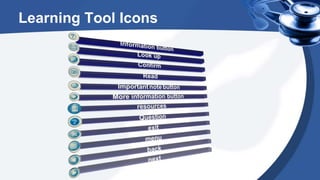
• Learning Tool Icons
Lecture’s Chapters
• Chapter IV – Endocrine, nutritional and
metabolic diseases
• Chapter VII – Diseases of the eye and adnexa
• Chapter VIII – Diseases of the ear and mastoid
process
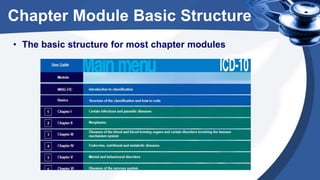
Chapter Module Basic Structure
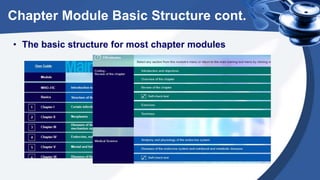
• The basic structure for most chapter modules
Chapter Module Basic Structure cont.
• The basic structure for most chapter modules
Chapter Module Basic Structure cont.
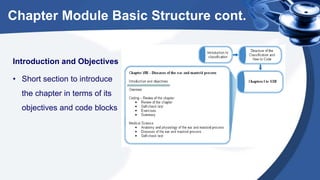
Introduction and Objectives
• Short section to introduce
the chapter in terms of its
objectives and code blocks
Chapter Module Basic Structure cont.
Overview
• Short section that display
code blocks of the chapter
and their categories
• will not teach you how to
code the diseases and
conditions covered.
Chapter Module Basic Structure cont.
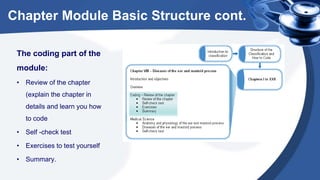
The coding part of the
module:
• Review of the chapter
(explain the chapter in
details and learn you how
to code
• Self -check test
• Exercises to test yourself
• Summary.
Chapter Module Basic Structure cont.
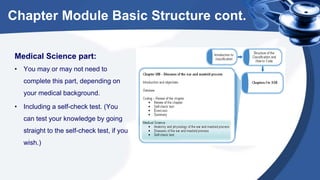
Medical Science part:
• You may or may not need to
complete this part, depending on
your medical background.
• Including a self-check test. (You
can test your knowledge by going
straight to the self-check test, if you
wish.)
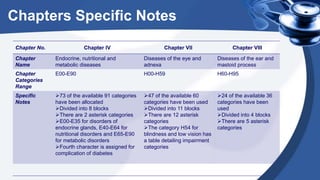
Chapters Specific Notes
Chapter No. Chapter IV Chapter VII Chapter VIII
Chapter
Name
Endocrine, nutritional and
metabolic diseases
Diseases of the eye and
adnexa
Diseases of the ear and
mastoid process
Chapter
Categories
Range
E00-E90 H00-H59 H60-H95
Specific
Notes
73 of the available 91 categories
have been allocated
Divided into 8 blocks
There are 2 asterisk categories
E00-E35 for disorders of
endocrine glands, E40-E64 for
nutritional disorders and E65-E90
for metabolic disorders
Fourth character is assigned for
complication of diabetes
47 of the available 60
categories have been used
Divided into 11 blocks
There are 12 asterisk
categories
The category H54 for
blindness and low vision has
a table detailing impairment
categories
24 of the available 36
categories have been
used
Divided into 4 blocks
There are 5 asterisk
categories
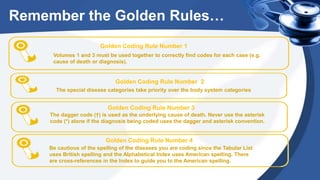
Remember the Golden Rules…
Volumes 1 and 3 must be used together to correctly find codes for each case (e.g.
cause of death or diagnosis).
Golden Coding Rule Number 1
The special disease categories take priority over the body system categories
Golden Coding Rule Number 2
Golden Coding Rule Number 3
The dagger code (†) is used as the underlying cause of death. Never use the asterisk
code (*) alone if the diagnosis being coded uses the dagger and asterisk convention.
Golden Coding Rule Number 4
Be cautious of the spelling of the diseases you are coding since the Tabular List
uses British spelling and the Alphabetical Index uses American spelling. There
are cross-references in the Index to guide you to the American spelling.
Remember the Coding Conventions
Volume 1 contains certain abbreviations, punctuations, symbols and instructional terms;
referred to as the coding conventions.
the coding conventions of the ICD-10
• Inclusion term (of unexpected codes) [within chapters, blocks and three- and four-
character rubrics level, different conditions or synonyms, not a sub-classification]
• Exclusion term (of unexpected codes) [within chapters, blocks, three- and four-character
codes level, conditions coded elsewhere]
• NOS and NEC
• Dagger and asterisk
• Other coding conventions
Remember the Coding Conventions cont.
Other coding conventions
• Parentheses ( )
– Enclose supplementary words (non essential modifier)
– Enclose code of exclusion
– Enclose 3 character code of categories in a particular block (k65-k67)
– Enclose the dagger code in asterisk category or the asterisk code in a dagger term
• Square brackets [ ]
– Enclose synonyms, alternative words or explanatory phrases e.g. leprosy [Hansen’s disease]
– Referring to note
– Referring to previously stated set of fourth character subdivision common to a number of categories
• Colon : For listing inclusion and exclusion terms when the word require one or more modifying words
• Brace } For listing inclusion and exclusion terms while the term that follow the brace should be part of diagnosis
• “And” in code title stands for and/or
• “With“ in code title stands for and
• Point dash .- (incomplete code)
Remember the Basic Coding
Guidelines
From 1 to 5 are related to Vol.3 and from 6 to 7 are related to Vol.1
1. Consult the appropriate section in Vol.3 (index) according to the type of statement to be coded (section I : for
disease, injury or other condition classifiable to chapters I-XIX or XXI) and (section II : for external cause of injury
or other event classifiable to chapter XX)
2. Locate the lead term (noun or adjective of the pathological conditions) [if you cannot identify the lead term in the
index, one of standard ways is to try using generic lead terms such as condition , disease, symptoms,….]
3. Read any note under the lead term
4. Read any terms in parentheses after the lead term (complementary words or non essential modifiers) and any
term indented under the lead term (essential modifiers)
5. Follow cross references (“see” and “see also”)
6. Refer to the Tabular List (Vol. 1) to verify the suitability of code number selected
7. Be guided by any inclusion or exclusion terms at the selected code level, chapter, block or at category level
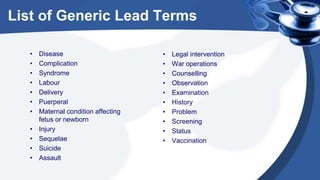
List of Generic Lead Terms
• Disease
• Complication
• Syndrome
• Labour
• Delivery
• Puerperal
• Maternal condition affecting
fetus or newborn
• Injury
• Sequelae
• Suicide
• Assault
• Legal intervention
• War operations
• Counselling
• Observation
• Examination
• History
• Problem
• Screening
• Status
• Vaccination
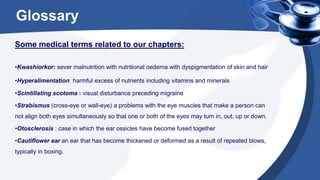
Glossary
Some medical terms related to our chapters:
•Kwashiorkor: sever malnutrition with nutritional oedema with dyspigmentation of skin and hair
•Hyperalimentation: harmful excess of nutrients including vitamins and minerals
•Scintillating scotoma : visual disturbance preceding migraine
•Strabismus (cross-eye or wall-eye) a problems with the eye muscles that make a person can
not align both eyes simultaneously so that one or both of the eyes may turn in, out, up or down.
•Otosclerosis : case in which the ear ossicles have become fused together
•Cauliflower ear an ear that has become thickened or deformed as a result of repeated blows,
typically in boxing.
Learning Tool Icons
Icd 10 course  lecture slide (ch 4,7,8)

Icd 10 course lecture slide (ch 4,7,8)

  • 2.
  • 3.
    Topics • Lecture’s Chapters •Chapter Module Basic Structure • Chapters Specific Notes • Remember…. • List of Generic Lead Terms • Glossary • Learning Tool Icons
  • 4.
    Lecture’s Chapters • ChapterIV – Endocrine, nutritional and metabolic diseases • Chapter VII – Diseases of the eye and adnexa • Chapter VIII – Diseases of the ear and mastoid process
  • 5.
    Chapter Module BasicStructure • The basic structure for most chapter modules
  • 6.
    Chapter Module BasicStructure cont. • The basic structure for most chapter modules
  • 7.
    Chapter Module BasicStructure cont. Introduction and Objectives • Short section to introduce the chapter in terms of its objectives and code blocks
  • 8.
    Chapter Module BasicStructure cont. Overview • Short section that display code blocks of the chapter and their categories • will not teach you how to code the diseases and conditions covered.
  • 9.
    Chapter Module BasicStructure cont. The coding part of the module: • Review of the chapter (explain the chapter in details and learn you how to code • Self -check test • Exercises to test yourself • Summary.
  • 10.
    Chapter Module BasicStructure cont. Medical Science part: • You may or may not need to complete this part, depending on your medical background. • Including a self-check test. (You can test your knowledge by going straight to the self-check test, if you wish.)
  • 11.
    Chapters Specific Notes ChapterNo. Chapter IV Chapter VII Chapter VIII Chapter Name Endocrine, nutritional and metabolic diseases Diseases of the eye and adnexa Diseases of the ear and mastoid process Chapter Categories Range E00-E90 H00-H59 H60-H95 Specific Notes 73 of the available 91 categories have been allocated Divided into 8 blocks There are 2 asterisk categories E00-E35 for disorders of endocrine glands, E40-E64 for nutritional disorders and E65-E90 for metabolic disorders Fourth character is assigned for complication of diabetes 47 of the available 60 categories have been used Divided into 11 blocks There are 12 asterisk categories The category H54 for blindness and low vision has a table detailing impairment categories 24 of the available 36 categories have been used Divided into 4 blocks There are 5 asterisk categories
  • 12.
    Remember the GoldenRules… Volumes 1 and 3 must be used together to correctly find codes for each case (e.g. cause of death or diagnosis). Golden Coding Rule Number 1 The special disease categories take priority over the body system categories Golden Coding Rule Number 2 Golden Coding Rule Number 3 The dagger code (†) is used as the underlying cause of death. Never use the asterisk code (*) alone if the diagnosis being coded uses the dagger and asterisk convention. Golden Coding Rule Number 4 Be cautious of the spelling of the diseases you are coding since the Tabular List uses British spelling and the Alphabetical Index uses American spelling. There are cross-references in the Index to guide you to the American spelling.
  • 13.
    Remember the CodingConventions Volume 1 contains certain abbreviations, punctuations, symbols and instructional terms; referred to as the coding conventions. the coding conventions of the ICD-10 • Inclusion term (of unexpected codes) [within chapters, blocks and three- and four- character rubrics level, different conditions or synonyms, not a sub-classification] • Exclusion term (of unexpected codes) [within chapters, blocks, three- and four-character codes level, conditions coded elsewhere] • NOS and NEC • Dagger and asterisk • Other coding conventions
  • 14.
    Remember the CodingConventions cont. Other coding conventions • Parentheses ( ) – Enclose supplementary words (non essential modifier) – Enclose code of exclusion – Enclose 3 character code of categories in a particular block (k65-k67) – Enclose the dagger code in asterisk category or the asterisk code in a dagger term • Square brackets [ ] – Enclose synonyms, alternative words or explanatory phrases e.g. leprosy [Hansen’s disease] – Referring to note – Referring to previously stated set of fourth character subdivision common to a number of categories • Colon : For listing inclusion and exclusion terms when the word require one or more modifying words • Brace } For listing inclusion and exclusion terms while the term that follow the brace should be part of diagnosis • “And” in code title stands for and/or • “With“ in code title stands for and • Point dash .- (incomplete code)
  • 15.
    Remember the BasicCoding Guidelines From 1 to 5 are related to Vol.3 and from 6 to 7 are related to Vol.1 1. Consult the appropriate section in Vol.3 (index) according to the type of statement to be coded (section I : for disease, injury or other condition classifiable to chapters I-XIX or XXI) and (section II : for external cause of injury or other event classifiable to chapter XX) 2. Locate the lead term (noun or adjective of the pathological conditions) [if you cannot identify the lead term in the index, one of standard ways is to try using generic lead terms such as condition , disease, symptoms,….] 3. Read any note under the lead term 4. Read any terms in parentheses after the lead term (complementary words or non essential modifiers) and any term indented under the lead term (essential modifiers) 5. Follow cross references (“see” and “see also”) 6. Refer to the Tabular List (Vol. 1) to verify the suitability of code number selected 7. Be guided by any inclusion or exclusion terms at the selected code level, chapter, block or at category level
  • 16.
    List of GenericLead Terms • Disease • Complication • Syndrome • Labour • Delivery • Puerperal • Maternal condition affecting fetus or newborn • Injury • Sequelae • Suicide • Assault • Legal intervention • War operations • Counselling • Observation • Examination • History • Problem • Screening • Status • Vaccination
  • 17.
    Glossary Some medical termsrelated to our chapters: •Kwashiorkor: sever malnutrition with nutritional oedema with dyspigmentation of skin and hair •Hyperalimentation: harmful excess of nutrients including vitamins and minerals •Scintillating scotoma : visual disturbance preceding migraine •Strabismus (cross-eye or wall-eye) a problems with the eye muscles that make a person can not align both eyes simultaneously so that one or both of the eyes may turn in, out, up or down. •Otosclerosis : case in which the ear ossicles have become fused together •Cauliflower ear an ear that has become thickened or deformed as a result of repeated blows, typically in boxing.
  • 18.