UNCTAD
IMO
IAPH
BY: Aditya M
CONTENTS
• INTRODUCTION
• UNCTAD
• FUNCTIONS OF UNCTAD
• ACTIVITIES
• REPORTS
• IMO-IAPH
INTRODUCTION
UNCTAD was formed in 1964 at Geneva in Switzerland as its headquarters. It is
permanent part of United Nations. It was formed when IMF, WTO , GATT were not
properly organized to handle the problem of developing country .There are around 195
countries as its members.
UNITED NATIONS CONFERENCE ON TRADE
AND DEVELOPMENT
• What is UNCTAD ?
• UNCTAD is a the principal organ of the United Nations General Assembly dealing
with trade, investment and development issues.
• It was established in the year 1964, with over 194 countries as members. It is a
permanent intergovernmental body. The headquarters situated in Geneva, Switzerland.
Current Secretary General Mukhisa Kituyi.
• The primary Objective of UNCTAD is to formulate policies relating to all aspects of
development including trade, aid, transport, finance and technology. The conference
ordinarily gets held once in four years.
FUNCTIONS
• To promote international trade with a view to accelerating economic development
• To formulate principles and policies on international trade and related problems of
economic development.
• To negotiate multinational trade agreements.
• To make proposals for putting its principles and policies into effect
BASIC PRINCIPLES
UNCTAD’S action program and priorities have been laid down in the various
recommendations adopted by the first conference in 1964. The recommendations are as
follows.
• Every country has the sovereign right freely to dispose of its natural resources.
• Economic relations between countries
• There shall be no discrimination on the basis of difference in socio – economic systems.
• Comprehend options to address macro-level development challenges
• Achieve beneficial integration into the international trading system
• Diversify economies to make them less dependent on commodities
• Limit their exposure to financial volatility and debt
• Attract investment and make it more development friendly
• Increase access to digital technologies
• Promote entrepreneurship and innovation
• Help local firms move up value chains
• Speed up the flow of goods across borders
• Protect consumers from abuse
• Curb regulations that stifle competition
• Adapt to climate change and use natural resources more effectively
MEMBERSHIP OF UNCTAD
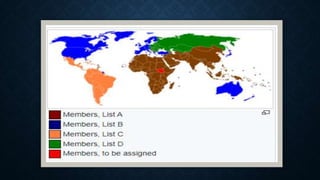
There are around 195 states in UNCTAD as current members. It includes all the
UN members along with the UN observer sates, Palestine and Holy See. The UNCTAD
members are divided in four lists. They are:
• List A : Asia, African Nations(100 member nations)
• List B : Western Europe and Other Groups(31 Members)
• List C: Latin American and Caribbean states(33 Members)
• List D: Consists of Eastern Europe Groups (24 Members)
ACTIVITIES OF UNCTAD
• Meetings:
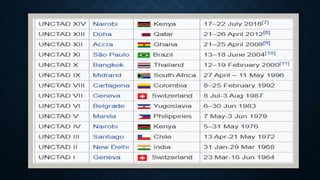
Every four years UNCTAD holds meeting. Around 14 Meetings has been held so
far. The following below shows the list of UNCTAD meetings held so far and the list of
nations where the meeting took place.
• Geneva: In 1964, The first meeting of UNCTAD was held in Geneva in Switzerland. At Geneva,
the LDCs (Least Developed Countries) were successful in their proposal for the conference with
its secretariat to become a permanent organ of the UN, with meetings every four years. In this
meeting, Raul Prebisch-a prominent Argentinian economist from the United Nations Economic
Commission on Latin America and the Caribbean (ECLA)-became the organization's first
secretary-general.
• NEW DELHI: The Second meeting was held in New Delhi India in 1968. The conference provided a
major impetus in persuading the North to follow up UNCTAD I resolutions, in establishing generalized
preferences. The target for private and official flows to LDCs was raised to 1% of the North's GNP, but
the developed countries failed to commit themselves to achieving the target by a specific date. This has
proven a continuing point of debate at UNCTAD conferences. The conference led to the International
Sugar Agreement, which seeks to stabilize world sugar prices
• SANTIAGO: The third meeting was held in Santiago in 1972. The developing countries have confronted
the rich with the need to use trade and aid measures more effectively to improve living standards in the
developing world.
• NAIROBI: The fourth meeting was held in Nairobi in 1976. UNCTAD IV showed relative success
compared to its predecessors. An Overseas Development Institute briefing paper of April 1979 highlights
one reason for success as being down to the 1973 Oil Crisis and the encouragement of LDCs to make
gains through producers of other commodities. The principal result of the conference was the adoption of
the Integrated Programme for Commodities. The programme covered the principal commodity exports
and its objectives
• MANILA : The fifth meeting of UNCTAD was held in 1979 at Manila. It focused on the key
issues of: protectionism in developing countries and the need for structural change, trade in
commodities and manufactures aid and international monetary reform, technology, shipping, and
economic co-operation among developing countries.
• BELGRADE: The sixth meeting of UNCTAD was held in 1983 at Belgrade. was held against the
background of earlier UNCTADs which have substantially failed to resolve many of the
disagreements between the developed and developing countries and of a world economy in its
worst recession since the early 1930s. The key issues of the time were finance and adjustment,
commodity price stabilization and trade.
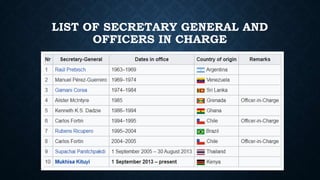
LIST OF SECRETARY GENERAL AND
OFFICERS IN CHARGE
REPORT LIST
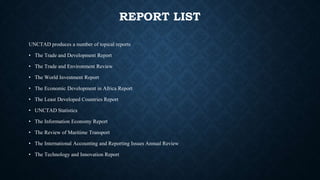
UNCTAD produces a number of topical reports
• The Trade and Development Report
• The Trade and Environment Review
• The World Investment Report
• The Economic Development in Africa Report
• The Least Developed Countries Report
• UNCTAD Statistics
• The Information Economy Report
• The Review of Maritime Transport
• The International Accounting and Reporting Issues Annual Review
• The Technology and Innovation Report
INTERNATIONAL
MARITIME
ORGANIZATION
“SAFE, SECURE AND
EFFICIENT SHIPPING
ON CLEAN OCEANS”
HISTORY OF IMO
• At the beginning of the last century that there was a need of a universal governing body that in
turn laid down rules and standards to regulate the shipping process and the industry worldwide.
Thus the International maritime organization came into being.
• The International Maritime Organization formerly known as the Inter-Governmental Maritime
Consultative Organization until 1982 is a specialised agency of the United Nations responsible
for regulating shipping.
• IMO was established in 1948 in Geneva, it was not enforced until 1959 at a meeting held in
London, its headquarters
• The first international treaty of any kind between nations can be traced back to the treaty of
‘safety of life at sea’ – SOLAS, which was adopted by a few nations, post the disaster of Titanic.
• IMO currently has 174 member states and three associate members.
PURPOSE AND FUNCTIONS OF IMO
• IMO’s main objective is to facilitate cooperation among governments on technical and legal
matters affecting international shipping to achieve highest levels of international standards for
maritime safety, maritime security and protection of the marine environment.
• Its main role is to create a regulatory framework for the shipping industry that is fair and
effective, universally adopted and universally implemented.
• IMO involves in legal matters including liability and compensation issues and the facilitation of
international maritime traffic.
• IMO was made responsible to ensure that all the conventions under it are kept up to date.
• Development of human resource and seafarers.
• Establishing a system for providing compensation to those who had suffered financially as a
result of pollution.
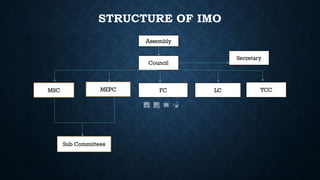
STRUCTURE OF IMO
ASSEMBLY
• Assembly is the highest governing body of IMO, it consist of all member states currently 174
members. They meet once every 2 years but may also meet up in extraordinary sessions.
Assembly is responsible for approving the work program, voting the budget, determining the
financial arrangements of the organisation. Assembly elects the council of 40 members for a term
of 2 years.
COUNCIL
• The function of council is to supervise the work of the organisation and the council performs all
the functions of the assembly except the function of making recommendations to the government
on maritime safety & pollution prevention. The council is an executive organ of IMO, it appoints
the Secretary General subject to the approval from the assembly.
CONTD….
• The council is categorised into category A,B &C.
• Category A
• Those 10 states with the largest interest in providing international shipping services comes under
this category.
• Category B
• This category includes 10 states other than category A, with the largest interest in international
seaborne trade. India at present is under this category.
• Category C
• States not elected under category A or B, which have special interest in maritime
transport/navigation & whose election to the council will ensure the representation of all major
geographic areas of the world.
COMMITTEES AND SUB COMMITTEES
• There are 5 important committees under IMO
• Maritime safety committee
• Maritime environment protection Committee
• Legal committee
• Technical Cooperation Committee
• Facilitation Committee
• Maritime Safety committee and Maritime Environmental Protection Committee are
assisted by sub committees such as:
• Human element, Training & Watch, Navigation Communication & Research & Rescue,
Pollution Prevention& Response, Ship Design & Construction, Carriage of Cargo &
Containers, Ship System & Equipment’s committees.
IMO RESOLUTIONS
• When Amendments are made by the committees & sub committees & council to a convention which
are brought about through a resolution by IMO.
Resolution to come into force
• Proposal
• Resolutions are proposed to IMO by any of the contracting Government
• Review
• It is reviewed by IMO
• Adoption
• It is first adopted by IMO
• Final Acceptance
• The members states accept this resolution
• After the member states has accepted it a date is fixed from the time of acceptance when the resolution
is supposed to come in to force.
IMO’S STRATEGY FOR REDUCING SHIPPING
EMISSIONS
• Year after year Industries are becoming Greener and energy efficient. Energy efficient
means less fuel consumption which in turn helps to reduce harmful emissions.
• IMO is leading a European Union funded project designed to help shipping industry to move
into a new era of low carbon operations. This project is believed to help shipping to become
greener and environment friendly.
• Under Global Maritime Technology Cooperation Centers' Network (GMN) project a global
network of 5 maritime technology cooperation centers have been established acting as
centers of excellence for their regions.
• Maritime Technology Cooperation Centre(MTCC) designs a bunch of programs all designed
to promote energy efficient technologies and operations. Developing countries, least
developed countries, small islands will be main beneficiaries. Studies indicates that ships
energy use and co2 emissions can be reduced up to 75%. Their main amin is to reduce
green house gases and improve the air quality of the environment.
• GMN is trying their best to improve the energy efficiency in the maritime sector and help to
navigate shipping into a low carbon future. Use of renewable energy can help the shipping
industry to reduce carbon emissions.
INTERNATIONAL ASSOCIATION OF PORTS
AND HARBOURS
HISTORY
• On November 7th 1955, some 100 delegates from 38 ports and maritime organizations
in 14 countries gathered in Los Angeles to announce the creation of the International
Association of Ports and Harbors (IAPH).
• It marked its 50th Anniversary (Golden Jubilee) in 2005. Over the past six decades,
IAPH has steadily developed into a global alliance of ports, representing today some
180 ports and some 140 port-related businesses in 90 countries.
• The member ports together handle well over 60% of the world’s sea-borne trade and
nearly 80% of the world container traffic. It is a non-profit-making and non-governmental
organization (NGO) headquartered in Tokyo, Japan.
• IAPH comprises some 200 Regular Members – leading ports in 90 countries, who are
public port authorities, private port operators, government agencies responsible for
ports.
• Surveys conducted in the past years show that, combining all IAPH member ports, they
handle over 60% of the world sea-borne trade in metric ton and over 80% of world
container traffic in TEU.
• In addition, nearly
• 150 shipping, stevedoring and warehousing businesses, national and regional port
associations, port research and training institutes, and manufacturers of port-related
products are represented as Associate members
• The Secretariat is based in Tokyo and is headed by a Secretary General who is
appointed by the Board of Directors
• The current Secretary General of IAPH is Dr. Masahiko Furuichi who along with Dr.
Patrick Verhoeven, Managing Director ‐ Policy and Strategy handles the day-to-day
operations Under the direction and supervision of the President
VISION & MISSION
• The International Association of Ports and Harbors (IAPH) adopted the new IAPH Vision
and Mission Statements as well as the Objectives to achieve the Mission at its Mid-term
Conference and Board Meeting, 22 May 2012, Jerusalem, Israel.
• New IAPH VISION Statement:
The Global Ports’ Forum For Industry Collaboration and Excellence.
• New IAPH MISSION Statement:
Promoting the interest of ports worldwide through strong member relationships,
collaboration and information-sharing that help resolve common issues, advance
sustainable practices and continually improve how ports serve the maritime industries.
OBJECTIVES TO ACHIEVE THE MISSION
•Strengthen relationships among the member ports by facilitating interaction, dialogue, problem-
solving and formulation of best practices.
•Leverage member expertise through strong technical committees and programs that create
platforms focused on resolving complex port and maritime industry concerns and building greater
efficiency and sustainability for ports worldwide.
•Promote and demonstrate IAPH members’ leadership and commitment to a cleaner, safer and
more environmentally sustainable industry for the benefit of the global community.
•Proactively coordinate with other international maritime and related organizations (such as IMO,
UNCTAD, WCO, PIANC, etc.) and advocate for global solutions to issues that impact IAPH
members.
Thank You

PowerPoint ppt on UNCTAD, IMO, IAPH

  • 1.
  • 2.
    CONTENTS • INTRODUCTION • UNCTAD •FUNCTIONS OF UNCTAD • ACTIVITIES • REPORTS • IMO-IAPH
  • 3.
    INTRODUCTION UNCTAD was formedin 1964 at Geneva in Switzerland as its headquarters. It is permanent part of United Nations. It was formed when IMF, WTO , GATT were not properly organized to handle the problem of developing country .There are around 195 countries as its members.
  • 4.
    UNITED NATIONS CONFERENCEON TRADE AND DEVELOPMENT • What is UNCTAD ? • UNCTAD is a the principal organ of the United Nations General Assembly dealing with trade, investment and development issues. • It was established in the year 1964, with over 194 countries as members. It is a permanent intergovernmental body. The headquarters situated in Geneva, Switzerland. Current Secretary General Mukhisa Kituyi. • The primary Objective of UNCTAD is to formulate policies relating to all aspects of development including trade, aid, transport, finance and technology. The conference ordinarily gets held once in four years.
  • 5.
    FUNCTIONS • To promoteinternational trade with a view to accelerating economic development • To formulate principles and policies on international trade and related problems of economic development. • To negotiate multinational trade agreements. • To make proposals for putting its principles and policies into effect
  • 6.
    BASIC PRINCIPLES UNCTAD’S actionprogram and priorities have been laid down in the various recommendations adopted by the first conference in 1964. The recommendations are as follows. • Every country has the sovereign right freely to dispose of its natural resources. • Economic relations between countries • There shall be no discrimination on the basis of difference in socio – economic systems.
  • 7.
    • Comprehend optionsto address macro-level development challenges • Achieve beneficial integration into the international trading system • Diversify economies to make them less dependent on commodities • Limit their exposure to financial volatility and debt • Attract investment and make it more development friendly • Increase access to digital technologies • Promote entrepreneurship and innovation • Help local firms move up value chains • Speed up the flow of goods across borders • Protect consumers from abuse • Curb regulations that stifle competition • Adapt to climate change and use natural resources more effectively
  • 8.
    MEMBERSHIP OF UNCTAD Thereare around 195 states in UNCTAD as current members. It includes all the UN members along with the UN observer sates, Palestine and Holy See. The UNCTAD members are divided in four lists. They are: • List A : Asia, African Nations(100 member nations) • List B : Western Europe and Other Groups(31 Members) • List C: Latin American and Caribbean states(33 Members) • List D: Consists of Eastern Europe Groups (24 Members)
  • 10.
    ACTIVITIES OF UNCTAD •Meetings: Every four years UNCTAD holds meeting. Around 14 Meetings has been held so far. The following below shows the list of UNCTAD meetings held so far and the list of nations where the meeting took place. • Geneva: In 1964, The first meeting of UNCTAD was held in Geneva in Switzerland. At Geneva, the LDCs (Least Developed Countries) were successful in their proposal for the conference with its secretariat to become a permanent organ of the UN, with meetings every four years. In this meeting, Raul Prebisch-a prominent Argentinian economist from the United Nations Economic Commission on Latin America and the Caribbean (ECLA)-became the organization's first secretary-general.
  • 11.
    • NEW DELHI:The Second meeting was held in New Delhi India in 1968. The conference provided a major impetus in persuading the North to follow up UNCTAD I resolutions, in establishing generalized preferences. The target for private and official flows to LDCs was raised to 1% of the North's GNP, but the developed countries failed to commit themselves to achieving the target by a specific date. This has proven a continuing point of debate at UNCTAD conferences. The conference led to the International Sugar Agreement, which seeks to stabilize world sugar prices • SANTIAGO: The third meeting was held in Santiago in 1972. The developing countries have confronted the rich with the need to use trade and aid measures more effectively to improve living standards in the developing world. • NAIROBI: The fourth meeting was held in Nairobi in 1976. UNCTAD IV showed relative success compared to its predecessors. An Overseas Development Institute briefing paper of April 1979 highlights one reason for success as being down to the 1973 Oil Crisis and the encouragement of LDCs to make gains through producers of other commodities. The principal result of the conference was the adoption of the Integrated Programme for Commodities. The programme covered the principal commodity exports and its objectives
  • 12.
    • MANILA :The fifth meeting of UNCTAD was held in 1979 at Manila. It focused on the key issues of: protectionism in developing countries and the need for structural change, trade in commodities and manufactures aid and international monetary reform, technology, shipping, and economic co-operation among developing countries. • BELGRADE: The sixth meeting of UNCTAD was held in 1983 at Belgrade. was held against the background of earlier UNCTADs which have substantially failed to resolve many of the disagreements between the developed and developing countries and of a world economy in its worst recession since the early 1930s. The key issues of the time were finance and adjustment, commodity price stabilization and trade.
  • 14.
    LIST OF SECRETARYGENERAL AND OFFICERS IN CHARGE
  • 15.
    REPORT LIST UNCTAD producesa number of topical reports • The Trade and Development Report • The Trade and Environment Review • The World Investment Report • The Economic Development in Africa Report • The Least Developed Countries Report • UNCTAD Statistics • The Information Economy Report • The Review of Maritime Transport • The International Accounting and Reporting Issues Annual Review • The Technology and Innovation Report
  • 16.
  • 17.
    HISTORY OF IMO •At the beginning of the last century that there was a need of a universal governing body that in turn laid down rules and standards to regulate the shipping process and the industry worldwide. Thus the International maritime organization came into being. • The International Maritime Organization formerly known as the Inter-Governmental Maritime Consultative Organization until 1982 is a specialised agency of the United Nations responsible for regulating shipping. • IMO was established in 1948 in Geneva, it was not enforced until 1959 at a meeting held in London, its headquarters • The first international treaty of any kind between nations can be traced back to the treaty of ‘safety of life at sea’ – SOLAS, which was adopted by a few nations, post the disaster of Titanic. • IMO currently has 174 member states and three associate members.
  • 18.
    PURPOSE AND FUNCTIONSOF IMO • IMO’s main objective is to facilitate cooperation among governments on technical and legal matters affecting international shipping to achieve highest levels of international standards for maritime safety, maritime security and protection of the marine environment. • Its main role is to create a regulatory framework for the shipping industry that is fair and effective, universally adopted and universally implemented. • IMO involves in legal matters including liability and compensation issues and the facilitation of international maritime traffic. • IMO was made responsible to ensure that all the conventions under it are kept up to date. • Development of human resource and seafarers. • Establishing a system for providing compensation to those who had suffered financially as a result of pollution.
  • 19.
  • 20.
    ASSEMBLY • Assembly isthe highest governing body of IMO, it consist of all member states currently 174 members. They meet once every 2 years but may also meet up in extraordinary sessions. Assembly is responsible for approving the work program, voting the budget, determining the financial arrangements of the organisation. Assembly elects the council of 40 members for a term of 2 years. COUNCIL • The function of council is to supervise the work of the organisation and the council performs all the functions of the assembly except the function of making recommendations to the government on maritime safety & pollution prevention. The council is an executive organ of IMO, it appoints the Secretary General subject to the approval from the assembly.
  • 21.
    CONTD…. • The councilis categorised into category A,B &C. • Category A • Those 10 states with the largest interest in providing international shipping services comes under this category. • Category B • This category includes 10 states other than category A, with the largest interest in international seaborne trade. India at present is under this category. • Category C • States not elected under category A or B, which have special interest in maritime transport/navigation & whose election to the council will ensure the representation of all major geographic areas of the world.
  • 22.
    COMMITTEES AND SUBCOMMITTEES • There are 5 important committees under IMO • Maritime safety committee • Maritime environment protection Committee • Legal committee • Technical Cooperation Committee • Facilitation Committee • Maritime Safety committee and Maritime Environmental Protection Committee are assisted by sub committees such as: • Human element, Training & Watch, Navigation Communication & Research & Rescue, Pollution Prevention& Response, Ship Design & Construction, Carriage of Cargo & Containers, Ship System & Equipment’s committees.
  • 23.
    IMO RESOLUTIONS • WhenAmendments are made by the committees & sub committees & council to a convention which are brought about through a resolution by IMO. Resolution to come into force • Proposal • Resolutions are proposed to IMO by any of the contracting Government • Review • It is reviewed by IMO • Adoption • It is first adopted by IMO • Final Acceptance • The members states accept this resolution • After the member states has accepted it a date is fixed from the time of acceptance when the resolution is supposed to come in to force.
  • 24.
    IMO’S STRATEGY FORREDUCING SHIPPING EMISSIONS • Year after year Industries are becoming Greener and energy efficient. Energy efficient means less fuel consumption which in turn helps to reduce harmful emissions. • IMO is leading a European Union funded project designed to help shipping industry to move into a new era of low carbon operations. This project is believed to help shipping to become greener and environment friendly. • Under Global Maritime Technology Cooperation Centers' Network (GMN) project a global network of 5 maritime technology cooperation centers have been established acting as centers of excellence for their regions. • Maritime Technology Cooperation Centre(MTCC) designs a bunch of programs all designed to promote energy efficient technologies and operations. Developing countries, least developed countries, small islands will be main beneficiaries. Studies indicates that ships energy use and co2 emissions can be reduced up to 75%. Their main amin is to reduce green house gases and improve the air quality of the environment. • GMN is trying their best to improve the energy efficiency in the maritime sector and help to navigate shipping into a low carbon future. Use of renewable energy can help the shipping industry to reduce carbon emissions.
  • 25.
    INTERNATIONAL ASSOCIATION OFPORTS AND HARBOURS
  • 26.
    HISTORY • On November7th 1955, some 100 delegates from 38 ports and maritime organizations in 14 countries gathered in Los Angeles to announce the creation of the International Association of Ports and Harbors (IAPH). • It marked its 50th Anniversary (Golden Jubilee) in 2005. Over the past six decades, IAPH has steadily developed into a global alliance of ports, representing today some 180 ports and some 140 port-related businesses in 90 countries. • The member ports together handle well over 60% of the world’s sea-borne trade and nearly 80% of the world container traffic. It is a non-profit-making and non-governmental organization (NGO) headquartered in Tokyo, Japan.
  • 27.
    • IAPH comprisessome 200 Regular Members – leading ports in 90 countries, who are public port authorities, private port operators, government agencies responsible for ports. • Surveys conducted in the past years show that, combining all IAPH member ports, they handle over 60% of the world sea-borne trade in metric ton and over 80% of world container traffic in TEU. • In addition, nearly • 150 shipping, stevedoring and warehousing businesses, national and regional port associations, port research and training institutes, and manufacturers of port-related products are represented as Associate members • The Secretariat is based in Tokyo and is headed by a Secretary General who is appointed by the Board of Directors • The current Secretary General of IAPH is Dr. Masahiko Furuichi who along with Dr. Patrick Verhoeven, Managing Director ‐ Policy and Strategy handles the day-to-day operations Under the direction and supervision of the President
  • 28.
    VISION & MISSION •The International Association of Ports and Harbors (IAPH) adopted the new IAPH Vision and Mission Statements as well as the Objectives to achieve the Mission at its Mid-term Conference and Board Meeting, 22 May 2012, Jerusalem, Israel. • New IAPH VISION Statement: The Global Ports’ Forum For Industry Collaboration and Excellence. • New IAPH MISSION Statement: Promoting the interest of ports worldwide through strong member relationships, collaboration and information-sharing that help resolve common issues, advance sustainable practices and continually improve how ports serve the maritime industries.
  • 29.
    OBJECTIVES TO ACHIEVETHE MISSION •Strengthen relationships among the member ports by facilitating interaction, dialogue, problem- solving and formulation of best practices. •Leverage member expertise through strong technical committees and programs that create platforms focused on resolving complex port and maritime industry concerns and building greater efficiency and sustainability for ports worldwide. •Promote and demonstrate IAPH members’ leadership and commitment to a cleaner, safer and more environmentally sustainable industry for the benefit of the global community. •Proactively coordinate with other international maritime and related organizations (such as IMO, UNCTAD, WCO, PIANC, etc.) and advocate for global solutions to issues that impact IAPH members.
  • 30.