International Business
Unit - I
Unit I
I. Introduction: Meaning, Nature and Scope of
International Management,
I. Driving and Restraining Forces,
II. Domestic to Transnational Business,
III. Modes of Entry,
II. Globalization – Forces, Meaning, dimensions and
stages in Globalization
III. Characteristics and role of MNCs.
IV. International Business Environment – The economic
environment; social and cultural environment,
political, legal and regulatory environment, natural
environment, technological environment.
12/18/2018 Kartikeya Singh,SMS Varanasi
An Overview of International Business
• Industrial Revolution (1820 - 1840)
• World War I.
• World War II.
• GATT - 1945
• WTO – 1995
• IMF and World Bank
• Current WTO regime and Controversy
12/18/2018 Kartikeya Singh,SMS Varanasi
An Overview of International Business
• Charles Hills defines globalization as "The shift towards a more integrated
and interdependent world economy". Globalization has two main
components - the globalization of markets and the globalization of production.
• According to International Monetary Fund, globalization means "the growing
economic interdependence of countries worldwide through increasing
volume and variety of cross border transactions in goods and services and of
international capital flows and also through the more rapid and widespread
diffusion of technology. Interdependency and integration of individual
countries of the world is also called as globalization”. Globalization integrates
not only economies but also societies. The globalization process includes :
• Globalization of markets,
• Globalization of production,
• Globalization of technology,
• Globalization of investment.
12/18/2018 Kartikeya Singh,SMS Varanasi
I. Definition of International Business
• Exchange of Goods and Services across the national
boundary of a country is called “International Business”.
• International Business is the outcome of Globalisation and
Liberalisation, Privatization.
• International Business comprises of all commercial
transactions
private and governmental, sales, investments, logistics,
and transportation) that take place between two or more
regions, countries and nations beyond their political
boundaries.
12/18/2018 Kartikeya Singh,SMS Varanasi
I. International Business: Introduction
Features of International Business
• Flow of capital Across Countries
• Accurate and Timely Information Required
• Market Expansion
• Size of International Business
• Wider Scope
• More Potential than Domestic Markets
• Market Segmentation.
• Inter Country Comparative Cost Advantage.
12/18/2018 Kartikeya Singh,SMS Varanasi
II. Nature and Scope of International Business
• Nature:
1. It is related to business between two or more
countries
2. It may be carried out by an Individual, Group,
Organization and Government
3. It includes transfer of knowledge, skills, people,
technology, capital information and other
resources.
4. It has become massive in scale.
5. The purpose is to satisfy the customer.
12/18/2018 Kartikeya Singh,SMS Varanasi
II. Nature and Scope of International Business
• Scope:
1. Export Business
2. International Business
3. Multinational firm
4. Global firm
5. Transactional firm
6. International Finance and Investment
7. Foreign Reserve
8. Balance of payment enhancement
12/18/2018 Kartikeya Singh,SMS Varanasi
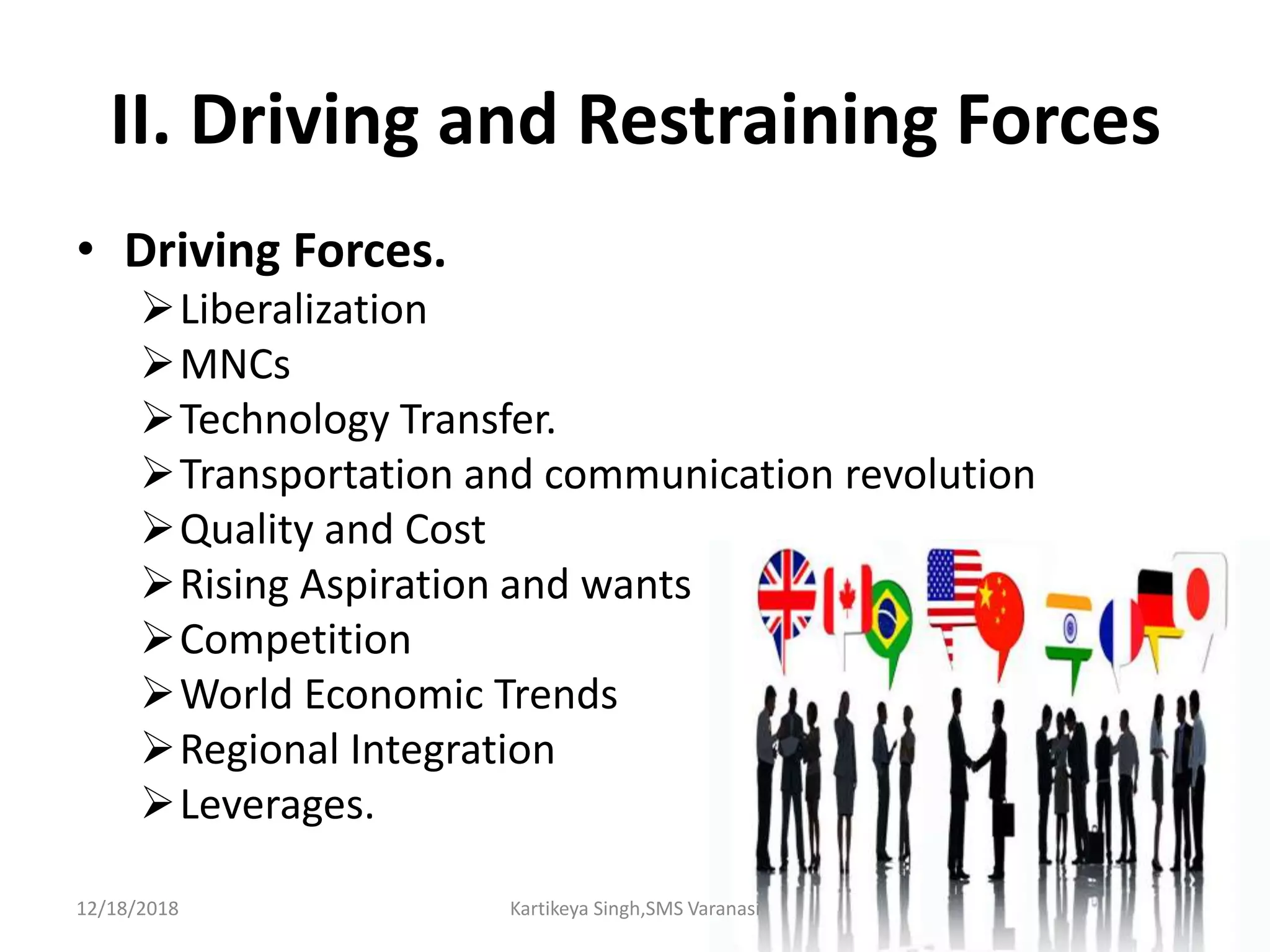
II. Driving and Restraining Forces
• Driving Forces.
Liberalization
MNCs
Technology Transfer.
Transportation and communication revolution
Quality and Cost
Rising Aspiration and wants
Competition
World Economic Trends
Regional Integration
Leverages.
12/18/2018 Kartikeya Singh,SMS Varanasi
II. Driving and Restraining Forces
• Restraining Forces :
External
Government policies
Social Development
Political Development
Internal
Management Myopia – nearsightedness
Organizational Culture
Local Orientation
12/18/2018 Kartikeya Singh,SMS Varanasi
III. Modes of Entry
• Basic Entry Decisions.
– Which foreign market to enter?
• Size of the Market
• Wealth(purchasing power)
• Legal framework
– Example of Diebold entering china and brazil market due increasing
number of middle class and low penetration of ATM
– Timing of entry.
• First Mover Advantage
• First Mover Disadvantage (Pioneering Cost)
– Example of KFC was first to start his operation in China but actual benefit
was taken by McDonald’s.
– Scale of entry and Strategic Commitments
• Example of ING a Dutch Company entering USA market
aggressively.
12/18/2018 Kartikeya Singh,SMS Varanasi
III. Modes of Entry
I. Exporting
II. Turnkey Projects
III. Licensing
IV. Franchising
V. Establishing Joint Ventures
VI. Wholly owned subsidiary
12/18/2018 Kartikeya Singh,SMS Varanasi
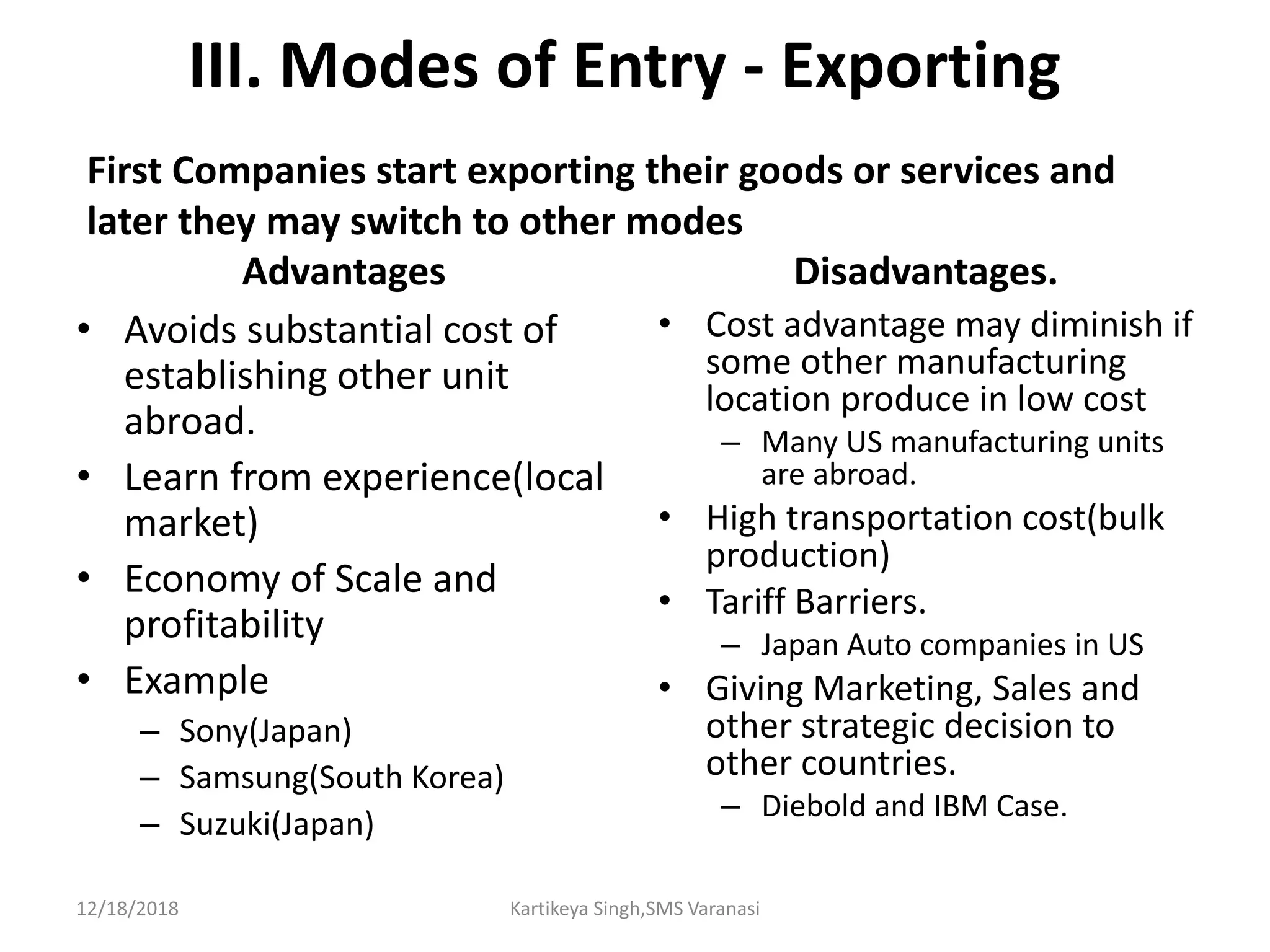
III. Modes of Entry - Exporting
Advantages
• Avoids substantial cost of
establishing other unit
abroad.
• Learn from experience(local
market)
• Economy of Scale and
profitability
• Example
– Sony(Japan)
– Samsung(South Korea)
– Suzuki(Japan)
Disadvantages.
• Cost advantage may diminish if
some other manufacturing
location produce in low cost
– Many US manufacturing units
are abroad.
• High transportation cost(bulk
production)
• Tariff Barriers.
– Japan Auto companies in US
• Giving Marketing, Sales and
other strategic decision to
other countries.
– Diebold and IBM Case.
First Companies start exporting their goods or services and
later they may switch to other modes
12/18/2018 Kartikeya Singh,SMS Varanasi
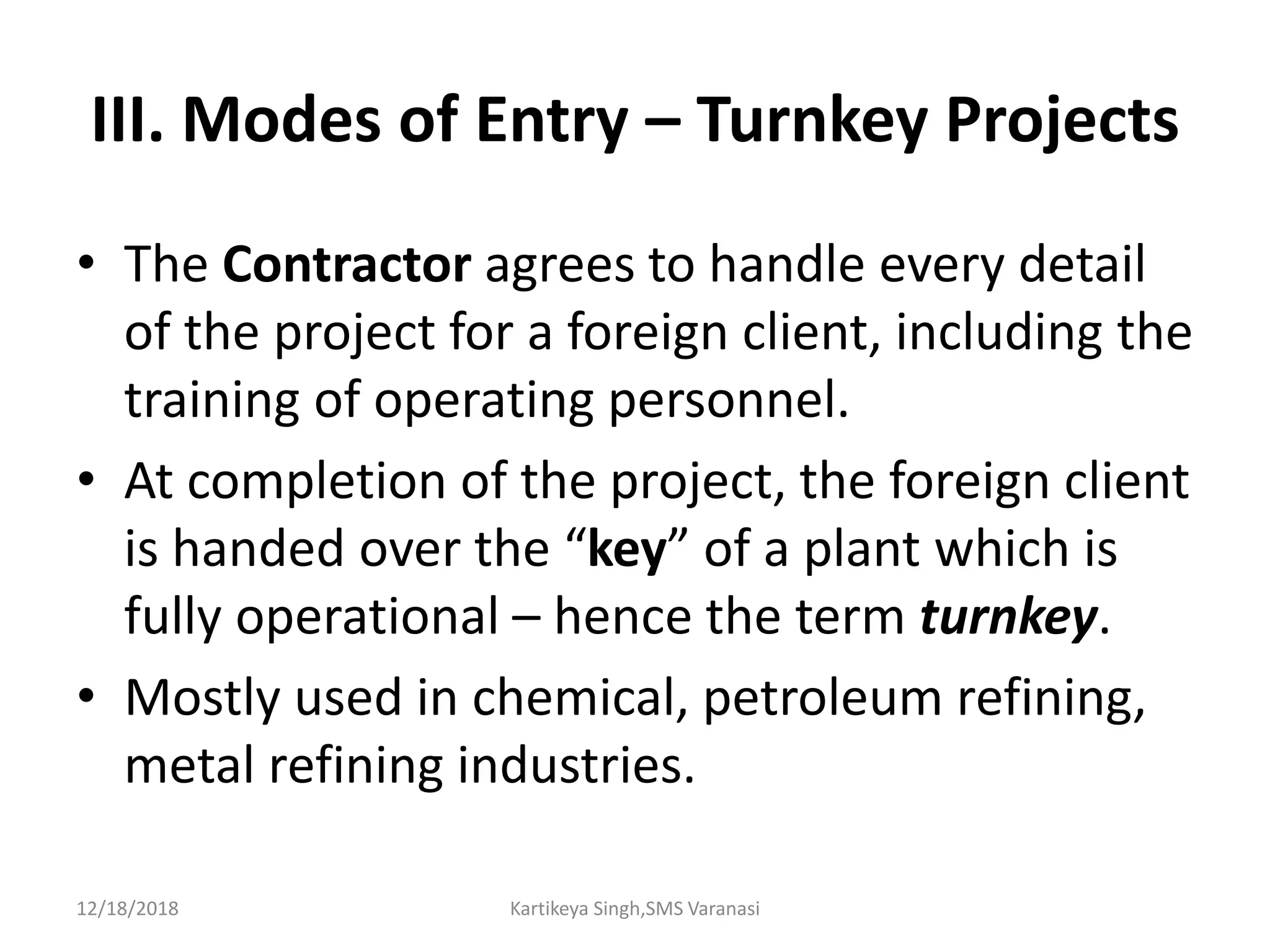
III. Modes of Entry – Turnkey Projects
• The Contractor agrees to handle every detail
of the project for a foreign client, including the
training of operating personnel.
• At completion of the project, the foreign client
is handed over the “key” of a plant which is
fully operational – hence the term turnkey.
• Mostly used in chemical, petroleum refining,
metal refining industries.
12/18/2018 Kartikeya Singh,SMS Varanasi
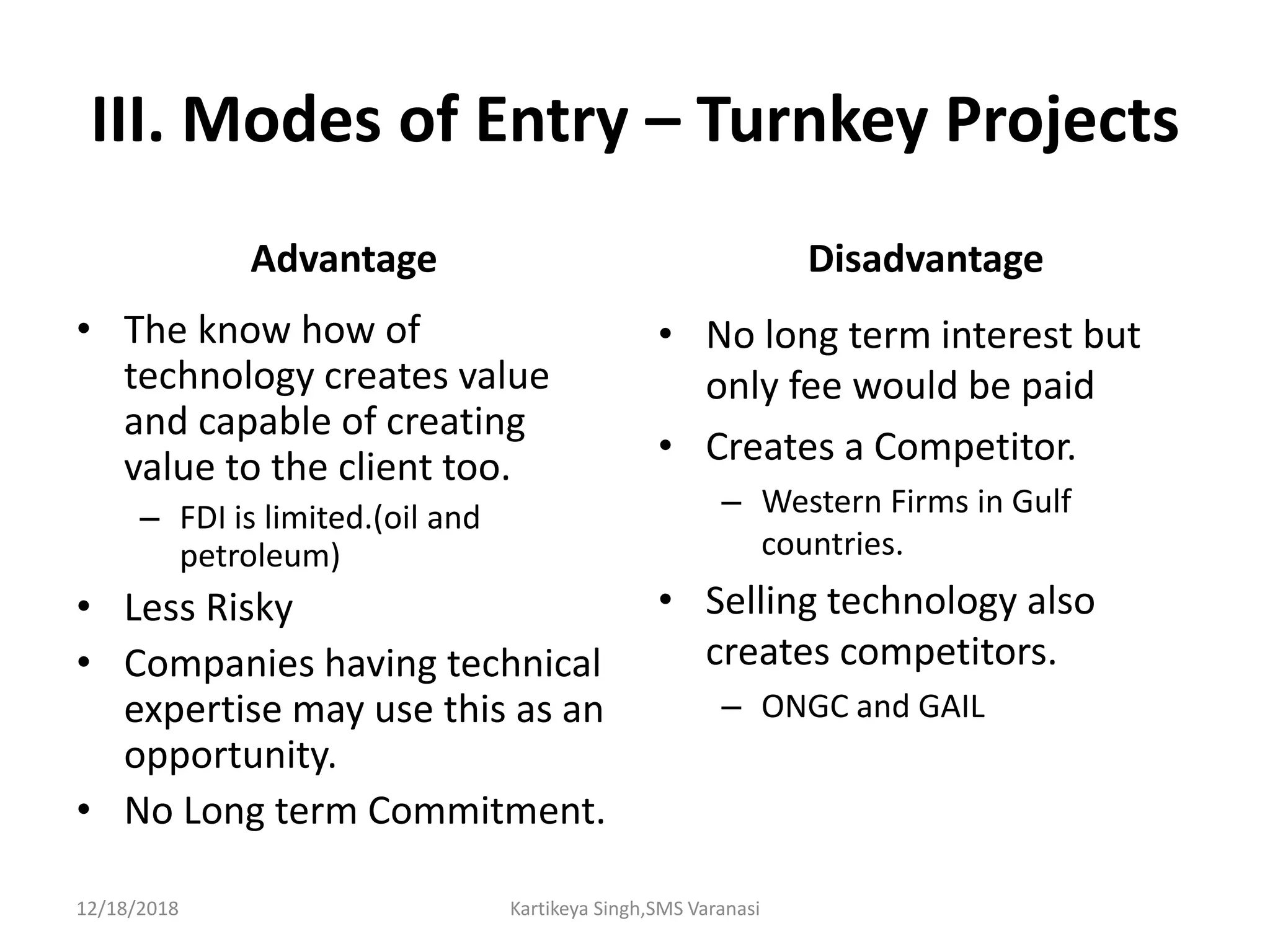
III. Modes of Entry – Turnkey Projects
Advantage
• The know how of
technology creates value
and capable of creating
value to the client too.
– FDI is limited.(oil and
petroleum)
• Less Risky
• Companies having technical
expertise may use this as an
opportunity.
• No Long term Commitment.
Disadvantage
• No long term interest but
only fee would be paid
• Creates a Competitor.
– Western Firms in Gulf
countries.
• Selling technology also
creates competitors.
– ONGC and GAIL
12/18/2018 Kartikeya Singh,SMS Varanasi
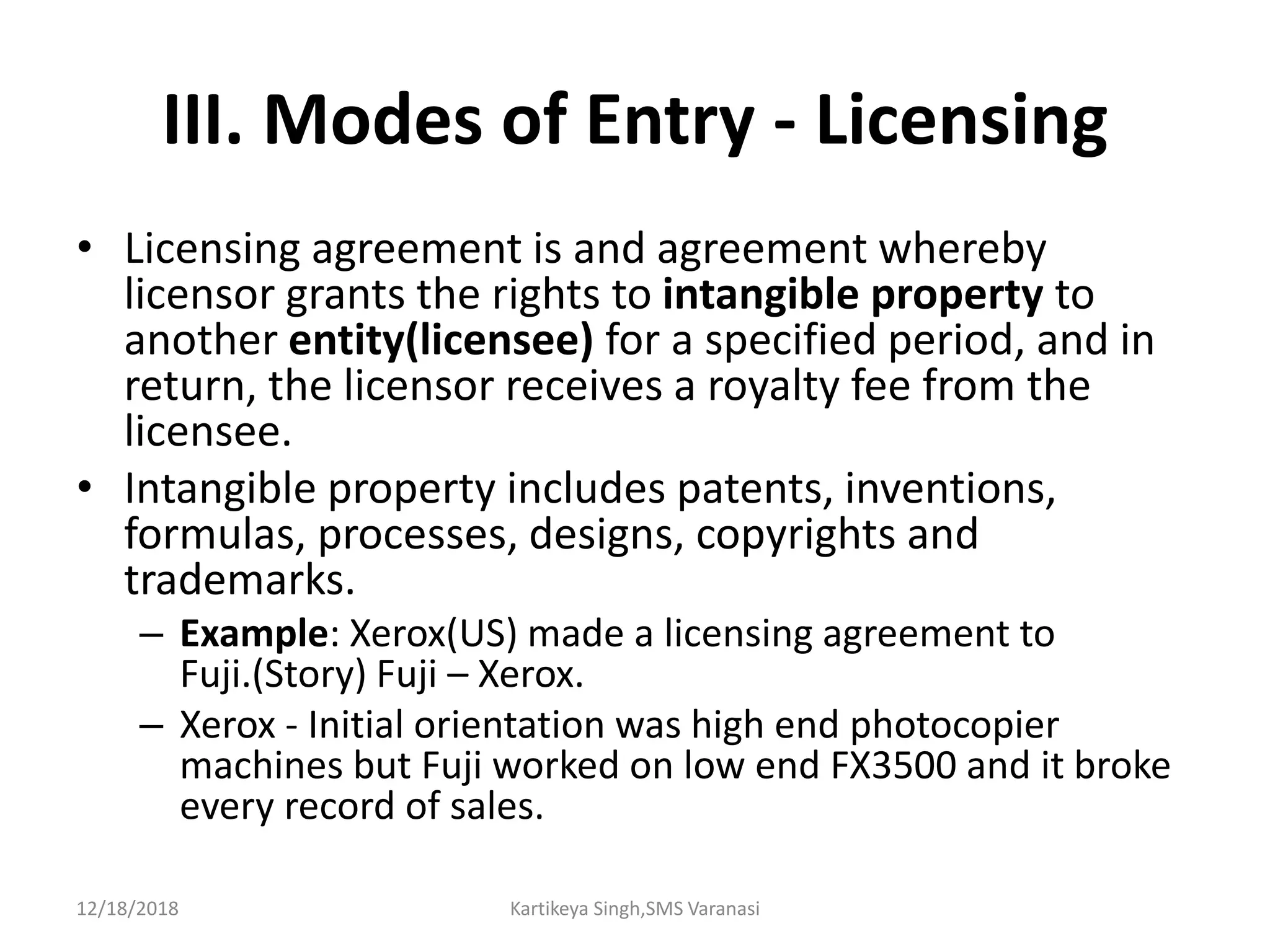
III. Modes of Entry - Licensing
• Licensing agreement is and agreement whereby
licensor grants the rights to intangible property to
another entity(licensee) for a specified period, and in
return, the licensor receives a royalty fee from the
licensee.
• Intangible property includes patents, inventions,
formulas, processes, designs, copyrights and
trademarks.
– Example: Xerox(US) made a licensing agreement to
Fuji.(Story) Fuji – Xerox.
– Xerox - Initial orientation was high end photocopier
machines but Fuji worked on low end FX3500 and it broke
every record of sales.
12/18/2018 Kartikeya Singh,SMS Varanasi
III. Modes of Entry - Licensing
Advantage
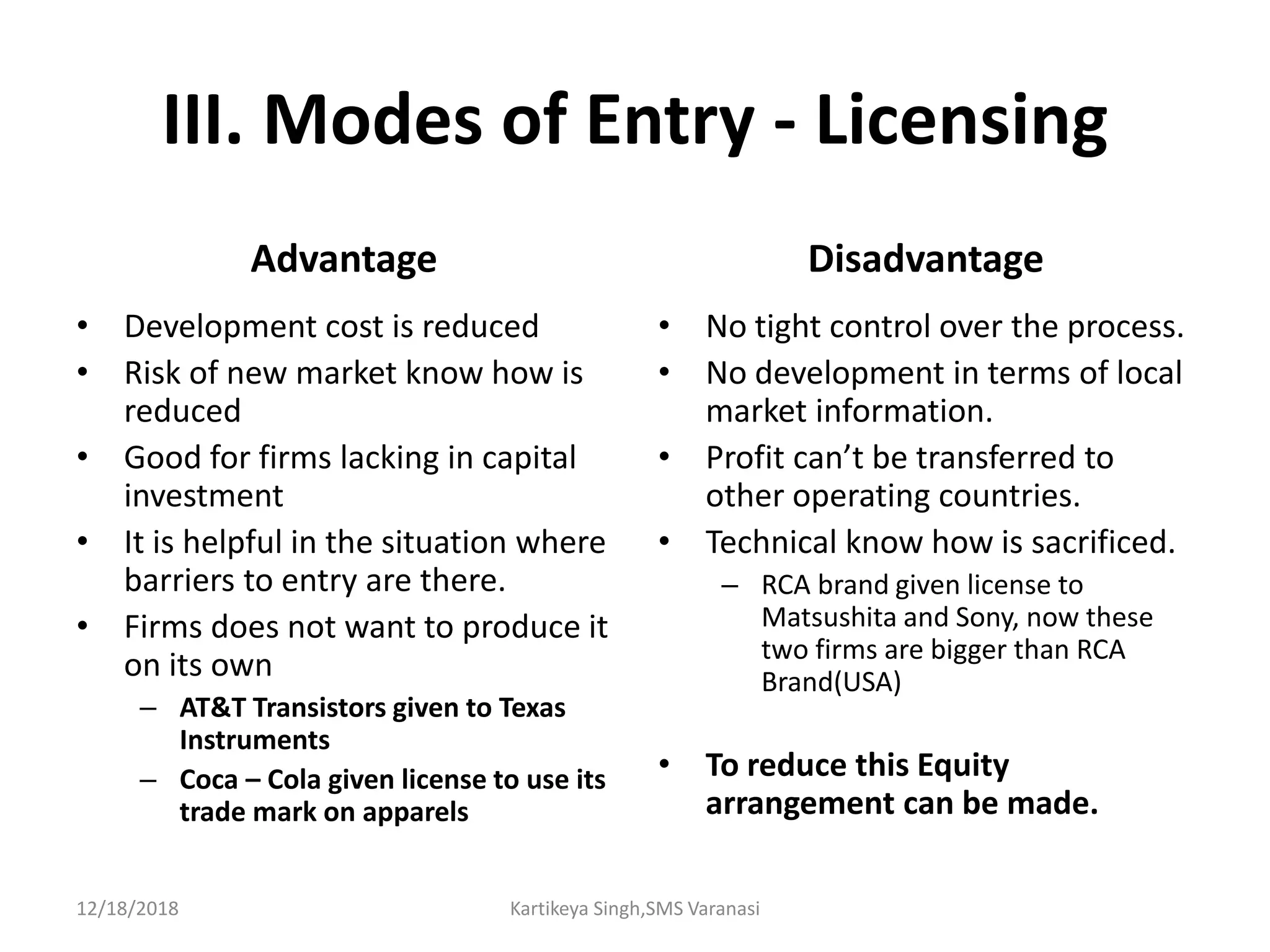
• Development cost is reduced
• Risk of new market know how is
reduced
• Good for firms lacking in capital
investment
• It is helpful in the situation where
barriers to entry are there.
• Firms does not want to produce it
on its own
– AT&T Transistors given to Texas
Instruments
– Coca – Cola given license to use its
trade mark on apparels
Disadvantage
• No tight control over the process.
• No development in terms of local
market information.
• Profit can’t be transferred to
other operating countries.
• Technical know how is sacrificed.
– RCA brand given license to
Matsushita and Sony, now these
two firms are bigger than RCA
Brand(USA)
• To reduce this Equity
arrangement can be made.
12/18/2018 Kartikeya Singh,SMS Varanasi
III. Modes of Entry - Franchising
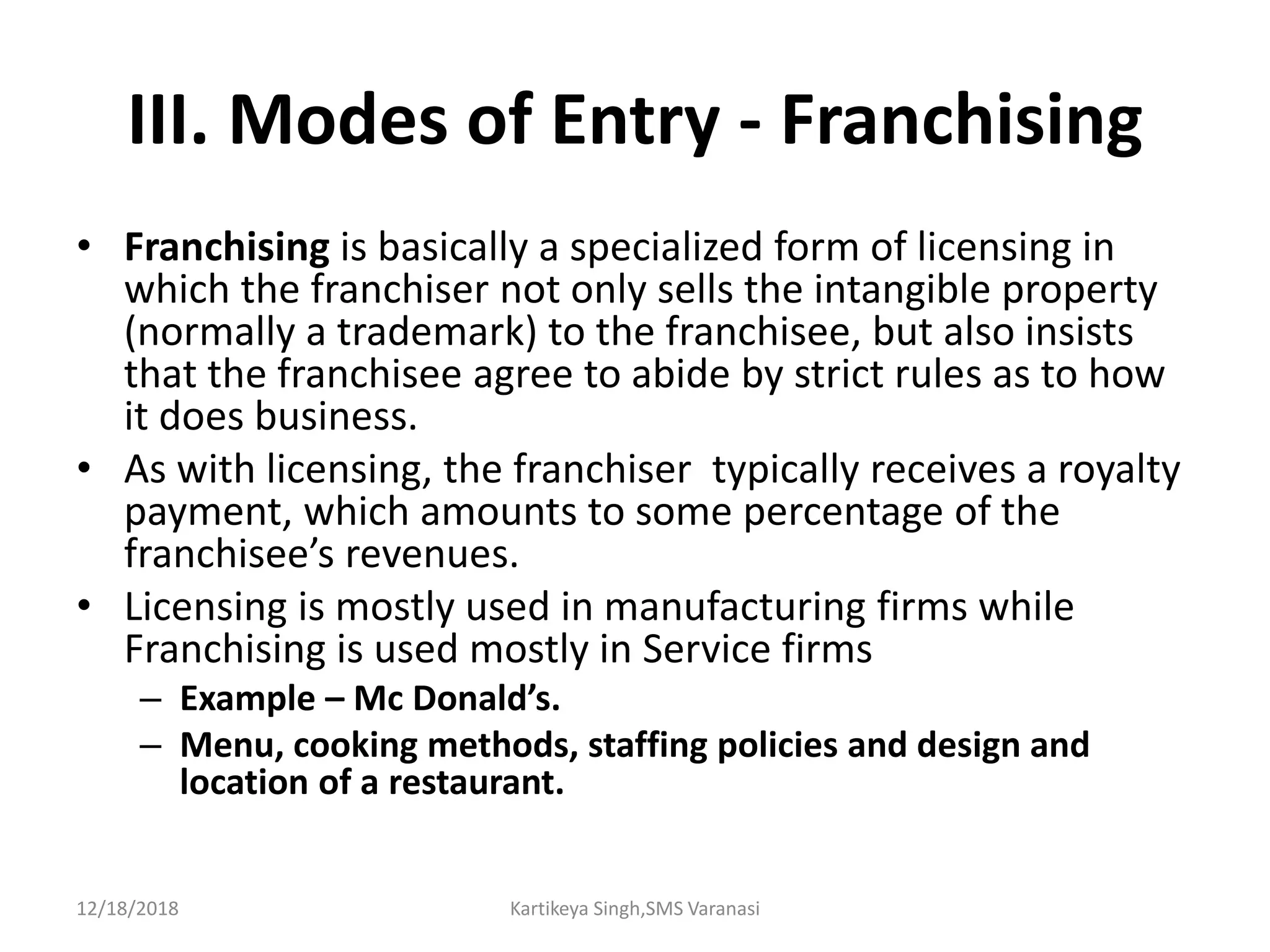
• Franchising is basically a specialized form of licensing in
which the franchiser not only sells the intangible property
(normally a trademark) to the franchisee, but also insists
that the franchisee agree to abide by strict rules as to how
it does business.
• As with licensing, the franchiser typically receives a royalty
payment, which amounts to some percentage of the
franchisee’s revenues.
• Licensing is mostly used in manufacturing firms while
Franchising is used mostly in Service firms
– Example – Mc Donald’s.
– Menu, cooking methods, staffing policies and design and
location of a restaurant.
12/18/2018 Kartikeya Singh,SMS Varanasi
III. Modes of Entry - Franchising
Advantage
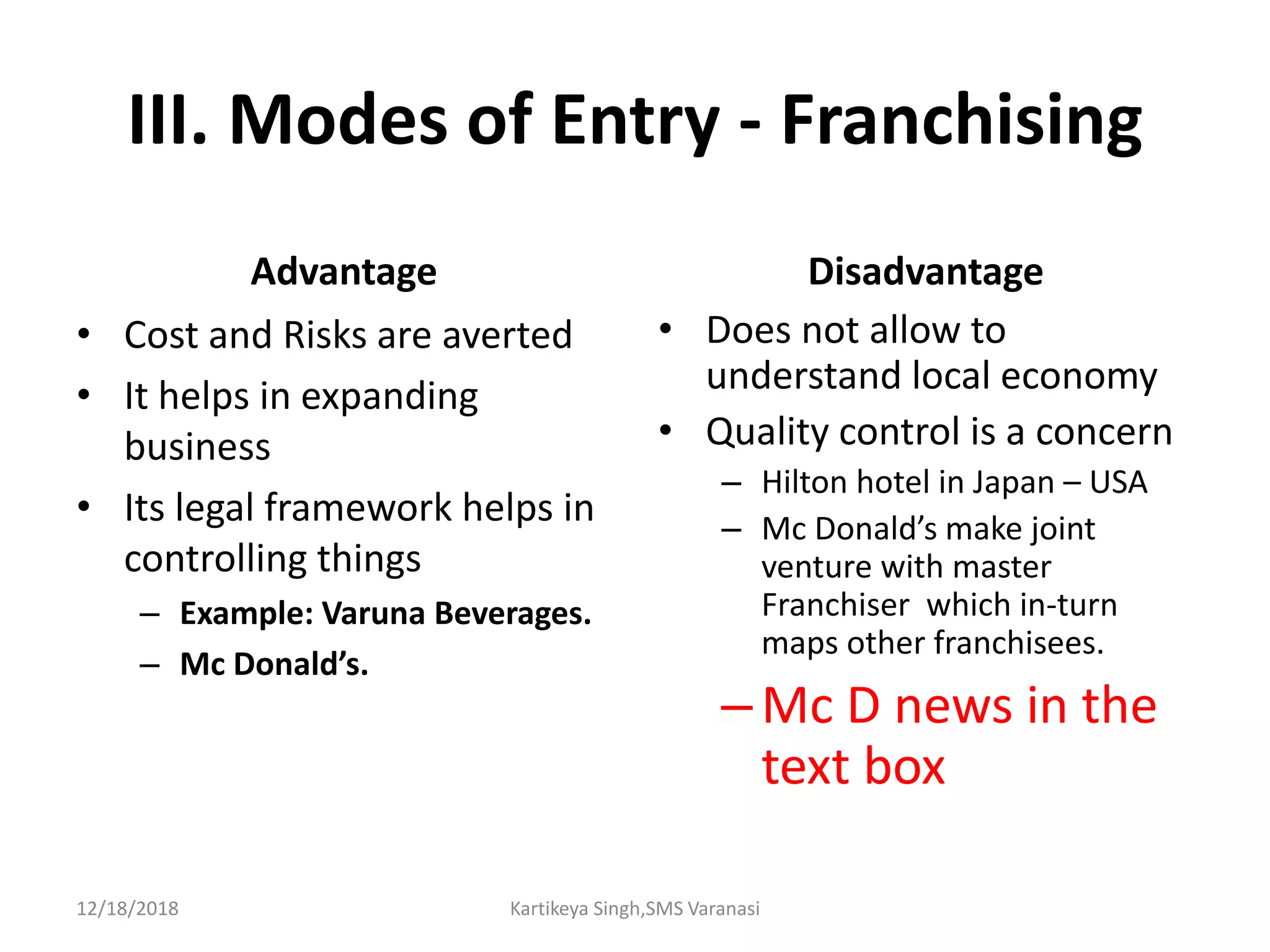
• Cost and Risks are averted
• It helps in expanding
business
• Its legal framework helps in
controlling things
– Example: Varuna Beverages.
– Mc Donald’s.
Disadvantage
• Does not allow to
understand local economy
• Quality control is a concern
– Hilton hotel in Japan – USA
– Mc Donald’s make joint
venture with master
Franchiser which in-turn
maps other franchisees.
–Mc D news in the
text box
12/18/2018 Kartikeya Singh,SMS Varanasi
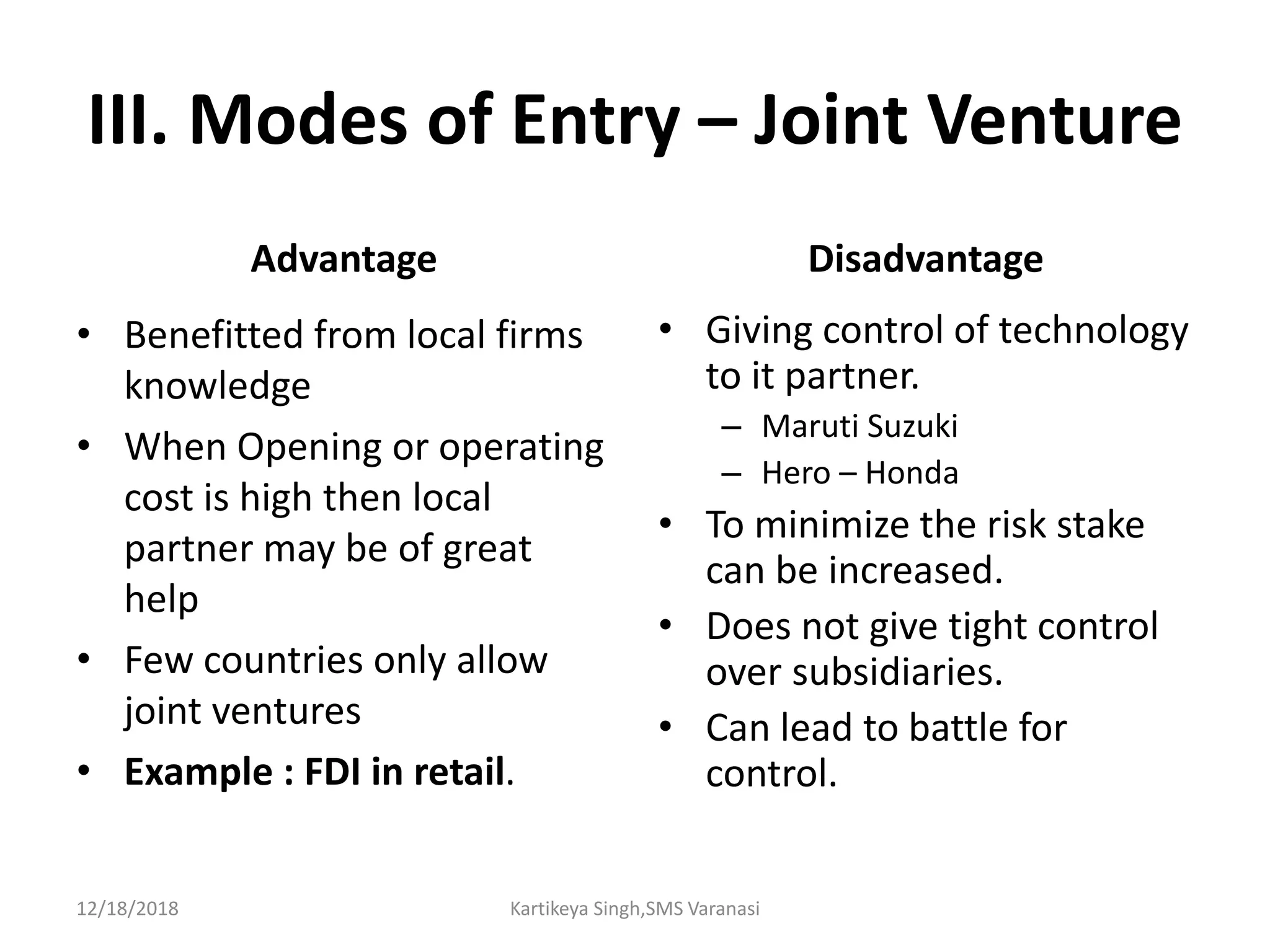
III. Modes of Entry – Joint Venture
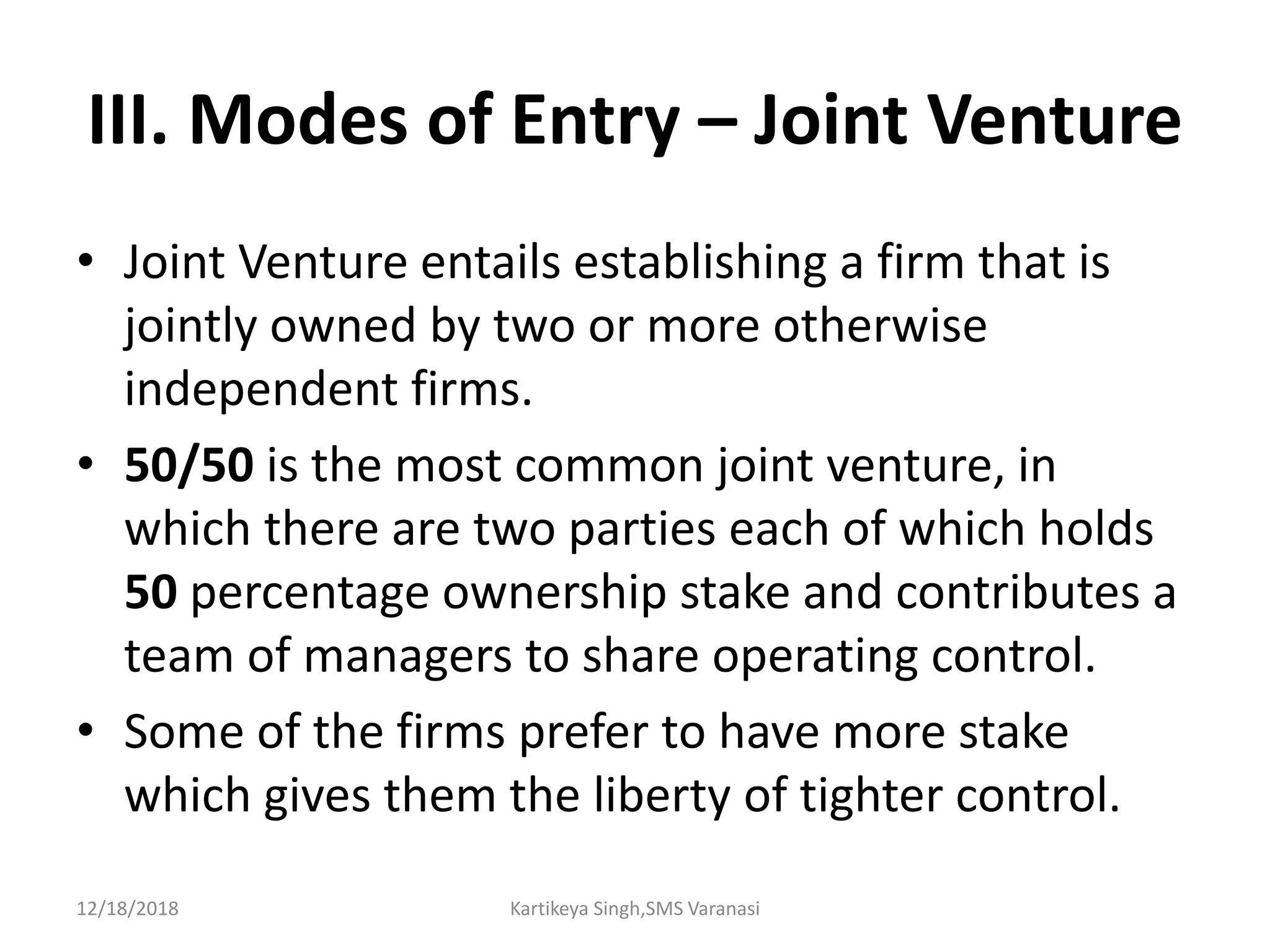
• Joint Venture entails establishing a firm that is
jointly owned by two or more otherwise
independent firms.
• 50/50 is the most common joint venture, in
which there are two parties each of which holds
50 percentage ownership stake and contributes a
team of managers to share operating control.
• Some of the firms prefer to have more stake
which gives them the liberty of tighter control.
12/18/2018 Kartikeya Singh,SMS Varanasi
III. Modes of Entry – Joint Venture
Advantage
• Benefitted from local firms
knowledge
• When Opening or operating
cost is high then local
partner may be of great
help
• Few countries only allow
joint ventures
• Example : FDI in retail.
Disadvantage
• Giving control of technology
to it partner.
– Maruti Suzuki
– Hero – Honda
• To minimize the risk stake
can be increased.
• Does not give tight control
over subsidiaries.
• Can lead to battle for
control.
12/18/2018 Kartikeya Singh,SMS Varanasi
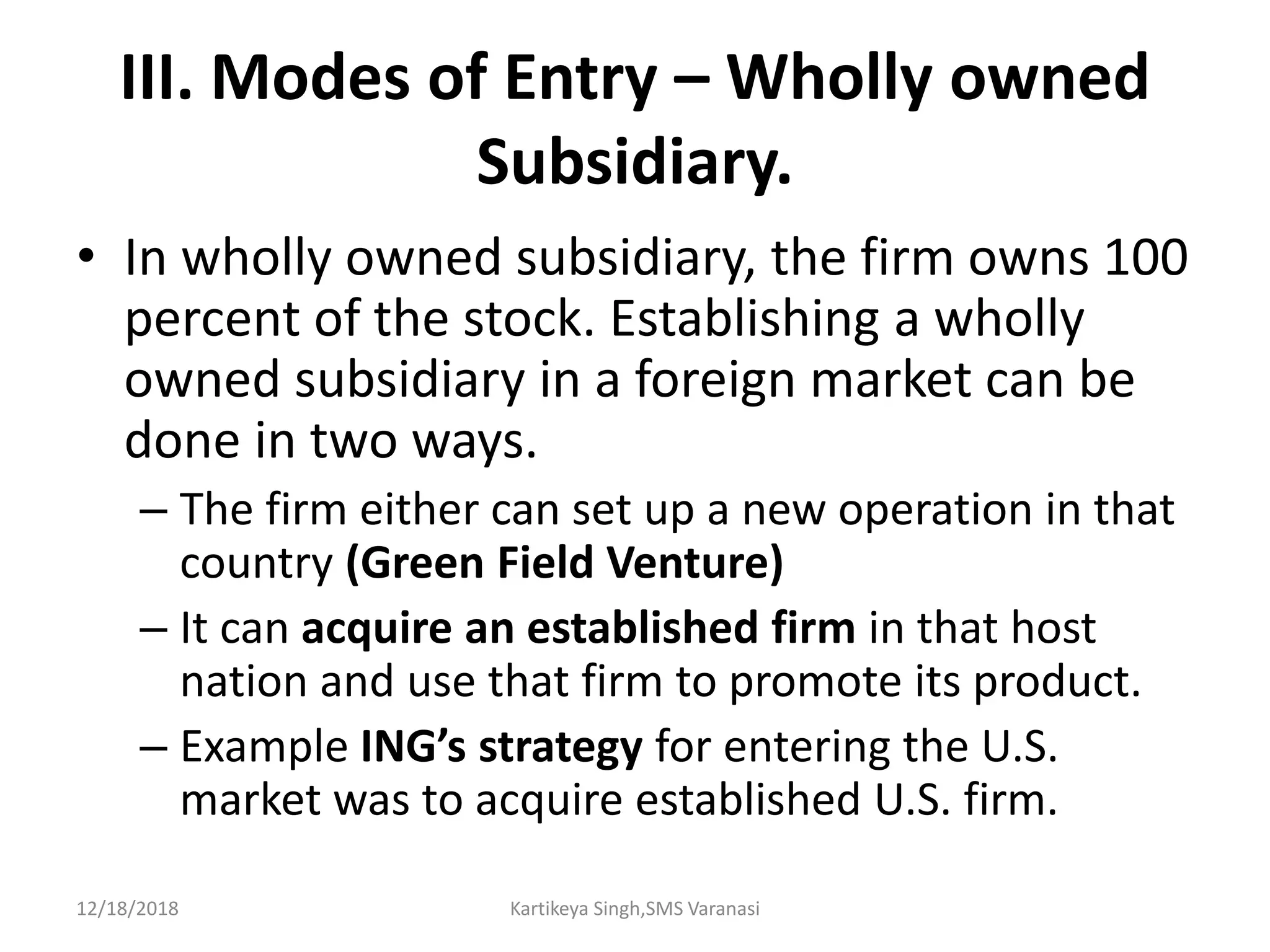
III. Modes of Entry – Wholly owned
Subsidiary.
• In wholly owned subsidiary, the firm owns 100
percent of the stock. Establishing a wholly
owned subsidiary in a foreign market can be
done in two ways.
– The firm either can set up a new operation in that
country (Green Field Venture)
– It can acquire an established firm in that host
nation and use that firm to promote its product.
– Example ING’s strategy for entering the U.S.
market was to acquire established U.S. firm.
12/18/2018 Kartikeya Singh,SMS Varanasi
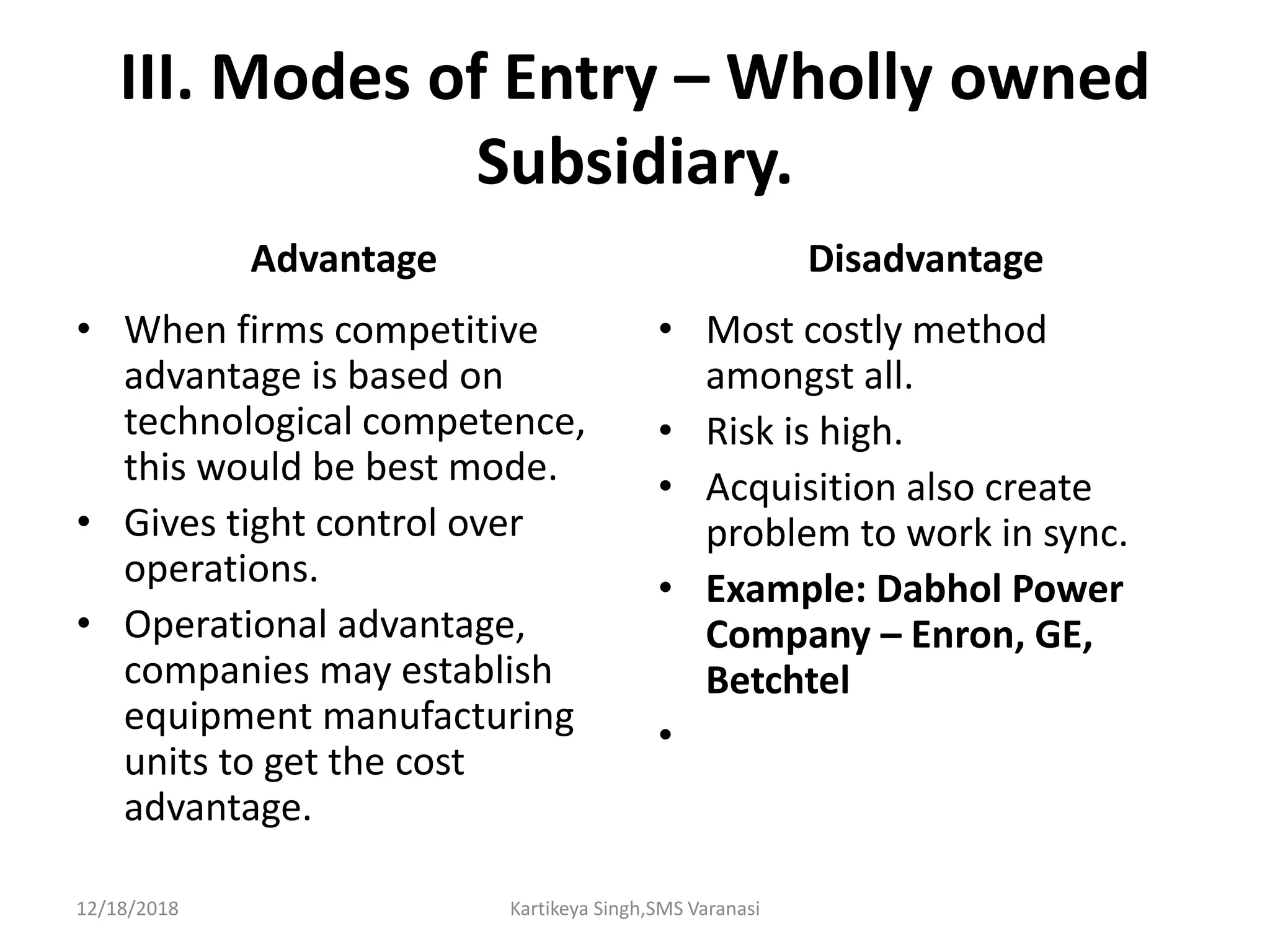
III. Modes of Entry – Wholly owned
Subsidiary.
Advantage
• When firms competitive
advantage is based on
technological competence,
this would be best mode.
• Gives tight control over
operations.
• Operational advantage,
companies may establish
equipment manufacturing
units to get the cost
advantage.
Disadvantage
• Most costly method
amongst all.
• Risk is high.
• Acquisition also create
problem to work in sync.
• Example: Dabhol Power
Company – Enron, GE,
Betchtel
•
12/18/2018 Kartikeya Singh,SMS Varanasi
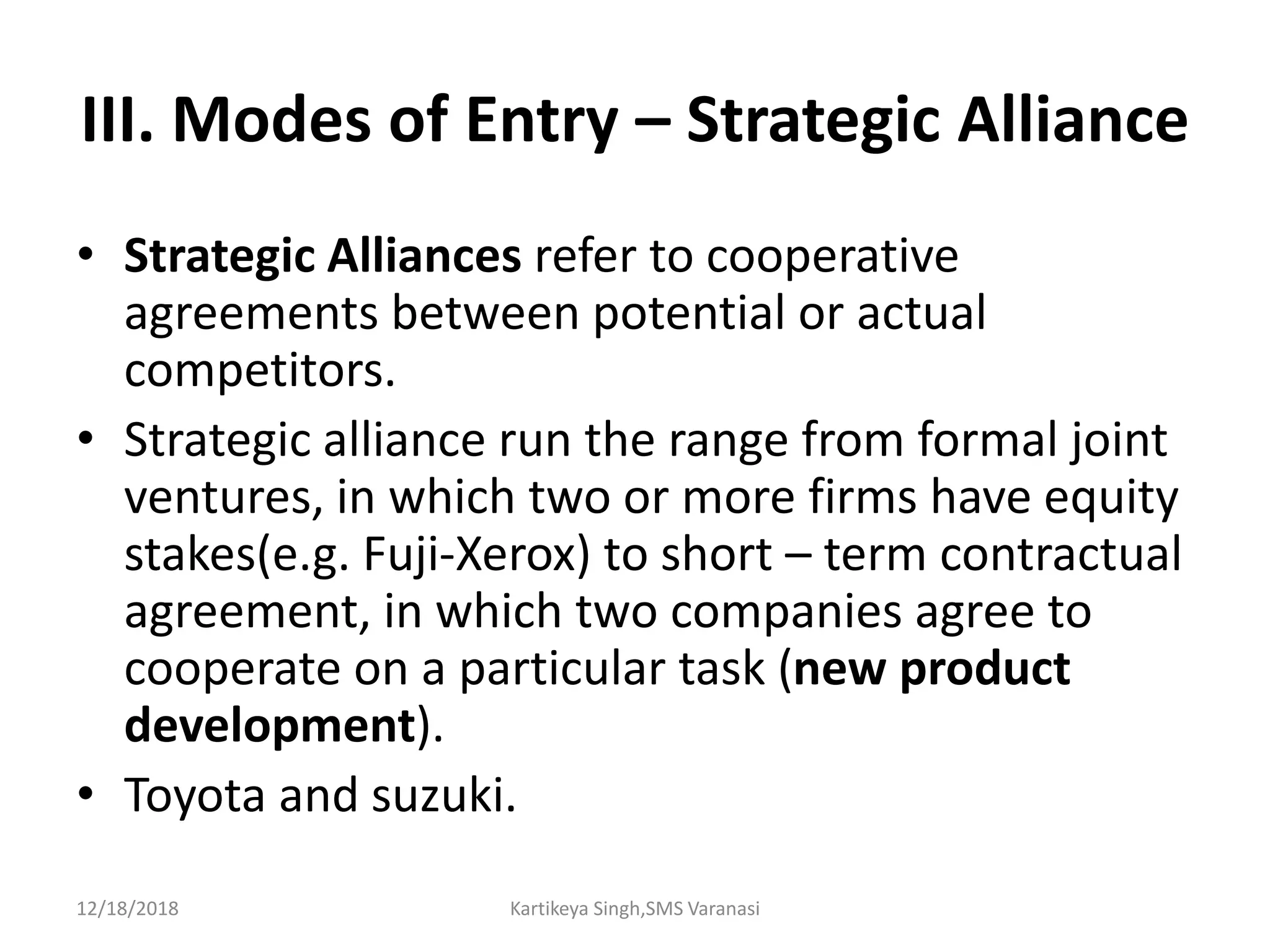
III. Modes of Entry – Strategic Alliance
• Strategic Alliances refer to cooperative
agreements between potential or actual
competitors.
• Strategic alliance run the range from formal joint
ventures, in which two or more firms have equity
stakes(e.g. Fuji-Xerox) to short – term contractual
agreement, in which two companies agree to
cooperate on a particular task (new product
development).
• Toyota and suzuki.
12/18/2018 Kartikeya Singh,SMS Varanasi
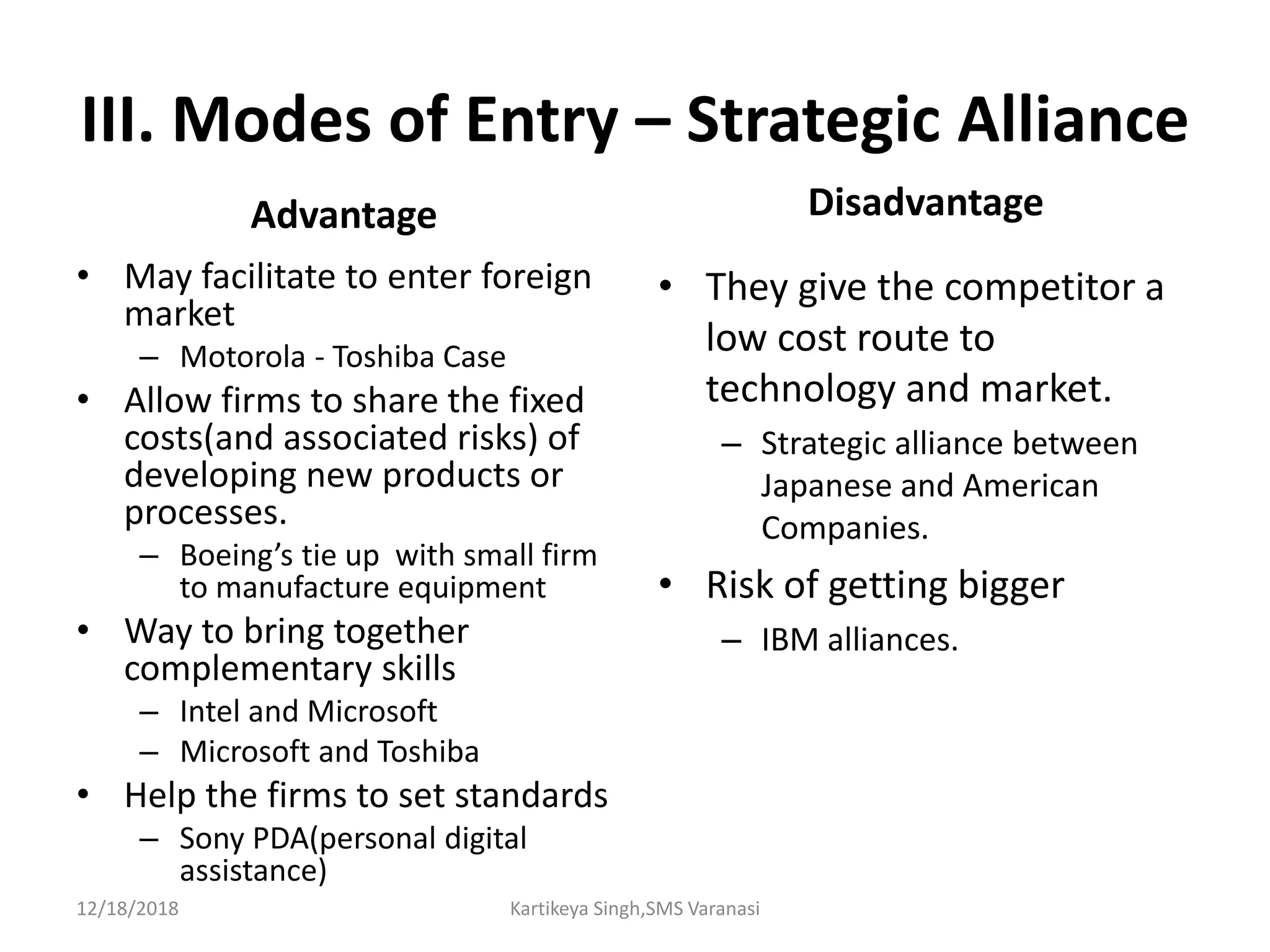
III. Modes of Entry – Strategic Alliance
Advantage
• May facilitate to enter foreign
market
– Motorola - Toshiba Case
• Allow firms to share the fixed
costs(and associated risks) of
developing new products or
processes.
– Boeing’s tie up with small firm
to manufacture equipment
• Way to bring together
complementary skills
– Intel and Microsoft
– Microsoft and Toshiba
• Help the firms to set standards
– Sony PDA(personal digital
assistance)
Disadvantage
• They give the competitor a
low cost route to
technology and market.
– Strategic alliance between
Japanese and American
Companies.
• Risk of getting bigger
– IBM alliances.
12/18/2018 Kartikeya Singh,SMS Varanasi
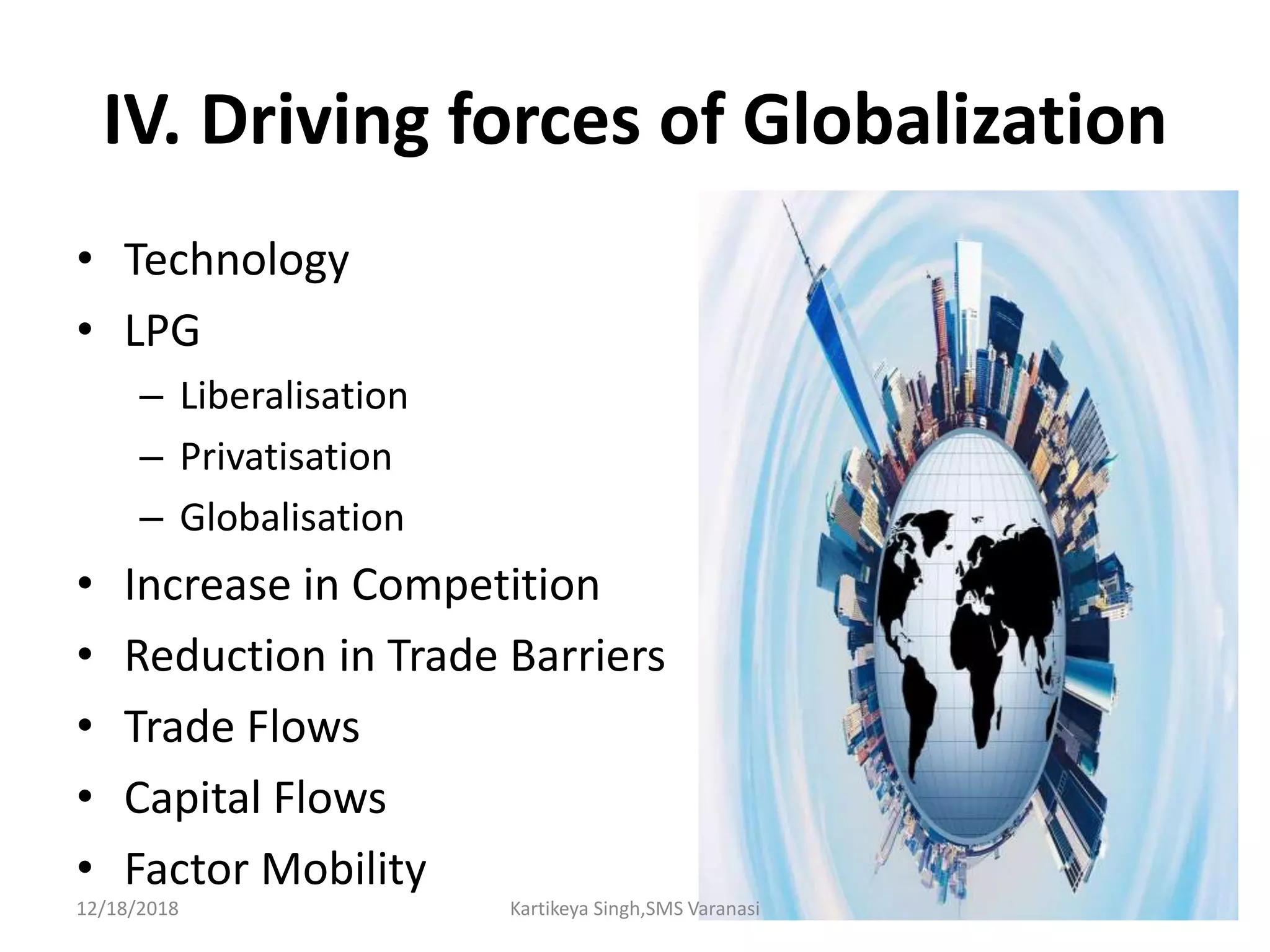
IV. Driving forces of Globalization
• Technology
• LPG
– Liberalisation
– Privatisation
– Globalisation
• Increase in Competition
• Reduction in Trade Barriers
• Trade Flows
• Capital Flows
• Factor Mobility
12/18/2018 Kartikeya Singh,SMS Varanasi
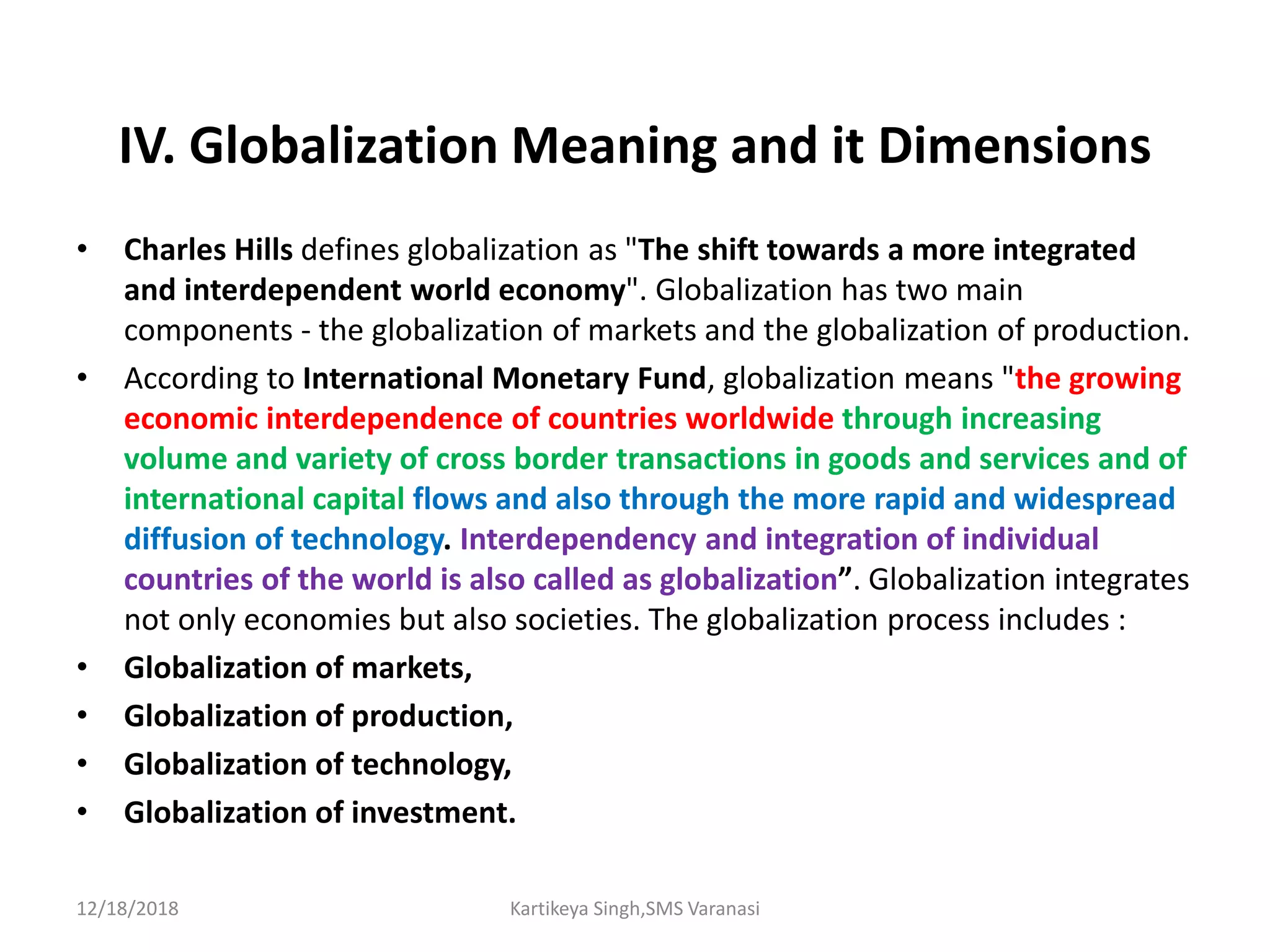
IV. Globalization Meaning and it Dimensions
• Charles Hills defines globalization as "The shift towards a more integrated
and interdependent world economy". Globalization has two main
components - the globalization of markets and the globalization of production.
• According to International Monetary Fund, globalization means "the growing
economic interdependence of countries worldwide through increasing
volume and variety of cross border transactions in goods and services and of
international capital flows and also through the more rapid and widespread
diffusion of technology. Interdependency and integration of individual
countries of the world is also called as globalization”. Globalization integrates
not only economies but also societies. The globalization process includes :
• Globalization of markets,
• Globalization of production,
• Globalization of technology,
• Globalization of investment.
12/18/2018 Kartikeya Singh,SMS Varanasi
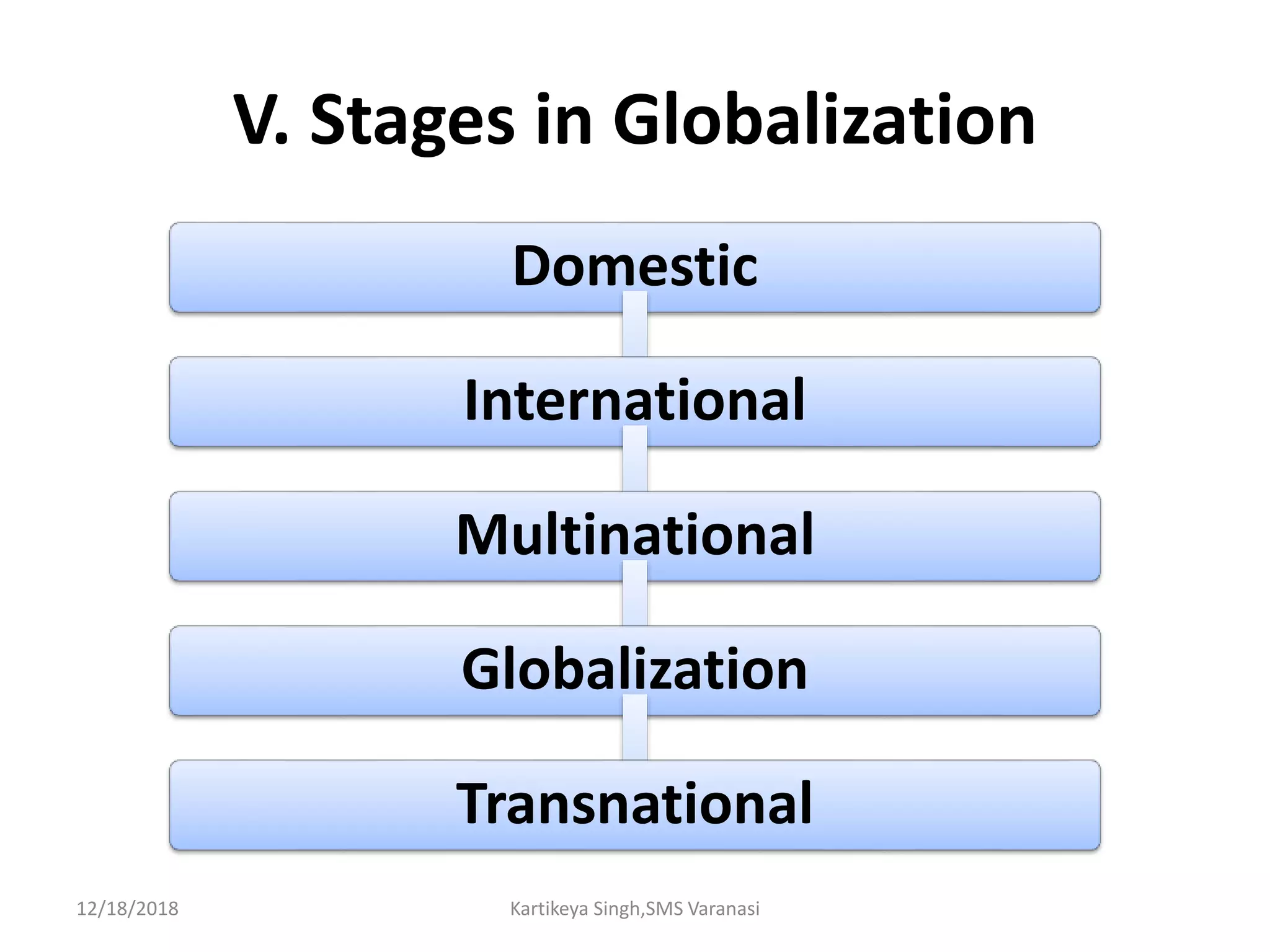
V. Stages in Globalization
Domestic
International
Multinational
Globalization
Transnational
12/18/2018 Kartikeya Singh,SMS Varanasi
V. Stages in Globalization - Domestic
• Market potential is limited to the home
country.
• Production and marketing facilities are located
at home only.
• It may add new product lines, serve new local
markets but whole planning is limited to
national markets only.
12/18/2018 Kartikeya Singh,SMS Varanasi
V. Stages in Globalization - Domestic
• Their focus remains with domestic market.
• Their productions facilities remain based in home country.
Their analysis is focused on the national market.
• They do not think globally and avoid taking risk in going
global.
• Their top management may have traditional kind of
business management competency and less global
expertise.
• They perceive that there is risk in expanding into global
market and thus they try to play safe and satisfied with
whatever gains they are getting in domestic market.
– Example : 5615 domestic companies India - 2017.
– Maharaja white line, Hind Motors.
12/18/2018 Kartikeya Singh,SMS Varanasi
V. Stages in Globalization - International
• International companies are the companies, who sell its
products in foreign countries by exporting it to those
countries and they might also be involved in various
importing activities. These companies do not have their
own establishments in foreign countries
• Investment: International companies do not have any
foreign direct investment (FDI) in the foreign countries
where they export to or import from their
products/services.
• Strategy: As these companies do not have any foreign set
up or branches, the key decision making functions is always
taken from the domestic country of the company
12/18/2018 Kartikeya Singh,SMS Varanasi
V. Stages in Globalization - International
• Products / R&D: Product development processes
are accomplished in the domestic country.
• Challenges: Legal, regulatory and customs issues
are the key bottlenecks for these companies.
Also, in cases where the taste of products in
some of the countries does not match, these
company may run the risk of failures.
• Example: Maharaja Whiteline, Dabur.
12/18/2018 Kartikeya Singh,SMS Varanasi
V. Stages in Globalization -
Multinational
• Operations & Trading: Any Company, which is
having operations and trading in two or more
countries across the globe is called as a
multinational Company. Generally, the number of
countries in this cases, would be in the medium
range - from two to ten.
• Investment: Multinational companies may have
foreign direct investment (FDI) in very few of the
foreign countries where they operate in.
12/18/2018 Kartikeya Singh,SMS Varanasi
V. Stages in Globalization -
Multinational
• Products / R&D: Just like the global companies, in
case of multinational companies the Products
development processes are generally taken up
by the Parent company and then distributed to
various subsidiary companies at foreign
countries for further trading.
• Challenges: In addition to the international legal
issues, these companies also face various IPR
(Intellectual Property Rights) issues like product
ideas copying, etc.
• Example: General Motors, Intuit.
12/18/2018 Kartikeya Singh,SMS Varanasi
V. Stages in Globalization - Global
• Operations & Trading: Any Company, which is having
operations and trading in many countries across the world
is called as a Global Company. Generally, the number of
countries in these cases, would be quite high, lets say
atleast around 15-20+ countries.
• Investment: Global companies mostly have foreign direct
investment (FDI) in some or all of the foreign countries
where they operate in. organization structure and key
decisions making functions have a "Centralized" approach
i.e the major decisions on the organizational approaches
/changes are taken from the headquarter. of the company.
These major decisions are like merger and amalgamation,
new products launching, etc.
12/18/2018 Kartikeya Singh,SMS Varanasi
V. Stages in Globalization - Global
• Products / R&D: Products development processes are
generally initiated and also completed by the Parent
company and then distributed to the subsidiary companies
at other countries for further trading. Subsidiary companies
at other countries may be allowed to take part in product
idea evolvement process, but the final development takes
place at the headquarter of the Parent company's country.
• Challenges: As these companies have investment in many
countries, they face regulatory and legal issues in those
countries often. Also, as these companies follow uniform
product type across all countries, they miss the local touch
in it and this sometimes lowers the demand in some
countries.
• Example: Lenovo, Kellogg, Shell, Coca-cola, Microsoft.
12/18/2018 Kartikeya Singh,SMS Varanasi
V. Stages in Globalization -
Transnational
• Operations & Trading: These type of companies can be considered
as a mixture of the global, multinational and international
companies, as it combines many of the features of these 3 types of
companies. Here, the structure of the company is a little complex
type and also versatile - considering many of aspects vital for global
trade. These companies are pretty flexible companies in terms of
operating across the global by adopting the local cultures and
consumer behaviors and the ultimate marketing strategy based on
it.
• Investment: Transnational companies mostly have foreign direct
investment (FDI) in many of the foreign countries where they
operate in.
• Strategy: Transnational companies prefer to have a "Decentralized"
organization structure and key decisions making functions wherein
each of their international establishments are responsible to take
their own key decisions as suitable for the local region they are in.
12/18/2018 Kartikeya Singh,SMS Varanasi
V. Stages in Globalization -
Transnational
• Products / R&D: Here, subsidiary companies at
different countries are also given the rights to develop
products on their own based on the local needs and
demands, though the final approval for launching may
come from Parent company's side. Products of multi
domestic companies vary from country to country, as
products are developed in line with the local taste and
customs.
• Challenges: Due to varied organization structure and
culture, transnational companies mainly face internal
manpower issues, and organizational problems, etc.
• Example: FEDEX, BMW, Nokia, Ford Motor Company.
12/18/2018 Kartikeya Singh,SMS Varanasi
IV. Changing Environment of International Business
• Difference between domestic market and foreign market
tends to disappear.
• Expansion of business activities taking place throughout
the world.
• Buying and selling of goods taking place from and to any
country of the world.
• Decision to make any product taking place by
considering entire world as a market.
• Necessary inputs are obtained from the entire world.
• Formulation of strategies, is based on global approach
• It results into rapid increase in interdependence
between different countries in the world.
12/18/2018 Kartikeya Singh,SMS Varanasi
V. Globalisation of Market
• On account of global markets, Customers tend to get highest
value for money.
• Globalization promotes formation of trade blocks
• On account of liberalization, the focus will be shifted from the
bureaucrat to the businessmen.
• Rapid increase in mobility of resources takes place under
globalization.
• It tends to remove international trade barriers.
• It tends to drive out sick and inefficient companies, but
provides tremendous scope for sound companies.
12/18/2018 Kartikeya Singh,SMS Varanasi
VI Trends in Globalization
• Coal based Economy shifted to oil based economy.
• Organization such as WTO, IMF as well as World Bank started
taking care of the world trade as no. of member nation has
increased.
• Liberalization in American as well as European country started bit
early but Asian countries started it bit late.
• Trade blocks were created due to globalization
• Export became the main tool to increase foreign reserve.
• Fast globalization of the world’s economies in recent years is largely
based on the rapid development of science and technologies.
• Globalization of the financial sector has become the most rapidly
developing and most influential aspect of economic globalization.
• Market-oriented reform carried out throughout the world should
be regarded as the institutional driving force for the Globalisation.
12/18/2018 Kartikeya Singh,SMS Varanasi
Features of International Business
• Large scale operations
• Integration of economies
• Dominated by developed countries and MNCs
• Benefits to participating countries
• Keen competition.
• Special role of science and technology
• International restrictions
12/18/2018 Kartikeya Singh,SMS Varanasi
Approaches of IB
• Ethnocentric
• Polycentric
• Regiocentric
• Geocentric
12/18/2018 Kartikeya Singh,SMS Varanasi
Ethnocentric approach
• Under this approach, target market is own
country , Excessive production will export due
to change in customer taste, preferences.
12/18/2018 Kartikeya Singh,SMS Varanasi
Polycentric Approach
• Under this approach, the companies
customizes the marketing mix to meet the
taste, performance and needs of the
customers of each international market.
12/18/2018 Kartikeya Singh,SMS Varanasi
Regiocentric approach
• Under this approach, the company operating
successfully in a foreign country thinks of
exporting other neighboring countries of the
host country.
• At this stage, the concerned subsidiary considers
the regional environment ( such as laws, culture,
policies etc.) for formulating the policies &
strategies.
12/18/2018 Kartikeya Singh,SMS Varanasi
Geocentric approach
• Under this approach, the company analyses
the tastes, preference and needs of the
customers in all foreign markets and then
adopts a standardized marketing mix for all
the foreign markets.
12/18/2018 Kartikeya Singh,SMS Varanasi
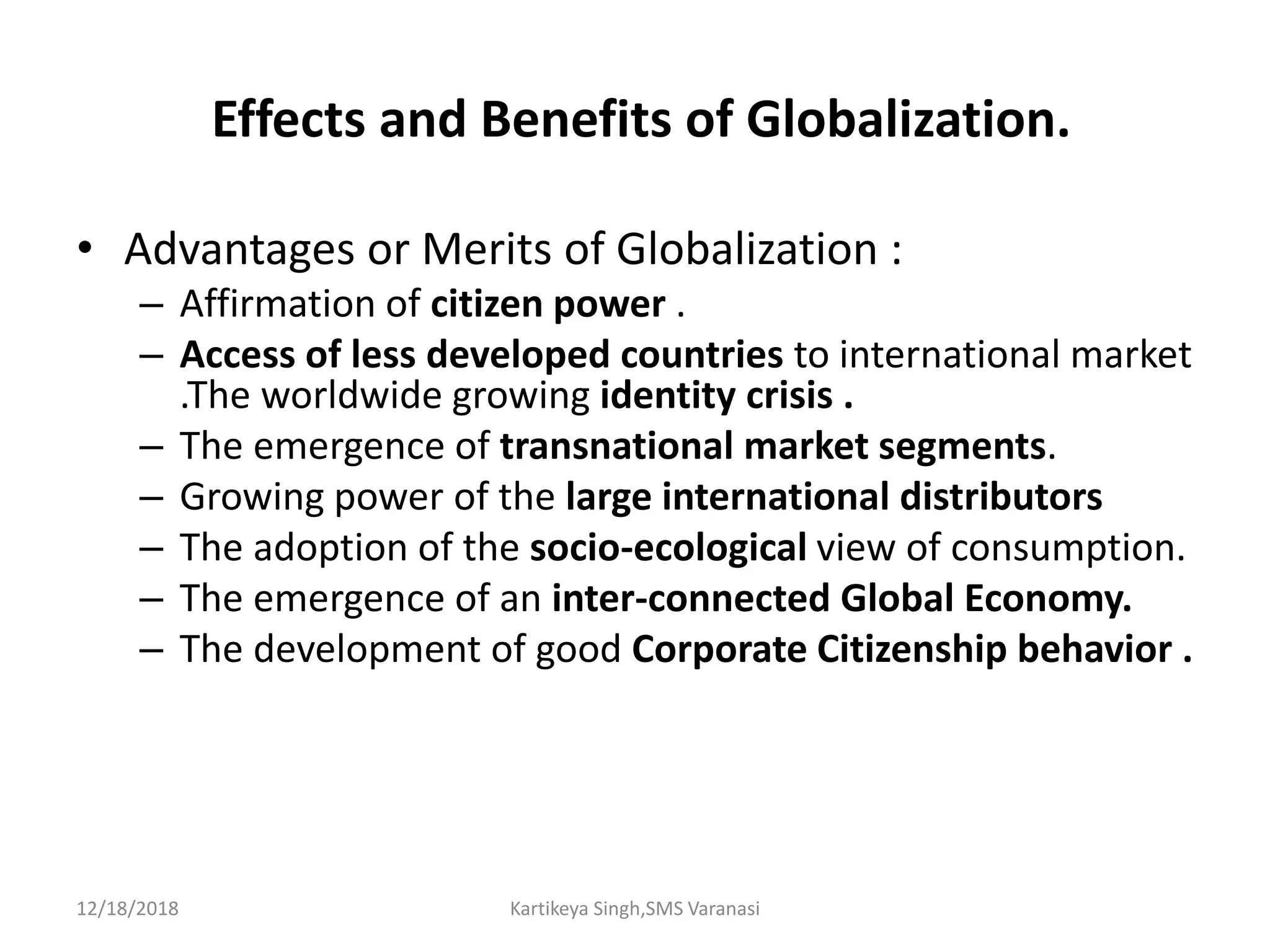
Effects and Benefits of Globalization.
• Advantages or Merits of Globalization :
– Affirmation of citizen power .
– Access of less developed countries to international market
.The worldwide growing identity crisis .
– The emergence of transnational market segments.
– Growing power of the large international distributors
– The adoption of the socio-ecological view of consumption.
– The emergence of an inter-connected Global Economy.
– The development of good Corporate Citizenship behavior .
12/18/2018 Kartikeya Singh,SMS Varanasi
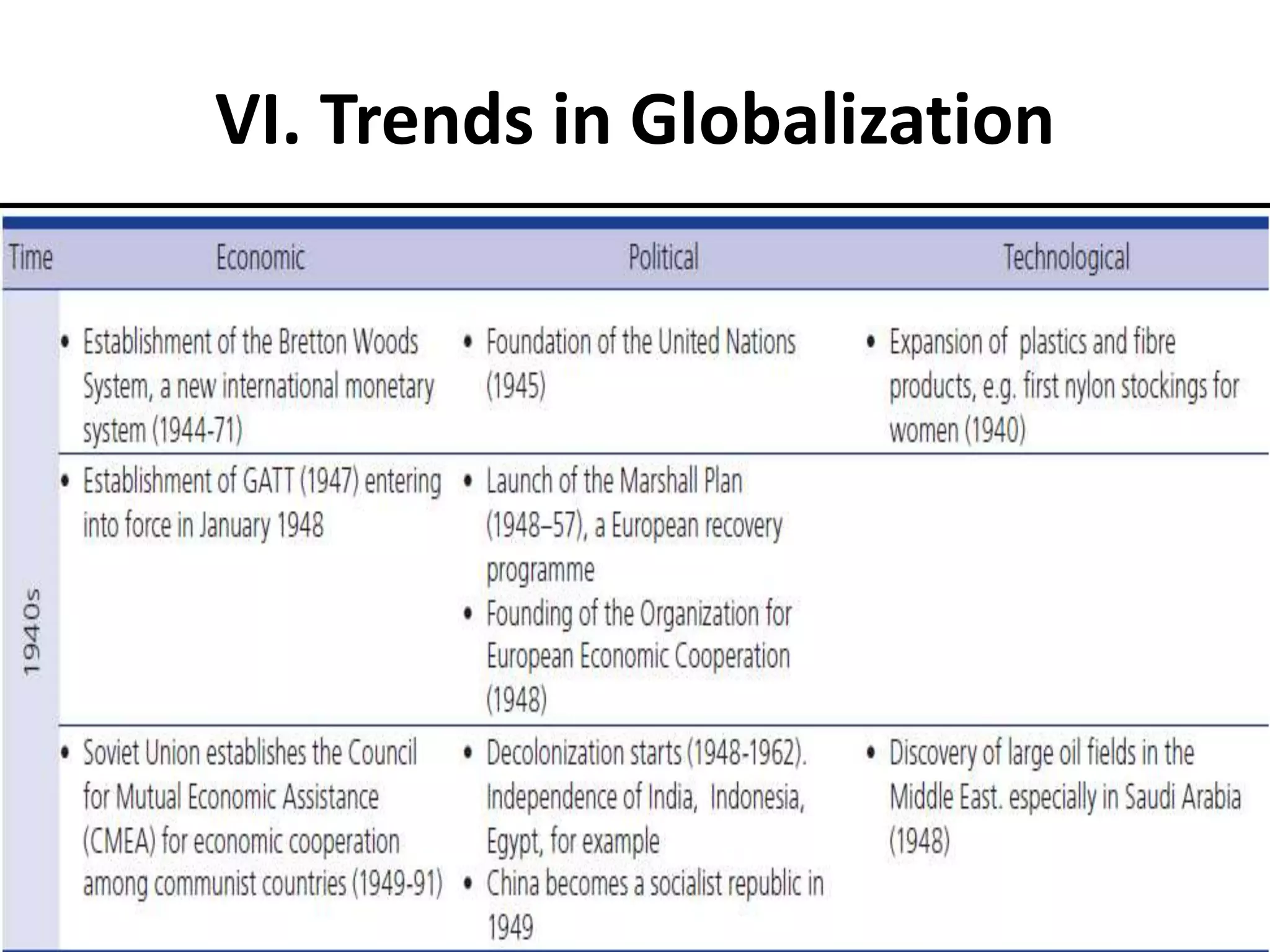
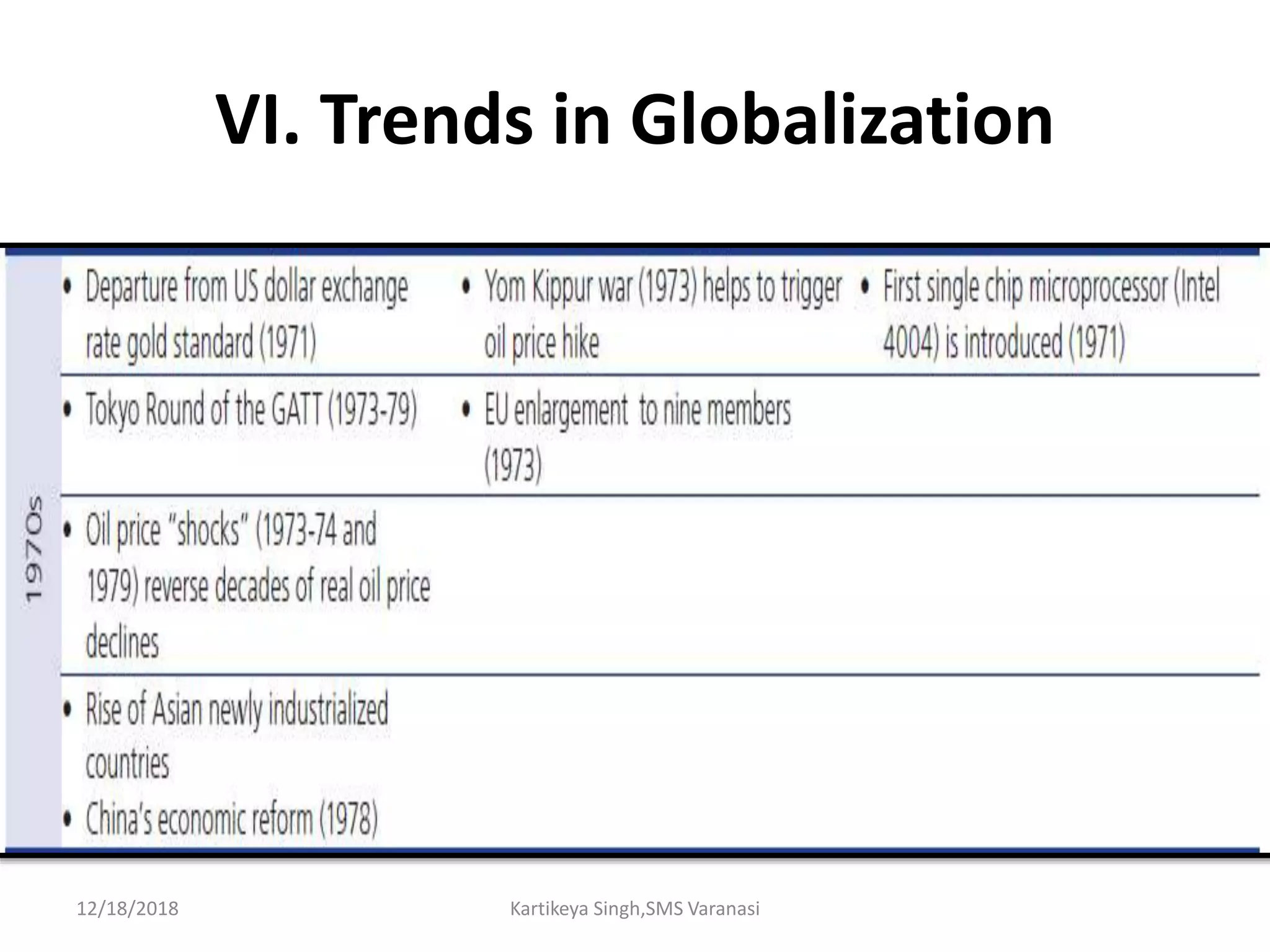
VI. Trends in Globalization
12/18/2018 Kartikeya Singh,SMS Varanasi
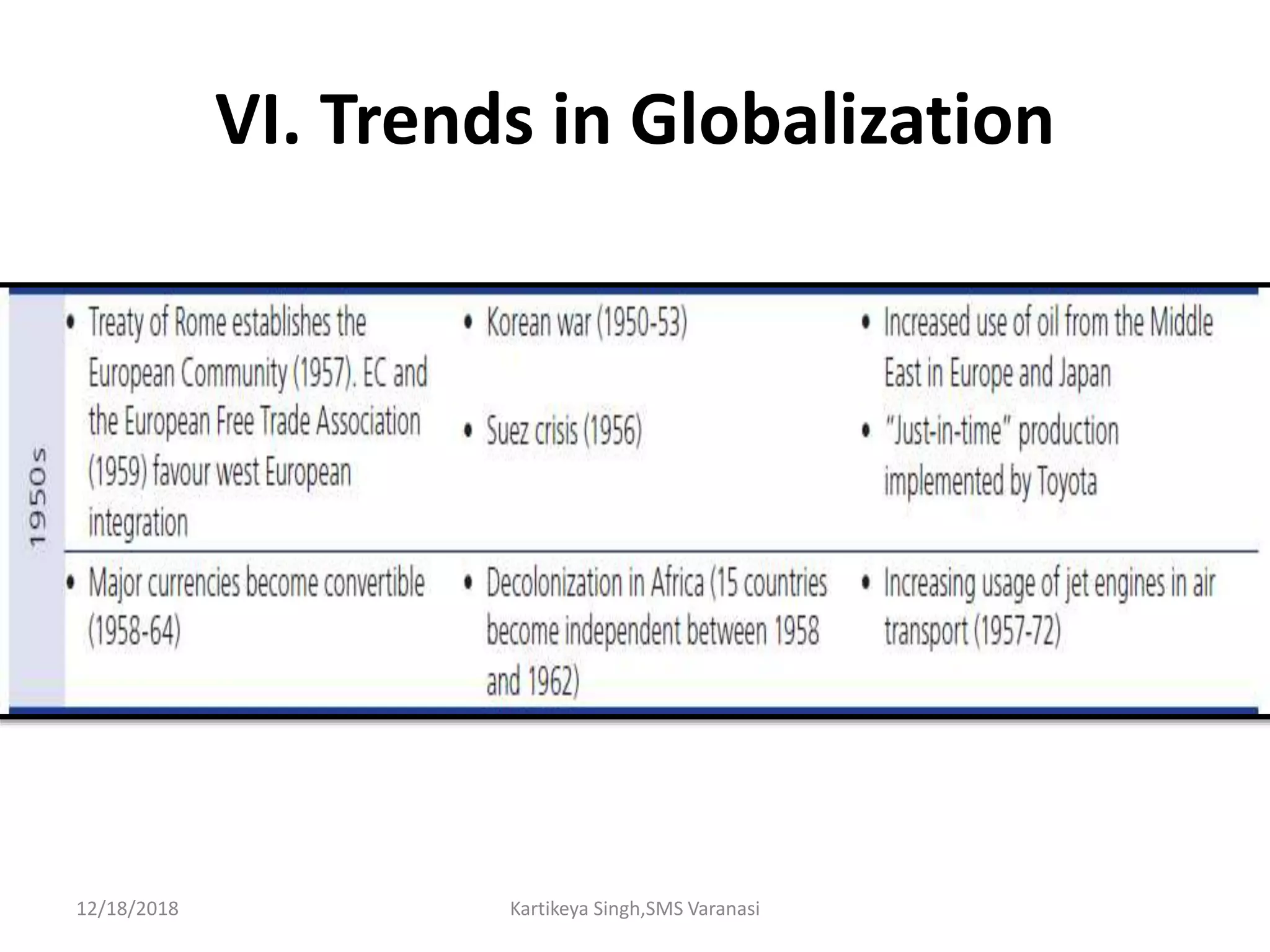
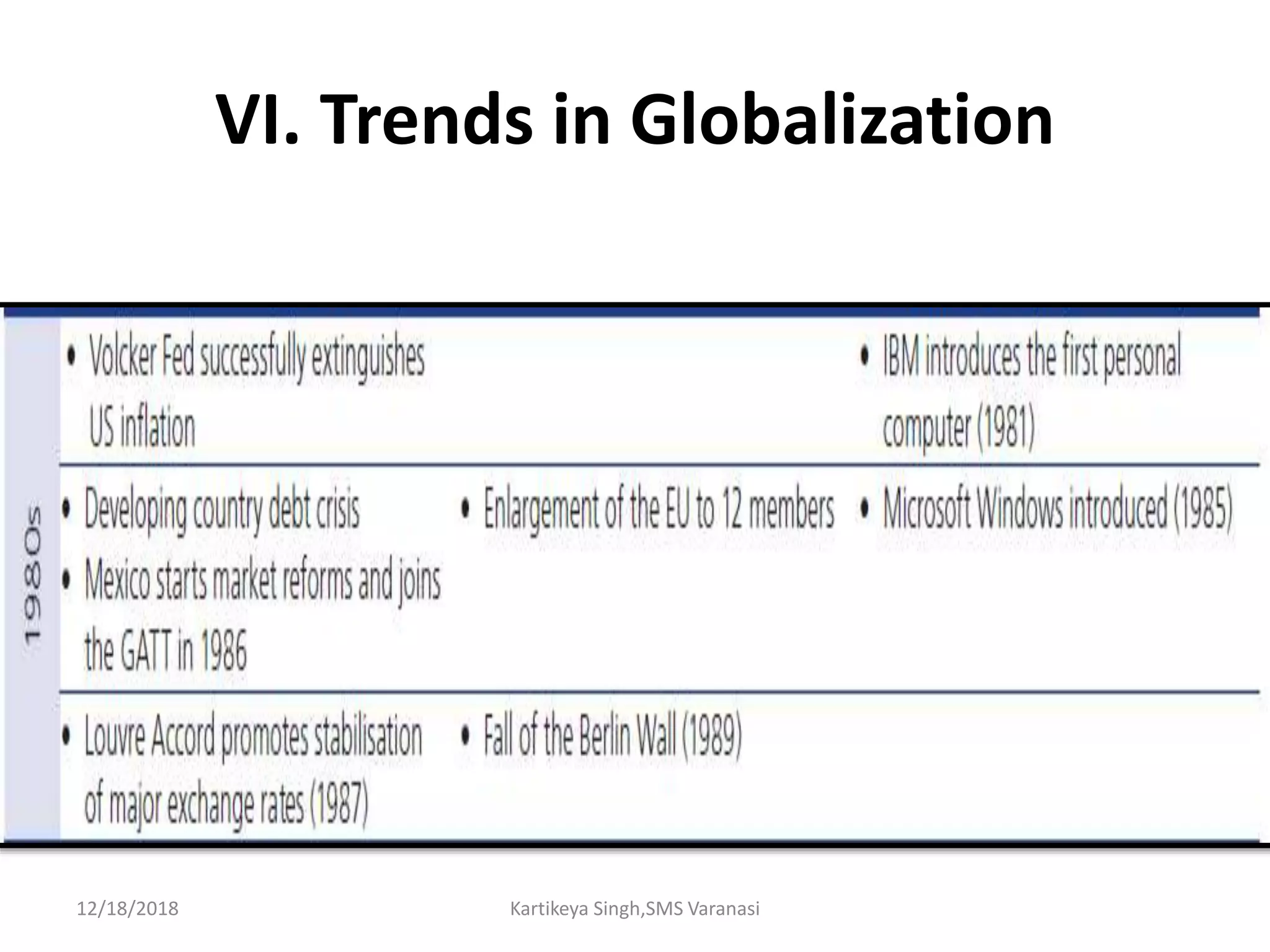
VI. Trends in Globalization
12/18/2018 Kartikeya Singh,SMS Varanasi
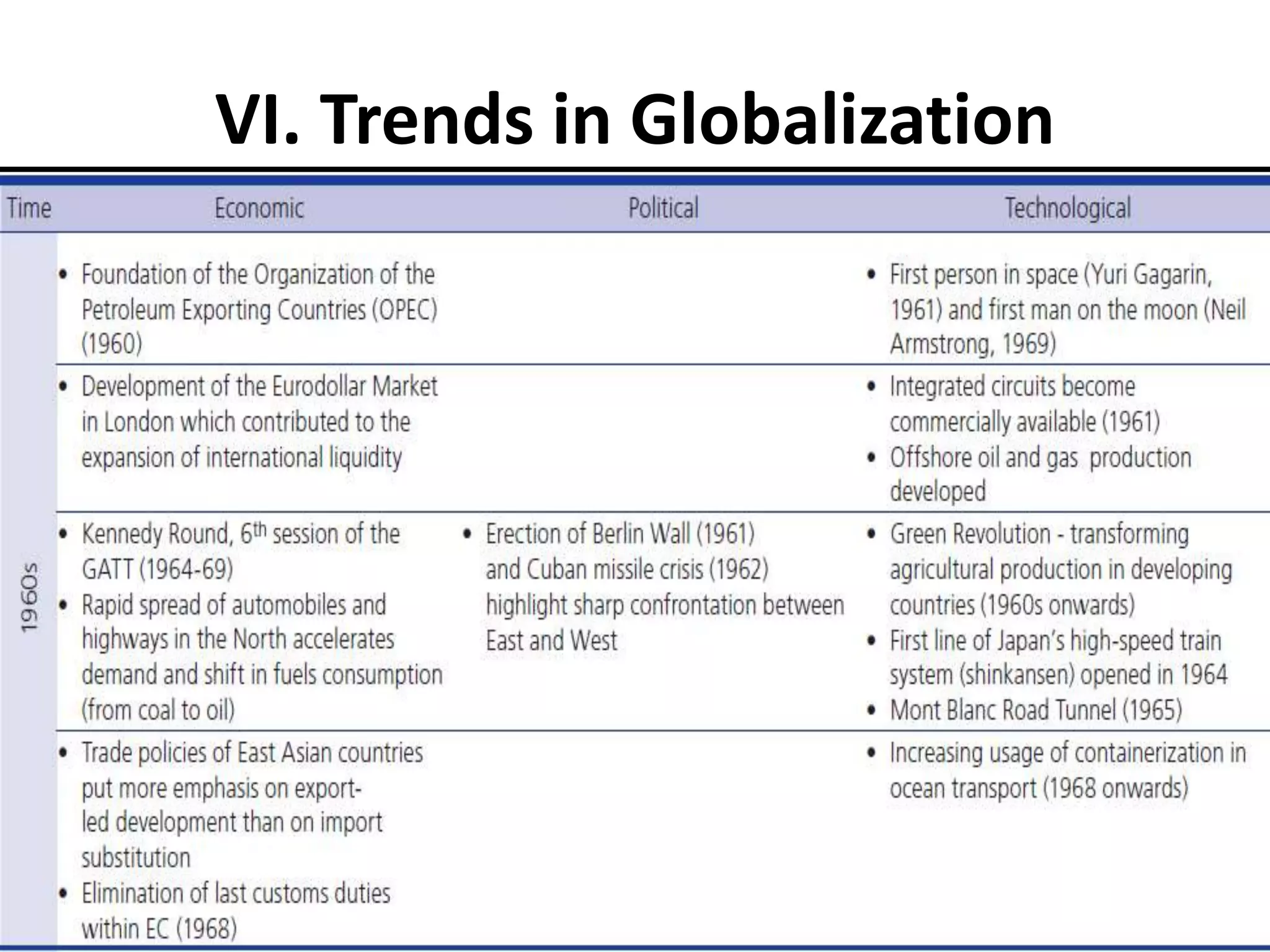
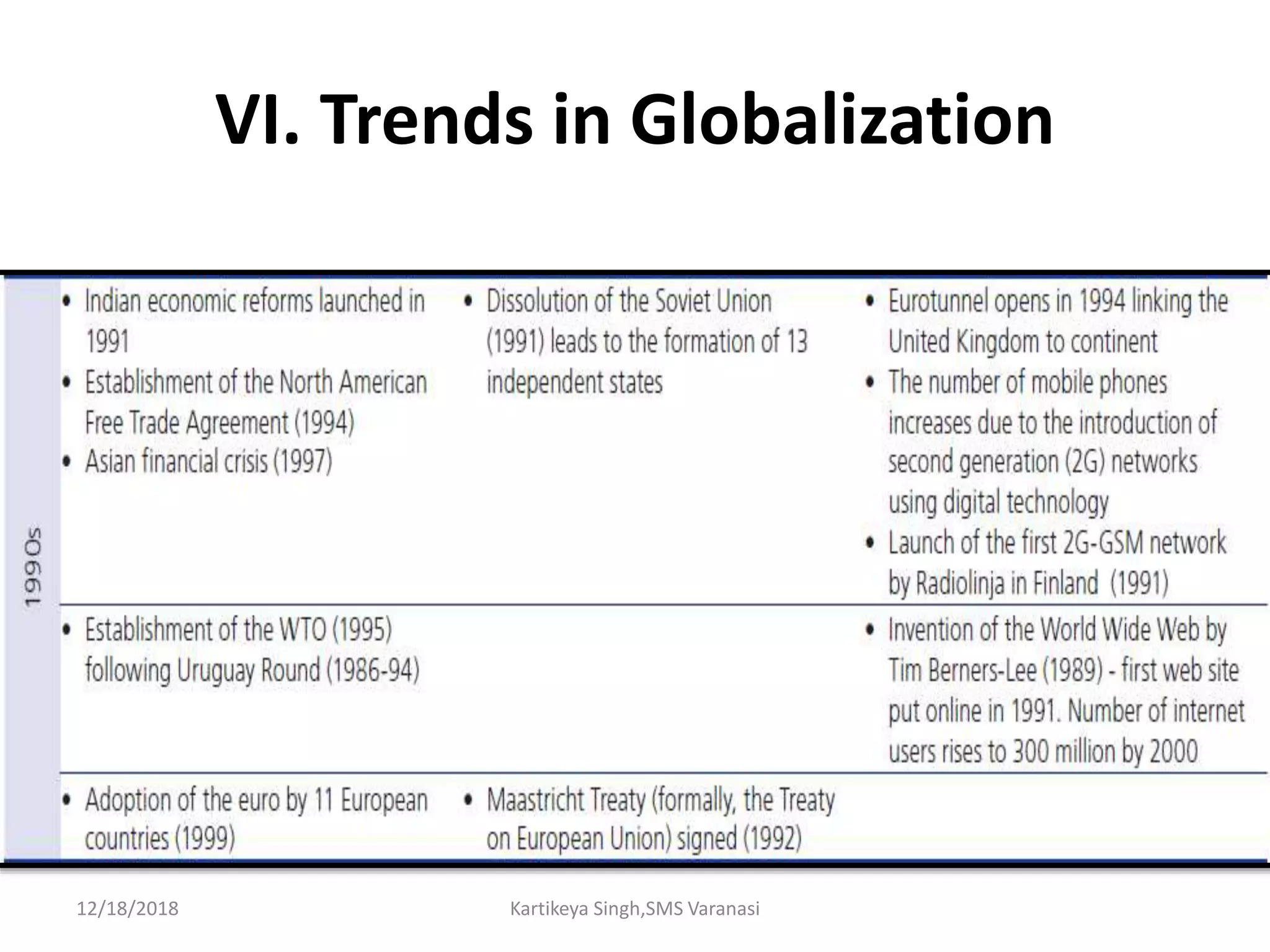
VI. Trends in Globalization
12/18/2018 Kartikeya Singh,SMS Varanasi
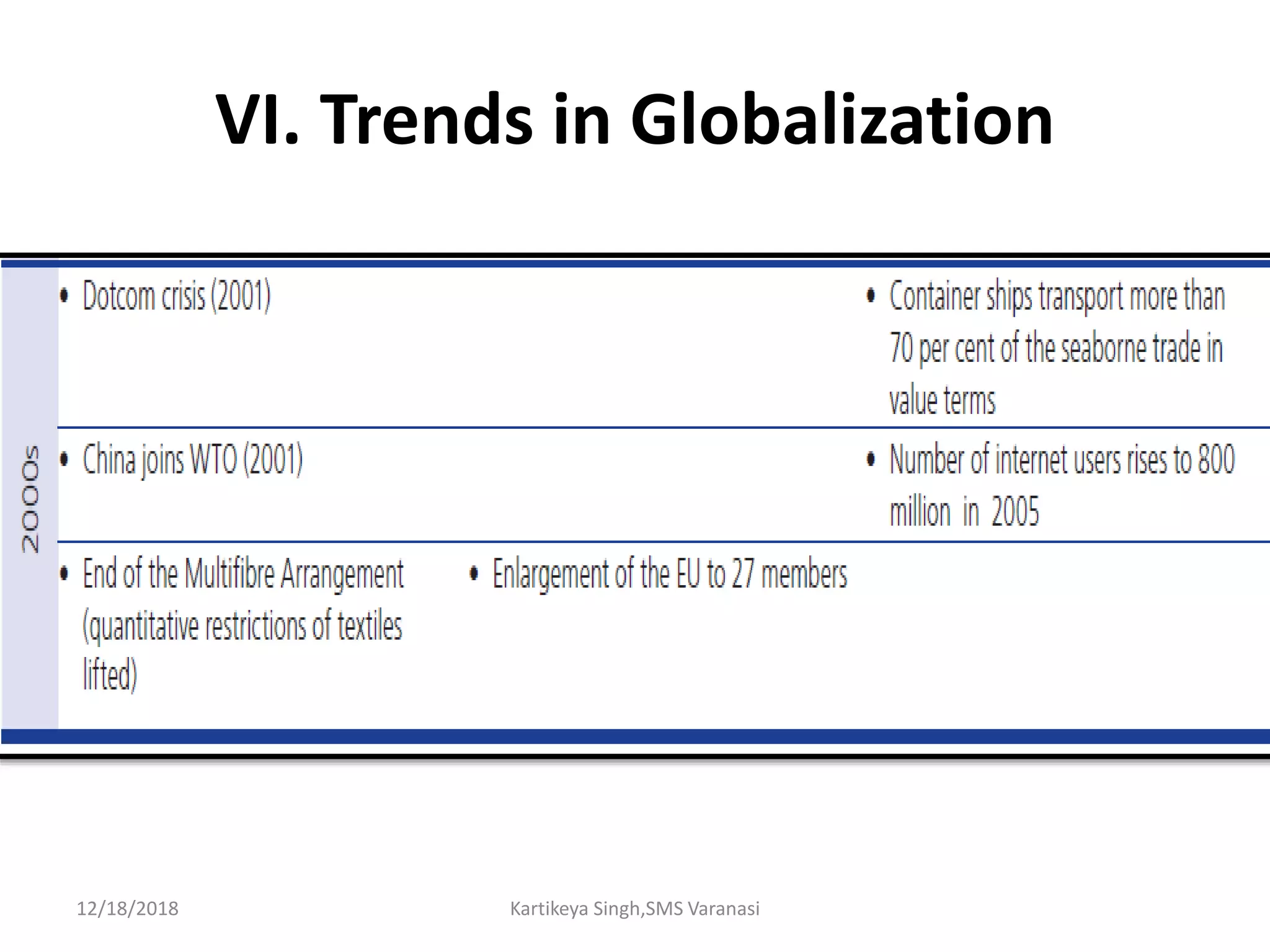
VI. Trends in Globalization
12/18/2018 Kartikeya Singh,SMS Varanasi
VI. Trends in Globalization
12/18/2018 Kartikeya Singh,SMS Varanasi
VI. Trends in Globalization
12/18/2018 Kartikeya Singh,SMS Varanasi
VI. Trends in Globalization
12/18/2018 Kartikeya Singh,SMS Varanasi

IBM - RMB302 - Unit I

  • 1.
  • 2.
    Unit I I. Introduction:Meaning, Nature and Scope of International Management, I. Driving and Restraining Forces, II. Domestic to Transnational Business, III. Modes of Entry, II. Globalization – Forces, Meaning, dimensions and stages in Globalization III. Characteristics and role of MNCs. IV. International Business Environment – The economic environment; social and cultural environment, political, legal and regulatory environment, natural environment, technological environment. 12/18/2018 Kartikeya Singh,SMS Varanasi
  • 3.
    An Overview ofInternational Business • Industrial Revolution (1820 - 1840) • World War I. • World War II. • GATT - 1945 • WTO – 1995 • IMF and World Bank • Current WTO regime and Controversy 12/18/2018 Kartikeya Singh,SMS Varanasi
  • 4.
    An Overview ofInternational Business • Charles Hills defines globalization as "The shift towards a more integrated and interdependent world economy". Globalization has two main components - the globalization of markets and the globalization of production. • According to International Monetary Fund, globalization means "the growing economic interdependence of countries worldwide through increasing volume and variety of cross border transactions in goods and services and of international capital flows and also through the more rapid and widespread diffusion of technology. Interdependency and integration of individual countries of the world is also called as globalization”. Globalization integrates not only economies but also societies. The globalization process includes : • Globalization of markets, • Globalization of production, • Globalization of technology, • Globalization of investment. 12/18/2018 Kartikeya Singh,SMS Varanasi
  • 5.
    I. Definition ofInternational Business • Exchange of Goods and Services across the national boundary of a country is called “International Business”. • International Business is the outcome of Globalisation and Liberalisation, Privatization. • International Business comprises of all commercial transactions private and governmental, sales, investments, logistics, and transportation) that take place between two or more regions, countries and nations beyond their political boundaries. 12/18/2018 Kartikeya Singh,SMS Varanasi
  • 6.
    I. International Business:Introduction Features of International Business • Flow of capital Across Countries • Accurate and Timely Information Required • Market Expansion • Size of International Business • Wider Scope • More Potential than Domestic Markets • Market Segmentation. • Inter Country Comparative Cost Advantage. 12/18/2018 Kartikeya Singh,SMS Varanasi
  • 7.
    II. Nature andScope of International Business • Nature: 1. It is related to business between two or more countries 2. It may be carried out by an Individual, Group, Organization and Government 3. It includes transfer of knowledge, skills, people, technology, capital information and other resources. 4. It has become massive in scale. 5. The purpose is to satisfy the customer. 12/18/2018 Kartikeya Singh,SMS Varanasi
  • 8.
    II. Nature andScope of International Business • Scope: 1. Export Business 2. International Business 3. Multinational firm 4. Global firm 5. Transactional firm 6. International Finance and Investment 7. Foreign Reserve 8. Balance of payment enhancement 12/18/2018 Kartikeya Singh,SMS Varanasi
  • 9.
    II. Driving andRestraining Forces • Driving Forces. Liberalization MNCs Technology Transfer. Transportation and communication revolution Quality and Cost Rising Aspiration and wants Competition World Economic Trends Regional Integration Leverages. 12/18/2018 Kartikeya Singh,SMS Varanasi
  • 10.
    II. Driving andRestraining Forces • Restraining Forces : External Government policies Social Development Political Development Internal Management Myopia – nearsightedness Organizational Culture Local Orientation 12/18/2018 Kartikeya Singh,SMS Varanasi
  • 11.
    III. Modes ofEntry • Basic Entry Decisions. – Which foreign market to enter? • Size of the Market • Wealth(purchasing power) • Legal framework – Example of Diebold entering china and brazil market due increasing number of middle class and low penetration of ATM – Timing of entry. • First Mover Advantage • First Mover Disadvantage (Pioneering Cost) – Example of KFC was first to start his operation in China but actual benefit was taken by McDonald’s. – Scale of entry and Strategic Commitments • Example of ING a Dutch Company entering USA market aggressively. 12/18/2018 Kartikeya Singh,SMS Varanasi
  • 12.
    III. Modes ofEntry I. Exporting II. Turnkey Projects III. Licensing IV. Franchising V. Establishing Joint Ventures VI. Wholly owned subsidiary 12/18/2018 Kartikeya Singh,SMS Varanasi
  • 13.
    III. Modes ofEntry - Exporting Advantages • Avoids substantial cost of establishing other unit abroad. • Learn from experience(local market) • Economy of Scale and profitability • Example – Sony(Japan) – Samsung(South Korea) – Suzuki(Japan) Disadvantages. • Cost advantage may diminish if some other manufacturing location produce in low cost – Many US manufacturing units are abroad. • High transportation cost(bulk production) • Tariff Barriers. – Japan Auto companies in US • Giving Marketing, Sales and other strategic decision to other countries. – Diebold and IBM Case. First Companies start exporting their goods or services and later they may switch to other modes 12/18/2018 Kartikeya Singh,SMS Varanasi
  • 14.
    III. Modes ofEntry – Turnkey Projects • The Contractor agrees to handle every detail of the project for a foreign client, including the training of operating personnel. • At completion of the project, the foreign client is handed over the “key” of a plant which is fully operational – hence the term turnkey. • Mostly used in chemical, petroleum refining, metal refining industries. 12/18/2018 Kartikeya Singh,SMS Varanasi
  • 15.
    III. Modes ofEntry – Turnkey Projects Advantage • The know how of technology creates value and capable of creating value to the client too. – FDI is limited.(oil and petroleum) • Less Risky • Companies having technical expertise may use this as an opportunity. • No Long term Commitment. Disadvantage • No long term interest but only fee would be paid • Creates a Competitor. – Western Firms in Gulf countries. • Selling technology also creates competitors. – ONGC and GAIL 12/18/2018 Kartikeya Singh,SMS Varanasi
  • 16.
    III. Modes ofEntry - Licensing • Licensing agreement is and agreement whereby licensor grants the rights to intangible property to another entity(licensee) for a specified period, and in return, the licensor receives a royalty fee from the licensee. • Intangible property includes patents, inventions, formulas, processes, designs, copyrights and trademarks. – Example: Xerox(US) made a licensing agreement to Fuji.(Story) Fuji – Xerox. – Xerox - Initial orientation was high end photocopier machines but Fuji worked on low end FX3500 and it broke every record of sales. 12/18/2018 Kartikeya Singh,SMS Varanasi
  • 17.
    III. Modes ofEntry - Licensing Advantage • Development cost is reduced • Risk of new market know how is reduced • Good for firms lacking in capital investment • It is helpful in the situation where barriers to entry are there. • Firms does not want to produce it on its own – AT&T Transistors given to Texas Instruments – Coca – Cola given license to use its trade mark on apparels Disadvantage • No tight control over the process. • No development in terms of local market information. • Profit can’t be transferred to other operating countries. • Technical know how is sacrificed. – RCA brand given license to Matsushita and Sony, now these two firms are bigger than RCA Brand(USA) • To reduce this Equity arrangement can be made. 12/18/2018 Kartikeya Singh,SMS Varanasi
  • 18.
    III. Modes ofEntry - Franchising • Franchising is basically a specialized form of licensing in which the franchiser not only sells the intangible property (normally a trademark) to the franchisee, but also insists that the franchisee agree to abide by strict rules as to how it does business. • As with licensing, the franchiser typically receives a royalty payment, which amounts to some percentage of the franchisee’s revenues. • Licensing is mostly used in manufacturing firms while Franchising is used mostly in Service firms – Example – Mc Donald’s. – Menu, cooking methods, staffing policies and design and location of a restaurant. 12/18/2018 Kartikeya Singh,SMS Varanasi
  • 19.
    III. Modes ofEntry - Franchising Advantage • Cost and Risks are averted • It helps in expanding business • Its legal framework helps in controlling things – Example: Varuna Beverages. – Mc Donald’s. Disadvantage • Does not allow to understand local economy • Quality control is a concern – Hilton hotel in Japan – USA – Mc Donald’s make joint venture with master Franchiser which in-turn maps other franchisees. –Mc D news in the text box 12/18/2018 Kartikeya Singh,SMS Varanasi
  • 20.
    III. Modes ofEntry – Joint Venture • Joint Venture entails establishing a firm that is jointly owned by two or more otherwise independent firms. • 50/50 is the most common joint venture, in which there are two parties each of which holds 50 percentage ownership stake and contributes a team of managers to share operating control. • Some of the firms prefer to have more stake which gives them the liberty of tighter control. 12/18/2018 Kartikeya Singh,SMS Varanasi
  • 21.
    III. Modes ofEntry – Joint Venture Advantage • Benefitted from local firms knowledge • When Opening or operating cost is high then local partner may be of great help • Few countries only allow joint ventures • Example : FDI in retail. Disadvantage • Giving control of technology to it partner. – Maruti Suzuki – Hero – Honda • To minimize the risk stake can be increased. • Does not give tight control over subsidiaries. • Can lead to battle for control. 12/18/2018 Kartikeya Singh,SMS Varanasi
  • 22.
    III. Modes ofEntry – Wholly owned Subsidiary. • In wholly owned subsidiary, the firm owns 100 percent of the stock. Establishing a wholly owned subsidiary in a foreign market can be done in two ways. – The firm either can set up a new operation in that country (Green Field Venture) – It can acquire an established firm in that host nation and use that firm to promote its product. – Example ING’s strategy for entering the U.S. market was to acquire established U.S. firm. 12/18/2018 Kartikeya Singh,SMS Varanasi
  • 23.
    III. Modes ofEntry – Wholly owned Subsidiary. Advantage • When firms competitive advantage is based on technological competence, this would be best mode. • Gives tight control over operations. • Operational advantage, companies may establish equipment manufacturing units to get the cost advantage. Disadvantage • Most costly method amongst all. • Risk is high. • Acquisition also create problem to work in sync. • Example: Dabhol Power Company – Enron, GE, Betchtel • 12/18/2018 Kartikeya Singh,SMS Varanasi
  • 24.
    III. Modes ofEntry – Strategic Alliance • Strategic Alliances refer to cooperative agreements between potential or actual competitors. • Strategic alliance run the range from formal joint ventures, in which two or more firms have equity stakes(e.g. Fuji-Xerox) to short – term contractual agreement, in which two companies agree to cooperate on a particular task (new product development). • Toyota and suzuki. 12/18/2018 Kartikeya Singh,SMS Varanasi
  • 25.
    III. Modes ofEntry – Strategic Alliance Advantage • May facilitate to enter foreign market – Motorola - Toshiba Case • Allow firms to share the fixed costs(and associated risks) of developing new products or processes. – Boeing’s tie up with small firm to manufacture equipment • Way to bring together complementary skills – Intel and Microsoft – Microsoft and Toshiba • Help the firms to set standards – Sony PDA(personal digital assistance) Disadvantage • They give the competitor a low cost route to technology and market. – Strategic alliance between Japanese and American Companies. • Risk of getting bigger – IBM alliances. 12/18/2018 Kartikeya Singh,SMS Varanasi
  • 26.
    IV. Driving forcesof Globalization • Technology • LPG – Liberalisation – Privatisation – Globalisation • Increase in Competition • Reduction in Trade Barriers • Trade Flows • Capital Flows • Factor Mobility 12/18/2018 Kartikeya Singh,SMS Varanasi
  • 27.
    IV. Globalization Meaningand it Dimensions • Charles Hills defines globalization as "The shift towards a more integrated and interdependent world economy". Globalization has two main components - the globalization of markets and the globalization of production. • According to International Monetary Fund, globalization means "the growing economic interdependence of countries worldwide through increasing volume and variety of cross border transactions in goods and services and of international capital flows and also through the more rapid and widespread diffusion of technology. Interdependency and integration of individual countries of the world is also called as globalization”. Globalization integrates not only economies but also societies. The globalization process includes : • Globalization of markets, • Globalization of production, • Globalization of technology, • Globalization of investment. 12/18/2018 Kartikeya Singh,SMS Varanasi
  • 28.
    V. Stages inGlobalization Domestic International Multinational Globalization Transnational 12/18/2018 Kartikeya Singh,SMS Varanasi
  • 29.
    V. Stages inGlobalization - Domestic • Market potential is limited to the home country. • Production and marketing facilities are located at home only. • It may add new product lines, serve new local markets but whole planning is limited to national markets only. 12/18/2018 Kartikeya Singh,SMS Varanasi
  • 30.
    V. Stages inGlobalization - Domestic • Their focus remains with domestic market. • Their productions facilities remain based in home country. Their analysis is focused on the national market. • They do not think globally and avoid taking risk in going global. • Their top management may have traditional kind of business management competency and less global expertise. • They perceive that there is risk in expanding into global market and thus they try to play safe and satisfied with whatever gains they are getting in domestic market. – Example : 5615 domestic companies India - 2017. – Maharaja white line, Hind Motors. 12/18/2018 Kartikeya Singh,SMS Varanasi
  • 31.
    V. Stages inGlobalization - International • International companies are the companies, who sell its products in foreign countries by exporting it to those countries and they might also be involved in various importing activities. These companies do not have their own establishments in foreign countries • Investment: International companies do not have any foreign direct investment (FDI) in the foreign countries where they export to or import from their products/services. • Strategy: As these companies do not have any foreign set up or branches, the key decision making functions is always taken from the domestic country of the company 12/18/2018 Kartikeya Singh,SMS Varanasi
  • 32.
    V. Stages inGlobalization - International • Products / R&D: Product development processes are accomplished in the domestic country. • Challenges: Legal, regulatory and customs issues are the key bottlenecks for these companies. Also, in cases where the taste of products in some of the countries does not match, these company may run the risk of failures. • Example: Maharaja Whiteline, Dabur. 12/18/2018 Kartikeya Singh,SMS Varanasi
  • 33.
    V. Stages inGlobalization - Multinational • Operations & Trading: Any Company, which is having operations and trading in two or more countries across the globe is called as a multinational Company. Generally, the number of countries in this cases, would be in the medium range - from two to ten. • Investment: Multinational companies may have foreign direct investment (FDI) in very few of the foreign countries where they operate in. 12/18/2018 Kartikeya Singh,SMS Varanasi
  • 34.
    V. Stages inGlobalization - Multinational • Products / R&D: Just like the global companies, in case of multinational companies the Products development processes are generally taken up by the Parent company and then distributed to various subsidiary companies at foreign countries for further trading. • Challenges: In addition to the international legal issues, these companies also face various IPR (Intellectual Property Rights) issues like product ideas copying, etc. • Example: General Motors, Intuit. 12/18/2018 Kartikeya Singh,SMS Varanasi
  • 35.
    V. Stages inGlobalization - Global • Operations & Trading: Any Company, which is having operations and trading in many countries across the world is called as a Global Company. Generally, the number of countries in these cases, would be quite high, lets say atleast around 15-20+ countries. • Investment: Global companies mostly have foreign direct investment (FDI) in some or all of the foreign countries where they operate in. organization structure and key decisions making functions have a "Centralized" approach i.e the major decisions on the organizational approaches /changes are taken from the headquarter. of the company. These major decisions are like merger and amalgamation, new products launching, etc. 12/18/2018 Kartikeya Singh,SMS Varanasi
  • 36.
    V. Stages inGlobalization - Global • Products / R&D: Products development processes are generally initiated and also completed by the Parent company and then distributed to the subsidiary companies at other countries for further trading. Subsidiary companies at other countries may be allowed to take part in product idea evolvement process, but the final development takes place at the headquarter of the Parent company's country. • Challenges: As these companies have investment in many countries, they face regulatory and legal issues in those countries often. Also, as these companies follow uniform product type across all countries, they miss the local touch in it and this sometimes lowers the demand in some countries. • Example: Lenovo, Kellogg, Shell, Coca-cola, Microsoft. 12/18/2018 Kartikeya Singh,SMS Varanasi
  • 37.
    V. Stages inGlobalization - Transnational • Operations & Trading: These type of companies can be considered as a mixture of the global, multinational and international companies, as it combines many of the features of these 3 types of companies. Here, the structure of the company is a little complex type and also versatile - considering many of aspects vital for global trade. These companies are pretty flexible companies in terms of operating across the global by adopting the local cultures and consumer behaviors and the ultimate marketing strategy based on it. • Investment: Transnational companies mostly have foreign direct investment (FDI) in many of the foreign countries where they operate in. • Strategy: Transnational companies prefer to have a "Decentralized" organization structure and key decisions making functions wherein each of their international establishments are responsible to take their own key decisions as suitable for the local region they are in. 12/18/2018 Kartikeya Singh,SMS Varanasi
  • 38.
    V. Stages inGlobalization - Transnational • Products / R&D: Here, subsidiary companies at different countries are also given the rights to develop products on their own based on the local needs and demands, though the final approval for launching may come from Parent company's side. Products of multi domestic companies vary from country to country, as products are developed in line with the local taste and customs. • Challenges: Due to varied organization structure and culture, transnational companies mainly face internal manpower issues, and organizational problems, etc. • Example: FEDEX, BMW, Nokia, Ford Motor Company. 12/18/2018 Kartikeya Singh,SMS Varanasi
  • 39.
    IV. Changing Environmentof International Business • Difference between domestic market and foreign market tends to disappear. • Expansion of business activities taking place throughout the world. • Buying and selling of goods taking place from and to any country of the world. • Decision to make any product taking place by considering entire world as a market. • Necessary inputs are obtained from the entire world. • Formulation of strategies, is based on global approach • It results into rapid increase in interdependence between different countries in the world. 12/18/2018 Kartikeya Singh,SMS Varanasi
  • 40.
    V. Globalisation ofMarket • On account of global markets, Customers tend to get highest value for money. • Globalization promotes formation of trade blocks • On account of liberalization, the focus will be shifted from the bureaucrat to the businessmen. • Rapid increase in mobility of resources takes place under globalization. • It tends to remove international trade barriers. • It tends to drive out sick and inefficient companies, but provides tremendous scope for sound companies. 12/18/2018 Kartikeya Singh,SMS Varanasi
  • 41.
    VI Trends inGlobalization • Coal based Economy shifted to oil based economy. • Organization such as WTO, IMF as well as World Bank started taking care of the world trade as no. of member nation has increased. • Liberalization in American as well as European country started bit early but Asian countries started it bit late. • Trade blocks were created due to globalization • Export became the main tool to increase foreign reserve. • Fast globalization of the world’s economies in recent years is largely based on the rapid development of science and technologies. • Globalization of the financial sector has become the most rapidly developing and most influential aspect of economic globalization. • Market-oriented reform carried out throughout the world should be regarded as the institutional driving force for the Globalisation. 12/18/2018 Kartikeya Singh,SMS Varanasi
  • 42.
    Features of InternationalBusiness • Large scale operations • Integration of economies • Dominated by developed countries and MNCs • Benefits to participating countries • Keen competition. • Special role of science and technology • International restrictions 12/18/2018 Kartikeya Singh,SMS Varanasi
  • 43.
    Approaches of IB •Ethnocentric • Polycentric • Regiocentric • Geocentric 12/18/2018 Kartikeya Singh,SMS Varanasi
  • 44.
    Ethnocentric approach • Underthis approach, target market is own country , Excessive production will export due to change in customer taste, preferences. 12/18/2018 Kartikeya Singh,SMS Varanasi
  • 45.
    Polycentric Approach • Underthis approach, the companies customizes the marketing mix to meet the taste, performance and needs of the customers of each international market. 12/18/2018 Kartikeya Singh,SMS Varanasi
  • 46.
    Regiocentric approach • Underthis approach, the company operating successfully in a foreign country thinks of exporting other neighboring countries of the host country. • At this stage, the concerned subsidiary considers the regional environment ( such as laws, culture, policies etc.) for formulating the policies & strategies. 12/18/2018 Kartikeya Singh,SMS Varanasi
  • 47.
    Geocentric approach • Underthis approach, the company analyses the tastes, preference and needs of the customers in all foreign markets and then adopts a standardized marketing mix for all the foreign markets. 12/18/2018 Kartikeya Singh,SMS Varanasi
  • 48.
    Effects and Benefitsof Globalization. • Advantages or Merits of Globalization : – Affirmation of citizen power . – Access of less developed countries to international market .The worldwide growing identity crisis . – The emergence of transnational market segments. – Growing power of the large international distributors – The adoption of the socio-ecological view of consumption. – The emergence of an inter-connected Global Economy. – The development of good Corporate Citizenship behavior . 12/18/2018 Kartikeya Singh,SMS Varanasi
  • 49.
    VI. Trends inGlobalization 12/18/2018 Kartikeya Singh,SMS Varanasi
  • 50.
    VI. Trends inGlobalization 12/18/2018 Kartikeya Singh,SMS Varanasi
  • 51.
    VI. Trends inGlobalization 12/18/2018 Kartikeya Singh,SMS Varanasi
  • 52.
    VI. Trends inGlobalization 12/18/2018 Kartikeya Singh,SMS Varanasi
  • 53.
    VI. Trends inGlobalization 12/18/2018 Kartikeya Singh,SMS Varanasi
  • 54.
    VI. Trends inGlobalization 12/18/2018 Kartikeya Singh,SMS Varanasi
  • 55.
    VI. Trends inGlobalization 12/18/2018 Kartikeya Singh,SMS Varanasi

Editor's Notes

  • #4 International Business conducts business transactions all over the world. These transactions include the transfer of goods, services, technology, managerial knowledge, and capital to other countries. International business involves exports and imports. International Business is also known as Global Business. Daniels and Radebaugh defined international business, “as all commercial transactions-private and governmental-between two or more countries. Private companies undertake such transactions for profit; governments may or may not do the same in their transactions. These transactions include sales, investments, and transportation. Thus, international business comprises a large and growing portion of the world’s total business. Today, global events and competition affect almost all companies-large or small-because most sell output to and secure supplies from foreign countries. Many companies also compete against products and services that come from abroad. In other words, a company operating in the international business field will engage in modes of business, such as exporting and importing, that differ from those operating on a domestic level. To operate effectively, managers must understand these different modes. The importance of international business in the 21st century has increased tremendously. The fact is that international business makes it possible for us to have the quality goods and services available at the prices we are willing to pay. International business is gaining increasing importance because it comprises a large and growing portion of the world’s total business. International business is important as it creates a suitable ground on which companies can expand their markets and operations. This is attributed to the fact that no country can stand alone without having to engage in trans-border transactions hence, there is need to include the neighboring countries, as well as, the international community. This will lead to a wider market2 for goods and an even wider source of raw materials essential for producing the products that are altered or exported. The increased levels of globalization have also led to elevate international business as more people are getting involved in multinational corporations. In this respect, the investors often open subsidiary branches of their companies in other countries hence, their transactions are carried out across the borders. Consequently, improved communication by introduction of the Internet has generated increased interest in the ability to transact business across continents without having to shift the locality in terms of being mobile. Hence, it becomes even easier to locate business enterprises where it is more likely to attract more profits and this could be in foreign countries. Every company is trying to expand its business by entering foreign markets. International business helps companies grow geographically. Geographic expansion may be used as a business strategy. Even though companies may expand their business at home. International business helps companies in managing product life cycle of their products. Every product has to pass through different stages of product life cycle-when the product reaches the last stages of life cycle in present market it may get proper response at other markets. Companies having outstanding technology advantages gain through the achievement of core competency. This technology helps the company in capturing other markets. Business opportunities in overseas markets help in expansion of many companies. They might have reached a saturation point in domestic market. It results in the proper use of resources available with the firms like labour, minerals etc. but are not productively utilized. Further, the international business makes availability of quality products when markets are open. Foreign companies will market latest products at reasonable prices. Also the firms doing international business earning foreign exchange may be used for strategic imports. India, in particular, needs foreign exchange to import crude oil, defence equipment, raw material and machinery. In International business countries depend upon each other for meeting their requirements. India depends on gulf countries for its crude oil supplies. International business necessitates proper development of infrastructure. A company entering international business must invest in sufficiently in infrastructure.
  • #12 Diebold Nixdorf is an American financial self-service, security and services corporation internationally engaged primarily in the sale, manufacture, installation and service of self-service transaction systems (such as ATMs and currency processing systems), point-of-sale terminals, physical security products (including vaults and currency processing systems), and software and related services for global financial, retail, and commercial markets.
  • #17 Case on page 387 Fuji – Xerox, International Business, Arun K. Jain and Charles Hills.
  • #18 RCA is an American trademark brand owned by French multinational corporation Technicolor SA, which is used on products made by that company as well as Voxx International, ON Corporation and Sony Music Entertainment. RCA stood for Radio Corporation of America, a company which later became RCA Corporation which was purchased by General Electric in 1986 and then liquidated.
  • #20 The Indian unit of McDonald’s said on Monday it ended a pact with Connaught Plaza Restaurants Pvt, a joint venture that operates 169 outlets in the northern and eastern regions of the world’s second-most populous nation. McDonald’s said its partner violated “certain essential obligations” of the agreement, including the payment of royalties. The local partner “has failed to remedy the breaches, despite being provided with an opportunity to do so in accordance with the agreements,” McDonald’s said. “We understand that this action brings uncertainty for many.” In a separate statement, Connaught Plaza said it’s considering “appropriate legal remedies” in response. The development creates a challenge for McDonald’s, disrupting operations in one of the world’s biggest emerging markets. The company will need to rebuild its brand across half the country as it searches for another partner. McDonald’s and Connaught Plaza have been at odds for the past few years and some of the joint venture’s restaurants were recently forced to suspend operations. An Indian court in July reinstated local partner Vikram Bakshi as Connaught’s managing director after its board had removed him earlier. McDonald’s, based in Oak Brook, Illinois, has two business entities in India. The largest venture is Hardcastle Restaurants Pvt, which operates 261 McDonald’s outlets in the western and southern parts of the country. With fewer than 500 eateries, India is a relatively small market for the world’s largest restaurant chain, which had almost 37,000 locations in 120 countries at the end of last year. Of those, more than 31,000 are franchised. The company has mounted a comeback from a prolonged sales slump under Chief Executive Officer Steve Easterbrook, who took over in March 2015. Same-store sales rose 6.6 percent globally for the chain in the most recent quarter.
  • #26 A personal digital assistant (PDA), also known as a handheld PC, is a variety mobile device which functions as a personal information manager. PDAs were largely discontinued in the early 2010s after the widespread adoption of highly capable smartphones, in particular those based on iOS and Android. Nearly all PDAs have the ability to connect to the Internet. A PDA has an electronic visual display, letting it include a web browser. Most models also have audio capabilities, allowing usage as a portable media player, and also enabling most of them to be used as telephones. Most PDAs can access the Internet, intranets or extranets via Wi-Fi or Wireless Wide Area Networks. Sometimes, instead of buttons, PDAs employ touchscreen technology. The technology industry has recently recycled the term personal digital assistance. The term is more commonly used for software that identifies a user's voice to reply to the queries. The first PDA, the Organizer, was released in 1984 by Psion, followed by Psion's Series 3, in 1991. The latter began to resemble the more familiar PDA style, including a full keyboard. The term PDA was first used on January 7, 1992 by Apple Computer CEO John Sculley at the Consumer Electronics Show in Las Vegas, Nevada, referring to the Apple Newton. In 1994, IBM introduced the first PDA with full telephone functionality, the IBM Simon, which can also be considered the first smartphone. Then in 1996, Nokia introduced a PDA with telephone functionality, the 9000 Communicator, which became the world's best-selling PDA. Another early entrant in this market was Palm, with a line of PDA products which began in March 1996.
  • #42 159 members WTO 188 members, World Bank Economic globalization refers to the increasing interdependence of world economies as a result of the growing scale of cross-border trade of commodities and services, flow of international capital and wide and rapid spread of technologies. It reflects the continuing expansion and mutual integration of market frontiers, and is an irreversible trend for the economic development in the whole world at the turn of the millennium. The rapid growing significance of information in all types of productive activities and marketization are the two major driving forces for economic globalization. In other words, the fast globalization of the world’s economies in recent years is largely based on the rapid development of science and technologies, has resulted from the environment in which market economic system has been fast spreading throughout the world, and has developed on the basis of increasing cross-border division of labor that has been penetrating down to the level of production chains within enterprises of different countries. The advancement of science and technologies has greatly reduced the cost of transportation and communication, making economic globalization possible. Today’s ocean shipping cost is only a half of that in the year 1930, the current airfreight 1/6, and telecommunication cost 1%. The price level of computers in 1990 was only about 1/125 of that in 1960, and this price level in 1998 reduced again by about 80%. This kind of ‘time and space compression effect’ of technological advancement greatly reduced the cost of international trade and investment, thus making it possible to organize and coordinate global production. For example, Ford’s Lyman car is designed in Germany, its gearing system produced in Korea, pump in USA, and engine in Australia. It is exactly the technological advancement that has made this type of global production possible. Moreover the development of the networking-based economy has given birth to a large group of shadow enterprises, making the concept of national boundaries and distance for certain economic activities meaningless. If technological advancement and IT development were assumed as the technological driving force for economic globalization, then the market-oriented reform carried out throughout the world should be regarded as the institutional driving force for this trend. Under the framework of GATT and WTO, many countries have gradually cut down their tariff and non-tariff barriers, more and more countries open up their current accounts and capital accounts. All of these have greatly stimulated the development of trade and investment. Moreover the transition of the former centralized planned economies to market economies has made it truly possible to for the world’s economies to integrate into a whole. Multinational corporations (MNCs) have become the main carriers of economic globalization. They are globally organizing production and allocating resources according to the principle of profit maximization. And their global expansions are reshaping macroeconomic mechanisms of the operation of the world economies. In 1996, there were altogether only more than 44,000 MNCs in the whole world, which had 280,000 overseas subsidiaries and branch offices. In 1997, the volume of the trade of only the top 100 MNCs already came up to 1/3 of the world’s total and that between their parent companies and their subsidiaries took up another 1/3. In the US$ 3,000 billion balance of foreign direct investment at the end of 1996, MNCs owned over 80%. Furthermore, about 70% of international technological transfers were conducted among MNCs. This type of cross-border economic activities within same enterprises has posed a challenge for the traditional international trade and investment theories. Globalization of the financial sector has become the most rapidly developing and most influential aspect of economic globalization. International finance came into being to serve the needs of international trade and investment activities. However, along with the development of economic globalization, it has become more and more independent. Compared with commodity and labor markets, the financial market is the only one that has realized globalization in the true sense of ‘globalization’. Since 1970’s, cross-border flow of capital has been rapidly expanding. In 1980, the total volume of cross-border transactions of stocks and bonds of major developed countries was still less than 10% of their GDP. However, this figure had far surpassed 100% in 1995. The value of the average daily transactions of foreign exchanges has grown from US$ 200 billion in the middle of 1980’s to the present US$ 1,200 billion, which is 85% of the foreign exchange reserves of all the countries in the world and 70 times as large as the value of the daily export of commodities and services. The process of economy globalization is also the process of global industrial restructuring and readjustment. With the development of science and technology and increase of income level, industrial structures of all the countries have been also undergoing readjustment and upgrading. In recent years, developed countries in the west are gradually entering the era of knowledge economy and have started to shift to developing countries many labor-intensive industries of weak international competitiveness. This process of cross-country shift is pushing forward an in-depth development of economic globalization. On the other hand, there has existed a surplus of productivity since the end of the cold war. Due to this fact, economic globalization has intensified the competition at the international market among enterprises from different countries. In order to raise their positions and improve their competitiveness at the international market, both domestic enterprises and those from other countries have been resorting to mergers and acquisitions one after another, which has resulted in tides of industrial restructuring. Take a few cases just as a demonstration: the most recent acquisition of Mannesmann by Vodaphone, acquisition of MCI by British Telecom, acquisition of by Deutsche Bank, and the amalgamation of Citibank with Travelers and that of Daimler-benz. All of these restructuring activities will exert far-reaching influence on the world’s industrial competition pattern. Developed countries have been playing a dominant role in the process of economic globalization. In 1996, the total volume of exports of developed countries was US$ 4,057 billion, accounting for 81.7% of the world’s total value of international trade. In 1995, the foreign direct investment by 10 major developed countries including the G7, Switzerland, Sweden and the Netherlands took up 85.1% of the total value of foreign direct investment in the whole world. The dominant role of developed countries in the process of economic globalization is also reflected in the fact that it is they that determine the rules for international economic exchanges. Although current rules of game for international economic activities have the good aspect of being in keeping with socialized mass production, they are generally laid down under the dominance of developed countries. International economic and financial organizations are under the control of the United States and other western countries. They have been using these advantages to promote and dominate the development of globalization. At the same time, they are the largest beneficiaries of economic globalization. In November of last year, China and the United States reached an agreement on the China’s accession to WTO. With this, China made a decisive step forward on its way to becoming a member country of WTO. The signing of this agreement shows the determination of the Chinese government to firmly speed up the reform of its economic system and further integrate itself into the process of economic globalization. It is a win-win agreement. On one hand, the United States can increase its exports of goods and services to China, thus creating more employment opportunities. While on the other hand, China can boost its economic growth by increasing its share of the US market. In addition, more advanced technologies, management experience and capital can be introduced from developed countries. And the pressure international competition will become a driving force for the reform and opening toward the outside world. This in turn will promote the competitiveness of china’s enterprises.
  • #49 Jean Jacques Lambin has listed the following Benefits/Advantages of Globalization.   Affirmation of citizen power : As a result of the cultural changes and better education, consumers tend to behave similar in different developed nations and represent a force of responsible citizen which business and government ignore. Consumer movement and vocal non governmental organizations are now well organized and listened to. Professional purchase behavior as consumers are well educated and experienced have become smart shoppers and able to make trade off between brands, stores, advertising and recommendations of sales people. The consumers have given search for new values over materialistic needs and they demand an ethical attitude on the part of suppliers. This' growing power of citizens generates new expectations which lead to the improvement in functioning and transparency of the market, liberty of choice, better information, pressure on prices, product safety, post-sales responsibility of manufacturers and ecologically and friendly products. New and more responsible relationship is emerging between consumers and producers Access of less developed countries to international market : At present, there is significant inequality between rich and poor countries which only education and information will help to eliminate. Globalization can play a key role in the development of electronic communication which facilitates the exchange of information at low cost anywhere and 'anytime. For example, during 1993-1997, per capita GDP growth has increased at an average 7.1 percent in the countries that globalize most quickly as against 2.2 percent for the slowest globalized. The worldwide growing identity crisis: As globalization progresses, there arises explosion of identity crisis among nations, regions, religions, ethnic and linguistic groups. In today's world the urge to maintain one's own cultural identity is greater than ever and in future it will become a guiding principle of decision-making. For transnational issues like ecology, safety, terrorism, health, etc. forms of world governance are necessary. Global capitalism needs strong countervailing powers, which go beyond the power of national governments. Hence, the power of supranational organizations like WTO, IMF, IBRD etc. should be reinforced and new supranational organizations be created to deal with these transnational issues; otherwise, we may end up with a wilder form of capitalism. The emergence of transnational market segments : Globalization increases inter-dependence between markets and hence national markets do not remain separate entities but as integrated part of the regional or world market. What happens one-market influences the other markets as experienced by the impact of South-East Asia financial crisis on the Brazilian economy. The inter-dependence of markets results in cultural convergence and creates transnational market segments or groups of consumers present in each country having the same needs and expectations. Thus, globalization means that there are groups of consumers with the same profiles that can be approached with same brands and communication campaigns. The individual and the identity crisis forces companies to adopt a mass-customization strategy whereby goods and services are individually customized in high volumes but at relatively low cost. Growing power of the large international distributors : In the fast moving goods markets, the growing power of retailers has been a significant development during last ten years. From passive intermediaries, retailers are now active entrepreneurs developing new store concepts and own label brands designed for well targeted segments. Some of them are adopting rapid internationalization strategies The adoption of the socio-ecological view of consumption- ; The environmental movement and socio-ecological view of consumption reflects a new awareness of the scarcity of natural resources, the uncontrolled growth of waste and the social cost of consumption. It reflects a changed attitude towards consumption which is not held as end in itself but which must take, into account its up-stream (opportunity cost) and down stream (repair and prevention cost) implications. Globalization is positively disseminating this new culture as markets become inter-dependent and as procurement and production activities spread across the planet. The emergence of an inter-connected Global Economy : As a result of the electronic communication revolution, the economic factors like suppliers, sellers, buyers, distributors etc. are no longer institutions or abstract entities but millions of individuals who participate in one to one relationship. This communication revolution reinforces the transparency and the democratic nature of the market economy. The electronic communication has reduced interaction costs, i.e. administrative costs borne to get people to work together, to collect information, to co-ordinate activities and to exchange goods and services. These costs account for 55 percent of the total administrative costs of the companies operating in advanced economies. The reduction of tele­communication and transport costs, with its massive diffusion of cheaper and more powerful information, progressively eliminates barriers between markets and gives access to the international market to any individual having talent or ideas. The development of good Corporate Citizenship behavior : Under the pressure of the citizen movement, firms everywhere are embracing the concept of responsible management. The responsible company is an organization, which wishes to establish a long-term sustainable relationship with the community where it lives and from which it gains its prosperity. It takes active part in combating social problems, in co-operation with public authorities. Now corporations are the most powerful forces for change in the modern world.
  • #51 https://www.google.co.in/search?q=suez+canal+on+map&espv=2&tbm=isch&imgil=68-IyE3wftpRLM%253A%253B73uR7DaL_QK0HM%253Bhttp%25253A%25252F%25252Fnews.bbc.co.uk%25252F2%25252Fhi%25252Fmiddle_east%25252F5195068.stm&source=iu&usg=__WdFNKCFEONHe_KnLstWTx7JlUF4%3D&sa=X&ei=wk30U8DfKsSSuATDyoDgBg&ved=0CCUQ9QEwBA&biw=1366&bih=667#facrc=_&imgdii=_&imgrc=68-IyE3wftpRLM%253A%3B73uR7DaL_QK0HM%3Bhttp%253A%252F%252Fnewsimg.bbc.co.uk%252Fmedia%252Fimages%252F41910000%252Fgif%252F_41910888_strategic_import_map416.gif%3Bhttp%253A%252F%252Fnews.bbc.co.uk%252F2%252Fhi%252Fmiddle_east%252F5195068.stm%3B416%3B319
  • #54 Jimmy carter and Ronald Regan The Louvre Accord was signed by the then G6 (France, West Germany, Japan, Canada, the United States and the United Kingdom) on February 22, 1987 in Paris, France. Italy had been an invited member, but declined to finalize the agreement. The goal of the Louvre Accord was to stabilize the international currency markets and halt the continued decline of the US Dollar caused by the Plaza Accord (of which a primary aim was depreciation of the US dollar in relation to the Japanese yen and German Deutsche Mark by the mutual agreement of the G7 Minister of Finance meeting (i.e. a conference of ministers of the "group of seven") that had been held in Louvre in Paris in 1987. Since the Plaza accord, the dollar rate had continued to slide, reaching an exchange rate of ¥150 per US$1 in 1987. The ministers of the G7 nations gathered at the Louvre in Paris to "put the brakes" on this decline.
  • #56 - President of the European Council Herman Van Rompuy - President of the European Commission José Manuel Barroso