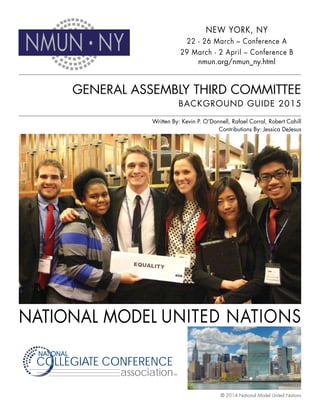
GENERAL ASSEMBLY THIRD COMMITTEE
BACKGROUND GUIDE 2015
NMUN • NY
COLLEGIATE CONFERENCECOLLEGIATE CONFERENCE
NATIONALNATIONAL
TMassociation
NEW YORK, NY
22 - 26 March – Conference A
29 March - 2 April – Conference B
nmun.org/nmun_ny.html
Written By: Kevin P. O’Donnell, Rafael Corral, Robert Cahill
Contributions By: Jessica DeJesus
© 2014 National Model United Nations
THE 2015 NATIONAL MODEL UNITED NATIONS
SPONSORED BY THE NATIONAL COLLEGIATE CONFERENCE ASSOCIATION
22–26 March (Conf. A) & 29 March – 2 April (Conf. B) • www.nmun.org
Roger Tseng &
Théo Thieffry
Secretaries-General
Yvonne Jeffery &
Kristina L. P. Mader
Deputy Secretaries-General
Sameer K. Kanal &
Meg Martin
Chiefs of Staff
Beatrice Soler &
Douglas C. Arseneault
Assistant Chiefs of Staff
Harald Eisenhauer
Assistant Secretary-General
Kristina Getty & Cara Wagner
Under-Secretaries-General
General Assembly
Ardis K. Smith & Monika Milinauskyte
Under-Secretaries-General
Economic and Social Council
Sonia N. Patel & Patrick Parsons
Under-Secretaries-General
Development
Andrea Wong & Rubai Aurora
Under-Secretaries-General
Human Rights and
Humanitarian Affairs
María Luisa Ortega &
Allison Chandler
Under-Secretaries-General
Peace and Security
Carl E. Dionne & Nguyen Cao
Under-Secretaries-General
Conference Services
ADVISORY GROUP
Prof. JoAnn Aviel
Holger Bär
Hannah Birkenkötter
Eugene Chen
Prof. Francine D’Amico
Ronny Heintze
Amierah Ismail
Rachel Johnson
Daniel Leyva, Jr.
Miriam Müller
Prof. Vaughn Shannon
Prof. Karen Vogel
Nicholas Warino
Thera Watson
Prof. Thomas Weiler
NCCA BOARD of DIRECTORS
Prof. Eric Cox, President
Prof. Kevin Grisham, Vice-President
Prof. Chaldeans Mensah, Treasurer
Prof. Pamela Chasek, Secretary
Jennifer Contreras
Raymond J. Freda
Rachel Holmes
Prof. Donna Schlagheck
Prof. Markéta Žídková
Members Ex-Officio
Michael Eaton
Executive Director
Prof. Richard Murgo
President Emeritus
Prof. Richard Reitano
President Emeritus
The NCCA/NMUN is a Non-Governmental Organization associated with the
United Nations Department of Public Information and a 501(c)(3) nonprofit organization of the United
States.
Dear Delegates,
We are pleased to welcome you to the 2015 National Model United Nations Conference in New York
(NMUN•NY)! This year’s General Assembly Third Committee staff is: Directors Kevin O’Donnell (Conference
A) and Rafael Corral (Conference B), and Assistant Director Robert Cahill (Conference B). Kevin holds a B.A.
in International Relations from San Francisco State University and continues to live and work in San Francisco.
He looks forward to returning for his fourth year on staff at NMUN•NY. Rafael earned his B.A. in International
Relations and Political Science with a minor in Human Rights from Universidad San Francisco de Quito in
Ecuador. Currently, he works on social development issues as a Junior Professional Associate at the World Bank
in Washington D.C. This is his fourth year on staff and his sixth year attending NMUN. Robert graduated in
2012 and triple majored in International Business, Marketing, and Management with minors in German and
French. He started working for Microsoft after college, and now is an Account Manager for a national company
based in Seattle, WA. This is Robert's third year as a staff member of NMUN.
The topics under discussion for the General Assembly Third Committee are:
I. Development and the Rights of Indigenous Peoples
II. The Right to Privacy in the Digital Age
III. Eliminating Racial Discrimination, Xenophobia and Related Intolerances
The General Assembly Third Committee is one of six Main Committees of the UN General Assembly, which is a
primary organ of the United Nations. The General Assembly Third Committee, also referred to as the Social,
Humanitarian and Cultural Affairs Committee, is tasked with deliberating topics that relate to social and
humanitarian affairs and human rights issues. The General Assembly Third Committee is the main facilitator of
international human rights issues at the UN and provides a forum for all 193 Member States to discuss and
cooperate through the creation of policy and norms. Because of their scope, General Assembly committees deal
with a vast range of complex and difficult topics, but it is our hope that this experience will be an incredibly
rewarding for all delegates.
We hope you will find this Background Guide useful as it serves to introduce you to the topics for this
committee. It is not meant to replace further research, and so we highly encourage you to explore in-depth your
assigned country’s policies, as well as use the Annotated Bibliography and Bibliography to further your
knowledge on these topics. In preparation for the conference, each delegation will submit a position paper. Please
take note of the NMUN policies on the website and in the Delegate Preparation Guide regarding plagiarism,
codes of conduct/dress code/sexual harassment, awards philosophy/evaluation method, etc. Adherence to these
guidelines is mandatory.
The NMUN Rules of Procedure are available to download from the NMUN website. This document includes the
long and short form of the rules, as well as an explanatory narrative and example script of the flow of procedure.
It is thus an essential instrument in preparing for the conference, and a reference during committee.
If you have any questions concerning your preparation for the Committee or the Conference itself, feel free to
contact the Under-Secretaries-General for the General Assembly Third Committee, Kristina Getty (Conference
A) and Cara Wagner (Conference B). You can reach either USG by contacting them at: usg.ga@nmun.org.
We wish you all the best for your preparation for the Conference and look forward to seeing you at the
conference!
Sincerely,
Conference A
Kevin O’Donnell, Director
Conference B
Rafael Corral, Director
Robert Cahill, Assistant Director
Table of Contents
Abbreviations...............................................................................................................................................................3
United Nations System at NMUN•NY........................................................................................................................4
Committee Overview...................................................................................................................................................5
Introduction........................................................................................................................................................................ 5
History ............................................................................................................................................................................... 5
Mandate ............................................................................................................................................................................. 6
Governance, Structure and Membership............................................................................................................................ 7
Functions and Powers ........................................................................................................................................................ 9
Current Priorities.............................................................................................................................................................. 10
Recent Sessions................................................................................................................................................................ 11
Conclusion ....................................................................................................................................................................... 12
Annotated Bibliography................................................................................................................................................... 13
Bibliography .................................................................................................................................................................... 13
I. Development and the Rights of Indigenous Peoples............................................................................................18
Introduction...................................................................................................................................................................... 18
International and Regional Framework............................................................................................................................ 19
Role of the International System...................................................................................................................................... 20
A Human Rights-Based Approach to the Post-2015 Development Agenda .................................................................... 22
Priorities for Action ......................................................................................................................................................... 23
Conclusion ....................................................................................................................................................................... 24
Further Research .............................................................................................................................................................. 24
Annotated Bibliography................................................................................................................................................... 25
Bibliography .................................................................................................................................................................... 27
II. The Right to Privacy in the Digital Age..............................................................................................................31
Introduction...................................................................................................................................................................... 31
International and Regional Framework............................................................................................................................ 32
Role of the International System...................................................................................................................................... 33
Understanding Privacy Violations ................................................................................................................................... 35
Types of Protections Needed ........................................................................................................................................... 36
Opportunities for Action .................................................................................................................................................. 37
Conclusion ....................................................................................................................................................................... 37
Further Research .............................................................................................................................................................. 38
Annotated Bibliography................................................................................................................................................... 39
Bibliography .................................................................................................................................................................... 41
III. Eliminating Racial Discrimination, Xenophobia and Related Intolerances ..................................................45
Introduction...................................................................................................................................................................... 45
International and Regional Framework............................................................................................................................ 46
Role of the International System...................................................................................................................................... 48
Migration ......................................................................................................................................................................... 49
Equality for People of African Descent – International Decade for People of African Descent...................................... 50
Case Study: Singapore ..................................................................................................................................................... 50
Conclusion ....................................................................................................................................................................... 51
Further Research .............................................................................................................................................................. 52
Annotated Bibliography................................................................................................................................................... 53
Bibliography .................................................................................................................................................................... 55
Abbreviations
AU African Union
CERD Committee on the Elimination of Racial Discrimination
ECHR European Convention on Human Rights
ECOSOC Economic and Social Council
FOC Freedom Online Coalition
GA General Assembly
GAEAD General Assembly and Economic and Social Council Affairs
Division
GDP Gross domestic product
HRC Human Rights Council
ICCPR International Covenant on Civil and Political Rights
ICERD International Convention on the Elimination of All Forms of
Racial Discrimination
ICT Information and communications technologies
IGF Internet Governance Forum
IGO Inter-governmental organization
ILO International Labor Organization
IOM International Organization for Migration
IP Internet Protocol
MDG Millennium Development Goals
NGO Non-governmental organizations
OECD Organization for Economic Cooperation and Development
OHCHR United Nations Office of the High Commissioner for Human
Rights
PGA President of the General Assembly
SC Security Council
SDG Sustainable development goals
SG Secretary-General
UDHR Universal Declaration of Human Rights
UN United Nations
UNDRIP United Nations Declaration on the Rights of Indigenous Peoples
UNHCR United Nations High Commissioner for Refugees
UNICEF United Nations Children’s Fund
UNODC United Nations Office on Drugs and Crime
UNPFII United Nations Permanent Forum on Indigenous Issues
UNV United Nations Volunteer
United Nations System at NMUN•NY
This diagram illustrates the UN System simulated at NMUN•NY. It shows where each committee “sits” within the system, to help understand the reportage and
relationships between the entities. Examine the diagram alongside the Committee Overview to gain a clear picture of the committee's position, purpose and
powers within the UN System.
Trusteeship Council
General Assembly
Security Council
International Court of
Justice
Economic and Social
Council
Secretariat
Specialized Agencies
FAO - Food and Agriculture Organization of the United Nations
UNESCO - United Nations Educational, Scientific and Cultural Organization
Subsidiary Bodies
GA First - Disarmament and International Security
GA Second - Economic and Financial
GA Third - Social, Humanitarian and Cultural
CEIRPP – Committee on the Exercise of the Inalienable
Rights of the Palestinian People
C-34 - Special Committee on Peacekeeping Operations
HRC - Human Rights Council
Functional Commissions Regional Commissions
CCPCJ - Crime Prevention and Criminal Justice
CPD - Population and Development
ECA - Economic Commission for Africa
ESCWA - Economic and Social Commission for Western Asia
Funds and Programmes
UNDP - UN Development Programme
UNEP - UN Environment Programme
UNFPA - UN Population Fund
UNICEF - UN Children’s Fund
UN-Women - UN Entity for Gender Equality and the Empowerment
of Women
UNHCR - Office of the UN High Commissioner for Refugees
WFP - World Food Programme
5
Committee Overview
Introduction
The United Nations (UN) General Assembly (GA) Third Committee
discusses and offers solutions for social, cultural, and humanitarian
matters.1
Over time, the work of this committee has evolved to deal
with mostly human rights issues, making it the world’s largest and
most prominent forum for international human rights norm creation.2
This overview will introduce the committee through a brief history,
an explanation of its mandate, an outline of its governance, structure,
and membership, and a description of its power and functions. Current priorities of the committee as well as details
of recent sessions held by the committee will then be examined, followed by a conclusion from which to draw
direction for further research.
History
In the wake of the Second World War, the UN was created to prevent future conflicts, maintain international peace
and security, and promote cooperation among states.3
The General Assembly, one of the six principal organs of the
UN created under the Charter of the United Nations (1945), was created to act as the representative, deliberative
arm of the organization.4
As the largest body of the UN, the GA could not feasibly be granted executive, decision-
making powers in the organization.5
Nor did the original members wish to do so because these executive and
administrative functions were to be carried out by the Security Council, Trusteeship Council, and Secretariat.6
The
Charter grants the GA the power to create subsidiary bodies to assist it in carrying out its work.7
The large variance
in the scope of its mandate led the GA to allocate its work among six committees that would allow each to focus on
a specific theme.8
The Third Committee is charged with considering and discussing social, humanitarian, and cultural affairs.9
Since its
inception, the Third Committee has been a venue for dialogue on many social matters, but today it is the primary
international forum for all human rights issues.10
It was not always so prominent, however, as many Member States
in the earlier decades of the UN regarded social issues as the least important for discussion.11
The very low priority
for human rights issues therefore resulted in assigning women as delegates to the Third Committee, the effect of
which can still be seen in the modern era, as the body has practically double the proportion of female delegates than
any other GA committee.12
Another reason for the early UN’s lack of enthusiasm for the Third Committee was the
murky distinction between economic and social issues.13
By 1970 that pattern was finally changing, with the General
Assembly Second Committee discussing mostly development agenda items, and the Third Committee discussing
mostly human rights and humanitarian agenda items.14
Over the next two decades, the Third Committee began
debating the definition of what constitutes a human right, as well as human rights situations in particular states.15
As
a majority of Member States are developing states, they began singling out specific states to highlight their poor
1
UN General Assembly, Social, Humanitarian & Cultural: Third Committee, 2014.
2
UN Human Rights Council, Institution-building of the United Nations Human Rights Council (A/HRC/RES/5/1), 2007; UN
General Assembly, Resolutions: 68th
session, 2014; UN Human Rights Council, Review of the work and functioning of
the Human Rights Council (A/HRC/RES/16/21), 2011; UN DESA, The UN General Assembly’s Third Committee –
social, humanitarian and cultural issues, 2013.
3
United Nations, Department of Public Information, UN at a Glance, 2014.
4
Charter of the United Nations, 1945; UN General Assembly, About the General Assembly, 2014.
5
Peterson, The UN General Assembly, 2006, p. 2.
6
Ibid.
7
Charter of the United Nations, 1945.
8
Charter of the United Nations, 1945; UN General Assembly, Main Committees, 2014.
9
UN General Assembly, Social, Humanitarian & Cultural: Third Committee, 2014.
10
UN DESA, The UN General Assembly’s Third Committee – social, humanitarian and cultural issues, 2013.
11
Peterson, The UN General Assembly, 2006, pp. 61-62.
12
Ibid., p. 62.
13
Ibid., p. 61.
14
Ibid., p. 62.
15
Ibid., p. 62.
The General Assembly Third
Committee (GA Third Committee) is one
of the six Main Committees. A report is
issued to the General Assembly Plenary
for each item allocated to a Main
Committee.
6
human rights records, mainly because they disagreed with those states’ foreign policies.16
One of the first instances
of such targeting was actually aimed at Chile in GA resolution 3219 (XXIX) of 1974, which condemned the
government there for “constant flagrant violations of basic human rights and fundamental freedoms.”17
As many of
these debated human rights have become normalized today, these topics of discussion (human rights and country-
specific human rights situations) continue to serve as the backbone of the Third Committee’s annual agenda.18
Mandate
The Third Committee derives its direction and work content from a variety of UN documents. Articles 10-17 of the
Charter are the principal guidelines for the substance and scope of all GA committees.19
These articles state that the
GA has the authority to “initiate studies and make recommendations,” as well as “receive and consider reports” from
other organs of the UN, including the Security Council (SC).20
More tangibly, the GA is responsible for allocating
and approving the overall biennial budget and the peacekeeping budget of the UN, via the GA Fifth Committee.21
The Universal Declaration of Human Rights (UDHR) (1948) also contains legal human rights guidelines from
which the Third Committee draws both its mandate and the focus of its work.22
In addition to the GA-specific
articles of the Charter, Article 1 also speaks of “promoting and encouraging respect for human rights and for
fundamental freedoms for all,” which has been said to be the foundation of the UDHR and the mandate of much of
the Third Committee’s work.23
Both GA and SC resolutions cite the UDHR as a reason and basis for action.24
Nearly
every international human rights instrument since the UDHR’s adoption in 1948 has elaborated on its principles,
thereby enlarging the Third Committee’s mandate by extension.25
For example, the Third Committee used the
UDHR as the groundwork to adopt additional and more specific international human rights instruments, chief
among them the International Covenant on Civil and Political Rights (1966) and the International Covenant on
Economic, Social, and Cultural Rights (1966).26
These documents, along with the two optional protocols to the
International Covenant on Civil and Political Rights, make up what is known as the International Bill of Human
Rights.27
In both covenants, Member States are reminded that the Charter calls for the promotion of human rights
and that, under the UDHR, individuals are free to exercise political and civil freedoms and should be free from fear
when enjoying such freedoms.28
In addition to this commonality, Article 3 of both International Covenants states
that men and women shall be equal in their enjoyment of rights and freedoms, and Article 5 of each lays out the
protection of these rights and freedoms from being limited or withheld.29
Both covenants differ from the UDHR in
that they are legally binding multilateral treaties to those Member States that have either ratified or acceded to
them.30
In other words, the mandate of the Third Committee was first shaped by the Charter, and then strengthened
and reinforced by the subsequent documents making up the International Bill of Human Rights.
Over time, the scope and content of work the Third Committee takes up has gradually been shifted and reinterpreted
to become more oriented towards human rights, especially since the establishment of the Human Rights Council
16
Peterson, The UN General Assembly, 2006, p. 62.
17
UN General Assembly, Protection and human rights in Chile (XXIX) (A/29/3219), 1974.
18
UN General Assembly, Proposed strategic framework for the period 2014-2015, Part two: biennial programme plan,
Programme 20, 2012; UN General Assembly, Resolutions: 68th
session, 2014; UN General Assembly, Resolutions
adopted by the General Assembly at its 8th
session, 1953.
19
Charter of the United Nations, 1945, Articles 10-17.
20
Ibid., Articles 13, 15.
21
Ibid., Article 17.
22
Charter of the United Nations, 1945; UN DESA, The UN General Assembly’s Third Committee – social, humanitarian and
cultural issues, 2013.
23
Office of the High Commissioner for Human Rights, Fact Sheet No.2 (Rev.1), The International Bill of Human Rights, 1996.
24
Ibid.
25
Ibid.
26
Ibid.; UN General Assembly, International Covenant on Civil and Political Rights, 1966; UN General Assembly, International
Covenant on Economic, Social, and Cultural Rights, 1966.
27
Office of the High Commissioner for Human Rights, Fact Sheet No.2 (Rev.1), The International Bill of Human Rights, 1996.
28
Ibid.
29
Ibid.
30
Ibid.
7
(HRC) in 2006.31
This is demonstrated by the fact that about half of the work taken up by the Third Committee is on
one agenda item, “Promotion and protection of human rights,” and includes such topics as human trafficking,
women’s empowerment, elimination of violence against women, protection of migrants, access to food and clean
water, and torture, among others.32
As such, it is the responsibility of the Third Committee to deliberate and resolve
issues among Member States involving human rights, social development, and humanitarian themes, stemming from
both its explicit mandate in the Charter, and the enhanced scope formulated by additional human rights instruments
and the creation of the HRC.33
Governance, Structure and Membership
All main General Assembly committees begin their annual session in mid-September at the UN headquarters in New
York City.34
Each year, new GA sessions begin with the process of adopting the agenda, followed by the allocation
of those items to each of the six GA committees according to theme and content.35
Next, there is a portion called the
General Debate, where a theme (chosen in advance by the President of the GA) is introduced and discussed,
primarily through speeches by Heads of State and Government.36
In contract with some other main GA committees,
there is no General Debate on topics at the beginning of Third Committee sessions.37
Agenda items are debated as a
body, one at a time.38
Relevant reports of the Secretary-General (SG) are issued just before each corresponding
agenda item is introduced, and there is also an allotted time for questions regarding clarification or analysis of
items.39
It is during these proceedings each year that Third Committee delegates interact directly with the UN High
Commissioner for Human Rights (OHCHR) and the UN High Commissioner for Refugees (UNHCR) via briefings
to understand and work through these issues.40
The Third Committee begins its substantive work in early October
and concludes its work before the last week of November, when the majority of draft resolutions are adopted by the
body.41
The President of the GA (PGA) is the largely ceremonial head of the GA, elected each year by a simple majority to a
one-year nonrenewable term.42
He or she cannot represent one of the five permanent members of the Security
Council.43
The PGA’s duties are to facilitate the GA Plenary sessions by directing discussions, managing the
administrative side of meetings, and enforcing the GA Rules of Procedure.44
The PGA does not preside over all six
GA committees separately; rather, Chairs and Vice Chairs are the facilitators of the committees.45
However, the
PGA may be requested to weigh in on a certain topic for a committee, in which case they may appoint a Permanent
Representative to organize such dialogue.46
For example, if a GA resolution mandates the PGA to facilitate
consultations on outcome documents or handle the logistics of high-level events, the PGA may assign one or several
Permanent Representatives to accomplish these tasks in his or her place.47
The PGA also performs executive duties
such as meeting regularly with the Secretary-General, President of the Security Council, and the President of
31
UN Human Rights Council, Institution-building of the United Nations Human Rights Council (A/HRC/RES/5/1), 2007; UN
General Assembly, Resolutions: 68th
session, 2014; UN Human Rights Council, Review of the work and functioning of
the Human Rights Council (A/HRC/RES/16/21), 2011.
32
Switzerland, Permanent Mission to the United Nations, The PGA Handbook: A practical guide to the United Nations General
Assembly, 2011, p. 65; UN General Assembly, Resolutions: 68th
session, 2014.
33
UN General Assembly, Social, Humanitarian & Cultural: Third Committee, 2014.
34
Switzerland, Permanent Mission to the United Nations, The PGA Handbook: A practical guide to the United Nations General
Assembly, 2011, p. 62.
35
Ibid., pp. 38, 62.
36
Ibid., pp. 76-79.
37
Ibid., p. 65.
38
Ibid., p. 65.
39
Ibid., p. 65.
40
Ibid., 2011, p. 65.
41
Switzerland, Permanent Mission to the United Nations, The PGA Handbook: A practical guide to the United Nations General
Assembly, 2011, p. 65; UN Meetings Coverage and Press Releases, Third Committee, 2014.
42
Switzerland, Permanent Mission to the United Nations, The PGA Handbook: A practical guide to the United Nations General
Assembly, 2011, p. 16.
43
Ibid., 2011, p. 15.
44
Ibid., p. 16.
45
Ibid., pp. 15, 18.
46
Ibid., pp. 16-17.
47
Ibid., p. 56.
8
Economic and Social Council (ECOSOC), communicating with the press and the public, and even organizing high-
level meetings for certain thematic issues.48
All GA committees are supported by “secretariats,” or bodies that provide administrative, logistical, and substantive
support to the committees. OHCHR serves as the primary substantive support wing of the Third Committee’s
secretariat.49
OHCHR serves as a focal point for human rights bodies, reports, and other publications, so it naturally
connects the Third Committee to all relevant organs and resources when carrying out its work.50
Aside from this,
depending on the topic, various other UN entities may serve as substantive secretariats for the Third Committee,
such as UN-Women, the United Nations Children’s Fund (UNICEF), the United Nations Volunteer Programme
(UNV), and the UNHCR.51
The GA and ECOSOC Affairs Division (GAEAD) of the Department provide much of
the logistical secretariat support for the Third Committee for General Assembly and Conference Management.52
This
involves crucial tasks such as drafting the agenda and program of work, scheduling GA meetings, preparing scripts
for the PGA, maintaining speakers’ lists, and updating the SG on developments in the GA.53
Logistical support
wings like GAEAD essentially function as the institutional memory of the body, providing the knowledge of how to
effectively and smoothly run the Third Committee’s sessions.54
Each of the 193 members of the UN is a de facto member of all six main GA committees.55
Each member of the GA
has one vote.56
In addition to voting “yes” or “no” on substantive items (items having to do with the topic, rather
than procedure), Member States may alternatively abstain from a vote.57
These abstentions are not added towards the
total when calculating majority votes.58
Under Article 18 of the Charter, “important questions,” a certain
classification of vote described below, are determined by a two-thirds majority of those members “present and
voting,” while all other questions are decided by a simple majority.59
Important questions are not considered by the
Third Committee, as they include matters of international peace and security; elections of members to the Security
Council, Trusteeship Council, and Economic and Social Council (ECOSOC); admission, suspension, or expulsion of
members from the UN; and budgetary items, areas outside the mandate of the Third Committee.60
Despite these
voting rules, the current trend in all six main GA committees is to adopt as many resolutions as possible by
acclamation (meaning without dissent).61
One reason for this can be attributed to the organic evolution of the body
as a whole, its delegates having preserved a degree of institutional memory within the context of consensus-building
in the Third Committee. In other words, each time new delegates were assigned to the Third Committee, they would
simply carry on their predecessors’ work and ideals, rather than starting over and learning that process from the
beginning. Another reason could be that the body collectively does not desire a divisive process like majority voting,
and they respect the minority’s views as much as possible by attempting to gain consensus on issues.62
Due to this
trend, the GA is now known as a consensus-building body, a process by which norms for international cooperation
can be continuously set on various on issues.63
The Third Committee, for example, adopts 70% of all its resolutions
48
Switzerland, Permanent Mission to the United Nations, The PGA Handbook: A practical guide to the United Nations General
Assembly, 2011, pp. 16-17.
49
Ibid., p. 65.
50
UN Office of the High Commissioner for Human Rights, Human Rights – New York: Mainstreaming human rights, 2014; UN
Office of the High Commissioner for Human Rights, Publications, 2014.
51
UN General Assembly, Organization of work of the Third Committee: Note by the Secretariat (A/C.3/69/L.1/Add. 1), 2014.
52
Switzerland, Permanent Mission to the United Nations, The PGA Handbook: A practical guide to the United Nations General
Assembly, 2011, p. 65.
53
Ibid., p. 24.
54
UN Department for General Assembly and Conference Management, The General Assembly and ECOSOC Affairs Division,
2011.
55
New Zealand, Ministry of Foreign Affairs and Trade, United Nations Handbook 2013-14, 2013, p. 12.
56
Charter of the United Nations, 1945, Article 18.
57
Switzerland, Permanent Mission to the United Nations, The PGA Handbook: A practical guide to the United Nations General
Assembly, 2011, p. 54; UNA USA, Model UN Glossary, 2013.
58
Ibid., p. 54.
59
Charter of the United Nations, 1945, Article 18.
60
Ibid.
61
UN General Assembly, Functions and Powers of the General Assembly, 2014.
62
Chen, Issues on Consensus and Quorum at International Conferences, 2010, pp. 717-739.
63
UN General Assembly, Functions and Powers of the General Assembly, 2014.
9
by acclamation, making it one example of how human rights promotion can be successfully advanced and acted
upon via international forums like the UN GA.64
The Third Committee has no subsidiary organs officially reporting to it, but because the “special procedures” of the
HRC usually fall under the agenda item of “Promotion and protection of human rights,” the committee does in fact
engage with the HRC through interactive dialogue and an extensive reporting process.65
Special procedures of the
HRC include independent experts, special rapporteurs, and working groups who compile reports and advise on
subjects such as indigenous peoples, torture, and extra-judiciary, summary, and arbitrary executions, often in the
context of a specific Member State.66
For example, in October 2014 while considering the agenda item “Promotion
and protection of the rights of children,” the Special Rapporteur on the sale of children, child prostitution and child
pornography delivered a statement and moderated a dialogue with delegates of the Third Committee.67
In 2013
alone, 49 Special Rapporteurs and independent experts delivered reports to the Third Committee via the special
procedures of the HRC, and the sixty-ninth session of the Third Committee will receive communication from 52 in
2014.68
The HRC works very closely with the Third Committee—so close that a Member State’s delegation to the
Third Committee often doubles as the delegation to the HRC, as well.69
As the GA’s budget is not broken down by each committee, the budget of the Third Committee is drawn from the
larger budget of the GA itself.70
This number changes every two years (with each new budget), as the size of the
GA’s budget depends on the size of the overall UN budget.71
The UN budget is determined by a system called “scale
of assessments,” in which each Member State is called on to contribute a percentage of the overall costs of the UN
based almost solely on gross domestic product (GDP) as a fraction of global GDP.72
This scale of assessments and
overall budget must then be approved by the GA Fifth Committee.73
The PGA’s office has its own annual budget,
totaling U.S. $300,000 in 1998 terms, which is adjusted for inflation each year.74
Functions and Powers
The GA has several roles and functions that are explicitly granted to it in the Charter as relate to its mandate.75
These
include approving the UN budget (mainly via the GA Fifth Committee, dealing with Administrative and Budgetary
matters), electing nonpermanent members to the SC and justices to the International Court of Justice, appointing the
SG upon the recommendation of the SC, considering reports from other UN bodies, and considering and making
recommendations on the general principles of the maintenance of international peace and security (such as
disarmament, via the GA First Committee).76
Additionally, under Article 13, the GA initiates studies and makes
nonbinding recommendations to support international cooperation and development, codify international law,
promote human rights and fundamental freedoms, and, in the Third Committee’s case, encourage international
collaboration in the social, humanitarian, and cultural fields.77
All the work of the Third Committee is of a normative nature, as it does not actually carry out the operations of the
tasks called for in its resolutions.78
The job of operationalizing the Third Committee’s recommendations is mainly
64
Switzerland, Permanent Mission to the United Nations, The PGA Handbook: A practical guide to the United Nations General
Assembly, 2011, p. 65.
65
Ibid.
66
Ibid.; UN DESA, The UN General Assembly’s Third Committee – social, humanitarian and cultural issues, 2013.
67
Journal of the United Nations, Programme of meetings and agenda: Wednesday, 15 October 2014, 2014.
68
UN General Assembly, Social, Humanitarian & Cultural: Third Committee, 2014; New Zealand Ministry of Foreign Affairs
and Trade, United Nations Handbook 2014-15, 2014, p. 39.
69
Switzerland, Permanent Mission to the United Nations, The PGA Handbook: A practical guide to the United Nations General
Assembly, 2011, p. 65.
70
UN General Assembly, Programme budget for the biennium 2014-2015 (A/68/6/Add.1), 2014.
71
Peterson, The UN General Assembly, 2006, p. 63.
72
Ibid.
73
Ibid.
74
Switzerland, Permanent Mission to the United Nations, The PGA Handbook: A practical guide to the United Nations General
Assembly, 2011, p. 90.
75
UN General Assembly, Functions and Powers of the General Assembly, 2014.
76
Ibid.
77
Ibid.
78
Ibid.
10
delegated to the various (usually human rights) agencies and offices of the Secretariat whose job it is to implement
such norms and policies agreed upon by the body.79
The Third Committee often requests studies to be undertaken by
relevant UN bodies such as OHCHR, the UNHCR, UN-Women, and the United Nations Office on Drugs and Crime
(UNODC).80
UN-Women, for example, delivers the “Report of the Secretary-General on trafficking in women and
girls” to the Third Committee, and UNODC similarly issues the “Report of the Secretary-General on international
cooperation against the world drug problem,” prepared pursuant to the Third Committee’s resolutions 67/145 (2012)
and 68/197 (2013), respectively.81
The Third Committee also occasionally calls for conferences to highlight certain
issues, and it coordinates with other bodies to execute and, if recurring, maintain them.82
There are numerous such
conferences, but one notable recurring example is the World Conference on Women, which originated from the
Third Committee resolution 29/3276 (1974).83
There have been a total of four World Conferences on Women, the
last of which took place in Beijing in 1995.84
Since then, there have been ongoing follow-up reviews every five
years, with the next one, Beijing+20, set to be held in 2015.85
Such activities aid the Third Committee in the
monitoring of key issues and the promotion of viable solutions and relevant information.
Current Priorities
Most of the work of the Third Committee for the current session, as in previous sessions, has centered on human
rights questions, including reports of the special procedures of the HRC.86
The Third Committee is discussing
human rights issues including, but not limited to: advancement of women, protection of children, indigenous
peoples, refugees, and promotion of fundamental freedoms.87
The committee will also address social development
topics such as youth, family, persons with disabilities, and criminal justice.88
Examples of current priorities of the
69th
session, which fall into these issues and themes, were outlined in various comments to the Third Committee in
October 2014.89
Greater emphasis on youth-, elderly-, and disability-inclusive policies was called for, in order to
contribute to the overall goal of a people-centered post-2015 development agenda.90
These priorities have been set
by a document called the Proposed Strategic Framework, which is adopted every two years in order to shape the
general themes and topics of work to be accomplished by the UN.91
The Strategic Framework currently in effect was
adopted at the 67th
session and is split into 28 programs of work.92
The Third Committee’s work will mainly involve
Programme 20: Human Rights, although elements of the programs covering international drug control, crime,
gender equality, empowerment of women, refugees, and humanitarian assistance will also be in the committee’s
purview.93
The volume and scope of the Third Committee’s agenda items has been increasing since its relatively
recent refocus on human rights, especially as Member States continue to find potential human rights implications in
such a wide variety of areas.
79
UN Office of the High Commissioner for Human Rights, Human Rights – New York: Mainstreaming human rights, 2014;
Switzerland, Permanent Mission to the United Nations, The PGA Handbook: A practical guide to the United Nations
General Assembly, 2011, p. 65.
80
UN General Assembly, Organization of work of the Third Committee: Note by the Secretariat (A/C.3/69/L.1/Add. 1), 2014.
81
Ibid.; UN General Assembly, International cooperation against the world drug problem: Report of the Secretary-General
(A/69/111), 2014; UN General Assembly, Trafficking in women and girls: Report of the Secretary-General (A/69/224),
2014.
82
UN General Assembly, Resolutions: 29th
session, 1974.
83
UN General Assembly, Conference of the International Women’s Year (XXIX) (A/RES/29/3276), 1974.
84
UN-Women, World Conferences on Women.
85
Ibid.
86
UN General Assembly, Social, Humanitarian & Cultural: Third Committee, 2014.
87
Ibid.
88
Ibid.
89
UN Meetings Coverage and Press Releases, Development Must Centre on People, Realization of Social Rights, Third
Committee Told at Opening of Session, 2014.
90
Ibid.
91
UN General Assembly, Proposed strategic framework for the period 2014-2015, Part one: plan outline 20 (A/67/6), 2012.
92
Ibid.
93
UN General Assembly, Proposed strategic framework for the period 2014-2015, Part one: plan outline 20 (A/67/6), 2012; UN
General Assembly, Proposed strategic framework for the period 2014-2015, Part two: biennial programme plan,
Programme 20: Human rights (A/67/6), 2012; UN General Assembly, Resolutions: 68th
session, 2014.
11
Recent Sessions
In recent years, the Third Committee has approved around 60 or 70 draft resolutions per session; at the 68th
session,
the committee approved 72.94
At that session, the committee’s adopted resolutions covered the areas of social
development promotion, preservation of self-determination, and the elimination of racism and discrimination.95
Additionally, multiple resolutions each were adopted on the topics of women’s advancement, children’s rights, and
the status of refugees.96
In the area of women’s rights, the Third Committee adopted resolutions that called for added
protections against, and criminal justice mechanisms aimed at gender-related killing, as well as the inclusion,
encouragement, and empowerment of women in rural areas at all levels of society.97
Children’s rights were outlined
in two major comprehensive resolutions, with one dealing with the rights of children, and the other dealing
specifically with the rights of girls.98
The status of refugees was addressed in three main resolutions which called for
increased protections of, and assistance for, internally displaced persons, increased effectiveness in assistance to
African refugees, and general compliance with, and support of, the UNHCR.99
Apart from thematic resolutions, the Third Committee also debated a number of country-specific human rights
situations.100
Four such resolutions were adopted in the 68th
session: GA resolutions 68/182, 68/183, and 68/184 of
18 December 2013, and 68/242 of 27 December 2013, which respectively reported on, and recommended solutions
for the human rights situations in the Syrian Arab Republic, Democratic People’s Republic of Korea, Islamic
Republic of Iran, and Myanmar.101
Resolution 68/182, having a humanitarian theme, condemns the atrocities being
committed in the Syrian Arab Republic and demands an end to the bloodshed, as opposed to the other three country-
specific resolutions, which focus on the protection of fundamental freedoms and human rights.102
The 69th
session of the GA opened on 16 September 2014, this year preceded by two conferences with a significant
connection to the work of the Third Committee: the World Conference on Indigenous Peoples and the Climate
Summit.103
The Third Committee adopted a familiar agenda consisting of 11 substantive items at the beginning of
their sixty-ninth session, over half of which are under one item: “Promotion and protection of human rights.”104
Sam
Kahamba Kutesa, Minister of Foreign Affairs of Uganda, was elected unanimously to be PGA for the sixty-ninth
session of the GA.105
The twenty-seventh session of the HRC was concluded in late September 2014, resulting in 32
adopted resolutions and four presidential statements, all of which will be summarized in a report to the Third
Committee.106
One extremely prominent theme exhibited by the entire spectrum of speakers has been the post-2015
94
UN General Assembly, Social, Humanitarian & Cultural: Third Committee, 2014; UN General Assembly, Resolutions: 68th
session, 2014; Switzerland, Permanent Mission to the United Nations, The PGA Handbook: A practical guide to the
United Nations General Assembly, 2011, p. 65.
95
UN General Assembly, Resolutions: 68th
session, 2014.
96
Ibid.
97
UN General Assembly, Improvement of the situation of women in rural areas (A/RES/68/139), 2013; UN General Assembly,
Taking action against gender-related killing of women and girls (A/RES/68/191), 2013.
98
UN General Assembly, Rights of the child (A/RES/68/147), 2013; UN General Assembly, The girl child (A/RES/68/146), 2013.
99
UN General Assembly, Assistance to refugees, returnees and displaced persons in Africa (A/RES/68/143), 2013; UN General
Assembly, Office of the United Nations High Commissioner for Refugees (A/RES/68/141), 2013; UN General
Assembly, Protection of and assistance to internally displaced persons (A/RES/68/180), 2013.
100
UN General Assembly, Resolutions: 68th
session, 2014.
101
UN General Assembly, Situation of human rights in the Syrian Arab Republic (A/RES/68/182), 2013; UN General Assembly,
Situation of human rights in the Democratic People’s Republic of Korea (A/RES/68/183), 2013; UN General Assembly,
Situation of human rights in the Islamic Republic of Iran (A/RES/68/184), 2013; UN General Assembly, Situation of
human rights in Myanmar (A/RES/68/242), 2013.
102
UN General Assembly, Situation of human rights in the Syrian Arab Republic (A/RES/68/182), 2013; UN General Assembly,
Situation of human rights in the Democratic People’s Republic of Korea (A/RES/68/183), 2013; UN General
Assembly, Situation of human rights in the Islamic Republic of Iran (A/RES/68/184), 2013; UN General Assembly,
Situation of human rights in Myanmar (A/RES/68/242), 2013.
103
PeaceWomen, General Debate of the 69th Session of the General Assembly - Reference to Gender Language, 2014.
104
UN General Assembly, Allocation of agenda items for the sixty-ninth session of the General Assembly (A/69/252), 2014.
105
UN News Centre, General Assembly elects Ugandan Foreign Minister as President of 69th session, 2014.
106
UN Office of the High Commissioner for Human Rights, Human Rights Council concludes twenty-seventh session after
adopting 32 resolutions and four presidential statements, 2014; UN General Assembly, Allocation of agenda items for
the sixty-ninth session of the General Assembly (A/69/252), 2014.
12
development agenda, in anticipation of the progress towards achieving the Millennium Development Goals by the
end of next year.107
Conclusion
The Third Committee is the main facilitator of international human rights issues at the UN and provides a forum for
Member States to discuss and cooperate through the creation of policy and norms. Delegates should seek to emulate
this by studying the language of the documents that make up the International Bill of Human Rights, watching
speeches made by Member States’ permanent representatives to the Third Committee and the HRC, and educating
themselves on the issues discussed by the committee, focusing on their peaceful resolution.
107
PeaceWomen, General Debate of the 69th Session of the General Assembly - Reference to Gender Language, 2014.
13
Annotated Bibliography
Charter of the United Nations. (1945). Retrieved 16 July 2014 from: http://www.un.org/en/documents/charter/
The Charter is the fundamental document that every delegate should read to understand what
ideas and terminology are used at the UN. Article 17 in particular is significant as it relates to the
General Assembly’s primary function and powers. The Charter is the foundation of the
organization itself, and is therefore an extremely valuable source for delegates.
Switzerland, Permanent Mission to the United Nations. (2011). The PGA Handbook: A practical guide to the United
Nations General Assembly. Retrieved 17 August 2014 from:
http://www.unitar.org/ny/sites/unitar.org.ny/files/UN_PGA_Handbook.pdf
The PGA Handbook is an essential read for delegates who will be a part of a General Assembly
committee. The entirety of the Handbook is relevant and delegates are encouraged to study it
carefully. Of particular interest is Page 65, which offers a superbly useful breakdown of the basic
info for Third Committee, including details of proceedings and voting information.
United Nations, General Assembly. (1948). Universal Declaration of Human Rights. Retrieved 16 July 2014 from:
http://www.un.org/en/documents/udhr/
The Universal Declaration of Human Rights (UDHR) is the cornerstone of international human
rights, and, along with the Charter, is one of the most important documents that delegates should
study when preparing to emulate the Third Committee. Delegates should seek to truly understand
these principles as opposed to memorization, as they are the fabric of how human rights are
viewed today. Special attention should be paid to the principles of equality and inalienability of
these rights, as well as the strong desire that Member States express for the UDHR to be
enshrined as the global standard for human rights. This is one of the prime examples of how the
UN sets international human rights standards for the world to follow, as laid out in the last
paragraph of the Preamble to the UDHR.
United Nations, General Assembly. (2014). Functions and Powers of the General Assembly [Website]. Retrieved 17
July 2014 from: http://www.un.org/en/ga/about/background.shtml
This is a basic overview of what kind of work the General Assembly actually performs, and how it
is permitted to do such work under the Charter. The page is very easy to understand and has links
on the side that can take delegates to other pages with valuable information on the General
Assembly, such as the Subsidiary Organs, Rules of Procedure, and Observers. All the functions of
the General Assembly are clearly laid out in bullet points, and delegates should study these points
carefully.
United Nations, Office of the High Commissioner for Human Rights. (1996). Fact Sheet No.2 (Rev.1), The
International Bill of Human Rights [Website]. Retrieved 17 August 2014 from:
http://www.ohchr.org/Documents/Publications/FactSheet2Rev.1en.pdf
This fact sheet demonstrates in detail the history and influence of the International Bill of Human
Rights. Helpful context and detailed explanation is also provided, which will aid tremendously in
delegates’ overall comprehension of these documents’ meaning. Delegates are advised to read
this document after having read through the UDHR and International Covenants in order to
clarify the principles and ideas laid out.
Bibliography
Charter of the United Nations. (1945). Retrieved 16 July 2014 from: http://www.un.org/en/documents/charter/
Chen, W. (2010). Issues on Consensus and Quorum at International Conferences. Chinese Journal of International
Law, 9 (4): 717-739.
Journal of the United Nations. (2014). Programme of meetings and agenda: Wednesday, 15 October 2014 [Meeting
Programme]. Retrieved 15 October 2014 from: http://www.un.org/Docs/journal/En/20141015e.pdf
14
New Zealand, Ministry of Foreign Affairs and Trade. (2013). United Nations Handbook 2013-14. Retrieved 15
August 2014 from: http://www.mfat.govt.nz/downloads/media-and-publications/UN-Handbook-2013-
web%20PDF.pdf
New Zealand, Ministry of Foreign Affairs and Trade. (2014). United Nations Handbook 2014-15. Retrieved 17
September 2014 from: http://www.mfat.govt.nz/UNHB2014/UN-Handbook-201415-6Aug-interactive.pdf
PeaceWomen. (2014). General Debate of the 69th Session of the General Assembly - Reference to Gender Language
[Website]. Retrieved 15 October 2014 from: http://www.peacewomen.org/peacewomen_and_the_un/peacewomen-
un-monitoring/general-assembly/debates/248/general-debate-of-the-69th-session-of-the-general-assembly-reference-
to-gender-language
Peterson, M.J. (2006). The UN General Assembly. New York, New York: Routledge.
Switzerland, Permanent Mission to the United Nations. (2011). The PGA Handbook: A practical guide to the United
Nations General Assembly. Retrieved 17 August 2014 from:
https://www.eda.admin.ch/content/dam/eda/en/documents/publications/InternationaleOrganisationen/Uno/UN-pga-
handbook_en.pdf
United Nations Association of the United States of America. (2013). Model UN Glossary [Website]. Retrieved 9
October 2014 from: http://www.unausa.org/global-classrooms-model-un/how-to-participate/getting-started/model-
un-glossary
United Nations, Department for General Assembly and Conference Management. (2011). The General Assembly
and ECOSOC Affairs Division [Website]. Retrieved 18 September 2014 from:
http://www.un.org/Depts/DGACM/funcgaead.shtml
United Nations, Department of Economic and Social Affairs. (2013). The UN General Assembly’s Third Committee
– social, humanitarian and cultural issues [Website]. Retrieved 16 August 2014 from:
http://www.un.org/en/development/desa/news/ecosoc/un-ga-third-committee.html
United Nations, Department of Public Information. (2014). UN at a Glance [Website]. Retrieved 16 August 2014
from: http://www.un.org/en/aboutun/
United Nations, General Assembly. (1948). Universal Declaration of Human Rights. Retrieved 16 July 2014 from:
http://www.un.org/en/documents/udhr/
United Nations, General Assembly. (1953). Resolutions adopted by the General Assembly at its 8th
session
[Website]. Retrieved 17 September 2014 from: http://research.un.org/en/docs/ga/quick/regular/8
United Nations, General Assembly. (1966). International Covenant on Economic, Social and Cultural Rights
(A/RES/2200A [XXI]). Retrieved 17 July 2014 from:
http://www.ohchr.org/EN/ProfessionalInterest/Pages/CESCR.aspx
United Nations, General Assembly. (1966). International Covenant on Civil and Political Rights (A/RES/2200A
[XXI]). Retrieved 17 July 2014 from: http://www.ohchr.org/en/professionalinterest/pages/ccpr.aspx
United Nations, General Assembly. (1974). Resolutions: 29th
Session [Website]. Retrieved 11 October 2014 from:
http://research.un.org/en/docs/ga/quick/regular/29
United Nations, General Assembly. (2014). About the General Assembly [Website]. Retrieved 17 August 2014 from:
http://www.un.org/en/ga/about/index.shtml
United Nations, General Assembly. (2014). Allocation of agenda items for the sixty-ninth session of the General
Assembly (A/69/252). Retrieved 15 October 2014 from:
http://www.un.org/en/ga/search/view_doc.asp?symbol=A/69/252
15
United Nations, General Assembly. (2014). Functions and Powers of the General Assembly [Website]. Retrieved 17
July 2014 from: http://www.un.org/en/ga/about/background.shtml
United Nations, General Assembly. (2014). Main Committees [Website]. Retrieved 17 August 2014 from:
http://www.un.org/en/ga/maincommittees/index.shtml
United Nations, General Assembly. (2014). Programme budget for the biennium 2014-2015 (A/68/6/Add.1).
Retrieved 19 September 2014 from: http://www.un.org/en/ga/search/view_doc.asp?symbol=A/68/6/Add.1
United Nations, General Assembly. (2014). Resolutions: 68th
Session [Website]. Retrieved 17 August 2014 from:
http://www.un.org/depts/dhl/resguide/r68_en.shtml
United Nations, General Assembly. (2014). Social, Humanitarian & Cultural: Third Committee [Website].
Retrieved 17 August 2014 from: http://www.un.org/en/ga/third/index.shtml
United Nations, General Assembly. (2014). Subsidiary organs of the General Assembly [Website]. Retrieved 11
October 2014 from: http://www.un.org/en/ga/about/subsidiary/index.shtml
United Nations, General Assembly, Twenty-ninth session. (1974). Conference of the International Women’s Year
(XXIX) (A/RES/29/3276) [Resolution]. Retrieved 11 October 2014 from:
http://www.un.org/en/ga/search/view_doc.asp?symbol=A/RES/3276(XXIX)
United Nations, General Assembly, Twenty-ninth session. (1974). Protection and human rights in Chile (XXIX)
(A/29/3219) [Resolution]. Retrieved 11 October 2014 from:
http://www.un.org/en/ga/search/view_doc.asp?symbol=A/RES/3219(XXIX)
United Nations, General Assembly, Sixty-seventh session. (2012). Proposed strategic framework for the period
2014-2015, Part one: plan outline (A/67/6) [Programme]. Retrieved 21 September 2014 from:
http://www.un.org/ga/search/view_doc.asp?symbol=A/67/6(Partone)
United Nations, General Assembly, Sixty-seventh session. (2012). Proposed strategic framework for the period
2014-2015, Part two: biennial programme plan, Programme 13: International drug control, crime and terrorism
prevention and criminal justice (A/67/6) [Programme]. Retrieved 21 September 2014 from:
http://www.un.org/ga/search/view_doc.asp?symbol=A/67/6(Prog.13)
United Nations, General Assembly, Sixty-seventh session. (2012). Proposed strategic framework for the period
2014-2015, Part two: biennial programme plan, Programme 14: Gender equality and empowerment of women
(A/67/6) [Programme]. Retrieved 21 September 2014 from:
http://www.un.org/ga/search/view_doc.asp?symbol=A/67/6(Prog.14)
United Nations, General Assembly, Sixty-seventh session. (2012). Proposed strategic framework for the period
2014-2015, Part two: biennial programme plan, Programme 20: Human rights (A/67/6) [Programme]. Retrieved 17
September 2014 from: http://www.un.org/ga/search/view_doc.asp?symbol=A/67/6(Prog.20)
United Nations, General Assembly, Sixty-seventh session. (2012). Proposed strategic framework for the period
2014-2015, Part two: biennial programme plan, Programme 21: International protection, durable solutions and
assistance to refugees (A/67/6) [Programme]. Retrieved 21 September 2014 from:
http://www.un.org/ga/search/view_doc.asp?symbol=A/67/6(Prog.21)
United Nations, General Assembly, Sixty-seventh session. (2012). Proposed strategic framework for the period
2014-2015, Part two: biennial programme plan, Programme 23: Humanitarian assistance (A/67/6) [Programme].
Retrieved 21 September 2014 from: http://www.un.org/ga/search/view_doc.asp?symbol=A/67/6(Prog.23)
16
United Nations, General Assembly, Sixty-eighth session. (2013). Assistance to refugees, returnees and displaced
persons in Africa (A/RES/68/143) [Resolution]. Adopted the report of the Third Committee (A/68/450). Retrieved
22 September 2014 from: http://www.un.org/en/ga/search/view_doc.asp?symbol=A/RES/68/143
United Nations, General Assembly, Sixty-eighth session. (2013). Improvement of the situation of women in rural
areas (A/RES/68/139) [Resolution]. Adopted on the report of the Third Committee (A/68/449 and Corr. 1).
Retrieved 22 September 2014 from: http://www.un.org/en/ga/search/view_doc.asp?symbol=A/RES/68/139
United Nations, General Assembly, Sixty-eighth session. (2013). Office of the United Nations High Commissioner
for Refugees (A/RES/68/141) [Resolution]. Adopted the report of the Third Committee (A/68/450). Retrieved 22
September 2014 from: http://www.un.org/en/ga/search/view_doc.asp?symbol=A/RES/68/141
United Nations, General Assembly, Sixty-eighth session. (2013). Protection of and assistance to internally
displaced persons (A/RES/68/180) [Resolution]. Adopted the report of the Third Committee (A/68/456/Add. 2).
Retrieved 22 September 2014 from: http://www.un.org/en/ga/search/view_doc.asp?symbol=A/RES/68/180
United Nations, General Assembly, Sixty-eighth session. (2013). Rights of the child (A/RES/68/147) [Resolution].
Adopted the report of the Third Committee (A/68/452 and Corr. 1). Retrieved 22 September 2014 from:
http://www.un.org/en/ga/search/view_doc.asp?symbol=A/RES/68/147
United Nations, General Assembly, Sixty-eighth session. (2013). Situation of human rights in Myanmar
(A/RES/68/242) [Resolution]. Adopted on the report of the Third Committee (A/68/456/Add.3). Retrieved 19
August 2014 from: http://www.un.org/en/ga/search/view_doc.asp?symbol=A/RES/68/242
United Nations, General Assembly, Sixty-eighth session. (2013). Situation of human rights in the Democratic
People’s Republic of Korea (A/RES/68/183) [Resolution]. Adopted on the report of the Third Committee
(A/68/456/Add.3). Retrieved 19 August 2014 from:
http://www.un.org/en/ga/search/view_doc.asp?symbol=A/RES/68/183
United Nations, General Assembly, Sixty-eighth session. (2013). Situation of human rights in the Islamic Republic
of Iran (A/RES/68/184) [Resolution]. Adopted on the report of the Third Committee (A/68/456/Add.3). Retrieved 20
August 2014 from: http://www.un.org/en/ga/search/view_doc.asp?symbol=A/RES/68/184
United Nations, General Assembly, Sixty-eighth session. (2013). Situation of human rights in the Syrian Arab
Republic (A/RES/68/182) [Resolution]. Adopted the report of the Third Committee (A/68/456/Add.3). Retrieved 17
July 2014 from: http://www.un.org/en/ga/search/view_doc.asp?symbol=A/RES/68/182
United Nations, General Assembly, Sixty-eighth session. (2013). Taking action against gender-related killing of
women and girls (A/RES/68/191) [Resolution]. Adopted the report of the Third Committee (A/68/457). Retrieved 17
July 2014 from: http://www.un.org/en/ga/search/view_doc.asp?symbol=A/RES/68/191
United Nations, General Assembly, Sixty-eighth session. (2013). The girl child (A/RES/68/146) [Resolution].
Adopted the report of the Third Committee (A/68/452). Retrieved 22 September 2014 from:
http://www.un.org/en/ga/search/view_doc.asp?symbol=A/RES/68/146
United Nations, General Assembly, Sixty-ninth session. (2014). International cooperation against the world drug
problem: Report of the Secretary-General (A/69/111). Retrieved 22 September 2014 from:
http://www.un.org/ga/search/view_doc.asp?symbol=A/69/111
United Nations, General Assembly, Sixty-ninth session. (2014). Organization of work of the Third Committee: Note
by the Secretariat (A/C.3/69/L.1/Add. 1) [Programme]. Retrieved 22 September 2014 from:
http://www.un.org/ga/search/view_doc.asp?symbol=A/C.3/69/L.1/Add.1
United Nations, General Assembly, Sixty-ninth session. (2014). Trafficking in women and girls: Report of the
Secretary-General (A/69/224). Retrieved 22 September 2014 from:
http://www.un.org/ga/search/view_doc.asp?symbol=A/69/224
17
United Nations, High Commissioner for Refugees. (2014). United Nations General Assembly [Website]. Retrieved
16 July 2014 from: http://www.unhcr.org/pages/49e455386.html
United Nations, Human Rights Council, Fifth session. (2007). Institution-building of the United Nations Human
Rights Council (A/HRC/RES/5/1) [Resolution]. Retrieved 17 September 2014 from:
http://ap.ohchr.org/Documents/dpage_e.aspx?b=10&se=68&t=11
United Nations, Human Rights Council, Sixteenth session. (2011). Review of the work and functioning of the Human
Rights Council (A/HRC/RES/16/21) [Resolution]. Retrieved 17 September 2014 from:
http://ap.ohchr.org/documents/dpage_e.aspx?si=A/HRC/RES/16/21
United Nations, Meetings Coverage and Press Releases. (7 October 2014). Development Must Centre on People,
Realization of Social Rights, Third Committee Told at Opening of Session. Retrieved 15 October 2014 from:
http://www.un.org/press/en/2014/gashc4097.doc.htm
United Nations, Meetings Coverage and Press Releases. (2014). Third Committee. Retrieved 13 October 2014 from:
http://www.un.org/press/en/content/third-committee
United Nations, News Centre. (2014). General Assembly elects Ugandan Foreign Minister as President of 69th
session [Press Release]. Retrieved 17 September 2014 from:
http://www.un.org/apps/news/story.asp?NewsID=48024#.VBqjU_mwJcR
United Nations, Office of the High Commissioner for Human Rights. (1996). Fact Sheet No.2 (Rev.1), The
International Bill of Human Rights [Website]. Retrieved 17 August 2014 from:
http://web.archive.org/web/20080313093428/http://www.unhchr.ch/html/menu6/2/fs2.htm
United Nations, Office of the High Commissioner for Human Rights. (2014). Human Rights – New York:
Mainstreaming human rights [Website]. Retrieved 13 October 2014 from:
http://www.ohchr.org/EN/NewYork/Pages/MainstreamingHR.aspx
United Nations, Office of the High Commissioner for Human Rights. (2014). Human Rights Council concludes
twenty-seventh session after adopting 32 resolutions and four presidential statements [Press release]. Retrieved 15
October 2014 from: http://www.ohchr.org/EN/NewsEvents/Pages/DisplayNews.aspx?NewsID=15110&LangID=E
United Nations, Office of the High Commissioner for Human Rights. (2014). Publications [Website]. Retrieved 13
October 2014 from: http://www.ohchr.org/EN/PublicationsResources/Pages/Publications.aspx
United Nations Entity for Gender Equality and Empowerment of Women. (n.d.). World Conferences on Women
[Website]. Retrieved 11 October 2014 from: http://www.unwomen.org/en/how-we-work/intergovernmental-
support/world-conferences-on-women
18
I. Development and the Rights of Indigenous Peoples
“Affirming that Indigenous Peoples are equal to all other peoples, while recognizing the right of all peoples to be
different, to consider themselves different, and to be respected as such."108
Introduction
While Indigenous Peoples make up only 5% of the world population, they account for 15% of the poor and 33% of
the world’s extreme rural poor.109
Despite global unprecedented progress in poverty reduction and economic
development during the last few decades, Indigenous Peoples remain, to this day, consistently and
disproportionately represented among the poorest of the poor and the most vulnerable.110
This injustice responds to
deep-rooted historical discrimination from the dominant groups in their respective societies, including forced
assimilation, expulsion, relocation, and even extermination.111
Due to this underlying discrimination, international
development efforts have had limited success in reaching these populations.112
The international community and the
United Nations (UN), however, have increasingly recognized the historical injustices Indigenous Peoples have
endured, as well as the unique contributions they bring to the common heritage of mankind, and have recognized
their rights to be respected as culturally distinct from their dominant societies.113
In this regard, the UN has also
acknowledged that if development efforts are to be successful with Indigenous Peoples, they must be driven by a
culturally sensitive and human rights-based approach.114
Such an approach must ensure the full and effective
participation of Indigenous Peoples through their representative institutions in the development and implementation
of programs or policies that may affect them or their environments, including their land, territories, and resources.115
At present, there is no internationally recognized definition of Indigenous Peoples. The approach within the UN
system, rather, has been to provide guidelines for the identification of Indigenous Peoples to which particular
instruments or policies should apply.116
In this regard, the International Labor Organization (ILO)’s Indigenous and
Tribal Peoples Convention (1989) applies to peoples “who are regarded as indigenous on account of their descent
from the populations which inhabited the country, or a geographical region to which the country belongs, at the time
of conquest or colonization or the establishment of present state boundaries and who, irrespective of their legal
status, retain some or all of their own social, economic, cultural and political institutions.”117
The Convention also
regards self identification as an important criterion for identification.118
Importantly, the preparatory work of the
United Nations Declaration on the Rights of Indigenous Peoples (UNDRIP) (2005) shows that a definition of the
term was not possible at the time, and not necessary for the adoption of UNDRIP.119
Rather, UNDRIP includes the
right of Indigenous Peoples to “determine their own identity or membership in accordance with their customs and
traditions,” and to “determine the structures and to select the membership of their institutions in accordance with
their own procedures.”120
In practical terms, however, distinct and specific guidelines for the identification of
Indigenous Peoples exist in the context of development programs and policies.121
The World Bank, for instance, has
a set of identification criteria used for screening the presence of Indigenous Peoples in the area of influence of their
investment projects. In this regard, World Bank Operational Policy 4.10 on Indigenous Peoples is applied when, in
the project area, there is the presence of a:
108
UN General Assembly, United Nations Declaration on the Rights of Indigenous Peoples, 2007.
109
United Nations Development Programme, Sustaining Human Progress: Reducing Vulnerabilities and Building Resilience,
Human Development Report, 2014, p. 3.
110
UN Department of Economic and Social Affairs, State of the World’s Indigenous Peoples (ST/ESA/328), p. 2.
111
Ibid.
112
Ibid.
113
UN General Assembly, United Nations Declaration on the Rights of Indigenous Peoples, 2007.
114
UN Department of Economic and Social Affairs, State of the World’s Indigenous Peoples (ST/ESA/328), p. 2.
115
Ibid.
116
UN Permanent Forum on Indigenous Issues, Who are Indigenous Peoples.
117
International Labor Organization, C169 – Indigenous and Tribal Peoples Convention, 1989, art. 1.
118
International Labor Organization, Convention No. 169.
119
UN Economic and Social Council, Report of the Working Group on Indigenous Populations on its Fifteenth Session
(E/CN.4/Sub.2/1997/14), 1997, para. 129.
120
UN General Assembly, United Nations Declaration on the Rights of Indigenous Peoples, 2007, art. 33.
121
World Bank, Operational Policy 4.10 – Indigenous Peoples, 2005.
19
“…distinct, vulnerable, social and cultural group possessing the following characteristics in
varying degrees: (a) self identification as members of a distinct indigenous cultural group and
recognition of this identity by others; (b) collective attachment to geographically distinct habitats
or ancestral territories in the project area and to the natural resources in these habitats and
territories; (c) customary cultural, economic, social, or political institutions that are separate from
those of the dominant society and culture; and (d) an indigenous language, often different from the
official language of the country or region.”122
It is important to note that the World Bank policy also covers those groups that have lost collective attachment to
their lands or territories due to forced displacement or absorption into urban areas.123
World Bank policy also notes
that in different states Indigenous Peoples may be referred to as ‘indigenous ethnic minorities’, ‘aboriginals’ ‘hill
tribes’ minority nationalities’ ‘scheduled tribes,’ or ‘tribal groups.’124
In fact, there are several regional differences in the approach towards the rights of Indigenous Peoples. In Africa and
Asia the uncertainty about criteria for identification has caused problems in addressing Indigenous Peoples rights.125
In these regions, the term is not necessarily related to outside colonization. In Africa for instance, there is the
argument that, if the literal meaning of the word is to be used, people with African origin can be considered
indigenous to Africa.126
There is a similar problem in Asia, where a number of states deny the applicability of the
concept of Indigenous Peoples as distinct groups, arguing that their whole population is indigenous.127
It is also
common in Asia for governments to have identification policies that regard Indigenous Peoples as “primitive” or
“backwards”, and which are part of policies that have the purpose of assimilating them into the dominant society.128
In Latin America, states generally recognize the presence of Indigenous Peoples, but they are often excluded from
national development policies and participatory processes.129
International and Regional Framework
The first international legal document on the subject of the rights of Indigenous Peoples was the ILO’s Indigenous
and Tribal Populations Convention (No. 107) (1957).130
This document followed an assimilationist approach, which
assumed that indigenous populations were transitional societies destined to disappear into mainstream society with
modernization.131
Convention 107 was considered obsolete and detrimental to indigenous rights, and Convention
169 replaced it in 1989.132
In particular, recognizing that Indigenous Peoples are likely to be discriminated against,
Convention 169 places a strong emphasis on non-discrimination and the right to full enjoyment of human rights and
fundamental freedoms from within their own and distinctive culture.133
It further recognizes that Indigenous Peoples
have distinct “ways of life customs, traditions, institutions, customary laws, forms of land use and forms of social
organization” which are different from those of the dominant society.134
In this regard, it also contains a right to be
consulted and engaged in free, prior, and informed participation in the development of policies and programs that
affect them, and their right to decide on their own priorities for development.135
Currently, although only 22 states
have ratified the Convention, it has gained global recognition by opening the topic to international dialogue and
influencing legal decisions and the adoption of legislation and policies at the national level.136
The general principles of Convention 169 are also present in the UNDRIP, adopted by the UN General Assembly
(GA) in 2007 with 144 votes in favor, 4 votes against, and 11 abstentions, reflecting a strong international
122
World Bank, Operational Policy 4.10 – Indigenous Peoples, 2005, Para. 4.
123
Ibid, para. 5.
124
Ibid, para. 3.
125
UN Department of Economic and Social Affairs, Resource Kit on Indigenous Peoples’ Issues, 2008, p. 26.
126
Ibid.
127
UN Human Rights Council, Report of the Special Rapporteur on the rights of Indigenous Peoples, James Anaya, 2008, p. 5.
128
Ibid.
129
International Work Group for Indigenous Affairs, Indigenous Peoples in Latin America – a general overview.
130
International Labor Organization, Convention No. 107.
131
Ibid.
132
Ibid; International Labor Organization, Convention No. 169.
133
International Labor Organization, Convention No. 169.
134
Ibid.
135
International Labor Organization, C169 – Indigenous and Tribal Peoples Convention, 1989, art. 7.
136
International Labor Organization, Convention No. 169.
20
consensus.137
UNDRIP explicitly recognizes that Indigenous Peoples have “suffered from historic injustices as a
result of, [among other things], their colonization and dispossession of their lands, territories and resources, thus
preventing them from exercising, in particular, their right to development in accordance with their own needs and
interests.”138
Consequently, UNDRIP has a strong focus on collective rights, including the right to live as distinct
peoples, maintaining their distinct institutions, and the right “not to be subjected to forceful assimilation or
destruction of their culture.”139
It also has a strong focus on the right not to be “forcibly removed from their lands or
territories” explicitly stating that relocation of Indigenous Peoples can only take place with their free, prior, and
informed consent, with just and fair compensation, and, when possible, with the option of return.140
The concept of
free, prior, and informed consent is also applied to the confiscation, use, occupation, or damage of their lands, to
their cultural, intellectual, religious and spiritual property, to legislative or administrative measures that may affect
them, and to any project affecting their lands, territories, or resources.141
Both Convention 169 and UNDRIP contain
a right to be consulted and to participate in the development of policies and programs that affect them, and their
right to decide on their own priorities for development.142
UNDRIP thus gives states the task of preventing and
mitigating any affectation of these rights.143
Role of the International System
The UN system had already begun efforts to protect indigenous rights before Convention 169 and UNDRIP were
adopted.144
The Working Group on Indigenous Populations, established by the UN Economic and Social Council
(ECOSOC) in 1982, was the first UN body created specifically to address indigenous issues.145
Now replaced by
other UN bodies, its mandate was to review developments related to the human rights of Indigenous Peoples and the
evolution of the international standards for the protection of those rights.146
Importantly, this working group
prepared a first draft of UNDRIP.147
In 1994, the GA launched the First International Decade of the World’s Indigenous Peoples (1995-2005) with the
purpose of increasing awareness and commitment to the implementation of projects for the protection and promotion
of indigenous customs, values, and practices.148
The main outcomes of this decade were the establishment of the
Permanent Forum on Indigenous Issues (UNPFII) and the appointment of a Special Rapporteur on the Rights of
Indigenous Peoples.149
As a subsidiary body of the ECOSOC, the UNFPII discusses indigenous issues within the
Council’s mandate.150
Importantly, as 8 of its 16 independent expert members are nominated directly by civil society
indigenous organizations, the UNFPII is a source of expert advice and an avenue of civil society participation on
indigenous issues for the UN system.151
Furthermore, the Commission on Human Rights created the office of the
Special Rapporteur on the Rights of Indigenous Peoples in 2001. The Special Rapporteur has the mandate of
promoting good practices to implement international standards on the rights of Indigenous Peoples, preparing
country reports on the human rights situations of Indigenous Peoples in particular Member States, liaising with
governments to addressed cases of rights violations, and conducting thematic studies on topics related to the
promotion and protection of indigenous rights.152
The Special Rapporteur currently reports to the Human Rights
Council (HRC).153
137
UN Permanent Forum on Indigenous Issues, History of Indigenous Peoples and the International System.
138
UN General Assembly, United Nations Declaration on the Rights of Indigenous Peoples, 2007.
139
Ibid. arts. 7 and 8.
140
Ibid. art. 10.
141
Ibid, arts. 11, 19, 28, 32.
142
Ibid.
143
UN General Assembly, United Nations Declaration on the Rights of Indigenous Peoples, 2007, arts. 11, 19, 28, 32;
International Labor Organization, C169 – Indigenous and Tribal Peoples Convention, 1989.
144
UN Permanent Forum on Indigenous Issues, History of Indigenous Peoples and the International System.
145
Ibid.
146
UN Office of the High Commissioner for Human Rights, Mandate of the Working Group on Indigenous Populations.
147
UN Permanent Forum on Indigenous Issues, History of Indigenous Peoples and the International System.
148
Ibid.
149
UN General Assembly, Second International Decade of the World’s Indigenous People (A/RES/59/174), 2004.
150
UN Permanent Forum on Indigenous Issues, Structure Within ECOSOC.
151
Ibid.
152
UN Office of the High Commissioner for Human Rights, Special Rapporteur on the rights of Indigenous Peoples.
153
Ibid.
21
Following the recognition that Indigenous Peoples continued to live in the most precarious economic and social
situations, in 2004 the GA launched the Second International Decade of the World’s Indigenous People (2005-
2015).154
The goal of the Second Decade is to further strengthen “international cooperation for the solution of
problems faced by indigenous people in such areas as culture, education, health, human rights, the environment, and
social and economic development, by means of action-oriented programs and specific projects, increased technical
assistance and relevant standard-setting activities.”155
In this context, the HRC established an Expert Mechanism on
the Rights of Indigenous Peoples in 2007 to provide the Council with research and thematic advice regarding the
rights of Indigenous Peoples.156
For instance, it has completed, among other things, studies on Indigenous Peoples
and the right to education, and Indigenous Peoples and the right to participate in decision-making.157
Also in 2007,
the GA adopted UNDRIP, and in 2010, decided to organize for the first time, a high-level plenary meeting to be
known as the World Conference on Indigenous Peoples, which was held in September of 2014.158
As expert bodies,
the UNPFII, the Special Rapporteur, and the Expert Mechanism on the Rights of Indigenous Peoples all provide
valuable insight and recommendations related to the promotion and protection of indigenous rights to policymaking
bodies in the whole UN system, including the GA.159
The UNPFII, for example, has conducted a series of surveys
among indigenous individuals as a preliminary way to assess the priority areas in terms of development.160
The
responses were the following: national and international recognition; recognition of collective rights; enactment of
intercultural and culturally sensitive policies; prioritization of the special needs of indigenous women, children and
persons with disabilities; recognition of culture as a pillar of sustainable development; and the establishment of
partnerships for development issues concerning Indigenous Peoples.161
The Second International Decade on the World’s Indigenous Peoples has also made advances in guaranteeing the
right of Indigenous Peoples to participate in all stages of policy and program development in areas and subjects that
may affect them.162
This gives the UN a mandate to involve Indigenous Peoples in all stages of the development
process.163
One way this has been done thus far is through the United Nations Voluntary Fund for Indigenous
Populations, with which the GA Third Committee has supported the participation of indigenous organizations and
communities in sessions of the HRC and other human rights treaty bodies.164
The First World Conference on Indigenous Peoples, which took place in September 2014, yielded important
commitments aimed at enhancing the realization of indigenous rights and the implementation of UNDRIP.165
Its
outcome document reaffirms the states’ obligation towards consultation and cooperation with indigenous
representative institutions geared towards the obtainment of their free, prior, and informed consent before adopting
or implementing any measures that may affect them.166
Furthermore, it requests the UN Secretary-General to
develop “a system-wide action plan” to be led by “an existing senior official” of the UN system to “ensure a
coherent approach to achieving the ends of the Declaration.”167
Similarly, it calls on the HRC to enhance the Expert
Mechanism to better promote respect for UNDRIP, in particular by assisting Member States in monitoring,
evaluating, and improving its implementation.168
The outcome document further calls for the enhancement of the
participation of indigenous peoples’ representatives and institutions at the UN.169
Finally, it explicitly commits the
Secretary-General to include information on indigenous peoples in his report on the achievement of the Millennium
Development Goals (MDGs), and Member States to give full consideration to all indigenous rights in the elaboration
154
UN General Assembly, Second International Decade of the World’s Indigenous People (A/Res/59/174), 2004, Para. 2.
155
Ibid.
156
UN Office of the High Commissioner for Human Rights, The Expert mechanism on the Rights of Indigenous Peoples.
157
Ibid.
158
UN General Assembly, Indigenous Issues (A/RES/65/198), 2011.
159
UN Permanent Forum on Indigenous Issues, History of Indigenous Peoples and the International System.
160
UN Permanent Forum on Indigenous Issues, Indigenous Peoples and the Post-2015 Development Agenda.
161
Ibid.
162
United Nations Development Group, Guidelines on Indigenous Peoples’ Issues, 2009, p. 15.
163
Ibid.
164
UN General Assembly, Rights of Indigenous Peoples (A/C.3/68/L.30/Rev.3), 2013.
165
UN General Assembly, Outcome Document of the World Conference on Indigenous Peoples (A/RES/69/2), 2014.
166
Ibid.
167
Ibid.
168
Ibid.
169
Ibid.
22
of the post-2015 development agenda.170
The Secretary-General will report on the advances on all of these issues at
the 70th
session of the GA in 2015.171
In recent decades, the GA Third has been deeply involved in the formulation and supervision of the initiatives
regarding Indigenous Peoples, many of them having originated as Third Committee resolutions before being adopted
by the GA Plenary.172
Looking to the future, much of the work of the Third Committee under agenda item 65,
“rights of indigenous peoples,” will involve the follow-up and implementation of the World Conference on
Indigenous Peoples’ outcome document.173
A Human Rights-Based Approach to the Post-2015 Development Agenda
According to the Office of the United Nations High Commissioner for Human Rights, a human rights-based
approach to development seeks to “analyze inequalities which lie at the heart of development problems and redress
discriminatory practices and unjust distributions of power that impede development progress.”174
A rights-based
approach to development is anchored in both a moral obligation and an instrumental rationale that recognizes that it
allows for better outcomes in sustainable human development.175
For example, a rights-based approach to
development promotes the sustainability of development policies by empowering their beneficiaries to participate in
policy formulation and execution.176
In terms of Indigenous Peoples’ rights, UNPFII has cautioned that the MDGs have not fully addressed the issues of
human rights and inequality in development.177
In particular, Indigenous Peoples are often absent from efforts to
achieve the MDGs and they are disregarded from progress reports and poverty reduction strategy papers.178
In fact,
UNPFII has warned that some development efforts have negatively affected the rights of indigenous communities
across the globe.179
Moreover, indigenous representatives from civil society have made statements in the context of
UNPFII sessions on the urgent need of redefining the approaches towards development and the need for Indigenous
Peoples to provide their own definitions of poverty and development, as well as their full and effective participation
in the creation of development policies and programs.180
Indeed, data gathered by the World Bank on progress
towards the achievement of the MDGs shows that Indigenous Peoples throughout the world are not being reached by
development efforts.181
Even in countries that have achieved considerable economic growth and poverty reduction
Indigenous Peoples are poorer than the non-indigenous populations.182
In particular, in Asia, Africa, and Latin
America, Indigenous Peoples have consistently worse human development indicators than the non-indigenous
populations.183
The negotiations on the sustainable development goals (SDGs) and the broader conversation surrounding the post-
2015 development agenda, thus, constitute a unique opportunity to address these issues and integrate Indigenous
Peoples into the global development agenda.184
In fact, the outcome document to the Rio+20 Conference, entitled
The Future We Want (2012), stresses the importance of the participation of Indigenous Peoples in sustainable
development as well as the importance of UNDRIP in the implementation of sustainable development strategies at
any level.185
As the place where many of the negotiations around the post-2015 development agenda take part, the
170
UN General Assembly, Outcome Document of the World Conference on Indigenous Peoples (A/RES/69/2), 2014.
171
Ibid.
172
UN General Assembly, Indigenous Issues (A/RES/65/198), 2011.
173
UN General Assembly, Allocation of Agenda items to the Third Committee (A/C.3/69/1), 2014.
174
UN Office of the High Commissioner for Human Rights, Frequently Asked Questions on a Human Rights-Based Approach to
Development Cooperation, 2009, p. 15.
175
Ibid, p. 16.
176
Ibid.
177
UN Permanent Forum on Indigenous Issues, Indigenous Peoples and the Post-2015 Development Agenda.
178
UN Permanent Forum on Indigenous Issues, Report on the Fourth Session (16-27 May 2005) (E/2005/43), para. 5.
179
Ibid, Par 6.
180
UN Permanent Forum on Indigenous Issues, MDGs and UNPFII.
181
Patrinos & Hall, Indigenous Peoples, Poverty and Development, 2010, p. 386.
182
Ibid.
183
Ibid, p. 344.
184
UN Permanent Forum on Indigenous Issues, MDGs and UNPFII.
185
UN General Assembly, The Future we want (A/RES/66/288), 2012.
23
Third Committee is uniquely placed in the UN System to integrate indigenous issues into the post-2015
development agenda.186
Collective Rights
A rights-based approach for the post-2015 development agenda that would effectively reach Indigenous Peoples
must ensure a fundamental concept of development that takes into account culture and identity.187
The preservation
of the specific collective rights of Indigenous Peoples as human groups distinct from their dominant societies is
essential to ensure their continued existence and avoid their forced assimilation.188
Such rights include “recognition
of their distinctive histories, languages, identities, and cultures but also of their collective right to the lands,
territories, and natural resources they have traditionally occupied and used, as well as the rights to their collectively
held traditional knowledge.”189
It is important to note that the respect for collective rights is meant to complement,
rather than negatively affect, the fulfillment of the individual rights protected by the various international human
rights instruments.190
Fundamentally, all this involves a culturally sensitive approach to programming at all levels,
which would include an effective participation by Indigenous Peoples, including women, both directly and through
their representatives, during all stages of programming cycles and planning processes. It would also include
proactively and consciously ensuring that these programming and planning activities respect, promote, and
strengthen their rights.191
Priorities for Action
Lands, territories, and resources
The importance of lands, territories, and resources for Indigenous Peoples should not be underestimated. A
collective attachment to ancestral lands and territories is a defining characteristic of Indigenous Peoples across the
globe and has been recognized as such in the international context.192
Beyond the lands they occupy, Indigenous
Peoples have rights over a broader territory that encompasses their total environments, including natural resources,
rivers, lakes, and coasts.193
Territories have a great influence on the identities, livelihoods, and knowledge of
Indigenous Peoples.194
Their land practices and livelihoods are deeply rooted in ancestral beliefs and knowledge
systems that often go undocumented by official state institutions.195
Likewise, their customary governance systems
and institutions are often unrecognized by the state.196
Moreover, indigenous communities often exist within nation
states that have historically lacked respect for their special relationship and the customary and ancestral ownership
of their lands and resources.197
This has caused them to experience a continuous loss of control over their lands,
territories, and resources.198
It is only through securing these rights that Indigenous Peoples can effectively
determine their own priorities for development.199
Specific procedures that can allow this recognition include
identification of indigenous lands and territories, respect for the cultural procedures for the transmission of land
rights, and adequate resources in national legal systems for resolving land claims.200
Full and effective participation, consultation, and free, prior, and informed consent
Full and effective participation is key to the respect for Indigenous Peoples’ rights and entails all steps in the
development process, from identification of priorities and design, to implementation, evaluation and benefit
sharing.201
Participation should be seen as the main avenue to providing equality for Indigenous Peoples, who should
186
UN General Assembly, Allocation of Agenda items to the Third Committee (A/C.3/69/1), 2014.
187
Patrinos & Hall, Indigenous Peoples, Poverty and Development, 2010, p. 337.
188
United Nations Development Group, Guidelines on Indigenous Peoples’ Issues, 2009, p. 10.
189
Ibid.
190
Ibid, p. 15.
191
Ibid, p. 26.
192
International Land Coalition, Indigenous Peoples’ Rights to Lands Territories and Resources, 2013, p. 13.
193
Ibid, p. 17.
194
Ibid, p. 14.
195
Ibid, p. 13.
196
Ibid.
197
Ibid, p. 14.
198
Ibid, p. 15.
199
Ibid, p. 17.
200
Ibid, p. 13.
201
UN Department of Economic and Social Affairs, Resource Kit on Indigenous Peoples’ Issues, 2008, p. 17.
24
be able to take part and be given concrete ownership of development projects that affect them.202
Participation
mechanisms at the national level can be established for this purpose.203
A challenge at the national level, however, is
to ensure that the representative institutions of Indigenous Peoples, which should be freely elected through
traditional mechanisms, are identified and that they have the sufficient capacity to be able to participate.204
One
necessary, although weak, form of participation is consultation.205
Both UNDRIP and Convention 169 are very clear
in requiring states to consult with Indigenous Peoples regarding measures that may directly affect them; they must
do so in good faith and with the objective of achieving agreement and consent to any proposed measure.206
It is
important to note that consultation might not lead to consent.207
A stronger form of participation is the concept of free, prior, and informed consent, which is linked to the lands,
territories, and resources of Indigenous Peoples.208
It supposes that before adopting any legislative or administrative
measure that may affect Indigenous Peoples, or implementing any project that may affect their right to land, territory
and resources, states must first obtain the free, prior, and informed consent of the Indigenous Peoples concerned
through their own representative institutions.209
The concept can be dissected by considering the term as three
distinct definitions. Free “implies that there is no coercion, intimidation or manipulation;” prior means that consent
is sought in advance of the authorization or commencement of activities; informed means that the information
provided covers a wide range of aspects regarding the nature of the project.”210
Challenges related to free, prior, and
informed consent include low levels of adaptation in national legislations, as well as difficulty in determining who
specifically has the right to consent in situations where indigenous lands and territories are not well defined, and
verifying when consent has taken place.211
Conclusion
Although Indigenous Peoples remain disproportionately represented among the poor and vulnerable, the UN has
made advances in the recognition of their rights as culturally distinct societies. International instruments such as
Convention 169 and the UNDRIP have set the basis for increased efforts by the international community to
empower indigenous peoples through their full and effective participation in all aspects of development. The
organization of a high-level meeting of the UN GA to address indigenous rights is testimony to this progress.
Nevertheless, the fact that Indigenous Peoples remain among the poorest and most marginalized peoples means that
there is still much effort to be made. The principles contained in Convention 169 and UNDRIP have not yet been
universally implemented, and problems related to the recognition of Indigenous Peoples, low cultural adaptation of
development programs to their needs, and limited participation or exclusion from the national and international
context abound. In light of this, the international community and UN Member States must recognize that if the post-
2015 development agenda is to effectively reach the poorest and most vulnerable, it must engage Indigenous Peoples
through a human rights-based approach at every step of the process.
Further Research
Some guidance questions when pursuing further research include: How can the GA Third most effectively follow-up
on the decisions made by the World Conference on Indigenous Peoples carried out in September 2014? How can the
UN system streamline cultural sensitivity and participation in all its activities? How can the post-2015 development
agenda be tailored towards a more rights-based approach, especially for the purpose of more effectively reaching
Indigenous Peoples? How can the UN Declaration on the Rights of Indigenous Peoples be more effectively
implemented at the national level? What are some opportunities for international collaboration in regards to the
rights of Indigenous Peoples? How can the GA promote the participation of Indigenous Peoples at all levels within
the UN system?
202
UN Department of Economic and Social Affairs, Resource Kit on Indigenous Peoples’ Issues, 2008, p. 17.
203
Ibid.
204
Ibid.
205
Ibid.
206
Ibid, p. 16.
207
Ibid, p. 17.
208
Ibid.
209
UN Office of the High Commissioner for Human Rights, Free, Prior, and Informed Consent of Indigenous Peoples, 2003.
210
Ibid.
211
Ibid.
25
Annotated Bibliography
Global Indigenous Preparatory Conference for the United Nations High-Level Plenary Meeting of the General
Assembly. (2013). Alta Outcome Document. Retrieved 15 September 2014 from: http://wcip2014.org/wp-
content/uploads/2013/06/Adopted-Alta-outcome-document-with-logo-ENG.pdf
The Alta Preparatory Conference brought together Indigenous Peoples representatives from all
regions of the world to exchange views and proposals and to provide recommendations to the
World Conference on Indigenous Peoples, held in September 2014 in New York. The Alta
Outcome Document reflects the concerted views of Indigenous Peoples across the globe with
regard to pressing issues in the international context. Such issues include their rights over lands,
territories, resources, oceans and waters, the actions the UN system and Member States must
carry out to implement the rights of Indigenous Peoples, and the priorities of Indigenous Peoples
for development in relation to free, prior, and informed consent. This is a useful source for
delegates because it comes directly from Indigenous Peoples across the globe, as opposed to
United Nations resolutions, which are adopted by Member States. An interesting exercise would
be to compare this document with the Outcome Document of the World Conference on Indigenous
Peoples, which is ultimately adopted by the Member States of the United Nations.
International Labour Organization. (1989). C169 – Indigenous and Tribal Peoples Convention. Retrieved 14 July
2014 from: http://www.ilo.org/dyn/normlex/en/f?p=NORMLEXPUB:12100:0::NO::P12100_ILO_CODE:C169
This ILO technical convention is the most important legally binding document outlining the rights
of Indigenous Peoples. It is an important cornerstone in the recognition of indigenous rights as it
touches upon issues of cultural adaptation of development efforts, respect for ancestral lands and
resources and effective participation. Although only 22 countries have ratified it, most of them in
Latin America and the Caribbean, it is relevant for the discussion of the topic anywhere as it is
often cited by indigenous organizations across the globe in support of the rights of Indigenous
Peoples.
International Land Coalition. (2013). Indigenous Peoples’ rights to lands, territories, and resources. Retrieved 18
July 2014 from: http://www.landcoalition.org/sites/default/files/publication/1517/IndigenousPeoplesSynthesis_0.pdf
This publication by the International Land Coalition is a very useful source for delegates to
understand the underlying issues related to Indigenous Peoples and their land, territories and
resources. It makes a comprehensive overview of international legal and institutional framework
for Indigenous Peoples rights and an assessment of regional perspectives on Indigenous Peoples
and land. It also presents several key thematic issues concerning Indigenous Peoples’ land rights,
including women’s rights, community conserved areas, and climate change. Finally, it outlines
trends challenges and opportunities in regard to the topic.
Patrinos, H. & G. Hall. (2010). Indigenous Peoples, Poverty and Development. Retrieved 18 July 2014 from:
http://web.worldbank.org/WBSITE/EXTERNAL/TOPICS/EXTEDUCATION/0,,contentMDK:22791758~pagePK:
148956~piPK:216618~theSitePK:282386,00.html
This report demonstrates that Indigenous Peoples have not been reached by development efforts
as their poverty rates and human development indicators generally remain below the average of
their countries, and further they have not seen an improvement over time. The authors use
disaggregated data to show that the situation of Indigenous Peoples is commonly invisible to
countrywide assessments of poverty and development, as these are usually carried out using
general averages that might not reflect the real situation in which Indigenous Peoples live. The
study includes evidence from various developing countries in Africa, Asia, and Latin America.
Stakeholder Forum. (n.d.). Sustainable Development 2015 Advocacy Toolkit Mini-Site: Part 1: The Post-2015
Development Agenda [Website]. Retrieved 14 September 2014 from:
http://www.sustainabledevelopment2015.org/AdvocacyToolkit/index.php/post-2015-what-it-is-and-how-you-engage
This Website gives a very clear and thorough overview of the post-2015 development agenda by
presenting, in graphic form, the process towards the creation of a new global sustainable
development framework to replace the MDGs. The site contains documents related both to the
26
review of the MDGs and to the development of the SDGs, including official UN documents such as
resolutions and reports of the Secretary-General, and civil society submissions and statements
from throughout the process. Although it is primarily a tool meant to help people develop
advocacy strategies, delegates will find the information on the site very useful to understand the
process for the creation of the post-2015 development agenda. Although not directly related to
Indigenous Peoples, the information in this site will help delegates identify where in the process
the GA Third can act to include Indigenous Peoples’ issues in the post-2015 development agenda.
United Nations Development Group. (2009). Guidelines on Indigenous Peoples’ Issues. Retrieved 6 August 2014
from: http://www.un.org/esa/socdev/unpfii/documents/UNDG_guidelines_EN.pdf
This publication by the United Nations Development Group provides a very useful overview of the
issues related to the rights of indigenous peoples in the international context. In this regard, it
presents an overview of the international norms and standards applicable to indigenous issues, as
well as the implications for mainstreaming Indigenous Peoples issues. In this context, it explores
how to apply a culturally sensitive approach to development programming, including through
country analyses, as well as through the use of strategic planning and monitoring and evaluation
techniques. The document also contains a very practical table that lists various issues and
provides basic information, as well as guiding principles for each one. The document will be very
useful for delegates to understand the many issues that affect indigenous peoples in the context of
development.
United Nations, General Assembly, Sixty-first session. (2007). United Nations Declaration on the Rights of
Indigenous Peoples (A/61/L.67 and Add.1). Retrieved 17 July 2014 from:
http://www.un.org/esa/socdev/unpfii/documents/DRIPS_en.pdf
The United Nations Declaration on the Rights of Indigenous Peoples is an essential source for
delegates as it is the main document of reference for this topic. It reflects the rights of the
Indigenous Peoples in regards to their territories, natural resources, the preservation of their
cultural heritage, and their participation in decision-making in matters that could affect their
rights. This document, although not legally binding, is the basis for the work of the General
Assembly on the topic, and its implementation is the main item of discussion at the World
Conference on Indigenous issues in New York held in September 2014.
United Nations, General Assembly, Sixty-seventh session. (2012). Evaluation of the Progress Made in the
Achievement of the Goal and Objectives of the Second International Decade of the World’s Indigenous People:
Report of the Secretary-General (A/67/273). Retrieved 18 July 2014 from: http://undocs.org/A/67/273
This report of the Secretary-General is a compilation of reports submitted to the UN and to the
Permanent Forum of Indigenous Issues by Member States, relevant United Nations agencies and
mechanisms and organizations representing Indigenous Peoples. It outlines the impact of the
Second Decade on the achievement of the Millennium Development Goals and concludes that the
rights of Indigenous Peoples should be prioritized in the post-2015 development agenda. In
particular, the report highlights the great gaps that exist between policies and practice in regards
to the rights to lands, territories, and resources.
United Nations, General Assembly, Sixty-ninth session. (2014). Outcome Document of the World Conference on
Indigenous Peoples (A/RES/69/2) [Resolution]. Retrieved 8 October 2014 from: http:/undocs.org/A/RES/69/2
Called by the General Assembly in 2010, the First World Conference on Indigenous Peoples took
place in September of 2014 at a high-level meeting of its 69th
session. Its outcome document,
adopted unanimously, is a milestone in addressing Indigenous Peoples’ rights at the international
level, and should be regarded as a main source for research on this topic. The document
addresses the main issues related to Indigenous Peoples, including free, prior, and informed
consent, and the right to full and effective participation, among many others. The Outcome
document is action-oriented as it instructs the Human Rights Council to make changes to the
Expert Mechanism to facilitate assistance to states in the implementation of UNDRIP. It also
instructs the Secretary-General to develop a system-wide plan for the fulfillment of indigenous
rights and appointing a senior UN official to coordinate it. Finally, it encourages Member States
27
to give due consideration to indigenous issues when negotiating the post-2015 development
agenda.
United Nations, Office of the High Commissioner for Human Rights. (2006). Frequently Asked Questions on a
Human Rights-Based Approach to Development Cooperation. Retrieved 6 August 2014 from:
http://www.ohchr.org/Documents/Publications/FAQen.pdf
This publication by the Office of the High Commissioner for Human Rights is a useful tool for
delegates to understand the definition of a human rights-based approach and the value that it adds
to development. The document also explores the linkages between development and human rights,
in particular, the relationship between human rights and poverty reduction, good governance, and
economic growth. It also discusses the implications of a human rights-based approach for
development programming. While it does not treat indigenous issues directly, it contains
discussions related to collective rights that can be applied in the context of Indigenous Peoples
issues.
World Bank. (2005). Operational Policy 4.10 – Indigenous Peoples. Retrieved 14 July 2014 from:
http://web.worldbank.org/WBSITE/EXTERNAL/PROJECTS/EXTPOLICIES/EXTOPMANUAL/0,,contentMDK:2
0553653~menuPK:4564185~pagePK:64709096~piPK:64709108~theSitePK:502184,00.html
World Bank Operational Policy 4.10 applies to all investment projects financed by the Bank. The
policy is triggered when there are Indigenous Peoples present in a project area. Its purpose is to
ensure that the Bank’s development efforts fully respect the rights and cultures of Indigenous
Peoples. It contains a series of requirements that borrower states need to fulfill, including the
preparation of a proper Social Assessment and process of consultation to ensure broad community
support for any project that could affect or benefit Indigenous Peoples. It also requires the
preparation of Indigenous Peoples Plans or Indigenous Peoples planning Frameworks to ensure
proper actions to preserve these rights. This source allows delegates to see how the rights of
Indigenous Peoples are addressed in real-world development efforts. Delegates should analyze
this source from a critical point of view.
Bibliography
Global Indigenous Preparatory Conference for the United Nations High-Level Plenary Meeting of the General
Assembly. (2013). Alta Outcome Document. Retrieved 15 September 2014 from: http://wcip2014.org/wp-
content/uploads/2013/06/Adopted-Alta-outcome-document-with-logo-ENG.pdf
Inter-Agency Support Group on Indigenous Peoples Issues. (2014). The Participation of Indigenous Peoples in the
United Nations [Report]. Retrieved 17 September 2014 from:
http://www.un.org/en/ga/president/68/pdf/wcip/IASG%20Thematic%20Paper_Participation%20-%20rev1.pdf
Inter-American Development Bank. (1998). Issues in Indigenous Poverty and Development. Retrieved 18 July 2014
from: http://publications.iadb.org/handle/11319/4574
International Labor Organization. (n.d.). Convention No. 107 [Website]. Retrieved 6 August 2014 from:
http://www.ilo.org/indigenous/Conventions/no107/lang--en/index.htm
International Labor Organization. (n.d.). Convention No. 169 [Website]. Retrieved 6 August 2014 from:
http://www.ilo.org/indigenous/Conventions/no169/lang--en/index.htm
International Labour Organization. (1989). C169 – Indigenous and Tribal Peoples Convention. Retrieved 14 July
2014 from: http://www.ilo.org/dyn/normlex/en/f?p=NORMLEXPUB:12100:0::NO::P12100_ILO_CODE:C169
International Land Coalition. (2013). Indigenous Peoples’ rights to lands, territories, and resources. Retrieved 18
July 2014 from: http://www.landcoalition.org/sites/default/files/publication/1517/IndigenousPeoplesSynthesis_0.pdf
28
International Work Group for Indigenous Affairs. (n.d.). Indigenous Peoples in Latin America – a general overview
[Website]. Retrieved 18 September 2014 from: http://www.iwgia.org/regions/latin-america/indigenous-peoples-in-
latin-america
Patrinos, H. & G. Hall. (2010). Indigenous Peoples, Poverty and Development. Retrieved 18 July 2014 from:
http://web.worldbank.org/WBSITE/EXTERNAL/TOPICS/EXTEDUCATION/0,,contentMDK:22791758~pagePK:
148956~piPK:216618~theSitePK:282386,00.html
Sena, K. (2010). Africa Indigenous Peoples: Development with Culture and Identity: Article 2 and 32 of the United
Nations Declaration on the Rights of Indigenous Peoples. Retrieved August 8 2014 from:
http://www.un.org/esa/socdev/unpfii/documents/Paper%20submitted%20by%20Kanyinke%20Sena.doc
Stakeholder Forum. (n.d.). Sustainable Development 2015 Advocacy Toolkit Mini-Site: Part 1: The Post-2015
Development Agenda [Website]. Retrieved 14 September 2014 from:
http://www.sustainabledevelopment2015.org/AdvocacyToolkit/index.php/post-2015-what-it-is-and-how-you-engage
United Nations Development Group. (2009). Guidelines on Indigenous Peoples’ Issues. Retrieved 6 August 2014
from: http://www.un.org/esa/socdev/unpfii/documents/UNDG_guidelines_EN.pdf
United Nations Development Program. (2014). Sustaining Human Progress: Reducing Vulnerabilities and Building
Resilience, Human Development Report. Retrieved 18 September 2014 from: http://hdr.undp.org/en/2014-
report/download
United Nations, Department of Economic and Social Affairs. (2008). Resource Kit on Indigenous Peoples’ Issues.
Retrieved 18 September 2014 from:
http://www.un.org/esa/socdev/unpfii/documents/resource_kit_indigenous_2008.pdf
United Nations, Department of Economic and Social Affairs. (2009). State of the World’s Indigenous Peoples
(ST/ESA/328) [Report]. Retrieved 18 September 2014 from:
http://www.un.org/esa/socdev/unpfii/documents/SOWIP_web.pdf
United Nations, Economic and Social Council. (1997). Report of the Working Group on Indigenous Populations on
its fifteenth session (E/CN.4/Sub.2/1997/14). Retrieved 8 August 2014 from:
http://undocs.org/E/CN.4/Sub.2/1997/14
United Nations, General Assembly, Fifty-ninth session. (2005). Second International Decade of the World’s
Indigenous People (A/Res/59/174) [Resolution]. Adopted on the report of the Third Committee (A/59/500).
Retrieved 6 August 2014 from: http://undocs.org/A/Res/59/174
United Nations, General Assembly, Sixty-first session. (2007). United Nations Declaration on the Rights of
Indigenous Peoples (A/61/L.67 and Add.1). Retrieved 17 July 2014 from:
http://www.un.org/esa/socdev/unpfii/documents/DRIPS_en.pdf
United Nations, General Assembly, Sixty-fifth session. (2011). Indigenous issues (A/RES/65/198) [Resolution].
Adopted on the report of the Third Committee. Retrieved 6 August 2014 from: http://undocs.org/A/RES/65/198
United Nations, General Assembly, Sixty-sixth session. (2012). Organization of the high-level plenary meeting of
the sixty/ninth session of the General Assembly, to be known as the World Conference on Indigenous Peoples
(A/RES/66/296) [Resolution]. Retrieved 6 August 2014 from: http://undocs.org/A/RES/66/296
United Nations, General Assembly, Sixty-seventh session. (2012). Evaluation of the Progress Made in the
Achievement of the Goal and Objectives of the Second International Decade of the World’s Indigenous People:
Report of the Secretary-General (A/67/273). Retrieved 18 July 2014 from: http://undocs.org/A/67/273
29
United Nations, General Assembly, Sixty-ninth session. (2014). Allocation of Agenda items to the Third
Committee (A/C.3/69/1). Retrieved 8 October 2014 from: http://undocs.org/a/c.3/69/1
United Nations, General Assembly, Sixty-ninth session. (2014). Outcome Document of the World Conference on
Indigenous Peoples (A/RES/69/2) [Resolution]. Retrieved 8 October 2014 from: http://undocs.org/A/RES/69/2
United Nations, General Assembly. (2012). The Future We Want (A/RES/66/288) [Resolution]. Retrieved 14
September 2014 from: http://undocs.org/a/res/66/288
United Nations, General Assembly. (2014). World Conference on Indigenous Peoples [Website]. Retrieved 18 July
2014 from: http://wcip2014.org/background
United Nations, General Assembly, Third Committee, Sixty-eighth session. (2013). Rights of Indigenous Peoples
(A/C.3/68/L.30/Rev.1) [Report]. Retrieved 18 July 2014 from: http://undocs.org/A/C.3/68/L.30/Rev.1
United Nations, Human Rights Council. (2006). Human Rights and Indigenous Peoples: mandate of the Special
Rapporteur on the situation of human rights and fundamental freedoms of Indigenous Peoples. Retrieved 18 July
2014 from: http://ap.ohchr.org/documents/E/HRC/resolutions/A_HRC_RES_6_12.pdf
United Nations, Human Rights Council, Twenty-fourth session. (2013). Report of the Special Rapporteur on the
rights of Indigenous Peoples, James Anaya (A/HRC/24/41/Add.3). Retrieved 18 September 2014 from:
http://undocs.org/A/HRC/24/41/Add.3
United Nations, Office of the High Commissioner for Human Rights. (n.d.). Mandate of the Working Group on
Indigenous Populations [Website]. Retrieved 6 August 2014 from:
http://www.ohchr.org/EN/Issues/IPeoples/Pages/MandateWGIP.aspx
United Nations, Office of the High Commissioner for Human Rights. (n.d.). Special Rapporteur on the Rights of
Indigenous Peoples [Website]. Retrieved 6 August 2014 from:
http://www.ohchr.org/EN/Issues/IPeoples/SRIndigenousPeoples/Pages/SRIPeoplesIndex.aspx
United Nations, Office of the High Commissioner for Human Rights. (n.d.). The Expert mechanism on the Rights of
Indigenous Peoples [Website]. Retrieved 6 August 2014 from:
http://www.ohchr.org/EN/Issues/IPeoples/EMRIP/Pages/EMRIPIndex.aspx
United Nations, Office of the High Commissioner for Human Rights. (2003). Free, Prior, and Informed Consent of
Indigenous Peoples [Website]. Retrieved 26 August 2014 from:
http://www.ohchr.org/Documents/Issues/IPeoples/FreePriorandInformedConsent.pdf
United Nations, Office of the High Commissioner for Human Rights. (2006). Frequently Asked Questions on a
Human Rights-Based Approach to Development Cooperation. Retrieved 6 August 2014 from:
http://www.ohchr.org/Documents/Publications/FAQen.pdf
United Nations, Office of the High Commissioner for Human Rights. (2010). Expert Mechanism on the Rights of
Indigenous Peoples [Website]. Retrieved 18 July 2014 from:
http://www.ohchr.org/en/issues/ipeoples/emrip/pages/emripindex.aspx
United Nations, Office of the High Commissioner for Human Rights. (2013). Free, Prior and Informed Consent of
Indigenous Peoples [Factsheet]. Retrieved 18 July 2014 from:
http://www.ohchr.org/Documents/Issues/IPeoples/FreePriorandInformedConsent.pdf
United Nations, Permanent Forum on Indigenous Issues. (n.d.). History of Indigenous Peoples and the International
System [Website]. Retrieved 6 August 2014 from:
http://undesadspd.org/IndigenousPeoples/AboutUsMembers/History.aspx
30
United Nations, Permanent Forum on Indigenous Issues. (n.d.). Indigenous Peoples and the Post-2015 Development
Agenda [Website]. Retrieved 26 August 2014 from: http://undesadspd.org/IndigenousPeoples/Post2015Agenda.aspx
United Nations, Permanent Forum on Indigenous Issues. (n.d.). Indigenous Peoples at the United Nations [Website].
Retrieved 6 August 2014 from: http://undesadspd.org/indigenouspeoples.aspx
United Nations, Permanent Forum on Indigenous Issues. (n.d.). Structure Within ECOSOC [Website]. Retrieved 6
August 2014 from: http://undesadspd.org/IndigenousPeoples/AboutUsMembers/ECOSOCResolution200022.aspx
United Nations, Permanent Forum on Indigenous Issues. (n.d.). MDGs and UNPFII [Website]. Retrieved 26 August
2014 from: http://undesadspd.org/IndigenousPeoples/CrossThematicIssues/MDGs.aspx
United Nations, Permanent Forum on Indigenous Issues. (n.d.). Who are Indigenous Peoples [Factsheet]. Retrieved
6 August 2014 from: http://www.un.org/esa/socdev/unpfii/documents/5session_factsheet1.pdf
United Nations, Permanent Forum on Indigenous Issues. (n.d.). World Conference on Indigenous Peoples [Website].
Retrieved 6 August 2014 from: http://undesadspd.org/indigenouspeoples/worldconference.aspx
United Nations, Permanent Forum on Indigenous Issues. (2005). Report on the Fourth Session (16-27 May 2005)
(E/2005/43). Retrieved 26 August 2014 from: http://undocs.org/E/2005/43
United Nations, Permanent Forum on Indigenous Issues. (2006). Report on the Fifth Session (E/C.19/2006/11).
Retrieved 25 August 2014 from: http://undocs.org/E/C.19/2006/11
World Bank. (2005). OP 4.10 – Indigenous Peoples. Retrieved 18 July 2014 from:
http://web.worldbank.org/WBSITE/EXTERNAL/PROJECTS/EXTPOLICIES/EXTOPMANUAL/0,,contentMDK:2
0553653~menuPK:4564185~pagePK:64709096~piPK:64709108~theSitePK:502184,00.html
World Bank. (2011). Indigenous Peoples and poverty in Mexico. Retrieved 18 July 2014 from:
http://siteresources.worldbank.org/EXTSOCIALDEVELOPMENT/Resources/244362-1265299949041/6766328-
1285599693282/Mexico_brief_0328.pdfl
World Bank. (n.d.). Indigenous Peoples: Still Among the Poorest of the Poor. Retrieved 18 July 2014 from:
http://www-
wds.worldbank.org/external/default/WDSContentServer/WDSP/IB/2011/10/03/000386194_20111003021020/Rend
ered/PDF/647600BRI0Box30ndigenous0clean00421.pdf
31
II. The Right to Privacy in the Digital Age
“Combined and collective action by everybody can end serious violations of human rights…That experience
inspires me to go on and address the issue of Internet [privacy], which right now is extremely troubling because the
revelations of surveillance have implications for human rights…People are really afraid that all their personal
details are being used in violation of traditional national protections.”212
Introduction
With an astounding 2.9 billion users or approximately 40.4% of today’s entire global population, the Internet has
become a primary medium for sharing information, news, political debate, and activism in both the private and
public sectors.213
The Internet has provided a platform for those who seek to exercise their human right of freedom
to information, granting them global access to ideas and materials via real-time communications.214
However,
though there are clear advantages to the Internet, technology is increasingly being used by national governments and
private corporations in ways that infringe on the privacy of citizens all around the world, disregarding and restricting
the fundamental right to privacy.215
Due to the increasing societal reliance on the Internet in our daily lives, there has
been a continuous recognition and there is a growing need for the formation of privacy guidelines and enforceable
international law to govern the use of technology.216
The importance, as well as the complexity, of establishing a cohesive international standard has become apparent
through recent constitutional and legal violations, such as mass surveillance programs and data collection activities,
which have failed to recognize individual privacy rights.217
To put it another way, there has been widespread failure
to respect the human right to security of privacy and protection “online” in the same capacity that is afforded
“offline.”218
While international law holds Member States accountable for enforcing the protection of human rights
online, corporations in the private sector must also play a supporting role by upholding these same protections.219
Internet usage is just one example of media protected by the human right to privacy, as defined in Article 12 of the
Universal Declaration of Human Rights (UDHR) (1948).220
Violation of the human right to privacy, especially when
committed by means of data collection and mass scale surveillance, also infringes on a crucial component of the
right to freedom of expression, and has thus prompted Member States to present the topic for discussion in the
United Nations (UN) General Assembly Third Committee (Third Committee).221
In 2013, this resulted in the first
Internet-related resolution being adopted by the General Assembly, resolution 68/167 (2014) on “The right to
privacy in the digital age.”222
The Third Committee discusses all matters of social, humanitarian, and cultural affairs, and as such deals with
human rights issues, such as the right to privacy.223
In order to address the challenges that remain on this topic, it is
important to examine some key definitions and topics including the principle of privacy as a human right, the
effectiveness of international and national frameworks currently in place, and the techniques that must be
212
Siddique, Internet privacy as important as human rights, says UN's Navi Pillay, 2013.
213
Internet Live Stats, Internet Users, 2014.
214
Rosen, Four ways your privacy is being invaded, 2012.
215
UN Human Rights Council, The Right to Privacy in the Digital Age: Report of the Office of the United Nations High
Commissioner for Human Rights (A/HRC/27/37), 2014; UN General Assembly, Universal Declaration of Human
Rights (A/RES/217 A (III)), 1948.
216
Rotenberg, Preserving Privacy in the Information Society.
217
UN Human Rights Council, The Right to Privacy in the Digital Age: Report of the Office of the United Nations High
Commissioner for Human Rights (A/HRC/27/37), 2014.
218
Embassy of Brazil in London, UN passes internet privacy resolution introduced by Brazil and Germany, 2013.
219
UN Human Rights Council, The Right to Privacy in the Digital Age: Report of the Office of the United Nations High
Commissioner for Human Rights (A/HRC/27/37), 2014.
220
Ibid.; UN General Assembly, Universal Declaration of Human Rights (A/RES/217 A (III)), 1948.
221
UN Human Rights Council, The Right to Privacy in the Digital Age: Report of the Office of the United Nations High
Commissioner for Human Rights (A/HRC/27/37), 2014; UN General Assembly, The right to privacy in the digital age
(A/RES/68/167), 2013.
222
UN General Assembly, The right to privacy in the digital age (A/RES/68/167), 2013.
223
UN General Assembly, Social, Humanitarian & Cultural: Third Committee, 2014; Access. “Digital rights and the UN”: recent
and upcoming UN resolutions, 2014.
32
implemented to ensure a transparent balance between government data collection for the purposes of security versus
unconstitutional surveillance.
International and Regional Framework
The right to digital privacy in the information age is predicated on respect for privacy enshrined in key international
human rights documents and frameworks; however, as a newer concept, it lacks clear universal definition and
codification. The UDHR, which defines the international standards for fundamental human rights, was adopted by
the General Assembly (GA) in 1948; Article 12 focuses on the right to privacy and explicitly states, “No one shall
be subjected to arbitrary interference with his privacy, family, home or correspondence, nor to attacks upon his
honor and reputation. Everyone has the right to the protection of the law against such interference or attacks.”224
Article 17 of the International Covenant on Civil and Political Rights (ICCPR) (1966) also incorporates the same
terminology.225
However, Article 2 (1) of this treaty also specifies that this is the responsibility of each respective
Member State, further complicating the debate surrounding increased international privacy protections.226
The right
to privacy is found in many other, specific international contexts, as well, including the Convention on the Rights of
Persons with Disabilities (CRPD) (2006) and the Convention on the Rights of the Child (CRC) (1989), which
contain language that guarantees privacy as a fundamental human right for disabled persons and children,
respectively.227
The importance of privacy rights has also been recognized as a human right on a regional level, as is evident by
various frameworks. Article 8 of the 1950 Convention for the Protection of Human Rights and Fundamental
Freedoms (also known as the European Convention on Human Rights, or ECHR) “guarantees the right to respect for
private life, family life, home and correspondence.”228
The European Court of Human Rights has been extremely
active in the enforcement of privacy rights.229
The European Court of Human Rights utilizes a “three-part test” to
render its decisions on cases of privacy breaches and is dependent on Article 8 of the ECHR.230
Some of the Court’s
current cases and rulings regarding the right to privacy also relate to government surveillance of citizens and the
legality of this activity, mirroring the debate at the international level.231
Likewise, Article 17 of the Arab Charter on
Human Rights, adopted in 1994, and Article 11 of the American Convention on Human Rights include language
comparable to that of the ECHR.232
Of note, the African Union (AU) does not currently have explicit privacy laws in
place; however, in August 2014, leaders of the AU approved the African Union Convention on Cyber Security and
Personal Data Protection.233
While indeed a milestone for the region since it includes the right to privacy, it will
likely be many years to come before it can be implemented and enforced.234
Though the UDHR and ECHR reflect general principles about the right to privacy, there are also additional specific
frameworks around more “digital” aspects of the right to privacy that are more developed than the AU’s recently
proposed convention. In fact, concern about the human right to privacy initially escalated in the 1970s when
information technology was being introduced on a large-scale throughout the world.235
In particular, Sweden, the
United States of America, Germany, and France were some of the first Member States to propose legislation relating
to data protection.236
The outcome of these national legislations led to the Convention for the Protection of
224
UN General Assembly, Universal Declaration of Human Rights (A/RES/217 A (III)), 1948, Preamble
225
UN General Assembly, International Covenant on Civil and Political Rights, 1966.
226
Ibid.; Nyst, Interference-Based Jurisdiction Over Violations of the Right to Privacy, 2013.
227
UNICEF, Using the human rights framework to promote the rights of children with disabilities: Discussion Paper, 2009.
228
Council of Europe, Convention for the Protection of Human Rights and Fundamental Freedoms as amended by Protocols No.
11 and No. 14, 2010.
229
European Convention on Human Rights, Art. 8 ECHR: Introduction, 2014; Privacy International, Report: Legal assessment of
Communications Data Retention - A violation of the European Convention of Human Rights; Chapter: The right of
privacy in the European Convention on Human Rights, 2012.
230
European Convention on Human Rights, Art. 8 ECHR: Introduction, 2014.
231
Privacy International, Report: Legal assessment of Communications Data Retention - A violation of the European Convention
of Human Rights; Chapter: The right of privacy in the European Convention on Human Rights, 2012.
232
League of Arab States, Arab Charter on Human Rights, 1994; Organization of American States. American Convention on
Human Rights "Pact of San Jose, Costa Rica" (B-32), 1969.
233
Access Policy Team, African Union adopts framework on cyber security and data protection, 2014.
234
Ibid.
235
Privacy International, Data Protection, 2014.
236
Ibid.
33
Individuals with Regard to the Automatic Processing of Personal Data (1981), which resulted from the Council of
Europe and the Organization for Economic Cooperation and Development’s (OECD) Guidelines Governing the
Protection of Privacy and Transborder Data Flows of Personal Data (1980).237
These data protection laws defined
personal data as “any information relating to an identified or identifiable individual.”238
Additionally, these laws
stipulate that personal data be procured legally, handled securely, and then disposed of properly upon completion of
its purpose.239
In follow-up, the OECD marked the 30th
anniversary of its Guidelines by hosting a conference called
“Current Developments in Privacy Frameworks: Towards Global Interoperability” in 2011, which examined the
development and effects of privacy guidelines, and considered their impact in the current global environment.240
These discussions have led to further refinement of the specific right to privacy “online.” In June 2014, the Third
Committee requested that the Office of the United Nations High Commissioner for Human Rights (OHCHR)
produced a report addressing “domestic and extraterritorial surveillance and/or the interception of digital
communications and the collection of personal data, including on a mass scale,” entitled The Right to Privacy in the
Digital Age.241
This report helped to highlight the current human rights framework and posed concerns regarding its
sufficiency in protecting and upholding individual privacy liberties, due to a lack of international compliance and
transparency.242
In this way, the report will inform future debates about international frameworks on the right to
privacy in the digital age and challenge the international community to evaluate the role of different actors in
relation to upholding the right.
Role of the International System
The Third Committee has adopted five resolutions regarding human rights online as of June 2014.243
Spearheaded by
Brazil and Germany in 2013 and adopted by the Third Committee later that year, GA resolution 68/167 (2014) on
“The right to privacy in the digital age” focuses on data collection and mass surveillance.244
This major initiative
affirmed that illegal surveillance and illegal data collection violated peoples’ right to privacy and freedom of
expression.245
As a committee whose work focuses on human rights, the Third Committee routinely addresses the issue of
privacy.246
Beyond the Third Committee, two other committees of the GA have covered the issue of the right to
privacy, such as the First Committee’s adoption of resolution 68/243 (2014) on “Developments in the field of
information telecommunications in the context of international security,” which, for the first time, included language
advocating for the respect of human rights in the field of information technology.247
Likewise, the Second
Committee adopted resolution 68/198 (2014) on “Information and communications technologies for development,”
which mentioned “online rights” and actually referenced the Third Committee’s resolution “The right to privacy in
the digital age.”248
The Third Committee also interacts with other UN institutions and actors dedicated to protecting human rights.249
For example, the OHCHR regularly issues reports, including one from June 2014, which shares the title of the
237
Hunton & Williams LLP, Tag Archives: Council of Europe, 2011.
238
Council of Europe, Convention for the Protection of Individuals with regard to Automatic Processing of Personal Data
(consolidated version), 1981.
239
Privacy International, Data Protection, 2014.
240
OECD, Current Developments in Privacy Frameworks: Towards Global Interoperability; Agenda, 2011.
241
UN Human Rights Council, The Right to Privacy in the Digital Age: Report of the Office of the United Nations High
Commissioner for Human Rights (A/HRC/27/37), 2014.
242
Ibid.
243
Brown, “Digital rights and the UN”: recent and upcoming UN resolutions, 2014.
244
Ibid.
245
Ibid.
246
Ibid.
247
UN General Assembly, Developments in the field of information and telecommunications in the context of international
security (A/RES/68/243), 2013.
248
Brown, “Digital rights and the UN”: recent and upcoming UN resolutions, 2014; UN General Assembly, Information and
communications technologies for development (A/RES/68/198), 2013.
249
UN General Assembly, The right to privacy in the digital age (A/RES/68/167), 2013.
34
landmark Third Committee resolution “The right to privacy in the digital age.”250
This report stresses that violations
of the right to privacy also constitute restrictions on the freedoms of expression and opinion, which are increasingly
presented digitally.251
The report also pointed to evidence related to the use of data and drone strikes that show
potential humanitarian violations as a result of digital surveillance and privacy breaches, and concluded that these
findings warranted further exploration.252
To that end, as ordered by this resolution, OHCHR must submit another
report to the GA at its sixty-ninth session.253
Other UN agencies have similarly begun to address the trending issue
of privacy in telecommunications. For example, the Human Rights Council (HRC) authored a resolution adopted by
consensus in July 2012 on the promotion, protection, and enjoyment of human rights on the Internet, which “affirms
that the same rights that people have offline must also be protected online.”254
Non-state actors such as intergovernmental organizations (IGOs) and non-governmental organizations (NGOs) have
recently been large advocates in the fight for the right to privacy. A key player committed to ensuring freedoms
online is the Freedom Online Coalition (FOC).255
The FOC is best known for dealing with mass surveillance
breaches and has been touted as a leader among civil society groups in advocating for Internet freedom.256
Similarly,
Privacy International, founded in the UK in 1990, prides itself as being the first organization to operate beyond the
national level on privacy issues.257
They confront issues such as data protection, rule of law, surveillance technology
in the global trade, and capacity building in the developing world.258
Another initiative, Internet Freedom Fellows, is
a program that links human rights activists with civil society, private sector, and government leaders to discuss the
importance of human rights in the 21st
century with respect to the Internet.259
Like NGOs and IGOs, members of civil society can have a profound effect on the governance of privacy rights
through activism and awareness campaigns. They also dedicate significant time and effort into urging and advising
policymakers to uphold human rights principles. One example of this was the joint statement displayed by civil
society leaders to the Internet Governance Forum (IGF).260
In 2013, activists attended the Eighth IGF in Indonesia
and delivered a powerful statement calling for transparency, accountability, and consistency.261
In 2013, a group of
civil society organizations followed suit and in response to the HRC’s report on state surveillance, launched a set of
13 principles that call for conduct that ensures “safeguards against illegitimate access and right to effective remedy,
transparency, public oversight, due process and competent judicial authority.”262
The hope is that the HRC will
consider the 13 principles along with their existing standards but the collaboration is yet to be seen.
All of these diverse actors frequently interact through many different events and conferences held on the issue of
digital privacy. In particular, as a response to the 2003 World Summit on the Information Society (WSIS), UN
Secretary-General Kofi Annan in 2006 endorsed the idea of the aforementioned multi-faceted Internet Governance
Forum; the IGF was subsequently created thereafter and composed of government officials, private sector
participants, civil society members, and those from the academic community.263
IGF’s main focus is to address the
security, privacy, and openness of the Internet.264
As part of its upcoming Ninth Annual IGF Meeting in Istanbul
250
UN Human Rights Council, The Right to Privacy in the Digital Age: Report of the Office of the United Nations High
Commissioner for Human Rights (A/HRC/27/37), 2014; UN General Assembly, The right to privacy in the digital age
(A/RES/68/167), 2013.
251
UN Human Rights Council, The Right to Privacy in the Digital Age: Report of the Office of the United Nations High
Commissioner for Human Rights (A/HRC/27/37), 2014.
252
Ibid.
253
Ibid.
254
UN Human Rights Council, The promotion, protection and enjoyment of human rights on the Internet (A/HRC/RES/20/8),
2012.
255
Human Rights Watch, Joint Letter from Civil Society Organizations to Foreign Ministers of Freedom Online Coalition
Member States, 2014.
256
Ibid.
257
Privacy International, Who We Are, 2014.
258
Ibid.
259
Internet Freedom Fellows, Home, 2014.
260
Freedom House, Joint Statement of Civil Society Delegates to the 2013 Internet Governance Forum, 2013.
261
Ibid.
262
Necessary and Proportionate, International Principles on the Application of Human Rights to Communications Surveillance,
2014.
263
Internet Governance Forum, List of Participants (Provisional), 2014.
264
Internet Governance Forum, About the Internet Governance Forum, 2014.
35
Turkey, IGF will confront the issues of Enhancing Digital Trust, Internet and Human Rights, and Content Creation,
Dissemination and Use.265
Through its Internet Rights & Principles Coalition, which is “an open network of
individuals and organizations based at the UN IGF,” the IGF established a charter called “10 Internet Rights and
Principles.”266
Privacy and data protection is listed as one of the ten principles and the charter proclaims “everyone
has the right to privacy online. This includes freedom from surveillance, the right to use encryption, and the right to
online anonymity. Everyone also has the right to data protection, including control over personal data collection,
retention, processing, disposal and disclosure.”267
The IGF is an important contributor to issues involving human
rights and Internet governance, but it also truly encompasses the dynamic of the UN, as it has a diverse coalition of
participants.
Understanding Privacy Violations
A 2011 report by the UN Human Rights Council’s (HRC) Special Rapporteur on the promotion and protection of
the right to freedom of opinion and expression, Frank La Rue, addressed the “inadequate protection of the right to
privacy and data protection,” as well as the “number of States introducing laws or modifying existing laws to
increase their power to monitor Internet users’ activities and content of communication without providing sufficient
guarantees against abuse,” which ultimately effects their ability to freely express themselves without anonymity.”268
In his report, La Rue acknowledged “that the right to privacy can be subject to restrictions or limitations under
certain exceptional circumstances. This may include State surveillance measures for the purposes of administration
of criminal justice, prevention of crime or combatting terrorism.”269
Nonetheless, the criteria set to distinguish an
abuse of power from a special circumstance that summons active surveillance is a re-occurring obstacle for policy
makers wishing to create concrete laws.270
The illegal surveillance and erosion of restrictions on government access to private technological activity creates an
extreme distrust for current models of privacy protection.271
This impacts both how citizens perceive of and trust
their government when it comes to data protection as well as how Member States interact with other Member States
when there are disagreements or differences in laws between states.272
Exceptions to the rules around the collection
of data that are done covertly for the purposes of criminal justice and national security are not clearly defined and
the unclear interpretations of the law create legal loopholes for those seeking information.273
One major loophole is
deciphering who the laws apply to when considering the concept of territory and jurisdiction.274
Depending
interpretation of the obligations set forth by the ICCPR, extraterritorial and cross-border surveillance may be out of
a Member State’s jurisdiction.275
The HRC believes that the ICCPR can have extraterritorial application, as it
believes that “a State party must respect and ensure the rights laid down in the Covenant to anyone within the power
of effective control of that State Party, even if not situated within the territory of the State Party.”276
265
Internet Governance Forum, Main Themes and Sub Themes, 2014.
266
Internet Rights & Principles Coalition, Home, 2013; Internet Rights & Principles Coalition, 10 Internet Rights & Principles,
2014.
267
Internet Rights & Principles Coalition, 10 Internet Rights & Principles, 2014.
268
UN Human Rights Council, Report of the Special Rapporteur on the promotion and protection of the right to freedom of
opinion and expression, Frank La Rue (A/HRC/17/27), 2011.
269
Ibid.
270
Ibid.
271
Schwartz, Differing Privacy Regimes: A Mini-Poll on Mutual EU-U.S. Distrust, 2014.
272
European Digital Rights, An Introduction to Data Protection, 2013.
273
Ibid., p. 21.
274
European Digital Rights, An Introduction to Data Protection, 2013.
275
Ibid.
276
UN Human Rights Committee, General Comment No. 31 [80]: The Nature of the General Legal Obligation Imposed on
States Parties to the Covenant (CCPR/C/21/Rev.1/Add. 1326), 2004.
36
Types of Protections Needed
Data collection and mass surveillance are the two major violations of privacy pointed to in both UN and civil society
reports.277
Increased protections have been called for in regards to each, mostly involving clearer, stronger
legislation at the national level.278
Data Protection
Safeguarding the fundamental human right to privacy is increasingly difficult as information and communications
technologies (ICTs) are becoming more accessible.279
However, by this same reasoning and due to rapidly changing
technological capabilities, the right to deny access to personal data must be afforded.280
Personal data is simply “any
piece of information or a set of information that can personally identify an individual or single them out as an
individual.”281
For example, information such as an Internet Protocol (IP) address used to identify individual
computers or health records can be considered personal data.282
At the forefront of this issue is the European Union, who has created a set of explicit directives to enforce privacy
laws and clarify those that are ambiguous.283
The European Union Data Privacy Direction and European Data
Privacy Law offer a blueprint for data privacy laws to those Member States that are a part of the regional bloc.284
It
is important to keep in mind the scope of the directive: “for most purposes, it does not itself dictate rights of
European individuals or companies. But it does serve as a framework for discussing data protection laws across
Europe.”285
Within these directives are systems that help to guarantee personal protection and privacy. For example,
Internet users leave footprints that help trace online activity and so therefore one method that ensures a user’s online
privacy is “anonymisation,” which means “removing or obscuring information from these electronic traces that
would allow direct or indirect identification of a person.”286
Another safeguard to protect against personal data
gathering is purpose limitation or “the principle that a data controller can only collect and use personal data for a
specific purpose.”287
Purpose limitation does not necessarily provide total privacy but it does help limit your
personal data from being used in whatever way preferred.288
Also, permission or consent to process personal
information can help protect users.289
Users must explicitly agree, be “properly informed” about the data being
processed, and offer consent by their own will.290
These are only a few of the many methods afforded by the
European Union’s Privacy Law, but reform and development are needed in many areas where Internet access is
guaranteed.291
Monitoring and Surveillance of Communications
Beyond collecting data, as alluded to above, what constitutes a legitimate monitoring activity and the limit of
surveillance is one of the more controversial aspects of privacy rights efforts.292
Although many Member States have
agreements that prevent interception of oral and digital communications without judicial approval, government
agencies throughout the world continue to push for the expansion of surveillance capabilities via investigations that
are either targeted or mass communications.293
Surveillance systems have prevented acts of terrorism and allowed
277
UN Human Rights Council, The Right to Privacy in the Digital Age: Report of the Office of the United Nations High
Commissioner for Human Rights (A/HRC/27/37), 2013; Brown, “Digital rights and the UN”: recent and upcoming UN
resolutions, 2014.
278
UN Human Rights Council, Report of the Special Rapporteur on the promotion and protection of the right to freedom of
opinion and expression, Frank La Rue (A/HRC/23/40), 2013.
279
Ibid.
280
Ibid.
281
European Digital Rights, An Introduction to Data Protection, 2013.
282
Ibid.
283
White & Case, International Data Protection and Privacy Law, 2009, p. 3.
284
Ibid.
285
Ibid., p. 4.
286
European Digital Rights, An Introduction to Data Protection, 2013.
287
Ibid.
288
Ibid.
289
Ibid.
290
Ibid.
291
Ibid.
292
White & Case, International Data Protection and Privacy Law, 2009;
293
Rosen, Four ways your privacy is being invaded, 2012.
37
for preparedness when faced with serious threats; however, this cannot be done without the consent and assistance
of major telecommunications carriers.294
This calls into question the balance of rights between rights to privacy and
rights to security.
In his report, Special Rapporteur Frank La Rue acknowledged the power of modern surveillance technologies,
methods which range from “real-time interception capabilities which allow States to listen to and record phone
calls,” to accessing emails, Websites visited, and mass media.295
Private sector involvement by third party service
providers such as telephone carriers or Internet suppliers has granted access to Member States at a very high rate.296
For example, in a period of just three years, governmental requests to Google for access to their communications
data have nearly doubled, totaling over 21,000 in the latter part of 2012.297
It is the responsibility of the Member
State to ensure that corporations in the private sector are upholding human rights standards, but interests are
conflicted when the Member State obligates complicity from these same subjects.298
Opportunities for Action
There remain a number of practical challenges regarding the right to privacy in the technological era. The obvious
obstacle is how to respect national sovereignty and security measures within the boundaries of a legal framework
that successfully reaffirms the fundamental human rights of an individual. More specifically, Member States must
define explicit and valid purposes for privacy breaches. To determine this, governments must adopt clear and precise
legislation that continues to protect the right to privacy.299
As described in the Report of the Special Rapporteur:
“Legislation must stipulate that State surveillance of communications must only occur under the most exceptional
circumstances and exclusively under the supervision of an independent judicial authority. Safeguards must be
articulated in law relation to the nature, scope and duration of the possible measures, the grounds required for
ordering them, the authorities competent to authorize, carry out and supervise them, and the kind of remedy
provided by national law.”300
Because technology is continuously advancing, Member States should review their legislation to ensure that it does
not become outdated or irrelevant.301
To increase transparency and public awareness, Member States should be
cautious in approaching third party corporations for assistance with mass surveillance and data sharing.302
Since the
role of the private sector is crucial, international frameworks should incorporate language that addresses human
rights privacy standards and the direct effect that corporations have.303
Conclusion
The UDHR, ICCPR, and other international documents, have emphasized the importance of fundamental human
rights. The Third Committee is uniquely focused on addressing issues related to these rights. Although
circumstances like technological advancement have redefined what an individual’s right to privacy means, Member
States have always been responsible for supporting this liberty.304
National and international laws have yet to evolve
294
Rosen, Four ways your privacy is being invaded, 2012.
295
UN Human Rights Council, Report of the Special Rapporteur on the promotion and protection of the right to freedom of
opinion and expression, Frank La Rue (A/HRC/23/40), 2013.
296
Ibid.
297
Ibid.
298
UN General Assembly, International Covenant on Civil and Political Rights, 1966; Nyst, Interference-Based Jurisdiction
Over Violations of the Right to Privacy, 2013; UN Human Rights Council, Report of the Special Rapporteur on the
promotion and protection of the right to freedom of opinion and expression, Frank La Rue (A/HRC/23/40), 2013.
299
UN Human Rights Council, Report of the Special Rapporteur on the promotion and protection of the right to freedom of
opinion and expression, Frank La Rue (A/HRC/23/40), 2013.
300
Ibid.
301
Ibid.
302
Ibid.
303
Ibid.
304
UN General Assembly, International Covenant on Civil and Political Rights, 1966; Nyst, Interference-Based Jurisdiction
Over Violations of the Right to Privacy, 2013.
38
with new technology and as a result, large-scale violations have occurred.305
In particular, the processing and
collection of personal data for security purposes has led to surveillance that might be deemed illegal. Because of this
lack of transparency, measures are needed to maintain citizen faith in national government and trust in private
businesses. Ensuring security and protecting privacy in the digital age is a difficult balancing act that requires the
cooperation of civil society, the private sector, and government. How best to achieve such a balance is evolving and
largely dependent on legal decisions that allow policymakers to implement effective safeguards.
Further Research
Delegates should be begin research by considering the larger issues of the international community should address
matters wherein the need for security and even the right to security conflicts with the right to privacy. Delegates
should then become knowledgeable not only about what the right to privacy means on the international and national
levels, but also how their Member States’ citizens have individually been affected thus far by the breaching of these
rights. What, if any, actions have already been taken by Member States to combat these infringements of the right to
privacy? Analysis of current government activity will help determine whether or not it can somehow be managed in
a way that does not sacrifice or hinder national security efforts. When there are clear violations of rights and, in
particular, online privacy, delegates should consider the ways in which civil society members and groups are
pushing for increased transparency on surveillance and even the ability to address privacy violations online such as
through the “right to be forgotten”, which refers to nascent policies that call for data to be removed from online
searches. Moreover, considering the role of civil society, delegates should consider the ways in which the Third
Committee engages with civil society and how both can work together to support strengthening international
frameworks and policy changes by individual Member States that favor greater protection of the right to privacy in
the digital age. Finally, looking towards this issue internationally, delegates should be aware of third party doctrine
and rationale behind laws that have allowed their participation in data sharing affairs. Research into these areas will
prove the most beneficial in conference preparation.
305
Nyst, Interference-Based Jurisdiction Over Violations of the Right to Privacy, 2013; Human Rights Watch, Joint Letter from
Civil Society Organizations to Foreign Ministers of Freedom Online Coalition Member States, 2014.
39
Annotated Bibliography
Brown, D. (11 June 2014). “Digital rights and the UN”: recent and upcoming UN resolutions [Blog]. Access.
Retrieved 18 July 2014 from: https://www.accessnow.org/blog/2014/06/11/Digital-rights-and-the-UN-recent-and-
upcoming-UN-resolutions
Access is an international human rights organization that works to protect and expand the digital
rights of Internet users. They follow all international Internet-related legislation, and thus serve as
an excellent source when studying this topic in the context of the UN. This blog post in particular
provides a very useful narrative of the resolutions in the HRC and Third Committee. Delegates
are encouraged to thoroughly examine this post, as well as the other posts and materials available
on their Website to be fully up-to-date on this issue.
European Digital Rights. (2013). An Introduction to Data Protection. Retrieved 19 July 2014 from:
http://www.edri.org/files/paper06_datap.pdf
This booklet, the creation of which was partially funded by the European Union’s Fundamental
Rights and Citizenship Programme, explains very simply the issues that fall under data protection.
The language is easy to understand and presented in a useful and engaging way. While this
booklet was created with the scope of the European Union in mind, it is nonetheless applicable to
the vast majority of citizens of all Member States. This is a great source for delegates to consult
when attempting to comprehend the reasoning for the debate around this topic.
Internet Governance Forum. (2014). About the Internet Governance Forum [Website]. Retrieved 25 October 2014
from: http://www.intgovforum.org/cms/aboutigf
The Internet Governance Forum (IGF) was created in 2006 as a network event for all
stakeholders involved in the discussion regarding the usage of the Internet. The goal of the annual
IGF is to provide the opportunity for open, inclusive dialogue across all fields and levels on public
policy issues relating to the Internet. Being a UN-led initiative, delegates should keep up-to-date
with the news surrounding the most recent IGF, which took place in September 2014.
Preparations for the 2015 IGF are already under way, and delegates should stay current on these
plans, as well, in order to anticipate future themes in the field of Internet governance.
Internet Rights & Principles Dynamic Coalition. (2014). 10 Internet Rights & Principles [Website]. Retrieved 19
July 2014 from: http://internetrightsandprinciples.org/site/wp-
content/uploads/2014/06/IRPC_10RightsandPrinciples_28May2014-11.pdf
The Internet Rights & Principles Dynamic Coalition is a network of governments,
intergovernmental organizations, civil society, academics, and members of the “technical society”
collaborating to uphold Internet human rights and promote these standards in governance
worldwide. It is based out of the UN-led Internet Governance Forums, and has been active in its
mission since 2009. These ten rights and principles are a well-presented and consolidated agenda
for upholding rights on the Internet, and are essential for delegates to read and gain insight from
civil society’s views on the subject. Delegates would also find browsing the rest of their Website to
be useful, as there are many links to their collaborators and network in this field.
Necessary and Proportionate. (2014). International Principles on the Application of Human Rights to
Communications Surveillance [Website]. Retrieved 19 July 2014 from: https://en.necessaryandproportionate.org/text
Necessary and Proportionate is a Website built by the Electronic Frontier Foundation for the sole
purpose of posting the International Principles on the Application of Human Rights to
Communications Surveillance. These principles are the product of a large-scale, two-year
collaboration between civil society organizations that wrote them in order to advocate for
national governments’ adherence to international law in the context of the digital age. The
principles were finalized in May 2014 and represent the most comprehensive and tangible set of
proposals that civil society has to offer. These principles have effectively proven their relevance to
this international issue, as evidenced by their mention in OHCHR’s June 2014 report to the HRC
on “The right to privacy in the digital age” (A/HRC/27.37).
40
Privacy International. (2014). Data Protection [Website]. Retrieved 18 July 2014 from:
https://www.privacyinternational.org/resources/privacy-101/data-protection
Privacy International works to preserve and enforce the right to privacy, and was the first
organization to ever do so on an international level. They conduct independent investigations and
support the enforcement of privacy laws, which often result in detailed reports and monitoring
that delegates will undoubtedly find useful in their research of privacy laws and data rights. This
page is a great starting point for delegates to learn why this issue is important at the most basic
level. Delegates should be intimately familiar with the contents of this page, and are also highly
encouraged to peruse their elaborate Surveillance Industry Index.
United Nations, General Assembly. (1966). International Covenant on Civil and Political Rights. Retrieved 18 July
2014 from: http://www.ohchr.org/en/professionalinterest/pages/ccpr.aspx
This covenant is an essential document used to help define the protections afforded by the right to
privacy and access of information. This multilateral treaty is known as one of several fundamental
human rights agreements and, along with its two optional protocols, makes up part of the
International Bill of Human Rights. Articles 17-19 deal explicitly with the rights to privacy,
freedom of expression, and opinion “without interference.” Delegates should read these articles
in particular to examine the limitations of the language used to better understand the need for
more comprehensive and expansive international measures on digital privacy rights.
United Nations, General Assembly, Sixty-eighth session. (2013). The right to privacy in the digital age
(A/RES/68/167) [Resolution]. Adopted on the report of the Third Committee (A/68/456/Add.2). Retrieved 17 July
2014 from: http://www.un.org/ga/search/view_doc.asp?symbol=A/RES/68/167
This is the most prominent of three Internet-related resolutions passed in the 68th
session that
originated from Third Committee reports. This resolution lends great importance to the human
right to privacy in the digital age and requests that the United Nations High Commissioner for
Human Rights (OHCHR) submit a report detailing the protection and promotion of the right to
privacy. As a result, in June 2014, the OHCHR compiled a detailed report that complied with this
request. This resolution is the Third Committee’s latest documentation regarding privacy and is
valuable partially because it refers to the newer idea that rights must apply both “offline” and
“online.”
United Nations, Human Rights Council. (2013). Report of the Special Rapporteur on the promotion and protection
of the right to freedom of opinion and expression, Frank La Rue (A/HRC/23/40). Retrieved 17 July 2014 from:
http://www.ohchr.org/Documents/HRBodies/HRCouncil/RegularSession/Session23/A.HRC.23.40_EN.pdf
This is the most recent report to the Human Rights Council by the Special Rapporteur on the
promotion and protection of the right to freedom of opinion and expression, published in April
2013. The focus of the report is on “the implications of States’ surveillance of communications on
the exercise of the human rights to privacy and to freedom of opinion and expression,” which
coincidentally came shortly before the revealing of government mass surveillance programs by
Edward Snowden in June 2013. This report is important because it further strengthened the
international legal rationale for digital privacy by citing laws and values that are based in
existing international human rights agreements. Delegates should especially pay attention to the
section on international human rights framework, as well as the conclusions and
recommendations.
United Nations, Human Rights Council. (2014). The Right to Privacy in the Digital Age: Report of the Office of the
United Nations High Commissioner for Human Rights (A/HRC/27/37). Retrieved 17 July 2014 from:
http://www.ohchr.org/EN/HRBodies/HRC/RegularSessions/Session27/Documents/A.HRC.27.37_en.pdf
This is the most recent report submitted by the United Nations High Commissioner for Human
Rights, and as such is the UN’s most comprehensive and relevant report on this subject. The
report is important because it details the protections and promotion of the right to privacy,
particularly within the realm of personal data collection and communications and surveillance.
The 16-page report details the practical challenges to the protection of the right to privacy in the
digital age and outlines current international covenants that help to ensure all persons are
41
protected. Delegates should study this report carefully and be extremely familiar with its contents
to prepare for drafting another resolution on this topic in committee.
Bibliography
Access. (2014). About Us [Website]. Retrieved 22 October 2014 from: https://www.accessnow.org/about
Access. (2014). List of UN/HRC Resolutions [Website]. Retrieved 22 October 2014 from:
https://www.accessnow.org/page/-/docs/List_of_UN_HRC_Resolutions.pdf
Access Policy Team. (22 August 2014). African Union adopts framework on cyber security and data protection
[Blog]. Access. Retrieved 25 October 2014 from: https://www.accessnow.org/blog/2014/08/22/african-union-adopts-
framework-on-cyber-security-and-data-protection
Access Policy Team. (16 September 2014). Joint Submission to the UN UPR Working Group [Website]. Retrieved
22 October 2014 from: https://www.accessnow.org/blog/2014/09/16/joint-submission-to-the-un-upr
Aydin, D. (4 September 2014). APC, Access Briefing note to the Human Rights Council 27th Session [Blog].
Access. Retrieved 22 October 2014 from: https://www.accessnow.org/blog/2014/09/04/apc-access-briefing-note-to-
the-human-rights-council-27th-session
Brown, D. (11 June 2014). “Digital rights and the UN”: recent and upcoming UN resolutions [Blog]. Access.
Retrieved 18 July 2014 from: https://www.accessnow.org/blog/2014/06/11/Digital-rights-and-the-UN-recent-and-
upcoming-UN-resolutions
Council of Europe. (2010). Convention for the Protection of Human Rights and Fundamental Freedoms
as amended by Protocols No. 11 and No. 14. Retrieved 18 July 2014 from:
http://conventions.coe.int/treaty/en/treaties/html/005.htm
Council of Europe. (1981). Convention for the Protection of Individuals with regard to Automatic Processing of
Personal Data (consolidated version). Retrieved 18 July 2014 from:
http://www.jus.uio.no/english/services/library/treaties/02/2-14/data_privacy.xml
Embassy of Brazil in London. (28 November 2013). UN passes Internet privacy resolution introduced by Brazil and
Germany [Press release]. Retrieved 17 July 2014 from:
http://www.brazil.org.uk/pressreleases/index_files/20131128.html
European Convention on Human Rights. (2014). Art. 8 ECHR: Introduction [Website]. Retrieved 17 July 2014
from: http://echr-online.com/art-8-echr/introduction
European Digital Rights. (2013). An Introduction to Data Protection. Retrieved 19 July 2014 from:
http://www.edri.org/files/paper06_datap.pdf
Finnegan, S. (2014). United Nations resolutions recognizing human rights online [Website]. Association for
Progressive Communications. Retrieved 22 October 2014 from: http://www.apc.org/en/blog/united-nations-
resolutions-recognising-human-rights
Freedom House. (2013). Joint Statement of Civil Society Delegates to the 2013 Internet Governance Forum
[Website]. Retrieved 19 July 2014 from: http://www.freedomhouse.org/article/joint-statement-civil-society-
delegates-2013-internet-governance-forum#.VEwmC_ldWSp
Human Rights Watch. (2014). Joint Letter from Civil Society Organizations to Foreign Ministers of Freedom Online
Coalition Member States [Website]. Retrieved 19 July 2014 from: http://www.hrw.org/news/2014/04/18/joint-letter-
civil-society-organizations-foreign-ministers-freedom-online-coalition-
Hunton & Williams LLP. (2011). Tag Archives: Council of Europe [Website]. Retrieved 17 July 2014 from:
https://www.huntonprivacyblog.com/tag/council-of-europe/
42
Internet Freedom Fellows. (2014). Home [Website]. Retrieved 19 July 2014 from:
http://www.internetfreedomfellows.com/
Internet Governance Forum. (2014). About the Internet Governance Forum [Website]. Retrieved 25 October 2014
from: http://www.intgovforum.org/cms/aboutigf
Internet Governance Forum. (2014). List of Participants (Provisional) [Website]. Retrieved 19 July 2014 from:
http://www.intgovforum.org/cms/preparatory-process-2015/registration-open-consultations-and-mag-meetings/list-
of-participants
Internet Governance Forum. (2014). Main Themes and Sub Themes [Website]. Retrieved 19 July 2014 from:
http://www.intgovforum.org/cms/component/content/article/127-workshop-proposals/1583-main-theme-and-sub-
themes
Internet Live Stats. (2014). Internet Users [Website]. Retrieved 17 July 2014 from:
http://www.internetlivestats.com/internet-users/
Internet Rights & Principles Dynamic Coalition. (2014). 10 Internet Rights & Principles [Website]. Retrieved 19
July 2014 from: http://internetrightsandprinciples.org/site/wp-
content/uploads/2014/06/IRPC_10RightsandPrinciples_28May2014-11.pdf
Internet Rights & Principles Dynamic Coalition. (2013). Home [Website]. Retrieved 19 July 2014 from:
http://internetrightsandprinciples.org/site/
Kenyanito, E. (2 September 2014). Access at the Internet Governance Forum [Blog]. Access. Retrieved 22 October
2014 from: https://www.accessnow.org/blog/2014/09/02/access-at-the-internet-governance-forum
League of Arab States. (1994). Arab Charter on Human Rights. Retrieved 17 July 2014 from:
http://www.refworld.org/cgi-bin/texis/vtx/rwmain?docid=3ae6b38540
Mitnick, D. (16 October 2014). UN Special Rapporteur report on mass surveillance: much to like, some to debate
[Blog]. Access. Retrieved 22 October 2014 from: https://www.accessnow.org/blog/2014/10/16/un-special-
rapporteur-report-on-mass-surveillance-much-to-like-some-to-deba
Necessary and Proportionate. (2014). International Principles on the Application of Human Rights to
Communications Surveillance [Website]. Retrieved 19 July 2014 from: https://en.necessaryandproportionate.org/text
Nyst, C. (2013). Interference-Based Jurisdiction Over Violations of the Right to Privacy, EJIL: Talk! [Website].
European Journal of International Law. Retrieved 18 July 2014 from: http://www.ejiltalk.org/interference-based-
jurisdiction-over-violations-of-the-right-to-privacy/
Organization of American States. (1969). American Convention on Human Rights "Pact of San Jose, Costa Rica"
(B-32). Retrieved 18 July 2014 from: http://www.oas.org/dil/treaties_B-
32_American_Convention_on_Human_Rights.htm
Organization for Economic Co-operation and Development. (2011). Current Developments in Privacy Frameworks:
Towards Global Interoperability; Agenda [Website]. Retrieved 19 July 2014 from:
http://www.oecd.org/internet/ieconomy/currentdevelopmentsinprivacyframeworkstowardsglobalinteroperability.htm
Privacy International. (2014). Data Protection [Website]. Retrieved 18 July 2014 from:
https://www.privacyinternational.org/resources/privacy-101/data-protection
Privacy International. (2012). Report: Legal assessment of Communications Data Retention - A violation of the
European Convention of Human Rights; Chapter: The right of privacy in the European Convention on Human
43
Rights. Retrieved 18 July 2014 from: https://www.privacyinternational.org/reports/data-retention-violates-human-
rights-convention/the-right-of-privacy-in-the-european
Privacy International. (2014). Who We Are [Website]. Retrieved 18 July 2014 from:
https://www.privacyinternational.org/about-us/who-we-are
Robinson, K. & A. Stepanovich. (18 July 2014). UN report slams global surveillance, cites Necessary &
Proportionate Principles [Blog]. Access. Retrieved 22 October 2014 from:
https://www.accessnow.org/blog/2014/07/18/un-report-slams-global-surveillance-cites-necessary-proportionate-
principle
Rosen, D. (11 September 2012). Four ways your privacy is being invaded. Salon. Retrieved 13 November 2014
from: http://www.salon.com/2012/09/11/four_ways_your_privacy_is_being_invaded/
Rotenberg, M. (n.d.). Preserving Privacy in the Information Society. Infoethics ’98. Retrieved 13 November 2014
from: http://www.unesco.org/webworld/infoethics_2/eng/papers/paper_10.htm
Schalke, T. (26 June 2014). Overcoming hostile Chinese amendment, Human Rights Council passes resolution
affirming online rights [Blog]. Access. Retrieved 22 October 2014 from:
https://www.accessnow.org/blog/2014/06/26/overcoming-hostile-chinese-amendment-human-rights-council-passes-
resolution
Schwartz, P. (2014). Differing Privacy Regimes: A Mini-Poll on
Mutual EU-U.S. Distrust. Retrieved 14 November 2014 from: http://paulschwartz.net/wp-
content/uploads/2014/07/Schwartz%20IAPP%20Blog%20Mini-Poll%20(july%202014).pdf
Siddique, H. (December 23 2013). Internet privacy as important as human rights, says UN's Navi Pillay. The
Guardian. Retrieved 17 July 2014 from: http://www.theguardian.com/world/2013/dec/26/un-navi-pillay-internet-
privacy
United Nations Children’s Fund. (2009). Using the human rights framework to promote the rights of children with
disabilities: Discussion Paper. Retrieved 17 July 2014 from:
http://www.unicef.org/disabilities/files/Synergies_paper_V6_Web_REVISED.pdf
United Nations, General Assembly. (2013). Brazil and Germany: draft resolution, The Right to Privacy in the
Digital Age. Retrieved 17 July 2014 from: http://www.kukutrust.org/wp-content/uploads/Brazil-and-Germany-UN-
draft-resolution-The-right-to-privacy-in-the-digital-age.pdf
United Nations, General Assembly. (1966). International Covenant on Civil and Political Rights. Retrieved 18 July
2014 from: http://www.ohchr.org/en/professionalinterest/pages/ccpr.aspx
United Nations, General Assembly. (2014). Social, Humanitarian & Cultural: Third Committee [Website].
Retrieved 25 October 2014 from: http://www.un.org/en/ga/third/index.shtml
United Nations, General Assembly. (1948). Universal Declaration of Human Rights (A/RES/217 A (III)). Retrieved
17 July 2014 from: http://www.un.org/en/documents/udhr/
United Nations, General Assembly, Sixty-eighth session. (2013). Developments in the field of information and
telecommunications in the context of international security (A/RES/68/243) [Resolution]. Adopted on the report of
the First Committee (A/68/406). Retrieved 17 July 2014 from: http://undocs.org/A/RES/68/243
United Nations, General Assembly, Sixty-eighth session. (2013). Information and communications technologies for
development (A/RES/68/198) [Resolution]. Adopted on the report of the Second Committee (A/68/435). Retrieved
17 July 2014 from: http://undocs.org/A/RES/68/198
44
United Nations, General Assembly, Sixty-eighth session. (2013). The right to privacy in the digital age
(A/RES/68/167) [Resolution]. Adopted on the report of the Third Committee (A/68/456/Add.2). Retrieved 17 July
2014 from: http://www.un.org/ga/search/view_doc.asp?symbol=A/RES/68/167
United Nations, Human Rights Committee. (2004). General Comment No. 31 [80]: The Nature of the General Legal
Obligation Imposed on States Parties to the Covenant (CCPR/C/21/Rev.1/Add. 1326). Retrieved 19 July 2014 from:
http://docstore.ohchr.org/SelfServices/FilesHandler.ashx?enc=6QkG1d%2fPPRiCAqhKb7yhsjYoiCfMKoIRv2FVa
VzRkMjTnjRO%2bfud3cPVrcM9YR0iW6Txaxgp3f9kUFpWoq%2fhW%2fTpKi2tPhZsbEJw%2fGeZRASjdFuuJ
QRnbJEaUhby31WiQPl2mLFDe6ZSwMMvmQGVHA%3d%3d
United Nations, Human Rights Council. (2012). The promotion, protection and enjoyment of human rights on the
Internet (A/HRC/RES/20/8) [Resolution]. Retrieved 24 October 2014 from: http://undocs.org/A/HRC/RES/20/8
United Nations, Human Rights Council. (2011). Report of the Special Rapporteur on the promotion and protection
of the right to freedom of opinion and expression, Frank La Rue (A/HRC/17/27). Retrieved 17 July 2014 from:
http://www2.ohchr.org/english/bodies/hrcouncil/docs/17session/A.HRC.17.27_en.pdf
United Nations, Human Rights Council. (2013). Report of the Special Rapporteur on the promotion and protection
of the right to freedom of opinion and expression, Frank La Rue (A/HRC/23/40). Retrieved 17 July 2014 from:
http://www.ohchr.org/Documents/HRBodies/HRCouncil/RegularSession/Session23/A.HRC.23.40_EN.pdf
United Nations, Human Rights Council. (2014). The Right to Privacy in the Digital Age: Report of the Office of the
United Nations High Commissioner for Human Rights (A/HRC/27/37). Retrieved 17 July 2014 from:
http://www.ohchr.org/EN/HRBodies/HRC/RegularSessions/Session27/Documents/A.HRC.27.37_en.pdf
White & Case. (2009). International Data Protection and Privacy Law. Retrieved 19 July 2014 from:
http://www.whitecase.com/files/publication/367982f8-6dc9-478e-ab2f-
5fdf2d96f84a/presentation/publicationattachment/30c48c85-a6c4-4c37-84bd-
6a4851f87a77/article_intldataprotectionandprivacylaw_v5.pdf
45
III. Eliminating Racial Discrimination, Xenophobia and Related Intolerances
“I have fought against white domination, and I have fought against black domination. I have cherished the ideal of a
democratic and free society in which all persons will live together in harmony with equal opportunities. It is an
ideal which I hope to live for, and to see realized. But my Lord, if needs be, it is an ideal for which I am prepared to
die. 306
Introduction
The United Nations (UN) has addressed the issue of racial discrimination since its inception, stating in the Charter
of the United Nations (1945) the realization of human rights and fundamental freedoms are without distinction as to
race. Subsequently, the Universal Declaration of Human Rights (1948), reinforced these principles, declaring that
all human beings are born free and equal in dignity and rights.”307
Article 1 of the UN Declaration on the
Elimination of All Forms of Racial Discrimination (1963) reaffirms this, stating "discrimination between human
beings on the ground of race, color, or ethnic origin is an offence to human dignity and shall be condemned … and
[is] a fact capable of disturbing peace and security among nations.”308
The Declaration further targeted racism as
ideology, asserting that “any doctrine of racial differentiation or superiority is scientifically false, morally
condemnable, socially unjust and dangerous… Thus, there is no justification for racism in theory or practice.”309
This conceptual framework is important as it grounds the work of the international community on this topic.
Early efforts within the UN system focused largely on ending discrimination in Non-Self-Governing and Trust
Territories, where segregation, discrimination and racial intolerance were often institutionalized by colonial
powers.310
The UN General Assembly “repeatedly supported the legitimacy of the struggle of oppressed
populations,” identifying discrimination as a result of colonialism in the Declaration on the Granting of
Independence to Colonial Countries and People adopted in 1960.311
South Africa’s “system of legalized racial discrimination,” referred to as apartheid, is an example of an issue that the
UN took early action on.312
Events such as what occurred in Sharpeville, South Africa, where, on 21 March 1960,
police opened fire and killed 69 people at a peaceful demonstration, were pivotal in prompting UN action and
generating momentum for concerted efforts to address racial discrimination at the international level.313
This
momentum prompted the GA to declare 21 March as the “International Day for the Elimination of Racial
Discrimination,” and eventually to adopt the United Nations Declaration on the Elimination of All Forms of Racial
Discrimination (1963), which was the start of a “concerted campaign to tackle racism in all its manifestations.”314
The International Convention on the Elimination of All Forms of Racial Discrimination (ICERD) (1965) defines
racial discrimination as:
“distinction, exclusion, restriction or preference based on race, color, descent, or national or ethnic
origin which has the purpose or effect of nullifying or impairing the recognition, enjoyment or
exercise, on an equal footing, of human rights and fundamental freedoms in the political,
economic, social, cultural or any other field of public life.”315
306
Miller, Remembering ‘the day Nelson Mandela became Nelson Mandela’, 2014.
307
UN General Assembly, Universal Declaration of Human Rights (A/RES/217 A (III)), 1948; OHCHR, Dimensions of Racism,
2003.
308
World Conference against Racism, Racial Discrimination, Xenophobia and Related Intolerance, Durban Declaration and
Programme of Action, 2001.
309
OHCHR, Dimensions of Racism, 2003, p. 24.
310
Ibid.
311
OHCHR, Fact Sheet 1: Why a World Conference Now?, 2001; UN General Assembly, Declaration on the Granting of
Independence to Colonial Countries and Peoples (A/RES/1514(XV)), 1960.
312
OHCHR, Fact Sheet 1: Why a World Conference Now?, 2001.
313
Ibid; UN DPI, The United Nations: Partner in the Struggle against Apartheid.
314
UN General Assembly, International Day for the Elimination of Racial Discrimination March 21; UN General Assembly,
United Nations Declaration on the Elimination of All Forms of Racial Discrimination (A/RES/1904 (XVIII)), 1963.
315
UN General Assembly, International Convention on the Elimination of All Forms of Racial Discrimination (A/Res/2106
(XX)), 1965.
46
The Office of the United Nations High Commissioner for Human Rights (OHCHR) describe xenophobia as a broad
concept that is manifested when an individual or individuals have an “intense dislike or hatred against people that
are perceived as outsiders, strangers or foreigners to a group, community or nation, based on their presumed or real
descent, national, ethnic or social origin, race, color, religion, gender, sexual orientation or other grounds.”316
Acts
that are termed “xenophobic,” are “intentional as the goal is to humiliate, denigrate and/or hurt the person(s) and the
“associated” group of people,” through “direct discrimination, hostility or violence and incitement of hatred.”317
Today, racial and ethnic discrimination occur on a daily basis, delaying advancement for millions of individuals
around the world.318
The Office of the UN High Commissioner for Human Rights reported that more than 55% of
violent conflicts from 2007-2009 had violations of minority rights or tensions between communities.319
Intolerance
takes various forms even beyond racial discrimination and xenophobia, from denying individuals the basic values of
equality, to fuelling ethnic hatred.320
Related intolerance of racial discrimination and xenophobia, thus, may refer to
any form of prejudice associated with the racial or ethnic background of an individual.321
Secretary-General Ban Ki-
moon has called upon leaders around the globe to oppose ideas based on racism or hatred and groups or individuals
who promote racism, racial discrimination, xenophobia and related intolerance.322
Racism and xenophobia
undermine peace, security, justice, and social progress; thus it is an important topic on the agenda of GA Third.323
International and Regional Framework
Over many decades, a series of key documents promoting the elimination of racial discrimination have been
adopted.324
Each of these documents is committed to the elimination of discrimination regardless of color, culture,
background and all other characteristics that may differentiate individuals.325
These are the ICERD and the Durban
Declaration and Programme of Action (2001), the outcome of the World Conference against Racism, Racial
Discrimination, Xenophobia and Related Intolerance held in Durban, South Africa.326
Guided by the fundamental goal of a global society free of racial discrimination, the GA adopted ICERD in 1965.327
Although it has been in force since 1969, it is yet to achieve universality.328
Drawing from the principles of the 1963
Declaration of Elimination of All Forms Racial Discrimination, ICERD defines racial discrimination in its various
forms, highlights the obligations of the States Parties, and establishes a Committee on the Elimination of Racial
Discrimination (CERD).329
ICERD is a legally binding instrument.330
Notably, it states that any doctrine of racial
differentiation is false, that racial discrimination violates human rights, and that it harms not only those who are its
objects but also those who practice it.331
The human rights highlighted in ICERD include but are not limited to: the
right to nationality, the right to marriage and choice of spouse, the right to inherit, the right of freedom of
expression, and the right to economic, social, and cultural rights.332
Under ICERD, Member States are not to practice
racial discrimination or defend discrimination, they are to repeal laws that establish racial discrimination, stop racial
316
OHCHR, Xenophobia, 2013.
317
Ibid.
318
OHCHR, Statement by the High Commissioner for Human Rights for 2012, 2012; OHCHR, Dimensions of Racism, 2003.
319
OHCHR, Statement by the High Commissioner for Human Rights for 2012, 2012.
320
UN General Assembly, International Day for the Elimination of Racial Discrimination.
321
Australian Human Rights Commission, Combating Racism in Australia, 2014.
322
UN General Assembly, Message of the Secretary-General for 2012, 2012.
323
Ibid.
324
UN General Assembly, Documents.
325
Ibid.
326
UN General Assembly, International Convention on the Elimination of All Forms of Racial Discrimination (A/Res/2106
(XX)), 1965; World Conference against Racism, Racial Discrimination, Xenophobia and Related Intolerance, Durban
Declaration and Programme of Action, 2001.
327
UN General Assembly, International Convention on the Elimination of All Forms of Racial Discrimination (A/Res/2106
(XX)), 1965.
17
Ibid.
329
Ibid.
330
PDHRE, Convention on the Elimination of All Forms of Racial Discrimination, 2014.
331
Ibid.
332
UN General Assembly, International Convention on the Elimination of All Forms of Racial Discrimination (A/Res/2106
(XX)), 1965.
47
discrimination by individuals, and encourage multiracial organizations and movements.333
As the main purpose is to
ensure and guarantee every individual the full and enjoyment of human rights, under ICERD, Member States must
ensure adequate improvement and protection of certain racial groups.334
This also includes the vast changes and
challenges that occur in the cultural, social, and economic environments.335
The Durban Declaration and Programme of Action (2001), further promotes equality and combats racism.336
Specifically, it highlights the right to education, enhancing international cooperation, fair wages, gender equality,
and health care as common standards that all should have.337
As Mutuma Ruteere, the Special Rapporteur on
Contemporary Forms of Racial Discrimination, Xenophobia, and Related Intolerances has noted, there is a clear link
between poverty and racism, as lack of education, adequate housing, and health care exacerbate racial stereotypes by
perpetuating racial prejudices and preconception of specific individuals.338
The 68th
session of the GA Third
reaffirmed in resolution 68/150 of 2013 the importance of education and health care as well as the need to improve
on such systems for eliminating racial discrimination.339
Further, the GA Third has called upon Member States to
devote finances to education and health care in order to alter attitudes and correct concepts of racial stereotypes.340
The Durban Declaration further defines the victims of racism, the sources, causes, and forms of racism, measures of
prevention, education, and the protection aimed to eradicate racism.341
Also to note, the Declaration includes
policies to achieve complete equality, including international collaboration, the role of the UN, and various other
international bodies within the UN such as the Human Rights Council (HRC) and the Economic and Social
Council.342
To operationalize the Declaration and to explain the practices needed for real-world and feasible
implementation, the Programme of Action was developed.343
The Programme of Action contains a total of 219
recommendations directed at UN Member States, non-government organizations, the private sector, and other
international organizations.344
It identifies certain groups as particular targets of racism, adopts programs
encouraging individuals and institutions to take a stand against racism, and addresses issues of international
displacement.345
Further, the program encourages states to: form partnerships between national governments and
civil society, develop policies pertaining to gender perspectives, adopt national programs to eradicate poverty and
reduce social exclusion, and ensure the political and legal systems reflect multicultural diversity.346
The program
reaffirms the values of equality as a basic human right, therefore, allowing Member States to be held accountable for
their actions.347
Further, the program asks for universal ratification of ICERD, and its effective implementation by
Member States.348
With the aforementioned legal foundation, Member States can understand what the goal and objectives of the UN
are in terms of eliminating these discriminations and intolerances. The Durban Declaration and Programme of
Action set up a clear stage of what needs to be done in order to overcome discrimination.349
However, the
international system cannot work effectively on eliminating racial discrimination, xenophobia, and related
333
PDHRE, Convention on the Elimination of All Forms of Racial Discrimination, 2014.
334
UN General Assembly, International Convention on the Elimination of All Forms of Racial Discrimination (A/Res/2106
(XX)), 1965.
335
Ibid.
336
World Conference against Racism, Racial Discrimination, Xenophobia and Related Intolerance, Durban Declaration and
Programme of Action, 2001.
337
Ibid.
338
UN General Assembly, Support International Decade for People of African Descent, 2013.
339
UN General Assembly, Combating glorification of Nazism and other practices that contribute to fuelling contemporary corms
of racism, racial discrimination, xenophobia and related intolerances (A/RES/68/150), 2013.
340
Ibid.
341
New Zealand Human Rights Commission, Summary of the Durban Declaration and Programme of Action to Combat Racism,
Racial Discrimination, Xenophobia, and Related Intolerance, 2002.
342
Ibid.
343
Ibid.
344
Ibid.
345
Ibid.
346
New Zealand Human Rights Commission, Summary of the Durban Declaration and Programme of Action to Combat Racism,
Racial Discrimination, Xenophobia, and Related Intolerance, 2002.
347
UN DPI, The Durban Declaration and Programme of Action, 2009.
348
Ibid.
349
Ibid.
48
intolerances until ICERD is achieved universally.350
Member States may not be able to progress efficiently to
combat the issues if the ideas are not universally recognized or accepted.351
Role of the International System
The issue of racial discrimination falls within the purview of GA Third, specifically, of agenda item 66: Elimination
of Racism, Racial Discrimination, Xenophobia and Related Intolerance.352
During its 68th
session the GA adopted
resolution 68/151 of 14 February 2014.353
This resolution notes worldwide ratification of ICERD has not yet been
reached; it also highlights the development of a trust fund for the Programme for the Decade for Action to Combat
Racism and Racial Discrimination.354
The session further highlighted past work that remains of vital importance
today including the increasing criminalization of irregular migration, effects on migrants facing racism, and equality
for people of African descent.355
Specifically, in 2013, more than 60 ministerial speakers attended discussions about
migration and development, to further strengthen the connection of individuals wishing to live abroad and further
development in 2015.356
In its 67th
session the GA Third adopted resolution 67/156, which calls upon Member States to submit periodic
reports to CERD in a timely manner, and asks every Member State to fulfill its financial obligation, both of which
are hindrances that CERD constantly faces.357
Member States are highly encouraged to submit a report periodically,
but it is common that many of the reports are not received, which has proven to be an area that needs improvement
on the part of the international community. In fact, 33% of the international community fails to submit a report.358
CERD monitors the implementation of the Convention on the Elimination of All Forms of Racial Discrimination.359
All States Parties must submit regular reports to CERD on its status and their implementation of such rights.360
In a
typical session, CERD considers the reports from numerous Member States, reviews the Member State reports that
are overdue, and provides general recommendations for the international on eliminating racial discrimination.361
For
example, Rwanda highlighted the positive aspects of several laws aimed to prevent discrimination, the concerns and
worries of specific ethnic groups, and the tragic 1994 genocide.362
Rwanda also recognized the regrets of not
recognizing certain indigenous people present in the country, such as the Batwa.363
As such, through this
recommendation, the situation of racial discrimination both in contemporary forms and history were brought to the
attention of CERD and the international community.364
The GA Third then reviews the implementation of the
Convention in Member States with the recommendations of CERD in mind.365
The 67th
session also passed Resolution 67/155 emphasizing that the basic responsibility to effectively combat racial
discrimination, xenophobia, and related intolerance lies within Members States rather than international
organizations, and that Member States have the primary obligation to ensure full and effective implementation of all
350
UN General Assembly, International Convention on the Elimination of All Forms of Racial Discrimination (A/Res/2106
(XX)), 1965.
351
Ibid.
352
UN General Assembly Third Committee, Social Humanitarian and Cultural, 2014.
353
UN General Assembly, Global Efforts for the Total Elimination of Racism, Racial Discrimination, Xenophobia, and Related
Intolerance and the Comprehensive Implementation of and Follow-up to the Durban Declaration and Programme of
Action (A/RES/68/151), 2014.
354
Ibid.
355
Ibid.
356
UN General Assembly, Crucial Importance of Strengthening Link between Migrants, Post 2015 Development, 2013.
357
UN General Assembly, International Convention on the Elimination of All Forms of Racial Discrimination (A/Res/2106
(XX)), 1965.
358
UN CERD, Report of the Committee on the Elimination of Racial Discrimination (A/66/18), 2011.
359
OHCHR, Committee on the Elimination of Racial Discrimination, 2014.
360
Ibid.
361
UN CERD, Report of the Committee on the Elimination of Racial Discrimination (A/66/18), 2011.
362
Ibid.
363
Ibid.
364
Ibid.
365
Ibid.
49
commitments and recommendations outlined in the Durban Declaration and Programme of Action.366
In fulfilling
their obligations, states may use the assistance of the Special Rapporteur on Racial Discrimination, whose mandate
is to examine, monitor, advise, and report on the human rights issues including incidents of contemporary forms of
racism, denial of individuals’ belongings, and the phenomenon of xenophobia.367
The Special Rapporteur may do
this through visits to Member States, deliver press releases, and holding conferences, seminars, and meetings to
address the thematic issues.368
Along with providing advice on technical cooperation at the state level, the Special
Rapporteur engages with the international community through such promotional activities.369
The Special
Rapporteur reports annually to the HRC and to the GA.370
As such, the GA reviews recommendations made by the
Special Rapporteur and advises the international community on next steps to eradicate racism and xenophobia.371
Since 2006, several new thematic mandates have been established in response to these recommendations, such as:
cultural rights, freedom of peaceful assembly and association, and the situation of human rights in Central African
Republic.372
Migration
On 19 October 2010, the GA Third discussed the promotion and the means to encourage human rights of migrants in
the face of racial discrimination.373
As a result of their often under recognized status, migrants are a highly
vulnerable population in their host countries, particularly migrant children.374
The Secretary-General asked Member
States to integrate the rights and participation of migrants and migrant children into all relevant legislation and
administrative regulations.375
However, regardless of status, judging migrants exposes them to potential racial and
xenophobic acts.376
The Secretary-General also asked Member States to adopt comprehensive national plans to
strengthen the protection of migrants, and achieve policy agreements at the national, regional, and international
levels regarding their racial discrimination and xenophobia.377
The Special Rapporteur on Human Rights of
Migrants in 2008 brought to the attention of the HRC that “…insufficient progress had been made in mainstreaming
human rights into migration governance…yet, migration can be an essential component of development and
prosperity in countries of destination, transit and origin in all regions of the world.”378
Italy has faced and is currently facing heavy racial discrimination with their high volume of migrants in the work
force.379
Italy’s demographic is one of the fastest changing in Europe, with an estimation of a foreign work force of
9%.380
On 7 January 2010, violence exploded after two African immigrants were shot by white men, and by the end
of the week, the government evacuated 1,000 immigrants to neighboring cities for their protection.381
In opposition
to the many immigrant African workers, Gianluca Buonanno, a Member of the Italian Parliament stated “[a]t the end
of the day, maybe in this country in order to achieve anything we need to be a bit darker.”382
However, the
spokesman of the International Organization for Migration (IOM) noted “[i]f all the migrants just stopped working
now, the Italian economic system would collapse.”383
Italy serves as an example of a Member State struggling to
adapt to the growing interconnection of the world and porous borders, with the result being high levels of racial
366
UN General Assembly, Global Efforts for the Total Elimination of Racism, Racial Discrimination, Xenophobia, and Related
Intolerance and the Comprehensive Implementation of and Follow-up to the Durban Declaration and Programme of
Action (A/RES/68/151), 2014.
367
OHCHR, Overview of the Mandate, 2014.
368
OHCHR, Special Procedures of the Human Rights Council, 2014.
369
Ibid.
370
Ibid.
371
Ibid.
372
Ibid.
373
UN DPI, Past Trends Towards Increasing ‘Criminalization’ of Irregular Migration Continue, 2010.
374
Ibid.
375
Ibid.
376
Ibid.
377
Ibid.
378
Ibid.
379
Withnal, Italian PM Gianluca Buonanno ‘blacks up’ to Deliver Racist Anti-Immigration Rant in Parliament Chamber, 2014.
380
Farris, In Italy, Racial Tensions Explode into Violence, 2010.
381
Ibid.
382
Withnal, Italian PM Gianluca Buonanno ‘blacks up’ to Deliver Racist Anti-Immigration Rant in Parliament Chamber, 2014.
383
Farris, In Italy, Racial Tensions Explode into Violence, 2010.
50
discrimination and xenophobic policies.384
If racial discrimination is not well-known in the public, then racism is not
recognized as such and is perpetuated.385
Furthermore, certain laws within Member States appear to rule out racism
offenses where the perpetrator may have mixed motives.386
The international community may be able to assist
national governments, especially those that which serve as destination or transit countries for migrants, by
recognizing racial discrimination and providing strategies and lessons learned of mixed motives in their criminal
laws regarding racial offenses, such as in Belgium and the United Kingdom.387
Equality for People of African Descent – International Decade for People of African Descent
On 18 December 2009, the GA declared 2011 as the International Year for People of African Descent.388
The Chair
of the Working Group of Experts on People of African Descent, Verence Shepherd said “[p]eople of African descent
have for centuries been victims of racism, racial discrimination, enslavement and denial of their rights.”389
Mirjana
Najchevska, a member of the Working Group, has noted that millions of people of African descent have been
victims of historical segregation and discrimination through unequal access to education throughout history.390
Najchevska has particularly asked states to guarantee equal opportunities and achievements in education.391
Through
multicultural education and dialogue, Member States could favor the elimination of socio-cultural ideas inherited
from the periods of slavery endured by individuals of African descent.392
Subsequently, on 4 November 2013, the
GA Third heard from UN experts, including Sheperd, who supported a call for an International Decade for People of
African Decent while discussing the issues of racism, racial discrimination, xenophobia, and related intolerances.393
Consequently, GA resolution 68/237 of 2014 proclaimed 2015-2024 as the International Decade for People of
African Descent, and asked to create a program for the implementation of the International Decade and allocate
funding for the operation and activities under it.394
Its observance by the UN will bring together actors across the
international community with the goals of promoting equality, greater economic and social development, and social
justice for people of African descent.395
Some of its activities include developing studies and reports, encouraging
the media to represent diversity, and inviting UN Education, Science, and Cultural Organization to support teaching
materials and tools for training and activities relating to rights of individuals of African descent.396
With this Decade
now a reality, it remains a high priority for the GA Third.397
Case Study: Singapore
Although Singapore has a history of racial tension, successful government policies directed towards instituting
multi-racialism and meritocracy have significantly quelled tensions and improved racial relations over the last few
decades.398
Singapore admits, however, that issues of racism and related intolerances may still exist even though
massive strides have been made.399
Over the last 60 years, the December 1950 Maria Hertogh and September 1964 Prophet Muhammad Birthday riots
have served as examples of the significant racial tensions within Singapore.400
The Mariah Hertogh riot was sparked
384
Human Rights Watch, Everyday Intolerance Racist and Xenophobic Violence in Italy, 2011.
385
Human Rights Watch, Everyday Intolerance Racist and Xenophobic Violence in Italy, 2011.
386
Ibid.
387
Ibid.
388
UN Educational, Scientific, and Cultural Organization, 2011, International Year for People of African Descent, 2011.
389
UN General Assembly, Support International Decade for People of African Descent, 2013.
390
UN High Commissioner for Human Rights, UN Expert Group Calls for the Recognition of People with African Decent, 2013.
391
Ibid.
392
Ibid.
393
UN General Assembly, Support International Decade for People of African Descent, 2013.
394
UN General Assembly, Proclamation of the International Decade for People of African Descent (A/RES/68/237), 2014.
395
UN General Assembly, Support International Decade for People of African Descent, 2013.
396
UN Human Rights Council, Report of the Working Group of Experts on People of African Descent on its Eleventh Session
(A/HRC/21/60/Add.2), 2012.
397
UN General Assembly, Proclamation of the International Decade for People of African Descent (A/RES/68/237), 2014.
398
Tan, Z’ming, & Chia, Civil Society Submission to the United Nations Special Rapporteur on Racism, Racial Discrimination,
Xenophobia, and Related Intolerance, 2010.
399
Ibid.
400
Ibid.
51
by a controversial custody battle between an adoptive family and a little girl’s biological Eurasian parents.401
Crowds rioted because people believed the courts and legal system was against Muslims.402
In the Prophet
Muhammad’s Birthday, roughly 20,000 individuals gathered to celebrate Prophet Muhammad’s birthday, but the
celebration ended with injuries and fatalities as a Malay organization launched a racial campaign against Chinese
individuals.403
In total these riots left 54 people dead and 729 injured.404
With high unemployment, widespread poverty, low levels of education, and house shortages for minorities and
migrants the government tackled the challenges with the idea of “multi-racialism” beginning in the 1970s.405
Multi-
racialism means representing a culturally diverse society.406
The promotion of multi-racialism is to a way to give a
fair and equal opportunity for every individual without giving privileges to one or the other.407
Some of the minority
racial groups are the Malays, Indians, and Eurasians.408
In 2006 and 2007, the government found that Singaporean
Chinese are least accepting towards being in a place full of Indians, with 75% approval compared to 79% for Malays
and 86% for various other nationalities.409
Further, for religious beliefs, 76% approve the thought of Hindus
compared to 99% for Buddhists or Taoists and 82% Muslim.410
The concept of multi-racialism in Singapore is
implemented in the forms of official governmental representation, media, and national holidays.411
By establishing
multi-racialism as a state ideology, Singapore’s idea of a divided nation was no longer an issue.412
Besides multi-racialism, in Singapore meritocracy is promoted as a fundamental law where each of the main races
are given fair and equal opportunity without any race being perceived to be more privileged than the other.413
The
Rule of Law in Singapore states within the foundation of the nation, “[e]qual opportunity for all, regardless of
economic background or social status, race, language, or religion. Meritocracy.”414
Mr. Zhongren, the Singaporean
delegate to the 68th
GA Third session, stated “[t]he ability of a Singaporean to advance in life is not based on
arbitrary criterion such as race, religion, family, class or gender, but based solely on merit, resulting from hard work
and achievement.”415
Meritocracy permits Singapore to have the best individuals in leadership positions, and it
minimizes any form of negative discrimination against any class of persons.416
Therefore, between multi-racialism
and meritocracy, the ideas transformed the national policies of Singapore towards eliminating racial discrimination,
xenophobia, and related intolerances over 40 years.417
As proof of its growing success, the amount of students who
are in meritocratic education in Singapore that progressed to a publically funded secondary institution grew from
88% in 2003 to 95% in 2012.418
Conclusion
The UN continues to substantially advance the elimination of racial discrimination, xenophobia, and related
intolerances as each Member State changes. ICERD, CERD, and other entities as well as the Durban Declaration
401
National Library Board Singapore, Mariah Hertogh Riots, 2014.
402
National Library Board Singapore, Mariah Hertogh Riots, 2014.
403
Chong, The Patient Labours of Peace – Othman Wok, 2012.
404
National Library Board Singapore, Mariah Hertogh Riots, 2014.
405
Tan, Z’ming, & Chia, Civil Society Submission to the United Nations Special Rapporteur on Racism, Racial Discrimination,
Xenophobia, and Related Intolerance, 2010.
406
Velayutham, Everyday Racism in Singapore, 2007.
407
Ibid.
408
Ibid .
409
Tan, Z’ming, & Chia, Civil Society Submission to the United Nations Special Rapporteur on Racism, Racial Discrimination,
Xenophobia, and Related Intolerance, 2010.
410
Ibid .
411
Velayutham, Everyday Racism in Singapore, 2007.
412
Ibid .
413
Tan, Z’ming, & Chia, Civil Society Submission to the United Nations Special Rapporteur on Racism, Racial Discrimination,
Xenophobia, and Related Intolerance, 2010.
414
Shanmugam, The Rule of Law in Singapore, 2012.
415
Singapore, Statement by Mr. Ang Zhongren, Delegate to the 65th
Session of the United Nations General Assembly on Agenda
Item 28, on the Advancement of Women, Third Committee, Tuesday 12 October 2010, 2010.
416
Ibid.
417
Tan, Z’ming, & Chia, Civil Society Submission to the United Nations Special Rapporteur on Racism, Racial Discrimination,
Xenophobia, and Related Intolerance, 2010.
418
Singapore, 10-Year Trend of Educational Performance 2003-2012, 2013.
52
and Programme of Action have built a solid groundwork for Member States to eliminate the actions of and beliefs in
intolerance. As states continue to advance and globalization spreads, Member States will be faced with increased
challenges while their communities become ever more interconnected and interdependent. This integration will
bring greater flows of migrants among other issues, and will force states to address their rights and the resulting
issues of racial discrimination that may occur. Moving ahead, the international community must to consider the
human rights of migrant workers, bring awareness and unique activities to protect and grow equality for individuals
of African descent, and create unique ideas to abolish any form of discrimination. Further, each Member State needs
to fulfill their obligations by submitting reports on time reporting bodies such as CERD, and universally adopt
ICERD. As Secretary-General Ban Ki-moon reminded the Third Committee, racism among ethnic and racial groups
is a threat and a grave violation of human rights.419
The focus and questions of eliminating racial discrimination is a
social development and as a result the GA Third’s involvement is required.
Further Research
With these issues in mind, delegates should consider the following questions: How can the international community
combat racism while also respecting national sovereignty and individual freedoms? What can the GA Third do to
encourage universality of ICERD? How can Member States ensure they submit regular reports to CERD on the
realization of these rights? How might Member States ensure laws be put in place to eliminate discrimination
without violating human rights? How can the GA Third better assist destination and transit countries that experience
high levels of immigration, especially migrant workers? Overall, what steps can be taken by GA Third to encourage
the universal elimination of racial discrimination and xenophobia?
419
United Nations General Assembly, Message of the Secretary-General, 2013.
53
Annotated Bibliography
New Zealand Human Rights Commission. (2002). Summary of the Durban Declaration and Programme of Action
to Combat Racism, Racial Discrimination, Xenophobia and Related Intolerance. Retrieved 16 August 2014 from:
https://www.humanrights.gov.au/durban-review-conference-summary-durban-declaration-and-programme-action-
combat-racism-racial
This report gives a general summary and overview of what the Durban Declaration and
Programme of Action state. The summary breaks it down by document and various key points such
as the victims of racism, measures to prevent, educate and protect, and various provisions. Also,
this document dissects the documents further to explain how certain individuals are more prone to
racism, legal action, and the various human rights violations. While the research material
presented only provides a broad view, it is a starting point for delegates to find additional
information to advance their own innovative ideas.
Tar, T., H. Z’ming, & R. Chia. (2010). Civil Society Submission to the United Nations Special Rapporteur on
Racism, Racial Discrimination, Xenophobia and Related Intolerance. Retrieved 18 July 2014 from:
http://www.academia.edu/2905889/Civil_Society_Submission_to_the_UN_Special_Rapporteur_on_Racism_Racial
_Discrimination_Xenophobia_and_Related_Intolerance_24_April_2010
This report submitted to the Special Rapporteur highlights what obstacles faced and strides made
by Singapore. This report by a civil society organization demonstrates what has been done to
eliminate discrimination, while understanding that there is still more work to be done in a
uniquely challenged country. Singapore has used a creative approach to solve racism by
balancing multi-racialism and meritocracy. The report provides examples of the legal work done,
and it breaks down the various discriminations that occur within Singapore. An important aim of
this report is to provide an understanding of a developing country’s obstacles, the rights of
individuals, and to further understand the work that needs to be done in order to fight racism and
xenophobia from a single country perspective.
United Nations, Department of Public Information. (2010, October 22). Past Trends Towards Increasing
‘Criminalization’ of Irregular Migration Continues [Press Release]. Retrieved 15 August 2014 from:
http://www.un.org/News/Press/docs/2010/gashc3986.doc.htm
This press release from the UN General Assembly discusses the promotion and the means to
promote human rights of migrants as they are battling racial discrimination. As one of the key
challenges facing the international community today relates to racial discrimination of migrants,
the document highlights numerous rights for migrants, the rights of migrant children into all
relevant legislation, strengthening the protection of migrant workers, and some of challenges
faced by documented and undocumented migrants in gaining access to adequate housing.
United Nations, General Assembly. (1965). International Convention on the Elimination of All Forms of Racial
Discrimination (A/RES/2106 (XX)). Retrieved 12 August 2014 from: http://undocs.org/A/RES/2106(XX)
ICERD is a treaty that provides an in-depth understanding and focus of work of the Committee on
Elimination of Racial Discrimination. The convention provides what is condemned in the
international society based on racial discrimination, and what the responsibilities are of each
Member State to overcome racial discrimination. Further it addresses the certain guarantees and
rights to everyone without distinction on race, color, national, or ethnic origin.
World Conference against Racism, Racial Discrimination, Xenophobia and Related Intolerance. (2001). Durban
Declaration and Programme of Action. Retrieved 17 July 2014 from: http://www.un.org/WCAR/durban.pdf
The Durban Declaration and Programme of Action are the outcome documents of the World
Conference against Racism, Racial Discrimination, Xenophobia and Related Intolerance. This
document recognizes the need to combat racial discrimination, xenophobia, and related
intolerances by all Member States and specifically addresses the victims, sources and forms of
racism, measures of prevention. Further, the Declaration includes approaches to UN accomplish
full equality, including international cooperation and the further improvement of the UN and
other international organizations in battling racism. The paper gives a synopsis of what to expect
for debate and further work on the topic in committee.
54
United Nations, General Assembly, Sixty-eighth session. (2013). Contemporary forms of racism, racial
discrimination, xenophobia and related intolerance: Note by the Secretary-General (A/68/329). Retrieved 18 July
2014 from: www.undocs.org/A/68/329
In this report, the Special Rapporteur summarizes the contributions by Member States,
intergovernmental, non-governmental, and other organizations pertaining to the topic. The report
gives a general knowledge of what some Member States have contributed to elimination of racism
and xenophobia, but also what certain things are currently being addressed by each Member
State. This report gives a general synopsis and scenario per Member State, and some of the
differences Member States have to deal with in terms of racial discrimination.
United Nations, General Assembly, Sixty-eighth session. (2013, November 4). Support International Decade for
People of African Descent [Press Release]. Retrieved 15 September from:
http://www.un.org/News/Press/docs/2013/gashc4084.doc.htm
As a great tool to focus on one of the many issues related to this topic, this press release describes
the idea and approach to eliminating racial discrimination specifically towards people of African
Descent. Because the General Assembly has already established the International Decade for
Individuals of African Descent, delegates are able to interpret what the GA and its Member States
are working on in terms of implementation. This source can help delegates in their attempt at
envisioning the efforts on both the local and international level as they generate their own ideas
and recommendations.
United Nations, General Assembly, Sixty-eighth session. (2014). Global efforts for the total elimination of racism,
racial discrimination, xenophobia and related intolerance and the comprehensive implementation of and follow-up
to the Durban Declaration and Programme of Action (A/RES/68/151) [Resolution]. Adopted on the report of the
Third Committee (A/68/454). Retrieved 17 July 2014 from: www.undocs.org/A/RES/68/151
As one of the most recent resolutions by the General Assembly on this topic, this document
highlights key aspects and priorities for the international community. It reminds Member States
that the International Convention on the Elimination of All Forms of Racial Discrimination has
yet to be universally ratified. The resolution also highlights previous documents adopted to fight
racism such as resolutions 56/266, 6/22, and 65/240. It further discusses the work done by the
Office of the United Nations High Commissioner for Human Rights and the Special Rapporteur on
Contemporary forms of racism, Racial Discrimination, Xenophobia, and Related Intolerance.
United Nations, Office of the High Commissioner for Human Rights. (2012). United Against Racism, Racial
Discrimination, Xenophobia and Related Intolerances [Report]. Retrieved 18 July 2014 from:
http://www.un.org/en/letsfightracism/pdfs/United%20against%20Racism_English_web.pdf
Published with the intent to provide a comprehensive international outline, the report compiles
adopted texts of the Durban Declaration and Programme of Action, the Outcome of the Durban
Review Conference, and the 10th
Anniversary of the Durban Declaration and Programme of
Action (2011) Political Declaration. The report provides the general background of racial
discrimination and recalls what many UN resolutions have highlighted such as Human Rights
Council resolutions 1997/74, 52/211, and 48/134. The reports can serve as a reference for
discussion, dialogue, and insights on what has been already discussed.
United Nations, Office of the High Commissioner for Human Rights. (2013, October 9). UN Expert Group Calls for
the Recognition of People With African Decent [News Article]. Retrieved 16 September 2014 from:
http://www.ohchr.org/EN/NewsEvents/Pages/RecognitionOfPeopleOfAfricanDescent.aspx
This article articulates and recognizes the Working Group of Experts on People of African
Descent. It states that the Working Group has highlighted certain needs that should to be fulfilled
in order to promote racial equality. As it is an important part to understand relating to the debate
of eliminating racial discrimination, it is critical to recognize this Group, whose focus is on
eliminating such discriminations around the world, and the work it is actively engaging in and
promoting.
55
Bibliography
American Psychological Association. (2014). Psychological Causes and Consequences of Racism, Racial
Discrimination, Xenophobia and Related Intolerances - Intervention of the American Psychological Association
Delegation to the World Conference Against Racism (WCAR). Retrieved 18 July from:
http://www.apa.org/pi/oema/programs/racism/un-conference-plenary.aspx
Australian Human Rights Commission. (2014). Combating Racism in Australia. Retrieved 13 September 2014 from:
https://www.humanrights.gov.au/hreoc-website-racial-discrimination-national-consultations-racism-and
Centre for Human Rights. (2012). Xenophobia Project [Website]. Retrieved 18 July 2014 from:
http://www.chr.up.ac.za/index.php/xenophobia-project.html
Charter of the United Nations. (1945). Retrieved 14 September 2014 from:
http://www.un.org/en/documents/charter/index.shtml
Cheung, H. (2014, May 1). ‘No Indians No PRCs’: Singapore’s Rental Discrimination Problem. BBC News.
Retrieved 16 September 2014 from: http://www.bbc.com/news/world-asia-26832115
Chong, Y. (2012). The Patient Labours of Peace – Othman Wok. iRememberSG [Website]. Retrieved September 17
2014 from: http://www.iremember.sg/index.php/2012/02/27/the-patient-labours-of-peace-othman-wok/
Committee on the Elimination of Racial Discrimination. (2005). Decision on Follow Up Procedure to the
Declaration on Prevention of Genocide Indicators of Systemic and Massive Patterns of Racial Discrimination
(CERD/C/67/1). Retrieved 19 August 2014 from:
http://www.ohchr.org/Documents/Press/indicators_for_genocide.pdf
Farris, S. (2010, January 12). In Italy, Racial Tensions Explode into Violence. Time. Retrieved 15 September 2014
from: http://content.time.com/time/world/article/0,8599,1953064,00.html
Human Rights Watch. (2001). Caste Discrimination: A Global Concern - A Report by Human Rights Watch for the
United Nations World Conference Against Racism, Racial Discrimination, Xenophobia and Related Intolerance.
Durban, South Africa, September 2001. Retrieved 18 July 2014 from:
http://www.hrw.org/reports/2001/globalcaste/caste0801.pdf
Human Rights Watch. (2011). Everyday Intolerance Racist and Xenophobic Violence in Italy. Retrieved 28
September 2014 from: http://www.hrw.org/sites/default/files/reports/italy0311WebRevised.pdf
Miller, K. (2014, April 20). Remembering ‘the day Nelson Mandela became Nelson Mandela.’ Public Broadcasting
Services. Retrieved 17 August 2014 from:
http://www.pbs.org/newshour/rundown/nelson-mandela-3/
National Library Board Singapore. (2014). Mariah Hertogh Riots. Singapore Infopedia [Website]. Retrieved 15
September 2014 from: http://eresources.nlb.gov.sg/infopedia/articles/SIP_83_2005-02-02.html
New Zealand Human Rights Commission. (2002). Summary of the Durban Declaration and Programme of Action
to Combat Racism, Racial Discrimination, Xenophobia and Related Intolerance. Retrieved 16 August 2014 from:
https://www.humanrights.gov.au/durban-review-conference-summary-durban-declaration-and-programme-action-
combat-racism-racial
Phillips, A. (2000). Racial Discrimination and the United Nations System. Minority Rights Group International.
Retrieved 18 July 2014 from: http://www.minorityrights.org/789/advocacy/racial-discrimination-and-the-united-
nations-system.html
Republic of Singapore, Permanent Mission to the United Nations. (2010). Statement by Mr. Ang Zhongren, Delegate
to the 65th
Session of the United Nations General Assembly on Agenda Item 28, on the Advancement of Women,
56
Third Committee, Tuesday 12 October 2010. Retrieved 14 September 2014 from:
http://www.mfa.gov.sg/content/mfa/overseasmission/newyork/nyemb_statements/third_committee/2010/201010/pre
ss_201010_03.html
Shanmugam, K. (2012). The Rule of Law in Singapore. Singapore Journal of Legal Studies. Retrieved 29
September 2014 from: http://law.nus.edu.sg/sjls/articles/SJLS-Dec-12-357.pdf
Singapore, Ministry of Education. (2013). 10-Year Trend of Educational Performance 2003-2012. Retrieved 15
September 2014 from: http://www.moe.gov.sg/media/press/2013/11/10-year-trend-of-educational-performance-
2003-2012.php
Tar, T., H. Z’ming, & R. Chia. (2010). Civil Society Submission to the United Nations Special Rapporteur on
Racism, Racial Discrimination, Xenophobia and Related Intolerance. Retrieved 18 July 2014 from:
http://www.academia.edu/2905889/Civil_Society_Submission_to_the_UN_Special_Rapporteur_on_Racism_Racial
_Discrimination_Xenophobia_and_Related_Intolerance_24_April_2010
The People’s Movement for Human Rights Learning. (2014). Convention on the Elimination of All Forms of Racial
Discrimination [Website]. Retrieved 14 August 2014 from:
http://www.pdhre.org/conventionsum/cersum.html
United Nations, Committee on the Elimination of Racial Discrimination. (2011). Report of the Committee on the
Elimination of Racial Discrimination (A/66/18). Retrieved 15 September 2014 from:
http://www.undocs.org/A/66/18
United Nations, Department of Public Information. (n.d.) Outcomes on Racism [Website]. Retrieved 16 August 2014
from: http://www.un.org/en/development/devagenda/racism.shtml
United Nations, Department of Public Information. (n.d.). The United Nations: Partner in the Struggle against
Apartheid. Retrieved 11 November 2014 from: http://www.un.org/en/events/mandeladay/apartheid.shtml
United Nations, Department of Public Information. (2008, September 19). Human Rights Council Takes up Racism
and Defamation of Religions [News Article]. Retrieved 18 August 2014 from:
http://www.un.org/apps/news/story.asp?NewsID=28137#.U_VvGfldW60
United Nations, Department of Public Information. (2009). The Durban Declaration and Programme of
Action. Durban Review Conference [Website]. Retrieved 13 September 2014 from:
http://www.un.org/en/durbanreview2009/ddpa.shtml
United Nations, Department of Public Information. (2010, October 22). Past Trends Towards Increasing
‘Criminalization’ of Irregular Migration Continues [Press Release]. Retrieved 15 August 2014 from:
http://www.un.org/News/Press/docs/2010/gashc3986.doc.htm
United Nations, Economic and Social Council, 43rd
plenary meeting. (2001). Genetic privacy and non-
discrimination (E/2001/39) [Resolution]. Retrieved 17 July 2014 from:
http://www.un.org/en/ecosoc/docs/2001/resolution%202001-39.pdf
United Nations Educational, Scientific, and Cultural Organization. (2011). 2011, International Year for People of
African Descent [Website]. Retrieved 14 September 2014 from:
http://www.unesco.org/new/en/culture/themes/dialogue/the-slave-route/right-box/related-information/2011-
international-year-for-people-of-african-descent/
United Nations Educational, Scientific, and Cultural Organization. (2014). Fight against Racism, Discrimination
and Xenophobia [Website]. Retrieved 17 August 2014 from: http://www.unesco.org/new/en/social-and-human-
sciences/themes/fight-against-discrimination/
57
United Nations Educational, Scientific, and Cultural Organization. (2014). International Migration Convention
[Website]. Retrieved 14 August 2014 from: http://www.unesco.org/new/en/social-and-human-
sciences/themes/international-migration/international-migration-convention/
United Nations Educational, Scientific, and Cultural Organization. (2014). Promoting Tolerance [Website].
Retrieved 17 August 2014 from: http://www.unesco.org/new/en/social-and-human-sciences/themes/fight-against-
discrimination/promoting-tolerance/
United Nations Educational, Scientific, and Cultural Organization. (2014). Xenophobia [Website]. Retrieved 16
August 2014 from: http://www.unesco.org/new/en/social-and-human-sciences/themes/international-
migration/glossary/xenophobia/
United Nations, General Assembly. (n.d.). International Day for the Elimination of Racial Discrimination
[Website]. Retrieved 13 September 2014 from:
http://www.un.org/en/events/racialdiscriminationday/documents.shtml
United Nations, General Assembly. (n.d.). International Day for the Elimination of Racial Discrimination
March 21 [Website]. Retrieved 16 August 2014 from:
http://www.un.org/en/events/racialdiscriminationday/background.shtml
United Nations, General Assembly. (1948). Universal Declaration of Human Rights (A/RES/217 A (III)). Retrieved
18 October 2014 from: http://www.un.org/en/documents/udhr/
United Nations, General Assembly. (1960). Declaration on the Granting of Independence to Colonial Countries and
Peoples (A/RES/1514(XV)). Retrieved 11 November 2014 from:
http://www.un.org/en/decolonization/declaration.shtml
United Nations, General Assembly. (1963). United Nations Declaration on the Elimination of All Forms of Racial
Discrimination (A/RES/1904 (XVIII)). Retrieved 18 October 2014 from: http://undocs.org/A/RES/1904(XVIII)
United Nations, General Assembly. (1965). International Convention on the Elimination of All Forms of Racial
Discrimination (A/RES/2106 (XX)). Retrieved 12 August 2014 from: http://undocs.org/A/RES/2106(XX)
United Nations, General Assembly, Forty-ninth session. (1995). Third Decade to Combat Racism and Racial
Discrimination (A/RES/49/146) [Resolution]. Adopted on the report of the Third Committee (A/49/604). Retrieved
17 July 2014 from: http://www.undocs.org/A/RES/49/146
United Nations, General Assembly, Sixty-fifth session. (2010). Elimination of all forms of intolerance and of
discrimination based on religion or belief (A/RES/65/211) [Resolution]. Adopted on the report of the Third
Committee (A/65/456/Add.2 (Part II)). Retrieved 17 July 2014 from: www.undocs.org/A/RES/65/211
United Nations, General Assembly, Sixty-fifth session. (2010). Global efforts for the total elimination of racism,
racial discrimination, xenophobia and related intolerance and the comprehensive implementation of and follow-up
to the Durban Declaration and Programme of Action (A/RES/65/240) [Resolution]. Adopted on the report of the
Third Committee (A/65/454 and Corr.1). Retrieved 17 July 2014 from: www.undocs.org/A/RES/65/240
United Nations, General Assembly, Sixty-fifth session. (2011). International Convention on the Elimination of All
Forms of Racial Discrimination (A/RES/65/200). Retrieved 17 July 2014 from: www.undocs.org/A/RES/65/200
United Nations, General Assembly, Sixty-seventh Session. (2012). Global Efforts for the Total Elimination of
Racism, Racial Discrimination, Xenophobia and Related Intolerance and the Comprehensive Implementation of and
follow-up to the Durban Declaration and Programme of Action (A/RES/67/155) [Resolution]. Adopted on the report
of the Third Committee (A/67/455). Retrieved 13 August 2014 from: www.undocs.org/a/res/67/155
United Nations, General Assembly, Sixty-eighth session. (2013). Combating glorification of Nazism and other
practices that contribute to fuelling contemporary forms of racism, racial discrimination, xenophobia and related
58
intolerances (A/RES/68/150) [Resolution]. Adopted on the report of the Third Committee (A/68/454). Retrieved 17
July 2014 from: www.undocs.org/A/RES/68/150
United Nations, General Assembly, Sixty-eighth session. (2013). Combating intolerance, negative stereotyping,
stigmatization, discrimination, incitement to violence and violence against persons, based on religion or belief
(A/RES/68/169) [Resolution]. Adopted on the report of the Third Committee (A/68/456/Add.2). Retrieved 17 July
2014 from: www.undocs.org/A/RES/68/169
United Nations, General Assembly, Sixty-eighth session. (2013). Contemporary forms of racism, racial
discrimination, xenophobia and related intolerance: Note by the Secretary-General (A/68/329). Retrieved 18 July
2014 from: www.undocs.org/A/68/329
United Nations, General Assembly. (2012). Secretary-General’s Message for 2012. International Day for the
Elimination of Racial Discrimination [Website]. Retrieved 16 August 2014 from:
http://www.un.org/en/events/nonviolenceday/2012/sgmessage.shtml
United Nations, General Assembly. (2013). Message of the Secretary-General. International Day for the Elimination
of Racial Discrimination [Website]. Retrieved 16 August 2014 from:
http://www.un.org/en/events/racialdiscriminationday/2013/sgmessage.shtml
United Nations, General Assembly, Sixty-eighth session. (2013). Proclamation of the International Decade
for People of African Descent (A/RES/68/237) [Resolution]. Retrieved 28 September 2014 from:
http://www.undocs.org/A/RES/68/237
United Nations, General Assembly, Sixty-eighth session. (2013, October 3). Crucial Importance of
Strengthening Link Between Migrants, Post 2015 Development [Meeting Record]. Retrieved 14 September
2014 from: http://www.un.org/News/Press/docs/2013/ga11434.doc.htm
United Nations, General Assembly, Sixty-eighth session. (2013, November 4). Support International Decade
for People of African Descent (GA/SHC/4084) [Press Release]. Retrieved 16 September 2014 from:
http://www.un.org/News/Press/docs/2013/gashc4084.doc.htm
United Nations, General Assembly, Sixty-eighth session. (2014). Global efforts for the total elimination of racism,
racial discrimination, xenophobia and related intolerance and the comprehensive implementation of and follow-up
to the Durban Declaration and Programme of Action (A/RES/68/151). Adopted on the report of the Third
Committee (A/68/454). Retrieved 17 July 2014 from: www.undocs.org/A/RES/68/151
United Nations, General Assembly, Third Committee. (n.d.). Social Humanitarian and Cultural [Website].
Retrieved 17 September 2014 from: http://www.un.org/en/ga/third/
United Nations, Human Rights Council. (2012). Report of the Working Group of Experts on People of African
Descent on its Eleventh Session (A/HRC/21/60/Add.2). Retrieved 28 September 2014 from:
http://www.ohchr.org/Documents/HRBodies/HRCouncil/RegularSession/Session21/A-HRC-21-60-Add2_en.pdf
United Nations, Office of the United Nations High Commissioner for Human Rights. (2001). Fact Sheet 1: Why a
World Conference Now?. Retrieved 11 November 2014 from: http://www.un.org/WCAR/e-kit/fact2.htm
United Nations, Office of the United Nations High Commissioner for Human Rights. (2003). Dimensions of Racism.
Retrieved 11 November 2014 from: http://www.ohchr.org/documents/publications/dimensionsracismen.pdf
59
United Nations, Office of the High Commissioner for Human Rights. (2009). UN Human Rights System Key to
Implementation of Anti-Racism Conference Continues [Article]. Retrieved 18 July 2014 from:
http://www.ohchr.org/EN/NewsEvents/Pages/HumanRightsSystemKey.aspx
United Nations, Office of the High Commissioner for Human Rights. (2012). Statement by the High Commissioner
for Human Rights 2012. Retrieved 14 August 2014 from:
http://www.un.org/en/events/racialdiscriminationday/2012/ohchr.shtml
United Nations, Office of the High Commissioner for Human Rights. (2012). United Against Racism, Racial
Discrimination, Xenophobia and Related Intolerances [Report]. Retrieved 18 July 2014 from:
http://www.un.org/en/letsfightracism/pdfs/United%20against%20Racism_English_web.pdf
United Nations, Office of the High Commissioner for Human Rights. (2013). Xenophobia. Retrieved 16 September
2014 from: http://nhri.ohchr.org/EN/Themes/Durban/Documents/Xenophobia.pdf
United Nations, Office of the High Commissioner for Human Rights. (2013, October 9). UN Expert Group Calls for
the Recognition of People With African Decent [Article]. Retrieved 16 September 2014 from:
http://www.ohchr.org/EN/NewsEvents/Pages/RecognitionOfPeopleOfAfricanDescent.aspx
United Nations, Office of the High Commissioner for Human Rights. (2014). Committee on the Elimination of
Racial Discrimination [Website]. Retrieved 25 October 2014 from:
http://www.ohchr.org/EN/HRBodies/CERD/Pages/CERDIndex.aspx
United Nations, Office of the High Commissioner for Human Rights. (2014). Overview of the Mandate [Website].
Retrieved 26 September 2014 from:
http://www.ohchr.org/EN/Issues/Racism/SRRacism/Pages/OverviewMandate.aspx
United Nations, Office of the High Commissioner for Human Rights. (2014). Special Procedures of the Human
Rights Council [Website]. Retrieved 16 September 2014 from:
http://www.ohchr.org/EN/HRBodies/SP/Pages/Introduction.aspx
Velayutham, S. (2007). Everyday Racism in Singapore. Centre for Research on Social Inclusion. Retrieved 15
September 2014 from: www.crsi.mq.edu.au/public/download.jsp?id=4338
Withnal, A. (2014, January 16). Italian MP Gianluca Buonanno ‘blacks up’ to Deliver Racist Anti-Immigration Rant
in Parliament Chamber. The Independent. Retrieved 15 September 2014 from:
http://www.independent.co.uk/news/world/europe/italian-mp-gianluca-buonanno-blacks-up-to-deliver-racist-
antiimmigration-rant-in-parliament-chamber-9065215.html
World Conference against Racism, Racial Discrimination, Xenophobia and Related Intolerance. (2001). Durban
Declaration and Programme of Action. Retrieved 17 July 2014 from: http://www.un.org/WCAR/durban.pdf
World Health Organization. (2001). WHO’s Contribution to the World Conference Against Racism, Racial
Discrimination, Xenophobia and Related Intolerance. Retrieved 18 July from:
http://www.who.int/hhr/activities/q_and_a/en/Health_and_Freedom_from_Discrimination_English_699KB.pdf

NY15_BGG_GA3

  • 1.
    GENERAL ASSEMBLY THIRDCOMMITTEE BACKGROUND GUIDE 2015 NMUN • NY COLLEGIATE CONFERENCECOLLEGIATE CONFERENCE NATIONALNATIONAL TMassociation NEW YORK, NY 22 - 26 March – Conference A 29 March - 2 April – Conference B nmun.org/nmun_ny.html Written By: Kevin P. O’Donnell, Rafael Corral, Robert Cahill Contributions By: Jessica DeJesus © 2014 National Model United Nations
  • 2.
    THE 2015 NATIONALMODEL UNITED NATIONS SPONSORED BY THE NATIONAL COLLEGIATE CONFERENCE ASSOCIATION 22–26 March (Conf. A) & 29 March – 2 April (Conf. B) • www.nmun.org Roger Tseng & Théo Thieffry Secretaries-General Yvonne Jeffery & Kristina L. P. Mader Deputy Secretaries-General Sameer K. Kanal & Meg Martin Chiefs of Staff Beatrice Soler & Douglas C. Arseneault Assistant Chiefs of Staff Harald Eisenhauer Assistant Secretary-General Kristina Getty & Cara Wagner Under-Secretaries-General General Assembly Ardis K. Smith & Monika Milinauskyte Under-Secretaries-General Economic and Social Council Sonia N. Patel & Patrick Parsons Under-Secretaries-General Development Andrea Wong & Rubai Aurora Under-Secretaries-General Human Rights and Humanitarian Affairs María Luisa Ortega & Allison Chandler Under-Secretaries-General Peace and Security Carl E. Dionne & Nguyen Cao Under-Secretaries-General Conference Services ADVISORY GROUP Prof. JoAnn Aviel Holger Bär Hannah Birkenkötter Eugene Chen Prof. Francine D’Amico Ronny Heintze Amierah Ismail Rachel Johnson Daniel Leyva, Jr. Miriam Müller Prof. Vaughn Shannon Prof. Karen Vogel Nicholas Warino Thera Watson Prof. Thomas Weiler NCCA BOARD of DIRECTORS Prof. Eric Cox, President Prof. Kevin Grisham, Vice-President Prof. Chaldeans Mensah, Treasurer Prof. Pamela Chasek, Secretary Jennifer Contreras Raymond J. Freda Rachel Holmes Prof. Donna Schlagheck Prof. Markéta Žídková Members Ex-Officio Michael Eaton Executive Director Prof. Richard Murgo President Emeritus Prof. Richard Reitano President Emeritus The NCCA/NMUN is a Non-Governmental Organization associated with the United Nations Department of Public Information and a 501(c)(3) nonprofit organization of the United States. Dear Delegates, We are pleased to welcome you to the 2015 National Model United Nations Conference in New York (NMUN•NY)! This year’s General Assembly Third Committee staff is: Directors Kevin O’Donnell (Conference A) and Rafael Corral (Conference B), and Assistant Director Robert Cahill (Conference B). Kevin holds a B.A. in International Relations from San Francisco State University and continues to live and work in San Francisco. He looks forward to returning for his fourth year on staff at NMUN•NY. Rafael earned his B.A. in International Relations and Political Science with a minor in Human Rights from Universidad San Francisco de Quito in Ecuador. Currently, he works on social development issues as a Junior Professional Associate at the World Bank in Washington D.C. This is his fourth year on staff and his sixth year attending NMUN. Robert graduated in 2012 and triple majored in International Business, Marketing, and Management with minors in German and French. He started working for Microsoft after college, and now is an Account Manager for a national company based in Seattle, WA. This is Robert's third year as a staff member of NMUN. The topics under discussion for the General Assembly Third Committee are: I. Development and the Rights of Indigenous Peoples II. The Right to Privacy in the Digital Age III. Eliminating Racial Discrimination, Xenophobia and Related Intolerances The General Assembly Third Committee is one of six Main Committees of the UN General Assembly, which is a primary organ of the United Nations. The General Assembly Third Committee, also referred to as the Social, Humanitarian and Cultural Affairs Committee, is tasked with deliberating topics that relate to social and humanitarian affairs and human rights issues. The General Assembly Third Committee is the main facilitator of international human rights issues at the UN and provides a forum for all 193 Member States to discuss and cooperate through the creation of policy and norms. Because of their scope, General Assembly committees deal with a vast range of complex and difficult topics, but it is our hope that this experience will be an incredibly rewarding for all delegates. We hope you will find this Background Guide useful as it serves to introduce you to the topics for this committee. It is not meant to replace further research, and so we highly encourage you to explore in-depth your assigned country’s policies, as well as use the Annotated Bibliography and Bibliography to further your knowledge on these topics. In preparation for the conference, each delegation will submit a position paper. Please take note of the NMUN policies on the website and in the Delegate Preparation Guide regarding plagiarism, codes of conduct/dress code/sexual harassment, awards philosophy/evaluation method, etc. Adherence to these guidelines is mandatory. The NMUN Rules of Procedure are available to download from the NMUN website. This document includes the long and short form of the rules, as well as an explanatory narrative and example script of the flow of procedure. It is thus an essential instrument in preparing for the conference, and a reference during committee. If you have any questions concerning your preparation for the Committee or the Conference itself, feel free to contact the Under-Secretaries-General for the General Assembly Third Committee, Kristina Getty (Conference A) and Cara Wagner (Conference B). You can reach either USG by contacting them at: usg.ga@nmun.org. We wish you all the best for your preparation for the Conference and look forward to seeing you at the conference! Sincerely, Conference A Kevin O’Donnell, Director Conference B Rafael Corral, Director Robert Cahill, Assistant Director
  • 3.
    Table of Contents Abbreviations...............................................................................................................................................................3 UnitedNations System at NMUN•NY........................................................................................................................4 Committee Overview...................................................................................................................................................5 Introduction........................................................................................................................................................................ 5 History ............................................................................................................................................................................... 5 Mandate ............................................................................................................................................................................. 6 Governance, Structure and Membership............................................................................................................................ 7 Functions and Powers ........................................................................................................................................................ 9 Current Priorities.............................................................................................................................................................. 10 Recent Sessions................................................................................................................................................................ 11 Conclusion ....................................................................................................................................................................... 12 Annotated Bibliography................................................................................................................................................... 13 Bibliography .................................................................................................................................................................... 13 I. Development and the Rights of Indigenous Peoples............................................................................................18 Introduction...................................................................................................................................................................... 18 International and Regional Framework............................................................................................................................ 19 Role of the International System...................................................................................................................................... 20 A Human Rights-Based Approach to the Post-2015 Development Agenda .................................................................... 22 Priorities for Action ......................................................................................................................................................... 23 Conclusion ....................................................................................................................................................................... 24 Further Research .............................................................................................................................................................. 24 Annotated Bibliography................................................................................................................................................... 25 Bibliography .................................................................................................................................................................... 27 II. The Right to Privacy in the Digital Age..............................................................................................................31 Introduction...................................................................................................................................................................... 31 International and Regional Framework............................................................................................................................ 32 Role of the International System...................................................................................................................................... 33 Understanding Privacy Violations ................................................................................................................................... 35 Types of Protections Needed ........................................................................................................................................... 36 Opportunities for Action .................................................................................................................................................. 37 Conclusion ....................................................................................................................................................................... 37 Further Research .............................................................................................................................................................. 38 Annotated Bibliography................................................................................................................................................... 39 Bibliography .................................................................................................................................................................... 41 III. Eliminating Racial Discrimination, Xenophobia and Related Intolerances ..................................................45 Introduction...................................................................................................................................................................... 45 International and Regional Framework............................................................................................................................ 46 Role of the International System...................................................................................................................................... 48 Migration ......................................................................................................................................................................... 49 Equality for People of African Descent – International Decade for People of African Descent...................................... 50 Case Study: Singapore ..................................................................................................................................................... 50 Conclusion ....................................................................................................................................................................... 51 Further Research .............................................................................................................................................................. 52 Annotated Bibliography................................................................................................................................................... 53 Bibliography .................................................................................................................................................................... 55
  • 4.
    Abbreviations AU African Union CERDCommittee on the Elimination of Racial Discrimination ECHR European Convention on Human Rights ECOSOC Economic and Social Council FOC Freedom Online Coalition GA General Assembly GAEAD General Assembly and Economic and Social Council Affairs Division GDP Gross domestic product HRC Human Rights Council ICCPR International Covenant on Civil and Political Rights ICERD International Convention on the Elimination of All Forms of Racial Discrimination ICT Information and communications technologies IGF Internet Governance Forum IGO Inter-governmental organization ILO International Labor Organization IOM International Organization for Migration IP Internet Protocol MDG Millennium Development Goals NGO Non-governmental organizations OECD Organization for Economic Cooperation and Development OHCHR United Nations Office of the High Commissioner for Human Rights PGA President of the General Assembly SC Security Council SDG Sustainable development goals SG Secretary-General UDHR Universal Declaration of Human Rights UN United Nations UNDRIP United Nations Declaration on the Rights of Indigenous Peoples UNHCR United Nations High Commissioner for Refugees UNICEF United Nations Children’s Fund UNODC United Nations Office on Drugs and Crime UNPFII United Nations Permanent Forum on Indigenous Issues UNV United Nations Volunteer
  • 5.
    United Nations Systemat NMUN•NY This diagram illustrates the UN System simulated at NMUN•NY. It shows where each committee “sits” within the system, to help understand the reportage and relationships between the entities. Examine the diagram alongside the Committee Overview to gain a clear picture of the committee's position, purpose and powers within the UN System. Trusteeship Council General Assembly Security Council International Court of Justice Economic and Social Council Secretariat Specialized Agencies FAO - Food and Agriculture Organization of the United Nations UNESCO - United Nations Educational, Scientific and Cultural Organization Subsidiary Bodies GA First - Disarmament and International Security GA Second - Economic and Financial GA Third - Social, Humanitarian and Cultural CEIRPP – Committee on the Exercise of the Inalienable Rights of the Palestinian People C-34 - Special Committee on Peacekeeping Operations HRC - Human Rights Council Functional Commissions Regional Commissions CCPCJ - Crime Prevention and Criminal Justice CPD - Population and Development ECA - Economic Commission for Africa ESCWA - Economic and Social Commission for Western Asia Funds and Programmes UNDP - UN Development Programme UNEP - UN Environment Programme UNFPA - UN Population Fund UNICEF - UN Children’s Fund UN-Women - UN Entity for Gender Equality and the Empowerment of Women UNHCR - Office of the UN High Commissioner for Refugees WFP - World Food Programme
  • 6.
    5 Committee Overview Introduction The UnitedNations (UN) General Assembly (GA) Third Committee discusses and offers solutions for social, cultural, and humanitarian matters.1 Over time, the work of this committee has evolved to deal with mostly human rights issues, making it the world’s largest and most prominent forum for international human rights norm creation.2 This overview will introduce the committee through a brief history, an explanation of its mandate, an outline of its governance, structure, and membership, and a description of its power and functions. Current priorities of the committee as well as details of recent sessions held by the committee will then be examined, followed by a conclusion from which to draw direction for further research. History In the wake of the Second World War, the UN was created to prevent future conflicts, maintain international peace and security, and promote cooperation among states.3 The General Assembly, one of the six principal organs of the UN created under the Charter of the United Nations (1945), was created to act as the representative, deliberative arm of the organization.4 As the largest body of the UN, the GA could not feasibly be granted executive, decision- making powers in the organization.5 Nor did the original members wish to do so because these executive and administrative functions were to be carried out by the Security Council, Trusteeship Council, and Secretariat.6 The Charter grants the GA the power to create subsidiary bodies to assist it in carrying out its work.7 The large variance in the scope of its mandate led the GA to allocate its work among six committees that would allow each to focus on a specific theme.8 The Third Committee is charged with considering and discussing social, humanitarian, and cultural affairs.9 Since its inception, the Third Committee has been a venue for dialogue on many social matters, but today it is the primary international forum for all human rights issues.10 It was not always so prominent, however, as many Member States in the earlier decades of the UN regarded social issues as the least important for discussion.11 The very low priority for human rights issues therefore resulted in assigning women as delegates to the Third Committee, the effect of which can still be seen in the modern era, as the body has practically double the proportion of female delegates than any other GA committee.12 Another reason for the early UN’s lack of enthusiasm for the Third Committee was the murky distinction between economic and social issues.13 By 1970 that pattern was finally changing, with the General Assembly Second Committee discussing mostly development agenda items, and the Third Committee discussing mostly human rights and humanitarian agenda items.14 Over the next two decades, the Third Committee began debating the definition of what constitutes a human right, as well as human rights situations in particular states.15 As a majority of Member States are developing states, they began singling out specific states to highlight their poor 1 UN General Assembly, Social, Humanitarian & Cultural: Third Committee, 2014. 2 UN Human Rights Council, Institution-building of the United Nations Human Rights Council (A/HRC/RES/5/1), 2007; UN General Assembly, Resolutions: 68th session, 2014; UN Human Rights Council, Review of the work and functioning of the Human Rights Council (A/HRC/RES/16/21), 2011; UN DESA, The UN General Assembly’s Third Committee – social, humanitarian and cultural issues, 2013. 3 United Nations, Department of Public Information, UN at a Glance, 2014. 4 Charter of the United Nations, 1945; UN General Assembly, About the General Assembly, 2014. 5 Peterson, The UN General Assembly, 2006, p. 2. 6 Ibid. 7 Charter of the United Nations, 1945. 8 Charter of the United Nations, 1945; UN General Assembly, Main Committees, 2014. 9 UN General Assembly, Social, Humanitarian & Cultural: Third Committee, 2014. 10 UN DESA, The UN General Assembly’s Third Committee – social, humanitarian and cultural issues, 2013. 11 Peterson, The UN General Assembly, 2006, pp. 61-62. 12 Ibid., p. 62. 13 Ibid., p. 61. 14 Ibid., p. 62. 15 Ibid., p. 62. The General Assembly Third Committee (GA Third Committee) is one of the six Main Committees. A report is issued to the General Assembly Plenary for each item allocated to a Main Committee.
  • 7.
    6 human rights records,mainly because they disagreed with those states’ foreign policies.16 One of the first instances of such targeting was actually aimed at Chile in GA resolution 3219 (XXIX) of 1974, which condemned the government there for “constant flagrant violations of basic human rights and fundamental freedoms.”17 As many of these debated human rights have become normalized today, these topics of discussion (human rights and country- specific human rights situations) continue to serve as the backbone of the Third Committee’s annual agenda.18 Mandate The Third Committee derives its direction and work content from a variety of UN documents. Articles 10-17 of the Charter are the principal guidelines for the substance and scope of all GA committees.19 These articles state that the GA has the authority to “initiate studies and make recommendations,” as well as “receive and consider reports” from other organs of the UN, including the Security Council (SC).20 More tangibly, the GA is responsible for allocating and approving the overall biennial budget and the peacekeeping budget of the UN, via the GA Fifth Committee.21 The Universal Declaration of Human Rights (UDHR) (1948) also contains legal human rights guidelines from which the Third Committee draws both its mandate and the focus of its work.22 In addition to the GA-specific articles of the Charter, Article 1 also speaks of “promoting and encouraging respect for human rights and for fundamental freedoms for all,” which has been said to be the foundation of the UDHR and the mandate of much of the Third Committee’s work.23 Both GA and SC resolutions cite the UDHR as a reason and basis for action.24 Nearly every international human rights instrument since the UDHR’s adoption in 1948 has elaborated on its principles, thereby enlarging the Third Committee’s mandate by extension.25 For example, the Third Committee used the UDHR as the groundwork to adopt additional and more specific international human rights instruments, chief among them the International Covenant on Civil and Political Rights (1966) and the International Covenant on Economic, Social, and Cultural Rights (1966).26 These documents, along with the two optional protocols to the International Covenant on Civil and Political Rights, make up what is known as the International Bill of Human Rights.27 In both covenants, Member States are reminded that the Charter calls for the promotion of human rights and that, under the UDHR, individuals are free to exercise political and civil freedoms and should be free from fear when enjoying such freedoms.28 In addition to this commonality, Article 3 of both International Covenants states that men and women shall be equal in their enjoyment of rights and freedoms, and Article 5 of each lays out the protection of these rights and freedoms from being limited or withheld.29 Both covenants differ from the UDHR in that they are legally binding multilateral treaties to those Member States that have either ratified or acceded to them.30 In other words, the mandate of the Third Committee was first shaped by the Charter, and then strengthened and reinforced by the subsequent documents making up the International Bill of Human Rights. Over time, the scope and content of work the Third Committee takes up has gradually been shifted and reinterpreted to become more oriented towards human rights, especially since the establishment of the Human Rights Council 16 Peterson, The UN General Assembly, 2006, p. 62. 17 UN General Assembly, Protection and human rights in Chile (XXIX) (A/29/3219), 1974. 18 UN General Assembly, Proposed strategic framework for the period 2014-2015, Part two: biennial programme plan, Programme 20, 2012; UN General Assembly, Resolutions: 68th session, 2014; UN General Assembly, Resolutions adopted by the General Assembly at its 8th session, 1953. 19 Charter of the United Nations, 1945, Articles 10-17. 20 Ibid., Articles 13, 15. 21 Ibid., Article 17. 22 Charter of the United Nations, 1945; UN DESA, The UN General Assembly’s Third Committee – social, humanitarian and cultural issues, 2013. 23 Office of the High Commissioner for Human Rights, Fact Sheet No.2 (Rev.1), The International Bill of Human Rights, 1996. 24 Ibid. 25 Ibid. 26 Ibid.; UN General Assembly, International Covenant on Civil and Political Rights, 1966; UN General Assembly, International Covenant on Economic, Social, and Cultural Rights, 1966. 27 Office of the High Commissioner for Human Rights, Fact Sheet No.2 (Rev.1), The International Bill of Human Rights, 1996. 28 Ibid. 29 Ibid. 30 Ibid.
  • 8.
    7 (HRC) in 2006.31 Thisis demonstrated by the fact that about half of the work taken up by the Third Committee is on one agenda item, “Promotion and protection of human rights,” and includes such topics as human trafficking, women’s empowerment, elimination of violence against women, protection of migrants, access to food and clean water, and torture, among others.32 As such, it is the responsibility of the Third Committee to deliberate and resolve issues among Member States involving human rights, social development, and humanitarian themes, stemming from both its explicit mandate in the Charter, and the enhanced scope formulated by additional human rights instruments and the creation of the HRC.33 Governance, Structure and Membership All main General Assembly committees begin their annual session in mid-September at the UN headquarters in New York City.34 Each year, new GA sessions begin with the process of adopting the agenda, followed by the allocation of those items to each of the six GA committees according to theme and content.35 Next, there is a portion called the General Debate, where a theme (chosen in advance by the President of the GA) is introduced and discussed, primarily through speeches by Heads of State and Government.36 In contract with some other main GA committees, there is no General Debate on topics at the beginning of Third Committee sessions.37 Agenda items are debated as a body, one at a time.38 Relevant reports of the Secretary-General (SG) are issued just before each corresponding agenda item is introduced, and there is also an allotted time for questions regarding clarification or analysis of items.39 It is during these proceedings each year that Third Committee delegates interact directly with the UN High Commissioner for Human Rights (OHCHR) and the UN High Commissioner for Refugees (UNHCR) via briefings to understand and work through these issues.40 The Third Committee begins its substantive work in early October and concludes its work before the last week of November, when the majority of draft resolutions are adopted by the body.41 The President of the GA (PGA) is the largely ceremonial head of the GA, elected each year by a simple majority to a one-year nonrenewable term.42 He or she cannot represent one of the five permanent members of the Security Council.43 The PGA’s duties are to facilitate the GA Plenary sessions by directing discussions, managing the administrative side of meetings, and enforcing the GA Rules of Procedure.44 The PGA does not preside over all six GA committees separately; rather, Chairs and Vice Chairs are the facilitators of the committees.45 However, the PGA may be requested to weigh in on a certain topic for a committee, in which case they may appoint a Permanent Representative to organize such dialogue.46 For example, if a GA resolution mandates the PGA to facilitate consultations on outcome documents or handle the logistics of high-level events, the PGA may assign one or several Permanent Representatives to accomplish these tasks in his or her place.47 The PGA also performs executive duties such as meeting regularly with the Secretary-General, President of the Security Council, and the President of 31 UN Human Rights Council, Institution-building of the United Nations Human Rights Council (A/HRC/RES/5/1), 2007; UN General Assembly, Resolutions: 68th session, 2014; UN Human Rights Council, Review of the work and functioning of the Human Rights Council (A/HRC/RES/16/21), 2011. 32 Switzerland, Permanent Mission to the United Nations, The PGA Handbook: A practical guide to the United Nations General Assembly, 2011, p. 65; UN General Assembly, Resolutions: 68th session, 2014. 33 UN General Assembly, Social, Humanitarian & Cultural: Third Committee, 2014. 34 Switzerland, Permanent Mission to the United Nations, The PGA Handbook: A practical guide to the United Nations General Assembly, 2011, p. 62. 35 Ibid., pp. 38, 62. 36 Ibid., pp. 76-79. 37 Ibid., p. 65. 38 Ibid., p. 65. 39 Ibid., p. 65. 40 Ibid., 2011, p. 65. 41 Switzerland, Permanent Mission to the United Nations, The PGA Handbook: A practical guide to the United Nations General Assembly, 2011, p. 65; UN Meetings Coverage and Press Releases, Third Committee, 2014. 42 Switzerland, Permanent Mission to the United Nations, The PGA Handbook: A practical guide to the United Nations General Assembly, 2011, p. 16. 43 Ibid., 2011, p. 15. 44 Ibid., p. 16. 45 Ibid., pp. 15, 18. 46 Ibid., pp. 16-17. 47 Ibid., p. 56.
  • 9.
    8 Economic and SocialCouncil (ECOSOC), communicating with the press and the public, and even organizing high- level meetings for certain thematic issues.48 All GA committees are supported by “secretariats,” or bodies that provide administrative, logistical, and substantive support to the committees. OHCHR serves as the primary substantive support wing of the Third Committee’s secretariat.49 OHCHR serves as a focal point for human rights bodies, reports, and other publications, so it naturally connects the Third Committee to all relevant organs and resources when carrying out its work.50 Aside from this, depending on the topic, various other UN entities may serve as substantive secretariats for the Third Committee, such as UN-Women, the United Nations Children’s Fund (UNICEF), the United Nations Volunteer Programme (UNV), and the UNHCR.51 The GA and ECOSOC Affairs Division (GAEAD) of the Department provide much of the logistical secretariat support for the Third Committee for General Assembly and Conference Management.52 This involves crucial tasks such as drafting the agenda and program of work, scheduling GA meetings, preparing scripts for the PGA, maintaining speakers’ lists, and updating the SG on developments in the GA.53 Logistical support wings like GAEAD essentially function as the institutional memory of the body, providing the knowledge of how to effectively and smoothly run the Third Committee’s sessions.54 Each of the 193 members of the UN is a de facto member of all six main GA committees.55 Each member of the GA has one vote.56 In addition to voting “yes” or “no” on substantive items (items having to do with the topic, rather than procedure), Member States may alternatively abstain from a vote.57 These abstentions are not added towards the total when calculating majority votes.58 Under Article 18 of the Charter, “important questions,” a certain classification of vote described below, are determined by a two-thirds majority of those members “present and voting,” while all other questions are decided by a simple majority.59 Important questions are not considered by the Third Committee, as they include matters of international peace and security; elections of members to the Security Council, Trusteeship Council, and Economic and Social Council (ECOSOC); admission, suspension, or expulsion of members from the UN; and budgetary items, areas outside the mandate of the Third Committee.60 Despite these voting rules, the current trend in all six main GA committees is to adopt as many resolutions as possible by acclamation (meaning without dissent).61 One reason for this can be attributed to the organic evolution of the body as a whole, its delegates having preserved a degree of institutional memory within the context of consensus-building in the Third Committee. In other words, each time new delegates were assigned to the Third Committee, they would simply carry on their predecessors’ work and ideals, rather than starting over and learning that process from the beginning. Another reason could be that the body collectively does not desire a divisive process like majority voting, and they respect the minority’s views as much as possible by attempting to gain consensus on issues.62 Due to this trend, the GA is now known as a consensus-building body, a process by which norms for international cooperation can be continuously set on various on issues.63 The Third Committee, for example, adopts 70% of all its resolutions 48 Switzerland, Permanent Mission to the United Nations, The PGA Handbook: A practical guide to the United Nations General Assembly, 2011, pp. 16-17. 49 Ibid., p. 65. 50 UN Office of the High Commissioner for Human Rights, Human Rights – New York: Mainstreaming human rights, 2014; UN Office of the High Commissioner for Human Rights, Publications, 2014. 51 UN General Assembly, Organization of work of the Third Committee: Note by the Secretariat (A/C.3/69/L.1/Add. 1), 2014. 52 Switzerland, Permanent Mission to the United Nations, The PGA Handbook: A practical guide to the United Nations General Assembly, 2011, p. 65. 53 Ibid., p. 24. 54 UN Department for General Assembly and Conference Management, The General Assembly and ECOSOC Affairs Division, 2011. 55 New Zealand, Ministry of Foreign Affairs and Trade, United Nations Handbook 2013-14, 2013, p. 12. 56 Charter of the United Nations, 1945, Article 18. 57 Switzerland, Permanent Mission to the United Nations, The PGA Handbook: A practical guide to the United Nations General Assembly, 2011, p. 54; UNA USA, Model UN Glossary, 2013. 58 Ibid., p. 54. 59 Charter of the United Nations, 1945, Article 18. 60 Ibid. 61 UN General Assembly, Functions and Powers of the General Assembly, 2014. 62 Chen, Issues on Consensus and Quorum at International Conferences, 2010, pp. 717-739. 63 UN General Assembly, Functions and Powers of the General Assembly, 2014.
  • 10.
    9 by acclamation, makingit one example of how human rights promotion can be successfully advanced and acted upon via international forums like the UN GA.64 The Third Committee has no subsidiary organs officially reporting to it, but because the “special procedures” of the HRC usually fall under the agenda item of “Promotion and protection of human rights,” the committee does in fact engage with the HRC through interactive dialogue and an extensive reporting process.65 Special procedures of the HRC include independent experts, special rapporteurs, and working groups who compile reports and advise on subjects such as indigenous peoples, torture, and extra-judiciary, summary, and arbitrary executions, often in the context of a specific Member State.66 For example, in October 2014 while considering the agenda item “Promotion and protection of the rights of children,” the Special Rapporteur on the sale of children, child prostitution and child pornography delivered a statement and moderated a dialogue with delegates of the Third Committee.67 In 2013 alone, 49 Special Rapporteurs and independent experts delivered reports to the Third Committee via the special procedures of the HRC, and the sixty-ninth session of the Third Committee will receive communication from 52 in 2014.68 The HRC works very closely with the Third Committee—so close that a Member State’s delegation to the Third Committee often doubles as the delegation to the HRC, as well.69 As the GA’s budget is not broken down by each committee, the budget of the Third Committee is drawn from the larger budget of the GA itself.70 This number changes every two years (with each new budget), as the size of the GA’s budget depends on the size of the overall UN budget.71 The UN budget is determined by a system called “scale of assessments,” in which each Member State is called on to contribute a percentage of the overall costs of the UN based almost solely on gross domestic product (GDP) as a fraction of global GDP.72 This scale of assessments and overall budget must then be approved by the GA Fifth Committee.73 The PGA’s office has its own annual budget, totaling U.S. $300,000 in 1998 terms, which is adjusted for inflation each year.74 Functions and Powers The GA has several roles and functions that are explicitly granted to it in the Charter as relate to its mandate.75 These include approving the UN budget (mainly via the GA Fifth Committee, dealing with Administrative and Budgetary matters), electing nonpermanent members to the SC and justices to the International Court of Justice, appointing the SG upon the recommendation of the SC, considering reports from other UN bodies, and considering and making recommendations on the general principles of the maintenance of international peace and security (such as disarmament, via the GA First Committee).76 Additionally, under Article 13, the GA initiates studies and makes nonbinding recommendations to support international cooperation and development, codify international law, promote human rights and fundamental freedoms, and, in the Third Committee’s case, encourage international collaboration in the social, humanitarian, and cultural fields.77 All the work of the Third Committee is of a normative nature, as it does not actually carry out the operations of the tasks called for in its resolutions.78 The job of operationalizing the Third Committee’s recommendations is mainly 64 Switzerland, Permanent Mission to the United Nations, The PGA Handbook: A practical guide to the United Nations General Assembly, 2011, p. 65. 65 Ibid. 66 Ibid.; UN DESA, The UN General Assembly’s Third Committee – social, humanitarian and cultural issues, 2013. 67 Journal of the United Nations, Programme of meetings and agenda: Wednesday, 15 October 2014, 2014. 68 UN General Assembly, Social, Humanitarian & Cultural: Third Committee, 2014; New Zealand Ministry of Foreign Affairs and Trade, United Nations Handbook 2014-15, 2014, p. 39. 69 Switzerland, Permanent Mission to the United Nations, The PGA Handbook: A practical guide to the United Nations General Assembly, 2011, p. 65. 70 UN General Assembly, Programme budget for the biennium 2014-2015 (A/68/6/Add.1), 2014. 71 Peterson, The UN General Assembly, 2006, p. 63. 72 Ibid. 73 Ibid. 74 Switzerland, Permanent Mission to the United Nations, The PGA Handbook: A practical guide to the United Nations General Assembly, 2011, p. 90. 75 UN General Assembly, Functions and Powers of the General Assembly, 2014. 76 Ibid. 77 Ibid. 78 Ibid.
  • 11.
    10 delegated to thevarious (usually human rights) agencies and offices of the Secretariat whose job it is to implement such norms and policies agreed upon by the body.79 The Third Committee often requests studies to be undertaken by relevant UN bodies such as OHCHR, the UNHCR, UN-Women, and the United Nations Office on Drugs and Crime (UNODC).80 UN-Women, for example, delivers the “Report of the Secretary-General on trafficking in women and girls” to the Third Committee, and UNODC similarly issues the “Report of the Secretary-General on international cooperation against the world drug problem,” prepared pursuant to the Third Committee’s resolutions 67/145 (2012) and 68/197 (2013), respectively.81 The Third Committee also occasionally calls for conferences to highlight certain issues, and it coordinates with other bodies to execute and, if recurring, maintain them.82 There are numerous such conferences, but one notable recurring example is the World Conference on Women, which originated from the Third Committee resolution 29/3276 (1974).83 There have been a total of four World Conferences on Women, the last of which took place in Beijing in 1995.84 Since then, there have been ongoing follow-up reviews every five years, with the next one, Beijing+20, set to be held in 2015.85 Such activities aid the Third Committee in the monitoring of key issues and the promotion of viable solutions and relevant information. Current Priorities Most of the work of the Third Committee for the current session, as in previous sessions, has centered on human rights questions, including reports of the special procedures of the HRC.86 The Third Committee is discussing human rights issues including, but not limited to: advancement of women, protection of children, indigenous peoples, refugees, and promotion of fundamental freedoms.87 The committee will also address social development topics such as youth, family, persons with disabilities, and criminal justice.88 Examples of current priorities of the 69th session, which fall into these issues and themes, were outlined in various comments to the Third Committee in October 2014.89 Greater emphasis on youth-, elderly-, and disability-inclusive policies was called for, in order to contribute to the overall goal of a people-centered post-2015 development agenda.90 These priorities have been set by a document called the Proposed Strategic Framework, which is adopted every two years in order to shape the general themes and topics of work to be accomplished by the UN.91 The Strategic Framework currently in effect was adopted at the 67th session and is split into 28 programs of work.92 The Third Committee’s work will mainly involve Programme 20: Human Rights, although elements of the programs covering international drug control, crime, gender equality, empowerment of women, refugees, and humanitarian assistance will also be in the committee’s purview.93 The volume and scope of the Third Committee’s agenda items has been increasing since its relatively recent refocus on human rights, especially as Member States continue to find potential human rights implications in such a wide variety of areas. 79 UN Office of the High Commissioner for Human Rights, Human Rights – New York: Mainstreaming human rights, 2014; Switzerland, Permanent Mission to the United Nations, The PGA Handbook: A practical guide to the United Nations General Assembly, 2011, p. 65. 80 UN General Assembly, Organization of work of the Third Committee: Note by the Secretariat (A/C.3/69/L.1/Add. 1), 2014. 81 Ibid.; UN General Assembly, International cooperation against the world drug problem: Report of the Secretary-General (A/69/111), 2014; UN General Assembly, Trafficking in women and girls: Report of the Secretary-General (A/69/224), 2014. 82 UN General Assembly, Resolutions: 29th session, 1974. 83 UN General Assembly, Conference of the International Women’s Year (XXIX) (A/RES/29/3276), 1974. 84 UN-Women, World Conferences on Women. 85 Ibid. 86 UN General Assembly, Social, Humanitarian & Cultural: Third Committee, 2014. 87 Ibid. 88 Ibid. 89 UN Meetings Coverage and Press Releases, Development Must Centre on People, Realization of Social Rights, Third Committee Told at Opening of Session, 2014. 90 Ibid. 91 UN General Assembly, Proposed strategic framework for the period 2014-2015, Part one: plan outline 20 (A/67/6), 2012. 92 Ibid. 93 UN General Assembly, Proposed strategic framework for the period 2014-2015, Part one: plan outline 20 (A/67/6), 2012; UN General Assembly, Proposed strategic framework for the period 2014-2015, Part two: biennial programme plan, Programme 20: Human rights (A/67/6), 2012; UN General Assembly, Resolutions: 68th session, 2014.
  • 12.
    11 Recent Sessions In recentyears, the Third Committee has approved around 60 or 70 draft resolutions per session; at the 68th session, the committee approved 72.94 At that session, the committee’s adopted resolutions covered the areas of social development promotion, preservation of self-determination, and the elimination of racism and discrimination.95 Additionally, multiple resolutions each were adopted on the topics of women’s advancement, children’s rights, and the status of refugees.96 In the area of women’s rights, the Third Committee adopted resolutions that called for added protections against, and criminal justice mechanisms aimed at gender-related killing, as well as the inclusion, encouragement, and empowerment of women in rural areas at all levels of society.97 Children’s rights were outlined in two major comprehensive resolutions, with one dealing with the rights of children, and the other dealing specifically with the rights of girls.98 The status of refugees was addressed in three main resolutions which called for increased protections of, and assistance for, internally displaced persons, increased effectiveness in assistance to African refugees, and general compliance with, and support of, the UNHCR.99 Apart from thematic resolutions, the Third Committee also debated a number of country-specific human rights situations.100 Four such resolutions were adopted in the 68th session: GA resolutions 68/182, 68/183, and 68/184 of 18 December 2013, and 68/242 of 27 December 2013, which respectively reported on, and recommended solutions for the human rights situations in the Syrian Arab Republic, Democratic People’s Republic of Korea, Islamic Republic of Iran, and Myanmar.101 Resolution 68/182, having a humanitarian theme, condemns the atrocities being committed in the Syrian Arab Republic and demands an end to the bloodshed, as opposed to the other three country- specific resolutions, which focus on the protection of fundamental freedoms and human rights.102 The 69th session of the GA opened on 16 September 2014, this year preceded by two conferences with a significant connection to the work of the Third Committee: the World Conference on Indigenous Peoples and the Climate Summit.103 The Third Committee adopted a familiar agenda consisting of 11 substantive items at the beginning of their sixty-ninth session, over half of which are under one item: “Promotion and protection of human rights.”104 Sam Kahamba Kutesa, Minister of Foreign Affairs of Uganda, was elected unanimously to be PGA for the sixty-ninth session of the GA.105 The twenty-seventh session of the HRC was concluded in late September 2014, resulting in 32 adopted resolutions and four presidential statements, all of which will be summarized in a report to the Third Committee.106 One extremely prominent theme exhibited by the entire spectrum of speakers has been the post-2015 94 UN General Assembly, Social, Humanitarian & Cultural: Third Committee, 2014; UN General Assembly, Resolutions: 68th session, 2014; Switzerland, Permanent Mission to the United Nations, The PGA Handbook: A practical guide to the United Nations General Assembly, 2011, p. 65. 95 UN General Assembly, Resolutions: 68th session, 2014. 96 Ibid. 97 UN General Assembly, Improvement of the situation of women in rural areas (A/RES/68/139), 2013; UN General Assembly, Taking action against gender-related killing of women and girls (A/RES/68/191), 2013. 98 UN General Assembly, Rights of the child (A/RES/68/147), 2013; UN General Assembly, The girl child (A/RES/68/146), 2013. 99 UN General Assembly, Assistance to refugees, returnees and displaced persons in Africa (A/RES/68/143), 2013; UN General Assembly, Office of the United Nations High Commissioner for Refugees (A/RES/68/141), 2013; UN General Assembly, Protection of and assistance to internally displaced persons (A/RES/68/180), 2013. 100 UN General Assembly, Resolutions: 68th session, 2014. 101 UN General Assembly, Situation of human rights in the Syrian Arab Republic (A/RES/68/182), 2013; UN General Assembly, Situation of human rights in the Democratic People’s Republic of Korea (A/RES/68/183), 2013; UN General Assembly, Situation of human rights in the Islamic Republic of Iran (A/RES/68/184), 2013; UN General Assembly, Situation of human rights in Myanmar (A/RES/68/242), 2013. 102 UN General Assembly, Situation of human rights in the Syrian Arab Republic (A/RES/68/182), 2013; UN General Assembly, Situation of human rights in the Democratic People’s Republic of Korea (A/RES/68/183), 2013; UN General Assembly, Situation of human rights in the Islamic Republic of Iran (A/RES/68/184), 2013; UN General Assembly, Situation of human rights in Myanmar (A/RES/68/242), 2013. 103 PeaceWomen, General Debate of the 69th Session of the General Assembly - Reference to Gender Language, 2014. 104 UN General Assembly, Allocation of agenda items for the sixty-ninth session of the General Assembly (A/69/252), 2014. 105 UN News Centre, General Assembly elects Ugandan Foreign Minister as President of 69th session, 2014. 106 UN Office of the High Commissioner for Human Rights, Human Rights Council concludes twenty-seventh session after adopting 32 resolutions and four presidential statements, 2014; UN General Assembly, Allocation of agenda items for the sixty-ninth session of the General Assembly (A/69/252), 2014.
  • 13.
    12 development agenda, inanticipation of the progress towards achieving the Millennium Development Goals by the end of next year.107 Conclusion The Third Committee is the main facilitator of international human rights issues at the UN and provides a forum for Member States to discuss and cooperate through the creation of policy and norms. Delegates should seek to emulate this by studying the language of the documents that make up the International Bill of Human Rights, watching speeches made by Member States’ permanent representatives to the Third Committee and the HRC, and educating themselves on the issues discussed by the committee, focusing on their peaceful resolution. 107 PeaceWomen, General Debate of the 69th Session of the General Assembly - Reference to Gender Language, 2014.
  • 14.
    13 Annotated Bibliography Charter ofthe United Nations. (1945). Retrieved 16 July 2014 from: http://www.un.org/en/documents/charter/ The Charter is the fundamental document that every delegate should read to understand what ideas and terminology are used at the UN. Article 17 in particular is significant as it relates to the General Assembly’s primary function and powers. The Charter is the foundation of the organization itself, and is therefore an extremely valuable source for delegates. Switzerland, Permanent Mission to the United Nations. (2011). The PGA Handbook: A practical guide to the United Nations General Assembly. Retrieved 17 August 2014 from: http://www.unitar.org/ny/sites/unitar.org.ny/files/UN_PGA_Handbook.pdf The PGA Handbook is an essential read for delegates who will be a part of a General Assembly committee. The entirety of the Handbook is relevant and delegates are encouraged to study it carefully. Of particular interest is Page 65, which offers a superbly useful breakdown of the basic info for Third Committee, including details of proceedings and voting information. United Nations, General Assembly. (1948). Universal Declaration of Human Rights. Retrieved 16 July 2014 from: http://www.un.org/en/documents/udhr/ The Universal Declaration of Human Rights (UDHR) is the cornerstone of international human rights, and, along with the Charter, is one of the most important documents that delegates should study when preparing to emulate the Third Committee. Delegates should seek to truly understand these principles as opposed to memorization, as they are the fabric of how human rights are viewed today. Special attention should be paid to the principles of equality and inalienability of these rights, as well as the strong desire that Member States express for the UDHR to be enshrined as the global standard for human rights. This is one of the prime examples of how the UN sets international human rights standards for the world to follow, as laid out in the last paragraph of the Preamble to the UDHR. United Nations, General Assembly. (2014). Functions and Powers of the General Assembly [Website]. Retrieved 17 July 2014 from: http://www.un.org/en/ga/about/background.shtml This is a basic overview of what kind of work the General Assembly actually performs, and how it is permitted to do such work under the Charter. The page is very easy to understand and has links on the side that can take delegates to other pages with valuable information on the General Assembly, such as the Subsidiary Organs, Rules of Procedure, and Observers. All the functions of the General Assembly are clearly laid out in bullet points, and delegates should study these points carefully. United Nations, Office of the High Commissioner for Human Rights. (1996). Fact Sheet No.2 (Rev.1), The International Bill of Human Rights [Website]. Retrieved 17 August 2014 from: http://www.ohchr.org/Documents/Publications/FactSheet2Rev.1en.pdf This fact sheet demonstrates in detail the history and influence of the International Bill of Human Rights. Helpful context and detailed explanation is also provided, which will aid tremendously in delegates’ overall comprehension of these documents’ meaning. Delegates are advised to read this document after having read through the UDHR and International Covenants in order to clarify the principles and ideas laid out. Bibliography Charter of the United Nations. (1945). Retrieved 16 July 2014 from: http://www.un.org/en/documents/charter/ Chen, W. (2010). Issues on Consensus and Quorum at International Conferences. Chinese Journal of International Law, 9 (4): 717-739. Journal of the United Nations. (2014). Programme of meetings and agenda: Wednesday, 15 October 2014 [Meeting Programme]. Retrieved 15 October 2014 from: http://www.un.org/Docs/journal/En/20141015e.pdf
  • 15.
    14 New Zealand, Ministryof Foreign Affairs and Trade. (2013). United Nations Handbook 2013-14. Retrieved 15 August 2014 from: http://www.mfat.govt.nz/downloads/media-and-publications/UN-Handbook-2013- web%20PDF.pdf New Zealand, Ministry of Foreign Affairs and Trade. (2014). United Nations Handbook 2014-15. Retrieved 17 September 2014 from: http://www.mfat.govt.nz/UNHB2014/UN-Handbook-201415-6Aug-interactive.pdf PeaceWomen. (2014). General Debate of the 69th Session of the General Assembly - Reference to Gender Language [Website]. Retrieved 15 October 2014 from: http://www.peacewomen.org/peacewomen_and_the_un/peacewomen- un-monitoring/general-assembly/debates/248/general-debate-of-the-69th-session-of-the-general-assembly-reference- to-gender-language Peterson, M.J. (2006). The UN General Assembly. New York, New York: Routledge. Switzerland, Permanent Mission to the United Nations. (2011). The PGA Handbook: A practical guide to the United Nations General Assembly. Retrieved 17 August 2014 from: https://www.eda.admin.ch/content/dam/eda/en/documents/publications/InternationaleOrganisationen/Uno/UN-pga- handbook_en.pdf United Nations Association of the United States of America. (2013). Model UN Glossary [Website]. Retrieved 9 October 2014 from: http://www.unausa.org/global-classrooms-model-un/how-to-participate/getting-started/model- un-glossary United Nations, Department for General Assembly and Conference Management. (2011). The General Assembly and ECOSOC Affairs Division [Website]. Retrieved 18 September 2014 from: http://www.un.org/Depts/DGACM/funcgaead.shtml United Nations, Department of Economic and Social Affairs. (2013). The UN General Assembly’s Third Committee – social, humanitarian and cultural issues [Website]. Retrieved 16 August 2014 from: http://www.un.org/en/development/desa/news/ecosoc/un-ga-third-committee.html United Nations, Department of Public Information. (2014). UN at a Glance [Website]. Retrieved 16 August 2014 from: http://www.un.org/en/aboutun/ United Nations, General Assembly. (1948). Universal Declaration of Human Rights. Retrieved 16 July 2014 from: http://www.un.org/en/documents/udhr/ United Nations, General Assembly. (1953). Resolutions adopted by the General Assembly at its 8th session [Website]. Retrieved 17 September 2014 from: http://research.un.org/en/docs/ga/quick/regular/8 United Nations, General Assembly. (1966). International Covenant on Economic, Social and Cultural Rights (A/RES/2200A [XXI]). Retrieved 17 July 2014 from: http://www.ohchr.org/EN/ProfessionalInterest/Pages/CESCR.aspx United Nations, General Assembly. (1966). International Covenant on Civil and Political Rights (A/RES/2200A [XXI]). Retrieved 17 July 2014 from: http://www.ohchr.org/en/professionalinterest/pages/ccpr.aspx United Nations, General Assembly. (1974). Resolutions: 29th Session [Website]. Retrieved 11 October 2014 from: http://research.un.org/en/docs/ga/quick/regular/29 United Nations, General Assembly. (2014). About the General Assembly [Website]. Retrieved 17 August 2014 from: http://www.un.org/en/ga/about/index.shtml United Nations, General Assembly. (2014). Allocation of agenda items for the sixty-ninth session of the General Assembly (A/69/252). Retrieved 15 October 2014 from: http://www.un.org/en/ga/search/view_doc.asp?symbol=A/69/252
  • 16.
    15 United Nations, GeneralAssembly. (2014). Functions and Powers of the General Assembly [Website]. Retrieved 17 July 2014 from: http://www.un.org/en/ga/about/background.shtml United Nations, General Assembly. (2014). Main Committees [Website]. Retrieved 17 August 2014 from: http://www.un.org/en/ga/maincommittees/index.shtml United Nations, General Assembly. (2014). Programme budget for the biennium 2014-2015 (A/68/6/Add.1). Retrieved 19 September 2014 from: http://www.un.org/en/ga/search/view_doc.asp?symbol=A/68/6/Add.1 United Nations, General Assembly. (2014). Resolutions: 68th Session [Website]. Retrieved 17 August 2014 from: http://www.un.org/depts/dhl/resguide/r68_en.shtml United Nations, General Assembly. (2014). Social, Humanitarian & Cultural: Third Committee [Website]. Retrieved 17 August 2014 from: http://www.un.org/en/ga/third/index.shtml United Nations, General Assembly. (2014). Subsidiary organs of the General Assembly [Website]. Retrieved 11 October 2014 from: http://www.un.org/en/ga/about/subsidiary/index.shtml United Nations, General Assembly, Twenty-ninth session. (1974). Conference of the International Women’s Year (XXIX) (A/RES/29/3276) [Resolution]. Retrieved 11 October 2014 from: http://www.un.org/en/ga/search/view_doc.asp?symbol=A/RES/3276(XXIX) United Nations, General Assembly, Twenty-ninth session. (1974). Protection and human rights in Chile (XXIX) (A/29/3219) [Resolution]. Retrieved 11 October 2014 from: http://www.un.org/en/ga/search/view_doc.asp?symbol=A/RES/3219(XXIX) United Nations, General Assembly, Sixty-seventh session. (2012). Proposed strategic framework for the period 2014-2015, Part one: plan outline (A/67/6) [Programme]. Retrieved 21 September 2014 from: http://www.un.org/ga/search/view_doc.asp?symbol=A/67/6(Partone) United Nations, General Assembly, Sixty-seventh session. (2012). Proposed strategic framework for the period 2014-2015, Part two: biennial programme plan, Programme 13: International drug control, crime and terrorism prevention and criminal justice (A/67/6) [Programme]. Retrieved 21 September 2014 from: http://www.un.org/ga/search/view_doc.asp?symbol=A/67/6(Prog.13) United Nations, General Assembly, Sixty-seventh session. (2012). Proposed strategic framework for the period 2014-2015, Part two: biennial programme plan, Programme 14: Gender equality and empowerment of women (A/67/6) [Programme]. Retrieved 21 September 2014 from: http://www.un.org/ga/search/view_doc.asp?symbol=A/67/6(Prog.14) United Nations, General Assembly, Sixty-seventh session. (2012). Proposed strategic framework for the period 2014-2015, Part two: biennial programme plan, Programme 20: Human rights (A/67/6) [Programme]. Retrieved 17 September 2014 from: http://www.un.org/ga/search/view_doc.asp?symbol=A/67/6(Prog.20) United Nations, General Assembly, Sixty-seventh session. (2012). Proposed strategic framework for the period 2014-2015, Part two: biennial programme plan, Programme 21: International protection, durable solutions and assistance to refugees (A/67/6) [Programme]. Retrieved 21 September 2014 from: http://www.un.org/ga/search/view_doc.asp?symbol=A/67/6(Prog.21) United Nations, General Assembly, Sixty-seventh session. (2012). Proposed strategic framework for the period 2014-2015, Part two: biennial programme plan, Programme 23: Humanitarian assistance (A/67/6) [Programme]. Retrieved 21 September 2014 from: http://www.un.org/ga/search/view_doc.asp?symbol=A/67/6(Prog.23)
  • 17.
    16 United Nations, GeneralAssembly, Sixty-eighth session. (2013). Assistance to refugees, returnees and displaced persons in Africa (A/RES/68/143) [Resolution]. Adopted the report of the Third Committee (A/68/450). Retrieved 22 September 2014 from: http://www.un.org/en/ga/search/view_doc.asp?symbol=A/RES/68/143 United Nations, General Assembly, Sixty-eighth session. (2013). Improvement of the situation of women in rural areas (A/RES/68/139) [Resolution]. Adopted on the report of the Third Committee (A/68/449 and Corr. 1). Retrieved 22 September 2014 from: http://www.un.org/en/ga/search/view_doc.asp?symbol=A/RES/68/139 United Nations, General Assembly, Sixty-eighth session. (2013). Office of the United Nations High Commissioner for Refugees (A/RES/68/141) [Resolution]. Adopted the report of the Third Committee (A/68/450). Retrieved 22 September 2014 from: http://www.un.org/en/ga/search/view_doc.asp?symbol=A/RES/68/141 United Nations, General Assembly, Sixty-eighth session. (2013). Protection of and assistance to internally displaced persons (A/RES/68/180) [Resolution]. Adopted the report of the Third Committee (A/68/456/Add. 2). Retrieved 22 September 2014 from: http://www.un.org/en/ga/search/view_doc.asp?symbol=A/RES/68/180 United Nations, General Assembly, Sixty-eighth session. (2013). Rights of the child (A/RES/68/147) [Resolution]. Adopted the report of the Third Committee (A/68/452 and Corr. 1). Retrieved 22 September 2014 from: http://www.un.org/en/ga/search/view_doc.asp?symbol=A/RES/68/147 United Nations, General Assembly, Sixty-eighth session. (2013). Situation of human rights in Myanmar (A/RES/68/242) [Resolution]. Adopted on the report of the Third Committee (A/68/456/Add.3). Retrieved 19 August 2014 from: http://www.un.org/en/ga/search/view_doc.asp?symbol=A/RES/68/242 United Nations, General Assembly, Sixty-eighth session. (2013). Situation of human rights in the Democratic People’s Republic of Korea (A/RES/68/183) [Resolution]. Adopted on the report of the Third Committee (A/68/456/Add.3). Retrieved 19 August 2014 from: http://www.un.org/en/ga/search/view_doc.asp?symbol=A/RES/68/183 United Nations, General Assembly, Sixty-eighth session. (2013). Situation of human rights in the Islamic Republic of Iran (A/RES/68/184) [Resolution]. Adopted on the report of the Third Committee (A/68/456/Add.3). Retrieved 20 August 2014 from: http://www.un.org/en/ga/search/view_doc.asp?symbol=A/RES/68/184 United Nations, General Assembly, Sixty-eighth session. (2013). Situation of human rights in the Syrian Arab Republic (A/RES/68/182) [Resolution]. Adopted the report of the Third Committee (A/68/456/Add.3). Retrieved 17 July 2014 from: http://www.un.org/en/ga/search/view_doc.asp?symbol=A/RES/68/182 United Nations, General Assembly, Sixty-eighth session. (2013). Taking action against gender-related killing of women and girls (A/RES/68/191) [Resolution]. Adopted the report of the Third Committee (A/68/457). Retrieved 17 July 2014 from: http://www.un.org/en/ga/search/view_doc.asp?symbol=A/RES/68/191 United Nations, General Assembly, Sixty-eighth session. (2013). The girl child (A/RES/68/146) [Resolution]. Adopted the report of the Third Committee (A/68/452). Retrieved 22 September 2014 from: http://www.un.org/en/ga/search/view_doc.asp?symbol=A/RES/68/146 United Nations, General Assembly, Sixty-ninth session. (2014). International cooperation against the world drug problem: Report of the Secretary-General (A/69/111). Retrieved 22 September 2014 from: http://www.un.org/ga/search/view_doc.asp?symbol=A/69/111 United Nations, General Assembly, Sixty-ninth session. (2014). Organization of work of the Third Committee: Note by the Secretariat (A/C.3/69/L.1/Add. 1) [Programme]. Retrieved 22 September 2014 from: http://www.un.org/ga/search/view_doc.asp?symbol=A/C.3/69/L.1/Add.1 United Nations, General Assembly, Sixty-ninth session. (2014). Trafficking in women and girls: Report of the Secretary-General (A/69/224). Retrieved 22 September 2014 from: http://www.un.org/ga/search/view_doc.asp?symbol=A/69/224
  • 18.
    17 United Nations, HighCommissioner for Refugees. (2014). United Nations General Assembly [Website]. Retrieved 16 July 2014 from: http://www.unhcr.org/pages/49e455386.html United Nations, Human Rights Council, Fifth session. (2007). Institution-building of the United Nations Human Rights Council (A/HRC/RES/5/1) [Resolution]. Retrieved 17 September 2014 from: http://ap.ohchr.org/Documents/dpage_e.aspx?b=10&se=68&t=11 United Nations, Human Rights Council, Sixteenth session. (2011). Review of the work and functioning of the Human Rights Council (A/HRC/RES/16/21) [Resolution]. Retrieved 17 September 2014 from: http://ap.ohchr.org/documents/dpage_e.aspx?si=A/HRC/RES/16/21 United Nations, Meetings Coverage and Press Releases. (7 October 2014). Development Must Centre on People, Realization of Social Rights, Third Committee Told at Opening of Session. Retrieved 15 October 2014 from: http://www.un.org/press/en/2014/gashc4097.doc.htm United Nations, Meetings Coverage and Press Releases. (2014). Third Committee. Retrieved 13 October 2014 from: http://www.un.org/press/en/content/third-committee United Nations, News Centre. (2014). General Assembly elects Ugandan Foreign Minister as President of 69th session [Press Release]. Retrieved 17 September 2014 from: http://www.un.org/apps/news/story.asp?NewsID=48024#.VBqjU_mwJcR United Nations, Office of the High Commissioner for Human Rights. (1996). Fact Sheet No.2 (Rev.1), The International Bill of Human Rights [Website]. Retrieved 17 August 2014 from: http://web.archive.org/web/20080313093428/http://www.unhchr.ch/html/menu6/2/fs2.htm United Nations, Office of the High Commissioner for Human Rights. (2014). Human Rights – New York: Mainstreaming human rights [Website]. Retrieved 13 October 2014 from: http://www.ohchr.org/EN/NewYork/Pages/MainstreamingHR.aspx United Nations, Office of the High Commissioner for Human Rights. (2014). Human Rights Council concludes twenty-seventh session after adopting 32 resolutions and four presidential statements [Press release]. Retrieved 15 October 2014 from: http://www.ohchr.org/EN/NewsEvents/Pages/DisplayNews.aspx?NewsID=15110&LangID=E United Nations, Office of the High Commissioner for Human Rights. (2014). Publications [Website]. Retrieved 13 October 2014 from: http://www.ohchr.org/EN/PublicationsResources/Pages/Publications.aspx United Nations Entity for Gender Equality and Empowerment of Women. (n.d.). World Conferences on Women [Website]. Retrieved 11 October 2014 from: http://www.unwomen.org/en/how-we-work/intergovernmental- support/world-conferences-on-women
  • 19.
    18 I. Development andthe Rights of Indigenous Peoples “Affirming that Indigenous Peoples are equal to all other peoples, while recognizing the right of all peoples to be different, to consider themselves different, and to be respected as such."108 Introduction While Indigenous Peoples make up only 5% of the world population, they account for 15% of the poor and 33% of the world’s extreme rural poor.109 Despite global unprecedented progress in poverty reduction and economic development during the last few decades, Indigenous Peoples remain, to this day, consistently and disproportionately represented among the poorest of the poor and the most vulnerable.110 This injustice responds to deep-rooted historical discrimination from the dominant groups in their respective societies, including forced assimilation, expulsion, relocation, and even extermination.111 Due to this underlying discrimination, international development efforts have had limited success in reaching these populations.112 The international community and the United Nations (UN), however, have increasingly recognized the historical injustices Indigenous Peoples have endured, as well as the unique contributions they bring to the common heritage of mankind, and have recognized their rights to be respected as culturally distinct from their dominant societies.113 In this regard, the UN has also acknowledged that if development efforts are to be successful with Indigenous Peoples, they must be driven by a culturally sensitive and human rights-based approach.114 Such an approach must ensure the full and effective participation of Indigenous Peoples through their representative institutions in the development and implementation of programs or policies that may affect them or their environments, including their land, territories, and resources.115 At present, there is no internationally recognized definition of Indigenous Peoples. The approach within the UN system, rather, has been to provide guidelines for the identification of Indigenous Peoples to which particular instruments or policies should apply.116 In this regard, the International Labor Organization (ILO)’s Indigenous and Tribal Peoples Convention (1989) applies to peoples “who are regarded as indigenous on account of their descent from the populations which inhabited the country, or a geographical region to which the country belongs, at the time of conquest or colonization or the establishment of present state boundaries and who, irrespective of their legal status, retain some or all of their own social, economic, cultural and political institutions.”117 The Convention also regards self identification as an important criterion for identification.118 Importantly, the preparatory work of the United Nations Declaration on the Rights of Indigenous Peoples (UNDRIP) (2005) shows that a definition of the term was not possible at the time, and not necessary for the adoption of UNDRIP.119 Rather, UNDRIP includes the right of Indigenous Peoples to “determine their own identity or membership in accordance with their customs and traditions,” and to “determine the structures and to select the membership of their institutions in accordance with their own procedures.”120 In practical terms, however, distinct and specific guidelines for the identification of Indigenous Peoples exist in the context of development programs and policies.121 The World Bank, for instance, has a set of identification criteria used for screening the presence of Indigenous Peoples in the area of influence of their investment projects. In this regard, World Bank Operational Policy 4.10 on Indigenous Peoples is applied when, in the project area, there is the presence of a: 108 UN General Assembly, United Nations Declaration on the Rights of Indigenous Peoples, 2007. 109 United Nations Development Programme, Sustaining Human Progress: Reducing Vulnerabilities and Building Resilience, Human Development Report, 2014, p. 3. 110 UN Department of Economic and Social Affairs, State of the World’s Indigenous Peoples (ST/ESA/328), p. 2. 111 Ibid. 112 Ibid. 113 UN General Assembly, United Nations Declaration on the Rights of Indigenous Peoples, 2007. 114 UN Department of Economic and Social Affairs, State of the World’s Indigenous Peoples (ST/ESA/328), p. 2. 115 Ibid. 116 UN Permanent Forum on Indigenous Issues, Who are Indigenous Peoples. 117 International Labor Organization, C169 – Indigenous and Tribal Peoples Convention, 1989, art. 1. 118 International Labor Organization, Convention No. 169. 119 UN Economic and Social Council, Report of the Working Group on Indigenous Populations on its Fifteenth Session (E/CN.4/Sub.2/1997/14), 1997, para. 129. 120 UN General Assembly, United Nations Declaration on the Rights of Indigenous Peoples, 2007, art. 33. 121 World Bank, Operational Policy 4.10 – Indigenous Peoples, 2005.
  • 20.
    19 “…distinct, vulnerable, socialand cultural group possessing the following characteristics in varying degrees: (a) self identification as members of a distinct indigenous cultural group and recognition of this identity by others; (b) collective attachment to geographically distinct habitats or ancestral territories in the project area and to the natural resources in these habitats and territories; (c) customary cultural, economic, social, or political institutions that are separate from those of the dominant society and culture; and (d) an indigenous language, often different from the official language of the country or region.”122 It is important to note that the World Bank policy also covers those groups that have lost collective attachment to their lands or territories due to forced displacement or absorption into urban areas.123 World Bank policy also notes that in different states Indigenous Peoples may be referred to as ‘indigenous ethnic minorities’, ‘aboriginals’ ‘hill tribes’ minority nationalities’ ‘scheduled tribes,’ or ‘tribal groups.’124 In fact, there are several regional differences in the approach towards the rights of Indigenous Peoples. In Africa and Asia the uncertainty about criteria for identification has caused problems in addressing Indigenous Peoples rights.125 In these regions, the term is not necessarily related to outside colonization. In Africa for instance, there is the argument that, if the literal meaning of the word is to be used, people with African origin can be considered indigenous to Africa.126 There is a similar problem in Asia, where a number of states deny the applicability of the concept of Indigenous Peoples as distinct groups, arguing that their whole population is indigenous.127 It is also common in Asia for governments to have identification policies that regard Indigenous Peoples as “primitive” or “backwards”, and which are part of policies that have the purpose of assimilating them into the dominant society.128 In Latin America, states generally recognize the presence of Indigenous Peoples, but they are often excluded from national development policies and participatory processes.129 International and Regional Framework The first international legal document on the subject of the rights of Indigenous Peoples was the ILO’s Indigenous and Tribal Populations Convention (No. 107) (1957).130 This document followed an assimilationist approach, which assumed that indigenous populations were transitional societies destined to disappear into mainstream society with modernization.131 Convention 107 was considered obsolete and detrimental to indigenous rights, and Convention 169 replaced it in 1989.132 In particular, recognizing that Indigenous Peoples are likely to be discriminated against, Convention 169 places a strong emphasis on non-discrimination and the right to full enjoyment of human rights and fundamental freedoms from within their own and distinctive culture.133 It further recognizes that Indigenous Peoples have distinct “ways of life customs, traditions, institutions, customary laws, forms of land use and forms of social organization” which are different from those of the dominant society.134 In this regard, it also contains a right to be consulted and engaged in free, prior, and informed participation in the development of policies and programs that affect them, and their right to decide on their own priorities for development.135 Currently, although only 22 states have ratified the Convention, it has gained global recognition by opening the topic to international dialogue and influencing legal decisions and the adoption of legislation and policies at the national level.136 The general principles of Convention 169 are also present in the UNDRIP, adopted by the UN General Assembly (GA) in 2007 with 144 votes in favor, 4 votes against, and 11 abstentions, reflecting a strong international 122 World Bank, Operational Policy 4.10 – Indigenous Peoples, 2005, Para. 4. 123 Ibid, para. 5. 124 Ibid, para. 3. 125 UN Department of Economic and Social Affairs, Resource Kit on Indigenous Peoples’ Issues, 2008, p. 26. 126 Ibid. 127 UN Human Rights Council, Report of the Special Rapporteur on the rights of Indigenous Peoples, James Anaya, 2008, p. 5. 128 Ibid. 129 International Work Group for Indigenous Affairs, Indigenous Peoples in Latin America – a general overview. 130 International Labor Organization, Convention No. 107. 131 Ibid. 132 Ibid; International Labor Organization, Convention No. 169. 133 International Labor Organization, Convention No. 169. 134 Ibid. 135 International Labor Organization, C169 – Indigenous and Tribal Peoples Convention, 1989, art. 7. 136 International Labor Organization, Convention No. 169.
  • 21.
    20 consensus.137 UNDRIP explicitly recognizesthat Indigenous Peoples have “suffered from historic injustices as a result of, [among other things], their colonization and dispossession of their lands, territories and resources, thus preventing them from exercising, in particular, their right to development in accordance with their own needs and interests.”138 Consequently, UNDRIP has a strong focus on collective rights, including the right to live as distinct peoples, maintaining their distinct institutions, and the right “not to be subjected to forceful assimilation or destruction of their culture.”139 It also has a strong focus on the right not to be “forcibly removed from their lands or territories” explicitly stating that relocation of Indigenous Peoples can only take place with their free, prior, and informed consent, with just and fair compensation, and, when possible, with the option of return.140 The concept of free, prior, and informed consent is also applied to the confiscation, use, occupation, or damage of their lands, to their cultural, intellectual, religious and spiritual property, to legislative or administrative measures that may affect them, and to any project affecting their lands, territories, or resources.141 Both Convention 169 and UNDRIP contain a right to be consulted and to participate in the development of policies and programs that affect them, and their right to decide on their own priorities for development.142 UNDRIP thus gives states the task of preventing and mitigating any affectation of these rights.143 Role of the International System The UN system had already begun efforts to protect indigenous rights before Convention 169 and UNDRIP were adopted.144 The Working Group on Indigenous Populations, established by the UN Economic and Social Council (ECOSOC) in 1982, was the first UN body created specifically to address indigenous issues.145 Now replaced by other UN bodies, its mandate was to review developments related to the human rights of Indigenous Peoples and the evolution of the international standards for the protection of those rights.146 Importantly, this working group prepared a first draft of UNDRIP.147 In 1994, the GA launched the First International Decade of the World’s Indigenous Peoples (1995-2005) with the purpose of increasing awareness and commitment to the implementation of projects for the protection and promotion of indigenous customs, values, and practices.148 The main outcomes of this decade were the establishment of the Permanent Forum on Indigenous Issues (UNPFII) and the appointment of a Special Rapporteur on the Rights of Indigenous Peoples.149 As a subsidiary body of the ECOSOC, the UNFPII discusses indigenous issues within the Council’s mandate.150 Importantly, as 8 of its 16 independent expert members are nominated directly by civil society indigenous organizations, the UNFPII is a source of expert advice and an avenue of civil society participation on indigenous issues for the UN system.151 Furthermore, the Commission on Human Rights created the office of the Special Rapporteur on the Rights of Indigenous Peoples in 2001. The Special Rapporteur has the mandate of promoting good practices to implement international standards on the rights of Indigenous Peoples, preparing country reports on the human rights situations of Indigenous Peoples in particular Member States, liaising with governments to addressed cases of rights violations, and conducting thematic studies on topics related to the promotion and protection of indigenous rights.152 The Special Rapporteur currently reports to the Human Rights Council (HRC).153 137 UN Permanent Forum on Indigenous Issues, History of Indigenous Peoples and the International System. 138 UN General Assembly, United Nations Declaration on the Rights of Indigenous Peoples, 2007. 139 Ibid. arts. 7 and 8. 140 Ibid. art. 10. 141 Ibid, arts. 11, 19, 28, 32. 142 Ibid. 143 UN General Assembly, United Nations Declaration on the Rights of Indigenous Peoples, 2007, arts. 11, 19, 28, 32; International Labor Organization, C169 – Indigenous and Tribal Peoples Convention, 1989. 144 UN Permanent Forum on Indigenous Issues, History of Indigenous Peoples and the International System. 145 Ibid. 146 UN Office of the High Commissioner for Human Rights, Mandate of the Working Group on Indigenous Populations. 147 UN Permanent Forum on Indigenous Issues, History of Indigenous Peoples and the International System. 148 Ibid. 149 UN General Assembly, Second International Decade of the World’s Indigenous People (A/RES/59/174), 2004. 150 UN Permanent Forum on Indigenous Issues, Structure Within ECOSOC. 151 Ibid. 152 UN Office of the High Commissioner for Human Rights, Special Rapporteur on the rights of Indigenous Peoples. 153 Ibid.
  • 22.
    21 Following the recognitionthat Indigenous Peoples continued to live in the most precarious economic and social situations, in 2004 the GA launched the Second International Decade of the World’s Indigenous People (2005- 2015).154 The goal of the Second Decade is to further strengthen “international cooperation for the solution of problems faced by indigenous people in such areas as culture, education, health, human rights, the environment, and social and economic development, by means of action-oriented programs and specific projects, increased technical assistance and relevant standard-setting activities.”155 In this context, the HRC established an Expert Mechanism on the Rights of Indigenous Peoples in 2007 to provide the Council with research and thematic advice regarding the rights of Indigenous Peoples.156 For instance, it has completed, among other things, studies on Indigenous Peoples and the right to education, and Indigenous Peoples and the right to participate in decision-making.157 Also in 2007, the GA adopted UNDRIP, and in 2010, decided to organize for the first time, a high-level plenary meeting to be known as the World Conference on Indigenous Peoples, which was held in September of 2014.158 As expert bodies, the UNPFII, the Special Rapporteur, and the Expert Mechanism on the Rights of Indigenous Peoples all provide valuable insight and recommendations related to the promotion and protection of indigenous rights to policymaking bodies in the whole UN system, including the GA.159 The UNPFII, for example, has conducted a series of surveys among indigenous individuals as a preliminary way to assess the priority areas in terms of development.160 The responses were the following: national and international recognition; recognition of collective rights; enactment of intercultural and culturally sensitive policies; prioritization of the special needs of indigenous women, children and persons with disabilities; recognition of culture as a pillar of sustainable development; and the establishment of partnerships for development issues concerning Indigenous Peoples.161 The Second International Decade on the World’s Indigenous Peoples has also made advances in guaranteeing the right of Indigenous Peoples to participate in all stages of policy and program development in areas and subjects that may affect them.162 This gives the UN a mandate to involve Indigenous Peoples in all stages of the development process.163 One way this has been done thus far is through the United Nations Voluntary Fund for Indigenous Populations, with which the GA Third Committee has supported the participation of indigenous organizations and communities in sessions of the HRC and other human rights treaty bodies.164 The First World Conference on Indigenous Peoples, which took place in September 2014, yielded important commitments aimed at enhancing the realization of indigenous rights and the implementation of UNDRIP.165 Its outcome document reaffirms the states’ obligation towards consultation and cooperation with indigenous representative institutions geared towards the obtainment of their free, prior, and informed consent before adopting or implementing any measures that may affect them.166 Furthermore, it requests the UN Secretary-General to develop “a system-wide action plan” to be led by “an existing senior official” of the UN system to “ensure a coherent approach to achieving the ends of the Declaration.”167 Similarly, it calls on the HRC to enhance the Expert Mechanism to better promote respect for UNDRIP, in particular by assisting Member States in monitoring, evaluating, and improving its implementation.168 The outcome document further calls for the enhancement of the participation of indigenous peoples’ representatives and institutions at the UN.169 Finally, it explicitly commits the Secretary-General to include information on indigenous peoples in his report on the achievement of the Millennium Development Goals (MDGs), and Member States to give full consideration to all indigenous rights in the elaboration 154 UN General Assembly, Second International Decade of the World’s Indigenous People (A/Res/59/174), 2004, Para. 2. 155 Ibid. 156 UN Office of the High Commissioner for Human Rights, The Expert mechanism on the Rights of Indigenous Peoples. 157 Ibid. 158 UN General Assembly, Indigenous Issues (A/RES/65/198), 2011. 159 UN Permanent Forum on Indigenous Issues, History of Indigenous Peoples and the International System. 160 UN Permanent Forum on Indigenous Issues, Indigenous Peoples and the Post-2015 Development Agenda. 161 Ibid. 162 United Nations Development Group, Guidelines on Indigenous Peoples’ Issues, 2009, p. 15. 163 Ibid. 164 UN General Assembly, Rights of Indigenous Peoples (A/C.3/68/L.30/Rev.3), 2013. 165 UN General Assembly, Outcome Document of the World Conference on Indigenous Peoples (A/RES/69/2), 2014. 166 Ibid. 167 Ibid. 168 Ibid. 169 Ibid.
  • 23.
    22 of the post-2015development agenda.170 The Secretary-General will report on the advances on all of these issues at the 70th session of the GA in 2015.171 In recent decades, the GA Third has been deeply involved in the formulation and supervision of the initiatives regarding Indigenous Peoples, many of them having originated as Third Committee resolutions before being adopted by the GA Plenary.172 Looking to the future, much of the work of the Third Committee under agenda item 65, “rights of indigenous peoples,” will involve the follow-up and implementation of the World Conference on Indigenous Peoples’ outcome document.173 A Human Rights-Based Approach to the Post-2015 Development Agenda According to the Office of the United Nations High Commissioner for Human Rights, a human rights-based approach to development seeks to “analyze inequalities which lie at the heart of development problems and redress discriminatory practices and unjust distributions of power that impede development progress.”174 A rights-based approach to development is anchored in both a moral obligation and an instrumental rationale that recognizes that it allows for better outcomes in sustainable human development.175 For example, a rights-based approach to development promotes the sustainability of development policies by empowering their beneficiaries to participate in policy formulation and execution.176 In terms of Indigenous Peoples’ rights, UNPFII has cautioned that the MDGs have not fully addressed the issues of human rights and inequality in development.177 In particular, Indigenous Peoples are often absent from efforts to achieve the MDGs and they are disregarded from progress reports and poverty reduction strategy papers.178 In fact, UNPFII has warned that some development efforts have negatively affected the rights of indigenous communities across the globe.179 Moreover, indigenous representatives from civil society have made statements in the context of UNPFII sessions on the urgent need of redefining the approaches towards development and the need for Indigenous Peoples to provide their own definitions of poverty and development, as well as their full and effective participation in the creation of development policies and programs.180 Indeed, data gathered by the World Bank on progress towards the achievement of the MDGs shows that Indigenous Peoples throughout the world are not being reached by development efforts.181 Even in countries that have achieved considerable economic growth and poverty reduction Indigenous Peoples are poorer than the non-indigenous populations.182 In particular, in Asia, Africa, and Latin America, Indigenous Peoples have consistently worse human development indicators than the non-indigenous populations.183 The negotiations on the sustainable development goals (SDGs) and the broader conversation surrounding the post- 2015 development agenda, thus, constitute a unique opportunity to address these issues and integrate Indigenous Peoples into the global development agenda.184 In fact, the outcome document to the Rio+20 Conference, entitled The Future We Want (2012), stresses the importance of the participation of Indigenous Peoples in sustainable development as well as the importance of UNDRIP in the implementation of sustainable development strategies at any level.185 As the place where many of the negotiations around the post-2015 development agenda take part, the 170 UN General Assembly, Outcome Document of the World Conference on Indigenous Peoples (A/RES/69/2), 2014. 171 Ibid. 172 UN General Assembly, Indigenous Issues (A/RES/65/198), 2011. 173 UN General Assembly, Allocation of Agenda items to the Third Committee (A/C.3/69/1), 2014. 174 UN Office of the High Commissioner for Human Rights, Frequently Asked Questions on a Human Rights-Based Approach to Development Cooperation, 2009, p. 15. 175 Ibid, p. 16. 176 Ibid. 177 UN Permanent Forum on Indigenous Issues, Indigenous Peoples and the Post-2015 Development Agenda. 178 UN Permanent Forum on Indigenous Issues, Report on the Fourth Session (16-27 May 2005) (E/2005/43), para. 5. 179 Ibid, Par 6. 180 UN Permanent Forum on Indigenous Issues, MDGs and UNPFII. 181 Patrinos & Hall, Indigenous Peoples, Poverty and Development, 2010, p. 386. 182 Ibid. 183 Ibid, p. 344. 184 UN Permanent Forum on Indigenous Issues, MDGs and UNPFII. 185 UN General Assembly, The Future we want (A/RES/66/288), 2012.
  • 24.
    23 Third Committee isuniquely placed in the UN System to integrate indigenous issues into the post-2015 development agenda.186 Collective Rights A rights-based approach for the post-2015 development agenda that would effectively reach Indigenous Peoples must ensure a fundamental concept of development that takes into account culture and identity.187 The preservation of the specific collective rights of Indigenous Peoples as human groups distinct from their dominant societies is essential to ensure their continued existence and avoid their forced assimilation.188 Such rights include “recognition of their distinctive histories, languages, identities, and cultures but also of their collective right to the lands, territories, and natural resources they have traditionally occupied and used, as well as the rights to their collectively held traditional knowledge.”189 It is important to note that the respect for collective rights is meant to complement, rather than negatively affect, the fulfillment of the individual rights protected by the various international human rights instruments.190 Fundamentally, all this involves a culturally sensitive approach to programming at all levels, which would include an effective participation by Indigenous Peoples, including women, both directly and through their representatives, during all stages of programming cycles and planning processes. It would also include proactively and consciously ensuring that these programming and planning activities respect, promote, and strengthen their rights.191 Priorities for Action Lands, territories, and resources The importance of lands, territories, and resources for Indigenous Peoples should not be underestimated. A collective attachment to ancestral lands and territories is a defining characteristic of Indigenous Peoples across the globe and has been recognized as such in the international context.192 Beyond the lands they occupy, Indigenous Peoples have rights over a broader territory that encompasses their total environments, including natural resources, rivers, lakes, and coasts.193 Territories have a great influence on the identities, livelihoods, and knowledge of Indigenous Peoples.194 Their land practices and livelihoods are deeply rooted in ancestral beliefs and knowledge systems that often go undocumented by official state institutions.195 Likewise, their customary governance systems and institutions are often unrecognized by the state.196 Moreover, indigenous communities often exist within nation states that have historically lacked respect for their special relationship and the customary and ancestral ownership of their lands and resources.197 This has caused them to experience a continuous loss of control over their lands, territories, and resources.198 It is only through securing these rights that Indigenous Peoples can effectively determine their own priorities for development.199 Specific procedures that can allow this recognition include identification of indigenous lands and territories, respect for the cultural procedures for the transmission of land rights, and adequate resources in national legal systems for resolving land claims.200 Full and effective participation, consultation, and free, prior, and informed consent Full and effective participation is key to the respect for Indigenous Peoples’ rights and entails all steps in the development process, from identification of priorities and design, to implementation, evaluation and benefit sharing.201 Participation should be seen as the main avenue to providing equality for Indigenous Peoples, who should 186 UN General Assembly, Allocation of Agenda items to the Third Committee (A/C.3/69/1), 2014. 187 Patrinos & Hall, Indigenous Peoples, Poverty and Development, 2010, p. 337. 188 United Nations Development Group, Guidelines on Indigenous Peoples’ Issues, 2009, p. 10. 189 Ibid. 190 Ibid, p. 15. 191 Ibid, p. 26. 192 International Land Coalition, Indigenous Peoples’ Rights to Lands Territories and Resources, 2013, p. 13. 193 Ibid, p. 17. 194 Ibid, p. 14. 195 Ibid, p. 13. 196 Ibid. 197 Ibid, p. 14. 198 Ibid, p. 15. 199 Ibid, p. 17. 200 Ibid, p. 13. 201 UN Department of Economic and Social Affairs, Resource Kit on Indigenous Peoples’ Issues, 2008, p. 17.
  • 25.
    24 be able totake part and be given concrete ownership of development projects that affect them.202 Participation mechanisms at the national level can be established for this purpose.203 A challenge at the national level, however, is to ensure that the representative institutions of Indigenous Peoples, which should be freely elected through traditional mechanisms, are identified and that they have the sufficient capacity to be able to participate.204 One necessary, although weak, form of participation is consultation.205 Both UNDRIP and Convention 169 are very clear in requiring states to consult with Indigenous Peoples regarding measures that may directly affect them; they must do so in good faith and with the objective of achieving agreement and consent to any proposed measure.206 It is important to note that consultation might not lead to consent.207 A stronger form of participation is the concept of free, prior, and informed consent, which is linked to the lands, territories, and resources of Indigenous Peoples.208 It supposes that before adopting any legislative or administrative measure that may affect Indigenous Peoples, or implementing any project that may affect their right to land, territory and resources, states must first obtain the free, prior, and informed consent of the Indigenous Peoples concerned through their own representative institutions.209 The concept can be dissected by considering the term as three distinct definitions. Free “implies that there is no coercion, intimidation or manipulation;” prior means that consent is sought in advance of the authorization or commencement of activities; informed means that the information provided covers a wide range of aspects regarding the nature of the project.”210 Challenges related to free, prior, and informed consent include low levels of adaptation in national legislations, as well as difficulty in determining who specifically has the right to consent in situations where indigenous lands and territories are not well defined, and verifying when consent has taken place.211 Conclusion Although Indigenous Peoples remain disproportionately represented among the poor and vulnerable, the UN has made advances in the recognition of their rights as culturally distinct societies. International instruments such as Convention 169 and the UNDRIP have set the basis for increased efforts by the international community to empower indigenous peoples through their full and effective participation in all aspects of development. The organization of a high-level meeting of the UN GA to address indigenous rights is testimony to this progress. Nevertheless, the fact that Indigenous Peoples remain among the poorest and most marginalized peoples means that there is still much effort to be made. The principles contained in Convention 169 and UNDRIP have not yet been universally implemented, and problems related to the recognition of Indigenous Peoples, low cultural adaptation of development programs to their needs, and limited participation or exclusion from the national and international context abound. In light of this, the international community and UN Member States must recognize that if the post- 2015 development agenda is to effectively reach the poorest and most vulnerable, it must engage Indigenous Peoples through a human rights-based approach at every step of the process. Further Research Some guidance questions when pursuing further research include: How can the GA Third most effectively follow-up on the decisions made by the World Conference on Indigenous Peoples carried out in September 2014? How can the UN system streamline cultural sensitivity and participation in all its activities? How can the post-2015 development agenda be tailored towards a more rights-based approach, especially for the purpose of more effectively reaching Indigenous Peoples? How can the UN Declaration on the Rights of Indigenous Peoples be more effectively implemented at the national level? What are some opportunities for international collaboration in regards to the rights of Indigenous Peoples? How can the GA promote the participation of Indigenous Peoples at all levels within the UN system? 202 UN Department of Economic and Social Affairs, Resource Kit on Indigenous Peoples’ Issues, 2008, p. 17. 203 Ibid. 204 Ibid. 205 Ibid. 206 Ibid, p. 16. 207 Ibid, p. 17. 208 Ibid. 209 UN Office of the High Commissioner for Human Rights, Free, Prior, and Informed Consent of Indigenous Peoples, 2003. 210 Ibid. 211 Ibid.
  • 26.
    25 Annotated Bibliography Global IndigenousPreparatory Conference for the United Nations High-Level Plenary Meeting of the General Assembly. (2013). Alta Outcome Document. Retrieved 15 September 2014 from: http://wcip2014.org/wp- content/uploads/2013/06/Adopted-Alta-outcome-document-with-logo-ENG.pdf The Alta Preparatory Conference brought together Indigenous Peoples representatives from all regions of the world to exchange views and proposals and to provide recommendations to the World Conference on Indigenous Peoples, held in September 2014 in New York. The Alta Outcome Document reflects the concerted views of Indigenous Peoples across the globe with regard to pressing issues in the international context. Such issues include their rights over lands, territories, resources, oceans and waters, the actions the UN system and Member States must carry out to implement the rights of Indigenous Peoples, and the priorities of Indigenous Peoples for development in relation to free, prior, and informed consent. This is a useful source for delegates because it comes directly from Indigenous Peoples across the globe, as opposed to United Nations resolutions, which are adopted by Member States. An interesting exercise would be to compare this document with the Outcome Document of the World Conference on Indigenous Peoples, which is ultimately adopted by the Member States of the United Nations. International Labour Organization. (1989). C169 – Indigenous and Tribal Peoples Convention. Retrieved 14 July 2014 from: http://www.ilo.org/dyn/normlex/en/f?p=NORMLEXPUB:12100:0::NO::P12100_ILO_CODE:C169 This ILO technical convention is the most important legally binding document outlining the rights of Indigenous Peoples. It is an important cornerstone in the recognition of indigenous rights as it touches upon issues of cultural adaptation of development efforts, respect for ancestral lands and resources and effective participation. Although only 22 countries have ratified it, most of them in Latin America and the Caribbean, it is relevant for the discussion of the topic anywhere as it is often cited by indigenous organizations across the globe in support of the rights of Indigenous Peoples. International Land Coalition. (2013). Indigenous Peoples’ rights to lands, territories, and resources. Retrieved 18 July 2014 from: http://www.landcoalition.org/sites/default/files/publication/1517/IndigenousPeoplesSynthesis_0.pdf This publication by the International Land Coalition is a very useful source for delegates to understand the underlying issues related to Indigenous Peoples and their land, territories and resources. It makes a comprehensive overview of international legal and institutional framework for Indigenous Peoples rights and an assessment of regional perspectives on Indigenous Peoples and land. It also presents several key thematic issues concerning Indigenous Peoples’ land rights, including women’s rights, community conserved areas, and climate change. Finally, it outlines trends challenges and opportunities in regard to the topic. Patrinos, H. & G. Hall. (2010). Indigenous Peoples, Poverty and Development. Retrieved 18 July 2014 from: http://web.worldbank.org/WBSITE/EXTERNAL/TOPICS/EXTEDUCATION/0,,contentMDK:22791758~pagePK: 148956~piPK:216618~theSitePK:282386,00.html This report demonstrates that Indigenous Peoples have not been reached by development efforts as their poverty rates and human development indicators generally remain below the average of their countries, and further they have not seen an improvement over time. The authors use disaggregated data to show that the situation of Indigenous Peoples is commonly invisible to countrywide assessments of poverty and development, as these are usually carried out using general averages that might not reflect the real situation in which Indigenous Peoples live. The study includes evidence from various developing countries in Africa, Asia, and Latin America. Stakeholder Forum. (n.d.). Sustainable Development 2015 Advocacy Toolkit Mini-Site: Part 1: The Post-2015 Development Agenda [Website]. Retrieved 14 September 2014 from: http://www.sustainabledevelopment2015.org/AdvocacyToolkit/index.php/post-2015-what-it-is-and-how-you-engage This Website gives a very clear and thorough overview of the post-2015 development agenda by presenting, in graphic form, the process towards the creation of a new global sustainable development framework to replace the MDGs. The site contains documents related both to the
  • 27.
    26 review of theMDGs and to the development of the SDGs, including official UN documents such as resolutions and reports of the Secretary-General, and civil society submissions and statements from throughout the process. Although it is primarily a tool meant to help people develop advocacy strategies, delegates will find the information on the site very useful to understand the process for the creation of the post-2015 development agenda. Although not directly related to Indigenous Peoples, the information in this site will help delegates identify where in the process the GA Third can act to include Indigenous Peoples’ issues in the post-2015 development agenda. United Nations Development Group. (2009). Guidelines on Indigenous Peoples’ Issues. Retrieved 6 August 2014 from: http://www.un.org/esa/socdev/unpfii/documents/UNDG_guidelines_EN.pdf This publication by the United Nations Development Group provides a very useful overview of the issues related to the rights of indigenous peoples in the international context. In this regard, it presents an overview of the international norms and standards applicable to indigenous issues, as well as the implications for mainstreaming Indigenous Peoples issues. In this context, it explores how to apply a culturally sensitive approach to development programming, including through country analyses, as well as through the use of strategic planning and monitoring and evaluation techniques. The document also contains a very practical table that lists various issues and provides basic information, as well as guiding principles for each one. The document will be very useful for delegates to understand the many issues that affect indigenous peoples in the context of development. United Nations, General Assembly, Sixty-first session. (2007). United Nations Declaration on the Rights of Indigenous Peoples (A/61/L.67 and Add.1). Retrieved 17 July 2014 from: http://www.un.org/esa/socdev/unpfii/documents/DRIPS_en.pdf The United Nations Declaration on the Rights of Indigenous Peoples is an essential source for delegates as it is the main document of reference for this topic. It reflects the rights of the Indigenous Peoples in regards to their territories, natural resources, the preservation of their cultural heritage, and their participation in decision-making in matters that could affect their rights. This document, although not legally binding, is the basis for the work of the General Assembly on the topic, and its implementation is the main item of discussion at the World Conference on Indigenous issues in New York held in September 2014. United Nations, General Assembly, Sixty-seventh session. (2012). Evaluation of the Progress Made in the Achievement of the Goal and Objectives of the Second International Decade of the World’s Indigenous People: Report of the Secretary-General (A/67/273). Retrieved 18 July 2014 from: http://undocs.org/A/67/273 This report of the Secretary-General is a compilation of reports submitted to the UN and to the Permanent Forum of Indigenous Issues by Member States, relevant United Nations agencies and mechanisms and organizations representing Indigenous Peoples. It outlines the impact of the Second Decade on the achievement of the Millennium Development Goals and concludes that the rights of Indigenous Peoples should be prioritized in the post-2015 development agenda. In particular, the report highlights the great gaps that exist between policies and practice in regards to the rights to lands, territories, and resources. United Nations, General Assembly, Sixty-ninth session. (2014). Outcome Document of the World Conference on Indigenous Peoples (A/RES/69/2) [Resolution]. Retrieved 8 October 2014 from: http:/undocs.org/A/RES/69/2 Called by the General Assembly in 2010, the First World Conference on Indigenous Peoples took place in September of 2014 at a high-level meeting of its 69th session. Its outcome document, adopted unanimously, is a milestone in addressing Indigenous Peoples’ rights at the international level, and should be regarded as a main source for research on this topic. The document addresses the main issues related to Indigenous Peoples, including free, prior, and informed consent, and the right to full and effective participation, among many others. The Outcome document is action-oriented as it instructs the Human Rights Council to make changes to the Expert Mechanism to facilitate assistance to states in the implementation of UNDRIP. It also instructs the Secretary-General to develop a system-wide plan for the fulfillment of indigenous rights and appointing a senior UN official to coordinate it. Finally, it encourages Member States
  • 28.
    27 to give dueconsideration to indigenous issues when negotiating the post-2015 development agenda. United Nations, Office of the High Commissioner for Human Rights. (2006). Frequently Asked Questions on a Human Rights-Based Approach to Development Cooperation. Retrieved 6 August 2014 from: http://www.ohchr.org/Documents/Publications/FAQen.pdf This publication by the Office of the High Commissioner for Human Rights is a useful tool for delegates to understand the definition of a human rights-based approach and the value that it adds to development. The document also explores the linkages between development and human rights, in particular, the relationship between human rights and poverty reduction, good governance, and economic growth. It also discusses the implications of a human rights-based approach for development programming. While it does not treat indigenous issues directly, it contains discussions related to collective rights that can be applied in the context of Indigenous Peoples issues. World Bank. (2005). Operational Policy 4.10 – Indigenous Peoples. Retrieved 14 July 2014 from: http://web.worldbank.org/WBSITE/EXTERNAL/PROJECTS/EXTPOLICIES/EXTOPMANUAL/0,,contentMDK:2 0553653~menuPK:4564185~pagePK:64709096~piPK:64709108~theSitePK:502184,00.html World Bank Operational Policy 4.10 applies to all investment projects financed by the Bank. The policy is triggered when there are Indigenous Peoples present in a project area. Its purpose is to ensure that the Bank’s development efforts fully respect the rights and cultures of Indigenous Peoples. It contains a series of requirements that borrower states need to fulfill, including the preparation of a proper Social Assessment and process of consultation to ensure broad community support for any project that could affect or benefit Indigenous Peoples. It also requires the preparation of Indigenous Peoples Plans or Indigenous Peoples planning Frameworks to ensure proper actions to preserve these rights. This source allows delegates to see how the rights of Indigenous Peoples are addressed in real-world development efforts. Delegates should analyze this source from a critical point of view. Bibliography Global Indigenous Preparatory Conference for the United Nations High-Level Plenary Meeting of the General Assembly. (2013). Alta Outcome Document. Retrieved 15 September 2014 from: http://wcip2014.org/wp- content/uploads/2013/06/Adopted-Alta-outcome-document-with-logo-ENG.pdf Inter-Agency Support Group on Indigenous Peoples Issues. (2014). The Participation of Indigenous Peoples in the United Nations [Report]. Retrieved 17 September 2014 from: http://www.un.org/en/ga/president/68/pdf/wcip/IASG%20Thematic%20Paper_Participation%20-%20rev1.pdf Inter-American Development Bank. (1998). Issues in Indigenous Poverty and Development. Retrieved 18 July 2014 from: http://publications.iadb.org/handle/11319/4574 International Labor Organization. (n.d.). Convention No. 107 [Website]. Retrieved 6 August 2014 from: http://www.ilo.org/indigenous/Conventions/no107/lang--en/index.htm International Labor Organization. (n.d.). Convention No. 169 [Website]. Retrieved 6 August 2014 from: http://www.ilo.org/indigenous/Conventions/no169/lang--en/index.htm International Labour Organization. (1989). C169 – Indigenous and Tribal Peoples Convention. Retrieved 14 July 2014 from: http://www.ilo.org/dyn/normlex/en/f?p=NORMLEXPUB:12100:0::NO::P12100_ILO_CODE:C169 International Land Coalition. (2013). Indigenous Peoples’ rights to lands, territories, and resources. Retrieved 18 July 2014 from: http://www.landcoalition.org/sites/default/files/publication/1517/IndigenousPeoplesSynthesis_0.pdf
  • 29.
    28 International Work Groupfor Indigenous Affairs. (n.d.). Indigenous Peoples in Latin America – a general overview [Website]. Retrieved 18 September 2014 from: http://www.iwgia.org/regions/latin-america/indigenous-peoples-in- latin-america Patrinos, H. & G. Hall. (2010). Indigenous Peoples, Poverty and Development. Retrieved 18 July 2014 from: http://web.worldbank.org/WBSITE/EXTERNAL/TOPICS/EXTEDUCATION/0,,contentMDK:22791758~pagePK: 148956~piPK:216618~theSitePK:282386,00.html Sena, K. (2010). Africa Indigenous Peoples: Development with Culture and Identity: Article 2 and 32 of the United Nations Declaration on the Rights of Indigenous Peoples. Retrieved August 8 2014 from: http://www.un.org/esa/socdev/unpfii/documents/Paper%20submitted%20by%20Kanyinke%20Sena.doc Stakeholder Forum. (n.d.). Sustainable Development 2015 Advocacy Toolkit Mini-Site: Part 1: The Post-2015 Development Agenda [Website]. Retrieved 14 September 2014 from: http://www.sustainabledevelopment2015.org/AdvocacyToolkit/index.php/post-2015-what-it-is-and-how-you-engage United Nations Development Group. (2009). Guidelines on Indigenous Peoples’ Issues. Retrieved 6 August 2014 from: http://www.un.org/esa/socdev/unpfii/documents/UNDG_guidelines_EN.pdf United Nations Development Program. (2014). Sustaining Human Progress: Reducing Vulnerabilities and Building Resilience, Human Development Report. Retrieved 18 September 2014 from: http://hdr.undp.org/en/2014- report/download United Nations, Department of Economic and Social Affairs. (2008). Resource Kit on Indigenous Peoples’ Issues. Retrieved 18 September 2014 from: http://www.un.org/esa/socdev/unpfii/documents/resource_kit_indigenous_2008.pdf United Nations, Department of Economic and Social Affairs. (2009). State of the World’s Indigenous Peoples (ST/ESA/328) [Report]. Retrieved 18 September 2014 from: http://www.un.org/esa/socdev/unpfii/documents/SOWIP_web.pdf United Nations, Economic and Social Council. (1997). Report of the Working Group on Indigenous Populations on its fifteenth session (E/CN.4/Sub.2/1997/14). Retrieved 8 August 2014 from: http://undocs.org/E/CN.4/Sub.2/1997/14 United Nations, General Assembly, Fifty-ninth session. (2005). Second International Decade of the World’s Indigenous People (A/Res/59/174) [Resolution]. Adopted on the report of the Third Committee (A/59/500). Retrieved 6 August 2014 from: http://undocs.org/A/Res/59/174 United Nations, General Assembly, Sixty-first session. (2007). United Nations Declaration on the Rights of Indigenous Peoples (A/61/L.67 and Add.1). Retrieved 17 July 2014 from: http://www.un.org/esa/socdev/unpfii/documents/DRIPS_en.pdf United Nations, General Assembly, Sixty-fifth session. (2011). Indigenous issues (A/RES/65/198) [Resolution]. Adopted on the report of the Third Committee. Retrieved 6 August 2014 from: http://undocs.org/A/RES/65/198 United Nations, General Assembly, Sixty-sixth session. (2012). Organization of the high-level plenary meeting of the sixty/ninth session of the General Assembly, to be known as the World Conference on Indigenous Peoples (A/RES/66/296) [Resolution]. Retrieved 6 August 2014 from: http://undocs.org/A/RES/66/296 United Nations, General Assembly, Sixty-seventh session. (2012). Evaluation of the Progress Made in the Achievement of the Goal and Objectives of the Second International Decade of the World’s Indigenous People: Report of the Secretary-General (A/67/273). Retrieved 18 July 2014 from: http://undocs.org/A/67/273
  • 30.
    29 United Nations, GeneralAssembly, Sixty-ninth session. (2014). Allocation of Agenda items to the Third Committee (A/C.3/69/1). Retrieved 8 October 2014 from: http://undocs.org/a/c.3/69/1 United Nations, General Assembly, Sixty-ninth session. (2014). Outcome Document of the World Conference on Indigenous Peoples (A/RES/69/2) [Resolution]. Retrieved 8 October 2014 from: http://undocs.org/A/RES/69/2 United Nations, General Assembly. (2012). The Future We Want (A/RES/66/288) [Resolution]. Retrieved 14 September 2014 from: http://undocs.org/a/res/66/288 United Nations, General Assembly. (2014). World Conference on Indigenous Peoples [Website]. Retrieved 18 July 2014 from: http://wcip2014.org/background United Nations, General Assembly, Third Committee, Sixty-eighth session. (2013). Rights of Indigenous Peoples (A/C.3/68/L.30/Rev.1) [Report]. Retrieved 18 July 2014 from: http://undocs.org/A/C.3/68/L.30/Rev.1 United Nations, Human Rights Council. (2006). Human Rights and Indigenous Peoples: mandate of the Special Rapporteur on the situation of human rights and fundamental freedoms of Indigenous Peoples. Retrieved 18 July 2014 from: http://ap.ohchr.org/documents/E/HRC/resolutions/A_HRC_RES_6_12.pdf United Nations, Human Rights Council, Twenty-fourth session. (2013). Report of the Special Rapporteur on the rights of Indigenous Peoples, James Anaya (A/HRC/24/41/Add.3). Retrieved 18 September 2014 from: http://undocs.org/A/HRC/24/41/Add.3 United Nations, Office of the High Commissioner for Human Rights. (n.d.). Mandate of the Working Group on Indigenous Populations [Website]. Retrieved 6 August 2014 from: http://www.ohchr.org/EN/Issues/IPeoples/Pages/MandateWGIP.aspx United Nations, Office of the High Commissioner for Human Rights. (n.d.). Special Rapporteur on the Rights of Indigenous Peoples [Website]. Retrieved 6 August 2014 from: http://www.ohchr.org/EN/Issues/IPeoples/SRIndigenousPeoples/Pages/SRIPeoplesIndex.aspx United Nations, Office of the High Commissioner for Human Rights. (n.d.). The Expert mechanism on the Rights of Indigenous Peoples [Website]. Retrieved 6 August 2014 from: http://www.ohchr.org/EN/Issues/IPeoples/EMRIP/Pages/EMRIPIndex.aspx United Nations, Office of the High Commissioner for Human Rights. (2003). Free, Prior, and Informed Consent of Indigenous Peoples [Website]. Retrieved 26 August 2014 from: http://www.ohchr.org/Documents/Issues/IPeoples/FreePriorandInformedConsent.pdf United Nations, Office of the High Commissioner for Human Rights. (2006). Frequently Asked Questions on a Human Rights-Based Approach to Development Cooperation. Retrieved 6 August 2014 from: http://www.ohchr.org/Documents/Publications/FAQen.pdf United Nations, Office of the High Commissioner for Human Rights. (2010). Expert Mechanism on the Rights of Indigenous Peoples [Website]. Retrieved 18 July 2014 from: http://www.ohchr.org/en/issues/ipeoples/emrip/pages/emripindex.aspx United Nations, Office of the High Commissioner for Human Rights. (2013). Free, Prior and Informed Consent of Indigenous Peoples [Factsheet]. Retrieved 18 July 2014 from: http://www.ohchr.org/Documents/Issues/IPeoples/FreePriorandInformedConsent.pdf United Nations, Permanent Forum on Indigenous Issues. (n.d.). History of Indigenous Peoples and the International System [Website]. Retrieved 6 August 2014 from: http://undesadspd.org/IndigenousPeoples/AboutUsMembers/History.aspx
  • 31.
    30 United Nations, PermanentForum on Indigenous Issues. (n.d.). Indigenous Peoples and the Post-2015 Development Agenda [Website]. Retrieved 26 August 2014 from: http://undesadspd.org/IndigenousPeoples/Post2015Agenda.aspx United Nations, Permanent Forum on Indigenous Issues. (n.d.). Indigenous Peoples at the United Nations [Website]. Retrieved 6 August 2014 from: http://undesadspd.org/indigenouspeoples.aspx United Nations, Permanent Forum on Indigenous Issues. (n.d.). Structure Within ECOSOC [Website]. Retrieved 6 August 2014 from: http://undesadspd.org/IndigenousPeoples/AboutUsMembers/ECOSOCResolution200022.aspx United Nations, Permanent Forum on Indigenous Issues. (n.d.). MDGs and UNPFII [Website]. Retrieved 26 August 2014 from: http://undesadspd.org/IndigenousPeoples/CrossThematicIssues/MDGs.aspx United Nations, Permanent Forum on Indigenous Issues. (n.d.). Who are Indigenous Peoples [Factsheet]. Retrieved 6 August 2014 from: http://www.un.org/esa/socdev/unpfii/documents/5session_factsheet1.pdf United Nations, Permanent Forum on Indigenous Issues. (n.d.). World Conference on Indigenous Peoples [Website]. Retrieved 6 August 2014 from: http://undesadspd.org/indigenouspeoples/worldconference.aspx United Nations, Permanent Forum on Indigenous Issues. (2005). Report on the Fourth Session (16-27 May 2005) (E/2005/43). Retrieved 26 August 2014 from: http://undocs.org/E/2005/43 United Nations, Permanent Forum on Indigenous Issues. (2006). Report on the Fifth Session (E/C.19/2006/11). Retrieved 25 August 2014 from: http://undocs.org/E/C.19/2006/11 World Bank. (2005). OP 4.10 – Indigenous Peoples. Retrieved 18 July 2014 from: http://web.worldbank.org/WBSITE/EXTERNAL/PROJECTS/EXTPOLICIES/EXTOPMANUAL/0,,contentMDK:2 0553653~menuPK:4564185~pagePK:64709096~piPK:64709108~theSitePK:502184,00.html World Bank. (2011). Indigenous Peoples and poverty in Mexico. Retrieved 18 July 2014 from: http://siteresources.worldbank.org/EXTSOCIALDEVELOPMENT/Resources/244362-1265299949041/6766328- 1285599693282/Mexico_brief_0328.pdfl World Bank. (n.d.). Indigenous Peoples: Still Among the Poorest of the Poor. Retrieved 18 July 2014 from: http://www- wds.worldbank.org/external/default/WDSContentServer/WDSP/IB/2011/10/03/000386194_20111003021020/Rend ered/PDF/647600BRI0Box30ndigenous0clean00421.pdf
  • 32.
    31 II. The Rightto Privacy in the Digital Age “Combined and collective action by everybody can end serious violations of human rights…That experience inspires me to go on and address the issue of Internet [privacy], which right now is extremely troubling because the revelations of surveillance have implications for human rights…People are really afraid that all their personal details are being used in violation of traditional national protections.”212 Introduction With an astounding 2.9 billion users or approximately 40.4% of today’s entire global population, the Internet has become a primary medium for sharing information, news, political debate, and activism in both the private and public sectors.213 The Internet has provided a platform for those who seek to exercise their human right of freedom to information, granting them global access to ideas and materials via real-time communications.214 However, though there are clear advantages to the Internet, technology is increasingly being used by national governments and private corporations in ways that infringe on the privacy of citizens all around the world, disregarding and restricting the fundamental right to privacy.215 Due to the increasing societal reliance on the Internet in our daily lives, there has been a continuous recognition and there is a growing need for the formation of privacy guidelines and enforceable international law to govern the use of technology.216 The importance, as well as the complexity, of establishing a cohesive international standard has become apparent through recent constitutional and legal violations, such as mass surveillance programs and data collection activities, which have failed to recognize individual privacy rights.217 To put it another way, there has been widespread failure to respect the human right to security of privacy and protection “online” in the same capacity that is afforded “offline.”218 While international law holds Member States accountable for enforcing the protection of human rights online, corporations in the private sector must also play a supporting role by upholding these same protections.219 Internet usage is just one example of media protected by the human right to privacy, as defined in Article 12 of the Universal Declaration of Human Rights (UDHR) (1948).220 Violation of the human right to privacy, especially when committed by means of data collection and mass scale surveillance, also infringes on a crucial component of the right to freedom of expression, and has thus prompted Member States to present the topic for discussion in the United Nations (UN) General Assembly Third Committee (Third Committee).221 In 2013, this resulted in the first Internet-related resolution being adopted by the General Assembly, resolution 68/167 (2014) on “The right to privacy in the digital age.”222 The Third Committee discusses all matters of social, humanitarian, and cultural affairs, and as such deals with human rights issues, such as the right to privacy.223 In order to address the challenges that remain on this topic, it is important to examine some key definitions and topics including the principle of privacy as a human right, the effectiveness of international and national frameworks currently in place, and the techniques that must be 212 Siddique, Internet privacy as important as human rights, says UN's Navi Pillay, 2013. 213 Internet Live Stats, Internet Users, 2014. 214 Rosen, Four ways your privacy is being invaded, 2012. 215 UN Human Rights Council, The Right to Privacy in the Digital Age: Report of the Office of the United Nations High Commissioner for Human Rights (A/HRC/27/37), 2014; UN General Assembly, Universal Declaration of Human Rights (A/RES/217 A (III)), 1948. 216 Rotenberg, Preserving Privacy in the Information Society. 217 UN Human Rights Council, The Right to Privacy in the Digital Age: Report of the Office of the United Nations High Commissioner for Human Rights (A/HRC/27/37), 2014. 218 Embassy of Brazil in London, UN passes internet privacy resolution introduced by Brazil and Germany, 2013. 219 UN Human Rights Council, The Right to Privacy in the Digital Age: Report of the Office of the United Nations High Commissioner for Human Rights (A/HRC/27/37), 2014. 220 Ibid.; UN General Assembly, Universal Declaration of Human Rights (A/RES/217 A (III)), 1948. 221 UN Human Rights Council, The Right to Privacy in the Digital Age: Report of the Office of the United Nations High Commissioner for Human Rights (A/HRC/27/37), 2014; UN General Assembly, The right to privacy in the digital age (A/RES/68/167), 2013. 222 UN General Assembly, The right to privacy in the digital age (A/RES/68/167), 2013. 223 UN General Assembly, Social, Humanitarian & Cultural: Third Committee, 2014; Access. “Digital rights and the UN”: recent and upcoming UN resolutions, 2014.
  • 33.
    32 implemented to ensurea transparent balance between government data collection for the purposes of security versus unconstitutional surveillance. International and Regional Framework The right to digital privacy in the information age is predicated on respect for privacy enshrined in key international human rights documents and frameworks; however, as a newer concept, it lacks clear universal definition and codification. The UDHR, which defines the international standards for fundamental human rights, was adopted by the General Assembly (GA) in 1948; Article 12 focuses on the right to privacy and explicitly states, “No one shall be subjected to arbitrary interference with his privacy, family, home or correspondence, nor to attacks upon his honor and reputation. Everyone has the right to the protection of the law against such interference or attacks.”224 Article 17 of the International Covenant on Civil and Political Rights (ICCPR) (1966) also incorporates the same terminology.225 However, Article 2 (1) of this treaty also specifies that this is the responsibility of each respective Member State, further complicating the debate surrounding increased international privacy protections.226 The right to privacy is found in many other, specific international contexts, as well, including the Convention on the Rights of Persons with Disabilities (CRPD) (2006) and the Convention on the Rights of the Child (CRC) (1989), which contain language that guarantees privacy as a fundamental human right for disabled persons and children, respectively.227 The importance of privacy rights has also been recognized as a human right on a regional level, as is evident by various frameworks. Article 8 of the 1950 Convention for the Protection of Human Rights and Fundamental Freedoms (also known as the European Convention on Human Rights, or ECHR) “guarantees the right to respect for private life, family life, home and correspondence.”228 The European Court of Human Rights has been extremely active in the enforcement of privacy rights.229 The European Court of Human Rights utilizes a “three-part test” to render its decisions on cases of privacy breaches and is dependent on Article 8 of the ECHR.230 Some of the Court’s current cases and rulings regarding the right to privacy also relate to government surveillance of citizens and the legality of this activity, mirroring the debate at the international level.231 Likewise, Article 17 of the Arab Charter on Human Rights, adopted in 1994, and Article 11 of the American Convention on Human Rights include language comparable to that of the ECHR.232 Of note, the African Union (AU) does not currently have explicit privacy laws in place; however, in August 2014, leaders of the AU approved the African Union Convention on Cyber Security and Personal Data Protection.233 While indeed a milestone for the region since it includes the right to privacy, it will likely be many years to come before it can be implemented and enforced.234 Though the UDHR and ECHR reflect general principles about the right to privacy, there are also additional specific frameworks around more “digital” aspects of the right to privacy that are more developed than the AU’s recently proposed convention. In fact, concern about the human right to privacy initially escalated in the 1970s when information technology was being introduced on a large-scale throughout the world.235 In particular, Sweden, the United States of America, Germany, and France were some of the first Member States to propose legislation relating to data protection.236 The outcome of these national legislations led to the Convention for the Protection of 224 UN General Assembly, Universal Declaration of Human Rights (A/RES/217 A (III)), 1948, Preamble 225 UN General Assembly, International Covenant on Civil and Political Rights, 1966. 226 Ibid.; Nyst, Interference-Based Jurisdiction Over Violations of the Right to Privacy, 2013. 227 UNICEF, Using the human rights framework to promote the rights of children with disabilities: Discussion Paper, 2009. 228 Council of Europe, Convention for the Protection of Human Rights and Fundamental Freedoms as amended by Protocols No. 11 and No. 14, 2010. 229 European Convention on Human Rights, Art. 8 ECHR: Introduction, 2014; Privacy International, Report: Legal assessment of Communications Data Retention - A violation of the European Convention of Human Rights; Chapter: The right of privacy in the European Convention on Human Rights, 2012. 230 European Convention on Human Rights, Art. 8 ECHR: Introduction, 2014. 231 Privacy International, Report: Legal assessment of Communications Data Retention - A violation of the European Convention of Human Rights; Chapter: The right of privacy in the European Convention on Human Rights, 2012. 232 League of Arab States, Arab Charter on Human Rights, 1994; Organization of American States. American Convention on Human Rights "Pact of San Jose, Costa Rica" (B-32), 1969. 233 Access Policy Team, African Union adopts framework on cyber security and data protection, 2014. 234 Ibid. 235 Privacy International, Data Protection, 2014. 236 Ibid.
  • 34.
    33 Individuals with Regardto the Automatic Processing of Personal Data (1981), which resulted from the Council of Europe and the Organization for Economic Cooperation and Development’s (OECD) Guidelines Governing the Protection of Privacy and Transborder Data Flows of Personal Data (1980).237 These data protection laws defined personal data as “any information relating to an identified or identifiable individual.”238 Additionally, these laws stipulate that personal data be procured legally, handled securely, and then disposed of properly upon completion of its purpose.239 In follow-up, the OECD marked the 30th anniversary of its Guidelines by hosting a conference called “Current Developments in Privacy Frameworks: Towards Global Interoperability” in 2011, which examined the development and effects of privacy guidelines, and considered their impact in the current global environment.240 These discussions have led to further refinement of the specific right to privacy “online.” In June 2014, the Third Committee requested that the Office of the United Nations High Commissioner for Human Rights (OHCHR) produced a report addressing “domestic and extraterritorial surveillance and/or the interception of digital communications and the collection of personal data, including on a mass scale,” entitled The Right to Privacy in the Digital Age.241 This report helped to highlight the current human rights framework and posed concerns regarding its sufficiency in protecting and upholding individual privacy liberties, due to a lack of international compliance and transparency.242 In this way, the report will inform future debates about international frameworks on the right to privacy in the digital age and challenge the international community to evaluate the role of different actors in relation to upholding the right. Role of the International System The Third Committee has adopted five resolutions regarding human rights online as of June 2014.243 Spearheaded by Brazil and Germany in 2013 and adopted by the Third Committee later that year, GA resolution 68/167 (2014) on “The right to privacy in the digital age” focuses on data collection and mass surveillance.244 This major initiative affirmed that illegal surveillance and illegal data collection violated peoples’ right to privacy and freedom of expression.245 As a committee whose work focuses on human rights, the Third Committee routinely addresses the issue of privacy.246 Beyond the Third Committee, two other committees of the GA have covered the issue of the right to privacy, such as the First Committee’s adoption of resolution 68/243 (2014) on “Developments in the field of information telecommunications in the context of international security,” which, for the first time, included language advocating for the respect of human rights in the field of information technology.247 Likewise, the Second Committee adopted resolution 68/198 (2014) on “Information and communications technologies for development,” which mentioned “online rights” and actually referenced the Third Committee’s resolution “The right to privacy in the digital age.”248 The Third Committee also interacts with other UN institutions and actors dedicated to protecting human rights.249 For example, the OHCHR regularly issues reports, including one from June 2014, which shares the title of the 237 Hunton & Williams LLP, Tag Archives: Council of Europe, 2011. 238 Council of Europe, Convention for the Protection of Individuals with regard to Automatic Processing of Personal Data (consolidated version), 1981. 239 Privacy International, Data Protection, 2014. 240 OECD, Current Developments in Privacy Frameworks: Towards Global Interoperability; Agenda, 2011. 241 UN Human Rights Council, The Right to Privacy in the Digital Age: Report of the Office of the United Nations High Commissioner for Human Rights (A/HRC/27/37), 2014. 242 Ibid. 243 Brown, “Digital rights and the UN”: recent and upcoming UN resolutions, 2014. 244 Ibid. 245 Ibid. 246 Ibid. 247 UN General Assembly, Developments in the field of information and telecommunications in the context of international security (A/RES/68/243), 2013. 248 Brown, “Digital rights and the UN”: recent and upcoming UN resolutions, 2014; UN General Assembly, Information and communications technologies for development (A/RES/68/198), 2013. 249 UN General Assembly, The right to privacy in the digital age (A/RES/68/167), 2013.
  • 35.
    34 landmark Third Committeeresolution “The right to privacy in the digital age.”250 This report stresses that violations of the right to privacy also constitute restrictions on the freedoms of expression and opinion, which are increasingly presented digitally.251 The report also pointed to evidence related to the use of data and drone strikes that show potential humanitarian violations as a result of digital surveillance and privacy breaches, and concluded that these findings warranted further exploration.252 To that end, as ordered by this resolution, OHCHR must submit another report to the GA at its sixty-ninth session.253 Other UN agencies have similarly begun to address the trending issue of privacy in telecommunications. For example, the Human Rights Council (HRC) authored a resolution adopted by consensus in July 2012 on the promotion, protection, and enjoyment of human rights on the Internet, which “affirms that the same rights that people have offline must also be protected online.”254 Non-state actors such as intergovernmental organizations (IGOs) and non-governmental organizations (NGOs) have recently been large advocates in the fight for the right to privacy. A key player committed to ensuring freedoms online is the Freedom Online Coalition (FOC).255 The FOC is best known for dealing with mass surveillance breaches and has been touted as a leader among civil society groups in advocating for Internet freedom.256 Similarly, Privacy International, founded in the UK in 1990, prides itself as being the first organization to operate beyond the national level on privacy issues.257 They confront issues such as data protection, rule of law, surveillance technology in the global trade, and capacity building in the developing world.258 Another initiative, Internet Freedom Fellows, is a program that links human rights activists with civil society, private sector, and government leaders to discuss the importance of human rights in the 21st century with respect to the Internet.259 Like NGOs and IGOs, members of civil society can have a profound effect on the governance of privacy rights through activism and awareness campaigns. They also dedicate significant time and effort into urging and advising policymakers to uphold human rights principles. One example of this was the joint statement displayed by civil society leaders to the Internet Governance Forum (IGF).260 In 2013, activists attended the Eighth IGF in Indonesia and delivered a powerful statement calling for transparency, accountability, and consistency.261 In 2013, a group of civil society organizations followed suit and in response to the HRC’s report on state surveillance, launched a set of 13 principles that call for conduct that ensures “safeguards against illegitimate access and right to effective remedy, transparency, public oversight, due process and competent judicial authority.”262 The hope is that the HRC will consider the 13 principles along with their existing standards but the collaboration is yet to be seen. All of these diverse actors frequently interact through many different events and conferences held on the issue of digital privacy. In particular, as a response to the 2003 World Summit on the Information Society (WSIS), UN Secretary-General Kofi Annan in 2006 endorsed the idea of the aforementioned multi-faceted Internet Governance Forum; the IGF was subsequently created thereafter and composed of government officials, private sector participants, civil society members, and those from the academic community.263 IGF’s main focus is to address the security, privacy, and openness of the Internet.264 As part of its upcoming Ninth Annual IGF Meeting in Istanbul 250 UN Human Rights Council, The Right to Privacy in the Digital Age: Report of the Office of the United Nations High Commissioner for Human Rights (A/HRC/27/37), 2014; UN General Assembly, The right to privacy in the digital age (A/RES/68/167), 2013. 251 UN Human Rights Council, The Right to Privacy in the Digital Age: Report of the Office of the United Nations High Commissioner for Human Rights (A/HRC/27/37), 2014. 252 Ibid. 253 Ibid. 254 UN Human Rights Council, The promotion, protection and enjoyment of human rights on the Internet (A/HRC/RES/20/8), 2012. 255 Human Rights Watch, Joint Letter from Civil Society Organizations to Foreign Ministers of Freedom Online Coalition Member States, 2014. 256 Ibid. 257 Privacy International, Who We Are, 2014. 258 Ibid. 259 Internet Freedom Fellows, Home, 2014. 260 Freedom House, Joint Statement of Civil Society Delegates to the 2013 Internet Governance Forum, 2013. 261 Ibid. 262 Necessary and Proportionate, International Principles on the Application of Human Rights to Communications Surveillance, 2014. 263 Internet Governance Forum, List of Participants (Provisional), 2014. 264 Internet Governance Forum, About the Internet Governance Forum, 2014.
  • 36.
    35 Turkey, IGF willconfront the issues of Enhancing Digital Trust, Internet and Human Rights, and Content Creation, Dissemination and Use.265 Through its Internet Rights & Principles Coalition, which is “an open network of individuals and organizations based at the UN IGF,” the IGF established a charter called “10 Internet Rights and Principles.”266 Privacy and data protection is listed as one of the ten principles and the charter proclaims “everyone has the right to privacy online. This includes freedom from surveillance, the right to use encryption, and the right to online anonymity. Everyone also has the right to data protection, including control over personal data collection, retention, processing, disposal and disclosure.”267 The IGF is an important contributor to issues involving human rights and Internet governance, but it also truly encompasses the dynamic of the UN, as it has a diverse coalition of participants. Understanding Privacy Violations A 2011 report by the UN Human Rights Council’s (HRC) Special Rapporteur on the promotion and protection of the right to freedom of opinion and expression, Frank La Rue, addressed the “inadequate protection of the right to privacy and data protection,” as well as the “number of States introducing laws or modifying existing laws to increase their power to monitor Internet users’ activities and content of communication without providing sufficient guarantees against abuse,” which ultimately effects their ability to freely express themselves without anonymity.”268 In his report, La Rue acknowledged “that the right to privacy can be subject to restrictions or limitations under certain exceptional circumstances. This may include State surveillance measures for the purposes of administration of criminal justice, prevention of crime or combatting terrorism.”269 Nonetheless, the criteria set to distinguish an abuse of power from a special circumstance that summons active surveillance is a re-occurring obstacle for policy makers wishing to create concrete laws.270 The illegal surveillance and erosion of restrictions on government access to private technological activity creates an extreme distrust for current models of privacy protection.271 This impacts both how citizens perceive of and trust their government when it comes to data protection as well as how Member States interact with other Member States when there are disagreements or differences in laws between states.272 Exceptions to the rules around the collection of data that are done covertly for the purposes of criminal justice and national security are not clearly defined and the unclear interpretations of the law create legal loopholes for those seeking information.273 One major loophole is deciphering who the laws apply to when considering the concept of territory and jurisdiction.274 Depending interpretation of the obligations set forth by the ICCPR, extraterritorial and cross-border surveillance may be out of a Member State’s jurisdiction.275 The HRC believes that the ICCPR can have extraterritorial application, as it believes that “a State party must respect and ensure the rights laid down in the Covenant to anyone within the power of effective control of that State Party, even if not situated within the territory of the State Party.”276 265 Internet Governance Forum, Main Themes and Sub Themes, 2014. 266 Internet Rights & Principles Coalition, Home, 2013; Internet Rights & Principles Coalition, 10 Internet Rights & Principles, 2014. 267 Internet Rights & Principles Coalition, 10 Internet Rights & Principles, 2014. 268 UN Human Rights Council, Report of the Special Rapporteur on the promotion and protection of the right to freedom of opinion and expression, Frank La Rue (A/HRC/17/27), 2011. 269 Ibid. 270 Ibid. 271 Schwartz, Differing Privacy Regimes: A Mini-Poll on Mutual EU-U.S. Distrust, 2014. 272 European Digital Rights, An Introduction to Data Protection, 2013. 273 Ibid., p. 21. 274 European Digital Rights, An Introduction to Data Protection, 2013. 275 Ibid. 276 UN Human Rights Committee, General Comment No. 31 [80]: The Nature of the General Legal Obligation Imposed on States Parties to the Covenant (CCPR/C/21/Rev.1/Add. 1326), 2004.
  • 37.
    36 Types of ProtectionsNeeded Data collection and mass surveillance are the two major violations of privacy pointed to in both UN and civil society reports.277 Increased protections have been called for in regards to each, mostly involving clearer, stronger legislation at the national level.278 Data Protection Safeguarding the fundamental human right to privacy is increasingly difficult as information and communications technologies (ICTs) are becoming more accessible.279 However, by this same reasoning and due to rapidly changing technological capabilities, the right to deny access to personal data must be afforded.280 Personal data is simply “any piece of information or a set of information that can personally identify an individual or single them out as an individual.”281 For example, information such as an Internet Protocol (IP) address used to identify individual computers or health records can be considered personal data.282 At the forefront of this issue is the European Union, who has created a set of explicit directives to enforce privacy laws and clarify those that are ambiguous.283 The European Union Data Privacy Direction and European Data Privacy Law offer a blueprint for data privacy laws to those Member States that are a part of the regional bloc.284 It is important to keep in mind the scope of the directive: “for most purposes, it does not itself dictate rights of European individuals or companies. But it does serve as a framework for discussing data protection laws across Europe.”285 Within these directives are systems that help to guarantee personal protection and privacy. For example, Internet users leave footprints that help trace online activity and so therefore one method that ensures a user’s online privacy is “anonymisation,” which means “removing or obscuring information from these electronic traces that would allow direct or indirect identification of a person.”286 Another safeguard to protect against personal data gathering is purpose limitation or “the principle that a data controller can only collect and use personal data for a specific purpose.”287 Purpose limitation does not necessarily provide total privacy but it does help limit your personal data from being used in whatever way preferred.288 Also, permission or consent to process personal information can help protect users.289 Users must explicitly agree, be “properly informed” about the data being processed, and offer consent by their own will.290 These are only a few of the many methods afforded by the European Union’s Privacy Law, but reform and development are needed in many areas where Internet access is guaranteed.291 Monitoring and Surveillance of Communications Beyond collecting data, as alluded to above, what constitutes a legitimate monitoring activity and the limit of surveillance is one of the more controversial aspects of privacy rights efforts.292 Although many Member States have agreements that prevent interception of oral and digital communications without judicial approval, government agencies throughout the world continue to push for the expansion of surveillance capabilities via investigations that are either targeted or mass communications.293 Surveillance systems have prevented acts of terrorism and allowed 277 UN Human Rights Council, The Right to Privacy in the Digital Age: Report of the Office of the United Nations High Commissioner for Human Rights (A/HRC/27/37), 2013; Brown, “Digital rights and the UN”: recent and upcoming UN resolutions, 2014. 278 UN Human Rights Council, Report of the Special Rapporteur on the promotion and protection of the right to freedom of opinion and expression, Frank La Rue (A/HRC/23/40), 2013. 279 Ibid. 280 Ibid. 281 European Digital Rights, An Introduction to Data Protection, 2013. 282 Ibid. 283 White & Case, International Data Protection and Privacy Law, 2009, p. 3. 284 Ibid. 285 Ibid., p. 4. 286 European Digital Rights, An Introduction to Data Protection, 2013. 287 Ibid. 288 Ibid. 289 Ibid. 290 Ibid. 291 Ibid. 292 White & Case, International Data Protection and Privacy Law, 2009; 293 Rosen, Four ways your privacy is being invaded, 2012.
  • 38.
    37 for preparedness whenfaced with serious threats; however, this cannot be done without the consent and assistance of major telecommunications carriers.294 This calls into question the balance of rights between rights to privacy and rights to security. In his report, Special Rapporteur Frank La Rue acknowledged the power of modern surveillance technologies, methods which range from “real-time interception capabilities which allow States to listen to and record phone calls,” to accessing emails, Websites visited, and mass media.295 Private sector involvement by third party service providers such as telephone carriers or Internet suppliers has granted access to Member States at a very high rate.296 For example, in a period of just three years, governmental requests to Google for access to their communications data have nearly doubled, totaling over 21,000 in the latter part of 2012.297 It is the responsibility of the Member State to ensure that corporations in the private sector are upholding human rights standards, but interests are conflicted when the Member State obligates complicity from these same subjects.298 Opportunities for Action There remain a number of practical challenges regarding the right to privacy in the technological era. The obvious obstacle is how to respect national sovereignty and security measures within the boundaries of a legal framework that successfully reaffirms the fundamental human rights of an individual. More specifically, Member States must define explicit and valid purposes for privacy breaches. To determine this, governments must adopt clear and precise legislation that continues to protect the right to privacy.299 As described in the Report of the Special Rapporteur: “Legislation must stipulate that State surveillance of communications must only occur under the most exceptional circumstances and exclusively under the supervision of an independent judicial authority. Safeguards must be articulated in law relation to the nature, scope and duration of the possible measures, the grounds required for ordering them, the authorities competent to authorize, carry out and supervise them, and the kind of remedy provided by national law.”300 Because technology is continuously advancing, Member States should review their legislation to ensure that it does not become outdated or irrelevant.301 To increase transparency and public awareness, Member States should be cautious in approaching third party corporations for assistance with mass surveillance and data sharing.302 Since the role of the private sector is crucial, international frameworks should incorporate language that addresses human rights privacy standards and the direct effect that corporations have.303 Conclusion The UDHR, ICCPR, and other international documents, have emphasized the importance of fundamental human rights. The Third Committee is uniquely focused on addressing issues related to these rights. Although circumstances like technological advancement have redefined what an individual’s right to privacy means, Member States have always been responsible for supporting this liberty.304 National and international laws have yet to evolve 294 Rosen, Four ways your privacy is being invaded, 2012. 295 UN Human Rights Council, Report of the Special Rapporteur on the promotion and protection of the right to freedom of opinion and expression, Frank La Rue (A/HRC/23/40), 2013. 296 Ibid. 297 Ibid. 298 UN General Assembly, International Covenant on Civil and Political Rights, 1966; Nyst, Interference-Based Jurisdiction Over Violations of the Right to Privacy, 2013; UN Human Rights Council, Report of the Special Rapporteur on the promotion and protection of the right to freedom of opinion and expression, Frank La Rue (A/HRC/23/40), 2013. 299 UN Human Rights Council, Report of the Special Rapporteur on the promotion and protection of the right to freedom of opinion and expression, Frank La Rue (A/HRC/23/40), 2013. 300 Ibid. 301 Ibid. 302 Ibid. 303 Ibid. 304 UN General Assembly, International Covenant on Civil and Political Rights, 1966; Nyst, Interference-Based Jurisdiction Over Violations of the Right to Privacy, 2013.
  • 39.
    38 with new technologyand as a result, large-scale violations have occurred.305 In particular, the processing and collection of personal data for security purposes has led to surveillance that might be deemed illegal. Because of this lack of transparency, measures are needed to maintain citizen faith in national government and trust in private businesses. Ensuring security and protecting privacy in the digital age is a difficult balancing act that requires the cooperation of civil society, the private sector, and government. How best to achieve such a balance is evolving and largely dependent on legal decisions that allow policymakers to implement effective safeguards. Further Research Delegates should be begin research by considering the larger issues of the international community should address matters wherein the need for security and even the right to security conflicts with the right to privacy. Delegates should then become knowledgeable not only about what the right to privacy means on the international and national levels, but also how their Member States’ citizens have individually been affected thus far by the breaching of these rights. What, if any, actions have already been taken by Member States to combat these infringements of the right to privacy? Analysis of current government activity will help determine whether or not it can somehow be managed in a way that does not sacrifice or hinder national security efforts. When there are clear violations of rights and, in particular, online privacy, delegates should consider the ways in which civil society members and groups are pushing for increased transparency on surveillance and even the ability to address privacy violations online such as through the “right to be forgotten”, which refers to nascent policies that call for data to be removed from online searches. Moreover, considering the role of civil society, delegates should consider the ways in which the Third Committee engages with civil society and how both can work together to support strengthening international frameworks and policy changes by individual Member States that favor greater protection of the right to privacy in the digital age. Finally, looking towards this issue internationally, delegates should be aware of third party doctrine and rationale behind laws that have allowed their participation in data sharing affairs. Research into these areas will prove the most beneficial in conference preparation. 305 Nyst, Interference-Based Jurisdiction Over Violations of the Right to Privacy, 2013; Human Rights Watch, Joint Letter from Civil Society Organizations to Foreign Ministers of Freedom Online Coalition Member States, 2014.
  • 40.
    39 Annotated Bibliography Brown, D.(11 June 2014). “Digital rights and the UN”: recent and upcoming UN resolutions [Blog]. Access. Retrieved 18 July 2014 from: https://www.accessnow.org/blog/2014/06/11/Digital-rights-and-the-UN-recent-and- upcoming-UN-resolutions Access is an international human rights organization that works to protect and expand the digital rights of Internet users. They follow all international Internet-related legislation, and thus serve as an excellent source when studying this topic in the context of the UN. This blog post in particular provides a very useful narrative of the resolutions in the HRC and Third Committee. Delegates are encouraged to thoroughly examine this post, as well as the other posts and materials available on their Website to be fully up-to-date on this issue. European Digital Rights. (2013). An Introduction to Data Protection. Retrieved 19 July 2014 from: http://www.edri.org/files/paper06_datap.pdf This booklet, the creation of which was partially funded by the European Union’s Fundamental Rights and Citizenship Programme, explains very simply the issues that fall under data protection. The language is easy to understand and presented in a useful and engaging way. While this booklet was created with the scope of the European Union in mind, it is nonetheless applicable to the vast majority of citizens of all Member States. This is a great source for delegates to consult when attempting to comprehend the reasoning for the debate around this topic. Internet Governance Forum. (2014). About the Internet Governance Forum [Website]. Retrieved 25 October 2014 from: http://www.intgovforum.org/cms/aboutigf The Internet Governance Forum (IGF) was created in 2006 as a network event for all stakeholders involved in the discussion regarding the usage of the Internet. The goal of the annual IGF is to provide the opportunity for open, inclusive dialogue across all fields and levels on public policy issues relating to the Internet. Being a UN-led initiative, delegates should keep up-to-date with the news surrounding the most recent IGF, which took place in September 2014. Preparations for the 2015 IGF are already under way, and delegates should stay current on these plans, as well, in order to anticipate future themes in the field of Internet governance. Internet Rights & Principles Dynamic Coalition. (2014). 10 Internet Rights & Principles [Website]. Retrieved 19 July 2014 from: http://internetrightsandprinciples.org/site/wp- content/uploads/2014/06/IRPC_10RightsandPrinciples_28May2014-11.pdf The Internet Rights & Principles Dynamic Coalition is a network of governments, intergovernmental organizations, civil society, academics, and members of the “technical society” collaborating to uphold Internet human rights and promote these standards in governance worldwide. It is based out of the UN-led Internet Governance Forums, and has been active in its mission since 2009. These ten rights and principles are a well-presented and consolidated agenda for upholding rights on the Internet, and are essential for delegates to read and gain insight from civil society’s views on the subject. Delegates would also find browsing the rest of their Website to be useful, as there are many links to their collaborators and network in this field. Necessary and Proportionate. (2014). International Principles on the Application of Human Rights to Communications Surveillance [Website]. Retrieved 19 July 2014 from: https://en.necessaryandproportionate.org/text Necessary and Proportionate is a Website built by the Electronic Frontier Foundation for the sole purpose of posting the International Principles on the Application of Human Rights to Communications Surveillance. These principles are the product of a large-scale, two-year collaboration between civil society organizations that wrote them in order to advocate for national governments’ adherence to international law in the context of the digital age. The principles were finalized in May 2014 and represent the most comprehensive and tangible set of proposals that civil society has to offer. These principles have effectively proven their relevance to this international issue, as evidenced by their mention in OHCHR’s June 2014 report to the HRC on “The right to privacy in the digital age” (A/HRC/27.37).
  • 41.
    40 Privacy International. (2014).Data Protection [Website]. Retrieved 18 July 2014 from: https://www.privacyinternational.org/resources/privacy-101/data-protection Privacy International works to preserve and enforce the right to privacy, and was the first organization to ever do so on an international level. They conduct independent investigations and support the enforcement of privacy laws, which often result in detailed reports and monitoring that delegates will undoubtedly find useful in their research of privacy laws and data rights. This page is a great starting point for delegates to learn why this issue is important at the most basic level. Delegates should be intimately familiar with the contents of this page, and are also highly encouraged to peruse their elaborate Surveillance Industry Index. United Nations, General Assembly. (1966). International Covenant on Civil and Political Rights. Retrieved 18 July 2014 from: http://www.ohchr.org/en/professionalinterest/pages/ccpr.aspx This covenant is an essential document used to help define the protections afforded by the right to privacy and access of information. This multilateral treaty is known as one of several fundamental human rights agreements and, along with its two optional protocols, makes up part of the International Bill of Human Rights. Articles 17-19 deal explicitly with the rights to privacy, freedom of expression, and opinion “without interference.” Delegates should read these articles in particular to examine the limitations of the language used to better understand the need for more comprehensive and expansive international measures on digital privacy rights. United Nations, General Assembly, Sixty-eighth session. (2013). The right to privacy in the digital age (A/RES/68/167) [Resolution]. Adopted on the report of the Third Committee (A/68/456/Add.2). Retrieved 17 July 2014 from: http://www.un.org/ga/search/view_doc.asp?symbol=A/RES/68/167 This is the most prominent of three Internet-related resolutions passed in the 68th session that originated from Third Committee reports. This resolution lends great importance to the human right to privacy in the digital age and requests that the United Nations High Commissioner for Human Rights (OHCHR) submit a report detailing the protection and promotion of the right to privacy. As a result, in June 2014, the OHCHR compiled a detailed report that complied with this request. This resolution is the Third Committee’s latest documentation regarding privacy and is valuable partially because it refers to the newer idea that rights must apply both “offline” and “online.” United Nations, Human Rights Council. (2013). Report of the Special Rapporteur on the promotion and protection of the right to freedom of opinion and expression, Frank La Rue (A/HRC/23/40). Retrieved 17 July 2014 from: http://www.ohchr.org/Documents/HRBodies/HRCouncil/RegularSession/Session23/A.HRC.23.40_EN.pdf This is the most recent report to the Human Rights Council by the Special Rapporteur on the promotion and protection of the right to freedom of opinion and expression, published in April 2013. The focus of the report is on “the implications of States’ surveillance of communications on the exercise of the human rights to privacy and to freedom of opinion and expression,” which coincidentally came shortly before the revealing of government mass surveillance programs by Edward Snowden in June 2013. This report is important because it further strengthened the international legal rationale for digital privacy by citing laws and values that are based in existing international human rights agreements. Delegates should especially pay attention to the section on international human rights framework, as well as the conclusions and recommendations. United Nations, Human Rights Council. (2014). The Right to Privacy in the Digital Age: Report of the Office of the United Nations High Commissioner for Human Rights (A/HRC/27/37). Retrieved 17 July 2014 from: http://www.ohchr.org/EN/HRBodies/HRC/RegularSessions/Session27/Documents/A.HRC.27.37_en.pdf This is the most recent report submitted by the United Nations High Commissioner for Human Rights, and as such is the UN’s most comprehensive and relevant report on this subject. The report is important because it details the protections and promotion of the right to privacy, particularly within the realm of personal data collection and communications and surveillance. The 16-page report details the practical challenges to the protection of the right to privacy in the digital age and outlines current international covenants that help to ensure all persons are
  • 42.
    41 protected. Delegates shouldstudy this report carefully and be extremely familiar with its contents to prepare for drafting another resolution on this topic in committee. Bibliography Access. (2014). About Us [Website]. Retrieved 22 October 2014 from: https://www.accessnow.org/about Access. (2014). List of UN/HRC Resolutions [Website]. Retrieved 22 October 2014 from: https://www.accessnow.org/page/-/docs/List_of_UN_HRC_Resolutions.pdf Access Policy Team. (22 August 2014). African Union adopts framework on cyber security and data protection [Blog]. Access. Retrieved 25 October 2014 from: https://www.accessnow.org/blog/2014/08/22/african-union-adopts- framework-on-cyber-security-and-data-protection Access Policy Team. (16 September 2014). Joint Submission to the UN UPR Working Group [Website]. Retrieved 22 October 2014 from: https://www.accessnow.org/blog/2014/09/16/joint-submission-to-the-un-upr Aydin, D. (4 September 2014). APC, Access Briefing note to the Human Rights Council 27th Session [Blog]. Access. Retrieved 22 October 2014 from: https://www.accessnow.org/blog/2014/09/04/apc-access-briefing-note-to- the-human-rights-council-27th-session Brown, D. (11 June 2014). “Digital rights and the UN”: recent and upcoming UN resolutions [Blog]. Access. Retrieved 18 July 2014 from: https://www.accessnow.org/blog/2014/06/11/Digital-rights-and-the-UN-recent-and- upcoming-UN-resolutions Council of Europe. (2010). Convention for the Protection of Human Rights and Fundamental Freedoms as amended by Protocols No. 11 and No. 14. Retrieved 18 July 2014 from: http://conventions.coe.int/treaty/en/treaties/html/005.htm Council of Europe. (1981). Convention for the Protection of Individuals with regard to Automatic Processing of Personal Data (consolidated version). Retrieved 18 July 2014 from: http://www.jus.uio.no/english/services/library/treaties/02/2-14/data_privacy.xml Embassy of Brazil in London. (28 November 2013). UN passes Internet privacy resolution introduced by Brazil and Germany [Press release]. Retrieved 17 July 2014 from: http://www.brazil.org.uk/pressreleases/index_files/20131128.html European Convention on Human Rights. (2014). Art. 8 ECHR: Introduction [Website]. Retrieved 17 July 2014 from: http://echr-online.com/art-8-echr/introduction European Digital Rights. (2013). An Introduction to Data Protection. Retrieved 19 July 2014 from: http://www.edri.org/files/paper06_datap.pdf Finnegan, S. (2014). United Nations resolutions recognizing human rights online [Website]. Association for Progressive Communications. Retrieved 22 October 2014 from: http://www.apc.org/en/blog/united-nations- resolutions-recognising-human-rights Freedom House. (2013). Joint Statement of Civil Society Delegates to the 2013 Internet Governance Forum [Website]. Retrieved 19 July 2014 from: http://www.freedomhouse.org/article/joint-statement-civil-society- delegates-2013-internet-governance-forum#.VEwmC_ldWSp Human Rights Watch. (2014). Joint Letter from Civil Society Organizations to Foreign Ministers of Freedom Online Coalition Member States [Website]. Retrieved 19 July 2014 from: http://www.hrw.org/news/2014/04/18/joint-letter- civil-society-organizations-foreign-ministers-freedom-online-coalition- Hunton & Williams LLP. (2011). Tag Archives: Council of Europe [Website]. Retrieved 17 July 2014 from: https://www.huntonprivacyblog.com/tag/council-of-europe/
  • 43.
    42 Internet Freedom Fellows.(2014). Home [Website]. Retrieved 19 July 2014 from: http://www.internetfreedomfellows.com/ Internet Governance Forum. (2014). About the Internet Governance Forum [Website]. Retrieved 25 October 2014 from: http://www.intgovforum.org/cms/aboutigf Internet Governance Forum. (2014). List of Participants (Provisional) [Website]. Retrieved 19 July 2014 from: http://www.intgovforum.org/cms/preparatory-process-2015/registration-open-consultations-and-mag-meetings/list- of-participants Internet Governance Forum. (2014). Main Themes and Sub Themes [Website]. Retrieved 19 July 2014 from: http://www.intgovforum.org/cms/component/content/article/127-workshop-proposals/1583-main-theme-and-sub- themes Internet Live Stats. (2014). Internet Users [Website]. Retrieved 17 July 2014 from: http://www.internetlivestats.com/internet-users/ Internet Rights & Principles Dynamic Coalition. (2014). 10 Internet Rights & Principles [Website]. Retrieved 19 July 2014 from: http://internetrightsandprinciples.org/site/wp- content/uploads/2014/06/IRPC_10RightsandPrinciples_28May2014-11.pdf Internet Rights & Principles Dynamic Coalition. (2013). Home [Website]. Retrieved 19 July 2014 from: http://internetrightsandprinciples.org/site/ Kenyanito, E. (2 September 2014). Access at the Internet Governance Forum [Blog]. Access. Retrieved 22 October 2014 from: https://www.accessnow.org/blog/2014/09/02/access-at-the-internet-governance-forum League of Arab States. (1994). Arab Charter on Human Rights. Retrieved 17 July 2014 from: http://www.refworld.org/cgi-bin/texis/vtx/rwmain?docid=3ae6b38540 Mitnick, D. (16 October 2014). UN Special Rapporteur report on mass surveillance: much to like, some to debate [Blog]. Access. Retrieved 22 October 2014 from: https://www.accessnow.org/blog/2014/10/16/un-special- rapporteur-report-on-mass-surveillance-much-to-like-some-to-deba Necessary and Proportionate. (2014). International Principles on the Application of Human Rights to Communications Surveillance [Website]. Retrieved 19 July 2014 from: https://en.necessaryandproportionate.org/text Nyst, C. (2013). Interference-Based Jurisdiction Over Violations of the Right to Privacy, EJIL: Talk! [Website]. European Journal of International Law. Retrieved 18 July 2014 from: http://www.ejiltalk.org/interference-based- jurisdiction-over-violations-of-the-right-to-privacy/ Organization of American States. (1969). American Convention on Human Rights "Pact of San Jose, Costa Rica" (B-32). Retrieved 18 July 2014 from: http://www.oas.org/dil/treaties_B- 32_American_Convention_on_Human_Rights.htm Organization for Economic Co-operation and Development. (2011). Current Developments in Privacy Frameworks: Towards Global Interoperability; Agenda [Website]. Retrieved 19 July 2014 from: http://www.oecd.org/internet/ieconomy/currentdevelopmentsinprivacyframeworkstowardsglobalinteroperability.htm Privacy International. (2014). Data Protection [Website]. Retrieved 18 July 2014 from: https://www.privacyinternational.org/resources/privacy-101/data-protection Privacy International. (2012). Report: Legal assessment of Communications Data Retention - A violation of the European Convention of Human Rights; Chapter: The right of privacy in the European Convention on Human
  • 44.
    43 Rights. Retrieved 18July 2014 from: https://www.privacyinternational.org/reports/data-retention-violates-human- rights-convention/the-right-of-privacy-in-the-european Privacy International. (2014). Who We Are [Website]. Retrieved 18 July 2014 from: https://www.privacyinternational.org/about-us/who-we-are Robinson, K. & A. Stepanovich. (18 July 2014). UN report slams global surveillance, cites Necessary & Proportionate Principles [Blog]. Access. Retrieved 22 October 2014 from: https://www.accessnow.org/blog/2014/07/18/un-report-slams-global-surveillance-cites-necessary-proportionate- principle Rosen, D. (11 September 2012). Four ways your privacy is being invaded. Salon. Retrieved 13 November 2014 from: http://www.salon.com/2012/09/11/four_ways_your_privacy_is_being_invaded/ Rotenberg, M. (n.d.). Preserving Privacy in the Information Society. Infoethics ’98. Retrieved 13 November 2014 from: http://www.unesco.org/webworld/infoethics_2/eng/papers/paper_10.htm Schalke, T. (26 June 2014). Overcoming hostile Chinese amendment, Human Rights Council passes resolution affirming online rights [Blog]. Access. Retrieved 22 October 2014 from: https://www.accessnow.org/blog/2014/06/26/overcoming-hostile-chinese-amendment-human-rights-council-passes- resolution Schwartz, P. (2014). Differing Privacy Regimes: A Mini-Poll on Mutual EU-U.S. Distrust. Retrieved 14 November 2014 from: http://paulschwartz.net/wp- content/uploads/2014/07/Schwartz%20IAPP%20Blog%20Mini-Poll%20(july%202014).pdf Siddique, H. (December 23 2013). Internet privacy as important as human rights, says UN's Navi Pillay. The Guardian. Retrieved 17 July 2014 from: http://www.theguardian.com/world/2013/dec/26/un-navi-pillay-internet- privacy United Nations Children’s Fund. (2009). Using the human rights framework to promote the rights of children with disabilities: Discussion Paper. Retrieved 17 July 2014 from: http://www.unicef.org/disabilities/files/Synergies_paper_V6_Web_REVISED.pdf United Nations, General Assembly. (2013). Brazil and Germany: draft resolution, The Right to Privacy in the Digital Age. Retrieved 17 July 2014 from: http://www.kukutrust.org/wp-content/uploads/Brazil-and-Germany-UN- draft-resolution-The-right-to-privacy-in-the-digital-age.pdf United Nations, General Assembly. (1966). International Covenant on Civil and Political Rights. Retrieved 18 July 2014 from: http://www.ohchr.org/en/professionalinterest/pages/ccpr.aspx United Nations, General Assembly. (2014). Social, Humanitarian & Cultural: Third Committee [Website]. Retrieved 25 October 2014 from: http://www.un.org/en/ga/third/index.shtml United Nations, General Assembly. (1948). Universal Declaration of Human Rights (A/RES/217 A (III)). Retrieved 17 July 2014 from: http://www.un.org/en/documents/udhr/ United Nations, General Assembly, Sixty-eighth session. (2013). Developments in the field of information and telecommunications in the context of international security (A/RES/68/243) [Resolution]. Adopted on the report of the First Committee (A/68/406). Retrieved 17 July 2014 from: http://undocs.org/A/RES/68/243 United Nations, General Assembly, Sixty-eighth session. (2013). Information and communications technologies for development (A/RES/68/198) [Resolution]. Adopted on the report of the Second Committee (A/68/435). Retrieved 17 July 2014 from: http://undocs.org/A/RES/68/198
  • 45.
    44 United Nations, GeneralAssembly, Sixty-eighth session. (2013). The right to privacy in the digital age (A/RES/68/167) [Resolution]. Adopted on the report of the Third Committee (A/68/456/Add.2). Retrieved 17 July 2014 from: http://www.un.org/ga/search/view_doc.asp?symbol=A/RES/68/167 United Nations, Human Rights Committee. (2004). General Comment No. 31 [80]: The Nature of the General Legal Obligation Imposed on States Parties to the Covenant (CCPR/C/21/Rev.1/Add. 1326). Retrieved 19 July 2014 from: http://docstore.ohchr.org/SelfServices/FilesHandler.ashx?enc=6QkG1d%2fPPRiCAqhKb7yhsjYoiCfMKoIRv2FVa VzRkMjTnjRO%2bfud3cPVrcM9YR0iW6Txaxgp3f9kUFpWoq%2fhW%2fTpKi2tPhZsbEJw%2fGeZRASjdFuuJ QRnbJEaUhby31WiQPl2mLFDe6ZSwMMvmQGVHA%3d%3d United Nations, Human Rights Council. (2012). The promotion, protection and enjoyment of human rights on the Internet (A/HRC/RES/20/8) [Resolution]. Retrieved 24 October 2014 from: http://undocs.org/A/HRC/RES/20/8 United Nations, Human Rights Council. (2011). Report of the Special Rapporteur on the promotion and protection of the right to freedom of opinion and expression, Frank La Rue (A/HRC/17/27). Retrieved 17 July 2014 from: http://www2.ohchr.org/english/bodies/hrcouncil/docs/17session/A.HRC.17.27_en.pdf United Nations, Human Rights Council. (2013). Report of the Special Rapporteur on the promotion and protection of the right to freedom of opinion and expression, Frank La Rue (A/HRC/23/40). Retrieved 17 July 2014 from: http://www.ohchr.org/Documents/HRBodies/HRCouncil/RegularSession/Session23/A.HRC.23.40_EN.pdf United Nations, Human Rights Council. (2014). The Right to Privacy in the Digital Age: Report of the Office of the United Nations High Commissioner for Human Rights (A/HRC/27/37). Retrieved 17 July 2014 from: http://www.ohchr.org/EN/HRBodies/HRC/RegularSessions/Session27/Documents/A.HRC.27.37_en.pdf White & Case. (2009). International Data Protection and Privacy Law. Retrieved 19 July 2014 from: http://www.whitecase.com/files/publication/367982f8-6dc9-478e-ab2f- 5fdf2d96f84a/presentation/publicationattachment/30c48c85-a6c4-4c37-84bd- 6a4851f87a77/article_intldataprotectionandprivacylaw_v5.pdf
  • 46.
    45 III. Eliminating RacialDiscrimination, Xenophobia and Related Intolerances “I have fought against white domination, and I have fought against black domination. I have cherished the ideal of a democratic and free society in which all persons will live together in harmony with equal opportunities. It is an ideal which I hope to live for, and to see realized. But my Lord, if needs be, it is an ideal for which I am prepared to die. 306 Introduction The United Nations (UN) has addressed the issue of racial discrimination since its inception, stating in the Charter of the United Nations (1945) the realization of human rights and fundamental freedoms are without distinction as to race. Subsequently, the Universal Declaration of Human Rights (1948), reinforced these principles, declaring that all human beings are born free and equal in dignity and rights.”307 Article 1 of the UN Declaration on the Elimination of All Forms of Racial Discrimination (1963) reaffirms this, stating "discrimination between human beings on the ground of race, color, or ethnic origin is an offence to human dignity and shall be condemned … and [is] a fact capable of disturbing peace and security among nations.”308 The Declaration further targeted racism as ideology, asserting that “any doctrine of racial differentiation or superiority is scientifically false, morally condemnable, socially unjust and dangerous… Thus, there is no justification for racism in theory or practice.”309 This conceptual framework is important as it grounds the work of the international community on this topic. Early efforts within the UN system focused largely on ending discrimination in Non-Self-Governing and Trust Territories, where segregation, discrimination and racial intolerance were often institutionalized by colonial powers.310 The UN General Assembly “repeatedly supported the legitimacy of the struggle of oppressed populations,” identifying discrimination as a result of colonialism in the Declaration on the Granting of Independence to Colonial Countries and People adopted in 1960.311 South Africa’s “system of legalized racial discrimination,” referred to as apartheid, is an example of an issue that the UN took early action on.312 Events such as what occurred in Sharpeville, South Africa, where, on 21 March 1960, police opened fire and killed 69 people at a peaceful demonstration, were pivotal in prompting UN action and generating momentum for concerted efforts to address racial discrimination at the international level.313 This momentum prompted the GA to declare 21 March as the “International Day for the Elimination of Racial Discrimination,” and eventually to adopt the United Nations Declaration on the Elimination of All Forms of Racial Discrimination (1963), which was the start of a “concerted campaign to tackle racism in all its manifestations.”314 The International Convention on the Elimination of All Forms of Racial Discrimination (ICERD) (1965) defines racial discrimination as: “distinction, exclusion, restriction or preference based on race, color, descent, or national or ethnic origin which has the purpose or effect of nullifying or impairing the recognition, enjoyment or exercise, on an equal footing, of human rights and fundamental freedoms in the political, economic, social, cultural or any other field of public life.”315 306 Miller, Remembering ‘the day Nelson Mandela became Nelson Mandela’, 2014. 307 UN General Assembly, Universal Declaration of Human Rights (A/RES/217 A (III)), 1948; OHCHR, Dimensions of Racism, 2003. 308 World Conference against Racism, Racial Discrimination, Xenophobia and Related Intolerance, Durban Declaration and Programme of Action, 2001. 309 OHCHR, Dimensions of Racism, 2003, p. 24. 310 Ibid. 311 OHCHR, Fact Sheet 1: Why a World Conference Now?, 2001; UN General Assembly, Declaration on the Granting of Independence to Colonial Countries and Peoples (A/RES/1514(XV)), 1960. 312 OHCHR, Fact Sheet 1: Why a World Conference Now?, 2001. 313 Ibid; UN DPI, The United Nations: Partner in the Struggle against Apartheid. 314 UN General Assembly, International Day for the Elimination of Racial Discrimination March 21; UN General Assembly, United Nations Declaration on the Elimination of All Forms of Racial Discrimination (A/RES/1904 (XVIII)), 1963. 315 UN General Assembly, International Convention on the Elimination of All Forms of Racial Discrimination (A/Res/2106 (XX)), 1965.
  • 47.
    46 The Office ofthe United Nations High Commissioner for Human Rights (OHCHR) describe xenophobia as a broad concept that is manifested when an individual or individuals have an “intense dislike or hatred against people that are perceived as outsiders, strangers or foreigners to a group, community or nation, based on their presumed or real descent, national, ethnic or social origin, race, color, religion, gender, sexual orientation or other grounds.”316 Acts that are termed “xenophobic,” are “intentional as the goal is to humiliate, denigrate and/or hurt the person(s) and the “associated” group of people,” through “direct discrimination, hostility or violence and incitement of hatred.”317 Today, racial and ethnic discrimination occur on a daily basis, delaying advancement for millions of individuals around the world.318 The Office of the UN High Commissioner for Human Rights reported that more than 55% of violent conflicts from 2007-2009 had violations of minority rights or tensions between communities.319 Intolerance takes various forms even beyond racial discrimination and xenophobia, from denying individuals the basic values of equality, to fuelling ethnic hatred.320 Related intolerance of racial discrimination and xenophobia, thus, may refer to any form of prejudice associated with the racial or ethnic background of an individual.321 Secretary-General Ban Ki- moon has called upon leaders around the globe to oppose ideas based on racism or hatred and groups or individuals who promote racism, racial discrimination, xenophobia and related intolerance.322 Racism and xenophobia undermine peace, security, justice, and social progress; thus it is an important topic on the agenda of GA Third.323 International and Regional Framework Over many decades, a series of key documents promoting the elimination of racial discrimination have been adopted.324 Each of these documents is committed to the elimination of discrimination regardless of color, culture, background and all other characteristics that may differentiate individuals.325 These are the ICERD and the Durban Declaration and Programme of Action (2001), the outcome of the World Conference against Racism, Racial Discrimination, Xenophobia and Related Intolerance held in Durban, South Africa.326 Guided by the fundamental goal of a global society free of racial discrimination, the GA adopted ICERD in 1965.327 Although it has been in force since 1969, it is yet to achieve universality.328 Drawing from the principles of the 1963 Declaration of Elimination of All Forms Racial Discrimination, ICERD defines racial discrimination in its various forms, highlights the obligations of the States Parties, and establishes a Committee on the Elimination of Racial Discrimination (CERD).329 ICERD is a legally binding instrument.330 Notably, it states that any doctrine of racial differentiation is false, that racial discrimination violates human rights, and that it harms not only those who are its objects but also those who practice it.331 The human rights highlighted in ICERD include but are not limited to: the right to nationality, the right to marriage and choice of spouse, the right to inherit, the right of freedom of expression, and the right to economic, social, and cultural rights.332 Under ICERD, Member States are not to practice racial discrimination or defend discrimination, they are to repeal laws that establish racial discrimination, stop racial 316 OHCHR, Xenophobia, 2013. 317 Ibid. 318 OHCHR, Statement by the High Commissioner for Human Rights for 2012, 2012; OHCHR, Dimensions of Racism, 2003. 319 OHCHR, Statement by the High Commissioner for Human Rights for 2012, 2012. 320 UN General Assembly, International Day for the Elimination of Racial Discrimination. 321 Australian Human Rights Commission, Combating Racism in Australia, 2014. 322 UN General Assembly, Message of the Secretary-General for 2012, 2012. 323 Ibid. 324 UN General Assembly, Documents. 325 Ibid. 326 UN General Assembly, International Convention on the Elimination of All Forms of Racial Discrimination (A/Res/2106 (XX)), 1965; World Conference against Racism, Racial Discrimination, Xenophobia and Related Intolerance, Durban Declaration and Programme of Action, 2001. 327 UN General Assembly, International Convention on the Elimination of All Forms of Racial Discrimination (A/Res/2106 (XX)), 1965. 17 Ibid. 329 Ibid. 330 PDHRE, Convention on the Elimination of All Forms of Racial Discrimination, 2014. 331 Ibid. 332 UN General Assembly, International Convention on the Elimination of All Forms of Racial Discrimination (A/Res/2106 (XX)), 1965.
  • 48.
    47 discrimination by individuals,and encourage multiracial organizations and movements.333 As the main purpose is to ensure and guarantee every individual the full and enjoyment of human rights, under ICERD, Member States must ensure adequate improvement and protection of certain racial groups.334 This also includes the vast changes and challenges that occur in the cultural, social, and economic environments.335 The Durban Declaration and Programme of Action (2001), further promotes equality and combats racism.336 Specifically, it highlights the right to education, enhancing international cooperation, fair wages, gender equality, and health care as common standards that all should have.337 As Mutuma Ruteere, the Special Rapporteur on Contemporary Forms of Racial Discrimination, Xenophobia, and Related Intolerances has noted, there is a clear link between poverty and racism, as lack of education, adequate housing, and health care exacerbate racial stereotypes by perpetuating racial prejudices and preconception of specific individuals.338 The 68th session of the GA Third reaffirmed in resolution 68/150 of 2013 the importance of education and health care as well as the need to improve on such systems for eliminating racial discrimination.339 Further, the GA Third has called upon Member States to devote finances to education and health care in order to alter attitudes and correct concepts of racial stereotypes.340 The Durban Declaration further defines the victims of racism, the sources, causes, and forms of racism, measures of prevention, education, and the protection aimed to eradicate racism.341 Also to note, the Declaration includes policies to achieve complete equality, including international collaboration, the role of the UN, and various other international bodies within the UN such as the Human Rights Council (HRC) and the Economic and Social Council.342 To operationalize the Declaration and to explain the practices needed for real-world and feasible implementation, the Programme of Action was developed.343 The Programme of Action contains a total of 219 recommendations directed at UN Member States, non-government organizations, the private sector, and other international organizations.344 It identifies certain groups as particular targets of racism, adopts programs encouraging individuals and institutions to take a stand against racism, and addresses issues of international displacement.345 Further, the program encourages states to: form partnerships between national governments and civil society, develop policies pertaining to gender perspectives, adopt national programs to eradicate poverty and reduce social exclusion, and ensure the political and legal systems reflect multicultural diversity.346 The program reaffirms the values of equality as a basic human right, therefore, allowing Member States to be held accountable for their actions.347 Further, the program asks for universal ratification of ICERD, and its effective implementation by Member States.348 With the aforementioned legal foundation, Member States can understand what the goal and objectives of the UN are in terms of eliminating these discriminations and intolerances. The Durban Declaration and Programme of Action set up a clear stage of what needs to be done in order to overcome discrimination.349 However, the international system cannot work effectively on eliminating racial discrimination, xenophobia, and related 333 PDHRE, Convention on the Elimination of All Forms of Racial Discrimination, 2014. 334 UN General Assembly, International Convention on the Elimination of All Forms of Racial Discrimination (A/Res/2106 (XX)), 1965. 335 Ibid. 336 World Conference against Racism, Racial Discrimination, Xenophobia and Related Intolerance, Durban Declaration and Programme of Action, 2001. 337 Ibid. 338 UN General Assembly, Support International Decade for People of African Descent, 2013. 339 UN General Assembly, Combating glorification of Nazism and other practices that contribute to fuelling contemporary corms of racism, racial discrimination, xenophobia and related intolerances (A/RES/68/150), 2013. 340 Ibid. 341 New Zealand Human Rights Commission, Summary of the Durban Declaration and Programme of Action to Combat Racism, Racial Discrimination, Xenophobia, and Related Intolerance, 2002. 342 Ibid. 343 Ibid. 344 Ibid. 345 Ibid. 346 New Zealand Human Rights Commission, Summary of the Durban Declaration and Programme of Action to Combat Racism, Racial Discrimination, Xenophobia, and Related Intolerance, 2002. 347 UN DPI, The Durban Declaration and Programme of Action, 2009. 348 Ibid. 349 Ibid.
  • 49.
    48 intolerances until ICERDis achieved universally.350 Member States may not be able to progress efficiently to combat the issues if the ideas are not universally recognized or accepted.351 Role of the International System The issue of racial discrimination falls within the purview of GA Third, specifically, of agenda item 66: Elimination of Racism, Racial Discrimination, Xenophobia and Related Intolerance.352 During its 68th session the GA adopted resolution 68/151 of 14 February 2014.353 This resolution notes worldwide ratification of ICERD has not yet been reached; it also highlights the development of a trust fund for the Programme for the Decade for Action to Combat Racism and Racial Discrimination.354 The session further highlighted past work that remains of vital importance today including the increasing criminalization of irregular migration, effects on migrants facing racism, and equality for people of African descent.355 Specifically, in 2013, more than 60 ministerial speakers attended discussions about migration and development, to further strengthen the connection of individuals wishing to live abroad and further development in 2015.356 In its 67th session the GA Third adopted resolution 67/156, which calls upon Member States to submit periodic reports to CERD in a timely manner, and asks every Member State to fulfill its financial obligation, both of which are hindrances that CERD constantly faces.357 Member States are highly encouraged to submit a report periodically, but it is common that many of the reports are not received, which has proven to be an area that needs improvement on the part of the international community. In fact, 33% of the international community fails to submit a report.358 CERD monitors the implementation of the Convention on the Elimination of All Forms of Racial Discrimination.359 All States Parties must submit regular reports to CERD on its status and their implementation of such rights.360 In a typical session, CERD considers the reports from numerous Member States, reviews the Member State reports that are overdue, and provides general recommendations for the international on eliminating racial discrimination.361 For example, Rwanda highlighted the positive aspects of several laws aimed to prevent discrimination, the concerns and worries of specific ethnic groups, and the tragic 1994 genocide.362 Rwanda also recognized the regrets of not recognizing certain indigenous people present in the country, such as the Batwa.363 As such, through this recommendation, the situation of racial discrimination both in contemporary forms and history were brought to the attention of CERD and the international community.364 The GA Third then reviews the implementation of the Convention in Member States with the recommendations of CERD in mind.365 The 67th session also passed Resolution 67/155 emphasizing that the basic responsibility to effectively combat racial discrimination, xenophobia, and related intolerance lies within Members States rather than international organizations, and that Member States have the primary obligation to ensure full and effective implementation of all 350 UN General Assembly, International Convention on the Elimination of All Forms of Racial Discrimination (A/Res/2106 (XX)), 1965. 351 Ibid. 352 UN General Assembly Third Committee, Social Humanitarian and Cultural, 2014. 353 UN General Assembly, Global Efforts for the Total Elimination of Racism, Racial Discrimination, Xenophobia, and Related Intolerance and the Comprehensive Implementation of and Follow-up to the Durban Declaration and Programme of Action (A/RES/68/151), 2014. 354 Ibid. 355 Ibid. 356 UN General Assembly, Crucial Importance of Strengthening Link between Migrants, Post 2015 Development, 2013. 357 UN General Assembly, International Convention on the Elimination of All Forms of Racial Discrimination (A/Res/2106 (XX)), 1965. 358 UN CERD, Report of the Committee on the Elimination of Racial Discrimination (A/66/18), 2011. 359 OHCHR, Committee on the Elimination of Racial Discrimination, 2014. 360 Ibid. 361 UN CERD, Report of the Committee on the Elimination of Racial Discrimination (A/66/18), 2011. 362 Ibid. 363 Ibid. 364 Ibid. 365 Ibid.
  • 50.
    49 commitments and recommendationsoutlined in the Durban Declaration and Programme of Action.366 In fulfilling their obligations, states may use the assistance of the Special Rapporteur on Racial Discrimination, whose mandate is to examine, monitor, advise, and report on the human rights issues including incidents of contemporary forms of racism, denial of individuals’ belongings, and the phenomenon of xenophobia.367 The Special Rapporteur may do this through visits to Member States, deliver press releases, and holding conferences, seminars, and meetings to address the thematic issues.368 Along with providing advice on technical cooperation at the state level, the Special Rapporteur engages with the international community through such promotional activities.369 The Special Rapporteur reports annually to the HRC and to the GA.370 As such, the GA reviews recommendations made by the Special Rapporteur and advises the international community on next steps to eradicate racism and xenophobia.371 Since 2006, several new thematic mandates have been established in response to these recommendations, such as: cultural rights, freedom of peaceful assembly and association, and the situation of human rights in Central African Republic.372 Migration On 19 October 2010, the GA Third discussed the promotion and the means to encourage human rights of migrants in the face of racial discrimination.373 As a result of their often under recognized status, migrants are a highly vulnerable population in their host countries, particularly migrant children.374 The Secretary-General asked Member States to integrate the rights and participation of migrants and migrant children into all relevant legislation and administrative regulations.375 However, regardless of status, judging migrants exposes them to potential racial and xenophobic acts.376 The Secretary-General also asked Member States to adopt comprehensive national plans to strengthen the protection of migrants, and achieve policy agreements at the national, regional, and international levels regarding their racial discrimination and xenophobia.377 The Special Rapporteur on Human Rights of Migrants in 2008 brought to the attention of the HRC that “…insufficient progress had been made in mainstreaming human rights into migration governance…yet, migration can be an essential component of development and prosperity in countries of destination, transit and origin in all regions of the world.”378 Italy has faced and is currently facing heavy racial discrimination with their high volume of migrants in the work force.379 Italy’s demographic is one of the fastest changing in Europe, with an estimation of a foreign work force of 9%.380 On 7 January 2010, violence exploded after two African immigrants were shot by white men, and by the end of the week, the government evacuated 1,000 immigrants to neighboring cities for their protection.381 In opposition to the many immigrant African workers, Gianluca Buonanno, a Member of the Italian Parliament stated “[a]t the end of the day, maybe in this country in order to achieve anything we need to be a bit darker.”382 However, the spokesman of the International Organization for Migration (IOM) noted “[i]f all the migrants just stopped working now, the Italian economic system would collapse.”383 Italy serves as an example of a Member State struggling to adapt to the growing interconnection of the world and porous borders, with the result being high levels of racial 366 UN General Assembly, Global Efforts for the Total Elimination of Racism, Racial Discrimination, Xenophobia, and Related Intolerance and the Comprehensive Implementation of and Follow-up to the Durban Declaration and Programme of Action (A/RES/68/151), 2014. 367 OHCHR, Overview of the Mandate, 2014. 368 OHCHR, Special Procedures of the Human Rights Council, 2014. 369 Ibid. 370 Ibid. 371 Ibid. 372 Ibid. 373 UN DPI, Past Trends Towards Increasing ‘Criminalization’ of Irregular Migration Continue, 2010. 374 Ibid. 375 Ibid. 376 Ibid. 377 Ibid. 378 Ibid. 379 Withnal, Italian PM Gianluca Buonanno ‘blacks up’ to Deliver Racist Anti-Immigration Rant in Parliament Chamber, 2014. 380 Farris, In Italy, Racial Tensions Explode into Violence, 2010. 381 Ibid. 382 Withnal, Italian PM Gianluca Buonanno ‘blacks up’ to Deliver Racist Anti-Immigration Rant in Parliament Chamber, 2014. 383 Farris, In Italy, Racial Tensions Explode into Violence, 2010.
  • 51.
    50 discrimination and xenophobicpolicies.384 If racial discrimination is not well-known in the public, then racism is not recognized as such and is perpetuated.385 Furthermore, certain laws within Member States appear to rule out racism offenses where the perpetrator may have mixed motives.386 The international community may be able to assist national governments, especially those that which serve as destination or transit countries for migrants, by recognizing racial discrimination and providing strategies and lessons learned of mixed motives in their criminal laws regarding racial offenses, such as in Belgium and the United Kingdom.387 Equality for People of African Descent – International Decade for People of African Descent On 18 December 2009, the GA declared 2011 as the International Year for People of African Descent.388 The Chair of the Working Group of Experts on People of African Descent, Verence Shepherd said “[p]eople of African descent have for centuries been victims of racism, racial discrimination, enslavement and denial of their rights.”389 Mirjana Najchevska, a member of the Working Group, has noted that millions of people of African descent have been victims of historical segregation and discrimination through unequal access to education throughout history.390 Najchevska has particularly asked states to guarantee equal opportunities and achievements in education.391 Through multicultural education and dialogue, Member States could favor the elimination of socio-cultural ideas inherited from the periods of slavery endured by individuals of African descent.392 Subsequently, on 4 November 2013, the GA Third heard from UN experts, including Sheperd, who supported a call for an International Decade for People of African Decent while discussing the issues of racism, racial discrimination, xenophobia, and related intolerances.393 Consequently, GA resolution 68/237 of 2014 proclaimed 2015-2024 as the International Decade for People of African Descent, and asked to create a program for the implementation of the International Decade and allocate funding for the operation and activities under it.394 Its observance by the UN will bring together actors across the international community with the goals of promoting equality, greater economic and social development, and social justice for people of African descent.395 Some of its activities include developing studies and reports, encouraging the media to represent diversity, and inviting UN Education, Science, and Cultural Organization to support teaching materials and tools for training and activities relating to rights of individuals of African descent.396 With this Decade now a reality, it remains a high priority for the GA Third.397 Case Study: Singapore Although Singapore has a history of racial tension, successful government policies directed towards instituting multi-racialism and meritocracy have significantly quelled tensions and improved racial relations over the last few decades.398 Singapore admits, however, that issues of racism and related intolerances may still exist even though massive strides have been made.399 Over the last 60 years, the December 1950 Maria Hertogh and September 1964 Prophet Muhammad Birthday riots have served as examples of the significant racial tensions within Singapore.400 The Mariah Hertogh riot was sparked 384 Human Rights Watch, Everyday Intolerance Racist and Xenophobic Violence in Italy, 2011. 385 Human Rights Watch, Everyday Intolerance Racist and Xenophobic Violence in Italy, 2011. 386 Ibid. 387 Ibid. 388 UN Educational, Scientific, and Cultural Organization, 2011, International Year for People of African Descent, 2011. 389 UN General Assembly, Support International Decade for People of African Descent, 2013. 390 UN High Commissioner for Human Rights, UN Expert Group Calls for the Recognition of People with African Decent, 2013. 391 Ibid. 392 Ibid. 393 UN General Assembly, Support International Decade for People of African Descent, 2013. 394 UN General Assembly, Proclamation of the International Decade for People of African Descent (A/RES/68/237), 2014. 395 UN General Assembly, Support International Decade for People of African Descent, 2013. 396 UN Human Rights Council, Report of the Working Group of Experts on People of African Descent on its Eleventh Session (A/HRC/21/60/Add.2), 2012. 397 UN General Assembly, Proclamation of the International Decade for People of African Descent (A/RES/68/237), 2014. 398 Tan, Z’ming, & Chia, Civil Society Submission to the United Nations Special Rapporteur on Racism, Racial Discrimination, Xenophobia, and Related Intolerance, 2010. 399 Ibid. 400 Ibid.
  • 52.
    51 by a controversialcustody battle between an adoptive family and a little girl’s biological Eurasian parents.401 Crowds rioted because people believed the courts and legal system was against Muslims.402 In the Prophet Muhammad’s Birthday, roughly 20,000 individuals gathered to celebrate Prophet Muhammad’s birthday, but the celebration ended with injuries and fatalities as a Malay organization launched a racial campaign against Chinese individuals.403 In total these riots left 54 people dead and 729 injured.404 With high unemployment, widespread poverty, low levels of education, and house shortages for minorities and migrants the government tackled the challenges with the idea of “multi-racialism” beginning in the 1970s.405 Multi- racialism means representing a culturally diverse society.406 The promotion of multi-racialism is to a way to give a fair and equal opportunity for every individual without giving privileges to one or the other.407 Some of the minority racial groups are the Malays, Indians, and Eurasians.408 In 2006 and 2007, the government found that Singaporean Chinese are least accepting towards being in a place full of Indians, with 75% approval compared to 79% for Malays and 86% for various other nationalities.409 Further, for religious beliefs, 76% approve the thought of Hindus compared to 99% for Buddhists or Taoists and 82% Muslim.410 The concept of multi-racialism in Singapore is implemented in the forms of official governmental representation, media, and national holidays.411 By establishing multi-racialism as a state ideology, Singapore’s idea of a divided nation was no longer an issue.412 Besides multi-racialism, in Singapore meritocracy is promoted as a fundamental law where each of the main races are given fair and equal opportunity without any race being perceived to be more privileged than the other.413 The Rule of Law in Singapore states within the foundation of the nation, “[e]qual opportunity for all, regardless of economic background or social status, race, language, or religion. Meritocracy.”414 Mr. Zhongren, the Singaporean delegate to the 68th GA Third session, stated “[t]he ability of a Singaporean to advance in life is not based on arbitrary criterion such as race, religion, family, class or gender, but based solely on merit, resulting from hard work and achievement.”415 Meritocracy permits Singapore to have the best individuals in leadership positions, and it minimizes any form of negative discrimination against any class of persons.416 Therefore, between multi-racialism and meritocracy, the ideas transformed the national policies of Singapore towards eliminating racial discrimination, xenophobia, and related intolerances over 40 years.417 As proof of its growing success, the amount of students who are in meritocratic education in Singapore that progressed to a publically funded secondary institution grew from 88% in 2003 to 95% in 2012.418 Conclusion The UN continues to substantially advance the elimination of racial discrimination, xenophobia, and related intolerances as each Member State changes. ICERD, CERD, and other entities as well as the Durban Declaration 401 National Library Board Singapore, Mariah Hertogh Riots, 2014. 402 National Library Board Singapore, Mariah Hertogh Riots, 2014. 403 Chong, The Patient Labours of Peace – Othman Wok, 2012. 404 National Library Board Singapore, Mariah Hertogh Riots, 2014. 405 Tan, Z’ming, & Chia, Civil Society Submission to the United Nations Special Rapporteur on Racism, Racial Discrimination, Xenophobia, and Related Intolerance, 2010. 406 Velayutham, Everyday Racism in Singapore, 2007. 407 Ibid. 408 Ibid . 409 Tan, Z’ming, & Chia, Civil Society Submission to the United Nations Special Rapporteur on Racism, Racial Discrimination, Xenophobia, and Related Intolerance, 2010. 410 Ibid . 411 Velayutham, Everyday Racism in Singapore, 2007. 412 Ibid . 413 Tan, Z’ming, & Chia, Civil Society Submission to the United Nations Special Rapporteur on Racism, Racial Discrimination, Xenophobia, and Related Intolerance, 2010. 414 Shanmugam, The Rule of Law in Singapore, 2012. 415 Singapore, Statement by Mr. Ang Zhongren, Delegate to the 65th Session of the United Nations General Assembly on Agenda Item 28, on the Advancement of Women, Third Committee, Tuesday 12 October 2010, 2010. 416 Ibid. 417 Tan, Z’ming, & Chia, Civil Society Submission to the United Nations Special Rapporteur on Racism, Racial Discrimination, Xenophobia, and Related Intolerance, 2010. 418 Singapore, 10-Year Trend of Educational Performance 2003-2012, 2013.
  • 53.
    52 and Programme ofAction have built a solid groundwork for Member States to eliminate the actions of and beliefs in intolerance. As states continue to advance and globalization spreads, Member States will be faced with increased challenges while their communities become ever more interconnected and interdependent. This integration will bring greater flows of migrants among other issues, and will force states to address their rights and the resulting issues of racial discrimination that may occur. Moving ahead, the international community must to consider the human rights of migrant workers, bring awareness and unique activities to protect and grow equality for individuals of African descent, and create unique ideas to abolish any form of discrimination. Further, each Member State needs to fulfill their obligations by submitting reports on time reporting bodies such as CERD, and universally adopt ICERD. As Secretary-General Ban Ki-moon reminded the Third Committee, racism among ethnic and racial groups is a threat and a grave violation of human rights.419 The focus and questions of eliminating racial discrimination is a social development and as a result the GA Third’s involvement is required. Further Research With these issues in mind, delegates should consider the following questions: How can the international community combat racism while also respecting national sovereignty and individual freedoms? What can the GA Third do to encourage universality of ICERD? How can Member States ensure they submit regular reports to CERD on the realization of these rights? How might Member States ensure laws be put in place to eliminate discrimination without violating human rights? How can the GA Third better assist destination and transit countries that experience high levels of immigration, especially migrant workers? Overall, what steps can be taken by GA Third to encourage the universal elimination of racial discrimination and xenophobia? 419 United Nations General Assembly, Message of the Secretary-General, 2013.
  • 54.
    53 Annotated Bibliography New ZealandHuman Rights Commission. (2002). Summary of the Durban Declaration and Programme of Action to Combat Racism, Racial Discrimination, Xenophobia and Related Intolerance. Retrieved 16 August 2014 from: https://www.humanrights.gov.au/durban-review-conference-summary-durban-declaration-and-programme-action- combat-racism-racial This report gives a general summary and overview of what the Durban Declaration and Programme of Action state. The summary breaks it down by document and various key points such as the victims of racism, measures to prevent, educate and protect, and various provisions. Also, this document dissects the documents further to explain how certain individuals are more prone to racism, legal action, and the various human rights violations. While the research material presented only provides a broad view, it is a starting point for delegates to find additional information to advance their own innovative ideas. Tar, T., H. Z’ming, & R. Chia. (2010). Civil Society Submission to the United Nations Special Rapporteur on Racism, Racial Discrimination, Xenophobia and Related Intolerance. Retrieved 18 July 2014 from: http://www.academia.edu/2905889/Civil_Society_Submission_to_the_UN_Special_Rapporteur_on_Racism_Racial _Discrimination_Xenophobia_and_Related_Intolerance_24_April_2010 This report submitted to the Special Rapporteur highlights what obstacles faced and strides made by Singapore. This report by a civil society organization demonstrates what has been done to eliminate discrimination, while understanding that there is still more work to be done in a uniquely challenged country. Singapore has used a creative approach to solve racism by balancing multi-racialism and meritocracy. The report provides examples of the legal work done, and it breaks down the various discriminations that occur within Singapore. An important aim of this report is to provide an understanding of a developing country’s obstacles, the rights of individuals, and to further understand the work that needs to be done in order to fight racism and xenophobia from a single country perspective. United Nations, Department of Public Information. (2010, October 22). Past Trends Towards Increasing ‘Criminalization’ of Irregular Migration Continues [Press Release]. Retrieved 15 August 2014 from: http://www.un.org/News/Press/docs/2010/gashc3986.doc.htm This press release from the UN General Assembly discusses the promotion and the means to promote human rights of migrants as they are battling racial discrimination. As one of the key challenges facing the international community today relates to racial discrimination of migrants, the document highlights numerous rights for migrants, the rights of migrant children into all relevant legislation, strengthening the protection of migrant workers, and some of challenges faced by documented and undocumented migrants in gaining access to adequate housing. United Nations, General Assembly. (1965). International Convention on the Elimination of All Forms of Racial Discrimination (A/RES/2106 (XX)). Retrieved 12 August 2014 from: http://undocs.org/A/RES/2106(XX) ICERD is a treaty that provides an in-depth understanding and focus of work of the Committee on Elimination of Racial Discrimination. The convention provides what is condemned in the international society based on racial discrimination, and what the responsibilities are of each Member State to overcome racial discrimination. Further it addresses the certain guarantees and rights to everyone without distinction on race, color, national, or ethnic origin. World Conference against Racism, Racial Discrimination, Xenophobia and Related Intolerance. (2001). Durban Declaration and Programme of Action. Retrieved 17 July 2014 from: http://www.un.org/WCAR/durban.pdf The Durban Declaration and Programme of Action are the outcome documents of the World Conference against Racism, Racial Discrimination, Xenophobia and Related Intolerance. This document recognizes the need to combat racial discrimination, xenophobia, and related intolerances by all Member States and specifically addresses the victims, sources and forms of racism, measures of prevention. Further, the Declaration includes approaches to UN accomplish full equality, including international cooperation and the further improvement of the UN and other international organizations in battling racism. The paper gives a synopsis of what to expect for debate and further work on the topic in committee.
  • 55.
    54 United Nations, GeneralAssembly, Sixty-eighth session. (2013). Contemporary forms of racism, racial discrimination, xenophobia and related intolerance: Note by the Secretary-General (A/68/329). Retrieved 18 July 2014 from: www.undocs.org/A/68/329 In this report, the Special Rapporteur summarizes the contributions by Member States, intergovernmental, non-governmental, and other organizations pertaining to the topic. The report gives a general knowledge of what some Member States have contributed to elimination of racism and xenophobia, but also what certain things are currently being addressed by each Member State. This report gives a general synopsis and scenario per Member State, and some of the differences Member States have to deal with in terms of racial discrimination. United Nations, General Assembly, Sixty-eighth session. (2013, November 4). Support International Decade for People of African Descent [Press Release]. Retrieved 15 September from: http://www.un.org/News/Press/docs/2013/gashc4084.doc.htm As a great tool to focus on one of the many issues related to this topic, this press release describes the idea and approach to eliminating racial discrimination specifically towards people of African Descent. Because the General Assembly has already established the International Decade for Individuals of African Descent, delegates are able to interpret what the GA and its Member States are working on in terms of implementation. This source can help delegates in their attempt at envisioning the efforts on both the local and international level as they generate their own ideas and recommendations. United Nations, General Assembly, Sixty-eighth session. (2014). Global efforts for the total elimination of racism, racial discrimination, xenophobia and related intolerance and the comprehensive implementation of and follow-up to the Durban Declaration and Programme of Action (A/RES/68/151) [Resolution]. Adopted on the report of the Third Committee (A/68/454). Retrieved 17 July 2014 from: www.undocs.org/A/RES/68/151 As one of the most recent resolutions by the General Assembly on this topic, this document highlights key aspects and priorities for the international community. It reminds Member States that the International Convention on the Elimination of All Forms of Racial Discrimination has yet to be universally ratified. The resolution also highlights previous documents adopted to fight racism such as resolutions 56/266, 6/22, and 65/240. It further discusses the work done by the Office of the United Nations High Commissioner for Human Rights and the Special Rapporteur on Contemporary forms of racism, Racial Discrimination, Xenophobia, and Related Intolerance. United Nations, Office of the High Commissioner for Human Rights. (2012). United Against Racism, Racial Discrimination, Xenophobia and Related Intolerances [Report]. Retrieved 18 July 2014 from: http://www.un.org/en/letsfightracism/pdfs/United%20against%20Racism_English_web.pdf Published with the intent to provide a comprehensive international outline, the report compiles adopted texts of the Durban Declaration and Programme of Action, the Outcome of the Durban Review Conference, and the 10th Anniversary of the Durban Declaration and Programme of Action (2011) Political Declaration. The report provides the general background of racial discrimination and recalls what many UN resolutions have highlighted such as Human Rights Council resolutions 1997/74, 52/211, and 48/134. The reports can serve as a reference for discussion, dialogue, and insights on what has been already discussed. United Nations, Office of the High Commissioner for Human Rights. (2013, October 9). UN Expert Group Calls for the Recognition of People With African Decent [News Article]. Retrieved 16 September 2014 from: http://www.ohchr.org/EN/NewsEvents/Pages/RecognitionOfPeopleOfAfricanDescent.aspx This article articulates and recognizes the Working Group of Experts on People of African Descent. It states that the Working Group has highlighted certain needs that should to be fulfilled in order to promote racial equality. As it is an important part to understand relating to the debate of eliminating racial discrimination, it is critical to recognize this Group, whose focus is on eliminating such discriminations around the world, and the work it is actively engaging in and promoting.
  • 56.
    55 Bibliography American Psychological Association.(2014). Psychological Causes and Consequences of Racism, Racial Discrimination, Xenophobia and Related Intolerances - Intervention of the American Psychological Association Delegation to the World Conference Against Racism (WCAR). Retrieved 18 July from: http://www.apa.org/pi/oema/programs/racism/un-conference-plenary.aspx Australian Human Rights Commission. (2014). Combating Racism in Australia. Retrieved 13 September 2014 from: https://www.humanrights.gov.au/hreoc-website-racial-discrimination-national-consultations-racism-and Centre for Human Rights. (2012). Xenophobia Project [Website]. Retrieved 18 July 2014 from: http://www.chr.up.ac.za/index.php/xenophobia-project.html Charter of the United Nations. (1945). Retrieved 14 September 2014 from: http://www.un.org/en/documents/charter/index.shtml Cheung, H. (2014, May 1). ‘No Indians No PRCs’: Singapore’s Rental Discrimination Problem. BBC News. Retrieved 16 September 2014 from: http://www.bbc.com/news/world-asia-26832115 Chong, Y. (2012). The Patient Labours of Peace – Othman Wok. iRememberSG [Website]. Retrieved September 17 2014 from: http://www.iremember.sg/index.php/2012/02/27/the-patient-labours-of-peace-othman-wok/ Committee on the Elimination of Racial Discrimination. (2005). Decision on Follow Up Procedure to the Declaration on Prevention of Genocide Indicators of Systemic and Massive Patterns of Racial Discrimination (CERD/C/67/1). Retrieved 19 August 2014 from: http://www.ohchr.org/Documents/Press/indicators_for_genocide.pdf Farris, S. (2010, January 12). In Italy, Racial Tensions Explode into Violence. Time. Retrieved 15 September 2014 from: http://content.time.com/time/world/article/0,8599,1953064,00.html Human Rights Watch. (2001). Caste Discrimination: A Global Concern - A Report by Human Rights Watch for the United Nations World Conference Against Racism, Racial Discrimination, Xenophobia and Related Intolerance. Durban, South Africa, September 2001. Retrieved 18 July 2014 from: http://www.hrw.org/reports/2001/globalcaste/caste0801.pdf Human Rights Watch. (2011). Everyday Intolerance Racist and Xenophobic Violence in Italy. Retrieved 28 September 2014 from: http://www.hrw.org/sites/default/files/reports/italy0311WebRevised.pdf Miller, K. (2014, April 20). Remembering ‘the day Nelson Mandela became Nelson Mandela.’ Public Broadcasting Services. Retrieved 17 August 2014 from: http://www.pbs.org/newshour/rundown/nelson-mandela-3/ National Library Board Singapore. (2014). Mariah Hertogh Riots. Singapore Infopedia [Website]. Retrieved 15 September 2014 from: http://eresources.nlb.gov.sg/infopedia/articles/SIP_83_2005-02-02.html New Zealand Human Rights Commission. (2002). Summary of the Durban Declaration and Programme of Action to Combat Racism, Racial Discrimination, Xenophobia and Related Intolerance. Retrieved 16 August 2014 from: https://www.humanrights.gov.au/durban-review-conference-summary-durban-declaration-and-programme-action- combat-racism-racial Phillips, A. (2000). Racial Discrimination and the United Nations System. Minority Rights Group International. Retrieved 18 July 2014 from: http://www.minorityrights.org/789/advocacy/racial-discrimination-and-the-united- nations-system.html Republic of Singapore, Permanent Mission to the United Nations. (2010). Statement by Mr. Ang Zhongren, Delegate to the 65th Session of the United Nations General Assembly on Agenda Item 28, on the Advancement of Women,
  • 57.
    56 Third Committee, Tuesday12 October 2010. Retrieved 14 September 2014 from: http://www.mfa.gov.sg/content/mfa/overseasmission/newyork/nyemb_statements/third_committee/2010/201010/pre ss_201010_03.html Shanmugam, K. (2012). The Rule of Law in Singapore. Singapore Journal of Legal Studies. Retrieved 29 September 2014 from: http://law.nus.edu.sg/sjls/articles/SJLS-Dec-12-357.pdf Singapore, Ministry of Education. (2013). 10-Year Trend of Educational Performance 2003-2012. Retrieved 15 September 2014 from: http://www.moe.gov.sg/media/press/2013/11/10-year-trend-of-educational-performance- 2003-2012.php Tar, T., H. Z’ming, & R. Chia. (2010). Civil Society Submission to the United Nations Special Rapporteur on Racism, Racial Discrimination, Xenophobia and Related Intolerance. Retrieved 18 July 2014 from: http://www.academia.edu/2905889/Civil_Society_Submission_to_the_UN_Special_Rapporteur_on_Racism_Racial _Discrimination_Xenophobia_and_Related_Intolerance_24_April_2010 The People’s Movement for Human Rights Learning. (2014). Convention on the Elimination of All Forms of Racial Discrimination [Website]. Retrieved 14 August 2014 from: http://www.pdhre.org/conventionsum/cersum.html United Nations, Committee on the Elimination of Racial Discrimination. (2011). Report of the Committee on the Elimination of Racial Discrimination (A/66/18). Retrieved 15 September 2014 from: http://www.undocs.org/A/66/18 United Nations, Department of Public Information. (n.d.) Outcomes on Racism [Website]. Retrieved 16 August 2014 from: http://www.un.org/en/development/devagenda/racism.shtml United Nations, Department of Public Information. (n.d.). The United Nations: Partner in the Struggle against Apartheid. Retrieved 11 November 2014 from: http://www.un.org/en/events/mandeladay/apartheid.shtml United Nations, Department of Public Information. (2008, September 19). Human Rights Council Takes up Racism and Defamation of Religions [News Article]. Retrieved 18 August 2014 from: http://www.un.org/apps/news/story.asp?NewsID=28137#.U_VvGfldW60 United Nations, Department of Public Information. (2009). The Durban Declaration and Programme of Action. Durban Review Conference [Website]. Retrieved 13 September 2014 from: http://www.un.org/en/durbanreview2009/ddpa.shtml United Nations, Department of Public Information. (2010, October 22). Past Trends Towards Increasing ‘Criminalization’ of Irregular Migration Continues [Press Release]. Retrieved 15 August 2014 from: http://www.un.org/News/Press/docs/2010/gashc3986.doc.htm United Nations, Economic and Social Council, 43rd plenary meeting. (2001). Genetic privacy and non- discrimination (E/2001/39) [Resolution]. Retrieved 17 July 2014 from: http://www.un.org/en/ecosoc/docs/2001/resolution%202001-39.pdf United Nations Educational, Scientific, and Cultural Organization. (2011). 2011, International Year for People of African Descent [Website]. Retrieved 14 September 2014 from: http://www.unesco.org/new/en/culture/themes/dialogue/the-slave-route/right-box/related-information/2011- international-year-for-people-of-african-descent/ United Nations Educational, Scientific, and Cultural Organization. (2014). Fight against Racism, Discrimination and Xenophobia [Website]. Retrieved 17 August 2014 from: http://www.unesco.org/new/en/social-and-human- sciences/themes/fight-against-discrimination/
  • 58.
    57 United Nations Educational,Scientific, and Cultural Organization. (2014). International Migration Convention [Website]. Retrieved 14 August 2014 from: http://www.unesco.org/new/en/social-and-human- sciences/themes/international-migration/international-migration-convention/ United Nations Educational, Scientific, and Cultural Organization. (2014). Promoting Tolerance [Website]. Retrieved 17 August 2014 from: http://www.unesco.org/new/en/social-and-human-sciences/themes/fight-against- discrimination/promoting-tolerance/ United Nations Educational, Scientific, and Cultural Organization. (2014). Xenophobia [Website]. Retrieved 16 August 2014 from: http://www.unesco.org/new/en/social-and-human-sciences/themes/international- migration/glossary/xenophobia/ United Nations, General Assembly. (n.d.). International Day for the Elimination of Racial Discrimination [Website]. Retrieved 13 September 2014 from: http://www.un.org/en/events/racialdiscriminationday/documents.shtml United Nations, General Assembly. (n.d.). International Day for the Elimination of Racial Discrimination March 21 [Website]. Retrieved 16 August 2014 from: http://www.un.org/en/events/racialdiscriminationday/background.shtml United Nations, General Assembly. (1948). Universal Declaration of Human Rights (A/RES/217 A (III)). Retrieved 18 October 2014 from: http://www.un.org/en/documents/udhr/ United Nations, General Assembly. (1960). Declaration on the Granting of Independence to Colonial Countries and Peoples (A/RES/1514(XV)). Retrieved 11 November 2014 from: http://www.un.org/en/decolonization/declaration.shtml United Nations, General Assembly. (1963). United Nations Declaration on the Elimination of All Forms of Racial Discrimination (A/RES/1904 (XVIII)). Retrieved 18 October 2014 from: http://undocs.org/A/RES/1904(XVIII) United Nations, General Assembly. (1965). International Convention on the Elimination of All Forms of Racial Discrimination (A/RES/2106 (XX)). Retrieved 12 August 2014 from: http://undocs.org/A/RES/2106(XX) United Nations, General Assembly, Forty-ninth session. (1995). Third Decade to Combat Racism and Racial Discrimination (A/RES/49/146) [Resolution]. Adopted on the report of the Third Committee (A/49/604). Retrieved 17 July 2014 from: http://www.undocs.org/A/RES/49/146 United Nations, General Assembly, Sixty-fifth session. (2010). Elimination of all forms of intolerance and of discrimination based on religion or belief (A/RES/65/211) [Resolution]. Adopted on the report of the Third Committee (A/65/456/Add.2 (Part II)). Retrieved 17 July 2014 from: www.undocs.org/A/RES/65/211 United Nations, General Assembly, Sixty-fifth session. (2010). Global efforts for the total elimination of racism, racial discrimination, xenophobia and related intolerance and the comprehensive implementation of and follow-up to the Durban Declaration and Programme of Action (A/RES/65/240) [Resolution]. Adopted on the report of the Third Committee (A/65/454 and Corr.1). Retrieved 17 July 2014 from: www.undocs.org/A/RES/65/240 United Nations, General Assembly, Sixty-fifth session. (2011). International Convention on the Elimination of All Forms of Racial Discrimination (A/RES/65/200). Retrieved 17 July 2014 from: www.undocs.org/A/RES/65/200 United Nations, General Assembly, Sixty-seventh Session. (2012). Global Efforts for the Total Elimination of Racism, Racial Discrimination, Xenophobia and Related Intolerance and the Comprehensive Implementation of and follow-up to the Durban Declaration and Programme of Action (A/RES/67/155) [Resolution]. Adopted on the report of the Third Committee (A/67/455). Retrieved 13 August 2014 from: www.undocs.org/a/res/67/155 United Nations, General Assembly, Sixty-eighth session. (2013). Combating glorification of Nazism and other practices that contribute to fuelling contemporary forms of racism, racial discrimination, xenophobia and related
  • 59.
    58 intolerances (A/RES/68/150) [Resolution].Adopted on the report of the Third Committee (A/68/454). Retrieved 17 July 2014 from: www.undocs.org/A/RES/68/150 United Nations, General Assembly, Sixty-eighth session. (2013). Combating intolerance, negative stereotyping, stigmatization, discrimination, incitement to violence and violence against persons, based on religion or belief (A/RES/68/169) [Resolution]. Adopted on the report of the Third Committee (A/68/456/Add.2). Retrieved 17 July 2014 from: www.undocs.org/A/RES/68/169 United Nations, General Assembly, Sixty-eighth session. (2013). Contemporary forms of racism, racial discrimination, xenophobia and related intolerance: Note by the Secretary-General (A/68/329). Retrieved 18 July 2014 from: www.undocs.org/A/68/329 United Nations, General Assembly. (2012). Secretary-General’s Message for 2012. International Day for the Elimination of Racial Discrimination [Website]. Retrieved 16 August 2014 from: http://www.un.org/en/events/nonviolenceday/2012/sgmessage.shtml United Nations, General Assembly. (2013). Message of the Secretary-General. International Day for the Elimination of Racial Discrimination [Website]. Retrieved 16 August 2014 from: http://www.un.org/en/events/racialdiscriminationday/2013/sgmessage.shtml United Nations, General Assembly, Sixty-eighth session. (2013). Proclamation of the International Decade for People of African Descent (A/RES/68/237) [Resolution]. Retrieved 28 September 2014 from: http://www.undocs.org/A/RES/68/237 United Nations, General Assembly, Sixty-eighth session. (2013, October 3). Crucial Importance of Strengthening Link Between Migrants, Post 2015 Development [Meeting Record]. Retrieved 14 September 2014 from: http://www.un.org/News/Press/docs/2013/ga11434.doc.htm United Nations, General Assembly, Sixty-eighth session. (2013, November 4). Support International Decade for People of African Descent (GA/SHC/4084) [Press Release]. Retrieved 16 September 2014 from: http://www.un.org/News/Press/docs/2013/gashc4084.doc.htm United Nations, General Assembly, Sixty-eighth session. (2014). Global efforts for the total elimination of racism, racial discrimination, xenophobia and related intolerance and the comprehensive implementation of and follow-up to the Durban Declaration and Programme of Action (A/RES/68/151). Adopted on the report of the Third Committee (A/68/454). Retrieved 17 July 2014 from: www.undocs.org/A/RES/68/151 United Nations, General Assembly, Third Committee. (n.d.). Social Humanitarian and Cultural [Website]. Retrieved 17 September 2014 from: http://www.un.org/en/ga/third/ United Nations, Human Rights Council. (2012). Report of the Working Group of Experts on People of African Descent on its Eleventh Session (A/HRC/21/60/Add.2). Retrieved 28 September 2014 from: http://www.ohchr.org/Documents/HRBodies/HRCouncil/RegularSession/Session21/A-HRC-21-60-Add2_en.pdf United Nations, Office of the United Nations High Commissioner for Human Rights. (2001). Fact Sheet 1: Why a World Conference Now?. Retrieved 11 November 2014 from: http://www.un.org/WCAR/e-kit/fact2.htm United Nations, Office of the United Nations High Commissioner for Human Rights. (2003). Dimensions of Racism. Retrieved 11 November 2014 from: http://www.ohchr.org/documents/publications/dimensionsracismen.pdf
  • 60.
    59 United Nations, Officeof the High Commissioner for Human Rights. (2009). UN Human Rights System Key to Implementation of Anti-Racism Conference Continues [Article]. Retrieved 18 July 2014 from: http://www.ohchr.org/EN/NewsEvents/Pages/HumanRightsSystemKey.aspx United Nations, Office of the High Commissioner for Human Rights. (2012). Statement by the High Commissioner for Human Rights 2012. Retrieved 14 August 2014 from: http://www.un.org/en/events/racialdiscriminationday/2012/ohchr.shtml United Nations, Office of the High Commissioner for Human Rights. (2012). United Against Racism, Racial Discrimination, Xenophobia and Related Intolerances [Report]. Retrieved 18 July 2014 from: http://www.un.org/en/letsfightracism/pdfs/United%20against%20Racism_English_web.pdf United Nations, Office of the High Commissioner for Human Rights. (2013). Xenophobia. Retrieved 16 September 2014 from: http://nhri.ohchr.org/EN/Themes/Durban/Documents/Xenophobia.pdf United Nations, Office of the High Commissioner for Human Rights. (2013, October 9). UN Expert Group Calls for the Recognition of People With African Decent [Article]. Retrieved 16 September 2014 from: http://www.ohchr.org/EN/NewsEvents/Pages/RecognitionOfPeopleOfAfricanDescent.aspx United Nations, Office of the High Commissioner for Human Rights. (2014). Committee on the Elimination of Racial Discrimination [Website]. Retrieved 25 October 2014 from: http://www.ohchr.org/EN/HRBodies/CERD/Pages/CERDIndex.aspx United Nations, Office of the High Commissioner for Human Rights. (2014). Overview of the Mandate [Website]. Retrieved 26 September 2014 from: http://www.ohchr.org/EN/Issues/Racism/SRRacism/Pages/OverviewMandate.aspx United Nations, Office of the High Commissioner for Human Rights. (2014). Special Procedures of the Human Rights Council [Website]. Retrieved 16 September 2014 from: http://www.ohchr.org/EN/HRBodies/SP/Pages/Introduction.aspx Velayutham, S. (2007). Everyday Racism in Singapore. Centre for Research on Social Inclusion. Retrieved 15 September 2014 from: www.crsi.mq.edu.au/public/download.jsp?id=4338 Withnal, A. (2014, January 16). Italian MP Gianluca Buonanno ‘blacks up’ to Deliver Racist Anti-Immigration Rant in Parliament Chamber. The Independent. Retrieved 15 September 2014 from: http://www.independent.co.uk/news/world/europe/italian-mp-gianluca-buonanno-blacks-up-to-deliver-racist- antiimmigration-rant-in-parliament-chamber-9065215.html World Conference against Racism, Racial Discrimination, Xenophobia and Related Intolerance. (2001). Durban Declaration and Programme of Action. Retrieved 17 July 2014 from: http://www.un.org/WCAR/durban.pdf World Health Organization. (2001). WHO’s Contribution to the World Conference Against Racism, Racial Discrimination, Xenophobia and Related Intolerance. Retrieved 18 July from: http://www.who.int/hhr/activities/q_and_a/en/Health_and_Freedom_from_Discrimination_English_699KB.pdf