
Commercial Roofing in the IBC Covering IBC Chapter 15 Roof Assemblies & Rooftop Structures Robert Dye, FCSI, LEED-AP Registered Roof Consultant
 
Overview ICBO Chapter 15 provides requirements in the following areas applicable to roofing: Fire resistance Roof Drainage Wind uplift resistance Material standards
Section 1501 - General 1501.1 – Scope  The provisions of this chapter shall govern the design, materials, construction, and quality of roof assemblies, and rooftop structures.
Section 1502 – Definitions
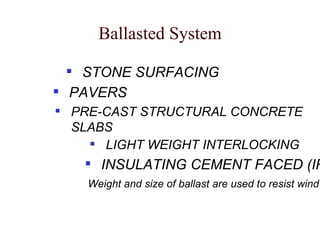
Section 1502 – Definitions Aggregate . Crushed stone, crushed slag or water-worn gravel used for surfacing for roof coverings. Ballast .  Large stones or paver systems or light-weight interlocking paver systems used to provide uplift resistance.
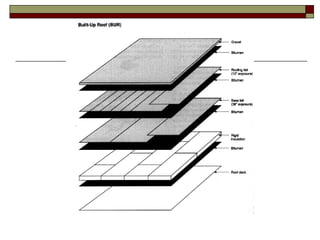
Section 1502 – Definitions Built-up Roof Covering .  Two or more layers of felt cemented together and surfaced with a cap sheet, mineral aggregate, smooth coating or similar surfacing material. Interlayment .  A layer of felt or nonbituminous saturated felt not less than 18 inches (457 mm) wide, shingled between each course of a wood-shake roof covering.
Section 1502 – Definitions Mechanical Equipment Screen .  A partially enclosed rooftop structure used to aesthetically conceal heating ventilating and air conditioning (HVAC) electrical or mechanical equipment from view. Metal Roof Panel .  An interlocking metal sheet having a minimum installed weather exposure of 3 square feet (.279 m2) per sheet.
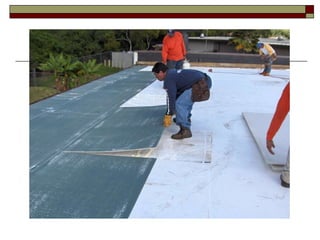
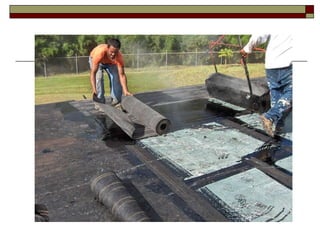
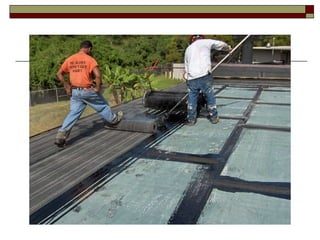
Section 1502 – Definitions Metal Roof Shingle .  An interlocking metal sheet having an installed weather exposure less than 3 square feet (.279 m2) per sheet. Modified Bitumen   Roof Covering .  One or more layers of polymer-modified asphalt sheets.  The sheet materials shall be fully adhered or mechanically attached to the substrate or held in place with an approved ballast layer.
Section 1502 – Definitions Penthouse .  An enclosed, unoccupied structure above the roof of a building, other than a tank, tower, spire, dome cupola or bulkhead. Positive Roof Drainage .  The drainage condition in which consideration has been made for all loading deflections of the roof deck, and additional slope has been provided to ensure drainage of the roof within 48 hours of precipitation.
Section 1502 – Definitions Reroofing .  The process of recovering or replacing an existing roof covering.  See “Roof recover” and “Roof replacement.” Roof Assembly .  A system designed to provide weather protection and resistance to design loads.  The system consists of a roof covering and roof deck or a single component serving as both the roof covering and the roof deck.  A roof assembly includes the roof deck, vapor retarder, substrate or thermal barrier, insulation, vapor retarder and roof covering.
Section 1502 – Definitions Roof Covering .  The covering applied to the roof deck for weather resistance, fire classification or appearance. Roof Deck .  The flat or sloped surface not including its supporting members or vertical supports.
Section 1502 – Definitions Roof Recover .  The process of installing an additional roof covering over a prepared existing roof covering without removing the existing roof covering. Roof Repair .  Reconstruction or renewal of any part of an existing roof for the purposes of its maintenance.
Section 1502 – Definitions Roof Replacement .  The process of removing the existing roof covering, repairing any damaged substrate and installing a new roof covering. Roof Ventilation .  The natural or mechanical process of supplying conditioned or unconditioned air to, or removing such air from, attics, cathedral ceilings or other enclosed spaces over which a roof assembly is installed.
Section 1502 – Definitions Rooftop Structure .  An enclosed structure on or above the roof of any part of a building. Scupper .  An opening in a wall or parapet that allows water to drain from a roof.
Section 1502 – Definitions Single-Ply Membrane .  A roofing membrane that is field applied using one layer of membrane material (either homogeneous or composite) rather than multiple layers. Underlayment .  One or more layers of felt, sheathing paper, nonbituminous saturated felt or other approved material over which a steep-slope roof covering is applied.
1503 Weather Protection
1503.1 Weather Protection   Roof decks shall be covered with approved roof coverings secured to the building or structure in accordance with the provisions of this chapter. Roof coverings shall be designed, installed and maintained in accordance with this code and the approved manufacturer’s installation instructions such that the roof covering shall serve to protect the building or structure.
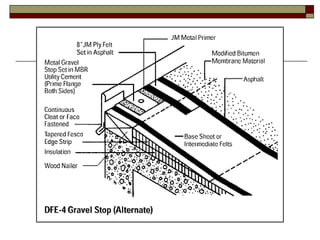
1503.2 Flashing   Flashing shall be installed in such a manner so as to prevent moisture entering the wall and roof through joints in copings, walls, intersections and other penetrations.
1503.3 Coping   Parapet walls shall be properly coped with noncombustable, weatherproof materials of a width no less than the thickness of the parapet wall.
1503.4 Roof Drainage Shall comply with International Plumbing Code.
P1101.7 Roof Design Roofs shall be designed for the maximum possible depth of water that will pond thereon as determined by the relative levels of roof deck and overflow weirs, scuppers, edges or serviceable drains in combination with the deflected structural elements.  In determining the maximum possible depth of water, all primary roof drainage means shall be assumed to be blocked.
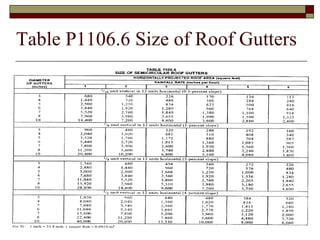
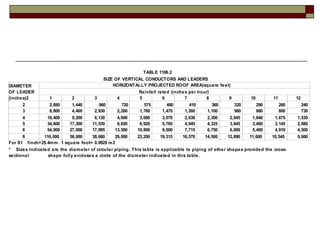
P1106.6 Size of Roof Gutters The size of semicircular gutters shall be based on the maximum projected roof area in accordance with Table 1106.6. Gutters and leaders placed on the outside of buildings, shall be of non-combustible material or a minimum of Schedule 40 plastic pipe.
 
Table P1106.6 Size of Roof Gutters Put a copy of chart 1106.6 in this slide.
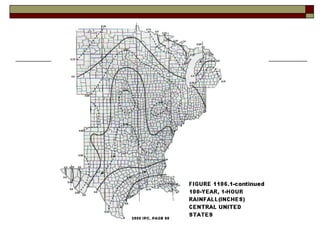
P1106.1 Roof Drain Sizing The size of the vertical conductors and leaders, building storm drains, building storm sewers, and any horizontal branches of such drains or sewers shall be based on the 100-year hourly rainfall rate indicated in Figures P1106.1A through 1E or other rainfall rates determined from approved local weather data.
P1106.2 Vertical Conductors/Leaders Vertical conductors and leaders shall be sized for the maximum projected roof area, in accordance with Table P1106.2.
 
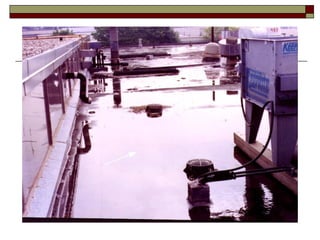
1503.4.1 Secondary Drainage Secondary (emergency) roof drains or scuppers shall be provided where the roof perimeter construction extends above the roof in such a manner that water will be entrapped if the primary drains allow build-up for any reason.
P1107.2 Separate Systems   Required Secondary roof drain systems shall have piping and point of discharge separate from the primary system. Discharge shall be above grade in a location that would normally be observed by the building occupants or maintenance personnel.
P1107.3 Sizing of Secondary Drains Size secondary roof drain systems in accordance with Section P1106 based on the rainfall rate for which the primary system is sized . . . Size scuppers to prevent the depth of ponding water from exceeding that for which the roof was designed as determined by Section P1101.7. Do not consider the flow through the primary system when sizing the secondary roof drain system.
 
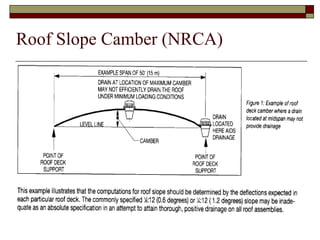
Location of Drains (NRCA) Certain decks, such as precast concrete decks or long-span prestressed concrete decks, may incorporate camber in anticipation of future loading conditions.  Consider the camber in the design of the roof slope and drainage system.  Depending on the structural design of a roof system and placement of drains, the camber may assist or restrict drainage.
Roof Slope Camber (NRCA)
 
1504 Performance Requirement
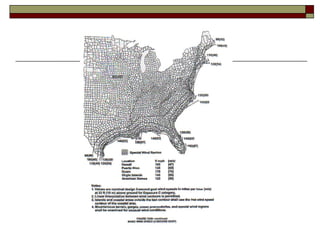
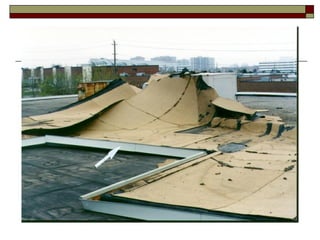
1504.1 Wind Resistance of Roofs Design roof decks and roof coverings for wind loads in accordance with Chapter 16 and Sections 1504.2, .3, and .4. Exception: Design asphalt shingles application for wind speeds in accordance with Section 1507.2.7.
1504.2 Wind Resistance of Clay and Concrete Tile Wind loads on clay and concrete tile roof coverings shall be in accordance with Section 1609.5.
1504.3 Wind Resistance of nonballasted roofs. Roof coverings that are mechanically attached or adhered to the roof deck shall be designed to resist the design wind load pressures in accordance with Section 1609.
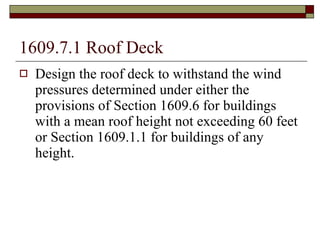
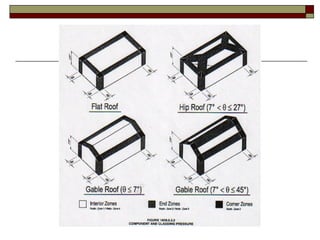
1609.7.1 Roof Deck Design the roof deck to withstand the wind pressures determined under either the provisions of Section 1609.6 for buildings with a mean roof height not exceeding 60 feet or Section 1609.1.1 for buildings of any height.


1504.3.1 Other Roof Systems Roof systems with built-up, modified bitumen, fully adhered or mechanically attached single-ply through fastened metal panel roof systems, and other types of membrane roof coverings shall also be tested in accordance with FM 4474, UL 580 or UL 1897.  (Wind uplift standards)
1504.3.2 Metal Panel Roof Systems Metal panel roof systems through fastened or standing seam shall be tested in accordance with UL 580 or ASTM E 1592.
1504.4 Ballasted Low-slope Roofs Design ballasted low-slope (<2:12) single-ply roof systems installed in accordance with Section 1507 in accordance with Section 1504.8 and ANSI/SPRI RP-4.
1504.5 Edge Securement (wind) Low slope membrane roof systems metal edge securement, except gutters, shall be designed and installed in accordance with Chapter 16 and tested in accordance with ANSI/SPRI ES-1, except the basic wind speed shall be determined from Figure 1609.
1504.7 Impact Resistance (Hail) Roof coverings installed on low slope roofs (<2:12) in accordance with Section 1507 shall resist impact damage based on the results of tests conducted in accordance with ASTM D3746, ASTM D4272, CGSB 37-GP-52M or FM 4470.
1504.8 Aggregate Aggregate, gravel or stone used as ballast shall not be used on the roof of a building located in a hurricane-prone region.
1505 Fire Classification
1505 Fire Classification The minimum roof coverings installed on buildings shall comply with Table 1505.1 based on the type of construction of the building.
Fire-Resistance of Roof Materials UL-790 (ASTM E-108) is the UL standard for tests of roof covering systems for resistance to fire originating form sources outside a building.  The tests include the intermittent flame test, the spread-of-flame test, and the burning brand test for systems installed on combustible decks.  On non-combustible decks, only the spread of flame test is required.
Table 1505.1 – Fire Classification
1505.2 Class A Roof Assemblies Class A roof assemblies are those that are effective against severe fire test exposure.
1505.2 Class A Roof Assemblies Exceptions: 1. Class A roof assemblies include those with coverings of brick, masonry or exposed concrete roof deck.
1505.2 Class A Roof Assemblies Exceptions: 2. Class A roof assemblies also include ferrous or copper shingles or sheets, clay or concrete roof tiles installed on noncombustible decks.
1505.3 Class B Roof Assemblies Class B roof assemblies are those that are effective against moderate fire-test exposure. Shall be listed and identified as Class B by an approved testing agency.
1505.4 Class C Roof Assemblies Class C roof assemblies are those that are effective against light fire-test exposure.
1505.5 Non-classified Roofing Non-classified roofing is approved material that is not listed as a Class A, B or C roof covering.
Section 1506 - Materials
Section 1506.1 - Scope Roof coverings shall be applied in accordance with this chapter and the manufacturer’s installation instructions.
1506.2 Compatibility of Materials Roofs and roof coverings shall be of materials that are compatible with each other and with the building or structure to which the materials are applied.
1506.3 Material Specifications Roof covering materials shall conform to the applicable standards listed in this chapter. In the absence of applicable standards or where materials are of questionable suitability, testing by an approved testing agency shall be required by the building official to determine the character, quality and limitations of application of the materials.
1506.4 Product Identification Roof covering materials shall be delivered in packages bearing the manufacturer’s identifying marks and approved testing agency labels required in accordance with Section 1505. Bulk shipments of materials shall be accompanied with the same information issued in the form of a certificate or on a bill of lading by the manufacturer.
Section 1507 – Materials Standards
Section 1507 – Materials Standards 1507.1 – Scope 1507.2 – Asphalt Shingles 1507.3 – Clay and Concrete Tile 1507.4 – Metal Roof Panels
Section  1507.2 – Asphalt Shingles 1507.2.7 Attachment. Asphalt shingle shall have the minimum number of fasteners required by the manufacturer, but not less than four fasteners per strip shingle or two fasteners per individual shingle.
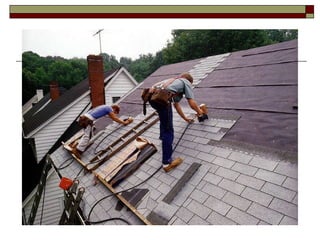
Section  1507.x.x – Ice Barrier In areas where there has been a history of ice forming along the eaves causing a backup of water, an ice barrier . . . shall be used in lieu of normal underlayment and extend from the lowest edges of all roof surfaces to a point 24 inches inside the exterior wall line of the building.


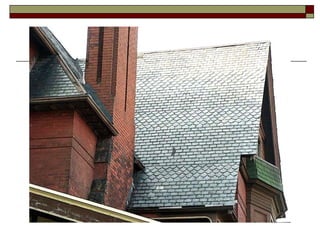
Section 1507 – Materials Standards 1507.5 – Metal Roof Shingles 1507.6 – Mineral-Surfaced Roll Roofing 1507.7 – Slate Shingles 1507.8 – Wood Shingles
 
Section 1507 – Materials Standards 1507.9 – Wood Shakes 1507.10 – Built-Up Roofs 1507.11 – Modified Bitumen Roofing 1507.12 – Thermoset Single-ply Roofing
Section 1507 – Materials Standards 1507.13 – Thermoplastic single-ply 1507.14 – Sprayed polyurethane foam 1507.15 – Liquid applied 1507.16 – Roof gardens and landscaped
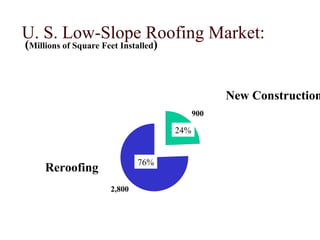
U. S. Low-Slope Roofing Market:  ( Millions of Square Feet Installed ) New Construction Reroofing 76% 24%
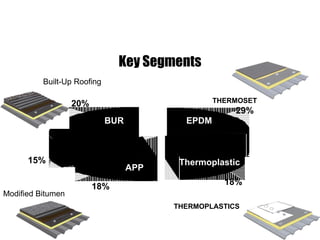
Key Segments APP BUR Built-Up Roofing Modified Bitumen THERMOPLASTICS Thermoplastic EPDM THERMOSET
Section  1507.10 – Built-Up Roofs
 
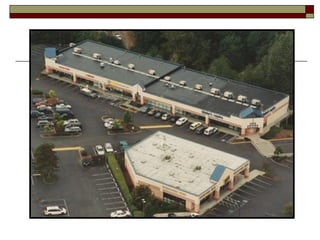
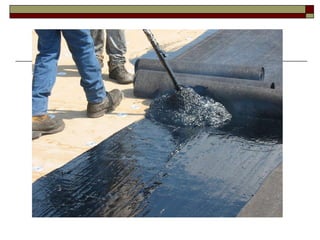
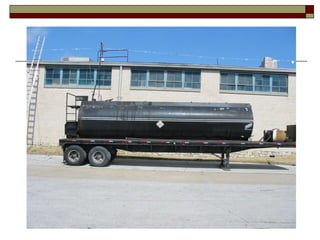
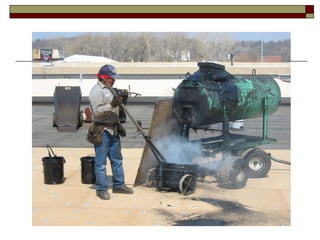
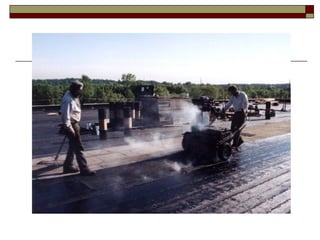
Built Up Roofing Redundancy Typically 4 plies Proven Track Record
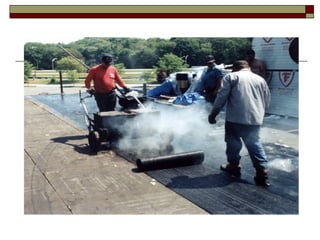
Built Up Roofing Hazardous Installation Techniques Kettles, Open Flames and Safety Concerns Lack of Elongation Need to build in expansion joints Susceptible to “thermal shock” Difficult to Repair Labor Intensive


Section 1507.11 – Modified Bitumen
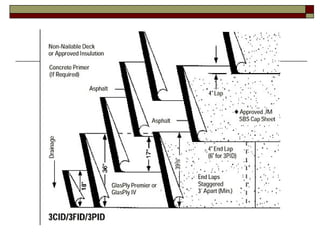
Polymer Modified Bitumen Membranes Developed in Europe in the 1960’s “ change the asphalt” by introducing polymers. Increase flexibility, elongation and long term waterproofing Reduce number of layers used for an asphalt roof
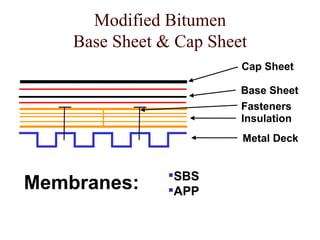
Modified Bitumen Base Sheet & Cap Sheet SBS APP Membranes: Metal Deck Insulation Fasteners Cap Sheet Base Sheet
Modified Bitumen Roofing Redundant Puncture Resistant Resistant Foot Traffic
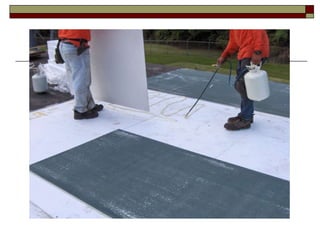
Modified Bitumen Roofing Hazardous Application Techniques Torches Hot Asphalt Fumes Application Issues of “Cold Systems” Wrinkling Mole Runs  Lack of Elongation Weight Number of Seams
 
 
Modified Bitumen Roof Membranes Are made of two distinct polymer configurations APP = Torch  SBS = Typically hot mopped Waterproofing layer is manufactured in a controlled environment
SBS Polymer Modified Asphalt SBS Styrene-Butadiene-Styrene (rubber) Traditionally known as “Hot Mopped” Now also cold applied, torched and self adhered
 
Kansas City International Airport 500,000 sf SBS Premium FR Modified Bitumen Membrane
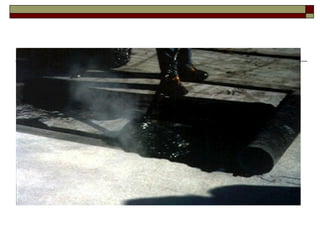
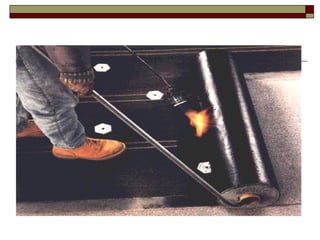
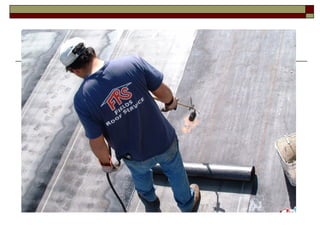
APP Modified Bitumen   APP Atactic Polypropylene Polymer (plastic) “ Torch Applied” Now also cold applied and self adhesive but never hot mopped
 
 
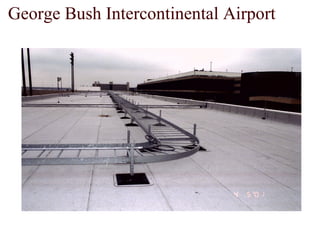
George Bush Intercontinental Airport
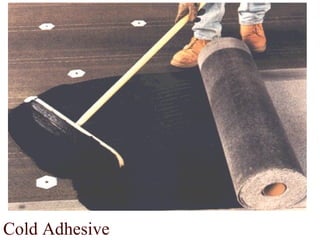
Cold Adhesive
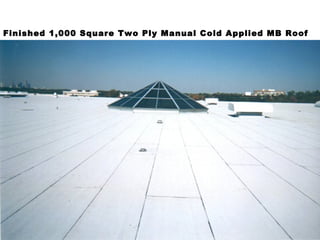
Finished 1,000 Square Two Ply Manual Cold Applied MB Roof
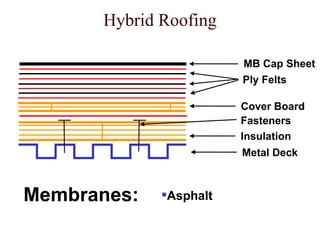
Hybrid Roofing Asphalt Membranes: Metal Deck Cover Board Fasteners Ply Felts MB Cap Sheet Insulation
Section 1507.12 – Thermoset Single-ply
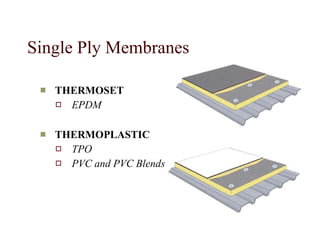
THERMOSET EPDM THERMOPLASTIC TPO PVC and PVC Blends Single Ply Membranes
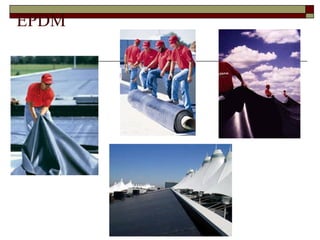
EPDM
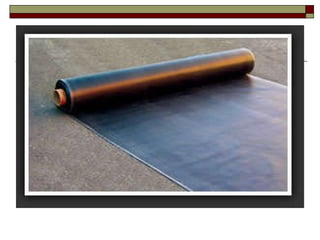
EPDM Longest track record of any single ply membrane Excellent Physical Properties Long term weathering Resistance to U.V. Elongation Tear Strength Economical  Lower labor input Easy to repair / maintain
 
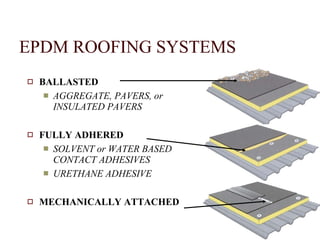
BALLASTED AGGREGATE, PAVERS, or INSULATED PAVERS FULLY ADHERED SOLVENT or WATER BASED CONTACT ADHESIVES URETHANE ADHESIVE MECHANICALLY ATTACHED EPDM ROOFING SYSTEMS
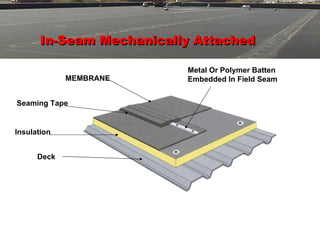
In-Seam Mechanically Attached Metal Or Polymer Batten Embedded In Field Seam MEMBRANE Insulation Deck Seaming Tape
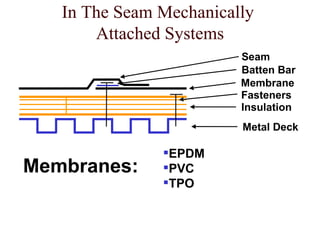
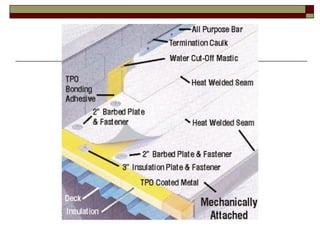
In The Seam Mechanically  Attached Systems EPDM PVC TPO Membranes: Metal Deck Insulation Fasteners Seam Membrane Batten Bar
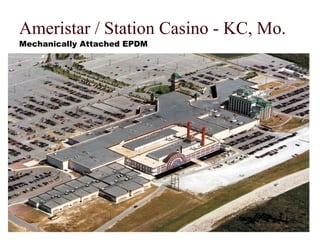
Ameristar / Station Casino - KC, Mo. Mechanically Attached EPDM
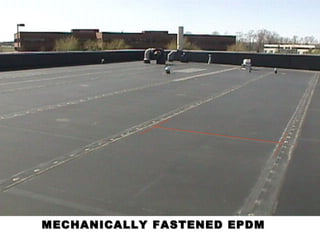
MECHANICALLY FASTENED EPDM
Mechanically Attached Single Ply Light Weight Cost Effective (Low Labor Input) Wide Range of membrane types colors and thicknesses Better Application Window (Weather) Less Fumes
Mechanically Attached Single Ply Seam attachment can result in billowing Need to use 8’ wide sheets maximum Air Barrier can minimize bellowing Metal Deck type impacts FM ratings
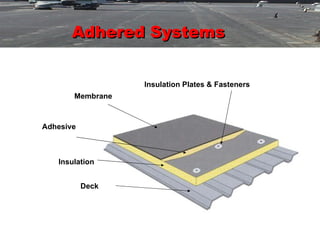
Adhered Systems Membrane Insulation Deck Deck Insulation Insulation Plates & Fasteners Adhesive Adhesive
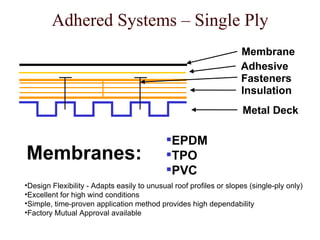
Adhered Systems – Single Ply Design Flexibility - Adapts easily to unusual roof profiles or slopes (single-ply only) Excellent for high wind conditions Simple, time-proven application method provides high dependability Factory Mutual Approval available EPDM  TPO PVC Membranes: Metal Deck Insulation Fasteners Membrane Adhesive
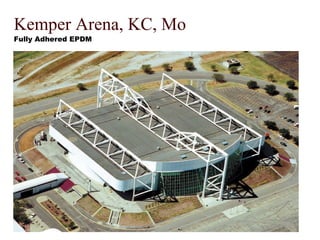
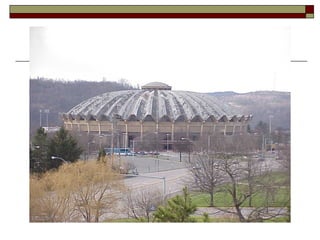
Kemper Arena, KC, Mo Fully Adhered EPDM
Adhered Single Ply Long term performance Membranes up to 90 mils thick Warranties up to 30 Years Very High Wind Ratings (FM) Easily maintained and repaired Available in a wide range of membrane type, thickness and color Excellent for irregular substrates, high slope, etc
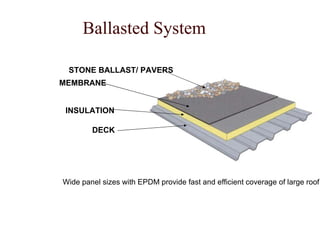
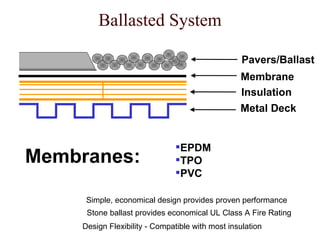
Ballasted System INSULATION DECK Wide panel sizes with EPDM provide fast and efficient coverage of large roof areas STONE BALLAST/ PAVERS MEMBRANE
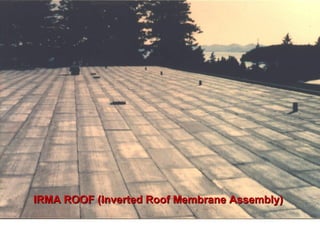
Ballasted System STONE SURFACING PAVERS PRE-CAST STRUCTURAL CONCRETE SLABS LIGHT WEIGHT INTERLOCKING INSULATING CEMENT FACED (IRMA) Weight and size of ballast are used to resist wind forces
Ballasted Single Ply Economical Uses large sheets (fewer seams) No roof deck penetration
Ballasted Single Ply Heavy Difficult to find leaks Not good for high traffic areas Environmental Impact
Ballasted System Simple, economical design provides proven performance Stone ballast provides economical UL Class A Fire Rating Design Flexibility - Compatible with most insulation EPDM  TPO PVC Membranes: Metal Deck Insulation Membrane Pavers/Ballast
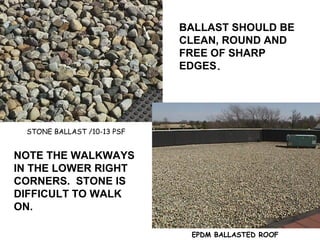
STONE BALLAST /10-13 PSF BALLAST SHOULD BE CLEAN, ROUND AND FREE OF SHARP EDGES . NOTE THE WALKWAYS IN THE LOWER RIGHT CORNERS.  STONE IS DIFFICULT TO WALK ON.
IRMA ROOF (Inverted Roof Membrane Assembly)
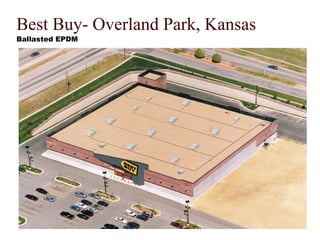
Best Buy- Overland Park, Kansas Ballasted EPDM
Section 1507.13 – Thermoplastic single-ply


TPO White Also available in Tan or Grey Energy Star compliant LEED Compliant Economical Low labor input
TPO TPO Membrane developing long-term track record. 10-15 Years maximum field experience Many manufacturers and formulations
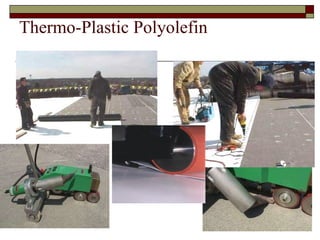
Thermo-Plastic Polyolefin
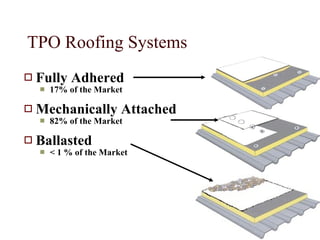
Fully Adhered   17% of the Market Mechanically Attached 82% of the Market Ballasted < 1 % of the Market TPO Roofing Systems
 
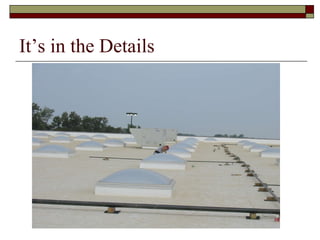
It’s in the Details
Section 1507.14 – Sprayed polyurethane foam


Section  1507.15 – Liquid applied
Section 1507.16 – Roof gardens and landscaped 1607.11.3 Landscaped roofs. Where roofs are to be landscaped, the uniform design live load in the landscaped area shall be 20 psf. The weight of the landscaping materials shall be considered as dead load and shall be computed on the basis of saturation of the soil.
California Title 24 Mandatory Requirements for Cool Roofs.  . . . a cool roof shall be certified and labelled . . .  Any roofing product with an initial thermal  emittance  greater than or equal to 0.75 and shall have a minimum initial solar  reflectance  of 0.70 when tested in accordance with CRRC.
1508 Roof Insulation The use of above-deck thermal insulation shall be permitted provided such insulation is covered with an approved roof covering and passes the tests of FM 4450 or UL 1256 when tested as an assembly. Exception: Foam plastic roof insulation shall conform to the material and installation requirements of Chapter 26. Exception: On concrete deck.
Chapter 26 Foam Plastic Insulation Label of an approved agency Manufacturer’s name and product listing Product identification information sufficient to determine that the end use will comply with the code requirements
Chapter 26 Foam Plastic Insulation Flame Spread and Smoke Development Not required if part of a Class A, B, or C roof covering assembly, provided the assembly . . . satisfactorily passes FM 4450 or UL 1256.
1508.1.1 Cellulosic Fiberboard Cellulosic Fiberboard roof insulation shall conform to the material and installation requirements of Chapter 23.
1510 Reroofing
1510.1 General Materials and methods of application used for recovering or replacing an existing roof covering shall comply with the requirements of Chapter 15. Exception: Reroofing shall not be required to meet the minimum design slope requirement of 1/4 unit vertical in 12 units horizontal in Section 1507 for roofs that provide positive roof drainage.
1510.2 Structural & Constr. Loads The structural roof components shall be capable of supporting the roof covering system and the material and equipment loads that will be encountered during installation of the system.
1510.3 Recover vs. Replacement New roof coverings shall  not  be installed without first removing all existing layers of roof coverings where any of the following conditions occur: Where the existing roof or roof covering is water soaked or has deteriorated to the point that the existing roof or roof covering is not adequate as a base for additional roofing. Where the existing roof covering is wood shake, slate, clay, cement or asbestos-cement tile. Where the existing roof has two or more applications of any type of roof covering.
1510.3 Recover vs. Replacement Exceptions: Complete and separate roofing systems, such as standing-seam metal roof systems, that are designed to transmit the roof loads directly to the building’s structural system and that do not rely on existing roofs and roof coverings for support, shall not require the removal of existing roof coverings. Metal panel, metal shingle, and concrete and clay tile roof coverings shall be permitted to be installed over existing wood shake roofs when applied in accordance with Section 1510.4 New coating over existing SPF system.
Section 1509 – Rooftop Structures 1509.1 – General – The provisions of this section shall govern the construction of rooftop structures. 1509.2 – Penthouses 1509.3 – Tanks
Section 1509 – Rooftop Structures 1509.4 – Cooling Towers  1509.5 – Towers, Spires, Domes & Cupolas
Section 1509.2 - Penthouses Penthouses in other than Type I construction shall not exceed 28 feet above roof when used as an enclosure for tanks or elevators that run to the roof. Penthouses shall not extend more than 18 feet above the roof otherwise. Penthouses shall not be used for purposes other than to shelter mechanical equipment or vertical shaft openings in the roof.
Section 1509.3 - Tanks Tanks having a capacity of more than 500 gallons placed in or on a building shall be supported on masonry, reinforced concrete, steel or Type IV construction provided that, where such supports are located in the building above the lowest story, the support shall be fire-resistance rated as required for Type IA construction.
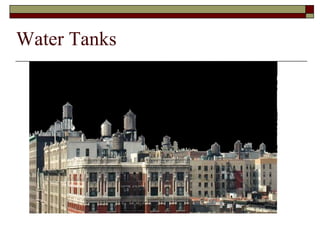
Water Tanks
Section 1509.3.1 – Valve Tanks shall have in the bottom or on the side near the bottom, a pipe or outlet, fitted with a suitable quick opening valve for discharging the contents in an emergency through an adequate drain.
Section 1509.3.2 - Location Tanks shall not be placed over or near a line of stairs or an elevator shaft, unless there is a solid roof or floor underneath the tank
Section 1509.3.2 - Tank cover Unenclosed roof tanks shall have covers sloping toward the outer edge.
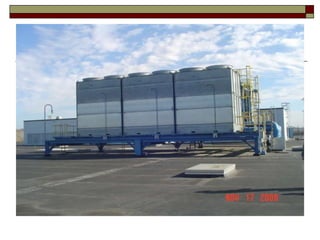
Section 1509.4 – Cooling Towers Cooling towers in excess of 250 square feet in base area or in excess of 15 feet high where located on buildings more than 50 feet high shall be of non-combustible construction. Cooling towers shall not exceed one-third of the supporting roof area.
 
Section 1509.5 – Towers, spires, domes, and cupolas Any tower, spire, dome, or cupola shall be of a type of construction not less in fire-resistance rating than required for the building to which it is attached. Height restrictions apply.  See the IBC for details.
More Information International Conference Of Building Officials 816-455-3330 2900 NE 60th St, Ste 206 Kansas City, MO 64119
More Information 913-735-4772

IBC Seminar 091112, R1

  • 1.
    Commercial Roofing inthe IBC Covering IBC Chapter 15 Roof Assemblies & Rooftop Structures Robert Dye, FCSI, LEED-AP Registered Roof Consultant
  • 2.
  • 3.
    Overview ICBO Chapter15 provides requirements in the following areas applicable to roofing: Fire resistance Roof Drainage Wind uplift resistance Material standards
  • 4.
    Section 1501 -General 1501.1 – Scope The provisions of this chapter shall govern the design, materials, construction, and quality of roof assemblies, and rooftop structures.
  • 5.
    Section 1502 –Definitions
  • 6.
    Section 1502 –Definitions Aggregate . Crushed stone, crushed slag or water-worn gravel used for surfacing for roof coverings. Ballast . Large stones or paver systems or light-weight interlocking paver systems used to provide uplift resistance.
  • 7.
    Section 1502 –Definitions Built-up Roof Covering . Two or more layers of felt cemented together and surfaced with a cap sheet, mineral aggregate, smooth coating or similar surfacing material. Interlayment . A layer of felt or nonbituminous saturated felt not less than 18 inches (457 mm) wide, shingled between each course of a wood-shake roof covering.
  • 8.
    Section 1502 –Definitions Mechanical Equipment Screen . A partially enclosed rooftop structure used to aesthetically conceal heating ventilating and air conditioning (HVAC) electrical or mechanical equipment from view. Metal Roof Panel . An interlocking metal sheet having a minimum installed weather exposure of 3 square feet (.279 m2) per sheet.
  • 9.
    Section 1502 –Definitions Metal Roof Shingle . An interlocking metal sheet having an installed weather exposure less than 3 square feet (.279 m2) per sheet. Modified Bitumen Roof Covering . One or more layers of polymer-modified asphalt sheets. The sheet materials shall be fully adhered or mechanically attached to the substrate or held in place with an approved ballast layer.
  • 10.
    Section 1502 –Definitions Penthouse . An enclosed, unoccupied structure above the roof of a building, other than a tank, tower, spire, dome cupola or bulkhead. Positive Roof Drainage . The drainage condition in which consideration has been made for all loading deflections of the roof deck, and additional slope has been provided to ensure drainage of the roof within 48 hours of precipitation.
  • 11.
    Section 1502 –Definitions Reroofing . The process of recovering or replacing an existing roof covering. See “Roof recover” and “Roof replacement.” Roof Assembly . A system designed to provide weather protection and resistance to design loads. The system consists of a roof covering and roof deck or a single component serving as both the roof covering and the roof deck. A roof assembly includes the roof deck, vapor retarder, substrate or thermal barrier, insulation, vapor retarder and roof covering.
  • 12.
    Section 1502 –Definitions Roof Covering . The covering applied to the roof deck for weather resistance, fire classification or appearance. Roof Deck . The flat or sloped surface not including its supporting members or vertical supports.
  • 13.
    Section 1502 –Definitions Roof Recover . The process of installing an additional roof covering over a prepared existing roof covering without removing the existing roof covering. Roof Repair . Reconstruction or renewal of any part of an existing roof for the purposes of its maintenance.
  • 14.
    Section 1502 –Definitions Roof Replacement . The process of removing the existing roof covering, repairing any damaged substrate and installing a new roof covering. Roof Ventilation . The natural or mechanical process of supplying conditioned or unconditioned air to, or removing such air from, attics, cathedral ceilings or other enclosed spaces over which a roof assembly is installed.
  • 15.
    Section 1502 –Definitions Rooftop Structure . An enclosed structure on or above the roof of any part of a building. Scupper . An opening in a wall or parapet that allows water to drain from a roof.
  • 16.
    Section 1502 –Definitions Single-Ply Membrane . A roofing membrane that is field applied using one layer of membrane material (either homogeneous or composite) rather than multiple layers. Underlayment . One or more layers of felt, sheathing paper, nonbituminous saturated felt or other approved material over which a steep-slope roof covering is applied.
  • 17.
  • 18.
    1503.1 Weather Protection Roof decks shall be covered with approved roof coverings secured to the building or structure in accordance with the provisions of this chapter. Roof coverings shall be designed, installed and maintained in accordance with this code and the approved manufacturer’s installation instructions such that the roof covering shall serve to protect the building or structure.
  • 19.
    1503.2 Flashing Flashing shall be installed in such a manner so as to prevent moisture entering the wall and roof through joints in copings, walls, intersections and other penetrations.
  • 20.
    1503.3 Coping Parapet walls shall be properly coped with noncombustable, weatherproof materials of a width no less than the thickness of the parapet wall.
  • 21.
    1503.4 Roof DrainageShall comply with International Plumbing Code.
  • 22.
    P1101.7 Roof DesignRoofs shall be designed for the maximum possible depth of water that will pond thereon as determined by the relative levels of roof deck and overflow weirs, scuppers, edges or serviceable drains in combination with the deflected structural elements. In determining the maximum possible depth of water, all primary roof drainage means shall be assumed to be blocked.
  • 23.
    P1106.6 Size ofRoof Gutters The size of semicircular gutters shall be based on the maximum projected roof area in accordance with Table 1106.6. Gutters and leaders placed on the outside of buildings, shall be of non-combustible material or a minimum of Schedule 40 plastic pipe.
  • 24.
  • 25.
    Table P1106.6 Sizeof Roof Gutters Put a copy of chart 1106.6 in this slide.
  • 26.
    P1106.1 Roof DrainSizing The size of the vertical conductors and leaders, building storm drains, building storm sewers, and any horizontal branches of such drains or sewers shall be based on the 100-year hourly rainfall rate indicated in Figures P1106.1A through 1E or other rainfall rates determined from approved local weather data.
  • 27.
    P1106.2 Vertical Conductors/LeadersVertical conductors and leaders shall be sized for the maximum projected roof area, in accordance with Table P1106.2.
  • 28.
  • 29.
    1503.4.1 Secondary DrainageSecondary (emergency) roof drains or scuppers shall be provided where the roof perimeter construction extends above the roof in such a manner that water will be entrapped if the primary drains allow build-up for any reason.
  • 30.
    P1107.2 Separate Systems Required Secondary roof drain systems shall have piping and point of discharge separate from the primary system. Discharge shall be above grade in a location that would normally be observed by the building occupants or maintenance personnel.
  • 31.
    P1107.3 Sizing ofSecondary Drains Size secondary roof drain systems in accordance with Section P1106 based on the rainfall rate for which the primary system is sized . . . Size scuppers to prevent the depth of ponding water from exceeding that for which the roof was designed as determined by Section P1101.7. Do not consider the flow through the primary system when sizing the secondary roof drain system.
  • 32.
  • 33.
    Location of Drains(NRCA) Certain decks, such as precast concrete decks or long-span prestressed concrete decks, may incorporate camber in anticipation of future loading conditions. Consider the camber in the design of the roof slope and drainage system. Depending on the structural design of a roof system and placement of drains, the camber may assist or restrict drainage.
  • 34.
  • 35.
  • 36.
  • 37.
    1504.1 Wind Resistanceof Roofs Design roof decks and roof coverings for wind loads in accordance with Chapter 16 and Sections 1504.2, .3, and .4. Exception: Design asphalt shingles application for wind speeds in accordance with Section 1507.2.7.
  • 38.
    1504.2 Wind Resistanceof Clay and Concrete Tile Wind loads on clay and concrete tile roof coverings shall be in accordance with Section 1609.5.
  • 39.
    1504.3 Wind Resistanceof nonballasted roofs. Roof coverings that are mechanically attached or adhered to the roof deck shall be designed to resist the design wind load pressures in accordance with Section 1609.
  • 40.
    1609.7.1 Roof DeckDesign the roof deck to withstand the wind pressures determined under either the provisions of Section 1609.6 for buildings with a mean roof height not exceeding 60 feet or Section 1609.1.1 for buildings of any height.
  • 41.
  • 42.
  • 43.
  • 44.
    1504.3.1 Other RoofSystems Roof systems with built-up, modified bitumen, fully adhered or mechanically attached single-ply through fastened metal panel roof systems, and other types of membrane roof coverings shall also be tested in accordance with FM 4474, UL 580 or UL 1897. (Wind uplift standards)
  • 45.
    1504.3.2 Metal PanelRoof Systems Metal panel roof systems through fastened or standing seam shall be tested in accordance with UL 580 or ASTM E 1592.
  • 46.
    1504.4 Ballasted Low-slopeRoofs Design ballasted low-slope (<2:12) single-ply roof systems installed in accordance with Section 1507 in accordance with Section 1504.8 and ANSI/SPRI RP-4.
  • 47.
    1504.5 Edge Securement(wind) Low slope membrane roof systems metal edge securement, except gutters, shall be designed and installed in accordance with Chapter 16 and tested in accordance with ANSI/SPRI ES-1, except the basic wind speed shall be determined from Figure 1609.
  • 48.
    1504.7 Impact Resistance(Hail) Roof coverings installed on low slope roofs (<2:12) in accordance with Section 1507 shall resist impact damage based on the results of tests conducted in accordance with ASTM D3746, ASTM D4272, CGSB 37-GP-52M or FM 4470.
  • 49.
    1504.8 Aggregate Aggregate,gravel or stone used as ballast shall not be used on the roof of a building located in a hurricane-prone region.
  • 50.
  • 51.
    1505 Fire ClassificationThe minimum roof coverings installed on buildings shall comply with Table 1505.1 based on the type of construction of the building.
  • 52.
    Fire-Resistance of RoofMaterials UL-790 (ASTM E-108) is the UL standard for tests of roof covering systems for resistance to fire originating form sources outside a building. The tests include the intermittent flame test, the spread-of-flame test, and the burning brand test for systems installed on combustible decks. On non-combustible decks, only the spread of flame test is required.
  • 53.
    Table 1505.1 –Fire Classification
  • 54.
    1505.2 Class ARoof Assemblies Class A roof assemblies are those that are effective against severe fire test exposure.
  • 55.
    1505.2 Class ARoof Assemblies Exceptions: 1. Class A roof assemblies include those with coverings of brick, masonry or exposed concrete roof deck.
  • 56.
    1505.2 Class ARoof Assemblies Exceptions: 2. Class A roof assemblies also include ferrous or copper shingles or sheets, clay or concrete roof tiles installed on noncombustible decks.
  • 57.
    1505.3 Class BRoof Assemblies Class B roof assemblies are those that are effective against moderate fire-test exposure. Shall be listed and identified as Class B by an approved testing agency.
  • 58.
    1505.4 Class CRoof Assemblies Class C roof assemblies are those that are effective against light fire-test exposure.
  • 59.
    1505.5 Non-classified RoofingNon-classified roofing is approved material that is not listed as a Class A, B or C roof covering.
  • 60.
    Section 1506 -Materials
  • 61.
    Section 1506.1 -Scope Roof coverings shall be applied in accordance with this chapter and the manufacturer’s installation instructions.
  • 62.
    1506.2 Compatibility ofMaterials Roofs and roof coverings shall be of materials that are compatible with each other and with the building or structure to which the materials are applied.
  • 63.
    1506.3 Material SpecificationsRoof covering materials shall conform to the applicable standards listed in this chapter. In the absence of applicable standards or where materials are of questionable suitability, testing by an approved testing agency shall be required by the building official to determine the character, quality and limitations of application of the materials.
  • 64.
    1506.4 Product IdentificationRoof covering materials shall be delivered in packages bearing the manufacturer’s identifying marks and approved testing agency labels required in accordance with Section 1505. Bulk shipments of materials shall be accompanied with the same information issued in the form of a certificate or on a bill of lading by the manufacturer.
  • 65.
    Section 1507 –Materials Standards
  • 66.
    Section 1507 –Materials Standards 1507.1 – Scope 1507.2 – Asphalt Shingles 1507.3 – Clay and Concrete Tile 1507.4 – Metal Roof Panels
  • 67.
    Section 1507.2– Asphalt Shingles 1507.2.7 Attachment. Asphalt shingle shall have the minimum number of fasteners required by the manufacturer, but not less than four fasteners per strip shingle or two fasteners per individual shingle.
  • 68.
    Section 1507.x.x– Ice Barrier In areas where there has been a history of ice forming along the eaves causing a backup of water, an ice barrier . . . shall be used in lieu of normal underlayment and extend from the lowest edges of all roof surfaces to a point 24 inches inside the exterior wall line of the building.
  • 69.
  • 70.
  • 71.
  • 72.
  • 73.
  • 74.
  • 75.
    Section 1507 –Materials Standards 1507.5 – Metal Roof Shingles 1507.6 – Mineral-Surfaced Roll Roofing 1507.7 – Slate Shingles 1507.8 – Wood Shingles
  • 76.
  • 77.
    Section 1507 –Materials Standards 1507.9 – Wood Shakes 1507.10 – Built-Up Roofs 1507.11 – Modified Bitumen Roofing 1507.12 – Thermoset Single-ply Roofing
  • 78.
    Section 1507 –Materials Standards 1507.13 – Thermoplastic single-ply 1507.14 – Sprayed polyurethane foam 1507.15 – Liquid applied 1507.16 – Roof gardens and landscaped
  • 79.
    U. S. Low-SlopeRoofing Market: ( Millions of Square Feet Installed ) New Construction Reroofing 76% 24%
  • 80.
    Key Segments APPBUR Built-Up Roofing Modified Bitumen THERMOPLASTICS Thermoplastic EPDM THERMOSET
  • 81.
    Section 1507.10– Built-Up Roofs
  • 82.
  • 83.
    Built Up RoofingRedundancy Typically 4 plies Proven Track Record
  • 84.
    Built Up RoofingHazardous Installation Techniques Kettles, Open Flames and Safety Concerns Lack of Elongation Need to build in expansion joints Susceptible to “thermal shock” Difficult to Repair Labor Intensive
  • 85.
  • 86.
  • 87.
  • 88.
  • 89.
  • 90.
  • 91.
  • 92.
  • 93.
  • 94.
  • 95.
    Section 1507.11 –Modified Bitumen
  • 96.
    Polymer Modified BitumenMembranes Developed in Europe in the 1960’s “ change the asphalt” by introducing polymers. Increase flexibility, elongation and long term waterproofing Reduce number of layers used for an asphalt roof
  • 97.
    Modified Bitumen BaseSheet & Cap Sheet SBS APP Membranes: Metal Deck Insulation Fasteners Cap Sheet Base Sheet
  • 98.
    Modified Bitumen RoofingRedundant Puncture Resistant Resistant Foot Traffic
  • 99.
    Modified Bitumen RoofingHazardous Application Techniques Torches Hot Asphalt Fumes Application Issues of “Cold Systems” Wrinkling Mole Runs Lack of Elongation Weight Number of Seams
  • 100.
  • 101.
  • 102.
    Modified Bitumen RoofMembranes Are made of two distinct polymer configurations APP = Torch SBS = Typically hot mopped Waterproofing layer is manufactured in a controlled environment
  • 103.
    SBS Polymer ModifiedAsphalt SBS Styrene-Butadiene-Styrene (rubber) Traditionally known as “Hot Mopped” Now also cold applied, torched and self adhered
  • 104.
  • 105.
    Kansas City InternationalAirport 500,000 sf SBS Premium FR Modified Bitumen Membrane
  • 106.
    APP Modified Bitumen APP Atactic Polypropylene Polymer (plastic) “ Torch Applied” Now also cold applied and self adhesive but never hot mopped
  • 107.
  • 108.
  • 109.
  • 110.
  • 111.
    Finished 1,000 SquareTwo Ply Manual Cold Applied MB Roof
  • 112.
    Hybrid Roofing AsphaltMembranes: Metal Deck Cover Board Fasteners Ply Felts MB Cap Sheet Insulation
  • 113.
    Section 1507.12 –Thermoset Single-ply
  • 114.
    THERMOSET EPDM THERMOPLASTICTPO PVC and PVC Blends Single Ply Membranes
  • 115.
  • 116.
    EPDM Longest trackrecord of any single ply membrane Excellent Physical Properties Long term weathering Resistance to U.V. Elongation Tear Strength Economical Lower labor input Easy to repair / maintain
  • 117.
  • 118.
    BALLASTED AGGREGATE, PAVERS,or INSULATED PAVERS FULLY ADHERED SOLVENT or WATER BASED CONTACT ADHESIVES URETHANE ADHESIVE MECHANICALLY ATTACHED EPDM ROOFING SYSTEMS
  • 119.
    In-Seam Mechanically AttachedMetal Or Polymer Batten Embedded In Field Seam MEMBRANE Insulation Deck Seaming Tape
  • 120.
    In The SeamMechanically Attached Systems EPDM PVC TPO Membranes: Metal Deck Insulation Fasteners Seam Membrane Batten Bar
  • 121.
    Ameristar / StationCasino - KC, Mo. Mechanically Attached EPDM
  • 122.
  • 123.
    Mechanically Attached SinglePly Light Weight Cost Effective (Low Labor Input) Wide Range of membrane types colors and thicknesses Better Application Window (Weather) Less Fumes
  • 124.
    Mechanically Attached SinglePly Seam attachment can result in billowing Need to use 8’ wide sheets maximum Air Barrier can minimize bellowing Metal Deck type impacts FM ratings
  • 125.
    Adhered Systems MembraneInsulation Deck Deck Insulation Insulation Plates & Fasteners Adhesive Adhesive
  • 126.
    Adhered Systems –Single Ply Design Flexibility - Adapts easily to unusual roof profiles or slopes (single-ply only) Excellent for high wind conditions Simple, time-proven application method provides high dependability Factory Mutual Approval available EPDM TPO PVC Membranes: Metal Deck Insulation Fasteners Membrane Adhesive
  • 127.
    Kemper Arena, KC,Mo Fully Adhered EPDM
  • 128.
    Adhered Single PlyLong term performance Membranes up to 90 mils thick Warranties up to 30 Years Very High Wind Ratings (FM) Easily maintained and repaired Available in a wide range of membrane type, thickness and color Excellent for irregular substrates, high slope, etc
  • 129.
    Ballasted System INSULATIONDECK Wide panel sizes with EPDM provide fast and efficient coverage of large roof areas STONE BALLAST/ PAVERS MEMBRANE
  • 130.
    Ballasted System STONESURFACING PAVERS PRE-CAST STRUCTURAL CONCRETE SLABS LIGHT WEIGHT INTERLOCKING INSULATING CEMENT FACED (IRMA) Weight and size of ballast are used to resist wind forces
  • 131.
    Ballasted Single PlyEconomical Uses large sheets (fewer seams) No roof deck penetration
  • 132.
    Ballasted Single PlyHeavy Difficult to find leaks Not good for high traffic areas Environmental Impact
  • 133.
    Ballasted System Simple,economical design provides proven performance Stone ballast provides economical UL Class A Fire Rating Design Flexibility - Compatible with most insulation EPDM TPO PVC Membranes: Metal Deck Insulation Membrane Pavers/Ballast
  • 134.
    STONE BALLAST /10-13PSF BALLAST SHOULD BE CLEAN, ROUND AND FREE OF SHARP EDGES . NOTE THE WALKWAYS IN THE LOWER RIGHT CORNERS. STONE IS DIFFICULT TO WALK ON.
  • 135.
    IRMA ROOF (InvertedRoof Membrane Assembly)
  • 136.
    Best Buy- OverlandPark, Kansas Ballasted EPDM
  • 137.
    Section 1507.13 –Thermoplastic single-ply
  • 138.
  • 139.
  • 140.
  • 141.
    TPO White Alsoavailable in Tan or Grey Energy Star compliant LEED Compliant Economical Low labor input
  • 142.
    TPO TPO Membranedeveloping long-term track record. 10-15 Years maximum field experience Many manufacturers and formulations
  • 143.
  • 144.
    Fully Adhered 17% of the Market Mechanically Attached 82% of the Market Ballasted < 1 % of the Market TPO Roofing Systems
  • 145.
  • 146.
  • 147.
    Section 1507.14 –Sprayed polyurethane foam
  • 148.
  • 149.
  • 150.
  • 151.
    Section 1507.15– Liquid applied
  • 152.
    Section 1507.16 –Roof gardens and landscaped 1607.11.3 Landscaped roofs. Where roofs are to be landscaped, the uniform design live load in the landscaped area shall be 20 psf. The weight of the landscaping materials shall be considered as dead load and shall be computed on the basis of saturation of the soil.
  • 153.
    California Title 24Mandatory Requirements for Cool Roofs. . . . a cool roof shall be certified and labelled . . . Any roofing product with an initial thermal emittance greater than or equal to 0.75 and shall have a minimum initial solar reflectance of 0.70 when tested in accordance with CRRC.
  • 154.
    1508 Roof InsulationThe use of above-deck thermal insulation shall be permitted provided such insulation is covered with an approved roof covering and passes the tests of FM 4450 or UL 1256 when tested as an assembly. Exception: Foam plastic roof insulation shall conform to the material and installation requirements of Chapter 26. Exception: On concrete deck.
  • 155.
    Chapter 26 FoamPlastic Insulation Label of an approved agency Manufacturer’s name and product listing Product identification information sufficient to determine that the end use will comply with the code requirements
  • 156.
    Chapter 26 FoamPlastic Insulation Flame Spread and Smoke Development Not required if part of a Class A, B, or C roof covering assembly, provided the assembly . . . satisfactorily passes FM 4450 or UL 1256.
  • 157.
    1508.1.1 Cellulosic FiberboardCellulosic Fiberboard roof insulation shall conform to the material and installation requirements of Chapter 23.
  • 158.
  • 159.
    1510.1 General Materialsand methods of application used for recovering or replacing an existing roof covering shall comply with the requirements of Chapter 15. Exception: Reroofing shall not be required to meet the minimum design slope requirement of 1/4 unit vertical in 12 units horizontal in Section 1507 for roofs that provide positive roof drainage.
  • 160.
    1510.2 Structural &Constr. Loads The structural roof components shall be capable of supporting the roof covering system and the material and equipment loads that will be encountered during installation of the system.
  • 161.
    1510.3 Recover vs.Replacement New roof coverings shall not be installed without first removing all existing layers of roof coverings where any of the following conditions occur: Where the existing roof or roof covering is water soaked or has deteriorated to the point that the existing roof or roof covering is not adequate as a base for additional roofing. Where the existing roof covering is wood shake, slate, clay, cement or asbestos-cement tile. Where the existing roof has two or more applications of any type of roof covering.
  • 162.
    1510.3 Recover vs.Replacement Exceptions: Complete and separate roofing systems, such as standing-seam metal roof systems, that are designed to transmit the roof loads directly to the building’s structural system and that do not rely on existing roofs and roof coverings for support, shall not require the removal of existing roof coverings. Metal panel, metal shingle, and concrete and clay tile roof coverings shall be permitted to be installed over existing wood shake roofs when applied in accordance with Section 1510.4 New coating over existing SPF system.
  • 163.
    Section 1509 –Rooftop Structures 1509.1 – General – The provisions of this section shall govern the construction of rooftop structures. 1509.2 – Penthouses 1509.3 – Tanks
  • 164.
    Section 1509 –Rooftop Structures 1509.4 – Cooling Towers 1509.5 – Towers, Spires, Domes & Cupolas
  • 165.
    Section 1509.2 -Penthouses Penthouses in other than Type I construction shall not exceed 28 feet above roof when used as an enclosure for tanks or elevators that run to the roof. Penthouses shall not extend more than 18 feet above the roof otherwise. Penthouses shall not be used for purposes other than to shelter mechanical equipment or vertical shaft openings in the roof.
  • 166.
    Section 1509.3 -Tanks Tanks having a capacity of more than 500 gallons placed in or on a building shall be supported on masonry, reinforced concrete, steel or Type IV construction provided that, where such supports are located in the building above the lowest story, the support shall be fire-resistance rated as required for Type IA construction.
  • 167.
  • 168.
    Section 1509.3.1 –Valve Tanks shall have in the bottom or on the side near the bottom, a pipe or outlet, fitted with a suitable quick opening valve for discharging the contents in an emergency through an adequate drain.
  • 169.
    Section 1509.3.2 -Location Tanks shall not be placed over or near a line of stairs or an elevator shaft, unless there is a solid roof or floor underneath the tank
  • 170.
    Section 1509.3.2 -Tank cover Unenclosed roof tanks shall have covers sloping toward the outer edge.
  • 171.
    Section 1509.4 –Cooling Towers Cooling towers in excess of 250 square feet in base area or in excess of 15 feet high where located on buildings more than 50 feet high shall be of non-combustible construction. Cooling towers shall not exceed one-third of the supporting roof area.
  • 172.
  • 173.
    Section 1509.5 –Towers, spires, domes, and cupolas Any tower, spire, dome, or cupola shall be of a type of construction not less in fire-resistance rating than required for the building to which it is attached. Height restrictions apply. See the IBC for details.
  • 174.
    More Information InternationalConference Of Building Officials 816-455-3330 2900 NE 60th St, Ste 206 Kansas City, MO 64119
  • 175.

Editor's Notes

  • #81 BUR- Built Up Roofing High Labor and Capital input. This method is favored by established contractors SBS (Modified Bitumen) Long service history in Europe. Lower Labor alternative to BUR APP-(Modified Bitumen) Simple installation with roofing torch. Favored by small contractors. Increasing fire safety concerns. EPDM- Rubber Roofing- Low labor input. 20 year service history. Dominates new construction Thermoplastics- Very low labor input. Fastest growing market segment. Less than 20 year service history.
  • #92 Job size: 96 squares. Existing adhered EPDM (rubber) membrane removed. Existing wood-fiber cover board removed -- termites! Existing roof insulation removed. New expanded polystyrene insulation and gypsum cover board installed in low-rise foam.
  • #94 3 plies Type IV glass-fiber felts installed in hot asphalt.
  • #95 Not shown: surfacing is modified bitumen (SBS) cap sheet. White granule surfacing.
  • #123 Note red Line indicates that sheet is not adhered and will flutter during high winds. May not wish to have a MAS system on auditorium
  • #130 Less Seams Communicate largest sheet size 50’ x 200’ Ask group if they can name all of the EPDM manufactures
  • #147 Wood Blocking - Bad Detail but commonly used. Trends are moving to non penetrating systems Note Roof Color