WAL-MART EXPANSION TO
INDIA
Presented By:
Danish Ameen
Muhammad Mubeen Raza
Ali Ahmed
Hafiz Hammad Ameen
Talha Bin Irfan
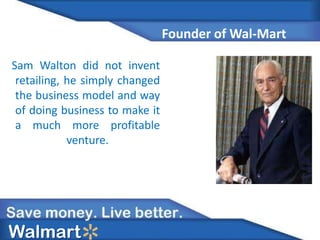
Founder of Wal-Mart
Sam Walton did not invent
retailing, he simply changed
the business model and way
of doing business to make it
a much more profitable
venture.
Walmart
• Headquarter:-
Bentonville, Arkansas, United States.
• World President & CEO :-Doug McMillon
• India President & CEO :- Krish Iyar
Walmart
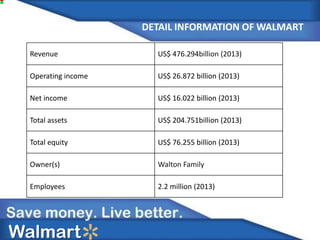
Revenue US$ 476.294billion (2013)
Operating income US$ 26.872 billion (2013)
Net income US$ 16.022 billion (2013)
Total assets US$ 204.751billion (2013)
Total equity US$ 76.255 billion (2013)
Owner(s) Walton Family
Employees 2.2 million (2013)
DETAIL INFORMATION OF WALMART
Walmart
History
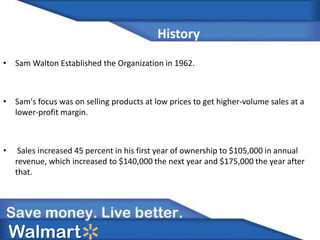
• Sam Walton Established the Organization in 1962.
• Sam's focus was on selling products at low prices to get higher-volume sales at a
lower-profit margin.
• Sales increased 45 percent in his first year of ownership to $105,000 in annual
revenue, which increased to $140,000 the next year and $175,000 the year after
that.
Walmart
Incorporation
• Incorporated as Wal-Mart Stores, Inc. on October 31, 1969.
• The first stock split occurred in May 1971 at a market price of $47
• Walmart opened its first Texas store in Mount Pleasant on November 11, 1975
Walmart
Wal-mart International
• Walmart's international comprise 4,263 stores and 660,000 workers in 15 countries
outside the United States
• the company is the largest private employer in the U.S. and Mexico, and one of the
largest in Canada.
• In the financial year 2010, Walmart's international division sales were $100 billion,
or 24.7 percent of total sales.
Walmart
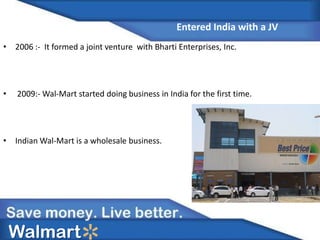
• 2006 :- It formed a joint venture with Bharti Enterprises, Inc.
• 2009:- Wal-Mart started doing business in India for the first time.
• Indian Wal-Mart is a wholesale business.
Walmart
Entered India with a JV
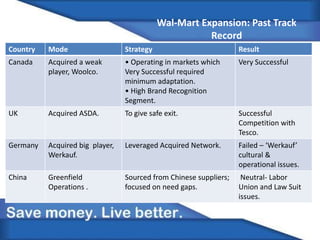
Wal-Mart Expansion: Past Track
Record
Country Mode Strategy Result
Canada Acquired a weak
player, Woolco.
• Operating in markets which
Very Successful required
minimum adaptation.
• High Brand Recognition
Segment.
Very Successful
UK Acquired ASDA. To give safe exit. Successful
Competition with
Tesco.
Germany Acquired big player,
Werkauf.
Leveraged Acquired Network. Failed – ‘Werkauf’
cultural &
operational issues.
China Greenfield
Operations .
Sourced from Chinese suppliers;
focused on need gaps.
Neutral- Labor
Union and Law Suit
issues.
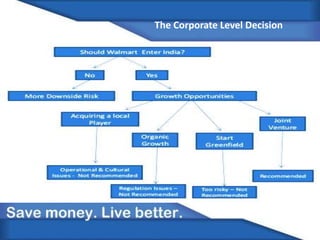
The Corporate Level Decision
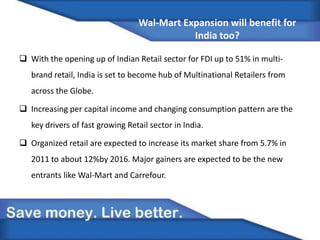
Wal-Mart Expansion will benefit for
India too?
 With the opening up of Indian Retail sector for FDI up to 51% in multi-
brand retail, India is set to become hub of Multinational Retailers from
across the Globe.
 Increasing per capital income and changing consumption pattern are the
key drivers of fast growing Retail sector in India.
 Organized retail are expected to increase its market share from 5.7% in
2011 to about 12%by 2016. Major gainers are expected to be the new
entrants like Wal-Mart and Carrefour.
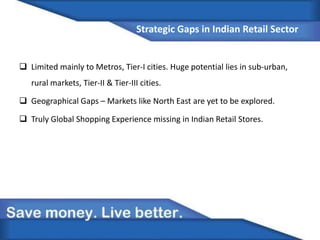
Strategic Gaps in Indian Retail Sector
 Limited mainly to Metros, Tier-I cities. Huge potential lies in sub-urban,
rural markets, Tier-II & Tier-III cities.
 Geographical Gaps – Markets like North East are yet to be explored.
 Truly Global Shopping Experience missing in Indian Retail Stores.
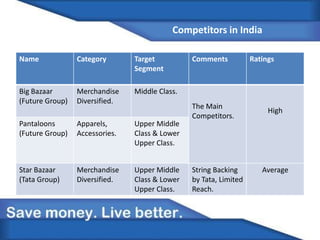
Competitors in India
Name Category Target
Segment
Comments Ratings
Big Bazaar
(Future Group)
Merchandise
Diversified.
Middle Class.
The Main
Competitors.
High
Pantaloons
(Future Group)
Apparels,
Accessories.
Upper Middle
Class & Lower
Upper Class.
Star Bazaar
(Tata Group)
Merchandise
Diversified.
Upper Middle
Class & Lower
Upper Class.
String Backing
by Tata, Limited
Reach.
Average
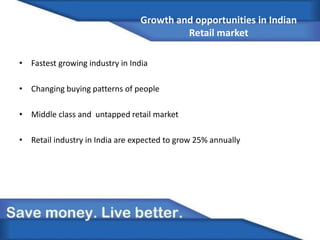
Growth and opportunities in Indian
Retail market
• Fastest growing industry in India
• Changing buying patterns of people
• Middle class and untapped retail market
• Retail industry in India are expected to grow 25% annually
Profitability Analysis
• Bargaining power of customer
• Bargaining power of supplier
• Threat of new entrant
• Threat of substitute
• Existing rivals
SWOT Analysis of Wal-Mart in
India
• Strength
• Weaknesses
• Opportunity
• Threats
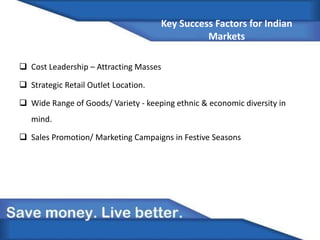
Key Success Factors for Indian
Markets
 Cost Leadership – Attracting Masses
 Strategic Retail Outlet Location.
 Wide Range of Goods/ Variety - keeping ethnic & economic diversity in
mind.
 Sales Promotion/ Marketing Campaigns in Festive Seasons
What Wal-Mart should suppose
to do?
 Wal-Mart should apply its ‘Repeatable formula’ of Lowest price - supported with
efficient supply chain and Information technology for Indian markets as well.
 Given the compliance with Regulatory norms and fast market penetration, Wal-
Mart to go for strategic alliance – joint venture. Success depends on
implementation within time-limits.
 Wal-Mart should focus on local customer preferences, strategic locations, regional
diversity & incorporating Indian values for building a sustainable business model
for India.
Conclusion
 Wal-Mart applied all their past strategies in India to get success.
 Resulting to it, Wal-Mart becomes the big retailer in India.
 They also apply new strategies which is linked to Indian culture to penetrate more
in Indian culture not repeating mistake they did in Germany.
 Wal-Mart knows that India is the fastest growing economy of the world and they
have the opportunity to avail the benefits of mass sales in India in order to
increase their revenues.
"The secret of successful retailing is to give your customers what
they want. And really, if you think about it from your point of view
as a customer, you want everything: a wide assortment of good-
quality merchandise; the lowest possible prices; guaranteed
satisfaction with what you buy; friendly, knowledgeable service;
convenient hours; free parking; a pleasant shopping experience."
:- Sam Walton (1918-1992)
Walmart
Walmart

WAL-MART EXPANSION TO INDIA

  • 1.
    WAL-MART EXPANSION TO INDIA PresentedBy: Danish Ameen Muhammad Mubeen Raza Ali Ahmed Hafiz Hammad Ameen Talha Bin Irfan
  • 2.
    Founder of Wal-Mart SamWalton did not invent retailing, he simply changed the business model and way of doing business to make it a much more profitable venture. Walmart
  • 3.
    • Headquarter:- Bentonville, Arkansas,United States. • World President & CEO :-Doug McMillon • India President & CEO :- Krish Iyar Walmart
  • 4.
    Revenue US$ 476.294billion(2013) Operating income US$ 26.872 billion (2013) Net income US$ 16.022 billion (2013) Total assets US$ 204.751billion (2013) Total equity US$ 76.255 billion (2013) Owner(s) Walton Family Employees 2.2 million (2013) DETAIL INFORMATION OF WALMART Walmart
  • 5.
    History • Sam WaltonEstablished the Organization in 1962. • Sam's focus was on selling products at low prices to get higher-volume sales at a lower-profit margin. • Sales increased 45 percent in his first year of ownership to $105,000 in annual revenue, which increased to $140,000 the next year and $175,000 the year after that. Walmart
  • 6.
    Incorporation • Incorporated asWal-Mart Stores, Inc. on October 31, 1969. • The first stock split occurred in May 1971 at a market price of $47 • Walmart opened its first Texas store in Mount Pleasant on November 11, 1975 Walmart
  • 7.
    Wal-mart International • Walmart'sinternational comprise 4,263 stores and 660,000 workers in 15 countries outside the United States • the company is the largest private employer in the U.S. and Mexico, and one of the largest in Canada. • In the financial year 2010, Walmart's international division sales were $100 billion, or 24.7 percent of total sales. Walmart
  • 8.
    • 2006 :-It formed a joint venture with Bharti Enterprises, Inc. • 2009:- Wal-Mart started doing business in India for the first time. • Indian Wal-Mart is a wholesale business. Walmart Entered India with a JV
  • 9.
    Wal-Mart Expansion: PastTrack Record Country Mode Strategy Result Canada Acquired a weak player, Woolco. • Operating in markets which Very Successful required minimum adaptation. • High Brand Recognition Segment. Very Successful UK Acquired ASDA. To give safe exit. Successful Competition with Tesco. Germany Acquired big player, Werkauf. Leveraged Acquired Network. Failed – ‘Werkauf’ cultural & operational issues. China Greenfield Operations . Sourced from Chinese suppliers; focused on need gaps. Neutral- Labor Union and Law Suit issues.
  • 10.
  • 11.
    Wal-Mart Expansion willbenefit for India too?  With the opening up of Indian Retail sector for FDI up to 51% in multi- brand retail, India is set to become hub of Multinational Retailers from across the Globe.  Increasing per capital income and changing consumption pattern are the key drivers of fast growing Retail sector in India.  Organized retail are expected to increase its market share from 5.7% in 2011 to about 12%by 2016. Major gainers are expected to be the new entrants like Wal-Mart and Carrefour.
  • 12.
    Strategic Gaps inIndian Retail Sector  Limited mainly to Metros, Tier-I cities. Huge potential lies in sub-urban, rural markets, Tier-II & Tier-III cities.  Geographical Gaps – Markets like North East are yet to be explored.  Truly Global Shopping Experience missing in Indian Retail Stores.
  • 13.
    Competitors in India NameCategory Target Segment Comments Ratings Big Bazaar (Future Group) Merchandise Diversified. Middle Class. The Main Competitors. High Pantaloons (Future Group) Apparels, Accessories. Upper Middle Class & Lower Upper Class. Star Bazaar (Tata Group) Merchandise Diversified. Upper Middle Class & Lower Upper Class. String Backing by Tata, Limited Reach. Average
  • 14.
    Growth and opportunitiesin Indian Retail market • Fastest growing industry in India • Changing buying patterns of people • Middle class and untapped retail market • Retail industry in India are expected to grow 25% annually
  • 15.
    Profitability Analysis • Bargainingpower of customer • Bargaining power of supplier • Threat of new entrant • Threat of substitute • Existing rivals
  • 16.
    SWOT Analysis ofWal-Mart in India • Strength • Weaknesses • Opportunity • Threats
  • 17.
    Key Success Factorsfor Indian Markets  Cost Leadership – Attracting Masses  Strategic Retail Outlet Location.  Wide Range of Goods/ Variety - keeping ethnic & economic diversity in mind.  Sales Promotion/ Marketing Campaigns in Festive Seasons
  • 18.
    What Wal-Mart shouldsuppose to do?  Wal-Mart should apply its ‘Repeatable formula’ of Lowest price - supported with efficient supply chain and Information technology for Indian markets as well.  Given the compliance with Regulatory norms and fast market penetration, Wal- Mart to go for strategic alliance – joint venture. Success depends on implementation within time-limits.  Wal-Mart should focus on local customer preferences, strategic locations, regional diversity & incorporating Indian values for building a sustainable business model for India.
  • 19.
    Conclusion  Wal-Mart appliedall their past strategies in India to get success.  Resulting to it, Wal-Mart becomes the big retailer in India.  They also apply new strategies which is linked to Indian culture to penetrate more in Indian culture not repeating mistake they did in Germany.  Wal-Mart knows that India is the fastest growing economy of the world and they have the opportunity to avail the benefits of mass sales in India in order to increase their revenues.
  • 20.
    "The secret ofsuccessful retailing is to give your customers what they want. And really, if you think about it from your point of view as a customer, you want everything: a wide assortment of good- quality merchandise; the lowest possible prices; guaranteed satisfaction with what you buy; friendly, knowledgeable service; convenient hours; free parking; a pleasant shopping experience." :- Sam Walton (1918-1992) Walmart
  • 21.