BHARTI WALMART INDIA STRATEGY
      Strategic Management


                       Prepared By
                     Vikas Gupta


                General Management Program
                         2011-2012
Retail Market in India
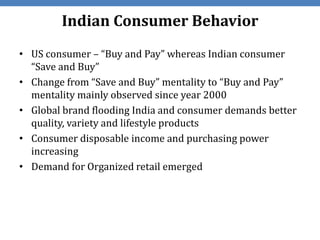
                                                                  Total Retail Market Size
 Indian Retail market highly fragmented                                                                           637 Billion
 Estimated at $ 320 Billion (2006), $ 427 Billion
(2010) and $ 637 Billion (2015)
                                                                                          427 Billion
 Mainly dominated by unorganized retail in the
                                                               320 Billion
form of kirana stores, mom-and-pop stores, small
stores etc.
 Only 2% currently Organized v/s 98 %
unorganized                                                2006                    2010                         2015
Estimated Market size for Organized retail is $7.17
Billion (2006) and $20 Billion (2010)


                                                                         Market Size         Organized Retail
                                  Organized
                                     2%                                                                  637 Billion


                                                                               427 Billion
                                                       320 Billion


                   Unorganized
                      98%                                       7.17 Billion            20 Billion

                                                             2006                      2010                      2015
Indian Consumer Behavior
• US consumer – “Buy and Pay” whereas Indian consumer
  “Save and Buy”
• Change from “Save and Buy” mentality to “Buy and Pay”
  mentality mainly observed since year 2000
• Global brand flooding India and consumer demands better
  quality, variety and lifestyle products
• Consumer disposable income and purchasing power
  increasing
• Demand for Organized retail emerged
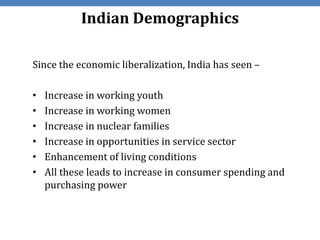
Indian Demographics

Since the economic liberalization, India has seen –

•   Increase in working youth
•   Increase in working women
•   Increase in nuclear families
•   Increase in opportunities in service sector
•   Enhancement of living conditions
•   All these leads to increase in consumer spending and
    purchasing power
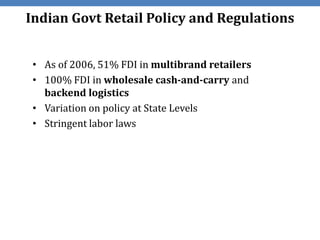
Indian Govt Retail Policy and Regulations


 • As of 2006, 51% FDI in multibrand retailers
 • 100% FDI in wholesale cash-and-carry and
   backend logistics
 • Variation on policy at State Levels
 • Stringent labor laws
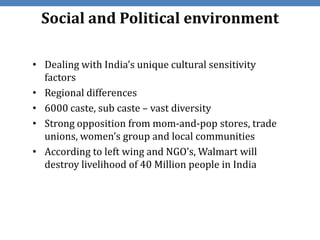
Social and Political environment

• Dealing with India’s unique cultural sensitivity
  factors
• Regional differences
• 6000 caste, sub caste – vast diversity
• Strong opposition from mom-and-pop stores, trade
  unions, women’s group and local communities
• According to left wing and NGO’s, Walmart will
  destroy livelihood of 40 Million people in India
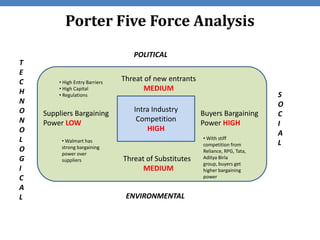
Porter Five Force Analysis
                                   POLITICAL
T
E
C       • High Entry Barriers
                                Threat of new entrants
H       • High Capital                MEDIUM
        • Regulations                                                           S
N                                                                               O
O                                  Intra Industry
    Suppliers Bargaining                                 Buyers Bargaining      C
N                                   Competition
    Power LOW                                            Power HIGH             I
O                                      HIGH
                                                                                A
L                                                        • With stiff
         • Walmart has                                                          L
                                                         competition from
O        strong bargaining
                                                         Reliance, RPG, Tata,
         power over
G        suppliers              Threat of Substitutes    Aditya Birla
                                                         group, buyers get
I                                     MEDIUM             higher bargaining
C                                                        power

A
L                                ENVIRONMENTAL
Walmart
• Largest department store
• Biggest public corp in the world
• Corp Philosophy – Strengthening its relationship with
  employees, suppliers and customers (core competency)
• Own transportation network
• Low pricing strategy – cost leadership (core competency)
• Robust and efficient Supply Chain network (core competency)
• Cold chain logistics i.e. refrigerated trucks and distribution
  centers to reduce wastage
• Leveraged IT to enhance their Supply chain.
• Use of Technology for improved planning, accurate
  merchandizing, enhanced customer experience, improved
  workforce management, strengthened store operations
  (core competency)
Why Walmart did well in other
           International locations ?

• Ability to apply its unique culture and successful retailing
  concept despite daunting business and cultural challenges
• Involve in local communities and adapt to local cultures –
  Glocalization
• Sourcing 90% products locally
• Hiring locally and supporting local communities.
Bharti-Walmart

Why Bharti ?
• Good history of partnering with overseas companies
• Bharti attracted $1.2 billion in foreign equity – highest in
  India
• No 1 in Telecom business in India
• Bharti has deep knowledge of India’s fast growing consumer
  market

Walmart
• Extensive global retail expertise
• Ability to apply its unique culture and successful retailing
  concept.
Bharti-Walmart

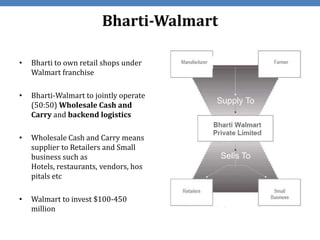
•   Bharti to own retail shops under
    Walmart franchise

•   Bharti-Walmart to jointly operate
    (50:50) Wholesale Cash and
    Carry and backend logistics

•   Wholesale Cash and Carry means
    supplier to Retailers and Small
    business such as
    Hotels, restaurants, vendors, hos
    pitals etc

•   Walmart to invest $100-450
    million
Bharti Walmart Challenging
                landscape
 Managing cultural diversity
 Managing Union and State level regulations
 Handling oppositions from Trade Unions, local kirana
  stores, left wing, NGO etc
 Under-developed infrastructure: quality of Roads, trucking
 Adoption of modern technology in india
 Want to cut middleman by linking suppliers directly with
  consumers. Facing strong opposition from trading
  community
Bharti Walmart stores

• India is already a huge supplier to Walmart. India supplies
  goods worth $1.6 Billion to Walmart
• First store opened in Amritsar, Punjab. This part of the
  country has sent many migrants to North America, we see
  a glimpse of NRI driven globalization
• As of now 7 Bharti Walmart Cash and Carry stores in India
• As of now, 117 Bharti Retail Supermarket stores in the
  states of Punjab, Haryana, Rajasthan, UP and Delhi
• 10 Compact Hyper Market stores
• Walmart’s office in Bangalore to serve as Global
  Procurement Hub
Bharti Walmart’s Store Location
            decision criteria

• State Laws and Regulations
• Ruling party in the state
•Availability of goods locally
• Political and Social Acceptance Factors
• Consumer Behavior and Spending power
•Demographics and Psychographics profile of consumer
• Influence of Globalization culture. E.g. Places such as
Punjab, Bangalore, Hyderabad, Mumbai has more
globalization effect than places such as Kolkata
• Quality of Infrastructure (Roadways, Trucking) to support
their supply chain operations
THANK YOU

Bharti Walmart

  • 1.
    BHARTI WALMART INDIASTRATEGY Strategic Management Prepared By Vikas Gupta General Management Program 2011-2012
  • 2.
    Retail Market inIndia Total Retail Market Size  Indian Retail market highly fragmented 637 Billion  Estimated at $ 320 Billion (2006), $ 427 Billion (2010) and $ 637 Billion (2015) 427 Billion  Mainly dominated by unorganized retail in the 320 Billion form of kirana stores, mom-and-pop stores, small stores etc.  Only 2% currently Organized v/s 98 % unorganized 2006 2010 2015 Estimated Market size for Organized retail is $7.17 Billion (2006) and $20 Billion (2010) Market Size Organized Retail Organized 2% 637 Billion 427 Billion 320 Billion Unorganized 98% 7.17 Billion 20 Billion 2006 2010 2015
  • 3.
    Indian Consumer Behavior •US consumer – “Buy and Pay” whereas Indian consumer “Save and Buy” • Change from “Save and Buy” mentality to “Buy and Pay” mentality mainly observed since year 2000 • Global brand flooding India and consumer demands better quality, variety and lifestyle products • Consumer disposable income and purchasing power increasing • Demand for Organized retail emerged
  • 4.
    Indian Demographics Since theeconomic liberalization, India has seen – • Increase in working youth • Increase in working women • Increase in nuclear families • Increase in opportunities in service sector • Enhancement of living conditions • All these leads to increase in consumer spending and purchasing power
  • 5.
    Indian Govt RetailPolicy and Regulations • As of 2006, 51% FDI in multibrand retailers • 100% FDI in wholesale cash-and-carry and backend logistics • Variation on policy at State Levels • Stringent labor laws
  • 6.
    Social and Politicalenvironment • Dealing with India’s unique cultural sensitivity factors • Regional differences • 6000 caste, sub caste – vast diversity • Strong opposition from mom-and-pop stores, trade unions, women’s group and local communities • According to left wing and NGO’s, Walmart will destroy livelihood of 40 Million people in India
  • 7.
    Porter Five ForceAnalysis POLITICAL T E C • High Entry Barriers Threat of new entrants H • High Capital MEDIUM • Regulations S N O O Intra Industry Suppliers Bargaining Buyers Bargaining C N Competition Power LOW Power HIGH I O HIGH A L • With stiff • Walmart has L competition from O strong bargaining Reliance, RPG, Tata, power over G suppliers Threat of Substitutes Aditya Birla group, buyers get I MEDIUM higher bargaining C power A L ENVIRONMENTAL
  • 8.
    Walmart • Largest departmentstore • Biggest public corp in the world • Corp Philosophy – Strengthening its relationship with employees, suppliers and customers (core competency) • Own transportation network • Low pricing strategy – cost leadership (core competency) • Robust and efficient Supply Chain network (core competency) • Cold chain logistics i.e. refrigerated trucks and distribution centers to reduce wastage • Leveraged IT to enhance their Supply chain. • Use of Technology for improved planning, accurate merchandizing, enhanced customer experience, improved workforce management, strengthened store operations (core competency)
  • 9.
    Why Walmart didwell in other International locations ? • Ability to apply its unique culture and successful retailing concept despite daunting business and cultural challenges • Involve in local communities and adapt to local cultures – Glocalization • Sourcing 90% products locally • Hiring locally and supporting local communities.
  • 10.
    Bharti-Walmart Why Bharti ? •Good history of partnering with overseas companies • Bharti attracted $1.2 billion in foreign equity – highest in India • No 1 in Telecom business in India • Bharti has deep knowledge of India’s fast growing consumer market Walmart • Extensive global retail expertise • Ability to apply its unique culture and successful retailing concept.
  • 11.
    Bharti-Walmart • Bharti to own retail shops under Walmart franchise • Bharti-Walmart to jointly operate (50:50) Wholesale Cash and Carry and backend logistics • Wholesale Cash and Carry means supplier to Retailers and Small business such as Hotels, restaurants, vendors, hos pitals etc • Walmart to invest $100-450 million
  • 12.
    Bharti Walmart Challenging landscape  Managing cultural diversity  Managing Union and State level regulations  Handling oppositions from Trade Unions, local kirana stores, left wing, NGO etc  Under-developed infrastructure: quality of Roads, trucking  Adoption of modern technology in india  Want to cut middleman by linking suppliers directly with consumers. Facing strong opposition from trading community
  • 13.
    Bharti Walmart stores •India is already a huge supplier to Walmart. India supplies goods worth $1.6 Billion to Walmart • First store opened in Amritsar, Punjab. This part of the country has sent many migrants to North America, we see a glimpse of NRI driven globalization • As of now 7 Bharti Walmart Cash and Carry stores in India • As of now, 117 Bharti Retail Supermarket stores in the states of Punjab, Haryana, Rajasthan, UP and Delhi • 10 Compact Hyper Market stores • Walmart’s office in Bangalore to serve as Global Procurement Hub
  • 14.
    Bharti Walmart’s StoreLocation decision criteria • State Laws and Regulations • Ruling party in the state •Availability of goods locally • Political and Social Acceptance Factors • Consumer Behavior and Spending power •Demographics and Psychographics profile of consumer • Influence of Globalization culture. E.g. Places such as Punjab, Bangalore, Hyderabad, Mumbai has more globalization effect than places such as Kolkata • Quality of Infrastructure (Roadways, Trucking) to support their supply chain operations
  • 15.