Presented By;
Swaraj Mishra - (CMBA-4)- 1450
Sohel Jamadar – (CMBA-4)- 1448
Akash Shukla - (CMBA-4)- 1417
Larika Arora - (CMBA-4)- 1431
Nikhileshwar Ravishankar - (CMBA-4)-1433
1. The overall market size, growth trends and future projections
2. The main market segments; their size and consumer behaviour trends
3. Major macro and global environmental influences on the market and
Critical Success Factors
4. Analyse the Industry with the help of Porter’s 5 Forces Model
5. The main market competitors; their market share and their strengths
and weaknesses
6. The main channels of distribution and their strengths and weaknesses
OBJECTIVES
“When most of us hear the word chocolate, we picture a bar, a box of
bonbons, or a bunny. The verb that comes to mind is probably "eat," not "drink," and
the most apt adjective would seem to be "sweet." But for about 90 percent of
chocolate's long history, it was strictly a beverage, and sugar didn't have anything to
do with it.” (Bensen, 2008)
"chocolate" comes from the Aztec word "xocoatl,“ which referred to a bitter
drink brewed from cacao beans.
History of chocolate
 From the research of University of Pennsylvania the people of Honduras were
using cocoa in the 1400 B.C. as an alcoholic beverage.
Source: A Brief History of Chocolate By Amanda Bensen, March 1, 2008
 In 1828, a Dutch chemist created powdered chocolate by removing 50% of
natural fat from chocolate and to cut the bitter taste it was added with the
alkaline salts. It was very much popular as “Dutch cocoa” and it lead to solid
chocolate.
 Modern chocolate bar was first made by Joseph Fry in 1847.
 Addition of honey to chocolate by Spanish people and popularized the drink in
Europe.
 In ancient time in Latin America, cacao beans were used as currency.
Source: A Brief History of Chocolate By Amanda Bensen, March 1, 2008
Cadbury
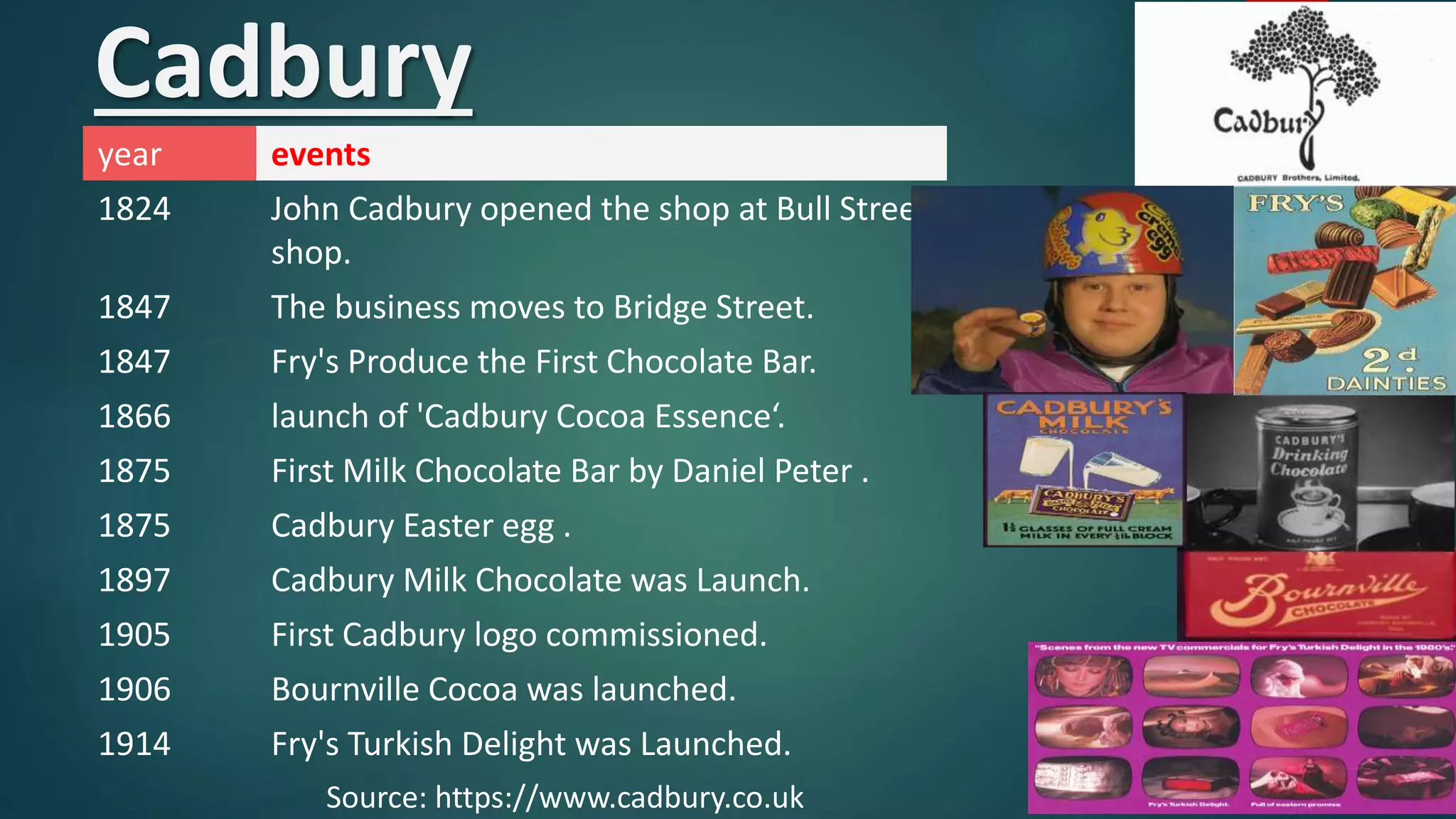
year events
1824 John Cadbury opened the shop at Bull Street
shop.
1847 The business moves to Bridge Street.
1847 Fry's Produce the First Chocolate Bar.
1866 launch of 'Cadbury Cocoa Essence‘.
1875 First Milk Chocolate Bar by Daniel Peter .
1875 Cadbury Easter egg .
1897 Cadbury Milk Chocolate was Launch.
1905 First Cadbury logo commissioned.
1906 Bournville Cocoa was launched.
1914 Fry's Turkish Delight was Launched.
Source: https://www.cadbury.co.uk
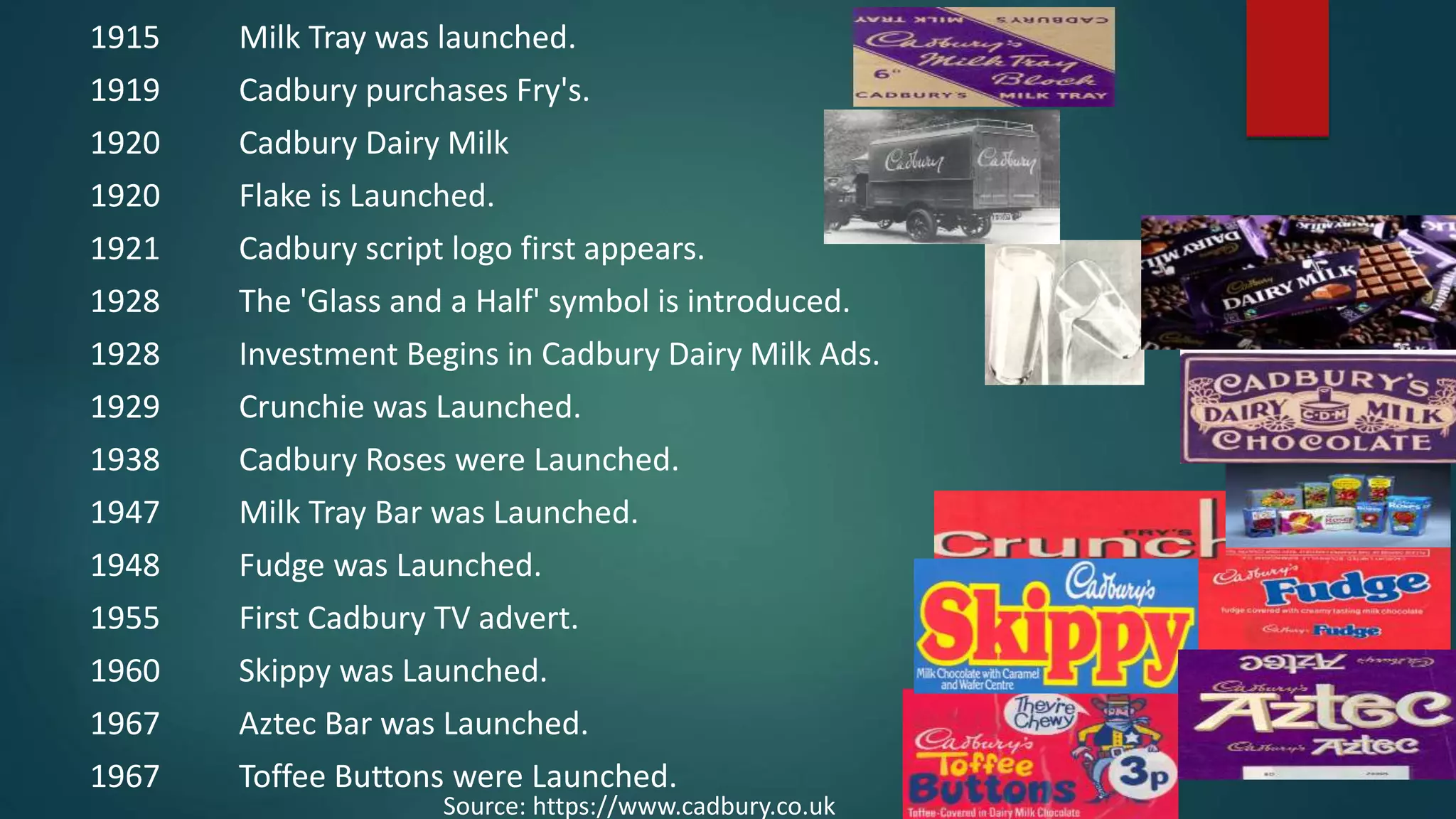
1915 Milk Tray was launched.
1919 Cadbury purchases Fry's.
1920 Cadbury Dairy Milk
1920 Flake is Launched.
1921 Cadbury script logo first appears.
1928 The 'Glass and a Half' symbol is introduced.
1928 Investment Begins in Cadbury Dairy Milk Ads.
1929 Crunchie was Launched.
1938 Cadbury Roses were Launched.
1947 Milk Tray Bar was Launched.
1948 Fudge was Launched.
1955 First Cadbury TV advert.
1960 Skippy was Launched.
1967 Aztec Bar was Launched.
1967 Toffee Buttons were Launched.
Source: https://www.cadbury.co.uk
1969 Cadbury Merges with Schweppes.
1970 Curly Wurly, Jamaica were launched.
1981 Wispa was Launched
1985 Boost Coconut was Launched
1987 Twirl was Launched
1989 Inspirations were Launched
1990 Cadbury World Opened
1996 Cadbury Fuse was Launched
2003 Cadbury Schweppes Bought Adams and Becomes the World's Leading Confectionery
Company.
2007 The Gorilla Advert Premiers.
2008 Cadbury and Schweppes Demerged.
2008 Cadbury Cocoa Partnership Launched in Ghana, India, Indonesia and the Caribbean
to boost the cocoa production farm.
2010 Cadbury becomes part of Mondelēz International.
Source: https://www.cadbury.co.uk
Cadbury In India
1948 - Incorporation on 19th July with launch of Cadbury dairymilk in India.
1967 -`Five Star’ .1968 -’Gems' .1978-Cadbury Bournville.
1987 - Company launched new products such as `Crackle', `Orange‘,`Strawberry Krisp', `Mello',
and `Wildlife bar‘ and in foods drinks, the Company launched `Choc O Cheer’.
1988-protein drink `Enriche' was introduced.
1989-enter to ice-cream market with brand name `Dollops'.
1995 -`Perk' was launched. 2000 –’Perk Slims’.2007 - 'Ulta Perk'.
2008- Cadbury relaunched its Bournville brand of dark chocolates.
2010 - ‘Dairy Milk Silk' has been introduced and Perk with glucose.
2012-”Toblerone” and “Cadbury Celebration”.
2014-Cadbury Glow
2014-April Cadbury India change to “Mondeleze India Foods Limited”.
Source: www.moneycontrol.com
Euromonitor predicts the industry will enjoy a 6% rise in revenues in 2014, delivering record
global revenues of US$117bn. This robust performance is driven by a 2.1% increase in volume,
reflecting growing appetite for chocolate in emerging markets. (Morris,2014 )
5.8
7.2
8.5
0
2
4
6
8
10
1999 2009 2020
MillionTons
year
Consumption in World wide
Sources:-
1. A taste of Future, KPMG international-Consumer Markets June 2014, By John A. Morris
2. http://www.statista.com
The overall market size, growth trends and future
projections in the world Market
Company Net Sales 2013 (US$ millions)
Mars Inc (USA) 17,640
Mondelēz International Inc (USA) 14,862
Nestlé SA (Switzerland) 11,760
Meiji Holdings Co Ltd (Japan) 11,742
Ferrero Group (Italy) 10,900
Hershey Foods Corp (USA) 7,043
Arcor (Argentina) 3,700
Chocoladenfabriken Lindt & Sprüngli AG (Switzerland) 3,149
Ezaki Glico Co Ltd (Japan) 3,018
Yildiz Holding (Turkey) 2,500
Source: http://www.icco.org
India's chocolate market is estimated at around Rs 3,000 crore and the overall chocolate market
is growing 15% a year. According to TechSci Research, India's chocolate market is expected to
reach $3.2 billion by 2018. (Mukherjee and Bhusan, 2013)
580
320
290
270
190
0 100 200 300 400 500 600 700
Belarus
Venezuela
Nigeria
India
Argentina
Total % growth 2007-12
Countries
5 Fastest growing chocolate industry from 2007-12
Sources: 1. India is the fastest growing market for adult consumption of chocolates and candies
Writankar Mukherjee & Ratna Bhushan, ET Bureau Aug 1, 2013
2.A taste of Future, KPMG international Consumer Markets-2014, By John A. Morris
The overall market size, growth trends and future
projections in Indian Market
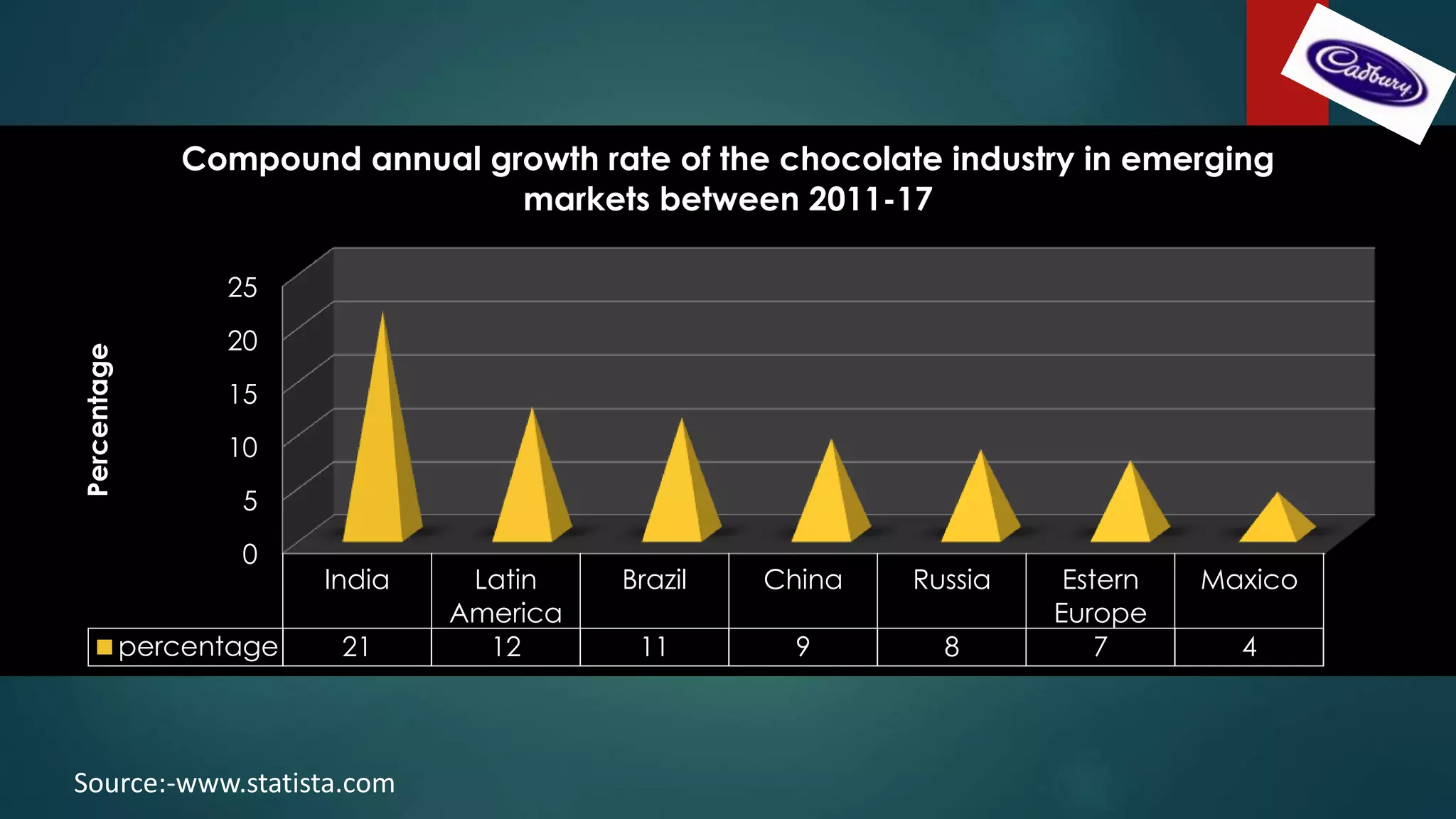
0
5
10
15
20
25
India Latin
America
Brazil China Russia Estern
Europe
Maxico
percentage 21 12 11 9 8 7 4
Percentage
Compound annual growth rate of the chocolate industry in emerging
markets between 2011-17
Source:-www.statista.com
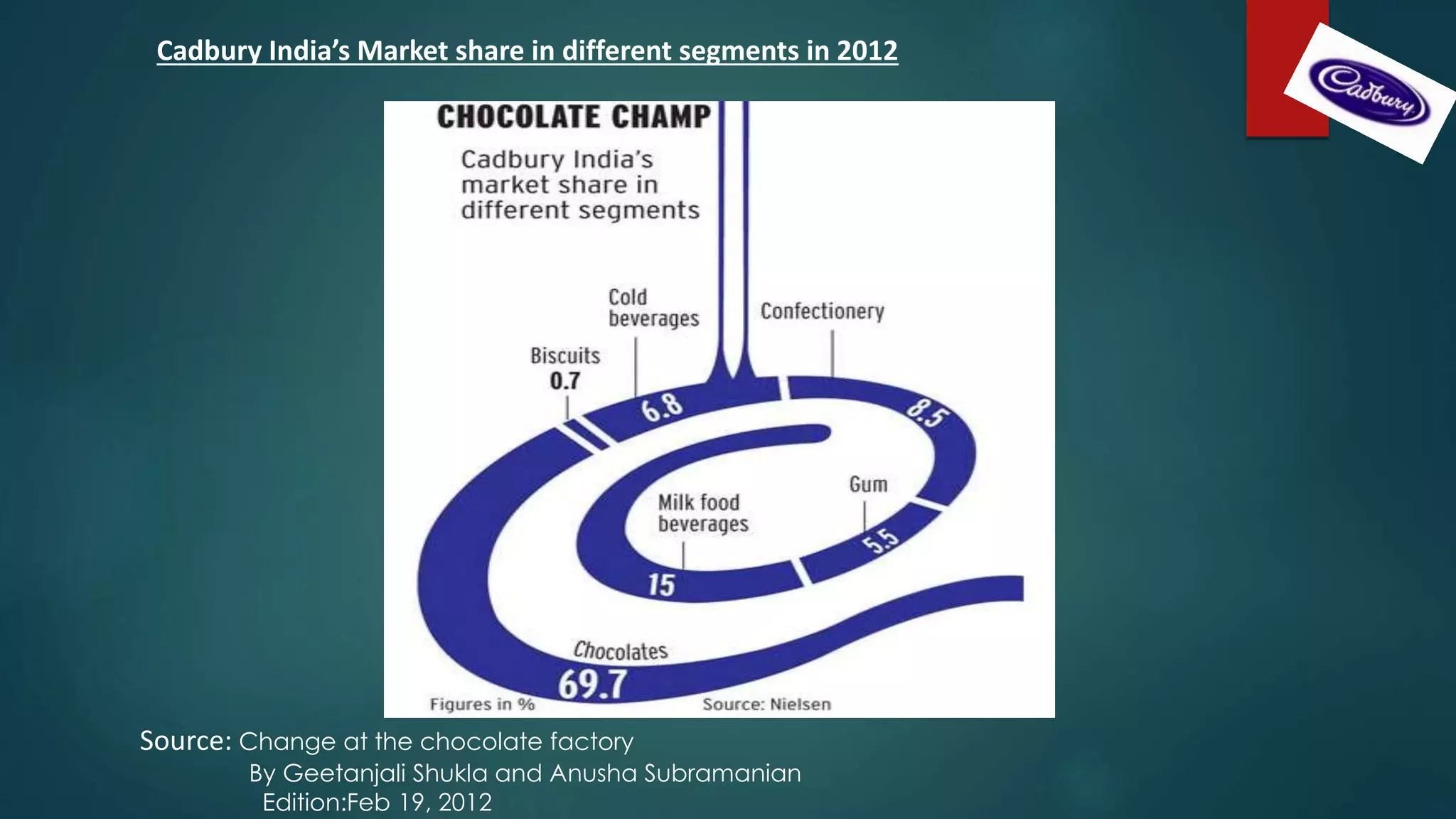
Source: Change at the chocolate factory
By Geetanjali Shukla and Anusha Subramanian
Edition:Feb 19, 2012
Cadbury India’s Market share in different segments in 2012
Cadbury India net profit Statistics
45.95
68.81
117.65
165.78
188.63
220.98
297 303.4
498.34
2005 2006 2007 2008 2009 2010 2011 2012 2013
Cadbury net profit(Cr.)
Cadbury net profit
Sources:- 1. http://www.moneycontrol.com
2. http://articles.economictimes.indiatimes.com
 $190 million to build
the country's largest
chocolate
manufacturing plant
near Hyderabad.
Cadbury
67%
Nestle
21%
Ferrero
6%
Others
6%
Market share of Chocolate Industry By
brand in India
Dairy Milk
35%
Bournville &
Silk
others
47%
Market share of Dairy Milk in Chocolate Industry in India
Sources:-
1.http://articles.economictimes.indiatimes.com
2.http://lifeatunitedworld.wordpress.com
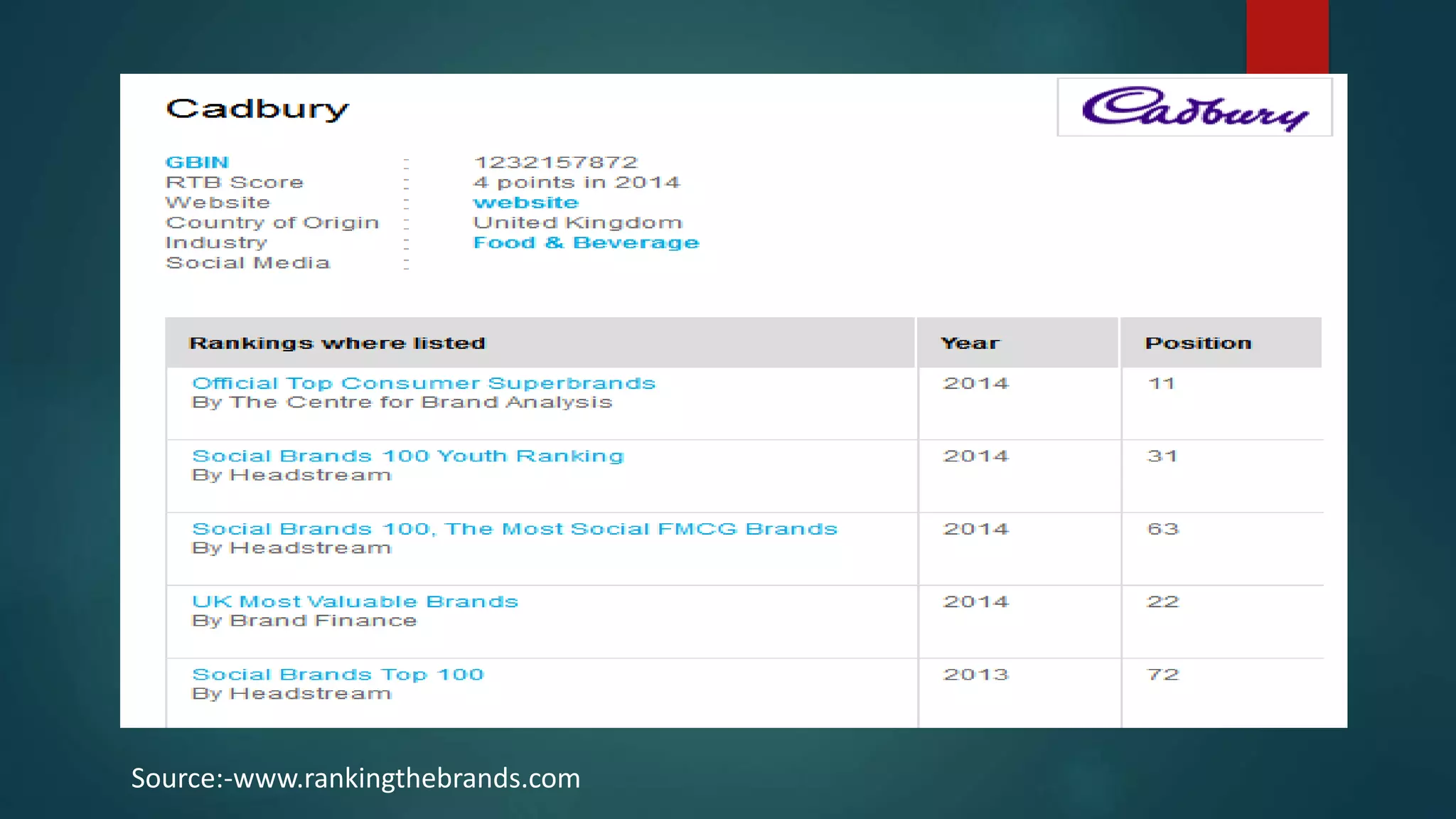
Source:-www.rankingthebrands.com
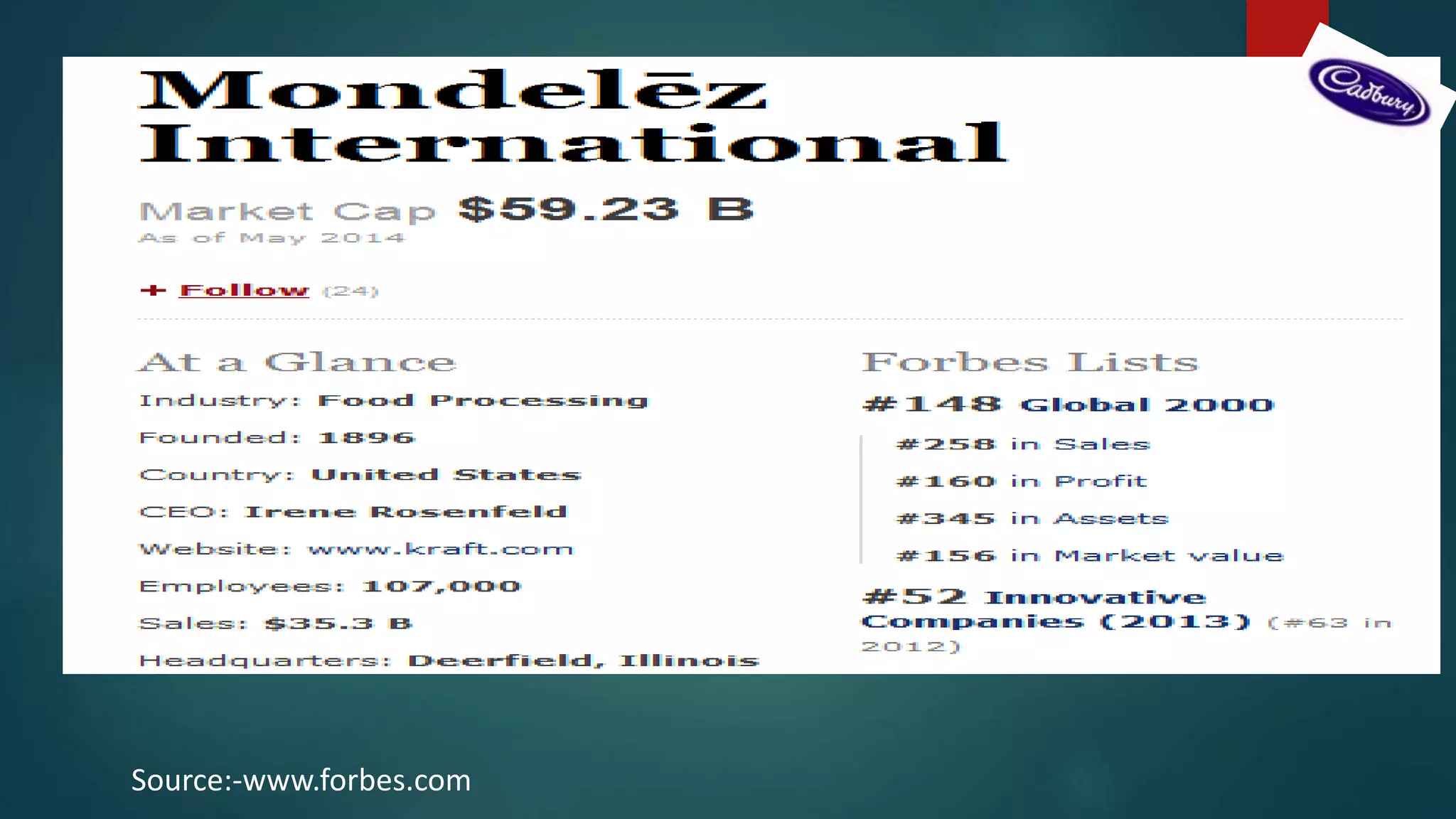
Source:-www.forbes.com
Source:-http://fortune.com
Milk
75%
Dark
9%
White
16%
Market size according to the Types of Ingredients
Source:-http://lifeatunitedworld.wordpress.com
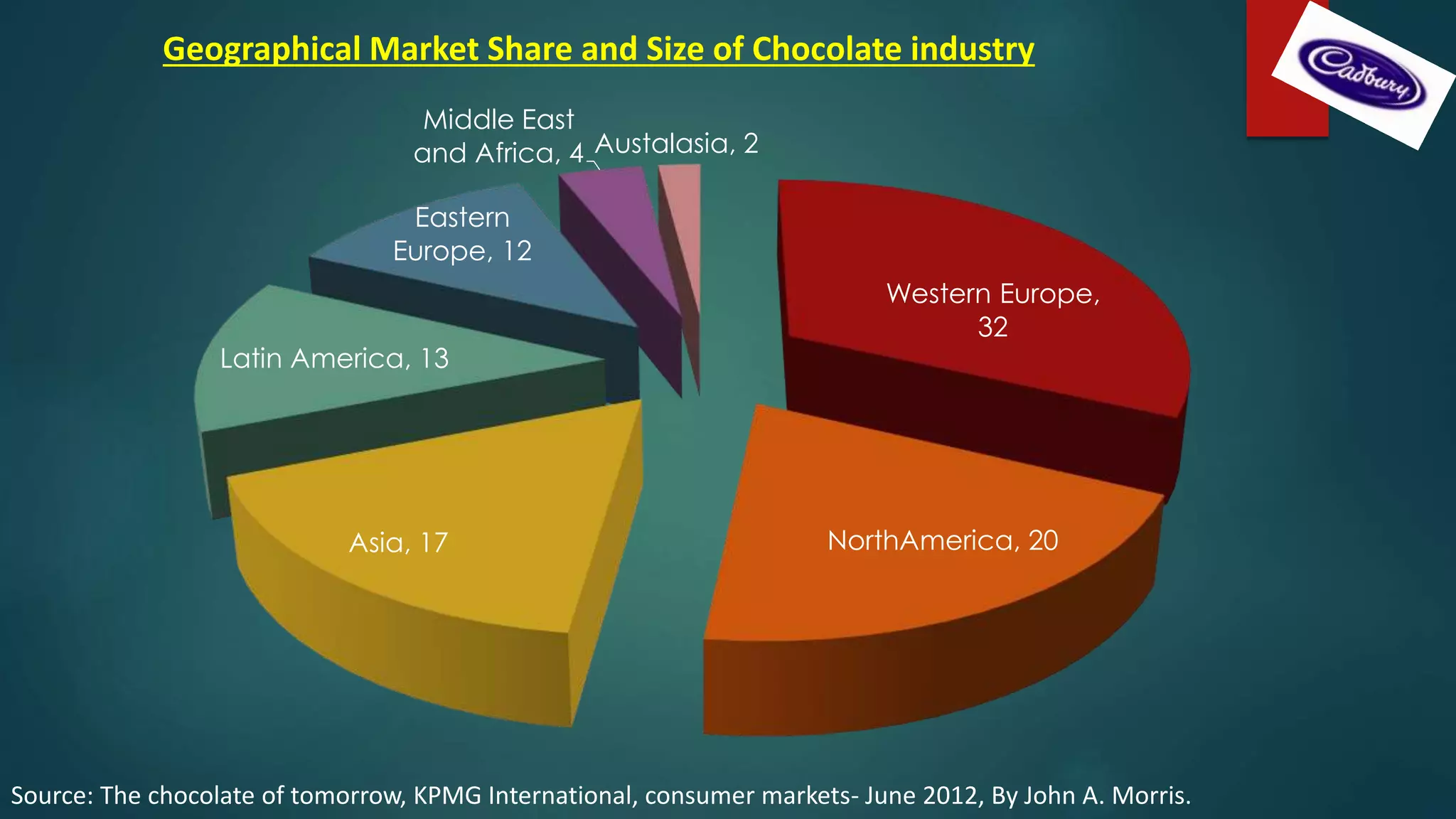
Western Europe,
32
NorthAmerica, 20Asia, 17
Latin America, 13
Eastern
Europe, 12
Middle East
and Africa, 4 Austalasia, 2
Geographical Market Share and Size of Chocolate industry
Source: The chocolate of tomorrow, KPMG International, consumer markets- June 2012, By John A. Morris.
MARKET SEGMENTS OF CADBURY DAIRYMILK
• A Market segment consists of a customers who share similar set of needs
and wants(Kotler, 2013).
• Cadbury dairy milk also divides the market into different group of
customers.
• Dairy milk is the megabrand of the Cadbury Family focusing on consumers
of all ages.
• One notable form of customer segmentation that Cadbury utilizes is
behavioural segmentation, which is based on actual customer decision-
making processes towards Cadbury’s products. We can understand it by
following discussion.
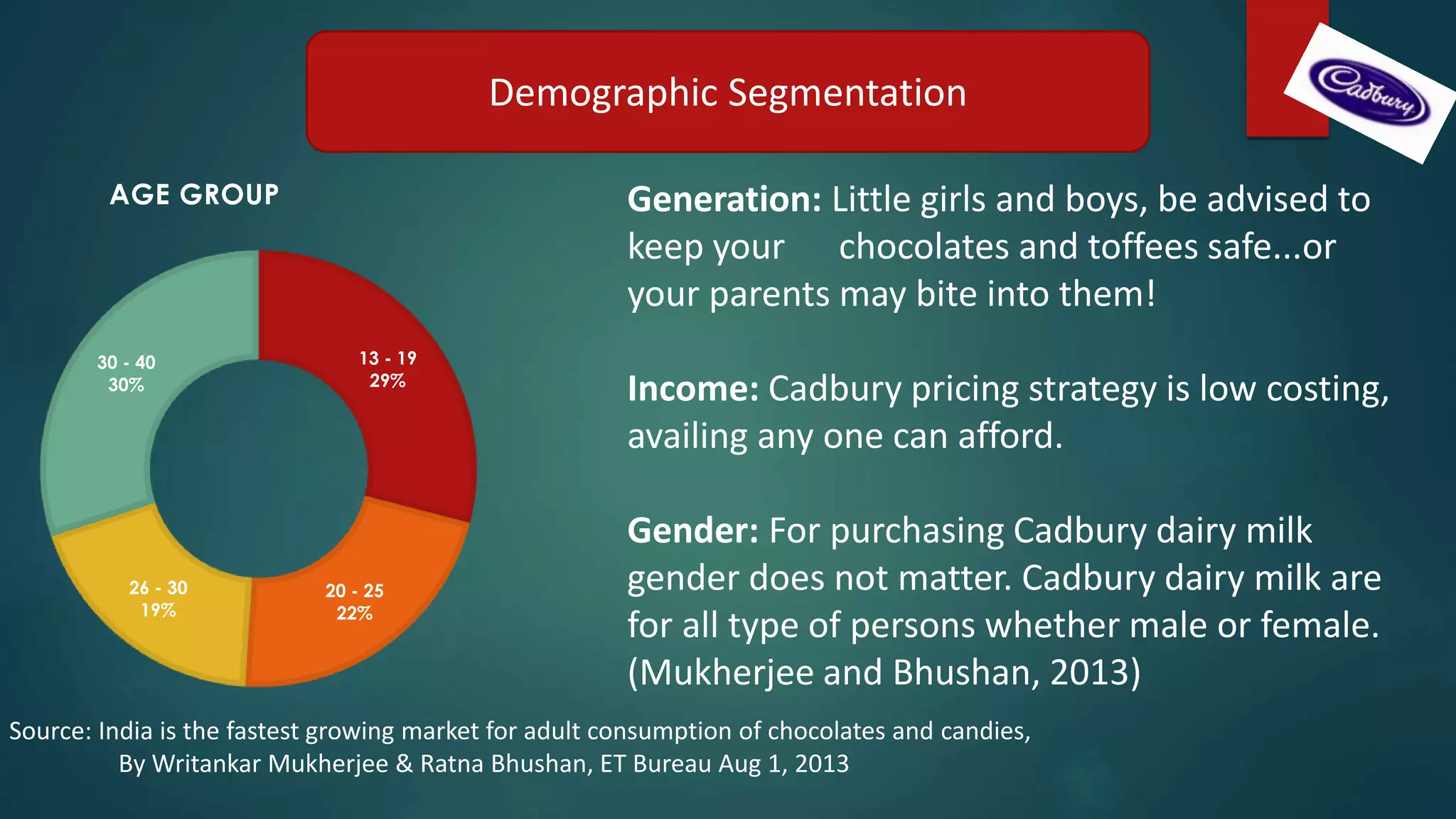
Demographic Segmentation
13 - 19
29%
20 - 25
22%
26 - 30
19%
30 - 40
30%
AGE GROUP Generation: Little girls and boys, be advised to
keep your chocolates and toffees safe...or
your parents may bite into them!
Income: Cadbury pricing strategy is low costing,
availing any one can afford.
Gender: For purchasing Cadbury dairy milk
gender does not matter. Cadbury dairy milk are
for all type of persons whether male or female.
(Mukherjee and Bhushan, 2013)
Source: India is the fastest growing market for adult consumption of chocolates and candies,
By Writankar Mukherjee & Ratna Bhushan, ET Bureau Aug 1, 2013
Behavioural Segmentation
• Decision roles:
The decision role is played by the children and youngsters when to buy the Cadbury dairy milk.
• Occasion:
For purchasing the Cadbury dairy milk no specific occasion are required.
• Benefits:
Cadbury dairy milk is easily available everywhere when we need it.
• User status:
There are mainly the Impulse users found in the user status of Cadbury dairy milk.
• User rate:
The user rate is heavy in the behavioral segmentation of Cadbury dairy milk.
• Loyalty status:
There is mainly the absolute loyal customers.
• Attitude:
There is an enthusiastic type of attitude seen in buyers(Porter, 2013).
Behavioral Market Segments On The Basis Of Usage
23 24
20
24
Relaxation
19 23 24 23
Sharing
32
23 19 23
Hunger
12 14
20
14
Rejuvenation
7
11
9 9
Indulgence
4
6
10
6
Celebration
3
0 0
1
Health
1 1 1 1
Romance
Any Snack Small Individual Chocolate Bar Chocolate Any Chocolate
Source:Indiaisthefastestgrowingmarketforadultconsumptionof
chocolatesandcandies,
WritankarMukherjee&RatnaBhushan,ETBureauAug1,2013
Campaigns Targeted Market
Kid In all of us, Real Taste of
Life ,Kuch khas hai Zindegi
main, No Umar far Lalach.
Psychology ( there is
a kid in all of us).
Higher age people
can eat chocolate
without fear.
Khane walo ko khane ka
bahana chahiye.
Replacing “mithai” on the
Family Occation.
Behavioral(usage
based)Mass
marketing.
Kuch Mitha ho jae(all ads). Behavioral(Special
Moments) and
ceremoney.
Middle age group.
Segments
Targeting
Source:- Cadbury Dairy Milk's Advertising Campaigns in India,2012
Mitha hai Khana aaj
peheli tarikh hai.
All family members in a
middle class nuclear family.
Psychology on the
basis of Family life style
and status.
Kiss me and Miss
me.
Youth and Middle age
group and little high
standard of living.
Behavioral (Loyal) as well
as Psychology (a child in
everyone), (Premium
segment). Dairy Milk Silk
Miss PalamPur.
Rural market with
lntroduction of Rs 5/- Dairy
Milk.
Villages(Geographic
segment)
Pappu Pass Ho gaya. All types of Students. Behavioral(User
status or Happy
moments).
Campaigns Targeted Market Segments
Targeting
Source:- Cadbury Dairy Milk's Advertising Campaigns in India,2012
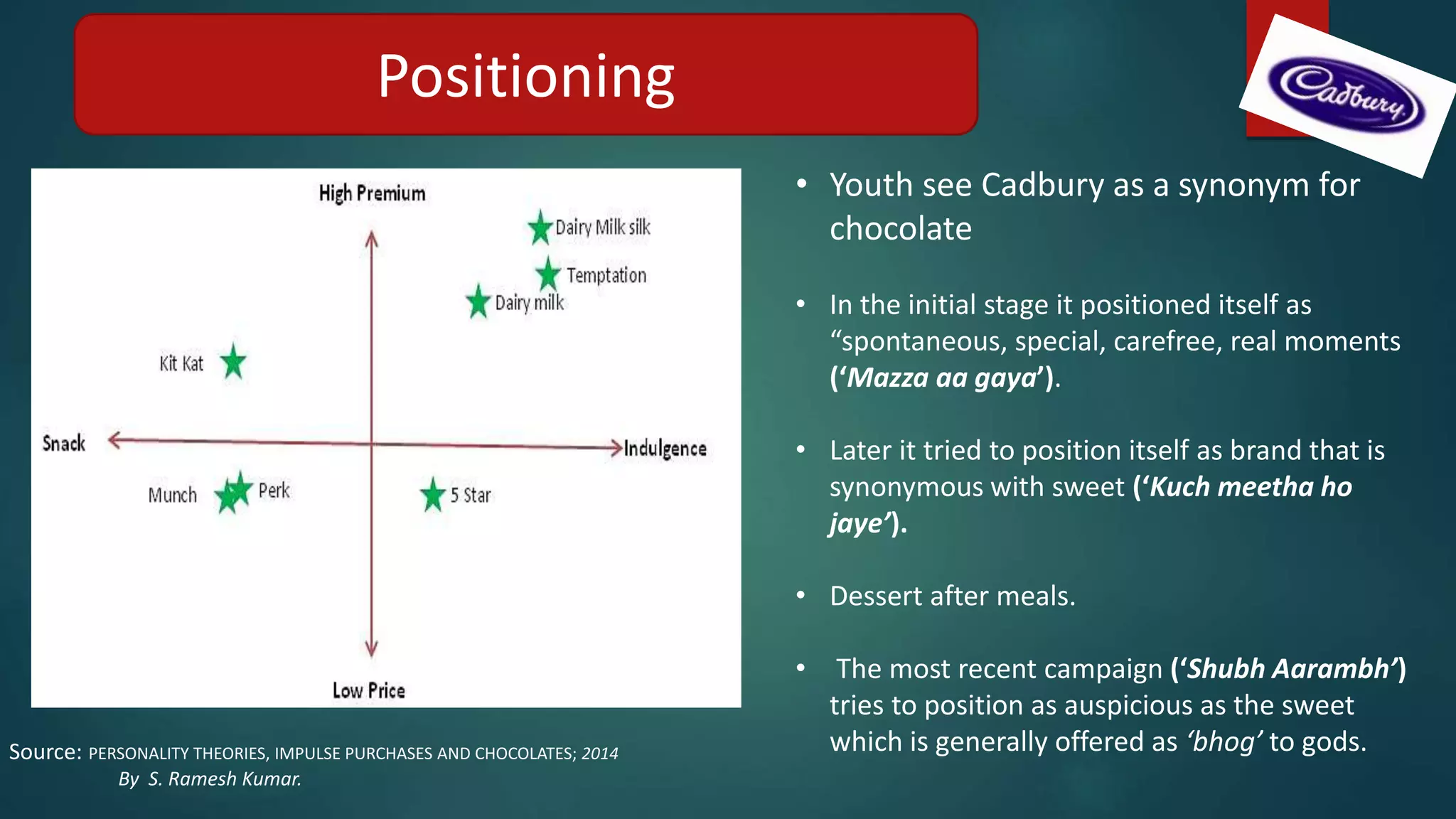
Positioning
• Youth see Cadbury as a synonym for
chocolate
• In the initial stage it positioned itself as
“spontaneous, special, carefree, real moments
(‘Mazza aa gaya’).
• Later it tried to position itself as brand that is
synonymous with sweet (‘Kuch meetha ho
jaye’).
• Dessert after meals.
• The most recent campaign (‘Shubh Aarambh’)
tries to position as auspicious as the sweet
which is generally offered as ‘bhog’ to gods.Source: PERSONALITY THEORIES, IMPULSE PURCHASES AND CHOCOLATES; 2014
By S. Ramesh Kumar.
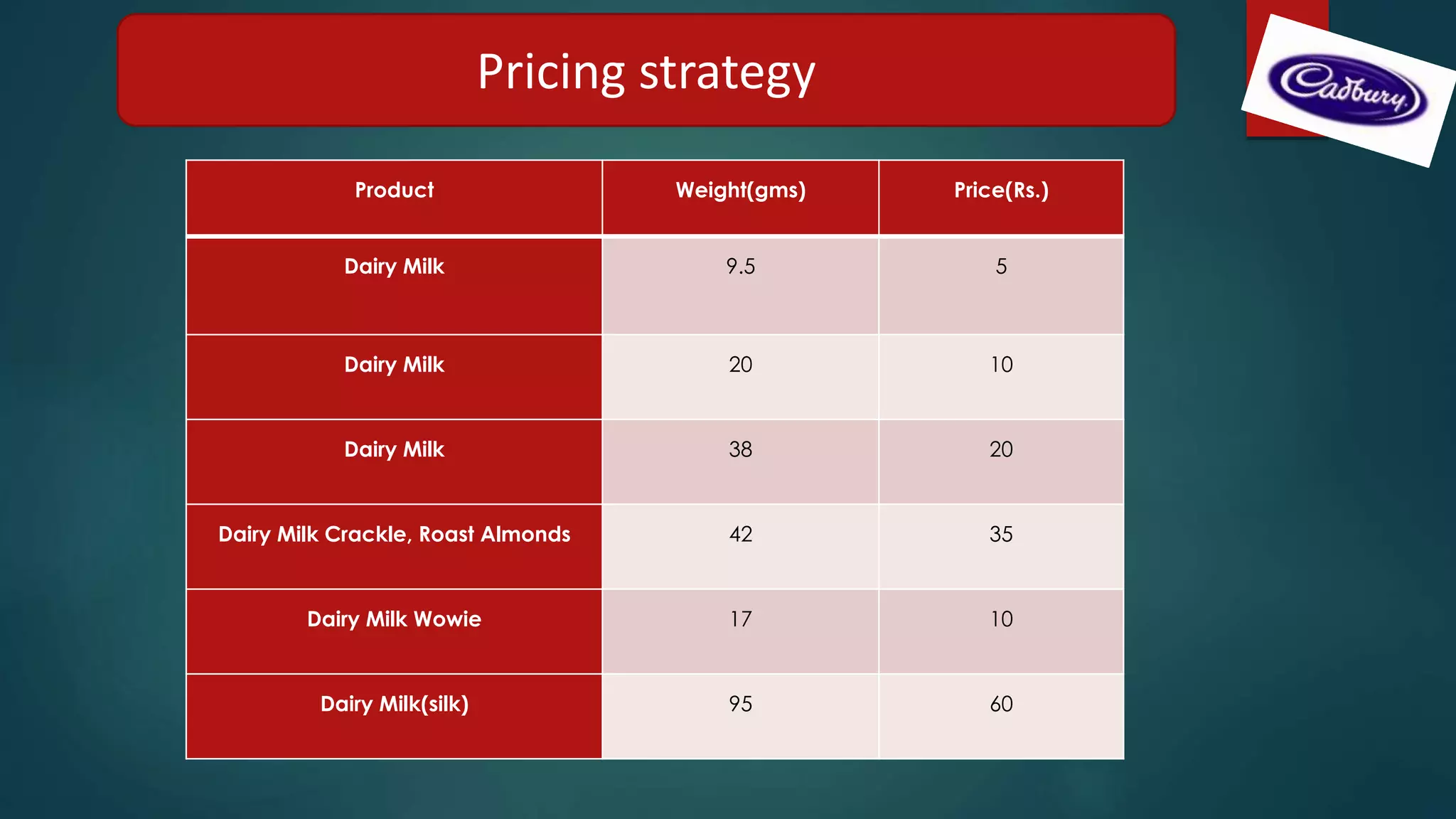
Product Weight(gms) Price(Rs.)
Dairy Milk 9.5 5
Dairy Milk 20 10
Dairy Milk 38 20
Dairy Milk Crackle, Roast Almonds 42 35
Dairy Milk Wowie 17 10
Dairy Milk(silk) 95 60
Pricing strategy
CUSTOMER TRENDS
Source:internationaljournalofBusinessandManagement
Tomorrow
September-2012Vol.2No.9ISSN:2249-9962
PublishedbySPIRI
Attraction toward buying
Consumers are influenced to buy a particular brand/product based on the
criteria of importance.
Brand/Image Quality Flavour/Taste
Source: international journal of Business and Management
Tomorrow. September-2012 Vol.2 No.9 ISSN: 2249-9962
Published by SPIRI
 With rapidly changing lifestyle chocolate eating is
definitely going to be widespread and acceptable.
 In the industry, both population and family incomes
as well as urbanisation are on the increase stage.
 There has been a significant growth in the middle
class, with 5.8 million people having upgraded to the
quoted middle class.
 Due to above reasons the growth in the chocolate
market is estimated to be at 22%.
Source: TRANS Asian Journal of Marketing & Management Researc
Vol.1 Issue 1, September 2012,
BY DR. B. C. M. PATNAIK; PRADEEP KUMAR SAHOO
12
Tradition for
gifting sweet is
increasing.
Shifting
consumer
preference
from “Mithai” to
sweet.
Increasing
demand for sugar
free and diet
chocolate.
Eating at the
time of hunger.Increase in the
disposal
income of the
urban people.
Income
capacity of
Rural people is
also
increasing.
Communication(I
nfrastructure) is
also playing a key
role.
Less
penetration in
the Market.
Critical Success Factor for
Chocolate industry.
Source: http://timesofindia.indiatimes.com
Major Global Influence factor
For India
•Milk Rate, sugar rate(raw material)
(Shah, 2012)
•Inflation
•Infrastructure for storage (cold storage
included)
•Labor issues and transportation
problem for distribution.
•Worm Controversy (Vaid, 2006)
•Rise in fodder prices(Mukherjee, 2014)
•Issues of Labeling (Barman, 2013)
International
•Global Warming.(Greenaway,2014)
•Ebola.(Tomson,2014)
•Child Labor. (Griek, 2010)
•Increase in International oil price.
(The effects of petroleum dependency onagricultural
trade in Nigeria:An error correlation
modeling(ECM)approach,2009)
Political condition of African Country.
(HOT CHOCOLATE:HOW COCOA FUELLED THE
CONFLICT IN CÔTE D’IVOIRE By Global witness,2007)
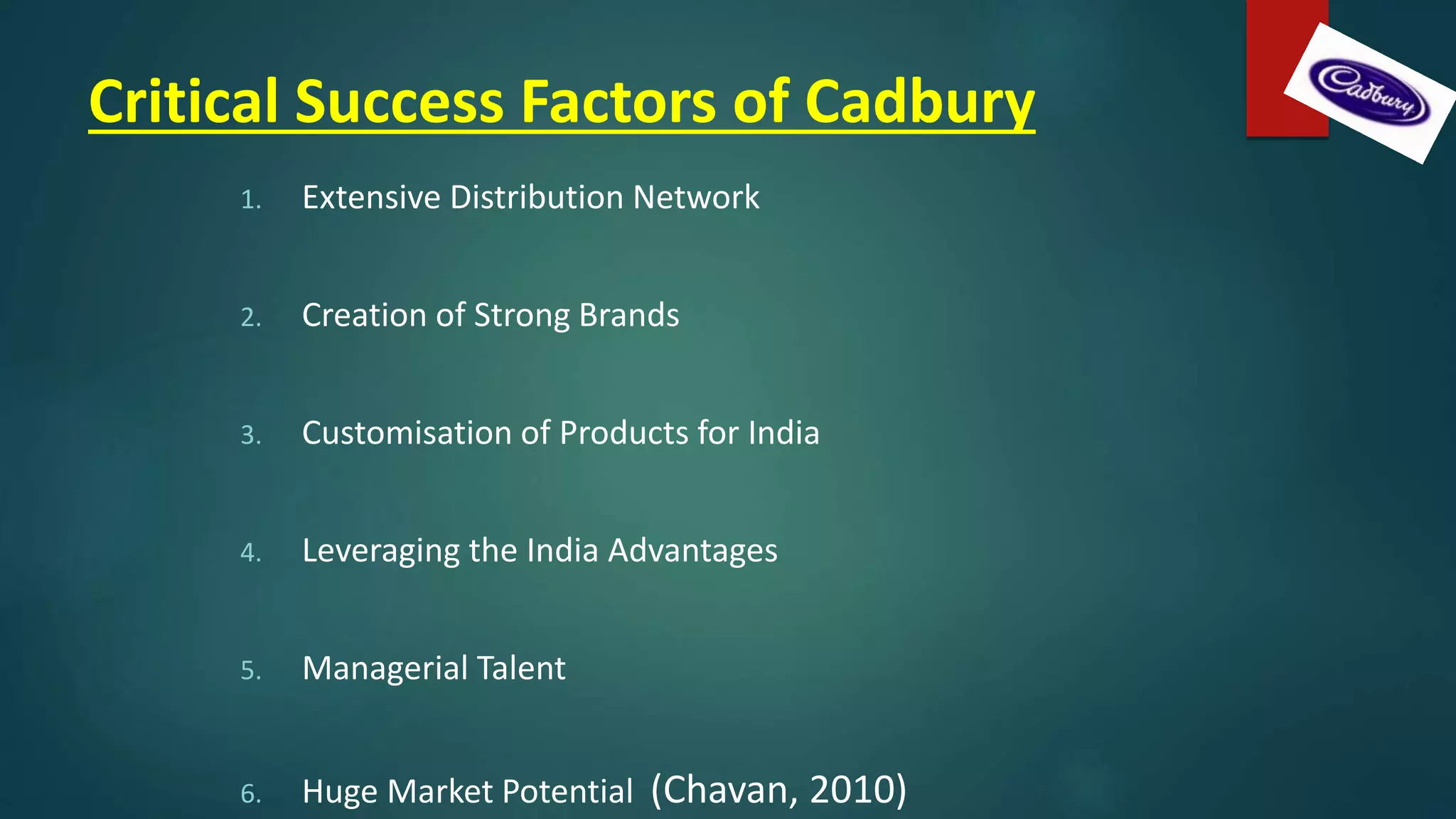
Critical Success Factors of Cadbury
1. Extensive Distribution Network
2. Creation of Strong Brands
3. Customisation of Products for India
4. Leveraging the India Advantages
5. Managerial Talent
6. Huge Market Potential (Chavan, 2010)
 The company has moved
from a growth of 20%-23%
each year before 2009 to
over 30% in 2010, and 40%
in the first nine months of
2011. (Malviya and Vyas ,
2012)
 Cadbury Dairy Milk, a driver
of the chocolate category in
India, grow at a
compounded growth rate of
30% per
annum.(Agarwal,2012)
Sources:
1. http://articles.economictimes.indiatimes.com
2. http://www.livemint.com
BCG Matrix
Product Life Cycle of Cadbury
Introduction Growth Maturity Decline
Growth
Time
Porter Competitive Model
Cadbury Dairy Milk
Bargaining
Power of
Buyers(high)
• Large Volume Buyers
• Shifting Cost Low
• Psychology of Buyers
Threat to Potential
New Entrant(low)
Threat of
Substitute Product
(moderate)
Intra-Industry Rivalry
SBU: Cadbury
Rivals: Nestle, Mars, Amul,
Perfetti, Parle, Ravalgaon,
Nutrine & Parry’s
• Knowing Indian
Consumers
• Established Company
• Brand Building
• Strong Distribution
Channel
• Supply of cocoa
• Switching Cost High
• Sugar Industry
• Labor Unions
• Quality Standards
Bargaining
Power of
Suppliers(low)
• Cookies, Sweets
• carob confections
• Ice creams
• Cakes and pastries
• Fruits and other natural
products
Source: (Porter, 2008)
 Wide consumer’s across the globe.
 It is a chocolate brand built upon a reputation for fine products and services.
 The maker of Cadbury chocolate is close to introducing heat-resistant bars it
can sell at market stalls in Africa and some of the world's hottest places. (BST,
June 2013)
 Cadbury is the world’s leader in chocolates. Known to have the best
manufacturing and a wide distribution channel, Cadbury has a presence in
200 or more countries.
Cadbury
Strength
The main market competitors their strengths and
weaknesses
Sources: 1.http://managementparadise.com
2.www.techieoasis.org
3.www.food-info.net
Weaknesses
 Cadbury has no apprehensions of cannibalization of its chocolate brands
 Transportation and storage infrastructure
 People avoid having chocolate thinking about animal fat (E442).
 It has being relatively a high price brand.
Sources: 1.http://managementparadise.com
2.www.techieoasis.org
3.www.food-info.net
 It is the largest food company in the world measured by revenues.
 Nestlé's sells baby food, breakfast cereals, coffee, confectionery, dairy
products, frozen food, pet foods, yoghurt and snacks. It owns several major
consumer brands such as Stouffers, Nescafe, Kit-Kat, Carnation, Nestlé Water,
and many others.
 Mergers and acquisitions and joint ventures to increase market share. (Nestle
M&A,2013) & strong advertising.
Weakness
 Inability to provide consistent quality in food products
 Weak implementation of Customer Service Relationship
 Complex supply chain management
Nestle
Strength
Source: SWOT Analysis of Nestle , the popular food brand, Oct 24,2014.
Amul
Strengths
 High brand equity.
 Products available at affordable price.
 Successful advertising and marketing campaigns
 Strong network.
Weakness
 Low market share in chocolates segment.
 Strong competition from international markets
Source: Amul is ‘taste of India’, says survey.
BS reporter, Sept 12, 2007.
Mars
Strengths
• The company has presence in more than 74 countries across North
America, Asia Pacific, Europe, Latin America and Middle East.
International brand name and brand presence
• High brand loyalty
• Great taste and packaging
• Highly regarded as a global chocolate brand
• Sponsors global football teams
Weakness
• Expensive chocolates
• Not easily available
• Milky Way has a low sales percentage of Mars domestic market
share. Source: Mars Inc in packaged food. April 2014.
SWOT ANALYSIS
• Number 1 chocolate brand in India with
lot of variants like Fruit & Nut, Crackle
and Roast Almond, Éclairs
• Celebrity brand ambassadors
• Excellent advertising, reach and
accessibility
• High brand loyalty
Strengths
• Rural Distribution penetration is less.
• Quality control need to be
strengthened.
Weakness
Source :- http://www.mbaskool.com
• Untapped rural markets
• Better product packaging and
preservation
• Sugar free category
Opportunities
• Other brand and local chocolate
Manufacturers, like merger of
mars and Wrigley in 2008.
• Obesity concern, Sweets as
substitutes
Threats
Source :- http://www.mbaskool.com
Political
Subject to food
and drug
administration
guidelines.
Licenses and
regulatory fees,
for eg. employee
children or paying
under minimum
wage.
Economical
• High population growth
rates and rising levels of
prosperity has increased
demands for affordable
luxuries and treats.
• Observed that chocolate
industry has not been
affected much, when the
economy was down.
Social
• Wellness is a
core focus.
• Consumers are
increasingly
becoming more
and more diet
conscious.
• Management
concentrating
on health and
fitness.
Technological
Innovation such as
web marketing and
social media is a
major growth driver
in developed markets
where
Premium and
exclusive products are
prevailing themes.
Source:- The Chocolate Market In India Cadburys Marketing Essay
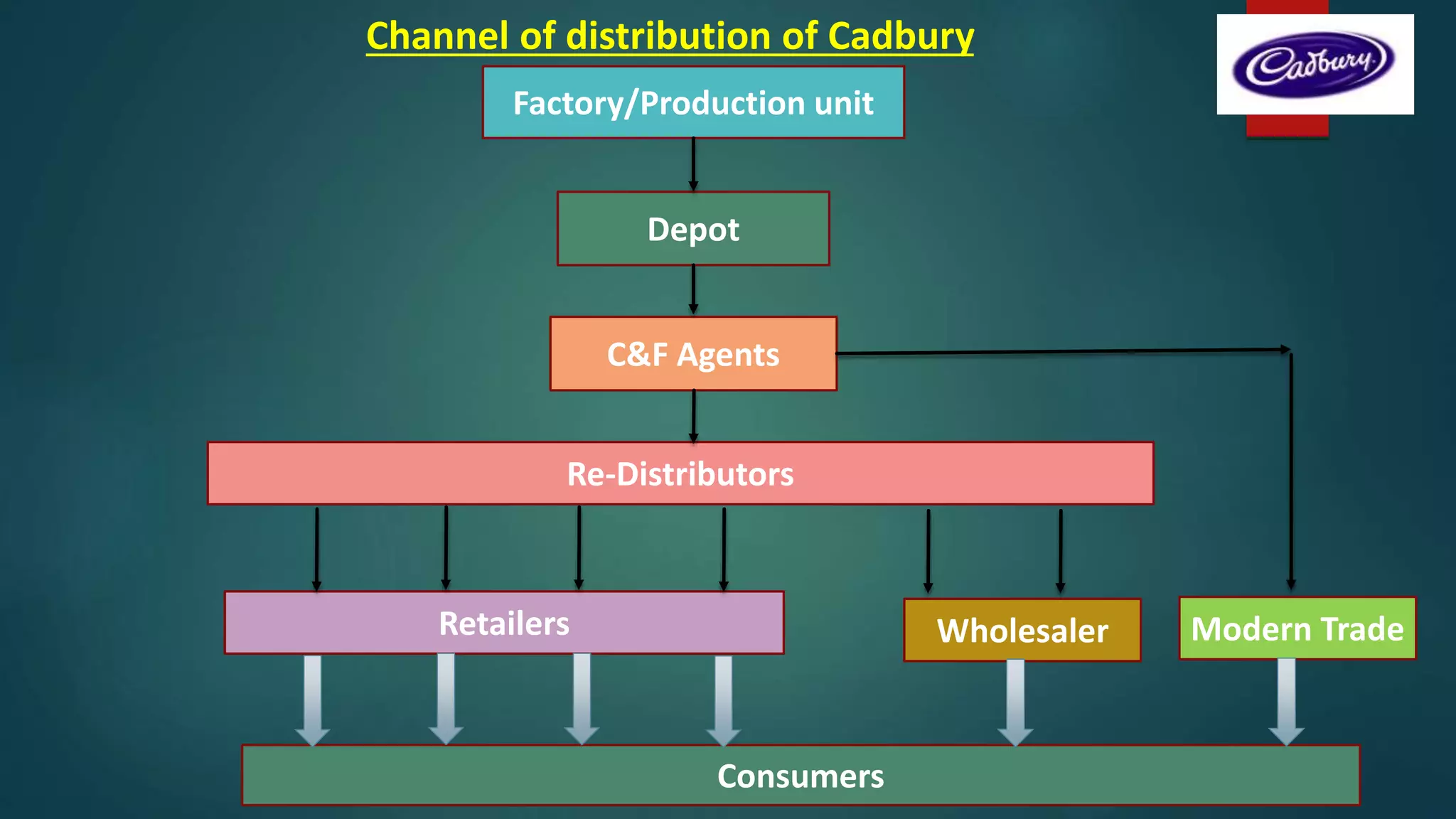
Channel of distribution
“The marketer uses distribution channels to display, sell, or deliver the
physical product or services to the buyer or users”. (Kotler, 2013)
Two Types:
Direct
• Internet
• Mail
• Mobile phone
• Telephone
Indirect
• Distributers
• Wholesalers
• Intermediaries
• Retailers
Channel of distribution of Cadbury
Factory/Production unit
Retailers
C&F Agents
Re-Distributors
Consumers
Depot
Wholesaler Modern Trade
Factory/Production unit
Thane
Induri(Pune) Malanpur(Gwal
ior)
Banglore Baadi(H.P)
Four Sales Offices
New Delhi Kolkata Mumbai Chennai
The corporate office is in Mumbai.
Cadbury encompasses 2100 distributers & 4,50,000 retailers.
Source :- http://www.scribd.com
Power Retailers
Factory
C&F Agents
Mall/Supermarkets
Online Distribution
Factory
E-Commerce
Mode of Transportation
Consumers Consumers
C&F Agents
Articles and Journals
1.A taste of the future (2014)
Published by KPMG International.
2. Bitter Harvest: Child Labour in the Cocoa Supply Chain, June 2010,
By:-By Lotte Griek, Sustainability Analyst, Jennifer Penikett, Sustainability Analyst,and Esther
Hougee, Research Manager.
3.Brand Development – Building the Dairy Milk Megabrand
Published by The Irish Times Ltd.
4.Cadbury World A Case Study(2009)
Published by Cadbury World Marketing Team.
5. Choc-a-lot a chocolate flavoured resource to explore the global trade in cocoa
Published by RISC, 35-39 London Street, Reading RG1 4PS.
6.COCOA AND CHILD LABOR
Published by International Labour Rights fund.
7.Cocoa Fact Sheets (2012)
Published By Wageningen UR Centre for Development Innovation
8.Cocoa Industry the in West Africa A history of exploitation(2004)
Published by Anti-Slavery International
9.Consumer buying behavior & perception towards chocolate brands and its consumption
(vol. 2, number 9 , 2012)
Published by SPIRI
10.Exploring the Cost of Milk Production & Potential Economies of Scale in a Dairy Cooperative(2012)
By Wharton Research Scholars Journal
11. HOT CHOCOLATE:HOW COCOA FUELLED THE CONFLICT IN CÔTE D’IVOIRE(2007)
Published By Global Witness
12. The chocolate of tomorrow(2012)
Published by KPMG International.
13. The effects of petroleum dependency on agriculture trade in Nigeria : An error correlation modeling(ECM)
approach
Published by Scientific research and essay Vol.4(11) pp.1385-1391,Nov,2009. ISSN1992-2248
14.TRANS Asian Journal of Marketing & Management Research
Vol.1 Issue 1, September 2012
Book
1.Kotler, P. (2013) Marketing Management, 14th edition, Dorling Kindersley (India) Pvt Ltd.
eRefferences
1.http://www.business-standard.com/article/economy-policy/costly-fodder-set-to-raise-prices-of-milk-eggs-
114070500095_1.html
2.http://www.business-standard.com/article/management/cadbury-glow-to-make-india-debut-
114082601330_1.html
3.http://businesstoday.intoday.in/story/kraft-takes-over-cadbury-india-changes/1/21920.html
4.https://www.cadbury.co.uk/the-story
5.http://www.campaignindia.in/Article/227676,cadbury-dairy-milk-explores-unabashed-joy-of-chocolate-with-
silk.aspx
6.http://articles.economictimes.indiatimes.com/2012-01-04/news/30588888_1_managing-director-anand-kripalu-
cadbury-india-cadbury-plc
7.http://articles.economictimes.indiatimes.com/2013-08-01/news/40963259_1_chocolate-consumption-chocolate-
market-indian-consumers
8.http://articles.economictimes.indiatimes.com/2013-11-02/news/43611397_1_fssai-indian-food-new-labelling-
norms
9.http://articles.economictimes.indiatimes.com/2014-02-20/news/47527437_1_cadbury-india-
mondelez-international-heinz-india
10.http://articles.economictimes.indiatimes.com/2014-10-07/news/54735768_1_mondelez-india-foods-
mondelez-international-market-share
11.http://www.forbes.com/companies/mondelez-international/
12.http://fortune.com/fortune500/mondelez-international-inc-89/
13.www.icco.org/about-cocoa/chocolate-industry.html
14.http://www.icmrindia.org/casestudies/catalogue/Marketing/MKTG287.htm
15.http://www.indianmirror.com/indian-industries/2012/chocolate-2012.html
16.http://www.indianmirror.com/indian-industries/2013/chocolate-2013.html
17.http://www.indianmirror.com/indian-industries/2014/chocolate-2014.html
18.http://lifeatunitedworld.wordpress.com/2013/06/27/perception-analysis-between-competing-confectionery-
fmcg-brands/
19.http://www.livemint.com/Companies/5NnJK87FxsWn7MZUvTq2HI/Cadbury-India-hopes-to-sustain-20-
growth.html
20.http://www.managementparadise.com/forums/marketing-management-rm-im/202433-factors-responsible-
cadbury-success.html
21.http://marketingpractice.blogspot.in/2009/01/cadbury-bournville-you-have-to-earn-it.html
22.http://www.mbaskool.com/brandguide/food-and-beverages/430-cadburys-dairy-milk.html
23.http://www.moneycontrol.com/company-facts/cadburyindia/history/CI
24.http://www.moneycontrol.com/financials/cadburyindia/profit-loss/CI
25.http://www.mxmindia.com/2014/09/cadbury-turns-focus-to-glow-moments-in-life-with-new-product-
launch/
26.http://www.politico.com/story/2014/10/ebola-chocolate-industry-africa-effects-111809.html
27.http://www.rankingthebrands.com/Brand-detail.aspx?brandID=192
28.http://www.rediff.com/money/2006/dec/24cad.htm
29.http://www.scribd.com/doc/175076860/Porter-s-Five-Forces-Model-cadbury
30.http://www.scribd.com/doc/35357589/study-of-consumer-prefarence-towards-cadbury-and-nestle-
chocolate
31.http://www.smithsonianmag.com/arts-culture/a-brief-history-of-chocolate-
21860917/#ux3DFOJEX3E6glBK.99
32.http://www.smithsonianmag.com/ist/?next=/arts-culture/a-brief-history-of-chocolate-21860917/
33.http://www.statista.com/statistics/238849/global-chocolate-consumption/
34.http://www.statista.com/statistics/238131/estimated-cagr-of-the-global-chocolate-market-by-region/
35.http://tejas.iimb.ac.in/articles/97.php
36.http://www.theguardian.com/sustainable-business/fairtrade-partner-zone/chocolate-cocoa-production-risk
37.http://www.theguardian.com/vital-signs/2014/oct/29/diet-climate-maple-syrup-coffee-global-warming
38.http://www.ukessays.com/essays/marketing/the-chocolate-market-in-india-cadburys-marketing-essay.php
39.http://www.valuenotes.biz/knowledge-center/short-industry-reports/chocolate-industry-india-2014-19/
Cadbury Dairy Milk Market Growth, Future Projections, BCG Matrix,PLC, Consumer Behavior, STP, Porter's 5 Forces Model, Market Competitors, Critica Success Factors and distribution Channel

Cadbury Dairy Milk Market Growth, Future Projections, BCG Matrix,PLC, Consumer Behavior, STP, Porter's 5 Forces Model, Market Competitors, Critica Success Factors and distribution Channel

  • 1.
    Presented By; Swaraj Mishra- (CMBA-4)- 1450 Sohel Jamadar – (CMBA-4)- 1448 Akash Shukla - (CMBA-4)- 1417 Larika Arora - (CMBA-4)- 1431 Nikhileshwar Ravishankar - (CMBA-4)-1433
  • 2.
    1. The overallmarket size, growth trends and future projections 2. The main market segments; their size and consumer behaviour trends 3. Major macro and global environmental influences on the market and Critical Success Factors 4. Analyse the Industry with the help of Porter’s 5 Forces Model 5. The main market competitors; their market share and their strengths and weaknesses 6. The main channels of distribution and their strengths and weaknesses OBJECTIVES
  • 3.
    “When most ofus hear the word chocolate, we picture a bar, a box of bonbons, or a bunny. The verb that comes to mind is probably "eat," not "drink," and the most apt adjective would seem to be "sweet." But for about 90 percent of chocolate's long history, it was strictly a beverage, and sugar didn't have anything to do with it.” (Bensen, 2008) "chocolate" comes from the Aztec word "xocoatl,“ which referred to a bitter drink brewed from cacao beans. History of chocolate  From the research of University of Pennsylvania the people of Honduras were using cocoa in the 1400 B.C. as an alcoholic beverage. Source: A Brief History of Chocolate By Amanda Bensen, March 1, 2008
  • 4.
     In 1828,a Dutch chemist created powdered chocolate by removing 50% of natural fat from chocolate and to cut the bitter taste it was added with the alkaline salts. It was very much popular as “Dutch cocoa” and it lead to solid chocolate.  Modern chocolate bar was first made by Joseph Fry in 1847.  Addition of honey to chocolate by Spanish people and popularized the drink in Europe.  In ancient time in Latin America, cacao beans were used as currency. Source: A Brief History of Chocolate By Amanda Bensen, March 1, 2008
  • 5.
    Cadbury year events 1824 JohnCadbury opened the shop at Bull Street shop. 1847 The business moves to Bridge Street. 1847 Fry's Produce the First Chocolate Bar. 1866 launch of 'Cadbury Cocoa Essence‘. 1875 First Milk Chocolate Bar by Daniel Peter . 1875 Cadbury Easter egg . 1897 Cadbury Milk Chocolate was Launch. 1905 First Cadbury logo commissioned. 1906 Bournville Cocoa was launched. 1914 Fry's Turkish Delight was Launched. Source: https://www.cadbury.co.uk
  • 6.
    1915 Milk Traywas launched. 1919 Cadbury purchases Fry's. 1920 Cadbury Dairy Milk 1920 Flake is Launched. 1921 Cadbury script logo first appears. 1928 The 'Glass and a Half' symbol is introduced. 1928 Investment Begins in Cadbury Dairy Milk Ads. 1929 Crunchie was Launched. 1938 Cadbury Roses were Launched. 1947 Milk Tray Bar was Launched. 1948 Fudge was Launched. 1955 First Cadbury TV advert. 1960 Skippy was Launched. 1967 Aztec Bar was Launched. 1967 Toffee Buttons were Launched. Source: https://www.cadbury.co.uk
  • 7.
    1969 Cadbury Mergeswith Schweppes. 1970 Curly Wurly, Jamaica were launched. 1981 Wispa was Launched 1985 Boost Coconut was Launched 1987 Twirl was Launched 1989 Inspirations were Launched 1990 Cadbury World Opened 1996 Cadbury Fuse was Launched 2003 Cadbury Schweppes Bought Adams and Becomes the World's Leading Confectionery Company. 2007 The Gorilla Advert Premiers. 2008 Cadbury and Schweppes Demerged. 2008 Cadbury Cocoa Partnership Launched in Ghana, India, Indonesia and the Caribbean to boost the cocoa production farm. 2010 Cadbury becomes part of Mondelēz International. Source: https://www.cadbury.co.uk
  • 8.
    Cadbury In India 1948- Incorporation on 19th July with launch of Cadbury dairymilk in India. 1967 -`Five Star’ .1968 -’Gems' .1978-Cadbury Bournville. 1987 - Company launched new products such as `Crackle', `Orange‘,`Strawberry Krisp', `Mello', and `Wildlife bar‘ and in foods drinks, the Company launched `Choc O Cheer’. 1988-protein drink `Enriche' was introduced. 1989-enter to ice-cream market with brand name `Dollops'. 1995 -`Perk' was launched. 2000 –’Perk Slims’.2007 - 'Ulta Perk'. 2008- Cadbury relaunched its Bournville brand of dark chocolates. 2010 - ‘Dairy Milk Silk' has been introduced and Perk with glucose. 2012-”Toblerone” and “Cadbury Celebration”. 2014-Cadbury Glow 2014-April Cadbury India change to “Mondeleze India Foods Limited”. Source: www.moneycontrol.com
  • 9.
    Euromonitor predicts theindustry will enjoy a 6% rise in revenues in 2014, delivering record global revenues of US$117bn. This robust performance is driven by a 2.1% increase in volume, reflecting growing appetite for chocolate in emerging markets. (Morris,2014 ) 5.8 7.2 8.5 0 2 4 6 8 10 1999 2009 2020 MillionTons year Consumption in World wide Sources:- 1. A taste of Future, KPMG international-Consumer Markets June 2014, By John A. Morris 2. http://www.statista.com The overall market size, growth trends and future projections in the world Market
  • 10.
    Company Net Sales2013 (US$ millions) Mars Inc (USA) 17,640 Mondelēz International Inc (USA) 14,862 Nestlé SA (Switzerland) 11,760 Meiji Holdings Co Ltd (Japan) 11,742 Ferrero Group (Italy) 10,900 Hershey Foods Corp (USA) 7,043 Arcor (Argentina) 3,700 Chocoladenfabriken Lindt & Sprüngli AG (Switzerland) 3,149 Ezaki Glico Co Ltd (Japan) 3,018 Yildiz Holding (Turkey) 2,500 Source: http://www.icco.org
  • 11.
    India's chocolate marketis estimated at around Rs 3,000 crore and the overall chocolate market is growing 15% a year. According to TechSci Research, India's chocolate market is expected to reach $3.2 billion by 2018. (Mukherjee and Bhusan, 2013) 580 320 290 270 190 0 100 200 300 400 500 600 700 Belarus Venezuela Nigeria India Argentina Total % growth 2007-12 Countries 5 Fastest growing chocolate industry from 2007-12 Sources: 1. India is the fastest growing market for adult consumption of chocolates and candies Writankar Mukherjee & Ratna Bhushan, ET Bureau Aug 1, 2013 2.A taste of Future, KPMG international Consumer Markets-2014, By John A. Morris The overall market size, growth trends and future projections in Indian Market
  • 12.
    0 5 10 15 20 25 India Latin America Brazil ChinaRussia Estern Europe Maxico percentage 21 12 11 9 8 7 4 Percentage Compound annual growth rate of the chocolate industry in emerging markets between 2011-17 Source:-www.statista.com
  • 13.
    Source: Change atthe chocolate factory By Geetanjali Shukla and Anusha Subramanian Edition:Feb 19, 2012 Cadbury India’s Market share in different segments in 2012
  • 14.
    Cadbury India netprofit Statistics 45.95 68.81 117.65 165.78 188.63 220.98 297 303.4 498.34 2005 2006 2007 2008 2009 2010 2011 2012 2013 Cadbury net profit(Cr.) Cadbury net profit Sources:- 1. http://www.moneycontrol.com 2. http://articles.economictimes.indiatimes.com  $190 million to build the country's largest chocolate manufacturing plant near Hyderabad.
  • 15.
    Cadbury 67% Nestle 21% Ferrero 6% Others 6% Market share ofChocolate Industry By brand in India Dairy Milk 35% Bournville & Silk others 47% Market share of Dairy Milk in Chocolate Industry in India Sources:- 1.http://articles.economictimes.indiatimes.com 2.http://lifeatunitedworld.wordpress.com
  • 16.
  • 17.
  • 18.
  • 19.
    Milk 75% Dark 9% White 16% Market size accordingto the Types of Ingredients Source:-http://lifeatunitedworld.wordpress.com
  • 20.
    Western Europe, 32 NorthAmerica, 20Asia,17 Latin America, 13 Eastern Europe, 12 Middle East and Africa, 4 Austalasia, 2 Geographical Market Share and Size of Chocolate industry Source: The chocolate of tomorrow, KPMG International, consumer markets- June 2012, By John A. Morris.
  • 21.
    MARKET SEGMENTS OFCADBURY DAIRYMILK • A Market segment consists of a customers who share similar set of needs and wants(Kotler, 2013). • Cadbury dairy milk also divides the market into different group of customers. • Dairy milk is the megabrand of the Cadbury Family focusing on consumers of all ages. • One notable form of customer segmentation that Cadbury utilizes is behavioural segmentation, which is based on actual customer decision- making processes towards Cadbury’s products. We can understand it by following discussion.
  • 22.
    Demographic Segmentation 13 -19 29% 20 - 25 22% 26 - 30 19% 30 - 40 30% AGE GROUP Generation: Little girls and boys, be advised to keep your chocolates and toffees safe...or your parents may bite into them! Income: Cadbury pricing strategy is low costing, availing any one can afford. Gender: For purchasing Cadbury dairy milk gender does not matter. Cadbury dairy milk are for all type of persons whether male or female. (Mukherjee and Bhushan, 2013) Source: India is the fastest growing market for adult consumption of chocolates and candies, By Writankar Mukherjee & Ratna Bhushan, ET Bureau Aug 1, 2013
  • 23.
    Behavioural Segmentation • Decisionroles: The decision role is played by the children and youngsters when to buy the Cadbury dairy milk. • Occasion: For purchasing the Cadbury dairy milk no specific occasion are required. • Benefits: Cadbury dairy milk is easily available everywhere when we need it. • User status: There are mainly the Impulse users found in the user status of Cadbury dairy milk. • User rate: The user rate is heavy in the behavioral segmentation of Cadbury dairy milk. • Loyalty status: There is mainly the absolute loyal customers. • Attitude: There is an enthusiastic type of attitude seen in buyers(Porter, 2013).
  • 24.
    Behavioral Market SegmentsOn The Basis Of Usage 23 24 20 24 Relaxation 19 23 24 23 Sharing 32 23 19 23 Hunger 12 14 20 14 Rejuvenation 7 11 9 9 Indulgence 4 6 10 6 Celebration 3 0 0 1 Health 1 1 1 1 Romance Any Snack Small Individual Chocolate Bar Chocolate Any Chocolate Source:Indiaisthefastestgrowingmarketforadultconsumptionof chocolatesandcandies, WritankarMukherjee&RatnaBhushan,ETBureauAug1,2013
  • 25.
    Campaigns Targeted Market KidIn all of us, Real Taste of Life ,Kuch khas hai Zindegi main, No Umar far Lalach. Psychology ( there is a kid in all of us). Higher age people can eat chocolate without fear. Khane walo ko khane ka bahana chahiye. Replacing “mithai” on the Family Occation. Behavioral(usage based)Mass marketing. Kuch Mitha ho jae(all ads). Behavioral(Special Moments) and ceremoney. Middle age group. Segments Targeting Source:- Cadbury Dairy Milk's Advertising Campaigns in India,2012
  • 26.
    Mitha hai Khanaaaj peheli tarikh hai. All family members in a middle class nuclear family. Psychology on the basis of Family life style and status. Kiss me and Miss me. Youth and Middle age group and little high standard of living. Behavioral (Loyal) as well as Psychology (a child in everyone), (Premium segment). Dairy Milk Silk Miss PalamPur. Rural market with lntroduction of Rs 5/- Dairy Milk. Villages(Geographic segment) Pappu Pass Ho gaya. All types of Students. Behavioral(User status or Happy moments). Campaigns Targeted Market Segments Targeting Source:- Cadbury Dairy Milk's Advertising Campaigns in India,2012
  • 27.
    Positioning • Youth seeCadbury as a synonym for chocolate • In the initial stage it positioned itself as “spontaneous, special, carefree, real moments (‘Mazza aa gaya’). • Later it tried to position itself as brand that is synonymous with sweet (‘Kuch meetha ho jaye’). • Dessert after meals. • The most recent campaign (‘Shubh Aarambh’) tries to position as auspicious as the sweet which is generally offered as ‘bhog’ to gods.Source: PERSONALITY THEORIES, IMPULSE PURCHASES AND CHOCOLATES; 2014 By S. Ramesh Kumar.
  • 28.
    Product Weight(gms) Price(Rs.) DairyMilk 9.5 5 Dairy Milk 20 10 Dairy Milk 38 20 Dairy Milk Crackle, Roast Almonds 42 35 Dairy Milk Wowie 17 10 Dairy Milk(silk) 95 60 Pricing strategy
  • 29.
  • 30.
    Attraction toward buying Consumersare influenced to buy a particular brand/product based on the criteria of importance. Brand/Image Quality Flavour/Taste Source: international journal of Business and Management Tomorrow. September-2012 Vol.2 No.9 ISSN: 2249-9962 Published by SPIRI
  • 31.
     With rapidlychanging lifestyle chocolate eating is definitely going to be widespread and acceptable.  In the industry, both population and family incomes as well as urbanisation are on the increase stage.  There has been a significant growth in the middle class, with 5.8 million people having upgraded to the quoted middle class.  Due to above reasons the growth in the chocolate market is estimated to be at 22%. Source: TRANS Asian Journal of Marketing & Management Researc Vol.1 Issue 1, September 2012, BY DR. B. C. M. PATNAIK; PRADEEP KUMAR SAHOO 12
  • 32.
    Tradition for gifting sweetis increasing. Shifting consumer preference from “Mithai” to sweet. Increasing demand for sugar free and diet chocolate. Eating at the time of hunger.Increase in the disposal income of the urban people. Income capacity of Rural people is also increasing. Communication(I nfrastructure) is also playing a key role. Less penetration in the Market. Critical Success Factor for Chocolate industry. Source: http://timesofindia.indiatimes.com
  • 33.
    Major Global Influencefactor For India •Milk Rate, sugar rate(raw material) (Shah, 2012) •Inflation •Infrastructure for storage (cold storage included) •Labor issues and transportation problem for distribution. •Worm Controversy (Vaid, 2006) •Rise in fodder prices(Mukherjee, 2014) •Issues of Labeling (Barman, 2013) International •Global Warming.(Greenaway,2014) •Ebola.(Tomson,2014) •Child Labor. (Griek, 2010) •Increase in International oil price. (The effects of petroleum dependency onagricultural trade in Nigeria:An error correlation modeling(ECM)approach,2009) Political condition of African Country. (HOT CHOCOLATE:HOW COCOA FUELLED THE CONFLICT IN CÔTE D’IVOIRE By Global witness,2007)
  • 34.
    Critical Success Factorsof Cadbury 1. Extensive Distribution Network 2. Creation of Strong Brands 3. Customisation of Products for India 4. Leveraging the India Advantages 5. Managerial Talent 6. Huge Market Potential (Chavan, 2010)
  • 35.
     The companyhas moved from a growth of 20%-23% each year before 2009 to over 30% in 2010, and 40% in the first nine months of 2011. (Malviya and Vyas , 2012)  Cadbury Dairy Milk, a driver of the chocolate category in India, grow at a compounded growth rate of 30% per annum.(Agarwal,2012) Sources: 1. http://articles.economictimes.indiatimes.com 2. http://www.livemint.com BCG Matrix
  • 36.
    Product Life Cycleof Cadbury Introduction Growth Maturity Decline Growth Time
  • 37.
    Porter Competitive Model CadburyDairy Milk Bargaining Power of Buyers(high) • Large Volume Buyers • Shifting Cost Low • Psychology of Buyers Threat to Potential New Entrant(low) Threat of Substitute Product (moderate) Intra-Industry Rivalry SBU: Cadbury Rivals: Nestle, Mars, Amul, Perfetti, Parle, Ravalgaon, Nutrine & Parry’s • Knowing Indian Consumers • Established Company • Brand Building • Strong Distribution Channel • Supply of cocoa • Switching Cost High • Sugar Industry • Labor Unions • Quality Standards Bargaining Power of Suppliers(low) • Cookies, Sweets • carob confections • Ice creams • Cakes and pastries • Fruits and other natural products Source: (Porter, 2008)
  • 38.
     Wide consumer’sacross the globe.  It is a chocolate brand built upon a reputation for fine products and services.  The maker of Cadbury chocolate is close to introducing heat-resistant bars it can sell at market stalls in Africa and some of the world's hottest places. (BST, June 2013)  Cadbury is the world’s leader in chocolates. Known to have the best manufacturing and a wide distribution channel, Cadbury has a presence in 200 or more countries. Cadbury Strength The main market competitors their strengths and weaknesses Sources: 1.http://managementparadise.com 2.www.techieoasis.org 3.www.food-info.net
  • 39.
    Weaknesses  Cadbury hasno apprehensions of cannibalization of its chocolate brands  Transportation and storage infrastructure  People avoid having chocolate thinking about animal fat (E442).  It has being relatively a high price brand. Sources: 1.http://managementparadise.com 2.www.techieoasis.org 3.www.food-info.net
  • 40.
     It isthe largest food company in the world measured by revenues.  Nestlé's sells baby food, breakfast cereals, coffee, confectionery, dairy products, frozen food, pet foods, yoghurt and snacks. It owns several major consumer brands such as Stouffers, Nescafe, Kit-Kat, Carnation, Nestlé Water, and many others.  Mergers and acquisitions and joint ventures to increase market share. (Nestle M&A,2013) & strong advertising. Weakness  Inability to provide consistent quality in food products  Weak implementation of Customer Service Relationship  Complex supply chain management Nestle Strength Source: SWOT Analysis of Nestle , the popular food brand, Oct 24,2014.
  • 41.
    Amul Strengths  High brandequity.  Products available at affordable price.  Successful advertising and marketing campaigns  Strong network. Weakness  Low market share in chocolates segment.  Strong competition from international markets Source: Amul is ‘taste of India’, says survey. BS reporter, Sept 12, 2007.
  • 42.
    Mars Strengths • The companyhas presence in more than 74 countries across North America, Asia Pacific, Europe, Latin America and Middle East. International brand name and brand presence • High brand loyalty • Great taste and packaging • Highly regarded as a global chocolate brand • Sponsors global football teams Weakness • Expensive chocolates • Not easily available • Milky Way has a low sales percentage of Mars domestic market share. Source: Mars Inc in packaged food. April 2014.
  • 43.
    SWOT ANALYSIS • Number1 chocolate brand in India with lot of variants like Fruit & Nut, Crackle and Roast Almond, Éclairs • Celebrity brand ambassadors • Excellent advertising, reach and accessibility • High brand loyalty Strengths • Rural Distribution penetration is less. • Quality control need to be strengthened. Weakness Source :- http://www.mbaskool.com
  • 44.
    • Untapped ruralmarkets • Better product packaging and preservation • Sugar free category Opportunities • Other brand and local chocolate Manufacturers, like merger of mars and Wrigley in 2008. • Obesity concern, Sweets as substitutes Threats Source :- http://www.mbaskool.com
  • 45.
    Political Subject to food anddrug administration guidelines. Licenses and regulatory fees, for eg. employee children or paying under minimum wage. Economical • High population growth rates and rising levels of prosperity has increased demands for affordable luxuries and treats. • Observed that chocolate industry has not been affected much, when the economy was down. Social • Wellness is a core focus. • Consumers are increasingly becoming more and more diet conscious. • Management concentrating on health and fitness. Technological Innovation such as web marketing and social media is a major growth driver in developed markets where Premium and exclusive products are prevailing themes. Source:- The Chocolate Market In India Cadburys Marketing Essay
  • 46.
    Channel of distribution “Themarketer uses distribution channels to display, sell, or deliver the physical product or services to the buyer or users”. (Kotler, 2013) Two Types: Direct • Internet • Mail • Mobile phone • Telephone Indirect • Distributers • Wholesalers • Intermediaries • Retailers
  • 47.
    Channel of distributionof Cadbury Factory/Production unit Retailers C&F Agents Re-Distributors Consumers Depot Wholesaler Modern Trade
  • 48.
    Factory/Production unit Thane Induri(Pune) Malanpur(Gwal ior) BangloreBaadi(H.P) Four Sales Offices New Delhi Kolkata Mumbai Chennai The corporate office is in Mumbai. Cadbury encompasses 2100 distributers & 4,50,000 retailers. Source :- http://www.scribd.com
  • 49.
    Power Retailers Factory C&F Agents Mall/Supermarkets OnlineDistribution Factory E-Commerce Mode of Transportation Consumers Consumers C&F Agents
  • 50.
    Articles and Journals 1.Ataste of the future (2014) Published by KPMG International. 2. Bitter Harvest: Child Labour in the Cocoa Supply Chain, June 2010, By:-By Lotte Griek, Sustainability Analyst, Jennifer Penikett, Sustainability Analyst,and Esther Hougee, Research Manager. 3.Brand Development – Building the Dairy Milk Megabrand Published by The Irish Times Ltd. 4.Cadbury World A Case Study(2009) Published by Cadbury World Marketing Team. 5. Choc-a-lot a chocolate flavoured resource to explore the global trade in cocoa Published by RISC, 35-39 London Street, Reading RG1 4PS. 6.COCOA AND CHILD LABOR Published by International Labour Rights fund.
  • 51.
    7.Cocoa Fact Sheets(2012) Published By Wageningen UR Centre for Development Innovation 8.Cocoa Industry the in West Africa A history of exploitation(2004) Published by Anti-Slavery International 9.Consumer buying behavior & perception towards chocolate brands and its consumption (vol. 2, number 9 , 2012) Published by SPIRI 10.Exploring the Cost of Milk Production & Potential Economies of Scale in a Dairy Cooperative(2012) By Wharton Research Scholars Journal 11. HOT CHOCOLATE:HOW COCOA FUELLED THE CONFLICT IN CÔTE D’IVOIRE(2007) Published By Global Witness 12. The chocolate of tomorrow(2012) Published by KPMG International. 13. The effects of petroleum dependency on agriculture trade in Nigeria : An error correlation modeling(ECM) approach Published by Scientific research and essay Vol.4(11) pp.1385-1391,Nov,2009. ISSN1992-2248 14.TRANS Asian Journal of Marketing & Management Research Vol.1 Issue 1, September 2012 Book 1.Kotler, P. (2013) Marketing Management, 14th edition, Dorling Kindersley (India) Pvt Ltd.
  • 52.
  • 53.
  • 54.
  • 55.
  • 56.

Editor's Notes

  • #5 Previously chocolate were so bitter that except Latin America countries no European countries liked that and after adding honey to it Spanish people and popularized the drink. In 1828, a Dutch chemist created powdered chocolate by removing 50% of natural fat from chocolate and to cut the bitter taste it was added with the alkaline salts. It was very much popular as “Dutch cocoa” and it led to solid chocolate.