Impact of Open Educational Resources: What Does Research Tell Us? 16 July 2008 IAU 13 th  General Conference Utrecht, Netherlands
Panelists: Dr. Grainne Conole Institute of Educational Technology The Open University, UK New Ways of Achieving the Vision of OER’s Dr. Mona Laroussi University of Lille, France National Institute of Applied Sciences & Technology, Tunis, Tunisia Elearning 2.0:Pedagogical Illusion  Dr. Sally M. Johnstone Winona State University  U.S.A
OER: a definition Web-based materials offered freely and openly for use and reuse in teaching, learning and research  (UNESCO, 2002) Only open if they are released under an open licence Includes any tool, material or technique used to support access to knowledge
Why OER? Knowledge as public good + www = extraordinary opportunity for sharing, use, and reuse of knowledge and tools to help others learn.  William & Flora Hewlett Foundation’s OER Goals: To help equalize access to knowledge and educational opportunities across the world
Critical assumptions for OER success: Fundamentally social and technical ..  An entire ecosystem – not just pipes and wires Fostered, not built Developed by ‘searchers’ not ‘planners’ that adapt to local systems Not built all at once or globally, but built in modular increments Infrastructure results from creating interoperability between systems Built on what has already been done; leveraging prior investments
The Cape Town Declaration “… a statement of principle, a statement of strategy and a statement of commitment … meant to spark dialogue, to inspire action and to help the open education movement grow.” (Cape Town Open Education Declaration, 2008)
Open Educational Resources The Way Forward Susan D’Antoni Manager of UNESCO on-line community exploring issues of OER
Aims of the on-line community: International dialogue and information exchange Linking people who might not otherwise meet Creating an international OER community
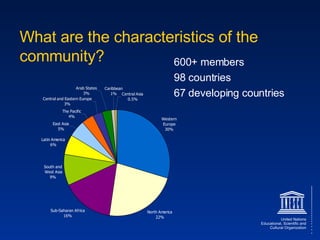
What are the characteristics of the community? 600+ members 98 countries 67 developing countries
What are the issues? Advancing the movement Awareness raising Communities and networking Research Enabling creation and re-use Policies Standards Technology tools Quality assurance Capacity development Enabling learning with OER Learning support services Assessment of learning Removing barriers to OER Accessibility Copyright and licensing Financing Sustainability
Join the community Email [email_address] Consult the resources Wiki http://oerwiki.iiep-unesco.org
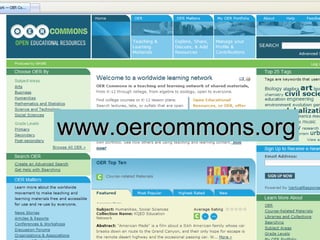
www.oercommons.org

IAU 2008

  • 1.
    Impact of OpenEducational Resources: What Does Research Tell Us? 16 July 2008 IAU 13 th General Conference Utrecht, Netherlands
  • 2.
    Panelists: Dr. GrainneConole Institute of Educational Technology The Open University, UK New Ways of Achieving the Vision of OER’s Dr. Mona Laroussi University of Lille, France National Institute of Applied Sciences & Technology, Tunis, Tunisia Elearning 2.0:Pedagogical Illusion Dr. Sally M. Johnstone Winona State University U.S.A
  • 3.
    OER: a definitionWeb-based materials offered freely and openly for use and reuse in teaching, learning and research (UNESCO, 2002) Only open if they are released under an open licence Includes any tool, material or technique used to support access to knowledge
  • 4.
    Why OER? Knowledgeas public good + www = extraordinary opportunity for sharing, use, and reuse of knowledge and tools to help others learn. William & Flora Hewlett Foundation’s OER Goals: To help equalize access to knowledge and educational opportunities across the world
  • 5.
    Critical assumptions forOER success: Fundamentally social and technical .. An entire ecosystem – not just pipes and wires Fostered, not built Developed by ‘searchers’ not ‘planners’ that adapt to local systems Not built all at once or globally, but built in modular increments Infrastructure results from creating interoperability between systems Built on what has already been done; leveraging prior investments
  • 6.
    The Cape TownDeclaration “… a statement of principle, a statement of strategy and a statement of commitment … meant to spark dialogue, to inspire action and to help the open education movement grow.” (Cape Town Open Education Declaration, 2008)
  • 7.
    Open Educational ResourcesThe Way Forward Susan D’Antoni Manager of UNESCO on-line community exploring issues of OER
  • 8.
    Aims of theon-line community: International dialogue and information exchange Linking people who might not otherwise meet Creating an international OER community
  • 9.
    What are thecharacteristics of the community? 600+ members 98 countries 67 developing countries
  • 10.
    What are theissues? Advancing the movement Awareness raising Communities and networking Research Enabling creation and re-use Policies Standards Technology tools Quality assurance Capacity development Enabling learning with OER Learning support services Assessment of learning Removing barriers to OER Accessibility Copyright and licensing Financing Sustainability
  • 11.
    Join the communityEmail [email_address] Consult the resources Wiki http://oerwiki.iiep-unesco.org
  • 12.