First International Conference of the CNIE 27-30 April 2008 Banff, Canada Open Educational Resources The Way Forward Susan D’Antoni UNESCO
Structure of the session OER: an overview and some examples A donor vision: the Hewlett change strategy Creating an international community: the UNESCO IIEP initiative The community speaks: the Way Forward Conclusion: next steps
OER: a definition Web-based materials offered freely and openly for use and reuse in teaching, learning and research  (UNESCO, 2002) Only open if they are released under an open licence Includes any tool, material or technique used to support access to knowledge
OER: milestones in the movement 1998: “open content” and the Open Publication License 2001: founding of Creative Commons 2001: MIT announces OpenCourseWare
The Cape Town Declaration “… a statement of principle, a statement of strategy and a statement of commitment … meant to spark dialogue, to inspire action and to help the open education movement grow.” (Cape Town Open Education Declaration, 2008)
What approaches have providers taken to making content freely and openly available?
 
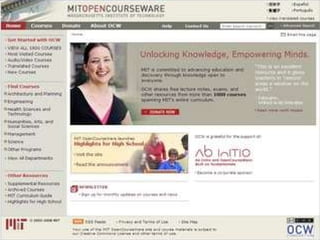
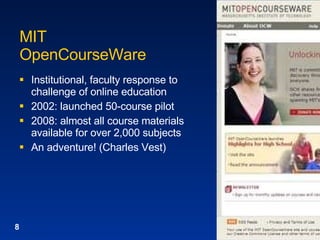
MIT  OpenCourseWare Institutional, faculty response to challenge of online education 2002: launched 50-course pilot 2008: almost all course materials available for over 2,000 subjects An adventure! (Charles Vest)
 
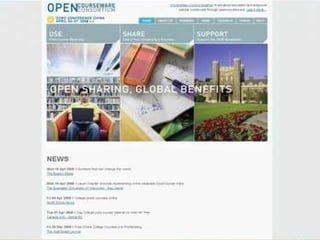
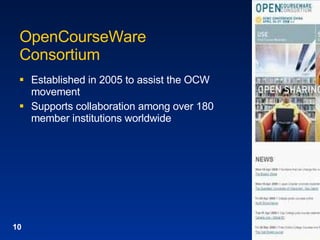
OpenCourseWare Consortium Established in 2005 to assist the OCW movement Supports collaboration among over 180 member institutions worldwide
 
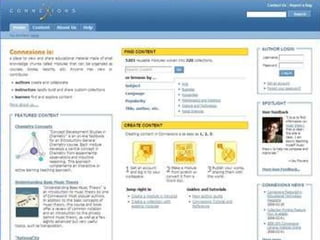
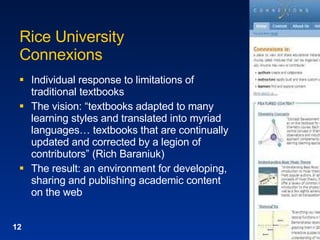
Rice University  Connexions Individual response to limitations of traditional textbooks The vision: “textbooks adapted to many learning styles and translated into myriad languages… textbooks that are continually updated and corrected by a legion of contributors” (Rich Baraniuk) The result: an environment for developing, sharing and publishing academic content on the web
 
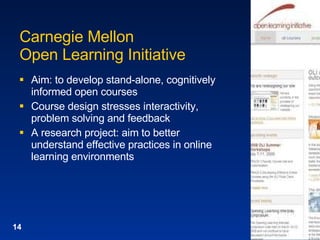
Carnegie Mellon Open Learning Initiative Aim: to develop stand-alone, cognitively informed open courses Course design stresses interactivity, problem solving and feedback A research project: aim to better understand effective practices in online learning environments
 
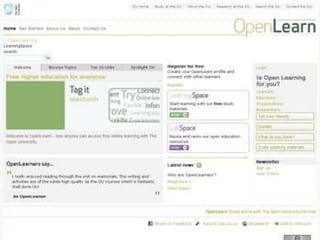
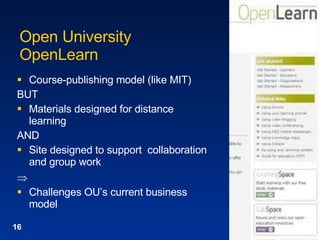
Open University OpenLearn Course-publishing model (like MIT) BUT Materials designed for distance learning AND Site designed to support  collaboration and group work  Challenges OU’s current business model
How have Canadian institutions responded to the challenge of OER?
 
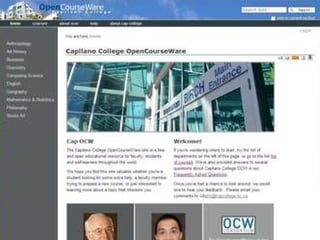
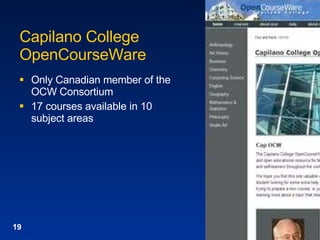
Capilano College OpenCourseWare Only Canadian member of the OCW Consortium 17 courses available in 10 subject areas
 
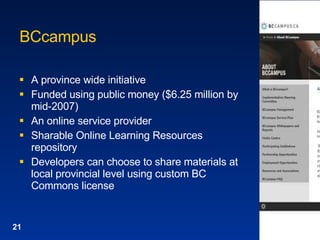
BCcampus A province wide initiative  Funded using public money ($6.25 million by mid-2007) An online service provider Sharable Online Learning Resources repository Developers can choose to share materials at local provincial level using custom BC Commons license
A donor vision: the Hewlett change strategy Aim: to equalize access to knowledge through: Sponsoring high quality content Understanding and stimulating use Removing barriers
UNESCO: removing barriers through awareness raising Potential of OER to contribute to: Education for All Building knowledge societies – especially “knowledge-sharing societies” But… No awareness of availability  =  resources not utilized and potential of OER not realized
Aims of the IIEP OER initiative International dialogue and information exchange Linking people who might not otherwise meet Creating an international OER community
Steps in the creation of a community Forum 1: an introduction to OER Short discussions on key topics OER research agenda A “Do-It-Yourself/Do-It-Together” resource for developing capacity FOSS for OER Forum 2: OECD study on OER
Sharing the outputs Forum 1 background documents and report OER research questions DIY/DIT resource outline FOSS for OER and lessons from the FOSS movement Forum 2 background documents and report The Way Forward: priority issues for advancing the OER movement Resources made available on website and wiki
After two years of intense reflection  and discussion…  … what did the community have to say about the priorities for advancing  the OER movement?
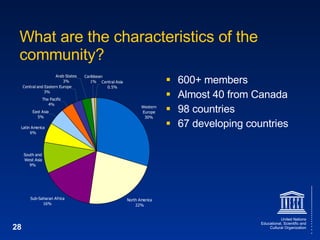
What are the characteristics of the community? 600+ members Almost 40 from Canada 98 countries 67 developing countries
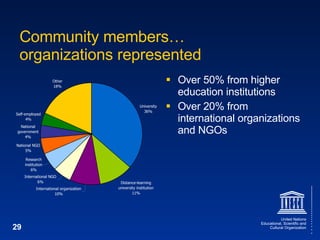
Community members… organizations represented Over 50% from higher education institutions Over 20% from international organizations and NGOs
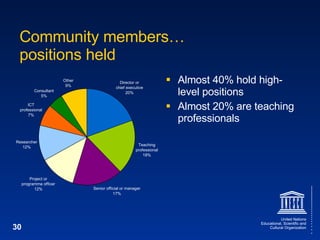
Community members… positions held Almost 40% hold high-level positions Almost 20% are teaching professionals
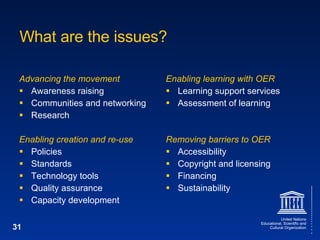
What are the issues? Advancing the movement Awareness raising Communities and networking Research Enabling creation and re-use Policies Standards Technology tools Quality assurance Capacity development Enabling learning with OER Learning support services Assessment of learning Removing barriers to OER Accessibility Copyright and licensing Financing Sustainability
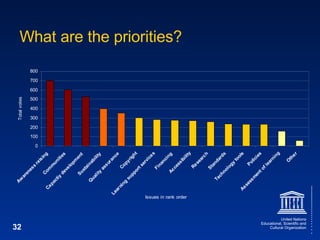
What are the priorities?
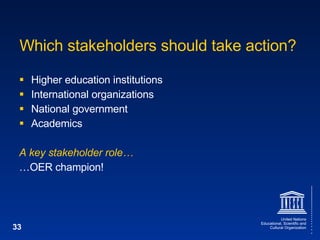
Which stakeholders should take action? Higher education institutions International organizations National government Academics A key stakeholder role… … OER champion!
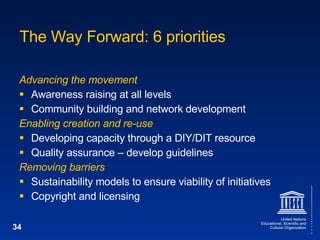
The Way Forward: 6 priorities Advancing the movement Awareness raising at all levels Community building and network development Enabling creation and re-use Developing capacity through a DIY/DIT resource Quality assurance – develop guidelines Removing barriers Sustainability models to ensure viability of initiatives Copyright and licensing
What is the way forward for UNESCO? Create an OER Network of nodes for local awareness raising and development Continue supporting OER Community as international forum for discussion Focus on awareness raising through international reach of UNESCO and the community itself
How has the community responded? With passion! Creation of resources to support awareness raising and community building: OER stories Introductory brochure PowerPoint presentation Translation of the Way Forward into 11 languages
Join the community Email [email_address] Consult the resources Wiki http://oerwiki.iiep-unesco.org

Oer Susan Dantoni June08

  • 1.
    First International Conferenceof the CNIE 27-30 April 2008 Banff, Canada Open Educational Resources The Way Forward Susan D’Antoni UNESCO
  • 2.
    Structure of thesession OER: an overview and some examples A donor vision: the Hewlett change strategy Creating an international community: the UNESCO IIEP initiative The community speaks: the Way Forward Conclusion: next steps
  • 3.
    OER: a definitionWeb-based materials offered freely and openly for use and reuse in teaching, learning and research (UNESCO, 2002) Only open if they are released under an open licence Includes any tool, material or technique used to support access to knowledge
  • 4.
    OER: milestones inthe movement 1998: “open content” and the Open Publication License 2001: founding of Creative Commons 2001: MIT announces OpenCourseWare
  • 5.
    The Cape TownDeclaration “… a statement of principle, a statement of strategy and a statement of commitment … meant to spark dialogue, to inspire action and to help the open education movement grow.” (Cape Town Open Education Declaration, 2008)
  • 6.
    What approaches haveproviders taken to making content freely and openly available?
  • 7.
  • 8.
    MIT OpenCourseWareInstitutional, faculty response to challenge of online education 2002: launched 50-course pilot 2008: almost all course materials available for over 2,000 subjects An adventure! (Charles Vest)
  • 9.
  • 10.
    OpenCourseWare Consortium Establishedin 2005 to assist the OCW movement Supports collaboration among over 180 member institutions worldwide
  • 11.
  • 12.
    Rice University Connexions Individual response to limitations of traditional textbooks The vision: “textbooks adapted to many learning styles and translated into myriad languages… textbooks that are continually updated and corrected by a legion of contributors” (Rich Baraniuk) The result: an environment for developing, sharing and publishing academic content on the web
  • 13.
  • 14.
    Carnegie Mellon OpenLearning Initiative Aim: to develop stand-alone, cognitively informed open courses Course design stresses interactivity, problem solving and feedback A research project: aim to better understand effective practices in online learning environments
  • 15.
  • 16.
    Open University OpenLearnCourse-publishing model (like MIT) BUT Materials designed for distance learning AND Site designed to support collaboration and group work  Challenges OU’s current business model
  • 17.
    How have Canadianinstitutions responded to the challenge of OER?
  • 18.
  • 19.
    Capilano College OpenCourseWareOnly Canadian member of the OCW Consortium 17 courses available in 10 subject areas
  • 20.
  • 21.
    BCcampus A provincewide initiative Funded using public money ($6.25 million by mid-2007) An online service provider Sharable Online Learning Resources repository Developers can choose to share materials at local provincial level using custom BC Commons license
  • 22.
    A donor vision:the Hewlett change strategy Aim: to equalize access to knowledge through: Sponsoring high quality content Understanding and stimulating use Removing barriers
  • 23.
    UNESCO: removing barriersthrough awareness raising Potential of OER to contribute to: Education for All Building knowledge societies – especially “knowledge-sharing societies” But… No awareness of availability = resources not utilized and potential of OER not realized
  • 24.
    Aims of theIIEP OER initiative International dialogue and information exchange Linking people who might not otherwise meet Creating an international OER community
  • 25.
    Steps in thecreation of a community Forum 1: an introduction to OER Short discussions on key topics OER research agenda A “Do-It-Yourself/Do-It-Together” resource for developing capacity FOSS for OER Forum 2: OECD study on OER
  • 26.
    Sharing the outputsForum 1 background documents and report OER research questions DIY/DIT resource outline FOSS for OER and lessons from the FOSS movement Forum 2 background documents and report The Way Forward: priority issues for advancing the OER movement Resources made available on website and wiki
  • 27.
    After two yearsof intense reflection and discussion… … what did the community have to say about the priorities for advancing the OER movement?
  • 28.
    What are thecharacteristics of the community? 600+ members Almost 40 from Canada 98 countries 67 developing countries
  • 29.
    Community members… organizationsrepresented Over 50% from higher education institutions Over 20% from international organizations and NGOs
  • 30.
    Community members… positionsheld Almost 40% hold high-level positions Almost 20% are teaching professionals
  • 31.
    What are theissues? Advancing the movement Awareness raising Communities and networking Research Enabling creation and re-use Policies Standards Technology tools Quality assurance Capacity development Enabling learning with OER Learning support services Assessment of learning Removing barriers to OER Accessibility Copyright and licensing Financing Sustainability
  • 32.
    What are thepriorities?
  • 33.
    Which stakeholders shouldtake action? Higher education institutions International organizations National government Academics A key stakeholder role… … OER champion!
  • 34.
    The Way Forward:6 priorities Advancing the movement Awareness raising at all levels Community building and network development Enabling creation and re-use Developing capacity through a DIY/DIT resource Quality assurance – develop guidelines Removing barriers Sustainability models to ensure viability of initiatives Copyright and licensing
  • 35.
    What is theway forward for UNESCO? Create an OER Network of nodes for local awareness raising and development Continue supporting OER Community as international forum for discussion Focus on awareness raising through international reach of UNESCO and the community itself
  • 36.
    How has thecommunity responded? With passion! Creation of resources to support awareness raising and community building: OER stories Introductory brochure PowerPoint presentation Translation of the Way Forward into 11 languages
  • 37.
    Join the communityEmail [email_address] Consult the resources Wiki http://oerwiki.iiep-unesco.org