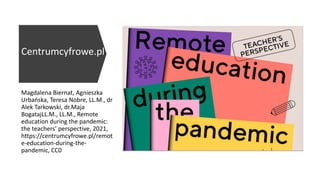
Magdalena Biernat, Agnieszka
Urbańska, Teresa Nobre, LL.M., dr
Alek Tarkowski, dr.Maja
BogatajLL.M., LL.M., Remote
education during the pandemic:
the teachers’ perspective, 2021,
https://centrumcyfrowe.pl/remot
e-education-during-the-
pandemic, CC0
Centrumcyfrowe.pl
At the beginning of 2021 it was decided to conduct
questionnaire-based, exploratory research in 7 European
countries on teachers’ practices in remote education. The
information we were particularly interested in include:
• Type of online tools and platforms most frequently used
• Usage of freely available digital resources vs usage of
paid/subscription-based digital resources and their
sources
• The different ways the resources are used
• The scale of creation and modification of teachers’ own
resources
• The awareness of the concept of Open Educational
Resources and the frequency of their usage
• Certainty level in regard to copyright work usage
• Facing copyright-related issues – frequency and typ
• The way and frequency of obtaining advice on copyright-
related issues
Through this study, the aim is to support the
adoption of the UNESCO Recommendation on
Open Educational Resources (OER). We would like
to contribute particularly to the second objective:
“Developing supportive policy: encouraging
governments, and education authorities and
institutions to adopt regulatory frameworks to
support open licensing of publicly funded educational
and research materials, develop strategies to enable the
use and adaptation of OER in support of high quality,
inclusive education and lifelong learning for all,
supported by relevant research in the area.
1.Teachers repurpose a wide range of copyrighted works for remote
education, mostly freely available works that are not intended for the
educational market –
it is crucial to ensure that broad copyright exceptions and limitations for
education are in place to protect those uses
2. Teachers informal collaboration networks played a significant role during the
pandemic and constitute one of the key pillars of online teaching – it is important
to support them on many levels
3. Teachers mostly depend on tools delivered by the biggest tech companies – it is
crucial to make sure that open and free cooperation, collaboration, co-creation and
exchange are possible without dependence on commercial platform providers
4. Remote education was to a great extent supported by Open Educational
Resources (more than half of the teachers use OER on a regular basis) - it is crucial
to ensure further development of policies supporting the development of high-
quality open resources and practices
5. Teachers mostly depend on tools delivered Remote education was to a great
extent supported by Open Educational Resources (more than half of the teachers
use OER on a regular basis) – it is crucial to ensure further development of policies
supporting the development of high-quality open resources and practices
Conclusions
UNESCO Recommendation on Open
Educational Resources (OER)
DEFINITION AND SCOPE
1. Open Educational Resources (OER) are learning, teaching and research materials in any format and medium that reside in the
public domain or are under copyright that have been released under an open license, that permit no-cost access, re-use, re-
purpose, adaptation and redistribution by others.
2. Open license refers to a license that respects the intellectual property rights of the copyright owner and provides permissions
granting the public the rights to access, re-use, re-purpose, adapt and redistribute educational materials.
3. Information and communications technology (ICT) provide great potential for effective, equitable and inclusive access to OER
and their use, adaptation and redistribution. They can open possibilities for OER to be accessible anytime and anywhere for
everyone, including individuals with disabilities and individuals coming from marginalized or disadvantaged groups. They can
help meet the needs of individual learners and effectively promote gender equality and incentivize innovative pedagogical,
didactical and methodological approaches.
4. Stakeholders in the formal, non-formal and informal sectors (where appropriate) in this Recommendation include: teachers,
educators, learners, governmental bodies, parents, educational providers and institutions, education support personnel,
teacher trainers, educational policy makers, cultural institutions (such as libraries, archives and museums) and their users,
information and communications technology (ICT) infrastructure providers, researchers, research institutions, civil society
organizations (including professional and student associations), publishers, the public and private sectors, intergovernmental
organizations, copyright holders and authors, media and broadcasting groups and funding bodies.
AREAS OF ACTION
(i) Building capacity of stakeholders to
create, access, re-use, adapt and
redistribute OER
(ii) Developing supportive policy
(iii) Encouraging effective, inclusive and
equitable access to quality OER
(iv) Nurturing the creation of
sustainability models for OER
(v) Promoting and reinforcing
international cooperation
To be discussed
• In the context of such results and challenges are faced, how to
address those?
• What effects can be imagine from those research results in 2 and 5
years?
• With those imagined effects what new questions for research they can
come up with that could help us understand those changes or predict
them better?
• How can those imagined effects compare to our current goals and
recommendations like UNESCO be addressed (do they pose some risks
in their implementations etc.)
• How could some of the research results impact OER policy?
• Collaboration for the futures?

Centrumcyfrowe pl ossiannilsson_sliwovski2021

  • 3.
    Magdalena Biernat, Agnieszka Urbańska,Teresa Nobre, LL.M., dr Alek Tarkowski, dr.Maja BogatajLL.M., LL.M., Remote education during the pandemic: the teachers’ perspective, 2021, https://centrumcyfrowe.pl/remot e-education-during-the- pandemic, CC0 Centrumcyfrowe.pl
  • 4.
    At the beginningof 2021 it was decided to conduct questionnaire-based, exploratory research in 7 European countries on teachers’ practices in remote education. The information we were particularly interested in include: • Type of online tools and platforms most frequently used • Usage of freely available digital resources vs usage of paid/subscription-based digital resources and their sources • The different ways the resources are used • The scale of creation and modification of teachers’ own resources • The awareness of the concept of Open Educational Resources and the frequency of their usage • Certainty level in regard to copyright work usage • Facing copyright-related issues – frequency and typ • The way and frequency of obtaining advice on copyright- related issues
  • 5.
    Through this study,the aim is to support the adoption of the UNESCO Recommendation on Open Educational Resources (OER). We would like to contribute particularly to the second objective: “Developing supportive policy: encouraging governments, and education authorities and institutions to adopt regulatory frameworks to support open licensing of publicly funded educational and research materials, develop strategies to enable the use and adaptation of OER in support of high quality, inclusive education and lifelong learning for all, supported by relevant research in the area.
  • 6.
    1.Teachers repurpose awide range of copyrighted works for remote education, mostly freely available works that are not intended for the educational market – it is crucial to ensure that broad copyright exceptions and limitations for education are in place to protect those uses 2. Teachers informal collaboration networks played a significant role during the pandemic and constitute one of the key pillars of online teaching – it is important to support them on many levels 3. Teachers mostly depend on tools delivered by the biggest tech companies – it is crucial to make sure that open and free cooperation, collaboration, co-creation and exchange are possible without dependence on commercial platform providers 4. Remote education was to a great extent supported by Open Educational Resources (more than half of the teachers use OER on a regular basis) - it is crucial to ensure further development of policies supporting the development of high- quality open resources and practices 5. Teachers mostly depend on tools delivered Remote education was to a great extent supported by Open Educational Resources (more than half of the teachers use OER on a regular basis) – it is crucial to ensure further development of policies supporting the development of high-quality open resources and practices Conclusions
  • 7.
    UNESCO Recommendation onOpen Educational Resources (OER) DEFINITION AND SCOPE 1. Open Educational Resources (OER) are learning, teaching and research materials in any format and medium that reside in the public domain or are under copyright that have been released under an open license, that permit no-cost access, re-use, re- purpose, adaptation and redistribution by others. 2. Open license refers to a license that respects the intellectual property rights of the copyright owner and provides permissions granting the public the rights to access, re-use, re-purpose, adapt and redistribute educational materials. 3. Information and communications technology (ICT) provide great potential for effective, equitable and inclusive access to OER and their use, adaptation and redistribution. They can open possibilities for OER to be accessible anytime and anywhere for everyone, including individuals with disabilities and individuals coming from marginalized or disadvantaged groups. They can help meet the needs of individual learners and effectively promote gender equality and incentivize innovative pedagogical, didactical and methodological approaches. 4. Stakeholders in the formal, non-formal and informal sectors (where appropriate) in this Recommendation include: teachers, educators, learners, governmental bodies, parents, educational providers and institutions, education support personnel, teacher trainers, educational policy makers, cultural institutions (such as libraries, archives and museums) and their users, information and communications technology (ICT) infrastructure providers, researchers, research institutions, civil society organizations (including professional and student associations), publishers, the public and private sectors, intergovernmental organizations, copyright holders and authors, media and broadcasting groups and funding bodies.
  • 8.
    AREAS OF ACTION (i)Building capacity of stakeholders to create, access, re-use, adapt and redistribute OER (ii) Developing supportive policy (iii) Encouraging effective, inclusive and equitable access to quality OER (iv) Nurturing the creation of sustainability models for OER (v) Promoting and reinforcing international cooperation
  • 9.
    To be discussed •In the context of such results and challenges are faced, how to address those? • What effects can be imagine from those research results in 2 and 5 years? • With those imagined effects what new questions for research they can come up with that could help us understand those changes or predict them better? • How can those imagined effects compare to our current goals and recommendations like UNESCO be addressed (do they pose some risks in their implementations etc.) • How could some of the research results impact OER policy? • Collaboration for the futures?