1Materials Science & Engineering Department Computational Materials Sci. Lab.
Uncertainty Propagation in CALPHAD-reinforced
Elastochemical Phase-field Modeling
Vahid Attari1, Raymundo Arroyave1,2
1
Department of Materials Science and Engineering, Texas A&M University
2Department of Mechanical Engineering, Texas A&M University
CHiMaD Workshop
Wednesday, November 06, 2019
2Materials Science & Engineering Department Computational Materials Sci. Lab. 2
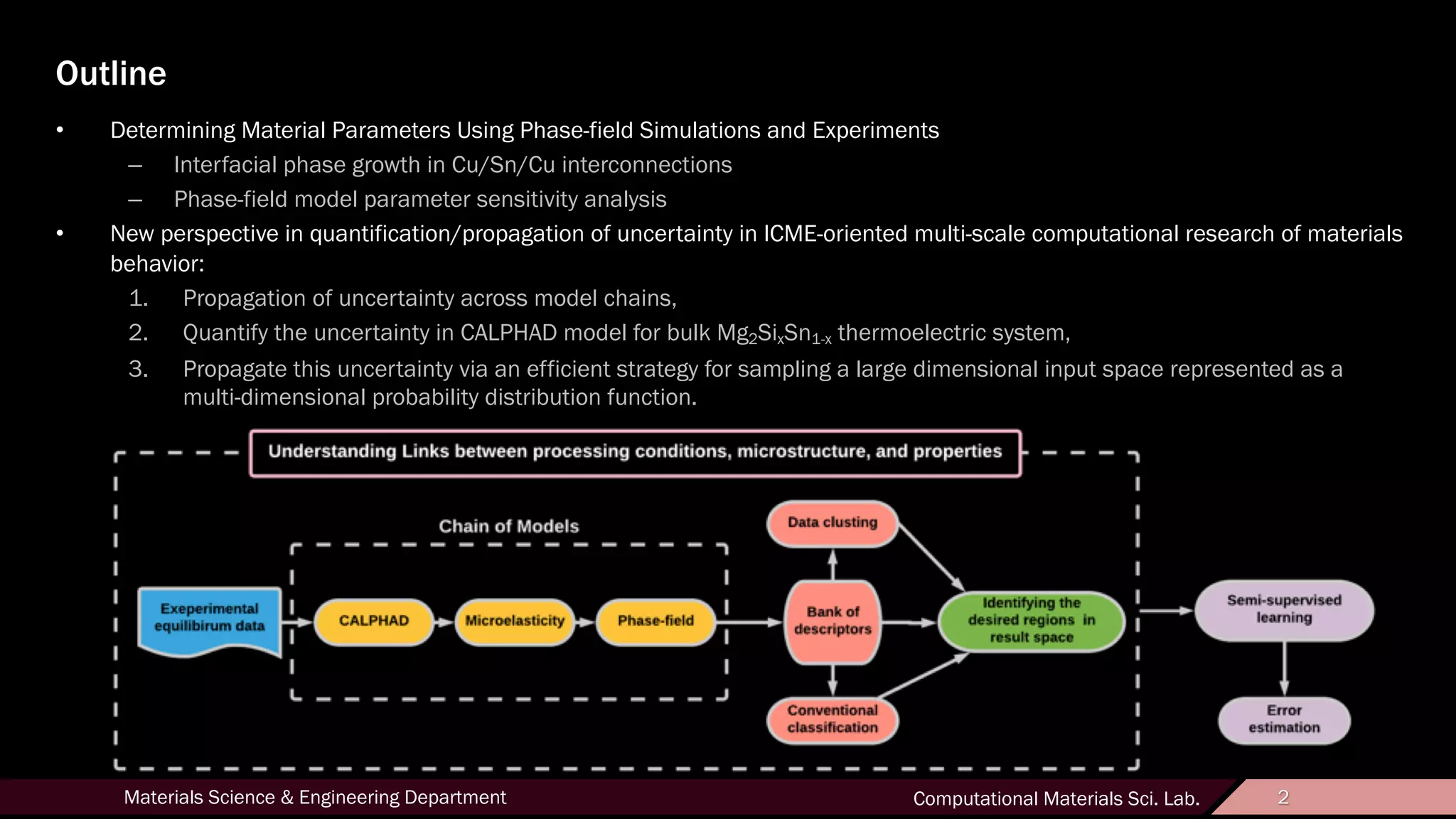
Outline
• Determining Material Parameters Using Phase-field Simulations and Experiments
– Interfacial phase growth in Cu/Sn/Cu interconnections
– Phase-field model parameter sensitivity analysis
• New perspective in quantification/propagation of uncertainty in ICME-oriented multi-scale computational research of materials
behavior:
1. Propagation of uncertainty across model chains,
2. Quantify the uncertainty in CALPHAD model for bulk Mg2SixSn1-x thermoelectric system,
3. Propagate this uncertainty via an efficient strategy for sampling a large dimensional input space represented as a
multi-dimensional probability distribution function.
3Materials Science & Engineering Department Computational Materials Sci. Lab. 3
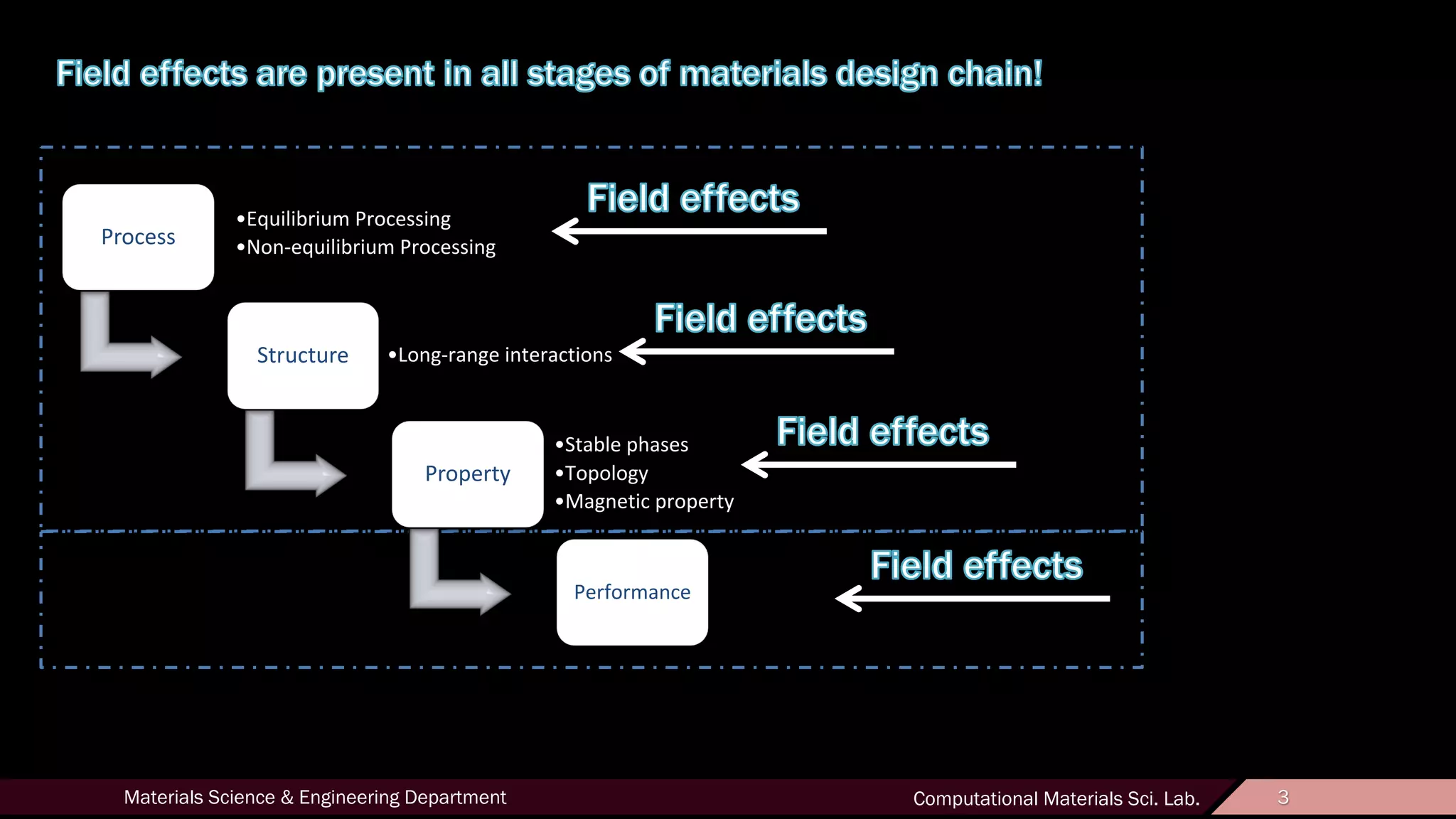
Process
•Equilibrium Processing
•Non-equilibrium Processing
Structure •Long-range interactions
Property
•Stable phases
•Topology
•Magnetic property
Performance
4Materials Science & Engineering Department Computational Materials Sci. Lab. 4
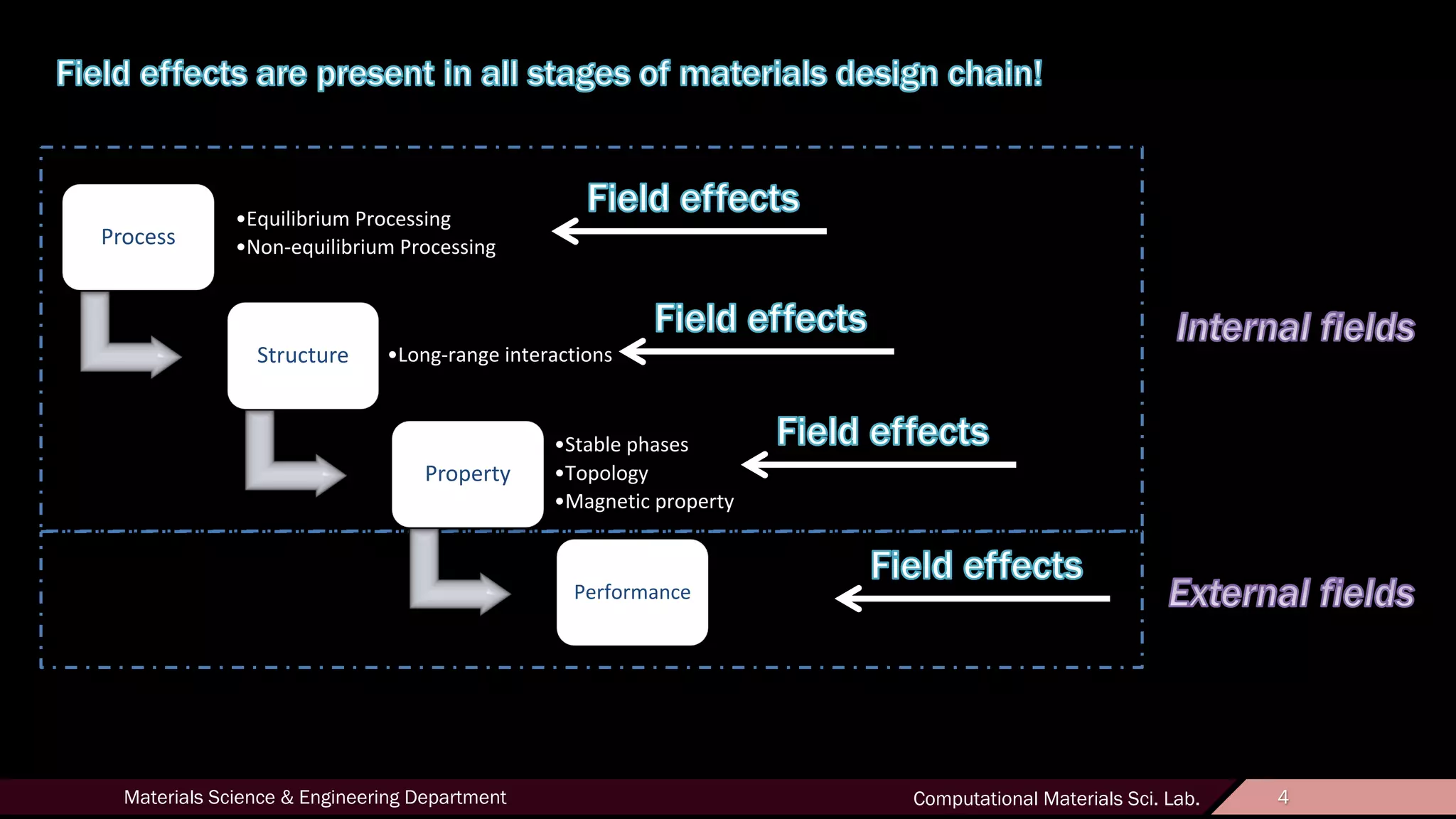
Process
•Equilibrium Processing
•Non-equilibrium Processing
Structure •Long-range interactions
Property
•Stable phases
•Topology
•Magnetic property
Performance
5Materials Science & Engineering Department Computational Materials Sci. Lab. 5
Process
•Equilibrium Processing
•Non-equilibrium Processing
Structure •Long-range interactions
Property
•Stable phases
•Topology
•Magnetic property
Performance
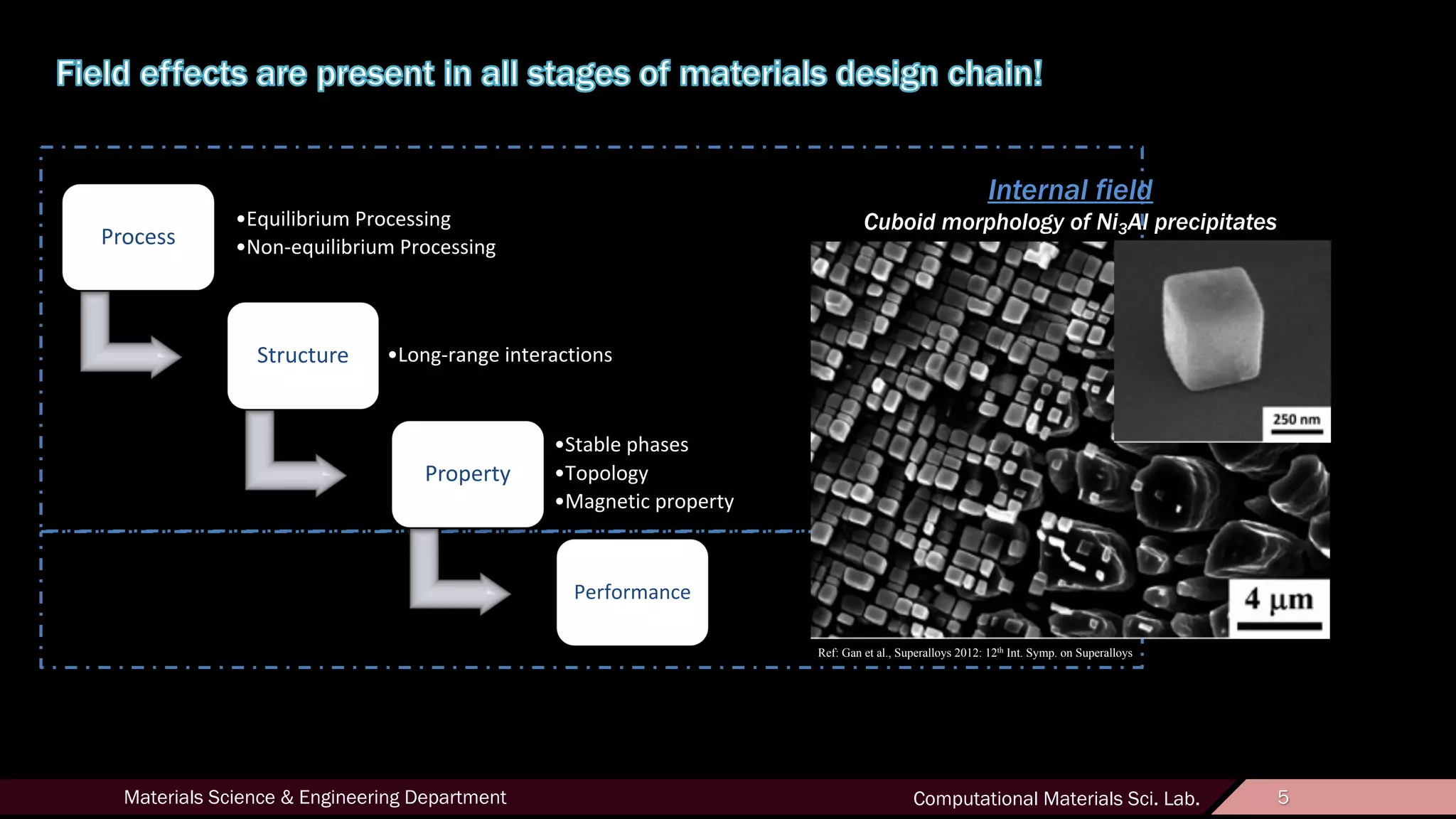
Ref: Gan et al., Superalloys 2012: 12th Int. Symp. on Superalloys
Internal field
Cuboid morphology of Ni3Al precipitates
6Materials Science & Engineering Department Computational Materials Sci. Lab. 6
Process
•Equilibrium Processing
•Non-equilibrium Processing
Structure •Long-range interactions
Property
•Stable phases
•Topology
•Magnetic property
Performance
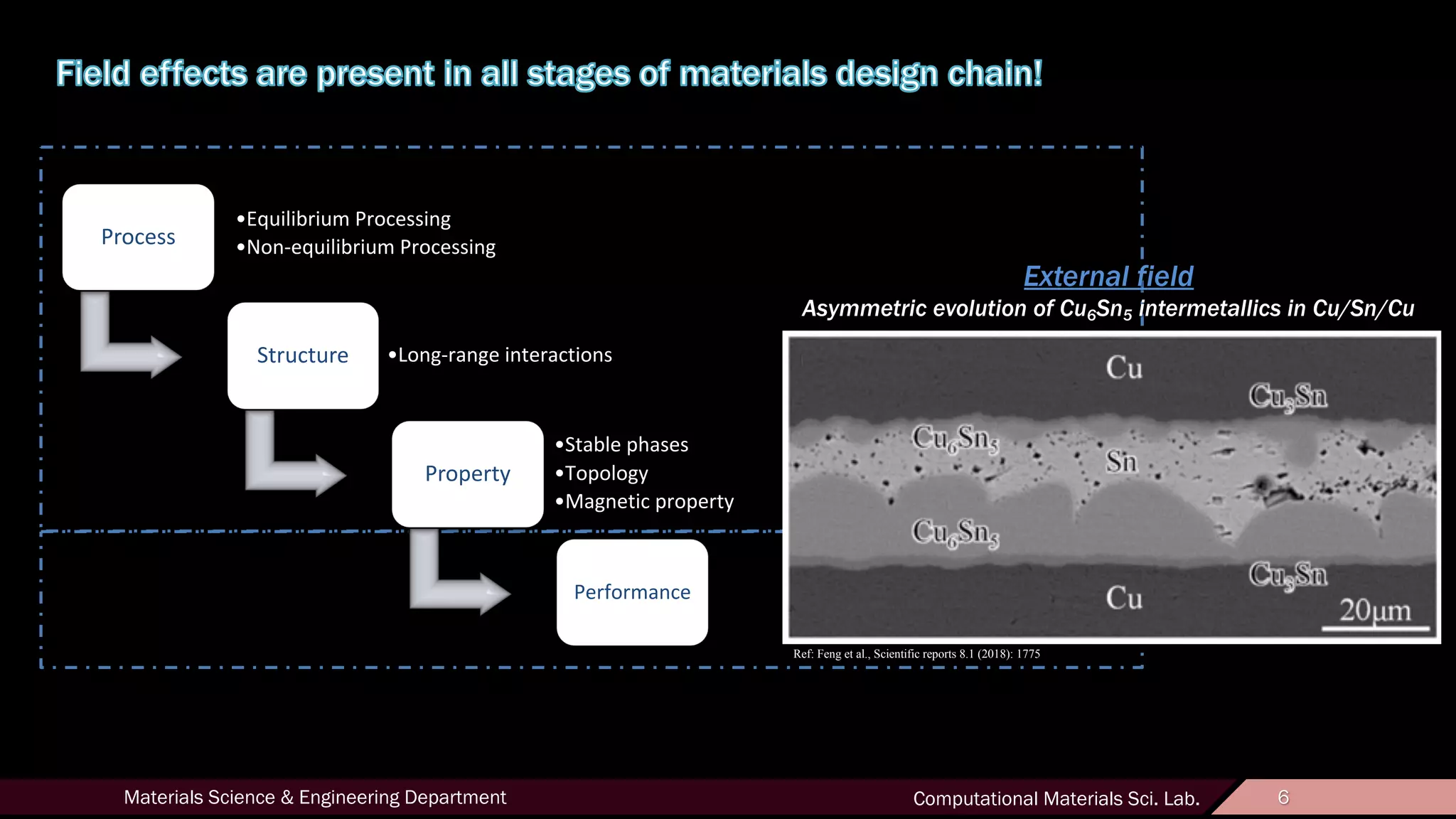
External field
Asymmetric evolution of Cu6Sn5 intermetallics in Cu/Sn/Cu
Ref: Feng et al., Scientific reports 8.1 (2018): 1775
7Materials Science & Engineering Department Computational Materials Sci. Lab. 7
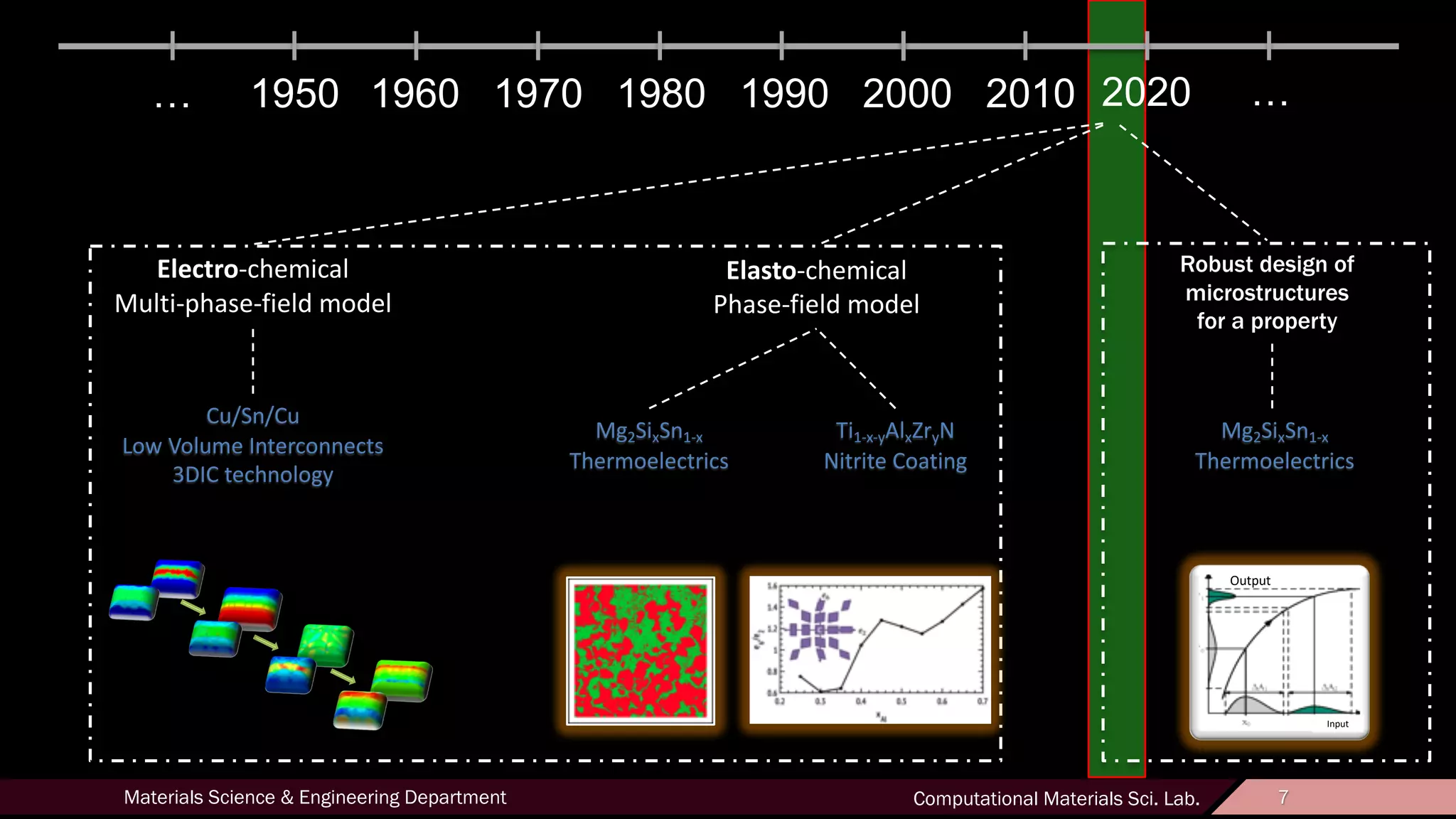
… 1950 1960 1970 1980 1990 2000 2010 2020 …
Robust design of
microstructures
for a property
Mg2SixSn1-x
Thermoelectrics
Electro-chemical
Multi-phase-field model
Cu/Sn/Cu
Low Volume Interconnects
3DIC technology
Elasto-chemical
Phase-field model
Mg2SixSn1-x
Thermoelectrics
Ti1-x-yAlxZryN
Nitrite Coating
Output
Input
8Materials Science & Engineering Department Computational Materials Sci. Lab. 8
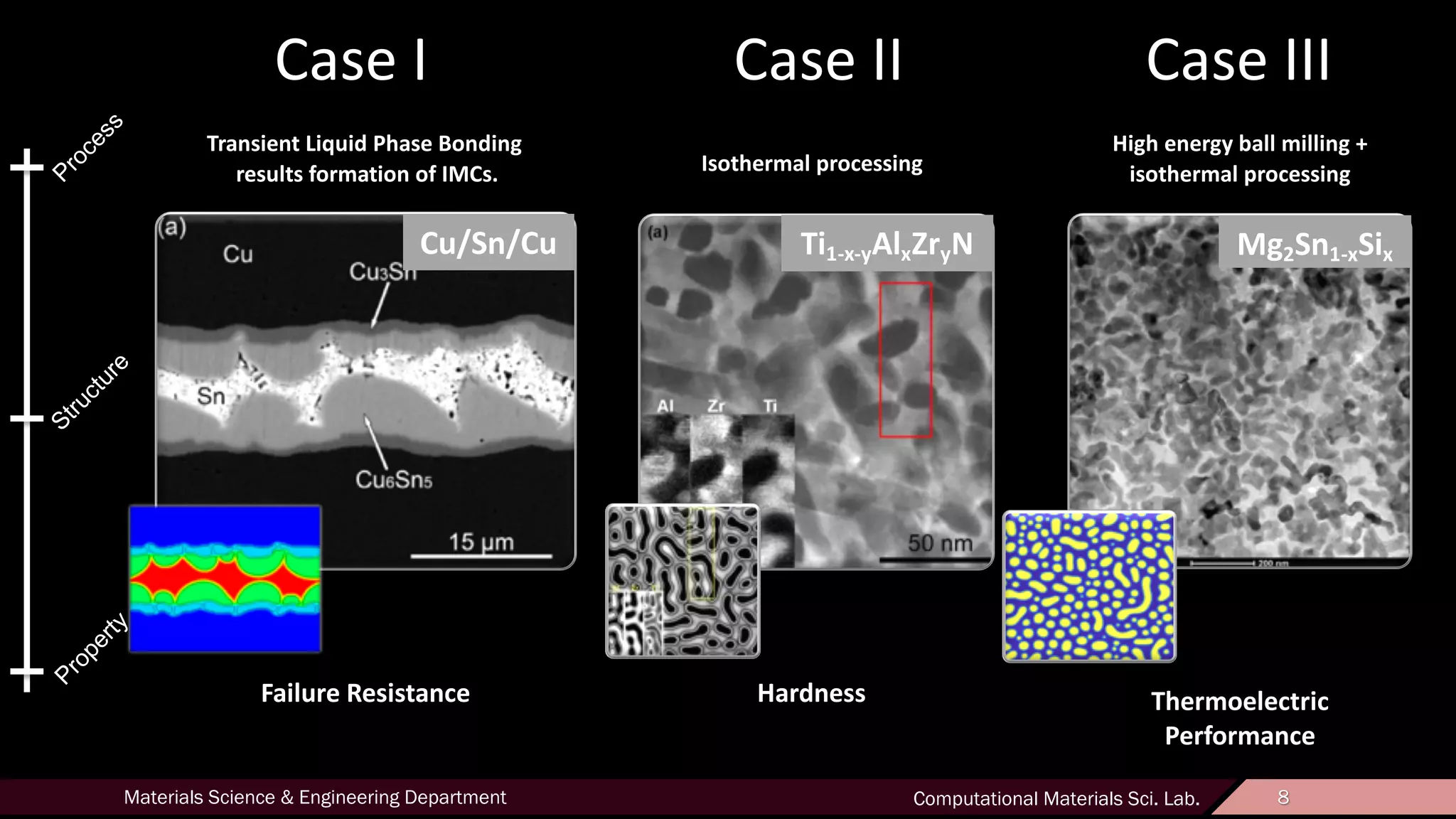
Transient Liquid Phase Bonding
results formation of IMCs.
Cu/Sn/Cu Ti1-x-yAlxZryN
Isothermal processing
Mg2Sn1-xSix
High energy ball milling +
isothermal processing
Failure Resistance Hardness Thermoelectric
Performance
Process
Structure
Property
Case I Case II Case III
9Materials Science & Engineering Department Computational Materials Sci. Lab.
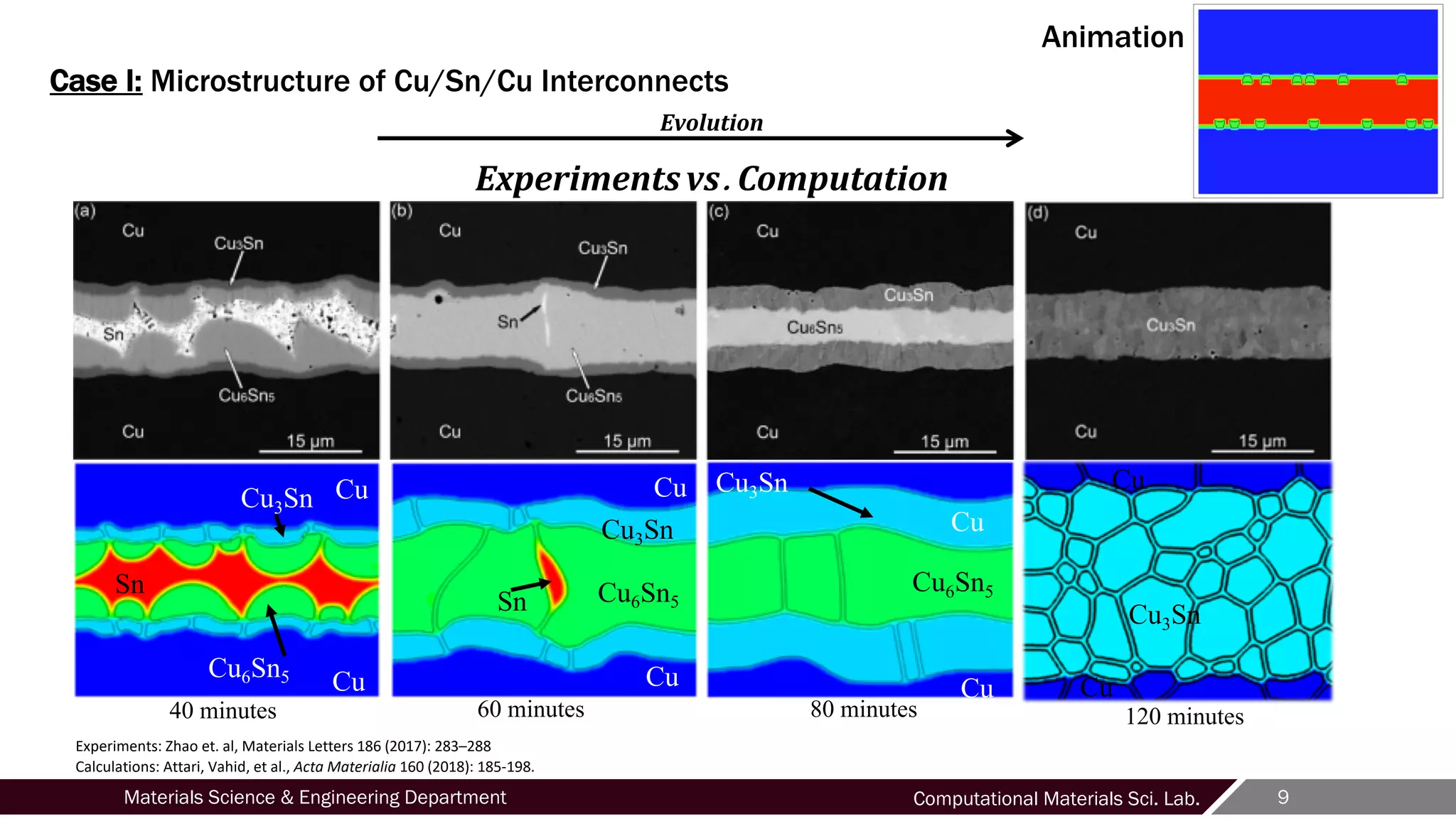
Case I: Microstructure of Cu/Sn/Cu Interconnects
Experimentsvs.Computation
Experiments: Zhao et. al, Materials Letters 186 (2017): 283–288
Calculations: Attari, Vahid, et al., Acta Materialia 160 (2018): 185-198.
Sn Cu6Sn5
Cu
Cu
Cu3Sn
Cu
Cu
Sn Cu6Sn5
Cu
Cu
Cu6Sn5
Cu3Sn
Cu3Sn
Cu3Sn
Cu
Cu
Animation
Evolution
40 minutes 60 minutes 80 minutes 120 minutes
10Materials Science & Engineering Department Computational Materials Sci. Lab. 10
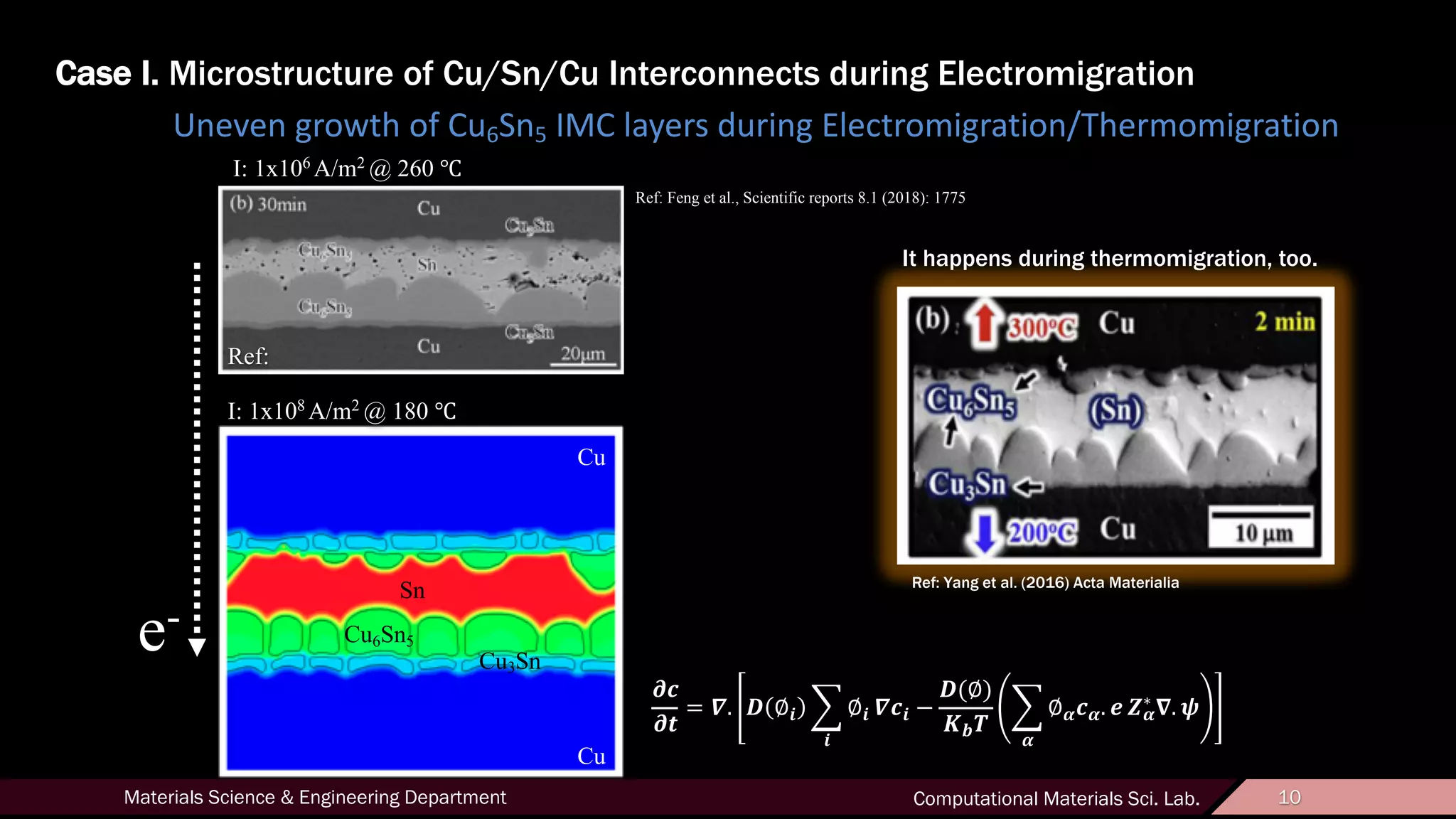
Case I. Microstructure of Cu/Sn/Cu Interconnects during Electromigration
e-
It happens during thermomigration, too.
!"
!#
= %. ' ∅) *
)
∅) %") −
'(∅)
./0
*
1
∅1"1. 2 31
∗ 5. 6
Uneven growth of Cu6Sn5 IMC layers during Electromigration/Thermomigration
I: 1x10⁶
A/m2
@ 260 ℃
I: 1x10⁸
A/m2
@ 180 ℃
Cu
Cu
Cu6Sn5
Sn
Cu3Sn
Ref: Yang et al. (2016) Acta Materialia
Ref:
Ref: Feng et al., Scientific reports 8.1 (2018): 1775
11Materials Science & Engineering Department Computational Materials Sci. Lab. 11
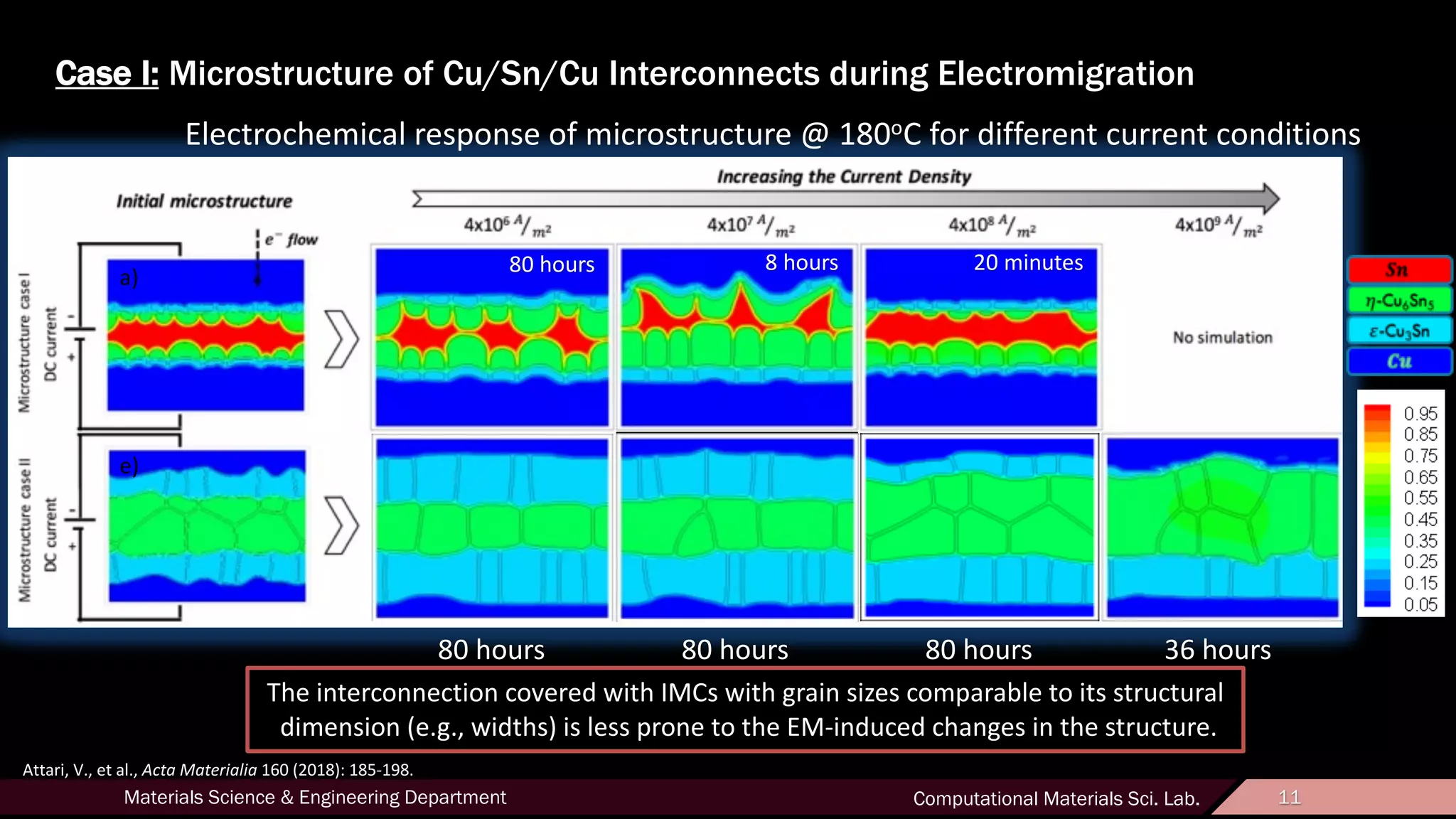
Case I: Microstructure of Cu/Sn/Cu Interconnects during Electromigration
The interconnection covered with IMCs with grain sizes comparable to its structural
dimension (e.g., widths) is less prone to the EM-induced changes in the structure.
a)
e)
f)
80 hours 80 hours 80 hours 36 hours
80 hours 8 hours 20 minutes
Electrochemical response of microstructure @ 180oC for different current conditions
Attari, V., et al., Acta Materialia 160 (2018): 185-198.
12Materials Science & Engineering Department Computational Materials Sci. Lab. 12
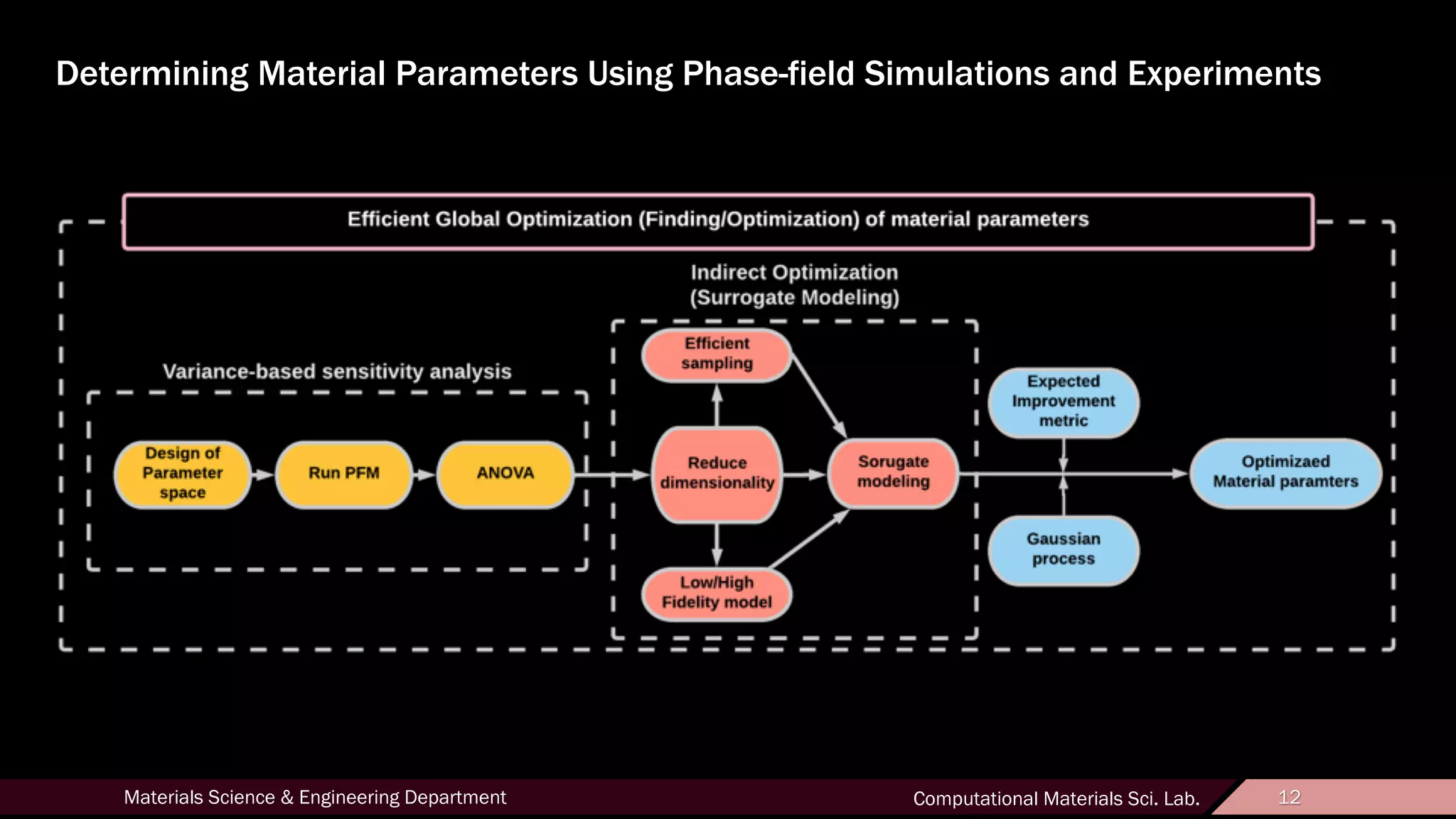
Determining Material Parameters Using Phase-field Simulations and Experiments
13Materials Science & Engineering Department Computational Materials Sci. Lab. 13
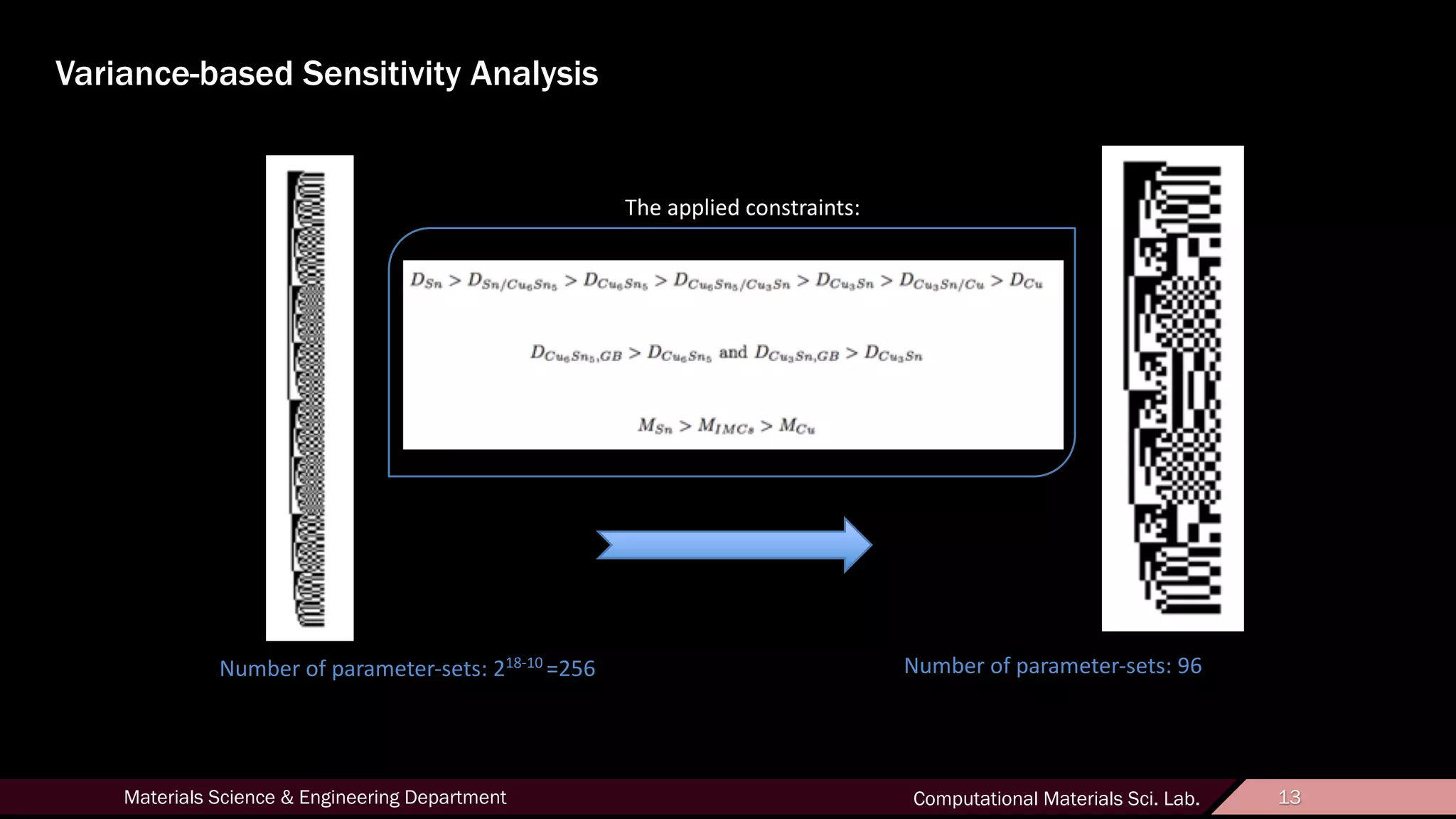
Variance-based Sensitivity Analysis
Number of parameter-sets: 218-10
=256 Number of parameter-sets: 96
The applied constraints:
14Materials Science & Engineering Department Computational Materials Sci. Lab. 14
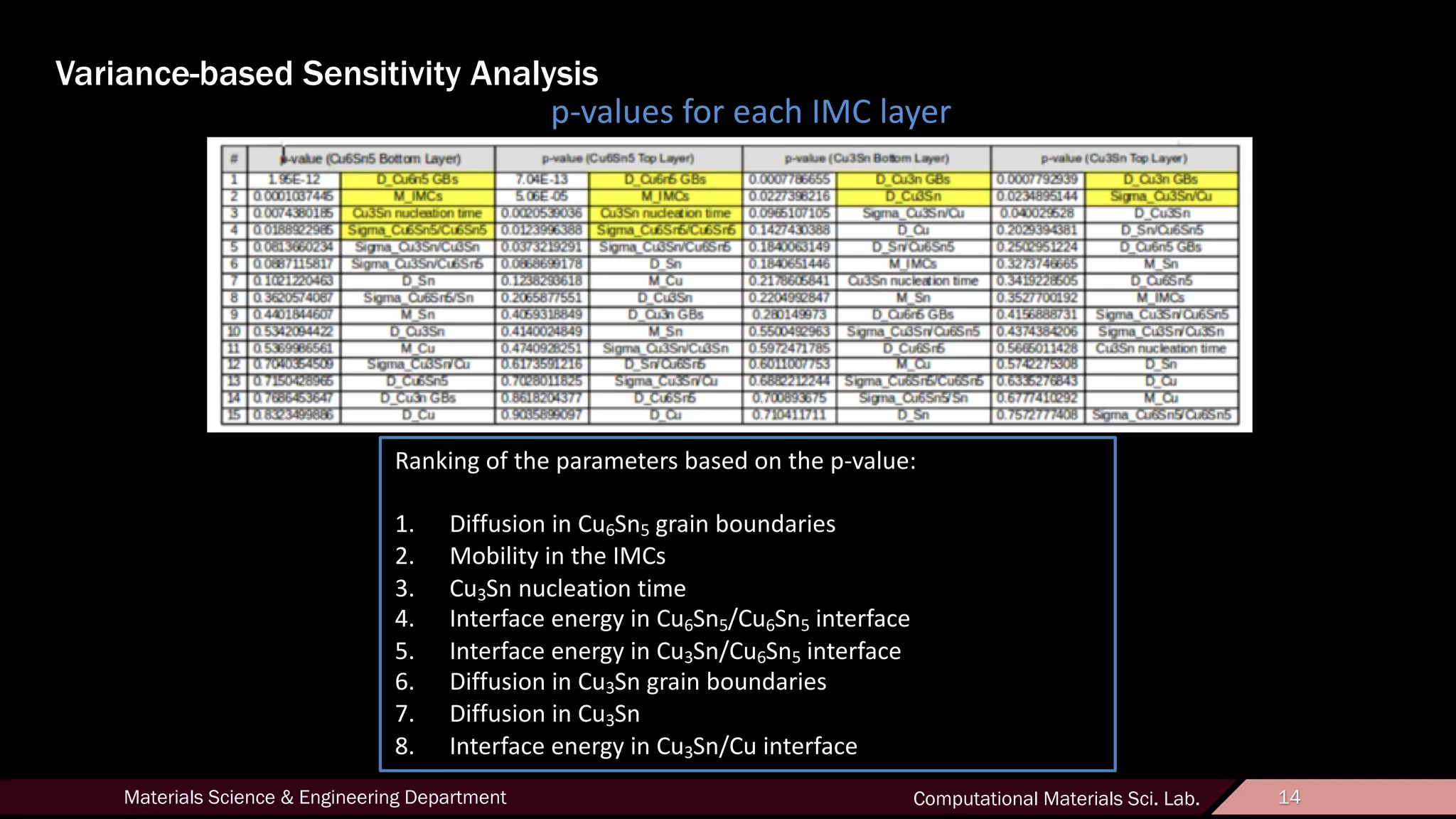
Variance-based Sensitivity Analysis
Ranking of the parameters based on the p-value:
1. Diffusion in Cu6Sn5 grain boundaries
2. Mobility in the IMCs
3. Cu3Sn nucleation time
4. Interface energy in Cu6Sn5/Cu6Sn5 interface
5. Interface energy in Cu3Sn/Cu6Sn5 interface
6. Diffusion in Cu3Sn grain boundaries
7. Diffusion in Cu3Sn
8. Interface energy in Cu3Sn/Cu interface
p-values for each IMC layer
15Materials Science & Engineering Department Computational Materials Sci. Lab. 15
Strain-induced Suppression of the Miscibility Gap
in Nanostructured Mg2Sn1-xSix Solid Solutions.
Yi, S. I. **, Attari, V. **, Jeong, M., Jian, J., Xue, S., Wang, H., ... & Yu, C.
(2018). Journal of Materials Chemistry A, 6(36), 17559-17570.
** Co-first author
16Materials Science & Engineering Department Computational Materials Sci. Lab. 16
Case III: Squeezing Efficient Thermoelectrics Properties
Nanostructure
Radioactive heat
source
Thermoelectric
device
Curiosity Mars
Rover
17Materials Science & Engineering Department Computational Materials Sci. Lab. 17
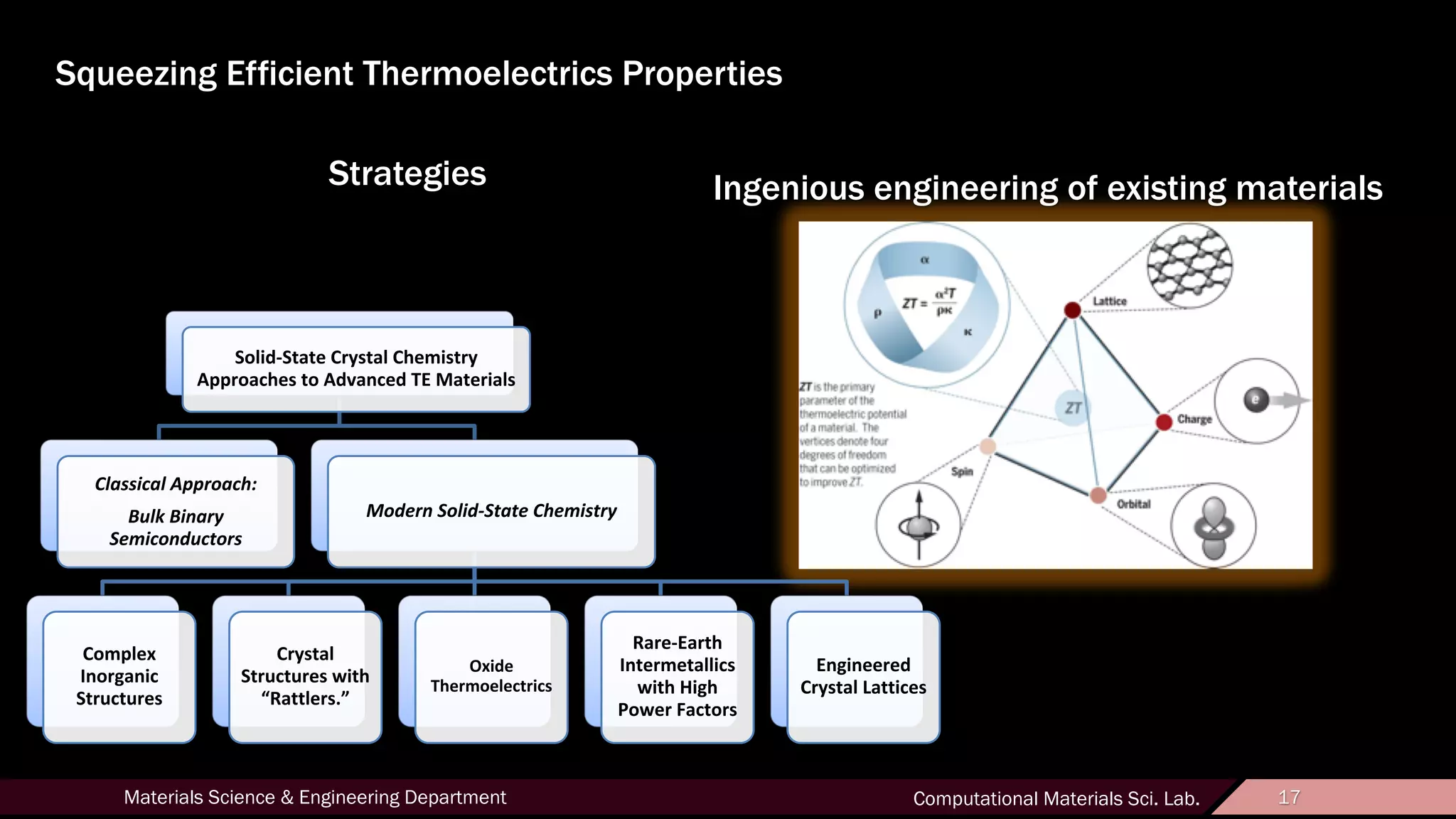
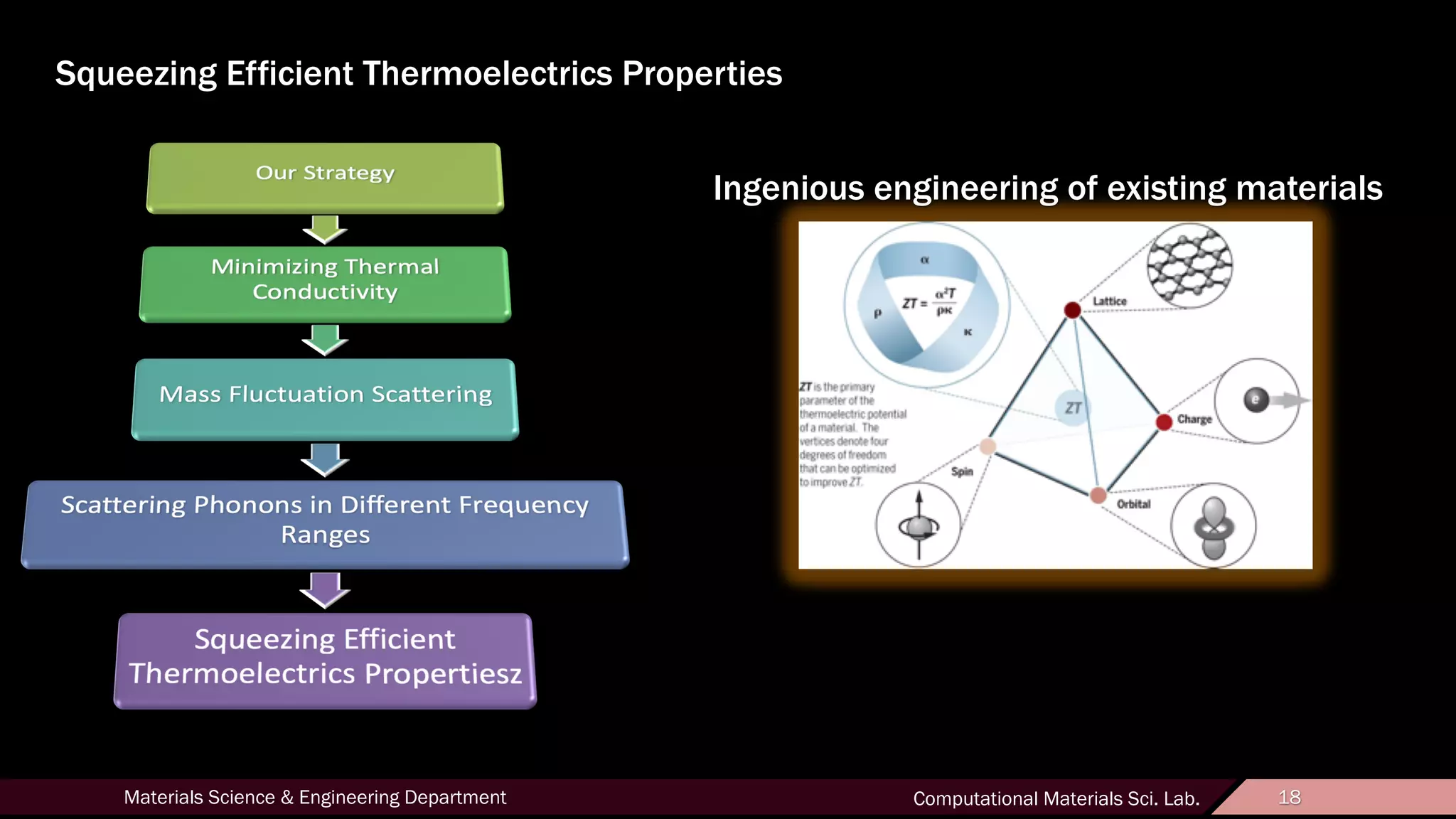
Squeezing Efficient Thermoelectrics Properties
Ingenious engineering of existing materials
Solid-State Crystal Chemistry
Approaches to Advanced TE Materials
Classical Approach:
Bulk Binary
Semiconductors
Modern Solid-State Chemistry
Complex
Inorganic
Structures
Crystal
Structures with
“Rattlers.”
Oxide
Thermoelectrics
Rare-Earth
Intermetallics
with High
Power Factors
Engineered
Crystal Lattices
Strategies
18Materials Science & Engineering Department Computational Materials Sci. Lab. 18
Squeezing Efficient Thermoelectrics Properties
Ingenious engineering of existing materials
19Materials Science & Engineering Department Computational Materials Sci. Lab. 19
Squeezing Efficient Thermoelectrics Properties
Process Structure Property/Performance
Thermal conductivity ZT factorHigh energy ball milling + Spark plasma sintering + Thermal annealing (Mg2Si)0.7(Mg2Sn)0.3
Xsi=0.7
20Materials Science & Engineering Department Computational Materials Sci. Lab. 20
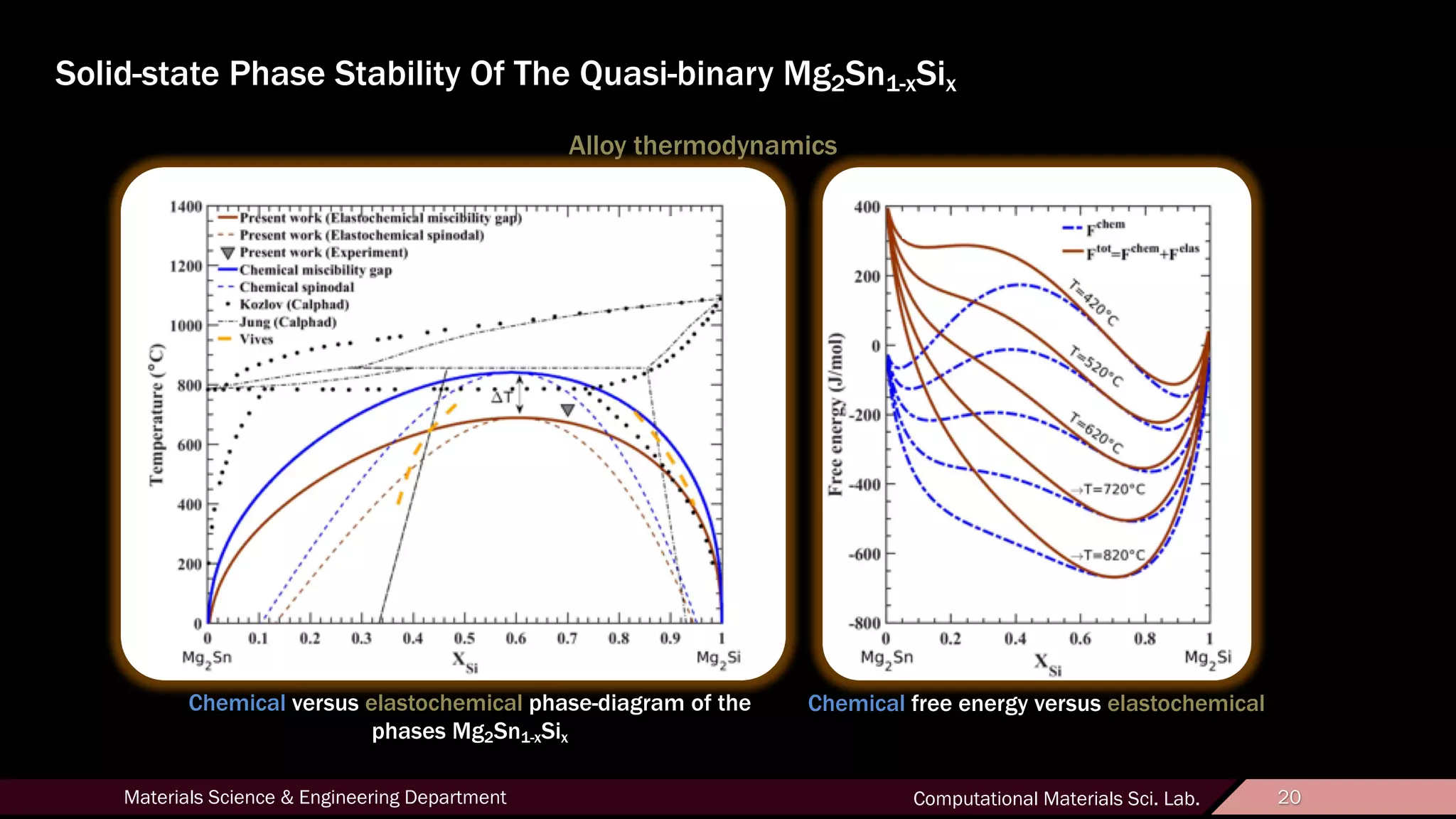
Solid-state Phase Stability Of The Quasi-binary Mg2Sn1-xSix
Alloy thermodynamics
Chemical versus elastochemical phase-diagram of the
phases Mg2Sn1-xSix
Chemical free energy versus elastochemical
21Materials Science & Engineering Department Computational Materials Sci. Lab. 21
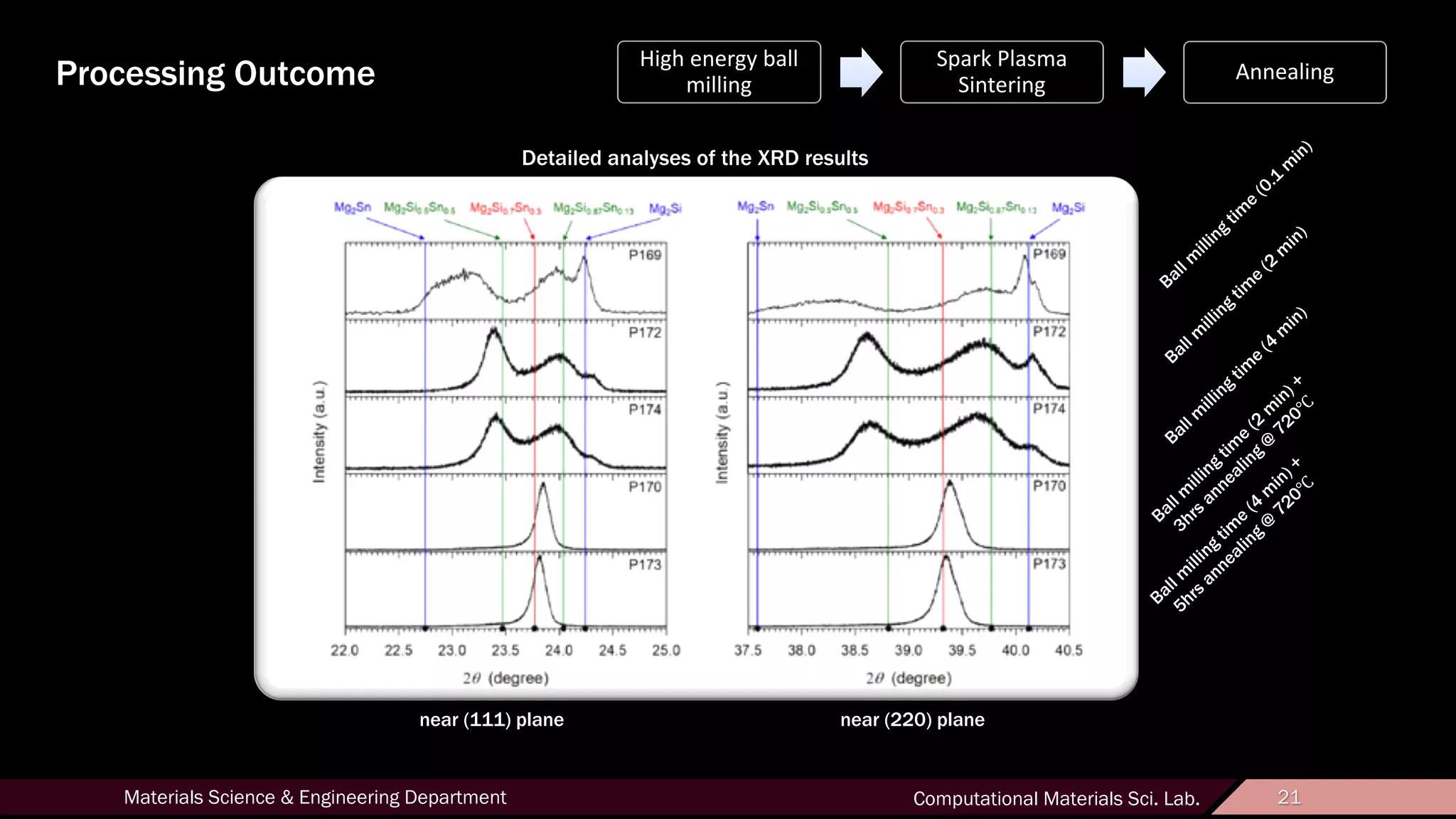
Processing Outcome
Detailed analyses of the XRD results
near (111) plane near (220) plane
Ball m
illing
tim
e
(0.1
m
in)
Ball m
illing
tim
e
(2
m
in)
Ball m
illing
tim
e
(4
m
in)
Ball m
illing
tim
e
(2
m
in) +
3hrs annealing
@
720℃
Ball m
illing
tim
e
(4
m
in) +
5hrs annealing
@
720℃
High energy ball
milling
Spark Plasma
Sintering
Annealing
22Materials Science & Engineering Department Computational Materials Sci. Lab. 22
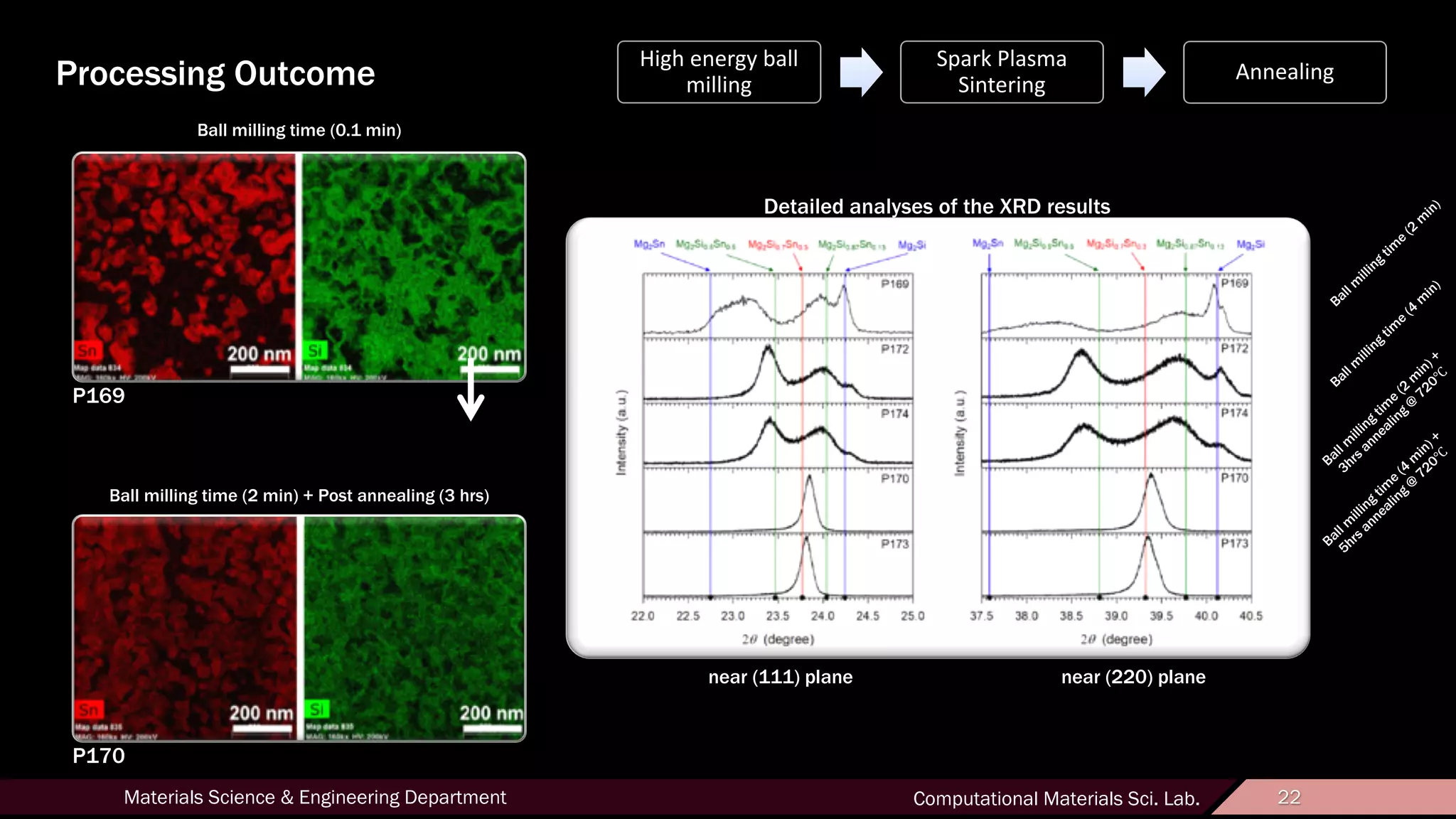
Processing Outcome
P169
Ball milling time (0.1 min)
P170
Ball milling time (2 min) + Post annealing (3 hrs)
Detailed analyses of the XRD results
near (111) plane near (220) plane
Ball m
illing
tim
e
(2
m
in)
Ball m
illing
tim
e
(4
m
in)
Ball m
illing
tim
e
(2
m
in) +
3hrs annealing
@
720℃
Ball m
illing
tim
e
(4
m
in) +
5hrs annealing
@
720℃
High energy ball
milling
Spark Plasma
Sintering
Annealing
23Materials Science & Engineering Department Computational Materials Sci. Lab. 23
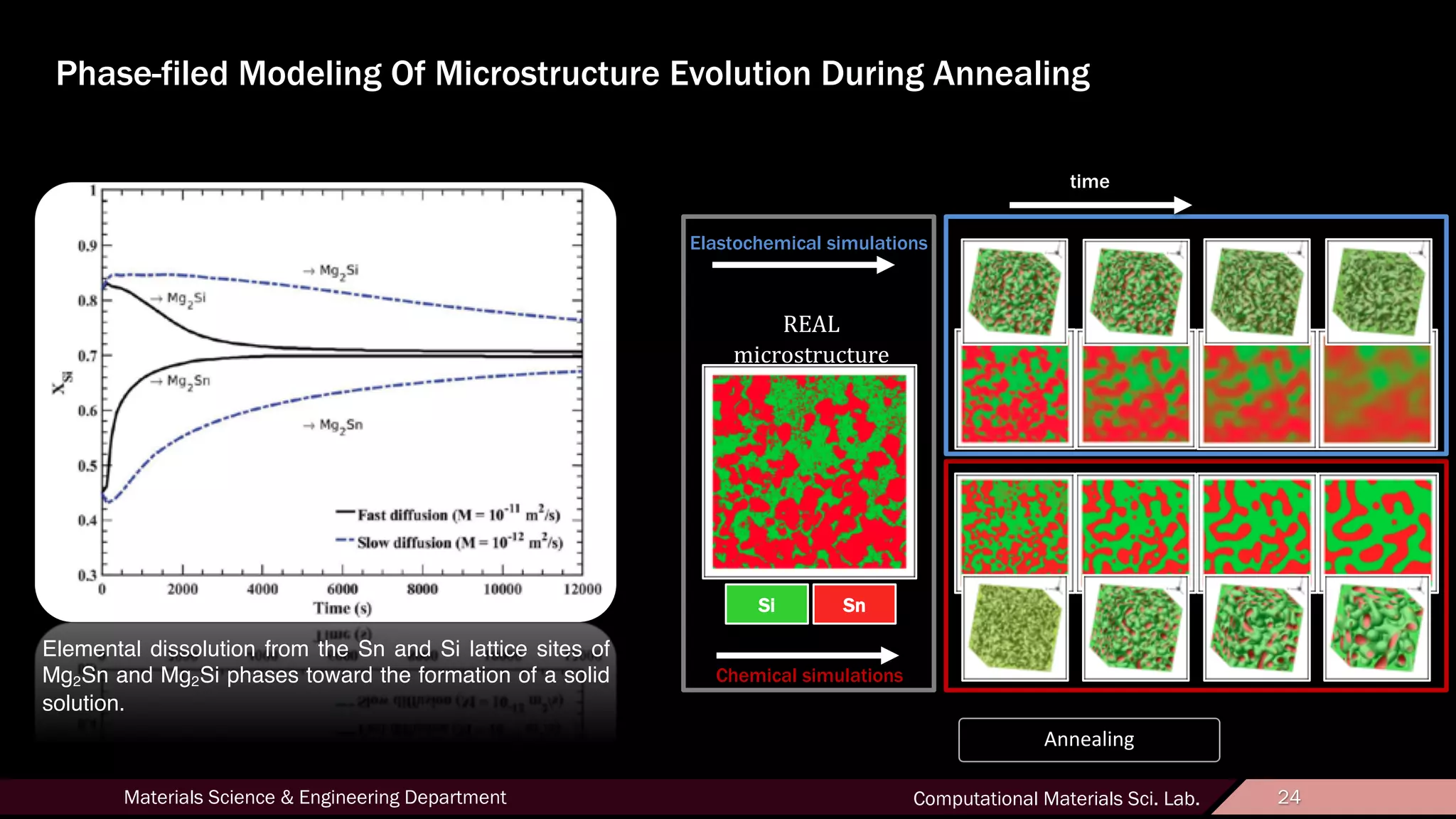
Phase-filed Modeling Of Microstructure Evolution During Annealing
SnSi
Chemical simulations
Elastochemical simulations
time
REAL
microstructure
High energy ball milling Spark Plasma Sintering Annealing
24Materials Science & Engineering Department Computational Materials Sci. Lab. 24
Phase-filed Modeling Of Microstructure Evolution During Annealing
SnSi
Chemical simulations
Elastochemical simulations
time
REAL
microstructure
Annealing
Elemental dissolution from the Sn and Si lattice sites of
Mg2Sn and Mg2Si phases toward the formation of a solid
solution.
25Materials Science & Engineering Department Computational Materials Sci. Lab. 25
Summary
• Non-equilibrium processing of materials can alter the properties significantly.
• The strain effects on phase dissolution are shown experimentally and theoretically.
• The best TE:
– Have the electrical properties of a crystalline material
– Have the thermal properties of an amorphous material
• Predication of phase stability in MgSixSn1-x TE materials
– Thermodynamics always comes first!
26Materials Science & Engineering Department Computational Materials Sci. Lab. 26
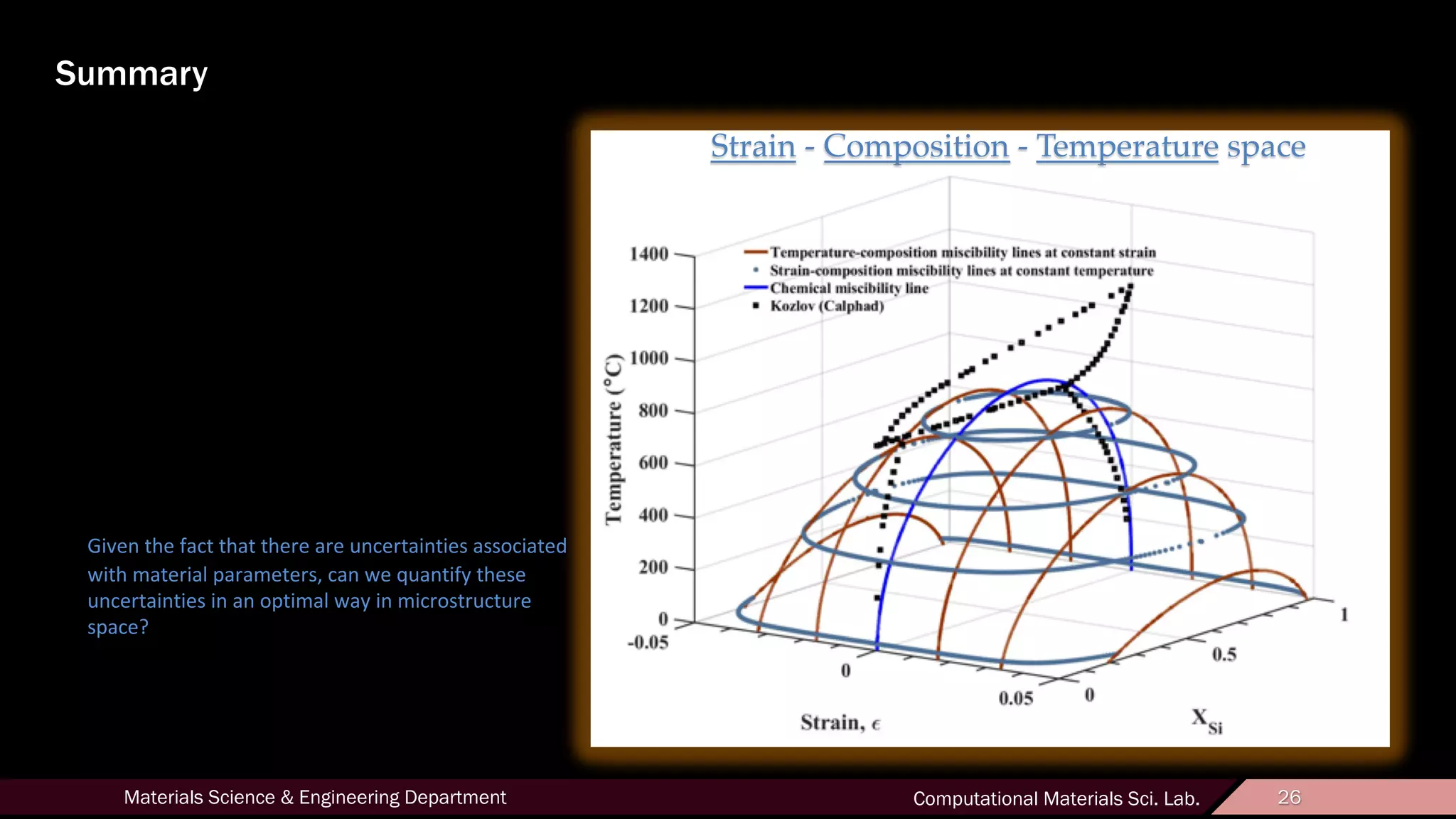
Summary
Strain - Composition - Temperature space
Given the fact that there are uncertainties associated
with material parameters, can we quantify these
uncertainties in an optimal way in microstructure
space?
27Materials Science & Engineering Department Computational Materials Sci. Lab. 27
Uncertainty Propagation in a Multiscale CALPHAD-Reinforced
Elastochemical Phase-field Model
Robust Design of Microstructures for a Property
arXiv preprint arXiv:1908.00638 (2019).
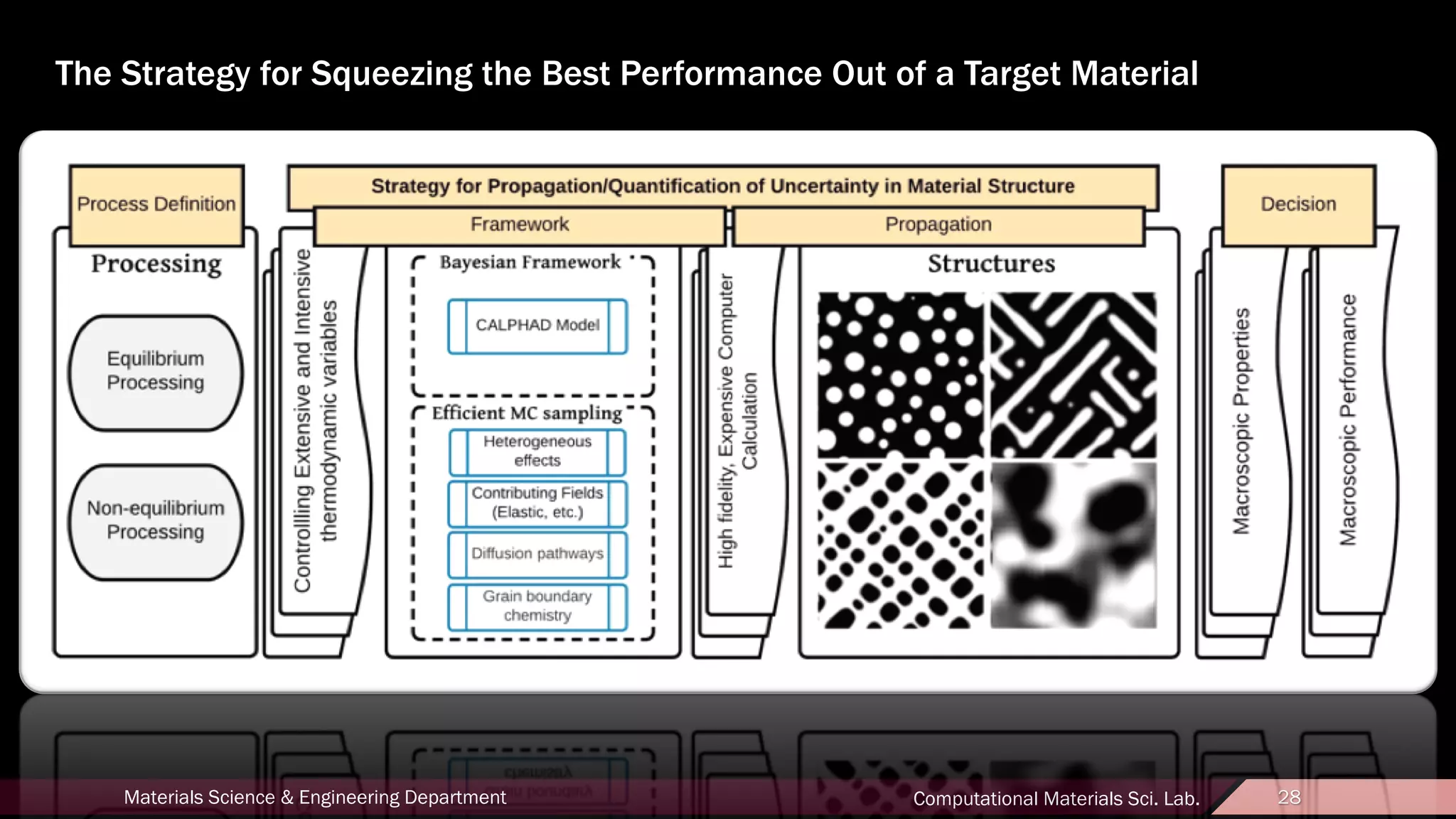
28Materials Science & Engineering Department Computational Materials Sci. Lab. 28
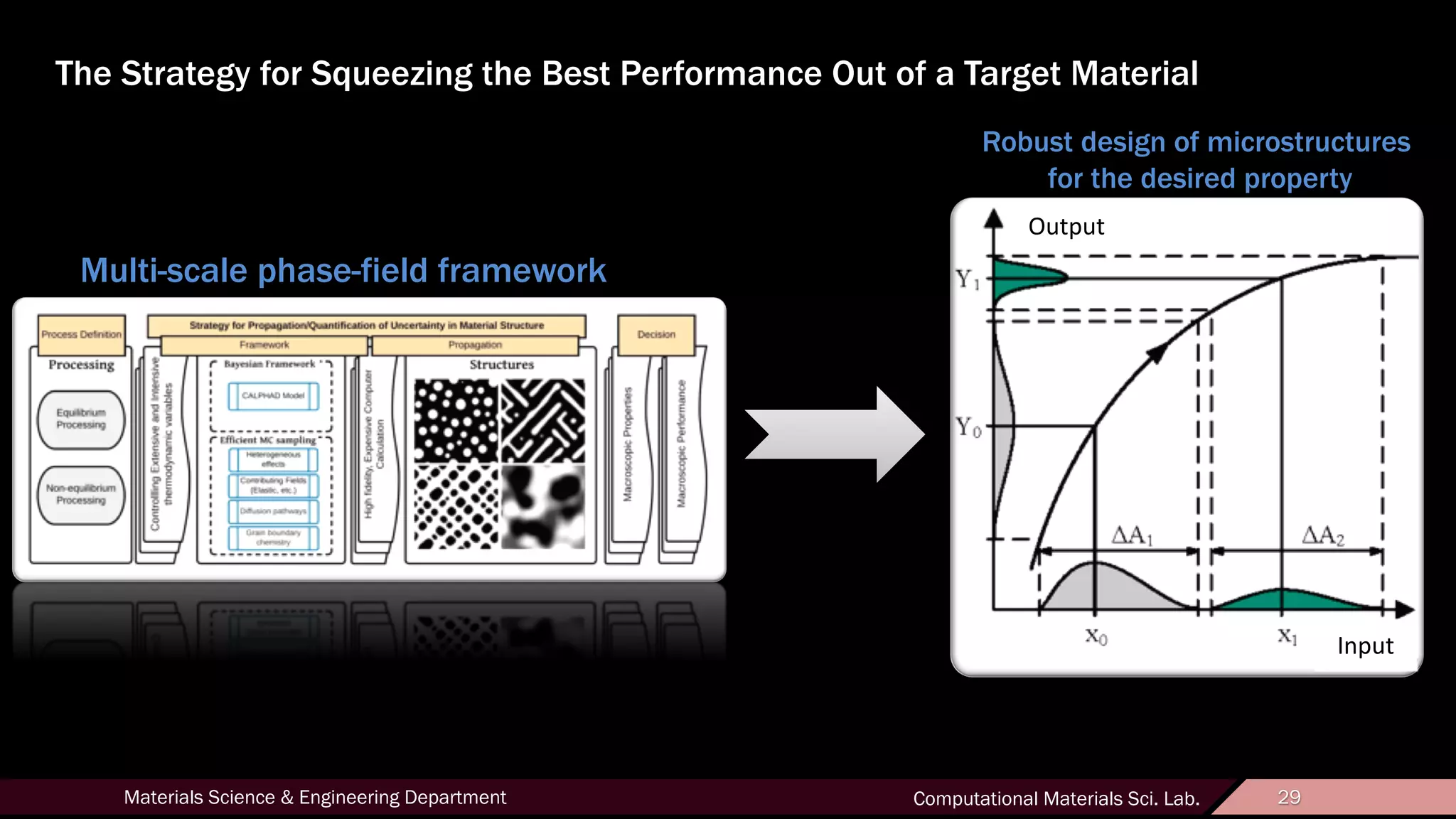
The Strategy for Squeezing the Best Performance Out of a Target Material
Output
Input
Robust design of microstructures
for the desired property
Multi-scale phase-field framework
29Materials Science & Engineering Department Computational Materials Sci. Lab. 29
The Strategy for Squeezing the Best Performance Out of a Target Material
Output
Input
Robust design of microstructures
for the desired property
Multi-scale phase-field framework
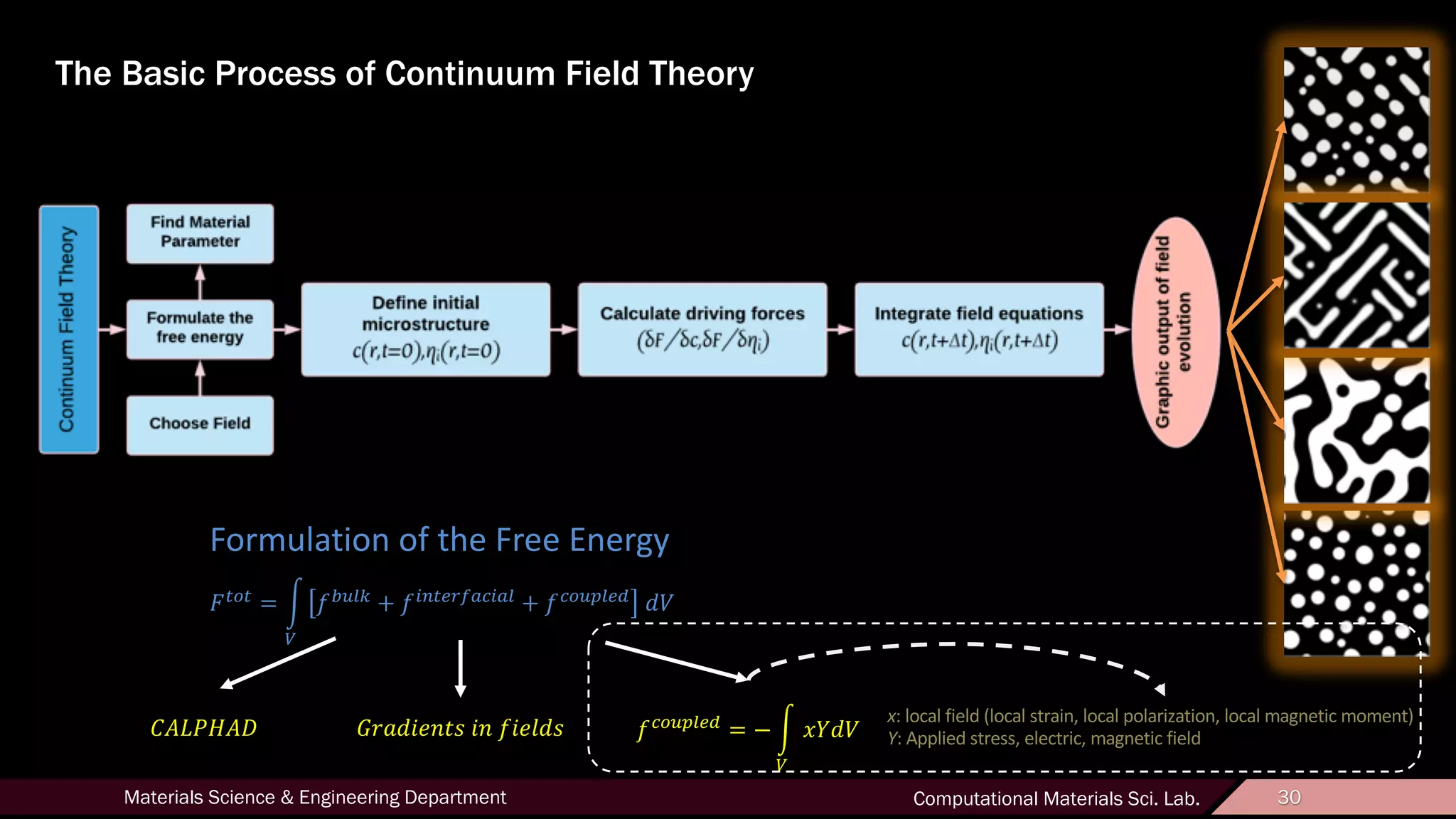
30Materials Science & Engineering Department Computational Materials Sci. Lab. 30
The Basic Process of Continuum Field Theory
!"#$%&'(
= − +
,
-./0
12#2 = +
,
!3$&4 + !672'89:"6:& + !"#$%&'( /0
Formulation of the Free Energy
;<=>?<@ ABC/DEFGH DF !DEI/H
x: local field (local strain, local polarization, local magnetic moment)
Y: Applied stress, electric, magnetic field
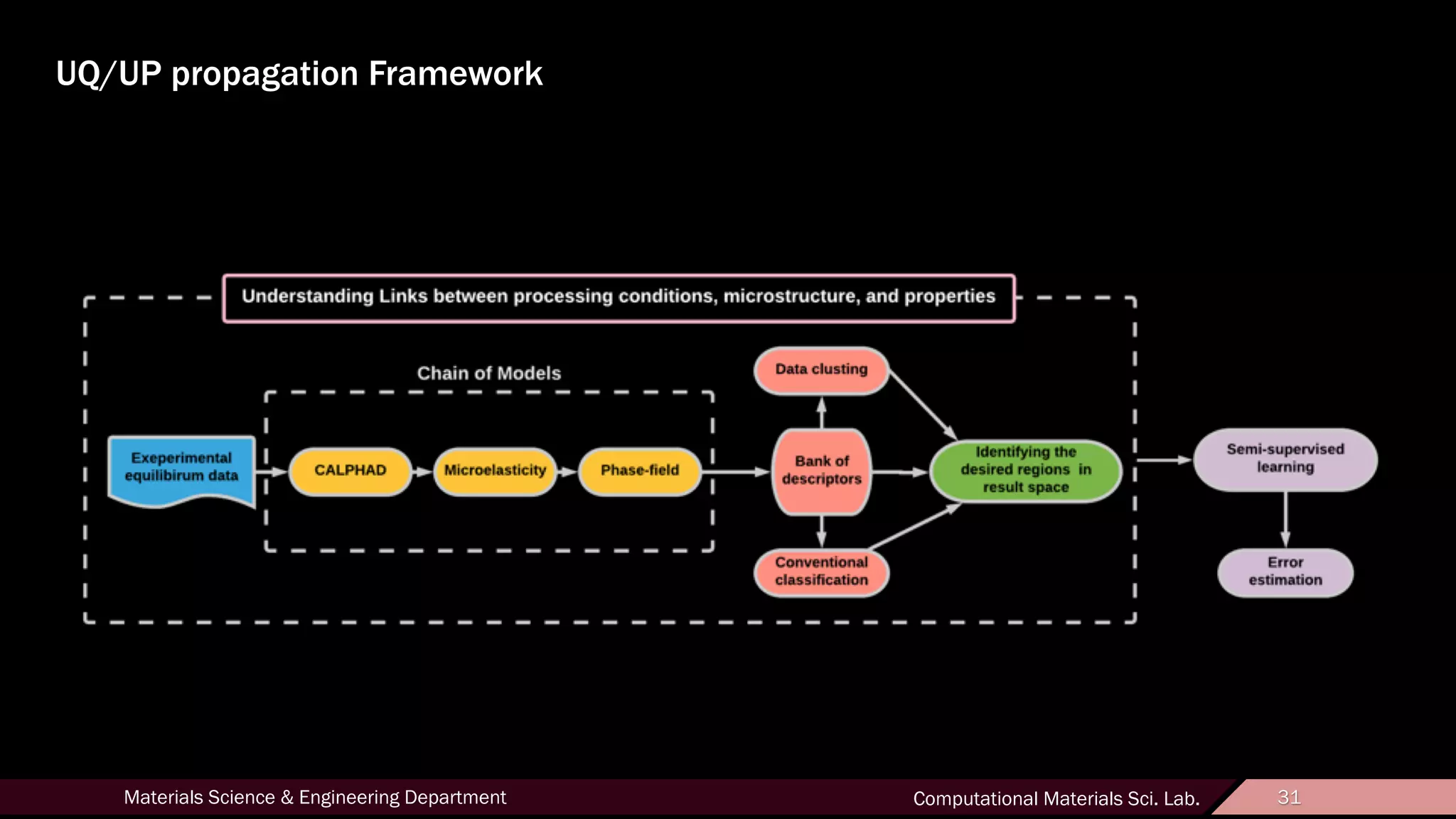
31Materials Science & Engineering Department Computational Materials Sci. Lab. 31
UQ/UP propagation Framework
32Materials Science & Engineering Department Computational Materials Sci. Lab. 32
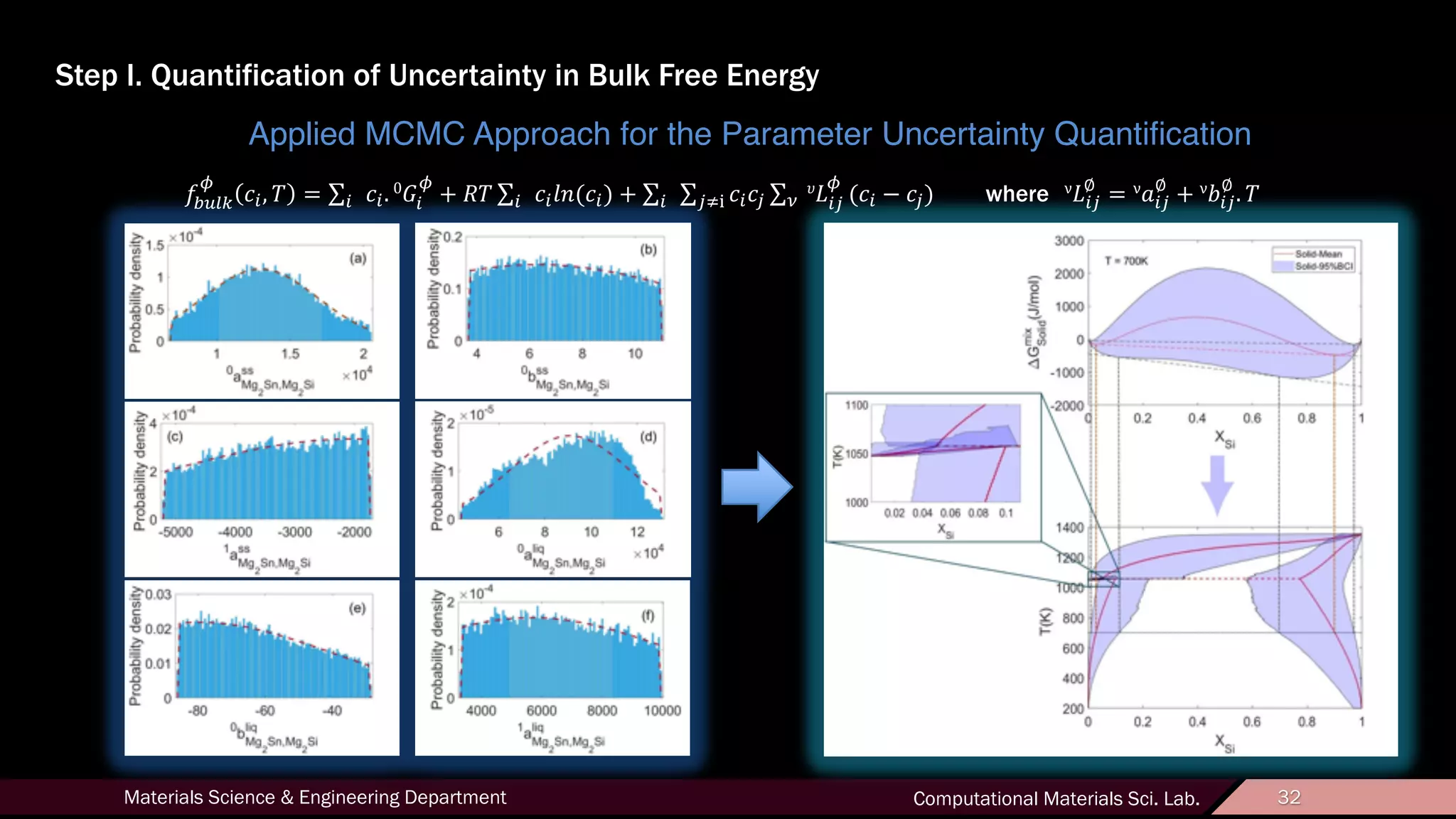
Step I. Quantification of Uncertainty in Bulk Free Energy
!"#$%
&
'(, * = ∑( '(. 0
/(
&
+ 1* ∑( '(23('() + ∑( ∑678 '('6 ∑9
:
;(6
&
('( − '6) where ν
;(6
∅
= ν
?(6
∅
+ ν
@(6
∅
. *
Applied MCMC Approach for the Parameter Uncertainty Quantification
33Materials Science & Engineering Department Computational Materials Sci. Lab. 33
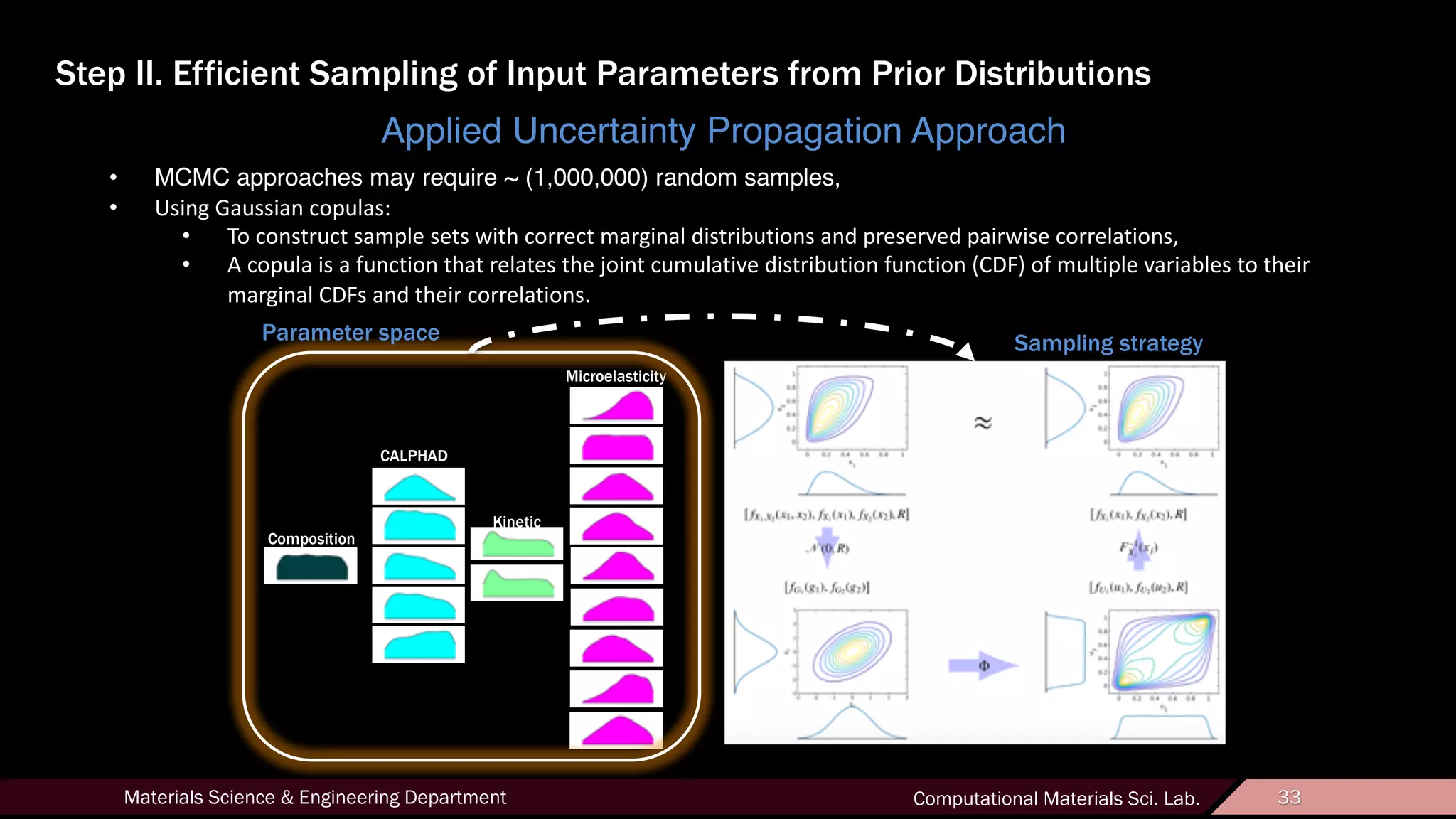
Step II. Efficient Sampling of Input Parameters from Prior Distributions
Microelasticity
CALPHAD
Composition
Kinetic
Parameter space Sampling strategy
• MCMC approaches may require ~ (1,000,000) random samples,
• Using Gaussian copulas:
• To construct sample sets with correct marginal distributions and preserved pairwise correlations,
• A copula is a function that relates the joint cumulative distribution function (CDF) of multiple variables to their
marginal CDFs and their correlations.
Applied Uncertainty Propagation Approach
34Materials Science & Engineering Department Computational Materials Sci. Lab. 34
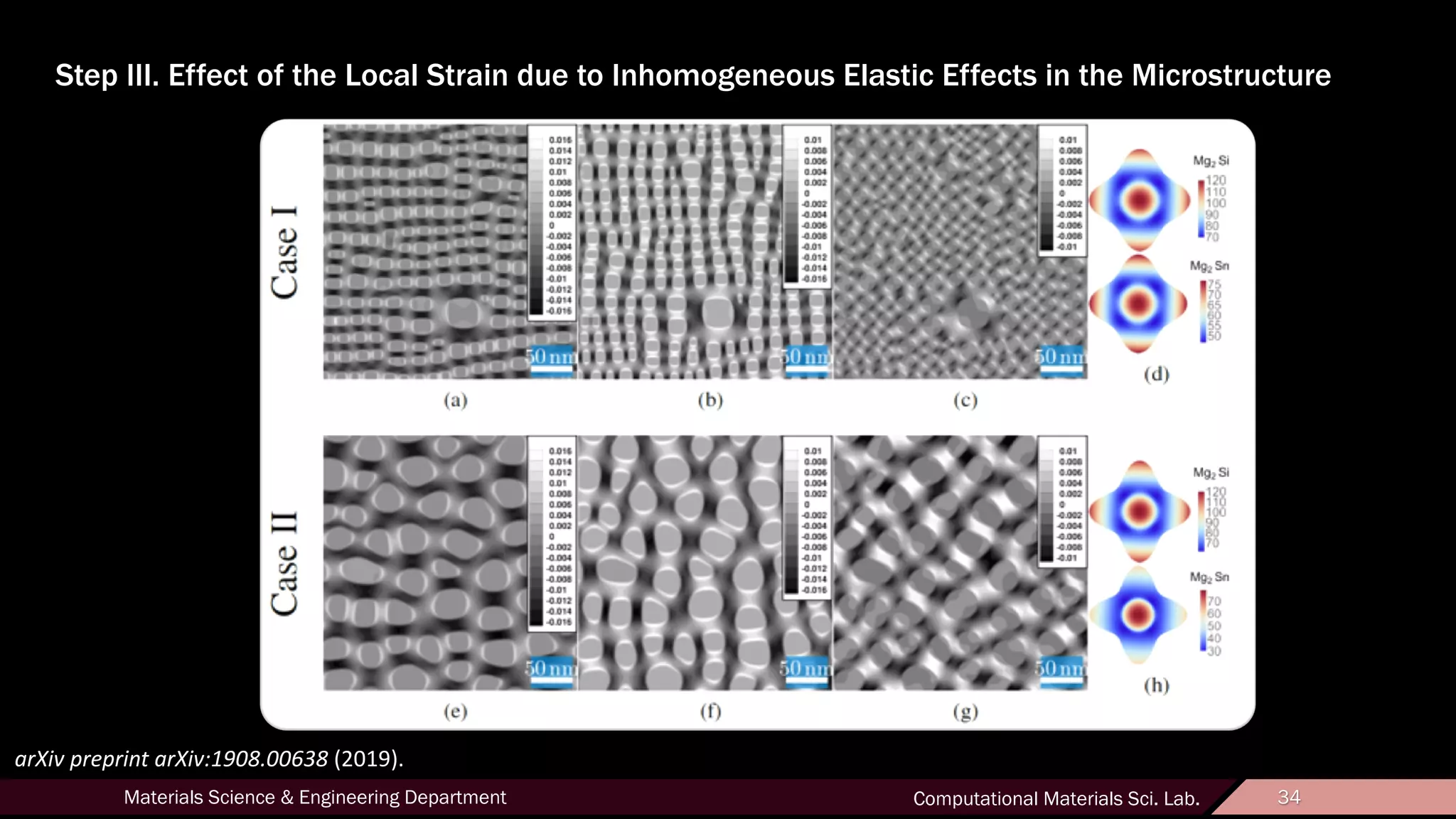
Step III. Effect of the Local Strain due to Inhomogeneous Elastic Effects in the Microstructure
arXiv preprint arXiv:1908.00638 (2019).
35Materials Science & Engineering Department Computational Materials Sci. Lab. 35
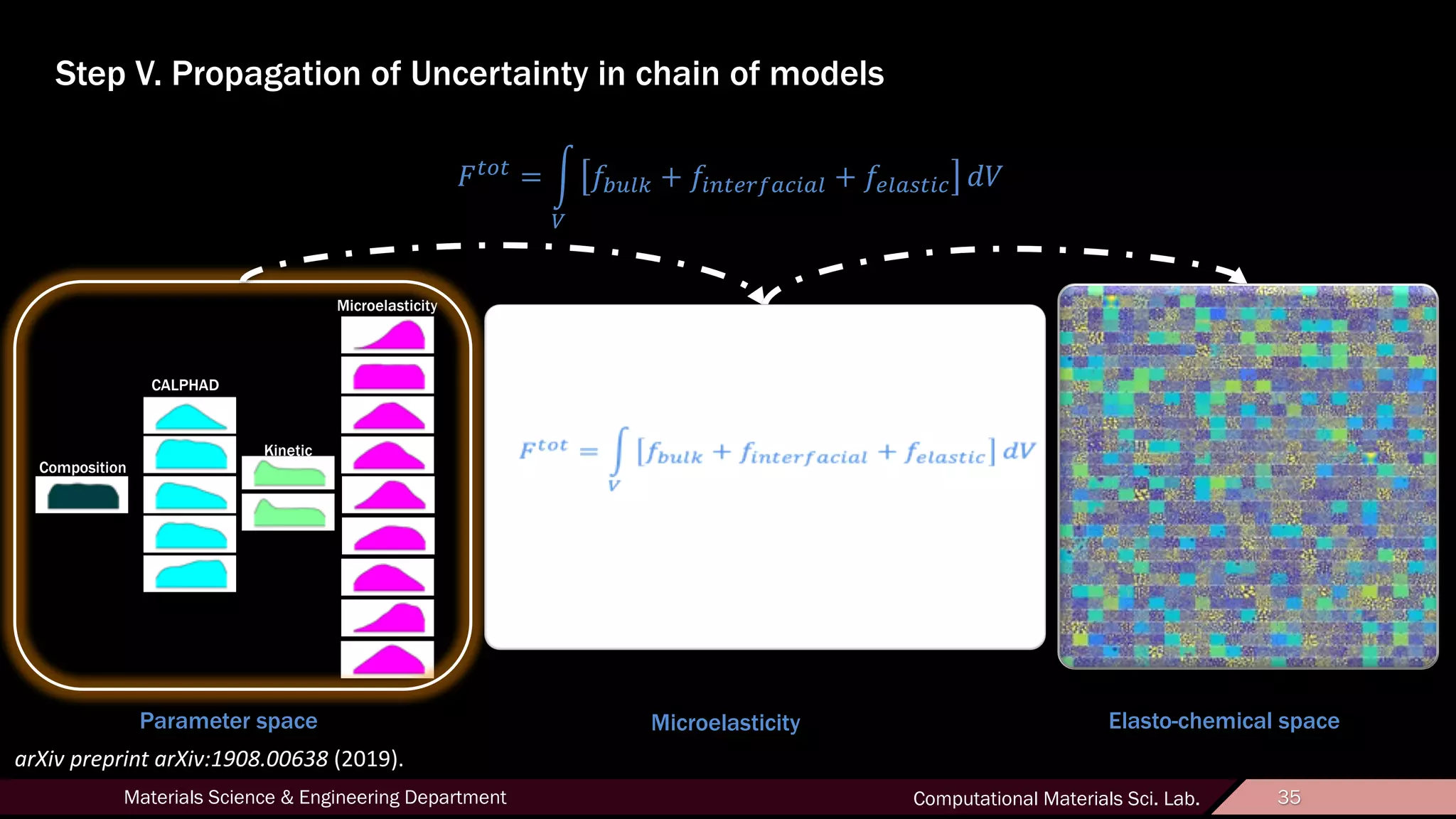
Step V. Propagation of Uncertainty in chain of models
Microelasticity
CALPHAD
Composition
Kinetic
!"#"
= %
&
'()*+ + '-."/0123-2* + '/*24"-3 56
Parameter space Elasto-chemical spaceMicroelasticity
arXiv preprint arXiv:1908.00638 (2019).
36Materials Science & Engineering Department Computational Materials Sci. Lab. 36
Uncertaintypropagationinalloynanostructure
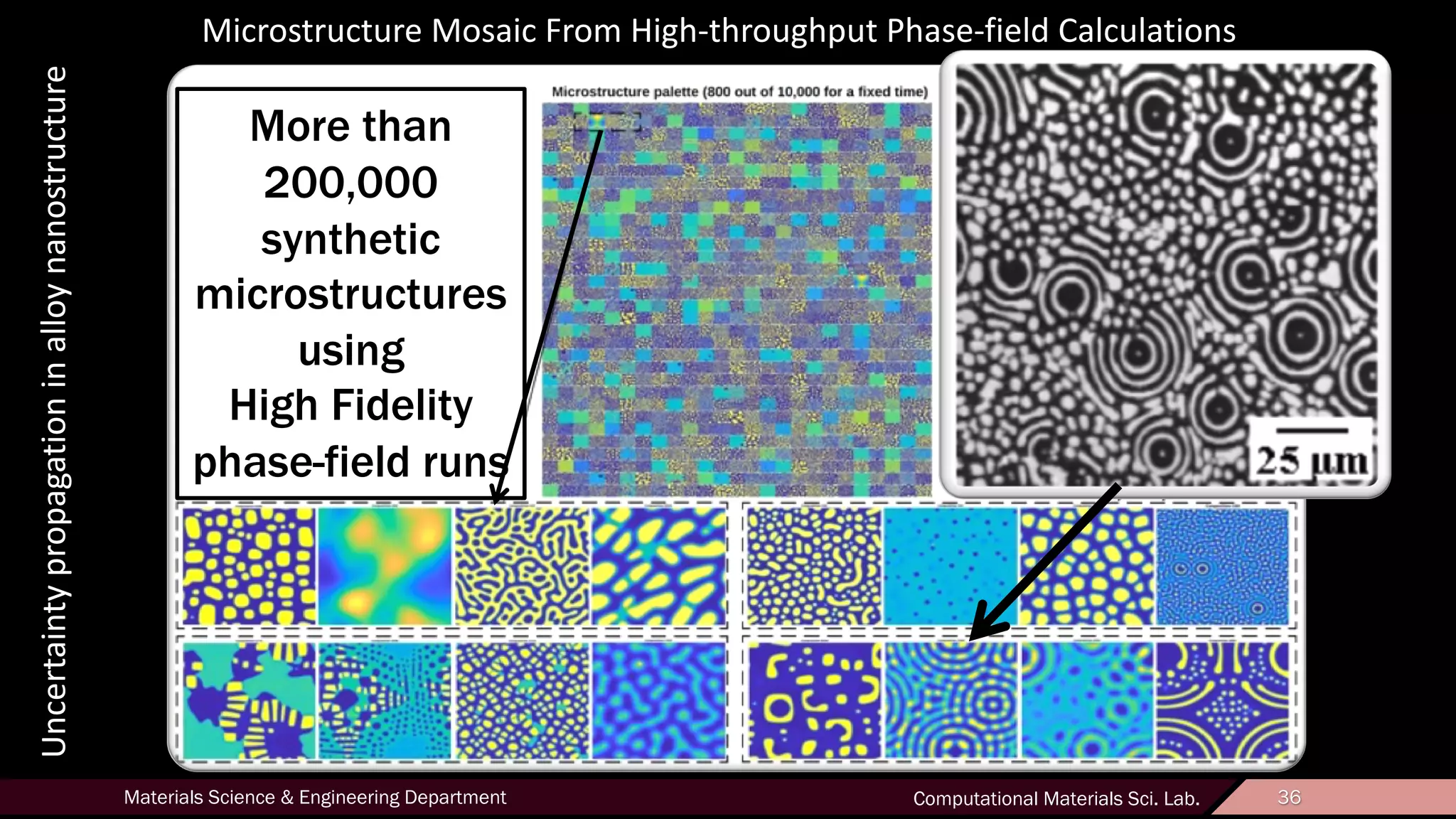
More than
200,000
synthetic
microstructures
using
High Fidelity
phase-field runs
Microstructure Mosaic From High-throughput Phase-field Calculations
!""
#$%&
!"'
#$%&
!''
#$%&
37Materials Science & Engineering Department Computational Materials Sci. Lab. 37
Uncertaintypropagationinalloynanostructure
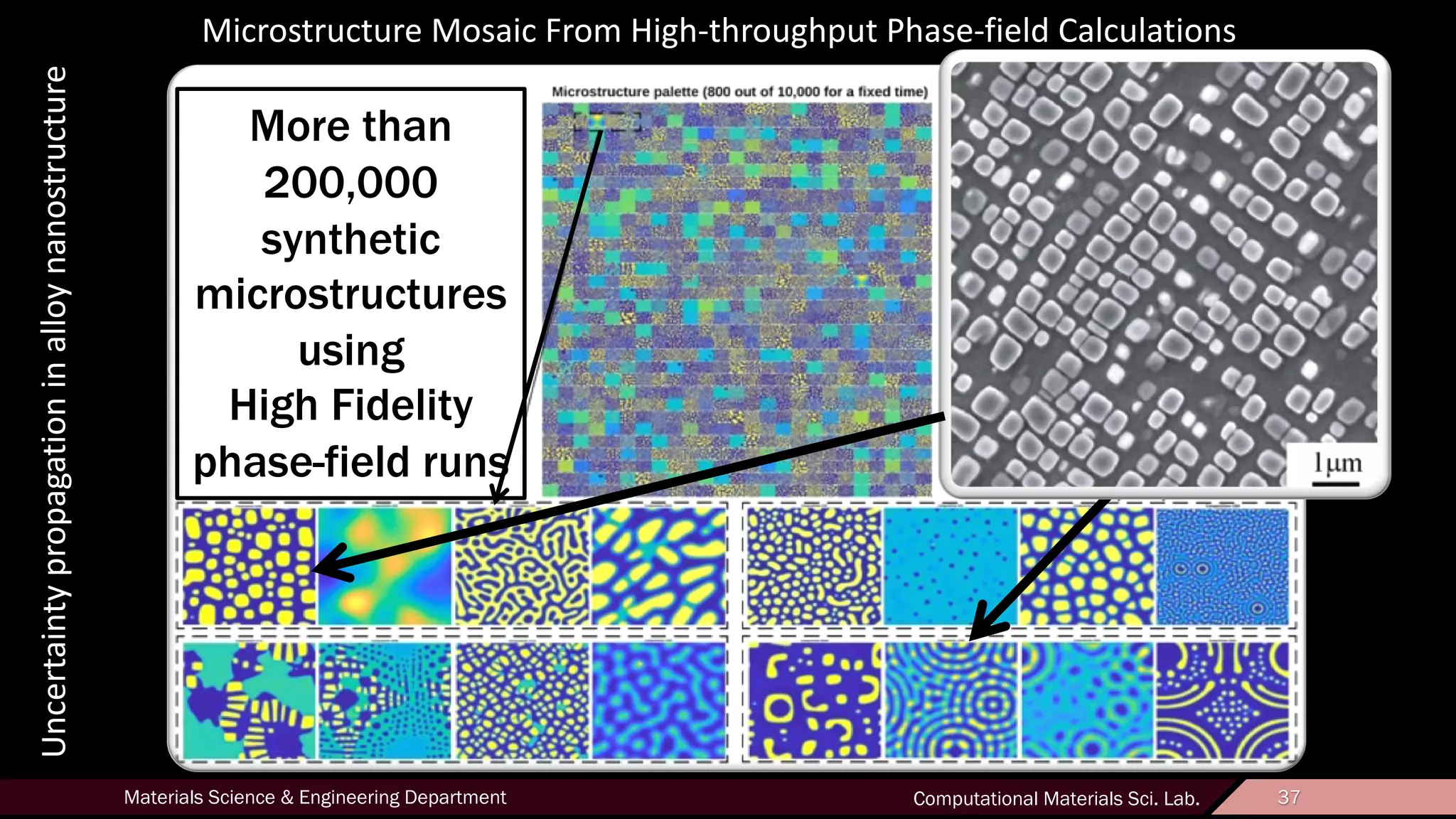
More than
200,000
synthetic
microstructures
using
High Fidelity
phase-field runs
Microstructure Mosaic From High-throughput Phase-field Calculations
!""
#$%&
!"'
#$%&
!''
#$%&
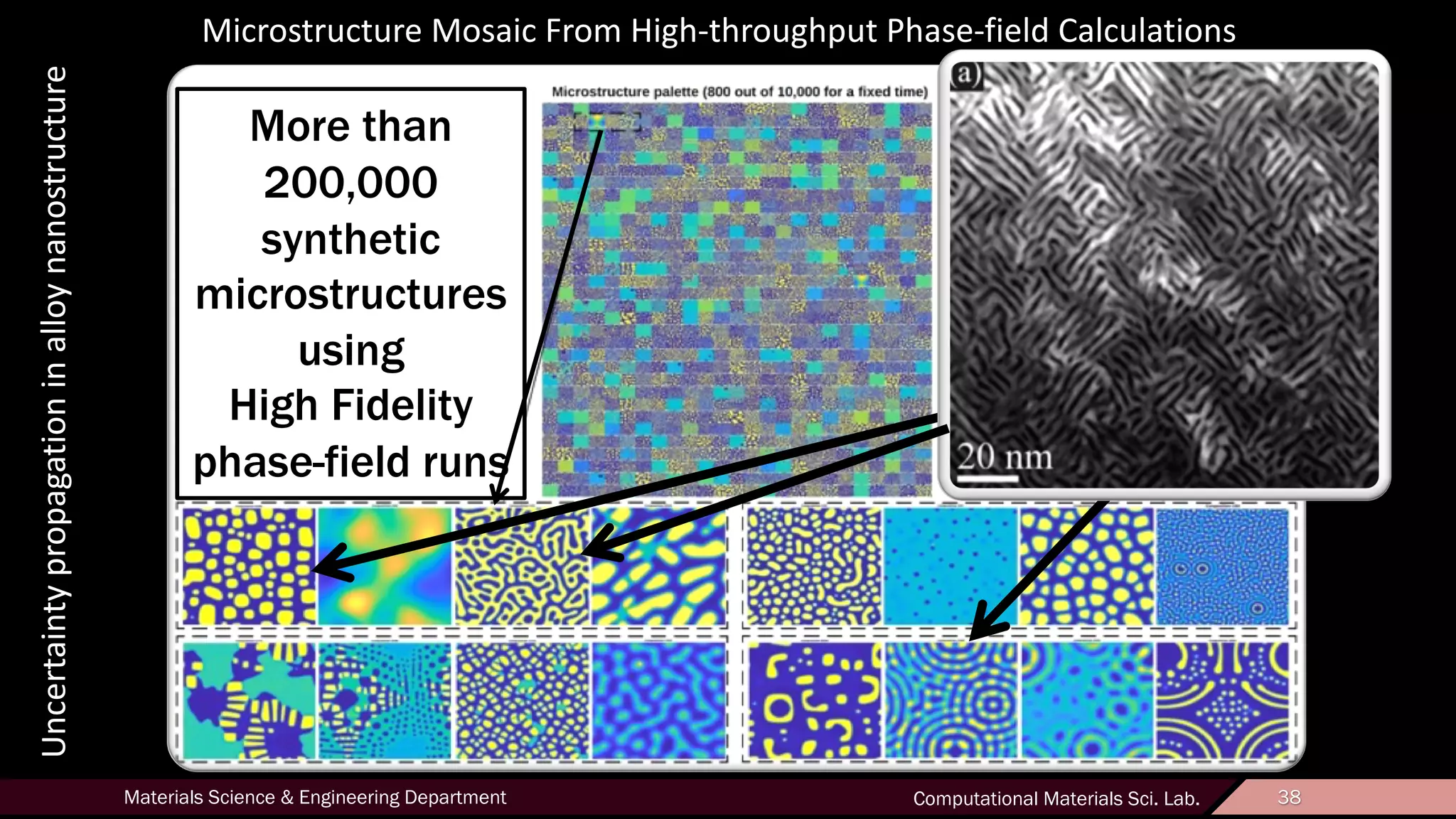
38Materials Science & Engineering Department Computational Materials Sci. Lab. 38
Uncertaintypropagationinalloynanostructure
More than
200,000
synthetic
microstructures
using
High Fidelity
phase-field runs
Microstructure Mosaic From High-throughput Phase-field Calculations
!""
#$%&
!"'
#$%&
!''
#$%&
39Materials Science & Engineering Department Computational Materials Sci. Lab. 39
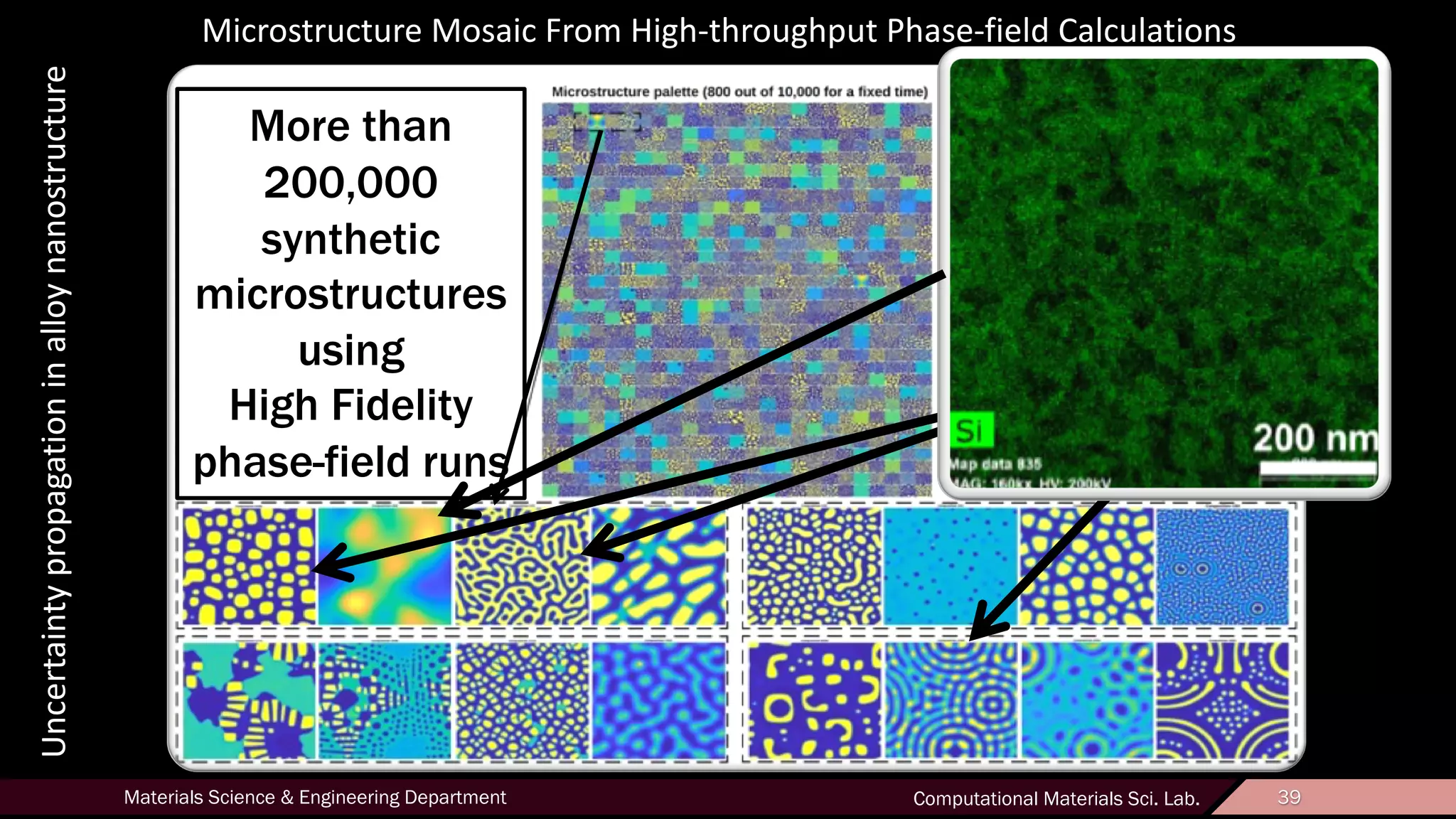
Uncertaintypropagationinalloynanostructure
More than
200,000
synthetic
microstructures
using
High Fidelity
phase-field runs
Microstructure Mosaic From High-throughput Phase-field Calculations
!""
#$%&
!"'
#$%&
!''
#$%&
40Materials Science & Engineering Department Computational Materials Sci. Lab. 40
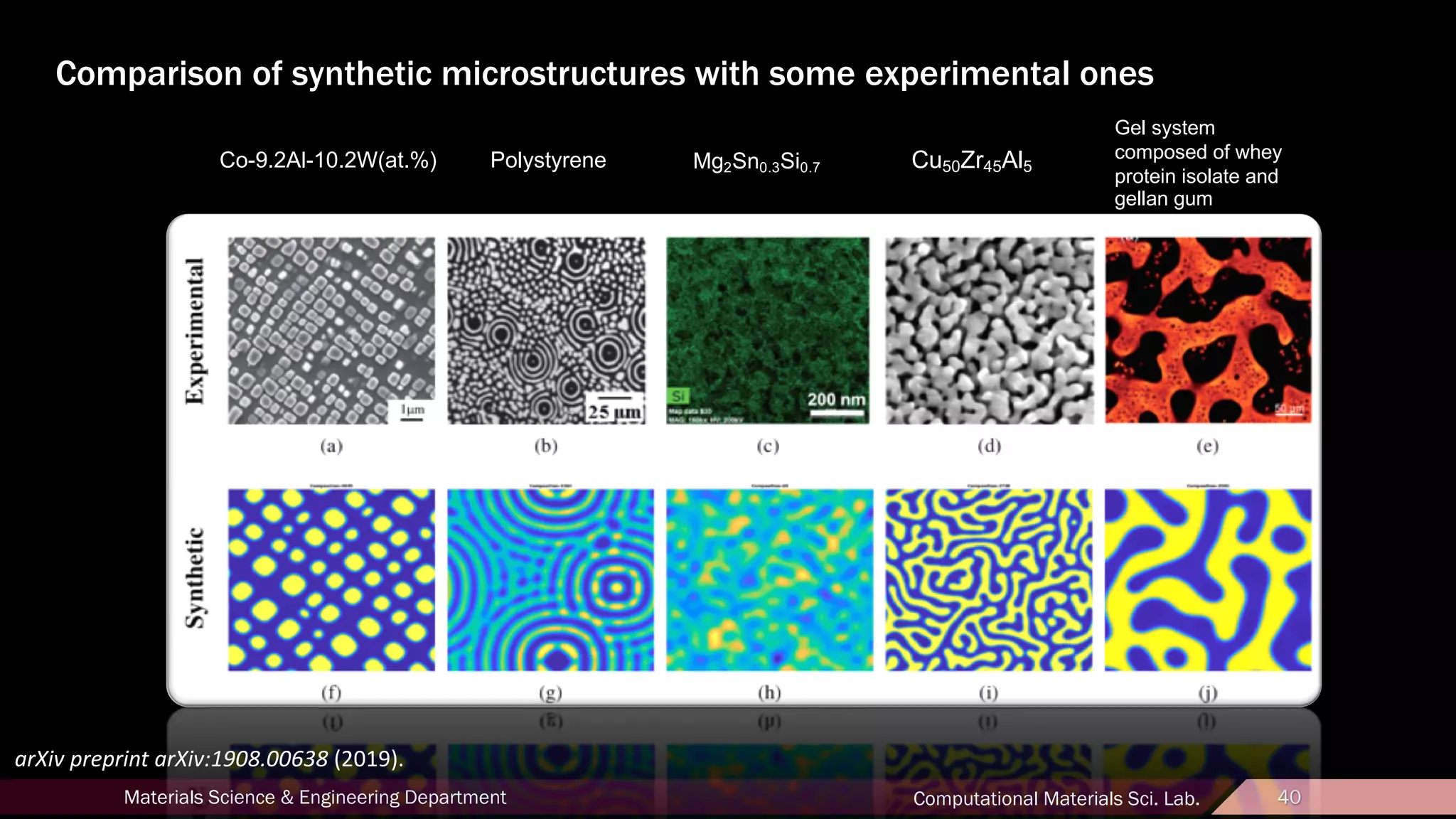
Comparison of synthetic microstructures with some experimental ones
Co-9.2Al-10.2W(at.%) Polystyrene Mg2Sn0.3Si0.7
arXiv preprint arXiv:1908.00638 (2019).
Cu50Zr45Al5
Gel system
composed of whey
protein isolate and
gellan gum
41Materials Science & Engineering Department Computational Materials Sci. Lab. 41
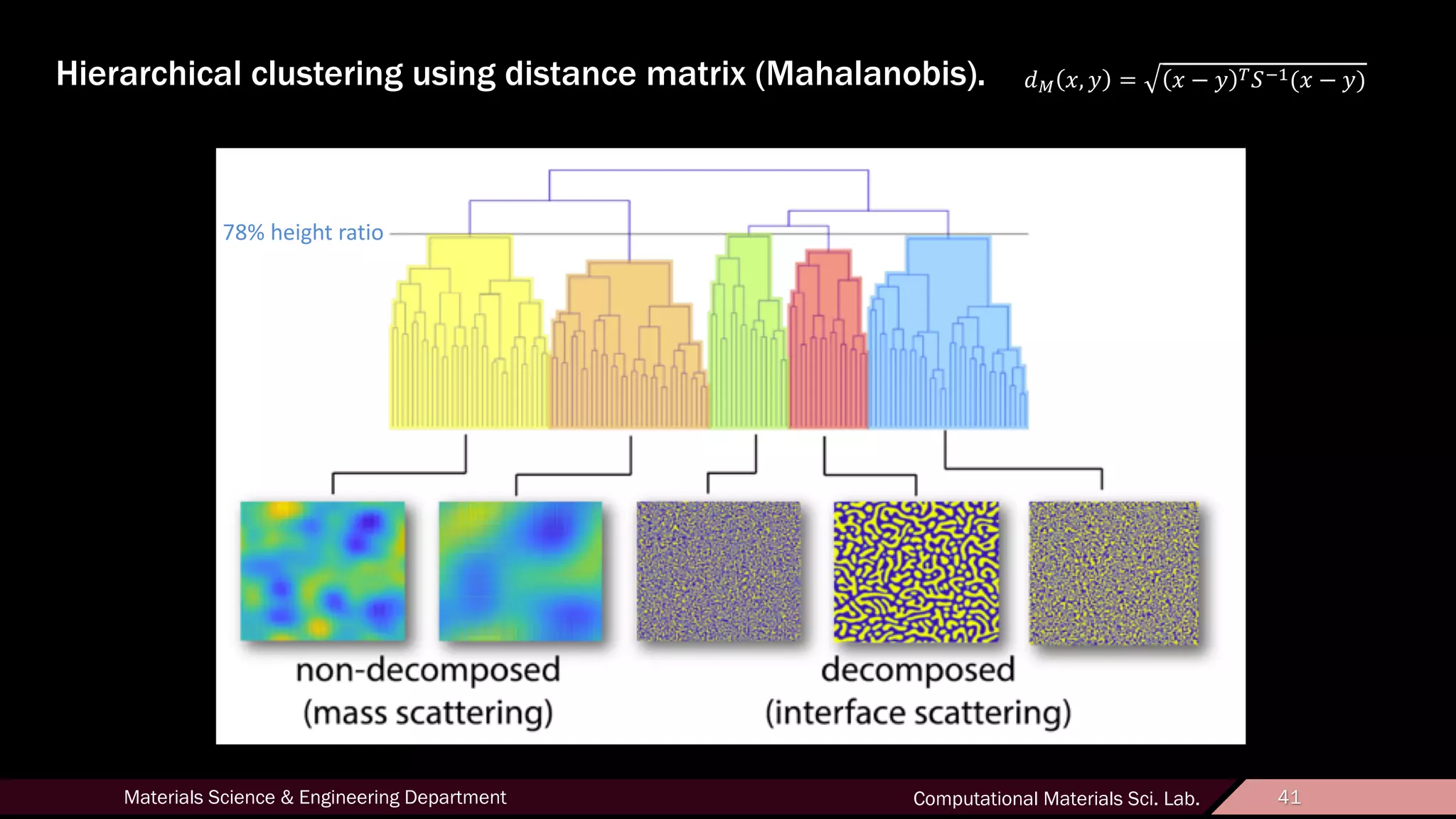
Hierarchical clustering using distance matrix (Mahalanobis).
78% height ratio
!" #, % = # − % ()*+(# − %)
42Materials Science & Engineering Department Computational Materials Sci. Lab. 42
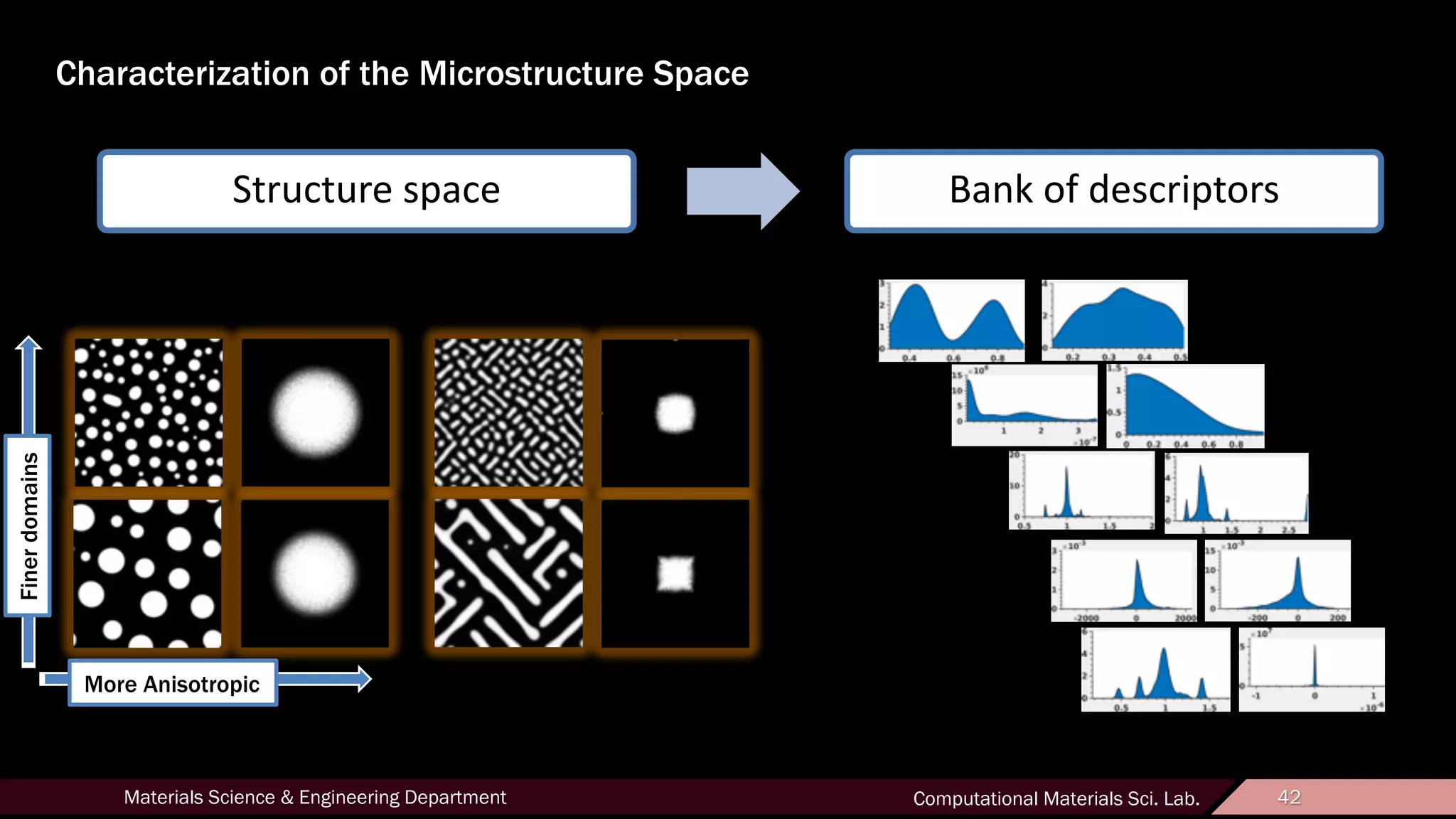
Structure space Bank of descriptors
Characterization of the Microstructure Space
More Anisotropic
Finerdomains
43Materials Science & Engineering Department Computational Materials Sci. Lab. 43
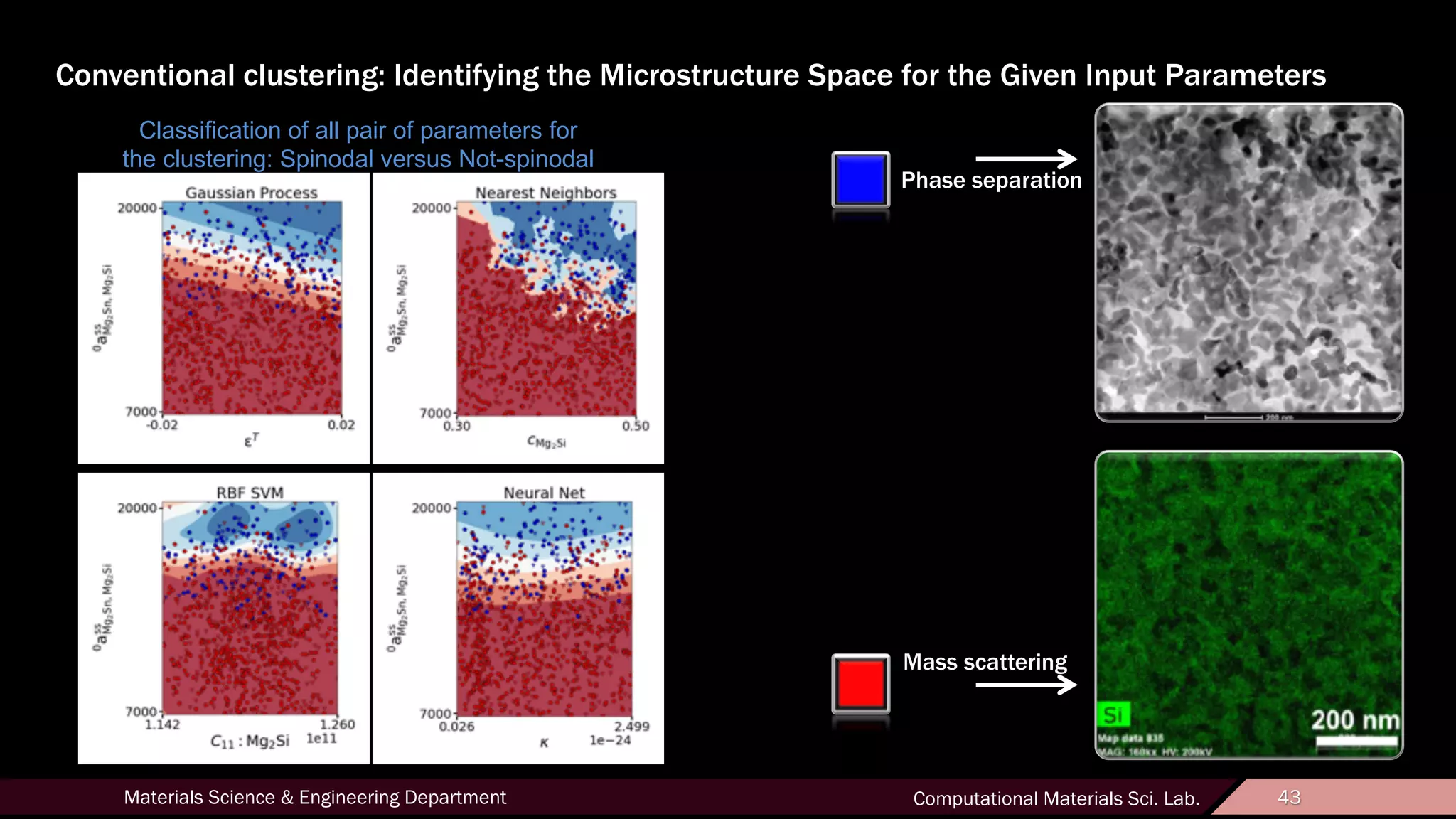
Conventional clustering: Identifying the Microstructure Space for the Given Input Parameters
Mass scattering
Phase separation
Classification of all pair of parameters for
the clustering: Spinodal versus Not-spinodal
44Materials Science & Engineering Department Computational Materials Sci. Lab. 44
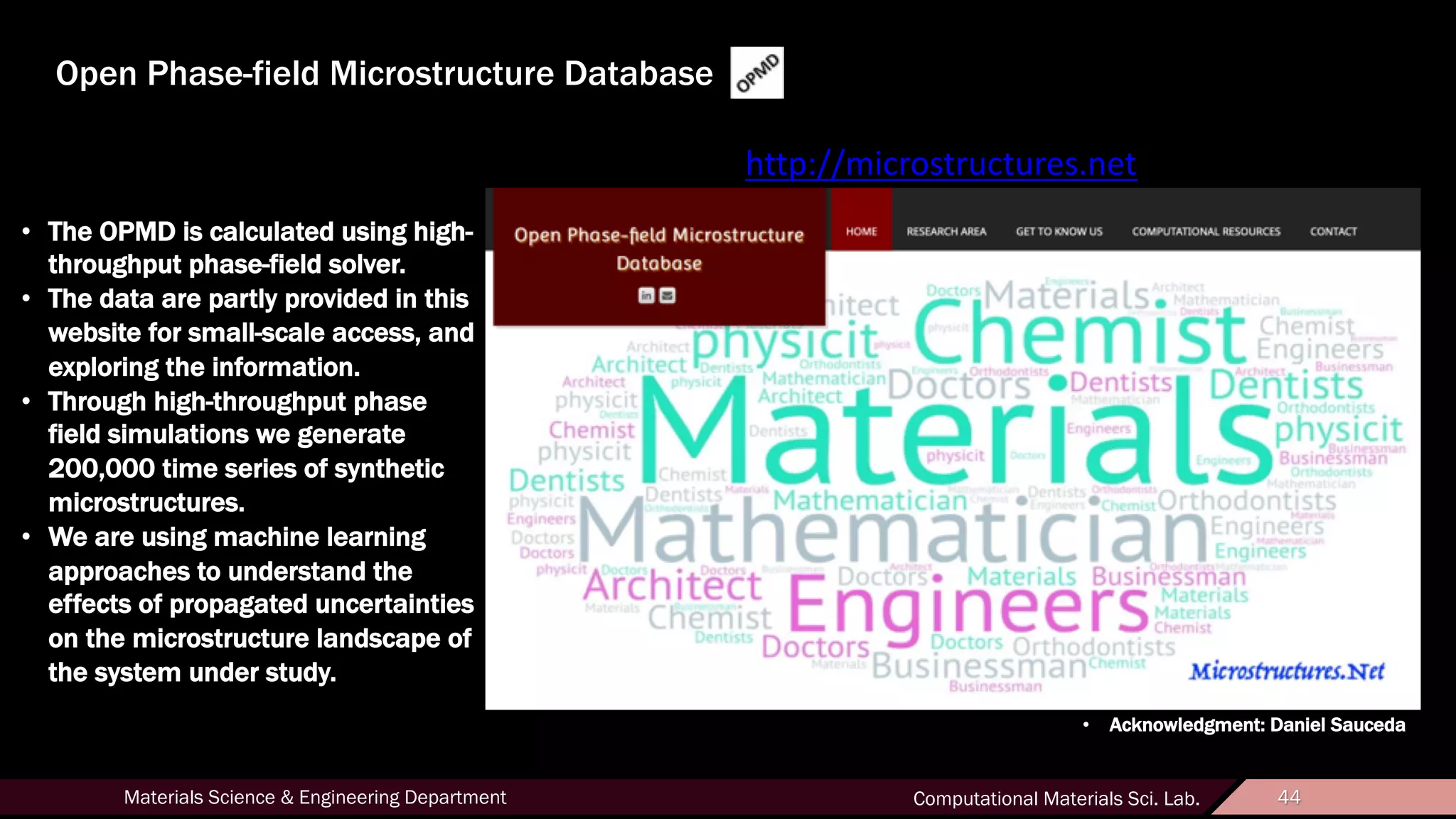
Open Phase-field Microstructure Database
http://microstructures.net
• The OPMD is calculated using high-
throughput phase-field solver.
• The data are partly provided in this
website for small-scale access, and
exploring the information.
• Through high-throughput phase
field simulations we generate
200,000 time series of synthetic
microstructures.
• We are using machine learning
approaches to understand the
effects of propagated uncertainties
on the microstructure landscape of
the system under study.
• Acknowledgment: Daniel Sauceda
45Materials Science & Engineering Department Computational Materials Sci. Lab. 45
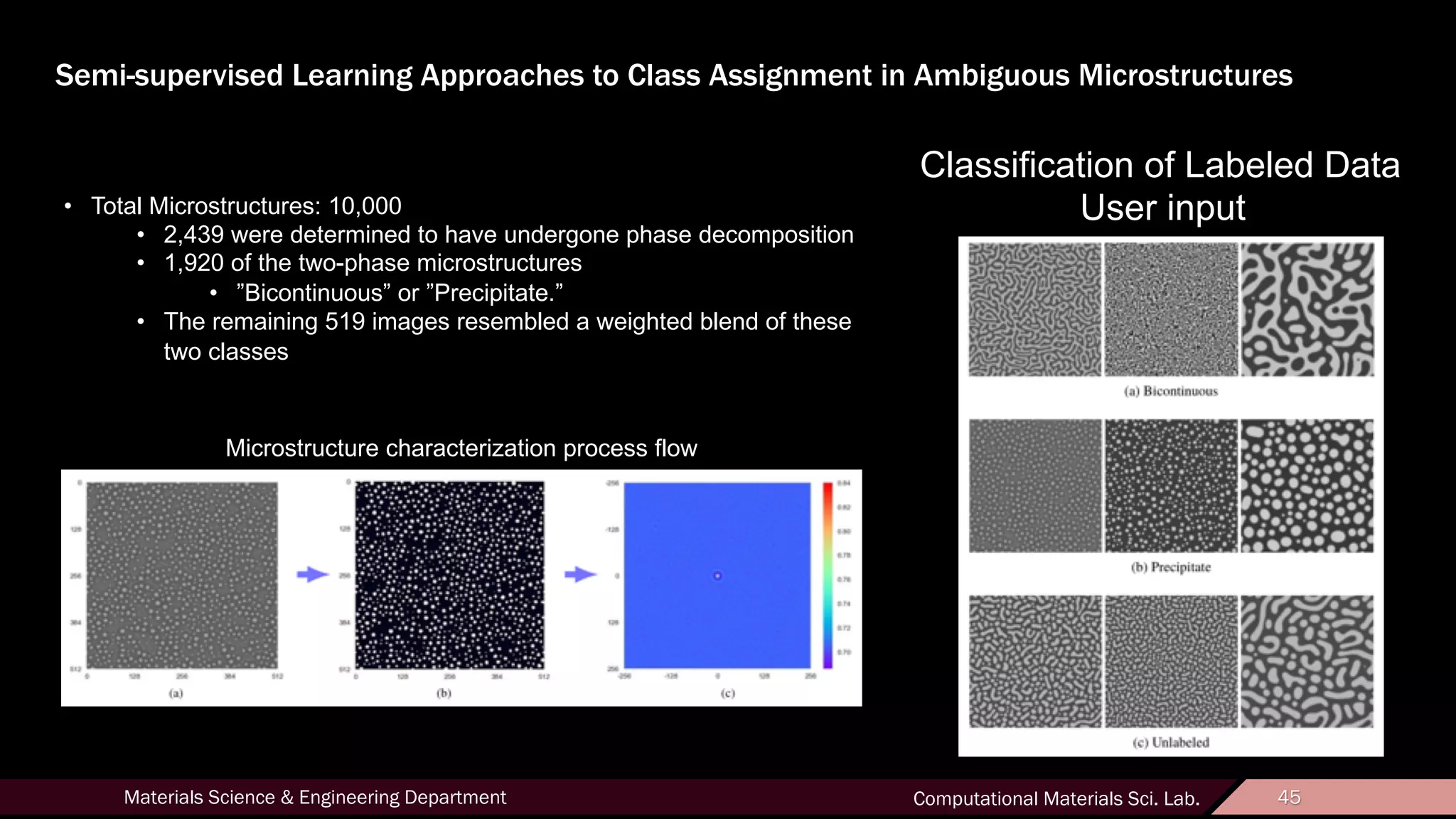
Semi-supervised Learning Approaches to Class Assignment in Ambiguous Microstructures
Microstructure characterization process flow
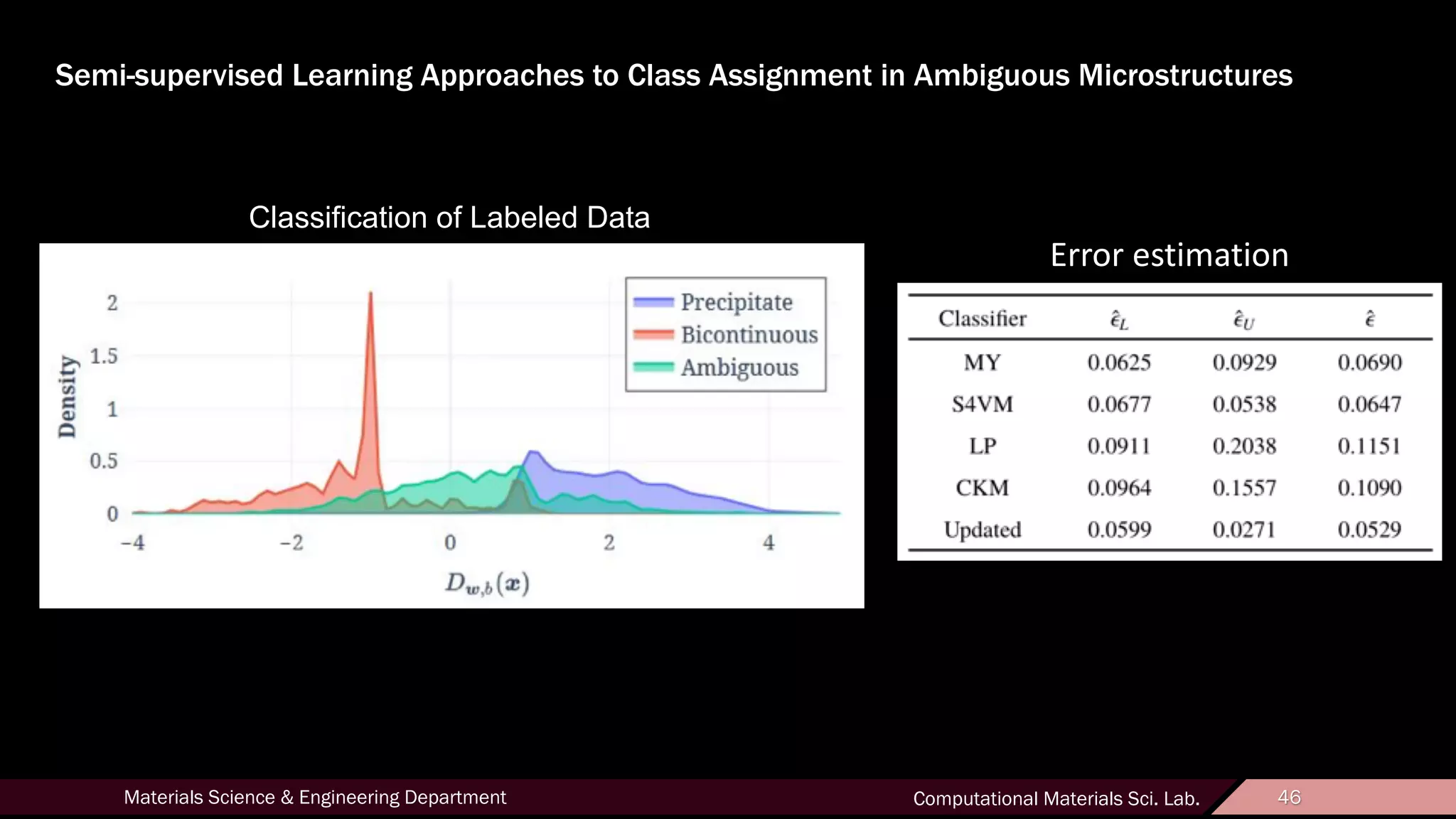
Classification of Labeled Data
User input• Total Microstructures: 10,000
• 2,439 were determined to have undergone phase decomposition
• 1,920 of the two-phase microstructures
• ”Bicontinuous” or ”Precipitate.”
• The remaining 519 images resembled a weighted blend of these
two classes
46Materials Science & Engineering Department Computational Materials Sci. Lab. 46
Semi-supervised Learning Approaches to Class Assignment in Ambiguous Microstructures
Classification of Labeled Data
Error estimation
47Materials Science & Engineering Department Computational Materials Sci. Lab. 47
Challenges in Quantification of Uncertainty in Phase-field Models
• Computation resources
– Optimized codes
– Fast processors
– Lots of storage for the results
• Uncovering links between process, microstructure, and properties
– Expressing the structural features in a universal quantitative fashion
• Quantities of interest (QoI) versus a universal QoI
• We need well-defined bank of descriptors for microstructures
– semantic texton forests
– visual words
– One or a combination of Filter-bank responses (e.g. Fourier or other sort of wavelets)
– Combination of invariant descriptors (e.g. SIFT
– algorithms to place microstructure images into predefined classes
48Materials Science & Engineering Department Computational Materials Sci. Lab. 48
Prerequisites of propagating uncertainty in microstructure modeling of materials
• Computation resources
– Optimized codes
– Fast processors
– Lots of storage for the results
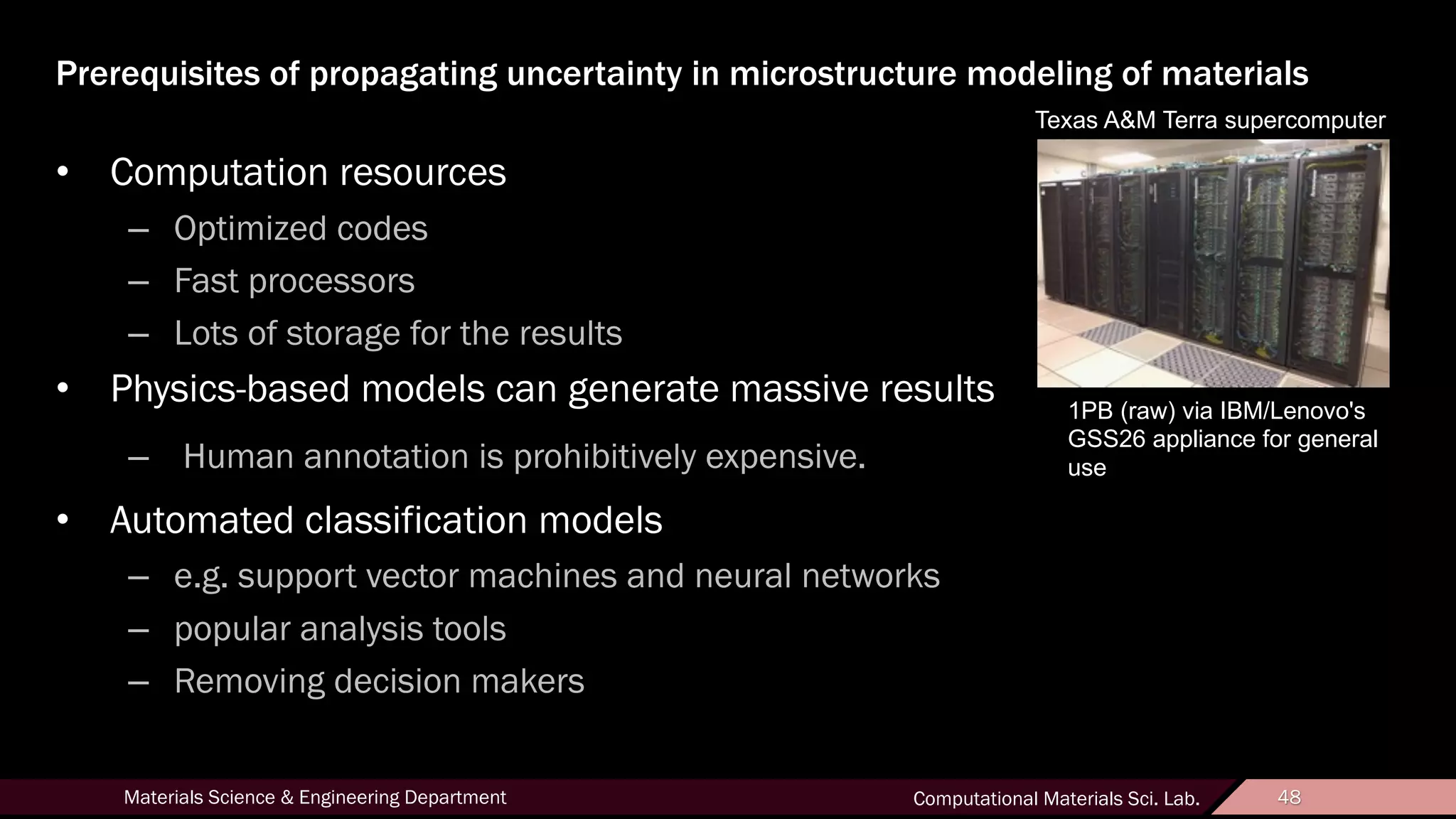
• Physics-based models can generate massive results
– Human annotation is prohibitively expensive.
• Automated classification models
– e.g. support vector machines and neural networks
– popular analysis tools
– Removing decision makers
1PB (raw) via IBM/Lenovo's
GSS26 appliance for general
use
Texas A&M Terra supercomputer
49Materials Science & Engineering Department Computational Materials Sci. Lab. 49
Summary and conclusion
• A framework for the quantification and propagation of uncertainty in a CALPHAD-based
elasto-chemical phase field model is proposed.
– Efficiently propagate uncertainty across model chains
– high-throughput phase-field modeling.
– Help for robust design of the structure of the materials under framework of ICME using
• Using high-throughput phase-field approach
– A synthetic microstructure database:
– ~50TBs of data including time series of microstructures with various topologies, strain
data, and etc.
– ~200,000 synthetic microstructure
• Open Phase–field Microstrcuture Dataset (OPMD): http://microstructures.net
50Materials Science & Engineering Department Computational Materials Sci. Lab.

Uncertainty Propagation in CALPHAD-reinforced Elastochemical Phase-field Modeling

  • 1.
    1Materials Science &Engineering Department Computational Materials Sci. Lab. Uncertainty Propagation in CALPHAD-reinforced Elastochemical Phase-field Modeling Vahid Attari1, Raymundo Arroyave1,2 1 Department of Materials Science and Engineering, Texas A&M University 2Department of Mechanical Engineering, Texas A&M University CHiMaD Workshop Wednesday, November 06, 2019
  • 2.
    2Materials Science &Engineering Department Computational Materials Sci. Lab. 2 Outline • Determining Material Parameters Using Phase-field Simulations and Experiments – Interfacial phase growth in Cu/Sn/Cu interconnections – Phase-field model parameter sensitivity analysis • New perspective in quantification/propagation of uncertainty in ICME-oriented multi-scale computational research of materials behavior: 1. Propagation of uncertainty across model chains, 2. Quantify the uncertainty in CALPHAD model for bulk Mg2SixSn1-x thermoelectric system, 3. Propagate this uncertainty via an efficient strategy for sampling a large dimensional input space represented as a multi-dimensional probability distribution function.
  • 3.
    3Materials Science &Engineering Department Computational Materials Sci. Lab. 3 Process •Equilibrium Processing •Non-equilibrium Processing Structure •Long-range interactions Property •Stable phases •Topology •Magnetic property Performance
  • 4.
    4Materials Science &Engineering Department Computational Materials Sci. Lab. 4 Process •Equilibrium Processing •Non-equilibrium Processing Structure •Long-range interactions Property •Stable phases •Topology •Magnetic property Performance
  • 5.
    5Materials Science &Engineering Department Computational Materials Sci. Lab. 5 Process •Equilibrium Processing •Non-equilibrium Processing Structure •Long-range interactions Property •Stable phases •Topology •Magnetic property Performance Ref: Gan et al., Superalloys 2012: 12th Int. Symp. on Superalloys Internal field Cuboid morphology of Ni3Al precipitates
  • 6.
    6Materials Science &Engineering Department Computational Materials Sci. Lab. 6 Process •Equilibrium Processing •Non-equilibrium Processing Structure •Long-range interactions Property •Stable phases •Topology •Magnetic property Performance External field Asymmetric evolution of Cu6Sn5 intermetallics in Cu/Sn/Cu Ref: Feng et al., Scientific reports 8.1 (2018): 1775
  • 7.
    7Materials Science &Engineering Department Computational Materials Sci. Lab. 7 … 1950 1960 1970 1980 1990 2000 2010 2020 … Robust design of microstructures for a property Mg2SixSn1-x Thermoelectrics Electro-chemical Multi-phase-field model Cu/Sn/Cu Low Volume Interconnects 3DIC technology Elasto-chemical Phase-field model Mg2SixSn1-x Thermoelectrics Ti1-x-yAlxZryN Nitrite Coating Output Input
  • 8.
    8Materials Science &Engineering Department Computational Materials Sci. Lab. 8 Transient Liquid Phase Bonding results formation of IMCs. Cu/Sn/Cu Ti1-x-yAlxZryN Isothermal processing Mg2Sn1-xSix High energy ball milling + isothermal processing Failure Resistance Hardness Thermoelectric Performance Process Structure Property Case I Case II Case III
  • 9.
    9Materials Science &Engineering Department Computational Materials Sci. Lab. Case I: Microstructure of Cu/Sn/Cu Interconnects Experimentsvs.Computation Experiments: Zhao et. al, Materials Letters 186 (2017): 283–288 Calculations: Attari, Vahid, et al., Acta Materialia 160 (2018): 185-198. Sn Cu6Sn5 Cu Cu Cu3Sn Cu Cu Sn Cu6Sn5 Cu Cu Cu6Sn5 Cu3Sn Cu3Sn Cu3Sn Cu Cu Animation Evolution 40 minutes 60 minutes 80 minutes 120 minutes
  • 10.
    10Materials Science &Engineering Department Computational Materials Sci. Lab. 10 Case I. Microstructure of Cu/Sn/Cu Interconnects during Electromigration e- It happens during thermomigration, too. !" !# = %. ' ∅) * ) ∅) %") − '(∅) ./0 * 1 ∅1"1. 2 31 ∗ 5. 6 Uneven growth of Cu6Sn5 IMC layers during Electromigration/Thermomigration I: 1x10⁶ A/m2 @ 260 ℃ I: 1x10⁸ A/m2 @ 180 ℃ Cu Cu Cu6Sn5 Sn Cu3Sn Ref: Yang et al. (2016) Acta Materialia Ref: Ref: Feng et al., Scientific reports 8.1 (2018): 1775
  • 11.
    11Materials Science &Engineering Department Computational Materials Sci. Lab. 11 Case I: Microstructure of Cu/Sn/Cu Interconnects during Electromigration The interconnection covered with IMCs with grain sizes comparable to its structural dimension (e.g., widths) is less prone to the EM-induced changes in the structure. a) e) f) 80 hours 80 hours 80 hours 36 hours 80 hours 8 hours 20 minutes Electrochemical response of microstructure @ 180oC for different current conditions Attari, V., et al., Acta Materialia 160 (2018): 185-198.
  • 12.
    12Materials Science &Engineering Department Computational Materials Sci. Lab. 12 Determining Material Parameters Using Phase-field Simulations and Experiments
  • 13.
    13Materials Science &Engineering Department Computational Materials Sci. Lab. 13 Variance-based Sensitivity Analysis Number of parameter-sets: 218-10 =256 Number of parameter-sets: 96 The applied constraints:
  • 14.
    14Materials Science &Engineering Department Computational Materials Sci. Lab. 14 Variance-based Sensitivity Analysis Ranking of the parameters based on the p-value: 1. Diffusion in Cu6Sn5 grain boundaries 2. Mobility in the IMCs 3. Cu3Sn nucleation time 4. Interface energy in Cu6Sn5/Cu6Sn5 interface 5. Interface energy in Cu3Sn/Cu6Sn5 interface 6. Diffusion in Cu3Sn grain boundaries 7. Diffusion in Cu3Sn 8. Interface energy in Cu3Sn/Cu interface p-values for each IMC layer
  • 15.
    15Materials Science &Engineering Department Computational Materials Sci. Lab. 15 Strain-induced Suppression of the Miscibility Gap in Nanostructured Mg2Sn1-xSix Solid Solutions. Yi, S. I. **, Attari, V. **, Jeong, M., Jian, J., Xue, S., Wang, H., ... & Yu, C. (2018). Journal of Materials Chemistry A, 6(36), 17559-17570. ** Co-first author
  • 16.
    16Materials Science &Engineering Department Computational Materials Sci. Lab. 16 Case III: Squeezing Efficient Thermoelectrics Properties Nanostructure Radioactive heat source Thermoelectric device Curiosity Mars Rover
  • 17.
    17Materials Science &Engineering Department Computational Materials Sci. Lab. 17 Squeezing Efficient Thermoelectrics Properties Ingenious engineering of existing materials Solid-State Crystal Chemistry Approaches to Advanced TE Materials Classical Approach: Bulk Binary Semiconductors Modern Solid-State Chemistry Complex Inorganic Structures Crystal Structures with “Rattlers.” Oxide Thermoelectrics Rare-Earth Intermetallics with High Power Factors Engineered Crystal Lattices Strategies
  • 18.
    18Materials Science &Engineering Department Computational Materials Sci. Lab. 18 Squeezing Efficient Thermoelectrics Properties Ingenious engineering of existing materials
  • 19.
    19Materials Science &Engineering Department Computational Materials Sci. Lab. 19 Squeezing Efficient Thermoelectrics Properties Process Structure Property/Performance Thermal conductivity ZT factorHigh energy ball milling + Spark plasma sintering + Thermal annealing (Mg2Si)0.7(Mg2Sn)0.3 Xsi=0.7
  • 20.
    20Materials Science &Engineering Department Computational Materials Sci. Lab. 20 Solid-state Phase Stability Of The Quasi-binary Mg2Sn1-xSix Alloy thermodynamics Chemical versus elastochemical phase-diagram of the phases Mg2Sn1-xSix Chemical free energy versus elastochemical
  • 21.
    21Materials Science &Engineering Department Computational Materials Sci. Lab. 21 Processing Outcome Detailed analyses of the XRD results near (111) plane near (220) plane Ball m illing tim e (0.1 m in) Ball m illing tim e (2 m in) Ball m illing tim e (4 m in) Ball m illing tim e (2 m in) + 3hrs annealing @ 720℃ Ball m illing tim e (4 m in) + 5hrs annealing @ 720℃ High energy ball milling Spark Plasma Sintering Annealing
  • 22.
    22Materials Science &Engineering Department Computational Materials Sci. Lab. 22 Processing Outcome P169 Ball milling time (0.1 min) P170 Ball milling time (2 min) + Post annealing (3 hrs) Detailed analyses of the XRD results near (111) plane near (220) plane Ball m illing tim e (2 m in) Ball m illing tim e (4 m in) Ball m illing tim e (2 m in) + 3hrs annealing @ 720℃ Ball m illing tim e (4 m in) + 5hrs annealing @ 720℃ High energy ball milling Spark Plasma Sintering Annealing
  • 23.
    23Materials Science &Engineering Department Computational Materials Sci. Lab. 23 Phase-filed Modeling Of Microstructure Evolution During Annealing SnSi Chemical simulations Elastochemical simulations time REAL microstructure High energy ball milling Spark Plasma Sintering Annealing
  • 24.
    24Materials Science &Engineering Department Computational Materials Sci. Lab. 24 Phase-filed Modeling Of Microstructure Evolution During Annealing SnSi Chemical simulations Elastochemical simulations time REAL microstructure Annealing Elemental dissolution from the Sn and Si lattice sites of Mg2Sn and Mg2Si phases toward the formation of a solid solution.
  • 25.
    25Materials Science &Engineering Department Computational Materials Sci. Lab. 25 Summary • Non-equilibrium processing of materials can alter the properties significantly. • The strain effects on phase dissolution are shown experimentally and theoretically. • The best TE: – Have the electrical properties of a crystalline material – Have the thermal properties of an amorphous material • Predication of phase stability in MgSixSn1-x TE materials – Thermodynamics always comes first!
  • 26.
    26Materials Science &Engineering Department Computational Materials Sci. Lab. 26 Summary Strain - Composition - Temperature space Given the fact that there are uncertainties associated with material parameters, can we quantify these uncertainties in an optimal way in microstructure space?
  • 27.
    27Materials Science &Engineering Department Computational Materials Sci. Lab. 27 Uncertainty Propagation in a Multiscale CALPHAD-Reinforced Elastochemical Phase-field Model Robust Design of Microstructures for a Property arXiv preprint arXiv:1908.00638 (2019).
  • 28.
    28Materials Science &Engineering Department Computational Materials Sci. Lab. 28 The Strategy for Squeezing the Best Performance Out of a Target Material Output Input Robust design of microstructures for the desired property Multi-scale phase-field framework
  • 29.
    29Materials Science &Engineering Department Computational Materials Sci. Lab. 29 The Strategy for Squeezing the Best Performance Out of a Target Material Output Input Robust design of microstructures for the desired property Multi-scale phase-field framework
  • 30.
    30Materials Science &Engineering Department Computational Materials Sci. Lab. 30 The Basic Process of Continuum Field Theory !"#$%&'( = − + , -./0 12#2 = + , !3$&4 + !672'89:"6:& + !"#$%&'( /0 Formulation of the Free Energy ;<=>?<@ ABC/DEFGH DF !DEI/H x: local field (local strain, local polarization, local magnetic moment) Y: Applied stress, electric, magnetic field
  • 31.
    31Materials Science &Engineering Department Computational Materials Sci. Lab. 31 UQ/UP propagation Framework
  • 32.
    32Materials Science &Engineering Department Computational Materials Sci. Lab. 32 Step I. Quantification of Uncertainty in Bulk Free Energy !"#$% & '(, * = ∑( '(. 0 /( & + 1* ∑( '(23('() + ∑( ∑678 '('6 ∑9 : ;(6 & ('( − '6) where ν ;(6 ∅ = ν ?(6 ∅ + ν @(6 ∅ . * Applied MCMC Approach for the Parameter Uncertainty Quantification
  • 33.
    33Materials Science &Engineering Department Computational Materials Sci. Lab. 33 Step II. Efficient Sampling of Input Parameters from Prior Distributions Microelasticity CALPHAD Composition Kinetic Parameter space Sampling strategy • MCMC approaches may require ~ (1,000,000) random samples, • Using Gaussian copulas: • To construct sample sets with correct marginal distributions and preserved pairwise correlations, • A copula is a function that relates the joint cumulative distribution function (CDF) of multiple variables to their marginal CDFs and their correlations. Applied Uncertainty Propagation Approach
  • 34.
    34Materials Science &Engineering Department Computational Materials Sci. Lab. 34 Step III. Effect of the Local Strain due to Inhomogeneous Elastic Effects in the Microstructure arXiv preprint arXiv:1908.00638 (2019).
  • 35.
    35Materials Science &Engineering Department Computational Materials Sci. Lab. 35 Step V. Propagation of Uncertainty in chain of models Microelasticity CALPHAD Composition Kinetic !"#" = % & '()*+ + '-."/0123-2* + '/*24"-3 56 Parameter space Elasto-chemical spaceMicroelasticity arXiv preprint arXiv:1908.00638 (2019).
  • 36.
    36Materials Science &Engineering Department Computational Materials Sci. Lab. 36 Uncertaintypropagationinalloynanostructure More than 200,000 synthetic microstructures using High Fidelity phase-field runs Microstructure Mosaic From High-throughput Phase-field Calculations !"" #$%& !"' #$%& !'' #$%&
  • 37.
    37Materials Science &Engineering Department Computational Materials Sci. Lab. 37 Uncertaintypropagationinalloynanostructure More than 200,000 synthetic microstructures using High Fidelity phase-field runs Microstructure Mosaic From High-throughput Phase-field Calculations !"" #$%& !"' #$%& !'' #$%&
  • 38.
    38Materials Science &Engineering Department Computational Materials Sci. Lab. 38 Uncertaintypropagationinalloynanostructure More than 200,000 synthetic microstructures using High Fidelity phase-field runs Microstructure Mosaic From High-throughput Phase-field Calculations !"" #$%& !"' #$%& !'' #$%&
  • 39.
    39Materials Science &Engineering Department Computational Materials Sci. Lab. 39 Uncertaintypropagationinalloynanostructure More than 200,000 synthetic microstructures using High Fidelity phase-field runs Microstructure Mosaic From High-throughput Phase-field Calculations !"" #$%& !"' #$%& !'' #$%&
  • 40.
    40Materials Science &Engineering Department Computational Materials Sci. Lab. 40 Comparison of synthetic microstructures with some experimental ones Co-9.2Al-10.2W(at.%) Polystyrene Mg2Sn0.3Si0.7 arXiv preprint arXiv:1908.00638 (2019). Cu50Zr45Al5 Gel system composed of whey protein isolate and gellan gum
  • 41.
    41Materials Science &Engineering Department Computational Materials Sci. Lab. 41 Hierarchical clustering using distance matrix (Mahalanobis). 78% height ratio !" #, % = # − % ()*+(# − %)
  • 42.
    42Materials Science &Engineering Department Computational Materials Sci. Lab. 42 Structure space Bank of descriptors Characterization of the Microstructure Space More Anisotropic Finerdomains
  • 43.
    43Materials Science &Engineering Department Computational Materials Sci. Lab. 43 Conventional clustering: Identifying the Microstructure Space for the Given Input Parameters Mass scattering Phase separation Classification of all pair of parameters for the clustering: Spinodal versus Not-spinodal
  • 44.
    44Materials Science &Engineering Department Computational Materials Sci. Lab. 44 Open Phase-field Microstructure Database http://microstructures.net • The OPMD is calculated using high- throughput phase-field solver. • The data are partly provided in this website for small-scale access, and exploring the information. • Through high-throughput phase field simulations we generate 200,000 time series of synthetic microstructures. • We are using machine learning approaches to understand the effects of propagated uncertainties on the microstructure landscape of the system under study. • Acknowledgment: Daniel Sauceda
  • 45.
    45Materials Science &Engineering Department Computational Materials Sci. Lab. 45 Semi-supervised Learning Approaches to Class Assignment in Ambiguous Microstructures Microstructure characterization process flow Classification of Labeled Data User input• Total Microstructures: 10,000 • 2,439 were determined to have undergone phase decomposition • 1,920 of the two-phase microstructures • ”Bicontinuous” or ”Precipitate.” • The remaining 519 images resembled a weighted blend of these two classes
  • 46.
    46Materials Science &Engineering Department Computational Materials Sci. Lab. 46 Semi-supervised Learning Approaches to Class Assignment in Ambiguous Microstructures Classification of Labeled Data Error estimation
  • 47.
    47Materials Science &Engineering Department Computational Materials Sci. Lab. 47 Challenges in Quantification of Uncertainty in Phase-field Models • Computation resources – Optimized codes – Fast processors – Lots of storage for the results • Uncovering links between process, microstructure, and properties – Expressing the structural features in a universal quantitative fashion • Quantities of interest (QoI) versus a universal QoI • We need well-defined bank of descriptors for microstructures – semantic texton forests – visual words – One or a combination of Filter-bank responses (e.g. Fourier or other sort of wavelets) – Combination of invariant descriptors (e.g. SIFT – algorithms to place microstructure images into predefined classes
  • 48.
    48Materials Science &Engineering Department Computational Materials Sci. Lab. 48 Prerequisites of propagating uncertainty in microstructure modeling of materials • Computation resources – Optimized codes – Fast processors – Lots of storage for the results • Physics-based models can generate massive results – Human annotation is prohibitively expensive. • Automated classification models – e.g. support vector machines and neural networks – popular analysis tools – Removing decision makers 1PB (raw) via IBM/Lenovo's GSS26 appliance for general use Texas A&M Terra supercomputer
  • 49.
    49Materials Science &Engineering Department Computational Materials Sci. Lab. 49 Summary and conclusion • A framework for the quantification and propagation of uncertainty in a CALPHAD-based elasto-chemical phase field model is proposed. – Efficiently propagate uncertainty across model chains – high-throughput phase-field modeling. – Help for robust design of the structure of the materials under framework of ICME using • Using high-throughput phase-field approach – A synthetic microstructure database: – ~50TBs of data including time series of microstructures with various topologies, strain data, and etc. – ~200,000 synthetic microstructure • Open Phase–field Microstrcuture Dataset (OPMD): http://microstructures.net
  • 50.
    50Materials Science &Engineering Department Computational Materials Sci. Lab.