Zareena Begum et al. Int. Journal of Engineering Research and Applications www.ijera.com
ISSN: 2248-9622, Vol. 5, Issue 7, (Part - 3) July 2015, pp.40-45
www.ijera.com 40 | P a g e
Break Down Analysis of Bearing
Zareena Begum, A sathish, Dr. P H V Sesha Talpa Sai
*Student of M.Tech
**Assi.Prof & Guide
***Proffessor & HOD
Department of Mechanical Engineering, Malla Reddy College of Engineering and Technology T.S., India.
ABSTRACT
The present research work deals is to model new fore wheel bearing of agricultural machine used for ploughing
which fail in regular usage. This bearing takes three formulations. They are bearing through Material Change
Break Down Analysis The design is done in CATIA and Break Even Analysis is done in ANSYS. And find
which one among the Bearing through Design or Bearing through Material Change is solution for the problem
aimed for. Break Down Analysis is done in each of the cases to find the maximum forces to be applied on the
bearings to get the maximum load that can be bared by the bearings. The objective of our project is to find the
solution for the regular failure of bearings of machine through different material. Here we are using three
materials i.e. steel, tungsten, zinc
Keywords: design,Finite Element Analysis, Break down Analysis.
I. INTRODUCTION
A bearing is a machine element that constrains
relative motion to only the desired motion, and
reduces friction between moving parts. The design of
the bearing may, for example, provide for
free linear movement of the moving part or for
free rotation around a fixed axis; or, it may prevent a
motion by controlling the vectors of normal forces that
bear on the moving parts. Many bearings
also facilitate the desired motion as much as possible,
such as by minimizing friction. Bearings are classified
broadly according to the type of operation, the
motions allowed, or to the directions of the loads
(forces) applied to the parts. Now a days the
agricultures has been using modern equipment of the
great output, in this criteria tractor is one of the main
technology used for ploughing .As the soil used for
ploughing is much slurry the sudden load impact are
possible on front axle of the tractor which lead to the
brakeage of bearings fixed to axle and tyres. The
bearings used are spherical bearings which have the
both parallel and perpendicular movement of rotation
of fore wheel bearing of agricultural machine used for
ploughing which fail in regular usage. So the bearings
are studied at different cases and the modeling of
bearings takes three formulations. They are modeling
of Bearing through Design, modeling of Bearing
through Material Change, Break Down Analysis. The
first two formulations are done in CATIA and Break
down Analysis is done in ANSYS. And find which
one among the modeling of Bearing through
Design or modeling of Bearing through Material
Change is solution for the problem aimed for. Break
down Analysis is done in each of the cases to find the
maximum forces to be applied on the bearings to get
the maximum load that can be bared by the bearings.
II. INTRODUCTION TO DESIGN
Design of the bearings is done through data
analysis of the bearing specifications and their design
catalogues. These ball bearings undergo deforming
under different periodic loads while rotation. So as
reach the require fatigue nature their loads are
calculated in two ways they are analytical method and
technical method. Analytical method gives out of the
hand calculations by using different scientific
formulas and modules with data book of different
catalogues. The values are approximate values to
satisfy the material properties and technical method
RESEARCH ARTICLE OPEN ACCESS
Zareena Begum et al. Int. Journal of Engineering Research and Applications www.ijera.com
ISSN: 2248-9622, Vol. 5, Issue 7, (Part - 3) July 2015, pp.40-45
www.ijera.com 41 | P a g e
gives out the values or visualization of design by
using technical software just by updating with the
specifications of required design. This project deals
with the both analytical method and technical
software CATIA.
III. ANALYTICALAPPROACH TO
DESIGN
The conditions involved in design of bearings is
Basic Static Load Rating of Rolling Contact Bearings
The load carried by a non-rotating bearing is called a
static load. The basic static load rating is defined as
the static radial load (in case of radial ball or roller
bearings) or axial load (in case of thrust ball or roller
bearings) which corresponds to a total permanent
deformation of the ball (or roller) and race, at the
most heavily stressed contact, equal to 0.0001 times
the ball (or roller) diameter. In single row angular
contact ball bearings, the basic static load relates to
the radial component of the load, which causes a
purely radial displacement of the bearing rings in
relation to each other. According to IS: 3823–1984,
the basic static load rating (C0) in Newton’s for ball
and roller bearings may be obtained as discussed
below:
A) For radial ball bearings, the basic static radial load
rating (C0) is given by C0 = f0.i.Z.D2
Cos α
Where
i = Number of rows of balls in any one bearing,
Z = Number of ball per row,
D = Diameter of balls, in mm,
α = Nominal angle of contact i.e. the nominal angle
between the line of action of the ball load and a plane
perpendicular to the axis of bearing, and
f0 = A factor depending upon the type of bearing.
The value of factor (f0) for bearings made of
hardened steel is taken as follows:
f0 = 3.33, for self-aligning ball bearings
= 12.3, for radial contact and angular contact
groove ball bearings.
B) For radial roller bearings, the basic static radial
load rating is given by C0 = f0.i.Z.le.D cos α
Where
i = Number of rows of rollers in the bearing,
Z = Number of rollers per row,
le = Effective length of contact between one roller and
that ring (or washer)
C) Where the contact is the shortest (in mm). It is
equal to the overall length of roller minus roller
chamfers or grinding undercuts For thrust ball
bearings, the basic static axial load rating is given by
C0 = f0.Z.D2
sin α
Where
Z = Number of balls carrying thrust in one direction,
and
f0 = 49, for bearings made of hardened steel.
Considering the values of the bearing
3.1 Calculations
Diameter of balls D=12mm
Number of balls carrying thrust in one direction,
Z = 2
Factor depending upon the type of bearing
for bearings made of hardened steel f0= 49
Nominal angle of contact α= 350
Therefore
Co=foZD2
sin α
=49x2x122
xsin35
=8094.91
Static Equivalent Load for Rolling Contact Bearings
The load carried by a non-rotating bearing is
called a static load. The basic static load rating is
defined as the static radial load (in case of radial ball
or roller bearings) or axial load (in case of thrust ball
or roller bearings) which corresponds to a total
permanent deformation of the ball (or roller) and
race, at the most heavily stressed contact, equal to
0.0001 times the ball (or roller) diameter. In single
row angular contact ball bearings, the basic static
load relates to the radial component of the load,
which causes a purely radial displacement of the
bearing rings in relation to each other. According to
IS: 3823–1984, the basic static load rating (C0) in
newtons for ball and roller bearings may be obtained
as discussed below:
1. For radial ball bearings, the basic static radial load
rating (C0) is given by
C0 = f0.i.Z.D2
cos α
Where
i = Number of rows of balls in any one bearing,
Z = Number of ball per row,
D = Diameter of balls, in mm,
α = Nominal angle of contact i.e. the nominal angle
between the line of action of the ball load and a plane
perpendicular to the axis of bearing, and
f0 = A factor depending upon the type of bearing.
The value of factor (f0) for bearings made of
hardened steel are taken as follows:
f0 = 3.33, for self-aligning ball bearings
= 12.3, for radial contact and angular contact groove
ball bearings.
2. For radial roller bearings, the basic static radial
load rating is given by
C0 = f0.i.Z.le.D cos α
Where
i = Number of rows of rollers in the bearing,
Z = Number of rollers per row,
le = Effective length of contact between one roller and
that ring (or washer)
Where the contact is the shortest (in mm). It is equal
to the overall length of roller minus roller chamfers or
grinding undercuts,
3. For thrust ball bearings, the basic static axial load
rating is given by
Zareena Begum et al. Int. Journal of Engineering Research and Applications www.ijera.com
ISSN: 2248-9622, Vol. 5, Issue 7, (Part - 3) July 2015, pp.40-45
www.ijera.com 42 | P a g e
C0 = f0.Z.D2
sin α
Where
Z = Number of balls carrying thrust in one direction,
and
f0 = 49, for bearings made of hardened steel.
Considering the values of the bearing
3.2 Calculations
Diameter of balls D =12mm
Number of balls carrying thrust in one direction,
Z = 2
Factor depending upon the type of bearing
for bearings made of hardened steel.
f0= 49,
Nominal angle of contact α= 350
Therefore
Co =foZD2
sin α
=49x2x122
xsin35
=8094.91
IV. APPROACH TO CATIA
In Mechanical engineering CATIA enables the
creation of 3D parts, from 3D sketches, sheet
metal, composites, moulded, forged or tooling parts
up to the definition of mechanical assemblies. The
software provides advanced technologies for
mechanical surfacing & BIW. It provides tools to
complete product definition, including functional
tolerances as well as kinematics definition. CATIA
provides a wide range of applications for tooling
design, for both generic tooling and molding.
4.1 DESIGN OF BEARING THROUGH CATIA
CATIA offers a solution to shape design, styling,
surfacing workflow and visualization to create,
modify, and validate complex innovative shapes from
industrial design to Class-A surfacing with the ICEM
surfacing technologies. CATIA supports multiple
stages of product design whether started from scratch
or from 2D sketches. CATIA is able to read and
produce STEP format files for reverse
engineering and surface reuse. To design a bearing
the commands are considered and the required
dimension are used to draw the Bearing in the catia
soft ware
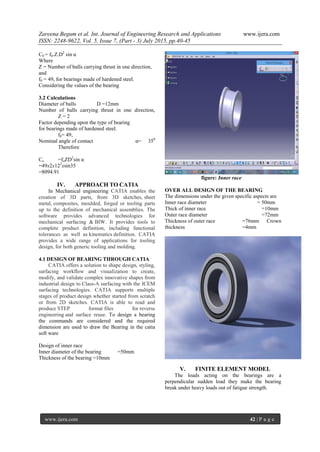
Design of inner race
Inner diameter of the bearing =50mm
Thickness of the bearing =10mm
figure: Inner race
OVER ALL DESIGN OF THE BEARING
The dimensions under the given specific aspects are
Inner race diameter = 50mm
Thick of inner race =10mm
Outer race diameter =72mm
Thickness of outer race =76mm Crown
thickness =4mm
V. FINITE ELEMENT MODEL
The loads acting on the bearings are a
perpendicular sudden load they make the bearing
break under heavy loads out of fatigue strength.
Zareena Begum et al. Int. Journal of Engineering Research and Applications www.ijera.com
ISSN: 2248-9622, Vol. 5, Issue 7, (Part - 3) July 2015, pp.40-45
www.ijera.com 43 | P a g e
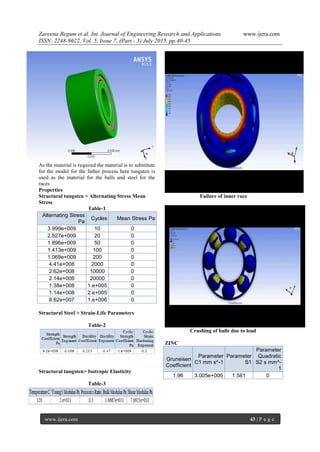
As the material is required the material is to substitute
for the model for the father process here tungsten is
used as the material for the balls and steel for the
races
Properties
Structural tungsten > Alternating Stress Mean
Stress
Table-1
Alternating Stress
Pa
Cycles Mean Stress Pa
3.999e+009 10 0
2.827e+009 20 0
1.896e+009 50 0
1.413e+009 100 0
1.069e+009 200 0
4.41e+008 2000 0
2.62e+008 10000 0
2.14e+008 20000 0
1.38e+008 1.e+005 0
1.14e+008 2.e+005 0
8.62e+007 1.e+006 0
Structural Steel > Strain-Life Parameters
Table-2
Structural tungsten> Isotropic Elasticity
Table-3
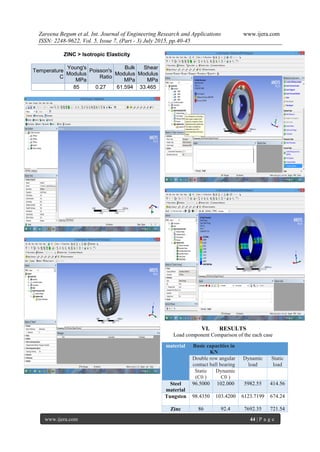
Failure of inner race
Crushing of balls due to load
ZINC
Gruneisen
Coefficient
Parameter
C1 mm s^-1
Parameter
S1
Parameter
Quadratic
S2 s mm^-
1
1.96 3.005e+006 1.581 0
Zareena Begum et al. Int. Journal of Engineering Research and Applications www.ijera.com
ISSN: 2248-9622, Vol. 5, Issue 7, (Part - 3) July 2015, pp.40-45
www.ijera.com 44 | P a g e
ZINC > Isotropic Elasticity
Temperature
C
Young's
Modulus
MPa
Poisson's
Ratio
Bulk
Modulus
MPa
Shear
Modulus
MPa
85 0.27 61.594 33.465
VI. RESULTS
Load component Comparison of the each case
material Basic capacities in
KN
Double row angular
contact ball bearing
Dynamic
load
Static
load
Static
(C0 )
Dynamic
C0 )
Steel
material
96.5000 102.000 5982.55 414.56
Tungsten 98.4350 103.4200 6123.7199 674.24
Zinc 86 92.4 7692.35 721.54
Zareena Begum et al. Int. Journal of Engineering Research and Applications www.ijera.com
ISSN: 2248-9622, Vol. 5, Issue 7, (Part - 3) July 2015, pp.40-45
www.ijera.com 45 | P a g e
Graph 1fatigue nature
The above graph shows how the fatigue nature
change in different load condition
CONCLUSION
The Project says that how the Load vary with
the material and load acting on the bearings under
fatigue nature of the material. The fatigue nature of
the Zinc alloy is more compared to the steel &
Tungsten but comprise of highly qualified design
REFERENCES
[1.] Eschmann et al (1958) stated that when
bearings operate under normal conditions of
well balanced load and good alignment,
fatigue failure begins with small fissures.
These fissures are located between the surface
of the raceway and the rolling elements,
which then gradually propagate to the
surface, generating detectable vibrations and
increasing noise levels.
[2.] Riddle (1955) observed the fatigue
phenomena, known as flaking or spalling and
suggested that continued stress causes
fragments of the material to break or loose,
and produce a localized fatigue.
[3.] Eschmann et al (1958). Eventually, the failure
results in rough running of the bearing. This
is the initiation of failure in rolling element
bearings which reduce the life of the bearing.
According to Riddle (1995) external sources
include contamination and corrosion.
[4.] Bertele (1990) and Neale (1985) suggested
that practically an application of condition
monitoring techniques may help in early fault
detection. In their study on 23 hydrodynamic
lubrication regime occurring in rolling
bearing, high contact pressures are developed
in the surfaces to deform elastically, giving
room for small elliptical contact areas.
[5.] Mitroviü and Tatjana Lazoviü (2002)
investigated upon the frictional sliding which
follows rolling of balls along the rings
raceways. This one causes rolling bearing to
wear
[6.] Tomimoto (2003) taking a keen interest in
plain bearings, opined that an increase in
contaminant concentration could decrease the
thickness of the oil film. Larger size particles
have greater tendency to cause early fatigue
spalling in the contact zone. Besides spalling,
contaminant particles can lead to other
damage mechanisms, such as scuffing. They
originate from the lubricant starvation at the
inlet of the contact zone.
[7.] Aktürk (1999) simulated the effect of
bearings surface waviness on the vibration by
a computer program. 25 The results are
obtained in both time domain and frequency
domains. Loparo et al (2000) presented a
model-based technique for the detection of
faults. Jang and Jeong (2003) proposed an
analytical method to investigate the stability
of a rotating system due to ball bearing
waviness
[8.] Ilonen (2005) introduced a generic condition
diagnosis tool. The tool successfully detected
bearing damage in induction motors using
measurements of the stator current or
vibration. It is based on discriminative energy
functions that reveal discriminative
frequency-domain regions where failures can
be identified.
[9.] Yhland (1992) proposed a linear model for
the vibrations of the shaft bearing system
caused by ball bearing geometric
imperfections. These imperfections covered
are radial and axial waviness of outer and
inner rings, ball waviness, and ball diameter
oversize.
[10.] Tandon and Nakra (1993) reported visual
inspection of the time history of the vibration
signals, time wave form indices, probability
density function, and probability density
moments that are easily analyzed using the
time domain analysis. A time wave form
index is a single number calculated, based on
the raw vibration signal and used for trending
and comparisons. The indices include peak
value, mean value, rms value, and peak-to-
peak amplitude. This method has been
applied with only limited success for the
detection of the defects.

Break Down Analysis of Bearing

  • 1.
    Zareena Begum etal. Int. Journal of Engineering Research and Applications www.ijera.com ISSN: 2248-9622, Vol. 5, Issue 7, (Part - 3) July 2015, pp.40-45 www.ijera.com 40 | P a g e Break Down Analysis of Bearing Zareena Begum, A sathish, Dr. P H V Sesha Talpa Sai *Student of M.Tech **Assi.Prof & Guide ***Proffessor & HOD Department of Mechanical Engineering, Malla Reddy College of Engineering and Technology T.S., India. ABSTRACT The present research work deals is to model new fore wheel bearing of agricultural machine used for ploughing which fail in regular usage. This bearing takes three formulations. They are bearing through Material Change Break Down Analysis The design is done in CATIA and Break Even Analysis is done in ANSYS. And find which one among the Bearing through Design or Bearing through Material Change is solution for the problem aimed for. Break Down Analysis is done in each of the cases to find the maximum forces to be applied on the bearings to get the maximum load that can be bared by the bearings. The objective of our project is to find the solution for the regular failure of bearings of machine through different material. Here we are using three materials i.e. steel, tungsten, zinc Keywords: design,Finite Element Analysis, Break down Analysis. I. INTRODUCTION A bearing is a machine element that constrains relative motion to only the desired motion, and reduces friction between moving parts. The design of the bearing may, for example, provide for free linear movement of the moving part or for free rotation around a fixed axis; or, it may prevent a motion by controlling the vectors of normal forces that bear on the moving parts. Many bearings also facilitate the desired motion as much as possible, such as by minimizing friction. Bearings are classified broadly according to the type of operation, the motions allowed, or to the directions of the loads (forces) applied to the parts. Now a days the agricultures has been using modern equipment of the great output, in this criteria tractor is one of the main technology used for ploughing .As the soil used for ploughing is much slurry the sudden load impact are possible on front axle of the tractor which lead to the brakeage of bearings fixed to axle and tyres. The bearings used are spherical bearings which have the both parallel and perpendicular movement of rotation of fore wheel bearing of agricultural machine used for ploughing which fail in regular usage. So the bearings are studied at different cases and the modeling of bearings takes three formulations. They are modeling of Bearing through Design, modeling of Bearing through Material Change, Break Down Analysis. The first two formulations are done in CATIA and Break down Analysis is done in ANSYS. And find which one among the modeling of Bearing through Design or modeling of Bearing through Material Change is solution for the problem aimed for. Break down Analysis is done in each of the cases to find the maximum forces to be applied on the bearings to get the maximum load that can be bared by the bearings. II. INTRODUCTION TO DESIGN Design of the bearings is done through data analysis of the bearing specifications and their design catalogues. These ball bearings undergo deforming under different periodic loads while rotation. So as reach the require fatigue nature their loads are calculated in two ways they are analytical method and technical method. Analytical method gives out of the hand calculations by using different scientific formulas and modules with data book of different catalogues. The values are approximate values to satisfy the material properties and technical method RESEARCH ARTICLE OPEN ACCESS
  • 2.
    Zareena Begum etal. Int. Journal of Engineering Research and Applications www.ijera.com ISSN: 2248-9622, Vol. 5, Issue 7, (Part - 3) July 2015, pp.40-45 www.ijera.com 41 | P a g e gives out the values or visualization of design by using technical software just by updating with the specifications of required design. This project deals with the both analytical method and technical software CATIA. III. ANALYTICALAPPROACH TO DESIGN The conditions involved in design of bearings is Basic Static Load Rating of Rolling Contact Bearings The load carried by a non-rotating bearing is called a static load. The basic static load rating is defined as the static radial load (in case of radial ball or roller bearings) or axial load (in case of thrust ball or roller bearings) which corresponds to a total permanent deformation of the ball (or roller) and race, at the most heavily stressed contact, equal to 0.0001 times the ball (or roller) diameter. In single row angular contact ball bearings, the basic static load relates to the radial component of the load, which causes a purely radial displacement of the bearing rings in relation to each other. According to IS: 3823–1984, the basic static load rating (C0) in Newton’s for ball and roller bearings may be obtained as discussed below: A) For radial ball bearings, the basic static radial load rating (C0) is given by C0 = f0.i.Z.D2 Cos α Where i = Number of rows of balls in any one bearing, Z = Number of ball per row, D = Diameter of balls, in mm, α = Nominal angle of contact i.e. the nominal angle between the line of action of the ball load and a plane perpendicular to the axis of bearing, and f0 = A factor depending upon the type of bearing. The value of factor (f0) for bearings made of hardened steel is taken as follows: f0 = 3.33, for self-aligning ball bearings = 12.3, for radial contact and angular contact groove ball bearings. B) For radial roller bearings, the basic static radial load rating is given by C0 = f0.i.Z.le.D cos α Where i = Number of rows of rollers in the bearing, Z = Number of rollers per row, le = Effective length of contact between one roller and that ring (or washer) C) Where the contact is the shortest (in mm). It is equal to the overall length of roller minus roller chamfers or grinding undercuts For thrust ball bearings, the basic static axial load rating is given by C0 = f0.Z.D2 sin α Where Z = Number of balls carrying thrust in one direction, and f0 = 49, for bearings made of hardened steel. Considering the values of the bearing 3.1 Calculations Diameter of balls D=12mm Number of balls carrying thrust in one direction, Z = 2 Factor depending upon the type of bearing for bearings made of hardened steel f0= 49 Nominal angle of contact α= 350 Therefore Co=foZD2 sin α =49x2x122 xsin35 =8094.91 Static Equivalent Load for Rolling Contact Bearings The load carried by a non-rotating bearing is called a static load. The basic static load rating is defined as the static radial load (in case of radial ball or roller bearings) or axial load (in case of thrust ball or roller bearings) which corresponds to a total permanent deformation of the ball (or roller) and race, at the most heavily stressed contact, equal to 0.0001 times the ball (or roller) diameter. In single row angular contact ball bearings, the basic static load relates to the radial component of the load, which causes a purely radial displacement of the bearing rings in relation to each other. According to IS: 3823–1984, the basic static load rating (C0) in newtons for ball and roller bearings may be obtained as discussed below: 1. For radial ball bearings, the basic static radial load rating (C0) is given by C0 = f0.i.Z.D2 cos α Where i = Number of rows of balls in any one bearing, Z = Number of ball per row, D = Diameter of balls, in mm, α = Nominal angle of contact i.e. the nominal angle between the line of action of the ball load and a plane perpendicular to the axis of bearing, and f0 = A factor depending upon the type of bearing. The value of factor (f0) for bearings made of hardened steel are taken as follows: f0 = 3.33, for self-aligning ball bearings = 12.3, for radial contact and angular contact groove ball bearings. 2. For radial roller bearings, the basic static radial load rating is given by C0 = f0.i.Z.le.D cos α Where i = Number of rows of rollers in the bearing, Z = Number of rollers per row, le = Effective length of contact between one roller and that ring (or washer) Where the contact is the shortest (in mm). It is equal to the overall length of roller minus roller chamfers or grinding undercuts, 3. For thrust ball bearings, the basic static axial load rating is given by
  • 3.
    Zareena Begum etal. Int. Journal of Engineering Research and Applications www.ijera.com ISSN: 2248-9622, Vol. 5, Issue 7, (Part - 3) July 2015, pp.40-45 www.ijera.com 42 | P a g e C0 = f0.Z.D2 sin α Where Z = Number of balls carrying thrust in one direction, and f0 = 49, for bearings made of hardened steel. Considering the values of the bearing 3.2 Calculations Diameter of balls D =12mm Number of balls carrying thrust in one direction, Z = 2 Factor depending upon the type of bearing for bearings made of hardened steel. f0= 49, Nominal angle of contact α= 350 Therefore Co =foZD2 sin α =49x2x122 xsin35 =8094.91 IV. APPROACH TO CATIA In Mechanical engineering CATIA enables the creation of 3D parts, from 3D sketches, sheet metal, composites, moulded, forged or tooling parts up to the definition of mechanical assemblies. The software provides advanced technologies for mechanical surfacing & BIW. It provides tools to complete product definition, including functional tolerances as well as kinematics definition. CATIA provides a wide range of applications for tooling design, for both generic tooling and molding. 4.1 DESIGN OF BEARING THROUGH CATIA CATIA offers a solution to shape design, styling, surfacing workflow and visualization to create, modify, and validate complex innovative shapes from industrial design to Class-A surfacing with the ICEM surfacing technologies. CATIA supports multiple stages of product design whether started from scratch or from 2D sketches. CATIA is able to read and produce STEP format files for reverse engineering and surface reuse. To design a bearing the commands are considered and the required dimension are used to draw the Bearing in the catia soft ware Design of inner race Inner diameter of the bearing =50mm Thickness of the bearing =10mm figure: Inner race OVER ALL DESIGN OF THE BEARING The dimensions under the given specific aspects are Inner race diameter = 50mm Thick of inner race =10mm Outer race diameter =72mm Thickness of outer race =76mm Crown thickness =4mm V. FINITE ELEMENT MODEL The loads acting on the bearings are a perpendicular sudden load they make the bearing break under heavy loads out of fatigue strength.
  • 4.
    Zareena Begum etal. Int. Journal of Engineering Research and Applications www.ijera.com ISSN: 2248-9622, Vol. 5, Issue 7, (Part - 3) July 2015, pp.40-45 www.ijera.com 43 | P a g e As the material is required the material is to substitute for the model for the father process here tungsten is used as the material for the balls and steel for the races Properties Structural tungsten > Alternating Stress Mean Stress Table-1 Alternating Stress Pa Cycles Mean Stress Pa 3.999e+009 10 0 2.827e+009 20 0 1.896e+009 50 0 1.413e+009 100 0 1.069e+009 200 0 4.41e+008 2000 0 2.62e+008 10000 0 2.14e+008 20000 0 1.38e+008 1.e+005 0 1.14e+008 2.e+005 0 8.62e+007 1.e+006 0 Structural Steel > Strain-Life Parameters Table-2 Structural tungsten> Isotropic Elasticity Table-3 Failure of inner race Crushing of balls due to load ZINC Gruneisen Coefficient Parameter C1 mm s^-1 Parameter S1 Parameter Quadratic S2 s mm^- 1 1.96 3.005e+006 1.581 0
  • 5.
    Zareena Begum etal. Int. Journal of Engineering Research and Applications www.ijera.com ISSN: 2248-9622, Vol. 5, Issue 7, (Part - 3) July 2015, pp.40-45 www.ijera.com 44 | P a g e ZINC > Isotropic Elasticity Temperature C Young's Modulus MPa Poisson's Ratio Bulk Modulus MPa Shear Modulus MPa 85 0.27 61.594 33.465 VI. RESULTS Load component Comparison of the each case material Basic capacities in KN Double row angular contact ball bearing Dynamic load Static load Static (C0 ) Dynamic C0 ) Steel material 96.5000 102.000 5982.55 414.56 Tungsten 98.4350 103.4200 6123.7199 674.24 Zinc 86 92.4 7692.35 721.54
  • 6.
    Zareena Begum etal. Int. Journal of Engineering Research and Applications www.ijera.com ISSN: 2248-9622, Vol. 5, Issue 7, (Part - 3) July 2015, pp.40-45 www.ijera.com 45 | P a g e Graph 1fatigue nature The above graph shows how the fatigue nature change in different load condition CONCLUSION The Project says that how the Load vary with the material and load acting on the bearings under fatigue nature of the material. The fatigue nature of the Zinc alloy is more compared to the steel & Tungsten but comprise of highly qualified design REFERENCES [1.] Eschmann et al (1958) stated that when bearings operate under normal conditions of well balanced load and good alignment, fatigue failure begins with small fissures. These fissures are located between the surface of the raceway and the rolling elements, which then gradually propagate to the surface, generating detectable vibrations and increasing noise levels. [2.] Riddle (1955) observed the fatigue phenomena, known as flaking or spalling and suggested that continued stress causes fragments of the material to break or loose, and produce a localized fatigue. [3.] Eschmann et al (1958). Eventually, the failure results in rough running of the bearing. This is the initiation of failure in rolling element bearings which reduce the life of the bearing. According to Riddle (1995) external sources include contamination and corrosion. [4.] Bertele (1990) and Neale (1985) suggested that practically an application of condition monitoring techniques may help in early fault detection. In their study on 23 hydrodynamic lubrication regime occurring in rolling bearing, high contact pressures are developed in the surfaces to deform elastically, giving room for small elliptical contact areas. [5.] Mitroviü and Tatjana Lazoviü (2002) investigated upon the frictional sliding which follows rolling of balls along the rings raceways. This one causes rolling bearing to wear [6.] Tomimoto (2003) taking a keen interest in plain bearings, opined that an increase in contaminant concentration could decrease the thickness of the oil film. Larger size particles have greater tendency to cause early fatigue spalling in the contact zone. Besides spalling, contaminant particles can lead to other damage mechanisms, such as scuffing. They originate from the lubricant starvation at the inlet of the contact zone. [7.] Aktürk (1999) simulated the effect of bearings surface waviness on the vibration by a computer program. 25 The results are obtained in both time domain and frequency domains. Loparo et al (2000) presented a model-based technique for the detection of faults. Jang and Jeong (2003) proposed an analytical method to investigate the stability of a rotating system due to ball bearing waviness [8.] Ilonen (2005) introduced a generic condition diagnosis tool. The tool successfully detected bearing damage in induction motors using measurements of the stator current or vibration. It is based on discriminative energy functions that reveal discriminative frequency-domain regions where failures can be identified. [9.] Yhland (1992) proposed a linear model for the vibrations of the shaft bearing system caused by ball bearing geometric imperfections. These imperfections covered are radial and axial waviness of outer and inner rings, ball waviness, and ball diameter oversize. [10.] Tandon and Nakra (1993) reported visual inspection of the time history of the vibration signals, time wave form indices, probability density function, and probability density moments that are easily analyzed using the time domain analysis. A time wave form index is a single number calculated, based on the raw vibration signal and used for trending and comparisons. The indices include peak value, mean value, rms value, and peak-to- peak amplitude. This method has been applied with only limited success for the detection of the defects.