Downloaded 16 times
![Navjot Int. Journal of Engineering Research and Applications www.ijera.com
ISSN : 2248-9622, Vol. 5, Issue 6, ( Part - 5) June 2015, pp.131-137
www.ijera.com 131 | P a g e
To mitigate Black-hole attack with CBDS in MANET
Navjot * Er.Pooja Rani**
*(M.tech Student ,Department of CSE, Rayat & Bahra, Mohali Campus,Tehsil- Kharar, Punjab-140104,)
** (Associate Professor, Department of IT, Rayat & Bahra, Mohali Campus,Tehsil- Kharar, Punjab-140104)
Abstract-
Mobile ad-hoc network is self configured network that consist of mobile nodes which communicate with each
other. Distributed self-organized nature of this network makes it venerable to various attacks likes DOS attack,
Black hole attack, wormhole attack and jamming attack etc. Blackhole attack is one of the serious attack in
network in which information loss occur which degrades the performance of network. In this work black hole
attack is detected with the help of CBDS (cooperative Bait Detection Algorithm) and MD5 is used for the
security purpose. This work is implemented in Network simulator and performance is checked on the bases of
network parameters.
Keywords-end to end delay, overhead, PDR, throughput
I. INTRODUCTION
Mobile ad hoc networks (MANETs) [12] have
become important in increasingly large range of
applications, such as battlefields and other military
environments, disaster areas, and some other
activities. A MANET is a multi-hop wireless
network (without wire) that is formed dynamically
from an accumulation of mobile nodes without the
assistance of a center coordinator. As the radio
propagation range is in limit, every mobile node has
information in limit, such as its own ID and the
Medium Access Control (MAC) address of its one-
hop neighbors. Therefore, if two nodes are not in the
radio propagation range, a multi-hop, via one or
more intermediate nodes, is needed to forward
packets. With recent invention in wireless
technology, portable computing platforms and small
wireless devices become indispensable devices [6].
The use of a portable device is constrained by its
energy, making power conservation the most critical
issue for portable devices and their uses. MANETs
are a kind of Wireless ad hoc network that usually
has a routable networking environment on above of
a Link Layer ad hoc network. MANETs consist of a
peer-to-peer, self-healing network in contrast to a
mesh network has a central controller (to determine,
optimize, and distribute). MANETs circa 2000-2015
typically communicate at radio frequencies.
1.1 Mobile Ad Hoc Network
MANETs is called Mobile Ad hoc Networks.
Mobile implies “mobility”. Ad hoc is a Latin word
that means “for this only”. MANET is an
autonomous collection of mobile nodes that
communicate over wireless links [4].
MANET is a minimum IP based system of mobile
and wireless machine nodes associated with radio. In
operation, the nodes of a MANET don't have a
concentrated organization mechanism. It is known
for its route network properties where every node go
about as a "router" to forward the movement to other
indicated hub in the system.
MANET is a less remote system. The nodes moves
haphazardly and sort out themselves discretionarily
[10]. The nodes specifically correspond through
remote connections with one another's radio reach,
while that are far off separated utilization different
nodes as hand-off, in a multi-jump steering capacity
[3]. As the nodes are mobile, the structure of the
system changes alertly and dynamically over the
long run. Ad-hoc networks are self-designing and
self-sorting out, so to keep up communication
between nodes in the system, every node carries on
as a source; begin point, a host and a switch.
"A mobile Ad-Hoc system (MANET) is a self-
arranging system of mobile routers (and related
hosts) associated by wireless links." [4].
Some of the principle components of MANET are as
follows [3]:
a) MANET can be framed with no previous
framework.
b) It deal with element topology where nodes may
join and leave the system whenever with their own
decision and the multi-jump directing may continue
changing as nodes join and withdraw from the
system.
RESEARCH ARTICLE OPEN ACCESS](https://image.slidesharecdn.com/w5605131137-150802102812-lva1-app6891/85/To-mitigate-Black-hole-attack-with-CBDS-in-MANET-1-320.jpg)
![Navjot Int. Journal of Engineering Research and Applications www.ijera.com
ISSN : 2248-9622, Vol. 5, Issue 6, ( Part - 5) June 2015, pp.131-137
www.ijera.com 131 | P a g e
To mitigate Black-hole attack with CBDS in MANET
Navjot * Er.Pooja Rani**
*(M.tech Student ,Department of CSE, Rayat & Bahra, Mohali Campus,Tehsil- Kharar, Punjab-140104,)
** (Associate Professor, Department of IT, Rayat & Bahra, Mohali Campus,Tehsil- Kharar, Punjab-140104)
Abstract-
Mobile ad-hoc network is self configured network that consist of mobile nodes which communicate with each
other. Distributed self-organized nature of this network makes it venerable to various attacks likes DOS attack,
Black hole attack, wormhole attack and jamming attack etc. Blackhole attack is one of the serious attack in
network in which information loss occur which degrades the performance of network. In this work black hole
attack is detected with the help of CBDS (cooperative Bait Detection Algorithm) and MD5 is used for the
security purpose. This work is implemented in Network simulator and performance is checked on the bases of
network parameters.
Keywords-end to end delay, overhead, PDR, throughput
I. INTRODUCTION
Mobile ad hoc networks (MANETs) [12] have
become important in increasingly large range of
applications, such as battlefields and other military
environments, disaster areas, and some other
activities. A MANET is a multi-hop wireless
network (without wire) that is formed dynamically
from an accumulation of mobile nodes without the
assistance of a center coordinator. As the radio
propagation range is in limit, every mobile node has
information in limit, such as its own ID and the
Medium Access Control (MAC) address of its one-
hop neighbors. Therefore, if two nodes are not in the
radio propagation range, a multi-hop, via one or
more intermediate nodes, is needed to forward
packets. With recent invention in wireless
technology, portable computing platforms and small
wireless devices become indispensable devices [6].
The use of a portable device is constrained by its
energy, making power conservation the most critical
issue for portable devices and their uses. MANETs
are a kind of Wireless ad hoc network that usually
has a routable networking environment on above of
a Link Layer ad hoc network. MANETs consist of a
peer-to-peer, self-healing network in contrast to a
mesh network has a central controller (to determine,
optimize, and distribute). MANETs circa 2000-2015
typically communicate at radio frequencies.
1.1 Mobile Ad Hoc Network
MANETs is called Mobile Ad hoc Networks.
Mobile implies “mobility”. Ad hoc is a Latin word
that means “for this only”. MANET is an
autonomous collection of mobile nodes that
communicate over wireless links [4].
MANET is a minimum IP based system of mobile
and wireless machine nodes associated with radio. In
operation, the nodes of a MANET don't have a
concentrated organization mechanism. It is known
for its route network properties where every node go
about as a "router" to forward the movement to other
indicated hub in the system.
MANET is a less remote system. The nodes moves
haphazardly and sort out themselves discretionarily
[10]. The nodes specifically correspond through
remote connections with one another's radio reach,
while that are far off separated utilization different
nodes as hand-off, in a multi-jump steering capacity
[3]. As the nodes are mobile, the structure of the
system changes alertly and dynamically over the
long run. Ad-hoc networks are self-designing and
self-sorting out, so to keep up communication
between nodes in the system, every node carries on
as a source; begin point, a host and a switch.
"A mobile Ad-Hoc system (MANET) is a self-
arranging system of mobile routers (and related
hosts) associated by wireless links." [4].
Some of the principle components of MANET are as
follows [3]:
a) MANET can be framed with no previous
framework.
b) It deal with element topology where nodes may
join and leave the system whenever with their own
decision and the multi-jump directing may continue
changing as nodes join and withdraw from the
system.
RESEARCH ARTICLE OPEN ACCESS](https://image.slidesharecdn.com/w5605131137-150802102812-lva1-app6891/75/To-mitigate-Black-hole-attack-with-CBDS-in-MANET-1-2048.jpg)
![Navjot Int. Journal of Engineering Research and Applications www.ijera.com
ISSN : 2248-9622, Vol. 5, Issue 6, ( Part - 5) June 2015, pp.131-137
www.ijera.com 132 | P a g e
c) It has extremely constrained physical security, and
accordingly expanding security is a noteworthy
concern.
d) Every node in the MANET can help with
directing of parcels in the system.
e) Both Bandwidth & Power in cutoff
1.2 Types of MANET
• Vehicular Ad hoc Networks (VANETs) are
utilized likewise as a part of correspondence.
Communication among vehicles and in the middle of
vehicles and roadside equipment. Intelligent
vehicular Ad-Hoc systems (In VANETs) are a sort
of computerized reasoning that helps vehicles to
carry on in intelligent manner during vehicle to
vehicle collision, accidents, drunken driving with
telephone calls [7].
• Internet based versatile specially appointed
systems (I MANETs) are Ad-Hoc systems that
connect portable nodes [8]. Fixed internet gateway
nodes. For instance, different sub-MANETs may be
connected by a classic Hub-Spoke VPN to make a
topographically conveyed MANET. In such kind of
systems ordinary specially appointed directing
calculations don't make a difference specifically.
• Military MANETs are utilized by military
units with accentuation on security, reach, and
incorporation with existing frameworks. Regular
waveforms incorporate the US, Persistent Systems'
Wave Relay, and Trellis product's TSM [2].
1.3 Characteristics of MANETs
• Dynamic topologies: Nodes are allowed to
move arbitrarily; along these lines, the system
topology- -which is ordinarily multichip- -may
change arbitrarily and quickly at unpredictable
times, and may comprise of both bidirectional,
unidirectional connections [8].
• Bandwidth-constrained, variable capacity
links: Wireless connections will keep on having
essentially lower limit than their hardwired
counterparts. Moreover, the acknowledged
throughput of wireless communication subsequent to
representing the impacts of multiple access, fading,
noise, and interference condition, and so forth., is
often much less than radio maximum condition [10].
• Energy-constrained operation: Some or the
greater part of the nodes in a MANET may depend
on batteries or other exaustable means for their
energy [11]. The most essential system design
criteria for streamlining may be energy preservation.
• Limited physical security: Mobile wireless
networks are by and large more inclined to physical
security dangers than are fixed cable nets. The
expanded possibility of eavesdropping, pooling, and
denial of attacks ought to be carefully considered.
Existing connection security procedures are
regularly connected inside of remote systems to
lessen security dangers [14]. As an advantage, the
decentralized way of system control in MANETs
gives extra strength against the single purposes of
disappointment of more unified.
1.4 MANET Challenges
A MANET [6] environment needs to overcome
certain issues of constraint and limitations. It
comprises of taking after:
• The qualities of remote connection are
time-varying in nature - There are transmission
obstruction like path loss, blockage and interference
that adds to the suspect able behavior of remote
channels. The reliability of remote transmission is
opposed by diverse elements [12].
• Limited scope of remote transmission - The
limited radio band brings about reduces information
rates compared with the remote systems.
Subsequently best use of bandwidth capacity is
essential by keeping low overhead as could
reasonably be expected.
• Packet loss because of error in transmission
- MANETs experience higher packet loss because of
variables, for example, hidden terminals that
outcomes in crashes, remote channel issues (high bit
lapse rate (BER)), obstruction, and successive
breakage in ways brought on by versatility of nodes,
expanded impacts because of the presence of hidden
terminals and uni-directional connections [15].
1.5 Applications of MANET
• The technology of Mobile Ad hoc
Networking is fairly synonymous with Mobile
Packet Radio Networking Mobile Mesh Networking
(a term that showed up in an article in The
Economist in regards to the structure of future
military systems) and Mobile, Multi-jump n/w,
Wireless Networking (maybe the most exact term,
in spite of the fact that somewhat unwieldy). There
is present and future requirement for dynamic ad hoc
network technology. The rising field of mobile and
nomadic computing, with its present emphasis on
versatile IP operation, ought to progressively](https://image.slidesharecdn.com/w5605131137-150802102812-lva1-app6891/85/To-mitigate-Black-hole-attack-with-CBDS-in-MANET-2-320.jpg)
![Navjot Int. Journal of Engineering Research and Applications www.ijera.com
ISSN : 2248-9622, Vol. 5, Issue 6, ( Part - 5) June 2015, pp.131-137
www.ijera.com 133 | P a g e
increase and require very highly adaptive mobile
networking technology [12]
• Effectively managed multichip, Ad-Hoc
network cluster which can work autonomously or
[13], more than likely, be appended sooner or later
to fixed Internet.
• Some uses of MANET technology could
incorporate modern and business applications
including cooperative versatile information trade.
Mobile base network can be fill in as strong, cheap
choices or improvements to cell-based versatile
system frameworks. There are likewise existing and
future military network requirement for robhust for
hearty, IP-consistent information benefits inside of
portable remote correspondence systems; a number
of these systems comprise of profoundly element or
we can say haphazardly self-sufficient topology
portions. Likewise, the creating innovations of
"wearable" figuring and correspondences may give
applications to MANET technology [16].
• In flame/safety operations or different
situations obliging quickly deployable
correspondences with survivable, proficient element
organizing [12]. There are likely different
applications for MANET innovation which are not
right away acknowledged or imagined by the
creators. It is, basically, enhanced IP-based systems
administration innovation for element.
2. Dark gap assault
MANETs face diverse securities dangers
The initially proposed arrangement here for dark
black hole is to discover more and more course to
the destination (excess courses, no less than three
distinct courses). At that point, the source node uni-
cast a ping packet to the destination utilizing these
three courses (we ought to allocate distinctive parcel
IDs and grouping number, so any node who get the
first parcel will not drop the second one just in one
condition in the event that it exists in both ways).
The receiver and the malicious in addition any
transitional node may have a course to the
destination will answer to this ping solicitation. The
source will check those acknowledgements, and
process them with a specific end goal to make sense
of which one is not sheltered and may have
malicious node.
The second proposed solution exploits the packet
sequence number included in any packet header. The
node in this situation needs to have two extra tables;
the first table consists of the sequence numbers of
the last packet sent to the every node in the network,
and the second table for the sequence number
received from every sender. During the RREP phase,
the intermediate or the last node must include the
sequence number of last packet received from the
source that initiates RREQ. Once the source receives
this RREP, it will extract the last sequence number
and then compare it with the values in the table. If it
matches the transmission will take place. If not, this
replied node is a malicious node, so an alarm text
will be broadcast as a warring the network about this
node.
These assaults are sorted as:-
2.1 Black Hole Attack: one malicious node uses
directing convention to claim itself of being briefest
way to last node yet drops steering bundles and
doesn't send parcels to its neighbors [17].
1.6 Internal Black Hole Attack
Internal black hole attack is that when internal node
act as a attacker. This is also called active attack.
Internal attack is that when the internal node is doing
misbehaving, such as not using proper bandwidth or
proper processing Capability also the misbehaving
node tells the entire node that it will be a shortest
path to reach the destination. The internal malicious
node also changes the data when it sends from first
node to last node [12]. in This type of black hole
attack has an internal malicious node which fits in
between the routes of given source and destination.
As soon as it gets the chance this malicious node
make itself an active data route element. At this
stage it is now capable of conducting attack with the
start of data transmission. This is an internal attack
because node belongs to the data route. Internal
attack is more vulnerable to defend against because
of difficulty in detecting the internal misbehaving
node
1.7 External Black Hole Attack
It is also called passive attack. It stays outside the
network, but disturbs the network by creating n/w
congestion and wants a control over the internal
node of the network by sending a RREQ to the
source that it’s a shortest path to reach in the last
node and carry data from the source. [6]
External attackers physically stay outside of the
system and deny access to network movement or
making blockage in system or by upsetting the
whole system.
1. Malicious nodedistinguishes the active route and
recalls the destination address.
2. Malicious node sends a course answer bundle
(RREP) including the destination location field
satirizes to an obscure destination address [17].](https://image.slidesharecdn.com/w5605131137-150802102812-lva1-app6891/85/To-mitigate-Black-hole-attack-with-CBDS-in-MANET-3-320.jpg)
![Navjot Int. Journal of Engineering Research and Applications www.ijera.com
ISSN : 2248-9622, Vol. 5, Issue 6, ( Part - 5) June 2015, pp.131-137
www.ijera.com 134 | P a g e
Hope count value is situated to lowest value qualities
and the sequence value is set to be the highest.
3. Malicious node sends RREP to the nearest nodes
which have a place with the active route. This can
likewise be send straightforwardly to the information
source node if course is accessible.
4. The RREP received by the nearest node to the
malicious node will transferred by means of the set
up inverse route to the information of source hub.
5. The new data got in the course answer will permit
the source hub to upgrade its steering table.
6. New route selected by source node for selecting
data.
7. The malicious node will drop now all the data to
which it belong in the route
1.8 Black hole Attacks are classified into two
categories
1.8.1 Single Black Hole Attack
In Single Black hole Attack in which one node acts
as attacker. It is also known as Black Hole Attack .it
has single malicious nodes.
1.8.2 Collaborating Hole Attack
In Collaborative Black Hole Attack more than one
nodes act as malicious node. It is also known as
Black Hole Attack with multiple malicious nodes
According to the original AODV protocol, when
first node S wants to communicate with the last node
D, the first node S shows the course ask for (RREQ)
parcel [4]. The neighboring dynamic nodes overhaul
their directing table with a section for the source hub
S, and check in the event that it is the last hub or has
a sufficiently crisp course to the destination hub. If
not, the transitional hub redesigns the RREQ
(expanding the jump tally) and surges the system
with the RREQ to the last hub D until it achieves
hub D or some other middle hub which has a
sufficiently new course to D, as delineated by
illustration in Figure 1. The last hub D or the middle
of the road hub with a sufficiently new course to D,
starts a course reaction (RREP) in the opposite
bearing, as portrayed. Hub S begins sending
information parcels to the neighboring hub which
reacted in the first place, and tosses alternate
reactions. This works is fine when the system has no
noxious nodes. Specialists have proposed answers
for recognize and evacuate a solitary dark gap hub.
Be that as it may, the instance of numerous dark
opening nodes acting in coordination has not been
tended to [17]. Case in point, when numerous dark
opening nodes are acting in a joint effort with one
another, the first dark gap hub B1 alludes to one of
its buddies B2 as the following bounce. As per [3],
the source hub S sends a "Further Request (FRq)" to
B2 through an alternate course (S-2-4-B2) other than
by means of B1. Hub S inquires as to whether it has
a course to hub B1 and a course to last hub D. Since
B2 is chipping in with B1, its "Further Reply (FRp)"
will be "yes" to both the inquiries. Presently per the
arrangement proposed in [3], nodes begins passing
the information parcels expecting that the course S-
B1-B2 is more secure. In any case, in actuality, the
bundles are devoured by hub B1 and the security of
the system is
bargained.
Figure 1: Black hole attack
1.9 Flow of Work
II. ALGORITHMIC STEPS
Step 1. Generate wireless scenario
Step 2. Initialize n number of nodes
Step 3. Apply CBDS
a) Send RREQ
b) If (RREQ = true)
{System working fine}
Else if (time of reply > threshold)](https://image.slidesharecdn.com/w5605131137-150802102812-lva1-app6891/85/To-mitigate-Black-hole-attack-with-CBDS-in-MANET-4-320.jpg)
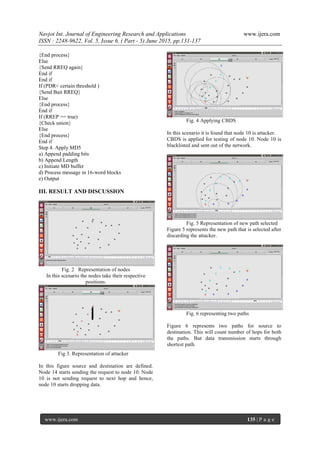
![Navjot Int. Journal of Engineering Research and Applications www.ijera.com
ISSN : 2248-9622, Vol. 5, Issue 6, ( Part - 5) June 2015, pp.131-137
www.ijera.com 136 | P a g e
Fig. 7Representing overhead
This graph represents routing overhead. Green line
represents routing overhead with CBDS and without
CBDS.
Fig 8 Represents throughput
Throughput is total number of successful bites
received. This graph represents throughput.
Fig. 9 Represents end to end delay
This figure represents end to end delay of nodes.
With CBDS delay is lesser as compared to without
CBDS hence, Afterapplying CBDS result are better.
Fig .10 Represents PDR
This figure represents PDR (Packet delivery ratio).
PDR with CBDS is good as compared to Without
CBDS.
IV. CONCLUSION
In this work blackhole attack is mitigated with
the help of cooperative bait detection scheme and
message digest 5. MD5 is used for the security of
messages. This research is concluded on the bases of
quality of service parameters like throughput, packet
delivery ratio, delay and overhead. It is examine that
parameters give better result with CBDS and MD5
scheme rather than other simple blackhole
approaches. In future this can also be dined using
some artificial intelligent technique and its security
can be enhanced by using cryptography.
REFERENCES
[1] C. E. Perkins and E. M. Royer, “Ad-hoc on-
demand distance vector routing” In Proc. 2nd
IEEE Workshop on Mobile Computing Systems
and Applications, Vol. 3, pp. 90–100, Feb.
1999.
[2] DanaiChasaki and Tilman Wolf, “Evaluation
of Path Recording Techniques in Secure
MANET” in Military Communications
Conference, 2009. MILCOM 2009. IEEE
Vol.2, Issue 2, pp. 1-6.
[3] H. Tian and H. Shen, “Multicast-based
inference of network-internal loss
performance,” in Proc. of 7th International
Symposium on Parallel Architectures,
Algorithms and Networks (ISPAN 2004), Hong
Kong, China, Vol.6 pp. 288–293.
[4] Kartik Kumar Srivastava, AvinashTripathi,
and Anjnesh Kumar Tiwari, “ Secure Data
Transmission in MANET Routing Protocol” in
International journal Computer Technology &
Applications Dec 2003,Vol.3, Issue 6, pp.
1915-1921.
[5] N. G. Duffield and F. Lo Presti, “Network
tomography from measured end-to-end delay
covariance” in IEEE/ACM Transactions on
Networking, Dec. 2004, Vol.12, Issue 6, pp.
978–992.
[6] Dutta, C.B “A novel black hole attack for
multipath AODV and its mitigation”, IEEE
conf. on Recent Advances and Innovations in
Engineering, May 2014, 1 – 6.
[7] Vicomsoft, “Knowledge share whitepapers
wireless networking Q&A”, Vicomsoft
connect and protect, Jan 2003.
[8] Wikipedia, “The free encyclopedia-, Mobile
ad-hoc Network”,
http://en.wikipedia.org/wiki/Mobile_ad-hoc_
network, Oct-2004.](https://image.slidesharecdn.com/w5605131137-150802102812-lva1-app6891/85/To-mitigate-Black-hole-attack-with-CBDS-in-MANET-6-320.jpg)
![Navjot Int. Journal of Engineering Research and Applications www.ijera.com
ISSN : 2248-9622, Vol. 5, Issue 6, ( Part - 5) June 2015, pp.131-137
www.ijera.com 137 | P a g e
[9] Charles E.Perkins and Elizabeth M. Royer,
“Ad hoc on demand distance vector (AODV)
routing (Internet-Draft)”, Aug-1998.
[10]HumayunBakht, “Computing Unplugged,
Wireless infrastructure, Some Applications of
Mobile ad hoc networks”,
http://www.computingunplugged.com/issues/
issue200410/00001395001.html, April-2003.
[11]Loutfi, Valerie, Bruno. “Securing mobile
adhoc networks”, MP71 project, 2003.
[12]Mario Joa-Ng, “A Peer-to-Peer Zone-Based
Two-Level Link State Routing for Mobile Ad
Hoc Networks”, IEEE Journal on selected
areas in communications, Vol. 17, No. 8, Aug-
1999.
[13]PadminiMisra, “Routing Protocols for ad hoc
mobile wireless Networks”,
http://www.cse.ohio-state.edu /~jain/cis788-
99/ftp/adhoc_routing/#TDRP, Nov-1999.
[14]Avdesh Kumar Bhatt, ChanderMohini and
Shikha Thakur, “ A New Efficient and Reliable
On-Demand Routing Protocol for MANET
(ERORPM)” International Journal of
Advanced Research in Computer Science and
Software Engineering,Volume 3, Issue 5, May
2013.
[15]Anju Gill and ChanderDiwaker, “Comparative
Analysis of Routing in MANET” International
Journal of Advanced Research in Computer
Science and Software Engineering,Volume 2,
Issue 7, July 2012.
[16]Rakesh Kumar, ManojMisra, and Anil K.
Sarje, “A Simplified Analytical Model for
End-To-End Delay Analysis in MANET” IJCA
Special Issue on “Mobile Ad-hoc Networks”
MANETs, 2010.
[17]TamilSelvan, L., Chennai ; Sankaranarayanan,
V.,” Prevention of Blackhole Attack in
MANET “,Wireless Broadband and Ultra
Wideband Communications, 2007.
AusWireless 2007. The 2nd International
Conference, pp-21-24.](https://image.slidesharecdn.com/w5605131137-150802102812-lva1-app6891/85/To-mitigate-Black-hole-attack-with-CBDS-in-MANET-7-320.jpg)

The document discusses strategies to mitigate black-hole attacks in Mobile Ad-hoc Networks (MANETs) using the Cooperative Bait Detection Algorithm (CBDS) and MD5 for security. It outlines the nature of MANETs, their vulnerabilities to attacks, and focuses on the problems of malicious nodes that disrupt communication by dropping data packets. The proposed method involves detecting threats by checking packet sequences and using alternative communication paths to ensure data integrity.


![[IJET-V1I6P19] Authors : Kirti](https://cdn.slidesharecdn.com/ss_thumbnails/ijet-v1i6p19-160110015550-thumbnail.jpg?width=640&height=640&fit=bounds)


