Hitesh pandey et al. Int. Journal of Engineering Research and Applications www.ijera.com 
ISSN : 2248-9622, Vol. 4, Issue 11(Version - 5), November 2014, pp.60-64 
www.ijera.com 60 | P a g e 
Thermal Stress Analysis of a Speculative IC Engine Piston using CAE Tools Hitesh pandey1, Avin Chandrakar2, PM Bhagwat3 1. Research Scholar, Oriental University, Indore. 2. Associate Professor, Oriental University, Indore. 3. Professor and head, Oriental University, Indore Abstract: This paper deals with the pressure due to expanding combustion gases in the combustion chamber space at the top of the cylinder which generate thermal stresses due to presence of heat involved on the reciprocating masses. The present work deals with the use of different materials for IC engine piston and a comparative study is made to achieve the best possible result. Piston parameters are taken using the conventional formulas and are constant throughout the analysis. Moreover the boundary conditions are chosen such that the piston does not moves sideways except in the direction of line of action of the piston itself. 
Keywords: Thermal stresses, FEA, IC engine Piston, pressure, Piston material 
I. Introduction: 
Thermal analysis is a branch of materials science where the properties of materials are studied as they change with temperature. In an IC engine the power is developed inside the engine cylinder by burning the fuel in the cylinder itself. The heat energy produced during the combustion of fuel is converted into mechanical energy by the expansion of gases against the piston. The piston is a disc which reciprocates within a cylinder. It is either moved by the fluid or it moves the fluid which enters the cylinder. The main function of the piston of an internal combustion engine is to receive the impulse from the expanding gas and to transmit the energy to the crankshaft through the connecting rod. The piston must also disperse a large amount of heat from the combustion chamber to the cylinder walls. 
II. Material for Pistons: 
The most commonly used materials for pistons of I.C. engines are cast iron, cast aluminium, forged aluminium, cast steel and forged steel. The cast iron pistons are used for moderately rated engines with piston speeds below 6 m/s and aluminium alloy pistons are used for highly rated engines running at higher piston speeds. Since the aluminium alloys used for pistons have high heat conductivity (nearly four times that of cast iron), therefore, these pistons ensure high rate of heat transfer and thus keeps down the maximum temperature difference between the centre and edges of the piston head or crown. 
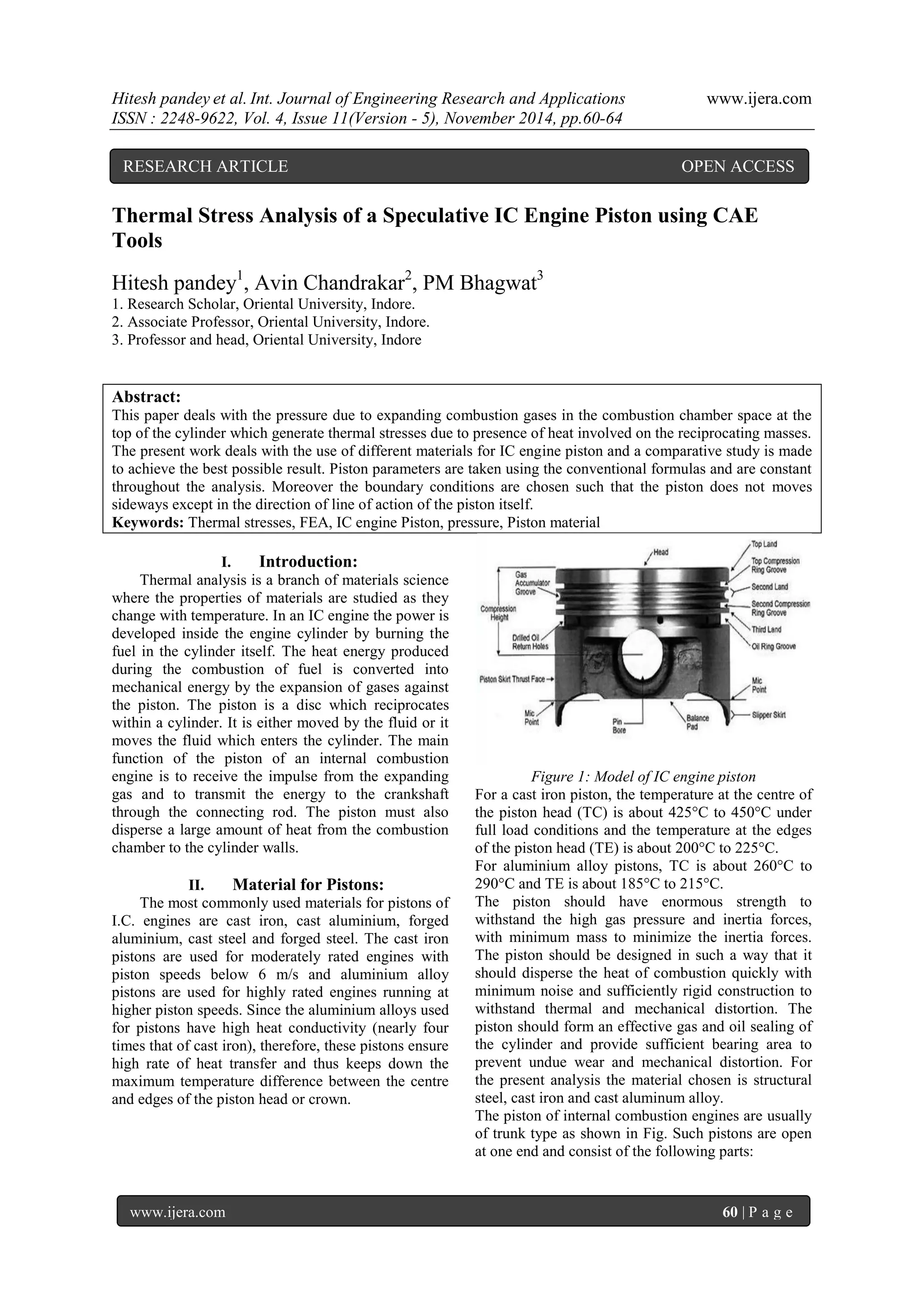
Figure 1: Model of IC engine piston For a cast iron piston, the temperature at the centre of the piston head (TC) is about 425°C to 450°C under full load conditions and the temperature at the edges of the piston head (TE) is about 200°C to 225°C. For aluminium alloy pistons, TC is about 260°C to 290°C and TE is about 185°C to 215°C. The piston should have enormous strength to withstand the high gas pressure and inertia forces, with minimum mass to minimize the inertia forces. The piston should be designed in such a way that it should disperse the heat of combustion quickly with minimum noise and sufficiently rigid construction to withstand thermal and mechanical distortion. The piston should form an effective gas and oil sealing of the cylinder and provide sufficient bearing area to prevent undue wear and mechanical distortion. For the present analysis the material chosen is structural steel, cast iron and cast aluminum alloy. The piston of internal combustion engines are usually of trunk type as shown in Fig. Such pistons are open at one end and consist of the following parts: 
RESEARCH ARTICLE OPEN ACCESS
Hitesh pandey et al. Int. Journal of Engineering Research and Applications www.ijera.com 
ISSN : 2248-9622, Vol. 4, Issue 11(Version - 5), November 2014, pp.60-64 
www.ijera.com 61 | P a g e 
1. Head or crown-The piston head or crown may be flat, convex or concave depending upon the design of combustion chamber. It withstands the pressure of gas in the cylinder. 2. Piston rings-The piston rings are used to seal the cylinder in order to prevent leakage of the gas past the piston. 3. Skirt-The skirt acts as a bearing for the side thrust of the connecting rod on the walls of cylinder. 4. Piston pin-It is also called gudgeon pin or wrist pin. It is used to connect the piston to the connecting rod. Literature Review: 
A combined experimental and numerical study has been carried out on finned metal foam and metal foam heat sinks under impinging air jet cooling M.M. Haquea observed that as the superheating temperature is increased up to an optimum temperature of 750 ◦C, the eutectic silicon becomes more globular and well distributed all over the entire structure[2]. Ajay Raj Singh describes the stress distribution and thermal stresses of three different aluminum alloys piston by using finite element method (FEM)[3]. M.X. Calbureanu compare the behavior of the combustion engine piston made of aluminum alloys. The paper describes the mesh optimization with using finite element analysis technique to predict the higher stress and critical region on the component[4]. S. Srikanth Reddy investigated on a conventional (uncoated) diesel piston, made of aluminium silicon alloy for design 1 and design 2 parameters. Secondly, thermal analyses are performed on piston, coated with Zirconium material by means of using a commercial code, namely ANSYS [5]. A. R. Bhagat describes the stress distribution of the seizure on piston four stroke engine by using FEA. The finite element analysis is performed by using computer aided design (CAD) software. The main objectives are to investigate and analyze the thermal stress distribution of piston at the real engine condition during combustion process. The paper describes the mesh optimization with using finite element analysis technique to predict the higher stress and critical region on the component [6]. Vinay V. Kuppast studied the geometric three dimensional model of the piston is developed and is used for the FE analysis for the thermal boundary conditions which are calculated by using the experimental data of the engine in running condition and by using the empirical relations[7]. Yuan Shen presented a thermodynamic model of IC engine combustion is and examined. A heat release function and an empirical conversion efficiency factor are introduced to solve the model. The pressure traces obtained by solving the thermodynamic model are compared with measured pressure data for a fully instrumented laboratory IC spark ignition (SI) engine. Derived scaling parameters for time to peak pressure, peak pressure, and maximum rate of pressure rise (Among others) are developed and compared with the numerical simulations [8]. 
III. Methodology: 
Whenever there is some increase or decrease in the temperature of a body, it causes the body to expand or contract. A little consideration will show that if the body is allowed to expand or contract freely, with the rise or fall of the temperature, no stresses are induced in the body. But, if the deformation of the body is prevented, some stresses are induced in the body. Such stresses are known as thermal stresses. [1] Let l = Original length of the body, t = Rise or fall of temperature, and α= Coefficient of thermal expansion, Thus increase or decrease in length, llt If the ends of the body are fixed to rigid supports, so that its expansion is prevented, then compressive strain induced in the body, c= 푙 푙 = 푙.α.푡 푙 =훼.푡 Thermal stress, th = c.E = .t.E The thickness of the piston head (tH), according to Grashoff’s formula is given by tH = 3푝퐷216 휎푡 12(in mm) Where p = Maximum gas pressure in N/mm2, D = Outside diameter of the piston in mm, and σt = Permissible bending (tensile) stress 
IV. Radial thickness of piston rings: 
t1= 퐷[ 3푃푤 휎푡 ] 12 Where D = Cylinder bore in mm, pw = Pressure of gas on the cylinder wall in N/mm2. σt = Allowable bending (tensile) stress in MPa. 
V. Maximum axial thickness of piston rings: 
t2= [ 퐷 10 푛푅 ] nR = Number of rings The maximum thickness (t3) of the piston barrel may be obtained from the following empirical relation: 푡3=0.03 퐷+푏+4.5 mm 
Where
Hitesh pandey et al. Int. Journal of Engineering Research and Applications www.ijera.com 
ISSN : 2248-9622, Vol. 4, Issue 11(Version - 5), November 2014, pp.60-64 
www.ijera.com 62 | P a g e 
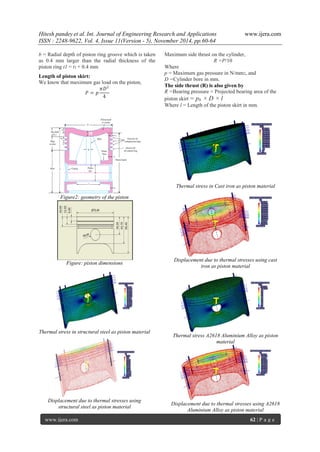
b = Radial depth of piston ring groove which is taken as 0.4 mm larger than the radial thickness of the piston ring t1 = t1 + 0.4 mm Length of piston skirt: We know that maximum gas load on the piston, 푃=푝 휋퐷24 
Maximum side thrust on the cylinder, R =P/10 Where p = Maximum gas pressure in N/mm2, and D =Cylinder bore in mm. The side thrust (R) is also given by R =Bearing pressure × Projected bearing area of the piston skirt = pb × D × l 
Where l = Length of the piston skirt in mm. 
Figure2: geometry of the piston 
Figure: piston dimensions 
Thermal stress in structural steel as piston material 
Displacement due to thermal stresses using structural steel as piston material 
Thermal stress in Cast iron as piston material 
Displacement due to thermal stresses using cast iron as piston material 
Thermal stress A2618 Aluminium Alloy as piston material 
Displacement due to thermal stresses using A2618 Aluminium Alloy as piston material
Hitesh pandey et al. Int. Journal of Engineering Research and Applications www.ijera.com 
ISSN : 2248-9622, Vol. 4, Issue 11(Version - 5), November 2014, pp.60-64 
www.ijera.com 63 | P a g e 
VI. Material Properties: 
VII. 
Table 1: Material Properties for Present Analysis 
S.No 
Piston Material 
Structural Steel 
Cast Iron 
A2618 Aluminium Alloy 
1. 
Young’s modulus of elasticity 
200 KN_mm2 
100 KN/mm2 
73.7 KN/mm2 
2. 
Poisson’s Ratio 
0.266 
0.27 
0.33 
3. 
Density 
7860kg/m3 
7200 Kg/m3 
2768 Kg/m3 
4. 
Coefficient of thermal expansion 
1.17x10⁻⁵ m/ ۫ ۫ c 
1.0x10⁻⁵ m/ c 
2.59x10⁻⁸ m/ c 
5. 
Shear modulus 
80 KN/mm2 
45 KN/mm2 
25 KN/mm2 
VIII. Result and discussions: 
Table 2: Effect of Thermal Stresses and Corresponding Piston Distortion using Different Piston Materials 
S.No 
Piston Material 
Structural Steel 
Cast Iron 
A2618 Aluminium Alloy 
1. 
Maximum Thermal stress (N/m2) 
1.39x10⁶ N/m2 
5.93x10³ N/m2 
1.15x10³ N/m2 
2. 
Maximum displacement (mm) 
0.004 mm 
3.81x10⁻⁵ mm 
10.6x10⁻⁵ mm 
The above table shows that the maximum thermal stress and the maximum distortion of piston are minimum for A2618 Aluminium alloy as piston material, and maximum for structural steel as piston material, while for cast iron it is lesser then structural steel but higher then A2618 Aluminium alloy. So we can conclude that the maximum thermal stress and the maximum distortion of piston in decreasing order are as follows Structural Steel > Cast Iron > A2618 Aluminium Alloy. So, it is convenient to use aluminum alloy as piston material rather than cast iron or structural steel. Since the aluminium alloys used for pistons have high heat conductivity, therefore, these pistons ensure high rate of heat transfer and thus keeps down the maximum temperature difference between the centre and edges of the piston head or crown. Other advantage is aluminium alloys are about three times lighter than cast iron, therefore, its mechanical strength is good at low temperatures, Sometimes, the pistons of aluminium alloys are coated with aluminium oxide also. 
IX. Conclusion: 
1. Aluminum alloy should be used as a piston material as it has minimum thermal stress and mechanical distortion in same working condition as that of cast iron and structural steel as piston material. 
2. Aluminum alloys are lighter in weight thus provides good mechanical strength at low temperatures. 
3. Aluminium alloys have high heat conductivity thus; high rate of heat transfer is possible between the centre and edge of the piston head. 
4. Use of CAE software eliminates the human effort in determination of stress, distortion 
values and so are referred as good tool for piston mechanical as well as thermal analysis. Future scope: 
1. This work can be extended by using some more type of aluminum alloys as piston material such as cast aluminium, forged aluminium, cast steel and forged steel. 
2. Aluminum alloys may be coated with aluminum oxides for pistons working at elevated temperatures. 
References: 
[1.] RS Khurmi and JK Gupta “Machine Design” Eurasia publishing house (pvt.) ltd. Ram Nagar, New Delhi - 110055, http://www.simpopdf.com, 2005 
[2.] S.S. Feng et al., An experimental and numerical study of finned metal foam heat sinks under impinging air jet cooling, International Journal of Heat and Mass Transfer 77 (2014) 1063–1074. 
[3.] M.M. Haque et al., “Effect of superheating temperatures on microstructure and properties of strontium modified aluminium–silicon eutectic alloy” Journal of Materials Processing Technology 162–163 (2005) 312– 316 
[4.] Ajay Raj Singh et al.,, Dr. Pushpendra Kumar Sharma, “Design, Analysis and Optimization of Three Aluminum Piston Alloys Using FEA” Int. Journal of Engineering Research and Applications, ISSN : 2248-9622, Vol. 4, Issue 1 Version 3, January 2014, pp.94-102. 
[5.] M.X. Calbureanu et al.,, “The finite element analysis of the thermal stress distribution of a piston head” International Journal OF Mechanics, Issue 4, Volume 7, 2013, pp- 467- 474.
Hitesh pandey et al. Int. Journal of Engineering Research and Applications www.ijera.com 
ISSN : 2248-9622, Vol. 4, Issue 11(Version - 5), November 2014, pp.60-64 
www.ijera.com 64 | P a g e 
[6.] S. Srikanth Reddy et al., Thermal Analysis and Optimization of I.C. Engine Piston Using Finite Element Method, International Journal of Innovative Research in Science, Engineering and Technology, Vol. 2, Issue 12, December 2013, pp 7834-7843. 
[7.] A. R. Bhagat et al., Thermal Analysis And Optimization Of I.C. Engine Piston Using finite Element Method, International Journal of Modern Engineering Research (IJMER) www.ijmer.com Vol.2, Issue.4, July-Aug 2012 pp-2919-2921. 
[8.] Vinay V. Kuppast et al., “Thermal Analysis of Piston for the Influence on Secondary motion”, International Journal of Engineering Research and Applications (IJERA) ISSN: 2248-9622, Vol. 3, Issue 3, May-Jun 2013, pp.1402-1407

Thermal Stress Analysis of a Speculative IC Engine Piston using CAE Tools

  • 1.
    Hitesh pandey etal. Int. Journal of Engineering Research and Applications www.ijera.com ISSN : 2248-9622, Vol. 4, Issue 11(Version - 5), November 2014, pp.60-64 www.ijera.com 60 | P a g e Thermal Stress Analysis of a Speculative IC Engine Piston using CAE Tools Hitesh pandey1, Avin Chandrakar2, PM Bhagwat3 1. Research Scholar, Oriental University, Indore. 2. Associate Professor, Oriental University, Indore. 3. Professor and head, Oriental University, Indore Abstract: This paper deals with the pressure due to expanding combustion gases in the combustion chamber space at the top of the cylinder which generate thermal stresses due to presence of heat involved on the reciprocating masses. The present work deals with the use of different materials for IC engine piston and a comparative study is made to achieve the best possible result. Piston parameters are taken using the conventional formulas and are constant throughout the analysis. Moreover the boundary conditions are chosen such that the piston does not moves sideways except in the direction of line of action of the piston itself. Keywords: Thermal stresses, FEA, IC engine Piston, pressure, Piston material I. Introduction: Thermal analysis is a branch of materials science where the properties of materials are studied as they change with temperature. In an IC engine the power is developed inside the engine cylinder by burning the fuel in the cylinder itself. The heat energy produced during the combustion of fuel is converted into mechanical energy by the expansion of gases against the piston. The piston is a disc which reciprocates within a cylinder. It is either moved by the fluid or it moves the fluid which enters the cylinder. The main function of the piston of an internal combustion engine is to receive the impulse from the expanding gas and to transmit the energy to the crankshaft through the connecting rod. The piston must also disperse a large amount of heat from the combustion chamber to the cylinder walls. II. Material for Pistons: The most commonly used materials for pistons of I.C. engines are cast iron, cast aluminium, forged aluminium, cast steel and forged steel. The cast iron pistons are used for moderately rated engines with piston speeds below 6 m/s and aluminium alloy pistons are used for highly rated engines running at higher piston speeds. Since the aluminium alloys used for pistons have high heat conductivity (nearly four times that of cast iron), therefore, these pistons ensure high rate of heat transfer and thus keeps down the maximum temperature difference between the centre and edges of the piston head or crown. Figure 1: Model of IC engine piston For a cast iron piston, the temperature at the centre of the piston head (TC) is about 425°C to 450°C under full load conditions and the temperature at the edges of the piston head (TE) is about 200°C to 225°C. For aluminium alloy pistons, TC is about 260°C to 290°C and TE is about 185°C to 215°C. The piston should have enormous strength to withstand the high gas pressure and inertia forces, with minimum mass to minimize the inertia forces. The piston should be designed in such a way that it should disperse the heat of combustion quickly with minimum noise and sufficiently rigid construction to withstand thermal and mechanical distortion. The piston should form an effective gas and oil sealing of the cylinder and provide sufficient bearing area to prevent undue wear and mechanical distortion. For the present analysis the material chosen is structural steel, cast iron and cast aluminum alloy. The piston of internal combustion engines are usually of trunk type as shown in Fig. Such pistons are open at one end and consist of the following parts: RESEARCH ARTICLE OPEN ACCESS
  • 2.
    Hitesh pandey etal. Int. Journal of Engineering Research and Applications www.ijera.com ISSN : 2248-9622, Vol. 4, Issue 11(Version - 5), November 2014, pp.60-64 www.ijera.com 61 | P a g e 1. Head or crown-The piston head or crown may be flat, convex or concave depending upon the design of combustion chamber. It withstands the pressure of gas in the cylinder. 2. Piston rings-The piston rings are used to seal the cylinder in order to prevent leakage of the gas past the piston. 3. Skirt-The skirt acts as a bearing for the side thrust of the connecting rod on the walls of cylinder. 4. Piston pin-It is also called gudgeon pin or wrist pin. It is used to connect the piston to the connecting rod. Literature Review: A combined experimental and numerical study has been carried out on finned metal foam and metal foam heat sinks under impinging air jet cooling M.M. Haquea observed that as the superheating temperature is increased up to an optimum temperature of 750 ◦C, the eutectic silicon becomes more globular and well distributed all over the entire structure[2]. Ajay Raj Singh describes the stress distribution and thermal stresses of three different aluminum alloys piston by using finite element method (FEM)[3]. M.X. Calbureanu compare the behavior of the combustion engine piston made of aluminum alloys. The paper describes the mesh optimization with using finite element analysis technique to predict the higher stress and critical region on the component[4]. S. Srikanth Reddy investigated on a conventional (uncoated) diesel piston, made of aluminium silicon alloy for design 1 and design 2 parameters. Secondly, thermal analyses are performed on piston, coated with Zirconium material by means of using a commercial code, namely ANSYS [5]. A. R. Bhagat describes the stress distribution of the seizure on piston four stroke engine by using FEA. The finite element analysis is performed by using computer aided design (CAD) software. The main objectives are to investigate and analyze the thermal stress distribution of piston at the real engine condition during combustion process. The paper describes the mesh optimization with using finite element analysis technique to predict the higher stress and critical region on the component [6]. Vinay V. Kuppast studied the geometric three dimensional model of the piston is developed and is used for the FE analysis for the thermal boundary conditions which are calculated by using the experimental data of the engine in running condition and by using the empirical relations[7]. Yuan Shen presented a thermodynamic model of IC engine combustion is and examined. A heat release function and an empirical conversion efficiency factor are introduced to solve the model. The pressure traces obtained by solving the thermodynamic model are compared with measured pressure data for a fully instrumented laboratory IC spark ignition (SI) engine. Derived scaling parameters for time to peak pressure, peak pressure, and maximum rate of pressure rise (Among others) are developed and compared with the numerical simulations [8]. III. Methodology: Whenever there is some increase or decrease in the temperature of a body, it causes the body to expand or contract. A little consideration will show that if the body is allowed to expand or contract freely, with the rise or fall of the temperature, no stresses are induced in the body. But, if the deformation of the body is prevented, some stresses are induced in the body. Such stresses are known as thermal stresses. [1] Let l = Original length of the body, t = Rise or fall of temperature, and α= Coefficient of thermal expansion, Thus increase or decrease in length, llt If the ends of the body are fixed to rigid supports, so that its expansion is prevented, then compressive strain induced in the body, c= 푙 푙 = 푙.α.푡 푙 =훼.푡 Thermal stress, th = c.E = .t.E The thickness of the piston head (tH), according to Grashoff’s formula is given by tH = 3푝퐷216 휎푡 12(in mm) Where p = Maximum gas pressure in N/mm2, D = Outside diameter of the piston in mm, and σt = Permissible bending (tensile) stress IV. Radial thickness of piston rings: t1= 퐷[ 3푃푤 휎푡 ] 12 Where D = Cylinder bore in mm, pw = Pressure of gas on the cylinder wall in N/mm2. σt = Allowable bending (tensile) stress in MPa. V. Maximum axial thickness of piston rings: t2= [ 퐷 10 푛푅 ] nR = Number of rings The maximum thickness (t3) of the piston barrel may be obtained from the following empirical relation: 푡3=0.03 퐷+푏+4.5 mm Where
  • 3.
    Hitesh pandey etal. Int. Journal of Engineering Research and Applications www.ijera.com ISSN : 2248-9622, Vol. 4, Issue 11(Version - 5), November 2014, pp.60-64 www.ijera.com 62 | P a g e b = Radial depth of piston ring groove which is taken as 0.4 mm larger than the radial thickness of the piston ring t1 = t1 + 0.4 mm Length of piston skirt: We know that maximum gas load on the piston, 푃=푝 휋퐷24 Maximum side thrust on the cylinder, R =P/10 Where p = Maximum gas pressure in N/mm2, and D =Cylinder bore in mm. The side thrust (R) is also given by R =Bearing pressure × Projected bearing area of the piston skirt = pb × D × l Where l = Length of the piston skirt in mm. Figure2: geometry of the piston Figure: piston dimensions Thermal stress in structural steel as piston material Displacement due to thermal stresses using structural steel as piston material Thermal stress in Cast iron as piston material Displacement due to thermal stresses using cast iron as piston material Thermal stress A2618 Aluminium Alloy as piston material Displacement due to thermal stresses using A2618 Aluminium Alloy as piston material
  • 4.
    Hitesh pandey etal. Int. Journal of Engineering Research and Applications www.ijera.com ISSN : 2248-9622, Vol. 4, Issue 11(Version - 5), November 2014, pp.60-64 www.ijera.com 63 | P a g e VI. Material Properties: VII. Table 1: Material Properties for Present Analysis S.No Piston Material Structural Steel Cast Iron A2618 Aluminium Alloy 1. Young’s modulus of elasticity 200 KN_mm2 100 KN/mm2 73.7 KN/mm2 2. Poisson’s Ratio 0.266 0.27 0.33 3. Density 7860kg/m3 7200 Kg/m3 2768 Kg/m3 4. Coefficient of thermal expansion 1.17x10⁻⁵ m/ ۫ ۫ c 1.0x10⁻⁵ m/ c 2.59x10⁻⁸ m/ c 5. Shear modulus 80 KN/mm2 45 KN/mm2 25 KN/mm2 VIII. Result and discussions: Table 2: Effect of Thermal Stresses and Corresponding Piston Distortion using Different Piston Materials S.No Piston Material Structural Steel Cast Iron A2618 Aluminium Alloy 1. Maximum Thermal stress (N/m2) 1.39x10⁶ N/m2 5.93x10³ N/m2 1.15x10³ N/m2 2. Maximum displacement (mm) 0.004 mm 3.81x10⁻⁵ mm 10.6x10⁻⁵ mm The above table shows that the maximum thermal stress and the maximum distortion of piston are minimum for A2618 Aluminium alloy as piston material, and maximum for structural steel as piston material, while for cast iron it is lesser then structural steel but higher then A2618 Aluminium alloy. So we can conclude that the maximum thermal stress and the maximum distortion of piston in decreasing order are as follows Structural Steel > Cast Iron > A2618 Aluminium Alloy. So, it is convenient to use aluminum alloy as piston material rather than cast iron or structural steel. Since the aluminium alloys used for pistons have high heat conductivity, therefore, these pistons ensure high rate of heat transfer and thus keeps down the maximum temperature difference between the centre and edges of the piston head or crown. Other advantage is aluminium alloys are about three times lighter than cast iron, therefore, its mechanical strength is good at low temperatures, Sometimes, the pistons of aluminium alloys are coated with aluminium oxide also. IX. Conclusion: 1. Aluminum alloy should be used as a piston material as it has minimum thermal stress and mechanical distortion in same working condition as that of cast iron and structural steel as piston material. 2. Aluminum alloys are lighter in weight thus provides good mechanical strength at low temperatures. 3. Aluminium alloys have high heat conductivity thus; high rate of heat transfer is possible between the centre and edge of the piston head. 4. Use of CAE software eliminates the human effort in determination of stress, distortion values and so are referred as good tool for piston mechanical as well as thermal analysis. Future scope: 1. This work can be extended by using some more type of aluminum alloys as piston material such as cast aluminium, forged aluminium, cast steel and forged steel. 2. Aluminum alloys may be coated with aluminum oxides for pistons working at elevated temperatures. References: [1.] RS Khurmi and JK Gupta “Machine Design” Eurasia publishing house (pvt.) ltd. Ram Nagar, New Delhi - 110055, http://www.simpopdf.com, 2005 [2.] S.S. Feng et al., An experimental and numerical study of finned metal foam heat sinks under impinging air jet cooling, International Journal of Heat and Mass Transfer 77 (2014) 1063–1074. [3.] M.M. Haque et al., “Effect of superheating temperatures on microstructure and properties of strontium modified aluminium–silicon eutectic alloy” Journal of Materials Processing Technology 162–163 (2005) 312– 316 [4.] Ajay Raj Singh et al.,, Dr. Pushpendra Kumar Sharma, “Design, Analysis and Optimization of Three Aluminum Piston Alloys Using FEA” Int. Journal of Engineering Research and Applications, ISSN : 2248-9622, Vol. 4, Issue 1 Version 3, January 2014, pp.94-102. [5.] M.X. Calbureanu et al.,, “The finite element analysis of the thermal stress distribution of a piston head” International Journal OF Mechanics, Issue 4, Volume 7, 2013, pp- 467- 474.
  • 5.
    Hitesh pandey etal. Int. Journal of Engineering Research and Applications www.ijera.com ISSN : 2248-9622, Vol. 4, Issue 11(Version - 5), November 2014, pp.60-64 www.ijera.com 64 | P a g e [6.] S. Srikanth Reddy et al., Thermal Analysis and Optimization of I.C. Engine Piston Using Finite Element Method, International Journal of Innovative Research in Science, Engineering and Technology, Vol. 2, Issue 12, December 2013, pp 7834-7843. [7.] A. R. Bhagat et al., Thermal Analysis And Optimization Of I.C. Engine Piston Using finite Element Method, International Journal of Modern Engineering Research (IJMER) www.ijmer.com Vol.2, Issue.4, July-Aug 2012 pp-2919-2921. [8.] Vinay V. Kuppast et al., “Thermal Analysis of Piston for the Influence on Secondary motion”, International Journal of Engineering Research and Applications (IJERA) ISSN: 2248-9622, Vol. 3, Issue 3, May-Jun 2013, pp.1402-1407