

1
Copyright © 2015, RES Software. All rights reserved. 0113
Presented by:
Stacy Leidwinger, VP of Product Marketing
Tom Lauzon, Solution Engineer
I Need it Right Now!
Successfully Equipping and
Empowering the Digital Workforce
22
The Culture of “I Want it Now!!!”
33
Did you know?
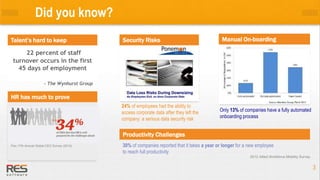
Only 13% of companies have a fully automated
onboarding process
HR has much to prove
Pwc 17th Annual Global CEO Survey (2014) 30% of companies reported that it takes a year or longer for a new employee
to reach full productivity
2012 Allied Workforce Mobility Survey
24% of employees had the ability to
access corporate data after they left the
company: a serious data security risk
Security Risks
Productivity Challenges
22 percent of staff
turnover occurs in the first
45 days of employment
- The Wynhurst Group
Talent’s hard to keep Manual On-boarding
44
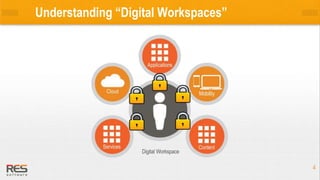
Understanding “Digital Workspaces”
55
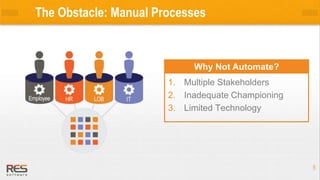
The Obstacle: Manual Processes
1. Multiple Stakeholders
2. Inadequate Championing
3. Limited Technology
Why Not Automate?
66
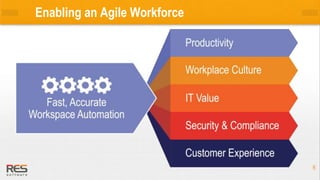
Enabling an Agile Workforce
77
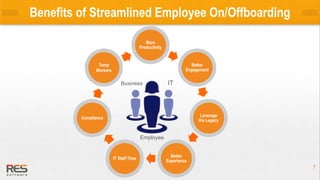
More
Productivity
Better
Engagement
Leverage
the Legacy
Better
Experience
IT Staff Time
Compliance
Temp
Workers
Business IT
Employee
Benefits of Streamlined Employee On/Offboarding
88
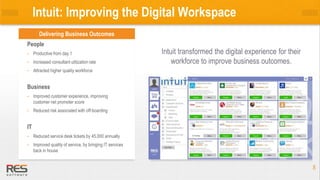
Delivering Business Outcomes
Intuit: Improving the Digital Workspace
Intuit transformed the digital experience for their
workforce to improve business outcomes.
People
• Productive from day 1
• Increased consultant utilization rate
• Attracted higher quality workforce
Business
• Improved customer experience, improving
customer net promoter score
• Reduced risk associated with off-boarding
IT
• Reduced service desk tickets by 45,000 annually
• Improved quality of service, by bringing IT services
back in house
9
DEMO
Automating Employee Onboarding & Offboarding
1010
How to Get Started
1. Identify today’s on/offboarding process
and key stakeholders
2. Determine blockers in enabling employees from day 1
and at key stages of their employment (ex: promotions)
3. Sketch your “ideal” state for on/offboarding
4. Roadmap to that ideal state involving key stakeholders
5. Begin roadmap implementation
11
Questions?
For more information please contact

I Need it Right Now! Successfully Equipping and Empowering the Digital Workforce

  • 1.
    1 Copyright © 2015,RES Software. All rights reserved. 0113 Presented by: Stacy Leidwinger, VP of Product Marketing Tom Lauzon, Solution Engineer I Need it Right Now! Successfully Equipping and Empowering the Digital Workforce
  • 2.
    22 The Culture of“I Want it Now!!!”
  • 3.
    33 Did you know? Only13% of companies have a fully automated onboarding process HR has much to prove Pwc 17th Annual Global CEO Survey (2014) 30% of companies reported that it takes a year or longer for a new employee to reach full productivity 2012 Allied Workforce Mobility Survey 24% of employees had the ability to access corporate data after they left the company: a serious data security risk Security Risks Productivity Challenges 22 percent of staff turnover occurs in the first 45 days of employment - The Wynhurst Group Talent’s hard to keep Manual On-boarding
  • 4.
  • 5.
    55 The Obstacle: ManualProcesses 1. Multiple Stakeholders 2. Inadequate Championing 3. Limited Technology Why Not Automate?
  • 6.
  • 7.
    77 More Productivity Better Engagement Leverage the Legacy Better Experience IT StaffTime Compliance Temp Workers Business IT Employee Benefits of Streamlined Employee On/Offboarding
  • 8.
    88 Delivering Business Outcomes Intuit:Improving the Digital Workspace Intuit transformed the digital experience for their workforce to improve business outcomes. People • Productive from day 1 • Increased consultant utilization rate • Attracted higher quality workforce Business • Improved customer experience, improving customer net promoter score • Reduced risk associated with off-boarding IT • Reduced service desk tickets by 45,000 annually • Improved quality of service, by bringing IT services back in house
  • 9.
  • 10.
    1010 How to GetStarted 1. Identify today’s on/offboarding process and key stakeholders 2. Determine blockers in enabling employees from day 1 and at key stages of their employment (ex: promotions) 3. Sketch your “ideal” state for on/offboarding 4. Roadmap to that ideal state involving key stakeholders 5. Begin roadmap implementation
  • 11.

Editor's Notes

  • #3 Even for those who don’t have children, you have seen the young toddler throwing a tantrum in a store of wanting that juice/candy/toy/ets. – RIGHT NOW. Now if you are honest with yourself, you probably have had that some meltdown internally at some point – especially in your career. If you haven’t, then your colleagues sure have. In a world where at home you can easily access any application you need (order groceries, watch a movie, look up a restaurant number); it isn’t surprising that people get frustrated when that same instant gratification and access isn’t available in their work life. We live in an “always on” culture and people want to be able to work anytime, from any location with any device. When that access is limited or unavailable then that inner toddler can quickly kick in.
  • #9 Here is one example on a customer who is receiving similar benefits to what we just outlined. Intuit is a large software company in the U.S. who delivers financial and tax preparation software and services for small business and individuals. Every January during tax season they experience an influx of employees increasing their workforce by 40%. Those employees need immediate access to all of the applications and services they need to productive. Prior to RES coming in that process was manual and took 3-5 days to onboard each employee. RES came in and provided an automated way to onboard all new employees and then upon their departure off-board securely. Additionally, the introduced a service app store concept using IT store to promote self-service empowering the workforce in supporting their digital and access needs. The workforce themselves were immediately productive starting on their first day. This increased Intuit’s consultant utilization rate with their transient workforce. They also were able to attract a higher quality workforce building a reputation of an organization that was digitally enabled and focused on the success of their employees. For the business not only did they improve productivity of their workforce, they also improved the customer experience. Intuit’s customer workforce is customer focused and by enabling the employees more quickly giving them access to the right tools and applications to perform their job the quality of service increased. Additionally, with the ability to immediately de-provision the employees and remove access when they left the organization the business was at less of a risk from an insider threat exposing personable financial information of their clients. Once an employee leaves their connection to Intuit’s customer financial history should be completely severed. From an IT perspective, RES helped streamline operations. By automating the on/off-boarding process as well as other IT services, Intuit was able to reduce their service desk tickets by 30,000 tickets annually. They also were able to reduce the inbound service requests and as such were able to bring their IT support completely back in house. This improved the quality of IT services overall by being brought back in house and also saved the IT organizations the cost of outsourcing. Overall RES transformed the digital experience for Intuit’s workforce allowing them to improve employee productivity, deliver a superior customer experience and reduce operational expenses.