Inflammatory Bowel Disease
30th march 2023
Dr DN SURYA
Spectrum of Inflammatory Bowel Disorders
Normal ? IBS Microscopic
Colitis
IBD
Inflammation
Drug induced colitis
Diversion Colits
Inflammatory
Bowel
Disease
Genetically
Predisposed
Individual
Ubiquitous
Microbial
Antigen
Dysregulated
Immune
Response
Chronic Gut
Inflammation
Spectrum of IBD
Ulcerative colitis Crohn’s Disease
Indeterminate colitis
Term reserved for pathologists to describe a colectomy specimen which has
overlapping features of ulcerative colitis and Crohn‘s
IBD unclassified (IBDU)
Minority of cases where a definitive distinction between UC, Crohn's
disease, or other cause of colitis cannot be made
Dignass A, et al;Definitions and diagnosis,Journal of Crohn's and Colitis(2012)
• Ulcerative Colitis is a chronic gastrointestinal condition which causes the inflammation of the
digestive tract.
• It is labelled as inflammatory bowel disease which occurs due to ulcerations on the inner walls of
the intestine and rectum.
• Ulcerative colitis is a painful long term condition which can cause severe distress, debilitating pain
and other complications over time. It affects an estimated It is known to graduate and worsen
over time, when left untreated.
ULCERATIVE COLITIS
Ulcerative Colitis
•Type of IBD
•Presentation: Bloody diarhea
•Rectal involvement
•Diffuse involvement
•Colonic disease
•Mucosal in most patients
•Associated with complications
•Medical & Surgical
Pathogenesis
Environmental
Immune
Genetics
Genetic Factors
•Risk in twins
•CD> UC
•Familial
•Not simplistic Mendelian
•7.5% of entire risk is genetic (cf 13% in CD)
•Autophagy related genes: IRGM
• IL-23R
Environmental
•Antigenic stimulus
•Ubiquitous antigen
•Excessive immune response
•Dysbiosis
Environmental/drugs
Risk Factor CD UC
Smoking ↑ ↓
Appendectom
y
↑ ↓
NSAIDs ↑ ↑
Stress ↑
Antibiotics,
Vitamin D,
OCP
↓
Immune Dysregulation
•Humoral: Antibodies
• ASCA
• CBir1 (Flagellin, Clostridium)
• OmpC (E coli)
• Anti-I2 (Pseudomonas)
•Cellular
• Innate : 1st line defence eg NLR, TLR
• Adaptive : T cells and B cells
Pathology
•Severity Distal> Proximal
•Continuous
•Symmetric
•Sharp transition
•Hyperemia, edematous, granular, friable, hemorrhagic, ulcers,
•Pseudopoylps , mucosal bridging, featureless colon
Microscopy
•Acute Colitis
• Neutrophils
• Cryptitis
• Crypt abscess
•Chronic Colitis
• Crypt distortion
• Branching
• Widening
• Crypt loss and mucodepletion
Differentiation of ulcerative colitis from Crohn’s disease
Ulcerative colitis Crohn’s disease
Site of disease
Distribution
Colon only
Diffuse
Mucosal
Any part of GI trat
Focal (segmental)-skip areas
Transmural
Complications Fistulae/abscess or rarely Fistlae/abscess can occur
occur
Strictures appearance uncommon
Cancer risk after long ++++ Standing disease
Common
++
GROSS APPEARANCE OF UC AND CD
Extent at Presentation
PROCTITIS
LEFT SIDED DISEASE
EXTENSIVE COLITIS
Clinical Presentation
•Rectal Bleeding: Mixed or Streaked
•Diarrhea with mucus
•Tenesmus
•Urgency
•Abdominal pain?
•Constipation?
•Weight loss, Edema, Anemia?
Disease activity : Truelove and Witts
Parameter Mild Moderate ‘in
between mild
and severe’
Severe
Bloody stools/day <4 4 or more ≥6
Pulse <90 bpm ≤90 bpm > 90 bpm
Temperature <37.5 °C ≤37.8 °C >37.8 °C
Haemoglobin >11.5 g/dL ≥10.5 g/dL <10.5 g/dL
ESR <20 mm/h ≤30 mm/h > 30mm/h
CRP Normal ≤30 mg/L >30 mg/L
Dignass A, et al; Definitions and diagnosis, Journal of Crohn's and Colitis(2012)
Endoscopic image
Score
Feature
Stool
Frequency
Rectal
Bleeding
0 1 2 3
Normal 1-2/day more
than normal
3-4/day more
than normal
5 or more than
normal
None Streaks of blood
with stool less
than half of the
time
Obvious blood
with stool most
of the time
Blood alone
passes
Mucosal
Appearance
Normal Erythema, loss
of vascular
pattern, mild
friablity
Marked
Erythema, loss
of vascular
pattern, friablity,
erosion
Spontaneous
bleeding or
ulceration
Physicians
global
assessment
Normal Mild Moderate Severe
Grade I:
Loss of vascular
Pattern
Erythema
Grade III:
Erosions
Ulcers
Spontaneous
bleeding
Grade II :
Friability
Petechiae
Normal sigmoid
Grade III
changes
Crohn’s disease
•Intervening
mucosa normal
( skip lesions)
•Longitudinal, deep
Ulcers
•Earliest lesion is
Aphthoid ulcers
• Rectal sparing
•Terminal ileum
involvement
Differential
•Intestinal tuberculosis
Ulcers, nodules
Intervening mucosa normal
Biopsy
Differential of granulomatous
Ileocolotis is a problem
where both diseases are
prevalent
Microscopy OF CHORNS DS
Crohn’s disease vs Intestinal TB
Crohns Intestinal TB
Age
Sex (M:F)
20-50 yr any age
3:1 1:3
Malabsorbtion frequent infrequent
Obstructive sx occasional
Perianal dis/fistula frequent
Ulcer/stricture long deep
multiple
frequent
rare
Transverse
small <3 cm
Extra-intestinal manifestations of IBD
Extent of Disease UC
Treatment aims in IBD
•Traditional treatment goals of IBD
• Control of symptoms
• ?Improvement in quality of life
• Induction of remission
• Improvement in quality of life
• ? Reduction in complication related to inflammation
•Treatment of goals in the era of biologicals & IM
• Mucosal healing: Histological/Endoscopic
• In addition to above, change in course of disease
• Deep remission
• Dream destination – achievable for some
• Reduced risk of all complications
• Change in course of disease – Concept of DMAIDs
MANAGEMENT OF
ULCERATIVE
COLITIS
Treatment of UC
•Induction vs. Maintenance
•Proctitis vrs Left-sided vs. Extensive disease
•Severe disease
•Steroid dependent/refractory disease
Serendipity in IBD
a
Sulfas lazine
5-Aminosalicylic acid Sulfapyridine
A bit of History
•1965: Placebo controlled trial of Sulfasalazine
•Active component: 5-ASA (Mesalazine)
•Azad Khan and Truelove: Retention enemas of 5-ASA
•5-ASA unstable and absorbed in small bowel
Oral 5-ASAReleaseSites
Stomach
Small
Intestine
Large
Intestine
Azo bond
AZO-
COMPOUN DS
Mesalaminein
microgranules
Pentasa®
Mesalamine
w/ eudragit-S
Asacol®
Management of Ulcerative Proctitis
•Rectal ASA
• Suppositories
•Add oral ASA
• Rectal steroids
•Maintain with rectal ASA
Remission
• Remission is defined as complete resolution of symptoms and endoscopic mucosal healing
• UCDAI <2
• Clinical practice: ‘Remission’
• Stool frequency ≤3/day with no bleeding and no urgency
• Absence of visible blood and absent mucosal friability
• 86% sensitivity
• 76% specificity
• Sigmoidoscopy to confirm mucosal healing is generally unnecessary in practice
Dignass A, et al; Definitions and diagnosis, Journal of Crohn's and Colitis(2012)
Left -UC Management Algorithm
•5-ASA enema or foam
•Hydrocortisone enema
•Oral ASA (combination of oral and rectal)
•Oral steroid if no response
•Maintain with ASA enema ± oral ASA
Relapse
• Relapse: Flare of symptoms in a patient with established UC who is
in clinical remission
• Spontaneously or after medical treatment
• Pattern:
• Infrequent (≤1/year)
• Frequent (≥2 relapses/ year)
• Continuous (persistent symptoms of active UC without a period
of remission)
Dignass A, et al; Definitions and diagnosis, Journal of Crohn's and Colitis(2012)
Steroid /Immunomodulator use
• Steroid-dependent colitis:
• Inability to reduce steroids below the equivalent of prednisolone 10 mg/day
within 3 months of starting steroids, without recurrent active disease
• Relapse within 3 months of stopping steroids
• Steroid refractory:
• Active disease despite prednisolone up to 0.75 mg/kg/day over a period of 4
weeks
• Immunomodulator refractory:
• Active disease or relapse in spite of thiopurines at an appropriate dose for at
least 3 months (Azathioprine 2–2.5 mg/kg/day or mercaptopurine 1–1.5
mg/kg/day in the absence of leucopenia)
Steroids
•Steroids introduced 1950s
•Cornerstone
•Response
❖30 days: Oral steroids (40 mg prednisolone)
❖10 days: IV steroids
Azathioprine & 6-MP
•A major limitation is the delay in the onset of action
•Requires up to 3 months before becoming fully effective
•Patients with severe disease often require colectomy before the
azathioprine has had an opportunity to exert its full effects
Azathioprine & 6-MP
•Side effects
❖Intolerance
❖Flu
❖Leucopenia
❖Hepatotoxicity
❖Pancreatitis
GUT 2004
What Next?
•Continue Steroids
•Colectomy
•Cyclosporine
•Infliximab
Takeaways
•ASUC: are mainstay of therapy
•ASUC : Rescue medical therapy may prevent colectomy
•ASUC: Infliximab is effective in ASUC
•Moderate to Severe UC: Adalimumab and Golimumab are also
effective
Biological agents for treatment of IBD
Role of Surgery
•Toxic megacolon
•Perforation
•Dysplasia or malignancy Intolerable adverse effects of medical Rx
•Refractory to medical Rx
•Uncontrollable bleeding
Therapeutic Pyramid for
Active UC
Severe
Moderate
Mild
Aminosalicylates
Surgery
Oral Steroids
AZA/6-MP
Systemic Corticosteroids
Infliximab
Cyclosporine
MANAGEMENT OF CROHNS
DISEASE
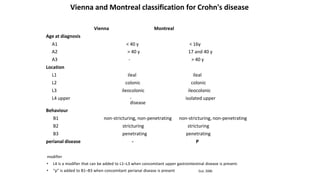
Vienna and Montreal classification for Crohn's disease
Vienna Montreal
Age at diagnosis
disease
A1 < 40 y < 16y
A2 > 40 y 17 and 40 y
A3 - > 40 y
Location
L1 ileal ileal
L2 colonic colonic
L3 ileocolonic ileocolonic
L4 upper - isolated upper
Behaviour
B1 non-stricturing, non-penetrating non-stricturing, non-penetrating
B2 stricturing stricturing
B3 penetrating penetrating
perianal disease - P
modifier
• L4 is a modifier that can be added to L1–L3 when concomitant upper gastrointestinal disease is present.
• “p” is added to B1–B3 when concomitant perianal disease is present Gut. 2006
Phenotypes of CD patients according to
montreal
Age at diagnosis (years)
A1: ≤16 4 (15%)
A2: 17-40 20 (74%)
A3: >40 3 (11%)
Disease location
L1: ileal 3 (11%)
L2: colonic 6 (22%)
L3: ileocolonic 18 (67%)
L4: isolated upper disease (0)
Disease behaviour
B1: non-stricturing, non-penetrating 17 (63%)
B2: stricturing 4 (15%)
B3: penetrating 6 (22%)
p: peri-anal disease modifier 10 (37%) Hong Kong Med J 2007;13:436-41
Distribution
Severity
Treatment goals
Historic goals
•Induction and maintenance of
clinical response and remission
Current evolution of Rx goals
• Improvement in quality of
life
•Steroid free remission
•Induction / maintenance of
endoscopic healing
•Reduction in hospitalization
•Reduction in surgery
single goal
Mucosal healing
•Increase steroid free remission
•Reduce hospitalization
•Reduce surgery need
•Change the natural history of IBD by preventing bowel
damage and disability
•Reduce the risk of neoplasia
Medical MX
Biologics
Immunomodulators
Mesalamines and steroids
Identifying the need for biologics
•Predictors for disabling disease
• Age < 40 years
• Extensive small bowel/ stricturing disease
• Perianal disease
• Smokers
• Initial need for steroid therapy
These patients may benefit from early biologics
SUTD (Step-Up/Top-Down): Study Design
Conventional management
(‘step-up’) (n=66)
Early combined
immunosuppression
(‘top-down’) (n=67)
Steroids
+ AZA/MTX
Steroids
+ IFX
Steroids
+ (episodic) IFX
IFX + AZA
SUTD
Clinical trials synopsis
Biologicals in IBD: Aims of therapy
• Induction of remission
• Maintenance of steroid-free remission
• Closure of fistulizing disease
• Minimization of complications and surgery
• Prevention of disease-related mortality
• Preservation of intestinal function
• Improvement of the quality of life of patients
• Minimization of the adverse effects of treatment
Conclusion
•CD progressive disease
•Mucosal healing single desirable goal
•Biologics preferred modality – Disease modifying drugs
Take home message
•IBD is a common disorder with profound effect on morbidity
•Despite advances, a substantial number of patients are not fully
responsive to treatment or lose efficacy over time
•Recent novel therapies are under development with the target for
better disease remission
THANK YOU

IBD lecture ppt FINAL.pptx

  • 1.
    Inflammatory Bowel Disease 30thmarch 2023 Dr DN SURYA
  • 2.
    Spectrum of InflammatoryBowel Disorders Normal ? IBS Microscopic Colitis IBD Inflammation Drug induced colitis Diversion Colits
  • 3.
  • 4.
    Spectrum of IBD Ulcerativecolitis Crohn’s Disease Indeterminate colitis Term reserved for pathologists to describe a colectomy specimen which has overlapping features of ulcerative colitis and Crohn‘s IBD unclassified (IBDU) Minority of cases where a definitive distinction between UC, Crohn's disease, or other cause of colitis cannot be made Dignass A, et al;Definitions and diagnosis,Journal of Crohn's and Colitis(2012)
  • 5.
    • Ulcerative Colitisis a chronic gastrointestinal condition which causes the inflammation of the digestive tract. • It is labelled as inflammatory bowel disease which occurs due to ulcerations on the inner walls of the intestine and rectum. • Ulcerative colitis is a painful long term condition which can cause severe distress, debilitating pain and other complications over time. It affects an estimated It is known to graduate and worsen over time, when left untreated. ULCERATIVE COLITIS
  • 6.
    Ulcerative Colitis •Type ofIBD •Presentation: Bloody diarhea •Rectal involvement •Diffuse involvement •Colonic disease •Mucosal in most patients •Associated with complications •Medical & Surgical
  • 7.
  • 8.
    Genetic Factors •Risk intwins •CD> UC •Familial •Not simplistic Mendelian •7.5% of entire risk is genetic (cf 13% in CD) •Autophagy related genes: IRGM • IL-23R
  • 9.
  • 12.
    Environmental/drugs Risk Factor CDUC Smoking ↑ ↓ Appendectom y ↑ ↓ NSAIDs ↑ ↑ Stress ↑ Antibiotics, Vitamin D, OCP ↓
  • 13.
    Immune Dysregulation •Humoral: Antibodies •ASCA • CBir1 (Flagellin, Clostridium) • OmpC (E coli) • Anti-I2 (Pseudomonas) •Cellular • Innate : 1st line defence eg NLR, TLR • Adaptive : T cells and B cells
  • 14.
    Pathology •Severity Distal> Proximal •Continuous •Symmetric •Sharptransition •Hyperemia, edematous, granular, friable, hemorrhagic, ulcers, •Pseudopoylps , mucosal bridging, featureless colon
  • 16.
    Microscopy •Acute Colitis • Neutrophils •Cryptitis • Crypt abscess •Chronic Colitis • Crypt distortion • Branching • Widening • Crypt loss and mucodepletion
  • 17.
    Differentiation of ulcerativecolitis from Crohn’s disease Ulcerative colitis Crohn’s disease Site of disease Distribution Colon only Diffuse Mucosal Any part of GI trat Focal (segmental)-skip areas Transmural Complications Fistulae/abscess or rarely Fistlae/abscess can occur occur Strictures appearance uncommon Cancer risk after long ++++ Standing disease Common ++
  • 18.
  • 20.
    Extent at Presentation PROCTITIS LEFTSIDED DISEASE EXTENSIVE COLITIS
  • 21.
    Clinical Presentation •Rectal Bleeding:Mixed or Streaked •Diarrhea with mucus •Tenesmus •Urgency •Abdominal pain? •Constipation? •Weight loss, Edema, Anemia?
  • 22.
    Disease activity :Truelove and Witts Parameter Mild Moderate ‘in between mild and severe’ Severe Bloody stools/day <4 4 or more ≥6 Pulse <90 bpm ≤90 bpm > 90 bpm Temperature <37.5 °C ≤37.8 °C >37.8 °C Haemoglobin >11.5 g/dL ≥10.5 g/dL <10.5 g/dL ESR <20 mm/h ≤30 mm/h > 30mm/h CRP Normal ≤30 mg/L >30 mg/L Dignass A, et al; Definitions and diagnosis, Journal of Crohn's and Colitis(2012)
  • 23.
  • 24.
    Score Feature Stool Frequency Rectal Bleeding 0 1 23 Normal 1-2/day more than normal 3-4/day more than normal 5 or more than normal None Streaks of blood with stool less than half of the time Obvious blood with stool most of the time Blood alone passes Mucosal Appearance Normal Erythema, loss of vascular pattern, mild friablity Marked Erythema, loss of vascular pattern, friablity, erosion Spontaneous bleeding or ulceration Physicians global assessment Normal Mild Moderate Severe
  • 25.
    Grade I: Loss ofvascular Pattern Erythema Grade III: Erosions Ulcers Spontaneous bleeding Grade II : Friability Petechiae
  • 26.
  • 27.
    Crohn’s disease •Intervening mucosa normal (skip lesions) •Longitudinal, deep Ulcers •Earliest lesion is Aphthoid ulcers • Rectal sparing •Terminal ileum involvement
  • 28.
    Differential •Intestinal tuberculosis Ulcers, nodules Interveningmucosa normal Biopsy Differential of granulomatous Ileocolotis is a problem where both diseases are prevalent
  • 29.
  • 30.
    Crohn’s disease vsIntestinal TB Crohns Intestinal TB Age Sex (M:F) 20-50 yr any age 3:1 1:3 Malabsorbtion frequent infrequent Obstructive sx occasional Perianal dis/fistula frequent Ulcer/stricture long deep multiple frequent rare Transverse small <3 cm
  • 31.
  • 32.
  • 35.
  • 36.
    Treatment aims inIBD •Traditional treatment goals of IBD • Control of symptoms • ?Improvement in quality of life • Induction of remission • Improvement in quality of life • ? Reduction in complication related to inflammation •Treatment of goals in the era of biologicals & IM • Mucosal healing: Histological/Endoscopic • In addition to above, change in course of disease • Deep remission • Dream destination – achievable for some • Reduced risk of all complications • Change in course of disease – Concept of DMAIDs
  • 37.
  • 38.
    Treatment of UC •Inductionvs. Maintenance •Proctitis vrs Left-sided vs. Extensive disease •Severe disease •Steroid dependent/refractory disease
  • 40.
    Serendipity in IBD a Sulfaslazine 5-Aminosalicylic acid Sulfapyridine
  • 41.
    A bit ofHistory •1965: Placebo controlled trial of Sulfasalazine •Active component: 5-ASA (Mesalazine) •Azad Khan and Truelove: Retention enemas of 5-ASA •5-ASA unstable and absorbed in small bowel
  • 42.
    Oral 5-ASAReleaseSites Stomach Small Intestine Large Intestine Azo bond AZO- COMPOUNDS Mesalaminein microgranules Pentasa® Mesalamine w/ eudragit-S Asacol®
  • 43.
    Management of UlcerativeProctitis •Rectal ASA • Suppositories •Add oral ASA • Rectal steroids •Maintain with rectal ASA
  • 44.
    Remission • Remission isdefined as complete resolution of symptoms and endoscopic mucosal healing • UCDAI <2 • Clinical practice: ‘Remission’ • Stool frequency ≤3/day with no bleeding and no urgency • Absence of visible blood and absent mucosal friability • 86% sensitivity • 76% specificity • Sigmoidoscopy to confirm mucosal healing is generally unnecessary in practice Dignass A, et al; Definitions and diagnosis, Journal of Crohn's and Colitis(2012)
  • 46.
    Left -UC ManagementAlgorithm •5-ASA enema or foam •Hydrocortisone enema •Oral ASA (combination of oral and rectal) •Oral steroid if no response •Maintain with ASA enema ± oral ASA
  • 48.
    Relapse • Relapse: Flareof symptoms in a patient with established UC who is in clinical remission • Spontaneously or after medical treatment • Pattern: • Infrequent (≤1/year) • Frequent (≥2 relapses/ year) • Continuous (persistent symptoms of active UC without a period of remission) Dignass A, et al; Definitions and diagnosis, Journal of Crohn's and Colitis(2012)
  • 49.
    Steroid /Immunomodulator use •Steroid-dependent colitis: • Inability to reduce steroids below the equivalent of prednisolone 10 mg/day within 3 months of starting steroids, without recurrent active disease • Relapse within 3 months of stopping steroids • Steroid refractory: • Active disease despite prednisolone up to 0.75 mg/kg/day over a period of 4 weeks • Immunomodulator refractory: • Active disease or relapse in spite of thiopurines at an appropriate dose for at least 3 months (Azathioprine 2–2.5 mg/kg/day or mercaptopurine 1–1.5 mg/kg/day in the absence of leucopenia)
  • 50.
    Steroids •Steroids introduced 1950s •Cornerstone •Response ❖30days: Oral steroids (40 mg prednisolone) ❖10 days: IV steroids
  • 51.
    Azathioprine & 6-MP •Amajor limitation is the delay in the onset of action •Requires up to 3 months before becoming fully effective •Patients with severe disease often require colectomy before the azathioprine has had an opportunity to exert its full effects
  • 52.
    Azathioprine & 6-MP •Sideeffects ❖Intolerance ❖Flu ❖Leucopenia ❖Hepatotoxicity ❖Pancreatitis GUT 2004
  • 53.
  • 54.
    Takeaways •ASUC: are mainstayof therapy •ASUC : Rescue medical therapy may prevent colectomy •ASUC: Infliximab is effective in ASUC •Moderate to Severe UC: Adalimumab and Golimumab are also effective
  • 55.
    Biological agents fortreatment of IBD
  • 56.
    Role of Surgery •Toxicmegacolon •Perforation •Dysplasia or malignancy Intolerable adverse effects of medical Rx •Refractory to medical Rx •Uncontrollable bleeding
  • 57.
    Therapeutic Pyramid for ActiveUC Severe Moderate Mild Aminosalicylates Surgery Oral Steroids AZA/6-MP Systemic Corticosteroids Infliximab Cyclosporine
  • 58.
  • 59.
    Vienna and Montrealclassification for Crohn's disease Vienna Montreal Age at diagnosis disease A1 < 40 y < 16y A2 > 40 y 17 and 40 y A3 - > 40 y Location L1 ileal ileal L2 colonic colonic L3 ileocolonic ileocolonic L4 upper - isolated upper Behaviour B1 non-stricturing, non-penetrating non-stricturing, non-penetrating B2 stricturing stricturing B3 penetrating penetrating perianal disease - P modifier • L4 is a modifier that can be added to L1–L3 when concomitant upper gastrointestinal disease is present. • “p” is added to B1–B3 when concomitant perianal disease is present Gut. 2006
  • 61.
    Phenotypes of CDpatients according to montreal Age at diagnosis (years) A1: ≤16 4 (15%) A2: 17-40 20 (74%) A3: >40 3 (11%) Disease location L1: ileal 3 (11%) L2: colonic 6 (22%) L3: ileocolonic 18 (67%) L4: isolated upper disease (0) Disease behaviour B1: non-stricturing, non-penetrating 17 (63%) B2: stricturing 4 (15%) B3: penetrating 6 (22%) p: peri-anal disease modifier 10 (37%) Hong Kong Med J 2007;13:436-41
  • 62.
  • 65.
  • 66.
    Treatment goals Historic goals •Inductionand maintenance of clinical response and remission Current evolution of Rx goals • Improvement in quality of life •Steroid free remission •Induction / maintenance of endoscopic healing •Reduction in hospitalization •Reduction in surgery
  • 67.
    single goal Mucosal healing •Increasesteroid free remission •Reduce hospitalization •Reduce surgery need •Change the natural history of IBD by preventing bowel damage and disability •Reduce the risk of neoplasia
  • 68.
  • 69.
    Identifying the needfor biologics •Predictors for disabling disease • Age < 40 years • Extensive small bowel/ stricturing disease • Perianal disease • Smokers • Initial need for steroid therapy These patients may benefit from early biologics
  • 70.
    SUTD (Step-Up/Top-Down): StudyDesign Conventional management (‘step-up’) (n=66) Early combined immunosuppression (‘top-down’) (n=67) Steroids + AZA/MTX Steroids + IFX Steroids + (episodic) IFX IFX + AZA SUTD
  • 71.
  • 72.
    Biologicals in IBD:Aims of therapy • Induction of remission • Maintenance of steroid-free remission • Closure of fistulizing disease • Minimization of complications and surgery • Prevention of disease-related mortality • Preservation of intestinal function • Improvement of the quality of life of patients • Minimization of the adverse effects of treatment
  • 73.
    Conclusion •CD progressive disease •Mucosalhealing single desirable goal •Biologics preferred modality – Disease modifying drugs
  • 74.
    Take home message •IBDis a common disorder with profound effect on morbidity •Despite advances, a substantial number of patients are not fully responsive to treatment or lose efficacy over time •Recent novel therapies are under development with the target for better disease remission
  • 75.