{
Audience theory
Hypodermic needle
theory
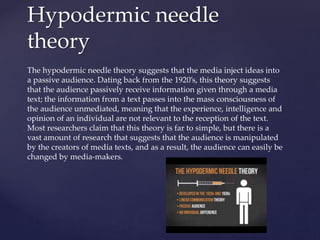
The hypodermic needle theory suggests that the media inject ideas into
a passive audience. Dating back from the 1920’s, this theory suggests
that the audience passively receive information given through a media
text; the information from a text passes into the mass consciousness of
the audience unmediated, meaning that the experience, intelligence and
opinion of an individual are not relevant to the reception of the text.
Most researchers claim that this theory is far to simple, but there is a
vast amount of research that suggests that the audience is manipulated
by the creators of media texts, and as a result, the audience can easily be
changed by media-makers.
Two step flow
The two step flow model suggests that ideas flow from mass media to
opinion leaders, and then from them to a wider population. The theory was
first introduced by Paul Lazarsfield in 1944. Unlike the hypodermic needle
model, which considers mass media effects to be direct, the two step flow
model stresses the model, mass media information is channelled to the
masses through opinion leadership; the people with most access to media
and a greater understanding of media content, explain the content and
share their knowledge.
Uses and gratifications theory
This theory accepts that audiences are made up of individuals who actively
consume texts for different reasons and in different ways.
It was said by Halloran in 1970, “We must get away from the habit of thinking in
terms of what the media do to people and subsititute for it the idea of what people
do with the media”. This suggests that he believes the audience is able to control
what they do with the media that is accessible to them.
Wright mill specified four functions of media for the audience
1) To give people aspiration
2) To give individuals identity
3) To give people instruction
4) To give people a form of escapism
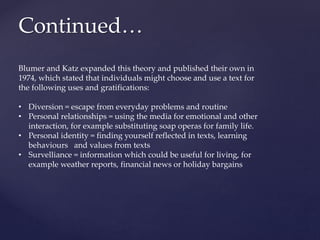
Continued…
Blumer and Katz expanded this theory and published their own in
1974, which stated that individuals might choose and use a text for
the following uses and gratifications:
• Diversion = escape from everyday problems and routine
• Personal relationships = using the media for emotional and other
interaction, for example substituting soap operas for family life.
• Personal identity = finding yourself reflected in texts, learning
behaviours and values from texts
• Survelliance = information which could be useful for living, for
example weather reports, financial news or holiday bargains

Hypodermic needle theory

  • 1.
  • 2.
    Hypodermic needle theory The hypodermicneedle theory suggests that the media inject ideas into a passive audience. Dating back from the 1920’s, this theory suggests that the audience passively receive information given through a media text; the information from a text passes into the mass consciousness of the audience unmediated, meaning that the experience, intelligence and opinion of an individual are not relevant to the reception of the text. Most researchers claim that this theory is far to simple, but there is a vast amount of research that suggests that the audience is manipulated by the creators of media texts, and as a result, the audience can easily be changed by media-makers.
  • 3.
    Two step flow Thetwo step flow model suggests that ideas flow from mass media to opinion leaders, and then from them to a wider population. The theory was first introduced by Paul Lazarsfield in 1944. Unlike the hypodermic needle model, which considers mass media effects to be direct, the two step flow model stresses the model, mass media information is channelled to the masses through opinion leadership; the people with most access to media and a greater understanding of media content, explain the content and share their knowledge.
  • 4.
    Uses and gratificationstheory This theory accepts that audiences are made up of individuals who actively consume texts for different reasons and in different ways. It was said by Halloran in 1970, “We must get away from the habit of thinking in terms of what the media do to people and subsititute for it the idea of what people do with the media”. This suggests that he believes the audience is able to control what they do with the media that is accessible to them. Wright mill specified four functions of media for the audience 1) To give people aspiration 2) To give individuals identity 3) To give people instruction 4) To give people a form of escapism
  • 5.
    Continued… Blumer and Katzexpanded this theory and published their own in 1974, which stated that individuals might choose and use a text for the following uses and gratifications: • Diversion = escape from everyday problems and routine • Personal relationships = using the media for emotional and other interaction, for example substituting soap operas for family life. • Personal identity = finding yourself reflected in texts, learning behaviours and values from texts • Survelliance = information which could be useful for living, for example weather reports, financial news or holiday bargains