
By Artsiom Chaiko
MASS MEDIA


                                   Also known as the Multistep Flow
                                   Model is a theory based on a 1940s
                                   study on social influence that states
                                   that media effects are indirectly
                                   established through the personal
                                   influence of opinion leaders. The
                                   majority of people receive much of
                                   their    information      and     are
                                   influenced     by      the    media
                                   secondhand, through the personal
                                   influence of opinion leaders.
- Opinion leader
- Individuals in socials contact
with an Opinion leader
The Multistep Flow Model says that most
people form their opinions based on opinion
leaders that influence the media. Opinion
leaders are those initially exposed to a
specific media content, and who interpret it
based on their own opinion. They then begin
to infiltrate these opinions through the
general public who become "opinion
followers". These "opinion leaders" gain their
influence through more elite media as
opposed to mainstream mass media. In this
process, social influence is created and
adjusted by the ideals and opinions of each
specific "elite media" group, and by these
media group's opposing ideals and opinions
and in combination with popular mass media
sources. Therefore, the leading influence in
these opinions is primarily a social
persuasion.
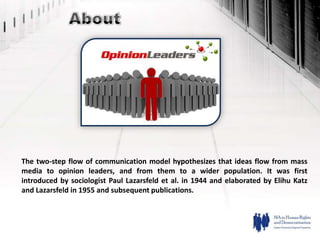
The two-step flow of communication model hypothesizes that ideas flow from mass
media to opinion leaders, and from them to a wider population. It was first
introduced by sociologist Paul Lazarsfeld et al. in 1944 and elaborated by Elihu Katz
and Lazarsfeld in 1955 and subsequent publications.
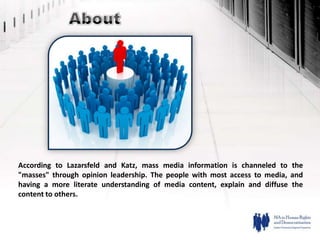
According to Lazarsfeld and Katz, mass media information is channeled to the
"masses" through opinion leadership. The people with most access to media, and
having a more literate understanding of media content, explain and diffuse the
content to others.
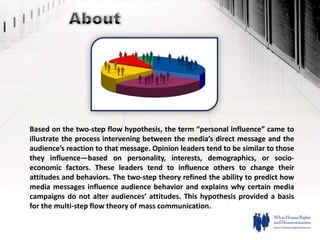
Based on the two-step flow hypothesis, the term “personal influence” came to
illustrate the process intervening between the media’s direct message and the
audience’s reaction to that message. Opinion leaders tend to be similar to those
they influence—based on personality, interests, demographics, or socio-
economic factors. These leaders tend to influence others to change their
attitudes and behaviors. The two-step theory refined the ability to predict how
media messages influence audience behavior and explains why certain media
campaigns do not alter audiences’ attitudes. This hypothesis provided a basis
for the multi-step flow theory of mass communication.
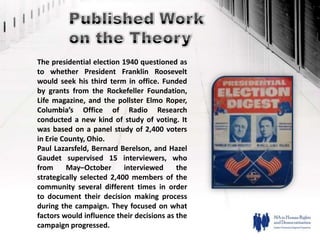
The presidential election 1940 questioned as
to whether President Franklin Roosevelt
would seek his third term in office. Funded
by grants from the Rockefeller Foundation,
Life magazine, and the pollster Elmo Roper,
Columbia’s Office of Radio Research
conducted a new kind of study of voting. It
was based on a panel study of 2,400 voters
in Erie County, Ohio.
Paul Lazarsfeld, Bernard Berelson, and Hazel
Gaudet supervised 15 interviewers, who
from     May–October       interviewed     the
strategically selected 2,400 members of the
community several different times in order
to document their decision making process
during the campaign. They focused on what
factors would influence their decisions as the
campaign progressed.
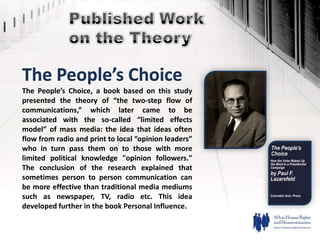
The People’s Choice
The People’s Choice, a book based on this study
presented the theory of “the two-step flow of
communications,” which later came to be
associated with the so-called “limited effects
model” of mass media: the idea that ideas often
flow from radio and print to local “opinion leaders”
who in turn pass them on to those with more
limited political knowledge "opinion followers."
The conclusion of the research explained that
sometimes person to person communication can
be more effective than traditional media mediums
such as newspaper, TV, radio etc. This idea
developed further in the book Personal Influence.
Two step flow of communication

Two step flow of communication

  • 1.
  • 2.
    MASS MEDIA Also known as the Multistep Flow Model is a theory based on a 1940s study on social influence that states that media effects are indirectly established through the personal influence of opinion leaders. The majority of people receive much of their information and are influenced by the media secondhand, through the personal influence of opinion leaders. - Opinion leader - Individuals in socials contact with an Opinion leader
  • 3.
    The Multistep FlowModel says that most people form their opinions based on opinion leaders that influence the media. Opinion leaders are those initially exposed to a specific media content, and who interpret it based on their own opinion. They then begin to infiltrate these opinions through the general public who become "opinion followers". These "opinion leaders" gain their influence through more elite media as opposed to mainstream mass media. In this process, social influence is created and adjusted by the ideals and opinions of each specific "elite media" group, and by these media group's opposing ideals and opinions and in combination with popular mass media sources. Therefore, the leading influence in these opinions is primarily a social persuasion.
  • 4.
    The two-step flowof communication model hypothesizes that ideas flow from mass media to opinion leaders, and from them to a wider population. It was first introduced by sociologist Paul Lazarsfeld et al. in 1944 and elaborated by Elihu Katz and Lazarsfeld in 1955 and subsequent publications.
  • 5.
    According to Lazarsfeldand Katz, mass media information is channeled to the "masses" through opinion leadership. The people with most access to media, and having a more literate understanding of media content, explain and diffuse the content to others.
  • 6.
    Based on thetwo-step flow hypothesis, the term “personal influence” came to illustrate the process intervening between the media’s direct message and the audience’s reaction to that message. Opinion leaders tend to be similar to those they influence—based on personality, interests, demographics, or socio- economic factors. These leaders tend to influence others to change their attitudes and behaviors. The two-step theory refined the ability to predict how media messages influence audience behavior and explains why certain media campaigns do not alter audiences’ attitudes. This hypothesis provided a basis for the multi-step flow theory of mass communication.
  • 7.
    The presidential election1940 questioned as to whether President Franklin Roosevelt would seek his third term in office. Funded by grants from the Rockefeller Foundation, Life magazine, and the pollster Elmo Roper, Columbia’s Office of Radio Research conducted a new kind of study of voting. It was based on a panel study of 2,400 voters in Erie County, Ohio. Paul Lazarsfeld, Bernard Berelson, and Hazel Gaudet supervised 15 interviewers, who from May–October interviewed the strategically selected 2,400 members of the community several different times in order to document their decision making process during the campaign. They focused on what factors would influence their decisions as the campaign progressed.
  • 8.
    The People’s Choice ThePeople’s Choice, a book based on this study presented the theory of “the two-step flow of communications,” which later came to be associated with the so-called “limited effects model” of mass media: the idea that ideas often flow from radio and print to local “opinion leaders” who in turn pass them on to those with more limited political knowledge "opinion followers." The conclusion of the research explained that sometimes person to person communication can be more effective than traditional media mediums such as newspaper, TV, radio etc. This idea developed further in the book Personal Influence.