MEDIA AUDIENCES
Hierarchy of needs
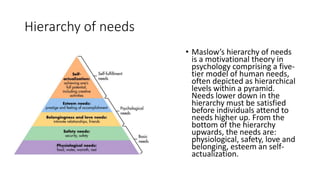
• Maslow’s hierarchy of needs
is a motivational theory in
psychology comprising a five-
tier model of human needs,
often depicted as hierarchical
levels within a pyramid.
Needs lower down in the
hierarchy must be satisfied
before individuals attend to
needs higher up. From the
bottom of the hierarchy
upwards, the needs are:
physiological, safety, love and
belonging, esteem an self-
actualization.
Passive Audiences
• Media analysis has developed
several effects models, ie
theoretical explanations of how
humans ingest the information
transmitted by media texts and
how this might influence (or not)
their behaviour.
• Dating from the 1920s, this
theory was the first attempt
to explain how mass
audiences might react to mass
media.
• Governments had just
discovered the power of
advertising to communicate
a message, and
produced propaganda to try
and sway populaces to their
way of thinking.
The History Of The hypodermic effect
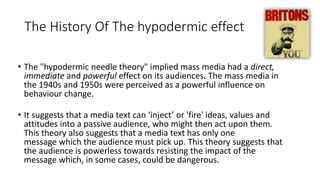
• The "hypodermic needle theory" implied mass media had a direct,
immediate and powerful effect on its audiences. The mass media in
the 1940s and 1950s were perceived as a powerful influence on
behaviour change.
• It suggests that a media text can ‘inject’ or 'fire' ideas, values and
attitudes into a passive audience, who might then act upon them.
This theory also suggests that a media text has only one
message which the audience must pick up. This theory suggests that
the audience is powerless towards resisting the impact of the
message which, in some cases, could be dangerous.
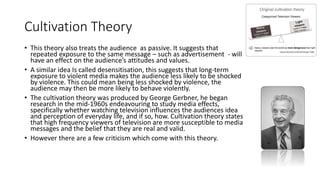
Cultivation Theory
• This theory also treats the audience as passive. It suggests that
repeated exposure to the same message – such as advertisement - will
have an effect on the audience’s attitudes and values.
• A similar idea Is called desensitisation, this suggests that long-term
exposure to violent media makes the audience less likely to be shocked
by violence. This could mean being less shocked by violence, the
audience may then be more likely to behave violently.
• The cultivation theory was produced by George Gerbner, he began
research in the mid-1960s endeavouring to study media effects,
specifically whether watching television influences the audiences idea
and perception of everyday life, and if so, how. Cultivation theory states
that high frequency viewers of television are more susceptible to media
messages and the belief that they are real and valid.
• However there are a few criticism which come with this theory.
Two Step Flow Theory
• The two authors of the theory are called Katz and Lazarsfeld and
they looked at how voters made up their minds in presidential
elections.
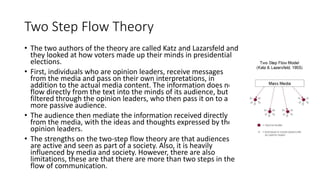
• First, individuals who are opinion leaders, receive messages
from the media and pass on their own interpretations, in
addition to the actual media content. The information does not
flow directly from the text into the minds of its audience, but is
filtered through the opinion leaders, who then pass it on to a
more passive audience.
• The audience then mediate the information received directly
from the media, with the ideas and thoughts expressed by the
opinion leaders.
• The strengths on the two-step flow theory are that audiences
are active and seen as part of a society. Also, it is heavily
influenced by media and society. However, there are also
limitations, these are that there are more than two steps in the
flow of communication.
Active Audiences
• This newer model sees the audience not as couch potatoes, but as
individuals who are active and interact with the communication
process and use media texts for their own purposes. They are
prosumers.
• We behave differently because we are different people from different
backgrounds with many different attitudes, values, experiences and
ideas.
Uses And Gratifications Model
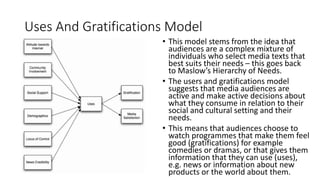
• This model stems from the idea that
audiences are a complex mixture of
individuals who select media texts that
best suits their needs – this goes back
to Maslow’s Hierarchy of Needs.
• The users and gratifications model
suggests that media audiences are
active and make active decisions about
what they consume in relation to their
social and cultural setting and their
needs.
• This means that audiences choose to
watch programmes that make them feel
good (gratifications) for example
comedies or dramas, or that gives them
information that they can use (uses),
e.g. news or information about new
products or the world about them.
Reception Theory
• Reception analysis is an active audience theory that looks at how
audiences interact with a media text taking into account their
‘situated culture’.
• His theory was put forward by Professor Stuart Hall in ‘The Television
Discourse - Encoding/Decoding’ in 1974, with later research by David
Morley and Charlotte Brunsden.
• The theory suggests that social and daily experiences can affect the
way an audience reads a media text and reacts to it.

Media audiences powerpoint

  • 1.
  • 2.
    Hierarchy of needs •Maslow’s hierarchy of needs is a motivational theory in psychology comprising a five- tier model of human needs, often depicted as hierarchical levels within a pyramid. Needs lower down in the hierarchy must be satisfied before individuals attend to needs higher up. From the bottom of the hierarchy upwards, the needs are: physiological, safety, love and belonging, esteem an self- actualization.
  • 3.
    Passive Audiences • Mediaanalysis has developed several effects models, ie theoretical explanations of how humans ingest the information transmitted by media texts and how this might influence (or not) their behaviour. • Dating from the 1920s, this theory was the first attempt to explain how mass audiences might react to mass media. • Governments had just discovered the power of advertising to communicate a message, and produced propaganda to try and sway populaces to their way of thinking.
  • 4.
    The History OfThe hypodermic effect • The "hypodermic needle theory" implied mass media had a direct, immediate and powerful effect on its audiences. The mass media in the 1940s and 1950s were perceived as a powerful influence on behaviour change. • It suggests that a media text can ‘inject’ or 'fire' ideas, values and attitudes into a passive audience, who might then act upon them. This theory also suggests that a media text has only one message which the audience must pick up. This theory suggests that the audience is powerless towards resisting the impact of the message which, in some cases, could be dangerous.
  • 5.
    Cultivation Theory • Thistheory also treats the audience as passive. It suggests that repeated exposure to the same message – such as advertisement - will have an effect on the audience’s attitudes and values. • A similar idea Is called desensitisation, this suggests that long-term exposure to violent media makes the audience less likely to be shocked by violence. This could mean being less shocked by violence, the audience may then be more likely to behave violently. • The cultivation theory was produced by George Gerbner, he began research in the mid-1960s endeavouring to study media effects, specifically whether watching television influences the audiences idea and perception of everyday life, and if so, how. Cultivation theory states that high frequency viewers of television are more susceptible to media messages and the belief that they are real and valid. • However there are a few criticism which come with this theory.
  • 6.
    Two Step FlowTheory • The two authors of the theory are called Katz and Lazarsfeld and they looked at how voters made up their minds in presidential elections. • First, individuals who are opinion leaders, receive messages from the media and pass on their own interpretations, in addition to the actual media content. The information does not flow directly from the text into the minds of its audience, but is filtered through the opinion leaders, who then pass it on to a more passive audience. • The audience then mediate the information received directly from the media, with the ideas and thoughts expressed by the opinion leaders. • The strengths on the two-step flow theory are that audiences are active and seen as part of a society. Also, it is heavily influenced by media and society. However, there are also limitations, these are that there are more than two steps in the flow of communication.
  • 7.
    Active Audiences • Thisnewer model sees the audience not as couch potatoes, but as individuals who are active and interact with the communication process and use media texts for their own purposes. They are prosumers. • We behave differently because we are different people from different backgrounds with many different attitudes, values, experiences and ideas.
  • 8.
    Uses And GratificationsModel • This model stems from the idea that audiences are a complex mixture of individuals who select media texts that best suits their needs – this goes back to Maslow’s Hierarchy of Needs. • The users and gratifications model suggests that media audiences are active and make active decisions about what they consume in relation to their social and cultural setting and their needs. • This means that audiences choose to watch programmes that make them feel good (gratifications) for example comedies or dramas, or that gives them information that they can use (uses), e.g. news or information about new products or the world about them.
  • 9.
    Reception Theory • Receptionanalysis is an active audience theory that looks at how audiences interact with a media text taking into account their ‘situated culture’. • His theory was put forward by Professor Stuart Hall in ‘The Television Discourse - Encoding/Decoding’ in 1974, with later research by David Morley and Charlotte Brunsden. • The theory suggests that social and daily experiences can affect the way an audience reads a media text and reacts to it.