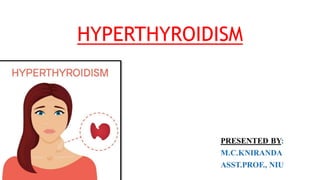
HYPERTHYROIDISM
THYROIDITIS
• 15 to 20% cases.
• Thyroiditis is a general term that refers to “inflammation of the
thyroid gland”.
TREATMENT
• Goals: –
1. Normalize serum TSH levels.
2. Correct clinical signs & symptoms and metabolic
derangements.
TREATMENT
Steps:
1. Rest
2. Sedation
3. Beta-blockers
4. Antithyroid medication
5. NSAIDs and Corticosteroids
SYMPTOMS RELIEF
• Rehydration is the first step
• β – blockers to decrease the sympathetic excess.
• Propranalol, Atenelol, Metoprolol
valuable during the first 2–3 weeks of treatment in
providing symptomatic relief of tachycardia,
nervousness and tremor and can then be
discontinued as the specific antithyroid drug
becomes clinically effective.
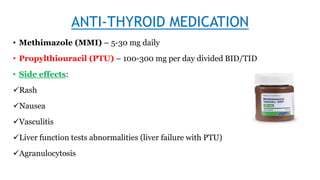
ANTI-THYROID MEDICATION
• Methimazole (MMI) – 5-30 mg daily
• Propylthiouracil (PTU) – 100-300 mg per day divided BID/TID
• Side effects:
Rash
Nausea
Vasculitis
Liver function tests abnormalities (liver failure with PTU)
Agranulocytosis
Radio Active Iodine (RAI Rx.)
• In women who are not pregnant
• Graves disease not remitting with ATD
• RAI Rx is the best treatment of hyperthyroidism in adults
• The effect is less rapid than ATD or Thyroidectomy
• It is effective, safe, and does not require hospitalization.
• Given orally as a single dose in a capsule or liquid form.
• Very few adverse effects as no other tissue absorbs RAI
SURGICAL TREATMENT
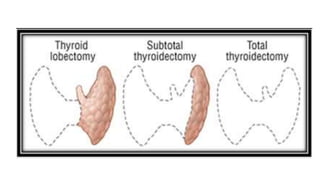
• Subtotal Thyroidectomy or Total Thyroidectomy.
• Total thyroidectomy is an operation that involves the surgical
removal of the whole thyroid gland.
• Subtotal thyroidectomy leaves 3 g to 5 g on the less affected side
of the thyroid gland.
NURSING MANAGEMENT OF
HYPOTHYROIDISM
• Promote rest. Promote rest and exercise as tolerated.
• Protect against coldness. Provide extra layer of
clothing or extra blanket.
• Avoid external heat exposure. Discourage and avoid
the use of external heat source.
• Mind the temperature. Monitor patient’s body
temperature.
NURSING MANAGEMENT OF
HYPOTHYROIDISM
• Increase fluid intake. Encourage increased fluid intake within
the limits of fluid restriction.
• Provide foods high in fiber.
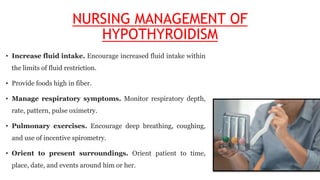
• Manage respiratory symptoms. Monitor respiratory depth,
rate, pattern, pulse oximetry.
• Pulmonary exercises. Encourage deep breathing, coughing,
and use of incentive spirometry.
• Orient to present surroundings. Orient patient to time,
place, date, and events around him or her.
NURSING MANAGEMENT OF
HYPERTHYROIDISM
• Provide a cool environment.
• Minimize stress by providing privacy and placing the patient in a private room.
• Teach patient to avoid stimulants such as coffee, sweets, tea, soft drinks, energy bar
and cigarette smoking.
• Watch out for signs of Agranulocytosis (decrease in WBC) such as sudden onset of
fever and sore throat when patient has medications such as PTU or Methimazole.
• Monitor for other problems such as allergic reactions to drugs, and others.
• Patient care post-thyroidectomy
Hyperthyroidism thyroid disorders  .pptx

Hyperthyroidism thyroid disorders .pptx

  • 1.
  • 6.
    THYROIDITIS • 15 to20% cases. • Thyroiditis is a general term that refers to “inflammation of the thyroid gland”.
  • 14.
    TREATMENT • Goals: – 1.Normalize serum TSH levels. 2. Correct clinical signs & symptoms and metabolic derangements.
  • 15.
    TREATMENT Steps: 1. Rest 2. Sedation 3.Beta-blockers 4. Antithyroid medication 5. NSAIDs and Corticosteroids
  • 16.
    SYMPTOMS RELIEF • Rehydrationis the first step • β – blockers to decrease the sympathetic excess. • Propranalol, Atenelol, Metoprolol valuable during the first 2–3 weeks of treatment in providing symptomatic relief of tachycardia, nervousness and tremor and can then be discontinued as the specific antithyroid drug becomes clinically effective.
  • 17.
    ANTI-THYROID MEDICATION • Methimazole(MMI) – 5-30 mg daily • Propylthiouracil (PTU) – 100-300 mg per day divided BID/TID • Side effects: Rash Nausea Vasculitis Liver function tests abnormalities (liver failure with PTU) Agranulocytosis
  • 18.
    Radio Active Iodine(RAI Rx.) • In women who are not pregnant • Graves disease not remitting with ATD • RAI Rx is the best treatment of hyperthyroidism in adults • The effect is less rapid than ATD or Thyroidectomy • It is effective, safe, and does not require hospitalization. • Given orally as a single dose in a capsule or liquid form. • Very few adverse effects as no other tissue absorbs RAI
  • 19.
    SURGICAL TREATMENT • SubtotalThyroidectomy or Total Thyroidectomy. • Total thyroidectomy is an operation that involves the surgical removal of the whole thyroid gland. • Subtotal thyroidectomy leaves 3 g to 5 g on the less affected side of the thyroid gland.
  • 21.
    NURSING MANAGEMENT OF HYPOTHYROIDISM •Promote rest. Promote rest and exercise as tolerated. • Protect against coldness. Provide extra layer of clothing or extra blanket. • Avoid external heat exposure. Discourage and avoid the use of external heat source. • Mind the temperature. Monitor patient’s body temperature.
  • 22.
    NURSING MANAGEMENT OF HYPOTHYROIDISM •Increase fluid intake. Encourage increased fluid intake within the limits of fluid restriction. • Provide foods high in fiber. • Manage respiratory symptoms. Monitor respiratory depth, rate, pattern, pulse oximetry. • Pulmonary exercises. Encourage deep breathing, coughing, and use of incentive spirometry. • Orient to present surroundings. Orient patient to time, place, date, and events around him or her.
  • 23.
    NURSING MANAGEMENT OF HYPERTHYROIDISM •Provide a cool environment. • Minimize stress by providing privacy and placing the patient in a private room. • Teach patient to avoid stimulants such as coffee, sweets, tea, soft drinks, energy bar and cigarette smoking. • Watch out for signs of Agranulocytosis (decrease in WBC) such as sudden onset of fever and sore throat when patient has medications such as PTU or Methimazole. • Monitor for other problems such as allergic reactions to drugs, and others. • Patient care post-thyroidectomy