Thyrotoxicosis
Dr. Nazma Begum
MD-IM, Part III
Sylhet MAG Osmani Medical College
Thyroid gland : Anatomy
Thyroid gland : Physiology
Definition
• Thyrotoxicosis is defined as the state of thyroid hormone
excess.
• Hyperthyroidism- is the result of excessive thyroid gland
function.
• The major etiologies of thyrotoxicosis are hyperthyroidism
caused by Graves’ disease, toxic MNG, and toxic adenoma.
Clinical manifestations
GRAVES’ DISEASE
• Graves’ disease accounts for 60–80% of thyrotoxicosis, most common in
women of 30-50 years of age.
• a combination of environmental and genetic factors, including
polymorphisms in HLA-DR, CTLA-4, and PTPN22 (a T cell regulatory
gene), contribute to Graves’ disease susceptibility.
• Smoking is a minor risk factor for Graves’ disease and a major risk factor
for the development of ophthalmopathy.
GRAVES’ DISEASE
• The hyperthyroidism of Graves’ disease is caused by TRAb/TSI (thyroid
stimulating immunoglobulin) that can be detected in 95% cases and are
synthesized in the thyroid gland as well as in bone marrow and lymph
nodes.
• In pregnancy: high levels of TSI can cross the placenta and cause
neonatal thyrotoxicosis.
Graves’Disease: Cont….
Graves’ ophthalmopathy:
• Cytokines appear to play a major role.
• infiltration of the extraocular muscles by activated T cells; the
release of cytokines such as IFN-gamma, TNF, and IL-1 results
in fibroblast activation and increased synthesis of
glycosaminoglycans that trap water, thereby leading to
characteristic muscle swelling.
Graves’ Ophthalmopathy: Cont…
• Increased fat - an additional cause of retrobulbar tissue
expansion.
• increase in intraorbital pressure can lead to proptosis,
diplopia, and optic neuropathy.
• Late in the disease, there is irreversible fibrosis of the
muscles.
In the elderly:
• features of thyrotoxicosis may be subtle or masked,
• may present mainly with fatigue and weight loss, a
condition known as apathetic thyrotoxicosis.
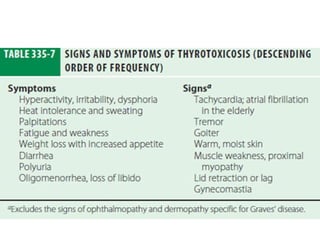
• Thyrotoxicosis cause weight loss, despite an enhanced appetite,
due to the increased metabolic rate.
• Fine tremor is a frequent finding, best elicited by having patients
stretch out their fingers while feeling the fingertips with the palm
or placing a paper over the fingers.
• Thyrotoxicosis is sometimes associated with a form of
hypokalemic periodic paralysis.
• Common neurologic manifestations include hyperreflexia, muscle
wasting, and proximal myopathy without fasciculation.
• The direct effect of thyroid hormones on bone resorption leads to
osteopenia in longstanding thyrotoxicosis; mild hypercalcemia
occurs in up to 20% of patients, but hypercalciuria is more common.
• In Graves’ disease the thyroid is usually diffusely enlarged to two–
three times its normal size.
• Prevalence of eye disease 50% at presentation but exophthalmic
Graves’ disease may occur before or after thyrotoxic episode.
Lid retraction, causing a staring appearance, can occur in any
form of thyrotoxicosis and is the result of sympathetic
overactivity.
The earliest manifestations of ophthalmopathy are usually a
sensation of grittiness, eye discomfort, and excess tearing on
exposure of wind and bright light
• Scoring system to gauge the extent and activity of the
orbital changes in Graves’ disease is the “NO SPECS” scheme
NO SPECS
• 0 = No signs or symptoms
• 1 = Only signs (lid retraction or lag), no symptoms
• 2 = Soft tissue involvement (periorbital edema,
pain)
• 3 = Proptosis (>20 mm)
• 4 = Extraocular muscle involvement (diplopia)
• 5 = Corneal ulceration.
• 6 = Sight loss(visual acuity </=0.67, due to corneal
edema or Optic nerve compression)
• Ophthalmopathy typically worsens over the initial
3–6 months, followed by a plateau phase over the next
12–18 months, with spontaneous improvement,
particularly in the soft tissue changes.
• Thyroid dermopathy occurs in <5% of patients with
Graves’ disease , almost always in the presence of
moderate or severe ophthalmopathy.
• Thyroid dermopathy, when it occurs, usually appears 1–2
years after the development of Graves’ hyperthyroidism;
it may improve spontaneously.
• Thyroid acropachy refers to a form of clubbing found in
<1% of patients with Graves’ disease.
• Thyroid failure seen in some patient
• Results from the presence of TSH-R blocking auto Ab
and from tissue destruction by cytotoxic Ab and cell
mediated immunity.
• There may be fluctuation between hyperthyroidism,
euthyroidism and hyperthyroidism in natural course of
Graves’ disease due to changes in the functional
activity of TSH-R antibodies.
Thyrotoxicosis Mimic:
• Clinical features of thyrotoxicosis can mimic certain aspects of
other disorders, including panic attacks, mania, post menopausal
syndrome, pheochromocytoma, and weight loss associated with
malignancy.
• The diagnosis of thyrotoxicosis can be easily excluded if the TSH
and unbound/free T3 levels are normal.
Lab. Investigation:
• TSH level is suppressed and total and unbound/free thyroid
hormone levels are increased in Graves' disease.
• USG of thyroid and Thyroid scan
• Measurement of TBII(TSH binding inhibitor immunoglobulin)
or TSI will confirm the diagnosis but is not needed routinely.
• Nonspecific elevation of bilirubin, liver enzymes, and ferritin.
• Microcytic anemia and thrombocytopenia may occur.
Treatment modalities:
Main treatment modalities are-
• Antithyroid drugs when appropriate
• Symptomatic treatment
• Radioactive iodine ablation and
• Surgery
Treatment : cont…
• The hyperthyroidism of Graves’ disease is treated by reducing
thyroid hormone synthesis, using antithyroid drugs, or reducing the
amount of thyroid tissue with radioiodine (131I) treatment or by
thyroidectomy.
• The main antithyroid drugs are the thionamides, such as
propylthiouracil, carbimazole, and the active metabolite of the latter,
methimazole. All inhibit the function of TPO, reducing oxidation and
organification of iodide.
• Propylthiouracil also inhibits deiodination of T4 to T3.
Treatment: cont…
• The initial dose of carbimazole or methimazole is usually 40–60 mg
daily.
• Propylthiouracil (PTU) : at a dose of 400–600 mg daily
Subjective improvement within 10-14 days
Clinical and Biochemical euthyroid at 6-8 weeks.
• At this point, carbimazole dose is reduced or titrated to 5-20mg and PTU
50 to 100mg to maintain T4 and TSH in reference Range .
• Continue for 12 to 18 months but recurrence rate is 50-70%.
Treatment: cont…
• Risk factors for relapse: younger age , male sex, presence of goiter,
higher TRAb.
• Rarely, T4 and TSH level fluctuate between those of thyrotoxicosis and
Hypothyroidism during ATD maintenance period despite good
compliance due to changing concentration of TRAb.
• High doses may be given combined with levothyroxine 30-40 mg daily
supplementation with adding levothyroxine 100-150 microgm (block-
replace regimen) to avoid drug-induced hypothyroidism.
• The common side effects of antithyroid drugs are rash,
urticaria, fever, and arthralgia (1–5% of patients). And
• Need to watch for symptoms of possible agranulocytosis
(e.g., sore throat, fever, mouth ulcers) (o.2%-o.5%).
• PTU may causes hepatotoxicity and liver failure.
• Propranolol (20–40 mg every 6 h) or longer-acting beta
blockers such as atenolol, may be helpful to control adrenergic
symptoms, especially in the early stages before antithyroid
drugs take effect. Verapamil can be used if Propranolol is
contraindicated.
• The need for anticoagulation should be considered in all
patients with atrial fibrillation.
Ophthalmopathy
For mild or moderate disease, usually spontaneous
improvement with
• cessation of smoking
• Methyl cellulose drops and gel
• Tinted glass or side shield attached to spectacle frame
• Oral selenium 100microgram BD for 6 months.
For moderate to severe – need multidisciplinary service
• glucocorticoid and/or orbital radiotherapy.
• Recent updated Rx:
Rituximab, Tocilizumab. IGF-1 R blocker teprotumumab
• Loss of visual acuity- urgent Surgical decompression and
Burn out case- surgery to EOM.
Radioactive Iodine:
• Radioiodine 131I causes progressive destruction of
thyroid cells and can be used in relapses after a trial of
antithyroid drugs.
• Propylthiouracil has a prolonged radioprotective effect
and should be stopped several weeks before radioiodine
is given.
Radioactive Iodine: cont…
• 131I dosage generally ranges between 400 MBq (10mCi) to 600 MBq
(15 mCi).
• Has long inhibitory effect on survival and proliferation of follicular cell
and effective in 75% of cases within 4 to 12 weeks
• Hyperthyroidism can persist for 2–3 months before radioiodine takes
full effect. For this reason, beta-adrenergic blockers or antithyroid drugs
can be used to control symptoms during this interval.
• But carbimazole have to avoid in first 48 hours
• In case of Graves’ disease with ophthalmopathy , Before RAI
a 6 weeks tapering course of oral prednisolone should be
given to avoid exacerbation of ophthalmopathy.
• Persistent hyperthyroidism can be treated with a second
dose of radioiodine, usually 6 months after the first dose.
• Pregnancy and breast feeding are absolute
contraindications to radioiodine treatment, but patients can
conceive safely 6 months after treatment.
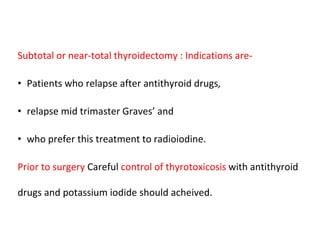
Subtotal or near-total thyroidectomy : Indications are-
• Patients who relapse after antithyroid drugs,
• relapse mid trimaster Graves’ and
• who prefer this treatment to radioiodine.
Prior to surgery Careful control of thyrotoxicosis with antithyroid
drugs and potassium iodide should acheived.
• Propylthiouracil is usually used in 1st trimester
of pregnancy because of relatively low
transplacental transfer and its ability to block
T4 to T3 conversion.
Thyroid storm/ Thyrotoxic crisis
Thyrotoxic crisis, or thyroid storm, is rare but life-threatening
complication of thyrotoxicosis,
• Characterized by fever, delirium, seizures, coma, vomiting, diarrhea,
and jaundice, tachycardia, AF, in older patient, heart failure.
Precipitated by :
• infection in an unrecognized or inadequately treated case or after
thyroidectomy in ill prepared patient or within few days after 131I
• Mortality around 10% despite early recognition and treatment.
Thyroid storm/ Thyrotoxic crisis
Management:
• Adequate hydration with I. V. fluid.
• oral Propranolol 80mg QDS / I.V. 1-4mg QDS.
• Injection Hydrocortisone 100mg TDS
• Oral Sodium Ipodate 500mg daily for 48 to72 hours ( or KI/
Lugol’s solution)
Thyroid storm/ Thyrotoxic crisis
• Propylthiouracil 200mg every 4 hours should be given orally or by
nasogastric tube; the drug is preferred for it’s inhibitory action
on T4 to T3.
• Tab. Carbimazole 20 mg QDS can be used if PTU is not available.
• After 10 to 14 days patient can be maintained on carbimazole
alone.
THYROIDITIS
• The patient presents with thyroid pain, often referred to the
throat or ears, and a small, tender goiter that may be asymmetric.
• The erythrocyte sedimentation rate (ESR) and white cell count are
usually increased, but thyroid function is normal. FNA biopsy
shows infiltration by polymorphonuclear leukocytes; culture of
the sample can identify the organism
• The differential diagnosis of thyroid pain
includes
• Subacute thyroiditis
• Chronic thyroiditis
• Hemorrhage into a cyst
• Malignancy including lymphoma
• Amiodarone-induced thyroiditis or
• Amyloidosis.
• Antibiotic treatment is guided initially by Gram
stain and subsequently by cultures of the FNA
biopsy.
• Surgery to drain the abscess.
SUBACUTE THYROIDITIS
• This is also termed de Quervain’s thyroiditis, granulomatous
thyroiditis, or viral thyroiditis.
• Viral etiology- mumps, coxsackie, influenza.
• Symptoms can mimic pharyngitis.
• During the initial phase of follicular destruction, there is release of Tg
and thyroid hormones, leading to increased circulating T4 and T3
and suppression of TSH.
• Later stages shows increase in TSH and increased radio iodine
uptake.
Clinical Manifestations :
• Painful and enlarged thyroid, sometimes accompanied by
fever.
• Malaise and symptoms of an upper respiratory tract infection
may precede the thyroid-related features by several weeks.
• The patient typically complains of a sore throat, and
examination reveals a small goiter that is exquisitely tender.
• The diagnosis is confirmed by a high ESR and low
radioiodine uptake.
• Relatively large doses of aspirin (e.g., 600 mg every 4–6 h)
or NSAIDs are sufficient to control symptoms in many cases.
• Glucocorticoids -The usual starting dose is 40–60 mg
prednisone, depending on severity.
SILENT THYROIDITIS
• Painless thyroiditis, or “silent” thyroiditis, occurs in patients
with underlying autoimmune thyroid disease.
• Typically, patients have a brief phase of thyrotoxicosis lasting
2–4 weeks, followed by hypothyroidism for 4–12 weeks, and
then resolution.
• In addition to the painless goiter, silent thyroiditis can be
distinguished from subacute thyroiditis by a normal ESR and
the presence of TPO antibodies.
• Glucocorticoids are not indicated for silent thyroiditis.
• Symptomatic treatment with short course of propranolol, 20–
40 mg three or four times daily.
SICK EUTHYROID SYNDROME
• Any acute, severe non-thyroid illness can cause abnormalities
of circulating TSH or thyroid hormone levels
• Cause is the release of cytokines such as IL-6.
• The most common hormone pattern in sick euthyroid
syndrome (SES) is a decrease in total and unbound/free T3
levels (low T3 syndrome) with normal levels of T4 and TSH.
• Very sick patients may exhibit a dramatic fall in total T4 and T3
levels (low T4 syndrome). This state has a poor prognosis
SES: cont…
• History is vital
• No laboratory investigations needed.
• Treatment is usually not required and subsequent
thyroid functions need to be monitored.
THYROID FUNCTION IN PREGNANCY
Five factors alter thyroid function in pregnancy:
(1) the transient increase in hCG during the first trimester, which stimulates
the TSH-R.
(2) Rise in TBG during the first trimester, which is sustained during
pregnancy.
(3) Alterations in the immune system, leading to the onset, exacerbation, or
amelioration of an underlying autoimmune thyroid disease.
Thyroid in pg: cont…
(4) increased thyroid hormone metabolism by the placenta.
(5) increased urinary iodide excretion, which can cause impaired
thyroid hormone production in areas of marginal iodine sufficiency.
• hCG-induced changes in thyroid function can result in transient
gestational hyperthyroidism and/or hyperemesis gravidarum,
• Thyroid hormone requirements are increased by 25–50 mic g/d
during pregnancy.
GOITER AND NODULAR THYROID DISEASE
• Goiter refers to an enlarged thyroid gland.
• Through by different mechanisms, biosynthetic defects, iodine deficiency,
autoimmune disease, and nodular diseases can each lead to goite.
• In Graves’ disease, the goiter results mainly from the TSH-R–mediated
effects of TSI.
• The goitrous form of Hashimoto’s thyroiditis occurs because of acquired
defects in hormone synthesis, leading to elevated levels of TSH and its
consequent growth effects.
Goiter :cont…
• Nodular disease is characterized by the disordered growth of
thyroid cells, often combined with the gradual development of
fibrosis.
• When diffuse enlargement of the thyroid occurs in the absence of
nodules and hyperthyroidism, it is referred to as a diffuse
nontoxic goiter. This is sometimes called simple goiter or colloid
goiter.
Goiter: cont…
• Most patients with thyroid nodules have normal thyroid
function tests.
• If TSH is suppressed, a radionuclide scan is indicated to
determine if the identified nodule is “hot,” as lesions with
increased uptake are almost never malignant and FNA is
unnecessary.
Indication for Rx:
• Goiter having malignant potential
• Large goiter causing stridor or dysphagia
• Cosmetic purpose.
Take home message
 Thyrotoxicosis is most common Endocrine Disease having
diverse etiology
 Easier to diagnose by history and clinical examination.
 But before starting specific treatment, confirmation of
diagnosis is mandatory.
 Follow up and monitoring of thyroid function have paramount
importance.
Thank you

Hyperthyroidism Ppt.pptx

  • 1.
    Thyrotoxicosis Dr. Nazma Begum MD-IM,Part III Sylhet MAG Osmani Medical College
  • 2.
  • 4.
    Thyroid gland :Physiology
  • 6.
    Definition • Thyrotoxicosis isdefined as the state of thyroid hormone excess. • Hyperthyroidism- is the result of excessive thyroid gland function. • The major etiologies of thyrotoxicosis are hyperthyroidism caused by Graves’ disease, toxic MNG, and toxic adenoma.
  • 8.
  • 12.
    GRAVES’ DISEASE • Graves’disease accounts for 60–80% of thyrotoxicosis, most common in women of 30-50 years of age. • a combination of environmental and genetic factors, including polymorphisms in HLA-DR, CTLA-4, and PTPN22 (a T cell regulatory gene), contribute to Graves’ disease susceptibility. • Smoking is a minor risk factor for Graves’ disease and a major risk factor for the development of ophthalmopathy.
  • 13.
    GRAVES’ DISEASE • Thehyperthyroidism of Graves’ disease is caused by TRAb/TSI (thyroid stimulating immunoglobulin) that can be detected in 95% cases and are synthesized in the thyroid gland as well as in bone marrow and lymph nodes. • In pregnancy: high levels of TSI can cross the placenta and cause neonatal thyrotoxicosis.
  • 14.
    Graves’Disease: Cont…. Graves’ ophthalmopathy: •Cytokines appear to play a major role. • infiltration of the extraocular muscles by activated T cells; the release of cytokines such as IFN-gamma, TNF, and IL-1 results in fibroblast activation and increased synthesis of glycosaminoglycans that trap water, thereby leading to characteristic muscle swelling.
  • 15.
    Graves’ Ophthalmopathy: Cont… •Increased fat - an additional cause of retrobulbar tissue expansion. • increase in intraorbital pressure can lead to proptosis, diplopia, and optic neuropathy. • Late in the disease, there is irreversible fibrosis of the muscles.
  • 16.
    In the elderly: •features of thyrotoxicosis may be subtle or masked, • may present mainly with fatigue and weight loss, a condition known as apathetic thyrotoxicosis.
  • 17.
    • Thyrotoxicosis causeweight loss, despite an enhanced appetite, due to the increased metabolic rate. • Fine tremor is a frequent finding, best elicited by having patients stretch out their fingers while feeling the fingertips with the palm or placing a paper over the fingers. • Thyrotoxicosis is sometimes associated with a form of hypokalemic periodic paralysis. • Common neurologic manifestations include hyperreflexia, muscle wasting, and proximal myopathy without fasciculation.
  • 19.
    • The directeffect of thyroid hormones on bone resorption leads to osteopenia in longstanding thyrotoxicosis; mild hypercalcemia occurs in up to 20% of patients, but hypercalciuria is more common. • In Graves’ disease the thyroid is usually diffusely enlarged to two– three times its normal size. • Prevalence of eye disease 50% at presentation but exophthalmic Graves’ disease may occur before or after thyrotoxic episode.
  • 20.
    Lid retraction, causinga staring appearance, can occur in any form of thyrotoxicosis and is the result of sympathetic overactivity. The earliest manifestations of ophthalmopathy are usually a sensation of grittiness, eye discomfort, and excess tearing on exposure of wind and bright light • Scoring system to gauge the extent and activity of the orbital changes in Graves’ disease is the “NO SPECS” scheme
  • 21.
    NO SPECS • 0= No signs or symptoms • 1 = Only signs (lid retraction or lag), no symptoms • 2 = Soft tissue involvement (periorbital edema, pain) • 3 = Proptosis (>20 mm) • 4 = Extraocular muscle involvement (diplopia) • 5 = Corneal ulceration. • 6 = Sight loss(visual acuity </=0.67, due to corneal edema or Optic nerve compression)
  • 22.
    • Ophthalmopathy typicallyworsens over the initial 3–6 months, followed by a plateau phase over the next 12–18 months, with spontaneous improvement, particularly in the soft tissue changes.
  • 24.
    • Thyroid dermopathyoccurs in <5% of patients with Graves’ disease , almost always in the presence of moderate or severe ophthalmopathy. • Thyroid dermopathy, when it occurs, usually appears 1–2 years after the development of Graves’ hyperthyroidism; it may improve spontaneously. • Thyroid acropachy refers to a form of clubbing found in <1% of patients with Graves’ disease.
  • 26.
    • Thyroid failureseen in some patient • Results from the presence of TSH-R blocking auto Ab and from tissue destruction by cytotoxic Ab and cell mediated immunity. • There may be fluctuation between hyperthyroidism, euthyroidism and hyperthyroidism in natural course of Graves’ disease due to changes in the functional activity of TSH-R antibodies.
  • 28.
    Thyrotoxicosis Mimic: • Clinicalfeatures of thyrotoxicosis can mimic certain aspects of other disorders, including panic attacks, mania, post menopausal syndrome, pheochromocytoma, and weight loss associated with malignancy. • The diagnosis of thyrotoxicosis can be easily excluded if the TSH and unbound/free T3 levels are normal.
  • 30.
    Lab. Investigation: • TSHlevel is suppressed and total and unbound/free thyroid hormone levels are increased in Graves' disease. • USG of thyroid and Thyroid scan • Measurement of TBII(TSH binding inhibitor immunoglobulin) or TSI will confirm the diagnosis but is not needed routinely. • Nonspecific elevation of bilirubin, liver enzymes, and ferritin. • Microcytic anemia and thrombocytopenia may occur.
  • 32.
    Treatment modalities: Main treatmentmodalities are- • Antithyroid drugs when appropriate • Symptomatic treatment • Radioactive iodine ablation and • Surgery
  • 33.
    Treatment : cont… •The hyperthyroidism of Graves’ disease is treated by reducing thyroid hormone synthesis, using antithyroid drugs, or reducing the amount of thyroid tissue with radioiodine (131I) treatment or by thyroidectomy. • The main antithyroid drugs are the thionamides, such as propylthiouracil, carbimazole, and the active metabolite of the latter, methimazole. All inhibit the function of TPO, reducing oxidation and organification of iodide. • Propylthiouracil also inhibits deiodination of T4 to T3.
  • 34.
    Treatment: cont… • Theinitial dose of carbimazole or methimazole is usually 40–60 mg daily. • Propylthiouracil (PTU) : at a dose of 400–600 mg daily Subjective improvement within 10-14 days Clinical and Biochemical euthyroid at 6-8 weeks. • At this point, carbimazole dose is reduced or titrated to 5-20mg and PTU 50 to 100mg to maintain T4 and TSH in reference Range . • Continue for 12 to 18 months but recurrence rate is 50-70%.
  • 35.
    Treatment: cont… • Riskfactors for relapse: younger age , male sex, presence of goiter, higher TRAb. • Rarely, T4 and TSH level fluctuate between those of thyrotoxicosis and Hypothyroidism during ATD maintenance period despite good compliance due to changing concentration of TRAb. • High doses may be given combined with levothyroxine 30-40 mg daily supplementation with adding levothyroxine 100-150 microgm (block- replace regimen) to avoid drug-induced hypothyroidism.
  • 36.
    • The commonside effects of antithyroid drugs are rash, urticaria, fever, and arthralgia (1–5% of patients). And • Need to watch for symptoms of possible agranulocytosis (e.g., sore throat, fever, mouth ulcers) (o.2%-o.5%). • PTU may causes hepatotoxicity and liver failure.
  • 37.
    • Propranolol (20–40mg every 6 h) or longer-acting beta blockers such as atenolol, may be helpful to control adrenergic symptoms, especially in the early stages before antithyroid drugs take effect. Verapamil can be used if Propranolol is contraindicated. • The need for anticoagulation should be considered in all patients with atrial fibrillation.
  • 38.
    Ophthalmopathy For mild ormoderate disease, usually spontaneous improvement with • cessation of smoking • Methyl cellulose drops and gel • Tinted glass or side shield attached to spectacle frame • Oral selenium 100microgram BD for 6 months. For moderate to severe – need multidisciplinary service • glucocorticoid and/or orbital radiotherapy. • Recent updated Rx: Rituximab, Tocilizumab. IGF-1 R blocker teprotumumab • Loss of visual acuity- urgent Surgical decompression and Burn out case- surgery to EOM.
  • 39.
    Radioactive Iodine: • Radioiodine131I causes progressive destruction of thyroid cells and can be used in relapses after a trial of antithyroid drugs. • Propylthiouracil has a prolonged radioprotective effect and should be stopped several weeks before radioiodine is given.
  • 40.
    Radioactive Iodine: cont… •131I dosage generally ranges between 400 MBq (10mCi) to 600 MBq (15 mCi). • Has long inhibitory effect on survival and proliferation of follicular cell and effective in 75% of cases within 4 to 12 weeks • Hyperthyroidism can persist for 2–3 months before radioiodine takes full effect. For this reason, beta-adrenergic blockers or antithyroid drugs can be used to control symptoms during this interval. • But carbimazole have to avoid in first 48 hours
  • 41.
    • In caseof Graves’ disease with ophthalmopathy , Before RAI a 6 weeks tapering course of oral prednisolone should be given to avoid exacerbation of ophthalmopathy. • Persistent hyperthyroidism can be treated with a second dose of radioiodine, usually 6 months after the first dose. • Pregnancy and breast feeding are absolute contraindications to radioiodine treatment, but patients can conceive safely 6 months after treatment.
  • 42.
    Subtotal or near-totalthyroidectomy : Indications are- • Patients who relapse after antithyroid drugs, • relapse mid trimaster Graves’ and • who prefer this treatment to radioiodine. Prior to surgery Careful control of thyrotoxicosis with antithyroid drugs and potassium iodide should acheived.
  • 43.
    • Propylthiouracil isusually used in 1st trimester of pregnancy because of relatively low transplacental transfer and its ability to block T4 to T3 conversion.
  • 44.
    Thyroid storm/ Thyrotoxiccrisis Thyrotoxic crisis, or thyroid storm, is rare but life-threatening complication of thyrotoxicosis, • Characterized by fever, delirium, seizures, coma, vomiting, diarrhea, and jaundice, tachycardia, AF, in older patient, heart failure. Precipitated by : • infection in an unrecognized or inadequately treated case or after thyroidectomy in ill prepared patient or within few days after 131I • Mortality around 10% despite early recognition and treatment.
  • 45.
    Thyroid storm/ Thyrotoxiccrisis Management: • Adequate hydration with I. V. fluid. • oral Propranolol 80mg QDS / I.V. 1-4mg QDS. • Injection Hydrocortisone 100mg TDS • Oral Sodium Ipodate 500mg daily for 48 to72 hours ( or KI/ Lugol’s solution)
  • 46.
    Thyroid storm/ Thyrotoxiccrisis • Propylthiouracil 200mg every 4 hours should be given orally or by nasogastric tube; the drug is preferred for it’s inhibitory action on T4 to T3. • Tab. Carbimazole 20 mg QDS can be used if PTU is not available. • After 10 to 14 days patient can be maintained on carbimazole alone.
  • 48.
    THYROIDITIS • The patientpresents with thyroid pain, often referred to the throat or ears, and a small, tender goiter that may be asymmetric. • The erythrocyte sedimentation rate (ESR) and white cell count are usually increased, but thyroid function is normal. FNA biopsy shows infiltration by polymorphonuclear leukocytes; culture of the sample can identify the organism
  • 50.
    • The differentialdiagnosis of thyroid pain includes • Subacute thyroiditis • Chronic thyroiditis • Hemorrhage into a cyst • Malignancy including lymphoma • Amiodarone-induced thyroiditis or • Amyloidosis.
  • 51.
    • Antibiotic treatmentis guided initially by Gram stain and subsequently by cultures of the FNA biopsy. • Surgery to drain the abscess.
  • 52.
    SUBACUTE THYROIDITIS • Thisis also termed de Quervain’s thyroiditis, granulomatous thyroiditis, or viral thyroiditis. • Viral etiology- mumps, coxsackie, influenza. • Symptoms can mimic pharyngitis. • During the initial phase of follicular destruction, there is release of Tg and thyroid hormones, leading to increased circulating T4 and T3 and suppression of TSH. • Later stages shows increase in TSH and increased radio iodine uptake.
  • 53.
    Clinical Manifestations : •Painful and enlarged thyroid, sometimes accompanied by fever. • Malaise and symptoms of an upper respiratory tract infection may precede the thyroid-related features by several weeks. • The patient typically complains of a sore throat, and examination reveals a small goiter that is exquisitely tender.
  • 55.
    • The diagnosisis confirmed by a high ESR and low radioiodine uptake. • Relatively large doses of aspirin (e.g., 600 mg every 4–6 h) or NSAIDs are sufficient to control symptoms in many cases. • Glucocorticoids -The usual starting dose is 40–60 mg prednisone, depending on severity.
  • 56.
    SILENT THYROIDITIS • Painlessthyroiditis, or “silent” thyroiditis, occurs in patients with underlying autoimmune thyroid disease. • Typically, patients have a brief phase of thyrotoxicosis lasting 2–4 weeks, followed by hypothyroidism for 4–12 weeks, and then resolution.
  • 57.
    • In additionto the painless goiter, silent thyroiditis can be distinguished from subacute thyroiditis by a normal ESR and the presence of TPO antibodies. • Glucocorticoids are not indicated for silent thyroiditis. • Symptomatic treatment with short course of propranolol, 20– 40 mg three or four times daily.
  • 58.
    SICK EUTHYROID SYNDROME •Any acute, severe non-thyroid illness can cause abnormalities of circulating TSH or thyroid hormone levels • Cause is the release of cytokines such as IL-6.
  • 59.
    • The mostcommon hormone pattern in sick euthyroid syndrome (SES) is a decrease in total and unbound/free T3 levels (low T3 syndrome) with normal levels of T4 and TSH. • Very sick patients may exhibit a dramatic fall in total T4 and T3 levels (low T4 syndrome). This state has a poor prognosis
  • 60.
    SES: cont… • Historyis vital • No laboratory investigations needed. • Treatment is usually not required and subsequent thyroid functions need to be monitored.
  • 61.
    THYROID FUNCTION INPREGNANCY Five factors alter thyroid function in pregnancy: (1) the transient increase in hCG during the first trimester, which stimulates the TSH-R. (2) Rise in TBG during the first trimester, which is sustained during pregnancy. (3) Alterations in the immune system, leading to the onset, exacerbation, or amelioration of an underlying autoimmune thyroid disease.
  • 62.
    Thyroid in pg:cont… (4) increased thyroid hormone metabolism by the placenta. (5) increased urinary iodide excretion, which can cause impaired thyroid hormone production in areas of marginal iodine sufficiency. • hCG-induced changes in thyroid function can result in transient gestational hyperthyroidism and/or hyperemesis gravidarum, • Thyroid hormone requirements are increased by 25–50 mic g/d during pregnancy.
  • 63.
    GOITER AND NODULARTHYROID DISEASE • Goiter refers to an enlarged thyroid gland. • Through by different mechanisms, biosynthetic defects, iodine deficiency, autoimmune disease, and nodular diseases can each lead to goite. • In Graves’ disease, the goiter results mainly from the TSH-R–mediated effects of TSI. • The goitrous form of Hashimoto’s thyroiditis occurs because of acquired defects in hormone synthesis, leading to elevated levels of TSH and its consequent growth effects.
  • 64.
    Goiter :cont… • Nodulardisease is characterized by the disordered growth of thyroid cells, often combined with the gradual development of fibrosis. • When diffuse enlargement of the thyroid occurs in the absence of nodules and hyperthyroidism, it is referred to as a diffuse nontoxic goiter. This is sometimes called simple goiter or colloid goiter.
  • 67.
    Goiter: cont… • Mostpatients with thyroid nodules have normal thyroid function tests. • If TSH is suppressed, a radionuclide scan is indicated to determine if the identified nodule is “hot,” as lesions with increased uptake are almost never malignant and FNA is unnecessary.
  • 68.
    Indication for Rx: •Goiter having malignant potential • Large goiter causing stridor or dysphagia • Cosmetic purpose.
  • 69.
    Take home message Thyrotoxicosis is most common Endocrine Disease having diverse etiology  Easier to diagnose by history and clinical examination.  But before starting specific treatment, confirmation of diagnosis is mandatory.  Follow up and monitoring of thyroid function have paramount importance.
  • 70.