
University of agricultural sciences
Bangalore
College of agriculture Mandya ,VC Farm
Topic : Hypersentive response in plant
From
Shwetha G S
PAMM1028
To
Dr.Jadesha
Dept.of plant pathology
HYPERSENITIVE RESPONSE
Hypersentive reaction
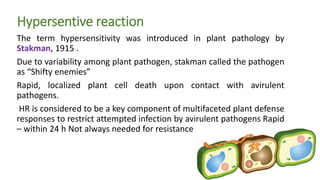
The term hypersensitivity was introduced in plant pathology by
Stakman, 1915 .
Due to variability among plant pathogen, stakman called the pathogen
as “Shifty enemies”
Rapid, localized plant cell death upon contact with avirulent
pathogens.
HR is considered to be a key component of multifaceted plant defense
responses to restrict attempted infection by avirulent pathogens Rapid
– within 24 h Not always needed for resistance
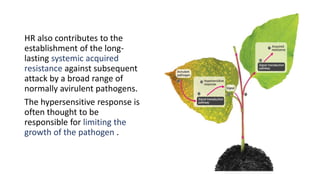
HR also contributes to the
establishment of the long-
lasting systemic acquired
resistance against subsequent
attack by a broad range of
normally avirulent pathogens.
The hypersensitive response is
often thought to be
responsible for limiting the
growth of the pathogen .
• A localized induced cell defense in the host plant at the site of
infection by a pathogen.
• Its occur only in Vertical resistance.
• Most Hypersensitive response involve only single cell or very few
cells
Artifical condition
• Injection of several genera of plant pathogenic bacteria into leaf tissues of
nonhost plants results in the development of the a hypersensitive
response.
• The artificially induced HR of consists of large leaf sectors becoming water
soaked at first and, subsequently, necrotic and collapsed within 8 to 12
hours after inoculation .
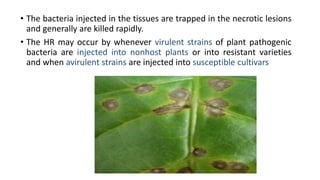
• The bacteria injected in the tissues are trapped in the necrotic lesions
and generally are killed rapidly.
• The HR may occur by whenever virulent strains of plant pathogenic
bacteria are injected into nonhost plants or into resistant varieties
and when avirulent strains are injected into susceptible cultivars
Ward (The Cambridge Botanist) 1st to recognise significance of
hypersensitivity as a defense mechanism of plant against plant
pathogens (parasites) .
He observed no difference between the behaviour of the resistant and
susceptible host plant until direct, physiological contact is established.
Steps in hypersensitive reaction
• Recognition of the elicitor by the host activation of biochemical
reactions
• Rapid burst of reactive oxygen species, increase of oxidative
reactions;
• Increased ion movement,(k and H through the cell membrane)
• Disruption of membranes and loss of cellular compartmentalization
• Cross-linking of phenolics with cell wall components and
strengthening of the plant cell wall;
• Transient activation of protein kinases (wounding-induced and
salicylic acid-induced kinases);
• Production of phenolics (phytoalexins);
• Formation of anti microbial pathogenesis-related proteins
Mechanism /steps
• Defense mechanism, involves interaction between products of an
‘avr gene of the pathogen and a matching ‘R’ gene of the plant
(Dodds et al., 2006).
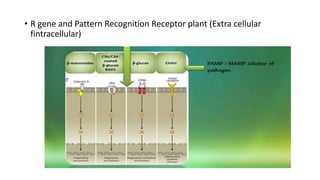
• R gene and Pattern Recognition Receptor plant (Extra cellular
fintracellular)
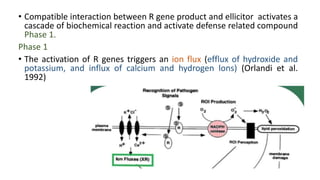
• Compatible interaction between R gene product and ellicitor activates a
cascade of biochemical reaction and activate defense related compound
Phase 1.
Phase 1
• The activation of R genes triggers an ion flux (efflux of hydroxide and
potassium, and influx of calcium and hydrogen lons) (Orlandi et al.
1992)
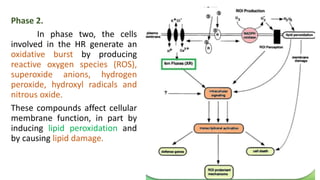
Phase 2.
In phase two, the cells
involved in the HR generate an
oxidative burst by producing
reactive oxygen species (ROS),
superoxide anions, hydrogen
peroxide, hydroxyl radicals and
nitrous oxide.
These compounds affect cellular
membrane function, in part by
inducing lipid peroxidation and
by causing lipid damage.
This event increase
biosynthesis of salicylic
acid (SA), jasmonic acid (JA)
and ethylene (ET) which
leads to long-lasting
systemic acquired
resistance (SAR) and ISR.
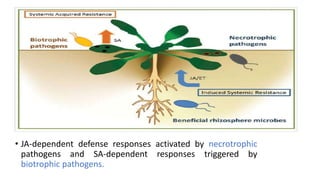
• JA-dependent defense responses activated by necrotrophic
pathogens and SA-dependent responses triggered by
biotrophic pathogens.
Changes due to HR
• Loss of selective membrane
permeability
• Deposition of material to the cell
wall
• Increased cytoplasmic streaming
• Condensation of nucleoplasm and
cytoplasm
• Disintegration of cytoskeleton
• Cleavage of nuclear DNA
• Depolarization of the membrane
electrolyte leakage
• Increased cytoplasmic streaming
• Callose deposition and papillae formation
Bacteria T3SS
Bacteria like Pseudomonas syringae inject effector proteins into plant
cells using the Type-III secretion system.
Plants that are resistant to the bacteria have resistance proteins that
recognize the effector proteins and cause the infected cell to commit
suicide (apoptosis/PCD/Hypersensitive Response)
“prevents the bacteria from infecting the rest of the plant by directly
killing them and depleting nutrients”
The hypersensitive response occurs only in specific host-pathogen
combinations in which the host Resistance gene and the pathogen
avirulence gene , the pathogen fails to infect the host..
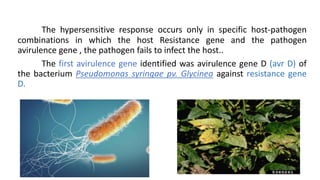
The first avirulence gene identified was avirulence gene D (avr D) of
the bacterium Pseudomonas syringae pv. Glycinea against resistance gene
D.
Examples of Plant Defense through R gene and their
Matching Avr Genes
Avirulant gene Resistance gene
Avr gene Pto R gene Tomato speck by
Pseudomonas Syringae
Avr gene Xa21 Blast by xanthomonas
oryzae
Avr gene Cf 9 Leaf mould cladosprium
fulvum
Avr gene N gene Tobacco mosaic virus in
tobacco
Avr Bs2 Bs 2 Bacterial leaf spot of
tomato
Avr Rpm 1 Rpm1 Bacterial leaf spot in
arabdiopsis
In 1946, E. Gaumann proposed that in many host-pathogen
combinations plants remain resistant through hypersensitivity; i.e., the
attacked cells are so sensitive to the pathogen that they and some
adjacent cells die immediately and in that way they isolate or cause the
death of the pathogen.
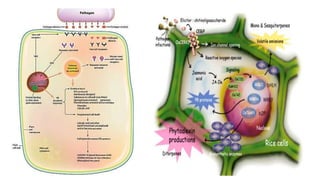
Journal of Fruit and Ornamental
Plant Research Vol. 13, 2005:
135-158
International Journal
of Engineering
Research &
Technology
Why cell death occur only at the site of Infection ?
In the absence of pathogen challenge, NPR1 (non-expresser of
pathogenesis-related genes 1) is retained in the cytoplasm as an
oligomer through redox-sensitive intermolecular di-sulphide bonds.
Two receptors for salicylic acid NPR3 and NPR4 in cytoplasm.NPR3 has
high affinity with SA as compared to NPR4
After induction, these di-sulphide bonds are reduced, releasing NPRI
monomers into the nucleus, where NPR1 acts as a cofactor for
transcription factors to induce defense related genes.
source of references
Plant Pathology 5th Edition by George N. Agrios
www.research gate .com
www.Google images .com
www.wikipedia .com
International Journal of Engineering Research & Technology, 2013
Journal of Fruit and Ornamental Plant Research Vol. 13, 2005: 135-
158
Thanking you……..

Hypersensitive response ( HR ) in plants

  • 1.
    University of agriculturalsciences Bangalore College of agriculture Mandya ,VC Farm Topic : Hypersentive response in plant From Shwetha G S PAMM1028 To Dr.Jadesha Dept.of plant pathology
  • 2.
  • 3.
    Hypersentive reaction The termhypersensitivity was introduced in plant pathology by Stakman, 1915 . Due to variability among plant pathogen, stakman called the pathogen as “Shifty enemies” Rapid, localized plant cell death upon contact with avirulent pathogens. HR is considered to be a key component of multifaceted plant defense responses to restrict attempted infection by avirulent pathogens Rapid – within 24 h Not always needed for resistance
  • 4.
    HR also contributesto the establishment of the long- lasting systemic acquired resistance against subsequent attack by a broad range of normally avirulent pathogens. The hypersensitive response is often thought to be responsible for limiting the growth of the pathogen .
  • 5.
    • A localizedinduced cell defense in the host plant at the site of infection by a pathogen. • Its occur only in Vertical resistance. • Most Hypersensitive response involve only single cell or very few cells
  • 6.
    Artifical condition • Injectionof several genera of plant pathogenic bacteria into leaf tissues of nonhost plants results in the development of the a hypersensitive response. • The artificially induced HR of consists of large leaf sectors becoming water soaked at first and, subsequently, necrotic and collapsed within 8 to 12 hours after inoculation .
  • 7.
    • The bacteriainjected in the tissues are trapped in the necrotic lesions and generally are killed rapidly. • The HR may occur by whenever virulent strains of plant pathogenic bacteria are injected into nonhost plants or into resistant varieties and when avirulent strains are injected into susceptible cultivars
  • 8.
    Ward (The CambridgeBotanist) 1st to recognise significance of hypersensitivity as a defense mechanism of plant against plant pathogens (parasites) . He observed no difference between the behaviour of the resistant and susceptible host plant until direct, physiological contact is established.
  • 9.
    Steps in hypersensitivereaction • Recognition of the elicitor by the host activation of biochemical reactions • Rapid burst of reactive oxygen species, increase of oxidative reactions; • Increased ion movement,(k and H through the cell membrane) • Disruption of membranes and loss of cellular compartmentalization • Cross-linking of phenolics with cell wall components and strengthening of the plant cell wall; • Transient activation of protein kinases (wounding-induced and salicylic acid-induced kinases); • Production of phenolics (phytoalexins); • Formation of anti microbial pathogenesis-related proteins
  • 11.
    Mechanism /steps • Defensemechanism, involves interaction between products of an ‘avr gene of the pathogen and a matching ‘R’ gene of the plant (Dodds et al., 2006).
  • 12.
    • R geneand Pattern Recognition Receptor plant (Extra cellular fintracellular)
  • 13.
    • Compatible interactionbetween R gene product and ellicitor activates a cascade of biochemical reaction and activate defense related compound Phase 1. Phase 1 • The activation of R genes triggers an ion flux (efflux of hydroxide and potassium, and influx of calcium and hydrogen lons) (Orlandi et al. 1992)
  • 14.
    Phase 2. In phasetwo, the cells involved in the HR generate an oxidative burst by producing reactive oxygen species (ROS), superoxide anions, hydrogen peroxide, hydroxyl radicals and nitrous oxide. These compounds affect cellular membrane function, in part by inducing lipid peroxidation and by causing lipid damage.
  • 15.
    This event increase biosynthesisof salicylic acid (SA), jasmonic acid (JA) and ethylene (ET) which leads to long-lasting systemic acquired resistance (SAR) and ISR.
  • 16.
    • JA-dependent defenseresponses activated by necrotrophic pathogens and SA-dependent responses triggered by biotrophic pathogens.
  • 17.
    Changes due toHR • Loss of selective membrane permeability • Deposition of material to the cell wall • Increased cytoplasmic streaming • Condensation of nucleoplasm and cytoplasm • Disintegration of cytoskeleton • Cleavage of nuclear DNA
  • 18.
    • Depolarization ofthe membrane electrolyte leakage • Increased cytoplasmic streaming • Callose deposition and papillae formation
  • 19.
  • 20.
    Bacteria like Pseudomonassyringae inject effector proteins into plant cells using the Type-III secretion system. Plants that are resistant to the bacteria have resistance proteins that recognize the effector proteins and cause the infected cell to commit suicide (apoptosis/PCD/Hypersensitive Response) “prevents the bacteria from infecting the rest of the plant by directly killing them and depleting nutrients”
  • 21.
    The hypersensitive responseoccurs only in specific host-pathogen combinations in which the host Resistance gene and the pathogen avirulence gene , the pathogen fails to infect the host.. The first avirulence gene identified was avirulence gene D (avr D) of the bacterium Pseudomonas syringae pv. Glycinea against resistance gene D.
  • 22.
    Examples of PlantDefense through R gene and their Matching Avr Genes Avirulant gene Resistance gene Avr gene Pto R gene Tomato speck by Pseudomonas Syringae Avr gene Xa21 Blast by xanthomonas oryzae Avr gene Cf 9 Leaf mould cladosprium fulvum Avr gene N gene Tobacco mosaic virus in tobacco Avr Bs2 Bs 2 Bacterial leaf spot of tomato Avr Rpm 1 Rpm1 Bacterial leaf spot in arabdiopsis
  • 23.
    In 1946, E.Gaumann proposed that in many host-pathogen combinations plants remain resistant through hypersensitivity; i.e., the attacked cells are so sensitive to the pathogen that they and some adjacent cells die immediately and in that way they isolate or cause the death of the pathogen.
  • 24.
    Journal of Fruitand Ornamental Plant Research Vol. 13, 2005: 135-158
  • 25.
  • 26.
    Why cell deathoccur only at the site of Infection ? In the absence of pathogen challenge, NPR1 (non-expresser of pathogenesis-related genes 1) is retained in the cytoplasm as an oligomer through redox-sensitive intermolecular di-sulphide bonds. Two receptors for salicylic acid NPR3 and NPR4 in cytoplasm.NPR3 has high affinity with SA as compared to NPR4 After induction, these di-sulphide bonds are reduced, releasing NPRI monomers into the nucleus, where NPR1 acts as a cofactor for transcription factors to induce defense related genes.
  • 27.
    source of references PlantPathology 5th Edition by George N. Agrios www.research gate .com www.Google images .com www.wikipedia .com International Journal of Engineering Research & Technology, 2013 Journal of Fruit and Ornamental Plant Research Vol. 13, 2005: 135- 158
  • 28.