The Female
Reproductive System

     2ND Lecture
Female Reproductive System
             Lesson Overview:
             Reproductive
              Anatomy
             The Menstrual
              Cycle
             Treating Pre-
              menstrual
              Syndrome
                       dr.Shaban
Anatomy and Physiology
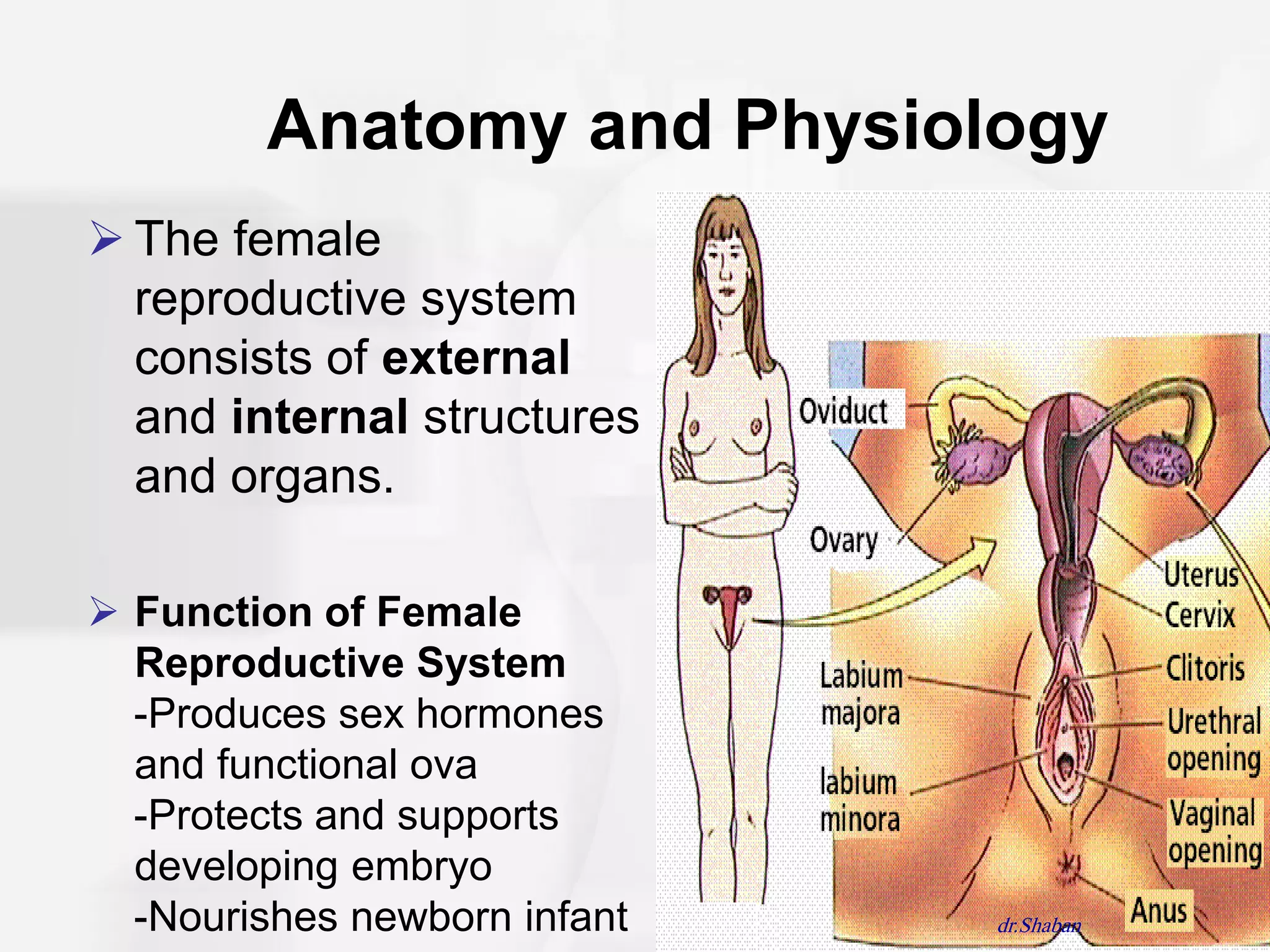
 The female
  reproductive system
  consists of external
  and internal structures
  and organs.

 Function of Female
  Reproductive System
  -Produces sex hormones
  and functional ova
  -Protects and supports
  developing embryo
  -Nourishes newborn infant   dr.Shaban
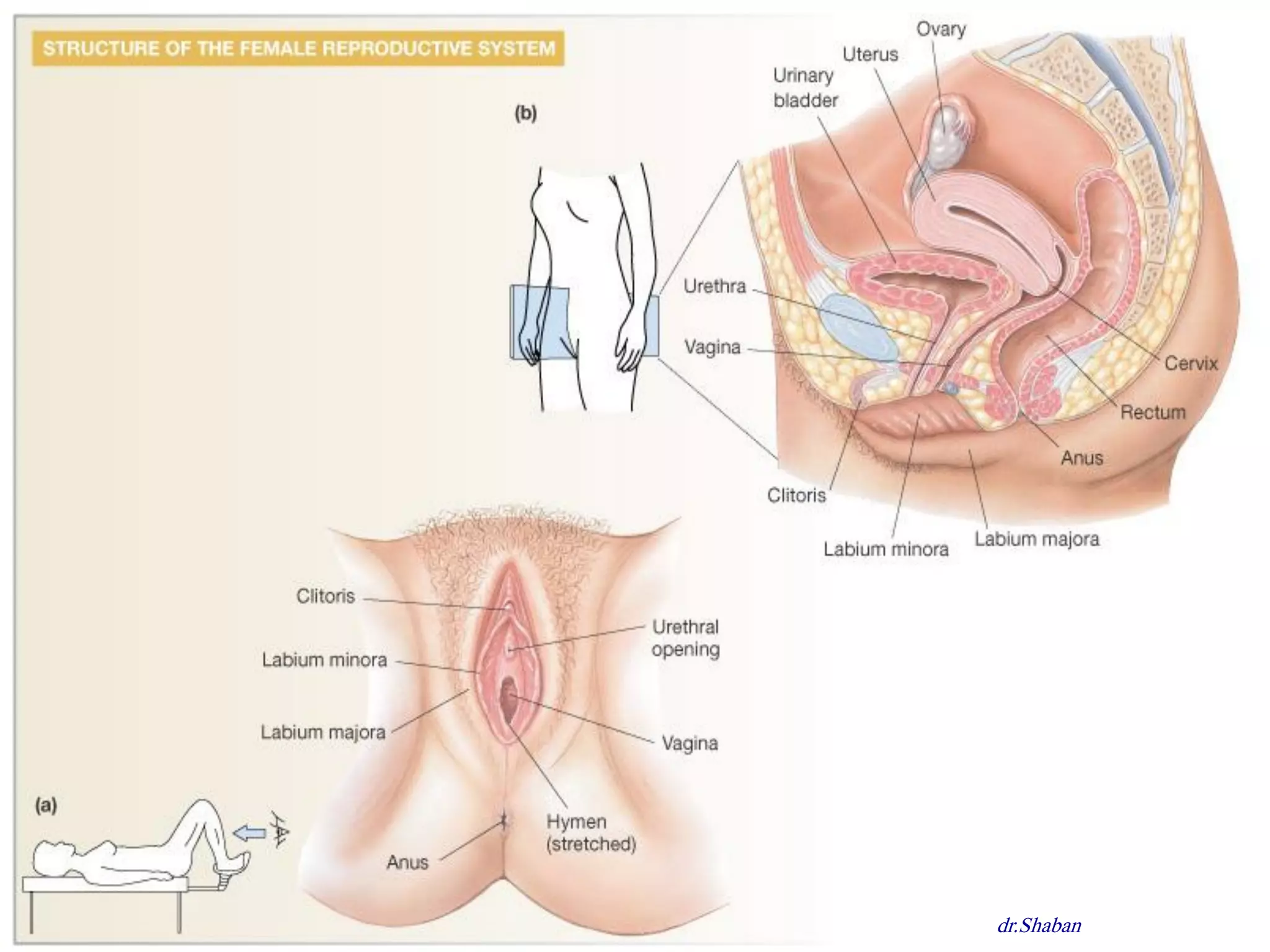
External Sex Organs
 Vulva – entire female region of external sex organs
 Mons pubis
       -protective, fatty cushion over the pubic bone;
       -covered with pubic hair
     Vestibule. consists of the clitoris, urethral meatus, and the
     vaginal introitus.
 Labia Majora
   outer lips; tissue folds from mons to perineum
    surrounding the rest of the female genitals;
 Labia Minora
   inner lips; pink tissue folds between vestibule and
    labia majora; no hair; many oil glands;
                                                    dr.Shaban
External Sex Organs- Cont.
 The clitoris is a short erectile organ at the top of the vaginal
  vestibule whose function is sexual excitation (analogous to the
  penis).
 The urethral meatus is the opening of the urethra.
 The vaginal introitus is the vaginal entrance
 Perineum. This is the skin covered muscular area between the
  vaginal opening (introitus) and the anus. It aids in constricting
  the urinary, vaginal, and anal opening. It also helps support the
  pelvic contents.
 Bartholin's Glands. The Bartholin's glands lie on either side of
  the vaginal opening. They produce a mucoid substance, which
  provides lubrication for intercourse.
 Fourchette: Trauma provides forensic evidence in rape
  trials.                                  dr.Shaban
dr.Shaban
The hymen
 Separate external organ from internal
 A membrane covered by stratified squamous
  epithelium on both sides that partially closes
  the vaginal orifice. Congenitally, it may have
  no opening (imperforate hymen), also rarely it
  may be absent. The shape and size of the
  openings vary. It is torn with the first sexual
  intercourse (unless the opening is unusually
  large or the hymen is elastic).


                                         dr.Shaban
The Breasts
 The breasts are also part of the external female
  reproductive system.
 Their external structure include the nipple, areola
  (darker area around the nipples) and
  Montgomery tubercles (glands that produce a
  lubricant to keep the nipple soft and supple).
   Primary function: Lactation
   Influence of hormones (Estrogen-develop. of
     breasts , Progesterone-secretion of milk)
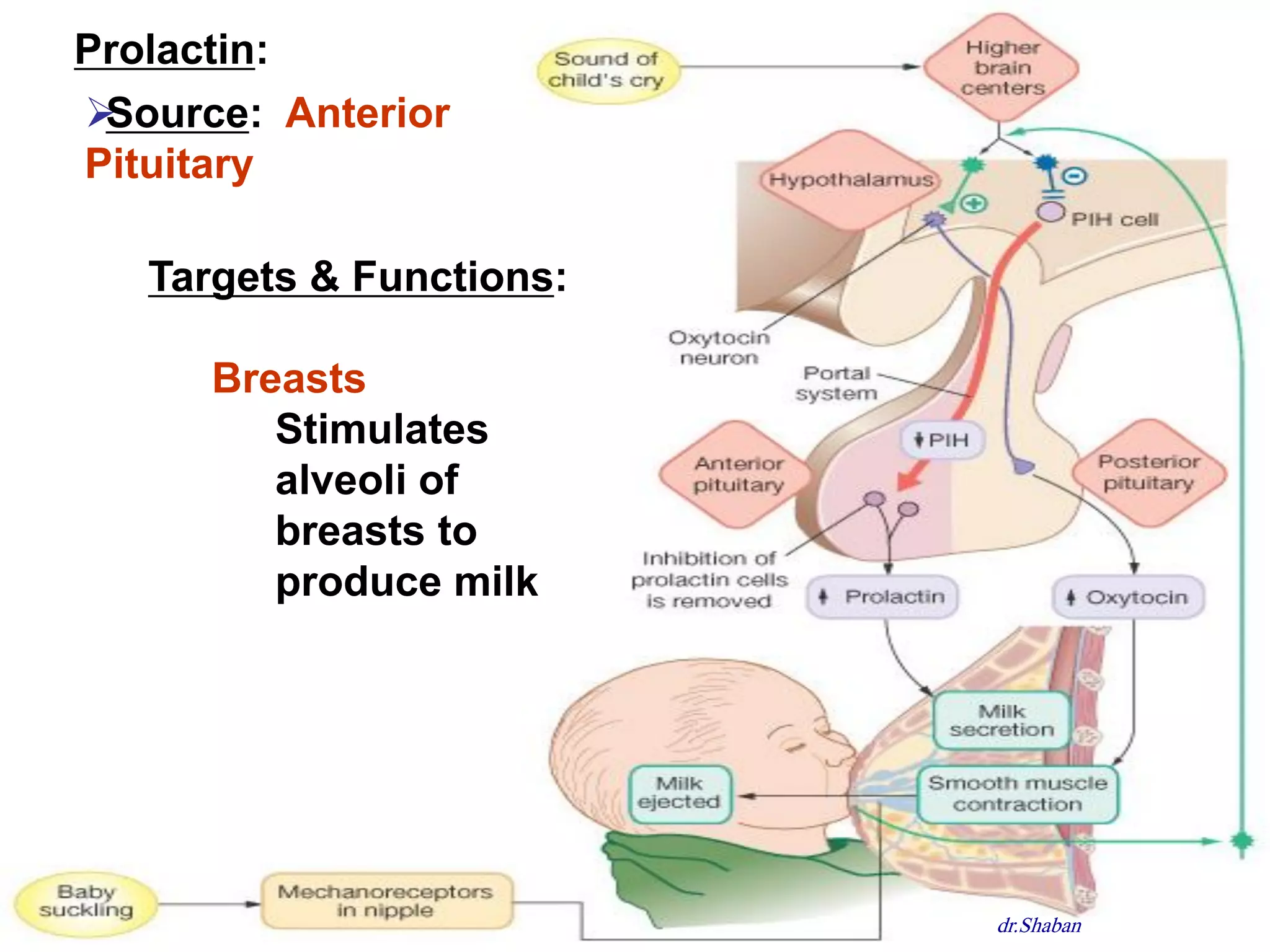
   Sucking stimulates pituitary gland to release
     prolactin (begin milk synthesis) and oxytocin
     (release of milk)                      dr.Shaban
Prolactin:
Source: Anterior
Pituitary

   Targets & Functions:

      Breasts
         Stimulates
         alveoli of
         breasts to
         produce milk


                          dr.Shaban
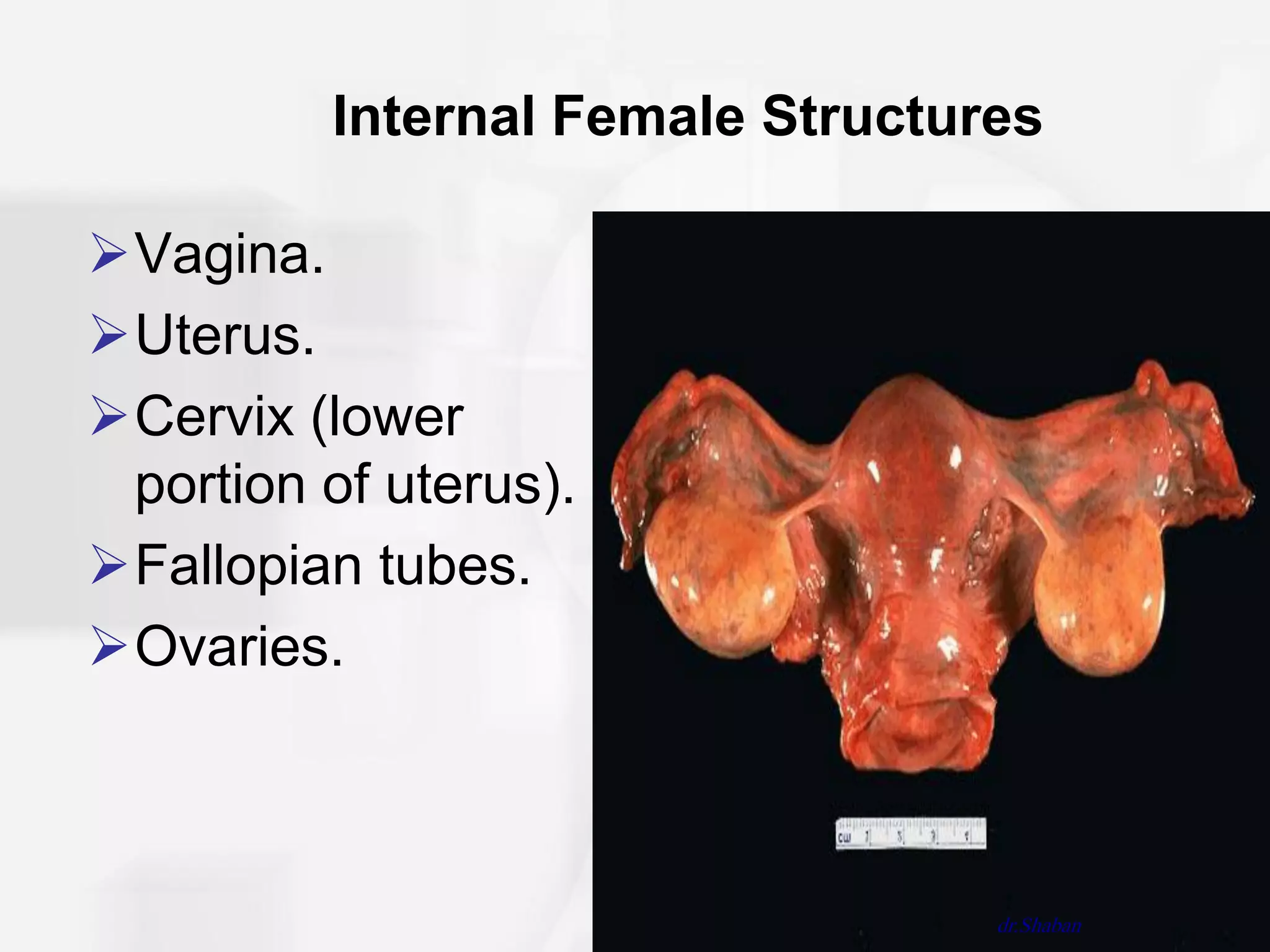
Internal Female Structures

Vagina.
Uterus.
Cervix (lower
 portion of uterus).
Fallopian tubes.
Ovaries.


                                  dr.Shaban
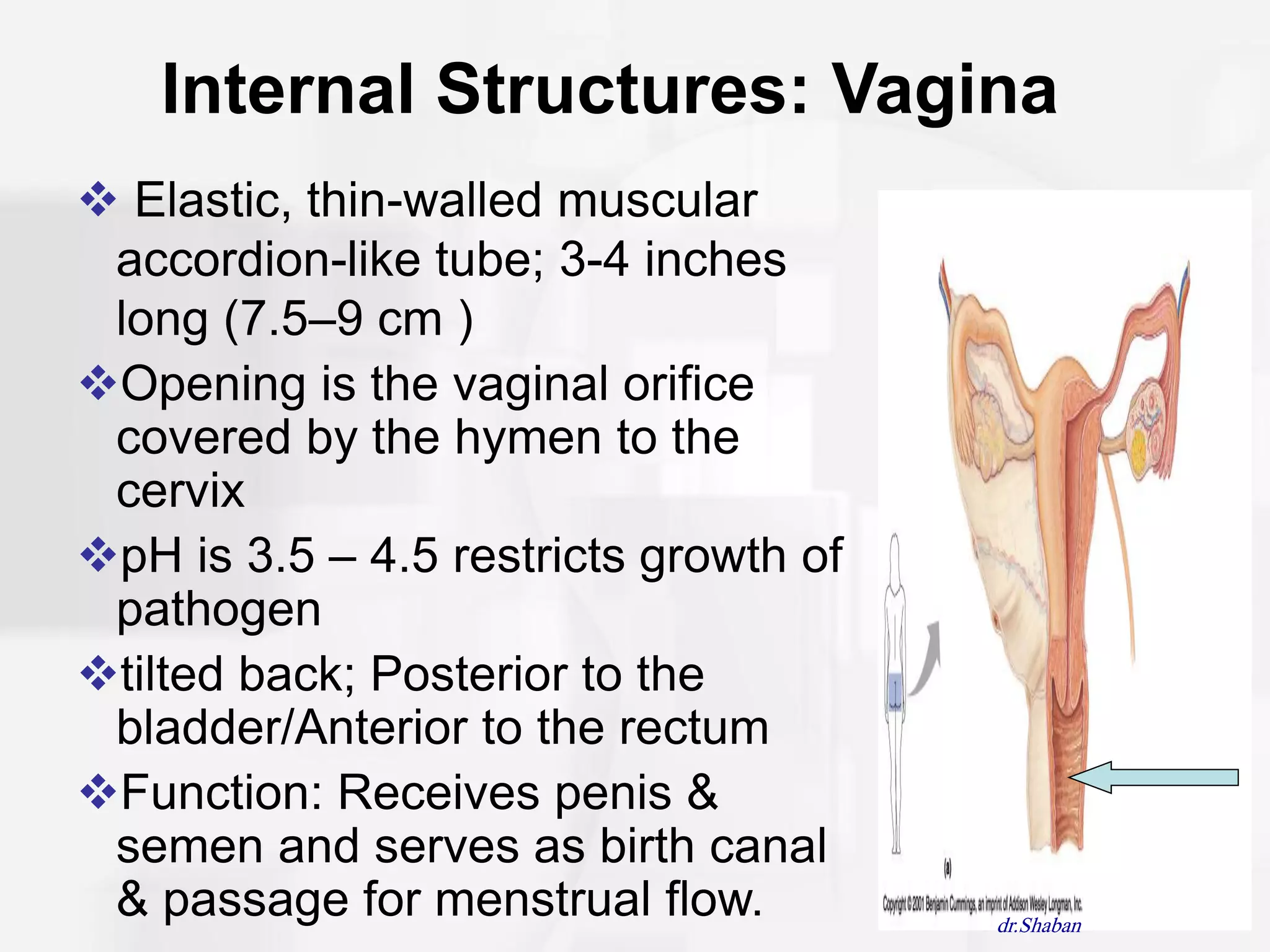
Internal Structures: Vagina
 Elastic, thin-walled muscular
 accordion-like tube; 3-4 inches
 long (7.5–9 cm )
Opening is the vaginal orifice
 covered by the hymen to the
 cervix
pH is 3.5 – 4.5 restricts growth of
 pathogen
tilted back; Posterior to the
 bladder/Anterior to the rectum
Function: Receives penis &
 semen and serves as birth canal
 & passage for menstrual flow.         dr.Shaban
Internal Sex Organs
 Uterus – 1-inch thick walls, 3 inches long, 2 inches wide
  ;hollow, muscular organ between the bladder and rectum;
  Normally anteverted anteflexed
   3 uterine wall layers: Perimetrium ; Myometrium
    ; Endometrium
 The major portion of the uterus is called the body or
  corpus.
 The fundus is the superior, rounded region above the
  entrance of the fallopian tubes.
 The cervix is the narrow, inferior outlet that protrudes into
  the vagina. Os – opening leading into the uterus
 The isthmus is the slightly constricted portion that joins the
  corpus to the cervix.

                                                    dr.Shaban
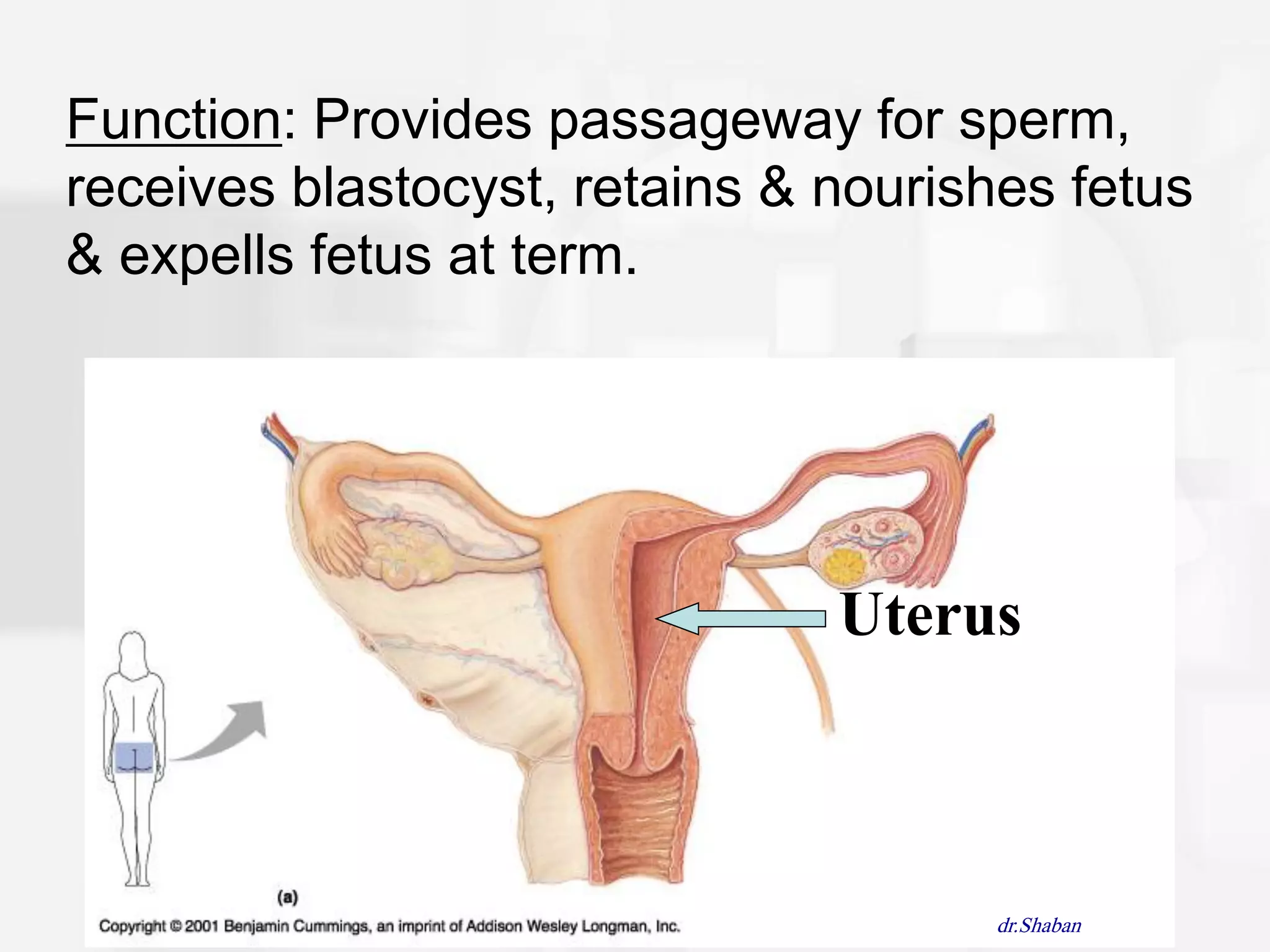
Function: Provides passageway for sperm,
receives blastocyst, retains & nourishes fetus
& expells fetus at term.


                               Uterus


                                     dr.Shaban
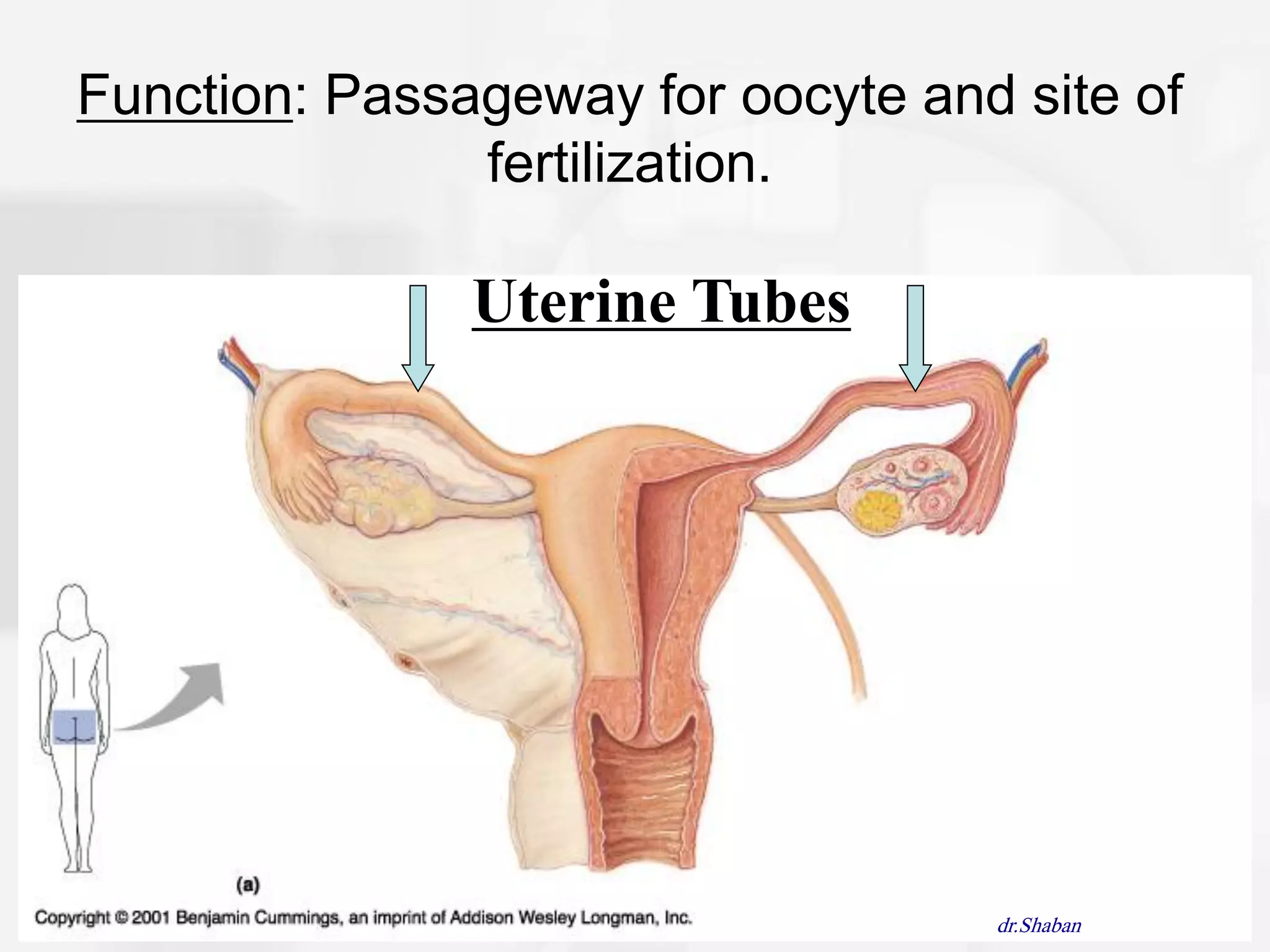
Fallopian Tubes
 Two 4-inch (8 to 13 cm ) length that extend from
  the sides of the uterus and curve up to and
  around the ovaries
   Infundibulum – has fimbriae finger-like
     projections at the distal end surrounding the
     ovaries to collect an egg upon release

 Millions of tiny hair-like cilia line the fimbria that
  beat in waves hundreds of times a second
  catching the egg at ovulation and moving it
  through the tube to the uterine cavity (takes 3–4
  days) .
                                              dr.Shaban
Function: Passageway for oocyte and site of
               fertilization.

               Uterine Tubes


                                   dr.Shaban
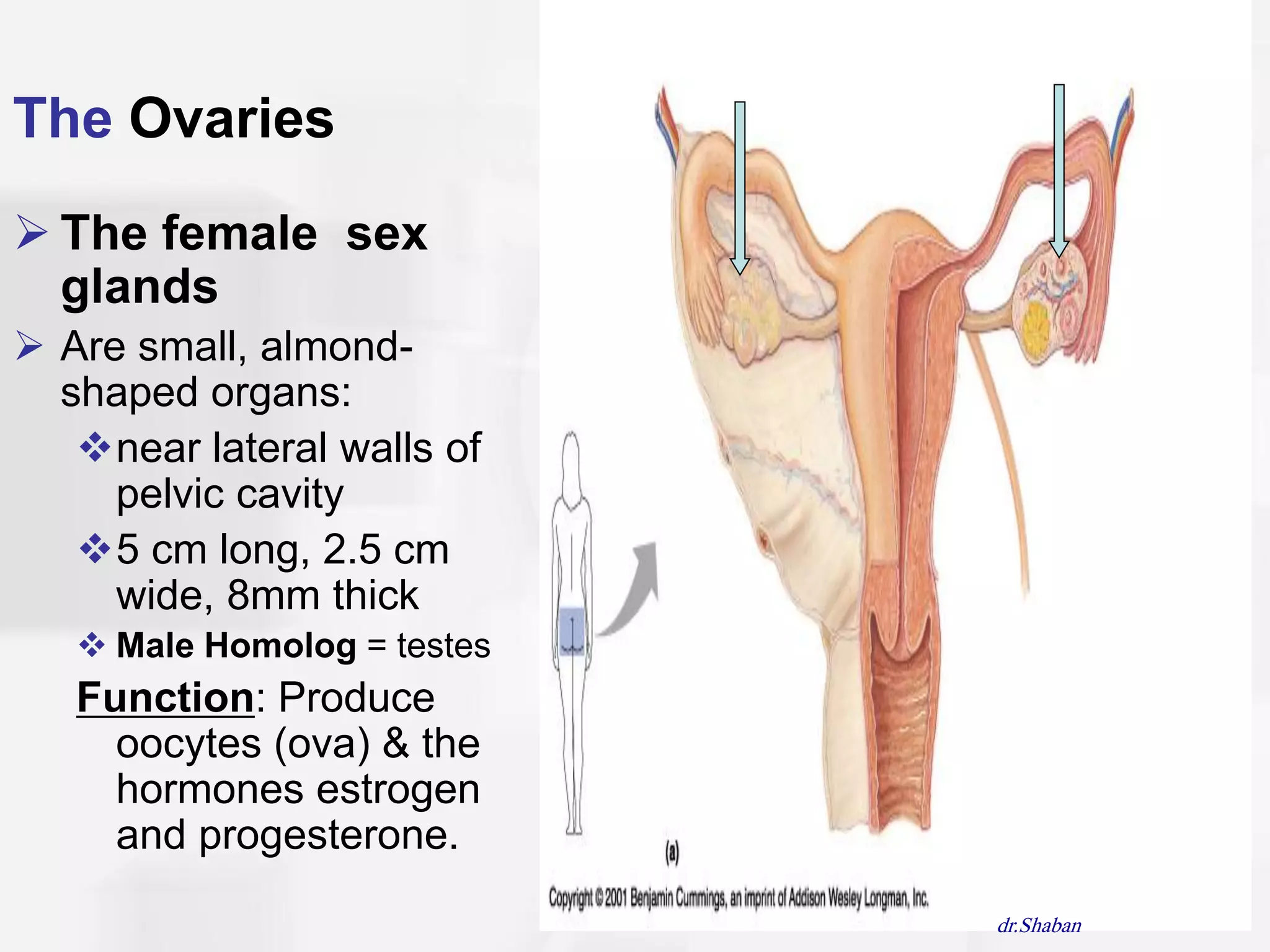
The Ovaries
 The female sex
  glands
 Are small, almond-
  shaped organs:
   near lateral walls of
     pelvic cavity
   5 cm long, 2.5 cm
     wide, 8mm thick
    Male Homolog = testes
   Function: Produce
     oocytes (ova) & the
     hormones estrogen
     and progesterone.
                             dr.Shaban
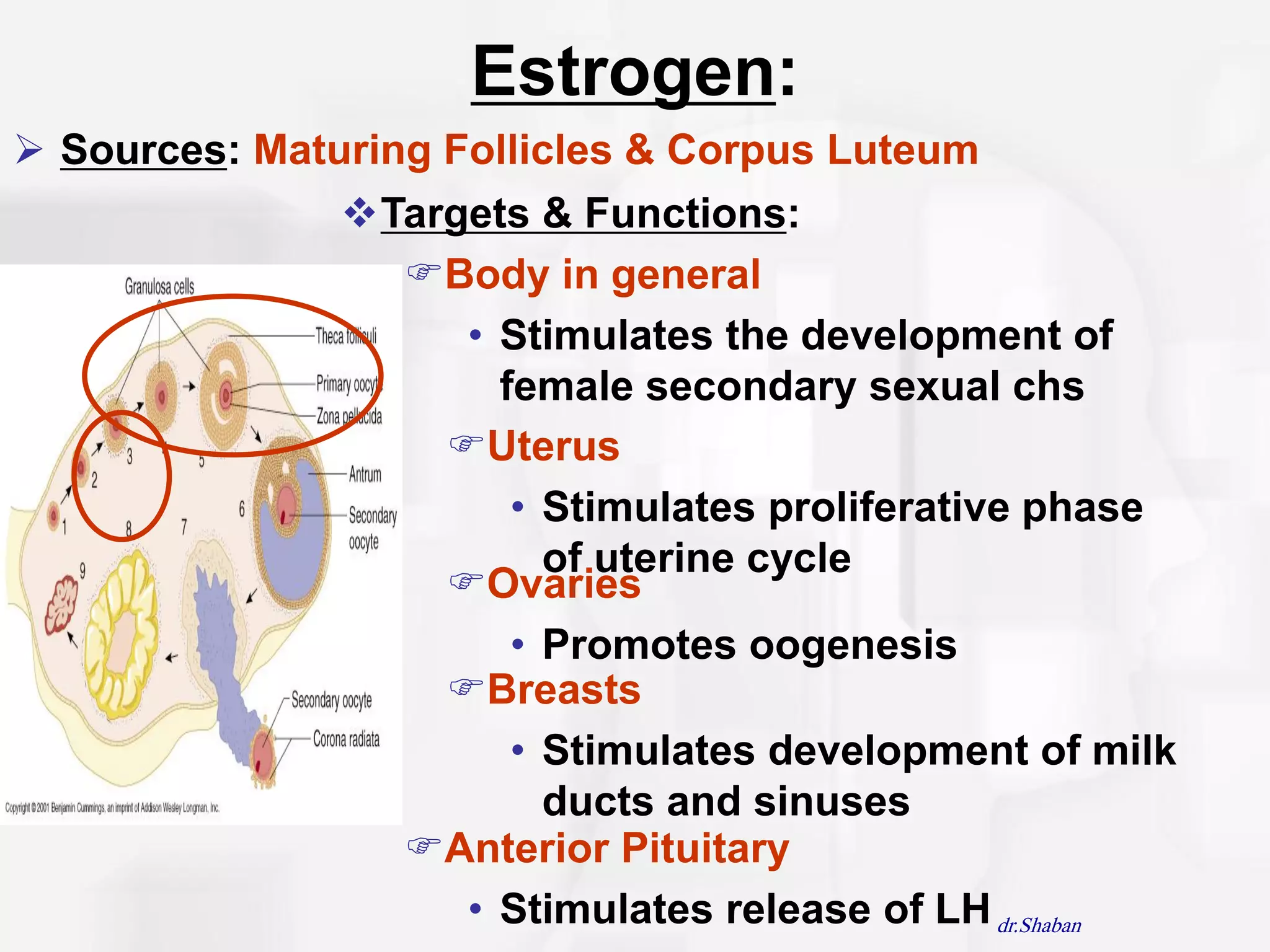
Estrogen:
 Sources: Maturing Follicles & Corpus Luteum
               Targets & Functions:
                  Body in general
                     • Stimulates the development of
                       female secondary sexual chs
                    Uterus
                        • Stimulates proliferative phase
                          of uterine cycle
                    Ovaries
                        • Promotes oogenesis
                    Breasts
                        • Stimulates development of milk
                          ducts and sinuses
                  Anterior Pituitary
                     • Stimulates release of LH dr.Shaban
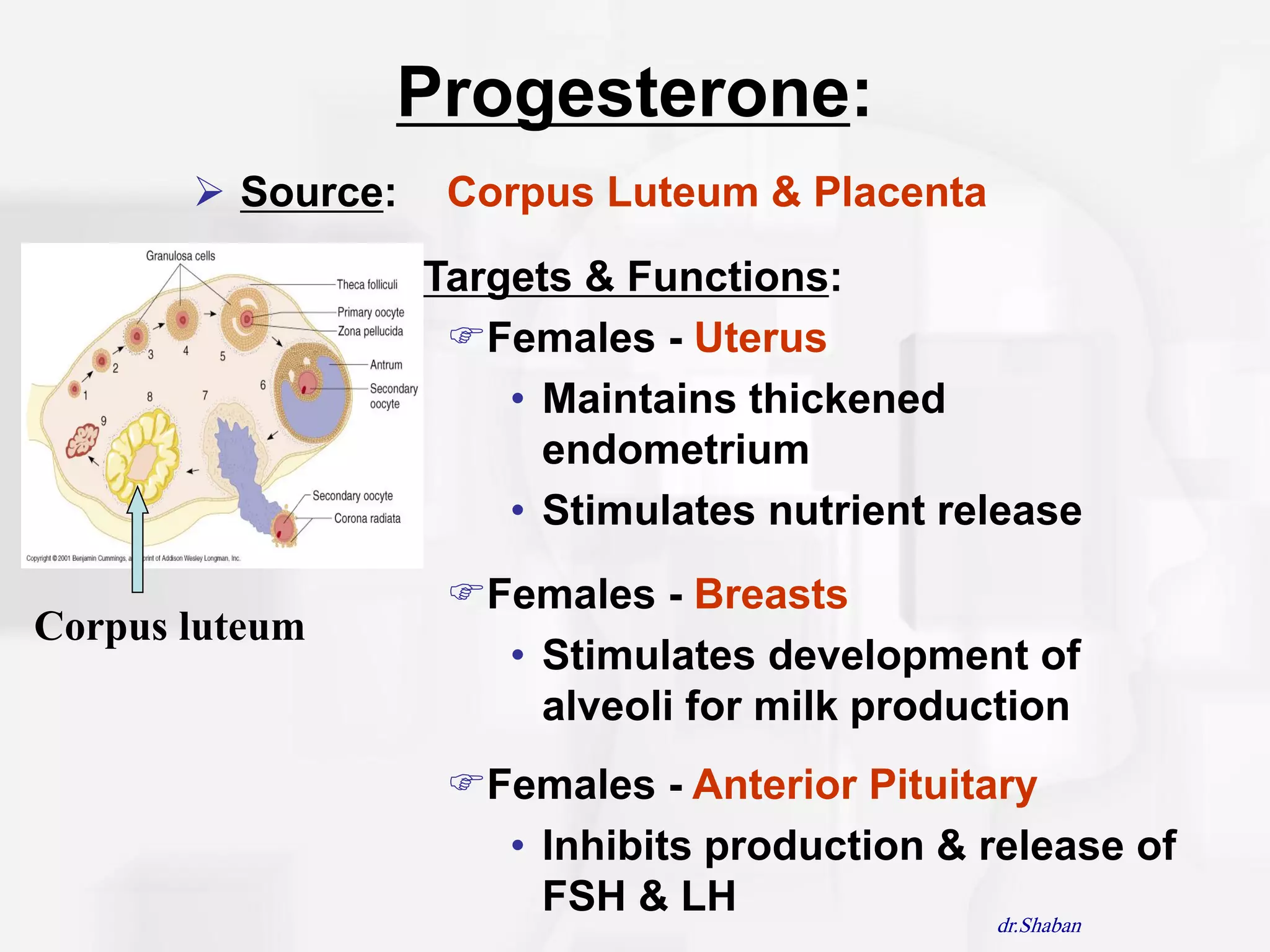
Progesterone:
        Source:   Corpus Luteum & Placenta

                Targets & Functions:
                  Females - Uterus
                     • Maintains thickened
                       endometrium
                     • Stimulates nutrient release
                   Females - Breasts
Corpus luteum
                     • Stimulates development of
                       alveoli for milk production
                   Females - Anterior Pituitary
                     • Inhibits production & release of
                       FSH & LH
                                              dr.Shaban
Oxytocin:
 Sources: Manufactured by hypothalamus.
  Stored & released by Posterior Pituitary

  Positive Feedback Mechanisms:
  1. Childbirth - Stretching of uterus and cervix
  2. Suckling - Milk letdown reflex
  Targets & Functions:
    Uterus
       • Stimulates contraction of uterine
         myometrium causing lowering of fetus &
         labor
       Breasts
           • Stimulates contraction of milk ducts
             and sinuses, releasing milk dr.Shaban
Puberty
 Is the stage at which the individual first becomes
  capable of sexual reproduction
 A girl has entered puberty when she begins to
  menstruate
 A Boy enters puberty when he begins to produce
  spermatozoa
 Puberty occur between 11-14 years
 Puberty lasts about 3 to 5 years
 Begins when pituitary gland initiates release of FSH
  and LH, which increases the ovaries production of
  estrogen; Pelvis widens; Pubic hair grows;
  Menarche occurs during this time, although it may
  be a few months before or after ovulationdr.Shaban
                                               begins
Menstruation
 Menstruation – uterine lining is shed if no
  pregnancy; tissue and blood exit the introitus
 Four body structures are involved in physiology
  of MP: Hypothalamus; Ovaries; Pituitary glands;
  and Uterus
 Menstrual cycle has four phases:
   Follicular phase
   Ovulation phase
   Luteal phase
   Menstrual phase

                                         dr.Shaban
Normal menstrual cycle

 Beginning           Average age of
  (menarche )          onset 12 or 13 ,
                       average range is
                       9-17 years


 Interval between    Average 28 days
  cycles               , cycles between
                       23-35 not unusual


                                dr.Shaban
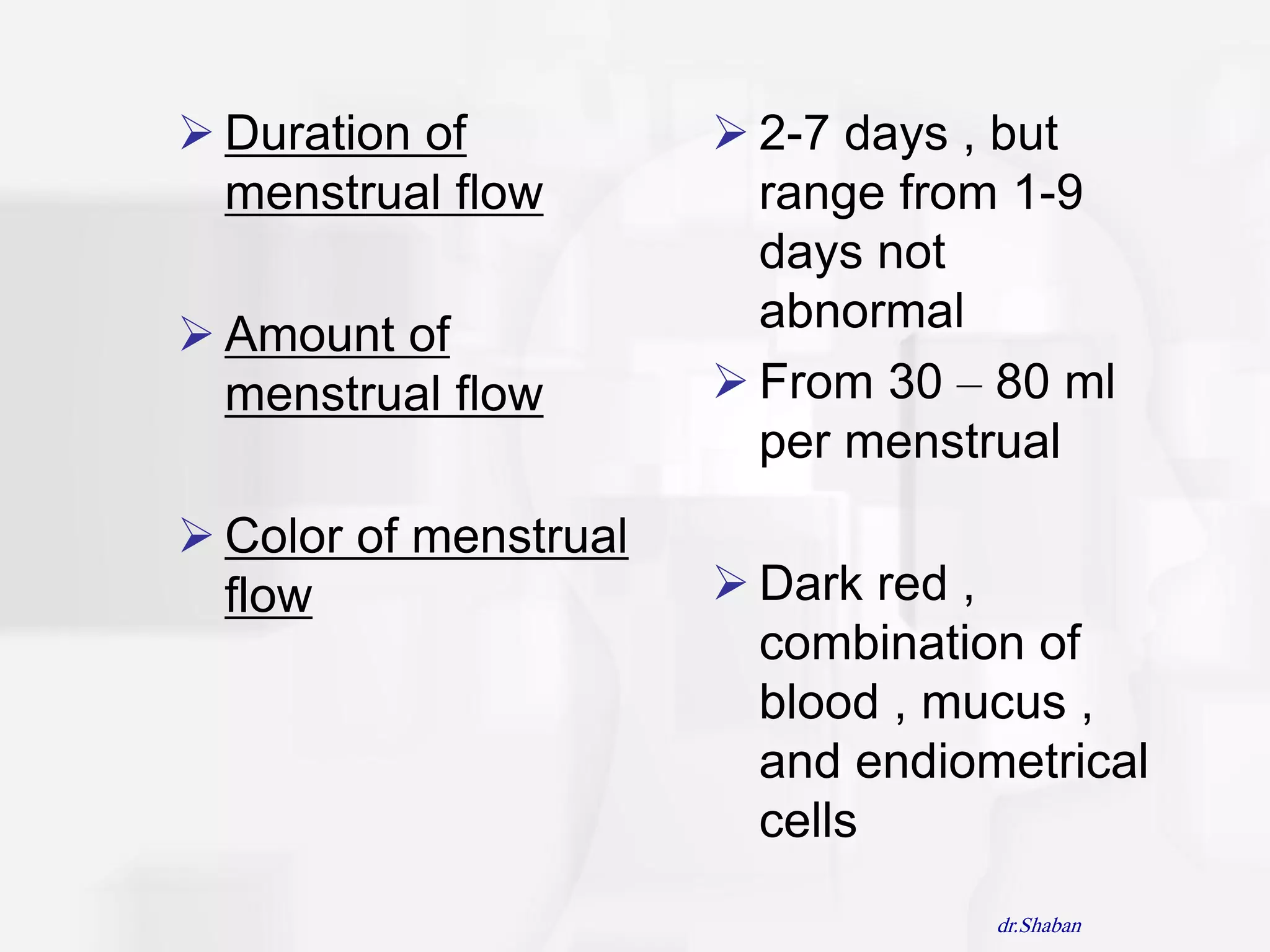
 Duration of           2-7 days , but
  menstrual flow         range from 1-9
                         days not
 Amount of              abnormal
  menstrual flow        From 30 – 80 ml
                         per menstrual
 Color of menstrual
  flow                  Dark red ,
                         combination of
                         blood , mucus ,
                         and endiometrical
                         cells
                                   dr.Shaban
dr.Shaban
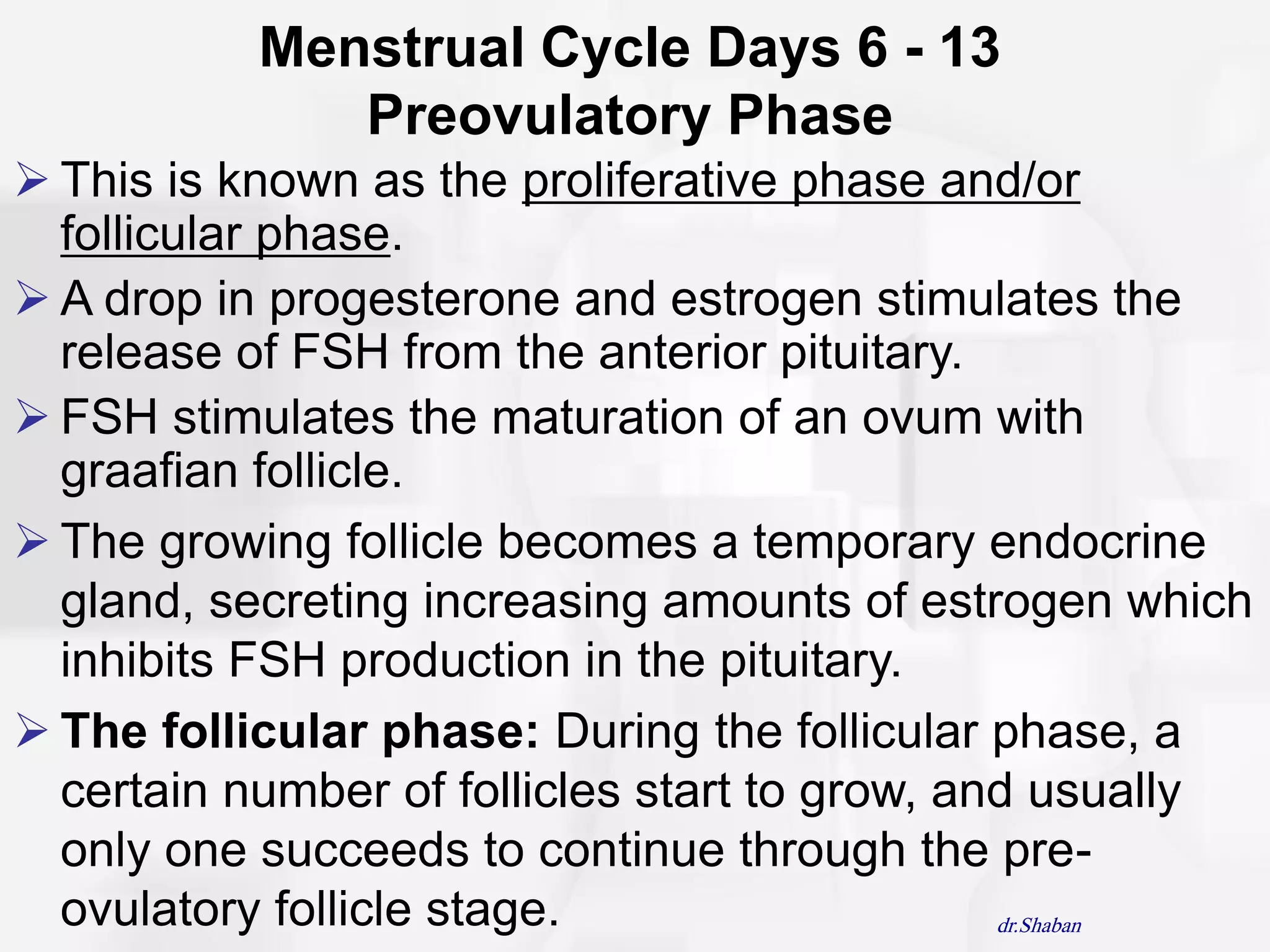
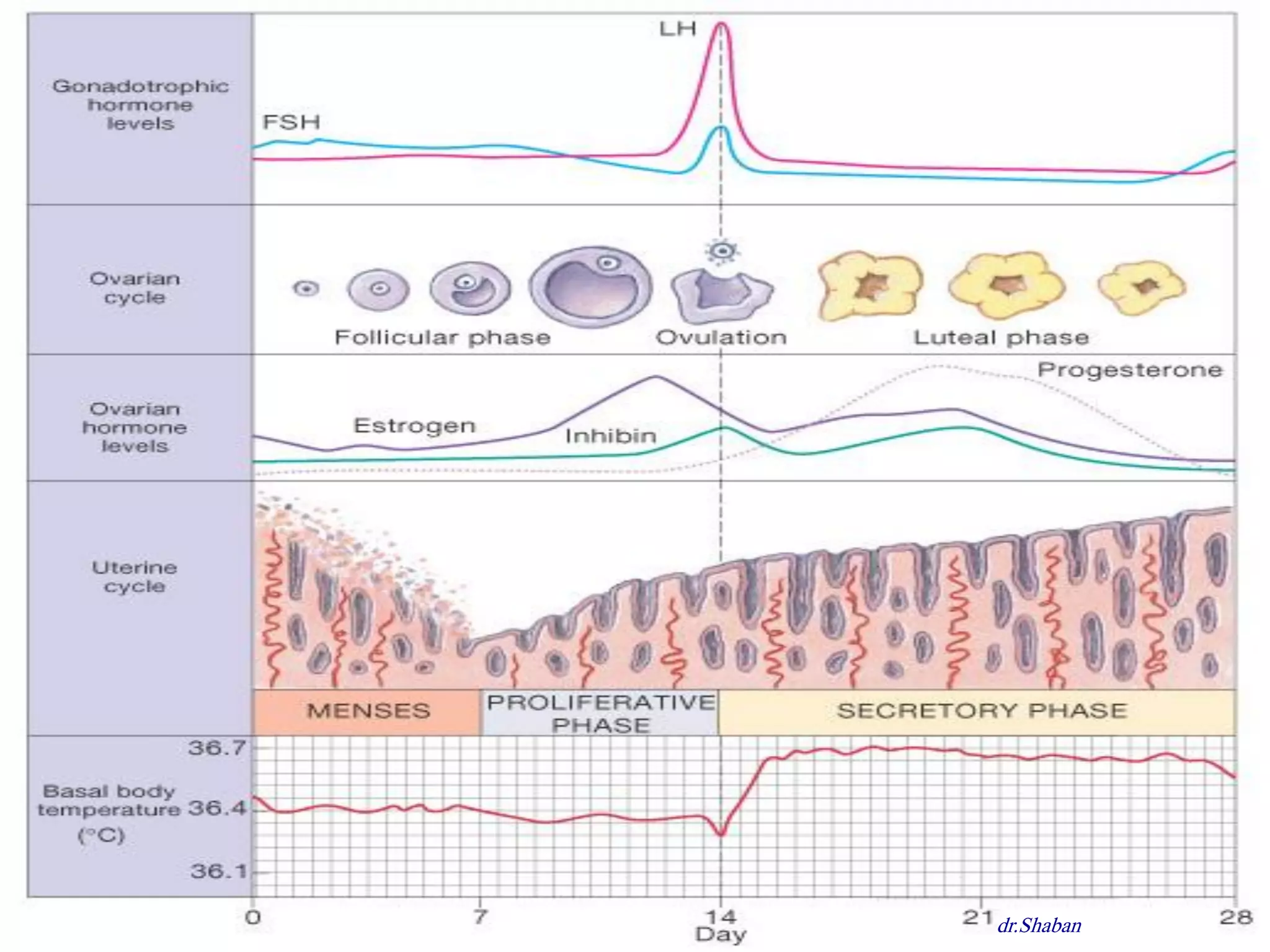
Menstrual Cycle Days 6 - 13
              Preovulatory Phase
 This is known as the proliferative phase and/or
  follicular phase.
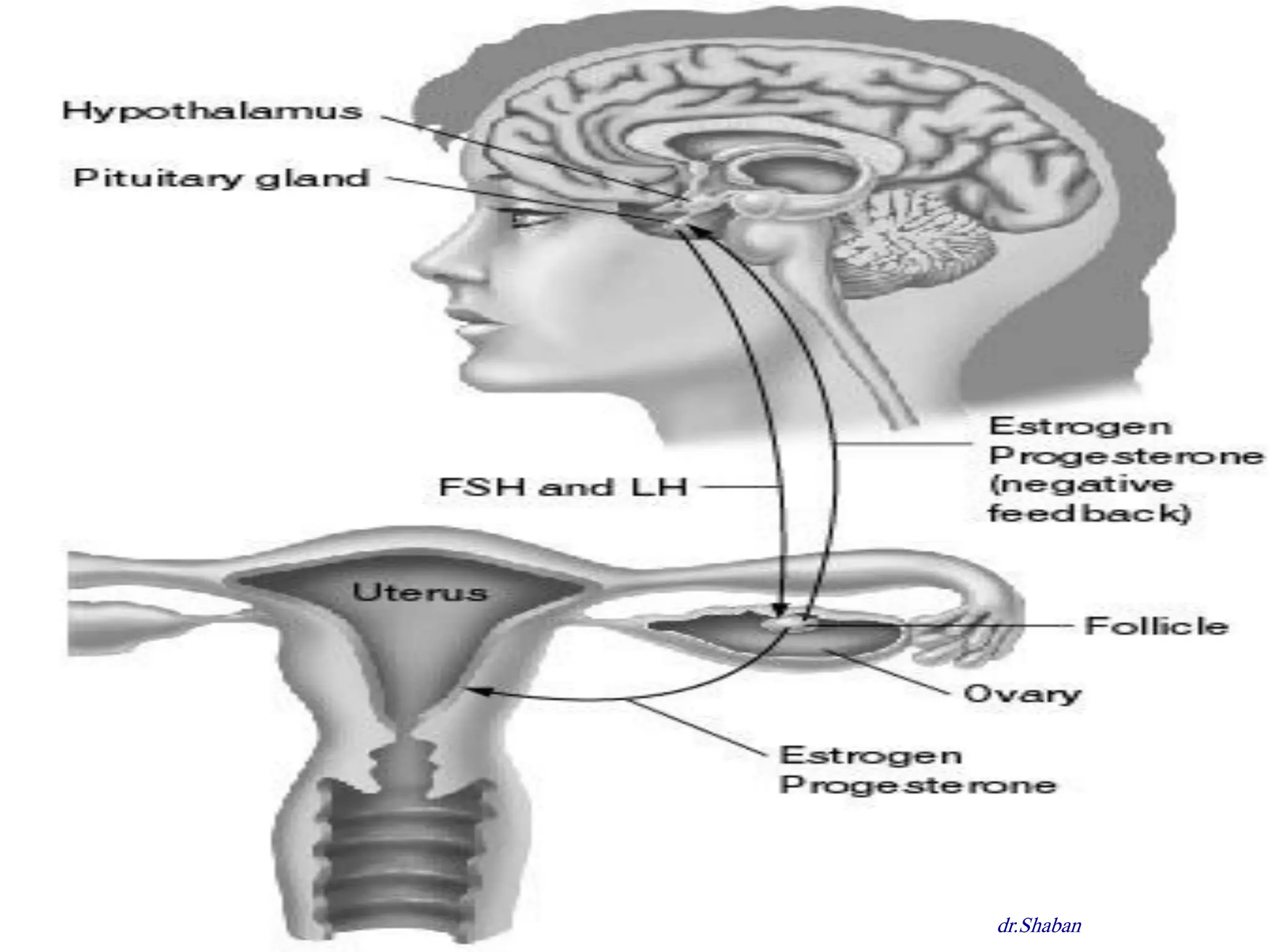
 A drop in progesterone and estrogen stimulates the
  release of FSH from the anterior pituitary.
 FSH stimulates the maturation of an ovum with
  graafian follicle.
 The growing follicle becomes a temporary endocrine
  gland, secreting increasing amounts of estrogen which
  inhibits FSH production in the pituitary.
 The follicular phase: During the follicular phase, a
  certain number of follicles start to grow, and usually
  only one succeeds to continue through the pre-
  ovulatory follicle stage.                    dr.Shaban
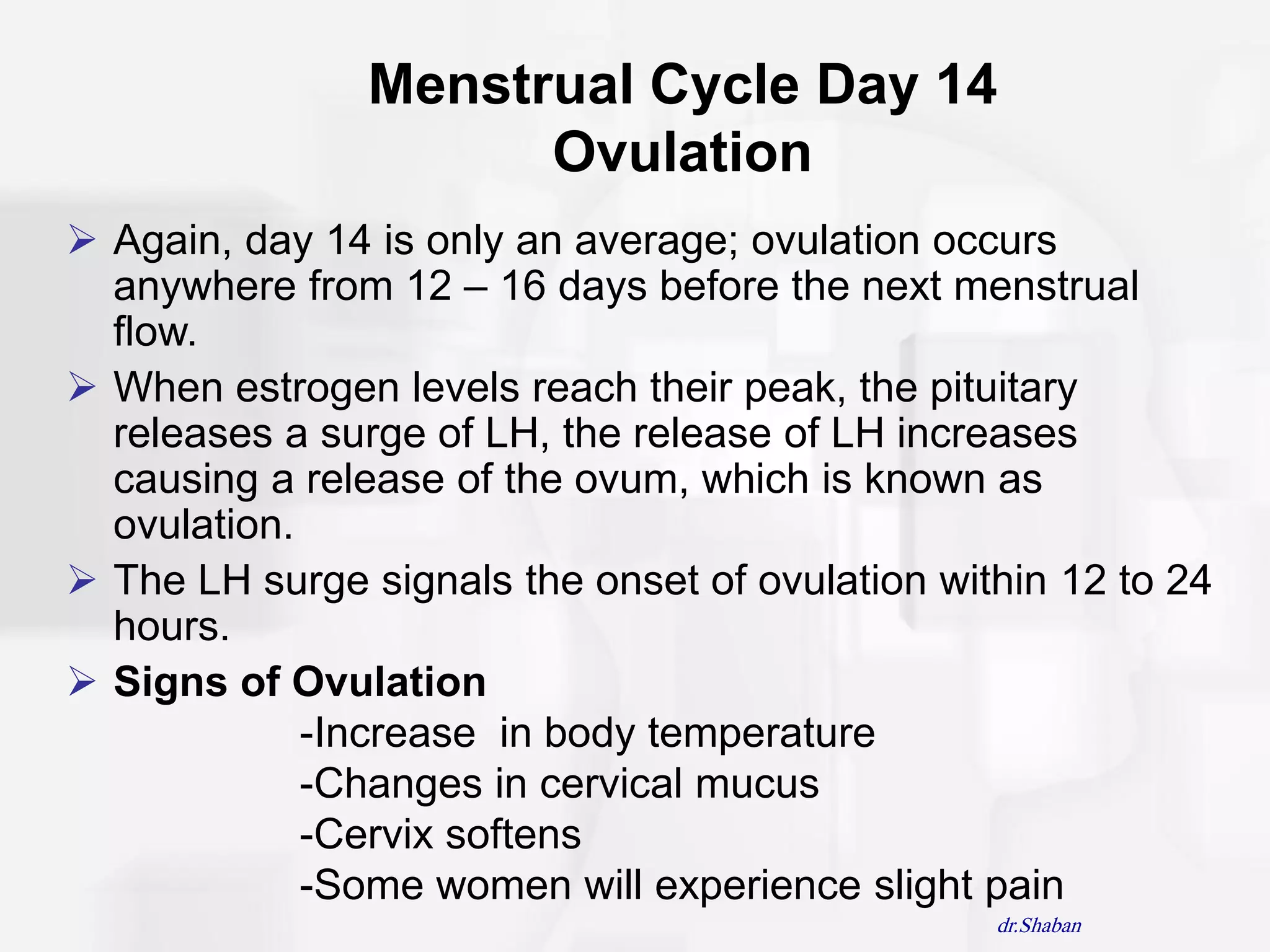
Menstrual Cycle Day 14
                      Ovulation
 Again, day 14 is only an average; ovulation occurs
  anywhere from 12 – 16 days before the next menstrual
  flow.
 When estrogen levels reach their peak, the pituitary
  releases a surge of LH, the release of LH increases
  causing a release of the ovum, which is known as
  ovulation.
 The LH surge signals the onset of ovulation within 12 to 24
  hours.
 Signs of Ovulation
             -Increase in body temperature
             -Changes in cervical mucus
             -Cervix softens
             -Some women will experience slight pain
                                                 dr.Shaban
Menstrual Cycle Days 15 - 28
            Postovulatory Phase
 This phase is also called the luteal or secretory
  phase because the cells of the follicle remain in the
  ovary, renamed the “corpus luteum,” where they will
  produce large amounts of progesterone under the
  effects of high levels of LH
 Progesterone inhibits release of LH from the pituitary
  gland and further prepares the endometrial lining of
  the uterus to receive a fertilized egg.
Corpus luteum translated means “yellow body.”
  > This structure forms after the egg is expelled from
  the follicle.
  >If pregnancy does not occur it will degenerate.
                                            dr.Shaban
Menstrual Cycle Days 1-5
              Menses phase.
A lack of signal from a fertilized egg influences
 the drop in estrogen and progesterone
 production.
A drop in progesterone results in the sloughing
 off of the thick endometrial lining which is the
 menstrual flow.
Menstrual phase – endometrial buildup is
 expelled through uterine contractions for 3-7
 days; volume of menses is about 50 ml blood
                                       dr.Shaban
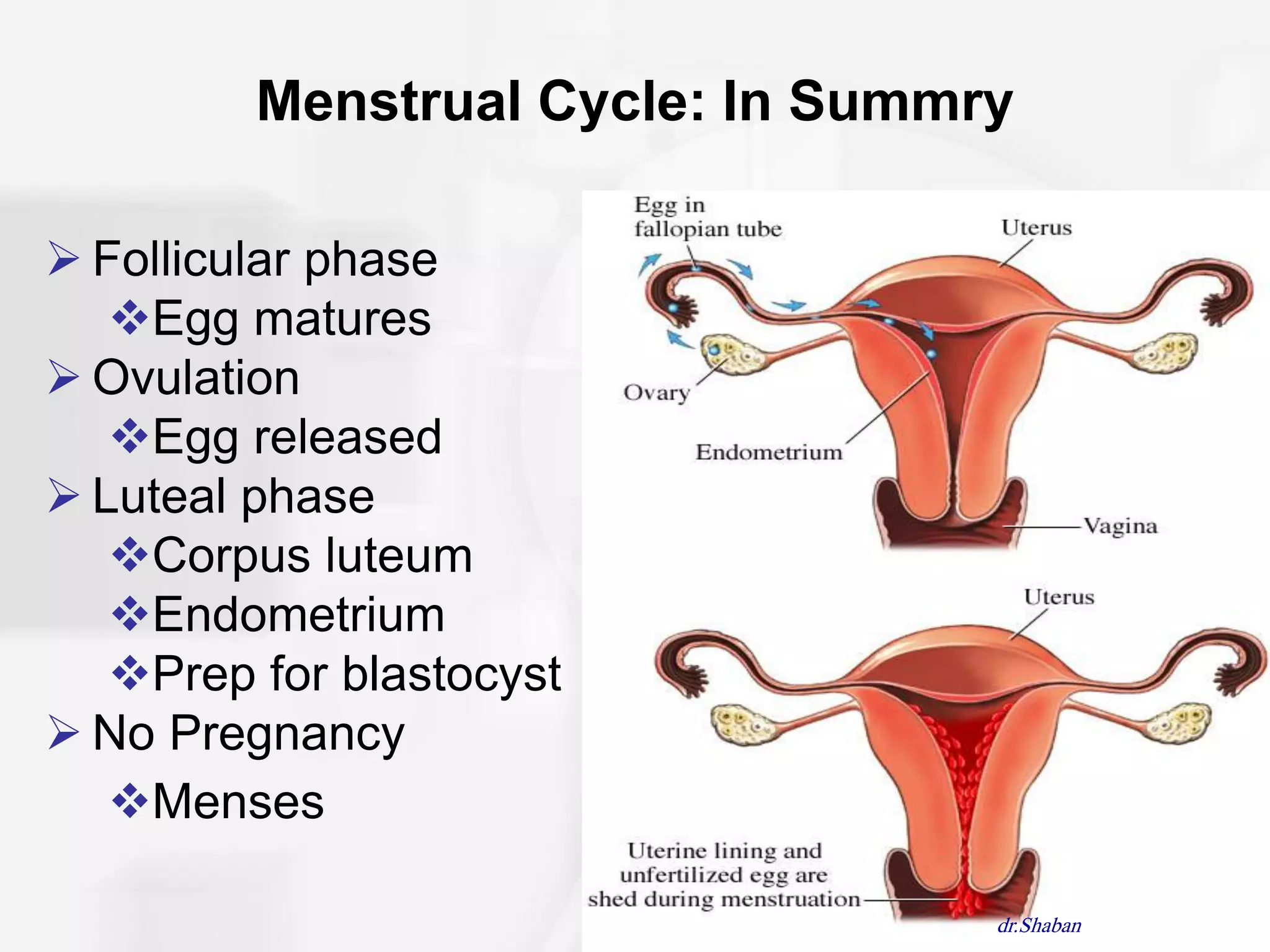
Menstrual Cycle: In Summry

 Follicular phase
   Egg matures
 Ovulation
   Egg released
 Luteal phase
   Corpus luteum
   Endometrium
   Prep for blastocyst
 No Pregnancy
   Menses

                                  dr.Shaban
dr.Shaban
Menstrual Problems –
            Premenstrual Syndrome (PMS)
 3 to 14 days prior to the menstrual period, during the
  postovulatory/luteal phase, and are relieved by onset
  of the menses.
 Experienced by one-third to one-half of women
  between 20 and 50.
 Symptoms include weight gain, irritability, mood
  swings, edema, headache, inability to concentrate,
  food cravings, acne, and many others.
 Can be alleviated by pharmacological interventions,
  diet, and exercise, Eat „real‟ food! Eliminate „junk‟ food
  (caffeine, soda, alcohol, processed foods, sugar),
  Decrease salt intake to relieve bloating and edema.
                                                dr.Shaban
Amenorrhea

 Absence of menstruation. Can be primary or
  secondary.
 Primary amenorrhea defined as absence of
  menstruation by age of 17. Can be related to
  anatomical or genetic abnormalities.
 Secondary amenorrhea is the absence of
  menstrual flow in a woman who has had previous
  menstrual periods, may result from nutritional
  deficits (anorexia nervosa), excessive exercise,
  emotional disturbances, endocrine dysfunction, side
  effects of medication, pregnancy, and lactation.

                                          dr.Shaban
Dysmenorrhea
 Painful menstruation, also called “menstrual
  cramps,” is more common in nulliparous women and
  in women who are not having intercourse.
 S&S Painful abdominal cramping, backaches,
  headaches, feeling bloated and nausea

  Management. NSAIDS (nonsteroidal anti
   inflammatory drugs). Analgesia (aspirin mild
   prostaglandin inhibitor ; Adequate rest and sleep
   and regular exercise, showers and heating pad.


                                           dr.Shaban
Menorrhagia
Excessive bleeding during a menstrual
 period
  Either in terms of the amount of blood lost or
   the number of days that bleeding lasts
  Hormonal disturbances, infections, and growths
   inside the uterus can cause menorrhagia
  Excessive bleeding for an extended period of
   time can cause a woman to become anemic
   from the chronic blood loss

                                        dr.Shaban
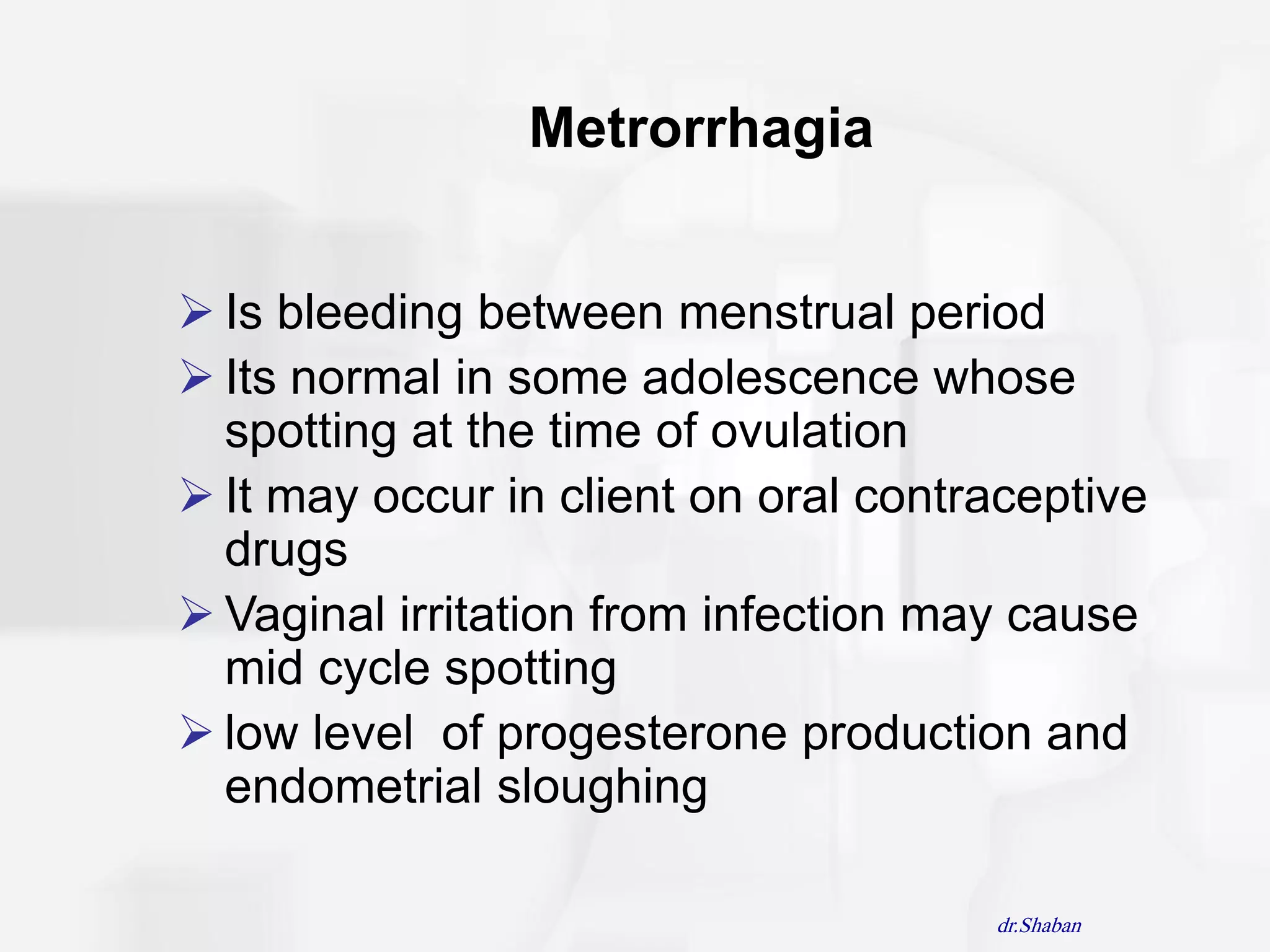
Metrorrhagia


 Is bleeding between menstrual period
 Its normal in some adolescence whose
  spotting at the time of ovulation
 It may occur in client on oral contraceptive
  drugs
 Vaginal irritation from infection may cause
  mid cycle spotting
 low level of progesterone production and
  endometrial sloughing

                                      dr.Shaban
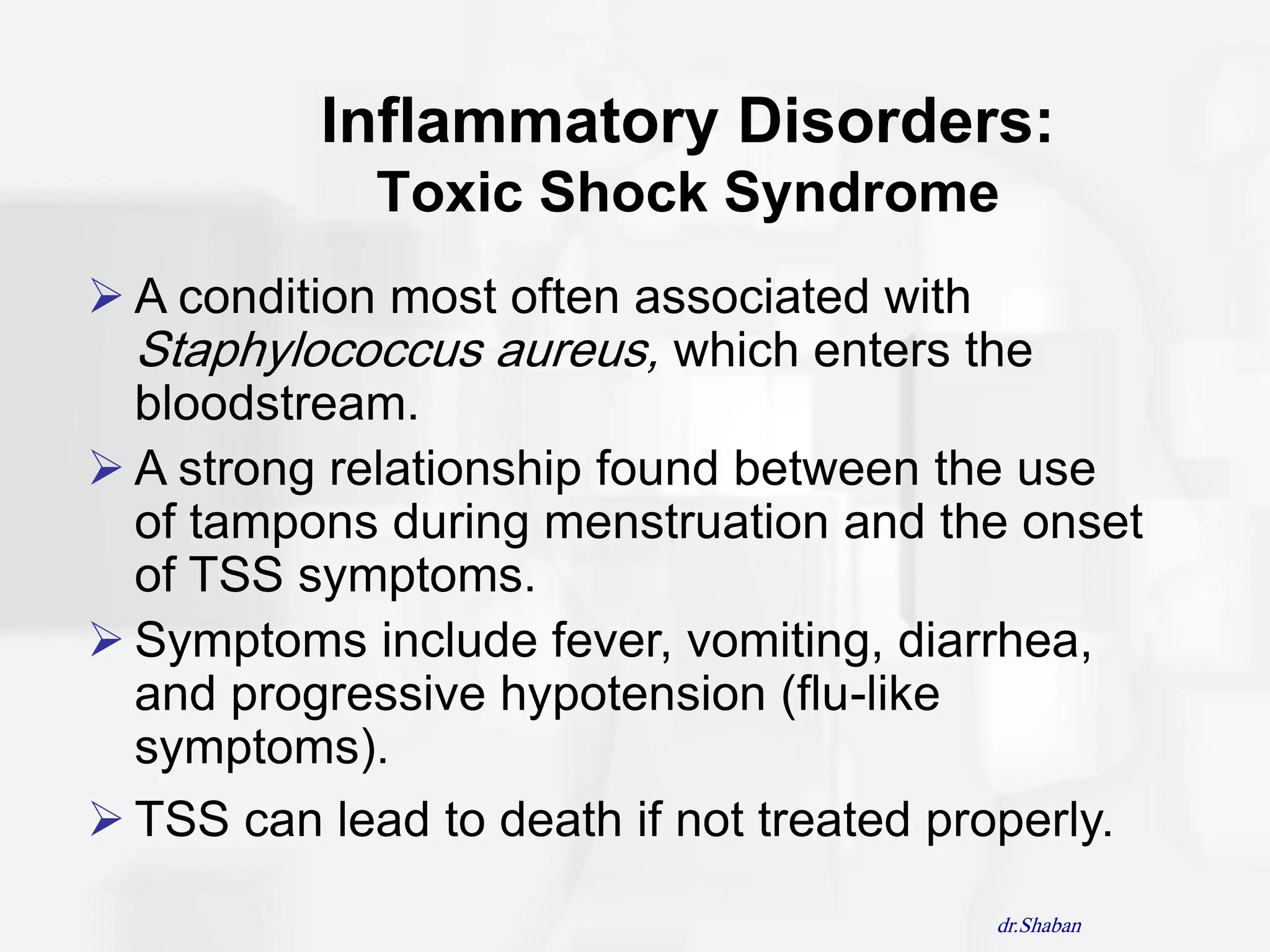
Inflammatory Disorders:
             Toxic Shock Syndrome
 A condition most often associated with
  Staphylococcus aureus, which enters the
  bloodstream.
 A strong relationship found between the use
  of tampons during menstruation and the onset
  of TSS symptoms.
 Symptoms include fever, vomiting, diarrhea,
  and progressive hypotension (flu-like
  symptoms).
 TSS can lead to death if not treated properly.
                                         dr.Shaban
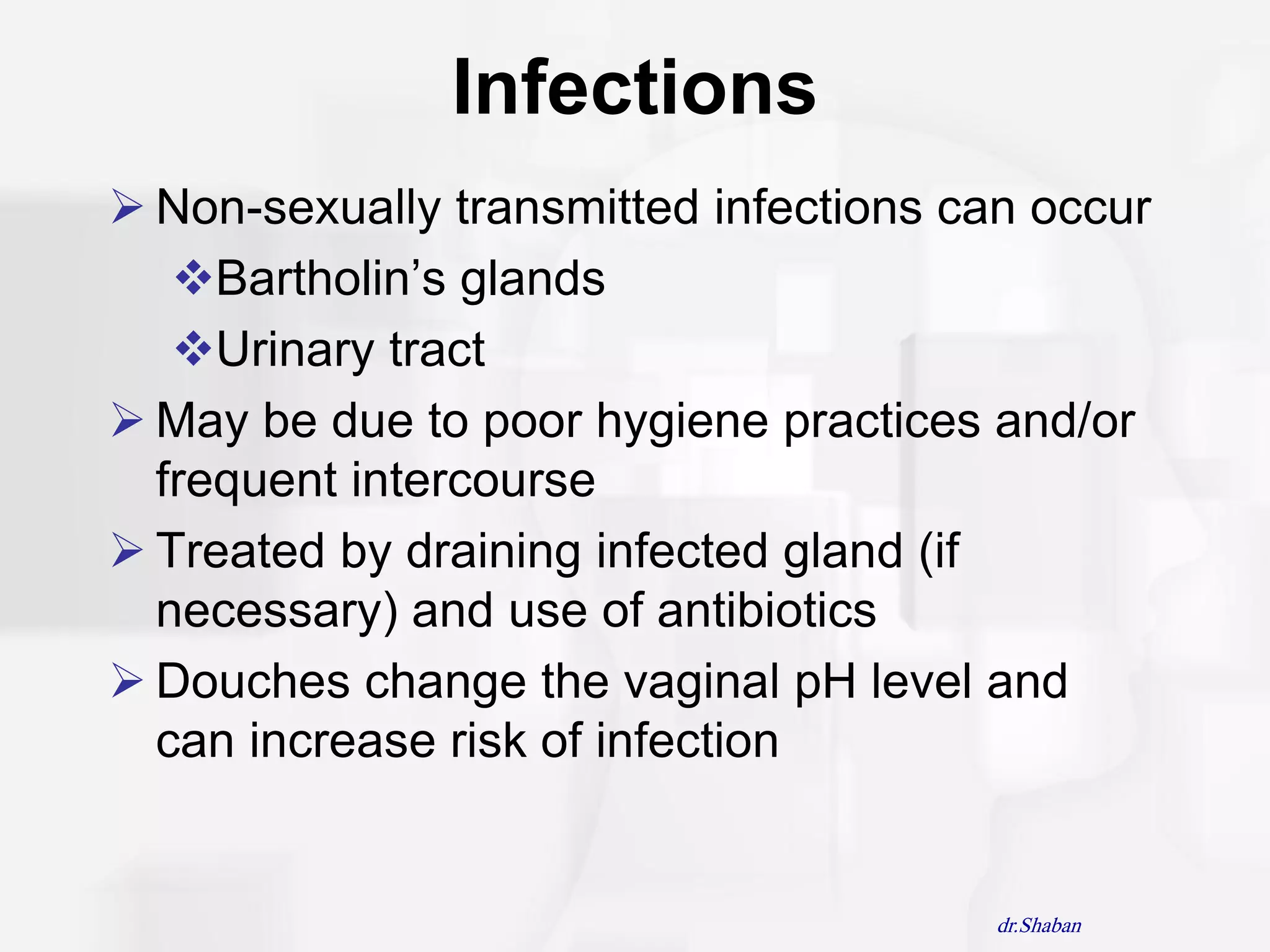
Infections
 Non-sexually transmitted infections can occur
   Bartholin‟s glands
   Urinary tract
 May be due to poor hygiene practices and/or
  frequent intercourse
 Treated by draining infected gland (if
  necessary) and use of antibiotics
 Douches change the vaginal pH level and
  can increase risk of infection


                                        dr.Shaban
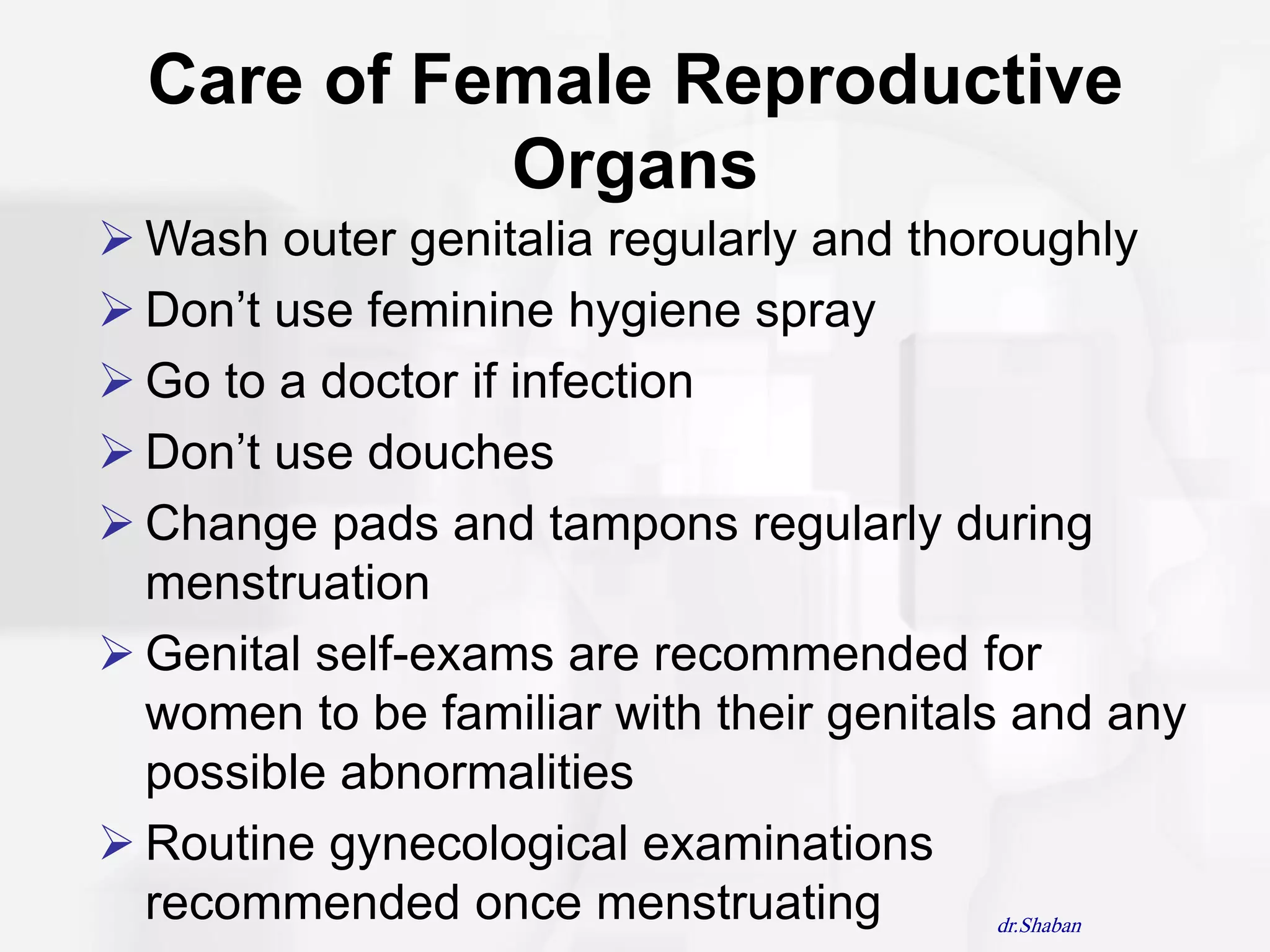
Care of Female Reproductive
            Organs
 Wash outer genitalia regularly and thoroughly
 Don‟t use feminine hygiene spray
 Go to a doctor if infection
 Don‟t use douches
 Change pads and tampons regularly during
  menstruation
 Genital self-exams are recommended for
  women to be familiar with their genitals and any
  possible abnormalities
 Routine gynecological examinations
  recommended once menstruating           dr.Shaban
In case of fertilization
 At time of ovulation, the cervical mucous becomes less
  viscous and providing channels for sperms passage.
 The sperms ascent through the uterine cavity and
  Fallopian tubes to reach the site of fertilization in the
  ampulla
 The ovum leaves the ovary after rupture of the Graafian
  follicle, the ovum is picked up by the fimbrial end of the
  Fallopian tubes and moved towards the ampulla
 After penetration of the ovum by a sperm, resistant to
  penetration by another sperms occur
                                                  dr.Shaban
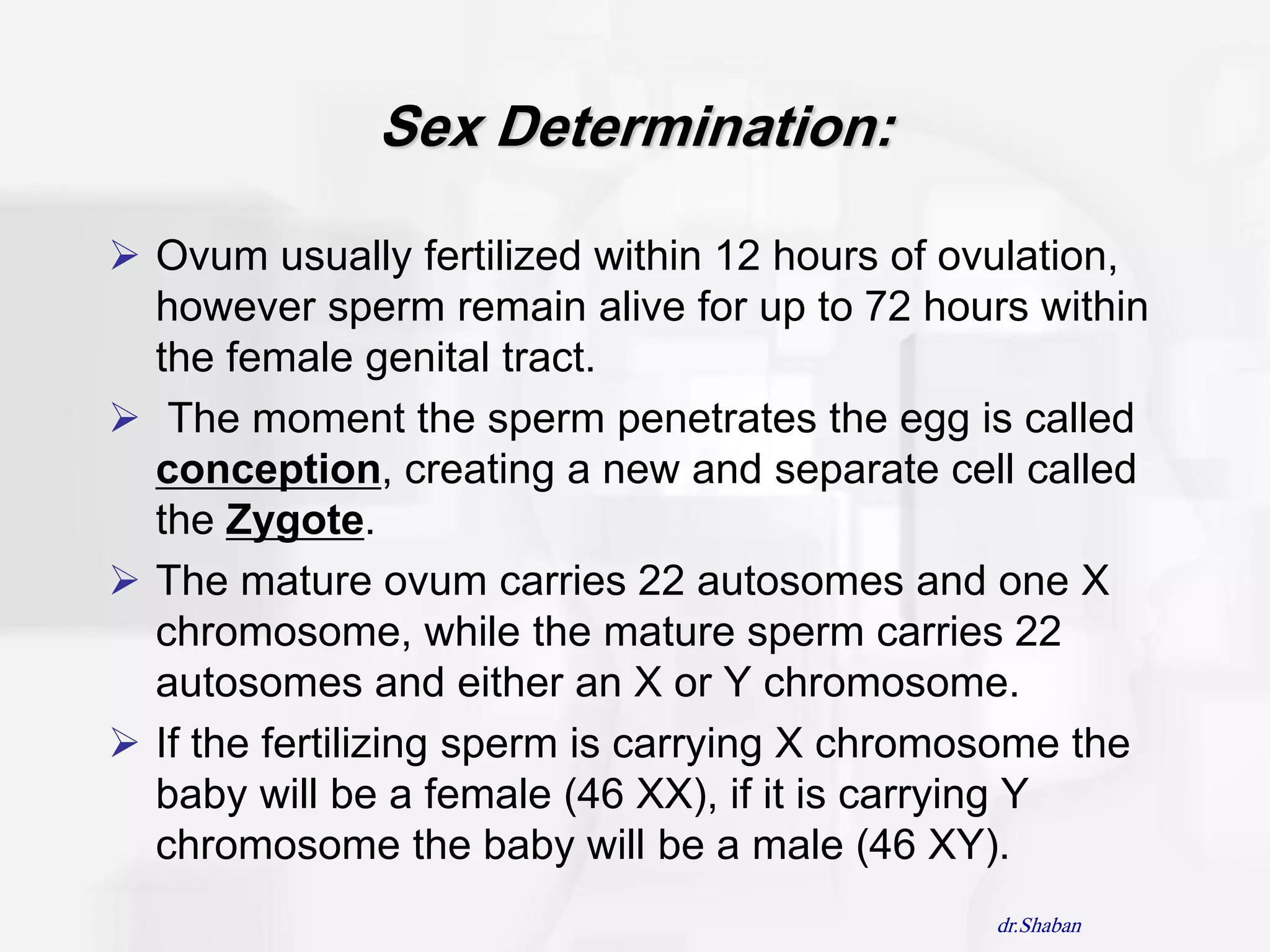
Sex Determination:

 Ovum usually fertilized within 12 hours of ovulation,
  however sperm remain alive for up to 72 hours within
  the female genital tract.
 The moment the sperm penetrates the egg is called
  conception, creating a new and separate cell called
  the Zygote.
 The mature ovum carries 22 autosomes and one X
  chromosome, while the mature sperm carries 22
  autosomes and either an X or Y chromosome.
 If the fertilizing sperm is carrying X chromosome the
  baby will be a female (46 XX), if it is carrying Y
  chromosome the baby will be a male (46 XY).
                                              dr.Shaban
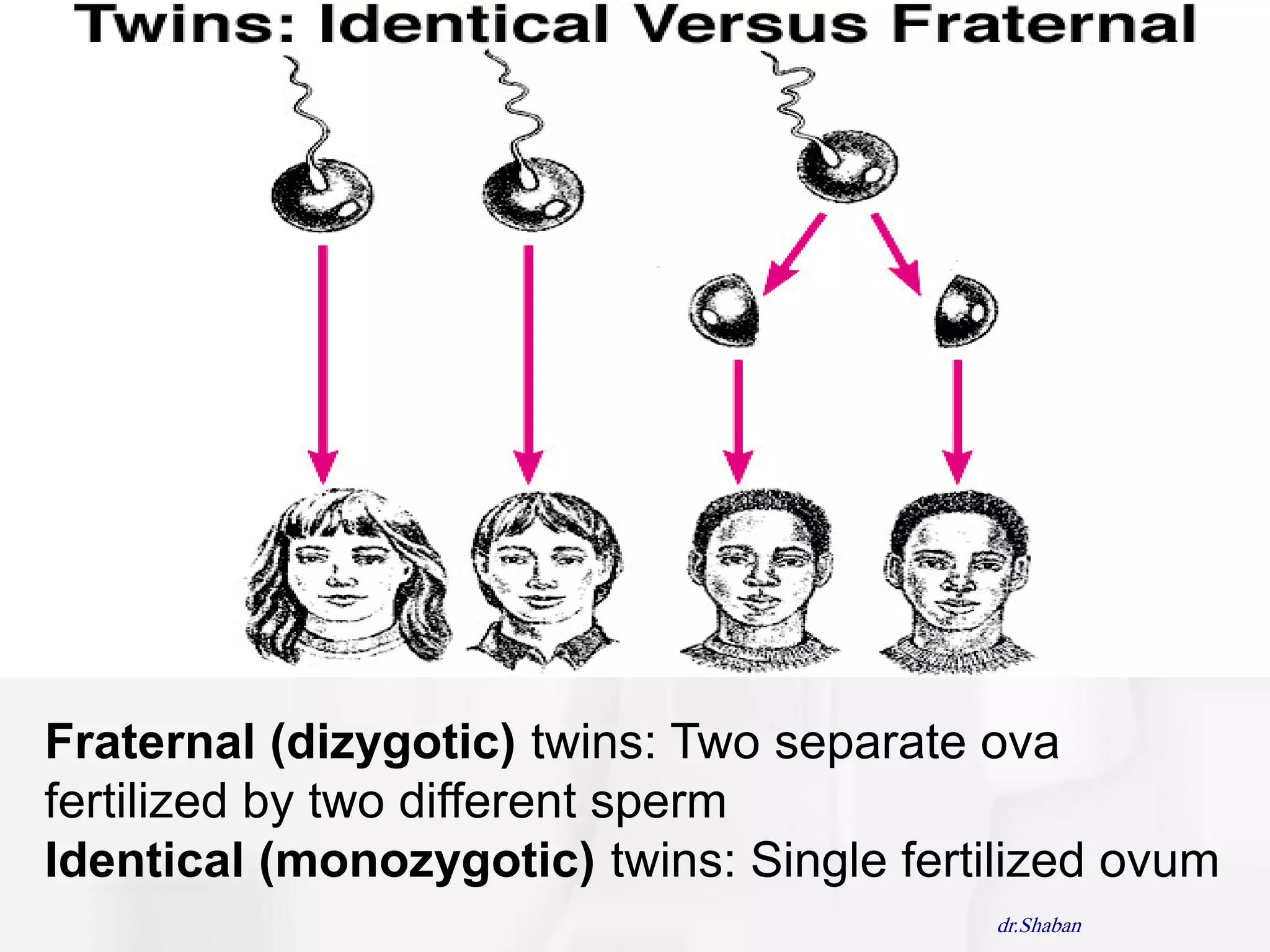
Fraternal (dizygotic) twins: Two separate ova
fertilized by two different sperm
Identical (monozygotic) twins: Single fertilized ovum
                                          dr.Shaban
Human Development before
           Implementation
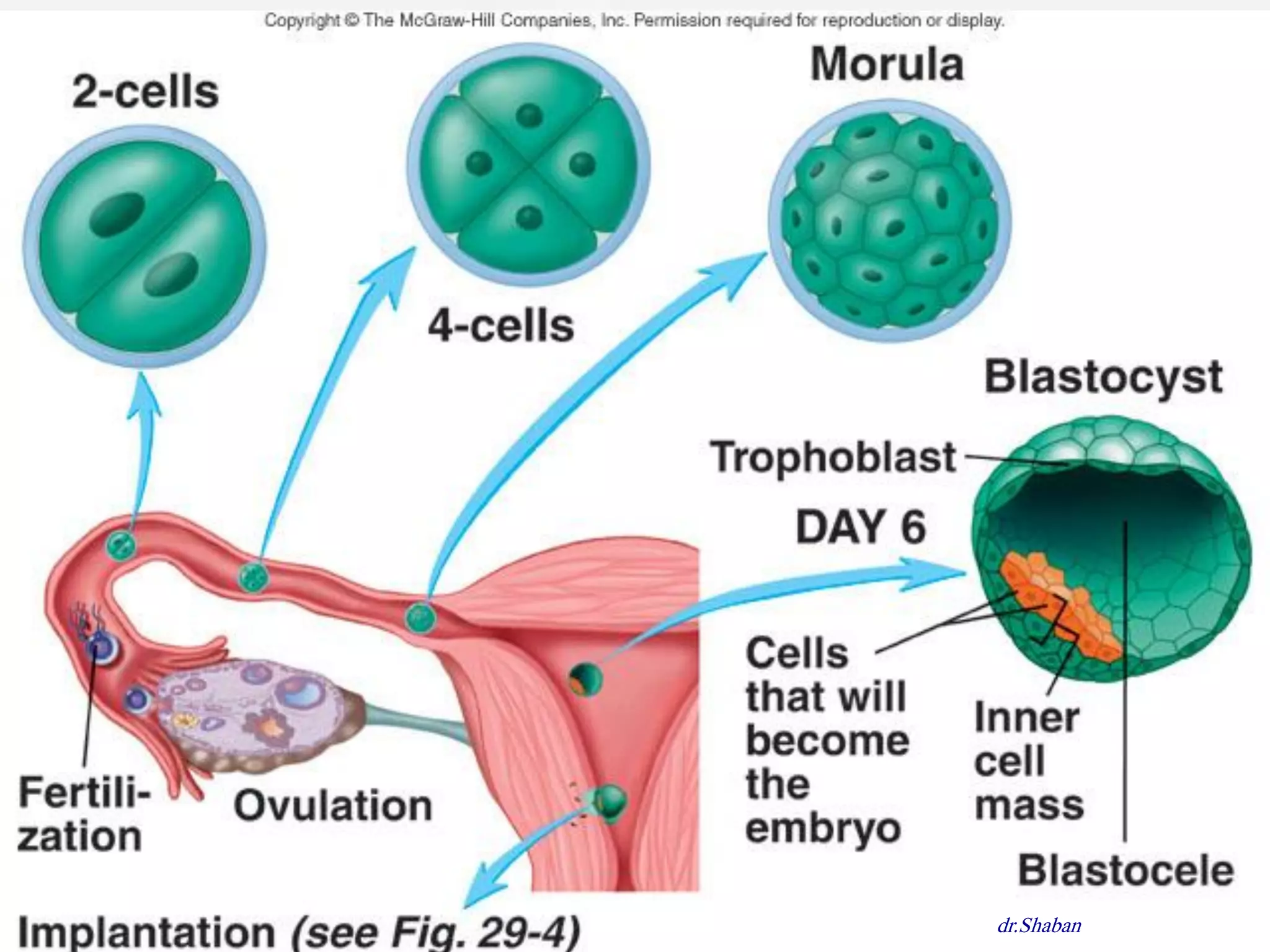
 On its way to the uterine cavity, the fertilized
   ovum (zygote) divides into 2,4,8 then 16
   cells (blastomeres).
 This cleavage starts within 24 hours of
 fertilization and occurs nearly every 12 hours
 repeatedly
 The resultant 16 cells mass is called morula
 which reaches the uterine cavity after about 4
 days from fertilization.


                                          dr.Shaban
dr.Shaban
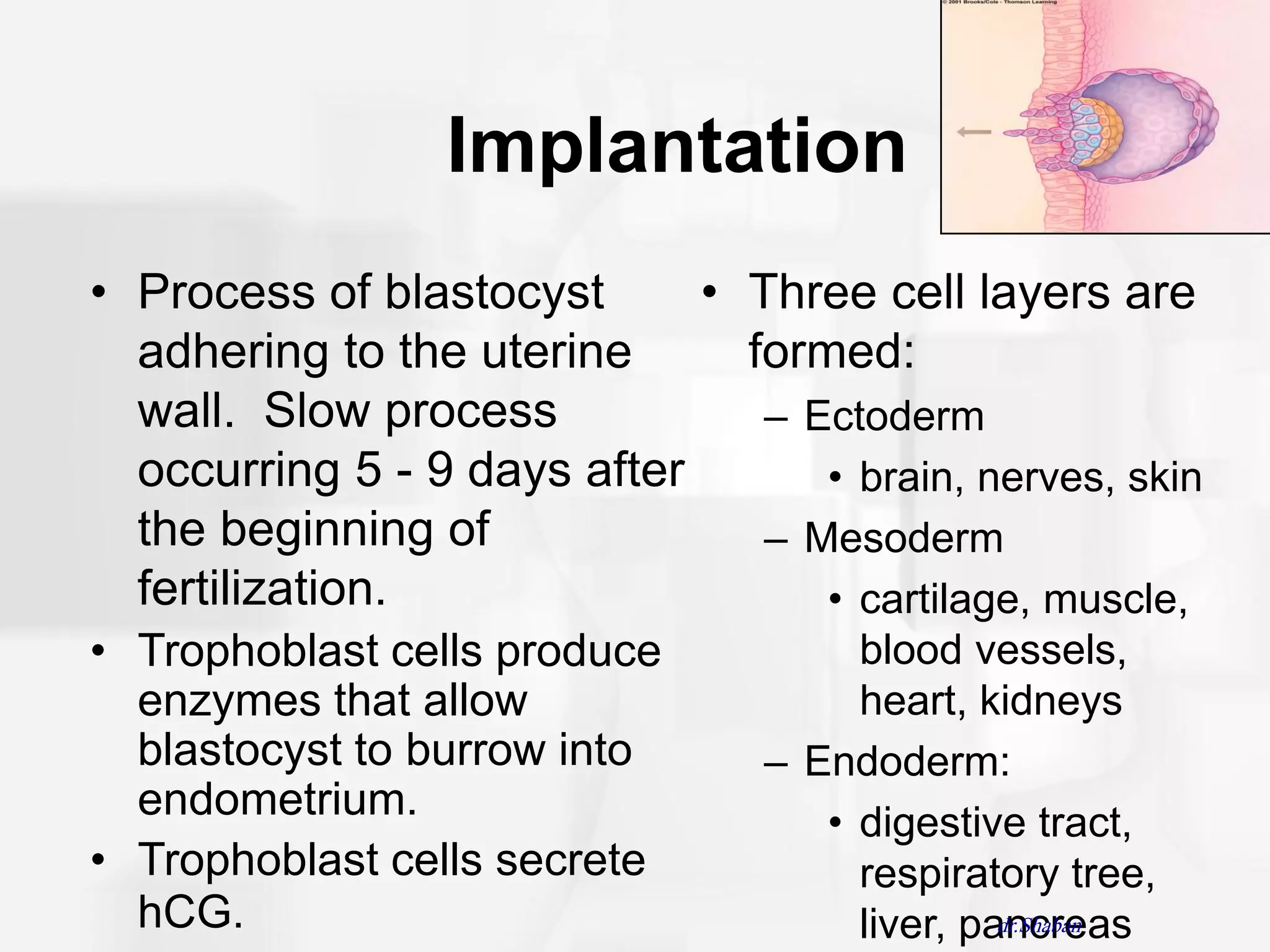
Implantation
• Process of blastocyst      • Three cell layers are
  adhering to the uterine      formed:
  wall. Slow process            – Ectoderm
  occurring 5 - 9 days after       • brain, nerves, skin
  the beginning of              – Mesoderm
  fertilization.                   • cartilage, muscle,
• Trophoblast cells produce           blood vessels,
  enzymes that allow                  heart, kidneys
  blastocyst to burrow into      – Endoderm:
  endometrium.                      • digestive tract,
• Trophoblast cells secrete           respiratory tree,
  hCG.                                liver, pancreas
                                               dr.Shaban
Human Chorionic Gonadotropin (HCG):
 Source: Trophoblasts of blastocyst &
  Chorion (effects similar to LH).
  Target & Functions:
    Corpus Luteum
       • Maintains corpus luteum & causes it to
         continue producing progesterone in the
         absence of LH through first four months of
         pregnancy till placenta produces sufficient
         estrogen & progesterone to maintain the
         pregnancy
       • This maintains endometrium, prevents
         menstruation
       • Can be detected by week 3 with a home
         pregnancy test (Basis of pregnancy dr.Shaban
                                            test).
In Vitro Fertilization and
  Embryo Transfer
 Fertilized ovum introduced into the uterus (fertilization to
  implantation (7days)
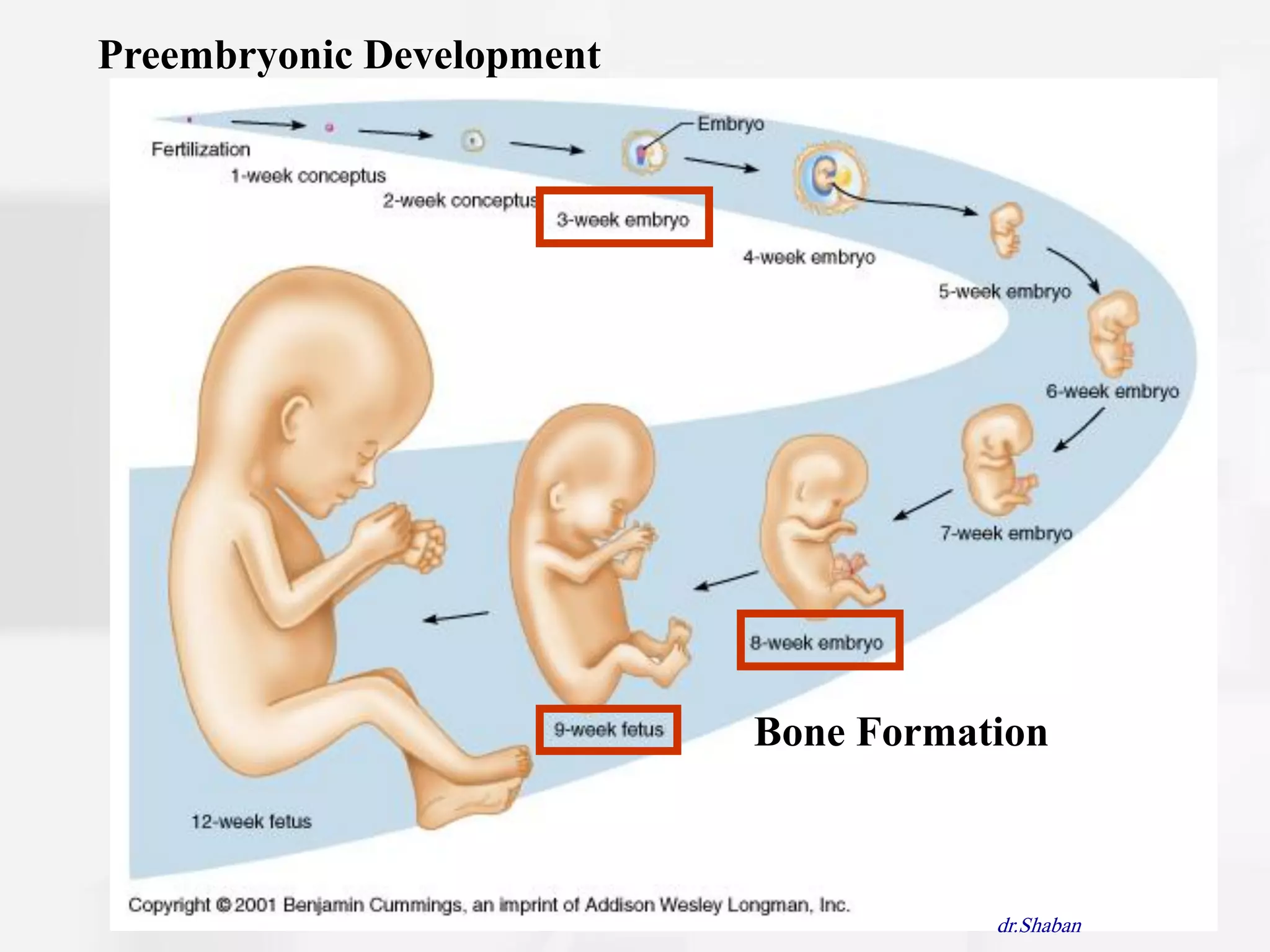
 Preembryonic period
    First 14 days of human development starting at the time
     of fertilization
 Embryonic period
   Beginning of the third week through approximately 8
  weeks
 Fetal period
    From 9 weeks until birth (at approximately 40 weeks
     after the last normal menstrual period).

                                                   dr.Shaban
Preembryonic Development


                           Bone Formation


                                      dr.Shaban
‫- ‪Stages of Human Development‬‬
           ‫‪Prenatal‬‬
‫‪ Zygote‬‬        ‫‪ ‬قال تثارك ٔ تعانى: "ٔ نقد خهقُا اإلَساٌ يٍ سالنة يٍ‬
              ‫طيٍ (21) ثى جعهُاِ َطفة في قرار يكيٍ (31) ثى خهقُا‬
‫‪ Morula‬‬         ‫انُطفة علقة فخهقُا انعهقة مضغة فخهقُا انًضغة عظاما‬
                    ‫فكسَٕا انعظاو لحما ثى أَشأَاِ خلقا آخر، فتثارك اهلل‬
‫‪ Blastocyst‬‬                                       ‫أحسٍ انخانقيٍ (41).‬
                   ‫‪ ‬قال انثياٌ انقرآَي: يا أيٓا انُاس إٌ كُتى في رية يٍ‬
‫‪ Embryo‬‬
               ‫انثعث فإَا خهقُاكى يٍ تراب ثى يٍ َطفة ثى يٍ علقة ثى‬
‫‪ Fetus‬‬      ‫يٍ مضغة يخهقة ٔغير يخهقة نُثيٍ نكى َٔقر في األرحاو‬
                                     ‫يا َشاء إنى أجم يسًى (انحج :5)‬
               ‫‪ ‬قال انرسٕل صهى اهلل عهيّ ٔسهى: "إذا ير تانُطفة اثُتاٌ‬
                               ‫ّ‬
              ‫ٔأرتعٌٕ نيهة تعث اهلل إنيٓا يه ًا فصٕرْا، ٔخهق سًعٓا‬
                                         ‫ك‬
              ‫ٔتصرْا ٔجهدْا ٔنحًٓا ٔعظايٓا، ثى قال: يا ر ّ أذكر‬
                      ‫ب‬
                                                  ‫أو أَثى؟" صحيح يسهى‬

                                                       ‫‪dr.Shaban‬‬

1001331 2nd lecture

  • 1.
  • 2.
    Female Reproductive System Lesson Overview: Reproductive Anatomy The Menstrual Cycle Treating Pre- menstrual Syndrome dr.Shaban
  • 3.
    Anatomy and Physiology The female reproductive system consists of external and internal structures and organs.  Function of Female Reproductive System -Produces sex hormones and functional ova -Protects and supports developing embryo -Nourishes newborn infant dr.Shaban
  • 4.
    External Sex Organs Vulva – entire female region of external sex organs  Mons pubis -protective, fatty cushion over the pubic bone; -covered with pubic hair Vestibule. consists of the clitoris, urethral meatus, and the vaginal introitus.  Labia Majora outer lips; tissue folds from mons to perineum surrounding the rest of the female genitals;  Labia Minora inner lips; pink tissue folds between vestibule and labia majora; no hair; many oil glands; dr.Shaban
  • 5.
    External Sex Organs-Cont.  The clitoris is a short erectile organ at the top of the vaginal vestibule whose function is sexual excitation (analogous to the penis).  The urethral meatus is the opening of the urethra.  The vaginal introitus is the vaginal entrance  Perineum. This is the skin covered muscular area between the vaginal opening (introitus) and the anus. It aids in constricting the urinary, vaginal, and anal opening. It also helps support the pelvic contents.  Bartholin's Glands. The Bartholin's glands lie on either side of the vaginal opening. They produce a mucoid substance, which provides lubrication for intercourse.  Fourchette: Trauma provides forensic evidence in rape trials. dr.Shaban
  • 6.
  • 7.
    The hymen  Separateexternal organ from internal  A membrane covered by stratified squamous epithelium on both sides that partially closes the vaginal orifice. Congenitally, it may have no opening (imperforate hymen), also rarely it may be absent. The shape and size of the openings vary. It is torn with the first sexual intercourse (unless the opening is unusually large or the hymen is elastic). dr.Shaban
  • 8.
    The Breasts  Thebreasts are also part of the external female reproductive system.  Their external structure include the nipple, areola (darker area around the nipples) and Montgomery tubercles (glands that produce a lubricant to keep the nipple soft and supple). Primary function: Lactation Influence of hormones (Estrogen-develop. of breasts , Progesterone-secretion of milk) Sucking stimulates pituitary gland to release prolactin (begin milk synthesis) and oxytocin (release of milk) dr.Shaban
  • 9.
    Prolactin: Source: Anterior Pituitary Targets & Functions: Breasts Stimulates alveoli of breasts to produce milk dr.Shaban
  • 10.
    Internal Female Structures Vagina. Uterus. Cervix(lower portion of uterus). Fallopian tubes. Ovaries. dr.Shaban
  • 11.
    Internal Structures: Vagina Elastic, thin-walled muscular accordion-like tube; 3-4 inches long (7.5–9 cm ) Opening is the vaginal orifice covered by the hymen to the cervix pH is 3.5 – 4.5 restricts growth of pathogen tilted back; Posterior to the bladder/Anterior to the rectum Function: Receives penis & semen and serves as birth canal & passage for menstrual flow. dr.Shaban
  • 12.
    Internal Sex Organs Uterus – 1-inch thick walls, 3 inches long, 2 inches wide ;hollow, muscular organ between the bladder and rectum; Normally anteverted anteflexed 3 uterine wall layers: Perimetrium ; Myometrium ; Endometrium  The major portion of the uterus is called the body or corpus.  The fundus is the superior, rounded region above the entrance of the fallopian tubes.  The cervix is the narrow, inferior outlet that protrudes into the vagina. Os – opening leading into the uterus  The isthmus is the slightly constricted portion that joins the corpus to the cervix. dr.Shaban
  • 13.
    Function: Provides passagewayfor sperm, receives blastocyst, retains & nourishes fetus & expells fetus at term. Uterus dr.Shaban
  • 14.
    Fallopian Tubes  Two4-inch (8 to 13 cm ) length that extend from the sides of the uterus and curve up to and around the ovaries Infundibulum – has fimbriae finger-like projections at the distal end surrounding the ovaries to collect an egg upon release  Millions of tiny hair-like cilia line the fimbria that beat in waves hundreds of times a second catching the egg at ovulation and moving it through the tube to the uterine cavity (takes 3–4 days) . dr.Shaban
  • 15.
    Function: Passageway foroocyte and site of fertilization. Uterine Tubes dr.Shaban
  • 16.
    The Ovaries  Thefemale sex glands  Are small, almond- shaped organs: near lateral walls of pelvic cavity 5 cm long, 2.5 cm wide, 8mm thick  Male Homolog = testes Function: Produce oocytes (ova) & the hormones estrogen and progesterone. dr.Shaban
  • 17.
    Estrogen:  Sources: MaturingFollicles & Corpus Luteum Targets & Functions: Body in general • Stimulates the development of female secondary sexual chs Uterus • Stimulates proliferative phase of uterine cycle Ovaries • Promotes oogenesis Breasts • Stimulates development of milk ducts and sinuses Anterior Pituitary • Stimulates release of LH dr.Shaban
  • 18.
    Progesterone:  Source: Corpus Luteum & Placenta Targets & Functions: Females - Uterus • Maintains thickened endometrium • Stimulates nutrient release Females - Breasts Corpus luteum • Stimulates development of alveoli for milk production Females - Anterior Pituitary • Inhibits production & release of FSH & LH dr.Shaban
  • 19.
    Oxytocin:  Sources: Manufacturedby hypothalamus. Stored & released by Posterior Pituitary Positive Feedback Mechanisms: 1. Childbirth - Stretching of uterus and cervix 2. Suckling - Milk letdown reflex Targets & Functions: Uterus • Stimulates contraction of uterine myometrium causing lowering of fetus & labor Breasts • Stimulates contraction of milk ducts and sinuses, releasing milk dr.Shaban
  • 20.
    Puberty  Is thestage at which the individual first becomes capable of sexual reproduction  A girl has entered puberty when she begins to menstruate  A Boy enters puberty when he begins to produce spermatozoa  Puberty occur between 11-14 years  Puberty lasts about 3 to 5 years  Begins when pituitary gland initiates release of FSH and LH, which increases the ovaries production of estrogen; Pelvis widens; Pubic hair grows; Menarche occurs during this time, although it may be a few months before or after ovulationdr.Shaban begins
  • 21.
    Menstruation  Menstruation –uterine lining is shed if no pregnancy; tissue and blood exit the introitus  Four body structures are involved in physiology of MP: Hypothalamus; Ovaries; Pituitary glands; and Uterus  Menstrual cycle has four phases: Follicular phase Ovulation phase Luteal phase Menstrual phase dr.Shaban
  • 22.
    Normal menstrual cycle Beginning  Average age of (menarche ) onset 12 or 13 , average range is 9-17 years  Interval between  Average 28 days cycles , cycles between 23-35 not unusual dr.Shaban
  • 23.
     Duration of  2-7 days , but menstrual flow range from 1-9 days not  Amount of abnormal menstrual flow  From 30 – 80 ml per menstrual  Color of menstrual flow  Dark red , combination of blood , mucus , and endiometrical cells dr.Shaban
  • 24.
  • 25.
    Menstrual Cycle Days6 - 13 Preovulatory Phase  This is known as the proliferative phase and/or follicular phase.  A drop in progesterone and estrogen stimulates the release of FSH from the anterior pituitary.  FSH stimulates the maturation of an ovum with graafian follicle.  The growing follicle becomes a temporary endocrine gland, secreting increasing amounts of estrogen which inhibits FSH production in the pituitary.  The follicular phase: During the follicular phase, a certain number of follicles start to grow, and usually only one succeeds to continue through the pre- ovulatory follicle stage. dr.Shaban
  • 26.
    Menstrual Cycle Day14 Ovulation  Again, day 14 is only an average; ovulation occurs anywhere from 12 – 16 days before the next menstrual flow.  When estrogen levels reach their peak, the pituitary releases a surge of LH, the release of LH increases causing a release of the ovum, which is known as ovulation.  The LH surge signals the onset of ovulation within 12 to 24 hours.  Signs of Ovulation -Increase in body temperature -Changes in cervical mucus -Cervix softens -Some women will experience slight pain dr.Shaban
  • 27.
    Menstrual Cycle Days15 - 28 Postovulatory Phase  This phase is also called the luteal or secretory phase because the cells of the follicle remain in the ovary, renamed the “corpus luteum,” where they will produce large amounts of progesterone under the effects of high levels of LH  Progesterone inhibits release of LH from the pituitary gland and further prepares the endometrial lining of the uterus to receive a fertilized egg. Corpus luteum translated means “yellow body.” > This structure forms after the egg is expelled from the follicle. >If pregnancy does not occur it will degenerate. dr.Shaban
  • 28.
    Menstrual Cycle Days1-5 Menses phase. A lack of signal from a fertilized egg influences the drop in estrogen and progesterone production. A drop in progesterone results in the sloughing off of the thick endometrial lining which is the menstrual flow. Menstrual phase – endometrial buildup is expelled through uterine contractions for 3-7 days; volume of menses is about 50 ml blood dr.Shaban
  • 29.
    Menstrual Cycle: InSummry  Follicular phase Egg matures  Ovulation Egg released  Luteal phase Corpus luteum Endometrium Prep for blastocyst  No Pregnancy Menses dr.Shaban
  • 30.
  • 31.
    Menstrual Problems – Premenstrual Syndrome (PMS)  3 to 14 days prior to the menstrual period, during the postovulatory/luteal phase, and are relieved by onset of the menses.  Experienced by one-third to one-half of women between 20 and 50.  Symptoms include weight gain, irritability, mood swings, edema, headache, inability to concentrate, food cravings, acne, and many others.  Can be alleviated by pharmacological interventions, diet, and exercise, Eat „real‟ food! Eliminate „junk‟ food (caffeine, soda, alcohol, processed foods, sugar), Decrease salt intake to relieve bloating and edema. dr.Shaban
  • 32.
    Amenorrhea  Absence ofmenstruation. Can be primary or secondary.  Primary amenorrhea defined as absence of menstruation by age of 17. Can be related to anatomical or genetic abnormalities.  Secondary amenorrhea is the absence of menstrual flow in a woman who has had previous menstrual periods, may result from nutritional deficits (anorexia nervosa), excessive exercise, emotional disturbances, endocrine dysfunction, side effects of medication, pregnancy, and lactation. dr.Shaban
  • 33.
    Dysmenorrhea  Painful menstruation,also called “menstrual cramps,” is more common in nulliparous women and in women who are not having intercourse.  S&S Painful abdominal cramping, backaches, headaches, feeling bloated and nausea Management. NSAIDS (nonsteroidal anti inflammatory drugs). Analgesia (aspirin mild prostaglandin inhibitor ; Adequate rest and sleep and regular exercise, showers and heating pad. dr.Shaban
  • 34.
    Menorrhagia Excessive bleeding duringa menstrual period Either in terms of the amount of blood lost or the number of days that bleeding lasts Hormonal disturbances, infections, and growths inside the uterus can cause menorrhagia Excessive bleeding for an extended period of time can cause a woman to become anemic from the chronic blood loss dr.Shaban
  • 35.
    Metrorrhagia  Is bleedingbetween menstrual period  Its normal in some adolescence whose spotting at the time of ovulation  It may occur in client on oral contraceptive drugs  Vaginal irritation from infection may cause mid cycle spotting  low level of progesterone production and endometrial sloughing dr.Shaban
  • 36.
    Inflammatory Disorders: Toxic Shock Syndrome  A condition most often associated with Staphylococcus aureus, which enters the bloodstream.  A strong relationship found between the use of tampons during menstruation and the onset of TSS symptoms.  Symptoms include fever, vomiting, diarrhea, and progressive hypotension (flu-like symptoms).  TSS can lead to death if not treated properly. dr.Shaban
  • 37.
    Infections  Non-sexually transmittedinfections can occur Bartholin‟s glands Urinary tract  May be due to poor hygiene practices and/or frequent intercourse  Treated by draining infected gland (if necessary) and use of antibiotics  Douches change the vaginal pH level and can increase risk of infection dr.Shaban
  • 38.
    Care of FemaleReproductive Organs  Wash outer genitalia regularly and thoroughly  Don‟t use feminine hygiene spray  Go to a doctor if infection  Don‟t use douches  Change pads and tampons regularly during menstruation  Genital self-exams are recommended for women to be familiar with their genitals and any possible abnormalities  Routine gynecological examinations recommended once menstruating dr.Shaban
  • 39.
    In case offertilization  At time of ovulation, the cervical mucous becomes less viscous and providing channels for sperms passage.  The sperms ascent through the uterine cavity and Fallopian tubes to reach the site of fertilization in the ampulla  The ovum leaves the ovary after rupture of the Graafian follicle, the ovum is picked up by the fimbrial end of the Fallopian tubes and moved towards the ampulla  After penetration of the ovum by a sperm, resistant to penetration by another sperms occur dr.Shaban
  • 40.
    Sex Determination:  Ovumusually fertilized within 12 hours of ovulation, however sperm remain alive for up to 72 hours within the female genital tract.  The moment the sperm penetrates the egg is called conception, creating a new and separate cell called the Zygote.  The mature ovum carries 22 autosomes and one X chromosome, while the mature sperm carries 22 autosomes and either an X or Y chromosome.  If the fertilizing sperm is carrying X chromosome the baby will be a female (46 XX), if it is carrying Y chromosome the baby will be a male (46 XY). dr.Shaban
  • 41.
    Fraternal (dizygotic) twins:Two separate ova fertilized by two different sperm Identical (monozygotic) twins: Single fertilized ovum dr.Shaban
  • 42.
    Human Development before Implementation  On its way to the uterine cavity, the fertilized ovum (zygote) divides into 2,4,8 then 16 cells (blastomeres).  This cleavage starts within 24 hours of fertilization and occurs nearly every 12 hours repeatedly  The resultant 16 cells mass is called morula which reaches the uterine cavity after about 4 days from fertilization. dr.Shaban
  • 43.
  • 44.
    Implantation • Process ofblastocyst • Three cell layers are adhering to the uterine formed: wall. Slow process – Ectoderm occurring 5 - 9 days after • brain, nerves, skin the beginning of – Mesoderm fertilization. • cartilage, muscle, • Trophoblast cells produce blood vessels, enzymes that allow heart, kidneys blastocyst to burrow into – Endoderm: endometrium. • digestive tract, • Trophoblast cells secrete respiratory tree, hCG. liver, pancreas dr.Shaban
  • 45.
    Human Chorionic Gonadotropin(HCG):  Source: Trophoblasts of blastocyst & Chorion (effects similar to LH). Target & Functions: Corpus Luteum • Maintains corpus luteum & causes it to continue producing progesterone in the absence of LH through first four months of pregnancy till placenta produces sufficient estrogen & progesterone to maintain the pregnancy • This maintains endometrium, prevents menstruation • Can be detected by week 3 with a home pregnancy test (Basis of pregnancy dr.Shaban test).
  • 46.
    In Vitro Fertilizationand Embryo Transfer  Fertilized ovum introduced into the uterus (fertilization to implantation (7days)  Preembryonic period  First 14 days of human development starting at the time of fertilization  Embryonic period Beginning of the third week through approximately 8 weeks  Fetal period  From 9 weeks until birth (at approximately 40 weeks after the last normal menstrual period). dr.Shaban
  • 47.
    Preembryonic Development Bone Formation dr.Shaban
  • 48.
    ‫- ‪Stages ofHuman Development‬‬ ‫‪Prenatal‬‬ ‫‪ Zygote‬‬ ‫‪ ‬قال تثارك ٔ تعانى: "ٔ نقد خهقُا اإلَساٌ يٍ سالنة يٍ‬ ‫طيٍ (21) ثى جعهُاِ َطفة في قرار يكيٍ (31) ثى خهقُا‬ ‫‪ Morula‬‬ ‫انُطفة علقة فخهقُا انعهقة مضغة فخهقُا انًضغة عظاما‬ ‫فكسَٕا انعظاو لحما ثى أَشأَاِ خلقا آخر، فتثارك اهلل‬ ‫‪ Blastocyst‬‬ ‫أحسٍ انخانقيٍ (41).‬ ‫‪ ‬قال انثياٌ انقرآَي: يا أيٓا انُاس إٌ كُتى في رية يٍ‬ ‫‪ Embryo‬‬ ‫انثعث فإَا خهقُاكى يٍ تراب ثى يٍ َطفة ثى يٍ علقة ثى‬ ‫‪ Fetus‬‬ ‫يٍ مضغة يخهقة ٔغير يخهقة نُثيٍ نكى َٔقر في األرحاو‬ ‫يا َشاء إنى أجم يسًى (انحج :5)‬ ‫‪ ‬قال انرسٕل صهى اهلل عهيّ ٔسهى: "إذا ير تانُطفة اثُتاٌ‬ ‫ّ‬ ‫ٔأرتعٌٕ نيهة تعث اهلل إنيٓا يه ًا فصٕرْا، ٔخهق سًعٓا‬ ‫ك‬ ‫ٔتصرْا ٔجهدْا ٔنحًٓا ٔعظايٓا، ثى قال: يا ر ّ أذكر‬ ‫ب‬ ‫أو أَثى؟" صحيح يسهى‬ ‫‪dr.Shaban‬‬