Hyperinflation in Zimbabwe
Its causes, current situation and possible solutions
Presented By
Name Batch Number Roll
Number
Slides
Md. Golam Moula Mehedi Hasan 45E ZR – 14 1 - 7
Kazi Md. Masum 45E ZR – 04 8 - 15
Muhammad Maqsud Hussain 45E ZR – 13 16 - 22
Fardin Humayun 45E ZR – 25 23 - 31
Dipankar Ghosh 45E ZR – 36 36 - 38
Hasnat Imtiaz Uddin Ahmed 45E ZR – 56 33 - 35
Contents
1. About Zimbabwe
2. What is Inflation?
3. How is it Measured?
4. What is Hyperinflation?
5. Current situation in Zimbabwe
6. What caused this Hyperinflation
7. What can be done to overcome it
About Zimbabwe
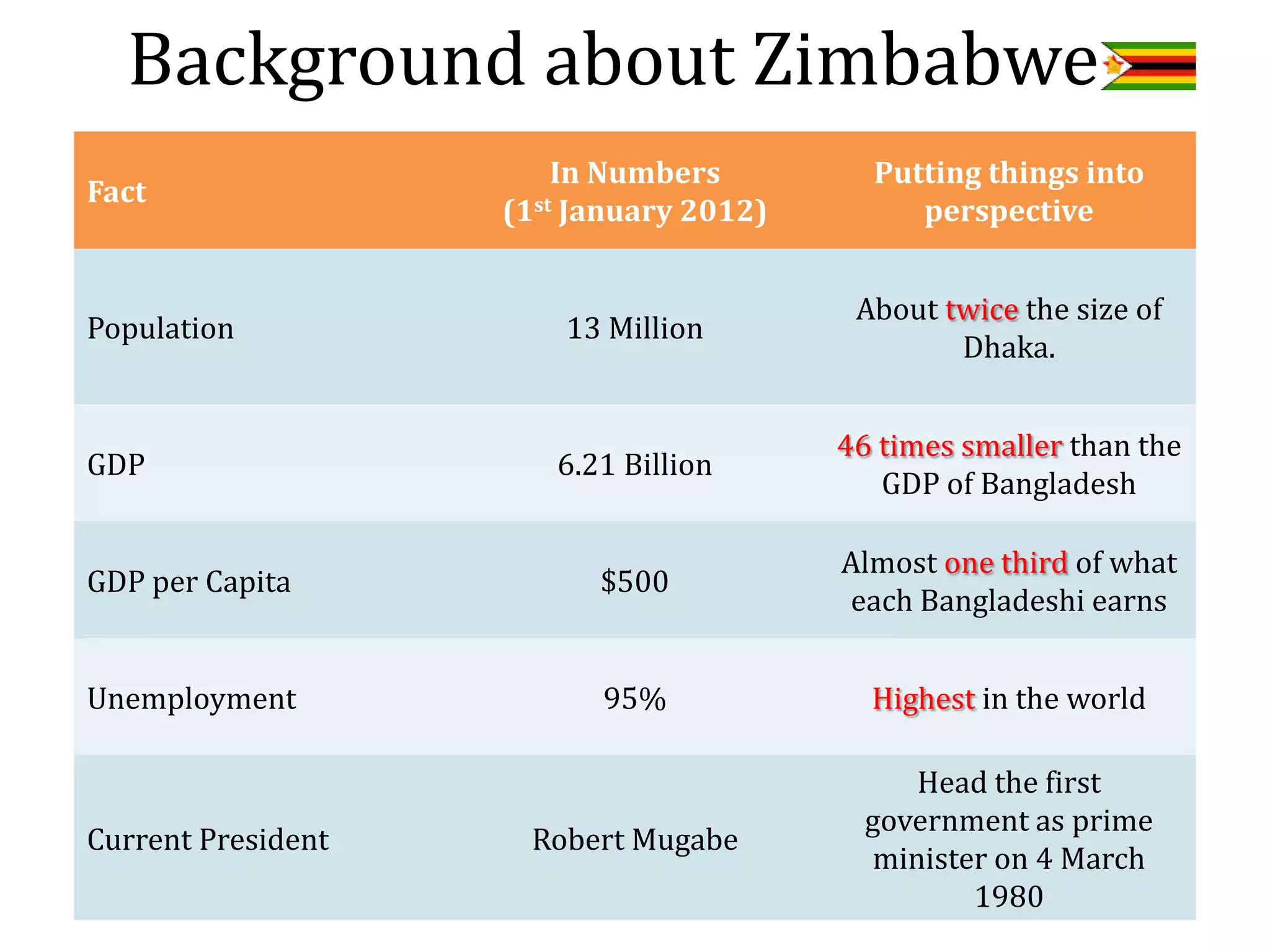
Background about Zimbabwe
Fact
In Numbers
(1st January 2012)
Putting things into
perspective
Population 13 Million
About twice the size of
Dhaka.
GDP 6.21 Billion
46 times smaller than the
GDP of Bangladesh
GDP per Capita $500
Almost one third of what
each Bangladeshi earns
Unemployment 95% Highest in the world
Current President Robert Mugabe
Head the first
government as prime
minister on 4 March
1980
What is Inflation?
What is Inflation?
By inflation we mean a general rise in prices
throughout the economy. Government policy is
used to keep inflation both low and stable.
(J.Sloman,2001, 2nd edition, Pearson Education Limited. 'Essentials of Economics', pp.244-245)
How is inflation
measured?
Inflation: How Is It Measured?
A number of goods that are representative of the
economy are put together into what is referred to
as a "market basket."
Inflation: How Is It Measured?
A year is selected as the base year
1982
Inflation: How Is It Measured?
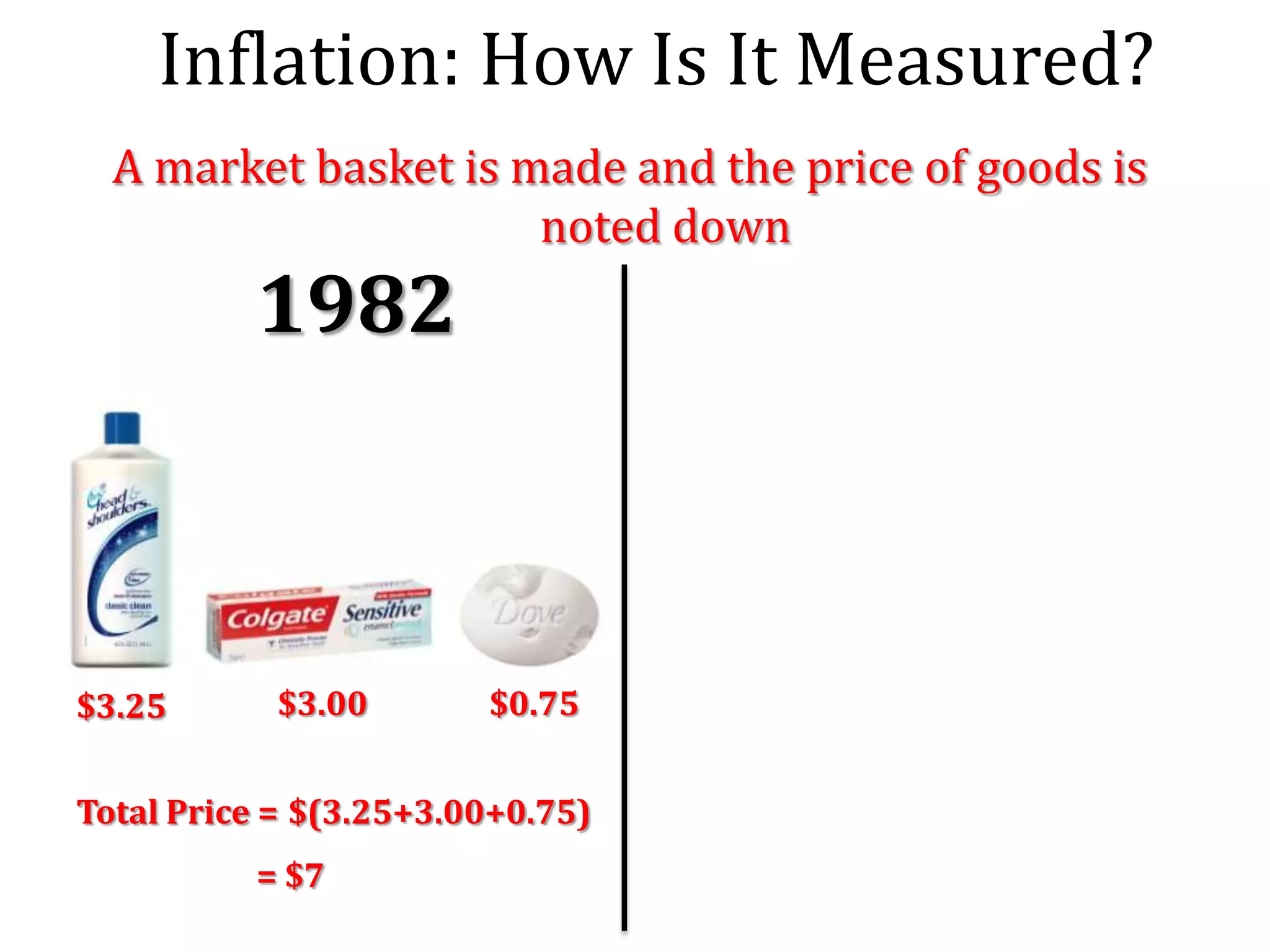
A market basket is made and the price of goods is
noted down
1982
$3.25 $3.00 $0.75
Total Price = $(3.25+3.00+0.75)
= $7
Inflation: How Is It Measured?
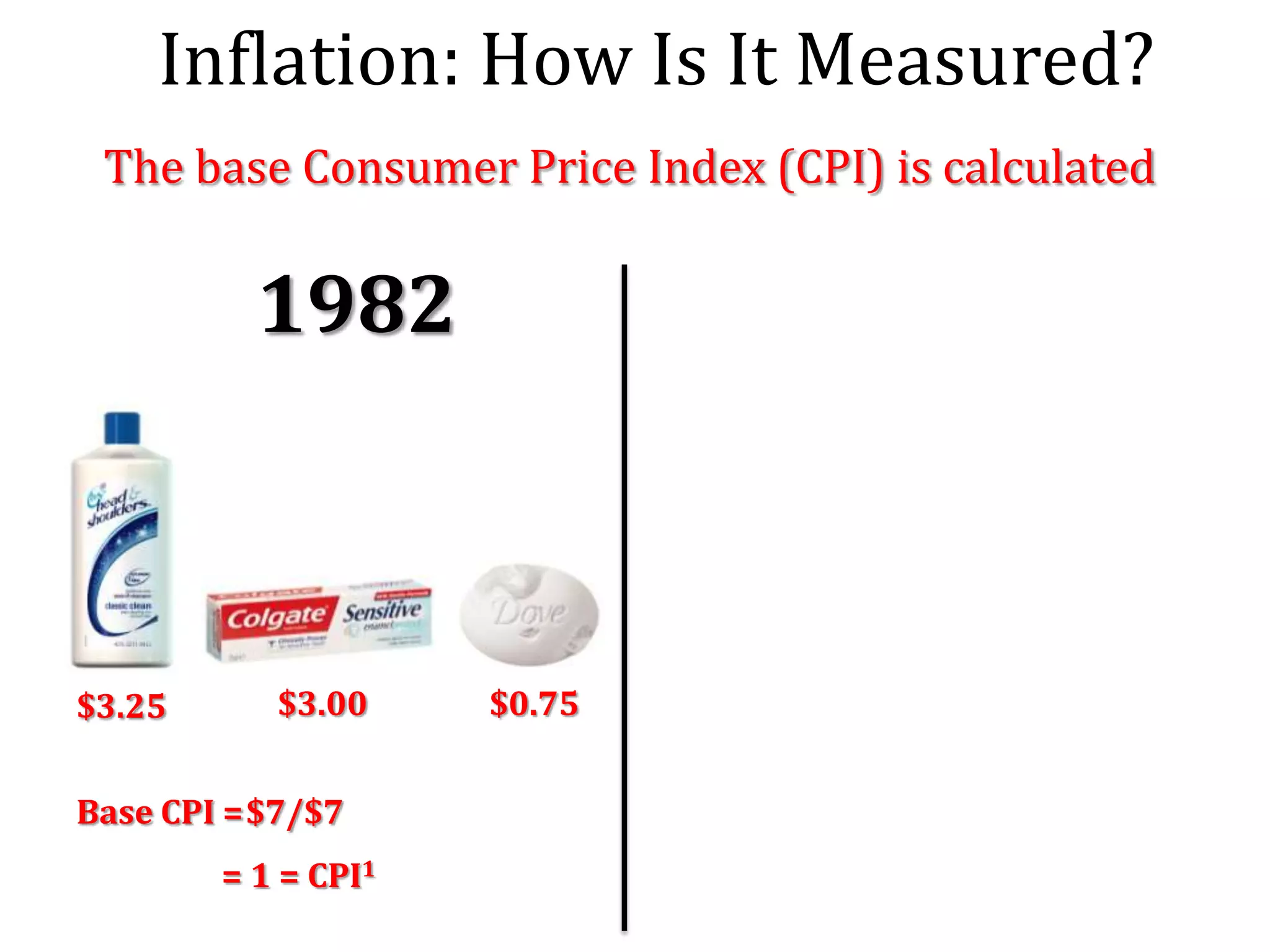
The base Consumer Price Index (CPI) is calculated
1982
$3.25 $3.00 $0.75
Base CPI =$7/$7
= 1 = CPI1
Inflation: How Is It Measured?
Repeating the same process for the year 2013
1982
$3.25 $3.00 $0.75
2013
$8.25 $5.00 $2.75
Total Price =
= 16
$(8.25+5.00+2.75)Base CPI =$7/$7
= 1 = CPI1
Inflation: How Is It Measured?
Calculating CPI for the year 2013
1982
$3.25 $3.00 $0.75
2013
$8.25 $5.00 $2.75
Base CPI =$7/$7
= 1 = CPI1
CPI2 = $16/$7
= 2.29
Inflation: How Is It Measured?
Increase in inflation rate for the year 2013
relative to 1982
=Increase in Inflation = (CPI2- CPI1)* 100 (2.29- 1.00) * 100
= 129%
What is Hyperinflation?
In economics, hyperinflation occurs when a country
experiences very high, accelerating, and perceptibly
"unstoppable" rates of inflation. Two things happen as
a consequence:
1. General price level of goods and
services increase, meaning currency
loses real value.
2. The real values of economic items
generally stay the same.
What causes Hyperinflation?
Hyperinflation is often associated with wars, their
aftermath, sociopolitical upheavals, or other crises that
make it difficult for the government to tax the
population.
So, the government starts printing more money to
finance its expenditures and thus pumps money
into the economy.
And as a result of Hyperinflation
People can obtain less products for more
money
Currency devaluates
Prices of goods go up
People have more money to spend
Current situation in
Zimbabwe
Hyperinflation in Zimbabwe
0%
10000%
20000%
30000%
40000%
50000%
60000%
70000%
Inflation Rate
Inflation Rate
Due to Hyperinflation in Zimbabwe
A toilet paper would cost you $417
You have to spare a measly $50 Billion to buy an egg
They even have a 100 trillion dollar note!
And with ONLY two truck loads of money you could
pay your restaurant bill!
What caused this
Hyperinflation?
What pushed Zimbabwe into such
madness?
The three main causes of hyperinflation in Zimbabwe are
as follows:
1. Controversial Government land reforms
2. Drought
3. HIV/AIDS
Land Reforms
The prime contributor to Hyperinflation
The farm sector supplied about 60 percent of the
inputs to the manufacturing base—so agriculture was truly
the backbone of the economy.
Due to colonialism
4500 White Families owned most of the
commercial farms
Excellent productive capacity
Well-irrigated
Land Reforms
The prime contributor to Hyperinflation
The farm sector supplied about 60 percent of the
inputs to the manufacturing base—so agriculture was truly
the backbone of the economy.
Due to colonialism
840,000 black farmers eked out a living on the
communal lands
Completely barren
No water supply
Land Reforms
The prime contributor to Hyperinflation
Commercial Farms Communal firms
Had secure property titles
that gave farmers large
incentives to efficiently
manage the land
without property titles
allowed a banking sector to
loan funds for machinery,
irrigation etc.
Banks were reluctant to
provide loans
Land Reforms
The prime contributor to Hyperinflation
Then president Mugabe decided on Land Reforms
This essentially caused,
1. Seizure of commercial farms from
4500 white families
2. Redistribution of these farms
amongst black farmers
Land Reforms
The prime contributor to Hyperinflation
Then president Mugabe decided on Land Reforms
In practice, however,
Most plots ended up
in the hands of Mugabe’s political
supporters and government
officials, whose knowledge of
farming was meager.
Land Reforms
During the next 4 Years
INFLATION SOARED
Government started printing money to be able to afford goods in spite of
increasing prices
Price of goods went up
Economy began to shrink
Due to lack of expertise the black people were clueless as to what to do
with the commercial firms
Land Reforms
After Which..
The demise of the agricultural sector led to widespread famine
Without equity in the banking system, vast networks of economic activity
collapsed across all sectors of the economy
Because the government no longer enforced titles to land, there was far
less collateral for bank loans. Dozens of banks collapsed; those that did
not collapse refused to extend credit to farmers
Financial investors fled, wondering if other businesses might be seized
next. FDI fell to 0
Things that can be done
Possible Solutions
Dollarization
Freezing
government
spending
Stop printing
currency
Increase Taxes
Dollarization
Occurs when the inhabitants of a country use
foreign currencyin parallel to or instead of
the domestic currencyas a store of value, unit
of account, and/or medium of exchange within the
domestic economy.
This is effectivebecause the real value of
non-monetary items does not
decrease, what decreases is the value of the currency
with which those commodities are bought.
Freezing Government Spending
Inflation would decrease
There is no need for central bank to print any more
money
If government decreases its spending
The central bank printed money to facilitate
government spending
Stop Printing Currency
Eventually, Inflation would decrease
Price of goods and services go down
Less money circulates the economy
Printing less money would ensure
Conclusion
When all these policies are in place, hopefully, the
inflation will die down and Zimbabwean economy would
see better days
THANK YOU

Hyperinflation in zimbabwe

  • 1.
    Hyperinflation in Zimbabwe Itscauses, current situation and possible solutions
  • 2.
    Presented By Name BatchNumber Roll Number Slides Md. Golam Moula Mehedi Hasan 45E ZR – 14 1 - 7 Kazi Md. Masum 45E ZR – 04 8 - 15 Muhammad Maqsud Hussain 45E ZR – 13 16 - 22 Fardin Humayun 45E ZR – 25 23 - 31 Dipankar Ghosh 45E ZR – 36 36 - 38 Hasnat Imtiaz Uddin Ahmed 45E ZR – 56 33 - 35
  • 3.
    Contents 1. About Zimbabwe 2.What is Inflation? 3. How is it Measured? 4. What is Hyperinflation? 5. Current situation in Zimbabwe 6. What caused this Hyperinflation 7. What can be done to overcome it
  • 4.
  • 5.
    Background about Zimbabwe Fact InNumbers (1st January 2012) Putting things into perspective Population 13 Million About twice the size of Dhaka. GDP 6.21 Billion 46 times smaller than the GDP of Bangladesh GDP per Capita $500 Almost one third of what each Bangladeshi earns Unemployment 95% Highest in the world Current President Robert Mugabe Head the first government as prime minister on 4 March 1980
  • 6.
  • 7.
    What is Inflation? Byinflation we mean a general rise in prices throughout the economy. Government policy is used to keep inflation both low and stable. (J.Sloman,2001, 2nd edition, Pearson Education Limited. 'Essentials of Economics', pp.244-245)
  • 8.
  • 9.
    Inflation: How IsIt Measured? A number of goods that are representative of the economy are put together into what is referred to as a "market basket."
  • 10.
    Inflation: How IsIt Measured? A year is selected as the base year 1982
  • 11.
    Inflation: How IsIt Measured? A market basket is made and the price of goods is noted down 1982 $3.25 $3.00 $0.75 Total Price = $(3.25+3.00+0.75) = $7
  • 12.
    Inflation: How IsIt Measured? The base Consumer Price Index (CPI) is calculated 1982 $3.25 $3.00 $0.75 Base CPI =$7/$7 = 1 = CPI1
  • 13.
    Inflation: How IsIt Measured? Repeating the same process for the year 2013 1982 $3.25 $3.00 $0.75 2013 $8.25 $5.00 $2.75 Total Price = = 16 $(8.25+5.00+2.75)Base CPI =$7/$7 = 1 = CPI1
  • 14.
    Inflation: How IsIt Measured? Calculating CPI for the year 2013 1982 $3.25 $3.00 $0.75 2013 $8.25 $5.00 $2.75 Base CPI =$7/$7 = 1 = CPI1 CPI2 = $16/$7 = 2.29
  • 15.
    Inflation: How IsIt Measured? Increase in inflation rate for the year 2013 relative to 1982 =Increase in Inflation = (CPI2- CPI1)* 100 (2.29- 1.00) * 100 = 129%
  • 16.
  • 17.
    What is Hyperinflation? Ineconomics, hyperinflation occurs when a country experiences very high, accelerating, and perceptibly "unstoppable" rates of inflation. Two things happen as a consequence: 1. General price level of goods and services increase, meaning currency loses real value. 2. The real values of economic items generally stay the same.
  • 18.
    What causes Hyperinflation? Hyperinflationis often associated with wars, their aftermath, sociopolitical upheavals, or other crises that make it difficult for the government to tax the population. So, the government starts printing more money to finance its expenditures and thus pumps money into the economy.
  • 19.
    And as aresult of Hyperinflation People can obtain less products for more money Currency devaluates Prices of goods go up People have more money to spend
  • 20.
  • 21.
  • 22.
    Due to Hyperinflationin Zimbabwe A toilet paper would cost you $417 You have to spare a measly $50 Billion to buy an egg They even have a 100 trillion dollar note! And with ONLY two truck loads of money you could pay your restaurant bill!
  • 23.
  • 24.
    What pushed Zimbabweinto such madness? The three main causes of hyperinflation in Zimbabwe are as follows: 1. Controversial Government land reforms 2. Drought 3. HIV/AIDS
  • 25.
    Land Reforms The primecontributor to Hyperinflation The farm sector supplied about 60 percent of the inputs to the manufacturing base—so agriculture was truly the backbone of the economy. Due to colonialism 4500 White Families owned most of the commercial farms Excellent productive capacity Well-irrigated
  • 26.
    Land Reforms The primecontributor to Hyperinflation The farm sector supplied about 60 percent of the inputs to the manufacturing base—so agriculture was truly the backbone of the economy. Due to colonialism 840,000 black farmers eked out a living on the communal lands Completely barren No water supply
  • 27.
    Land Reforms The primecontributor to Hyperinflation Commercial Farms Communal firms Had secure property titles that gave farmers large incentives to efficiently manage the land without property titles allowed a banking sector to loan funds for machinery, irrigation etc. Banks were reluctant to provide loans
  • 28.
    Land Reforms The primecontributor to Hyperinflation Then president Mugabe decided on Land Reforms This essentially caused, 1. Seizure of commercial farms from 4500 white families 2. Redistribution of these farms amongst black farmers
  • 29.
    Land Reforms The primecontributor to Hyperinflation Then president Mugabe decided on Land Reforms In practice, however, Most plots ended up in the hands of Mugabe’s political supporters and government officials, whose knowledge of farming was meager.
  • 30.
    Land Reforms During thenext 4 Years INFLATION SOARED Government started printing money to be able to afford goods in spite of increasing prices Price of goods went up Economy began to shrink Due to lack of expertise the black people were clueless as to what to do with the commercial firms
  • 31.
    Land Reforms After Which.. Thedemise of the agricultural sector led to widespread famine Without equity in the banking system, vast networks of economic activity collapsed across all sectors of the economy Because the government no longer enforced titles to land, there was far less collateral for bank loans. Dozens of banks collapsed; those that did not collapse refused to extend credit to farmers Financial investors fled, wondering if other businesses might be seized next. FDI fell to 0
  • 32.
  • 33.
  • 34.
    Dollarization Occurs when theinhabitants of a country use foreign currencyin parallel to or instead of the domestic currencyas a store of value, unit of account, and/or medium of exchange within the domestic economy. This is effectivebecause the real value of non-monetary items does not decrease, what decreases is the value of the currency with which those commodities are bought.
  • 35.
    Freezing Government Spending Inflationwould decrease There is no need for central bank to print any more money If government decreases its spending The central bank printed money to facilitate government spending
  • 36.
    Stop Printing Currency Eventually,Inflation would decrease Price of goods and services go down Less money circulates the economy Printing less money would ensure
  • 37.
    Conclusion When all thesepolicies are in place, hopefully, the inflation will die down and Zimbabwean economy would see better days
  • 38.