International Finance
KT40_Diplomatic Academy of Vietnam
Financial crisis
2008-2009
1. Pham Tuyet Mai
2. Nguyen Thi Huong
3. Khong Thi Huong
4. Tran Van An
5. Ngo Thi Thuy Linh
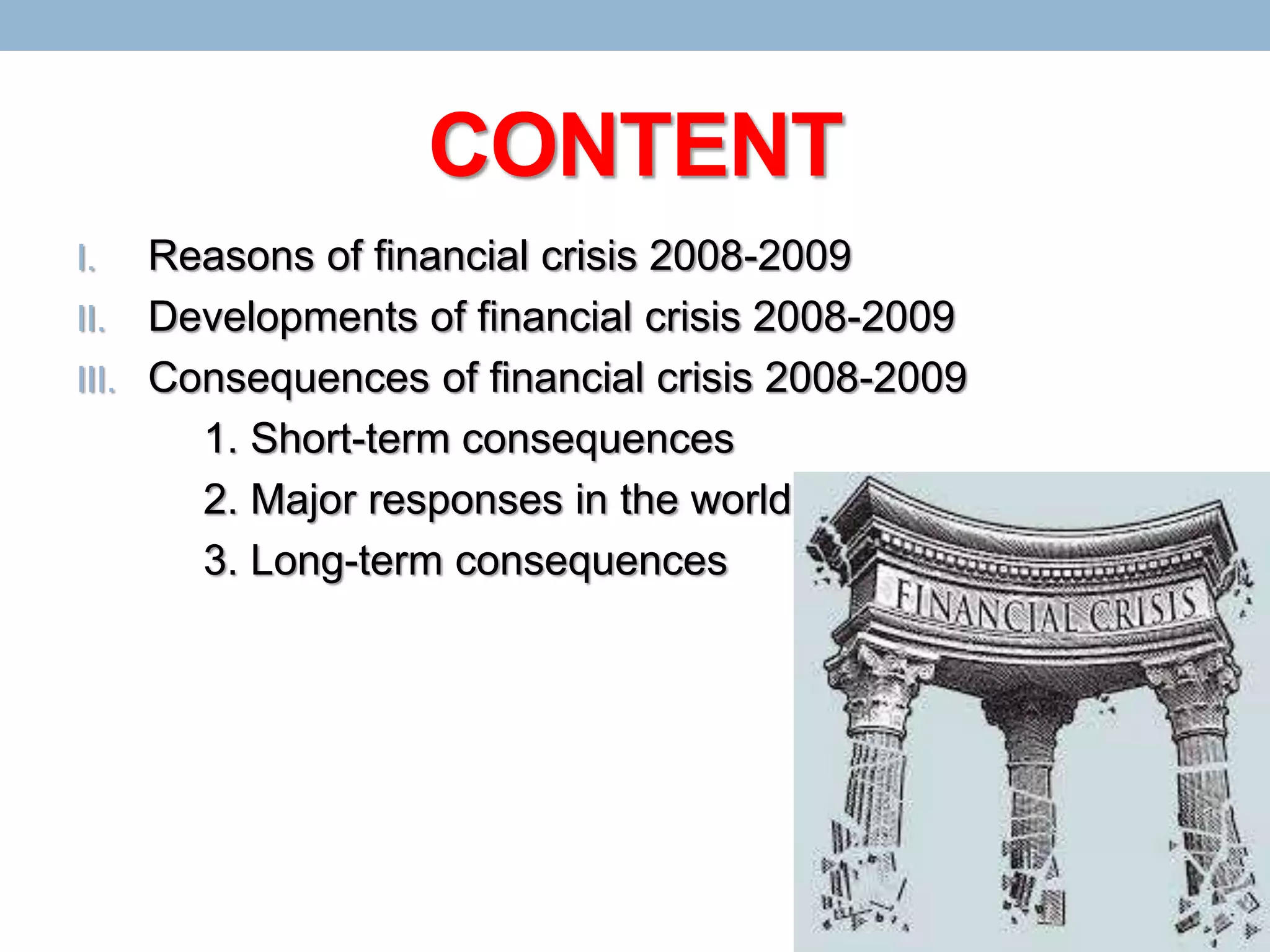
CONTENT
I. Reasons of financial crisis 2008-2009
II. Developments of financial crisis 2008-2009
III. Consequences of financial crisis 2008-2009
1. Short-term consequences
2. Major responses in the world
3. Long-term consequences
I. Reasons of the financial crisis 2008-2009
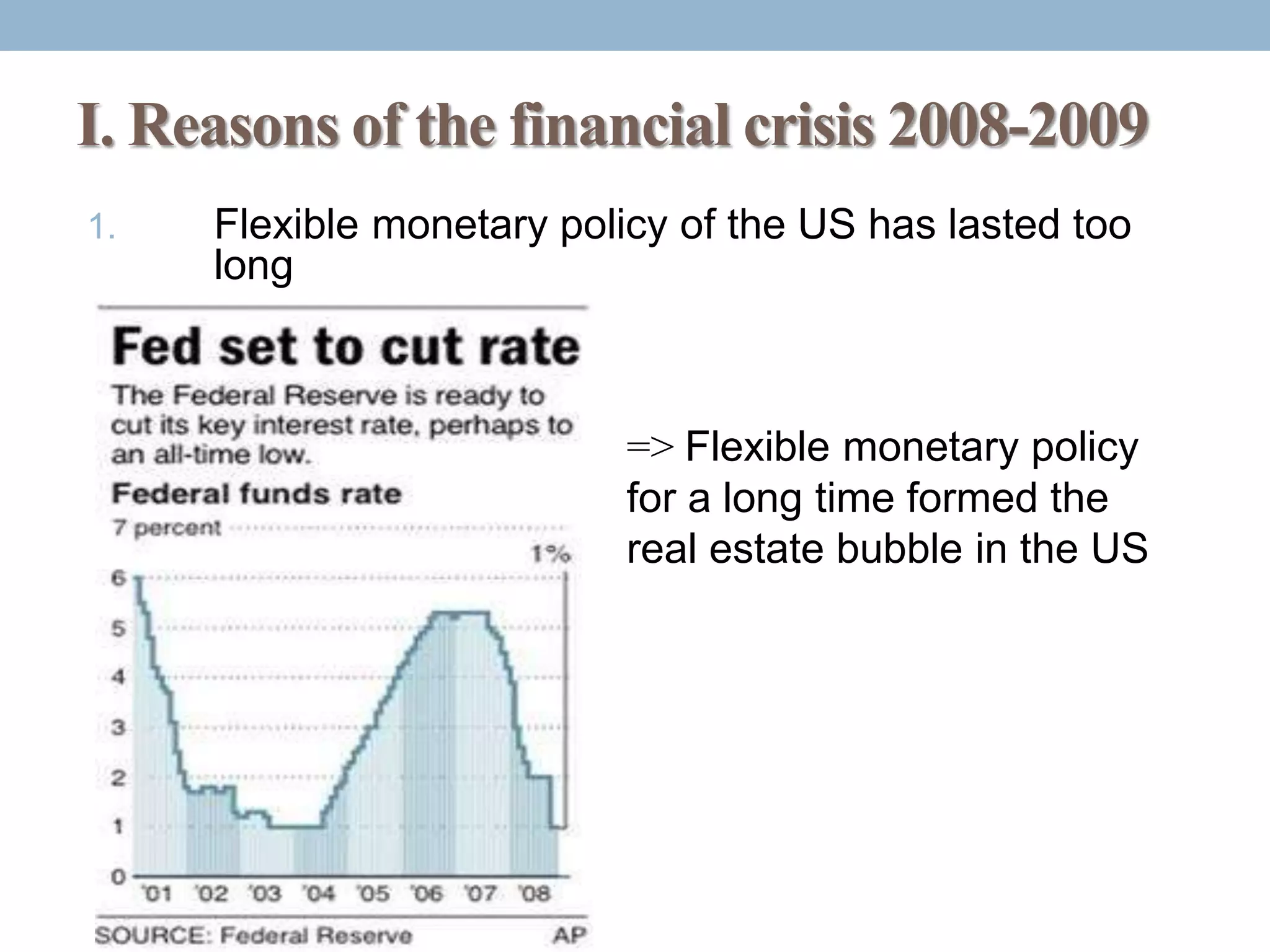
1. Flexible monetary policy of the US has lasted too
long
=> Flexible monetary policy
for a long time formed the
real estate bubble in the US
• The real estate bubble
Low interest rate
Increasing the
borrower to buy
house
House price was
increasing
Subprime
mortgage rapidly
developing
I. Reasons of the financial crisis 2008-2009
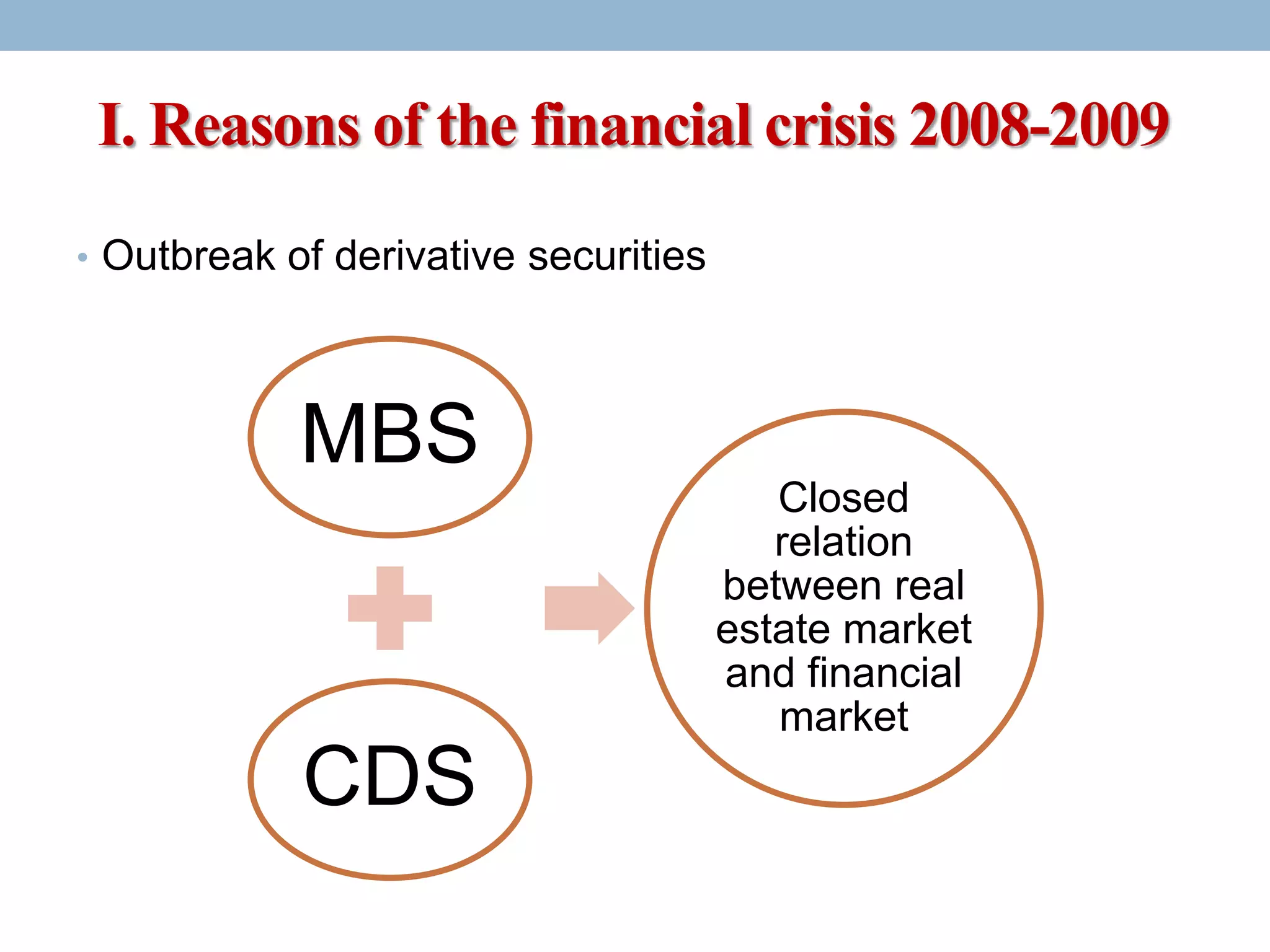
• Outbreak of derivative securities
MBS
CDS
Closed
relation
between real
estate market
and financial
market
I. Reasons of the financial crisis 2008-2009
The real
estate
bubble
bursted
The house
price
decreased
The banks
realize
value own
house
could not
offset value
of loans
Price of stock,
bond reduced
sharply (MBS)
I. Reasons of the financial crisis 2008-2009
II. Developments of the financial crisis
2008-2009
- Many banks incurring subprime loans suffered
heavy losses
Bankruptcy situation 2007-2008, source: World Bank
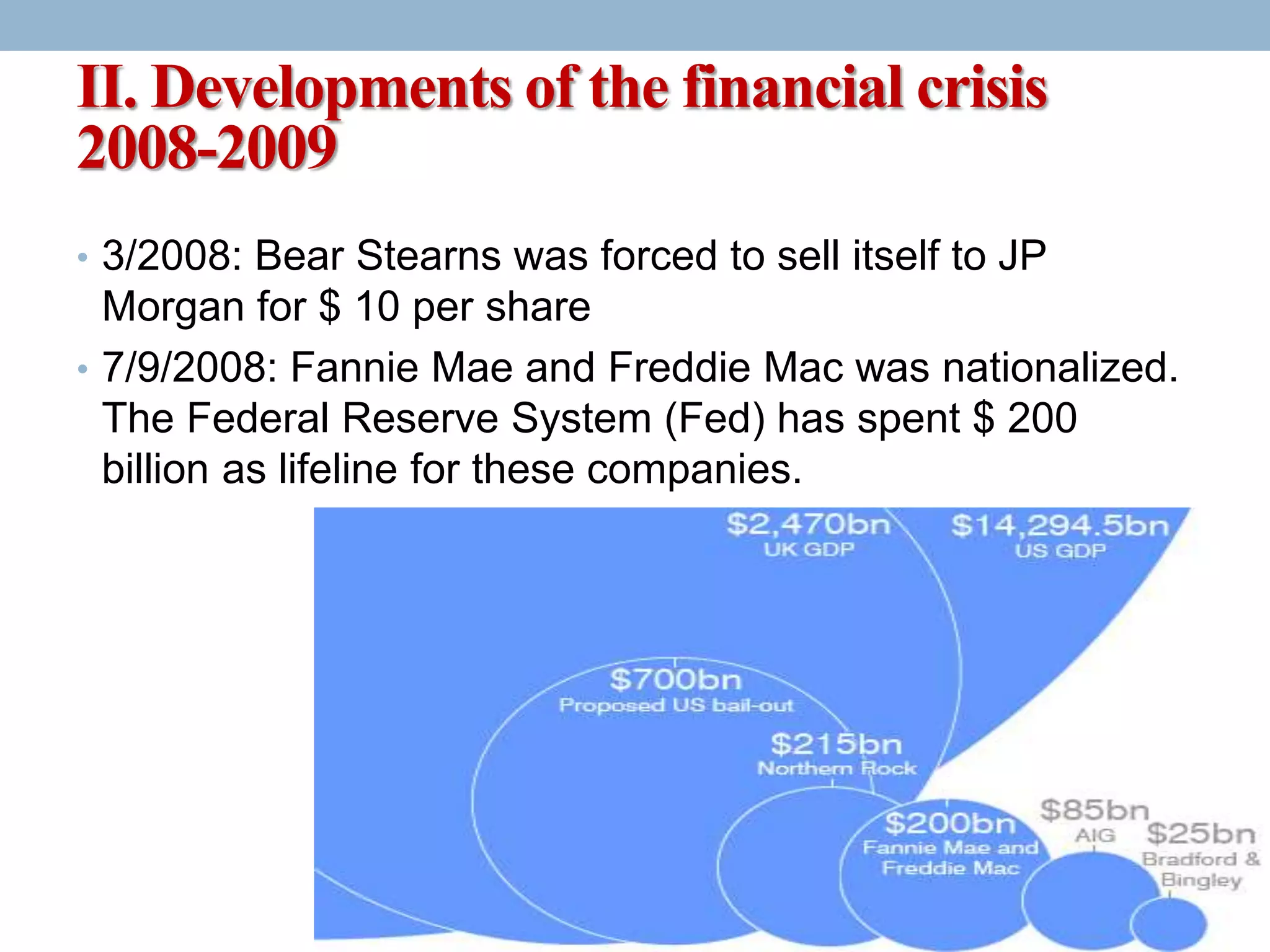
• 3/2008: Bear Stearns was forced to sell itself to JP
Morgan for $ 10 per share
• 7/9/2008: Fannie Mae and Freddie Mac was nationalized.
The Federal Reserve System (Fed) has spent $ 200
billion as lifeline for these companies.
II. Developments of the financial crisis
2008-2009
• 15/9/2008: Lehman Brothers went bankrupt
II. Developments of the financial crisis
2008-2009
• 10/2008: Dow Jones indexes lost 25% of its value after
one month
• 10/2008: global stock market lost ~ 50% ($28.7 trillion)
The Dow Jones index in the period from 16/09/2008 to 6/10/2008
Source: Federal Reserve System (FED)
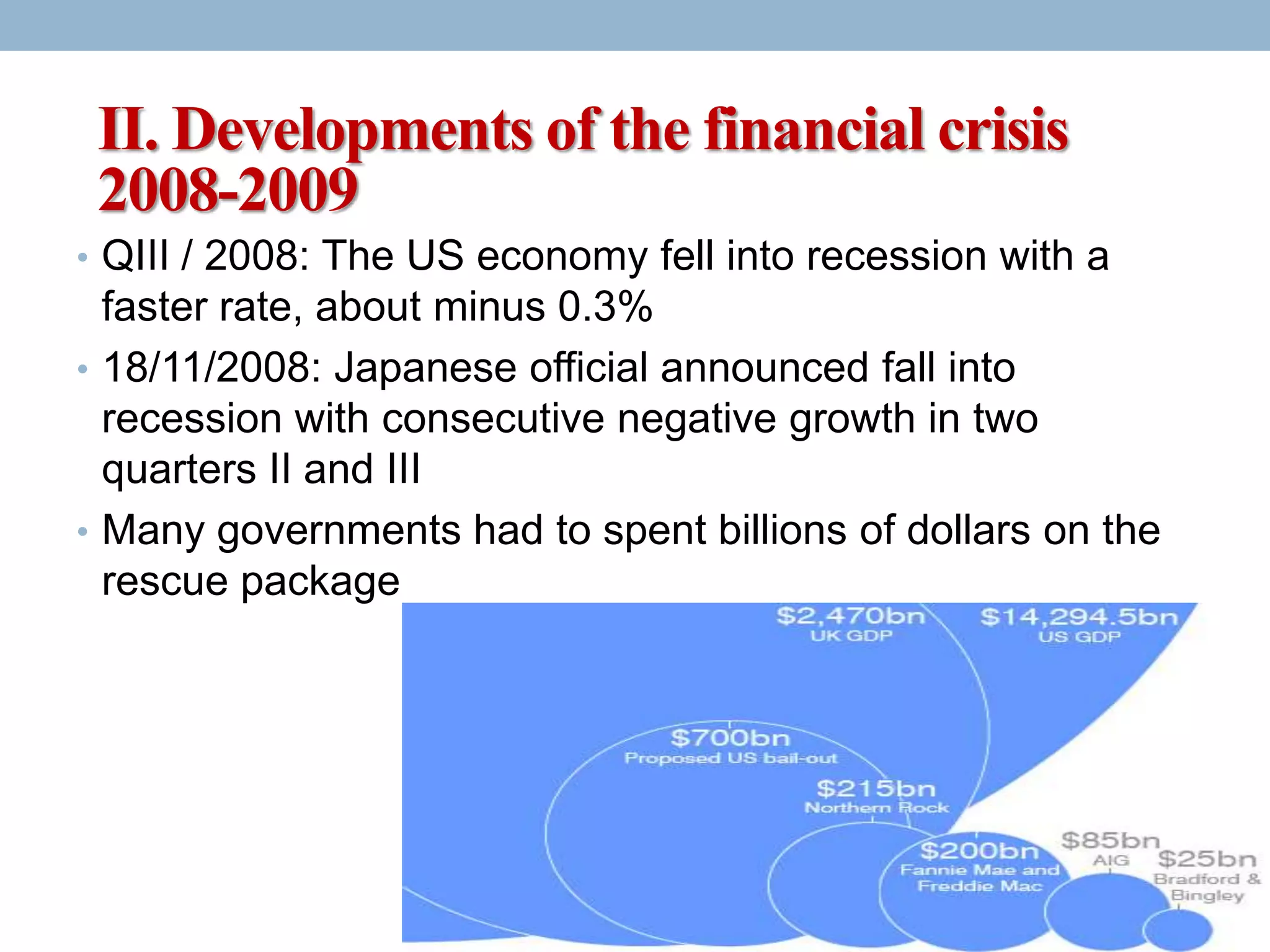
• QIII / 2008: The US economy fell into recession with a
faster rate, about minus 0.3%
• 18/11/2008: Japanese official announced fall into
recession with consecutive negative growth in two
quarters II and III
• Many governments had to spent billions of dollars on the
rescue package
II. Developments of the financial crisis
2008-2009
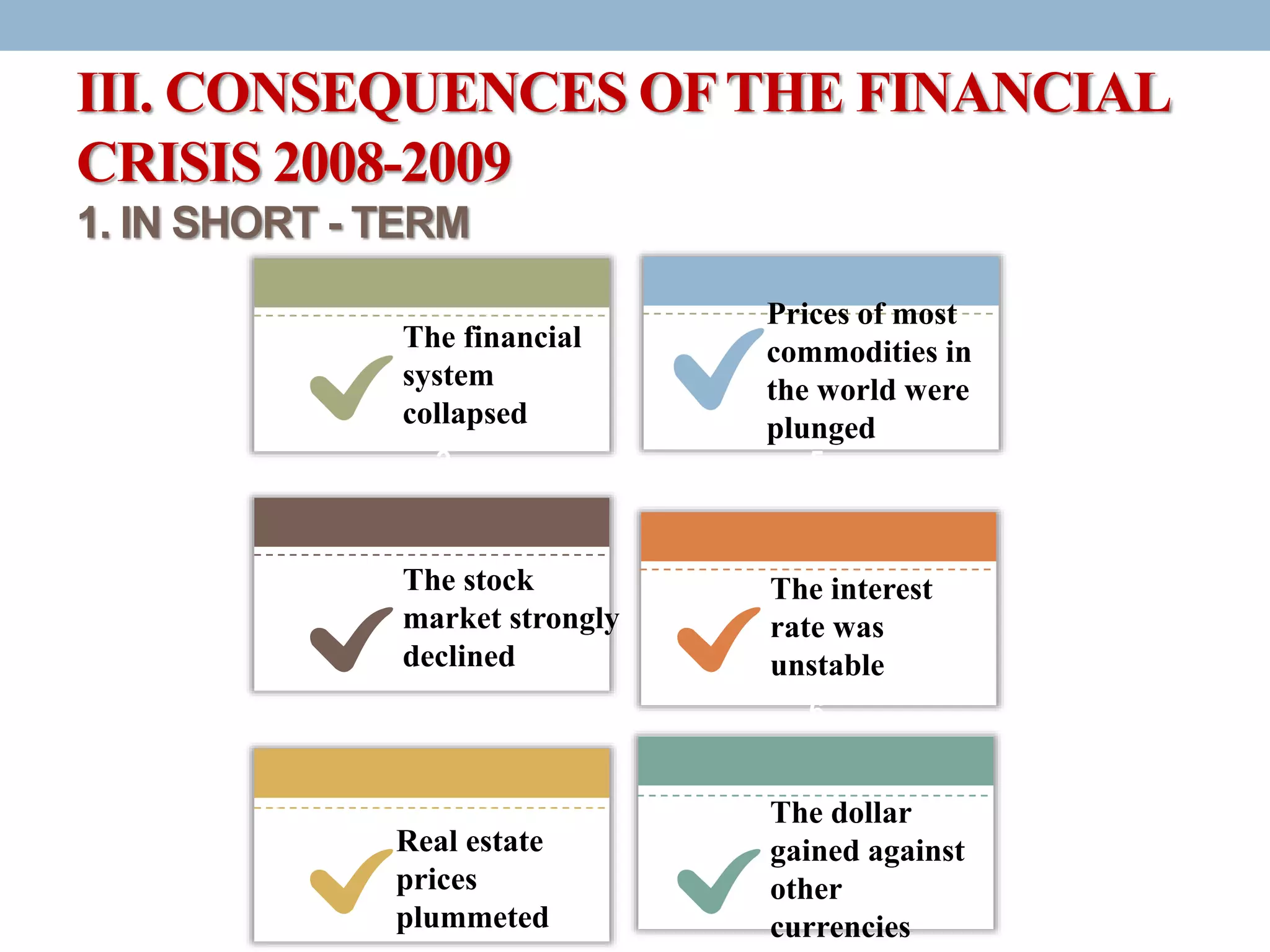
The financial
system
collapsed
The stock
market strongly
declined
Real estate
prices
plummeted
Prices of most
commodities in
the world were
plunged
The interest
rate was
unstable
The dollar
gained against
other
currencies
1
2
3
4
5
6
III. CONSEQUENCES OFTHE FINANCIAL
CRISIS 2008-2009
1. IN SHORT - TERM
(1) The financial system collapsed
III. CONSEQUENCES OFTHE FINANCIAL
CRISIS 2008-2009
1. IN SHORT-TERM
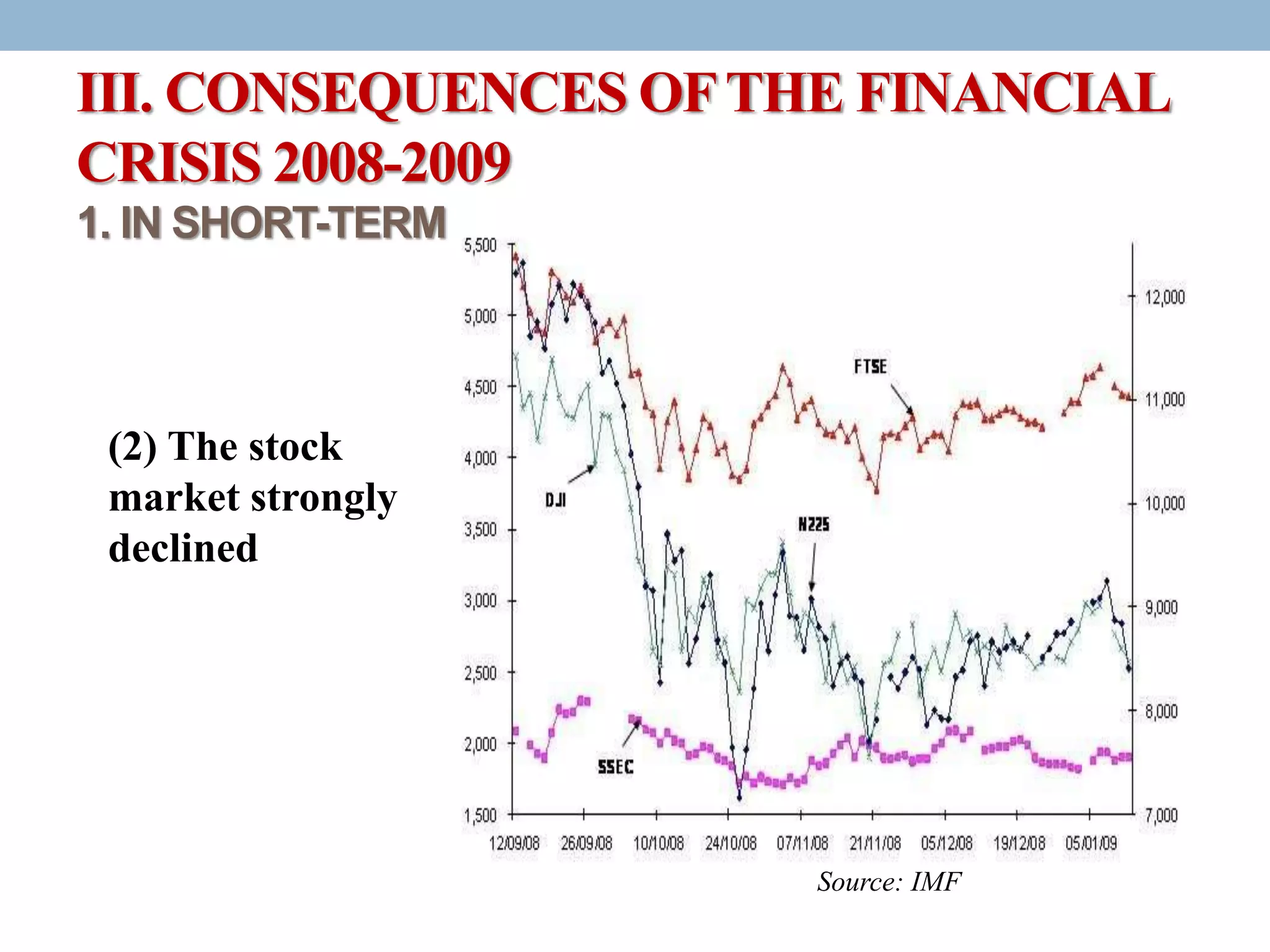
(2) The stock
market strongly
declined
III. CONSEQUENCES OFTHE FINANCIAL
CRISIS 2008-2009
1. IN SHORT-TERM
Source: IMF
(3) Real estate prices
plummeted
Price
III. CONSEQUENCES OFTHE FINANCIAL
CRISIS 2008-2009
1. IN SHORT-TERM
(4) Prices of most commodities in the world were plunged
III. CONSEQUENCES OFTHE FINANCIAL
CRISIS 2008-2009
1. IN SHORT-TERM
(5) The interest rate was unstable
III. CONSEQUENCES OFTHE FINANCIAL
CRISIS 2008-2009
1. IN SHORT-TERM
Source: IMF, WOE
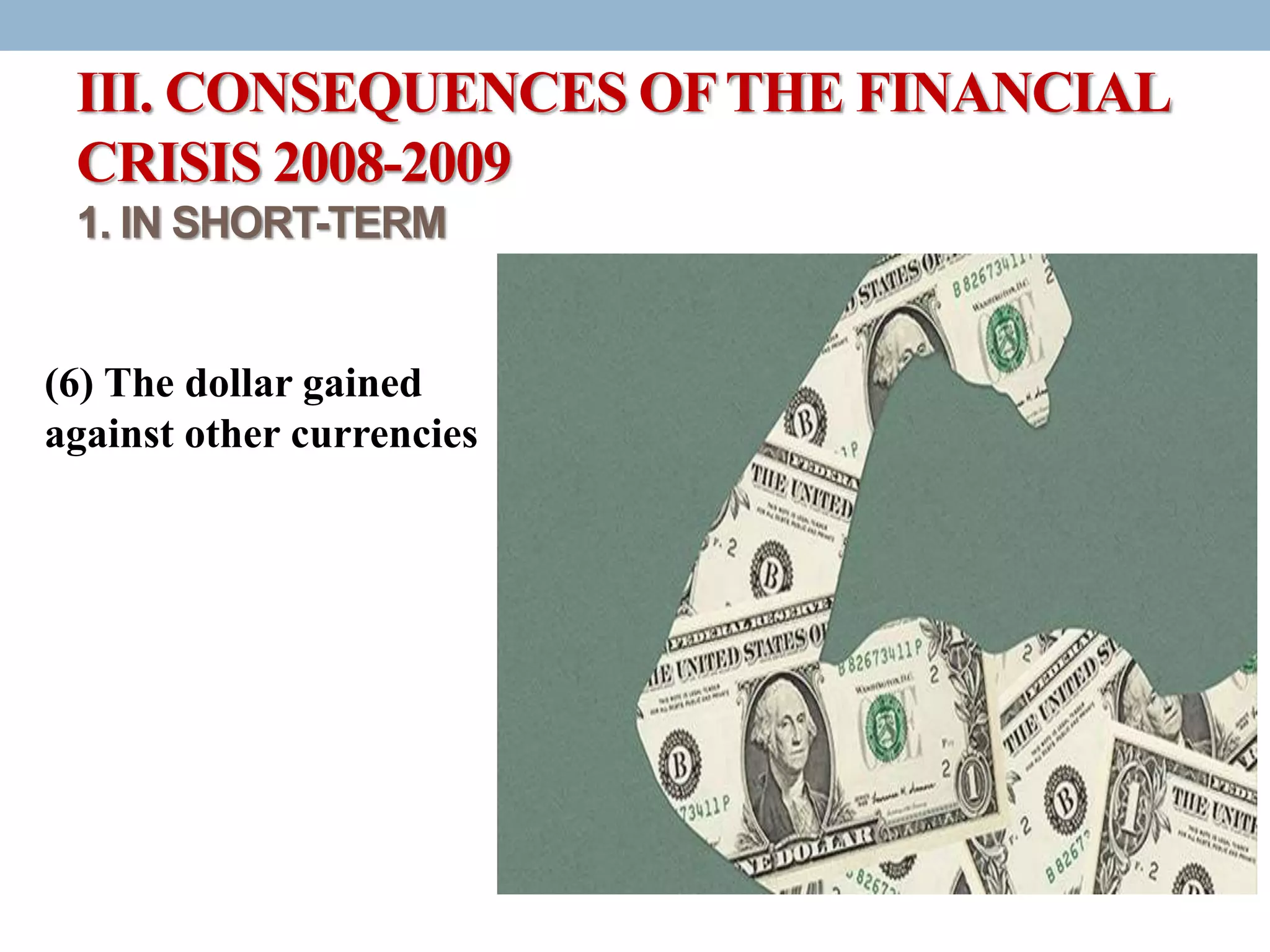
(6) The dollar gained
against other currencies
III. CONSEQUENCES OFTHE FINANCIAL
CRISIS 2008-2009
1. IN SHORT-TERM
1. Immediate support for liquidity
Guarantee for debts
0
100
200
300
400
500
600
France Netherlands Germany Korea
billion USD
IMF 2010, Crisis Management and Resolution, International
Monetary Fund.
III. CONSEQUENCES OFTHE FINANCIAL
CRISIS 2008-2009
2. MAJOR RESPONSES
Takeover or providing direct capital for main manufacturing.
Country Sector/big company amount of money
America Automobile Manufacturing/
General Mortor, Chrysler
17.4 billion USD
EU small and medium
companies
30 billion EURO
Canada Automobile and
infrastructure
3 billion USD
France Automobile and
infrastructure
19 billion EURO
IMF 2010, Crisis Management and Resolution, International Monetary Fund.
III. CONSEQUENCES OFTHE FINANCIAL
CRISIS 2008-2009
2. MAJOR RESPONSES
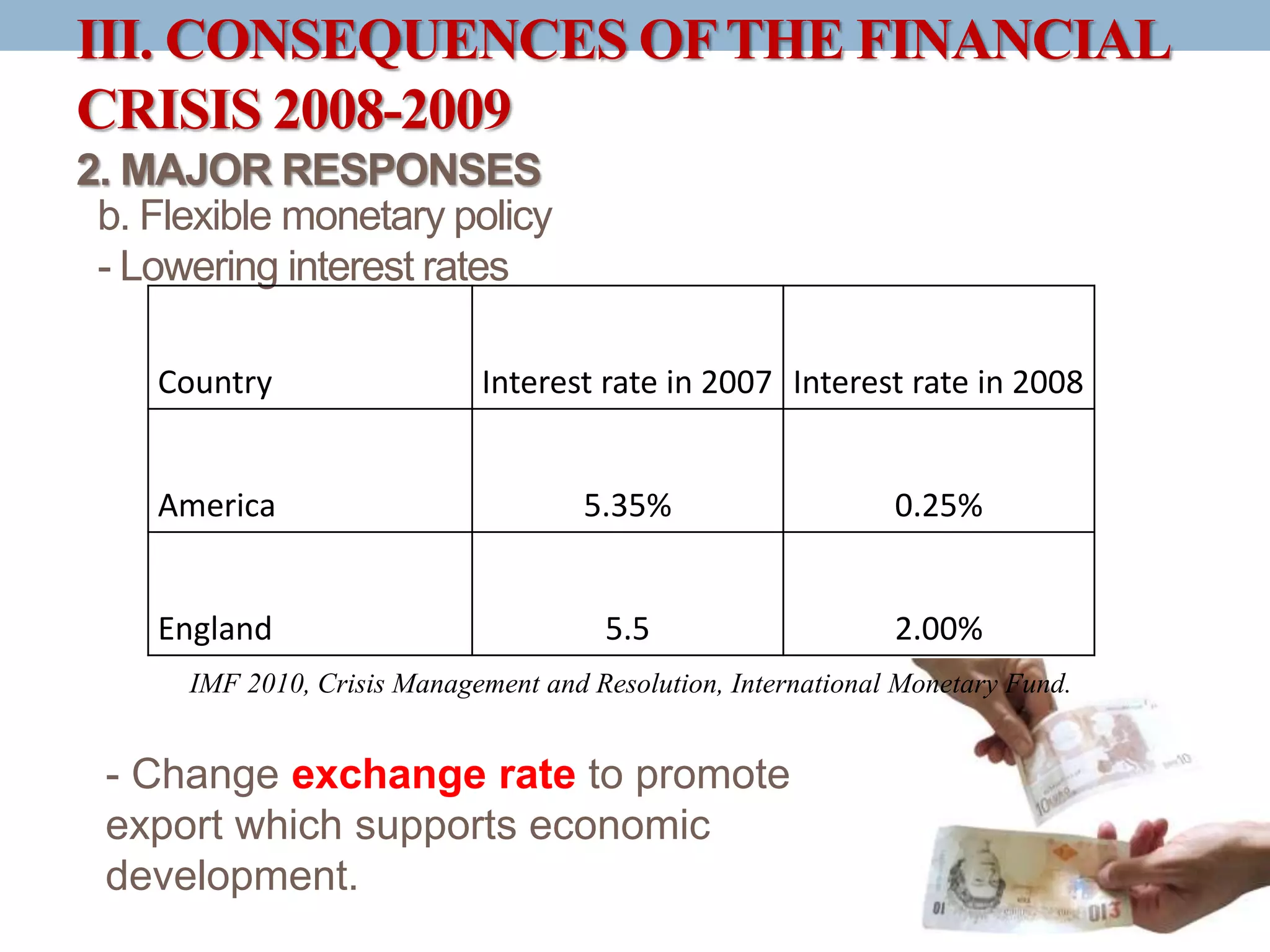
b. Flexible monetary policy
- Lowering interest rates
Country Interest rate in 2007 Interest rate in 2008
America 5.35% 0.25%
England 5.5 2.00%
- Change exchange rate to promote
export which supports economic
development.
III. CONSEQUENCES OFTHE FINANCIAL
CRISIS 2008-2009
2. MAJOR RESPONSES
IMF 2010, Crisis Management and Resolution, International Monetary Fund.
c. Reconstruction for financial corporations.
- (M&A) in European countries
- Nationalization
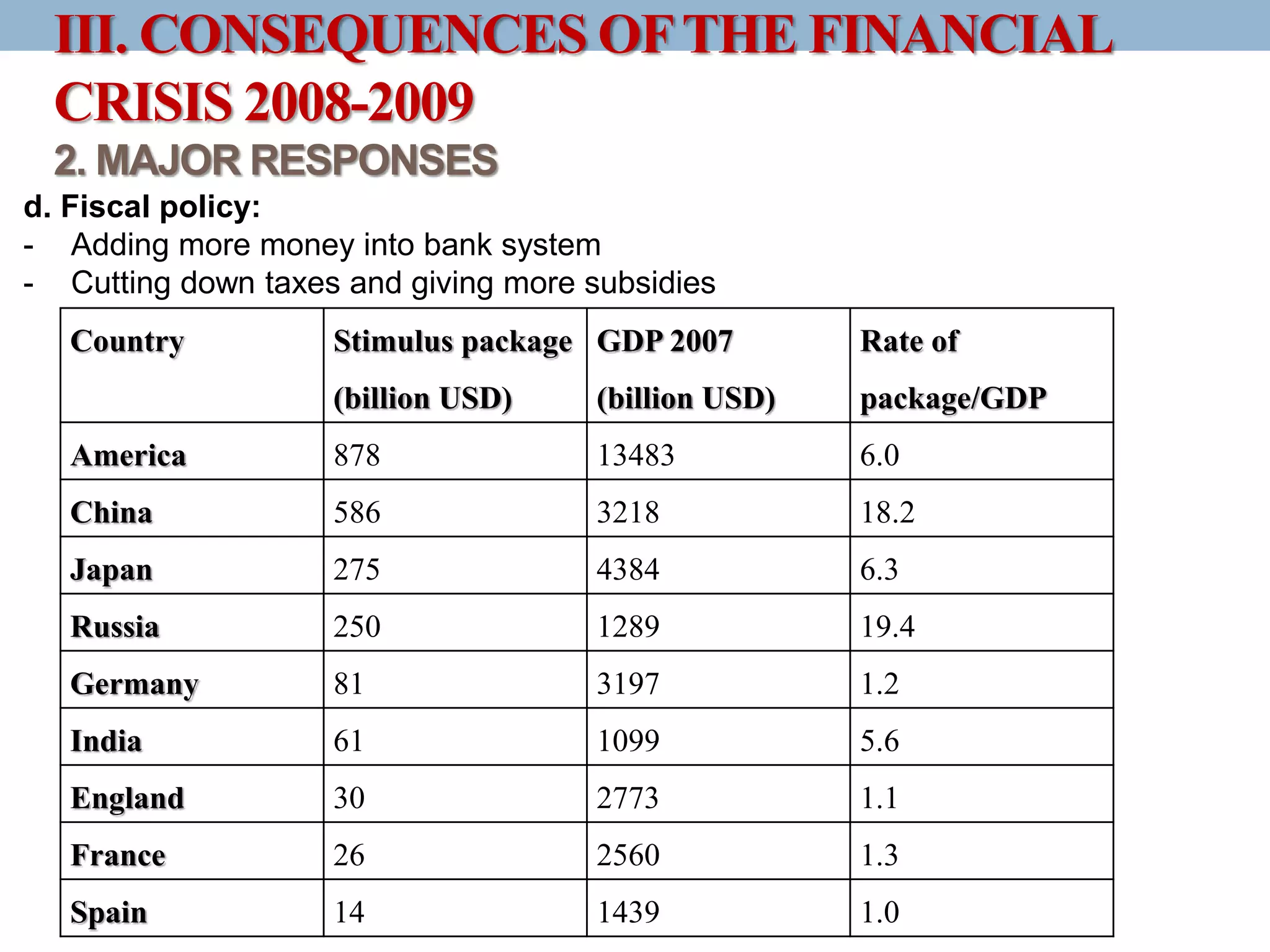
d. Fiscal policy:
- Providing stimulus packages, decreasing tax and increasing
subsidy
III. CONSEQUENCES OFTHE FINANCIAL
CRISIS 2008-2009
2. MAJOR RESPONSES
Country Stimulus package
(billion USD)
GDP 2007
(billion USD)
Rate of
package/GDP
America 878 13483 6.0
China 586 3218 18.2
Japan 275 4384 6.3
Russia 250 1289 19.4
Germany 81 3197 1.2
India 61 1099 5.6
England 30 2773 1.1
France 26 2560 1.3
Spain 14 1439 1.0
d. Fiscal policy:
- Adding more money into bank system
- Cutting down taxes and giving more subsidies
III. CONSEQUENCES OFTHE FINANCIAL
CRISIS 2008-2009
2. MAJOR RESPONSES
a. The public-debt crisis
III. CONSEQUENCES OFTHE FINANCIAL
CRISIS 2008-2009
3. IN LONG-TERM
Controlling bad
debts and
stimulating demand
Public-debt
crisis
Economic
recession
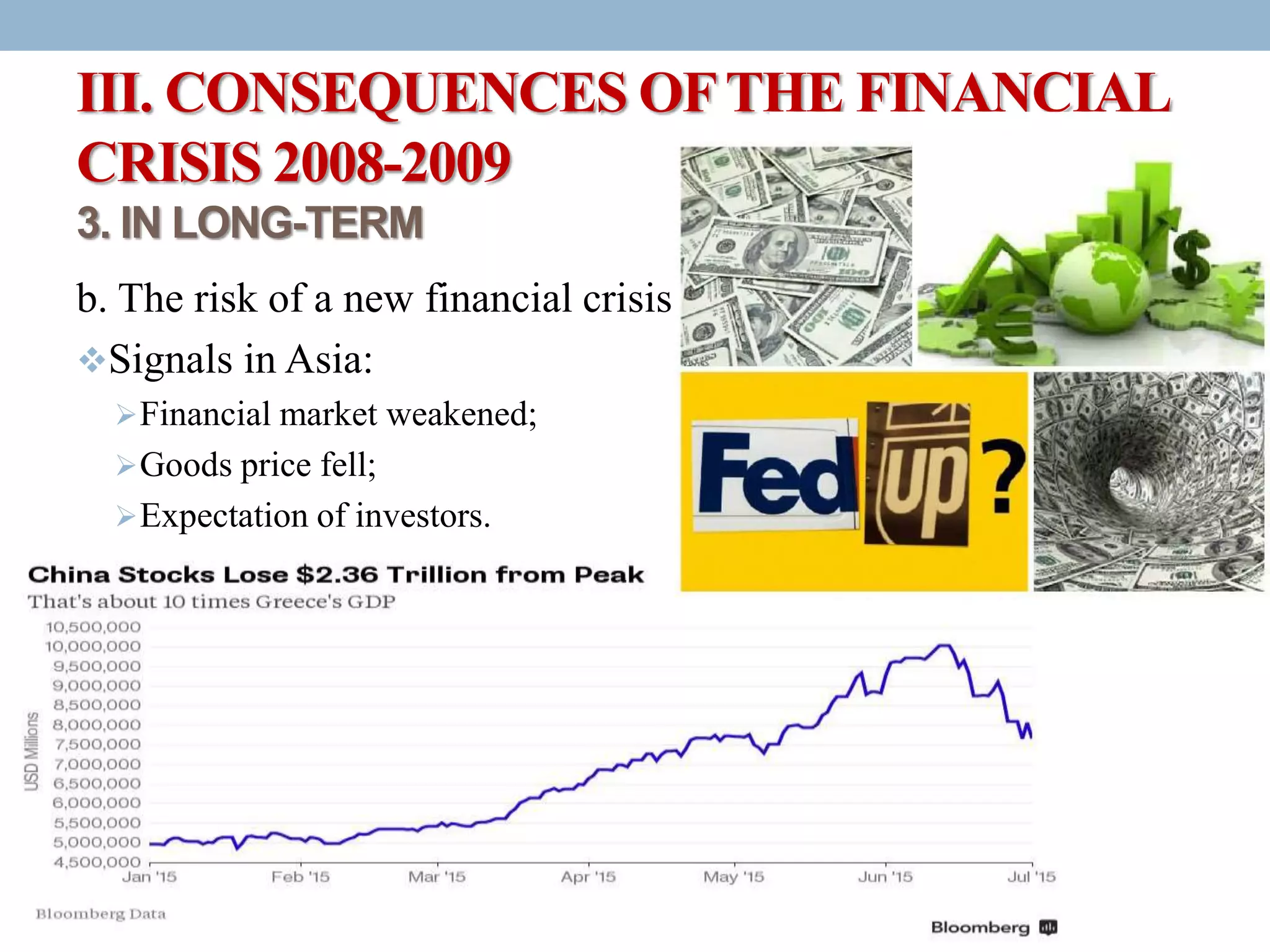
b. The risk of a new financial crisis
Cause: existing problem
Vulnerable
economy
Underground
banks
Public debt
Lack of
structure
reforms
Stability of
Emerging
economies
III. CONSEQUENCES OFTHE FINANCIAL
CRISIS 2008-2009
3. IN LONG-TERM
b. The risk of a new financial crisis
Signals in Asia:
Financial market weakened;
Goods price fell;
Expectation of investors.
III. CONSEQUENCES OFTHE FINANCIAL
CRISIS 2008-2009
3. IN LONG-TERM
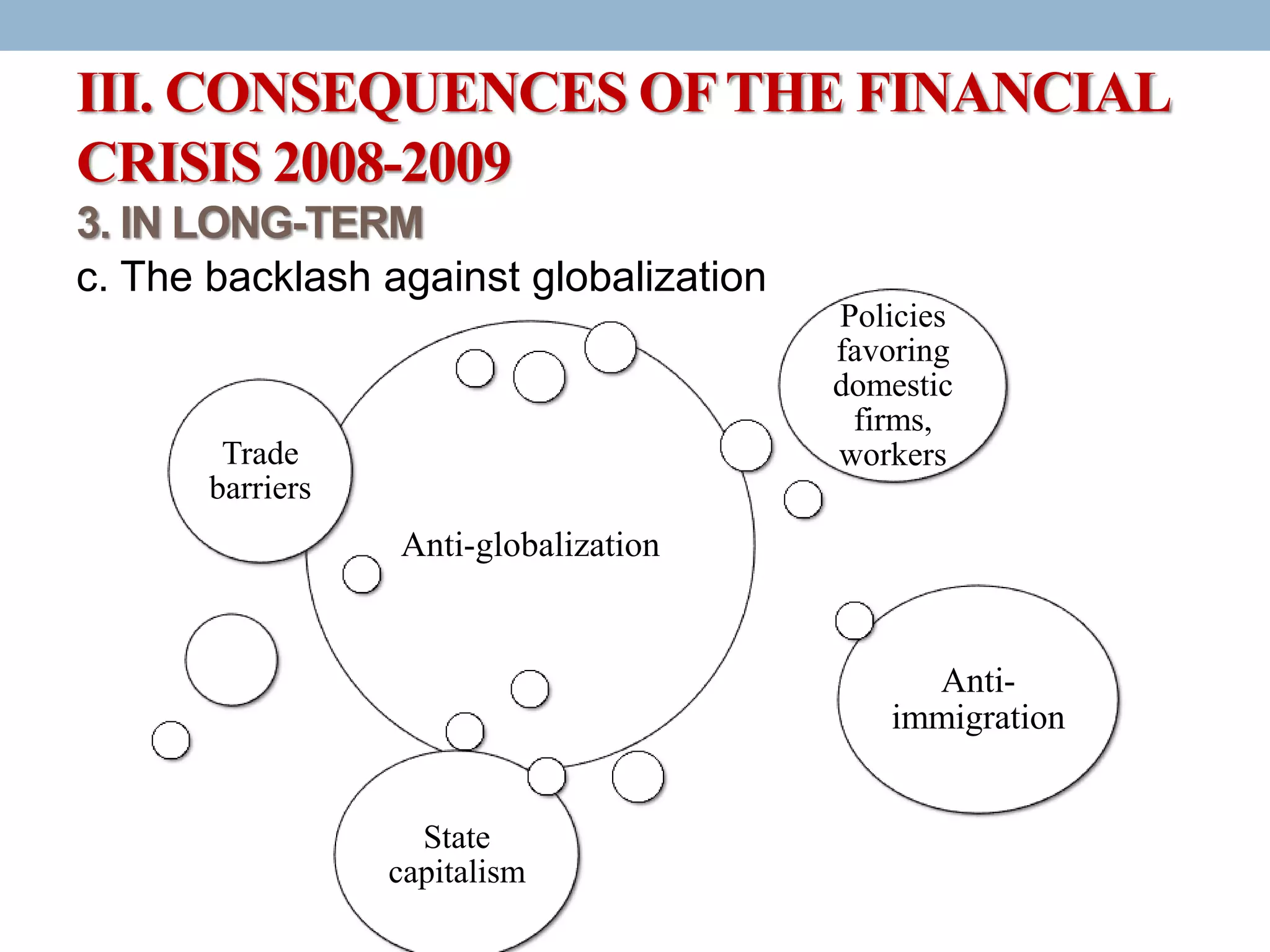
c. The backlash against globalization
III. CONSEQUENCES OFTHE FINANCIAL
CRISIS 2008-2009
3. IN LONG-TERM
c. The backlash against globalization
III. CONSEQUENCES OFTHE FINANCIAL
CRISIS 2008-2009
3. IN LONG-TERM
Anti-globalization
Trade
barriers
Policies
favoring
domestic
firms,
workers
Anti-
immigration
State
capitalism
Members evaluation
CONTENT Presented by
I. Reasons of financial crisis 2008-
2009
Nguyen Thi Huong – KT40A
II. Developments of financial crisis
2008-2009
Tran Van An – KT40A
III. Consequences of financial crisis
2008-2009
1. Short-term consequences Ngo Thi Thuy Linh – KT40A
2. Major responses in the world Khong Thi Huong – KT40B
3. Long-term consequences Pham Thi Tuyet Mai – KT40A

Financial crisis 2008

  • 1.
    International Finance KT40_Diplomatic Academyof Vietnam Financial crisis 2008-2009 1. Pham Tuyet Mai 2. Nguyen Thi Huong 3. Khong Thi Huong 4. Tran Van An 5. Ngo Thi Thuy Linh
  • 2.
    CONTENT I. Reasons offinancial crisis 2008-2009 II. Developments of financial crisis 2008-2009 III. Consequences of financial crisis 2008-2009 1. Short-term consequences 2. Major responses in the world 3. Long-term consequences
  • 3.
    I. Reasons ofthe financial crisis 2008-2009 1. Flexible monetary policy of the US has lasted too long => Flexible monetary policy for a long time formed the real estate bubble in the US
  • 4.
    • The realestate bubble Low interest rate Increasing the borrower to buy house House price was increasing Subprime mortgage rapidly developing I. Reasons of the financial crisis 2008-2009
  • 5.
    • Outbreak ofderivative securities MBS CDS Closed relation between real estate market and financial market I. Reasons of the financial crisis 2008-2009
  • 6.
    The real estate bubble bursted The house price decreased Thebanks realize value own house could not offset value of loans Price of stock, bond reduced sharply (MBS) I. Reasons of the financial crisis 2008-2009
  • 7.
    II. Developments ofthe financial crisis 2008-2009 - Many banks incurring subprime loans suffered heavy losses Bankruptcy situation 2007-2008, source: World Bank
  • 8.
    • 3/2008: BearStearns was forced to sell itself to JP Morgan for $ 10 per share • 7/9/2008: Fannie Mae and Freddie Mac was nationalized. The Federal Reserve System (Fed) has spent $ 200 billion as lifeline for these companies. II. Developments of the financial crisis 2008-2009
  • 9.
    • 15/9/2008: LehmanBrothers went bankrupt II. Developments of the financial crisis 2008-2009 • 10/2008: Dow Jones indexes lost 25% of its value after one month • 10/2008: global stock market lost ~ 50% ($28.7 trillion) The Dow Jones index in the period from 16/09/2008 to 6/10/2008 Source: Federal Reserve System (FED)
  • 10.
    • QIII /2008: The US economy fell into recession with a faster rate, about minus 0.3% • 18/11/2008: Japanese official announced fall into recession with consecutive negative growth in two quarters II and III • Many governments had to spent billions of dollars on the rescue package II. Developments of the financial crisis 2008-2009
  • 11.
    The financial system collapsed The stock marketstrongly declined Real estate prices plummeted Prices of most commodities in the world were plunged The interest rate was unstable The dollar gained against other currencies 1 2 3 4 5 6 III. CONSEQUENCES OFTHE FINANCIAL CRISIS 2008-2009 1. IN SHORT - TERM
  • 12.
    (1) The financialsystem collapsed III. CONSEQUENCES OFTHE FINANCIAL CRISIS 2008-2009 1. IN SHORT-TERM
  • 13.
    (2) The stock marketstrongly declined III. CONSEQUENCES OFTHE FINANCIAL CRISIS 2008-2009 1. IN SHORT-TERM Source: IMF
  • 14.
    (3) Real estateprices plummeted Price III. CONSEQUENCES OFTHE FINANCIAL CRISIS 2008-2009 1. IN SHORT-TERM
  • 15.
    (4) Prices ofmost commodities in the world were plunged III. CONSEQUENCES OFTHE FINANCIAL CRISIS 2008-2009 1. IN SHORT-TERM
  • 16.
    (5) The interestrate was unstable III. CONSEQUENCES OFTHE FINANCIAL CRISIS 2008-2009 1. IN SHORT-TERM Source: IMF, WOE
  • 17.
    (6) The dollargained against other currencies III. CONSEQUENCES OFTHE FINANCIAL CRISIS 2008-2009 1. IN SHORT-TERM
  • 18.
    1. Immediate supportfor liquidity Guarantee for debts 0 100 200 300 400 500 600 France Netherlands Germany Korea billion USD IMF 2010, Crisis Management and Resolution, International Monetary Fund. III. CONSEQUENCES OFTHE FINANCIAL CRISIS 2008-2009 2. MAJOR RESPONSES
  • 19.
    Takeover or providingdirect capital for main manufacturing. Country Sector/big company amount of money America Automobile Manufacturing/ General Mortor, Chrysler 17.4 billion USD EU small and medium companies 30 billion EURO Canada Automobile and infrastructure 3 billion USD France Automobile and infrastructure 19 billion EURO IMF 2010, Crisis Management and Resolution, International Monetary Fund. III. CONSEQUENCES OFTHE FINANCIAL CRISIS 2008-2009 2. MAJOR RESPONSES
  • 20.
    b. Flexible monetarypolicy - Lowering interest rates Country Interest rate in 2007 Interest rate in 2008 America 5.35% 0.25% England 5.5 2.00% - Change exchange rate to promote export which supports economic development. III. CONSEQUENCES OFTHE FINANCIAL CRISIS 2008-2009 2. MAJOR RESPONSES IMF 2010, Crisis Management and Resolution, International Monetary Fund.
  • 21.
    c. Reconstruction forfinancial corporations. - (M&A) in European countries - Nationalization d. Fiscal policy: - Providing stimulus packages, decreasing tax and increasing subsidy III. CONSEQUENCES OFTHE FINANCIAL CRISIS 2008-2009 2. MAJOR RESPONSES
  • 22.
    Country Stimulus package (billionUSD) GDP 2007 (billion USD) Rate of package/GDP America 878 13483 6.0 China 586 3218 18.2 Japan 275 4384 6.3 Russia 250 1289 19.4 Germany 81 3197 1.2 India 61 1099 5.6 England 30 2773 1.1 France 26 2560 1.3 Spain 14 1439 1.0 d. Fiscal policy: - Adding more money into bank system - Cutting down taxes and giving more subsidies III. CONSEQUENCES OFTHE FINANCIAL CRISIS 2008-2009 2. MAJOR RESPONSES
  • 23.
    a. The public-debtcrisis III. CONSEQUENCES OFTHE FINANCIAL CRISIS 2008-2009 3. IN LONG-TERM Controlling bad debts and stimulating demand Public-debt crisis Economic recession
  • 24.
    b. The riskof a new financial crisis Cause: existing problem Vulnerable economy Underground banks Public debt Lack of structure reforms Stability of Emerging economies III. CONSEQUENCES OFTHE FINANCIAL CRISIS 2008-2009 3. IN LONG-TERM
  • 25.
    b. The riskof a new financial crisis Signals in Asia: Financial market weakened; Goods price fell; Expectation of investors. III. CONSEQUENCES OFTHE FINANCIAL CRISIS 2008-2009 3. IN LONG-TERM
  • 26.
    c. The backlashagainst globalization III. CONSEQUENCES OFTHE FINANCIAL CRISIS 2008-2009 3. IN LONG-TERM
  • 27.
    c. The backlashagainst globalization III. CONSEQUENCES OFTHE FINANCIAL CRISIS 2008-2009 3. IN LONG-TERM Anti-globalization Trade barriers Policies favoring domestic firms, workers Anti- immigration State capitalism
  • 29.
    Members evaluation CONTENT Presentedby I. Reasons of financial crisis 2008- 2009 Nguyen Thi Huong – KT40A II. Developments of financial crisis 2008-2009 Tran Van An – KT40A III. Consequences of financial crisis 2008-2009 1. Short-term consequences Ngo Thi Thuy Linh – KT40A 2. Major responses in the world Khong Thi Huong – KT40B 3. Long-term consequences Pham Thi Tuyet Mai – KT40A