Presenters

   Afreh Kwame
  Elisante Kimabo
 Adeyemo Adewale
Ayodeji Sunday Abel
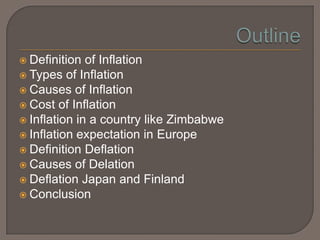
 Definition  of Inflation
 Types of Inflation
 Causes of Inflation
 Cost of Inflation
 Inflation in a country like Zimbabwe
 Inflation expectation in Europe
 Definition Deflation
 Causes of Delation
 Deflation Japan and Finland
 Conclusion
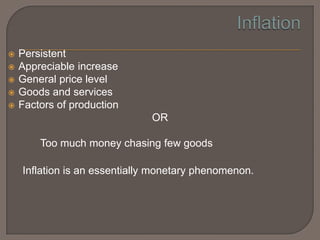
   Persistent
   Appreciable increase
   General price level
   Goods and services
   Factors of production
                              OR

        Too much money chasing few goods

    Inflation is an essentially monetary phenomenon.
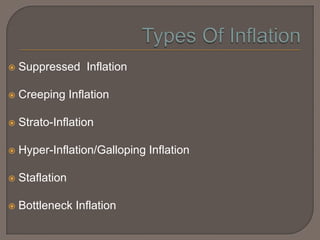
   Suppressed Inflation

   Creeping Inflation

   Strato-Inflation

   Hyper-Inflation/Galloping Inflation

   Staflation

   Bottleneck Inflation
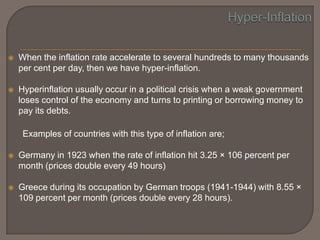
   When the inflation rate accelerate to several hundreds to many thousands
    per cent per day, then we have hyper-inflation.

   Hyperinflation usually occur in a political crisis when a weak government
    loses control of the economy and turns to printing or borrowing money to
    pay its debts.

     Examples of countries with this type of inflation are;

   Germany in 1923 when the rate of inflation hit 3.25 × 10⁶ percent per
    month (prices double every 49 hours)

   Greece during its occupation by German troops (1941-1944) with 8.55 ×
    109 percent per month (prices double every 28 hours).
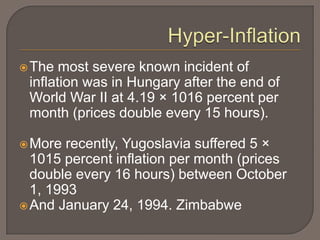
 The  most severe known incident of
 inflation was in Hungary after the end of
 World War II at 4.19 × 10¹⁶ percent per
 month (prices double every 15 hours).

 More  recently, Yugoslavia suffered 5 ×
  1015 percent inflation per month (prices
  double every 16 hours) between October
  1, 1993
 And January 24, 1994. Zimbabwe
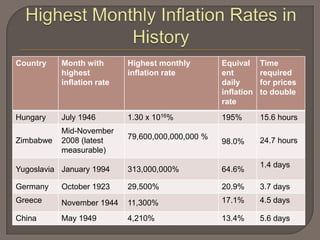
Country    Month with       Highest monthly        Equival     Time
           highest          inflation rate         ent         required
           inflation rate                          daily       for prices
                                                   inflation   to double
                                                   rate
Hungary    July 1946        1.30 x 10¹⁶%           195%        15.6 hours
           Mid-November
Zimbabwe   2008 (latest     79,600,000,000,000 %               24.7 hours
                                                   98.0%
           measurable)
                                                               1.4 days
Yugoslavia January 1994     313,000,000%           64.6%

Germany    October 1923     29,500%                20.9%       3.7 days
Greece     November 1944    11,300%                17.1%       4.5 days

China      May 1949         4,210%                 13.4%       5.6 days
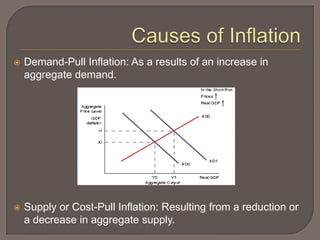
   Demand-Pull Inflation: As a results of an increase in
    aggregate demand.


   Supply or Cost-Pull Inflation: Resulting from a reduction or
    a decrease in aggregate supply.
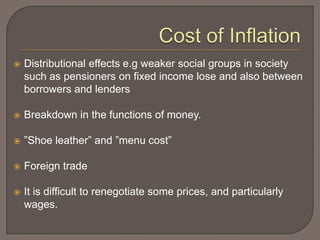
   Distributional effects e.g weaker social groups in society
    such as pensioners on fixed income lose and also between
    borrowers and lenders

   Breakdown in the functions of money.

   ”Shoe leather” and ”menu cost”

   Foreign trade

   It is difficult to renegotiate some prices, and particularly
    wages.
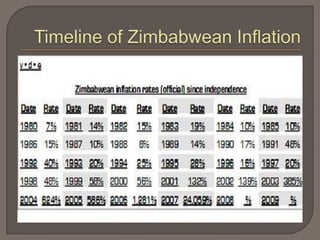
   ZIMBABWE’S chart topping inflation reportedly at
    24,000 % qualifies the nation as experiencing hyper
    inflation.

   Zimbabwe’s hyper-Inflation is a result of the monetary
    authority irresponsibly borrowing money to pay all its
    expenses and funding quasi-fiscal activities.

   ZIMBABWE is so short on consumer goods, the
    government can't even calculate inflation, the chief
    statistician said on Tuesday(12.11.09)
   Zimbabwe's inflation -- already the highest in the world -- hit 7,634.8
    percent.

  The Zimbabwe dollar has strengthened against the U.S. dollar on the
   black market, rising to Z$1.5 million per dollar on Tuesday from a low of
   ZW$2.4 million.
                                   Scenario:
"I came here at five (0300 GMT) and just got ZW$5 million. What can I do
    with that money," an angry mother of two who identified herself only as
       Auxilia said as she left a bank where a long queue stretched for a
                                 couple of blocks.
              The amount is equivalent to three days of bus fare
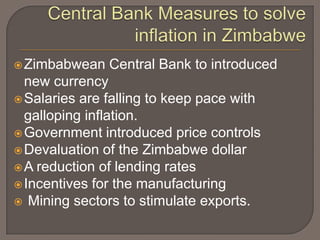
 Zimbabwean   Central Bank to introduced
  new currency
 Salaries are falling to keep pace with
  galloping inflation.
 Government introduced price controls
 Devaluation of the Zimbabwe dollar
 A reduction of lending rates
 Incentives for the manufacturing
 Mining sectors to stimulate exports.
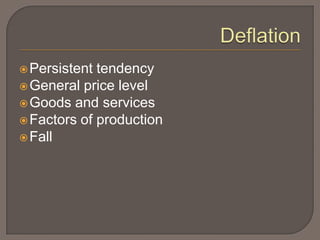
 Persistent tendency
 General price level
 Goods and services
 Factors of production
 Fall
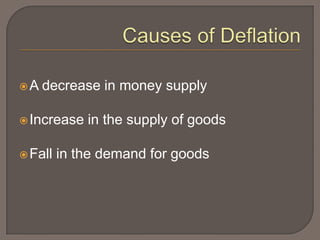
A   decrease in money supply

 Increase   in the supply of goods

 Fall   in the demand for goods
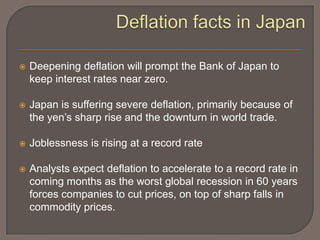
   Deepening deflation will prompt the Bank of Japan to
    keep interest rates near zero.

   Japan is suffering severe deflation, primarily because of
    the yen’s sharp rise and the downturn in world trade.

   Joblessness is rising at a record rate

   Analysts expect deflation to accelerate to a record rate in
    coming months as the worst global recession in 60 years
    forces companies to cut prices, on top of sharp falls in
    commodity prices.
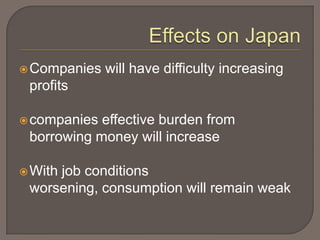
 Companies   will have difficulty increasing
 profits

 companies effective burden from
 borrowing money will increase

 With
     job conditions
 worsening, consumption will remain weak
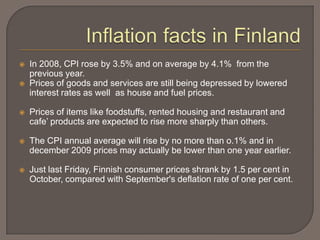
   In 2008, CPI rose by 3.5% and on average by 4.1% from the
    previous year.
   Prices of goods and services are still being depressed by lowered
    interest rates as well as house and fuel prices.

   Prices of items like foodstuffs, rented housing and restaurant and
    cafe’ products are expected to rise more sharply than others.

   The CPI annual average will rise by no more than o.1% and in
    december 2009 prices may actually be lower than one year earlier.

   Just last Friday, Finnish consumer prices shrank by 1.5 per cent in
    October, compared with September's deflation rate of one per cent.
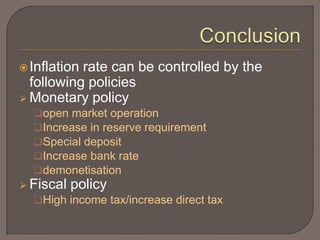
 Inflationrate can be controlled by the
  following policies
 Monetary policy
  open market operation
  Increase in reserve requirement
  Special deposit
  Increase bank rate
  demonetisation
 Fiscal policy
  High income tax/increase direct tax
 http://www.newzimbabwe.com/pages/inflati
  on180.17386.html
 Article by Prof. Steve H. Hanke, February
  5, 2009.
 http://www.cato.org/zimbabwe
 Finnish economic outlook for 2009
 A handout on macroeconomics by Prof.
  Lawrence Adu Kofi(University of Cape
  Coast, Ghana )
Inflation  _deflation

Inflation _deflation

  • 1.
    Presenters Afreh Kwame Elisante Kimabo Adeyemo Adewale Ayodeji Sunday Abel
  • 2.
     Definition of Inflation  Types of Inflation  Causes of Inflation  Cost of Inflation  Inflation in a country like Zimbabwe  Inflation expectation in Europe  Definition Deflation  Causes of Delation  Deflation Japan and Finland  Conclusion
  • 3.
    Persistent  Appreciable increase  General price level  Goods and services  Factors of production OR Too much money chasing few goods Inflation is an essentially monetary phenomenon.
  • 4.
    Suppressed Inflation  Creeping Inflation  Strato-Inflation  Hyper-Inflation/Galloping Inflation  Staflation  Bottleneck Inflation
  • 5.
    When the inflation rate accelerate to several hundreds to many thousands per cent per day, then we have hyper-inflation.  Hyperinflation usually occur in a political crisis when a weak government loses control of the economy and turns to printing or borrowing money to pay its debts. Examples of countries with this type of inflation are;  Germany in 1923 when the rate of inflation hit 3.25 × 10⁶ percent per month (prices double every 49 hours)  Greece during its occupation by German troops (1941-1944) with 8.55 × 10⁹ percent per month (prices double every 28 hours).
  • 6.
     The most severe known incident of inflation was in Hungary after the end of World War II at 4.19 × 10¹⁶ percent per month (prices double every 15 hours).  More recently, Yugoslavia suffered 5 × 10¹⁵ percent inflation per month (prices double every 16 hours) between October 1, 1993  And January 24, 1994. Zimbabwe
  • 7.
    Country Month with Highest monthly Equival Time highest inflation rate ent required inflation rate daily for prices inflation to double rate Hungary July 1946 1.30 x 10¹⁶% 195% 15.6 hours Mid-November Zimbabwe 2008 (latest 79,600,000,000,000 % 24.7 hours 98.0% measurable) 1.4 days Yugoslavia January 1994 313,000,000% 64.6% Germany October 1923 29,500% 20.9% 3.7 days Greece November 1944 11,300% 17.1% 4.5 days China May 1949 4,210% 13.4% 5.6 days
  • 8.
    Demand-Pull Inflation: As a results of an increase in aggregate demand.  Supply or Cost-Pull Inflation: Resulting from a reduction or a decrease in aggregate supply.
  • 9.
    Distributional effects e.g weaker social groups in society such as pensioners on fixed income lose and also between borrowers and lenders  Breakdown in the functions of money.  ”Shoe leather” and ”menu cost”  Foreign trade  It is difficult to renegotiate some prices, and particularly wages.
  • 10.
    ZIMBABWE’S chart topping inflation reportedly at 24,000 % qualifies the nation as experiencing hyper inflation.  Zimbabwe’s hyper-Inflation is a result of the monetary authority irresponsibly borrowing money to pay all its expenses and funding quasi-fiscal activities.  ZIMBABWE is so short on consumer goods, the government can't even calculate inflation, the chief statistician said on Tuesday(12.11.09)
  • 11.
    Zimbabwe's inflation -- already the highest in the world -- hit 7,634.8 percent.  The Zimbabwe dollar has strengthened against the U.S. dollar on the black market, rising to Z$1.5 million per dollar on Tuesday from a low of ZW$2.4 million. Scenario: "I came here at five (0300 GMT) and just got ZW$5 million. What can I do with that money," an angry mother of two who identified herself only as Auxilia said as she left a bank where a long queue stretched for a couple of blocks. The amount is equivalent to three days of bus fare
  • 13.
     Zimbabwean Central Bank to introduced new currency  Salaries are falling to keep pace with galloping inflation.  Government introduced price controls  Devaluation of the Zimbabwe dollar  A reduction of lending rates  Incentives for the manufacturing  Mining sectors to stimulate exports.
  • 14.
     Persistent tendency General price level  Goods and services  Factors of production  Fall
  • 15.
    A decrease in money supply  Increase in the supply of goods  Fall in the demand for goods
  • 16.
    Deepening deflation will prompt the Bank of Japan to keep interest rates near zero.  Japan is suffering severe deflation, primarily because of the yen’s sharp rise and the downturn in world trade.  Joblessness is rising at a record rate  Analysts expect deflation to accelerate to a record rate in coming months as the worst global recession in 60 years forces companies to cut prices, on top of sharp falls in commodity prices.
  • 17.
     Companies will have difficulty increasing profits  companies effective burden from borrowing money will increase  With job conditions worsening, consumption will remain weak
  • 18.
    In 2008, CPI rose by 3.5% and on average by 4.1% from the previous year.  Prices of goods and services are still being depressed by lowered interest rates as well as house and fuel prices.  Prices of items like foodstuffs, rented housing and restaurant and cafe’ products are expected to rise more sharply than others.  The CPI annual average will rise by no more than o.1% and in december 2009 prices may actually be lower than one year earlier.  Just last Friday, Finnish consumer prices shrank by 1.5 per cent in October, compared with September's deflation rate of one per cent.
  • 19.
     Inflationrate canbe controlled by the following policies  Monetary policy open market operation Increase in reserve requirement Special deposit Increase bank rate demonetisation  Fiscal policy High income tax/increase direct tax
  • 20.
     http://www.newzimbabwe.com/pages/inflati on180.17386.html  Article by Prof. Steve H. Hanke, February 5, 2009.  http://www.cato.org/zimbabwe  Finnish economic outlook for 2009  A handout on macroeconomics by Prof. Lawrence Adu Kofi(University of Cape Coast, Ghana )