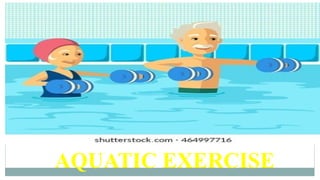
AQUATIC EXERCISE
LEARNING OBJECTIVE
 1. DEFINATION
 2. GOALS & INDICATIONS
 3. PHYSICAL PROPERTIES OF WATER
 4. AQUATIC TEMPERATURE & THERAPEUTIC EXERCISES
 5. POOLS FOR AQUATIC EXERCISES
 6. EXERCISE INTERVENTIONS.
 Aquatic exercise refers to the use of water (in multidepth immersion
pools or tanks) that facilitates the application of established therapeutic
interventions, including stretching, strengthening, joint mobilization,
balance and gait training, and endurance training.
 Facilitate range of motion (ROM) exercise
 Initiate resistance training
 Facilitate weight-bearing activities
 Enhance delivery of manual techniques
 Facilitate cardiovascular exercise
 Initiate functional activity replication
 Minimize risk of injury or reinjure during rehabilitation
 Enhance patient relaxation
PRECAUTIONS
1. Fear of water
2. Respiratory disorders
3. Neurological disorders
4. Cardiac dysfunction
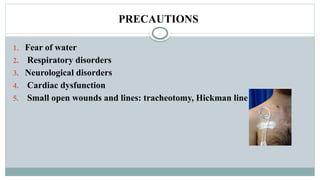
5. Small open wounds and lines: tracheotomy, Hickman line .
CONTRAINDICATIONS
 Incipient cardiac failure and unstable angina.
 Respiratory dysfunction,
 Severe peripheral vascular disease.
 Danger of bleeding or hemorrhage.
 Open wounds without occlusive dressings, colostomy, and skin
infections, such as tinea pedis and ringworm.
 Uncontrolled bowel or bladder (bowel accidents require pool
evacuation, chemical treatment, and possibly drainage).
 Water and airborne infections or diseases (examples include influenza,
gastrointestinal infections, typhoid, cholera, and poliomyelitis).
 Uncontrolled seizures during the last year (they create a safety issue for
both clinician and patient if immediate removal from the pool is
necessary
PROPERTIES OF WATER
PHYSICAL PROPERTIES OF WATER
BUOYANCY
 DEFINITION. Buoyancy is the upward
force that works opposite to gravity
PROPERTIES.
 Archimedes’ principle states that an
immersed body experiences upward
thrust equal to the volume of liquid
displaced
 CLINICAL SIGNIFICANCE.
 The effects of buoyancy include the
following.
 Buoyancy provides the patient with relative
weightlessness and joint unloading by
reducing the force of gravity on the body. In
turn, this allows the patient to perform
active motion with increased ease.
 Buoyancy provides resistance to movement
when an extremity is moved against the
force of buoyancy. This technique can be
used to strengthen muscles.
HYDROSTATIC PRESSURE
DEFINITION.
Hydrostatic pressure is the pressure
exerted by the water on immersed
objects.
PROPERTIES.
Pascal’s law states that the pressure
exerted by fluid on an immersed object
is equal on all surfaces of the object. As
the density of water and depth of
immersion increase, so does
hydrostatic pressure
CLINICAL SIGNIFICANCE
The effects of hydrostatic pressure
include the following
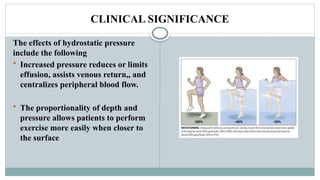
 Increased pressure reduces or limits
effusion, assists venous return,, and
centralizes peripheral blood flow.
 The proportionality of depth and
pressure allows patients to perform
exercise more easily when closer to
the surface
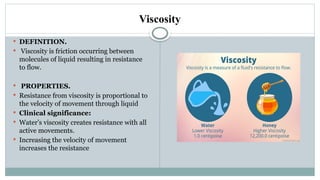
Viscosity
 DEFINITION.
 Viscosity is friction occurring between
molecules of liquid resulting in resistance
to flow.
 PROPERTIES.
 Resistance from viscosity is proportional to
the velocity of movement through liquid
 Clinical significance:
 Water’s viscosity creates resistance with all
active movements.
 Increasing the velocity of movement
increases the resistance
SURFACE TENSION
 SURFACE TENSION:
 DEFINITION.
 The surface of a fluid acts as a membrane
under tension. Surface tension is measured
as force per unit length.
 PROPERTIES.
 The attraction of surface molecules is
parallel to the surface. The resistive force of
surface tension changes proportionally to the
size of the object moving through the fluid
surface

Clinical significance.
The effect of surface tension includes the following.
 An extremity that moves through the surface performs more work than if kept
under water.
 Using equipment at the surface of the water increases the resistance.
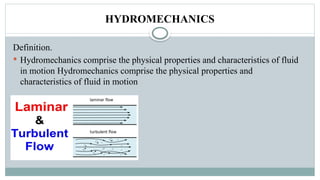
HYDROMECHANICS
Definition.
 Hydromechanics comprise the physical properties and characteristics of fluid
in motion Hydromechanics comprise the physical properties and
characteristics of fluid in motion
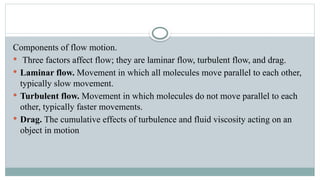
Components of flow motion.
 Three factors affect flow; they are laminar flow, turbulent flow, and drag.
 Laminar flow. Movement in which all molecules move parallel to each other,
typically slow movement.
 Turbulent flow. Movement in which molecules do not move parallel to each
other, typically faster movements.
 Drag. The cumulative effects of turbulence and fluid viscosity acting on an
object in motion
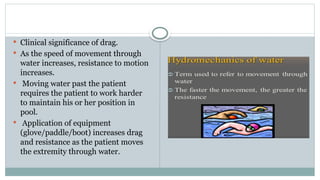
 Clinical significance of drag.
 As the speed of movement through
water increases, resistance to motion
increases.
 Moving water past the patient
requires the patient to work harder
to maintain his or her position in
pool.
 Application of equipment
(glove/paddle/boot) increases drag
and resistance as the patient moves
the extremity through water.
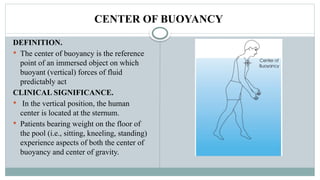
CENTER OF BUOYANCY
DEFINITION.
 The center of buoyancy is the reference
point of an immersed object on which
buoyant (vertical) forces of fluid
predictably act
CLINICAL SIGNIFICANCE.
 In the vertical position, the human
center is located at the sternum.
 Patients bearing weight on the floor of
the pool (i.e., sitting, kneeling, standing)
experience aspects of both the center of
buoyancy and center of gravity.
AQUATIC TEMPERATURE AND THERAPEUTIC EXERCISE
Temperature Regulation
 Temperature regulation during immersed exercise differs from that during land
exercise because of alterations in temperature conduction and the body’s
ability to dissipate heat. With immersion there is less skin exposed to air,
resulting in less opportunity to dissipate heat through normal sweating
mechanisms.
MOBILITY AND FUNCTIONAL CONTROL EXERCISE
 Aquatic exercises, including flexibility, strengthening, gait training, and
relaxation, may be performed in temperatures between 26°C and 35°C.
 Therapeutic exercise performed in warm water (33°C) may be beneficial for
patients with acute painful musculoskeletal injuries because of the effects of
relaxation, elevated pain threshold, and decreased muscle spasm.
AEROBIC CONDITIONING
 Cardiovascular training and aerobic exercise should be performed in water
temperatures between 26°C and 28°C. This range maximizes exercise
efficiency, increases stroke volume, and decreases heart rate.
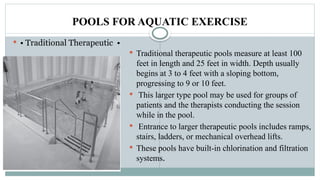
POOLS FOR AQUATIC EXERCISE
 • Traditional Therapeutic •
 Traditional therapeutic pools measure at least 100
feet in length and 25 feet in width. Depth usually
begins at 3 to 4 feet with a sloping bottom,
progressing to 9 or 10 feet.
 This larger type pool may be used for groups of
patients and the therapists conducting the session
while in the pool.
 Entrance to larger therapeutic pools includes ramps,
stairs, ladders, or mechanical overhead lifts.
 These pools have built-in chlorination and filtration
systems.
INDIVIDUAL PATIENT POOLS
 Pools designed for individual patient use are usually smaller, self-contained
units.
 These self-contained pools are entered via a door or one to two steps on the
side of the unit.
 The therapist provides instructions or cueing from outside the unit.
 In addition to built-in filtration systems, these units may include treadmills,
adjustable currents, and varying water depths
SPECIAL EQUIPMENT FOR AQUATIC EXERCISE
• Collars, Rings, Belts, and Vests
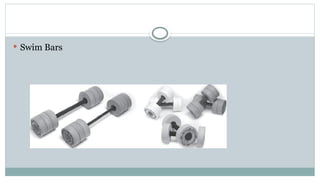
 Swim Bars
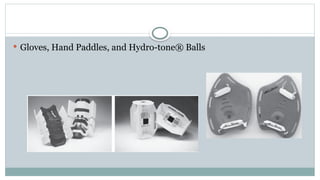
 Gloves, Hand Paddles, and Hydro-tone® Balls
 Fins and Hydro-tone® Boots, kickboards
POOL CARE AND SAFETY
• Therapeutic pools require regular care and cleaning to avoid Pseudomonas aeruginosa (an
infection causing folliculitis).
• Cleaning should occur at least twice weekly, and chlorine and pH level tests should be
done twice daily.
• All walking surfaces near and around the pool should be slip- resistant and free of barriers.
Water splashses should be dried immediately to prevent slips and falls.
• Safety rules and regulations are a must, as are emergency procedures, and should be posted
and observed by all involved in therapeutic pool use
• Life preservers should be readily available and at least one staff member who is CPR
certified should be present at all times.
AEROBIC CONDITIONING
TREATMENT INTERVENTIONS:
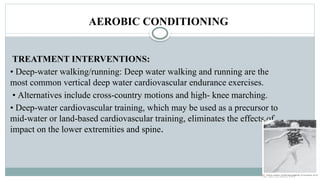
• Deep-water walking/running: Deep water walking and running are the
most common vertical deep water cardiovascular endurance exercises.
• Alternatives include cross-country motions and high- knee marching.
• Deep-water cardiovascular training, which may be used as a precursor to
mid-water or land-based cardiovascular training, eliminates the effects of
impact on the lower extremities and spine.
 Mid-water jogging/running (immersed treadmill running).
 Mid-water aerobic exercise, which may be used as a precursor to land training,
lessens the effects of impact on the spine and lower extremities.
PHYSIOLOGICAL RESPONSE TO DEEP-WATER WALKING/RUNNING
 Cardiovascular response. Patients without cardiovascular compromise may
experience dampened elevation of heart rate, ventilation, and VO2max
compared to similar land-based exercise
 During low-intensity exercise, cardiac patients may experience lower
cardiovascular stresses.
 As exercise intensity increases, cardiovascular stresses approach those of
related exercise on land.
 Training effect. Patients experience carryover gains in VO2max from aquatic
to land conditions.
 Additionally, aquatic cardiovascular training maintains leg strength and
maximum oxygen consumption in healthy runners
PROPER FORM FOR DEEP-WATER RUNNING
 INSTRUCTION FOR BEGINNERS.
 Proper instruction is important to ensure correct form because many beginners
experience a significant learning curve
 Once immersed, the patient should maintain a neutral cervical spine and
slightly forward flexed trunk with the arms at the sides.
 During running the hips should alternately flex to approximately 80° with the
knee extended and then extend to neutral as the knee flexes.
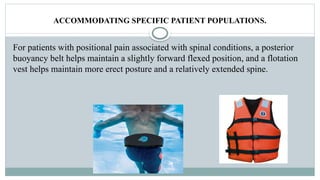
ACCOMMODATING SPECIFIC PATIENT POPULATIONS.
For patients with positional pain associated with spinal conditions, a posterior
buoyancy belt helps maintain a slightly forward flexed position, and a flotation
vest helps maintain more erect posture and a relatively extended spine.
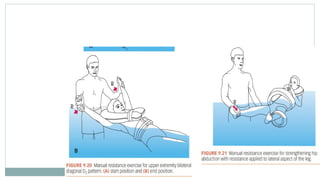
EXERCISE INTERVENTIONS USING AN AQUATIC
ENVIRONMENT
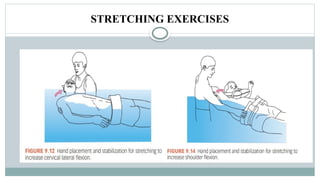
STRETCHING EXERCISES
STRENGTHENING EXERCISES
REFERENCE
THERAPEUTIC
EXERCISE ,FOUND
ATIONS AND
TECHNIQUES ( 6TH
EDITION)
BY,CAROLYN
KISNER, PT, MS
CHAPTER 9 AQUATIC EXERCISES

aquatic exercises.pptxxxxxxxxxxxxxxxxxxxx

  • 1.
  • 2.
    LEARNING OBJECTIVE  1.DEFINATION  2. GOALS & INDICATIONS  3. PHYSICAL PROPERTIES OF WATER  4. AQUATIC TEMPERATURE & THERAPEUTIC EXERCISES  5. POOLS FOR AQUATIC EXERCISES  6. EXERCISE INTERVENTIONS.
  • 3.
     Aquatic exerciserefers to the use of water (in multidepth immersion pools or tanks) that facilitates the application of established therapeutic interventions, including stretching, strengthening, joint mobilization, balance and gait training, and endurance training.
  • 4.
     Facilitate rangeof motion (ROM) exercise  Initiate resistance training  Facilitate weight-bearing activities  Enhance delivery of manual techniques
  • 5.
     Facilitate cardiovascularexercise  Initiate functional activity replication  Minimize risk of injury or reinjure during rehabilitation  Enhance patient relaxation
  • 6.
    PRECAUTIONS 1. Fear ofwater 2. Respiratory disorders 3. Neurological disorders 4. Cardiac dysfunction 5. Small open wounds and lines: tracheotomy, Hickman line .
  • 7.
    CONTRAINDICATIONS  Incipient cardiacfailure and unstable angina.  Respiratory dysfunction,  Severe peripheral vascular disease.  Danger of bleeding or hemorrhage.  Open wounds without occlusive dressings, colostomy, and skin infections, such as tinea pedis and ringworm.
  • 8.
     Uncontrolled bowelor bladder (bowel accidents require pool evacuation, chemical treatment, and possibly drainage).  Water and airborne infections or diseases (examples include influenza, gastrointestinal infections, typhoid, cholera, and poliomyelitis).  Uncontrolled seizures during the last year (they create a safety issue for both clinician and patient if immediate removal from the pool is necessary
  • 9.
    PROPERTIES OF WATER PHYSICALPROPERTIES OF WATER
  • 10.
    BUOYANCY  DEFINITION. Buoyancyis the upward force that works opposite to gravity PROPERTIES.  Archimedes’ principle states that an immersed body experiences upward thrust equal to the volume of liquid displaced
  • 11.
     CLINICAL SIGNIFICANCE. The effects of buoyancy include the following.  Buoyancy provides the patient with relative weightlessness and joint unloading by reducing the force of gravity on the body. In turn, this allows the patient to perform active motion with increased ease.  Buoyancy provides resistance to movement when an extremity is moved against the force of buoyancy. This technique can be used to strengthen muscles.
  • 12.
    HYDROSTATIC PRESSURE DEFINITION. Hydrostatic pressureis the pressure exerted by the water on immersed objects. PROPERTIES. Pascal’s law states that the pressure exerted by fluid on an immersed object is equal on all surfaces of the object. As the density of water and depth of immersion increase, so does hydrostatic pressure
  • 13.
    CLINICAL SIGNIFICANCE The effectsof hydrostatic pressure include the following  Increased pressure reduces or limits effusion, assists venous return,, and centralizes peripheral blood flow.  The proportionality of depth and pressure allows patients to perform exercise more easily when closer to the surface
  • 14.
    Viscosity  DEFINITION.  Viscosityis friction occurring between molecules of liquid resulting in resistance to flow.  PROPERTIES.  Resistance from viscosity is proportional to the velocity of movement through liquid  Clinical significance:  Water’s viscosity creates resistance with all active movements.  Increasing the velocity of movement increases the resistance
  • 15.
    SURFACE TENSION  SURFACETENSION:  DEFINITION.  The surface of a fluid acts as a membrane under tension. Surface tension is measured as force per unit length.  PROPERTIES.  The attraction of surface molecules is parallel to the surface. The resistive force of surface tension changes proportionally to the size of the object moving through the fluid surface 
  • 16.
    Clinical significance. The effectof surface tension includes the following.  An extremity that moves through the surface performs more work than if kept under water.  Using equipment at the surface of the water increases the resistance.
  • 17.
    HYDROMECHANICS Definition.  Hydromechanics comprisethe physical properties and characteristics of fluid in motion Hydromechanics comprise the physical properties and characteristics of fluid in motion
  • 18.
    Components of flowmotion.  Three factors affect flow; they are laminar flow, turbulent flow, and drag.  Laminar flow. Movement in which all molecules move parallel to each other, typically slow movement.  Turbulent flow. Movement in which molecules do not move parallel to each other, typically faster movements.  Drag. The cumulative effects of turbulence and fluid viscosity acting on an object in motion
  • 19.
     Clinical significanceof drag.  As the speed of movement through water increases, resistance to motion increases.  Moving water past the patient requires the patient to work harder to maintain his or her position in pool.  Application of equipment (glove/paddle/boot) increases drag and resistance as the patient moves the extremity through water.
  • 20.
    CENTER OF BUOYANCY DEFINITION. The center of buoyancy is the reference point of an immersed object on which buoyant (vertical) forces of fluid predictably act CLINICAL SIGNIFICANCE.  In the vertical position, the human center is located at the sternum.  Patients bearing weight on the floor of the pool (i.e., sitting, kneeling, standing) experience aspects of both the center of buoyancy and center of gravity.
  • 22.
    AQUATIC TEMPERATURE ANDTHERAPEUTIC EXERCISE Temperature Regulation  Temperature regulation during immersed exercise differs from that during land exercise because of alterations in temperature conduction and the body’s ability to dissipate heat. With immersion there is less skin exposed to air, resulting in less opportunity to dissipate heat through normal sweating mechanisms.
  • 23.
    MOBILITY AND FUNCTIONALCONTROL EXERCISE  Aquatic exercises, including flexibility, strengthening, gait training, and relaxation, may be performed in temperatures between 26°C and 35°C.  Therapeutic exercise performed in warm water (33°C) may be beneficial for patients with acute painful musculoskeletal injuries because of the effects of relaxation, elevated pain threshold, and decreased muscle spasm.
  • 24.
    AEROBIC CONDITIONING  Cardiovasculartraining and aerobic exercise should be performed in water temperatures between 26°C and 28°C. This range maximizes exercise efficiency, increases stroke volume, and decreases heart rate.
  • 25.
    POOLS FOR AQUATICEXERCISE  • Traditional Therapeutic •  Traditional therapeutic pools measure at least 100 feet in length and 25 feet in width. Depth usually begins at 3 to 4 feet with a sloping bottom, progressing to 9 or 10 feet.  This larger type pool may be used for groups of patients and the therapists conducting the session while in the pool.  Entrance to larger therapeutic pools includes ramps, stairs, ladders, or mechanical overhead lifts.  These pools have built-in chlorination and filtration systems.
  • 26.
  • 27.
     Pools designedfor individual patient use are usually smaller, self-contained units.  These self-contained pools are entered via a door or one to two steps on the side of the unit.  The therapist provides instructions or cueing from outside the unit.  In addition to built-in filtration systems, these units may include treadmills, adjustable currents, and varying water depths
  • 28.
    SPECIAL EQUIPMENT FORAQUATIC EXERCISE • Collars, Rings, Belts, and Vests
  • 29.
  • 30.
     Gloves, HandPaddles, and Hydro-tone® Balls
  • 31.
     Fins andHydro-tone® Boots, kickboards
  • 32.
    POOL CARE ANDSAFETY • Therapeutic pools require regular care and cleaning to avoid Pseudomonas aeruginosa (an infection causing folliculitis). • Cleaning should occur at least twice weekly, and chlorine and pH level tests should be done twice daily. • All walking surfaces near and around the pool should be slip- resistant and free of barriers. Water splashses should be dried immediately to prevent slips and falls. • Safety rules and regulations are a must, as are emergency procedures, and should be posted and observed by all involved in therapeutic pool use • Life preservers should be readily available and at least one staff member who is CPR certified should be present at all times.
  • 33.
    AEROBIC CONDITIONING TREATMENT INTERVENTIONS: •Deep-water walking/running: Deep water walking and running are the most common vertical deep water cardiovascular endurance exercises. • Alternatives include cross-country motions and high- knee marching. • Deep-water cardiovascular training, which may be used as a precursor to mid-water or land-based cardiovascular training, eliminates the effects of impact on the lower extremities and spine.
  • 34.
     Mid-water jogging/running(immersed treadmill running).  Mid-water aerobic exercise, which may be used as a precursor to land training, lessens the effects of impact on the spine and lower extremities.
  • 35.
    PHYSIOLOGICAL RESPONSE TODEEP-WATER WALKING/RUNNING  Cardiovascular response. Patients without cardiovascular compromise may experience dampened elevation of heart rate, ventilation, and VO2max compared to similar land-based exercise  During low-intensity exercise, cardiac patients may experience lower cardiovascular stresses.  As exercise intensity increases, cardiovascular stresses approach those of related exercise on land.  Training effect. Patients experience carryover gains in VO2max from aquatic to land conditions.  Additionally, aquatic cardiovascular training maintains leg strength and maximum oxygen consumption in healthy runners
  • 36.
    PROPER FORM FORDEEP-WATER RUNNING  INSTRUCTION FOR BEGINNERS.  Proper instruction is important to ensure correct form because many beginners experience a significant learning curve  Once immersed, the patient should maintain a neutral cervical spine and slightly forward flexed trunk with the arms at the sides.  During running the hips should alternately flex to approximately 80° with the knee extended and then extend to neutral as the knee flexes.
  • 37.
    ACCOMMODATING SPECIFIC PATIENTPOPULATIONS. For patients with positional pain associated with spinal conditions, a posterior buoyancy belt helps maintain a slightly forward flexed position, and a flotation vest helps maintain more erect posture and a relatively extended spine.
  • 38.
    EXERCISE INTERVENTIONS USINGAN AQUATIC ENVIRONMENT
  • 39.
  • 40.
  • 42.
    REFERENCE THERAPEUTIC EXERCISE ,FOUND ATIONS AND TECHNIQUES( 6TH EDITION) BY,CAROLYN KISNER, PT, MS CHAPTER 9 AQUATIC EXERCISES