9.89.8
Reactions of AlkynesReactions of Alkynes
Acidity (Section 9.5)Acidity (Section 9.5)
Hydrogenation (Section 9.9)Hydrogenation (Section 9.9)
Metal-Ammonia Reduction (Section 9.10)Metal-Ammonia Reduction (Section 9.10)
Addition of Hydrogen Halides (Section 9.11)Addition of Hydrogen Halides (Section 9.11)
Hydration (Section 9.12)Hydration (Section 9.12)
Addition of Halogens (Section 9.13)Addition of Halogens (Section 9.13)
Ozonolysis (Section 9.14)Ozonolysis (Section 9.14)
Reactions of AlkynesReactions of Alkynes
9.99.9
Hydrogenation of AlkynesHydrogenation of Alkynes
RCRCHH22CCHH22R'R'
catcat
catalyst = Pt, Pd, Ni, or Rhcatalyst = Pt, Pd, Ni, or Rh
alkene is an intermediatealkene is an intermediate
RCRC CR'CR' ++ 22HH22
Hydrogenation of AlkynesHydrogenation of Alkynes
Heats of HydrogenationHeats of Hydrogenation
292 kJ/mol292 kJ/mol 275 kJ/mol275 kJ/mol
Alkyl groups stabilize triple bonds in theAlkyl groups stabilize triple bonds in the
same way that they stabilize doublesame way that they stabilize double
bonds. Internal triple bonds are morebonds. Internal triple bonds are more
stable than terminal ones.stable than terminal ones.
CHCH33CHCH22CC CHCH CHCH33CC CCCHCH33
RCHRCH22CHCH22R'R'
Alkenes could be used to prepare alkenes if aAlkenes could be used to prepare alkenes if a
catalyst were available that is active enough tocatalyst were available that is active enough to
catalyze the hydrogenation of alkynes, but notcatalyze the hydrogenation of alkynes, but not
active enough for the hydrogenation of alkenes.active enough for the hydrogenation of alkenes.
catcat
HH22
RCRC CR'CR'
catcat
HH22
RCHRCH CHR'CHR'
Partial HydrogenationPartial Hydrogenation
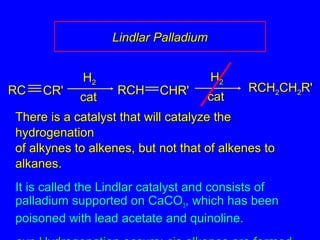
There is a catalyst that will catalyze theThere is a catalyst that will catalyze the
hydrogenationhydrogenation
of alkynes to alkenes, but not that of alkenes toof alkynes to alkenes, but not that of alkenes to
alkanes.alkanes.
It is called the Lindlar catalyst and consists ofIt is called the Lindlar catalyst and consists of
palladium supported on CaCOpalladium supported on CaCO33, which has been, which has been
poisoned with lead acetate and quinoline.poisoned with lead acetate and quinoline.
RCHRCH22CHCH22R'R'
catcat
HH22
RCRC CR'CR'
catcat
HH22
RCHRCH CHR'CHR'
Lindlar PalladiumLindlar Palladium
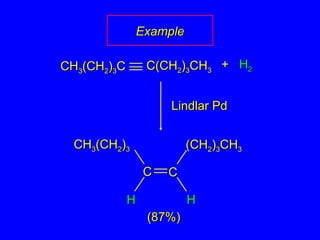
++ HH22
Lindlar PdLindlar Pd
CHCH33(CH(CH22))33 (CH(CH22))33CHCH33
HH HH
(87%)(87%)
CHCH33(CH(CH22))33CC C(CHC(CH22))33CHCH33
CCCC
ExampleExample
AlkynesAlkynes ∅∅ transtrans-Alkenes-Alkenes
9.109.10
Metal-Ammonia ReductionMetal-Ammonia Reduction
of Alkynesof Alkynes
RCHRCH22CHCH22R'R'
Another way to convert alkynes to alkenes isAnother way to convert alkynes to alkenes is
by reduction with sodium (or lithium orby reduction with sodium (or lithium or
potassium)potassium)
in ammonia.in ammonia.
transtrans-Alkenes are formed.-Alkenes are formed.
RCRC CR'CR' RCHRCH CHR'CHR'
Partial ReductionPartial Reduction
CHCH33CHCH22
CHCH22CHCH33HH
HH
(82%)(82%)
CHCH33CHCH22CC CCHCCH22CHCH33
CCCC
Na, NHNa, NH33
ExampleExample
four stepsfour steps
(1)(1) electron transferelectron transfer
(2)(2) proton transferproton transfer
(3)(3) electron transferelectron transfer
(4)(4) proton transferproton transfer
Metal (Li, Na, K) is reducing agent;Metal (Li, Na, K) is reducing agent;
HH22 is not involvedis not involved
MechanismMechanism
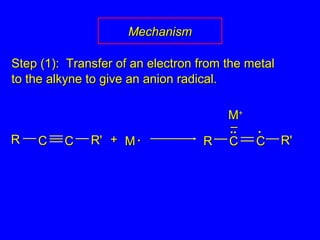
Step (1): Transfer of an electron from the metalStep (1): Transfer of an electron from the metal
to the alkyne to give an anion radical.to the alkyne to give an anion radical.
MM ..++RR R'R'CC CC RR R'R'CC
.... ..––
CC
MM++
MechanismMechanism
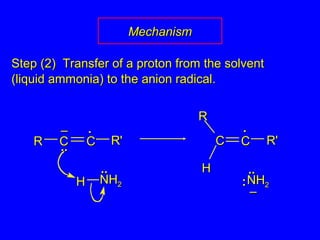
Step (2) Transfer of a proton from the solventStep (2) Transfer of a proton from the solvent
(liquid ammonia) to the anion radical.(liquid ammonia) to the anion radical.
HH NHNH22
....
RR R'R'CC....
..––
CC
..
R'R'
RR
CC CC
HH
NHNH22
....
––
::
MechanismMechanism
Step (3): Transfer of an electron from the metalStep (3): Transfer of an electron from the metal
to the alkenyl radical to give a carbanion.to the alkenyl radical to give a carbanion.
MM..++
..
R'R'
RR
CC CC
HH
MM++
R'R'
RR
CC CC
HH
....––
MechanismMechanism
Step (4) Transfer of a proton from the solventStep (4) Transfer of a proton from the solvent
(liquid ammonia) to the carbanion .(liquid ammonia) to the carbanion .
....
HH NHNH22
R'R'
RR
CC CC
HH
....
––
R'R'HH
HH
CCCC
RR NHNH22
....
––
::
MechanismMechanism
Suggest efficient syntheses of (Suggest efficient syntheses of (EE)- and ()- and (ZZ)-2-)-2-
heptene from propyne and any necessary organicheptene from propyne and any necessary organic
or inorganic reagents.or inorganic reagents.
Problem 9.12Problem 9.12
StrategyStrategy
1. NaNH1. NaNH22
2. CH2. CH33CHCH22CHCH22CHCH22BrBr
Na, NHNa, NH33HH22, Lindlar Pd, Lindlar Pd
Problem 9.12Problem 9.12
SynthesisSynthesis
9.119.11
Addition of Hydrogen HalidesAddition of Hydrogen Halides
to Alkynesto Alkynes
HBrHBr
BrBr
(60%)(60%)
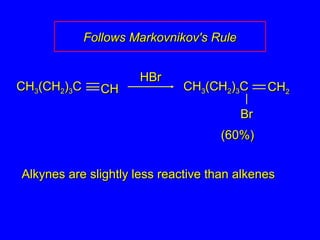
Alkynes are slightly less reactive than alkenesAlkynes are slightly less reactive than alkenes
CHCH33(CH(CH22))33CC CHCH CHCH33(CH(CH22))33CC CHCH22
Follows Markovnikov's RuleFollows Markovnikov's Rule
CHCH
....
BrBrHH ::
....
RCRC
....
BrBrHH ::
....
Observed rate law: rate =Observed rate law: rate = kk[alkyne][HX][alkyne][HX]22
Termolecular Rate-Determining StepTermolecular Rate-Determining Step
(76%)(76%)
CHCH33CHCH22CC CCHCCH22CHCH33
2 H2 HFF
FF
FF
CC CC
HH
HH
CHCH33CHCH22 CHCH22CHCH33
Two Molar Equivalents of Hydrogen HalideTwo Molar Equivalents of Hydrogen Halide
HBrHBr
(79%)(79%)
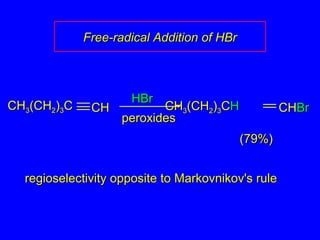
regioselectivity opposite to Markovnikov's ruleregioselectivity opposite to Markovnikov's rule
CHCH33(CH(CH22))33CC CHCH CHCH33(CH(CH22))33CCHH CHCHBrBr
peroxidesperoxides
Free-radical Addition of HBrFree-radical Addition of HBr
9.129.12
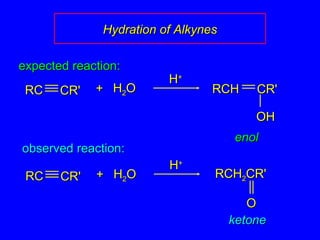
Hydration of AlkynesHydration of Alkynes
expected reaction:expected reaction:
enolenol
observed reaction:observed reaction:
RCHRCH22CR'CR'
OO
HH++
RCRC CR'CR' HH22OO++
HH++
RCRC CR'CR' HH22OO++
OHOH
RCHRCH CR'CR'
ketoneketone
Hydration of AlkynesHydration of Alkynes
enols are regioisomers of ketones, and existenols are regioisomers of ketones, and exist
in equilibrium with themin equilibrium with them
keto-enol equilibration is rapid in acidic mediaketo-enol equilibration is rapid in acidic media
ketones are more stable than enols andketones are more stable than enols and
predominate at equilibriumpredominate at equilibrium
enolenol
OHOH
RCHRCH CR'CR' RCHRCH22CR'CR'
OO
ketoneketone
EnolsEnols
OO HH
CC CC
HH
++
OO
HH
HH
::
....
::
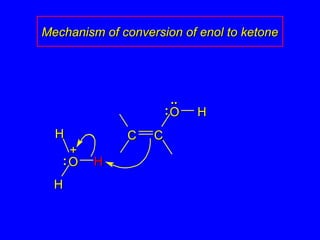
Mechanism of conversion of enol to ketoneMechanism of conversion of enol to ketone
OO HH
CC CC
HH
++
OO
HH
HH
::
....
::
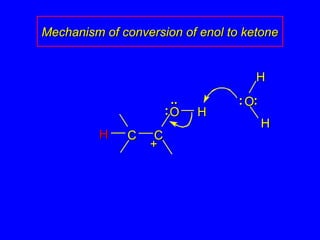
Mechanism of conversion of enol to ketoneMechanism of conversion of enol to ketone
OO HH
CC CCHH
++
OO
HH
HH
::
....
::
::
Mechanism of conversion of enol to ketoneMechanism of conversion of enol to ketone
OO HH
CC CC
HH
HH
OO:: ::
HH
++
....
::
Mechanism of conversion of enol to ketoneMechanism of conversion of enol to ketone
OO HH
CC CC
HH
HH
OO:: ::
HH
++
....
::
Mechanism of conversion of enol to ketoneMechanism of conversion of enol to ketone
OO
HH
CC CC
HH
HH
OO::
HH
++
....
::
Mechanism of conversion of enol to ketoneMechanism of conversion of enol to ketone
Carbocation is stabilized byCarbocation is stabilized by
electron delocalization (resonance)electron delocalization (resonance)
HH OO
CC CCHH
....
HH++
Key Carbocation IntermediateKey Carbocation Intermediate
OO
CC CCHH
++
....
::
HH22O, HO, H++
(89%)(89%)
viavia
CHCH33(CH(CH22))22CC C(CHC(CH22))22CHCH33
HgHg2+2+
OO
CHCH33(CH(CH22))22CHCH22C(CHC(CH22))22CHCH33
OHOH
CHCH33(CH(CH22))22CHCH C(CHC(CH22))22CHCH33
Example of Alkyne HydrationExample of Alkyne Hydration
HH22O, HO, H22SOSO44
HgSOHgSO44
CHCH33(CH(CH22))55CCHCCH33
(91%)(91%)
viavia
Markovnikov's rule followed in formation of enolMarkovnikov's rule followed in formation of enol
CHCH33(CH(CH22))55CC CHCH22
OHOH
CHCH33(CH(CH22))55CC CHCH
OO
RegioselectivityRegioselectivity
9.139.13
Addition of Halogens to AlkynesAddition of Halogens to Alkynes
+ 2+ 2 ClCl22
ClCl
ClCl
(63%)(63%)
CCClCl22CHCH CHCH33HCHC CCHCCH33
ExampleExample
BrBr22
CHCH33CHCH22
CHCH22CHCH33BrBr
BrBr
(90%)(90%)
CHCH33CHCH22CC CCHCCH22CHCH33 CC CC
Addition is antiAddition is anti
gives two carboxylic acids by cleavagegives two carboxylic acids by cleavage
of triple bondof triple bond
9.149.14
Ozonolysis of AlkynesOzonolysis of Alkynes
1. O1. O33
2. H2. H22OO
++
CHCH33(CH(CH22))33CC CCHH
CHCH33(CH(CH22))33CCOHOH
(51%)(51%)
OO
HOHOCCOHOH
OO
ExampleExample

Hydrogenation (4)

  • 1.
  • 2.
    Acidity (Section 9.5)Acidity(Section 9.5) Hydrogenation (Section 9.9)Hydrogenation (Section 9.9) Metal-Ammonia Reduction (Section 9.10)Metal-Ammonia Reduction (Section 9.10) Addition of Hydrogen Halides (Section 9.11)Addition of Hydrogen Halides (Section 9.11) Hydration (Section 9.12)Hydration (Section 9.12) Addition of Halogens (Section 9.13)Addition of Halogens (Section 9.13) Ozonolysis (Section 9.14)Ozonolysis (Section 9.14) Reactions of AlkynesReactions of Alkynes
  • 3.
  • 4.
    RCRCHH22CCHH22R'R' catcat catalyst = Pt,Pd, Ni, or Rhcatalyst = Pt, Pd, Ni, or Rh alkene is an intermediatealkene is an intermediate RCRC CR'CR' ++ 22HH22 Hydrogenation of AlkynesHydrogenation of Alkynes
  • 5.
    Heats of HydrogenationHeatsof Hydrogenation 292 kJ/mol292 kJ/mol 275 kJ/mol275 kJ/mol Alkyl groups stabilize triple bonds in theAlkyl groups stabilize triple bonds in the same way that they stabilize doublesame way that they stabilize double bonds. Internal triple bonds are morebonds. Internal triple bonds are more stable than terminal ones.stable than terminal ones. CHCH33CHCH22CC CHCH CHCH33CC CCCHCH33
  • 6.
    RCHRCH22CHCH22R'R' Alkenes could beused to prepare alkenes if aAlkenes could be used to prepare alkenes if a catalyst were available that is active enough tocatalyst were available that is active enough to catalyze the hydrogenation of alkynes, but notcatalyze the hydrogenation of alkynes, but not active enough for the hydrogenation of alkenes.active enough for the hydrogenation of alkenes. catcat HH22 RCRC CR'CR' catcat HH22 RCHRCH CHR'CHR' Partial HydrogenationPartial Hydrogenation
  • 7.
    There is acatalyst that will catalyze theThere is a catalyst that will catalyze the hydrogenationhydrogenation of alkynes to alkenes, but not that of alkenes toof alkynes to alkenes, but not that of alkenes to alkanes.alkanes. It is called the Lindlar catalyst and consists ofIt is called the Lindlar catalyst and consists of palladium supported on CaCOpalladium supported on CaCO33, which has been, which has been poisoned with lead acetate and quinoline.poisoned with lead acetate and quinoline. RCHRCH22CHCH22R'R' catcat HH22 RCRC CR'CR' catcat HH22 RCHRCH CHR'CHR' Lindlar PalladiumLindlar Palladium
  • 8.
    ++ HH22 Lindlar PdLindlarPd CHCH33(CH(CH22))33 (CH(CH22))33CHCH33 HH HH (87%)(87%) CHCH33(CH(CH22))33CC C(CHC(CH22))33CHCH33 CCCC ExampleExample
  • 9.
    AlkynesAlkynes ∅∅ transtrans-Alkenes-Alkenes 9.109.10 Metal-AmmoniaReductionMetal-Ammonia Reduction of Alkynesof Alkynes
  • 10.
    RCHRCH22CHCH22R'R' Another way toconvert alkynes to alkenes isAnother way to convert alkynes to alkenes is by reduction with sodium (or lithium orby reduction with sodium (or lithium or potassium)potassium) in ammonia.in ammonia. transtrans-Alkenes are formed.-Alkenes are formed. RCRC CR'CR' RCHRCH CHR'CHR' Partial ReductionPartial Reduction
  • 11.
  • 12.
    four stepsfour steps (1)(1)electron transferelectron transfer (2)(2) proton transferproton transfer (3)(3) electron transferelectron transfer (4)(4) proton transferproton transfer Metal (Li, Na, K) is reducing agent;Metal (Li, Na, K) is reducing agent; HH22 is not involvedis not involved MechanismMechanism
  • 13.
    Step (1): Transferof an electron from the metalStep (1): Transfer of an electron from the metal to the alkyne to give an anion radical.to the alkyne to give an anion radical. MM ..++RR R'R'CC CC RR R'R'CC .... ..–– CC MM++ MechanismMechanism
  • 14.
    Step (2) Transferof a proton from the solventStep (2) Transfer of a proton from the solvent (liquid ammonia) to the anion radical.(liquid ammonia) to the anion radical. HH NHNH22 .... RR R'R'CC.... ..–– CC .. R'R' RR CC CC HH NHNH22 .... –– :: MechanismMechanism
  • 15.
    Step (3): Transferof an electron from the metalStep (3): Transfer of an electron from the metal to the alkenyl radical to give a carbanion.to the alkenyl radical to give a carbanion. MM..++ .. R'R' RR CC CC HH MM++ R'R' RR CC CC HH ....–– MechanismMechanism
  • 16.
    Step (4) Transferof a proton from the solventStep (4) Transfer of a proton from the solvent (liquid ammonia) to the carbanion .(liquid ammonia) to the carbanion . .... HH NHNH22 R'R' RR CC CC HH .... –– R'R'HH HH CCCC RR NHNH22 .... –– :: MechanismMechanism
  • 17.
    Suggest efficient synthesesof (Suggest efficient syntheses of (EE)- and ()- and (ZZ)-2-)-2- heptene from propyne and any necessary organicheptene from propyne and any necessary organic or inorganic reagents.or inorganic reagents. Problem 9.12Problem 9.12
  • 18.
  • 19.
    1. NaNH1. NaNH22 2.CH2. CH33CHCH22CHCH22CHCH22BrBr Na, NHNa, NH33HH22, Lindlar Pd, Lindlar Pd Problem 9.12Problem 9.12 SynthesisSynthesis
  • 20.
    9.119.11 Addition of HydrogenHalidesAddition of Hydrogen Halides to Alkynesto Alkynes
  • 21.
    HBrHBr BrBr (60%)(60%) Alkynes are slightlyless reactive than alkenesAlkynes are slightly less reactive than alkenes CHCH33(CH(CH22))33CC CHCH CHCH33(CH(CH22))33CC CHCH22 Follows Markovnikov's RuleFollows Markovnikov's Rule
  • 22.
    CHCH .... BrBrHH :: .... RCRC .... BrBrHH :: .... Observedrate law: rate =Observed rate law: rate = kk[alkyne][HX][alkyne][HX]22 Termolecular Rate-Determining StepTermolecular Rate-Determining Step
  • 23.
    (76%)(76%) CHCH33CHCH22CC CCHCCH22CHCH33 2 H2HFF FF FF CC CC HH HH CHCH33CHCH22 CHCH22CHCH33 Two Molar Equivalents of Hydrogen HalideTwo Molar Equivalents of Hydrogen Halide
  • 24.
    HBrHBr (79%)(79%) regioselectivity opposite toMarkovnikov's ruleregioselectivity opposite to Markovnikov's rule CHCH33(CH(CH22))33CC CHCH CHCH33(CH(CH22))33CCHH CHCHBrBr peroxidesperoxides Free-radical Addition of HBrFree-radical Addition of HBr
  • 25.
  • 26.
    expected reaction:expected reaction: enolenol observedreaction:observed reaction: RCHRCH22CR'CR' OO HH++ RCRC CR'CR' HH22OO++ HH++ RCRC CR'CR' HH22OO++ OHOH RCHRCH CR'CR' ketoneketone Hydration of AlkynesHydration of Alkynes
  • 27.
    enols are regioisomersof ketones, and existenols are regioisomers of ketones, and exist in equilibrium with themin equilibrium with them keto-enol equilibration is rapid in acidic mediaketo-enol equilibration is rapid in acidic media ketones are more stable than enols andketones are more stable than enols and predominate at equilibriumpredominate at equilibrium enolenol OHOH RCHRCH CR'CR' RCHRCH22CR'CR' OO ketoneketone EnolsEnols
  • 28.
    OO HH CC CC HH ++ OO HH HH :: .... :: Mechanismof conversion of enol to ketoneMechanism of conversion of enol to ketone
  • 29.
    OO HH CC CC HH ++ OO HH HH :: .... :: Mechanismof conversion of enol to ketoneMechanism of conversion of enol to ketone
  • 30.
    OO HH CC CCHH ++ OO HH HH :: .... :: :: Mechanismof conversion of enol to ketoneMechanism of conversion of enol to ketone
  • 31.
    OO HH CC CC HH HH OO:::: HH ++ .... :: Mechanism of conversion of enol to ketoneMechanism of conversion of enol to ketone
  • 32.
    OO HH CC CC HH HH OO:::: HH ++ .... :: Mechanism of conversion of enol to ketoneMechanism of conversion of enol to ketone
  • 33.
    OO HH CC CC HH HH OO:: HH ++ .... :: Mechanism ofconversion of enol to ketoneMechanism of conversion of enol to ketone
  • 34.
    Carbocation is stabilizedbyCarbocation is stabilized by electron delocalization (resonance)electron delocalization (resonance) HH OO CC CCHH .... HH++ Key Carbocation IntermediateKey Carbocation Intermediate OO CC CCHH ++ .... ::
  • 35.
    HH22O, HO, H++ (89%)(89%) viavia CHCH33(CH(CH22))22CCC(CHC(CH22))22CHCH33 HgHg2+2+ OO CHCH33(CH(CH22))22CHCH22C(CHC(CH22))22CHCH33 OHOH CHCH33(CH(CH22))22CHCH C(CHC(CH22))22CHCH33 Example of Alkyne HydrationExample of Alkyne Hydration
  • 36.
    HH22O, HO, H22SOSO44 HgSOHgSO44 CHCH33(CH(CH22))55CCHCCH33 (91%)(91%) viavia Markovnikov'srule followed in formation of enolMarkovnikov's rule followed in formation of enol CHCH33(CH(CH22))55CC CHCH22 OHOH CHCH33(CH(CH22))55CC CHCH OO RegioselectivityRegioselectivity
  • 37.
    9.139.13 Addition of Halogensto AlkynesAddition of Halogens to Alkynes
  • 38.
    + 2+ 2ClCl22 ClCl ClCl (63%)(63%) CCClCl22CHCH CHCH33HCHC CCHCCH33 ExampleExample
  • 39.
  • 40.
    gives two carboxylicacids by cleavagegives two carboxylic acids by cleavage of triple bondof triple bond 9.149.14 Ozonolysis of AlkynesOzonolysis of Alkynes
  • 41.
    1. O1. O33 2.H2. H22OO ++ CHCH33(CH(CH22))33CC CCHH CHCH33(CH(CH22))33CCOHOH (51%)(51%) OO HOHOCCOHOH OO ExampleExample